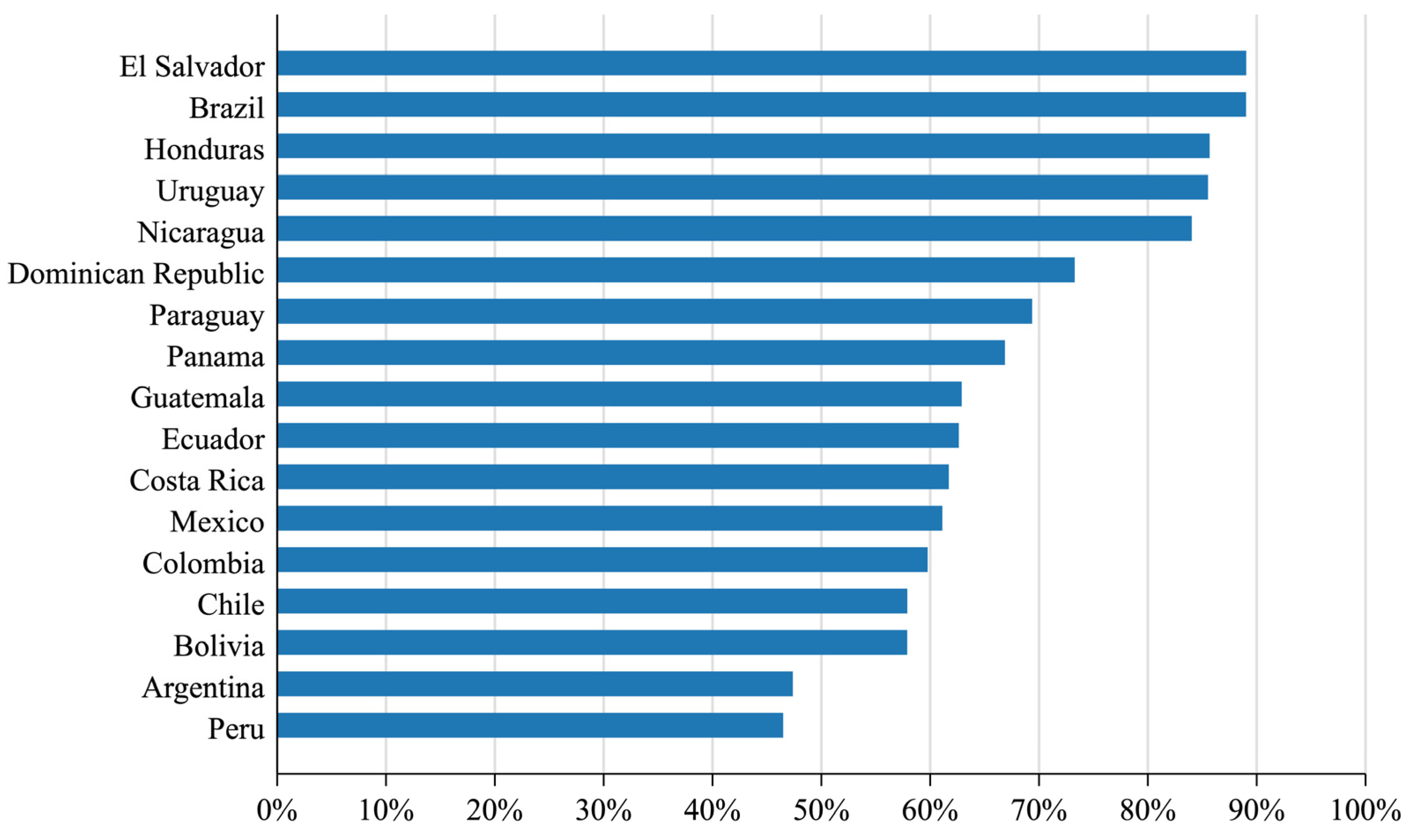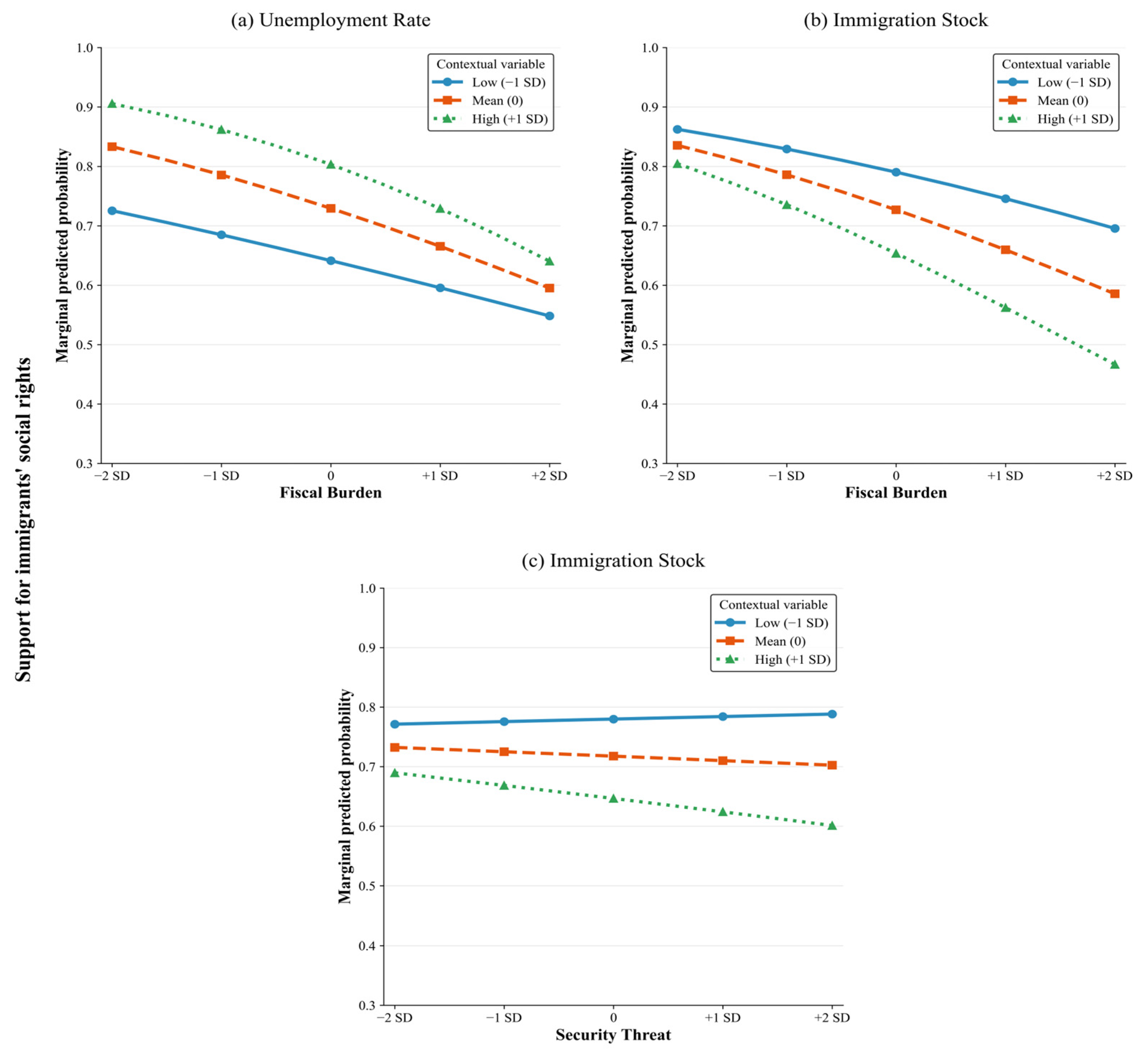

A Multilevel Analysis of Support for Immigrants’ Social Rights in Latin America


Abstract
1. Introduction
2. Theoretical Background
2.1. Intergroup Threat Theory (ITT)
2.2. Extending ITT: The Threat-Benefit Model (TBM)
Realistic (Economic) and Symbolic (Cultural) Benefits
2.3. Political Ideology
2.4. Contextual Factors and Cross-Level Interactions
3. Data and Methods
3.1. Data and Sample
3.2. Measurement
3.3. Statistical Data Analysis Techniques
4. Results
5. Conclusions
Funding
Institutional Review Board Statement
Informed Consent Statement
Data Availability Statement
Conflicts of Interest
References
- Abbondanza, Gabriele. 2025. The Foreign Policy of Irregular Migration Governance: State Security and Migrants’ Insecurity in Italy and Australia. London and New York: Routledge. [Google Scholar]
- Acosta, Diego. 2018. The National Versus the Foreigner in South America: 200 Years of Migration and Citizenship Law. Cambridge: Cambridge University Press. [Google Scholar]
- Alesina, Alberto, and Marco Tabellini. 2024. The political effects of immigration: Culture or economics? Journal of Economic Literature 62: 5–46. [Google Scholar] [CrossRef] [Scilit]
- Alesina, Alberto, Armando Miano, and Stefanie Stantcheva. 2023. Immigration and redistribution. The Review of Economic Studies 90: 1–39. [Google Scholar] [CrossRef] [Scilit]
- Allen, William L., Mariña Fernández-Reino, and Isabel Ruiz. 2025. Immigration and the welfare state. Oxford Review of Economic Policy 41: 64–86. [Google Scholar] [CrossRef] [Scilit]
- Alvaredo, Facundo, François Bourguignon, Francisco H. G. Ferreira, and Nora Lustig. 2025. Inequality bands: Seventy-five years of measuring income inequality in Latin America. Oxford Open Economics 4: i9–i35. [Google Scholar] [CrossRef] [Scilit]
- Argote, Pablo, and Lucas Perelló. 2024. Explaining the Impact of South-South Migration: Evidence from Chile’s Immigration Boom. Journal of International Migration and Integration 25: 2071–93. [Google Scholar] [CrossRef] [Scilit]
- Baranauskas, Andrew J., and Jacob I. Stowell. 2025. Perceptions of Immigrants as a Criminal Threat: The Role of Negative Affect and Ethnocentrism. Race and Justice 15: 92–118. [Google Scholar] [CrossRef] [Scilit]
- Bartasevičius, Vainius, and Ivan Trunov. 2024. Association between dimensions of national identity and immigration attitudes: A meta-analysis. International Journal of Intercultural Relations 102: 102031. [Google Scholar] [CrossRef] [Scilit]
- Bell, Andrew, Kelvyn Jones, and Malcolm Fairbrother. 2018. Understanding and misunderstanding group mean centering: A commentary on Kelley et al.’s dangerous practice. Quality & Quantity 52: 2031–36. [Google Scholar]
- Bell, David Andreas, and Marko Valenta. 2024. Who would never grant them equal rights? A comparative analysis of welfare chauvinism in Central and Eastern Europe. European Journal of Social Work 27: 1287–302. [Google Scholar] [CrossRef] [Scilit]
- Bell, David Andreas, and Marko Valenta. 2025. Outside the Western bubble: Explaining anti-immigrant attitudes in 28 post-communist countries. Nations and Nationalism 31: 668–88. [Google Scholar] [CrossRef] [Scilit]
- Bell, David Andreas, Marko Valenta, and Zan Strabac. 2023. Perceptions and realities: Explaining welfare chauvinism in Europe. Journal of European Social Policy 33: 301–16. [Google Scholar] [CrossRef] [Scilit]
- Benoit, Verena. 2021. Opposing immigrants in Europe: The interplay between religiosity, values, and threat. Journal for the Scientific Study of Religion 60: 555–89. [Google Scholar] [CrossRef] [Scilit]
- Bessen, Brett R., Brendan J. Connell, and Ken Stallman. 2025. Fairweather cosmopolitans: Immigration attitudes in Latin America during the migrant crisis. Latin American Politics and Society 67: 75–95. [Google Scholar] [CrossRef] [Scilit]
- Billiet, Jaak, Bart Meuleman, and Hans De Witte. 2014. The relationship between ethnic threat and economic insecurity in times of economic crisis: Analysis of European Social Survey data. Migration Studies 2: 135–61. [Google Scholar] [CrossRef] [Scilit]
- Blinder, Scott, and Lydia Lundgren. 2019. Roots of group threat: Anti-prejudice motivations and implicit bias in perceptions of immigrants as threats. Ethnic and Racial Studies 42: 1971–89. [Google Scholar] [CrossRef] [Scilit]
- Boateng, Francis D., Wesley S. McCann, Joselyne L. Chenane, and Daniel K. Pryce. 2021. Perception of immigrants in Europe: A multilevel assessment of macrolevel conditions. Social Science Quarterly 102: 209–27. [Google Scholar] [CrossRef] [Scilit]
- Bollinger, Christopher R., Barry T. Hirsch, Charles M. Hokayem, and James P. Ziliak. 2019. Trouble in the tails: What we know about earnings nonresponse 30 years after Lillard, Smith, and Welch. Journal of Political Economy 127: 2143–85. [Google Scholar] [CrossRef] [Scilit]
- Brady, David, and Ryan Finnigan. 2014. Does immigration undermine public support for social policy? American Sociological Review 79: 17–42. [Google Scholar] [CrossRef] [Scilit]
- Breznau, Nate, and Maureen A. Eger. 2016. Immigrant presence, group boundaries, and support for the welfare state in Western European societies. Acta Sociologica 59: 195–214. [Google Scholar] [CrossRef] [Scilit]
- Burgoon, Brian, and Matthijs Rooduijn. 2021. ‘Immigrationization’ of welfare politics? Anti-immigration and welfare attitudes in context. West European Politics 44: 177–203. [Google Scholar] [CrossRef] [Scilit]
- Careja, Romana, and Eloisa Harris. 2022. Thirty years of welfare chauvinism research: Findings and challenges. Journal of European Social Policy 32: 212–24. [Google Scholar] [CrossRef] [Scilit]
- Carranza, Rafael, Mauricio De Rosa, and Ignacio Flores. 2023. Wealth inequality in Latin America. IDB Working Paper Series No IDB-WP-01483. Washington, DC: Inter-American Development Bank. [Google Scholar] [CrossRef] [Scilit]
- Chang Kang, Woo, and Emily Look. 2020. Inequality and attitudes toward immigration: The native-immigrant gap in Australia. Australian Journal of Political Science 55: 257–75. [Google Scholar] [CrossRef] [Scilit]
- Cooray, Arusha, Abdeslam Marfouk, and Maliha Nazir. 2018. Public Opinion and immigration: Who favours employment discrimination against immigrants? International Migration 56: 5–23. [Google Scholar] [CrossRef] [Scilit]
- Crepaz, Markus M. L. 2022. Introduction to the handbook on migration and welfare: The contours of contested concepts. In Handbook on Migration and Welfare. Edited by Markus M. L. Crepaz. Cheltenham and Northampton: Edward Elgar Publishing, pp. 1–11. [Google Scholar]
- Dancygier, Rafaela, and Yotam Margalit. 2020. The evolution of the immigration debate: Evidence from a new dataset of party positions over the last half-century. Comparative Political Studies 53: 734–74. [Google Scholar] [CrossRef] [Scilit]
- Davidov, Eldad, Daniel Seddig, Anastasia Gorodzeisky, Rebeca Raijman, Peter Schmidt, and Moshe Semyonov. 2020. Direct and indirect predictors of opposition to immigration in Europe: Individual values, cultural values, and symbolic threat. Journal of Ethnic and Migration Studies 46: 553–73. [Google Scholar] [CrossRef] [Scilit]
- Dempster, Helen, Amy Leach, and Karen Hargrave. 2020. Public Attitudes Towards Immigration and Immigrants. London: ODI. [Google Scholar]
- Dražanová, Lenka. 2022. Sometimes it is the little things: A meta-analysis of individual and contextual determinants of attitudes toward immigration (2009–2019). International Journal of Intercultural Relations 87: 85–97. [Google Scholar] [CrossRef] [Scilit]
- Dražanová, Lenka, and Jérôme Gonnot. 2023. Attitudes toward immigration in Europe: Cross-regional differences. Open Research Europe 3: 66. [Google Scholar] [CrossRef] [Scilit] [PubMed]
- Dražanová, Lenka, Jérôme Gonnot, Tobias Heidland, and Finja Krüger. 2024. Which individual-level factors explain public attitudes toward immigration? A meta-analysis. Journal of Ethnic and Migration Studies 50: 317–40. [Google Scholar] [CrossRef] [Scilit]
- Eger, Maureen A., and Andrea Bohman. 2016. The political consequences of contemporary immigration. Sociology Compass 10: 877–92. [Google Scholar] [CrossRef] [Scilit]
- Elff, Martin, Jan Paul Heisig, Merlin Schaeffer, and Susumu Shikano. 2021. Multilevel analysis with few clusters: Improving likelihood-based methods to provide unbiased estimates and accurate inference. British Journal of Political Science 51: 412–26. [Google Scholar] [CrossRef] [Scilit]
- Esipova, Nelli, Julie Ray, and Anita Pugliese. 2020. World Grows Less Accepting of Migrants. Washington, DC: Gallup. Available online: https://news.gallup.com/poll/320678/world-grows-less-accepting-migrants.aspx (accessed on 23 May 2023).
- Esses, Victoria M. 2021. Prejudice and discrimination toward immigrants. Annual Review of Psychology 72: 503–31. [Google Scholar] [CrossRef] [Scilit]
- Finch, W. Holmes, Jocelyn E. Bolin, and Ken Kelley. 2024. Multilevel Modeling Using R, 3rd ed. Boca Raton: CRC Press. Boca Raton: Taylor & Francis. [Google Scholar]
- FitzGerald, David Scott, and David Cook-Martín. 2014. Culling the Masses: The Democratic Origins of Racist Immigration Policy in the Americas. Cambridge, MA: Harvard University Press. [Google Scholar]
- Ford, Robert, and Jonathan Mellon. 2020. The skills premium and the ethnic premium: A cross-national experiment on European attitudes to immigrants. Journal of Ethnic and Migration Studies 46: 512–32. [Google Scholar] [CrossRef] [Scilit]
- Franko, Katja. 2026. Criminal Justice in the Age of Crimmigration. Annual Review of Criminology 9: 297–316. [Google Scholar] [CrossRef] [Scilit]
- García-Muñoz, Teresa María, and Juliette Milgram-Baleix. 2021. Explaining attitudes towards immigration: The role of economic factors. Politics and Governance 9: 159–73. [Google Scholar] [CrossRef] [Scilit]
- Gootjes, Frank, Toon Kuppens, Tom Postmes, and Ernestine Gordijn. 2021. Disentangling societal discontent and intergroup threat: Explaining actions towards refugees and towards the state. International Review of Social Psychology 34: 8. [Google Scholar] [CrossRef] [Scilit]
- Grund, Simon, Oliver Lüdtke, and Alexander Robitzsch. 2018. Multiple imputation of missing data for multilevel models: Simulations and recommendations. Organizational Research Methods 21: 111–49. [Google Scholar] [CrossRef] [Scilit]
- Grund, Simon, Oliver Lüdtke, and Alexander Robitzsch. 2026. Multiple imputation of multilevel data with single-level models: A fully conditional specification approach using adjusted group means. Behavior Research Methods 58: 76. [Google Scholar] [CrossRef] [Scilit]
- Gu, Yanfeng, Xingxi Zhang, and Zhiwen Lin. 2022. Factors affecting attitudes toward migrants: An international comparative study. Chinese Political Science Review 7: 234–58. [Google Scholar] [CrossRef] [Scilit]
- Gugushvili, Dimitri, Laura Ravazzini, Michael Ochsner, Martin Lukac, Orsolya Lelkes, Marcel Fink, Peter Grand, and Wim Van Oorschot. 2021. Welfare solidarities in the age of mass migration: Evidence from European Social Survey 2016. Acta Politica 56: 351–75. [Google Scholar] [CrossRef] [Scilit]
- Hainmueller, Jens, and Daniel J. Hopkins. 2014. Public attitudes toward immigration. Annual Review of Political Science 17: 225–49. [Google Scholar] [CrossRef] [Scilit]
- Harris, Jeremy, Thomas Liebig, and David Khoudour, eds. 2023. How Do Migrants Fare in Latin America and the Caribbean? Mapping Socio-Economic Integration. Washington, DC: Inter-American Development Bank. Washington, DC: OECD. Washington, DC: UNDP. [Google Scholar]
- He, Yulei, Guangyu Zhang, and Chiu-Hsieh Hsu. 2022. Multiple Imputation of Missing Data in Practice: Basic Theory and Analysis Strategies. Boca Raton: CRC Press. [Google Scholar]
- Heizmann, Boris, and Nora Huth. 2021. Economic conditions and perceptions of immigrants as an economic threat in Europe: Temporal dynamics and mediating processes. International Journal of Comparative Sociology 62: 56–82. [Google Scholar] [CrossRef] [Scilit]
- Hlasny, Vladimir. 2020. Nonresponse bias in inequality measurement: Cross-country analysis using Luxembourg Income Study surveys. Social Science Quarterly 101: 712–31. [Google Scholar] [CrossRef] [Scilit]
- Hox, Joop J., Mirjam Moerbeek, and Rens van de Schoot. 2018. Multilevel Analysis: Techniques and Applications, 3rd ed. New York: Routledge. [Google Scholar]
- Jabkowski, Piotr, and Aneta Piekut. 2024. Not random and not ignorable. An examination of nonresponse to income question in the European Social Survey. Field Methods 36: 213–28. [Google Scholar] [CrossRef] [Scilit]
- Jaime-Castillo, Antonio M., Ildefonso Marqués-Perales, and Javier Álvarez-Gálvez. 2016. The impact of social expenditure on attitudes towards immigration in Europe. Social Indicators Research 126: 1089–108. [Google Scholar] [CrossRef] [Scilit]
- Kleider, Hanna. 2022. What explains opposition to immigration: Economic anxiety, cultural threat, or both? In Handbook on Migration and Welfare. Edited by Markus M. L. Crepaz. Cheltenham and Northampton: Edward Elgar Publishing, pp. 338–50. [Google Scholar]
- Knotz, Carlo M., Alyssa M. Taylor, Mia K. Gandenberger, and Juliana Chueri. 2025. What drives opposition to social rights for immigrants? Clarifying the role of psychological predispositions. Political Studies 73: 101–25. [Google Scholar] [CrossRef] [Scilit]
- Kocijan, Bojana, and Marko Kukec. 2022. Immigration attitudes among western and eastern European MPs: Social identity, economic aspects and political ideology. Comparative European Politics 20: 33–52. [Google Scholar] [CrossRef] [Scilit]
- Koning, Edward Anthony. 2022. Welfare chauvinist or neoliberal opposition to immigrant welfare? The importance of measurement in the study of welfare chauvinism. In Handbook on Migration and Welfare. Edited by Markus M. L. Crepaz. Cheltenham and Northampton: Edward Elgar Publishing, pp. 156–74. [Google Scholar]
- Koning, Edward Anthony, and Neeraj Kaushal. 2024. The role of politics in public views about immigrants. Journal of International Migration and Integration 25: 2095–122. [Google Scholar] [CrossRef] [Scilit]
- Kosic, Ankica, Silvia Andreassi, Barbara Cordella, Serena De Dominicis, Alessandro Gennaro, Salvatore Iuso, Skaiste Kerusauskaite, Terri Mannarini, Matteo Reho, Giulia Rocchi, and et al. 2023. Perceiving migrants as a threat: The role of the estimated number of migrants and symbolic universes. Genealogy 7: 99. [Google Scholar] [CrossRef] [Scilit]
- Kukk, Merike, Alari Paulus, and Karsten Staehr. 2020. Cheating in Europe: Underreporting of self-employment income in comparative perspective. International Tax and Public Finance 27: 363–90. [Google Scholar] [CrossRef] [Scilit]
- Kukk, Merike, and Karsten Staehr. 2017. Identification of households prone to income underreporting: Employment status or reported business income? Public Finance Review 45: 599–627. [Google Scholar] [CrossRef] [Scilit]
- Kustov, Alexander. 2019. Is there a backlash against immigration from richer countries? International hierarchy and the limits of group threat. Political Psychology 40: 973–1000. [Google Scholar] [CrossRef] [Scilit]
- Kwon, Ronald, William J. Scarborough, and Roberto Gallardo. 2024. Configurations of attitudes toward immigration in Europe: Evidence of polarization, ambivalence, and multidimensionality. Comparative Migration Studies 12: 25. [Google Scholar] [CrossRef] [Scilit]
- Laaker, Dillon. 2024. Economic shocks and the development of immigration attitudes. British Journal of Political Science 54: 220–40. [Google Scholar] [CrossRef] [Scilit]
- Larrañaga, Osvaldo, Benjamín Echecopar, and Nicolás Grau. 2022. Una nueva estimación de la desigualdad de ingresos en Chile. Estudios Públicos 167: 45–76. [Google Scholar] [CrossRef] [Scilit]
- Laurence, James, and Harris Hyun-soo Kim. 2023. Foreign-Born Population Growth, Negative Outgroup Contact, and Americans’ Attitudes towards legal and unauthorized immigration. Political Studies 71: 175–97. [Google Scholar] [CrossRef] [Scilit]
- Leykin, Inna, and Anastasia Gorodzeisky. 2024. Is anti-immigrant sentiment owned by the political right? Sociology 58: 3–22. [Google Scholar] [CrossRef] [Scilit]
- Lustig, Nora, and Andrea Vigorito. 2025. The “Missing Rich” in Household Surveys: Causes and Correction Approaches. Extended Version with Technical Appendixes. Serie Documentos de Trabajo DT 03/2025. Montevideo: Instituto de Economía, Facultad de Ciencias Económicas y Administración, Universidad de la República, Uruguay. [Google Scholar]
- Lutz, Philip. 2025. Do immigrants at bay keep the xenophobes away? Post-entry rights and public opposition to immigrant admission. European Political Science Review 17: 128–42. [Google Scholar] [CrossRef] [Scilit]
- Mainwaring, Scott. 2018. Party Systems in Latin America: Institutionalization, Decay, and Collapse. Cambridge: Cambridge University Press. [Google Scholar]
- Marroquin, Andres, and Antonio Saravia. 2022. Perception of immigrants in Latin America. Migration Letters 19: 95–106. [Google Scholar] [CrossRef] [Scilit]
- Mau, Steffen, and Christoph Burkhardt. 2009. Migration and welfare state solidarity in Western Europe. Journal of European Social Policy 19: 213–29. [Google Scholar] [CrossRef] [Scilit]
- McAuliffe, Marie, and Anna Triandafyllidou, eds. 2021. World Migration Report 2022. Geneva: International Organization for Migration (IOM). [Google Scholar]
- McAuliffe, Marie, and Linda Adhiambo Oucho, eds. 2024. World Migration Report 2024. Geneva: International Organization for Migration (IOM). [Google Scholar]
- McNeish, Daniel. 2017. Challenging conventional wisdom for multivariate statistical models with small samples. Review of Educational Research 87: 1117–51. [Google Scholar] [CrossRef] [Scilit]
- Mepham, Kieran, and Maykel Verkuyten. 2017. Citizenship representations, group indispensability and attitudes towards immigrants’ rights. International Journal of Intercultural Relations 61: 52–62. [Google Scholar] [CrossRef] [Scilit]
- Meseguer, Covadonga, and Achim Kemmerling. 2018. What do you fear? Anti-Immigrant Sentiment in Latin America. International Migration Review 52: 236–72. [Google Scholar] [CrossRef] [Scilit]
- Meuleman, Bart, Eldad Davidov, and Jaak B. Billiet. 2018. Modeling multiple-country repeated cross-sections. A societal growth curve model for studying the effect of the economic crisis on perceived ethnic threat. Methods, Data, Analyses 12: 185–210. [Google Scholar]
- Miller, Steven V. 2023. Economic anxiety or ethnocentrism? An evaluation of attitudes toward immigration in the U. S. from 1992 to 2017. The Social Science Journal 60: 818–37. [Google Scholar] [CrossRef] [Scilit]
- Mize, Trenton D. 2019. Best practices for estimating, interpreting, and presenting nonlinear interaction effects. Sociological Science 6: 81–117. [Google Scholar] [CrossRef] [Scilit]
- Moore, Jeffrey C., Linda L. Stinson, and Edward J. Welniak. 2000. Income measurement error in surveys: A review. Journal of Official Statistics 16: 331–61. [Google Scholar]
- Murard, Elie. 2022. Immigration and preferences for redistribution: Empirical evidence and political implications of the progressives’ dilemma in Europe. In Handbook on Migration and Welfare. Edited by Markus M. L. Crepaz. Cheltenham and Northampton: Edward Elgar Publishing, pp. 118–36. [Google Scholar]
- Nakagawa, Shinichi, Paul C. D. Johnson, and Holger Schielzeth. 2017. The coefficient of determination and intra-class correlation coefficient from generalized linear mixed-effects models revisited and expanded. Journal of the Royal Society Interface 14: 20170213. [Google Scholar] [CrossRef] [Scilit]
- Niedzwiecki, Sara. 2026. Immigrants’ Barriers to Accessing Social Policy in Argentina and Chile. International Migration Review 60: 231–64. [Google Scholar] [CrossRef] [Scilit]
- Norris, Pippa. 2005. Radical Right: Voters and Parties in the Electoral Market. Cambridge: Cambridge University Press. [Google Scholar]
- Norris, Pippa, and Ronald Inglehart. 2019. Cultural Backlash: Trump, Brexit, and Authoritarian Populism. Cambridge: Cambridge University Press. [Google Scholar]
- Pari-Bedoya, Ilda Nadia Monica De La Asuncion. 2026. The securitization of the Peruvian-Chilean border and the criminalization of the migrant in the discourse of Sin Fronteras (Tacna, Peru). Frontiers in Political Science 7: 1695959. [Google Scholar] [CrossRef] [Scilit]
- Peresman, Adam, Royce Carroll, and Hanna Bäck. 2023. Authoritarianism and immigration attitudes in the UK. Political Studies 71: 616–33. [Google Scholar] [CrossRef] [Scilit]
- Poirier, Mathieu J. P., Karen A. Grépin, and Michel Grignon. 2020. Approaches and alternatives to the wealth index to measure socioeconomic status using survey data: A critical interpretive synthesis. Social Indicators Research 148: 1–46. [Google Scholar] [CrossRef] [Scilit]
- Rabe-Hesketh, Sophia, and Anders Skrondal. 2022. Multilevel and Longitudinal Modeling Using Stata, 4th ed. College Station: Stata Press. [Google Scholar]
- Rubin, Donald Bruce. 1987. Multiple Imputation for Nonresponse in Surveys. New York: John Wiley & Sons. [Google Scholar]
- Ruist, Joakim. 2016. How the macroeconomic context impacts on attitudes to immigration: Evidence from within-country variation. Social Science Research 60: 125–34. [Google Scholar] [CrossRef] [Scilit]
- Rydgren, Jens. 2018. The Radical Right: An Introduction. In The Oxford Handbook of The Radical Right. Edited by Jens Rydgren. New York: Oxford University Press, pp. 23–39. [Google Scholar]
- Sánchez-Sibony, Omar. 2024. Why Latin American Parties Are Not Coming Back. Latin American Politics and Society 66: 164–93. [Google Scholar] [CrossRef] [Scilit]
- Schmidt-Catran, Alexander W., and Christian S. Czymara. 2023. Political elite discourses polarize attitudes toward immigration along ideological lines. A comparative longitudinal analysis of Europe in the twenty-first century. Journal of Ethnic and Migration Studies 49: 85–109. [Google Scholar] [CrossRef] [Scilit]
- Sipinen, Josefina, Peter Söderlund, and Maria Bäck. 2020. The relevance of contextual generalised trust in explaining individual immigration sentiments. European Societies 22: 456–79. [Google Scholar] [CrossRef] [Scilit]
- Stumpf, Juliet. 2006. The crimmigration crisis: Immigrants, crime, and sovereign power. American University Law Review 56: 367–419. [Google Scholar]
- Talani, Leila Simona, and Matilde Rosina. 2025. The Migration Question: Politics, Economics and the Failure of Border Security. Oxford and New York: Oxford University Press. [Google Scholar]
- Tartakovsky, Eugene, and Sophie D. Walsh. 2016. Testing a New Conceptual Model for Attitudes Toward Immigrants: A Case of Social Workers’ Attitudes Toward Asylum Seekers in Israel. Journal of Cross-Cultural Psychology 47: 72–96. [Google Scholar] [CrossRef] [Scilit]
- Tartakovsky, Eugene, and Sophie D. Walsh. 2020. Are some immigrants more equal than others? Applying a threat-benefit model to understanding the appraisal of different immigrant groups by the local population. Journal of Ethnic and Migration Studies 46: 3955–73. [Google Scholar] [CrossRef] [Scilit]
- Thomsen, Jens Peter Frølund, and Arzoo Rafiqi. 2019. The impact of mass-level ideological orientations on immigration policy preferences over time. Italian Political Science Review/Rivista Italiana Di Scienza Politica 49: 279–91. [Google Scholar] [CrossRef] [Scilit]
- Thomsen, Jens Peter Frølund, and Arzoo Rafiqi. 2020. Ideological biases weaken the impact of social trust on ethnic outgroup threat. Political Studies 68: 523–40. [Google Scholar] [CrossRef] [Scilit]
- Turner, Thomas, and Christine Cross. 2015. Do attitudes to immigrants change in hard times? Ireland in a European context. European Societies 17: 372–95. [Google Scholar] [CrossRef] [Scilit]
- Umansky, Karen, Daniela Weber, and Wolfgang Lutz. 2025. Revisiting the role of education in attitudes toward immigration in different contexts in Europe. Genus 81: 1. [Google Scholar] [CrossRef] [Scilit]
- Valentino, Nicholas A., Stuart N. Soroka, Shanto Iyengar, Toril Aalberg, Raymond Duch, Marta Fraile, Kyu S. Hahn, Kasper M. Hansen, Allison Harell, Marc Helbling, and et al. 2019. Economic and cultural drivers of immigrant support worldwide. British Journal of Political Science 49: 1201–26. [Google Scholar] [CrossRef] [Scilit]
- Valenzuela, Marcus A., Seth J. Schwartz, and Hanna Zagefka. 2024. Benefits over threats associated with host-country nationals’ acculturation preferences: Examining a stereotype content and threat benefit model. Group Processes & Intergroup Relations 27: 1501–18. [Google Scholar] [CrossRef] [Scilit]
- Van Hauwaert, Steven M. 2023. Immigration as a thermostat? Public opinion and immigration policy across Western Europe (1980–2017). Journal of European Public Policy 30: 2665–91. [Google Scholar] [CrossRef] [Scilit]
- Vargas-Maia, Tatiana, and Rosana Pinheiro-Machado. 2023. Introduction: A new radical right in the global South? In The Rise of The Radical Right in The Global South. Edited by Tatiana Vargas-Maia and Rosana Pinheiro-Machado. New York: Routledge, pp. 1–14. [Google Scholar]
- Verkuyten, Maykel, Rachel Kollar, Jessica Gale, and Kumar Yogeeswaran. 2022. Right-wing political orientation, national identification and the acceptance of immigrants and minorities. Personality and Individual Differences 184: 111217. [Google Scholar] [CrossRef] [Scilit]
- Vogt Isaksen, Joachim. 2019. The impact of the financial crisis on European attitudes toward immigration. Comparative Migration Studies 7: 24. [Google Scholar] [CrossRef] [Scilit]
- Walsh, Sophie D., and Eugene Tartakovsky. 2020. Receiving Population Appraisal as Potential Risk or Resilience for Immigrant Adaptation: The Threat-Benefit Model. In Contextualizing Immigrant and Refugee Resilience Cultural and Acculturation Perspectives. Edited by Derya Güngör and Dagmar Strohmeier. Cham: Springer, pp. 75–98. [Google Scholar]
- Walsh, Sophie D., and Eugene Tartakovsky. 2021. Personal Value Preferences, Threat-Benefit Appraisal of Immigrants and Levels of Social Contact: Looking Through the Lens of the Stereotype Content Model. Frontiers in Psychology 12: 609219. [Google Scholar] [CrossRef] [Scilit] [PubMed]
- Young, Yvette, Peter Loebach, and Kim Korinek. 2018. Building walls or opening borders? Global immigration policy attitudes across economic, cultural and human security contexts. Social Science Research 75: 83–95. [Google Scholar] [CrossRef] [Scilit]
- Zhang, Yichi, and Mark H. C. Lai. 2024. Evaluating two small sample corrections for fixed-effects standard errors and inferences in multilevel models with heteroscedastic, unbalanced, clustered data. Behavior Research Methods 56: 5930–46. [Google Scholar] [CrossRef] [Scilit] [PubMed]
- Ziller, Conrad, and Romana Careja. 2022. Personal and contextual foundations of welfare chauvinism in Western Europe. In Handbook on Migration and Welfare. Edited by Markus M. L. Crepaz. Cheltenham and Northampton: Edward Elgar Publishing, pp. 175–93. [Google Scholar]



| Model 1 | Model 2 | Model 3 | Model 4 | |
|---|---|---|---|---|
| Individual-level variables | ||||
| Sociodemographic characteristics | ||||
| Sex [1 = female] | −0.015 | −0.015 | −0.015 | −0.015 |
| Age groups | −0.049 * | −0.049 * | −0.049 * | −0.049 * |
| Education | −0.016 | −0.016 | −0.016 | −0.016 |
| Socioeconomic status | 0.000 | 0.000 | 0.000 | 0.000 |
| Country’s economic situation | ||||
| Perception of country’s economic situation | 0.050 | 0.050 | 0.050 | 0.050 |
| Perceived threats | ||||
| Fiscal burden | −0.356 *** | −0.356 *** | −0.356 *** | −0.356 *** |
| Labor market competition | 0.025 | 0.025 | 0.025 | 0.025 |
| Security threat | −0.041 | −0.041 | −0.041 | −0.041 |
| Perceived benefits | ||||
| Economic benefits | 0.382 *** | 0.382 *** | 0.382 *** | 0.382 *** |
| Cultural benefits | 0.470 *** | 0.470 *** | 0.470 *** | 0.470 *** |
| Political ideology (ref. category = Left) | ||||
| Center | −0.050 | −0.050 | −0.050 | −0.050 |
| Right | −0.047 | −0.047 | −0.047 | −0.047 |
| None | −0.204 * | −0.205 * | −0.204 * | −0.205 * |
| Country-level variables | ||||
| Annual GDP per capita growth rate | 0.001 | |||
| Unemployment rate | 0.455 *** | |||
| Immigration stock | −0.379 *** | |||
| Immigrant population growth rate | −0.289 *** | |||
| Random effects variance (country-level) | 0.703 | 0.577 | 0.575 | 0.633 |
| Marginal R2 (fixed) | 0.186 | 0.222 | 0.212 | 0.202 |
| Conditional R2 (total) | 0.330 | 0.338 | 0.329 | 0.331 |
| Individual-level N | 19,004 | 19,004 | 19,004 | 19,004 |
| Country-level N | 17 | 17 | 17 | 17 |
| Economic Context | Demographic Context | |||
|---|---|---|---|---|
| GDP Growth per Capita | Unemployment Rate | Immigrant Stock | Immigrant Growth Rate | |
| Perceived threats | ||||
| Fiscal burden | 0.106 | −0.123 * | −0.079 * | −0.000 |
| Labor market competition | 0.111 | −0.071 | −0.049 | 0.039 |
| Security threat | 0.089 | −0.090 | −0.070 * | 0.017 |
| Structural Context | Marginal Effect (b) | Robust SE | t(15) | Exact p-Value |
|---|---|---|---|---|
| Unemployment Rate | ||||
| Low (−1 SD) | −0.217 | (0.045) | −4.768 | <0.001 *** |
| Mean (0) | −0.337 | (0.043) | −7.820 | <0.001 *** |
| High (+1 SD) | −0.458 | (0.095) | −4.837 | <0.001 *** |
| Immigrant Stock | ||||
| Low (−1 SD) | −0.275 | (0.050) | −5.534 | <0.001 *** |
| Mean (0) | −0.353 | (0.049) | −7.194 | <0.001 *** |
| High (+1 SD) | −0.430 | (0.072) | −5.951 | <0.001 *** |
| Demographic Context | Marginal Effect (b) | Robust SE | t(15) | Exact p-Value |
|---|---|---|---|---|
| Immigrant Stock | ||||
| Low (−1 SD) | 0.028 | (0.041) | 0.694 | 0.498 |
| Mean (0) | −0.043 | (0.032) | −1.347 | 0.201 |
| High (+1 SD) | −0.114 | (0.047) | −2.424 | 0.029 * |
Disclaimer/Publisher’s Note: The statements, opinions and data contained in all publications are solely those of the individual author(s) and contributor(s) and not of MDPI and/or the editor(s). MDPI and/or the editor(s) disclaim responsibility for any injury to people or property resulting from any ideas, methods, instructions or products referred to in the content. |
© 2026 by the author. Licensee MDPI, Basel, Switzerland. This article is an open access article distributed under the terms and conditions of the Creative Commons Attribution (CC BY) license.
Share and Cite
Fierro, J. A Multilevel Analysis of Support for Immigrants’ Social Rights in Latin America. Soc. Sci. 2026, 15, 380. https://doi.org/10.3390/socsci15060380
Fierro J. A Multilevel Analysis of Support for Immigrants’ Social Rights in Latin America. Social Sciences. 2026; 15(6):380. https://doi.org/10.3390/socsci15060380
Chicago/Turabian StyleFierro, Jaime. 2026. "A Multilevel Analysis of Support for Immigrants’ Social Rights in Latin America" Social Sciences 15, no. 6: 380. https://doi.org/10.3390/socsci15060380
APA StyleFierro, J. (2026). A Multilevel Analysis of Support for Immigrants’ Social Rights in Latin America. Social Sciences, 15(6), 380. https://doi.org/10.3390/socsci15060380