1. Introduction
Myanmar migrant workers hold a contradictory role in Thailand’s labor economy. They are essential to labor-intensive sectors; nevertheless, their future association with Thailand is ambiguous. The Myanmar–Thailand corridor is a critical movement system in Southeast Asia. The
International Organization for Migration (
2025) estimates that 4.1 million Myanmar nationals lived in Thailand in early 2025, with 2,270,382 registered as migrant workers, constituting 68% of all registered migrants in the country. Samut Sakhon Province illustrates this connection. As a prominent hub for fisheries, seafood processing, and associated industries, it has historically depended on migrant labor, particularly from Myanmar, to maintain production and supply linkages. The primary question is not only why Myanmar workers travel to Thailand but also why some envision returning while others want to remain despite the uncertainties in Myanmar.
Return migration has emerged as a significant issue in migration studies due to its impact on migrants’ life trajectories, origin-country development, household welfare, labor market restructuring, and transnational social relations (
Hagan and Wassink 2020;
King and Kuschminder 2019;
Pauli 2021). The return migration intention is analytically valuable as it reflects migrants’ future orientation before actual relocation. It can influence decisions about savings, remittances, family relocation, social investments, and long-term labor market engagement. Simultaneously, expressed intention should not be seen as synonymous with actual return. Return migration intentions for Myanmar workers in Thailand may be influenced or hindered by finances, legal status, familial responsibilities, employment conditions, and perceived instability in their country of origin.
These concerns are particularly prominent among Myanmar migrant laborers in Thailand. A significant number are employed in labor-intensive industries characterized by legal instability, restricted bargaining power, and socially undervalued labor (
Griffiths and Ito 2016;
Mortensen 2024). Simultaneously, migration is frequently understood as transient and intentional rather than as a permanent residence. Workers may travel to amass savings, settle debts, assist family members, acquire land, construct a residence, or ensure a more stable livelihood upon their return (
Mortensen 2024;
Rhoden and Unger 2014;
Stark 2019). Remittances are intricately linked to household well-being and forward-looking familial policies in Myanmar (
Chantavanich and Vungsiriphisal 2012;
Myat 2020). The return migration intention is not merely an individual choice; it is linked to household strategy, labor retention, and the prospective availability of migrant labor in essential Thai industries.
Notwithstanding the growing body of research on return migration intentions, significant empirical gaps persist. A significant portion of the current information originates from alternative migration corridors or from migrant populations with labor-market characteristics that differ from those of Myanmar workers in Thailand (
Carling and Pettersen 2014;
Makina 2012). Current research frequently prioritizes a certain set of explanations, predominantly economic variables, while inadequately addressing the interplay of individual resources, familial responsibilities, job dynamics, social integration, and perspectives from the country of origin. This disparity is especially significant in Samut Sakhon, where migrants’ future aspirations are shaped by both the demand for industrial labor in Thailand and the political–economic instability in Myanmar. This study investigates the micro-, meso-, and macro-level determinants of return migration intention among Myanmar migrant workers in Samut Sakhon Province, Thailand. The article offers a multilayered explanation of return migration intentions by synthesizing individual and household resources, workplace and social experiences, and perceptions of conditions in Myanmar, while also presenting findings pertinent to migrant protection, labor retention, and migration governance.
2. Objective
This study aimed to examine the factors influencing the intention to return among Myanmar migrant workers in Samut Sakhon Province.
3. Conceptual Framework
The conceptual framework was derived from return migration theories and empirical research on Myanmar migrant laborers in Thailand. The study employs a multilevel framework to analyze the relationship between return migration intentions and individual and household resources, employment, and social experiences in Thailand, as well as perceived conditions in Myanmar, rather than testing a singular theory. This methodology is especially pertinent in Samut Sakhon, where the future aspirations of migrant workers are influenced by industrial labor demand, familial responsibilities, employment conditions, and uncertainties in their countries of origin.
Economic explanations establish the initial basis of the framework. From a neoclassical viewpoint, return may be linked to inadequate adaptation or restricted integration into the destination labor market. In contrast, the contemporary economics of labor migration perceives migration as a household strategy wherein workers relocate internationally to amass savings, mitigate risk, provide support to family members, and return upon reaching economic objectives or target earnings (
de Haas and Fokkema 2011;
de Haas et al. 2015;
Stark 2019). This rationale is evident among Myanmar workers in Thailand through remittances, loan repayment, land acquisition, house construction, and future livelihood planning in Myanmar (
Chantavanich and Vungsiriphisal 2012;
Mortensen 2024;
Myat 2020;
Rhoden and Unger 2014). These viewpoints contribute to the incorporation of income, savings, remittance patterns, familial obligations in Myanmar, and familial status in Thailand.
Economic resources by themselves do not dictate returns.
Cassarino’s (
2004) return preparedness framework distinguishes between willingness to return and readiness to return, highlighting the importance of resources, information, planning, and reintegration capacity. The aspirations–capabilities concept posits that mobility is contingent upon both aspiration and the ability to act within perceived opportunity structures (
Carling and Schewel 2018;
de Haas 2021). This study regards return migration intention as a prospective orientation rather than a straightforward forecast of actual return. A worker may wish to return but may be unable or reluctant to do so promptly due to inadequate resources, a precarious legal position, family commitments in Thailand, insufficient information, or ongoing insecurity in Myanmar. The 10–15-year timeframe encompasses returns as a medium- to long-term life course and household strategy rather than an instant mobility initiative.
The integration–transnationalism concept provides an additional foundation. Migrants assess the decision to remain or return based on their connections to both host and home countries (
Carling and Pettersen 2014). The presence of family in Thailand may stabilize workers in the host country, but familial duties in Myanmar and remittance responsibilities may foster a focus on ultimate repatriation. Social networks, ethnic or labor-group support, healthcare availability, and perceived quality of life in Thailand may influence perceptions of continued residence as secure and viable.
The third cornerstone of the framework is workplace experience. The intention to return among migrant workers is influenced not only by earnings but also by perceptions of fairness, dignity, recognition, and labor-market integration.
Schuss (
2016) emphasizes the significance of labor-market integration and discrimination in elucidating return migration. This is particularly pertinent to Myanmar workers in Thailand, many of whom are employed in labor-intensive industries characterized by legal uncertainty, limited bargaining power, and socially devalued employment (
Griffiths and Ito 2016;
Mortensen 2024). This study considers occupational discrimination as a meso-level factor that may diminish migrants’ commitment to Thailand, thereby rendering return a more appealing exit option. In contrast, improved employment prospects, advantageous job attributes, and contentment with remuneration and benefits may enhance integration into the destination country and diminish the intention to return to one’s home country.
Macro-level perceptions finalize the framework. Structural frameworks for return migration highlight that migrants evaluate the adequacy of safety, employment opportunities, and institutional assistance in their place of origin prior to deeming return viable (
King and Kuschminder 2019). For Myanmar migrant workers, these include perceptions of political stability, safety, employment prospects, labor regulation, and government actions to facilitate returns. These variables may render repatriation seemingly feasible or incentivize migrants to defer their return while still harboring a desire to return (
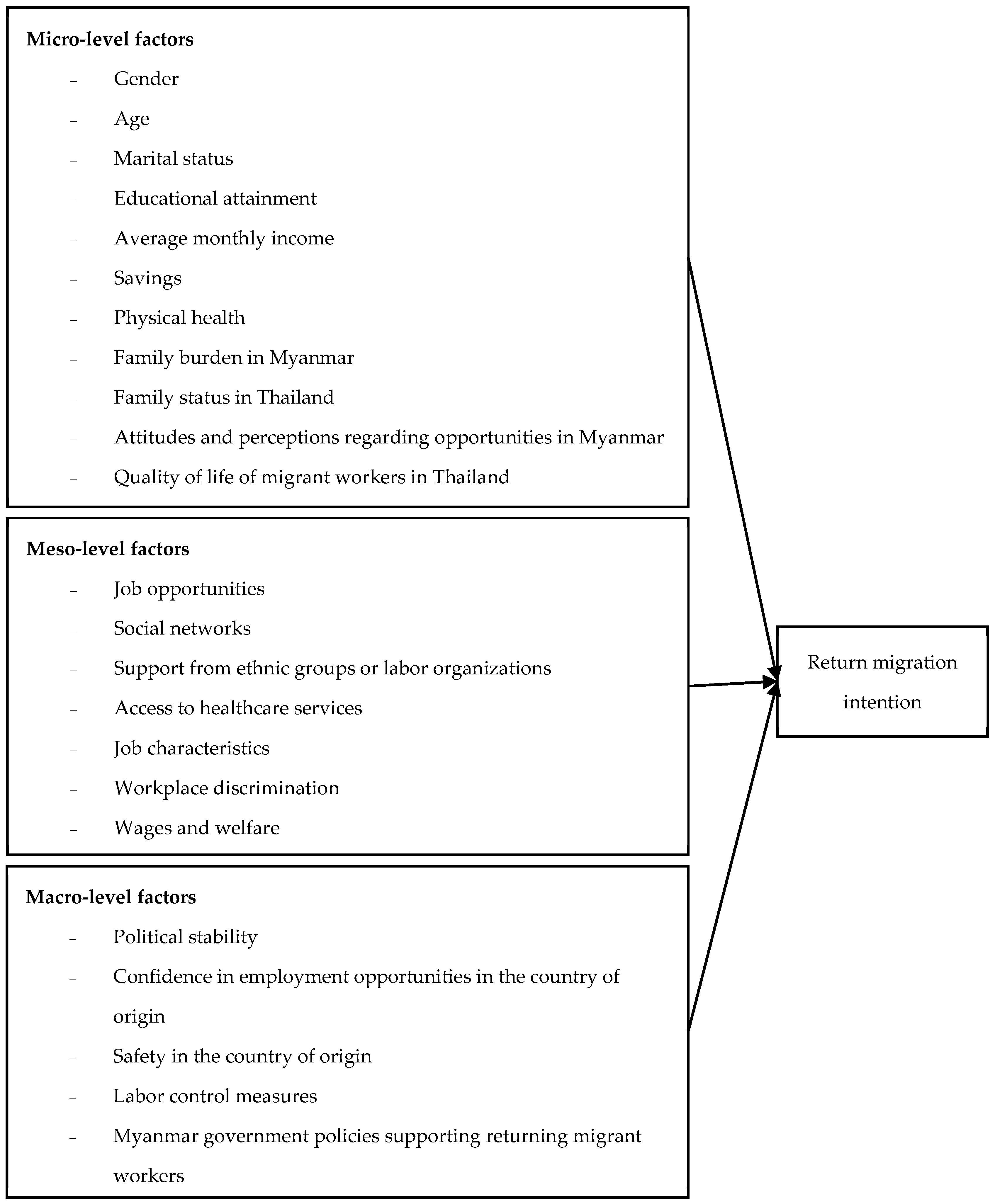
Figure 1).
The framework categorizes the factors influencing return migration intention into three tiers. The micro level encompasses individual and household resources and responsibilities, including gender, age, marriage status, educational attainment, income, savings, physical health, remittance behavior, familial status in Thailand, and perceptions of opportunities in Myanmar. The meso level encompasses workplace and social integration in Thailand, including quality of life, employment prospects, social networks, support for ethnic or labor organizations, access to healthcare, job attributes, workplace discrimination, and compensation and welfare. The macro level encompasses perceived conditions in the place of origin and migratory governance, including political stability, employment prospects in Myanmar, safety, labor control measures, and government initiatives in Myanmar aimed at promoting the return of migrants.
The approach regards return migration intention as a result of overlapping resources, obligations, workplace experiences, social connections, and perceived conditions in the country of origin. It does not presume that expressed intention invariably translates into a real outcome. It analyzes how migrants assess the desirability, feasibility, and compatibility of returning to their current or expected life situations.
4. Research Methodology
4.1. Population and Samples
The target demographic comprised Myanmar migrant laborers living and employed in Samut Sakhon Province, a principal industrial region in Thailand characterized by a significant influx of migrant labor. The reference population comprised 257,239 workers, categorized into three legal-status strata: workers recruited under Section 59 via the memorandum of understanding (MOU) system (28,321 individuals), workers registered under Section 63/2 according to the Cabinet resolution of 7 February 2023 (159,895 individuals), and workers registered under Section 63/2 in accordance with the Cabinet resolution of 3 October 2023 (69,023 individuals). The study employed proportional stratified random sampling to achieve a final sample of 506 respondents. The minimum requisite sample size was 460 instances, and the final objective was augmented by 10% to accommodate incomplete responses.
The legal-status categories indicate various pathways for regularization and work authorization for Myanmar migrant workers in Thailand. Section 59 pertains to employees officially enlisted via the bilateral Memorandum of Understanding framework between Thailand and Myanmar. Section 63/2 pertains to workers authorized to reside and engage in employment under interim regularization measures established by Thai Cabinet directives. The two Section 63/2 strata were delineated due to the Cabinet resolutions of 7 February 2023 and 3 October 2023, which indicated distinct registration cohorts and administrative requirements. This stratification guaranteed that the sample represented the legal and administrative diversity of Myanmar migrant laborers in Samut Sakhon Province.
Generative artificial intelligence was not used in the study design, data collection, data analysis, or interpretation of the findings.
4.2. Research Instrument
The principal tool utilized was a meticulously crafted questionnaire designed exclusively for this research. The questionnaire items were designed based on the conceptual framework, previous empirical research on Myanmar migrant workers in Thailand, and the operational definitions of micro-, meso-, and macro-level variables. The questionnaire comprised single-item background measures and three multi-item scales: (1) perceptions of opportunities in Myanmar and quality of life in Thailand, (2) job characteristics and workplace discrimination, and (3) labor control measures and Myanmar government policies concerning migrant labor. All three scales were constructed as five-point Likert-type instruments.
4.2.1. Operationalization of Variables
The dependent variable was the return migration intention, assessed by asking respondents whether they planned to return to Myanmar within the next 10 to 15 years. Responses were categorized as a binary outcome: “intend to return” and “do not intend to return.” The 10–15-year timeframe was chosen because the study frames return migration intention as a medium- to long-term future perspective rather than an urgent relocation plan. For labor migrants, repatriation is frequently associated with the acquisition of savings, debt settlement, children’s education, family establishment, career paths, and readiness for reintegration. A five-year span would likely convey short-term constraints, while a 10–15-year horizon more accurately represents return as a life-course and household strategy.
The independent variables were categorized into micro-, meso-, and macro-level categories. Micro-level variables include respondents’ personal traits, domestic conditions, and subjective evaluations of their living circumstances. The factors encompassed gender, age, marital status, educational attainment, monthly income, savings, physical health, remittance behavior as a measure of familial hardship in Myanmar, family status in Thailand, attitudes and perceptions towards opportunities in Myanmar, and quality of life in Thailand. The majority of these factors were assessed via single-item categorical questions. In contrast, attitudes and perceptions of opportunities in Myanmar and quality of life in Thailand were evaluated using Likert-type items. Quality of life pertains to respondents’ assessed capacity to live and work safely and securely in Thailand.
Meso-level factors encompassed respondents’ occupational and social experiences in Thailand. Job opportunities pertain to projected prospects for employment alteration or advancement. Social networks, assistance from ethnic communities or labor organizations, and the availability of healthcare services were assessed to evaluate respondents’ access to social, organizational, and health-related support. The job features evaluated were job–skill compatibility, working hours, workplace safety, and long-term employment stability. Workplace discrimination pertains to perceived inequitable, unjust, or exclusionary treatment based on nationality or ethnicity, unequal access to advancement or skill development, and inequitable treatment regarding compensation, benefits, or employment prospects. Items were scored such that elevated scores indicated a greater perception of workplace discrimination. Wages and welfare pertained to respondents’ contentment with salary levels, benefits, and occupational well-being.
Macro-level variables reflected the perceived conditions in Myanmar and the overarching migratory governance framework. The factors encompassed political stability, safety in the nation of origin, employment prospects in Myanmar, labor regulations, and governmental initiatives in Myanmar that facilitate the reintegration of returnees, including vocational training, financial aid, employment assistance, and reintegration support.
4.2.2. Validity and Reliability
The questionnaire’s content validity was assessed by three experts utilizing the Index of Congruence (IOC) method. The specialists evaluated the congruence among study objectives, operational definitions, and questionnaire items. Items with IOC values of 0.50 or greater were preserved. Following content validation, the instrument underwent pilot testing with 30 Myanmar migrant laborers who shared characteristics with those in the actual sample, although they were excluded from the primary study. Reliability was evaluated with Cronbach’s alpha (
Cronbach 1951). The three multi-item scales exhibited satisfactory internal consistency: perceptions of opportunities in Myanmar and quality of life in Thailand, α = 0.723; job features and workplace discrimination, α = 0.798; and labor control measures and Myanmar migrant labor policies, α = 0.794.
4.3. Collection of Data
The study addressed linguistic accessibility and power dynamics among researchers, fieldworkers, and participants as significant ethical and methodological concerns due to the involvement of Myanmar migrant workers. The questionnaire was translated into Burmese using a back-translation methodology, comprising forward translation, evaluation of the translated text, backward translation, comparison of the original and back-translated texts, and pre-testing prior to field deployment.
Data collection was facilitated by four bilingual fieldworkers from the Labour Rights Promotion Network (LPN). The fieldworkers were literate in both Thai and Burmese and knowledgeable about migrant groups. Their participation reduced language barriers, enhanced respondents’ understanding, and narrowed the social gap between the study team and participants. Prior to data collection, fieldworkers received training on study ethics, informed consent, confidentiality, impartiality in questionnaire delivery, and protocols for safeguarding participants against pressure or coercion.
The research team, affiliated with a Thai academic institution, did not share the same social, linguistic, or legal status as the Myanmar migrant workers involved in the study. To mitigate potential power disparities, the study employed bilingual fieldworkers who were trusted by migrant communities, emphasized voluntary participation, disseminated information in a comprehensible language, and guaranteed that refusal to participate would not impact access to services, employment, or legal status. Informed consent was secured prior to data collection, and no personally identifiable information was disclosed.
4.4. Data Analysis
The data were examined utilizing descriptive and inferential statistics. Descriptive statistics, encompassing frequency, percentage, mean, standard deviation, maximum, and minimum, encapsulated respondent attributes and scale-based factors. Bivariate analysis employed cross-tabulation, chi-square tests, and t-tests to investigate initial correlations between independent variables and the return migration intention. The concluding multivariate analysis utilized binary logistic regression to assess the relationships between micro-, meso-, and macro-level factors and the probability of planning to return.
Data were analyzed using IBM SPSS Statistics for Windows, Version 26.0 (IBM Corp., Armonk, NY, USA). Categorical predictors with several categories were dummy-coded based on the reference categories used in the logistic regression model, while continuous predictors were included in their original measure. Since IBM SPSS Statistics does not directly provide VIFs for binary logistic regression, a linear regression diagnostic model using the same predictors was used to assess multicollinearity. According to
Cohen (
2013), correlations exceeding 0.50 necessitated further examination. Tolerance values below 0.10 and VIF values exceeding 10 indicate significant multicollinearity.
The diagnostics revealed no significant multicollinearity. No pair of independent variables surpassed 0.50. Tolerance values ranged from 0.150 to 0.942, and VIF values ranged from 1.061 to 6.669. Despite workplace discrimination exceeding the conservative VIF criterion of 5, it remained below 10 and showed acceptable tolerance; it was retained due to its theoretical and substantive significance. The model’s fit and predictive ability were evaluated using the Hosmer–Lemeshow test and the area under the curve (AUC). The Hosmer–Lemeshow test revealed no indication of inadequate fit (χ2(8) = 15.105, p = 0.057). The AUC was 0.786, with standard error = 0.021 and 95% confidence interval [0.744, 0.827], p < 0.001. Due to the cross-sectional methodology and the quantity of factors, the results were interpreted as statistical connections rather than causal relationships.
5. Results
A total of 506 Myanmar migrant laborers in Samut Sakhon Province engaged in the study. The sample consisted primarily of females (58.1%), with the most significant age demographic being individuals aged 41 years and older (31.6%). A majority of respondents were married (46.8%) and had attained lower secondary education (37.7%). The predominant monthly income bracket was THB 10,001–15,000 (36.0%), and 38.3% indicated possessing savings. Moreover, 64.4% indicated having relatives in Thailand. Respondents indicated a generally positive quality of life in Thailand (mean = 3.60), high satisfaction with job attributes, compensation, and benefits, and a low perception of prejudice. In contrast, the majority of respondents regarded Myanmar as politically unstable and insecure.
Concerning the dependent variable, 204 respondents (40.3%) indicated an intention to return to Myanmar during the next 10–15 years, whereas 302 respondents (59.7%) expressed no such intention. Consequently, the predominant number of Myanmar migrant workers in this study did not want to return in the medium term.
The multivariate analysis identified multiple statistically significant predictors of return migration intention. The model exhibited a Nagelkerke pseudo-R2 of 0.304, indicating a reasonable level of explanatory power for return migration intention. Respondents aged 31–40 exhibited a lower likelihood of expressing an intention to return compared to those under 20 years (OR = 0.501, 95% CI [0.259, 0.969]). A higher monthly income correlated positively with the return migration intention: respondents earning THB 10,001–15,000 (OR = 2.581, 95% CI [1.379, 4.830]) and those earning over THB 15,000 (OR = 3.658, 95% CI [1.796, 7.450]) exhibited a greater likelihood of intending to return compared to individuals earning no more than THB 5000. Individuals who remitted funds annually exhibited a greater propensity to express intentions of return migration compared to those who did not remit at all (OR = 1.989, 95% CI [1.105, 3.583]). Conversely, having family in Thailand reduced the likelihood of wanting to return (OR = 0.386, 95% CI [0.242, 0.616]).
At the meso level, the perceived chance for work change or advancement exhibited a negative correlation with the desire to return migrate (OR = 0.480, 95% CI [0.243, 0.950]), as did contentment with earnings and welfare (OR = 0.523, 95% CI [0.283, 0.967]). Conversely, employment discrimination was identified as the most significant positive predictor in the model, increasing the likelihood of return migration intention by more than threefold (OR = 3.025, 95% CI [1.387, 6.597]).
At the macro level, perceived safety in Myanmar was associated with a reduced intention to return (OR = 0.418, 95% CI [0.272, 0.643]). In comparison to the group exhibiting the least confidence in job prospects in Myanmar, respondents indicating low (OR = 0.419, 95% CI [0.184, 0.956]), high (OR = 0.363, 95% CI [0.175, 0.755]), and very high confidence (OR = 0.400, 95% CI [0.188, 0.850]) were less inclined to express an intention to return (
Table 1).
Numerous theoretically relevant factors failed to remain statistically significant in the final logistic regression model. This does not imply that these variables are insignificant to migrants’ lives or their considerations regarding return. Their impacts may be indirect, context-dependent, or overshadowed by more immediate predictors in the model. Social networks, support from ethnic groups or labor organizations, and access to healthcare services may indirectly affect return migration intentions through quality of life, perceived security, family embeddedness, or professional experiences. Incorporating these more immediate characteristics into the model may have diminished the independent statistical significance of social support and service-access variables.
The negligible impact of job qualities indicates that the overarching attributes of employment may be less impactful than migrants’ subjective assessments of their work experiences. In this model, workplace discrimination, satisfaction with compensation and benefits, and anticipated prospects for job change or advancement were more directly linked to the intention to return to one’s home country than employment qualities as a general category. This pattern suggests that migrants’ future mobility orientation is likely influenced more significantly by specific workplace experiences of equity, compensation, and advancement than by the overall characteristics of the employment.
At the macro level, political stability, labor control measures, and government policies in Myanmar that promote the return of migrant workers were not statistically significant in the final model. This suggests that overarching political or policy perceptions are less significant than personally actionable evaluations, especially regarding perceived safety in Myanmar and perceived career prospects in the place of origin. Migrants may assess repatriation not only on abstract policy conditions but also on their perceptions of safety and employment security upon return.
The data together suggest that the return migration intention is linked to a combination of economic status, familial ties, professional experience, and perceptions of the context in the country of origin. In substantive terms, elevated income, annual remittances, and particularly workplace discrimination increased the propensity for return migration intentions. In contrast, familial presence in Thailand, projected professional advancement, contentment with remuneration and welfare, and perceived safety in Myanmar diminished it. These findings should be regarded as statistical correlations within a cross-sectional framework rather than as causal influences or definitive forecasts of actual return behavior.
6. Discussion
This study illustrates that the intention to return to Myanmar among Myanmar migrant workers in Samut Sakhon Province is influenced not solely by a single economic motive, but rather by the interplay of economic status, familial ties, workplace experiences, and perceived conditions in their country of origin. The results substantiate the study’s multilevel conceptual framework by demonstrating that the return migration intention is influenced concurrently by micro-level resources and obligations, meso-level experiences in Thailand, and macro-level perceptions of Myanmar. The results should be construed as statistical relationships within a cross-sectional model, rather than as causal effects or definitive predictions of actual return behavior.
The analysis reveals that workplace discrimination is the most significant conclusion. Migrant workers who felt elevated levels of workplace discrimination were significantly more inclined to express intentions of return migration. This pattern indicates that return plans are not only based on salary or employment status. It is also influenced by dignity, equity, acknowledgment, and the caliber of labor-market integration in the host nation. This research enhances labor-market integration theories by demonstrating that discriminatory workplace experiences might function as a meso-level push factor. When migrants perceive unequal treatment, exclusion from opportunities, or denial of fair treatment, repatriation may become a more appealing exit strategy. This finding aligns with
Schuss’s (
2016) focus on the significance of labor market integration and discrimination in elucidating return migration.
The correlation between elevated income and the inclination to return to migration is also theoretically substantial. While elevated income is typically presumed to promote extended residence in the destination country, the current findings indicate an alternative mechanism. Migrants with higher incomes may be better able to accumulate funds, fulfill household responsibilities, repay debts, or prepare for future investments in Myanmar. This endorses the contemporary economics of labor migration and the target-earnings rationale, wherein migration is perceived as a household strategy rather than a permanent resettlement initiative (
Dustmann and Mestres 2010;
Stark 2019). This perspective suggests that economic success in Thailand does not inherently diminish the intention to return to migrate. Rather, it may enhance the perceived viability of returning by enabling migrants to meet the financial prerequisites for repatriation.
The function of remittance behavior further corroborates this interpretation. Respondents who remitted annually showed a greater propensity to intend to return compared to those who did not remit at all. Remittances serve not just as money transfers but also as indicators of ongoing household obligations and transnational connections. Research on Myanmar migrants in Thailand indicates that remittances enhance household welfare, alleviate poverty, facilitate debt repayment, and support future-oriented family plans in Myanmar (
Myat 2020). In this regard, remittances may maintain migrants’ social and economic ties to their place of origin, notwithstanding their employment in Thailand.
The negative correlation between family presence in Thailand and the return migration intention underscores the significance of destination-country embeddedness. Respondents with relatives in Thailand exhibited a diminished intention to return, indicating that familial ties anchor migrants in the host country. This discovery corresponds with integration–transnationalism theories, which assert that the inclination to return migrate is contingent upon the equilibrium between assimilation in the host nation and ongoing connections to the country of origin (
Carling and Pettersen 2014). The current analysis indicates that families in Thailand are transitioning their migration initiative from temporary labor mobility to longer-term residence, or at the very least, a postponed return.
Labor-related variables indicate that migrants’ future aspirations are influenced by particular evaluative experiences rather than by labor as a whole. Job features, as a general construct, were not statistically significant, whereas workplace discrimination, perceived prospects for job change or promotion, and contentment with earnings and benefits emerged as significant predictors. This pattern indicates that migrants may not determine their intention to return based solely on the nature of their employment but rather on the workplace’s provision of equity, compensation, stability, and opportunities for advancement. In practice, this suggests that reducing discrimination, improving wage and welfare satisfaction, and establishing clearer avenues for job mobility may be more relevant to migrant retention than general improvements in job conditions.
The macro-level findings exhibit greater complexity. The perception of safety in Myanmar correlated with a diminished intention to return or migrate, which seems paradoxical if return is presumed to be motivated by advantageous conditions in the place of origin. One explanation is that migrants who view Myanmar as safer may be more stable, more informed, or less compelled to return promptly. In this context, positive opinions of Myanmar may serve as a prospective alternative rather than an urgent catalyst for repatriation. This interpretation aligns with the ambitions–capabilities framework, which underscores that mobility decisions are influenced by both aspirations and perceived feasibility, timing, and capability (
de Haas 2021;
Carling and Schewel 2018). Return can be considered feasible without being immediately favored. This interpretation aligns with
Rangkla’s (
2019) study of Burmese returnees, indicating that return is frequently influenced by future-oriented considerations, uncertainty, land and livelihood limitations, and the potential for deferral or ongoing cross-border movement, rather than a straightforward decision to return home.
The insignificant macro-level variables warrant consideration. Political stability, labor control measures, and Myanmar government policies favoring the return of workers were not statistically significant in the final model. This does not imply that these things are inconsequential. Instead, they may be overly broad or indirect compared to more personally actionable impressions, such as those related to safety and career prospects. Migrants may assess return not primarily through abstract policy frameworks but rather through tangible considerations: their ability to live safely, secure employment, provide for family members, and reintegrate into daily life post-return.
The findings indicate that the return migration intention is a socially integrated process characterized by the interplay of economic resources, familial structures, employment equity, and perceptions of the country of origin. Economic resources are significant, though they operate alongside familial structures, job equity, social integration, and perceptions of conditions in the nation of origin. The study thus enhances return migration literature by demonstrating that employment discrimination transcends a mere labor-rights concern; it also constitutes a migration-governance issue that might influence migrants’ future mobility orientation. This has practical ramifications for labor retention, migrant protection, and the sustainability of enterprises in Thailand that rely significantly on Myanmar migrant workers.
7. Conclusions
This study originated from a fundamental dilemma: Myanmar migrant laborers are crucial to Thailand’s labor-intensive economy, yet their continued association with Thailand is not assured. The study reveals that the future mobility orientation of Myanmar migrant workers in Samut Sakhon Province is influenced by factors beyond just earnings or economic opportunities. The return migration intention arises from the interplay of household strategies, familial ties, employment experiences, and perceived circumstances in Myanmar.
The results demonstrate that employment discrimination was the most significant factor in elevating return migration intention, while rising income and annual remittance behavior significantly increased the probability of planning to return. Conversely, possessing family in Thailand, perceived prospects for career change or advancement, contentment with remuneration and benefits, and perceived security in Myanmar diminished the propensity for return migration intention. These findings suggest a multidimensional rationale for return migration intentions, indicating that both desires and perceived feasibility influence migrant workers’ plans.
This study enhances return migration literature by illustrating the crucial influence of employment discrimination on return migration intentions in a prominent migrant-receiving industrial province. It contributes to migration governance discussions by demonstrating that enhancing labor conditions is not solely a question of worker protection but also a strategy for maintaining a stable migrant workforce. Given Thailand’s dependence on migrant labor and Myanmar’s ongoing political and economic instability, it is crucial to comprehend the determinants influencing return migration intentions to formulate equitable, adaptive, and sustainable migration policies.
8. Recommendations
Recommendations are suggested at three tiers: policy enforcement, workplace practices, and migrant support infrastructure.
Initially, Thai labor authorities should enhance the implementation of anti-discrimination measures in workplaces employing migrant workers. Given that workplace discrimination significantly influences the intention to return migrate, labor inspections must explicitly address nationality- or ethnicity-based inequities, disparities in access to promotion and skills development, wage and welfare inequalities, and obstacles to complaint mechanisms. Complaint mechanisms must be accessible in the Myanmar language and structured to safeguard workers against reprisal. Local labor offices ought to partner with businesses, NGOs, and leaders of migrant communities to oversee discriminatory practices in high-risk sectors, including seafood processing, fisheries, manufacturing, and other labor-intensive industries.
Employers should go beyond mere compliance and establish inclusive workplace practices that enhance migrant retention. The results indicate that contentment with compensation and benefits, together with perceived prospects for career alteration or advancement, diminished the return migration intention. Employers must ensure transparent remuneration, equitable access to benefits, clear communication regarding welfare rights, and tangible chances for skill enhancement or internal mobility. These interventions are both protective and strategic, since they may diminish turnover intention and enhance migrants’ connection to the workplace.
Third, community-based support services must be enhanced to help migrant workers navigate their rights, healthcare, documentation, and future planning. Although social networks and healthcare access were not statistically significant in the final model, they are crucial components of migrant well-being. They may influence it indirectly through perceived security and quality of life. Non-governmental organizations, ethnic associations, healthcare professionals, and municipal authorities should cooperate to deliver multilingual information, mobile counseling, health rights education, and referral systems. This assistance can enable migrants to make informed choices regarding whether to remain, return, or postpone their return.
Fourth, where bilateral or cross-border coordination is practicable, policymakers should prioritize safe and organized return rather than presuming that return will occur automatically upon migrants’ expression of intent. Return migration intention should be understood as a prospective orientation shaped by aspiration, capacity, and feasibility. Policies facilitating return should consequently encompass accurate information regarding employment prospects, reintegration assistance, vocational education, financial management, and safeguards against hazardous or premature repatriation. These measures are particularly crucial in a scenario where political instability and insecurity in Myanmar persistently influence migrants’ evaluations of repatriation.
9. Limitations and Future Research
Numerous constraints must be acknowledged. The cross-sectional approach limits the ability to determine causal linkages between the independent variables and the desire to return to migration. The results should be regarded as statistical correlations rather than causal relationships. The dependent variable assesses the intention to return, rather than actual return behavior. The aspirations–capabilities framework highlights that migration intentions may not materialize if migrants lack adequate finances, legal security, information, familial preparedness, or conducive conditions in their place of origin.
Third, despite the model incorporating theoretically pertinent micro-, meso-, and macro-level predictors, the large number of predictors may have reduced statistical power for certain variables and potentially led to non-significant results for factors such as social networks, healthcare access, or overarching policy perceptions. Consequently, the results ought to be regarded as explanatory rather than predictive. The study was exclusively conducted in Samut Sakhon Province, a prominent industrial hub for Myanmar migrant workers. The results may not comprehensively reflect Myanmar migrant workers in different areas, industries, or legal-status categories.
Future research ought to employ longitudinal designs to investigate whether the intention to return migrate evolves over time and whether expressed intention ultimately translates into actual return action. Qualitative or mixed-methods research would be essential in examining how migrants articulate their experiences of employment discrimination, familial responsibilities, remittance behaviors, and the perceived feasibility of repatriation. Comparative analyses across regions and industries would elucidate whether the factors found in this study apply to Myanmar migrant workers in other labor-market scenarios in Thailand.