Article

Using Law to Gut Law: Executive Aggrandizement and Quality of Government Decline in Chávez’s Venezuela

Center for Comparative and International Studies, ETH Zurich, 8092 Zurich, Switzerland
*
Author to whom correspondence should be addressed.
Soc. Sci. 2026, 15(4), 246; https://doi.org/10.3390/socsci15040246 (registering DOI)
Submission received: 25 February 2026 / Revised: 29 March 2026 / Accepted: 10 April 2026 / Published: 11 April 2026

Abstract

This study examines the relationship between executive aggrandizement and Quality of Government (QoG) deterioration in Hugo Chávez’s Venezuela. Drawing on the framework of autocratic legalism—whereby legal forms are used to hollow out legal protections—we theorize how constitutional reforms that concentrate executive power through autocratic legalism may systematically undermine the institutional foundations of impartial governance. We employ a synthetic control method to construct a counterfactual governance trajectory for Venezuela, comparing observed outcomes following the 1999 constitutional reforms to what comparable Latin American countries would predict. Our quasi-experimental analysis provides evidence that the institutionalization of executive aggrandizement was associated with modest yet sustained QoG deterioration from 2000 to 2012. This decline manifested primarily through a collapse in the rule of law and rising systemic corruption, patterns consistent with the theoretical mechanisms of autocratic legalism linking constitutional reforms to governance erosion through institutional capture. The findings suggest that constitutional changes concentrating power in the executive, while appearing procedurally legitimate, may potentially compromise the impartial exercise of state authority.

1. Introduction

In democratic contexts, demands for systemic reform are often driven by ambiguous agendas that garner significant popular backing. Such reforms may be initiated by marginalized groups seeking greater inclusion (Bermeo 2016) or by national leaders who deliberately weaken democratic institutions, claiming this is necessary to deepen democracy (Cameron 2021). While such institutional changes can, in some cases, lead to more responsive political systems (Armesto 2025; Weyland 2001), they also carry a significant risk as they can create openings for executive aggrandizement. This process involves elected leaders systematically concentrating power by weakening horizontal accountability institutions like the judiciary, legislature, and independent electoral bodies (Bermeo 2016). Under the guise of enacting the popular will, aggrandizing executives strategically dismantle checks and balances, subordinating governance to the interests of the ruling power (Khaitan 2019).
This dynamic directly threatens the foundations of Quality of Government (QoG), defined as the impartial exercise of state authority (Rothstein and Teorell 2008). The core pillars of QoG—a professional bureaucracy, strong rule of law, and low corruption—are inherently dependent on the very institutional constraints that executive aggrandizement seeks to remove. Thus, reforms marketed as enhancing popular sovereignty can strategically dismantle the state’s impartial infrastructure (Garcia-Holgado 2025). However, the relationship between such institutionalized executive aggrandizement and QoG deterioration remains an important empirical question requiring careful investigation. This study addresses this gap by asking: To what extent was the institutionalization of executive aggrandizement through Venezuela’s 1999 constitutional reforms associated with subsequent deterioration in Quality of Government?
Venezuela under Hugo Chávez provides a compelling case for examining these dynamics. Following decades of declining oil revenues, economic crisis, and public disillusionment with traditional political parties, Chávez was elected in 1998 on a platform promising fundamental transformation through a new constitution (Corrales and Penfold 2015). The 1999 constitutional reforms concentrated power in the executive while weakening institutional checks, justified as necessary to overcome the failures of the old political system and implement the Bolivarian Revolution’s agenda. The institutional changes under Chávez set the stage for profound governance challenges under his successor. The systematic reconfiguration of checks and balances and the reorganization of state institutions preceded the government’s subsequent struggles to function impartially. This institutional framework, combined with external economic shocks, preceded Venezuela’s descent under Nicolás Maduro into one of the hemisphere’s most severe humanitarian emergencies, characterized by collapsed public services, hyperinflation, and mass migration (Hellinger and Spanakos 2017).
To examine the relationship between Chávez’s executive aggrandizement and QoG changes, this study employs a synthetic control methodology, constructing a counterfactual Venezuela from comparable Latin American countries. This approach simulates a trajectory of how Venezuela’s QoG would have evolved without the 1999 constitutional reforms, moving beyond simple before-and-after comparisons to evaluate governance changes following the reforms. By analyzing Venezuela from 1984 to 2012, we provide quasi-experimental evidence examining whether the institutionalization of executive aggrandizement under Chávez was associated with significant and sustained deterioration in QoG, marked particularly by changes in the rule of law, corruption levels, and bureaucratic quality.
The following sections are organized as follows. Section 2 reviews the relevant literature to guide our research questions. Section 3 discusses the methods employed in this study, while Section 4 presents an overview of the results, along with robustness checks. Finally, Section 5 discusses the results and concludes the study.

2. Literature Review

2.1. Executive Aggrandizement Conceptual Definitions

The concept of executive aggrandizement builds conceptually on broader concerns about the expansion of executive authority in democratic systems. In Schlesinger’s (1973) seminal work The Imperial Presidency, he traced how the U.S. presidency gradually accumulated powers far beyond those originally prescribed by the Constitution, particularly during wartime, eroding the balance of powers between the executive and other branches. Though written in the American context, Schlesinger’s (1973) analysis offers a foundational framework for understanding how democratically elected leaders can legally and incrementally centralize authority, often justified as an expression of popular will or national necessity. Contemporary notions of “executive aggrandizement” (Bermeo 2016) and “autocratic legalism” (Scheppele 2018) extend this logic to modern comparative politics, illustrating how executives in diverse regimes exploit legal and constitutional mechanisms to consolidate power while maintaining the formal appearance of democracy. Yet, Bermeo (2016) defines executive aggrandizement as the strategic weakening of checks on executive power through institutional changes that appear legal and procedurally legitimate, distinguishing it from overt coups or emergency rule. Crucially, this process unfolds incrementally—through seemingly democratic means such as referenda, legislative majorities, or judicial appointments—making it difficult for opposition forces and international observers to identify a clear moment of democratic rupture.
Scheppele’s (2018) concept of “autocratic legalism” provides the procedural complement to executive aggrandizement, describing the specific toolkit through which executives operationalize power concentration. Autocratic legalism refers to the systematic manipulation of legal instruments—constitutional amendments, statutory reforms, court-packing, and the selective enforcement of laws—to create a veneer of legality while gutting democratic substance. The strategy is characterized by its exploitation of democratic procedures: executives use their electoral mandates to claim popular authorization for reforms that formally comply with constitutional requirements yet systematically dismantle horizontal accountability. For instance, an executive might legally pack courts with loyalists through constitutional processes, then use those courts to legitimize further power grabs. This approach allows leaders to maintain international legitimacy and domestic plausibility (“we’re just following the constitution”) while fundamentally restructuring governance to weaken checks on executive authority (Bermeo 2016; Cameron 2021). Together, executive aggrandizement and autocratic legalism describe both the outcome (concentrated executive power) and the process (legal manipulation) of incremental authoritarianism in formally democratic settings.

2.2. Theoretical Linkages Between Executive Aggrandizement and Quality of Government

Building on Bermeo’s (2016) conceptualization of executive aggrandizement and Scheppele’s (2018) framework of autocratic legalism, we theorize specific causal mechanisms linking constitutional reforms that concentrate executive power to the deterioration of Quality of Government (QoG). QoG, defined as the impartial exercise of state authority (Rothstein and Teorell 2008), manifests empirically through three dimensions captured by the International Country Risk Guide (ICRG): control of corruption, strength of law and order, and bureaucratic quality (Charron and Lapuente 2010). The relationship between executive power expansion and QoG decline is not automatic—executives gaining constitutional authority need not inevitably weaken governance quality, as institutional power is not strictly zero-sum. However, executive aggrandizement as conceptualized by Bermeo—the strategic weakening of checks on executive power through ostensibly legal institutional changes—operates through distinct mechanisms that may systematically undermine the institutional foundations underlying each dimension of QoG.
The collapse of law and order operates through judicial capture and the consequent breakdown of legal predictability and impartial enforcement. When constitutions are amended through seemingly democratic procedures to grant executives expanded authority over judicial appointments, the formal legal infrastructure maintaining judicial independence collapses, following Scheppele’s (2018) description of autocratic legalism as using law to gut law. This enables executives to appoint loyalist judges who transform courts into instruments of executive will, ceasing to enforce legal norms impartially and instead legitimizing executive overreach while selectively applying laws based on political rather than legal considerations (Rohlfing and Wind 2023). Captured judiciaries undermine the rule of law by making legal outcomes dependent on political considerations: property rights weaken as courts defer to executive preferences over legal protections, contractual enforcement becomes unreliable as judicial decisions reflect political alignments rather than legal principles, and citizens lose confidence that laws will be applied consistently or that courts will protect individual rights against state power (Holgado and Urribarri 2024). The erosion manifests in weakening legal system strength and declining societal respect for rule of law—precisely what ICRG’s law and order indicator captures.
The rise in systemic corruption operates through the dismantling of horizontal accountability institutions that creates what Scheppele (2018) terms “zones of impunity.” Constitutional reforms use ostensibly democratic procedures to strategically weaken the institutional checks that constrain corruption. Legislatures become captured through constitutional provisions that remove their power to summon officials or access financial records, eliminating much of their investigative authority. Audit and comptroller institutions become increasingly subordinated to executive control through constitutional reorganizations that alter appointment processes or restrict investigative scope. Captured judiciaries then reinforce the accountability collapse by systematically refusing to prosecute corruption by regime allies, exploiting their ostensibly independent status to provide legal cover for executive resource diversion (Khaitan 2020). This institutional configuration reflects the core dynamic of using law to gut law: legal forms remain intact while their substantive function erodes. As these accountability mechanisms weaken, corruption transforms from conduct officials must hide into routine practice embedded in governance structures (Zhang 2024). Executives divert public resources for patronage and regime maintenance facing substantially reduced institutional resistance, precisely the institutionalized misuse of public power for private gain that ICRG’s corruption measure captures (Khaitan 2020; Zhang 2024).
Bureaucratic quality—the institutional strength and expertise of the bureaucracy to govern without drastic policy changes or service disruptions, assessing autonomy from political pressure and established meritocratic hiring/training (Ko et al. 2024)—may deteriorate as constitutional reforms concentrate control over the civil service. Constitutional changes can reorganize civil service commissions under executive authority or expand executive discretion over personnel decisions while formal civil service laws remain on the books. This exemplifies using law to gut law: the legal architecture of professional bureaucracy persists even as constitutional transfers of enforcement authority to executive-aligned actors may reduce institutional capacity to resist politically motivated personnel decisions (Newland 2003). Civil service protections remain legally valid but may become functionally unenforceable when the institutions empowered to apply them answer to executives seeking to bypass those protections. Legislatures and judiciaries captured through earlier reforms can reinforce this dynamic. Legislatures with reduced oversight may struggle to investigate hiring patterns (Li and Wang 2023), while reconstituted judiciaries may prove reluctant to enforce civil service protections against executive personnel preferences. Legal challenges may fail not because civil service laws have been repealed, but because captured courts interpret those laws to defer to executive prerogatives. As such, this legal hollowing-out can affect bureaucratic composition. Professional civil servants observing that political alignment appears to matter more for advancement may exit public service (Charron and Lapuente 2010). Through these formally legal procedures, constitutional reforms can enable executives to reshape professionally oriented bureaucracies, potentially degrading the administrative quality ICRG measures.
These mechanisms are interconnected through autocratic legalism’s common logic: constitutional reforms appearing procedurally legitimate create legal pathways for institutional capture, captured institutions cease to enforce impartiality, and governance deteriorates as the institutional architecture preventing partisan subordination collapses (Scheppele 2018). The framework suggests that executive aggrandizement through constitutional means should produce observable declines across QoG dimensions as the legal hollowing-out of accountability institutions progresses.

2.3. Executive Aggrandizement in Latin America: Empirical Patterns and Methodological Approaches

In Latin America, attempts at executive aggrandizement have been a recurrent feature of democratic backsliding, often initiated through legal and constitutional reform channels that exemplify autocratic legalism. The region’s presidential systems, characterized by institutional instability and a tendency toward paralegal change, provide fertile ground for such strategies (Weyland 2001). Leaders frequently frame reforms that weaken horizontal accountability institutions—such as the judiciary, legislature, and electoral bodies—as necessary steps to enact the popular will and dismantle corrupt establishments, using constitutional and legal mechanisms to create an appearance of legitimacy while systematically dismantling democratic checks and balances (Bermeo 2016; Cameron 2021; Scheppele 2018).
Empirical studies across Latin America have documented associations between executive aggrandizement through autocratic legalism and governance decline. In Nicaragua, the Ortega administration consolidated power through strategic constitutional reforms—such as the 2014 changes that abolished term limits and enabled rule by decree—combined with co-opting the judiciary and manipulating elections through legal justifications, leading to a severe erosion of the rule of law and a rise in systemic corruption (McConnell 2024). In Bolivia, Evo Morales strategically used the 2009 constitution to reset term limits and extend his tenure through formally legal mechanisms, creating a system where state resources were increasingly directed along partisan lines, thereby undermining bureaucratic impartiality while maintaining constitutional legitimacy (Mendoza-Botelho 2024). In Ecuador, Rafael Correa leveraged a popular mandate to enact a new constitution via a 2008 referendum—a form of plebiscitary override similar to Venezuela’s pathway—which was then used to reconfigure state institutions and facilitate executive assaults on media and judicial independence through legal and administrative channels (Conaghan 2016).
While these studies provide valuable insights into temporal associations between constitutional reforms enacted through autocratic legalism and governance deterioration, they adopt research designs suited to their specific analytical objectives that differ from the goals of the present study. McConnell (2024) employs qualitative analysis to trace Nicaragua’s institutional trajectory and political dynamics of legal institutional capture. Likewise, Mendoza-Botelho (2024) examines legislative responses and constitutional crisis management in Bolivia, focusing on parliamentary behavior during political turmoil. In addition, Conaghan (2016) offers rich institutional and historical analysis of Ecuador’s reforms, emphasizing the political and social context of constitutional change and executive use of legal mechanisms to consolidate power. Each of these studies contributes important case-specific knowledge about how autocratic legalism operates in practice, though their qualitative and descriptive approaches leave open opportunities for complementary quantitative analyses that construct explicit counterfactuals and systematically measure aggregate governance outcomes across time.

2.4. The Venezuelan Case: Descriptive Evidence and Inferential Limitations

For Venezuela, existing scholarship has documented how legal and constitutional reforms were strategically employed to enable executive aggrandizement through autocratic legalism under Hugo Chávez and Nicolás Maduro. Gamboa (2024) outlines a “plebiscitary override” pathway beginning with Chávez’s 1999 constitutional assembly referendum—despite no constitutional provision for such a mechanism—to systematically dismantle checks and balances through formal institutional changes that appeared procedurally legitimate while fundamentally undermining democracy. The Supreme Court’s authorization of this unconstitutional process in January 1999 enabled what Holgado and Urribarri (2024) identify as the critical first step: early and comprehensive judicial co-optation that allowed the Constitutional Assembly (95% Chavista majority) to expand executive powers, create a unicameral congress, and establish a December 1999 Constitution with a new Supreme Tribunal dominated by regime loyalists. This captured judiciary engaged in “authoritarian judicial activism” by interpreting jurisdiction expansively, consistently deciding in favor of the executive, implementing a 2001 Enabling Law allowing legislative reform by decree, supporting media control including the 2007 closure of Radio Caracas Television, and illegally disqualifying opposition candidates—all scaffolded in constitutional and legal rhetoric to maintain legitimacy (Holgado and Urribarri 2024). The intertwined erosion of judicial independence and rule of law through these mechanisms established a comprehensive authoritarian framework that Maduro later exploited to pack the Supreme Tribunal again after the opposition’s 2015 legislative victory and create a fraudulent 2017 Constitutional Assembly that never produced a constitutional text but served to secure power against democratization efforts (Gamboa 2024; Holgado and Urribarri 2024).
Building on this foundation of judicial capture, autocratic legalism extended to subnational governance through tactics that Polga-Hecimovich (2022) and Gamboa (2024) document as evolving across distinct phases. The 2009 electoral law exemplified constitutional manipulation by reducing proportional representation from 50% to 30% of legislative seats and creating a mixed-member majoritarian system that enabled the government to secure 87% of governorships in 2012 despite winning only 54.5% of votes through gerrymandering and electoral system design (Polga-Hecimovich 2022). Polga-Hecimovich (2022) identifies three primary tactics operating at the subnational level: electoral manipulation, targeted punishment of opposition governors through delayed fiscal transfers, and creation of parallel administrative structures called “protectores” in opposition-controlled states—a mechanism that Gamboa (2024) situates within the competitive authoritarian phase (2008–2015) alongside modified National Assembly procedural rules and constitutional reform allowing indefinite reelections (2009). These scholars collectively demonstrate how autocratic legalism progressed from the plebiscitary override phase (1999–2006) featuring constitutional reform and judicial co-optation, through competitive authoritarianism involving electoral law manipulation and parallel institutions, to full authoritarianism (2016–present) deploying Supreme Court injunctions to eliminate the qualified legislative majority won in 2015 and systematic intervention in opposition parties (Gamboa 2024; Polga-Hecimovich 2022). Under Maduro, facing economic collapse and declining popularity, tactics escalated from institutional manipulation to outright electoral fraud, with the 2017 gubernatorial elections featuring 14 different types of irregularities and the 2018 legislative elections producing a 97% government victory amid opposition boycotts (Polga-Hecimovich 2022). The 2024 presidential contest demonstrated the ultimate limits of autocratic legalism when Maduro refused to recognize his defeat (67% to 30%) despite the opposition collecting 83% of electoral tally sheets, revealing how complete capture of all institutional arbiters—military, Supreme Court, and Electoral Council—through autocratic legalism eliminated any independent legal authorities who could enforce democratic outcomes even with incontrovertible evidence of electoral fraud (Gamboa 2024).
However, while these qualitative descriptive studies provide rich documentation of temporal associations between constitutional reform and declining quality of government, opportunities remain for complementary analytical approaches. The case study approaches employed by Gamboa (2024), Holgado and Urribarri (2024), and Polga-Hecimovich (2022) trace sequential institutional changes and governance deterioration, though their research designs do not incorporate counterfactual frameworks that would enable stronger causal inference. Without explicit comparison to what Venezuela’s trajectory would have been absent the 1999 constitutional reform, it remains challenging to definitively isolate whether constitutional changes caused governance decline or whether both phenomena coincided due to confounding factors. Given their qualitative methodological approach, these institutional narratives establish temporal precedence but leave open questions about alternative explanations. Additionally, these studies examine specific mechanisms—plebiscitary override, judicial capture, subnational electoral manipulation—rather than systematically measuring aggregate governance outcomes using standardized cross-national indicators, making it difficult to quantify the magnitude of Venezuela’s governance changes relative to comparable Latin American countries. While the conceptual literature theorizes sequential pathways from constitutional reform through institutional capture to governance decline (Bermeo 2016; Scheppele 2018), existing empirical work has not yet provided quantitative assessments of whether observed temporal patterns in Venezuela align with these theoretical mechanisms or diverge significantly from comparable countries experiencing similar conditions.
This study complements existing scholarship by employing synthetic control methodology to construct a data-driven counterfactual Venezuela from comparable Latin American countries. This quasi-experimental design extends beyond the temporal associations documented in qualitative case studies by simulating how Venezuela’s governance would have evolved absent the 1999 constitutional reform. We systematically quantify governance changes using internationally comparable Quality of Government indicators from the International Country Risk Guide (1984–2012), measuring both aggregate effects and disaggregated impacts on corruption, rule of law, and bureaucratic quality—dimensions that existing studies discuss narratively but do not measure comparatively. By analyzing temporal patterns in these governance indicators, we provide quantitative assessment of whether observed trajectories align with the theorized mechanisms of autocratic legalism linking constitutional reform to governance decline through institutional capture.

2.5. Mechanism and Hypothesis

The theoretical framework linking executive aggrandizement through autocratic legalism to governance deterioration provides a lens for understanding Venezuela’s institutional trajectory following the 1999 constitutional reform. Venezuela’s case exemplifies how constitutional changes that appear procedurally democratic can systematically undermine the institutional foundations of quality governance through three interconnected mechanisms: judicial capture leading to rule of law collapse, dismantling of horizontal accountability enabling systemic corruption, and politicization of the bureaucracy degrading administrative capacity. Drawing on qualitative counterfactual reasoning (Goertz 2006; Goertz and Levy 2007), we theorize how these mechanisms trace pathways through which the 1999 Constitution made governance deterioration possible—pathways that would have been substantially constrained or unavailable absent the constitutional reform’s specific institutional reconfigurations.
The first mechanism—judicial capture and rule of law collapse—manifested directly through Venezuela’s 1999 Constitution. The constitution authorized the Constitutional Assembly to dissolve the existing Supreme Court and establish a new Supreme Tribunal of Justice, which was then populated with regime loyalists through constitutionally sanctioned appointment procedures (Holgado and Urribarri 2024). A qualitative counterfactual illuminates the mechanism’s causal necessity: absent the 1999 Constitution’s provisions dissolving the existing Supreme Court and creating new appointment procedures, the executive would have faced the pre-existing judiciary—composed of justices appointed under the prior constitutional framework with established tenure protections and institutional independence norms—creating substantially higher institutional barriers to judicial subordination. This exemplifies autocratic legalism’s core logic: the constitution itself—ostensibly the supreme legal framework protecting democratic institutions—was weaponized to dismantle the very judicial independence it formally claimed to uphold. The 1999 Constitution maintained formal provisions for judicial independence while simultaneously creating constitutional mechanisms that subordinated the judiciary to executive control. This captured judiciary ceased enforcing legal norms impartially, instead legitimizing executive overreach through expansive constitutional interpretations of executive authority while selectively applying laws based on political rather than legal considerations. The Supreme Tribunal’s subsequent approval of executive decree powers operated through the constitutional authority granted by the 1999 reform, demonstrating how the constitution facilitated further executive expansion while maintaining constitutional legitimacy (Holgado and Urribarri 2024). Courts deferred to executive preferences over legal protections, judicial decisions reflected political alignments rather than legal principles, and citizens lost confidence that laws would be applied consistently or that courts would protect individual rights against state power. This transformation directly produced the weakening legal system strength and declining societal respect for rule of law that ICRG’s law and order indicator captures.
The second mechanism—corruption through accountability collapse—operated through the 1999 Constitution’s institutional redesign. The constitution created a unicameral legislature replacing the bicameral Congress, thereby concentrating legislative power in a single chamber more easily dominated by the executive coalition and established new constitutional arrangements for audit and oversight bodies that concentrated appointment authority in executive-aligned institutions (Gamboa 2024). Qualitative counterfactual reasoning clarifies the mechanism: had the bicameral Congress structure been retained, the executive would have faced dual legislative chambers with potentially divergent partisan compositions and separate investigative authorities, creating institutional redundancy that could have sustained oversight capacity even if one chamber became aligned with executive interests. The constitution’s provisions for the Supreme Tribunal reinforced this accountability vacuum by granting the judiciary constitutional authority to interpret the scope of legislative oversight and prosecutorial independence, which the captured court systematically exercised to shield regime allies from accountability (Holgado and Urribarri 2024). The 1999 Constitution did not eliminate accountability institutions but rather reconfigured their constitutional foundations to render them functionally subordinate to executive interests while preserving their formal existence. As these constitutionally restructured accountability mechanisms weakened, the legislature—operating under the new unicameral constitutional structure—lost much of its investigative authority and capacity to summon officials or access financial records. Comptroller institutions found their constitutional independence hollowed out through the reform’s appointment provisions. This constitutional architecture created “zones of impunity” (Scheppele 2018) where corruption transformed from conduct officials must hide into routine practice embedded in governance structures. Executives diverted public resources for patronage networks and regime maintenance facing substantially reduced institutional resistance—the institutionalized misuse of public power for private gain that ICRG’s corruption measure captures. By 2008, the constitutional framework established in 1999 had enabled Chávez to fully co-opt courts and oversight agencies through mechanisms the constitution itself authorized (Gamboa 2024).
The third mechanism—bureaucratic politicization and administrative degradation—emerged as the 1999 Constitution reorganized the constitutional status of civil service institutions. The constitution placed oversight bodies under new constitutional arrangements that enhanced executive influence over personnel systems through what appeared as legitimate constitutional reform. It maintained constitutional provisions for professional civil service while simultaneously transferring constitutional enforcement authority to executive-aligned institutions, reducing the constitutional capacity of independent bodies to resist politically motivated personnel decisions (Scheppele 2018). The counterfactual scenario—retention of pre-1999 civil service oversight structures with independent enforcement capacity—would have created institutional friction against wholesale personnel replacement, as independent bodies could have challenged politically motivated dismissals through constitutional mechanisms beyond executive control. The captured legislature—operating under the unicameral structure created in 1999—struggled to investigate hiring patterns or enforce civil service protections, while the reconstituted Supreme Tribunal, empowered by its expanded constitutional jurisdiction, proved reluctant to enforce constitutional civil service protections against executive personnel preferences, interpreting constitutional provisions to defer to executive prerogatives (Gamboa 2024). Civil service protections remained legally valid but became functionally unenforceable when the institutions empowered to apply them answered to executives seeking to bypass those protections. As political alignment became increasingly important for advancement and professional civil servants observed that technical expertise mattered less than regime loyalty under the new constitutional order, the bureaucracy’s institutional strength declined (Gamboa 2024). This constitutional hollowing-out enabled executives to systematically replace professionally oriented civil servants with political appointees through constitutionally sanctioned administrative procedures, degrading the administrative quality ICRG’s bureaucratic quality indicator measures.
These three mechanisms operated simultaneously and reinforced each other through the 1999 Constitution’s logic of autocratic legalism. The constitutional reform created legal pathways for comprehensive institutional capture by redesigning the constitutional foundations of judicial, legislative, and administrative institutions. The judiciary’s capture through the constitution’s Supreme Tribunal provisions proved particularly consequential because it enabled subsequent stages of erosion—from constitutional interpretations supporting executive expansion to constitutional validation of parallel governing structures (Holgado and Urribarri 2024; Gamboa 2024). The constitution did not merely permit these developments; it constitutionally mandated the institutional reconfigurations that made them possible, exemplifying Scheppele’s (2018) insight that autocratic legalism uses constitutional legitimacy to dismantle the very protections constitutions ostensibly guarantee. This mechanism development through qualitative counterfactual analysis—tracing how alternative institutional configurations would have constrained these pathways—complements our quantitative synthetic control approach. While the qualitative counterfactuals identify the institutional mechanisms through which the 1999 Constitution enabled governance deterioration, the synthetic control quantifies whether Venezuela’s aggregate trajectory diverged from comparable Latin American countries. Based on this integrated framework, we advance the following testable hypothesis:
H1. 
Venezuela’s QoG is associated with significant decline following the 1999 constitutional reform, with observed QoG trajectories from 2000 to 2012 diverging negatively from synthetic counterfactual trajectories constructed from comparable Latin American countries.

3. Methods

This study constructs a synthetic counterfactual for Venezuela using a donor pool of 14 Latin American countries over 1984–2012. The treatment is coded as beginning in 2000, as the Constitution of the Bolivarian Republic of Venezuela was adopted in the final days of 1999; accordingly, 1984–1999 serves as the pre-treatment calibration window. Countries were selected because their historical, economic, and political characteristics closely resemble those of Venezuela, particularly prior to 2000, making them suitable comparators. Focusing exclusively on Latin America is justified by shared features such as colonial history, patterns of state formation, and similar political–economic development trajectories. This approach minimizes structural and institutional differences that would arise from including countries outside the region, ensuring the counterfactual reflects Venezuela’s pre-2000 trajectory as accurately as possible.
While this regional restriction enhances comparability, it also entails the exclusion of cases such as the United States or Canada that might otherwise appear relevant to debates on executive aggrandizement in the wider Americas. These countries were omitted because their institutional structures, economic development levels, and state–society relations differ markedly from those of Latin American systems. Including them would create substantial imbalance in the donor pool, as their political and economic characteristics are not comparable to Venezuela’s pre-2000 context. Moreover, the dynamics of presidentialism and institutional change in Latin America operate within a distinct historical framework that differs fundamentally from the North American experience. The analytic focus is therefore deliberately regional rather than hemispheric, ensuring that the counterfactual reflects governance patterns rooted in shared structural and institutional conditions.
The timing of Chávez’s executive aggrandizement is considered exogenous, conditional on a broad set of economic, demographic, and political covariates. It is also assumed that the relationship between these covariates and the key independent variable is linear in the short term, consistent with the findings of Charron and Lapuente (2010). Some Latin American countries were excluded from the donor pool for specific reasons. Cuba was omitted due to missing data on key economic and political indicators, while Nicaragua and Bolivia were excluded because their episodes of executive aggrandizement during the study period could introduce similar treatment effects, distorting the counterfactual. Paraguay was also excluded to account for potential regional spillovers that might bias the analysis.
The causal quantity of interest is defined as α 1 t = Y 1 t I Y 1 t N , which is the Average Treatment effect on the Treated (ATT) represents the observed Quality of Government (QoG) in Venezuela during the treatment period (1999–2012), and Y 1 t N is the counterfactual QoG predicted by the synthetic control model. The analysis begins in 1984, the first year for which QoG data is available, and ends in 2012. Truncating the analysis at 2012 avoids conflating the effects of Hugo Chávez’s executive aggrandizement with the more severe political and economic turmoil that followed under Nicolás Maduro’s regime, which began in 2013. This ensures the study isolates the specific impact of Chávez’s policies on governance quality without introducing additional confounding factors.
We employed QoG measurement from the International Country Risk Guide (ICRG) as the main variable of interest that ranges from a value of 0 (poor quality of governance) to 1 (excellent quality of governance). It is composed of three critical dimensions (ranging from to 6, where higher values indicate better governance outcomes): corruption, which captures the misuse of public power for private gain; law and order, which reflects the strength of the legal system and societal respect for the rule of law; and bureaucratic quality, which assesses the institutional capacity and professionalism of the public administration. These dimensions align closely with the concept of QoG by reflecting the institutional and administrative infrastructure central to effective governance. The ICRG is particularly suitable for this study because it provides consistent, internationally comparable governance data over time, enabling robust evaluation of how Chávez’s policies affected Venezuela’s governance trajectory.
Here, we present the weights assigned to the 14 donor pool countries in constructing the synthetic counterfactual. The weighting assigned are as follows:
  • Brazil: 0.285;
  • Colombia: 0.199;
  • Ecuador: 0.180;
  • Argentina: 0.131;
  • Uruguay: 0.071;
  • Costa Rica: 0.067;
  • Mexico: 0.066;
  • Chile: 0.000;
  • Dominican Republic: 0.000;
  • El Salvador: 0.000;
  • Guatemala: 0.000;
  • Honduras: 0.000;
  • Panama: 0.000;
  • Peru: 0.000.
Brazil, Colombia, and Ecuador received the highest weights (0.285, 0.199, and 0.180, respectively), reflecting their greater similarity to Venezuela in the pre-treatment period in terms of governance, institutional, and economic characteristics. These weights ensure the model achieves a strong pre-treatment fit, as they prioritize the most relevant countries for approximating Venezuela before the treatment period. Table 1 and Table 2 provides descriptive statistics and compares Treated Venezuela to Synthetic Venezuela across governance, institutional, economic, and demographic variables. The synthetic model closely replicates Venezuela’s pre-treatment Quality of Government (QoG) score (0.488 for Treated vs. 0.501 for Synthetic) and other key institutional variables like Horizontal Constraints, Participatory Democracy, and Electoral Democracy.
It is worth noting that seven of the fourteen donor countries received zero weight in the final synthetic control estimates. This is common in synthetic control analyses, as the algorithm assigns positive weights only to those cases that best reproduce the treated unit’s pre-treatment characteristics. Accordingly, the effective donor pool consists of the seven countries with non-zero weights, which provide the optimal combination for approximating Venezuela’s pre-1999 trajectory. The countries receiving zero weights remain part of the broader donor set but do not improve the model fit. Paraguay was excluded to prevent potential regional spillover effects—specifically, political and institutional contagion linked to the 1999 constitutional crisis and subsequent instability, which involved close interaction with heavily weighted neighbors such as Argentina and Brazil. Excluding Paraguay reduces the risk that correlated shocks within the Southern Cone region bias the estimated counterfactual.
This methodological framework achieves a robust pre-treatment fit for key variables because it effectively prioritizes the dimensions most relevant to governance quality, such as institutional constraints and democratic indicators, which are highly predictive of Venezuela’s governance trajectory. By assigning higher weights to countries and variables that closely resemble Venezuela’s pre-treatment characteristics, the synthetic control model minimizes discrepancies between Treated Venezuela and Synthetic Venezuela before 1999, ensuring that observed post-treatment differences can be attributed to Chávez’s policies rather than pre-existing disparities.

4. Results and Robustness Checks

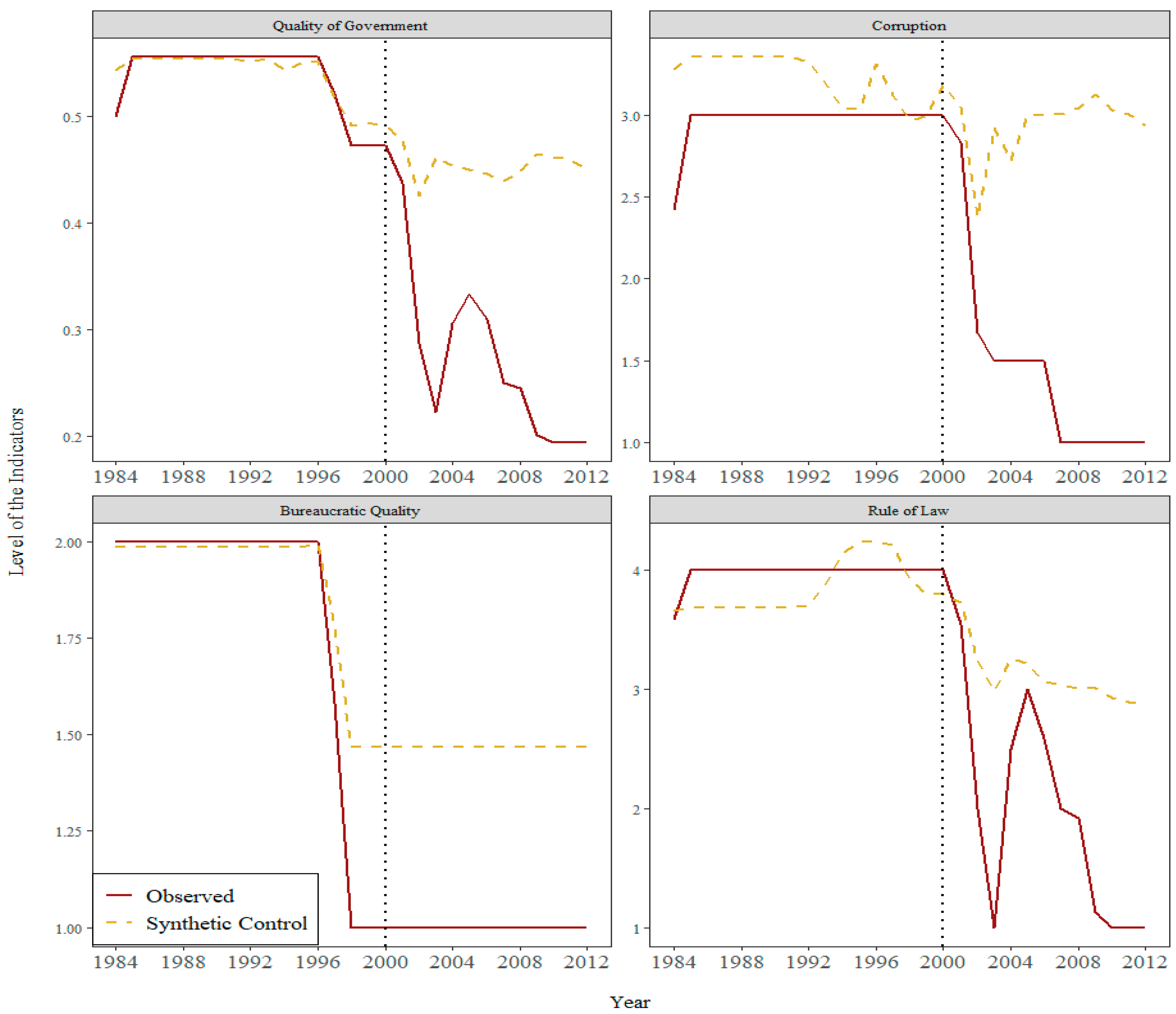
The synthetic control method yields a counterfactual Quality of Government (QoG) trajectory for Venezuela that closely mirrors its observed QoG during the pre-treatment period (1984–1999). As shown in Figure 1, the synthetic counterfactual accurately tracks Venezuela’s governance quality until the adoption of the new Venezuelan constitution in 1999. After 2000, a modest divergence emerges, with Venezuela’s QoG declining gradually relative to its synthetic counterpart. In addition, leave-one-out tests were conducted (not displayed) to confirm that the results are not overly reliant on any single donor country in the synthetic control model. The stability of the ATT within the range of −0.154 to −0.182 indicates that the observed divergence in Venezuela’s QoG after 2000 is both consistent and robust, even when individual donor countries are excluded from the analysis.
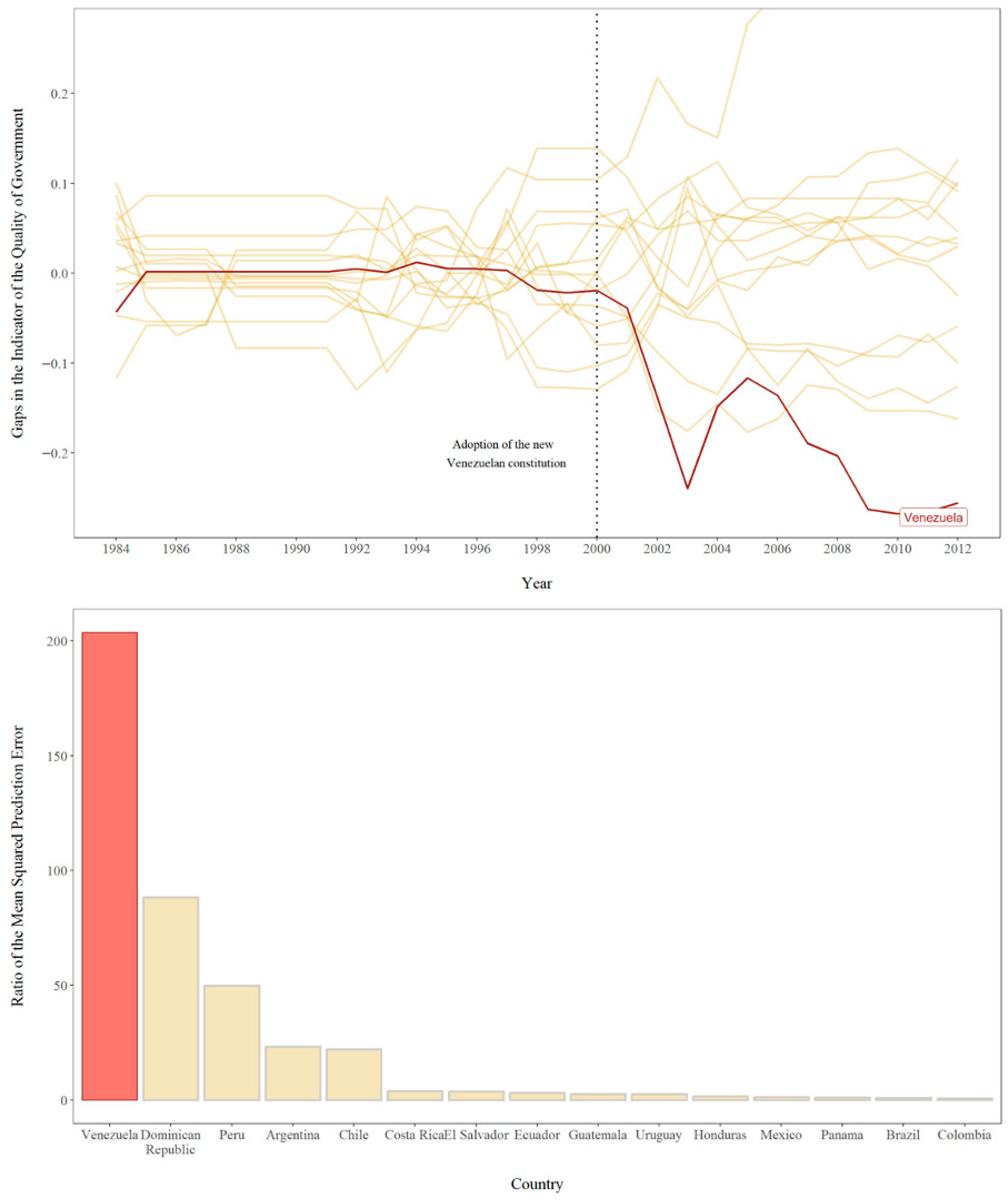
Robustness is further assessed through in-space placebo tests, which reassign the treatment to each donor country in the dataset. The upper diagram in Figure 2 shows that Venezuela’s gap in the QoG Index becomes the most negative following the adoption of the new constitution in 2000, exhibiting a modest but sustained downward trajectory. By 2012, Venezuela’s gap reaches approximately −0.25, in contrast to donor countries’ trajectories, which generally fluctuate between −0.1 and 0.1. While a few donors experience minor post-2000 declines, these remain limited and short-lived, with no pattern as persistent as that of Venezuela. This outcome highlights Venezuela’s distinct governance trajectory, with the absence of comparable trends among donors reinforcing the robustness of the synthetic control in identifying changes associated with the post-1999 institutional transformation.
The Mean Squared Prediction Error (MSPE) further assesses the model’s accuracy in replicating Venezuela’s pre-treatment trajectory relative to its synthetic control. A low pre-treatment MSPE indicates a good fit, while a rise in the post-treatment MSPE ratio reflects a growing deviation between Venezuela and the synthetic counterpart. Moreover, this difference is statistically significant at p = 0.067. Although this value lies slightly above conventional thresholds (p < 0.05), it remains within a range commonly interpreted in small-sample and quasi-experimental contexts as indicating marginal or suggestive evidence of an association. Given the limited number of donor countries and the inferential constraints inherent to the synthetic control framework, this result should be understood as indicative rather than definitive. The associated MSPEs, shown in the lower diagram of Figure 2, align with those in the main specification, underscoring the model’s reliability during the pre-treatment period (1984–1999). However, the substantial increase in Venezuela’s post-to-pre MSPE ratio—exceeding 200, compared to the next-highest ratio of less than 100 for the Dominican Republic—suggests structural governance changes modestly associated with increasing executive concentration under Hugo Chávez after 2000.
For an additional robustness check aimed at exploring potential mechanisms, the QoG index was disaggregated into its three components—law and order, corruption, and bureaucratic quality—to provide further insight into the governance dimensions associated with the overall decline (Figure 1).
Law and Order: This component shows the steepest decline, with a sharp drop in the observed trajectory immediately after 2000. The observed level for law and order decreases from 4.0 in 1999 to 1.0 by 2004, compared to the synthetic counterpart, which remains relatively stable around 3.7 during the same period. This pronounced divergence is associated with a substantial weakening of rule-of-law institutions and limitations in the state’s capacity to enforce legal norms or maintain public safety. The continued stagnation at 1.0 through 2012 reflects a persistent deterioration in these institutional functions, leaving the observed value far below the synthetic level.
Corruption: The corruption component exhibits a moderate yet steady decline, with divergence beginning earlier—in the late 1990s. The observed level of corruption drops from 3.0 in 1999 to 1.0 by 2004, while the synthetic counterpart remains consistent at around 2.8 over the same period. The widening gap between observed and synthetic values is associated with the deterioration of accountability mechanisms and the weakening of governance practices designed to prevent and control corruption. By 2012, the observed level remains at its lowest point (1.0), compared to 2.8 for the synthetic counterpart, underscoring the persistence of corruption-related governance challenges.
Bureaucratic Quality: This component reveals a more gradual decline but displays a pre-treatment divergence that predates the 1999 constitutional reform. The observed level drops from 2.0 in 1997 to 1.0 by 1999, whereas the synthetic trajectory remains stable at 1.5. This early divergence indicates that Venezuela’s bureaucratic quality was already weakening before the onset of the reform, thereby limiting the strength of causal inference for this subcomponent. Accordingly, the relationship between the constitutional reform and bureaucratic quality should be understood as associative rather than strictly causal, reflecting concurrent institutional deterioration rather than a reform-induced shift. Nonetheless, the persistent gap through 2012—where the observed level remains fixed at 1.0—indicates a continuing erosion of state capacity and administrative effectiveness that likely compounded the broader governance decline.
As such, disaggregating the QoG suggests that Venezuela’s post-2000 deterioration is associated chiefly with a dramatic collapse in law and order, compounded by a sustained rise in corruption beginning in the late 1990s, against a backdrop of earlier bureaucratic weakening that had already stagnated at a low level relative to the synthetic control.

5. Discussion and Conclusions

5.1. Discussion of the Results

This study provides evidence that Hugo Chávez’s executive aggrandizement—institutionalized through the 1999 Constitution of the Bolivarian Republic of Venezuela—was modestly associated with an enduring deterioration in the country’s quality of government. By constructing a synthetic counterfactual of Venezuela from a regionally coherent donor pool of fourteen Latin American countries, the analysis shows that, beginning in 2000, Venezuela’s governance trajectory departed noticeably from what comparable regional cases would predict. This divergence suggests a modest association between the constitutional reforms and Venezuela’s subsequent governance decline, rather than a pattern fully explained by contemporaneous regional dynamics or cyclical shocks. The evidence therefore points to a potential structural shift characterized by institutionalized executive concentration and a gradual weakening of governance quality.
The mechanisms linking executive aggrandizement through autocratic legalism to governance deterioration operated through the constitution’s strategic redesign of institutional foundations, manifesting distinctly across the three dimensions of quality of government. Most fundamentally, the constitution authorized dissolution of the existing Supreme Court and created new appointment procedures that subordinated the judiciary to executive control (Holgado and Urribarri 2024). A qualitative counterfactual illuminates this pathway: absent the 1999 Constitution’s provisions dissolving the Supreme Court, the executive would have confronted the pre-existing judiciary with established tenure protections and institutional independence norms. This alternative configuration would have created substantially higher barriers to judicial subordination, as capturing the courts would have required navigating existing constitutional constraints designed to prevent executive interference. Instead, the reform weaponized legal legitimacy itself, using ostensibly democratic procedures to dismantle the protections constitutions ostensibly guarantee (Scheppele 2018). The captured judiciary ceased enforcing legal norms impartially, legitimizing executive overreach through expansive constitutional interpretations while selectively applying laws based on political rather than legal considerations. Our disaggregated results reveal this mechanism operated most directly and dramatically, with the law-and-order indicator showing the steepest post-reform decline among all governance dimensions examined.
This judicial capture, in turn, facilitated the second mechanism: the collapse of horizontal accountability that enabled systemic corruption. The constitution’s shift from bicameral to unicameral legislature concentrated legislative power in a single chamber more easily dominated by the executive coalition, while reorganization of oversight bodies placed appointment authority in executive-aligned institutions (Gamboa 2024). Qualitative counterfactual reasoning clarifies how alternative configurations would have constrained this pathway: had the bicameral Congress been retained, the executive would have faced dual chambers with potentially divergent partisan compositions and separate investigative authorities. This institutional redundancy would have created multiple veto points where oversight could have been sustained even if one chamber became aligned with executive interests. Instead, the unicameral structure eliminated this redundancy, concentrating all legislative authority in a single institution vulnerable to executive domination. The captured Supreme Tribunal systematically exercised its constitutional authority to shield regime allies from accountability (Holgado and Urribarri 2024), creating what Scheppele (2018) terms “zones of impunity” where corruption transformed from conduct officials must hide into routine practice. As the legislature lost investigative authority and comptroller institutions found their constitutional independence hollowed out, executives could divert public resources for patronage networks facing substantially reduced institutional resistance. Our corruption indicator captures this pattern through its moderate yet steady decline following the reform, with divergence beginning as these constitutionally restructured accountability mechanisms weakened.
The third mechanism—bureaucratic politicization through civil service reorganization—presents a more ambiguous relationship with the constitutional reform. The constitution reorganized civil service oversight while transferring enforcement authority to executive-aligned institutions (Scheppele 2018; Gamboa 2024). The counterfactual scenario—retention of pre-1999 civil service oversight structures with independent enforcement capacity—would have created institutional friction against wholesale personnel replacement, as independent commissions could have challenged politically motivated dismissals through constitutional mechanisms beyond executive control. However, evidence for this mechanism’s association with the constitutional reform remains less supported. The bureaucratic quality indicator reveals pre-treatment divergence beginning around 1998, predating the reform. This decline likely reflected the political and economic turmoil surrounding Chávez’s election campaign, when anticipation of fundamental institutional change and intensifying political polarization may have already begun destabilizing administrative structures and professional civil service norms (Corrales and Penfold 2015). Consequently, causal inference for this dimension remains limited, and the relationship should be understood as associative rather than strictly causal—reflecting concurrent institutional deterioration rather than reform-induced change. The persistent post-reform weakness in bureaucratic quality likely compounded broader governance decline but cannot be confidently attributed to the constitutional reform itself given the pre-existing downward trajectory.
Taken together, these mechanisms operated through autocratic legalism’s logic: constitutional reforms appearing procedurally legitimate created legal pathways for institutional capture, captured institutions ceased enforcing impartiality, and governance deteriorated as the institutional architecture preventing partisan subordination collapsed (Scheppele 2018). The judiciary’s capture proved particularly consequential because it enabled subsequent erosion stages—from constitutional interpretations expanding executive authority to validation of parallel governing structures (Holgado and Urribarri 2024; Gamboa 2024). Our quantitative synthetic control findings demonstrate that Venezuela’s aggregate governance trajectory diverged modestly but persistently from comparable Latin American countries following the reform, with this deterioration manifesting most strongly in rule of law, followed by corruption, while bureaucratic quality showed ambiguous patterns due to pre-existing decline. This differential pattern supports the theoretical framework linking autocratic legalism’s mechanisms most directly to judicial capture and accountability collapse, with less clear effects on administrative capacity vulnerable to pre-reform political instability.
The adaptation of the Constitution of the Bolivarian Republic of Venezuela in late 1999 fundamentally altered Venezuela’s political framework by enabling executive aggrandizement, which subsequently allowed Chávez’s ruling party to consolidate presidential authority while weakening the foundations necessary for effective governance (Polga-Hecimovich 2022). Over time, this framework led to escalating corruption, the erosion of the rule of law, and a deteriorating bureaucracy—conditions that fueled economic instability, a deepening humanitarian crisis, and persistent autocratization. After Chávez’s death, his successor and ally, Nicolás Maduro, intensified these dynamics. Under Maduro’s leadership since 2013, power has become even more centralized, opposition has been systematically suppressed, and democratic norms have further eroded. The combined effects of these governance failures have plunged Venezuela into one of the worst humanitarian crises in the region, marked by widespread poverty, severe food and medicine shortages, mass migration, and the collapse of basic public services (Hellinger and Spanakos 2017). Today, the country remains trapped in a cycle of institutional decay, with Maduro’s regime exacerbating the political, economic, and humanitarian crises rooted in the reforms initiated under Chávez.

5.2. Strengths and Limitations

Regarding the study’s strengths, its design provides strong analytical leverage by combining a robust pre-treatment fit, a regionally coherent donor pool, and convergent falsification checks. These elements potentially reduce—though cannot eliminate—the risk that unobserved shocks or trends drive the results. By constructing an explicit counterfactual, the method provides transparent estimation of the treatment effect, identifying a governance pattern consistent with executive aggrandizement and quantifying its magnitude across domains. This approach supports moderate confidence that Venezuela’s governance deterioration is modestly associated with the constitutional reforms introduced under Chávez. Despite the study’s rigorous design, several limitations warrant acknowledgment. The first limitation concerns the influence of unobserved confounders. While the synthetic control method is effective in approximating counterfactual outcomes, it cannot fully account for all unmeasured factors. Variables such as external economic shocks, or unique domestic political dynamics may have contributed to Venezuela’s governance decline independently of the 1999 constitutional reform. Although the design mitigates these risks through a strong pre-treatment fit and robustness checks, they cannot be entirely ruled out. Consequently, the magnitude of the observed association may be either underestimated or overestimated, depending on how these unobserved shocks align with the timing and trajectory of the constitutional reform. For example, if concurrent macroeconomic downturns or global oil price fluctuations exerted downward pressure on governance indicators, the synthetic control estimate could exaggerate the apparent association between the reform and governance outcomes. Conversely, if countervailing factors—such as periods of high oil revenue or temporary institutional resilience—masked governance erosion, the true association may be stronger than estimated. Thus, while the findings are robust across multiple tests, the direction and scale of any residual bias cannot be precisely determined, and some uncertainty regarding internal validity remains.
A second limitation concerns the construction of the donor pool: seven of the fourteen donor countries received zero weight in the final model. While such outcomes are standard in synthetic control estimation, they effectively reduce the donor pool to the seven countries with non-zero weights, which together provide the optimal combination for approximating Venezuela’s pre-1999 trajectory. Nevertheless, this reduction constrains the diversity of the comparison group and may limit the generalizability of the estimated counterfactual. The reduced heterogeneity of the donor pool could also amplify the influence of country-specific factors in the remaining donor set, thereby affecting the stability of the estimated coefficients. Future research should employ process tracing to link these quantitative patterns with detailed institutional evidence, clarifying how the 1999 reform interacted with other political and socioeconomic variables in shaping Venezuela’s governance trajectory.
A third limitation relates to Venezuela’s high dependency on natural resources, particularly oil. Unlike other Latin American economies, where hydrocarbons serve as one component within more diversified export structures, Venezuela’s economy has been historically dominated by petroleum, which accounts for more than 90 percent of export revenues and represents the primary source of public income. This extreme concentration makes Venezuela structurally different from regional peers such as Mexico, Brazil, or Colombia, whose oil sectors are significant but embedded within diversified production and fiscal systems. Incorporating oil production or revenue variables into the synthetic control model substantially alters the optimization process, as no other donor-country exhibits a comparable level of resource dependence. When such predictors are included, the model becomes dominated by this single factor, effectively reducing the donor pool to Ecuador. This structural imbalance constrains the feasibility of constructing a balanced synthetic control that simultaneously reflects Venezuela’s institutional and economic characteristics. Although the model partially mitigates this bias through the exclusion of outlier predictors, it remains possible that fluctuations in global oil markets either attenuated or exaggerated the observed association between the reform and governance outcomes. If oil-driven revenues temporarily masked institutional decline, the true effect could be underestimated; conversely, if price volatility eroded governance independently of political change, the observed association may be overstated. Future research could address this issue by developing hybrid specifications or region-specific donor pools, including other major oil-dependent economies, to better capture structural differences in resource dependence and improve the validity of cross-case comparisons.
A fourth limitation concerns the parallel-trends assumption. The analysis of QoG subcomponents, particularly bureaucratic quality, reveals some pre-treatment divergence between the treated and synthetic series prior to 1999. This pattern suggests that Venezuela’s administrative capacity was already weakening before the constitutional reform, which limits the strength of causal inference for that specific dimension. As such, the results should be interpreted with caution and understood as associative rather than strictly causal. Future research could strengthen this aspect by incorporating longer pre-treatment periods, alternative estimation techniques (such as augmented synthetic control or panel-data approaches), or comparative case designs that explicitly model pre-existing institutional decline. These strategies would provide a clearer baseline for distinguishing reform-related effects from antecedent trends and enhance confidence in causal interpretation. A fifth and related limitation concerns the level of inference permitted by the macro-comparative design. The synthetic control method identifies associations between constitutional reform and changes in governance quality but cannot directly establish micro-level causal mechanisms linking executive aggrandizement to specific institutional outcomes. Because the analysis operates at an aggregate level, it captures system-wide patterns while leaving the internal institutional dynamics largely as a “black box.” In other words, the study traces broad associations between executive concentration and governance deterioration but does not unpack the precise causal processes through which these changes occur within the judiciary, law enforcement, or legislative oversight. Future research could open this black box through qualitative or institutional analyses—such as process tracing, elite interviews, or sector-specific indicators—to illuminate the micro-level mechanisms through which executive expansion affects rule-of-law performance and state capacity.
In addition, external validity is limited because the study focuses specifically on Venezuela in relation to Latin American countries with shared historical and political characteristics, which may not fully capture how similar constitutional reforms would affect governance in regions with distinct institutional contexts, such as Sub-Saharan Africa or Eastern Europe. Even within Latin America, countries experiencing executive aggrandizement may follow different governance trajectories due to variations in resource reliance, political systems, or judicial independence. Future research could use synthetic control methods or comparative case studies to investigate whether comparable reforms produce similar governance outcomes across Latin America or other regions. Despite these limitations, this study highlights the risks associated with constitutional reforms that concentrate power and offers a foundation for exploring their broader implications in diverse contexts.


Author Contributions

Conceptualization, J.K. and Y.G.; methodology, A.G.F.; software, A.G.F.; validation, J.K., A.G.F. and Y.G.; formal analysis, A.G.F.; investigation, A.G.F.; resources, Y.G.; data curation, Y.G.; writing—original draft preparation, J.K.; writing—review and editing, J.K., A.G.F. and Y.G.; visualization, Y.G.; supervision, J.K.; project administration, J.K.; funding acquisition, Y.G. All authors have read and agreed to the published version of the manuscript.

Funding

The APC was funded by the ETH Zurich Library.

Institutional Review Board Statement

Not applicable.

Informed Consent Statement

Not applicable.

Data Availability Statement

The replication data are available by the OSF link: https://osf.io/udxzy/overview?view_only=d6205b934d3643efbbd2f1f6dd9d88f2 (accessed on 24 February 2026).

Acknowledgments

The authors express sincere gratitude to Robin Fretz (ETH Zurich), seminar participants, and members of the Immigration Policy Lab at ETH Zurich for their feedback on earlier versions of this manuscript.

Conflicts of Interest

The authors declare no conflicts of interest.

References

  1. Armesto, Alejandra. 2025. Populismo y retroceso democrático en América Latina. Revista Latinoamericana Sobre Democracia 1: 96–107. [Google Scholar] [CrossRef]
  2. Bermeo, Nancy. 2016. On democratic backsliding. Journal of Democracy 27: 5–19. [Google Scholar] [CrossRef]
  3. Cameron, Maxwell A. 2021. Pathways to inclusion in Latin America. In The Inclusionary Turn in Latin American Democracies. Edited by Diana Kapiszewski, Steven Levitsky and Deborah J. Yashar. Cambridge: Cambridge University Press, pp. 401–33. [Google Scholar] [CrossRef]
  4. Charron, Nicholas, and Victor Lapuente. 2010. Does democracy produce quality of government? European Journal of Political Research 49: 443–70. [Google Scholar] [CrossRef]
  5. Conaghan, Catherine M. 2016. Delegative Democracy Revisited: Ecuador Under Correa. Journal of Democracy 27: 109–18. [Google Scholar] [CrossRef]
  6. Corrales, Javier, and Michael Penfold. 2015. Dragon in the Tropics: Venezuela and the Legacy of Hugo Chavez. Washington: Brookings Institution Press. Available online: https://www.jstor.org/stable/10.7864/j.ctt7zsw23 (accessed on 25 March 2026).
  7. Gamboa, Laura. 2024. Plebiscitary Override in Venezuela: Erosion of Democracy and Deepening Authoritarianism. The ANNALS of the American Academy of Political and Social Science 712: 124–36. [Google Scholar] [CrossRef]
  8. Garcia-Holgado, Benjamin. 2025. Overruling the Executive: Judicial Strategies to Resist Democratic Erosion. Journal of Law and Courts 13: 274–303. [Google Scholar] [CrossRef]
  9. Goertz, Gary. 2006. Assessing the Trivialness, Relevance, and Relative Importance of Necessary or Sufficient Conditions in Social Science. Studies in Comparative International Development 41: 88–109. [Google Scholar] [CrossRef]
  10. Goertz, Gary, and Jack S. Levy, eds. 2007. Causal explanation, necessary conditions, and case studies. In Explaining War and Peace: Case Studies and Necessary Condition Counterfactuals. Abingdon: Routledge, pp. 9–45. [Google Scholar]
  11. Hellinger, Daniel, and Anthony Petros Spanakos. 2017. The Legacy of Hugo Chávez. Latin American Perspectives 44: 4–16. [Google Scholar] [CrossRef]
  12. Holgado, Benjamin Garcia, and Raúl Sánchez Urribarri. 2024. The Dark Side of Legalism: Abuse of the Law and Democratic Erosion in Argentina, Ecuador, and Venezuela. American Behavioral Scientist 68: 1578–96. [Google Scholar] [CrossRef]
  13. Khaitan, Tarunabh. 2019. Executive aggrandizement in established democracies: A crisis of liberal democratic constitutionalism. International Journal of Constitutional Law 17: 342–56. [Google Scholar] [CrossRef]
  14. Khaitan, Tarunabh. 2020. Killing a Constitution with a Thousand Cuts: Executive Aggrandizement and Party-state Fusion in India. Law & Ethics of Human Rights 14: 49–95. [Google Scholar] [CrossRef]
  15. Ko, Jeremy, Chun Kai Leung, and Chitao Yu. 2024. Reinforcing inequalities: A critical examination of international sanctions and bureaucratic decline in the Global South. Research in Globalization 9: 100258. [Google Scholar] [CrossRef]
  16. Li, Tao, and Zhenyu M. Wang. 2023. The top-heavy shape of authoritarian bureaucracy: Evidence from Russia and China. International Review of Administrative Sciences 89: 703–21. [Google Scholar] [CrossRef]
  17. McConnell, Shelley A. 2024. Elite Collusion and Creeping Authoritarianism in Nicaragua: Lessons on Democratic Backsliding from an Outlier Case. The ANNALS of the American Academy of Political and Social Science 712: 196–210. [Google Scholar] [CrossRef]
  18. Mendoza-Botelho, Martín. 2024. Political turmoil and parliamentary response—The constitutional crisis in Bolivia 2019. The Theory and Practice of Legislation 12: 155–79. [Google Scholar] [CrossRef]
  19. Newland, Chester A. 2003. The Facilitative State, Political Executive Aggrandizement, and Public Service Challenges. Administration & Society 35: 379–407. [Google Scholar] [CrossRef]
  20. Polga-Hecimovich, John. 2022. Venezuelan regional elections, democratic backsliding, and autocratization in the 2010s. Regional & Federal Studies 32: 437–58. [Google Scholar] [CrossRef]
  21. Rohlfing, Regitze Helene, and Marlene Wind. 2023. Death by a thousand cuts: Measuring autocratic legalism in the European Union’s rule of law conundrum. Democratization 30: 551–68. [Google Scholar] [CrossRef]
  22. Rothstein, Bo O., and Jan AN Teorell. 2008. What is quality of government? A theory of impartial government institutions. Governance 21: 165–90. [Google Scholar] [CrossRef]
  23. Scheppele, Kim Lane. 2018. Autocratic legalism. The University of Chicago Law Review 85: 545–84. [Google Scholar]
  24. Schlesinger, Arthur M., Jr. 1973. The Imperial Presidency. Boston: Houghton Mifflin Company. [Google Scholar]
  25. Weyland, K. 2001. Clarifying a contested concept: Populism in the study of Latin American politics. Comparative Politics 34: 1–22. [Google Scholar] [CrossRef]
  26. Zhang, Dong. 2024. Draining the swamp? Populist leadership and corruption. Governance 37: 1141–61. [Google Scholar] [CrossRef]
Figure 1. Time-series Path Plots of the QoG Index and Its Three Subcomponents: Observed vs. Synthetic Control.
Socsci 15 00246 g001
Figure 2. Placebo Gaps on Quality of Governance Trajectories and Post/Pre-Treatment MSPE Ratios for Venezuela and Donor Countries.
Socsci 15 00246 g002
Table 1. Descriptive Statistics and Comparison Between Treated Venezuela and Synthetic Counterpart Across Institutional and Governance Variables.
CategoryVariableMeanSDMinMaxTreatedSyntheticWeight
Outcome VariableQoG 1997–19990.450.130.110.780.4880.5010.34
Institutional/Democracy VariablesHorizontal Constraints0.300.90−1.832.030.9720.7460.12
Vertical Constraints0.910.61−1.581.311.1061.1620.08
Participatory Democracy0.400.0170.030.530.4640.4650.10
Deliberative Democracy0.460.240.020.640.6320.5310.01
Electoral Democracy0.600.220.070.910.7370.6900.06
Liberal Democracy0.440.440.240.620.5890.5370.05
Presidential Election Year0.220.410.001.000.2000.2450.02
Parliamentary Election Year0.270.450.001.000.3000.4060.00
Autonomy of Electoral Body1.261.40−2.442.251.3821.8660.05
Capacity of Electoral Body1.170.90−2.693.102.0711.2960.00
Civil Society Autonomy1.131.31−2.863.211.7851.4000.06
Table 2. Descriptive Statistics and Comparison Between Treated Venezuela and Synthetic Counterpart Across Economic and Demographic Variables.
CategoryVariableMeanSDMinMaxTreatedSyntheticWeight
Economic IndicatorsGDP Per Capita4504.683811.41242.5119,249.943140.8742972.8280.03
Foreign Direct Investment2.802.69−7.8016.231.7811.6010.05
Trade Openness59.7428.6112.35174.7148.38338.0430.01
Natural Resource Dependency4.144.810.0249.2516.4583.2590.01
Demographic VariablePopulation (Millions)27.7643.502.15213.2020.45657.5560.01
Disclaimer/Publisher’s Note: The statements, opinions and data contained in all publications are solely those of the individual author(s) and contributor(s) and not of MDPI and/or the editor(s). MDPI and/or the editor(s) disclaim responsibility for any injury to people or property resulting from any ideas, methods, instructions or products referred to in the content.