1. Introduction
As societal shifts are inevitable, education systems must continue to adapt and evolve to meet the needs and current lifestyles of their learners. Higher education in the United States (US) is currently facing this challenge. Higher education refers to any degree-granting institution and encompasses a diverse range, including public universities, small liberal arts colleges, community colleges, and large research universities. The socio-cultural context, which is time-dependent, influences emerging student cohorts and higher education as a whole. One example of this was the significant impact of the COVID-19 pandemic, which led to the widespread adoption of online learning worldwide (
Hulene et al. 2023;
Hodges et al. 2020).
Another example is the steady increase in first-generation college students (FGCSs) in the US, with the number of FGCSs approximately doubling over the past decade as more young people decide to be the first in their families to attend college. In 2025, 54% of all US undergraduates were FGCSs, accounting for roughly 8.2 million students (
FirstGen Forward 2025). Looking at this data alone, the US’s higher education system is thriving. However, with further review, there appears to be a misalignment between increases in first-time enrollment and long-term persistence leading to degree attainment. Disparities persist with part-time students, FGCSs, and those from low-income backgrounds (
Davis et al. 2024). For example, FGCSs are twice as likely to leave college without earning a bachelor’s degree, even when academically prepared and from higher-income families (
Davis et al. 2024). Unfortunately, the increase in FGCSs is met with an academic system that remains unchanged in many critical ways. Thus, despite the steady increase in FGCS enrollment, persistence rates remain disproportionately low (
Weisen et al. 2024).
In addition to FGCS concerns, institutions are struggling to fully support the current cohort of university students, most of whom are Generation Z (Gen Z). Gen Z makes up the majority of college students in the US at present. Born roughly between the late 1990s and late 2000s, this generation is the most racially and ethnically diverse in US history and the first to have grown up fully within a technologically driven society (
O’Hare and Mayol-García 2023). Gen Z learners, also referred to as digital natives, are increasingly questioning the traditional four-year degree pathway, driven by economic shifts, the development of artificial intelligence (AI), and the emergence of non-linear career pathways (
Pew Research Center 2024;
Schmidt et al. 2025;
Zhou and Schofield 2024). These current realities influence how Gen Z students experience college. When considering both identities, being Gen Z and a first-generation college student, the COVID-19 pandemic is especially relevant. Evidence suggests that the global pandemic exacerbated educational disparities, potentially worsening existing academic barriers for marginalized groups and affecting the broader generational cohort (
Davis and Wilson-Kennedy 2024;
Soria et al. 2020). These recent findings further highlight the need for innovative student support, with the consideration of FGCSs and Gen Z experiences in higher education.
Kalsbeek (
2013) made a similar call to re-examine student success frameworks, advocating for faculty-facing models and expanding the definition of academic outcomes. Further, he argued for reframing retention as an institutional responsibility. More recently, researchers have expanded the conversation on student success, moving beyond the deficit model and now redefining it as a multidimensional set of outcomes (
Vugteveen et al. 2025). Student success research has historically relied on frameworks such as
Tinto’s (
1993) Theory of Student Departure and
Astin’s (
1999) Student Involvement Theory, which emphasize academic integration, persistence, and institutional commitment.
Strayhorn’s (
2012) Sense of Belonging framework elaborates on these theories, highlighting how identity and environment influence grades, retention, and degree attainment. Additional models, such as
Gilligan’s (
1982) Ethics of Care Model, have highlighted the importance of faculty–student connections. Currently, surging technological advancements have spurred the growing and necessary adoption of contemporary digital integration frameworks in higher education (
Tareke et al. 2025). For example,
Davis’s (
1989) Technology Acceptance Model (TAM) and
Mishra and Koehler’s (
2006) Technological Pedagogical Content Knowledge (TPACK) conceptual frameworks are being applied to understand the academic adoption of digital tools (
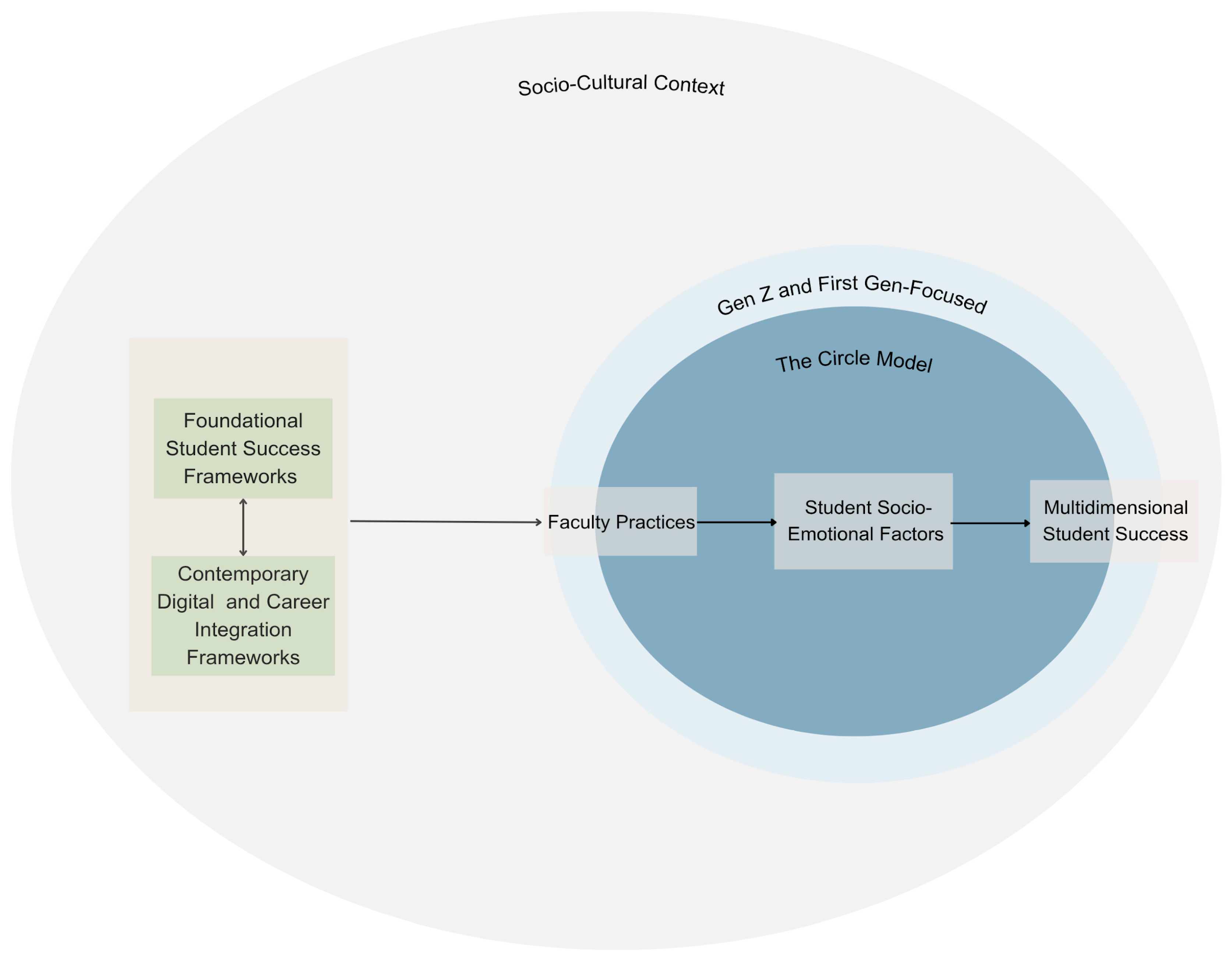
Tareke et al. 2025). Researchers are exploring ways to combine human and digital assets to foster student success. The current paper fully embraces this movement by synthesizing student-centered and digital integration theories while connecting evidence-based practices with clear faculty-facing practices. The Circle model draws on the literature on effective practices and socio-emotional mediators. Through the lens of the current socio-cultural context, the model outlines a holistic, direct approach for faculty to make the greatest impact on student learning and success outcomes. A visual overview of the integration of existing frameworks within the current socio-historical context is shown in
Figure 1.
1.1. Scope and Socio-Cultural Context
The proposed conceptual framework and model reconceptualize faculty impact on student success in today’s digital era. The included frameworks and literature were reviewed through the perspective of Baltes’ Lifespan Developmental Theory (
Baltes 1987), thus reviewed in connection to the current socio-cultural context. Baltes offers a broad explanation of development as a multidimensional process shaped by multiple contextual factors (
Baltes 1987). One of the central arguments of this theory is that cohort effects and historical events influence development. A cohort refers to a group of people born during the same general time period, often categorized into labeled generations. Two key tenets of the theory are historical embeddedness and history-graded influence. Historical embeddedness suggests that a cohort’s experiences shape group-level developmental shifts, which include the influence of the social and cultural context in which they age. History-graded influences refer to societal events that alter developmental pathways in measurable ways and across generations. These concepts are parallel to Bronfenbrenner’s Ecological Theory of Development and the later Process–Person–Context–Time refinement of the theory (
Bronfenbrenner and Morris 2006). Bronfenbrenner argued that development occurs through interactions across nested systems, from immediate environments to broader societal structures and historical time. The PPCT model reinforces that lived time, social systems, and everyday settings interact to shape individual development. In other words, development is not separate from societal, historical, and environmental context.
With these frameworks in mind, student success models are contextually linked to the research of the time. This point does not suggest that existing models are irrelevant, only that they may need adaptation when applied to different student cohorts and changing higher education systems. Thus, the Circle model builds on established student success theories but re-examines how they can be applied to students within the contemporary societal conditions. This primarily includes Gen Z students, who comprise the majority of traditional-age undergraduates, and FGCSs, who represent a large and growing percentage of students entering higher education in the United States (
NCES 2023).
Before discussing the characteristics of Gen Z, it is important to clarify that generations are not monolithic. Individual variation within any cohort remains substantial. This variation is also true for FGCSs, as individuals who identify as first-generation come from diverse backgrounds. The discussion of these groups is a generalization and refers to overarching historical and cultural experiences. Gen Z is frequently described as “digital natives”, meaning that this cohort has grown up with widespread access to the internet, smartphones, and social media. Technology has not been an added feature of their lives; it has been the background context. This technological immersion only intensified during the COVID-19 pandemic, when universities worldwide rapidly transitioned to online instruction (
Hodges et al. 2020). Despite long-standing institutional resistance to technological change, higher education underwent a swift transformation.
In the wake of COVID-19 and the digital shift, there has been a growing discussion about mental health. According to the
Office of the U.S. Surgeon General (
2023), there has been an increase in mental health concerns, especially among young people, as loneliness and anxiety have risen in recent years. The current rise in mental health concerns, including loneliness, has highlighted the importance of meaningful connection and faculty support (
Wodika et al. 2025). It is, therefore, unsurprising that many Gen Z students look to instructors to demonstrate flexibility and care (
Felten et al. 2023). Additionally, Gen Z, being a highly diverse cohort, demonstrates a strong awareness of individual differences and topics such as neurodiversity and inclusion. Overall, research suggests that this generation has struggled to find community, underscoring the importance of campus climate and social capital (
Garvey et al. 2020).
In addition to preferences around relational support, Gen Z students are accustomed to structured digital environments, including learning management systems, and respond to strategies such as nudging and visible teaching presence (
Martin et al. 2020). Interestingly, despite strong digital fluency, research suggests that many Gen Z students desire meaningful face-to-face interaction (
Schroth 2019). Thus, a generation immersed in online communication may simultaneously crave an authentic in-person connection. This tension becomes especially salient in the era of artificial intelligence (AI). As AI popularity grows, AI literacy is becoming increasingly valuable for students navigating academic and professional environments, yet it also contributes to future career uncertainty (
Deng and Sun 2026). This AI growth is occurring as faculty express hesitance to integrate its use due to concerns about ethics, reliability, and academic integrity (
Schmidt et al. 2025). Gen Z students are concerned about AI effects on the job market and are also challenged with navigating non-linear career paths amid economic and technological uncertainty (
Ayoobzadeh et al. 2024). Students are forced to evaluate whether the time, financial investment, and effort required for a college degree will yield meaningful returns. This topic warrants further exploration, particularly among FGCSs, who may view higher education through the lens of economic mobility. In response to career path changes and student preferences, institutions have increased their emphasis on career readiness. However, uncertainty persists about the best practices for meaningfully integrating career development across curricula. While faculty and institutions cannot resolve all external societal pressures, nor is it their responsibility, acknowledging these realities is essential to produce meaningful student support research. Student success models that fail to account for generational realities, technological integration, mental health patterns, and post-COVID-19 dynamics risk being ineffective. Thus, addressing the socio-cultural context as it relates to student success theory is imperative (
Shaikh et al. 2024;
Miller and Mills 2019). The CIRCLE model represents a direct effort to holistically address the existing context while applying known effective practices for student support.
The primary stakeholders addressed by the proposed model are undergraduate students who identify as first-generation college students and/or who are members of Generation Z, as well as the faculty members who support their academic and psychosocial development. This includes students who attend any form of higher education, including community colleges, online colleges, public and private universities, small liberal arts colleges, and large research universities. FGCSs are emphasized because of their disproportionately low persistence and completion rates, even when controlling for academic preparation and income (
Engle and Tinto 2008;
Weisen et al. 2024). Additionally, FGCSs are of high interest due to evidence of exacerbated academic disparities linked to the COVID-19 pandemic (
Davis et al. 2024). Further, within the broader institutional context, the faculty–student interaction remains one of the most consistent and scalable avenues for improving student outcomes (
Strayhorn 2018;
Felten and Lambert 2020). Faculty interact with students daily; they are uniquely positioned to shape both learning experiences and the broader campus climate. The role and presence of faculty make them central to institutional change.
Throughout this paper, the term faculty will refer to full-time and part-time instructional faculty who have direct, recurring contact with undergraduate students through coursework, office hours, and advising. This includes those who teach in person as well as faculty who teach partially or fully online. The term faculty will not be used to refer to administrative roles or staff. However, these roles are closely tied to faculty work and are included in the student success literature. Further, the model is directed towards higher education students in the US, specifically. However, this review includes many intervention research and reviews, and the context regarding career and education disparities varies widely across cultures. Thus, theories and research findings were considered specifically in relation to the US socio-cultural context. This was necessary, especially when reviewing career readiness, economic challenges, non-linear career paths, specific FGCS trends, and the level of cultural technological use. The CIRCLE model has cross-cultural use; however, it requires re-examination when directly applied outside its scope.
The societal concerns and need to re-examine student success are not due to a lack of researcher interest or institutional support, but rather to the fragmentation of efforts across institutions. While advising centers, federally funded student support programs for low-income families, and first-year seminars have demonstrated some success, many students still do not adequately use the resources these systems provide (
Davis et al. 2024). Faculty interactions are structurally unavoidable for enrolled students and therefore represent a critical, yet underutilized, site for addressing belonging, self-efficacy, perceived support, and academic engagement. Many initiatives approach student success by addressing a singular issue, rather than multiple interconnected and key parts of the student experience. The CIRCLE model is intentionally designed as a faculty-embedded framework, rather than an institution-wide retention program, to personalize the connection and belonging concerns of the current cohort (
Felten et al. 2023;
Walton et al. 2023). Additionally, the model focuses on relational, cultural, technological, and motivational processes within everyday instructional contexts. These domains are simplified into a straightforward evidence-informed structure for action.
1.2. Integrated Theoretical Frameworks
The established student success and belonging frameworks highlight interactions between institutional factors and students’ socio-emotional experiences, including belonging, engagement, and self-efficacy. These theories are foundational in explaining how faculty practices matter and how they influence student success outcomes.
Tinto’s (
1993) retention and persistence theory was among the first to formally explain student–institution interaction as a key factor in student persistence. This was a change from the previous focus on student factors only. Tinto’s persistence model is foundational because the implications of a faculty-facing model rest on the notion that students’ psychological factors are partly predicted by academic and social integration. Tinto’s theory touches on aspects of a sense of belonging; however, it does not include self-identity and cultural factors that can moderate students’ experiences in higher education. Thus,
Strayhorn’s (
2012) Sense of Belonging framework was impactful, as it sharpened the focus on students’ sense of belonging and the cultural components that are especially relevant within a Westernized higher education system. Strayhorn explained the sense of belonging as a feeling of being valued and included. The word “belonging“ is used interchangeably with “sense of belonging,” and both refer to the psychological experience that Strayhorn describes in higher education environments. Strayhorn’s Sense of Belonging framework directly addresses how belonging differs across aspects of identity, with those who identify within marginalized communities having less access to belonging in institutional contexts. This piece of the framework is especially relevant when exploring how FGCSs and a diverse Gen Z cohort experience higher education. The Circle model identifies the significance of students’ sense of belonging for student success and aligns with Strayhorn’s theory that belonging is not evenly distributed.
Further, Strayhorn links belonging to multiple factors, such as engagement, well-being, motivation, and achievement. Both Tinto and Strayhorn describe the complexity of the student experience in relation to the persistence pathway, but neither lists evidence-based faculty guidelines for moderating the relevant factors. Thus, the frameworks are left open to interpretation and for individualized application in pedagogical practices. Researchers have incorporated components of the student experience into philosophical theories, such as
Noddings’ (
2005) Ethics of Care. The Ethics of Care work has been applied in higher education settings and discussed as a key component in fostering faculty–student connections and feelings of support and belonging (
Hawk 2017). Lastly, the Relationship-Rich Education literature highlights the importance of relationship-building and social support within institutions (
Felten and Lambert 2020). Each of these frameworks is rooted in the idea that education is inherently relational and that care is an ethical need within the teacher–learner relationship. This key concept is foundational within the Circle model. Faculty–student relationship models are mostly broad in their explanation of the importance of connection and student support, lacking definitive implementation details.
The culturally responsive pedagogy (CRP) framework is a significant contributor to the proposed model. The framework advocates embedding cultural inclusion within the curriculum and embracing cultural diversity (
Ladson-Billings 1995). The theoretical underpinnings of CRP inform social–psychological interventions that affirm students’ identities and reduce uncertainty about belonging (
Walton and Cohen 2011;
Cohen et al. 2006), resulting in durable improvements in academic outcomes for underrepresented students. One important perspective of the CRP framework is that it shifts the focus from deficits among underrepresented learners to the universal benefits of cultural embeddedness in education. CRP benefits education systems and their learners in general, with both cognitive and psychological impacts. This area of research aligns with the literature on cultural mismatch and how misalignment within the higher education system’s culture can act as a barrier to academic achievement (
Phillips et al. 2020).
The Circle model integrates and expands upon the discussed frameworks by applying their core concepts to explain why faculty behaviors predict socio-emotional factors and multidimensional student success outcomes. The concepts from traditional student success models are highly applicable and require only review in light of new societal developments. This would be the post-COVID-19, technologically savvy education system in the US. These student-centered frameworks are especially informative in understanding the human experiences of pursuing a college degree. The Circle model includes a few core concepts from the traditional student-centered frameworks. These include the ideas that (1) student success is a function of the student and environment interaction, including faculty behaviors; (2) student perceptions and experiences predict student success; and (3) student success is multidimensional and a result of multiple psychological and environmental factors. Further details on existing frameworks that inform the conceptual model are provided in
Table 1.
As
Tareke et al. (
2025) noted, traditional frameworks apply to contemporary digitally based models that are growing in popularity. The rapid expansion of digital technologies in higher education, particularly following the COVID-19 pandemic, has fundamentally altered the instructional landscape. As
Hodges et al. (
2020) documented, the global shift to remote and emergency online teaching accelerated digital adoption across institutions that had historically been slow to change. While many digital frameworks were developed before the pandemic, their relevance has intensified as learning management systems (LMSs), blended learning environments, generative AI tools, and collaborative online platforms have become normalized. Thus, faculty impact in the digital era must extend beyond relational presence to include intentional design, thoughtful tool use, and clearly articulated digital objectives. In response to this, the Circle model integrates a human-centered psychological theory with models of digital use. While contemporary digital integration frameworks provide valuable insights into adoption, design, and implementation, they often lack integration with established psychological predictors of student success, including belonging, engagement, and perceived support. Further, they are rarely examined through the perspective of Gen Z or FGCS support. The Circle model responds to this gap by embedding digital practices within a broader socio-cultural and psychological framework. Faculty support is therefore demonstrated through relational care and through course architecture that uses new-age technology.
Contemporary digital integration models provide valuable insight into how and why technology is adopted and used in higher education contexts.
Davis’s (
1989) Technology Acceptance Model (TAM) and its extensions TAM2 and TAM3 explain technology adoption through perceived usefulness and ease of use. These frameworks are user-centered and primarily focus on predicting whether individuals will adopt and continue using a technological system. The TAM is not inherently a teaching model; rather, it explains behavioral intention through cost–benefit evaluations and perceived value. While the TAM can be applied to students, it does not explicitly address how the implementation of digital tools shapes belonging, engagement, self-efficacy, or multidimensional student success outcomes. The Circle model builds on the TAM’s logic of perceived value and accessibility by extending it into faculty practices that intentionally leverage technology to strengthen predictors of student success, particularly engagement and perceived support. Similarly,
Rogers’s (
2003) Diffusion of Innovations theory provides insight into how technology adoption develops within institutions. Rogers explains how users interact with the technology and that gradual introduction increases later use. These models highlight the psychological factors that shape technology use. With a slightly different take,
Mishra and Koehler’s (
2006) Technological Pedagogical Content Knowledge (TPACK) framework emphasizes the pairing of technological knowledge with pedagogy. TPACK advances beyond tool adoption and highlights the need for intentional alignment between instructional goals and digital tools. Similarly to the TAM, TPACK centers the instructor’s knowledge and capacity rather than the student’s psychological response. The Circle model incorporates TPACK’s emphasis on quality and intent in digital tool use but further specifies how leveraging technology (e.g., multimodal content delivery, structured navigation in learning management systems (LMSs), collaborative platforms) predicts changes in belonging, engagement, perceived support, and self-efficacy.
As online adoption has become more common, researchers are revisiting the Community of Inquiry (COI) framework (
Garrison 2009;
Martin et al. 2020), which focuses on instructor presence within the course’s educational environment. The theory focuses on social, cognitive, and teaching presence components within online and blended learning environments. The COI describes teaching presence as the facilitation and design of the course, with social elements as the personality and connection components. Cognitive presence is described as assistance through critical thinking, questioning, and problem-solving, facilitated by collaboration.
Fiock (
2020) presented cognitive presence practices that involved assisting students in applying content to real-life situations and applying learning to field-related problem-solving. Social presence was added later, as it has become clearer that instructors have social influence on course community, student communication, and the sense of belonging (
Garrison 2009). Social presence can be implemented in many ways through authentic expression and by showing one’s personality in instruction. Social presence is predictive of learning engagement, but it remains unclear which mechanisms are linked to student success outcomes (
Martin et al. 2020).
Martin et al. (
2020) conducted a meta-analysis of COI studies and found that teacher presence has the largest overall effect on learning outcomes. Thus, course design and instructional facilitation aspects are pivotal, especially in online and blended learning environments. In this meta-analysis, the authors reviewed objective learning, student-perceived learning, and student satisfaction. Overall, the COI framework focuses on instructor practices that cultivate promising learning and connection within educational environments, including online environments. The faculty-driven aspect of this framework is especially relevant to the proposed model; however, it falls short in its application to the diversity of the current study population. One major aspect of the Circle model includes leveraging digital tools to enhance accessibility and to strengthen students’ academic self-efficacy and sense of belonging. This integration is particularly relevant for Gen Z and FGCSs, who may be assumed to be technologically fluent, though they have faced structural inequities in access to technology. A more applicable theory would be the Universal Design for Learning (UDL) framework (
CAST 2018), as it addresses multimodal access, instructor flexibility, and ways to reduce barriers in academia. Overall, these theories are particularly relevant as technology continues to advance and is integrated within education systems. There is a lack of clear instructional implementation of these technologies within student support pedagogy.
Beyond digital transformation, higher education institutions face growing pressure to demonstrate tangible career value and return on investment. Generation Z learners express heightened concern about employability and career clarity (
Barhate and Dirani 2022). Institutions have responded by integrating career mapping and career relevance into the curriculum as embedded development learning. However, some researchers argue that career relevance should be embedded in learning outcomes within academic experiences rather than treated as an add-on activity or event (
Soares et al. 2022). This is similar to how cultural responsiveness practices are suggested as embedded parts of pedagogy rather than standalone diversity additions to courses. Overall, clarity around pathways and competencies enhances students’ direction and purpose.
Bridgstock et al. (
2019) argue that career development is best practiced when students are encouraged to reflect and link academic learning to future work identities. Research on Career Development Learning argues that structured reflection on career pathways and transferable skills enhances students’ sense of relevance and purpose within academic study (
Bridgstock 2009). The Career Development Learning perspective considers career integration and the career mapping of pathways and skills as necessary embedded parts of the education system.
Despite the growing prominence of career integration models, many frameworks focus on structural alignment rather than socio-emotional mediators and student experiences. They outline pathways and competencies but do not explicitly model how career integration influences belonging, self-efficacy, engagement, or perceived support. The Circle model includes career integration, such as career connection reflections, and anchors both career and digital integration as tools for enhancing psychological predictors of student success.
Figure 1.
A conceptual outlining of synthesized theories, indicating the integration of foundational student-centered frameworks for student success and contemporary digitally based models for technology use. These groups, when bridged, as suggested by
Tareke et al. (
2025), contribute to the conceptual Circle model. The model depicts faculty behavior, informed by theory, to predict multiple aspects of student success via student socio-emotional mechanisms. All parts of the framework are reviewed through the lens of historically embedded aspects, such as generations, historical events, and societal advancements. Lastly, the Circle model focuses on approaches for FGCS and Gen Z student support within the US.
Figure 1.
A conceptual outlining of synthesized theories, indicating the integration of foundational student-centered frameworks for student success and contemporary digitally based models for technology use. These groups, when bridged, as suggested by
Tareke et al. (
2025), contribute to the conceptual Circle model. The model depicts faculty behavior, informed by theory, to predict multiple aspects of student success via student socio-emotional mechanisms. All parts of the framework are reviewed through the lens of historically embedded aspects, such as generations, historical events, and societal advancements. Lastly, the Circle model focuses on approaches for FGCS and Gen Z student support within the US.
1.3. Socio-Emotional Mediators
The proposed model focuses on socio-emotional variables (e.g., belonging, engagement, perceived support, and academic self-efficacy) as mediators within the relationship between faculty practices and multidimensional student success outcomes. Student sense of belonging is a vague term that is measured in various ways. Across reviews of the belonging literature, common themes include acceptance, connectedness, and perceived support (
Dias-Broens et al. 2024). Qualitative work further identifies representation, community, support, accomplishments, and academic or professional experiences as central elements of the construct (
Dias-Broens et al. 2024). Belonging is a more complex feeling than comfort; it reflects whether students perceive themselves as valued, capable, and aligned with their environment.
Strayhorn (
2018) conceptualizes belonging as a precursor to achievement, well-being, and student behaviors while also emphasizing that it is fluid and context-dependent. Belonging is inherently tied to the environment, shifting across classrooms, instructors, and institutional climates. Additionally, a student’s sense of belonging is shaped by the intersection of identity, culture, and representation (
Strayhorn 2018). For FGCSs, students of color, gender-nonconforming students, and others navigating marginalization, belonging may be especially valuable; however, they may be at risk (
Garvey et al. 2020;
Ives and Castillo-Montoya 2020;
Stephens et al. 2012;
Walton and Cohen 2011).
One effective avenue for strengthening belonging has been the use of self-disclosure to normalize social and academic adversity.
Walton and Cohen (
2011) implemented this strategy in their intervention, in which older students shared their experiences of adversity as they navigated higher education. From this, participants experienced reduced belonging uncertainty, thus decoupling academic adversity from aspects of identity. The intervention significantly decreased belonging uncertainty among African American students and produced long-term academic gains, including higher grades. No comparable effect was observed among White students, who reported higher baseline belonging. Belonging interventions may be particularly powerful for students who enter college or university with a lower baseline level of belonging and who experience cultural mismatch (
Stephens et al. 2012;
Walton and Cohen 2011). This work has been replicated at public universities with larger proportions of FGCSs, lower-socioeconomic-status students, and racially and ethnically diverse populations (
Murphy et al. 2020). The results have yielded consistent findings. When adversity is framed as a normal part of the degree process, students are better able to separate their challenges from personal deficiency. This work closely aligns with Strayhorn’s description of a sense of belonging shaped by context, identity, and cues that reinforce or mitigate uncertainty.
Belonging is commonly associated with and often precedes engagement (
Strayhorn 2018). Engagement, like belonging, is a vague construct that is measured in various ways. The construct can be measured as emotional, cognitive, or behavioral, with behavioral being a common way it is referred to (
Fredricks et al. 2004). Behaviors such as academic help-seeking, class participation, and campus involvement are all forms of student engagement (
Kuh 2009). Academic engagement is associated with higher grades and academic progress and often functions as a mediator between student characteristics and academic outcomes (
Kuh 2009). However, similar to belonging, engagement is not evenly distributed. Research consistently shows that relationships in academic settings are linked to student motivation and engagement (
Davis et al. 2024). Belonging strengthens engagement by increasing psychological safety. When students feel accepted and supported, they are more likely to participate, ask questions, and seek assistance. Thus, perceived faculty support functions as a central connecting variable between belonging and engagement (
Felten et al. 2023). Perceived support is not simply friendliness; it reflects whether students believe their professors genuinely care, are accessible, and are invested in their success.
Garvey and Dolan (
2021), demonstrate that faculty support for LGBTQ+ students predicts greater belonging and reduced marginalization. Small actions such as using inclusive language, affirming identities, and inviting dialogue signal support. Faculty today navigate the growing challenge of supporting students amid elevated rates of anxiety, depression, and psychological distress across college populations (
Lipson et al. 2022). While instructors are not mental health professionals, they are uniquely positioned to shape environments that influence student perceptions of safety, belonging, and competence. Research consistently demonstrates that the sense of belonging and academic self-efficacy function as protective psychological factors, buffering stress and promoting persistence (
Walton and Cohen 2011;
Usher 2024). Faculty do not need to take on therapeutic roles or cross boundaries to foster important socio-emotional factors. The CIRCLE model effectively leverages pedagogical practices that support students while maintaining professional boundaries.
Engagement is also heavily linked to student interest, another construct that significantly impacts academic trajectories (
Harackiewicz et al. 2016). Engagement can be distinguished into situated interest, tied to a specific course experience, and individual interest, which is more stable and enduring. When interest, competence, beliefs, and belonging begin at higher levels and decline more slowly, students demonstrate stronger final test performance and are more likely to persist in subsequent courses. Slower declines in these variables are associated with continued enrollment in subsequent-level chemistry courses (
Beymer et al. 2025). This suggests that belonging and self-efficacy are not fixed traits but dynamic processes that interact and predict persistence. Lecture modalities and instructional formats often shape students’ interest, perceived value, and engagement, even in online learning environments (
Martin et al. 2020). When instructional methods align with student needs, interests, and engagement, they are more likely to be maintained. This is especially relevant for Gen Z students, who have experienced blended and digital learning, and for faculty as they decide how to design courses in the digital era. Self-efficacy, defined as a student’s confidence in their ability to succeed, graduate, and improve through challenges, is a precursor to academic engagement (
Bandura 1977;
Usher and Pajares 2008). However, FGCSs and racial minorities often report lower belonging and lower perceived competence (
Strayhorn 2018). Interventions often target group belonging and self-efficacy in tandem. As seen with belonging, engagement, and student interest, faculty can have a significant impact on student self-efficacy (
Usher and Pajares 2008). This construct is sensitive to environmental factors, such as course design and interactions. The self-efficacy prediction of persistence can also be undermined by educator behaviors that signal low expectations or dismiss student effort (
Usher 2024). Furthermore, self-efficacy in online and in-person learning environments is linked to higher engagement, further illustrating the nuanced connections among socio-emotional predictors of student success (
Zhao and Cao 2023;
Zhou et al. 2025).
Student sense of belonging, engagement, self-efficacy, and perceived support are distinct constructs that operate in concert. Belonging strengthens engagement, engagement and self-efficacy reinforce one another, and perceived support sustains all three (
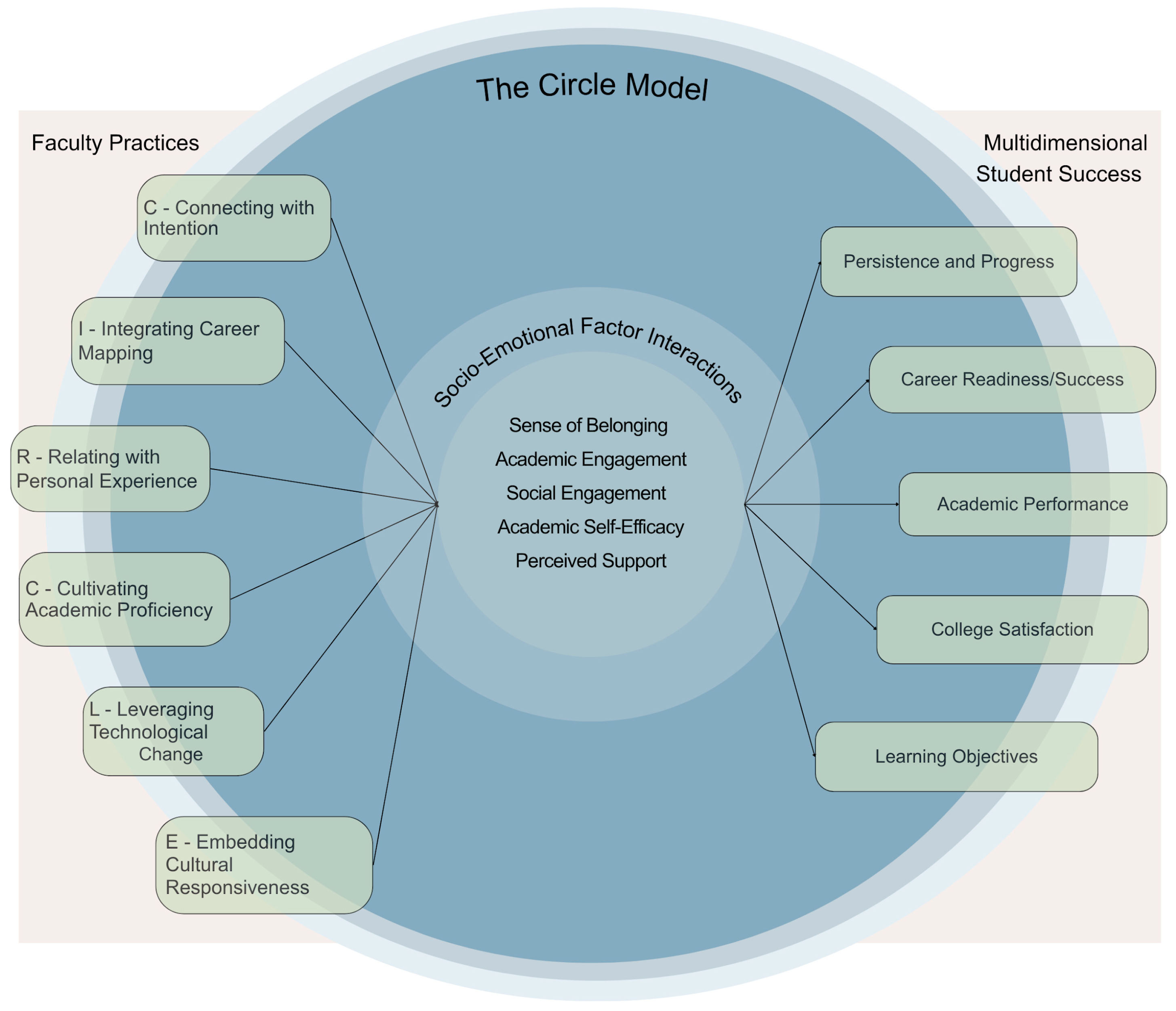
Hiatt et al. 2023). Because these factors are interconnected, interventions that aggregate multiple belonging-related mechanisms may yield greater improvements in student success outcomes, rather than targeting a single variable in isolation. Further, a holistic approach that addresses belonging, engagement behaviors, self-efficacy, and perceived support altogether is likely to be more impactful, particularly for FGCSs and marginalized students navigating identity-based and contextual barriers. A model overview and a conceptual figure depicting faculty practices, specifically beneficial for Gen Z and FGCSs, as they relate to belonging, self-efficacy, engagement, and perceived support, are presented in
Table 1 and
Figure 1.
3. The CIRCLE Model
C—Connecting with Intention: Faculty who connect with their students will establish relationships built on trust and support. Evidence suggests that faculty–student relationships foster a sense of belonging, a known contributor to academic outcomes in higher education (
Felten and Lambert 2020). Furthermore, students who trust faculty may be more likely to seek help from them rather than avoid them or use technology. Gen Z students have reported a preference for faculty connection and a desire for more support from their instructors (
Felten et al. 2023). FGCSs, especially, benefit from authentic connections with their educators, one reason being that they are new to the higher education culture, which may also differ from what they know (
Stephens et al. 2012). The importance of quality faculty interactions and connections is crucial for FGCS success (
Ives and Castillo-Montoya 2020). One strategy to implement this component could be to organize one-on-one meetings with all students, replacing a lecture week. One-on-one meetings are shown to foster a sense of belonging and engagement (
Weber and Keim 2021). LMSs are designed as supplementary tools for educators and include features such as engagement levels and live course progress (
Xu et al. 2025). Therefore, student check-ins can be conducted easily using LMS engagement details, particularly when highlighting low engagement. This may be a useful and more realistic implementation of the component within larger classes and/or at large research institutions. Thus, connection would still occur, even in large classes. LMS nudging could be the first step, followed by a scheduled follow-up meeting with students who perform poorly on tests or have low engagement. These one-on-one checks are supported by
Miller and Mills (
2019), whose research has shed light on student preferences for faculty acts of care and support, through relatively simple actions.
I—Integrating Career Mapping: As previously mentioned, college value and career insecurity have been relevant topics among Gen Z. To address these topics and the associated socio-emotional factors, career integration is critical. Gen Z students consistently report wanting clearer connections between what they are learning and how it translates into employment (
Barhate and Dirani 2022). In the systematic review of Gen Z career aspirations by
Barhate and Dirani (
2022), the authors discuss trends in which Gen Z connects career success with stability and the economy. Further, the cohort’s knowledge of the 2008 financial crisis, its experience with economic disruptions from COVID-19 shutdowns, and AI’s infiltration into the job market are also discussed. These cultural context details influence Gen Z’s expectations for career planning and their desire for clear job security plans upon completing their education. One way for higher education to approach these concerns and values is to integrate career mapping within the system.
Bridgstock (
2009) explains that career development should include aspects of student identity and values. Many US universities consider these additions to be career mapping, distinct from vocational preparation.
Career mapping is a process embedded within a program or course. In alignment with Career Development Learning theory, it is a necessary part of the higher education curriculum. Career development is often implemented through reflective goal setting, identification of personal skills, and the integration of career readiness across coursework and experiential learning (
NACE 2023). In this regard, research grounded in expectancy–value theory shows that when students perceive coursework as useful and instrumentally relevant to future goals, engagement and persistence increase (
Eccles and Wigfield 2020). Career-connected instruction and career-mapping activities are associated with stronger task value, engagement, and self-efficacy (
Soares et al. 2022). Students weigh the costs and benefits of their education, as well as the requirements, efforts, and time needed throughout their academic careers. Thus, career mapping is especially consequential for FGCSs, who report lower access to informal professional networks and reduced exposure to implicit knowledge about career pathways (
Stephens et al. 2012;
Felten and Lambert 2020). Gen Z and FGCSs are also less likely to seek help for academic-related needs (
White and Canning 2023). Faculty can improve students’ self-efficacy through career mapping strategies and normalize career help-seeking. Additionally, when FGCSs experience relationship-rich and culturally responsive education, they are more likely to actively seek help rather than passively wait for assistance or look outside the academic setting (
Ives and Castillo-Montoya 2020;
Felten et al. 2023;
White and Canning 2023). For this component, faculty provide career connections to coursework/content and create opportunities for students to reflect on how their learning can be applied in everyday workplace settings.
R—Relating with Personal Experience: Through academically relevant shared experiences, faculty can normalize college adversity for their students. This practice assists with approachability and faculty–student relationships (
Song et al. 2016). The action of occasional self-disclosure when teaching seems simple, but it is linked to multiple mediating factors such as immediacy, belonging uncertainty, self-efficacy, faculty affect, and engagement (
Kromka and Goodboy 2021;
Song et al. 2016;
Walton and Cohen 2011). Faculty implement this component through appropriate self-disclosure, acknowledging their own academic struggles, sharing moments of doubt or failure, and articulating that challenge is a normal part of intellectual growth.
Research on faculty self-disclosure demonstrates that when instructors share relevant aspects of their academic journeys, students report greater connection, credibility, and motivation (
Kromka and Goodboy 2021). This approach aligns with the COI’s social presence effect on student satisfaction (
Martin et al. 2020). Although many belonging uncertainty interventions have been delivered through peer narratives rather than faculty communication, the mechanism of normalizing adversity can also be activated with instructors (
Walton and Cohen 2011).
Felten et al. (
2023)’s Trust Moves conceptual framework further supports the priority of faculty–student rapport. Building rapport and approachability through sharing may also foster student help-seeking (
White and Canning 2023). Many students, particularly FGCSs, report avoiding seeking help from professors (
Li et al. 2025). This is concerning, given that faculty are not only instructional leaders but also key sources of academic guidance and social capital (
Felten and Lambert 2020). Lowered help-seeking is associated with reduced academic performance and an increased risk of disengagement, suggesting that help-seeking is one mediating mechanism between perceptions of the environment and student success (
White and Canning 2023). Although Gen Z learners report wanting support, they also report low help-seeking intentions, especially when their sense of belonging is low (
Shaikh et al. 2024). Faculty relating with students through relevant storytelling and motivating self-disclosure has significant potential to benefit Gen Z and FGCSs. Concrete practices within this component include sharing personal stories of academic challenges and growth and communicating affirming messages; further, faculty should include content-related personal examples when able. These practices are simple additions to existing pedagogical practices. They may be especially useful in online settings, with evidence showing significantly greater benefits than in face-to-face-only settings (
Song et al. 2016).
C—Cultivating Academic Proficiency Through Transparency: Strong evidence supports the notion that transparency in instruction and course design benefits undergraduate students, especially FGCSs. In many ways, this overarching theme of clarity and transparency boosts equity while simultaneously fostering self-efficacy and belonging (
Ojha et al. 2024). This approach cautions against equating prior experience or perceived ability with actual understanding. For example, it is often assumed that Gen Z students, being “digital natives,” know the best practices and strategies for using digital tools; however, this is not always the case (
Kirschner and De Bruyckere 2017). This assumption can be harmful, reducing attention to and efforts for demonstrating digital literacy and navigation skills. With this in mind, faculty would include digital literacy and academic skills for learning and navigating higher education in their courses. A simple approach would be to upload “how-to” videos to LMS pages. This strategy not only would impact academic success but could also be considered an aspect of career readiness (
Ng 2012;
van Laar et al. 2017).
Ng (
2012) defines digital literacy as a multidimensional skill set for using, managing, and communicating with digital tools. This is especially relevant, given that blended learning environments and technology use are fully integrated into the higher education system within the US (
Koh and Daniel 2022;
Martin et al. 2020). By providing clear, transparent direction on how to use digital tools within a course or for general institutional purposes, the instructor increases the likelihood of self-efficacy and further increases social and academic engagement (
Ojha et al. 2024). Additionally, practice suggestions include adding campus resource information and links within the LMS page. Supplemental resources and concise “how-to” videos support self-directed learning by ensuring students can access guidance at the point of need. Considering the diversity of the current student cohort, inclusive practices, such as clearly articulating the skills expected within higher education, may be especially beneficial. This aligns with both culturally responsive pedagogy theory and the Universal Design for Learning Theory (
CAST 2018;
Ladson-Billings 1995). Suggested implementations include explicitly modeling effective digital tool use and providing online or face-to-face information for general, however critical, skills within higher education.
L—Leveraging Technological Change: This component draws on contemporary digital integration frameworks, particularly the TAM (
Davis 1989). Students are more likely to engage with digital learning systems when they perceive them as useful and easy to use (
Al-Maroof et al. 2022). Further, a collaborative blended learning environment can foster improved self-efficacy and student engagement (
Zhao and Cao 2023). When supported by their institutions, faculty can leverage newer digital systems and tools to support student collaboration, engagement, feedback, and overall performance outcomes. Blended and multimodal learning environments are particularly powerful in this regard. When online course pages include interactive features that promote self-regulated learning, students demonstrate improved academic outcomes (
de Bruijn-Smolders and Prinsen 2024;
Xu et al. 2023).
Tareke et al. (
2025) similarly report that structured, interactive digital environments are preferred by students, particularly when accompanied by transparent expectations and frequent feedback. These mechanisms directly support belonging, engagement, and self-efficacy, the core mediators within the CIRCLE model. Universal Design for Learning principles (
CAST 2018;
Meyer et al. 2014) support online collaboration by providing multiple means of engagement. For example, with digital tools, participation can be measured through written responses, video reflections, structured small-group collaboration, polls, or asynchronous dialog. Further, these inclusions reduce immediate performance pressure and increase psychological safety. This is particularly relevant for Gen Z students, including those who identify as neurodivergent or experience high academic anxiety.
Within the CIRCLE model, this component strengthens perceived support (clear guidance), engagement (interactive design), belonging (inclusive modalities), and self-efficacy (skill-building), which in turn predict multidimensional student success outcomes. Implementation includes some online engagement opportunities and facilitating online collaboration and group work, with clear monitoring and direct feedback within documents.
E—Embedding Cultural Responsiveness: To embrace the culturally responsive pedagogy (CRP) framework, an instructor must acknowledge cultural variation within society and ensure that it is reflected in their courses. This does not require intensive diversity talks or themed days surrounding specific cultures. Acknowledging and embracing individual differences and considering how content relates across various populations are great ways to embed cultural responsiveness. These practices have cognitive, social, and emotional benefits for learners through various mechanisms and are needed beyond moral reasoning (
Aronson and Laughter 2016;
Museus et al. 2017). One common mechanism identified in the CRP literature is represented by faculty practices that affirm identity, thereby fostering validation among students and increasing their sense of belonging (
Museus et al. 2017).
Zeng et al. (
2025) conducted a mixed-methods intervention that included CRP training, content that spanned cultures, and student reflections connecting identity to content. The intervention showed significant effects on engagement (d = 0.68), belonging (d = 0.57), and achievement (d = 0.41), with identity affirmation explaining a large portion of the variance. One concrete way for faculty to implement the Embedding Cultural Responsiveness component is to ask students to connect their personal identities and experiences with course content through reflections and/or discussions. Another component that may add impact would be to include a representation of topics across various cultures and populations. The proposed implementation strategy aligns with intervention research by
Zeng et al. (
2025) and
Dee and Penner (
2017).
Dee and Penner (
2017) found strong evidence for the beneficial effects of the content of study-based interventions on GPA, attendance, and program progress for academically “at-risk” students. Thus, students who may need the most academic support may gain the most from culturally responsive pedagogical practices.
The components of the Circle model do not work in isolation. For example, parts of the Embedding Cultural Responsiveness component are rooted in the Ethics of Care, Trust Moves, and Sense of Belonging frameworks previously described. Further, interpersonal experiences and environmental conditions must align with CRP in order for intentional CRP practices to be effective (
Gay 2018). These interactions with students, specifically during one-on-one meetings, need to be culturally responsive and mindful. Unintentional racial microaggressions or offensive language could reduce a student’s feelings of belonging, engagement, and perceived support (
Museus et al. 2017). A lack of CRP mindfulness in one component can undermine the possible effectiveness of other components within the model. Lastly, this component can be simply applied within digital learning spaces (
Mills 2026); thus, Embedding Cultural Responsiveness should be included in course design across in-person, online, and blended learning environments.
Figure 2 illustrates the theorized pathways linking faculty implementation (CIRCLE components) to student success outcomes, with mediating socio-emotional factors. Each CIRCLE component is expected to influence students’ social-emotional factors, which in turn predict multidimensional student success outcomes, including persistence, academic progress, learning attainment, satisfaction, and career readiness. Factors within the same category may interactively predict outcomes.
4. Discussion
The CIRCLE model draws on existing evidence-based faculty practices and intentionally aligns them to meet the needs of Gen Z and first-generation learners. Widely documented interventions, such as first-year seminars or orientations, have been effective in improving academic outcomes (
Engle and Tinto 2008;
Walton and Cohen 2011). However, these interventions are typically one-time programs and offer limited ongoing support throughout the college journey. With educators as the drivers of the Circle model, exposure to and consistency in its effects are heightened. Thus, multiple instructors who implement the model in their course design and pedagogy can have a significant impact on students across diverse institutions. The CIRCLE model identifies specific faculty-level instructional behaviors that directly shape socio-emotional mediators of student success. In doing so, it meaningfully bridges the gap between influential theoretical frameworks and practical, holistic implementation in higher education.
Furthermore, the model extends theories of technology use and career learning by applying them to students’ inclusion, cultural, and relational needs. Thus, technology can be leveraged and transformed into an academic asset rather than an added burden within education systems. Further, the proposed conceptual model is holistic in its approach to student support and defines student success as multidimensional, encompassing persistence, academic progress, learning achievement, satisfaction, and career readiness (
Vugteveen et al. 2025).
Taken together, the CIRCLE model advances existing student success frameworks by integrating relational, cultural, technological, and motivational dimensions into a coherent structure that reflects the lived realities of Gen Z and FGCSs. Rather than positioning faculty support as an abstract ideal or an added burden, the model reframes every day, possibly already implemented, teaching practices as strategic sites of intervention that can simultaneously influence multiple pathways to success.
4.1. Equity and Practice Implications
Practical implications include institutional training on relationship-building, motivational communication, cultural humility, and inclusive pedagogy. Hiring priorities should emphasize student-centered teaching, and part-time faculty must receive support to implement relational strategies (
Museus et al. 2017). Leveraging alum FGCSs as instructors and mentors can help improve help-seeking and representation and strengthen connections. Policy directions should also include evaluations of the effectiveness of holistic models, such as the CIRCLE model, in advancing progress toward degree completion, rather than focusing solely on year-to-year retention (
Kalsbeek 2013).
From a practical standpoint, the model suggests that faculty development efforts prioritize relationship-building, cultural variation, and transparent communication about academic and technological expectations, rather than focusing solely on content delivery. Institutional policies that value student-centered teaching in hiring, evaluation, and professional development may be particularly impactful (
Felten et al. 2023;
Museus et al. 2017). At the policy level, the CIRCLE model supports calls to move beyond narrow retention metrics and toward evaluations that capture multidimensional student outcomes and mediators, including belonging, self-efficacy, and perceived support. Such a shift is especially relevant as FGCS enrollment becomes increasingly central to institutional sustainability.
4.2. Limitations
Although the CIRCLE model is grounded in existing research on belonging, engagement, self-efficacy, and perceived support, it remains conceptual. It has not yet been tested as one integrated framework. The individual components draw from strong empirical foundations; however, the model as a whole has not been examined longitudinally to determine whether effects accumulate over time or extend into later academic progress and career outcomes. At this stage, it is also specific to the US higher education context. Institutional structures, faculty roles, student demographics, and cultural expectations differ across countries; thus, broader applicability remains unknown.
Furthermore, the model does not yet account for dynamic changes over time. Socio-emotional variables such as belonging and self-efficacy fluctuate, especially during the first year. Students enter college with different summer experiences, prior preparation, and expectations. These initial perceptions influence how quickly belonging or confidence shifts once college begins. It is unclear whether implementation must occur immediately upon entry to generate lasting benefits or whether later interventions can meaningfully alter trajectories. Longitudinal research is needed to understand timing effects and durability.
Faculty capacity is another realistic consideration. The practices outlined in this model require time, energy, and institutional backing. Transparent communication, college proficiency supports, culturally responsive practices, and multimodal engagement strategies do not occur automatically. Without professional development, instructional design support, and reasonable workload expectations, faculty may find implementation unrealistic. The model operates within broader institutional structures that faculty cannot control. Accessibility policies, campus climate, inclusion practices, and administrative systems also shape the student experience.
Jayakumar and Whitman (
2023), note that institutional-level barriers can undermine individual faculty efforts if systemic concerns remain unaddressed.
Walton et al. (
2023) further show that belonging interventions are the most effective when embedded within a campus culture that reinforces these practices. This aligns with
Strayhorn’s (
2018) assertion that belonging is context-dependent and ongoing. Faculty can influence classroom climates, but sustained change depends on institutional alignment.
Furthermore, the balance between student care and faculty well-being must also be considered. Developing online materials, recording or finding walkthrough videos, maintaining digital presence, and holding one-on-one meetings as a whole require more effort.
Watermeyer et al.’s (
2021) research has suggested increased workload and strain experienced by faculty during digital transitions. While clear systems and structured implementation guides may ultimately reduce cognitive load, the initial implementation of the model components in course design demands time and the institutional recognition of faculty labor.
Lastly, technology presents both opportunity and risk within this framework. While structured digital guidance can reduce confusion and increase self-efficacy, the overuse of technology could increase stress. Research on person–environment misfit in digital learning contexts shows that when platforms are poorly aligned with student needs, technostress increases and performance declines (
Wang et al. 2020). Additionally, the model does not directly address differences in home stability, Wi-Fi reliability, or device access. During the pandemic, many students reported unstable internet connections and home environments that were not conducive to sustained academic work (
Castelli and Sarvary 2021). Heavy reliance on digital tools may unintentionally widen inequities for lower-socioeconomic-status and non-traditional students. Institutional support for internet access and technology provision is therefore essential. Without accessibility as an infrastructure, well-intended digital supports could disadvantage the very students they are meant to assist. These limitations do not negate the model’s value. Rather, they clarify that its effectiveness depends on thoughtful implementation, institutional support, technological equity, and future empirical testing.
4.3. Future Directions
Future directions include piloting the CIRCLE model in first-year seminars and/or student support programs; for example, these seminars could integrate structured one-on-one meetings, career mapping activities, AI literacy modules, and cultural reflection assignments into existing courses. Faculty implementation would need to be measured as a continuous factor and tested for predictive validity on belonging, self-efficacy, engagement, and perceived support. Further exploration would involve randomized controlled trials of the model intervention to examine its effectiveness across the multidimensional aspects of student success.
Future research may also examine whether faculty-to-faculty communication infrastructures, such as LMS-embedded discussion forums for instructors implementing CIRCLE, enhance the fidelity and sustainability of the model. Structured peer dialog may enhance clarity, promote uniformity, and strengthen consistency in student-facing practices across sections. Testing whether faculty peer reinforcement indirectly amplifies student socio-emotional and academic performance outcomes represents an important next step in randomized or multi-site evaluations. Furthermore, all model measures could be embedded in an LMS as a faculty toolkit and module. A CIRCLE model digital toolkit would include guidelines for components with to-do systems, end-of-semester surveys for faculty to complete as a reflection on their implementation, and student responses on career readiness, self-efficacy, system engagement, grades, and the likelihood of retention. Toolkit data could be exported, and regression models could be included as data outputs at semester closeout. This information would provide faculty with a report on how effective their practices were and may serve as an encouragement, as it would demonstrate the impact of their direct efforts.