


Signs, Shapes, and Spaces: A CAMIL-Informed Qualitative Study of Metaverse Geometry Learning for Deaf and Hard-of-Hearing Students

Abstract
1. Introduction
1.1. Geometry Learning Challenges for DHH Students
1.2. Immersive Technologies as a Response to DHH Learning Needs
1.3. Theoretical Framework: Cognitive Affective Model of Immersive Learning
1.4. The Present Study
- How do DHH students experience metaverse-based learning within the GeoMETriA environment in terms of engagement, participation, and interaction?
- How do key CAMIL dimensions (interest, intrinsic motivation, self-efficacy, embodiment, cognitive load, and self-regulation) manifest in DHH students’ engagement within a metaverse-based geometry learning context?
- What usability and accessibility considerations emerge from teachers’ and students’ interactions with the GeoMETriA platform, and how do these considerations shape inclusive learning experiences for DHH learners?
2. Literature Review
2.1. The Metaverse in Education and Its Core Affordances
2.2. Metaverse-Based Learning for DHH Students
2.3. Cognitive Affective Model of Immersive Learning in Metaverse-Based Education
2.3.1. Interest and Intrinsic Motivation
2.3.2. Self-Efficacy in Virtual Learning Contexts
2.3.3. Embodiment and Presence
2.3.4. Cognitive Load in Immersive Environments
2.3.5. Self-Regulation in Immersive Educational Settings
2.4. Research Gaps and Study Rationale
3. Methodology
3.1. Research Design
3.2. Participants
3.2.1. Teacher Participants
3.2.2. Student Participants
3.3. Ethical Considerations
3.4. Data Collection Procedures
3.4.1. Phase 1: Pre-Workshop Teacher Interviews
3.4.2. Phase 2: Student Workshop Implementation

| Session | Activity | Description |
|---|---|---|
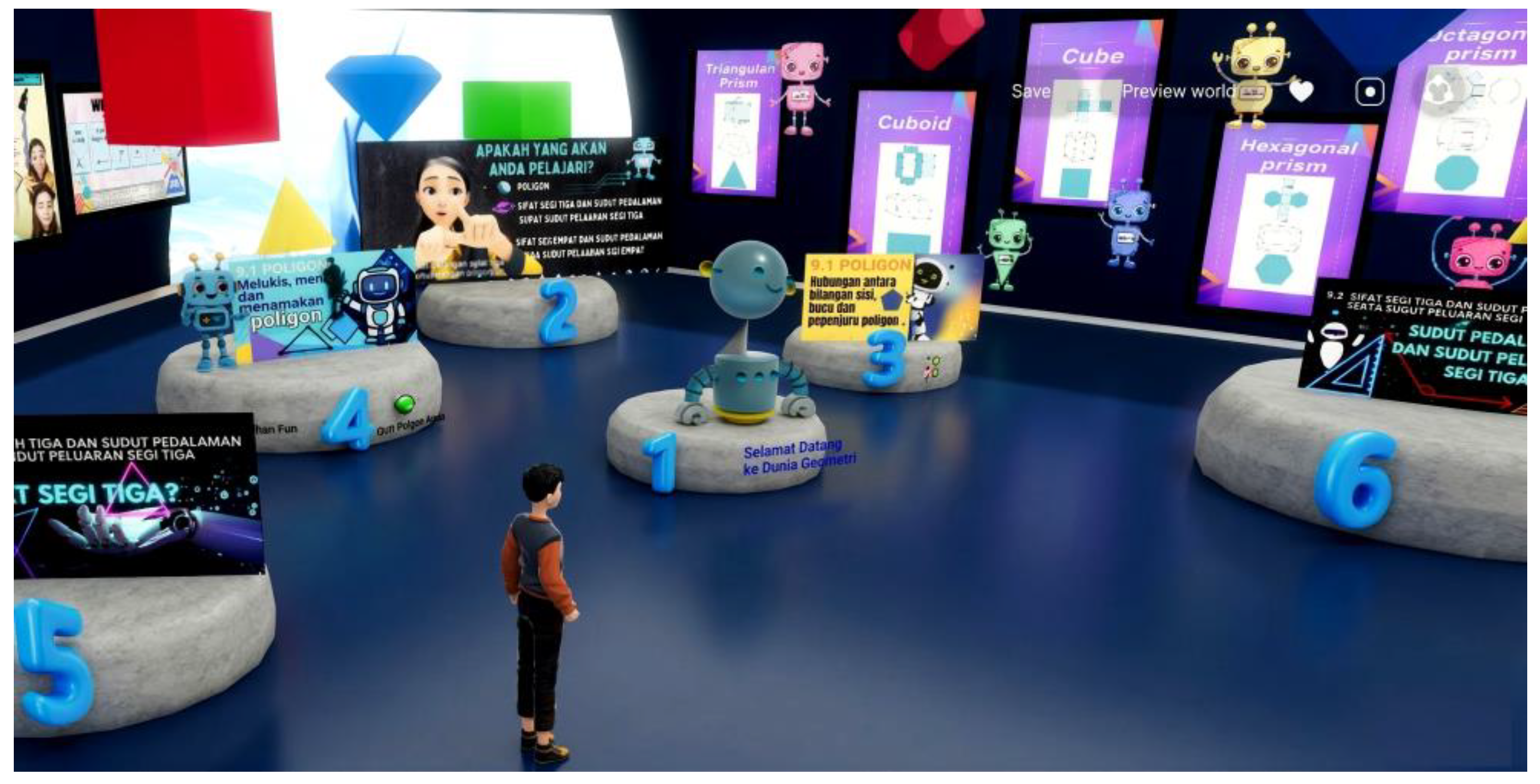
| Session 1 | Introduction and Orientation | Students were introduced to the metaverse platform, including account setup, navigation, and basic interaction (Figure 2). |
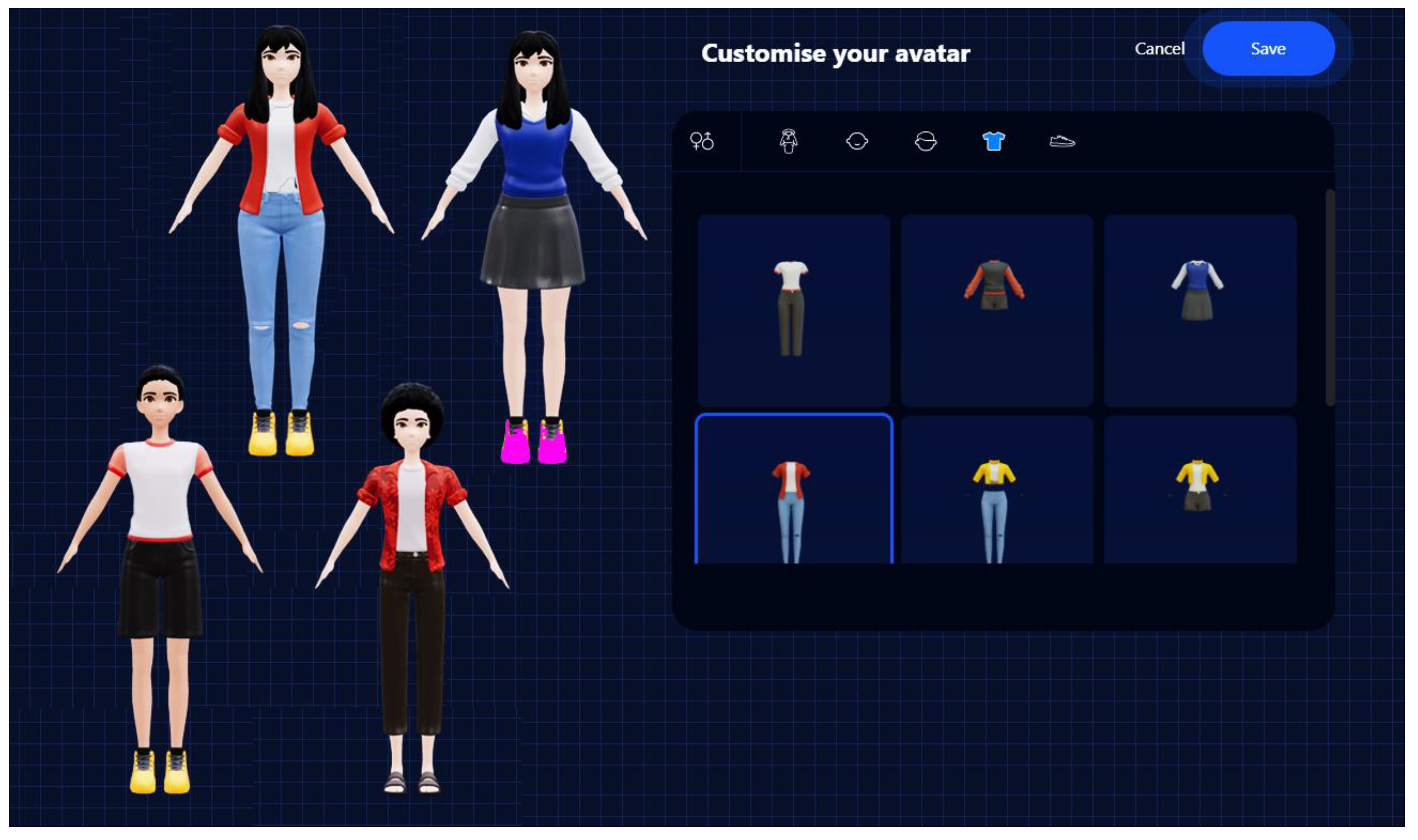
| Session 2 | Avatar Customization and Virtual Navigation | Students personalized avatars and practiced movement, teleportation, and object interaction (Figure 3). |
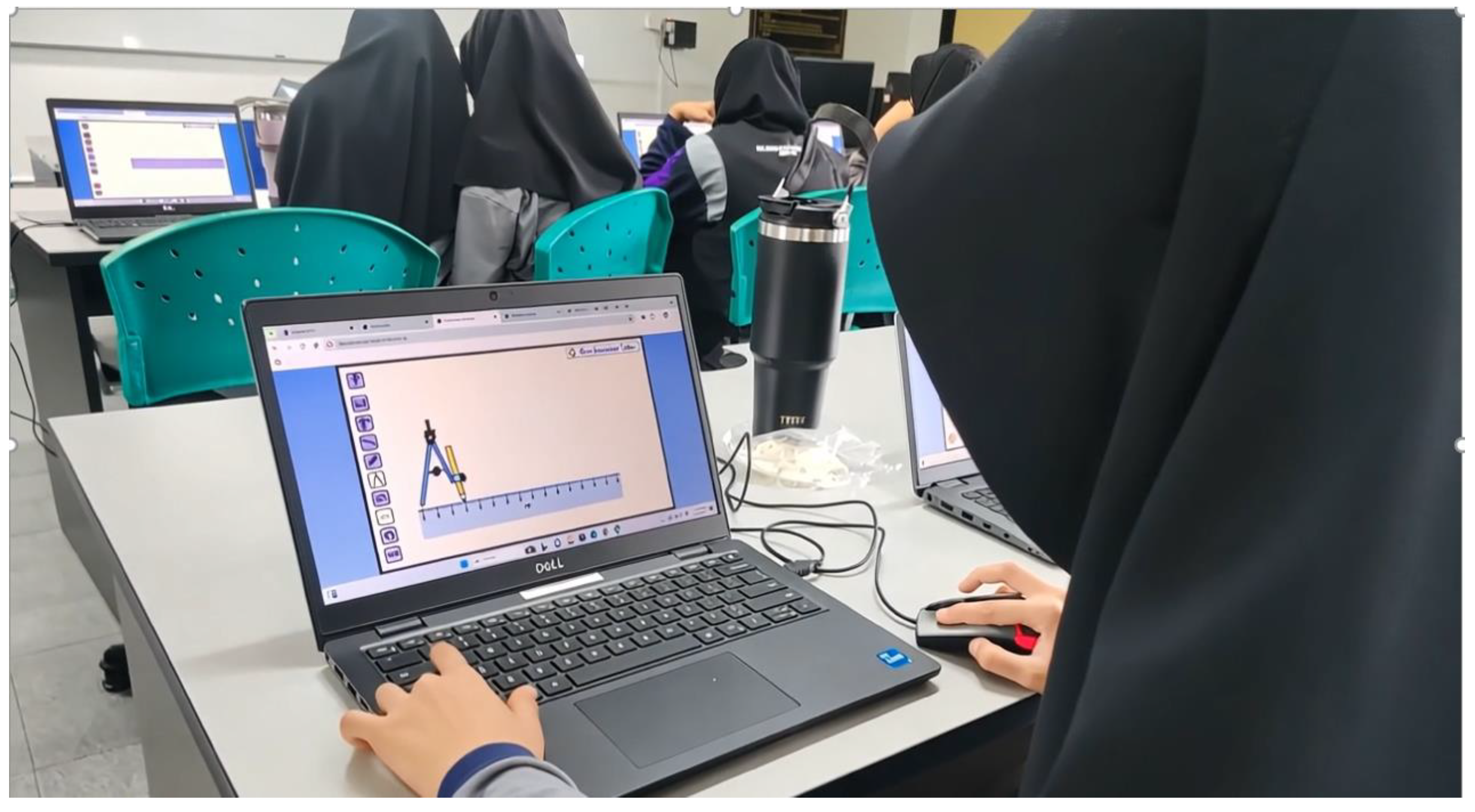
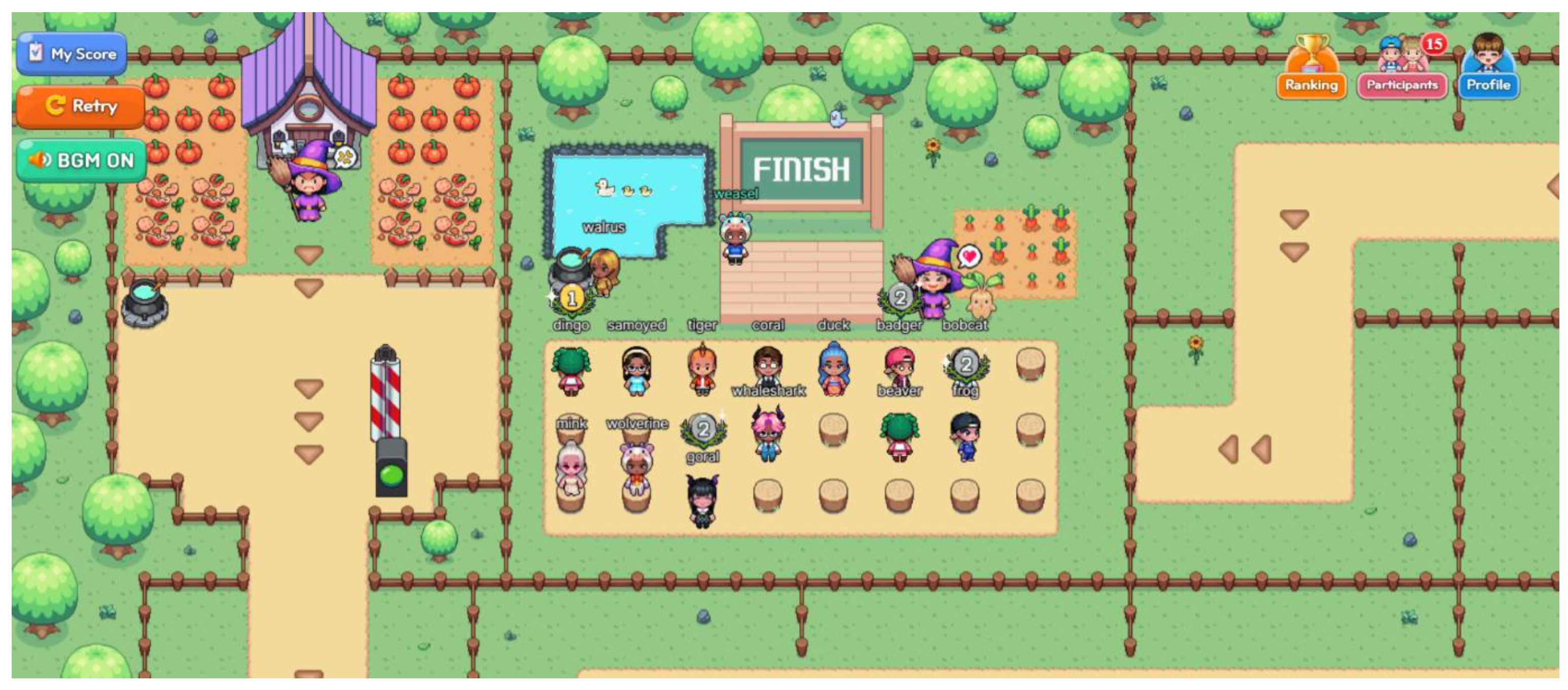
| Session 3 | Hands-on Geometry Tasks | Students completed sign language-guided geometry activities using digital tools (e.g., instructional videos, drawing line segments, measuring angles) and played educational games to reinforce concepts (Figure 4). |
| Session 4 | Interactive Assessment | Students participated in collaborative discussions and completed a multiplayer metaverse quiz to assess conceptual understanding and engagement (Figure 5). |
3.4.3. Phase 3: Post-Workshop Focus Group Discussion (FGD)
3.5. Data Analysis and Trustworthiness
3.6. Researcher Positionality
3.7. Translation and Transcription Procedures
4. Results
4.1. Pre-Workshop Insights
4.1.1. Expectations and Challenges of GeoMETriA Through the Lens of CAMIL
4.1.2. Enhancing Usability and Accessibility in GeoMETriA
4.1.3. Gamification and Engagement Factors
4.2. Post-Workshop Insight: Focus Group Discussion
4.2.1. Gamification and Social Engagement: Enhancing Interest and Motivation
4.2.2. Embodiment and Virtual Presence: Identity and Immersion
4.2.3. Self-Efficacy and Confidence Development: From Uncertainty to Independence
4.2.4. Social Learning and Self-Regulation: Peer Collaboration and Independent Learning Challenges
4.2.5. Cognitive Load and Learning: Processing Challenges, Pacing, and Navigation
4.2.6. Usability and Accessibility: Practical Constraints and Design Suggestions
5. Discussion
5.1. RQ1: How DHH Students Experienced Learning in GeoMETriA
5.2. RQ2: How CAMIL Dimensions Manifested in DHH Students’ Engagement
5.2.1. Interest and Intrinsic Motivation
5.2.2. Embodiment and Presence
5.2.3. Self-Efficacy
5.2.4. Cognitive Load and Self-Regulation
5.3. RQ3: Usability and Accessibility Considerations for Inclusive Metaverse Learning
5.3.1. Sign Language Integration as Foundational Accessibility
5.3.2. Infrastructural Accessibility and Interface Usability
5.3.3. Toward Ecological Accessibility
6. Implications
6.1. Theoretical Implications
6.2. Practical Implications
7. Limitations and Directions for Future Research
8. Conclusions
Author Contributions
Funding
Institutional Review Board Statement
Informed Consent Statement
Data Availability Statement
Acknowledgments
Conflicts of Interest
References
- Abdullah Almulhim, Fatimah, Sougata Roy, and Aritra Swarnali Priyanka. 2025. Smart classrooms, unheard perspectives: A global review of technology integration and local challenges in deaf and hard-of-hearing education in Saudi Arabia. Frontiers in Education 10: 1663912. [Google Scholar] [CrossRef]
- Aboud, Yara Z., and Rami Al Ali. 2025. Bridging the gap: Augmented reality for math education among Saudi deaf students. Decision Making: Applications in Management and Engineering 8: 348–63. [Google Scholar] [CrossRef]
- Abylkassymova, Alma, Yermek Yessetov, Yerlan Tuyakov, and Aizhan Ardabayeva. 2025. Teaching geometry in school: Digital resources to develop students’ spatial thinking. International Journal of Innovative Research and Scientific Studies 8: 439–50. [Google Scholar] [CrossRef]
- Akrami, Zahra, and Mahdi Shirvani. 2025. Deaf and hard-of-hearing students’ chemistry learning and engagement: Smartphone-created multimodal artifacts. Journal of Chemical Education 102: 5218–28. [Google Scholar] [CrossRef]
- Alam, M. Sakhawat, Joy Lamberton, Jia Wang, Caroline Leannah, Seth Miller, John Palagano, Melissa de Bastion, Heather L. Smith, Melissa Malzkuhn, and Lorna C. Quandt. 2024. ASL champ!: A virtual reality game with deep-learning driven sign recognition. Computers and Education: X Reality 4: 100059. [Google Scholar] [CrossRef]
- Aljedaani, Wajdi, Rina Krasniqi, Salwa Aljedaani, Mohamed Wiem Mkaouer, Stephanie Ludi, and Khaled Al-Raddah. 2023. If online learning works for you, what about deaf students? Emerging challenges of online learning for deaf and hearing-impaired students during COVID-19: A literature review. Universal Access in the Information Society 22: 1027–46. [Google Scholar] [CrossRef]
- Almalhy, Khalid M. 2022. Effect of video tutorial delivery method on D/HH students’ content comprehension. Frontiers in Psychology 13: 872946. [Google Scholar] [CrossRef] [PubMed]
- Altinay, Fahriye, Ahmed Tlili, Zehra Altinay, Gökmen Dagli, Oluwafemi Benson Adedoyin, Ronghuai Huang, Lyu Xu, Mohamed Jemni, Reza Hadi Mogavi, and Ahmed Hosny Saleh Metwally. 2024. Meta-in or meta-out of students with special needs: A systematic review on the use of metaverse in special education. In Metaverse Learning Environments. Singapore: Springer, pp. 111–28. [Google Scholar] [CrossRef]
- Andriyani, Joko Lianto Buliali, and Yudhiakto Pramudya. 2022. The effectiveness application of learning model with augmented reality on deaf student’s geometry learning outcomes. AIP Conference Proceedings 2479: 020007. [Google Scholar] [CrossRef]
- Arcavi, Abraham. 2003. The role of visual representations in the learning of mathematics. Educational Studies in Mathematics 52: 215–41. [Google Scholar] [CrossRef]
- Asiksoy, Gulsum. 2023. Empirical studies on the metaverse-based education: A systematic review. International Journal of Engineering Pedagogy 13: 120–33. [Google Scholar] [CrossRef]
- Askari, Gholamreza, Makan Vajdi, Somayeh Jafari-Nasab, and Sara Golpour-Hamedani. 2024. Ethical guidelines for human research on children and adolescents: A narrative review study. Journal of Research in Medical Sciences 29: 53. [Google Scholar] [CrossRef] [PubMed]
- Balch, George I., and Donna M. Mertens. 1999. Focus group design and group dynamics: Lessons from deaf and hard of hearing participants. American Journal of Evaluation 20: 265–77. [Google Scholar] [CrossRef]
- Bandura, Albert. 1977. Self-efficacy: Toward a unifying theory of behavioral change. Psychological Review 84: 191–215. [Google Scholar] [CrossRef]
- Bartels, Nils, and Kirsten Hahne. 2023. Teaching building information modeling in the metaverse—An approach based on quantitative and qualitative evaluation of the students perspective. Buildings 13: 2198. [Google Scholar] [CrossRef]
- Bedard, Alexia, and Qi Zhang. 2023. Building an inclusive metaverse: Opening doors to a brighter digital future. In HCI International 2023—Late Breaking Papers. Cham: Springer, pp. 333–51. [Google Scholar] [CrossRef]
- Birt, Linda, Suzanne Scott, Debbie Cavers, Christine Campbell, and Fiona Walter. 2016. Member checking: A tool to enhance trustworthiness or merely a nod to validation? Qualitative Health Research 26: 1802–11. [Google Scholar] [CrossRef]
- Blatto-Vallee, Gary, Ronald R. Kelly, Martha G. Gaustad, Judith Porter, and Joseph Fonzi. 2007. Visual-spatial representation in mathematical problem solving by deaf and hearing students. Journal of Deaf Studies and Deaf Education 12: 432–48. [Google Scholar] [CrossRef]
- Boekaerts, Monique, and Markku Niemivirta. 2000. Self-regulated learning. In Handbook of Self-Regulation. Edited by Monique Boekaerts, Paul R. Pintrich and Moshe Zeidner. San Diego: Academic Press, pp. 417–50. [Google Scholar] [CrossRef]
- Boonstra, Karianne, Marjolein Kool, Anna Shvarts, and Paul Drijvers. 2023. Theories and practical perspectives on fostering embodied abstraction in primary school geometry education. Frontiers in Education 8: 1162681. [Google Scholar] [CrossRef]
- Bowen, Sarah K., and Kimberly M. Probst. 2023. Deaf and hard of hearing students with disabilities: An evolving landscape. Education Sciences 13: 752. [Google Scholar] [CrossRef]
- Braguez, João, Marta Braguez, Sofia Moreira, and Carlos Filipe. 2023. The possibilities of changes in learning experiences with metaverse. Procedia Computer Science 219: 504–11. [Google Scholar] [CrossRef]
- Braun, Virginia, and Victoria Clarke. 2006. Using thematic analysis in psychology. Qualitative Research in Psychology 3: 77–101. [Google Scholar] [CrossRef]
- CAST. 2018. Universal Design for Learning Guidelines Version 2.2. Wakefield: CAST. Available online: https://udlguidelines.cast.org (accessed on 10 January 2026).
- Cawthon, Stephanie W., Emily Barker, Jessica Daniel, Nathan Cooc, and Aida G. Vielma. 2022. Longitudinal models of reading and mathematics achievement in deaf and hard of hearing students. The Journal of Deaf Studies and Deaf Education 28: 115–23. [Google Scholar] [CrossRef]
- Chamola, Vinay, Mayank Singh Peelam, Utkarsh Mittal, Vikas Hassija, Anurag Singh, Ritika Pareek, Prateeksha Mangal, Divya Sangwan, Victor Hugo C. de Albuquerque, Mufti Mahmud, and et al. 2025. Metaverse for education: Developments, challenges, and future direction. Computer Applications in Engineering Education 33: e70018. [Google Scholar] [CrossRef]
- Chee, Yam San. 2007. Embodiment, embeddedness, and experience: Game-based learning and the construction of identity. Research and Practice in Technology Enhanced Learning 2: 3–30. [Google Scholar] [CrossRef]
- Chen, Shu Jun, Cun Qiang Chen, and Xiao Feng Shan. 2024. The effects of an immersive virtual-reality-based 3D modeling approach on the creativity and problem-solving tendency of elementary school students. Sustainability 16: 4092. [Google Scholar] [CrossRef]
- Cheng, Shengyao, Hao Cheng, Shumin Su, Li Ming, Saleh Masud, Qi Wang, and Yue Huang. 2024. Motion design principles for accessible video-based learning: Addressing cognitive challenges for deaf and hard of hearing learners. arXiv arXiv:2410.00196. [Google Scholar] [CrossRef]
- Christopoulos, Athanasios, Stylianos Mystakidis, Joanna Kurczaba, Mikko-Jussi Laakso, and Chrysostomos Stylios. 2024. Is immersion in 3D virtual games associated with mathematical ability improvement in game-based learning? International Journal of Science and Mathematics Education 22: 1479–99. [Google Scholar] [CrossRef]
- Cortini, Michela, Teresa Galanti, and Stefania Fantinelli. 2019. Focus group discussion: How many participants in a group? Encyclopaideia 23: 29–43. [Google Scholar] [CrossRef]
- Creed, Chris, Maadh Al-Kalbani, Arthur Theil, Sayan Sarcar, and Ian Williams. 2024. Inclusive AR/VR: Accessibility barriers for immersive technologies. Universal Access in the Information Society 23: 59–73. [Google Scholar] [CrossRef]
- Dahal, Bishnu. 2024. Participants’ right to withdraw from research: Researchers’ lived experiences on ethics of withdrawal. Journal of Academic Ethics 22: 191–209. [Google Scholar] [CrossRef]
- Damasceno, André, Lucas Silva, Eduardo Barros, and Fernando Oliveira. 2024. Metaverse4Deaf: Assistive technology for inclusion of people with hearing impairment in distance education through a metaverse-based environment. Paper presented at the International Conference on Computer Supported Education, Angers, France, May 2–4. [Google Scholar] [CrossRef]
- de Oliveira, Fernando Cardoso, Wanderley Eustáquio Toledo, Márcia Aparecida, Silvana Bissaco, and Rodrigo Rodrigues Da Silva. 2022. SpaceGeo_AR: Augmented reality application for teaching and learning spatial geometry by deaf and non-deaf students. Research, Society and Development 11: e23211729656. [Google Scholar] [CrossRef]
- Di Dario, Davide, Giovanni Sellitto, Valerio Pentangelo, Maria Luisa Fede, and Filomena Ferrucci. 2024. Breaking barriers in the metaverse: A comprehensive exploration of accessibility for users with disabilities. In Web Engineering. Cham: Springer, pp. 45–55. [Google Scholar] [CrossRef]
- Dudley, John, Lulu Yin, Vanja Garaj, and Per Ola Kristensson. 2023. Inclusive immersion: A review of efforts to improve accessibility in virtual reality, augmented reality and the metaverse. Virtual Reality 27: 2989–3020. [Google Scholar] [CrossRef]
- Duval, Raymond. 2006. A cognitive analysis of problems of comprehension in a learning of mathematics. Educational Studies in Mathematics 61: 103–31. [Google Scholar] [CrossRef]
- Eichengreen, Anat, Anna Spigt, and Anat Zaidman-Zait. 2025. Social inclusion of mainstreamed deaf or hard-of-hearing preadolescents and their perspectives on coping with communication barriers. European Journal of Special Needs Education, 1–19. [Google Scholar] [CrossRef]
- Farikah, Farikah, Astuty Astuty, Said Mazid, and Mulyani Mulyani. 2023. Student engagement in virtual learning: The self-determination theory perspective. Arab World English Journal 14: 182–98. [Google Scholar] [CrossRef]
- Fereday, Jennifer, and Eimear Muir-Cochrane. 2006. Demonstrating rigor using thematic analysis: A hybrid approach of inductive and deductive coding and theme development. International Journal of Qualitative Methods 5: 80–92. [Google Scholar] [CrossRef]
- Fernandes, Nathalia, Antônio José Melo Leite Junior, Edgar Marçal, and Windson Viana. 2024. Augmented reality in education for people who are deaf or hard of hearing: A systematic literature review. Universal Access in the Information Society 23: 1483–502. [Google Scholar] [CrossRef]
- Gehret, Abigail U., and Lisa B. Elliot. 2025. Perceptions of e-learning by deaf and hard of hearing students using asynchronous multimedia tutorials. Educational Technology Research and Development 73: 1921–49. [Google Scholar] [CrossRef]
- González Vallejo, Rodrigo. 2024. The role of avatars in language learning in the metaverse. Metaverse Basic and Applied Research 3: 62. [Google Scholar] [CrossRef]
- Gottardis, Louisa, Terezinha Nunes, and Ingrid Lunt. 2011. A synthesis of research on deaf and hearing children’s mathematical achievement. Deafness and Education International 13: 131–50. [Google Scholar] [CrossRef]
- Gremp, Megan A., Joanne A. Deocampo, Anne M. Walk, and Christopher M. Conway. 2019. Visual sequential processing and language ability in children who are deaf or hard of hearing. Journal of Child Language 46: 785–99. [Google Scholar] [CrossRef]
- Guy, Morgan, Jean-Marie Normand, Camille Jeunet-Kelway, and Guillaume Moreau. 2023. The sense of embodiment in virtual reality and its assessment methods. Frontiers in Virtual Reality 4: 1141683. [Google Scholar] [CrossRef]
- Gürefe, Nejla. 2022. How must a polygon be according to hard of hearing students? An investigation with a semiotic approach. Journal of Research in Mathematics Education 11: 180–213. [Google Scholar] [CrossRef]
- Hadi Mogavi, Reza, Julia Hoffman, Chaofan Deng, Yifan Du, Ehsan Ul Haq, and Pan Hui. 2023. Envisioning an inclusive metaverse: Student perspectives on accessible and empowering metaverse-enabled learning. Paper presented at the 10th ACM Conference on Learning @ Scale, Copenhagen, Denmark, July 20–22. [Google Scholar] [CrossRef]
- Heaton, Janet. 2022. ‘Pseudonyms are used throughout’: A footnote, unpacked. Qualitative Inquiry 28: 123–32. [Google Scholar] [CrossRef]
- Henner, Jon, Claudia Pagliaro, Shirley Sullivan, and Robert Hoffmeister. 2021. Counting differently: Assessing mathematics achievement of signing deaf and hard of hearing children through a unique lens. American Annals of the Deaf 166: 318–41. [Google Scholar] [CrossRef] [PubMed]
- Heryanto, Feri Hidayatullah Firmansyah, and Yusep Rosmansyah. 2024. Exploring collaboration in multiplayer gamification: A systematic literature review. IEEE Access 12: 149399–431. [Google Scholar] [CrossRef]
- Hsu, Yu-Ting, Silvia Lee, Wan-Yu Lee, and Su Wen-Yu. 2025. Support for self-regulated learning in immersive virtual reality—An experimental design for science learning. Education and Information Technologies 31: 269–300. [Google Scholar] [CrossRef]
- Husniati, Agustiningsih, I. Ketut Budayasa, Dwi Juniati, and Lydia C. Lant. 2020. Analysis of deaf students understanding math concepts in the topic of geometry (rectangle shape): A case study. Journal for the Education of Gifted Young Scientists 8: 1213–29. [Google Scholar] [CrossRef]
- Huynh-The, Thien, Thippa Reddy Gadekallu, Weizheng Wang, Gokul Yenduri, Pasika Ranaweera, Quoc-Viet Pham, Daniel Benevides da Costa, and Madhusanka Liyanage. 2023. Blockchain for the metaverse: A review. Future Generation Computer Systems 143: 401–19. [Google Scholar] [CrossRef]
- Hwang, Gwo-Jen, and Shu-Yun Chien. 2022. Definition, roles, and potential research issues of the metaverse in education: An artificial intelligence perspective. Computers and Education: Artificial Intelligence 3: 100082. [Google Scholar] [CrossRef]
- Hwang, Yohan, Dongyeon Shin, and Hyunseung Lee. 2023. Students’ perception on immersive learning through 2D and 3D metaverse platforms. Educational Technology Research and Development 71: 1687–708. [Google Scholar] [CrossRef]
- Jiang, Shengnan, Yiwen Wang, and Yonghao Sun. 2025. Exploring the role of virtual reality in cultural heritage education based on the cognitive affective model of immersive learning. PACIS 2025 Proceedings 15. Available online: https://aisel.aisnet.org/pacis2025/general_topic/general_topic/15 (accessed on 14 October 2025).
- Johnson-Glenberg, Mina. 2018. Immersive VR and education: Embodied design principles that include gesture and hand controls. Frontiers in Robotics and AI 5: 81. [Google Scholar] [CrossRef]
- Kaddoura, Sanaa, and Fatima Al Husseiny. 2023. The rising trend of metaverse in education: Challenges, opportunities, and ethical considerations. PeerJ Computer Science 9: e1252. [Google Scholar] [CrossRef] [PubMed]
- Karnieli-Miller, Orit, Roni Strier, and Liat Pessach. 2009. Power relations in qualitative research. Qualitative Health Research 19: 279–89. [Google Scholar] [CrossRef]
- Kato, Naoto, and Hitomi Kitamura. 2021. Objective evaluation method of reading captioning using HMD for deaf and hard-of-hearing. Paper presented at the International Conference on Computer Supported Education, Online, April 23–25. [Google Scholar] [CrossRef]
- Knoors, Harry. 2016. Language use in the classroom. In Diversity in Deaf Education. Edited by Marc Marschark and Patricia Elizabeth Spencer. New York: Oxford University Press, pp. 219–46. [Google Scholar] [CrossRef]
- Knoors, Harry, and Marc Marschark. 2014. Teaching Deaf Learners: Psychological and Developmental Foundations. New York: Oxford University Press. [Google Scholar] [CrossRef]
- Koohang, Alex, Joanna H. Nord, Keng-Boon Ooi, Garry Wei-Han Tan, Mohamed Al-Emran, Eugene Cheng-Xi Aw, Ali M. Baabdullah, Dimitrios Buhalis, Tat-Huei Cham, Charles Dennis, and et al. 2023. Shaping the metaverse into reality: A holistic multidisciplinary understanding of opportunities, challenges, and avenues for future investigation. Journal of Computer Information Systems 63: 735–65. [Google Scholar] [CrossRef]
- Krasavina, Yulia, Elena Ponomarenko, Oksana Zhuykova, and Yuliya Serebryakova. 2022. Designing e-courses for hearing impaired students: Practices and challenges. Paper presented at the VII International Forum on Teacher Education, Kazan, Russia, May 26–28. [Google Scholar] [CrossRef]
- Krause, Christina M., and Annika M. Wille. 2021. Sign language in light of mathematics education: An exploration within semiotic and embodiment theories of learning mathematics. American Annals of the Deaf 166: 352–77. [Google Scholar] [CrossRef] [PubMed]
- Krueger, Richard A., and Mary Anne Casey. 2014. Focus Groups: A Practical Guide for Applied Research, 5th ed. Thousand Oaks: SAGE Publications. [Google Scholar]
- Kurz, Christopher, and Claudia M. Pagliaro. 2019. Using L1 sign language to teach mathematics. In The Routledge Handbook of Sign Language Pedagogy. Edited by Anne Baker, Beppie van den Bogaerde and Roland Pfau. New York: Routledge, pp. 85–99. [Google Scholar] [CrossRef]
- Kye, Bokyung, Nara Han, Eunji Kim, Yeonjeong Park, and Soyoung Jo. 2021. Educational applications of metaverse: Possibilities and limitations. Journal of Educational Evaluation for Health Professions 18: 32. [Google Scholar] [CrossRef]
- Lampropoulos, Georgios, and Kinshuk. 2024. Virtual reality and gamification in education: A systematic review. Educational Technology Research and Development 72: 1691–785. [Google Scholar] [CrossRef]
- Lee, Hee Woo, Kyungwon Chang, Ji-Pyung Uhm, and Enyonam Owiro. 2023a. How avatar identification affects enjoyment in the metaverse: The roles of avatar customization and social engagement. Cyberpsychology, Behavior, and Social Networking 26: 255–62. [Google Scholar] [CrossRef]
- Lee, Jeong Hyun, Tae Seon Lee, Seung Young Yoo, Sung Woo Lee, Jae Hye Jang, Young Jin Choi, and Rae Woong Park. 2023b. Metaverse-based social skills training programme for children with autism spectrum disorder to improve social interaction ability: An open-label, single-centre, randomised controlled pilot trial. EClinicalMedicine 61: 102072. [Google Scholar] [CrossRef]
- Li, Ling, Khe Foon Hew, and Jiahui Du. 2024. Gamification enhances student intrinsic motivation, perceptions of autonomy and relatedness, but minimal impact on competency: A meta-analysis and systematic review. Educational Technology Research and Development 72: 765–96. [Google Scholar] [CrossRef]
- Lieberman, Amy M., Marla Hatrak, and Rachel I. Mayberry. 2013. Learning to look for language: Development of joint attention in young deaf children. Language Learning and Development 10: 19–35. [Google Scholar] [CrossRef]
- Lillo-Martin, Diane C., Elaine Gale, and Deborah Chen Pichler. 2023. Family ASL: An early start to equitable education for deaf children. Topics in Early Childhood Special Education 43: 156–66. [Google Scholar] [CrossRef]
- Lincoln, Yvonna, and Egon G. Guba. 1985. Naturalistic Inquiry. Thousand Oaks: SAGE Publications. [Google Scholar]
- Lowell, Victoria L., and Deepak Tagare. 2023. Authentic learning and fidelity in virtual reality learning experiences for self-efficacy and transfer. Computers and Education: X Reality 2: 100017. [Google Scholar] [CrossRef]
- Luarn, Pin, Chiao-Chen Chen, and Yu-Ping Chiu. 2023. Enhancing intrinsic learning motivation through gamification: A self-determination theory perspective. International Journal of Information and Learning Technology 40: 413–24. [Google Scholar] [CrossRef]
- Luft, Pamela, and Chantal Brochu. 2023. Online learning challenges and strategies: Visual fatigue and split visual attention. American Annals of the Deaf 168: 71–92. [Google Scholar] [CrossRef] [PubMed]
- Makransky, Guido, and Gustav B. Petersen. 2019. Investigating the process of learning with desktop virtual reality: A structural equation modeling approach. Computers and Education 134: 15–30. [Google Scholar] [CrossRef]
- Makransky, Guido, and Gustav B. Petersen. 2021. The cognitive affective model of immersive learning (CAMIL): A theoretical research-based model of learning in immersive virtual reality. Educational Psychology Review 33: 937–58. [Google Scholar] [CrossRef]
- Makransky, Guido, and Lau Lilleholt. 2018. A structural equation modeling investigation of the emotional value of immersive virtual reality in education. Educational Technology Research and Development 66: 1141–64. [Google Scholar] [CrossRef]
- Makransky, Guido, Thomas S. Terkildsen, and Richard E. Mayer. 2019. Adding immersive virtual reality to a science lab simulation causes more presence but less learning. Learning and Instruction 60: 225–36. [Google Scholar] [CrossRef]
- Malterud, Kirsti, Volkert Dirk Siersma, and Ann Dorrit Guassora. 2016. Sample size in qualitative interview studies: Guided by information power. Qualitative Health Research 26: 1753–60. [Google Scholar] [CrossRef]
- Marschark, Marc, Allan Paivio, Linda J. Spencer, Anthony Durkin, Georgianna Borgna, Carol Convertino, and Elizabeth Machmer. 2017. Don’t assume deaf students are visual learners. Journal of Developmental and Physical Disabilities 29: 153–71. [Google Scholar] [CrossRef]
- Marschark, Marc, and Patricia Elizabeth Spencer. 2010. The Oxford Handbook of Deaf Studies, Language, and Education, 2nd ed. New York: Oxford University Press. [Google Scholar] [CrossRef]
- Marschark, Marc, Deniece M. Shaver, Katherine M. Nagle, and Lynn A. Newman. 2015a. Predicting the academic achievement of deaf and hard-of-hearing students from individual, household, communication, and educational factors. Exceptional Children 81: 350–69. [Google Scholar] [CrossRef]
- Marschark, Marc, Greg Leigh, Patricia Sapere, Denis Burnham, Carol Convertino, Michael Stinson, and William Noble. 2006. Benefits of sign language interpreting and text alternatives for deaf students’ classroom learning. The Journal of Deaf Studies and Deaf Education 11: 421–37. [Google Scholar] [CrossRef]
- Marschark, Marc, Jeff B. Pelz, Carol Convertino, Patricia Sapere, Mary Ellen Arndt, and Richard Seewagen. 2005. Classroom interpreting and visual information processing in mainstream education for deaf students: Live or Memorex? American Educational Research Journal 42: 727–61. [Google Scholar] [CrossRef]
- Marschark, Marc, Linda J. Spencer, Anthony Durkin, Georgianna Borgna, Carol Convertino, Elizabeth Machmer, William G. Kronenberger, and Anna Trani. 2015b. Understanding language, hearing status, and visual-spatial skills. Journal of Deaf Studies and Deaf Education 20: 310–30. [Google Scholar] [CrossRef]
- Mayer, Connie C., and Beverly J. Trezek. 2023. Communication, language, and modality in the education of deaf students. Education Sciences 13: 1033. [Google Scholar] [CrossRef]
- Mayer, Richard E. 2005. Cognitive theory of multimedia learning. In The Cambridge Handbook of Multimedia Learning. Edited by Richard E. Mayer. Cambridge: Cambridge University Press, pp. 31–48. [Google Scholar] [CrossRef]
- Mayer, Richard E., Guido Makransky, and Jocelyn Parong. 2023. The promise and pitfalls of learning in immersive virtual reality. International Journal of Human-Computer Interaction 39: 2229–38. [Google Scholar] [CrossRef]
- McKee, Michael, Denise Schlehofer, and Donna Thew. 2013. Ethical issues in conducting research with deaf populations. American Journal of Public Health 103: 2174–78. [Google Scholar] [CrossRef] [PubMed]
- Milgram, Paul, and Fumio Kishino. 1994. A taxonomy of mixed reality visual displays. IEICE Transactions on Information and Systems E77-D: 1321–29. [Google Scholar] [CrossRef]
- Ministry of Education Malaysia. 2023. Dasar pendidikan digital [Digital Education Policy]; Putrajaya: Ministry of Education Malaysia. Available online: https://www.moe.gov.my/dasarmenu/dasar-pendidikan-digital (accessed on 14 December 2025).
- Ministry of Education Malaysia. 2024. Pelan Strategik Kementerian Pendidikan Malaysia (PSKPM) 2024–2030 [Ministry of Education Strategic Plan 2024–2030]; Putrajaya: Ministry of Education Malaysia. Available online: https://www.moe.gov.my/pskpm20242030 (accessed on 14 December 2025).
- Ministry of Women Family and Community Development. 2025. Statistics of Registered Persons with Disabilities by Age Group and Category. Available online: https://www.jpw.gov.my/index.php/en/home (accessed on 5 January 2026).
- Mirzaei, Mersedeh, Peter Kán, and Hannes Kaufmann. 2020. EarVR: Using ear haptics in virtual reality for deaf and hard-of-hearing people. IEEE Transactions on Visualization and Computer Graphics 26: 2084–93. [Google Scholar] [CrossRef] [PubMed]
- Mitchell, Ross E., and Michael A. Karchmer. 2004. Chasing the mythical ten percent: Parental hearing status of deaf and hard of hearing students in the United States. Sign Language Studies 4: 138–63. [Google Scholar] [CrossRef]
- Mystakidis, Stylianos. 2022. Metaverse. Encyclopedia 2: 486–97. [Google Scholar] [CrossRef]
- Ng, Davy Tsz Kit. 2022. What is the metaverse? Definitions, technologies and the community of inquiry. Australasian Journal of Educational Technology 38: 190–205. [Google Scholar] [CrossRef]
- Nguyen, Thao Hanh, and Xuan Long Pham. 2024. Enhancing social presence in online learning through metaverse platform. Policy Futures in Education 24: 146–63. [Google Scholar] [CrossRef]
- Nowak, Kristine L., and Frank Waddell. 2018. Avatars and computer-mediated communication: A review of the uses and effects of virtual representations. Review of Communication Research 6: 30–53. [Google Scholar] [CrossRef]
- O’Connor, Cliodhna. 2016. Embodiment and the construction of social knowledge: Towards an integration of embodiment and social representations theory. Journal for the Theory of Social Behaviour 47: 2–24. [Google Scholar] [CrossRef]
- Oh, Hyun Jung, Jisoo Kim, Jason J. C. Chang, Namkee Park, and Sora Lee. 2023. Social benefits of living in the metaverse: The relationships among social presence, supportive interaction, social self-efficacy, and feelings of loneliness. Computers in Human Behavior 139: 107498. [Google Scholar] [CrossRef]
- Olszak, Irena, and Alicja Borowicz. 2025. Learning styles and strategies of D/deaf and hard of hearing students in foreign language acquisition—A research report. Frontiers in Education 10: 1553031. [Google Scholar] [CrossRef]
- Onu, Peter, Adekunle Pradhan, and Charles Mbohwa. 2024. Potential to use metaverse for future teaching and learning. Education and Information Technologies 29: 8893–924. [Google Scholar] [CrossRef]
- Othman, Achraf, Kifayat Chemnad, Aboul Ella Hassanien, Ahmed Tlili, Chuang Yi Zhang, Dena Al-Thani, Fahriye Altınay, Hajer Chalghoumi, Hend S. Al-Khalifa, Maha Obeid, and et al. 2024. Accessible metaverse: A theoretical framework for accessibility and inclusion in the metaverse. Multimodal Technologies and Interaction 8: 21. [Google Scholar] [CrossRef]
- Pagliaro, Claudia M., and Ellen Ansell. 2012. Deaf and hard of hearing students’ problem-solving strategies with signed arithmetic story problems. American Annals of the Deaf 156: 438–58. [Google Scholar] [CrossRef] [PubMed]
- Parekh, Gillian, Kathryn Underwood, and Amar Atwal. 2021. Ethical considerations for doing research with, and in relation to, disabled children. In Ethics and Integrity in Research with Children and Young People. Bingley: Emerald Publishing, pp. 73–86. [Google Scholar] [CrossRef]
- Park, Sang-Min, and Young-Gab Kim. 2022. A metaverse: Taxonomy, components, applications, and open challenges. IEEE Access 10: 4209–51. [Google Scholar] [CrossRef]
- Parker, Callum, Soobin Yoo, Jess Fredericks, Trung T. M. Tran, Jacob R. Williamson, Yongsoon Lee, and Woontack Woo. 2024. Building a metaverse for all: Opportunities and challenges for future inclusive and accessible virtual environments. Paper presented at the CHI Conference on Human Factors in Computing Systems, Honolulu, HI, USA, May 11–16. [Google Scholar] [CrossRef]
- Pendergast, Donna, Megan O’Brien, Sarah Prestridge, and Beryl Exley. 2022. Self-efficacy in a 3-dimensional virtual reality classroom—Initial teacher education students’ experiences. Education Sciences 12: 368. [Google Scholar] [CrossRef]
- Petersen, Gustav B., Georgios Petkakis, and Guido Makransky. 2022. A study of how immersion and interactivity drive VR learning. Computers and Education 179: 104429. [Google Scholar] [CrossRef]
- Peterson, Jamie M., Christy M. Borders, and Mary S. Ely. 2023. Prevalence of educationally significant disabilities among deaf and hard of hearing students. American Annals of the Deaf 167: 583–96. [Google Scholar] [CrossRef]
- Pintrich, Paul R. 2000. The role of goal orientation in self-regulated learning. In Handbook of Self-Regulation. Edited by Monique Boekaerts, Paul R. Pintrich and Moshe Zeidner. San Diego: Academic Press, pp. 451–502. [Google Scholar] [CrossRef]
- Rassy, Reem P., Nurul Azlina Mokmin, Nur Elina Fairuz, and Zatul Apandi. 2023. Examining learning enjoyment, presence, and achievement using a virtual reality pathology laboratory by applying the CAMIL model in health education. Research Square. [Google Scholar] [CrossRef]
- Rodrigues, Filipa M., António M. Abreu, Ingela Holmström, and Ana Mineiro. 2022a. E-learning is a burden for the deaf and hard of hearing. Scientific Reports 12: 9346. [Google Scholar] [CrossRef]
- Rodrigues, Filipa M., Joana R. Rato, Ana Mineiro, and Ingela Holmström. 2022b. Unveiling teachers’ beliefs on visual cognition and learning styles of deaf and hard of hearing students: A Portuguese-Swedish study. PLoS ONE 17: e0263216. [Google Scholar] [CrossRef]
- Ryan, Richard M., and Edward L. Deci. 2000. Self-determination theory and the facilitation of intrinsic motivation, social development, and well-being. American Psychologist 55: 68–78. [Google Scholar] [CrossRef]
- Saad Elfar, Eman, Dina Mohamed Abdelkhalik Kishk, Asmaa M. Ibrahim, and Shaimaa Elhoseiny Abdelraouf. 2024. Silent lifesavers: Breaking barriers with a sign language health education video for students with deafness on school first aid. International Journal of Africa Nursing Sciences 20: 100725. [Google Scholar] [CrossRef]
- Samaradivakara, Yomal, Tharindu Ushan, Amila Pathirage, Prabhashi Sasikumar, Kasun Karunanayaka, Chamath Keppitiyagama, and Suranga Nanayakkara. 2024. SeEar: Tailoring real-time AR caption interfaces for deaf and hard-of-hearing (DHH) students in specialized educational settings. Paper presented at the CHI Conference on Human Factors in Computing Systems, Honolulu, HI, USA, May 11–16. [Google Scholar] [CrossRef]
- Sandelowski, Margarete. 2000. Focus on research methods: Whatever happened to qualitative description? Research in Nursing and Health 23: 334–40. [Google Scholar] [CrossRef]
- Santos, Sofia, and Sara Cordes. 2022. Math abilities in deaf and hard of hearing children: The role of language in developing number concepts. Psychological Review 129: 199–211. [Google Scholar] [CrossRef] [PubMed]
- Schindler, Maike, Julia H. Doderer, Anna L. Simon, Elisabeth Schaaernicht, Achim J. Lilienthal, and Karla Schäfer. 2022. Small number enumeration processes of deaf or hard-of-hearing students: A study using eye tracking and artificial intelligence. Frontiers in Psychology 13: 909775. [Google Scholar] [CrossRef]
- Schmidt-Weigand, Florian, Alfred Kohnert, and Ulrich Glowalla. 2010. A closer look at split visual attention in system- and self-paced instruction in multimedia learning. Learning and Instruction 20: 100–10. [Google Scholar] [CrossRef]
- Schwab, Susanne, Tina Wimberger, and Christoforos Mamas. 2019. Fostering social participation in inclusive classrooms of students who are deaf. International Journal of Disability, Development and Education 66: 325–42. [Google Scholar] [CrossRef]
- Scott, Jessica, Jon Henner, and Michael E. Skyer. 2023. Six arguments for Vygotskian pragmatism in deaf education: Multimodal multilingualism as applied harm reduction. American Annals of the Deaf 168: 56–79. [Google Scholar] [CrossRef]
- Shi, Aizhu, Yun Wang, and Nan Ding. 2022. The effect of game-based immersive virtual reality learning environment on learning outcomes: Designing an intrinsic integrated educational game for pre-class learning. Interactive Learning Environments 30: 721–34. [Google Scholar] [CrossRef]
- Shusterman, Anna, Rebecca Peretz-Lange, Talia Berkowitz, and Emily Carrigan. 2022. The development of early numeracy in deaf and hard of hearing children acquiring spoken language. Child Development 93: e468–e483. [Google Scholar] [CrossRef] [PubMed]
- Silvestri, Jason A., and Michael C. Hartman. 2022. Inclusion and deaf and hard of hearing students: Finding asylum in the LRE. Education Sciences 12: 773. [Google Scholar] [CrossRef]
- Sinclair, Nathalie, and Catherine D. Bruce. 2015. New opportunities in geometry education at the primary school. ZDM–Mathematics Education 47: 319–29. [Google Scholar] [CrossRef]
- Singleton, Jenny L., and Patti K. Crume. 2022. The socialization of modality capital in sign language ecologies: A classroom example. Frontiers in Psychology 13: 934649. [Google Scholar] [CrossRef] [PubMed]
- Skyer, Michael E. 2023. Multimodal transduction and translanguaging in deaf pedagogy. Languages 8: 127. [Google Scholar] [CrossRef]
- Slater, Mel, and Sylvia Wilbur. 1997. A framework for immersive virtual environments (FIVE): Speculations on the role of presence in virtual environments. Presence: Teleoperators and Virtual Environments 6: 603–16. [Google Scholar] [CrossRef]
- Song, Yanjie, Jing Cao, Kan Wu, Patrick L. H. Yu, and John C. K. Lee. 2023. Developing ‘Learningverse’—A 3-D metaverse platform to support teaching, social, and cognitive presences. IEEE Transactions on Learning Technologies 16: 1165–78. [Google Scholar] [CrossRef]
- Starosky, Patrícia, and Maria G. D. Pereira. 2013. Role-playing game as a pedagogical proposition for story co-construction: A Brazilian experience with deaf individuals in an educational context. In Student Usability in Educational Software and Games: Improving Experiences. Edited by Cynthia Gonzalez. Hershey: IGI Global, pp. 274–92. [Google Scholar] [CrossRef]
- Su, Yu-Sheng, Hung-Wei Cheng, and Chin-Feng Lai. 2022. Study of virtual reality immersive technology enhanced mathematics geometry learning. Frontiers in Psychology 13: 760418. [Google Scholar] [CrossRef]
- Sweller, John. 1988. Cognitive load during problem solving: Effects on learning. Cognitive Science 12: 257–85. [Google Scholar] [CrossRef]
- Tanrıdiler, Abdullah. 2024. Teaching mathematics to students with hearing loss using instructional materials. World Journal of Education 14: 23. [Google Scholar] [CrossRef]
- Tene, Talia, Julio A. Marcatoma Tixi, María de Lourdes Palacios Robalino, Marco J. Mendoza Salazar, Cristian Vacacela Gomez, and Stefano Bellucci. 2024. Integrating immersive technologies with STEM education: A systematic review. Frontiers in Education 9: 1410163. [Google Scholar] [CrossRef]
- Teng, Ching I., Alan R. Dennis, and Andrea S. Dennis. 2023. Avatar-mediated communication and social identification. Journal of Management Information Systems 40: 1171–201. [Google Scholar] [CrossRef]
- Thom, Jennifer S., and Teresa Hallenbeck. 2021. Beyond words/signs: DHH learners’ spatial reasoning in mathematics as embodied cognition. American Annals of the Deaf 166: 378–408. [Google Scholar] [CrossRef] [PubMed]
- Thom, Jennifer S., and Teresa Hallenbeck. 2022. Spatial reasoning in mathematics: A cross-field perspective on deaf and general education research. Deafness and Education International 24: 127–59. [Google Scholar] [CrossRef]
- Timotheou, Stella, Ourania Miliou, Yannis Dimitriadis, Sara Villagrá Sobrino, Nikoleta Giannoutsou, Romina Cachia, Alejandra Martínez Monés, and Andri Ioannou. 2022. Impacts of digital technologies on education and factors influencing schools’ digital capacity and transformation: A literature review. Education and Information Technologies 28: 6695–726. [Google Scholar] [CrossRef]
- Tlili, Ahmed, Ronghuai Huang, Boulus Shehata, Dejian Liu, Jiachen Zhao, Ahmed Hosny Saleh Metwally, Huanhuan Wang, Mouna Denden, Aras Bozkurt, Lik-Hang Lee, and et al. 2022. Is metaverse in education a blessing or a curse: A combined content and bibliometric analysis. Smart Learning Environments 9: 24. [Google Scholar] [CrossRef]
- Uddin, Mueen, Mohammed Obaidat, Selvakumar Manickam, Syed Usman Ali Laghari, Abdallah Dandoush, Hizbullah Ullah, and Syed Sajid Ullah. 2024. Exploring the convergence of metaverse, blockchain, and AI: A comprehensive survey of enabling technologies, applications, challenges, and future directions. Wiley Interdisciplinary Reviews: Data Mining and Knowledge Discovery 14: e1556. [Google Scholar] [CrossRef]
- Vasileiou, Konstantina, Julie Barnett, Susan Thorpe, and Terry Young. 2018. Characterising and justifying sample size sufficiency in interview-based studies: Systematic analysis of qualitative health research over a 15-year period. BMC Medical Research Methodology 18: 148. [Google Scholar] [CrossRef]
- Villalonga-Gomez, Cristina, Elena Ortega-Fernandez, and Elena Borau-Boira. 2023. Fifteen years of metaverse in higher education: A systematic literature review. IEEE Transactions on Learning Technologies 16: 1057–70. [Google Scholar] [CrossRef]
- Walker, Kelsey, Emily Carrigan, and Marie Coppola. 2023. Early access to language supports number mapping skills in deaf children. Journal of Deaf Studies and Deaf Education 29: 1–18. [Google Scholar] [CrossRef]
- Walkington, Candace, Mitchell J. Nathan, Jonathan Hunnicutt, Jessenia Washington, and Mingyu Zhou. 2024. New kinds of embodied interactions that arise in augmented reality dynamic geometry software. Journal of Mathematical Behavior 75: 101175. [Google Scholar] [CrossRef]
- Wang, Sai, Jama M. Ramdani, Siyu Sun, Puja Bose, and Xuesong Gao. 2026. Naming research participants in qualitative language learning research: Numbers, pseudonyms, or real names? Journal of Language, Identity and Education 25: 86–99. [Google Scholar] [CrossRef]
- Wang, Wei-Sheng, Hsin-Yu Lee, Chi-Jen Lin, Ping-Han Li, Yueh-Min Huang, and Ting-Ting Wu. 2024. Enhancing students’ learning outcomes in self-regulated virtual reality learning environment with learning aid mechanisms. British Journal of Educational Technology 56: 366–87. [Google Scholar] [CrossRef]
- Wittich, Walter, Natalie R. Boie, and Atul Jaiswal. 2023. Methodological approaches to obtaining informed consent when conducting research with individuals with deafblindness. International Journal of Qualitative Methods 22: 16094069231205176. [Google Scholar] [CrossRef]
- World Federation of the Deaf. 2020. Statement on Equality and Non-Discrimination During the Global COVID-19 Pandemic. Available online: https://wfdeaf.org/wp-content/uploads/Statement-on-Non-Discrinination_Covid-19-situation_April-2020.docx.pdf (accessed on 9 March 2026).
- World Health Organization. 2021. World Report on Hearing. Geneva: World Health Organization. Available online: https://www.who.int/publications/i/item/world-report-on-hearing (accessed on 10 January 2026).
- Yang, Jiajing, Guang Shi, Wenfeng Zhu, and Yue Sun. 2025. Intelligent technologies in smart education: A comprehensive review of transformative pillars and their impact on teaching and learning methods. Humanities and Social Sciences Communications 12: 1239. [Google Scholar] [CrossRef]
- Yousefdeh, Seyed Ahmad Gholhaki, and Solomon Sunday Oyelere. 2024. Investigating co-presence and collaboration dynamics in realtime virtual reality user interactions. Frontiers in Virtual Reality 5: 1478481. [Google Scholar] [CrossRef]
- Yue, Shijia, and Xinyue Tang. 2025. Analysis of the impact of intelligent multimedia educational systems on the learning outcomes of deaf and hard of hearing students. Education and Information Technologies, 1–26. [Google Scholar] [CrossRef]
- Zallio, Matteo, and P. John Clarkson. 2022. Designing the metaverse: A study on inclusion, diversity, equity, accessibility and safety for digital immersive environments. Telematics and Informatics 75: 101909. [Google Scholar] [CrossRef]
- Zhang, Kaiwen, Elmira Deldari, Zhicong Lu, Yaxing Yao, and Yuhang Zhao. 2022a. It’s just part of me: Understanding avatar diversity and self-presentation of people with disabilities in social virtual reality. Paper presented at the 24th International ACM SIGACCESS Conference on Computers and Accessibility, Athens, Greece, October 23–26. [Google Scholar] [CrossRef]
- Zhang, Xinli, Yuqin Chen, Liejun Hu, and Yongsheng Wang. 2022b. The metaverse in education: Definition, framework, features, potential applications, challenges, and future research topics. Frontiers in Psychology 13: 1016300. [Google Scholar] [CrossRef] [PubMed]
- Zhi, Yuhao, and Liwei Wu. 2023. Extended reality in language learning: A cognitive affective model of immersive learning perspective. Frontiers in Psychology 14: 1109025. [Google Scholar] [CrossRef]
- Zhu, Chang, Remke Klapwijk, Miriam Silva-Ordaz, Jeroen Spandaw, and Marc J. de Vries. 2023. Cognitive and embodied mapping of data: An examination of children’s spatial thinking in data physicalization. Frontiers in Education 8: 1308117. [Google Scholar] [CrossRef]
- Zimmerman, Barry J. 2002. Becoming a self-regulated learner: An overview. Theory into Practice 41: 64–70. [Google Scholar] [CrossRef]
- Zimmerman, Barry J., and Dale H. Schunk. 2011. Handbook of Self-Regulation of Learning and Performance. New York: Routledge. [Google Scholar]
- Zimmermann, Danielle, Alexandra Wehler, and Kai Kaspar. 2023. Self-representation through avatars in digital environments. Current Psychology 42: 21775–89. [Google Scholar] [CrossRef]
| Participant | Gender | Experience in Deaf Education |
|---|---|---|
| T1 | Female | 25 years |
| T2 | Female | 11 years |
| T3 | Female | 15 years |
| T4 | Male | 16 years |
| Participant | Gender | Age | Degree of Hearing Loss | Hearing Device(s) | Communication Mode |
|---|---|---|---|---|---|
| S1 | Female | 16 | Profound (≥90 dB) | Hearing aids | Sign language |
| S2 | Male | 16 | Profound (≥90 dB) | None | Sign language |
| S3 | Male | 15 | Profound (≥90 dB) | None | Sign language |
| S4 | Female | 15 | Moderate (30 to <60 dB) | Cochlear implant | Sign-supported speech |
| S5 | Male | 17 | Profound (≥90 dB) | Hearing aids | Sign language |
| S6 | Male | 16 | Moderate (30 to <60 dB) | Hearing aids | Sign-supported speech |
| S7 | Female | 16 | Moderate (30 to <60 dB) | None | Sign-supported speech |
| Theme | CAMIL Dimension | Description (Student Experience) |
|---|---|---|
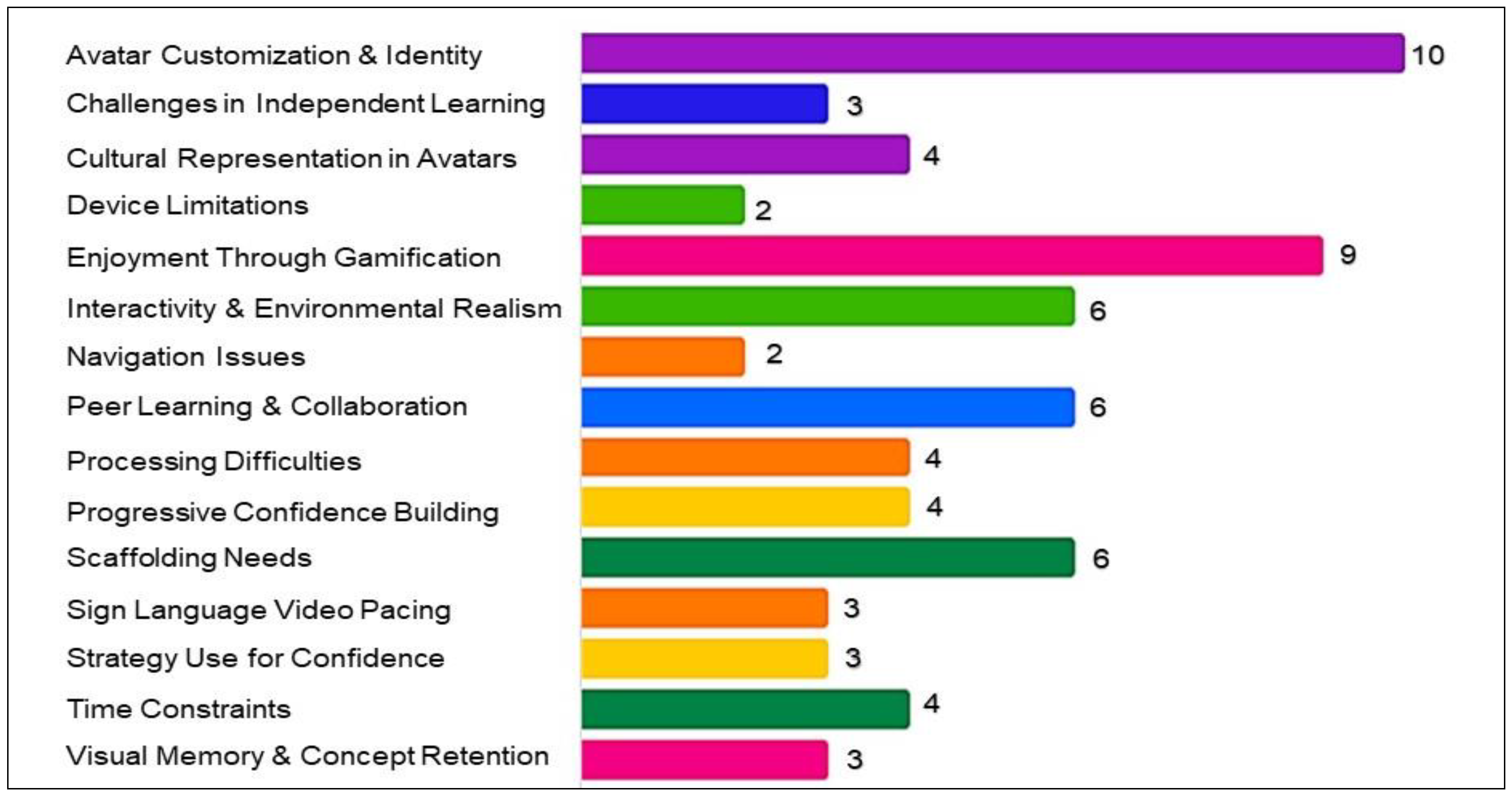
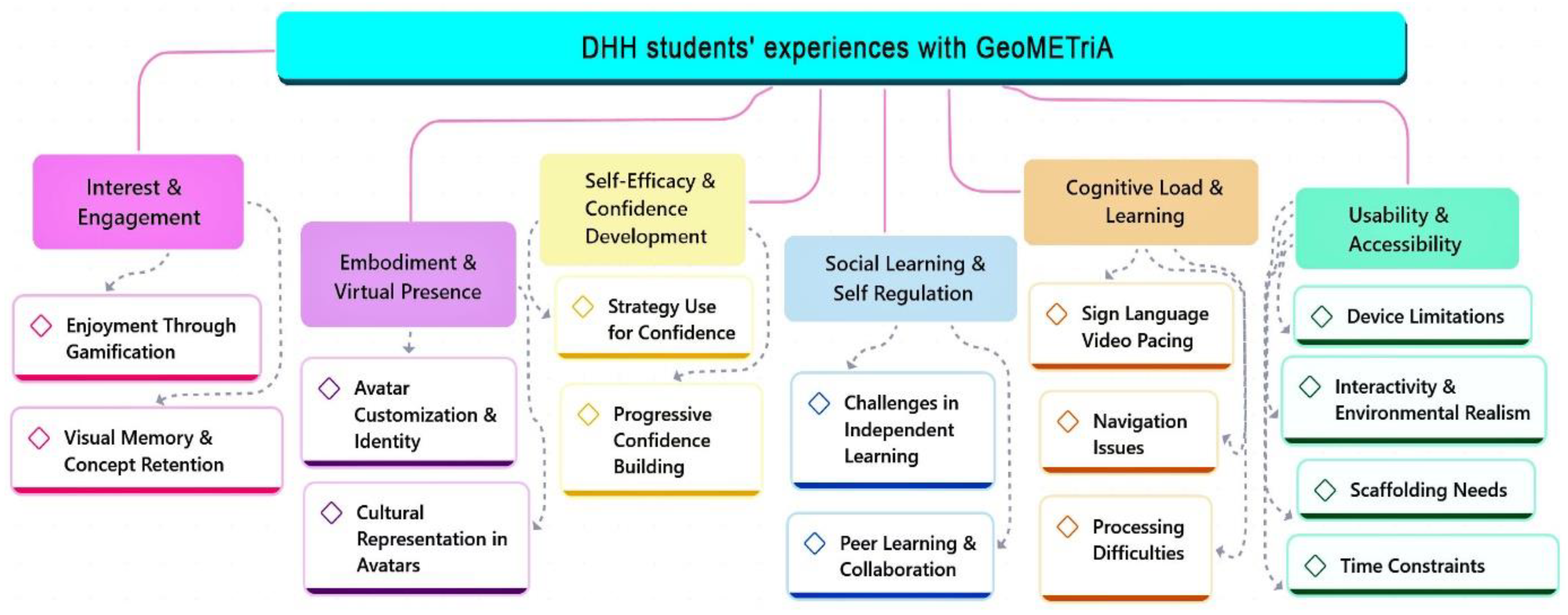
| Interest and Engagement | Interest, Intrinsic Motivation | Gamified tasks supported enjoyment and sustained participation; multiplayer/competition increased involvement; visual exposure supported concept recall. |
| Embodiment and Virtual Presence | Embodiment | Avatar customization supported identity and presence; movement enhanced immersion; limited cultural options reduced relevance for some students. |
| Self-Efficacy and Confidence Development | Self-Efficacy | Confidence increased from initial uncertainty through practice and teacher scaffolding; worked examples supported task completion. |
| Social Learning and Self-Regulation | Self-Regulation | Students preferred learning with peers; collaboration supported motivation and problem-solving; learning alone reduced engagement. |
| Cognitive Load and Learning | Cognitive Load | Limited scaffolding, fast sign-video pacing, and navigation issues increased cognitive demands; students requested slower pacing and clearer guidance. |
| Usability and Accessibility | Non-CAMIL (platform/context) | Device and time constraints disrupted learning continuity; students suggested stronger guidance, improved interactivity, and added environmental realism. |
| Sub-Theme | Exemplar Quotes | Interpretation |
|---|---|---|
| Enjoyment Through Gamification | “Fun! I can play and learn at the same time.” (S1) “I like to compete with friends. It’s exciting to see who can jump to the correct shape first.” (S5) | Game-based and competitive activities enhanced enjoyment and sustained engagement, increasing students’ willingness to participate in geometry learning tasks. |
| Visual Memory and Concept Retention | “After playing, I remember the names of the shapes better. The captions along with sign language, it helps me understand better.” (S3) “I remember shapes like triangle, square because I see them in the game.” (S4) | Repeated visual exposure and multimodal supports strengthened geometry terms recall and conceptual understanding. |
| Sub-Theme | Exemplar Quotes | Interpretation |
|---|---|---|
| Avatar Customization and Identity | “It was fun to choose my own avatar.” (S1) “I love running and jumping with my avatar. It feels like I’m really inside the game!” (S7) | Avatar customization supported identity expression and presence, while movement capabilities deepened immersion. |
| Cultural Representation in Avatars | “I looked for a tudung (headscarf), but I couldn’t find one. If there’s a choice, I want to wear it for my avatar.” (S7) “If we could use our own photo to create an avatar that looks more like us, that would be amazing!” (S6) | Limited cultural options reduced personal relevance. Inclusive avatar representations may strengthen belonging. |
| Sub-Theme | Exemplar Quotes | Interpretation |
|---|---|---|
| Progressive Confidence Building | “At first, I didn’t understand how to write the answers, but after some time, I got used to it.” (S1) “After teacher explains, I can do it better by myself.” (S3) | Repeated practice and teacher scaffolding facilitated a transition from uncertainty to independence, indicating self-efficacy development. |
| Strategy Use for Confidence | “I read the examples first, so I feel more confident to answer the questions.” (S4) “I feel confident in the games, but the hard questions make me unsure.” (S2) | Students using available scaffolds reported greater confidence, though some distinguished between confidence in games versus formal questions. |
| Sub-Theme | Exemplar Quotes | Interpretation |
|---|---|---|
| Peer Learning and Collaboration | “I learn better with friends. It makes the learning more enjoyable.” (S2) “I can chat and help each other. When I don’t understand, I ask my friend to help.” (S4) | Students expressed strong preference for collaborative learning, with peer interaction supporting motivation and mutual problem-solving. |
| Challenges in Independent Learning | “If I do it alone, it feels boring. Studying with friends makes it more fun.” (S7) “Learning alone is boring. Better when we have friends to do it together.” (S3) | Reduced engagement during independent learning indicates need for structured support during solo tasks. |
| Sub-Theme | Exemplar Quotes | Interpretation |
|---|---|---|
| Processing Difficulties | “No guided questions are hard to understand.” (S3) “Sometimes I get distracted and need a reminder to focus.” (S6) | Limited scaffolding and unclear questions increased cognitive demands. Some students experienced attention regulation challenges. |
| Sign Language Video Pacing | “Sign language video is good, but sometimes I had to replay the video many times to understand.” (S4) “Make the sign language videos slower.” (S3) | Video pacing affected comprehension, requiring replay functionality and slower presentation for effective processing. |
| Navigation Issues | “Different videos too close, I misclick sometimes.” (S6) | Interface layout created extraneous cognitive load through unintended navigation errors. |
| Sub-Theme | Exemplar Quotes | Interpretation |
|---|---|---|
| Device Limitations | “At home, I don’t have a laptop. Using a phone is hard because the screen is too small.” (S6) “I had to change my laptop twice due to battery issues.” (S5) | Device constraints disrupted access and continuity. Platform design should accommodate varied devices. |
| Time Constraints | “I want more time to explore each activity before moving on.” (S1) “One hour feels too short, more time for games would be better.” (S2) | Limited session time reduced exploration and consolidation opportunities. |
| Scaffolding Needs | “Give examples to the difficult questions.” (S4) “We need a tutorial on the symbol of angles.” (S7) | Students requested worked examples and explicit instruction for mathematical symbols. |
| Interactivity and Environmental Realism | “It would be fun if avatars could talk in sign language.” (S6) “If I can move objects, like rotate a shape or changing colors, feel more like a real place.” (S7) | Students desired enhanced interaction capabilities and environmental features to increase realism. |
Disclaimer/Publisher’s Note: The statements, opinions and data contained in all publications are solely those of the individual author(s) and contributor(s) and not of MDPI and/or the editor(s). MDPI and/or the editor(s) disclaim responsibility for any injury to people or property resulting from any ideas, methods, instructions or products referred to in the content. |
© 2026 by the authors. Licensee MDPI, Basel, Switzerland. This article is an open access article distributed under the terms and conditions of the Creative Commons Attribution (CC BY) license.
Share and Cite
Chong, A.P.; Wong, K.-T.; Vestly, K.L.S.; Suresh Kumar, K. Signs, Shapes, and Spaces: A CAMIL-Informed Qualitative Study of Metaverse Geometry Learning for Deaf and Hard-of-Hearing Students. Soc. Sci. 2026, 15, 191. https://doi.org/10.3390/socsci15030191
Chong AP, Wong K-T, Vestly KLS, Suresh Kumar K. Signs, Shapes, and Spaces: A CAMIL-Informed Qualitative Study of Metaverse Geometry Learning for Deaf and Hard-of-Hearing Students. Social Sciences. 2026; 15(3):191. https://doi.org/10.3390/socsci15030191
Chicago/Turabian StyleChong, Ai Peng, Kung-Teck Wong, Kong Liang Soon Vestly, and Kuppusamy Suresh Kumar. 2026. "Signs, Shapes, and Spaces: A CAMIL-Informed Qualitative Study of Metaverse Geometry Learning for Deaf and Hard-of-Hearing Students" Social Sciences 15, no. 3: 191. https://doi.org/10.3390/socsci15030191
APA StyleChong, A. P., Wong, K.-T., Vestly, K. L. S., & Suresh Kumar, K. (2026). Signs, Shapes, and Spaces: A CAMIL-Informed Qualitative Study of Metaverse Geometry Learning for Deaf and Hard-of-Hearing Students. Social Sciences, 15(3), 191. https://doi.org/10.3390/socsci15030191

