1. Introduction
Donald Trump’s return to the US presidency in 2024 has once again placed the role of political communication at the centre of public debate. His discursive style, characterised by confrontation, sensationalism and distrust of traditional media, strains the limits of democratic institutions. In this context, the White House’s official account on platform X (formerly Twitter) becomes a privileged space for observing how presidential communication articulates institutional authority with the dynamics of digital visibility and attention.
Rather than conceiving legitimacy in normative or institutional terms, this study approaches it as a symbolic and relational process that emerges from communicative practices within hybrid media systems. In this sense, legitimacy is understood as a discursive and reputational construction, shaped by visibility, association with influential actors and the affective framing of political leadership in platform-mediated environments.
This paper analyses the White House’s institutional communication during the first months of Trump’s new term from three interrelated levels: topics, actors and language. First, the main thematic fields of institutional communication are identified through a semantic network analysis, which reveals a coexistence between highly politically relevant content—such as fiscal policy or international relations—and publications oriented towards entertainment or popular culture. Secondly, it examines the network of co-mentions and the types of actors with whom the White House interacts digitally, revealing the expansion of the presidential ecosystem to include the media, businesses and entertainment figures. Finally, the discursive dimension is addressed through a lexical analysis of the terms “Trump,” “America,” and “country,” which shows the persistence of a nationalist and moralising rhetorical framework focused on greatness, threat, and protection.
Based on this integrated approach, the article seeks to provide empirical evidence on how institutional communication under Trump’s leadership articulates a hybrid between political discourse and mass communication, in which spectacularisation and personalisation become structural resources of power. Ultimately, the study proposes a rethinking of the role of government communication in a media environment dominated by the logic of visibility and polarisation.
In light of this theoretical background, the article aims to examine how the White House’s institutional communication during Trump’s second presidency operates within the dynamics of hybrid media systems, affective publics and platform-mediated visibility. The study focuses on three analytical dimensions: the thematic organisation of content, the network of actors involved in co-mention dynamics, and the lexical and discursive patterns through which institutional authority and symbolic legitimacy are constructed and performed.
Accordingly, the study is guided by the following research questions:
(RQ1) How does the White House’s institutional communication articulate the relationship between information, visibility and affect during Trump’s presidency?
(RQ2) Which actors structure the network of symbolic legitimacy surrounding the presidential account, and what roles do institutional, media and market-oriented actors play within this configuration?
(RQ3) What lexical, emotional and ideological frames characterise the discourse projected through @WhiteHouse?
Drawing on research on digital populism, mediatization and platform logics, the article advances an analytically informed expectation that the White House’s communication under Trump operates as a hybrid and post-bureaucratic model, combining institutional authority with affective performance and market-driven visibility strategies. Accordingly, the analysis explores whether the account relies on emotionally charged narratives, associative forms of symbolic legitimacy involving financial and technological actors, and a discursive structure centred on personalisation and national identity.
2. Theoretical Framework
2.1. Political Communication and Digital Populism
Recent scholarship has highlighted how contemporary political communication is increasingly shaped by hybrid media environments in which institutional, journalistic and platform logics operate simultaneously (
Chadwick 2017). In this context, digital infrastructures, algorithmic curation and networked publics reshape the ways in which political actors project authority, perform legitimacy and address publics within platform-mediated spaces (
Papacharissi 2015;
Waisbord 2019). The United States has been one of the clearest examples of this shift, where presidential communication relies not only on the press and broadcast media, but also on the affordances and visibility dynamics of social media platforms (
Enli 2017;
Kreiss 2017).
Within this landscape, Donald Trump’s communicative style has been widely analysed as a form of digital populism characterised by personalisation, emotional intensification and performative transgression. These contributions provide a conceptual lens for interpreting communicative styles and discursive patterns in digital environments, rather than a causal account of political outcomes.
Moffitt (
2016) conceptualises populism as a political style based on crisis narratives, antagonism and mediated spectacle, while
Mudde (
2019) emphasises its moral dualism between a virtuous people and a corrupt elite. Trump’s online presence reflects both dimensions, combining anti-establishment rhetoric with a high degree of performance and provocation that resonates strongly with platform logics (
Ott 2017;
Ross and Rivers 2018). Research on his Twitter use has shown how strategic norm-breaking, insult and hyperbole function as resources to command attention and reshape the limits of acceptable political discourse (
Ott 2017;
Wodak 2021).
Institutional communication under Trump can be analytically situated within this broader dynamic. Unlike the highly personalised and confrontational tone of his personal account, the White House profile represents a hybrid format in which institutional authority coexists with stylistic elements of digital populism and affective politics (
Papacharissi 2015;
Kellner 2020). Comparisons with subsequent administrations have underlined the contrast between Trump’s spectacular presidency and more conventional, technocratic approaches to presidential communication, such as those associated with Joe Biden (
Kellner 2020;
Törnberg 2022). Taken together, these contributions suggest that institutional accounts cannot be treated as neutral channels of governmental information, but as actors embedded in hybrid media systems where legitimacy is negotiated through visibility, emotional resonance and reputational associations (
Chadwick 2017;
Gerbaudo 2021).
The study of contemporary political communication has highlighted the central role of digital platforms in the transformation of political leadership (
Moffitt 2016). In this environment, populist leaders have been able to exploit the logic of immediacy, authenticity and confrontation inherent in social media to build a direct relationship with citizens (
Waisbord and Amado 2017). Donald Trump is the paradigmatic example of this convergence between populism and digital communication. Since his first campaign in 2016, his presence on Twitter has reconfigured the traditional forms of interaction between the media, institutions and public opinion, displacing conventional media channels (
Ott 2017;
Kreiss 2017).
Trump’s communication style has been described as a “populist performance” (
Moffitt 2016) characterised by theatricality, moral simplification and constant attacks on his opponents. This type of communication feeds on what
Wodak (
2021) calls the politics of fear: rhetoric based on threat, outrage and emotional appeals to a people supposedly betrayed by the elites. Digitalisation amplifies these strategies, allowing constant contact with followers and the production of a segmented public sphere (
Törnberg 2022).
Recent literature has emphasised how Trump has made his digital presence an instrument of symbolic governance. His use of social media constitutes a form of political action that challenges the limits of institutionality (
Casero-Ripollés 2020). The personalisation of the message, the dissemination of fake news and the delegitimisation of traditional media constitute a communicative ecosystem where perceived authenticity replaces veracity (
Ross and Rivers 2018). This model has transcended US borders and become a reference point for global right-wing populism (
Mudde 2019).
2.2. Mediated Institutionality: The White House, Visibility and Spectacle
US presidential communication has historically oscillated between institutional formality and the need for direct connection with the public (
Kumar 2007). Social media has intensified this tension by providing presidents with direct channels of communication that bypass journalistic mediation, reshaping established relations between the press and the executive branch. In this context, the White House becomes a privileged laboratory for observing how institutional communication is progressively incorporating the codes of the digital environment.
Several studies have pointed out that, during Donald Trump’s presidency, institutional communication exhibited high levels of personalisation and an intensified degree of media centrality (
Kellner 2020). The president projected his image as a personal brand, bringing to the White House the logic of spectacle and self-promotion that characterised his previous career (
Serazio 2025). From this perspective, presidential communication is configured as a hybrid process in which the boundaries between public information, political leadership and entertainment become porous.
The literature on political visibility has described this phenomenon as a new media visibility, in which power is increasingly mediated through sustained exposure and public presence (
Thompson 2005). Institutional social networks amplify this dynamic by turning each message into an act of public presence, measurable in terms of interaction and reach. Government communication thus becomes dependent on its potential for circulation, emotionality and spectacularisation.
The concept of politainment (
Berrocal-Gonzalo et al. 2014) is useful for describing this convergence between politics and entertainment, in which public attention becomes a resource of power. Some authors have observed that this trend can manifest itself through the incorporation of media personalities, athletes or businesspeople into institutional communication (
Waisbord and Amado 2017), a practice associated with broader audience reach and more diversified discursive registers. However, empirical research on how this logic translates into the White House’s communication practices at the level of content, actors and discourse remains limited, particularly from a multimodal and network-oriented perspective.
2.3. Hybrid Models and Multimodal Analysis of Social Networks
The consolidation of a hybrid media ecosystem has transformed the ways in which political messages are produced, circulated and received (
Chadwick 2017). In this system, institutional actors compete with the media, opinion leaders and digital communities in an environment where attention is fragmented and information flows are reconfigured in real time (
Casero-Ripollés 2020). This hybridisation calls for methodologies capable of integrating the relational structure of interactions with the analysis of content and discursive frameworks that organise communicative practices.
In this context, the study of digital social networks has adopted a multimodal approach that combines quantitative and qualitative techniques. Network analysis tools such as NodeXL, Gephi, and Pajek have made it possible to map interactions between political actors, the media, and citizens, offering a visual representation of the communicative architecture of platforms (
Hansen et al. 2010). These approaches are particularly suited to identifying structural patterns and relational configurations, rather than establishing causal effects or behavioural outcomes. NodeXL, in particular, has been used in numerous studies on political communication on X, as it facilitates direct data extraction and the identification of patterns of co-mentioning, retweets, or communities (
Small 2011;
Graham and Wright 2014). Its use has proven effective in analysing phenomena such as the viralisation of institutional messages or discursive polarisation in election campaigns.
At the same time, the development of artificial intelligence-based analysis platforms—such as Graphext—has opened up new possibilities for examining large volumes of textual data through semantic clustering and similarity-based modelling. In this context, clustering techniques are employed as exploratory devices to detect thematic regularities and conversational structures, rather than as definitive classifications of content. These tools make it possible to identify emerging themes, detect conversation patterns, and establish connections between actors and narratives based on linguistic similarities. Recent research has shown Graphext’s potential for analysing institutional communication strategies, social movements, and transnational narratives (
Rodríguez 2024). Its ability to combine co-occurrence networks and lexical-discursive analysis makes it an ideal tool for hybrid approaches between data mining and qualitative analysis.
Corpus-assisted content analysis—such as that enabled by Sketch Engine—complements this structural approach by offering tools for lemmatisation, concordance, and collocation study (
Kilgarriff et al. 2014). In the field of political communication, its application has proven useful for identifying recurring discursive frames, examining patterns of semantic association, and tracing the circulation of key concepts over time (
Stubbs 2010). In this way, lexical analysis provides an interpretative dimension that transcends network metrics and allows us to examine how meanings and values are constructed around the most relevant topics.
Together, these approaches form a mixed methodological framework designed to address the analytical demands of the contemporary study of digital political communication. Rather than privileging a single method or metric, this framework combines complementary analytical lenses to provide a structured reading of communicative practices across relational, thematic and discursive levels. The combination of network analysis (NodeXL, Gephi), semantic topic analysis (Graphext) and lexical-discourse analysis (Sketch Engine) allows three analytical levels to be connected:
The interaction structure, which reveals the relationships between actors and communities;
The thematic dimension, which identifies the axes of conversation and their hierarchy;
The discursive dimension, which examines the frames of meaning and the ideological orientation of the message.
This integrated model offers a more comprehensive reading of institutional communication on digital platforms by connecting the relational and discursive levels. In the case of the White House under President Donald Trump, this approach is particularly relevant: it allows us to simultaneously observe which issues the institution prioritises, which actors it engages with, and what kind of language it uses to build legitimacy and authority. In this way, the article is part of a line of research that advocates for a multimodal and empirical analysis of digital political communication, contributing to a rapidly evolving field of study.
Based on this framework, this study examines how the official @WhiteHouse account articulates institutional discourse in an environment dominated by the logic of digital visibility. The analysis seeks to map patterns of content organisation, actor relations and discursive framing, offering an empirically grounded but exploratory account of contemporary institutional communication on social media platforms.
3. Methodology
This approach is designed to map structural and discursive patterns in institutional communication, rather than to test causal relationships or normative effects. The dataset consists of 4297 tweets published by the official White House account (@WhiteHouse) between 20 January and 1 October 2025, corresponding to the first nine months of Donald Trump’s second presidential term. This time frame captures the period in which the administration redefines its priorities, establishes its communicative teams and consolidates its digital strategy.
3.1. Data Extraction and Preprocessing
Tweets were collected using NodeXL Pro (version 1.0.1.520) with the Twitter Search Network 3.0 connector and the query from:whitehouse. The export included tweet text, timestamp, mentions, URLs and interaction metrics (likes, retweets, quotes and replies). Duplicates, non-English tweets and system-generated artefacts were removed. Data were cleaned and normalised in Python (pandas 2.0), which produced a relational dataset containing more than 9000 co-mention pairs. Basic descriptive checks were conducted after preprocessing to ensure internal consistency of the dataset and the stability of interaction patterns.
3.2. Thematic Clustering (Graphext)
To identify thematic communities, the tweets were analysed in Graphext (2025 release), which applies multilingual Sentence-BERT embeddings, dimensionality reduction through UMAP and modularity optimisation via the Louvain algorithm. Clustering techniques were employed as exploratory analytical devices to detect thematic regularities and conversational structures in the corpus. To assess the robustness of the resulting clusters, alternative parameter configurations were tested (including variations in similarity thresholds and modularity resolution), producing substantively comparable thematic groupings.
Cluster validation followed a mixed procedure combining automatic labelling (Graphext semantic labels) and manual review of prototypical tweets. This ensured semantic coherence and mitigated noise in clusters dominated by highly formulaic political language.
3.3. Network Analysis (Gephi)
Co-mention relations were processed in Gephi 0.10.1. The network layout used ForceAtlas2 with default inertia and stronger gravity (1.2) to reduce node overlap. Eigenvector centrality, modularity and degree were calculated using Gephi’s built-in functions, all normalised to 1. The resulting graph contained 152 nodes and 438 edges, with a modularity score of 0.744, indicating high community structure. The main measures analysed were:
Degree: number of connections per node (co-mention frequency);
Betweenness centrality: an actor’s capacity for intermediation in the network;
Eigenvector centrality: relative influence based on the connectivity of its neighbours. These measures are interpreted as indicators of relational prominence within the communication network, rather than as direct proxies for political power or real-world influence;
Modularity: identification of communities of actors (resolution = 1.0).
3.4. Lexical–Discursive Analysis (Sketch Engine)
Lexical patterns were examined using Sketch Engine (version 2024). Concordances, collocations and word sketches were computed with the logDice association measure, which is optimal for small-to-medium corpora. Three high-frequency lemmas —Trump, President and America—were analysed in detail due to their recurrent presence and discursive salience within the corpus.
3.5. Engagement Metrics
Engagement rate was calculated using the formula:
The reference was the account’s follower count in October 2025 (2.8 million). This measure enabled comparison across thematic clusters and provided an indicative proxy of relative audience interaction with different types of content (
Alhabash and McAlister 2015;
Castillo-Esparcia et al. 2020).
3.6. Reproducibility
A replication package including Tweet IDs, Python preprocessing scripts and Graphext/Gephi configuration files is available from the author upon reasonable request. This material enables inspection of the analytical workflow and supports transparency and replicability within the constraints imposed by platform policies.
4. Results
4.1. Thematic Level: Hierarchy and Nature of Content
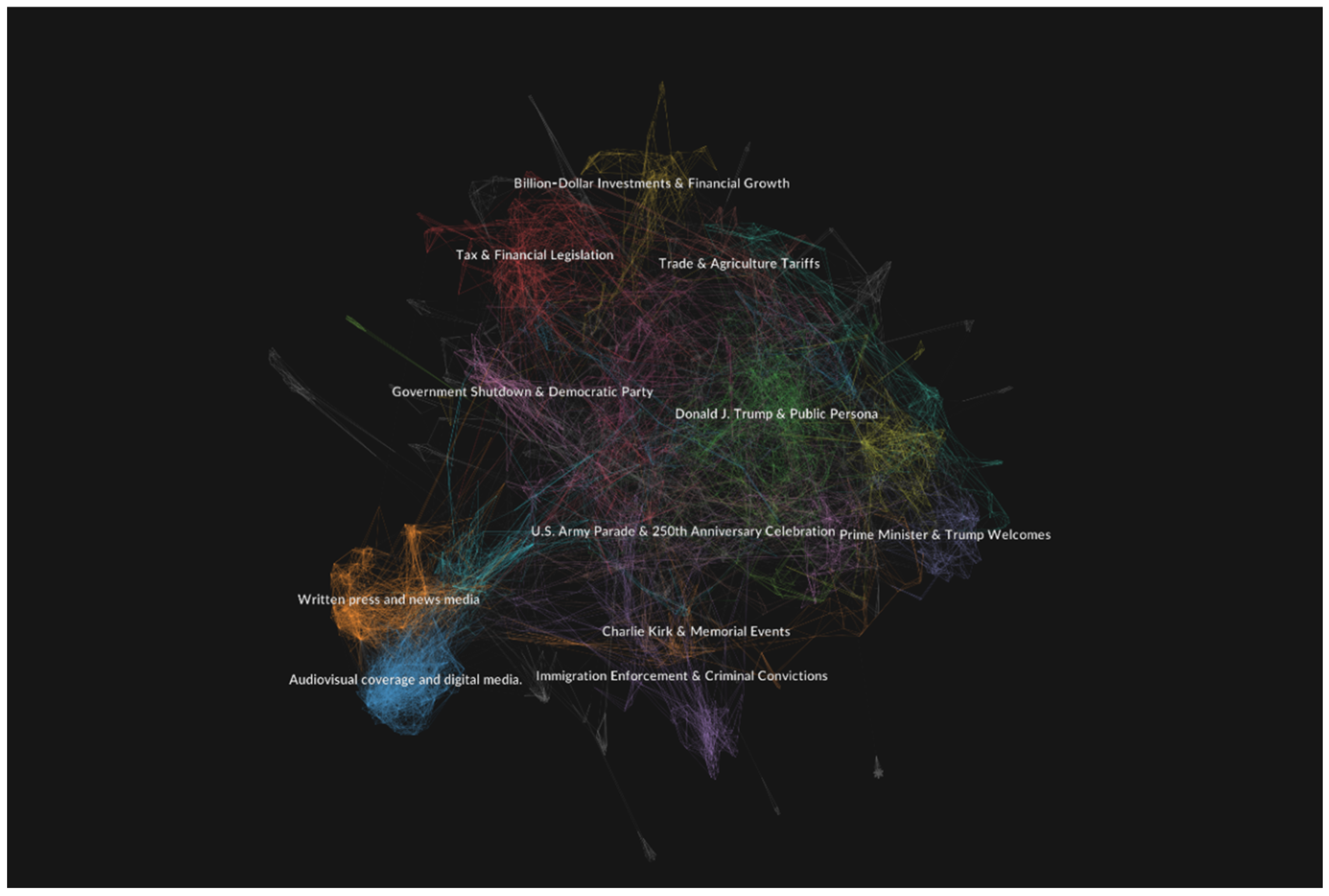
The thematic analysis carried out with Graphext identified nine main clusters in the White House’s communication during the period analysed (January–October 2025). Among these, two groups stand out as having greater density—audiovisual coverage and video on social media, and press and news media—which account for more than 60% of total publications (see
Figure 1). These clusters reveal a dual communicative orientation: on the one hand, a strong presence of audiovisual content, designed for viral dissemination in short format, and on the other, a media validation strategy through explicit citation or reference to the media.
The first cluster, Audiovisual coverage and video on social media, groups together posts accompanied by clips of presidential events, press conferences and institutional announcements. These pieces are characterised by a performative tone and the use of visual resources that reinforce the president’s image of leadership and approachability. The predominant themes are the signing of executive orders, official trips and the president’s interaction with citizens, security forces or workers in strategic sectors. The second cluster, Press and News Media, consists of tweets that link to or quote information from national and international media outlets. In this case, the White House acts as a curator and redistributor of media content, reinforcing the legitimacy of its messages by referring to external sources.
Smaller clusters group specific topics, such as International Relations and Foreign Policy, Economy and Employment, Sporting Events and Popular Culture, National Security and Defence, and the Environment. Taken together, these groups show that White House communication is organised around three narrative axes:
Government management (decisions, decrees, programmes);
Media and emotional projection (videos, public events, patriotic symbols);
Interaction with entertainment and popular culture, which serves as a means of reaching non-politicised audiences.
Cluster engagement analysis reveals that spectacular or symbolic content (such as that associated with celebrities or sporting events) generates much higher levels of interaction than strictly political or legislative topics. This disparity reinforces the idea that contemporary presidential communication is driven by the logic of attention rather than the logic of information.
4.2. Engagement and Content Circulation
Calculating the average engagement relative to the total number of followers of the @WhiteHouse account (2.8 million in October 2025) allows us to observe the differential performance of different types of content more accurately. Using the usual interaction criterion, the results confirm a clear inequality between informative topics and those of a symbolic or spectacular nature.
Table 1 presents the average engagement metrics associated with each thematic cluster identified in the @WhiteHouse tweets during the analyzed period.
The data shows that audiovisual and entertainment-related content has the highest interaction rates, exceeding 0.25%. In contrast, strictly institutional topics, such as economic and environmental policy or executive decrees, barely exceed 0.05%.
These percentages place the White House’s institutional account well above the usual average engagement rate for government agencies, which typically ranges between 0.03% and 0.08% (
Castillo-Esparcia et al. 2020;
Mergel 2013). These values reflect the difficulties of institutional communication in generating participation or reciprocity with users, generally limited to passive interactions such as “likes” or retweets. In this context, the results obtained for @WhiteHouse indicate a deliberate optimisation of the format and communicative tone, with intensive use of audiovisual and emotional elements aimed at maximising circulation.
Beyond the magnitude of the figures, the type of content that elicits the greatest response reveals a functional transformation of the institutional message: the priority lies in the capacity for resonance and virality. The White House’s communication displays features commonly associated with digital marketing and brand communication, aligning institutional messaging with the logic of the attention economy (
Marwick and Boyd 2011;
Couldry and Hepp 2018).
4.3. Actor Level: Network of Co-Mentions and Digital Legitimisation
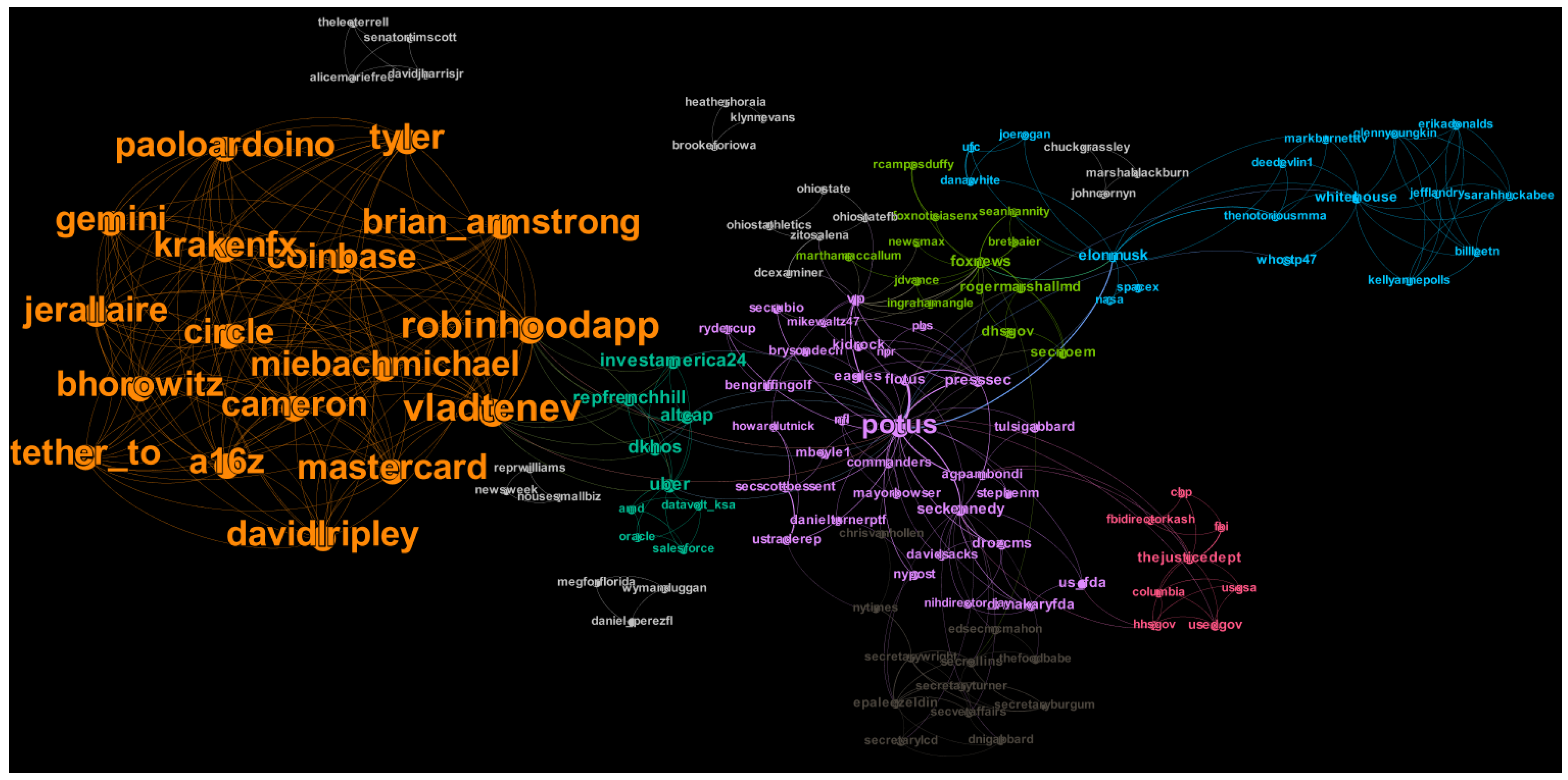
In total, 152 actors connected by 438 links were identified, with a modularity of 0.744, indicating a fragmented structure in well-defined communities.
The centrality analysis shows a striking result: the actors with the greatest influence in the network do not belong to the political or institutional sphere, but to the financial and technological ecosystem. The accounts with the highest values are @robinhoodapp, @vladtenev, @a16z, @coinbase, @krakenfx, @mastercard, @circle, @tether_to and @gemini, all linked to digital finance, cryptocurrencies and economic innovation. These have a centrality greater than 0.87, well above institutional nodes such as @potus (0.57), @whitehouse (0.10) or @flotus (0.10).
This hierarchy shows that the White House’s communication network is structured around economic and technological authority figures rather than government actors or traditional media. From a symbolic and communicative perspective, this configuration points to associative forms of legitimacy grounded in visibility and reputational proximity, rather than in formal institutional authority. In symbolic terms, the legitimacy of the presidential discourse is reinforced through association with companies and figures from the digital entrepreneurship sector, which function as nodes of prestige and visibility in the connected public sphere.
The modular structure reinforces this interpretation (see
Figure 2). The main cluster, coloured orange in the visualisation, groups together actors from the financial and technological sectors (Robinhood, Coinbase, Mastercard, Kraken, Circle, Gemini, a16z), with a very high level of internal density and frequent co-mentions between them. This group represents a block of economic affinity, where institutional communication converges with the narrative of innovation, competitiveness and prosperity.
The second cluster, in purple, brings together political and institutional accounts such as @potus, @vp, @presssec and @flotus, along with government agencies and related media outlets. Its structure is more cohesive but less interconnected with the rest of the network, indicating a more endogamous communication space with limited circulation.
The third cluster, in blue, includes media actors and journalists’ profiles, forming a bridge between institutional discourse and the information ecosystem. This group features recurring mentions of @foxnews, @nbcnews and @elonmusk, reinforcing the connection between politics, the media and high-impact media figures.
When viewed as a whole, the network reveals that the @WhiteHouse account does not operate solely as an institutional node. Rather, it acts as an intermediary between three spheres of symbolic power:
Political power, associated with government institutions;
Media power, derived from interaction with major media outlets and influential personalities; and
Economic-technological power, represented by companies and leaders in the financial and digital sectors.
The predominance of the third block, both in terms of centrality and volume of mentions, indicates a reconfiguration of political legitimacy in the digital environment, where the authority of the state increasingly relies on the reputation and visibility of market actors. This finding is in line with what some authors have described as a “technopolitics of influence” (
Gerbaudo 2021) or a form of “reputational capitalism” (
Marwick 2013), in which influence and attention function as symbolic capital in government communication.
4.4. Discursive Level: Presidential Frameworks and Lexicon
The lexical-discursive analysis carried out with Sketch Engine confirms the centrality of three semantic nuclei in the White House’s institutional communication during 2025: Trump, President and America. These terms function as narrative pillars of discourse, articulating the representation of leadership, institutional authority and the national imagination.
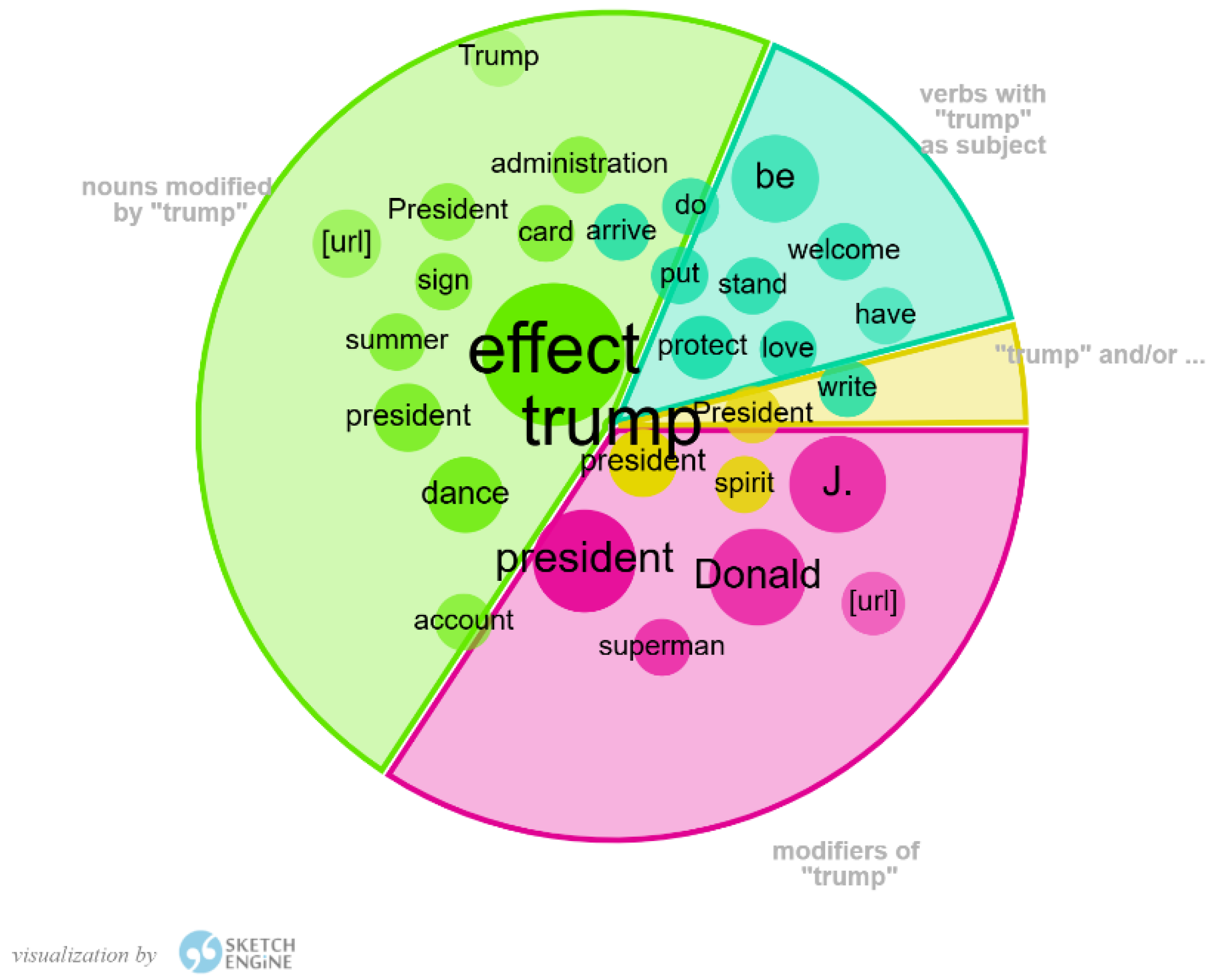
The term Trump appears 1712 times (see
Figure 3), making it the most recurrent noun in the corpus. The most frequent collocations are grouped around two lexical fields: one of action and authority (protect, lead, stand, arrive, sign, administration) and another of a symbolic or emotional nature (love, welcome, spirit, superman). The combination of both produces a narrative in which the leader appears simultaneously as protector and hero, merging the presidential figure with a dimension of personal exceptionality.
The associated modifiers—effect, president, administration—consolidate the notion of performative leadership, which, in addition to governing, produces effect. In terms of framing, the discourse constructs a representation of the president as an agent of action and effectiveness, emphasising narratives of consequence and achievement. This pattern confirms the continuity of the extreme personalisation of power already observed in his first presidency.
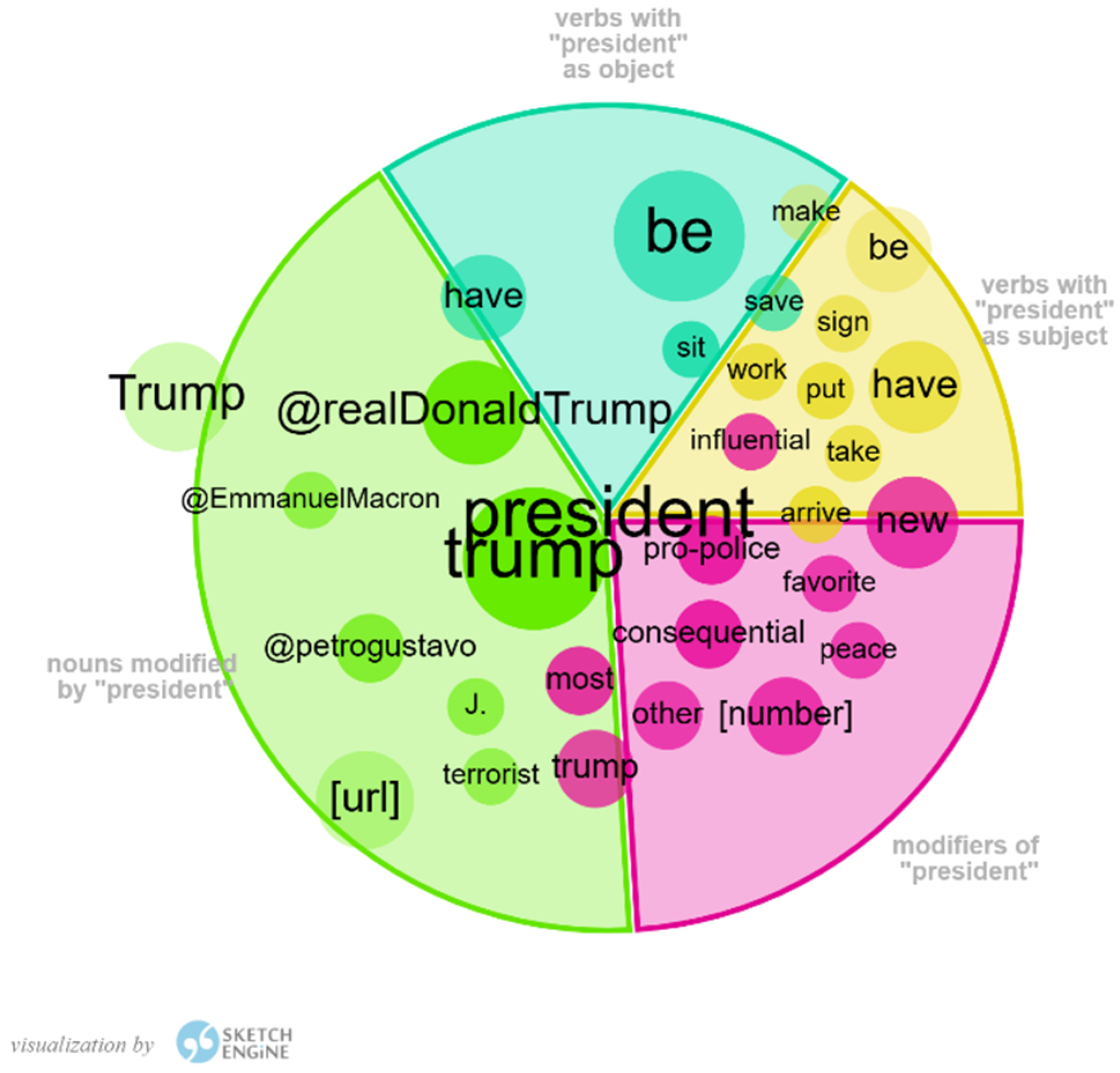
The word
president (1631 occurrences) is associated with a lexical field of institutionality and comparison (see
Figure 4). The visualisations of collocations highlight the names of other leaders such as
@EmmanuelMacron and
@petrogustavo, along with
@realDonaldTrump himself. This network of references shows a discourse that seeks to reaffirm the legitimacy of presidential leadership through international recognition.
The associated verbs (sign, make, take, work, save, arrive) reinforce a semantics of efficiency, action and achievement. The adjectives (influential, consequential, favourite) consolidate the president’s position as a decisive figure, even in global contexts. Taken together, the term functions as a marker of authority, but also of transnational identity: the “president” who represents a model of government vis-à-vis other actors in the international system.
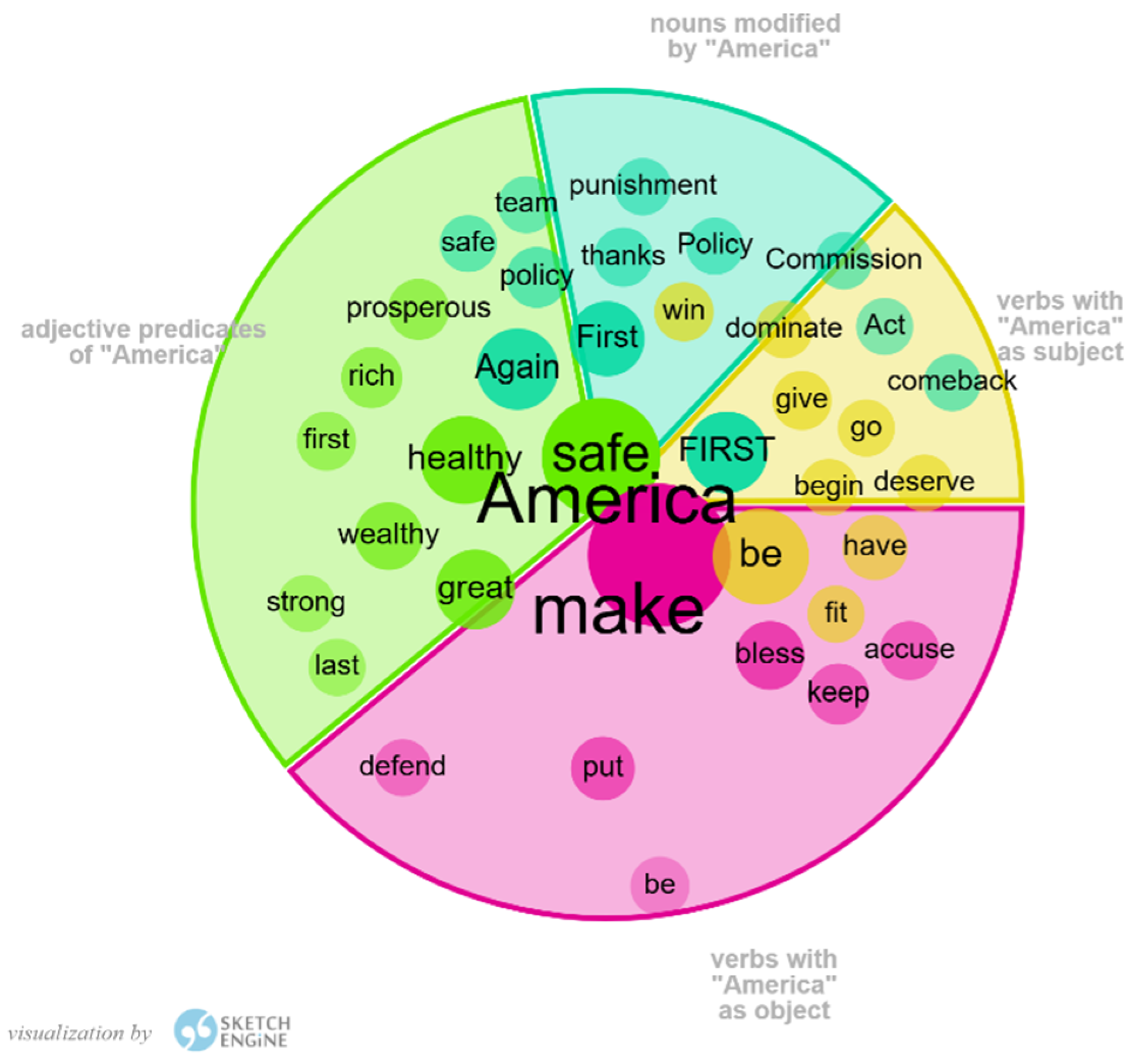
America appears 693 times and articulates the most ideological discursive framework in the corpus (see
Figure 5). The most recurrent collocations (safe, great, strong, prosperous, healthy, wealthy) reproduce the traditional semantics of the slogan Make America Great Again, where the nation is represented as a space of well-being, strength and moral superiority.
The associated verbs—make, defend, bless, keep—inscribe a narrative of divine action and national defence, in which the White House assumes the role of guarantor of order, prosperity and blessing. The discourse thus combines religious, patriotic and economic registers, establishing a continuity between political management and the moral mission of preserving the country’s greatness.
5. Discussion
The analysis of the @WhiteHouse institutional account during the first nine months of 2025 provides insights into how presidential communication in the digital environment reconfigures the relationship between politics, the media and citizens. The results obtained from the three levels confirm that the Trump administration is consolidating a hybrid institutional communication model, where the government’s informative function is intertwined with the media and emotional logic of show business culture.
Thematically, the content hierarchy reveals a structural tension between management communication and attention-seeking communication. The topics with the highest dissemination and engagement are those that integrate visual, emotional or entertainment components, while economic or environmental policy issues obtain very low levels of interaction. This imbalance is consistent with processes of spectacularisation of institutional discourse described in the literature (
Berrocal-Gonzalo et al. 2014), in which visibility tends to be prioritised and audiovisual formats gain prominence over argumentative text.
The consequence is a redefinition of communicative effectiveness: success depends not so much on the clarity of information as on the ability to generate circulation. As
Moffitt (
2016) points out, contemporary populism turns politics into performance and institutions into stages for media representation. In this context, the White House presents itself as a producer of content geared towards emotional consumption.
Actor analysis confirms this shift. The centrality of technology and financial companies in the co-mention network shows that the symbolic legitimacy of the institution is nourished by the reputational capital of market actors. Presidential communication can be interpreted as operating within an ecosystem of visibility shared with companies, platforms and business leaders. This phenomenon can be interpreted as a form of “reputational capitalism” (
Marwick 2013) or “technopolitics of influence” (
Gerbaudo 2021), where is measured by the ability to generate attention and link the image of public power with the prestige of private innovation.
From the perspective of media hybridisation theory (
Chadwick 2017), the network of actors detected in Gephi expresses a structural interdependence between government communication and corporate communication. Institutions adopt brand strategies, while private actors benefit from the exposure derived from their association with political power. This dynamic shapes a communicative space in which the boundary between public information and business promotion is blurred, reinforcing the logic of the spectacle presidency (
Kellner 2020).
The discursive level reinforces this interpretation. The lexical centrality of Trump, President and America establishes an emotional grammar that legitimises leadership through moral exaltation. The frames detected in Sketch Engine reproduce the classic narrative of conservative populism: a leader who presents himself as a saviour, a nation that must be defended and a people that mobilises around shared values.
This type of discourse, characterised by the convergence of authority and affection (
Papacharissi 2015), confirms the shift from institutional politics to a form of affective communication. In this context, the government seeks to generate emotional resonance through a lexical repertoire focused on strength, protection and prosperity. The repetition of terms such as great, safe, bless, and strong creates a discursive framework where morality and effectiveness are confused, and where political success is measured in terms of symbolic intensity rather than administrative results.
An integrated reading of the three analytical levels suggests that the White House’s institutional communication in 2025 operates as an interface between political authority, the digital market and public emotion. Unlike previous models of government communication, which focused on transparency or accountability, the current model privileges the aesthetics of action and the logic of virality. Instead of addressing citizens as a deliberative public, it addresses them as a segmented audience, susceptible to being mobilised through visual and emotional stimuli.
In this sense, the Trump administration embodies what
Casero-Ripollés (
2020) calls the mediatisation of politics from the supply side, where leaders and institutions design their communication to adapt to the algorithmic dynamics of platforms. The White House communicates through X as an experienced account on the platform: adjusting its style to the formats, metrics and temporalities of the network.
At the same time, the network structure and engagement patterns propose a model of asymmetric and unidirectional communication, with little real interaction with citizens. Public conversation is replaced by a massive circulation of content that reinforces the presidential figure. This finding coincides with the analyses of
Mergel (
2013) and
Mattoni et al. (
2025), who describe government social networks as spaces of low reciprocity, focused on visibility rather than participation.
The articulation between these three levels shows, in short, that institutional communication in the Trump era takes on a post-bureaucratic and emotionally -intensive form. The presidency is represented as a brand, authority is measured in terms of attention, and discourse is oriented toward identity affirmation rather than public debate.
This pattern coincides with what the literature has described as a model of narrative presidency (
Stuckey 2023) or affective politics (
Papacharissi 2015), in which institutional communication is less oriented towards informing and more towards mobilising emotions, reinforcing identities and projecting a moralised vision of the nation.
Similarly, this transformation can be understood as part of a broader process of colonisation of the political space by the logic of the digital market. As
Couldry and Hepp (
2018) warn, in the contemporary media ecosystem, visibility becomes the main resource of power, displacing the deliberative function of democratic communication. By adopting this logic, the White House contributes to reinforcing a model of mediated governance where attention replaces consensus and reputation replaces legitimacy.
The findings of this study also resonate with broader processes of digital cultural production that shape contemporary ideological dynamics on social media. In this sense, the communicative strategies observed in the White House account can be connected to the discursive logics identified in the so-called manosphere (
Brandariz Portela et al. 2024): the personalization of authority, the appeal to affective authenticity, and the production of symbolic hierarchies through networked visibility. Both phenomena exemplify how platform architectures amplify emotionally charged and identity-based narratives, reinforcing polarized imaginaries and reshaping the conditions of public legitimacy in the hybrid media system.
This study is limited by its exclusive focus on X as a platform, which no longer occupies a central role in political communication as it once did. Future research could integrate cross-platform analysis (e.g., Instagram, Truth Social, or YouTube) and comparative cases, including the Biden administration. These findings should be read as an empirically grounded mapping of communicative patterns, rather than as an assessment of political effects or democratic outcomes.
6. Conclusions
The analysis carried out suggests that the White House’s institutional communication during the first months of Donald Trump’s presidency in 2025 aligns with a hybrid model situated between the logic of digital governance and the culture of spectacle. The @WhiteHouse account is configured as a space for the representation of mediated power, where the institution’s traditional informational functions are combined with strategies of visibility, emotionality and virality.
Thematically, the results show that attention is focused on audiovisual content, public events and symbolic pieces, while management and economic policy issues are relegated to the background. This imbalance points to forms of communication oriented towards attention rather than deliberation, consistent with processes of spectacularisation and emotionalisation of politics identified in the literature.
In terms of actors, the network of co-mentions shows a structural change in the mechanisms of legitimisation of institutional discourse. The most central actors belong to the financial and technological sectors, indicating a convergence between state authority and the reputational logic of the digital market. From a communicative perspective, this convergence reflects associative forms of symbolic legitimacy grounded in visibility and reputational proximity. Presidential communication thus relies on the visibility and prestige of companies and business leaders as new guarantors of influence.
At the discursive level, the three lexical nuclei form a coherent discursive structure: Trump represents the figure of the hero and protector; President embodies institutional authority and international leadership; and America symbolises the moral and emotional horizon of political action. The repetition of these lexical fields suggests that the @WhiteHouse account functions as a discursive device for constructing and performing presidential leadership, where authority is constructed through a mixture of emotion, morality and nationalism.
White House communication can be understood as part of a dynamic hybridisation between politics, media and the digital economy, which reshapes contemporary forms of institutional communication. This study suggests that political legitimacy in the contemporary media environment is increasingly articulated through the interplay between institutional authority and the capacity to generate visibility and attention. Future research could extend this line of inquiry through longitudinal comparisons between administrations and cross-platform analyses, as well as by examining the growing role of automation and artificial intelligence in institutional communication.