
Impact of Harassment by Clients and Their Family Members on Psychological Health and Work Engagement: A Study of Disability Welfare Professionals in Japan

Abstract
1. Introduction
2. Materials and Methods
2.1. Study Design and Participants
2.2. Procedure and Ethical Considerations
2.3. Measures
2.3.1. Demographic and Professional Characteristics
2.3.2. Harassment Experiences
- Physical Violence: Acts using physical force to cause harm (including cases where staff avoided injury by evasion), such as being subjected to or threatened with violence, or experiencing fear-inducing acts like the destruction of objects.
- Psychological Violence: Acts that damage or disparage an individual’s dignity or personality through words or attitudes, such as being yelled at aggressively, receiving statements that deny one’s personality or abilities, receiving threats, or facing repeated demands for excessive or contractually impossible services.
- Sexual Harassment: Unwanted sexual advances, demands for favorable attitudes, or other acts of sexual-related harassment, such as unnecessary physical contact (or near-contact) during service provision or receiving repeated sexual remarks.
2.3.3. Psychological Health
2.3.4. Work Engagement
2.4. Data Analysis
3. Results
3.1. Demographic and Professional Characteristics of Participants
3.2. The Posttraumatic Stress Disorder Checklist for DSM-5 (PCL-5 Scores)
3.2.1. Descriptive Statistics of the Post-Traumatic Stress Disorder Checklist for DSM-5 and Classification of Possible PTSD Cases
3.2.2. Gender Differences in PCL-5 Total, Cluster, and Item Scores Among Participants
3.3. Relationship Between Harassment Experiences from Client or Client’ Family Members and Work Engagement
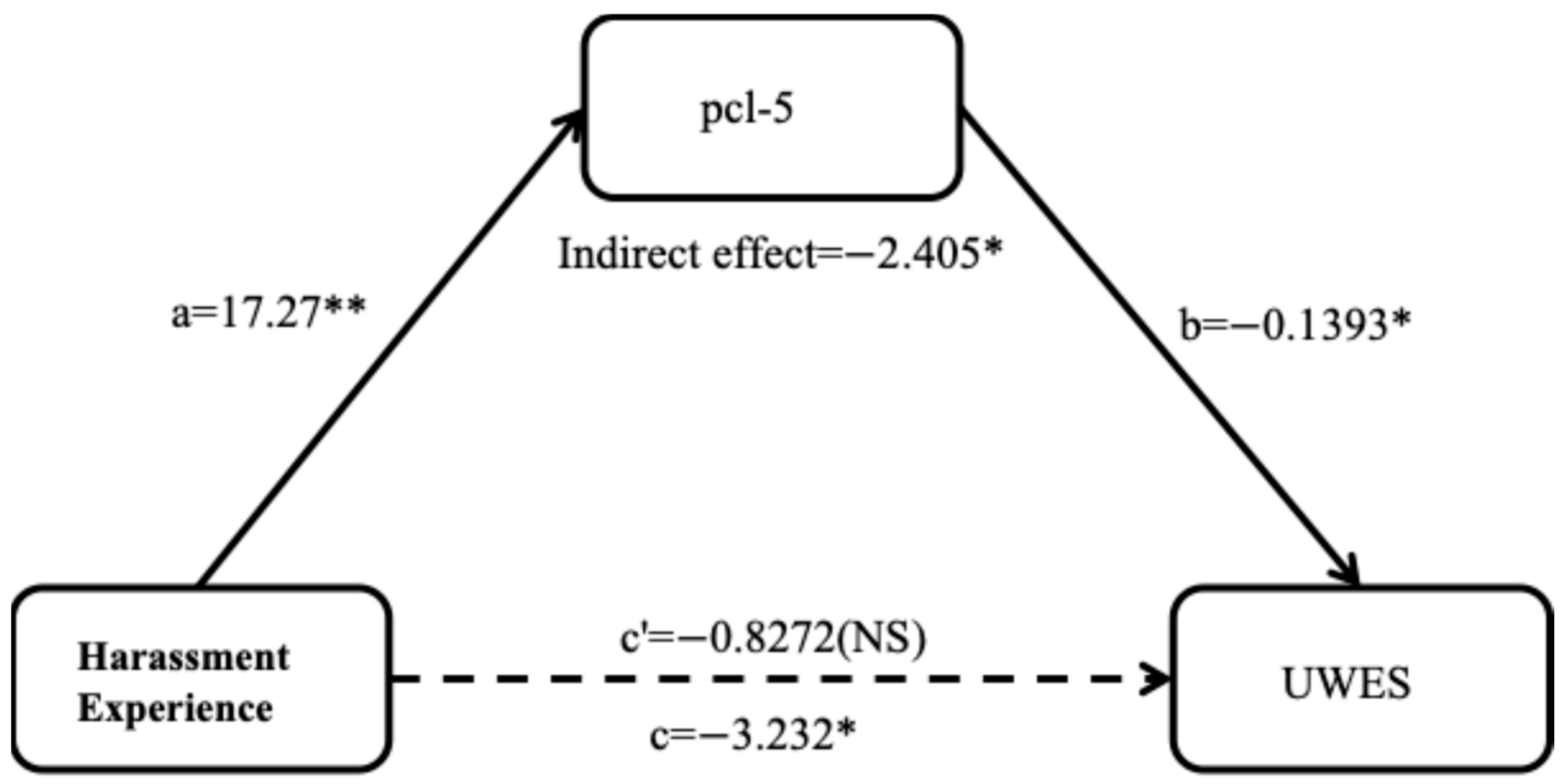
3.4. Analysis of the Indirect Role of PTSD Symptoms in the Association Between Harassment and Work Engagement
4. Discussion
4.1. Prevalence of Clients and Their Family Members Harassment
4.2. Harassment and the Risk of PTSD
4.3. Impact on Work Engagement: Resource Depletion and Motivational Erosion
4.4. PTSD as a Mediating Mechanism: The Cognitive, Organizational, and Gender Interaction
5. Conclusions
6. Organizational and Practical Implications
7. Limitations
Author Contributions
Funding
Institutional Review Board Statement
Informed Consent Statement
Data Availability Statement
Acknowledgments
Conflicts of Interest
References
- Act on Providing Comprehensive Support for the Daily Life and Life in Society of Persons with Disabilities. 2005. Act No. 123 of 2005. Japanese Law Translation Database System. Available online: https://www.japaneselawtranslation.go.jp/en/laws/view/4093/en (accessed on 1 August 2025).
- American Nurses Association. 2015. Code of Ethics for Nurses with Interpretive Statements. Silver Spring: American Nurses Association. [Google Scholar]
- American Psychiatric Association. 2013. Diagnostic and Statistical Manual of Mental Disorders, 5th ed. Washington, DC: American Psychiatric Association. [Google Scholar]
- Armour, Cherie, Jonathan Tsai, Timothy A. Durham, Rani Charak, Thomas L. Biehn, John D. Elhai, and Robert H. Pietrzak. 2015. Dimensional Structure of DSM-5 Posttraumatic Stress Symptoms: Support for a Hybrid Anhedonia and Externalizing Behaviors Model. Journal of Psychiatric Research 61: 106–13. [Google Scholar] [CrossRef]
- Arnetz, Judith E., Lydia Hamblin, Leo Russell, Mark J. Upfal, Mark Luborsky, James Janisse, and Linda Essenmacher. 2017. Preventing patient-to-worker violence in hospitals: Outcome of a randomized controlled intervention. Journal of Occupational and Environmental Medicine 59: 18–27. [Google Scholar] [CrossRef]
- Bakker, Arnold B., and Evangelia Demerouti. 2007. The Job Demands-Resources model: State of the art. Journal of Managerial Psychology 22: 309–28. [Google Scholar] [CrossRef]
- Bakker, Arnold B., and Evangelia Demerouti. 2017. Job demands–resources theory: Taking stock and looking forward. Journal of Occupational Health Psychology 22: 273–85. [Google Scholar] [CrossRef] [PubMed]
- Barnes, Colin, and Geof Mercer. 2010. Exploring Disability, 2nd ed. Cambridge: Polity Press. [Google Scholar]
- Beaulaurier, Richard L., and Samuel H. Taylor. 2001. Social work practice with people with disabilities in the era of disability rights. Social Work in Health Care 32: 67–91. [Google Scholar] [CrossRef] [PubMed]
- Bell, Holly, Shanti Kulkarni, and Lisa Dalton. 2003. Organizational prevention of vicarious trauma. Families in Society 84: 463–70. [Google Scholar] [CrossRef]
- Beresford, Peter. 2016. From “Them” to “Us”: A Personal Journey into Disability Politics. Bristol: Policy Press. [Google Scholar]
- Blevins, Christy A., Frank W. Weathers, Margaret T. Davis, Tracy K. Witte, and Jessica L. Domino. 2015. The Posttraumatic Stress Disorder Checklist for DSM-5 (PCL-5): Development and Initial Psychometric Evaluation. Journal of Traumatic Stress 28: 489–98. [Google Scholar] [CrossRef]
- Bowers, Len. 2014. Safewards: A New Model of Conflict and Containment on Psychiatric Wards. Journal of Psychiatric and Mental Health Nursing 21: 499–508. [Google Scholar] [CrossRef]
- Bride, Brian E. 2007. Prevalence of secondary traumatic stress among social workers. Social Work 52: 63–70. [Google Scholar] [CrossRef]
- Care Work Foundation. 2023. Report on the Results of the Survey on Care Work Stability in Fiscal Year 2022. Available online: https://www.kaigo-center.or.jp/ (accessed on 1 August 2025).
- Care Work Foundation. 2025. Results of the Survey on the Actual Status of Care Work in Fiscal Year 2024. Available online: https://www.kaigo-center.or.jp/content/files/report/R6_jittai_chousa_press.pdf (accessed on 1 August 2025).
- Caringi, James C., and Eric R. Hardiman. 2011. Secondary traumatic stress among child welfare workers in the United States. International Journal of Child & Family Welfare 14: 63–78. Available online: https://ugp.rug.nl/IJCFW/article/view/37844 (accessed on 1 August 2025).
- Carmassi, Claudia, Claudia Foghi, Valerio Dell’Oste, Annalisa Cordone, Carlo Antonio Bertelloni, Eric Bui, and Liliana Dell’Osso. 2020. PTSD symptoms in healthcare workers facing the three coronavirus outbreaks: What can we expect after the COVID-19 pandemic. Psychiatry Research 292: 113312. [Google Scholar] [CrossRef]
- Cavanaugh, Marcie A., Wendy R. Boswell, Mark V. Roehling, and John W. Boudreau. 2000. An empirical examination of self-reported work stress among U.S. managers. Journal of Applied Psychology 85: 65–74. [Google Scholar] [CrossRef]
- Demerouti, Evangelia, Arnold B. Bakker, Friedhelm Nachreiner, and Wilmar B. Schaufeli. 2001. The job demands-resources model of burnout. Journal of Applied Psychology 86: 499–512. [Google Scholar] [CrossRef]
- Disaster Mental Health Information Support Center. 2016. PCL-5 (PTSD Checklist for DSM-5) [About PCL-5]. Tokyo: National Center of Neurology and Psychiatry. Available online: https://saigai-kokoro.ncnp.go.jp/contents/pdf/about_PCL-5.pdf (accessed on 18 January 2026).
- Dollard, Maureen F., and Arnold B. Bakker. 2010. Psychosocial safety climate as a precursor to conducive work environments, psychological health problems, and employee engagement. Journal of Occupational and Organizational Psychology 83: 579–99. [Google Scholar] [CrossRef]
- Ehlers, Anke, and David M. Clark. 2000. A cognitive model of posttraumatic stress disorder. Behaviour Research and Therapy 38: 319–45. [Google Scholar] [CrossRef] [PubMed]
- Einarsen, Ståle Valvatne, Helge Hoel, Dieter Zapf, and Cary L. Cooper, eds. 2020. Bullying and Harassment in the Workplace: Theory, Research and Practice, 3rd ed. Boca Raton: CRC Press. [Google Scholar] [CrossRef]
- Escartín, Jordi. 2016. Insights into workplace bullying: Psychosocial drivers and effective interventions. Employee Responsibilities and Rights Journal 28: 155–69. [Google Scholar] [CrossRef] [PubMed]
- Figley, Charles R., ed. 1995. Compassion Fatigue: Coping with Secondary Traumatic Stress Disorder in Those Who Treat the Traumatized. New York: Brunner/Mazel. [Google Scholar]
- Finkelhor, David, Richard K. Ormrod, and Heather A. Turner. 2007. Poly-victimization: A neglected component in child victimization. Child Abuse & Neglect 31: 7–26. [Google Scholar] [CrossRef] [PubMed]
- Ford, Julian D., Jon D. Elhai, Daniel F. Connor, and B. Christopher Frueh. 2010. Poly-victimization and risk of posttraumatic, depressive, and substance use disorders and involvement in delinquency in a national sample of adolescents. Journal of Adolescent Health 46: 545–52. [Google Scholar] [CrossRef]
- Friedman, Carli. 2021. The impact of direct support professional turnover on the health and safety of people with intellectual and developmental disabilities. Inclusion 9: 63–73. [Google Scholar] [CrossRef]
- Fujita, Shigeru, Shinya Ito, Kanako Seto, Takefumi Kitazawa, Kunichika Matsumoto, and Tomonori Hasegawa. 2012. Risk factors of workplace violence at hospitals in Japan. Journal of Hospital Medicine 7: 79–84. [Google Scholar] [CrossRef]
- Hanson, Ginger C., Nancy A. Perrin, Helen Moss, Naima Laharnar, and Nancy Glass. 2015. Workplace violence against homecare workers and its relationship with workers’ health outcomes. BMC Public Health 15: 11. [Google Scholar] [CrossRef] [PubMed]
- Harris, Maxine, and Roger D. Fallot, eds. 2001. Using Trauma Theory to Design Service Systems. San Francisco: Jossey-Bass. [Google Scholar]
- Herman, Judith Lewis. 1992. Complex PTSD: A syndrome in survivors of prolonged and repeated trauma. Journal of Traumatic Stress 5: 377–91. [Google Scholar] [CrossRef]
- Herman, Judith Lewis. 1997. Trauma and Recovery: The Aftermath of Violence—From Domestic Abuse to Political Terror. New York: Basic Books. [Google Scholar]
- Herschcovis, M. Sandy, and Julian Barling. 2010. Towards a Multi-Foci Approach to Workplace Aggression: A Meta-Analytic Review of Outcomes From Different Perpetrators. Journal of Organizational Behavior 31: 24–44. [Google Scholar] [CrossRef]
- Hibino, Yuri, Keiki Ogino, and Michiko Inagaki. 2006. Sexual harassment of female nurses by patients in Japan. Journal of Nursing Scholarship 38: 400–5. [Google Scholar] [CrossRef] [PubMed]
- Hobfoll, Stevan E. 1989. Conservation of resources: A new attempt at conceptualizing stress. American Psychologist 44: 513–24. [Google Scholar] [CrossRef]
- Hobfoll, Stevan E. 2001. The influence of culture, community, and the nested-self in the stress process: Advancing conservation of resources theory. Applied Psychology 50: 337–421. [Google Scholar] [CrossRef]
- Hodgins, Margaret, Sarah MacCurtain, and Patricia Mannix-McNamara. 2014. Workplace bullying and incivility: A systematic review of interventions. International Journal of Workplace Health Management 7: 54–72. [Google Scholar] [CrossRef]
- Huffington, Clare, David Armstrong, William Halton, Linda Hoyle, and Jane Pooley, eds. 2004. Working Below the Surface: The Emotional Life of Contemporary Organizations. London: Karnac Books. [Google Scholar]
- Imakita, Teppei, Kayo Tajime, and Sanae Ikenari. 2020. Sexual harassment toward hospital staff by patients or their family members in a Japanese general hospital: An examination including inhibitory factors of help-seeking behavior. Journal of Occupational Safety and Health 13: 11–22. [Google Scholar] [CrossRef]
- International Labour Organization. 2018. Workplace Violence and Harassment in the Health and Social Care Sector: International Labour Standards and Good Practices. Geneva: ILO. Available online: https://www.ilo.org/global/topics/violence-harassment/lang--en/index.htm (accessed on 1 August 2025).
- Ito, Masaya, Yoshitake Takebayashi, Yuriko Suzuki, and Masaru Horikoshi. 2019. Posttraumatic Stress Disorder Checklist for DSM-5: Psychometric Properties in a Japanese Population. Journal of Affective Disorders 247: 11–19. [Google Scholar] [CrossRef]
- Jameton, Andrew. 1984. Nursing Practice: The Ethical Issues. Englewood Cliffs: Prentice-Hall. [Google Scholar]
- Janoff-Bulman, Ronnie. 1992. Shattered Assumptions: Towards a New Psychology of Trauma. New York: Free Press. [Google Scholar]
- Kahn, William A. 1990. Psychological conditions of personal engagement and disengagement at work. Academy of Management Journal 33: 692–724. Available online: https://www.jstor.org/stable/256287 (accessed on 1 August 2025). [CrossRef]
- Kanno, Hanae, and Martha M. Giddings. 2017. Hidden Trauma Victims: Understanding and Preventing Traumatic Stress in Mental Health Professionals. Social Work in Mental Health 15: 331–53. [Google Scholar] [CrossRef]
- Kikuchi, Yukiko, Yukiko Kudo, Makiko Hasebe, Reiko Sugiyama, Ryosuke Muto, and Makiko Sasaki. 2024. The reality of occupational harm incurred by Japanese home health care nurses, the hazardous situations they face, and protective measures: A cross-sectional study. Journal of Occupational Health 66: uiad010. [Google Scholar] [CrossRef] [PubMed]
- Killian, Kyle D. 2008. Helping till it hurts? A multimethod study of compassion fatigue, burnout, and self-care in clinicians working with trauma survivors. Traumatology 14: 32–44. [Google Scholar] [CrossRef]
- Kim, Hansung, and Karen M. Hopkins. 2017. Child Welfare Workers’ Home Visit Risks and Safety Experiences in the USA: A Qualitative Approach. International Journal of Social Work and Human Services Practice 5: 1–8. [Google Scholar] [CrossRef]
- Kim, Hansung, and Madeleine Stoner. 2008. Burnout and turnover intention among social workers: Effects of role stress, job autonomy and social support. Administration in Social Work 32: 5–25. [Google Scholar] [CrossRef]
- King, Erin A. 2021. Child Welfare Workers’ Experiences of Client-Perpetrated Violence: Implications for Worker Mental Health. Children and Youth Services Review 120: 105763. [Google Scholar] [CrossRef]
- Knight, Carolyn. 2018. Trauma-informed supervision: Historical antecedents, current practice, and future directions. The Clinical Supervisor 37: 7–37. [Google Scholar] [CrossRef]
- Koritsas, Stella, Jan Coles, and Malcolm J. Boyle. 2010. Workplace violence towards social workers: The Australian experience. British Journal of Social Work 40: 257–69. [Google Scholar] [CrossRef]
- Lanctôt, Nathalie, and Stéphane Guay. 2014. The aftermath of workplace violence among healthcare workers: A systematic literature review of the consequences. Aggression and Violent Behavior 19: 492–501. [Google Scholar] [CrossRef]
- Law, Rebecca, Maureen F. Dollard, Michelle R. Tuckey, and Christian Dormann. 2011. Psychosocial Safety Climate as a Lead Indicator of Workplace Bullying and Harassment, Job Resources, Psychological Health and Employee Engagement. Accident Analysis & Prevention 43: 1782–93. [Google Scholar] [CrossRef]
- Lazarus, Richard S., and Susan Folkman. 1984. Stress, Appraisal, and Coping. New York: Springer Publishing Company. [Google Scholar]
- Leiter, Michael P., and Christina Maslach. 2016. Latent burnout profiles: A new approach to understanding the burnout experience. Burnout Research 3: 89–100. [Google Scholar] [CrossRef]
- Litz, Brett T., Nathan R. Stein, Eileen Delaney, Leslie Lebowitz, William P. Nash, Cherie Silva, and Shira Maguen. 2009. Moral injury and moral repair in war veterans: A preliminary model and intervention strategy. Clinical Psychology Review 29: 695–706. [Google Scholar] [CrossRef] [PubMed]
- Love, Michelle. 2025. Study Estimates 57% of Home Health Care Workers Experience Violence. Homecare Now, June 18. Available online: https://www.homecaremag.com/news/study-estimates-57-home-health-care-workers-experience-violence (accessed on 1 August 2025).
- Macdonald, Grant, and Frank Sirotich. 2005. Violence in the social work workplace: The Canadian experience. International Social Work 48: 772–81. [Google Scholar] [CrossRef]
- Maslach, Christina, and Michael P. Leiter. 2016. Understanding the burnout experience: Recent research and its implications for psychiatry. World Psychiatry 15: 103–11. [Google Scholar] [CrossRef]
- McPhaul, Kathleen M., Matthew London, Kevin Murrett, Kelly Flannery, Jonathan Rosen, and Jane Lipscomb. 2008. Environmental evaluation for workplace violence in healthcare and social services. Journal of Safety Research 39: 237–50. [Google Scholar] [CrossRef]
- Ministry of Health, Labour and Welfare. 2021. Manual for Harassment Countermeasures in Long-Term Care Settings. Available online: https://www.mhlw.go.jp/content/12305000/000947524.pdf (accessed on 1 August 2025).
- Ministry of Health, Labour and Welfare. 2022a. Customer Harassment Prevention Corporate Manual. Available online: https://www.mhlw.go.jp/content/11900000/000915233.pdf (accessed on 1 August 2025).
- Ministry of Health, Labour and Welfare. 2022b. Manual for Harassment Countermeasures in Disability Welfare Settings: To Protect Staff from Harassment by Users and Their Families. Available online: https://www.mhlw.go.jp/content/12200000/000937619.pdf (accessed on 1 August 2025).
- Ministry of Health, Labour and Welfare. 2023. 2022 Survey on Employment Trends. Available online: https://www.e-stat.go.jp/en/statistics/00450073 (accessed on 1 August 2025).
- Mitchell, Jeffrey T. 1983. When disaster strikes… The critical incident stress debriefing process. Journal of Emergency Medical Services 8: 36–39. [Google Scholar]
- National Association of Social Workers. 2017. Code of Ethics of the National Association of Social Workers. Washington, DC: NASW Press. [Google Scholar]
- Nawata, Y. 2021. Issues concerning customer harassment in medical and nursing care: From the perspective of the duty to accept medical treatment. Quarterly Labor Law 273: 45–54. [Google Scholar]
- Newhill, Christina E. 1996. Prevalence and consequences of client violence toward social workers. Social Work 41: 481–89. [Google Scholar]
- Occupational Safety and Health Administration. 2016. Guidelines for Preventing Workplace Violence for Healthcare and Social Service Workers; OSHA Publication No. 3148-06R. Washington, DC: U.S. Department of Labor. Available online: https://www.osha.gov/sites/default/files/publications/osha3148.pdf (accessed on 1 August 2025).
- Ohnishi, Kayoko, Yasuko Ohgushi, Masataka Nakano, Hirohide Fujii, Hiromi Tanaka, Kazuyo Kitaoka, Jun Nakahara, and Yugo Narita. 2010. Moral distress experienced by psychiatric nurses in Japan. Nursing Ethics 17: 726–40. [Google Scholar] [CrossRef]
- Persol Research and Consulting. 2024. Survey on Customer Harassment in the Service Industry. Available online: https://rc.persol-group.co.jp/wp-content/uploads/thinktank/data/customer-harassment.pdf (accessed on 1 August 2025).
- Ringstad, Robin. 2005. Conflict in the workplace: Social workers as victims and perpetrators. Social Work 50: 305–13. [Google Scholar] [CrossRef]
- Rushton, Cynda Hylton. 2016. Moral resilience: A capacity for navigating moral distress in critical care. AACN Advanced Critical Care 27: 111–19. [Google Scholar] [CrossRef] [PubMed]
- Saeki, Keigo, Nozomi Okamoto, Kimiko Tomioka, Kenji Obayashi, Hisayuki Nishioka, Kenryo Ohara, and Norio Kurumatani. 2011. Work-related aggression and violence committed by patients and its psychological influence on doctors. Journal of Occupational Health 53: 356–64. [Google Scholar] [CrossRef] [PubMed]
- Schaufeli, Wilmar B., and Arnold B. Bakker. 2004. Job demands, job resources, and their relationship with burnout and engagement: A multi-sample study. Journal of Organizational Behavior 25: 293–315. [Google Scholar] [CrossRef]
- Schaufeli, Wilmar B., Marisa Salanova, Vicente González-Romá, and Arnold B. Bakker. 2002. The measurement of engagement and burnout: A Two Sample Confirmatory Factor Analytic Approach. Journal of Happiness Studies 3: 71–92. [Google Scholar] [CrossRef]
- Shapiro, Jo, and Pamela Galowitz. 2016. Peer support for clinicians: A programmatic approach. Academic Medicine 91: 1200–4. [Google Scholar] [CrossRef] [PubMed]
- Shimazu, Akihito, Wilmar B. Schaufeli, Saburo Kosugi, Atsushi Suzuki, Hiroashi Nashiwa, Akira Kato, Motoyuki Sakamoto, Hiroki Irimajiri, Satoko Amano, Kazuhito Hirohata, and et al. 2008. Work Engagement in Japan: Validation of the Japanese Version of the Utrecht Work Engagement Scale. Applied Psychology: An International Review 57: 510–23. [Google Scholar] [CrossRef]
- Smith, Carly Parnitzke, and Jennifer J. Freyd. 2014. Institutional betrayal. American Psychologist 69: 575–87. [Google Scholar] [CrossRef] [PubMed]
- Stamm, Beth Hudnall. 2010. The Concise ProQOL Manual, 2nd ed. Pocatello: ProQOL. [Google Scholar]
- Tan, Malvin Ping Chieng, Sharon Sam Mee Kwan, Azizi Yahaya, Ismail Maakip, and Peter Voo. 2020. The Importance of Organizational Climate for Psychosocial Safety in the Prevention of Sexual Harassment at Work. Journal of Occupational Health 62: e12192. [Google Scholar] [CrossRef]
- Tuckey, Michelle R., and Jennifer E. Scott. 2014. Group critical incident stress debriefing with emergency services personnel: A randomized controlled trial. Anxiety, Stress, & Coping 27: 38–54. [Google Scholar] [CrossRef]
- United Workers Union. 2023. Shocking Risks Facing Disability Support Workers. Docklands: United Workers Union. Available online: https://unitedworkers.org.au/archive/shocking-risks-facing-disability-support-workers/ (accessed on 1 August 2025).
- Vogel, David L., Sarah R. Heimerdinger-Edwards, Joseph H. Hammer, and Asale Hubbard. 2011. Boys Don’t Cry: Examination of the Links Between Endorsement of Masculine Norms, Self-Stigma, and Help-Seeking Attitudes for Men From Diverse Backgrounds. Journal of Counseling Psychology 58: 368–82. [Google Scholar] [CrossRef]
- Womack, Kelsey N., Teala W. Alvord, Caitlyn F. Trullinger-Dwyer, Sean P. M. Rice, and Ryan Olson. 2020. Challenging Aggressive Behaviors Experienced by Personal Support Workers in Comparison to Home Care Workers: Relationships between Caregiver Experiences and Psychological Health. International Journal of Environmental Research and Public Health 17: 5486. [Google Scholar] [CrossRef] [PubMed]
- Wong, Y. Joel, Moon-Ho Ringo Ho, Shu-Yi Wang, and I. S. Keino Miller. 2017. Meta-Analyses of the Relationship Between Conformity to Masculine Norms and Mental Health-Related Outcomes. Journal of Counseling Psychology 64: 80–93. [Google Scholar] [CrossRef] [PubMed]


| Characteristic | Frequency | Percent | M ± SD | Range |
|---|---|---|---|---|
| Gender | ||||
| Male | 169 | 60.4 | ||
| Female | 110 | 39.3 | ||
| Other | 1 | 0.4 | ||
| Age (years) | 49.88 ± 11.60 | 25–77 | ||
| 20–29 | 9 | 3.2 | ||
| 30–39 | 50 | 17.9 | ||
| 40–49 | 83 | 29.6 | ||
| 50–59 | 71 | 25.4 | ||
| 60–69 | 51 | 18.2 | ||
| ≥70 | 16 | 5.7 | ||
| Professional Experience Years in disability field | 11.53 ± 9.00 | 0–50 | ||
| <3 years | 40 | 14.3 | ||
| 3–5 years | 44 | 15.7 | ||
| >5–≤10 years | 75 | 26.8 | ||
| >10 years | 121 | 43.2 | ||
| Years at current workplace | 8.23 ± 7.39 | 0–38 | ||
| <3 years | 68 | 24.3 | ||
| 3–5 years | 63 | 22.5 | ||
| >5–≤10 years | 72 | 25.7 | ||
| >10 years | 77 | 27.5 | ||
| National Qualifications | ||||
| Certified Care Worker | 85 | 30.4 | ||
| Certified Social Worker | 57 | 20.4 | ||
| Certified Mental Health Social Worker | 32 | 11.4 | ||
| None | 147 | 52.5 | ||
| Experience of Harassment (Source) | ||||
| From client | 91 | 32.5 | ||
| From client’s family | 47 | 16.8 | ||
| From colleague | 41 | 14.6 | ||
| From supervisor/manager | 66 | 23.6 | ||
| None | 136 | 48.6 |
| Variable | n | Range | M | SD | Classification Criteria | n (%) |
|---|---|---|---|---|---|---|
| PCL-5 total score | 100 | 0–80 | 17.27 | 18.98 | Possible PTSD (≥31) | 21 (21.0) |
| Non-PTSD (<31) | 79 (79.0) |
| Cluster | Gender | M ± SD | p Value | Cluster | Gender | M ± SD | p Value | Item | Gender | M ± SD | p Value |
|---|---|---|---|---|---|---|---|---|---|---|---|
| cluster B | Male (n = 52) Female (n = 47) | 5.96 ± 5.60 3.81 ± 4.42 | 0.038 * | cluster B 1 | Male (n = 52) Female (n = 47) | 5.96 ± 5.60 3.81 ± 4.42 | 0.038 * | 1. Repeated, disturbing, and unwanted memories of the stressful experience? | Male (n = 52) Female (n = 47) | 1.44 ± 1.31 1.04 ± 1.00 | 0.093 |
| 2. Repeated, disturbing dreams of the stressful experience? | Male (n = 52) Female (n = 47) | 1.17 ± 1.25 0.55 ± 0.86 | 0.005 ** | ||||||||
| 3. Suddenly feeling or acting as if the stressful experience were actually happening again (as if you were actually back there reliving it)? | Male (n = 52) Female (n = 47) | 1.08 ± 1.17 0.68 ± 0.98 | 0.072 | ||||||||
| 4. Feeling very upset when something reminded you of the stressful experience? | Male (n = 52) Female (n = 47) | 1.15 ± 1.23 0.70 ± 1.04 | 0.052 | ||||||||
| 5. Having strong physical reactions when something reminded you of the stressful experience (for example, heart pounding, trouble breathing, sweating)? | Male (n = 52) Female (n = 47) | 1.12 ± 1.20 0.83 ± 1.09 | 0.22 | ||||||||
| cluster C | Male (n = 52) | 2.15 ± 2.26 | 0.174 | cluster C 1 | Male (n = 52) | 2.15 ± 2.26 | 0.174 | 6. Avoiding memories, thoughts, or feelings related to the stressful experience? | Male (n = 52) Female (n = 47) | 1.0 ± 1.10 0.87 ± 1.08 | 0.562 |
| Female (n = 47) | 1.55 ± 2.08 | Female (n = 47) | 1.55 ± 2.08 | 7. Avoiding external reminders of the stressful experience (for example, people, places, conversations, activities, objects, or situations)? | Male (n = 52) Female (n = 47) | 1.15 ± 1.21 0.68 ± 1.13 | 0.048 * | ||||
| cluster D | Male (n = 52) Female (n = 47) | 6.48 ± 7.52 4.19 ± 6.09 | 0.101 | cluster D 1 | Male (n = 52) Female (n = 47) | 3.56 ± 4.06 2.49 ± 3.58 | 0.17 | 8. Trouble remembering important parts of the stressful experience? | Male (n = 52) Female (n = 47) | 0.79 ± 1.00 0.47 ± 0.95 | 0.106 |
| 9. Having strong negative beliefs about yourself, other people, or the world (for example, having thoughts such as: I am bad, there is something seriously wrong with me, no one can be trusted, the world is completely dangerous)? | Male (n = 52) Female (n = 47) | 0.90 ± 1.24 0.66 ± 1.09 | 0.303 | ||||||||
| 10. Blaming yourself or someone else for the stressful experience or what happened after it? | Male (n = 52) Female (n = 47) | 0.75 ± 1.08 0.55 ± 1.00 | 0.35 | ||||||||
| 11. Having strong negative feelings such as fear, horror, anger, guilt, or shame? | Male (n = 52) Female (n = 47) | 1.12 ± 1.20 0.81 ± 1.01 | 0.175 | ||||||||
| cluster E 1 | Male (n = 52) | 2.92 ± 3.56 | 0.064 | 12. Loss of interest in activities that you used to enjoy? | Male (n = 52) Female (n = 47) | 0.94 ± 1.23 0.64 ± 1.09 | 0.198 | ||||
| 13. Feeling distant or cut off from other people? | Male (n = 52) | 0.98 ± 1.29 | 0.023 * | ||||||||
| Female (n = 47) | 1.70 ± 2.83 | Female (n = 47) | 0.47 ± 0.86 | ||||||||
| 14. Trouble experiencing positive feelings (for example, being unable to feel happiness or have loving feelings for people close to you)? | Male (n = 52) Female (n = 47) | 1.0 ± 1.22 0.06 ± 1.04 | 0.08 | ||||||||
| cluster E | Male (n = 52) Female (n = 47) | 5.96 ± 6.19 4.09 ± 4.91 | 0.1 | cluster F | Male (n = 52) | 1.46 ± 2.02 | 0.115 | 15. Irritable behavior, angry outbursts, or acting aggressively? | Male (n = 52) Female (n = 47) | 0.83 ± 1.12 0.49 ± 0.86 | 0.097 |
| Female (n = 47) | 0.87 ± 1.61 | 16. Taking too many risks or doing things that could cause you harm? | Male (n = 52) Female (n = 47) | 0.63 ± 0.99 0.38 ± 0.85 | 0.18 | ||||||
| cluster G | Male (n = 52) | 2.15 ± 2.20 | 0.391 | 17. Being “superalert” or watchful or on guard? | Male (n = 52) | 1.17 ± 1.22 | 0.465 | ||||
| Female (n = 47) | 1.00 ± 1.12 | ||||||||||
| Female (n = 47) | 1.79 ± 2.01 | 18. Feeling jumpy or easily startled? | Male (n = 52) | 0.98 ± 1.11 | 0.379 | ||||||
| Female (n = 47) | 0.79 ± 1.06 | ||||||||||
| cluster H | Male (n = 52) | 2.35 ± 2.45 | 0.037 * | 19. Having difficulty concentrating? | Male (n = 52) | 1.13 ± 1.25 | 0.021 * | ||||
| Female (n = 47) | 0.62 ± 0.90 | ||||||||||
| Female (n = 47) | 1.43 ± 1.80 | 20. Trouble falling or staying asleep? | Male (n = 52) | 1.21 ± 1.32 | 0.099 | ||||||
| Female (n = 47) | 0.81 ± 1.06 |
| Variable | M | SD | 1 | 2 | 3 | 4 | 5 |
|---|---|---|---|---|---|---|---|
| 1. Gender 1 | 1.47 | 0.50 | 1 | ||||
| 2. Age | 48.75 | 10.75 | −0.18 | 1 | |||
| 3. Years in disability field | 12.46 | 9.62 | −0.15 | 0.27 ** | 1 | ||
| 4. PTSD symptoms (PCL-5) | 17.27 | 19.07 | −0.18 | −0.05 | 0.21 * | 1 | |
| 5. Sustainable work engagement | 19.60 | 11.35 | 0.07 | 0.09 | 0 | −0.23 * | 1 |
| Predictor | B | SE | β | t | p Value |
|---|---|---|---|---|---|
| (Intercept) | 20.14 | 4.24 | 4.76 | <0.001 | |
| Gender | 0.77 | 2.31 | 0.03 | 0.34 | 0.738 |
| Years in disability field | 0.06 | 0.12 | 0.05 | 0.51 | 0.613 |
| PTSD symptoms (PCL-5) | −0.14 | 0.06 | −0.24 | −2.32 | 0.023 |
| R2 | 0.058 | ||||
| Adjusted R2 | 0.028 | ||||
| F-statistic | 1.95 | 0.127 |
| Source of Variation | SS | df | MS | F | p Value | |
|---|---|---|---|---|---|---|
| Interaction Terms | ||||||
| Age × PTSD symptoms (PCL-5) | 251.62 | 1 | 251.62 | 2.03 | 0.158 | 0.022 |
| Years in disability filed × PTSD symptoms (PCL-5) | 6.52 | 1 | 6.52 | 0.05 | 0.819 | 0.001 |
| Years at current workplace × PTSD (PCL-5) | 28.79 | 1 | 28.79 | 0.23 | 0.631 | 0.003 |
| Error | 11,400.85 | 92 | 123.92 |
Disclaimer/Publisher’s Note: The statements, opinions and data contained in all publications are solely those of the individual author(s) and contributor(s) and not of MDPI and/or the editor(s). MDPI and/or the editor(s) disclaim responsibility for any injury to people or property resulting from any ideas, methods, instructions or products referred to in the content. |
© 2026 by the authors. Licensee MDPI, Basel, Switzerland. This article is an open access article distributed under the terms and conditions of the Creative Commons Attribution (CC BY) license.
Share and Cite
Li, Y.; Iwasaki, K. Impact of Harassment by Clients and Their Family Members on Psychological Health and Work Engagement: A Study of Disability Welfare Professionals in Japan. Soc. Sci. 2026, 15, 82. https://doi.org/10.3390/socsci15020082
Li Y, Iwasaki K. Impact of Harassment by Clients and Their Family Members on Psychological Health and Work Engagement: A Study of Disability Welfare Professionals in Japan. Social Sciences. 2026; 15(2):82. https://doi.org/10.3390/socsci15020082
Chicago/Turabian StyleLi, Yanshu, and Kaori Iwasaki. 2026. "Impact of Harassment by Clients and Their Family Members on Psychological Health and Work Engagement: A Study of Disability Welfare Professionals in Japan" Social Sciences 15, no. 2: 82. https://doi.org/10.3390/socsci15020082
APA StyleLi, Y., & Iwasaki, K. (2026). Impact of Harassment by Clients and Their Family Members on Psychological Health and Work Engagement: A Study of Disability Welfare Professionals in Japan. Social Sciences, 15(2), 82. https://doi.org/10.3390/socsci15020082