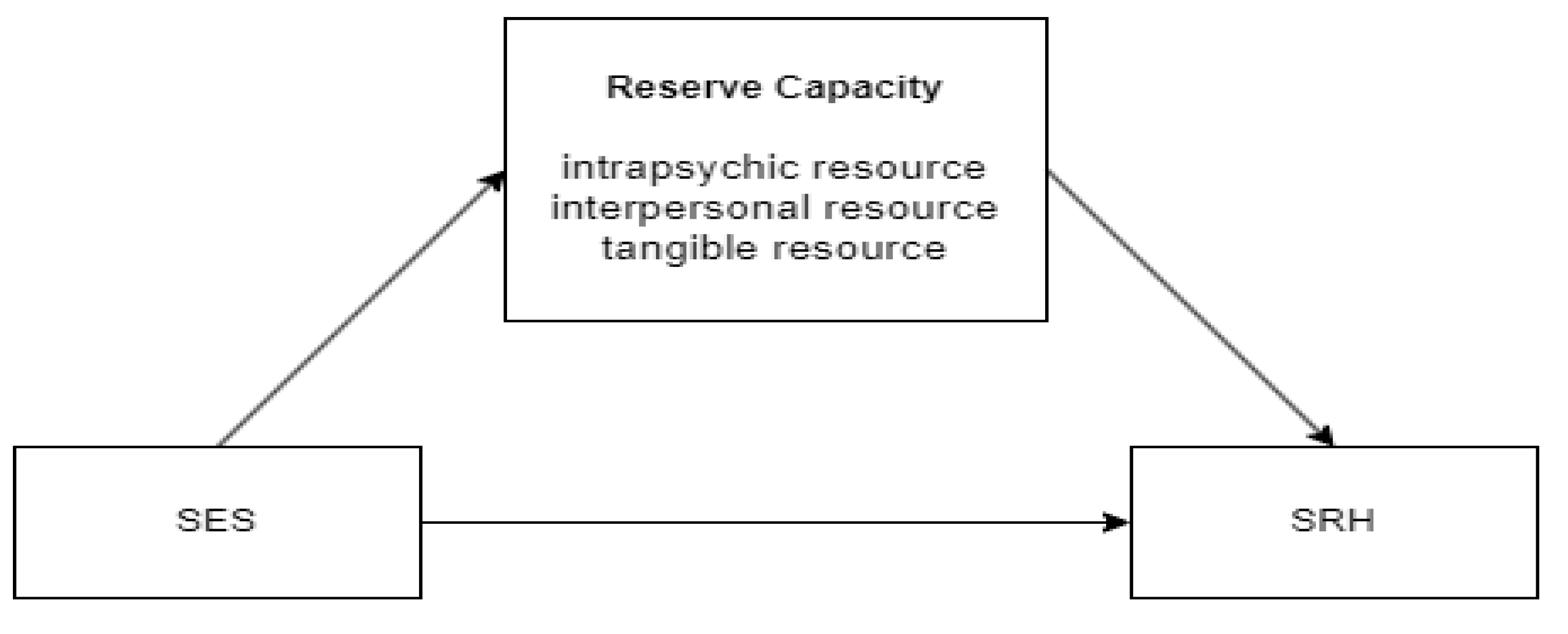


Socioeconomic Status and Self-Rated Health in Older Adults with Disabilities: A Mediation Analysis of Reserve Capacity Using the Korea Welfare Panel Study
Abstract
1. Introduction
2. Materials and Methods
2.1. Study Design
2.2. Participants and Materials
2.3. Measurements of Variables
2.3.1. Dependent Variable
2.3.2. Independent Variable
- (1)
- Socioeconomic Status (SES)
2.3.3. Mediating Variables
- (1)
- Interpersonal resources
- (2)
- Intrapsychic resources
- (3)
- Tangible resources
2.3.4. Control Variables
2.4. Analytic Strategy
3. Results
3.1. Demographic Information of Participants
3.2. Descriptive and Correlational Statistics
3.3. The Effect of SES on Reserve Capacity
3.4. The Effects of SES and Reserve Capacity on SRH
3.5. Mediation Analysis
4. Discussion
Author Contributions
Funding
Institutional Review Board Statement
Informed Consent Statement
Data Availability Statement
Acknowledgments
Conflicts of Interest
References
- Azizoddin, Desiree R., Richard Olmstead, Kris-Ann Anderson, Alanna E. Hirz, Michael R. Irwin, Shadi Gholizadeh, Michael Weisman, Mariko Ishimori, Daniel Wallace, and Perry Nicassio. 2024. Socioeconomic status, reserve capacity, and depressive symptoms predict pain in Rheumatoid Arthritis: An examination of the reserve capacity model. BMC Rheumatology 8: 46. [Google Scholar] [CrossRef]
- Bae, MinYoung, YunYoung Kim, and Ijin Hong. 2023. Factors of Capital on Depression in Older Adulthood: A Comparison of Urban and Rural Regions in Korea. Healthcare 11: 2850. [Google Scholar] [CrossRef]
- Bennett, Elena M., Wolfgang Cramer, Alpina Begossi, Georgina Cundill, Sandra Díaz, Benis N. Egoh, Ilse R. Geijzendorffer, Cornelia B. Krug, Sandra Lavorel, Elena Lazos, and et al. 2015. Linking biodiversity, ecosystem services, and human well-being: Three challenges for designing research for sustainability. Current Opinion in Environmental Sustainability 14: 76–85. [Google Scholar] [CrossRef]
- Cho, S. 2017. Life satisfaction among older Korean adults with disabilities: An application of the PACID model. Innovation in Aging 1 S1: 220. [Google Scholar] [CrossRef][Green Version]
- Choi, Eunjeong, Hyun-Ju Seo, Kye Ha Kim, and Sun-Young Jung. 2025. Gender-specific secular trends and related factors of high perceived stress level among Korean older adults: A nation-wide serial cross-sectional study. BMC Public Health 25: 450. [Google Scholar] [CrossRef]
- Chon, Yongho, Seok-Hwan Lee, and Yun-Young Kim. 2024. Long-Term care insurance for older adults in terms of community care in South Korea: Using the framework method. Healthcare 12: 1238. [Google Scholar] [CrossRef]
- Conger, Rand D., and M. Brent Donnellan. 2007. An interactionist perspective on the socioeconomic context of human development. Annual Review of Psychology 58: 175–99. [Google Scholar] [CrossRef]
- Do, Eun Kyeong. 2017. Filial Piety Obligations and the Lived Experience of Korean Female Caregivers of Aging Parents-in-Law in Canada. Master’s thesis, University of Manitoba, Winnipeg, MB, Canada. [Google Scholar]
- Ga, Hyuk. 2024. The Korean long-term care system: 2024 update. Annals of Geriatric Medicine and Research 28: 235. [Google Scholar] [CrossRef]
- Gallo, Linda C., and Karen A. Matthews. 2003. Understanding the association between socioeconomic status and physical health: Do negative emotions play a role? Psychological Bulletin 129: 10. [Google Scholar] [CrossRef]
- Hayes, Andrew F. 2017. Introduction to Mediation, Moderation, and Conditional Process Analysis: A Regression-Based Approach. New York: Guilford Publications. [Google Scholar]
- Howarter, Alisha D., and Kymberley K. Bennett. 2013. Perceived discrimination and health-related quality of life: Testing the reserve capacity model in Hispanic Americans. The Journal of Social Psychology 153: 62–79. [Google Scholar] [CrossRef]
- Idler, Ellen L., and Yael Benyamini. 1997. Self-rated health and mortality: A review of twenty-seven community studies. Journal of Health and Social Behavior 38: 21–37. [Google Scholar] [CrossRef]
- Jang, Y., M. Yoon, and S. Hong. 2020. The Effects of Gender Role Perception on the Work-Life Balance of Married Female Workers: The Parallel Multiple Mediation Effect of Work Satisfaction. Journal of Asian Women’s Studies 59: 115–55. [Google Scholar] [CrossRef]
- Jeon, Boyoung, and Soonman Kwon. 2017. Health and Long-Term Care Systems for Older People in the Republic of Korea: Policy Challenges and Lessons. Health Systems & Reform 3: 214–23. [Google Scholar] [CrossRef]
- Jung, Boyoung, and In-Hyuk Ha. 2021. Determining the reasons for unmet healthcare needs in South Korea: A secondary data analysis. Health and Quality of Life Outcomes 19: 99. [Google Scholar] [CrossRef] [PubMed]
- Kawachi, Ichiro, and Lisa F. Berkman. 2001. Social ties and mental health. Journal of Urban Health 78: 458–67. [Google Scholar] [CrossRef]
- Kim, Sang Hyuck, Belong Cho, Chang Won Won, Young Ho Hong, and Ki Young Son. 2017. Self-reported health status as a predictor of functional decline in a community-dwelling elderly population: Nationwide longitudinal survey in Korea. Geriatrics & Gerontology International 17: 885–92. [Google Scholar]
- Korea Disabled Persons Development Institute. 2024. 2024 Statistics on People with Disabilities in Korea. Available online: https://www.koddi.or.kr (accessed on 7 January 2026).
- Lee, Subin. 2024. Confucian Familialism and the Crisis of Care. Hypatia 39: 597–615. [Google Scholar] [CrossRef]
- Lueckmann, Sara Lena, Jens Hoebel, Julia Roick, Jenny Markert, Jacob Spallek, Olaf Von Dem Knesebeck, and Matthias Richter. 2021. Socioeconomic inequalities in primary-care and specialist physician visits: A systematic review. International Journal for Equity in Health 20: 58. [Google Scholar] [CrossRef]
- Marmot, Michael. 2005. Social determinants of health inequalities. The Lancet 365: 1099–104. [Google Scholar] [CrossRef] [PubMed]
- Moon, Daseul, Roman Pabayo, and Jongnam Hwang. 2024. An evolution of socioeconomic inequalities in self-rated health in Korea: Evidence from Korea National Health and Nutrition Examination Survey (KNHANES) 1998–2018. SSM-Population Health 26: 101689. [Google Scholar] [CrossRef] [PubMed]
- Moon, Heakyung, and Wonjung Noh. 2024. Factors Affecting the Subjective Health Status of Middle-Aged Retirees in Korea. Iranian Journal of Public Health 53: 27–30. [Google Scholar] [CrossRef]
- Park, Hong-Jae. 2022. Realizing “Filiality Rights”: The Role of Filial Piety in Localizing Human Rights in the Contemporary Korean Context. In The Two Koreas and Their Global Engagements. Berlin/Heidelberg: Springer. [Google Scholar]
- Park, Keong-Suk. 2013. Consecrating or desecrating filial piety?: Korean elder care and the politics of family support. Development and Society 42: 287–313. [Google Scholar] [CrossRef]
- Pearlin, Leonard I., Elizabeth G. Menaghan, Morton A. Lieberman, and Joseph T. Mullan. 1981. The stress process. Journal of Health and Social Behavior 22: 337–56. [Google Scholar] [CrossRef]
- Pinquart, Martin. 2001. Correlates of subjective health in older adults: A meta-analysis. Psychology and Aging 16: 414. [Google Scholar] [CrossRef]
- Pinquart, Martin, and Silvia Sörensen. 2000. Influences of socioeconomic status, social network, and competence on subjective well-being in later life: A meta-analysis. Psychology and Aging 15: 187. [Google Scholar] [CrossRef]
- Rosenberg, Morris. 1965. Rosenberg self-esteem scale (RSE). Acceptance and Commitment Therapy. Measures Package 61: 18. [Google Scholar]
- Sampson, Robert J., Jeffrey D. Morenoff, and Thomas Gannon-Rowley. 2002. Assessing “neighborhood effects”: Social processes and new directions in research. Annual Review of Sociology 28: 443–78. [Google Scholar] [CrossRef]
- Schöllgen, Ina, Oliver Huxhold, Benjamin Schüz, and Clemens Tesch-Römer. 2011. Resources for health: Differential effects of optimistic self-beliefs and social support according to socioeconomic status. Health Psychology 30: 326. [Google Scholar] [CrossRef] [PubMed]
- Shin, Hyun-Young, Hee-Taik Kang, Jae Woo Lee, and Hyoung-Ji Lim. 2018. The association between socioeconomic status and adherence to health check-up in Korean adults, based on the 2010–2012 Korean National Health and Nutrition Examination Survey. Korean Journal of Family Medicine 39: 114. [Google Scholar] [CrossRef] [PubMed]
- Singh-Manoux, Archana, Pekka Martikainen, Jane Ferrie, Marie Zins, Michael Marmot, and Marcel Goldberg. 2006. What does self rated health measure? Results from the British Whitehall II and French Gazel cohort studies. Journal of Epidemiology & Community Health 60: 364–72. [Google Scholar]
- Statistics Korea. 2024. Population Projections for Korea: Elderly Population (Aged 65 and Over), 2024. Available online: https://kosis.kr (accessed on 7 January 2026).
- Thoits, Peggy A. 2011. Mechanisms linking social ties and support to physical and mental health. Journal of Health and Social Behavior 52: 145–61. [Google Scholar] [CrossRef] [PubMed]
- Twenge, Jean M., and W. Keith Campbell. 2002. Self-esteem and socioeconomic status: A meta-analytic review. Personality and Social Psychology Review 6: 59–71. [Google Scholar] [CrossRef]
- Umberson, Debra. 1987. Family status and health behaviors: Social control as a dimension of social integration. Journal of Health and Social Behavior 28: 306–19. [Google Scholar] [CrossRef]
- Yan, Junwei, Yanjie Wang, En Yang, Jing Wang, Benyan Lv, Yan Cao, and Shangfeng Tang. 2024. Subjective social status, health and well-being among older adults in China and South Korea: A cross-sectional analysis. BMJ Open 14: e081872. [Google Scholar] [CrossRef]
- Zhou, Chenxi, Yangchun Xiao, Mei Wang, Yun Wang, and Xiao Yue. 2025. Digital Exclusion and Health Literacy Among Older Adults: The Mediating Effects of Social Support and Self-Efficacy. Journal of Clinical Nursing 35: 653–63. [Google Scholar] [CrossRef] [PubMed]


| Characteristics | Categories | N (%) |
|---|---|---|
| Gender | Male | 360 (42.6%) |
| Female | 485 (57.4) | |
| Age | 65~74 | 270 (32.0) |
| 75~84 | 411 (48.6) | |
| 85 and over | 164 (19.4) | |
| Education | No formal education | 150 (17.8) |
| Elementary school | 398 (47.1) | |
| Middle school | 156 (18.5) | |
| High school | 113 (13.4) | |
| College Graduate and over | 28 (3.3) | |
| Marital Status | Married | 442 (52.3) |
| Widowed(er) | 322 (38.1) | |
| Divorced | 64 (7.6) | |
| Separated | 3 (0.4) | |
| Never been married | 14 (1.7) |
| Title 1 | Min. | Max | Mean | SD | Skewness | Kurtosis | |
|---|---|---|---|---|---|---|---|
| SES * | 0 | 3 | 1.49 | 0.75 | −0.76 | −0.36 | |
| Reserve Capacity | Intrapsychic | 15 | 31 | 21.07 | 2.39 | 0.40 | 0.64 |
| Interpersonal | 1 | 5 | 3.66 | 0.51 | −0.98 | 1.47 | |
| Tangible | 0 | 5 | 0.74 | 1.05 | 1.43 | 1.45 | |
| Self-rated health | 1 | 5 | 2.65 | 0.88 | 0.28 | −0.82 | |
| Age | 66 | 98 | 78.013 | 6.804 | 0.037 | −0.788 | |
| Variables | 1 | 2 | 3 | 4 | 5 | 6 | 7 | 8 | |
|---|---|---|---|---|---|---|---|---|---|
| 1. SES * | 1 | ||||||||
| Reserve Capacity | 2. Intrapsychic | 0.056 | 1 | ||||||
| 3. Interpersonal | 0.285 ** | 0.209 ** | 1 | ||||||
| 4. Tangible | −0.386 ** | −0.094 ** | −0.239 ** | 1 | |||||
| 5. Self-rated health | 0.049 | 0.286 ** | 0.278 ** | −0.167 ** | 1 | ||||
| 6. Age | −0.006 | −0.138 ** | −0.010 | 0.230 ** | −0.188 ** | 1 | |||
| 7. Gender | 0.077 * | 0.076 * | 0.001 | −0.212 ** | 0.113 ** | −0.177 ** | 1 | ||
| 8. Marital Status | 0.358 ** | −0.008 | 0.204 ** | −0.283 ** | 0.110 ** | −0.130 ** | 0.396 ** | 1 | |
| Variables | Intrapsychic Resource | Interpersonal Resources | Tangible Resources | |||||||||
|---|---|---|---|---|---|---|---|---|---|---|---|---|
| B | SE | t | p | B | SE | T | P | B | SE | T | p | |
| Cons | 3.229 *** | 0.203 | 15.896 | 0.000 | 25.214 *** | 0.98 | 25.729 | 0 | −0.868 * | 0.386 | −2.247 | 0.025 |
| SES | 0.162 *** | 0.024 | 6.748 | 0.000 | 0.254 * | 0.116 | 2.190 | 0.029 | −0.478 *** | 0.046 | −10.463 | 0.000 |
| Gender | 0.080 * | 0.038 | 2.128 | 0.034 | −0.389 * | 0.181 | −2.148 | 0.032 | 0.255 *** | 0.071 | 3.576 | 0.000 |
| Age | −0.000 | 0.003 | −0.090 | 0.928 | −0.047 *** | 0.012 | −3.899 | 0.000 | 0.026 *** | 0.005 | 5.410 | 0.000 |
| Marital Status | 0.153 *** | 0.039 | 3.877 | 0.000 | −0.413 * | 0.190 | −2.171 | 0.030 | −0.189 * | 0.075 | −2.523 | 0.012 |
| R2 | 0.098 | 0.031 | 0.218 | |||||||||
| F (Sig) | 22.804 (0.000) | 6.502 (0.000) | 58.403 (0.000) | |||||||||
| Variables | B | SE | T | P | |
|---|---|---|---|---|---|
| Cons | 1.293 *** | 0.462 | 2.798 | 0.005 | |
| SES | −0.063 | 0.043 | −1.476 | 0.140 | |
| Reserve Capacity | Intrapsychic | 0.076 *** | 0.012 | 6.329 | 0.000 |
| Interpersonal | 0.406 *** | 0.059 | 6.941 | 0.000 | |
| Tangible | −0.065 * | 0.030 | −2.150 | 0.032 | |
| Gender | −0.156 * | 0.063 | −2.498 | 0.013 | |
| Age | −0.017 *** | 0.004 | −3.957 | 0.000 | |
| Marital Status | −0.067 | 0.066 | −1.015 | 0.311 | |
| R2 | 0.169 | ||||
| F (Sig) | 24.312 (0.000) | ||||
| Mediating Variables | Mediating Effect Coefficient | BootSE | 95% Confidence Intervals | |
|---|---|---|---|---|
| BootLLCI | BootULCI | |||
| Intrapsychic resources | 0.0193 | 0.0097 | 0.0016 | 0.0394 |
| Interpersonal resources | 0.0658 | 0.0143 | 0.0402 | 0.0957 |
| Tangible resources | 0.0309 | 0.0144 | 0.0033 | 0.0606 |
| Comparing Mediating Effects | Contrast | BootSE | 95% Confidence Intervals | |||
|---|---|---|---|---|---|---|
| BootLLCI | BootULCI | |||||
| Tangible resources | A–B | Interpersonal resources | −0.0349 | 0.0213 | −0.0778 | 0.0059 |
| Tangible resources | A–C | Intrapsychic resources | 0.0116 | 0.0181 | −0.0241 | 0.0471 |
| Interpersonal resources | B–C | Intrapsychic resources | 0.0465 | 0.0159 | 0.0157 | 0.0784 |
Disclaimer/Publisher’s Note: The statements, opinions and data contained in all publications are solely those of the individual author(s) and contributor(s) and not of MDPI and/or the editor(s). MDPI and/or the editor(s) disclaim responsibility for any injury to people or property resulting from any ideas, methods, instructions or products referred to in the content. |
© 2026 by the authors. Licensee MDPI, Basel, Switzerland. This article is an open access article distributed under the terms and conditions of the Creative Commons Attribution (CC BY) license.
Share and Cite
Park, S.; Ahn, J. Socioeconomic Status and Self-Rated Health in Older Adults with Disabilities: A Mediation Analysis of Reserve Capacity Using the Korea Welfare Panel Study. Soc. Sci. 2026, 15, 144. https://doi.org/10.3390/socsci15020144
Park S, Ahn J. Socioeconomic Status and Self-Rated Health in Older Adults with Disabilities: A Mediation Analysis of Reserve Capacity Using the Korea Welfare Panel Study. Social Sciences. 2026; 15(2):144. https://doi.org/10.3390/socsci15020144
Chicago/Turabian StylePark, Sanghyun, and Joonhee Ahn. 2026. "Socioeconomic Status and Self-Rated Health in Older Adults with Disabilities: A Mediation Analysis of Reserve Capacity Using the Korea Welfare Panel Study" Social Sciences 15, no. 2: 144. https://doi.org/10.3390/socsci15020144
APA StylePark, S., & Ahn, J. (2026). Socioeconomic Status and Self-Rated Health in Older Adults with Disabilities: A Mediation Analysis of Reserve Capacity Using the Korea Welfare Panel Study. Social Sciences, 15(2), 144. https://doi.org/10.3390/socsci15020144