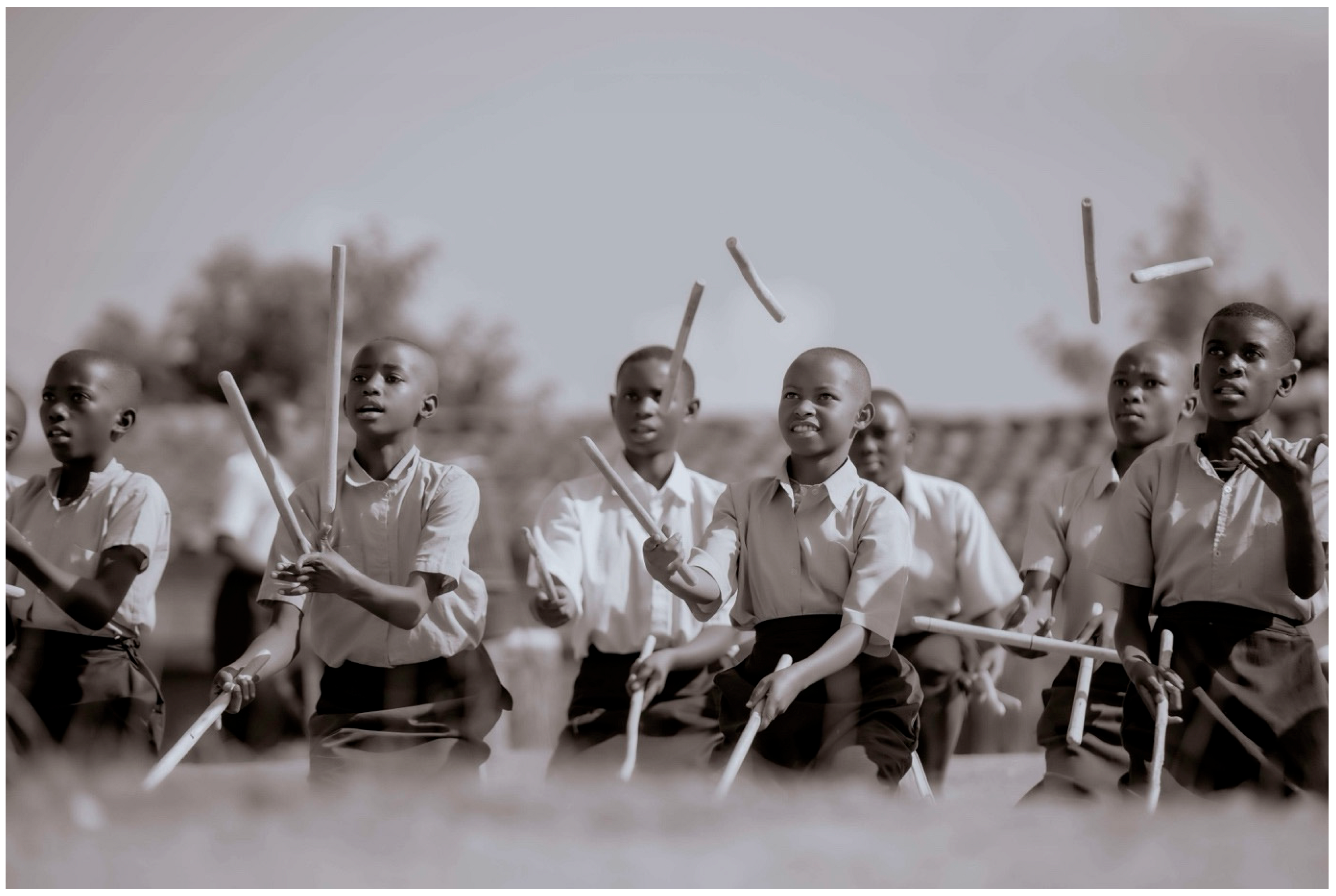
The girl drummer holds her drumsticks and lightly begins to tap the skin of the drum. She was told to be meek and humble. The girl drummer begins to pound her drumsticks with strength and authority. She was told to be reserved. The girl drummer twirls her sticks into the air and catches them. She was told that drumming is a male tradition. The girl drummer adds poetry as she speaks to the past and future of the drum. She was told that the drum belongs to the Mwami or King of Rwanda. The girl drummer flings her body into the air as she dances and creates a choreography. She was told that girls cannot drum. The girl drummer drums for gender equality. The girl drummer drums as gender equality (
Figure 1). This article investigates the use of culture in and through drumming to explore different knowledges and understandings of gender in/equalities. It foregrounds girl drummers within the predominantly male dominated cultural practice of drumming in Rwanda, to challenge gendered hierarchies of knowledge and power.
1. Introduction
Persistent gender stereotypes and cultural norms continue to hinder the effectiveness of Rwanda’s National Gender Policy (2021). While legal frameworks exist, cultural practices often reinforce inequality.
Gira Ingoma addresses this gap by reconstructing cultural forms—drumming, warrior dance, and poetry—to empower girls and influence policy. We ask how embodied cultural practice functions as a performative route to gender equality and contributes to “everyday peace power,” understood as micro-processes and spaces of solidarity and agency in everyday life (
Mac Ginty 2021a).
Research Questions
RQ1. How do girls and women participating in Gira Ingoma negotiate and perform gender through drumming and related cultural forms?
RQ2. What micro-processes of “everyday peace power” emerge through workshops and festivals, and how do these interact with policy actors and spaces?
RQ3. What changes are observable in participant confidence, community engagement, and institutional practice over the project period?
The position advanced in this study highlights the creative practice of drumming through the
Gira Ingoma (One Drum per Girl) research project as everyday embodied experiences that link with everyday peace practices.
1 Gira Ingoma and lead organization Woman Cultural Centre engaged over 250 female research participants to voice their issues, needs, and solutions for local decision-makers and community members through girl drumming festivals.
2 The
Ingoma Nshya Festivals were staged at a large sports stadium in Huye to construct and perform gender equality through the embodiment of drumming, warrior dancing, and self-praise poetry with and for girls. This article provides important empirical evidence regarding the need for shifts in cultural practice to reinforce gender equality laws. Girl drumming and the
Gira Ingoma project challenges social injustice through culture as ‘a process of communication and a contested arena of meaning-making practices…as a process of invention and innovation’.
3 Through the integration of
Gira Ingoma into local schools and the engagement of decision-makers,
Gira Ingoma has not only created a sustainable approach to embed girl drumming within formal and non-formal education structures within the Huye region of Rwanda, but it has also developed an economic, social, cultural, and political platform for gender equality.
We analyse empirical research through the following theoretical frames: (1) Gender Performativity: gender is enacted and sedimented through repeated acts that produce social reality rather than simply reflect it (
Butler 1988). For
Gira Ingoma, the public, repeated act of girls’ drumming asserts new gendered possibilities. (2) Everyday Peace Power and Spatiality: Everyday peace emerges through micro-acts of sociality, reciprocity, and solidarity (
Mac Ginty 2021b) and is inherently spatial, produced through agentic practices in homes, schools, and community venues (
Björkdahl 2023). (3) Performance-as-Knowledge: Performance functions as a machinery of knowing (
Cetina Knorr 1999;
Jost et al. 2023), where bodies learn, transmit, and stabilise new meanings. Arts-based peacebuilding leverages aesthetic, affective, and collaborative processes (
Cohen et al. 2011;
Breed et al. 2024).
Drumming in Rwanda: Historically associated with royal power and male guardians of ritual (
Gansemans 1988;
Vansina 2000), drumming has been framed as ‘tradition’. Challenges to such ‘fixed’ practices expose how traditions are invented and re-invented (
Hobsbawm and Ranger 1983). Women’s entry into drumming disrupts patriarchal symbolism while renewing cultural forms.
1.1. Our Contribution: How Can Reconstructed Cultural Forms Perform Gender Equality Laws?
This article will provide an overview of the
Gira Ingoma project concerning the revised National Gender Policy (2021) in Rwanda that defines gender as: ‘…a social and cultural construction, which distinguishes differences in the attributes of men and women, girls and boys, and accordingly refers to the roles and responsibilities of men and women. It also refers to the state of being male or female in relation to the social and cultural roles that are considered appropriate for men and women’ (
MIGEPROF 2021, p. 9). There is increasing attention to the importance of culture for health, community cohesion, and sustainability. And yet, women and cultural artists are often the most marginalised. The Assistant Director-General for Culture UNESCO, Ernesto Ottone R. stated ‘[w]e must go further. Cultural policies that do not actively empower women and girls risk reinforcing existing inequalities and limiting the transformative power of culture itself’. The
UNESCO (
2025) report Art for All: Placing Gender Equality at the Heart of Tomorrow’s Cultural Policies sought to explore the role of women and girls in the cultural and creative sectors, as there is often discrimination, underrepresentation, precarious working conditions, and unequal participation. The
Gira Ingoma project therefore provides an important contribution to the Sustainable Development Goal (SDG) 5: Gender Equality pertaining to the evolution of drumming in Rwanda through a female-led and youth-engaged practice for gender equality that has manifested gender equality through the transformation of culture.
The coming into being of gender equality with
Gira Ingoma is rehearsed and performed through the repetitive performance of girl drumming. Following Judith
Butler (
1988), we investigate gender as “a cultural convention that is embodied and enacted” and we consider that the body does not only show but also produces cultural signification (525). In the case of drumming, the act of a girl drumming is performative, and it produces a reality in which drumming becomes a possibility for women and, through repetition, can become a recognized and accepted cultural expression for them. The performativity of female drumming moves from a narrative and practice dominated by boys and men to the inclusion of girls and women. Through ongoing embodied ways of knowing and practicing, women perform and embody a cultural practice formerly reserved for men, towards a reclamation, and cultural assertion of rightfully owning it. In
Performing Cultures of Equality, Emilia María
Durán-Almarza et al. (
2022, p. 2) state: ‘[a] renewed understanding of culture as performative (i.e., as producing rather than just reproducing specific social values and belief systems) has opened new avenues for engaging with sociocultural practices. If cultural forms and artworks are not just objects to be enjoyed from a passive outside position but are instead regarded as artefacts co-created in the very act of interacting with them, viewers, spectators, and readers become key agents in the process of artistic and cultural production’. Suzanne Clisby and Mark Johnson (
Clisby et al. 2020, p. 2) critique culture ‘…as the process through which people create and contest the social worlds that they inhabit’ and ‘thus becomes a key site for the critique, activist intervention, and imaginative production of material in/equalities’ (
Durán-Almarza et al. 2022). Drumming, in this context, enables the performance of gender in/equality, whilst enabling different pathways for cultural and gendered power relations to be reimagined through the engagement of local to national stakeholders (students, cultural organisations, local government, and international organisations).
1.2. Dramaturgical Acts
This article takes you through a journey consisting of three main sections as dramaturgical acts—Act One, Act Two, and Act Three—presenting the Gira Ingoma project as a staging of gender equality in Rwanda. Dramaturgical frameworks inform analyses of gender performativity by framing gender as both staged and embodied for the construction (and deconstruction) of gendered roles within society as a performance. Act One presents an overview of Gira Ingoma within the context of Gender Policy in Rwanda; explaining the underlying need or inequality that the project aimed to address. Act Two presents the supporting literature which includes an overview of the historical context of drumming in Rwanda and interlinkages between art and peacebuilding. We introduce the concept of ‘everyday peace power’, as well as consider spatial approaches to everyday peacebuilding as part of the wider Mobile Arts for Peace (MAP) project. In Act Three, we conclude with recommendations that have emerged from Gira Ingoma as part of the wider Mobile Arts for Peace (MAP) research project to inform gender policy and peacebuilding.
2. Background on the Gira Ingoma Project
Gira Ingoma (One Drum Per Girl) is a project of Woman Cultural Centre (WCC), developed by Katese and the drumming troupe Ingoma Nshya since 2019. It aims to address persistent gender stereotypes and discriminatory social norms that prevent girls from engaging in non-traditional activities and/or roles in the creative and cultural industries. Gira Ingoma uses drumming, warrior dance (guhamiriza), and self-praise poetry (kwivuga) for gender equality. In 2023, Gira Ingoma was funded by the MAP project to explore the use of local cultural forms to establish a dialogue between young people and decision-makers. The Woman Cultural Centre, in partnership with Ingoma Nshya Women’s Initiatives (INWI) and Nofit State (Wales), provided 326 workshops in drumming, warrior dance, poetry, singing and juggling over ten months. Through these workshops, over 250 girls aged 3 to 18 invited local, regional, and national decision-makers to a quarterly drumming festival. The festivals included talks and performances portraying and embodying the women they claim themselves to already be, and the wider culture they hope to see in the future. The girls and their 11 female trainers, supported by the headteachers from their schools, were reinventing themselves, and what it means to be a young female Rwandan, on their own terms.
Polyvocality: An Intentionally Artistic Ontological Approach
This article was written by four women with different experiences and perspectives that relate to gender, art, youth, performance, and policy. Being thus, the voices and tone of the article may shift from time to time as varied contributors share their insights, experiences, and research to contribute to knowledge production and knowledge transfer. We have decided to keep the tone and style intact to accent these voices and contributions, versus to homogenise the tone and style. In this way, incorporating different ways of knowing that contribute to decolonial and arts-based practices that focus on relationality, reciprocity, and respect (
Littletree et al. 2023). We also position the drum as another kind of author or writer of the text, as it becomes embodied through poetry and through dialogue. Odile Gakire Katese (Kiki) who serves as the founder of
Gira Ingoma, provides an account through her own experience of gender and the cultural arts in Rwanda. Ariane Zaytzeff serves as Co-Investigator of the
Gira Ingoma project and provides insights as a Performance Studies scholar and cultural artist. Ananda Breed serves as a researcher and Applied Performance practitioner who investigated the use of performance for justice and peacebuilding from 2004 onwards and has developed the MAP project to extend the learning from Rwanda to other contexts. Sarah Huxley serves as a researcher and youth specialist who has explored varied Global South contexts in relation to youth policy, education, and play. In some ways, the article attempts to resist the traditional academic frame of a journal article to enable ruptures through varied voices, to integrate script and poetry to foreground different knowledges, and to explore creative approaches to knowledge production and knowledge transfer. The varied contributions provide the rich cultural context, theoretical frameworks, and relevant policy evocations that call for gender equality enacted through the performativity of gender equality in drumming.
The drums, the warrior dance and the self-praised poetry were performed by men, most often at the court of the king. The warrior dance was inspired from battle and self-praise poetry emphasised stories of war. One comment from a critic of the project stated, ‘how can a girl tell stories of war? They have no such stories to tell.’ Ask a girl who has undergone systemic violence that has led her to be malnourished whether war is fought on her body. Ask a girl who has experienced sexual violence whether war is fought on her body. Ask a girl who has not been allowed to go to school because her value is regulated to household chores whether war is fought on her body. As four female academics and practitioners, we consider performance epistemologies through the drum and a decolonial aesthetic to unlock embodied knowledge that activates generational and intergenerational scripts in relational ways.
3. Methodology
We advance debates on culture, gender, and peace by evidencing how repetitive, public, and durational performances materialise gender equality as practice—not merely policy text—thereby complementing top-down policy with bottom-up, embodied change (
Butler 1988;
Jost et al. 2023;
Mac Ginty 2021a).
This study employed a qualitative, arts-based research design informed by performance studies and participatory approaches. Arts-based methods were selected to investigate gender performativity and cultural transformation through embodied practices such as drumming, warrior dance, and self-praise poetry. The research aligns with feminist and decolonial frameworks that privilege relationality, reciprocity, and creative knowledge production (
Breed et al. 2024;
Littletree et al. 2023).
The research engaged over 250 girls aged 3–18 from eleven schools in Huye and Gisagara districts, alongside 11 female trainers, parents, teachers, cultural organization directors, and government decision-makers. A national youth advisory board (YAB) of 17 members aged 16–21 facilitated Monitoring, Evaluation, and Learning (MEL) activities. Participants were recruited through collaboration with local schools and cultural organisations to ensure inclusivity and community ownership.
Data were generated through multiple methods: Semi-structured interviews (n = 18) with youth participants, parents, educators, cultural leaders, and policymakers. Arts-based workshops (n = 6) incorporating drumming, warrior dance, poetry, and visual arts reflection. Drumming festivals (n = 6) staged as performative interventions to embody and communicate gender equality. Arts-based MEL tools such as Outcomes Vision Murals and Wellbeing Barometers were employed to capture participants’ experiences and aspirations. Participant observation was integral, with researchers actively engaging in rehearsals, performances, and community dialogues.
Data analysis combined thematic coding with dramaturgical frameworks to examine gender performativity and cultural shifts (
Butler 1988;
Jost et al. 2023). Polyvocal writing was employed to preserve diverse voices and resist homogenization, emphasizing relationality and reciprocity. Performance was conceptualized as a “machinery of knowing” (
Cetina Knorr 1999), enabling interpretation of embodied practices as epistemic acts.
Ethical protocols included informed consent from participants and guardians, safeguarding measures for minors, and adherence to institutional ethics approval. Collaboration with local cultural organizations ensured culturally sensitive practices and reciprocal benefits for participants. Confidentiality was maintained throughout, and findings were disseminated through policy briefs, community events, and open-access resources.
The study acknowledges limitations such as reliance on qualitative data, potential biases in participant selection, and challenges in sustaining long-term cultural change beyond the project’s duration. However, the durational and participatory nature of the research mitigated some constraints by embedding practices within local schools and communities.
In an interview with a leading cultural organisation in Rwanda, the Director commented:
I was struck by the number of young girls who were there, learning to beat the drum. I was fascinated by the enthusiasm. You can see that they want this, they really want to learn to drum, to practice, to be drummers. You can see they’re interested and very happy. In fact, I was surprised. I didn’t know there were so many of them. And I was also delighted when the young girl spoke on behalf of the others. Because when I arrived, I met a mother, and the question the girl asks herself is: will I have a drum when I’m in high school? I met a mother whose daughter asked the same question. I told her it would be difficult. But as long as she wants to be there and practice drumming, she has to be part of the school troupe. Maybe in time that will change. Otherwise, I was interested in the parents’ presence. Seeing that the parents support the girls.
In this quote, there is recognition of the youth and girl-focused aspect of drumming that is motivated by the young people and supported by parents. The link between the role of Gira Ingoma to ignite the social imagination for gender equality is well stated in the following quote by a local representative of the Ministry of Sports and Culture: ‘It’s understandable because it’s possible. We’ve seen that it’s possible.’ The comment emphasises the need for gender equality through action and visibility.
YAB members conducted MEL focus groups and workshops in three schools with a total number of 46 participants: Groupe Scolaire Rukira (n = 22), Groupe Scolaire Kinteko (n = 18), and Groupe Scolaire Sovu (n = 8). The youngest girl who participated in MEL activities was 3 years old and the oldest was 16 years old. All participants were given materials to respond to MEL tasks (papers, pencils, markers, and scissors). Most exercises were conducted in small groups and involved peer-to-peer discussions. Participant responses illustrated the increased sense of safety and worth whilst participating in the Gira Ingoma project and the desire to engage with decision-makers about issues of importance to them. Due to the need to share drums among participants, it was a common request for additional funding to provide one drum per girl and to embed the project into schools and the national curriculum.
4. Act One: Overview of Gira Ingoma and Peacebuilding
Created in 2004, Ingoma Nshya (which translates as New Power and New Drum), is the first-ever and only female drumming organisation in Rwanda that is culturally empowering women and fostering a creative culture that is ‘woman-friendly’. Inspired by other homegrown programmes such as ‘Gira Inka’ and ‘One laptop per child’, Ingoma Nshya and the Woman Cultural Centre launched ‘Gira Ingoma (One Drum Per Girl)’ in 2019 to address persistent gender stereotypes, sexist attitudes and discriminatory patterns that perpetuate inequalities and exclusion in the creative and cultural industries by preventing girls and women from performing non-traditional jobs and roles. Gira Ingoma was initiated to demonstrate how creative arts in primary and secondary schools could be gender-responsive, by providing regular training workshops to hundreds of young girls in artistic and cultural fields where they were historically excluded, or absent, namely in drumming, warrior dance, and self-praise poetry. A youth participant from Groupe Scolaire Kabuga stated: ‘Drums relax the mind. Here we come to relax and laugh. When we don’t drum, I feel in my head that I am not thinking clearly…in the past, only boys could play the drums, but today, progress has been made and we can play too.’ Now we turn to the link between Gira Ingoma and the Mobile Arts for Peace (MAP) project to consider gender equality and everyday embodied experiences as a form of everyday peacebuilding.
4.1. Spatial Approaches to Peacebuilding
In 2023, Gira Ingoma joined a wider research project entitled Mobile Arts for Peace (MAP): Informing National Curriculum and Youth Policy for Peacebuilding in Kyrgyzstan, Rwanda, Indonesia, and Nepal. Thus, the focus on gender empowerment and equality with and for girls relates as part of an overarching framework for peacebuilding. The project has explored varied spaces (both internal and external; physical and metaphorical) to enable dialogue between children and young people and decision-makers. In an interview with a parent from participating school GS Cyarwa, the interviewee notes how Gira Ingoma provides a positive and transformative link between the home or domestic sphere and the school or educational sphere:
First, my daughter came to watch. The next day, she asked me to register her, to let her participate. I told her to go register because I could not deny her rights. When they come here, I know they are safe and learning useful things. They declaim poems praising themselves, they sing. When we gather at night they sing for me. I didn’t expect them to learn anything, because they were so sad. But now they laugh and rejoice. Personally, Gira Ingoma is like a co-parent helping me to raise them. Because they get knowledge, they get education. When I’m not here, I know my children are safe. It gave me peace of mind and made me happy. And more importantly, my children are not isolated (in solitude). In one song, she sings that she’s a girl who’s not afraid to fight, that she’s a brave warrior. I think she’ll be a capable girl, freeing herself from the bad history she was born into. At just eight years old, she has already set herself the goal of becoming a great person. When she goes to school, I like to tell her: “You sing that you’ll be at the top of the power. So go and study hard to become the leader you’ve decided to become.”
Thinking through peace and conflict research using spatial and peace geographies encourages a rethinking of where knowledge about peace and conflict is produced. According to Annika
Björkdahl (
2023), peace is spatially constructed, it is a symbiotic phenomenon through which the agentic nature of the individuals and social groups generates the phenomena: in other words, ‘space is a product of agency’ and vice versa (
Björkdahl 2023, p. 54). Roger
Mac Ginty’s (
2021a) concept of ‘everyday peacebuilding’ and ‘everyday peace power’ draw from these root assumptions. Namely that ‘mobilities of peace’ (
Richmond and Mac Ginty 2019) recognise that peace can be generated and understood through the movement and interactions of people and ideas and not only in relation to international borders and statehood. For
Mac Ginty (
2021a), the concept of ‘everyday peacebuilding’ focuses on how individuals and small groups can capably etch out spaces of tolerance and conciliation in conflict-ridden societies through ‘micro-acts’ of sociality, reciprocity, and solidarity. These are highly significant, because such everyday practices and norms deployed by individuals and groups in deeply divided societies, seeks to avoid and minimise conflict at both intra and inter-group levels. It is a form of tactical agency—a mode of thinking as well as a series of actions—that often occurs in unthreatening or marginal spaces.
The emphasis is drawn away from large top-down peace-building endeavours such as political peace processes to acknowledge the communal spaces of homes, schools, marketplaces, ‘queues for bakeries’ (
Mac Ginty 2021a) and so forth. Mac Ginty argues that both top-down social geographies and bottom-up are needed, but that the everyday should garner more attention. This article contributes towards this agenda through the
Gira Ingoma drumming festivals’ use of stadiums and site-specific performance spaces to redress gender inequalities.
Our interest is with gender, the social power dynamics that play out through drumming festivals, and how these can contribute towards micro acts and spaces demanding tolerance and conciliation within wider societal narratives of gender policy. In this regard, ‘everyday peace power’, Mac Ginty’s concept of micro-processes that involve ‘brokerage, human capital, emotional intelligence, and opportunism’ (
Mac Ginty 2015), is key to understanding how the drumming festivals contribute to a series of events that invigorate and stretch gender policy and its implementation in Rwanda. Mac Ginty argues that everyday peace agency is a form of power in and of itself, that is, a ‘power with/to/from’ as opposed to ‘power over’; this aligns with
John Gaventa’s (
2006) work on Powercubes. It’s a form of power that may go unnoticed: disrupting hegemonic narratives around conflict.
Finally, whilst it’s important to not overly ‘romanticise’ i.e., apply the same rigorous questioning of so-called ‘local’ or ‘indigenous’ agentic actions (
FitzGerald 2023;
Sillitoe 1998), concerning spatial approaches to peacebuilding. This research along with others in the field of youth studies and peacebuilding (
Berents 2024) asserts that there is still much to understand and apply through everyday peace, especially given Mac Ginty’s view of applying a critical lens to ‘the local’ (
Mac Ginty 2015). Mac Ginty perceives it not as territory, but rather in terms of activity, networks and relationships. Yet for some peacebuilding researchers, this is still somewhat ‘fuzzy’ (
Ejdus 2021). However, what is useful in discussing the ‘local turn’ in peacebuilding, and in relation to gender, is that the academic study of peacebuilding is understood to be integrated into ‘the real world’ i.e., intentionally seeks to support local peacebuilding agents, rather than (or just) informing external peacebuilding interventions (
Mac Ginty and Richmond 2013).
4.2. Art and Peacebuilding
Within peacebuilding research, there is a growing interest and understanding in the ‘aesthetic turn’ (
Chipato 2024). That is to say, where creative and artistic expressions, and the making and doing of them, become a form of knowledge practice and production in and of themselves. Peacebuilding is framed within ‘a more complex, entangled, relational world, where agency and causality are no longer easily distinguishable’ and localised understandings of the world are foregrounded (
Chipato 2024, p. 226). According to a growing number of scholars who work at the intersections of art and peacebuilding (
Lederach 2005;
Cohen et al. 2011;
de Guevara and Cole 2024;
Breed et al. 2024), artistic methods and approaches are rooted in creative collaboration, emotional engagement and dialogue in ways that are often unpredictable rather than linear and results-focused (
Cohen et al. 2011;
Chipato 2024;
Huxley 2025).
The integration in and with artistic methods and approaches in peacebuilding research frames the research as a way of knowing and inquiry as encounter (
Breed et al. 2024), an unfolding of creative collective experiences, rather than as a static and overly controlled research project (
Ware et al. 2024). Artistic ontologies centre generativity rather than control, and there is a careful balancing between discipline through form, and spontaneity as knowing. There is also an inherent focus on subjectivity as researcher-peacebuilder, as well as the role of the audience and receiver—they are inherently brought within the act of creation: of both the research itself and the type of peacebuilding (or otherwise) being expressed. Audiences and participants bring who they are, their mental experiences, personal histories and values to the artistic expression or form (
Grant 2024). There is a dialogic relationship between form, artist and audience, a continual remaking.
Performance (such as dance, drama, music) also provides an aesthetic quality that can be discomforting and unsettling, especially in the localised contexts of social relations in post-conflict situations (
Chipato 2024;
de Guevara and Cole 2024). Peacebuilding scholarship that integrates arts-based epistemologies, is not in and of itself, inherently peaceful (
Mitchell et al. 2019) or ‘good’.
Mitchell et al. (
2019) suggest that researchers should question further how peacebuilding research with and through the arts might reinforce or overly focus on certain conflict sites, spaces, and communities through the emphasis on artistic production. This requires further ethical consideration than it is often afforded. Research increasingly suggests that the particular value of the arts with regard to peacebuilding may lie in their capacity to work with tensions, and differences in often more than verbal ways that enable a greater capacity for communication (
de Guevara and Cole 2024), thereby contributing towards a real-type agonistic peace (not an overly homogenised so-called harmonious peace). There are, however, real risks and challenges of art in and for peacebuilding. As
de Guevara and Cole (
2024) acknowledge, there is a risk of both an over instrumentalisation of the art forms themselves when predefined ends are overvalued that deaden political and epistemic exploration. Furthermore, questions of whether different artistic forms are prioritised over others, and ethical questions concerning large power differentials between researcher and artists, remain.
4.3. A Brief History of Drumming
In Rwanda, the drum,
ingoma, played with sticks, is one of the major traditional art forms. It was reserved for men, and it was taboo and forbidden for women to touch the drums. At the court of the king, before colonization, drummers were a category of
abiru, the guardians of history and oral tradition. The
abiru were divided into clans, and each clan had the responsibility of a ritual (
Vansina 2000). According to ethnomusicologist Jos
Gansemans (
1988), the
abiru-drummers lived at the court close to the king and were under his protection. They had the responsibility of making and preserving the drums and playing them for the waking and bedtime of the king and other events such as royal audiences or the departure and return of the king and his troops. Drumming literally gave rhythm to the life of the king and the kingdom.
The Kinyarwanda word
ingoma means both drum and kingdom or reign. More than music instruments, the drums are symbols, and the court had a series of dynastic drums (
ingoma z’ingabe) that were never played but had important roles in various rituals of the king’s life. The most important of them is the dynastic drum
Karinga, symbol of the kingdom passed down from king to king (
Gansemans 1988, p. 214). The
ingoma z’imivugo (beating drums) had a rhythm for each event, with a total of eighteen fixed traditional rhythms, to which ensembles added their own improvisations (
Gansemans 1988, p. 223). With changes in political power away from the rule of kings due to colonization, independence in 1962, and the two Hutu Republics, the drums changed towards a more popular practice (
Gansemans 1988, p. 28). And yet, women still did not drum. In 2004, Katese offered drumming workshops to women at the University Center for Arts and Drama in Huye. She was unaware of the taboo, as she had grown up in the neighboring Democratic Republic of Congo. She was told that it was forbidden, but when she asked why, the answers were vague and unconvincing, such as: ‘it is too heavy for them to carry’. She held the workshops, and later that year, fifteen women created the first ever all-female drumming ensemble in Rwanda:
Ingoma Nshya, New Drum or New Kingdom. In the following years, the women showed that they could not only carry the drums but also learn and perfect traditional drumming and revive it in an unprecedented way. In that regard,
Ingoma Nshya joined a movement to integrate women in Rwanda’s political life. Be it in the Senate or in the Cabinet, women are now visibly participating in the exercise of political power. Yet women drumming was not a top-down decision, it came from the women themselves. In 2018, they started training young girls and in 2019 the
Gira Ingoma initiative was born.
The drums are more than just a symbol of political power; they also represent the woman. There is a whole vocabulary that associates the drum with the female body: the drum has breasts, a naval, and when it has a hole, one says that it gave birth (
Redmond 1997). The drum represents the woman and that is why the woman cannot play herself. She cannot touch herself. In that regard, one could say that the women of
Ingoma Nshya and the girls of
Gira Ingoma perform some kind of sexual revolution and claim agency on their own bodies. Yet they do more than that: they refuse the objectification of women’s bodies. The parallel between a drum and a woman is part of a patriarchal system of representation that is harmful to women and their emancipation. With drumming, women take back control over their bodies and lives and they deconstruct representations formulated by men. They contribute to producing representations that enable women to fulfil themselves and accompany them in their autonomy. Drumming has provided the women of
Ingoma Nshya with financial security. The girls of
Gira Ingoma experience drumming as a source of revenue, as the school’s troupes are often hired to drum at official events. The women of
Ingoma Nshya have financial stability, and that is a major reason why they are taken seriously.
Katese remembers their evolution since the pandemic, when once confined, they were forced to rely only on themselves, so they had to create, at first with little confidence, their own melodies, music, and poems. Today it is almost spontaneous and natural to create songs that celebrate women and to train children in schools. Gira Ingoma was a big step in gaining confidence, as having a position of trainer felt like a promotion, an acknowledgement of their talent and experience. Becoming a trainer changed the way they see themselves. Katese remembers that when she first met these women, they would not look you in the eye, they had their heads down, and they spoke in a small voice. Now they are proud, and they are not afraid to be loud. The same process took place with the girls of Gira Ingoma, whose attitude and way of holding themselves has evolved towards more self-confidence.
Drumming offers an opportunity to advance gender equality because it touches on symbols of political power and female objectification, and it can provide women with financial means and confidence for emancipation. Of course, what constitutes an opportunity for women is perceived as a threat by those who wish to perpetuate the patriarchal system and its representations. The criticisms that women drummers receive all fall under one main issue, that is, the disrespect and damage to tradition. In
The Invention of Tradition,
Hobsbawm and Ranger (
1983, p. 2) explains that ‘the object and characteristics of “traditions” (…) is invariance. The past, real or invented, to which they refer imposes fixed (normally formalized) practices’. These practices ‘seek to inculcate certain values and norms of behaviour by repetition, which automatically implies continuity with the past’. Women drummers introduce a variation in the practice of drumming and thereby challenge the values and norms its traditional version conveys. Their detractors’ attachment to a ‘correct’ expression of traditional art and culture is in fact an attachment to the values that underlie the ‘traditional’, normalised practice of the drums, which are deeply sexist. The argument of the preservation of a cultural heritage uses culture as an excuse to express their opposition to women’s empowerment.
The ‘traditional’ system is deep-rooted and has lasted for several centuries, so it is crucial to set up alternatives that will also be a hundred years old one day, that will become anchored in mentalities, habits and mechanisms, but which are for the benefit and service of women. It takes time, and Ingoma Nshya has taken this time. They have 20 years of data to prove that it is possible, and they are continuing and growing this initiative with Gira Ingoma. The most important lesson was that it was up to them to take the place they wanted and to redefine themselves. Katese believes that waiting for approval, for some kind of recognition and integration from others, from society, even delayed the work Ingoma Nshya accomplished. For a long time, they waited for people to change, but they had to change their attitudes towards themselves first. In Katese’s (2025) words: ‘It’s absolutely vital that women get it into their heads that it’s up to them to seek out this equality and defend it daily. To never give up, because the patriarchal environment in which we evolve will look for the slightest opportunity to sabotage all that’.
5. Act Two: Epistemologies of Knowledge as ‘Machinery of Knowing’
Performance, and in this case drumming, can be used as a ‘machinery of knowing’ (
Cetina Knorr 1999) to unlock embodied knowledge in ways that activate generational and intergenerational scripts. The activation of memory, from the past, and visioning of the future serves as a dialogue between past, present, and future, which foregrounds the possibility to intervene within culture (through a rights-based approach). The bodies of young girls who performed the
intore warrior dance and recited songs of praise from the battlefield on a field with 250 other girls (as part of the MAP project) told their stories with bodies that were not meek nor humble (often referred to as the ideal Rwandan girl or women).
Gira Ingoma invited girls and women to perform warrior dances and drum, thereby inhabiting strong and confident behaviours, often gendered as male. This reclamation of alternative gender performances is a way of empowering Rwandan women, and by extension, this is a motivation behind the drumming practices of
Ingoma Nshya. Girls spoke, danced, and drummed their truth loudly and with confidence; they took the stage with joy. The Interweaving Performance Cultures project entitled
Performance Cultures as Epistemic Cultures (
Jost et al. 2023) explored the varied epistemologies of knowing within performance as ‘distinctive habitats of knowledge practice, including multilayered hierarchies and power relations, facts that are too often ignored or neglected by practitioners and scholars working within knowledge settings’. The epistemological position of drumming within the Rwandan context to transmit different knowledges and understandings of gender (in)equalities served as a form of resistance and celebration.
The role of the drum as a carrier of knowledge and instrument for research and knowledge production is explored as a performance text or script within an article by Celeste
Pedri-Spade (
2016) entitled ‘The Drum is Your Document: Decolonizing Research Through Anishinabe Song and Story’. The excerpt below demonstrates the interplay between the drummer and researcher, elders, research participants, and drum as a negotiation of epistemologies:
Beatrice: drum carrier: The drum teaches us that we are all equal when we come together in a circle to share our songs and stories. Everyone is welcome, and no one is better than the other. We learn from each other.
Celeste:
daughter, researcher, drum carrier: Yes, and on this journey, we are all equals. It’s not as if I am the researcher with eight participants. We are all coresearchers (
Lassiter 1998,
2005) on this collaborative journey, and we need to come together so that we may share our storied experiences and song, drum in hand. Privileging and empowering voice acknowledges that each person has a right to contribute and connect to what is given in his or her own way.
Isabelle: drum carrier: As drum carriers, we understand that drums are part of us. We confirm this bond as we birth them, carry them where we go, take care of them, and honour them through feasts and ceremony.
Celeste: daughter, researcher, drum carrier: And what I’ve learned from this is that the connection between person, voice, and drum must remain intact because to separate these parts is to destroy the sacredness of our songs.
The text navigates between varied contexts and ways of knowing through perspectives, methods, and Western versus indigenous epistemologies (
Ochwo-Oburu,
2020;
da Silva et al. 2023;
Day et al. 2023) as dialogue. At one point, the researcher and protagonist states: ‘…my relationship with my drum continues to evolve…the way I look at it and relate to it. Through this growth, I now see that my drum gives me my methodology’ (
Pedri-Spade 2016, p. 394). Now we turn to Katese, to voice the drum as a methodology through creative writing entitled ‘
Ingoma! A Revolution in Rhythm’. This has been developed into a theatrical production of the same name.
To keep me away from you, men shaped me in your image: they gave me your breasts, your belly, your navel, your uterus, your vagina. Like you, I too, give birth in a tear. But me, I am what you have never been: I am sacred and venerated. You remain impure and despised. You can’t come near me. You can’t touch me. Touching me is like touching yourself, it’s like two women touching each other, ‘it’s a sacrilege’, they say.
So, the first time you touched me, your hand was very hesitant and clumsy. It was at this very first rehearsal that you became a fairground animal. The men would stand right in front of you, stunned and sceptical. At the shy, uncertain and very disorderly sound of your hand, they crumble to the ground, laughing their heads off. The gaze of men will never leave you. Very quickly, the gaze became disapproving.
This is when I also realized that when the gods were creating you, they did not use the earth or extract a rib from a man; but instead, they used terror and distilled it into every cell of your body. So, you had to overcome your fear. And despite the taboo, I proudly saw you disobey, defy habits and customs and rescue me. I saw you ride the relentless monster that kept smashing you to the ground with violent blows. I so often found you on the ground with your back in mush and your trembling hand. Did you have any clue about the creature: how to tame it, how to attack it? I clearly saw that only one shot was possible. And I shouted to you: in the balls!
They say it was the most despicable thing you ever did to men: hurting them, in their manhood. They keep saying how disrespectful and painful it was. And yet, I agree with you: you had to desacralize and deconstruct the myth.
And here you are! Blessed girl of a trembling, unexpected but fulfilled disobedience. Miraculous daughter of a jerky but serene revolution. Fruit of a wild and fierce love and a thwarted and prohibited passion that you had for me and that you refused to abort. You were born on a stormy night, in the most distraught and desperate cries. Isn’t she beautiful? Isn’t she powerful? Please, don’t silence her. Make room for her. Accompany her and let her be. Let her live… And above all, don’t gag her, she could tear your arm off.
You were on your knee; I lifted you up and revealed you to yourself.
And here I am! The once sacred and royal drum. You had already heard of my past glory. You had also seen me gagged and bloodied on the ruins of colonization. Then, you found me disembowelled and mute after the genocide. We were both in the same state: abused and abandoned by men, kings and gods. We took care of each other. You treated my wounds and with a growl, I calmed your anxieties. We repaired ourselves; and our hearts, appeased, tuned in and since then, they beat, they vibrate, and they enter in a trance in unison. I chose you to bring me back to life and you spontaneously dedicated your life to mine. Through you, I am taking a new turn, a new impetus, and regaining another prestige. You are my new face. You are the new face of power. Together, we smash all taboos and set precedents. And you are not afraid anymore. The days of fear are gone. Because every day I play with you the unspeakable and exhilarating tune of freedom.
Drum I am, drum I become again. I give you back your breasts. I give you back your uterus. I give you back your vagina. They are yours. Drum I am, drum I become again. Stick I am, stick I become again. I give you back your penis. I give you back your rib. They are yours.
Today, through you, I become a new drum: a drum of freedom, with sticks of equality. So, make the world dance to this music.
6. Act Three: Informing Gender Policy
The
Gira Ingoma project demonstrates the importance of sustainable, embedded, and durational performances of gender equality with and through culture. Although the
Mobile Arts for Peace project was funded from 2020-2024 and the
Gira Ingoma project was funded from 2023-2024, the work is ongoing and has served as a model for gender equality through culture.
4 It continues to inform international policy through the UNESCO Chair on Arts-based Methods for Peacebuilding with and for children and young people led by Ananda Breed at the University of Lincoln. Key learnings that can be applied to other programmes include considerations of how the performativity of gender equality contributed towards a localized activation of gender policies. The initiative sheds light on how ritualistic or repetitive behaviours can explicitly or implicitly contribute towards gender policies. The research also raises questions such as: Are there limitations in relation to the representation of girls and women within the cultural sector and creative industries? Are there disparities in relation to funding or support for women and girls as cultural artists to generate income and evolve careers within the cultural sector? These two questions were partially addressed through the project’s active inclusion of local female cultural artists, cultural institutions, schools, and local government. There was an initial policy-informing series of meetings with international organisations such as Plan International and UNESCO to inform and promote the work of
Gira Ingoma alongside national ministerial advocacy through the Ministry of Youth and Culture. The
Gira Ingoma festivals integrated local schools and local decision-makers through a durational performance—an ongoing series of performances through the drumming festivals by participating schools—that incorporated prizes (through the donation of drums) to the awarded schools.
In an interview with Katese she commented on the evolution of Gira Ingoma. She described how at first, Gira Ingoma, was a spectacular display of gender equality that was performed on the field of a sports stadium. Over 250 girls drummed, sang, recited, and danced gender equality through a powerful demonstration by female drummers who addressed cultural exclusion through the rightful embodiment of drumming with and for girls. At first, this was choreographed and curated through a day-long festival of participating schools and was attended by parents, educators, decision-makers and community members at large. However, through time, the form and structure of the festivals shifted. Katese stated that each school (and performance troupe) needed more time and that a space was required. The festival expanded from a one-day festival to a week-long festival by the sixth edition. Katese built a site-specific space, a performance space, to hold the drumming festival. The space was more intimate, to incorporate deeper listening. Instead of conducting the festival in a stadium, the festival was moved into a performance space.
The audience transformed as well. Instead of talking during the performances, which would be common in a stadium setting, the audience engaged with and through the performances (often providing testimonies at the end). In this way, the ritual performance space served as an incubator for gender equality for both the performers (female drummers) and the audience for a community-engaged process. The evolution did not happen overnight; it took decades of ongoing work and the continued direction of Katese to continue the female drumming company. It took the perseverance of Katese to envision a culture of gender equality that included girls and to create a space for girls and women to manifest that future in the present. It took the engagement of schools and local decision-makers to create a space for drumming with and for girls as part of the school curriculum and environment to enable a cultural eco-system in Huye. Now, the girl drummers are invited to numerous cultural events and are projected as the symbol or image of gender equality with and through culture. They are paid for their work as cultural artists; and parents, community members, and decision-makers are proud of the embodiment of gender equality through Gira Ingoma.
7. Policy Implications
The findings from the Gira Ingoma project underscore the critical role of cultural transformation in advancing gender equality and implementing Rwanda’s National Gender Policy (2021). While legislative frameworks provide a foundation, persistent cultural norms and stereotypes continue to hinder progress. This research demonstrates that arts-based interventions—particularly female-led drumming—can serve as powerful vehicles for social change by challenging patriarchal traditions and creating inclusive spaces for girls and women.
Three key policy implications emerge: (1) integrating cultural reform into gender policy strategies should explicitly address cultural practices as sites of transformation; (2) embedding gender-responsive arts education within the national curriculum can normalize female participation in traditionally male-dominated cultural forms; (3) institutional support and dedicated funding streams for girls and women in the creative sector is essential to sustain participation and professionalization, and (4) quota-based inclusion in cultural institutions mandating a minimum 50% representation of girls and women in cultural and artistic activities can accelerate structural change. Such measures would mirror constitutional quotas in political representation, reinforcing the cultural dimension of gender equality.
By leveraging cultural practices as performative acts of equality, policymakers can move beyond legalistic frameworks toward embodied, community-driven approaches that foster sustainable gender transformation. These implications align with SDG 5 and UNESCO’s call to place gender equality at the heart of cultural policy.
8. Empirical Findings, Interpretive Analysis, and Theoretical Reflection
This section will aim to summarise the empirical findings, interpretive analysis, and theoretical framing in response to the primary research questions prior to closing with recommendations.
RQ1. How do girls and women participating in Gira Ingoma negotiate and perform gender through drumming and related cultural forms?
8.1. Empirical Findings
Girls and women actively participated in drumming, warrior dance, and self-praise poetry—cultural forms historically reserved for men. Participants reported increased confidence, pride, and bodily assertiveness (e.g., ‘when we don’t drum, I cannot think clearly… in the past only boys could drum, but today we can play too’). Women trainers described their own transformations from speaking softly and avoiding eye contact to performing and teaching confidently. The public reaction ranged from community support, particularly from parents and families, to criticism from decision-makers and sceptics for ‘damaging tradition’.
8.2. Interpretive Analysis
Participants’ behaviours suggest a redefinition of culturally sanctioned femininity: embodied practices of loudness, strength, and leadership contradict expectations of meekness and humility. Drumming becomes a site of resistance, where girls and women re-claim symbolic domains (the drum as representation of kingdom and female body) and challenge patriarchal gatekeeping. The intergenerational dynamics—girls adopting roles modelled by the Ingoma Nshya women—indicate a cultural shift at multiple levels: personal, familial, institutional. Criticism framed as ‘protecting tradition’ reveals how cultural norms can function as mechanisms of gender regulation.
8.3. Theoretical Reflection
The practices exemplify Butlerian performativity: gender is produced through repeated acts, and female drumming generates new gendered possibilities rather than mimicking existing norms (
Butler 1988). The project demonstrates how cultural forms are ‘performative artefacts’ (
Durán-Almarza et al. 2022), co-produced through interaction between performers and audience. The act of women drumming destabilises what
Hobsbawm and Ranger (
1983) call ‘invented traditions’, exposing their political function in maintaining inequality or performing equality (in the case of
Gira Ingoma).
RQ2. What micro-processes of ‘everyday peace power’ emerge through workshops and festivals, and how do these interact with policy actors and spaces?
8.4. Empirical Findings
Workshops and festivals created regular opportunities for girls to meet decision-makers, parents, and educators. The shift from stadium events to an intimate purpose-built performance venue increased focused listening and meaningful dialogue. Parents reported improvements in children’s wellbeing, confidence, and aspirations (‘Gira Ingoma is like a co-parent helping me raise them’). Decision-makers expressed recognition of feasibility and impact (‘we’ve seen that it’s possible’).
8.5. Interpretive Analysis
These practices cultivate micro-spaces of social cohesion, where girls’ voices gain legitimacy in policy-relevant arenas. The relocation to a smaller performance venue transforms the festivals into intentional dialogic spaces, shifting the audience from passive observers to engaged interlocutors. Parent involvement strengthens a home-school cultural ecosystem, enhancing safety, belonging, and intergenerational support. Dialogues with officials link grassroots creativity and advocacy to institutional structures.
8.6. Theoretical Reflection
The project exemplifies Mac Ginty’s ‘everyday peace power’: small-scale practices—affective labour, emotional intelligence, relationship-building—to generate peace from below. The spatial reconfiguration of performance aligns with
Björkdahl’s (
2023) claim that peace is spatially produced through everyday agency. The project contributes to ‘the aesthetic turn’ in peacebuilding (
Chipato 2024), demonstrating how drumming and creative performance serves as a knowledge practice rather than mere representation.
RQ3. What changes are observable in participant confidence, community engagement, and institutional practice over the project period?
8.7. Empirical Findings
Girls showed increased physical confidence, leadership, and ability to address audiences. Schools integrated Gira Ingoma trainings within timetables; troupes performed at official regional events and earned revenue. The festivals expanded in duration (from one day to week-long events) and required institutional resources, including a new performance space. MEL data indicated increased feelings of safety, belonging, and desire for continued engagement.
8.8. Interpretive Analysis
These shifts represent institutional uptake, signalling the transition from project-based activity to embedded cultural change. Revenue-earning performances demonstrate the emergence of female creative labour markets previously inaccessible to girls. The expanding festival format and infrastructure indicates a consolidation of cultural legitimacy—girls’ drumming has become a recognised community practice. The desire for ‘one drum per girl’ reflects participants’ readiness for scaling up alongside structural integration into education and policy.
8.9. Theoretical Reflection
The findings support the view that durational, repetitive performance can materialise new social norms, functioning as slow-burn cultural transformation (
Jost et al. 2023). They reveal how embodied cultural practice complements top-down gender policy, creating what
Cetina Knorr (
1999) describes as ‘machineries of knowing’—sites where knowledge is produced through action. The project demonstrates how girls’ performances create affective infrastructures for policy change, aligning with feminist peace scholarship that emphasises emotion, relationships, and embodiment as sources of political agency (
Day et al. 2023).
9. Conclusions: Make the World Dance to This Music
Our data show how girls’ drumming enacts gender equality as a practice, not merely an aspiration. Through disciplined, joyful repetition, the performers accumulate authority in a domain historically aligned with masculine political power (
Gansemans 1988;
Vansina 2000). This aligns with performativity (
Butler 1988) and performance-as-knowledge (
Jost et al. 2023;
Cetina Knorr 1999): bodies learn, transmit, and stabilize new social meanings in and through performance.
Crucially, the project’s spatial and temporal design—schools, rehearsals, festivals; stadium to intimate venue—cultivates everyday peace power (
Mac Ginty 2021a). The project serves to brokerage gender equality through families, educators, and officials as affective labour (confidence, pride, recognition) and advocacy (platforms that welcome policy actors). Rather than idealizing the ‘local’, we observe a negotiated assemblage of actors and sites, where legal frameworks meet lived cultural change.
Before presenting three key recommendations, it’s important to dwell in Katese’s utterances as drum: ‘Today, through you, I become a new drum: a drum of freedom, with sticks of equality. So, make the world dance to this music.’ The rallying call here is a proclamation, reclamation, and symbiotic phenomenon through which the agentic nature of the individuals and social groups of teachers, officials, parents and girls, generates alternative spaces of gender equality. These social spaces are a product of the girls’ agency, but also the danced social spaces help to re-generate and reinforce the girls’ agency (
Björkdahl 2023, p. 54), and ‘everyday peace power’ (
Mac Ginty 2021b). And this is not to say that this agentic power and re-framing is constant or linear, just like a dance it is conversational and fluid. The performativity of female drummers brings gender equality into being through durational performances, which respond to the political/legalistic construction of gender equality as a direct response to the Rwandan gender equality law.
The conclusion goes one step further, to echo the girls’ rallying calls; calls to embodied and performative action, for readers of this article to consider how gender equality through culture and ‘machinery of knowing’ (
Cetina Knorr 1999) might be supported and championed from local to national levels. We invite the reader to consider how these recommendations might pertain to Rwanda, but also wider international contexts as well.
Three recommendations aim to contribute to the need for ‘addressing the persistent cultural norms and stereotypes hindering the effectiveness of gender equality and equity’ identified by the revised National Gender Policy (NGP) in Rwanda. The NGP’s priority area number four is to: ‘Leverage on positive cultural norms that support best practices for gender promotion. This intends to identify, map gender best practices and address persistent cultural norms, gender stereotypes, and imbalances affecting the principles of gender equality and equity between women and men and girls and boys’ (
MIGEPROF 2021).
The three recommendations (outlined in the
Gira Ingoma Photo Book and Policy Brief: The Culture We Want, for the Women We Want
5 are outlined below:
1. Quota of 50% of girls and women in artistic and cultural activities where gender-based exclusion and discrimination prevail. Imposing a 50% quota in artistic and cultural fields still dominated by men would be an acknowledgement of the importance of arts and culture in the country and its development. In line with the 30% of women in decision-making organs imposed in the Constitution, this quota would set another precedent, this time cultural, like the political one. The quota could be imposed by the Ministry of Gender and Family Promotion (
MIGEPROF 2021), the Ministry of Youth and Arts and the Ministry of Education (MINEDUC) in all artistic and cultural activities such as drumming, warrior dance (
guhamiriza), poetry (
kwivuga),
inanga, etc.… Any cultural troupe, association or institution offering training in these art forms would have to include at least 50% of girls and women in training and in public performances. That includes the National Ballet and the National Museum of Heritage, which gives classes in traditional arts in their summer programs, as well as schools that offer arts classes.
2. Implement classes in drumming, warrior dance, poetry, songwriting and juggling for girls in all primary and secondary schools throughout the country aged 6 to 18 years of age. Gira Ingoma is currently being implemented in eleven schools in the two districts of Huye and Gisagara. The programme is aligned with the Creative Arts curriculum developed by the Rwanda Education Board since 2019. The Creative Arts curriculum already includes drumming, warrior dance and singing. The program that Gira Ingoma proposes focuses on girls and adds poetry and juggling. It has been written and implemented over several years and can easily be submitted for approval and transmitted to trained trainers. With the technical support of the Woman Cultural Centre and Ingoma Nshya, the Ministry of Education and the Rwanda Education Board could partner with the Ministry of Gender and Family Promotion (MIGEPROF) and the Ministry of Youth and Arts to implement a curriculum that is part of the Creative Arts but focused on girls. In an interview with NGO Never Again, the representative stated: ‘Gender and genocide studies and peace values are cross-cutting issues in the national curriculum. If we are activists and fighting for gender equality to be considered, then culture should also be considered as an important thing to feed the peace values, the genocide studies, the gender equality issues or solutions’. The first phase, over the next five years, would involve training one thousand five hundred (1500) girls in Rwanda’s thirty (30) districts, with an average of three hundred (300) girls across six districts each year.
3. A dedicated fund to ensure and increase girls’ and women’s participation in artistic and cultural activities where gender-based exclusion and discrimination prevail. The creation of a fund dedicated to finance participation of girls and women in every stage of the entire creative value chain i.e., capacity building, production, distribution and documentation is key. The fund will foster the development of a thriving female creative and cultural industry by building an ecosystem for aspiring and professional Rwandan female artists to work in decent conditions and enjoy a conducive environment that enables them to unleash their explosive talents and appear to the world at full strength. In line with the gender-responsive budgeting that enforces accountability measures for gender sensitive resource allocation across sectors programmes and projects, the fund would be created by the Ministry of Youth and Arts, the Ministry of Education (MINEDUC) and the Ministry of Gender and Family Promotion (MIGEPROF) and would first support the implementation of the two measures suggested above in the thirty Rwandan districts.
With twenty years of experience, Ingoma Nshya has become an inspiring and effective model of transformative cultural action for gender equality whose aim is now to lead to the elaboration of comprehensive gender transformative measures addressing discrimination and gender inequality in the creative and cultural industries. The girl drummers of Gira Ingoma have contributed to the legacy of Ingoma Nshya and serve as the beacon for transformative cultural practices for gender equality in Rwanda and beyond.
If I was a drum, I would be proud of how you use your drumsticks with strength.
If I was a drum, I would be happy by the way you express yourself with joy.
If I was a drum, I would be thankful for how you play me as an instrument to communicate your ideas and dreams.