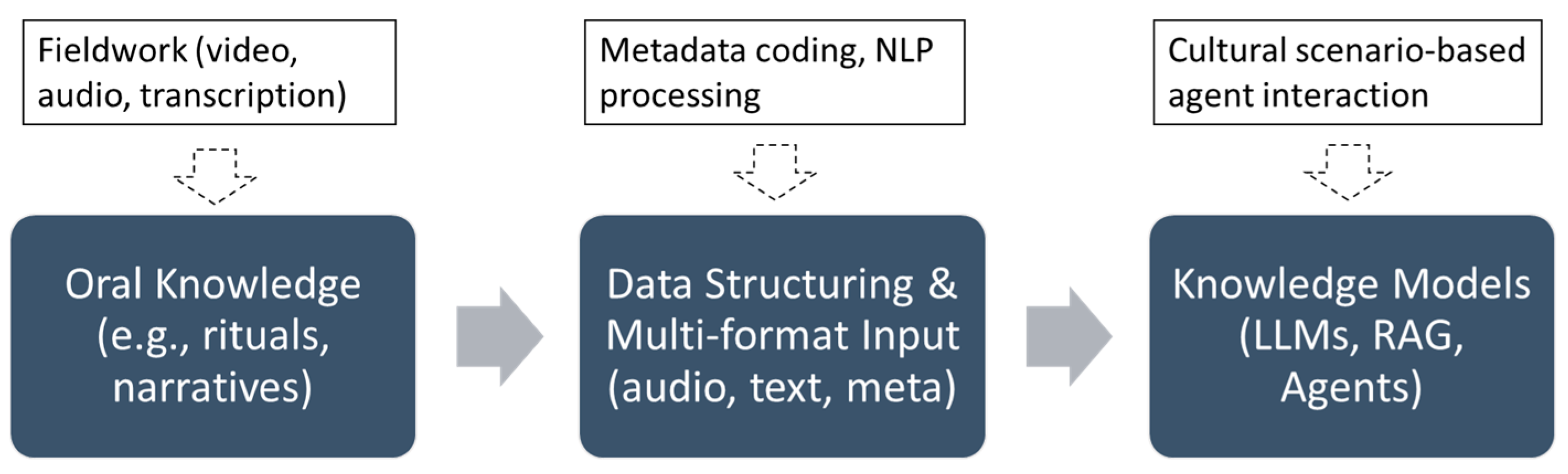
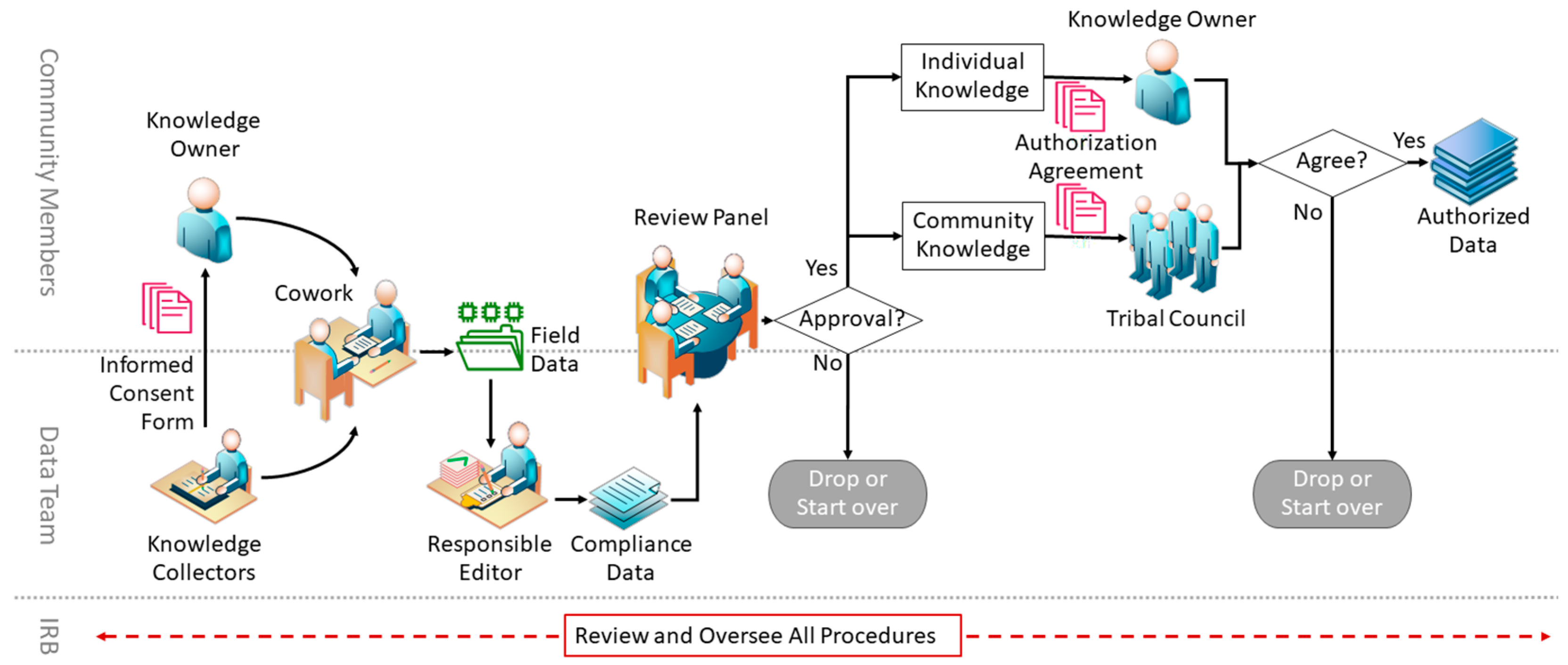
The research adopts a longitudinal, participatory, and technology-integrated methodology to facilitate the transformation of orally transmitted Indigenous TEK into digitally operable and culturally respectful knowledge systems. Bridging ethnographic inquiry with computational design, we adopt a co-constructive research paradigm that underpins community participation, iterative knowledge modeling, and the responsible deployment of agentic artificial intelligence. Our methodology is shaped by two interdependent trajectories: the cultural logic and embodied practices of TEK observed through long-term fieldwork, and the affordances of semantic data processing and adaptive AI systems capable of dialogical, permission-aware interaction. By integrating these dimensions, we seek to construct a system in which Indigenous knowledge is not merely digitized, but meaningfully structured, contextualized, and sustained through culturally congruent interaction models. The section presents the stepwise transition from ethnographic engagement to technical implementation, including the modeling of knowledge layers, agent design strategies, and the ethical protocols that govern system development and use.
3.2. Knowledge Accumulation and Outreach, Sharing and Internalization in Indigenous Knowledge Systems
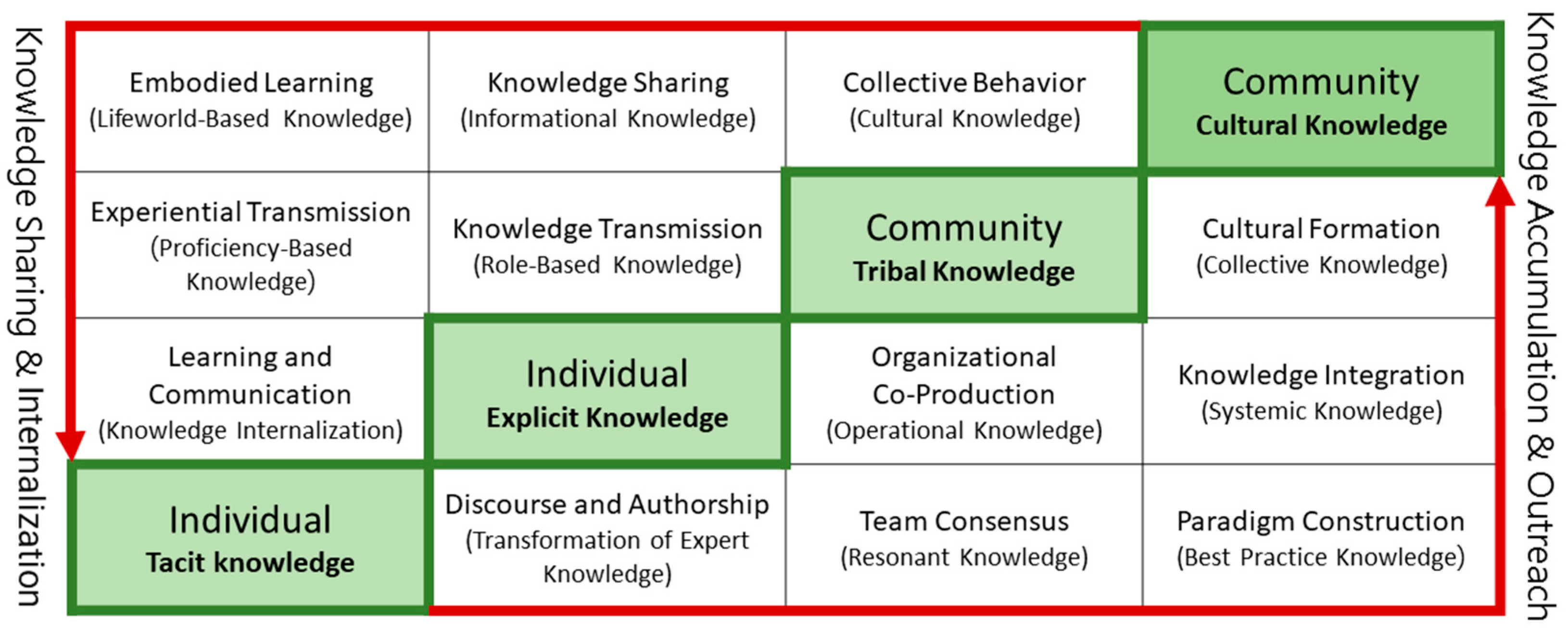
Based on extensive data accumulation, this study proposes a bidirectional model of Indigenous knowledge dynamics. The model, as depicted in
Figure 3, illustrates two interrelated processes: knowledge accumulation and outreach, represented in the lower-right quadrant, and knowledge sharing and internalization, depicted in the upper-left quadrant. It captures the reciprocal movement between individual and collective knowledge systems within TEK. This framework is empirically informed by observations of how knowledge is embodied, enacted, stored, and transmitted across generations in Paiwan social contexts.
Building upon the tacit–explicit knowledge framework proposed by
Nonaka (
1994) and further developed by
Nonaka and von Krogh (
2009), this study extends the model within the context of Paiwan TEK to delineate four interrelated domains: Individual Tacit Knowledge (K
1), Individual Explicit Knowledge (K
2), Community Tribal Knowledge (K
3), and Community Cultural Knowledge (K
4). Together, these domains outline the transition from a personal, embodied understanding to a culturally institutionalized system of knowledge, illustrating how Indigenous epistemologies evolve through articulation, collaboration, and collective validation.
K1 refers to the unarticulated, experiential knowledge that individuals internalize through direct engagement with their surroundings. These include embodied practices, sensory familiarity with local ecologies, and intuitive understanding that is difficult to formalize. Among the Paiwan people, for example, elders may possess tacit knowledge of soil moisture conditions suitable for millet planting, acquired through decades of hands-on observation and interaction with the land. Such knowledge was not formally codified but remained embedded in practice, movement, and seasonal rhythms.
K2 occurs when tacit knowledge is externalized through language, diagrams, rituals, or other communicable forms. This process often involves reflection and the codification of practical experience into teachable content. Paiwan farmers, for example, who documents seasonal planting cycles and correlate them with lunar phases, are transforming embodied knowledge into a structured knowledge system. Such explicit representations enable the transmission of traditional ecological wisdom across individuals and generations, supporting both continuity and reinterpretation within the community.
K3 encompasses collectively held, contextually grounded knowledge embedded in specific tribal groups. It is relational and socially regulated, often shared through communal rituals, apprenticeships and performances. In Paiwan communities, this might take the form of ceremonial protocols for land use, clan-based rules for forest resource gathering, or the narrative logic embedded in origin myths that guide environmental stewardship. These shared epistemic forms are not only practical but also symbolic, anchoring tribal identity and guiding collective interaction with the natural world through culturally sanctioned knowledge frameworks.
K4 represents a broader, systematized stratum of knowledge that has been maintained across generations. They include shared symbols, collective memory, normative values and ontological worldviews. This form of knowledge is often codified in language, ritual calendars and oral literature. For the Paiwan, such cultural knowledge is not confined to a single locality but represents a trans-tribal cultural fabric. It is expressed through intergenerational songs, chieftain narratives, and symbolic systems that link ecological phenomena with social responsibilities. These elements do not simply preserve tradition; they actively shape collective identity, legitimate authority structures, and guide ethical engagement with both human and non-human worlds.
The diagonal line extending from the lower left to the upper right of the matrix, along with the lower-right quadrant, represents a process of knowledge accumulation and outreach. The transition from K1 to K2 occurs when embodied and experiential understanding is externalized through language, symbols, or other forms of representation. This stage is conceptualized as Discourse and Authorship, denoting the transformation of expert, experience-based knowledge into communicable and shareable formats. For example, the Paiwan people’s intuitive understanding of mountain weather patterns, shaped by decades of hunting and farming, is articulated through storytelling, sketching and pedagogical exchanges. Through narration, gestures and metaphors, tacit knowledge is rendered explicit. This discursive process not only documents personal expertise but also prompts epistemic reflection, transforming localized knowledge into transmissible form while preserving its cultural embeddedness.
K1 may also transition directly into K3 when tacit knowledge is collectively enacted, negotiated, and validated through shared practices. These transformations occur when multiple individuals co-experience a task, engage in dialog, and align their interpretations in situ. During communal activities such as millet planting or harvest preparation, Paiwan participants often exchange embodied techniques, reflect on their actions, and adapt to others’ cues. As mutual understanding crystallizes, a shared interpretive framework is emerging, forming the basis of community tribal knowledge. This stage is conceptualized as the Team Consensus (Resonant Knowledge). Within Paiwan society, such alignment is notably visible during the Masalut (Paiwan’s harvest rituals) where coordinated movements and timing are achieved not through formal instruction but through mutual observation, rhythm, and trust. These embodied synergies cultivate coherence and solidarity, reinforcing a communal epistemology grounded in lived practice.
As individualized knowledge is spread and systematized through collaborative effort, it transforms into functional tribal knowledge. This transformation from K2 to K3 is conceptualized as Organizational Co-Production (Operational Knowledge). In this phase, individual contributions, such as documented ancestral planting practices or ecological observations, are incorporated into collective initiatives. For example, a community may use such knowledge to collaboratively map traditional territorial boundaries or design projects to restore native plant and animal species. Through processes of dialog, consensus-building, and collaborative decision-making, these insights are formalized into communal routines, guidelines, or institutional memory. The resulting co-produced knowledge becomes embedded within collective practice, reinforcing the dynamic interdependence between individual agency and tribal organization.
Certain tacit insights, that are repeatedly tested, ritualized and validated across generations, crystallize into paradigmatic knowledge that shapes cultural norms. This transformation from K1 to K4 is described as Paradigm Construction (Best Practice Knowledge). Within the Paiwan worldview, recurrent experiential lessons, such as the belief that overharvesting disrupts ancestral harmony, have evolved into enduring paradigms that emphasize ecological balance and interdependence. These paradigms not only inform local ethical codes and governance structures but also guide cosmological education across generations. The progression from embodied intuition to culturally embedded principle illustrates how deeply personal, experiential knowledge can scale into foundational moral and ecological frameworks that sustain collective identity and guide future action.
Cultural knowledge may also develop through the Knowledge Integration (Systemic Knowledge) process, which represents the transformation from K2 to K4. Within this trajectory, explicit knowledge becomes culturally significant when it is systematically embedded within institutions such as education, ritual practice, and local governance. Among Paiwan communities, there is a growing trend of incorporating documented oral histories, ecological knowledge and ceremonial protocols into bilingual archives and school curricula. Through such integrative efforts, individual knowledge gains cultural legitimacy and ensures continuity across generations. This process allows digital, textual, and performative knowledge to coexist, bridging generational and linguistic gaps while reinforcing shared epistemological frameworks. Knowledge integration thus serves as a circulatory system that connects codified documentation with the dynamic processes of living cultural practice.
Finally, K3 evolves into K4 through iterative enactment, ritual reinforcement and intergenerational transmission. As ritual behavior, ceremonial songs and oral narratives are performed collectively, they are gradually moving beyond their original contexts and becoming emblematic of a collective identity. A compelling example is the transformation of the Maljeveq, which has evolved from localized tribal knowledge into a pan-tribal cultural symbol. Historically, Maljeveq was not a standardized tradition but rather a constellation of ritual practices embedded within specific communities, transmitted orally and legitimized through sustained performance. Its recent public revival has catalyzed inter-communal engagement, fostering the codification of a shared ceremonial framework across diverse Paiwan territories. Through this process, Maljeveq has transitioned from an internally focused, clan-specific ritual into a widely recognized emblem of Paiwan cultural identity and resilience.
Together, these six pathways delineate a multidirectional ecology of knowledge transformation. The proposed model underscores that Indigenous TEK is not a unidirectional transmission of static facts but a dynamic epistemological system. It is sustained through practices of co-authorship, dialogic consensus, and ritual regeneration. Within this cyclical framework, personal experience is not isolated but continuously contributes to the renewal and evolution of collective wisdom. This ongoing interplay between individual insight and communal knowledge ensures that TEK remains adaptive, resilient, and culturally embedded.
By contrast, the diagonal trajectory from the upper right to the lower left of the matrix, together with the upper-left quadrant, illustrates a cyclical process of knowledge sharing and internalization, wherein culturally embedded knowledge is refracted back into individual and community contexts. The transition from K4 to K3 occurs through active engagement in ritual performance and everyday communal life. Within the Paiwan context, such a process is exemplified by events such as the Maljeveq ceremony, during which historical narratives, mytho-temporal structures, and hierarchical kinship systems are embodied through coordinated ritual acts. Notably, even Paiwan communities that have experienced cultural discontinuity may gradually reintegrate these traditional elements through intertribal ritual collaboration, using shared ceremonial spaces as vehicles for cultural revitalization. Through repeated enactment, abstract values such as relational ethics, ecological reverence, and ancestral accountability, become crystallized into normative frameworks and embodied expectations. These frameworks, in turn, provide the foundation for communal coordination, identity formation, and enhanced collective intelligence. This process constitutes the stage of “Collective Behavior (Cultural Knowledge)”.
K4 also facilitates personal consciousness (K2) through intentional communication such as storytelling, instruction, or ceremonial discourse. For example, during the Kaumaqan (ancestral house) initiation, elders articulate genealogies and spatial metaphors to younger generations. These culturally embedded narratives transform diffuse collective memory into recognizable and structured knowledge components. As individuals engage with these narratives, they begin to internalize the underlying cultural values, historical lessons, and spatial ontologies encoded within them. This transformative process, referred to as “Knowledge Sharing (Informational Knowledge)”, bridges systemic cultural knowledge and individual cognitive frameworks, reinforcing identity formation and cultural continuity through intentional verbal transmission.
K3 is transmitted to individuals as K2 through structured educational mechanisms that scaffold learning and internalization. In the Paiwan context, this frequently involves apprenticeship-based instruction in cultural practices such as the preparation of cinavu (millet dumplings), wherein procedural knowledge is conveyed through demonstration and participatory observation. By engaging with these tasks, learners begin to formulate explicit representations, such as sequential methods, material patterns, or symbolic associations, that reflect and extend the community’s embodied knowledge system. This process marks the stage of Knowledge Transmission (Role-Based Knowledge), wherein community-held knowledge is personalized and formalized through guided socialization and role-appropriate learning.
K4 is internalized as K1 through experiential immersion, where individuals acquire knowledge not through formal instruction but through participation in embodied cultural practices. In the Paiwan context, rituals such as the Masalut transmit relational ethics, kinship hierarchies, and sacred spatial understandings through affective and somatic engagement rather than verbal articulation. Since participants repeatedly engage in culturally sanctioned behaviors, these behaviors are internalized as intuitive dispositions, guiding behavior, emotional orientation, and decision-making in ways that feel natural rather than taught. This stage is conceptualized as Embodied Learning (Lifeworld-Based Knowledge), highlighting how collective symbolic orders are absorbed into the pre-reflective realm of personal experience.
K3 is internalized into K1 at the tacit level when individuals engage in situated observation and imitation within context-rich communal settings. Rather than relying on formal instruction, knowledge is absorbed through proximity and participation. When youth observe elders interpreting animal behavior to predict weather conditions, they begin to internalize ecological patterns through multisensory experiencing. This transmission occurs via osmosis, which is usually unspoken, immersive, and grounded in a shared lifeworld, embedding TEK within embodied cognition. This process is referred to as Experiential Transmission (Proficiency-Based Knowledge), emphasizing the gradual acquisition of know-how through lived interaction and social attunement.
Finally, K2 is transformed into K1 through practice-based internalization, guided instruction, or even through verbal transmission alone. Paiwan youth learn about the calendrical logic of planting cycles, whether through oral interpretation or written documentation, this knowledge remains abstract until enacted in the field. Working alongside elders during millet cultivation allows the learner to refine intuition and develop embodied sensitivity to seasonal rhythms and environmental signals. Representational knowledge becomes perceptual and responsive in this process. The procedural is reconstituted as lived experience, enabling real-time decision-making grounded in relational awareness. This transformation is described as Learning and Communication (Knowledge Internalization), emphasizing how culturally situated knowledge becomes personalized and actionable through mentorship and embodied practice.
In this epistemological cycle, tribal chief, shaman and elders serve not only as transmitters of K3 procedural knowledge but also as gatekeepers of K1 intuitive and lifeworld knowledge. Their participation determines the legitimacy of knowledge flow between layers, particularly where spiritual, ritual, or taboo elements are involved. The transformation of abstract representational knowledge into embodied understanding often occurs only through elder-guided practice, such as through ritual chanting, spatial anchoring of stories, or situational permissions based on ancestral lineage.
This reversed epistemological flow illustrates the recursive vitality of TEK within Indigenous systems. Rather than treating knowledge as static content to be archived, the Paiwan epistemic tradition emphasizes relational animation where knowledge is lived, embodied, articulated, and reabsorbed through iterative cycles of practice and reflection. Such dynamism affirms that TEK is not merely preserved through documentation but sustained through continuous enactment and affective engagement within community lifeworlds.
By embedding our design within this bidirectional knowledge ecology, we move beyond linear knowledge transfer models. Instead, we cultivate a culturally resonant feedback loop that honors Indigenous logic, relational authority, and co-evolving agency. This ensures that the TEK system we model not only safeguards intergenerational knowledge but also actively reinforces the contexts in which that knowledge remains meaningful, adaptive, and alive.
3.4. System Architecture: Technical Design for AI-Enabled TEK Modeling
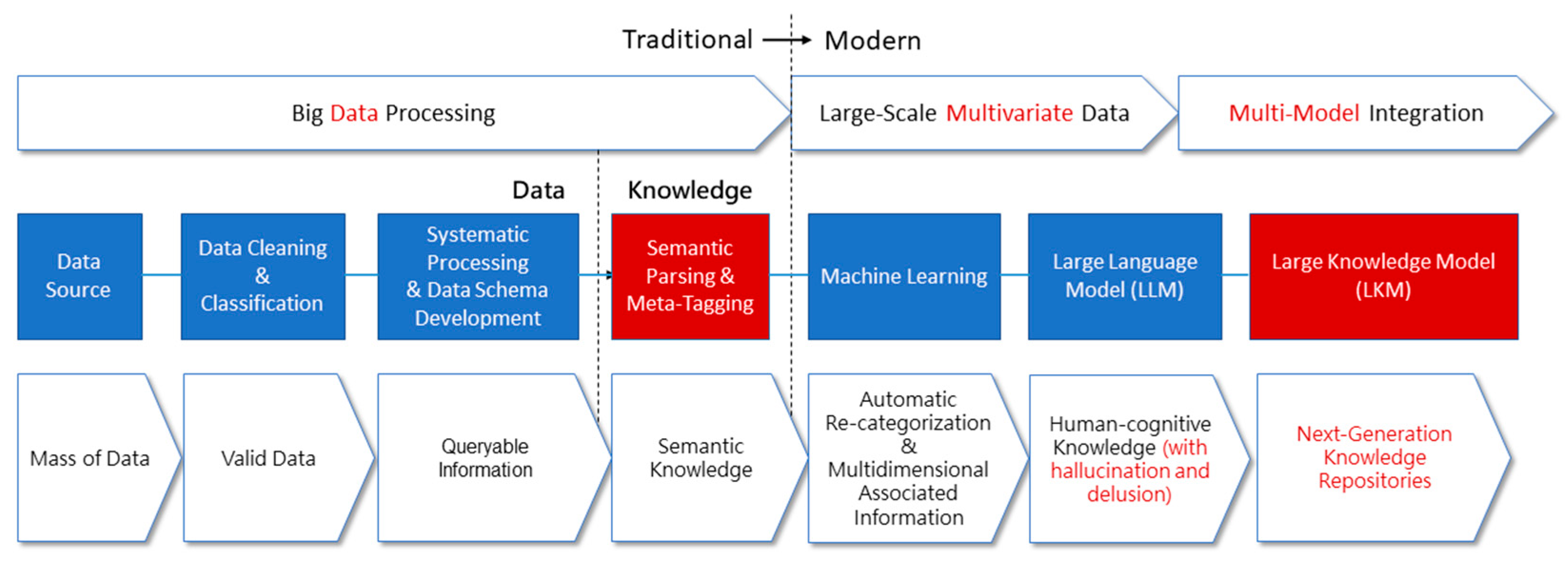
To instantiate the conceptual pipeline introduced in
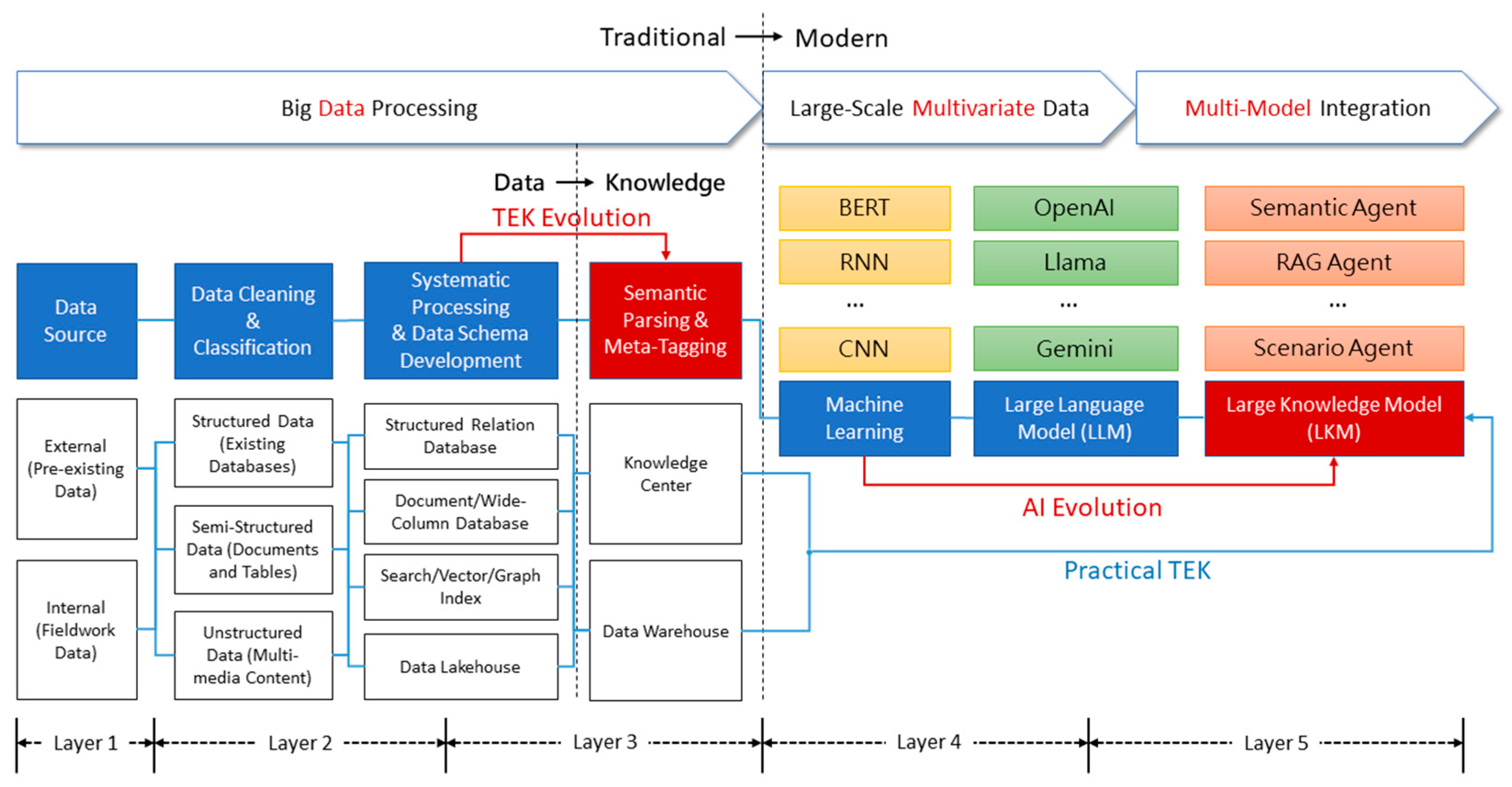
Section 3.3, we present an operational system architecture designed to bridge TEK processing methods with contemporary artificial intelligence capabilities. As shown in
Figure 5, this layered architecture supports both cultural specificity and computational scalability, ensuring that TEK remains epistemologically intact while benefiting from technological advancements. Extended from
Figure 4 with additional elaboration, the hollow text boxes positioned above and below the solid boxes illustrate representative data or technical examples associated with each stage.
The system comprises five interdependent functional layers, each responsible for a critical phase in the knowledge modeling lifecycle. These layers work together to ingest, process, structure and interact with TEK in a manner that respects Indigenous epistemologies while enabling advanced reasoning and interaction modalities.
3.4.1. Layer 1: Data Source Integration with Data Governance
The foundational layer of the architecture begins with the acquisition of diverse data sources originating from both external repositories and internally conducted fieldwork. External data may include government records, ecological databases, and prior ethnographic studies, while internal data sources typically involve multimedia documentation, interviews, sensor data, and community-contributed content obtained through participatory methods. The dual sourcing strategy ensures both breadth and depth of informational input, accommodating the variability and multimodality of TEK. By embedding field-collected, lived-context data at the outset, the architecture preserves the ontological grounding of Indigenous knowledge, thereby maintaining fidelity to community-authenticated perspectives.
To address concerns regarding epistemic reliability, the architecture implements a governance-oriented validation and adjudication procedure prior to the incorporation of externally sourced materials. External repositories may contain errors, omissions, or interpretive framings that are incongruent with local meanings and community experience. Accordingly, candidate external inputs are reviewed through established mechanisms of knowledge governance, including domain expert assessment and, where appropriate, deliberation in tribal or community meetings that are authorized to determine the admissibility of information. Field-collected, community-authenticated materials, such as audio recordings, video documentation, transcripts, and field notes, are treated as primary evidence. These materials are curated jointly with local collaborators and subjected to iterative feedback from elders, ritual practitioners, and youth participants before being encoded in the knowledge schema, thereby anchoring the system in community-validated lived realities. In contrast, external sources, including government records, ecological databases, and prior ethnographic studies, are treated as secondary or contextual evidence. They are first examined by the research team for internal consistency and then systematically cross-checked against field data and community narratives rather than being presumed authoritative.
This procedural emphasis is particularly consequential in the Paiwan context, where the Paiwan language has been classified as “vulnerable” within the United Nations Educational, Scientific and Cultural Organization’s endangerment framework, which constrains the feasibility of constructing a comprehensive local knowledge model solely through field-based elicitation and documentation. At the same time, an approach that relies extensively on external repositories would reintroduce the reliability limitations and sovereignty-related contestations identified in the preceding literature review. When inconsistencies arise between external documents and Paiwan-authenticated field records, the architecture assigns higher evidentiary weight to community-authenticated data and explicitly prioritizes these first-hand sources. In such cases, external claims are flagged, down-weighted, or excluded from the operational corpus, rather than treated as neutral or default references, thereby reducing the risk of reproducing external misrepresentation and reinforcing alignment with locally validated realities.
3.4.2. Layer 2: Data Cleaning and Classification
The second layer involves the preprocessing of raw data into structured, semi-structured and unstructured formats. Structured data includes tabular records and metadata from existing databases; semi-structured data comprises annotated texts, spreadsheets, and logs; while unstructured data spans images, videos, and oral narratives. Each category undergoes cleansing and classification operations to ensure consistency, resolve ambiguities, and eliminate redundancy. This process not only improves the technical quality of the data but also introduces a culturally conscious taxonomy that differentiates between ecological signs, cultural protocols, and contextual dependencies. The outcome is a refined corpus that is both machine-readable and semantically meaningful, serving as a bridge between Indigenous epistemologies and computational representations.
3.4.3. Layer 3: Systematic Processing and Knowledge Schema Development
At this stage, processed data are transformed into information architectures through the construction of structured relational databases, document and wide-column databases, and advanced indexing mechanisms such as vector, graph or hybrid search indices. These forms enable high-performance querying, semantic inference, and cross-referencing across knowledge modalities. The development of a knowledge schema at this layer introduces formal ontologies, meta-tagging standards, and logic models that encode TEK concepts such as seasonality, ritual timing, plant–animal symbiosis, and relational ethics. A dedicated knowledge center or data warehouse serve as repositories for these encoded relationships, allowing for versioned updates, lineage tracing, and participatory validation. This layer effectively scaffolds the transition from data to meaning, enabling culturally coherent knowledge structures to be computationally instantiated.
3.4.4. Layer 4: Machine Learning and LLM Integration
The fourth layer transitions from static knowledge structures to dynamic inference engines by integrating machine learning algorithms and LLMs. Classical models such as recurrent neural networks (RNN, a type of artificial neural network designed to process sequential data by using loops that allow information to persist across time steps), convolutional neural networks (CNNs, a type of neural network that learns spatial patterns by applying sliding filters across images or other grid-structured data), and transformer-based architectures like BERT are employed to recognize temporal patterns, spatial relations, and contextual semantics. These models are complemented by frontier LLM implementations such as those developed by OpenAI, LLaMA, and Gemini (Google’s multimodal generative AI model family), offering scalable natural language understanding and generation. By fine-tuning these models with TEK-specific corpora, the architecture is capable of generating human cognitive outputs that mimic Indigenous reasoning styles. Nonetheless, attention is given to the epistemic risks of hallucination, misrepresentation, and delusion, which are mitigated through feedback loops and rule-based constraints established in the next layer.
3.4.5. Layer 5: Knowledge Modeling Agents and Practical TEK Deployment
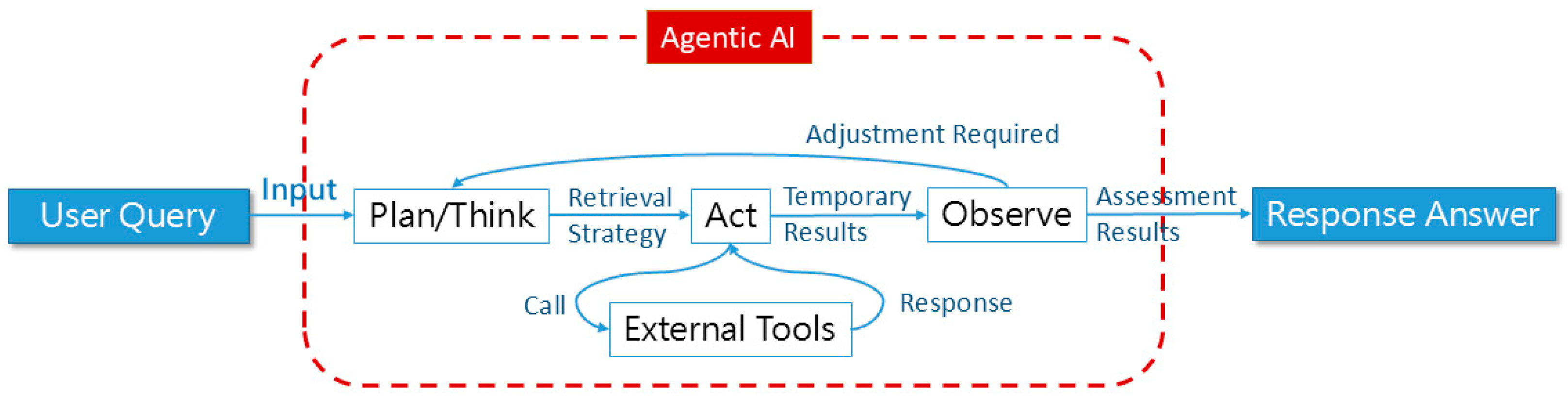
The final layer introduces a suite of semantic and scenario agents designed to enact practical applications of TEK in real-world or simulated environments. They include RAG agents for context-specific querying, semantic agents for ontology-consistent reasoning, and scenario agents for role-based interaction and decision support. All agents are anchored by a LKM, which consolidates prior outputs, aligns them with Indigenous logic and enables emergent properties such as dialogic learning, situated adaptation, and multi-agent coordination. This layer marks the reintegration of knowledge into community-facing tools, decision-support systems, and educational interfaces. Rather than treating TEK as a static corpus, the architecture re-embeds it within relational, experiential, and iterative loops, thereby reinforcing its performative and regenerative nature.
Across all layers, the architecture is guided by principles of ethical AI, including data traceability, explainability, and Indigenous data sovereignty. Each transformation from data to knowledge is documented with provenance metadata, allowing communities to audit and contest outputs. Knowledge is never extracted or abstracted without communal validation, and the system explicitly supports iterative co-design with knowledge holders.
In summary, this layered framework establishes a technically robust yet culturally respectful platform for the modeling of TEK. It exemplifies how AI can serve not to replace Indigenous epistemologies, but to extend their resilience, interpretability, and translatability in the digital age.