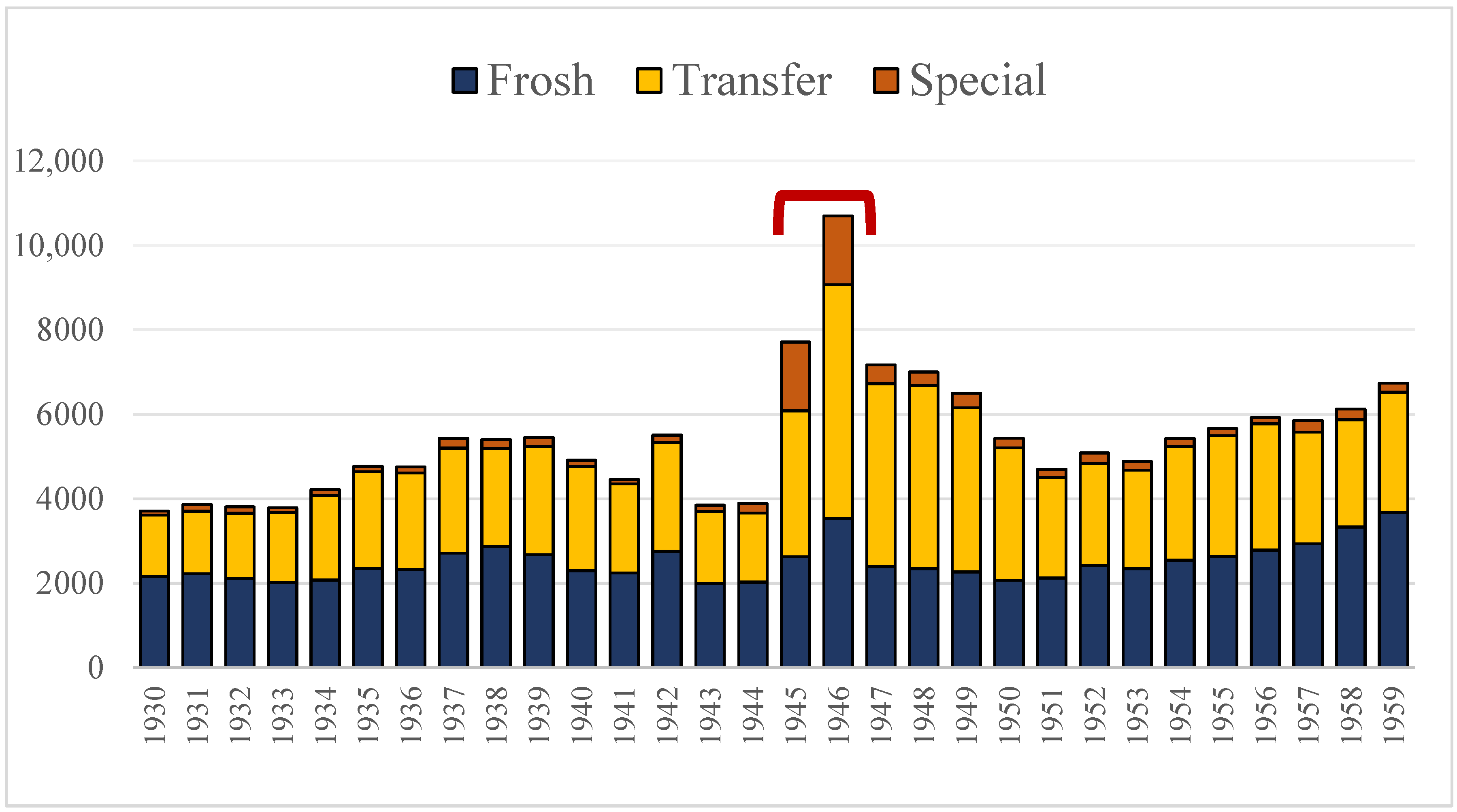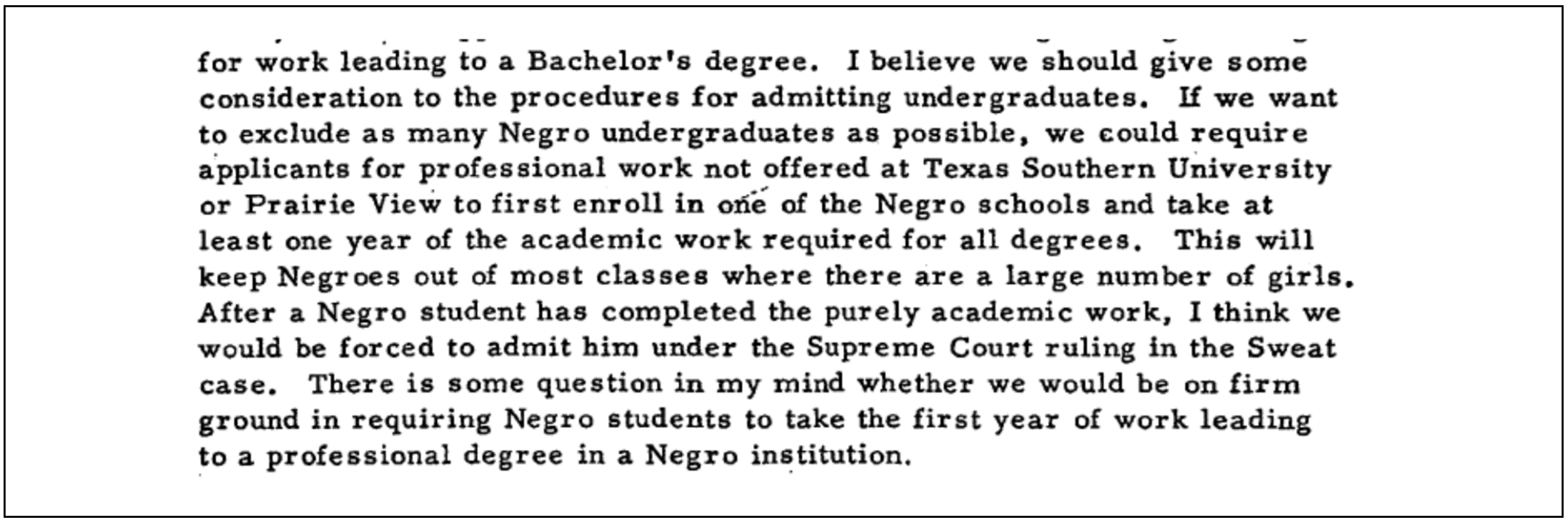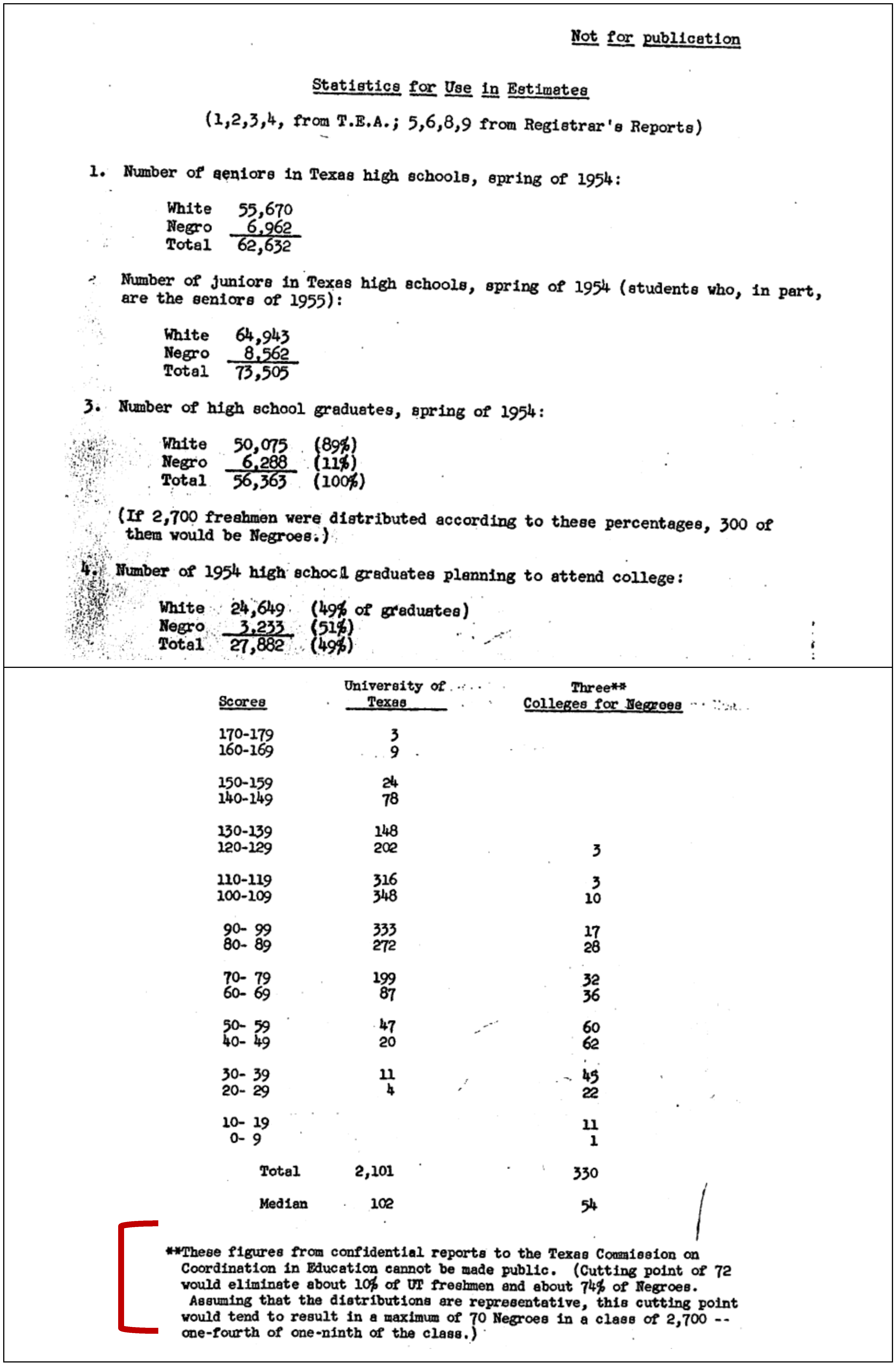

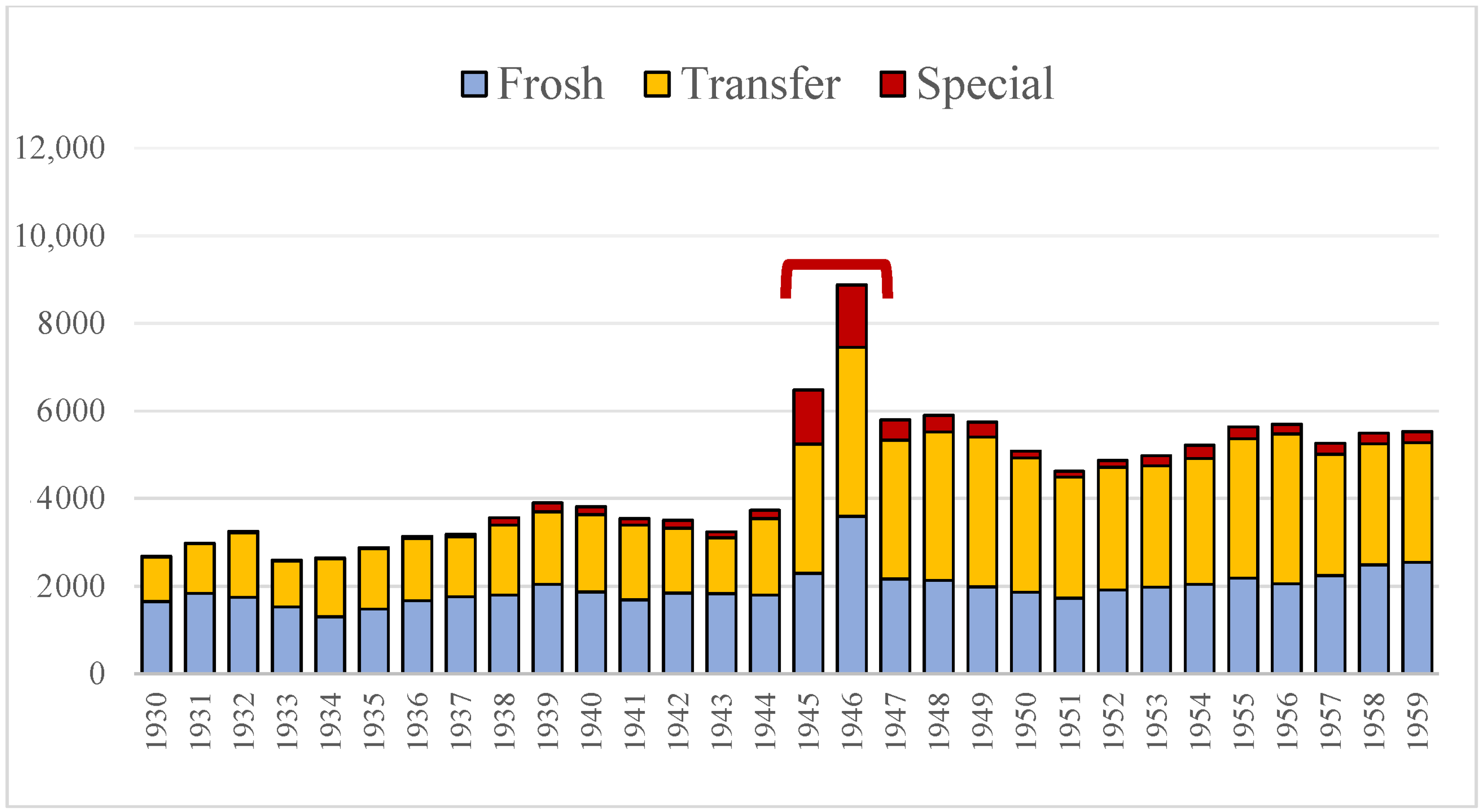
From Housing to Admissions Redlining: Race, Wealth and Selective Access at Public Flagships, Post-World War II to Present
Abstract
1. Introduction: Historical and Theoretical Framing
“Given the lengthy history of state-sponsored race-based preferences in America, to say that anyone is now victimized if a college considers whether that legacy of discrimination has unequally advantaged its applicants fails to acknowledge the well-documented ‘intergenerational transmission of inequality’ that still plagues our citizenry.”—Justice Ketanji Brown Jackson, dissenting in Students for Fair Admissions v. University of North Carolina, 600 U.S. 181, p. 385 (Students for Fair Admissions 2023)1
2. The UC Story
3. The UT Story
4. Admissions Redlining as Structural Continuity
5. Conclusions
Author Contributions
Funding
Institutional Review Board Statement
Informed Consent Statement
Data Availability Statement
Acknowledgments
Conflicts of Interest
Appendix A

| Regular Admission | Admission by Exception | |||
|---|---|---|---|---|
| By Residency | ||||
| CA Resident | 21,414 | 76% | 284 | 66% |
| Out of State | 3278 | 12% | 95 | 22% |
| International | 3380 | 12% | 51 | 12% |
| Total | 28,072 | 100% | 430 | 100% |
| By Race/Ethnicity | ||||
| African American | 1580 | 6% | 109 | 25% |
| Asian | 8412 | 30% | 32 | 7% |
| Chicano/Latino | 5938 | 21% | 58 | 13% |
| Native American | 168 | 1% | 3 | 1% |
| Pacific Islander | 66 | 0% | 7 | 2% |
| White | 7621 | 27% | 152 | 35% |
| International | 3380 | 12% | 51 | 12% |
| Domestic Unknown | 907 | 3% | 18 | 4% |
| Total | 28,072 | 100% | 430 | 100% |
| By Athlete Status | ||||
| Recruited Athletes | 580 | 2% | 361 | 84% |
| Other Students | 27,492 | 98% | 69 | 16% |
| Total | 28,072 | 100% | 430 | 100% |
| By Income | ||||
| Mean | $152,640 | $167,725 | ||
| Median | $100,000 | $130,000 | ||
| Median Per Family Member | $25,834 | $38,208 | ||
| 1 | The Court’s opinion in SFFA v University of North Carolina is conjoined with the more familiar SFFA v. Harvard 600 U.S. 181 (2023) opinion, but Justice Jackson recused in the Harvard case because she had served on its board and thus only dissented in the UNC case. See 600 U.S at 384 *. |
| 2 | UT was also under a previous affirmative action ban after Hopwood v. State of Texas 78 F.3d 932 (5th Cir. 1996), that was later abrogated by the 2003 Supreme Court ruling in Grutter v. Bollinger until the Court’s 2023 SFFA v. Harvard ruling. The Hopwood district court opinion summarizes the history of discrimination against Black and Hispanic students at UT Austin in the 1950s through the 1980s. (Hopwood v. Texas 1996, 861 F. Supp. 551, pp. 554–57). |
| 3 | This can also be confirmed by searching names in the UC Berkeley Blue and Gold Yearbook (1946), though the optical scan-to-text quality appears to be inferior compared to the UC ClioMetric optically scanned records. |
| 4 | These figures may understate the true magnitude of racial disparities (differential mortality by 1979 and/or if higher educational attainment positively correlated with survey response rates). Women veterans were also eligible for the GI Bill (see Eisenmann 2006), but represented about 2% of the WWII era population eligible for GI Bill benefits. |
| 5 | An overlooked contributing factor to this pattern is that at UC Berkeley and UCLA combined in 1941–42 there were roughly 600 Japanese American undergraduates enrolled (see UC Regents 2009, p. 4). However, after Roosevelt’s Executive Order 9066 interned Japanese Americans in Spring 1942 and those of high school age were dispersed to other parts of the interior U.S. after being released from internment camps in 1944–45, the Japanese American student population at UC Berkeley and UCLA was decimated. While Japanese names can occasionally be found in the UC ClioMetric records, the 1946 UC Berkeley yearbook no longer lists a Japanese student club. We focus on undergraduate admissions, but many veterans also used GI Bill benefits to go back to professional school such as law school. At the UC Hastings College of Law (now UC Law San Francisco) total enrollment had collapsed during WWII (49 students in 1944–45) then ballooned to 583 in 1947–48 (96% men) and then receded somewhat by the early 1950s (Stadtman 1967, p. 223). |
| 6 | We thank Prof. Thomas Russell for sharing these important UT archival records (originating in UT Austin Chancellor’s office records) with us years ago. |
| 7 | McCaslin quotes Dean Henry McCown’s address (“A Plan for Selected Enrollment in a State University,” address by McCown to the Southern Association of Colleges and Secondary Schools, Miami, Florida, Nov. 30, 1955) as well as advisor to the UT President F. Lanier Cox. The UT Regents had quietly insisted in 1955 that school districts with large Black populations administer their new admissions test using segregated testing rooms. |
| 8 | Eventually the U.S. Supreme Court, in U.S. v. Fordice, 505 U.S. 717, pp. 737–38 (1992) ruled this ACT requirement was a vestige of segregation with ongoing discriminatory effects: “[T]he ACT requirement was originally adopted for discriminatory purposes, the current requirement is traceable to that decision and seemingly continues to have segregative effects, and the State has so far failed to show that the ‘ACT-only’ admissions standard is not susceptible to elimination without eroding sound educational policy.” |
| 9 | Archival information from Cal Athletics makes clear that the reference in President Sproul’s letter is to Walter Gordon, who had full-time jobs as a lawyer and police officer while also serving as an assistant football coach at Cal. Mr. Gordon was also the first Black graduate of UC Berkeley’s Law School and later served as Governor of the U.S. Virgin Islands (UC Berkeley Athletics 2023). |
| 10 | UCLA represents the high water mark at UC as far as recruited athletes and Admission by Exception. At several UC campuses with smaller NCAA Division I programs, Admission by Exception represents well under 1% of freshmen. |
References
- Abramitzky, Ran, Jennifer K. Kowalski, Santiago Pérez, and Joseph Price. 2024. The GI Bill, Standardized Testing, and Socioeconomic Origins of the US Educational Elite over a Century. NBER Working Paper No. 33164. Cambridge: NBER. Available online: https://www.nber.org/system/files/working_papers/w33164/w33164.pdf (accessed on 30 September 2025).
- Aladangady, Aditya, and Akila Forde. 2021. Wealth Inequality and the Racial Wealth Gap. Federal Reserve Discussion Paper. Available online: https://fedinprint.org/item/fedgfn/93320 (accessed on 30 September 2025).
- Alon, Sigal, and Marta Tienda. 2007. Diversity, opportunity, and the shifting meritocracy in higher education. American Sociological Review 72: 487–511. [Google Scholar] [CrossRef] [Scilit]
- Anderson, James D. 1993. Race, meritocracy, and the American academy during the immediate post—World War II era. History of Education Quarterly 33: 151–75. [Google Scholar] [CrossRef] [Scilit]
- Baradaran, Mehrsa. 2017. The Color of Money: Black Banks and the Racial Wealth Gap. Cambridge: Harvard University Press. [Google Scholar]
- Beilock, Sian Leah. 2024. Reactivating the SAT/ACT Requirement for Dartmouth Undergraduate Admissions. Dartmouth President’s Office. Available online: https://president.dartmouth.edu/news/2024/02/reactivating-satact-requirement-dartmouth-undergraduate-admissions (accessed on 30 September 2025).
- Bleemer, Zachary. 2018. The UC ClioMetric History Project and Formatted Optical Character Recognition. UC Berkeley CSHE Research and Occasional Paper 3.18. Student Records Database. Available online: https://uccliometric.org/students/ (accessed on 30 September 2025).
- Bollinger, Lee C., and Geoffrey R. Stone. 2023. A Legacy of Discrimination: The Essential Constitutionality of Affirmative Action. Oxford: Oxford University Press. [Google Scholar]
- Bourdieu, Pierre. 1977. Cultural reproduction and social reproduction. In Power and Ideology in Education. Edited by Jerome Karabel and Albert Henry Halsey. Oxford: Oxford University Press, pp. 487–511. [Google Scholar]
- Bourdieu, Pierre. 1984. Distinction: A Social Critique of the Judgment of Taste. Cambridge: Harvard University Press. [Google Scholar]
- Bowman, Nicholas A., and Nida Denson. 2022. Institutional racial representation and equity gaps in college graduation. The Journal of Higher Education 93: 399–423. [Google Scholar] [CrossRef] [Scilit]
- Brown-Nagin, Tomiko, Lani Guinier, and Gerald Torres. 2015. Tejas es Diferente: UT Austin’s Admissions Program in Light of Its Exclusionary History 1. In Affirmative Action and Racial Equity: Considering the Fisher Case to Forge the Path Ahead. Edited by Uma M. Jayakumar and Liliana M. Garces. Oxfordshire: Routledge. [Google Scholar]
- Bush, Vannevar. 1945. Director of the U.S. Office of Scientific Research and Development. Report to the President. Science: The Endless Frontier, Republished by the National Science Foundation. Available online: https://nsf-gov-resources.nsf.gov/2023-04/EndlessFrontier75th_w.pdf (accessed on 30 September 2025).
- Cantalupo, Nancy Chi, and William C. Kidder. 2019. Systematic prevention of a serial problem: Sexual harassment and bridging core concepts of Bakke in the# MeToo era. UC Davis Law Review 52: 2349–405. [Google Scholar]
- Card, David, and Jesse Rothstein. 2007. Racial segregation and the black–white test score gap. Journal of Public Economics 91: 2158–84. [Google Scholar] [CrossRef] [Scilit]
- Carnevale, Anthony P., Jeff Strohl, Martin Van Der Werf, Michael C. Quinn, and Kathryn Peltier Campbell. 2019. SAT-Only Admission: How Would It Change College Campuses? Washington, DC: Georgetown University Center on Education and the Workforce. [Google Scholar]
- Corcoran, Marlena. 2024. Why Highly Selective Colleges Are Reinstating the SAT. Forbes, March 12.
- Dickens, William T., and Thomas J. Kane. 1999. Racial test score differences as evidence of reverse discrimination: Less than meets the eye. Industrial Relations: A Journal of Economy and Society 38: 331–63. [Google Scholar] [CrossRef] [Scilit]
- Dickerson, A. Mechele. 2022. Shining a bright light on the color of wealth. Michigan Law Review 120: 1085–107. [Google Scholar] [CrossRef] [Scilit]
- Douglass, John Aubrey. 2007. The Conditions for Admission: Access, Equity, and the Social Contract of Public Universities. Redwood City: Stanford University Press. [Google Scholar]
- Douglass, John Aubrey. 2021. Federally Funded Research, the Bayh-Dole Act, and the COVID Vaccine Race. UC Berkeley CSHE Research Paper 3.21. Berkeley: UC Berkeley. Available online: https://escholarship.org/content/qt4b58z7w6/qt4b58z7w6.pdf (accessed on 30 September 2025).
- Douglass, John Aubrey, and Zachary Bleemer. 2018. Approaching a tipping point. In A History and Prospectus of Funding for the University of California. UC Berkeley CSHE Research Report. Berkeley: UC Berkeley. Available online: https://gspp.berkeley.edu/assets/uploads/page/EmbargoedCopy.Tipping_Point_Report_.August_2018_.pdf (accessed on 30 September 2025).
- Eisenmann, Linda. 2006. Higher Education for Women in Postwar America, 1945–1965. Baltimore: Johns Hopkins University Press. [Google Scholar]
- Geiger, Roger L. 2017. Research and Relevant Knowledge: American Research Universities Since World War II, 2nd ed. Oxfordshire: Routledge. [Google Scholar]
- Geiser, Saul. 2020. Norm-Referenced Tests and Race-Blind Admissions. In The Scandal of Standardized Tests: Why We Need to Drop the SAT and ACT. Edited by Joseph A. Soares. New York: Teachers College Press. [Google Scholar]
- Giancola, Jennifer, and Richard D. Kahlenberg. 2016. True Merit: Ensuring Our Brightest Students Have Access to Our Best Colleges and Universities. In Jack Kent Cooke Foundation. Available online: https://files.eric.ed.gov/fulltext/ED569948.pdf (accessed on 30 September 2025).
- Goldstone, Dwonna. 2005. “TO EXCLUDE AS MANY NEGRO UNDERGRADUATES AS POSSIBLE”: Brown v. Board of Education and the University of Texas at Austin. Du Bois Review: Social Science Research on Race 2: 209–26. [Google Scholar] [CrossRef] [Scilit]
- Gretzinger, Erin, Maggie Hicks, Christa Dutton, Jasper Smith, Sonel Cutler, and Aisha Baiocchi. 2025. Tracking higher ed’s dismantling of DEI. The Chronicle of Higher Education. November 10. Available online: https://www.chronicle.com/article/tracking-higher-eds-dismantling-of-dei (accessed on 30 September 2025).
- Guinier, Lani, and Gerald Torres. 2002. The Miner’s Canary. Cambridge: Harvard University Press. [Google Scholar]
- Harper, Shaun. 2025. Leveraging research and demanding proof in response to legislative attacks on DEI in US higher education. AERA Open 11: 1–7. [Google Scholar] [CrossRef] [Scilit]
- Harris, Cheryl I. 1993. Whiteness as property. Harvard Law Review 106: 1707–91. [Google Scholar] [CrossRef] [Scilit]
- Hopwood v. Texas. 1996. 861 F. Supp. 551 (W.D. Tex. 1994), reversed, 78 F.3d 932 (5th Cir. 1996), Certiorari Denied, 518 U.S. 1033. Available online: https://scholarlycommons.law.wlu.edu/cgi/viewcontent.cgi?article=1054&context=crsj (accessed on 30 September 2025).
- Huelsman, Mark. 2018. Social Exclusion: The State of State U for Black Students. Available online: https://vtechworks.lib.vt.edu/server/api/core/bitstreams/e9dc533c-c4d1-47eb-a4bd-a3456caeac10/content (accessed on 30 September 2025).
- Jayakumar, Uma Mazyck. 2024. The mourning after affirmative action: A composite counterstory about whiteness as property, fugitive pedagogy, and possibility. Equality, Diversity and Inclusion: An International Journal 43: 425–41. [Google Scholar] [CrossRef] [Scilit]
- Jayakumar, Uma Mazyck, and Ibram X. Kendi. 2023. Race neutral is the new separate but equal. The Atlantic, June 29.
- Jayakumar, Uma Mazyck, and Scott E. Page. 2021. Cultural capital and opportunities for exceptionalism: Bias in university admissions. The Journal of Higher Education 92: 1109–39. [Google Scholar] [CrossRef] [Scilit]
- Jayakumar, Uma Mazyck, William C. Kidder, and Caroline E. Reynolds. 2023a. Brief of 1246 American Social Science Researchers and scholars as Amici Curiae in support of respondents. North Carolina Civil Rights Law Review 4: 64–86. [Google Scholar]
- Jayakumar, Uma Mazyck, William C. Kidder, Eddie Comeaux, and Sherod Thaxton. 2023b. Race and privilege misunderstood: Athletics and selective college admissions in (and beyond) the Supreme court affirmative action cases. UCLA Law Review Discourse 70: 230. [Google Scholar]
- Jencks, Christopher. 1998. Racial bias in testing. In The Black–White Test Score Gap. Edited by Christopher Jencks and Meredith Phillips. Washington, DC: Brookings Institution Press, pp. 55–85. [Google Scholar]
- Karabel, Jerome. 2005. The Chosen: The Hidden History of Admission and Exclusion at Harvard, Yale, and Princeton. Boston: Houghton Mifflin. [Google Scholar]
- Katznelson, Ira. 2005. When Affirmative Action Was White: An Untold History of Racial Inequality in Twentieth-Century America. New York: W.W. Norton & Company. [Google Scholar]
- Kendi, Ibram X. 2019. How to Be an Antiracist. Mumbai: One World. [Google Scholar]
- Kidder, William, and Jay Rosner. 2020. How the SAT Creates ‘Built-In Headwinds’. In The Scandal of Standardized Tests: Why We Need to Drop the SAT and ACT. Edited by Joseph A. Soares. New York: Teachers College Press. [Google Scholar]
- Kidder, William C. 2003. The struggle for access from Sweatt to Grutter: A history of African American, Latino, and American Indian law school admissions, 1950–2000. Harvard BlackLetter Law Journal 19: 1–42. [Google Scholar]
- Kim, Juliana. 2025. Over 50 Universities Are Under Investigation as Part of Trump’s Anti-DEI Crackdown. NPR. Available online: https://www.npr.org/2025/03/14/g-s1-53831/dei-universities-education-department-investigation (accessed on 30 September 2025).
- King, C. Judson. 2018. The University of California: Creating, Nurturing, and Maintaining Academic Quality in a Public University Setting. Berkeley: UC Berkeley, Center for Studies in Higher Education. [Google Scholar]
- Kurlaender, Michal, and Eric Grodsky. 2013. Mismatch and the paternalistic justification for selective college admissions. Sociology of Education 86: 294–310. [Google Scholar] [CrossRef] [Scilit]
- Lemann, Nicholas. 1999. The Big Test: The Secret History of the American Meritocracy. New York: Farrar, Straus and Giroux. [Google Scholar]
- Lipsitz, George. 2006. The Possessive Investment in Whiteness: How White People Profit from Identity Politics. Philadelphia: Temple University Press. [Google Scholar]
- Markson, Craig, Kenneth Forman, Dafny Irizarry, and Lawrence Levy. 2023. Diversity, Inequity, and Exclusion: How SATs and Other Standardized Tests Reduce Diversity in Higher Education. Journal for Leadership and Instruction 22: 41–46. [Google Scholar]
- McCaslin, Richard B. 1991. Steadfast in his intent: John W. Hargis and the integration of the University of Texas at Austin. Southwestern Historical Quarterly 95: 20–41. [Google Scholar]
- Mineo, Liz. 2023. New Study Finds Wide Gap in SAT/ACT Test Scores Between Wealthy, Lower-Income Kids. Harvard Gazette. November 22. Available online: https://news.harvard.edu/gazette/story/2023/11/new-study-finds-wide-gap-in-sat-act-test-scores-between-wealthy-lower-income-kids/ (accessed on 30 September 2025).
- Miri, Johnny. 2021. The fall of Vannevar Bush: The forgotten war for control of science policy in postwar America. Historical Studies in the Natural Sciences 51: 507–41. [Google Scholar] [CrossRef] [Scilit]
- Olivas, Michael A. 1992. Legal norms in law school admissions: An essay on parallel universes. Journal of Legal Education 42: 103–17. [Google Scholar]
- Olivas, Michael A. 2005. Brown and the desegregative ideal: Location, race, and college attendance policies. Cornell Law Review 90: 391–418. [Google Scholar]
- Olson, Keith W. 1974. The GI Bill, the Veterans, and the Colleges. Lexington: University of Kentucky Press. [Google Scholar]
- Park, Julie J., and Ann H. Becks. 2015. Who benefits from SAT prep?: An examination of high school context and race/ethnicity. The Review of Higher Education 39: 1–23. [Google Scholar] [CrossRef] [Scilit]
- Reardon, Sara. 2025. NIH grants caught in crossfire as Harvard and Trump collide. Science 388: 342–43. [Google Scholar] [CrossRef] [Scilit] [PubMed]
- Rothstein, Richard. 2017. The Color of Law: A Forgotten History of How Our Government Segregated America. New York: Liveright Publishing. [Google Scholar]
- Russell, Thomas D. 2010. Keep Negroes out of Most Classes Where There are a Large Number of Girls: The Unseen Power of the Klux Klan and Standardized Testing at the University of Texas, 1899–1999. South Texas Law Review 52: 1. [Google Scholar] [CrossRef] [Scilit]
- Sacerdote, Bruce, Douglas O. Staiger, and Michele Tine. 2025. How Test Optional Policies in College Admissions Disproportionately Harm High Achieving Applicants from Disadvantaged Backgrounds. NBER Working Paper No. w33389. Cambridge: NBER. [Google Scholar]
- Sadler, Philip M., and Robert H. Tai. 2007. The two high-school pillars supporting college science. Science 317: 457–58. [Google Scholar] [CrossRef] [Scilit]
- Saul, Stephanie, Dana Goldstein, and Sarah Mervosh. 2025. Trump escalates a fight over how to measure merit in American education. The New York Times, August 8.
- Schmitt, Neal. 2023. Biographical Data and Situational Judgment Measures of Student Potential. In College Admissions and Admissions Testing in a Time of Transformational Change. Oxfordshire: Routledge, pp. 92–107. [Google Scholar]
- Secretary of Education Linda McMahon Memorandum. 2025. U.S. Department of Education. “Ensuring Transparency in Higher Education Admissions,” August 7. Available online: https://www.ed.gov/media/document/secretary-directive-ensuring-transparency-higher-education-admissions-august-7-2025-110497.pdf (accessed on 30 September 2025).
- Soares, Joseph A. 2007. The Power of Privilege: Yale and America’s Elite Colleges. Redwood City: Stanford University Press. [Google Scholar]
- Spitalniak, Laura. 2024. UNC System Colleges Eliminate 59 DEI Related Positions. Higher Ed Dive. Available online: https://www.highereddive.com/news/unc-university-of-north-carolina-system-eliminates-59-dei-related-positions/726892/ (accessed on 30 September 2025).
- Stadtman, Vern A. 1967. The Centennial Record of the University of California, 1868–1968. Berkeley: University of California. Available online: https://digicoll.lib.berkeley.edu/record/81096/files/centennial.pdf (accessed on 30 September 2025).
- Students for Fair Admissions. 2023, Inc. v. President & Fellows of Harvard College, 600 U.S. 181, 385. Jackson, J., Dissenting only in the SFFA v University of North Carolina Portion of This Ruling. Available online: https://www.supremecourt.gov/opinions/22pdf/20-1199_hgdj.pdf (accessed on 30 September 2025).
- Time Magazine. 1954. Education: Action Report. Time Magazine. September 13. Available online: https://time.com/archive/6884889/education-action-report/ (accessed on 30 September 2025).
- Turner, Sarah, and John Bound. 2003. Closing the gap or widening the divide: The effects of the GI Bill and World War II on the educational outcomes of black Americans. The Journal of Economic History 63: 145–77. [Google Scholar] [CrossRef] [Scilit]
- UC Academic Senate. 1960. Meeting of the Representative Assembly, October 25, at “Appendix B—Admission Statistics, 1930–1960, Berkeley and Los Angeles. Available online: https://digicoll.lib.berkeley.edu/record/81297?ln=en&v=pdf (accessed on 30 September 2025).
- UC Academic Senate. 2019. UC Academic Senate Regulation 424. Last Amended 2019. Available online: https://senate.universityofcalifornia.edu/bylaws-regulations/regulations/rpart2.html#r424 (accessed on 30 September 2025).
- UC Academic Senate. 2020. Board of Admissions and Relations with Schools (BOARS), Guidelines for Implementation of University Policy on Admission by Exception for California Residents. First Published 2005. Available online: https://www.ucop.edu/enrollment-services/policies/a-by-e-guidelines-april2020.pdf (accessed on 30 September 2025).
- UC Berkeley Athletics. 2023. The Cal 100: No. 9—Walter Gordon. Available online: https://www.si.com/college/cal/news/no-9-walter-gordon#:~:text=He%20was%20a%20Cal%20assistant%20football%20coach%20until%201948.,all%20in%20this%20world%20together (accessed on 30 September 2025).
- UC Berkeley Blue and Gold Yearbook. 1946. Scanned Text. Available online: https://www.e-yearbook.com/yearbooks/University_California_Blue_Gold_Yearbook/1946/Page_1.html (accessed on 30 September 2025).
- UC Office of the President. 2020. Regents Unanimously Approved Changes to Standardized Testing Requirement for Undergraduates. Available online: https://www.universityofcalifornia.edu/press-room/university-california-board-regents-unanimously-approved-changes-standardized-testing (accessed on 30 September 2025).
- UC Regents. 2009. Proposed Action Item Conferring of Honorary Degrees and Suspension of Bylaw 29.1. Available online: https://regents.universityofcalifornia.edu/regmeet/jul09/e4pp.pdf (accessed on 30 September 2025).
- University of California. 1946a. Register of the University of California 1945–46 v.1. Available online: https://babel.hathitrust.org/cgi/pt?id=uc1.32106019793113&seq=19 (accessed on 30 September 2025).
- University of California. 1946b. Register of the University of California 1945–46 v.2. Available online: https://babel.hathitrust.org/cgi/pt?id=uc1.b3040411&seq=7 (accessed on 30 September 2025).
- University of Texas. 1954–1957. University of Texas Chancellor’s Office Historical Admissions Records, 1954–57. Austin: University of Texas. [Google Scholar]
- University of Texas at Austin Office of Admissions. 2003. Diversity Levels of Undergraduate Classes at The University of Texas at Austin 1996–2002. Summary (Internet Archive Version). Available online: https://web.archive.org/web/20250804193531/https://news.utexas.edu/2003/11/24/the-university-of-texas-at-austin-proposes-inclusion-of-race-as-a-factor-in-admissions-process/ (accessed on 30 September 2025).
- West-Faulcon, Kimberly. 2011. More Intelligent Design: Testing Measures of Merit. University of Pennsylvania Journal of Constitutional Law 13: 1235. [Google Scholar]
- Yosso, Tara J. 2005. Whose culture has capital? A critical race theory discussion of community cultural wealth. Race Ethnicity and Education 8: 69–91. [Google Scholar] [CrossRef] [Scilit]



Disclaimer/Publisher’s Note: The statements, opinions and data contained in all publications are solely those of the individual author(s) and contributor(s) and not of MDPI and/or the editor(s). MDPI and/or the editor(s) disclaim responsibility for any injury to people or property resulting from any ideas, methods, instructions or products referred to in the content. |
© 2025 by the authors. Licensee MDPI, Basel, Switzerland. This article is an open access article distributed under the terms and conditions of the Creative Commons Attribution (CC BY) license (https://creativecommons.org/licenses/by/4.0/).
Share and Cite
Jayakumar, U.M.; Kidder, W.C. From Housing to Admissions Redlining: Race, Wealth and Selective Access at Public Flagships, Post-World War II to Present. Soc. Sci. 2025, 14, 694. https://doi.org/10.3390/socsci14120694
Jayakumar UM, Kidder WC. From Housing to Admissions Redlining: Race, Wealth and Selective Access at Public Flagships, Post-World War II to Present. Social Sciences. 2025; 14(12):694. https://doi.org/10.3390/socsci14120694
Chicago/Turabian StyleJayakumar, Uma Mazyck, and William C. Kidder. 2025. "From Housing to Admissions Redlining: Race, Wealth and Selective Access at Public Flagships, Post-World War II to Present" Social Sciences 14, no. 12: 694. https://doi.org/10.3390/socsci14120694
APA StyleJayakumar, U. M., & Kidder, W. C. (2025). From Housing to Admissions Redlining: Race, Wealth and Selective Access at Public Flagships, Post-World War II to Present. Social Sciences, 14(12), 694. https://doi.org/10.3390/socsci14120694