1. Introduction
Educational change begins in the classroom, as it constitutes a key setting for reflecting on teaching practices and promoting improvement across the entire educational institution (
Rubia-Avi 2023;
Hargreaves and Fullan 2014). The active participation of teachers is considered essential for designing and implementing educational transformation strategies that respond to the demands of the current context (
Vaillant and Marcelo 2015).
Nowadays, educational systems face generational challenges arising from globalization and the impact of digital technologies. These changes have led to new ways of learning and communicating, making Digital Competence of Educators (DigCompEdu) in a fundamental pillar for promoting educational innovation. Over the last decade, this competence has been recognized as key to the professional development of teaching staff at all educational levels (
Dervenis et al. 2022;
Fernández-Luque et al. 2021). International models and conceptual frameworks, such as the European Framework for the Digital Competence of Educators -DigCompEdu- (
Redecker and Punie 2017) and the Reference Framework for Digital Teacher Competence in Spain (
INTEF 2022), emphasize the need to integrate technological tools into educational processes. These models, along with others such as the ICT Competence Model for teacher professional development in Colombia, the ICT Competence and Standards Model for the teaching profession in Chile, and the Digital Teaching Framework in the United Kingdom (
García-Ruiz et al. 2023), share essential elements, such as establishing descriptors and designing standards that allow for the effective integration of technological and digital resources in the classroom. Additionally, they facilitate the identification of training needs and define personalized training pathways for teachers (
Cabero-Almenara et al. 2021).
In this regard,
UNESCO (
2011) argues that it is not enough for teachers to possess technological competences; they must also master digital tools to provide their students with the skills needed for an interconnected society that requires continuous learning, thus highlighting the necessity of a comprehensive approach to teacher training in order to face the challenges of the 21st century. Recently,
UNESCO (
2025a,
2025b) has proposed a framework of Artificial Intelligence competencies for teachers and students, to guide their ethical, critical, and effective incorporation into education. This framework promotes the transversal integration of AI and the development of informed and reflective citizens. Furthermore, it emphasizes that AI does not replace the teaching role but rather complements it, enabling more personalized and inclusive practices.
In this context, educational robotics has gained prominence as a pedagogical tool that promotes interdisciplinary learning by integrating STEAM areas (Science, Technology, Engineering, Arts, and Mathematics).
Lara Orcos (
2019) highlights its ability to foster competencies such as creativity, critical thinking, collaboration, and problem-solving, linking them to learning connected with the demands of real life and the skills of the 21st century. Moreover, various studies show that educational robotics can motivate students by presenting them with practical challenges and facilitating the understanding of abstract principles, while also providing a rich context to develop and assess computational thinking concepts, practices, and perspectives in developmentally appropriate ways (
Brennan and Resnick 2012;
Resnick et al. 2009).
Computational Thinking (CT), according to
Wing (
2006), encompasses the skills and processes necessary to solve problems from a computational perspective, including decomposition, abstraction, pattern recognition, and algorithm design. CT can be cultivated through diverse tasks and media, including but not limited to programming and robotics.
Brennan and Resnick (
2012) propose a theoretical framework that defines it around three dimensions (
INTEF 2020): concepts, such as loops, conditionals, and events; practices, such as debugging and modularization; and perspectives, such as personal expression and questioning technology. Its incorporation in the classroom prepares students to face the challenges of today’s technological world, promoting competencies such as logical reasoning, problem-solving, and adaptability (
Adell Segura et al. 2019;
Bocconi et al. 2016).
While teachers’ digital competences are crucial for planning, orchestrating, and assessing technology-rich learning environments, CT offers a cognitive framework for problem solving that involves abstraction, decomposition, pattern recognition, and algorithmic design (
Wing 2006;
Grover and Pea 2013;
Shute et al. 2017). In this sense, digital competences provide an enabling layer that allows teachers to integrate tools into instruction, while CT is framed as a transversal learning goal and a pedagogical design principle that can be fostered in multiple contexts. Educational robotics is therefore treated as an effective context to develop CT concepts, practices, and perspectives (
Brennan and Resnick 2012;
Bers 2017).
However, the success in the implementation of new technological tools, such as educational robotics, or the development of skills like computational thinking, is linked to the training and professional development of teachers.
Lara Orcos (
2019) concludes in her study on teacher perceptions that, although teachers value educational robotics as a tool that fosters technological and scientific competencies, the lack of specific training limits its application. Likewise, the results obtained in the research conducted by
Santos and Casagrande (
2024), which explored the perceptions of secondary education teachers about STEAM in Brazil, concluded that there is some resistance to methodological change, as teachers prefer to prioritize expository approaches. They also highlight that the implementation of this approach requires institutional support and continuous professional development. Accordingly, teacher professional development should integrate both ICT competences to manage technology and pedagogical knowledge of CT to design problem-based challenges that foster abstraction, decomposition, pattern recognition, and algorithmic thinking.
In a similar way, the study developed by
Romero-Ariza et al. (
2021), which presents and evaluates a training model based on STEAM education, evidenced the need to integrate cultural values and promote interdisciplinary approaches among teachers, also emphasizing that structural factors, such as curricular organization and resource availability, limit the effective implementation of these methodologies in real contexts.
Therefore, teachers play a fundamental role in promoting inclusive STEM education from a gender perspective as they can serve as role models, guide students, and advocate for equity in the classroom. Studies such as those by
Hasenhütl et al. (
2024) and
Holincheck et al. (
2024) indicate that teachers’ beliefs, attitudes, and practices significantly influence student engagement and participation in STEM subjects. Teachers who adopt gender-sensitive pedagogies can create inclusive learning environments that encourage girls and underrepresented groups to pursue careers related to STEM (
Cedeño Bermello et al. 2024), as well as help students develop a sense of belonging and confidence in these subjects (
Goode et al. 2020).
Gender stereotypes represent a significant obstacle from an early age.
UNESCO (
2017) notes that girls are exposed to stereotypes that associate technological and scientific abilities with the male gender, thereby shaping their future choices and limiting their participation in fields such as engineering, mathematics, or technology. Along these lines,
Alonso Betanzos (
2021) highlights that up to 90% of girls between the ages of 6 and 8 believe that professions such as engineering require skills traditionally associated with men, thus reinforcing these inequalities. International reports conclude that women’s low participation in scientific and technological fields is strongly rooted in these stereotypes, which are present in school and family contexts, in the media, and in the social expectations assigned to women (
UNESCO 2017). The underrepresentation of women in STEM studies and professions remains a persistent issue, particularly in areas related to digital technologies, despite the implementation of numerous institutional initiatives (
Cernadas et al. 2025). As
Monteiro and Coelho (
2025) warn, there is a notable disconnection between international discourses promoting inclusive STEM education and the reality of educational systems, where many initiatives lack continuity, gender perspective, or structural sustainability.
At the international level, recent UNESCO data show that women account for less than 30% of researchers worldwide (
UIS 2018, UNESCO) and hold only 22% of STEM jobs in G20 countries (
UNESCO 2024). Between 2018 and 2023, women represented only 35% of STEM graduates, with no significant progress achieved over the last decade. These figures highlight that the gender gap persists both in education and in access to scientific and technological professions. As
Mateu (
2014) states, old stereotypes with new arguments continue to justify the underrepresentation of women in scientific disciplines, some of them grounded in so-called “neurosexism” and frequently reproduced by the media. In this regard,
Butler’s (
2004) contributions underscore that gender should not be understood as a fixed category or a mere biological variable, but rather as a social and cultural construction produced and reproduced through discursive and performative practices. From this perspective, inequalities in women’s participation in STEM fields do not stem from an alleged female nature, but from social norms that assign differentiated roles and legitimize gendered hierarchies.
This work presents an analysis of the perceptions of teachers in early childhood education (3–6 years) and primary education (6–12 years) regarding educational robotics and computational thinking, with the aim of exploring how factors such as gender, age, and educational stage influence the adoption of these resources in the classroom. Additionally, it seeks to identify the elements that enhance or limit their integration, with the goal of proposing strategies that promote pedagogical innovation, overcome resistance to change, and foster professional development aligned with contemporary educational demands.
Although international research has emphasized the importance of teachers’ digital competence and the role of educational robotics in fostering computational thinking, few studies have jointly examined how the variables of gender, age, and educational stage influence teachers’ perceptions in early childhood and primary education. This gap is particularly relevant given the persistence of gender stereotypes and the urgent need to design inclusive and contextualized training programs starting from the earliest educational stages.
2. Materials and Methods
The study presented here adopts a quantitative approach under a descriptive-comparative design that allows measuring and analyzing phenomena through numerical data, ensuring objectivity and precision in exploring relationships between variables (
Creswell and Creswell 2018). The choice of this type of design is justified because it not only allows describing the general perceptions of teachers regarding educational robotics and computational thinking but also analyzing significant differences between different groups (
Hernández-Sampieri and Mendoza 2018), in this case, gender, age, and educational stage. Based on these objectives, the following hypotheses are formulated:
There are significant differences in the perception of the usefulness and benefits of educational robotics between active male and female teachers.
The perception of computational thinking as a necessary skill in the classroom differs depending on the gender of the teachers.
Younger teachers use robotics more and place greater importance on the development of computational thinking in the classroom compared to older teachers.
The evaluation of active teachers regarding the didactic aspects of educational robotics varies according to the educational stage, identifying a more favorable perception in primary education.
Participants from Primary Education show greater interest in computational thinking compared to those from Early Childhood Education.
2.1. Sample
The sample consisted of 216 active teachers who teach in the stages of early childhood education (0–6 years) and primary education (6–12 years) in Autonomous Community of Galicia (Spain), selected through a non-probabilistic convenience sampling (
Hernández-Sampieri and Mendoza 2018) justified by the accessibility to the participants.
The majority of participating teachers are concentrated in the age range of 31 to 40 years (31.94%) and 41 to 50 years (31.02%), followed by 18.98% who are over 50 years old and 16.2% who are 30 years old or younger. Regarding gender, 73.61% of the teachers are women and 23.93% are men, which shows a notable female predominance in the sample. Regarding the educational stage, the data are more balanced as 56.02% of the participants teach in Primary Education (children aged 6 to 12 years), while 43.96% teach in Early Childhood Education (children aged 3 to 6 years).
Regarding the experience with robotics and/or computational thinking in the classroom, as observed in
Table 1, 38.4% of the participating teachers indicate that they engage in these activities sometimes, 18.1% of the teachers declare that they do so often, and 19.9% do it rarely. Only 18.1% indicate that they never carry out dynamics or practices with educational robotics. Regarding the specific training they possess, 12.5% of the participating teachers declare to have a lot of specific training, 27.3% consider that they have quite adequate training, and 49.5% report having “scarce” training. 10.6% report having no training in this area.
For data collection, an ad hoc questionnaire was designed called “Teachers’ Perception of Educational Robotics,” validated by a panel of experts. The selection of these experts was made considering ease of access, speed of obtaining results, and their “expert competence coefficient” (K = 8), which, in the words of
Cabero Almenara and Barroso Osuna (
2013), suggests an appropriate selection of them and helps avoid experimental mortality. The expert review introduced significant adjustments that reinforced the content validity of the questionnaire, improving the wording, conceptual precision, and pedagogical adequacy of the items, thereby ensuring greater internal coherence and alignment with the study’s objectives. The questionnaire consists of 24 items organized into five thematic blocks: knowledge and use of educational robots, didactic aspects, computational thinking, teacher training, and sociodemographic data.
The reliability of the questionnaire was evaluated using Cronbach’s Alpha coefficient, obtaining a value of 0.958, which reflects excellent internal consistency (
George and Mallery 2003). Regarding construct validity, the fit indices resulting from the confirmatory factor analysis (CFI = 0.956, TLI = 0.945, RMSEA = 0.064) suggest an adequate fit of the model to the data (
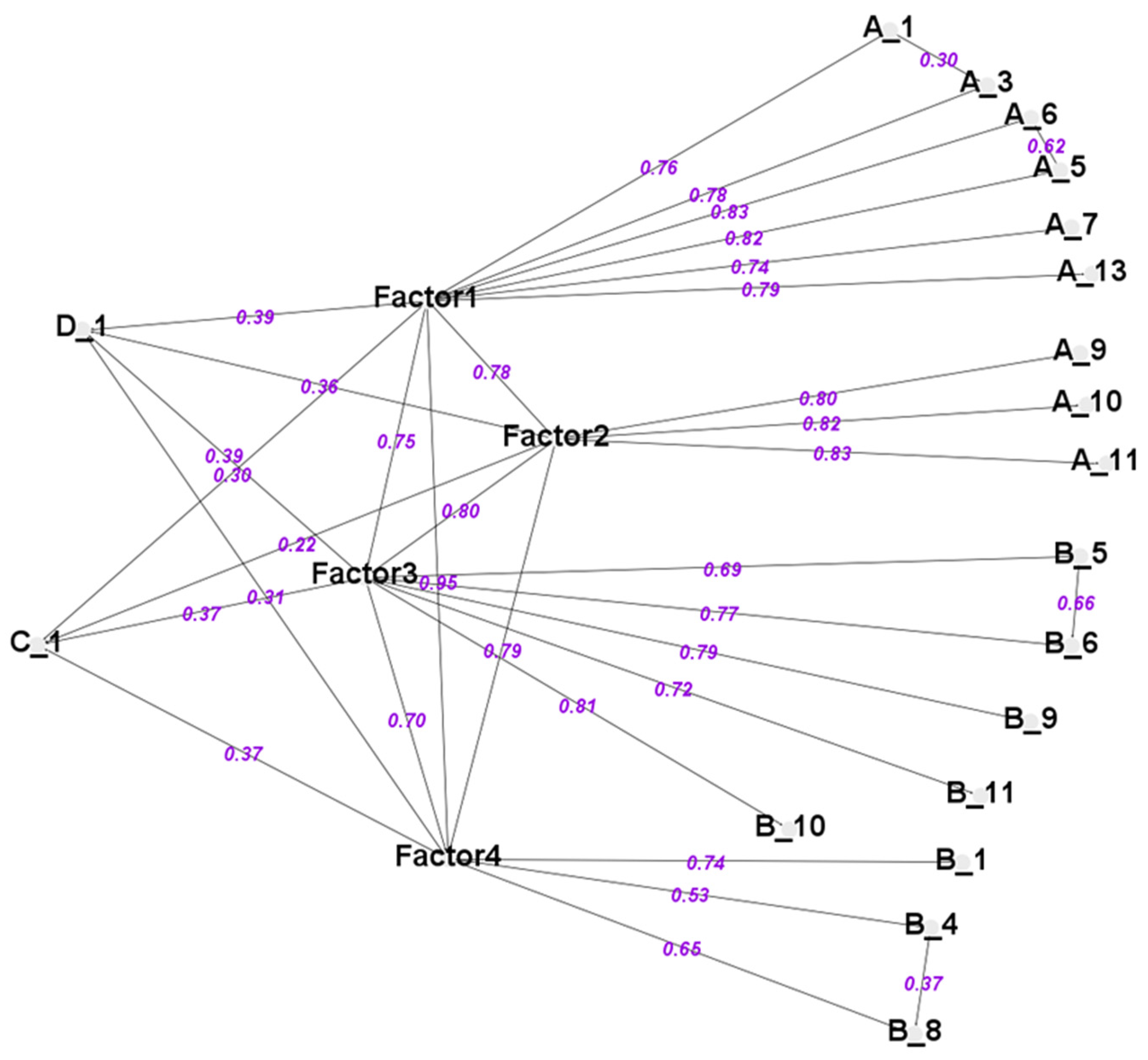
Hu and Bentler 1999), As observed in its structure (
Figure 1), the confirmatory factor analysis reveals the relationships between the four main factors and their associated items. The KMO measure (0.935) and Bartlett’s sphericity test (
p = 0.000) indicate the adequacy of the sample for conducting this type of analysis.
The structure distributes the object of study based on two categories: The Knowledge of robots by teachers (C1) and the Conceptualization of computational thinking by teachers (D1). These categories are divided into four factors: (a) FACTOR 1. Collaboration: It is useful for teaching work (A1), Encourages creativity (A3), Fosters collaborative learning (A5), Fosters cooperative learning (A6), Encourages problem-solving (A7), Facilitates interdisciplinarity among different areas of knowledge (A13). (b) FACTOR 2. STEAM: Develops digital competence (A9), Encourages scientific-technological vocations (A10), Works on STEAM competencies (A11). (c) FACTOR 3. Skills: Spatial orientation (B5), Laterality (B6), Sequencing (B9), Programming (B10), and Understanding algorithms (B11). (d) FACTOR 4: Critical thinking (B1), Psychomotricity (B4), Manipulative skills (B8).
As shown in the figure, the standardized factor loadings of the items on their respective latent factors are consistently high, which provides evidence of the internal consistency of the instrument. The strong correlations observed between the four factors (e.g., Factor 1 and Factor 4) indicate convergent validity, suggesting that the dimensions are not independent but rather interconnected facets of a broader construct related to educational robotics. Furthermore, the inclusion of the exogenous variables C1 and D1, both significantly related to the four factors, reinforces the validity of the model by demonstrating that teachers’ knowledge of robots and their conceptualization of computational thinking exert an influence on the structure of the construct. Taken together, the model confirms both the construct validity and the consistency of the questionnaire, supporting its use for the study of teachers’ perceptions of educational robotics.
2.2. Procedure
The questionnaire was sent through the institutional emails of schools for early childhood education (3–6 years) and primary education (6–12 years). Participants were provided with complete information about the purpose of the study, thus respecting the ethical and regulatory principles that guide research with people, including aspects related to confidentiality, informed consent, and voluntariness (
APA 2020). Additionally, mechanisms were established to ensure the protection of personal data, in compliance with the General Data Protection Regulation of the European Union.
2.3. Data Analysis
The data were collected online through Microsoft Forms, exported to Microsoft Excel for initial data management, and subsequently analyzed using R software for advanced statistics. Descriptive analyses were applied to characterize the sample, and inferential analyses, such as confirmatory factor analysis (CFA), were used to validate the latent structures of the questionnaire. Additionally, since the data did not meet the necessary assumptions for the use of parametric tests, non-parametric tests such as Mann–Whitney U, Kruskal–Wallis, and Dunn’s Test were used as post hoc tests to identify significant differences between demographic and educational groups.
3. Results
First, the opinion of teachers on robotics as an educational resource is addressed, followed by its relationship with computational thinking, along with possible correlations.
3.1. Robotics as an Educational Resource in Teaching and Learning Processes
Regarding the assessment of robotics as a specific didactic resource, as shown in
Table 2, the obtained data reflect mean scores (on a scale of 0 to 3) ranging from 2.26 to 2.59. The results highlight that the development of digital competence is the aspect most valued by teachers (m = 2.59), followed by its ability to foster the creation of a playful environment in the classroom (m = 2.57), to enhance motivation (m = 2.55), and its contribution to the development of computational thinking (m = 2.55). On the other hand, the least considered aspects include the development of creativity (m = 2.38), collaborative learning (m = 2.33) and cooperative (m = 2.30), its usefulness for teaching work (m = 2.29), interdisciplinarity among different areas of knowledge (m = 2.29), problem-solving (m = 2.29), with the learning of different languages (m = 2.26) being the least valued dimension.
Regarding the relationship between the gender of the participants and the assessment of robotics as an educational resource, the analysis (Mann–Whitney U) indicates that there are no significant differences between men and women in these variables, as it has a significance value greater than 0.05. Therefore, Hypothesis 1 is rejected, as no significant gender differences were found in teachers’ perceptions of the usefulness and benefits of educational robotics (p > 0.05). There are also no significant differences concerning age or the educational stage in which they carry out their professional activity, according to the results of the Kruskal–Wallis’ test. Consequently, both Hypothesis 3 and Hypothesis 4 are rejected, since no significant differences were observed either by age or by educational stage in the perceptions of robotics as an educational resource (p > 0.05).
In contrast, the results of the Kruskal–Wallis analysis (
Table 3) reveal significant differences in how teachers value various didactic aspects of educational robotics, considering the frequency of use of robotics in the classroom.
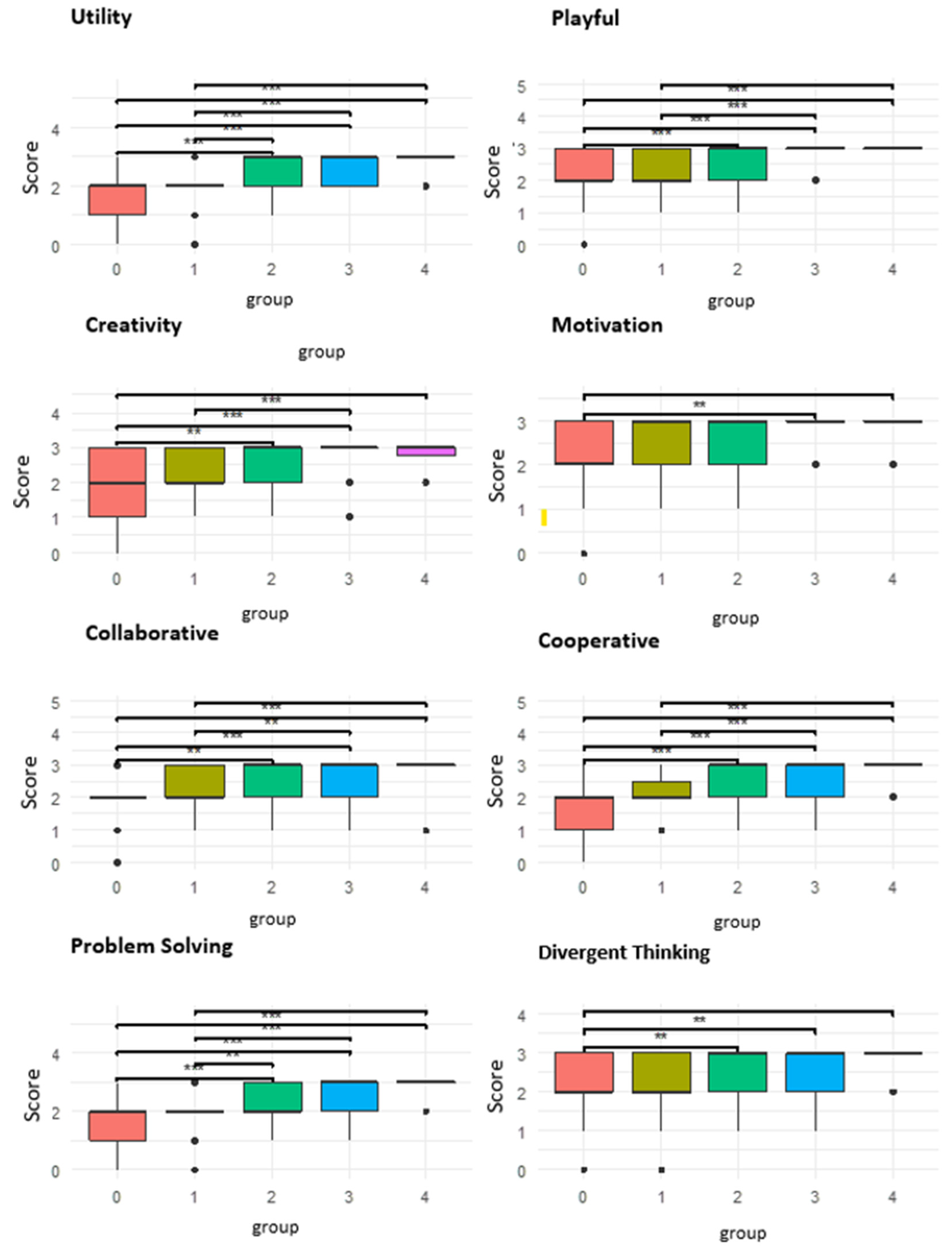
In more detail, the results of the non-parametric Kruskal–Wallis’s analysis show statistically significant differences in teachers’ perceptions regarding the educational benefits of robotics, depending on the frequency of use in the classroom. As shown in
Figure 2, those who use this tool more regularly (“often” or “always”) tend to rate various dimensions associated with its pedagogical utility significantly more positively.
The figure presents the results of the Kruskal–Wallis analyses for the different dimensions associated with educational robotics (utility, playful character, creativity, motivation, collaborative and cooperative learning, problem solving, and divergent thinking). Each boxplot represents teachers’ scores according to the frequency of use of robotics in their teaching practice, grouped as follows: 0 = never, 1 = rarely, 2 = sometimes, 3 = frequently, and 4 = always. The colors of the boxes correspond to each of these groups, where the central line indicates the median, the edges show the interquartile range, and the dots represent outliers. The horizontal brackets with asterisks above the boxes display the results of the post hoc pairwise comparisons, where significance levels are denoted as p < 0.05 (*), p < 0.01 (**), and p < 0.001 (***).
Specifically, significant differences are observed for usefulness (H(4) = 53.83,
p < 0.001), playful character (H(4) = 36.78,
p < 0.001), fostering creativity (H(4) = 26.22,
p < 0.001), motivation (H(4) = 17.21,
p = 0.002), collaborative learning (H(4) = 25.92,
p < 0.001), and cooperative learning (H(4) = 33.25,
p < 0.001). Post hoc analyses reveal that teachers who reported “never” using educational robotics (group 0, in red) differ significantly from those who reported frequent or systematic use (groups 2, 3, and 4), particularly in their perception of robotics as a tool to motivate students, foster creativity, and promote collaborative learning. Although these differences reached statistical significance, the effect sizes (η
2) ranged from 0.03 to 0.12, which are considered small to moderate according to
Cohen’s (
1992) guidelines, where η
2 = 0.01 represents a small effect, η
2 = 0.06 a medium effect, and η
2 = 0.14 a large effect. The use of eta squared (η
2) is appropriate for this study, as it provides an effective estimate of effect size in designs comparing more than two independent groups (
Castillo-Blanco and Alegre 2015). This suggests that, while the frequency of robotics use influences teachers’ perceptions, the magnitude of this effect remains limited, a result that will be discussed in greater depth later in the manuscript.
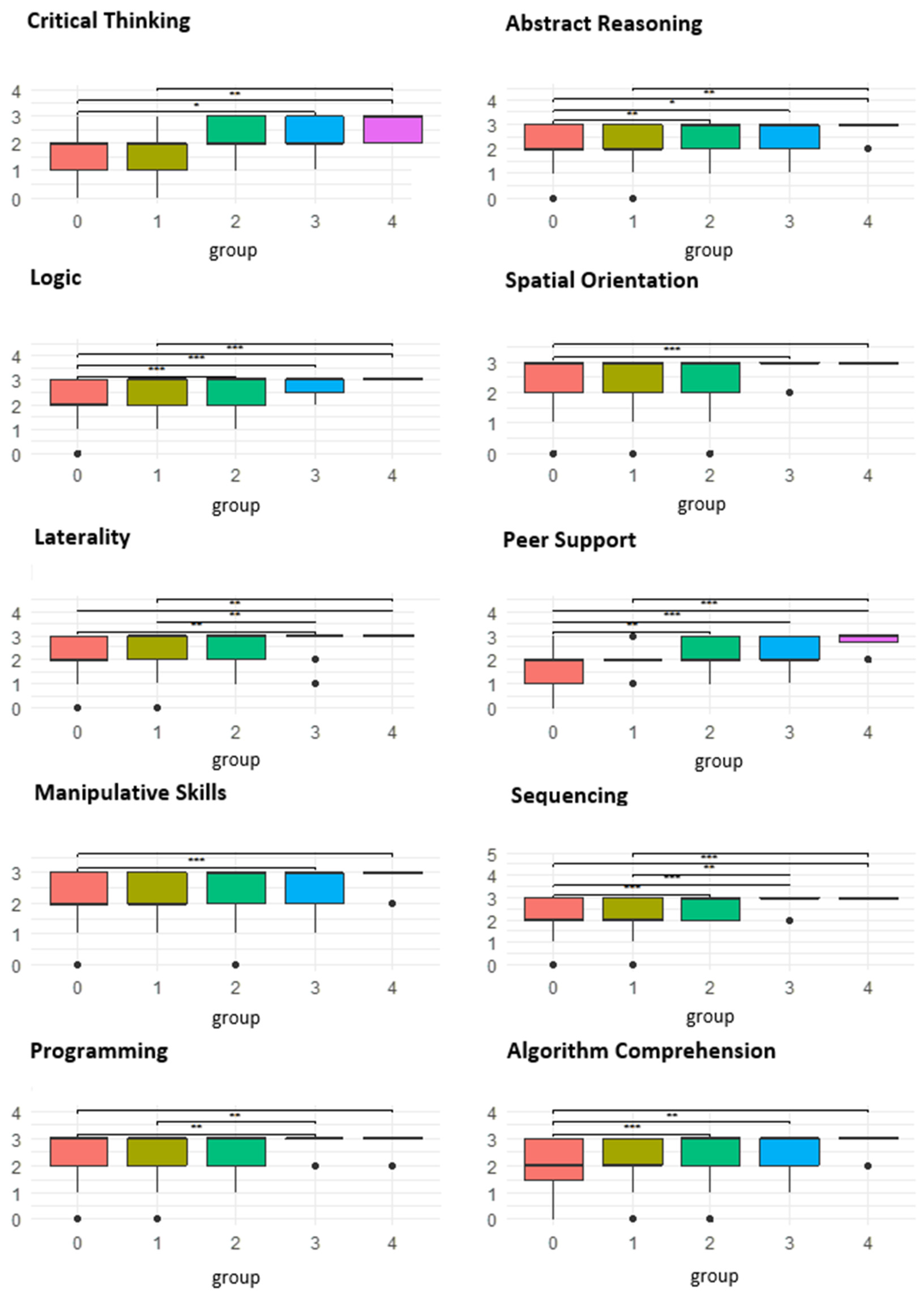
On the other hand, significant differences are also detected in the perception of the skills that educational robotics can develop, as shown in
Figure 3. Among the dimensions that present relevant differences are: Critical thinking (H(4) = 15.28,
p = 0.004), Abstract reasoning (H(4) = 20.81,
p < 0.001), Logic (H(4) = 27.16,
p < 0.001), Spatial orientation (H(4) = 11.93,
p = 0.018) and Understanding algorithms (H(4) = 20.81,
p < 0.001). In all cases, teachers who use robotics “always” or “often” assign significantly higher scores compared to those who “never” use it (
p < 0.05). This reinforces the association between frequent practice with this tool and a greater appreciation of its impact on the development of key competencies in students.
3.2. Educational Robotics as a Resource for the Development of Skills in Students
In relation to teachers’ perceptions of the skills that educational robotics can develop in students (see
Table 4), it is observed that among the highest rated are spatial orientation (m = 2.62), programming (m = 2.61), sequencing (m = 2.58), logic (m = 2.56), and laterality (m = 2.56).
The skills with moderate ratings include understanding algorithms (m = 2.39), abstract reasoning (m = 2.38), and manipulative skills (m = 2.36). On the other hand, the skills that are considered to be less developed through robotics are peer support (m = 2.17), critical thinking (m = 2.06), and psychomotor skills (m = 2.02).
The results of the ANOVA analysis show that no significant differences were found between men and women regarding the perception of the skills fostered by educational robotics, nor in relation to age or the educational stage in which they develop their professional activity. On the contrary, significant differences are presented based on the frequency with which teachers implement practices related to this tool. According to the results of the Kruskal–Wallis analysis, statistically significant differences are revealed in teachers’ perceptions of the impact of educational robotics on the development of various cognitive, psychomotor, and socio-emotional skills of students, depending on the frequency with which they implement this tool in their teaching practices.
As shown in
Table 5, the dimensions that present the most relevant differences between groups are: logic (H(4) = 25.35,
p < 0.001), sequencing (H(4) = 28.78,
p < 0.001), understanding algorithms (H(4) = 20.85,
p < 0.001), laterality (H(4) = 20.47,
p < 0.001), and peer support (H(4) = 22.15,
p < 0.001). These results show that teachers who use educational robotics more regularly tend to give higher ratings to the impact of this tool on the development of these skills. Significant differences are also identified in dimensions such as critical thinking (H(4) = 17.70,
p = 0.001), abstract reasoning (H(4) = 19.44,
p = 0.001), spatial orientation (H(4) = 18.65,
p = 0.001), manipulative skills (H(4) = 19.88,
p = 0.001) and programming (H(4) = 17.23,
p = 0.002). These skills, directly linked to the development of computational thinking, show a similar pattern: the greater the frequency of use of robotics, the higher the appreciation of its formative potential.
In the case of psychomotricity, although the observed significance is weaker (H(4) = 9.27, p = 0.055), the trend also points towards a higher valuation among those who integrate robotics into their practice more frequently. To complement these results, we also examined the effect sizes (η2) associated with the Kruskal–Wallis tests. The values ranged from small to moderate, with the strongest effects observed for sequencing (η2 = 0.13), logic (η2 = 0.11), and peer support (η2 = 0.10). These findings reinforce that, beyond statistical significance, the frequency of robotics use has a substantive impact on how teachers value its contribution to key student skills.
Box plots clearly reflect the increasing trend in the median scores assigned to each skill as the use of robotics increases. This progression is especially pronounced in skills such as logic, programming, sequencing, spatial orientation, and understanding algorithms, all of which are associated with computational thinking.
There is also a significant improvement in the ratings of higher-order skills such as abstract reasoning and critical thinking, as well as in dimensions related to motor development (laterality and psychomotricity) and social competencies (peer support, cooperative skills). The visual trend aligns with the statistical results presented earlier (
Figure 4), where these differences reached statistical significance through the Kruskal–Wallis test.
3.3. Educational Robotics and Computational Thinking
Considering the degree to which teachers view computational thinking as a necessary skill for their students, the majority of participating teachers give a high rating to this skill. Specifically, 50.46% of respondents consider it quite necessary, followed by 39.35% who consider it very necessary. In contrast, the lowest ratings have a marginal representation, close to 10%, with 8.33% considering it a little necessary and only 1.85% not necessary at all. Furthermore, participants’ perception regarding whether educational robotics promotes the development of computational thinking reveals that the majority consider it “a lot” (61.57%), followed by 32.87% who consider it “quite a bit.” The lowest ratings, “little” and “not at all,” have minimal representation, with 4.17% and 1.39% of responses, respectively.
In relation to the dimensions associated with computational thinking, the data presented in
Table 6 reflect teachers’ evaluations of them. The means obtained (on a scale of 1 to 5) range from 3.87 to 4.24, indicating a globally positive evaluation of the assessed dimensions. More specifically, robotics (m = 4.24), experimentation (m = 4.19), and STEAM vocations (m = 4.12) stand out as the highest rated, suggesting that teachers perceive them as a key element in the development of skills associated with computational thinking.
Dimensions such as problem decomposition (m = 4.13) and data analysis (m = 4.07) also show high ratings. Creation (mean = 4.02) and reflection (m = 4.09) reflect that teachers perceive robotics as a resource that fosters both creativity and critical and reflective thinking in students. At the lower end of the ratings, although still positive, are communication (m = 3.87) and working with algorithms (m = 3.93).
Based on the results of the Kruskal–Wallis analysis on the perception of computational thinking as a necessary skill in the classroom, no significant differences are shown between men and women. The statistical analysis indicates that the significance values are greater than the critical threshold of 0.05, Accordingly, Hypothesis 2 is rejected, since no significant gender differences were identified in teachers’ perceptions of computational thinking as a necessary skill (
p > 0.05). Similarly, the results of the Kruskal–Wallis analysis show that there are no significant differences in the perception of computational thinking as a necessary skill in the classroom in relation to age. Likewise, the analysis conducted for educational stages also does not detect significant differences between the teaching staff of Early Childhood Education and Primary Education regarding this perception, with significance values also greater than 0.05. Therefore, both Hypothesis 3 and Hypothesis 5 are rejected, as no significant differences were detected in the importance assigned to computational thinking according to either age or educational stage (
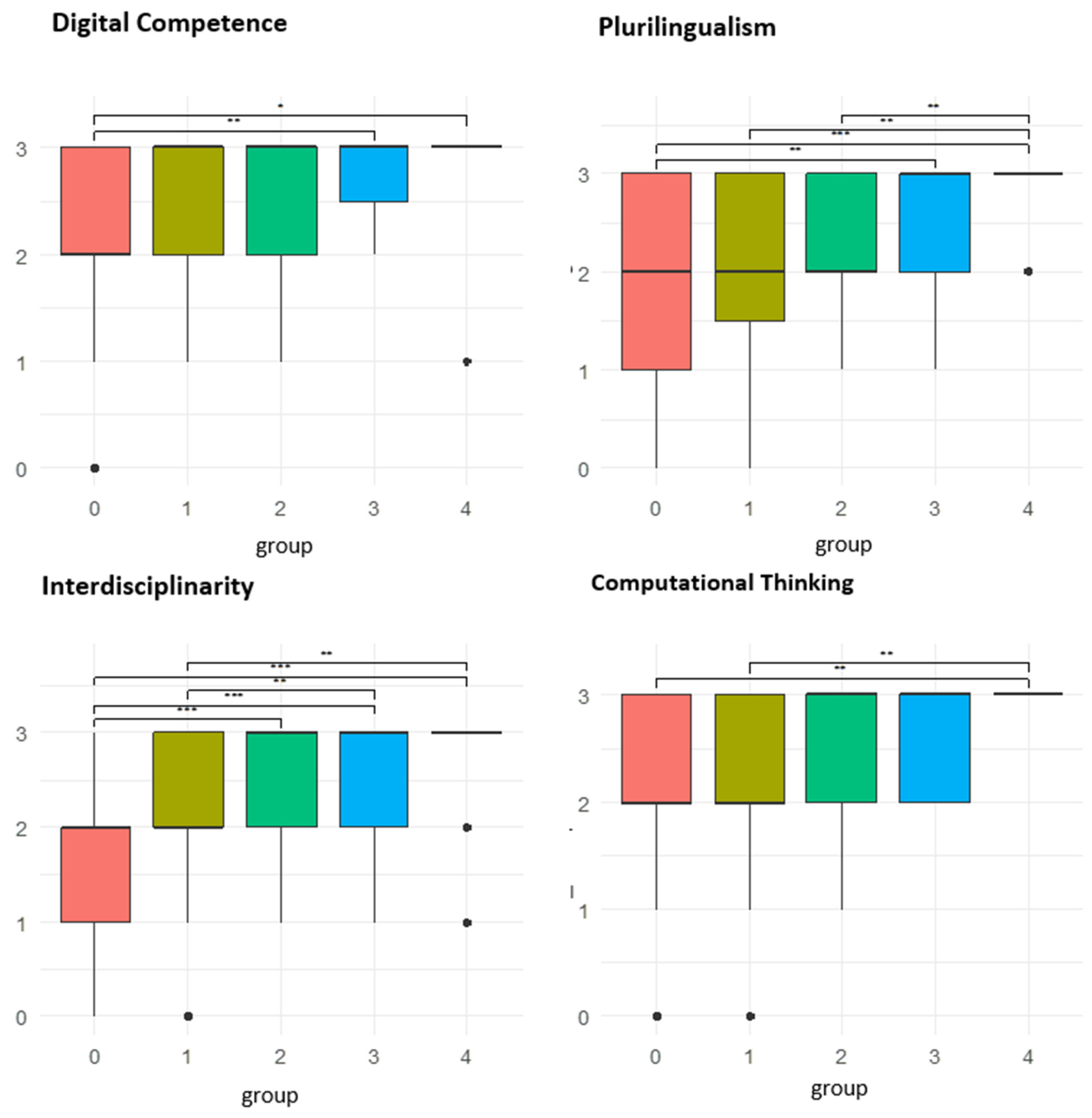
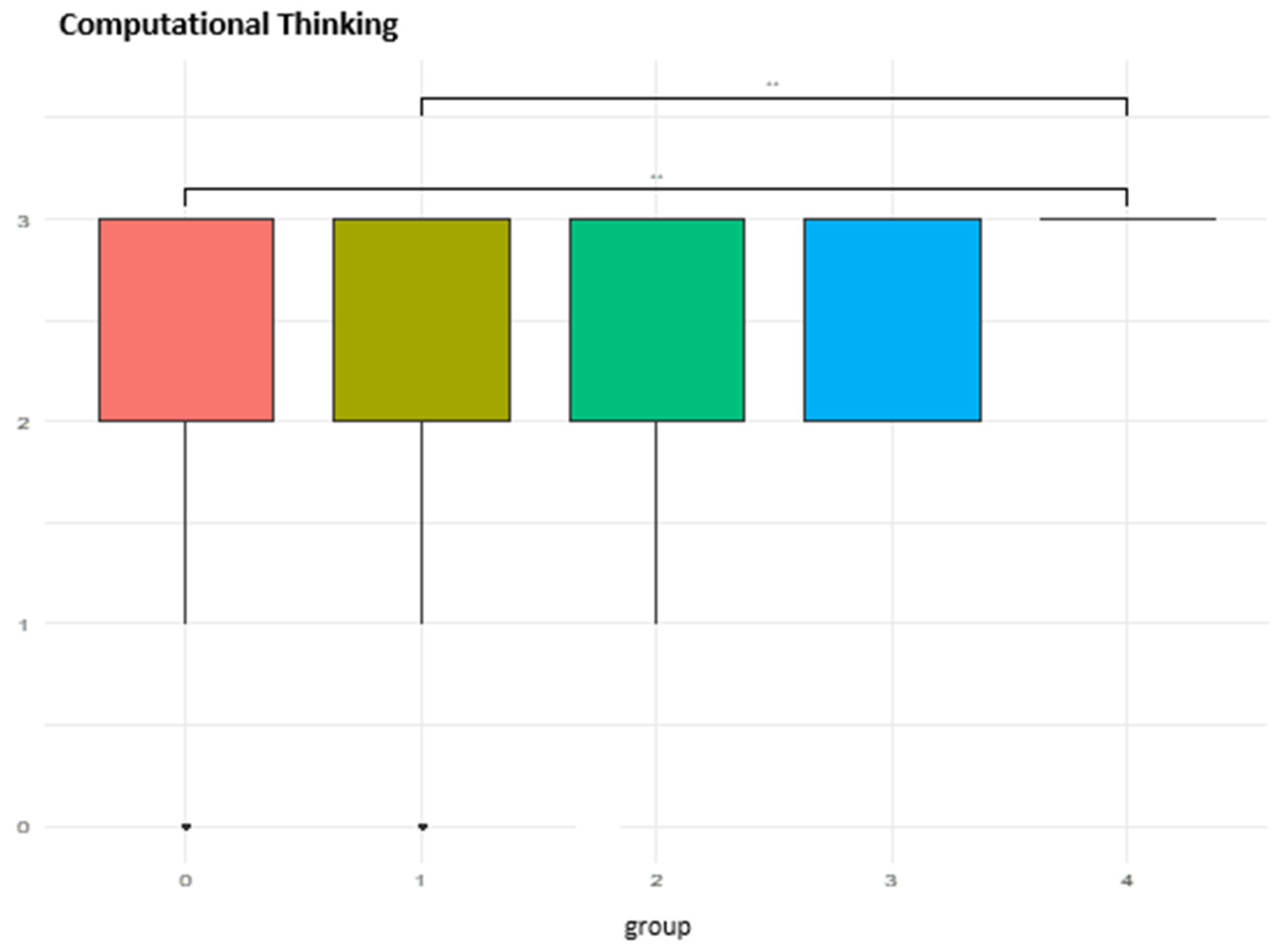
p > 0.05). Finally, regarding the “development of computational thinking”, although not all comparisons between groups are significant, teachers who use robotics “always” have a significantly higher valuation than those who “never” use it. This finding reinforces the idea that the practical and frequent use of robotics in the classroom enhances its perception as a tool to promote computational thinking, as seen in
Figure 5.
3.4. Correlation Analysis
The correlation analysis reveals significant relationships between teachers’ expertise in the use of educational robots, the conceptualization of computational thinking, the perception of the qualities of robotics as an educational resource, and the skills developed in students. All correlations are statistically significant at the
p < 0.01 level, which evidences the robustness of the observed relationships, as shown in
Table 7.
Firstly, a moderate positive evaluation was found between teachers’ expertise with robots and their consideration as a resource for improving students’ skills (r = 0.411, p < 0.01). This suggests that teachers with greater experience in handling robotic tools perceive a more pronounced impact on the development of skills and abilities in their students. Similarly, the conceptualization of computational thinking also shows a positive correlation with students’ skills (r = 0.464, p < 0.01). This indicates that teachers who have a deeper understanding of the principles of computational thinking tend to value its effect on strengthening students’ competencies more highly.
The strongest relationship is observed between the qualities of robotics as an educational resource and the promotion of students’ skills (r = 0.858, p < 0.01). This finding highlights that teachers who perceive robotics as a valuable resource in pedagogical terms are also those who identify a greater impact on the development of key skills. Furthermore, expertise with robots shows a moderate increase with the perception of the qualities of robotics as an educational resource (r = 0.361, p < 0.01), suggesting that practical experience reinforces the positive valuation of the educational potential of robotics.
Finally, the relationship between expertise with robots and the conceptualization of computational thinking is also significant, although weaker (r = 0.227, p < 0.01). These factors seem to be key to maximizing the benefits of educational robotics in school contexts.
In a similar way, the correlations between variables related to teaching and the use of educational robotics, including expertise in handling robots, the conceptualization of computational thinking, the perceived qualities of robotics as an educational resource, and the skills developed in students are presented in
Table 8.
The relationship between seniority as a teacher and the conceptualization of computational thinking is inverse, with a precision coefficient of −0.167 and a significance of p = 0.015. This indicates that teachers with more seniority tend to have a more limited understanding of computational thinking, possibly due to a lack of specific training in this area during their initial preparation. Similarly, the relationship between teaching seniority and student skills is also inverse and significant (r = −0.196, p = 0.004), suggesting that teachers with more work experience perceive a lesser impact of educational robotics.
Seniority as a teacher also shows a marginally significant inverse trend with the perception of the qualities of robotics as an educational resource, with a coefficient of −0.132 and p = 0.056. This could reflect that teachers with more years of experience are more critical or less optimistic about the potential of robotics in educational contexts. On the other hand, a strong positive relationship is observed between teaching seniority and seniority in the educational center (r = 0.691, p < 0.001), which shows that teachers with more experience tend to stay in the same workplace.
Expertise in the use of educational robots is positively related to various key variables. There is a significant evaluation with the conceptualization of computational thinking (r = 0.227, p = 0.001), suggesting that teachers with greater practical experience tend to have a more solid understanding of this concept. Additionally, this expertise is positively associated with the perception of the qualities of robotics as an educational resource (r = 0.361, p < 0.001) and with the perceived impact on student skills (r = 0.411, p < 0.001). These results indicate that practical experience in robotics is closely linked to a positive assessment of its pedagogical applications and the perception of its benefits in student learning.
4. Discussion
This research aims to provide a current map of teachers’ conceptions regarding educational robotics and computational thinking, which allows for the exploration and design of contextualized interventions aimed at reducing the training gap and promoting strategies that overcome gender stereotypes in this area (
UNESCO 2017).
The results obtained show that educational robotics is perceived by teachers as a teaching resource with high potential to promote key competencies such as problem-solving, creativity, or abstract reasoning. Furthermore, both educational robotics and computational thinking are positively related to the development of STEAM competencies and student motivation. These findings coincide with previous research that underscores the need for improvement and change in educational institutions (
Hargreaves and Fullan 2014) and their capacity to integrate disciplines and foster transversal competencies in current educational contexts as suggested by international models such as DigCompEdu (
Redecker and Punie 2017;
Cabero-Almenara and Palacios-Rodríguez 2020) as well as the possible transformative role of educational robotics in teaching and learning (
Lara Orcos 2019;
Resnick et al. 2009).
In relation to the use of educational robotics, the developed study highlights that the frequency of implementation is a key factor influencing teachers’ perceptions. Teaching staff who regularly integrate robotics practices in the classroom significantly value aspects such as collaborative learning, critical thinking, and logic compared to those who never or rarely use these tools. These resources provide the opportunity to promote skills, as well as meaningful, flexible, and inclusive learning opportunities (
Goode et al. 2020).
Furthermore, there is widespread evidence of a lack of specific training for teachers in educational robotics, as 49.5% of participants indicate having little training, and 10.6% indicate having no training in this area, reinforcing the need to design professional development programs aligned with the demands of STEAM education and computational thinking. It thus becomes evident that the presence of structural and cultural barriers, such as the lack of specific training and resistance to methodological change (
Cedeño Bermello et al. 2024;
Santos and Casagrande 2024;
Romero-Ariza et al. 2021) remains present. Similarly, the results obtained suggest that training in this area remains an outstanding issue for many teachers, as stated by
Lara Orcos (
2019).
Overcoming these limitations requires moving towards more effective professional development models that transcend one-off training and promote continuous, collaborative, and situated training processes. An effective strategy is peer training, where more experienced teachers in the use of robotics and computational thinking act as mentors in communities of practice, fostering a culture of sustainable innovation (
Lieberman and Mace 2010). Likewise, it is necessary to design training programs linked to real teaching contexts that facilitate methodological transfer and align with curriculum demands (
Cabero-Almenara and Palacios-Rodríguez 2020), especially to respond to the STEAM approach (
García Fuentes et al. 2022). These actions must be accompanied by institutional policies that support change, minimizing resistance and creating school environments that value experimentation and teacher learning. In this regard, existing frameworks such as DigCompEdu at the European level or the Spanish INTEF framework already emphasize the importance of digital teacher competence, but they should be strengthened with a more explicit focus on robotics and computational thinking.
Promoting pedagogical innovation and the effective integration of educational robotics and computational thinking requires a systemic vision that encompasses both digital competencies and the socio-emotional and ethical dimensions of technology use. In this sense, computational thinking should be understood not only as a technical competence but also as a tool for the intellectual and civic empowerment of students, in line with the frameworks proposed by
UNESCO (
2024) and the
European Commission (
2023). The early and equitable incorporation of robotics into teaching practice can help close gender and access gaps, as long as it is integrated from an inclusive and critical perspective that promotes the professional development of teachers as transformative agents.
Although the gender variable is linked to others such as socioeconomic level when promoting STEM education (
Cedeño Bermello et al. 2024;
Holincheck et al. 2024), the absence of significant differences based on gender or educational stage found in this study could be interpreted as progress towards equity in the perception and application of these technologies. However, it may also indicate the need to promote practices that ensure the active participation of all teaching groups, including those that currently show lower frequency of use of educational robotics and computational thinking in the classroom.
5. Conclusions
This study analyzed teachers’ perceptions of educational robotics and CT in early childhood and primary education, considering gender, age, and educational stage. The results indicate that gender and age do not significantly influence perceptions, while primary education teachers show greater appreciation of these resources compared to early childhood teachers. The findings also reveal a lack of specific training, which limits their effective implementation in classrooms. These results highlight the need for continuous and contextualized professional development, as well as institutional support, to ensure an inclusive and sustainable integration of educational robotics and CT into teaching practice.
Therefore, the absence of significant gender differences in this study should not be interpreted as evidence of equality, but rather as an invitation to further explore how invisible gender stereotypes often shape how teachers and students approach educational robotics and computational thinking
Limitations of this study include the use of non-probabilistic convenience sampling, which may limit the generalizability of the findings. Additionally, reliance on self-reported data introduces the possibility of social desirability bias. Future research should consider longitudinal designs and triangulated data sources to validate these findings.
The results obtained show that it is essential to implement specific teacher training programs in educational robotics and computational thinking, designed from a practical and adaptive perspective, that consider the individual needs of teachers, which is shown as a line of work for the future. Additionally, it would be valuable to conduct longitudinal studies that allow for the evaluation of the impact of this training on the integration of educational robotics and on student learning outcomes, especially in diverse educational contexts, as it could provide a more global view of reality.