As a part of this, Correa’s African-ness has been minimized over the centuries via its lack of overt examination. This essay further posits that the absence is the point. As an artist who achieved visible success, Correa stands out as an exception that proves the rule. Correa’s artistic production adheres to the contemporary standards of elite painting, engaging and solidifying emerging cultural narratives and framing the artist as an elite practitioner. His personal colonial subjectivity in this sense is both present and absent. Ultimately, this paper is concerned with situating Correa as an artist within a larger visual and social context to demonstrate the ways that bodies operate within matrices of colonialism and to understand how the visibilities of race and rhetorical bodies functioned in New Spain as the larger Viceregal territory.
The goal of the present study is therefore to begin addressing such a scope by posing questions, problematizing current framings, and inviting discussion so that we may develop an understanding of the lived complexities and richness of the colonial sphere in the Atlantic World that is rooted in its pluralities. It is therefore particularly indebted to a number of extant studies complicating long-held assumptions and historical silences, including Aaron Hyman’s excellent article, “Inventing Painting: Cristóbal de Villalpando, Juan Correa, and New Spain’s Transatlantic Canon,” Susan Deans-Smith’s examinations of the racial politics of painting, Barbara Mundy’s study of elite secular art and colonial memory, and the investigations on visualizing Blackness and colonial models of artistic identity put forth by Kathryn Santner and Helen Melling. This brief curriculum vitae is but a sample of a larger body of literature that reflects an exciting moment in the discipline, one aimed at moving towards a more complicated, and therefore more interesting, art history of the Americas.
Given Correa’s prolific production, the essay will specifically ground its discussion in an examination of his two biombos as representations of his secular work: The Four Continents and The Meeting of Hernán Cortés and Moctezuma and The Liberal Arts and Four Elements. The selection of these screens owes itself to their encapsulation and expression of a specific tension that scholarship on Correa has yet to approach—namely the tension that exists for artists of color in the colonial world who navigate the dominant visual field from a position of subalternity and the varying degrees of success that system accepts. As an individual, Juan Correa’s racialized identity, his membership in the sistema de castas, should have precluded his place in the canon. Correa’s contemporary success is a marker of his navigation of the hegemonic structures of his day, but it does not reflect progressive social advancements. It does, however, connote a role in expressing and reinforcing hegemonic colonial power structures. Biombos are elite objects—they exist in performative domestic spaces, and their themes envisage specific social narratives. I therefore argue in this text that Correa’s biombos pointedly reflect his role in helping to establish the visual field and his performance of elite painterly identities. In both form and subject, they render the heterogeneity of colonial life visible through their material agency, but contribute to the invisibility of that same heterogeneity through their imagery. In other words, these examples visualize and reflect Correa’s subaltern subjectivity and also contribute to racialized invisibilities in the wider canon.
In support, the essay will examine visual narratives of colonial order and constructions of race and identity. Within this, it will establish that the construction of mestizaje established the European-Indigenous binary as the essential and founding identity of New Spain in a manner that excluded and elided lived complexities and artistic practice. It will also examine Correa and his status as a maestro pintor within the racialized politics of painting in seventeenth-century Mexico and the role Blackness was assigned in Viceregal society among visualizations of rhetorical bodies to determine how social narratives were mapped onto human forms. This essay fundamentally approaches the rhetorical body as an unstable image in the colonial system designed to function in multiplicity and engage key vectors for the constructions of colonial identities and local political systems. This allows for a more nuanced understanding of the specifics that would have been attached to Correa’s person and the othered boundaries that circumscribed the depictions of Black bodies.
The visual evidence in this latter instance is not produced by Correa; rather, it represents the visual systems he inherited and helped to produce. Within the racialized contexts of New Spain, Juan Correa’s own identity matrix becomes significant when coupled with his status in the canon. As one of the defining artists in the history of seventeenth-century Mexican art, part of what makes Correa and his biombos a significant case-study is where he sits in the arc of Viceregal painting, as across his seventy years, Correa witnessed and participated in the shift from the early to late colonial system. In other words, the primary questions this essay explores are grounded in how Correa himself participated in producing and mapping colonial hegemonies, and how these discourses of power are complicated if we consider Correa in his personhood as a colonized body.
1. Mestizaje and Colonial Order
Born in Mexico City, Juan Correa became one of the two most prominent painters of his day, along with Cristóbal Villalpando, and he likely studied under Antonio Rodríguez (1636–1691), himself a celebrated painter and the producer of arguably the most famous image of the Mexica (Aztec) ruler Motecuhzoma. Correa’s family built a robust workshop, with his brothers, sons, and cousins all participating. The Correa workshop was not only one of the most celebrated, but also one of the most active, primarily producing devotional paintings for a varied clientele and export. After 1680, Correa’s style became more dynamic, with an emphasis on movement, a noticeably looser brushwork, and an increase in the use of a bright palette. His (arguably) most celebrated works,
The Assumption of the Virgin (1689) and
The Entry of Christ into Jerusalem (1691), were executed for the Sacristy of the Catedral Metropolitana in Mexico City, and he additionally painted several versions of the Virgin of Guadalupe.
2 Correa, in fact, is essential to the dissemination of the latter image and its proliferation in the visual canon. This is significant, as the Virgin of Guadalupe, both as image prototype and motif, came to serve as an emblem for
criollo (American-born but white, European-descended) identity in New Spain and emerging narratives of nationalism.
3While the majority of Correa’s corpus is religious in nature, for the purposes of this essay, I will narrow the scope to two primary case studies of his secular production,
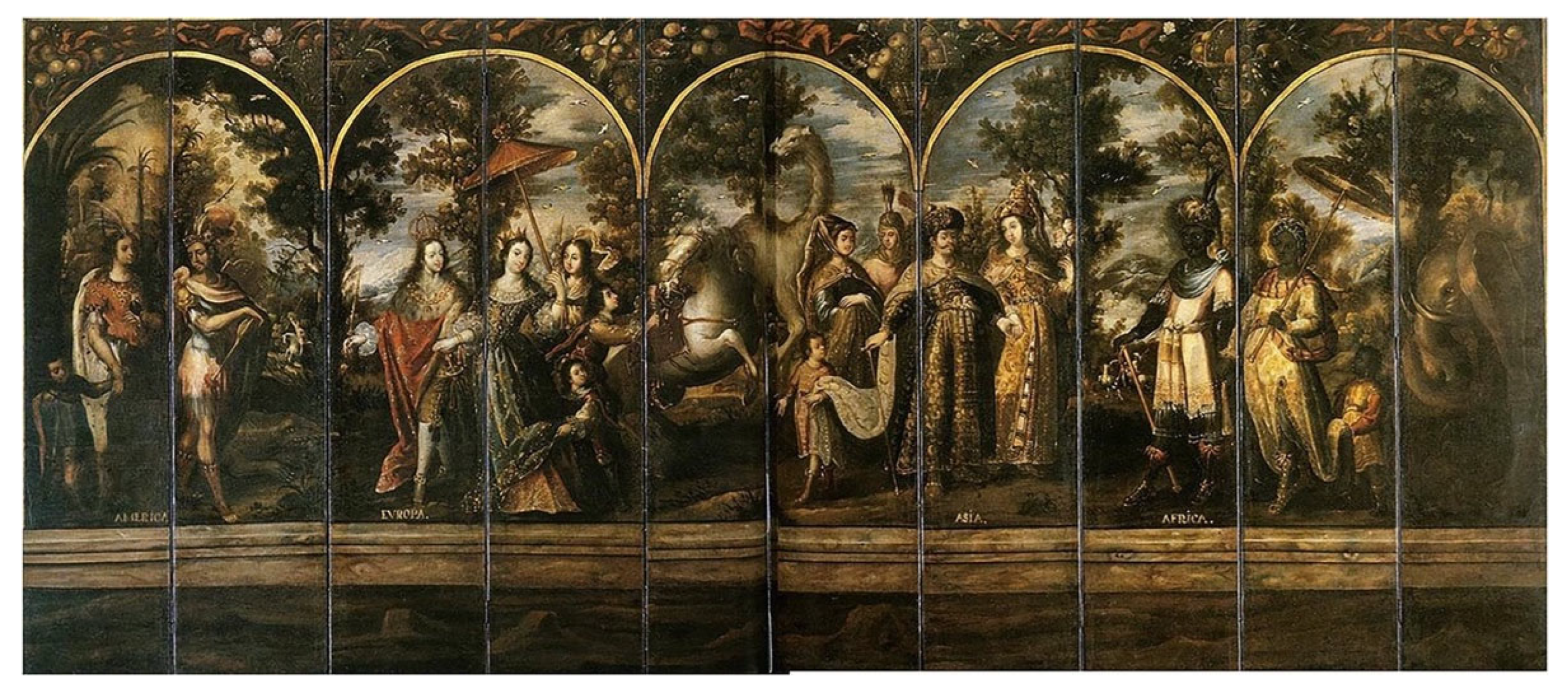
The Four Continents and The Meeting of Hernán Cortés and Moctezuma (Biombo de Las cuatro partes del mundo y El encuentro de Hernán Cortés y Moctezuma) and
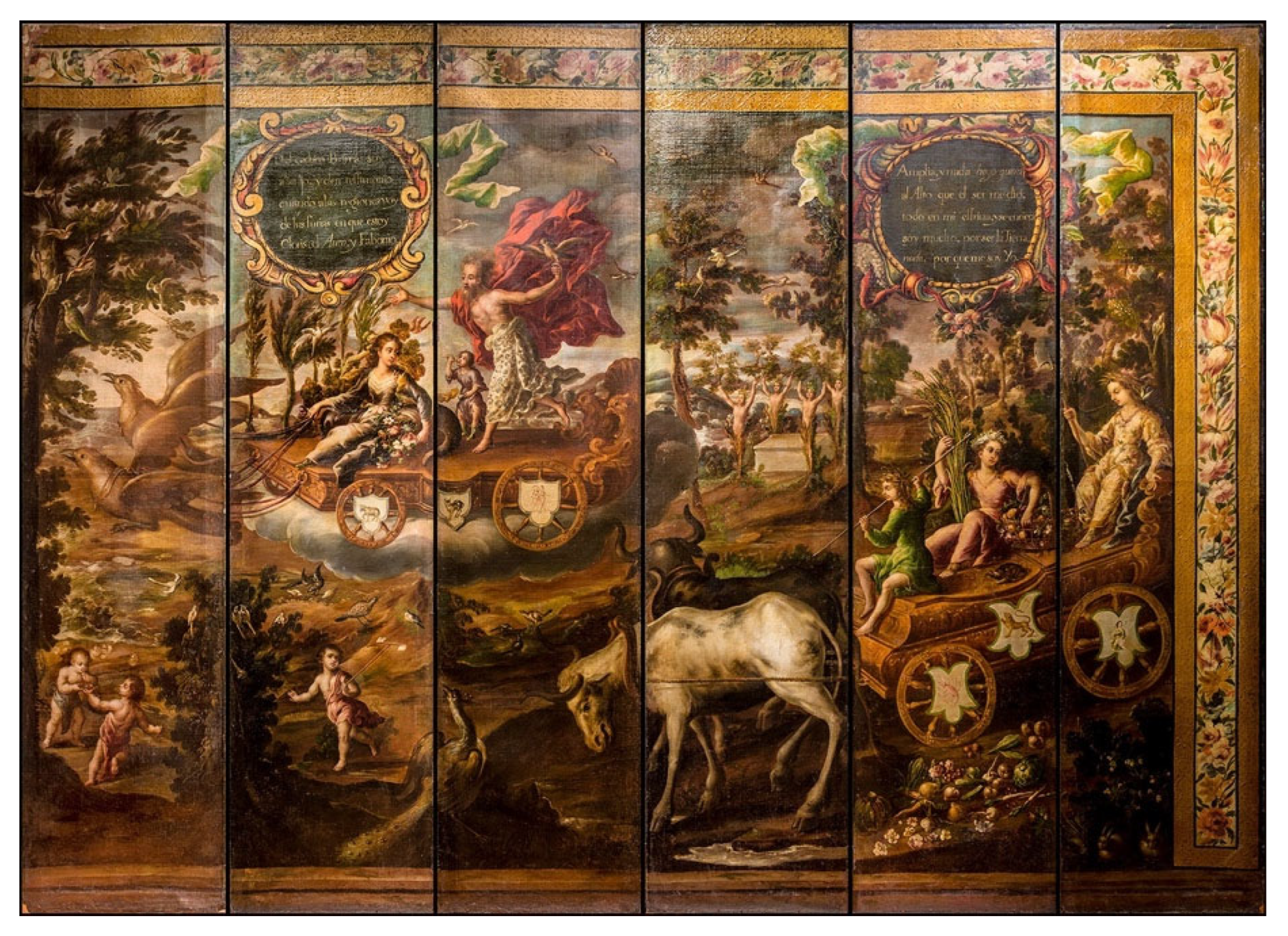
The Liberal Arts and Four Elements (Biombo de los cuatro elementos y las artes liberales) to frame the conversation (
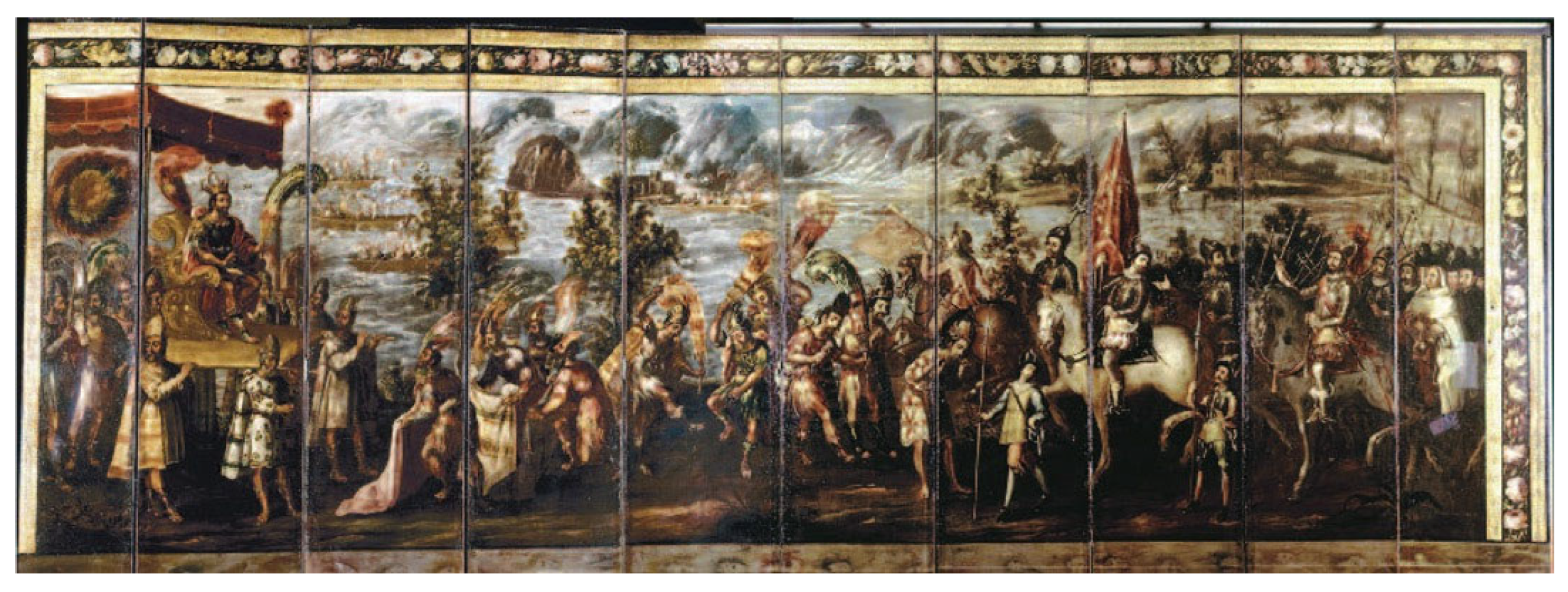
Figure 1,
Figure 2, Figure 10 and Figure 11). The use of these two
biombos specifically as foci, while not reflective of the extent of Correa’s secular imagery, serves to connect a number of distinct narrative threads in service of two larger points. Chiefly, these images highlight the fundamental binary within the definition of
mestizaje at the expense of the heterogeneity of the colonial period, and they further express Correa’s racialized subjectivity as a Black artist working with, and within, elite imagery and material culture that relates to Early Modern narratives of artistic practice. Each of these distinctions takes on significance when interrogated against Correa’s person and personhood.
Correa himself was part of a new racial moment; for the first one hundred years or so of colonization, the primary
mestizaje that occurred reflected a fusion of European and Indigenous identities. The early to mid-seventeenth century saw a pronounced increase in heterogeneity from a racial perspective, as the Hispanic empire expanded and movement across the world increased.
4 In terms of imperial control, this necessitated a new framing of hierarchies within variety, and an establishment of specific positionalities as primary and therefore legitimate, or legitimating, of the colonial endeavor.
5 Through an examination of his production for elite spaces, it is clear that Correa engaged with the dominant narratives swirling within the social body of New Spain in a manner that typified the mythohistories being constructed. It is also clear that elite secular art played a unique role in both reflecting and shaping narratives of colonization of the Americas. As colonial hegemonies solidified, their enactment remained in flux, within the inherently liminal space of colonization. Thus, the deployment of specific racialized frameworks responded to the changing (and challenging) heterogeneity of New Spain.
In the seventeenth and early eighteenth centuries, anxieties emerged within the
criollo class around the impression that the population of New Spain was mostly “mixed” in a variety of ways (
Martínez 2008, 228–264). By focusing on depictions of the
Encuentro in particular (the encounter or first meeting of Hernán Cortés and Motecuhzoma),
mestizaje, and the larger framing of the Contact era as the central (visual) organizing principle of identification in New Spain, the specifics of the
criollo class’s anxiety around the “legitimacy” of their world becomes clear. Rendered from the perspectives of European hegemony, narratives of Contact and
mestizaje were organizing principles of elite vision, as they provided not just justification for the creation of New Spain, but the success of the colonial project and therefore the legitimacy of the
criollo class as elite members of the Hispanic world.
6 While the heterogeneity of colonial Spanish America is not only reflected in the lived experiences of its citizenry, but generally via the material agency of its cultural production, the narrative of
mestizaje was reduced to a combination of European and Indigenous identities as the essential binary undergirding colonial life and the organizing dichotomy of colonial vision.
Early settlement policies in the sixteenth century laid out two colonial polities for governance: what was termed the
república de Españoles and the
república de Indios (
Deans-Smith and Katzew 2009, 7). Importantly, these are the only two racial identity markers given the moniker of a “república,” or “republic.” As colonial life became more heterogeneous, other racialized categories were not extended the status of individualized polities, and were classified collectively as the
castas. Within this, Black-descended peoples had less clearly defined rights; their associations with slavery were held as a rationale to not recognize them as a
república of their own, and this was further complicated by notions of “purity” and
limpieza de sangre, to be discussed later (
Martínez 2004, 485).
We must then ask how and why this identity was shaped via its visual narratives. Correa’s
biombo,
The Four Continents and The Meeting of Hernán Cortés and Moctezuma, featuring allegorical representations of the four continents on one side and the
Encuentro on the other, can be put in direct dialogue with other images that served to visually “prove” the success of the
república de Españoles and the
república de Indios dichotomy. While artists took a measure of freedom in what they chose to render on
biombos, the genre coalesced around a few popular themes. These included: the Conquest of Mexico (the fall of Tenochtitlan), the
Encuentro, the Four Continents, the entrance/procession of the Viceroy into Mexico City,
fêtes galantes, city views, and emblematic and allegorical scenes.
7 Two of these themes appear paired on a screen attributed to Juan Correa from c.1690, with side one entitled
The Four Continents and the other
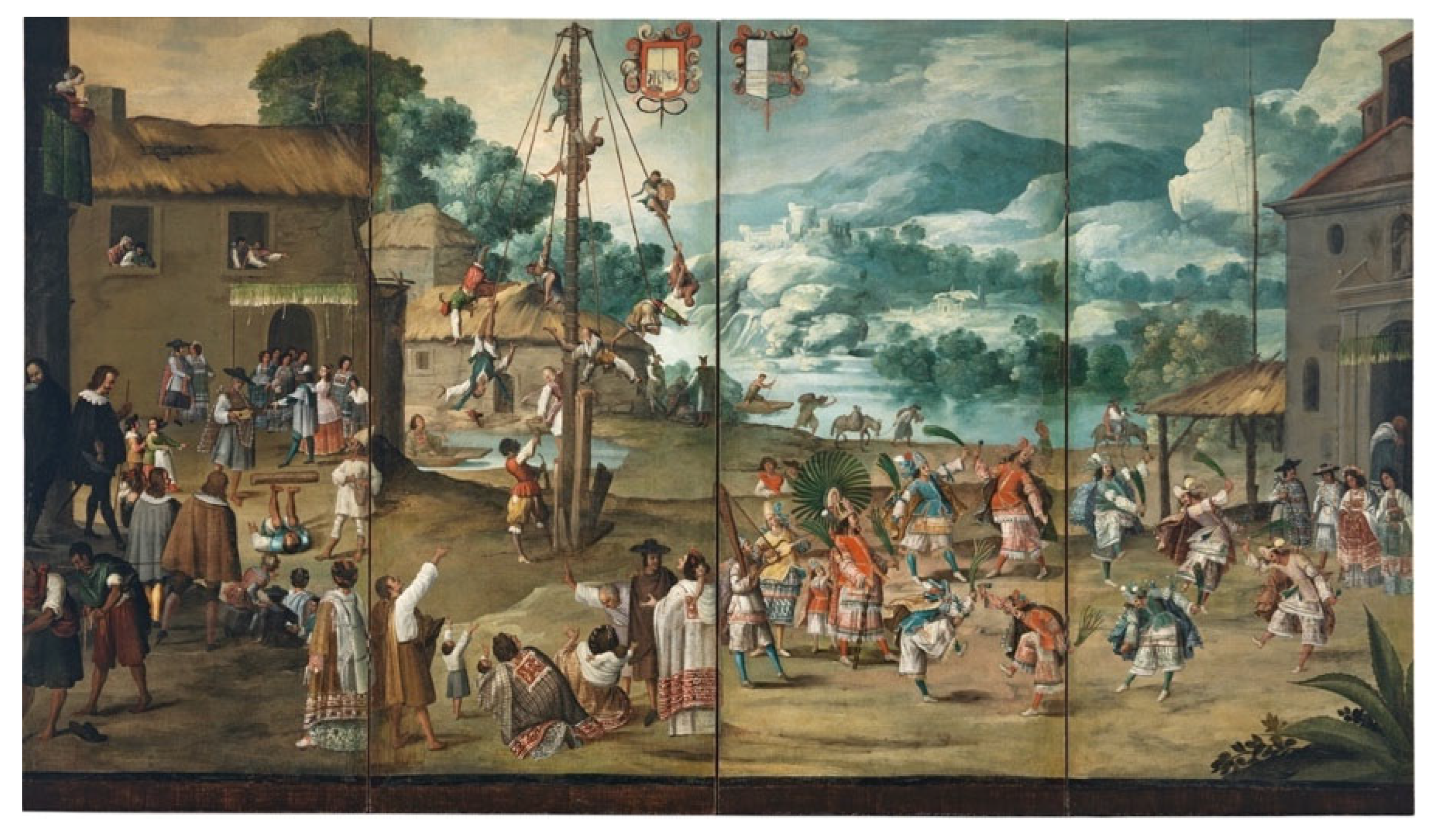
El encuentro de Hernán Cortés y Moctezuma (
The Meeting of Hernán Cortés and Moctezuma) (
Figure 1 and
Figure 2).
Images rendering scenes associated with the Conquest are abundant in the seventeenth century, but we do not see images of evangelization on the folding screens. Rather than religious conversion and conquest, the
biombos engage the scenes associated with the arrival of Cortés and his men and the Mexica-Spanish war as a metaphor for the totality of these worlds in collision. With the shift to the eighteenth century, we see a change in the
biombo corpus. The Conquest disappears as an image subject, likely due to the historical distance and the rise of a
criollo class identity that saw itself as (at this point) autochthonous to New Spain (
Zapatero 2007, 447–48).
8 The dual-sided nature of the
biombos is significant, as the physical frame integrates the images on each side into a connective narrative structure via the body of the viewer. In the case of the
Four Continents/El encuentro screen, the relationship lies between a representation of allegorical figures of the continents and the meeting of the two political leaders.
Importantly, both of these images are processional in their visuality. On the first side, the four continents (America, Europe, Asia, and Africa) are styled in figural groups, spread across a colonnade of five archways. At the far right stands the family figural group representing Africa: a trio of man, woman, and child accompanied by a large elephant whose head and forelegs enter the scene from the border. These figures represent a standard depiction of the Black body in colonial narrativizations of place. While numerous sources have pointed out the multi-racial tenor of angelic cherubim in Correa’s oeuvre, the Black body itself is absent from his corpus of images. There are two exceptions—the biombo under discussion and a second with the same theme in the collection of the Museo Soumaya in Mexico City. In both of these works, we see allegorical representations of Africa, with a standard rendering as Black figures, but also with a physiognomy indicative of stock characters whose skin tone serves as a marker of place. This is combined with two other markers: the presence of an elephant and the figures’ clothing (itself a relative hodgepodge of turbans, head-wraps, scarves, and bodywear that bears similarity to the figures representing Asia).
The Four Continents adheres to the general formatting of images of a triumphal procession.
9 A large, active scene, three of the “continents” spread across four of the arches, while America stands at the far left. The female figures of Europe and Africa bound the overall group with parasols, although Europe’s bright red accoutrement stands out, drawing the eye and pairing with the luxurious red fabric of her male counterpart. In contrast, Africa’s parasol, rendered in natural hues, blends into the foliage behind her, while still remaining visible enough to serve as a paired device. This section of the
biombo stands on its own; America is positioned as an as-yet unintegrated new component.
In the painting, Europe leads the procession; here, a male–female pair is rendered in the style of European monarchs.
10 Facing the remaining continents, America’s familial group walks to meet them. As with Africa, the unit is composed of a male, female, and child figure; of the continents, these two representations bear the most striking resemblance to the casta painting format soon-to-come into being. If we narrow our gaze to the four left-most panels, the image reduces to a meeting between Europe and America, an
encuentro. The two figural groups are also visually balanced. Each pair of adults exhibits body language that integrates the two disparate groups across the slice of nature between, a feature repeated on the opposite end of the painting with Asia and Africa.
This procession is paired with the image on the reverse, the
Encuentro at Ixtapalapan.
11 Also rendered as a processional scene, the image positions the two historical figures at opposing ends of the picture plane. At left, the Mexica ruler Motecuhzoma is carried on a palanquin, framed by attendants with a cloth of honor just overhead. On both sides of the
biombo, the Indigenous American figures are dressed in a hybrid manner. Their Classicized attire is designed to
look Antique, connoting a
before paired with Europe’s
after. Far opposite, at right, Cortés arrives, armor-plated and astride a dappled horse. Unlike his Indigenous counterpart, Cortés is enmeshed within accompanying figures; the viewer relies on the directional gazes of the surrounding bodies to indicate to whom we should give our attention. Close behind him rides Malintzin, his interpreter. Draped in white, she is rendered in a manner that recalls images of the Virgin Mary; the image positions her just behind Cortés, both in the procession and in her distance from the viewer.
12Between these two men, a full scene unfolds, replete with bodies in motion and swirling brushwork that presents Lake Texcoco beyond as a riotous and living natural feature. While the image is overall well-organized, the internal spaces of Indigeneity are presented as embodying the chaos of untamed nature, while the Spanish figures march into the scene in orderly fashion—a crush of bodies that are organized and arranged as a unit. In this, Correa’s image bears similarities to another folding screen, the anonymous
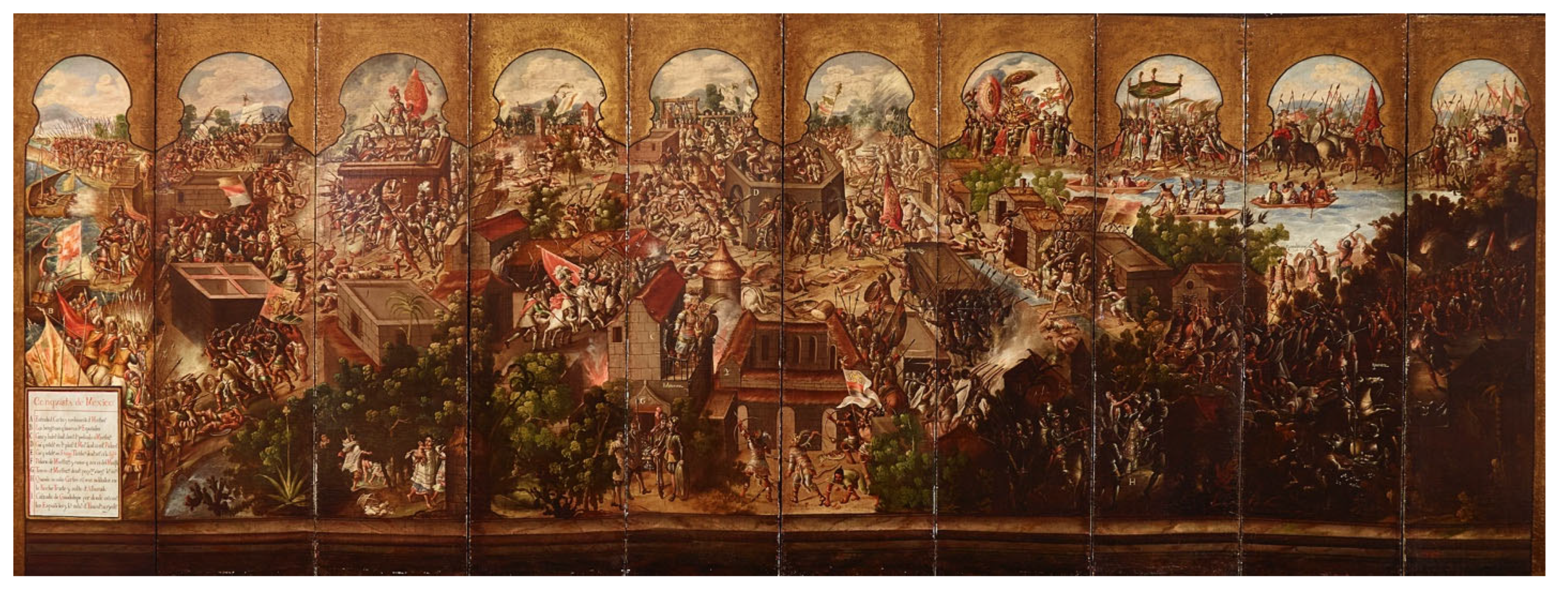
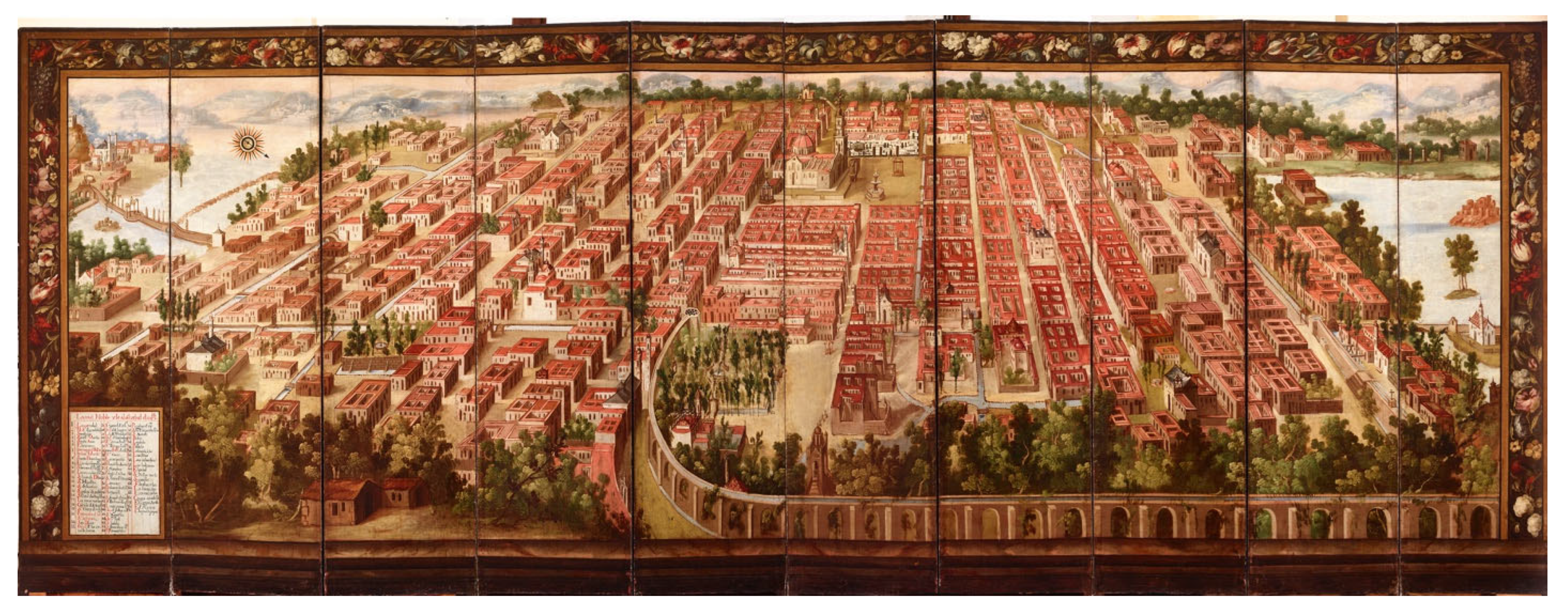
Biombo de la Conquista de México y vista de la Ciudad de México (
Figure 3 and
Figure 4). Here, the Indigenous pre-Hispanic is framed in terms of the unwieldy, whereas the arriving Spanish and the world they create are the order to be imposed. Cortés and Motecuhzoma, positioned as they are at facing sides of the image, mirror the encounter on the front of the
biombo. The
biombos therefore situate the combination of Europe and America as the essential meeting of colonization, and it connotes this encounter as the primary meaning of
mestizaje.
This transformation and movement from a chaotic landscape to a calm and orderly one is not uncommon in the biombo corpus and is specifically seen in those that feature a two-sided representation of Mexico City, a popular theme. In the second half of the seventeenth century, one of the functions of biombo imagery was to assert the distinct identity of the criollo class in New Spain’s history, and screens with this subject matter played a specific role.
Composed of the standard ten panels, Biombo de la Conquista de México y vista de la Ciudad de México is over six and a half feet in height and approximately 18 feet in length, permitting a vast view of both the pre-Hispanic and colonial cities. Across the first side, the fall of Tenochtitlan to Spanish forces takes center stage, as the two clashing armies spread across the eighteen feet of the extended screen in a chaotic melee. Small white letters mark specific vignettes and move the viewer through the scene, with a key in the text on the far-left panel. The visual perspective here is also of note—strong orthogonal lines provide an underlying anchor to the otherwise unwieldy scene, but it is also slightly elevated. Not quite a bird’s-eye view, the elevated perspective aligns with the only other organizational motif: the framing device of archways that runs across the upper edge. This has the effect of positioning the viewer as in a colonnade: a witness to the action, but architecturally separated from it.
Limited to the background, across the top register of the right four panels, we see the
Encuentro, while on the opposite side, a view of the colonial city unfolds. Painted in one-point perspective, the view is likely based (at least in part) on a 1628 map of the city by Juan Gómez Trasmonte that depicts the landscape before the drainage of Lake Texcoco (
Mundy 2011, 161–65). This side of the
biombo functions as a map that invites the viewer to visually “walk” the city and experience the orderliness brought about by colonization. On the
biombo, Mexico City embraces the Renaissance grid, while in contrast, Tenochtitlan is presented as a chaotic precursor; the two are nevertheless linked via their depiction on the same physical frame. While both sides of the screen depict the same physical geographic space, as in Correa’s example previously discussed, here the sides depict two different
places, with the difference intentionally emphasized via the contrast in the chaos on the Conquest side and the calm orderliness on the colonial one.
Such scenes of Conquest and colonization manifestly reflected and contributed to the criollos’ understanding of themselves as a distinct nation (or república) founded in mixture and exchange with the diverse people inhabiting New Spain in the seventeenth century. The unique and innovative format of the folding screen provided new ways for artists like Correa to depict such subject matter, experimenting with the genre and utilizing the full artistic potential of the folding screen’s space. As domestic objects, the biombos differed from the usual format and iconography of an altarpiece, devotional painting, or portrait, and again, the phenomenological experience of the viewer is a component that cannot be overlooked. In contrast with other formats or media, the biombo allowed for a transformative process to take place through vision and bodily relationships. In other words, in the space of the home, viewers became the active agents that finalized the transformation from the “chaos” of the pre-Hispanic to the “order” of the colonial. That this act of vision took place in the spaces of elite (i.e., criollo) homes is significant.
The imaging of this transition of place identity, from the pre-Hispanic to the Spanish colonial, was written on the bodies of Indigenous peoples and spaces across the visual corpus and ultimately designed to speak to the correct colonization of the Americas.
13 Cityscapes emphasized visual order—clean lines and Renaissance grids in urban planning—imposing a frame that marshalled and bounded an otherwise “natural” landscape. In the seventeenth and eighteenth centuries, a large portion of images became concerned with proving the effectiveness of this, to quote Walter Mignolo, “colonization of space,” through demonstrating that Indigenous Americans had been successfully converted to Christianity and that the
república de Españoles and the
república de Indios relationship was a functional and successful foundational dichotomy (
Mignolo [1995] 2003).
14 To do this, many of these images portrayed Indigenous Americans partaking in the most important Christian sacraments, such as marriage and baptism. A depiction of an Indigenous celebration of a wedding in Mexico City on another
biombo, entitled
Indian Wedding and Flying Pole (Biombo con desposorio indígena y palo volado), for example, depicts an Indigenous wedding that exemplifies this trend. Complete with a
palo volador (flying pole) and
voladores (flyers), the festivity takes place in a village situated along a canal, most likely meant to be the Santa Anita Ixtacalco, a famous location in Mexico City recognizable to any contemporaneous viewer (
Figure 5).
15 At the far-right edge, a newly wed Indigenous couple is shown leaving the church, flanked by their godparents. A number of nearby figures take part in various pre-Hispanic games, festivities that continued into the colonial era. This includes the
mitote—the Dance of Motecuhzoma.
The historical significance of the screen is twofold. On the one hand, the subject satisfied white viewers’ curiosity about the customs and rituals of Indigenous Americans. Likely intended for export to Europe, the image provided a glimpse into local community traditions. Throughout the image, we have an extraordinarily detailed representation of Indigenous festivities; however, for all its attention to perceived ethnographic detail, the scene is set against an imaginary landscape of the type usually seen in Flemish paintings. On the other hand, the screen is part of a body of images that proved that the native population of New Spain fully partook in important Christian sacraments—here, marriage—thereby conveying the notion of “civilized” land.
16 In light of the contemporaneous debates on the rational abilities of Indigenous Americans, images like these conveyed powerful political messages. For
criollos, proving that Indigenous groups were Christian was tantamount to proving the success of the Spanish agenda in the Americas. More importantly, this success in theory granted
criollos their own right to a cultural status equal to that of
peninsulares from Spain. Demonstrating this successful, and
enduring, Christianization of the Americas was essential to the
criollo class’s narrative of self-identity as Spanish subjects living in a proper, civilized society rather than a pagan periphery.
17Indian Wedding and Flying Pole is simply one of a number of
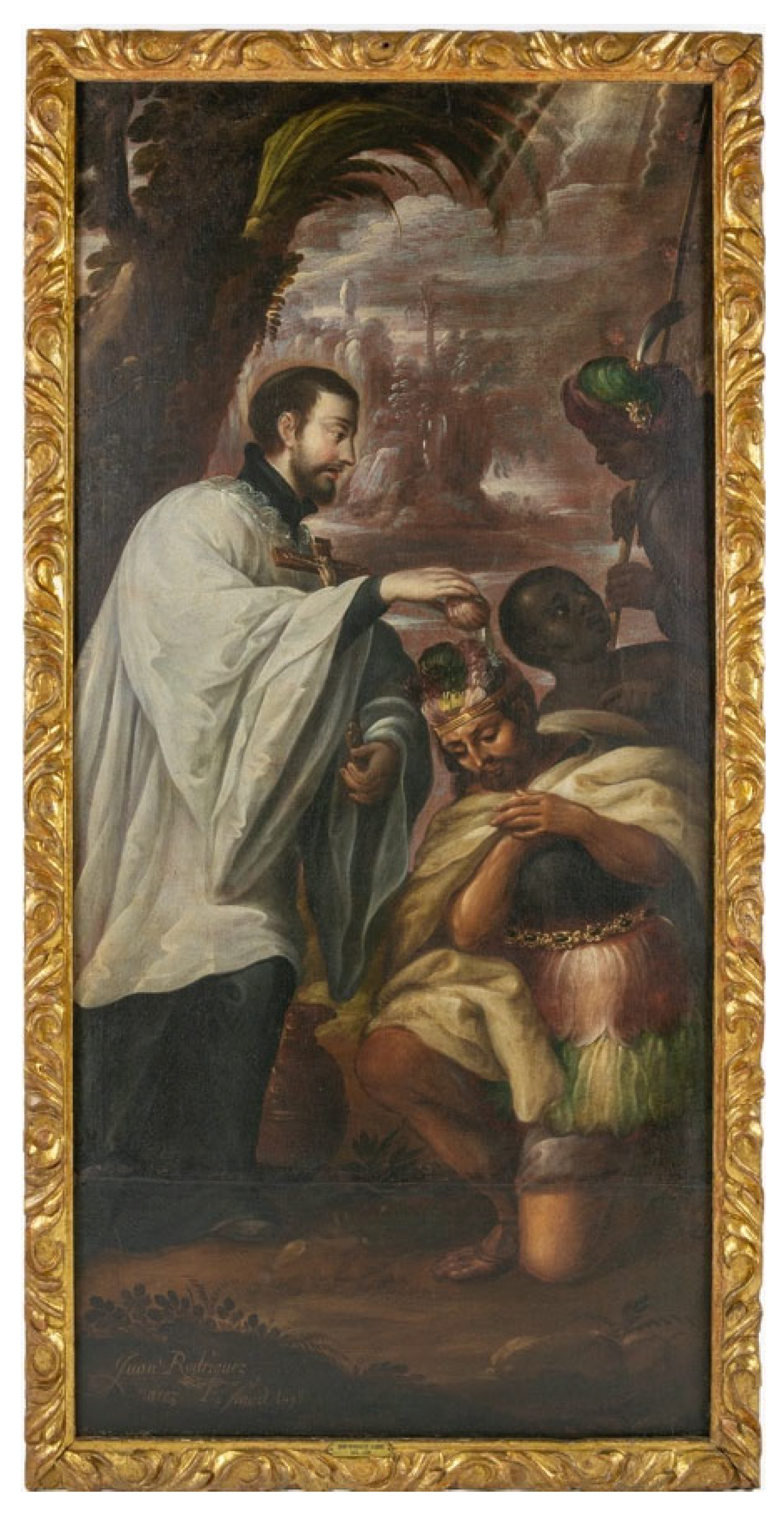
biombos concerned with the correctness of the colonial order and the management of non-white bodies in such a space. Other images expand upon this trope, with the baptizing of Indigenous peoples also serving as a popular motif, a theme also executed by Juan Correa. By and large, such images visually center the saint and complete the figural group with Indigenous supplicants receiving the rite of Baptism, and the Correa examples generally adhere to this format. Of particular interest to the present conversation is Juan Rodríguez Juárez’s version of such a scene,
St. Francis Xavier Baptizing the Three Parts of the World (San Francisco Javier bautizando a las tres partes del mundo) of 1693 (
Figure 6). In the image, the saint and the Amerindian figure are foregrounded together, closest to the picture plane and the primary focus. While not the only figures rendered, the juxtaposition of Saint Francis Xavier and the Amerindian—and their bounded closeness and pyramidal composition as a figural sub-group—serves to position them as the primary point of unification. Again, we see a visual depiction that posits the meeting of the European and the Indigenous as the primary point of contact and interlocution in Spanish colonization.
The figures behind the Amerindian, representations of Africa and Asia, awaiting their own reception of the rite of Baptism, are visually secondary. The image also lacks a specificity of place—the figures are nestled within a landscape that is simultaneously everywhere and nowhere; all the viewer knows is they are not looking at a European (read “civilized”) space. The visual emphasis is instead on the transformative power of the rite under witness. Thus, the image collapses the totality of Early Modern global endeavors into a single visual shot. The subject of the painting is the reception of the Americas writ large as the recipient of Baptism. As in Indian Wedding and Flying Pole, the visualizing of the Christian rite is the point—these images are (at least in part) about framing the Americas collectively as a colonized body, an entity that has been folded into a proper or “civilizing” worldview. While within the narrow visual field, Africa and Asia are shown as secondary, they still participate in this dialogue of transformation. Such images insert the Black body within the dialogues of colonization discussed here, and it is worth considering its visual–rhetorical function.
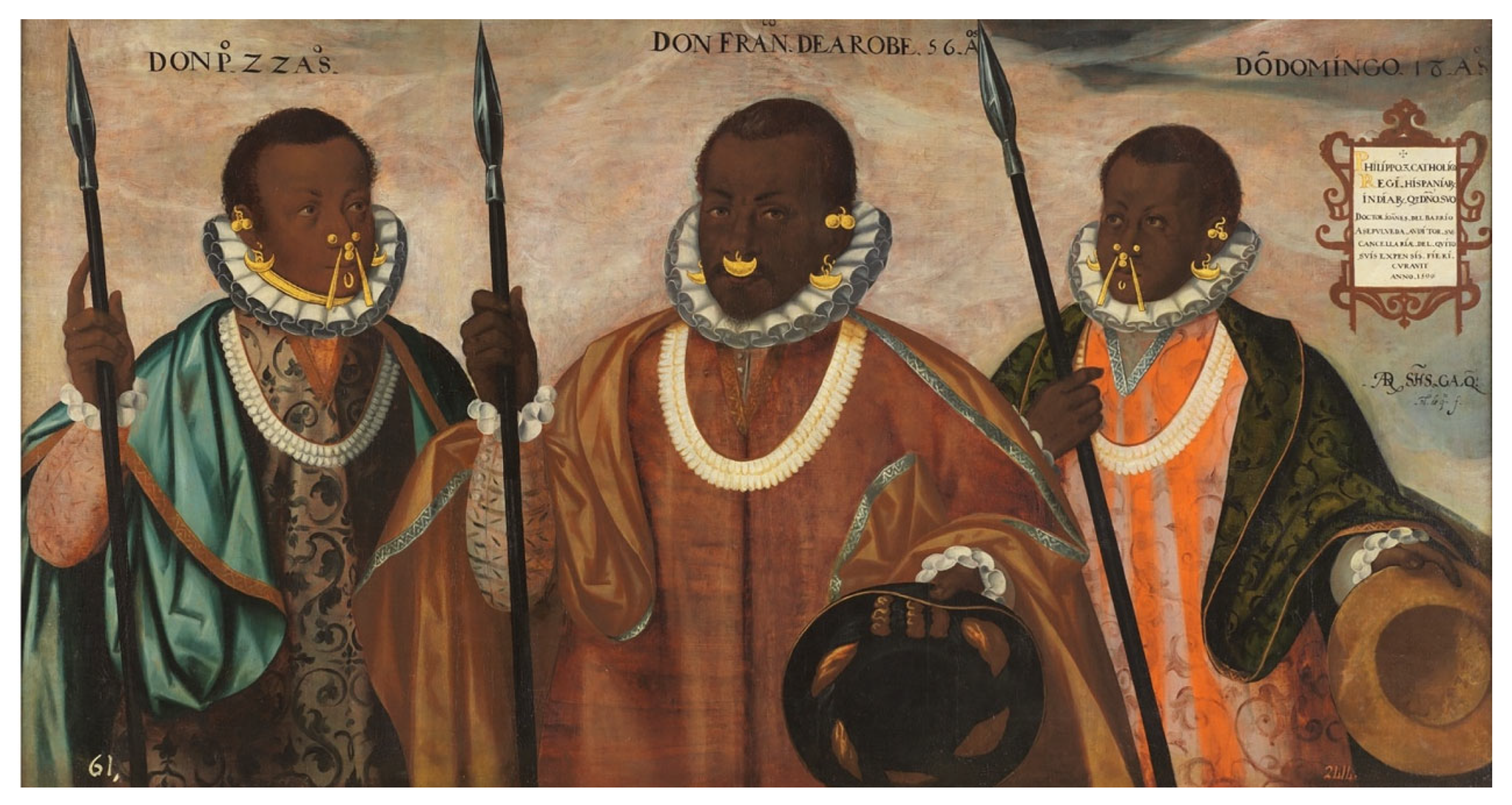
These images explicitly remind us that the Black body serves several visual functions, which are often in tension. Like Correa’s complex social personhood, these enduring matrices established in the early colonial period themselves drew on existing racial rhetoric. Again, we must assert Correa’s positionality as an Afro-Mexican body and thus must examine the roots of the images that shaped and reflected contemporary ideas of the Black body and colonization. To that end, I turn to arguably the most famous colonial depiction of Black bodies in the colonial period,
Retrato de Don Francisco de Arobe y sus hijos, caciques de Esmeraldas, also known as the
Three Mulatto Gentlemen of Esmeraldas (Los tres mulatos de Esmeraldas) (
Figure 7).
Don Francisco de Arobe is a canonical text; a visual marker of colonial origins and a painting ubiquitous in contemporary examinations of Viceregal painting. As the oldest surviving signed and dated portrait from the Viceroyalty of Peru, the image presents an unusually dignified and politically agentive representation of Black bodies in the colonial canon. Commissioned by the principal judge in the Audiencia of Quito (Juan del Barrio Sepúlveda), the portrait accompanied an official report to the Crown on the pacification of the Pacific coast in addition to commemorating the titular Don Francisco’s visit to Quito, where he signed a treaty with the Audiencia in 1598, granting peace and pledging obedience to the King.
18In examining the rhetorical body,
Don Francisco de Arobe stands out because it is unusual. Across the colonial period, the rendering of non-white bodies is heavily indebted to Renaissance visual vocabularies. That is, from the engravings of Hans Burgkmair and Theodore de Bry forward, Indigenous American, African, and Asian bodies were cast in Renaissance visions of Greco-Roman terms (physically) via the artistic turn to Antique models for rendering the form.
19 These constructs were used interchangeably; often, the distinguishing factors were minimal (i.e., the presence or absence of feathered headdresses and the like), and such figures were often featured in anachronistic settings. In such images, bodies coded as African are substitutes for Indigenous American ones or even a generic form meant to simply indicate “Other” and reduce non-white bodies to a trope or visual type.
Don Francisco de Arobe does the exact opposite. In his portrait, the Afro-descended Don Francisco is depicted at age 56, at this point the governor of Esmeraldas, a community of fugitive African slaves and Indigenous Andeans that existed in a state of semi-independence. The painting is an act of recognition—a legitimization of Don Francisco’s political role and testimony of the negotiations that occurred between him and the Audiencia. In the portrait, Don Francisco and his sons remove their hats in deference to the new Phillip III, a symbol of homage that supposes the actual physical presence of the ruler half a world away. Through metaphor, Don Francisco and his sons are physically present before the king and are therefore active interlocutors in absentia with Phillip, a bold statement of their right to represent their communities and negotiate on an even field. They retain an aristocratic appearance—the dignity of semi-independent rulers. This can be directly compared to Correa’s depiction of the “African” royal body in his biombo.
Don Francisco and his sons, Pedro and Domingo (22 and 18 years of age, respectively), are visually presented in half-length and rendered in exacting detail. Each figure stands regally with a spear in hand, richly attired in brocade and silk robes. This is a visual evocation of the gifts given to the trio by the Audiencia on behalf of the Crown including textiles, weapons, and iron utensils. We get a sense of the sitters’ personalities, their dignity, and their air of authority. But this is also an image of correctly colonized bodies. The purpose of the painting is to present these figures to the king; their doffed caps signal submission in addition to the aforementioned respect. The symbolic value of its removal is significant, as it corresponds to the protocol associated with acts of vassalage.
Notably, this gesture also signals their
calidad; it is a testament to their acculturation to Spanish elite norms. Commonly used to characterize people at the end of the colonial era, in the construction of the
sistema de castas, Spain began to deploy some such classifications and place them in hierarchies as early as the late sixteenth century, when they also began to articulate some of the defining principles of racial classifications (
Martínez 2009, 41).
Calidad was typically expressed in racial terms and, in many instances, denoted one’s cumulative reputation. This was inclusive of
raza (race), occupation, wealth, purity of blood, honor, and integrity, among other qualities. In other words, while translated as “quality” or “kind,”
calidad across the colonial period encompassed broader social rankings and reputations, reflecting a person’s place in society.
20 Don Francisco and his sons are, in the painting, performing a
calidad that transgresses typical delineations. Swathed in yards of rich fabric, their bodies are performing the coded language of power for Spanish elite portraiture, with the visualization of their race restricted to their hands and face.
These hands hold the depicted spears delicately—each features a different style of grip, but each also evokes the delicacy of gesture featured in elite portraiture–the delicacy of the hold is another visual evocation of their calidad. The spears are not clutched, they are held. A convert to Catholicism along with his Indigenous wife, Don Francisco retains his original non-colonized identity only through the wearing of the gold labrets, nose rings, earrings, and tooth necklaces of his community. These golden details draw the eye directly to Don Francisco’s face. He makes direct eye contact with the viewer; our gaze is further held in place by the directing turns of his sons’ postures. The face that we encounter is dignified and powerful, uncowed with a commanding pose.
The canvas itself would have arrived in Spain via a ship on a return route of Galleons filled with gold, silver, indigo, tobacco, and other products, a commodified and conquered cache of naturalia that served as a testament to the reach of the Spanish Crown. As a result, the bodies of Don Francisco and his sons were functionally collected by Spain, where they have resided ever since. Such images expressing these early colonial notions of race and classification are the roots of later Enlightenment sureties and the cultural matrix within which Juan Correa’s body itself would have been wrapped. As María Elena Martínez points out, the “early modern Spanish obsession with genealogy,” was reinforced later in the colonial experiment as “colonial hierarchies became unstable,” and new institutions were needed to reinforce existing ones (
Martínez 2009, 42). As previously stated, it is a fundamental claim of this essay that the rhetorical body is an unstable image in the colonial system designed to function in multiplicity. We must, therefore, assert Correa’s positionality as an Afro-Mexican body and thus must examine the roots of the images that shaped and reflected contemporary ideas of the Black body and colonization to express his racialized subjectivity as a Black artist working with, and within, colonial imagery and material culture.
2. Race and the Visual Sorting of Bodies
Images, as a result of such rhetoric, played a key role in developing a
criollo consciousness, and a strong sense of
criollo pride developed in the late sixteenth and early seventeenth centuries. Over this time, as the colonial world was built, American-born descendants of Spanish
peninsulares moved into positions of power and prestige and became the elite class of the territories. Europeans in the metropole, however, continued to denigrate
criollos as members of the imperial periphery, so the latter sought to establish an identity by extolling their country and its inhabitants. The strong sense of
criollismo was cemented in the second half of the seventeenth century and flourished in the eighteenth century throughout Spanish America. One of the facts that the
criollos of New Spain could not get away from, however, was that the majority of the territory’s population (at the beginning) was Indigenous. This complication was mitigated, significantly, by the fact that Indigenous peoples of the early colonial period were newly Christianized; their
limpieza de sangre (blood purity, or absence of non-Christian blood) could not be doubted. This is a complicated statement; however, the term, “limpieza de sangre,” (lit. “cleanliness of blood”) sometimes refers to the absence of Jewish, Muslim, or Black ancestry and at other times refers to simply the absence of non-Christian heritage.
21 Also, many
criollo intellectuals descended from Indigenous nobility, and contemporary debates distinguished between “new” and “old” Christian blood. With all of these competing factors, the relationship of
criollos to the Indigenous population was contradictory at best.
In the late colonial period, Indigenous bodies were often used as a visual symbol of the providential destiny of New Spain, and criollos with some Indigenous ancestry were still thought to be possessed of limpieza de sangre. While the term “criollo” refers to those of European ancestry born in the Americas, it can also be applied to those who have one (or a few) Indigenous ancestors, and prominent families would in fact boast of their mestizo origins when the marriage was between equals (i.e., the pre-Hispanic ruling class and the Spanish conquistadors). Ultimately presented as a simple binary, this version of mestizaje downplayed the global scale of colonial interactions and erased the complexities of Viceregal life.
As a part of this framing of the Black body, we must consider the visual categorizing, classifying, and displaying of such via such examples as the casta paintings. Although produced after Correa’s time, these images link the rhetorical framings of the Black body, limpieza de sangre, and mestizaje—imaging a late colonial visual legacy founded on early colonial and Medieval social anxieties. Furthermore, Correa is an artist who participated in defining the realm of New Spanish painting that gave rise to the casta images, a significant fact when one factors in his identity positionality. A defining element of eighteenth-century Mexican art, the casta paintings were designed to speak to an external audience about the diversity of peoples created by colonization of the Americas and mestizaje. Mestizaje, as we have seen, is a sticky term, and it is important to point out here that mestizaje as a concept has its roots in Medieval Spain.
As María Elena Martínez has observed, the Spanish colonial sorting of individuals has cultural roots in Medieval Spain, where, as part of the Reconquista, there was a perceived need to describe and categorize “hybrid offspring” of the type produced by Christian–Muslim intermarriage (
Martínez 2008, 142).
22 The term was first used in 1275 and reflected the general social anxiety about the “mixing of bloods” on the Iberian Peninsula and the need to name and categorize the resulting offspring. This is an important moment as it is quite in the middle of the Reconquista, the Christian monarchs’ attempts to push Islamic polities and Jewish communities out of the peninsula, and the solidification of the concept of
limpieza de sangre in which an honorable Christian identity was linked to the absence of Jewish or Muslim blood. Visual manifestations of these ideas were quick to emerge, and about five years after the first textual use of
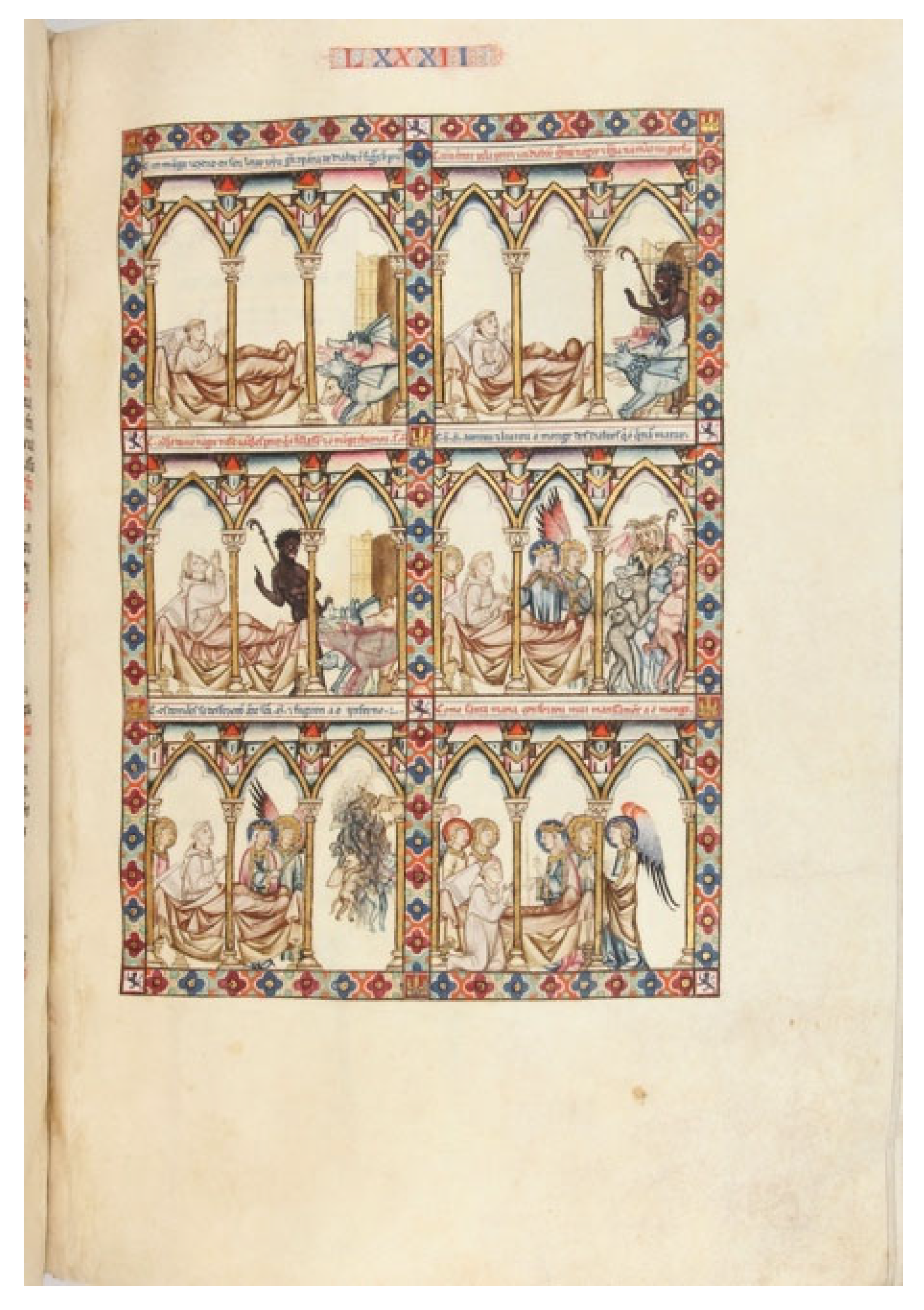
mestizaje, we begin to see Medieval Spanish artists clearly engage the Black body as a signifier of demonic potential, specifically in works such as Cantiga 82, of the
Cantigas de Santa María.
Throughout the texts of the full
Cantigas, the visual renderings repeatedly use dark pigments to depict Satan or his followers and often complement the songs’ own references to the Devil as black (
Patton 2016, 225). The illustration on folio 120r specifically and overtly engages the topos of the Ethiopian in its rendering of Satan (
Figure 8). His very dark skin and exaggerated physiognomy are marked by oversized white eyes and teeth, protruding red lips, and short, unruly hair. The motif of the Ethiopian has long-standing associations with sin and emerged as a consistent visual form by the mid-twelfth century. In Medieval symbolism, the Ethiopian’s blackness connoted moral degradation and lack of rectitude (
Patton 2016, 219–221). As Pamela A. Patton has noted, Cantiga 82 offers a particularly literal example of the Devil in this frame and emphasizes the figure’s blackness (
Patton 2016, 228). Patton also links the topos of the Ethiopian to women, Blackness, and sex, and she also examines vivid temptation accounts of demons presenting themselves to challenge the chastity of monks in the form of Ethiopian women. She points out that,
“[s]uch dark-skinned temptresses merged familiar stereotypes concerning the sexuality of Ethiopians with similarly venerable conceptions of the female body as both inherently lascivious and dangerously tempting. Women had long been perceived by Christian thinkers as more susceptible to fleshly desires than were men, posing a social danger that could only be controlled by the careful safeguards of male authority” (
Patton 2016, 229).
In the way that sin embodied by the Medieval Ethiopian topos could be alleviated via conversion to Christianity, an allegorical relationship exists within the connotations of
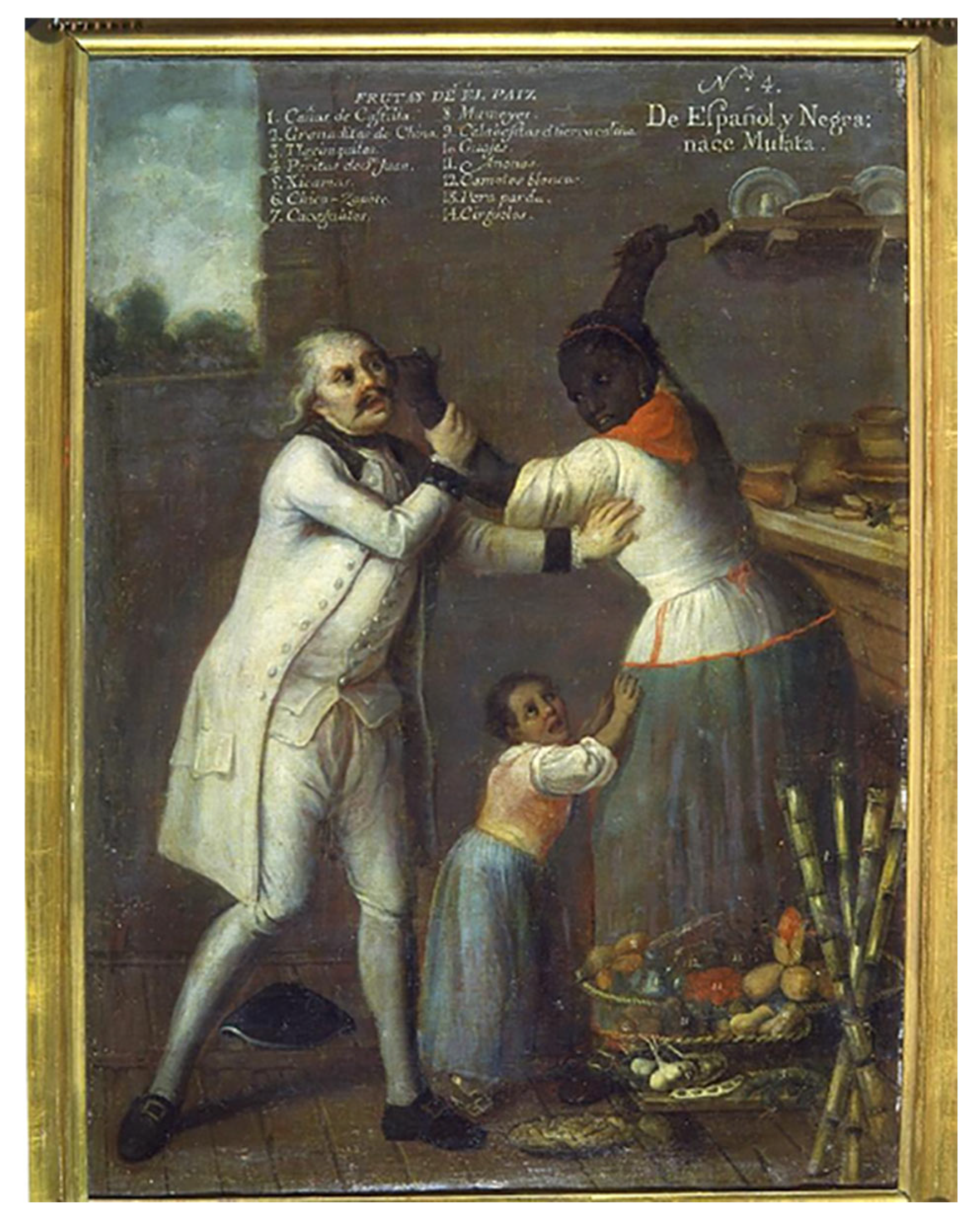
mestizaje. While the presence of Blackness dilutes and corrupts the “purity” of Christian (read: white) blood, that same blood elevates, purifies, and works to negate as much as possible the passions and tendency to sin of the presence of Black blood. Such Medieval notions endure, transform, and are subsequently visualized in eighteenth-century works such as Andrés de Islas’s
No. 4 De español y negra, nace mulata (No. 4 From Spaniard and Black, a Mulatta is Born) (
Figure 9). In the image, the traditional hypersexualization of the Black feminine body is visually rendered as an explosion of violent passions. Restrained by her white husband, the titular
negra is further held back, her violence rendered as dangerous and socially incorrect, by the gentle pleading hands of her
mulata daughter.
In the family figural group, the
negra is positioned in opposition to the
español and their daughter, with the latter forming the visual linchpin. The violence and chaotic timbre of the image is striking, as is the visual of the two figures with white heritage restraining the
negra. As Ilona Katzew has noted, the scene is one of “domestic degeneracy,” in contrast to other images that depict the
español as “controller of his family and his environs” (
Katzew 1996, 24). While in other images, the figure of the Spanish man is calm and composed, physically positioned to enjoy domestic bliss, here he barely restrains his wife, his body actively engaged in the physical altercation, his hat having been knocked to the ground behind him. Katzew further points out that there is a distinct trend within the
casta paintings of depicting certain mixes of couples as leading to the “contraction of debased sentiments, immoral proclivities, and [...] a decivilized state” (
Katzew 1996, 24).
In other words, these images are also about the moralization of the social body. The implication here is that Spanish or white blood is a redeeming factor, while Black is not. The mulata daughter in the image is tainted by her mother’s Blackness, but clearly takes after her father in her opposition to her mother’s violent passions. The point is further driven home by the look of distress on the child’s face, her mouth open as if pleading for a cessation of the violence. She is also painted significantly lighter, her skin tone more in line with the Indigenous women depicted in the series. This takes on additional nuance when we consider other examples, such as Correa’s El encuentro de Hernán Cortés y Moctezuma. As previously noted, here, Correa actively engages a visual pacification of the Indigenous female body in a moment of tension between Motecuhzoma and Cortés through the integration of Malintzin. Through her physical position and attire, Malintzin (by this point, Doña Marina) represented the converted woman. While she is not Black, she is not white either—her otherness is both visible and contained—but it is quite literally folded into the moralizing framework of Christianity. This point is driven home by her visual similarities to images of the Virgin Mary on her journey to Bethlehem.
The casta paintings are specifically a representation of the sistema de castas, the system of racial lineages in Spanish America. They are designed to reflect and define not only the existence of the multiplicities of racial heterogeneity in Viceregal society, but also to display what were seen to be the innate characteristics of different racial classifications in “scientific” terms as defined by the European Enlightenment. Importantly, the casta paintings depict family groupings, implying the inheritability of morality and race as a biological factor. The family unit is also the cornerstone of colonial society and a microcosm of the social body. Each scene depicts a man and a woman, each of a different racial classification, and the one or two children that result from their union, with the children rendering a third racial step visually present. This motif is also present in Correa’s depiction of the four continents, and his Four Continents itself is not unlike a casta painting—almost a prototype in its essentials.
In the
casta paintings, the “diversity” showcased is that of the
eighteenth century; in other words, what is depicted is the
result of colonization and the progressive “dilution” of “pure” European, Indigenous, and African blood. Intermarriage among these three groups was not common until the second half of the seventeenth century, and Juan Correa, therefore, was a physical representation of a wave of this specific form of
mestizaje (
Katzew 1996, 9). When discussing race in colonial Spanish America, the specificity is important, as it represents the construction and (re-)affirmation of social hierarchy. This specificity is also extended to the settings, which render the flora, fauna, food, and objects of the colonial world. In the
casta paintings, these accoutrements serve as visual markers as much as the figures’ skin tone and play into the Enlightenment trend of classifying and categorizing racial typologies.
23 The
casta paintings are designed to speak to the rhetorical body and its
collection. Any patron is removed from the scenes depicted. The result is that human beings are classified in the vein of naturalia, calling to mind the myriad drawings of plants and bugs taken back to Europe by scientific expeditions.
The spaces of the casta paintings are also racialized social spaces; as Mey-Yen Moriuchi notes, they are “settings in which racial, social, and gender relationships were imagined and visualized” (
Moriuchi 2016, 228). The Black and Indigenous figures depicted are invariably displayed as prone to “hostile and passionate streaks that could not be controlled” (
Moriuchi 2016, 230). But this is further contextualized by different connotations resulting from the socio-economic cues visually rendered within the spaces occupied by the families. To return to Andrés de Islas’s painting, the space we are given access to is not one of poverty, nor one of privilege. The kitchen in which the altercation takes place is clean and well-kept, with a large window admitting light and fresh air while simultaneously giving the viewer a slight glimpse of the landscape outside.
However, the negra as she is depicted is a creature of the kitchen, her body restricted to that side of the canvas and physically overlapping with the workbench behind her. Her clothing is well-maintained; her sleeves are pushed up, and we have a hint that she also wears an apron, indicating that the scene has interrupted her work in the kitchen. This point is emphasized by the utensil she wields that was presumably selected as her weapon due to its physical proximity. The implication is one of a quick temper, a passion suddenly inflamed. Without further clues, the image reduces such a reaction to the physical personhood of the negra. We are not given an external reason to validate her reaction, and so it must come from within, an innate feature of her being. The system of classification represented by such images was solidified and made visually explicit in the latter half of the eighteenth century, but they were not invented out of whole cloth.
Images such as
De español y negra nace mulata represent a system made visual that was explicitly linked to studies of the natural world, while also articulating concepts of race and the social body that were complicated by the arc of colonization of the Americas. Blackness in the colonial world was therefore negotiated under these terms. The main principle of the
sistema de castas, namely that reproduction between persons of different racial classifications was a thing to be ordered, also communicated through ordering that Black blood was more damaging to Spanish blood than Indigenous blood. Those colonial bodies of Spanish–Indigenous descent could, if they continued to intermarry with Spanish lineage, eventually attain
limpieza de sangre. The religious-to-racialized allegory previously mentioned meant that, as notions of “purity” and race became secularized, Indigenous blood was allowed to be redeemed while Black blood was actively positioned as a corrupting force (
Martínez 2009, 41–42).
3. Painterly Identities
The seventeenth century was a pivotal moment in New Spain, in terms of sociopolitical frameworks, culture, and artistic production. The latter half represents a fulcrum: the ending of the early colonial period and the birth of the late.
24 The era thus represents at times contradictory impulses and responses to identities still being shaped and defined. By this point in colonization, New Spain featured a wealthy
criollo elite, still kept out of the most hallowed halls of power by the
peninsulares (Iberian-born Spaniards), a robust missionary endeavor in northern Mexico and (what is now) the U.S. southwest, and the consolidations of regional wealth in urban spaces like Mexico City and Puebla. These were, themselves, as Juan Luis Burke notes, modeled after the colonial center via imported forms (
Burke 2021, 29). The cities of New Spain therefore existed as a space of performance: a local audience performing the center-periphery dialectic within the global and local discourses of coloniality.
There is both a pairing and a disjunction between the global and the local in the colonial Americas, specifically when one takes into account the elite framings of identity and the politics of mimicry, established by Homi Bhabha as “one of the most elusive and effective strategies of colonial power and knowledge” (
Bhabha 1984, 126). The idea of colonial mimicry holds that while the standards of the colonizing (European) center might be spread out across the global empires, the bodies that exist in the colonized holdings can never achieve them—they are, and always will be, Other, and therefore less. Mimicry, therefore, always reveals the colonial subject. The product of the colony will always be a (perceived) poor facsimile, regardless of the proficiencies of the creators, and, while colonial artists might adhere to the creative technical standards of the European, there will always be a difference that reveals and exposes the colonial positionality of the creative hand. In other words, true mimesis is impossible. This exposure crosses racial and ethnic lines and the divisions explored earlier, as in Correa’s
biombos. Thus, the idea of mimicry applies to the colonial subject regardless of their elite or plebeian status, and regardless of whether or not that status is conferred via racial categorization
This is the primary reason to explore a selection of Juan Correa’s elite secular imagery, rather than his religious commissions. The
criollo elites of New Spain, those paying for such images, were an audience speaking to themselves about themselves and sublimating their own anxieties as colonial subjects. Across the colonial period, as the imperial project expanded, solidified, and became more diverse, local elite spheres were produced within which a white, European-descended body existed in positions of local power on behalf of the metropole in Europe. What, then, is the nuance of this colonized (and colonizing) body? It is a body that exists both in its local elite sphere of power and its global positionality as an imperial subject—the distance from the imperial capital necessitating its lesser status. The local elite status, that of the artist, or of the patron, might provide familiarity with the imperial standard, and the colonial subject might perceive their product as mimetic, but they will only ever be a “mimic man” (
Bhabha 1984, 128).
In short, colonial life was one of pronounced heterogeneity, and major urban centers such as Mexico City demonstrated this at its fullest. The cities themselves, however, were styled as the foci of culture; in other words, the spaces where white New Spain performed their understanding of European-descended culture. Within this, the Black hand was present. Artists working in these cities, across social classes, had Black studio assistants, were themselves slave owners, and, furthermore, enslaved populations were a distinct presence across Mexican cities, not just on the coast, as is typically characterized. While enslaved populations of New Spain are often discussed within a rural or coastal context, Mexico City was not alone in their presence. Furthermore, slavery also intersected with artistic practice through the participation of artists as purchasers of human bondage. Within both the enslaved and free communities of color in these urban centers, Black studio assistants also toiled in workshops and participated at all levels of visual and material cultural production.
25Relative to this, the painters’ guild in Mexico City began a period of reorganization in 1681–1683. Predominantly a revival of ordinances that remained from the sixteenth century, new stipulations were added to reflect contemporary concerns. Within this restructuring, artists of African descent were no longer permitted to rise to the level of “master,” (
maestro pintor), a designation now reserved for those of “pure” Spanish lines. As a result, “masters” began signing their paintings as proof of their racial purity, or
limpieza de sangre, and all guild members were now required to sign their completed works before installation or sale (
Hyman 2017, 122–123).
26 Correa is therefore notable as a mixed-race artist because he has been
allowed to participate in realms historically reserved for white artists. Correa’s racial positionality
should have precluded him from achieving such success. The arguments in favor of the guild stipulations were grounded in the perspective that artists of the
castas brought dishonor to the noble art of painting, a direct response to the heterogeneity of the class of painters in Mexico City (
Deans-Smith 2009, 46) (see also,
Thames 2023, 126). As Susan Deans-Smith notes, the majority of those involved in establishing new guild stipulations were Spanish or
passed as Spanish—the ambiguities of painters’ identities are rooted in their marking in the archival record. For example, the artists José de Ibarra, Juan Patricio Morlete Ruiz, and Miguel Cabrera all textually self-identified as “Spaniards” even though they were, respectively,
moreno,
mestizo, and “unclear” (
Deans-Smith 2009, 46–47).
Correa is often pointed to as evidence of openness amongst the painterly establishment due to his success, when in actuality, to quote Deans-Smith, “[the] guild, and their socio-economic backgrounds and networks reveal ambiguities in their position and status in colonial society” (
Deans-Smith 2009, 47). This essay has explored how Correa’s personhood would have been marked contemporaneously. The whiteness Correa inherited via his father’s bloodline provided a legitimating component to his identity, a personhood that would have been circumscribed by notions of
limpieza de sangre. In seeking to establish himself as a painter of note, Correa would have pursued tropes and visual narratives that reflected the dominant aesthetic system, not necessarily a personal exploration of identity.
27 Importantly, Correa has always been accepted as a prominent, influential, and important artist of colonial Mexico, but his Blackness has historically remained a somewhat elided point of exploration. This is part of a larger discussion of art historical pedagogical practice that is beyond the bounds of this essay; however, it is an important point when examining the foundations of hegemonic systems of control. In not mentioning Correa’s African heritage, and not framing him and his work through an examination of the impact such a designation would have had upon his abilities to navigate the colonial world, the historiographical literature has (perhaps unintentionally) framed him as a member of the dominant positionality. In other words, when whiteness is the default, not acknowledging racialized difference(s) places the artist within this dominant category and allows them to participate in the shaping of the visual system and to defy the social codes placed upon their personhood.
While the majority of extant art from the early colonial period is religious in nature, and Juan Correa is a robust participant in this sphere, secular art and architecture were important factors in the construction of the Viceregal social landscape. It is in the realm of elite secular arts that we find defining features of the social matrix formed around colonial identities and the negotiations of colonial norms. In particular, the category of biombos is especially enlightening as they express and visualize a number of trends but specifically provide insight into the tastes of elite audiences and the narratives about themselves that the criollo class was specifically invested in developing. Popular in elite and aristocratic homes, the biombos were painted folding screens derived from the tradition of the Japanese byobu. As a paneled screen meant to serve as an accent in a large reception room, the Novohispanic biombos adorned grand Viceregal homes and expressed the global reach of Spain’s empire through their very materiality.
The first Japanese folding screens (
byobu) arrived in New Spain as diplomatic gifts in 1614, as the Spanish territories of the Americas served as a transitional space embedded within imperial trade routes. Via these imperial trade networks, the subsequent introduction of the folding screen as an item of European décor was inextricably linked to colonial ambitions. Generally agreed to originate in China under the Han dynasty, their popularity flourishing under the Tang, folded-screen room dividers spread to Japan in the seventh or eighth century, where their ubiquity made them prominent spaces of visual culture. With the closing of Japan’s borders in 1638, China then became the primary source for many of the screens imported to Europe in the seventeenth and eighteenth centuries. This robust trade network had the additional output of unique acts of visual and material transculturation, and along their journey, the Japanese examples influenced the creation of Novohispanic adaptations. When the screens became widespread in New Spain—and their terminology Hispanicized to
biombos—they maintained certain tastes specific to the Japanese Momoyama Period (1568–1615), such as the inclusion of gold leaf clouds, but transformed the landscape themes prominent in their place of origin to predominantly local or invented scenic views, urban vistas, and historical themes. Over time came the additional inclusion of allegorical subject matter. These moments of hybridity and influence were however not passive, but rather reflected the adaptations and manipulations of global art histories in local contexts.
28The point here is that, while the
biombo imagery moved away from the East Asian visual preferences, the materiality of the object retains the stamp of the global reach of Spain’s empire. The Correa
biombos are therefore an encapsulation of the colonial system through their material agency. What is visible through the imagery is the hegemonic standard of artistic practice and local narratives of place identity. As a result, the heterogeneity of the colonial world is physically made manifest by their creation, and subjective bodies are thereby visible, but the imagery renders those subjective bodies invisible. And it is not an insubstantial fact that Correa is a Black artist engaging with dominant colonial visualities on a medium and frame imported from Asia. The
biombos are predominantly oil on canvas, with some examples executed as
enconchado paintings on wooden panels. The materiality of the latter added an additional layer of meaning, as the mother-of-pearl inlay was a glittering manifestation of Spanish control and the colonization of nature (see
Torres (
2024); see also
Ruiz (
2024)). Juan Correa’s
oeuvre features a few
biombos, including
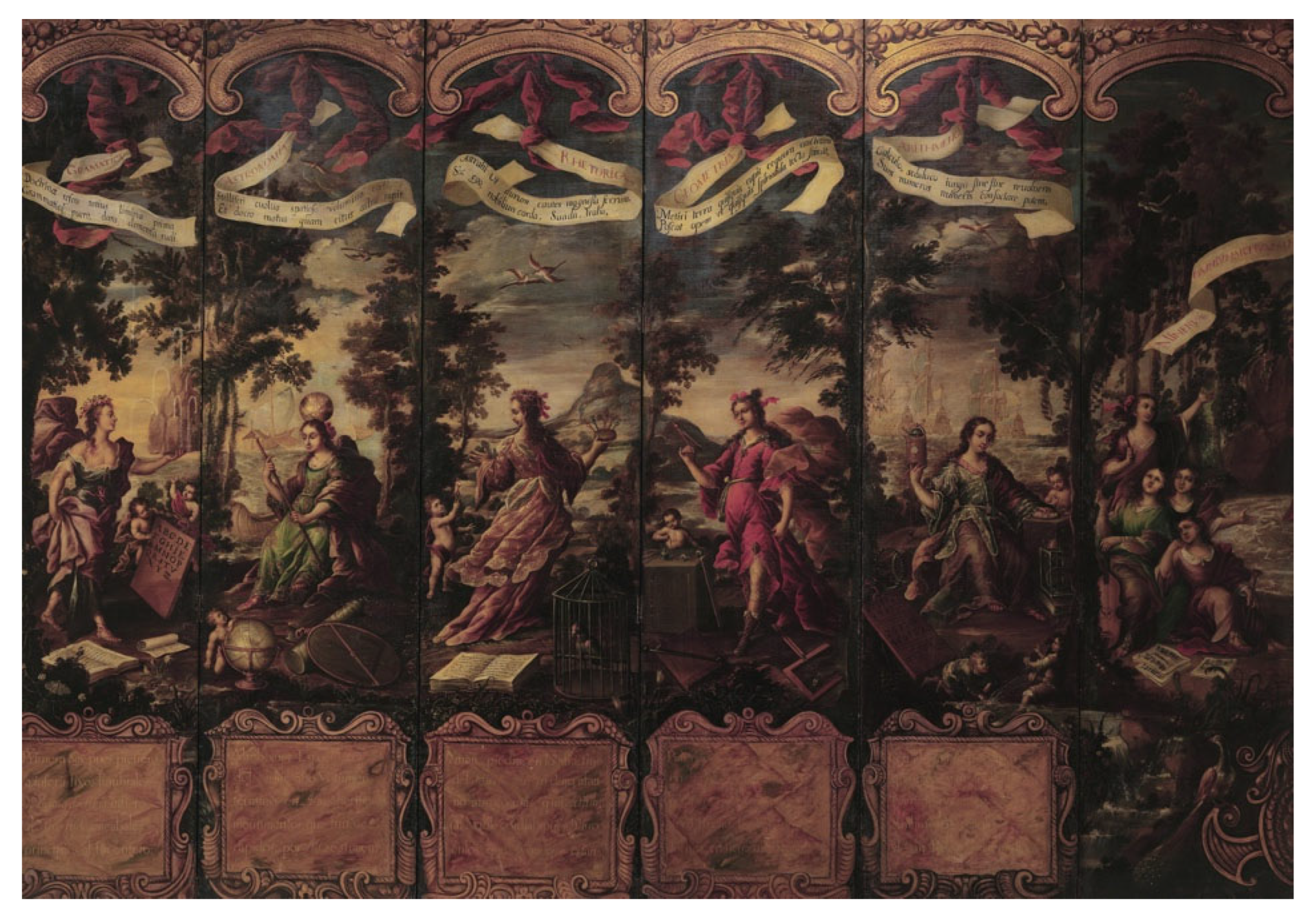
The Liberal Arts and Four Elements, executed c.1670 (
Figure 10 and
Figure 11). Now housed at the Museo Franz Mayer in Mexico City, this example was commissioned by the Viceroy of New Spain, Archbishop Don Fr. Payo Enríquez de Rivera.
29 As is typical of
biombos, both sides are canvases for imagery. The full
biombo, however, does not survive. Typically a set of around ten panels, this example is (at six panels) believed to exist now in roughly half its original expanse.
On one side, female allegorical figures of the four elements ride on triumphal carts and are accompanied by mythological figures. On the other side, allegorical figures represent the Liberal Arts, combining science and knowledge, including Grammar, Astronomy, Rhetoric, Geometry, and Arithmetic. The figures of the Liberal Arts are believed to have been originally arranged in two groups, each on either side of a fountain along with representations of the Muses, Apollo, and Minerva (according to the inscriptions on the screen). It is also likely that the screen included representations of Painting, Sculpture, and Architecture. Such erudite imagery was popular in elite spaces, and designs (as here) were drawn from imported seventeenth-century books on Classical symbolism and allegory.
The choice of subject matter is typically ascribed to Rivera’s interests in Classical literature, the arts, philosophy, and theology as the motivation for a design that places art and nature in a binomial relationship. The side of the screen devoted to Nature is dominated by two triumphal chariots carrying the allegorical figures Earth and Air. The first, which stretches across the foreground of the three right panels, is pulled by oxen and carries the figures personifying Summer and Earth, the former clasping ears of grain and fruit. The
biombo’s middle-ground features the chariot of the Wind, drawn across the three left panels by eagles. Driven by the nymph Chloris who appears as Spring and clutches a cornucopia of wildflowers, the chariot also features the wind Boreas, whose red cloak billows dramatically behind, echoing the swaying branches nearby. Based on engravings by Anton Wierix, the composition is simultaneously pastoral and dramatic and bathed in Correa’s trademark warm color palette.
30 As the eye moves across the
biombo’s panels, distinct figural groups and vignettes emerge; each features its own narrative flavor while maintaining unity through a rich and populated landscape of birds, animals, fruit, trees, and
putti, suggesting fertility and prosperity. At the far left of the scene, a fragment of a large tree serves as the original dividing point of the composition; the panels that featured the chariots of Water and Fire are now missing.
It is worth stressing here that while Enríquez de Rivera may have chosen the iconographic program and supplied source engravings by Wierix, Correa is more than a copyist. As is well-attested in the literature, artists such as Correa often worked from European print models but reconfigured them in fundamental and inventive ways. For the reworkings of this model, Clara Bargellini specifically points out Correa’s changes to the compositional integrations, reductions of Classical mythological references, the modesty he imprints onto the female figures, the inclusion of children, and the visual importance lent to the landscape, among other details (
Bargellini 2017, 133–141). In other words, Correa’s execution of the theme of the Elements represents the tensions between the global (import) model and local visualities.
Such reworkings take on additional import when we question Correa’s authorial role vis á vis his racial status. As Aaron Hyman has pointed out, pejorative notions around slavish copying are entangled in the foundations of colonial art history but have roots in Antique narratives around the liberal arts that were integrated into Early Modern artistic and social philosophies. Hyman takes the point further by establishing a relationship between “the servile, slavish copy and the free, liberal art,” as marking a binary between disenfranchisement and enfranchised citizenship (
Hyman 2017, 123). While engaging European print models was standard practice for painters of his day, the charge of “slavish copying,” bore additional resonance for Correa as it was, to borrow Hyman’s language, “race analogized in the formation of images” (
Hyman 2017, 125). In other words, Correa’s racial positionality should have precluded his status as a
maestro pintor, and his divergences from the original European prototype therefore reinforce his status as a master through the contemporary dialogues around invention in ways they would not for a similarly inventive
criollo artist.
31Hyman’s discussion of copying adds a specific nuance to understanding Correa’s subjectivity as a Black artist and his participation in the dominant visual system(s) that relied on his ability to
perform as a painter in the political sense. As we have seen throughout this essay, the politics of painting in Early Modern New Spain were defined by narratives of colonial order and a prioritizing perspective of colonial correctness. Again, there is a reliance on metropolitan models and a tension for artists working on the peripheries of empire. Within this, the elite colonial interest in European mythological imagery is well-established, part and parcel of the explosion of maps, atlases, and the voracious interest in categorizing and classifying the naturalia of the “New World,” when Europeans turned to Classical Antiquity and a paganism with which they were more comfortable as the framing devices to make sense of new (to them) lands and cultures. It is also no coincidence that contact with the Americas occurred at the beginning of Early Modern scientific developments, and the history of the two cannot be separated. The history of science runs through the natural collections and
Wunderkammern within which the flora, fauna, and visual and material culture of the Americas were collected and displayed. These cabinets of curiosities were positioned as repositories for the wonders of God’s creation and additionally served as a means of showcasing wealth and knowledge. In other words, these encyclopedic collections of objects whose categories were yet to be defined additionally represented the social performance of the colonial matrix (
Baudrillard 1994, 8).
Similarly, Correa’s screen represents an expression of erudition designed to display the intellectual and cultural sophistication of its owner and artist. But of specific importance is the dual nature of the biombo. Originally featured in reception and semi-public spaces of the home, the biombo relies on the movement of the viewer to unify the two sides. As the viewer meditates on first one side then the other, they move around the screen, their body the physical link between the two sets of panels and the conduit of meaning. As one surveys first one side then the other, the body moves between the allegories. First, a landscape of natural power, lively and only visually ordered by the pockets that happen to be created via the peaks and valleys and vegetation of the lush and dynamic vista. Next, a landscape of intellectual power, with each panel a defined and bounded vignette containing a single allegorical figure in front of a slice of the natural landscape behind.
Nature, here, is ordered and precise. Trees stand tall and straight in the panel seams, their boughs a framing device for the feminine forms between. Surrounded by their various accoutrements, the allegorical figures are depicted within nature yet apart from it. The landscape feels distant—the ships and mountains receding into the background. The shallow nature of the picture plane places each woman close to the viewer and makes them active interlocutors separated only by the golden phylacteries at the bottom of each panel. As one moves between the two sides of the biombo, the landscape transforms—first a dynamic scene of movement and energy, and later a scene of order and precision. It is therefore via the direct phenomenological experience in the body of the viewer that nature and culture are unified.
Through (European) culture and scientific framing, the landscape of nature is given shape and peace, a calmness, through the ordering principles of the Early Modern intellectual world. Through the act of looking, the viewer may therefore superimpose themselves as the linking force between the two. Furthermore, while wild, untamed, and untethered, nature is still relegated via the picture plane into a panel organization, with each bend in the screen providing distinctive framing. This presupposes nature as a
thing to be ordered. As a physical body, nature is only ever tamed once given the guiding hand of human society. The project of coloniality cannot be divorced from this, and the colonization of nature must be thought of as a central tenet to the project of empire, in line with the program of
casta painting.
32 As an Afro-descended artist, Correa himself is therefore a thing to be ordered, but it is in fact his own image that does the ordering.
In conclusion, while Juan Correa, as an artist, renders the African history of the Americas visible through his own personhood, we must consider the historical differences and invisibilities of positionalities in the past. As one of the most prominent artists of his time, Correa was an active participant in the dominant narrative structure that the visual corpus reflects, but he also reflects the position of an outlier. The Black hand is present in the material culture of the Americas, and Juan Correa stands out precisely because of his prominence, while the primary challenge of excavating the lived experiences of artists of color in Viceregal Mexico remains the silences of the archival record. This essay argues that a simultaneous visibility and invisibility of the Black artist in the colonial world is therefore reflected in the objects made, commissions undertaken, and spaces of professionalization.
The fullness of the contributions of Black artists has remained neglected as a site of artistic enquiry, but in the narrative of power, the absence is the point. With this challenge, the close reading of visual texts becomes paramount, and this essay has turned to Correa’s biombos to understand what historical, cultural, and social mechanisms allowed for, and how they perpetuated such disparities in the first place. This conversation also examined colonial constructions of race and identity to establish the roles Blackness was assigned in Viceregal society and the visualizations of rhetorical bodies. This allows for an understanding of how Juan Correa was himself inserted into such racialized contexts. Finally, this essay examined the visual narratives of colonial order and the tandem construction of mestizaje to argue for a European–Indigenous binary as the essential and founding connotation of the identity of New Spain’s body politic. By attempting to address historical absences by posing questions, problematizing framings, and inviting further discussion, we can begin to understand the lived complexities, pluralities, and richness of the colonial world, hopefully leaving a better archival trail in our wake.