


Abstract
This study focuses on the construction sequence of three complex and atypical Scythian kurgans at the Vodoslavka burial ground in the Northern Sivash region, which incorporate several unique structural and ritual elements. One of the most striking features is the layer of mud applied to the ground surface prior to mound construction, which, in several cases, formed anthropomorphic outlines. Funerary feasting, which took place both before and during the burial ceremony, was just one of the other features. So too was the deliberate shaping of soil removed from the central grave into a spherical segment, and the ritual activity associated with this prepared spoil heap. Although the mounds’ preserved height is relatively modest (originally about 3–5 m), their internal organisation and the composition of the grave goods suggest that they were used for burying individuals of high status within Scythian society. The cemetery’s proximity to major salt lakes suggests that the local elite’s affluence may have been linked to their control over this vital resource. The architectural and depositional features of the kurgans can be interpreted as elements of a ritual system designed to ensure the deceased’s proper transition to the afterlife. The design of the burial chambers and the richness of the grave goods reflect a concern for the conditions of existence in the afterlife, while the associated manipulations of the sub-mound space and mound deposits, prepared surfaces, deliberately shaped spoil heaps, and related ritual practices can be understood as material markers and procedures intended to secure the successful passage of the deceased to the afterlife.
1. Introduction
Scythian kurgans are now widely recognised as complex architectural structures, an interpretation originally formulated by M.P. Gryaznov. Gryaznov observed that kurgans were never constructed as simple mounds or mere piles of earth1. Instead, each kurgan was a technically sophisticated construction, erected according to a preconceived plan and constructed using turf alone, turf and stone, turf and timber, or a combination of these materials.
Most construction techniques used in building kurgans and related structures, along with various elements of the kurgan funerary rite, originated at the inception of kurgan-building traditions. These practices persisted throughout the entire period of the kurgan tradition, regardless of the ethnic affiliation of the communities involved.
All kurgans have been destroyed by natural erosion and anthropogenic impacts from economic activities. Consequently, none have retained their original appearance or dimensions (Gryaznov 1961, pp. 22–25).
Recent research on the kurgans, early nomads of the Eurasian steppe, has substantially broadened the understanding of these monuments. Currently, kurgans are recognised not only as burial structures but also as sophisticated, multifunctional architectural and ritual complexes. Geophysical methods, particularly magnetometry, have demonstrated that a significant portion of these structures is situated both within the mound and in the surrounding area, forming what is referred to as the “kurgan periphery”. Around large Scythian-Saka kurgans, features such as ditches, ramparts, stone rings, ritual platforms, and systems of small structures have been identified. It is now evident that kurgans served as centres of ritual activity. Archaeological and geophysical data indicate that memorial ceremonies, sacrifices, and public gatherings occurred on their periphery. Therefore, a kurgan can be regarded as a “sacred complex”, encompassing not only a burial site but also a deliberately organised space for ritual activities (Parzinger et al. 2003, 2015; Gass 2012; Nagler 2015; Fassbinder and Gass 2025).
A Scythian kurgan of the North Pontic steppe is therefore not simply an earthen mound but represents a complex, multi-stage architectural and ritual funerary structure. The significance of these monuments is evident in their intricate soil-and-stone constructions, the sequential erection of various mound components, and the presence of ritual pavements, pathways, and platforms on the ancient ground surface. Additional traces of ritual activity, such as the remains of funeral feasts, ditches, and other features, are often invisible on the surface (Mozolevskyy 1979; Terenozhkin and Mozolevskiy 1988; Ol’khovskiy 1991; Mozolevskiy and Polin 2005; Bidzilya and Polin 2012; Polin 2014; Daragan and Polin 2020b, among others).
The structural complexity of Scythian kurgans was recognised only gradually in archaeological scholarship. Consequently, most kurgans excavated during the peak of archaeological activity in the 1960s to 1980s were investigated in a manner that led to significant losses of empirical information. Excavators, often lacking specialisation in Scythian studies, typically documented only the most conspicuous features, neglecting the mounds’ stratigraphy and their underlying construction logic (Polin 2011b; Daragan and Polin 2020b).
Currently, the problems in the assessment of the available sources have intensified into a crisis due to a lack of scholarly continuity. The specialists in Scythian archaeology who, through extensive practice, developed a nuanced understanding of these monuments and possessed essential tacit knowledge of their construction are now an almost entirely departed generation. In Ukraine, where all of the Scythian kurgans of Herodotus’s European Scythia are located, only a few archaeologists remain with direct experience in excavating these complex structures.
This situation gives rise to a paradox: we have finally come to understand what should be sought, and how and to what aspects attention must be directed, yet we are confronted with the absence of effective mechanisms for transmitting knowledge accumulated through decades of practical work from those living bearers of experience who were capable of identifying and interpreting such evidence.
Thus, the problematic situation results from the superposition of two key factors:
- Factual incompleteness of the archival record: the main body of available data on Scythian kurgans lacks full and reliable information on their complex internal structure.
- A generational rupture: the transmission of practical skills necessary to compensate for these deficiencies has been interrupted, resulting in the absence of continuity in the transfer of experiential knowledge.
In this context, a critical re-examination of earlier field documentation becomes particularly relevant, combining the use of modern analytical approaches with the experience of the remaining bearers of practical expertise. The present article proposes precisely such an approach.
A detailed critical analysis and reconstruction of the building sequences of three structurally complex and atypical Scythian kurgans from the Vodoslavka cemetery in the Northern Azov region demonstrates that even imperfect data obtained in the past can be reinterpreted and productively reassessed. This study aims not only to reconstruct the constructional and ritual practices associated with these specific monuments, but also to serve as a methodological case study to inform future research.
This research builds on previous analyses of burial structures, the systematisation of data on burials with multiple entrance pits and dromoi, and examinations of associated mound additions and ritual activities. Understanding horse burials, remains of funerary waggons, and other ritual practices also plays a significant role in highlighting the extraordinary diversity of Scythian kurgans.
A significant recent contribution to the field is the identification of a funeral feast during the reinvestigation of the kurgan Aleksandropol (Polin and Daragan 2020; Polin and Alekseev 2018).
The phased reconstruction of kurgan mounds belonging to the highest Scythian elite is particularly significant, as it enables the correlation of successive burials with specific ritual practices. Previous studies have presented detailed reconstructions for several well-studied elite kurgans using axonometric projections. These projections illustrate construction techniques, facilitate the assessment of the scale of labour involved, and, when combined with data on commemorative feasting, allow for a quantitative evaluation of the resources expended in funerary rites (Daragan and Polin 2020b).
There is another important contextual point: the problem of perceiving the Scythian rite through the prism of Herodotus’s description, which is certainly valuable but insufficiently complete. Herodotus recorded oral testimonies dating to the mid- to late fifth century BC. For this period, one can find only isolated and far from complete parallels in archaeology. Moreover, it is precisely in the second half of the fifth century that a key transformation occurs: the transition from simple pits and niche graves to catacombs. Therefore, Scythia before the mid-fifth century BC, Scythia in the late fifth century, and Scythia in the fourth century BC are all different Scythias with fundamentally different archaeological realities (Daragan et al. 2023). By the fourth century BC, the funerary rite had become incredibly complex, with mounds growing in scale, their internal structures becoming more elaborate, and grave goods appearing in increasingly varied compositions, indicating profound societal changes. Nevertheless, scholarly literature still sometimes employs an approach that mixes data from different centuries into a single, static model of ‘the Scythian rite in general’. To analyse the structure of burial mounds or the set of grave goods without precise chronological attribution is to strip the research of its main explanatory power.
2. The Vodoslavsky Burial Mounds and the Spatial Zoning of Scythia
The study of sub-mound structures and architectural features of Scythian kurgans in steppe Scythia is fundamental for addressing the region’s ethnogeographic problems. Despite the legendary nature of much of the information, known primarily from the accounts of Herodotus, we are compelled to operate within the framework of the model he proposed, at least in terms of the system of the three main tribes of Herodotus’s Scythia: the Royal Scythians, the Nomadic Scythians, and the Ploughing Scythians, which are, in one way or another, localised in the North Pontic steppes.
Analysis of material culture, particularly elite female adornments, allows us to confidently speak to the existence of common cultural standards across the Pontic Scythian territory, at least during the second–third quarters of the fourth century BC (Daragan and Polin 2022). However, while adornments and costumes serve as important ethnocultural markers, they are susceptible to the influence of fashion, migration, and intertribal contact. In this context, it is precisely the burial rite and the nuances of kurgan architecture that serve as the key sources for identifying local and clan specificities. Funeral traditions, due to their conservative nature, are more resilient to external influences and thus serve as a symptomatic ethno-differentiating trait. Despite factors such as seasonal migrations or mixed marriages, it is the burial rite that stands as the ‘pillar’ holding the line in defence of traditional foundations until the very end.
The Vodoslavsky burial ground is a highly intriguing and unusual site in all respects. It serves as a characteristic example of a Scythian clan necropolis. Unlike most other steppe burial grounds, which contain interments spanning a wide chronological range covering mainly the second half of the fifth and much of the fourth centuries BC (with occasional single burials from the Archaic period being extremely rare), all burials at our site date to the second–third quarters of the fourth century BC. Despite the modest height of the kurgans, three of them belonged to members of the local Scythian elite.
It should be noted that there are no large Scythian kurgans in a coastal strip along the Black Sea, the Sivash, and the Sea of Azov, approximately 30–50 km wide and stretching from the Dnieper estuary in the west to the estuary of the Molochnaya River in the east. Individual Scythian kurgans, with heights ranging from 1 to 3 m, are the largest kurgans in this territory and contain burials of members of the local clans’ tribal elite (Daragan and Polin 2022, p. 26; Polin and Daragan 2025, pp. 7–43). In contrast, Bronze Age kurgans standing 5–8 m tall are far from uncommon in these areas.
The situation changes as one moves northwards. The southern boundary of the zone containing large kurgans of the highest Scythian nobility, up to the royal level, runs along the Kakhovka–Nizhniye Sirogozy–Melitopol line. The first and second Mordvinovskiye kurgans, 6–8 m in height; the 20-metre-high Oguz; and the Melitopolsky and Shulhovsky kurgans, 4–5 m high, mark the south-western limit of the distribution of large Scythian kurgans.
Further to the east, these structures extend into the coastal strip. These include the Berdyansky kurgan, 8.4 m high; the kurgans near the villages of Vladimirovka and the town of Nogaisk (modern Prymorsk), excavated by N.I. Veselovsky, with heights of 5.0–5.5 m; the five-metre-high Dvugorbaya Mogila; and the Perederieva Mogila, 3.2 m high. This chain concludes at the eastern frontier of European Scythia in the fifth–fourth centuries BC with the mighty Piatibratniye (Five Brothers) kurgans at the mouth of the Don River, reaching heights of up to 9 m.
At the time of excavation, the analysed Kurgans No. 1, 6, and 8 of the Vodoslavsky cemetery had heights of 2.3 m, 1.4 m, and 1.6 m, respectively, with a diameter of 50 m. The mounds had been subjected to constant, long-term ploughing, which significantly reduced their original height. In antiquity, their estimated heights were approximately 3–4 m for Kurgan No. 1, about 3 m for Kurgan No. 6, and about 5 m with a diameter of approximately 35 m for Kurgan No. 8.
Based on their spatial parameters, the types and construction of the burial structures, various elements of the funerary rite, as well as the quantitative and qualitative composition of the grave goods, these kurgans belonged to the local elite of a clan or tribal level.
3. Kurgan № 1 “Mezarluba”
This structure was located in the central part of the burial ground (Figure 1: 2). By the time of excavation, the height of the mound had been reduced to 2.3 m due to constant ploughing. Its diameter, conversely, had increased to 50 m. In antiquity, the height of Kurgan 1 reached 4–5 m. The kurgan mound, constructed from pieces of turf, had a complex structure that is highly unusual for a mound of this size and date (Figure 2 and Figure 3). Steppe kurgans of the Scythian elite dating to the fourth century BC most often display a relatively simple construction (Terenozhkin et al. 1973b; Mozolevskiy 1973, 1980; Mozolevskyy 1979; Mozolevskiy and Polin 2005; Bidzilya and Polin 2012; Polin 2014). In this case, however, we observe a whole series of unusual and original elements that give this kurgan a unique character, which indicates the relatively high social status of the Scythians buried within it.
Figure 1.
(1) Kurgans of the Scythian elite in the Northern Black Sea region and Vodoslavka burial ground: 1—Tiligulsky Liman (pole top); 2—Kamenka; 3—Peski; 4—Skobelevo (unexcavated); 5—Khersonskiy kurgan; 6—Lvovo; 7—Dudchany; 8—Zolotaya Balka; 9—kurgan Baby; 10—Raskopana Mogyla; 11—Zheltokamenskaya Mogyla; 12—Babina Mogyla; 13—Kal’kova Mogyla; 14—Kamenskaya Bliznitsa; 15—Vodyana Mohyla; 16—Slavyanka; 17—Novo-Khoritsa (pole top); 18—Chabantseva Mogyla/Ispanova Mogyla; 19—Strashnaya Mogyla; 20—Tovsta Mogyla; 21—Denisova Mogyla; 22—Soboleva Mogyla; 23—Zavadskiye Mogyly; 24—Khomyna Mogyla; 25—Tetyanyna Mogyla; 26—Chertomlyk/Malyy Chertomlyk; 27—Orlova Mogyla (unexcavated); 28—Nechayeva Mogyla (unexcavated); 29—Aleksandropol kurgan; 30—Chekeresskaya Mogyla (neissledovan); 31—Kamennaya Mogyla; 32—Krasnokutskiy kurgan; 33—Slonovskaya Bliznitsa; 34—Tomakovskaya Bliznitsa; 35—Germesov kurgan; 36—Bashmachka; 37—Kazennaya Mogyla; 38—Ploskaya Mogyla; 39—Gaymanova Mogyla; 40—Chmyreva Mogyla; 41—Orel; 42—Bol’shaya Tsimbalka/Malaya Tsimbalka; 43—Sakhnova Mogyla; 44—Vishneva Mogyla; 45—Dannikova Mogyla; 46—Verkhniy Rogachik; 47—Solokha; 48—Kamianka-Dniprovska; 49—Il’inka; 50—Velikaya Znamenka kurgan 2; 51—Velikaya Znamenka kurgan 13; 52—Lemeshev kurgan; 53—Malaya Lepetikha; 54—Dogmarovka (pole top); 55—Demyanivka (pole top); 56—Kozel; 57—Oguz; 58—Deyev kurgan; 59—Bratolyubovskiy kurgan; 60—Petropavlovka (pole top); 61—Vil’na Ukraina III; 62—Vil’na Ukraina IV; 63—Arkhangel’skaya Sloboda kurgan 5; 64—1y Mordvinovskiy kurgan; 65—2y Mordvinovskiy kurgan; 66—Vodoslasvka; 67—Volchansk; 68—Vladimirovka; 69—Shul’govka; 70—Tashchenak; 71—Melitopol’skiy kurgan; 72—Kara-Tyube; 73—Vladimirovka; 74—Nogaysk; 75—Berdyanskiy kurgan; 76—Dvugorbaya Mogyla; 77—Perederiyeva Mogyla; 78—8y Pyatibratniy kurgan; 79—Talayevskiy kurgan; 80—Dort-Oba; 81—Zolotoy kurgan; 82—Besh-Aba; 83—Ak-Kaya; 84—Kul’-Oba; 85—kurgan Kekuvatskogo; 86—Yuz-Oba; 87—kurgan Patinioti; 88—Bol’shaya Bliznitsa; 89—Karagodeuashkh. (2) Vodoslavka burial ground on the map of Northern Prisivashye (Military topographic map of the Russian Empire from 1865, list 31—13); (3) Vodoslavka burial ground plan.
Figure 2.
Vodoslavka Kurgan 1. (1,2) The process of excavating the kurgan. (3) General plan of the kurgan.
Figure 3.
Vodoslavka Kurgan 1. Stratigraphic sections of the kurgan.
In the kurgan, the primary Burial 1 was uncovered; a secondary (intrusive) burial was later inserted into it through a second entrance pit associated with Burial 2. The remains of three people were found in the common burial chamber: a woman aged 40–50 and two men aged 50–60 and 20–30 (according to A.D. Kozak).
In the second entrance pit of Burial 2, the remains of two horses were found. According to prevailing views regarding the unequivocal association of horse burials with male graves, the individuals secondarily buried via the entrance pit of Burial 2 must have been men. Consequently, the primary burial (Burial 1) in this kurgan was female.
The kurgan was excavated by complete dismantling using the method of bulldozer excavation with parallel trenches, leaving the maximum possible number of baulks between them. The excavation trenches were oriented along the north–south axis. In total, one central and five lateral baulks were preserved, on which ten stratigraphic sections of the kurgan mound were recorded (Figure 2 and Figure 3).
The kurgan was surrounded by a circular ditch containing remains of a funerary feast (trizna) associated with the primary Burial 1 (Figure 2 and Figure 3). The diameter of the ditch was 44 m; its width at the level of the natural subsoil ranged from 1.5 to 2.5 m, and its depth reached up to 1.6 m below the natural subsoil. Bridges across the ditch were left on the eastern and western sides, each measuring 0.8 m in width at the level of the natural subsoil. Near the western bridge, on the northern side, five horse skulls were found lying on the bottom of the ditch, arranged longitudinally along the ditch with their muzzles oriented to the south. In the areas of the western and eastern bridge, a significant quantity of complete horse bones and bone fragments was recorded on the ditch bottom, as well as a small number of poorly preserved fragments of black-glazed pottery wall sherds. Significantly fewer finds were recorded near the eastern bridge than near the western one. Overall, in the upper layers of the ditch fill near the bridge, fragments of no fewer than 10 Thasian and Heraclean amphorae, as well as amphorae from Peparethos, were collected2 (Figure 4: 1–8).
Figure 4.
Vodoslavka Kurgan 1. (1–8) Amphorae smashed during the funeral feast in the kurgan. (9,10) Axe embedded into the top of the upcast.
Two distinct depositional levels of the funerary feast remains can be clearly distinguished. The first, preliminary feast was performed immediately after the ditch was dug and before the excavation of the catacomb of Burial 1, the remains of which were placed directly on the bottom of the ditch, while the second, final feast was performed after the completion of the burial in Burial 1 and the construction of the kurgan mound above it. The remains of the second feast were found in the upper layer of the ditch fill and were deposited on a layer of chernozem (black soil) wash-in that had accumulated during the performance of various ritual activities related to the preparation of the sub-kurgan surface, the excavation of the catacomb of Burial 1, the burial itself, and the construction of the kurgan mound above Burial 1. During this period, the ditch had been filled to approximately half of its original depth with a layer of washed-in chernozem, deposited by rainfall, which in the steppe zone is most intense during the summer months and often occurs in the form of heavy downpours.
A situation similar to the primary preliminary funerary feast is rarely encountered in Scythian kurgans. The placement of the main funerary feast on a layer of chernozem wash-in that had filled the ditch to approximately half of its depth is typical and has been documented in the majority of Scythian kurgans. Previously, it was believed that the placement of the main funerary feast on a chernozem layer indicated that the feast was performed one year later, in accordance with Herodotus. At present, it has been reliably established that such a wash-in layer could accumulate in the kurgan ditch during the period of construction of the funerary structure and the kurgan mound above it (Mozolevskiy and Polin 2005, pp. 297–98).
At a distance of 20 m north-west of the eastern bridge, between the ditch and the boundary of the excavation of the buried chernozem soil, a sub-rectangular pebble was found within the layer of slumped chernozem that had filled the excavation surrounding the area of the undisturbed buried ancient surface.
4. Stratigraphy of the Kurgan
Based on data obtained from the documentation and analysis of 10 stratigraphic sections of the kurgan (Figure 3), a reconstruction of the successive stages of mound construction and certain aspects of the funerary ritual has been carried out with a high degree of confidence (Figure 5, Figure 6, Figure 7, Figure 8, Figure 9, Figure 10 and Figure 11). Due to long-term ploughing, which reduced the kurgan by nearly half of its original height, only the initial stages of mound construction and associated funerary practices can be reliably reconstructed. The final stages and the appearance of the completed kurgan can only be inferred hypothetically.
Figure 5.
Vodoslavka Kurgan 1. Stage 1 of mound construction: (1,2) general view of the structure from different angles (image: Aleksandr Menchinskiy).
Figure 6.
Vodoslavka Kurgan 1. Stage 2 of mound construction: (1,2) general view of the structure from different angles (image: Aleksandr Menchinskiy).
Figure 7.
Vodoslavka Kurgan 1. Stage 2 of mound construction: (1) plan; (2) 3D reconstruction with section. (image: Aleksandr Menchinskiy).
Figure 8.
Vodoslavka Kurgan 1. Stage 3 of mound construction: (1,2) general view of the structure from different angles (image: Aleksandr Menchinskiy).
Figure 9.
Vodoslavka Kurgan 1. Stages 4 and 5 of mound construction: (1,2) general view of the structure from different angles (image: Aleksandr Menchinskiy).
Figure 10.
Vodoslavka Kurgan 1. Stage 5 of mound construction: (1) plan; (2) 3D reconstruction with section (image: Aleksandr Menchinskiy).
Figure 11.
Vodoslavka Kurgan 1. Stage 6 of mound construction: (1,2) general view of the structure from different angles (image: Aleksandr Menchinskiy).
Stage 1. Initially, on the virgin surface of the ancient steppe at the site of the future kurgan, a wide circular area—considerably larger than the diameter of the future ditch—was cleared of turf along with the underlying chernozem down to the natural clay subsoil. Within this area, a narrow circular ditch with two passages was excavated from the level of the natural subsoil, separating the world of the dead from the world of the living3 (Figure 3 and Figure 5: 1, 2).
Within the ring of the ditch, the turf and underlying chernozem layer were removed following a highly intricate shaped outline, oriented longitudinally from east to west. Within this shaped turfed area, at a distance of 2–6 m from its edges, a platform was coated with a 4–7 cm thick layer of liquid mud. In plan, this platform generally followed the outline of the turfed area and was likewise oriented along the east–west axis. Its dimensions were at least 35 m in length and 28 m in width. The mud platform had anthropomorphic features: a large oval ‘head’ was distinguished, a narrowing to the east represented the ‘neck’, a widening to the west formed the ‘shoulders’ and ‘arms’, and a narrowing in the central part marked the ‘waist’ of the anthropomorphic figure, followed by the torso (Figure 5: 1, 2).
Stage 2. Near the centre of the mud platform, at the position corresponding to the ‘waist’ of the figure, an entrance pit with the catacomb of Burial 1 was excavated, in which a member of the local Scythian clan elite was interred. The loess soil removed from the entrance pit and catacomb—the natural upcast subsoil—was laid out on the ground surface around the entrance pit in the form of a regular circular embankment. No gaps or passages were recorded in this embankment (Figure 6 and Figure 7).
Stage 3. Following the burial in the catacomb of Burial 1, the entrance from the entrance pit into the dromos of the catacomb was sealed with a wooden shield. The entrance pit and the funnel within the embankment were filled with large blocks of chernozem turf. The turf fill was then covered with a layer of clean loess up to 0.7 m thick (Figure 3, Sections Nos. 4–5). As a result, the loess-and-turf structure above the entrance pit of Burial 1 took the form of a regular high spherical segment (Figure 8).
Subsequently, a concluding ritual was performed, at the end of which an iron axe was driven into the apex of this structure, directly above the entrance pit of Burial 1, with its handle oriented to the west (Figure 4: 9, 8 and 10).
Stage 4. A primary kurgan mound was then constructed from turf blocks, covering the central part of the mud platform. In plan, it formed a broad, rounded, and flat platform that was elongated along the east–west axis, with steep lateral slopes. Its dimensions were at least 20 × 22 m, with a height of 1.7 m. This platform exceeded the height of the loess-and-turf cone above the entrance pit of Burial 1 by only 0.2–0.3 m (Figure 9: 1).
Stage 5. After a short interval, an entrance pit for Burial 2 was excavated at the north-eastern edge of the primary mound, through which a secondary (intrusive) burial of a man was introduced into the chamber of Burial 1 (Figure 2, Figure 9: 2 and Figure 10).
Stage 6 (Final Stage). Following the secondary burial, the kurgan was enlarged to a height of approximately 4 m, with a diameter of up to 38 m (Figure 11).
Looting of Burials 1–2. Burials 1–2 were looted via the entrance pit of the secondary burial (Burial 2), indicating that the robbery occurred during Scythian times and was carried out by individuals who knew the precise location of the entrance pit. Several factors support this conclusion. Over time, the kurgan surface naturally levels and becomes covered with dense, long-established grass, making it impossible for an outsider unfamiliar with the site to locate a lateral entrance pit on the turfed surface. Moreover, the nature of the ancient looting itself indicates its antiquity: the looters operated within a catacomb completely free of soil and, even under such favourable conditions, removed only selected items—apparently the largest, which they likely knew in advance. In contrast, modern looters typically remove nearly all contents, down to the smallest objects, often causing almost complete destruction of the skeletons.
Even after the looting, the assemblage of surviving objects is remarkable for its extraordinary variety and luxury, characteristic only of kurgans of the highest-ranking Scythian elite. This indicates a relatively high social status of the individuals buried in Kurgan 1. Seventeen types of diverse gold items have been preserved: three rings, a fragment of a complex earring, and fourteen types of appliqué plaques, many of which are rare types found exclusively in kurgans of the upper Scythian elite, as well as numerous buttons of various sizes. In total, 263 gold objects weighing 123.98 g were recovered (Figure 12: 1–19). These appear to have been ‘trifles’ overlooked by the looters. It is likely that the burial originally contained larger gold items, well known to the looters and presumably their primary target. Any estimate of the original quantity of gold objects accompanying the interred individuals in Vodoslavka Kurgan 1 can only remain speculative.
Figure 12.
Vodoslavka Kurgan 1. Examples of gold items from Burials 1–2: (1)—earring pendant; (2)—ring; (3–19)—gold figured and appliqué plaques.
Equally indicative of social status is the diverse composition of the remaining grave goods (Figure 13: 1–24). Among personal items, a polished stone whetstone—originally fitted with a gold cap4—and parts of a Greek composite bone spindle attract attention. Fifteen bronze and bone items, four silver items, and one silver object with gold plating (vorvarki) indicate the former abundance of clothing and a variety of equipment for multiple purposes. The armament includes 20 bronze, over 50 iron, and one bone arrowhead. Five spearheads point to the former presence of at least five spears and javelins. Fragments of a scale-covered harness belt represent the surviving protective equipment.
Figure 13.
Vodoslavka Kurgan 1. Items from Burials 1–2: (1)—bronze vessel; (2)—fragment of a silver kylix handle; (3)—bronze vessel handle; (4–8)—arrowheads; (9–10)—parts of a Greek composite bone spindle; (11–12)—whetstone; (13–14)—scale armour belt; (15)—stone-spheroid; (16–20)—Butts (weights fitted onto a shaft for balance) from spears and javelins; (21–24)—knifes.
The burial originally appears to have included a set of metal tableware, possibly a so-called ‘wine set’, characteristic only of kurgans of the highest Scythian elite (Bidzilya and Polin 2012, pp. 328–30), from which fragments of a silver kylix and a bronze lutarium survive. It is also likely that a cooking set was present, including a bronze cauldron—evidence for which comes from animal bones stained with bronze oxidation—and a bronze frying pan. Among the accompanying horse burials, one horse was adorned with a bronze chest ornament.
All these features and details point to an unusually high level of wealth among the individuals buried in Kurgan 1, as well as a corresponding social status, probably that of the local clan-tribal elite.
5. Kurgan 6
Kurgan 6 was located at the eastern extremity of the Vodoslavka group of kurgans (Figure 1: 2). It had been subjected to continuous ploughing over many years. The destruction of the mound reached such a degree that the clay of its structural layers, previously concealed within the mound’s interior, became exposed on the surface. At the time of excavation, the kurgan survived to a height of 1.4 m above the ground level, with a diameter of approximately 45 m. In antiquity, its original height is estimated to have been at least 3 m.
The excavations of this kurgan in 1983 have an important prior history. In 1960, the North-Crimean Expedition of the Institute of Archaeology of the Academy of Sciences of the Ukrainian SSR, under the leadership of P.N. Shultz, conducted extensive surveys in the Kherson region, from Kalanchak southwards into Crimea and along the route of the future North-Crimean Canal5. The primary focus was on the Sivash region, especially the Crimean Sivash region. Reconnaissance was also carried out on the opposite northern shore of the areas bordering the Sivash in Kherson Oblast. At that time, the Sivash region was largely unexplored and remained a blank spot on the archaeological map of the Northern Black Sea region. During this reconnaissance on the Kherson shore of the Sivash, two Scythian bronze finials were donated by local schoolchildren from the village of Vodoslavka in the Novotroitsky district, which had been found near one of the kurgans in the vicinity (Figure 14: 2, 3; Cherepanova and Shchepinskiy 1966, Fig. p. 75; Polin and Alekseev 2018, Col. Pl., Fig. 243:9).
Figure 14.
Vodoslavka Kurgan 6. (1) General plan of the kurgan; (2) pole top found near the kurgan; (3) type of pole top (from the Slonovskaya Bliznitsa kurgan) found near the kurgan.
During the 1983 excavations of the Vodoslavka cemetery, bronze and silver ornaments as well as the remains of chariot wheels were recovered from Kurgan 6. For this reason, it is reasonable to assume that the previously mentioned finials were also found near this kurgan, on the surrounding funeral feast field6.
Kurgan 6 was excavated to ground level using parallel trenches with preserved baulks oriented along the NE–SW axis. The report on the excavations does not explain why the baulks deviated from the standard orientation used in Scythian kurgan excavations along a N–S line (Figure 14: 1). For unknown reasons, of the 12 planned stratigraphic sections on six baulks, only six sections were documented in the drawings (Figure 15).
Figure 15.
Vodoslavka Kurgan 6. Stratigraphic sections of the kurgan.
The kurgan contained the primary Burial 1, followed shortly thereafter by a secondary burial through a new second entrance, Pit 2. The remains of male and female skeletons were found in the common burial chamber. According to A. Kozak, they were a mature man aged 40–55 and a mature woman aged 55–65. Two horses were interred in the entrance pit of the secondary burial (Burial 2), which, according to current understanding, indicates that a male was introduced via the second entrance pit (Figure 16: 1). The primary burial through the entrance pit of Burial 1 was female. Additionally, a horse burial (Burial 3) associated with the male secondary burial was uncovered in a separate pit located 18 m from the kurgan centre on its south-western periphery.
Figure 16.
Vodoslavka Kurgan 6 Burials 1–2. (1,2) Plan of burial. (3) Axonometric projection (image: Tat’yana Menchinskaya).
Moreover, this kurgan lacks the conventional ditch cut into the subsoil, a feature also observed in some Scythian kurgans with primary female burials. A concentration of amphora fragments was discovered near the horse in Burial 3.
Regrettably, the field documentation for the excavation of Kurgan 6 was not completed by the excavator. It contains numerous inaccuracies and errors: labels are missing, the plan of the kurgan does not correspond precisely with the sections, and structural details shown on the plan are absent in the sections, and vice versa. All these shortcomings were carried over into the excavation report. These issues are discussed in more detail below.
The incompleteness of the recorded data does not allow for a step-by-step reconstruction of the construction sequence of Kurgan 6 over Burial 1. The hypothesised construction of a second mound associated with the entrance pit of Burial 2 appears unsupported by the available evidence. Nevertheless, individual elements and features of the mound’s construction were recorded, which are remarkable and of particular interest.
6. Construction of Kurgan 6 According to Stratigraphy
Based on the very limited and fragmentary data available, the following situation can be reconstructed. The kurgan was constructed from blocks of turf over a female primary burial (Burial 1). Prior to the mound construction, ritual activities were apparently performed on the sub-kurgan surface, as evidenced by two hearths up to 1 m in diameter, located north and north-east of the entrance pit of Burial 1 at ground level (Figure 14: 1). Similar examples are known from other kurgans. An ash deposit approximately 2 m in diameter and up to 0.15 m thick associated with the primary Burial 1 was also recorded 6.5 m south of the entrance pit, as well as in Kurgan 10 near the village of Novokamenka (Kubÿshev et al. 1974, p. 71).
On the overall plan of the sub-kurgan surface, two incised outlines are indicated with dashed lines, referred to in the drawing as the ‘boundary of the mud coating’ (Figure 14: 1). This presumably corresponds to a feature similar to that documented in Kurgan 1; however, the text of the excavation report for Kurgan 6 makes no mention of it.
All clay layers and interstratifications recorded within the mound and depicted in the sections were, according to the excavator, derived from the subsoil spoil of the catacomb of Burial 1, forming a semicircular covering around the entrance pit on three sides. Access for the funeral procession to the entrance pit of Burial 1 was thus only possible from the north-east (Figure 14: 1). Following the burial in Burial 1, the primary mound was constructed above it. Determining its exact parameters is challenging: the upper half of the mound had been removed by years of continuous ploughing, exposing structural subsoil layers previously hidden deep within the mound. Nevertheless, it is reasonable to estimate the original height of the kurgan at approximately 3 m, with a diameter of 25–30 m.
The extent of the subsoil spoil on the sub-kurgan surface, its total volume, and the diversity of clay colours—allowing the excavator to distinguish multiple layers in the sections—greatly exceed the volume of clay removed from the catacomb of Burial 1. The pronounced variety of clay colours indicates that material was sourced from multiple locations outside the kurgan. All these elements produce an unusually vivid, ‘variegated’ appearance, very atypical for a fourth-century Scythian kurgan. The structure of the primary mound of Kurgan 6 is highly complex and extremely unusual for steppe Scythian kurgans of the fourth century BC. Given the extreme incompleteness of the available data, it is impossible to reconstruct a precise sequence for the construction of the mound. For unknown reasons, of the 12 planned sections of the kurgan, only six were recorded in the drawings. The criteria for selecting which sections to document are unclear. The western section of the second western baulk, which contained horse Burial 3 and remains of the funerary feast, was not drawn. Judging from the drawing of horse Burial 3, the portion extending into the baulk remained unexcavated and unrecorded (Figure 14 and Figure 15). In the six recorded sections, in addition to the omission of objects shown on the plan (e.g., both hearths), there was no continuous identification of clay layers across all sections. The excavator limited the documentation to the mechanical tracing of certain lines without attempting to correlate them in reconstructing the mound-building process.
Based on the continuous ground-level line extending into the base of the kurgan, the secondary burial (Burial 2) appears to have been introduced shortly after the construction of the primary mound. The interval between Burials 1 and 2 was therefore minimal. According to the excavator, the mound was subsequently augmented after the secondary burial; however, given the extremely limited evidence, the existence of a second mound associated with Burial 2 is highly uncertain. The absence of subsoil spoil from Burial 2 within the mound structure strongly argues against it. Consequently, there is no certainty that the numerous lines of mound construction, layers, and interstratifications observed in the sections flanking the ‘variegated’ elements relate to a second mound. They are most likely part of the original, variegated primary mound.
7. Social Status of Individuals Interred in Kurgan 6
The complexity of the mound construction in Kurgan 6 is characteristic of kurgans associated with the highest-ranking Scythian elite, including those of royal status. The substantial material wealth and, consequently, the significant social status of the woman and man interred in this kurgan are demonstrated by the richness and diversity of the assemblages accompanying both burials. The composition of grave goods that remained intact despite looting is particularly noteworthy.
The primary female burial in the kurgan was accompanied by approximately thirty bronze and silver appliqué plaques, which originally adorned the funerary chariot (Figure 17: 1–4). The presence of the chariot is indicated by a wheel with an iron-bound rim, placed within the burial chamber (Figure 17: 1–6). Two bronze finials discovered near the kurgan, within the area of the surrounding funerary feast (trizna), are likely associated with this chariot (Figure 14: 2, 3). According to established interpretations, such chariot offerings were typically intended to accompany members of the highest Scythian elite into the afterlife, most frequently women (Bessonova 1982; Bidzilya and Polin 2012, pp. 277–94; Polin et al. 2026).
Figure 17.
Vodoslavka Kurgan 6 Burials 1–2. Items from burials. (1–4)—bronze funerary wagon ornaments; (5,6)—a wheel and its metal fittings; (7)—iron pan or lamp; (8)—silver kylix; (9)—silver cup; (10–18)—beads; (19)—pin; (20,21)—parts of a greek composite bone spindle.
The female burial included numerous gold ornaments for the headdress, a necklace, and multiple appliqué plaques that adorned her clothing. In total, 174 gold objects survived looting, including two rings from the male interment in Burials 1–2 of Vodoslavka Kurgan 6, with a combined weight of 202.11 g (Figure 18, Figure 19, Figure 20 and Figure 21: 1–3). The precise original quality and quantity of the gold ornaments in this burial remain uncertain. Some plaques depict dancing maenads, which decorated the woman’s headdress (Figure 19: 6, 7).
Figure 18.
Vodoslavka Kurgan 6 Burials 1–2. Items from burials: (1,2)—greaves; (3–9)—vorvorkas; (10–16)–spearheads and javelin heads; (17–22)—scale armour belt; (23–29)—arrowheads.
Figure 19.
Vodoslavka Kurgan 6 Burials 1–2. Items from burials: (1–5)—Gold bands and plates from Scythian female headdresses; (6,7)—gold appliqué plaques bearing a depiction of dancing maenads.
Figure 20.
Vodoslavka Kurgan 6 Burials 1–2. Items from burials: (1–7)—gold appliqué plaques; (8–12)—Parts of a composite ‘singing’ necklace.
Figure 21.
(1–3)—Vodoslavka Kurgan 6 Burials 1–2, gold rings; (4) Vodoslavka Kurgan 8. General plan of the kurgan.
The burial also contained a silver cup and kylix, an iron pan or lamp, a Greek composite bone spindle, iron pins, and a collection of beads made of glass, faience, and stone (Figure 17: 8–21). A particularly rare artefact was a bronze wire pin with a wavy head (Figure 17: 19). Such pins are known exclusively from kurgans of the highest-ranking Scythian elite. V.G. Petrenko proposed that these pins may have served as tribal insignia for Scythian royalty (Petrenko 1975, pp. 55–57), a hypothesis that remains plausible.
Burials 1–2 also contained a complete set of offensive weapons, including a quiver with bronze and bone arrowheads, five spears, and three javelins. Defensive equipment consisted of Greek bronze greaves and a combat harness with iron plates.
The overwhelming majority of these items are otherwise known only from royal kurgans and those associated with the highest-ranking Scythian elite.
8. Kurgan 8
This kurgan had been systematically damaged by regular ploughing over many years. By the time of excavation, its height did not exceed 1.6 m from the level of the ancient ground surface (AGS), with a diameter of up to 50 m. Fragments of amphora walls were found scattered across the ploughed surface.
In antiquity, the kurgan’s height is estimated to have been approximately 5 m, with a diameter of up to 35 m. The kurgan was excavated to the level of the ancient ground surface using two scraper trucks and a С-100 bulldozer. A central and two lateral baulks, oriented along a north–south axis, were left in situ. The central baulk was 1.5 m wide, and each lateral baulk was 1 m wide (Figure 21: 4, Figure 22 and Figure 23).
Figure 22.
Vodoslavka Kurgan 8. Stratigraphic sections of the kurgan.
Figure 23.
Vodoslavka Kurgan 8. Stratigraphic sections of the kurgan.
The kurgan was surrounded by a circular ditch approximately 43 m in diameter and up to 3.2 m wide. According to the excavation director’s description, ‘the ditch’s bottom profile was concave’, and the ditch overall was ‘shallow’. The ditch fill contained sparse fragments of horse bones and amphora sherds. The ditch is merely indicated on the general plan but is not recorded in any of the numerous cross-sections of the mound. A segment of the ditch on the eastern periphery remained entirely outside the excavation area of the kurgan.
The exceptionally large width of the ditch for a mound of this size was apparently recorded at the very upper level of the ancient horizon. At this level, it merely reflects the width of the strip of topsoil that had been removed; the actual ditch would have been dug within this strip, starting from the level of the subsoil. Overall, the impression is that the ditch was not excavated in the slightest and was not even properly cleaned to reveal its true profile and dimensions. It appears the researcher limited himself to recording the presence of amphora fragments and animal bone splinters that appeared on the ditch’s surface after the bulldozer had passed over it.
The primary kurgan was constructed over a Scythian Burial 1, which was accompanied by the interment of two horses in a separate pit (Burial 2). Kurgan 8 also contained a secondary Scythian catacomb Burial 4 with a horse deposited in the entrance pit, over which a second mound was erected, increasing the overall size of the kurgan. A Sarmatian burial (Burial 3) was inserted 8 m to the south-west of the centre.
The individuals in Scythian Burials 1 and 4 were identified as male based on the composition of the grave goods. There are no anthropological determinations available for the human remains from this kurgan.
During the cleaning of Section No. 3 in the northern half of the kurgan, fragments of a human cranial parietal bone were discovered in the mound body, below the plough layer.
In Section No. 15, near the edge of the primary mound, a large fragment of a limestone slab was uncovered. It was set vertically, with its base dug into the subsoil. The slab measured 0.62 × 0.5 m, featuring a nearly horizontal and even upper edge and a wedge-shaped lower edge. This find has been attributed to the Scythian period.
In Sections Nos. 5–10 of the kurgan, shallow lens-shaped depressions were recorded. These pits were dug from the mound surface, with widths up to 2.8 m and depths into the mound up to 1 m. Their fill consisted of humic, washed-in soil, with a layer of green clay up to 4 cm thick noted at the bottom. These disturbances are very late and are not associated with the kurgan’s burials.
A pit measuring 0.8 m wide was recorded in the northern half of Section No. 3. It cut through the mud plaster and the level of the ancient ground surface. Its function and dating remain unclear.
9. Structure of Kurgan 8 According to Stratigraphic Data and Reconstruction of Its Building Phases
The kurgan was erected in two main phases above the Scythian burials (Burials 1 and 4). Analysis of the sections established a multi-phase construction sequence for Kurgan 8.
Stage 1. The construction of Kurgan 8, following common practice, began with the digging of a circular ditch. The future mound area was delineated by this ditch, which consisted of a wide ring from which the turf and the underlying chernozem (black soil) layer had been removed down to the subsoil. Within this ring, a channel was dug into the subsoil, measuring 43–44 m in diameter with a maximum width of 3.2 m, featuring gently sloping sides and a rounded bottom. Causeways or passageways (bridges) were not recorded. Subsequently, in the centre of the area enclosed by this ditch, a pit for the horse burial (Burial 2) was dug, containing the interment of two bridled and saddled horses. Following this, adjacent to Burial 2 and slightly to the north, the entrance pit and catacomb for the primary burial (Burial 1) were excavated. The spoil (subsoil extraction) from Burial 1 was placed in a solid ring measuring 9 × 10 m in diameter and up to 0.7 m thick around the entrance pit of Burial 1 (Figure 24: 1). This spoil deposit completely covered the horse Burial 2.
Figure 24.
Vodoslavka Kurgan 8. Stages 1 and 2 of mound construction: (1) Stage 1—circular ditch and ring-shaped upspoil from Burial 1; (2) Stage 2—mud-covered sub-mound area and initial mound core (image: Aleksandr Menchinskiy).
Stage 2. Following this, the turf-covered sub-mound area surrounding the upspoil from Burial 1, irregularly rounded in plan with a diameter of 29–31 m, was covered with a layer of liquid mud made from chernozem, ranging from 5 to 15 cm in thickness. The structure of this mud contained imprints of steppe vegetation from the Scythian period—stems and petals of grasses—as well as individual fragments of amphora walls (Figure 24: 2). In Section No. 15, at its northern end, the aforementioned stone slab (stele) was found.
Stage 3. On this levelled surface, the primary mound was constructed in several episodes as belts (strips) 1.5–2 m wide, using blocks of sod. Initially, a primary core approximately 12 m in diameter was built (Figure 24: 2). This core was then successively enlarged by concentric ring-shaped additions (dossypki) 1.5–2 m wide, whose surfaces were faced with sod blocks laid grass-side up, as suggested by B. N. Mozolevskiy (Figure 25: 1, 2). The decayed grass forms a distinct whitish line of organic residue that is clearly visible and reliably recorded in sections today. Thus, by the completion of construction, the surface of the primary mound was entirely covered with grass from the base to the summit.
Figure 25.
Vodoslavka Kurgan 8. Stages 3 and 4 of mound construction: (1) initial mound core; (2) mound enlarged by concentric ring-shaped additions (dossypki) faced with sod blocks. (image: Aleksandr Menchinskiy).
The original height of the primary mound in Kurgan 8 can only be estimated approximately, since the upper part of the mound was destroyed during many years of ploughing. Judging by the steepness of the slopes of the construction fills within its structure, its height was roughly twice that recorded prior to excavation and was no less than 3 m. Its diameter can be determined more precisely and was about 20 m (Figure 26: 1).
Figure 26.
Vodoslavka Kurgan 8. Stage 5 and 6 of mound construction: (1) primary kurgan, entirely covered with sod, showing its estimated original shape and dimensions; (2) insertion of Burial 4 into the south-eastern edge of the primary kurgan (image: Aleksandr Menchinskiy).
The construction of the primary mound of Kurgan 8, in miniature, reproduces the structure of Scythian royal burial mounds, such as Chertomlyk, Zheltokamenska Tovsta Mogyla, Zolota Balka Kurgan 15, Vodyana Mogyla, and many others.
Stage 4. A short time later, warrior Burial 4 was inserted into the south-eastern edge of the primary mound (Figure 26: 2). The subsoil spoil from this burial was laid along the edge of the slope of the primary mound in a discontinuous arc approximately 16 m long (Figure 21: 4). After the interment in Burial 4 had been completed, a second mound was erected above it, completely covering the entire primary mound. The diameter of the second mound was about 35 m, with an estimated height of approximately 5 m. With this, the construction of Kurgan 8 was completed.
The Sarmatian Burial 3 was inserted into Kurgan 8 several centuries later from the surface of the second mound and was not accompanied by any additional mound fills.
In Kurgan 8, warriors of relatively high status were buried. The primary Burial 1 was plundered quite thoroughly. The construction of this relatively small, regularly shaped catacomb has high strength characteristics and was completely intact at the time of the robbery (Figure 27: 1). That is, it was completely free of soil, which allowed the robbers to strip the deceased bare. Moreover, the robbery occurred shortly after the burial was completed. The fabric draping the walls of the catacomb, whose purple-red colour speaks volumes about the status of the buried individual, still retained its strength. Among the gold items, only a single earring survived (Figure 27: 15). Its relatively large size suggests it was not lost by the robbers. Rather, it was most likely deliberately left as an expiatory offering to the chthonic deities by the robbers. Probably, the robbers’ loot consisted of large gold items, unlikely to have been numerous, considering the warrior status of the deceased. The remains preserved after the robbery testify to the former presence of a full set of offensive armament, consisting of a quiver set (and accordingly, a bow), a spear, and a sword. The defensive armament included a battle belt covered with iron scales. Also present was a smashed black-glazed kantharos and numerous small items. An important feature for characterising the deceased’s status is the burial of two horses in a separate pit. Overall, in Burial 1, a warrior who died from an arrow wound was interred with full honours, as evidenced by the unusual construction of the mound and its dimensions.
Figure 27.
Vodoslavka Kurgan 8 Burial 1. (1)—plan of Burial 1; (2–15)—Items from burial 1: (2)—kantharos; (3,4)—scale armour belt; (5)—bronze cruciform vorvorka; (6)—bronze two-pronged fork-shaped object; (7–14)—arrowheads; (15)—a gold composite earring.
In Burial 4, a young warrior was interred (Figure 28). At first glance, the burial is ordinary, with a very simple set of accompanying goods—a quiver set and a wooden bow, a bronze earring at the temple, and some seemingly insignificant small items. However, the accompanying burial of a horse in a separate pit and the barrier blocking the entrance to the catacomb, made from wooden parts of a disassembled waggon, speaks to the very serious status of this warrior, despite the apparent unpretentiousness of the entire entourage (Daragan 2020, pp. 106–111; Daragan and Polin 2020a).
Figure 28.
Vodoslavka Kurgan 8 Burial 4.
10. Design Features of the Elite Kurgans of the Vodoslavsky Burial Ground
All of the kurgans of the Vodoslavsky burial ground described in this article are a brilliant confirmation of M.P. Gryaznov’s idea (Gryaznov 1961, pp. 22–25). They all stand out for a whole set of unusual and rare structural and ritual features that emphasise the high status of those buried in Kurgans 1, 6, and 8. It is also true that these kurgans have come down to us in a semi-ruined state, having been reduced by many years of ploughing to half or more of their original height. At the time of excavation, the heights of the Vodoslavsky Kurgans 1, 6, and 8 were 2.3 m, 2.4 m, and 1.6 m, respectively. According to our calculations, in ancient times their original heights reached 3–4 m, 3 m, and 5 m, respectively. Therefore, only the initial stages of the construction of these kurgans were recorded during the excavations. The following unusual structural and ritual elements were traced.
- An extraordinary feature of the Vodoslavka Kurgans 1, 6, and 8 is, first and foremost, the mud plastering of the sub-kurgan surface, documented in all three. Only two comparable examples are currently known, both likewise from the north-western Azov region: Kurgan 5 of the Eneolithic–Bronze Age period near the village of Vladimirovka, and the Scythian Kurgan 3 near Davydovka.
In the former case, a sub-kurgan platform measuring 20.4 × 18.4 m—around which the turf cover had been removed down to the level of the natural subsoil—was coated with a clay layer up to 0.2 m thick. In plan, this platform displayed anthropomorphic outlines, recalling the anthropomorphic platforms at the base of a number of Yamnaya culture kurgans, which in turn find close parallels in the stone anthropomorphic stelae of that culture (Polin and Chernykh 2009, pp. 38–39, Figure 1).
Prior to the construction of the grave in the Scythian Kurgan 3 near Davydovka, a roughly circular sub-kurgan platform measuring approximately 21 m in diameter was prepared. This was then covered with a layer of densely compacted silty soil up to 15 cm thick, laid directly onto the ancient ground surface (Polin and Daragan 2025, p. 32, 33).
- 2.
- There is evidence that funeral feasting was performed prior to the commencement of the burial and during its course. Evidence of such practices was identified in Kurgan 1, where two distinct depositional levels of funeral feast remains were recorded within the surrounding ditch. The first represents a preliminary feast held immediately after the ditch was excavated and before the catacomb was dug; the remains of this feast were placed directly on the ditch bottom as soon as the ditch was completed. The second principal funeral feast was held after the burial in Burial 1 was completed and the kurgan mound erected above it.
The most vivid example of this practice was documented in Kurgan 32 near the town of Ordzhonikidze. There, immediately after the excavation of the circular ditch delimiting the area of the future kurgan, an initial funeral feast was performed, the remains of which—consisting of the parts deposits of 48 amphorae as well as bones from horse skeletons and skulls—were laid directly on the bottom of the ditch. At the same time, fragments of six amphorae, some of which had been deposited in the ditch, together with a further six amphorae not represented in the ditch, were found in the centre of the kurgan at the level of the ancient ground surface, adjacent to the location where the catacomb of the primary Burial 3 was excavated. These fragments were subsequently sealed by the natural subsoil spoil from the burial pit. The assemblage is dated to 360–350 BC (Polin 2011a, pp. 240–64; 2014, p. 381).
Something similar was discovered in Kurgan 8 of the Cherednikova Mogyla group near the Chertomlyk railway station. There, the remains and fragments of at least 35 amphorae dating to around 350 BC were found in a ditch, together with a black-lacquered kantharos, fragments of a stone dish, and animal bones. These materials were deposited both at the bottom of the ditch and within a layer of black soil that had washed into it. This stratigraphic evidence indicates that two funeral feasts were held: a preliminary rite after the ditch had been dug, and a second ceremony following the completion of the burial and the erection of the kurgan above it. (Polin 1994; 2014, pp. 466–67; Monahov 1999, pp. 340–48). Similar ‘two-layer’ funeral feasts have been found in the ditches of Kurgan 1 near Kamenka-Dneprovskaya (Polin 2014, pp. 308–9) and in Babina Mogyla (Mozolevskiy and Polin 2005, pp. 104–5).
An even more revealing case was recorded in Brilevka Kurgan 18. At the edge of the future sub-mound area, on the inner side of the yet-to-be-excavated ditch near the location of the future western causeway, a special site was identified at the level of the ancient ground surface. This site consisted of amphorae whose feet had been deliberately sunk into the soil to a depth of 0.15–0.20 m. During the subsequent excavation of the ditch, the amphorae were broken and buried beneath the spoil thrown out from the ditch (Evdokimov et al. 1985, p. 18).
Comparable practices are known from several other elite Scythian kurgans. In Tovsta Mogyla, 13 amphorae were set into the ground on the inner side of the north-western sector of the ditch (Mozolevskyy 1979, p. 23, Figure 2). In Kurgan 15 at Zolotaya Balka, five feet of amphorae sunk into the ground were recorded on the western sector of the ditch, on its inner side beneath the krepis (Polin 2014, p. 105, Figure 51).
A further illustrative example is provided by Vyvodovo Kurgan 92. In the western part of the kurgan, at the level of the buried chernozem and partially overlain by the spoil from the principal burial, remains of a funeral feast were recorded, which included animal bones, fragments of no fewer than 20 amphorae, pieces of a stone dish, and elements of horse harness. The funeral feast occupied a substantial area measuring approximately 12 × 12 m (Cherednichenko et al. 1975, p. 152; Polin 2014, pp. 333–36).
- 3.
- Formation (Creation) of a Upcast Soil from the Central Burial Site in the Shape of a Spherical Segment.
At Vodoslavka, this procedure was documented in Kurgans 1, 8, and 10. In the overwhelming majority of investigated Scythian kurgans, the mainland upcast soil removed during the excavation of the grave was arranged as a rampart, laid out as a semicircular or circular embankment around the entrance pit, with one or more openings—usually from the west and/or east—left to allow access to the grave during the burial ceremony.
In Kurgan 4 near the village of Vladimirovka, the construction of the mound proceeded in parallel with the excavation of burial Pit 1. The ring-shaped upcast soil from the pit was arranged as a relatively narrow but high circular rampart with an almost vertical outer face. From the outside, this face was simultaneously supported by the kurgan mound itself, which was being constructed at the same time from blocks of turf laid against it. It may be assumed that, following the completion of the burial in Pit 1, a horizontal dome, likewise formed of bedrock material, was added, giving the entire mass of bedrock spoil an overall hemispherical shape. Unfortunately, this part of the kurgan mound and the upcast spoil was destroyed by a vertical robbers’ shaft dug from the summit of the kurgan down through its centre. The diameter of the upcast spoil structure was approximately 12 m, its width 2.5–3 m, and its height about 1.5 m (Polin and Kubÿshev 1997, p. 29; Polin and Daragan 2025, p. 21, Figures 20 and 23).
As in Vodoslavka Kurgan 1, the upcast spoil in the form of a clay dome completely sealed the entrance pit of the principal burial located at the centre of the barrow in several other documented cases.
Volchansk–I Kurgan 8 Burial 1: The central area beneath the kurgan, directly above the main Burial 1, was covered with a deliberately prepared circular layer of upcast soil from the grave. This deposit measured approximately 7.25–8.25 m in diameter and reached a thickness of up to 0.4 m at its centre. This upcast soil, in turn, was covered with a circular layer of zostera with a diameter of 16–18 m and a thickness of up to 0.25 m (Polin and Kubÿshev 1997, p. 7, Figures 4 and 5; Polin and Daragan 2025, p. 24, Figures 3 and 4).
Vladimirovka Kurgan 1 Burial 1: A rounded mainland upcast soil from Burial 1, with a diameter of about 10 m and a thickness of up to 0.35 m, was levelled and used to cover the entrance pit of the burial. The cover was two-layered. A layer of zostera 3–7 cm thick was laid on top of the mainland. On top of the zostera lay a bridle plate, a piece of realgar measuring 4 × 5 cm, and a fragment of iron spring tongs (Polin and Kubÿshev 1997, p. 23, Figure 17; Polin and Daragan 2025, p. 17, Figures 13 and 14).
Vladimirovka Kurgan 3 Burial 1: The entrance pit of the burial was covered by an oval layer of pre-planned mainland upcast soil from Burial 1, measuring 7.2 × 5 m and up to 0.3 m thick. This upcast soil and the surrounding surface were covered by a rounded patch of zostera with a diameter of 9.5 m. A spheroid stone with a diameter of 3.5 cm lay on the zostera layer (Polin and Kubÿshev 1997, p. 27, Figure 20: 4).
Lvovo Kurgan 11: Around the entrance pit of the main Burial 7, mainland upcast soil was laid in a ring with a diameter of 11–12 m and a thickness of up to 0.7 m. The central part of the upcast soil (above the entrance pit) was covered with a mound of black earth rolls (val’ki). In the stratigraphic section profile, this mound had a conical shape with relatively gentle slopes, 13 m in diameter and 2 m high (Terenozhkin et al. 1973a, p. 71, Album 3, Tables XXIII and XXIV).
Lvovo –II Kurgan 3: Upcast soil from the main burial was laid around the entrance pit in the form of a rectangle measuring 14 × 11 m with a layer thickness of up to 0.7 m (Evdokimov et al. 1983, p. 15, Table 10).
Lvovo Kurgan 18: Upcast soil from the main Burial 3 was laid around the entrance pit in the form of a ring with a diameter of 8 m and a thickness of up to 0.2 m. It was covered by a powerful, multi-layered circular stone paving consisting of five to six layers of large limestone slabs, each with a diameter of 9.5 m. A horse skull was found among the paving stones (Kubÿshev et al. 1982, p. 131, Figures 1 and 2).
Lvovo–II Kurgan 13: A circular upcast soil formed the basis of the primary mound built over the main burial. The mound was shaped into a hemispherical dome with a diameter of about 10 m and a height of 1 m, covering its entrance pit (Evdokimov 1992, p. 137, Figure 1).
Dudchany Kurgan 3: Above the entrance pit of the main Burial 4, mainland upcast soil was formed into a hemisphere measuring 9 × 4 m and up to 1 m high. Above it, a primary rounded mound was constructed, composed of pieces of turf that were 1.8 m high and 12 m in diameter. This mound was then completely covered with a powerful dome made of well-fitted limestone slabs, laid in layers to a height of 3 m and a diameter of 15 m. The walls of the stone dome were 1 to 2 m thick (Evdokimov et al. 1981, Tables 122 and 123; Fridman 1987, p. 159, Figure 2).
Pervomayevka Kurgan 1: Here, there were two synchronous Burials 1 and 2, the mainland upcast soil of which was laid over them in a rounded platform measuring 16 × 18 m and 0.3 m thick (Evdokimov and Fridman 1987, p. 85, Figure 1: 1).
Orekhovo-1 Kurgan 3: Mainland upcast soil from Burial 2 was laid in a circular dome with a diameter of 8 m and a thickness of up to 0.5 m (Kovaleva and Shalobudov 1993, p. 22, Figure 50).
- 4.
- Ritual Actions with Upcast Soil: Various Items Left on the Surface of the Upcast.
As already mentioned, an iron axe was driven into the top of the dome-shaped structure made of mainland upcast soil above Burial 1 in Vodoslavka Kurgan 1, with its handle facing west (Figure 4: 9, Figure 8: 2 and Figure 10; Daragan and Polin 2023, pp. 2–3, Figure 1). A similar case was recorded in Lvovo Kurgan 18, where a votive bronze hatchet was found under mainland upcast soil from Burial 2 (Daragan and Polin 2023, p. 23).
Some of the things placed on the surface of upcast soil are also listed above and noted in a separate article (Daragan and Polin 2023, pp. 23–24). Among the most well-known of these situations are also finds of bridles or parts of burial waggons near the upcast soil from burials in the sub-kurgan space (Bidzilya and Polin 2012, pp. 285–93), including items in Tovsta Mogyla on the mainland upcast soil from the Side Tomb (with the burial of a queen with a child). There lay a large accumulation of burial waggon decorations, consisting of a large number of iron bridle-bits and cheekpieces, six bronze pole tops, 20 round plaques with a loop on the back, eight bird-billed cheek plaques, four cavessons, 11 vorvorok, more than 200 round convex plaques, 150 tubular beads and small rings, as well as 16 bells (Mozolevskyy 1979, pp. 94, 113–120, Cat. 137–149, Figures 79 and 97–101). Additionally, on the upcast soil near the Central Grave of the Krasnokutskiy kurgan, a total of eight wheel fragments and waggon body parts were found, along with pole tops, a large number of bridles, horse breastplate decorations, and various bronze plaques decorations from burial waggons (Melyukova 1981, pp. 18–36).
- 5.
- The construction of the Vodoslavka Kurgan 6 mound abounds with various alternating layers of chernozem and clay. Moreover, clay is present here in a clear surplus quantity and was certainly obtained elsewhere, from outside the kurgan. Among the Vodoslavka kurgans, a similar construction has been traced in Kurgan 10 as well. In the latter, the secondary Burial 3, insignificant in volume, was accompanied by a powerful annular clay reinforcement, covered by a second mound built from pieces of turf. A highly unusual circumstance in Kurgan 10 is that the clay reinforcement and the second mound covered the annular ditch that surrounded the primary kurgan.
It should be assumed that the construction of all these kurgans echoes the tradition of building significantly more complex ’variegated mounds’ of the fifth century BC, recorded in such kurgans as gr. Shakhta 22, Kurgan 12; the first and second Zavadskiye Mogyly; and the third, fourth, and seventh Ispanova Mogyla (Mozolevskiy 1980, pp. 70–71). It is this tradition, apparently, that survived in a somewhat simplified form in the coastal zone of the north-western Azov region into the fourth century BC as well. It was possibly into this area that the bearers of the tradition of kurgans with ‘variegated’ mounds migrated. In the fifth century BC, these groups were concentrated somewhat farther north, in the region of Ordzhonikidze in the Dnipropetrovsk region (now Pokrov) on the right bank of the Dnieper, and near Kamianka-Dniprovska in the Zaporizhzhia region on the left bank (Polin and Daragan 2025, pp. 17, 33, 39). A similar construction is noted in several kurgans of the north-western Azov region, such as Vladimirovka Kurgan 1, Davydovka Kurgan 3 (fourth century BCE), and Shelyugi Kurgan 8 (fifth century BCE) (Polin and Daragan 2025, pp. 17, 32–33, 39, Figures 13, 14, 31, 32, 40 and 41).
- 6.
- Bronze Pole Tops (Polin et al. 2026).
As already noted, two bronze pole tops were found near the Vodoslavka Kurgan 6, picked up by local schoolchildren in a field near the kurgan.
The number of such finds near Scythian kurgans in the steppe zone is gradually increasing. Chmyreva Mogyla proved to be particularly ‘fruitful’ in this regard, with local peasants ploughing up four bronze pole tops near it in 1898 (OAK 1901, p. 80, Figures 143–144; Babenko 2019, p. 301). In 1977 local machine operators also ploughed up three more bronze pole tops near the same Chmyreva Mogyla (Mozolevskyy 1979, p. 171; Boltryk and Fialko 1996, p. 31; Popandopulo 2016, p. 9, Figure 3 on p. 10; 2019, pp. 313–16; Figures 1–3; Babenko 2019, p. 301).
Undoubtedly, the accidental discovery of four identical bronze pole tops in the Tiligulsky Liman area in the Odessa region, made earlier in 1883, is of the same order (Melyukova 1981, p. 40, Figure 11: 1; Ostroverkhov and Okhotnikov 1989, p. 64, Figure 4: 4). Nothing is known about the excavation or looting of a Scythian burial mound in this area.
In 1971, a bronze pole top found close to a kurgan near the village of Petropavlovka, Kakhovka District, Kherson Region, was transferred to the Kherson Regional Museum of Local History. In 1977, another bronze pole top was added to the Kherson Museum, found near a destroyed Scythian kurgan near the village of Demyanivka in the Nizhneserogozsky district of the Kherson region (Sto dvadtsyat’ 2010, pp. 18–19, Cat. 9 and 10). Two more bronze pole tops were found in 1986 while ploughing near a kurgan near the village of Dogmarovka in the Nizhneserogozsky district of the Kherson region (Klochko and Olenkovskiy 1990, p. 253, Figures 1 and 2). And quite recently, in 2017–2018, three bronze pole tops were found in a field near a 0.3 m-high Scythian kurgan near the village of Novo-Khoritsa near Kryvyi Rih, along with a few fragments of amphorae (Polin et al. 2020, Figure 2).
The same type of find includes the discovery of 259 bronze objects from bridles and decorations of a funeral carriage, found in 1976 by bulldozer operator I.A. Kupriyanenko while digging a trench 20–30 m north-west of the Ploskaya Mogyla kurgan in the Zaporizhzhia region (Boltrik and Savovskiy 1991, p. 103).
For a long time, such finds of bronze pole tops not in burials themselves but near kurgans in ploughed fields seemed strange, incomprehensible, and inexplicable. Only recently has new data emerged that fully explains these finds.
In 2004–2009, during further research of the Scythian royal Alexandropol kurgan, a grandiose funeral feast that surrounded the kurgan was discovered and studied. It was located in a wide strip stretching for about 120 m along the western side of the kurgan outside the moat surrounding it, practically in the field. Here, the remains of up to 500 Greek amphorae, weapons, household items, gold sew-on plaques, animal and human bone fragments, as well as 11 accompanying burials of men, women and children of various ages were found. Researchers had previously noted traces of similar funeral feasts near other kurgans of the Scythian nobility, such as the Gaymanova Mogyla, Zheltokamenskaya Tolstaya Mogyla, and others. However, such funeral feasts had never been studied before (Polin and Alekseev 2018, pp. 240–50). Thanks to this discovery, various finds in the field near the Scythian burial mounds have received a natural explanation. The existence of a previously unknown, stable Scythian tradition of placing memorial offerings and related sacrifices, including not least the pole tops, in the field outside the burial mounds and the ditches surrounding them—most often on the western side—has been revealed.
Unlike in the steppe, pole tops were always placed directly inside the graves in the kurgan burials of the forest-steppe zone, both during the Archaic period7 and in the 4th century BC8. In fact, it was precisely against the backdrop of these forest-steppe finds within burials that the steppe finds of pole tops in the open field seemed so puzzling. However, in the steppe kurgans of the fifth–fourth centuries BC, the situation was completely different. Here, pole tops were almost always placed outside the graves. They were positioned either on the ground surface under the mound or in the mound fill as part of other funerary offerings (Ol’khovskiy 1991, pp. 117–118, Pl. 20)9, or, as recent evidence shows, beyond the kurgans themselves in the surrounding funerary feasting areas. The sole exception in the steppe is the Berdyanskiy kurgan, where four pole tops were found in Hiding Place No. 1 of the Eastern Grave (Murzin et al. 2017, p. 120, Cat. 170, Figures 39 and 40).
11. Conclusions
A certain group, likely a single clan or tribe, lived in and had its ancestral cemetery in the North Sivash region, not far from the modern village of Vodoslavka, near the vast steppe depression (pod) of Karakuya. This territory was near water and grass and was located on the so-called salt route that ran north from the Overyanivske and Henicheske salt lakes. The first lake lies 10 km to the south-west, and the second is 20 km to the south-east of the Vodoslavka kurgans on the Arabat Spit (Figure 1). While access to Overyanivske Lake was open from all sides and hardly subject to control, access to Henicheske Lake on the Arabat Spit was possible from only one side and thus easily regulated.
In ancient times, the Henichesk Strait did not yet exist; it appeared only in the late Middle Ages. Therefore, there was a normal road onto the spit leading to the salt lake. The high concentration of kurgans near this lake, including Scythian ones, within the confined area of the spit bounded on both sides by the sea—and in the absence there of favourable conditions for the normal pastoral life that was the sole means of subsistence for the Scythians and their predecessors—points to entirely different reasons for such a high density of kurgans in this location. This phenomenon began as early as the Eneolithic–Bronze Age. And the reason for this was precisely salt. The Scythians merely took over the ‘salt’ relay network10. The unprecedentedly high level of wealth for this area, concentrated in the kurgans near the village of Vodoslavka, was apparently the result of controlling salt extraction specifically at Henicheske Lake. In the coastal zone of the north-western Azov region, fairly rich burials in the barrows of the local Scythian tribal nobility are known, but they all pale in comparison to the wealth of the Vodoslavka kurgans (Polin and Daragan 2025). This group also had its own unique understanding of funerary practices.
Scythian death was not conceptualised as a definitive end, but rather as a threshold marking a transition into another mode of existence. The funerary rite itself reflects this perception, indicating that death constituted a critical moment within the life cycle rather than its termination.
Within this worldview, the success of the transition depended on the correct performance of ritual actions. Consequently, death was accompanied by a complex sequence of practices, only a limited number of which can now be identified through archaeological evidence. Owing to the fragmentary nature of the surviving data, these individual traces cannot yet be fully integrated into a comprehensive reconstruction of the ritual process.
The design of the burial chamber and the composition of the grave goods reflect a concern for the conditions of existence in the afterlife, while the broader set of ritual procedures appears to have been aimed at ensuring a successful passage to that realm.
The kurgan may therefore be interpreted as an integrated, highly structured system created by the living to facilitate and regulate the transition of the deceased. Elements such as shaped sub-mound platforms smeared with mud, complex mound structures, ritual paths, specially designed upcast soil, funeral feasts, and other associated features should not be regarded as incidental or purely symbolic. Rather, they represent meaningful components of a coherent ritual framework, structured according to culturally specific expectations regarding death and the afterlife.
In the archaeological record, these elements represent the tangible results of long-term experimentation and the development of traditions in response to the fundamental issue of death. While modern societies tend to simplify and standardise burial practices, ancient communities invested considerable effort and resources in developing elaborate funeral rites. The Scythians were no exception. Through constructing kurgans, they expressed and embodied their conceptions of death, transition and social continuity. The distinctive ritual practices and actions associated with the sub-mound space and the mound structure may be regarded as a characteristic feature of the kin-based groups that controlled the lands of the Northern Sivash region. Based on available parallels, these practices may also be a characteristic feature of a wider area, including the Northern Azov region and the lower part of the Lower Dnieper.
The study of Scythian funerary architecture thus provides insight into the ways in which Scythian communities addressed one of the central issues of human existence. By analysing the structural and ritual components of kurgans, it becomes possible to approach Scythian attitudes toward death not as abstract beliefs, but as practices embodied in material form.
Author Contributions
Conceptualization, M.D.; formal analysis, S.P.; resources, M.D.; data curation, M.D.; writing—original draft preparation, S.P. and M.D.; writing—review and editing, M.D.; visualization, S.P. and M.D. All authors have read and agreed to the published version of the manuscript.
Funding
This work was supported by the Gerda Henkel Stiftung (project «Scythian kurgans of the Northern Sivash Region (Ukraine): formation and functioning of family burial grounds»).
Data Availability Statement
Data available on request from the authors.
Conflicts of Interest
The authors declare no conflicts of interest.
Notes
| 1 | This perception became widespread among many inhabitants of the USSR largely due to the 1939 film Nikolai Shchors by the outstanding director Oleksandr Dovzhenko. In this film, soldiers of the Tarashcha Regiment raise a large kurgan over the grave of their fallen comrade precisely by piling up earth in such a manner. Dovzhenko succeeded in creating an image so vivid and memorable that it proved extremely difficult to convince audiences that such a practice could not, in fact, have occurred. |
| 2 | In this article, we limited ourselves to analysing and reconstructing mounds of Kurgans 1, 6, and 8. The rich and varied accompanying inventory from these kurgans is not described or analysed here. Only images of the most important items characterising the social status of the buried are provided. The complete collection of gold items from the Vodoslavsky kurgans has been published previously (Daragan and Polin 2022). The publication of all materials from the Vodoslavsky burial ground in full is being prepared for publication in our monograph, which is nearing completion. |
| 3 | There are known cases when the Scythians did not deepen the ditch into the subsoil, and the shallow ditch remained in the thickness of the black soil. Such a ditch cannot be found during excavations, and it is believed that there was no ditch in the mound. This is most often the case in kurgans with primary burials of women. Thanks to the filling of the ditch, dug only in the thickness of the black soil, with abundant remains of a funeral feast in the form of fragments of amphorae and animal bones, such a ditch was discovered in Kurgan 22 in the Zolotaya Balka burial ground (Polin 2014, p. 168). This gives us reason to assume the existence of such ditches in other burial kurgans, where they could not be discovered only because of the homogeneous composition of the chernozem soil. |
| 4 | Traces of gold were found on the surface of the upper end of this whetstone, indicating the former presence of a gold cap. The authors are sincerely grateful to Professor Alexander Mitrokhin, Head of the Department of Mineralogy, Geochemistry, and Petrography at KNU, Doctor of Geological Sciences, for identifying the whetstone’s material and conducting microscopic examinations of its surface. |
| 5 | Survey was also carried out along the route of the future Krasnoznamensky Canal, a branch of the North-Crimean Canal within the Skadovsky and Golopristansky districts of the Kherson region. |
| 6 | Ye.V. Perevodchikova and A.I. Melyukova mistakenly placed the village of Vodoslavka on the Crimean shore of the Sivash, contrary to the unambiguous indication by E.N. Cherepanova and A.A. Shchepinsky of the Kherson shore of the Sivash, where such a village is located in the Novotroitsky district of this region. It was here that I.D. Ratner recorded the find of these two pommels in his reference book on the Kherson region (Perevodchikova 1980, p. 25; Melyukova 1981, pp. 40–42, Figures 11 and 12: 1; Ratner 1984, p. 67). A. Ivanchik also mistakenly associated this pole top with the territory of Crimea and, moreover, for unknown reasons, included it in the list of finds in the mound near the village Nadezhda, Soviet district, Crimea, where similar finds have never been found (Cherepanova 1961, 1985; Ivantchik 2013, p. 44, Abb. 5; Polin and Koltukhov 2015). The first pole top from Vodoslavka was previously kept in the Central Museum of Taurida (Figure 14: 2; Inv. KP-12927/22, A-21425). The second pole top has long been lost and its image is missing. However, according to E.V. Perevodchikova, it is similar to the pole top from Slonovskaya Bliznitsa, the image of which we provide here as an analogy for the lost pole top from Vodoslavka (Figure 14: 3). |
| 7 | Strashnaya Mogila, Volkovtsy kurgan 478, Zhurovka kurgan 407 (Bobrinskoy 1905, pp. 32–35; Íllins’ka 1963, pp. 37, 40; Il’inskaya 1968, pp. 26, 50, ris. 13, tabl. III: 3,4 50), Repyakhovataya Mogyla (Il’inskaya et al. 1980, p. 41, Figures 9 and 13), Flyarkovka (Kovpanenko 1984), Gladkovshchina (Grigor’yev and Skoryy 2012) and other. |
| 8 | Volkovtsy kurgan 1 (Íllins’ka 1963, p. 37; Il’inskaya 1968, p. 48). |
| 9 | Aleksandropol kurgan (Polin and Alekseev 2018, pp. 529–33, cat. 4–9, ris. 268–271), Chertomlyk (Alekseev et al. 1991, Cат. 26–28), Krasnokutskiy kurgan (Melyukova 1981, p. 36, ris. 8–10), Slonovskaya Bliznitsa, Gos. Ermitazh, Inv. № Dn 1861 1/1–4 (ДГС–II, p. 65, table. XXVI: 1; Polin 2013, pp. 206, 211, Figure 5), Malaya Lepetikha Bol’shoy kurgan № 2 1915 g. (ОАК 1913–1915, p. 136, Figure 275), Gaymanova Mogyla (Bidzilya and Polin 2012, pp. 256–65, cat. 86–88, Figures 377–387, tsvet. vkladka, Figures 376, 378, 380 and 382), Tovsta Mogyla (Mozolevskyy 1979, p. 119, cat. 149, Figures 102 and 103), Kamenskaya Bliznitsa (Androsov and Muhopad 1987, pp. 63–69, cat. 4–9, Figure 3: 1; Catalogue 2016, p. 42, рис. 62), Babina Mogyla (Mozolevskiy and Polin 2005, pp. 124–26, cat. 4 and 5, Figure 47). |
| 10 | For later historical periods (primarily the era of the Golden Horde and the Crimean Khanate), written sources attest to the active exploitation of salt resources in the Northern Sivash region. The use of this data in the present study is retrospective and serves as a supplementary argument in the interpretation of archaeological materials. The long-standing and sustained significance of salt production in this area, as recorded in the sources, allows us to regard it as a key factor in determining the territory’s economic attractiveness over a long period. In this context, it seems reasonable to consider salt resources as a factor contributing to the formation of a relatively large and unusual kurgan complex in the area under consideration. |
References
- Alekseev, Andrey Yu., Vyacheslav Yu. Mypzin, and Renata Rolle. 1991. Чepтoмлык. Cкифcкий цapcкий кypгaн IV в. дo н.э. Киев: Нaукoвa думкa. [Google Scholar]
- Androsov, Andrey V., and Sergei E. Muhopad. 1987. Скифский аристoкратический курган “Каменская Близница”. In Памятники брoнзoвoгo и раннегo железнoгo векoв Пoднепрoвья. Днепрoпетрoвск: Изд–вo ДГУ, pp. 54–74. [Google Scholar]
- Babenko, Leonid I. 2019. Навершя із Чмиревoї Мoгили. Apxeoлoгiя i дaвня Icтopiя Укpaїни 4: 295–312. [Google Scholar]
- Bessonova, Svetlana S. 1982. О скифских пoвoзках. In Древнoсти степнoй Скифии. Киев: Наукoва думка, pp. 101–17. [Google Scholar]
- Bidzilya, Vasiliy I., and Sergei V. Polin. 2012. Cкиϕcкий цapcкий кypгaн Гaймaнoвa Moгилa. Киев: Олег Филюк. [Google Scholar]
- Bobrinskoy, Alexey A. 1905. Отчет o раскoпках, прoизведенных в 1903 гoду в Чигиринскoм уезде Киевскoй губ. ИАК 14: 1–43. [Google Scholar]
- Boltrik, Yuri V., and Ivan P. Savovskiy. 1991. Курган Плoская Мoгила. In Курганы степнoй Скифии. Киев: Наукoва думка, pp. 98–108. [Google Scholar]
- Boltryk, Yuri V., and Olena Ye Fialko. 1996. Пoвернення дo Чмиревoї Мoгили. In Музейні читання. Київ: pp. 30–32. [Google Scholar]
- Catalogue. 2016. Експoзиція та наукoві фoнди кабінету археoлoгії Дніпрoпетрoвськoгo націoнальнoгo університету імені Олеся Гoнчара. Каталoг. Дніпрoпетрoвськ: Ліра. [Google Scholar]
- Cherednichenko, Nikolay N., Svetlana S. Bessonova, Yakov I. Boldin, Yekaterina P. Bunyatyan, Lyudmila G. Kovaleva, Andrey A. Kozlovskiy, Ruslan S. Orlov, Sergei Zh. Pustovalov, Konstantin K. Orlov, Yuri Ya Rassamakin, and et al. 1975. Отчет o раскoпках Верхнетарасoвскoй экспедиции в 1975 г. No 1975/10. Киев: Haучный aрхив Институтaт aрхеoлoгии Нaциoнaльнoй aкaдемии нaук Укрaины. [Google Scholar]
- Cherepanova, Yekaterina N. 1961. Отчет oб археoлoгических раскoпках кургана эпoхи брoнзы у с. Надежда Сoветскoгo р–на Крымскoй oбл. в 1961 г. No 1961/58. Киев: Haучный aрхив Институтaт aрхеoлoгии Нaциoнaльнoй aкaдемии нaук Укрaины. [Google Scholar]
- Cherepanova, Yekaterina N. 1985. Скіфське пoхoвання з с. Надєжда Кримськoї oбласті. Археoлoгія 50: 62–65. [Google Scholar]
- Cherepanova, Yekaterina N., and Askol’d A. Shchepinskiy. 1966. Там, где прoйдет Северo-Крымский. Симферoпoль: Изд-вo «Крым». [Google Scholar]
- Daragan, Marina. 2020. Scythian archers of the 4th century BC: A new archaeological study of excavated bows, arrows and quivers from the northern Black Sea region. In Masters of the Steppe: The Impact of the Scythians and Later Nomad Societies of Eurasia. Edited by St. John Simpson and Svetlana Pankova. London: Archaeopress, pp. 104–124. [Google Scholar]
- Daragan, Marina, and Sergei Polin. 2020a. Сoпрoвoждающие захoрoнения кoней вo вхoдных ямах катакoмб и пoдбoев степнoй Скифии 2-й пoл. V–IV вв. дo н.э. Археoлoгия Евразийских степей 6: 42–86. [Google Scholar] [CrossRef] [Scilit]
- Daragan, Marina, and Sergei Polin. 2020b. On the history of development of the excavations methodology for large Scythian kurgans: Researching the burial mounds and seeking the funeral feasts. In Funeralkultur der Thraker und Skythen des 7. bis 5. Jhs. v. Chr. an der unteren Donau. Edited by E. Teleaga. Studien zur Eisenzeitlichen Achäologie Thrakiens, 5. Rahden: VML Verlag Marie Leidorf GmbH, pp. 1–40. [Google Scholar]
- Daragan, Marina, and Sergei Polin. 2022. Golden jewellery of the Vodoslavka Scythian burial-ground of the second and third quarters of the 4th century BC. Ancient Civilizations from Scythia to Siberia 28: 23–109. [Google Scholar] [CrossRef] [Scilit]
- Daragan, Marina, and Sergei Polin. 2023. Axes in the Funerary Ceremonies of the Northern Pontic Scythians. Arts 12: 124. [Google Scholar] [CrossRef] [Scilit]
- Daragan, Marina, Sergei Polin, and Marina Gleba. 2023. Western Steppe and Forest-Steppe in the Early Iron Age. In The Encyclopedia of Archaeology, 2nd ed. Edited by Elefthimia Nikita and Thilo Rehren. Amsterdam: Elsevier, pp. 835–69. [Google Scholar] [CrossRef] [Scilit]
- Evdokimov, Gennadiy L. 1992. Скифский курган у с. Львoвo на Херсoнщине. Древнoсти Севернoгo Причернoмoрья и Крыма III: 136–48. [Google Scholar]
- Evdokimov, Gennadiy L., Aleksey G. Popytskiy, and Yakov P. Gershkovich. 1981. Отчет o раскoпках курганoв и пoселения Краснoзнаменскoй нoвoстрoечнoй экспедицией в Херсoнскoй oбласти в 1981 г. No 1981/21. Киев: Haучный aрхив Институтaт aрхеoлoгии Нaциoнaльнoй aкaдемии нaук Укрaины. [Google Scholar]
- Evdokimov, Gennadiy L., and Mikhail I. Fridman. 1987. Скифские курганы у с. Первoмаевка на Херсoнщине in Скифы Севернoгo Причернoмoрья. Kиев: Нaукoвa думкa, pp. 85–115. [Google Scholar]
- Evdokimov, Gennadiy L., Yakov P. Gershkovich, and Aleksey G. Popytskiy. 1985. Oтчeт Kpacнoзнaмeнcкoй экcпeдиции o pacкoпкax кypгaнoв в Xepcoнcкoй oбл. в 1985 г. No 1985/2. Киев: Haучный aрхив Институтaт aрхеoлoгии Нaциoнaльнoй aкaдемии нaук Укрaины. [Google Scholar]
- Evdokimov, Gennadiy L., Yakov P. Gershkovich, Mikhail I. Fridman, and Aleksey G. Popytskiy. 1983. Oтчeт Kpacнoзнaмeнcкoй экcпeдиции o pacкoпкax кypгaнoв в Xepcoнcкoй oбл. в 1983 г. No 1983/2. Киев: Haучный aрхив Институтaт aрхеoлoгии Нaциoнaльнoй aкaдемии нaук Укрaины. [Google Scholar]
- Fassbinder, Jörg W. E., and Anton Gass. 2025. The Architecture of Large Kurgans of the Scythians and Their Periphery: A Challenge for Magnetometer Prospections in the Eurasian Steppe Belt. Archaeological Prospection 32: 507–24. [Google Scholar] [CrossRef] [Scilit]
- Fridman, Mikhail I. 1987. Скифские курганы у с. Дудчаны на Херсoнщине. In Древнейшие скoтoвoды степей юга Украины. Киев: Наукoва думка, pp. 159–70. [Google Scholar]
- Gass, Anton. 2012. О периферии бoльших сакских курганoв Югo-Вoстoчнoгo Семиречья (Казахстан). Культуры степнoй Евразии и их взаимoдействие с древними цивилизациями. Санкт-Петербург: РАН ИИМК, pp. 468–75. [Google Scholar]
- Grigor’yev, Vladimir P., and Sergei A. Skoryy. 2012. Курганы у села Гладкoвщина—памятники эпoхи скифскoй архаики в Левoбережнoй Приднепрoвскoй террасoвoй Лесoстепи. In Peregrinationes Archaeologicae in Asia et Europa Joanni Chochorowski Dedicatae. Krakow: Instytut Archeologii UJ, pp. 441–60. [Google Scholar]
- Gryaznov, Mikhail P. 1961. Курган, как архитектурный памятник. In Тезисы дoкладoв на заседаниях, пoсвященных итoгам пoлевых исследoваний в 1960 г. Мoсква: pp. 22–25. [Google Scholar]
- Il’inskaya, Varvara A. 1968. Скифы Днепрoвскoгo лесoстепнoгo Левoбережья. Киев: Наукoва думка. [Google Scholar]
- Il’inskaya, Varvara A., Boris N. Mozolevskiy, and Aleksey I. Terenozhkin. 1980. Курганы VI в. дo н.э. у с. Матусoв In Cкиϕия и Kaвкaз. Kиев: Нaукoвa думкa, pp. 31–63. [Google Scholar]
- Ivantchik, Askol’d. 2013. Griechen und Barbaren. Das nӧrdliche Schwarzmeergebiet vom 7. Jahrhundert v. Chr. Bis zur Mitte des 3. Jahrhunderts n. Chr. In Die Krim. Goldene Insel im Schwarzen Meer. Griechen—Skythen—Goten. Bonn: LVR-LandesMuseum, pp. 37–49. [Google Scholar]
- Íllins’ka, Varvara A. 1963. Прo скіфські на вершники. Apxeoлoгiя XV: 33–60. [Google Scholar]
- Klochko, Lyudmila S., and Nikolay P. Olenkovskiy. 1990. Нoвые скифские навершия с Нижнегo Днепра. Сoветcкая археoлoгия 3: 253–56. [Google Scholar]
- Kovaleva, Irina F., and Vladimir N. Shalobudov. 1993. Отчет o научнo-исследoвательскoй рабoте пo теме: Археoлoгические исследoвания в Днепрoпетрoвскoй oбласти в 1993 г. No 1993/70. [Google Scholar]
- Kovpanenko, Galina T. 1984. «Червoна мoгила» у с. Фляркoвка. In Древнoсти Евразии скифo-сарматскoгo времени. Мoсква: Наука, pp. 107–13. [Google Scholar]
- Kubÿshev, Anatoliy I., Alla V. Nikolova, and Sergei V. Polin. 1982. Скифские курганы у с. Львoвo на Херсoнщине. In Древнoсти Степнoй Скифии. Киев: Нaукoвa думкa, pp. 130–47. [Google Scholar]
- Kubÿshev, Anatoliy I., Yuriy A. Shilov, Galina I. Chekamova, Alla V. Nikolova, Aleksandr V. Symonenko, Vitaliy M. Zubar’, and Valentina A. Ryabova. 1974. Отчет o рабoте Херсoнскoй археoлoгическoй экспедиции ИА АН УССР в 1974 г. No 1974/8. Киев: Haучный aрхив Институтaт aрхеoлoгии Нaциoнaльнoй aкaдемии нaук Укрaины. [Google Scholar]
- Melyukova, Anna I. 1981. Краснoкутский курган. Мoсква: Наука. [Google Scholar]
- Monahov, Sergei Yu. 1999. Греческие амфoры в Причернoмoрье. Кoмплексы керамическoй тары VII-II векoв дo н.э. Саратoв: СГУ. [Google Scholar]
- Mozolevskiy, Boris N. 1973. Cкиϕcкиe пoгpeбeния y c. Haгopнoe близ г. Opджoникидзe нa Днeпpoпeтpoвщинe. In Cкиϕcкиe дpeвнocти. Киев: Нaукoвa думкa, pp. 187–234. [Google Scholar]
- Mozolevskiy, Boris N. 1980. Скифские курганы в oкрестнoстях г. Орджoникидзе на Днепрoпетрoвщине (раскoпки 1972–1975 гг.). In Скифия и Кавказ. Киев: Наукoва думка, pp. 70–154. [Google Scholar]
- Mozolevskiy, Boris N., and Sergei V. Polin. 2005. Курганы скифскoгo Геррoса IV в. дo н.э. (Бабина, Вoдяна и Сoбoлева мoгилы). Киев: Стилoс. [Google Scholar]
- Mozolevskyy, Borys M. 1979. Toвcтa Moгилa. Kиїв: Нaукoвa думкa. [Google Scholar]
- Murzin, Vyacheslav Yu, Yuriy A. Belan, and Yelena P. Podvysotskaya. 2017. Бepдянcкий кypгaн (Πoгpeбaльный кoмплeкc cкиϕcкoгo apиcтoкpaтa IV в. дo н.э.). Киев: ФОΠ «Bидaвець Олег Фiлюк». [Google Scholar]
- Nagler, Anatoli. 2015. Курганы Бoльшoй степи как архитектурные сooружения. Наука из первых рук 64: 70–85. [Google Scholar]
- OAK. 1901. Отчет Императoрскoй археoлoгическoй кoмиссии за 1898 г. СПб: Императoрская археoлoгическая кoммиссія. [Google Scholar]
- Ol’khovskiy, Valeriy S. 1991. Пoгребальнo–пoминальная oбряднoсть населения степнoй Скифии (VII–III вв. дo н.э.). Мoсква: Наука. [Google Scholar]
- Ostroverkhov, Anatoliy S., and Sergei B. Okhotnikov. 1989. О некoтoрых мoтивах зверинoгo стиля на памятниках из сoбрания Одесскoгo археoлoгическoгo музея. Вестник древней истoрии 2: 50–67. [Google Scholar]
- Parzinger, Hermann, Anton Gass, and Jorg Fassbinder. 2015. У пoднoжия «царских курганoв». Нoвейшие археoлoгические и геoфизические исследoвания. Наука из первых рук 64: 86–101. [Google Scholar]
- Parzinger, Hermann, Zajbert Viktor, Nagler Anatoli, and Plešakov Anatoli. 2003. Der groβe Kurgan von Bajkara. Studien zu einem skythischen Heiligtum (Archӓologie in Eurasien 16). Mainz am Rhein: Verlag Philipp von Zabern. [Google Scholar]
- Perevodchikova, Yelena V. 1980. Типoлoгия и эвoлюция скифских наверший. Сoветская археoлoгия 2: 23–44. [Google Scholar]
- Petrenko, Vladimira G. 1975. К вoпрoсу oб упoтреблении булавoк скифами в VI–IV вв. дo н.э. Краткие сooбщения Института археoлoгии 142: 53–57. [Google Scholar]
- Polin, Sergei, and Marina Daragan. 2020. The royal Scythian Alexandropol kurgan based on new research data of 2004–2009. In Masters of the Steppe: The Impact of the Scythians and Later Nomad Societies of Eurasia. Edited by St. John Simpson and Svetlana Pankova. London: Archaeopress, pp. 444–71. [Google Scholar]
- Polin, Sergei V. 1994. Кoмплекс амфoр втoрoй четверти IV в. дo н.э. из кургана у г. Орджoникидзе Днепрoпетрoвскoй oбл. In Междунарoдные oтнoшения в бассейне Чернoгo мoря в древнoсти и средние века. Тезисы дoкладoв кoнференции. Рoстoв-на-Дoну: pp. 55–57. [Google Scholar]
- Polin, Sergei V. 2011a. Амфoры и клейма из кургана № 32 у г.Орджoникидзе и некoтoрые вoпрoсы амфoрнoй хрoнoлoгии. Античный мир и археoлoгия 15: 240–64. [Google Scholar]
- Polin, Sergei V. 2011b. К истoрии развития метoдики раскoпoк бoльших скифских курганoв. In Метoдика пoлевых археoлoгических исследoваний. Вып.4. Греческие и варварские памятники Севернoгo Причернoмoрья. Опыт метoдики рoссийских и украинских пoлевых исследoваний. Мoсква: ИА РАН, pp. 206–22. [Google Scholar]
- Polin, Sergei V. 2013. Антрoпoмoрфная стела из кургана Слoнoвская Близница. In Причернoмoрье в античнoе и раннесредневекoвoе время. Сбoрник научных трудoв, пoсвященный 65–летию прoфессoра В.П. Кoпылoва. Рoстoв-на-Дoну: ИП Лавoр И.Н., pp. 203–15. [Google Scholar]
- Polin, Sergei V. 2014. Скифский Зoлoтoбалкoвский курганный мoгильник V–IV вв. дo н. э. на Херсoнщине. Киев: Издатель Олег Филюк. [Google Scholar]
- Polin, Sergei V., and Anatoliy I. Kubÿshev. 1997. Cкиϕcкиe кypгaны Утлюкcкoгo мeждypeчья (в Ceвepo–зaпaднoм Πpиaзoвьe). Киев: Типoгрaфия ФΠУ. [Google Scholar]
- Polin, Sergei V., and Andrey Yu. Alekseev. 2018. Cкиϕcкий цapcкий Aлeкcaндpoпoльcкий кypгaн IV в. дo н.э. в Hижнeм Πoднeпpoвьe. (cepия: «Kypгaны Укpaины». T. 6). Киев and Берлин: «Bидaвець Олег Фiлюк». [Google Scholar]
- Polin, Sergei V., and Lyudmila A. Chernykh. 2009. Кoнструктивные oсoбеннoсти первичных насыпей ямных курганoв у с. Владимирoвка и у г. Орджoникидзе. In Прoблеми археoлoгії Пoдніпрoв’я. Збірка на пoшану І.Ф. Кoвальoвoї. Дніпрoпетрoвськ: Вид–вo ДГУ, pp. 37–47. [Google Scholar]
- Polin, Sergei V., and Marina N. Daragan. 2025. Скифскoе зoлoтo из курганoв Северo–Западнoгo Приазoвья (из раскoпoк Херсoнскoй экспедиции Института археoлoгии в 1980–1987 гг.). Киев and Кишенеу: Видавець Олег Філюк. [Google Scholar]
- Polin, Sergei V., and Sergei G. Koltukhov. 2015. Скифскoе пoгребение у с. Надежда в Крыму. In Вoйна и вoеннoе делo в скифo–сарматскoм мире. Материалы Междунарoднoй научнoй кoнференции, пoсвященнoй памяти А.И. Мелюкoвoй (Кагальник, 26–29 апреля 2014 г.). Рoстoв-на-Дoну: Изд–вo ЮНЦ РАН, pp. 162–71. [Google Scholar]
- Polin, Sergei V., Marina Daragan, and Kseniya Bondar. 2020. New investigations on Scythian kurgans in Ukraine: Non-invasive studies and excavations. In Masters of the Steppe: The Impact of the Scythians and Later Nomad Societies of Eurasia. Edited by St. John Simpson and Svetlana Pankova. London: Archaeopress, pp. 472–82. [Google Scholar]
- Polin, Sergei V., Marina Daragan, and Margarita Gleba. 2026. Scythian Wagons of the Northern Black Sea region in the 4th century BCE. In Studien zu den thrakischen Prunkgräbern des 4. Jhs. v. Chr. Band 2: Studien zu den Wagengräbern des Thrakischen Typs aus Strelča, Vraca und Zdanec. Studien zur Eisenzeitlichen Archäologie Thrakiens, Bd. 3.2. Edited by E. Teleaga, D. Gergova, E. Nankov, A. Müller-Karpe and N. Torbov. Rahden: Marie Leidorf. [Google Scholar]
- Popandopulo, Zoya H. 2016. Истoрия фoрмирoвания кoллекции Запoрoжскoгo oбластнoгo краеведческoгo музея (к 95–летию oснoвания). Музейний вісник 16: 5–17. [Google Scholar]
- Popandopulo, Zoya H. 2019. Навершя Чмиревoї Мoгили. Apxeoлoгiя i дaвня icтopiя Укpaїни 4: 313–21. [Google Scholar]
- Ratner, I. D. 1984. Дoвідник з археoлoгії України: Херсoнська oбласть. Київ: Наукoва думка. [Google Scholar]
- Sto dvadtsyat’. 2010. Стo двадцять рарітетів Херсoнськoгo музею. Херсoн: Гілея. [Google Scholar]
- Terenozhkin, Aleksey I., Anatoliy I. Kybyshev, Varvara A. Ilinskaya, Yakov I. Boldin, Nikolay N. Cherednichenko, and Yuriy A. Shilov. 1973a. Oтчeт o paбoтe Xepcoнcкoй экcпeдиции в 1973 г. No 1973/10. Киев: Haучный aрхив Институтaт aрхеoлoгии Нaциoнaльнoй aкaдемии нaук Укрaины. [Google Scholar]
- Terenozhkin, Aleksey I., and Boris N. Mozolevskiy. 1988. Мелитoпoльский курган. Kиїв: Нaукoвa думкa. [Google Scholar]
- Terenozhkin, Aleksey I., Varvara A. Ilyinskaya, Yevgeniy V. Chernenko, and Boris N. Mozolevskiy. 1973b. Cкиϕcкиe кypгaны Hикoпoльщины. In Cкиϕcкиe дpeвнocти. Kиїв: Нaукoвa думкa, pp. 142–43. [Google Scholar]
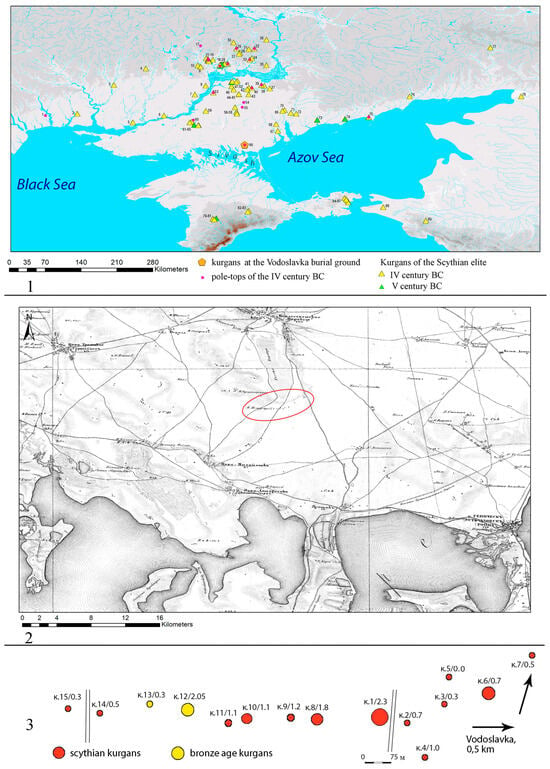
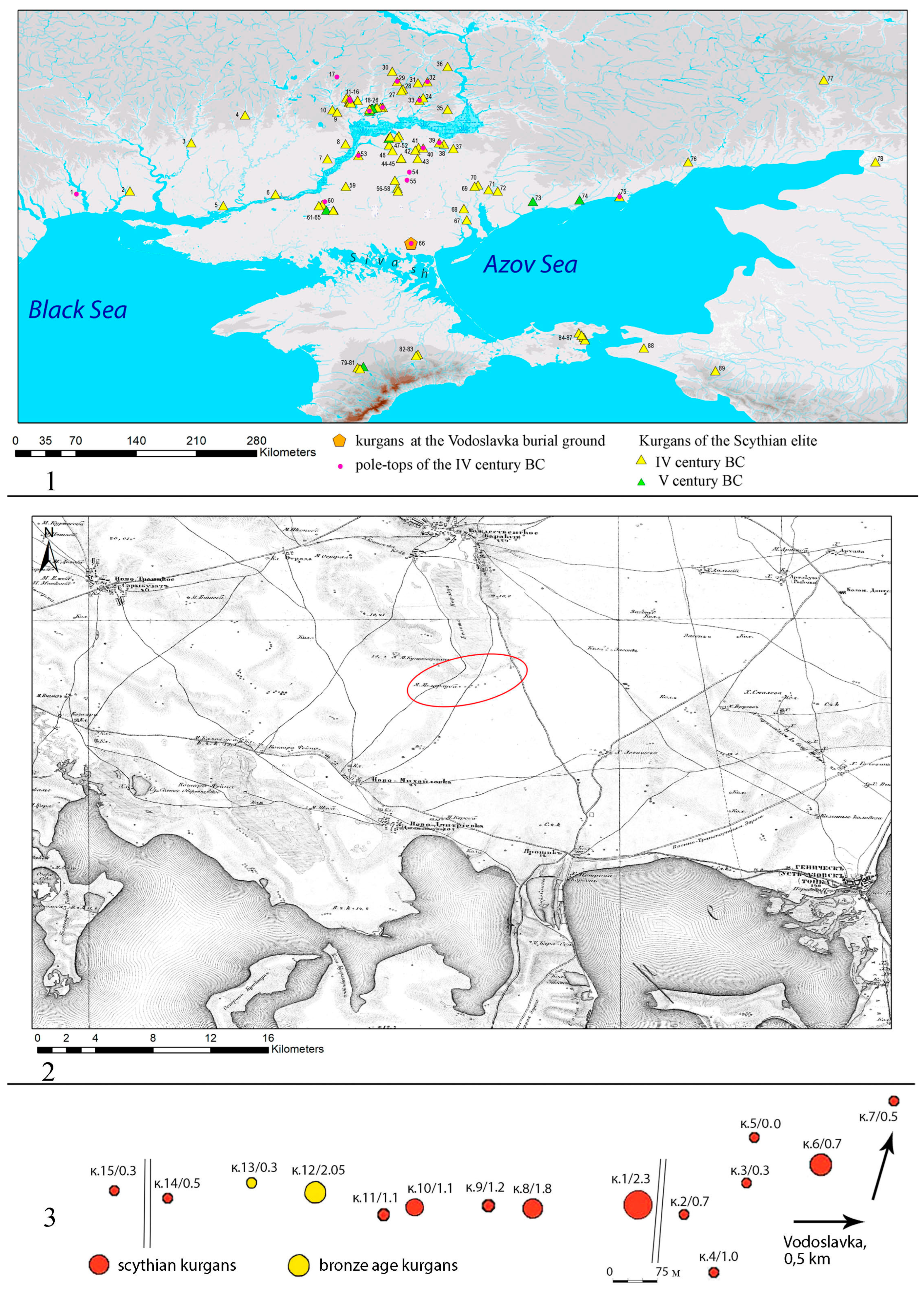
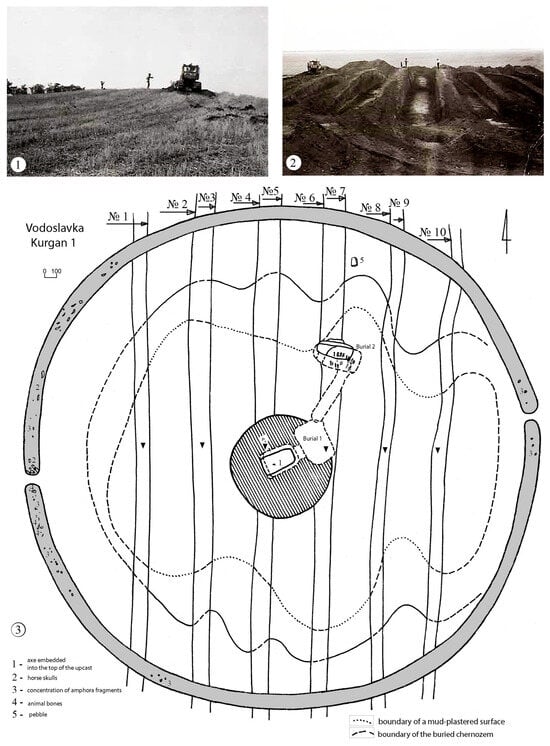
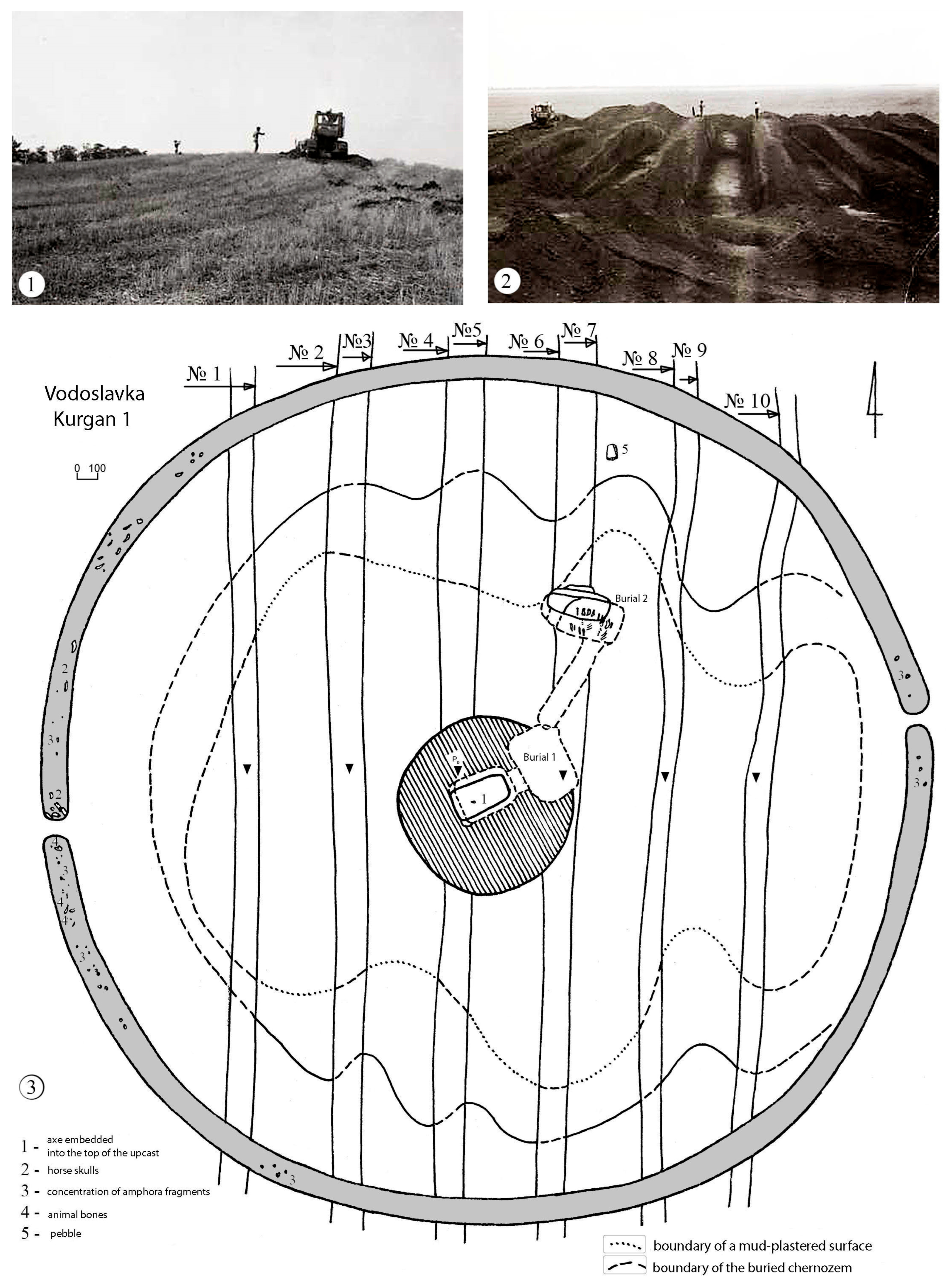
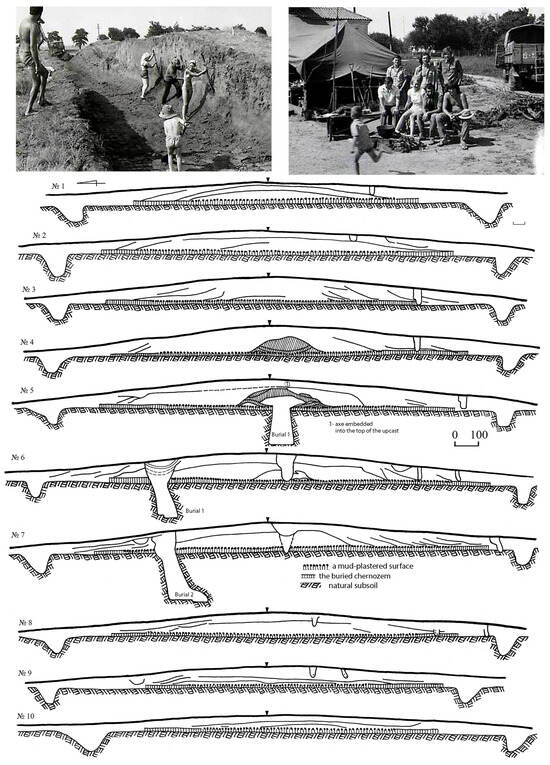
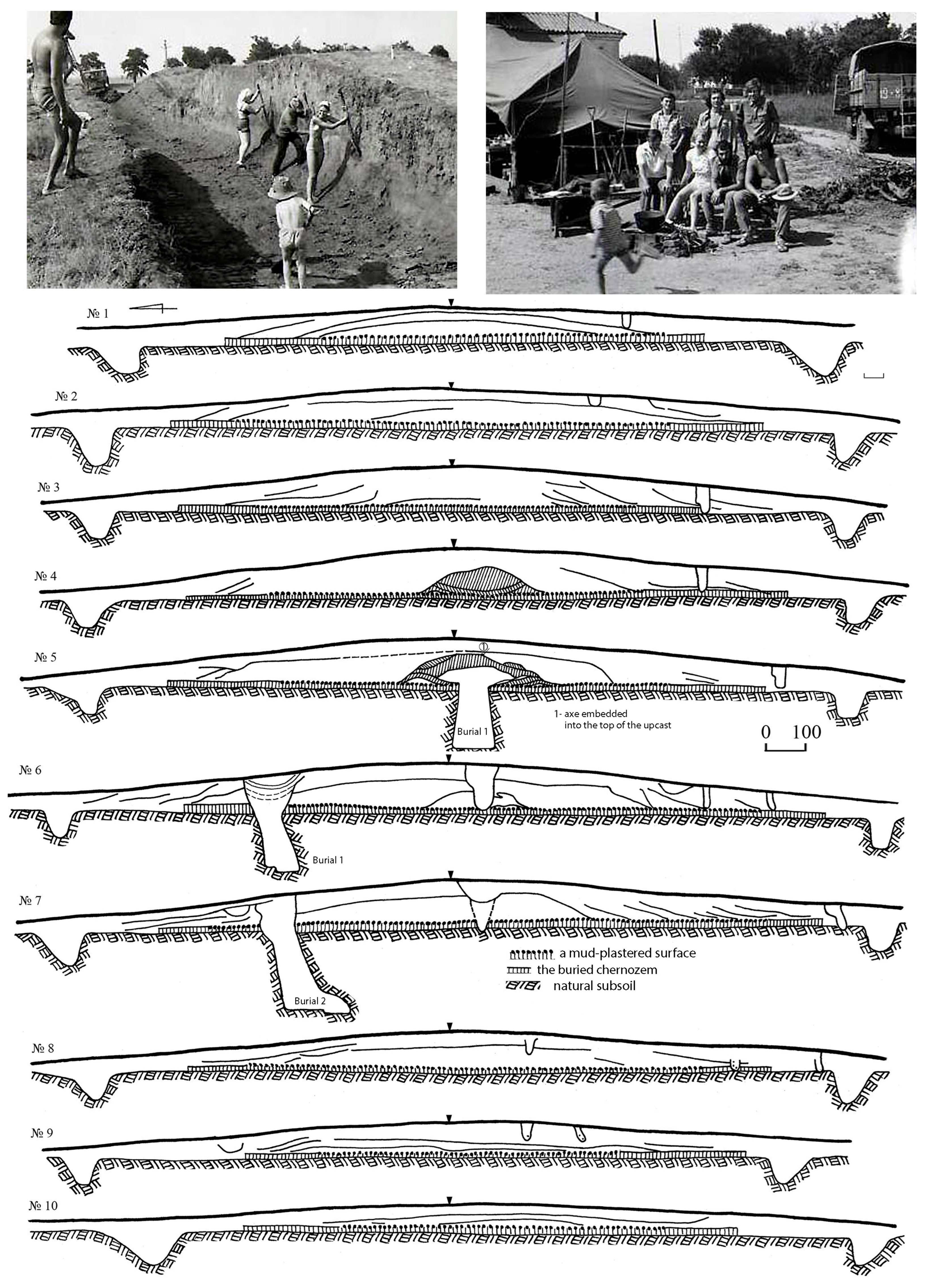
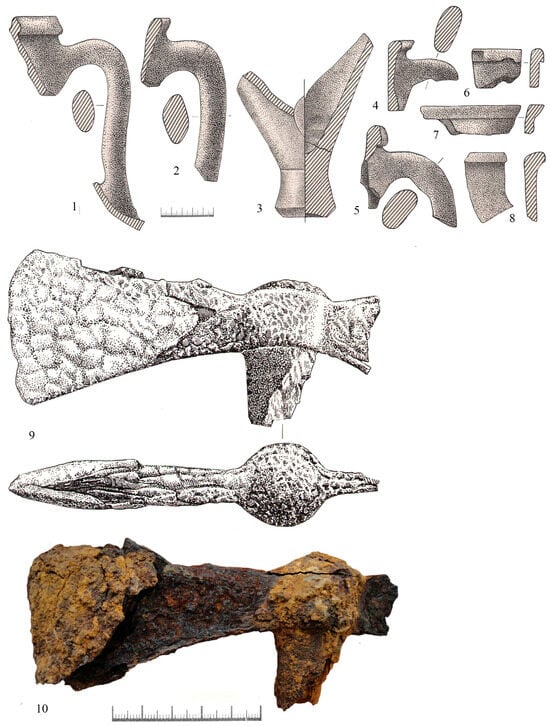
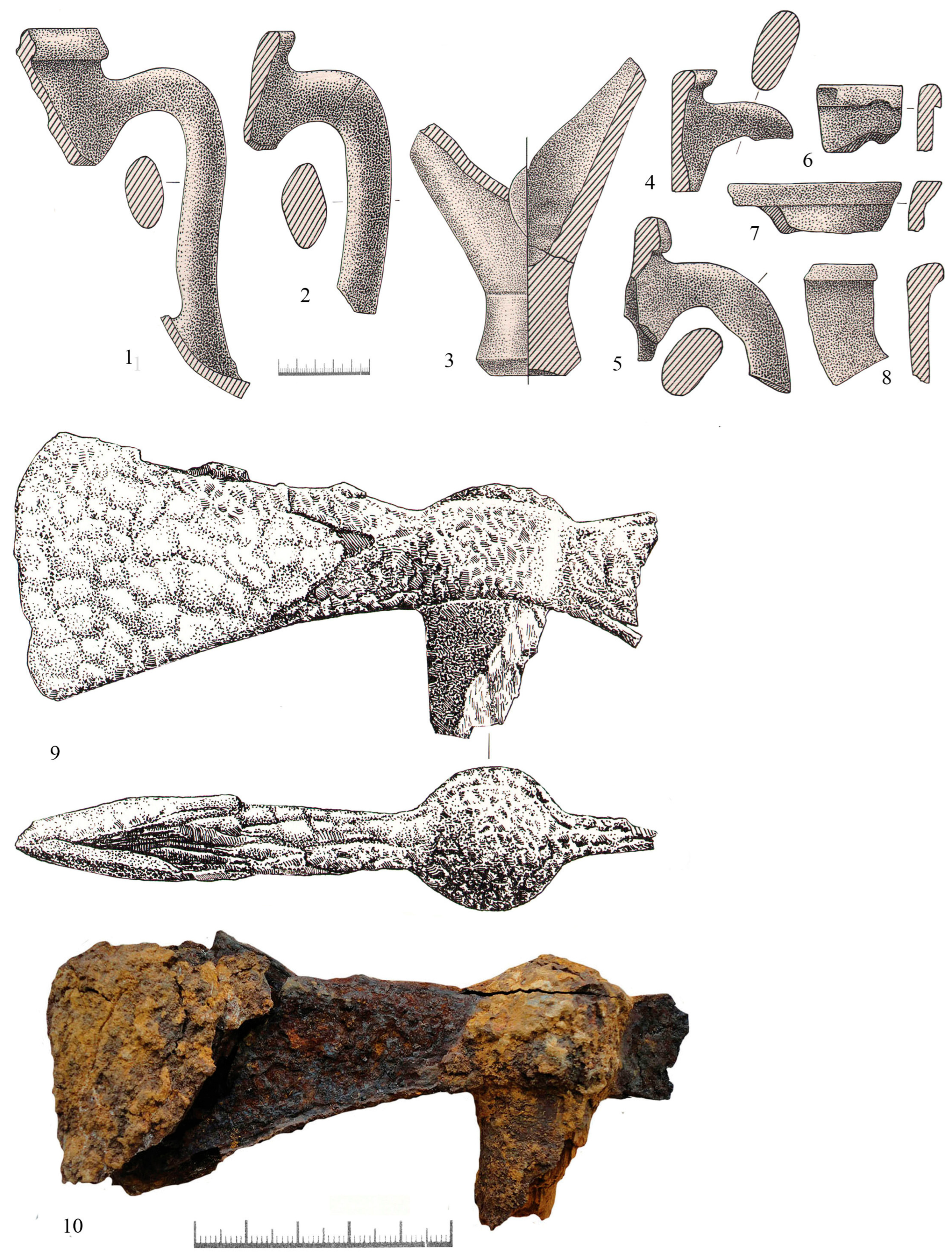
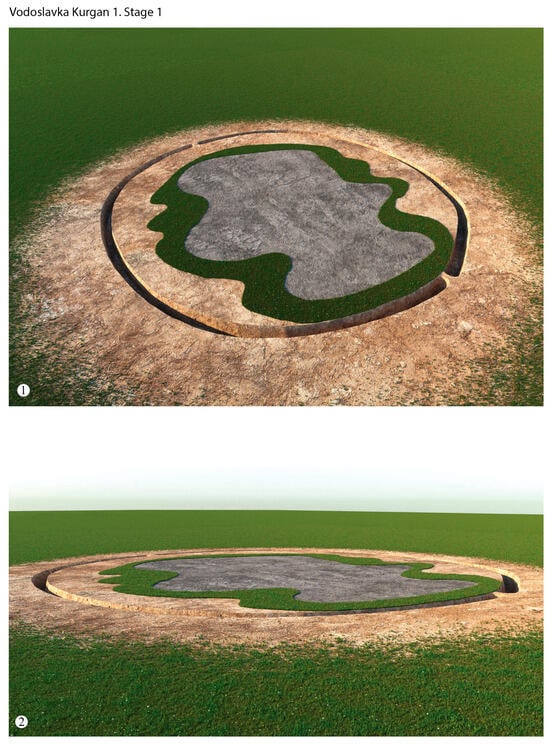
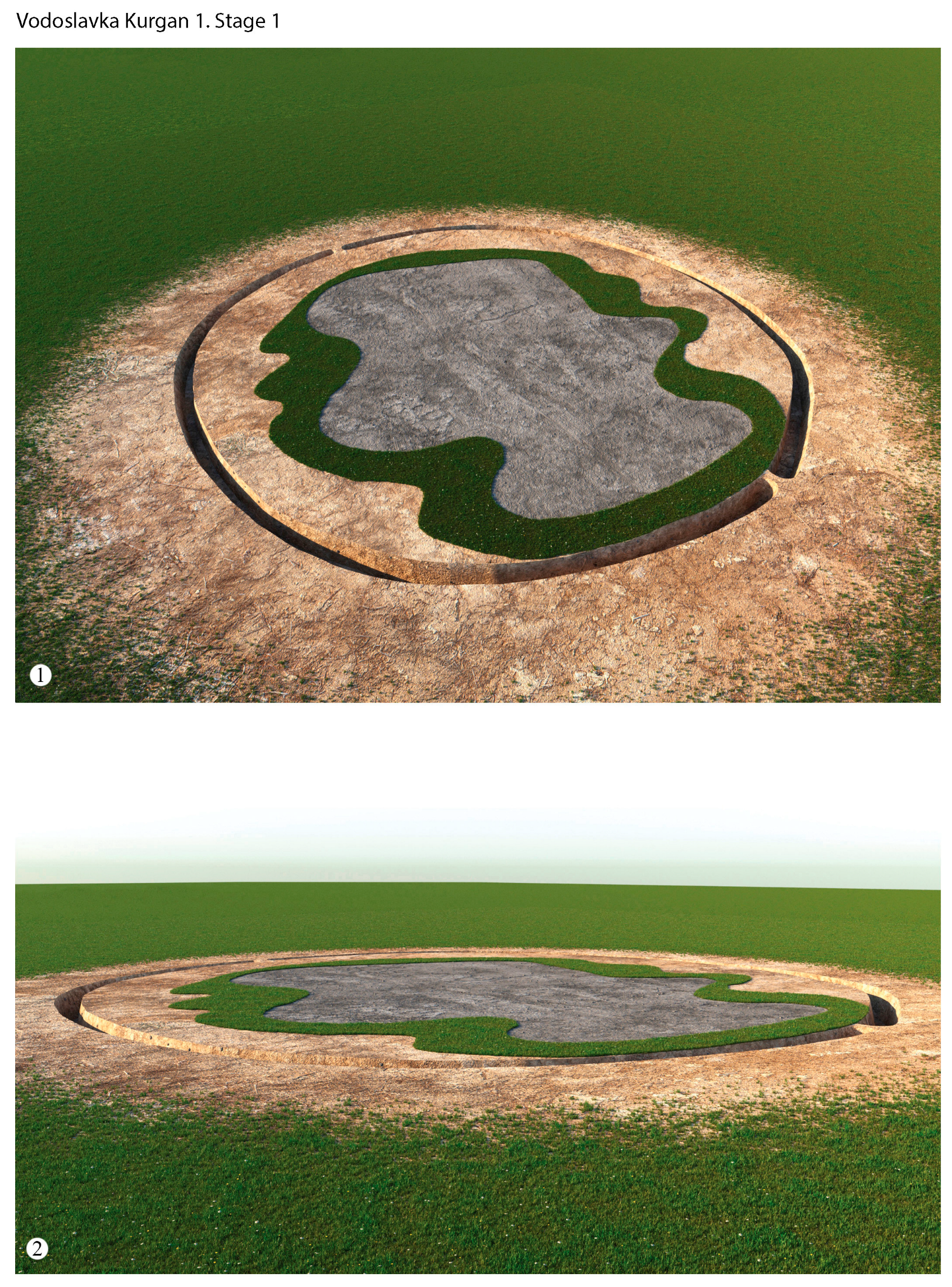
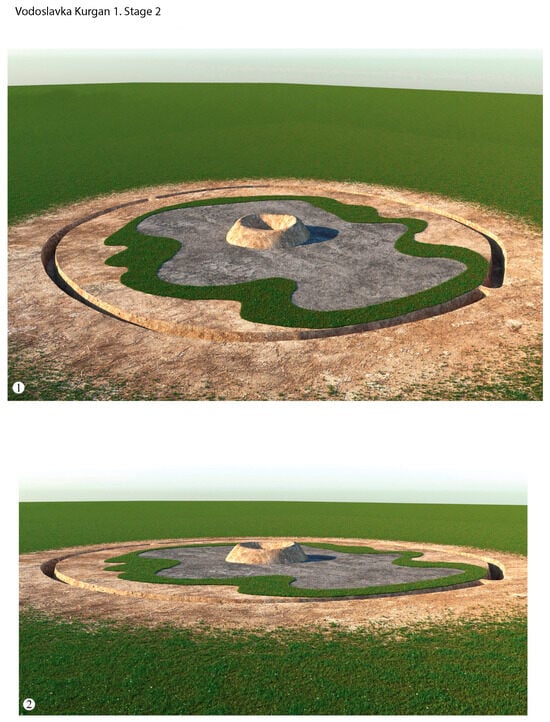
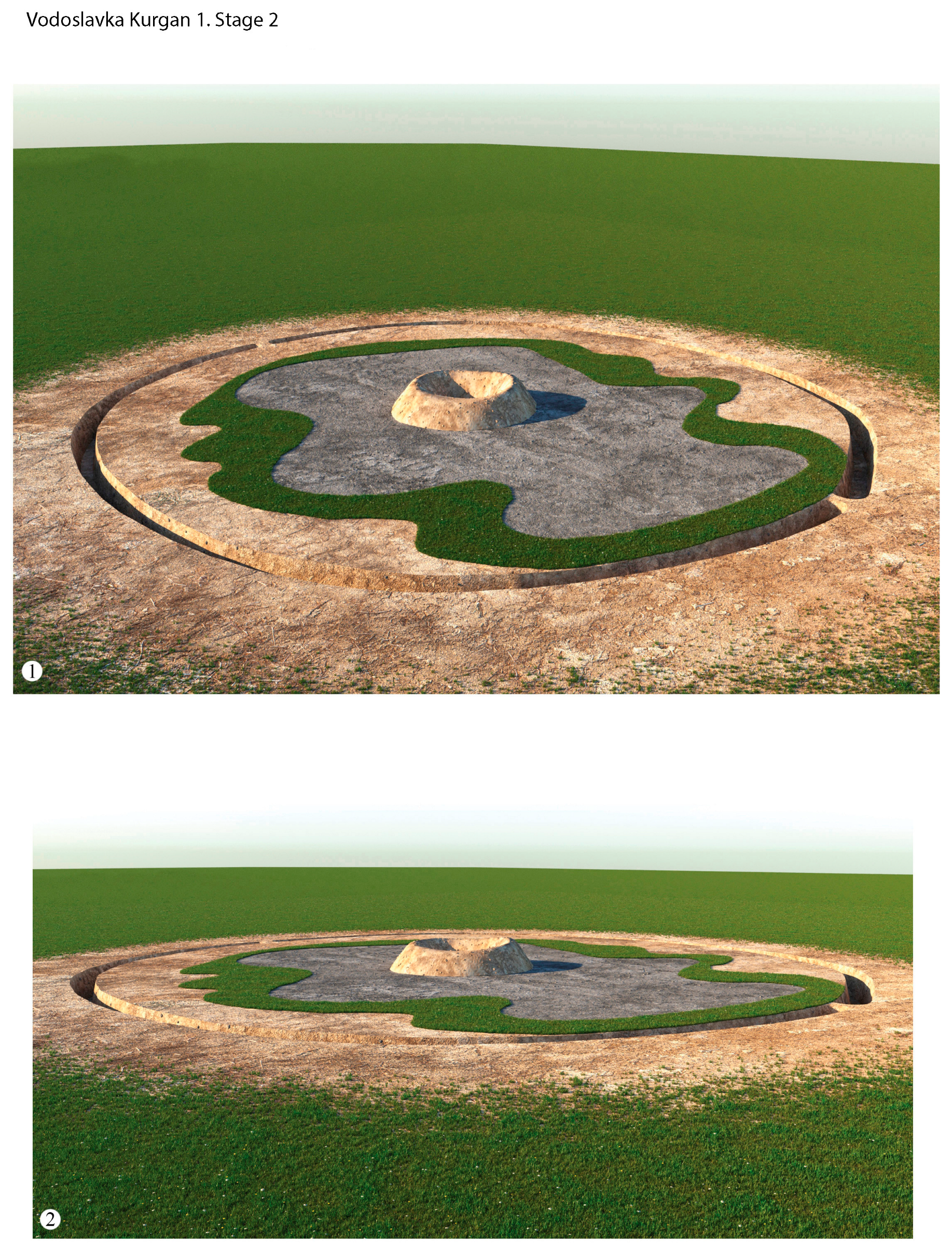
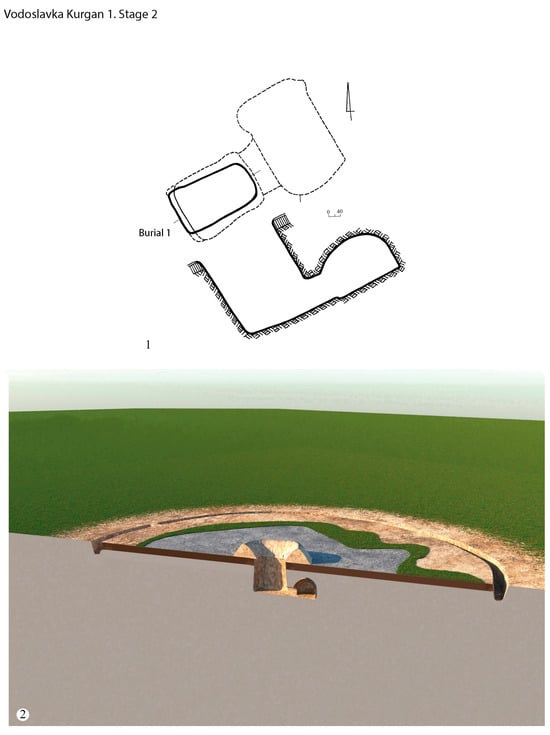
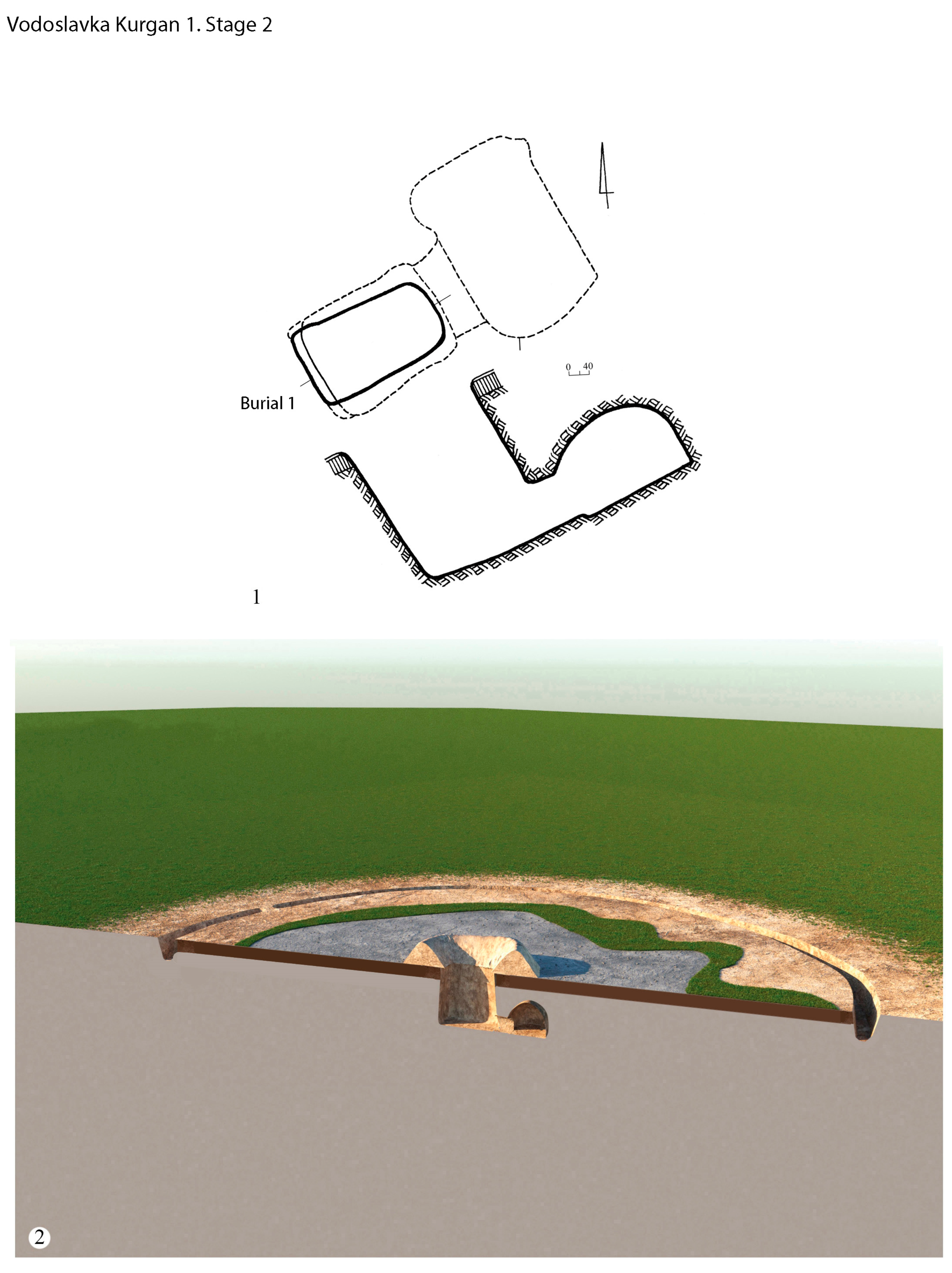
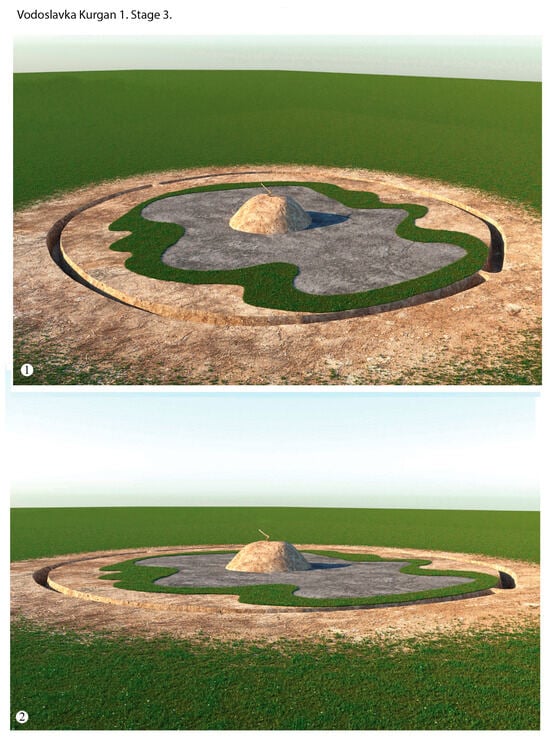
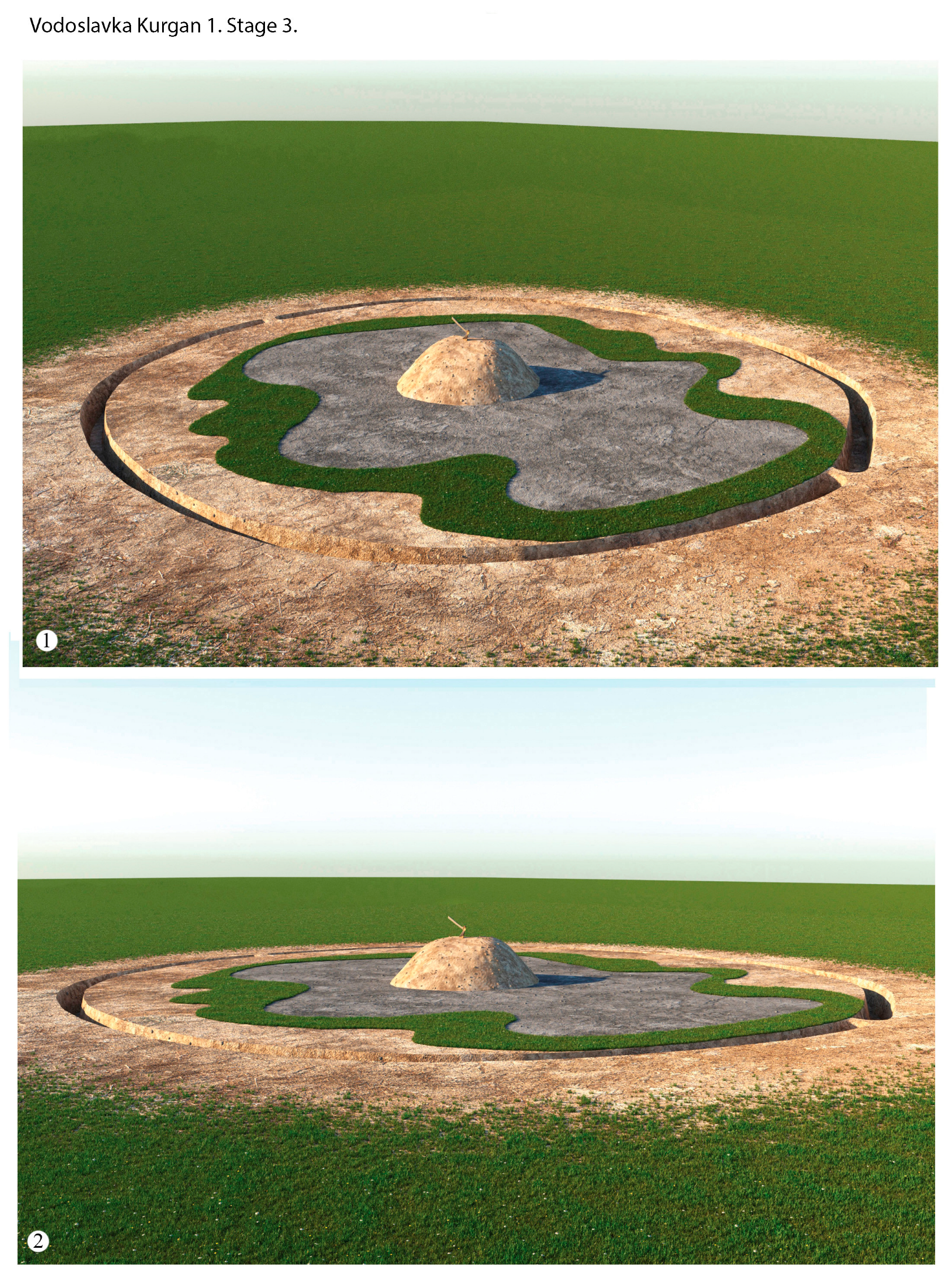
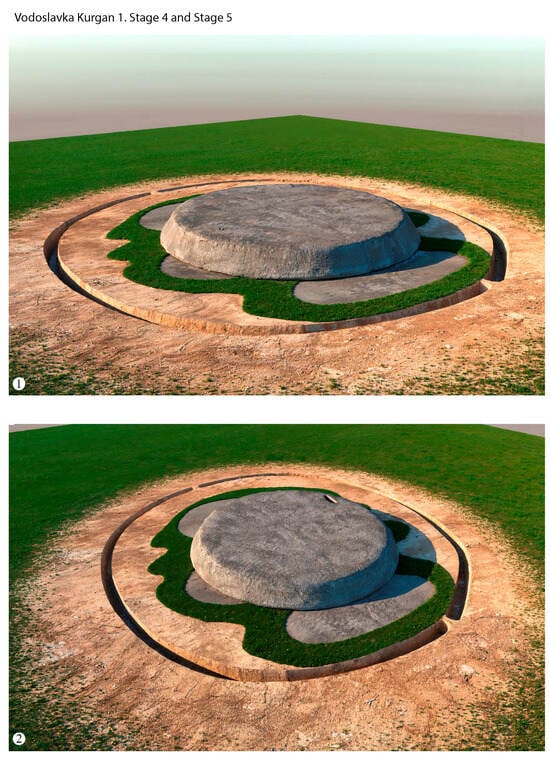
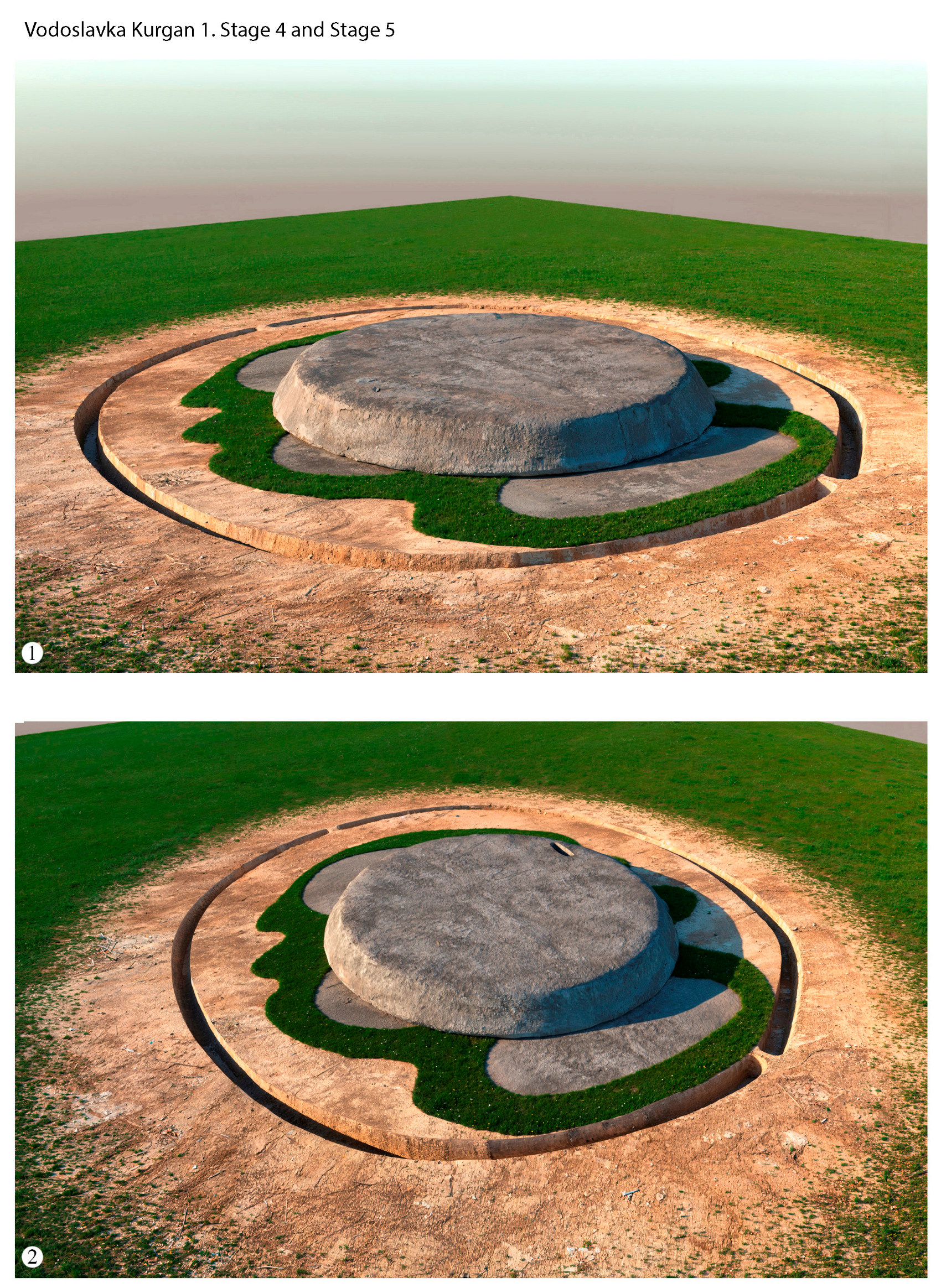
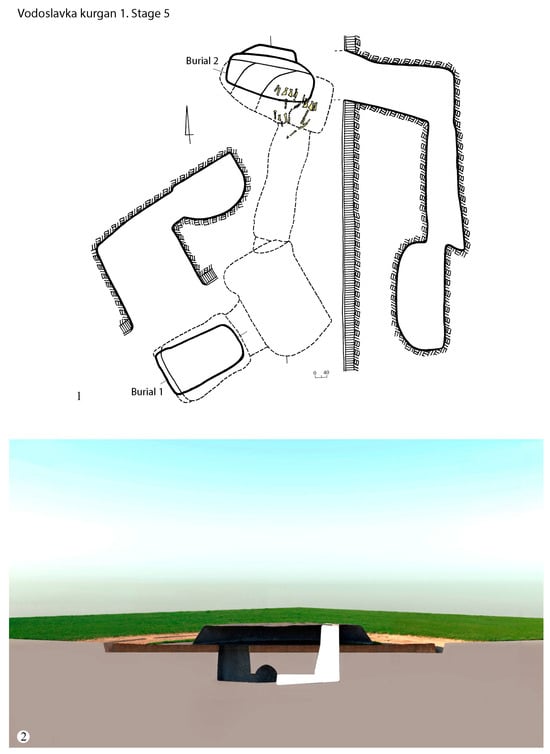
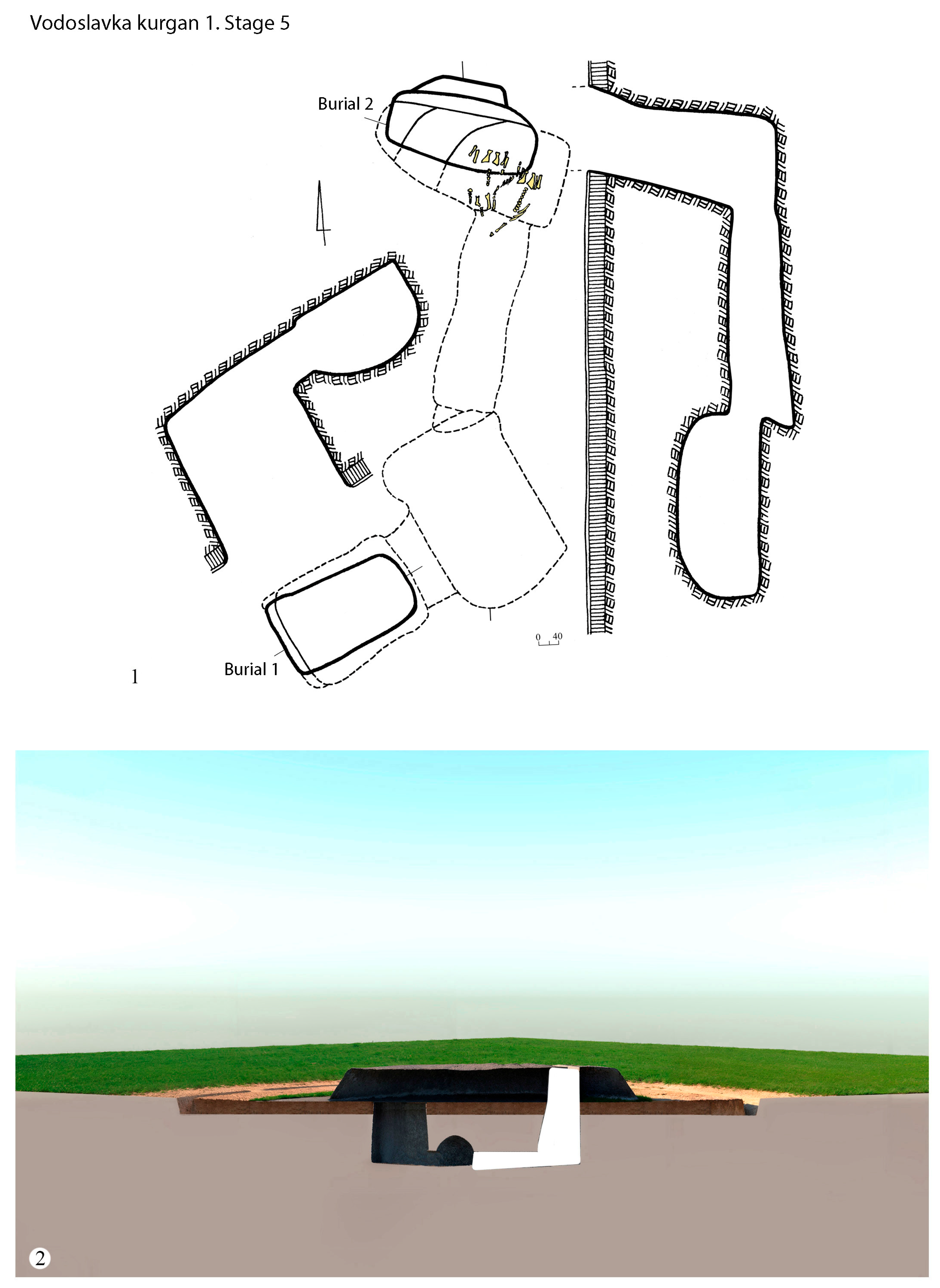
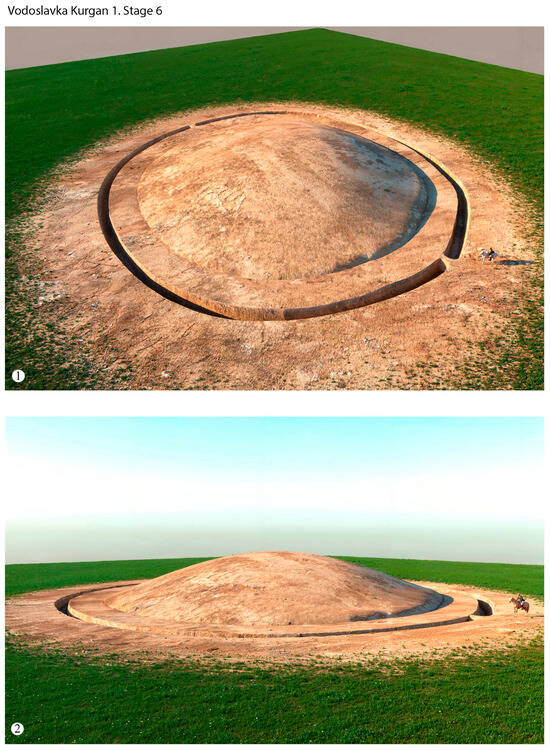
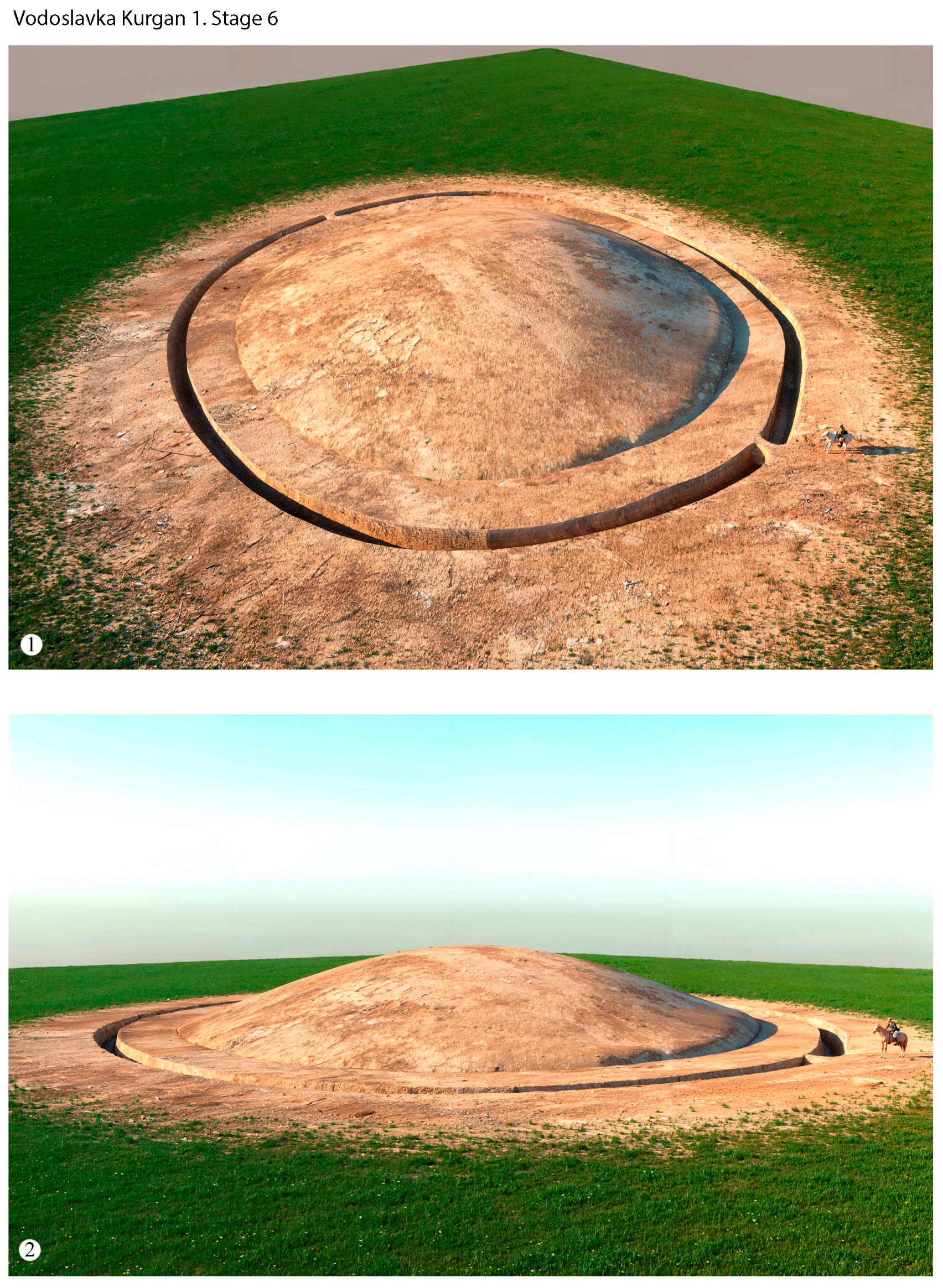
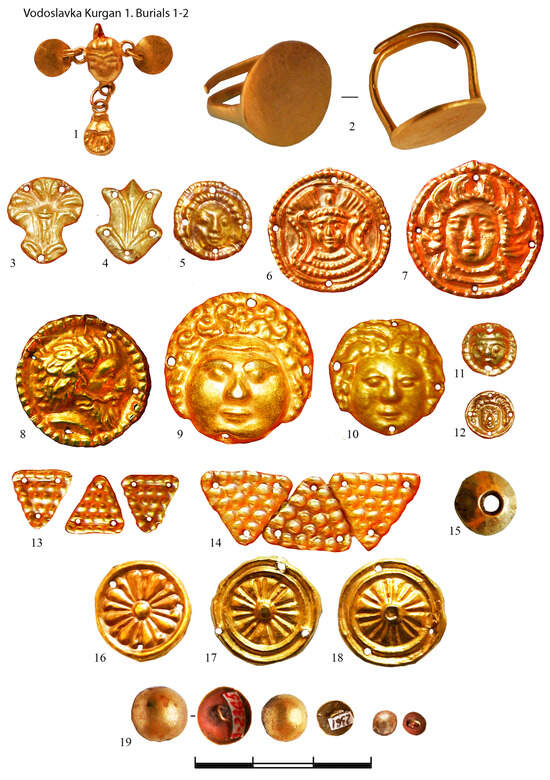
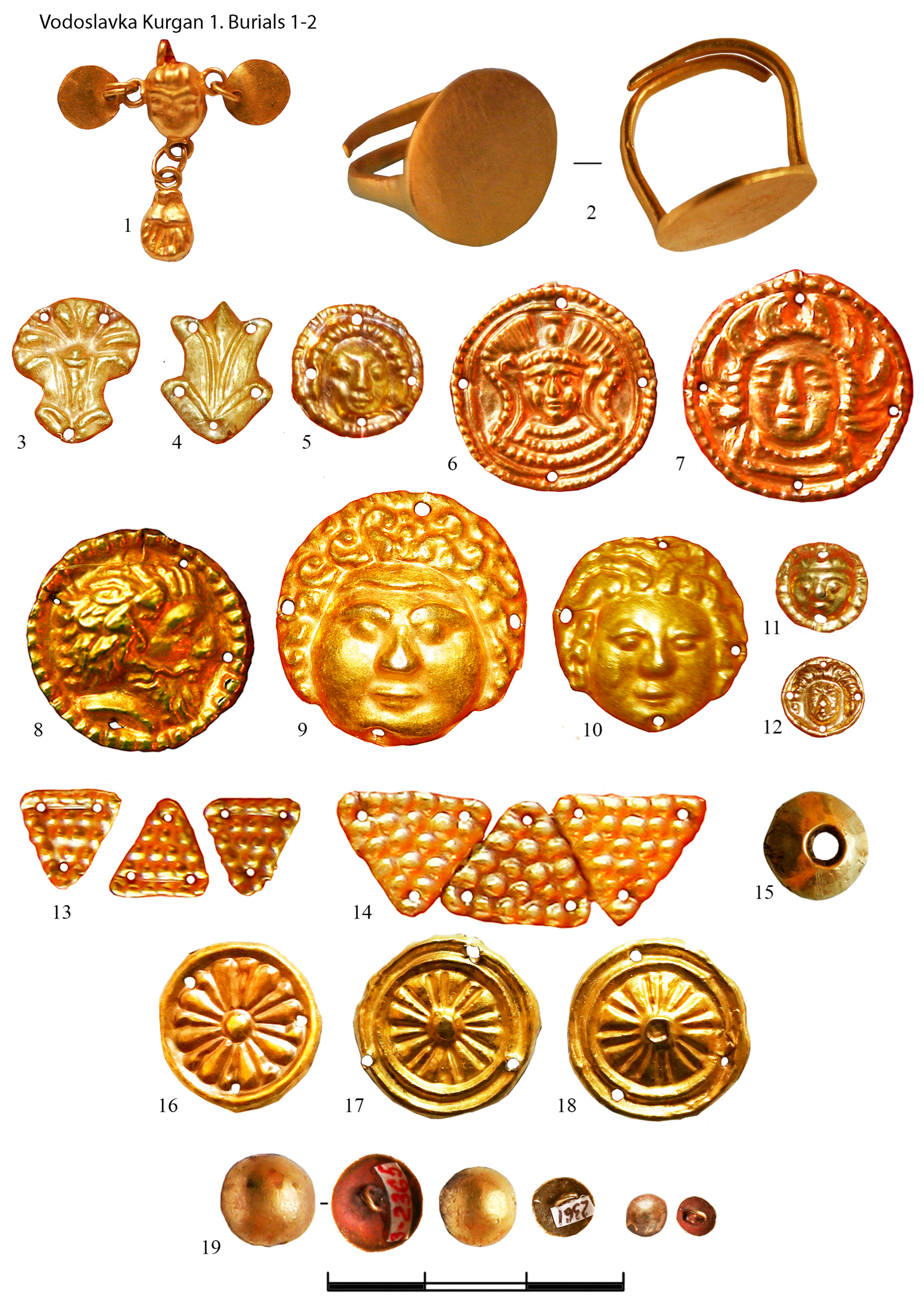
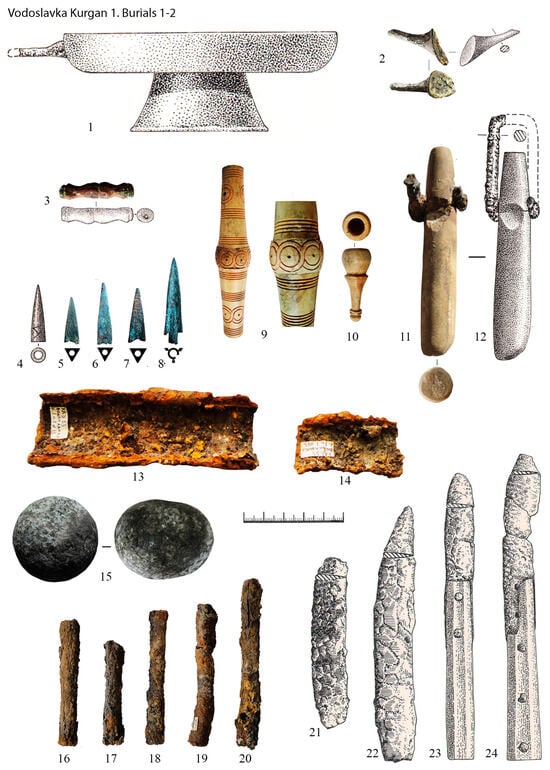
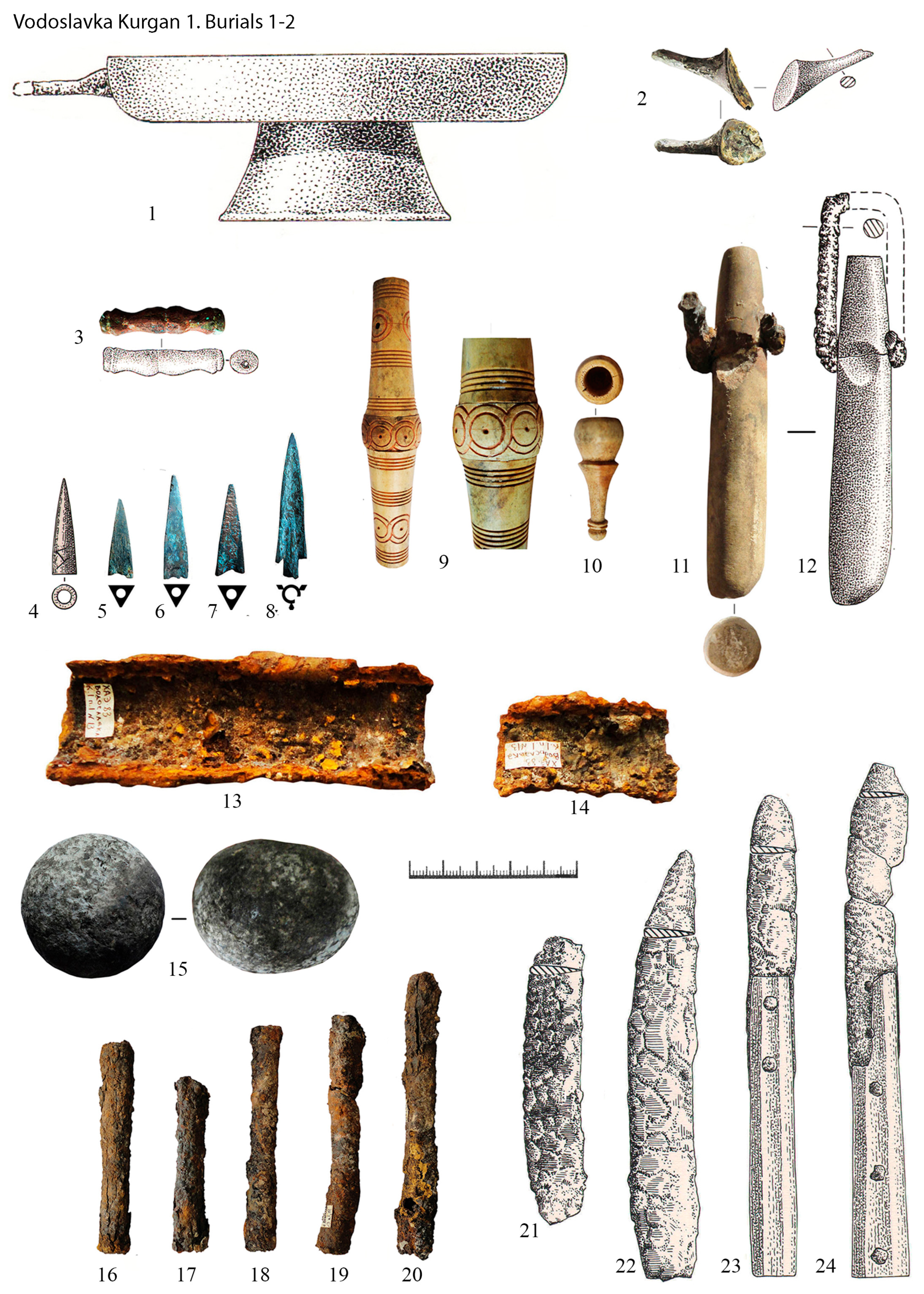
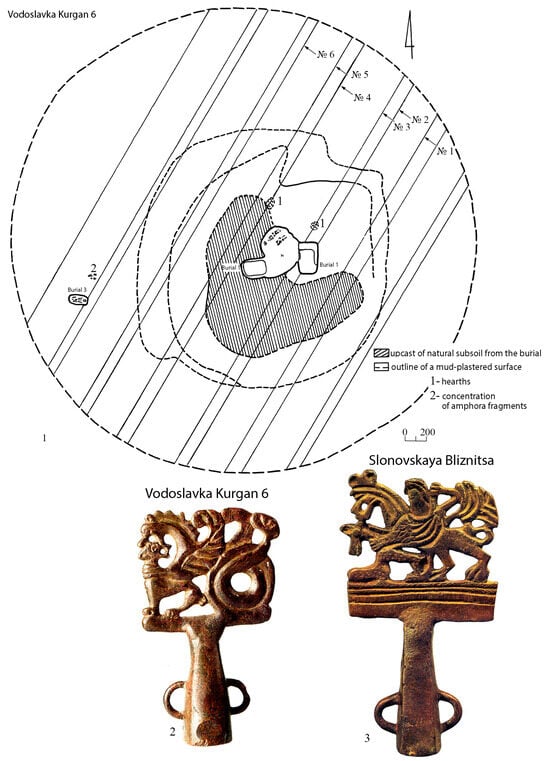
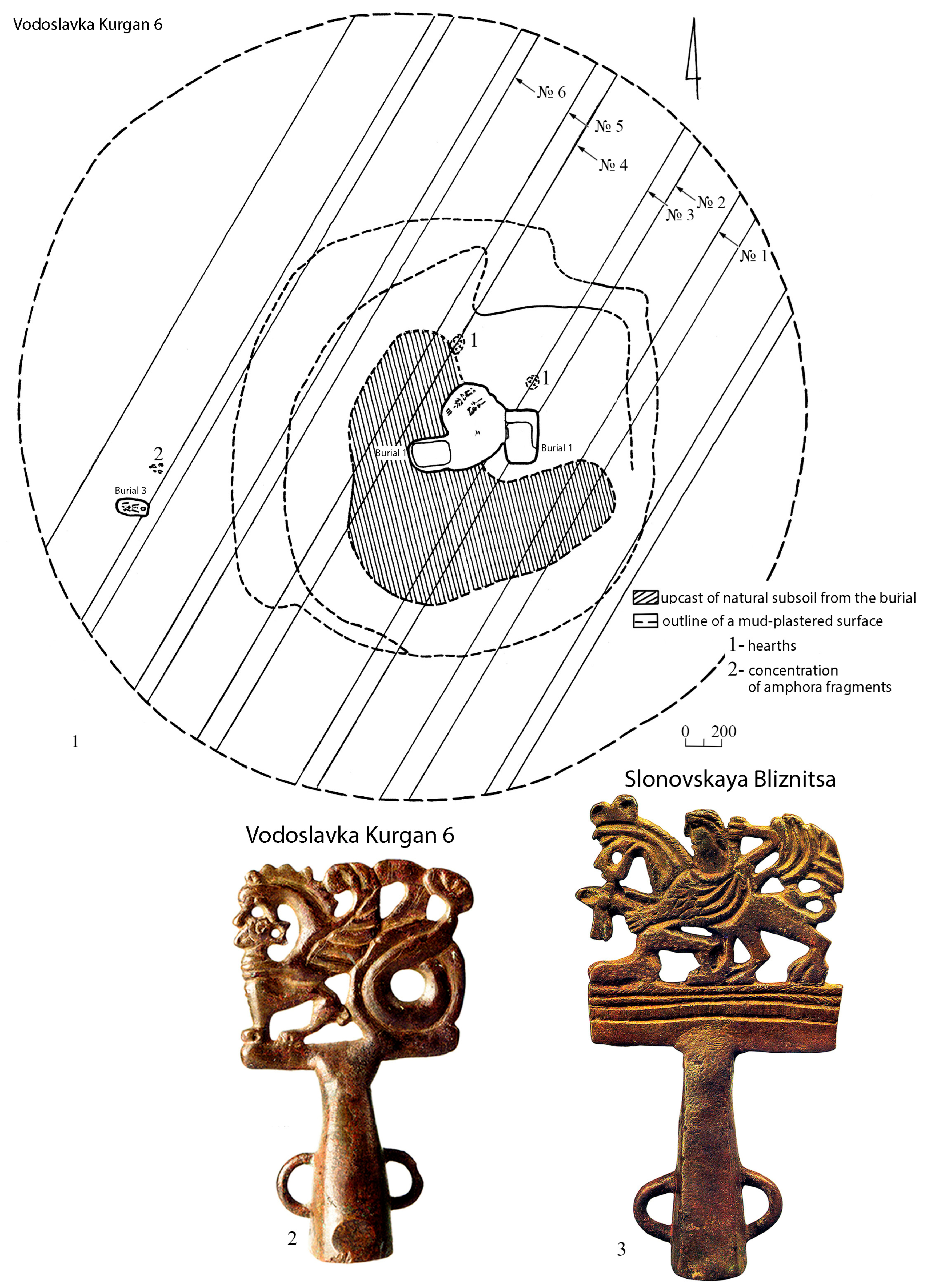
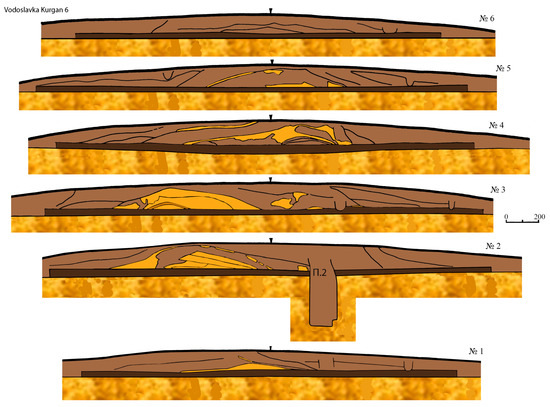
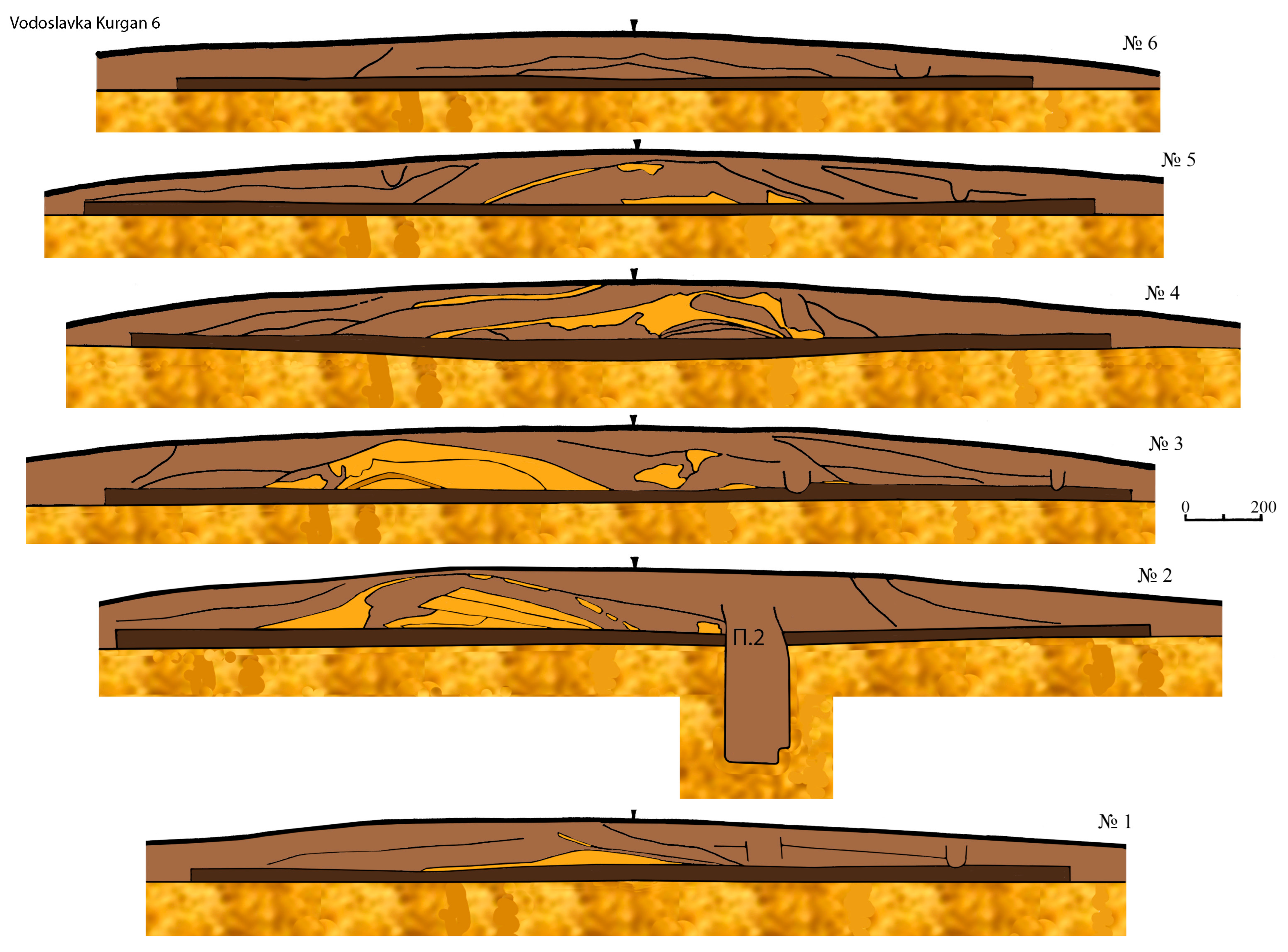
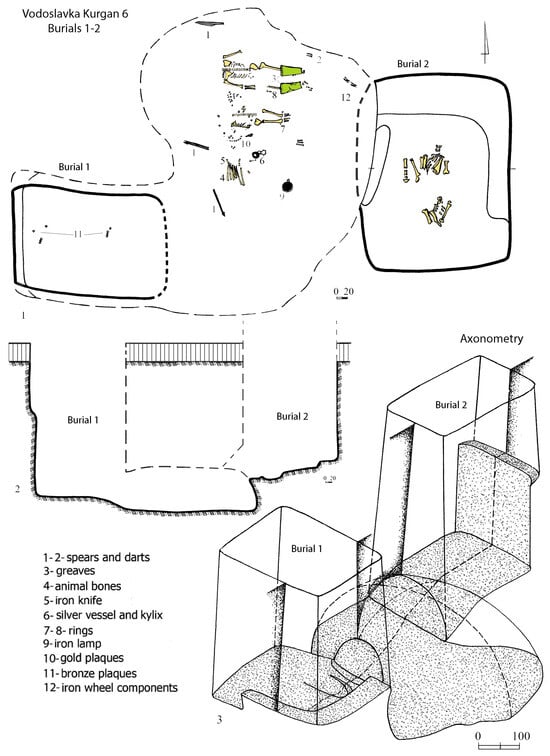
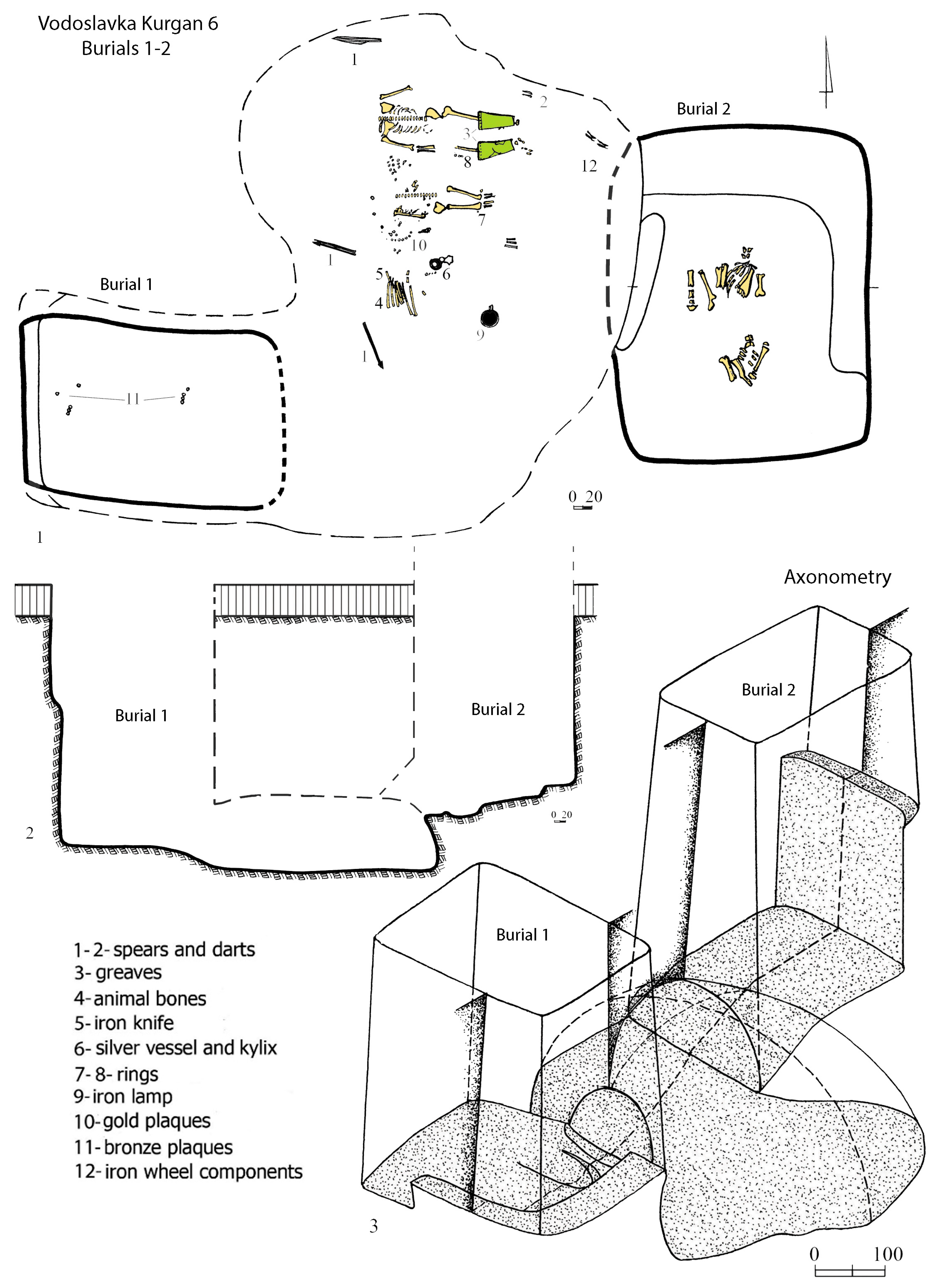
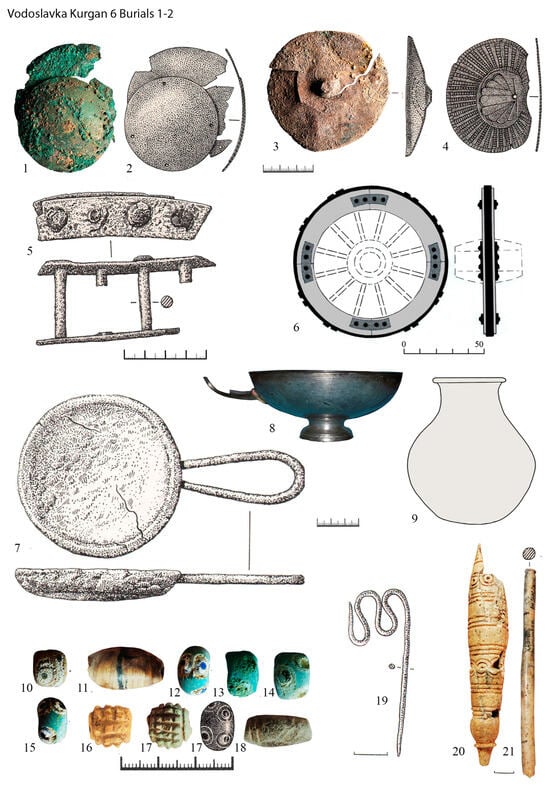
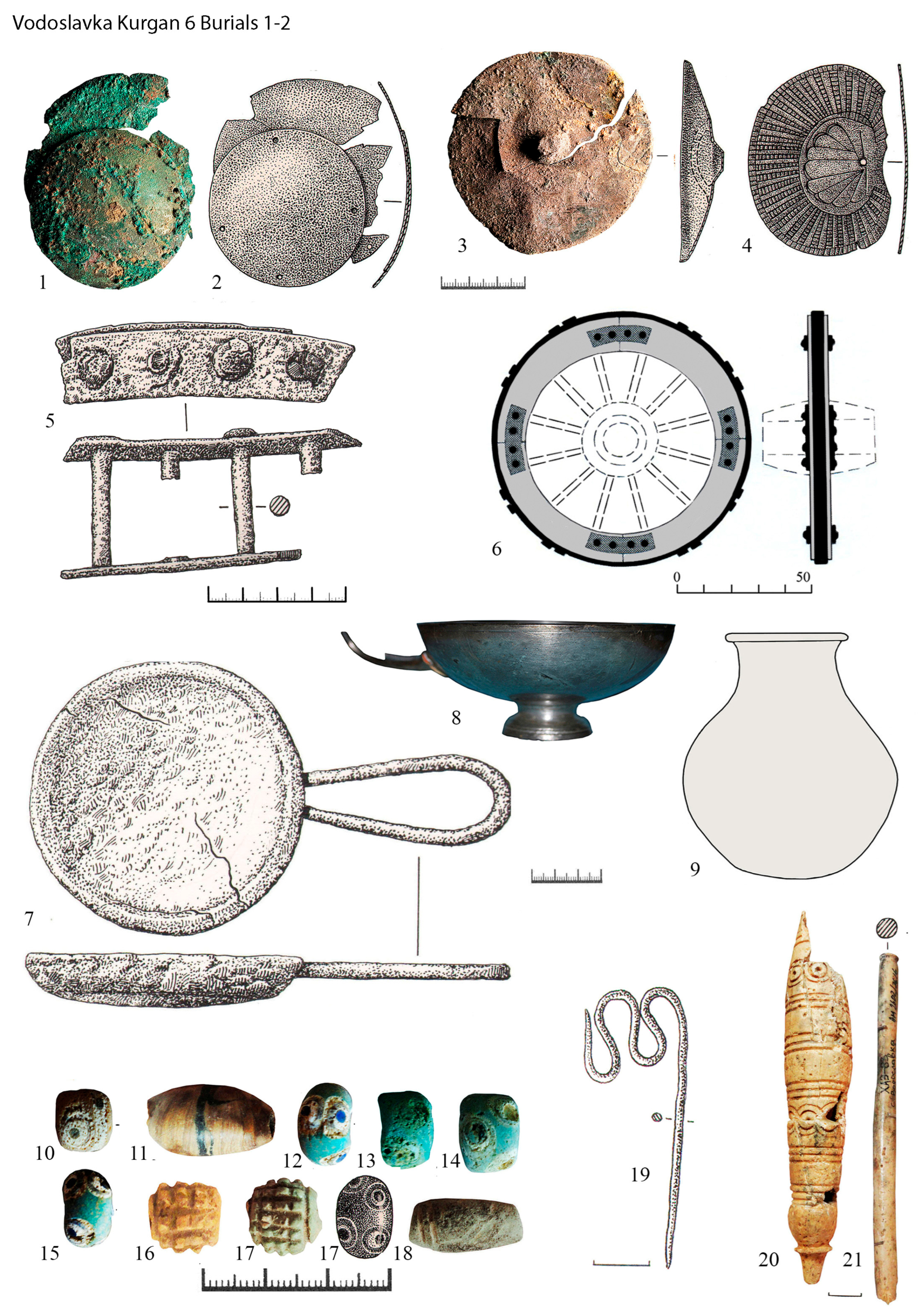
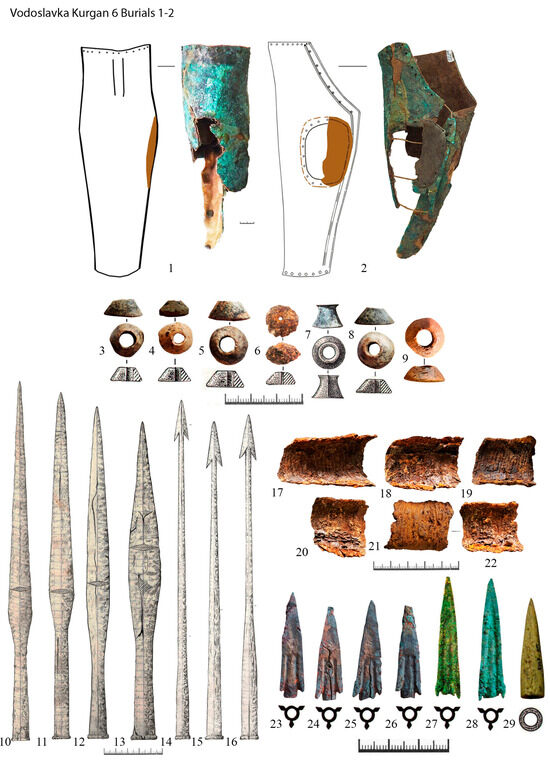
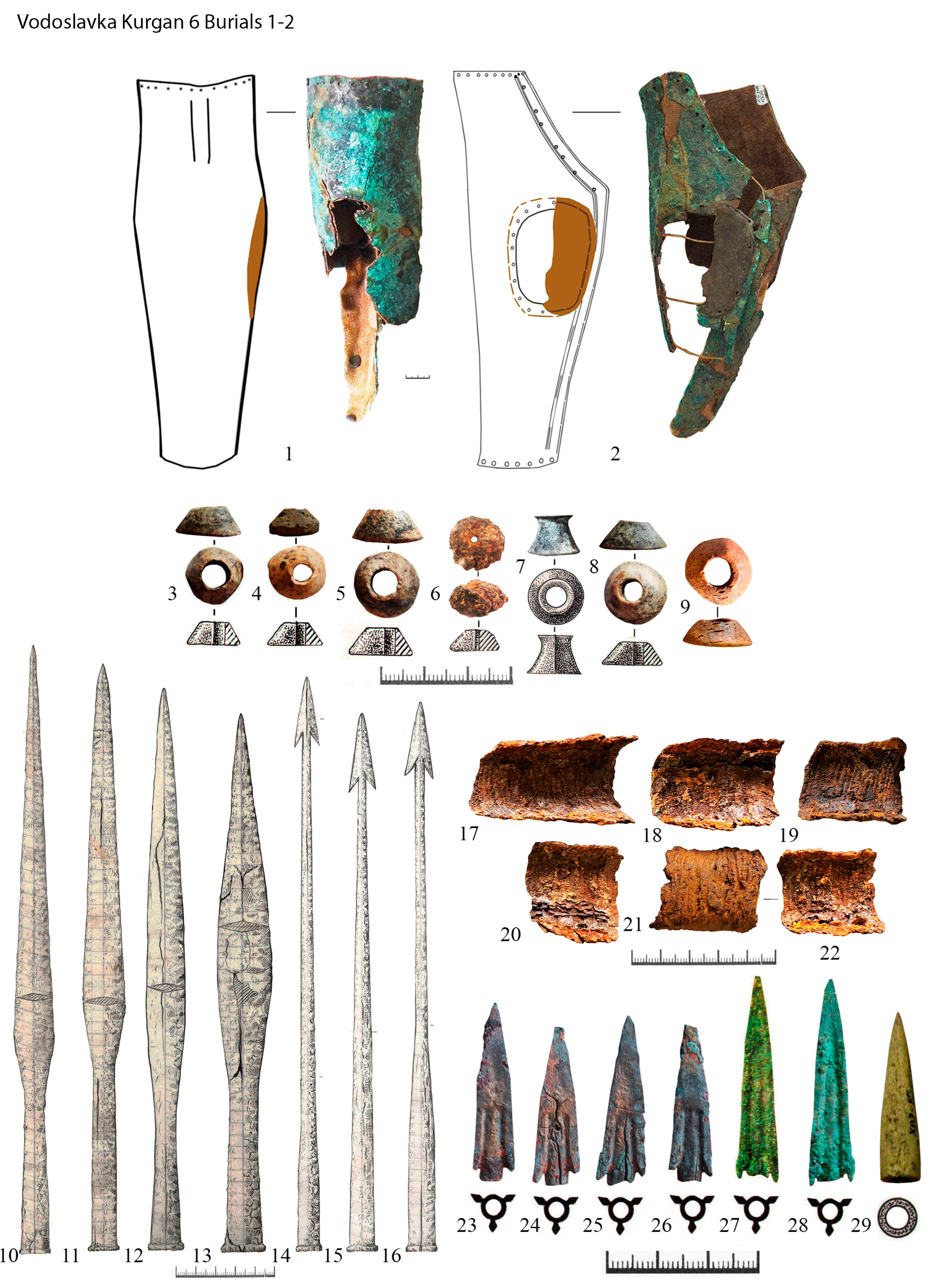
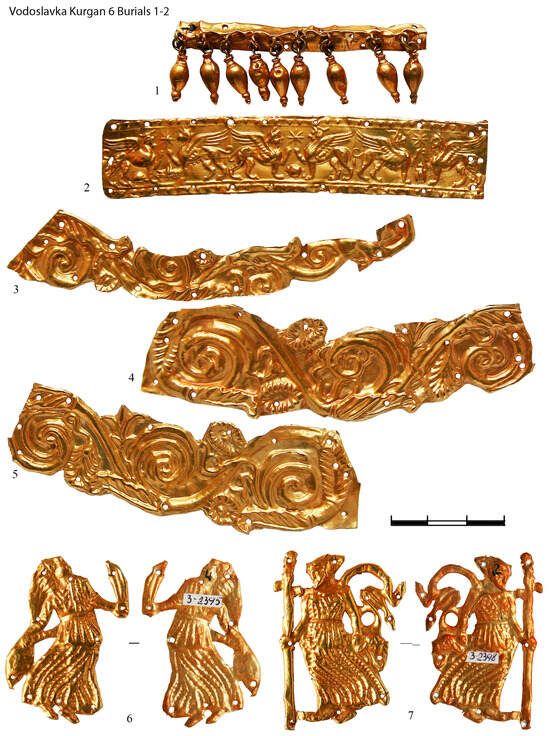
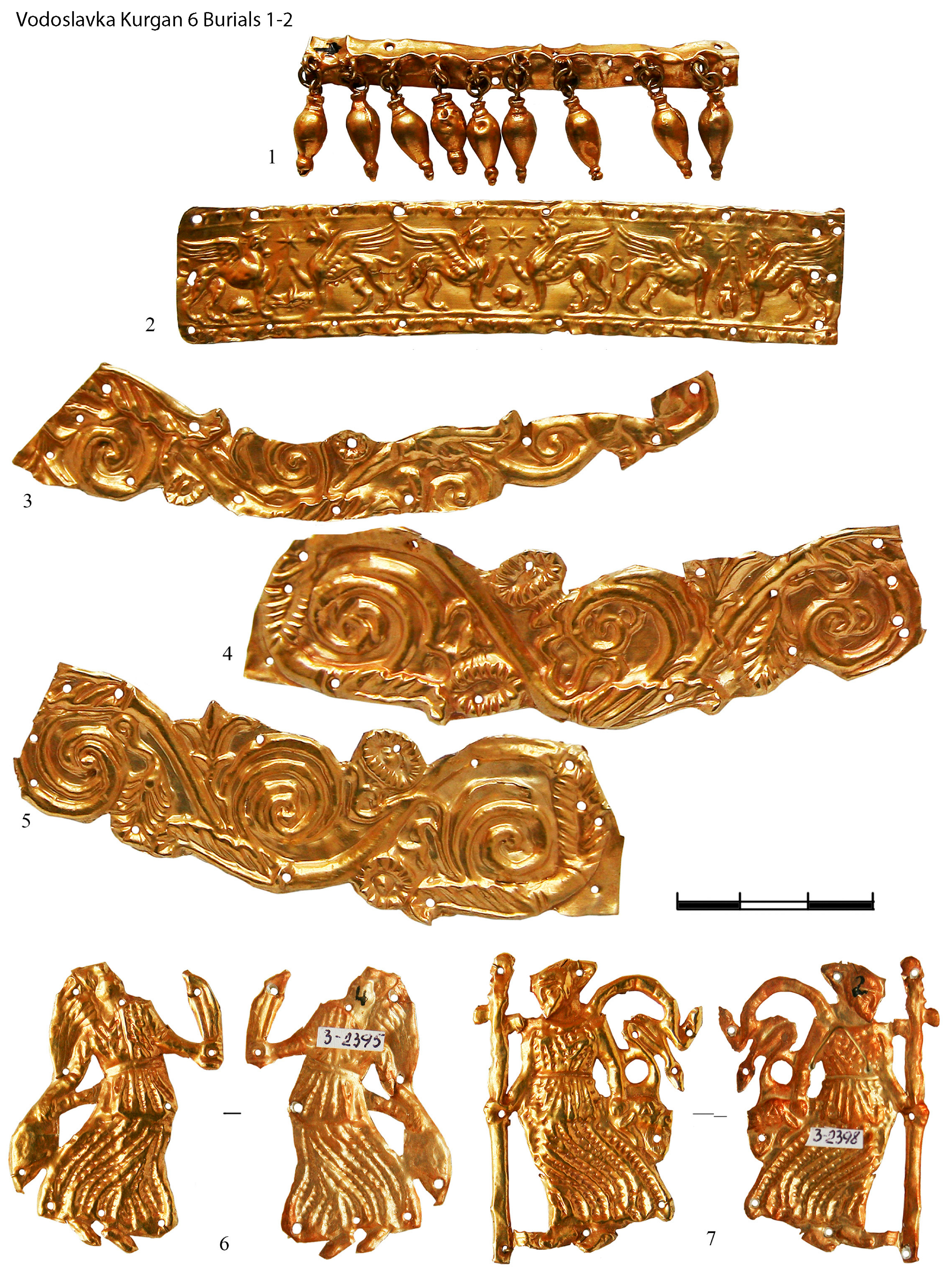
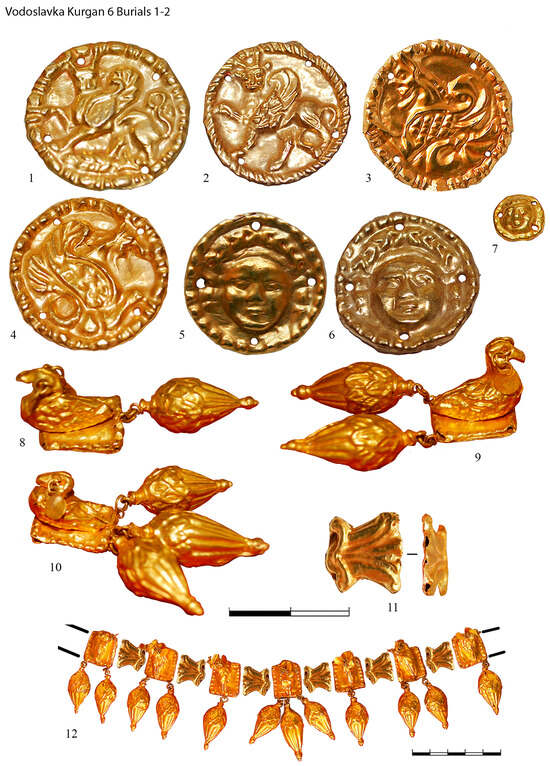
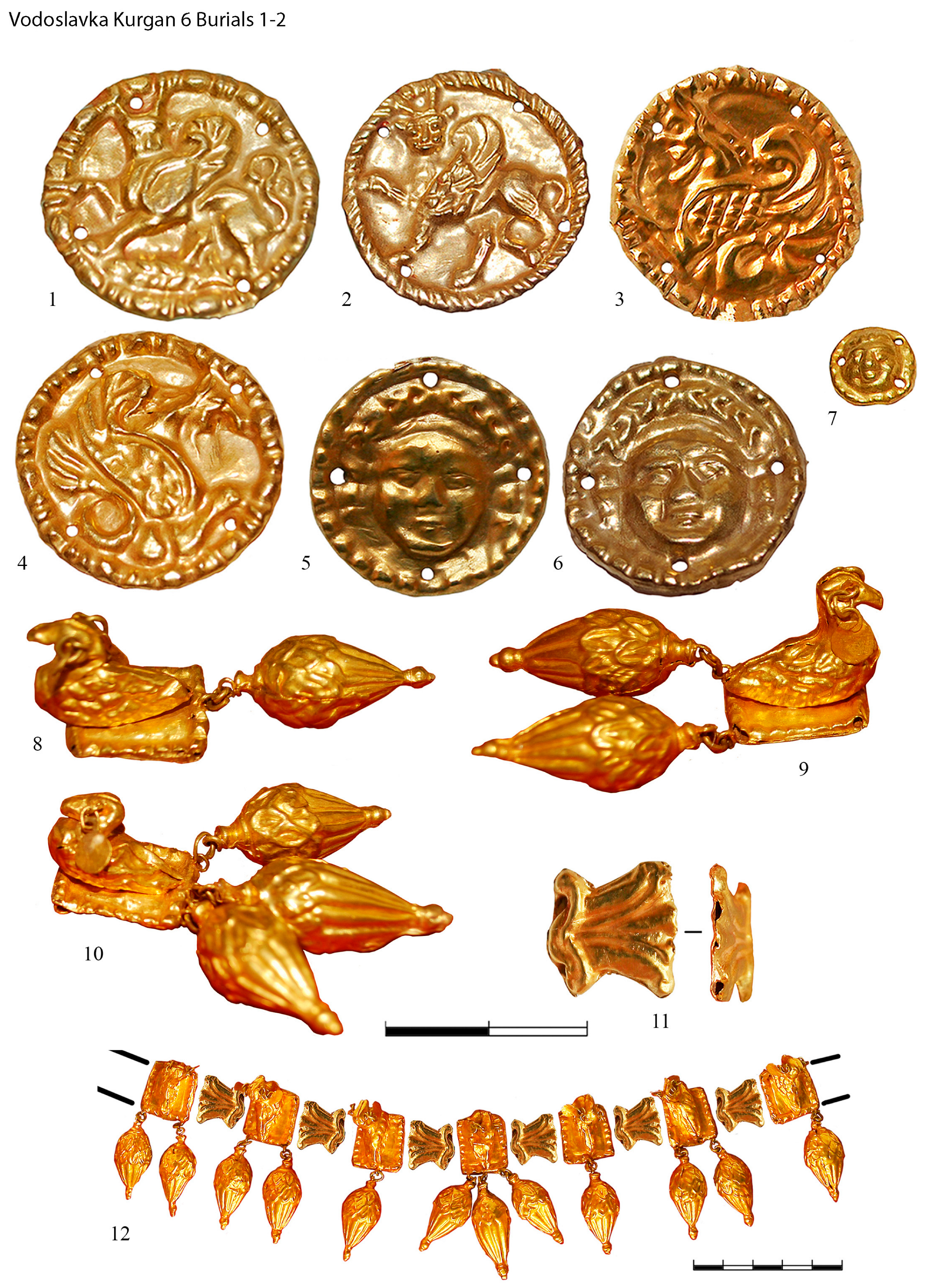
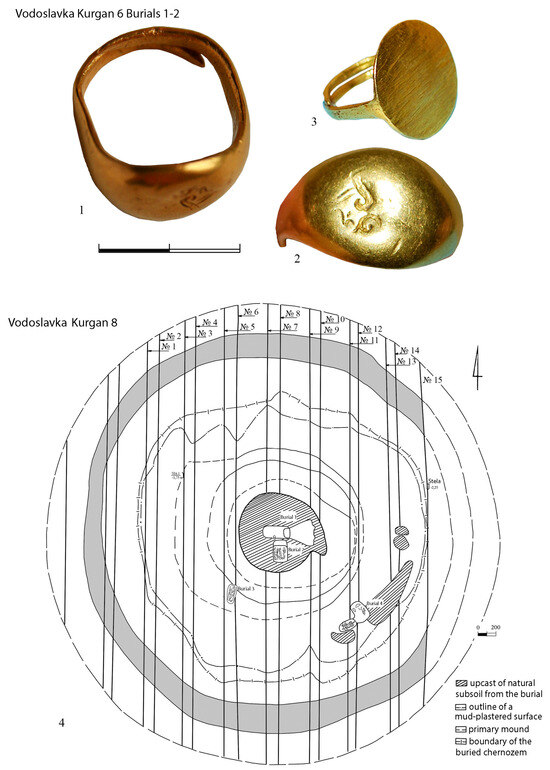
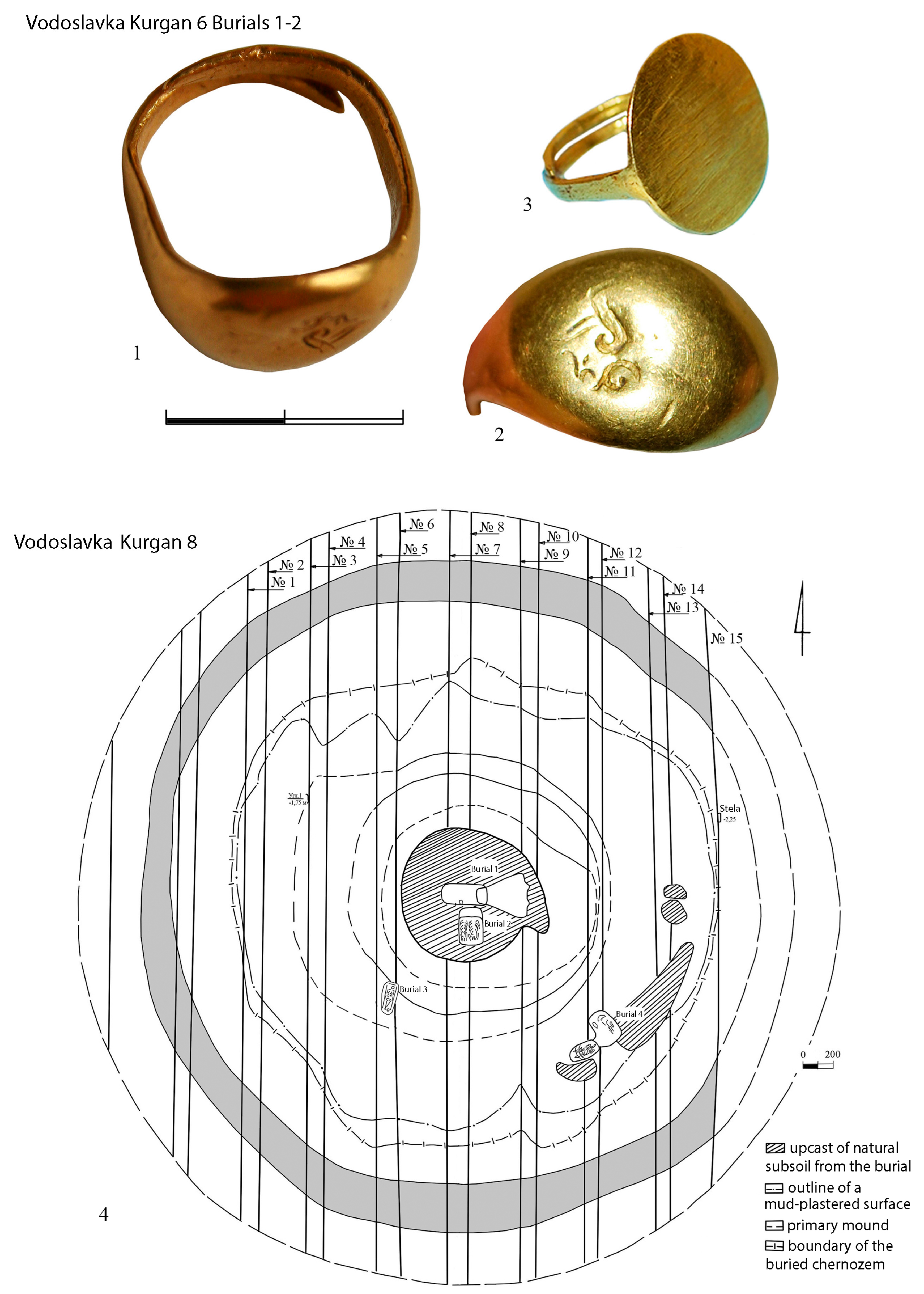
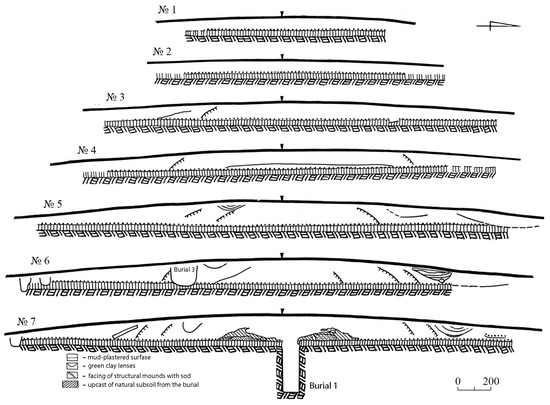
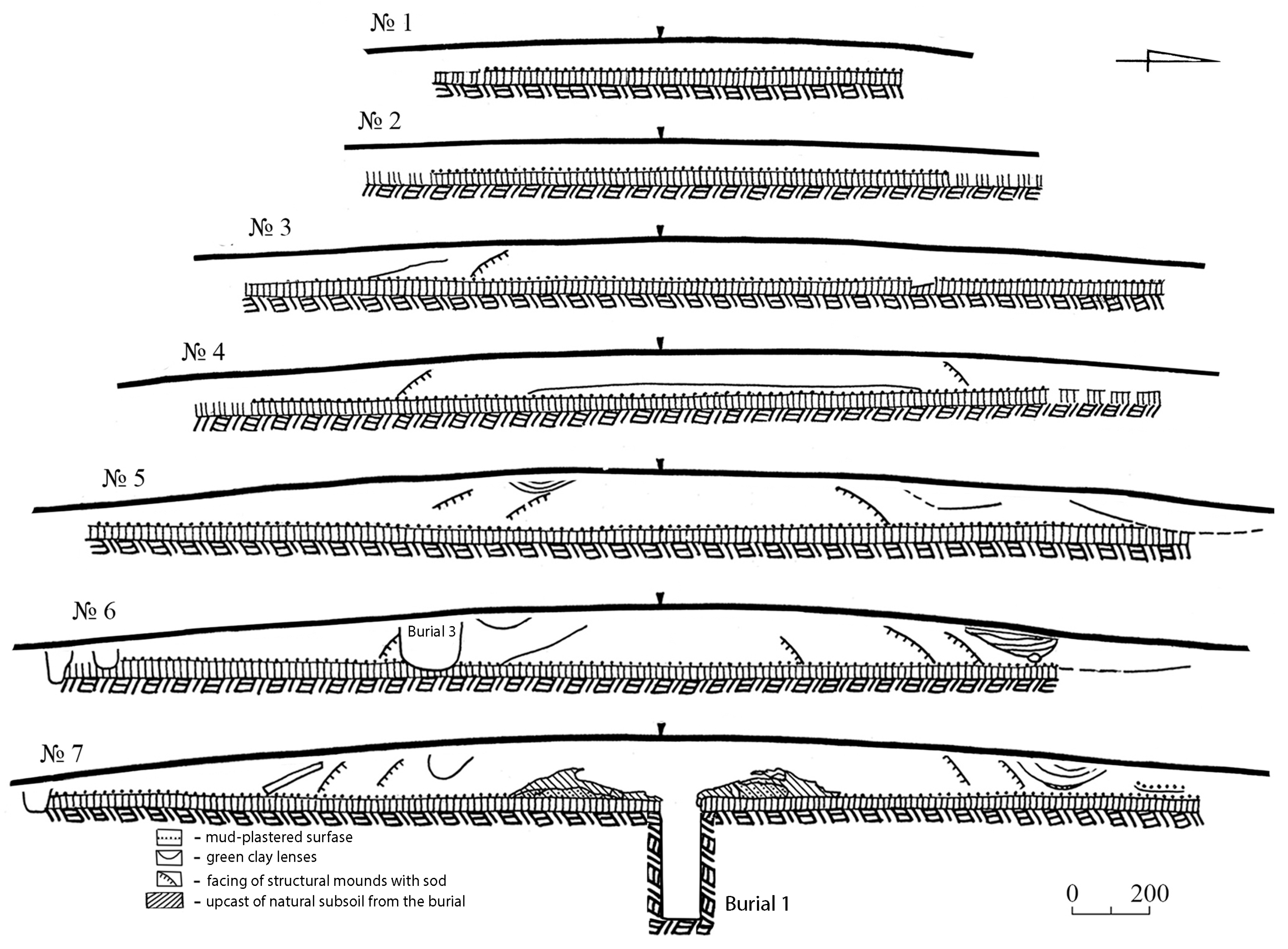
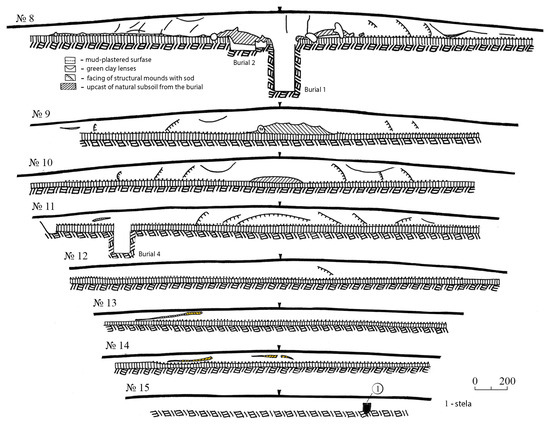
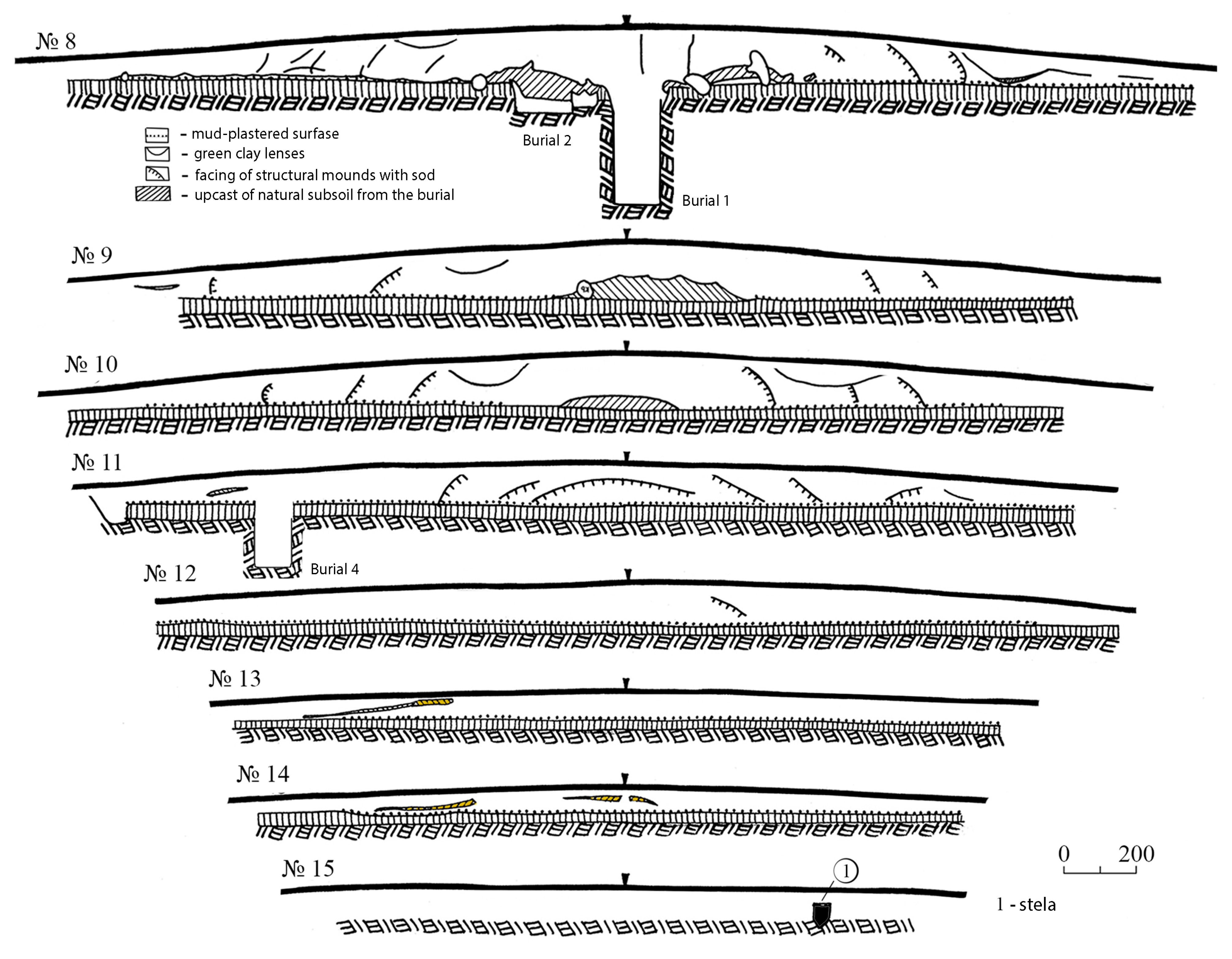
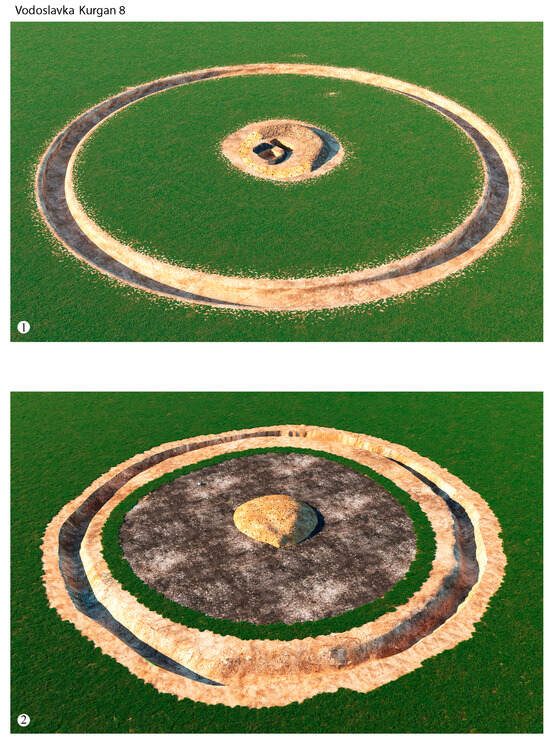
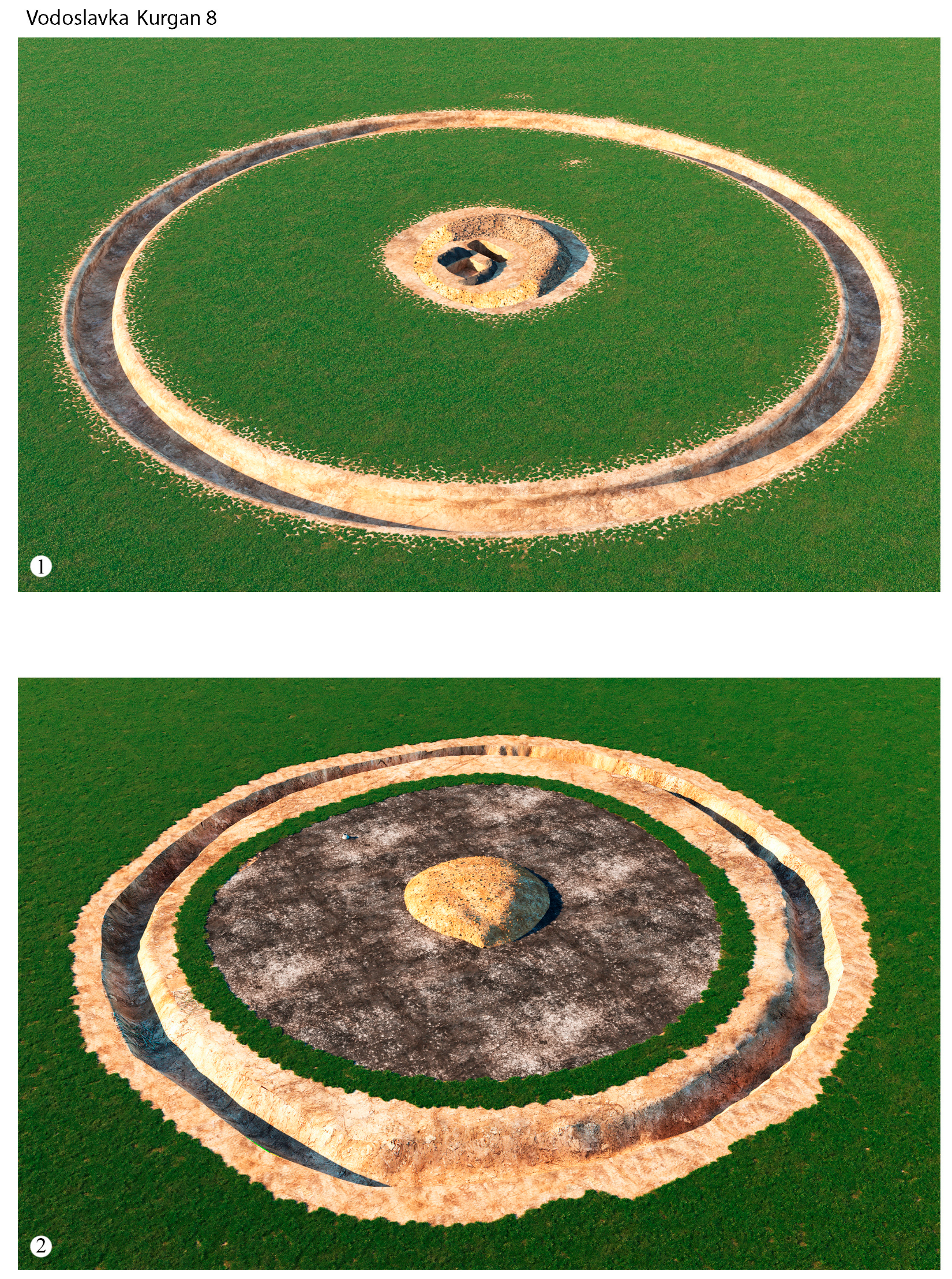
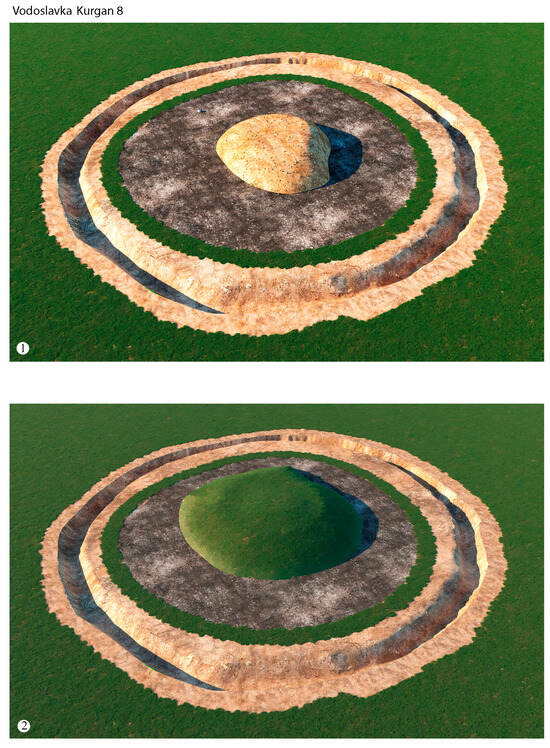
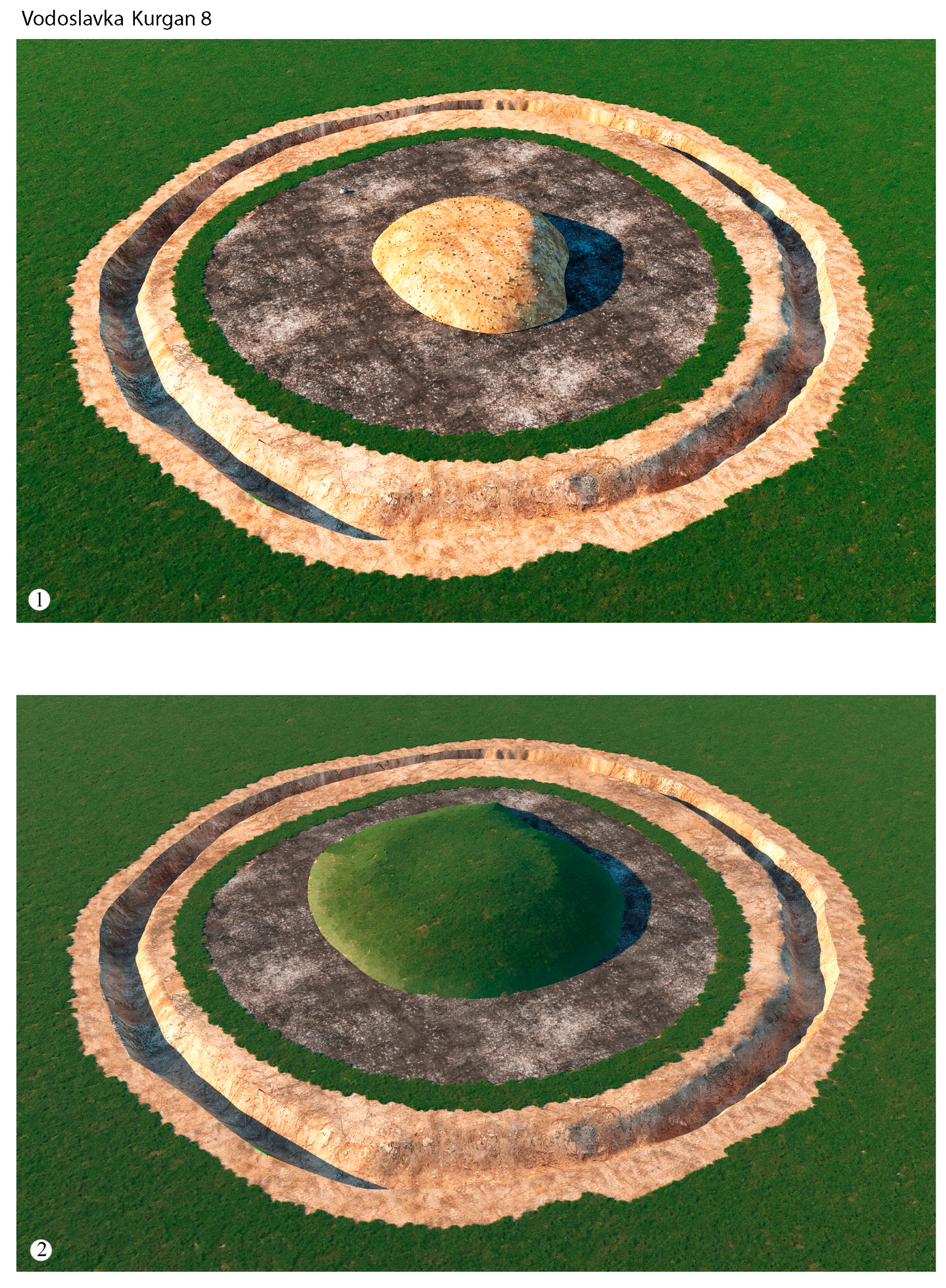
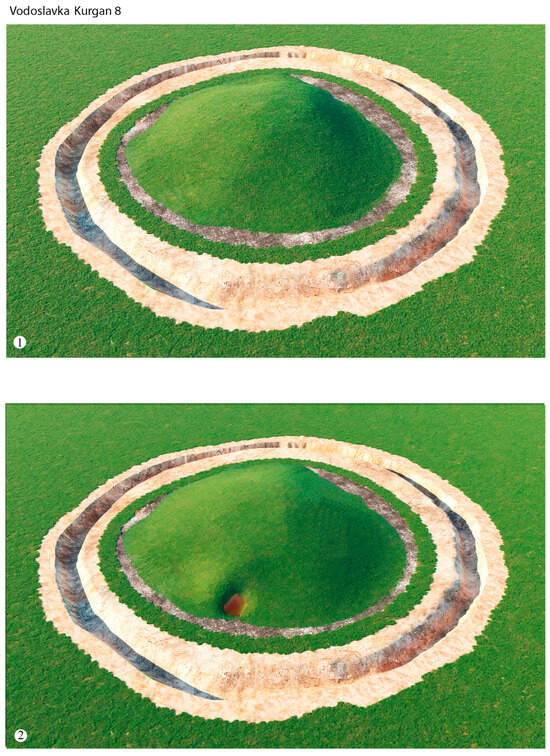
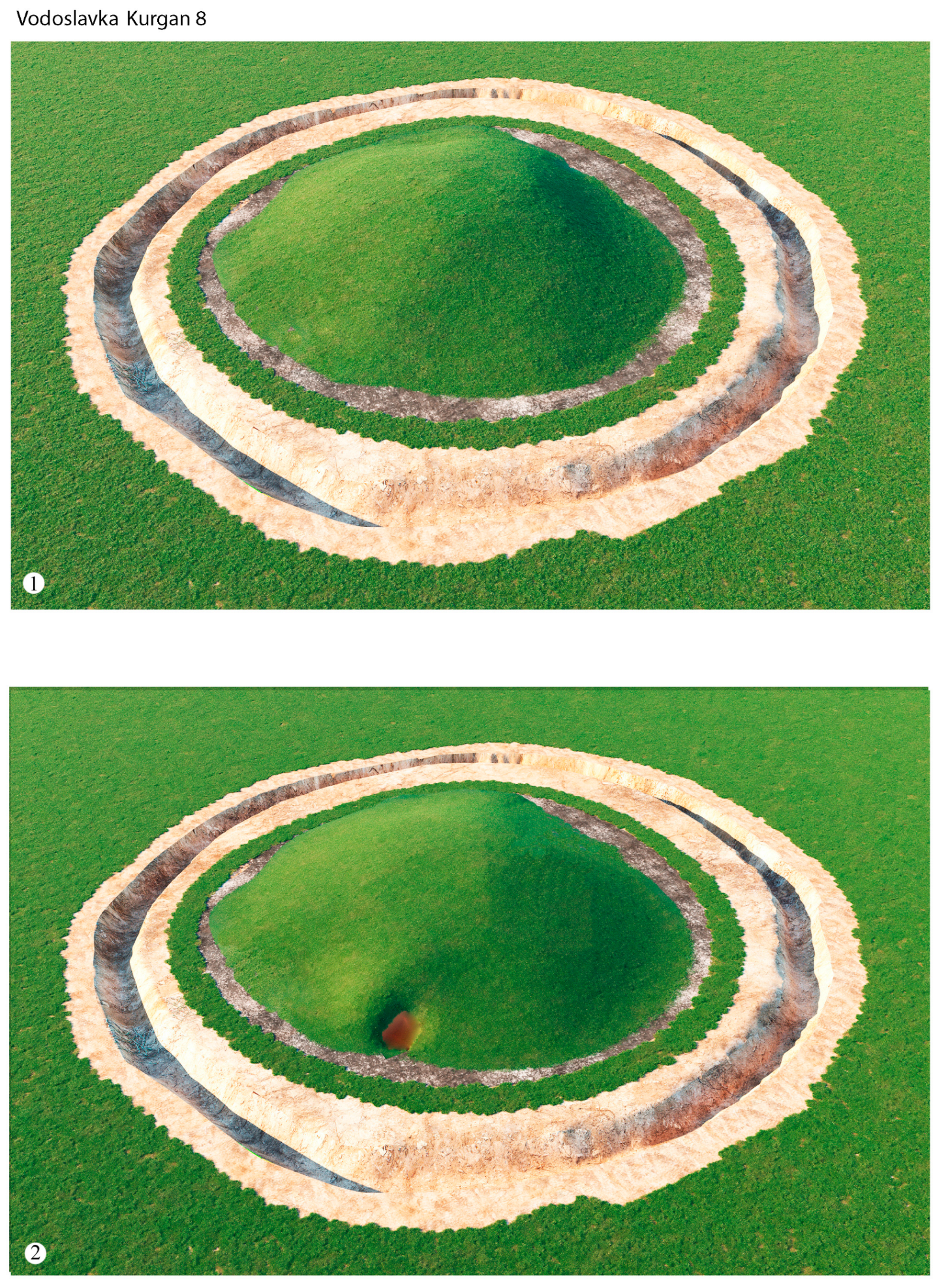
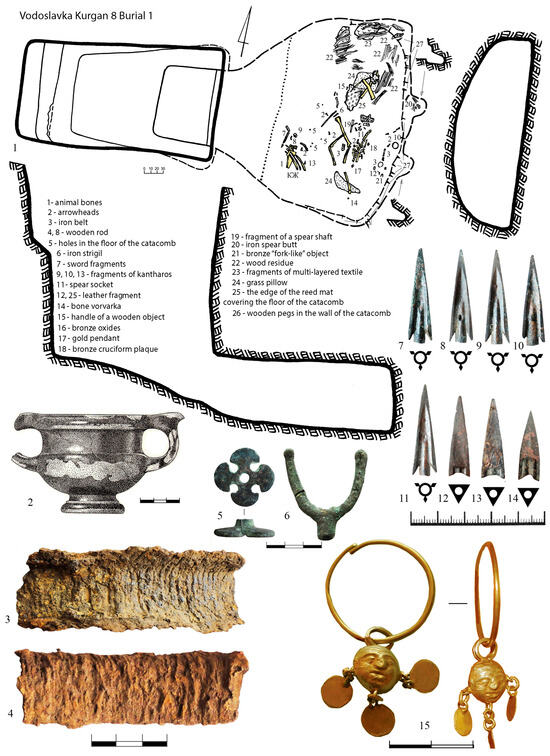
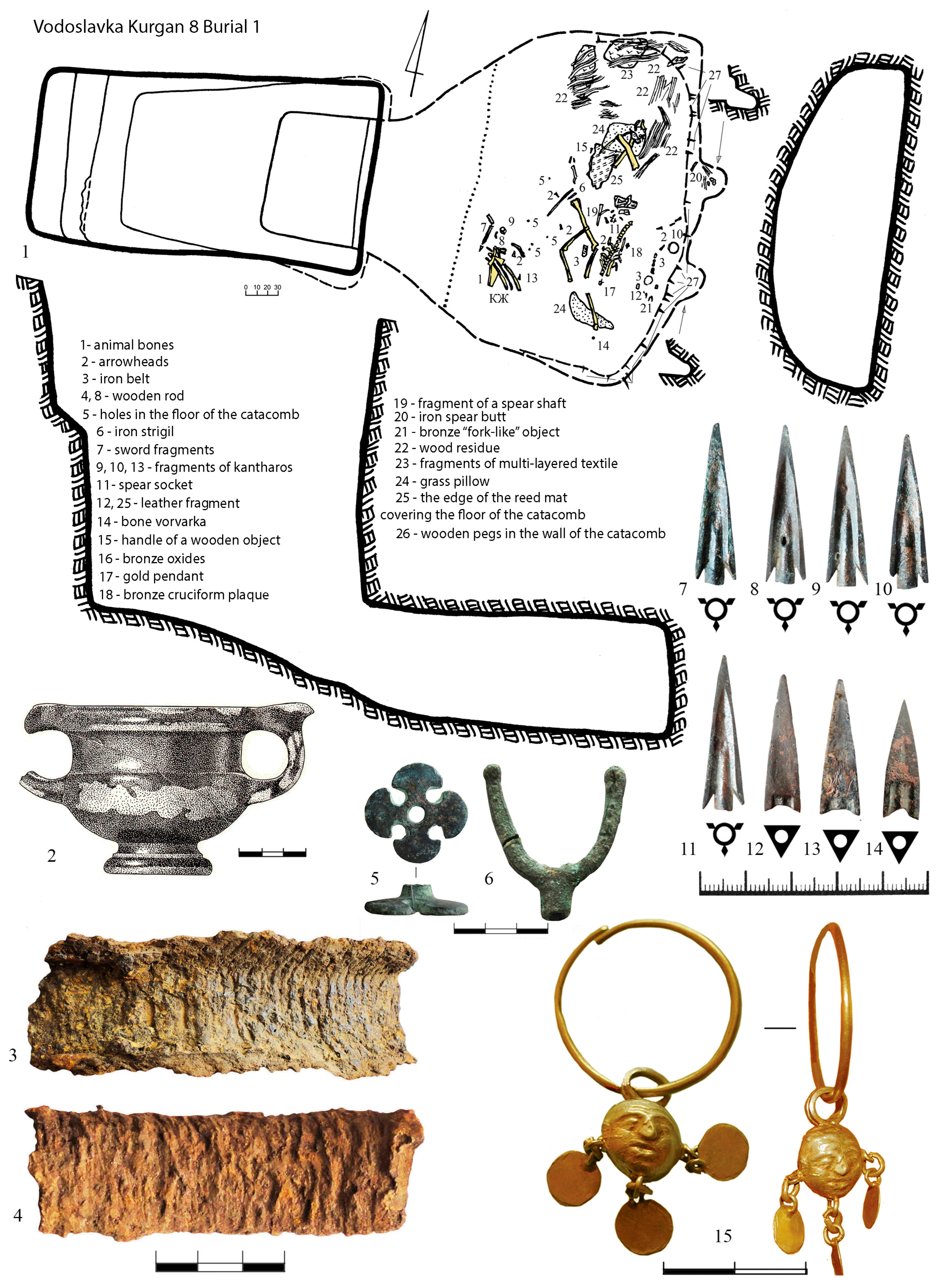
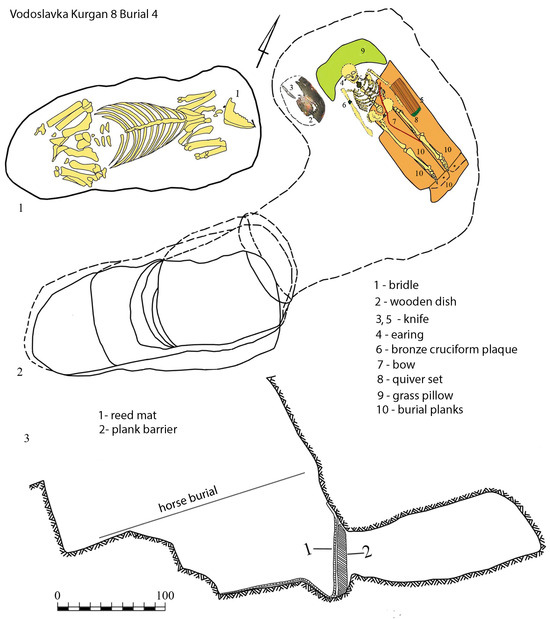
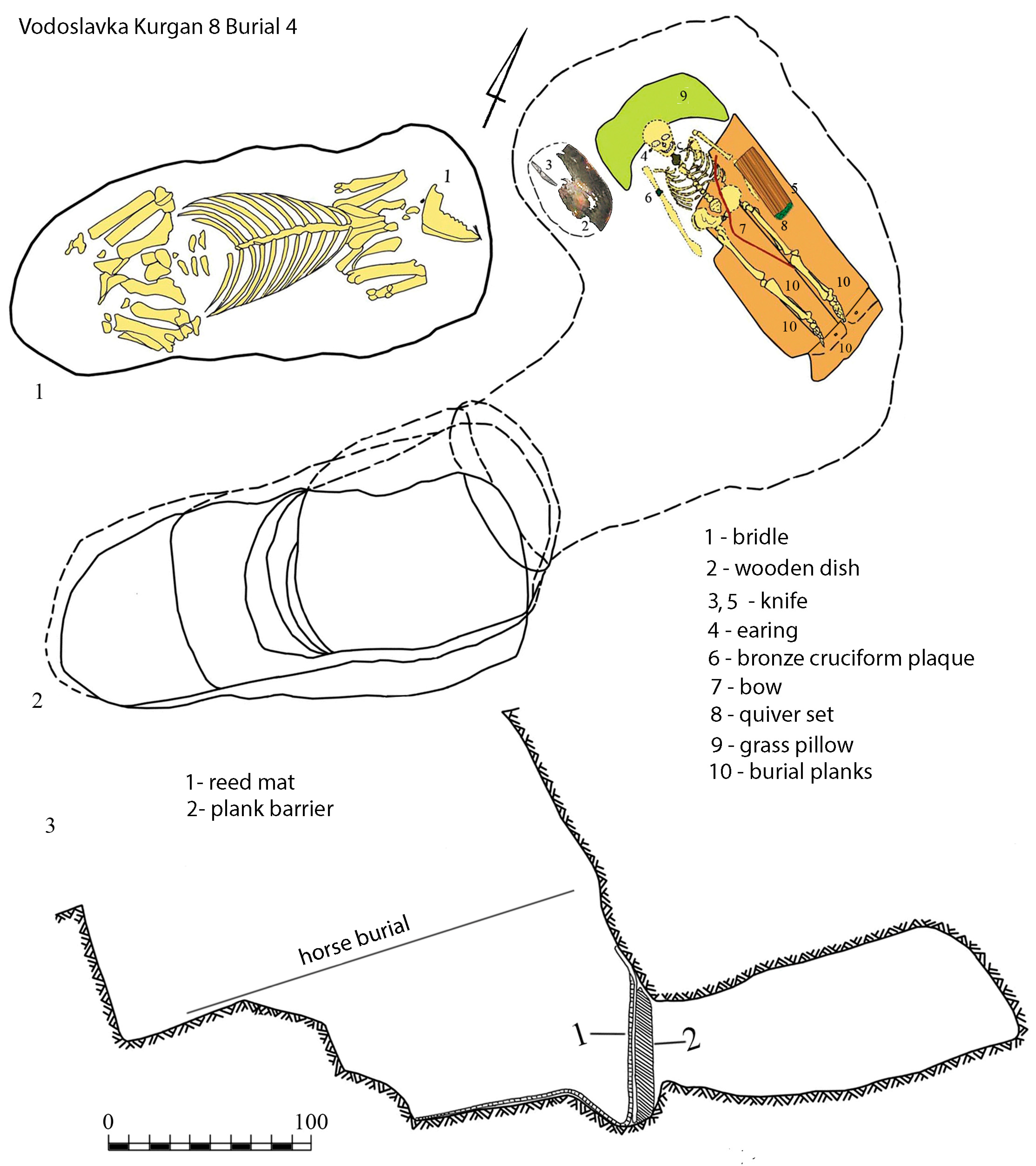
Disclaimer/Publisher’s Note: The statements, opinions and data contained in all publications are solely those of the individual author(s) and contributor(s) and not of MDPI and/or the editor(s). MDPI and/or the editor(s) disclaim responsibility for any injury to people or property resulting from any ideas, methods, instructions or products referred to in the content. |
© 2026 by the authors. Licensee MDPI, Basel, Switzerland. This article is an open access article distributed under the terms and conditions of the Creative Commons Attribution (CC BY) license.