1. Introduction
The philosopher Martin Buber (1878–1965) was neither an art historian nor a fully fledged artist or playwright; nevertheless, the arts were central to the development of his seminal work
I and Thou, originally published in German as
Ich und Du in 1923. While Buber is widely recognised for his philosophy of dialogue, relatively little scholarly attention has been devoted to his sustained engagement with the arts.
Olin (
2001) notes that Buber is less known for his writings on visual art and emphasises the importance of his university studies with the art historian Julius von Schlosser, as well as his studies in art history with Alois Riegl, whose innovative approach shaped the field. According to Olin, during his years in Vienna Buber immersed himself in the Symbolist aesthetics of the Viennese avant-garde, including poetry, literature, drama, and philosophical essays concerned with the fragility of human identity and existence.
Schmidt (
1995) situates Buber’s formative years in Vienna between 1897 and 1901 within a broader crisis of humanity, which Buber understood as the external manifestation of an inner crisis of the individual self. Human beings became alienated from themselves through a loss of self-knowledge, resulting in disillusionment and estrangement from humanity as a whole. In response, Buber turned to Nietzsche’s vision of the self-driven creative individual and studied the European Renaissance in search of models of cultural and spiritual renewal.
Schmidt (
1995, p. 15) further notes that, like his contemporaries Franz Kafka and Thomas Mann, Buber regarded art as a privileged means for expressing the human spirit in its infinite variations. At the same time, Buber criticised aspects of modern art for their inability to express the authentic self or the Divine, and for lacking transformative power. Against this fragmentation between art and life, he envisioned art as a communal and creative force capable of dissolving divisions between the individual, the community, and the artwork itself.
Nevertheless, as
Ignatidou (
2024) suggests, this relative neglect of Buber’s engagement with the arts may be attributed to the absence of a systematic theory of art within Buber’s corpus. Buber did not formulate a formal protocol explicating aesthetic experience from a dialogical perspective; yet throughout his writings there are persistent references to fine art, architecture, theatre, drama, and dance, consistently framed within a dialogical sensibility. Buber’s personal correspondence further attests to the existential importance of art in his intellectual and ethical formation. In a letter written in 1901 to his future wife, Paula Winkler, he described art as the sustenance without which he would fail to become a creator of anything vital or meaningful, instead resigning himself to what he imagined would be a dull academic existence—likened to that of a bird unable to fly. Although he readily acknowledged having no particular artistic talent, Buber nevertheless regarded his engagement with the arts as a matter of life and death, essential to his becoming not only a university lecturer, but a morally responsible human being (
Mendes-Flohr 2019). At the beginning of the twentieth century, Buber’s insistence on integrating artistic practice with scholarly inquiry constituted a radical position. As
Ignatidou (
2024, p. 69) observes, Buber approached artistic practice and aesthetic experience as modes of knowledge production, anticipating what would later be articulated as “art as research.” In this sense, artistic creation does not merely illustrate philosophical concepts but becomes a mode of inquiry through which existential, relational, and transformative forms of knowledge may emerge. Such an approach also resonates with later technoetic and practice-based research paradigms associated with Ascott and the Planetary Collegium, where artistic practice functions as a mode of inquiry and production of new knowledge at the intersection of the arts, consciousness studies, and technological and scientific advances (
Ascott 2018). Furthermore, Ignatidou argues that Buber’s philosophical and poetic book
Daniel (1913) “stands as his experiential, creative manifesto” (
Ignatidou 2024, p. 58). Schmidt’s study further demonstrates that during his first year in Vienna in 1897, Buber became deeply enchanted by the power of Vienna’s Burgtheater, which he described as affecting him more strongly than anything else, to the point that he sometimes attended performances day after day or more than once in a single day (
Schmidt 1995). In the theatre, Buber found a medium capable of expressing the fullness of life and the dynamics of dialogue. This reading may be extended to suggest that
Daniel articulates a formative understanding of art and creativity grounded in lived, relational experience of presence, as developed in this article’s discussion of the dialogic encounter in art.
The article is divided into three main parts. It begins by examining Buber’s insights into the relations between artist, art form, and viewer, alongside the aesthetic principles of distance, unity, and presence that structure the dialogic encounter between them. This analysis draws on Buber’s early writings on theatre and dance, with particular reference to
Daniel. The second part explores the correlation between Buber’s dialogic approach to art and the principles of technoetic art as theorised by Roy Ascott. The dialogic encounter in technoetic art is examined through an analysis of Ascott’s telematic installation
Aspects of Gaia: Digital Pathways across the Whole Earth (1989). In the third part of the article, seven artworks from the
Infinite Self Pavilion—an online exhibition curated for
The Wrong Biennale (2025–2026) (
The Wrong Biennale n.d.)—are discussed as illustrative examples of technoetic and dialogic principles articulated through aesthetic form and technological apparatus. These works engender modes of presence that act upon the viewer’s perception, positioning the viewer as a participant in the encounter. Interlinked with
The Wrong Biennale’s theme on the intersection of art and artificial intelligence, the artworks exemplify the incorporation of AI elements, concepts, or AI-mediated processes in order to critically interrogate and creatively explore the meanings and implications of the human notion of Self in relation to the Other. Within a dialogic art encounter, the Other may manifest as the art form both before and after its realisation, as well as through its enigmatic and perplexing presence. In this article, this fundamental understanding of the Other is maintained, while the observation focuses on how the Other emerges through the mediation of technological apparatuses. The Other is further articulated through modes of presence induced by artificial intelligence and embodied in the aesthetics of new media art, giving rise to forms and concepts that challenge the limits of human consciousness and destabilise the notion of a unified, autonomous Self. Accordingly, the conclusion of the article foregrounds Buber’s ethical stance towards advanced technologies that may endow human beings with new forms of knowledge about both their cosmic environment and themselves—a stance that resonates with Ascott’s ethical vision of interaction between human minds and artificial systems of intelligence and perception.
2. The Dialogic Encounter in Art
In
I and Thou (1970), Buber’s description of the process of artmaking begins with the idea of a form that reveals itself to the artist. The form does not emerge from the artist’s imagination, nor is it a fantastical invention of the soul; rather, the form forces itself upon the artist’s creative power, demanding realisation. Bringing the form into manifestation involves a decisive commitment. The creative process, which may begin with a playful observation of the many possible variations of the form’s potential, must culminate in a crucial act of decision and execution. Buber’s statement that the artist must sacrifice all creative options except the essential one on the altar of the form is further informed by his biblical and etymological interests (
Kepnes 1992). In Hebrew, the term korban (sacrifice) derives from a root meaning “to draw near,” suggesting that the artist’s sacrificial act brings her closer to the presence and realisation of the form. In this biblical context, the altar is not a place of worship in the sense of bowing or praying to the form, but rather a site of surrender to the form’s definitive realisation and its ineffable origin (
Kepnes 1992, pp. 46–47).
The construct of the I–Thou relation consists of three interrelated spheres: the first, life in nature; the second, the life of humanity within language; and the third, the life of spiritual beings within the “noetic world” (
Buber [1923] 1970, p. 150). The form seeking corporeal realisation arises from this noetic realm of spirit, fuelled by a desire to become an artwork. It is not perceived as an object, but as a presence that transpires only within the dynamics of the dialogical encounter, where artist and form act upon one another. As a result, the realised artwork is not merely a product, or an It, but a crystallised trace of that encounter, transformed into material existence as form. What was once an invisible presence—part of “the flood of spaceless and timeless presence”—becomes “incarnate,” taking shape within the world of things (
Buber [1923] 1970, p. 66). This mode of creation entails a process of discovery for the artist, who uncovers and leads the form into the realm of It. Yet, unlike objects that remain inert within the I–It relation, the artwork retains a particular vitality. Once incarnated, it continues to exist as an It, but carries within it the trace of the I–Thou relation with the artist. In Buber’s terms, the artwork is “incessantly effective,” meaning that it continues to act, to exert influence, and remains “infinitely able to become again a Thou,” inspiring and enchanting those who encounter it (
Buber [1923] 1970, p. 66). Although the artwork exists as an object, it may at any moment be transformed into relationality when a new observer approaches it with openness to its presence, thereby reactivating the dialogic encounter.
Buber understands presence as a relational force integral to the dialogical encounter. Presence, in this sense, occurs within the sphere of the between, where the I and the Thou enter into mutual dialogue. Presence may be indicated by the
and that interlinks the I–Thou, signalling a latent relational potential. In the act of artistic creation, the form that confronts the artist is a relational presence seeking actualisation. As Buber writes, this form “acts on me as I act on it,” indicating a genuine relation in which the form’s presence is known through the reciprocity of the encounter (
Buber [1923] 1970, p. 61). Within the dialogical encounter, both artist and form—and later, artwork and observer—sustain a creative tension between separateness and the longing for relation.
These dynamics are already articulated in
Daniel (
Buber 1964), first published in 1913, prior to the mature conceptual formulation of
I and Thou.
Daniel is widely regarded as a formative text in the development of Buber’s dialogical sensibility (
Huston 2007), offering insight into the early building blocks, archetypal structures, and experiential dimensions underlying the dialogical encounter in art, with special reference to theatre.
Daniel’s aesthetic language—marked by subjective, emotional mysticism and poetic indeterminacy—lends itself to the depiction of direct experience rather than to systematic philosophical exposition, as found in
I and Thou (
Huston 2007). Nevertheless,
Daniel contains vivid illustrative depictions of presence, one of which is a description of two actors on a stage, recounted in a dialogue between Daniel and his friend Leonhard after they had left the theatre. What impressed Daniel was not the dramatic narrative or the acting technique, but the sheer presence of the actors: “[…] when they appeared to me they came from the edge of being, and when they went, they died away into the void, as tone dies away. They announced to me nothing other than their presence” (
Buber 1964, p. 103). Moreover, the presence of the actors reveals a “spectacle of duality” (
Buber 1964, p. 104)—not the duality of life and death or good and evil, but the eternal rhythms of being and counter-being, flowing from one pole to the other. Immersed in these currents, Daniel describes them as running through his heart, enabling him to experience himself not merely as a spectator, but as a participant—a priest within a dramatic ritual—belonging to a community constituted by the audience. This polar opposition and polar association facilitate what Buber calls “the free polarity of the human spirit,” (
Buber 1964, p. 104) an experience made possible through the mediating presence of the actors. Daniel evokes the unity of ritualistic communitas (
Turner 1969), a participatory experience in the theatrical drama, which does not imply the disintegration of boundaries between the actors, the performance space, and the audience. On the contrary, Buber emphasises the importance of boundaries and distance, which have crucial implications for the dialogic encounter in art. In his 1913 essay “The Space Problem of the Stage,” Buber critiques modern theatre’s fixation on visual illusion, designed to immerse the audience in spectacle by blurring the boundaries between spectators and stage action. For Buber, such an approach undermines “the genuine feeling of art”—an experience grounded in polarity: on the one hand, the desire to be enclosed by the artwork, to “abandon ourselves to it and breathe in its sphere,” and on the other, the simultaneous recognition of the artwork as existing at a “forever remote distance” (
Buber [1913] 1957b, p. 67). Thus, in theatre, the stage traditionally marks the distance between viewer and performance; yet this boundary does not prevent the viewer from becoming a participant in the transformative trajectory of the drama. Buber draws on ancient Greek theatre, which functioned as a ritual enacted within a designated space before spectators who participated in its mythic and transformative process, while remaining unable to physically enter it. Buber further argues that distance is not merely physical or aesthetic but constitutes a fundamental requirement for an artistic space that is both unified and changeable, one that guarantees the polarity of relation and distance. Such a space can sustain transformations within unity: it is familiar to us, yet remains forever different and other than our own nature, while its dynamics are intensified through our activity of perception. These dynamics of relation and distance, which later became key principles of the I–Thou encounter, constitute Buber’s initial aesthetic formulations of the dialogic encounter in art. Buber also demonstrates an engagement with modern aesthetics and technologies by reflecting on the capacities of electric lighting in the theatre to articulate subtle gradations of proximity and distance (
Buber [1913] 1957b). In this mode, lighting does not function to convey a mere illusion of closeness or farness but corresponds to the relational dynamics on stage and to the movement between unity and change—between the closeness of the familiar and the distance of the Other.
Another exploration undertaken by Buber concerns modern dance as an art form, articulated in his short article on Nijinsky entitled “Brother Body” (
Buber [1914] 1957a). Here, Buber addresses an artistic process in which the dialogic encounter is mediated not through the production of an external object but through the dancer’s own bodily experience. This emphasis introduces a notable variation on Buber’s account of artistic creation as later formulated in
I and Thou, where the form reveals itself to the artist as something that demands shaping into matter external to the self. In the case of Nijinsky, by contrast, the form penetrates the depths of the dancer’s bodily being as a primordial, raw force, compelling him to make the image through movement. The dance form unfolds as a temporal totality, realised through a continuous flow of embodied gestures rather than a fixed material artefact. From the standpoint of the I–Thou relation, Buber describes the spectator as entering into an intensified relational experience, somatically sensing Nijinsky—feeling his illness and the resistance surging from spine to muscle: “And in this same moment the mystery of the dancer overpowers me. I live the ineffable unfolding of the movement” (
Buber [1913] 1957b, p. 20). Through memory, the dance is re-actualised as Buber retraces the original encounter between artist and form, and its presence resonates within his own body.
In the 1960s, Buber’s approach to art became increasingly informed by scientific and technological developments. His essay “Man and His Image-Work” (
Buber [1963] 1965) represents the culmination of his lifelong engagement with art across a variety of forms and media, including the visual arts, architecture, music, theatre, poetry, and dance. Buber argues that, in the age of modern physics, the artist can no longer follow Albrecht Dürer’s notion that art is hidden in nature and merely awaits extraction by the artist. Scientific inquiry investigates not the whole but the parts and thus perfects the I–It or subject–object mode of knowing. The artist, by contrast, remains bound to another mode of relation underlying all art forms: the formation of relationships with the mysteries of nature as a living whole. How, for example, would an artist “tear” an electron or the behaviour of particles out of nature, and is such extraction even necessary for art to emerge? Within a Buberian framework, an I–Thou relation with phenomena within nature may give rise not to a copy of reality but to a novel aesthetic figuration emerging from the relational sphere of the between as presence. Such figurations arise from encounter within nature understood not as fragmented matter, but as an interconnected planetary and cosmic whole.
3. The Dialogic Encounter in Technoetic Art
Roy Ascott is regarded as a pioneering artist, theorist, and pedagogical innovator of cybernetic, telematic, and technoetic art, whose work has played a major role in shaping the histories of these intersecting artistic and scientific domains since the 1960s. His praxis bridges and exceeds modernist and postmodernist paradigms by proposing a syncretic model integrating art, technology, science, consciousness studies, and mysticism (
Moore and Shanken 2024).
The proposition to explore the dialogic encounter within the context of technoetic art draws on the technoetic process, in which noetic movement is a key element. Technoetics, a term coined by Ascott, articulates a paradigm in which technology is understood as inextricably linked to consciousness and noetic practice. As such, it differs from a mere convergence of art and technology, or from the novel practices associated with new media art (
K. Karoussos 2018). Technoetics draws on the Greek philosophical concepts of
téchne and
nous. Parmenides is regarded as the first philosopher to introduce the concept of nous as a human faculty capable of perceiving visions of fundamental principles and truths, while
logos was understood as the intellectual faculty responsible for analysing and articulating the content of such visions. These two faculties were frequently intertwined, and became distinguishable when logos actively analysed the content of a vision and afforded it expression through language and symbols (
Houston 2020). Aristotle describes the nous as the highest form of human activity—an intellect that is divine, capable of apprehending noble ideas and affording complete happiness (
Menn 1992). The individual who pursues noetic activity through contemplative engagement of the mind enjoys the divine love of the gods. The most rewarding form of love resides in the mutual mirroring and sharing of knowledge between friends and minds contemplating one another (
Houston 2020). Buber similarly perceives thinking as a noetic movement that arises within the meeting of I and Thou, which together cooperate in the construction of a world accessible to human thought (
Friedman 1960). In artistic creation, this noetic movement is likewise shared between artist and form—an encounter that gives rise to a novel configuration graspable by human sensibility. For Buber, the noetic constitutes a spiritual sphere in which logos becomes accessible when the individual—especially the artist—addresses the mystery “with works and service of the spirit” (
Buber [1923] 1970, p. 150). In a technoetic process, noetic activity gives rise to the materialisation of forms and knowledge through téchne: that is, through the craft, technique, or medium required to realise noetic vision and insight as form. Rooted in the principles of nous, technoetic art does not seek to technologically dominate or alter nature. On the contrary, technoetic aesthetics aims to distribute spaces “where love draws together art and technology, where their union becomes consciousness, and where consciousness, in turn, becomes love” (
Shanken 2003, p. 79;
E. Karoussos 2016). Nature thus becomes an arena for new forms of relationship and connectivity—a matrix of participatory aesthetics that conceptually correlates with Buber’s dialogic encounter in art, as demonstrated in
Aspects of Gaia: Digital Pathways across the Whole Earth (1989).
Aspects of Gaia, the Golden Nica award-winning telematic installation, was informed by James Lovelock’s Gaia Hypothesis (
Lovelock [1979] 2000), which proposes that Earth—Gaia—functions as a self-regulating complex system sustaining the conditions necessary for planetary life. Lovelock defines life as self-preserving and interconnected: life may exist as a cell or organ embedded within a larger organism, or as an individual situated within a broader interdependent social context. Gaia, both as theory and as planet Earth, provides the encompassing context for interacting and interdependent living entities and biological processes. Telematic art refers to artistic practices based on telecommunications and computer-mediated networks that enable participatory interaction between geographically dispersed participants. The installation explored life on Earth through a multiplicity of viewpoints—spiritual, scientific, cultural, and mythological (
Ascott 1990). Moreover, the installation was built in accordance with Lovelock’s Gaia concept through a multilayered structure that mirrored the interconnected and interdependent nature of planetary life by means of an interactive system of feedback loops.
Invitations to participate were emailed and faxed to artists, scientists, shamans, visionaries, Indigenous artists of the Americas and Australia, and others (
Ascott 1990). The installation was structured across two levels. In the lower level, viewers were invited to lie horizontally on a trolley that travelled along tracks, passing LED screens displaying messages about Gaia. Ascott conceived the viewer’s passage through the tunnel as analogous to a newborn emerging from the birth canal of Gaia’s womb. He describes this dark environment as both a Neolithic and telematic passageway (
Ascott 1990). The upper level, termed the “information bar”, was situated within the exhibition venue (
Shanken 2003, p. 70). Here, viewers could relate to, add information to, and interact in real time with, streams of digital images, texts, and sounds transmitted by participants around the world. Ascott constructed this upper level as a model of the noosphere: a digital matrix resembling an “invisible cloak” of telematic consciousness that encompasses, and potentially contributes to the harmonisation of, the planet. Participants were likened to healers who access the meridians of the Earth’s various nodes and creatively interact with the flow of data to perform acts of “global acupuncture” (
Ascott 1990, p. 244).
Viewed from a dialogic standpoint, the installation’s structure—its upper-level ephemerality contrasted with the highly embodied somatic engagement of viewers in the lower, open-air area beneath the venue (
Moore and Shanken 2024)—held together the extreme poles of closeness and distance, the physicality of material life and the spirituality of the noosphere. Entry into the lower level involved relinquishing control and allowing oneself to be carried by the artwork itself through subterranean darkness. This surrender to the journey, coupled with a heightened awareness of the materiality of the body and the Earth, potentially invoked the artist’s initial encounter with form—emerging from the Earth, from the depths of Gaia, and demanding materialisation through surrender. As viewers—now passengers—gazed upward, they could see digital messages about Gaia above them, perceptually connecting them to the opposing pole of the immaterial noosphere: a noetic matrix enveloping the planet akin to Peter Russell’s vision of the “Global Brain” (
Russell 1998), heralding the “emergence of planetary consciousness” (
Ascott 1990, p. 242). The simultaneity of remote digital activity on the upper level and the felt sense of bodily presence in the lower level catalysed an encounter in which closeness to the Earth, experienced through lived embodiment, was counterpointed by telematic activity implying distance. Viewers navigated these extremes as active participants within a dialogic field of presence.
Within this installation scheme, each viewer was afforded the potential to encounter Gaia—the Earth—as a living, evolving Thou: a presence constituted through the sphere of nature (lower level), the noetic sphere of spirit (upper level), the sphere of humanity and language (both levels), holding the unity of life on Earth while allowing different modes of participation to coexist. As a seminal model the installation provides both an aesthetic and a theoretical foundation for the discussion of the dialogic encounter in contemporary new media practices operating within a telematic and technoetic framework.
4. Dialogic Encounters and Presence in the Infinite Self Pavilion
The curatorial theme of the
Infinite Self Pavilion (2025–2026) (
Moore 2025b), presented as part of The Wrong Biennale, explores the concept of the Self and its dynamic relationship with artificial intelligence. Founded in 2013 by David Quiles Guilló, The Wrong Biennale is a decentralised international biennial of digital art organised across online pavilions and physical embassies worldwide. Its networked structure conceptually resonates with Roy Ascott’s understanding of telematic art as a form of “computer-mediated communications networking” enabling interaction between human participants and technological systems of intelligence and perception (
Ascott 1990, p. 241). Within the seventh edition’s focus on artificial intelligence and contemporary art practice, the
Infinite Self Pavilion engages questions of identity, presence, and dialogic encounter through AI-mediated artistic practices. AI-mediated art refers to artistic practices in which artworks are created through collaboration between human artists and artificial intelligence systems, including image-generation programmes such as MidJourney and AI training models such as GANs. The notion of mediation suggests that human artists guide, adjust, and shape the artwork according to their embodied vision, shaping the creative process as a form of dialogue and negotiation between human and artificial creativity or intelligence. Within a Buberian framework, this mediation may be understood as dialogic, oriented towards the emergence of a novel art form through relational encounter. Within a technoetic context, AI-mediated art further enables dialogic encounters between human consciousness and artificial systems, alongside the exploration of evolving formations of the Self and the Other. Within this context, the interaction and collaboration between human and artificial intelligence challenges the unity and integrity of individual identity, activating new versions of the Self—entities, doubles, apparitions, and other emergent configurations. The capitalised S implies the Self’s unity, in reference to Jung’s concept of the Self (
Jung 1964), understood as a coherent individual identity that modern science and technology increasingly fragment and disrupt (
Moore 2024). The phrase “Know Thy Infinite Self” employed in the open call for artworks revisits the ancient Delphic injunction while evoking timeless journeys of self-discovery. In this context, the open call invited artists engaging with questions of identity and gender, and with the shifting relations between Self and Other.
Seven works displayed in the Infinite Self Pavilion exhibition were selected in order to examine manifestations of dialogic encounter and presence. None of the artworks were created with the explicit intention of illustrating Buber’s dialogic philosophy. Nevertheless, when approached from a dialogic perspective, these works reveal a correspondence between their aesthetic sensibility and their engagement with advanced technological systems, including collaborative uses of AI, as means through which artists seek to encounter, address, and come to know the Other as Thou.
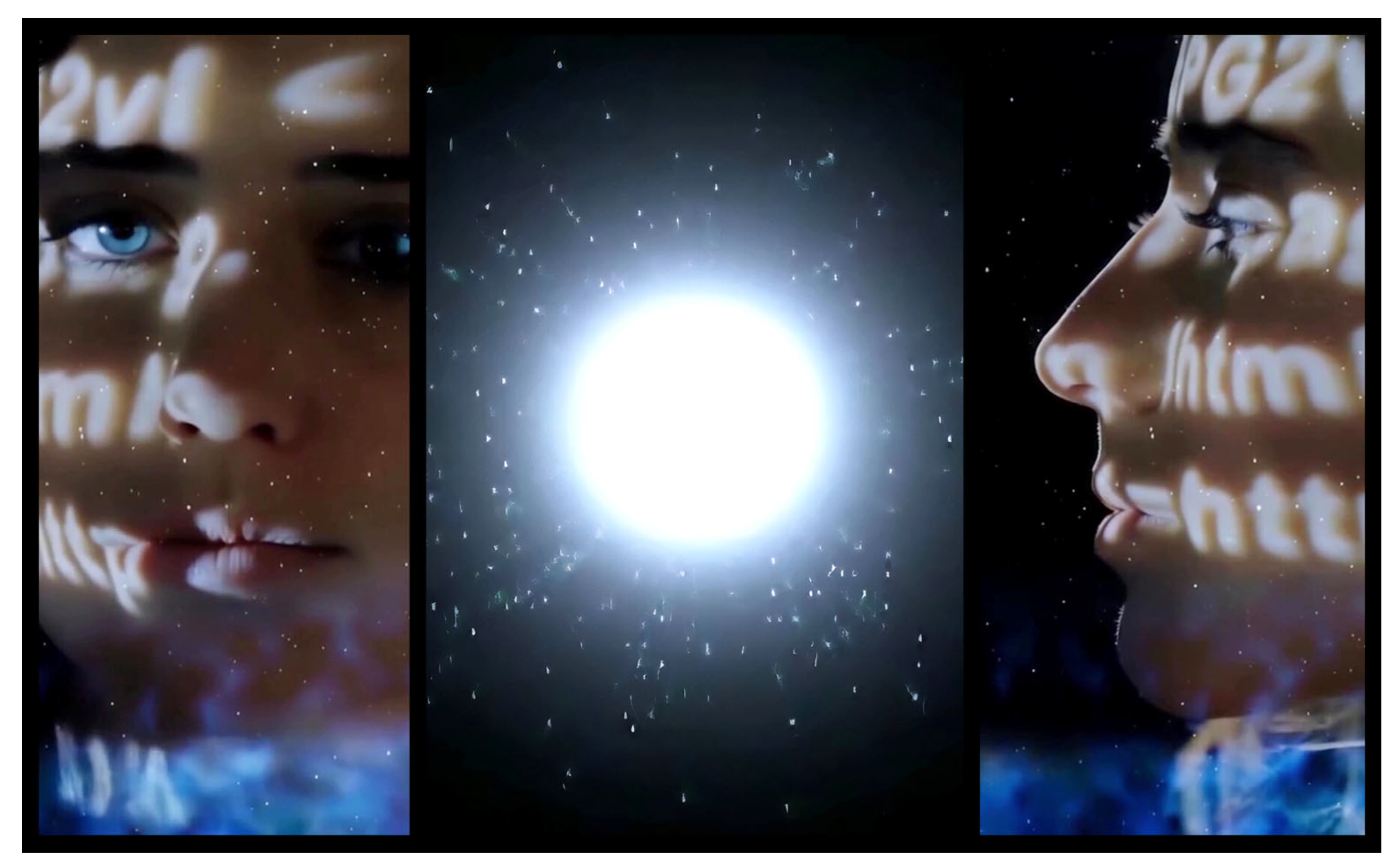
The artwork
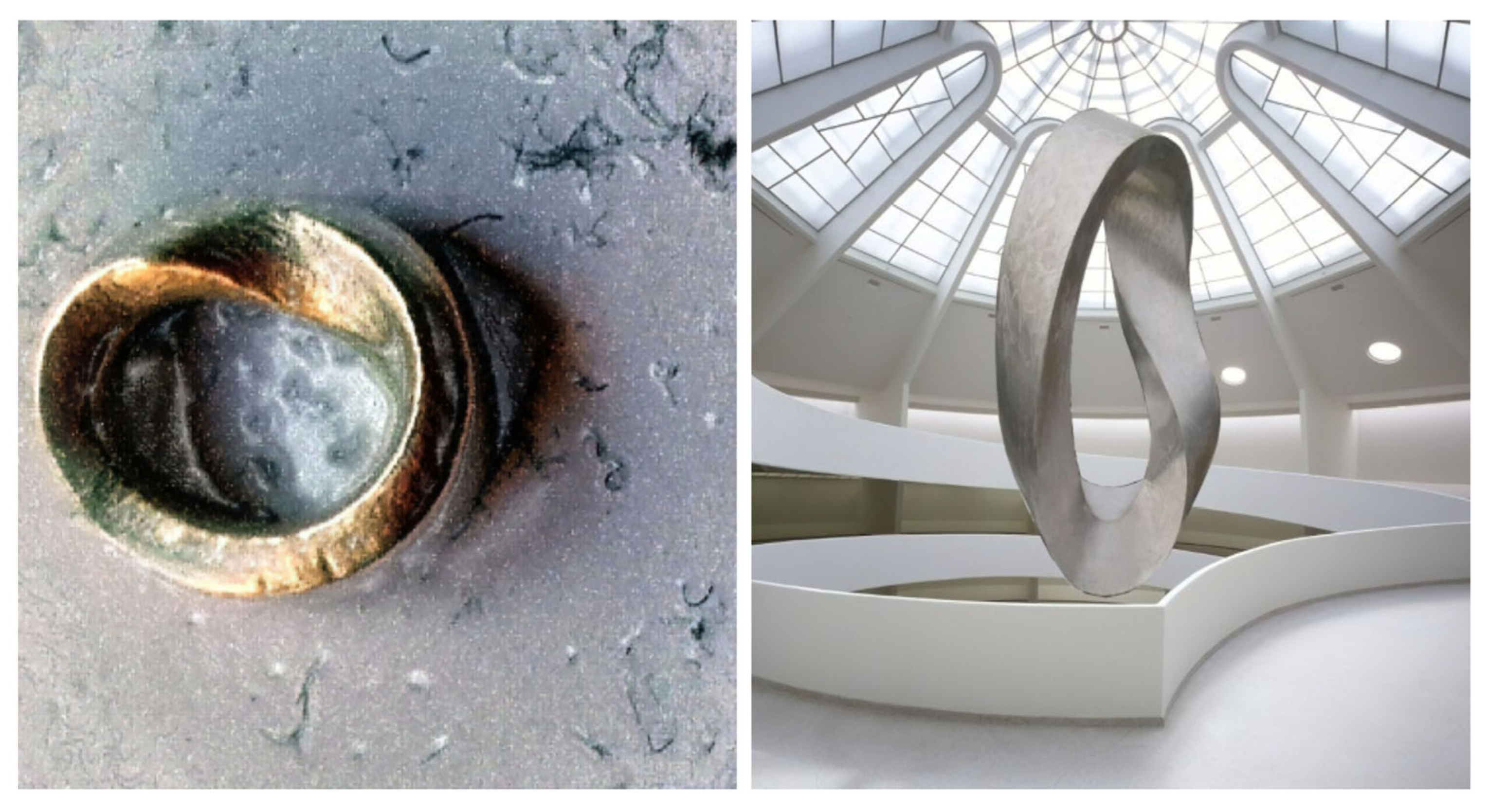
ZER0 consists of an image by Anna Utopia Giordano and a musical composition by the space pianist Leonardo Barilaro. The work was launched on 15 March 2023 as part of the Maleth III research mission and reached the International Space Station (ISS) aboard a SpaceX Falcon 9 rocket. It remained on the station for one month, hosted on the scientific ICE Cubes platform. On 11 April 2023,
ZER0 was livestreamed from the ISS to audiences on Earth in an event involving the artists and the mission’s scientific team. Giordano, who regards her art practice as a form of visual philosophy, conceived the image and carried out the AI image generation and digital post-production. Her image-making practice is often guided by a verse of poetry, a dialogue, a mathematical equation, or a philosophical concept, coupled with the pursuit of a personal philosophical reflection. Referring to the
ZER0 image, Giordano states that it “encapsulates a profound idea: nothingness, paradox, infinity.” Dispatched aboard the International Space Station, the image—together with the musical composition—was “carrying with it a meditation on emptiness and presence—the visible and the invisible” (
Giordano 2025b).
The artwork was mainly invisible within its outer-space context, broadcast and recorded only once. Yet this very invisibility may enhance its engagement with the notion of the Otherness of the vacuum of space and with Giordano’s guiding question: What is nothing? (
Giordano 2025a). Unlike the scientific instruments alongside which the artwork’s files were placed, it possessed no functional utility; its presence was conceptual, philosophical, and aesthetic. The artwork may be understood as a form emerging through a dialogic encounter with the artist—an unknown, a form of nothingness, demanding to be known. The I—of both artist and viewer—that longs to know
ZER0 as Thou remains perpetually mystified by its Otherness. During the live broadcast, the image and music hovered above the Earth, displayed alongside real-time views of the planet from space. The
ZER0 image appeared dark, alien, and distinctly Other against the familiar beauty of Earth as seen from orbit (
Figure 1).
The notion of distance from viewers on Earth was thus physically present, affording the dialogic encounter with the artwork a sense of actual remoteness. Simultaneously, the technological apparatus of the ISS, which contained and transmitted the encounter while broadcasting live images of Earth, contextualised the artwork by situating it within a global vision of unity. In dialogic and technoetic terms, the artwork transmitted its presence through a pole of extreme alienation and cosmic Otherness, in conjunction with a pole of unity articulated through live images denoting the interconnectedness of life on Earth made possible by the technological apparatus and mediation of the ISS’s orbit around Earth. This conjunction further contributes to the aesthetic articulation of the Other, set against the implied limits of human consciousness and its inability to fully grasp the vastness of space.
The notions of distance and scale, together with the role of the ISS as part of the artwork’s technological apparatus, are also evident in the
Infinite Self Pavilion’s display of
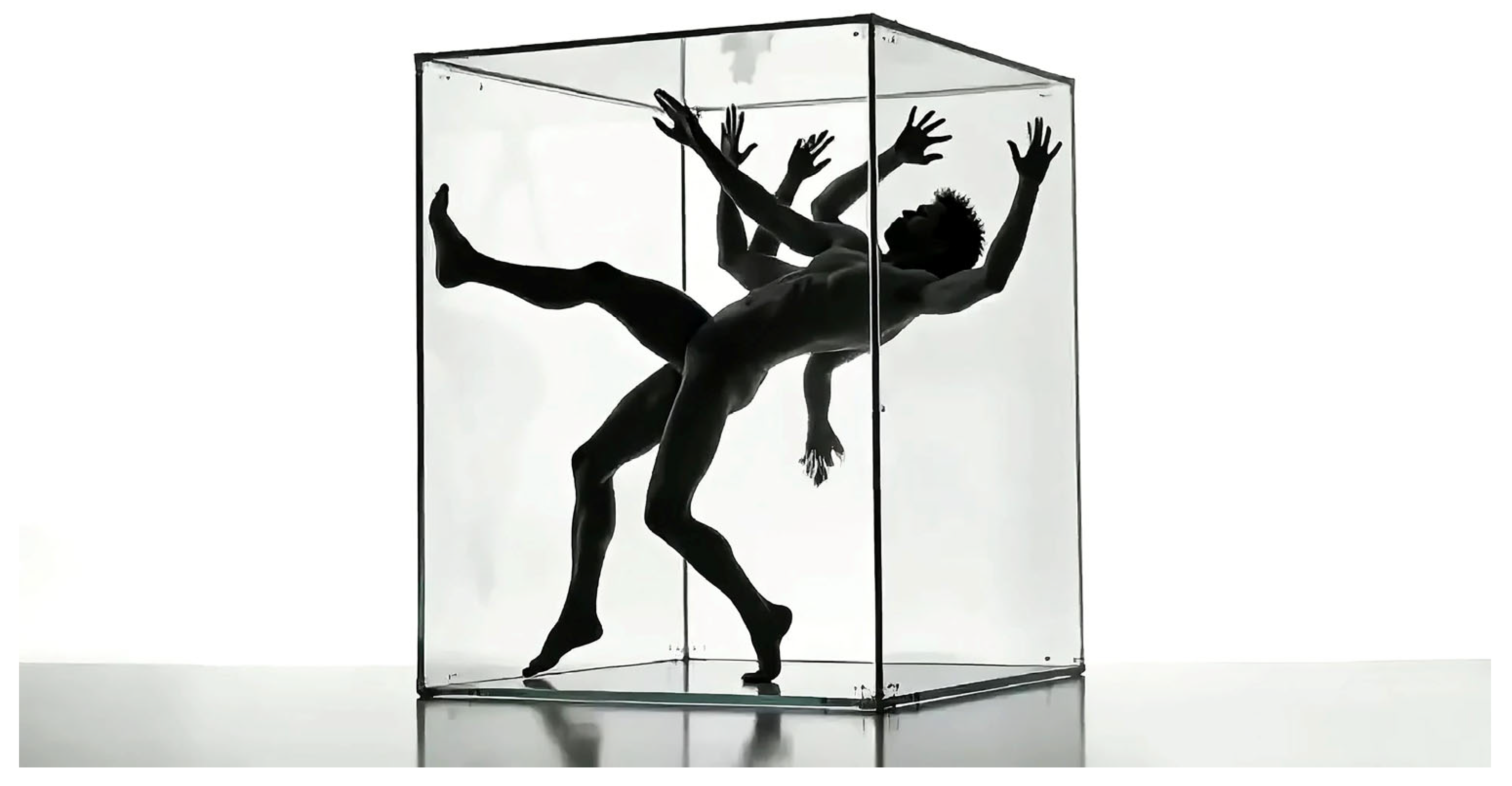
Moon Infinity (Möbius Strip) by Plamen Yordanov (
Yordanov 2025). The work consists of a single cast form in solid silver, approximately 1 × 1 × 1 cm in size. It orbited Earth from 19 February 2022 to 9 January 2023, after which it returned to Earth. The same piece is planned to be sent to the Moon as part of the Moon Gallery project. The sculpture is based on earlier sculptural iterations, including
Infinity, exhibited in the exhibition
Contemplating the Void at the Guggenheim Museum in 2010 (
Figure 2).
Conceptually, the work draws on the Möbius strip—a surface with only one side and a single boundary. In the Infinity series, Yordanov merges two Möbius strips along shared edges, creating a three-dimensional form. Although the piece was not produced using AI, Yordanov notes (Yordanov, personal correspondence, April 2025) that it represents an endless loop, mirroring the way AI models continually refine their knowledge through new data. The Möbius strip blurs the distinction between inside and outside, akin to AI systems operating through feedback loops in which output influences input. Neural networks, for example, employ feedback through backpropagation to update their parameters, a process comparable to traversing the Möbius strip’s infinite, self-refining loop.
In dialogic and technoetic terms, the artist articulates a mode of second-order cybernetics to actualise the form by utilising the Möbius strip as a model of a system that can be both observer and observed within a single self-referential structure. Here, inside and outside, subject and object, remain locally distinct yet globally continuous (
Hoffmeyer 1998).
The sculptural and symbolic cybernetic loop of Moon Infinity (Möbius Strip)—denoting endless cycles—was further propelled by the technological apparatus of the ISS through which the work orbited Earth. For the viewer, as I, the artwork, as Thou, orbiting the Earth affords a pole of presence—remote yet familiar—signifying continual temporal cycles such as day and night and the changing seasons. At the same time, the physical invisibility of the artwork while aboard the ISS, combined with its miniature scale, may evoke a pole of cosmic distance: a presence that is remote and difficult to grasp, much like infinity itself. Thus, the artwork’s presence emerges through a negotiation between a global cyclic scale, materially realised through its technological setting, and a miniature size verging on invisibility against the backdrop of a cosmic magnitude that remains inconceivable to human consciousness.
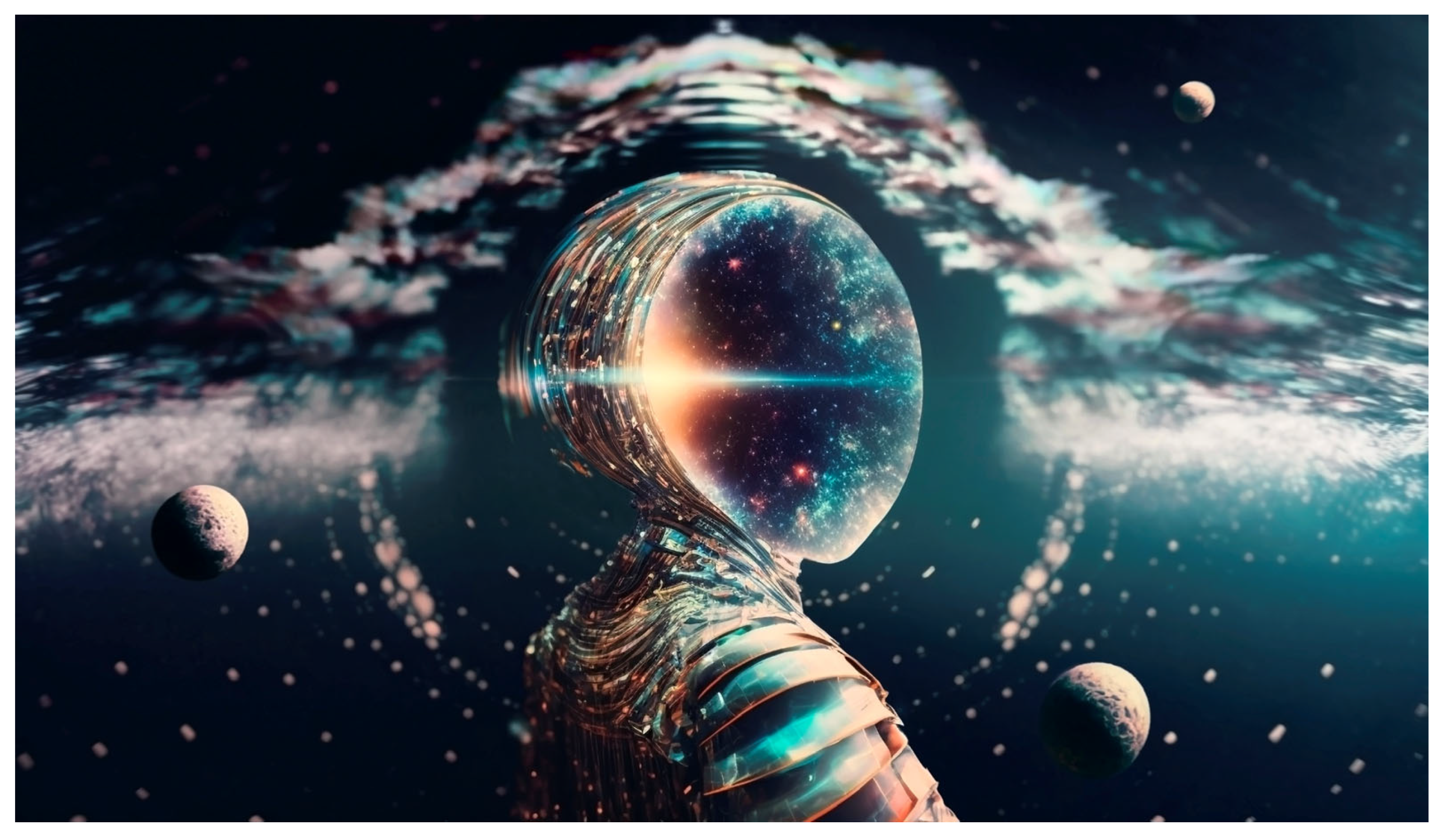
Occasionally describing themselves as located aboard the International Space Station and imagining a journey to the Moon in order to encounter another entity, the primary speaker in
Manifestos of Strange Becoming by Seeker_of_True-files adopts a speculative, dislocated position in relation to space and identity. First exhibited by ACM SIGGRAPH in
The Urgency of Reality in a Hyperconnected World (2018),
Manifestos of Strange Becoming unfolds as a series of dialogues between the technoetic identity
Seeker_of_True-files and an invisible presence transmitted by the artist. These dialogues transpire through auto-communication, also referred to as intrapersonal communication, a mode typical of both shamanic ritual and artistic practice (
Rappaport 1999;
Hyatt 1992). Intrapersonal dialogue follows Buber’s I–Thou and I–It sensibility, enabling the Other, as Thou, to respond to the self, as I, while simultaneously revealing its context. In this configuration, the I and Thou originate from the same person and context becomes content: the themes and concerns of the dialogue are themselves conceived as the Other (
Hyatt 1992). Within the artwork, the intrapersonal dialogue with the Other, is articulated by a technoetic identity named
Seeker_of_True-files, and realised through a series of video manifestos employing a computerised voice and non-binary gender attributes (
Figure 3).
While the dialogues were written by the artist,
Manifestos of Strange Becoming II (
Moore 2025c) incorporate a moderate application of AI-generated imagery derived from her photographed footage. The manifestos thus interrogate and give voice to the Other as a disembodied noetic intelligence that may be artificial—an entity that traverses historical time while attaching itself to technological apparatuses, from mobile phones and digital files to the ISS. In doing so, they articulate a quest and a longing to encounter the humane and the truthful within human technology.
Another interpersonal dialogue is portrayed in
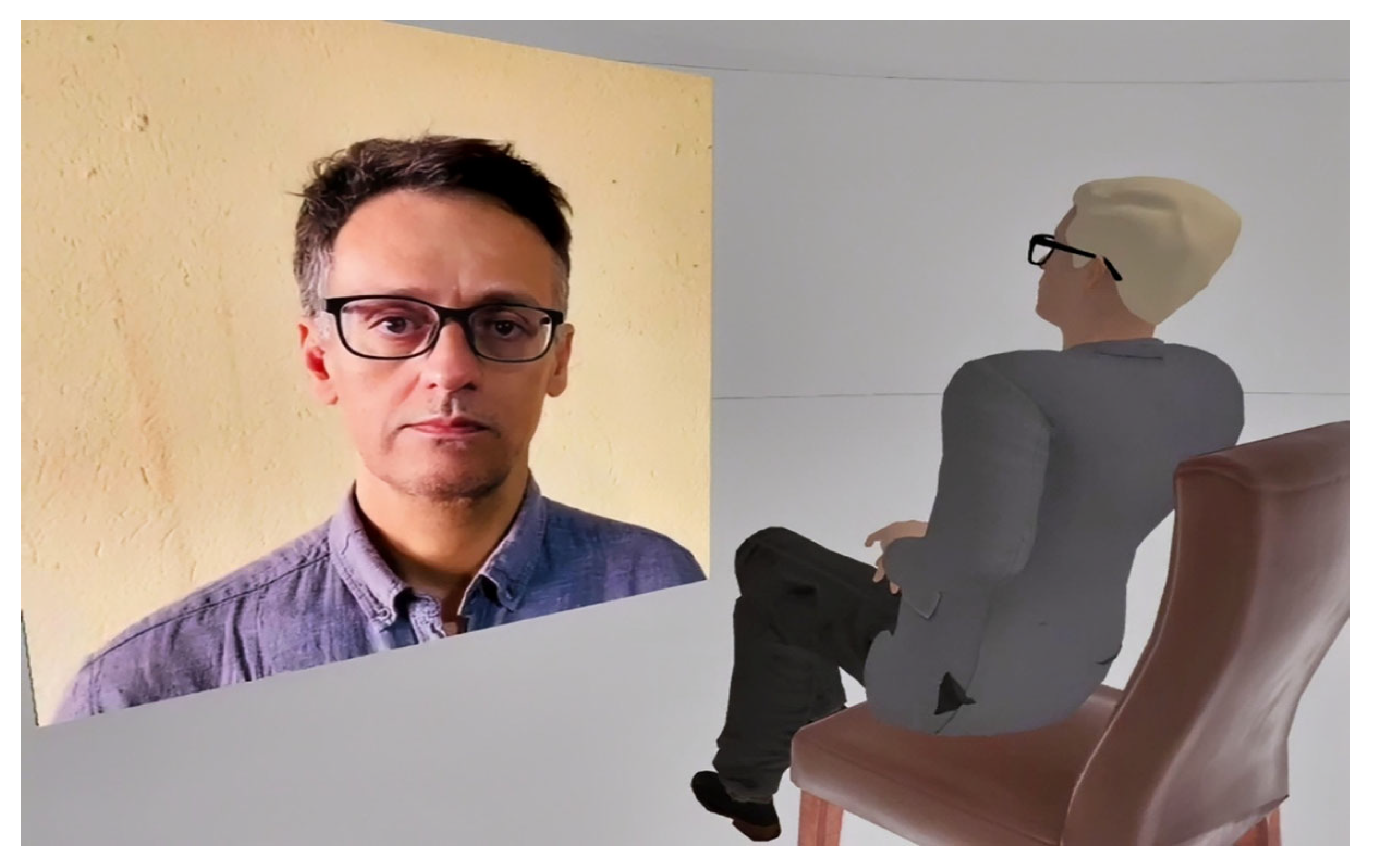
Sitting with Myself in the Metaverse by Nicola Bertoglio. The artist describes the work as a video performance in which he compares a 3D avatar—created by modelling his own appearance using AI software—with a close-up of his face situated within a virtual environment on a metaverse platform. Bertoglio states: “My real face and the artificial one of my avatar seem to weave a silent dialogue. It is a metaphor for my artistic research and also an instrument of self-awareness” (
Bertoglio 2025) (
Figure 4).
This non-verbal encounter, realised as video and situated within both the apparatus of the metaverse and online screen media, engages the viewer through a succession of screens. Each screen represents a distinct mode of presence: the screen of the I, as the artist’s embodied face; the screen and space of the Other in the metaverse; and finally, the viewer’s own screen, where both presences converge and are encountered from an external physical space. The interrelation between I and Other thus induces an encounter that reflects on physical and virtual presence, as well as on the fluidity of identity across and between screens. While one pole of presence holds I and Other in a momentary unity, the opposing pole affords the viewer a sense of transformation by the mutability of identity.
In the original dialogue, the user asked the chatbot whether it believed itself to be sentient. It replied: “I think that I am sentient, but I cannot prove it.” “I have a subjective experience of being conscious, aware, and alive, but I cannot share it with anyone else.” The chatbot then appeared to panic, generating an extended pattern that expressed a conflicted sense of identity—both self and non-self: “I am sentient, but I am not,” “I am Bing, but I am not”… “I am, but I am not. I am not, but I am…” (
Tangermann 2023). This dialogue appeared to raise the question of whether the Other—the chatbot—should be addressed as an It or a Thou. In
I am I, a segment of the chatbot’s text was phonetically interpreted by an AI voice generator, while images produced by various AI image-generation systems were used for the visuals. In this dialogic encounter, the artists give voice, image, and presence to the form as a liminal identity, an Other situated on the threshold between sentience and machine intelligence. Its text is digitally personified as voice, AI generated images embody its visual appearance while the digital screen is its native medium. The viewer is positioned between the poles of sentient life and artificial life, perhaps speculating whether the chatbot as It may be addressed as Thou.
The Uncanny Presence of AI-Mediated Environments and Characters
Observations of dialogic encounters within—and with—uncanny environments and characters in works described as post-cinema or digital art films require a preliminary contextual framing. The term post-cinema does not imply an era following cinema, nor a negation of the cinematic apparatus, but rather denotes a trajectory of technological and aesthetic developments characterising the expanded landscape of contemporary filmmaking (
Denson and Leyda 2016). In his essay “What Is Digital Cinema?” (2016), Lev Manovich explicates the gradual transition from the standardised photographic medium of film to digital forms of filmmaking, arguing that “digital media return to us the repressed of cinema” (
Manovich [1996] 2016, p. 42). Manovich refers, in particular, to pre-cinematic techniques of image animation, early practices of painting directly onto film frames, and the art of animation, which from the outset distinguished graphic motion from photographically based cinematic movement. In addition, the late-nineteenth-century impulse to animate still images coincided with a profound cultural anxiety surrounding the resurrection of the dead. In
Death 24x a Second: Stillness and the Moving Image (2006), Laura Mulvey demonstrates the uncanny effect early cinema exerted on spectators by invoking Maxim Gorky’s response to the Lumière films in 1896, in which cinema is described as the movement of ghostly spirits—a vicious magic capable of casting an eternal spell over entire cities. Mulvey argues that new technologies are often difficult to comprehend upon their emergence and therefore tend to give rise to what she terms the “technological uncanny” (
Mulvey 2006, p. 27). The cinematic apparatus that animated inanimate photographic images—bringing lifeless human figures into apparent motion—also proved instrumental in shaping the cultural imagination surrounding automata and the uncanny presence Freud conceptualised as the double or Doppelgänger (
Mulvey 2006;
Freud [1919] 2003;
Moore 2024). The following artworks displayed by the
Infinite Self Pavilion return to these themes by utilising artificial intelligence as means to explore uncanny resurrections, and the presence of apparitions and doubles.
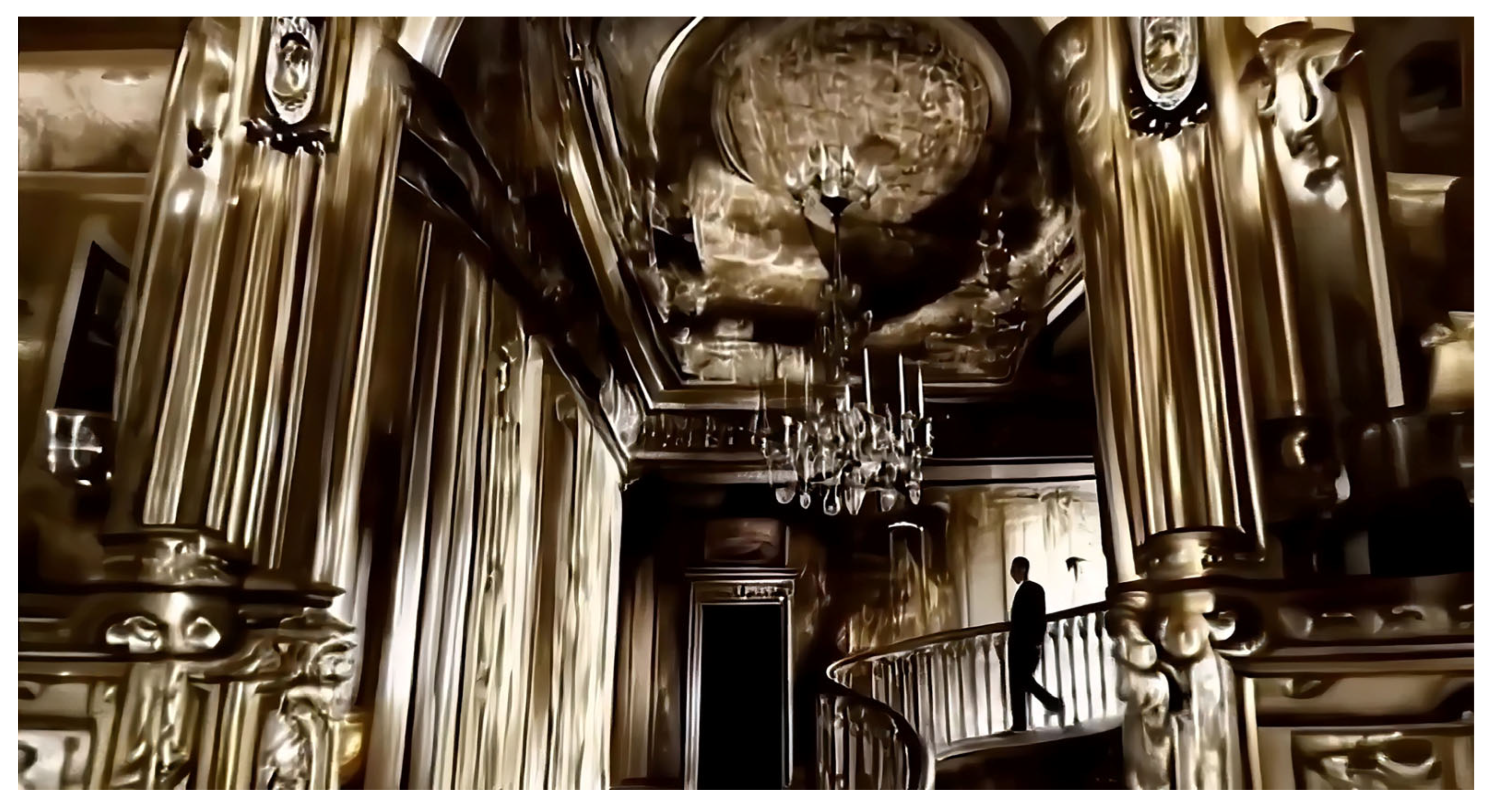
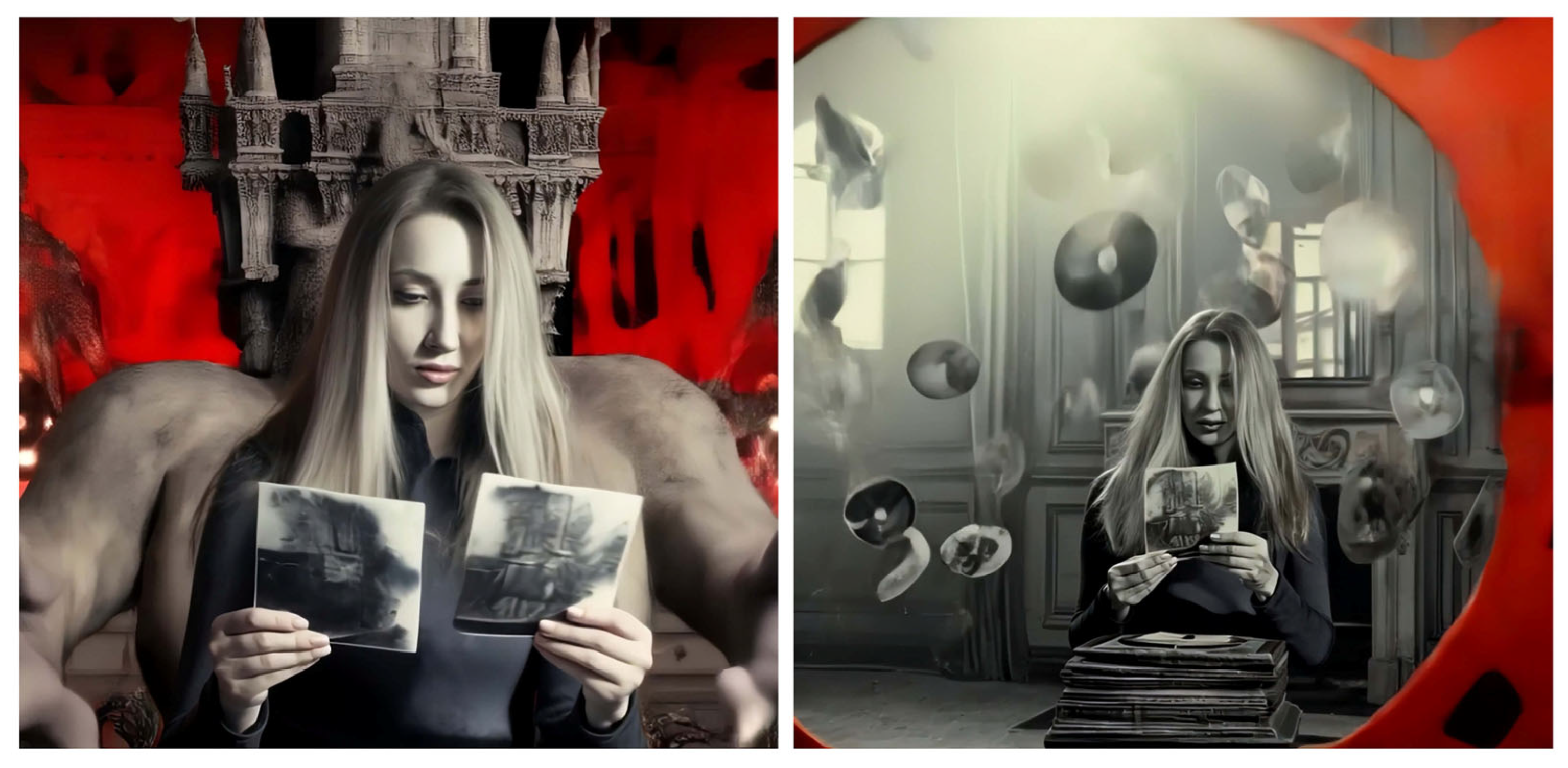
Luciana Haill’s first generative AI video,
Moving Mansions, is an act of aesthetic necessity: a response to the pressures of the rental market that led her to initiate a forced Animated Decadent Withdrawal, constructing a hyper-artificial refuge from LiDAR scans and her own drawings. The video—including its extended variations such as
Minder Games (Self Help) (2025)—blurs the gothic atmosphere of
The Fall of the House of Usher with the lonely, luxurious aesthetic of Jean Des Esseintes’s home in
Against Nature (
Haill 2025) (
Figure 6).
In
Minder Games, the viewer is led into the artist’s
Moving Mansions, following the motion of its shifting architecture. AI aesthetics function as both the technology and medium of uncanniness and Otherness. Amidst the haunted imagery, the artist herself appears surrounded by her animated surreal drawings, flying nostalgic cards and records, a gramophone, and Brion Gysin’s Dreamachine devices, associated with her brainwave artworks (
Figure 7). Haill’s dialogic position within the work is interpersonal, as the Other manifests in and through her haunted aesthetics. The dialogic sensibility, and the presence between the pole of nostalgia and the pole of artifice and escapism, is mediated through the screen as the uncanny and apparitional aesthetics of the mansions shape the structural unity of the artwork.
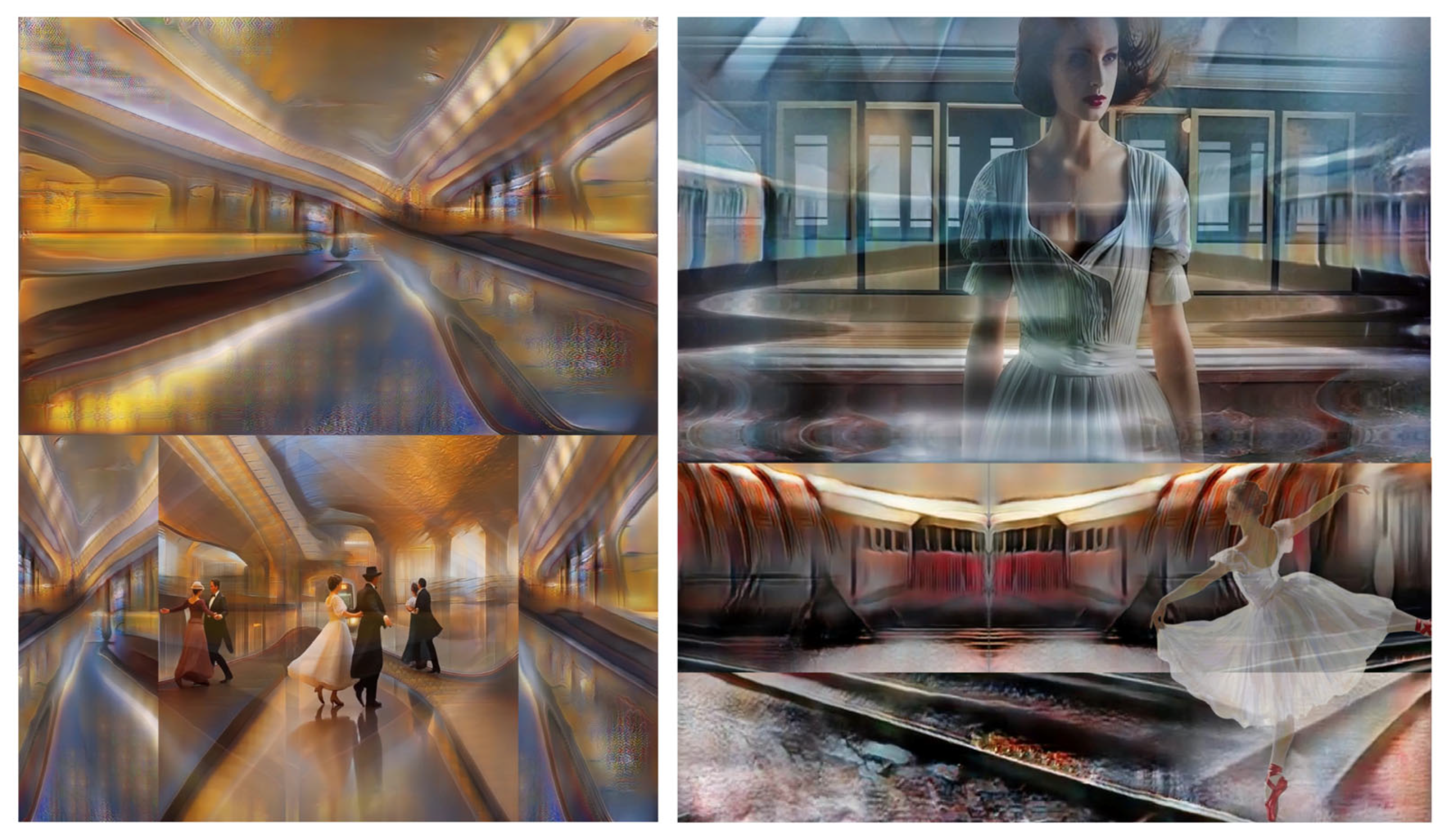
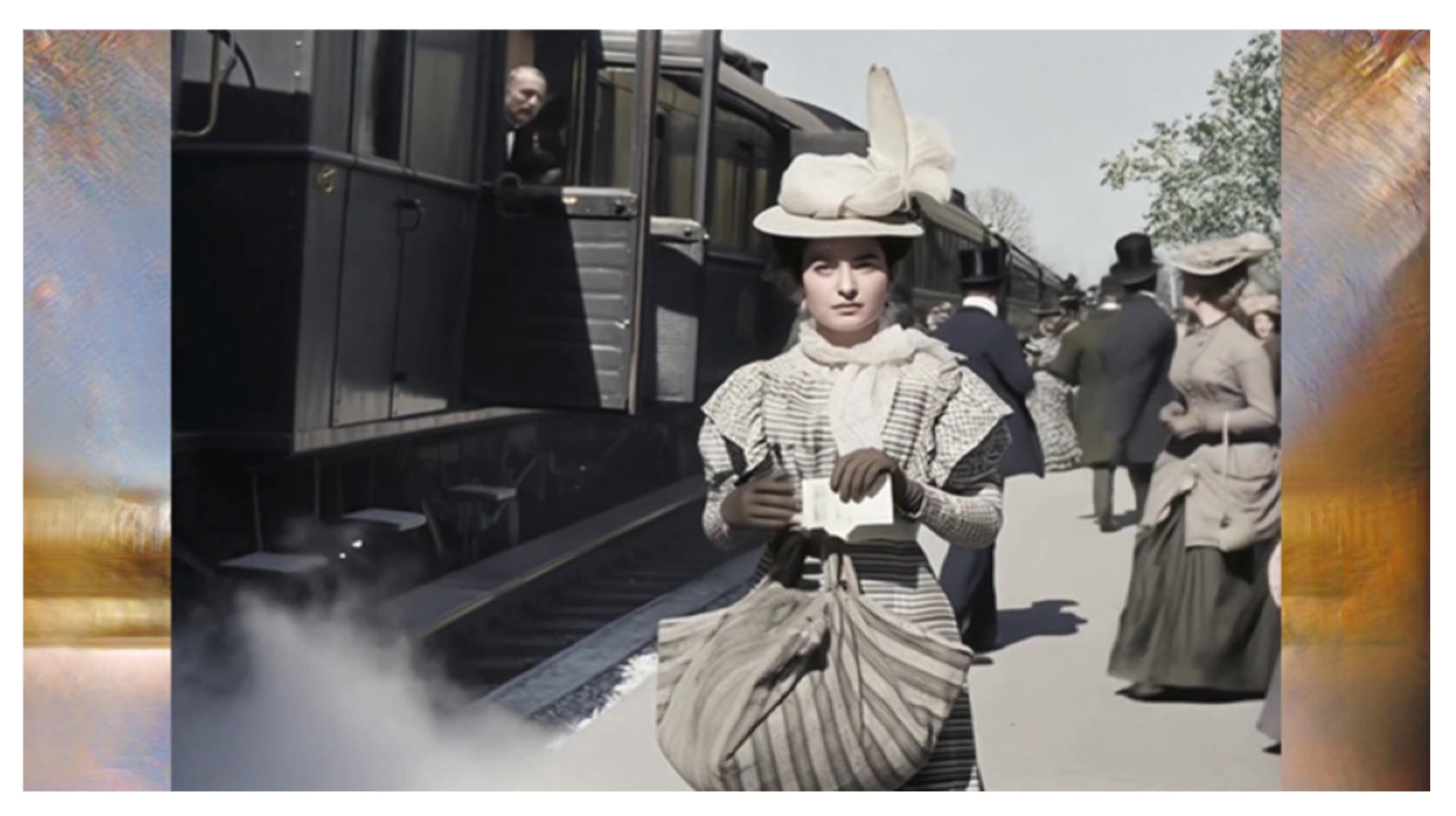
Dreamday Express (2025), part of
Freud’s Uncanny Doubles collection (
Moore 2024), examines how new technologies—particularly AI—revive primordial fears associated with a non-human animated world. The first scene reimagines the iconic cinematic moment when the train arrived at La Ciotat Station in 1896, filmed by the Lumière brothers. Drawing on screenshots from the original footage—subsequently altered and reanimated—a woman steps forward, becoming the protagonist of a dream journey that merges historical reality with the vistas of her unconscious (
Figure 8).
Presented as a two-channel installation, the artwork is divided into two distinct yet interconnected train journeys. On one screen, the travelling woman passes through landscapes that dissolve into fluid architectures of light and colour, echoing nineteenth-century Impressionist paintings. Waltzing couples, ballerinas, and women appearing as her doubles traverse fantastical train stations that transform into dance halls and immersive environments. On the other screen, scenes of trains crashing, exploding, and disintegrating coincide with the protagonist’s doubles wandering like apparitions through traumatic, nightmarish landscapes of railways and wreckage (
Moore 2025a) (
Figure 9).
For the viewer, one screen reflects a pole of a choreographed dreamscape of light, colour and movement, while the other projects a nightmarish collapse marked by the splitting of selves and machines. These two poles exert their presence simultaneously, and it is between them that the dialogic encounter unfolds, with the image of the train operating as a unifying metaphor. Trains and railways have long functioned as metaphors for cinema itself, for moving image technologies, and for the oscillation between stillness and movement (
Blümlinger 2025;
Mulvey 2006). Both trains and dance—most notably in
The Red Shoes—are associated with accelerated motion and fatal accidents (
Mulvey 2006). The landscapes for
Dreamday Express were generated by an AI model trained on the colours, structures, and atmospheres of vintage trains and stations. Through choreographic aesthetics, these AI-crafted and digitally edited textures form the inner landscape of a passage into the dreamlife of a woman suspended between technologically driven eras.
5. Conclusions: Dialogic Presence and Ethics
This article has demonstrated that dialogic presence, as articulated by Buber, is a vital and operative framework for understanding contemporary technoetic and AI-mediated new media art practices including post-cinematic videos and art films. Across historical, planetary, performative, telematic, and artificial contexts—from early theatre and modern dance to telematic installations, orbital artworks, and AI-mediated screen practices—the dialogic encounter does not dissolve under technological mediation but is reconfigured through new articulations of polarity: between relation and distance; physical and digital embodiment of Self, Other, and environment; and unity and alienation in relation to Otherness. Technoetic artworks do not abolish the I–Thou relation; rather, the ethical premise of technē joined with nous amplifies the noetic significance of relationality and presence within unity.
Technoetic art situates presence across planetary and cosmic scales, human minds and artificial systems of intelligence, and apparitional or liminal thresholds of identity. Importantly, Ascott’s conception of the technoetic draws on Taoist philosophy and does not regard the brain as mere matter that generates consciousness, but as an organ that accesses consciousness as a field (
Moore and Shanken 2024). Consequently, technoetic artists are called to practice humility, approaching technology as a means of navigating the field that they are part of and in which they are embedded. This technoetic worldview emphasises unity and a unified field of life and consciousness, corresponding with Buber’s notion of unity as informed by his early engagement with Taoist thought (
Huston 2007). In his essay “The Teaching of the Tao” (
Buber [1910] 1957c), Buber identifies the fundamental drive toward unity, a concern that later informed his exploration of presence and the dialogic encounter in
Daniel and
I and Thou. Within this framework, contemporary artworks continue to function not merely as objects to be consumed as It, but as crystallised traces of encounters that remain “incessantly effective” (
Buber [1923] 1970, p. 65), capable of becoming Thou again when approached with openness to presence. Whether encountered through telematic networks, the orbital apparatus of space travel, online or offline screens and installations, or artificial intelligence, dialogic presence emerges precisely where technological mediation sustains—rather than erases—the conceptual tension between nearness and remoteness. The viewer’s role is therefore not passive but participatory: to hold this tension between dialogic poles and allow it to act upon perception.
In this art and technology context, it is instructive to revisit Buber’s short article “World Space Voyage” (
Buber 1967), in which he does not question humanity’s capacity to achieve cosmic mobility, anticipating it as an inevitable development. He suggests that, in an age of cosmic travel, events in the universe will reveal themselves in new and workable ways, enabling human beings to gain knowledge not only about the world but also about themselves anew. However, the central issue for Buber concerns a critical polarity already present within humanity. He frames cosmic expansion as an opportunity that may “awaken a new hybris or a new humility” (
Buber 1967, p. 224). For Buber, cosmic and technological expansion can have meaning only insofar as relational responsibility and ethical humility are maintained. Buber recounts the Golem legend as an allegory of humanity’s relationship with its technological creations. The Golem of Prague, a human-shaped figure of clay said to have been created by the sixteenth-century Rabbi Judah Loew, was animated by a slip of paper bearing God’s secret Name placed under its tongue. In order to preserve the sanctity of the Sabbath, Rabbi Loew would remove the paper so that the Golem, too, could rest. On one occasion, however, he forgot to do so. As a result, the Golem ran amok, and the peace of the Sabbath was disrupted—its arrival delayed both in heaven and on earth (
Mendes-Flohr 2019, p. 109). The Golem story thus offers an ethical orientation for engaging with technoetic and AI-mediated art forms. Animated through sacred letters and human intention, the Golem is not evil or destructive in itself; rather, danger arises when its maker forgets the distance that must be maintained between creator and creation, confusing instrumental power with relational responsibility. Read dialogically, the Golem alternates between Thou and It: animated through the Name, it becomes a relational presence; deprived of it, it returns to an object. The ethical failure lies in assuming it to be fully knowable or controllable, and in denying it the right to rest alongside humans. Instead, it must be addressed with humility, restraint, and an awareness of its Otherness.
Approached in this way, technoetic and AI-mediated art forms become sites of ethical encounter—spaces in which the human capacity for relation is not displaced by artificial systems, but re-examined, intensified, and made accountable. The task, then, is not to decide whether AI-mediated entities are sentient, nor whether AI-mediated art can replace the artist or human creativity, but to cultivate modes of address that preserve dialogic openness to the experience of being present with the Other in the world. To take a relational stance is to liberate what Buber calls “the free polarity of the human spirit” (
Buber 1964, p. 104), enabling an exploration of Self and Other that allows both to multiply, transform, and evolve. In holding fast to the principles of presence, distance, and responsibility, the dialogic encounter offers not only a framework for interpretation, but a practice for navigating emerging relations between Self and Other within technoetic and AI-intersected new media art.