Article

Kasimir Malevich, Maria Dzhagupova and a Contested Portrait of Elizaveta Iakovleva

by
Alexander Lisov
1 and
Willem Jan Renders
2,*
1
Independent Researcher, 210030 Vitebsk, Belarus
2
Independent Researcher, 6871AL Renkum, The Netherlands
*
Author to whom correspondence should be addressed.
Arts 2026, 15(6), 118; https://doi.org/10.3390/arts15060118
Submission received: 19 March 2026 / Revised: 12 May 2026 / Accepted: 12 May 2026 / Published: 29 May 2026

Abstract

This essay examines the painting known as Portrait of Elizaveta Iakovleva, which has long been attributed to Kazimir Malevich, using close analysis of the painting materials and techniques, as well as newly discovered archival evidence. It reconstructs part of the work’s provenance, places it within Malevich’s late Leningrad circle, and explores Maria Dzhagupova’s and Elizaveta Iakovleva’s roles in relation to the artist. By comparing the portrait with Malevich’s late portraits and works by Dzhagupova, the study revisits authorship and sitter identity. It argues for a more nuanced understanding of the complex exchanges between Malevich and his students and situates the work more precisely within his late portrait practice and artistic milieu of the 1930s.

1. Introduction

In 1997, a remarkable painting was purchased by two Dutch collectors: a portrait of a woman believed to be Elizaveta Iakovleva. Although there were uncertainties about the provenance of the work and the identity of the sitter, there was no doubt about its author: this was a portrait by Kazimir Malevich.
The painting quickly caused a sensation. Not only was it included in several important retrospective exhibitions of Malevich’s work, it was also studied by experts of his oeuvre. In 2021, however, Andrey Vasiliev published a book about his research on this portrait. In this “archival novel”, he attributed the painting to an unknown pupil of Malevich: Maria Dzhagupova. Since then, apart from a few press publications, nothing has been published about this work. Nevertheless, some questions remain.
This essay examines this portrait through close visual, material, and archival research to position it more precisely within its historical context and to re-evaluate the narratives that have framed its reception.1

2. The Portrait

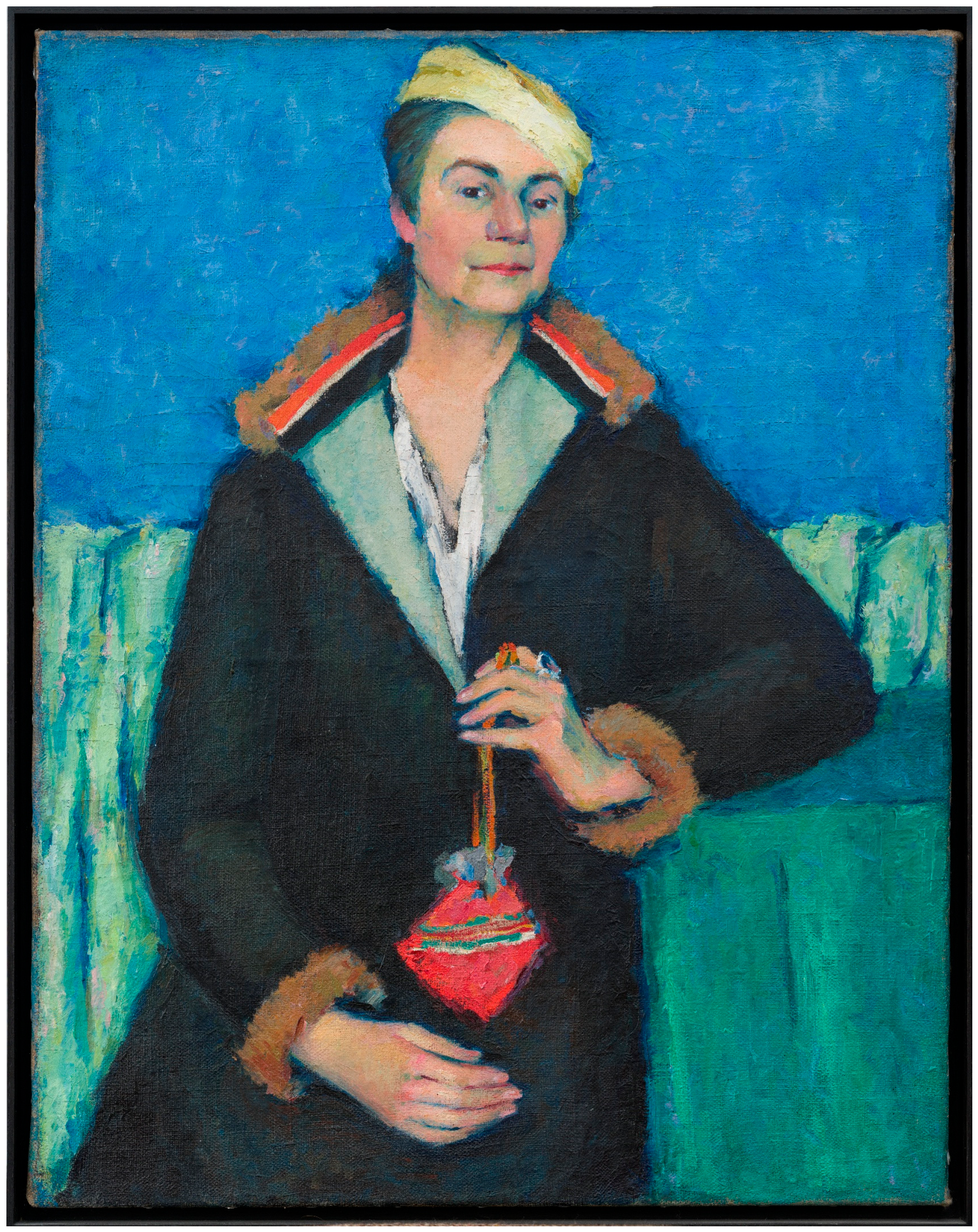
Set against a light blue background, Portrait of Elizaveta Iakovleva (Figure 1) depicts a woman in a black cloak, wearing a pale-yellow hat, tilted slightly to her left. Her head is gently turned in that direction, yet her gaze meets the viewer with a faint smile on her thin red lips. Her fine black eyebrows are subtly raised. The cloak, trimmed with a brown fur collar, is distinguished by a decorative band of red, white, and black stripes. As the cloak is open at the top, its light green lining emerges, along with a low-cut white blouse. Her left elbow rests on a blue-green support, while her lower back leans against a pale green fabric. From her left hand hangs a small, red, diamond-shaped purse, suspended by a brown cord; its light-blue opening and green-and-white horizontal band echo the painting’s balanced palette. A large ring encircles her finger, which delicately grasps the cord; her right-hand rests on her lap. The clock’s cuffs are also trimmed with brown fur without additional decoration.
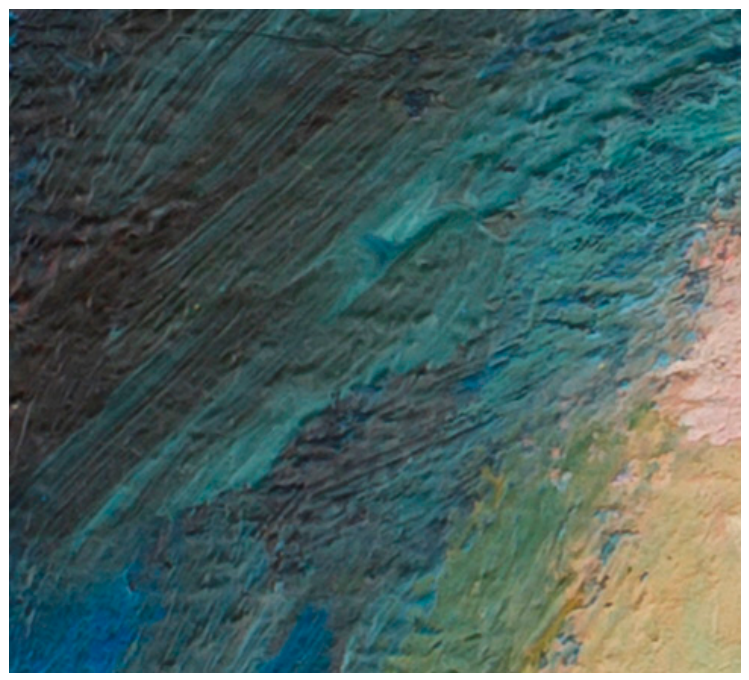
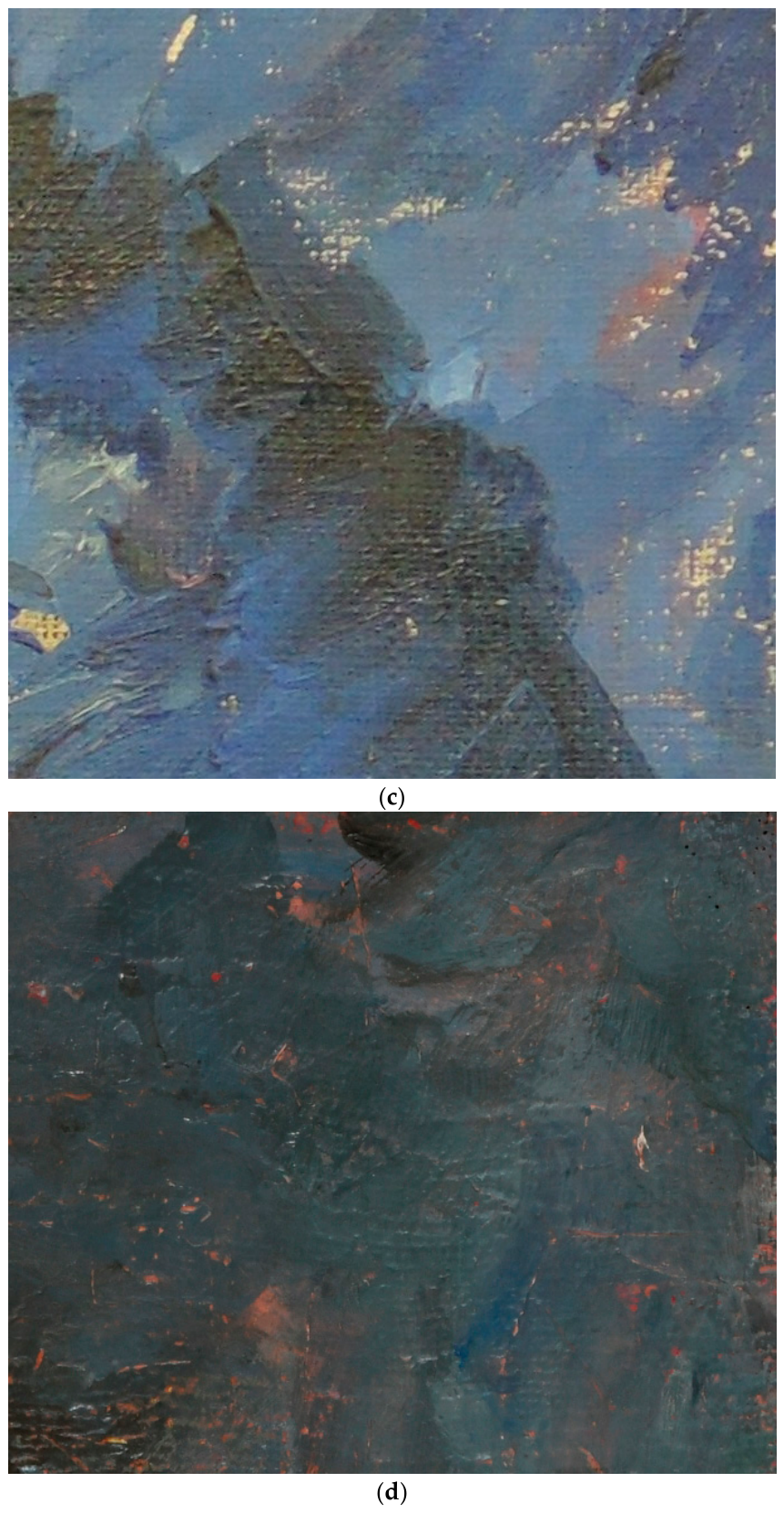
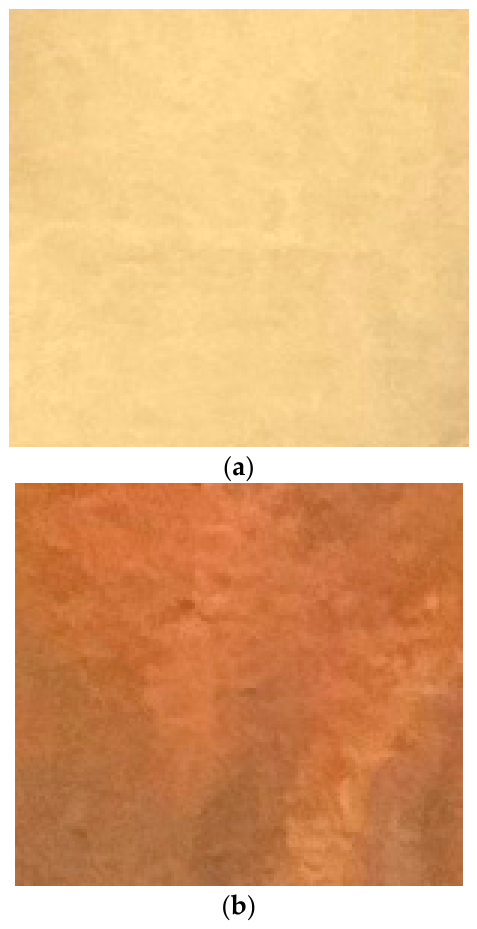
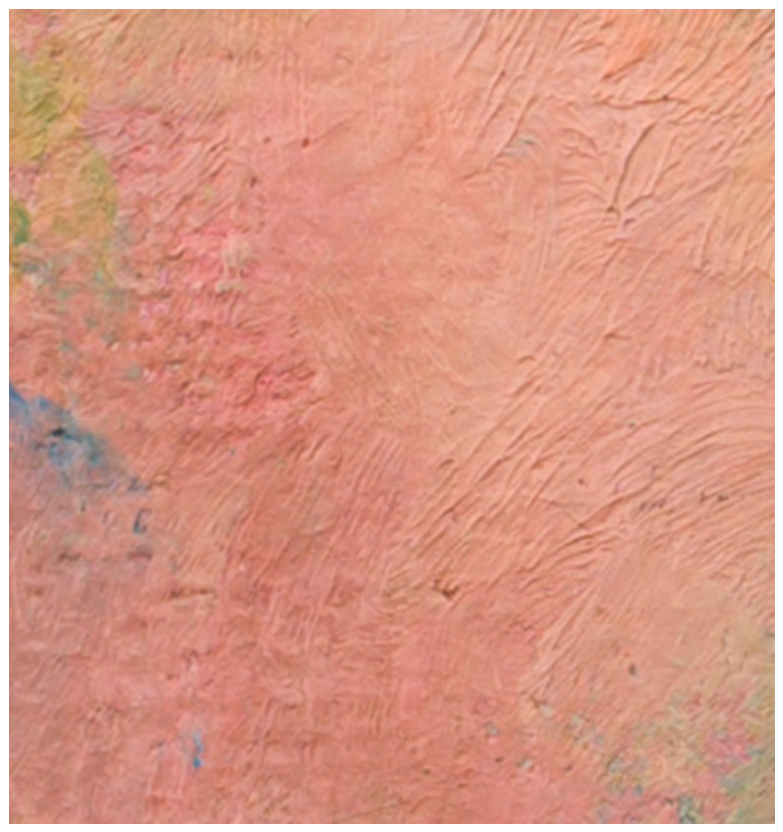
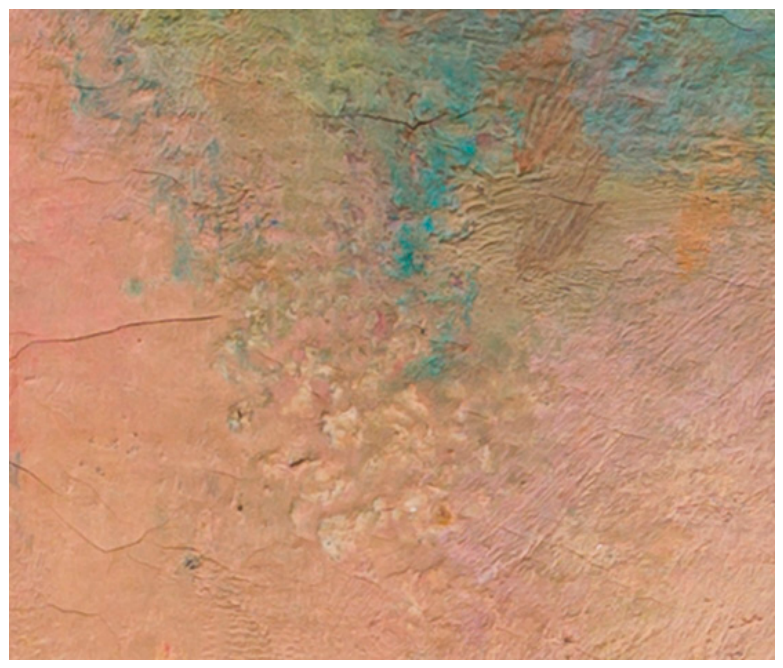
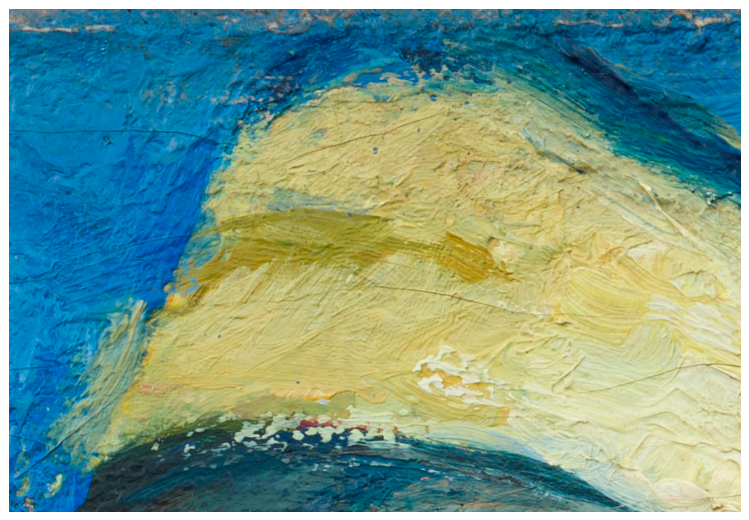
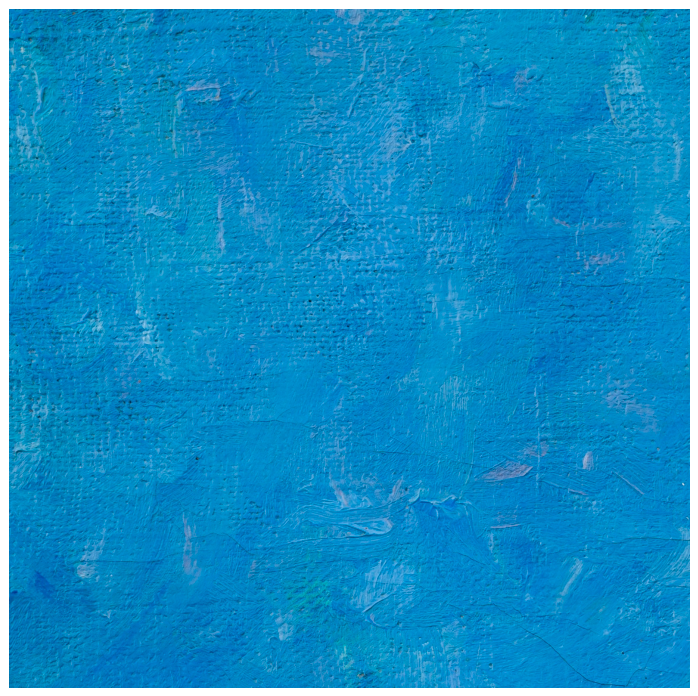
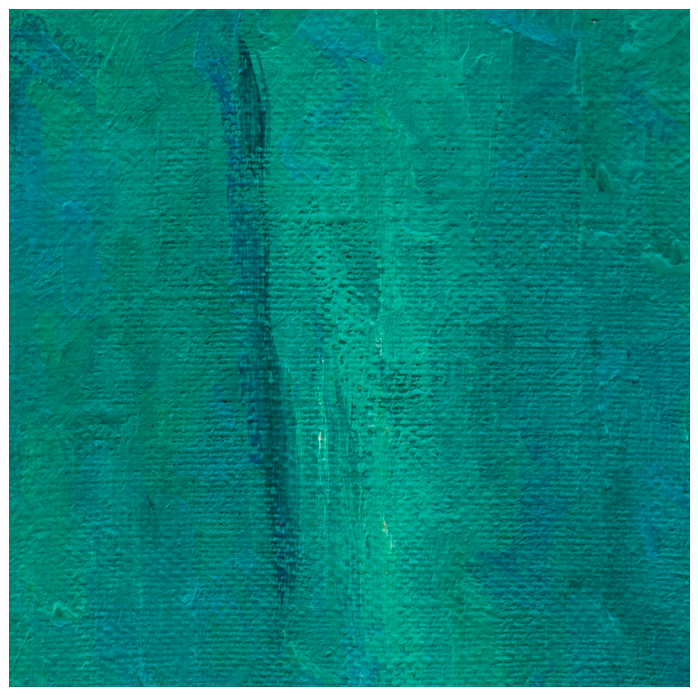
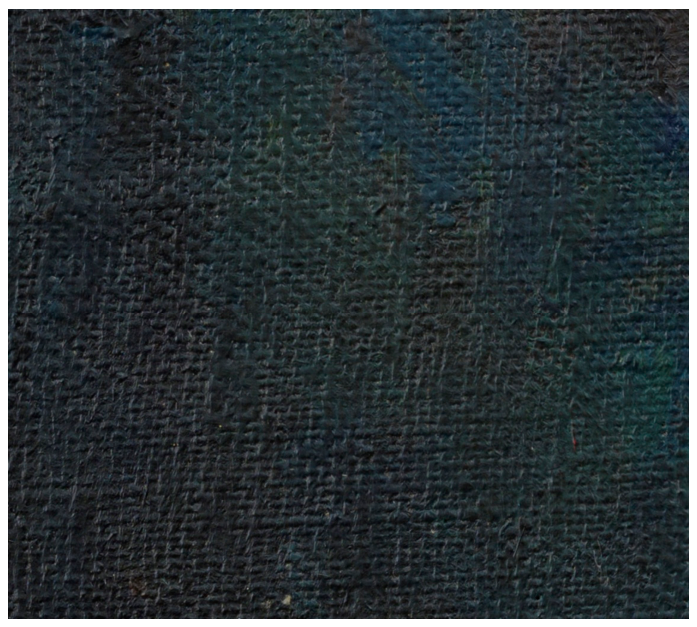
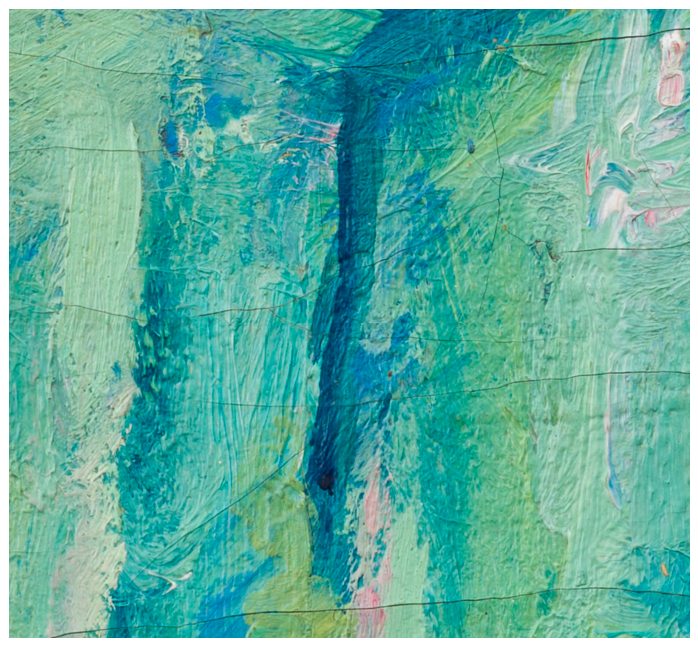
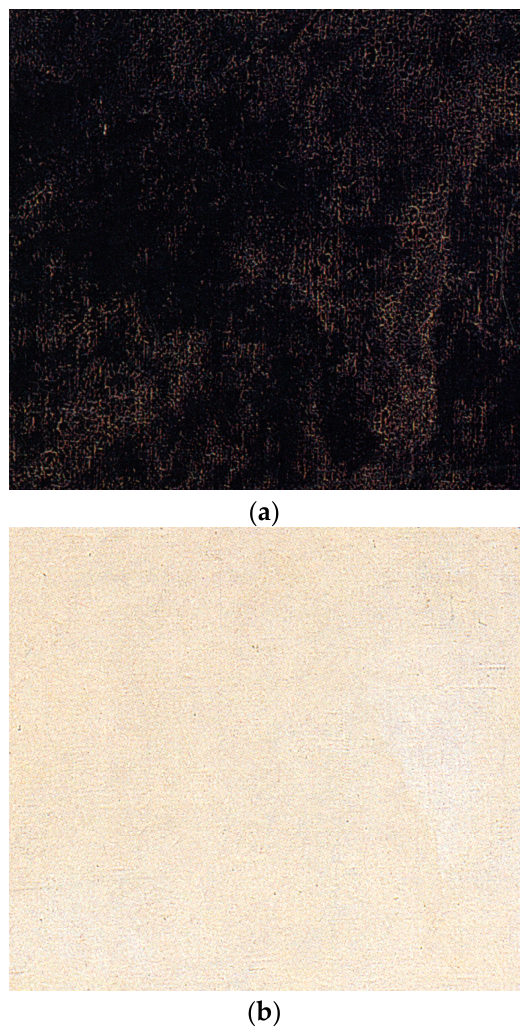
The portrait is built through colour with few clear contours. Much of the paint is applied with a large brush in blended strokes of mixed hues. The face, neck, throat, and hands are modelled with a finer brush, using lighter and darker flesh tones—beige, rose, white, and touches of pale green and occasional blue (Figure 2 and Figure 3). The hat is firmly shaped through modulations of yellow, moving from pale, almost luminous tones to deeper, saturated shades applied in sweeping strokes (Figure 4). On the right side of her head, the hair transitions from variegated grey to black (Figure 5). Large passages—the pale blue background (Figure 6) and the green plane at the lower right (Figure 7)—are constructed from layered mixtures of two or three colours, producing subtle tonal fluctuations across their surfaces. Even the black cloak is not uniform, its depth is articulated through shifts between warm and cool blacks (Figure 8). The lower background, composed of light green and white, is handled more loosely; visible vertical blue strokes indicate the drapery’s fall (Figure 9).
The paint is laid down in thin layers, with varied brushstrokes—short, parallel touches; long, narrow lines; and occasionally curved or broken marks. Brush texture and areas of light stippling remain visible across the surface. In more fluid passages, worked wet-into-wet, the paint is spread evenly enough for the canvas weave to show through, flattening the surface and exposing the canvas weave beneath. Analysis of paint samples identified zinc white, cadmium red and vermilion, cobalt blue and Prussian blue, viridian, chrome yellow, and carbon black. Examination by infrared reflectography revealed a delicate preliminary underdrawing in certain areas, outlining the forms over the white ground. The chromatic structure appears to have evolved in stages, with tones adjusted and reworked as the composition developed. The handling of paint—attentive to density, opacity, and tonality—reveals sustained engagement with the material properties of colour. Variations in surface gloss are minimal, with no pronounced areas of high sheen. The buildup of paint is relatively simple, and there is no evidence of significant revision or compositional alteration. In certain passages, colour is constructed through successive applications, allowing tonal interplay to develop alongside subtle shifts in surface texture.
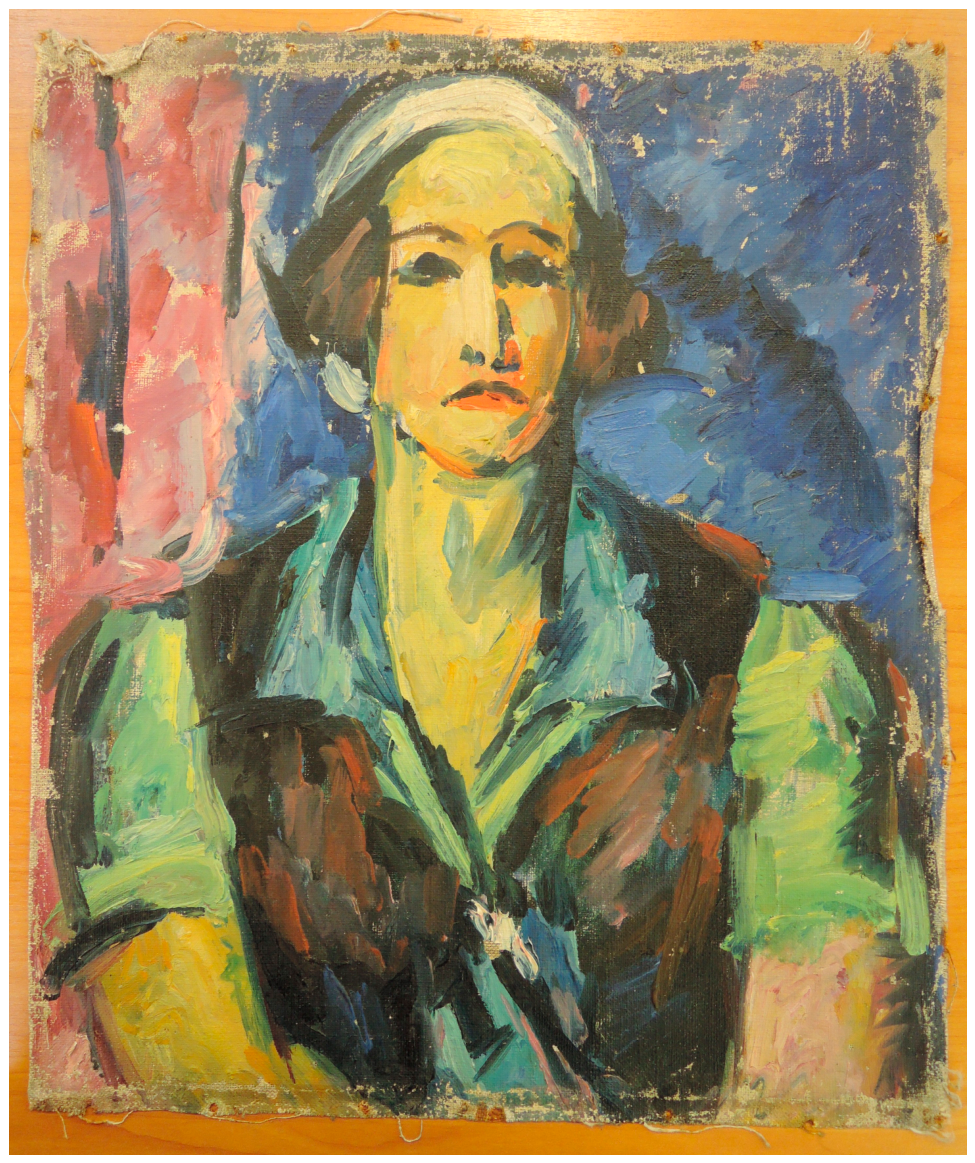
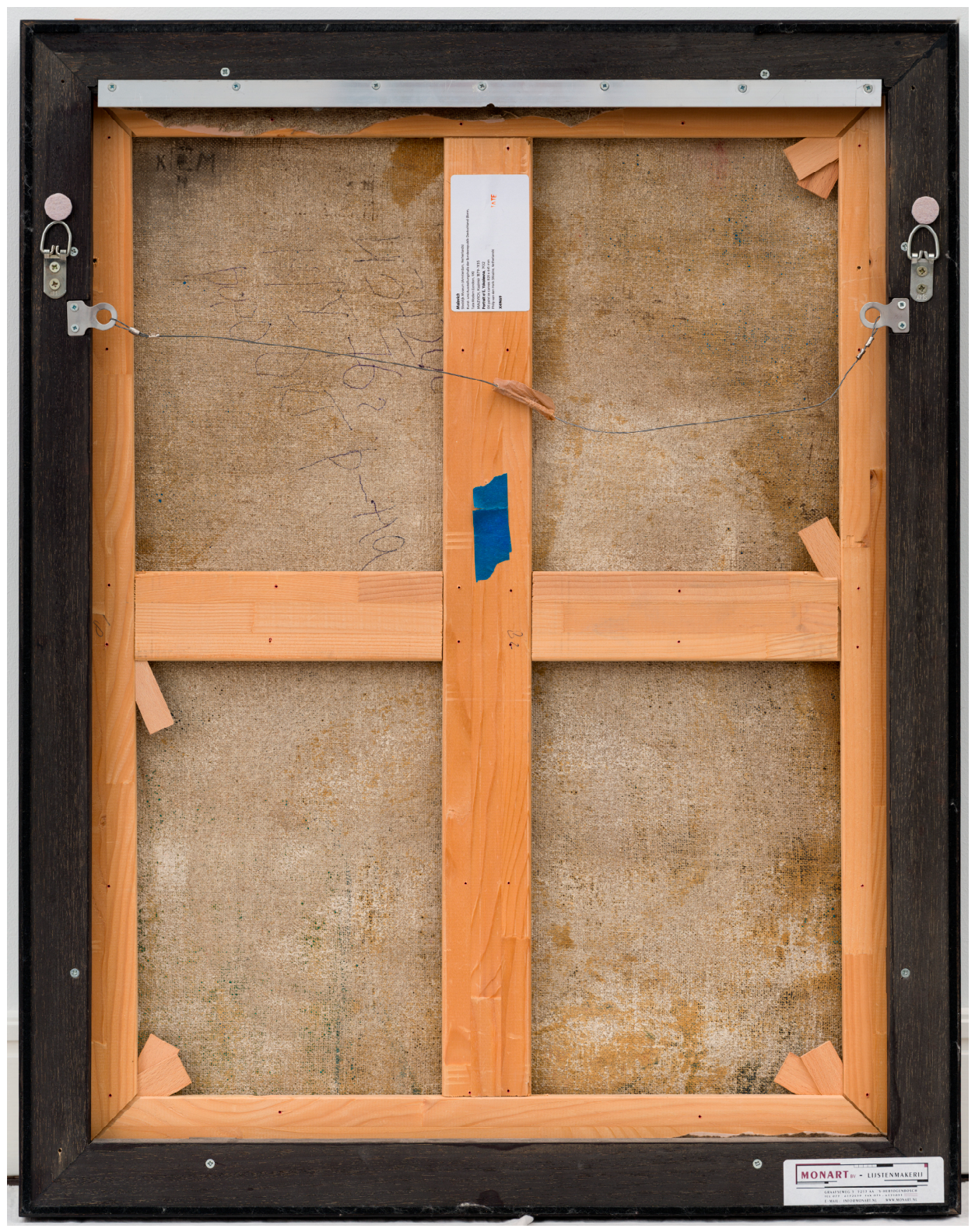
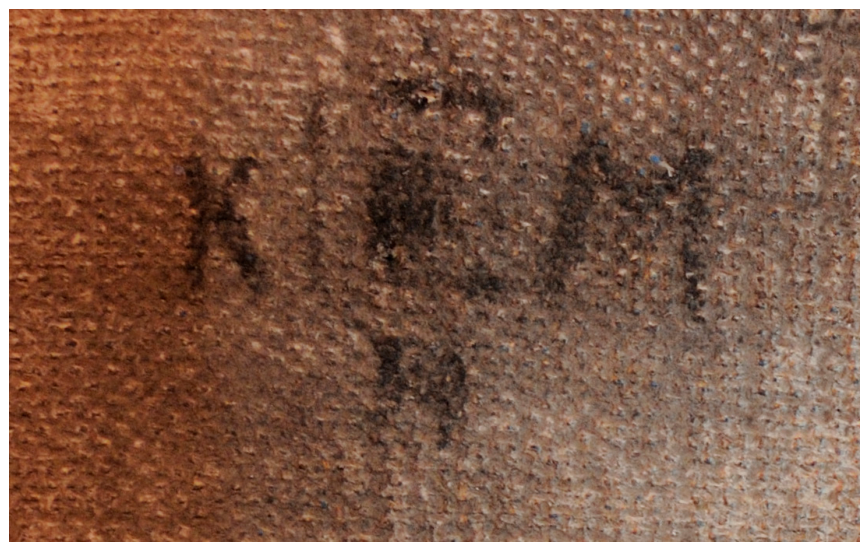
On the verso of the canvas (Figure 10), there is a stamp-like signature with the Unovis emblem (a black square within a square background), the initials K and M, and, underneath the square, two digits of the date [19]34 (Figure 11). Several undisputed works by Malevich of 1933–34 in the collection of the State Russian Museum in St. Petersburg bear the same type of signature either on the front of the canvas or the verso2.

3. Provenance

At the time the portrait entered its current collection, little information was available about its ownership history. The work was attributed to Malevich and dated 1934, but provenance details were not documented, and previous owners remain unidentified. The painting was acquired in 1997 and since then has remained in the collection.3
A recent publication by Andrey Vasiliev introduced new archival evidence contributing to the painting’s provenance.4 Another inscription on the back of the painting, written with pen, reads: “4342[00] …/X/76g okt[iabskaia] ra[io]na”. The letters are Cyrillic (Figure 10).
These numbers and letters correspond to inventory records linked to Maria Dzhagupova, a student of Kazimir Malevich. After she died in 1975, and in the absence of heirs within the legally prescribed period, her estate—including her paintings—was registered in October 1976 by the District Financial Department of the Oktiabrskii District of Leningrad and assigned inventory numbers. The abbreviated letters on the reverse match the designation of this institution. The same inventory number appears in the “List of Paintings by M. M. Dzhagupova” from the Leningrad Consignment Shop, dated 8 and 12 October 1976, where a work bearing that number was sold under the title Portrait of Iakovleva.5 This archival documentation demonstrates that the painting was in Dzhagupova’s possession until her death and supports, pending further confirmation, the identification of the sitter as Elizaveta Iakovleva.

4. Maria Dzhagupova’s Drawings Related to the Portrait

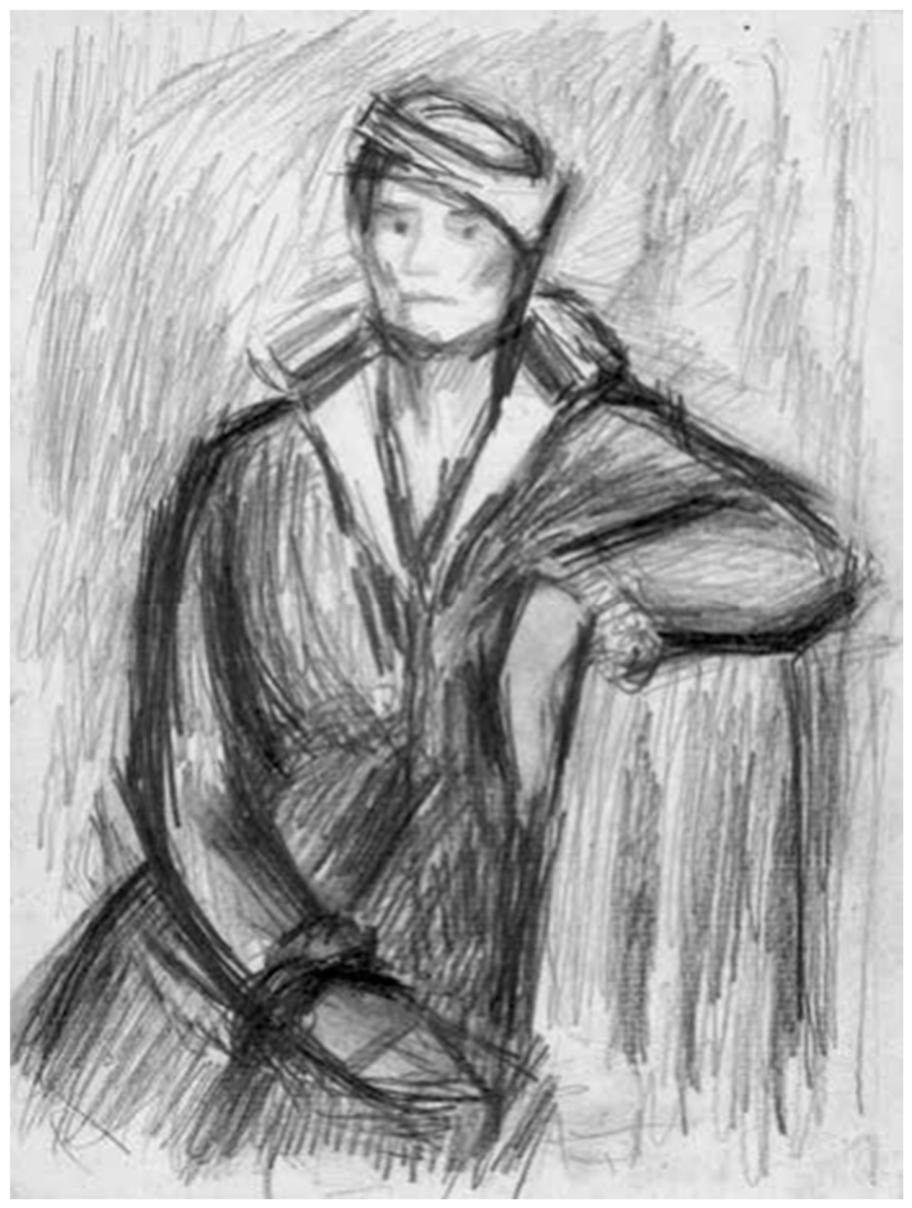
Among the Dzhagupova materials in TsGALI archives, there is a drawing that bears a marked resemblance to the portrait (Figure 12). Its execution with strong, linear pencil lines constructing the figure aligns with other drawings by Dzhagupova in the archive. The compositional affinities between the drawing and the painting are evident. In both images, a woman leans on a pedestal with her left arm; she wears a dark cloak with a decorated collar and fur-trimmed sleeves, along with a small hat. At the same time, the differences are substantial. In the drawing, the pedestal is higher, raising the left arm, and the hand falls downward without holding an object. The head inclines slightly to our left, whereas in the painting it turns the other way, exposing part of the woman’s right ear. The painted figure’s neck appears elongated, accentuated by the lowered collar on the right side. The drawing omits the blouse and fur collar and reveals more of the hat’s upper contour. Most notably, the purse and the carefully articulated gesture of the left hand are absent.
This drawing has been interpreted as evidence supporting the portrait’s authorship.6 Given the divergences, however, it cannot be considered a preparatory study in a strict sense. Nor does it read as a copy after the painting. Was Dzhagupova sketching alongside Kasimir Malevich during a sitting? Were both working through compositional ideas before the painted version took form?7 A letter from Konstantin Rozhdestvenskii to Lev Iudin, dated 8 September 1934, notes that Malevich produced numerous preliminary sketches for these portraits, opening further questions about the drawing’s role within that process:
“K.M. is simply indefatigable. How many drawings he made before painting his thematic shock workers. How many corpses [?] and how much crassness before the portrait of Natalia, the one that was in the exhibition of women.”8
When attempting to reconstruct the sittings that led to this portrait, several studio scenarios suggest themselves. Dzhagupova may have been present while her friend Elizaveta posed for Malevich; conversely, Malevich might have advised Dzhagupova as she worked from the same model. It is also possible that she produced her drawing independently. One possibility, however, can be set aside: that Dzhagupova assisted Malevich in executing the portrait.
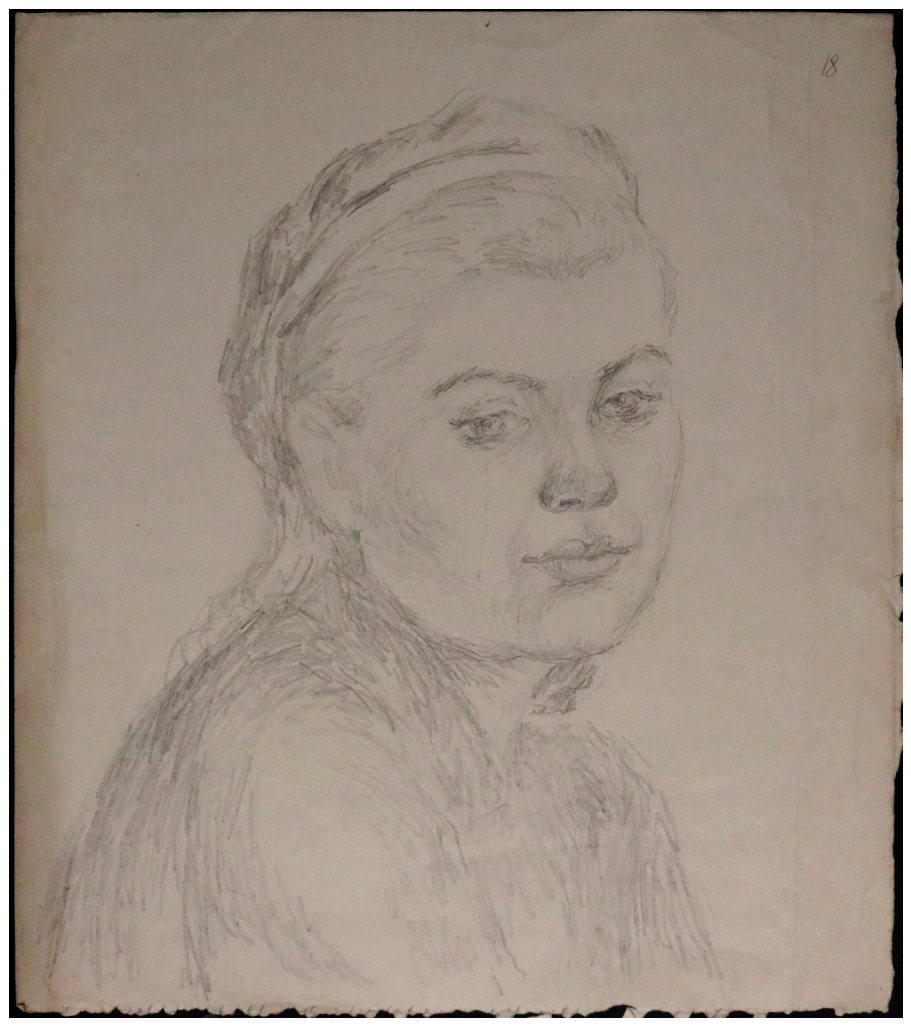
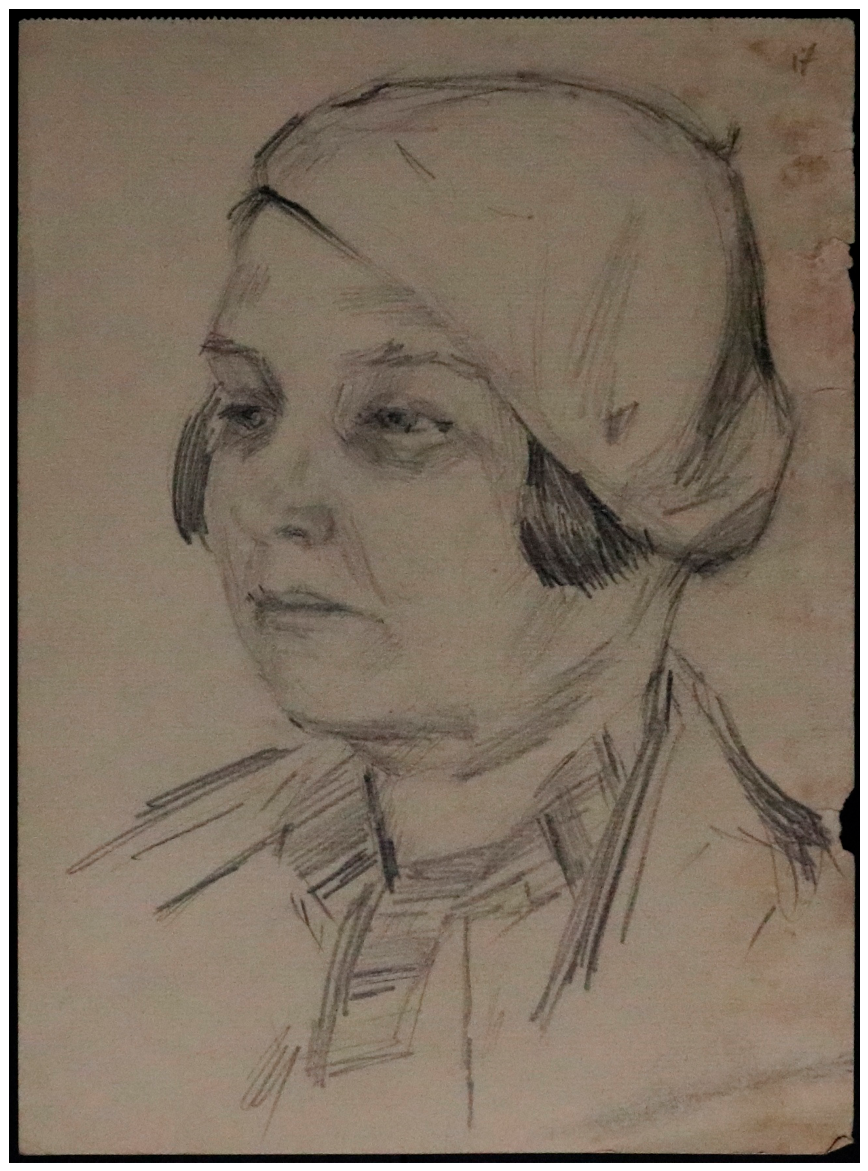
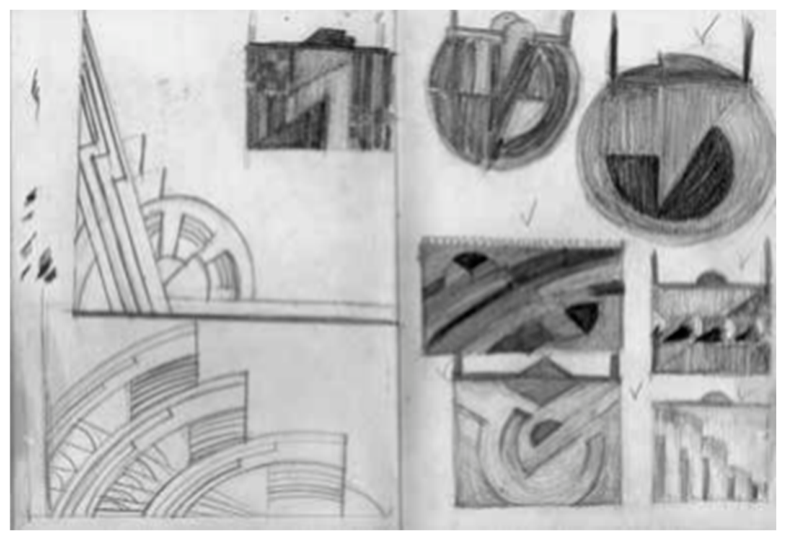
Other drawings by Dzhagupova demonstrate varied approaches and modes of execution. A drawing of a young woman (Figure 13), for example, appears to be a copy of an impressionist portrait, while another (Figure 14) reads as a more immediate study from life. The purpose of the “Iakovleva drawing” cannot be determined with certainty. Additional sketches, however, complicate the picture. Like Olga Rozanova, Liubov Popova, and Nadezhda Udaltsova around 1916,9 Dzhagupova was professionally engaged in textile design, and several of her drawings relate to purses. One of these, for example, includes designs for round and rectangular purses with abstract decorations (Figure 15).10 Yet none of these newly identified drawings feature the rhomboid purse seen in the portrait. It remains possible that Dzhagupova devised the accessory represented there, but no documentation supports this assumption. The purse may equally be an invention of Malevich or someone else.

5. A List of Paintings by Dzhagupova

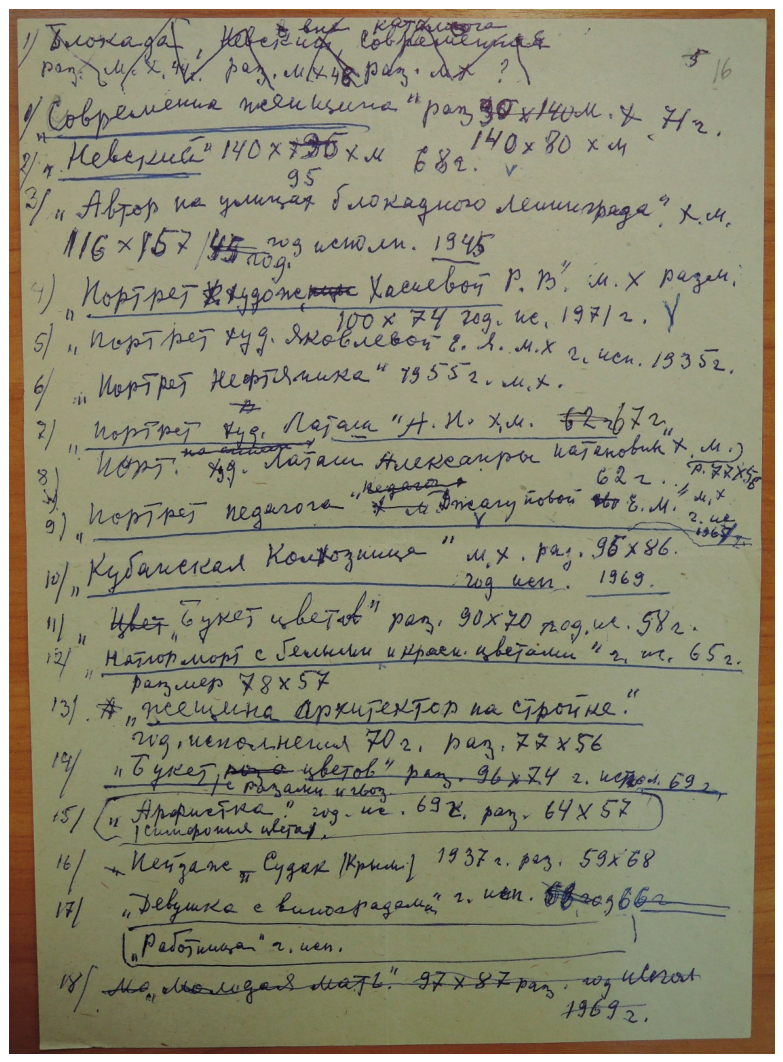
There is another document in TsGALI related to the Iakovleva portrait: a handwritten draft list compiled by Dzhagupova in 1971 for her biographical entry in the third volume of Artists of the Peoples of the USSR (published in 1976). Unlike the estate inventory, this list records works she claimed to have made. It is a selective rather than comprehensive list. The entry no. 5 reads: “Portrait of the artist E. Ia. Iakovleva,” 1935, oil on canvas.11 If this refers to the present work, it would constitute direct evidence that Dzhagupova considered herself its author and that she painted it in 1935. The document, therefore, requires close attention.
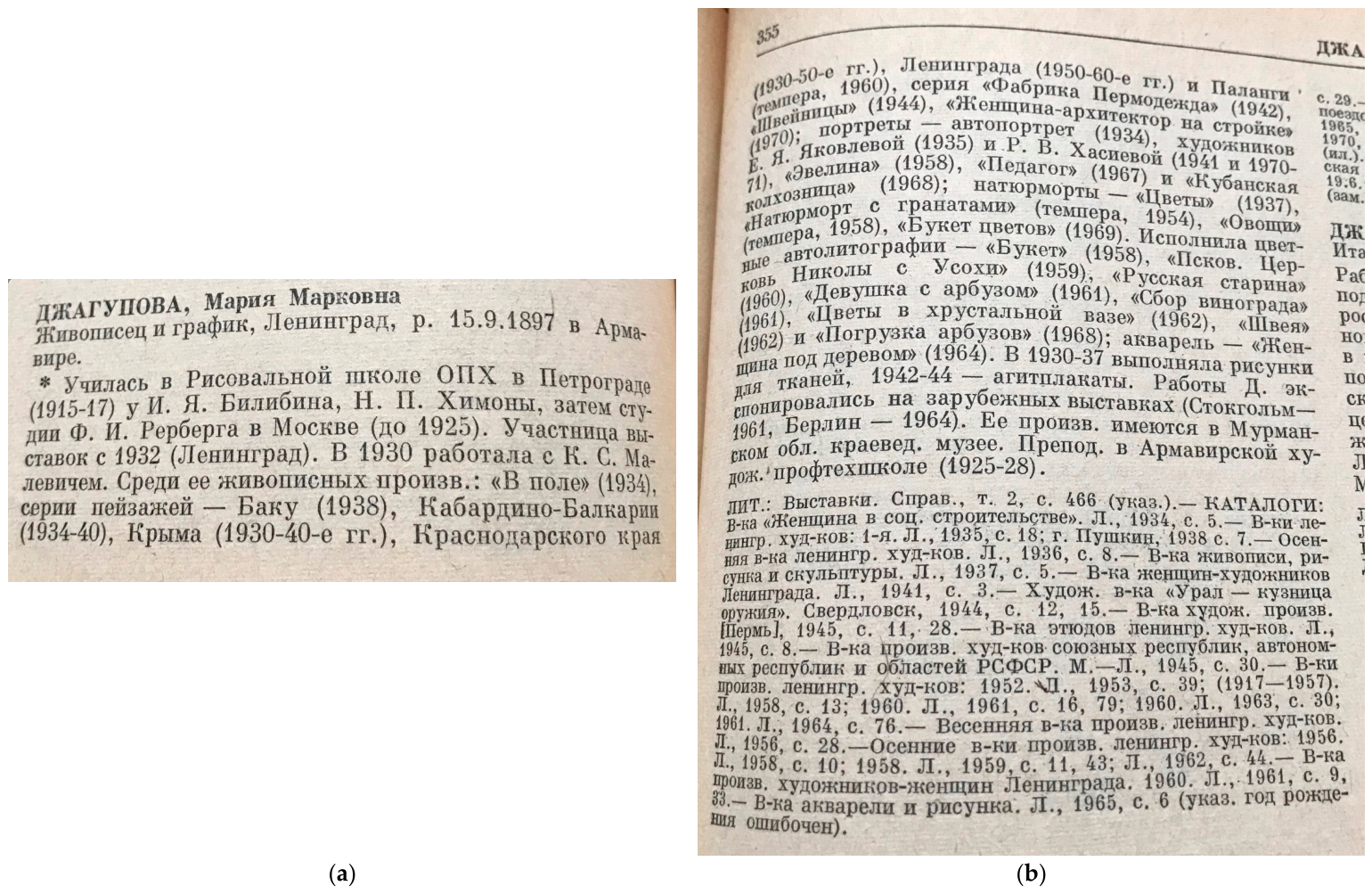
The list forms the final page of a six-page manuscript. The first page records her biographical information and address; in 1971, she was still living in the apartment she once shared with Elizaveta Iakovleva. The following four pages outline twenty exhibitions in which she participated, beginning with Women in Socialist Construction (1934)12 and concluding in 1965, after which she notes that she was no longer able to exhibit. She then enumerates eleven paintings from 1966 to 1971, each identified by title, date, and dimensions. On the final page (Figure 16), she sums up a selected group of works intended for publication in the official USSR biobibliographical dictionary—an authoritative and prestigious reference at that time. It lists eighteen oil paintings on canvas, thirteen with measurements and five without. Several entries are crossed out; nine are underlined. Among the eighteen works are six portraits, including “Portrait of Artist Iakovleva E. Ia.” (1935).13 The remaining works are still lifes, landscapes, and views of Leningrad. In the published dictionary (Figure 17a,b), her oeuvre is organised by medium and genre. Here the portrait selection differs: a self-portrait (1934); portraits of E. A. Iakovleva (1935) and P. V. Chasneva (1941; 1970/71); Eveline (1958); and Pedagogue (1967). Several works listed in print do not appear in the 1971 manuscript, suggesting that Dzhagupova later supplemented her submission; no such addendum survives in TsGALI.
The Iakovleva portrait was in Dzhagupova’s possession before she died, though it is unclear for how long. In her 1971 draft list, she does not merely record ownership but claims authorship. Yet, unlike other entries, this one lacks dimensions—despite the likelihood that the painting hung in her apartment—leaving open the possibility that she may have referred to another portrait of Iakovleva.
Notably, this is the only pre-war work she initially selected. In the published dictionary, she added her self-portrait. This may reflect a limited prewar output, since she was engaged in textile design, or a deliberate choice to highlight what she regarded as a significant early achievement, and possibly the best portrait in her possession.
The document thus sharpens rather than resolves the central questions: did Dzhagupova paint the portrait? Did Malevich assist her, or paint it himself before it entered her possession? Does the claim of authorship represent fact, collaboration, or retrospective attribution? And can the sitter be securely identified as Elizaveta Iakovleva?
All scholars who have addressed the Iakovleva portrait place it in the final phase of Kazimir Malevich’s career, between 1931 and 1935, the year of his death. The more specific date of 1934 corresponds to the number “34” painted beneath the signature on the verso of the painting (Figure 11). Chronologically, the painting is thus situated within Malevich’s late Leningrad period.
Most scholars ascribe the work to Malevich, while one scholar has suggested an alternative attribution to his student Dzhagupova. Several writers identify the sitter as Elizaveta Iakovleva. Both Dzhagupova and Iakovleva were acquainted with Malevich in Leningrad, though their relationships to him differed. Taken together, these views position the portrait either as a work by Malevich himself or as a product of his immediate artistic circle. This temporal framework, together with the circle of artists and the shared Leningrad context, provides a structure for reassessing the painting’s historical context and authorship.

6. Malevich and His Students in 1927

The year 1927 marked a turning point in the career of Kazimir Malevich. It was the first—and only—occasion on which he travelled to the West. For several years, he had sought opportunities to present his work abroad, hoping to lecture and organise exhibitions in Warsaw and Berlin. As early as 1924, he corresponded with El Lissitzky about arranging an exhibition in Germany.14 By 1926, however, Malevich’s position in Leningrad had shifted dramatically. The State Institute of Artistic Culture (GINKhUK), which he led alongside Mikhail Matiushin, Vladimir Tatlin, and others, came under intense criticism. In Leningrad Pravda, the institute was mockingly described as a “government-supported monastery,” and it was soon dismantled.15
This mounting hostility likely prompted Malevich to seek opportunities abroad to promote his artistic, theoretical, and pedagogical work. In March 1927, he left for Warsaw, carrying with him a substantial group of paintings and his archive of manuscripts. The trip, however, was cut short. While in Berlin, he received orders from Soviet authorities to return immediately. Alarmed by the summons, he drafted a will before departing, returning to Leningrad in June 1927.16 His Berlin solo exhibition opened in his absence.17 After it closed, his artistic legacy—paintings, drawings, and manuscripts—remained crated in Germany.18 Although the Bauhaus published his text The World as Objectlessness, Malevich was absent and did not witness the realisation of this long-anticipated publication.19
Upon his return to Leningrad in early July 1927, Malevich married Natalia Andreevna Manchenko, his third wife. He secured a position at the State Institute of Art History20 though his appointment remained unstable. At the same time, he travelled monthly to his native city of Kyiv, where he lectured at the Kyiv Art Institute.21
In 1929, the State Tretyakov Gallery began preparing a major exhibition of his work. Lacking access to the paintings and manuscripts left in Germany, Malevich was compelled to reconstruct his artistic trajectory largely from memory. He reassessed his creative, theoretical, and pedagogical positions, reshaping the narrative of his development—at times with deliberate myth-making. He recreated earlier works and backdated them, effectively reconstructing and, in some instances, reconfiguring his artistic past.22 This retrospective effort coincided with a renewed engagement with figuration. During these years, he produced a series of peasant paintings, gradually forging a new and distinctly personal mode of representation.23
In 1929, Malevich’s works were shown both inside and outside the Soviet Union. At the State Tretyakov Gallery, many of his recently produced—and in some cases backdated—paintings were exhibited. Meanwhile, the Zurich exhibition Abstract and Surrealist Painting and Sculpture presented works created before 1927. The following year, selections from this pre-1927 group travelled to Berlin and Vienna, while a reduced version of the Tretyakov exhibition opened in Kyiv. Amid these public presentations, Malevich’s institutional position deteriorated. His department at the State Institute of Art History was closed, and in the autumn of 1930, he was arrested by the OGPU on suspicion of espionage for Germany. He was released in December. Though he continued to paint and moved toward a highly personal, metaphysical mode of figuration,24 he remained conscious of the rupture with his earlier oeuvre. Writing to Nikolai Punin in December 1930, he remarked that his desk was empty—a stark image of loss and dislocation.25
From his tenure in Vitebsk onward, Malevich made the study of painting—its theory and practice—a cornerstone of his teaching. Students followed him from one institution to the next, and their memoirs reflect lasting respect and allegiance. His lessons had a profound impact: several developments in Malevich’s own oeuvre can be traced in the works of his students. Malevich embraced teaching with seriousness and commitment, regarding it not only as a responsibility but also as a means of clarifying his own creative method. Art history formed an integral part of his curriculum. In his painting courses, works of the late nineteenth and early twentieth centuries served as essential references—not only those of the Cubists and Futurists, but also the paintings of the Impressionists. What he termed the “Impressionist system” offered a deeper investigation of colour, light, and the surface of the canvas. As he wrote:
“Impressionists applied themselves exclusively to the truth of the impressions made by colour and light. That was their genre, the subject of their research. Colour as research and light as its formula. That was the content of each canvas.”26
In reconstructing his artistic trajectory, Malevich underscored the role of Impressionism in his early development. He produced numerous works in Impressionist style, and, more than two decades later, still regarded it as a revolutionary practice that had laid the foundation for an entirely new form of realism. Reflecting on the beginnings of his career, he wrote in 1933:
“Impressionism led me to look at nature again with new eyes, and nature in turn evoked new reactions in me, igniting my spiritual energy toward creativity, toward working on a completely different aspect of the phenomenon.”27
What drew Kazimir Malevich to Impressionism was its treatment of colour as a vehicle for reflected light. He sought to convey these insights to his students. Even before 1927, a sustained theoretical analysis of Impressionism formed a central part of his teaching at the Institute of Artistic Culture (GINKhUK). His curriculum addressed Impressionism as a painterly–plastic worldview; examined the individual approaches of Monet, Manet, and Pissarro; and explored techniques such as pointillism and divisionism. It also considered the problems of form, colour, and light, as well as the movement’s reception in Russia and its broader cultural impact.28 Malevich’s engagement with Impressionism intensified in the final years of his life. In October 1934, confined to his sickbed, he continued to stress its importance in conversation with his student Lev Iudin.29
In some cases, Malevich’s teaching extended beyond the study of works by Impressionist artists; his own paintings also served as models for his students’ work. Some works by Leporskaia or Rozhdestvenskii—for example, from the Peasant series (1928–1932)—are at times nearly indistinguishable from Malevich’s, reflecting his conviction that close imitation was a rigorous and legitimate path to mastering painting. His students did not object to this approach; on the contrary, several of them explicitly endorsed it. As Rozhdestvenskii wrote to Iudin in September 1934:
“We want to be mixable with Malevich … we should be proud of this.”30
This study practice, however, was reserved for Malevich’s most advanced and dedicated students. Only they were sometimes permitted to copy his works.

7. The Circle of New Western Painting and the Experimental Laboratory

In 1932, Malevich was appointed head of the Experimental Laboratory at the State Russian Museum, an opportunity that allowed him to further systematise his long-standing interest in the scientific study of painting. During its first year, he made Impressionism and Post-Impressionism the laboratory’s central focus. In March 1933, he drafted an extensive plan de campagne outlining the laboratory’s research agenda. Compared to his earlier work at GINKhUK (before 1927), this programme emphasised the social conditions that influenced Impressionism and Post-Impressionism, the historical development of these movements, detailed formal analysis of individual artworks, and their modes of display. Curators from the Russian Museum were invited to participate in this ambitious initiative.31 The necessary study material was readily available. Works from the former Shchukin and Morozov collections were on view at the Museum of New Western Art in Moscow and in the New Department of the Hermitage in Leningrad, providing a substantial corpus for sustained study.32
Malevich and his colleagues did not limit themselves to analysing the pictorial system of Impressionism; Malevich also drew on his own experience with the style in his teaching. Beginning in 1929, he gathered around him in Leningrad a group of students known as the Circle of New Western Painting. The Circle consisted of roughly ten members—primarily young artists, though by no means novices.33 In the Encyclopedia of the Russian Avant-Garde, Irina Karasik identifies the participants as E. M. Krimmer, M. M. Dzhagupova, N. G. Lozovoi, K. I. Nelius, V. E. Shmit-Ryzhov, F. I. Zaryanov, Kamenskaia (no first names known), and M. P. Gerets.34 All had already acquired substantial artistic training and experience and were seeking to refine their own artistic trajectories. Admission to this select group required completion of a questionnaire.35 Notably, Malevich’s senior students—such as Lev Iudin and Konstantin Rozhdestvenskii—were not members. Anna Leporskaia served, at times, as the group’s secretary.36
For Malevich, mastering Impressionism meant more than adopting its manner of painting; it required theoretical study and familiarity with the concepts and terminology that defined the style. He urged his students to examine original Impressionist works firsthand and to analyse individual artistic methods with precision. As Irina Karasik observes in describing the Circle’s curriculum:
“The study began with Impressionism (and lingered on it much longer than had been done previously in Malevich’s pedagogical practice): divisionism, the division of the brushstroke, the personal methods of Monet, Renoir, and Cézanne, with ‘the sprouting of one current into another.’”37
The Circle’s work unfolded on both practical and theoretical levels, through painting, close reading of texts, and collective discussion. Members studied not only the historical conditions that shaped the emergence and development of Impressionism, but also the methods of individual artists. They analysed colour palettes and facture, worked from fragments, and subjected specific paintings to detailed formal examinations. As Irina Karasik pointed out, neither Malevich nor his students sought mere stylistic imitation or the replication of Impressionism’s features. Their aim was more ambitious; namely, to internalise the Impressionist mode of creation and transform it into an individual practice:
“Malevich did not train the circle members to be Impressionists (‘the era of Impressionist culture is over’), he consistently emphasised the educational and methodological nature of the exercises: ‘… so that you can develop a certain culture of pictorial sensations’; ‘so that it [impressionism] passes not only through knowledge, but also through sensation, through feeling,’ ‘remember, check my findings and make your way to other beginnings.’ The circle members themselves stated: ‘We do not absorb the ideologies of one movement or another but want to incorporate the knowledge we have acquired into the problems posed by our era of socialist construction’.”38
To master the technique, each student was required to visit the museum and study the work of a specific Impressionist painter firsthand. The Circle of New Western Painting is particularly relevant here, as it provides crucial historical and art-historical context for the Iakovleva portrait. It is through this Circle that Dzhagupova is directly connected to Malevich, as she was among his students within the group. The Circle and its activities remain understudied, and only a limited body of documentation survives. What can be established is that the curriculum included portrait painting. These works, however, differed fundamentally from the Iakovleva portrait: they were conceived as studies after Impressionist paintings. There is no evidence that the Circle practiced the direct imitation of Malevich’s own paintings of the kind documented in works by Leporskaia and Rozhdestvenskii between 1928 and 1932.
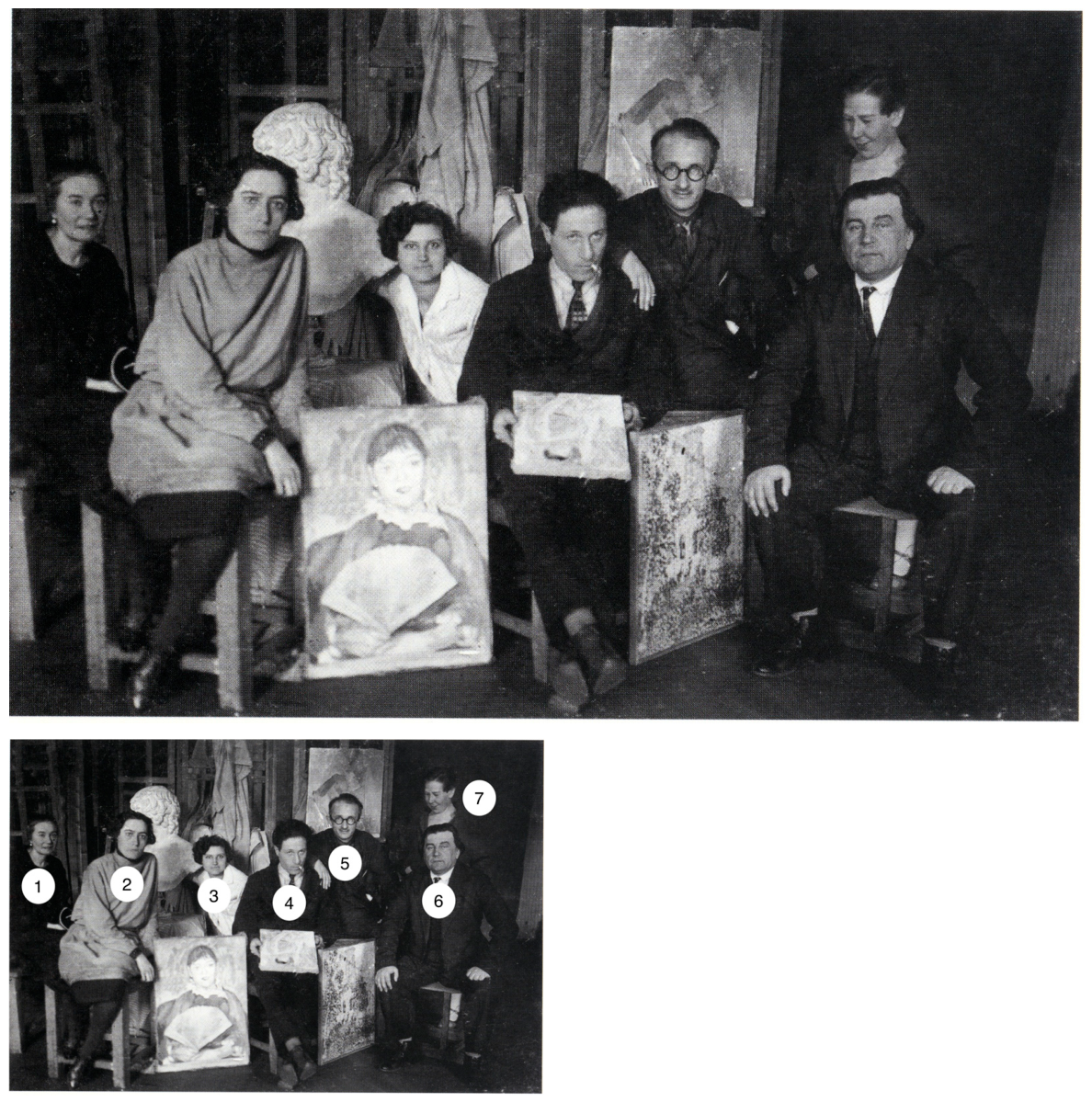
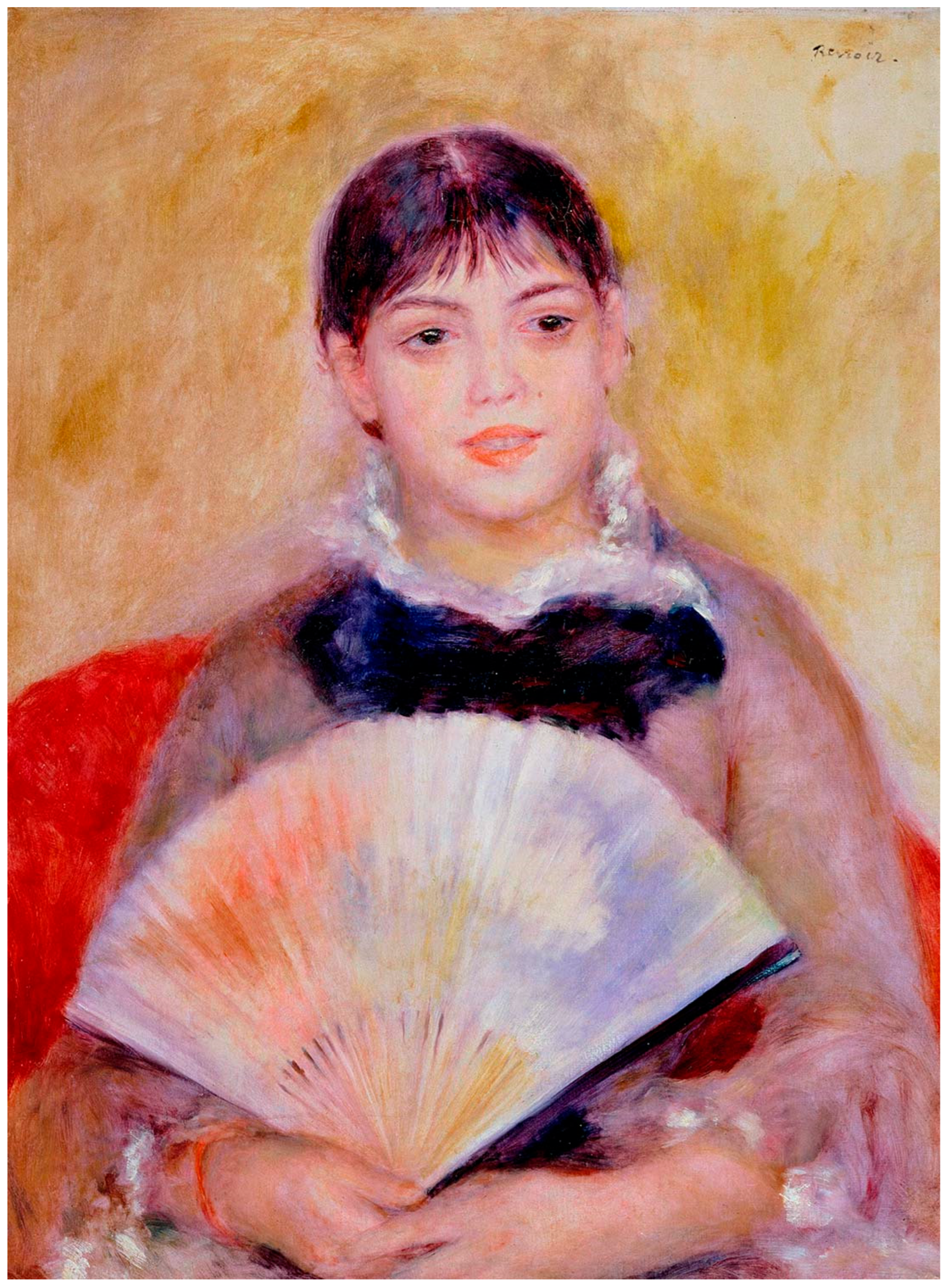
Only two photographs of the Circle are known. One of these shows Malevich with several students in a studio interior (Figure 18). In the background stands a plaster cast of an antique sculpture used as a study model; numerous easels are arranged around the room. One participant holds a painting that cannot be identified, and the portrait displayed by the centrally positioned figure also remains unknown.39 In the left foreground, however, Dzhagupova is clearly visible holding a portrait of a woman that can be identified: it is a study after Pierre-Auguste Renoir’s Girl with a Fan (Figure 19). Renoir was the Impressionist she had chosen to study within the Circle, and the photograph suggests that she had just completed this painted exercise after one of his portraits. Behind Dzhagupova, on the far left, we see a woman that bears resemblance to the sitter of our portrait. Could this be Elizaveta Iakovleva?
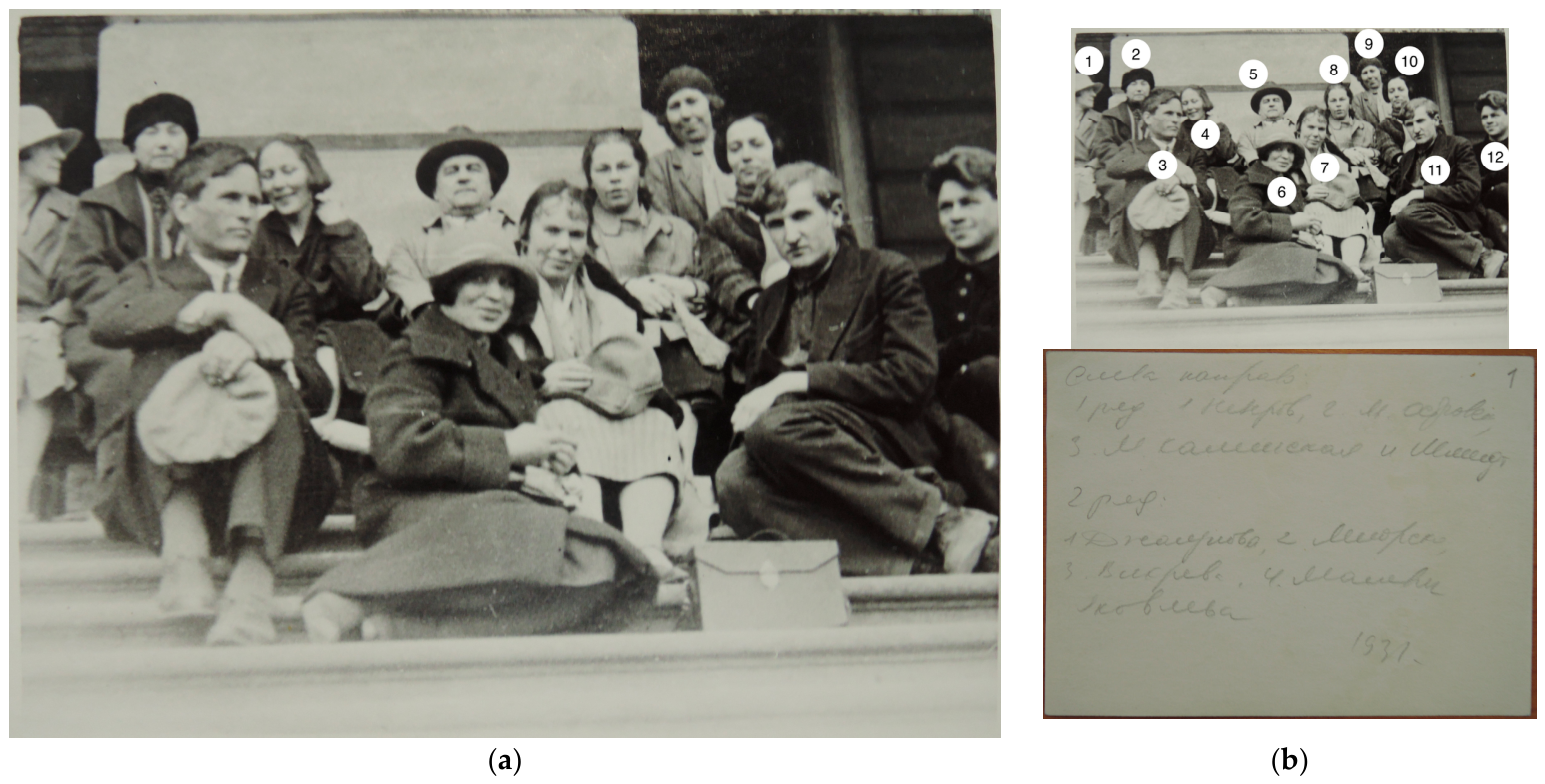
A second photograph, dated 1931, depicts several members of the Circle seated on the steps of the State Russian Museum alongside their teacher (Figure 20).40 This photo, however, offers no insight into the group’s working methods or pedagogical activities.

8. Maria Dzhagupova and the Circle

In October 1928, Maria Dzhagupova arrived in Leningrad from Armavir, Armenia.41 Within a few months, she joined the Circle of New Western Painting. Malevich regularly devoted time to detailed discussions of his students’ work; his comments were sometimes recorded in shorthand by Anna Leporskaia and, at other times, by Nikolai Suetin.42 Notably, such records survive for his discussions of Dzhagupova’s paintings. Among the preserved documents in the Manuscript Department of the State Russian Museum is a file titled Records of conversations between K. S. Malevich and Maria Markovna Dzhagupova.43 Dated between 11 February 1929 and 11 October 1932, these notes attest to Malevich’s sustained engagement with her artistic development (Leporskaia 1929). They show that Dzhagupova’s assignments—like those of the two other members of her small working group, Maria Dmitrievna Vikhreva (1901–1942) and Maria Feodosievna Ostrovskaia (1896–1980)—were structured around the study of Pierre-Auguste Renoir’s artistic system. This focus is confirmed by the portrait Dzhagupova holds in the Circle photograph discussed above. These previously unpublished records of Malevich’s commentary on Dzhagupova’s work illuminate not only the Circle’s pedagogical structure and Malevich’s evaluative criteria, but also key aspects of Dzhagupova’s painterly technique.
Opening his critique with a comparison to the other members of the Circle, Malevich observed that Dzhagupova—unlike her peers—had succeeded in “adhering to Renoir’s plan,” while the others had not. At the same time, he judged her work overall to be “amateurish.” Despite this reservation, Malevich expressed confidence in her potential, noting that, if she continued her studies with perseverance, “by autumn she will achieve great results.”44 He referred specifically to three portraits on which she was to continue working over the summer: Mother, Mikhail, and Girl.
Malevich also asked about Dzhagupova’s prior artistic training, and the two discussed her motivations. She explained that she loved painting and had never abandoned it, though she remained dissatisfied with her results. Commenting on a still life with a teapot—a studio exercise—Malevich noted that she was on the right path and advised her to concentrate on reducing and “spraying” the brushstroke.45
On 18 February, while discussing Dzhagupova’s painting of a model, Malevich advised that “all the spots should express great light intensity.” He recommended the use of a “hair-like,” or “impressionistic,” technique and urged her to pay greater attention to colour when working on the “impressionistic head.”46 At the same time, he observed that she was “more captivated by the form itself than by the light,” adding that nature must be perceived “through this prism.”47 Returning to a sketch of a model, Malevich remarked: “You cannot smear the form; rather, the form itself must emerge from the material.” Otherwise, he warned, the result resembles “a woman covered in confetti.” He then formulated a guiding principle: “the strokes should build the form and flow from the form.” Finally, he stressed the need “to achieve pure tones without airy overtones”—a phrase he underlined in the protocol.48
On 25 April, Malevich and Dzhagupova discussed several of her earlier works, including a still life with a hat. He advised her: “You need to embrace a healthy naturalism” (the last two words underlined), “without any fantasy, and Impressionism provides this attitude and cleanses you of any intrusions.” He further recommended the use of pointillism—small spots of colour. Dzhagupova admitted that pointillism “annoys” her. Malevich responded: “This is because you do not capture nature through pointillism, but when nature passes through Impressionism, it will become easier for you.”49
At their meeting on 7 May, Malevich and Dzhagupova again discussed earlier works, sketches, and studies from the model. Once more, Malevich observed a “strong imprint” in Dzhagupova’s work—“a view of nature under a familiar veil that must be destroyed.” He insisted that the Impressionists should lead her “to a healthier physical perception.”50 Malevich stated categorically: “Do Impressionism, because otherwise you are in a vicious circle.” In his comments of 4 June—the final review before the start of the summer break—Malevich analysed a painting from the model. He remarked that “the model is very stylized, not simplified,” and concluded with the directive: “Continue with pointillism, only brighter.”51
The next entry dates only from November 1929. In it, the sketches are diagnosed as a means to “cure… vagueness and lead to colour as such.” It is noted that, in her landscapes, Dzhagupova had succeeded in emerging from a state described as “twenty veils.” Further remarks in the notes are interspersed with assessments of other students’ work. On 30 December, Malevich turns to Renoir’s models, which he describes as “surprising with blue and pink colours.”
The notes from January and February 1930 were made during sessions held in Dzhagupova’s absence. In a questionnaire, the artist herself stated that she studied with Malevich for seventeen months.52 On 16 April, Malevich recorded the following observation: “Begins to understand.”53 Regarding her studies, he noted: “Model—order and frame with a white frame.” At a certain point, however, Malevich expressed concern that Dzhagupova might undo the discoveries of the preceding period. Thus, in the entries dated 17 May, he wrote: “The colour scheme has weakened. The tones are all ochre and dead… The tones are academic in nature. They should be more lively,” followed by an even harsher assessment: “a kind of pictorial anemia.” In reference to a plein air sketch, he added a more positive remark: “the pines are good in tone—Cézanne-esque.”54
During the summer, the students of the Circle often worked en plein air; however, on the eve of 16 June, they were all assigned a still life with a lilac and pink tablecloth. Malevich observed: “Dzhagupova’s is better, more refined—the pinks are good, the greens too—but the blues are very strong; the spots are taken without understanding why. The spot does not flow from the painting itself; it does not flow from this tradition.”55 His following remarks turned to the students more generally, using their works as points of comparison. Malevich discussed Cézanne, Renoir, and the development of impressionistic qualities in painting.
In subsequent analyses of student works contained in these minutes by Leporskaia other names appear, and Dzhagupova herself disappears from the records from the summer of 1931 onward, reappearing only sporadically in the autumn of 1933. On 11 October 1933, Malevich returned to a discussion of her nature studies, referring in this context to the work of Cézanne. He remarked: “Everything has become poor, poor in colour, black.” Dzhagupova responded: “Nature overwhelmed me. The dark, heavy forest is alien to me. The task was to develop the colour scheme of the painting, but I did not adhere to it; I worked freely. I found myself in nature, and all your colours jumped out.” Malevich replied: “In terms of character, it can be attributed to Cézannism. But Cézanne is not understood here…” He concluded with the directive: “Clean up the colour so that there is no dirt.”56 On 14 November, Dzhagupova reported again: “I tried to work on the portrait artistically.”57 Unfortunately, the records do not specify which portrait she was referring to.
The final entries in the commentary on Dzhagupova’s work are undated. They conclude with Malevich’s assessment that Dzhagupova misjudged her own progress: what she herself perceived as a decline, he regarded as an advance in the development of tonal relationships. He advised:
“Begin with light undertones and then cover them five or ten times with the same tone. The whiteness that participates in the colour is a measure of light and colour. Blue and pink know their limits. The face and hands are not fully resolved and appear decorative; they should function as a contrast, with a more definite tone… It is not the pink background that is the central tone, but the figure.”58
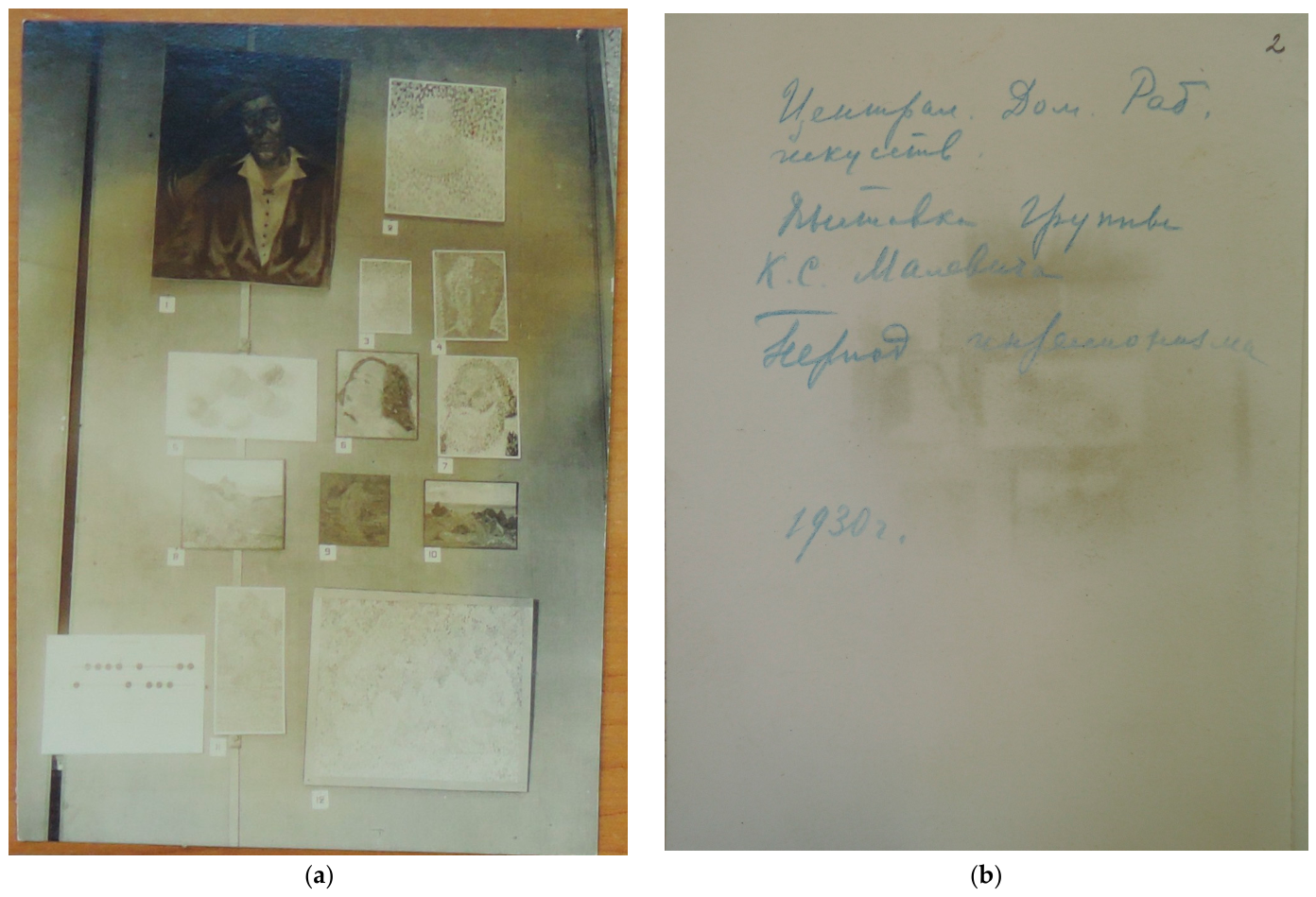
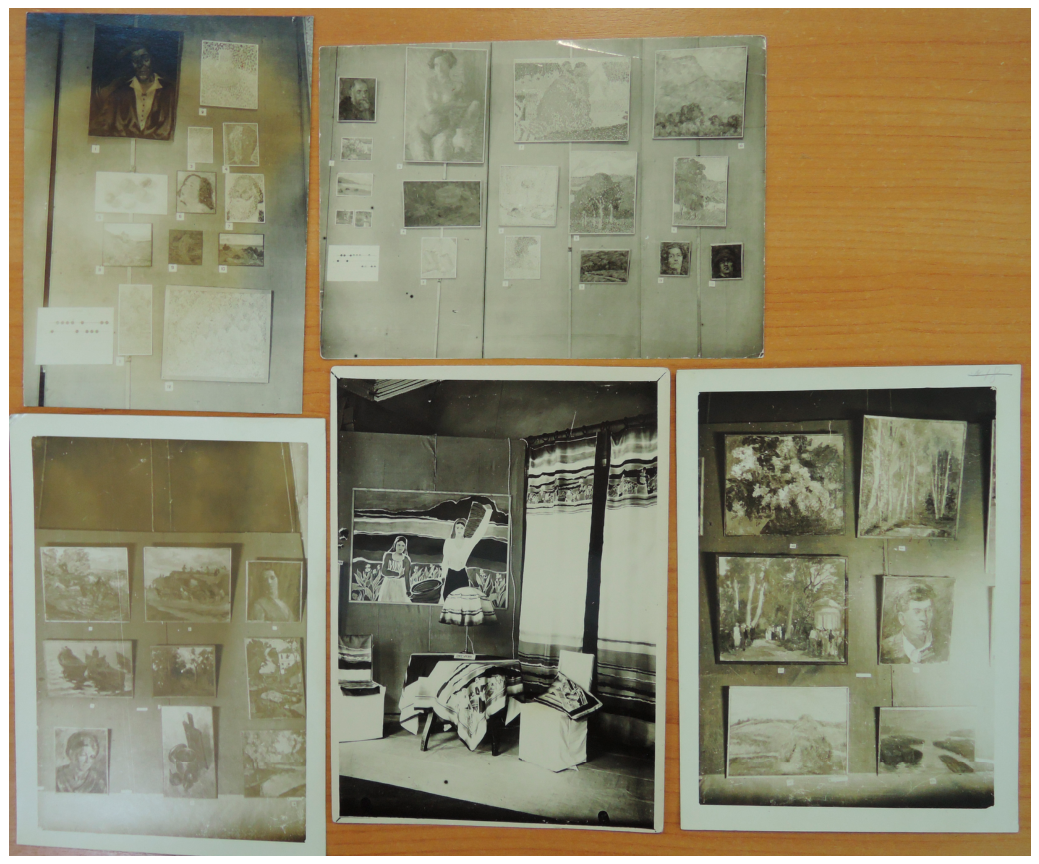
Among the Dzhagupova-related documents preserved in TsGALI is a photograph of an exhibition of the so-called “Malevich group” held at the Central House of Workers in 1930 (Figure 21a,b). The inscription on the reverse of the photograph identifies the theme as “The Period of Impressionism.”59 It is plausible that Dzhagupova retained this photograph as documentation of her studies under Malevich.
Taken together, these documents allow us to conclude that Dzhagupova was consistently engaged in the study of portrait painting within the Circle, under Malevich’s guidance. It is equally clear that she was encouraged to adopt and adapt the Impressionist method, specifically that of Renoir, when producing these works. However, none of the surviving comments refer to specific portraits.

9. Elizaveta Iakovleva and Malevich

Maria Dzhagupova was clearly a regular participant in the lessons of the Circle. The relationship between Elizaveta Iakovleva60 and the group, however, is much more difficult to establish. In the minutes of the fourth meeting of the Circle, dated 11 February 1929, her surname appears among the nine students present, alongside Krimmer, Dzhagupova, and Nelius, and it is noted that their works were reviewed. Significantly, however, the minutes record the name as “Iakovlev” rather than “Iakovleva,” and they contain no analysis of any specific work. No separate comments on Iakovleva’s works have been identified. From 22 February onward, the name Iakovleva appears sporadically, sometimes alongside that of M. Vikhreva. Yet again, the documents occasionally substitute the female form with the male surname “Iakovlev,” introducing further uncertainty. The surviving records, therefore, do not permit a reliable assessment of Iakovleva’s activities associated with the Circle. It remains unclear whether, and if so, how frequently she participated in the lessons. At most, she appears to have been only loosely connected to the group. It is clear, however, that she was well acquainted with Dzhagupova.
Dzhagupova came into contact with Iakovleva in the winter of 1929. They most likely became acquainted through Malevich’s Circle, although their connection extended beyond painting. Both shared interests in textiles, theatre design, and costume work. Iakovleva had substantial experience as a costume designer, and in 1930, Dzhagupova was involved in design work for a fabric-painting factory. It is also possible that Iakovleva considered herself too old to participate fully in the Circle: she was only three years younger than Malevich himself and significantly older than the other students.
Iakovleva was, however, part of another circle around Malevich: his inner circle. She was among the regular visitors to his home. Until 1929, she lived in an apartment on Prachechny Lane, not far from the Miatlevsky House where Malevich resided, although it is possible that she became a frequent visitor only later. It remains difficult to establish precisely when she entered this more intimate circle around Malevich. Una, Malevich’s daughter, mentions Iakovleva in her memoirs. Together with Dzhagupova, Iakovleva is listed among the guests who attended Malevich’s birthday celebration on 23 February 1934:
“Many people came, all our regular guests: Anna Alexandrovna, Nikolai Mikhailovich, Elizaveta Iakovlevna, and the younger painters who often dropped by then: Vikhreva, Maria Markovna Dzhagupova.”61
Una moved from Nemchinovka, near Moscow, to Leningrad in the autumn of 1933 to settle in her father’s apartment. Her recollections of Iakovleva therefore date from this period onward. She describes Iakovleva as a regular visitor to the household—an artist of modest creative talent (an assessment evidently based on her father’s private remarks)—but also notes that she was well-liked by everyone in the house.62
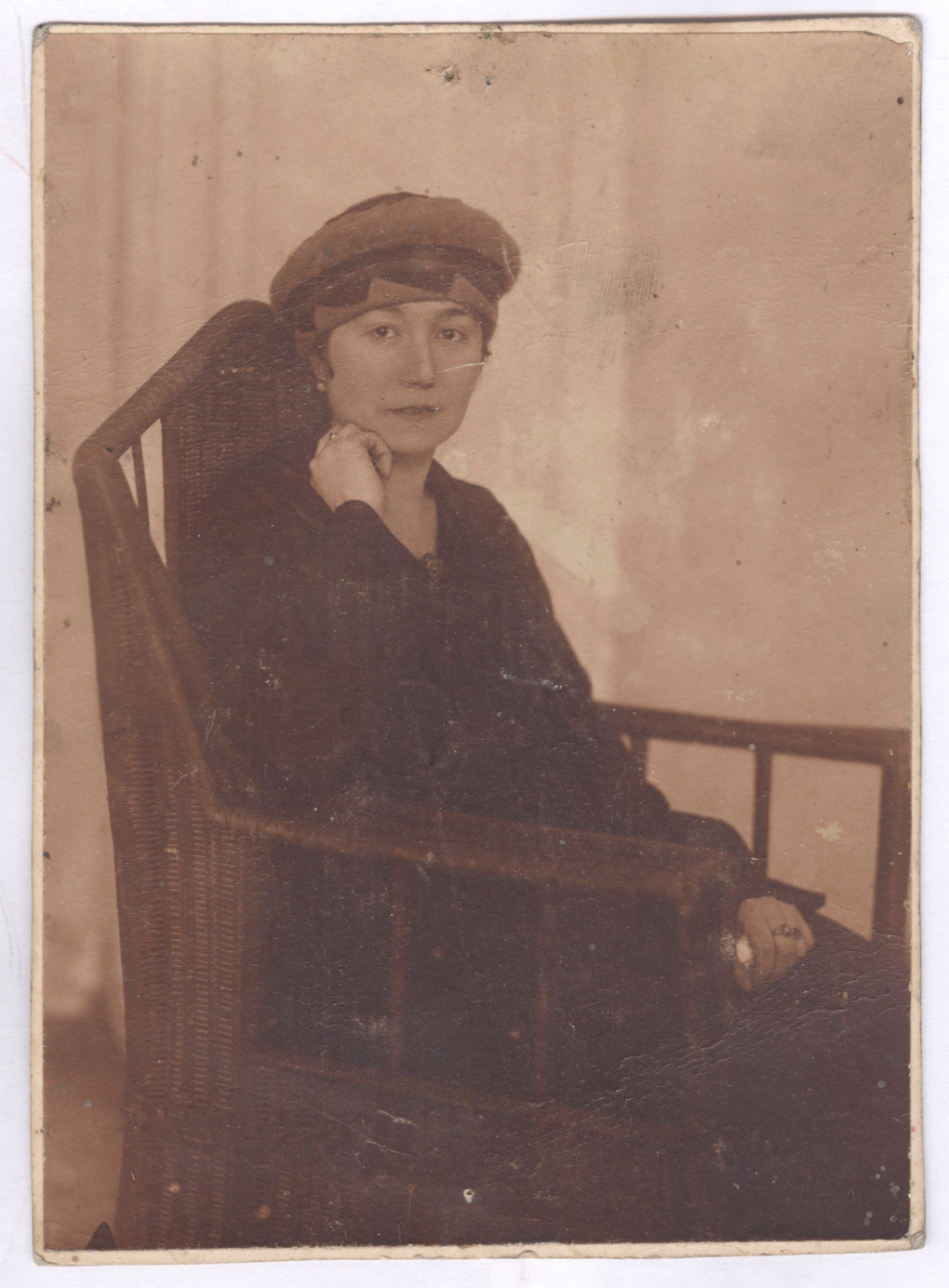
Among the documents in the TsGALI files of Maria Dzhagupova, there is a photograph of Elizaveta Iakovleva (Figure 22)63 which allow us to verify the identity of the sitter in the portrait. A comparison of this photograph with the painting confirms that the depicted woman is indeed Iakovleva.
After arriving in Leningrad in October 1928, Dzhagupova lived on Vasilievskii Island, while Iakovleva, as noted above, resided in the city centre. From 1929 onward, however, both women moved to a more remote area of Leningrad and began living together in a communal apartment in the Kolomna district, at 3 Kanonerskaia Street, apartment 29.64 The distance from the city centre did not prevent them from maintaining regular contact with Malevich.
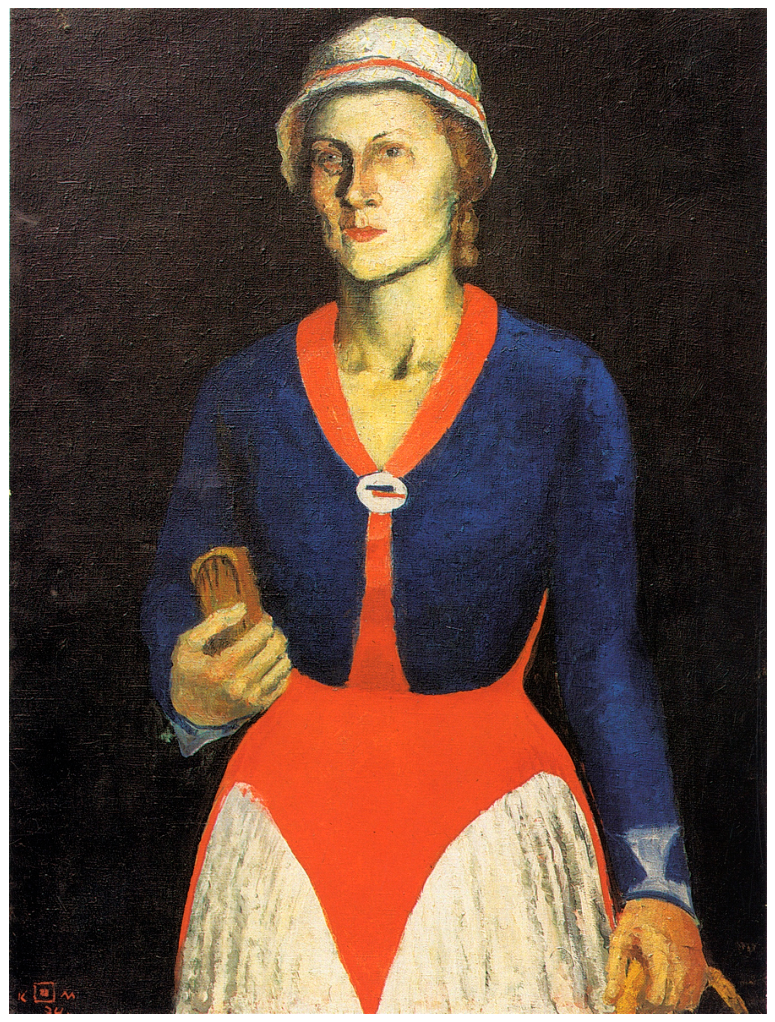
Due to the difference in their ages, the periods of greatest creative activity for Iakovleva and Dzhagupova did not coincide. Iakovleva’s career reached its peak in the 1920s, with the 1927 Exhibition of Theatrical and Decorative Art in Leningrad marking a significant moment for her work. Dzhagupova, by contrast, noted that she began participating in art exhibitions only in 1934, with her debut at the exhibition Women in Socialist Construction held in Leningrad that year.65 According to the exhibition catalogue, she presented a Self-Portrait (Figure 23), while Malevich exhibited a Portrait of His Wife (Figure 24).
Dzhagupova participated in several other exhibitions during the 1930s. It is difficult, however, to determine precisely which works she exhibited, as many exhibitions of the period were not accompanied by catalogues. When catalogues did exist, they often listed works under generic titles such as Portrait or Landscape, without further specification.66 Unlike many works of the period, Dzhagupova’s paintings did not glorify the new Soviet reality through the dominant visual language of Socialist Realism. As a result, her work did not conform to the category of “official art” and attracted little attention in the contemporary press. Dzhagupova thus belongs to the large group of lesser-known artists who, during the 1930s, sought to find their place within the artistic landscape of Leningrad under the growing dominance of Stalinist ideology.

10. A New Series of Portraits

Malevich’s unfinished trip abroad in 1927, followed by unrealised plans to leave Leningrad for Moscow or Kyiv, his arrest and imprisonment by the OGPU in the autumn and early winter of 1930, the loss of his position, and finally a serious and debilitating illness—all these misfortunes radically altered his life. Increasingly confined to his home and often bedridden, his social circle narrowed considerably. Only his most loyal students continued to visit him, and his relationships with them grew more informal. In some cases, these visits developed into direct collaboration on artistic and theoretical projects.
From 1932 onward, some of these students—together with several of Malevich’s close friends and family members—became the subjects of a new series of portraits. These works were not repetitions of earlier motifs; rather, they marked a decisive break, introducing something fundamentally new in terms of subject matter, iconography, and execution. Also, in another sense, these portraits were a very private undertaking. Unlike other paintings from this period, no comparable portraits are known to have been painted by his students, even the most devoted. Nor did Malevich present them to the sitters once completed. Instead, he kept them or sold them to the Russian Museum. Not even his close friend Nikolai Punin received his own portrait (Figure 25).67
Against this background, the final phase of Malevich’s work, his return to figuration, appears less abrupt than it might initially seem. The preceding survey has traced the uneven path toward this moment, clarifying both his artistic production and exhibition history, as well as the renewed inspiration he drew from Impressionism and the painterly techniques he transmitted to his students in the Circle. It has also introduced two of these students, Dzhagupova and her close associate Iakovleva. This trajectory leads directly to Malevich’s final portraits, which require closer attention here, since the portrait of Iakovleva may belong to this last group.

11. The Iakovleva Portrait as an Allegorical Portrait by Malevich

Unlike his early work, Malevich’s late portraits received only sporadic attention from art historians and exhibition curators throughout the last century. Few scholars examined them as a coherent group, while others discussed only individual works in detail. As a result, this late phase of the artist’s oeuvre remained largely underappreciated. As Elena Basner observed in her 1999 dissertation on Malevich, such neglect is unjustified. In her view, these paintings deserve greater scholarly attention:
“<…> if only because they represent the final conclusion of his creative and life journey. Moreover, this is undoubtedly the most ‘discriminated’ stage of his artistic activity: as a rule, the organizers of personal exhibitions were very reluctant to select only two or three of his most significant works—‘Self-Portrait’ and portraits of his wife and daughter. However, it would be fair to try to identify in this last period of his work the aspects that can be correlated with the general logic of the evolution of Malevich’s late painting <…>.”68
Interest in Malevich’s later works emerged relatively late in the twentieth century. Christina Lodder has linked this renewed scholarly attention to a broader shift in Western art history: the transition from modernism to postmodernism. She wrote:
“These late works, in which Malevich returned to a figurative content, used to be regarded as an ideological and aesthetic retreat from the high point of Suprematism. They were seen in an entirely negative light as being symptomatic of Malevich’s compromise with (and ultimately defeat by) the Soviet regime, as well as epitomizing his betrayal of modernism.”69
It is only about forty-five years ago that Malevich’s late portraits, especially the symbolic ones, began to receive sustained scholarly attention. In 1980, Charlotte Douglas broke new ground with an essay on Malevich’s work after 1927.70 A decade later, some of the late portraits were included in major retrospectives, including exhibitions in Washington in 199071, Florence in 199372 and Vienna 199473. As Douglas wrote:
“In spite of the mounting atmosphere of state terrorism and his own increasing ill health, Malevich continued to work after 1932. At a time in Russian history when many modern artists were reduced to painting endless children and bouquets of flowers. Malevich painted portraits of himself and his friends in bright, phantastical clothing, rendered in a style reminiscent of Holbein or Cranach. ‘Portrait of Nikolai Punin’, for example, bears a certain resemblance to Piero della Francesca’s ‘Duke of Urbino’ (1465–72). Such works are, to an extent, a response to the increasing critical attention Soviet art historians devoted at this time to the Renaissance, but Malevich’s depictions are also derived from Russian icons and bear the imprint of his continuing interest in the higher ‘objectless world’. In the last year of his life, his portraits, such as the ‘Portrait of the Artist’s Daughter, Una’, became warmly expressionistic and intense. Four such works, including his ‘Self-Portrait’, were on exhibition at the time of his death in 1935.”74
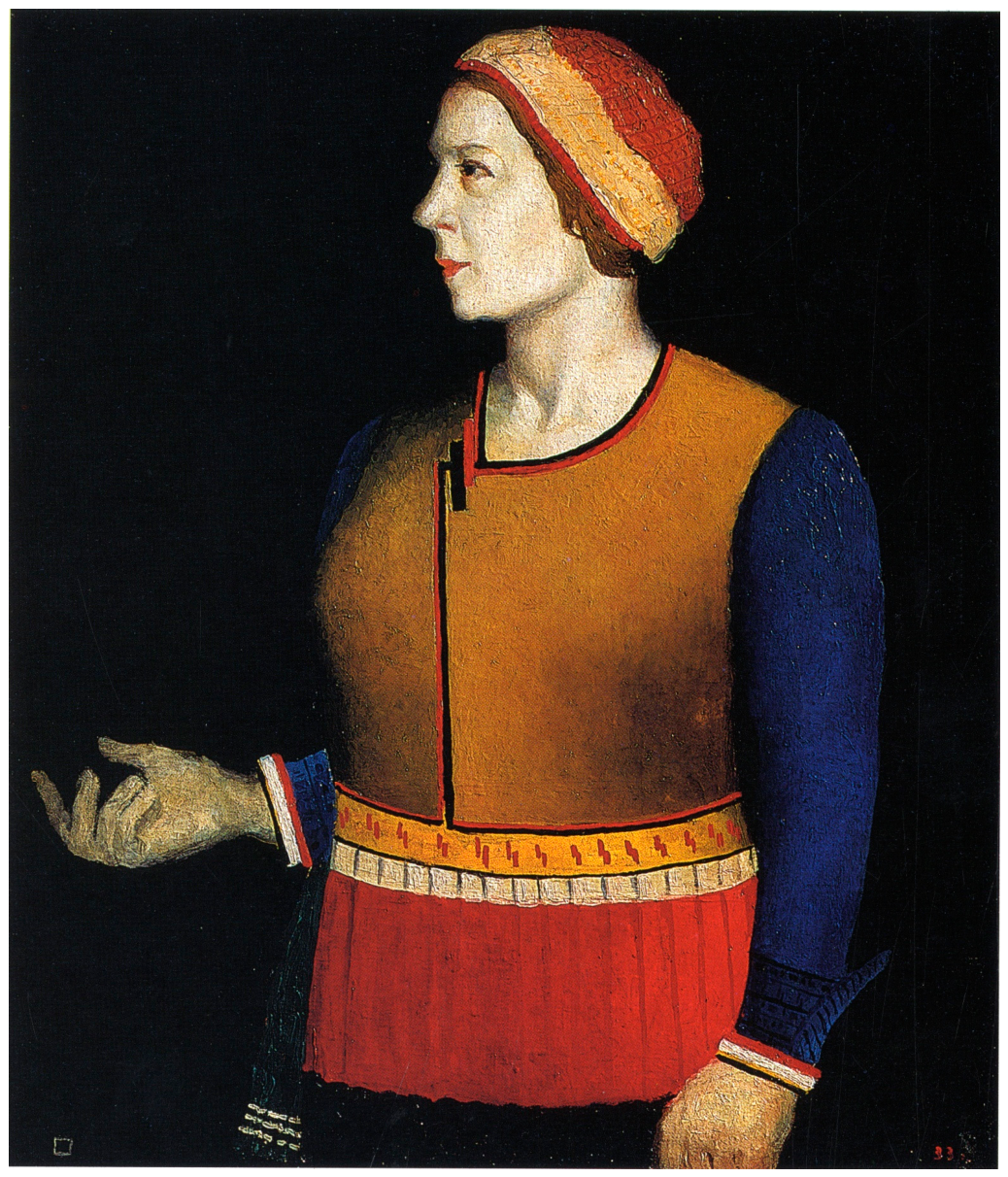
In her 1994 book on Malevich’s oeuvre, Douglas discussed forty of the artist’s paintings in detail, including two late portraits.75 Placing these works within their historical context, she suggested that Malevich had political reasons for portraying family members, friends, and himself. In the early 1930s, works of art in the Soviet Union were frequently subjected to ideological scrutiny. Anything that could be interpreted as criticism in a work of art posed a risk to its maker. Because portraiture was considered one of the most neutral genres in painting, it offered a comparatively safe subject to pursue. Although this may well have been one of Malevich’s considerations in turning to portraiture, it does not explain why he depicted some sitters in Suprematist clothing and with striking, stylized gestures. To account for these features, Charlotte Douglas pointed to the influence of the Italian Metaphysical painter Giorgio de Chirico.76 About the portrait of Malevich’s wife (Figure 24), Douglas wrote:
“But Malevich’s pictures are not primarily concerned with the most obvious task of portraiture, that is, with reproducing the sitter’s likeness. True to the direction of his previous artistic interests, the artist continued through portraiture to represent the metaphysical modes he understood as inherent in human life.”
She compared the gesture in this portrait to “a characteristic pose of the saints and angels on the Deesis row of an iconostasis, or icon screen, of a Russian Orthodox church.” She also identified a possible source in Portrait of Jane Seymour (1536) by Hans Holbein the Younger. More broadly, Douglas argued that the iconography of these allegorical portraits, especially the Self-Portrait (GRM ZhB-1516), reflects the influence of Italian and Northern European painting of the fifteenth and sixteenth centuries. In these works, the hand gesture directly echoes traditional representations of Christ.
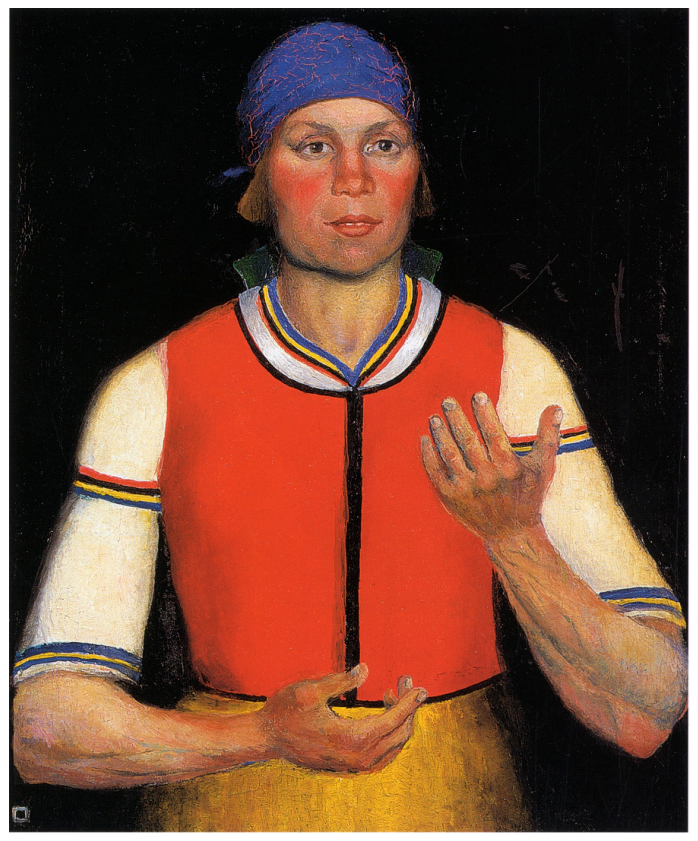
In her essay in the catalogue of the major Malevich exhibition at Tate Modern in 2014, Evgenia Petrova interpreted Malevich’s late portraits as part of his transition from Suprematism to Supranaturalism. She suggested that some of these works may have been conceived for public spaces such as theatres, cinemas, and houses of culture. She wrote:
“It is quite possible that it was for one of his ‘monumental projects’ that Malevich painted Woman Worker, Self-Portrait and Portrait of the Artist’s Wife (all 1933: <in our text: Figures 24, 37 and 40>). Certain gestures of a sacred quality, perfected by the artist in studies showing a blacksmith and a worker, suggest a link between these late portraits and some architectural projects in a new classical style to which Malevich gave much thought in the early 1930’s. Captured in the spirit of the Renaissance, these new ‘heroes and martyrs’ appear before the audience in hypothetical palaces and houses of culture. They do not look like saints in traditional churches; rather, they are conveyed in a new contemporary interpretation (<in our text: Figures 25 and 40>). In this series, it is not so much concrete individuals who appear, as much as certain types, who exist outside of time, beyond any nationality. ‘I do not paint PORTRAITS but have returned to the Pictorial culture of the human face’, said Malevich, according to Anna Leporskaya in 1931.”
With regard to portrait painting, Petrova cited a remark by Malevich in a letter to his friend Ivan Kliun: “At the present moment … I am allowing myself to develop images [of saints], i.e., human faces in classical form.” Petrova continued:
“He <Malevich> did not specify to what purpose he was ‘assembling man’; however, the stylistic similarity of his late portraits and their lack of literal portraiture fundamentally distinguish them from compositions in this genre by contemporaries.”77
Ever since the Iakovleva portrait was discovered in the 1990s, it has been regarded as a work by Malevich and identified as one of his allegorical portraits. It was included in several monographic exhibitions devoted to the artist, notably in Amsterdam and Bonn (2013–2014), London (2014), and Moscow (2017–2018).
The following section briefly reviews the scholarly reception of the Iakovleva portrait from the late twentieth century through the first two decades of the twenty-first century. One of the earliest discussions appeared in 1995, when Douglas addressed the then recently discovered painting in her survey of Suprematist ornamental designs.
“Suprematist design then acquired an even greater importance for Malevich. In his late portraits it has emblematic, philosophical, and even counterrevolutionary significance. In 1934 Malevich painted a splendid portrait of the Leningrad theater designer Elizaveta lakovleva <…>. Dressed in a yellow hat and a coat with a Suprematist collar, she slyly exhibits a bright red Suprematist handbag. This painting has recently been discovered.”78
In his contribution to the catalogue of the major Malevich exhibition held at Tate Modern in London in 2014, Nicolas Cullinan examined the development of form and colour in the artist’s oeuvre. Within this framework, he cited the portrait as an example of Malevich’s late use of geometric form and colour, interpreting it as a culmination of Suprematist principles under increasingly difficult circumstances:
“The crucial example with which to conclude a consideration of the various guises and shades of suprematism is with the still-enigmatic late figurative works of Malevich’s so-called ‘Second Peasant Cycle’ from the late 1920s and early 1930s, and the role and function of colour therein. These range from the overly emphatic bands of pure colour in works such as Head of a Peasant 1928–9 <…> with blocks of red and green gesturing towards the furrow of a ploughed field, or the striated bands of pure colour that act as horizon lines in Running Man 1930–1 (Centre Pompidou, Paris) and Three Female Figures c.1930 <…> through to the seemingly more orthodox figurative paintings such as Portrait of E. Iakovleva of 1932 <…>. In all of these, it is colour that effects a rapprochement between the compositional norms of suprematism and the conflicting demands of figuration. The bold bands of red and green that adorn the coat collar of the sitter in Portrait of E. Iakovleva, or the red of her strangely quadrangular purse—both of which are strikingly at odds with the naturalism of this portrait—are perhaps a form of encoded or suppressed suprematism, and one that suggests itself precisely through these geometrical blocks of solid colour. In this poignant painting, we come full circle from the Black Square, from colour being sublimated in order to heighten the dramatic impact of the birth of suprematism, to colour being one of the few ways in which Malevich could tacitly allude to the innovations he had pioneered and that were now themselves suppressed. Here, by once again ‘pouring colour into squares, as Matyushin had characterised (or caricatured) the paintings from the 0.10 exhibition, Malevich ingeniously used colour to infuse his figurative paintings with the pioneering developments of his suprematist period, which here becomes an adornment or badge of honour that effects a rapprochement between the aesthetics of both.”79
In 2017, Alexandra Shatskikh included the Iakovleva portrait in her exhibition Kazimir Malevich: More than the Black Square in Moscow. The catalogue text described the work as follows:
“The Portrait of Elizaveta Iakovleva combines the general horizon <meant here is the monochrome background used in other metaphysical compositions> with the depiction of the woman sitting for the artists, who is offered more freedom that most of Malevich’s other sitters. Malevich was quite insistent in asking his sitters to assume highly concentrated facial expressions and laboured gestures, making no exceptions even for children’s portraits.”
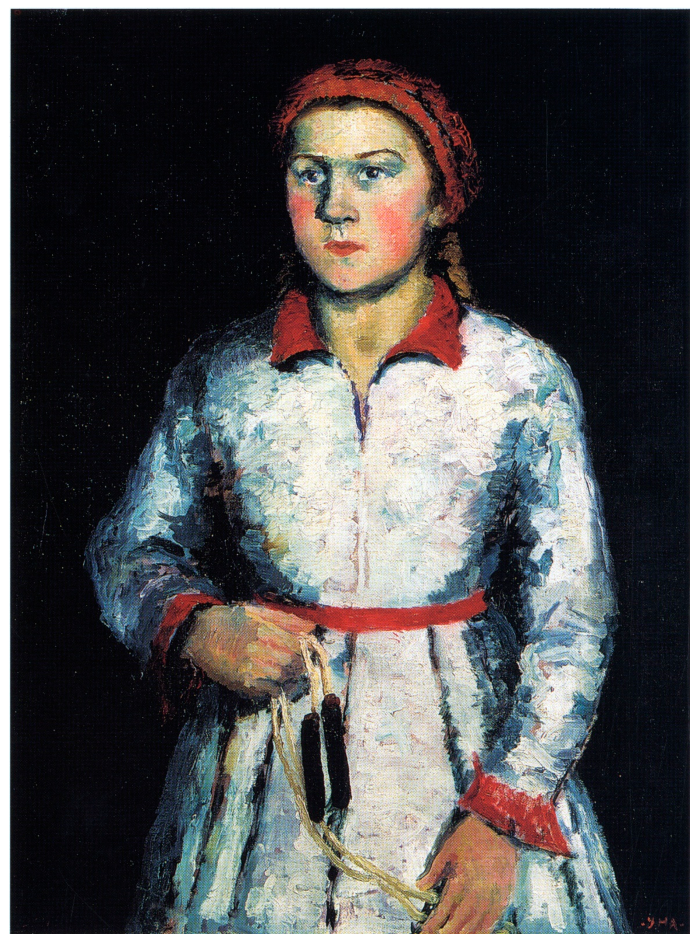
The text also refers to Malevich’s portrait of his daughter Una holding a skipping rope—an “everyday life object”—in order to draw a comparison with the handbag carried by Iakovleva.
“<…> Iakovleva has been allowed to keep her handbag, to hold and play with it, thus accompanying her facial expression and the tilt of her head. There is no doubt that the personal, the “small” in the midst of the “general”, particularly dominated the artist’s interests in the 1920s–1930s, of which the Portrait of Elizaveta Iakovleva provides further interest.”
Part of the wall text next to the Iakovleva portrait in this 2017 Moscow exhibition specifies the stylistic influences and the links to Suprematism to situate this painting among the late allegorical portraits by Malevich:
“The picture’s colours evidence the artist’s extraordinary mastery of the impressionist system of reflexes and his canny skill to improvise with brushes. The warm high-contrast strokes of intense emerald colours form the canvas background architecture and cast cold green and blue shadows on the sitter’s hands, neck and face.
Building the painting upon one central axis was one of his key techniques in cubist works. The composition of the portrait is flawlessly vertical, with the painting’s most prominent elements threaded on an explicit axis.
Yakovleva’s clothes on Malevich’s portrait are remarkable for the theatrical suprematist details: the three-colour (black, white and red) stretch on the collar; the geometrical pattern on the purse. However, it is hard to say whether those really belonged to the sitter, for Malevich had the habit of painting certain sitters in unbelievable dresses with suprematist elements, thus emphasizing their belonging to the circle of closest and dearest people of his.
Malevich reproduces his own Suprematism far beyond the collar’s and bag’s ornaments, for the bag itself is a slightly deformed red square, put on an angle, while Elizaveta’s elbow, resting on the table, transforms her black dress into a smoothed rectangular arousing vague associations with the primal figure of non-objectiveness. The overall composition of the painting testifies to the artist’s masterful skill, which allowed him to achieve a balanced dialogue of all the elements depicted in his suprematist canvasses.
The complex mat blue of the upper part of the background throws an unexpected shade of drama into the painting’s composition. That was the shade of blue Malevich used in a whole sequence of his suprematist paintings to depict the sky, this cold endless space indifferent to the human destiny.
The painting fascinates with the accurate physical portrayal of the sitter and its cunny rendition of her psychological state. Elizaveta Yakovleva’s pondering face is enlightened with a half-smile.
The skill of depicting the sitter’s hands was always a sing of the artist’s mastery of portrait painting. And the present canvas is a vivid evidence of Malevich’s mastery of the genre.
It is worth noticing that the vivid Portrait of Yakovleva. remarkable for its imagery and plasticity, is Malevich’s only late canvas depicting a close person of his and belonging to a private collection.”80
The above texts, cited in part or in extenso, may suffice to illustrate the different reasons why—until 2019—the Iakovleva portrait was regarded as one of Malevich’s late portraits.81

12. Maria Dzhagupova’s Portraits and the Late Portraits by Malevich

Since Iakovleva’s portrait was long considered part of Malevich’s late portraits, it is important to examine how it relates to that group. Many scholars placed it within the series he produced after 1931. More recently, however, this attribution has been challenged, with the suggestion that the painting may instead be the work of Maria Dzhagupova. The comparison that follows, therefore, considers both Malevich’s late portraits and works by Dzhagupova.
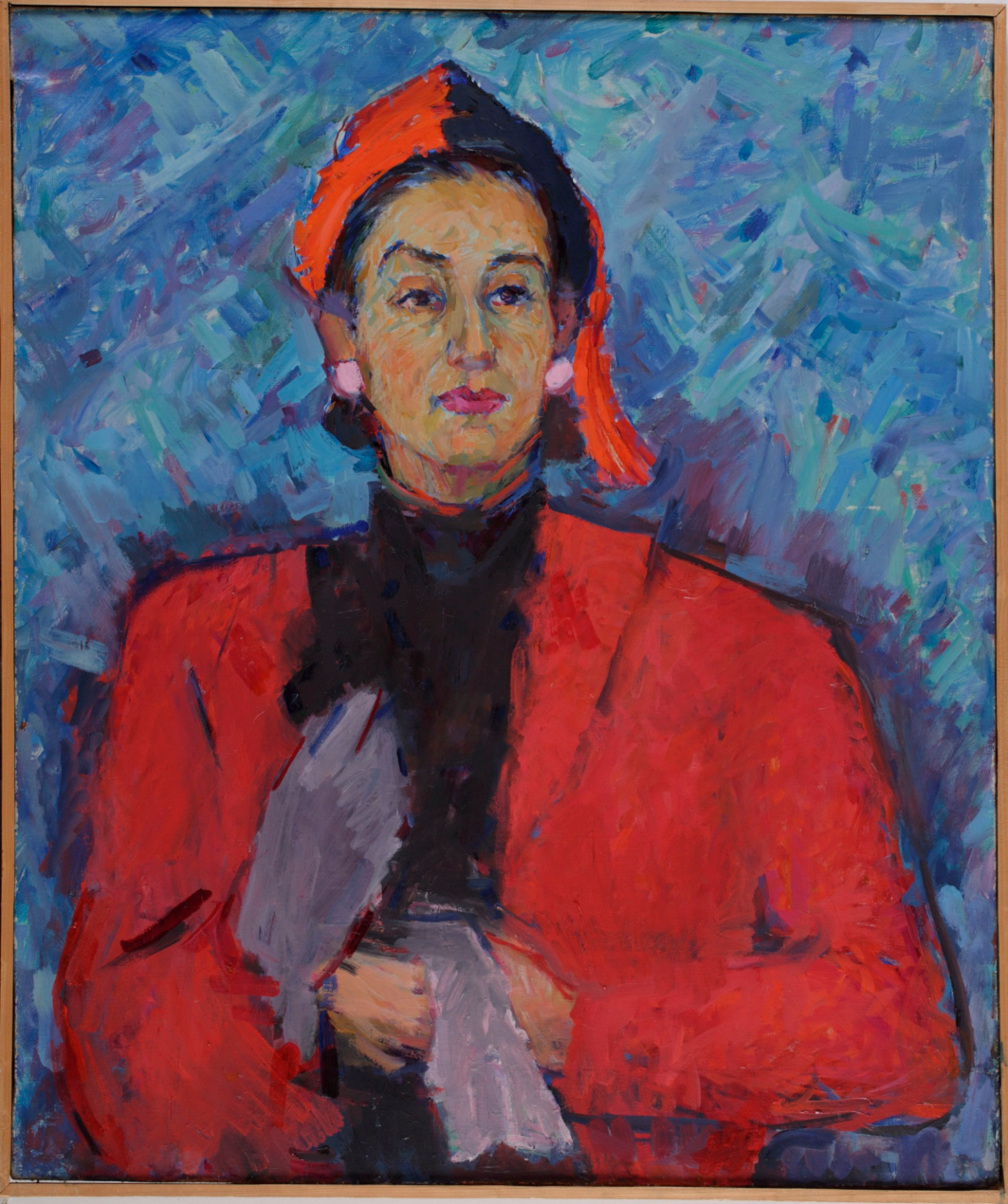
Few paintings by Dzhagupova are held in Russian public collections, and portraits by her are particularly rare. The Perm Museum preserves several of her works, both graphics and paintings, including landscapes, a few still lifes, and a single portrait. All were acquired in 1976 from her belongings.82 For comparison, we focus here on the only portrait in the group, Woman in Red (Figure 26). Her other paintings in this collection will not be discussed here.
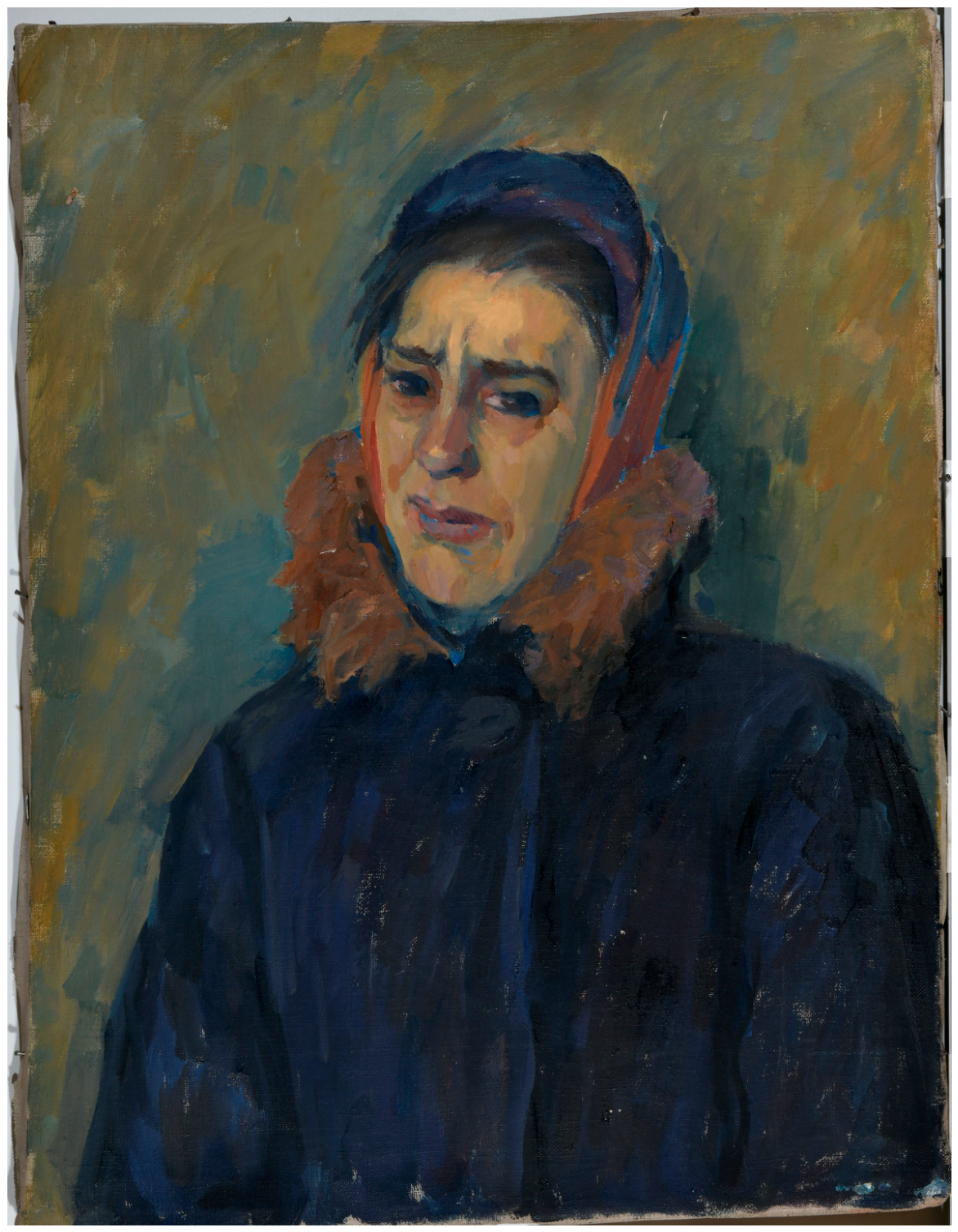
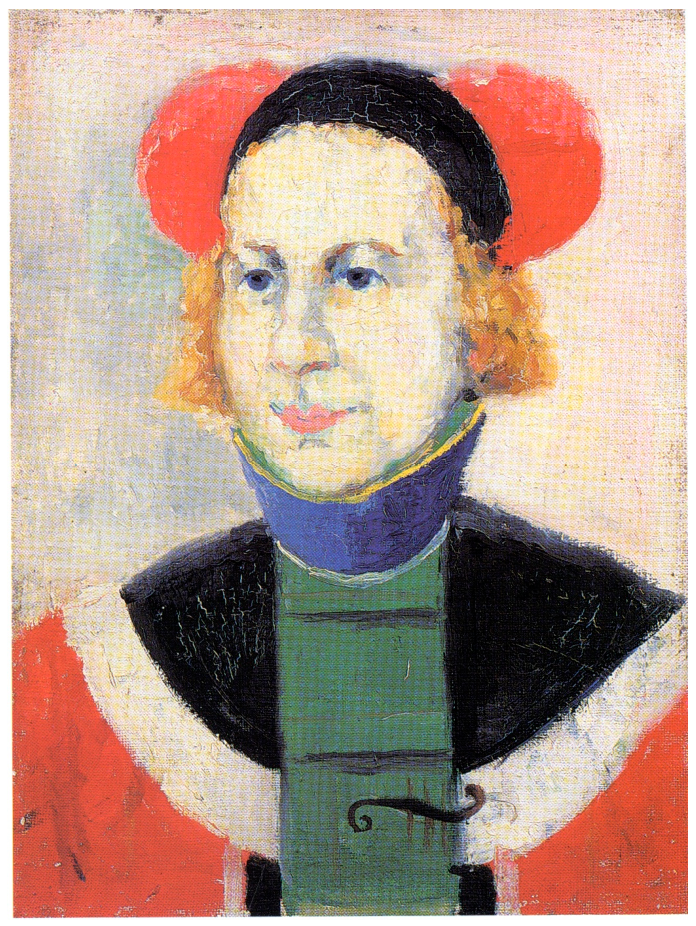
Several paintings by Dzhagupova are also preserved in the Historical Museum of St. Petersburg, including city views, a landscape, a still life, a self-portrait, and a portrait of a woman. For our purposes, the two portraits are of particular interest: Self-Portrait (Figure 23) and Woman Wearing a Headscarf (Figure 27). The self-portrait corresponds to the work from 1934 listed in Dzhagupova’s handwritten inventory and shown in the exhibition Women in Socialist Construction mentioned earlier. The second portrait is believed to depict Elizaveta Yakovleva during the Siege of Leningrad, shortly before her death. If so, the painting would date to around 1940 or 1941.83
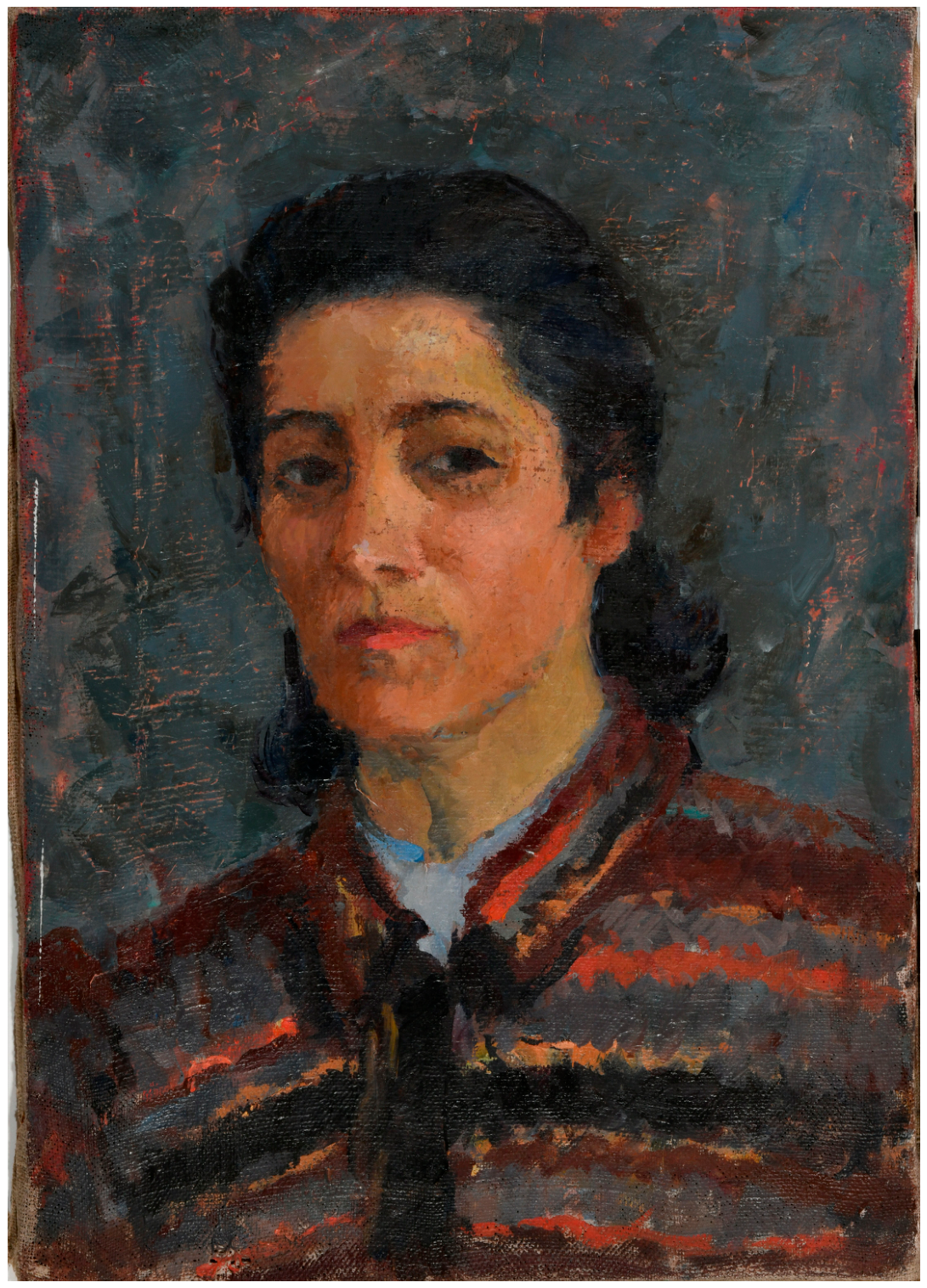
In the folder of Maria Dzhagupova’s documents in the Central Archive of Literature and Art in St. Petersburg, there is also a portrait in oil painting. It is unmounted and may represent an early self-portrait (Figure 28).84
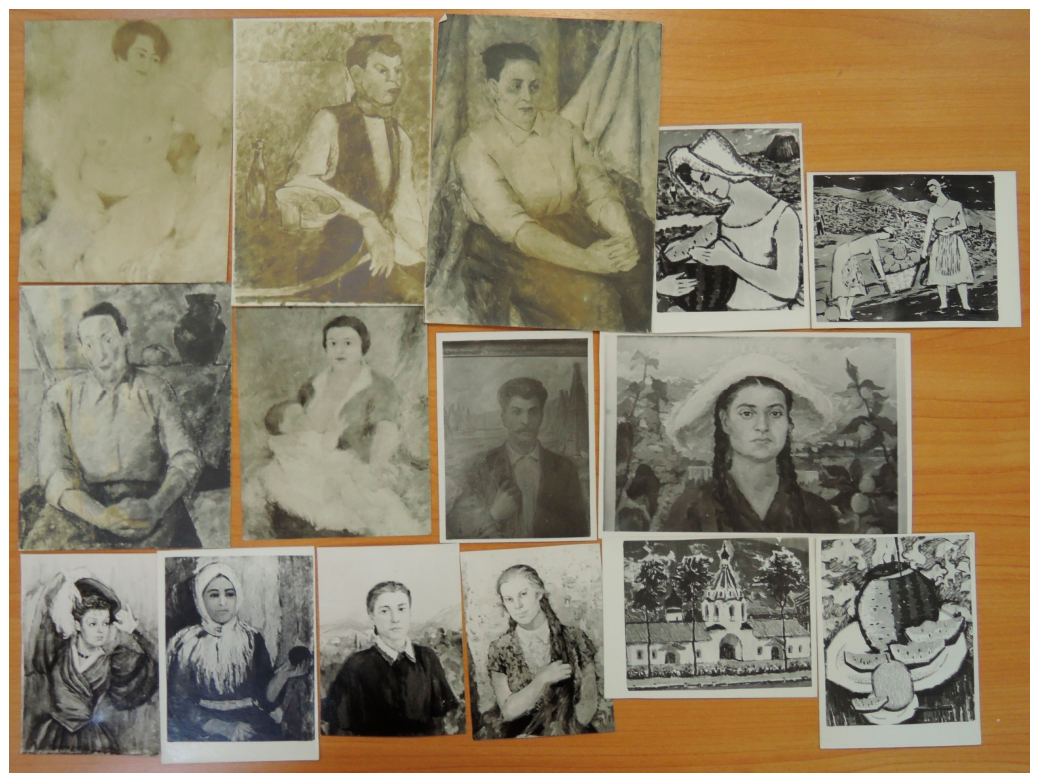
The TsGALI files also contain photographs of exhibitions of Dzhagupova’s works (Figure 29), which she kept as documentation of her artistic activity. Among them is the photograph of the 1930 exhibition in the Central House of Workers discussed earlier. Several of these images show portraits of both men and women on display. Other photographs document individual works by Dzhagupova (Figure 30), including graphic works and painted portraits. Notably, the Iakovleva portrait does not appear in any of these images. Because the photographs are black-and-white and often of limited clarity, they cannot be used here for stylistic comparison. They do, however, indicate that Dzhagupova produced far more portraits than those preserved today in public collections.
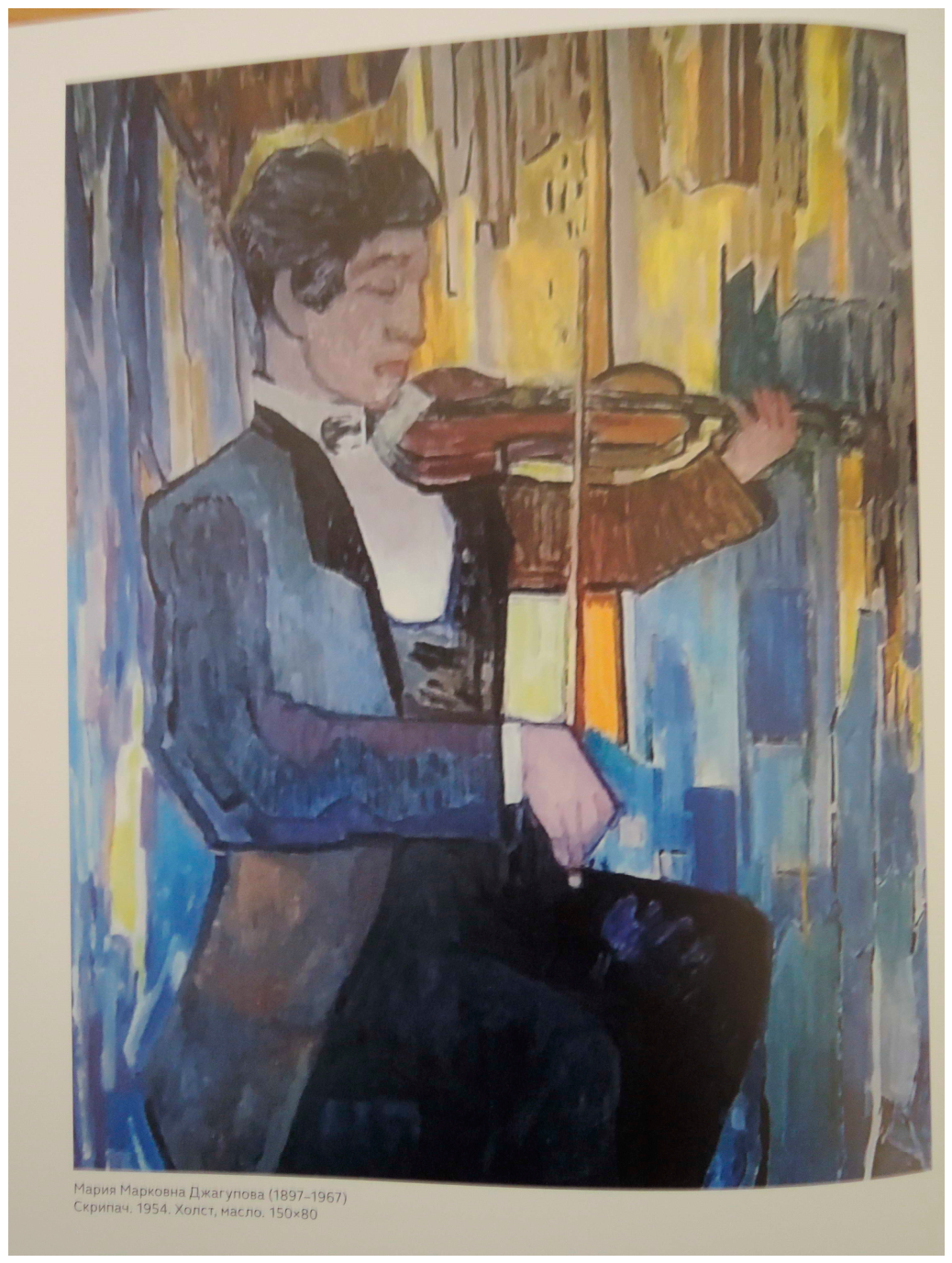
A private collection in St. Petersburg also holds several of her paintings, mainly landscapes and still lifes. Only one portrait is known from this group: Violinist (Figure 31). This painting was recently sold.
Our survey identified five surviving portraits by Dzhagupova. To our knowledge, none of her paintings has yet been examined scientifically—neither their materials and canvases nor their painting technique have been analysed. However, good photographic documentation exists for several works.85 These images allow a preliminary examination of her painterly technique and provide a basis for comparison with the Iakovleva portrait. The painting Violinist is excluded from this analysis because no photograph of sufficient resolution is available to examine the brushwork. The remaining four portraits were all acquired as works by Dzhagupova, and their authorship has never been questioned. Only the self-portrait dates from roughly the same period as the Iakovleva portrait. In the absence of additional works from this time, all four paintings are considered here for comparison.
The sitters in these portraits by Dzhagupova are depicted in a similar manner. Each is shown from the upper body against a plain background. Their heads are presented frontally or nearly so, and three of the figures look directly at the viewer, while the woman in red gazes slightly past us. All are dressed in ordinary clothing, without notable decorative elements.
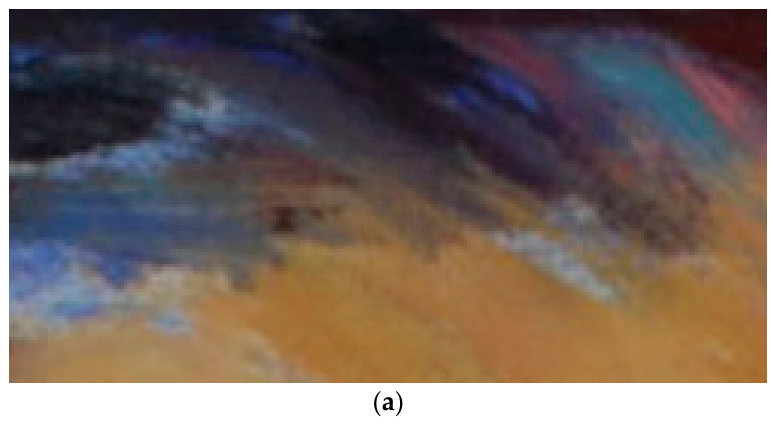
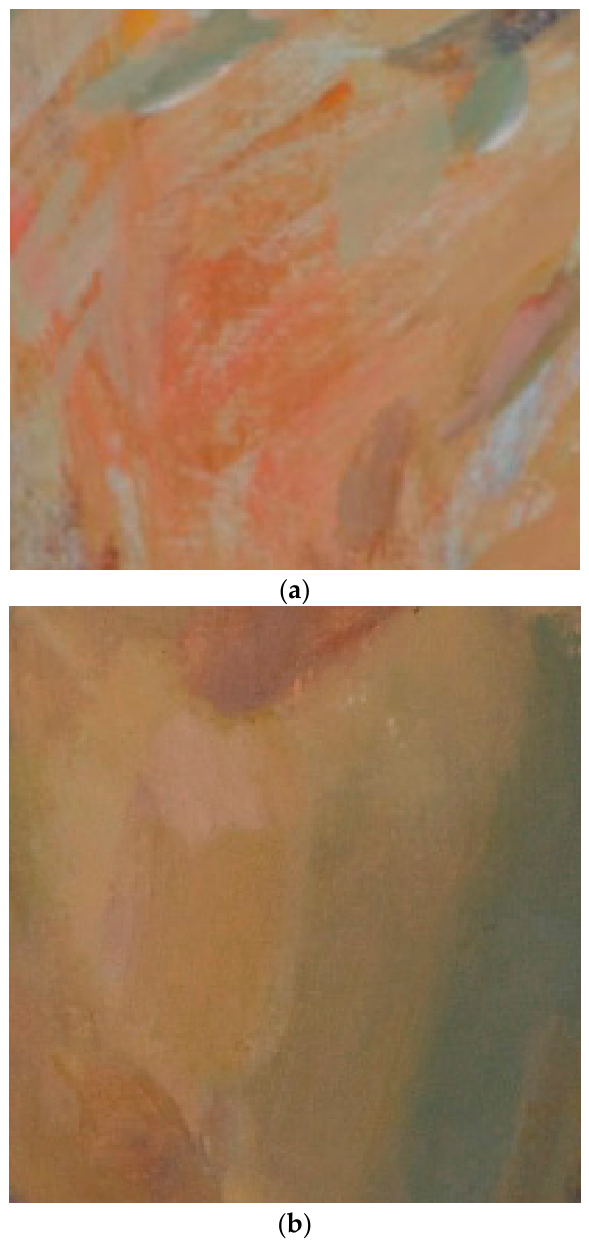
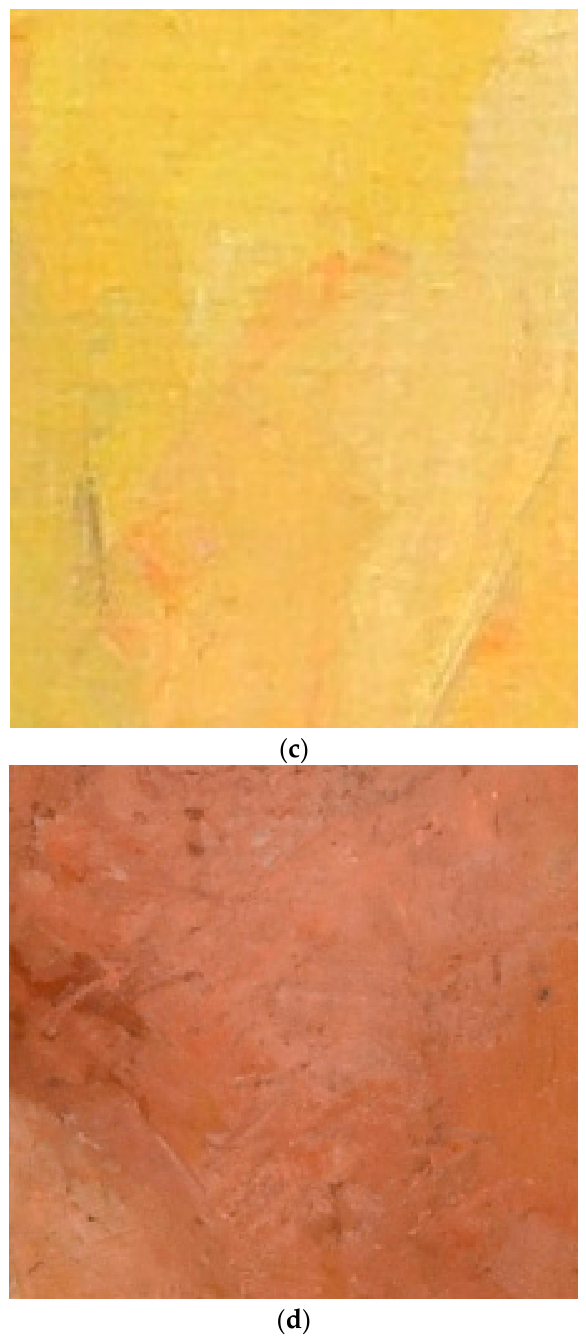
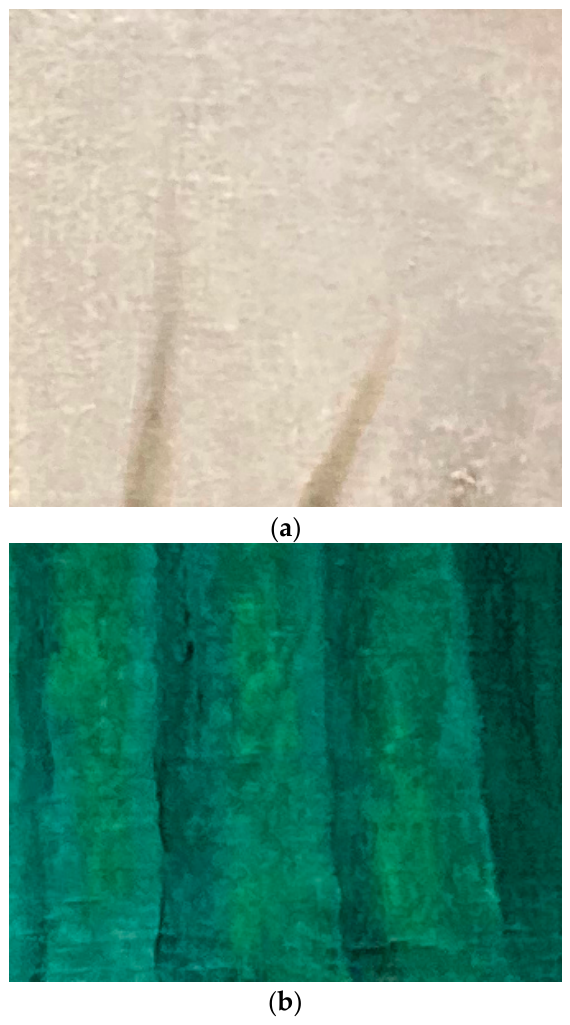
The figures are constructed with broad, visible brushstrokes and an intense handling of paint. Forms are built through patches of colour rather than carefully blended transitions. Facial features, especially the eyes, nose, and mouth, are indicated with a few decisive strokes, giving the faces a somewhat simplified and schematic appearance (Figure 32a–d). The modelling of the flesh relies strongly on contrasting colour tones rather than subtle gradations: greens, yellows, and pinks are often juxtaposed to define planes of the face. The paint is applied unevenly, sometimes thickly, leaving a clearly perceptible surface texture (Figure 33a–d). In several areas, the brushwork remains sketchy, suggesting a rapid, direct execution. The contours of the figure are not always sharply defined; instead, the forms emerge from the surrounding colour fields (Figure 34a–d). The backgrounds are treated in the same painterly manner, with broad strokes of multiple colours that create a dense chromatic field (Figure 35a–d).

13. Malevich’s Late Portraits

In his catalogue raisonné of Malevich’s work, Andrei Nakov places the portrait of Elizaveta Iakovleva among the artist’s late portraits, identifying a group of twenty-nine works created after 1931.86 Fourteen of the sitters are women: four portraits depict Malevich’s wife Natalia, three his daughter Una, two his mother, and one his sister-in-law Angelika. Another portrays an unidentified woman, whom Nakov suggests may also be Angelika. The group also includes portraits of his devoted student and secretary, Anna Leporskaya; a female labourer; and Elizaveta Iakovleva.
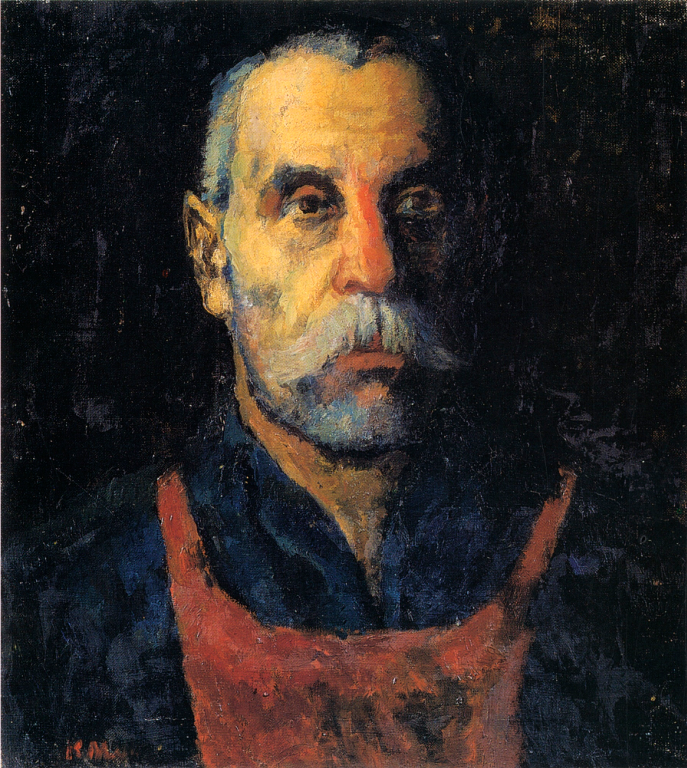
Likewise, there are fifteen portraits of men in this group. Malevich portrayed himself three times, twice in paintings and once in a drawing, and depicted figures such as his brother Mieczyslaw, the art historian Nikolai Punin, the painter V. Pavlov, Ivan Kliun, and his student Konstantin Rozhdestvenskii. The series further comprises three portraits of a shock worker, as well as portraits of a blacksmith, an unidentified man, and two unknown young men.
In terms of composition, several key similarities exist in how the sitters are depicted. Only one of these paintings is a full-length portrait, making it an exception. Five works, including the Iakovleva portrait, depict the figure three-quarter length, beginning at the upper legs. Most of the remaining portraits show only the waist up or present a head-and-shoulders view, highlighting a shared approach to picturing the sitters.
The backgrounds of these portraits also show evident similarities. Most feature a uniform backdrop, generally dark in tone, though in some cases it is off-white or light beige. The Iakovleva portrait stands out with its light blue background, making it distinct from the others. As no other elements are depicted, focus remains firmly on the sitter and their attributes. Only a small subset of works includes any setting or additional figures behind the subject, furthering this contrast.
None of the portraits in Nakov’s group presents the sitter fully en face. In some, the face is nearly frontal, but the head turns slightly away; others show the sitter en quart, and two are in profile. Although most figures gaze outward, they look past rather than directly at the viewer. Only six meet the viewer’s gaze: Malevich in one self-portrait, his brother, Ivan Kliun, the unidentified woman (possibly Angelika), the blacksmith, and Elizaveta Iakovleva.
Striking contrasts emerge in the sitters’ clothing across these late portraits. In many works, figures wear ordinary attire: a shirt paired with a tie and jacket, a work apron, a Schiller-collared shirt, or a simple blouse. In such cases, clothing is secondary, with attention focused on the face. Other works, however, elevate dress to a central role. Garments—far removed from everyday wear—include robes, distinctive collars, dresses, blouses, waistcoats, and headgear, often adorned with colourful Suprematist-style bands or strips. This prominence is heightened by composition, as these figures frequently appear three-quarter length, emphasising their distinctive outfits.
This unique clothing, clearly carrying symbolic overtones, is one reason why these works may be described as allegorical portraits. Equally significant are the sitters’ gestures. A recurring motif is the raised right hand at chest level, with the palm turned inward or upward and the thumb pointing upward; the fingers are extended or slightly bent. In some cases, this gesture is echoed by the left hand, while in another portrait, a hand is shown clenched into a fist.
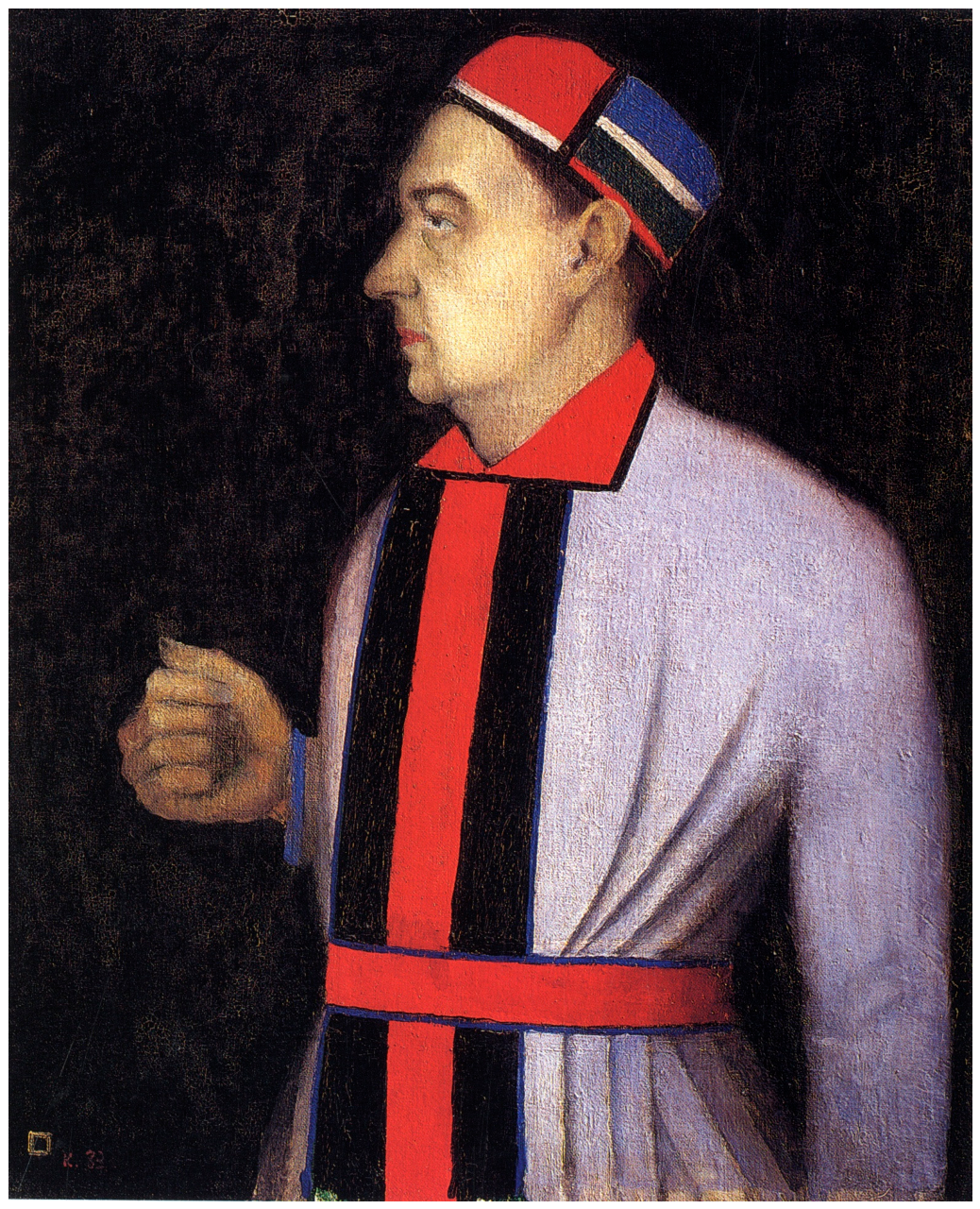
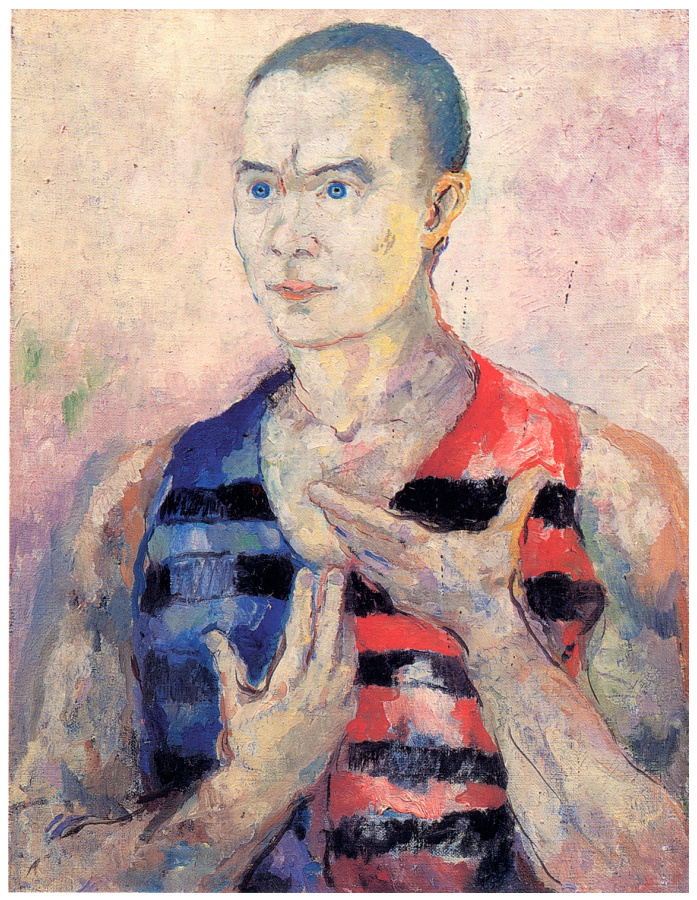
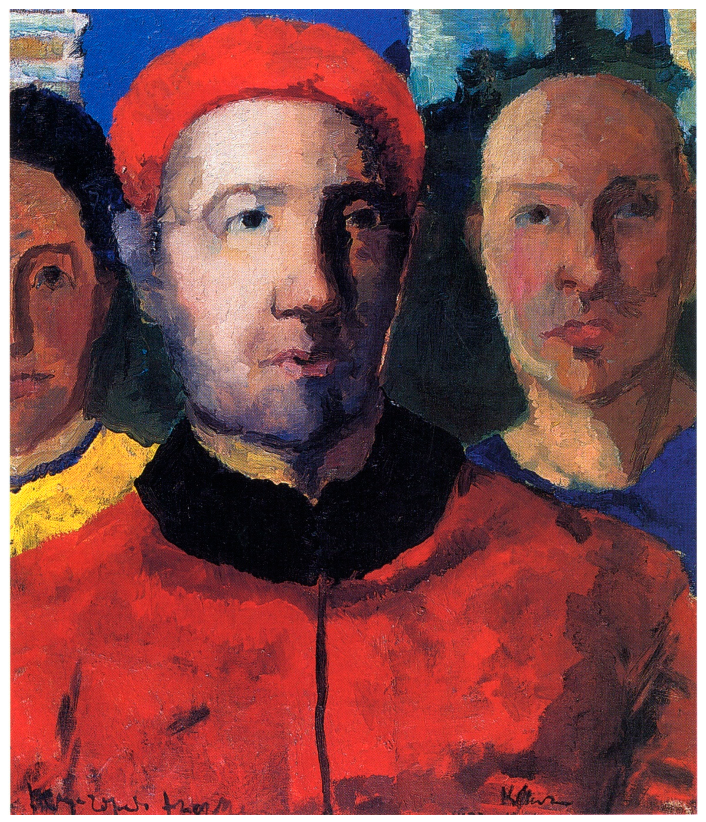
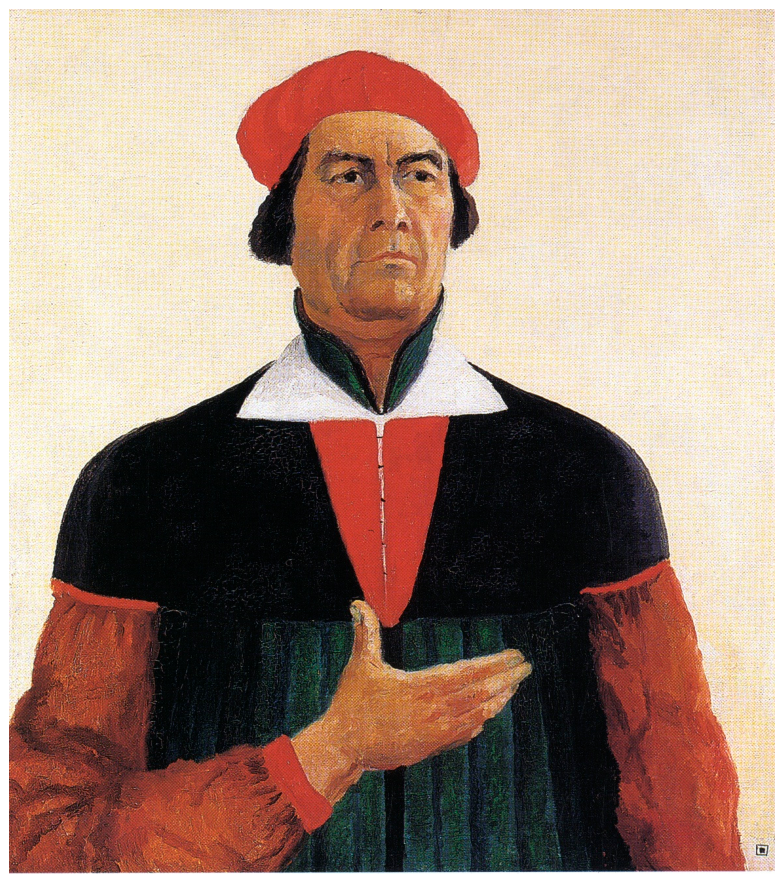
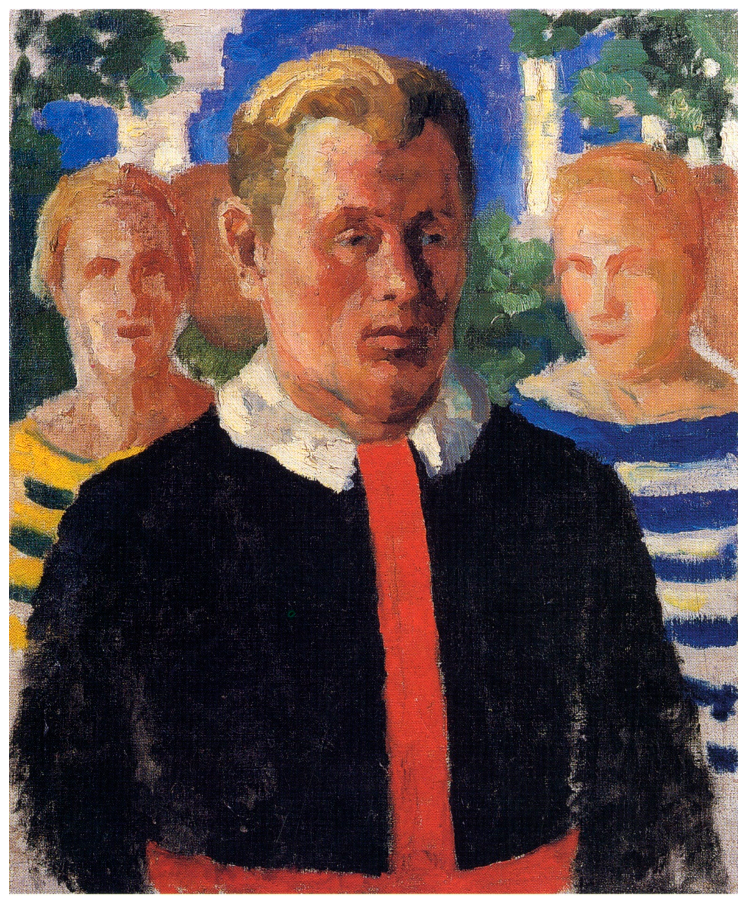
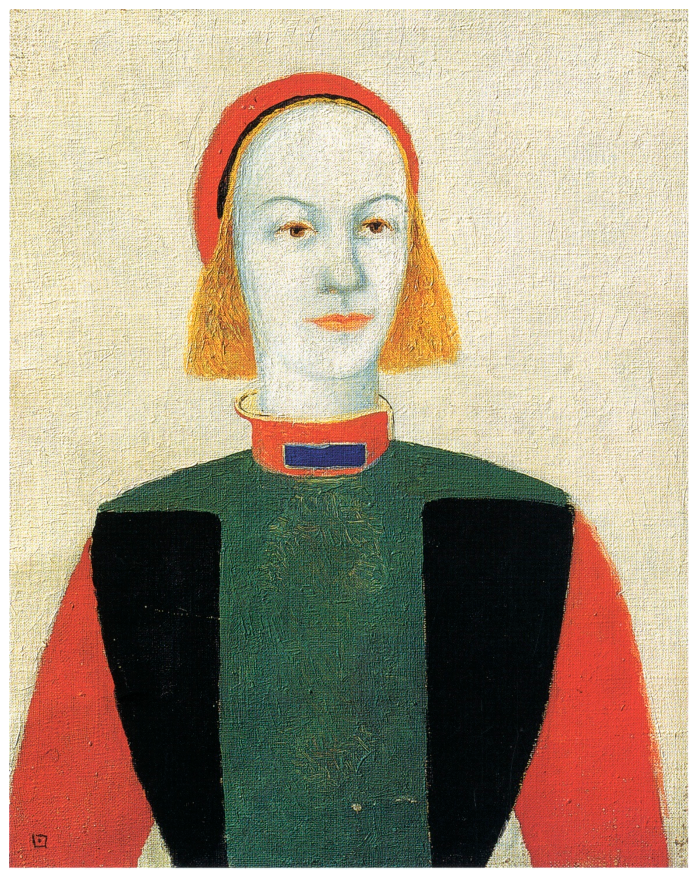
Of the twenty-nine late portraits in Nakov’s group, eleven can be considered allegorical, distinguished by Suprematist clothing, expressive gestures, or both. Four depict unidentified figures: a blacksmith (Figure 36), a female labourer (Figure 37), a young man (Figure 38), and three men (Figure 39). The remaining seven portray identifiable members of Malevich’s circle: the artist himself (Figure 40), his wife (Figure 24), his sister-in-law87 (Figure 41), his daughter Una (Figure 42), Nikolai Punin (Figure 17), Konstantin Rozhdestvenskii (Figure 43), and Elizaveta Iakovleva (Figure 1).
Two additional paintings from this period should also be considered here because of their allegorical costumes.88 Although Nakov does not count them among the late portraits, they closely resemble these, depicting women in allegorical dress similar to that in other works (Figure 44 and Figure 45). Strictly speaking, these works might even not be real portraits; the faces could well be invented. Here, they rather serve to illustrate the range of Malevich’s late allegorical paintings.
For a more detailed comparison, the authors selected four portraits by Malevich: a self-portrait (Figure 40), a portrait of his wife (Figure 24), one of his sister-in-law (Figure 41), and a portrait of his friend Nikolai Punin (Figure 25). All four paintings belong to the collection of the State Russian Museum. They were either purchased directly from the artist or transferred to the museum by his family in 1936, and their authorship is undisputed.
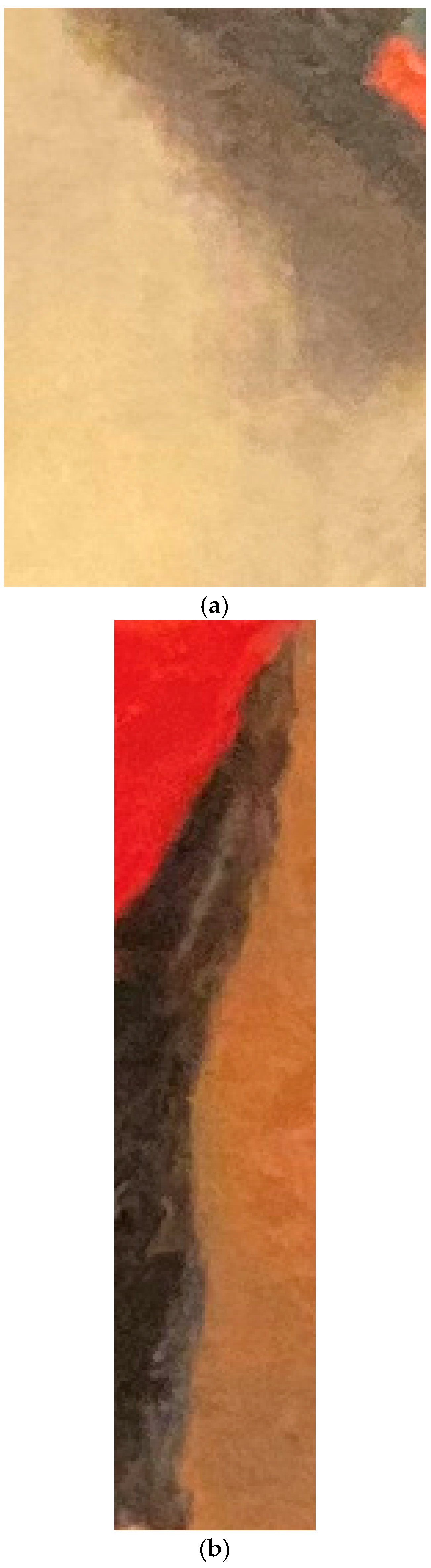
In these works, the handling of paint is controlled and deliberate. Malevich models the faces with carefully blended tonal transitions rather than with loosely juxtaposed patches of colour (Figure 46a,b)89. The planes of the face, forehead, cheeks, nose, and chin are constructed through subtle gradations of light and shadow, creating a sculptural clarity. Brushstrokes are generally subdued and often almost invisible, especially in the treatment of skin and garments (Figure 47a,b and Figure 48a,b). The contours of forms are sharply defined. The figures appear clearly separated from the background, and the outlines of the body and garments are precise. This clarity reinforces the monumentality of the sitters, whose bodies are constructed with stable, geometric simplicity. The compositions often emphasise vertical and symmetrical structure. In the portraits, the garments are rendered with great care and clarity, frequently organised into bold geometric shapes and strong colour contrasts, including reds, blacks, whites, and blues. These areas of colour are applied in relatively flat, even layers, producing a smooth and stable surface (Figure 49a,b). Decorative bands, stripes, and collars introduce elements reminiscent of Suprematist geometry, integrating abstract principles into figurative representation.
In these late portraits, Malevich used a very similar palette to that of the Iakovleva portrait. There are similarities in the artist’s material preferences, pigment blending, and paint application technique. There are also similarities in the form of the pigments, morphology, and particle size.
Comparing these portraits by Kazimir Malevich reveals a markedly different approach to painting from that seen in the works attributed to Dzhagupova. In contrast to the painterly spontaneity and visible brushwork in the portraits attributed to Dzhagupova, Malevich’s portraits display a controlled, carefully constructed technique, emphasising clarity of form, smooth surfaces, and a deliberate synthesis of figuration with Suprematist structure.

14. Conclusions

Before returning from his journey to Warsaw and Berlin in 1927, Malevich left a large number of works in Berlin. Once back in Leningrad, he began to fill this creative gap by reconstructing part of his earlier oeuvre, while simultaneously developing a new mode of pictorial figuration. Among these late works is a series of allegorical paintings, portraits in which the sitters are dressed in Suprematist costumes and perform symbolic gestures. For several of these portraits, Malevich asked relatives and friends to pose as models.
After its discovery in the 1990s, the painting known as Portrait of Elizaveta Iakovleva was regarded for several decades as one of these allegorical portraits. In 2021, newly discovered information related to a number written on the reverse of the painting led to the identification of part of its provenance: the work had once belonged to Dzhagupova, a student in Malevich’s Circle of New Western Painting. Documents concerning Dzhagupova’s life and artistic activity subsequently prompted a reassessment of the painting’s authorship, suggesting that she, rather than Malevich, might have been the painter.
A concise examination of Malevich’s work and teaching during the last period of his life reveals a pronounced engagement with Impressionism. Newly uncovered comments by Malevich on Dzhagupova’s studies within the Circle further demonstrate the detailed advice and criticism he offered as a teacher, all grounded in what he described as the “Impressionist system.” Although students in the Circle practiced portrait painting, they often did so using Impressionist portraits as examples. Malevich’s older students were not members of the Circle; for a time, some of them copied works by Malevich in order to study his method. However, no allegorical portraits by these older students are known, suggesting that such works were not part of Malevich’s formal teaching. The elaborate analysis of the pedagogical activities of Malevich in his last years offers a more nuanced understanding of the complex exchanges between him and his students and situates the work more precisely within his late portrait practice and artistic milieu of the 1930s.
The Iakovleva portrait was in the possession of Dzhagupova until her death. Archival documents confirm that Dzhagupova painted numerous portraits, and several of these documents appear to relate directly to the Iakovleva portrait. None, however, provide evidence that she painted the work. It might have been donated to Iakovleva or purchased by her and left to Dzhagupova. Other scenarios are also possible. At the same time, no historical documents explicitly confirm Malevich’s authorship. The identity of the sitter, however, can be securely established as Elizaveta Iakovleva through archival photographs.
Both the painterly technique and the materials used in the Iakovleva portrait were examined in 2020 and the results of this research were used in this article. Examination of four surviving portraits by Dzhagupova confirms Malevich’s own remarks about her manner of painting. A comparable study of four of Malevich’s allegorical portraits, by contrast, reveals a markedly different pictorial approach. Beyond iconographic similarities, Malevich’s painterly method shows significant affinities with the execution of the Iakovleva portrait. By contrast, Dzhagupova’s painting technique differs considerably. Furthermore, comparison of the materials and techniques with works by Malevich of his late period provides additional evidence supporting Malevich as the painter of the portrait of Elizaveta Iakovleva.

Author Contributions

Writing—original draft, A.L. and W.J.R.; Writing—review & editing, A.L. and W.J.R. All authors have read and agreed to the published version of the manuscript.

Funding

Part of this research has been funded by Philip and Inge van den Hurk, the owners of the painting under scrutiny.

Institutional Review Board Statement

Not applicable.

Informed Consent Statement

Not applicable.

Data Availability Statement

Almost all of the data presented in this study are available in public archives. Some of the data on the material research of the Iakovleva the portrait have not been published. They are available on request from the corresponding author.

Conflicts of Interest

The authors declare no conflicts of interest. The funders had no role in the design of the study; in the collection, analyses, or interpretation of data, in the writing of the manuscript, or in the decision to publish the results.

Notes

1
The authors would like to thank Maria Kokkori for insightful discussions on Malevich’s use of materials and techniques and for sharing analytical data from the analysis of the Iakovleva portrait (unpublished document, 2020). They also would like to thank Irina Karasik for sharing information and reviewing parts of this essay and Christina Lodder for her advice.
2
The material of the signature (paint or ink?) has not been examined.
3
For the provenance, see (Nakov 2002, p. 403).
4
(Vasiliev 2021, pp. 267–68, 296, 426–28). The authors would like to thank Andrey Vasiliev for sharing his archival information.
5
PФO OKT. p-нa—abbreviation for the District Financial Department of the Oktyabrsky District. Each painting was assigned an individual inventory number, in this case 434208 (State Archive of St. Petersburg [CSA SPB], F. 1853, Op. 49, D. 62, L. 33). In this document, the portrait is listed as no. 48/53, and its recorded dimensions correspond to those of the present work. When the paintings formerly owned by Dzhagupova were transferred for sale to a local art salon, these inventory numbers were retained.
6
For the attribution to Dzhagupova, see (Vasiliev 2021, p. 154).
7
Ibid. This was one of the thoughts Vasiliev had when he first saw the drawing.
8
Cited in: (Petrova 2000b, p. 251). This remark refers to the exhibition Women in Socialist Construction, Russian Museum, May 1934. Malevich exhibited the painting Portrait of his Wife (Figure 24) there. See also below, p. 25. There are no known preparatory drawings by Malevich for these portraits.
9
For some of these early Suprematist designs, see (Douglas 1995). Malevich also made textile designs himself. Charlotte Douglas mentions the Iakovlava portrait as a late example of this kind of decoration.
10
These drawings are the second reason for Vasiliev to attribute the painting to Dzhagupova. See (Vasiliev 2021, pp. 166, 167).
11
TsGALI. F. 175. Op. 1. D. 191. L. 16. This document is the third reason for Vasiliev for his attribution. See (Vasiliev 2021, p. 158).
12
For this exhibition see note 8 above.
13
For the lemma on Dzhagupova, see (Chudozhniki Narodov SSSR 1976), T. III, pp. 354, 355).
14
For the English translation of this correspondence, see (Vakar 2015, vol. 1, pp. 176–80).
15
For this critique and its consequences, see (Douglas 1994, pp. 33, 34). For a detailed history of the State Institute of Artistic Culture (GINKhUK), see (Karasik 1991, pp. 40–58).
16
For a brief eyewitness report of the last days of Malevich’s stay in Berlin and the fate of the manuscripts he left there, see (Von Riesen 1962, pp. 31–35).
17
For an elaborate reconstruction of the Berlin exhibition, see (Andersen 1970).
18
For the fate of this crate, see (Heiting 2006) and also (Katenhusen 2017, pp. 151–62).
19
Already in 1924, Lissitzky translated texts of Malevich into German. Sophie Küppers corrected them, and Lissitzky tried in vain to publish them. After Malevich visited the Bauhaus, some of his texts were published in a simplified translation in 1927 in the series of Bauhaus Bücher (nr. 11) under the title ‘Die Gegenstandslose Welt’. For a detailed account of Malevich’s stay in Warsaw and Berlin, see (Douglas 1994, p. 34). For a detailed account of his stay in The Bauhaus in Dessau, see (Forgács 2022, pp. 192–95).
20
Gosudarstvennyi Institut Istorii Iskusstv (GIII), formerly the Zubovsky Institute.
21
For Malevich and the Kyiv Art Institute, see (Mudrak 2007, pp. 82–120).
22
For the antedated works, see (Basner 2000, pp. 20, 21). For a chronological list of works according to the antedates, see ibid., p. 388.
23
For a detailed description of the so-called ‘Second Peasant Cycle’, see (Sarabianov 1990, pp. 142–47). For a formal analysis of the works in this series, see (Basner 2000, pp. 20, 21).
24
For an introduction to these allegorical portraits, see (Douglas 2007, p. 292).
25
For an English translation of this letter, see (Vakar 2015, vol. 1, p. 231).
26
For this citation, see (Malevich [1924] 1990, p. 202).
27
For this citation, see (Malevich [1933] 1990, p. 173).
28
(Basner 2000, p. 268). For the complete pedagogical programme of the study of Impressionism in the Institute of Artistic Culture, written down by postgraduate student and secretary Anna Leporskaia, see (Petrova 2000b, p. 270).
29
For this citation, see (Petrova 2000a, p. 423).
30
For an English translation of this letter, see (Vakar 2015, vol. 2, p. 308).
31
For the complete programme of the Laboratory, see ‘Plan of the Work of the Experimental Research Laboratory, Art Department, Russian Museum, for the Second, Third and Fourth Quarters of 1933’ in: (Petrova 2000a, pp. 401, 402). For more on Malevich’s interest in Impressionism, see ibid., n. 2.
32
For the history of the Museum of Painterly Culture, see (Pchelkina 2019, pp. 5–33).
33
Malevich had a similar Circle in Kyiv. See (Mudrak 2007).
34
For The Circle of New Western Painting in Leningrad, see (Karasik 2014, vol. 3, p. 318).
35
Already in Vitebsk, Malevich used a questionnaire to apply for the art school. For the list of questions of the Circle, see ibid.
36
Some of the reports by Leporskaia with Malevich’s comments on works of the students of the Circle are now in the Manuscripts Department of the State Russian Museum. See note 38 below.
37
(Karasik 2014, vol. 3, p. 318). Our translation.
38
Ibid. The citations were drawn by Irina Karasik from notes taken by Dzhagupova. These materials were formerly preserved in the private archive of Anna Leporskaya in St. Petersburg. After Leporskaya’s death, the archive was kept by her daughter, Nina Nikolaevna Suetina. Most of these documents are now housed in the Manuscripts Department of the State Russian Museum. The catalogue of TsGALI also records the existence of Dzhagupova’s notes on Malevich’s lessons in this public archive. However, these materials are now lost.
39
The photograph is preserved in the Manuscripts Department of the State Russian Museum and is dated “1933–1935 (?)”. On the verso, several names are inscribed in an unidentified hand: “(from right to left) Kazimir Severinovich Malevich, Maria Markovna Dzhagupova, Eduard Mikhailovich Krimmer (wearing glasses), Ilya Grigorievich Chashnik, model.” The woman at the far left remains unidentified.
If the figure identified as Chashnik is indeed Ilya Chashnik, the photograph cannot have been taken after 1929, the year of his death. Yet before 1929, the Circle had not yet been formed, and Dzhagupova was not living in Leningrad. At present, no alternative identification for this figure can be proposed. The woman at the far right has been identified as Maria Vikhreva; a corresponding portrait photograph is preserved in the Scientific Archive of the Russian Academy of Arts, St. Petersburg (NA RAKh). The woman sitting behind Dzhagupova bears a strong resemblance to Elizaveta Iakovleva (see also Vasiliev 2021, p. 26). The group photograph was also published in (Petrova 2000a) (between illustrations 54 and 55, unpaginated), where it is dated “1933 (?)”.
40
TsGALI, St. Petersburg, F. 483, Op. 1, D. 57, L. 1. On the verso of the photograph (Figure 20b), several names are inscribed by an unidentified hand; however, it is unclear to which figures these names correspond. The photograph was published in Malevich: Artist and Theoretician, p. 25, where it is dated 1931, but apart from Malevich, no other individuals were identified. The central person (no. 5) is Malevich. Several others can be identified with relative certainty: Schmidt (no. 11) and Anna Leporskaia (1900–1982) (no. 9). It is also likely that no. 8 represents Maria Dmitrievna Vikhreva (1901–1942) and no. 10 Maria Markovna Dzhagupova (1897–1975). Figure no. 4 is probably not Elizaveta Iakovleva (1882–1942) as has been suggested. Given the nearly twenty-year age difference between Vikhreva and Iakovleva, the two women would not be of comparable age, as they seem here. The following identifications are tentative: no. 3 may be Mikhail Pavlovich Neverov (1896–1942); no. 6, Maria Feodosievna Ostrovskaya (1896–1980); and no. 7, M. Kamenskaya. Persons nos. 1, 2, and 12 remain unidentified.
41
For a detailed biography of Dzhagupova, see (Vasiliev 2021, pp. 37–41).
42
For an account of one of Malevich’s comments on the work of Eduard Krimmer, see (Tsaritsyn 2000, pp. 308, 309).
43
Fund 278 of the Manuscript Archive of the State Russian Museum, relating to the activities of the State Institute of Artistic Culture (GINKHUK), also contains documents on the activities of the ‘Circle for the Study of New Western Painting’. Units 23–34 contain some documents that are directly related to M.M. Dzhagupova’s participation in this Circle. If we consider these records alongside the analyses of the academic work of other students in the Circle, then, in terms of volume and detail, these records are surpassed only by the analyses of the Circle’s activities of E.M. Krimmer. Judging by the volumes of the comments on their work, Krimmer and Dzhagupova were both very active students.
44
Manuscript Archive of the State Russian Museum, St. Petersburg, fund 278 units 23–34, p. 1.
45
Ibid., p. 4.
46
Ibid., p. 5.
47
Ibid., pp. 6–7.
48
Ibid., p. 8.
49
Ibid., p. 9.
50
Ibid., p. 9.
51
Ibid., p. 10.
52
This questionnaire is in TsGALI, St. Petersburg, F. 173, O. 1, D. 191, LL. 15–16.
53
Manuscript Archive of the State Russian Museum, St. Petersburg, fund 278 units 23–34, p. 14.
54
Ibid., p. 15.
55
Ibid., p. 15.
56
Ibid., p. 19.
57
Ibid., p. 19.
58
Ibid., p. 25.
59
The written text in Cyrillic is as follows:
“Цeнтpaльный Дoм Paбoтникoв
Иcкyccтв
Bыcтaвкa гpyппы
K. C. Maлeвичa
Пepиoд импpeccиoнизмa
1930 гoд”
60
For a detailed biography of Elizaveta Iakovlava, see (Vasiliev 2021, pp. 31–37). She was born in Penza. The Governmental Archive in Penza holds the document confirming her birth: F. 182 Op. 3 D. 156 LL. 131ob-132.
61
For an English translation of Una’s memories of her father, and her record of his birthday, see (Vakar 2015, vol. 2, p. 31).
62
Ibid., p. 19.
63
TsGALI, St. Petersburg, F. 173, O. 1, D. 198, L. 4.
64
For the related archival documents, see (Vasiliev 2021, p. 97).
65
She mentions this in her biography. See (a.v. 1976, pp. 354–55) and TsGALI, St. Petersburg, F. 173, O. 1, D. 191, LL. 15–16.
66
For some photographs of exhibitions of works by Dzhagupova, see below.
67
The diaries of Nikolai Punin of this period have disappeared and there is no known record by him of how this portrait was made. The authors would like to thank Natalia Murray for this information.
68
This citation is from (Basner 1999, pp. 123, 124). Our translation.
69
This citation is from (Lodder 2007, p. XIX).
70
For this essay on the later Malevich works, see (Douglas 1980).
71
72
73
74
For this exhibition, see (Douglas 1990, p. 26).
75
(Douglas 1994, pp. 36–41). For the two allegorical portraits, see ibid., pp. 124–126.
76
Tatiana Goriatcheva also pointed to this influence. See (Goriatcheva 1993).
77
This citation is from (Petrova 2014, pp. 200–3).
78
This citation is from (Douglas 1995, p. 45).
79
This citation is from (Cullinan 2014, p. 121).
80
(ex. cat. Moscow 2017, p. 182), and wall text of this exhibition on the Iakovleva portrait.
81
On 7 April 2019, the first article on Vasiliev findings was published in The Guardian: https://www.theguardian.com/world/2019/apr/07/kazimir-malevich-lost-masterpiece-painted-by-pupil. Accessed on 17 December 2026.
82
This portrait does not have a similar numbering and lettering inscribed on the back as we have seen on the back of the Yakovleva portrait. Yet the museum catalogue states it was acquired from her belongings. The inventory numbers may have disappeared during a restoration or the paintings may have been sold before the inventory by the shop.
83
If the person on this painting is indeed Yakovleva, then she is also depicted in two other paintings from the same period from the collection of the State Museum of the History of St. Petersburg: a small sketch entitled ‘The Siege’ and a larger painting entitled ‘Leningrad during the Siege’.
84
TsGALI, St. Petersburg, F. 173, O. 1, D. 116, L. 27. Also compare her face on the photo members of the Circle in a studio (Figure 10).
85
The authors would like to thank the Perm Museum and the State Museum of the History of St. Petersburg for their kind cooperation.
86
For a survey of Malevich’s late portraits, see (Nakov 2002, pp. 402–8).
87
The catalogue of the State Russian Museum lists this work as Portrait of the Artist’s Wife. According to (Nakov 2002, p. 402), however, this is Angelika Manchenko, the sister of his wife.
88
There are more works in this series, but we will not discuss these here. These two costumed ‘portraits’ serve only to illustrate the range of the late allegorical paintings.
89
It proved impossible to obtain high resolution photographs from the State Russian Museum in St. Petersburg of these four reference portraits. Unfortunately, brushstrokes are hardly visible in details taken from photographs in books because the moiré interferes. Therefore, the details (a) of Portrait of Nikolai Punin, 1933, oil on canvas, 57 × 70. Collection State Russian Museum, St. Petersburg, inv. no.: ZhB-1517 and (b) of Self-Portrait, 1933, oil on canvas, 66 × 73. Collection State Russian Museum, St. Petersburg, inv. no.: ZhB-1516, are taken from photographs made by the authors on the exhibition Nash Avangard in the State Russian Museum in 2025. Because the other two reference works were not in the exhibition, we have no direct photographs and details of these.

References

  1. Andersen, Troels. 1970. Malevich: Catalogue Raisonné of the Berlin Exhibition 1927. Amsterdam: Stedelijk Museum. [Google Scholar]
  2. Basner, Elena V. 1999. Zhivopis K.S. Malevicha pozdnego perioda (Fenomen rekonstruktii chudoznikom svoevo tvorcheskovo puti)]. St. Petersburg: Typoscript. [Google Scholar]
  3. Basner, Elena V. 2000. Malevich’s paintings in the collection of the Russian Museum (The matter of the artist’s creative evolution). In Kazimir Malevich in the Russian Museum. Edited by Yevgenia Petrova. St. Petersburg: Palace Editions, pp. 15–27. [Google Scholar]
  4. Chudozhniki Narodov SSSR—Biobibliograficheskii Slovar. Moskva: Isskustvo.
  5. Cullinan, Nicholas. 2014. Colour Masses. In Malevich. ex. cat. Edited by Achim Borchardt-Hume. London: Tate Publishing, pp. 118–21. [Google Scholar]
  6. Douglas, Charlotte. 1980. Beyond Suprematism—Malevich 1927–1933. Soviet Union 7: 214–26. [Google Scholar]
  7. Douglas, Charlotte. 1990. The return to painting. In Malevich—Artist and Theoretician. Paris: Flammarion, pp. 22–26. [Google Scholar]
  8. Douglas, Charlotte. 1994. Kazimir Malevich. New York: Harry N. Abrams, Inc. [Google Scholar]
  9. Douglas, Charlotte. 1995. Suprematist Embroidered Ornament. Art Journal 54: 42–45. [Google Scholar] [CrossRef]
  10. Douglas, Charlotte. 2007. Malevich and De Chirico. In Rethinking Malevich: Proceedings of a Conference in Celebration of the 125th Anniversary of Kazimir Malevich’s Birth. Edited by Charlotte Douglas and Christina Lodder. London: Pindar Press, pp. 254–93. [Google Scholar]
  11. ex. cat. Florence. 1993. Kazimir Malevič, una retrospettiva. Florence: Artificio. [Google Scholar]
  12. ex. cat. Moscow. 2017. Kazimir Malevich: More than the Black Square. Edited by Alexandra Shatskikh. Moscow: Art Grid. [Google Scholar]
  13. ex. cat. Vienna. 1994. Kasimir Malewitsch, 1878–1935: Meisterwerke aus dem Russischen Staatsmuseum St. Petersburg. Vienna: Bawag Fondation. [Google Scholar]
  14. ex. cat. Washington. 1990. Kazimir Malevich, 1878–1935. Los Angeles: Armand Hammer Museum of Art and Cultural Center. [Google Scholar]
  15. Forgács, Eva. 2022. Malevich and Interwar Modernism: Russian Art and the International of the Square. London: Bloomsbury. [Google Scholar]
  16. Goriatcheva, Tatiana. 1993. Malevich I metafizicheskaya zhivopis. In Voprosy Iskusstvoznanniya. I/93. Moscow: pp. 49–59. [Google Scholar]
  17. Heiting, Lien. 2006. De verdwaalde collectie—De schilder Kazimir Malevitsj en de strijd om zijn erfenis. Amsterdam: Prometheus. [Google Scholar]
  18. Karasik, Irina. 1991. Das Institut für künstlerische Kultur. In Matjuschin und die Leningrader Avantgarde. Edited by Heinrich Klotz. Karlsruhe: Oktogon, pp. 40–59. [Google Scholar]
  19. Karasik, Irina. 2014. Kryzhok novoi zapadnoi zhovopisi. In Entsiklopediia russkogo avangarda. Edited by Vasily Rakitin and Andrei Sarabianov. Moscow: Global Expert and Service Team, vol. 3, p. 318. [Google Scholar]
  20. Katenhusen, Ines. 2017. A Crate in the Basement: On the Works of Kazimir Malevich Loaned to the Hanover Museum. In Museums and Restitution—New Practices, New Approaches. Edited by Louise and Arvanitis Tytacott. London and New York: Routledge, pp. 151–62. [Google Scholar]
  21. Leporskaia, Anna. 1929. Records of Conversations Between K. S. Malevich and Maria Markovna Dzhagupova. Moscow: Manuscript Archive of the State Russian Museum. [Google Scholar]
  22. Lodder, Christina. 2007. Malevich scholarship: A brief introduction. In Rethinking Malevich: Proceedings of a Conference in Celebration of the 125th Anniversary of Kazimir Malevich’s Birth. Edited by Charlotte Douglas and Christina Lodder. London: Pindar Press, pp. IX–XXI. [Google Scholar]
  23. Malevich, Kazimir. 1990. Fragments from an artist’s autobiography. In Kazimir Malevich 1978–1935. ex. cat. Edited by Jeanne d’Andrea. Los Angeles: The Armand Hammer Museum of Art and Culture Center, pp. 173–75. First published 1933. [Google Scholar]
  24. Malevich, Kazimir. 1990. Through My Experience as a Painter. In Malevich—Artist and Theoretician. Paris: Flammarion, pp. 200–9. First published 1924. [Google Scholar]
  25. Mudrak, Myroslava. 2007. Malevich and his Ukrainian contemporaries. In Rethinking Malevich: Proceedings of a Conference in Celebration of the 125th Anniversary of Kazimir Malevich’s Birth. Edited by Charlotte Douglas and Christina Lodder. London: Pindar Press, pp. 82–120. [Google Scholar]
  26. Nakov, Andre B. 2002. Kazimir Malewicz: Catalogue raisonné. Paris: Adam Biro. [Google Scholar]
  27. Pchelkina, Liubov. L. 2019. Moskovskii Musei Zhivopisnoi Kulturi—Istoria bes Kupior. In Avantgard Spisok no. 1, k 100-letiu Musea Zhivopisnoi Kulturi. ex. cat. Moscow: State Tretyakov Gallery, pp. 5–33. [Google Scholar]
  28. Petrova, Evgenia, ed. 2000a. Kazimir Malevich in the Russian Museum. St. Petersburg: Palace editions. [Google Scholar]
  29. Petrova, Evgenia, ed. 2000b. Malevich’s Circle. St. Petersburg: Palace editions. [Google Scholar]
  30. Petrova, Evgenia. 2014. From Suprematism to Supranaturalism: Malevich’s late works. In Malevich. ex. cat. Edited by Achim Borchardt-Hume. London: Tate Publishing, pp. 200–3. [Google Scholar]
  31. Sarabianov, Dmitrii. 1990. Malevich at the time of the ‘Great Break’. In Malevich—Artist and Theoretician. Paris: Flammarion, pp. 142–47. [Google Scholar]
  32. Tsaritsyn, Viktor. V. 2000. Eduard Mikhailovich Krimmer. In Malevich’s Circle. Edited by Yevgenia Petrova. St. Petersburg: Palace editions, pp. 307–11. [Google Scholar]
  33. Vakar, Irina. A. 2015. Kazimir Malevich: Letters, Documents, Memoirs. London: Tate Publishing. [Google Scholar]
  34. Vasiliev, Andrey. 2021. Rabota nad falshivkami, ili Podlinaia istoria dami s teatralnoi sumkoi. Archivni roman. Moscow: Izdatelskii Dom Gorodets. [Google Scholar]
  35. Von Riesen, Hans, ed. 1962. Vorwort. In Kasimir Malewitsch—Suprematismus: Die gegenstandslose Welt. Cologne: DuMont Schauberg, pp. 31–35. [Google Scholar]
Figure 1. Portrait of Elizaveta Yakovleva, oil on canvas, 64 × 82, collection Philip and Inge van den Hurk, Netherlands. Photo Peter Cox.
Arts 15 00118 g001
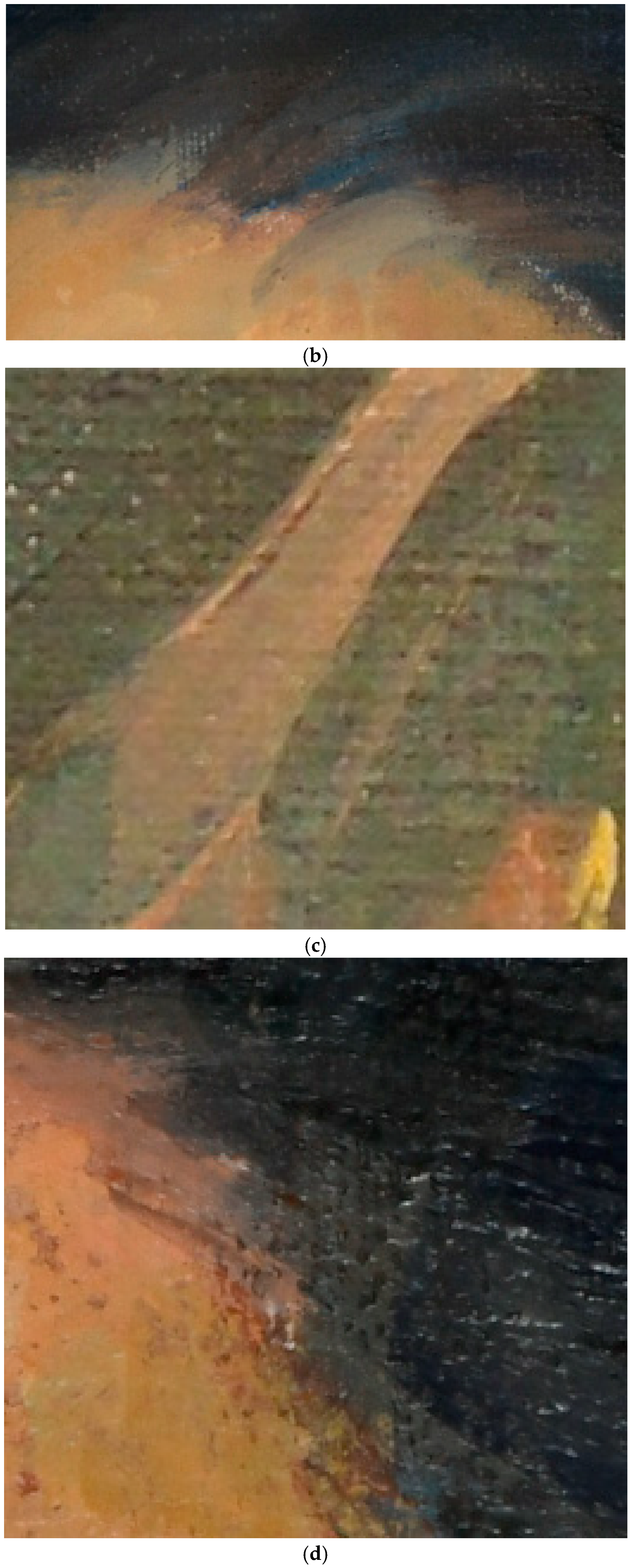
Figure 2. Detail: cheek.
Arts 15 00118 g002
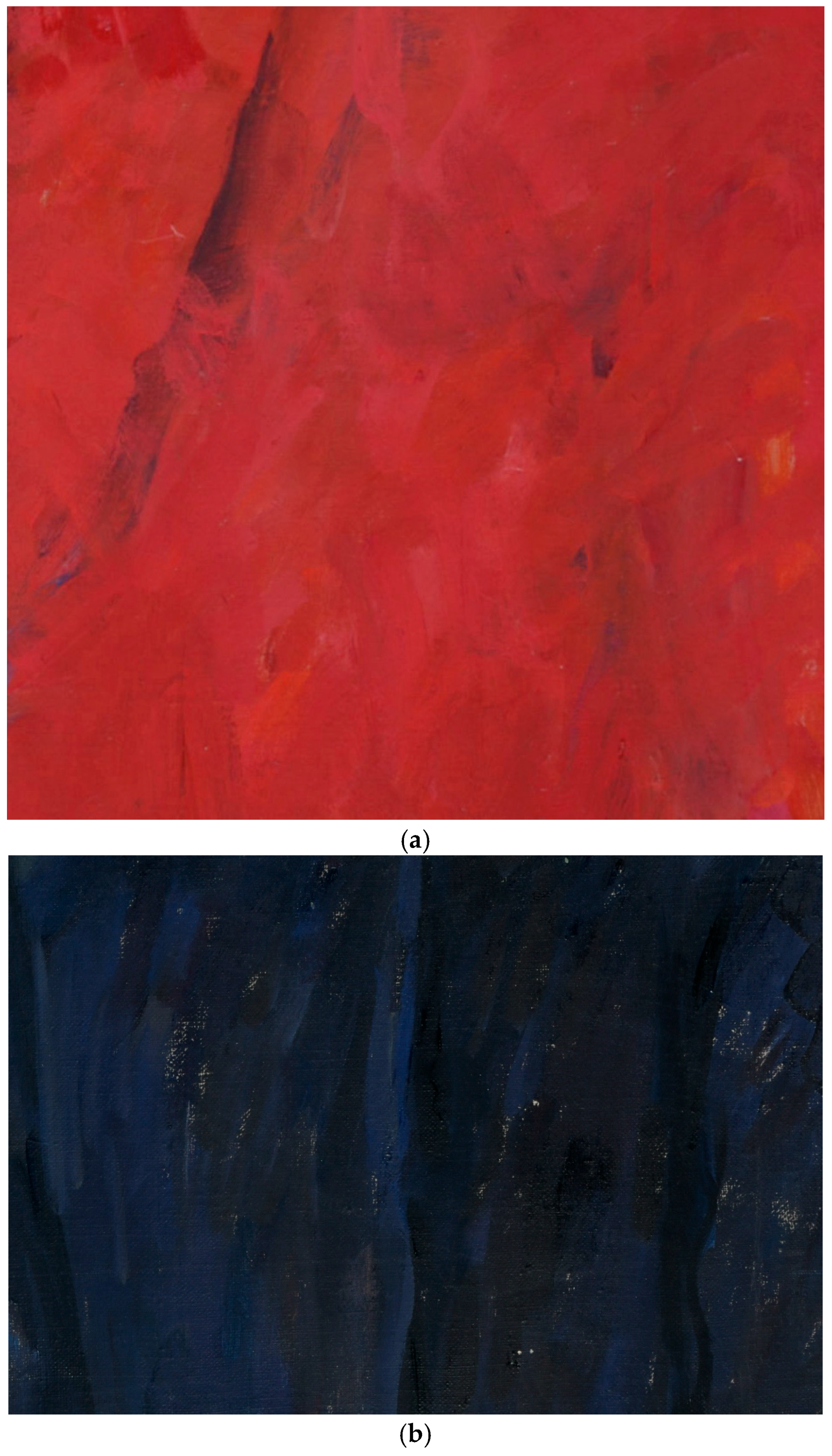
Figure 3. Detail: neck.
Arts 15 00118 g003
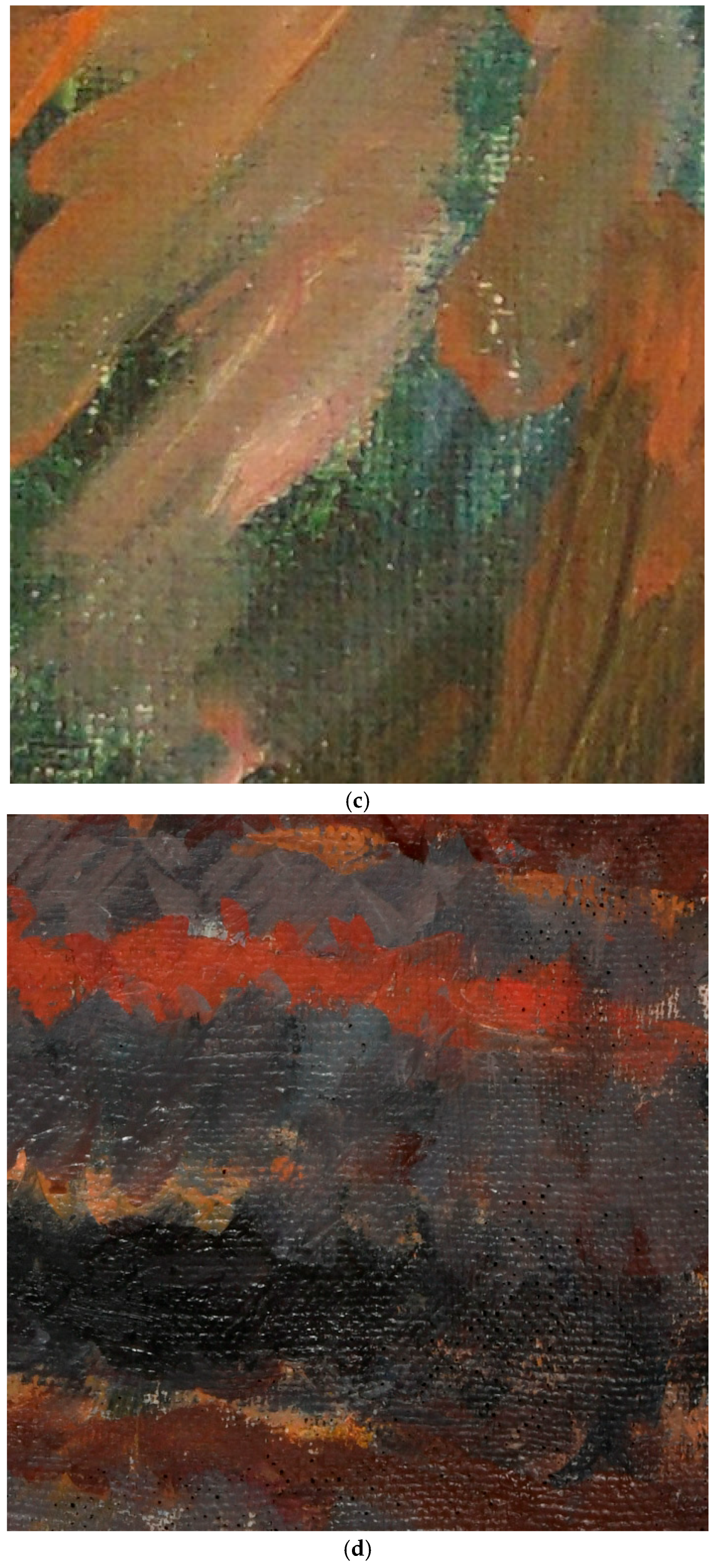
Figure 4. Detail: hat.
Arts 15 00118 g004
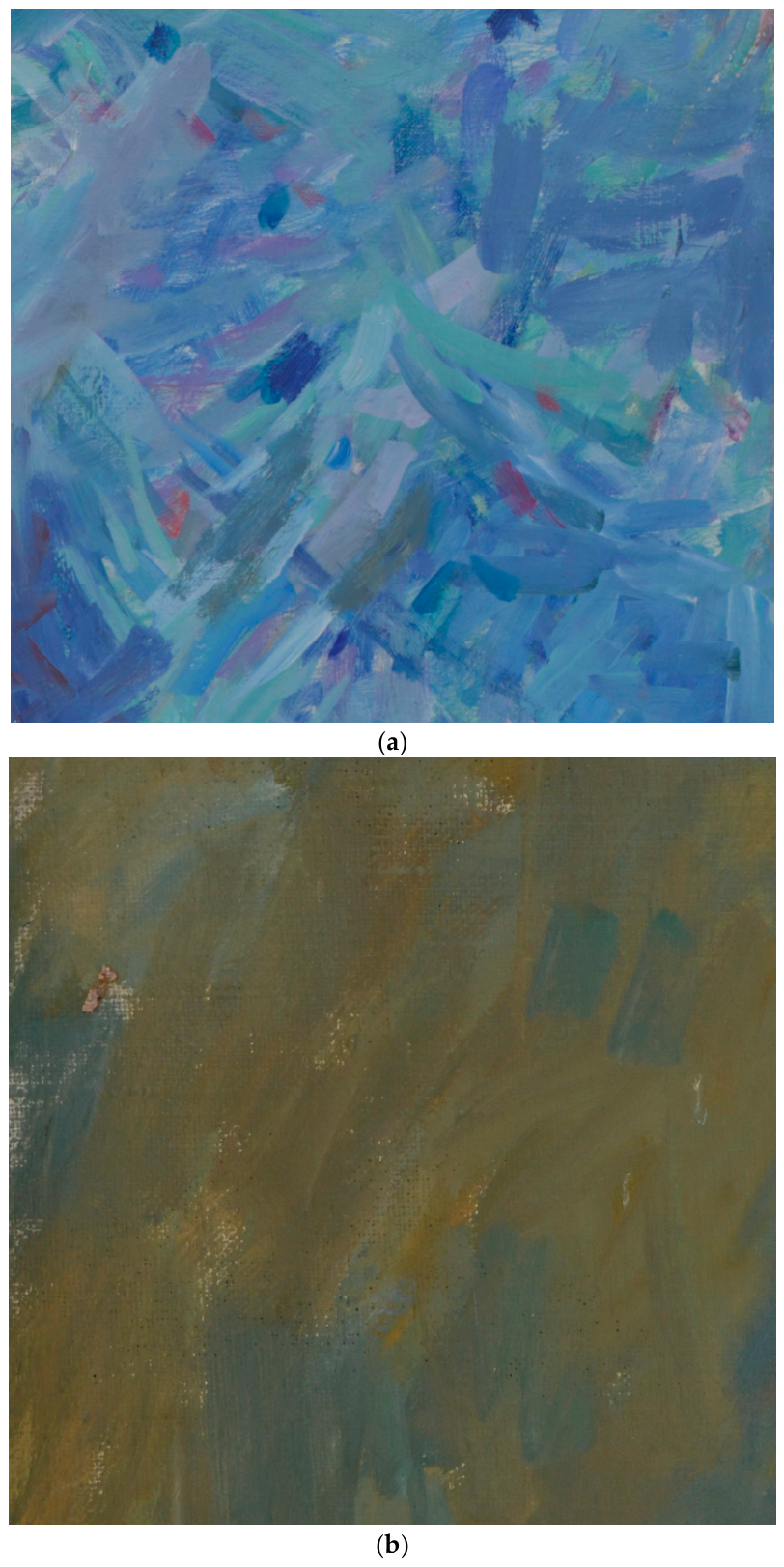
Figure 5. Detail: hair.
Arts 15 00118 g005
Figure 6. Detail: light blue background.
Arts 15 00118 g006
Figure 7. Detail: green plane background.
Arts 15 00118 g007
Figure 8. Detail: black cloak.
Arts 15 00118 g008
Figure 9. Detail: lower background.
Arts 15 00118 g009
Figure 10. Overview of the backside of the Yakovleva portrait. Photo Peter Cox.
Arts 15 00118 g010
Figure 11. Detail verso: signature.
Arts 15 00118 g011
Figure 12. Maria Dzhagupova, untitled sketch related to the Iakovleva portrait, TsGALI, St. Petersburg, F. 173. Op. 1. D. 116. L. 27.
Arts 15 00118 g012
Figure 13. Maria Dzhagupova, untitled sketch of a woman after an Impressionist portrait, TsGALI, St. Petersburg, F. 173. Op. 1. D. 116. L. 25.
Arts 15 00118 g013
Figure 14. Maria Dzhagupova, untitled sketch of a woman, TsGALI, St. Petersburg, F. 173. Op. 1. D. 116. L. 23.
Arts 15 00118 g014
Figure 15. Maria Dzhagupova, untitled sketch with textile designs, TsGALI, St. Petersburg, F. 173. Op. 1. D. 174. L. 11.
Arts 15 00118 g015
Figure 16. Maria Dzhagupova, handwritten list of works, TsGALI, St. Petersburg, F. 173. Op. 1. D. 191. L. 16.
Arts 15 00118 g016
Figure 17. (a,b) Entry on Maria Dzhagupova in volume 3 of the Biobibliographical Dictionary of USSR Artists, Leningrad 1976.
Arts 15 00118 g017
Figure 18. Kazimir Malevich with members of the Circle of New Western Painting in the interior of a studio, after 1929. 1. Elizaveta Yakovleva (?), 2. Maria Dzhagupova, 3. unknown woman, 4. unknown man, 5. Eduard Krimmer, 6. Kazimir Malevich, 7. Maria Vikhreva. Manuscript Department of the State Russian Museum, St. Petersburg, F. 178 (E. M. Krimmer collection) Op. 1. D. 10. L. 1.
Arts 15 00118 g018
Figure 19. Pierre-Auguste Renoir, Girl with a Fan, oil on canvas, 50 × 65. Collection State Hermitage Museum, St. Petersburg, inv. nr. GE-6507.
Arts 15 00118 g019
Figure 20. (a) Malevich and some of the students of the Circle of Western Painting on the stairs of the Russian Museum, 1931. (b) backside of this photograph. TsGALI, St. Petersburg, F. 483 op. 1 D. 57 L 1.
Arts 15 00118 g020
Figure 21. (a) The exhibition held at the Central House of Workers: department of the so-called “Malevich group”, 1930. TsGALI, St. Petersburg, F. 173. Op. 1. D. 23. L. (b) backside of this photograph.
Arts 15 00118 g021
Figure 22. Portrait photo of Elizaveta Iakovleva, TsGALI, St. Petersburg, F. 173. Op. 1. D. 113. L. 13.
Arts 15 00118 g022
Figure 23. Maria Dzhagupova, Self-Portrait, 1934, oil on canvas, 38 × 55. Collection State Museum of the History of St. Petersburg, inv. nr. kp-86096.
Arts 15 00118 g023
Figure 24. Kazimir Malevich, Portrait of the Artist’s Wife, 1933, oil on canvas, 56 × 66. Collection State Russian Museum, St. Petersburg, inv. no.: Zh-1572.
Arts 15 00118 g024
Figure 25. Kazimir Malevich, Portrait of Nikolai Punin, 1933, oil on canvas, 57 × 70. Collection State Russian Museum, St. Petersburg, inv. no.: ZhB-1517.
Arts 15 00118 g025
Figure 26. Maria Dzhagupova, Woman in Red, not dated, oil on canvas, 63 × 75. Collection PERMM Museum of Contemporary Art, inv. no.: NVF-2220.
Arts 15 00118 g026
Figure 27. Maria Dzhagupova, Woman wearing a headscarf, not dated (1940–1941?), oil on canvas, 38 × 55. Collection State Museum of the History of St. Petersburg, inv. nr. kp-86094.
Arts 15 00118 g027
Figure 28. Maria Dzhagupova, Self-Portrait (?), oil on canvas, 30 × 40 (estimate), not dated, TsGALI, St. Petersburg, F. 173 Op. 1 D. 116 L. 27.
Arts 15 00118 g028
Figure 29. Photos of exhibitions of works by Maria Dzhagupova, TsGALI, St. Petersburg.
Arts 15 00118 g029
Figure 30. Photos of individual works by Maria Dzhagupova, TsGALI, St. Petersburg.
Arts 15 00118 g030
Figure 31. Maria Dzhagupova, Violinist, 1954, oil on canvas, 80 × 150. Private collection, St. Petersburg.
Arts 15 00118 g031
Figure 32. (ad) Details of four Dzhagupova portraits: skin.
Arts 15 00118 g032aArts 15 00118 g032b
Figure 33. (ad) Details of four Dzhagupova portraits: hair.
Arts 15 00118 g033aArts 15 00118 g033b
Figure 34. (ad) Details of four Dzhagupova portraits: cloth.
Arts 15 00118 g034aArts 15 00118 g034b
Figure 35. (ad) Details of four Dzhagupova portraits: background.
Arts 15 00118 g035aArts 15 00118 g035b
Figure 36. Kazimir Malevich, Blacksmith Study, 1933, oil on canvas, 55 × 64. Collection State Russian Museum, St. Petersburg, inv. no.: Zh-9466.
Arts 15 00118 g036
Figure 37. Kazimir Malevich, Woman Worker, 1933, oil on canvas, 58 × 70. Collection State Russian Museum, St. Petersburg, inv. no.: Zh-9494.
Arts 15 00118 g037
Figure 38. Kazimir Malevich, Portrait of a Youth, 1933, oil on canvas, 39.5 × 52. Collection State Russian Museum, St. Petersburg, inv. no.: Zh-9451.
Arts 15 00118 g038
Figure 39. Kazimir Malevich, Triple Portrait, Study for the unpainted painting Soc-City, 1933, oil on canvas, 46 × 56. Collection State Russian Museum, St. Petersburg, inv. no.: Zh-9401.
Arts 15 00118 g039
Figure 40. Kazimir Malevich, Self-Portrait, 1933, oil on canvas, 66 × 73. Collection State Russian Museum, St. Petersburg, inv. no.: ZhB-1516.
Arts 15 00118 g040
Figure 41. Kazimir Malevich, Portrait of his Sister in Law, 1934, oil on canvas, 74.3 × 99.5. Collection State Russian Museum, St. Petersburg, inv. no.: Zh-9389.
Arts 15 00118 g041
Figure 42. Kazimir Malevich, Portrait of the Artist’s Daughter, 1934, oil on canvas, 85 × 61.8. Collection State Russian Museum, St. Petersburg, inv. no.: ZhB-1462.
Arts 15 00118 g042
Figure 43. Kazimir Malevich, Portrait of Konstantin Rozhdestvenskii, 1933–34, oil on canvas, 47 × 58. Collection State Russian Museum, St. Petersburg, inv. no.: Zh-9449.
Arts 15 00118 g043
Figure 44. Kazimir Malevich, Head of a Modern Girl, 1932(?), oil on canvas, 34 × 43.5. Collection State Russian Museum, St. Petersburg, inv. no.: Zh-9456.
Arts 15 00118 g044
Figure 45. Kazimir Malevich, Head of a Girl, Study, 1932, oil on canvas, 25 × 34. Collection State Russian Museum, St. Petersburg, inv. no.: Zh-9465.
Arts 15 00118 g045
Figure 46. (a,b) Details of two Malevich portraits: skin.
Arts 15 00118 g046
Figure 47. (a,b) Details of two Malevich portraits: hair.
Arts 15 00118 g047
Figure 48. (a,b) Details of two Malevich portraits: cloth.
Arts 15 00118 g048
Figure 49. (a,b) Details of two Malevich portraits: background.
Arts 15 00118 g049
Disclaimer/Publisher’s Note: The statements, opinions and data contained in all publications are solely those of the individual author(s) and contributor(s) and not of MDPI and/or the editor(s). MDPI and/or the editor(s) disclaim responsibility for any injury to people or property resulting from any ideas, methods, instructions or products referred to in the content.