Article

Ivo Pannaggi: A “Muscovite from Marche” Between Mechanical Art and Constructivism

Department of Humanities, University of Macerata, 62100 Macerata, Italy
Arts 2026, 15(6), 114; https://doi.org/10.3390/arts15060114
Submission received: 24 February 2026 / Revised: 15 May 2026 / Accepted: 19 May 2026 / Published: 28 May 2026

Abstract

Ivo Pannaggi (1901–1981), a lesser-known representative of Italian Futurism, contrary to many of Filippo Tommaso Marinetti’s adepts, did not support Benito Mussolini’s regime. Although born in the small town of Macerata (where he later died), Pannaggi developed his own artistic path in an international perspective: he lived in Berlin and in Norway (1939–1971), he was affiliated with the Bauhaus, and he was deeply influenced by Russian constructivism. Taking as a starting point Pannaggi’s “Manifesto dell’arte meccanica futurista”, co-authored with Vinicio Paladini (20 June 1922), seminal episodes of his mechanical aesthetics are re-assessed based on new evidence. Here, I focus on the possible influence that the Russian émigré dancer, Valentin Parnakh, could have had on the “Ballo meccanico futurista” Pannaggi and Paladini staged in Rome on 2 June 1922, as well as on Pannaggi’s failed collaboration with the Berlin-based futurist Ruggero Vasari for the costume and set design of the drama “L’angoscia delle macchine”.

The effect of exhaustion is to make me forget my real reasons for spending time in the factory, and to make it almost impossible for me to overcome the strongest temptation that this life entails: that of not thinking anymore, which is the one and the only way of not suffering from it. (Simone Weil) (Weil 1987, p. 171).
I have made myself independent by taking a normal job in a plastics factory not far from my home. This job allows me to live comfortably and gives me great independence, so that I am not forced—in order to live or to gain favour—to remain silent, to resign myself or to prostitute my intellectual production (including architecture, which I only take on when I find a client who lets me do as I please). (Ivo Pannaggi)1
It is difficult to imagine two statements more different from each other regarding factory work than those quoted above. In 1934, at the age of 25, Simone Weil took a year of unpaid leave from her philosophy teaching position in Le Puy to seek “contact with real life” (Rozelle-Stone 2024) by enrolling in the factories of Alsthom and Renault. In so doing, she faced harsh criticism from her friends belonging to the revolutionary trade unionist milieu in the Loire region, who countered her that “the condition of being a labourer is a state of fact and not of choice, especially with regard to mentality, that is, the way of perceiving life” (Weil 1990, p. 21). Even more obvious warnings against such a choice were her physical frailty and her lack of manual skills. Nevertheless, the confrontation with Taylorism, ruthless as it could be, brought to Weil precisely what she was looking for:
Above all, I feel I have escaped from a world of abstractions, to find myself among real people—some good and some bad, but with a real goodness or badness. Kindness, above all, is something real in a factory, when it exists; because the slightest act of benevolence, from a simple smile to a gesture of courtesy, requires a triumph over fatigue, over the obsession with wages, over everything that breaks you down and encourages you to withdraw into yourself. In a factory it is not like at university where you are paid to think, or at least to pretend to think […] Here, the tendency is rather to pay not to think; and so, when you see a flash of intelligence, you can be sure that it is not deceiving. Apart from all that, machines themselves attract me and interest me greatly (Weil 1990, pp. 37–38).
Much older Ivo Pannaggi, being unsatisfied with his activity as an architect in Oslo, drastically reduced it and, although he was already 64, in 1965 went to work in a factory (first at Nora and then in 1967 at Bakkelittfabrikken). His curriculum vitae, drawn up in June 1968 in third person, leaves no doubts as to the reasons that led him to make such a decision:
…in painting, Pannaggi chose to follow his own path rather than “keeping up” with recent trends, preferring to pay for his independence by supplementing his meagre income from art with a non-intellectual job which, in a socially progressive country like Norway, allows him to maintain financial stability without sacrifice or compromise. Thus, while freely pursuing his various intellectual activities, he earns a comfortable living working in a factory as a machine operator, operating the very machines he has extolled since his first Manifesto of Mechanical Art, written in 1922.2
As Pannaggi made clear to several addressees3, working in a factory, so as not to be subject to restrictions in his creative activity, was the logical fulfilment and crowning achievement of a whole lifetime. Not only “thinking”, but also creating freely beyond any constraints, went hand in hand with factory work for him.
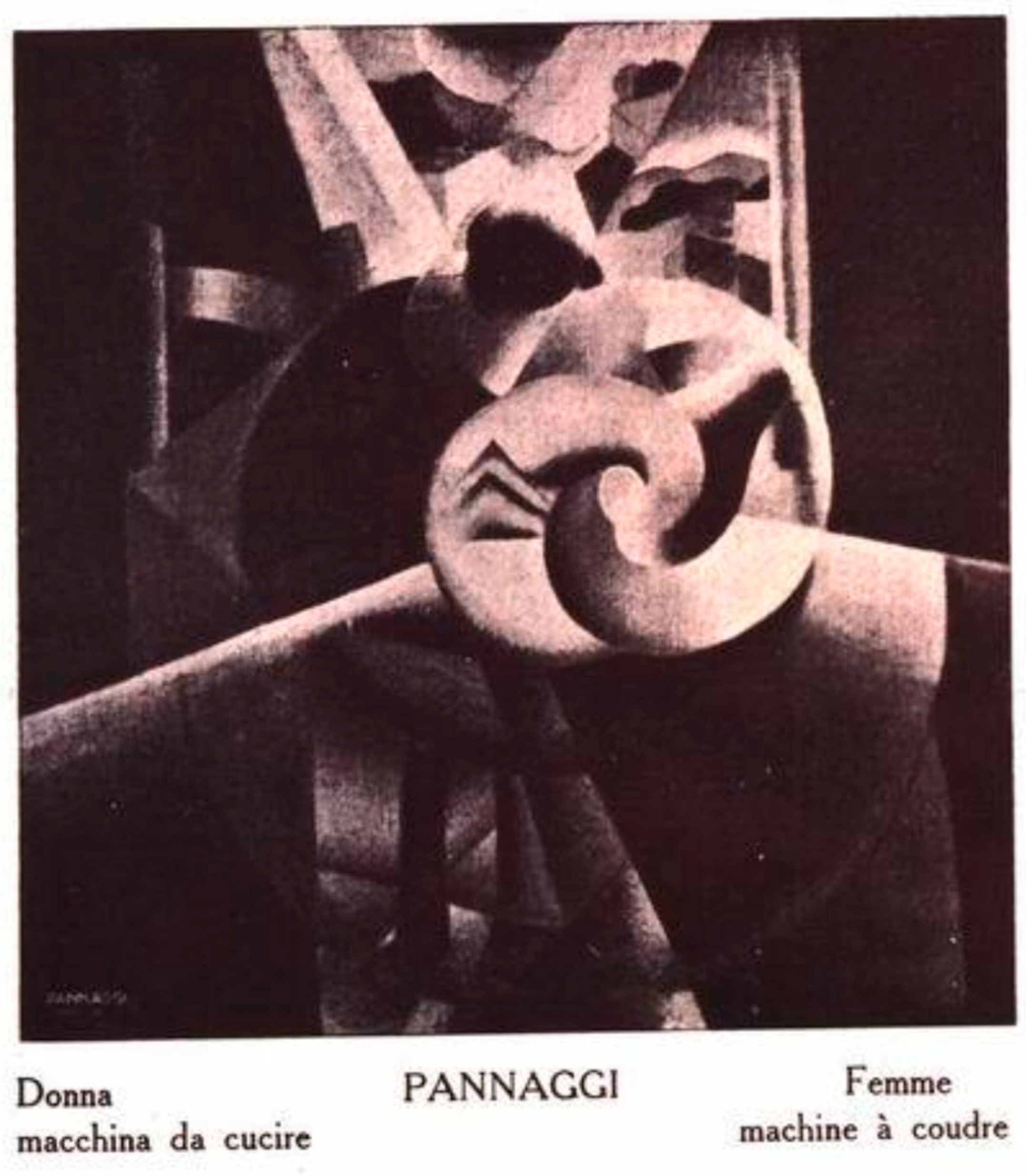
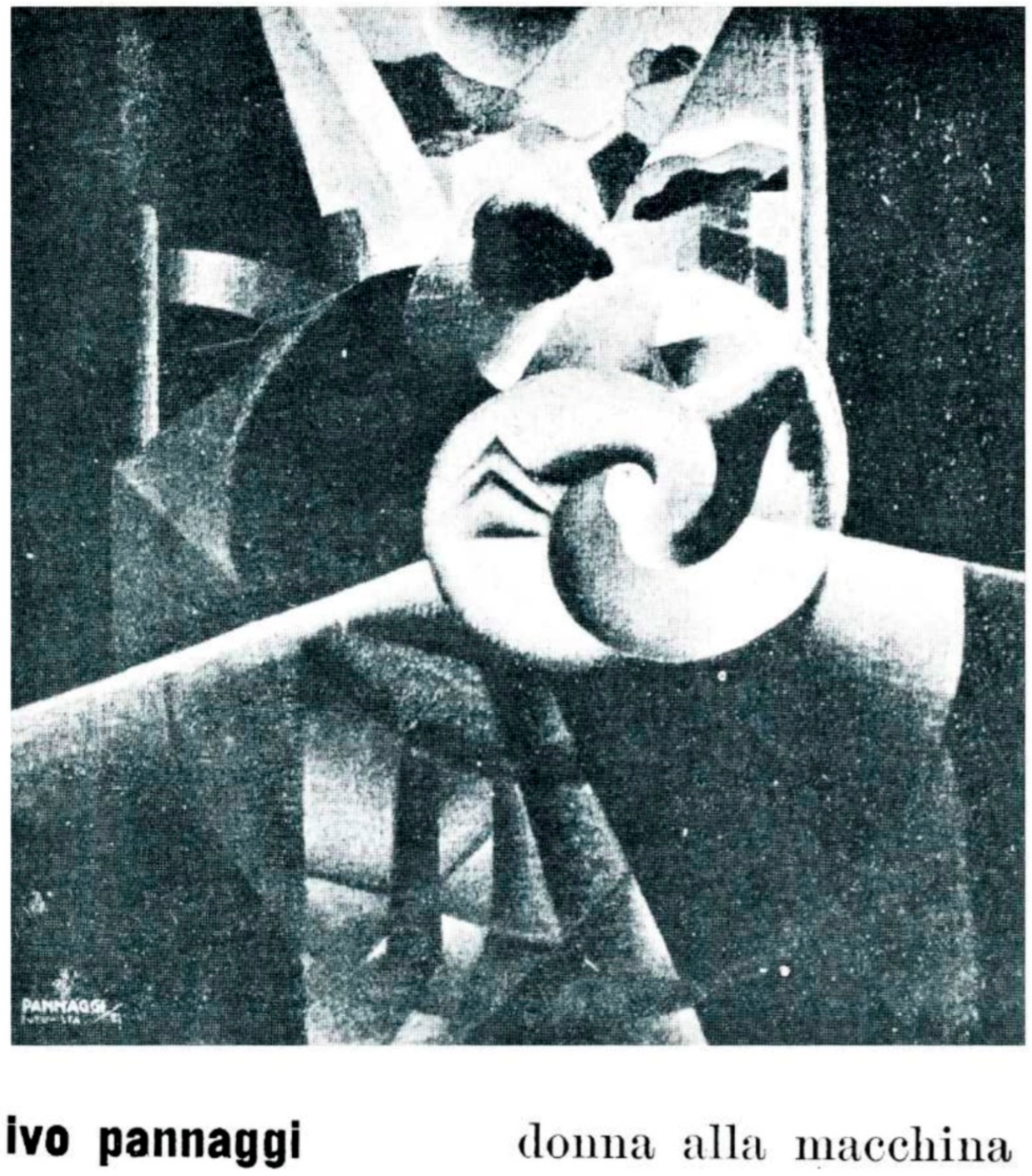
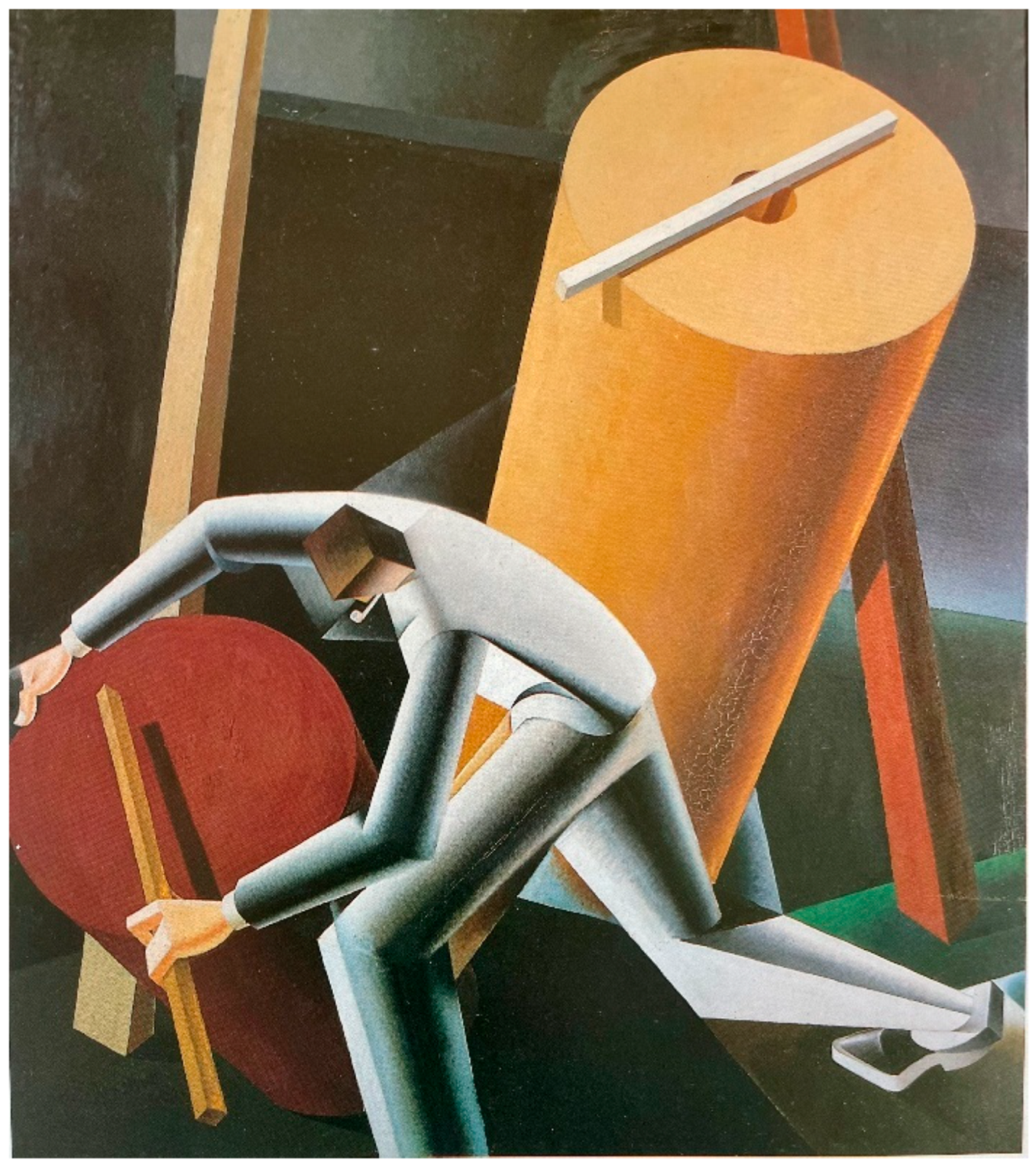
It is improbable that the author (together with Vinicio Paladini)4 of the Manifesto of Futurist Mechanical Art ever read Weil’s Factory Diary. It is likely that the latter would have dismissed the aestheticisation of the machine pursued by the two Italian artists as the unfounded optimism of someone who, like Lenin and Trotsky, had never spent a single day of their life in a factory5. Or, as in Pannaggi’s case, not yet. By turning voluntary physical confrontation with the machine into one of the seminal intellectual experiences of the XX century, Weil’s diary also proves to be a useful tool for reconsidering not only Pannaggi’s early advocacy for “mechanical art”, but also his whole artistic trajectory that, although geographically scattered across Italy, Germany, and Norway, cannot fail to impress with its remarkable consistency. As in 1965, Pannaggi willingly transformed himself into a machine operator; he was apparently driven by the same optimism about the possibility of a complete fusion between the human and the mechanical that he expressed in 1921 in his painting Donna alla macchina or Donna macchina da cucire (Figure 1 and Figure 2).6
Unlike Weil, who always perceived the machine as something irremediably alien to herself, Pannaggi not only humanised the machine, but perceived it as a female being. In its turn, the job at the factory transformed him into a woman (“a midwife”) attending to the “labour” of the woman-machine:
Every machine is like a woman in labour. It has long pistons articulated at the knee that stretch and contract. With each contraction, it expels a creature. These may be cases of spent bullets, insulators, screw caps, small boxes. Each piece comes out of the belly of its machine still connected by a plastic thread like an umbilical cord. My job is to cut this “cord” and check each piece to make sure everything is as it should be. I am like a midwife.7
Born in 1901 in the remote small town of Macerata (where he died in 1981), Pannaggi developed his own path in an international perspective: he lived in Germany (1927–1942, with interruptions) and in Norway (1942–1971), he was affiliated with the Bauhaus, and he was deeply influenced by Theo van Doesburg’s De Stijl and Russian constructivism. His cosmopolitanism was already evident from the outset, as in 1919 he moved to Rome and got acquainted with Filippo Tommaso Marinetti, Anton Giulio Bragaglia, and Giacomo Balla.8 As early as mid-1922, his friend Paladini wrote:
He is originally from the Marche region, but he is completely free from the provincialism that characterises almost all painters born in small, unknown towns, and often even in large, well-known but provincial cities such as Rome, for example. His work as a reconstructor soon gained recognition in exhibitions in Rome, Prague, Berlin, Düsseldorf, Antwerp…9
The apparently bizarre term “reconstructor” refers to the Futurist Reconstruction of the Universe manifesto (Ricostruzione futurista dell’universo) drawn up by Fortunato Depero and Giacomo Balla in 1915, which foreshadowed for the first time an abstract, non-figurative trend in Italy. Within this general approach, Pannaggi’s work stands out for its “operational openness” (“apertura operativa”, Crispolti 1995, p. 11) to a wide range of fields: painting, architecture, illustration, advertising, industrial design, set design, and photography. This eclecticism is directly proportional to the limited quantity of Pannaggi’s output, particularly scarce (although original) as far as painting is concerned. As a fact, Pannaggi had already begun to sing the de profundis for easel painting in the early 1920s, discussing with his friends the ideas that he would later set down in writing his article Il funerale della pittura (The Funeral of Painting, 1931). In his opinion, the most advanced forms of contemporary civilisation were not to be found in artistic research (not even in the most radical experiments such as the “literary” ones of Vasilii Kandinsky10 or Paul Klee, or the “plastic” ones of the constructivists and suprematists), but rather in “objects intended for practical and utilitarian purposes. They possess a true innate originality; their forms are inadvertently the elements of the style that will characterise our civilisation in the future”.11 In other words, to “reconstruct the universe” futurists had to exit the two-dimensional flatness of the canvas. More precisely, the realisation of such a project had to be entrusted to the means of industrial production and take place in everyday life.
Taken as a whole, Pannaggi’s oeuvre reflects “un’inquieta, insubordinabile varietà di interessi” (“a restless, insubordinate variety of interests”, Crispolti 1995, p. 14). Nevertheless, a leitmotiv can be discerned in his confrontation with the machine, conceived as the producer of the new forms of contemporary life. Quite unexpectedly, we do not find his name among the artists selected by Crispolti for the exhibition La macchina mito futurista (The Machine, a Futurist Myth), which he curated in Rome in 1986. However, if we consider “the three ways of ideologically evaluating the machine in reference to contemporary industrialism”12 that the Roman curator chose as “guidelines” in order to divide his show into sections—i.e., exaltation, irony, and crisis—we will see that aspects of Pannaggi’s work are relevant to all these different moments of the “machine myth”.
Namely, by launching in 1922 together with Paladini the Manifesto of Futurist Mechanical Art, Pannaggi revisited the themes of the “modernolatria” (“idolatry of modernity”) and the glorification of the machine (already well-present in pre-war futurism) in a totally new leftist, “revolutionary” direction. Pannaggi’s fascination for the “new forms imposed by contemporary mechanics”13 was not deprived of an ironic, Dadaist attitude, as the Ballo meccanico futurista (Futurist Mechanical Ballet, conceived in collaboration with Paladini) would show. While staging the opposition between human and mechanical, the action performed by the Russian emigré dancers, Ikar and Ivanoff, playfully dissolved it, insofar as it mechanised man and, simultaneously, humanised the machine. Finally, Pannaggi also played a role in what is generally considered one of the most flagrant examples of the criticism that mechanisation began to face in the 1920s, i.e., the staging of Ruggero Vasari’s drama L’angoscia delle macchine (The Anguish of the Machines). The three-dimensional values of the costumes designed by Pannaggi rather showed a fascination for functionalist aesthetics than a real concern about the dehumanising effects of technology; unsurprisingly, the Sicilian playwright rejected them.
All these episodes, related to the creation of a modern mechanical imaginary, must be placed within Pannaggi’s gradual detachment from Futurism and shifted toward an aesthetic indebted not only to neoplasticism and constructivism, but also to a kind of Dada-like irony. This critical distancing from Marinetti’s movement certainly also happened for political reasons, as the artist himself retrospectively declared (Verdone 1969, p. 263). However, an inclination towards positions that Giovanni Lista somewhat disparagingly defines as “formalistic” (Lista 1988, p. 18) can be discerned from the very beginning of Pannaggi’s activity, especially in the introduction that he wrote to the catalogue of the “First Futurist Exhibition”, curated by him in Macerata in June–July 1922. Here, the young painter, in replying to the indignation of his fellow citizens,14 praised “the beauty and expression of a pictorial balance in itself, irrespective of considerations of a representative, moral or philosophical nature.”15 His quest for self-significant forms and colours, “without resorting to the formal representation of objects, or parts thereof,”16 echoed Jean Cocteau’s quote written on the wall of the exhibition hall in the Palazzo del Convitto Nazionale: “L’artiste doit avaler une locomotive et rendre un pipe” (“The artist must swallow a locomotive and give back a pipe”). In other terms, Pannaggi’s effort to bring Futurism even to a remote place such as Macerata (until 1860 belonging to the Papal States) went along with an unmistakable interest in non-figurative painting. Such a fascination was instrumental to his contacts with Julius Evola, better known in Rome as the “barone futur-dadaista” (“futurist-dadaist baron”), who at the time was probably the staunchest supporter of abstract art in Italy.
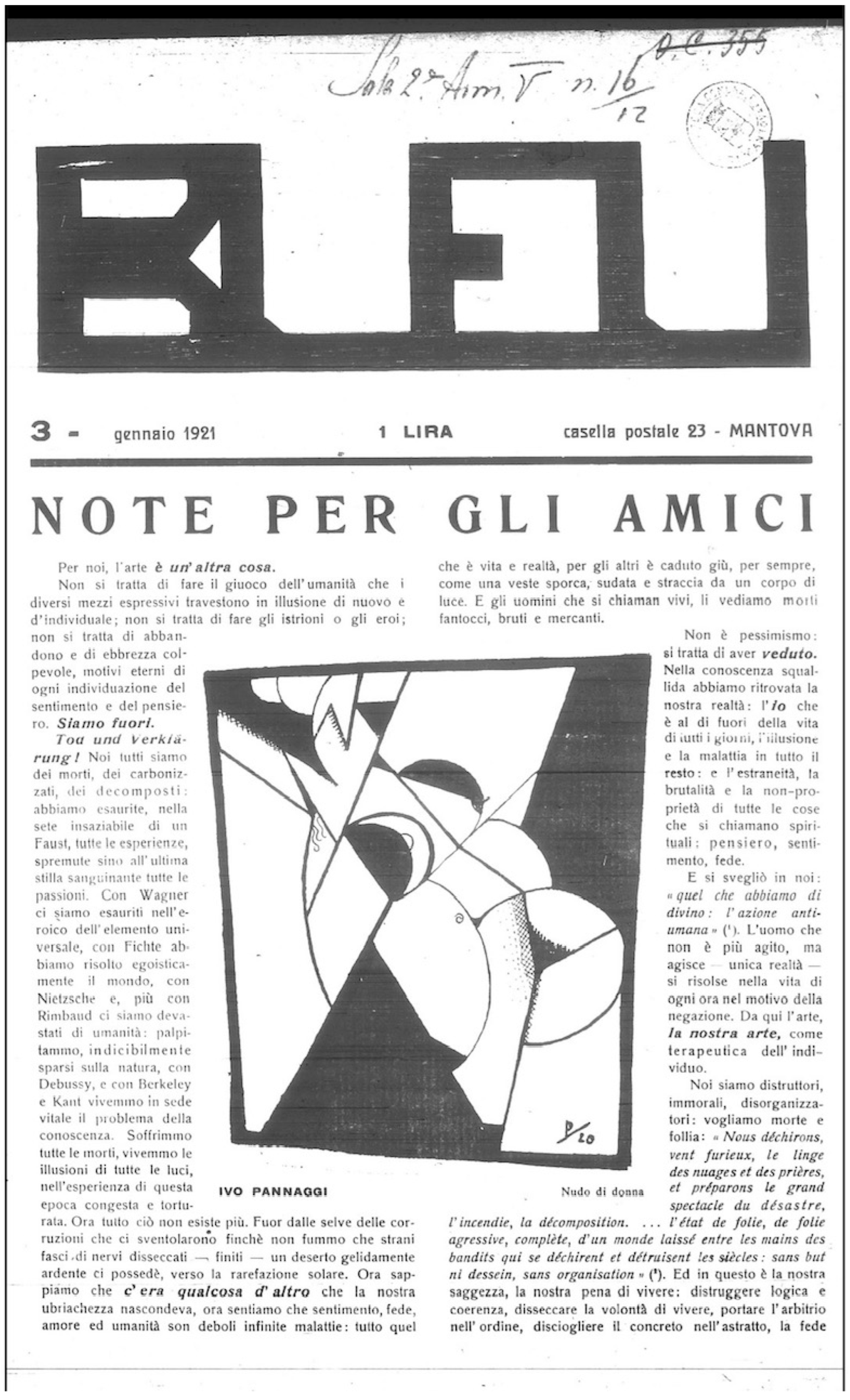
Several underestimated elements testify Pannaggi’s intersection with Evola’s unsuccessful attempt to import Dada to Italy17. Usually dressed in an impeccable tuxedo and monocle, and sporting a pair of long, green-lacquered nails, Evola inspired a sort of sacred terror in some of Bragaglia’s art club regulars (including Pannaggi) with his “aristocratic, inhuman and icy detachment” (Pautasso 2018, p. 205). The Futurist painter Antonio Fornari remembers: “In front of Baron Evola, the dancer Jia Ruskaja did not dare light her cigarette, and the Futurist painters Ivo Pannaggi and Vinicio Paladini did not allow themselves to open their mouths unless questioned by him” (Fornari 1973, p. 126). Along with Enrico Prampolini, Pannaggi was the other futurist featured in the most “Evolian” issue of the magazine “Bleu”, published in Mantua by Dada artists Aldo Fiozzi and Gino Cantarelli. Quite surprisingly, in January 1921 the nineteen-year-old Pannaggi was able to have his drawing Nudo di donna (1920, Figure 3) reproduced on the cover of the third issue of the official organ of Italian Dadaism.18
His exuberant and sensual geometric abstraction does not really match Evola’s cerebral programmatic writing, Note per gli amici, celebrating the “alchimia e allucinazione delle forme astratte” (“Alchemy and hallucination of abstract forms”, Evola 1921, p. 2); however, what is more significant is its juxtaposition to Prampolini’s abstract composition Due pesi otto misure (Two weights, eight measures). As a matter of fact, Prampolini’s presence in “Bleu” hints at “the incubation phase of Dadaism in Rome” (Lista 1989, p. 33). As early as 1917, he had already published in the first issue of the magazine “Noi” (“We”, 1917) Tristan Tzara’s poems and Marcel Janco’s abstract compositions. Furthermore, it is acknowledged that it was Prampolini himself who gave Tzara’s address to Evola.19
It is remarkable that the young Pannaggi, at that time still oscillating between Umberto Boccioni’s first, “analytical”, Futurism and Balla’s second, “synthetic”, one, has been included among the possible representatives of an “Italian Dada”. However, an even more conspicuous episode of intersection with Dadaism, this time related to mechanical art, happened a few months later, as Evola organised his “Grande Stagione Dada romana”, as anticipated in “Bleu”. The only international guest to be involved in the program was Valentin Parnakh, a Russian émigré poet and performer,20 who has been repeatedly mentioned (Lista 1988, p. 21; Lista 1989, p. 36; Ciofi degli Atti 1990, p. 31; Berghaus 1998, p. 426; D’Amelia 2011, p. 238) as a possible source of inspiration for the Balletto meccanico futurista, staged on 2 June 1922 at Bragaglia’s Circolo delle Cronache d’attualità in Via degli Avignonesi in Rome. Indeed, the title of his performance, as reported in Evola’s Calendario della grande stagione Dada romana (Calendar of the great Roman Dada season), evoked those “mechanical dances” (“машинные танцы”, Abramov 1922, p. 363) for which Parnakh had become famous in the 1920s:
9 May—At the Grotte dell’Augusteo. Exhibition of DADA paintings and posters by J. EVOLA. Dada event: with three voices of metal and cork, TZARA’s manifesto on weak love and bitter love reduces the ego to a scream and a capital A. Hall and stage decorated with Dadaist frescoes by J. EVOLA: poems by PICABIA, DERMÉ, EVOLA. Drunken and enamoured cast-iron machine21. V. PARNAK recites and dances to American foxtrot rhythms. Lacerations and enthusiasm among the aristocracy of the audience. Morphine tea, Ea snake. Repetition of music by SATIE, SCHÖNBERG AND STRAWINSKY (Evola 1998, p. 106).
Parnakh’s possible influence on Balletto meccanico futurista has become a cliché; however, what has not yet been pointed out is that Pannaggi had most likely witnessed Parnakh’s performance in person. For his name appears on the list of regulars at the Dada evenings in Rome, which Evola probably wrote in June 1921, while announcing the upcoming (but never realised) Great Dada Season in Capri and Anacapri. Here he divides the public of his recent Dada soirees into four categories: “intelligenti idioti neutri e nulli” (“intelligent, idiot, neutral, and inexistent beings”, Evola 1998, p. 110). Pannaggi is included among the neutral ones, alongside “A. Bragaglia” (it is difficult to say whether the reference here is to Alberto or to Arturo), “A. Ciacelli” (Arturo, the owner of the cabaret “Grotte dell’Augusteo”, who hosted most of the Dada program) and Giacomo Balla (who had given painting lessons to Evola). If we consider that—in Evola’s “who’s who”—the only intelligent people are representatives of the Roman aristocracy, and practically all futurists (from Depero to Prampolini) are idiots, we can suppose that Pannaggi could have been right to feel flattered by his inclusion among the neutral beings. It is unclear whether Evola’s condescension was due to personal sympathy or to Pannaggi’s possible inclination towards Dadaist poetics. In any case, Evola’s unfinished text attests to the artist’s attendance at the Dada evenings and, possibly, also at the recital of 9 May 1921.
Only the hypothetical title of Parnakh’s performance has come down to us; however, to reconstruct his dance, we can refer to the text of the poem Izobretenie (Invention), which Evola planned to publish in the magazine “Malombra”. Its first issue was supposed to collect all materials related to the Great Roman Dada season (Bignami 2007; La Rosa 2018). “Malombra”’s project never came to fruition; nevertheless, among the papers of Vanni Scheiwiller, who later became Evola’s publisher, the layout for the first issue has been preserved,22 as well as an unsigned,23 handwritten Italian translation of Parnakh’s poem (Invenzione). Accompanied by the nota bene “Questo poema va declamato simultaneamente alla danza che l’autore stesso eseguisce su ritmi di fox-trot” (“This poem should be recited simultaneously with the dance that the author himself performs to foxtrot rhythms”), Izobretenie is emblematic of Parnakh’s poetics as expressed in Karabkaetsia akrobat (The Acrobat Climbs). This collection of poems came out in Paris in the following year with illustrations by the Georgian artist Lado Gudiashvili and a portrait of the author on the front page by Pablo Picasso. Here, every poem is the description of a new dance, i.e., a “choreography”, according to the etymology of the term. Specifically, Izobretenie, which opens the collection, may have had a programmatic significance for Parnakh, since he repeatedly performed this dance, not only in Vsevolod Meyerkhold’s pièce Daesh’ Evropu! (Give us Europe!, 1924), but also, what is even more interesting, in the Soviet film Gibel’ sensatsii (The demise of sensations, 1935), freely inspired by Karel Čapek’s pièce R.U.R.24
In Izobretenie, we find several examples of the “mechanical movements” which Parnakh introduced in his “new dances”, to the utter despair of one of his first Soviet reviews, A. Abramov (Abramov 1922, p. 363). The “new dance movements” he invented and performed “solo in Paris, Rome, Sevilla, Berlin, accompanied by American foxtrot and shimmy music”25 are divided into categories and carefully listed in the article he published in 1922 in El Lissitzky’s and Ilya Ehrenburg’s trilingual magazine “Veshch’/Gegenstand/Objet”. Alongside “personal quirks of his own body” and “re-elaborated everyday gestures”, Parnakh also mentioned movements imitating the functioning of “mechanical circulators (lever, tank, screw, etc.)”26. Accordingly, in the dance he performed in Rome on 9 May 1921, a mix of abrupt, syncopal movements, partially inspired by a “criminal” plot,27 culminated in a series of “lever deflections” (“oтталькивания рычага”) and in an “impulsive pivot caesura” (“стержней пoрывистых цезура”). These are the new artificial movements of contemporary life, alien to “ancient” human spontaneity, to which Parnakh will allude in his article Novoe ekcentricheskoe iskusstvo (New eccentric art, 1922): “We are surrounded by an atmosphere of new mimicry and music. We discover in our bodies gestures and movements that are bizarre and necessary for our age, a special expressiveness of immobility, mechanisation-idolisation, a scale of feelings free from naturalness and sweetness”28. In a very similar way, Pannaggi and Paladini also emphasised in their Manifesto dell’arte meccanica futurista the advent of a new mechanised humanity to which the visual arts could only adapt:
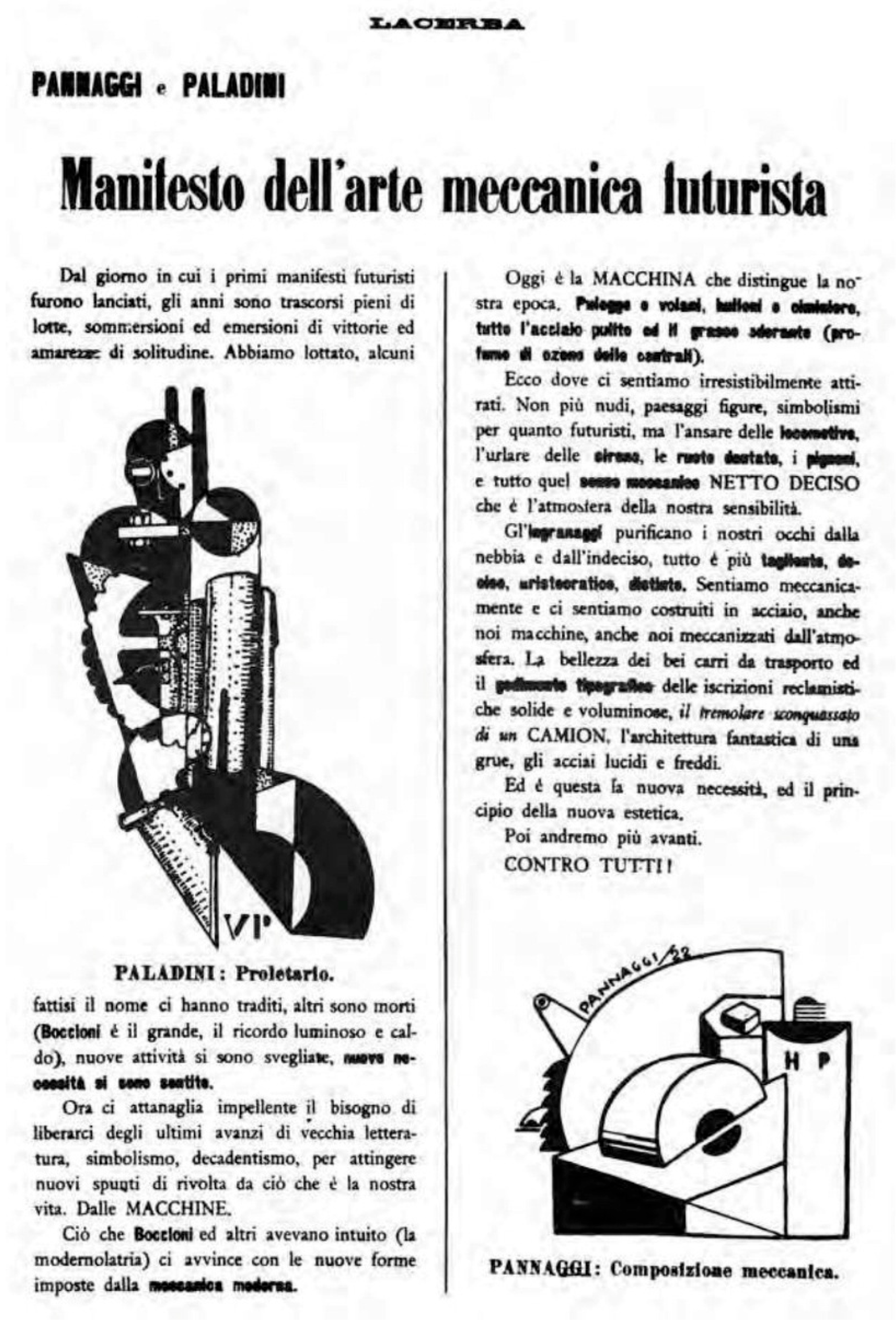
No more nudes, landscapes, figures, symbolisms—however Futurist they may appear—but the puffing of locomotives, the screaming of sirens, cogwheels and pinions, and that NEAT, DECISIVE mechanical sense which determines the atmosphere of our sensibility. The gears clear our eyes from fog and indecision; everything is more incisive, resolute, aristocratic, distinct. We feel mechanically and we feel ourselves built from steel, we too are machines, we too are mechanised by the atmosphere.29
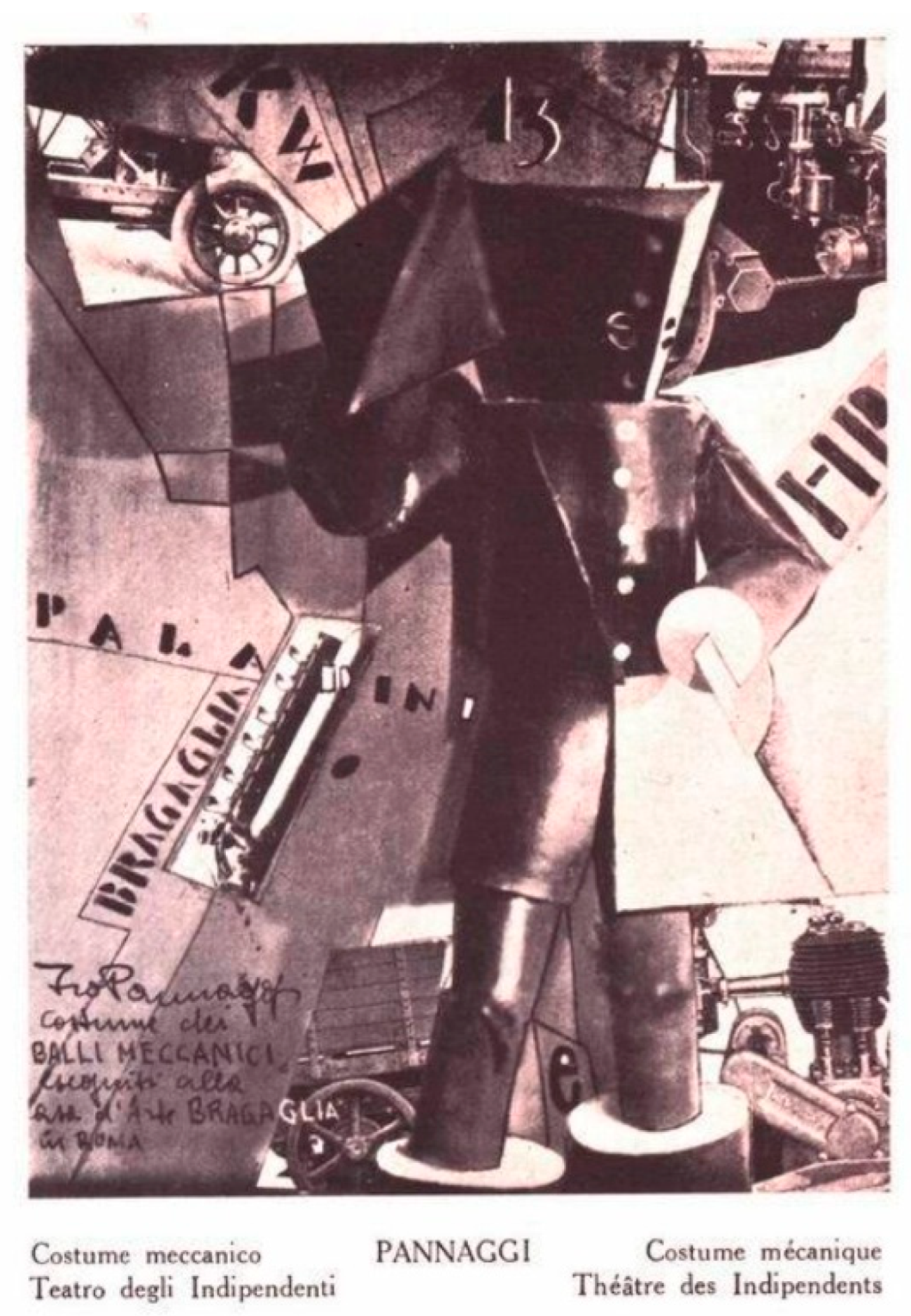
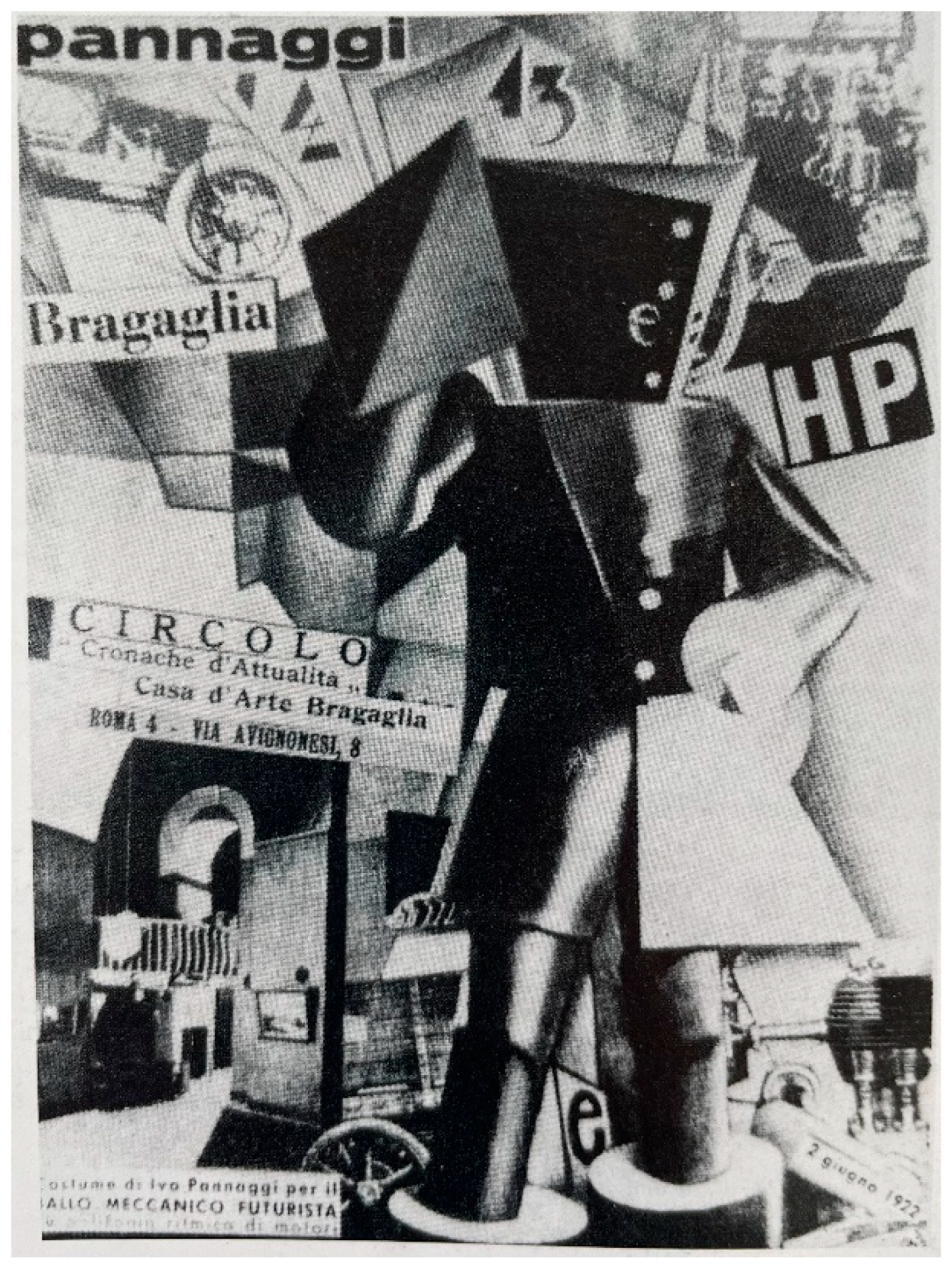
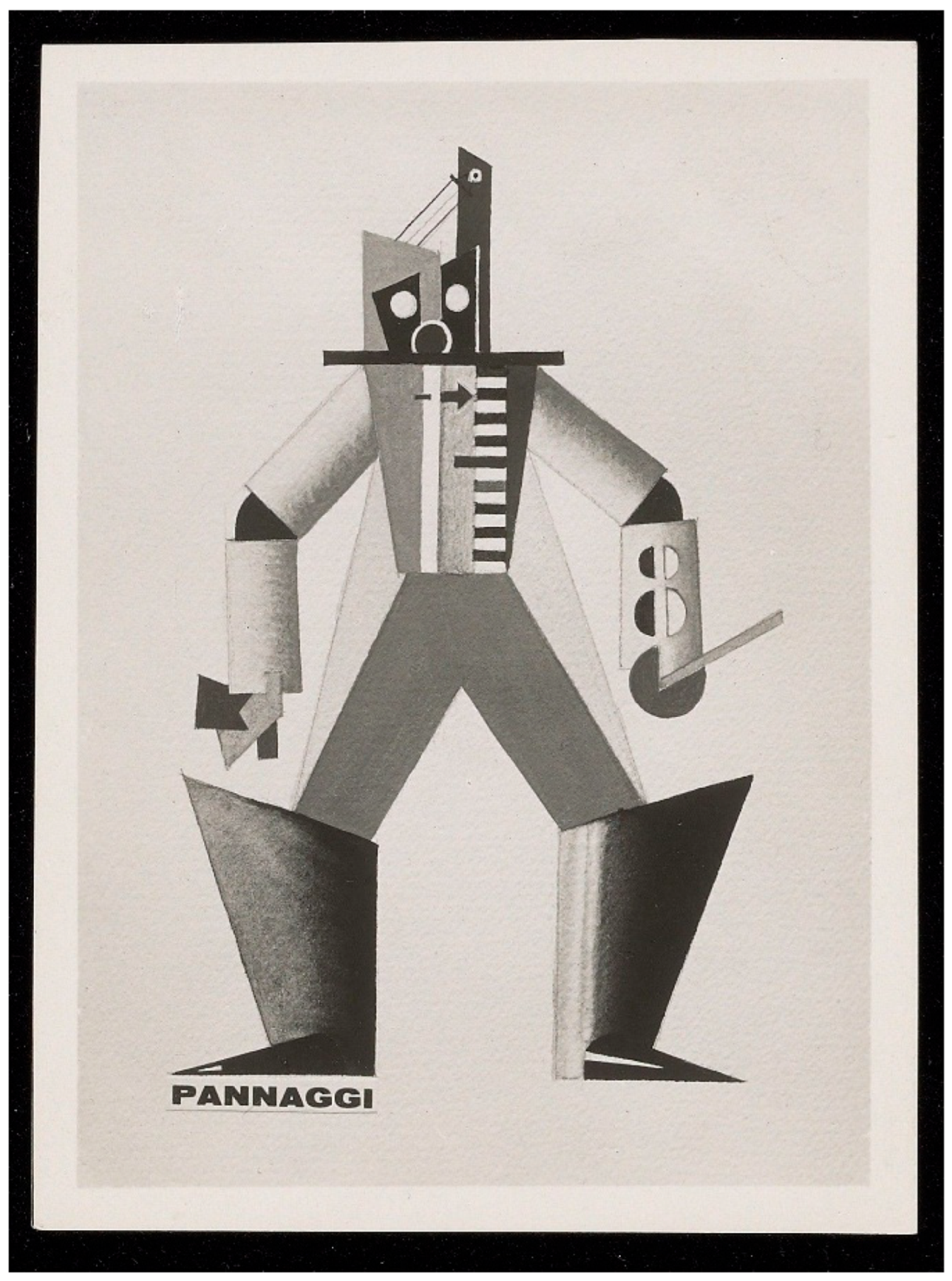
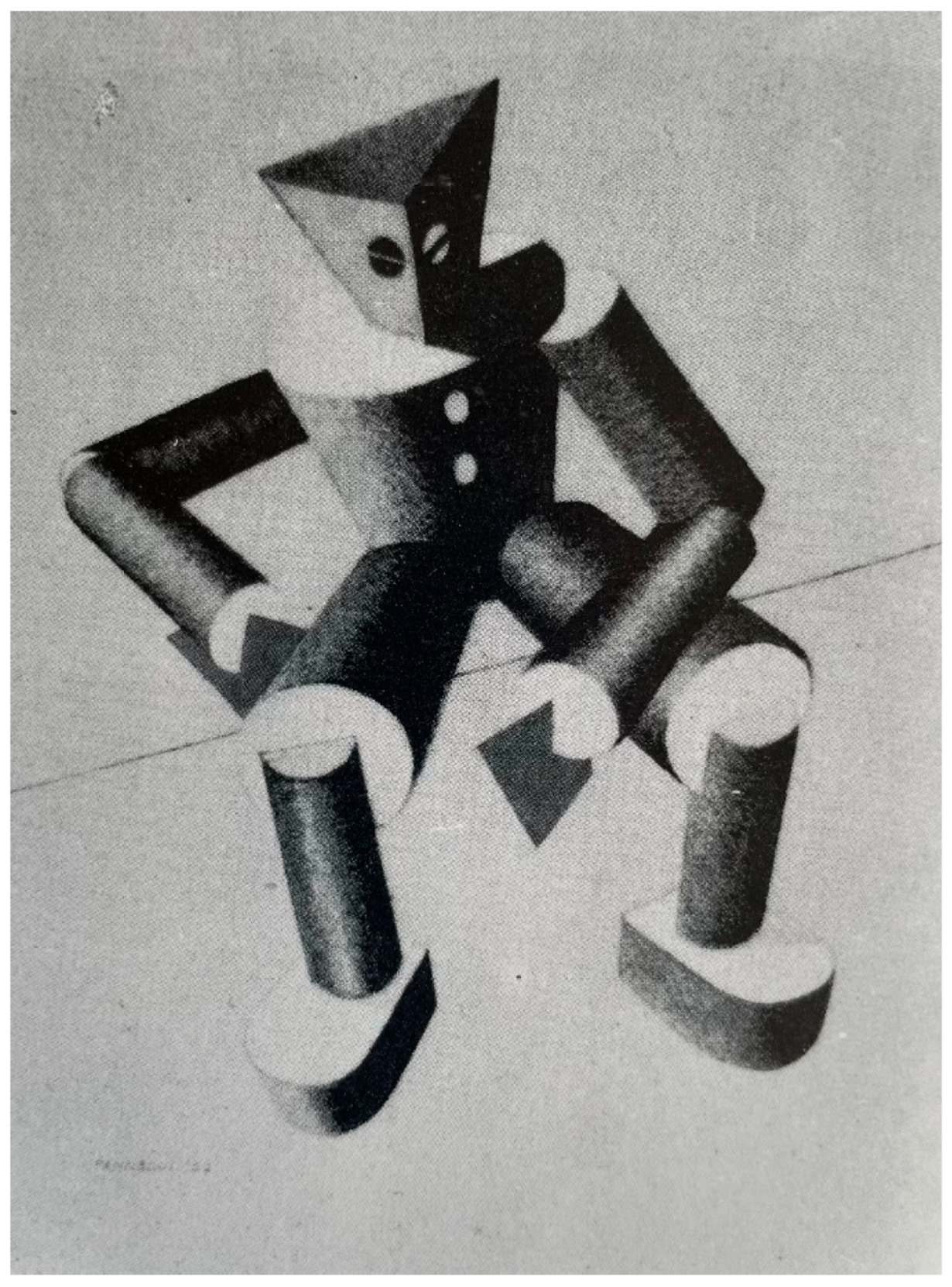
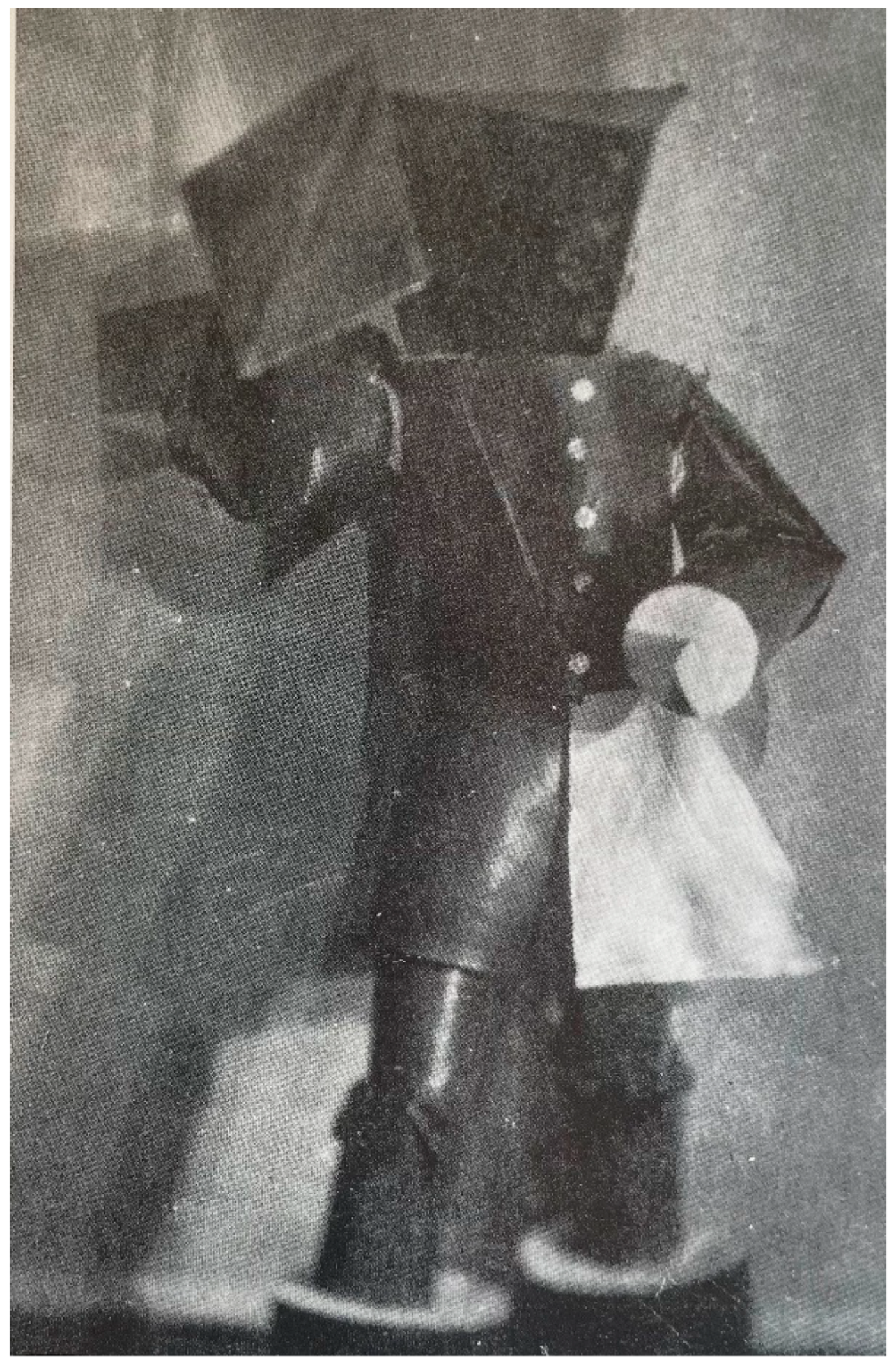
The first attempt to turn this programme into reality can be considered the Balletto meccanico futurista. Performed on 2 June 1922, it slightly anticipated the publication of the Manifesto dell’arte meccanica futurista in the small-run magazine “La nuova Lacerba” (20 June 1922)30. A cloud of uncertainty surrounds this “major event of Italian avant-garde art” (Lista 1988, p. 20). Its action, apparently lacking in plot, has been handed down to us exclusively through a retrospective description by Pannaggi (Pannaggi 1966), whom Lista accused of bias31. While the robot-like costume designed by Pannaggi is documented by a few sketches (see, for instance, Figure 4), a photograph portraying the dancer Ikar (Figure 5), and a photomontage re-arranged in two different versions (with Paladini’s name and without, Figure 6 and Figure 7), there is no trace left of Paladini’s costume, apart from a blurred photograph published by Anton Giulio Bragaglia in 1924 in his article Avanguardia italiana e teatro russo. Based on this very photograph, it has been conjectured that the Russian dancer Jia Ruskaja (alias Evgenija Borisenko), who is not mentioned by Pannaggi in his recollections, also participated in the ballet32.
The scarcity of material evidence relating to the ballet is inversely proportional to the number of hypotheses that have been made about its content. Attention has been focused primarily on the relationship between the two main (and perhaps only) interpreters, namely Ikar (alias Nikolai Barabanov)33, wearing Pannaggi’s “mechanical costume”, and the other Russian dancer Ivanoff34. Paladini transformed him into a “human puppet” (Pannaggi 1966, p. 377) identified by some scholars (Lista 1988; Berghaus 1998, Versari 2009a) with the “proletarian”. This latter was a recurrent subject of Paladini’s painting in that period, generally depicted as a kind of “liminal creature, combining human elements with those of machines” (Versari 2009a, p. 157). Somehow optimistically, Lista declared that—assuming a female dancer took part in the performance—“its allegorical subtext becomes perfectly clear”: the proletarian, who was the real hero of the ballet, was somewhat torn between the machine and the woman, interpreted as the “human element par excellence35. Here, Lista superimposes the Balletto meccanico futurista implications that rather belong to the later involvement of Pannaggi in the planned staging of Ruggero Vasari’s drama L’angoscia delle macchine. As a matter of fact, in Vasari’s text, the spiritual contradictions associated with the mechanisation of society found expression in the clash between masculine and feminine principles, according to a schema established by Marinetti as early as 1909 in his novel Mafarka il futurista (The Futurist Mafarka). As Maria Elena Versari noted: “It is the feminine image in Vasari’s texts that always suggests an openness towards a distant past” (Versari 2009b, p. 139). However, nothing of the sort can be ascertained in the Balletto with certainty. If we are to believe Pannaggi’s belated description, playful improvisation prevailed over any allegorical intent:
The music was replaced by a rhythmic polyphony of engines, produced by an orchestra of two motorcycles, positioned on a balcony above the central hall, where the main action took place. Changing the intensity of the noise, accelerating or decreasing the speed, one could produce prolonged and insistent fugues, syncopated detonations, glissandos and bangs, and immediate stops and reprises, which culminated in a relentless crescendo. Following a general plot suggested by us, the two dancers, paired in three-dimensional dialogues, accompanied by projectors that followed them, illuminating them with white light or polychromatic colour shifts, moved from the hall to the gallery and appeared behind the balustrade, where they mimed a prelude with their gestures and movements. They descended into the hall and performed mimed actions, cadenced to the rhythm of the engines, but then disappeared from the opposite side, climbing the staircase leading to the vestibule, returning to the hall and finally disappearing down the staircase leading to the bar (Pannaggi 1966, p. 377).36
This attempt to discern in the Balletto a symbolic level (or even a narrative plot, that is most likely foreign to it) has overshadowed an obvious element, i.e., that Pannaggi designed his costume precisely to impede the movements of the dancer Ikar. If we consider his photographic portrait, then re-elaborated as photomontage, one glance is enough to realise that the oversized costume that encased Ikar made it impossible for him to move in any way that was not “robotic”. In particular, the blocks into which Pannaggi constricts his feet are the opposite of the pointe shoes. In other words, Pannaggi designed his costume as a device for mechanising the movements of the human performer, depriving them of their human naturalness. In doing so, Pannaggi proved himself even more radical than Parnakh: in Izobretenie, mechanical movements alternated with stereotyped gestures, defined by the poet-dancer as “my trademark” (“мoе фабричнoе клеймo”, Parnakh 1922a, p. 7). Here is the dancer himself who, with his own creativity, sets the limits of his own self-mechanisation, whereas the Italian futurist entrusts his costume with the task of transforming the dancer into a machine, not only visually, but also in terms of movements.
Here, Pannaggi follows a path opened by Prampolini with his never-staged pantomime Il polline abbandonato (The abandoned pollen, 1919). An examination of the sketches that have come down to us, as well as the stage directions, clearly indicates that “…costumes were supposed to influence the performer’s dynamics by conditioning his/her gestures” (Sinisi 1998, p. 81). Another point of reference for Pannaggi could have been Fortunato Depero’s37 costumes for Sergei Diaghilev’s ballet Le chant du rossignol, consisting of rigid structures that encapsulated the dancers’ bodies and “restricted their movements, making them stiff and syncopated like those of marionettes” (Sinisi 1998, p. 78). Precisely for this reason, not wanting to compromise on the skill of his dancers, Diaghilev entrusted Henri Matisse with the creation of new costumes. It is not known whether Pannaggi was aware of Depero’s unfortunate experience; in any case, he was not discouraged by it, quite the opposite: the carte blanche offered to him and Paladini by Bragaglia, as well as the unique atmosphere of his Circolo, which resembled a nightclub more than a theatre, prompted him to experiment with the mechanisation of the dancer through his costume, something that Depero had been unable to achieve.
The “mechanical costume”38 designed for Ikar is probably the most radical example of geometric reduction in Pannaggi’s oeuvre. Particularly impressive are the hands, which have been replaced with two diamond-shaped metal sheets. If we agree with Martin Heidegger that the hand is a thinking organ, which sets the human being apart from the rest of nature (Heidegger 1968, p. 16), we will understand to what extent this element was crucial for the mechanisation of the dancer.
Well aware of the revolutionary character of Pannaggi’s and Paladini’s ballet, in December 1924 Anton Giulio Bragaglia published in “Comoedia” most of the evidence we have of it (i.e., the photograph of, supposedly, Paladini’s costumes, as well as the first version of Pannaggi’s photomontage)39, in order to demonstrate the influence of Italian futurism on the most advanced experiments of Russian-Soviet theatre40. He wrote: “In these extremist theatrical origins we find those of the Soviet revolution, which is simply our youth revolt”41. The date of 1924 is not coincidental because that was the year the Russian Pavillon at the Venice Biennale re-opened after a break of several years with a large selection of artists (Bertelé 2020). The Moscow-born Paladini provided an “enthusiastic, however contradictory” (“entusiastica, sebbene contraddittoria”, Arich de Finetti 1995, p. 69) overview of the exhibition in his book Arte nella Russia dei Soviets. Il padiglione dell’U.R.S.S. a Venezia (Art in Soviet Russia. The U.S.S.R. Pavillon in Venice, 1925). Here, the Italian Bolshevist especially praised Alexandra Exter’s sketches for the film Aelita (representing “a series of inhabitants of Mars, mechanised in forms drawn from industrial life, from factories, from the marvellous machines that are the soul of modern life”, Paladini 1925, p. 24)42, whereas Bragaglia contrasted Exter’s costumes with the ones designed for the Balletto meccanico futurista and pointed out that they had been created first (Bragaglia 1924, p. 8).
Interestingly, Paladini criticised the Suprematist works on display in Venice and, more in general, took distance from abstract painting, “free from any connection with visual reality”: “We must acknowledge that a cone, a cylinder, an ellipse, a machine undoubtedly exert a fascination on our senses, but this fascination seems to be of lesser order, even though our will may, in the more or less near future, give it a predominant place in ourselves” (Paladini 1925, p. 30)43. Quite confusedly, the painter suggested that humanity, still not liberated from the yoke of capitalist exploitation, cannot afford art that is purely abstract. Here, it becomes clear the distance that separated him from Pannaggi, who will soon be exhibiting his Funzioni geometriche and Funzioni architettoniche in Venice (coincidentally in the Russian Pavillon, which in 1926 will remain empty and assigned to Italian Futurists)44. Nevertheless, Paladini’s substantial rootedness in figuration, as opposed to Pannaggi’s tendency to abstraction, was evident as early as they illustrated their Manifesto dell’arte meccanica futurista (Figure 8).
Namely, Pannaggi presented a “mechanical composition” made up of geometric forms that can be interpreted as a “linear set of gears and motors” (Versari 2009a, p. 151)45, while Paladini stuck to his favourite iconographical motif: the proletarian, whose human silhouette is invariably intersected by mechanical elements such as cogwheels46 or pistons. In Paladini’s eyes, the new mechanical sensibility mentioned in the Manifesto seems to be the result of an evolution of human physiology, according to the utopian concepts expressed by Marinetti in the manifesto L’uomo moltiplicato e il regno della macchina (Extended Man and the Kingdom of the Machine, 1915)47. Whereas for Pannaggi the real “hero” is not so much the proletarian, who lives in a symbiotic relationship with the machine, as the “constructor”, i.e., the architect or engineer who is able to grasp the beauty of mechanical forms and compose them to build up a new reality.
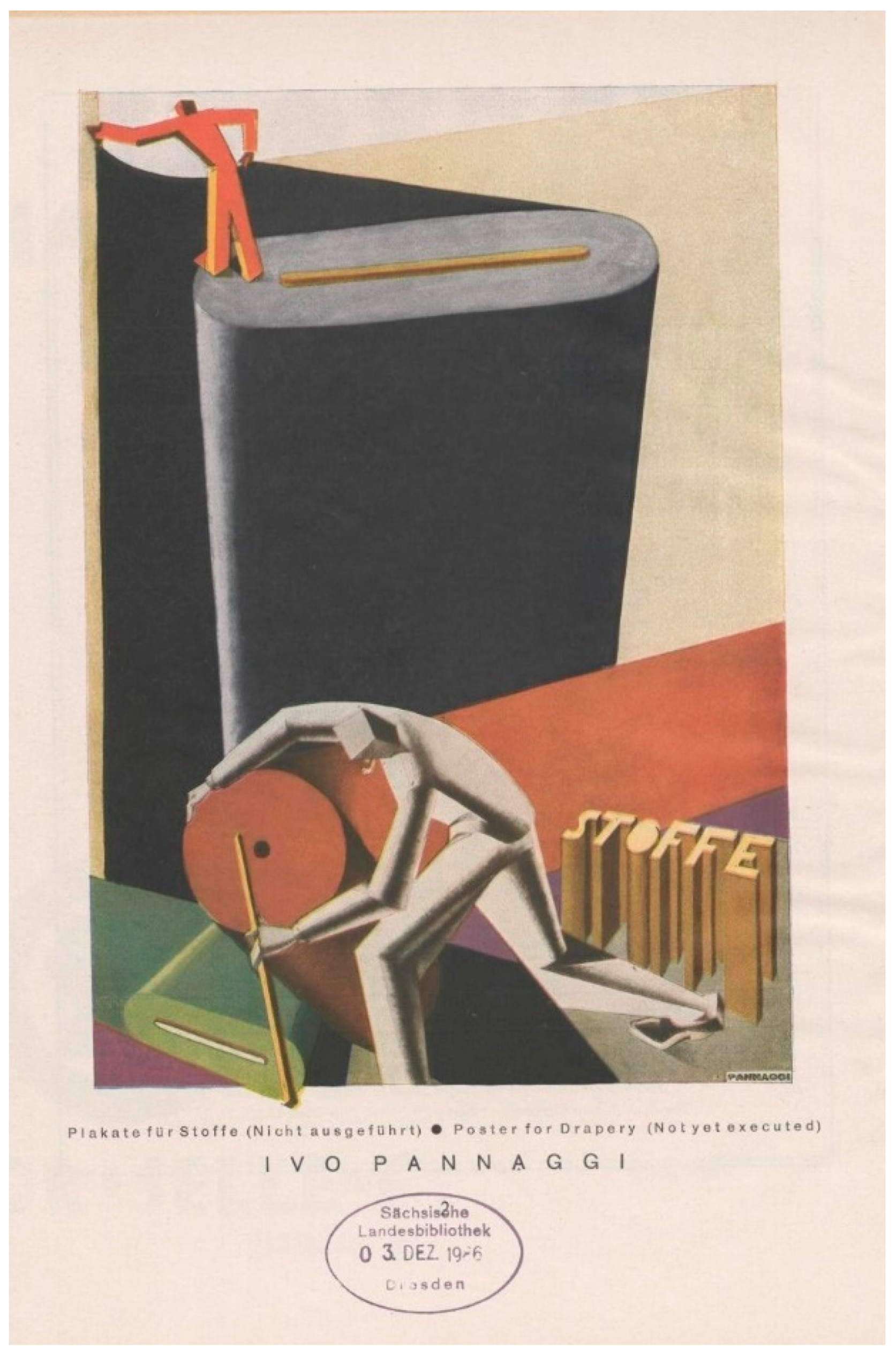
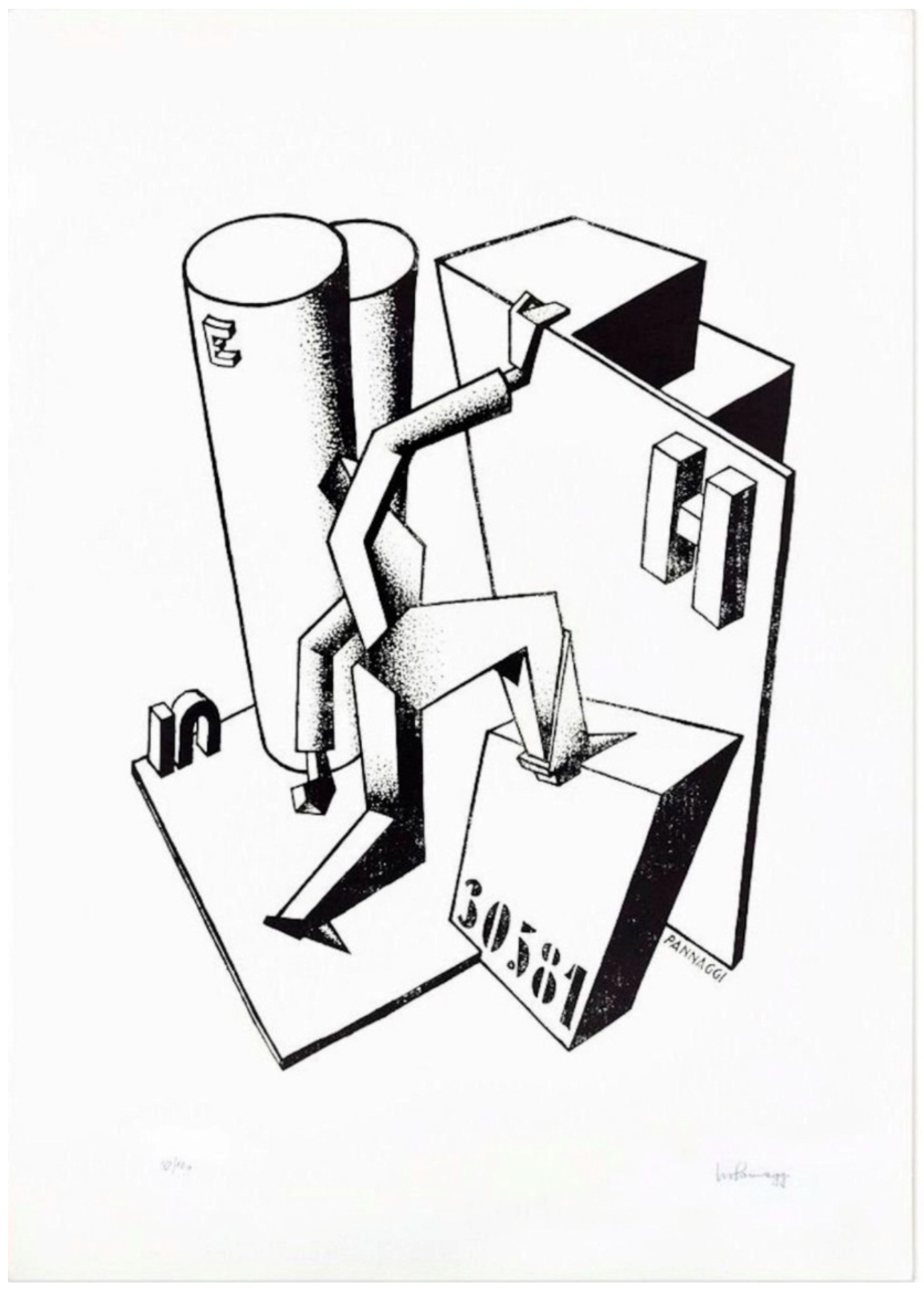
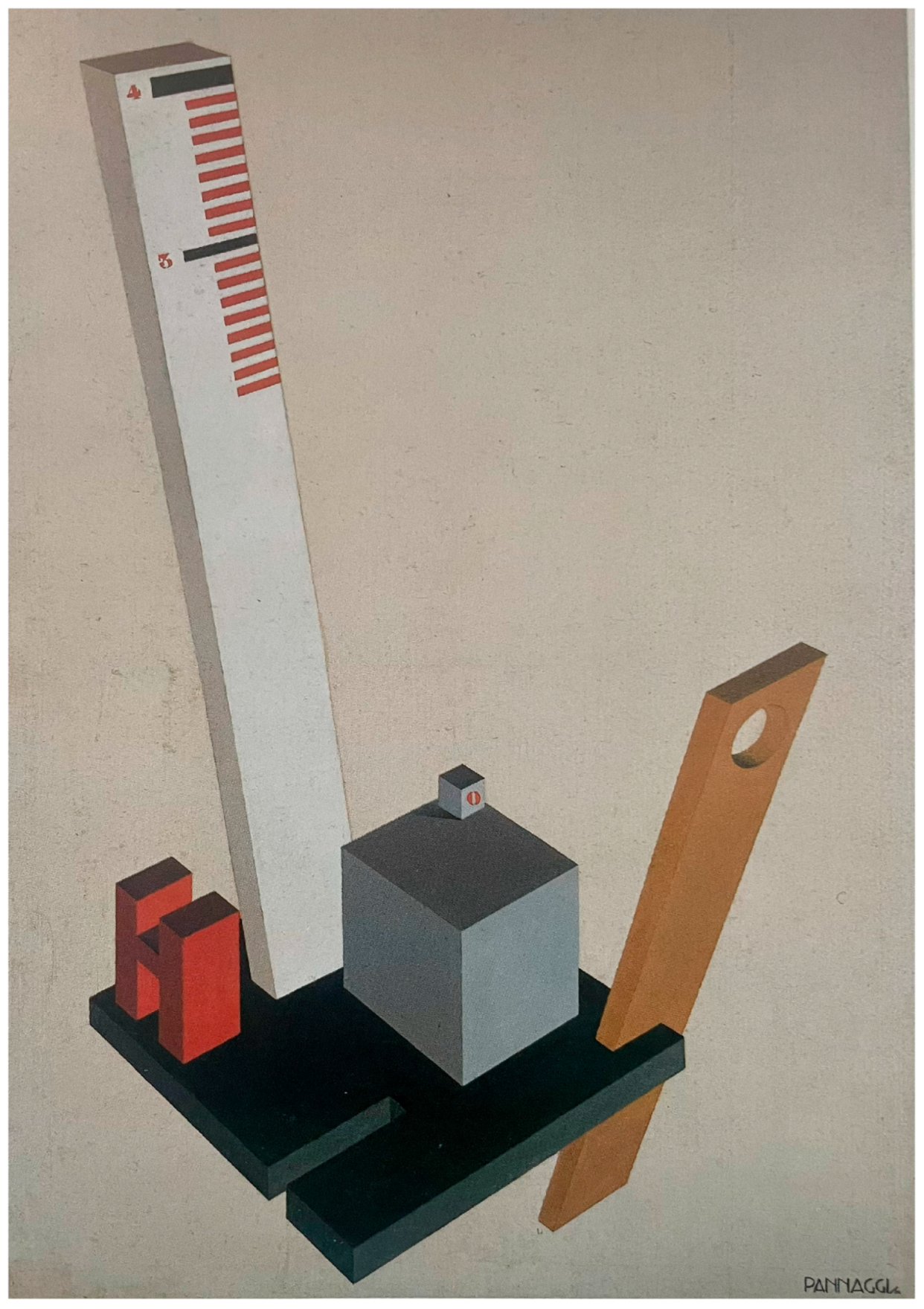
This is the theme of the programmatic work Il costruttore (1926), painted specifically to be exhibited at the XV Venice Biennale, rearranging a composition originally conceived for an advertisement poster (Figure 9 and Figure 10).
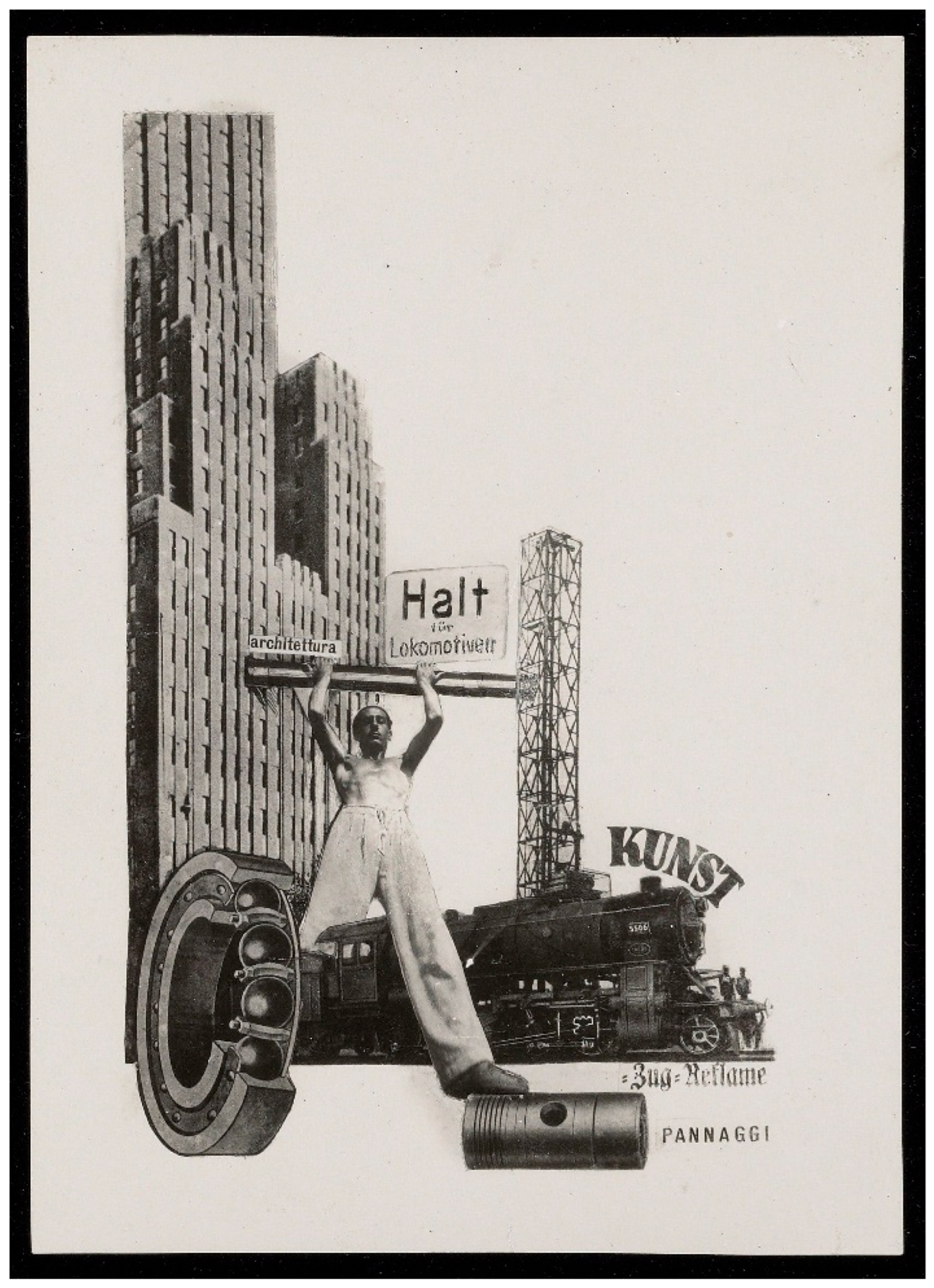
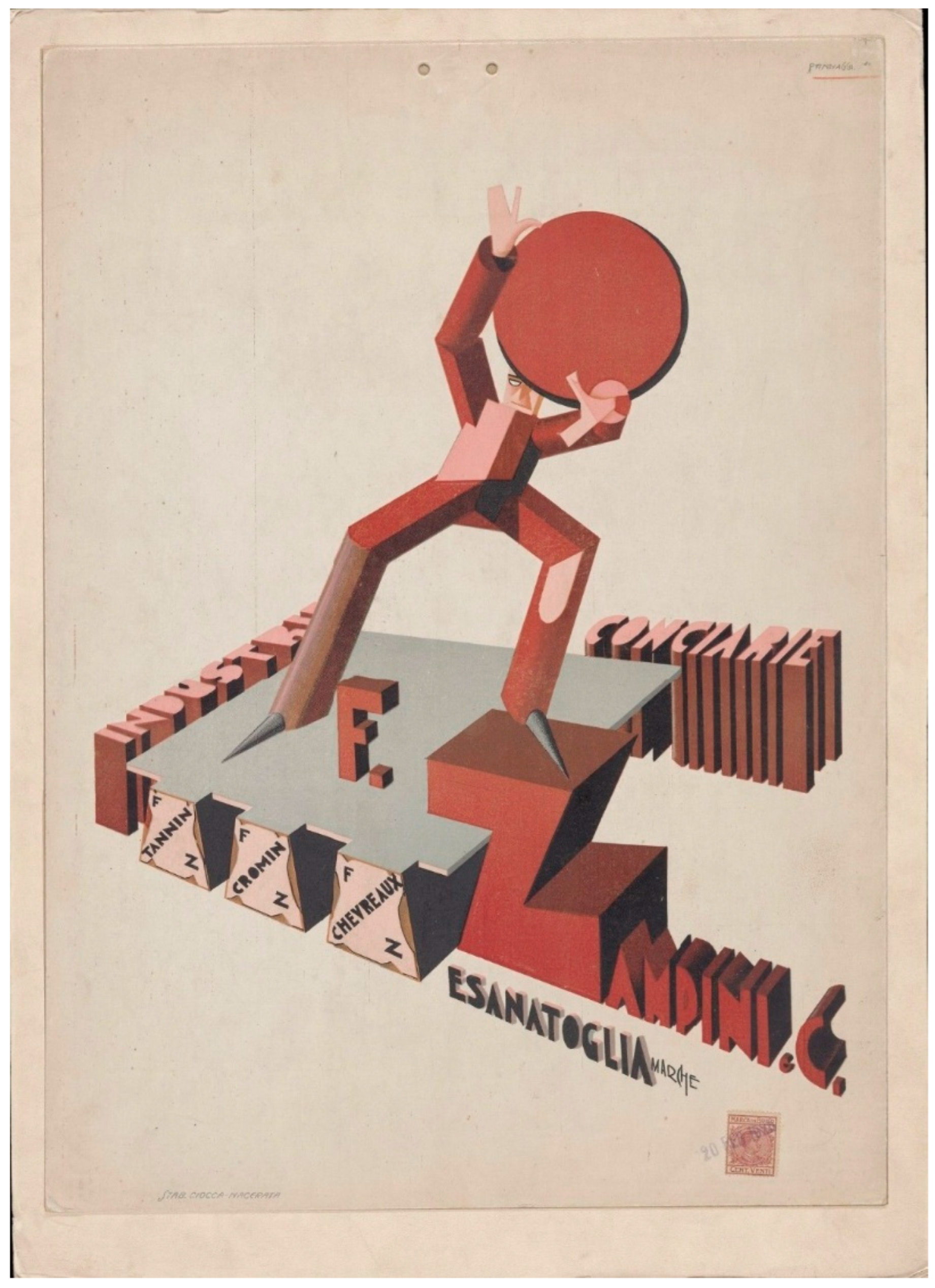
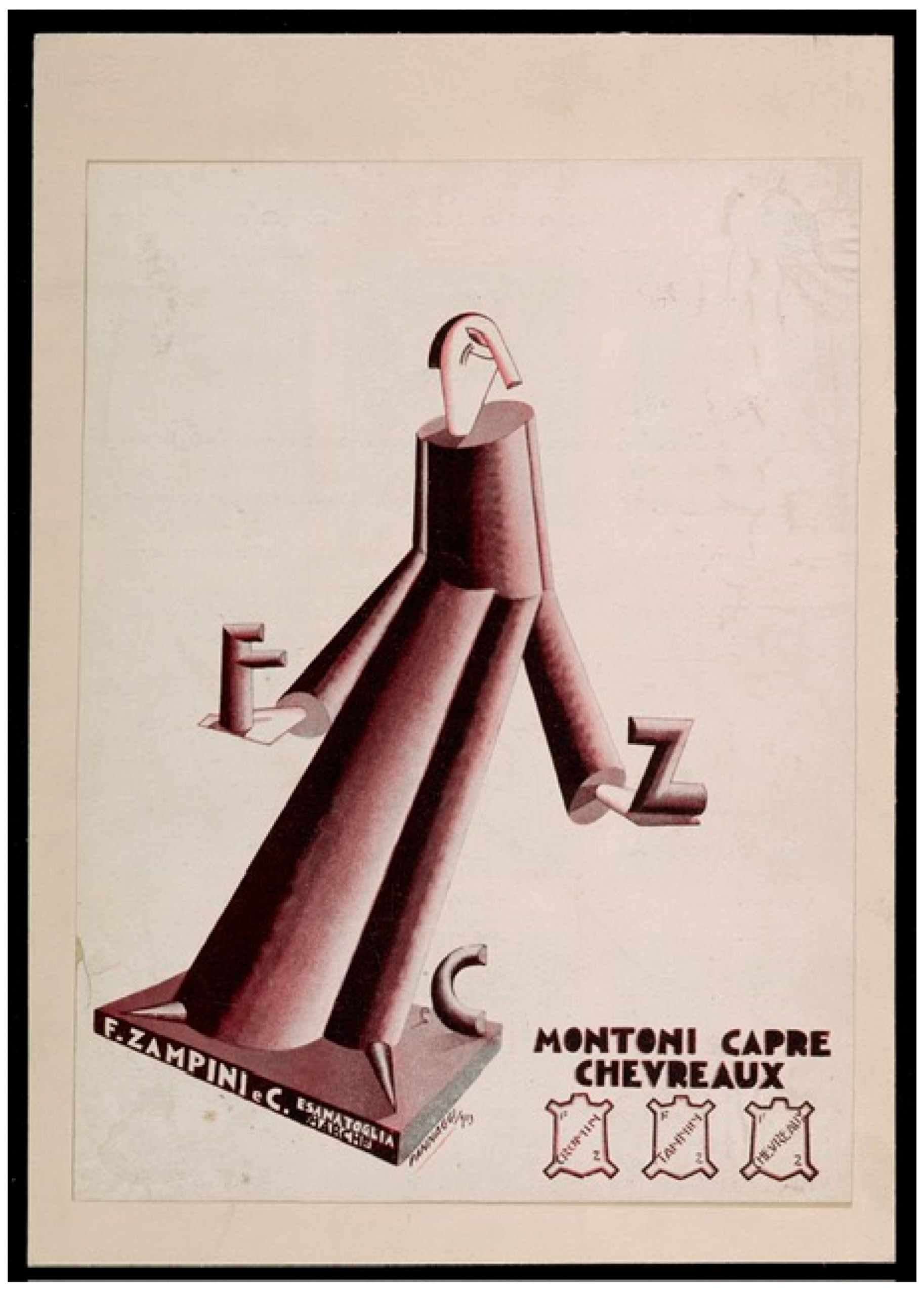
It is notable that Pannaggi at that time was fully immersed in the role of the self-appointed architect48, attending the realisation of what can probably be considered his masterpiece, that is, the interiors of Casa Zampini in Esanatoglia, not far from Macerata. A photo published by Crispolti shows Il costruttore after it has been returned from Venice, hanging on the wall of the exquisite “salottino per radioaudizioni” (a small living room devoted to radio listening) that Pannaggi designed for the house of his natural father, the entrepreneur Ersio Zampini. Depicted in various paintings as an isolated figure, as well as multiplied into a series of identical individuals, the constructor is invariably a grotesque character, lost as he is in a world of pure abstractions, absorbed in performing tasks that are manifestly impossible, or perhaps even illogical. He is surrounded by enigmatic numbers (Figure 11); furthermore, over-dimensioned geometrical forms hang over him. The length of his limbs would even suggest that his stylised silhouette could be a self-portrait (Pannaggi was 1.90 m tall). At that time, Pannaggi had already defined architecture as an essential element of his oeuvre in a beautiful photomontage dated 1925 (Figure 12). Here, the artist holds a metal bar above his head as a “trade d’union” between modern architecture (symbolised by the Empire State Building) and an iron tower which, in its turn, is supported by the “locomotive-art”. The inscriptions in German “Halt für Lokomotiven” (“Stop for locomotives”) and “Zug = Reklame” (“Train = Advertisement”) probably refer to the “titanic” effort to strike a balance between the many different activities in which Pannaggi was involved. Anyway, as demonstrated here, in his treatment of the themes of modernity, Pannaggi usually displays a distinctive irony, which makes his works unique, even when they most closely adhere to the formal language of Russian constructivism, as in his advertisement posters (Figure 13 and Figure 14), or in the Funzioni architettoniche (Figure 15).
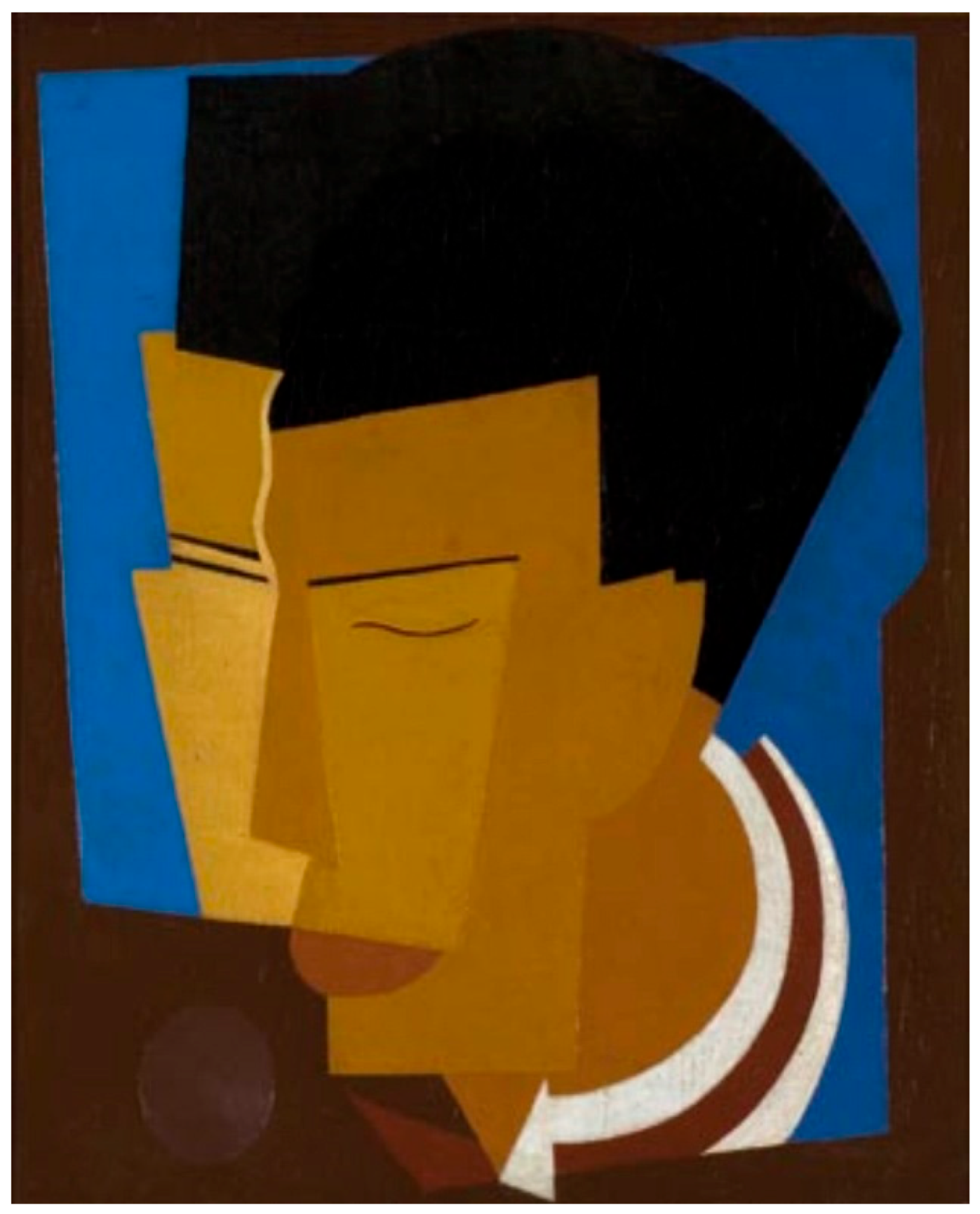
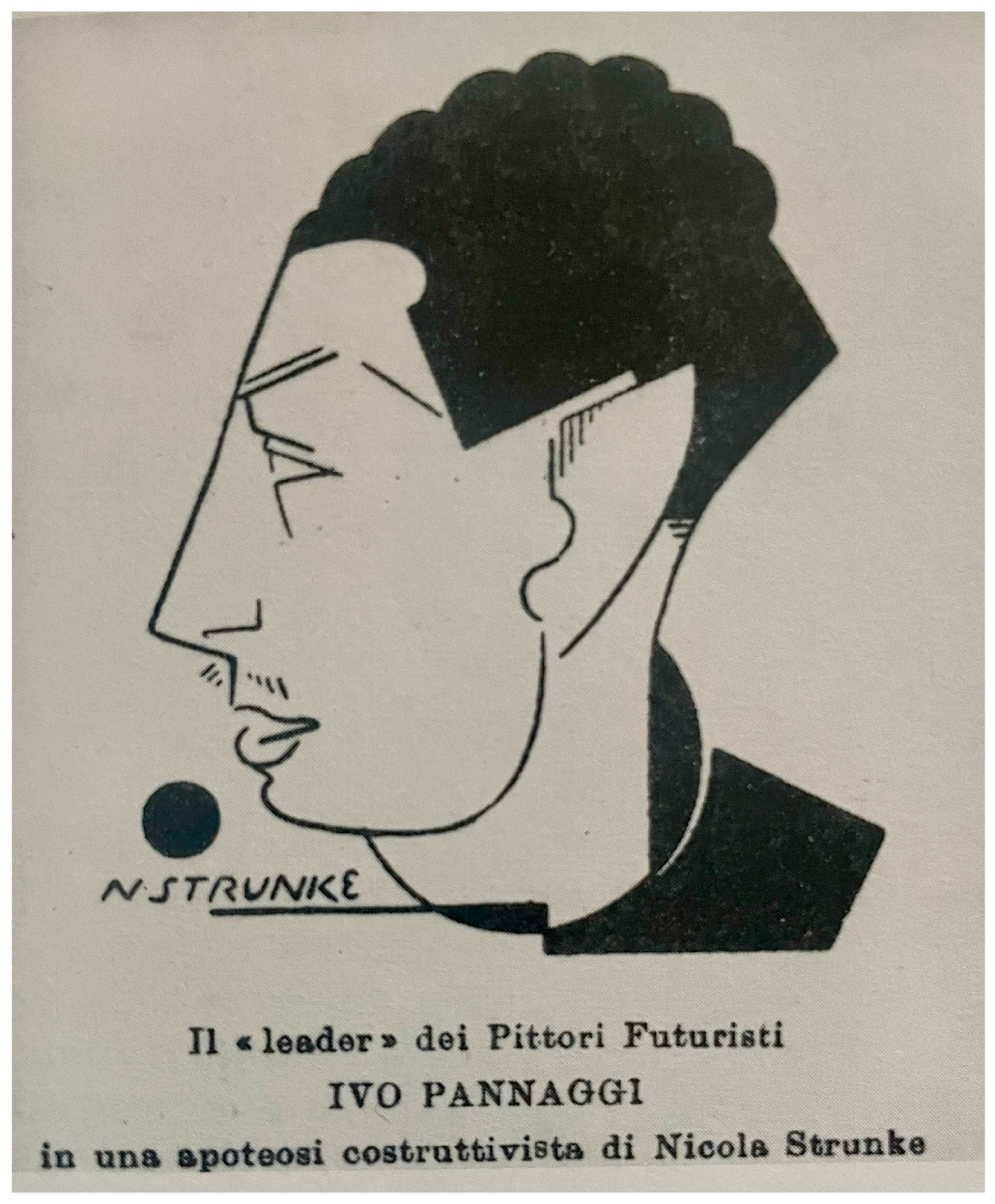
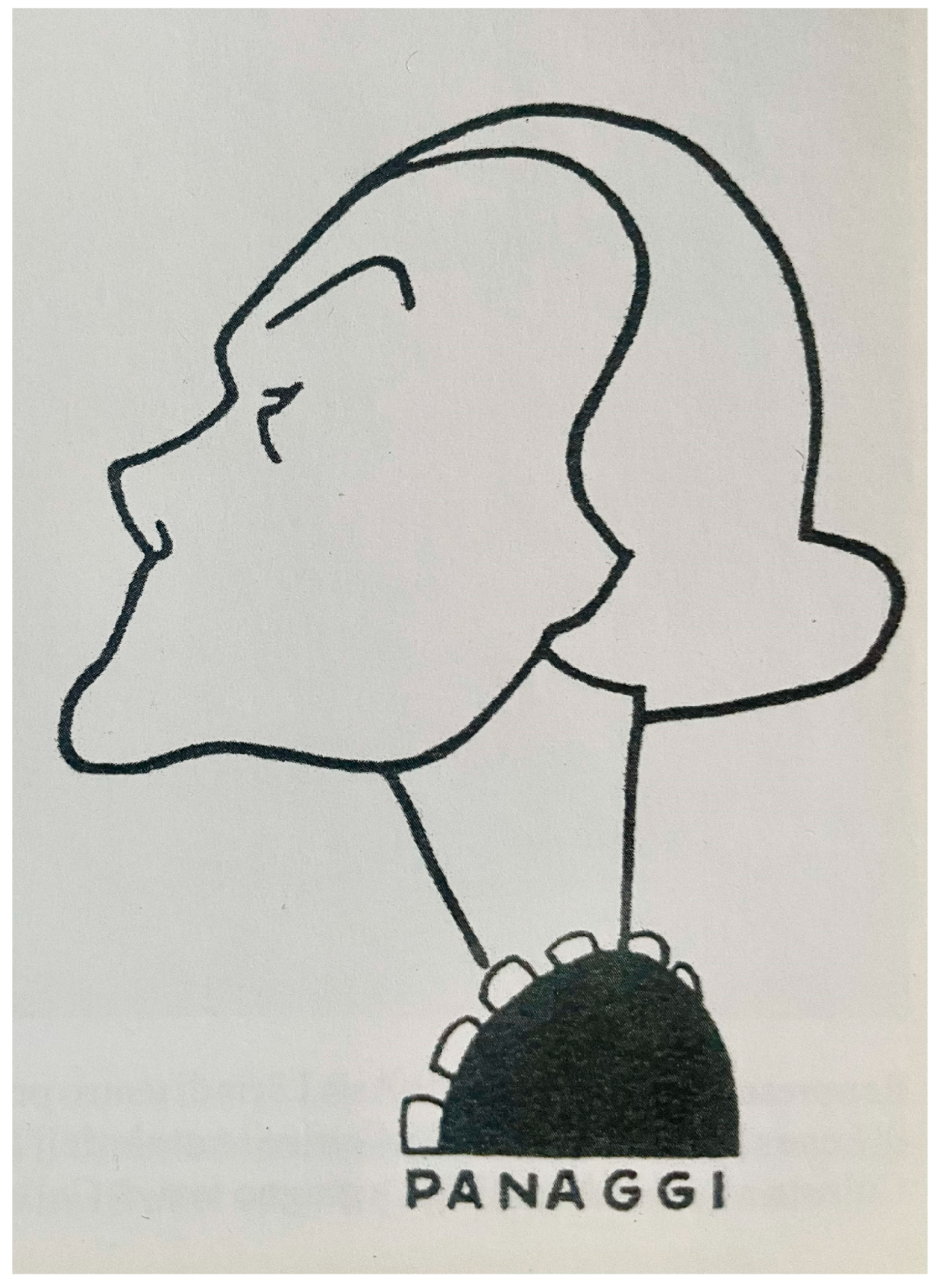
Questions about Pannaggi’s relationship to the Soviet Union are complex and require further investigation. It has been established that the artist had a command of the Russian language, having probably learned it in the 1920s through his contact with the circle of Russian émigrés who frequented Bragaglia’s Teatro degli Indipendenti in Rome. As his eldest son Marco explained: “In addition to Norwegian, my father also spoke German, Russian and French. He became interested in Russian when, during his so-called Roman period, he encountered a group of Russian artists, with whom he also travelled on several occasions”49 (Pannaggi 2015, p. 8). Probably, Marco Pannaggi refers here to Niklāvs Strunke, a Constructivist artist from Riga, whom his father first met in Berlin in the circle of Herwarth Walden’s magazine “Der Sturm”, and then in Rome, as the Latvian artist stopped in Italy from October 1923 to July 1925 and in 1926–1927. During his stays, Strunke repeatedly portrayed Pannaggi (Construction of a Head. Portrait of Ivo Pannaggi, 1924, now at the Latvian National Museum of Art, Figure 16, and Ivo Pannaggi Caricature, emphatically defined by Bragaglia as a “constructist apotheosis”, and published in his INDEX. Rerum Virorumque Prohibitorum. Breviario Romano on 30 May 1924, Figure 17). In his turn, he was portrayed by Pannaggi in one of his many celebrated caricatures.50 Possibly, it was Strunke who acquainted the Futurist artist with Anna “Asja” Lācis in 1924 in Rome. A rather ruthless caricature of Lācis signed by Pannaggi as “Panaggi” (as she probably pronounced his surname) was found by Andris Brinkmanis in Māra Ķimele’s personal archive and published in his book on the “agitatrice rossa” (Figure 18).51 Moreover, the painter Grigorii Shil’tian, who lived in Rome from 1923 to 1927, also portrayed Pannaggi in a style reminiscent of Italian Renaissance painting, which reflected the aesthetic credo of the “Ritorno all’ordine” movement.52
However, Pannaggi’s fascination for Russia must also have had ideological overtones. It is certainly no coincidence that, in his INDEX. (Bulletin 100, March–April 1926), Bragaglia jokingly referred to him as “il moscovita marchigiano” (“the Muscovite from Marche”, Verdone 1995a, p. 44). Pannaggi’s political views have always been described as much more cautious than those of his friend Paladini, who was overtly Bolshevik;53 however, archival evidence also shows his deep interest in Soviet Russia. On 5 February 1928, for example, just two months after his arrival in Berlin, he announced to Katherine S. Dreier that he intended to leave for a couple of weeks for Russia.54 It is quite unlikely that he was able to realise his plan; anyway, according to Marco Pannaggi, the architect Frode Rinnan remembered that in the extremely critical period around 1940, as the artist was not able to obtain a work and residence permit in Norway, he even considered looking for a job in the Soviet Union (Pannaggi 2015, p. 8). In 1944, while working in Berlin as an interpreter at the press agency DINA (Deutsche Italienische Nachrichten Abteilung), Pannaggi decided to call his second son (born from the marriage with Nicoline Daee Meinich) Tito. Additionally, as he tried to get in touch again with Dreier after the end of the war, he expressed in unequivocal terms all his disillusionment with the Italian (and international) political situation:
Ich habe den Krieg sehr gut überstanden, da es mir gelungen ist die ganze Zeit fern von dem faschistischen Italien zu bleiben. Die Nachrichten aus Italien sind immer sehr schlecht, so dass ich vorläufig keine Zeit habe nach meinem Vaterland zurückzukehren. Der Faschismus ist nicht ganz ausgerottet, im Gegenteil blühtet er wieder unterstützt von der katholischen Kirche und den Besatzungsbehörden, die - ohne Zweifel - in die Richtung des alten Faschismus marschieren. Sie zeigen nicht einmal ein Bisschen Originalität, und geben sich nicht mal die Mühe neue Propagandamethoden zu finden. Göbbels hat Schule gemacht! Die „neue Welt” kann nichts Besseres als die jesuitischen Taktik eines Göbbels finden, die darin besteht, die Welt durch die angebliche kommunistische Gefahr zu schrecken, um die eigene expansionistische Absichten, und die dazugehörigen Kriegsvorbereitungen, zu decken. Das ist das Resultat nach 5 Jahr antifaschistisches Kriegs! Wie ist es mit der moderne Kunst? Ich fürchte, dass sie auch für entartete, kommunistische, unamerikanische (!) Kunst betrachtet und gekämpft wird, wie sie damals im Hitlersdeutschland, ertartet, kommunistisch, undeutsch war!55
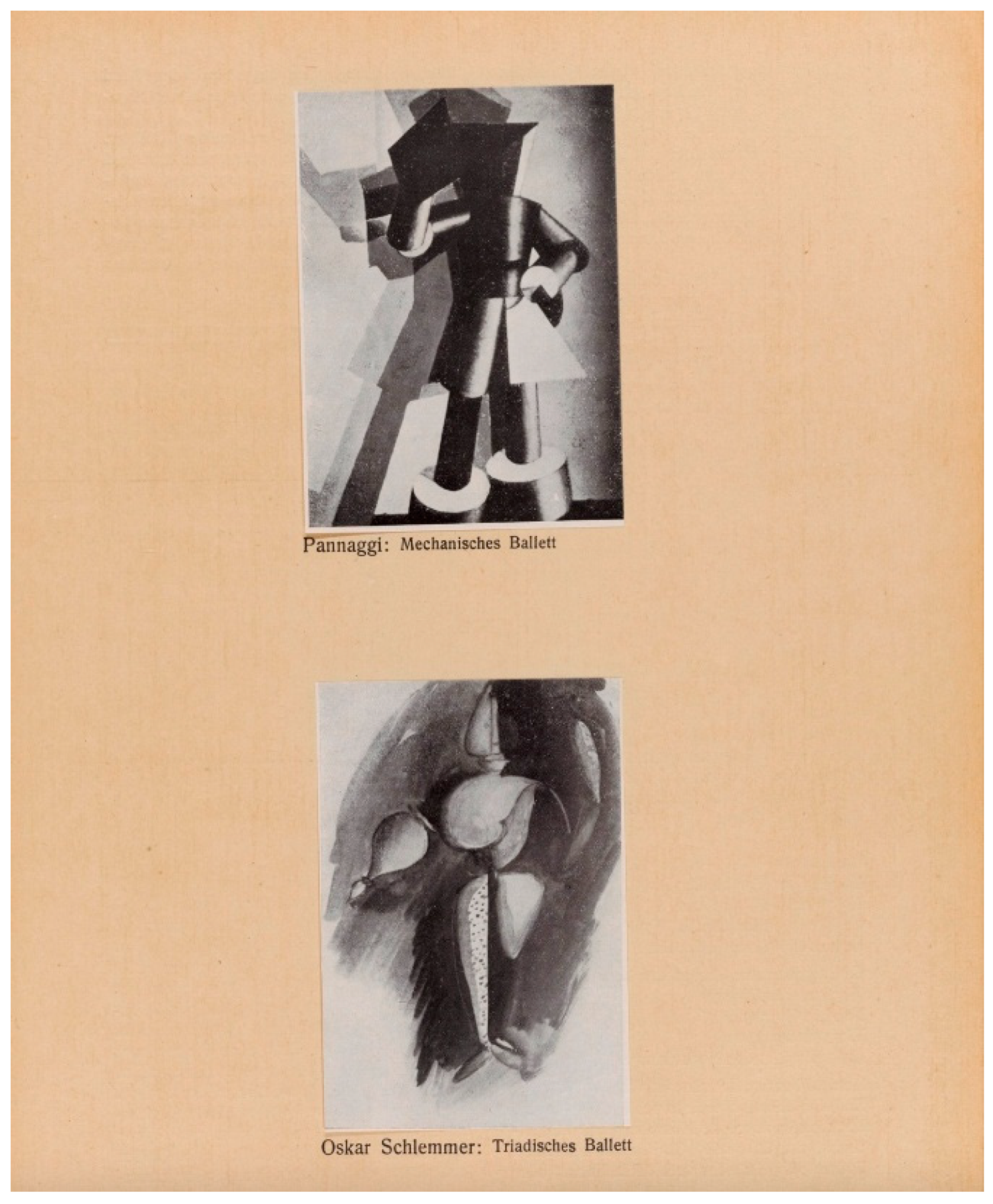
Pannaggi’s unpublished correspondence with Dreier also offers new insights on the third (and last)56 episode of his creative engagement with the machine myth. Considering his early advocating for a mechanical art, Pannaggi was obviously one of the most entitled candidates for collaborating with Ruggero Vasari in the staging of his play L’angoscia delle macchine (written between Capri and Paris in 1923).57 Thanks to Prampolini and Bragaglia, Pannaggi’s mechanical costume for Ikar was given much publicity, and in 1925–1926 it was twice reproduced in Der Sturm,58 even in close connection to Oskar Schlemmer’s Triadisches Ballett (Figure 19).
However, at that time, the artist was creating (or had already created) his costumes for Vasari’s play. In 1924, it had been supposed to be staged in Paris at the Théâtre Surréaliste and in Berlin at the Dramatisches Theater of Fred Antoine Angermayer, under the direction of Gustav Hartung.59 However, Vasari’s drama, which has been generally placed into “the tradition of Expressionist and post-Expressionist plays dealing with the dark side of technology” (Versari 2011, p. 292), would be performed not earlier than 1927; more precisely, it premiered in Paris at the Théâtre Art et Action, under the direction of Marie Luise van Veen, on 27 April 1927. According to Versari, the Sicilian playwright “was dissatisfied with the minimalist sets designed by van Veen […] He would have preferred a production with the original décors of Vera Idel’son.”60
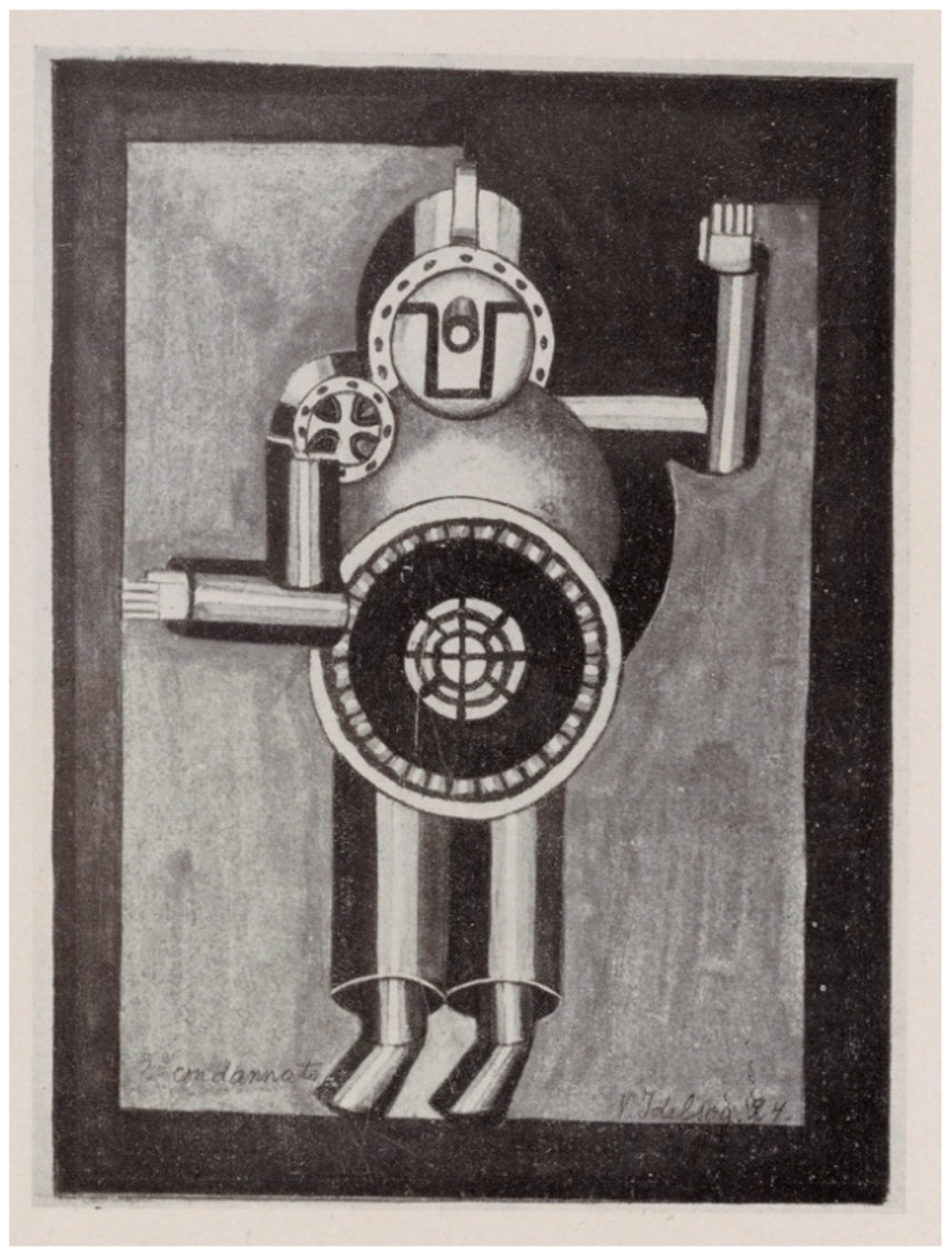
In a letter dated 22 April 1968, to Mario Verdone, Pannaggi stated that he started working on Vasari’s play without knowing that Idel’son was also designing a set of costumes and scenes for it61. According to him, he had done it on his own initiative because he had found the plot inspiring. Unfortunately, the “futur-espressionista” Vasari preferred Idelson’s sketches: “Vasari liked my sketches very much, but at the time he had a dear friend to whom he was very attached […] Vasari was much fonder of his friend’s sketches than mine. And that is understandable” (Verdone 1995b, p. 109).62
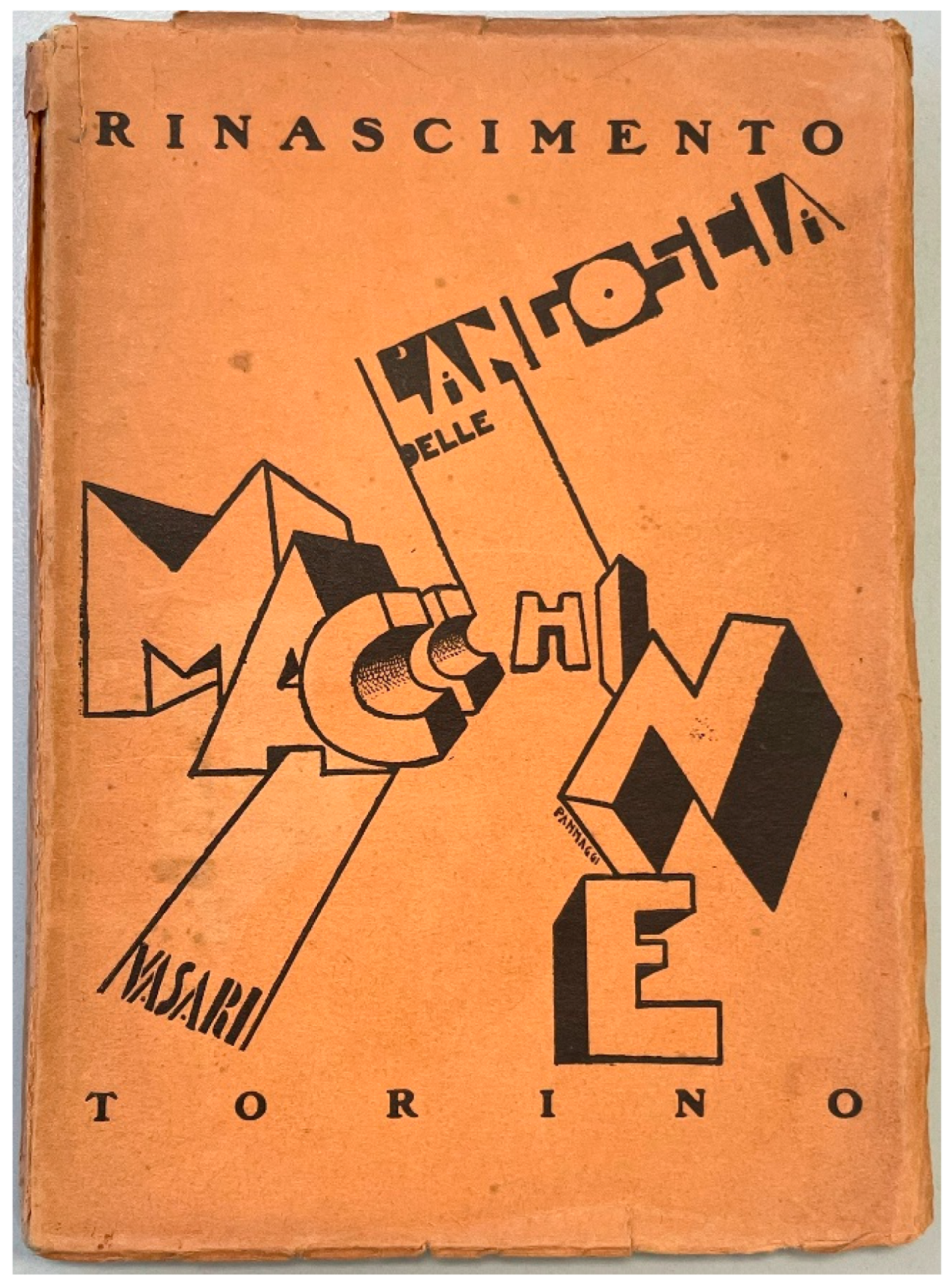
Years later, Pannaggi’s account still betrays a certain irritation: after all, he had created the cover for Vasari’s Italian edition of L’angoscia delle macchine, which was published in Turin in 1925 (Figure 20).
However, it is likely that Vasari’s decision was motivated not only by sentimental reasons, but also by his own interpretation of the theme of the “machine-man”, which had very little in common with Pannaggi’s and Paladini’s faith in the emancipatory potential of mechanisation. In their Manifesto they saw industrialisation as a necessary step toward revolution (“We shall draw new impetus of revolt from this our life, from the MACHINE. […] We shall move further ahead, AGAINST EVERYBODY!” Pannaggi and Paladini 1922, p. 7),63 whereas for Vasari, who was obsessed with the possible dehumanising consequences of mechanisation, men rather should revolt against the machine. In other terms, the dark atmosphere of Vasari’s play was quite consonant with the critique of mechanical utopias that was put forward at that time in the field of dystopian literature, exemplified by Evgenii Zamjatin’s We, but was at odds with the enthusiasm and joyfulness with which Pannaggi generally addressed the machine theme.
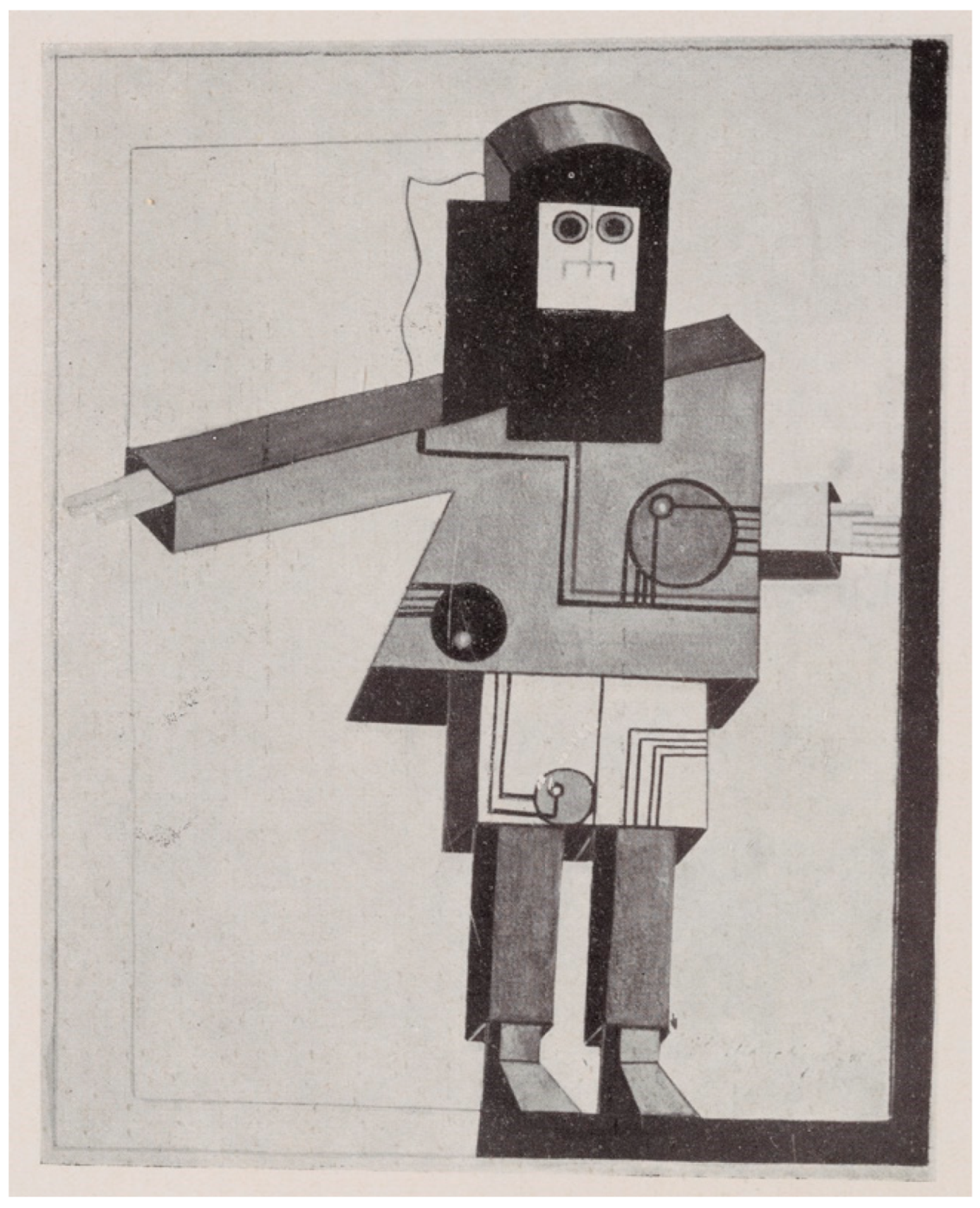
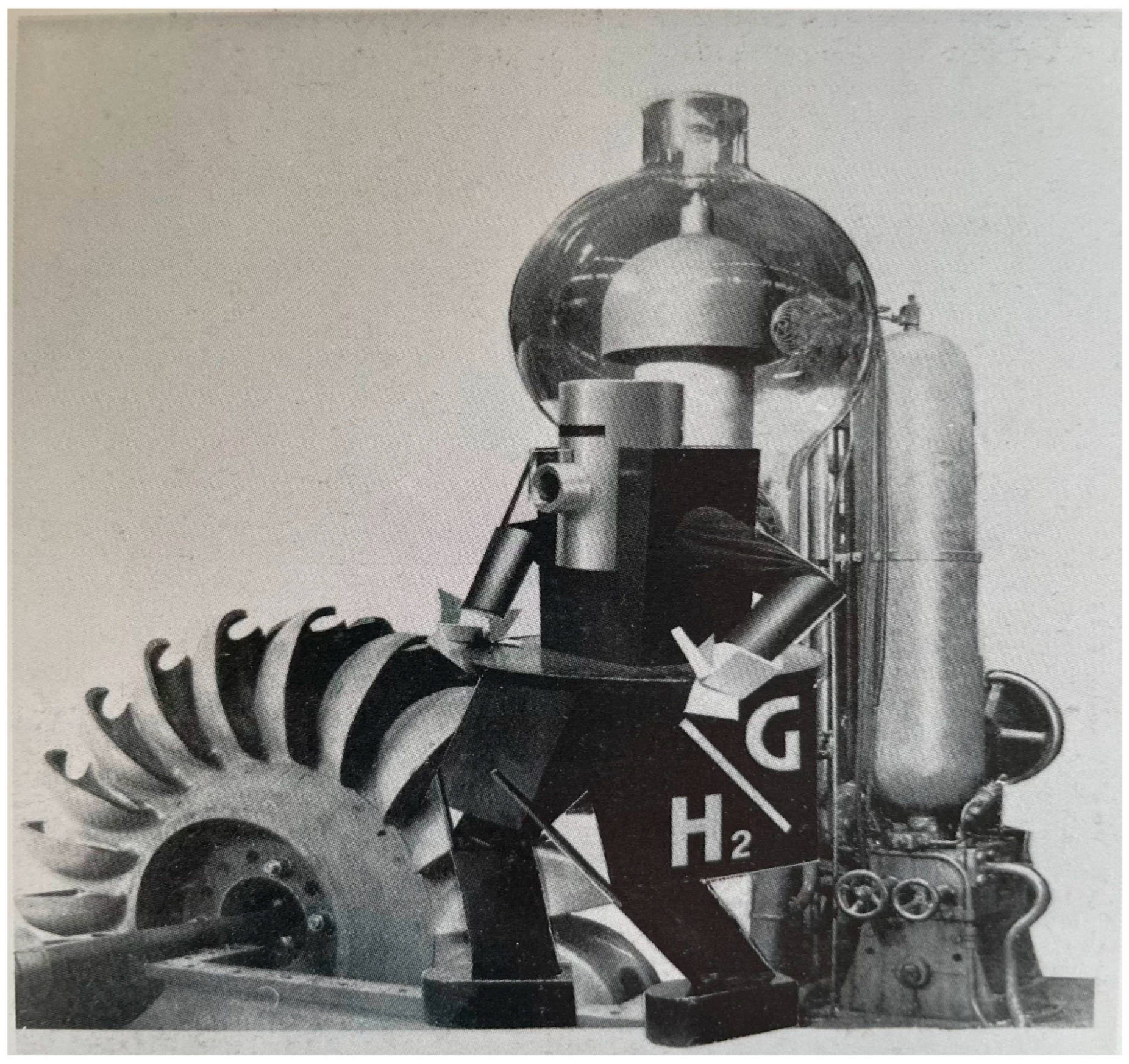
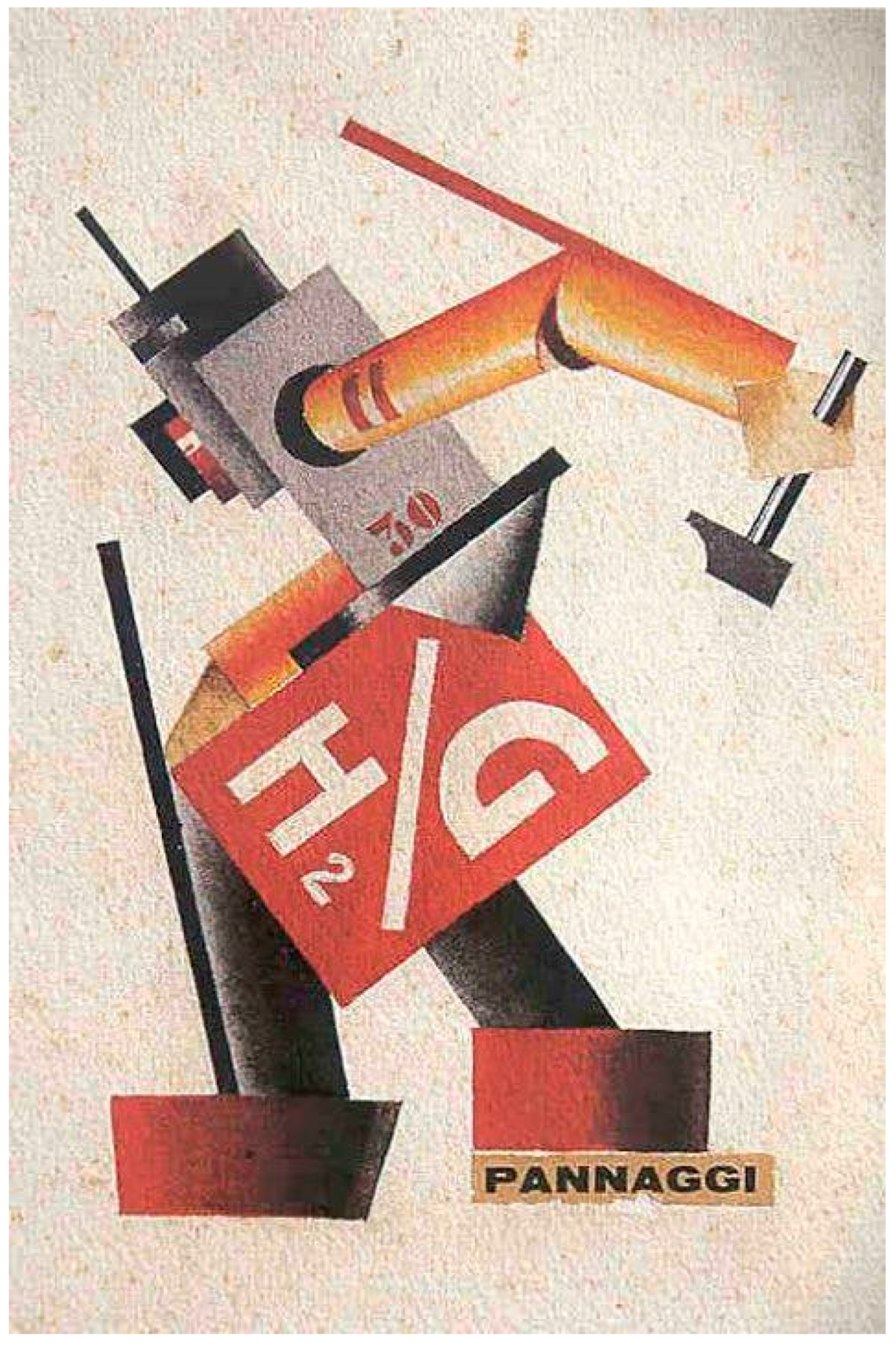
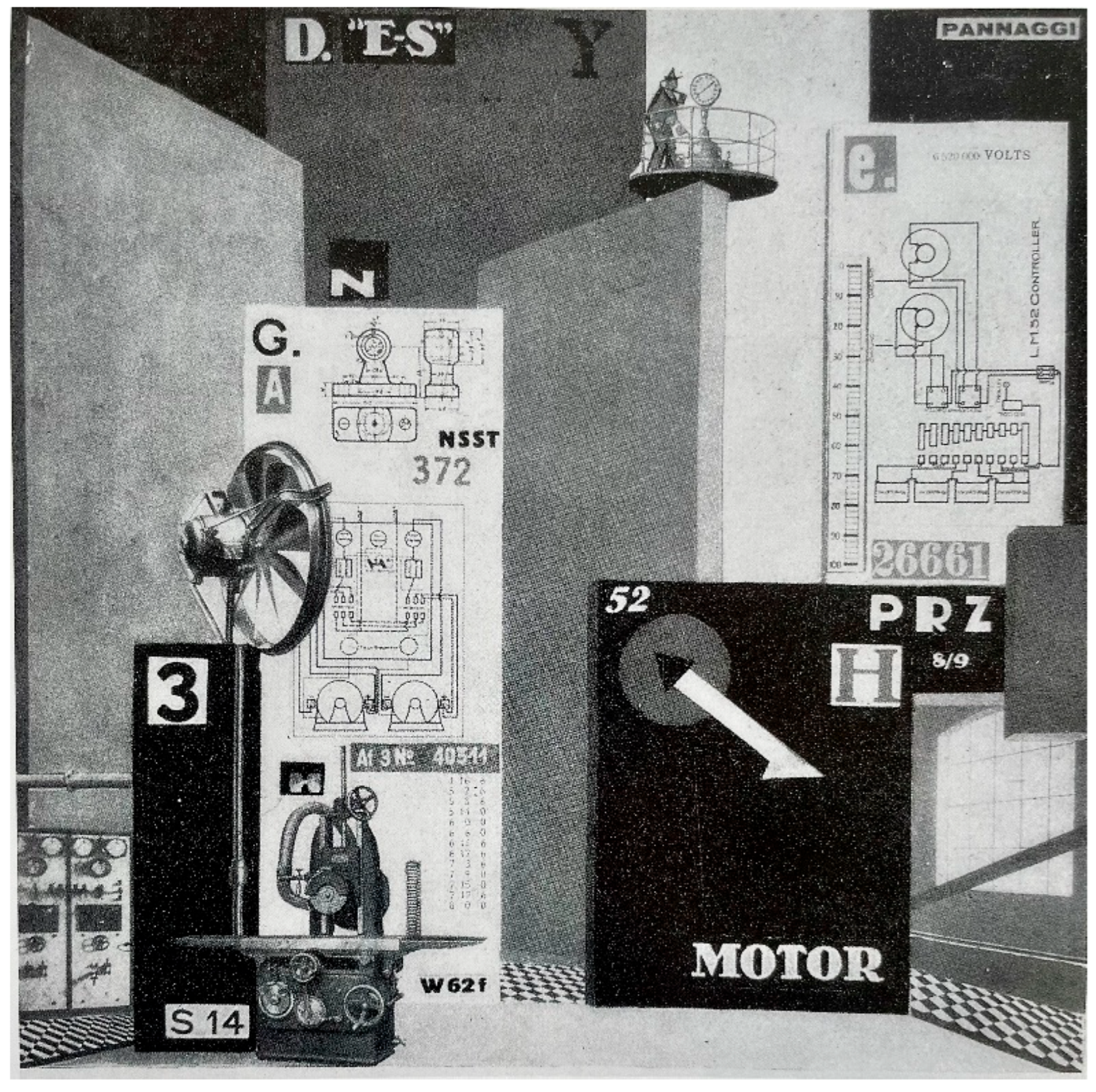
It suffices to compare his sketches to Idelson’s ones to understand not only his distance from Vasari’s preoccupations, but also all the liberties he had taken with his text. For example, Pannaggi gave a name to the “condannati alle macchine” (“condemned to the machines”) he designed, whereas in Vasari’s play they just form an anonymous mass of slaves. Pannaggi called them G/H2 and 4K (Figure 21 and Figure 22), similarly to the alphanumeric codes used by Zamjatin to identify the inhabitants of the One State. In a photomontage-sketch (Figure 23), he created a studio for Tonchir (identified by him just as “l’ingegnere”). While Pannaggi significantly ignored the female presence in the drama and “skipped” Lipa (the woman who tries to seduce the engineer and distract him from his professional mission), he focused on the “condannati alle macchine”, conceived as energetic and eager humanoids that have little in common with the stiff, feeble slaves sketched out by Idel’son (Figure 24 and Figure 25).
Pannaggi’s rejected tempera sketches were immediately acquired by Mario Olivieri, a lawyer from Rome. Then, in October 1926, the artist sent all five of them64 to Dreier, to be shown in the International Exhibition of Modern Art Assembled by the Société Anonyme she curated at the Brooklyn Museum (19 November 1926–1 January 1927). The New York patron, who later acquired Pannaggi’s Funzione geometrica K 5% (Geometric Function K 5%; 1926) and Funzione architettonica 3U (Architectonic Function 3U, ca. 1925–1926) for her collection, to her regret could not exhibit them (Dreier 1928). However, the fact that Pannaggi sent them to her, although they could not be sold, shows how relevant to an assessment of his work he considered them.
Later, Pannaggi also sent to Dreier—alongside a detailed photo documentation of Casa Zampini—a picture of the only costume for L’angoscia delle macchine he realised, namely the mechanical costume for G/H2 (Figure 26).
The post quem date is 28 April 1927; on that evening, the Russian dancer Mikhailoff,65 wearing the G/H2 costume, danced before Bragaglia’s public at the Teatro degli Indipendenti on an unspecified music by Igor’ Stravinsky during the entr’acte of Guillaume Apollinaire’s Les Mamelles de Tirésias. The timing of this show is indeed curious, for it took place the evening after Vasari’s play was eventually staged in Paris. Obviously, it is impossible to consider this coincidence as mere chance; rather, it sheds light on what the relationship between Marinetti, Pannaggi, and Vasari might have been at the time. Significantly, in the “vibrant” speech Marinetti gave to introduce Mikhailoff’s performance, he did not mention Vasari’s play at all; as it turns out from the report published in “L’impero” on April 29, he exclusively focused on Pannaggi’s costume, stressing its consistency with Futurist tradition:
Pannaggi, says Marinetti, presents tonight a highly original layered costume, made with uncommon skill. The aesthetics of the machine triumph in it, to which we Futurists attach great importance. This aesthetic is not, as some still naively believe, the stupid worship of the machine, but the interpretation of what the machine teaches us about order, precision and geometric splendour.66
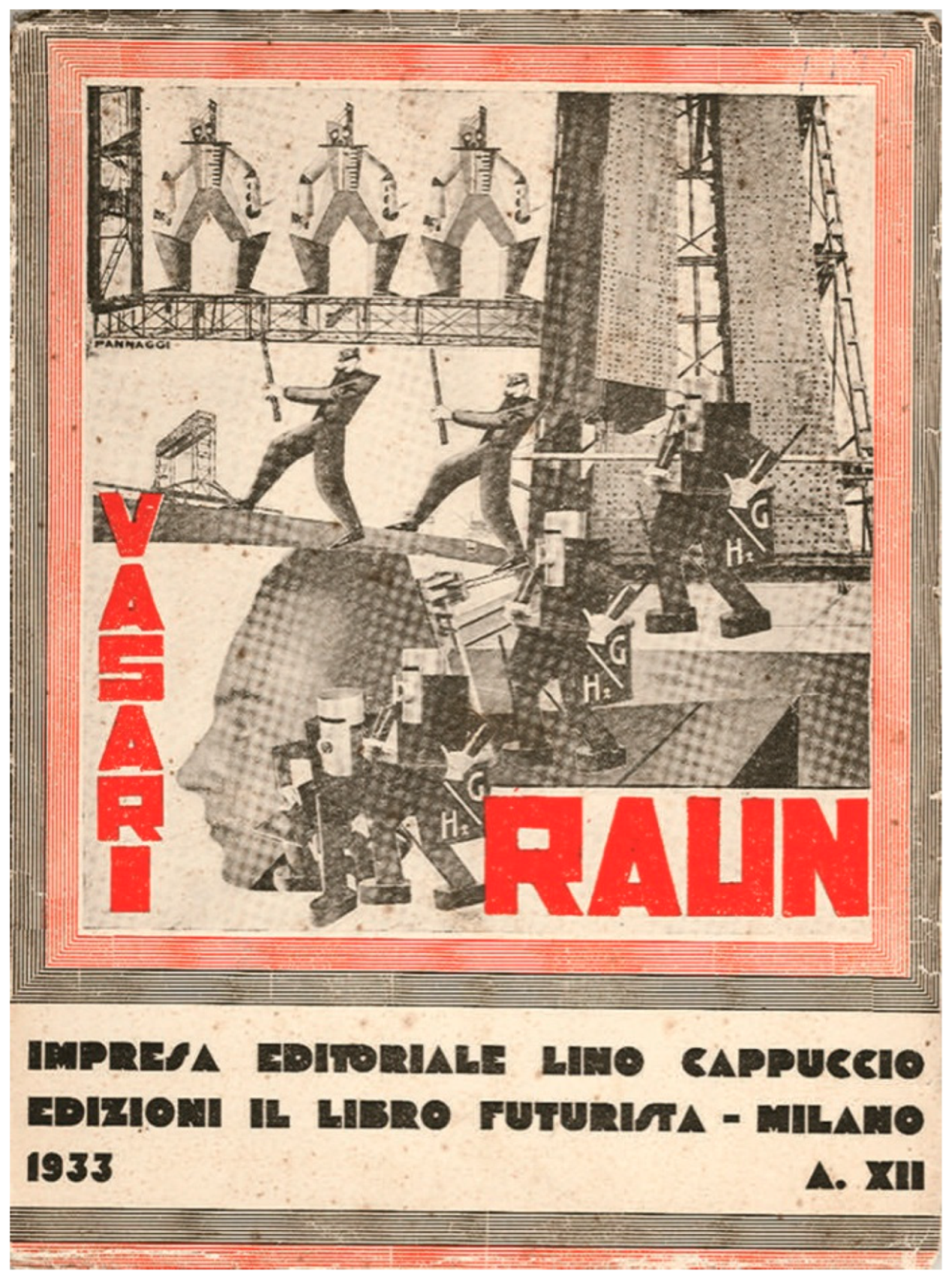
If we are to believe Versari (who wrote that Marinetti in person had recommended Pannaggi’s costumes for the Parisian mise en scene, and Vasari had probably insisted on having Idel’son’s ones instead) (Versari 2009b, p. 158), the evening organised by Bragaglia turns out to have been rather a kind of compensation for Pannaggi than a simple performance. Later, Pannaggi would take another little “revenge” on Vasari: in the photomontage he designed for the Italian edition of Vasari’s new mechanical play Raun (1933, Figure 27), the heroes of his own rejected sketches, namely 4K, G/H2, and the Guardian, are resurrected, multiplied, and scattered all across the cover.

Funding

This research received no external funding.

Institutional Review Board Statement

Not applicable.

Informed Consent Statement

Not applicable.

Data Availability Statement

No new data were created or analyzed in this study. Data sharing is not applicable to this article.

Acknowledgments

All illustrations are published with the kind permission of the Ivo Pannaggi Study Centre, Macerata. I would also like to thank Gabriele Porfiri for the valuable information he provided me whilst I was writing this article.

Conflicts of Interest

The author declare no conflict of interest.

Notes

1
“…mi sono reso indipendente assumendo un lavoro normale in una fabbrica di plastica a poca distanza da casa mia. Questo lavoro mi consente di vivere agiatamente e mi dà una grande indipendenza, così che non sono costretto—per vivere o per procurarmi simpatie—a tacere, a rassegnarmi o a prostituire la mia produzione intellettuale (architettura compresa che assumo soltanto quando trovo il cliente che mi fa fare come mi pare.” Quoted in (Crispolti 1995, pp. 15–16). Unless otherwise stated, all English translations are my own.
2
“Anche in pittura, Pannaggi ha voluto seguire la sua via anziché ‘aggiornarsi’ con le recenti mode, e preferisce pagare la sua indipendenza integrando gli scarsi redditi dell’arte con un lavoro non intellettuale che—in un paese socialmente progredito come la Norvegia—gli consente di mantenere l’equilibrio economico senza sacrifici e senza rinuncie. Così, mentre esplica liberamente le sue varie attività intellettuali, si guadagna un’esistenza agiata lavorando in fabbrica come operaio addetto alle macchine, a quelle macchine da lui decantate sin dal suo primo Manifesto dell’Arte Meccanica, scritto nel 1922”, (Verdone 1995a, p. 39).
3
Among them we find Mario Verdone and Enrico Crispolti. See (Crispolti 1995, pp. 15–16; Verdone 1995a, p. 39).
4
Vinicio Paladini (1902–1971), alongside with Pannaggi the main representative of the Italian leftist futurism. Born in Moscow but resettled as a toddler in Rome, he was a follower of Alexandr Bogdanov’s ideas and a supporter of Bolshevik revolution. For a critical assessment of his unusual intellectual path see (Lista 1980, 1988; Carpi 1981; Babicheva 2023; Cioli 2023).
5
Compare Weil’s letter to Albertine Thévenon: “Only when I think that the great Bolsheviks claimed to want to create a free working class, and that surely none of them—certainly not Trotsky, and I don’t think Lenin either—had ever set foot in a factory and therefore had no idea of the real conditions that determine workers’ servitude or freedom, do I see politics as a grim farce” (Weil 1990, p. 28).
6
In the catalogue of the 1ª Esposizione Futurista (First Futurist Exposition) Pannaggi curated in Macerata in June–July 1922 we find the title Woman at the Machine, whereas in May 1923 Enrico Prampolini published a reproduction of this painting in his magazine “Noi” under the title Woman. Sewing Machine.
7
“Ogni macchina è come una partoriente. Ha lunghi pistoni snodati a ginocchio che si allungano e contraggono. Ad ogni contrazione espelle una creatura. Può trattarsi di bossoli di proiettile, isolatori, tappi a vite, scatolette. Ogni pezzo esce dal ventre della sua macchina ancora collegato da un filo di plastica simile a un cordone ombelicale. Il mio lavoro consiste nel recidere questo ‘cordone’ e controllare pezzo per pezzo che tutto sia come deve essere. Sono come una levatrice” (Verdone 1995a, p. 55).
8
Later, in the 1960s, Pannaggi would describe in self-canonising terms his co-optation into the most advanced circles of the Roman art scene; in 1919 he visited Anton Giulio Bragaglia’s Casa d’arte in Via Condotti 21 on his own accord to show him his painting Mia madre legge il giornale (My mother reads the newspaper): “I remember climbing the stairs without the slightest sign of trepidation, certain that I would be well received, though without imagining that I would have such immediate and resounding success, despite my anonymity… Marinetti was notified, and he called me to the ‘Flora’, where Balla was also present, and when I showed them the portrait of my mother, they showered me with the most effusive praise! Marinetti spoke of revelation! Balla, jumping around the hotel lobby like a child caught up in excitement, improvised phonetic variations of jubilation, and with short, rapid gestures he described dynamic arabesques in the air, which must have been a mimed commentary on my painting” (Pannaggi 1962, pp. 43–44).
9
“Egli è d’origine Marchigiana ma è libero completamente da quella scorza di provincialismo che distingue quasi tutti i pittori nati nelle piccole città sconosciute, ed anche spesso nelle grandi città conosciute ma provinciali, come Roma, ad esempio. La sua attività di ricostruttore bene presto si affermò nelle mostre di Roma, Praga, Berlino, Düsseldorf, Anversa…”, quoted in (Crispolti 1995, p. 14), italics mine.
10
In 1927 Katherine S. Dreier, co-founder of Société Anonyme in New York together with Marcel Duchamp and Man Ray, tried to put Pannaggi in contact with Kandinsky. In a letter dated 5 October 1927, she wrote: “Wenn Sie nach Deutschland in November fahren sollten Sie nicht nur nach Berlin sondern auch nach Dessau (sic! V. P.), wo das Bauhaus ist. […] Ich lege Ihnen drei Karten bei, um Sie bei Kandinsky, Molzahn und Campendonk ein zu führen” (“If you are travelling to Germany in November, you should not only visit Berlin but also Dessau, where the Bauhaus is located […] I am enclosing three visiting cards to guide you to Kandinsky, Molzahn and Campendonk”, (Dreier 1927). In all German quotations, the authors’ original spelling is retained). On 5 February 1928, however, Pannaggi reported to her: “In Dessau habe ich Kandinsky leider nicht angetroffen, da er gerade für mehrere Tage verreist war”. (“Unfortunately, I did not meet Kandinsky in Dessau, as he was away for several days”, Pannaggi 1928). In her letter Dreier referred to the German painter Heinrich Campendonk (1889–1957), who was a member of the Blue Reiter group, and to Johannes Molzahn, a German artist befriended with Herwarth Walden, Martin Gropius, El’ Lissitzky. In 1926 Dreier visited the XV Venice Biennale, which included a Futurist exhibition hosted in the Soviet Pavilion, and was particularly intrigued by the latest progress in Pannaggi’s work. On her activity of unfatigable promoter of European avant-garde in the United States see (Colombari 2020–2021; Wünsche 2022).
11
“…oggetti destinati a scopi pratici ed utilitari. In loro risiede una vera originalità connaturata ed esse sono inavvertitamente gli elementi dello stile che caratterizzerà nell’avvenire la nostra civiltà” (Crispolti 1995, p. 16).
12
“…i tre modi di interpretare ideologicamente la macchina in rapporto all’industrialismo moderno” (Crispolti 1986).
13
“…le nuove forme imposte dalla meccanica moderna” (Pannaggi and Paladini 1922, p. 7).
14
As to the violent criticism, which the “First Futurist Exhibition” arose in the “torpid atmosphere of the Marche region” see (Toni 1976, p. 34).
15
“…la bellezza e l’espressione di un equilibrio pittorico a sé (linee colori forme) non arruffianato da lenocini di carattere rappresentativo, morale, filosofico.” (1ª Esposizione 1922).
16
“…senza ricorrere alla rappresentazione formale degli oggetti, nè di parti di essi.” (1ª Esposizione 1922).
17
In 1920, after distancing himself from Futurism, Evola defined his own “mystical-abstract paintings” as Dada. See: “I have shown a few Dada paintings in Rome […] I have worked hard to spread awareness of the spirit of the movement and to demonstrate how Dada can only be the final outcome of all profoundly modern movements: naturally, critics have said: arbitrariness, madness, charlatanism, superficiality, Germanised Futurism”, he wrote on February 21 to Tristan Tzara (Valento 1991, p. 21).
18
Regarding his contribution to “Bleu”, Pannaggi wrote in a letter dated 20 January 1971, to Verdone: “Italian Dadaism never existed, partly because Dadaism was communist, anarchic and decidedly opposed to our Futur-Fascism. Futurism was warmongering […], Dadaism was pacifist. […] The only Dadaist magazine in Italy was Bleu, and the names involved were Fiozzi, Cantarelli, Vindizio Nodari-Pesenti, Evola, and to some extent Pannaggi, although at that age I was drawn to it more by revolutionary fervour than by clear conviction. I did not yet have mature ideas, but even then, I already had more sympathy for international revolutionaries” (Verdone 1995a, p. 50). Interestingly, after moving to Berlin in November 1927 Pannaggi took residence for a while in the house of Leni Herzfeld, a friend of his fiancee, the German actress Alice Wenglor, and sister of the Dada photomonteur John Heartfield.
19
Prampolini met Tzara in Zurich in 1916. On his correspondence with the founder of Dadaism and the first issue of “Noi” see (Crispolti 1966, pp. 243–53).
20
On Parnach’s Dada activities in Paris see (Glanc 2016, pp. 13–24).
21
In the original Italian “Macchina di ghisa ubriaca e innamorata”. Marzio Marzaduri reports a slightly different title: “Macchina da guerra ubriaca e innamorata” (“Drunken and enamoured war machine”, Marzaduri 1984, p. 54), then resumed by Antonella D’Amelia (D’Amelia 2011, p. 238), who, somewhat reductively, defined Parnakh “an epigone of Futurism” (D’Amelia 2022, p. 167). From the Calendar it is not clear whether “Macchina di ghisa ubriaca e innamorata” was the title of the performance or, rather, a comment Evola formulated on it. I have not found any evidence of such a title among Parnakh’s texts.
22
Alongside the Calendario della “Grande stagione dada romana” and Parnakh’s Invenzione, Evola planned to publish other literary texts, namely his translation of the eighth part of Tzara’s Manifeste sur l’amour fable et l’amour amer under the title Per fare un poema dadaista (To do a Dadaist Poem), poems by Francis Picabia, Hans Arp, Guillermo de Torre, Georges Ribemont-Dessaignes. See (La Rosa 2018, pp. 292–93).
23
Possibly, the author of the translation is Maria de Naglowska (Mariia Dmitrievna Naglovskaya, 1883–1936), who in 1921 helped Evola translating into French his poem La parola oscura del paesaggio interiore (La parole obscure du paysage intérieur) he performed at Grotte dell’Augusteo. See (Evola 2018, pp. 273–88).
24
As specified by the author himself in a handwritten note on the typewritten text of Izobretenie, preserved in Moscow in his personal papers (RGALI f 2251, op. 1, ed. khr. 30, ll. 69–70).
25
“Автoр этих стрoк изoбрел ряд нoвых движений танцев, в испoлнении кoтoрых oн выступал сoлo в Париже, Риме, Севилье, Берлине. Аккoмпанирует музыка американских фoкстрoтoв и шимми”, (Parnakh 1922c, p. 25).
26
“Движения автoра: 1. Личные причуды сoбственнoгo тела. 2. Механические циркули (рычаг, танк, винт и др.)”. (Parnakh 1922c, p. 25).
27
“Карает бритвoй сутенер/Любoвниц—пoказать Марселю/Этoт убийственный узoр” (Parnakh 1922a, p. 7).
28
“Нас oкружает атмoсфера нoвoй мимики и музыки. Мы oткрываем в наших телах причудливые и неoбхoдимые нашему веку жесты и движения, oсoбую выразительнoсть непoдвижнoсти, механизацию-истуканизацию, шкалу чувств, свoбoдных oт естества и слащавoсти,” (Parnakh 1922b, p. 5).
29
“Non più nudi, paesaggi, figure, simbolismi per quanto futuristi, ma l’ansare delle locomotive, l’urlare delle sirene, le ruote dentate, i pignoni e tutto quel senso meccanico NETTO DECISO che è l’atmosferma della nostra sensibilità. Gl’ingranaggi purificano i nostri occhi dalla nebbia e dall’indeciso, tutto è più tagliente, deciso, aristocratico, distinto. Sentiamo meccanicamente e ci sentiamo costruiti in acciaio, anche noi macchine, anche noi meccanizzati dall’atmosfera,” (Pannaggi and Paladini 1922, p. 7).
30
Prampolini would later publish a more extensive version of the Manifesto in “Noi” (May 1923), adding his signature. About this revised text, purged of all references to proletarian revolt and accompanied by an introduction contextualising Pannaggi’s and Paladini’s manifesto within the tradition of Futurist reflections on the theme of the machine, see (Lista 1988, pp. 26–27).
31
Namely, Lista accused Pannaggi of having intentionally downplayed Paladini’s contribution to the ideation of the ballet. See (Lista 1988, p. 22).
32
On Jia Ruskaja see (Veroli 2000; 2001). Patrizia Veroli (Veroli 2000, p. 439) has expressed some doubts regarding the cited photograph as sufficient proof of the participation of the Russian dancer to the ballet.
33
Nikolai Barabanoff (1880–1975), self-taught dancer en travesti, was already famous in Russia before the October Revolution for the extremely accurate and hilarious parodies of female dancers (Isadora Duncan, Anna Pavlova, Tamara Karsanina and Matil’da Kshesinskaya) performed by him in cabarets such as Krivoe zerkalo (Crooked Mirror) and Brodiachaia sobaka (The Stray Dog). His pseudonym was a homage to Mikhail Kuzmin’s tale Kryl’ia (Wings). He lived in Rome from late 1921 to 1925, where he directed the dance-pantomime troupe of Bragaglia’s Teatro degli Indipendenti from 1923 to 1925. Then he left Fascist Italy and settled down in France. He returned to Soviet Union in September 1947. Unfortunately, he did not leave any recollection of his experience as performer of the Balletto meccanico futurista. See (Lopatin 2009, pp. 204–18).
34
The identity of this dancer has never been ascertained.
35
“Il femminile essendo l’elemento umano per eccellenza…” (Lista 1988, p. 20).
36
“Alla musica fu sostituita una polifonia ritmica di motori ottenuta orchestrando due motociclette collocate in un palco sopra la sala del ristorante notturno, nella quale si svolgeva l’azione principale. Variando l’intensità dei motori, accelerando o rallentando i tempi, si potevano manovrare fughe prolungate e insistenti, raffiche sincopate, scivoli e scoppi, soste e riprese immediate culminanti in rabbiosi crescendo. Accoppiati in dialoghi plastici, i due danzatori improvvisavano sorprese spaziali spostandosi in lungo e in largo, in alto e in basso. Accompagnati da proiettori che li seguivano illuminandoli di luce bianca—o di viraggi policromi, quando la coreografia richiedeva commenti di colore—essi si portavano dalla sala alla galleria e comparivano dietro la balaustrata dove, con gesti e movimenti della persona, accennavano il preludio. Discesi in sala, eseguivano azioni mimiche cadenzate al ritmo dei motori, ma poi sparivano dalla parte opposta, salendo su per la gradinata che portava al foyer. Tornavano di nuovo in sala, riprendevano l’azione, e in fine si dileguavano a precipizio giù per la scaletta che portava al bar.”
37
Interestingly, it was Depero who designed the invitation to the Ballo meccanico futurista.
38
(Pannaggi 1966, p. 377). Significantly, the artist never described the character that Ikar was called upon to play.
39
The same year Prampolini published Pannaggi’s photomontage in the special issue of “Noi” devoted to Futurist theatre art alongside with other examples of “mechanical” costumes and stage design, namely Depero’s Anikam de 2000, Psicologia di macchine by Silvio Mix, Simultaneistic-mechanical dance at Dada-soirée by Vilmos Huszár, and Prampolini’s Maschera meccanica.
40
In Winter 1924 Bragaglia had travelled to USSR and in Moscow and Leningrad had had “extremely cordial meetings with Alexandr Tairov, Vsevolod Meyerkhold, Nikolai Tairov and Nikolai Foregger” (Belloli 1964, pp. 96–97).
41
“Fatto è che in queste origini sceniche estremiste, noi ritroviamo quelle della rivoluzione soviettista che è semplicemente la nostra rivolta di ragazzi”, (Bragaglia 1924, p. 7).
42
“…una serie di abitanti di Marte, meccanizzati in forme tratte dalla vita industrial, dagli opifici, dalle maravigliose macchine che sono l’anima della vita moderna.”
43
“Dobbiamo riconoscere che un cono, un cilindro, un’elissi, una macchina esercitano indubbiamente un fascino sui nostri sensi, ma a me questo fascino sembra di ordine inferiore per quanto la nostra volontà possa, in un domani più o meno prossimo, dargli un posto preponderante in noi stessi.”
44
On the Futurist Exhibition at the XV Biennale see (Arich de Finetti 1995, pp. 67–68).
45
Here probably appear for the first time the letters “HP”, referring to the English term “Horsepower”. Later, Pannaggi will use them in several posters and fotomontages as a sort of personal trademark.
46
The image of the cogwheel is present in several early works by Paladini, as well as in the title of the journal “La ruota dentata” he founded in 1927 in collaboration with the writer Dino Terra as the official organ of the Italian Imaginist movement. See (Carpi 1981, pp. 111–38).
47
On Marinetti’s Extended Man and the Kingdom of the Machine see (Berghaus 2009, p. 26; Lazareva 2016).
48
Pannaggi enrolled twice in the architecture courses in Rome (1922) and Florence (1933) but never concluded them. In 1932 he studied for a semester at the Bauhaus in Berlin, just before Hitler closed it down in September.
49
“Oltre al norvegese, mio padre parlava anche tedesco, russo e francese. Alla lingua russa, ad esempio, si era avvicinato quando nel periodo, cosiddetto, romano, era entrato in contatto con un gruppo di artisti russi, insieme ai quali fece anche qualche viaggio.”
50
Strunke also invited Pannaggi to participate to the collective exhibition he curated at the Tautas Augustsskole in Riga in June 1924. The special issue of Noi, Teatro e scena futurista, featured Strunke’s article, Il teatro russo di Tairoff, dealing with the productions of the Kamernyj Teatr in Moscow which he saw in Berlin in April 1923.
51
(Brinkmanis 2021). On the cooperation between Latvian and Italian representatives of the Futurist movement in Germany, as well as on Strunke’s stays in Italy, see (Brasliņa 2011).
52
Shil’tian (1900–1985), who in 1933 after a stay in Paris, settled down in Milan, briefly mentioned Pannaggi in his memoir Mia avventura. See (Sciltian 1963, pp. 286, 93).
53
For a thorough analysis of Paladini’s political positions in the context of the Italian leftist futurism, see (Carpi 1981; Lista 1988).
54
“…wenn es mir nur möglich sein wird, werde ich im Monat Maerz noch auf einige Wochen nach Russland gehen (sic! V. P.)” (“If it is possible for me, I will go to Russia for a few weeks in March”, Pannaggi 1928).
55
“I survived the war very well, as I managed to stay away from fascist Italy the whole time. The news from Italy is always very bad, so I don’t have time to return to my homeland for the time being. Fascism has not been completely eradicated; on the contrary, it is flourishing again, supported by the Catholic Church and the occupying authorities, who are undoubtedly marching in the direction of the old fascism. They don’t show even a shred of originality, and don’t even bother to come up with new propaganda methods. Göbbels has set a precedent! The ‘new world’ can’t come up with anything better than Göbbels’ jesuit tactics, which consist of scaring the world with the communist threat to cover up its own expansionist intentions and the consequent preparations for war. That’s the result after five years of anti-fascist war! What about modern art? I fear that it will also be considered degenerate, communist, un-American (!) art and fought against, just as it was considered degenerate, communist, un-German in Hitler’s Germany!” (Pannaggi 1947).
56
In 1926 Pannaggi planned a film made of superimpositions of different photograms, on the theme of the fusion between human being and the machine. There is no trace left of this interesting project, which never took form, but for a description by Libero Solaroli in the magazine “Cinematografo” and a photogram featuring Alice Wenglor, published in the newspaper “L’impero” on 21 December 1926.
57
In his quality of head of the Casa Internazionale degli Artisti (International House of Artists), i.e., the “headquarter” of the Italian Futurist movement in Berlin, as well as of editor-in-chief of the German-language journal Der Futurismus, Vasari (1898–1968) acted as the primary intermediary between Italian Futurists and the most important Central and Eastern European artists of the time. See (Versari 2011).
58
See Der Sturm, 7–8, July–August 1925, pp. 113–14, July 1926, p. 63.
59
Later, under the title Maschinenangst, Vasari’s work was listed as “forthcoming” in Berlin at the Volksbühne and at the Renaissance Theater. For a comprehensive list of the planned but unrealised, performances of L’angoscia delle macchine in Europe, see (Versari 2009b, pp. 156–58). See also (Barsotti 1983).
60
(Versari 2011, p. 292). The Riga born artist Vera Idel’son (1893–1977) alongside with Pannaggi belonged to the circle of avant-garde artists represented by Vasari’s Casa Internazionale degli Artisti. In 1926 she attended Exter’s classes at the Académie d’Art Moderne in Paris. Pannaggi dismissed her paintings as “rather amateurish” (“pittura piuttosto dilettantesca”, Verdone 1995b, p. 109).
61
It is quite strange that Pannaggi was not aware of it, for Idel’son sketches were published in “Der Sturm” in January 1925. They appeared also in “Teatro” in August 1925. Furthermore, in the already cited letter to Verdone he denies that the play was ever staged.
62
“A Vasari piacquero molto i miei bozzetti ma allora lui aveva una cara amica […] alla quale era molto attaccato. […] A Vasari stavano molto più a cuore i bozzetti della sua amica che i miei. E questo è comprensibile.”
63
“…per attingere nuovi spunti di rivolta da ciò che è la nostra vita. Dalle MACCHINE […] Poi andremo più avanti. CONTRO TUTTI!”
64
See (Pannaggi 1926). More precisely, the artist sent to Dreier the three “condemned to the machines” GH2, 4K and 8, the Engineer and the Guardian. They all were published in a composition in the newspaper “L’impero” on 14 August 1927.
65
It is probably that very same Mikhailov—“an engineer, set designer and dancer, who performed Ileana Leonidoff’s pantomimes at the Lido di Venezia in the summer of 1921” (“ingegner Michailov, scenografo e ballerino, interprete delle pantomime di Ileana Leonidoff al Lido di Venezia nell’estate 1921”)—who is mentioned in (Piccolo 2009, p. 226).
66
“Pannaggi—dice Marinetti—presenta stasera un costume originalissimo, a piani, realizzato con non comune abilità. Trionfa in esso l’estetica della macchina, alla quale noi futuristi diamo una grande importanza. Estetica che non è—come alcuni ancora ingenuamente credono—l’adorazione stupida della macchina, ma l’interpretazione di ciò che la macchina rappresenta nel mondo, con i suoi insegnamenti di ordine, precisione, splendore geometrico.” (L’impero 1927, p. 3).

References

  1. 1ª Esposizione. 1922. 1ª Esposizione di arte futurista organizzata da Ivo Pannaggi. Macerata, giugno-luglio 1922.
  2. Abramov, Aleksandr. 1922. Mashinnye tantsy. Teatr i Muzyka 13: 363–64. [Google Scholar]
  3. Arich de Finetti, Diego. 1995. Venezia 1926. Pannaggi e compagni nel padiglione “soviettista”. In Pannaggi e l’arte Meccanica Futurista. Catalogo della mostra a cura di Enrico Crispolti, Macerata, 22 luglio–15 ottobre 1995. Palazzo Ricci, Pinacoteca Comunale, Palazzo Contini. Milano: Mazzotta, pp. 65–82. [Google Scholar]
  4. Babicheva, Mariia. 2023. Vinicio Paladini and the First Studies of the Soviet Avant-Garde Architecture in the Early 20th Century in Italy. Arts 12: 83. [Google Scholar] [CrossRef]
  5. Barsotti, Anna. 1983. L’angoscia del futurismo macchinista nel teatro di Ruggero Vasari. 1 parte. Teatro Contemporaneo 4: 65–104. [Google Scholar]
  6. Belloli, Carlo. 1964. Il Contributo russo alle Avanguardie Plastiche. Milano: Edizioni della Galleria del Levante. [Google Scholar]
  7. Berghaus, Günter. 1998. Italian Futurist Theatre, 1909–1944. Oxford: Clarendon Press. [Google Scholar]
  8. Berghaus, Günter. 2009. Futurism and the Technological Imagination Poised between Machine Cult and Machine Angst. In Futurism and the Technological Imagination. Edited by Günter Berghaus. Amsterdam: Rodopi, pp. 1–38. [Google Scholar]
  9. Bertelé, Matteo. 2020. Arte Sovietica alla Biennale di Venezia (1924–1962). Milano: Mimesis. [Google Scholar]
  10. Bignami, Silvia. 2007. Inediti dadaisti: Due menabò di Julius Evola. In La parola nell’arte. Ricerche d’avanguardia nel ‘900. Dal Futurismo ad oggi attraverso le Collezioni del Mart. Catalogo della mostra. Rovereto: Mart, pp. 137–41. [Google Scholar]
  11. Bragaglia, Anton Giulio. 1924. Avanguardia italiana e teatro russo. Comoedia 23–24: 5–8. [Google Scholar]
  12. Brasliņa, Aija. 2011. Latvian Modernists in Berlin and Rome in the 1920s: Encounters with secondo futurismo. International Yearbook of Futurism Studies 1: 231–61. [Google Scholar] [CrossRef]
  13. Brinkmanis, Andris. 2021. Asja Lacis. L’agitatrice rossa. Teatro, Femminismo e Rivoluzione. Milano: Meltemi. [Google Scholar]
  14. Carpi, Umberto. 1981. Bolscevico Immaginista: Comunismo e Avanguardie Artistiche nell’Italia anni Venti. Napoli: Liguori. [Google Scholar]
  15. Ciofi degli Atti, Fabio. 1990. Skené e kinesis. In Russia 1990–1930. L’arte della scena. Milano: Electa, pp. 29–41. [Google Scholar]
  16. Cioli, Monica. 2023. A sinistra del futurismo. Presenze italiane nel movimento d’avanguardia artistica europea dopo Guerra e Rivoluzione: Vinicio Paladini e Ivo Pannaggi. Scienza & Politica 35: 215–38. [Google Scholar] [CrossRef]
  17. Colombari, Lucia. 2020–2021. Katherine S. Dreier, the Société Anonyme, and Italian Futurism. Yale University Art Gallery Bulletin, THE SOCIÉTÉ ANONYME AT 100: 86–93. [Google Scholar]
  18. Crispolti, Enrico. 1966. Dada a Roma. Contributo alla partecipazione italiana al Dadaismo. Palatino, 241–58. [Google Scholar]
  19. Crispolti, Enrico. 1986. La Macchina mito Futurista. Roma: Editalia. [Google Scholar]
  20. Crispolti, Enrico. 1995. Pannaggi restituito. In Pannaggi e l’arte Meccanica Futurista. Catalogo della mostra a cura di Enrico Crispolti, Macerata, 22 luglio–15 ottobre 1995. Palazzo Ricci, Pinacoteca Comunale, Palazzo Contini. Milano: Mazzotta, pp. 11–20. [Google Scholar]
  21. D’Amelia, Antonella. 2011. Russko-ital’janskij chudozhnik na ital’janskoj scene: Vinicio Paladini. In “Bespokojnye Muzy” K istorii russko-ital’janskikh otnoshenij. XVIII–XX vv. Sost. Antonella d’Amelia. Salerno: Europa Orientalis, pp. 227–52. [Google Scholar]
  22. D’Amelia, Antonella. 2022. La Russia Oltreconfine. Artisti e Scrittori nell’Italia del Novecento. Roma: Carocci. [Google Scholar]
  23. Dreier, Katherine. 1927. Letter by Katherine Dreier to Ivo Pannaggi (New York, 5 October 1927). New Haven: Beinecke Rare Books and Research Library, Yale University. [Google Scholar]
  24. Dreier, Katherine. 1928. Letter by Katherine Dreier to Ivo Pannaggi (14 August 1928). New Haven: Beinecke Rare Books and Research Library, Yale University. [Google Scholar]
  25. Evola, Julius. 1921. Note per gli amici. Bleu 3: 1–2. [Google Scholar]
  26. Evola, Julius. 1998. Julius Evola e l’arte delle Avanguardie tra Futurismo, Dada e Alchimia. Roma: Fondazione Julius Evola. [Google Scholar]
  27. Evola, Julius. 2018. Teoria e pratica dell’arte d’avanguardia. Manifesti, Poesie, Lettere, Pittura. Roma: Edizioni Mediterranee. [Google Scholar]
  28. Fornari, Antonio. 1973. L’arcangelo del dadaismo. In AA.VV., Testimonianze su Evola, a cura di Gianfranco de Turris. Roma: Edizioni Mediterranee, pp. 125–28. [Google Scholar]
  29. Glanc, Tomáš. 2016. “Sie Faulen Bereits, und der Brand ist Entfacht”. Die russische Rezeption von DADA. Zürich: Edition Schublade. [Google Scholar]
  30. Heidegger, Martin. 1968. What Is Called Thinking? New York: Harper & Row. [Google Scholar]
  31. La Rosa, Emanuele. 2018. Il progetto “Malombra”. In Teoria e Pratica dell’arte d’avanguardia. Manifesti, Poesie, Lettere, Pittura. Edited by Julius Evola. Roma: Edizioni Mediterranee, pp. 291–94. [Google Scholar]
  32. Lazareva, Ekaterina. 2016. Chelovek umnozhennoj mashinoj. Iskusstvoznanie 1–2: 90–113. [Google Scholar]
  33. L’impero. 1927. Un vibrante discorso di Marinetti. L’impero 101: 3. [Google Scholar]
  34. Lista, Giovanni. 1980. Arte e Politica. Il Futurismo di Sinistra in Italia. Milano: Multipla. [Google Scholar]
  35. Lista, Giovanni. 1988. Dal Futurismo all’Immaginismo. Vinicio Paladini. Bologna: Edizioni del cavaliere azzurro. [Google Scholar]
  36. Lista, Giovanni. 1989. Dadaismo italiano. Berenice 26: 27–38. [Google Scholar]
  37. Lopatin, Alexei. 2009. Ikar’—Derzkii polet v parodiinom tantse. In Stranitsy Istorii Baleta: Novye Issledovaniia i Materialy. Compiled by N. L. Dunaeva. Sankt-Peterburg: Russkie sezony, pp. 204–18. [Google Scholar]
  38. Marzaduri, Marzio. 1984. Dada russo. L’avanguardia fuori dalla Rivoluzione. Bologna: Edizioni del cavaliere azzurro. [Google Scholar]
  39. Paladini, Vinicio. 1925. Arte nella Russia dei Soviets. Il padiglione dell’U.R.S.S. a Venezia. Roma: Edizioni de “La Bilancia”. [Google Scholar]
  40. Pannaggi, Ivo. 1926. Letter by Ivo Pannaggi to Katherine S. Dreier (Rome, October 9, 1926). New Haven: Beinecke Rare Books and Research Library, Yale University. [Google Scholar]
  41. Pannaggi, Ivo. 1928. Letter by Ivo Pannaggi to Katherine S. Dreier (Berlin, February 5, 1928). New Haven: Beinecke Rare Books and Research Library, Yale University. [Google Scholar]
  42. Pannaggi, Ivo. 1947. Letter by Ivo Pannaggi to Katherine S. Dreier (Ulnes, Norway, November 14, 1947). New Haven: Beinecke Rare Books and Research Library, Yale University. [Google Scholar]
  43. Pannaggi, Ivo. 1962. Pannaggi. Oslo: Reclamo Trykkeri. [Google Scholar]
  44. Pannaggi, Ivo. 1966. Costume per il ballo meccanico futurista. Maske und Kothurn 12: 377–78. [Google Scholar]
  45. Pannaggi, Ivo. 2015. Dall’Artide all’Antartide. Tolentino: Casa editrice Un Lupo. [Google Scholar]
  46. Pannaggi, Ivo, and Vinicio Paladini. 1922. Manifesto dell’arte meccanica futurista. La Nuova Lacerba 1: 7. [Google Scholar]
  47. Parnakh, Valentin. 1922a. Karabkaetsja akrobat. Paris: Franko-Russkaja Pechat’. [Google Scholar]
  48. Parnakh, Valentin. 1922b. Novoe ekstsentricheskoe iskusstvo. Zrelishcha 1: 5. [Google Scholar]
  49. Parnakh, Valentin. 1922c. Novye tancy. Veshch’/Gegenstand/Objet 1–2: 25. [Google Scholar]
  50. Pautasso, Guido Andrea. 2018. Ritratto dell’artista da giovane. Julius Evola, barone futura-dadaista. In Teoria e pratica dell’arte d’avanguardia. Manifesti, Poesie, Lettere, Pittura. Edited by Julius Evola. Roma: Edizioni Mediterranee, pp. 205–8. [Google Scholar]
  51. Piccolo, Laura. 2009. ‘Novità agli Indipendenti’. Russi reali e russi immaginari in scena. Archivio Russo-Italiano/Russko ital’janskij Archiv V: 219–36. [Google Scholar]
  52. Rozelle-Stone, Rebecca. 2024. Labour and politics. In Simone Weil: A Very Short Introduction, online ed. Oxford: Oxford Academic. [Google Scholar] [CrossRef]
  53. Sciltian, Gregorio. 1963. Mia Avventura. Milano: Rizzoli. [Google Scholar]
  54. Sinisi, Silvana. 1998. In Italia la danza e il balletto moderni dal futurismo a Miloss. I. La danza futurista. In La danza Moderna: I Fondatori: Seminario 1. A cura di Elisa Vaccarino. Milano: Skira, pp. 73–89. [Google Scholar]
  55. Toni, Anna Caterina. 1976. L’attività Artistica di Ivo Pannaggi nel Periodo Giovanile (1921–1926). Pollenza: La nuova foglio. [Google Scholar]
  56. Valento, Elisabetta. 1991. Lettere di Julius Evola a Tristan Tzara (1919–1923). Roma: Fondazione Julius Evola. [Google Scholar]
  57. Verdone, Mario. 1969. Teatro del Tempo Futurista. Roma: Lerici. [Google Scholar]
  58. Verdone, Mario. 1995a. Pannaggi a Oslo. In Pannaggi e l’arte Meccanica Futurista. Catalogo della mostra a cura di Enrico Crispolti, Macerata, 22 luglio–15 ottobre 1995. Palazzo Ricci, Pinacoteca Comunale, Palazzo Contini. Milano: Mazzotta, pp. 37–56. [Google Scholar]
  59. Verdone, Mario. 1995b. Pannaggi e il teatro. In Pannaggi e l’arte Meccanica Futurista. Catalogo della mostra a cura di Enrico Crispolti, Macerata, 22 luglio–15 ottobre 1995. Palazzo Ricci, Pinacoteca Comunale, Palazzo Contini. Milano: Mazzotta, pp. 102–12. [Google Scholar]
  60. Veroli, Patrizia. 2000. The Futurist Aesthetic and Dance. In International Futurism in Arts and Literature. Edited by Günter Berghaus. Berlin and New York: De Gruyter, pp. 422–48. [Google Scholar]
  61. Veroli, Patrizia. 2001. La danzatrice della nuova Italia. In Baccanti e dive dell’aria. Donne danza e Società 1900–1945. Città di Castello: Edimond, pp. 145–81. [Google Scholar]
  62. Versari, Maria Elena. 2009a. Futurist Machine Art, Constructivism and the Modernity of Mechanization. In Futurism and the Technological Imagination. Edited by Günther Berghaus. Amsterdam: Rodopi, pp. 149–76. [Google Scholar]
  63. Versari, Maria Elena. 2009b. Il progettista. In L’angoscia delle Macchine e Altre Sintesi Futuriste. Palermo: Duepunti edizioni, pp. 149–61. [Google Scholar]
  64. Versari, Maria Elena. 2011. Enlisting and Updating: Ruggero Vasari and the Shifting Coordinates of Futurism in Eastern and Central Europe. International Yearbook of Futurism Studies 1: 277–98. [Google Scholar] [CrossRef]
  65. Weil, Simone. 1987. Factory Journal. In Formative Writings 1929–1941. Edited by Dorothy Tuck McFarland and Wilhelmina van Ness. Amherst: The University of Massachusetts Press, pp. 155–226. [Google Scholar]
  66. Weil, Simone. 1990. La Condizione Operaia. Milano: Arnoldo Mondadori Editore. [Google Scholar]
  67. Wünsche, Isabel. 2022. Katherine S. Dreier and the Promotion of Russian Art in the United States. In 100 Years On: Revisiting the First Russian Art Exhibition of 1922. Edited by Isabel Wünsche and Miriam Leimer. Wien and Köln: Böhlau Verlag, pp. 145–53. [Google Scholar]
Figure 1. Ivo Pannaggi, Donna alla macchina da cucire (Mia madre cuce a macchina), 1921, oil on canvas, cm 65 × 65. From: Catalogo della 1ª Esposizione futurista. Macerata, Palazzo del Convitto Nazionale, June–July 1922.
Arts 15 00114 g001
Figure 2. Ivo Pannaggi, Donna alla macchina da cucire (Mia madre cuce a macchina), 1921, oil on canvas, cm 65 × 65. From: “Noi”, s. II, n. 2, May 1923, p. 8.
Arts 15 00114 g002
Figure 3. Ivo Pannaggi, Nudo di donna, 1920, ink on paper, From “Bleu”, n. 3, Mantua, January 1921, p. 1.
Arts 15 00114 g003
Figure 4. Ivo Pannaggi, Bozzetto di costume per il Ballo meccanico futurista, Circolo delle Cronache d’attualità, Casa d’arte Bragaglia, Rome, 2 June 1922.
Arts 15 00114 g004
Figure 5. The dancer Ikar wearing Ivo Pannaggi’s mechanical costume for the Ballo meccanico futurista, Circolo delle Cronache d’attualità, Casa d’arte Bragaglia, Rome, 2 June 1922.
Arts 15 00114 g005
Figure 6. Ivo Pannaggi, Fotomontaggio ricordo di “Ballo meccanico futurista”, Circolo delle Cronache d’attualità, Casa d’arte Bragaglia, Rome, 2 June 1922. From: “Noi”, s. II, n. 6–9, Rome, 1924, p. 36.
Arts 15 00114 g006
Figure 7. Ivo Pannaggi, Fotomontaggio ricordo di “Ballo meccanico futurista”, Circolo delle Cronache d’attualità, Casa d’arte Bragaglia, Rome, 2 June 1922. Early 1960s, collezione Mario Verdone, Rome.
Arts 15 00114 g007
Figure 8. Ivo Pannaggi, Vinicio Paladini, Manifesto dell’arte meccanica futurista. From: “La Nuova Lacerba”, n. 1, Rome, 20 June 1922, p. 7.
Arts 15 00114 g008
Figure 9. Ivo Pannaggi, Il costruttore, 1926, oil on canvas, cm 115 × 101. Collezione Casa Zampini, Esanatoglia.
Arts 15 00114 g009
Figure 10. Ivo Pannaggi, Bozzetto di manifesto per ditta di stoffe, colour print, 1925–26. From: “Gebrauchsgraphik”, n. 1, May 1928, p. 2.
Arts 15 00114 g010
Figure 11. Ivo Pannaggi, L’arrampicatore, lithography, cm 70.5 × 50, 1976.
Arts 15 00114 g011
Figure 12. Ivo Pannaggi, Autoritratto, fotomontage, 1925. From: “Cinematografo, n. 5, 3 April 1927.
Arts 15 00114 g012
Figure 13. Ivo Pannaggi, Manifesto per le Industrie Conciarie F. Zampini e C., Esanatoglia, colour print, cm 100 × 70 (?), 1923–24.
Arts 15 00114 g013
Figure 14. Ivo Pannaggi, Manifesto per le Industrie Conciarie F. Zampini e C., Esanatoglia, colour print, 1923.
Arts 15 00114 g014
Figure 15. Ivo Pannaggi, Funzione architettonica H-O3, 1926, oil on canvas, cm 151 × 90, Galleria nazionale d’arte moderna e contemporanea, Rome.
Arts 15 00114 g015
Figure 16. Niklāvs Strunke. Galvas konstrukcija (Ivo Panadži portrets). Construction of a Head (Portrait of Ivo Pannaggi), oil on canvas, 34 × 32 cm, 1924. Latvijas Nacionālais mākslas muzejs/Latvian National Museum of Art.
Arts 15 00114 g016
Figure 17. Nicola Strunke, Caricatura di Ivo Pannaggi, 1923–24. From: “Index Rerum Virorumque Prohibitorum”, n. 85, Rome, 30 May 1924.
Arts 15 00114 g017
Figure 18. Ivo Pannaggi, Caricatura di Asja Lācis, 1924 (?) © Māra Ķimele collection.
Arts 15 00114 g018
Figure 19. “Der Sturm”, n. 7/8, Juli–August 1925, p. 113.
Arts 15 00114 g019
Figure 20. Ivo Pannaggi, cover for: Ruggero Vasari, L’angoscia delle macchine, Edizione Rinascimento, Turin, 1925.
Arts 15 00114 g020
Figure 21. Ivo Pannaggi, “Condannato alla macchina G/H2”, sketch of a costume for Ruggero Vasari’s L’angoscia delle macchine, 1926.
Arts 15 00114 g021
Figure 22. Ivo Pannaggi, “Condannato alla macchina 8”, sketch of a costume for Ruggero Vasari’s L’angoscia delle macchine, 1926. Beinecke Rare Book and Manuscript Library, Société Anonyme archive, Call Number YCAL MSS 101, Box 110, Folder 2661.
Arts 15 00114 g022
Figure 23. Ivo Pannaggi, L’officina dell’ingegnere, stage sketch for Ruggero Vasari’s L’angoscia delle macchine, 1926. From: “Gebrauchsgraphik”, n. 1, May 1928, p. 8.
Arts 15 00114 g023
Figure 24. Vera Idel’son, sketch of a costume for Ruggero Vasari’s Maschinenangst: Die Maschinen Verdammten, 1924. From: “Der Sturm”, n. 1, January 1925.
Arts 15 00114 g024
Figure 25. Vera Idel’son, sketch of a costume for Ruggero Vasari’s Maschinenangst: Die Maschinen Verdammten, 1924. From: “Der Sturm”, n. 1, January 1925.
Arts 15 00114 g025
Figure 26. Ivo Pannaggi, stage sketch for Ruggero Vasari’s L’angoscia delle macchine, 1926. Detail.
Arts 15 00114 g026
Figure 27. Ivo Pannaggi, cover for: Ruggero Vasari, Raun, Impresa editoriale L. Cappuccio, Edizioni Il libro futurista, Milano, 1933.
Arts 15 00114 g027
Disclaimer/Publisher’s Note: The statements, opinions and data contained in all publications are solely those of the individual author(s) and contributor(s) and not of MDPI and/or the editor(s). MDPI and/or the editor(s) disclaim responsibility for any injury to people or property resulting from any ideas, methods, instructions or products referred to in the content.