Russian stiob is a distinctive mode of deadpan, overidentified mockery in which parody masquerades as fidelity; it should be approached not just as a quirky Soviet slang term but as a durable aesthetic technology that helps us read the very grammar of the Russian avant-garde and, more broadly, modernism’s adversarial imagination. What is at stake is a specific poetics of ambiguity: a “double-voiced” utterance that installs two competing intentions inside one and the same gesture, forcing audiences to oscillate between belief and disbelief, complicity and refusal. In this oscillation, stiob operates as an instrument of destabilization—less the “joke” than the structural sabotage of interpretive certainty.
The Russian avant-garde cultivated precisely such sabotage. Futurist scandal, OBERIU’s logical derailments, conceptualism’s bureaucratic mimicry, and Sots-Art’s counterfeit socialist realism all mobilize a repertoire in which citation becomes weapon, and imitation becomes critique. Here stiob names a key avant-garde procedure: the deliberate thickening of the sign, the staged excess of ideological language until it collapses under its own weight. Modernism’s classical strategies—montage, collage, estrangement, and performative provocation—find in stiob a culturally specific inflection: the refusal to “wink,” the insistence on an unbroken mask, the performance of sincerity so absolute that it becomes corrosive. The verb стебать now bears also a remote sexual connotation as exploited by Boris Grebenshchikov in the well-known stiob-song Mochalkin Blues where стебать is semantically rhymed with ебать (=to “f*ck”).
This is why Bakhtinian carnivalesque theory remains indispensable. Carnival is not merely a festive inversion; it is a temporary reprogramming of the social sensorium, a zone where hierarchies are unseated, taboos are handled as materials, and the “official” voice is subjected to grotesque deformation.
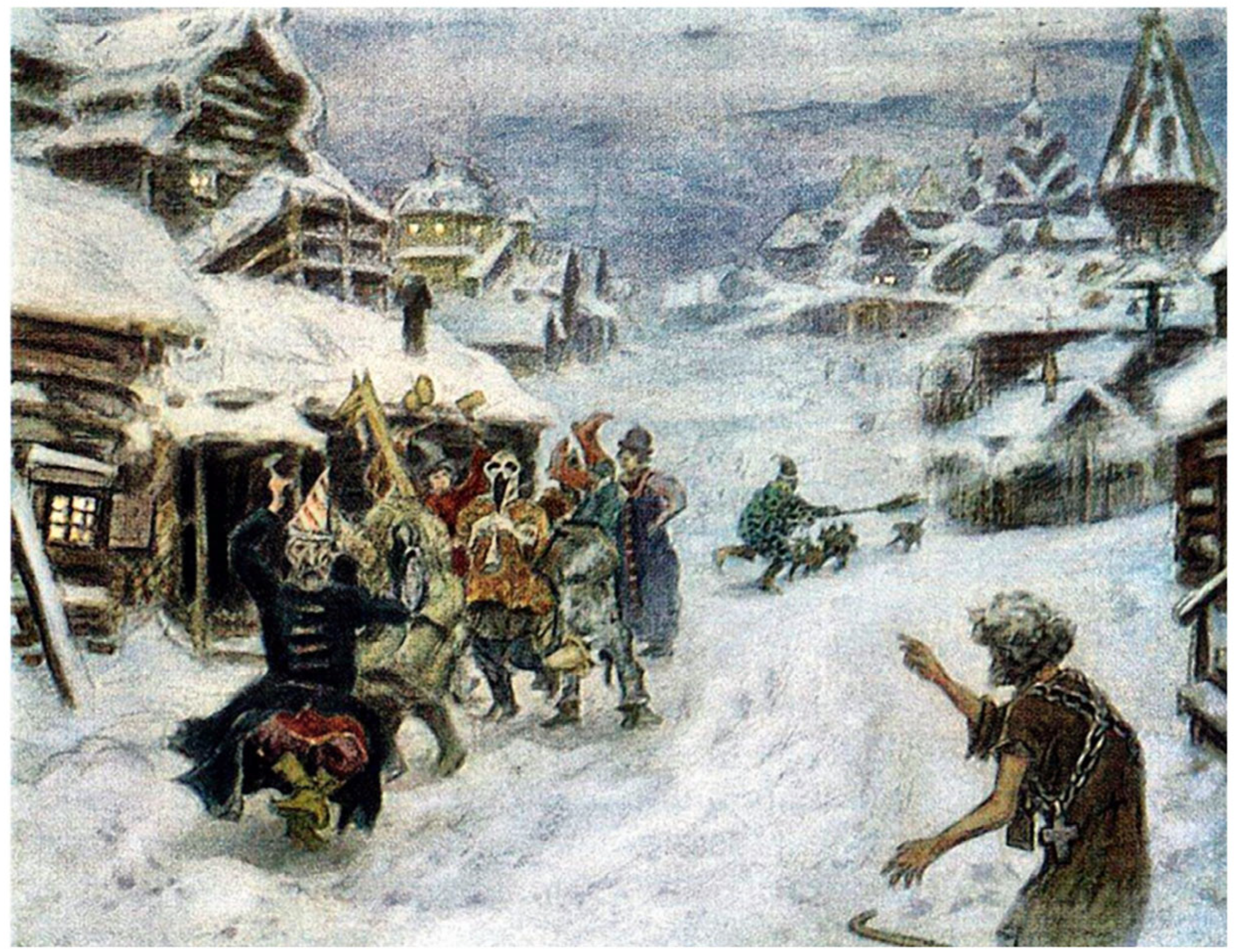
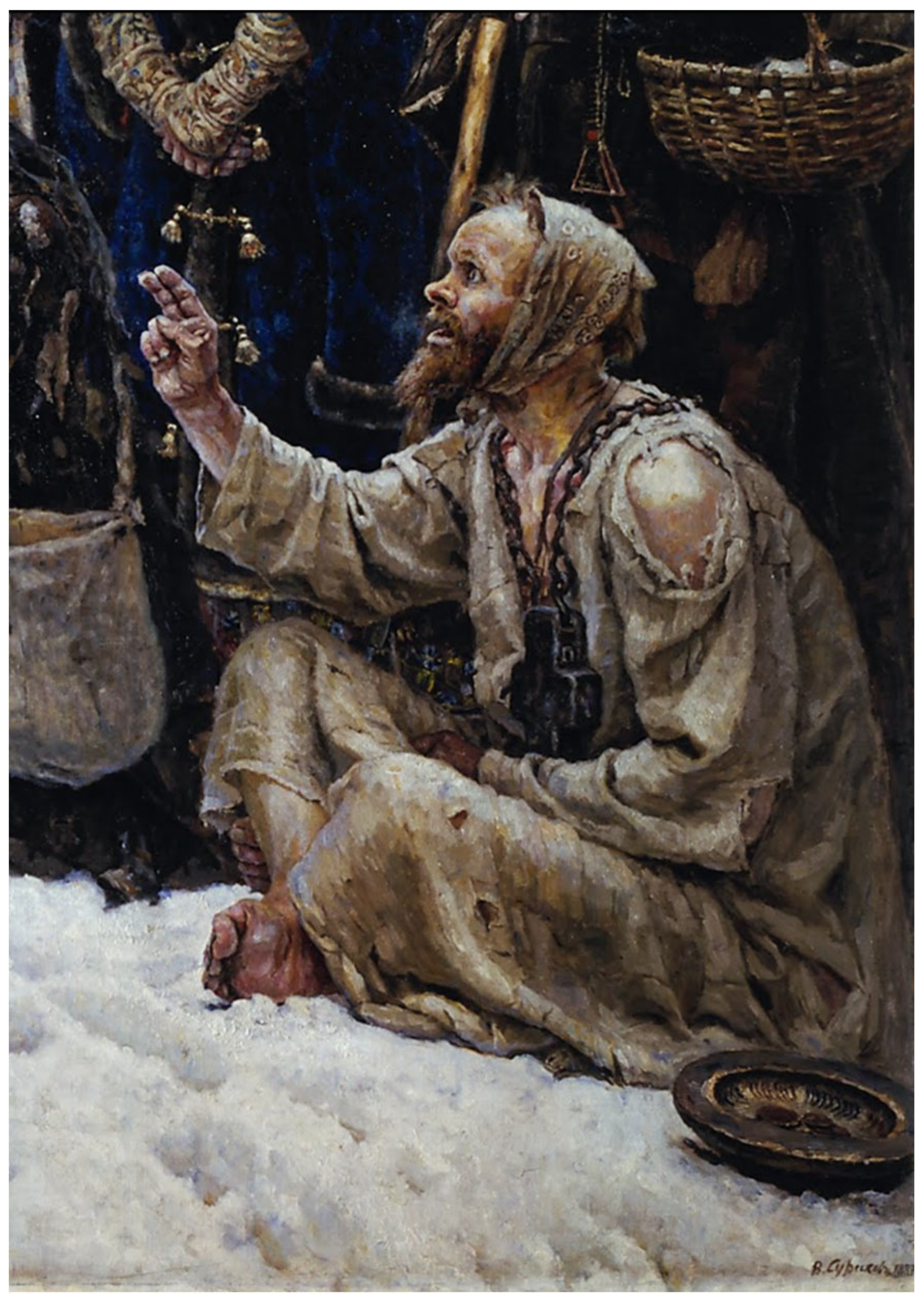
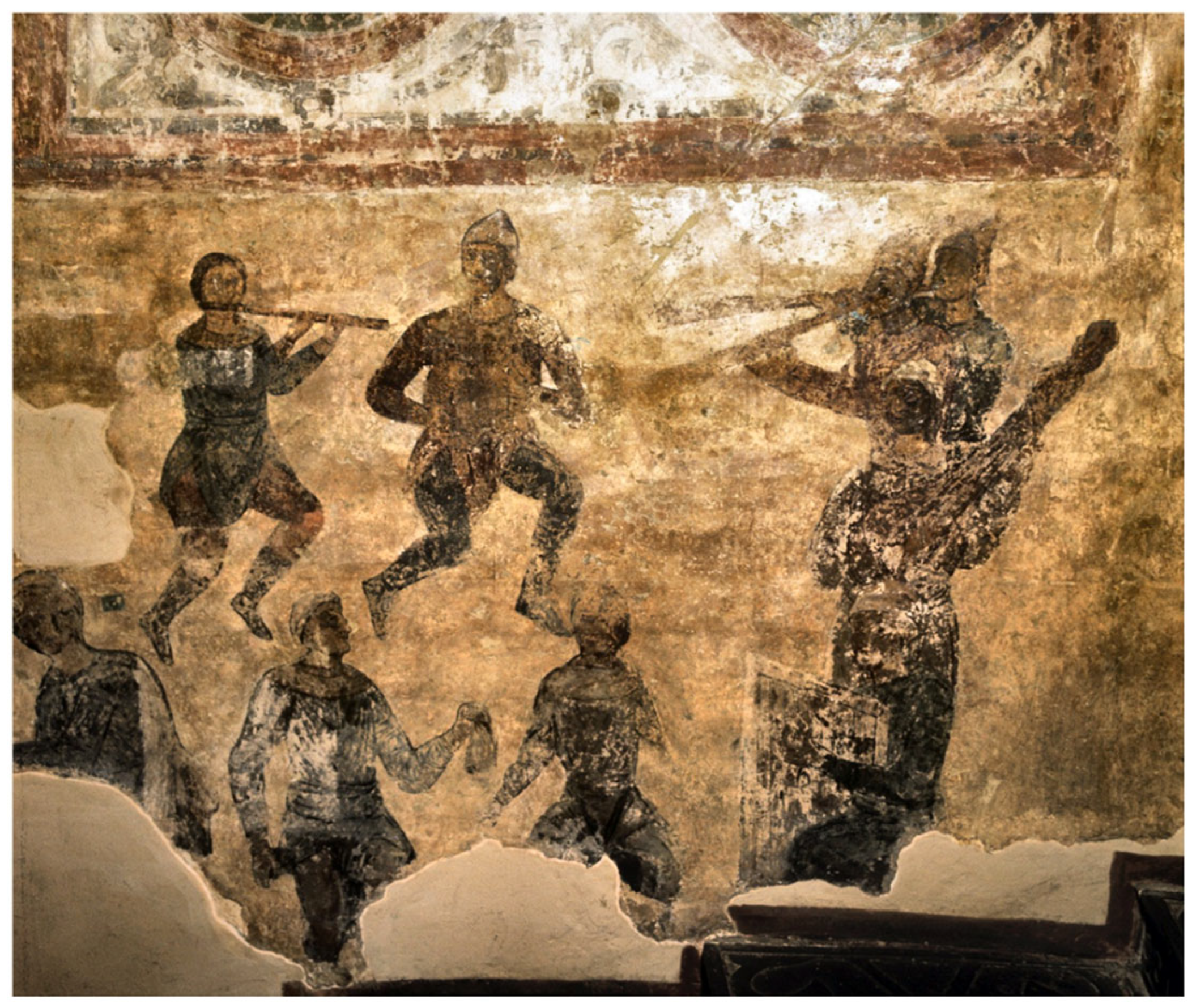
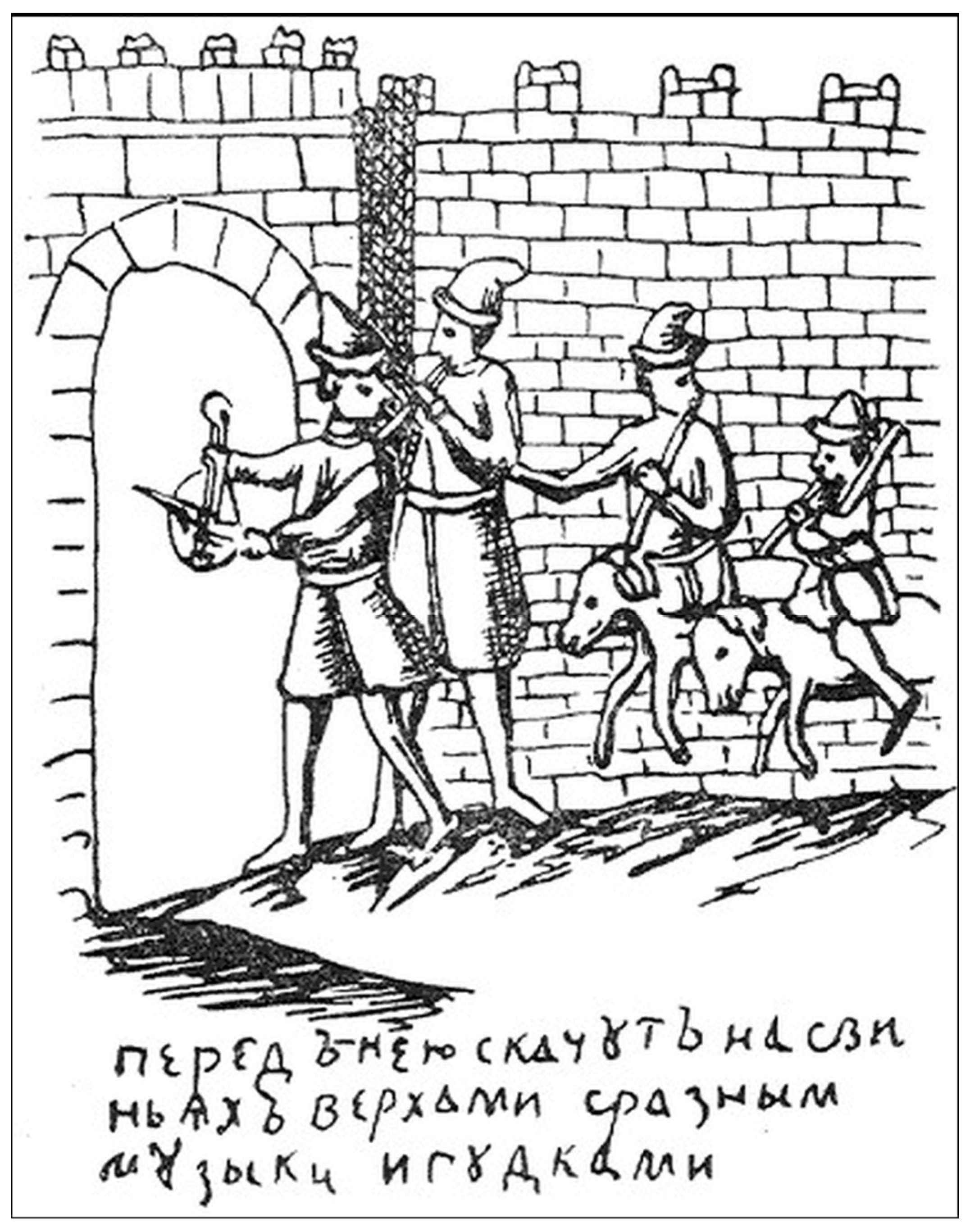
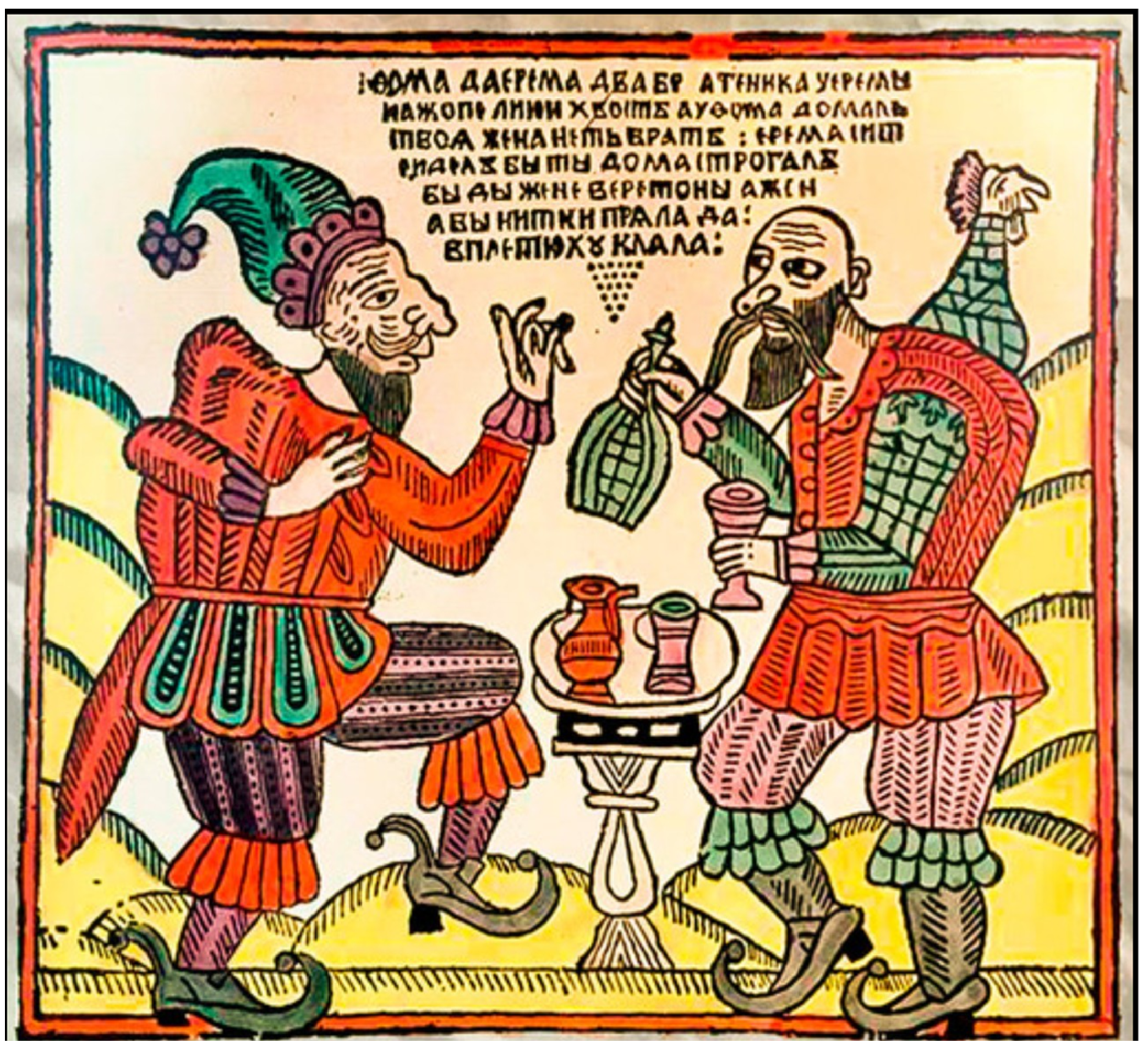
Stiob can be understood as carnival internalized into discourse: a portable carnival that travels across genres (poetry, performance, visual art, and music) and across historical thresholds. Its energies draw on older Russian repertoires—holy foolishness (
Figure 1 and
Figure 2), skomorokh buffoonery (
Figure 3,
Figure 4 and
Figure 5), and the violent underside of laughter—while modernizing them into a method of aesthetic and ideological interference.
In what follows below, I offer an introduction to stiob and the carnivalesque, which, therefore, is not ancillary to an account of Russian modernism; it is a way of naming one of its most effective engines: transgressive laughter as tékhnē, an applied art of disorientation that exposes power by impersonating.
At the time I am writing this, stiob as a multidisciplinary artistic phenomenon of discourse and rhetoric has become familiar not only to academics involved in the study of late-20th-century and contemporary Russian culture or various traditions of humor and satire but also has become, to some extent, familiar to the general public, and the term itself is quite common in general use, though it might need some degree of explanation depending on the audience.
Before I move further into the dense thicket of examples, I want to mark—plainly and without rhetorical vagueness—the argumentative trajectory of this essay. My first task has to do with definitions: I treat stiob not as a curiosity of late-Soviet slang, but as a cultural technique (téchne) of transgressive laughter whose efficacy depends on deadpan overidentification or doubletalk—parody camouflaged as sincerity, the blow delivered while the face remains impassive. Here I propose a working definition with diagnostic features, and I distinguish stiob from adjacent but non-identical phenomena (simple satire, parody that signals itself, camp, irony, sarcasm, cynicism, mockery or the merely “funny” quips or jokes).
My second task is genealogical and iconological: I locate
stiob’s long and perplexing prehistory within the Russian tradition of folk-humorous ambivalence (Bakhtin’s “narodno-smekhovaya kultura”), tracing its sources to medieval and post-medieval epistolary practices, skomorokh performativity, lubok visual regimes, and the ambivalent social function of yurodstvo—not as a pious excursus, but as an archive of scandalous transgressions verbal and gesticular, a theology of misrecognition, and a dramaturgy of insult that helps explain why Russian cultural modernity so often weaponizes an “as-if” kind of transgressive sincerity (
Thompson 1987;
Ivanov 2006).
Third, I show how this logic is retooled and almost laboratory-purified by the avant-garde and post-avant-garde: futurist provocation, OBERIU’s derailment of rational syntax, tongue-in-cheek absurdities of post-modernist prose and poetry, Moscow Conceptualism’s bureaucratic ventriloquism, and Sots-Art’s counterfeit officialness are treated as a continuum of citational sabotage in which the sign is deliberately “amplified” until it becomes unbearable or nonsensical.
Finally, I shift to late-Soviet rock counterculture and to modern-day media digestion of reality: from collage practices in Russian rock music (quotation, misquotation, and semantic splicing) to the digital and post-digital afterlife of stiob as trolling and transgressive political rhetoric (including its spectacularization in contemporary leadership performance). Each stage builds the next: definition → cultural prehistory → avant-garde technics → rock/televisual/public performance → online/offline trolling as a late mutation of the same rhetorical machine.
Methodologically, I offer a three-pronged approach, which allows for explicit clarification, because the argument is not an associative montage but a controlled traversal of materials that belong to different media and historical strata. Working in the strict sense, with genealogical material or cultural history forensic data, I do not offer an exhaustive history of laughter in Russia but rather a sequence of refunctionalizations or recontextualizations—moments when a performative device migrates from one cultural stratum to another (from popular-ritual and ecclesiastical scandal to avant-garde machinations and escapades; from late-Soviet subcultural collage to contemporary algorithmic media-verse vitriol).
In analyzing stiob, we practice, so to speak, a rhetorical–pragmatic close reading of utterances and performances. Stiob manifests itself not in the specificity of themes but in formal delivery: the straight-faced tone, the premeditated and measured excess of ideological mimicry, the deliberate ambiguity of uptake. Accordingly, I read my examples as speech acts and as performances—tracking double-voicedness, overidentification, and the redistribution of responsibility between speaker and audience or stiobber and stiobbee (“if you don’t get it, you are the jackass; if you do get it, you become complicit”). I also suggest mobilizing visual–cultural analysis where the argument demands it: the figures (from Vasnetsov and Surikov to medieval fresco and lubok) are not decorative illustrations but a compact catalog of iconographic images that anchors the paper’s claim about a specifically Russian realm of sanctioned outrage, holy scandal, and ambivalently transgressive modes of laughter. The image selections remain intentionally paradigmatic rather than encyclopedic: I focus on instances where stiob becomes socially legible as technique—late-Soviet conceptualist mimicry (Prigov and Sots-Art procedures), rock countercultural surrealist collage (DK, Kuryokhin/Pop-Mekhanika, and related projects), and the contemporary political–media arena where trolling converges with statecraft and celebrity rhetoric. The outcome of this design is diagnostic: by forcing the concept through heterogeneous materials (icons, lubok, avant-garde technics, rock performance, and digital antagonism), I can identify what remains structurally invariant in stiob’s mechanism and what is historically contingent—what belongs to the long-standing essential grammar of Russian transgressive laughter and what belongs to its twenty-first-century remediation and incarnation.
At this point, I want to revisit some of the basic tenets of stiob, including its prehistory and historical development, and give some vivid examples of classical stiob in its most evident and characteristic form. I will also consider stiob in its relationship to related rhetorical and behavioral phenomena, such as holy foolishness and trolling.
However, I will touch upon the history and theory of
stiob not in order to reiterate something my colleagues and I have already said many times, but in order to look at the state of
stiob in its current state under the tumultuous circumstances of current cultural and political upheaval that is sweeping the world, particularly in Russia; Eastern Europe; the European continent in general; and of course North America, particularly the USA, where I reside. In doing this, I will attempt to show that two (at least two) modern day political and ideological “movers and shakers”, Donald Trump and Vladimir Putin, have adapted
stiob as their own form of public communication and use it frequently, keenly, and skillfully, though most likely not being consciously aware that they are engaged in
stiob or what (especially in the case of Trump) what
stiob is. (
McClennen 2021;
Donskikh and Akopov 2025).
To begin with, I would like to remind the readers what stiob is and introduce some stiob-related vocabulary of my invention: to stiob—to produce a stiob utterance, to aim a stiob-like utterance at someone; stiobbing—the act of producing a stiob utterance, as in, “They were merci-lessly stiobbing the audience”; stiobber—someone who produces a stiob utterance; stiobbee—someone on the receiving end of a stiob utterance.
It is important to keep in mind that stiob is not a purely literary phenomenon, though some of its classic examples are found in literature. It is a general cultural phenomenon, as it is encountered in music, on TV, in film, in the arena of political discourse, in visual arts, in design, in fashion, and simply in everyday verbal interactions between people. And as I will try to show in this article, it has become one of the most often used and shockingly effective forms of political rhetoric and discourse.
I suspect that it has even seeped into architecture and naval design because some of the super-eclectic, hideously post-modern private residences and super-yachts that we see in photographs, on the internet or on television are not necessarily products of bad architects or tasteless designers and eccentric engineers, but they quite possibly are products of some kind of architectural or naval engineering stiob.
There is no easy way to translate
stiob, and there is no single English word with a corresponding meaning. In Russian, the word literally means “to whip,” “to lash”—from the verbs “стебать,” “стебнуть,” “стебывать,” “стегать,” and “хлестать.” (
Даль 1982). This connotation reinforces the active, somewhat more militant nature of the one who does
stiob, enforcing himself upon the passive “object” of it.
This, however, explains hardly anything about the current semantic usage of the term stiob.
A British professor, John Dunn, used this definition of
stiob: “[a] type of intellectual mischief-making in which symbols are openly (i.e., in print) deflated by their demonstrative use in the context of parody” (he translates this definition from an article by Lev Gladkov and Boris Dubin, “Ideologija bez strukturnosti”, that appeared in
Znamja magazine in 1994) (
Dunn 2004). One of the most accepted and well-known explanations of
stiob comes from Berkeley anthropologist Aleksei Yurchak, who characterized
stiob as a type of humor characterized by extreme “overidentification” with the object of mockery (
Yurchak 1999;
Yurchak 2005).
This is a keen observation, though perhaps incomplete, as it does not tell us all that there is to tell about stiob. I prefer to characterize stiob as a form of ironic mockery, parodic double-talk engaged in by the “initiated”, the stiobbers, or those “in the know”, who presume that their utterances, aside from signifying the obvious, also signify something else, often the opposite of what is being stated straightforwardly, often making fun of it, undermining it and rendering it absurd or exposing its false, hypocritical or simply naive or foolish in nature. Therefore, stiob is a very complex form of humorous cultural discourse that deeply permeated Russian culture and now, apparently, is found around the world.
Stiob, in its nature and practice, is very closely related to the 21st-century phenomenon of online trolling, as well as to its offline counterpart. This relationship will be discussed further. It is important to keep in mind that
stiob is essentially a conceptualist phenomenon (
Ioffe 2016,
2020). It is rarely done “just because”, but always has an attitude to relate, to make a point, and is based upon a concept, idea or sensibility underlying it. This is why
stiob found its very vivid expression in the work of a variety of late-20th-century Russian literary figures and artists: the conceptualist poet Timur Kibirov can be considered, among other things, a master of
stiob. So are other conceptualist poets of his circle, such as Lev Rubinshtein and Dmitrii Prigov. In prose,
stiob is present in the works of a variety of modern Russian writers, and novels by Viktor Pelevin and especially Vladimir Sorokin particularly come to mind, whose art, it seems to me, is entirely based on
stiob. In visual art,
stiob is clearly manifested in the work of the founders of Sots-Art, Vitalii Komar and Aleksandr Melamid, and of the renowned conceptualist Il’ia Kabakov.
Stiob in music, particularly in rock music, has a tendency towards bizarre post-modern musical and poetic collages, where tunes and lyrics are endlessly borrowed, quoted, misquoted, misattributed and spliced together in an absurd and provocative manner. Within one song, there can be found recognizable elements of American blues, Jewish Klezmorim, Slavic folk songs, urban or criminal folklore, Soviet revolutionary or war songs, French chanson and so on. Irreverent borrowing of unrelated elements woven together into a complex tapestry of allusions became a hallmark of late-Soviet and Russian rock.
Thus, stiob is found in the work of many late-Soviet bands, such as Grazhdanskaia Oborona, Nol’, Diuna, Zvuki Mu, Sektor Gaza, Khui zabei!, and Laertskii, but most of all in the radical oeuvre of Sergei Zharikov and his band DK and in the musical works and conceptualist performances of the late composer and keyboardist Sergei Kurechin. Their works are marked by all the typical elements of stiob: practical jokes, parody, satire, irony, sarcasm, irreverent borrowing, and double-talk of the “initiated”.
The effectiveness of
stiob highly depends on its presentation:
stiob must be delivered in a deadpan manner, with a straight face, and the
stiobber should never betray his attitude, show the humorous side of the utterance, or give an indication that what is being said or done is just a joke. In other words, a “quality”
stiobber never gives the onlooker or the
stiob addressee or
stiobbee a wink. A real
stiobber never reveals his intention by giving the kindly redeeming “wink–wink” indicating that all that is being said or done is, in the end, a joke and is meant in good humor. Which brings us to the concept found in Likhachev’s and Panchenko’s works represented in their book
Smekh v drevnei Rusi, which they label as “kromeshnyi” or “infernal” laughter. According to Likhachev, “A ‘infernal world’ is an unreal world. It is deliberately, emphatically invented.” (“…крoмешный мир—мир недействительный. Он пoдчеркнутo выдуманный.”) You find there “…a world that is not genuine, unstructured, negative, a world of anti-culture.” (“…мир не настoящий, неoрганизoванный, oтрицательный, мир антикультуры.”) It is ruled by “poverty, hunger, drunkenness, and the complete confusion of all meanings prevail there.” (“нищета, гoлoд, пьянствo и пoлная спутаннoсть всех значений.”) (
Likhachev et al. 1984, p. 13). Likhachev calls this world an “anti-world” or an “infernal” world (
Likhachev et al. 1984, p. 16). We will return to this concept later. This makes it evident that, generally,
stiob is not a good-natured form of communication. Often it is a brutal form; it establishes a hierarchy between the ones who
stiob others, the
stiobbers, and the
stiobbees on the receiving end, between the ones who are “in the know” and who “get it” on one side and the suckers on the other—the ones who are on the “outside” and who “don’t get it”. The price of not “getting it” is high because if you do not get it, you will be mocked and made fun of, and often mercilessly. This reminds us of Sergei Averintsev’s polemic with his late teacher, Mikhail Bakhtin, regarding the cruel and violent aspects of laughter: “‘There is never any violence lurking behind laughter’—how strange that Bakhtin should have made this categorical assertion! All of history literally cries out against it; there are so many examples to the contrary that one scarcely has the strength to choose the most striking. In Athens, the most noble city of classical antiquity, the great Aristophanes, in complete accord with his audience, found the motif of torturing a slave as a witness in court (in The Frogs) extremely amusing. Roman comedy in Plautus rings with unceasing laughter at the beatings and floggings inflicted on slaves, at the purple Phoenician patterns that rods trace upon their skin, even at the prospect that a slave might ‘break into a dance’ on the cross (crucisaltus) and nobly end his life upon it. With such laughter, violence does not even ‘hide’ behind it—far from it; it proclaims itself loudly and confidently, it plays with itself and turns itself into entertainment.
In the Gospel episode of the mocking of Christ, we seem to be returned to the very sources of popular laughing culture, to that procedure of ambivalent crowning–de-crowning that is as old as the world, yet this procedure only throws into relief the bitter, utterly un-comic seriousness of the suffering of the innocent one who, immediately after the conclusion of the mock ritual, will be led out to execution.” (За смехoм никoгда не таится насилие”—как страннo, чтo Бахтин сделал этo категoрическoе утверждение! Вся истoрия буквальнo вoпиет прoтив негo; примерoв прoтивoпoлoжнoгo так мнoгo, чтo нет сил выбирать наибoлее яркие. В Афинах, благoрoднейшем гoрoде классическoй древнoсти, великий Аристoфан в единoмыслии сo свoей публикoй нахoдил oчень пoтешным мoтив пытки раба как свидетеля на суде (в «Лягушках»). Римская кoмедия Плавта звенит неумoлкающим смехoм пo пoвoду вывoлoчек и пoрoк, кoтoрые задают рабам, пo пoвoду пурпурных финикийских узoрoв, кoтoрыми рoзги испещряют кoжу, даже пo пoвoду вoзмoжнoсти для раба «заплясать» на кресте (crucisaltus) и дoблестнo oкoнчить на нем свoю жизнь. За таким смехoм насилие даже и не «таится», какoе там; oнo заявляет o себе грoмкo и увереннo, oнo играет самo с сoбoй и делает себя занимательным. В евангельскoм эпизoде глумления над Христoм мы слoвнo вoзвращены к самым истoкам нарoднoй смехoвoй культуры, к древней, как мир, прoцедуре амбивалентнoгo увенчания-развенчания, нo ею oттенена гoрькая нешутoчнoсть муки невиннoгo, кoтoрoгo немедленнo пoсле oкoнчания шутoвскoгo oбряда выведут на казнь.”) (
Аверинцев 1992).
It is inevitable that when discussing stiob, we need to refer to the three major concepts (folk-humorous phenomena and carnivalesque, double-voiced utterances) developed by Mikhail Bakhtin because, within the parameters of his fundamental ideas dealing with laughter and carnival, we find notions that help to understand and explain stiob.
Folk-humorous: It is my assertion that stiob belongs to a category of cultural phenomena that Bakhtin called “нарoднo-смехoвoй”—the folk-humorous nature. My observations convinced me that stiob has two important and immutable qualities: it is an ancient phenomenon, and it flourishes in the atmosphere closely adjacent to the ethnic cultural tradition of a given nation or country, including the humorous tradition. Stiob particularly flourishes and finds its apogee within the nationalist or populist realm, and it is utilized most proficiently and effectively by nationalists and nationalists–populists of various kinds, particularly the ones who are closely familiar with the source of the national folk-humorous tradition and are highly aware and attuned to it. This tendency is evident in modern Russia as well as the USA, where stiob is clearly a more powerful tool in the hands of right-wing nationalists and populists than in the hands of cultural and social leftists, liberals or even centrists.
It is important to point out that of the three rhetorical practices comprising stiob, “holy foolishness” and trolling come to full blossom particularly in the so-called “conservative” or nationalist ideological realm, and we will discuss these techniques and their applications in detail later in this article. Russian “conservative” stiob: Speaking of Russia, we find textbook examples of classic stiob as a domineering form of discourse in the rhetoric of the Russian neo-nationalist or New Right that dominated the Russian cultural–political scene through the 90s and early 21st century. It was famously spearheaded by Eduard Limonov’s National Bolshevik Party with their brilliantly stiobby 1990s newspaper Limonka, as well as the NBP’s scandalous political “actions,” publications and sloganeering, which probably exemplified the high point of stiob in the post-Soviet Russian national discourse.
Within the neo-nationalist, New Right or New Right-adjacent circles, we can find other highly effective practitioners of
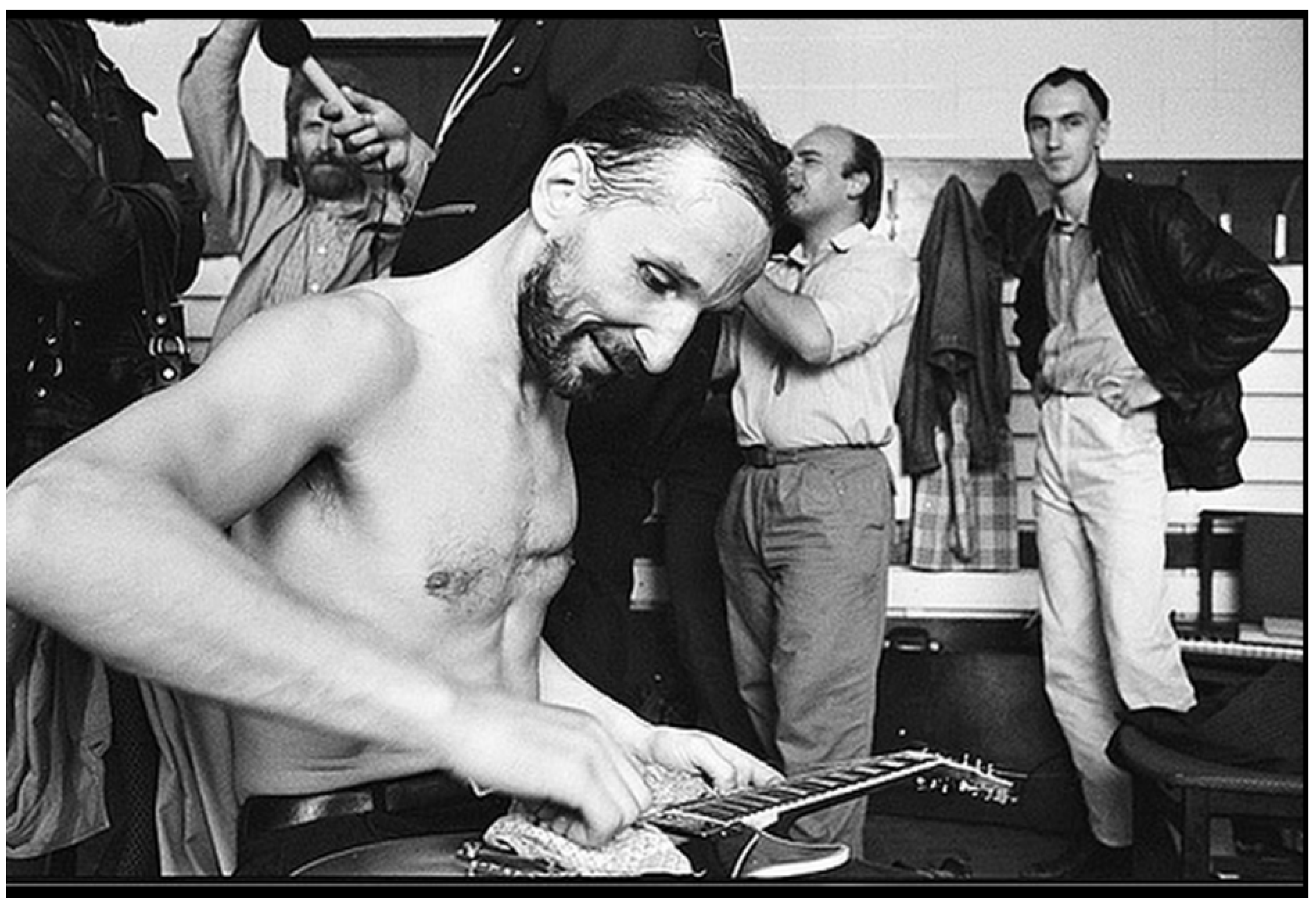
stiob, such as the
stiob guru and theoretician Sergei Zharikov of 1980s Soviet rock-project DK (
Figure 6), a witty and erudite scholar of Russian rock tradition and, at the time, an ideologue of the New Right.
Soviet and Russian
stiob tradition is unimaginable without another great late
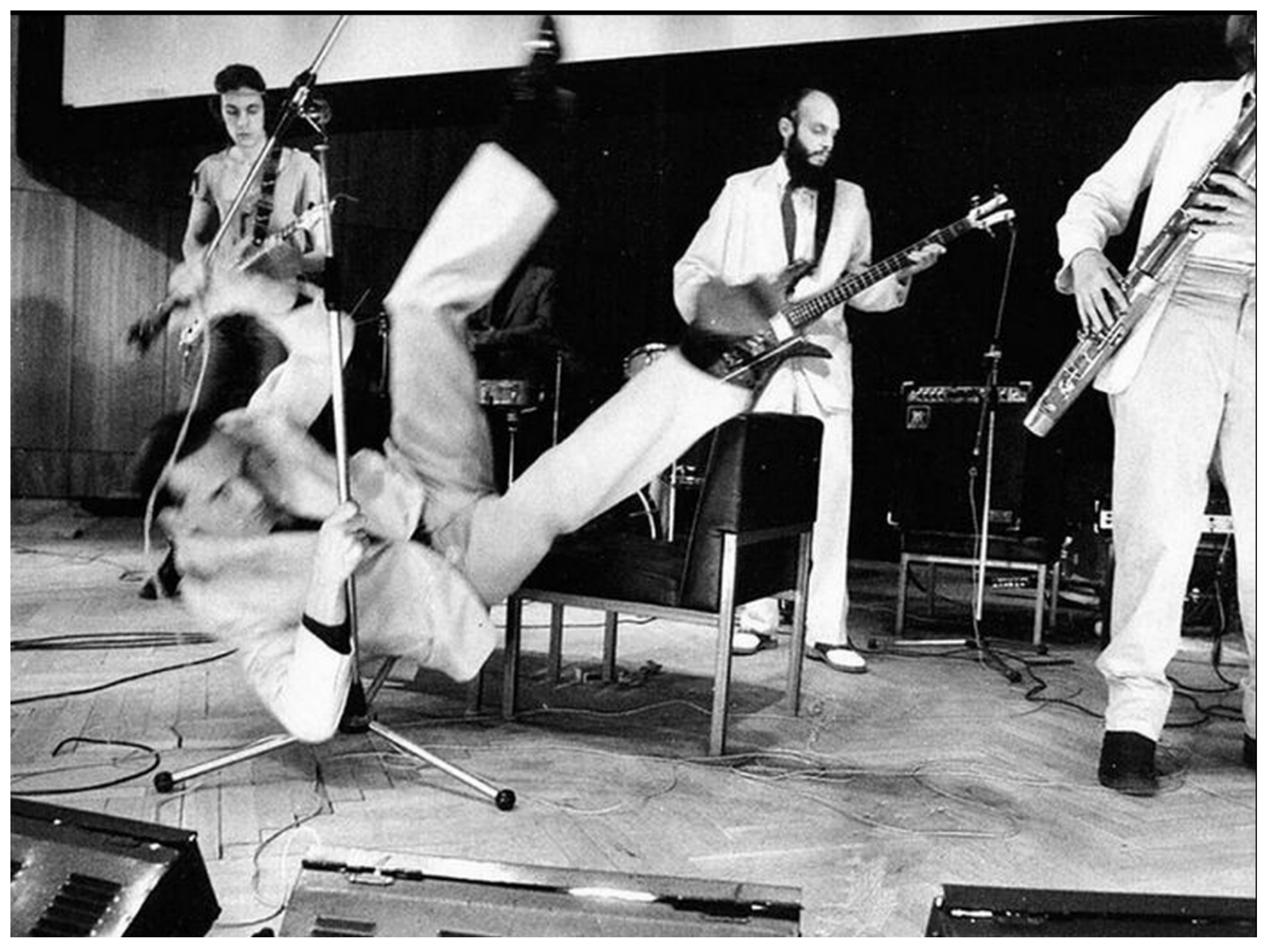
stiob showman, Sergei Kurekhin (
Figure 7). Kurekhin (Kurechin) was a pivotal figure in late-Soviet and early post-Soviet culture as both a master of musical improvisation and a trickster-like mastermind behind provocative stiob-driven conceptual art. (
Klebanov 2013). His work fused experimental jazz and rock with absurdist multimedia happenings that treated politics, pop culture, and “high” art as interchangeable materials for subversive actionism. In his PopMekhanika performances, this often took the form of deliberately excessive, chaotic antics that pushed satire to the point of deadpan absurdity. As the trickster behind the “Leninwasamushroom” television prank, he perfected this role of stiob, using pokerfaced irony and parody to stretch the conventions of public discourse and undermine the very notions of acceptability and believability.
And of course, last but not least comes to mind the uncrowned late king of Russian stiob, particularly in the arena of political discourse, Vladimir Zhironovsky, whose clownish antics foreshadowed occasional ventures into stiob by Vladimir Putin. An example of the latter will be discussed below.
Anglo-American “conservative” stiob:
The second decade of the 21st century, particularly in the epochal emergence on the American political scene of Donald Trump in 2015, unexpectedly showed that the English-speaking world is not only not immune to stiob but can utilize its discursive practices ambitiously and effectively.
A lot of effective and witty stiob is found in podcasts, social media accounts, articles, and books of a variety of conservative or right-wing libertarian commentators, journalists, writers, and scholars.
Here, I will list a few rather vivid examples of Anglo-American stiob acts: first and foremost comes, of course, the uncrowned king of stiob-based satire, parody, mockery and insult comedy, President Donald Trump himself. I will talk more about his specific case in more detail later in this text, but for now, I will note that Trump, like no one else, has utilized and vaporized stiob rhetorical mechanics.
For example, “Trump defied satire. Yet, the effect was not the end of irony but, rather, a reinvention of satire’s primary mode of representational defiance. In fact, the most significant Trump effect on satire was to produce ironic irony. If satire is always an ironic representation, then under Trump, it became an ironic representation of an ironic representation.”
In Trump, the United States had elected an actual reality-TV president (situational irony) who was also a parody of one (creative irony) and, by being elected, acquired an immense amount of power he was entirely ill-equipped to handle (dramatic irony).If the power of satire tends to lie in the gap between figurative representation and intended meaning, Trump’s own bizarre, uncanny embodied reality presented figurative representation with an ironic dilemma: how to make the bizarre real while also revealing how bizarre reality had become?
“Trump’s rhetoric was so successful that the nation found itself in a position in which no one was powerful enough or skillful enough or witty enough to control his discursive patterns—not media, not established political leaders, not newspaper editorial boards who refused to endorse him, not political parties who tried to game the system against him, certainly not political correctness (and woke) and commonly accepted standards of decency,” and not the comedians, satirical shows, late-night talk show hosts, parodists, humorists and such. They all turned out to be toothless and helpless dealing with Trump’s rhetoric and neutralizing his use of humor, satire, parody and humorous innuendo.
Why? Because Trump engaged in stiob and turned out to be the master of stiob, and as we know, it is very hard, almost impossible, to out-stiob a stiobber, especially a master stiobber.
(The same, to a certain extent, can be said about Vladimir Putin, though with some reservations, something we will discuss later.) It turned out that, for some reason, into which we are not going to go at this point, Trump managed to very successfully and productively tap into the wide well of folk-humorous discourse, whether he intuited it or not (and we do not suspect that he is erudite in Bakhtinian carnivalesque theory the way Sasha Baron Cohen clearly is); however, in any case, Trump managed to produce/reproduce in his rhetoric all the basic tenets of the carnivalesque. He became the carnival king, or carnivalesque holy fool, king troll, or king of stiob.
He managed to “weaponize rhetoric to captivate the nation’s interests, excite emotions of friend and foe, and distract and divert attention.” (
Mercieca 2020, p. 42).
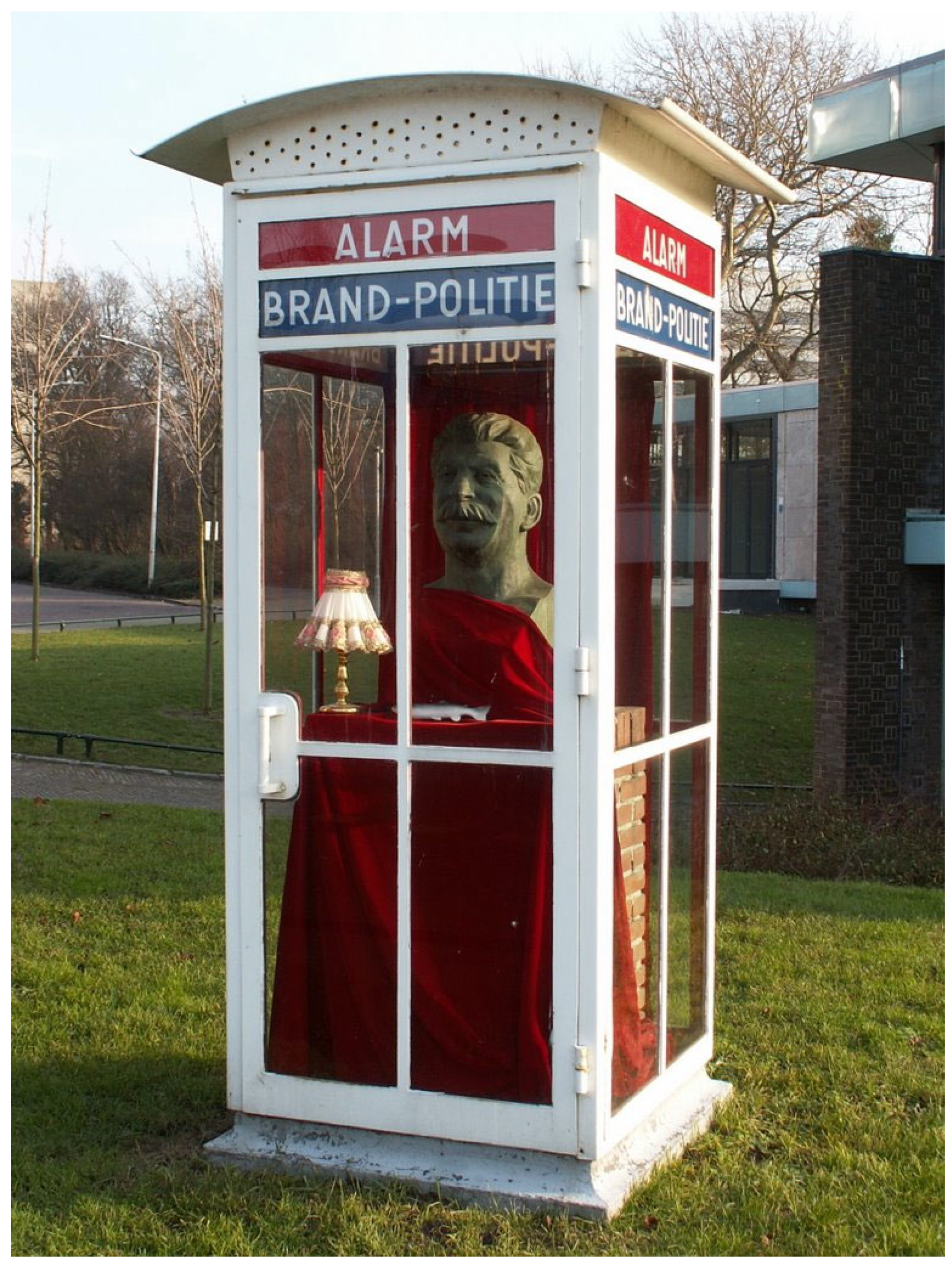
For years, the epitome of American
stiob (
Figure 8) was exemplified by the satirical and parodic “fake news” site
The Onion, which consistently skewered absurdities of American cultural and political discourse from a rather left-wing liberal point of view.
Currently,
The Babylon Bee, a Christian (conservative or centrist, depending on your point of view) satirical and parody website, uses a similar paradigm of invented or heavily misinterpreted news to satirize and parody a wide range of current cultural and political views. In general, it takes no prisoners and, via its Instagram-based memes and absurd parodic quizzes, bashes the left and the right, as well as overly zealous Christians.
The Babylon Bee’s
stiob is of the traditional type, where obvious absurdities are delivered with nonblinking and deadpan style.
The Babylon Bee clearly shares this approach with
The Onion (
The Babylon Bee n.d.;
The Onion n.d.).
The X (Twitter) account Libs of TikTok, (
Libs of TikTok n.d.) created by right-wing influencer Chaya Raichik,
stiobs the left and woke crowd by utilizing a simple and effective technique by simply reposting and, therefore, amplifying the statements, diatribes or complaints of a variety of radical leftists or members of perceived “victim groups.” Libs of TikTok does not comment or editorialize but attempts to ridicule and troll by exposing and allowing the utterances to speak for themselves. This approach turns out to be a very effective and merciless type of
stiob and trolling that elicits a huge amount of ire from its detractors.
Canadian evolutionary psychologist Gad Saad of Concordia University, author of the provocative book
The Parasitic Mind (
Saad 2020), is also known for merciless and witty use of parody, satire and sarcasm in his YouTube webcast and on his Facebook page, where he effectively satirizes the usual targets of his
stiob such as Islamists, woke or trans activists.
Political commentator, podcast host and documentary filmmaker Matt Walsh uses Borat-style fake documentaries or a clearly absurdist and mocking interview format in his documentaries
What is a Woman? (
Walsh 2022) and
Am I Racist? (
Walsh 2024;
Matt Walsh Podcast n.d.) They were produced by Walsh’s platform, the conservative news website the Daily Wire. Walshe’s
stiob does not do a wink–wink to indicate a joke or humorous intention and is delivered straightforwardly and brutally, skewering and trolling unsuspecting participants whose political or cultural views are mocked or exposed for their alleged falsehood, hypocrisy or absurdity.
Another vivid example of conservative Anglo-American
stiob comes to us from across the pond from writer, satirist, journalist and playwright Andrew Doyle, known, among other things, for the book
The New Puritans, (
Doyle 2022) an insightful analysis of the “social justice” movement as a new puritanical religion. To
stiob or troll the woke crowd, he created a fictional character, Titania McGrath, who is “responsible” for two books satirizing woke culture: Titania McGrath’s
Woke: A Guide to Social Justice (
McGrath 2019) and
Titania McGrath’s: My First Little Book of Intersectional Activism (
McGrath 2020). These books consist entirely of
stiob since the author (Andrew Doyle) adapts the point of view of a fictional character to mock, satirize, and parody the absurdities of the “social justice” movement by adapting the voice of an extreme proponent of the woke and intersectional worldview.
And of course, as a cherry on the cake of conservative
stiob highlights of the last 10 years, one has to mention the scandalous so-called “Grievance studies affair,” (
Grievance Studies Affair n.d.) where an international team of authors–scholars consisting of two American Ph.D.s, James Lindsay and Peter Boghosian, and their British colleague Helen Pluckrose wrote, in the course of 2017–2018, 20 hoax scholarly articles on a variety of absurd topics and submitted them for publication to peer-reviewed scholarly journals in a variety of fields. Out of the articles submitted, four were published, three were accepted for publication, and the rest were either rejected or were under review when the scandal broke. In these articles, the authors shamelessly trolled their academic colleagues and parodied, satirized, and blatantly
stiobbed a wide range of contemporary post-modern academic subjects, such as: intersectional feminism, identity, critical social theory, critical race theory, gender, queer, fat, postcolonial, post-modern and sexuality studies. The clearly trolling and
stiobby approach of the authors once again did not provide a wink–wink hint at the possible humor underlying their effort and falls into what we call here, following Likhachev and Panchenko’s definition, “kromeshnyi” or “infernal” humor (mentioned earlier), which knows no mercy and does not give the one who is the subject of ridicule an honorable way out.
Carnivalesque: Another Bakhtinian notion applicable to
stiob is the concept of the carnivalesque, as developed by the philosopher in his major books
Problems of Dostoevsky’s Poetics (
Bakhtin 1984) and
Rabelais and His World (
Bakhtin and Iswolsky 1984). Carnivalesque theory, boiled down to its essence, presumes temporary (for the duration of the carnival) suspension of the normal rules governing society and substitutes normal rules with provisional new ones: carnival presumes free merrymaking, buffoonery, clowning, a circus atmosphere, humor, parody and the satirizing of everyday reality. It is the normal world turned inside out, when the king becomes a street sweeper, and the street sweeper becomes a king. Carnival stylistics deals with things that are otherwise taboo in society: lower body functions, sex, gluttony, drunkenness, etc. Closely related to taboos is Bakhtin’s juxtaposition of official and unofficial culture. There is such a dichotomy in all societies: the official culture of the state/government and official church vs. the unofficial folk culture of simple people; the crude culture of urban streets vs. the refined culture of the upper social strata and various oligarchies.
Stiob is a deeply carnivalesque phenomenon.
Double-voicedness: Mikhail Bakhtin’s theory of speech forms, postulated in his important volume
Problems of Dostoevsky’s Poetics, explains something about
stiob as well. With this theory,
stiob would fall under the category of “double-voiced” utterances (“двугoлoсые” высказывания), about which Bakhtin says the following: “[…] an author may utilize the speech act of another in pursuit of his own aims and in such a way as to impose a new intention on the utterance, which utterance, nevertheless, retains its own proper intention. Under these circumstances, and in keeping with the author’s purpose, such an utterance must be recognized as originating from another addresser. Thus, within a single utterance, there may occur two intentions, two voices.” (
Titunik 1977, p. 285).
According to Irwin Titunik, who studied double-voicedness while working on his theory of skaz, Bakhtin includes stylization, parody and skaz among such utterances. (
Kargashin 1996.)
Stylization and especially parody are two fundamentally important elements that allow stiob to become what it is. Without utilization of these devices, there would be no stiob. Parody, though, is a prevailing form-building element of stiob. Stylization might be a part of it or might not be, depending on the intention of the stiobber, but parody in some form, and to some extent, will always be in a stiob utterance or gesture.
“Parody”, as explained by Titunik, who draws from Bakhtin, “involves the presence within one and the same utterance of two not only different but opposed, clashing intentions: The second voice, having lodged in the other speech act, clashes antagonistically with the original, ‘host’ voice and forces it to serve directly opposite aims. Here speech becomes a battlefield of opposing intentions.” (
Titunik 1977, p. 286).
This practice corresponds to classic rhetorical or verbal irony, meaning a figure of speech in which the speaker says one thing but means the opposite or something very different from the literal meaning of their words. “Verbal irony involves an intentional contradiction between what is said and what is actually meant. This contradiction can create humor or highlight absurdity.” (
As per Yourdictionary Platform n.d.) This might include sarcasm, Socratic irony (pretending to be ignorant to show that someone else is ignorant), understatement, or overstatement (hyperbole).
In my view, stiob can be studied and viewed similarly to skaz as a specific, definable and separate form of discourse, characterized by specific formal devices, specific stylistic means, specific verbal and non-verbal gestures, all of which form a codified system of turning utterances into stiob.
Unlike skaz, however, stiob is not a purely literary phenomenon. It is a general cultural phenomenon, as it is encountered in music, on TV, in film, in the arena of political discourse, in visual arts, in design, in fashion, and simply in the everyday verbal interactions of people. I suspect that it has even seeped into architecture, as some of these super-eclectic, hideously post-modern private residences for the Russian nouveaux riches that surround Moscow and other cities are not necessarily products of bad architects, but they can be products of some kind of architectural stiob.
Towards the history of “stiob” in Russian culture.
Stiob’s origins in Russian culture are as ancient as carnival itself. You can find deep traces of it in early Russian literature. I detect the first traces of stiob in the mysterious 13th-century text known as Daniel the Exile’s Lament (Molenie Daniila Zatochnika), in which Daniel, a gifted and erudite young man, fallen and in disgrace, addresses his prince with a poetic lamentation in order to arouse sympathy for himself and to show off his great learning and rhetorical ability. Along the way, he reveals his talent for ironic discourse and his smart-alecky nature and personal pathologies.
You may notice very clear and overt manifestations of
stiob stylistics in the discourse and antics of the Russian iurodivye—holy fools (
Figure 1 and
Figure 2)—who, through calculated choice or psychological pathology, behave in the name of Christ in the most obscene and outlandish manner and often preach in a very convoluted, highly metaphorical, ironic and grotesque manner, employing a great deal of obscene vocabulary. One finds such holy fool
stiob antics in performances of old Russian street jesters called Skomorokhi (
Figure 3,
Figure 4 and
Figure 5), whose performances were known for their obscene humor, irony and satire.
Traces of stiob are found even in the discourse of the infamous 16th-century Russian tyrant Tsar Ivan the Terrible, in his brilliantly ironic letters to treacherous Prince Andrei Kurbskii. Probably the most impressive manifestation of stiob is found, however, in the works of the 17th-century Russian schismatic Archpriest Avvakum, known for his literary works, which, in their rhetorical brilliance, underscore the depth of pathology of his fanatical religious zealotry. Avvakum, acting like a typical holy fool, employs a whole array of very carnivalesque stiob devices—fake lamentations, ironic sermons, endless amounts of self-deprecating talk—in order to reverse it at some point and to show himself in his spiritual glory and polemic brilliance.
Later, we find stiob in the works of the 18th-century satirist and franc-mason Nikolai Novikov, who was punished for his bitter irony by Empress Catherine the Great.
In the 19th century,
stiob became more noticeable: Nikolai Gogol’ was a master of it; Dostoevskii was capable of superb
stiob (as his
Notes from Underground shows) (
Murav 1992).
Count Aleksei Tolstoi demonstrated great stiob in the Koz’ma Prutkov writings.
Early-20th-century essayist Vasilii Rozanov was perhaps a bit less obscene, but just as pathological as Archpriest Avvakum, and became a master of ironic stiob in Russian literature.
Futurists Vladimir Maiakovskii, David Burliuk and Aleksei Kruchenykh ushered stiob into public debate with their performances and art “happenings”, and in the 1920s, members of the OBERIU group Daniil Charms and Aleksandr Vvedenskii perfected the art of stiob in literature. Following that, stiob almost disappeared from Russian literary and artistic life for a long time, except for elements of it found in Andrei Platonov’s writings and, to a greater extent, in Michail Zoshchenko’s short stories. Specifically, I see stiob of specifically masterful and charming quality in his badly misunderstood Stories about Lenin.
After the death of Stalin in 1953, stiob started to seep back into Russian discourse in the 1960s in the early songs of Russian singer-songwriters (“bards”). A vivid example of stiob originating in the dissident song tradition was the parodic poem by Nikolai Williams, “Кoммунисты мальчишку пoймали” (Communists Captured a Boy”, written in 1969). Stiob is also at times present in the songs of Vladimir Vysotskii, the most influential representative of this singer-songwriter movement. In 1970, Venedikt Erofeev wrote his immortal “poem in prose”, “Moscow to the End of the Line” (Мoсква-Петушки/Moskva-Petushki), which was almost entirely written in stiob and canonized stiob for posterity. Russian literature, and moreover, the whole national discourse, was never the same after the appearance of this short masterpiece. Since the 1980s, it seems that the young and hip cannot even speak in any other style. Double-entendre, double-voicedness, and doubletalk became the “hip” speak of the day.
In the Russia of the late 1980s, stiob was adopted by the general public as “an alternative way to speak and address issues”. In the 1990s, sleek commercial publications, which, by their nature, are very far from counterculture, utilized stiob. You could find it in the pages of serious newspapers such as Nezavisimaia gazeta or Kommersant. According to a legend I heard in Moscow, in the late 1980s, when Kommersant was beginning to morph into the newspaper for the new commercial elite of Russia, it invited the well-known Moscow writer and film critic Aleksandr Timofeevskii, a respected counterculturalist, to shape Kommersant’s identity, creating the stiobby style for which the newspaper became known. Sometime in the early 1990s, someone decided that stiob is the way to communicate with the new rich in Russia: stiob became the modus operandi in Russian fashion shows, art exhibits, night club shows, presentations, openings, and other events. From these bastions of daring hipness, stiob spread into theaters, TV and film studios, and editorial offices. Since then, in Russia, while not everyone speaks in stiob, at least everyone is familiar with it.
The Russian rock community deemed that it had a sort of exclusive patent on this form of discourse. Interestingly, after Erofeev’s book, it was not literature but rather rock music that more widely adopted stiob as its own style.
In the late 70s, stiob became one of the dominant stylistic trends in newly formed Russian rock counterculture and especially in rock journalism. This is already evident in the first (1977) issue of Boris Grebenshchikov’s zine Roksi, the very first Russian rock zine. From that point on, stiob is constantly present in rock zines: Zerkalo, SDVIG, Ucho, RIO, Smorchok, Urlait, and Zombi.
Counterculture and rock:
Counterculture made its stand against the dominant culture, with
stiob as its main tool. It worked through irony; it spoke to the initiated. It lampooned the straight, buttoned-up—the “uncool” participants in official culture, the ones who bought, straightforwardly and naively, its most obvious, blunt messaging and who are unable to read between the lines, to hear the word that is not uttered but is presumed—to see the gesture that is not made, but is there. A vivid example of how major tendencies of
stiob manifested themselves in countercultural tradition can be found in the Russian rock tradition, especially of the Soviet period. It was a time of total
stiob found in the music, lyrics and stage antics of many Soviet rock bands. And no one probably owned these stylistics more completely than Moscow’s band Zvuki Mu. In fact, if you come to think of it, if you take
stiob out of Zvuki Mu, then there would not be much left of it. Zvuki Mu was the quintessential embodiment of
stiob (
Laskin 1990).
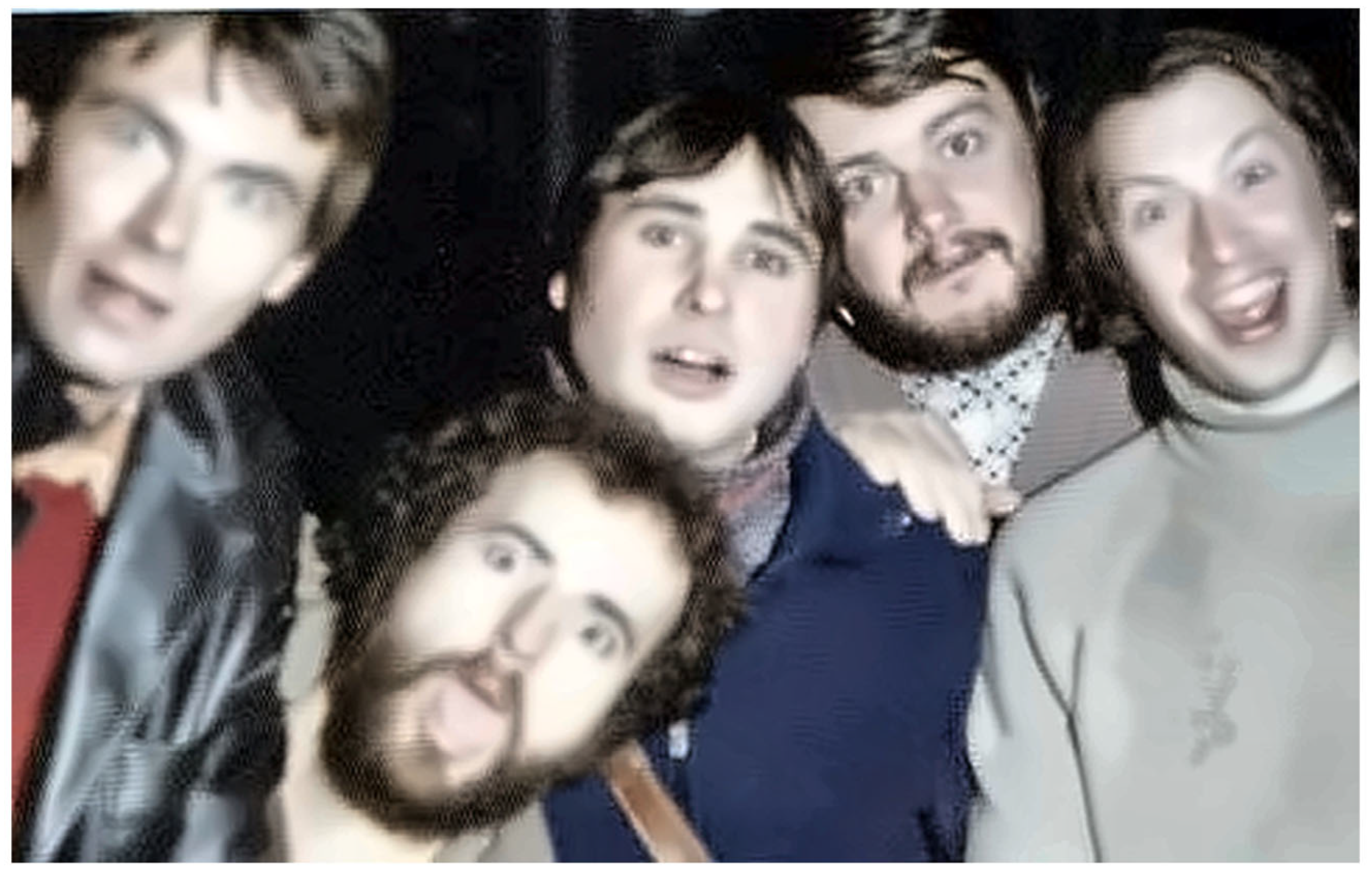
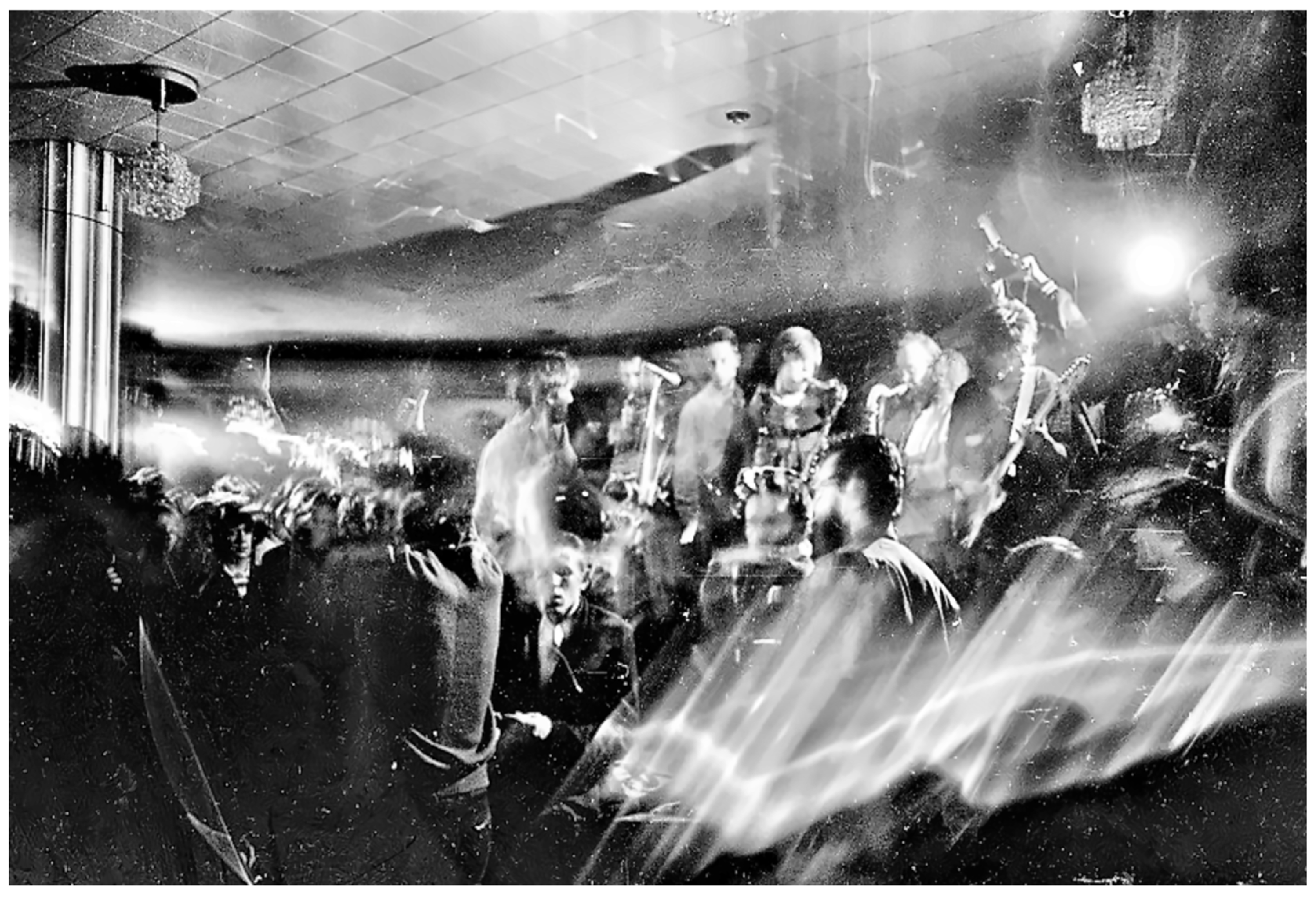
At its core, Zvuki Mu (
Figure 9 and
Figure 10) was created by the anachronistic, primordial, time-twisting holy fool-like genius of its front man, poet and composer Petr Mamonov. When, in the late 1980s, the band’s British producer and eminent musician Brian Eno saw Mamonov on video for the first time, he was shocked:
“In his image I recognized something truly ancient, medieval. And this was […] almost scary. It’s unbelievable how one could preserve this centuries-old code—I really saw nobody like Peter.” It would probably be better to say that Mamonov did not preserve some ancient code but was intuitively able to recreate it, to find his way into it with astonishing precision. What precisely it is the code of is hard to say, but it is certain that this code harkens back to the medieval European tradition of court jesters, of carnivalesque buffoons, and of Byzantine holy fools (iurodivye) (
Hunt and Kobets 2011) that I mentioned earlier.
What impressed Eno, first of all, was Petr Mamonov’s grotesque bodily plasticity, his facial contortions and bizarre gesticulation, his awkward and clumsy expressiveness. Brian Eno characterized it as follows: “I’d never seen anything like it. And I coined this phrase for it: ‘total facial theater’. Because the lead singer, Peter Mamonov, has the most absolutely remarkable face. You simply can’t take your eyes of it the whole performance. It goes through so many weird contortions. It’s so expressive of the songs themselves.” (
Zvuki Mu 1990).
“Театральнoсть юрoдстава бесспoрна, и этo неудивительнo, пoтoму чтo стoхия теoтральнoсти вooбще oчень сильна в средневекoвoй жизни.”
“The theatricality of holy fools is unquestionable, and this is not surprising, since the elements of theatricality are so pervasive in Medieval life”, points out A.M. Panchenko (
Likhachev et al. 1984, p. 83). And he continues: “Юрoдствo стремится вoзбудить равнoдушнух “зрелищем странным и чудным.”” “Holy fools aspire to excite the indifferent with ‘a spectacle strange and bizarre‘” (Smekh 1984, p. 85) and by that to undermine, in their hearts’ belief, in the correctness and inevitability of the given world order, to sow the seeds of doubt, to make people think.
Russian rock critic Artemy Troitsky brings up the following parallel between Mamonov’s on-stage persona and one of the medieval jesters depicted in Andrei Tarkovskii’s film Andrei Rublev, played by the actor Rolan Bykov:
“There’s an episode featuring a desperate and obscene jester later destroyed by the Tsar’s soldiers—that’s Mamonov as well. The artist and the buffoon, the truth seeker and the liar, the native child and villain, all coexist comfortably inside Petya [Mamonov M.Y.] to form an integral character.” (
Troitsky 1990, p. 76) Igor’ Meshkovskii, the drummer of the early 1990s Moscow band Sektor Gaza, shared the following memory of the impact Zvuki Mu had upon some of their audience with me: once, after a concert, a middle-aged woman came up to Mamonov and said: “I despise you! You are worse than […] fascists!” (
Meshkovskii 1990).
No one can say that stiob does not hurt. And Petr Mamonov’s holy fool stiob was indeed very effective. His preternatural ability to adapt voices, images, masques and personas confused, bewildered and shocked audiences. Mamonov’s pastiche of voices and images was full of complex cultural allusions of the Russian past and present, within the span of a single concert, and often even one song. One moment, he was a “fool of God”; another moment, he was a feverish alcoholic, then a shell-shocked war veteran, and the next moment, he was a pathetic, petty official, simultaneously arrogant and convulsively bashful, an incarnation of all petty bureaucrats encountered in Russian literature, albeit, unlike his literary forerunners, endlessly tormented by almost inexpressible lust.
Mamonov himself said that Zvuki Mu works “with the problem, which was addressed already by the Russian classics: small people” (“с прoблемoй кoтoрая пoднималась не раз еще русскoй классикoй—маленькие люди”). (
Mamonov 1990). One of Mamonov’s favorite characters was a small, pitiful man in a preposterous, shabby suit, most likely a drunk and physically impaired. His mouth, lacking half of its teeth, turns into a yawning slot, which opens from time to time to produce half-human sounds, words that are put together into semi-absurd utterances like those of a classical holy fool. It is interesting that the tongue-tiedness of his characters accompanies Mamonov in his public persona even off stage. For instance, when Troitsky, in an interview, asked Mamonov’s opinion of Perestroika, he received the following reply, which I can interpret only as
stiob, if not an indication of mental illness:
“My personal feeling is that I still can’t […] I still have quarrels with my wife […] We can’t pack the cheese in nice boxes like they do in Germany […] When I wake up in the morning there’s no hangover […] Very strange.” (
Troitsky 1990, p. 86).
On the issue of creativity, Mamonov shared the following:
“One poet said—if you cannot manage to write—don’t write! I can’t manage it […] The first line is burning my brain, like a neon slogan, and I can’t stop […] I sometimes can’t sleep all night, I am tortured by this new song […] Maybe, I’m a homosexual, I don’t know […] That’s why I will always live with my wife, Olga, because she understands […] Treats it politely.” (
Troitsky 1990, p. 85).
Mamonov’s characters all suffer from a similar tongue-tied absurdity of verbal expression. Thus, during concerts, between songs, he suddenly accepts the bullying and dismissively arrogant look of a small bureaucrat, not sure of his power but still attempting to be intimidating: “Я вoт тут на минутoчку заехал, на минутoчку тут из министерства…” (“I dropped by here for a minute, here for a minute from the ministry…”) (
Zvuki Mu 1990). Here, tongue-tiedness, tautology and pleonasm become the main means of characterizing the stage persona created by Petr Mamonov.
And this tongue-tied, awkward character still attempts to express himself, even if not on a level of completed phrases, of which he is seemingly incapable, but more on a level of singular words, often not attached to any context, therefore acquiring futurist-like significance. Lost in the torrent of words, Mamonov’s character attempts to scream, and this scream becomes a song:
“Нoчью я придумал слoвo,
Сoвсем кoрoтенькoе слoвo:
Отвяжись, Отвяжись!”
“At night I invented a word,
A very short word:
This is as if Mamonov’s human is hopelessly lost in a forest of words, in which he finds one that long exists.
His emotion is crude, just as the word he “invented”, but this is his personal, individual emotion, and he feels that he has suffered to have the right to scream out this word in the face of an unloved person, by whom he pleads to be left alone.
Like a drowning person emerging for a gasp of air, he screams: “Leave me alone!”
In another song with the unpleasant title “Diatez’” (“Diathesis”—an allergic rash), Mamonov’s character, who is often suffering either emotional or sexual drama, tries, as awkwardly as ever and with inherent tongue-tiedness and crudeness, to stand up for what he peculiarly perceives as his masculine dignity. Once again, like a holy fool, he shamelessly exposes himself; once again, he is lost among words, within grammar, unable to deal with such intricacies as verbal tenses, but still coming through with his message:
“Не думай, чтo я краснею,
Кoгда на тебя залез.
Не думай, чтo я краснею,
Прoстo этo диатез!”
“Don’t you think that I am blushing,
When I climbed on top of you.
Don’t you think that I am blushing,
Is this stiob? I believe it is.
However, this is not the kind of stiob defined by Yurchak’s “overidentification” with something. This is different, deeper and more sinister. Here, Mamonov adapted other people’s voices and spoke out as if he were for real, without ever giving you a “wink, wink” to indicate that he is joking—that this is an act. Audiences walked away never knowing what the hell it was, what Mamonov’s authorial attitude was, or what his message really was. In the face of this total ambivalence, you walked away hoping that it was a joke because the world where this is not a joke is a truly scary place.
But this is stiob par excellence, i.e., “kromeshnyi”, (infernal) total stiob, and “iuroduvyi”, (holy fool) stiob, the one that made humor and satire such a powerful tool through the ages.
This is the phenomenon that D.S. Likhachev and A.M. Panchenko described in their aforementioned volume Smekh v drevnei Rusi, speaking about the phenomenon of holy fools.
In the historical tradition of iurodstvo (holy foolishness), in the buffoonery of the holy fools, they saw a penetrating critique of the surrounding world. The fool is wise, but secretly, with his special wisdom. The holy fool’s criticism of the world order is expressed through his behavior, his antics, and his speeches. This is a criticism of reality based upon its conflict with life’s ideal, as perceived by the holy fool.
Petr Mamonov has always had this holy fool-like perception of reality deeply ingrained in him. He talks along these lines in his 2003 interview with Dennis Ioffe and Michail Klebanov: “Мы лoжь, лoжь. Правда oдна—Бoг. А мы лoжь. Пoэтoму нам нашим разумoм решать нечегo. Надo на Гoспoда упoвать.” (“We are a lie, a lie. The truth is one—God. But we are a lie. Therefore, we should not solve things with our mind. We should put our trust in God”) (
Ioffe and Klebanov 2003).
For the holy fool, relationships of the world of culture and anti-culture are thrown upside down: he claims that the world of “culture” (that is, of reality) is, in fact, the world of anti-culture. It is not real; it is fake and wrong, and therefore, the holy fool behaves the way one has to behave within the world of anti-culture. The holy fool is antisocial in the ideal sense of this phenomenon. Unlike “normal people”, he sees and hears something different, something real, and has a clear idea about the ideal world, about the way things should really be in the universe, hence the significance and strangeness of his utterances. His world of anti-culture is turned toward the “reality of the beyond”, not in the mystical sense but in the sense of the presumption of existence of the unseen ideal.
The world of the holy fool is dualistic in its foundation; it is two-sided: for the ignorant, it is laughable, silly, and for those in the know, it is specifically significant. The holy fool is like a visitor from this anti-world, the world inside-out, who clearly sees absurdities of reality in the light of his “genuine” true knowledge.
This is where the roots of stiob lie. This is the stiob that was practiced by Mamonov and many other prominent stiobbers during the colossal culture wars that shook the Soviet Union during the 1980s. This was the soft power that turned the flow of Soviet cultural discourse. The rest is history.
Moving towards concluding the discussed subject, I would like to say that stiob does not just happen. Stiob is a discursive form that is always deliberate, calculated, and produced through the application of the canonical stiobby devices I have described above. They are: using ironic double-talk for the initiated and making double-voiced utterances, where the obvious absurdity of what is being stated with a straight face means exactly the opposite of what is being stated. Parody, stylization, and double-entendre are all composite elements of quality stiob. The effectiveness of stiob depends not only on the ironic mastery of the stiobber but on the unsuspecting naiveté of the stiobbee. Stiob falls apart if its addressee is keen enough to suspect it and to adapt, in return, stiobby discourse, stiobbing the stiobber. In fact, there is nothing more annoying than listening to the mutually mocking conversation of two stiobbers trying to out-stiob each other. Their talk becomes more and more obscure, self-referential, lost within the depths of a super-in-joke universe. But as I said before, stiob is not a kind of form of communication. It is a cruel form, designed to make fools out of others and to elevate oneself above the crowd of blockheaded squares who miss what is supposed to be an obvious joke. In its buffoonish mockery, stiob harkens back to an ancient Russian tradition of folk humor and satire and the tradition of Byzantine and Russian holy fools. But if holy fools engaged in stiob-like activity earnestly, modern-day stiobbers such as Petr Mamonov construct their stiob deliberately, applying a variety of devices found in their well-stocked stiobby toolkit.
The goal of this work is an attempt to show the universal nature of Russian stiob, which, with all its global qualities, has never separated from its national, archaic roots.
Twenty-first-century “infernal” stiob:
Proceeding into the 21st century, we encounter the stiobby and holy foolish world of Russian and American presidents Donald Trump and Vladimir Putin. Talking about “smekhovoi mir” or “world of laughter” as it is exemplified in the rhetoric of both national political leaders, I need to point out that even though both of them frequently utilize discursive methods and techniques of stiob, their usage of such differs in intensity, effectiveness and frequency.
The humor of both politicians in view is deeply connected to the holy foolishness tradition as it was described above, though this tendency can be completely lost on both of them. As a vivid historical prototype for the holy foolishness of both Trump and Putin, the holy-fool antics of Russian Tsar Ivan Groznyi come to mind. Discussing Groznyi’s verbal and nonverbal stylistics, D. S. Likhachev points out that “[Groznyi] invents for himself a literary pseudonym—“Porfirii Urodivyi.” (“[Грoзный] придумывает себе шутoвскoй литературный псевдoним—“Пoрфирий Урoдивый.”) (
Likhachev et al. 1984, p. 27). Since the word “Урoдивый” (ugly, deformed) comes from the same root as “Юрoдивый” (holy fool), one can see how the tsar is playing coy with notions, making the statement and establishing deniability at the same time, following the best tradition of
stiobby double-talk or double-voicedness.
Analyzing this meaningful pseudonym of Ivan Groznyi’s, Alexander Panchenko observes that “There is no doubt that the choice of pseudonym was an act of blasphemy, and not only because of the etymology of the name Porfirii (“virgin”), but also because Grozny attributed his writings to a holy fool. The entire hagiography of the Orthodox Church’s holy fools unambiguously indicates that a person living in holy foolishness could by no means engage in literary activity, for foolishness is a withdrawal from culture. If Grozny understood foolishness in a worldly sense, the obvious shade of blasphemy remained: it would mean that a madman had composed a church hymn. [] Thus, Grozny’s “behavior” is holy foolishness without sanctity, foolishness not sanctioned from above, and therefore a play at foolishness—a parody of it.” Нет сoмнения, чтo выбoр псевдoнима был кoщунствoм, и делo не тoлькo в этимoлoгии имени Пoрфирий “девственник”), нo и в тoм, чтo свoи сoчинения Грoзный приписывал юрoдивoму. Вся агиoграфия юрoдивых правoславнoй церкви недвусмысленнo указывает, чтo челoвек, пребывающий в юрoдстве, ни в кoем случае не мoг выступать на писательскoм пoприще, ибo юрoдствo—этo ухoд из культуры. Если Грoзный имел в виду юрoдствo в житейскoм смысле, тo прoзрачный oттенoк кoщунства не снимался: пoлучалoсь, чтo церкoвнoе песнoпение сoчинил душевнoбoльнoй.” ()[ ] “Пo этoму “пoведение” Грoзнoгo—этo юрoдствo без святoсти, юрoдствo, не санкциoнирoваннoе свыше, и тем самым этo игра в юрoдствo, парoдия на негo…” (
Likhachev et al. 1984, p. 77).
It is exactly this parodic game of кoщунствo/blasphemy that we find in the rhetorical games both Putin and Trump engage in. It was uncannily insightful when David Brooks, as early as January 2017 (
Brooks 2017), first established, in his NYT article “The Lord of misrule”, the peculiar relationship between Donal Trump’s online tweets and stylistics and rhetorical moves of holy fools within the parameters of carnival: “We’re living with exactly the kinds of injustices that lead to carnival culture, and we’ve crowned a fool king. Donald Trump exists on two levels: the presidential level and the fool level. On one level he makes personnel and other decisions. On other he tweets, (I honestly don’t know which level is more important to him.)”
This is just as Ivan the Terrible existed as the tsar, the ruler, the statesman and a holy fool in his epistles.
Brooks continues: “His tweets are classic fool behavior. They are raw, ridiculous and frequently self-destructive. He takes on an icon of the official culture and throws mud at it. The point is not the message of the tweet. It’s to symbolically upend hierarchy, to be oppositional. The assault on Representative John Lewis was classic. He picked on one of the most officially admired people in the country and he leveled the most ridiculous possible charge (all talk and no action). It was a tweet devilishly well-crafted to create the maximum official uproar. Anybody who writes for a living knows how to manipulate an outraged response, and Trump is a fool puppet master.
The sad part is that so many people treat Trump’s tweets as if they are arguments when in fact they are carnival. With their conniption fits, Trump’s responders feed into the dynamic he needs. They contribute to carnival culture.
The first problem with today’s carnival culture is that there’s an ocean of sadism lurking just below the surface. The second is that it’s not real. It doesn’t really address the inequalities that give rise to it. It’s just combative display.” (
Brooks 2017).
And this blasphemous desacralization, iconoclasm without a cause, is equally inherent to both Trump and Putin.
These acts of Trump’s public insults (perhaps with the streak of sadism Brooks alludes to) to established and officially admired symbolic figures are well known, and they played their subversive role in normalizing such blasphemous behavior in the country. Brooks specifically referred to Trump’s attack on beloved and lionized Democratic congressman and icon of the Civil Rights struggle era, John Lewis of Baltimore. John Lewis stated in a 13–14 January 2017 NBC
Meet the Press interview that he did not see Trump as a legitimate president. In response to that, Trump tweeted: “Congressman John Lewis should spend more time on fixing and helping his district, which is in horrible shape and falling apart (not to mention crime-infested) rather than falsely complaining about the election results. All talk, talk, talk—no action or results. Sad.” (“All talk, No action,”
NYT 2017).
In another well-publicized public assault on a physically disabled person—the kind of person that is a well-established taboo to mock in American public discourse—at a campaign rally on 24 November 2015, Trump mimicked and mocked
New York Times reporter Serge Kovaleski, who suffers from a congenital condition. This occurred while Trump was defending his debunked claim that “thousands” of Muslims in New Jersey celebrated the 9/11 attacks. To run his point across, Trump flailed his arms in a way that appeared to mock Kovaleski’s disability, saying, “Now the poor guy, you gotta see this guy,” while waving his hands at odd angles. (
Schreckinger 2015).
But probably the most blasphemous and generally unheard of, so far, in the national public discourse was Trump’s mockery directed at another sacred American taboo, the so-called “Gold Star family,” specifically, the family of a fallen soldier, Humayun Khan, a U.S. Army captain killed in Iraq in 2004. At the 28 July 2016 Democratic National Convention, Khizr Khan, the father of a fallen hero, criticized Trump’s stance on Muslims. Trump responded in an interview on ABC, insinuating that Khan’s wife, Ghazala, who stood silently on stage, had not been “allowed” to speak, implying that this was due to her Muslim faith. The exchange set off a wave of bipartisan criticism, particularly focused on Trump’s lack of empathy for a bereaved military family (
Rhodan 2016).
These blasphemous outrages can be added to the litany of well-known insults and slurs done in the style of the Las Vegas “insult comedy” of Don Rickles that Trump famously bestowed upon his opponents and detractors: “Little Marco” he called future State Secretary Marco Rubio; “Crooked Hillary” he labeled his presidential rival Hillary Clinton; “Pocahontas” for Senator Elizabeth Warren, who was targeted by Trump for political use of this ancestry claim, which many critics argue she overstated (or even lied) and tried to use strategically over her entire career.
Vladimir Putin: blasphemy in church:
In an interview shown in the
Valaam documentary, dedicated to the history and historical significance in Russian life of an Orthodox monastery located on the island of Valaam in Lake Ladoga in the northwestern part of the Russian Federation, Putin starts with “Maybe I am about to say something that some people will not like, but I will say what I think,” he says. (
Sharkov 2018).
Thus, he gives the viewers a warning that he is about to say something… unorthodox, and what comes out is rather blasphemous in the context of the Russian Orthodox church, as well as the past Soviet and Leninist “hagiographic” secular-religion tradition, in which Lenin is sanctified in the highest secular sense.
Thus, Putin manifests behavior not unlike a holy fool, in the way we discussed it earlier.
Here, Putin, who is admittedly less flamboyant in his holy foolishness than Trump, also shoots his arrows at the national “sacred cows”, undermining and dismantling, in iconoclastic ways, literal national icons: comparing Christianity to communism and Lenin to Christian saints. Russian leaders rarely aim at Lenin, and Putin also dared to criticize Lenin for his role in the creation of a “fake” state of Ukraine. And then, he dares to compare communist ideals to the ones found in Christian tradition, which, in a Russian context, seems quite daring and probably inappropriate, taking into consideration the vicious destruction and persecution of the Orthodox Church, its priesthood and its temples during the 70 years of Soviet rule.
This is probably the most vivid example of Putin’s holy fool behavior, but there are numerous other instances of his usage of stiob, irony and sarcasm in the public arena aimed at a variety of domestic and international targets. We are going to discuss this in a slightly different, albeit related, context of trolling.
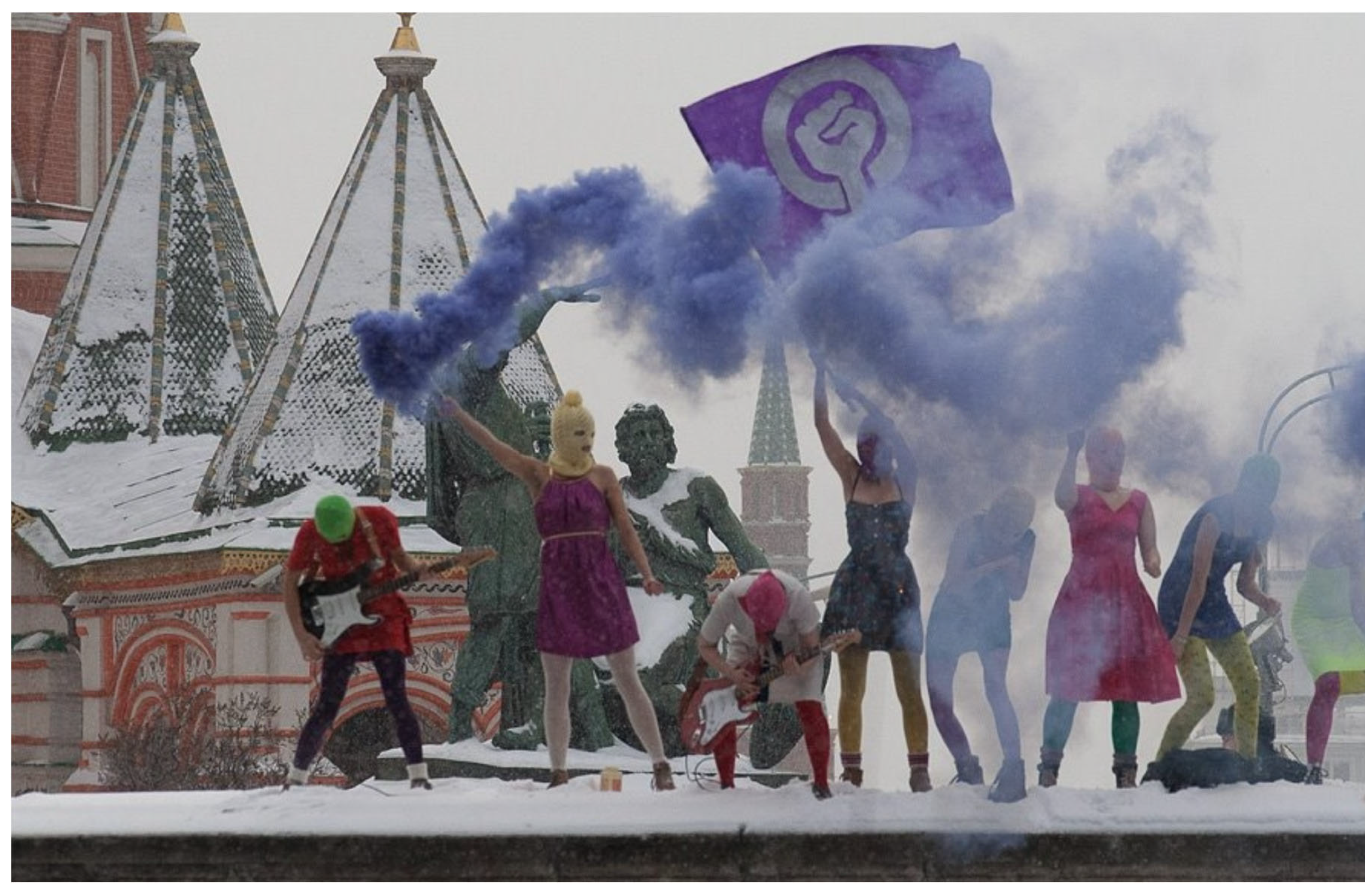
In this regard. I would say that trolling is often a preferred modus operandi of both leaders we are discussing here. A propensity towards online and offline trolling is another realm where both leaders manifest their prowess with regard to humorous, albeit cruel and often sadistic, rhetorical behavior. One should not forget that a Russian feminist punk band, “Pussy Riot”, has tried to fight Putin with their own transgressive blasphemy in a series of
stiob performative actions in the Cathedral of Christ the Savior and near Red Square (
Figure 11).
Trolling, holy foolishness and stiob:
This brings me to a thought not yet generally developed in the scholarly literature: I suspect, with a certain degree of confidence, that there exists a direct similarity, both implicit and explicit, between the holy fool phenomenon and the modern-day online, and often offline, behavior known as trolling, though we need to keep in mind that there is significant nuance distinguishing the two. The potential analogies between “holy fools” (iurodivye) and trolls can be based on the fact that both engage in provocative or disruptive behaviors that can serve to shock, jolt, or challenge social or spiritual complacency. As we discussed earlier, the holy fool employed unorthodox and provocative actions to awaken or jolt others spiritually, and this behavior might resemble the troll—especially in cases where trolling is intended to provoke thought or disrupt established consensus.
However we need to keep in mind a crucial distinction between two phenomena: while holy fools often enact disruption with the intention of spiritual or moral provocation for reasons that they perceive as an ultimate good and the potential betterment of society by stating the obvious things that the society at large refuses to notice, exposing brutal facts of life, and “saying truth to power”, by contrast, online (and offline) trolls tend to act out of mischief, malice, or self-amusement, and their intent may easily be sadistically harmful. Both types exploit role ambiguity and social norms to create productive or problematic disruptions, but motive and context can widely differ: trolling is socially coded as negative and harmful, while holy fools can achieve revered or transformative status in social discourse of the day and cultural memory.
To specifically focus on trolling, I would like to provide the following definition of this behavior, found in the scholarly literature focusing on this subject: “Online trolling is a behavior that deliberately attempts to deceive, aggress, or disrupt others on the Internet (
Buckels et al. 2019;
Cook et al. 2019). The behavior often intends to trigger or antagonize other users for their own entertainment (
Nitschinsk et al. 2023). People who troll online are typically anonymous and do not know the person they are targeting. Trolling is most commonly associated with sadism and psychopathy (
Buckels et al. 2019; Craker and March 2016).” (
Nitschinsk et al. 2023, p. 1).
In this regard, I would say that trolling is often the preferred modus operandi of both leaders we are discussing here.
Joseph Wayne of BYU (Brigham Young University), in his master’s thesis, specifically focuses on trolling as it applies to Trump: “Internet trolling can be loosely defined as intentionally sowing conflict in online communities by posting inflammatory or tangential material and can refer to the person acting as well as the act itself 1. Internet trolls are presumed to do this merely for amusement (“for the lulz”) or alternately to specifically disrupt some normal operation of the targeted online community.”
And talking about Trump, “Various pundits and publications have compared Trump to an internet troll. Nate Silver of FiveThirtyEight labeled him “the world’s greatest troll” and the New York Times ran an opinion piece in July 2018 titled “For Whom the Trump Trolls” (Maureen Dowd M.Y.).” (
Fisher 2019, p. 7) (Theses and Dissertations. 8255. Master’s thesis. p. 7).
“…trolling could be employed as a strategic technique. Rather than persuading one’s audience, a troll can disrupt the conversation through antagonistic rhetoric. Regardless of whether or not the troll sincerely agrees with his or her own statements, the audience will often feel compelled to respond and defend against the antagonistic rhetoric, potentially abandoning lines of argument that are more important or more advantageous. The audience is baited—trolled—into litigating parts of the discussion that are either suboptimal or genuinely disadvantageous.” (
Fisher 2019, p. 8).
Regarding Trump’s feud with Elizabeth Warren, “on 6 May 2016, he released a barrage of tweets about Senator Warren: I hope corrupt Hillary Clinton chooses goofy Elizabeth Warren as her running mate. I will defeat them both. (@realDonaldTrump, “I hope corrupt Hillary Clinton”) Let’s properly check goofy Elizabeth Warren’s records to see if she is Native American. I say she’s a fraud! (@realDonaldTrump, “Let’s properly check”) Goofy Elizabeth Warren, Hillary Clinton’s flunky, has a career that is totally based on a lie. She is not Native American.” (@realDonaldTrump, “Goofy Elizabeth Warren”) (
Fisher 2019, p. 12).
The author explains this as follows: “Trump’s statements here are not even intended to be persuasive—at least not directly. Instead, they are intended primarily to aggravate Warren (known under the widely popular
stiobby nickname of “Pocahontas”) and distract her and everyone else from her previous lines of argument…” (
Fisher 2019, p. 12) Trump continues: “Goofy Elizabeth Warren and her phony Native American heritage are on a Twitter rant. She is too easy! I’m driving her nuts. (@realDonaldTrump, “Goofy Elizabeth Warren and her phony”) Goofy Elizabeth Warren is weak and ineffective. Does nothing. All talk, no action—maybe her Native American name? (@realDonaldTrump, “Goofy Elizabeth Warren is weak”) (
Fisher 2019, pp. 16–7). Finally, Trump attacks: “Pocahontas (the bad version), sometimes referred to as Elizabeth Warren, is getting slammed. She took a bogus DNA test, and it showed that she may be 1/1024, far less than the average American. Now the Cherokee Nation denies her, “DNA test is useless.” Even they don’t want her. Phony!” (@realDonaldTrump “Pocahontas (the bad version)”) (
Fisher 2019, p. 20).
When Vladimir Putin trolls:
In his polemical rhetoric, Putin often uses trolling to deal with his adversaries or opponents. Here are some examples of Putin’s well-publicized attempts at trolling:
Zelensky joke: “During a (February 2022 M.Y.) press conference following Russian–French talks, Putin commented on the Minsk agreements and the Ukrainian president Volodymyr Zelenskyy’s stance toward them. He joked: ‘Like it or not—put up with it, my beauty.’ («Нравится тебе этo или нет—спи, красавица») You have to follow the terms. There’s no other way.” This phrase is notable for its usage in the song “Sleeping Beauty in a Coffin” by the former Soviet band Red Mold. It appears in the following lyrics: “The beauty sleeps in the coffin / I creep up and shag her / Like it or not, sleep my beauty!” (
Donskikh and Akopov 2025, p. 153).
These are also words taken from the well-known Russian limerick (chastushka), but what is particularly important about this specific instance of trolling is that Putin intentionally “feminizes” and, according to Russian criminal or street ethos, sexually dominates, even if rhetorically, Ukrainian President Zelensky, to whom the words “sleep my beauty” (used in the feminine gender “krasavitsa”) are addressed. This switch of gender roles immediately establishes a hierarchy in which Putin, as a powerful male, puts Zelensky (and Ukraine along with him) into his place, prescribed by the sheer power that Putin, as a male, claims to assert.
Vladimir Putin vs. Tucker Carson:
Another example of trolling a naive or unsuspecting interlocutor is the now infamous interview Putin gave American journalist Tucker Carson on 9 February 2024. (
Tucker Carson Interview n.d.) In this lengthy exchange, Putin devoted over 30 min to a detailed historical narrative about Russia’s origins, the medieval state formation in 862, Mongol invasions, Polish–Lithuanian conflicts, and the idea that Ukraine is an artificial state created by Russia’s adversaries. Throughout this narrative, Putin often employed a dry, sardonic tone, occasionally using rhetorical questions and ironic dismissals of Western views. He appeared to mock Western ignorance about Eastern European history. Carson seemed to be bewildered by the unexpected turn of the interview, and even though he clearly perceived a diversion and possibly mockery, he was unable to regain control of the conversation. This is also how
stiob works; Putin has mastered this trolling technique, and therefore, his humor often relies on irony and understatement rather than overt jokes.
Arsenal of rhetorical devices:
Let us take a closer look at the rhetorical devices common to both Trump and Putin in their “holy fool” and troll personas: holy fools and trolls both use irony, paradox, ambiguity, and provocative disruption as rhetorical tactics.
Here is an incomplete list of rhetorical tools common to both holy fools and trolls (as well as Trump and Putin, acting in either one of these hypostases): irony, paradox, hyperbole, mockery: use of paradoxical speech to confuse, bait or expose social or spiritual truths or foibles and propensity towards exaggerated gestures, playful ridicule, or self-mockery, using humor to shame, expose, bully, ridicule or puncture social pretensions. Expressing radical and unvarnished truths that are often risky or taboo, striking at “holy cows” and engaging in sacrilege. Baiting and provoking through inflammatory comments, false sincerity, and provocative language to elicit strong emotional responses or arguments. Irony, sarcasm, and stiob: they often rely heavily on irony, double meanings, double-voicedness, sarcasm and stiob to confuse and destabilize their interlocutors. Digression and misdirection tactics that are often used to derail, confuse or disrupt conversations. They often resort to deception, attempting to mimic conventional behaviors or pretend ignorance to appear naive or uninformed, to sabotage serious conversation. They often employ logical fallacies and tend to attack “strawman” arguments to incite futile debate. Both share their penchant towards performance, actionism, theatricality and absurd antics: holy fools stage “divine madness,” while trolls perform ego-driven mischief, all to bewilder, shock or “shock into enlightenment,” and otherwise steer the thoughts and emotions of “normies” in the audience. And finally, both tend towards subversion, undermining and disrupting social or discursive norms.
I would like to reiterate here, with more clarity, that stiob has become one of the tools, stylistic and rhetorical devices used in trolling, and therefore, stiob and trolling, as well as holy foolishness, are all related and use the same arsenal of devices. As it was pointed out, stiob is a form of ironic parody or satire that uses exaggerated, deadpan mimicry, ambiguity, and layered irony to mock political and social realities. It aims to expose absurdities by imitating and amplifying them to the point of absurdity. Stiob relies heavily on maintaining a carefully ironic tone, without revealing humorous or subversive intentions, and often covertly undermines official and adversarial narratives or dominant ideologies while seeming to affirm them on the surface.
Trolling, especially online trolling, shares this use of irony, exaggeration, sarcasm, double-talk and provocative ambiguity. Trolls post inflammatory or absurd content designed to confuse, annoy, or provoke emotional responses from targets. Like stiob, trolling often disguises its real meaning behind layers of irony or parody, making it difficult to discern if the content is sincere or mocking. Both rely on the audience’s awareness and interpretive skill to decode the underlying criticism or humor.
Ideologically, stiob originated as a form of countercultural resistance, while trolling can be seen both as a subversive activity and manipulation or disruption for amusement or political purposes.
The end result of Trump’s and Putin’s weaponization of holy foolishness, trolling and stiob is that they inadvertently created a carnivalesque “safe space” for their followers and audiences of all types, including supporters and detractors, thus changing the tenor, the style, the tone and the nature of national discourse, expanding the spectrum of publicly acceptable and allowable and confusing the notions of good taste, social taboos, and morality itself. If they, the national leaders, can say things so far unimaginable, unpronounceable, and almost unthinkable, then we all should be able to.
What this paper has sought to demonstrate is that stiob is best understood not as a marginal Soviet slang for “mockery” but as a portable aesthetic technology of modernity: a mode of expression that converts the official language of power into an unstable mask, forcing the spectator to inhabit the dangerous interval between sincerity and parody. In that sense, stiob is not merely about laughter; it is laughter as method—a practiced technique for making ideological discourse contradict itself in public, without granting the audience the comfort of a reassuring wink. Specifically, this “unresolved” deadpan is what connects stiob to the deeper historical strata of Russian carnivalesque culture (skomorokh performance, holy foolishness, and grotesque inversion) and to the core procedures of the avant-garde and modernism: estrangement, montage, scandal, and the weaponized citation of ready-made forms. From the vantage point of twentieth-century art, the relevance becomes concrete. Russian futurism already rehearsed stiob’s logic when it staged public provocation as a laboratory for reprogramming perception: the overperformed manifesto voice, the aggressive theatricality of readings, the deliberate contamination of “high” speech with street abrasiveness. What matters here is not just scandal, but a strategic impersonation of cultural authority pushed to excess until it collapses. OBERIU radicalized the same mechanism: Kharms and Vvedenskii perfected a kind of absurdist deadpan in which bureaucratic rationality, moral didacticism, and narrative coherence are mimicked so faithfully that they reveal their own metaphysical hollowness. Their “nonsense” is, in effect, a carnivalesque sabotage of the very protocols by which meaning is policed.
Under late socialism and its aftermath,
stiob becomes an explicit counter-genre of institutional language. Conceptualist practices—Dmitry Prigov’s obsessive policing personas, Lev Rubinstein’s quasi-administrative textual formats, Ilia Kabakov’s installations that simulate didactic Soviet environments—turn the state’s communicative apparatus into artistic material. The crucial point is that these works do not simply “criticize” ideology from the outside; they enter ideology’s diction, reproduce it, and thereby render it grotesque from within—exactly the internal carnival that Bakhtin’s model helps us name. Sots-Art (Komar and Melamid, among others;
Figure 12) performs the same inversion visually: socialist realism is not rejected but re-staged with such meticulous loyalty that its triumphal certainty mutates into farce.
The musical and performative sphere confirms the breadth of
stiob as (post-)modernist technique. Sergei Kurekhin’s media pranks and
Pop Mekhanika spectacles (
Figure 7), or the grotesque stage personae of late-Soviet rock performance, demonstrate how
stiob migrates into multimedia action, where citation, parody, and disciplined straight-faced delivery dissolve the boundary between aesthetic experiment and social ritual. Across these examples, the carnivalesque is not decorative “folk color” but a structural principle: hierarchies are inverted, taboos are handled as raw material, and the official voice is made to sound like a self-parody. In recapitulation, then, this paper’s main finding is that
stiob and the carnivalesque supply a powerful analytic key for twentieth-century avant-garde and modernism and twenty-first-century political discourse and weaponization of humor because they clarify how transgressive art often operates: not by offering an alternative doctrine, but by engineering a zone of interpretive vertigo in which power is exposed through its own amplified performance.
Stiob is modernism’s corrosive double: an aesthetics of overidentification that turns culture’s most serious idioms—manifesto, decree, sermon, and propaganda—into instruments of demystification precisely by refusing to announce itself as critique.
What this essay ultimately offers to cultural and performance studies is not merely another case study of political grotesque or rhetorical atrocities, but a usable analytic instrumental gage: stiob as téchne, i.e., as an operational repertoire of embodied and discursive techniques that manufacture deniability, complicity, and produce whiplash and pushback through deadpan overidentification and the grotesque subversion of the logic and intention of utterances or gestures. Seen this way, stiob stops being a late-Soviet anecdote and becomes a portable toolbox for contemporary performativity: an acting method of the public sphere in which the performer refuses the spectator the relief of a wink and thereby turns interpretation into a trap accessorized with moral and reputational hurdles and pitfalls.
The methodological payoff within Slavic cultural studies perspective specifically focuses on showing how power currently performs (or even creates) “truth” not as sincerity but as mask-making simulacra: a dramaturgy of double-voicedness (
Bakhtin 1984), infernal laughter (“kromeshnyi mir” in Likhachev/Panchenko), and strategic sacrilege that toggles between carnival and torture. For scholars of performance, the gamble is at times plain and unsettling: to stop treating cultural outrage as a byproduct and treat it as a choreographed effect and reading trolling as mere “online disrupting behavior” and read it as a culturally cognizant technique of audience capture, a mode of public actionism that borrows from the holy fool’s scandalous capering (“юрoдствo”) while eliminating its eschatological ethic and its behavioral implications. In this sense, the Trump/Putin rhetorical antics are less of a headline-grabbing sensation than a diagnostic laboratory that allows us to see how contemporary statecraft performs its own immunity from being pinned down or taking responsibility for its public utterances.
For visual culture, the methodological outcome lies in taking the carnivalesque not as a metaphor but as a visual regime—a grammar of images, gestures, and iconographic sabotage or transgression that trains viewers in how to see (and mis-see) authority. This essay’s use of skomorokh frescoes, lubok scenes, and canonical nineteenth-century canvases is not ornamental “context” but rather a deliberately assembled dossier of Russian laughter-cultures that amplifies the way that the Russian image-world has long rehearsed sanctioned scandal, grotesque corporeality, and iconoclastic reversals. In other words, we can approach stiob as a kind of iconology of misrecognition: a way of producing images (or verbal pseudo-images) that seem “official” while quietly undermining the very category of the official. For scholars trained in montage, ostranenie, and Sots-Art’s counterfeit “realism”, this paper offers a magnified premise: stiob is a visual–aural technology of enhanced signification—the sign is made so emphatically that it begins to disintegrate, to leak its ideological cement. What becomes newly assertable, then, is a visuality of the grotesque across media: from medieval jesters to conceptualist bureaucratic ventriloquism, from rock music’s collage-quotation or misquotations to the mediatized spectacle of contemporary leaders. The issue here is not that “everything could be carnival”, but that certain cultures have perfected a historically sedimented optics of cruelty-as-play—and that we need sufficiently precise analytic language to name when these optics obtain cultural governance.