1. Introduction
Digital capitalism has transformed not only the structure of economies but also the textures of daily life. Through the pervasive reach of algorithmic systems, social relations are increasingly mediated, accelerated, and commodified (
Striphas 2015;
Zuboff 2020). Data is mined as a resource, attention becomes currency, and affect is harnessed for profit, forming what
Berardi (
2009) describes as the “psychosphere” of late capitalism, where cognitive and emotional life are subsumed into circuits of value extraction. Beneath the rhetoric of efficiency and personalization lies an infrastructure of extraction: lithium and cobalt mines, energy-intensive server farms, exploitative supply chains, and resource-intensive cloud ecologies (
Crawford 2021). Scholars across media studies, environmental humanities, and critical infrastructure studies have emphasized that the digital sphere is never immaterial: it rests upon deeply uneven geographies of extraction and labor (
Parikka 2015;
Starosielski 2015). The duality of software interfaces promising frictionless connection while masking extraordinary material costs demands renewed interrogation, particularly as algorithmic systems increasingly shape cultural production, perception, and imagination.
Exhibitions offer a unique cultural platform for such interrogation. Unlike theoretical critique alone, curatorial practice creates embodied, sensory encounters that can both reveal hidden infrastructures and prototype regenerative alternatives. Within debates on algorithmic resistance and post-extractive futures, exhibitions have been positioned as sites where cultural narratives can be unsettled and remade (
Bishop 2022;
Lind 2012). Their spatial, temporal, and multisensory qualities allow visitors to confront the material realities that digital capitalism renders invisible, while simultaneously engaging in speculative modes of world-building. Exhibitions may thus be understood as laboratories for resistance: spaces where embodied attention interrupts algorithmic acceleration, where craft and care counter digital abstraction, and where public imagination can be redirected from extractivist futures toward more symbiotic ones. This article introduces the concept of symbiotic curation to describe curatorial approaches that combine critical exposure with regenerative proposition. While many critical exhibitions diagnose the harms of extractivism, symbiotic curation aims to balance critique with the cultivation of alternatives, emphasizing repair and ecological attunement.
This article asks:
- (1)
How can exhibition practices function as forms of algorithmic resistance through material and embodied strategies?
- (2)
How can curatorial practice balance critical exposure of extractivist systems with the cultivation of regenerative imaginaries?
- (3)
What transferable principles can be derived from practice-based curatorial research for post-extractive cultural work?
To address these questions, the article adopts a practice-based research approach in which curatorial design, spatial composition, and material choices operate as epistemic tools. Exhibitions are approached not only as objects of analysis but as sites of knowledge production through which theoretical propositions are tested and embodied.
The methodological orientation of this paper is grounded in practice-based research, where artistic and curatorial processes function as modes of inquiry rather than merely as objects of study (
Bolt and Barrett 2019;
Candy and Edmonds 2018). Within arts-based research, exhibitions are understood as epistemic environments that generate knowledge through spatial arrangement, affective resonance, and material engagement. This perspective is central to understanding how curatorial practice can intervene in the socio-ecological imaginaries shaped by digital capitalism, not only by representing post-extractive possibilities but also by enacting them through embodied encounters, material experimentation, and participatory reflection.
The positionality of the practitioner-researcher is therefore central to this study. As the creator of
Nature Reclaims: Images of Healing, the author occupies a dual role: both observing and producing the curatorial strategies under examination. This reflexive standpoint aligns with traditions of situated knowledge (
Haraway 1988) and acknowledges that curatorial decisions—framing, spatial arrangement, material choice—are shaped by lived experience, disciplinary background, and ongoing research in environmental psychology. In the context of this article, reflexivity is not merely methodological transparency but an ethical commitment: understanding how one’s own curatorial practice participates in the broader struggle to imagine post-extractive futures.
This paper explores these possibilities through two case studies. The first is the author’s exhibition
Nature Reclaims: Images of Healing, curating photographs of urban rewilding alongside tactile material interfaces, linking artistic practice with social enterprises and economies for the common good. The second is
Fossil Fables, curated by the Global Extraction Observatory and Kate Goodwin (
Baska 2023), which uses architectural and spatial strategies to expose the entanglement of extraction industries and national identity in Australia. Together, they illustrate the curatorial framework of symbiotic curation—a practice that resists algorithmic determinism by combining critical exposure with regenerative proposition.
This article is structured as follows.
Section 2 develops a theoretical framework around extractivism, materiality, and care in digital capitalism, positioning algorithmic culture as a multi-layered extractive formation and outlining material praxis and relational ethics as counter-logics.
Section 3 and
Section 4 present the two case studies—
Nature Reclaims: Images of Healing and
Fossil Fables—examining how each exhibition enacts forms of algorithmic resistance through embodied, spatial, and material strategies.
Section 5 synthesizes these analyses under the concept of symbiotic curation, articulating it as a post-extractive curatorial method that balances critical exposure with regenerative imagination while identifying transferable methodological principles.
Section 6 concludes by reflecting on the broader implications of symbiotic curation for cultural institutions, practice-based research, and socio-ecological transition. The author’s exhibition,
Nature Reclaims, is analyzed as a reflexive case study to examine how curatorial practice can go beyond algorithmic resistance and enact ecological and psychological regeneration. The analysis is grounded in the author’s ongoing research in environmental psychology and conducted in accordance with academic integrity and transparency guidelines.
2. Extractivism, Materiality, and Care in Digital Capitalism
To address how exhibition practices may function as forms of algorithmic resistance, it is necessary first to clarify the extractive conditions within which contemporary curatorial work operates. Digital capitalism is not merely a technological development but a political–economic formation that reorganizes perception, affect, material resources, and attention. Algorithmic culture embeds computational processes into cultural production and experience, shaping visibility, value, and imagination (
Bucher 2018;
Striphas 2015). Surveillance-based models transform behavioral data into economic assets (
Zuboff 2020), while platform infrastructures consolidate power through opaque systems of optimization and prediction. What appears as seamless interface is sustained by extraction at multiple levels: cognitive, affective, ecological, and infrastructural.
The political economy of data extraction reveals how human experience itself becomes a site of appropriation.
Couldry and Mejias (
2019) describe this as “data colonialism,” a process through which everyday interactions are continuously measured and operationalized for profit. Digital labour theorists (
Fuchs 2014;
Terranova 2000) show how participation—scrolling, reacting, and sharing—generates uncompensated value for platform economies, while
Morozov (
2013) critiques the ideology of technological solutionism that masks these asymmetries. Extraction here is not limited to raw materials, extending to attention, emotion, and time.
Crawford (
2021) deepens this analysis by situating artificial intelligence within planetary-scale infrastructures of mining, logistics, and energy consumption. Rare earth minerals such as cobalt and lithium, exploitative supply chains, water-intensive data centers, and carbon-intensive computation expose AI as materially grounded rather than immaterial.
Parikka’s (
2015) “geology of media” similarly foregrounds the mineral and energetic substrates of digital culture, demonstrating that media technologies emerge from deep-time processes of extraction and waste. Together, Crawford and Parikka reveal digital capitalism as a materially intensive regime whose operations are sustained by environmental degradation and infrastructural invisibility.
Extraction also operates affectively. Engagement-optimizing algorithms, persuasive design (
Fogg 2003;
Lockton 2012;
Williams 2018), and affective computing reorganize emotional life into monetizable data flows (
Crawford 2021). Attention becomes a scarce resource to be captured and intensified, while social acceleration (
Rosa et al. 2015) compresses temporal experience into cycles of immediacy and stimulation. Digital infrastructures thus shape not only what users encounter, but how they feel and how they inhabit time.
New materialist and posthumanist thought provide crucial counterpoints to this abstraction.
Barad’s (
2007) theory of intra-action insists that matter and meaning emerge relationally, challenging representational models that separate humans from infrastructures or ecologies.
Bennett’s (
2010) notion of “vibrant matter” foregrounds the agency of nonhuman materials, emphasizing that political and ethical life unfolds within assemblages of human and more-than-human actors.
Braidotti (
2013) and related critical posthumanist scholarship further destabilize anthropocentric assumptions by emphasizing entanglement and relational ontology. From this perspective, digital systems cannot be understood solely as symbolic or informational; they are socio-material assemblages that shape bodies, ecologies, and imaginaries.
Within this relational framework, care emerges as a counter-principle to extraction.
Puig de la Bellacasa (
2017) conceptualizes care not as sentimentality but as a material and ethical practice grounded in interdependence. Care attends to vulnerability, maintenance, and responsibility across human and nonhuman worlds. Where extraction abstracts, accelerates, and instrumentalizes, care slows, situates, and relates.
Haraway’s (
2016) call to “stay with the trouble” similarly advocates for sustained, embodied engagement rather than escapist technological optimism. This orientation also resonates with scholarship in eco-curating (
Demos 2016), regenerative design (
Cole 2012;
Mang and Haggard 2016), and decolonial aesthetics (
Mignolo and Walsh 2018;
Vázquez Melken 2020), which similarly foreground relationality, material accountability, and the ethical reorientation of cultural production.
Material praxis thus becomes significant in this context.
Ingold (
2013) understands making as a form of knowing that unfolds through bodily negotiation with materials, while
Sennett (
2008) emphasizes craft as an ethical discipline cultivating attention and responsibility. Embodied cognition research (
Noë 2006) further demonstrates that perception and understanding arise through sensory engagement rather than abstract computation. Material engagement—touch, slowness, spatial arrangement—therefore functions as more than aesthetic preference, becoming a political intervention into the perceptual regimes structured by digital acceleration.
These theoretical strands collectively illuminate the stakes of the first research question: how exhibition practices may function as forms of algorithmic resistance. If algorithmic systems operate by abstracting experience into data, compressing time, and obscuring material infrastructures, then curatorial practices that foreground materiality, slowness, and embodied participation intervene precisely at the level where extraction reorganizes perception. Exhibitions possess the capacity to reorganize attention, recalibrate temporality, and render infrastructures visible.
The second research question—how curatorial practice can balance critical exposure with regenerative imaginaries—emerges from this same framework. Crawford’s planetary analysis and Parikka’s “geology of media” demand exposure of infrastructural violence; Puig de la Bellacasa’s ethics of care and Bennett’s vibrant materialism call for cultivating alternative relations grounded in reciprocity and responsibility. Curatorial practice therefore operates within a productive tension: it must simultaneously reveal extractive systems and enact relational alternatives. This dual orientation moves beyond purely diagnostic critique toward regenerative imagination.
The broader body of scholarship on algorithmic culture, digital labour, acceleration, participatory art, and social practice (
Bucher 2018;
Striphas 2015;
Bishop 2022;
Lind 2012;
Jackson 2011) contextualizes this shift. Exhibitions are not neutral containers of discourse but structured environments that organize sensory experience, relationality, and participation. They function as spatial and affective mediators capable of countering the privatized and individualized logic of platform culture.
The third research question—concerning transferable principles for post-extractive cultural work—follows from this synthesis. If extractivism operates through abstraction and invisibility, and care operates through material and relational attentiveness, then curatorial methodologies that integrate critique with embodied engagement offer replicable strategies beyond individual exhibitions. Material attunement, participatory structures, infrastructural visibility, and the ethical repurposing of digital tools become methodological principles rather than isolated aesthetic choices.
Within this theoretical constellation, the concept of symbiotic curation emerges as a response to extractivism’s multi-layered operations. Symbiotic curation does not reject digitality outright but embeds digital tools within ecosystems of material care. It pairs infrastructural exposure with regenerative encounter, critique with cultivation, confrontation with repair. The case studies that follow—Fossil Fables and Nature Reclaims—are examined as situated experiments in this approach: one foregrounding exposure of extraction’s infrastructures, the other cultivating embodied relations of care and regeneration. Together, they illustrate how curatorial practice can intervene materially, affectively, and imaginatively within the extractive conditions outlined above.
3. Case Study I: Nature Reclaims: Images of Healing
3.1. Concept and Design
The author’s exhibition Nature Reclaims: Images of Healing investigates how urban spaces, often dominated by concrete, steel, and infrastructural hardness, become sites of ecological persistence and renewal. The exhibition presents a curated sequence of 29 photographs, a number chosen to suggest an intimate ‘cycle’ of rewilding encounters observed during the author’s travels to various places of the world. The selection criteria emphasized three dimensions:
Ecological agency (images revealing spontaneous plant emergence in the absence of human intervention),
Temporal layering (structures showing nature’s regeneration over time within built environment decay),
Symbolic resonance (scenes that visually evoke healing, repair, or resistance).
These images are arranged in a slow, spiraling visual narrative that guide visitors from micro-level phenomena (sprouting moss, fissures, cracks) to larger ones (trees growing from ruins, vines enveloping façades). The exhibition layout is designed to evoke a gradual deceleration: dimmer lighting at the entrance signals a transition away from sensory overstimulation, while warmer, softer lighting near the center creates an atmosphere conducive to reflection. Photographs are mounted at slightly varied heights to mirror the unevenness of the natural growth they depict, inviting visitors to bend, lean, or adjust their posture as subtle acts of embodied engagement opposing algorithmic passivity. This curatorial emphasis on bodily adjustment and relational perception resonates with
Barad’s (
2007) concept of intra-action, in which meaning and matter emerge through entangled relations rather than representational distance. The photographs and spatial choreography also align with
Bennett’s (
2010) notion of vibrant matter, foregrounding nonhuman agency as active participant in processes of healing and transformation, not as background scenery.
These rewilding images illustrate what
Tsing (
2021) calls “life in capitalist ruins,” where nonhuman persistence overcomes extractive logics. As illustrated in
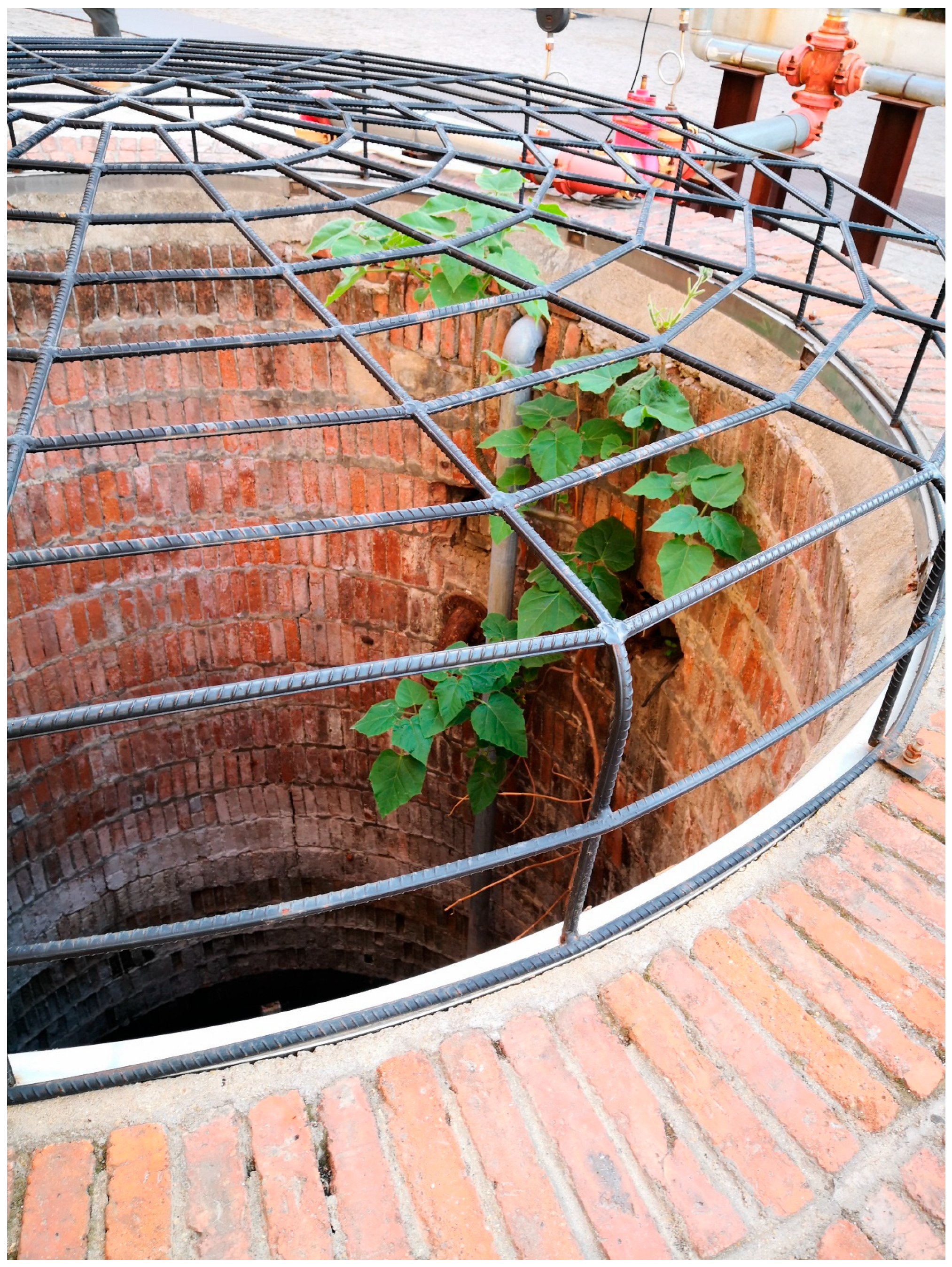
Figure 1, vegetation forcing its way through the structure of a brick well becomes a visual metaphor for resistance and ecological and psychological healing. The slow intertwining of architecture and nature becomes evident in
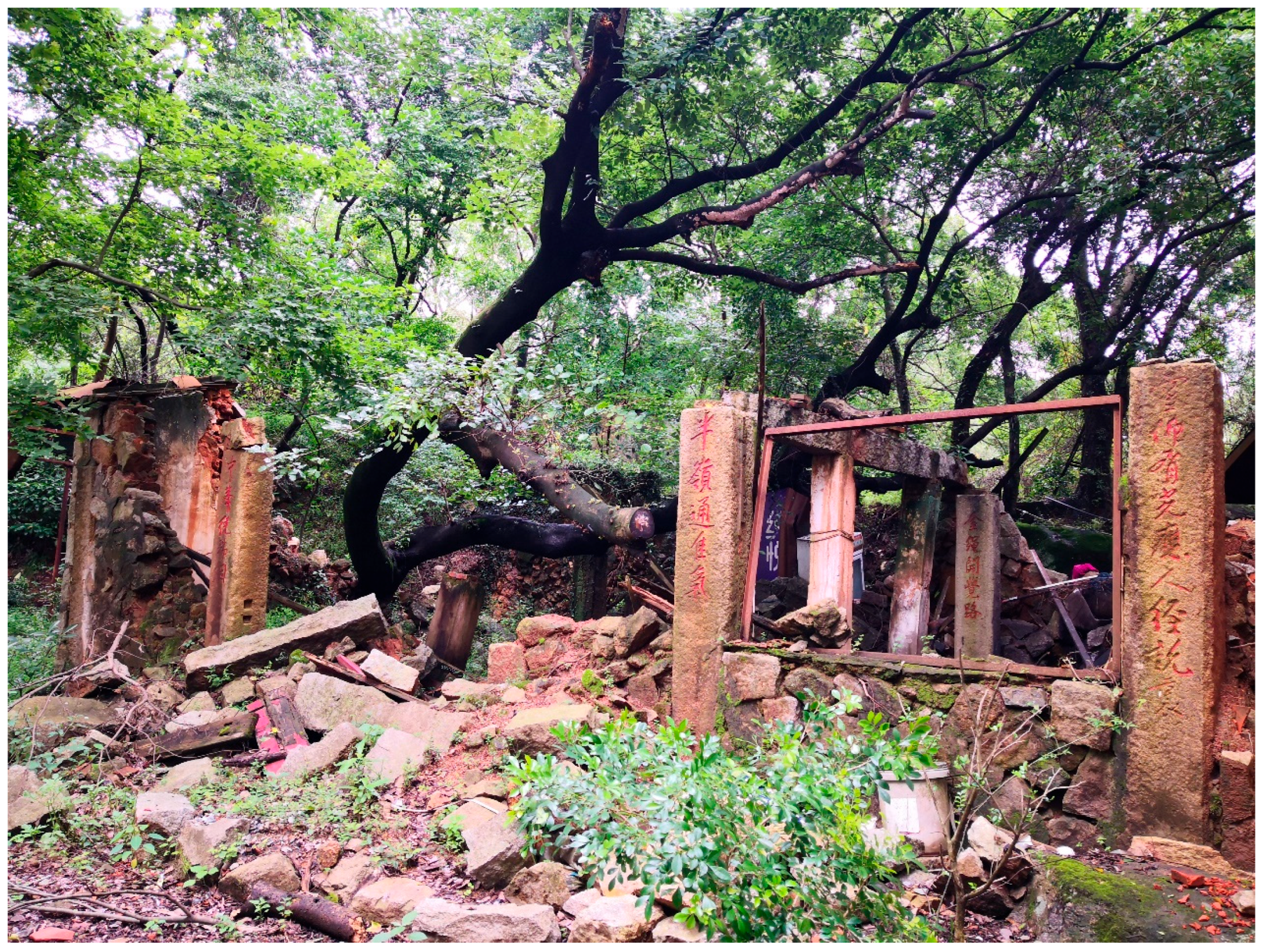
Figure 2, where trees thrive in ruined masonry.
Complementing the photographs are tactile installations composed of concrete fragments embedded with live plants. These objects serve as anchors of material engagement within the gallery. Visitors are invited to touch, smell, and sit beside these living fragments, attuning to the slow temporalities of growth that persist beneath digital acceleration. These installations embody
Haraway’s (
2016) invitation to “stay with the trouble”, to dwell with damaged ecologies rather than turn away from them. They also enact what
Puig de la Bellacasa (
2017) describes as “matters of care,” where ethical responsibility arises through situated, material relations rather than abstract moral frameworks. The sensory stimulation—cool concrete, delicate leaf textures, soil moisture—brings visitors outside the digital environment and activates processes associated with restorative environmental experience, grounding the exhibition in principles of environmental psychology.
3.2. Environmental Psychology Grounding
Environmental psychology research highlights several mechanisms through which natural elements promote psychological well-being. Attention Restoration Theory (ART) suggests that exposure to natural patterns facilitates cognitive restoration by engaging involuntary attention in gentle, non-demanding ways (
Berman et al. 2008;
Kaplan and Kaplan 1989;
Kaplan 1995). Biophilia theory similarly posits an innate human affinity for natural forms, textures, and temporalities (
Wilson 2010). The photographs and tactile installations in
Nature Reclaims intentionally leverage these mechanisms to invite the kind of “soft fascination” conducive to mental restoration.
Touch plays a central role. Contemporary studies in haptic perception and sensory engagement indicate that tactile interaction with natural materials regulates physiological stress responses and enhances emotional grounding (
Gallace and Spence 2010;
Gibson 1983;
Lederman and Klatzky 1987;
Pallasmaa 2012). By inviting visitors to touch the plant-embedded concrete pieces, the exhibition counters the visual dominance of digital culture with multisensory engagement. The shift from visual consumption to sensory co-presence strengthens the exhibition’s resistance to algorithmic abstraction. If, as
Crawford (
2021) argues, digital systems reorganize human experience into extractable behavioral and affective data, then re-centering perception in multisensory, non-instrumental bodily experience becomes a form of algorithmic resistance rather than a purely therapeutic gesture.
3.3. Interactive Elements
3.3.1. QR Codes
Crucially, the exhibition integrates QR codes embedded directly into the tactile concrete fragments. In conventional cultural institutions, QR codes often serve marketing, tracking, or data extraction purposes. Here, however, they are redirected toward social enterprises and economy-for-the-common-good initiatives. This repurposing constitutes an act of critical digitality: a gesture that reframes digital engagement as a pathway toward regenerative action rather than a mechanism of attention capture. Rather than extracting attention, the digital interface is embedded within an ecology of care, aligning with symbiotic curation’s insistence that digital tools be woven into relational and material contexts rather than operate as autonomous systems. Visitors who scan the codes are invited into a relational ecosystem of projects that challenge extractivist economic logics. This reflects
Bourriaud’s (
2009) notion of relational aesthetics, where art functions as a social interstice, an opening through which alternative models of social and ecological value emerge.
3.3.2. The Invisible Backpack Station: Trauma-Informed and Reflexive Engagement
A central interactive component is the Invisible Backpack station, based on the author’s conceptual tool used throughout her broader practice to represent the cumulation of individual experiences from birth until present moment that will shape individual mindset and behavior. Here, visitors are invited to reflect on the implicit assumptions they carry in their own “Invisible Backpack” about productivity, growth, success, scarcity, and value, many of which unconsciously stem from conditioning within extractivist systems.
The station is grounded in principles from trauma-informed design (
Harris and Fallot 2001) and constructivist learning theory (
Brooks and Brooks 2001). Trauma-informed approaches emphasize safety, choice, reflection, and empowerment; the station therefore uses soft lighting, natural materials, and open-ended prompts that allow visitors to engage at their own pace. Constructivist learning theory asserts that knowledge is co-created through experience and personal meaning-making; the station invites visitors to “unpack” or externalize inner narratives, making them tangible.
Participants engaging with this tool often respond with unanticipated depth, reflecting on how their own view of the world was shaped by their growing up environment and experiences. In this sense, the station functions as an embodied counter-practice to the self-optimization narratives prevalent within algorithmic culture. This reflexive process mirrors
Barad’s (
2007) understanding of knowledge as emerging through entangled material-discursive practices, where inner narratives, bodily presence, and spatial conditions co-produce meaning.
3.4. Resistance Dimension
By combining photography, tactile materiality, environmental psychology principles, and repurposed digital tools, Nature Reclaims resists algorithmic determinism on multiple levels. The exhibition slows down perception, foregrounds embodied interaction, and reframes digital engagement as a conduit for solidarity rather than extraction. It fosters dialogical participation rather than passive spectatorship, situating visitors as co-producers of meaning rather than data points for algorithmic capture.
3.5. Connection to Business Redefinition
The exhibition is directly informed by the author’s broader research conducted within a sustainability research fellowship (
Deacu,
2025b), which seeks to redefine business as “an entity that solves social issues and creates social value in a financially sustainable way” as a solution to climate change and colonization. By linking artistic practice with economies for the common good,
Nature Reclaims demonstrates how art can catalyze regenerative economic imaginaries. It materializes a vision of post-extractive futures where ecological healing and social enterprise are entwined. This regenerative symbolism culminates in
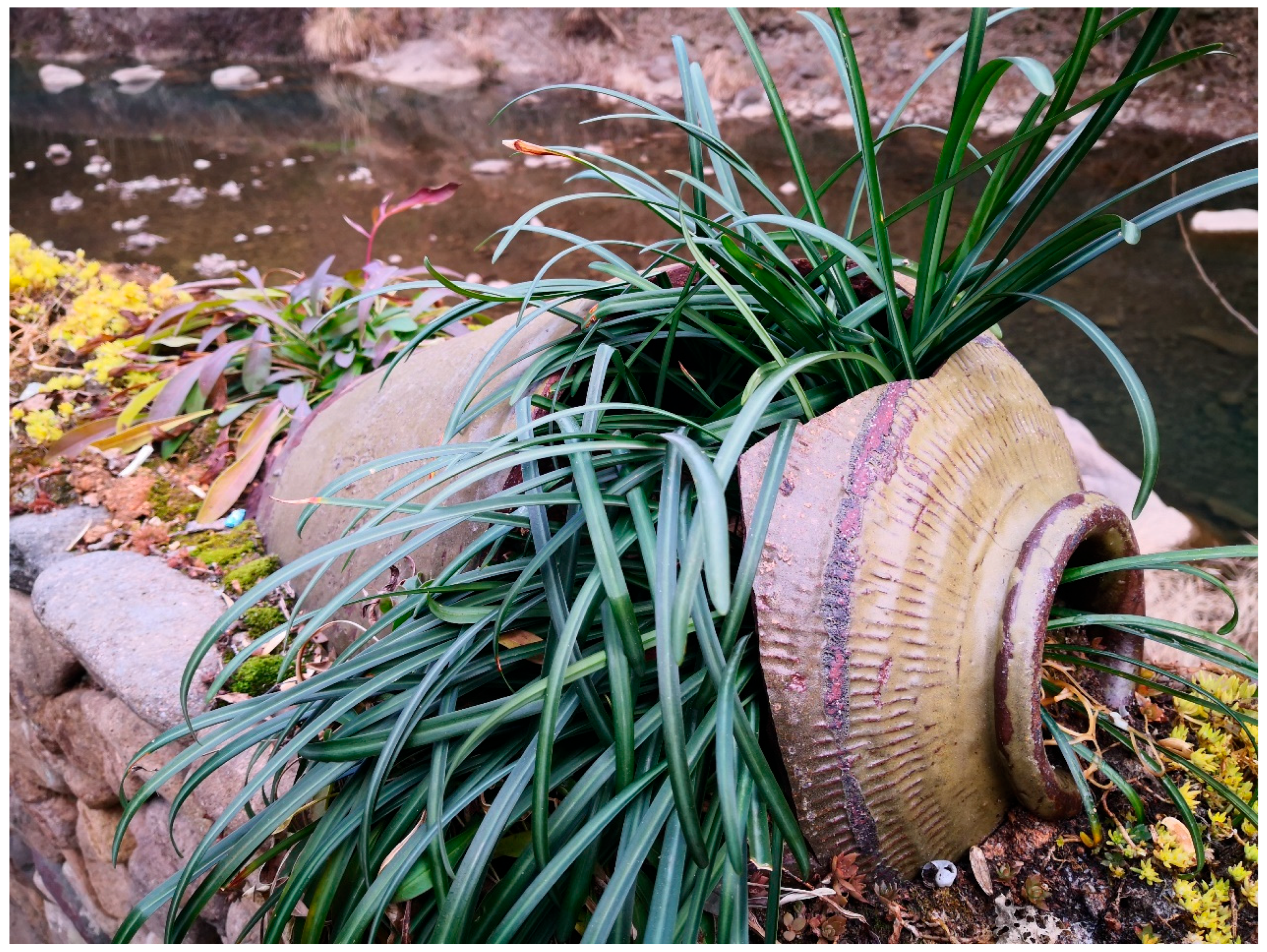
Figure 3, which reframes broken vessels as habitats of regeneration.
4. Case Study II: Fossil Fables
4.1. Concept and Design
Fossil Fables, curated by GEO co-founders Sam Spurr and Eduardo Kairuz and Kate Goodwin (
Baska 2023), stages Australia’s complex entanglement with extraction and coal mining through architectural installations, archival material, and spatial storytelling. The exhibition reimagines the gallery space as a landscape of extraction, transporting visitors from urban interiors into the material and symbolic terrains of the Hunter Valley. By using architecture as an analytical and affective tool,
Fossil Fables communicates the scale, violence, and mythologies of extractive industries. The exhibition can be read through
Crawford’s (
2021) planetary analysis of artificial intelligence and
Parikka’s (
2015) “geology of media,” both of which insist that contemporary technological culture is inseparable from mining, logistics, and energetic infrastructures.
Fossil Fables renders these usually invisible material substrates spatially and sensorially present.
Rather than relying on didactic displays, the exhibition employs spatial drama to confront viewers with the aesthetic and cultural dimensions of extraction. Installations blur boundaries between the historic and the contemporary, the industrial and the domestic, the monumental and the intimate. Each work functions as a “fable,” narrating aspects of extraction’s legacy through material and spatial means.
4.2. Spatial Strategies and Visual Language
The spatial language of
Fossil Fables transforms the gallery into a cartography of extraction. At its centre,
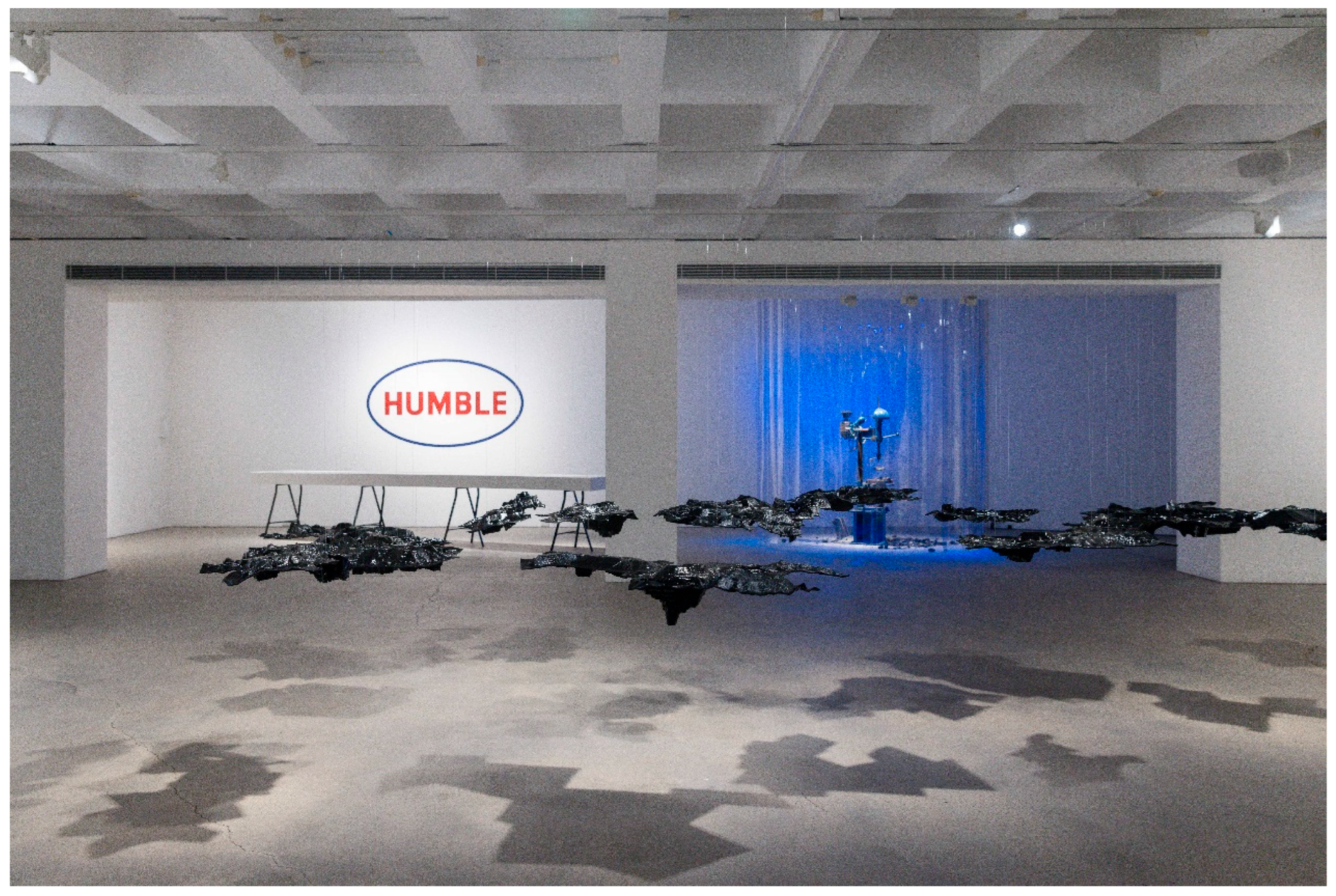
Terminal Void presents suspended 1:10,000-scale models of open-pit mines from the Hunter Valley, cast in jet-black photopolymer resin (see
Figure 4).
Arranged according to their real geographic positions, the forms hover from the ceiling like a negative relief map, what
Darmour-Paul and Barber (
2023) describe as a kind of exploded map of coal infrastructure that the vineyard cellar door tourists in the region can never see. The work exposes how extraction has been materially concealed behind “trees and artificial hills,” revealing the hidden architectures sustaining algorithmic infrastructure.
Behind it, the
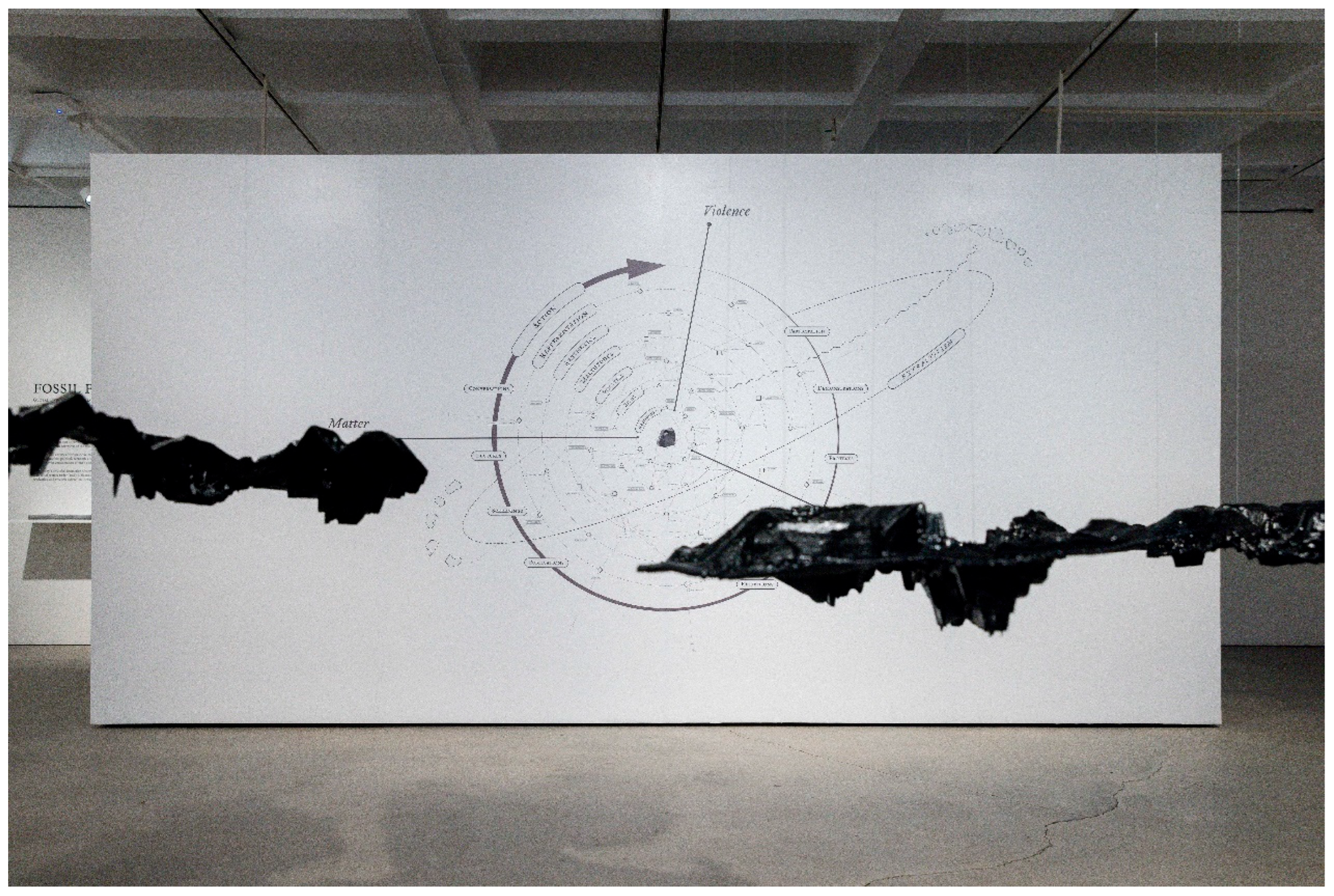
Matter-Violence piece, a dense text-based diagram amplifies the words scale, matter, and violence, encircled by smaller fragments—cobalt, coltan, copper—illustrating extractivism as a network of entangled operations (see
Figure 5).
On the back wall,
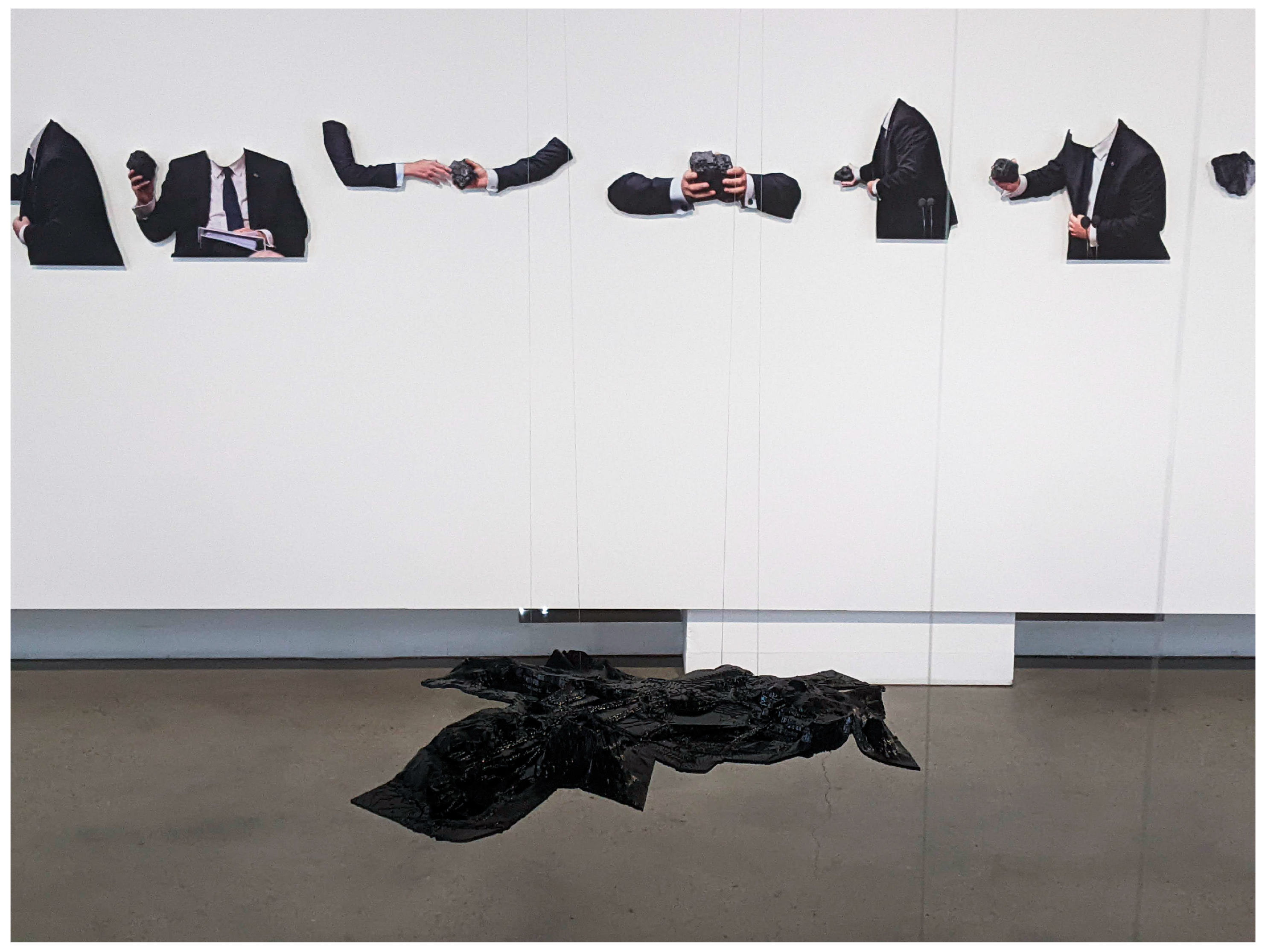
Lump depicts Australian politicians holding a polished lump of coal, their faces omitted to suggest collective complicity in fossil-fuel dependence (see
Figure 6).
Nearby,
Finite positions a coal sample under an archaic drill press, encased within a glowing PVC curtain that both shields and exposes (see
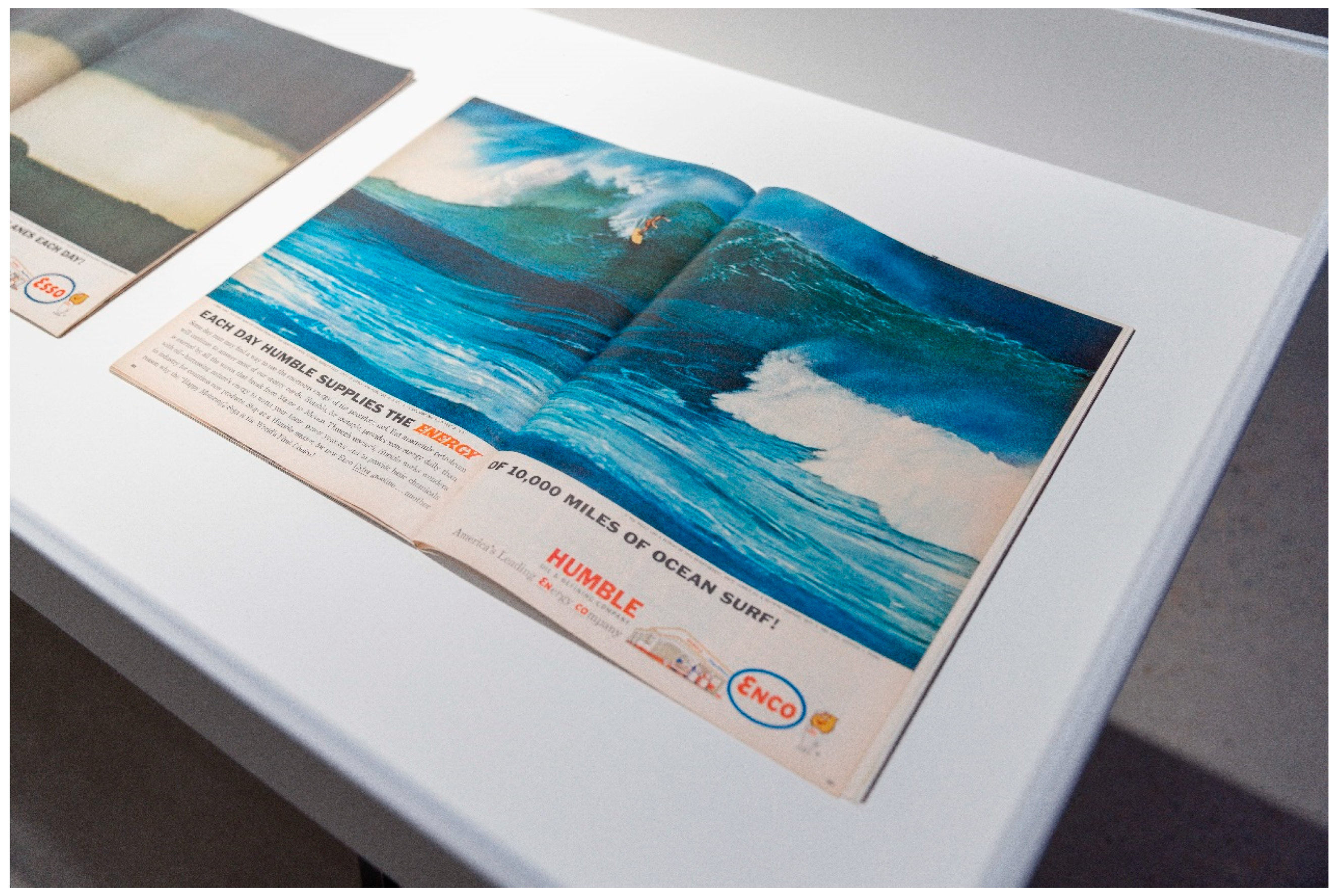
Figure 4). A final vitrine of 1960s Humble Oil advertisements, including one boasting the power to melt 7 million tons of glacier, connects industrial optimism to contemporary ecological crisis (see
Figure 7).
Through these works, Fossil Fables employs architectural form, photographic irony, and archival critique to visualize the aesthetic, political, and affective infrastructures of extraction that persist beneath digital modernity.
4.3. Affect and Atmosphere
The affective dimension of
Fossil Fables is central to its resistance. The gallery becomes a space of confrontation, where viewers are enveloped by sound, shadow, and scale. The suspension of coal-like masses evokes vulnerability and fragility, reminding visitors of their embodied relation to extractive infrastructures. The juxtaposition of archival cheerfulness with spatial violence destabilizes affective registers, making visible the ideological contradictions underpinning extraction. These affective intensities exemplify
Bennett’s (
2010) notion of vibrant matter, where material forms themselves provoke ethical and political awareness. In this way,
Fossil Fables functions as what
Parikka (
2015) terms a “geology of media”: a curatorial practice that exposes media culture as sedimented within minerals, energy, and planetary violence rather than immaterial information flows. By confronting audiences with the physical and affective presence of extraction, the exhibition resists the disembodiment typical of algorithmic systems.
4.4. Comparative Perspective: Exposure vs. Regeneration
While
Nature Reclaims and
Fossil Fables are linked through their engagement with post-extractive futures, the two exhibitions embody fundamentally different curatorial strategies.
Nature Reclaims adopts a regenerative orientation, emphasizing ecological persistence, sensory restoration, and slow engagement. Its visual language foregrounds tenderness, resilience, and the capacity of nonhuman life to reclaim spaces if given the time and space needed without human intervention. The viewer is invited into a reflective, contemplative encounter where tactile interfaces and environmental psychology principles go beyond algorithmic resistance and encourage healing and relational imagination. This regenerative orientation resonates with
Puig de la Bellacasa’s (
2017) ethics of care, where relational maintenance and ecological attentiveness become political practices.
Fossil Fables, by contrast, adopts an exposure-based and confrontational orientation. Rather than emphasizing healing, its algorithmic resistance is enacted by foregrounding rupture: the violence of extraction, the infrastructures that sustain it, and the ideologies that normalize it. Where
Nature Reclaims uses natural growth as a metaphor of repair,
Fossil Fables uses suspended mines, archival propaganda, and spatial disorientation to expose the industrial underbelly of contemporary prosperity. The emotional tone also differs sharply: where
Nature Reclaims encourages quiet restoration,
Fossil Fables induces discomfort, urgency, and critical alertness. This exposure-based strategy aligns with
Crawford’s (
2021) and
Parikka’s (
2015) insistence on rendering infrastructural violence visible as a prerequisite for any regenerative imagination.
In curatorial terms, Nature Reclaims creates conditions for regenerative imagination, inviting participants to slow down, attune to material presence, and envision ecological futures grounded in care. Fossil Fables creates conditions for critical confrontation, foregrounding the structural violence and geopolitical entanglements that make regeneration necessary in the first place. Together, they form a productive dyad within the article’s framework of symbiotic curation, one illuminating the systems that must be dismantled, the other illuminating the possibilities for regeneration of new systems.
5. Symbiotic Curation: Toward a Post-Extractive Curatorial Method
Symbiotic curation is proposed here as a curatorial method that holds critique and regeneration in sustained relation. Rather than positioning exhibitions as either sites of denunciation or sites of healing, symbiotic curation understands curatorial practice as a relational methodology that combines the exposure of extractive systems with the cultivation of regenerative imaginaries. The dialogical pairing of
Nature Reclaims and
Fossil Fables exemplifies this approach.
Fossil Fables renders visible the infrastructural, political, and ideological architectures that sustain extractive economies and digital culture, while
Nature Reclaims cultivates embodied encounters with ecological persistence, material care, and slow regeneration. Read together, the two exhibitions articulate a curatorial grammar oriented toward post-extractive futures—one that aligns with critical posthumanities (
Braidotti 2013;
Neimanis et al. 2015), eco-curating (
Demos 2016), regenerative design (
Cole 2012;
Mang and Haggard 2016), and decolonial aesthetics (
Mignolo and Walsh 2018;
Vázquez Melken 2020), all of which foreground relationality, interdependence, and the ethical reorientation of cultural production.
First, symbiotic curation insists that critical exposure and regenerative proposition are not opposing strategies but mutually constitutive ones. Exposure-based practices such as
Fossil Fables confront audiences with the material and affective violence of extraction, destabilizing narratives of technological inevitability and industrial progress. Regenerative practices such as
Nature Reclaims, by contrast, make perceptible the possibility of alternative relations: tenderness toward damaged ecologies, attentiveness to nonhuman agency, and the imagination of repair. Without exposure, regeneration risks becoming detached from structural realities; without regeneration, critique risks becoming paralyzing. Symbiotic curation therefore operates through oscillation, allowing exhibitions to move between unsettling recognition and hopeful reorientation. This oscillation mirrors the theoretical framework developed in
Section 2, where extractivism and care are understood as competing logics shaping perception, affect, and material relations.
Second, symbiotic curation foregrounds materiality as a site of both care and critique. In
Nature Reclaims, tactile installations, living fragments, and multisensory arrangements enact
Puig de la Bellacasa’s (
2017) “matters of care,” where ethical responsibility emerges through situated material relations rather than abstract moral claims. In
Fossil Fables, suspended mine models, glowing industrial curtains, and photopolymer landscapes foreground material harm, making visible the planetary substrates of digital culture in line with
Parikka’s (
2015) “geology of media” and
Crawford’s (
2021) planetary analysis of AI. Symbiotic curation thus treats materiality not as neutral medium but as an active agent in shaping ecological and political consciousness. Material care and material critique operate as two expressions of a shared curatorial ethic: one oriented toward sustaining life, the other toward confronting the conditions that endanger it.
Third, symbiotic curation cultivates embodied resistance as a counter to algorithmic abstraction. Both exhibitions resist the reduction of human experience to data by re-centering perception in bodily encounter, spatial negotiation, and affective intensity. In Nature Reclaims, slowness, haptic engagement, and reflective tools such as the Invisible Backpack station invite visitors to sense how extractivist logics have shaped their own assumptions about productivity, value, and success. In Fossil Fables, scale, darkness, and spatial tension provoke visceral responses—unease, vulnerability, alertness—that interrupt passive spectatorship. These embodied modalities counter the disembodied acceleration of algorithmic culture and reactivate the body as a site of ethical and political awareness. Exhibitions thus function as environments where perception itself becomes a terrain of resistance.
From these practices emerge transferable principles for curators and researchers engaged in post-extractive cultural work. Exhibitions can be designed as environments that reorganize attention rather than capture it; that privilege multisensory engagement over visual consumption; that make infrastructures visible rather than seamless; and that embed digital tools within relational ecologies rather than allowing them to operate autonomously. Such practices also counter what
Couldry and Mejias (
2019) describe as data colonialism by re-centering agency in embodied, collective environments. Such principles do not prescribe a single aesthetic style but describe a methodological orientation: curating as the design of conditions for relationality, attentiveness, and imagination under extractive conditions. In this sense, symbiotic curation offers a vocabulary for articulating curatorial decisions as ethical and political acts.
Symbiotic curation also carries methodological implications for practice-based research. The two case studies illustrate how curatorial practice can function as an epistemic process through which theoretical propositions about extraction, care, and materiality are tested in situated contexts. Nature Reclaims integrates insights from environmental psychology into spatial and material decisions, generating experiential knowledge about restoration, touch, and slowness. Fossil Fables mobilizes architectural form and affective atmosphere as analytical tools that materialize infrastructural critique. Together, they illustrate how practice-based research bridges environmental psychology, design research, and curatorial studies, producing forms of knowledge that cannot be generated through textual analysis alone. Symbiotic curation thus operates not only as a conceptual framework but as a methodological innovation for algorithmic resistance.
At the same time, symbiotic curation faces important limitations and risks. Slow, multisensory, care-based practices may conflict with institutional pressures for spectacle, throughput, and digital novelty. Exposure-based exhibitions risk aestheticizing extraction, transforming violence into consumable imagery. Even critically repurposed digital tools remain entangled with extractive infrastructures such as cloud computing and mineral-intensive devices. Furthermore, regenerative and confrontational strategies may not translate uniformly across cultural contexts, potentially alienating some audiences. Recognizing these tensions is essential for developing symbiotic curation as an ethically grounded and context-sensitive methodology rather than a universal formula.
Taken together, symbiotic curation can be understood as an emerging post-extractive curatorial method: one that supplements critique with regeneration, abstraction with materiality, and algorithmic speed with embodied slowness. It positions exhibitions as laboratories where alternative relations to matter, technology, and one another can be rehearsed, not as neutral containers of content. In doing so, symbiotic curation contributes to a broader curatorial ecology attuned to the ethical, ecological, and psychological demands of post-extractive futures.
6. Conclusions
In the shadow of digital capitalism, where algorithmic systems reorganize perception, attention, and material infrastructures through extractive logics, exhibitions emerge as sites capable of intervening at the level of embodied experience. This article has proposed that curatorial practice can function as a form of algorithmic resistance when it foregrounds material praxis, ecological attunement, and relational care. Through the case studies of Nature Reclaims: Images of Healing and Fossil Fables, the paper has illustrated how exhibitions can simultaneously render extractive infrastructures visible and cultivate regenerative imaginaries grounded in slowness, tactility, and interdependence. Together, the two exhibitions exemplify symbiotic curation: a curatorial method that holds critique and regeneration in sustained tension rather than privileging one at the expense of the other.
The analysis has shown that materiality is not merely an aesthetic choice but a political and epistemic strategy. In line with Crawford’s planetary account of AI and Parikka’s geology of media, Fossil Fables exposes the mineral, energetic, and ideological substrates of digital modernity. In resonance with Puig de la Bellacasa’s ethics of care and Bennett’s vibrant materialism, Nature Reclaims uses tactile engagement, multisensory environments, and ecological imagery to cultivate forms of attentiveness that exceed algorithmic abstraction. By re-centering the body as a site of perception and ethical awakening, both exhibitions intervene in the affective and temporal regimes structured by social acceleration and persuasive digital design.
Symbiotic curation therefore operates not only as a conceptual framework but as a methodological orientation. Through practice-based research, curatorial decisions—spatial arrangement, lighting, scale, material choice, interactive design—become epistemic tools that test theoretical propositions about extractivism, care, and regeneration. The case studies illustrate how exhibitions can function as laboratories in which infrastructures are made perceptible, assumptions are rendered reflexive, and alternative relations between humans, technologies, and ecologies are rehearsed. In this sense, symbiotic curation extends beyond exhibition-making to offer transferable principles for post-extractive cultural work: reorganizing attention rather than capturing it, embedding digital tools within ecosystems of care, cultivating multisensory engagement, and designing for relational participation rather than passive consumption.
The implications extend beyond the gallery. As cultural institutions confront ecological crisis, algorithmic governance, and declining public trust, they face the challenge of redefining their societal role. Rather than remaining neutral presenters of content, institutions can become mediators of ecological literacy, facilitators of embodied reflection, and stewards of regenerative imagination. This requires critically examining their own digital and environmental footprints, rethinking exhibition temporality in relation to acceleration, and embracing collaborative practices that bridge art, environmental psychology, design research, and civic engagement.
These conclusions also resonate with the broader research trajectory informing Nature Reclaims, particularly the reconceptualization of business as “an entity that solves social issues and creates social value in financially sustainable ways”. If extractivism is not confined to resource industries but extends into data economies, affective labor, and institutional design, then post-extractive transition demands reimagining value across domains. Cultural institutions, like businesses, participate in shaping imaginaries and relational norms. Symbiotic curation illustrates how such institutions can align critique with regeneration, exposure with repair, and digital literacy with material accountability.
Ultimately, exhibitions function here as counter-public spaces within algorithmic culture. They create conditions where infrastructures become visible, where slowness interrupts acceleration, and where relational forms of knowing challenge extractive abstraction. By weaving together confrontation and care, material critique and ecological imagination, symbiotic curation offers a pathway toward curatorial practices capable of contributing to broader socio-ecological transition. In an era defined by computational prediction and planetary instability, exhibitions can serve not merely as representations of crisis but as embodied sites for rehearsing post-extractive futures.