


Abstract
Ultra-High-Performance Concrete (UHPC) is increasingly used in slender and prestressed structural members due to its superior strength and durability. However, inaccurate or incomplete prediction of creep deformation may lead to excessive long-term deflection, prestress loss, cracking, and potential serviceability or safety risks in buildings and infrastructure. Therefore, reliable prediction methods for UHPC creep are essential for both structural design and long-term performance assessment. In this study, a database containing 60 literature-derived UHPC creep records was compiled to investigate the creep coefficient at approximately 100 days. Pearson correlation analysis revealed strong interdependence among predictors and weak single-variable linear relationships, indicating that creep behavior is governed by nonlinear interactions. A feedforward backpropagation neural network (BPNN) trained using the Levenberg–Marquardt algorithm was developed to predict the creep coefficient. To maintain engineering interpretability, the fib Model Code 2020 (MC2020) formulation was adopted as a code-based benchmark and further calibrated using ridge regression. Results show that the calibrated MC2020 model improves prediction consistency, while the BPNN model provides the highest predictive accuracy. The proposed framework integrates machine-learning prediction with interpretable code-based calibration, contributing to the development of creep modeling approaches for UHPC and providing practical support for the safe design of UHPC structures.
1. Introduction
Ultra-High-Performance Concrete (UHPC) has attracted significant attention in recent years due to its outstanding mechanical performance and durability. Compared with conventional concrete, UHPC typically exhibits extremely high compressive and flexural strengths, improved toughness, and enhanced crack resistance. With the addition of fiber reinforcement, UHPC can maintain considerable residual load-bearing capacity and deformation capacity even after tensile cracking. Moreover, the extremely dense microstructure and low porosity of UHPC significantly improve its durability performance, including resistance to carbonation, chloride ion penetration, freeze–thaw cycles, and chemical erosion [1]. Owing to these advantages, UHPC has gradually been applied in various engineering fields such as bridges, prefabricated components, and high-durability infrastructure systems. However, the long-term service performance of UHPC structures still requires further systematic evaluation.
Among the time-dependent behaviors of concrete materials, creep is one of the most important factors influencing the long-term deformation and stress redistribution of concrete structures. Creep refers to the gradual increase in deformation of concrete under sustained loading and directly affects both short-term and long-term structural responses. In prestressed concrete structures, creep may lead to prestress loss, increased risk of cracking, and long-term growth of mid-span deflection, which can weaken the durability and serviceability of the structure [2]. Previous studies have investigated the creep behavior of UHPC and attempted to establish corresponding prediction models [3,4,5]. Experimental studies have been widely conducted to analyze the creep characteristics of UHPC under different mixture proportions, curing regimes, loading conditions, and environmental effects [6,7,8,9,10,11,12,13,14]. These studies provide valuable insights into the mechanisms governing creep development in UHPC. However, creep experiments are usually time-consuming, costly, and highly sensitive to environmental conditions and experimental accuracy, which limits their application in rapid engineering evaluation and large-scale parametric studies. Existing literature indicates that UHPC creep is influenced by multiple factors in a coupled manner, including fiber type and content, curing regime, water–binder ratio, stress level, and loading age. Reviews have reported that increases in water–binder ratio, strength, elastic modulus, or loading duration often lead to higher creep deformation, whereas higher fiber content, aggregate content, or curing temperature may suppress creep development [3,4]. Because these influencing factors interact in a complex and nonlinear manner, conventional empirical models may struggle to accurately capture the coupled effects among variables.
To address these limitations, researchers have increasingly explored data-driven approaches, particularly machine learning, to complement traditional theoretical and empirical models [15,16]. Machine-learning techniques can identify complex nonlinear relationships between mixture parameters, environmental conditions, and material responses directly from data, and have therefore been widely adopted in civil engineering research [17,18]. In recent years, machine learning algorithms have been widely used to predict various mechanical properties of concrete materials, including compressive strength, shear strength, and fracture toughness [19,20,21,22]. A systematic review by Itzel et al. summarized the application of multiple machine-learning techniques—such as artificial neural networks (ANN), support vector machines (SVM), fuzzy logic, genetic algorithms, tree-based ensemble methods, hybrid models, and deep learning—in predicting mechanical properties of different types of concrete [23]. More recently, machine-learning approaches have been extended to a broader range of concrete properties beyond mechanical performance. Comprehensive reviews have summarized advances in traditional machine learning, deep learning, and hybrid modeling strategies in this field [24,25]. Specific studies have further demonstrated their effectiveness in predicting compressive strength at elevated temperatures [26], improving prediction accuracy through ensemble strategies [27], and estimating the tensile strength of high-performance concrete [28]. Machine learning has also been widely applied to durability-related properties of concrete, including chloride transport, freeze–thaw resistance, water absorption, abrasion resistance, and sulfate-induced deterioration. Predictive models have been developed for chloride migration coefficients [29], frost damage evolution [30], and compressive strength degradation under sulfate attack [31]. In addition, hybrid frameworks integrating genetic algorithms with ANN, XGBoost, or stacking models have achieved improved accuracy in the simultaneous prediction of multiple durability indicators such as water absorption and abrasion resistance [32]. More recent studies have further extended machine learning toward multi-property prediction and sustainability-oriented assessments. For example, machine-learning-assisted frameworks have been used to evaluate the coupled effects of supplementary materials and fibers on both mechanical and durability performance of sustainable concrete [33]. Moreover, durability-informed life-cycle assessment frameworks integrating machine-learning-based durability prediction with probabilistic service-life modeling have been proposed to enable more comprehensive sustainability evaluation [34]. Beyond bulk material properties, machine learning has also been applied to interface-related structural behavior; for instance, artificial neural networks have been used to model the bond capacity of steel-reinforced grout composite systems to concrete, further demonstrating the versatility of data-driven methods in cement-based materials and structural systems [35]. Collectively, these studies demonstrate that machine-learning methods provide a flexible and robust framework for modeling the coupled influences of mixture design, environmental exposure, and long-term performance evolution in concrete materials.
Compared with instantaneous performance indicators such as compressive strength, creep exhibits pronounced time-dependent evolution characteristics, which makes its prediction more complex. Existing studies applying machine learning to creep prediction mainly focus on artificial neural networks. Bal et al. [36] established a neural-network model based on the NU database to predict concrete creep behavior. Karthikeyan et al. [37] used creep results calculated from the CEB model as training data to construct a neural-network-based prediction model for high-performance concrete creep coefficients. Hodhod et al. [38] further improved prediction accuracy by combining explicit creep formulations with genetic algorithms to fit residual errors between theoretical predictions and experimental results. Although these studies demonstrate the feasibility of machine learning approaches in creep prediction, research specifically focusing on UHPC creep behavior remains relatively limited. In addition, most existing studies mainly emphasize prediction accuracy while rarely comparing machine learning models with design-code-based prediction models or exploring calibration strategies to improve the applicability of code formulations to UHPC materials.
In view of the limitations of existing studies, this work investigates the creep behavior of Ultra-High-Performance Concrete (UHPC) and develops a predictive framework combining data-driven modeling with code-based formulations. A literature-derived database containing 60 experimental records of UHPC creep at approximately 100 days was compiled to analyze the influence of mixture parameters and loading-related factors on creep variability. Pearson correlation analysis was first performed to diagnose predictor dependence and reveal potential collinearity and weak single-variable linear trends, thereby motivating a nonlinear multivariate modeling strategy. Based on the compiled dataset, a feedforward Backpropagation Neural Network (BPNN) trained using the Levenberg–Marquardt algorithm was established to predict the UHPC creep coefficient. To improve engineering interpretability, the fib Model Code 2020 was further adopted as a code-based benchmark, and its predictive performance was evaluated against experimental observations. A component-level calibration strategy was then proposed to improve prediction consistency while preserving the mechanistic structure of the code equation. Overall, this study integrates data-driven prediction with code-based calibration, providing a practical framework for the quantitative evaluation and refinement of UHPC time-dependent deformation.
2. The Establishment and Description of Database
2.1. The Establishment of Database
Machine learning and deep learning models are data-driven, and data quality is crucial for model training [38]. In this study, experimental data from previously published academic papers were collected to construct a data set [39,40,41,42,43,44]. Because these experimental studies were conducted by different researchers under varying materials, curing regimes, and testing conditions, the collected data exhibited considerable heterogeneity. Therefore, a systematic data screening procedure was performed to ensure the reliability and consistency of the dataset.
Specifically, the collected records were filtered according to the following criteria: (i) the availability of key parameters required for modeling, (ii) consistency in the definition and measurement of creep coefficients, and (iii) elimination of incomplete or inconsistent experimental records reported in the literature. After this screening process, a database containing 60 UHPC samples was established to support subsequent statistical analysis and model development. A total of six input characteristic parameters are set in the data set, including the key ratio water–binder ratio (w/b, %), compressive strength at loading age (fct0, MPa), elastic modulus at loading age (Et0, MPa), relative humidity (RH, %), experimental temperature (T, °C) and loading age (t0, days). The output variable is the 100-day creep coefficient.
2.2. Pearson Correlation Coefficient Analysis
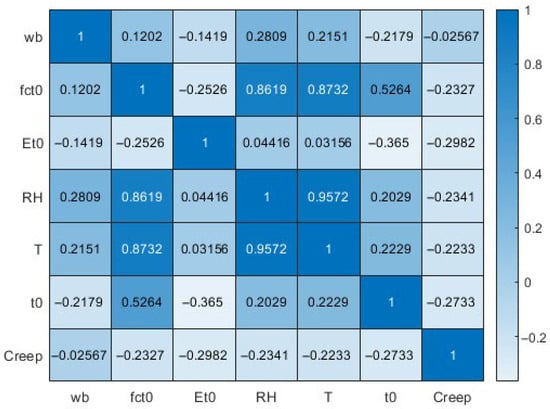
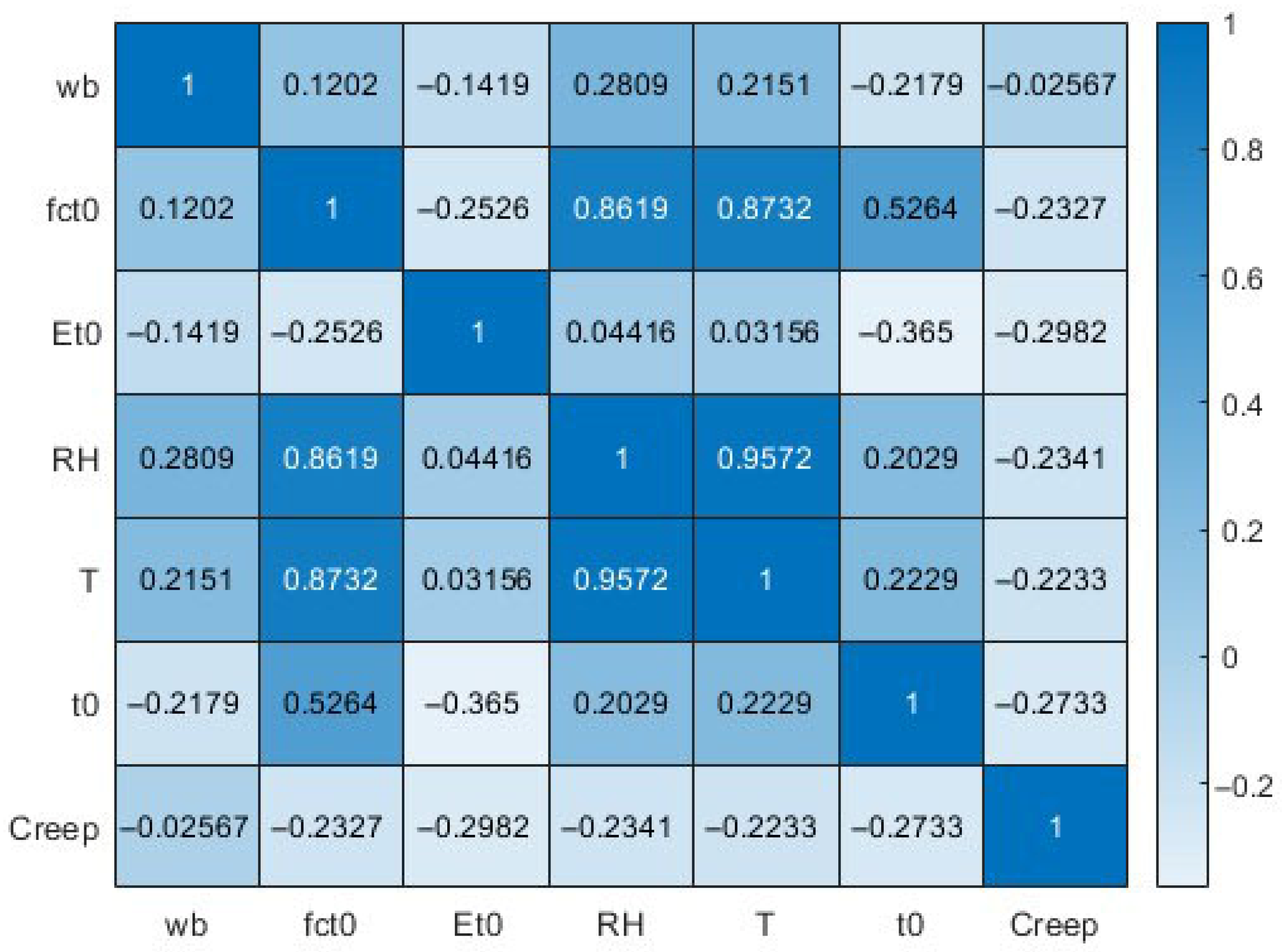
To evaluate how each parameter relates to concrete creep coefficient, we computed the Pearson product-moment correlation for every principal mix-design and testing variable, together with the corresponding two-tailed p-value that indicates statistical significance (see Equation (1)). This approach captures both the direction (positive or negative) and the strength (from weak to strong) of the linear association, while the p-value assesses whether the observed relationship could be due to random variation under a no-association assumption. Before analysis, units were harmonized and out-of-range records were screened to ensure comparability. The resulting correlations and p-values are reported to rank variables by their influence and significance across the dataset.
Among them, xi is the creep coefficient value, is the mean value of the creep coefficient value, yi is the parameter value, is the mean value of the parameter value.
Figure 1 reveals a pronounced dependency structure among the predictors, indicating substantial collinearity and potential confounding effects within the dataset. In particular, relative humidity and temperature exhibit an extremely strong positive correlation (r ≈ 0.96), and both are strongly correlated with the strength-related descriptor (r ≈ 0.86–0.87). This pattern suggests that environmental conditions and early-age mechanical characteristics do not vary independently in the compiled records, likely reflecting coupled experimental protocols and curing/conditioning regimes; as a result, univariate interpretations based solely on pairwise correlations may be misleading. A moderate positive association is also observed between loading age and strength (r ≈ 0.53), consistent with age-dependent property development, while the modulus-related descriptor shows a moderate negative correlation with loading age (r ≈ −0.37), which may partially stem from heterogeneous measurement practices and inter-study variability.
Figure 1.
Pearson correlation coefficient matrix.
With respect to the creep response, the Pearson coefficients are generally weak to modest and predominantly negative (roughly −0.22 to −0.30), and the correlation with the water–binder ratio is essentially negligible (near zero). Taken together, these results imply that the 100-day creep behavior cannot be adequately explained by any single predictor through a simple linear relationship, and that nonlinearities and interaction effects are likely dominant. Importantly, the interpretability of the correlation structure is further constrained by the limited sample size, which can amplify sensitivity to a few influential observations and to imbalanced coverage of extreme regimes; consequently, reported correlation magnitudes should be treated as indicative rather than definitive. These considerations motivate the use of multivariate nonlinear modeling and robust validation strategies (e.g., grouped or leave-one-study-out splits) to mitigate the impact of collinearity, confounding, and finite data effects on both inference and prediction.
3. Method
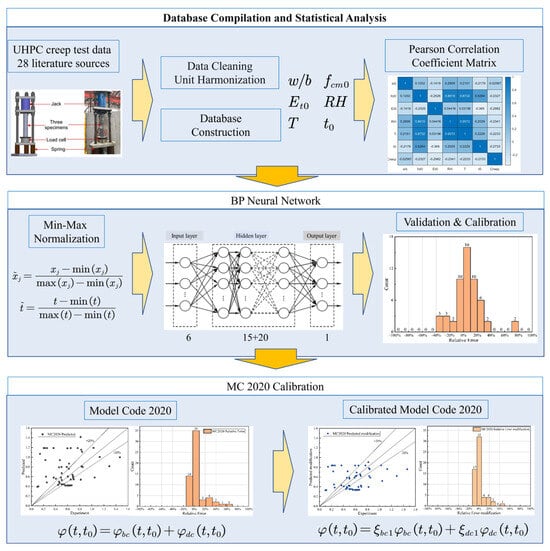
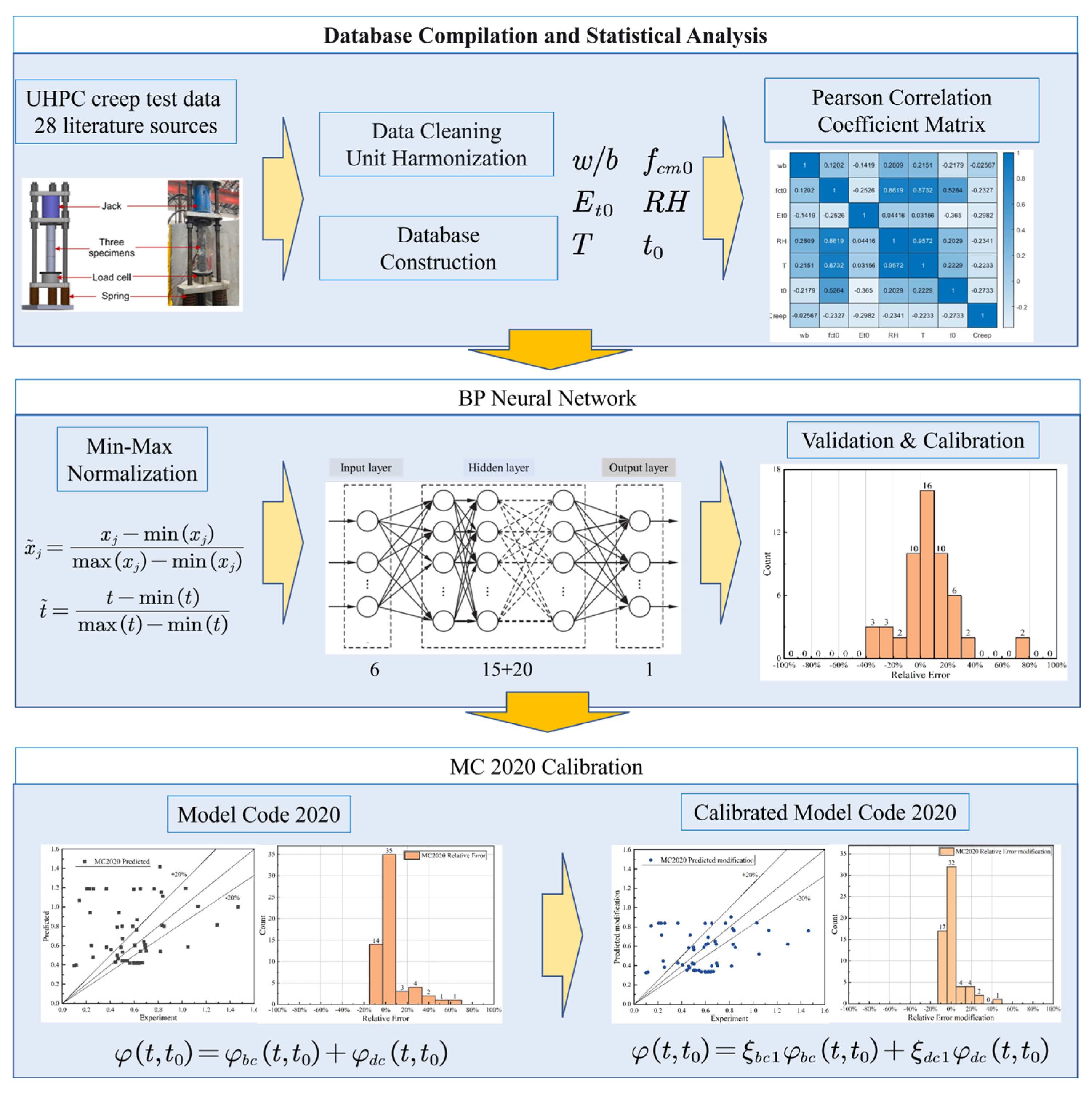
To provide a clear overview of the research procedure adopted in this study, the overall methodological framework is illustrated in Figure 2.
Figure 2.
Overall research framework for UHPC creep prediction and MC2020 calibration.
3.1. BP Neural Network
Artificial neural networks (ANNs) are large-scale, distributed, and parallel information-processing systems [45] that have proved especially effective for curve-fitting (i.e., nonlinear regression) tasks. By learning complex input–output relationships directly from data, an ANN can approximate highly nonlinear functions without an explicit parametric form, making it attractive when first-principles models are unavailable or intractable. A typical feed-forward ANN comprises an input layer, one or more hidden layers, and an output layer. Each layer contains a set of neurons, and all neurons in one layer are connected to those in the next layer via trainable weights and additive biases, enabling hierarchical feature transformation from raw inputs to task-specific outputs. Training commonly relies on the back-propagation algorithm, one of the simplest and most widely used optimization procedures for ANNs. Learning proceeds in two phases. In the forward-propagation phase, inputs are multiplied by layer-specific weights, summed with the corresponding biases, transformed by a predefined activation function, and passed to the next layer, as shown in Formula (2). In the model considered here, every layer employs the sigmoid activation function, which introduces smooth nonlinearity and constrains neuron outputs to a bounded range. The network’s final outputs are compared with the target values to compute a loss (for curve fitting, mean squared error is typically used), which quantifies the discrepancy between predictions and ground truth.
Among them xi and yj are the input and output of the j neuron, Wij is the weight between the i and j neurons; bj is the bias of the j neuron; n is the number of neurons; and f is the activation function.
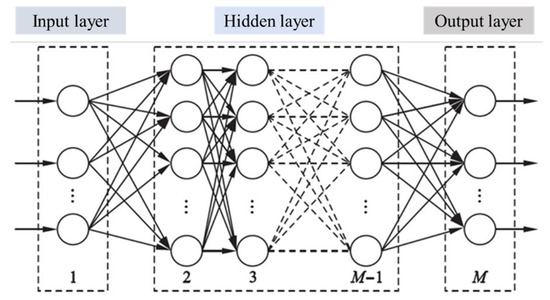
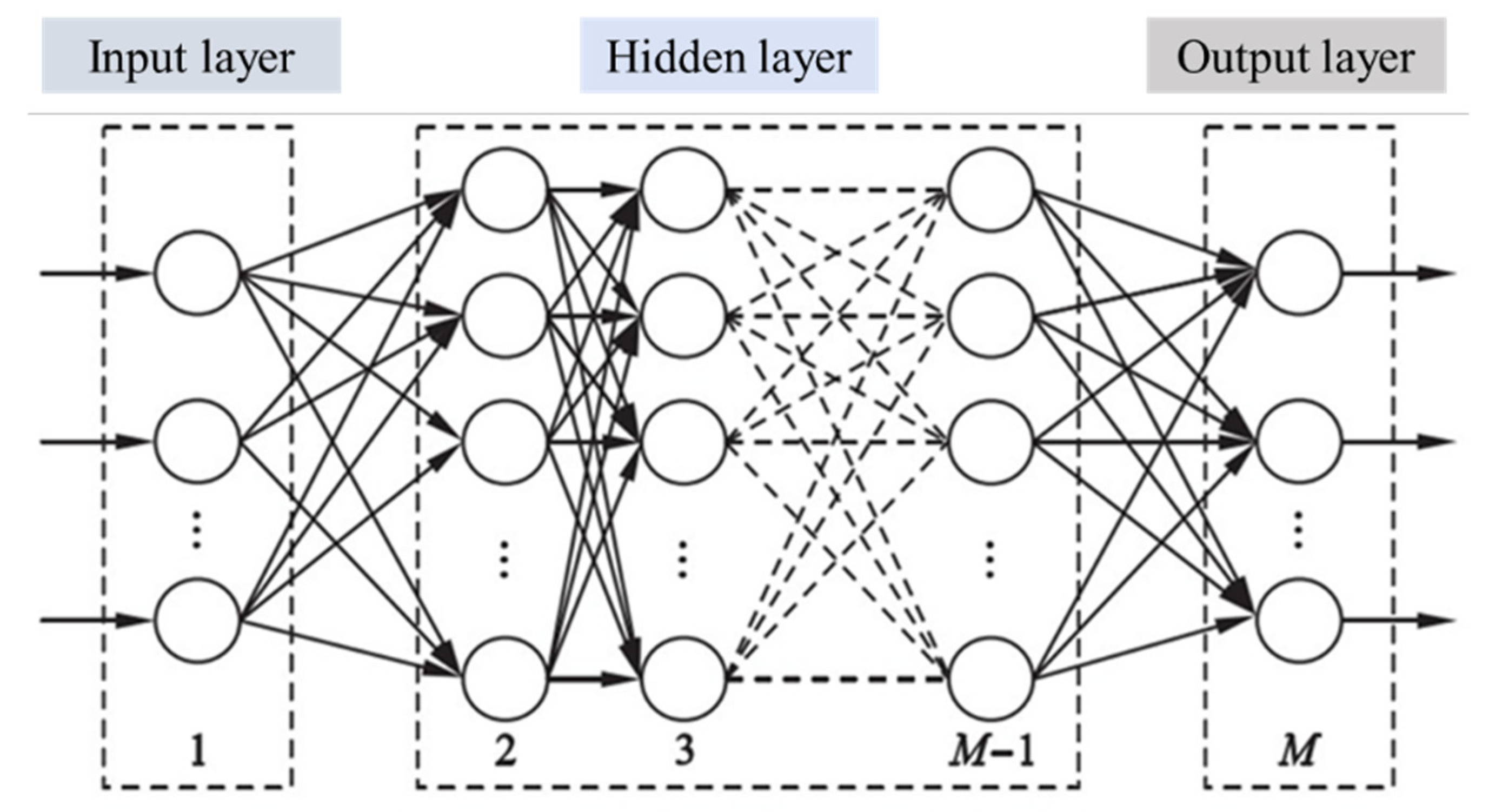
A back-propagation neural network (BPNN) is a fully connected feed-forward multilayer perceptron in which adjacent layers are densely linked by weights and biases. Learning follows a simple loop: forward propagation applies affine transforms and nonlinear activations (e.g., sigmoid, tanh, ReLU) to produce outputs; a loss (MSE for regression, cross-entropy for classification) quantifies error; back-propagation uses the chain rule to compute gradients for all parameters, which are updated via mini-batch SGD or adaptive methods such as Momentum, RMSProp, or Adam with suitable learning-rate schedules. Architecturally, a BPNN (cf. Figure 3) comprises an input layer, one or more hidden layers, and an output layer; depth and width set capacity-too small underfits, too large overfits. Generalization is improved with L2 weight decay, dropout, and early stopping on a validation set, alongside rigorous train/validation/test splits. Stable training benefits from standardized/normalized inputs; if a bounded output (e.g., sigmoid) is used for regression, targets should be scaled to the same range and inverse-transformed at inference. Because sigmoids can saturate and weaken gradients, scale-aware initialization (e.g., Xavier/Glorot), batch normalization where appropriate, and prudent depth/learning rates help mitigate vanishing-gradient and numerical-stability issues. With these practices, BPNNs provide an effective, broadly applicable framework for modeling nonlinear relationships and high-quality curve fitting.
Figure 3.
Backpropagation neural network topology diagram.
3.2. Evaluation Index
To comprehensively assess predictive accuracy, this study reports three complementary metrics: root mean square error (RMSE, as shown in Formula (3)), mean absolute error (MAE, as shown in Formula (4)), and the coefficient of determination (denoted as (R), as shown in Formula (5)). The coefficient of determination quantifies the proportion of variance in the dependent variable that is explained by the model and thus reflects goodness of fit in an intuitive, unitless manner. Values closer to 1 indicate that the model accounts for a larger share of the observed variability and, therefore, provides a tighter fit to the data, whereas values near 0 suggest little explanatory power; depending on the definition used, negative values can occur when the model underperforms a naïve baseline.
MAE measures the average magnitude of the errors between predictions and ground truth, without considering their direction. Because it aggregates absolute deviations, MAE is expressed in the same units as the target variable and is straightforward to interpret as a typical error size. It penalizes all residuals linearly and is therefore relatively robust to a small number of extreme outliers. Smaller MAE values indicate that, on average, predictions deviate less from the observed values. RMSE is the square root of the mean of the squared prediction errors and is likewise expressed in the target’s units. By squaring residuals before averaging, RMSE imposes a larger penalty on larger errors, making it more sensitive than MAE to occasional large deviations; as such, it is informative when large mistakes are especially undesirable. RMSE can also be viewed as a measure of the residual dispersion around the fitted values, with smaller values implying tighter residual concentration and better predictive precision. Reporting R alongside MAE and RMSE provides a balanced picture: R summarizes explained variance and overall fit quality independent of scale, while MAE and RMSE quantify typical and large-error behavior on the original scale of measurement. In practice, these metrics should be computed on validation and test sets, compared against simple baselines, and interpreted together with residual analyses to ensure both accuracy and robustness.
3.3. Data Processing and Network Architecture
To capture the nonlinear relationship between mixture design/curing parameters and creep, we used a feed-forward back-propagation neural network (BPNN) trained with the Levenberg–Marquardt (LM) optimization scheme, implemented in MATLAB (R2024b) through the built-in fitnet interface. As summarized in Table 1, the network was configured as a function-fitting neural network with two hidden layers. The first hidden layer contained 15 neurons and the second contained 20 neurons, which provides sufficient representational capacity to approximate nonlinear responses while remaining computationally efficient for the available dataset size. The LM back-propagation algorithm was selected as the training function because it is well suited for nonlinear regression problems with relatively small to medium network sizes: it combines the fast local convergence behavior of second-order methods with the stability of gradient descent, which typically leads to rapid decrease in mean squared error. For each mixture in the dataset, the model input is represented by a feature vector , containing the key mix-design variables (e.g., binder proportions, water–binder ratio, fiber content) together with relevant curing and testing parameters (e.g., temperature, humidity). The associated target is the measured creep coefficient for that mixture. Before training, both the inputs and the target creep values were scaled to the interval [0, 1] using min–max normalization. The normalization parameters were computed on the training subset only and then applied consistently to the validation and test subsets. This preprocessing step serves two purposes: (i) it prevents variables with larger numerical ranges from dominating the optimization, and (ii) it improves numerical conditioning of the hidden-layer activations, which in turn helps the LM routine converge more quickly and avoid instability. After training, predicted creep values were mapped back to the original physical units for interpretation and error analysis.
Table 1.
Neural Network Architecture and Training Parameters.
The dataset was divided into three non-overlapping subsets using MATLAB’s fitnet random partitioning strategy (dividerand): 70% for training, 15% for validation, and 15% for testing, corresponding to 42, 9, and 9 samples, respectively (Table 1). This split was adopted to preserve an independent test set for final performance assessment while retaining sufficient data for training, given the overall dataset size. To model the nonlinear relationship between mix-design/curing variables and creep coefficient with moderate complexity, a feedforward BPNN with two hidden layers was used. The hidden-layer sizes (15 and 20 neurons) were selected as a balanced configuration that provides adequate representational capacity without excessive parameters relative to the dataset size, thereby reducing the risk of overfitting. As summarized in Table 1, the network was trained using the Levenberg–Marquardt backpropagation algorithm, which is well suited to function-fitting problems with small-to-medium datasets due to its stable and fast convergence. Training was allowed to run up to 10,000 epochs; however, generalization was controlled primarily through validation-based early stopping. Specifically, training was terminated if the validation error did not improve for 15 consecutive validation checks, and the weights at the best validation state were retained. The performance goal (target MSE of 1 × 10⁻⁶) and the learning step size (0.001) were used to support stable optimization and convergence control under the adopted training scheme. Overall, the workflow in Table 1 moderate network capacity, randomized 70/15/15 data division, and strict early stopping was designed to obtain an accurate creep predictor while limiting overfitting and ensuring reliable performance on unseen data.
For the neural-network model, methodological transparency is essential to ensure that the reported performance is reproducible and not an artifact of a single random split. In addition to the stated 70/15/15 partition and early-stopping criterion, it is good practice to repeat training under multiple random seeds (affecting both dividerand partitioning and weight initialization) and to report the mean and dispersion of R, MAE, and RMSE across repeats. This practice is particularly important for small datasets, where the composition of the test subset can materially affect observed performance and where a single split may under- or over-estimate generalization. Likewise, the selected hidden-layer sizes (15 and 20 neurons) can be justified via a lightweight sensitivity study that varies network width (and, if feasible, depth) within a plausible range and evaluates validation performance under identical preprocessing and stopping rules; such a study helps demonstrate that the chosen architecture balances representational capacity and overfitting risk for the available sample size. Beyond scalar metrics, residual diagnostics can be strengthened by reporting error versus predicted creep (to visualize heteroscedasticity), by identifying influential creep samples, and by checking whether errors concentrate in sparsely populated regions of the feature space (e.g., very low w/b or extreme humidity). To improve reliability in these regimes without changing the overall modeling framework, one can consider data-rebalancing strategies, cost-sensitive losses that emphasize upper-tail cases, or post hoc calibration approaches. Finally, reproducibility is improved by documenting preprocessing parameters (normalization minima/ranges), MATLAB function settings (fitnet/trainlm options), and the random-seed policy, enabling independent researchers to replicate training and to verify that performance trends are stable rather than incidental.
Normalization parameters (per-feature minima and ranges) were stored and used for exact de-normalization of network outputs at inference:
The adopted BPNN consisted of two hidden layers with 15 and 20 neurons, respectively. Hidden units used the default hyperbolic tangent sigmoid activation (tansig), and the output layer used a linear activation (purelin), which is appropriate for continuous regression targets. The network thus parameterizes a nonlinear function such that .
Weights were initialized randomly and optimized with the LM algorithm (trainlm), which approximates second-order optimization while maintaining the robustness of gradient descent. The mean squared error (MSE) was adopted as the loss function. Training hyperparameters were:
- maximum epochs: 10,000,
- performance goal: ,
- validation patience (max_fail): 15 epochs.
The predictive performance of the backpropagation neural network (BPNN) model was evaluated on the training, validation, and testing datasets using three commonly adopted metrics: root mean square error (RMSE), mean absolute error (MAE), and coefficient of determination (R2), as summarized in Table 2.
Table 2.
BPNN model prediction performance.
On the training set (n = 42), the model achieved an RMSE of 0.1442, an MAE of 0.1135, and an R2 of 0.8552, indicating a good fit to the training data. On the validation set (n = 9), the RMSE and MAE were 0.1887 and 0.1485, respectively, with an R2 of 0.8074, suggesting acceptable generalization capability during model tuning. More importantly, on the testing set (n = 9), the model attained the best performance, with the lowest RMSE (0.1285) and MAE (0.0996), and the highest R2 (0.9072). These results demonstrate that the BPNN model possesses strong generalization ability and reliable predictive accuracy on unseen data.
3.4. Model Prediction Results
The architecture of the neural network was determined considering both the nonlinear characteristics of creep behavior and the relatively limited size of the available dataset. A feedforward backpropagation neural network (BPNN) was selected because of its proven capability in modeling nonlinear relationships in concrete material behavior. To balance model flexibility and the risk of overfitting, a moderate network configuration with two hidden layers was adopted. The numbers of neurons (15 and 20) were selected based on preliminary trials and common practices in nonlinear regression problems with small to medium datasets. In addition, the Levenberg–Marquardt algorithm was used as the training function due to its fast convergence and stability in function-fitting tasks.
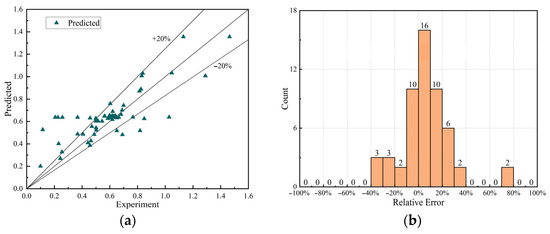
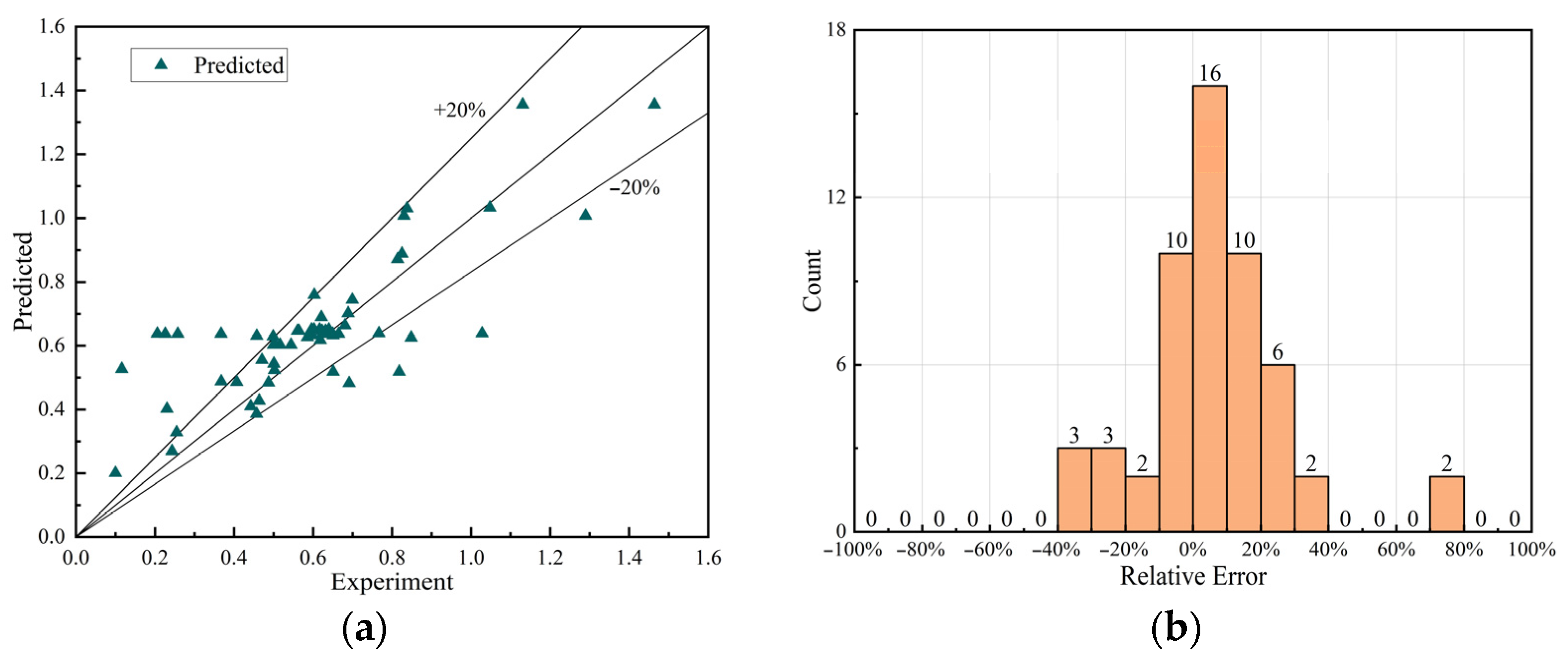
Figure 4 provides a comprehensive assessment of the BPNN model performance for predicting the UHPC creep coefficient at approximately 100 days. Figure 4a shows the parity relationship between predicted and experimental values, where the 1:1 line represents perfect agreement and the ±20% bounds quantify an engineering-relevant tolerance band. The majority of points cluster near the equality line and remain within the ±20% envelope, demonstrating that the model reproduces both the overall magnitude and the dominant variability of the 100-day creep coefficient with satisfactory accuracy. Nevertheless, as the experimental response increases, the scatter becomes more pronounced and a mild regression-to-the-mean tendency can be discerned, with several points deviating beyond the tolerance bounds. This pattern indicates that predictive fidelity decreases in the upper-response regime, which is commonly observed when high-response cases are sparsely represented in the dataset and may be further intensified by insufficient explicit descriptors of governing conditions such as sustained stress level/stress ratio, curing temperature history and maturity, and humidity boundary conditions (including internal RH evolution). Figure 4b summarizes the relative-error statistics, revealing a unimodal distribution concentrated around zero, which confirms a small overall bias and controlled dispersion across most samples. The distribution peak is slightly shifted toward positive errors, implying a minor conservative tendency on average, while a sparse right tail with a few large positive outliers suggests occasional overestimation under specific combinations of material composition and boundary conditions. Taken together, the two subplots indicate that the proposed BPNN model is robust for the central range of UHPC creep coefficients at 100 days, but further improvements in the upper-tail regime could be achieved by enriching high-creep samples, incorporating physics-informed predictors (e.g., stress ratio and maturity-related indices), and adopting reweighted losses or residual-correction strategies to enhance extrapolation and reduce tail risk.
Figure 4.
BPNN model prediction results. (a) Comparison of prediction results. (b) Distribution of relative errors.
4. Code-Based Prediction and Calibration of UHPC Creep
4.1. Overview of Code-Based Prediction Strategy
Although data-driven models such as neural networks demonstrate strong predictive capability for UHPC creep behavior, design-oriented engineering practice still relies heavily on code-based formulations due to their transparency, interpretability, and standardization. Therefore, it is essential to examine the applicability of existing creep provisions to UHPC and to explore feasible calibration strategies under limited input information.
In this chapter, the creep coefficient at approximately 100 days is taken as the target response, and the Eurocode-based framework is adopted as the reference analytical model. Specifically, the fib Model Code 2020 (MC2020) [46] creep formulation is implemented to generate baseline predictions using only mixture- and environment-related variables available in the compiled database. On this basis, a simple yet interpretable correction strategy is proposed to reduce systematic bias and improve predictive consistency with experimental observations.
4.2. Baseline Prediction Using fib Model Code 2020
The equations used in this study are adopted from the fib Model Code 2020 (MC2020). According to this code, the total creep coefficient of concrete loaded at age and evaluated at time t is decomposed into basic creep and drying creep components, as expressed in Equations (8)–(20) [46].
where φbc denotes the basic creep coefficient and φdc represents the drying creep coefficient.
- (1)
- Basic creep component
The basic creep coefficient is expressed as:
The strength-dependent factor is given by:
where fcm is the mean compressive strength (MPa) at the age of loading.
The time-development function of basic creep is defined as:
where t0,adj represents the adjusted loading age accounting for the influence of cement hydration kinetics and strength development, which is used to correct the time-dependent creep development at early ages.
- (2)
- Drying creep component
The drying creep coefficient is formulated as:
The strength-related coefficient is expressed as:
The relative humidity influence factor is given by:
where RH is the ambient relative humidity (%) and ℎ is the notional size (mm). The notional size ℎ represents the effective thickness of the concrete member governing moisture diffusion and drying processes.
The effect of loading age on drying creep is defined as:
The time-development function of drying creep is expressed as:
where the notional drying time parameter βH is defined as:
with
and the exponent γ governing the rate of drying creep development is given by:
- (3)
- Adjustment of loading age
In MC2020, the adjusted loading age t0,adj accounts for curing and environmental conditions and is defined as:
where α is a curing-related coefficient; in this study, α = 0 was adopted, corresponding to normal curing conditions.
- (4)
- Application to UHPC dataset
Due to the absence of specimen geometry and detailed thermal history in the collected literature data, a unified notional size of ℎ = 75 mm was adopted for all samples. The compressive strength at loading age was used as a surrogate for fcm. Under these assumptions, the MC2020 formulation was consistently applied to all 60 UHPC datasets to generate baseline predictions of the 100-day creep coefficient. This simplification may introduce additional uncertainty into the estimation of the drying creep component; however, it ensures methodological consistency across heterogeneous literature-derived datasets and enables a controlled evaluation of the code-based model.
4.3. Benchmarking and Calibration of the MC2020 Model
4.3.1. Baseline Benchmarking Results
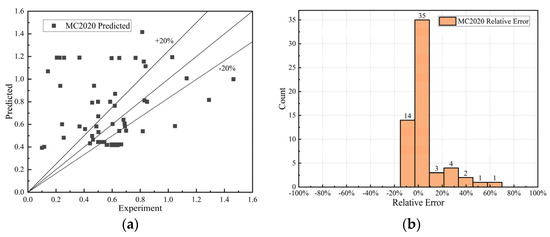
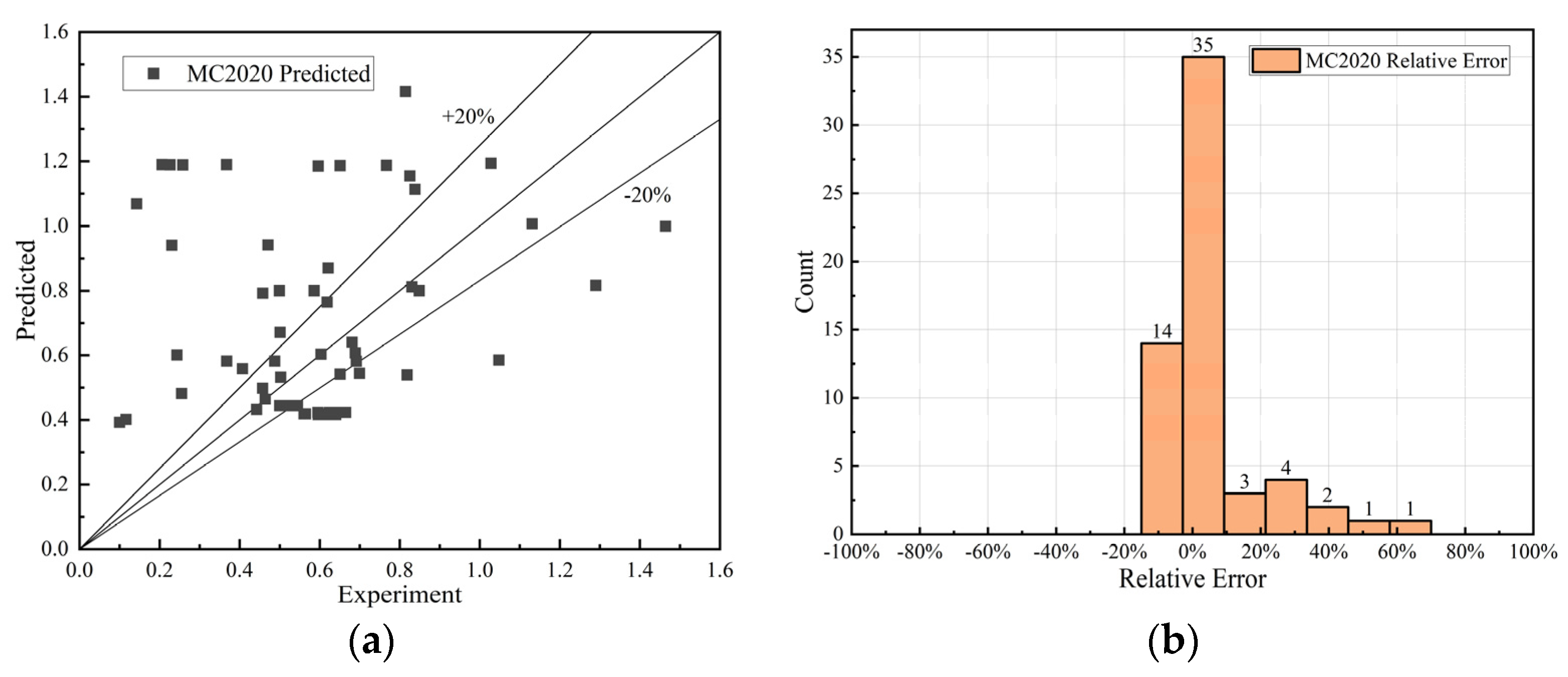
Figure 5a compares the MC2020-predicted creep coefficients with the experimental values using a parity plot with the 1:1 reference line and ±20% bounds. The scatter exhibits pronounced dispersion about the equality line, and a non-negligible portion of samples falls outside the ±20% envelope, indicating that the baseline MC2020 formulation provides limited accuracy for UHPC under the present input constraints. In addition, the predicted values occupy a comparatively narrower range than the experimental measurements, reflecting an attenuated sensitivity to inter-sample variability. This manifests as a regression-to-the-mean tendency, with systematic overestimation in the low-creep regime and underestimation at higher creep coefficients, implying that the default MC2020 parameterization does not fully reproduce the heterogeneity of UHPC creep responses.
Figure 5.
MC2020 model benchmarking results. (a) Comparison of prediction results. (b) Distribution of relative errors.
Figure 5b shows the corresponding distribution of relative errors. The histogram is centered close to zero, suggesting that MC2020 can reproduce the order of magnitude of the UHPC creep coefficient for a substantial fraction of the dataset. However, the error distribution is distinctly asymmetric and exhibits a pronounced right tail, indicating occasional large overpredictions. The coexistence of a near-zero central mass with sporadic extreme deviations suggests that the prediction error is not purely random but contains a systematic component, likely associated with the mismatch between the MC2020 calibration basis (conventional concrete) and the microstructural and moisture-transport characteristics of UHPC.
Overall, the benchmarking results in Figure 5a,b indicate that MC2020 can serve as a physically grounded baseline reference for UHPC creep prediction, but its direct application remains insufficiently reliable for capturing the full variability of the dataset. The observed dispersion, asymmetry in error distribution, and regression-to-the-mean behavior collectively motivate the need for a parsimonious calibration strategy that improves predictive fidelity while preserving the mechanistic structure of the code-based formulation.
4.3.2. Conditional Calibration of the MC2020 Model
Initial evaluation revealed systematic discrepancies between MC2020 predictions and experimental creep coefficients. To enhance predictive accuracy while preserving the physical structure of the code equation, a component-level conditional calibration was introduced.
The corrected creep coefficient is expressed as:
where ξbc1 and ξdc1 are calibration coefficients applied to the basic and drying creep components, respectively.
The coefficients were estimated using ridge regression, which stabilizes parameter estimation under small-sample conditions and mitigates multicollinearity between creep components. The regularization parameter was selected by maximizing the proportion of predictions within the ±20% acceptance band while enforcing positive coefficients. The optimal calibration yielded:
indicating a strengthened contribution from basic creep and a substantially reduced drying creep influence for the investigated UHPC dataset.
ξbc1 = 1.1948, ξdc1 = 0.0495
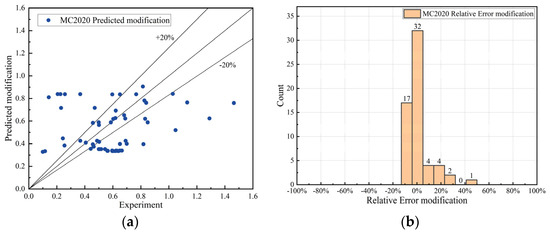
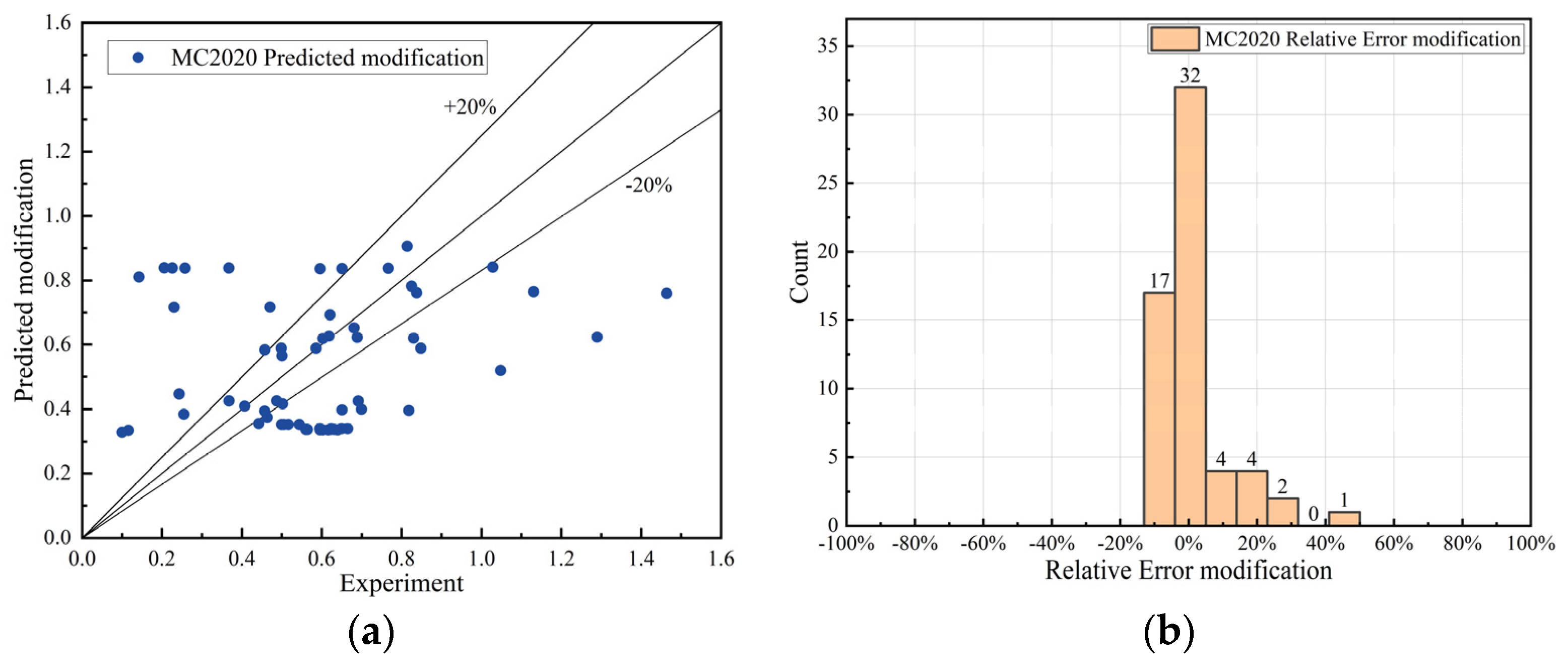
Figure 6a presents the parity relationship between the calibrated MC2020 predictions and the experimental creep coefficients. Compared with the baseline MC2020 benchmarking results, the scatter exhibits a noticeably tighter aggregation around the equality line, particularly within the moderate creep range, indicating that the calibration effectively reduces systematic deviation. The proportion of samples falling within the ±20% bounds is correspondingly increased, demonstrating improved engineering acceptability. However, when contrasted with the BPNN model prediction results, the calibrated MC2020 model still displays a broader dispersion and a weaker alignment with the 1:1 line. The BPNN predictions generally form a denser cluster with higher linear consistency, suggesting superior capability in capturing nonlinear interactions among influencing variables. This contrast highlights the inherent advantage of data-driven models in representing complex time-dependent behavior, whereas the calibrated MC2020 retains limitations associated with its predefined functional structure.
Figure 6.
MC2020 conditional-correction prediction results. (a) Comparison of prediction results. (b) Distribution of relative errors.
Figure 6b illustrates the relative error distribution following calibration. Relative to the uncalibrated MC2020 histogram, the errors are more concentrated near zero and the overall spread is reduced, confirming that the calibration mitigates part of the systematic bias observed in the benchmarking stage. The previously evident right-skewed tail is moderated, indicating fewer pronounced overpredictions. Nevertheless, compared with the error distribution of the BPNN model, which is typically more symmetric and tightly centered, the calibrated MC2020 results still exhibit a slightly wider dispersion. This suggests that while parameter reweighting improves predictive stability, it cannot fully compensate for the restricted flexibility of a code-based formulation when applied to UHPC.
From a quantitative perspective, the calibration leads to a clear reduction in global error metrics and an increase in the proportion of predictions within the acceptable deviation band, confirming the effectiveness of the proposed strategy. Yet, the remaining scatter implies that part of the variability arises from factors not explicitly represented in the code equations, such as microstructural refinement, fiber–matrix interaction, and moisture transport characteristics unique to UHPC. These mechanisms are more readily captured by data-driven approaches, explaining the comparatively stronger performance of the BPNN model.
Overall, the comparative analysis indicates that the calibrated MC2020 model represents a meaningful improvement over the baseline code predictions and provides a physically interpretable reference for UHPC creep estimation. However, the BPNN model remains superior in predictive accuracy and adaptability. Consequently, the calibrated MC2020 may be better suited for engineering scenarios requiring transparency and compatibility with existing design frameworks, while data-driven models offer greater potential for high-precision prediction. This complementary relationship suggests that future research should focus on integrating mechanistic code formulations with data-driven techniques to achieve both interpretability and predictive robustness.
4.4. Discussion
The present results are consistent with recent studies on creep prediction for UHPC and other concrete systems. In this study, the baseline MC2020 model reproduced the overall magnitude of the UHPC creep coefficient but showed evident scatter and a regression-to-the-mean tendency, with overestimation at low creep levels and underestimation at high creep levels. Similar limitations have been reported for conventional code-based models when extended to UHPC, mainly because their formulations were developed for normal-strength concrete and do not fully reflect the distinct microstructure and moisture-transport characteristics of UHPC [47].
After conditional calibration, the MC2020 model showed reduced error dispersion and a higher proportion of predictions within the ±20% acceptance band. This improvement is comparable to recent findings that recalibration can substantially enhance the performance of conventional creep models on heterogeneous datasets [47]. In addition, the increased weight of basic creep and the reduced contribution of drying creep obtained in this study agree with recent reviews showing that UHPC creep is strongly influenced by loading age, curing regime, and heat treatment, while its dense matrix tends to weaken drying-related effects [3,4].
The BPNN model provided the best predictive performance, with a tighter parity relationship and a more concentrated error distribution than both the baseline and calibrated MC2020 models. This agrees with recent machine-learning studies showing that data-driven models outperform conventional code-based formulations in creep prediction by better capturing nonlinear interactions among material, environmental, and loading variables [48,49]. Therefore, while calibrated MC2020 remains useful as an interpretable engineering baseline, BPNN offers higher predictive accuracy for UHPC creep.
Despite the promising results obtained in this study, several limitations and remaining scientific gaps should be noted. Since the UHPC database was compiled from published literature, some key information, such as specimen geometry, detailed curing history, and temperature evolution, was not consistently available, and simplified assumptions were therefore introduced, which may affect the accuracy of code-based prediction. In addition, the calibrated parameters and the BPNN model were established on a relatively limited dataset, and their robustness and generalizability still require further validation using larger and more diverse databases. From a scientific perspective, the creep mechanism of UHPC is not yet fully understood, particularly regarding the coupled effects of microstructural densification, moisture transport, fiber reinforcement, and curing regime. Future developments in creep theory should therefore focus on formulations that better reflect the time-dependent behavior of UHPC rather than direct extensions of conventional concrete models. From an engineering perspective, more reliable creep prediction is essential for the long-term design of slender, prestressed, and serviceability-controlled UHPC structures. In this regard, integrating physically interpretable code-based models with data-driven approaches may provide a promising direction for future research and design practice.
5. Conclusions
This study investigated the 100-day creep behavior of ultra-high-performance concrete (UHPC) using both data-driven and code-based approaches. The main conclusions are summarized as follows.
- (1)
- A UHPC creep database containing 60 samples and six input variables was established. Pearson correlation analysis showed strong interdependence among predictors, while the correlations between individual variables and creep coefficient were generally weak (approximately −0.22 to −0.30), indicating that UHPC creep behavior is dominated by multivariable nonlinear interactions.
- (2)
- The BPNN model demonstrated good predictive performance. The RMSE values for the training, validation, and testing sets were 0.1442, 0.1887, and 0.1285, respectively, with corresponding R2 values of 0.8552, 0.8074, and 0.9072.
- (3)
- The baseline MC2020 model reproduced the overall magnitude of creep but showed regression-to-the-mean behavior. After calibration, the coefficients were determined as ξbc1 = 1.1948 and ξdc1 = 0.0495, indicating a stronger contribution of basic creep and a reduced drying creep effect.
- (4)
- From an engineering perspective, the calibrated MC2020 model provides a more interpretable and design-compatible prediction method, while the BPNN model offers higher predictive accuracy for refined creep assessment of UHPC structures.
Overall, the results demonstrate that machine-learning models and calibrated code-based formulations play complementary roles in UHPC creep prediction: the former improves predictive accuracy, whereas the latter preserves interpretability and design compatibility. Further improvements should focus on expanding the database, incorporating additional influential descriptors, and extending the framework to multi-age and hybrid prediction approaches.
Author Contributions
Conceptualization, W.Z. and T.T.; methodology, M.Y.; software, M.Y.; validation, W.Z. and T.T.; formal analysis, S.W.; investigation, S.W.; resources, T.T.; data curation, M.Y.; writing—original draft preparation, M.Y.; writing—review and editing, S.W.; visualization, T.T.; supervision, T.T.; project administration, W.Z.; funding acquisition, T.T. All authors have read and agreed to the published version of the manuscript.
Funding
This research was funded by the National Natural Science Foundation of China, grant number 52378134.
Data Availability Statement
The original contributions presented in this study are included in the article. Further inquiries can be directed to the corresponding author.
Conflicts of Interest
The authors declare no conflicts of interest.
References
- Gu, B.W.; Wang, J.Z.; Gong, Z.Y.; Han, P.P.; Zou, J.L. Study on early shrinkage performance of Ultra-High-Performance concrete. Fly Ash Compr. Util. 2025, 39, 11–17. [Google Scholar] [CrossRef]
- Bazant, Z.P.; Panula, L. Creep and shrinkage characterization for analyzing prestressed concrete structures. PCI J. 1980, 25, 86–122. [Google Scholar] [CrossRef] [Scilit]
- Liu, Y.; Wang, L.; Wei, Y.; Sun, C.; Xu, Y. Current research status of UHPC creep properties and the corresponding applications—A review. Constr. Build. Mater. 2024, 416, 135120. [Google Scholar] [CrossRef] [Scilit]
- Huang, Y.; Wang, J.; Wei, Q.A.; Shang, H.; Liu, X. Creep behaviour of ultra-high-performance concrete (UHPC): A review. J. Build. Eng. 2023, 69, 106187. [Google Scholar] [CrossRef] [Scilit]
- Zhu, Y.; Zhang, Y.; Hussein, H.H.; Xu, Z. Normal concrete and ultra-high-performance concrete shrinkage and creep models: Development and Application. Adv. Struct. Eng. 2022, 25, 2400–2412. [Google Scholar] [CrossRef] [Scilit]
- Alireza, M.; Benjamin, G.; Zachary, H. Time-Dependent Properties of Ultrahigh-Performance Concrete: Compressive Creep and Shrinkage. J. Mater. Civ. Eng. 2022, 34, 04022096. [Google Scholar] [CrossRef] [Scilit]
- Soliman, A.A.; Heard, W.F.; Williams, B.A.; Ranade, R. Effects of the tensile properties of UHPC on the bond behavior. Constr. Build. Mater. 2023, 392, 131990. [Google Scholar] [CrossRef] [Scilit]
- Ya, W.; Weiqiang, G.; Lei, M.; Liu, Y.; Yang, B. Materials, Structure, and construction of a low-shrinkage UHPC overlay on concrete bridge deck. Constr. Build. Mater. 2023, 406, 133353. [Google Scholar] [CrossRef] [Scilit]
- Xu, T.; Zhang, Z.; Liu, Z.; Bian, X.; Zhou, Y.; Deng, K. Linear and nonlinear creep of UHPC under compression: Experiments, modeling, and verification. J. Build. Eng. 2023, 72, 106566. [Google Scholar] [CrossRef] [Scilit]
- Yuan, C.; Fu, W.; Raza, A.; Li, H. Study on Mechanical Properties and Mechanism of Recycled Brick Powder UHPC. Buildings 2022, 12, 1622. [Google Scholar] [CrossRef] [Scilit]
- Zeng, X.; Zhu, S.; Deng, K.; Zhao, C.; Zhou, Y. Experimental and numerical study on cyclic behavior of a UHPC-RC composite pier. Earthq. Eng. Eng. Vib. 2023, 22, 731–745. [Google Scholar] [CrossRef] [Scilit]
- Zhang, R.; Hu, P.; Chen, K.; Li, X.; Yang, X. Flexural Behavior of T-Shaped UHPC Beams with Varying Longitudinal Reinforcement Ratios. Materials 2021, 14, 5706. [Google Scholar] [CrossRef] [Scilit] [PubMed]
- Lu, K.; Du, L.; Zhang, F.; Zou, X.; Wang, J. Flexural Behavior of Ultra-High Performance Concrete (UHPC) Deck with Joints subjected to an Improved Steel Wire Mesh (SWM) Treatment. KSCE J. Civ. Eng. 2023, 27, 2163–2169. [Google Scholar] [CrossRef] [Scilit]
- Ding, Y.; Zeng, B.; Zhou, Z.; Wei, Y.; Huang, Y. Behavior of UHPC columns confined by high-strength transverse reinforcement under eccentric compression. J. Build. Eng. 2023, 70, 106352. [Google Scholar] [CrossRef] [Scilit]
- El-Abbasy, A.A.A. Artificial intelligence-driven predictive modeling in civil engineering: A comprehensive review. J. Umm Al-Qura Univ. Eng. Archit. 2025, 16, 1322–1345. [Google Scholar] [CrossRef] [Scilit]
- Adsul, N.; Choi, Y.; Kang, T.S. A Comprehensive Review of Numerical and Machine Learning Approaches for Predicting Concrete Properties: From Fresh to Long-Term. Materials 2025, 18, 3718. [Google Scholar] [CrossRef] [Scilit]
- Palanci, M. Fuzzy rule based seismic risk assessment of one-story precast industrial buildings. Earthq. Eng. Eng. Vib. 2019, 18, 631–648. [Google Scholar] [CrossRef] [Scilit]
- Alain, G.; Jorge, P.E. Review of Machine-Learning Techniques Applied to Structural Health Monitoring Systems for Building and Bridge Structures. Appl. Sci. 2022, 12, 10754. [Google Scholar] [CrossRef] [Scilit]
- Jesús, D.; Covadonga, P.; Neemias, S.; Martínez-García, R. To predict the compressive strength of self compacting concrete with recycled aggregates utilizing ensemble machine learning models. Case Stud. Constr. Mater. 2022, 16, e01046. [Google Scholar] [CrossRef] [Scilit]
- Wang, Q.; Hussain, A.; Farooqi, M.U.; Deifalla, A.F. Artificial intelligence-based estimation of ultra-high-strength concrete’s flexural property. Case Stud. Constr. Mater. 2022, 17, e01243. [Google Scholar] [CrossRef] [Scilit]
- Xu, S.; Wang, Q.; Lyu, Y.; Li, Q.; Reinhardt, H.W. Prediction of fracture parameters of concrete using an artificial neural network approach. Eng. Fract. Mech. 2021, 258, 108090. [Google Scholar] [CrossRef] [Scilit]
- Xie, T.; Yang, G.; Zhao, X.; Xu, J.; Fang, C. A unified model for predicting the compressive strength of recycled aggregate concrete containing supplementary cementitious materials. J. Clean. Prod. 2020, 251, 119752. [Google Scholar] [CrossRef] [Scilit]
- Itzel, N.; Afshin, M.; Majdi, F.; Nehdi, M.L. Estimating compressive strength of modern concrete mixtures using computational intelligence: A systematic review. Constr. Build. Mater. 2021, 310, 125279. [Google Scholar] [CrossRef] [Scilit]
- Fu, M.; Osofero, I.; Mao, J. The prediction and characterization of concrete properties by using the machine learning algorithms: A state-of-the-art review. Intell. Geoengin. 2025, 2, 274–299. [Google Scholar] [CrossRef] [Scilit]
- Bahmani, H.; Mostafaei, H.; Santos, P.; Ferrández, D. Concrete Material Variability and Machine Learning Model Performance: A Comprehensive Review. Buildings 2026, 16, 556. [Google Scholar] [CrossRef] [Scilit]
- Zeyad, A.M.; Mahmoud, A.A.; El-Sayed, A.A.; Aboraya, A.M.; Fathy, I.N.; Zygouris, N.; Asteris, P.G.; Agwa, I.S. Compressive strength of nano concrete materials under elevated temperatures using machine learning. Sci. Rep. 2024, 14, 24246. [Google Scholar] [CrossRef] [Scilit] [PubMed]
- Asteris, P.G.; Skentou, A.D.; Bardhan, A.; Samui, P.; Pilakoutas, K. Predicting concrete compressive strength using hybrid ensembling of surrogate machine learning models. Cem. Concr. Res. 2021, 145, 106449. [Google Scholar] [CrossRef] [Scilit]
- Kumar, D.R.; Kumar, P.; Thangavel, P.; Wipulanusat, W.; Thongchom, C.; Samui, P. Optimized machine learning models for predicting the tensile strength of high-performance concrete. J. Struct. Integr. Maint. 2025, 10, 2471682. [Google Scholar] [CrossRef] [Scilit]
- Espinosa-Leal, L.; Taffese, W.Z. A machine learning method for predicting the chloride migration coefficient of concrete. Constr. Build. Mater. 2022, 345, 128566. [Google Scholar] [CrossRef] [Scilit]
- Li, Y.; Jin, K.; Lin, H.; Shen, J.; Shi, J.; Fan, M. Analysis and prediction of freeze-thaw resistance of concrete based on machine learning. Mater. Today Commun. 2024, 39, 108946. [Google Scholar] [CrossRef] [Scilit]
- Zhang, M.; Gu, Z.; Zhao, Y.; Fu, Y.; Kong, X. Compressive strength prediction of cement base under sulfate attack by machine learning approach. Case Stud. Constr. Mater. 2024, 21, e03652. [Google Scholar] [CrossRef] [Scilit]
- Rezzoug, A.; Ltifi, M.; Alrashidi, R.S.; AlAteah, A.H. Predicting fracture energy and durability parameters of concrete through hybrid machine learning models. Rev. Adv. Mater. Sci. 2026, 65, 20250012. [Google Scholar] [CrossRef] [Scilit]
- Islam, S.; Hoque, M.I.; Sobuz, M.H.R.; Kabbo, M.K.I.; Alzlfawi, A.; Abubakar, S.A. Combined influence of treated eggshell powder and polypropylene fiber on the mechanical, durability and microstructural properties of sustainable concrete: Experimental and machine learning-based analysis. Case Stud. Constr. Mater. 2025, 24, e05656. [Google Scholar] [CrossRef] [Scilit]
- Flah, M.; Marani, A.; Suleiman, R.A.; Nehdi, M.L. Durability-informed life cycle assessment of concrete through machine learning for service life prediction. Renew. Sustain. Energy Rev. 2026, 231, 116730. [Google Scholar] [CrossRef] [Scilit]
- Ombres, L.; Aiello, M.A.; Cascardi, A.; Verre, S. Modeling of steel-reinforced grout composite system-to-concrete bond capacity using artificial neural networks. J. Compos. Constr. 2024, 28, 04024034. [Google Scholar] [CrossRef] [Scilit]
- Bal, L.; Buyle-Bodin, F. Artificial neural network for predicting creep of concrete. Neural Comput. Appl. 2014, 25, 1359–1367. [Google Scholar] [CrossRef] [Scilit]
- Karthikeyan, J.; Upadhyay, A.; Bhandari, M.N. Artificial Neural Network for Predicting Creep and Shrinkage of High Performance Concrete. J. Adv. Concr. Technol. 2008, 6, 135–142. [Google Scholar] [CrossRef] [Scilit]
- Hodhod, A.O.; Said, E.T.; Ataya, M.A. Prediction of creep in concrete using genetic programming hybridized with ANN. Comput. Concr. 2018, 21, 513–523. [Google Scholar] [CrossRef]
- Liu, G.; Liu, Z.; Zhang, G.; Zhang, Z.; Yan, M. Nonlinear creep characteristics of UHPC under indoor environment. World Bridges 2023, 51, 84–90. [Google Scholar] [CrossRef]
- Liu, L.; Fang, Z.; Liu, F.; Xiao, M. Shrinkage–creep tests and prediction of UHPC under indoor environment. China J. Highw. Transp. 2021, 34, 35–44. [Google Scholar] [CrossRef]
- Yang, Y. Prediction Model for Shrinkage and Creep of UHPC Box Girders and Long-Term Deformation Effects. Master’s Thesis, Lanzhou Jiaotong University, Lanzhou, China, 2023. [Google Scholar]
- Lu, Z.; Jiang, Z.; Liu, M. Creep performance and model study of lightweight ultra-high performance concrete. J. Huazhong Univ. Sci. Technol. (Nat. Sci. Ed.) 2023, 51, 128–133. [Google Scholar] [CrossRef]
- Liu, Y.; Fan, W.; Li, S. Creep tests and prediction model for internally cured UHPC. In Proceedings of the 2024 World Transport Convention (WTC2024): Highway Engineering; China Highway and Transportation Society: Beijing, China; China Institute of Navigation: Beijing, China; China Railway Society: Beijing, China; Chinese Society of Aeronautics and Astronautics: Beijing, China; China Society of Automotive Engineers: Beijing, China; National Center for Materials Service Safety, University of Science and Technology: Beijing, China; China Railway 14th Bureau Group Construction Engineering Co., Ltd.: Jinan, China, 2024; pp. 93–100. [Google Scholar] [CrossRef]
- Sun, M. Time-Dependent Deformation of Ultra-High Performance Concrete. Ph.D. Thesis, University of Adelaide, Adelaide, Australia, 2022. [Google Scholar]
- Liu, K.; Alam, M.S.; Zhu, J.; Zheng, J.; Chi, L. Prediction of carbonation depth for recycled aggregate concrete using ANN hybridized with swarm intelligence algorithms. Constr. Build. Mater. 2021, 301, 124382. [Google Scholar] [CrossRef] [Scilit]
- Fédération de l’Industrie du Béton (fib). fib Model Code for Concrete Structures 2020; Fédération de l’Industrie du Béton (fib): Lausanne, Switzerland, 2020. [Google Scholar]
- Shurbert-Hetzel, C.; Daneshvar, D.; Robisson, A.; Shafei, B. Data-enabled comparison of six prediction models for concrete shrinkage and creep. Case Stud. Constr. Mater. 2023, 19, e02406. [Google Scholar] [CrossRef] [Scilit]
- Liang, M.; Chang, Z.; Wan, Z.; Gan, Y.; Schlangen, E.; Šavija, B. Interpretable ensemble-machine-learning models for predicting creep behavior of concrete. Cem. Concr. Compos. 2022, 125, 104295. [Google Scholar] [CrossRef] [Scilit]
- Fan, Z.; Zhan, Y.; Xiang, T.; Huang, Y.; Li, B.; Xiang, H.; Li, Y. A time-series deep learning model for predicting concrete shrinkage and creep verified with in-situ and laboratory test data. Constr. Build. Mater. 2024, 447, 138140. [Google Scholar] [CrossRef] [Scilit]

Disclaimer/Publisher’s Note: The statements, opinions and data contained in all publications are solely those of the individual author(s) and contributor(s) and not of MDPI and/or the editor(s). MDPI and/or the editor(s) disclaim responsibility for any injury to people or property resulting from any ideas, methods, instructions or products referred to in the content. |
© 2026 by the authors. Licensee MDPI, Basel, Switzerland. This article is an open access article distributed under the terms and conditions of the Creative Commons Attribution (CC BY) license.