Next Article in Journal
Enhancing Asset Management: Deterioration and Seismic-Based Decision-Support Framework for Heterogeneous Portfolios
Previous Article in Journal
Performance and Mesoscopic Simulation of Self-Compacting Concrete Made with Different Lithological Types of Manufactured Sand
 
 
Due to scheduled maintenance work on our servers, there may be short service disruptions on this website between 11:00 and 12:00 CEST on March 28th.
Article

Visual Stimulation by Viewing a Seascape from a High-Rise Window Increases Subjective Relaxation and Left–Right Differences in Prefrontal Cortex Activity


1
Institute for Advanced Academic Research, Chiba University, 1-33 Yayoi-cho, Inage-ku, Chiba 263-8522, Japan
2
Center for Environment, Health and Field Sciences, Chiba University, 6-2-1 Kashiwa-no-ha, Kashiwa 277-0882, Chiba, Japan
3
Nomura Real Estate Development Co., Ltd., 1-1-1 Shibaura, Minato-ku 105-8341, Tokyo, Japan
*
Authors to whom correspondence should be addressed.
These authors contributed equally to this work.
Buildings 2026, 16(7), 1292; https://doi.org/10.3390/buildings16071292 (registering DOI)
Submission received: 21 January 2026 / Revised: 13 March 2026 / Accepted: 14 March 2026 / Published: 25 March 2026
(This article belongs to the Section Building Energy, Physics, Environment, and Systems)

Abstract

Stress states are increasing with global urbanization, but evidence on the physiological impact of urban blue-space exposure remains limited compared to green spaces. In this randomized within-subject crossover study, we examined the physiological effects of seascape viewing from the 29th floor of an office building in 44 healthy young adults. Each participant underwent visual stimulation with a seascape window view (blue space) and a blind-covered window (control) for 90 s each after a 60 s rest. Prefrontal cortex activity was recorded using near-infrared spectroscopy, and the left–right difference (LRD) in Δoxy-Hb concentrations was used as an indicator. Autonomic nervous system activity was assessed using heart rate variability, and psychological outcomes were measured using a semantic differential scale and the Profile of Mood States—2 short form. Seascape viewing significantly increased LRD, indicating left-dominant prefrontal activation relative to the control. It also increased comfort and relaxation and improved mood states. Correlation analyses showed that LRD was positively correlated with comfort and relaxation. These findings suggest that intentional window-view design, including exposure to high-rise blue-space views, represents a promising environmental approach to support occupants’ well-being and provide practical implications for window-view design and operation in high-rise office environments.

1. Introduction

Modern humans retain physiological functions that are adapted to natural environments [1]. Humans diverged from great apes approximately 6–7 million years ago [2,3]. If the Industrial Revolution is considered the starting point of urbanization, humans have spent >99.99% of their evolutionary history in natural environments. Therefore, modern humans, whose physiological functions remain suited to natural environments, are exposed to stress on a daily basis in today’s artificial environments [4,5]. In addition, technostress that is associated with the widespread use of information and communication technologies [6] and the rapid spread of coronavirus disease 2019 [7] have further aggravated the stress levels of modern people.
In this context, contact with natural environments has emerged as a practical public-health strategy to promote relaxation and support mental well-being. Nature therapy aims to achieve preventive medical effects via contact with nature that promotes a state of physiological relaxation and boosts weakened immune functions to prevent diseases [4]. Back-to-Nature Theory—which states that contact with nature physiologically relaxes people under stress and brings them closer to an original desirable state as humans [5]—devices for assessing physiological measurements (e.g., brain activity and autonomic nervous activity), which have advanced rapidly over the past few years, were used to target nature such as forests [8,9], parks [10], flowers [11,12], and wooden spaces [13]. Previous studies have collected scientific data on the physiological relaxation effects of nature in humans [14,15,16].
In view of the increase in stress levels caused by rapid global urbanization in recent years, expectations on the use of natural environments within urban areas are rising. Several meta-analyses have reported the effects of green space, including urban parks and street trees, on subjective mood states [17], mortality [18,19], and physiological responses [20,21,22].
Blue space such as seas and rivers has traditionally been positioned as one element that is included within green space. However, in recent times, scientific attention has focused on the health-promoting effects of blue space itself [23,24,25,26,27,28,29,30,31,32]. White et al. [23] performed a review on the potential benefits of exposures to the blue space environment on health and well-being. Previous studies on the association between blue space and well-being—particularly the distance between the coastline and residential areas—have been conducted, mainly in countries such as England [24,25], Ireland [26], Belgium [27], and Spain [28].
By contrast, the evidence base regarding the effects of blue spaces on human physio-logical responses compared with those of green spaces is relatively immature, so there is a need to accelerate research efforts [29]. Prior reports examining the effects of coastal walking [30,31] have shown improvements in mood and well-being, whereas no significant differences were observed in physiological (cardiovascular and autonomic) indices. Visual exposure to a virtual beach using virtual reality technology [32] suppressed sympathetic nervous system activity, but its effects on other physiological responses were limited.
Urban growth is shifting from horizontal expansion to vertical development; buildings in urban areas have become higher in recent years [33]. Several large cities are located along coastlines or inland waters [34], and the number of super high-rise buildings along the sea is expected to increase in the future. The view from windows is an important factor that affects the well-being of office workers and residents inside buildings [35]. However, there are no reports on the physiological relaxation effects of urban seascape viewing from a high-rise building in humans.
This study assessed the physiological effects of viewing a seascape from the 29th floor of a super high-rise building in Tokyo, the capital of Japan, using prefrontal cortex activity and autonomic nervous system activity as indices.

2. Materials and Methods

2.1. Participants

In the current study, we included healthy Japanese university students and graduate students. The inclusion criteria were as follows: individuals who were currently not receiving treatment at a medical institution for any disease; those not presenting with symptoms such as chronic rhinitis and asthma; those without arrhythmia; those who were not habitual smokers; those with a Landolt ring-based visual acuity of ≥0.3 (including correction with contact lenses or glasses, if worn); those without acrophobia; and women who were not menstruating on the experimental day.
An a priori sample size was assessed under the following three conditions using the G*Power software package (version 3.1.9.7, Heinrich Heine University Düsseldorf, Düsseldorf, Germany) [36,37]. First, the Wilcoxon signed-rank test was used to examine differences in psychological evaluations between the seascape viewing and control conditions (test parameters: means = Wilcoxon signed-rank test [matched pairs]; two-tailed; effect size |ρ| = 0.50; α err prob = 0.05; power (1 − β err prob) = 0.80). Second, the paired t-test was utilized to examine differences in physiological indices between the seascape viewing and control conditions (test parameters: means = difference between two dependent means [matched pairs]; two-tailed; effect size |ρ| = 0.50; α err prob = 0.05; power (1 − β err prob) = 0.80). Third, Spearman’s rank correlation analysis was conducted to examine the correlation between physiological indices and psychological evaluations. As G*Power v3.1.9.7 does not include a specific option for Spearman’s correlation, we followed common practice and approximated it using the bivariate normal model with the following parameters: two-tailed; effect size |ρ| = 0.40; α err probability = 0.05; and power (1 − β err prob) = 0.80. Thus, the required sample sizes were calculated as 35, 34, and 44, respectively. Considering possible absences and data loss and based on previous experience that assumed a dropout rate of 15%, the planned sample size was set to 52 (calculated as 44 divided by 0.85). Initially, 55 participants (32 men, 23 women) were enrolled; six (four men, two women) were absent due to poor physical condition and 49 (28 men, 21 women) took part in the experiment. Subsequently, to ensure the quality control of the physiological data (obtained using near-infrared spectroscopy and from heart rate variability [HRV]), six participants (three men, three women) with excessive artifacts and/or signal loss were excluded from the analysis. Therefore, the final analysis set comprised 44 participants (25 men, 19 women). Table 1 shows the physical characteristics of the participants.
Before the measurements, all participants received sufficient explanation about the purpose and procedures of the study and provided a written informed consent. This study was conducted in accordance with the guidelines of the Declaration of Helsinki, and the study protocol was approved by the Ethics Committee of the Center for Environment, Health and Field Sciences, Chiba University (approval number: 47). The current study was registered in the University Hospital Medical Information Network (registration numbers: UMIN000048326 [men]; UMIN000048083 [women]).

2.2. Visual Stimulation

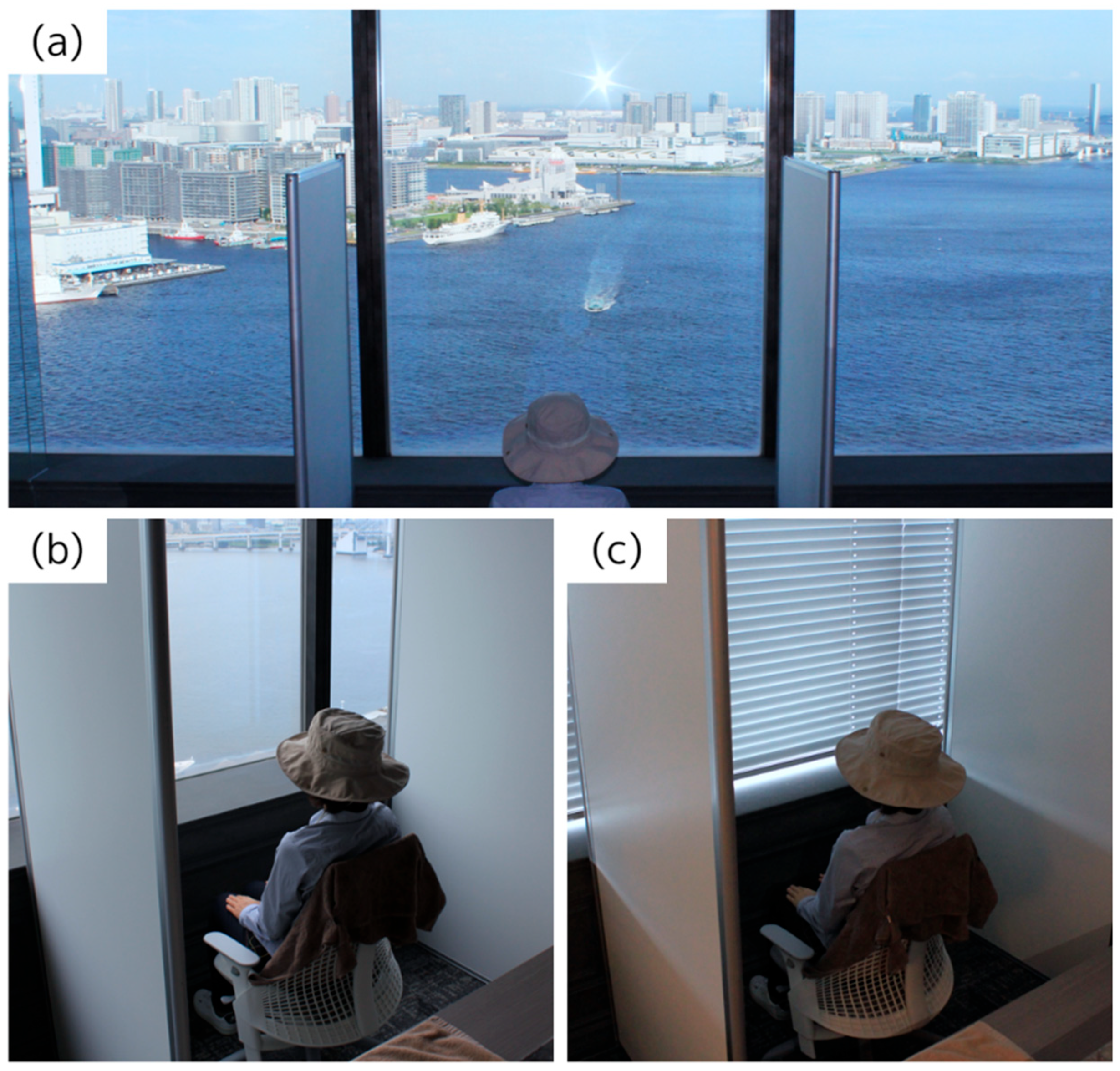
The intervention was visual stimulation, and a one-factor, two-condition crossover comparative experiment was conducted (within-subject design) (Figure 1a). The visual stimulus was seascape viewing from the east-facing window of a rental office space on the 29th floor of the Hamamatsucho Building (the planned site of BLUE FRONT SHIBAURA TOWER N; Figure 1b). For comparison, the control condition consisted of the same window covered with a blind (Figure 1c).

2.3. Procedure

Sequentially, the participants received an explanation about the study outline and procedures in a waiting room, signed the consent form, and then moved to the laboratory. Before the participants entered the laboratory, all windows were covered with blinds. The participants entered the measurement area and sat on a chair in front of the window. The experimenter attached physiological measurement sensors, conducted a practice run with the same procedure as the main measurement, and then performed the main measurement. First, while looking at the window covered with blinds, the participants rested for approximately 60 s. Then, the experimenter opened the blinds and the participant viewed the seascape; in the control condition, the participants continued to look at the window covered with blinds for 90 s. From the start of the rest period until the end of visual stimulation, physiological responses were recorded continuously. After the end of the visual stimulation, the participant completed the psychological questionnaires. The second measurement was conducted using the same procedure as the first, and the presentation order was randomized and counterbalanced.

2.4. Physiological Measurements

Oxyhemoglobin (oxy-Hb) concentrations in the left and right prefrontal cortex, which are an index of brain activity, were measured using a two-channel portable near-infrared spectroscopy device (PocketNIRS Duo, Dynasense, Hamamatsu, Japan [38]). The sensors were attached at sites corresponding to Fp1 and Fp2 according to the international 10–20 system for electroencephalography. A cap was worn to mitigate ambient light. In the visual-stimulation period, which lasted for 90 s, the data were expressed as the difference from the mean value during the 10 s pre-stimulus rest. In addition, the left–right difference in prefrontal oxy-Hb concentrations (Δoxy-Hb_Left−Δoxy-Hb_Right) was calculated, which is hereafter referred to as the left–right difference (LRD). Under this definition, a positive LRD indicates left-dominant prefrontal activation, while a negative LRD represents right-dominant activation. In relation to previous studies, the right−left definition was used, and increases in right dominance during mental arithmetic and other mental load tasks were reported [39,40]. When converted to the current definition, this corresponds to a decrease in LRD (right−left difference = −LRD).
HRV, which is an index of autonomic nervous system activity, was used [41,42]. Electrocardiogram findings were recorded with a portable electrocardiograph (ActivTracer AC-301A, GMS, Tokyo, Japan). The power of the high-frequency (HF; 0.15–0.40 Hz) and low-frequency (LF; 0.04–0.15 Hz) components of HRV was calculated using the maximum entropy method (MemCalc/Win, GMS, Tokyo, Japan) [43]. The HF component reflects parasympathetic nervous system activity that increases during relaxation, and LF/HF reflects sympathetic nervous system activity that increases during stress. In this study, the natural logarithms of HF and LF/HF (ln(HF), ln(LF/HF)) were used to normalize the HRV data [44], and the differences from the 30 s resting period (baseline) were calculated. Because changes in respiration can affect HRV, especially the HF component, the respiratory rate was approximately estimated from the HF peak in the HRV power spectrum to support interpretation and quality checking, as respiration was not directly measured [45,46,47].

2.5. Psychological Measurements

Changes in impressions and mood states induced by visual stimulation were evaluated using the following questionnaires: the modified semantic differential (SD) method [48] and the Profile of Mood States Second Edition (POMS 2) short form [49,50].
In the modified SD method [48], four pairs of opposite adjectives (comfortable–uncomfortable, relaxed–alert, natural–artificial, and bright–dark) were used, and subjective impressions were rated on a 13-point scale (−6 to 6).
In the POMS 2 short form [49,50], five negative mood scales (anger–hostility, confusion–bewilderment, depression–dejection, fatigue–inertia, and tension–anxiety) and two positive mood scales (vigor–activity, friendliness) were assessed by responding to 35 items on a five-point scale ranging from “very much (4)” to “not at all (0).” In addition, total mood disturbance scores were calculated by subtracting the vigor–activity score from the sum of the five negative mood scale scores. A smaller TMD indicates a more positive mood state.

2.6. Statistical Analysis

Data and figures for psychological and physiological indices are presented as mean ± standard error. In all cases, a p value of <0.05 indicated statistically significant differences. Variations between the seascape and control conditions were tested with the paired t-test for physiological indices and the Wilcoxon signed-rank test for psychological indices. When a significant difference was detected between the seascape and control conditions, effect sizes were calculated as Cohen’s d (d) for physiological indices [51] and the probability of superiority for dependent samples (PSdep) for psychological indices [52].
Further, to examine the association between physiological indices and psychological evaluations in each participant, the condition difference (seascape−control) was calculated, and the associations were evaluated using Spearman’s rank correlation (Rho). All statistical analyses were performed using the Statistical Package for the Social Sciences software (version 29.0; IBM Corp., Armonk, NY, USA).

3. Results

3.1. Physiological Responses

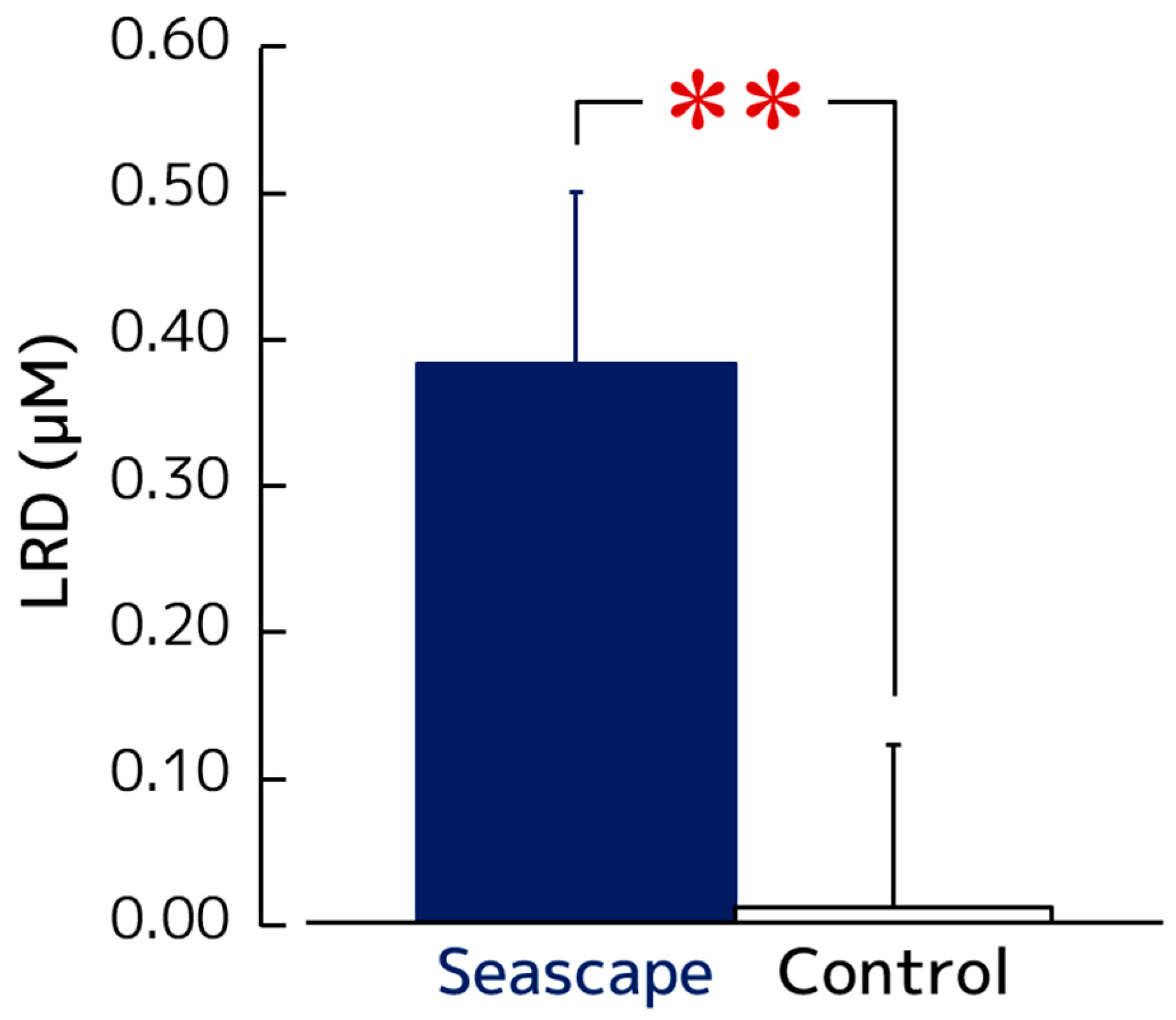
When the left and right prefrontal activities were examined separately, no significant between-condition differences were detected in Δoxy-Hb concentrations (left: 0.61 ± 0.13 vs. 0.42 ± 0.12 μM [seascape vs. control, respectively], t(43) = 1.149, p = 0.128; right: 0.22 ± 0.13 vs. 0.41 ± 0.16 μM, t(43) = −1.169, p = 0.124). By contrast, prefrontal LRD (left−right Δoxy-Hb concentration difference) significantly increased under the seascape viewing condition compared to the control condition (0.38 ± 0.12 vs. 0.01 ± 0.11 μM, t(43) = 3.192, p = 0.003, d = 0.49; Figure 2).
In terms of autonomic nervous system activity indices, HRV data were analyzed because there was no statistically significant difference in the estimated respiratory rate between the seascape viewing and control conditions. Δln(HF), which reflects parasympathetic nervous system activity, did not significantly differ between the seascape viewing and control conditions (−0.01 ± 0.10 vs. −0.01 ± 0.10 lnms2, t(43) = −0.018, p = 0.986). Similarly, Δln(LF/HF) (−0.34 ± 0.15 vs. −0.61 ± 0.14, t(43) = 1.258, p = 0.215), which reflects sympathetic nervous system activity, and ΔHR (1.07 ± 0.45 vs. 1.27 ± 0.40 bpm, t(43) = −0.369, p = 0.714) did not significantly differ between the seascape viewing and control conditions.

3.2. Psychological Responses

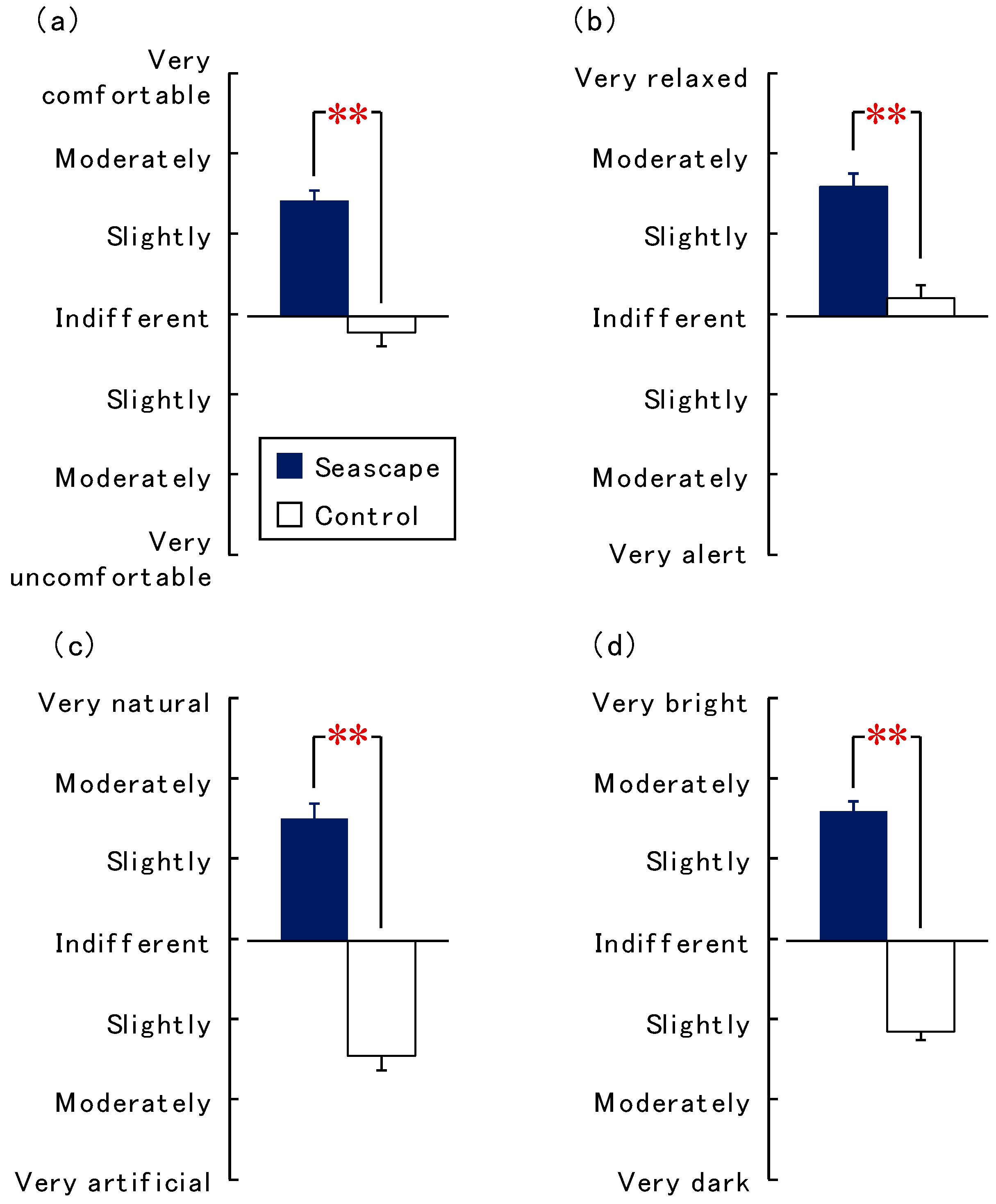
Figure 3 shows the results of the modified SD method. In terms of comfort, seascape viewing was rated between slightly comfortable and moderately comfortable (2.9 ± 0.3), while the control condition was rated between indifferent and slightly uncomfortable (−0.4 ± 0.3); seascape viewing was found to be significantly more comfortable than the control condition (p < 0.001, PSdep = 0.75). Regarding relaxation, seascape viewing was rated between slightly relaxed and moderately relaxed (3.2 ± 0.3), and the control condition was rated between indifferent and slightly relaxed (0.5 ± 0.3); seascape viewing was rated as significantly more relaxing than the control condition (p < 0.001, PSdep = 0.80). For naturalness, seascape viewing (3.0 ± 0.4) was perceived between slightly natural and moderately natural, while the control condition (−2.9 ± 0.4) was perceived between slightly artificial and moderately artificial; the difference was significant (p < 0.001, PSdep = 0.91). In terms of brightness, seascape viewing (3.2 ± 0.3) was perceived between slightly bright and moderately bright, whereas the control condition (−2.3 ± 0.2) was perceived as slightly dark; the difference was significant (p < 0.001, PSdep = 0.98).
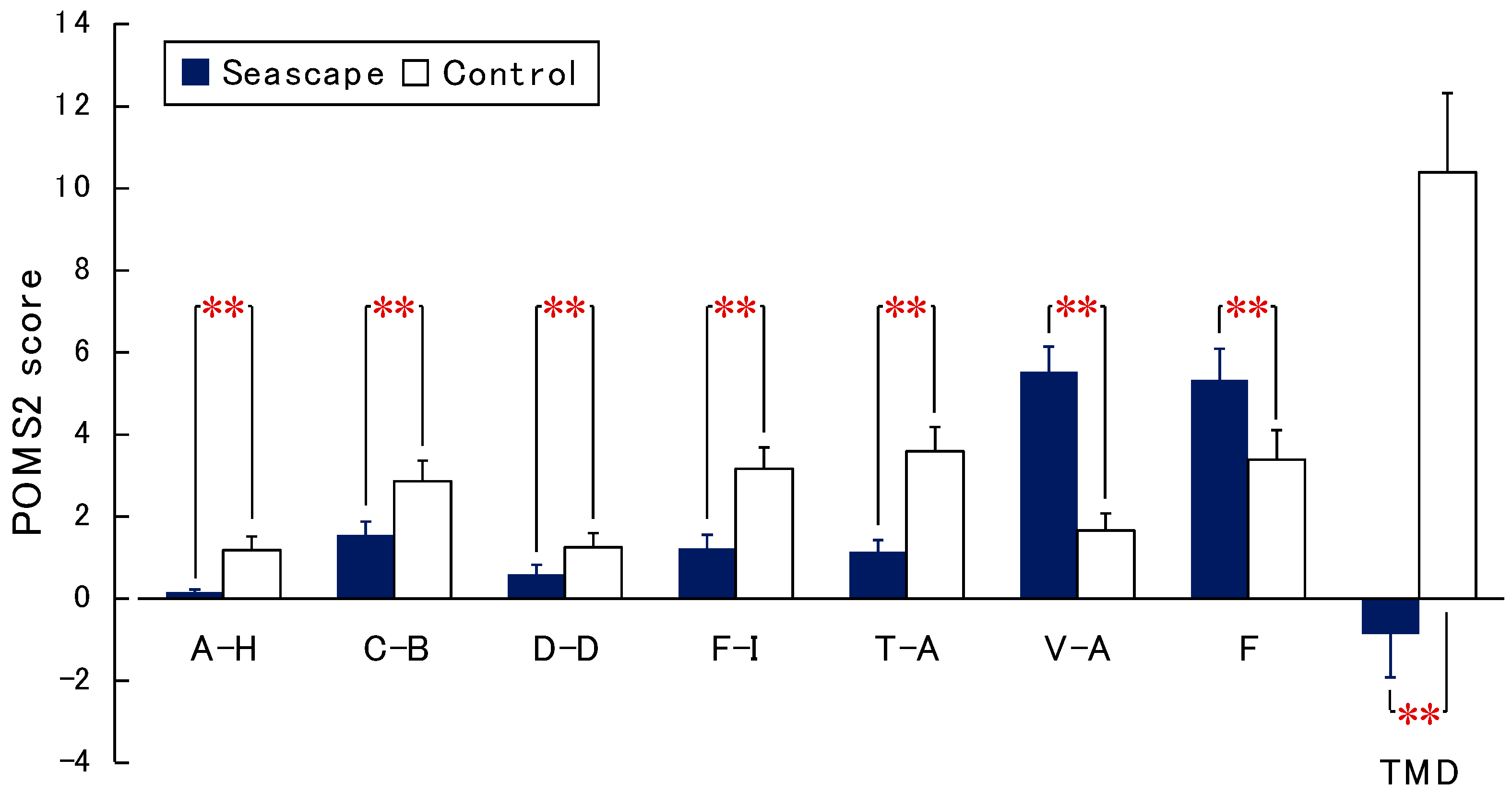
Figure 4 shows the results of the POMS 2 short form. Among the negative mood scales, A–H (seascape view: 0.2 ± 0.1, control: 1.2 ± 0.3; p = 0.004, PSdep = 0.32), C–B (seascape view: 1.5 ± 0.3, control: 2.9 ± 0.5; p = 0.005, PSdep = 0.52), D–D (seascape view: 0.6 ± 0.2, control: 1.3 ± 0.3; p < 0.001, PSdep = 0.30), F–I (seascape view: 1.2 ± 0.3, control: 3.2 ± 0.5; p < 0.001, PSdep = 0.64), and T–A (seascape view: 1.1 ± 0.3, control: 3.6 ± 0.6; p < 0.001, PSdep = 0.66) were significantly lower under the seascape viewing condition than the control condition. Among the positive mood scales, V–A (seascape view: 5.5 ± 0.6, control: 1.7 ± 0.4; p < 0.001, PSdep = 0.75) and F (seascape view: 5.3 ± 0.8, control: 3.4 ± 0.7; p < 0.001, PSdep = 0.64) were significantly higher under the seascape viewing condition than the control condition. The total mood disturbance score was also significantly lower under the seascape viewing condition than the control condition (−0.9 ± 1.1 vs. 10.4 ± 1.9, p < 0.001, PSdep = 0.95).

3.3. Correlation Between Physiological Indices and Psychological Evaluations

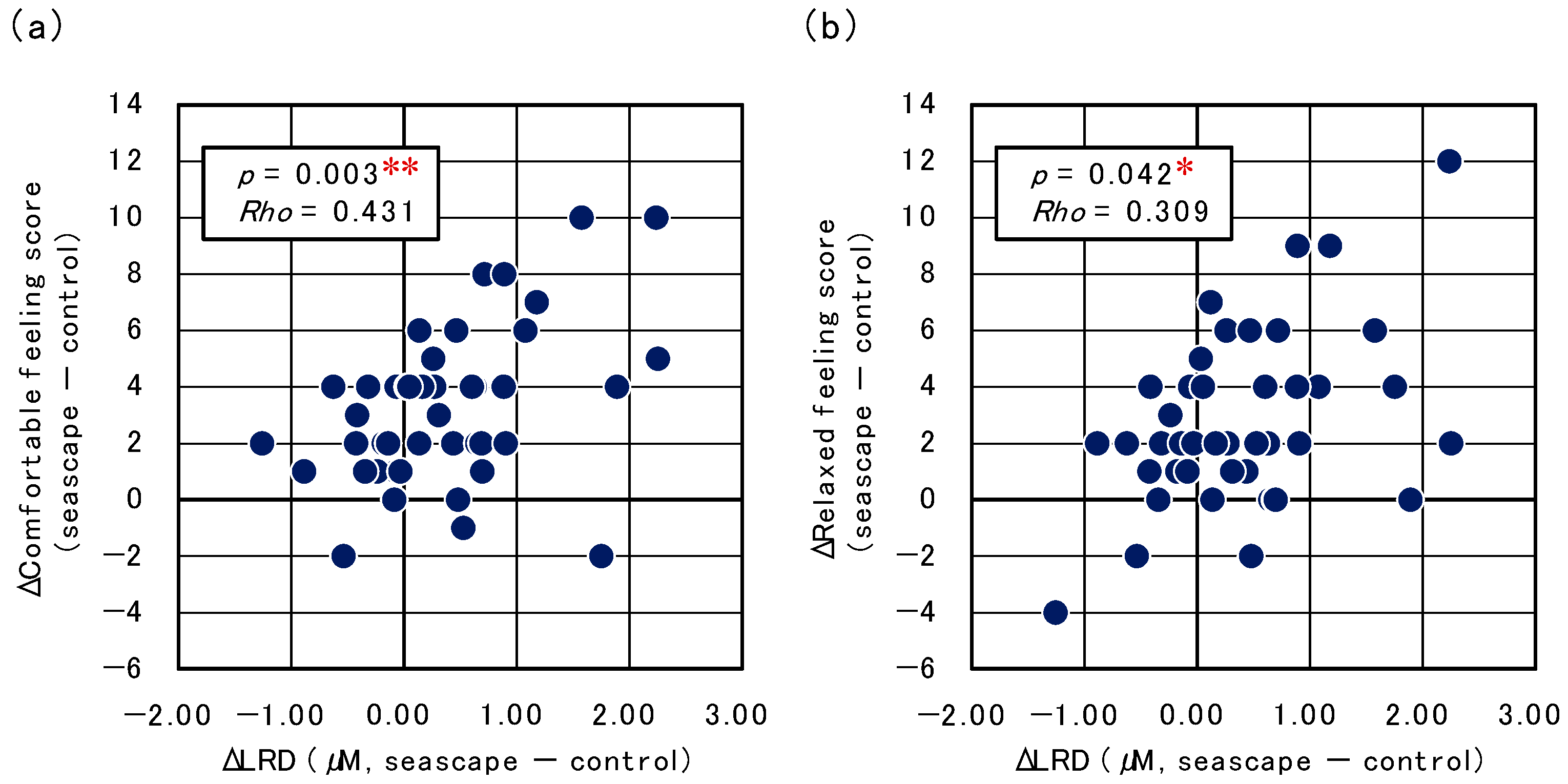
To examine the association between physiological indices and psychological evaluations, the condition difference (seascape−control) for each participant was calculated, and the associations were evaluated using Spearman’s rank correlation. Significant positive correlations were observed between the prefrontal LRD in Δoxy-Hb concentrations and comfort (Rho = 0.431, p = 0.003, Figure 5a) and relaxation (Rho = 0.309, p = 0.042, Figure 5b) based on the modified SD method.

4. Discussion

In this study, compared with a blind-covered window (control), visual stimulation with a seascape view significantly increased the prefrontal left–right difference (LRD) in Δoxy-Hb concentrations. Psychologically, seascape viewing increased subjective comfort, relaxation, naturalness, and brightness, and improved mood states. Finally, using within-participant condition differences (seascape − control), higher LRD was positively associated with greater subjective comfort and relaxation.
Regarding physiological indices, seascape viewing increased the LRD of prefrontal activity. Relative left prefrontal dominance is consistent with the neuropsychological framework linking the left prefrontal cortex to approach-related (positive) affect [53,54]. In this context, seascape viewing is in accordance with a pattern in which the left prefrontal activity associated with approach-related positive emotion is enhanced, while the right prefrontal activity associated with stress is attenuated.
The psychological outcomes of this study are consistent with those of previous studies showing that nature-derived stimuli (e.g., actual forest landscapes [8], wooden spaces [13], fresh flowers [11], and images of forests [55] and wooden walls [56]) promoted psychological enhancements. In addition, blue-space interventions, such as coastal walking, are often associated with improvements in subjective evaluations [30,31]. Based on this study, the psychological benefits of urban blue space are reproduced even with short-term visual exposure in the seated position.
In terms of psychophysiological domain, increases in the LRD were significantly associated with better subjective comfort and relaxation. Based on commonly used benchmarks for correlation effect sizes (|r| ≈ 0.10, small; 0.30, medium; 0.50, large), the corresponding correlation coefficients were small to moderate in magnitude (Spearman’s ρ = 0.309–0.431) [51]. Although this does not indicate a one-to-one correspondence, modest associations are expected in field psychophysiological research given multiple sources of variability (e.g., baseline state and individual differences). Previous studies have revealed that an increase in the right/left oxy-Hb ratio (right-dominant activation) was associated with a greater stress load [39]. Moreover, high Δright−left oxy-Hb concentrations are associated with a greater subjective fatigue, and they are inversely correlated with subjective relaxation and comfort [40]. Mapped onto the current study’s definition of LRD (Δleft−right oxy-Hb concentration difference), a lower LRD corresponds to stress-related responding (right dominance), whereas a higher LRD corresponds to relaxation-related responding (left dominance). Accordingly, the positive correlations observed between LRD and comfort/relaxation herein are consistent with these reports. These findings suggest that even brief visual access to urban blue space may represent a simple, low-cost environmental strategy for supporting mental well-being in office settings.
In this randomized crossover study, we examined the correlations between physiological and psychological indices using within-participant condition differences (seascape−control) to characterize inter-individual variability in responsiveness to brief exposure to a nature-derived visual stimulus. As nature therapy is considered a type of active comfort [5]—aiming to achieve plus-alpha benefits—substantial inter-individual variability is expected. Consistent with this expectation, a wide variability was observed in terms of comfort, relaxation, and prefrontal LRD. Cross-measure correlations accounted for part of this variability. These insights may inform workplace design and operational considerations to support occupants’ well-being, including window-view planning, blind operation, and the incorporation of brief breaks involving seascape or other nature views.

5. Limitations

In this study, we showed that brief visual exposure to a high-rise seascape view was associated with (1) increased prefrontal left–right difference (LRD), greater subjective comfort and relaxation, and improved mood states and (2) small-to-moderate correlations between LRD and subjective relaxation-related outcomes. However, several limitations should be noted.
  • Although we observed increased LRD during seascape viewing, the underlying neural mechanisms remain unclear. In particular, identifying how specific visual attributes (e.g., blue-space cues, openness/viewing distance, and brightness) contribute to changes in prefrontal lateralization was beyond the scope of this study. Future studies should quantify photometric variables (e.g., illuminance/luminance) and scene metrics and employ more refined control conditions to better disentangle contributing factors.
  • The control condition involved covering the window with blinds to reflect a practical “no-view” situation in everyday office use. Consequently, incoming light (i.e., illuminance/luminance) likely differed substantially between the seascape and control conditions. Therefore, within the present framework, we could not disentangle the contribution of blue-space cues from general visual features such as brightness (light intensity) and visual complexity. Future studies should include more ecologically valid comparison conditions, such as urban skyline views or indoor greening/indoor plants, together with objective quantification of illuminance/luminance.
  • In the present study, inter-individual variability was observed in the association between LRD and subjective outcomes. However, we did not examine potential moderators, including trait anxiety, stress-related traits, behavioral characteristics, or prior exposure to blue space. Future work should incorporate these factors to clarify who is more responsive to brief blue-space exposure and explain variability in psychophysiological responses.
  • The correlations between LRD and subjective relaxation outcomes are cross-sectional associations and do not establish directionality. Therefore, whether increased LRD contributes to greater relaxation or whether a relaxed state modulates prefrontal lateralization remains unclear. Future studies should use time-resolved analyses during stimulation and/or intervention designs with repeated exposures to evaluate the temporal and causal direction of these relationships.
  • We set the stimulation duration to 90 s to reflect a brief, implementable window-view micro-break in real office settings. Future studies should examine longer and/or repeated exposure protocols (e.g., varying duration, frequency, and number of breaks) to optimize practical rest-break designs for real-world implementation.
  • The participants included healthy young adults (mainly students in their 20s), limiting the generalizability of the findings to working-age office workers. Future research should examine broader populations, including office workers across a wider age range (e.g., 20–60 years), and consider work- and stress-related characteristics to confirm external validity.

6. Conclusions

Compared with a blind-covered window (control), visual stimulation with an urban seascape from the 29th floor of a high-rise building significantly increased the prefrontal left–right difference (LRD) in Δoxy-Hb concentrations. Psychologically, subjective comfort and relaxation increased and mood state improved, and LRD was also positively correlated with subjective comfort and relaxation. Taken together, brief seascape viewing from the 29th floor increased the prefrontal left–right difference and was accompanied by higher comfort and relaxation. These field data, obtained under actual office conditions, suggest that brief viewing of urban blue space from high-rise windows may be a feasible environmental approach to support short-term relaxation in workplace settings. As urbanization progresses worldwide, these findings may inform window-view planning and operational considerations (e.g., blind operation) in high-rise office settings.

Author Contributions

Conceptualization, H.I. and Y.M.; methodology, H.I.; formal analysis, H.I.; investigation, H.I., H.J. and Y.M.; resources, H.I., J.Y. and Y.M.; data curation, H.I. and H.J.; writing—original draft preparation, H.I. and Y.M.; writing—review and editing, H.I., H.J., J.Y. and Y.M.; visualization, H.I.; supervision, Y.M.; project administration, Y.M.; funding acquisition, H.I. All authors have read and agreed to the published version of the manuscript.

Funding

This research was funded by a collaborative research project with Nomura Real Estate Development Co., Ltd., entitled “Physiological effects of visual exposure to seascape views from upper floors of a high-rise building”. The funder had no role in the study design; data collection, analysis, or interpretation; writing of the report; or the decision to submit the article for publication.

Data Availability Statement

The datasets used and analyzed during the current study are available from the corresponding author on reasonable request.

Acknowledgments

We would like to thank Koichi Aoyama of Nomura Real Estate Development Co., Ltd., for logistical coordination and support regarding access to the study venue. We are also deeply grateful to Hiromitsu Kobayashi of Ishikawa Prefectural Nursing University for providing the software used to estimate respiratory rates from the HF component of HRV, as well as for his valuable advice on data interpretation.

Conflicts of Interest

Author Jun Yotsui was employed by the company Nomura Real Estate Development Co., Ltd. The remaining authors declare that the research was conducted in the absence of any commercial or financial relationships that could be construed as a potential conflict of interest.

Abbreviations

The following abbreviations are used in this manuscript:
HFHigh frequency
HRVHeart rate variability
SDSemantic differential
LRDLeft–right difference

References

  1. Miyazaki, Y.; Park, B.J.; Lee, J. Nature therapy. In Designing Our Future: Local Perspectives on Bioproduction, Ecosystems and Humanity; Osaki, M., Braimoh, A., Nakagami, K., Eds.; United Nations University Press: New York, NY, USA, 2011; pp. 407–412. [Google Scholar]
  2. Brunet, M.; Guy, F.; Pilbeam, D.; Mackaye, H.T.; Likius, A.; Ahounta, D.; Beauvilain, A.; Blondel, C.; Bocherens, H.; Boisserie, J.-R.; et al. A new hominid from the upper Miocene of Chad, Central Africa. Nature 2002, 418, 145–151. [Google Scholar] [CrossRef]
  3. Almécija, S.; Hammond, A.S.; Thompson, N.E.; Pugh, K.D.; Moyà-Solà, S.; Alba, D.M. Fossil apes and human evolution. Science 2021, 372, 4363. [Google Scholar] [CrossRef] [PubMed]
  4. Song, C.; Ikei, H.; Miyazaki, Y. Physiological effects of nature therapy: A review of the research in Japan. Int. J. Environ. Res. Public Health 2016, 13, 781. [Google Scholar] [CrossRef]
  5. Miyazaki, Y. Shinrin-Yoku: The Japanese Way of Forest Bathing for Health and Relaxation; Octopus Publishing Group: London, UK, 2018. [Google Scholar]
  6. Brod, C. Technostress: The Human Cost of the Computer Revolution; Addison Wesley: Reading, MA, USA, 1984. [Google Scholar]
  7. COVID-19 Mental Disorders Collaborators. Global prevalence and burden of depressive and anxiety disorders in 204 countries and territories in 2020 due to the COVID-19 pandemic. Lancet 2021, 398, 1700–1712. [CrossRef]
  8. Song, C.; Ikei, H.; Kagawa, T.; Miyazaki, Y. Effect of viewing real forest landscapes on brain activity. Sustainability 2020, 12, 6601. [Google Scholar] [CrossRef]
  9. Kobayashi, H.; Song, C.; Ikei, H.; Kagawa, T.; Miyazaki, Y. Analysis of individual variations in autonomic responses to urban and forest environments. Evid. Based Complement. Alternat. Med. 2015, 2015, 671094. [Google Scholar] [CrossRef]
  10. Song, C.; Ikei, H.; Miyazaki, Y. Seasonal differences in physiological responses to walking in urban parks. Int. J. Environ. Res. Public Health 2022, 19, 12154. [Google Scholar] [CrossRef]
  11. Song, C.; Igarashi, M.; Ikei, H.; Miyazaki, Y. Physiological effects of viewing fresh red roses. Complement. Ther. Med. 2017, 35, 78–84. [Google Scholar] [CrossRef]
  12. Ikei, H.; Song, C.; Miyazaki, Y. Physiological adjustment effect of visual stimulation by fresh rose flowers on sympathetic nervous activity. Front. Psychol. 2023, 14, 1159458. [Google Scholar] [CrossRef] [PubMed]
  13. Ikei, H.; Jo, H.; Miyazaki, Y. Physiological effects of visual stimulation by a Japanese low wooden table: A crossover field experiment. Int. J. Environ. Res. Public Health 2023, 20, 6351. [Google Scholar] [CrossRef] [PubMed]
  14. Wang, X.; Gong, X.-F.; Xiong, K.-X.; Guo, D.-S.; Liu, L.-J.; Lin, C.-M.; Chang, W.-Y. Mapping of research in the field of forest therapy-related issues: A bibliometric analysis for 2007–2021. Front. Psychol. 2022, 13, 930713. [Google Scholar] [CrossRef]
  15. Rodríguez-Redondo, Y.; Denche-Zamorano, A.; Muñoz-Bermejo, L.; Rojo-Ramos, J.; Adsuar, J.C.; Castillo-Paredes, A.; Vega-Muñoz, A.; Barrios-Fernandez, S. Bibliometric analysis of nature-based therapy research. Healthcare 2023, 11, 1249. [Google Scholar] [CrossRef]
  16. Denche-Zamorano, A.; Rodríguez-Redondo, Y.; Rojo-Ramos, J.; Miguel-Barrado, V.; Sánchez-Leal, A.; Pérez-Calderon, E. Global review of literature on forest bathing. Austrian J. For. Sci./Cent. Gesamte Forstwes. 2024, 141, 145. [Google Scholar]
  17. Bowler, D.E.; Buyung-Ali, L.M.; Knight, T.M.; Pullin, A.S. A systematic review of evidence for the added benefits to health of exposure to natural environments. BMC Public Health 2010, 10, 456. [Google Scholar] [CrossRef] [PubMed]
  18. Gascon, M.; Triguero-Mas, M.; Martínez, D.; Dadvand, P.; Rojas-Rueda, D.; Plasència, A.; Nieuwenhuijsen, M.J. Residential green spaces and mortality: A systematic review. Environ. Int. 2016, 86, 60–67. [Google Scholar] [CrossRef] [PubMed]
  19. Rojas-Rueda, D.; Nieuwenhuijsen, M.J.; Gascon, M.; Perez-Leon, D.; Mudu, P. Green spaces and mortality: A systematic review and meta-analysis of cohort studies. Lancet Planet. Health 2019, 3, e469–e477. [Google Scholar] [CrossRef]
  20. Twohig-Bennett, C.; Jones, A. The health benefits of the great outdoors: A systematic review and meta-analysis of greenspace exposure and health outcomes. Environ. Res. 2018, 166, 628–637. [Google Scholar] [CrossRef]
  21. Jimenez, M.P.; DeVille, N.V.; Elliott, E.G.; Schiff, J.E.; Wilt, G.E.; Hart, J.E.; James, P. Associations between nature exposure and health: A review of the evidence. Int. J. Environ. Res. Public Health 2021, 18, 4790. [Google Scholar] [CrossRef]
  22. Nguyen, P.-Y.; Astell-Burt, T.; Rahimi-Ardabili, H.; Feng, X. Effect of nature prescriptions on cardiometabolic and mental health, and physical activity: A systematic review. Lancet Planet. Health 2023, 7, e313–e328. [Google Scholar] [CrossRef]
  23. White, M.P.; Elliott, L.R.; Gascon, M.; Roberts, B.; Fleming, L.E. Blue space, health and well-being: A narrative overview and synthesis of potential benefits. Environ. Res. 2020, 191, 110169. [Google Scholar] [CrossRef]
  24. Garrett, J.K.; Clitherow, T.J.; White, M.P.; Wheeler, B.W.; Fleming, L.E. Coastal proximity and mental health among urban adults in England: The moderating effect of household income. Health Place 2019, 59, 102200. [Google Scholar] [CrossRef]
  25. Wheeler, B.W.; White, M.; Stahl-Timmins, W.; Depledge, M.H. Does living by the coast improve health and wellbeing? Health Place 2012, 18, 1198–1201. [Google Scholar] [CrossRef]
  26. Brereton, F.; Clinch, J.P.; Ferreira, S. Happiness, geography and the environment. Ecol. Econ. 2008, 65, 386–396. [Google Scholar] [CrossRef]
  27. Hooyberg, A.; Roose, H.; Grellier, J.; Elliott, L.R.; Lonneville, B.; White, M.P.; Michels, N.; De Henauw, S.; Vandegehuchte, M.; Everaert, G. General health and residential proximity to the coast in Belgium: Results from a cross-sectional health survey. Environ. Res. 2020, 184, 109225. [Google Scholar] [CrossRef] [PubMed]
  28. Ballesteros-Olza, M.; Gracia-De-Rentería, P.; Pérez-Zabaleta, A. Effects on general health associated with beach proximity in Barcelona (Spain). Health Promot. Int. 2020, 35, 1406–1414. [Google Scholar] [CrossRef]
  29. Hunter, R.F.; Nieuwenhuijsen, M.; Fabian, C.; Murphy, N.; O’Hara, K.; Rappe, E.; Sallis, J.F.; Lambert, E.V.; Duenas, O.L.S.; Sugiyama, T. Advancing urban green and blue space contributions to public health. Lancet Public Health 2023, 8, e735–e742. [Google Scholar] [CrossRef] [PubMed]
  30. Vert, C.; Gascon, M.; Ranzani, O.; Márquez, S.; Triguero-Mas, M.; Carrasco-Turigas, G.; Arjona, L.; Koch, S.; Llopis, M.; Donaire-Gonzalez, D. Physical and mental health effects of repeated short walks in a blue space environment: A randomised crossover study. Environ. Res. 2020, 188, 109812. [Google Scholar] [CrossRef]
  31. Yin, J.; Ramanpong, J.; Chang, J.; Wu, C.-D.; Chao, P.-H.; Yu, C.-P. Effects of blue space exposure in urban and natural environments on psychological and physiological responses: A within-subject experiment. Urban For. Urban Green. 2023, 87, 128066. [Google Scholar] [CrossRef]
  32. Hooyberg, A.; Michels, N.; Roose, H.; Everaert, G.; Mokas, I.; Malina, R.; Vanderhasselt, M.-A.; De Henauw, S. The psychophysiological reactivity to beaches vs. to green and urban environments: Insights from a virtual reality experiment. J. Environ. Psychol. 2023, 91, 102103. [Google Scholar] [CrossRef]
  33. Frolking, S.; Mahtta, R.; Milliman, T.; Esch, T.; Seto, K.C. Global urban structural growth shows a profound shift from spreading out to building up. Nat. Cities 2024, 1, 555–566. [Google Scholar] [CrossRef]
  34. Martínez, M.L.; Intralawan, A.; Vázquez, G.; Pérez-Maqueo, O.; Sutton, P.; Landgrave, R. The coasts of our world: Ecological, economic and social importance. Ecol. Econ. 2007, 63, 254–272. [Google Scholar] [CrossRef]
  35. Abd-Alhamid, F.; Kent, M.; Wu, Y. Quantifying window view quality: A review on view perception assessment and representation methods. Build. Environ. 2023, 227, 109742. [Google Scholar] [CrossRef]
  36. Faul, F.; Erdfelder, E.; Lang, A.-G.; Buchner, A. G*power 3: A flexible statistical power analysis program for the social, behavioral, and biomedical sciences. Behav. Res. Methods 2007, 39, 175–191. [Google Scholar] [CrossRef] [PubMed]
  37. Faul, F.; Erdfelder, E.; Buchner, A.; Lang, A.-G. Statistical power analyses using G*power 3.1: Tests for correlation and regression analyses. Behav. Res. Methods 2009, 41, 1149–1160. [Google Scholar] [CrossRef]
  38. Watanabe, T.; Mizuno, T.; Shikayama, T.; Miwa, M. Development of a wireless near-infrared tissue oxygen monitor system with high sampling rate. In Digital Holography and Three-Dimensional Imaging; Optical Society of America: Miami, FL, USA, 2012. [Google Scholar] [CrossRef]
  39. Tanida, M.; Katsuyama, M.; Sakatani, K. Effects of fragrance administration on stress-induced prefrontal cortex activity and sebum secretion in the facial skin. Neurosci. Lett. 2008, 432, 157–161. [Google Scholar] [CrossRef]
  40. Imamura, C.; Sakakibara, K.; Arai, K.; Ohira, H.; Yamaguchi, Y.; Yamada, H. Effect of indoor forest bathing on reducing feelings of fatigue using cerebral activity as an indicator. Int. J. Environ. Res. Public Health 2022, 19, 6672. [Google Scholar] [CrossRef]
  41. Task Force of the European Society of Cardiology; The North American Society of Pacing and Electrophysiology. Heart rate variability: Standards of measurement, physiological interpretation and clinical use. Task Force of the European Society of Cardiology and the North American Society of Pacing and Electrophysiology. Circulation 1996, 93, 1043–1065. [Google Scholar]
  42. Kobayashi, H.; Ishibashi, K.; Noguchi, H. Heart rate variability; an index for monitoring and analyzing human autonomic activities. Appl. Hum. Sci. 1999, 18, 53–59. [Google Scholar] [CrossRef] [PubMed]
  43. Sawada, Y.; Ohtomo, N.; Tanaka, Y.; Tanaka, G.; Yamakoshi, K.; Terachi, S.; Shimamoto, K.; Nakagawa, M.; Satoh, S.; Kuroda, S. New technique for time series analysis combining the maximum entropy method and non-linear least squares method: Its value in heart rate variability analysis. Med. Biol. Eng. Comput. 1997, 35, 318–322. [Google Scholar] [CrossRef] [PubMed]
  44. Kobayashi, H.; Park, B.-J.; Miyazaki, Y. Normative references of heart rate variability and salivary alpha-amylase in a healthy young male population. J. Physiol. Anthropol. 2012, 31, 9. [Google Scholar] [CrossRef]
  45. Schäfer, A.; Kratky, K.W. Estimation of breathing rate from respiratory sinus arrhythmia: Comparison of various methods. Ann. Biomed. Eng. 2008, 36, 476–485. [Google Scholar] [CrossRef]
  46. Blain, G.; Meste, O.; Bermon, S. Influences of breathing patterns on respiratory sinus arrhythmia in humans during exercise. Am. J. Physiol.-Heart Circ. Physiol. 2005, 288, H887–H895. [Google Scholar] [CrossRef]
  47. Khan, N.A.; Jönsson, P.; Sandsten, M. Performance comparison of time-frequency distributions for estimation of instantaneous frequency of heart rate variability signals. Appl. Sci. 2017, 7, 221. [Google Scholar] [CrossRef]
  48. Osgood, C.E.; Suci, G.J.; Tannenbaum, P. The Measurement of Meaning; University of Illinois Press: Urbana, IL, USA, 1957. [Google Scholar]
  49. Heuchert, J.P.; McNair, D.M. Profile of Mood States 2nd Edition™; American Psychological Association (APA): New York, NY, USA, 2012. [Google Scholar]
  50. Heuchert, J.P.; Mcnair, D.M. Japanese Translation of POMS2: Profile of Mood States; Yokoyama, K., Watanabe, K., Eds.; Kaneko Shobo: Tokyo, Japan, 2015. [Google Scholar]
  51. Cohen, J. Statistical Power Analysis for the Behavioral Sciences, 2nd ed.; Erlbaum: Hillsdale, MI, USA, 1988. [Google Scholar]
  52. Grissom, R.J.; Kim, J.J. Effect Sizes for Research: Univariate and Multivariate Applications, 2nd ed.; Routledge: New York, NY, USA, 2012. [Google Scholar]
  53. Kelley, N.J.; Hortensius, R.; Schutter, D.J.L.G.; Harmon-Jones, E. The relationship of approach/avoidance motivation and asymmetric frontal cortical activity: A review of studies manipulating frontal asymmetry. Int. J. Psychophysiol. 2017, 119, 19–30. [Google Scholar] [CrossRef] [PubMed]
  54. Palmiero, M.; Piccardi, L. Frontal EEG asymmetry of mood: A mini-review. Front. Behav. Neurosci. 2017, 11, 224. [Google Scholar] [CrossRef] [PubMed]
  55. Song, C.; Ikei, H.; Miyazaki, Y. Physiological effects of visual stimulation with forest imagery. Int. J. Environ. Res. Public Health 2018, 15, 213. [Google Scholar] [CrossRef]
  56. Ikei, H.; Nakamura, M.; Miyazaki, Y. Physiological effects of visual stimulation using knotty and clear wood images among young women. Sustainability 2020, 12, 9898. [Google Scholar] [CrossRef]
Figure 1. Visual stimulation setup. (a) Overview of the seascape window view; (b) seascape window view; (c) control (blind-covered window).
Buildings 16 01292 g001
Figure 2. Changes in the LRD. Lateral differences in prefrontal cortex activity (Δleft–right oxy-Hb concentration) during seascape viewing and the control condition. N  =  44, mean  ±  standard error. ** p  <  0.01 as determined using the paired t-test.
Buildings 16 01292 g002
Figure 3. Impression evaluation of the seascape view as a visual stimulus using the modified SD method. (a) Comfortable feeling, (b) relaxed feeling, (c) natural feeling, and (d) brightness feeling. N  =  44, mean  ±  standard error. ** p < 0.01 as determined using the Wilcoxon signed-rank test.
Buildings 16 01292 g003
Figure 4. Mood assessment with seascape viewing as a visual stimulus using the POMS 2 short-version. A–H, anger–hostility; C–B, confusion–bewilderment; D–D, depression–dejection; F–I, fatigue–inertia; T–A, tension–anxiety; V–A, vigor–activity; F, friendliness; TMD, total mood disturbance. N  =  44, mean  ±  standard error. ** p  <  0.01 as determined using the Wilcoxon signed-rank test.
Buildings 16 01292 g004
Figure 5. Associations between the LRD. Lateral differences in prefrontal cortex activity (Δleft–right oxy-Hb concentration) and changes in (a) subjective comfort and (b) relaxed feeling induced by seascape viewing (values plotted as seascape−control). Each dot represents one participant (N = 44). ** p < 0.01 and * p < 0.05 as determined using Spearman’s rank correlation.
Buildings 16 01292 g005
Table 1. Physical characteristics of the participants.
ParametersAll Participants
(n = 44)
Male Participants
(n = 25)
Female Participants
(n = 19)
Age (years)22.3 ± 1.922.7 ± 2.221.8 ± 1.5
Height (cm)166.2 ± 7.7171.2 ± 5.5159.6 ± 4.4
Weight (kg)58.1 ± 10.763.6 ± 9.850.9 ± 10.7
Note: Values are presented as mean ± standard deviation.
Disclaimer/Publisher’s Note: The statements, opinions and data contained in all publications are solely those of the individual author(s) and contributor(s) and not of MDPI and/or the editor(s). MDPI and/or the editor(s) disclaim responsibility for any injury to people or property resulting from any ideas, methods, instructions or products referred to in the content.