Visual Stimulation by Viewing a Seascape from a High-Rise Window Increases Subjective Relaxation and Left–Right Differences in Prefrontal Cortex Activity





Abstract
1. Introduction
2. Materials and Methods
2.1. Participants
2.2. Visual Stimulation
2.3. Procedure
2.4. Physiological Measurements
2.5. Psychological Measurements
2.6. Statistical Analysis
3. Results
3.1. Physiological Responses
3.2. Psychological Responses
3.3. Correlation Between Physiological Indices and Psychological Evaluations
4. Discussion
5. Limitations
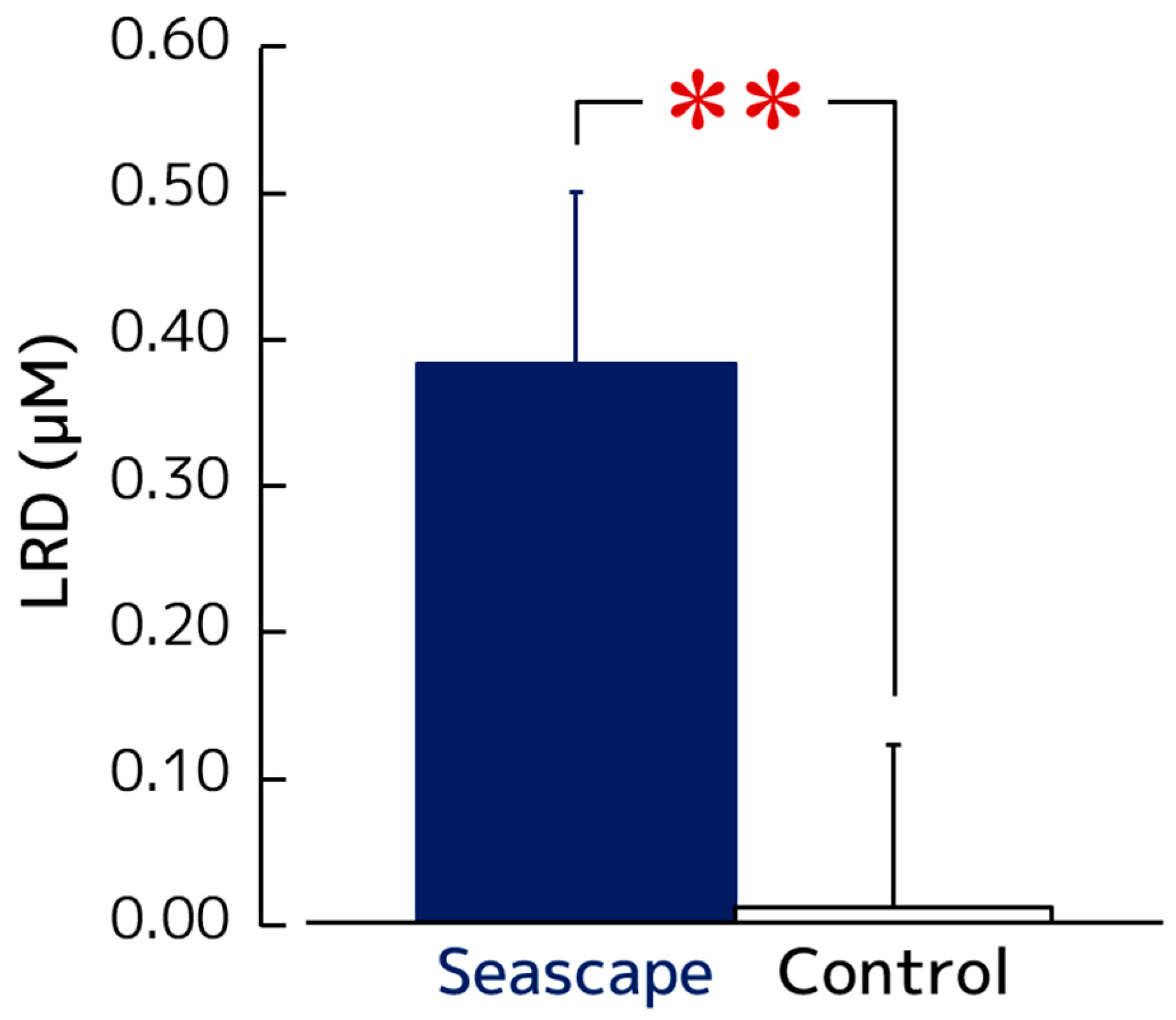
- Although we observed increased LRD during seascape viewing, the underlying neural mechanisms remain unclear. In particular, identifying how specific visual attributes (e.g., blue-space cues, openness/viewing distance, and brightness) contribute to changes in prefrontal lateralization was beyond the scope of this study. Future studies should quantify photometric variables (e.g., illuminance/luminance) and scene metrics and employ more refined control conditions to better disentangle contributing factors.
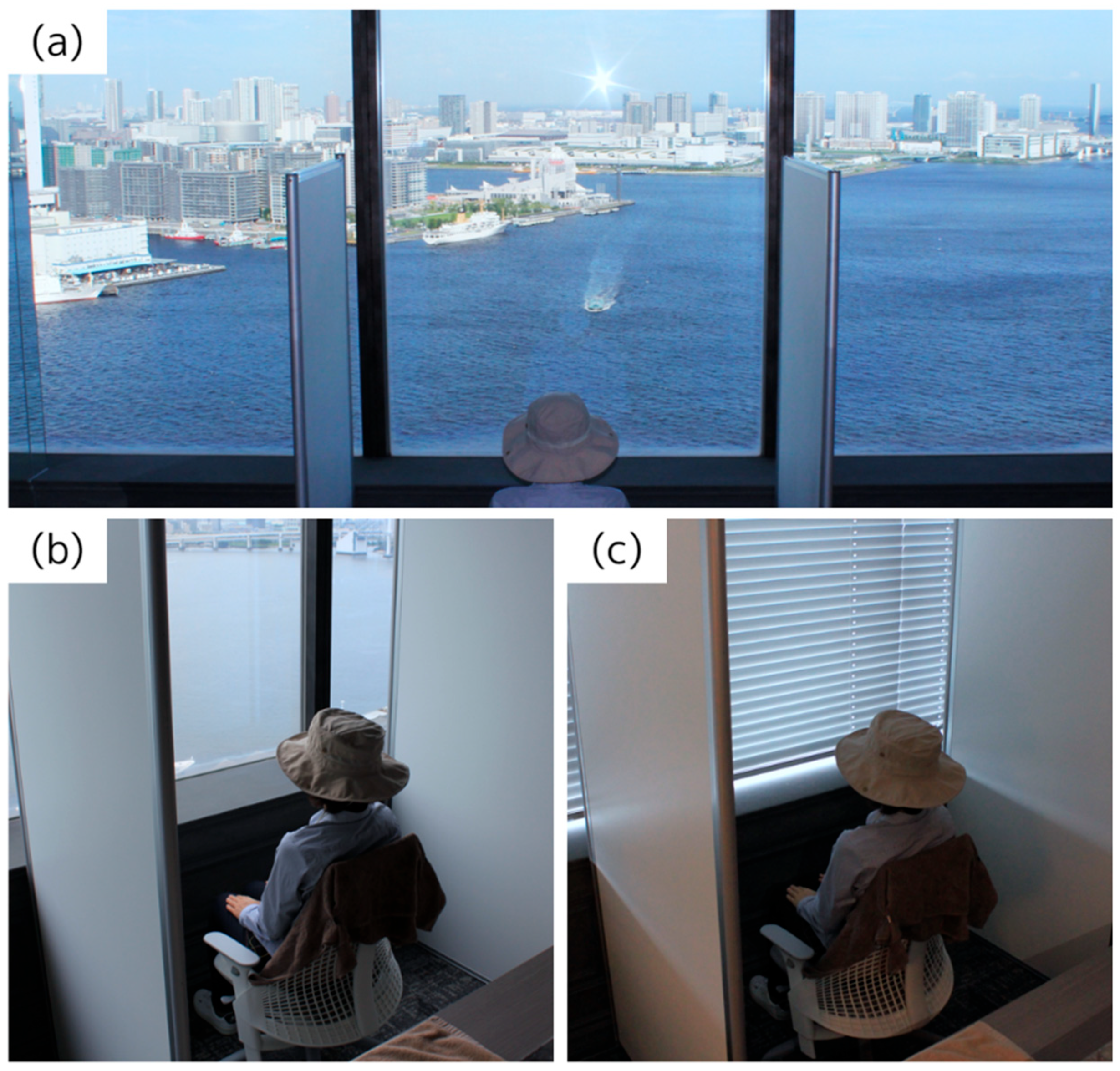
- The control condition involved covering the window with blinds to reflect a practical “no-view” situation in everyday office use. Consequently, incoming light (i.e., illuminance/luminance) likely differed substantially between the seascape and control conditions. Therefore, within the present framework, we could not disentangle the contribution of blue-space cues from general visual features such as brightness (light intensity) and visual complexity. Future studies should include more ecologically valid comparison conditions, such as urban skyline views or indoor greening/indoor plants, together with objective quantification of illuminance/luminance.
- In the present study, inter-individual variability was observed in the association between LRD and subjective outcomes. However, we did not examine potential moderators, including trait anxiety, stress-related traits, behavioral characteristics, or prior exposure to blue space. Future work should incorporate these factors to clarify who is more responsive to brief blue-space exposure and explain variability in psychophysiological responses.
- The correlations between LRD and subjective relaxation outcomes are cross-sectional associations and do not establish directionality. Therefore, whether increased LRD contributes to greater relaxation or whether a relaxed state modulates prefrontal lateralization remains unclear. Future studies should use time-resolved analyses during stimulation and/or intervention designs with repeated exposures to evaluate the temporal and causal direction of these relationships.
- We set the stimulation duration to 90 s to reflect a brief, implementable window-view micro-break in real office settings. Future studies should examine longer and/or repeated exposure protocols (e.g., varying duration, frequency, and number of breaks) to optimize practical rest-break designs for real-world implementation.
- The participants included healthy young adults (mainly students in their 20s), limiting the generalizability of the findings to working-age office workers. Future research should examine broader populations, including office workers across a wider age range (e.g., 20–60 years), and consider work- and stress-related characteristics to confirm external validity.
6. Conclusions
Author Contributions
Funding
Data Availability Statement
Acknowledgments
Conflicts of Interest
Abbreviations
| HF | High frequency |
| HRV | Heart rate variability |
| SD | Semantic differential |
| LRD | Left–right difference |
References
- Miyazaki, Y.; Park, B.J.; Lee, J. Nature therapy. In Designing Our Future: Local Perspectives on Bioproduction, Ecosystems and Humanity; Osaki, M., Braimoh, A., Nakagami, K., Eds.; United Nations University Press: New York, NY, USA, 2011; pp. 407–412. [Google Scholar]
- Brunet, M.; Guy, F.; Pilbeam, D.; Mackaye, H.T.; Likius, A.; Ahounta, D.; Beauvilain, A.; Blondel, C.; Bocherens, H.; Boisserie, J.-R.; et al. A new hominid from the upper Miocene of Chad, Central Africa. Nature 2002, 418, 145–151. [Google Scholar] [CrossRef]
- Almécija, S.; Hammond, A.S.; Thompson, N.E.; Pugh, K.D.; Moyà-Solà, S.; Alba, D.M. Fossil apes and human evolution. Science 2021, 372, 4363. [Google Scholar] [CrossRef] [PubMed]
- Song, C.; Ikei, H.; Miyazaki, Y. Physiological effects of nature therapy: A review of the research in Japan. Int. J. Environ. Res. Public Health 2016, 13, 781. [Google Scholar] [CrossRef]
- Miyazaki, Y. Shinrin-Yoku: The Japanese Way of Forest Bathing for Health and Relaxation; Octopus Publishing Group: London, UK, 2018. [Google Scholar]
- Brod, C. Technostress: The Human Cost of the Computer Revolution; Addison Wesley: Reading, MA, USA, 1984. [Google Scholar]
- COVID-19 Mental Disorders Collaborators. Global prevalence and burden of depressive and anxiety disorders in 204 countries and territories in 2020 due to the COVID-19 pandemic. Lancet 2021, 398, 1700–1712. [CrossRef]
- Song, C.; Ikei, H.; Kagawa, T.; Miyazaki, Y. Effect of viewing real forest landscapes on brain activity. Sustainability 2020, 12, 6601. [Google Scholar] [CrossRef]
- Kobayashi, H.; Song, C.; Ikei, H.; Kagawa, T.; Miyazaki, Y. Analysis of individual variations in autonomic responses to urban and forest environments. Evid. Based Complement. Alternat. Med. 2015, 2015, 671094. [Google Scholar] [CrossRef]
- Song, C.; Ikei, H.; Miyazaki, Y. Seasonal differences in physiological responses to walking in urban parks. Int. J. Environ. Res. Public Health 2022, 19, 12154. [Google Scholar] [CrossRef]
- Song, C.; Igarashi, M.; Ikei, H.; Miyazaki, Y. Physiological effects of viewing fresh red roses. Complement. Ther. Med. 2017, 35, 78–84. [Google Scholar] [CrossRef]
- Ikei, H.; Song, C.; Miyazaki, Y. Physiological adjustment effect of visual stimulation by fresh rose flowers on sympathetic nervous activity. Front. Psychol. 2023, 14, 1159458. [Google Scholar] [CrossRef] [PubMed]
- Ikei, H.; Jo, H.; Miyazaki, Y. Physiological effects of visual stimulation by a Japanese low wooden table: A crossover field experiment. Int. J. Environ. Res. Public Health 2023, 20, 6351. [Google Scholar] [CrossRef] [PubMed]
- Wang, X.; Gong, X.-F.; Xiong, K.-X.; Guo, D.-S.; Liu, L.-J.; Lin, C.-M.; Chang, W.-Y. Mapping of research in the field of forest therapy-related issues: A bibliometric analysis for 2007–2021. Front. Psychol. 2022, 13, 930713. [Google Scholar] [CrossRef]
- Rodríguez-Redondo, Y.; Denche-Zamorano, A.; Muñoz-Bermejo, L.; Rojo-Ramos, J.; Adsuar, J.C.; Castillo-Paredes, A.; Vega-Muñoz, A.; Barrios-Fernandez, S. Bibliometric analysis of nature-based therapy research. Healthcare 2023, 11, 1249. [Google Scholar] [CrossRef]
- Denche-Zamorano, A.; Rodríguez-Redondo, Y.; Rojo-Ramos, J.; Miguel-Barrado, V.; Sánchez-Leal, A.; Pérez-Calderon, E. Global review of literature on forest bathing. Austrian J. For. Sci./Cent. Gesamte Forstwes. 2024, 141, 145. [Google Scholar]
- Bowler, D.E.; Buyung-Ali, L.M.; Knight, T.M.; Pullin, A.S. A systematic review of evidence for the added benefits to health of exposure to natural environments. BMC Public Health 2010, 10, 456. [Google Scholar] [CrossRef] [PubMed]
- Gascon, M.; Triguero-Mas, M.; Martínez, D.; Dadvand, P.; Rojas-Rueda, D.; Plasència, A.; Nieuwenhuijsen, M.J. Residential green spaces and mortality: A systematic review. Environ. Int. 2016, 86, 60–67. [Google Scholar] [CrossRef] [PubMed]
- Rojas-Rueda, D.; Nieuwenhuijsen, M.J.; Gascon, M.; Perez-Leon, D.; Mudu, P. Green spaces and mortality: A systematic review and meta-analysis of cohort studies. Lancet Planet. Health 2019, 3, e469–e477. [Google Scholar] [CrossRef]
- Twohig-Bennett, C.; Jones, A. The health benefits of the great outdoors: A systematic review and meta-analysis of greenspace exposure and health outcomes. Environ. Res. 2018, 166, 628–637. [Google Scholar] [CrossRef]
- Jimenez, M.P.; DeVille, N.V.; Elliott, E.G.; Schiff, J.E.; Wilt, G.E.; Hart, J.E.; James, P. Associations between nature exposure and health: A review of the evidence. Int. J. Environ. Res. Public Health 2021, 18, 4790. [Google Scholar] [CrossRef]
- Nguyen, P.-Y.; Astell-Burt, T.; Rahimi-Ardabili, H.; Feng, X. Effect of nature prescriptions on cardiometabolic and mental health, and physical activity: A systematic review. Lancet Planet. Health 2023, 7, e313–e328. [Google Scholar] [CrossRef]
- White, M.P.; Elliott, L.R.; Gascon, M.; Roberts, B.; Fleming, L.E. Blue space, health and well-being: A narrative overview and synthesis of potential benefits. Environ. Res. 2020, 191, 110169. [Google Scholar] [CrossRef]
- Garrett, J.K.; Clitherow, T.J.; White, M.P.; Wheeler, B.W.; Fleming, L.E. Coastal proximity and mental health among urban adults in England: The moderating effect of household income. Health Place 2019, 59, 102200. [Google Scholar] [CrossRef]
- Wheeler, B.W.; White, M.; Stahl-Timmins, W.; Depledge, M.H. Does living by the coast improve health and wellbeing? Health Place 2012, 18, 1198–1201. [Google Scholar] [CrossRef]
- Brereton, F.; Clinch, J.P.; Ferreira, S. Happiness, geography and the environment. Ecol. Econ. 2008, 65, 386–396. [Google Scholar] [CrossRef]
- Hooyberg, A.; Roose, H.; Grellier, J.; Elliott, L.R.; Lonneville, B.; White, M.P.; Michels, N.; De Henauw, S.; Vandegehuchte, M.; Everaert, G. General health and residential proximity to the coast in Belgium: Results from a cross-sectional health survey. Environ. Res. 2020, 184, 109225. [Google Scholar] [CrossRef] [PubMed]
- Ballesteros-Olza, M.; Gracia-De-Rentería, P.; Pérez-Zabaleta, A. Effects on general health associated with beach proximity in Barcelona (Spain). Health Promot. Int. 2020, 35, 1406–1414. [Google Scholar] [CrossRef]
- Hunter, R.F.; Nieuwenhuijsen, M.; Fabian, C.; Murphy, N.; O’Hara, K.; Rappe, E.; Sallis, J.F.; Lambert, E.V.; Duenas, O.L.S.; Sugiyama, T. Advancing urban green and blue space contributions to public health. Lancet Public Health 2023, 8, e735–e742. [Google Scholar] [CrossRef] [PubMed]
- Vert, C.; Gascon, M.; Ranzani, O.; Márquez, S.; Triguero-Mas, M.; Carrasco-Turigas, G.; Arjona, L.; Koch, S.; Llopis, M.; Donaire-Gonzalez, D. Physical and mental health effects of repeated short walks in a blue space environment: A randomised crossover study. Environ. Res. 2020, 188, 109812. [Google Scholar] [CrossRef]
- Yin, J.; Ramanpong, J.; Chang, J.; Wu, C.-D.; Chao, P.-H.; Yu, C.-P. Effects of blue space exposure in urban and natural environments on psychological and physiological responses: A within-subject experiment. Urban For. Urban Green. 2023, 87, 128066. [Google Scholar] [CrossRef]
- Hooyberg, A.; Michels, N.; Roose, H.; Everaert, G.; Mokas, I.; Malina, R.; Vanderhasselt, M.-A.; De Henauw, S. The psychophysiological reactivity to beaches vs. to green and urban environments: Insights from a virtual reality experiment. J. Environ. Psychol. 2023, 91, 102103. [Google Scholar] [CrossRef]
- Frolking, S.; Mahtta, R.; Milliman, T.; Esch, T.; Seto, K.C. Global urban structural growth shows a profound shift from spreading out to building up. Nat. Cities 2024, 1, 555–566. [Google Scholar] [CrossRef]
- Martínez, M.L.; Intralawan, A.; Vázquez, G.; Pérez-Maqueo, O.; Sutton, P.; Landgrave, R. The coasts of our world: Ecological, economic and social importance. Ecol. Econ. 2007, 63, 254–272. [Google Scholar] [CrossRef]
- Abd-Alhamid, F.; Kent, M.; Wu, Y. Quantifying window view quality: A review on view perception assessment and representation methods. Build. Environ. 2023, 227, 109742. [Google Scholar] [CrossRef]
- Faul, F.; Erdfelder, E.; Lang, A.-G.; Buchner, A. G*power 3: A flexible statistical power analysis program for the social, behavioral, and biomedical sciences. Behav. Res. Methods 2007, 39, 175–191. [Google Scholar] [CrossRef] [PubMed]
- Faul, F.; Erdfelder, E.; Buchner, A.; Lang, A.-G. Statistical power analyses using G*power 3.1: Tests for correlation and regression analyses. Behav. Res. Methods 2009, 41, 1149–1160. [Google Scholar] [CrossRef]
- Watanabe, T.; Mizuno, T.; Shikayama, T.; Miwa, M. Development of a wireless near-infrared tissue oxygen monitor system with high sampling rate. In Digital Holography and Three-Dimensional Imaging; Optical Society of America: Miami, FL, USA, 2012. [Google Scholar] [CrossRef]
- Tanida, M.; Katsuyama, M.; Sakatani, K. Effects of fragrance administration on stress-induced prefrontal cortex activity and sebum secretion in the facial skin. Neurosci. Lett. 2008, 432, 157–161. [Google Scholar] [CrossRef]
- Imamura, C.; Sakakibara, K.; Arai, K.; Ohira, H.; Yamaguchi, Y.; Yamada, H. Effect of indoor forest bathing on reducing feelings of fatigue using cerebral activity as an indicator. Int. J. Environ. Res. Public Health 2022, 19, 6672. [Google Scholar] [CrossRef]
- Task Force of the European Society of Cardiology; The North American Society of Pacing and Electrophysiology. Heart rate variability: Standards of measurement, physiological interpretation and clinical use. Task Force of the European Society of Cardiology and the North American Society of Pacing and Electrophysiology. Circulation 1996, 93, 1043–1065. [Google Scholar]
- Kobayashi, H.; Ishibashi, K.; Noguchi, H. Heart rate variability; an index for monitoring and analyzing human autonomic activities. Appl. Hum. Sci. 1999, 18, 53–59. [Google Scholar] [CrossRef] [PubMed]
- Sawada, Y.; Ohtomo, N.; Tanaka, Y.; Tanaka, G.; Yamakoshi, K.; Terachi, S.; Shimamoto, K.; Nakagawa, M.; Satoh, S.; Kuroda, S. New technique for time series analysis combining the maximum entropy method and non-linear least squares method: Its value in heart rate variability analysis. Med. Biol. Eng. Comput. 1997, 35, 318–322. [Google Scholar] [CrossRef] [PubMed]
- Kobayashi, H.; Park, B.-J.; Miyazaki, Y. Normative references of heart rate variability and salivary alpha-amylase in a healthy young male population. J. Physiol. Anthropol. 2012, 31, 9. [Google Scholar] [CrossRef]
- Schäfer, A.; Kratky, K.W. Estimation of breathing rate from respiratory sinus arrhythmia: Comparison of various methods. Ann. Biomed. Eng. 2008, 36, 476–485. [Google Scholar] [CrossRef]
- Blain, G.; Meste, O.; Bermon, S. Influences of breathing patterns on respiratory sinus arrhythmia in humans during exercise. Am. J. Physiol.-Heart Circ. Physiol. 2005, 288, H887–H895. [Google Scholar] [CrossRef]
- Khan, N.A.; Jönsson, P.; Sandsten, M. Performance comparison of time-frequency distributions for estimation of instantaneous frequency of heart rate variability signals. Appl. Sci. 2017, 7, 221. [Google Scholar] [CrossRef]
- Osgood, C.E.; Suci, G.J.; Tannenbaum, P. The Measurement of Meaning; University of Illinois Press: Urbana, IL, USA, 1957. [Google Scholar]
- Heuchert, J.P.; McNair, D.M. Profile of Mood States 2nd Edition™; American Psychological Association (APA): New York, NY, USA, 2012. [Google Scholar]
- Heuchert, J.P.; Mcnair, D.M. Japanese Translation of POMS2: Profile of Mood States; Yokoyama, K., Watanabe, K., Eds.; Kaneko Shobo: Tokyo, Japan, 2015. [Google Scholar]
- Cohen, J. Statistical Power Analysis for the Behavioral Sciences, 2nd ed.; Erlbaum: Hillsdale, MI, USA, 1988. [Google Scholar]
- Grissom, R.J.; Kim, J.J. Effect Sizes for Research: Univariate and Multivariate Applications, 2nd ed.; Routledge: New York, NY, USA, 2012. [Google Scholar]
- Kelley, N.J.; Hortensius, R.; Schutter, D.J.L.G.; Harmon-Jones, E. The relationship of approach/avoidance motivation and asymmetric frontal cortical activity: A review of studies manipulating frontal asymmetry. Int. J. Psychophysiol. 2017, 119, 19–30. [Google Scholar] [CrossRef] [PubMed]
- Palmiero, M.; Piccardi, L. Frontal EEG asymmetry of mood: A mini-review. Front. Behav. Neurosci. 2017, 11, 224. [Google Scholar] [CrossRef] [PubMed]
- Song, C.; Ikei, H.; Miyazaki, Y. Physiological effects of visual stimulation with forest imagery. Int. J. Environ. Res. Public Health 2018, 15, 213. [Google Scholar] [CrossRef]
- Ikei, H.; Nakamura, M.; Miyazaki, Y. Physiological effects of visual stimulation using knotty and clear wood images among young women. Sustainability 2020, 12, 9898. [Google Scholar] [CrossRef]



| Parameters | All Participants (n = 44) | Male Participants (n = 25) | Female Participants (n = 19) |
|---|---|---|---|
| Age (years) | 22.3 ± 1.9 | 22.7 ± 2.2 | 21.8 ± 1.5 |
| Height (cm) | 166.2 ± 7.7 | 171.2 ± 5.5 | 159.6 ± 4.4 |
| Weight (kg) | 58.1 ± 10.7 | 63.6 ± 9.8 | 50.9 ± 10.7 |
Disclaimer/Publisher’s Note: The statements, opinions and data contained in all publications are solely those of the individual author(s) and contributor(s) and not of MDPI and/or the editor(s). MDPI and/or the editor(s) disclaim responsibility for any injury to people or property resulting from any ideas, methods, instructions or products referred to in the content. |
© 2026 by the authors. Licensee MDPI, Basel, Switzerland. This article is an open access article distributed under the terms and conditions of the Creative Commons Attribution (CC BY) license.
Share and Cite
Ikei, H.; Jo, H.; Yotsui, J.; Miyazaki, Y. Visual Stimulation by Viewing a Seascape from a High-Rise Window Increases Subjective Relaxation and Left–Right Differences in Prefrontal Cortex Activity. Buildings 2026, 16, 1292. https://doi.org/10.3390/buildings16071292
Ikei H, Jo H, Yotsui J, Miyazaki Y. Visual Stimulation by Viewing a Seascape from a High-Rise Window Increases Subjective Relaxation and Left–Right Differences in Prefrontal Cortex Activity. Buildings. 2026; 16(7):1292. https://doi.org/10.3390/buildings16071292
Chicago/Turabian StyleIkei, Harumi, Hyunju Jo, Jun Yotsui, and Yoshifumi Miyazaki. 2026. "Visual Stimulation by Viewing a Seascape from a High-Rise Window Increases Subjective Relaxation and Left–Right Differences in Prefrontal Cortex Activity" Buildings 16, no. 7: 1292. https://doi.org/10.3390/buildings16071292
APA StyleIkei, H., Jo, H., Yotsui, J., & Miyazaki, Y. (2026). Visual Stimulation by Viewing a Seascape from a High-Rise Window Increases Subjective Relaxation and Left–Right Differences in Prefrontal Cortex Activity. Buildings, 16(7), 1292. https://doi.org/10.3390/buildings16071292