

Review

The Physiological and Psychological Effects of the Built Environment: Research Progress and Implications

1
School of Architecture, South China University of Technology, Guangzhou 510640, China
2
State Key Laboratory of Subtropical Building Science, South China University of Technology, Guangzhou 510640, China
3
South China University of Technology Architectural Design & Research Institute Co., Ltd., Guangzhou 510640, China
4
Zhuhai Natural Resources and Planning Technology Center, Zhuhai 519015, China
*
Author to whom correspondence should be addressed.
Buildings 2026, 16(6), 1144; https://doi.org/10.3390/buildings16061144
Submission received: 31 January 2026 / Revised: 1 March 2026 / Accepted: 9 March 2026 / Published: 13 March 2026
(This article belongs to the Section Building Energy, Physics, Environment, and Systems)

Abstract

With accelerating urbanization and a global emphasis on quality of life, the effects of the built environment on individual physiological and psychological well-being have become a critical research focus. However, existing studies remain fragmented in terms of theoretical perspectives, spatial scales, and methodological approaches, and a comprehensive synthesis of the physiological and psychological effects of the built environment is still lacking. This review adopts an interdisciplinary approach, integrating architecture, urban planning, landscape architecture, geography, and psychology to systematically review the literature on the health impacts of the built environment. Its findings indicate that the scope of the built environment has expanded from natural settings to residential areas, streets, and public spaces. Research scales have progressed from macro-level districts to streets and public spaces and further to micro-level physical environments. The impacts have extended from emotional responses to broader health and well-being outcomes, with increasing attention being given to specific population groups. Technological advances have shifted research paradigms from traditional surveys to approaches incorporating big data, machine learning, virtual reality, and physiological monitoring, enabling more precise analyses of links between spatial perception and emotional responses. This review identifies gaps in interdisciplinary integration, long-term monitoring, and the consideration of individual differences, highlighting the need for future studies to integrate multimodal data with theory-informed practice to support more human-centered, health-promoting built environments.

1. Introduction

The built environment generally refers to the collective assemblage of human-constructed or human-modified physical spaces, encompassing buildings, infrastructure, street layouts, public spaces, and various sites shaped by planning or intentional intervention. It serves not only as the context for human activities but also exerts measurable influences on behavior and health through its spatial configuration and design [1,2]. Amid accelerating urbanization, the built environment—as the primary setting for daily production, living, and social interaction—has been shown to exert increasingly multidimensional effects on individual physical and mental health. It plays a pivotal role in emotional regulation, cognitive functioning, and the maintenance of physiological well-being. For instance, exposure to blue–green ecological spaces has been associated with reductions in cortisol levels, alleviation of chronic stress, and significant improvements in subjective pleasure and happiness [3]. Well-designed public spaces, characterized by high accessibility and functional diversity, have been shown to foster neighbourhood interactions and social cohesion, thereby reducing negative emotional states such as loneliness and anxiety [4]. Moreover, human-scale spatial dimensions, aesthetically pleasing light–shadow patterns, and acoustically comfortable environments have been found to reduce visual and auditory fatigue, thereby enhancing psychological comfort and concentration [5,6].
Individual subjective perceptions also exert substantial feedback effects and act as important drivers in built environment design. In this field, physiological effects are typically defined as measurable bodily indicators—such as heart rate, blood pressure, skin conductance, or brain activity—elicited by environmental exposure, whereas psychological effects refer to changes in subjective states, including mood, perceived stress, comfort, and well-being [7]. Beyond these operational definitions, the two response types also differ in their internal composition. Physiological responses involve interacting bodily systems, including neuroendocrine regulation, cardiovascular activity, sensory processing, and immune or metabolic reactions, reflecting how environmental stimuli are embodied biologically. Psychological responses encompass cognitive, affective, and behavioural dimensions such as perception, attention, emotional appraisal, stress experience, and subjective well-being. This distinction helps explain why built environment influences rarely operate through a single pathway but instead emerge through the interaction of biological regulation and experiential interpretation [8]. Environmental influences therefore manifest in health and well-being through the combined action of physiological and psychological pathways. In practice, spatial pain points and user needs are identified through satisfaction surveys, behavioural observations, and related methods, thereby providing empirical references for subsequent design optimization [9]. Conversely, individual emotional preferences for specific spatial environments can gradually form collective consensus, thereby shifting design philosophies from purely functional orientations toward more diverse and human-centred approaches [10].
Focusing on the interactions between the built environment and human experiences, translating the concept of “people-centered design” from an abstract principle into spatial practice has become a shared concern in urban research and design. In recent years, a growing body of studies across urban planning, architecture, and landscape architecture has explored the relationships between built environment characteristics and individual physiological and psychological health, providing valuable insights for the development of healthy and liveable cities [11,12]. However, several limitations remain in the existing literature. First, although studies on the built environment and health have expanded rapidly, many studies remain confined within single disciplinary traditions—such as environmental psychology, urban planning, or public health—resulting in limited theoretical integration across fields. Previous reviews have noted that research often develops in parallel disciplinary streams rather than through cumulative interdisciplinary synthesis [13]. Second, existing studies frequently examine physiological indicators (e.g., heart rate variability, cortisol levels) or psychological perceptions (e.g., stress, preference, well-being) in isolation. While both dimensions are acknowledged as essential to environmental health research, systematic reviews have pointed out that integrative frameworks capturing their dynamic interactions remain limited [14]. This methodological separation constrains the ability to explain how environmental exposure translates into holistic health outcomes, highlighting the need for more interdisciplinary and multimodal approaches. Third, prior research tends to focus on specific spatial types—such as green spaces, streetscapes, or residential environments—or on single spatial scales, with limited comparative analysis across different built environment levels. Meanwhile, place-based studies emphasize subjective meanings and attachments [15], whereas neuroscience-oriented approaches emphasize measurable physiological responses, resulting in fragmented explanatory frameworks.
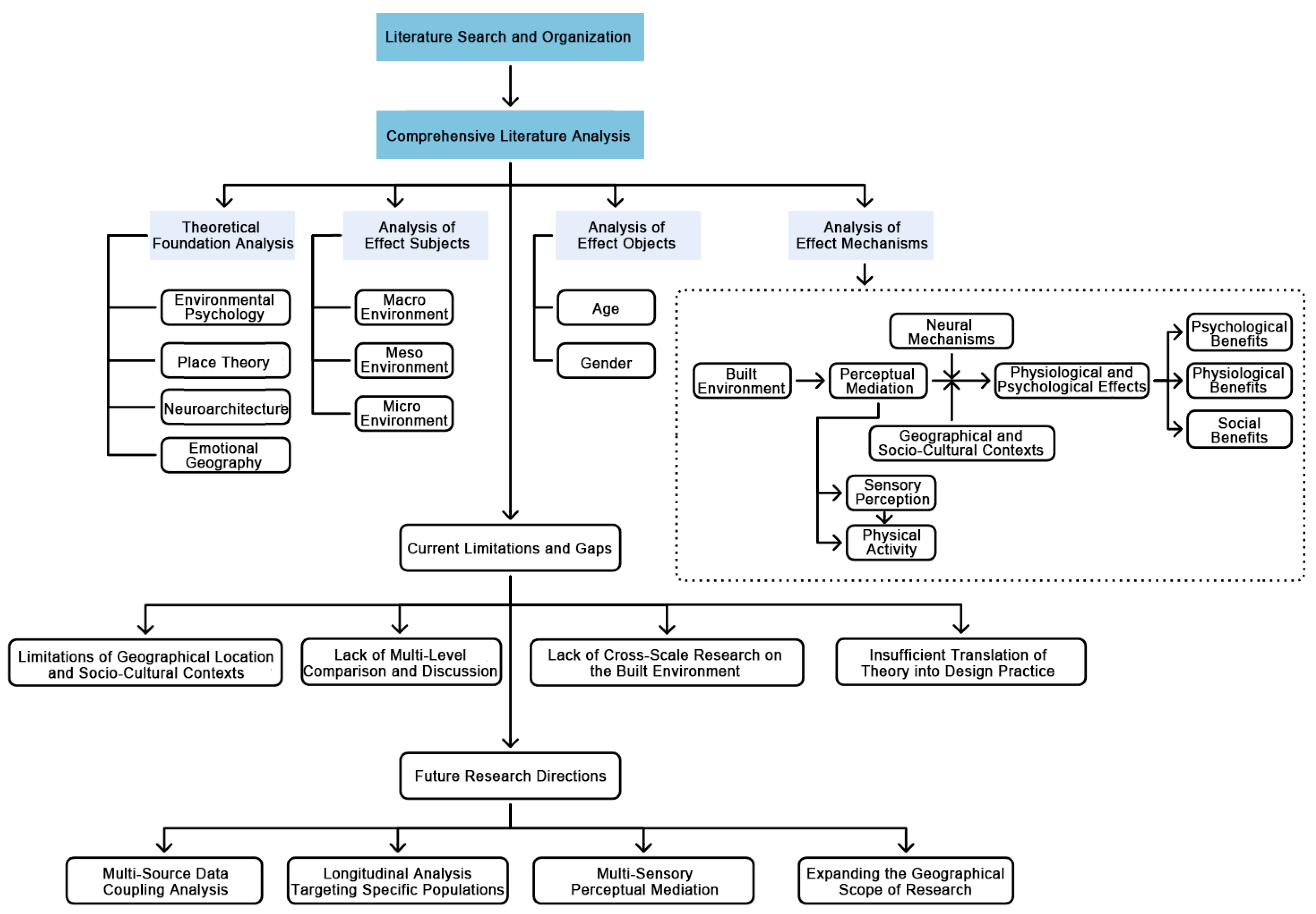
To address these gaps, this study conducts a structured thematic systematic review by synthesizing international research on the physiological and psychological responses to the built environment. Drawing on theoretical perspectives from environmental psychology, place theory, emotional geography, and neuroarchitecture, this review aims to clarify key environmental characteristics, influence pathways, and methodological approaches linking the built environment to human health. This review further proposes an integrative analytical framework connecting “built environment–subjective experience–design practice”, thereby contributing to interdisciplinary synthesis and providing theoretical support for human-centred and health-oriented built environment design. Figure 1 shows the overall conceptual framework of this study.

2. Methodology

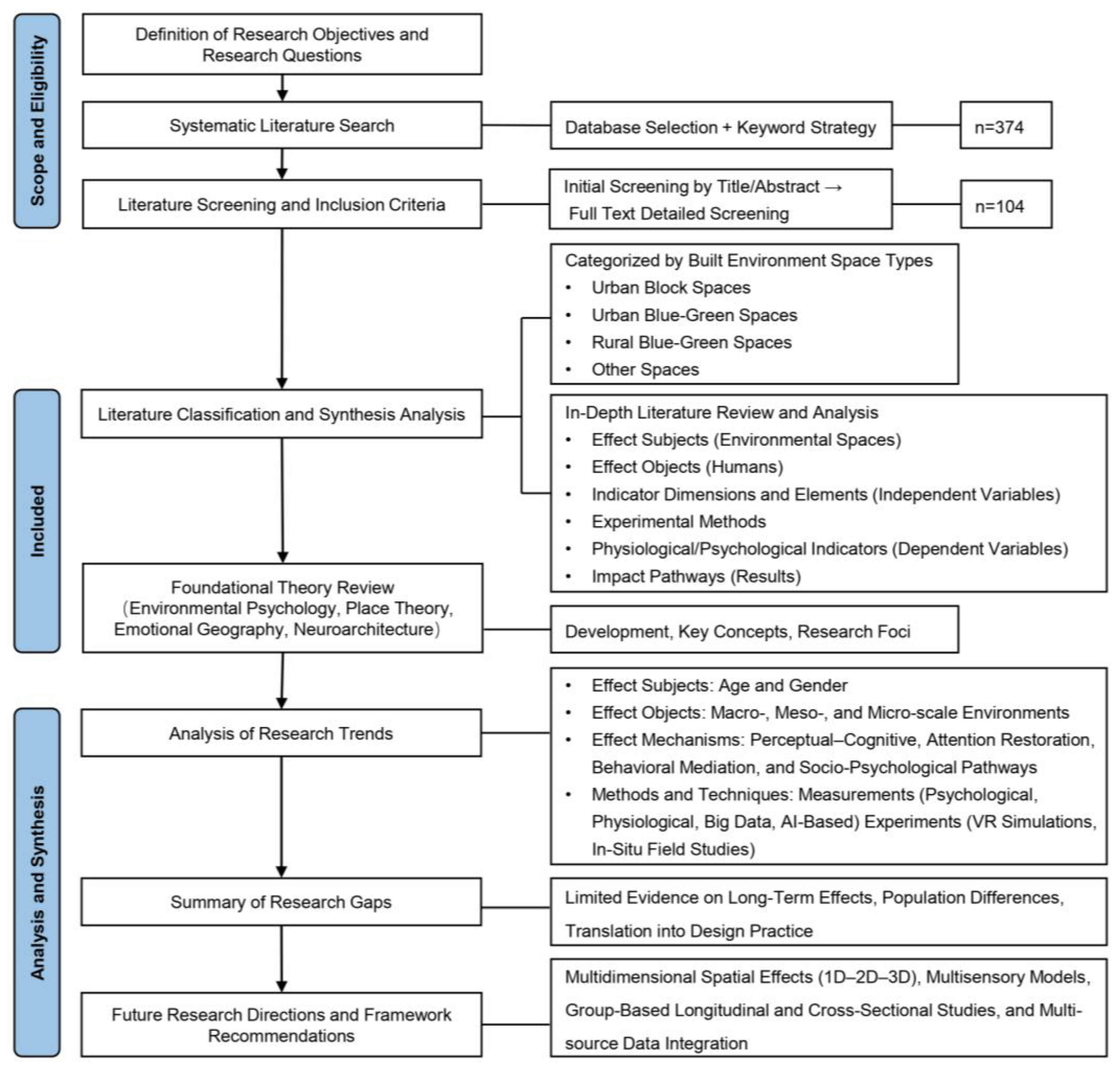
This study adopts a structured thematic systematic review approach to systematically synthesize and analyse research on the physiological and psychological effects of the built environment on individuals. The overall research process includes the definition of research objectives, literature retrieval and screening, thematic classification and in-depth coding, integrated analysis, and the identification of research trends and limitations. The detailed workflow is illustrated in Figure 2.
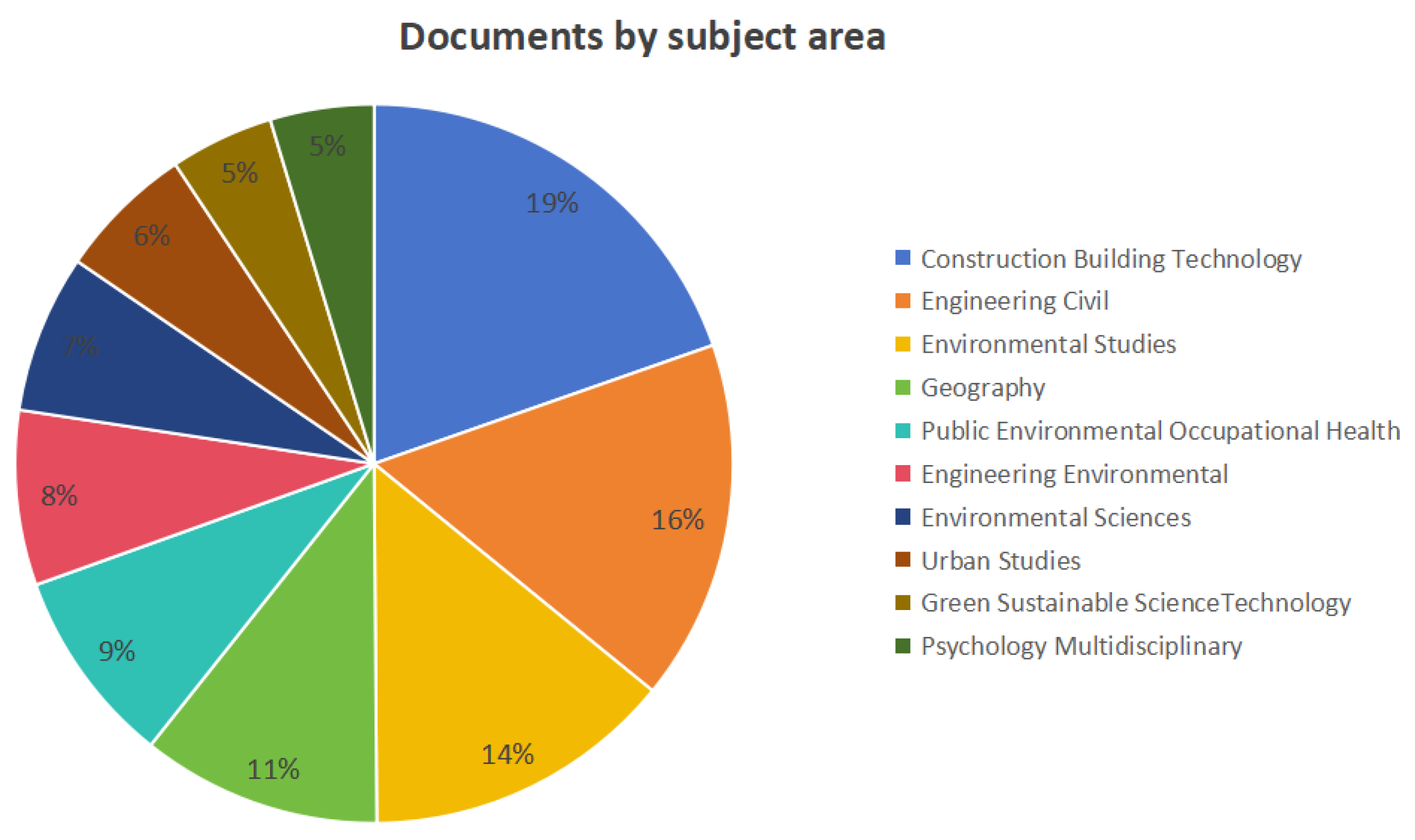
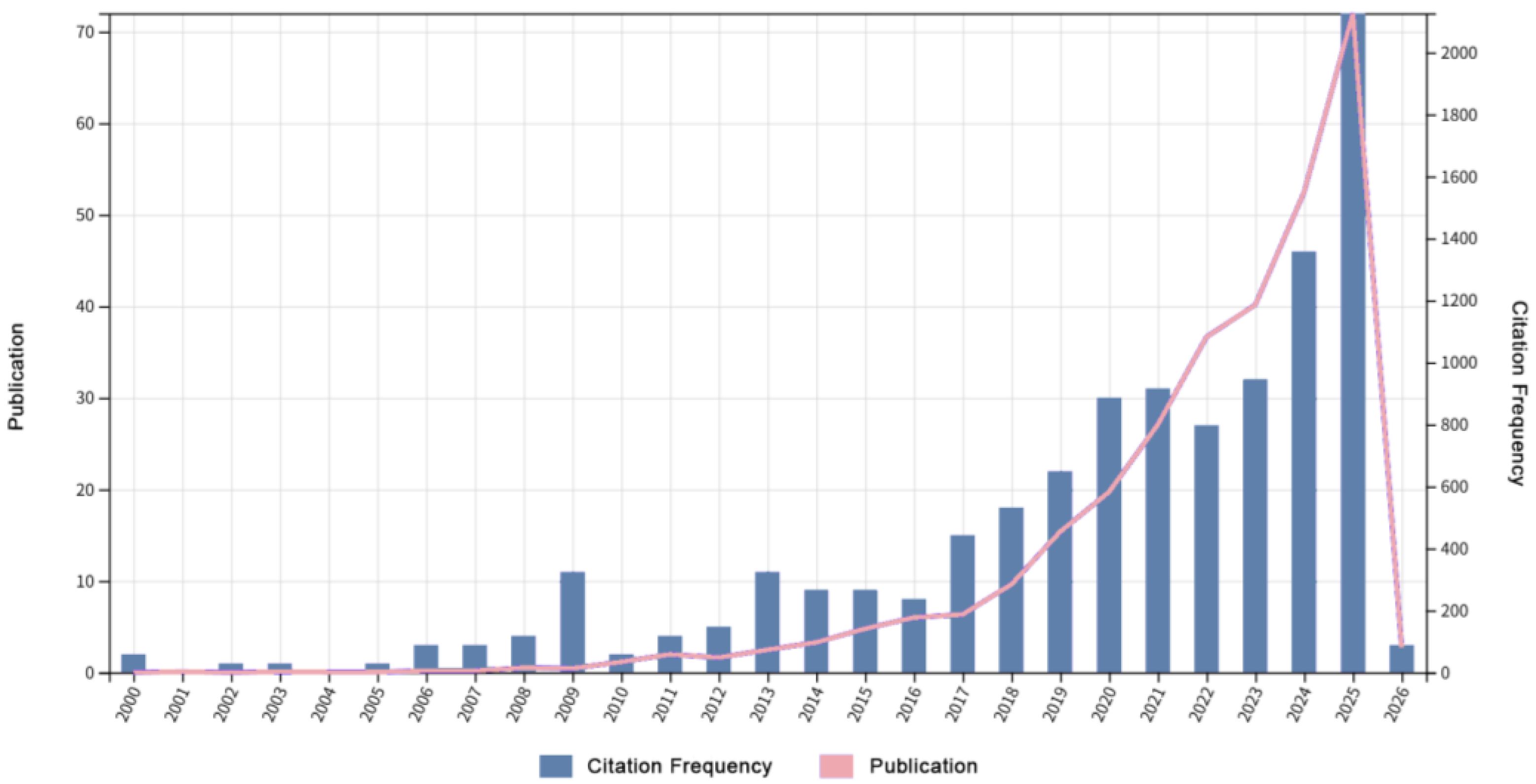
First, a systematic literature search was conducted after clarifying the research objectives and research questions. Relevant studies were retrieved from major academic databases, including Google Scholar, Scopus, and the Web of Science Core Collection. The search covered interdisciplinary fields such as architecture, urban planning, landscape architecture, geography, environmental psychology, and related behavioural sciences. The search period was limited to 2000–2025, and keywords focussed on the built environment, environmental exposure, physiological responses, psychological responses, emotional experience, place theory, and neuroarchitecture. In total, 370 records were initially identified. During the preliminary screening and thematic grouping stage, the retrieved literature was categorized according to research focus and theoretical orientation. Specifically, environmental psychology and physiological–psychological response mechanisms accounted for the largest proportion (146 studies, approximately 39%), followed by place theory and related conceptual studies (131 studies, about 35%). Research on emotional geography and emotion mapping constituted around 17% of all studies (64 studies), while neuroarchitecture-oriented studies represented roughly 9% (33 studies). This distribution reflects the dominance of behavioural-response research traditions in the field, while also indicating the increasing integration of spatial perception theory and neuroscience-based approaches. In addition to thematic distribution, the temporal pattern of publications reveals a clear growth trend. The proportional distribution of the reviewed literature across thematic categories is presented in Figure 3. Earlier studies (2000–2010) were relatively limited in number and primarily theoretical, whereas the period after 2015 shows a marked increase in empirical and interdisciplinary research, particularly in studies employing physiological measurements, spatial analytics, and mixed-method approaches. The distribution of citations and publications by year is shown in Figure 4. Citation patterns similarly demonstrate that more recent studies increasingly utilize interdisciplinary health and environment frameworks, suggesting a shift from conceptual exploration to evidence-based design implications.
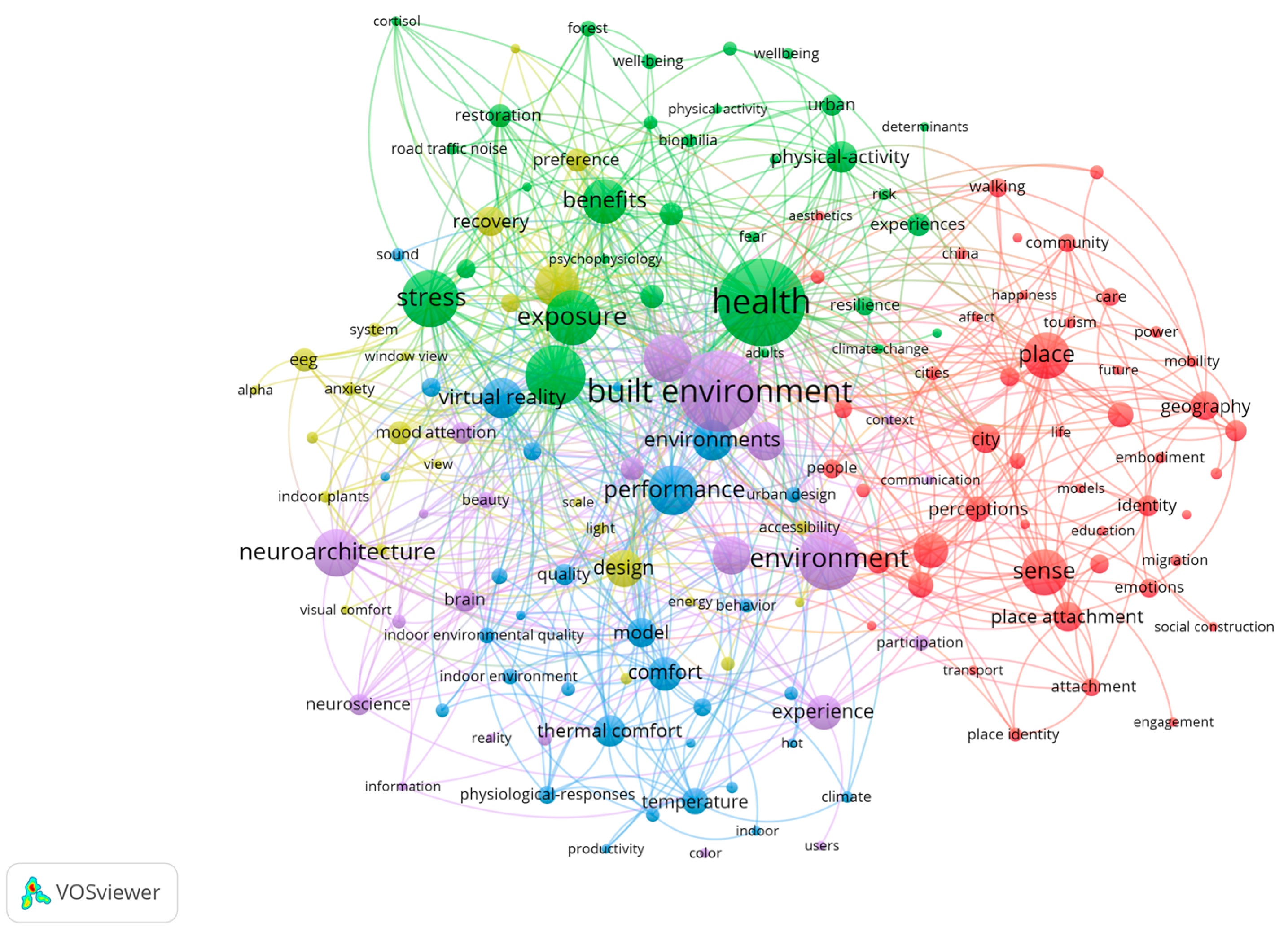
Second, the literature was screened based on predefined inclusion and exclusion criteria. The screening process consisted of two stages: an initial screening of titles and abstracts, followed by a full-text review. Studies that explicitly examined relationships between built environment characteristics and individual physiological or psychological responses were included, encompassing empirical studies, theoretical investigations, and review articles. In contrast, studies focusing solely on building technical performance or macro-scale environmental issues and those lacking analysis of individual perception and experience were excluded. After screening, a total of 108 studies were retained for subsequent analysis. To enhance the transparency and objectivity of the review structure, keyword co-occurrence analysis was further conducted using VOSviewer (version 1.6.20, Leiden University, Leiden, the Netherlands; www.vosviewer.com) to visualize thematic linkages and clustering patterns among the selected studies (Figure 5), thereby providing structural support for the systematic discussion in the following sections.
In the literature classification and thematic analysis stage, the retained studies were first grouped according to built environment types, including urban block spaces, urban blue–green spaces, rural blue–green spaces, and other spatial categories. Each study was then subjected to in-depth reading and coding to extract key information, including environmental indicators, research subjects, methodological approaches, physiological and psychological indicators, and identified impact pathways.
Subsequently, based on the classification and coding results, an integrated analysis was conducted by synthesizing common mechanisms and comparing differences across spatial types, research methods, and indicator systems. This process enabled a systematic examination of the main characteristics and pathways through which the built environment influences individual physiological and psychological effects. In addition, research trends were summarized from the perspectives of temporal evolution, methodological development, indicator selection, and spatial scale. Finally, major limitations in the existing literature were identified, and future research directions and framework development were proposed, with the aim of providing a systematic reference for subsequent studies on the health effects of the built environment and for evidence-informed design practice.

3. Thematic Analysis

3.1. Theoretical Foundation Development

Contemporary research on the built environment utilizes multiple complementary theoretical frameworks. Environmental psychology, which emerged in the 1960s, examines human–environment interactions, studying how features of natural and built settings affect cognition, emotion, and behavior [16,17]. Place theory (originally proposed by Canter in the 1970s) emphasizes how people assign meaning to specific places and form attachments over time [18,19]. Emotional geography, which was developed around 2001, further highlights that emotions are inherently tied to particular spatial and cultural contexts, serving as a bridge between people and their environments [20,21]. More recently, the emerging field of neuroarchitecture (which emerged in the early 21st century) applies neuroscience to design: it investigates how an architectural space influences brain activity and human performance [22,23]. Together, these theories—from classic environmental and place psychology to affective and neural perspectives—provide a deep foundation for understanding how environments support well-being and behavior.

3.1.1. Environmental Psychology

In response to environmental degradation and the depletion of natural resources, psychologists began to systematically examine the interactions between humans and their ecological surroundings in the 1960s, leading to the formal emergence of environmental psychology as an interdisciplinary field concerned with environment–behavior relationships [24,25]. Early Western environmental psychology primarily focussed on three interrelated dimensions of natural environment effects. First, researchers emphasized emotional and stress-related responses, highlighting the restorative potential of natural settings. Ulrich’s Stress Recovery Theory (SRT) proposed that exposure to natural environments can activate the parasympathetic nervous system, thereby reducing stress and negative emotions [26,27]. Second, research addressed cognitive functioning, with Kaplan’s Attention Restoration Theory (ART) suggesting that natural environments help replenish depleted directed attention resources and support cognitive recovery [28]. Third, studies explored the relationships between environmental characteristics, behavior, and emotional experience. As research expanded from purely natural settings to integrated built environments, Moscoso et al. (2018) demonstrated that natural soundscapes are more strongly associated with positive emotional responses, whereas mechanical and industrial sounds tend to elicit negative emotions [29]. Collectively, these theoretical and empirical studies provide a foundational framework for understanding how multisensory environmental stimuli influence human physiological and psychological responses, thereby informing subsequent research on the health effects of the built environment.
As environmental psychology has progressively extended its focus from natural settings to urban and architectural contexts, increasing attention has been directed toward the psychological and physiological effects of different environment types and specific spatial attributes. Empirical evidence indicates that natural environments generally provide stronger psychological restorative effects than highly urbanized settings, with implications for broader cognitive and emotional outcomes. For instance, Yeh et al. (2022) found that enhanced psychological restoration in natural environments contributes to the higher levels of the creative thinking trait, with significantly greater benefits compared to urban environments [30,31]. At finer spatial scales, research has further examined the influence of specific architectural features on emotional experience. Zhu et al. (2024), from an environmental psychology perspective, investigated the effects of building façade colours on user’s emotional responses and aesthetic perception, demonstrating that appropriate colour attributes—such as brightness and saturation—can significantly enhance positive emotions and place attractiveness, thereby strengthening the cognitive evaluations of space and behavioural intentions [32].
In recent years, the integration of virtual reality technologies, big data analytics, and neurophysiological measurement methods has driven a methodological transformation in built environment and environmental psychology research. This transformation comprises three main aspects. First, research has shifted from reliance on retrospective subjective self-reports to the integration of subjective evaluations and objective measurements, supported by multimodal, multiscale, and high-spatiotemporal resolution data to more comprehensively capture environmental exposure and human responses [33,34]. Second, analytical perspectives have evolved from examining relatively static relationships between environmental characteristics and psychological states to investigating dynamic processes characterized by “environmental stimuli–behavioural responses–subjective experiences,” thereby better reflecting the temporal dynamics of human–environment interactions [35]. Third, research objectives have expanded from macro-level descriptive analyses to the exploration of micro-level causal mechanisms. Furthermore, researchers employ neurophysiological indicators together with multimodal environmental data (e.g., images, sounds, and social media texts) to capture the immediate emotional and physiological impacts of environmental stimuli, enhancing both ecological validity and causal inference [36,37,38].

3.1.2. Place Theory

Before the formal articulation of place theory within human geography, the urban writer and activist Jane Jacobs, in her seminal work The Death and Life of Great American Cities (1961), had already laid important groundwork for understanding the emotional and social dimensions of urban places [39]. Although Jacobs did not explicitly use the term “place theory,” her vivid portrayal of sidewalks, neighbourhoods, and urban diversity emphasized how physical environments foster complex social attachments and a sense of lived community. Her concept of “eyes on the street,” for instance, illustrated how everyday built environments generate informal social control and belonging through continuous human presence and interaction. Thus, the research of Jacobs’ serves as an early and influential precursor to later theoretical developments, shifting attention from the abstract spatial form to the experiential and relational qualities of place.
Since the 1970s, humanistic geographers have increasingly focussed on the emotional relationships between individuals and places. Humanistic geography emphasizes on human subjectivity and agency, advocating the replacement of abstract notions of “space” with the more meaningful concept of “place,” and examining how places are experienced, perceived, and emotionally constructed [40]. Within this perspective, place theory is generally understood as a broader conceptual framework that encompasses related constructs such as sense of place, place identity, and place attachment, which together describe how individuals develop meanings and emotional bonds with specific environments. Consequently, a series of concepts describing human–place emotional relationships have been proposed, including topophilia, community attachment, sense of community, place attachment, place dependence, place identity, and sense of place [19,41]. Over time, place theory has evolved from abstract philosophical and humanistic reflections to empirically verifiable relationships between emotional experience and spatial attributes. Theoretically, this body of research is commonly organized around interrelated constructs such as place attachment, place identity, and sense of place. Mechanistically, it emphasizes the bidirectional interaction between environmental characteristics and individual states, while methodologically it has progressed toward integrative approaches combining psychometric scales, qualitative inquiry, spatial analysis, and data-driven techniques [42,43]. For example, Berroeta et al. (2017) examined the role of place attachment in post-disaster residential reconstruction and proposed three complementary approaches for studying subject–environment relationships, i.e., affective affinity analysis, social meaning identification, and material practice exploration, highlighting the importance of emotional bonds in recovery and rebuilding processes [44]. Similarly, Al-Azzawi et al. (2025) demonstrated that the environmental quality of public open spaces can enhance place attachment by promoting emotional restoration and social interaction, underscoring place attachment as a foundational condition for effective placemaking and public space regeneration [45].
Recent studies have further emphasized the role of sense of place and place attachment as key mediating constructs linking built environment characteristics to emotional experience and well-being outcomes. Empirical research has increasingly examined how physical, social, and cultural environmental attributes influence subjective well-being through place-based perceptions and emotional bonds. For instance, Cheng et al. (2023) identified sense of place as a mediating variable between neighbourhood environments and subjective well-being, showing that both physical and social neighbourhood qualities—particularly walkability and social integration—significantly affect well-being, with place-based perceptions strengthening these associations [46]. Likewise, Su et al. (2025) demonstrated that in, historic urban parks, cultural perception and place attachment mediate the relationship between landscape characteristics and well-being, revealing that historical elements promote well-being through pathways distinct from those of conventional green spaces [47]. Beyond perceptual and behavioural dimensions, cultural memory has increasingly been recognised as an important factor shaping human–place relationships. Collective memory theory suggests that places are not experienced solely through present sensory interaction but also through socially shared historical narratives and cultural frameworks that structure how communities remember and interpret a space [48]. From an anthropological perspective, memory functions as a mechanism through which groups construct identity, continuity, and spatial belonging, thereby reinforcing the emotional and symbolic significance of place [49]. Incorporating these perspectives expands place theory beyond individual perception and attachment to include the collective cultural processes through which environments acquire long-term meaning and social resonance. Collectively, these studies highlight sense of place and place attachment as central perceptual mediators in the mechanisms linking spatial environments to emotional responses, reflecting not only transient affective reactions but also the outcomes of long-term interaction and meaning construction between individuals and their environments.

3.1.3. Emotional Geography

Emotional geography emphasizes the dynamic interactions among emotions, space, and human experience. The origins of this field can be traced to the early 2000s, particularly to the editorial by Anderson and Smith published in Transactions, which introduced the concept of emotional geographies and called for greater attention to the role of emotions in shaping social spaces [50,51]. Over time, emotional geography has developed into a pluralistic and highly interdisciplinary research field. Central to this perspective is the understanding that emotions are not merely private, internal states but are socially and spatially constructed, triggered, and continuously negotiated within specific socio-spatial contexts. Building on this premise, research themes have expanded to encompass emotions related to ecological environments and climate change, everyday life and intimate spaces, politics and power relations, educational settings, place attachment and belonging, and social inequality and emotional experience [52]. Recent discussions on emotional geography have further highlighted the influence of environmental change on human–place relationships. The concept of solastalgia describes the distress experienced when familiar environments are altered by environmental degradation or climate-related transformations, illustrating how ecological disruption can reshape emotional attachment, identity, and community cohesion [53]. This perspective extends emotional geography from the study of everyday spatial emotions to a broader understanding of how large-scale environmental changes affect place-based well-being and social resilience. Collectively, these studies highlight the critical role of emotions in shaping spatial experience, social relations, and the production of place meanings.
In terms of research progress, emotional geography has primarily focussed on two interrelated dimensions. First, it emphasizes the theoretical significance of emotions in the construction of spatial experience, conceptualizing emotions as a core element linking individual perception with spatial meaning. The existing review studies suggest that emotions should not be treated as secondary subjective outcomes of spatial experience, but rather as constitutive components that are continuously produced through human–space interactions. From this perspective, emotions are essential for understanding place meaning, sense of place, and spatial identity. For example, Lin et al. (2022) systematically reviewed the development and theoretical contributions of emotional geography and argued that incorporating emotions into spatial analytical frameworks can substantially deepen the interpretations of the complexity of spatial experience and its broader social implications [54]. Second, emotional geography has increasingly examined the spatiotemporal distribution of emotions across different types of built environments and places, as well as the practical implications for spatial optimization. By constructing emotion maps and analyzing spatiotemporal patterns of emotional expression, researchers have explored how environmental characteristics of various place types influence public emotional states and have proposed data-informed spatial optimization strategies. For instance, Jiang et al. (2025) developed urban emotion maps based on social media data to identify emotional needs associated with work, daily life, and leisure across different urban contexts, thereby providing empirical support for improving urban emotional conditions and enhancing place quality [55]. These studies indicate that emotions can function as an important mediating variable linking built environment characteristics, spatial use behaviors, and residents’ well-being.
Despite the extensive research on affective geography, several limitations are evident. First, some early studies remain confined to macro-level narratives or descriptive conceptual frameworks, focusing on the insufficient systematic theorization of affect formation mechanisms, the multidimensional composition of spatial affect, and the underlying causal pathways. Second, empirical research on space–affect relationships has predominantly relied on indirect data sources, such as questionnaires or online affective texts, which are characterized by strong subjectivity and limited capacity to capture dynamic affective experiences. Third, insufficient attention has been paid to affective differences among specific population groups, such as the elderly, children, and other vulnerable populations, with limited investigation into the associated physiological and psychological mechanisms. Fourth, the application of emotional mapping in urban planning largely remains at a descriptive level, with a lack of actionable methodologies that are deeply integrated into planning, decision-making, and spatial design strategies. Therefore, future research is urgently required to (1) theoretically develop more explanatory models of the emotion–space interaction; (2) methodologically integrate physiological sensing, multimodal data, and artificial intelligence techniques; and (3) practically advance the standardized application of emotional data in urban planning and governance, thereby facilitating the substantive implementation of affective geography within urban spatial research.

3.1.4. Neuroarchitecture

Since the early twenty-first century, advances in neuroscience have led to the emergence of neuroarchitecture as an interdisciplinary field integrating neuroscience, psychology, and architecture to investigate how humans perceive and interact with the built environment [56,57]. This field focuses on how architectural elements influence physiological responses, emotional experiences, and behavior through perceptual and neural mechanisms [58,59]. Existing studies suggest that neuroarchitecture primarily addresses three aspects of the effects of architectural environments on emotions and behavior. First, research examines the emotional regulation effects of specific design elements. Spatial form, colour, lighting, acoustic conditions, and biophilic features have been shown to influence emotional and behavioural states. For example, Prykhodko (2025) demonstrated that interior environments shape emotions and behavior through form, colour schemes, biophilic elements, and intelligent technologies and proposed the corresponding design strategies [60]. Second, neuroarchitecture investigates the neurophysiological mechanisms underlying spatial perception and emotional experience. Basile et al. (2024) reported that the brain maintains distinct representations of the peripersonal space (PPS), which are closely associated with motor planning, visuospatial attention, and emotional and social cognition [61]. Using EEG, Razumnikova (2024) found that natural landscapes elicited more positive emotional responses than urban environments, with biophilic scores being significantly correlated with arousal levels [62]. Third, neuroarchitecture emphasizes the integrative role of neurophysiological evidence in explaining built environment–emotion relationships. Empirical studies have identified the involvement of specific brain regions, such as the anterior cingulate cortex and parahippocampal gyrus, as well as mirror neuron systems, in architectural perception and emotional experience [63,64]. Using virtual reality and physiological measurements, Yin et al. (2020) showed that indoor environments with stronger biophilic characteristics significantly promoted stress reduction and anxiety recovery [65].
Overall, neuroarchitecture has deepened understanding of the mechanisms through which the built environment influences human emotions and behaviors by introducing neurophysiological evidence, thereby providing important theoretical support for evidence-based and emotionally responsive architectural design [66]. However, several limitations remain in the existing body of research. First, many studies continue to focus on isolated environmental elements or highly controlled experimental settings, raising concerns regarding the contextual applicability and ecological validity of their findings. Second, the integrative analysis linking neurophysiological data with subjective emotional experience and real-world spatial behavior remains insufficient, and cross-scale research frameworks are still underdeveloped. Therefore, future studies should prioritise the integration of multimodal physiological measurements, behavioural data, and spatial characteristics within real or semi-real environments, to facilitate the translation of neuroarchitecture research outcomes into architectural and urban design practice.
Table 1 summarizes four theoretical frameworks related to the physiological and psychological effects of the built environment. Environmental psychology focuses on how environmental stimuli influence individual psychological states and behavioral responses through perception, attitude, and behavioral feedback. It emphasizes the bidirectional dynamic interaction mechanism between the environment and behavior and provides a micro-psychological mechanistic basis for understanding how cognitive and emotional responses are triggered by environmental attributes such as spatial layout, lighting, and noise.
Local theories (such as sense of place, place attachment) complement the perceptual aspect of environmental psychology, emphasizing how individuals form enduring meanings and emotional connections to specific spaces through repeated interactions. This represents a socio-cultural interpretation of the “individual–environment relationship”, creating a more stable psychological attachment structure based on the micro-perceptual foundation of environmental psychology.
Emotional geography emphasizes the geographical distribution of emotions in space and their association with socio-cultural factors. From the perspectives of geosociology and human geography, it explains how emotions are “constructed” and “flow” in different spatial contexts, as well as how they are regulated by socio-cultural elements, thereby expanding the social interpretation of place theory.
Neuroarchitecture, supported by neuroscientific methods, provides objective evidence at the physiological and neural levels for psychological and emotional responses. It promotes the integration of measurements from pure behavioral or self-reported data to physiological indicators such as brain activity and heart rate and continuously drives methodological innovation (such as neuroimaging and virtual reality experiments).
These four theories have propelled the study of built environment from pure descriptiveness to mechanistic and cross-scale interpretability, providing a theoretical foundation for revealing the specific mechanisms by which the built environment impacts humans.

3.2. Development Trends in Research on the Physiological and Psychological Effects of the Built Environment

3.2.1. Hierarchical Scaling of Effect Agents

As the research on the built environment deepens, researchers have progressively categorized the effect agents of the built environment across various scales, ranging from macro-level districts to meso-level public spaces and streets, down to micro-level natural elements, cultural elements, architectural features, and physical environments. Refined analyses of their emotional correlations offer more actionable guidance for design practice [67,68].
At the macro level, urban planning researchers focus on patterns of emotional distribution among city dwellers, investigating how macro-level factors, such as building density, floor area ratio, functional facility mix, and road network density, influence residents’ emotions and activities. For instance, Chrisinger et al. (2019) [69] examined the relationship between socioeconomic factors, population density, and urban spatial characteristics (e.g., commuting modes, number of healthcare facilities) and residents’ well-being, while also examining healthcare quality. They found these factors were most significantly correlated with dimensions of stress and resilience, emotional and mental health, and financial security within neighbourhoods. Educational attainment and income level were significant predictors of overall well-being. Ma et al. (2021) [70] analysed the spatiotemporal characteristics of public sentiment in Wuhan’s urban districts using linear regression and geographically weighted regression models. They found an overall “centrally dispersed diffusion” trend, with sentiment values decreasing outward from the central activity zones. Road network density, the mix of functional facilities, and density were identified as sentiment-enhancing factors, while excessively high building floor area ratios, building enclosure ratios, and distance from core functional zones had negative effects on public sentiment. Liu et al. (2024) [71] refined the indicators for high-density built environments. Conversely, the vegetation index, POI functional mix, spatial syntax choice, and population density exhibit mixed results across different spatial contexts. These findings reveal that open space ratio, green space ratio, POI functional density, and road network density positively correlate with floor area ratio, ground space index, average building height, and water index. In contrast, spatial syntax and integration negatively correlate with positive sentiment.
At the meso-scale level, researchers in disciplines such as architecture and landscape architecture often focus on built environments at this intermediate scale, including urban public spaces such as neighbourhood streetscapes, blue–green spaces, parks, and plazas, as well as their specific components. Their research generally falls into three main categories: (1) the relationship between spatial visual characteristics and emotional responses; (2) the perceived attributes of green and open spaces and their restorative effects; and (3) the comprehensive impact mechanisms of multisensory elements in complex environments such as waterfronts. In the first category, researchers often explore the relationship between visual order, interface readability, and emotional experiences, examining how the morphology of streets and public spaces affects users’ emotional states. For instance, Zhang et al. (2021) [72] conducted an empirical analysis of the emotional effects of urban street visual patterns by integrating physiological indicators, such as skin conductance and heart rate, with subjective mood evaluations. They found that street visual patterns with higher orderliness and legibility were more likely to evoke positive emotional responses, whereas disorderly or visually overstimulating street interfaces amplified negative emotions, such as tension and stress. This review reveals the mechanism through which street visual elements influence emotional experiences from a dual physiological–psychological perspective, providing a scientific basis for optimizing meso-scale urban public space design. The second category focuses on the perceived dimensions of urban green spaces and park areas and their influence on physiological and psychological recovery. Zhu et al. (2022) [73] found that perceived dimensions of high-density urban park green spaces—such as tranquility, sense of space, species richness, shelter, and sociability—predict users’ physiological and psychological well-being, with a greater impact on psychological recovery than on physiological recovery. Similarly, Memari et al. (2021) [74] experimentally explored the perceived dimensions of green spaces, revealing that tranquillity and sensory richness significantly influence stress recovery, particularly in urban green areas. The third category expands the scope to environments with multisensory characteristics, such as waterfront public spaces, emphasising the synergistic effects of audiovisual elements. Gao et al. (2023) [75] examined the impact of audiovisual elements in urban waterfront built environments on residents’ subjective experiences of restorative nature, safety, comfort, and satisfaction, particularly focusing on sounds. Based on their findings, they found that water span negatively correlated with multiple indicators of these subjective experiences and that foreground building height also had an effect. Birdsong was found to demonstrate superior restorative effects compared to flowing water. They proposed recommendations for controlling building height and sound sources in waterfront areas. Zhu et al. (2023) [76] further examined the restorative effects of audiovisual elements in urban waterfront spaces and found that sound elements, such as natural water sounds and birdsong, significantly enhanced residents’ psychological restoration. This further supports the critical influence of soundscapes on restorative experiences.
At the micro level, researchers focus on more specific and refined aspects of the built environment, such as detailed design elements and the physical characteristics of the environment. They explore the mechanisms by which specific types of elements influence individuals’ physiological and psychological perceptions, proposing more concrete, quantifiable design recommendations. These studies can generally be categorized into three main areas: (1) the relationship between environmental thermal perception and psychological restoration; (2) the impact of architectural and interior design elements on emotional responses; and (3) the connection between multifunctional space design and mental health. In the area of thermal perception and psychological restoration, Song et al. (2024) [77] found that, in green spaces within hot and humid regions, individuals’ thermal perception is significantly correlated with their psychological restorative benefits. Similarly, Fu et al. (2022) [78] highlighted that vegetation configuration—such as plant size and arrangement—plays a crucial role in mitigating urban heat and enhancing outdoor thermal comfort. In the area of architectural and interior design elements, Wang et al. (2024) [79] explored the impact of architectural façade design elements on visual comfort, emphasising the importance of façade colour, patterns, and details, such as doors, windows, and exterior finishes, in residential buildings. They found that greater integrity and orderliness in façade design promote positive emotional responses, proposing strategies for façade renovation and renewal accordingly. Şekerci et al. (2024) [80] examined interior design students’ perceptions and renovation ideas for their studio spaces, revealing the need for multifunctional spaces that evoke positive emotional responses. They highlighted the effects of ergonomic furniture, spatial zoning, colour preferences, natural elements, and functional integration on positive emotional responses. In the area of multifunctional space design and mental health, Martín López and Fernández Díaz (2022) [81] proposed interior design approaches to promote positive mental health during pandemic lockdowns, emphasising the impact of factors such as colours, materials, furniture, and spatial layouts on psychological well-being. This further underscores the importance of built environment design in supporting emotional and mental health.
In summary, the built environment, as the primary influence, exhibits a clear hierarchical structure for its impact on human physiology and psychology (Table 2).
The macro level examines the overall emotional distribution patterns and the correlation between urban macro-level indicators and emotional distribution characteristics. The meso level focuses on the effects of specific spatial forms and elements on physiological and psychological states. The micro level investigates the deep connections between granular elements and specific perceptions. Together, these three levels form a comprehensive influence system, spanning from top-level planning to detailed design, and providing precise guidance for differentiated design practices.
Based on this scale-based stratification of emotional effects, urban planning and architectural design should prioritise cross-scale integration and coordination. Macro-level urban planning must consider how to enhance residents’ overall emotional well-being through optimized policies, economic structures, and social frameworks. Meso-level design should concentrate on the form and function of public spaces to enhance the quality of daily life. Micro-level design must attend to details such as building façades and the comfort of interior spaces to improve individual emotional and psychological responses.

3.2.2. Refining Effect Objects

The mechanisms through which environments influence individuals are closely linked to their physiological and psychological characteristics, encompassing both biological foundations and lived experiences. Since analyzing broad populations alone cannot fully unravel this complexity, research has increasingly shifted toward examining distinct demographic groups. Studies now prioritise investigating the physiological and psychological traits of specific populations within particular environmental contexts, with categorisation primarily based on age and gender. (1) Psychological recovery in student populations: Ha and Kim (2021) found that campus green spaces combining biodiversity with visual and natural auditory stimuli significantly enhance students’ psychological recovery effects [82]. Song et al. (2023) experimentally demonstrated that university students listening to natural sounds (e.g., flowing water and other water sounds and birdsong) exhibited reduced physiological stress indicators and improved psychological well-being [83]. Zhang (2024) further indicated that campus green spaces can support students’ mental health recovery by enhancing their ability to experience solitude [84]. (2) Spatial perception and psychological health in older adults: Fu et al. (2025) [85] quantified older adults’ spatial perceptions of outdoor activity areas within integrated elderly care facilities. They found that areas with high subjective satisfaction correlated with strong emotional arousal and greater visual comfort, whereas sky visibility and spatial openness significantly enhanced satisfaction with spatial perception. Zhang et al. (2025) [86] explored the impact of urban green spaces and waterfront areas on psychological recovery among older adults based on subjective environmental perceptions. The study found that visual and physical accessibility to urban green spaces and waterfront areas significantly enhanced the mental health of older adults. Similarly, Zhang et al. (2025) [87] demonstrated the mediating role of seasonal environmental factors and walking activities in the relationship between environmental perceptions and mental health in older adults. (3) Children’s emotional health and environmental features: Ortegon-Sanchez et al. (2021) [88] conducted a systematic review of the relationship between the built environment and children’s emotional and mental health. Using the quantitative analysis of street environment characteristics, they found that street aesthetics, walkability, and road connectivity are key factors influencing children’s emotional and mental health, while land-use indicators, such as functional diversity and accessibility, have a lesser impact on children’s emotions. These studies reflect an increasing emphasis on human-centred approaches and precision, though they are still under development. Further discussion is required to explore differences based on gender, age, health status, economic level, and cultural background.

3.2.3. Deepening the Effect Mechanism

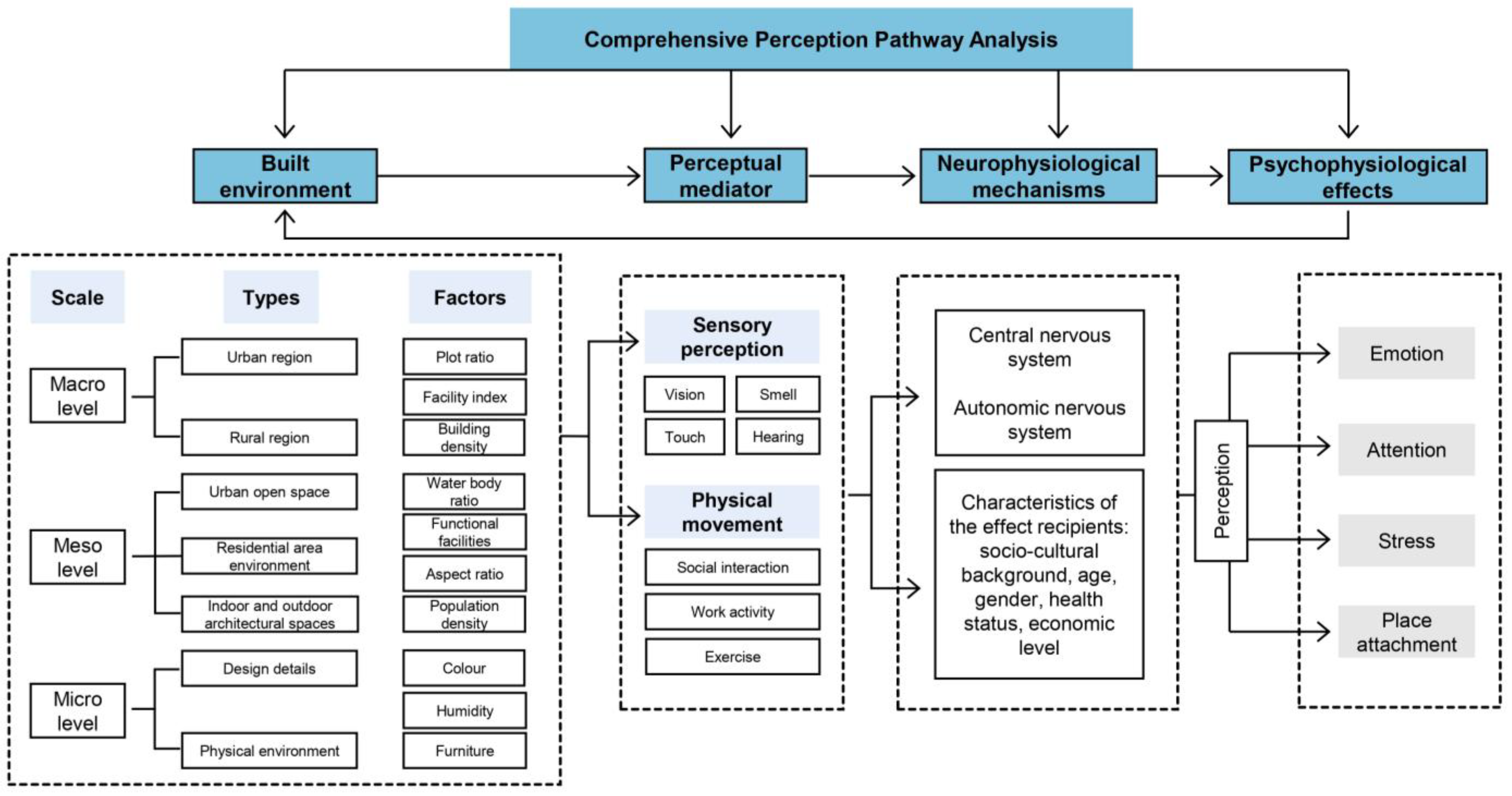
As research on the built environment deepens, research increasingly recognise that environmental influences on emotion are not direct but mediated through complex neural activities related to individuals’ “perception” of the environment [89]. Perceptual dimensions encompass not only simple visual input but also multimodal experiences involving auditory, olfactory, tactile, and kinesthetic sensations, which result in the cognitive and emotional processing of environmental spaces [90,91]. The emotion-influencing mechanism of the built environment is shown in Figure 6.
(1)
Sensory Perception
As the primary channel through which humans acquire environmental information, vision plays a dominant role in spatial perception [92]. Extensive research employs spatial imagery combined with computer vision and deep learning techniques to quantitatively analyse spatial visual elements and explore their relationship with emotional perception. For instance, Qi et al. (2025) [93] focussed on the colour characteristics of urban street landscapes. They used algorithms to construct a visitor emotional perception dataset, extract colour features, quantify colour metrics, and develop analytical models. Their findings revealed that visual colour does not linearly influence emotions but instead follows an “optimal point,” where its excess or deficiency may impair the generation of positive emotions.
Although visual perception dominates, the impact of the built environment on emotions is often the result of the integration of multisensory information. Beyond vision, other senses, such as hearing and smell, also play significant roles [94,95]. For instance, Yu et al. (2025) [96] introduced olfactory perception into library space design research, finding that users’ olfactory experiences can be semantically described along the dimensions of pleasantness, arousal, and control, with fatigue levels influencing olfactory perception. Similarly, research on natural soundscapes (e.g., Bai et al. (2024) [97]) indicates that environmental natural sounds, such as birdsong and flowing water, significantly influence human physiological and psychological responses. Particularly in natural settings, soundscapes exert significant restorative effects on human psychophysiological health.
(2)
Physical Movement
Beyond static sensory perception, bodily movement within space profoundly influences individuals’ spatial awareness and emotional experiences. For instance, Xu et al. (2023) found that different behavioural activities mediate the mechanism through which environmental perception affects older adults’ mental health, with varying mediating effects across activities [98]. Similarly, research on the relationship between built neighbourhood environments and mental health among elderly residents in Hangzhou indicates that different environmental factors influence mental health through distinct behavioural pathways, further supporting the role of behavior as a mediating variable in this relationship [99]. Ren et al. (2024) [100] found that the same environmental elements in urban street spaces exert differential effects on subjective perceptions among individuals with varying movement intentions (walking vs. jogging). These findings underscore the mediating role of body–environment interactions in shaping spatial awareness and emotional experiences. Konou et al. (2024) [101], by examining the link between urban agricultural practices and farmers’ psychosocial well-being, found that urban farming activities significantly enhance happiness. Notably, farmers in peripheral areas reported higher satisfaction than those in urban centers, indicating that specific spatial activities promote positive emotions by offering social, productive, and recreational opportunities.
(3)
Place Cognition
Within perceptual mediation, sense of place and place attachment serve as pivotal concepts linking physical environments to profound emotional experiences. These concepts transcend immediate sensory stimuli, encompassing individuals’ long-term interactions, meaning-making, and emotional attachments with specific locations. For instance, Cheng et al. (2023) [46] explicitly demonstrated that sense of place mediates the relationship between neighbourhood environment and immigrants’ subjective well-being, highlighting the role of emotional attachments to specific locations and the reinforcing effect of prolonged residence on place experience.

3.2.4. Innovative Integration of Research Methods and Technologies

To more accurately reveal the mechanisms through which the environment influences emotions, related research methods have increasingly shifted from subjective evaluations to the objective capture of physiological and neurological processes. In 1974, Mehrabian and Russell’s pleasure–arousal–dominance (PAD) three-dimensional model established the foundation for measuring emotional responses [102]. This model maps physical environmental stimuli onto emotional dimensions, providing a framework for subsequent quantitative assessments of environmental emotional effects. Early mainstream research methods combined questionnaires with subjective assessments, collecting participants’ environmental perceptions and emotional experiences using PAD scales and direct inquiries [103,104]. As research into the interaction mechanisms between human physiology and psychology deepened, researchers recognised that relying solely on subjective psychological assessments was prone to biases and limitations due to the complex coupling mechanisms between physiology and psychology, thereby compromising the precision of research conclusions. Consequently, researchers have begun incorporating physiological measurement devices (e.g., eye-trackers, electroencephalography, wearable sensors) to capture individuals’ subconscious perceptual activities and emotional responses, thereby supplementing measurements with physiological data [105,106]. For instance, Ren et al. (2024) [107] and Yang et al. (2024) [108] utilized eye-tracking data to analyse visual attention toward street-scene images and correlated it with subjective perception evaluations, providing a more objective understanding of urban perception. Zeng et al. [109] and Bower et al. (2022) [110] investigated brain activity levels through EEG data, revealing the neurophysiological mechanisms by which environments influence emotions. Chrisinger and King (2018) [111] conducted a pilot study integrating physiological data with geospatial data to investigate environmental influences on stress.
In recent years, with the rise of big data technology, researchers have begun leveraging non-traditional data sources, such as social media data and street view imagery, combined with machine learning algorithms, to conduct large-scale, efficient quantitative analyses of the relationship between urban environmental factors and emotions. Chrisinger et al. (2019) [69] used social media data for sentiment recognition and classification. Qi et al. (2025) [93], Han et al. (2023) [112], Peng et al. (2024) [113], Zhang et al. (2025) [87], Zhu et al. (2024) [114], and Bai et al. (2024) [97] all employed street view images and deep learning models (e.g., FCN, SegNet, Random Forest, LSTM) to extract visual features, assess perceptions, and predict emotions. Chen et al. (2025) [115] even proposed a large-scale pre-training framework designed to enhance the generalization capabilities of visual sentiment analysis. These techniques enable researchers to uncover complex patterns and correlations within massive datasets, overcoming the limitations of sample size and spatiotemporal coverage inherent in traditional field surveys.
Meanwhile, VR technology provides researchers a controlled simulation environment, enabling the precise manipulation of environmental variables to replicate immersive experiences. Wang et al. (2020) [116] utilized VR to investigate how wall textures influence perceptions of space. Prasetyo et al. (2025) [117] used VR simulations to investigate how lighting dynamics affect emotional perception. Zhang et al. (2024) [118] conducted VR eye-tracking experiments to explore the relationship between landscape elements and emotional attachment. The strength of VR technology lies in its ability to enforce strict experimental controls, eliminating confounding factors present in real-world settings, thereby facilitating stronger causal inferences—though its capacity to fully replicate authentic experiences remains limited.

4. Discussion

Future research should further strengthen the integration of multidisciplinary theories to investigate the synergistic mechanisms of environmental elements across multiple scales. Longitudinal studies focusing on specific populations should be advanced to enhance the precision of intervention strategies. More comprehensive multisensory perception models should be developed to examine the weighting and interactions of different sensory modalities in emotional induction. The coupled analysis and technological integration of multi-source data should be promoted to elucidate the dynamic processes linking perception and psychophysiological responses, thereby providing theoretical and practical support for the creation of more human-centred healthy spaces.

4.1. Synthesis Beyond Description

Based on the above systematic synthesis across macro–meso–micro scales, effect subjects, and underlying mechanisms, this review finds that contemporary built environment–health research has substantially moved away from the early paradigm dominated by macro-scale spatial structures and overall correlations, and it has formed important divergences from mainstream perspectives in several key dimensions: (1) Although mainstream research has long emphasized a direct “environment–emotion” relationship, the emerging literature demonstrates that environmental effects are primarily mediated through a “perception–neural–emotion–health” pathway. Traditional urban studies have often directly linked macro indicators—such as building density, green space ratio, or land-use mix—to happiness, emotional states, or mental health. However, this assumption of direct effects is mechanistically insufficient. A growing body of evidence indicates that multimodal perceptual processes—including visual stimuli, soundscapes, olfactory cues, bodily movement, and place cognition—constitute the key mediators through which environments influence physiological and psychological states. In other words, environments do not act on emotions directly; rather, they are translated into psychological and physiological responses through neural perception and cognitive processing [82]. (2) While mainstream research has typically relied on the “average individual” as its unit of analysis, current evidence reveals pronounced population heterogeneity in environmental effects. Previous studies often treated urban residents as homogeneous or relied on random samples, implicitly assuming that environmental influences operate similarly across different groups. In contrast, recent research shows that different age groups and social roles (e.g., students, older adults, children) exhibit systematic differences in perceptual modes, behavioural patterns, and restorative needs. For example, students are more sensitive to natural soundscapes and opportunities for solitude [84]; older adults depend more on accessibility, visual openness, and activity support [86]; and children are particularly responsive to street aesthetics and connectivity [88]. This demonstrates that the environment–health relationship is not a universal model but is highly contingent on the physiological and psychological characteristics of the effect subject. (3) Although mainstream research has predominantly explained emotional patterns through macro-scale spatial structures, increasing evidence suggests that micro- and meso-scale environmental elements exert more direct influence on lived experience. Although macro indicators such as building density, green space ratio, and functional structure shape urban emotional landscapes, directly perceivable elements—such as street interface order [72], tranquility of green spaces [73,74], soundscape quality in waterfront areas [75,76], façade colors [79], and interior layouts [80]—often have stronger explanatory power for momentary emotions and restorative experiences. This implies that the key influences of the environment on mental health do not primarily operate at the abstract level of urban structure, but rather within the concrete spatial situations that embody and sense an encounter in everyday life—marking an important departure from planning-scale-dominant perspectives.
In sum, contemporary built environment–physiological and psychological health research is undergoing a paradigm shift: from macro-level correlations to perception–neural–behavior mechanisms, from the “average person” to population differences, and from “structural indicators” to “experiential elements.” This shift not only challenges the traditional reliance on macro-planning indicators to explain emotion and health but also provides a new theoretical foundation for intervening in urban health through perceptual mechanisms and fine-grained design. Against this backdrop, a key task for future research is to integrate methods and findings across urban planning, architectural design, public health, environmental psychology, and neuroscience to further uncover the deeper mechanisms linking the built environment to human physiological and psychological responses.

4.2. Structural Gaps

There are several structural gaps in the current body of research on the relationships between the built environment and human physiological and psychological health.
(1) Geographical and Epistemological Bias: The reviewed literature demonstrates a noticeable geographical concentration in Western, Educated, Industrialised, Rich, and Democratic (WEIRD) societies, particularly China, the United States, and European countries. This distribution partly reflects the historical development of environmental psychology, place theory, and neuroarchitecture, which largely originated and institutionalised within Western academic traditions. Furthermore, empirical studies involving neurophysiological measurement and experimental design tend to be concentrated in regions with advanced research infrastructure, which further reinforces this imbalance. However, environmental perception, emotional expression, and conceptualisations of health and well-being are culturally embedded phenomena. Cultural norms may shape spatial preferences, place attachment patterns, and the interpretation of environmental stimuli. Therefore, the summary of research conclusions derived primarily from WEIRD contexts may not be universally generalizable.
(2) Lack of Cross-Sectional and Longitudinal Comparisons: There is a noticeable lack of systematic cross-sectional and longitudinal comparative research. Cross-sectional gaps include insufficient comparisons across regions, environmental typologies, socio-demographic groups, and cultural contexts. Existing studies often focus on single-case urban parks, neighbourhoods, or indoor environments, limiting the generalizability of findings. Longitudinal gaps are even more pronounced. Most studies capture short-term physiological or emotional responses (e.g., momentary stress reduction or mood change), while longitudinal evidence linking repeated environmental exposure to sustained psychological adaptation, cognitive development, or long-term health trajectories remains scarce. In addition, multidimensional outcome comparisons—such as interactions among emotion, attention, cognitive performance, and stress biomarkers—are rarely integrated within a unified analytical design.
(3) Fragmentation Across Scales: Current research remains fragmented across spatial scales. Macro-level urban indicators (e.g., density, land-use mix) are often examined independently from micro-level experiential elements (e.g., materiality, light quality, spatial enclosure). The absence of cross-scale modelling limits the ability to understand how large-scale planning decisions translate into perceptual and emotional experiences at the human scale.
(4) Limited Translation to Design Practice: Despite growing empirical evidence, the translation of research findings into actionable architectural or urban design strategies remains insufficiently operationalised. The gap between experimental findings and design implementation continues to challenge evidence-based environmental design.

4.3. Methodological Reflection

4.3.1. Data Constraints

Although the proposed framework offers integrative analytical advantages, its empirical application is constrained by several data-related challenges that affect the feasibility, validity, and temporal robustness of the analysis. (1) Multimodal Data Integration Challenges: The framework presupposes the integration of heterogeneous data types (subjective questionnaires, spatial metrics, physiological signals, behavioural observations). However, such integration requires synchronised measurement protocols, comparable sampling units, and advanced statistical modelling, which may not always be feasible in large-scale urban studies. (2) Ecological Validity vs. Experimental Control: Neurophysiological measurements often rely on laboratory or VR-based simulations to ensure experimental control. While these designs improve internal validity, they may reduce ecological validity compared to real-world exposure studies. Translating laboratory findings into real urban contexts remains methodologically challenging. (3) Temporal Data Scarcity: Longitudinal datasets capturing repeated environmental exposure and long-term health adaptation are limited. Most available datasets remain cross-sectional, constraining causal inference within the proposed pathway.

4.3.2. Generalizability and Transferability Issues

The generalizability and transferability of the proposed framework are influenced by several contextual, scalar, and infrastructural constraints. (1) Cultural and Contextual Variability: Perception, emotional expression, and health conceptualisation are culturally embedded. Therefore, although the pathway model is theoretically integrative, its empirical manifestations may vary across cultural, climatic, and socio-economic contexts. Cross-cultural validation is necessary before claiming universal applicability. (2) Scale Sensitivity: The framework assumes that environmental effects operate across scales; however, the relative importance of perceptual versus structural factors may differ depending on the spatial scale. This scale’s sensitivity limits straightforward generalization. (3) Infrastructure Dependency: Implementation of the full pathway model often depends on access to advanced measurement technologies (e.g., EEG, biometric sensors), which may not be available in all research settings, particularly in low-resource regions. This creates disparities in empirical testing capacity.

4.3.3. Boundary Conditions of the Framework

The proposed theoretical framework should be understood within clearly defined boundary conditions. It is important to clarify that the proposed theoretical framework is primarily conceptual and integrative rather than predictive. It aims to organise fragmented evidence into a coherent explanatory structure, but it does not yet constitute a validated causal model with quantified effect sizes. Further empirical work is needed to test mediation sequences and cross-scale interactions.

4.4. Theoretical and Practical Implications

4.4.1. Theoretical Contributions

This review makes three primary theoretical contributions to the field of built environment and health research. (1) It advances theoretical integration by synthesising environmental psychology, place theory, emotional geography, and neuroarchitecture into a unified multi-level explanatory framework. Rather than treating these traditions as parallel perspectives, this review clarifies their complementary roles across perceptual, affective, socio-spatial, and neurophysiological dimensions. By structuring these perspectives along an “environment–perception–neural–emotion–health” pathway, this review provides a coherent conceptual architecture that reduces disciplinary fragmentation. (2) This review shifts the analytical emphasis from isolated environment–outcome correlations toward mechanism-based modelling. By explicitly foregrounding perceptual mediation and psychophysiological processes, the proposed framework contributes to the theoretical refinement of how environmental stimuli are translated into emotional and health-related outcomes. This transition from descriptive association to mechanistic explanation represents a conceptual advancement in built environment research. (3) This review identifies structural gaps across spatial scales, temporal dimensions, and methodological approaches, thereby outlining boundary conditions for current knowledge. In doing so, it not only synthesises existing findings but also reorganises them into a structured research agenda, enhancing the explanatory coherence of interdisciplinary studies in architecture, urban planning, and health sciences.

4.4.2. Practical Implications

From a practical perspective, the proposed framework provides guidance for evidence-informed environmental design. (1) It emphasises the importance of perceptual and emotional mediation in shaping health outcomes, suggesting that design strategies should move beyond purely structural indicators (e.g., density or land-use mix) to incorporate experiential qualities such as spatial enclosure, materiality, lighting, acoustic comfort, and multisensory stimulation. (2) The framework highlights the need for human-centred and population-sensitive interventions. Given the heterogeneity in emotional response and health vulnerability across age groups, cultural contexts, and socio-economic backgrounds, future design strategies should incorporate targeted and context-specific approaches. (3) By advocating the integration of multi-source data—including spatial analytics, behavioural observations, and psychophysiological monitoring—this review supports the advancement of evidence-based design practices. Such integrative approaches can improve the precision of environmental interventions and enhance the alignment between scientific evidence and spatial implementation.

4.4.3. Future Research Directions

Future research should focus on several priority directions to advance the theoretical integration and empirical robustness of built environment and health studies. (1) Future research should further strengthen the integration of multidisciplinary theories to investigate the synergistic mechanisms of environmental elements across multiple spatial scales. (2) Longitudinal studies focusing on specific populations should be advanced to improve the precision and sustainability of environmental interventions. (3) More comprehensive multisensory perception models are needed to examine the relative weighting and interaction of visual, auditory, tactile, and olfactory stimuli in emotional induction processes. (4) The coupled analysis and technological integration of multi-source data—combining spatial metrics, subjective reports, and physiological signals—should be promoted to elucidate the dynamic processes linking perception and psychophysiological responses. Through the combination of cutting-edge technologies, such as virtual reality (VR), big data analytics, and neurophysiological monitoring, researchers could deeply analyse the dynamic processes linking perception and psychophysiology. This will provide theoretical foundations and design references for the construction of healthier, more human-centred urban spaces. (5) Expanding the geographical scope of this review constitutes a critical future direction. Current evidence remains disproportionately concentrated in Western and industrialised contexts. Comparative studies across diverse climatic, socio-economic, and cultural regions—particularly in underrepresented areas such as Africa, South America, the Middle East, and Southeast Asia—are essential for testing the contextual robustness of the proposed framework. Incorporating culturally sensitive methodologies and indigenous spatial concepts will contribute to refining and localising the integrative model, ensuring its applicability across varied environmental and cultural settings. By addressing these directions, future research can move toward a more globally inclusive, methodologically rigorous, and mechanism-oriented understanding of how built environments shape human well-being.

5. Conclusions

Considering multiple disciplinary perspectives, including environmental psychology, emotional geography, neuroarchitecture, and place theory, this study reveals how the built environment influences individuals’ physiological and psychological states, as well as behavioural patterns. Through a comprehensive synthesis of the existing literature, the following core conclusions are drawn. (1) Theoretical expansion: through interdisciplinary integration and theoretical convergence, current research has moved beyond the traditional, surface-level human–environment relationship to uncover the intrinsic mechanisms linking environmental settings with human physiological responses, psychological states, behavioural patterns, and social interactions, thereby emphasising a human-centred and empathetic perspective. (2) Multiscale investigation of environmental space: from macro-scale urban districts and functional zones to micro-scale natural, cultural, and architectural elements, research has adopted a multi-level and full-scale analytical framework, establishing a multidimensional system for interpreting environmental spaces. (3) Comprehensive expansion of environmental effects: research has progressed from a narrow focus on single emotional experiences to broader concepts such as health and well-being, and it has begun to address the differentiated environmental needs of specific populations, including older adults, children, and people with disabilities, thereby promoting the translation of research findings into design practice.
Future research may further focus on the following research directions: (1) interdisciplinary integration—strengthening the integration of perspectives from different disciplines, particularly in clarifying the relationships between physiological monitoring and environmental perception, in order to deepen understanding of perception–emotion–behavior mechanisms; (2) longitudinal studies—conducting more representative and long-term investigations to explore the sustained effects of environments on individuals’ psychological health; and (3) individual-difference-oriented research—developing fine-grained spatial interventions and design strategies tailored to the needs of different population groups (e.g., older adults, children, and other special groups). This review provides a theoretical foundation for creating more human-centred built environments and highlights the potential and challenges of future research, aiming to support interdisciplinary, longitudinal, and differentiated studies and to advance the field of the built environment and mental health.

Author Contributions

Conceptualization, M.D. and H.G.; methodology, M.D.; software, W.J., L.X. and Y.W.; validation, W.J., L.X. and Y.W.; formal analysis, X.C. and W.Z.; investigation, W.J., L.X. and Y.W.; resources, M.D.; data curation, M.D. and W.J.; writing—original draft preparation, W.J.; writing—review and editing, L.X. and Y.W.; visualization, M.D.; supervision, W.Z.; project administration, H.G.; funding acquisition, M.D. All authors have read and agreed to the published version of the manuscript.

Funding

This research was funded by the Guangdong Provincial Department of Housing and Urban-Rural Development Project, grant number 2022-K2-280927; the Research and The Application of Commercial Leisure Waterfront Space Design Based on the Feedback Role of Urban Regeneration Project, grant number x2jzD9246790; the Design Study of Urban Super High-Rise Hotels Project, grant number x2jzD8205830; the Guangdong Province General Universities Young Innovative Talent Project, grant number 2023WQNCX122; the Guangdong Philosophy and Social Sciences Planning Youth Project, grant number GD24YYS19; and the Zhuhai Philosophy and Social Sciences Planning Project, grant number 2025GJ075.

Data Availability Statement

The data presented in this study are included in the article; further inquiries can be directed to the corresponding author.

Acknowledgments

The authors are grateful to 5 students from the School of Architecture at South China University of Technology who participated in the empirical research.

Conflicts of Interest

Authors Mengren Deng, Haoxu Guo and Xinyan Chen were employed by the company South China University of Technology Architectural Design & Research Institute Co., Ltd. The remaining authors declare that the research was conducted in the absence of any commercial or financial relationships that could be construed as a potential conflict of interest.

References

  1. Bird, E.L.; Ige, J.; Pilkington, P.; Pinto, A.; Petrokofsky, C.; Burgess-Allen, J. Built and natural environment planning principles for promoting health: An umbrella review. BMC Public Health 2018, 18, 930. [Google Scholar] [CrossRef]
  2. Andalib, E.; Temeljotov-Salaj, A.; Steinert, M.; Johansen, A.; Aalto, P.; Lohne, J. The interplay between the built environment, health, and well-being—A scoping review. Urban Sci. 2024, 8, 184. [Google Scholar] [CrossRef]
  3. Roe, J.J.; Thompson, C.W.; Aspinall, P.A.; Brewer, M.J.; Duff, E.I.; Miller, D.; Mitchell, R.; Clow, A. Green space and stress: Evidence from cortisol measures in deprived urban communities. Int. J. Environ. Res. Public Health 2013, 10, 4086–4103. [Google Scholar] [CrossRef]
  4. Lai, Y.; Wang, P.; Wen, K. Exploring the Impact of Public Spaces on Social Cohesion in Resettlement Communities from the Perspective of Experiential Value: A Case Study of Fuzhou, China. Buildings 2024, 14, 3141. [Google Scholar] [CrossRef]
  5. Erfanian, M.; Mitchell, A.J.; Kang, J.; Aletta, F. The psychophysiological implications of soundscape: A systematic review of empirical literature and a research agenda. Int. J. Environ. Res. Public Health 2019, 16, 3533. [Google Scholar] [CrossRef] [PubMed]
  6. Jung, D.; An, J.; Hong, T. Exploring the relationship between office lighting, cognitive performance, and psychophysiological responses: A multidimensional approach. Build. Environ. 2024, 263, 111863. [Google Scholar] [CrossRef]
  7. Jo, H.; Song, C.; Miyazaki, Y. Physiological benefits of viewing nature: A systematic review of indoor experiments. Int. J. Environ. Res. Public Health 2019, 16, 4739. [Google Scholar] [CrossRef]
  8. Shuda, Q.; Bougoulias, M.E.; Kass, R. Effect of nature exposure on perceived and physiologic stress: A systematic review. Complement. Ther. Med. 2020, 53, 102514. [Google Scholar] [CrossRef]
  9. Chen, Q.; Yan, Y.; Zhang, X.; Chen, J. A study on the impact of built environment elements on satisfaction with residency whilst considering spatial heterogeneity. Sustainability 2022, 14, 15011. [Google Scholar] [CrossRef]
  10. Manzo, L.C.; Perkins, D.D. Finding common ground: The importance of place attachment to community participation and planning. J. Plan. Lit. 2006, 20, 335–350. [Google Scholar] [CrossRef]
  11. Sepe, M. Contemporary approaches to healthy and livable public spaces: Proximity, flexibility, and diversification. Urban Des. Int. 2025, 30, 115–129. [Google Scholar] [CrossRef]
  12. Peters, K.; Elands, B.; Buijs, A. Social interactions in urban parks: Stimulating social cohesion? Urban For. Urban Green. 2010, 9, 93–100. [Google Scholar] [CrossRef]
  13. Sallis, J.F.; Cerin, E.; Conway, T.L.; Adams, M.A.; Frank, L.D.; Pratt, M.; Salvo, D.; Schipperijn, J.; Smith, G.; Cain, K.L. Physical activity in relation to urban environments in 14 cities worldwide: A cross-sectional study. Lancet 2016, 387, 2207–2217. [Google Scholar] [CrossRef]
  14. Cavaliere, G.; Calvano, S.; Molina, P.; Negro, F. Psychophysiological responses to indoor wood use: A systematic literature review of indicators, methods, and research trends. Build. Environ. 2026, 290, 114188. [Google Scholar] [CrossRef]
  15. Kondo, M.C.; Fluehr, J.M.; McKeon, T.; Branas, C.C. Urban green space and its impact on human health. Int. J. Environ. Res. Public Health 2018, 15, 445. [Google Scholar] [CrossRef]
  16. Proshansky, H.M.; Ittelson, W.H.; Rivlin, L.G. Environmental Psychology: Man and His Physical Setting; Holt, Rinehart and Winston: New York, NY, USA, 1970. [Google Scholar]
  17. Proshansky, H.M.; O’Hanlon, T. Environmental Psychology: Origins and Development. In Perspectives on Environment and Behavior; Stokols, D., Ed.; Springer: Boston, MA, USA, 1977; pp. 101–129. [Google Scholar]
  18. Canter, D.V. The Psychology of Place; Architectural Press: London, UK, 1977. [Google Scholar]
  19. Lewicka, M. Place Attachment: How Far Have We Come in the Last 40 Years? J. Environ. Psychol. 2011, 31, 207–230. [Google Scholar] [CrossRef]
  20. Davidson, J.; Bondi, L.; Smith, M. (Eds.) Emotional Geographies; Routledge: Abingdon, UK, 2007. [Google Scholar]
  21. Kearney, A. Homeland Emotion: An Emotional Geography of Heritage and Homeland. Int. J. Herit. Stud. 2009, 15, 209–222. [Google Scholar] [CrossRef]
  22. Metzger, C. Neuroarchitecture; Jovis Verlag: Berlin, Germany, 2018. [Google Scholar]
  23. Attaianese, E.; Barilà, M.; Perillo, M. Exploring Neuroscientific Approaches to Architecture: Design Strategies of the Built Environment for Improving Human Performance. Buildings 2025, 15, 3524. [Google Scholar] [CrossRef]
  24. De Groot, J.I. Environmental Psychology: An Introduction; Routledge: London, UK, 2019. [Google Scholar]
  25. Stokols, D. Environmental Psychology; Praeger Publishers: New York, NY, USA, 1978. [Google Scholar]
  26. Ulrich, R.S. Natural versus urban scenes: Some psychophysiological effects. Environ. Behav. 1981, 13, 523–556. [Google Scholar] [CrossRef]
  27. Ulrich, R.S. View through a window may influence recovery from surgery. Science 1984, 224, 420–421. [Google Scholar] [CrossRef]
  28. Kaplan, R.; Kaplan, S. The Experience of Nature: A Psychological Perspective; Cambridge University Press: Cambridge, UK, 1989. [Google Scholar]
  29. Moscoso, P.; Peck, M.; Eldridge, A. Emotional associations with soundscape reflect human-environment relationships. J. Ecoacoustics 2018, 2, 1–19. [Google Scholar] [CrossRef]
  30. Xu, J.; Wang, Q.; Zhu, L.; Qing, W.; Jin, M.; Zhang, R.; Wang, H. The present of environmental psychology researches in China: Base on the bibliometric analysis and knowledge mapping. In Proceedings of the IOP Conference Series: Earth and Environmental Science, Kanazawa, Japan, 9–10 November 2017; IOP Publishing: Bristol, UK, 2018; p. 012158. [Google Scholar]
  31. Yeh, C.-W.; Hung, S.-H.; Chang, C.-Y. The influence of natural environments on creativity. Front. Psychiatry 2022, 13, 895213. [Google Scholar] [CrossRef] [PubMed]
  32. Zhu, Z.; Liu, Y.; Chen, Y. The influence of emotional response and aesthetic perception of shopping mall facade color on entry decisions—Evidence from the Yangtze River Delta region of China. Buildings 2024, 14, 2302. [Google Scholar] [CrossRef]
  33. Kitchin, R. The real-time city? Big data and smart urbanism. GeoJournal 2014, 79, 1–14. [Google Scholar] [CrossRef]
  34. Li, W.; Song, Y.; Herr, C.M.; Stouffs, R. A review of big data applications in studies of urban green space. Urban For. Urban Green. 2024, 101, 128524. [Google Scholar] [CrossRef]
  35. Zhou, M.; Luo, Y.; Xu, Z.; Zhang, R.; Liu, X. Nature Exposure and Subjective Well-Being: The Mediating Roles of Connectedness to Nature and Awe. Sustainability 2025, 17, 5406. [Google Scholar] [CrossRef]
  36. Lin, X.; Luo, J.; Liao, M.; Su, Y.; Lv, M.; Li, Q.; Xiao, S.; Xiang, J. Wearable sensor-based monitoring of environmental exposures and the associated health effects: A review. Biosensors 2022, 12, 1131. [Google Scholar] [CrossRef]
  37. Smith, J.W. Immersive virtual environment technology to supplement environmental perception, preference and behavior research: A review with applications. Int. J. Environ. Res. Public Health 2015, 12, 11486–11505. [Google Scholar] [CrossRef] [PubMed]
  38. Wang, Y.; Wang, Y.; Li, X.; Guan, X.; Zhang, B.; Huang, X. Pedestrian Emotion Perception in Urban Built Environments Based on Virtual Reality Technology: A Comparative Review of Chinese-and English-Language Literature. Buildings 2025, 15, 3713. [Google Scholar] [CrossRef]
  39. Jacobs, J. The Death and Life of Great American Cities; Vintage: New York, NY, USA, 1992. [Google Scholar]
  40. Tuan, Y.-F. Space and Place: The Perspective of Experience; University of Minnesota Press: Minneapolis, MN, USA, 1977. [Google Scholar]
  41. Manzo, L.; Devine-Wright, P. Place Attachment: Advances in Theory, Methods and Applications; Routledge: London, UK, 2013. [Google Scholar]
  42. Scannell, L.; Gifford, R. Defining place attachment: A tripartite organizing framework. J. Environ. Psychol. 2010, 30, 1–10. [Google Scholar] [CrossRef]
  43. Wächter, L. Beyond permanent residences: Measuring place attachment in tempo-local housing arrangements. Urban Sci. 2024, 8, 173. [Google Scholar] [CrossRef]
  44. Berroeta, H.; Pinto de Carvalho, L.; Di Masso, A.; Ossul Vermehren, M.I. Apego al lugar: Una aproximación psicoambiental a la vinculación afectiva con el entorno en procesos de reconstrucción del hábitat residencial. Rev. INVI 2017, 32, 113–139. [Google Scholar] [CrossRef]
  45. Al-Azzawi, S.; İnalhan, G.; Al-Azzawi, N. Aesthetic–Restorative Qualities and Social Interaction in Public Open Spaces: Investigating the Pathways to Place Attachment. Architecture 2025, 5, 114. [Google Scholar] [CrossRef]
  46. Cheng, H.; Su, L.; Li, Z. How does the neighbourhood environment influence migrants’ subjective well-being in urban China? Popul. Space Place 2024, 30, e2704. [Google Scholar] [CrossRef]
  47. Su, C.; Wang, X.; Wang, Y.; Chen, Y.; Dai, F.; Chen, X. Mediating Roles of Cultural Perception and Place Attachment in the Landscape–Wellbeing Relationship: Insights from Historical Urban Parks in Wuhan, China. Land 2025, 14, 1176. [Google Scholar] [CrossRef]
  48. Halbwachs, M. On Collective Memory; University of Chicago Press: Chicago, IL, USA, 1992. [Google Scholar]
  49. Candau, J. Anthropologie de la Mémoire; Armand Colin: Paris, France, 2005. [Google Scholar]
  50. Anderson, K.; Smith, S.J. Emotional geographies. Trans. Inst. Br. Geogr. 2001, 26, 7–10. [Google Scholar] [CrossRef]
  51. Davidson, J.; Milligan, C. Embodying emotion sensing space: Introducing emotional geographies. Soc. Cult. Geogr. 2004, 5, 523–532. [Google Scholar] [CrossRef]
  52. Hong, Z.; Quan, G. Review on “emotional turn” and emotional geographies in recent western geography. Geogr. Res. 2015, 34, 1394–1406. [Google Scholar]
  53. Albrecht, G.; Sartore, G.-M.; Connor, L.; Higginbotham, N.; Freeman, S.; Kelly, B.; Stain, H.; Tonna, A.; Pollard, G. Solastalgia: The distress caused by environmental change. Australas. Psychiatry 2007, 15, S95–S98. [Google Scholar] [CrossRef]
  54. Lin, J.; Feng, J.; Zhang, B.; Han, Y.; Zhang, H.; Luo, M.; Deng, F. Research hotspots, connotation, and significance of emotional geography at home and abroad: Based on bibliometrics and visualization. Trop. Geogr. 2022, 42, 1074–1086. [Google Scholar]
  55. Jiang, Y.; Yu, R.; Chen, Q.; Zhou, Y. Exploring the construction and application of “urban sentiment maps” in urban planning practice: A case study of Chengdu. Trans. Urban Data Sci. Technol. 2025, 4, 103–115. [Google Scholar] [CrossRef]
  56. Eberhard, J.P. Applying neuroscience to architecture. Neuron 2009, 62, 753–756. [Google Scholar] [CrossRef]
  57. Edelstein, E.A.; Macagno, E. Form follows function: Bridging neuroscience and architecture. In Sustainable Environmental Design in Architecture: Impacts on Health; Springer: Berlin/Heidelberg, Germany, 2011; pp. 27–41. [Google Scholar]
  58. Eberhard, J.P. Brain Landscape the Coexistence of Neuroscience and Architecture; Oxford University Press: Oxford, UK, 2008. [Google Scholar]
  59. Higuera-Trujillo, J.L.; Llinares, C.; Macagno, E. The cognitive-emotional design and study of architectural space: A scoping review of neuroarchitecture and its precursor approaches. Sensors 2021, 21, 2193. [Google Scholar] [CrossRef]
  60. Prykhodko, O. Psychology of Space Perception: How the Interior Influences Behavior. Univers. Libr. Eng. Technol. 2025, 2, 38–45. [Google Scholar] [CrossRef]
  61. Basile, G.A.; Tatti, E.; Bertino, S.; Milardi, D.; Genovese, G.; Bruno, A.; Muscatello, M.R.A.; Ciurleo, R.; Cerasa, A.; Quartarone, A. Neuroanatomical correlates of peripersonal space: Bridging the gap between perception, action, emotion and social cognition. Brain Struct. Funct. 2024, 229, 1047–1072. [Google Scholar] [CrossRef] [PubMed]
  62. Razumnikova, O.M. Association between biophilia, self-perceived emotional state, and brain bioelectrical activity during the perception of natural and urban landscapes. Ekol. Cheloveka (Hum. Ecol.) 2024, 31, 575–585. [Google Scholar] [CrossRef]
  63. Abbas, S.; Okdeh, N.; Roufayel, R.; Kovacic, H.; Sabatier, J.-M.; Fajloun, Z.; Abi Khattar, Z. Neuroarchitecture: How the perception of our surroundings impacts the brain. Biology 2024, 13, 220. [Google Scholar] [CrossRef] [PubMed]
  64. Banaei, M.; Hatami, J.; Yazdanfar, A.; Gramann, K. Walking through architectural spaces: The impact of interior forms on human brain dynamics. Front. Hum. Neurosci. 2017, 11, 477. [Google Scholar] [CrossRef]
  65. Yin, J.; Yuan, J.; Arfaei, N.; Catalano, P.J.; Allen, J.G.; Spengler, J.D. Effects of biophilic indoor environment on stress and anxiety recovery: A between-subjects experiment in virtual reality. Environ. Int. 2020, 136, 105427. [Google Scholar] [CrossRef]
  66. Karakas, T.; Yildiz, D. Exploring the influence of the built environment on human experience through a neuroscience approach: A systematic review. Front. Archit. Res. 2020, 9, 236–247. [Google Scholar] [CrossRef]
  67. Turcu, C.; Crane, M.; Hutchinson, E.; Lloyd, S.; Belesova, K.; Wilkinson, P.; Davies, M. A multi-scalar perspective on health and urban housing: An umbrella review. Build. Cities 2021, 2, 734. [Google Scholar] [CrossRef]
  68. Keralis, J.M.; Javanmardi, M.; Khanna, S.; Dwivedi, P.; Huang, D.; Tasdizen, T.; Nguyen, Q.C. Health and the built environment in United States cities: Measuring associations using Google Street View-derived indicators of the built environment. BMC Public Health 2020, 20, 215. [Google Scholar] [CrossRef]
  69. Chrisinger, B.W.; Gustafson, J.A.; King, A.C.; Winter, S.J. Understanding where we are well: Neighborhood-level social and environmental correlates of well-being in the Stanford Well for Life Study. Int. J. Environ. Res. Public Health 2019, 16, 1786. [Google Scholar] [CrossRef]
  70. Ma, Y.; Yang, Y.; Jiao, H. Exploring the impact of urban built environment on public emotions based on social media data: A case study of Wuhan. Land 2021, 10, 986. [Google Scholar] [CrossRef]
  71. Liu, W.; Li, D.; Meng, Y.; Guo, C. The relationship between emotional perception and high-density built environment based on social media data: Evidence from spatial analyses in Wuhan. Land 2024, 13, 294. [Google Scholar] [CrossRef]
  72. Zhang, Z.; Zhuo, K.; Wei, W.; Li, F.; Yin, J.; Xu, L. Emotional responses to the visual patterns of urban streets: Evidence from physiological and subjective indicators. Int. J. Environ. Res. Public Health 2021, 18, 9677. [Google Scholar] [CrossRef] [PubMed]
  73. Zhu, Z.; Hassan, A.; Wang, W.; Chen, Q. Relationship between PSD of park green space and attention restoration in dense urban areas. Brain Sci. 2022, 12, 721. [Google Scholar] [CrossRef]
  74. Memari, S.; Pazhouhanfar, M.; Grahn, P. Perceived sensory dimensions of green areas: An experimental study on stress recovery. Sustainability 2021, 13, 5419. [Google Scholar] [CrossRef]
  75. Gao, H.; Liu, F.; Kang, J.; Wu, Y.; Xue, Y. The relationship between the perceptual experience of a waterfront-built environment and audio-visual indicators. Appl. Acoust. 2023, 212, 109550. [Google Scholar] [CrossRef]
  76. Zhu, G.; Yuan, M.; Ma, H.; Luo, Z.; Shao, S. Restorative effect of audio and visual elements in urban waterfront spaces. Front. Psychol. 2023, 14, 1113134. [Google Scholar] [CrossRef]
  77. Song, S.; Xiao, Y.; Tu, R.; Yin, S. Effects of thermal perception on restorative benefits by green space exposure: A pilot study in hot-humid China. Urban Clim. 2024, 53, 101767. [Google Scholar] [CrossRef]
  78. Fu, J.; Dupre, K.; Tavares, S.; King, D.; Banhalmi-Zakar, Z. Optimized greenery configuration to mitigate urban heat: A decade systematic review. Front. Archit. Res. 2022, 11, 466–491. [Google Scholar] [CrossRef]
  79. Wang, Z.; Shen, M.; Huang, Y. Exploring the impact of facade color elements on visual comfort in old residential buildings in Shanghai: Insights from eye-tracking technology. Buildings 2024, 14, 1758. [Google Scholar] [CrossRef]
  80. Şekerci, Y.; Kahraman, M.U. Dreaming of Better Spaces: Environmental Psychology in Students’ Redesign of Interior Architecture Studios. J. Des. Studio 2024, 6, 5–30. [Google Scholar] [CrossRef]
  81. Martín López, L.; Fernández Díaz, A.B. Interior environment design method for positive mental health in lockdown times: Color, textures, objects, furniture and equipment. Designs 2022, 6, 35. [Google Scholar] [CrossRef]
  82. Ha, J.; Kim, H.J. The restorative effects of campus landscape biodiversity: Assessing visual and auditory perceptions among university students. Urban For. Urban Green. 2021, 64, 127259. [Google Scholar] [CrossRef]
  83. Song, I.; Baek, K.; Kim, C.; Song, C. Effects of nature sounds on the attention and physiological and psychological relaxation. Urban For. Urban Green. 2023, 86, 127987. [Google Scholar] [CrossRef]
  84. Zhang, J.; Jin, J.; Liang, Y. The Impact of Green Space on University Students’ Mental Health: The Mediating Roles of Solitude Competence and Perceptual Restoration. Sustainability 2024, 16, 707. [Google Scholar] [CrossRef]
  85. Fu, G.; Gai, Y.; Xiang, L.; Lin, L. Quantifying older adults’ spatial perceptions of outdoor activity areas for embedded retirement facilities. Buildings 2025, 15, 271. [Google Scholar] [CrossRef]
  86. Zhang, J.; Tan, Z.; Bu, F. Impact of Urban Green Spaces on Mental Restoration in Older Adults: From the Perspective of Subjective Perception. Front. Public Health 2025, 13, 1687874. [Google Scholar] [CrossRef] [PubMed]
  87. Zhang, X.; Yu, Y.; Cao, L. Blue Space and Healthy Aging: Effects on Older Adults’ Walking in 15-Minute Living Circles—Evidence from Tianjin Binhai New Area. Sustainability 2025, 17, 10225. [Google Scholar] [CrossRef]
  88. Ortegon-Sanchez, A.; McEachan, R.R.; Albert, A.; Cartwright, C.; Christie, N.; Dhanani, A.; Islam, S.; Ucci, M.; Vaughan, L. Measuring the built environment in studies of child health—A meta-narrative review of associations. Int. J. Environ. Res. Public Health 2021, 18, 10741. [Google Scholar] [CrossRef]
  89. Gkintoni, E.; Aroutzidis, A.; Antonopoulou, H.; Halkiopoulos, C. From neural networks to emotional networks: A systematic review of EEG-based emotion recognition in cognitive neuroscience and real-world applications. Brain Sci. 2025, 15, 220. [Google Scholar] [CrossRef] [PubMed]
  90. Chiang, Y.-J. Multisensory stimuli, restorative effect, and satisfaction of visits to forest recreation destinations: A case study of the Jhihben National Forest Recreation Area in Taiwan. Int. J. Environ. Res. Public Health 2023, 20, 6768. [Google Scholar] [CrossRef]
  91. Alshaer, A. The role of sensory experiences in evoking emotional responses in virtual reality. J. Umm Al-Qura Univ. Eng. Archit. 2025, 16, 172–184. [Google Scholar] [CrossRef]
  92. Lappin, J.S.; Bell, H.H. Form and function in information for visual perception. i-Perception 2021, 12, 20416695211053352. [Google Scholar] [CrossRef]
  93. Qi, Z.; Li, J.; Yang, X.; He, Z. How the characteristics of street color affect visitor emotional experience. Comput. Urban Sci. 2025, 5, 7. [Google Scholar] [CrossRef]
  94. Dai, T.; Zheng, X. Understanding how multi-sensory spatial experience influences atmosphere, affective city image and behavioural intention. Environ. Impact Assess. Rev. 2021, 89, 106595. [Google Scholar] [CrossRef]
  95. Song, C.; Cao, S.; Luo, H.; Huang, Y.; Jiang, S.; Guo, B.; Li, N.; Li, K.; Zhang, P.; Zhu, C. Effects of simulated multi-sensory stimulation integration on physiological and psychological restoration in virtual urban green space environment. Front. Psychol. 2024, 15, 1382143. [Google Scholar] [CrossRef] [PubMed]
  96. Yu, Y.; Su, W.; Lu, Z.; Liu, G.; Ni, W. Using semantic differential method to evaluate users’ olfactory perceptions in academic library. Libr. Hi Tech 2025, 43, 988–1013. [Google Scholar] [CrossRef]
  97. Bai, Z.; Zhang, S. Effects of different natural soundscapes on human psychophysiology in national forest park. Sci. Rep. 2024, 14, 17462. [Google Scholar] [CrossRef] [PubMed]
  98. Xu, L.; Han, H.; Yang, C.; Liu, Q. The influence mechanism of the community subjectively built environment on the physical and mental health of older adults. Sustainability 2023, 15, 13211. [Google Scholar] [CrossRef]
  99. Kong, X.; Han, H.; Chi, F.; Zhan, M. The association between neighborhood built environment and mental health among older adults in Hangzhou, China. Health Place 2025, 91, 103415. [Google Scholar] [CrossRef]
  100. Ren, W.; Zhan, K.; Chen, Z.; Hong, X.-C. Research on Landscape Perception of Urban Parks Based on User-Generated Data. Buildings 2024, 14, 2776. [Google Scholar] [CrossRef]
  101. Konou, A.A.; Zinsou-Klassou, K.; Mwakalinga, V.M.; Munyaka, B.J.-C.; Kemajou Mbianda, A.F.; Chenal, J. Exploring the Association of Urban Agricultural Practices with Farmers’ Psychosocial Well-Being in Dar Es Salaam and Greater Lomé: A Perceptual Study. Sustainability 2024, 16, 6747. [Google Scholar] [CrossRef]
  102. Mehrabian, A. Pleasure-arousal-dominance: A general framework for describing and measuring individual differences in temperament. Curr. Psychol. 1996, 14, 261–292. [Google Scholar] [CrossRef]
  103. Bakker, I.; Van Der Voordt, T.; Vink, P.; De Boon, J. Pleasure, arousal, dominance: Mehrabian and Russell revisited. Curr. Psychol. 2014, 33, 405–421. [Google Scholar] [CrossRef]
  104. Li, S.; Scott, N.; Walters, G. Current and potential methods for measuring emotion in tourism experiences: A review. Curr. Issues Tour. 2015, 18, 805–827. [Google Scholar] [CrossRef]
  105. Ayata, D.; Yaslan, Y.; Kamasak, M.E. Emotion recognition from multimodal physiological signals for emotion aware healthcare systems. J. Med. Biol. Eng. 2020, 40, 149–157. [Google Scholar] [CrossRef]
  106. Rosas, H.J.; Sussman, A.; Sekely, A.C.; Lavdas, A.A. Using eye tracking to reveal responses to the built environment and its constituents. Appl. Sci. 2023, 13, 12071. [Google Scholar] [CrossRef]
  107. Ren, H.; Yang, F.; Zhang, J.; Wang, Q. Evaluation of cognition of rural public space based on eye tracking analysis. Buildings 2024, 14, 1525. [Google Scholar] [CrossRef]
  108. Yang, N.; Deng, Z.; Hu, F.; Chao, Y.; Wan, L.; Guan, Q.; Wei, Z. Urban perception by using eye movement data on street view images. Trans. GIS 2024, 28, 1021–1042. [Google Scholar] [CrossRef]
  109. Zeng, C.; Lin, W.; Li, N.; Wen, Y.; Wang, Y.; Jiang, W.; Zhang, J.; Zhong, H.; Chen, X.; Luo, W. Electroencephalography (EEG)-based neural emotional response to the vegetation density and integrated sound environment in a green space. Forests 2021, 12, 1380. [Google Scholar] [CrossRef]
  110. Bower, I.S.; Clark, G.M.; Tucker, R.; Hill, A.T.; Lum, J.A.; Mortimer, M.A.; Enticott, P.G. Built environment color modulates autonomic and EEG indices of emotional response. Psychophysiology 2022, 59, e14121. [Google Scholar] [CrossRef]
  111. Chrisinger, B.W.; King, A.C. Stress experiences in neighborhood and social environments (SENSE): A pilot study to integrate the quantified self with citizen science to improve the built environment and health. Int. J. Health Geogr. 2018, 17, 17. [Google Scholar] [CrossRef] [PubMed]
  112. Han, X.; Wang, L.; He, J.; Jung, T. Restorative perception of urban streets: Interpretation using deep learning and MGWR models. Front. Public Health 2023, 11, 1141630. [Google Scholar] [CrossRef]
  113. Peng, Z.; Zhang, R.; Dong, Y.; Liang, Z. A Study on the Relationship between Campus Environment and College Students’ Emotional Perception: A Case Study of Yuelu Mountain National University Science and Technology City. Buildings 2024, 14, 2849. [Google Scholar] [CrossRef]
  114. Zhu, Y.; Wang, J.; Yuan, Y.; Meng, B.; Luo, M.; Shi, C.; Ji, H. Spatial heterogeneities of residents’ sentiments and their associations with urban functional areas during heat waves—A case study in Beijing. Comput. Urban Sci. 2024, 4, 7. [Google Scholar] [CrossRef]
  115. Chen, C.; Sun, X.; Liu, Z. UniEmoX: Cross-modal Semantic-Guided Large-Scale Pretraining for Universal Scene Emotion Perception. IEEE Trans. Image Process. 2025, 34, 4691–4705. [Google Scholar] [CrossRef] [PubMed]
  116. Wang, C.; Lu, W.; Ohno, R.; Gu, Z. Effect of wall texture on perceptual spaciousness of indoor space. Int. J. Environ. Res. Public Health 2020, 17, 4177. [Google Scholar] [CrossRef] [PubMed]
  117. Prasetyo, D.; Ramadhani, N.; Hariadi, M.; Mutiaz, I.R. Lighting Dynamics for Emotional Perception: A Technology-Driven Virtual Simulation Approach. Eng. Technol. Appl. Sci. Res. 2025, 15, 22196–22202. [Google Scholar] [CrossRef]
  118. Zhang, R.; Duan, W.; Zheng, Z. Multimodal quantitative research on the emotional attachment characteristics between people and the built environment based on the immersive VR eye-tracking experiment. Land 2024, 13, 52. [Google Scholar] [CrossRef]
Figure 1. The overall conceptual framework.
Buildings 16 01144 g001
Figure 2. The structured thematic, systematic review workflow of this study.
Buildings 16 01144 g002
Figure 3. The proportional distribution of publications across thematic categories.
Buildings 16 01144 g003
Figure 4. The yearly distribution of citations and publications.
Buildings 16 01144 g004
Figure 5. The keyword co-occurrence network of research on the physiological and psychological effects of the built environment.
Buildings 16 01144 g005
Figure 6. The emotion-influencing mechanism of the built environment.
Buildings 16 01144 g006
Table 1. A summary of theoretical frameworks related to the physiological and psychological effects of the built environment.
Environmental PsychologyPlace TheoryEmotional GeographyNeuroarchitecture
Formative Period1960s1970s2001Early 21st Century
Theoretical OverviewAn applied field of social psychology that studies the relationship between the environment and human psychology and behavior. While the term “environment” here encompasses social contexts, it primarily refers to the physical environment, including noise, crowding, air quality, temperature, architectural design, personal space, and so forth.Sense of place refers to the comprehensive perceptual structure formed by individuals in specific environments through emotions, memories, and other factors. It embodies the emotional connection between people and space, as well as the uniqueness of a place.
This concept spans psychology, architecture, and sociology, emphasising the shaping influence of the environment on individual psychology.
Emotion serves as the intermediary linking people to space.
Emotion uses space as its medium; people imbue space with meaning through emotion, which encapsulates their cognition and understanding of space.
Space possesses both physical and social dimensions.
Social space constitutes various social relationships within it, emerging from interactions between spatial subjects and between subjects and the physical space itself.
Aims to explore the application of neuroscience methods in the design and theoretical research of the built environment.
Research FocusFocusing on natural and built environments and the mechanisms by which they influence psychology, individual empirical research demonstrates the physiological and psychological effects of the environment such as stress reduction and attention restoration effects.Centered on the concept of “emotional connection–meaning construction”, this research analyses long-term human–place interactions through concepts like place attachment and identity, revealing the mutual construction between physical environments and subjective experiences.
It emphasizes qualitative research to elucidate the mechanisms generating spatial emotional value.
Utilizing tools like emotional mapping to analyse the spatiotemporal distribution of emotions, integrating individual emotional experiences with urban space optimization and broader social issues, and emphasising the guiding role of emotions in spatial governance.Leveraging neuroscience technologies (e.g., EEG, eye-tracking), this research investigates how architectural elements influence brain region activity, establishing quantitative correlations between physiological indicators and psychological perceptions to uncover the neurophysiological basis of built environment effects.
Table 2. The hierarchical framework of the built environment.
ScaleMacroMeso-ScaleMicro
Specific typesSingle region: urban, natural, rural, and their internal subdivisions; regional comparisons: urban vs. rural, urban vs. natural, developed vs. underdeveloped regions, with areas corresponding to specific subjects or events.Urban open spaces (green areas, plazas, streets, river corridors, greenways, parks, etc.); residential environmental spaces; architectural interior and exterior spaces.Detailed design (façades, construction, organizational forms); physical environment (thermal, wind, acoustic, lighting).
Specific influencing factorsVarious macro indicators (e.g., building index, green space index, water body index, transportation index, etc.); economic, social, cultural, and demographic characteristics.Spatial form, scale, and interface characteristics; natural, cultural, and historical element characteristics; functional characteristics.Colour, style, furniture, humidity, temperature, radiation, wind speed, brightness, colour temperature, and saturation.
Disclaimer/Publisher’s Note: The statements, opinions and data contained in all publications are solely those of the individual author(s) and contributor(s) and not of MDPI and/or the editor(s). MDPI and/or the editor(s) disclaim responsibility for any injury to people or property resulting from any ideas, methods, instructions or products referred to in the content.