Article

Health-Oriented Evaluation of Park Walking Environments for Older Adults: Developing an Age-Friendly Assessment Tool Across Multiple Park Types


1
School of Language, Literature and Law, Xi’an University of Architecture and Technology, Xi’an 710055, China
2
School of Humanities and Social Science, Xi’an Jiaotong University, Xi’an 710049, China
3
Key Laboratory of Ecology and Energy Saving Study of Dense Habitat, Ministry of Education, Tongji University, Shanghai 200092, China
*
Author to whom correspondence should be addressed.
These authors are co-first authors of the article.
Buildings 2026, 16(6), 1136; https://doi.org/10.3390/buildings16061136
Submission received: 29 January 2026 / Revised: 8 March 2026 / Accepted: 9 March 2026 / Published: 12 March 2026
(This article belongs to the Section Architectural Design, Urban Science, and Real Estate)

Abstract

Against the backdrop of accelerating urbanization and population aging, urban parks have emerged as significant venues for enhancing the physical and mental well-being of older adults. The age-friendly quality of these spaces is directly linked to health equity and urban inclusiveness. Using the high-density historic district of Beilin in Xi’an as a case study, we developed an innovative assessment tool to evaluate the age-friendliness of park walking environments. Guided by the Health Impact Assessment (HIA) framework, this tool integrates subjective perceptions and objective data to diagnose environmental strengths and weaknesses across four dimensions: accessibility, safety, comfort, and health-related interactivity. Based on multi-source data and quantitative analysis, the study revealed key variations in the age-friendly attributes of different parks. Our field assessment focused on three representative park types: urban comprehensive, historic–cultural, and community leisure parks. The key findings are: (1) Safety was perceived by experts as the most critical dimension for older adults’ health experience, with a weight of 0.49, accounting for nearly half of the total. However, significant variations exist in safety quality across different types of parks. (2) Age-friendly performance differed profoundly among park types. Benefiting from systematic management, the urban comprehensive park achieved balanced performance and a total score of 84.87. In contrast, the historic–cultural park, constrained by its linear morphology and historical functions, scored the lowest at 66.03, exhibiting notable deficits in safety and comfort. The community leisure park, while vibrant in community activity, attained an intermediate score of 74.76 due to insufficient attention to safety details. (3) The assessment outcomes highlight the association of park typology, site selection, and design sophistication with the lived experience and potential health benefits for older adults. This study provides a refined evaluation tool and tailored optimization strategies for the age-friendly renovation of diverse park types.

1. Introduction

As global urbanization accelerates and population aging intensifies, the coordinated improvement of urban public health issues and the well-being of the elderly has become a core challenge facing the international community [1,2]. In China, where the population aged 60 and above reached 18% in 2020 and is projected to rise to 39% by 2050 [3], adapting health, economic, and social policies to address this demographic shift has become a national priority [4]. Consequently, creating health-promoting, livable environments is widely recognized as a crucial approach to addressing the challenges of an aging society [5]. As important public open spaces, the health benefits of urban parks have received increasing attention. Extensive research demonstrates that contact with natural settings offers multiple benefits: reducing psychological stress, encouraging physical activity [6,7], and strengthening social cohesion [8]. For older adults, parks with walking environments that are accessible, safe, comfortable, and conducive to health-related interaction are crucial venues for preserving holistic health and nurturing social bonds [9,10,11]. However, urban parks often suffer from issues such as insufficient accessibility and uneven quality [12], limiting their capacity to improve older adults’ health. Therefore, the systematic evaluation and optimization of park walking environments for older adults is essential for building healthy, livable, and equitable cities [13]. Internationally, the Health Impact Assessment (HIA) serves as a key procedural framework for systematically evaluating the potential health impacts of policies and projects [1,14,15,16].
Initial research efforts focused on conceptualizing HIA and establishing its basic framework. Subsequent work has broadened the scope to incorporate diverse theoretical underpinnings, methodological approaches, and institutionalized implementation strategies [17,18]. These studies provide a methodological foundation for understanding the relationship between planning and health. However, effectively translating public health knowledge into concrete planning interventions still faces the challenge of bridging the gap between theory and practice [5]. Therefore, it is necessary to develop more operational HIA tools. The field of comprehensive park green space assessment has evolved to incorporate systematic, multidimensional, and multi-method approaches [19]. Scholarly work in this domain clusters around several key themes. One primary stream involves the assessment of ecosystem services and landscape values, with particular emphasis on climate regulation, biodiversity conservation, and the aesthetic quality provided by urban green spaces [20]. The second stream of research adopts a public health lens to assess green spaces, examining their contributions to enhancing physical activity [21], ameliorating mental well-being [22], and mitigating the risk of chronic disease [23]. The third category focuses on assessing spatial equity and accessibility issues. These studies frequently employ GIS-based spatial analysis, network analysis, and the two-step floating catchment area (2SFCA) method to uncover disparities in green space distribution across socioeconomic groups, thereby addressing questions of environmental justice [24]. Fourth, post-use evaluation and perception studies were conducted using methods such as questionnaires, behavioral observations, interviews, and, more recently, behavior mapping and public participation geographic information systems (PPGIS) [25,26,27].
Research on walking environments for older adults in park green spaces has primarily advanced through two interrelated dimensions: first, identifying environmental preferences and key factors influencing older adults’ walking behavior, such as safety [28], comfort [29], accessibility [30], and health-related interactivity [8], and second, evaluation methods tailored to pedestrian environments for older adults should be developed. These primarily include the indicator system approach [31], behavioral perception methods [32,33], and new technology approaches, such as utilizing street view imagery [34] and mobile phone trajectory data [35] for objective analyses. Recent studies have emphasized the actual needs of users. By integrating the cultural ecosystem services approach [36], they assessed the quality and equity of green space services for the elderly [19]. The findings reveal that high-quality green spaces are not equally accessible to all, potentially indicating distributional inequities [37].
However, from the perspective of building inclusive cities and supporting vulnerable groups in accessing transportation and public spaces, existing research still has the following limitations. First, older adults and other vulnerable populations receive insufficient targeted attention. Second, most park evaluation studies are designed for the general public [14] or consider older adults merely as a generic user group. This has led to a critical shortage of evaluation frameworks tailored to their distinct physiological, psychological, and socio-relational needs [38]. Accordingly, the current findings remain insufficient for guiding and improving inclusive designs that promote health equity and spatial well-being among older adults. Second, integration between research perspectives and HIA systems remains insufficient. Although theories such as environmental behavioral science and health geography are widely applied, existing studies have not fully integrated the systematic thinking and structured procedures of HIA [39]. Much of the current research is confined to identifying individual environmental factors or analyzing associations between a single factor and a specific health outcome. A systematic evaluation framework that links the “objective environment,” “users’ subjective experiences,” and “final health outcomes” into a coherent logical chain is lacking. Consequently, studies struggle to systematically diagnose and reveal the collective relationships between environmental features and the multilevel health of older adults. Third, empirical data from localized field research is insufficient. Despite the extensive use of various theoretical models in existing research [40], studies on the actual experiences and needs of older adults in diverse park environments are scarce. Excessive reliance on macro-level data or theoretical predictions while neglecting empirical evidence from observations, interviews, and questionnaires undermines the persuasiveness of research conclusions and the precision of design guidance. These shortcomings underscore the need to further explore age-friendly walking environments in older parks. Specifically, we urgently need to develop a new, comprehensive evaluation tool. This tool must center on the elderly population, integrate systems thinking of Health Impact Assessment (HIA), be grounded in field research, and effectively bridge the entire process from planning to design.
To provide scientific evidence and practical tools for promoting inclusive, age-friendly urban environments, this study developed a health-oriented assessment tool specifically tailored to evaluate park walking environments for older adults. The tool draws on the systematic thinking of Health Impact Assessment (HIA) and integrates four core dimensions: accessibility, safety, comfort, and health-related interactions. Using field survey data from three park types in Beilin District, Xi’an, this study demonstrates the tool’s utility in diagnosing environmental strengths and weaknesses. It also addresses shortcomings in existing research, such as insufficient attention to older adults and the lack of a specialized evaluation system. This study provides not only a systematic evaluation tool but also empirical evidence for optimizing age-friendly walking environments in parks.

2. Study Area and Data

2.1. Study Area

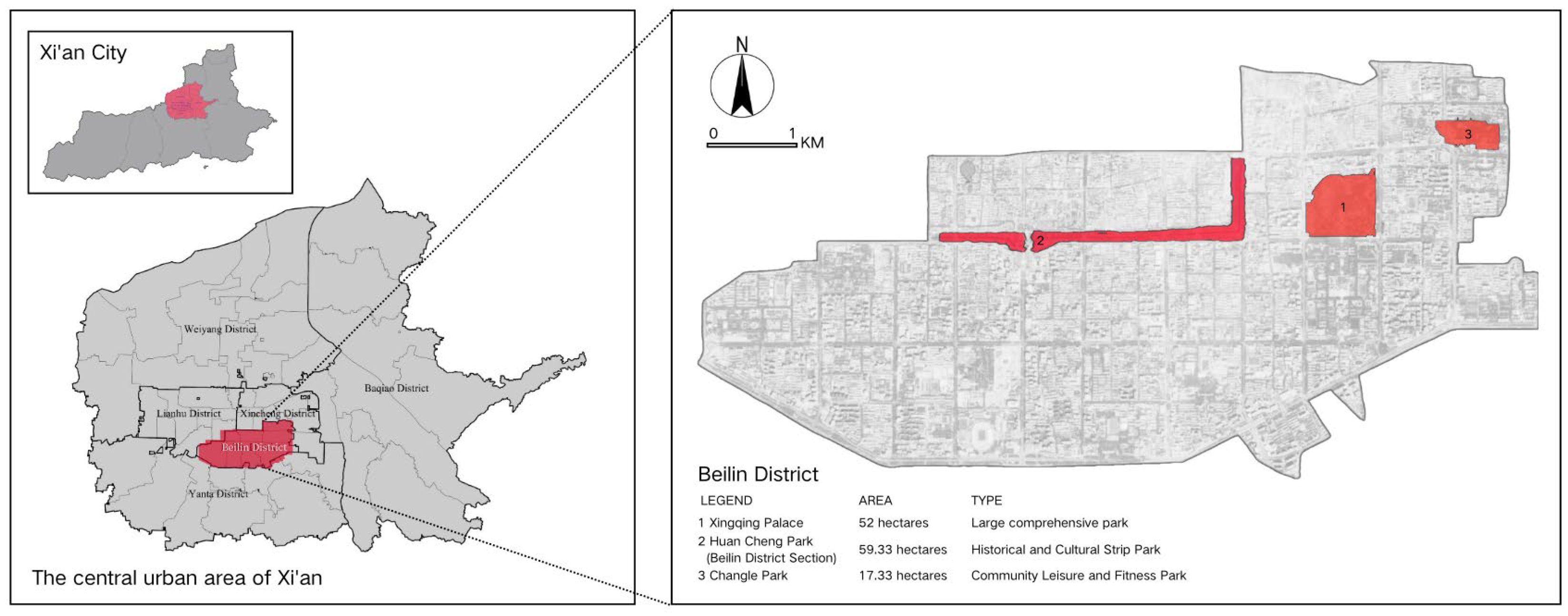
This study focuses on the central urban districts of Xi’an, encompassing six administrative districts: Beilin, Xincheng, Lianhu, Yanta, Baqiao, and Weiyang. According to data from China’s Seventh National Population Census, Beilin District, a high-density historic urban area, has the highest aging rate among these districts at 20.19%. Its elderly population density reaches 6542.77 people per square kilometer (Table 1), making it a highly representative case for studying aging populations in dense urban settings.
To systematically compare the impact of walking environments in different park types on the health of older adults, this study selected three representative park categories based on the functional classification in the Xi’an Urban Green Space System Plan, namely, urban comprehensive park, historic–cultural park, and community leisure park. This selection also considered the spatial distribution balance and service coverage (Figure 1).
Xingqing Palace Park, located in the eastern Beilin District, is an urban comprehensive park covering approximately 52 hectares. It features a planar layout with lakes, woodlands, plazas, and diverse cultural facilities, serving as a large-scale, multi-functional recreational space. Huancheng Park is located in the city center, with the Beilin District section covering an area of approximately 59.33 hectares. It has been designated as a historic–cultural park. The park was built around the ruins of the Ming Dynasty city wall, stretching in a narrow strip of land. It primarily serves the elderly residents of Xi’an’s old city district, surrounding the moat. Changle Park is located in the northeast corner of the Beilin District and covers an area of approximately 17.33 hectares. It is a community leisure park. The park features a compact layout centered around a centralized sports field and fitness facilities, primarily serving the elderly residents of eight surrounding communities, including Yongle and Jin Kang.
These three types of parks exhibit significant differences in functional characteristics, spatial layout, scale, and scope of services; however, all serve as public open spaces frequently used by the elderly in Beilin District on a daily basis. By comparing the differences in park types, we can effectively reveal their impact on the health benefits of walking environments for older adults, thereby providing a basis for developing precise evaluation and optimization strategies tailored to different park types.

2.2. Research Data

We conducted the survey of park walking environments for older adults in three parks within Beilin District, Xi’an: Xingqing Palace Park, Huancheng Park, and Changle Park. We distributed 200 questionnaires in each park, totaling 600. The valid response rates were 96% (n = 192) for Xingqing Palace Park, 93.5% (n = 187) for Huancheng Park, and 94.5% (n = 189) for Changle Park. The researchers conducted a statistical analysis of the collected questionnaire data and integrated the basic information of the survey data (Table 2).

3. Research Methodology

3.1. Overarching Framework

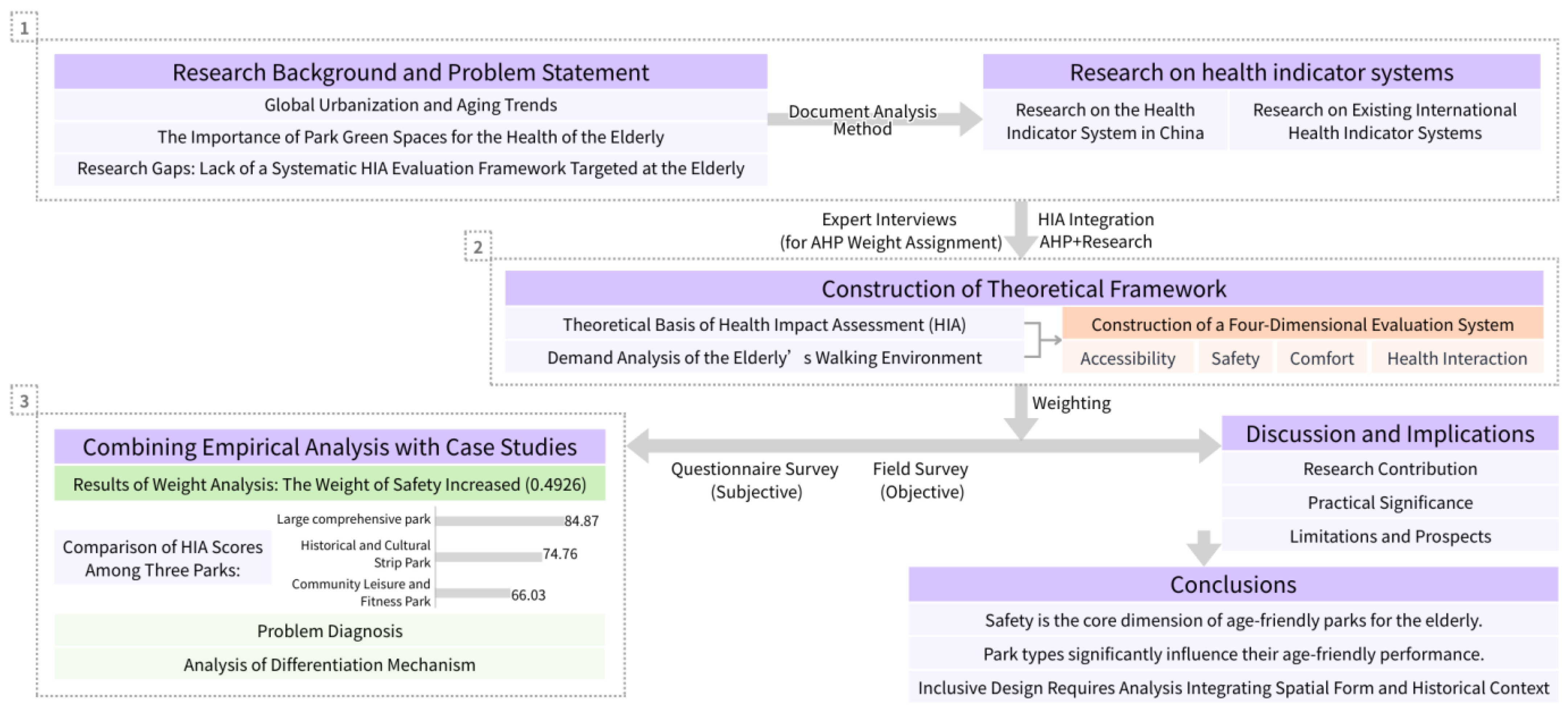
The core objective of this study was to develop a specialized evaluation tool and conduct an empirical analysis. This study addresses the global trends of urbanization and aging. Simultaneously, it aims to fill a critical gap in current research: the absence of a Health Impact Assessment (HIA) system specifically designed to evaluate the health effects of urban parks on older adults. The research framework is illustrated in Figure 2. First, the study integrated cutting-edge findings from the International Health Indicators System to establish an HIA system for walking environments for the elderly in urban parks. This system encompasses four dimensions—accessibility, safety, comfort, and health-related interactivity—and their corresponding weightings. Subsequently, the study selected three representative park types within Xi’an’s Beilin District: an urban comprehensive park, a historic–cultural park, and a community leisure park. Data were collected through questionnaires, field surveys, and on-site interviews. Finally, the study calculated the HIA scores for each sample and conducted a comprehensive comparative analysis, thereby identifying existing challenges in park walking environments that are unfavorable to older adults. This ultimately provides empirical evidence and actionable measures for creating inclusive and age-friendly environments.

3.2. Index System Construction

3.2.1. Research Foundation

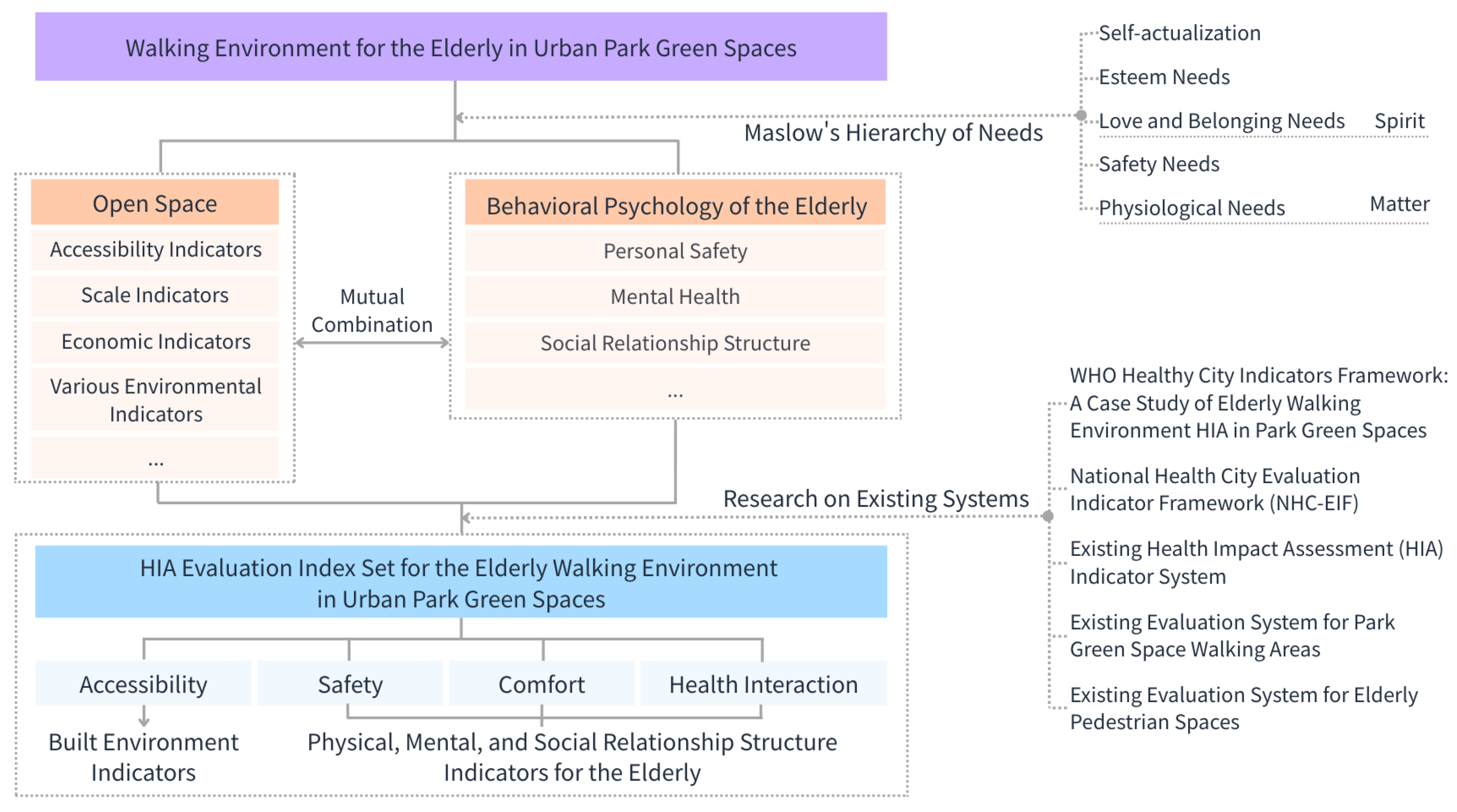
The theoretical framework of the assessment tool developed in this study for the walking environment of older adults in parks and green spaces has clear theoretical and indicator sources. The indicator system is based on Maslow’s Hierarchy of Needs Theory. It extensively draws upon relevant international principles and standards. For example, the indicators of healthy cities set by the World Health Organization (WHO) regarding the accessibility of public spaces and the principles of health promotion, the environmental comfort requirements of the evaluation index system for healthy cities in China, and safety and environmental entries in the Design for Health (DFH) rapid health impact assessment tool. The findings of Paudel et al. (2023) on the importance of park walking path microdesign for the health of older adults [42] were also integrated to ensure that the evaluation system had both an international perspective and local applicability. The specific hierarchical structure is illustrated in Figure 3.
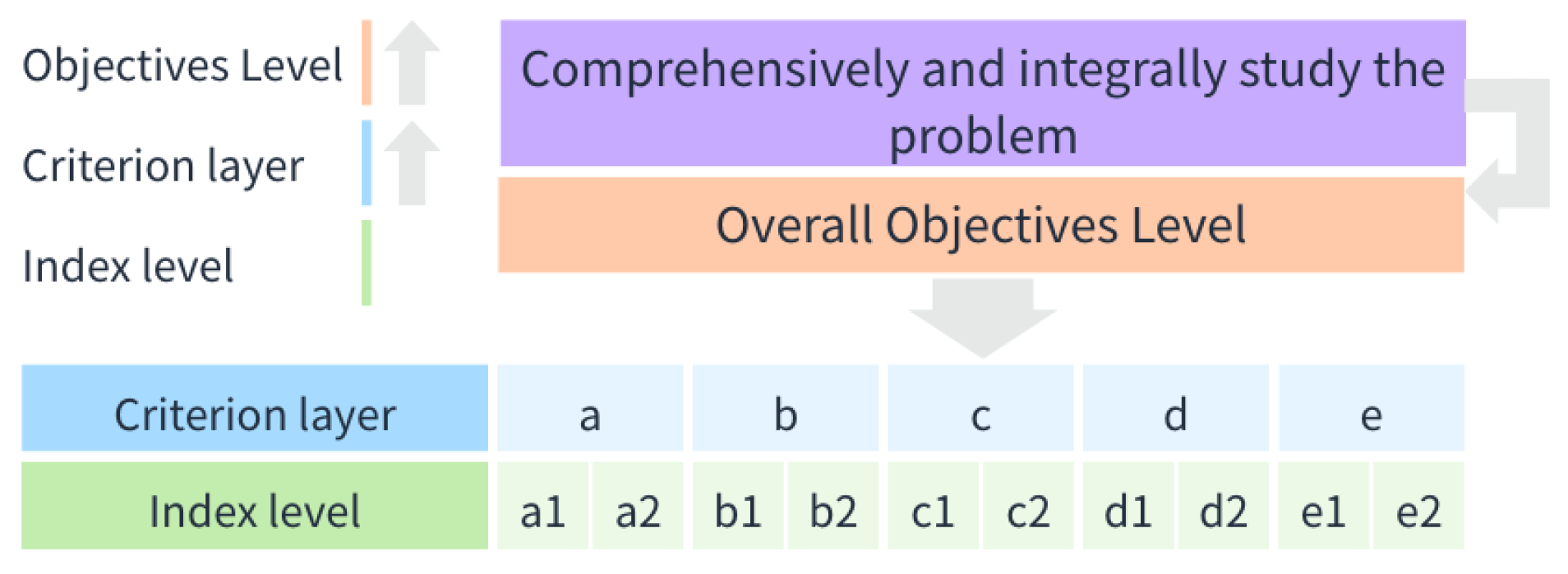
In this study, the Analytic Hierarchy Process (AHP) was used to construct and determine the weights of HIA indicators of the walking environment for older adults in parks and green spaces. AHP, originally developed by Saaty [43] as a systematic multi-criteria decision-making tool, is centered on the decomposition of complex decision problems into a hierarchical structural system [44,45]. This method is based on two basic concepts: hierarchical structure and weight assignment. By constructing a hierarchical model containing a target layer, a guideline layer, a sub-criteria layer, and a program layer, a systematic analysis of the complex problem is realized, and the HIA system of the walking environment for the elderly in parks and green spaces is established. The method calculates a composite weight by quantitatively comparing the relative importance of the elements in each tier. This type of evaluation can deal with both objective environment and subjective health perceptions and is therefore particularly suitable for the comprehensive evaluation questions addressed in this study. Figure 4 illustrates the basic hierarchical structure of the AHP.
During implementation, this study strictly followed the three key steps of AHP. First, as shown in Figure 4, a hierarchical model was constructed. The hierarchical structural model proposed in this study establishes a total of 25 items, ranging from the overall objective of assessing the health impacts of walking environments for the elderly in parks and green spaces to specific assessment factors. To determine the relative importance of the elements of each tier, 20 experts in relevant fields were invited to participate in this study. Saaty’s 1–9 scale was used to systematically compare elements within the same tier two-by-two busing an expert questionnaire, and a judgment matrix was constructed to minimize subjective errors. Finally, the valid questionnaire data were tested for consistency, and the consistency ratio (CR) was calculated to assess the logical consistency of the expert judgment. When the CR value is less than 0.1, the judgment matrix is determined to have acceptable consistency, thus ensuring the reliability of the final weight calculation results.

3.2.2. Preliminary Construction of HIA Indicators for Walking Environment for the Elderly in Parks and Green Spaces

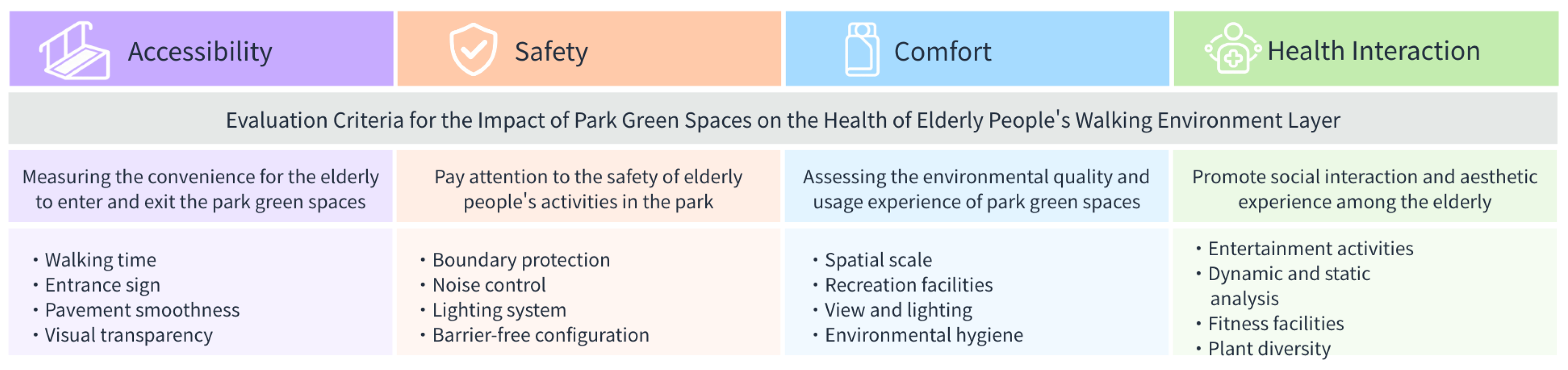
The tool for senior walking environments in parks and green spaces constructed in this study systematically categorizes the health needs of older adults into four spatial evaluation dimensions: accessibility, safety, comfort, and health-related interactivity. The system combines objective indicators and subjective needs (Figure 5).
The accessibility dimension focuses on how easy or difficult it is for older adults to reach and access park spaces, focusing on distance and time [46]. The safety dimension focuses on the personal safety and risk prevention of older adults when they are active in parks, which is the primary prerequisite for outdoor activities [47]. The comfort dimension assesses the physical quality and psychological feelings of the environment in terms of the subjective perception and use experience of older adults [48]. The Healthy Interactivity Dimension, on the other hand, emphasizes the critical role of parks as places that promote health-related interactivity for the mental health of older adults [8]. This categorization not only considers the spatial characteristics of parks and green spaces but also highlights the special needs of older people for their environment. Each dimension contains specific evaluation indicators, which together build a complete evaluation system, providing a systematic tool for subsequent empirical research and design optimization.
The specific classification of environmental health impact assessment factors for senior walking trails in park green spaces is shown in Appendix A, Table A1.

3.2.3. HIA Modeling of the Walking Environment for Seniors in Parks and Green Spaces

In this study, based on HIA, a hierarchical model was developed for assessing the impact of the walking environment in parks and green spaces on the health of the elderly population. The model contains four tiers.
  • Objective Level (O): Assessment of the impact of parkland walking environments on the health of the older population.
  • Criteria Level (A): It covers four main indicators: accessibility, safety, comfort, and health-related interactivity.
  • Sub-criteria Level (B): This is broken down into eight composite metrics, such as external accessibility and internal accessibility.
  • Alternative Level (C): Contains 25 detailed health assessment factors;
  • The details are presented in Table 3.

3.2.4. Thresholds for HIA Indicators of Walking Environment for the Elderly in Parks and Green Spaces—Determination and Analysis of Weights

In order to determine the relative weights of the elements at different levels, an expert questionnaire was designed for this study (Appendix A).
In AHP, the eigenvector W corresponding to the largest eigenvalue λ m a x of the judgment matrix A is normalized to represent the relative importance ranking weight of each factor at the same level with respect to the specific factor at the previous level. The maximum eigenvalue λ m a x is expressed as:
λ m a x = i = 1 n ( A W ) i n W i
In order to test the accuracy of the expert scoring results, a consistency test was performed after the weights were calculated, and the consistency ratio ( C R ) was calculated using the following formula:
C R = C I R I = λ m a x n n 1 R I
where C I denotes the consistency index, and R I denotes the average value of the random consistency index. When C R < 0.1, the judgment matrix satisfies the consistency test [45].
We invited a panel of 20 participants, including experts and local residents, to complete the AHP questionnaire. Four questionnaires were excluded due to incompleteness or obvious logical errors, leaving 16 valid responses for further analysis. These 16 datasets were then imported into the YAAHP V10.3 software for consistency testing. Five questionnaires had consistency ratios ( C R ) exceeding the acceptable threshold of 0.1 and were therefore excluded. The remaining 11 questionnaires, all with C R values below 0.1 (ranging from 0.02 to 0.09), were used to derive the final weights. All original judgment matrices for these 11 participants are provided in Appendix B (Table A2, Table A3, Table A4, Table A5, Table A6, Table A7, Table A8, Table A9, Table A10, Table A11, Table A12, Table A13 and Table A14).
In AHP, the computation of the judgment matrices of the m-bit experts requires the computation of the ordering vector of each judgment matrix as follows:
W c = ( W 1 c , W 2 c , . . . , W n c ) T , c = 1,2 , . . . , m
The integrated ranking vector W is computed as follows:
W j = c = 1 m λ c W j c , j = 1,2 , , n
In order to maintain the objectivity of the evaluation, this study set the weights of each expert to be the same:
W j = 1 m c = 1 m W j c , j = 1,2 , , n
Based on the above methodology, the absolute total ranking weights of the four-level indicator system of the HIA for the walking environment for the elderly in parks and green spaces were calculated (Table 4).

3.2.5. Weighting Analysis of the HIA Rapid Evaluation System

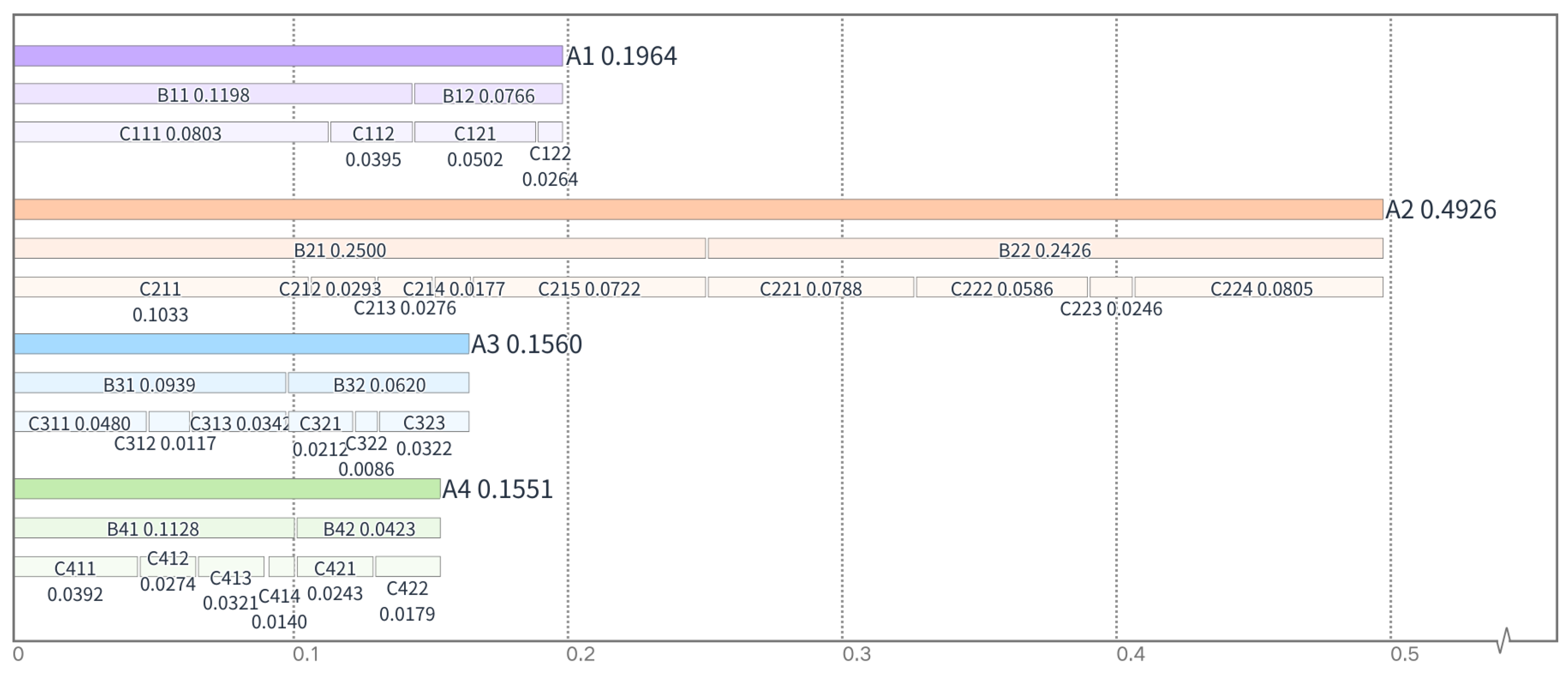
The hierarchical analysis of the final weighting results reveals the relative importance of each health influencer, as shown in the weighting below (Figure 6).
1.
Criteria Level (A)
In the criterion dimension (A), safety received the highest weight (0.4926), indicating that experts consider it the most important dimension for age-friendly environments. Accessibility ranked second with a weight of 0.1964, while Comfort and Healthy Interaction had similar weights of 0.1560 and 0.1551, respectively.
2.
Sub-criteria Level (B)
At the sub-criteria level (B), the weights of site safety and facility safety contributed the most. Notably, social interaction was significantly weighted higher than visual aesthetics, suggesting that from an expert perspective, environmental features that promote social connection have a more positive impact on the health of older adults than pure landscape aesthetics.
3.
Alternative Level (C)
At the specific indicator level (C), the top five most heavily weighted factors are all focused on the area of safety, in the following order: protection of site boundaries, security and rescue facilities, pedestrian accessibility time, safety of facilities, and nighttime lighting. In addition, accessibility and internal garden path accessibility also received high weightings. These results provide a clear quantitative basis for identifying key influencing factors and prioritizing intervention strategies.
Based on the literature review and theoretical analysis, this study constructed a four-tier index system for HIA of the senior walking environment in parks and green spaces. The system integrates the research results of HIA, park green space evaluation, and senior walking environment assessment, and fully considers the characteristics of open space and the special needs of the elderly group. The weights assigned to each indicator level were determined through expert consultation and YAAHP V10.3 software calculations. This multi-level evaluation model with a weighting system not only realizes the structuring and quantification of complex health impact issues, but also provides a scientific measurement tool and analysis system for subsequent empirical evaluation in the region.

3.3. Data Collection

3.3.1. Subjective Data Acquisition

1.
Expert data processing
The expert panel involved in this study was multidisciplinary, comprising researchers, park designers, park managers, and local residents. The researchers had expertise in urban planning, landscape architecture, environmental psychology, and older adult behavior studies, bringing relevant research experience to the panel. The designers and managers contributed frontline practical knowledge, with a deep understanding of park space design and daily operations. Local resident representatives were older adults who regularly used the parks under study, ensuring that the assessment framework genuinely reflected the lived experiences and priorities of the end-users. This composition ensured that the developed tool integrated academic rigor, practical feasibility, and user-centered perspectives. The purpose of the study and the manner in which the data were used were explained to all experts, and there was no potential conflict of interest.
2.
The elderly data processing
Data collection was conducted from March to May 2024 by a trained research team. The study was conducted on older people aged 60 and above who would be engaged in activities in the selected parks. The survey was conducted mainly on weekdays and weekends, covering three daily time periods (8:00–10:00, 14:00–16:00 and 16:00–18:00) to ensure coverage of park users during the different time periods. Respondents were selected through random field sampling: trained interviewers approached older people in the main activity areas and invited them to participate. To ensure a balanced representation of parks, it was planned to distribute 200 questionnaires per park, with an even distribution of valid responses and an overall valid response rate of 94.7%. Inclusion criteria were: (1) aged 60 and above; (2) currently engaged in leisure or exercise activities in the parks; (3) cognitive ability to understand and complete the questionnaire independently or with the assistance of others; and (4) voluntary participation. Exclusion criteria were (1) age below 60; (2) significant cognitive or communication impairment to understand the questionnaire; and (3) refusal to participate or withdrawal. To assess potential nonresponse bias, interviewers briefly recorded the gender and approximate age range (based on observations) of those who refused to participate in the survey. The main reasons for refusal included “scheduling constraints” or “unwillingness to be interviewed,” and there was no evidence of systematic selection bias. The sample size met the requirements for subsequent statistical analysis.
Before the formal survey, a pilot test was conducted in Xingqing Palace Park in February 2024 with 30 randomly selected older adults. The purposes of the pilot test were to: (1) assess the clarity and comprehensibility of the questionnaire items; (2) evaluate the average completion time; and (3) identify any potential cultural or language barriers. Based on the pilot feedback, minor wording adjustments were made to improve clarity, such as rephrasing “path connectivity” to a more colloquial expression. The completion time was controlled to approximately 5–8 min. Data from the pilot test were not included in the final analysis.
Based on the established HIA system for the walking environment for older adults in parks and green spaces, a research questionnaire was designed and distributed in this study. The questionnaire is centered on four dimensions: accessibility, safety, comfort, and health-related interactivity, and contains 25 specific indicators, which are assessed using a 5-point Likert scale, with scores ranging from 1–5 representing “poor” to “very good” (see Table 5 for details). The score from 1 to 5 represents “very poor” to “very good” respectively (see Table 5 for details).

3.3.2. Objective Data Acquisition

This objective data collection aims to validate and supplement the results of the preliminary questionnaire and provide a diverse basis for data analysis. The specific information collected is summarized in the table below (Table 6).

3.3.3. Statistical Analysis

To verify the reliability of the health impact assessment (HIA) instrument with 25 indicators constructed in this study as a reusable scale, we tested the reliability of 568 valid questionnaire data collected. The internal consistency of the scale was assessed by the Clonal Bach coefficient, which showed that the Clonal Bach α coefficient of the total scale was 0.92, and the α coefficients of the four core dimensions-accessibility (4 items), safety (9 items), comfort (6 items) and health interactivity (6 items) were 0.78, 0.88, 0.83 and 0.81, respectively. The α coefficients of all dimensions were above the recommended threshold of 0.7, indicating that this assessment tool has excellent internal consistency reliability.
All statistical analyses were performed using SPSS 26.0. Descriptive statistics, including means and standard deviations, were calculated for each dimension and for the overall HIA score. To compare differences among the three parks, independent samples t-tests were conducted for each dimension and for the overall HIA score. Effect sizes were calculated using Cohen’s d. The significance level was set at p < 0.05.

4. Results

4.1. HIA Score Results for Each Park

Based on the weighting system for elderly walking environments in park green spaces outlined in Section 3 of this article, the scoring table for elderly health factors in park walking environments, and the objective evaluation of park conditions, this study analyzes HIA evaluation scores for urban comprehensive park, historic–cultural park, and community leisure parks. The calculation formula is:
W n = f x = i = 1 n T n X n 4 1
In this study, T n represents the relative weight coefficient, indicating the specific score value for each evaluation indicator, while W n corresponds to the comprehensive score of the indicator level. The research employs a 5-point scale as the scoring standard for the original questionnaire, where 5 indicates the highest level of satisfaction, and 1 represents the lowest level of satisfaction. To ensure consistency and comparability in data analysis, this study converts the original 5-point scale scores to a percentage-based scoring system. The specific conversion formula is as follows:
f x = 20 W n 4 2

4.1.1. Xingqing Palace Park HIA Score Results

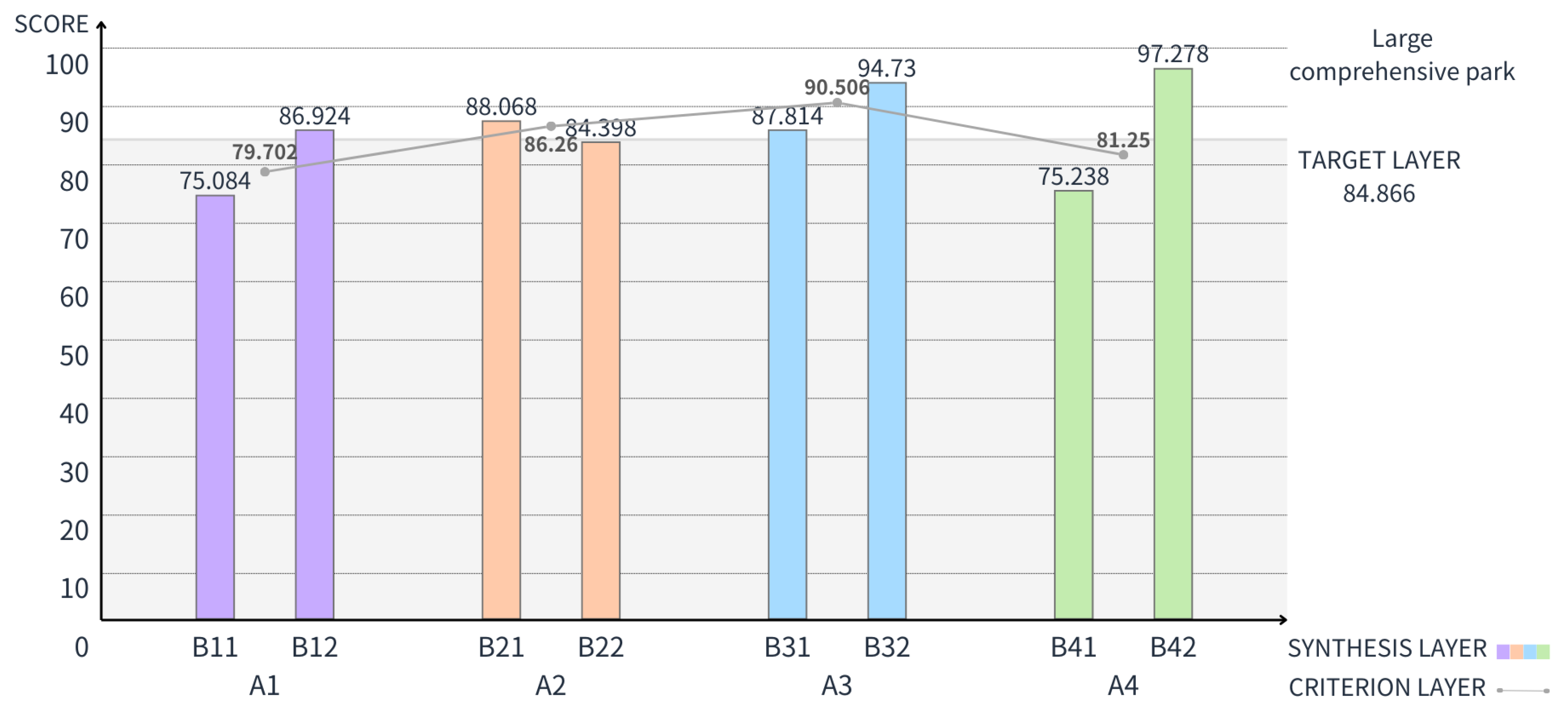
As shown in Figure 7, Xingqing Palace Park, functioning as an urban comprehensive park, achieves the highest HIA score in the Comfort dimension at the Criteria Level, while the Accessibility dimension receives the lowest score.
As for the eight indicators at the Comprehensive Level, all scores are relatively high, exceeding the passing threshold of 60 points. The score for the Visual Aesthetics indicator reaches a notable high of 97 points, while the scores for the External Accessibility and Social Interaction indicators are comparatively lower.
Furthermore, the formula for calculating the HIA score at the Objective Level is the sum of the HIA scores at the Criteria Level multiplied by their respective relative weights. Based on this calculation, Xingqing Palace Park achieves a final health quality score of 84.866 for its elderly walking environment.
The detailed calculation process is provided in Appendix C, Table A15.

4.1.2. Huancheng Park HIA Score Results

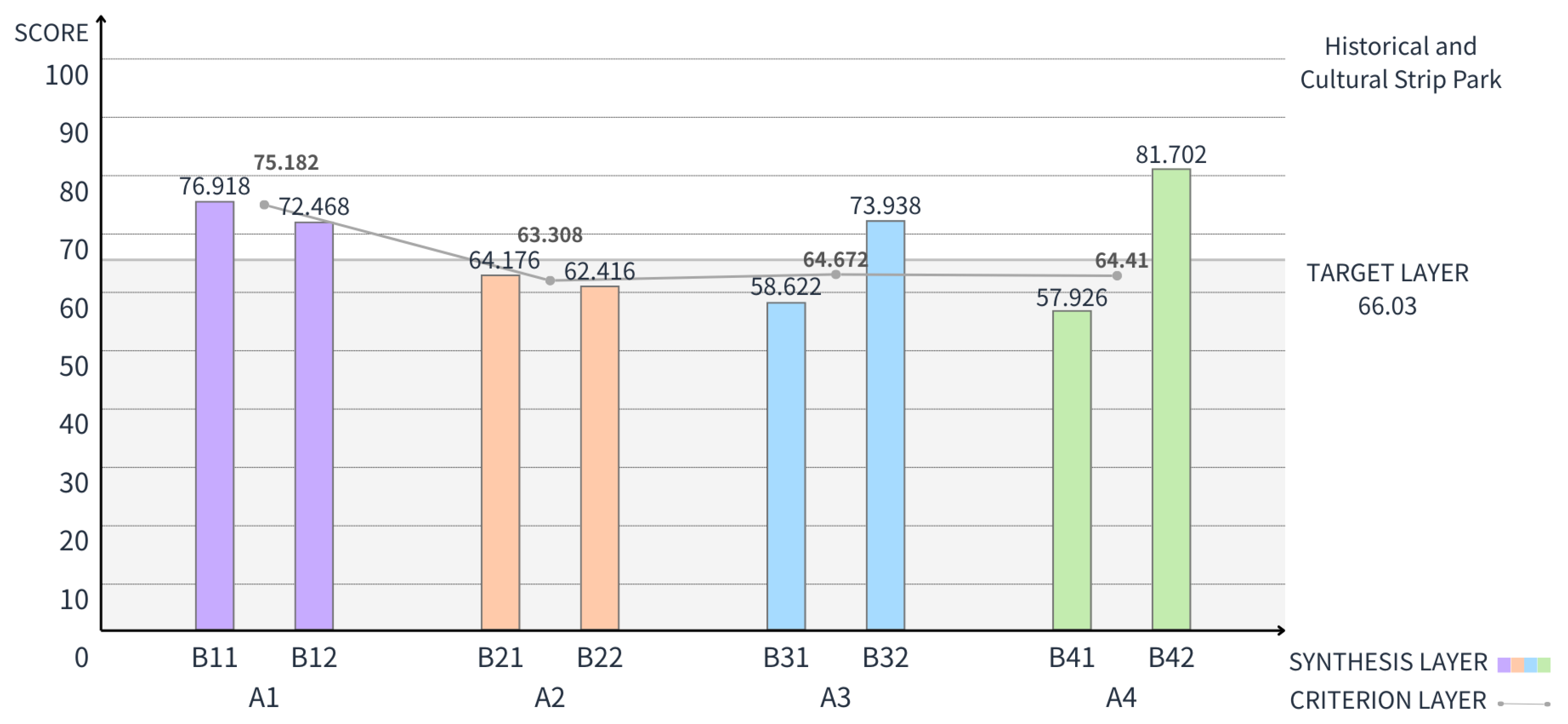
As shown in Figure 8, due to its linear morphology and location, the score for the Accessibility indicator in Huancheng Park is significantly higher than those of the other three indicators, reaching 75 points.
Due to insufficient consideration of age-friendly design for pedestrian environments, the Huancheng Park scored the lowest in safety metrics at just 63 points. Its scores for comfort and health-related interactivity were 64.672 points and 64.41 points.
Moreover, the eight comprehensive levels of the Huancheng Park scored relatively low, with both behavioral comfort and social interaction falling below 60 points. Safety of the site and facilities was average, scoring under 65 points, while visual aesthetics received a higher score.
Based on this calculation, Huancheng Park achieves a final health quality score of 66.03 for its elderly walking environment.
The detailed calculation process is provided in Appendix C, Table A16.

4.1.3. Changle Park HIA Score Results

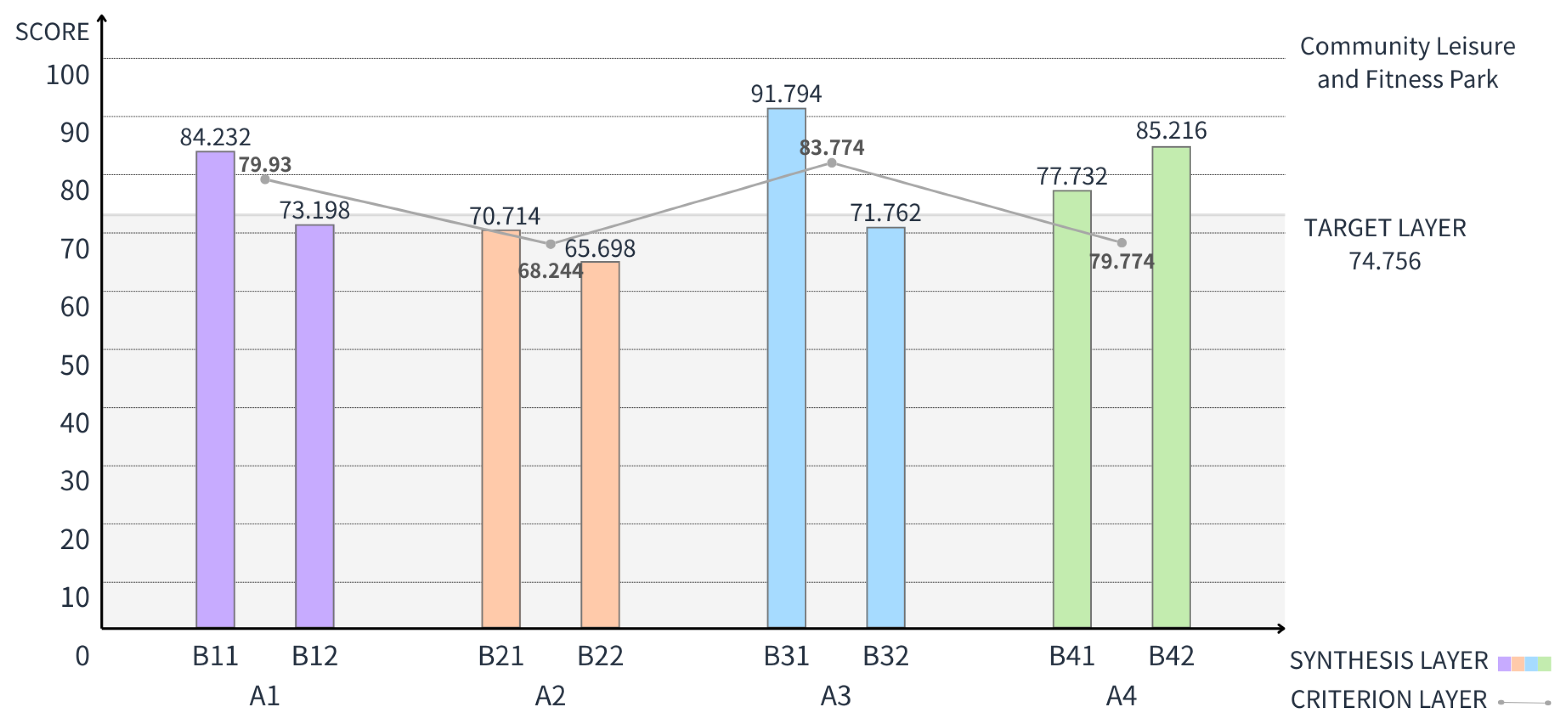
As shown in Figure 9, Changle Park, as a community leisure park, achieved a high comfort index score of 83 points.
The safety score is relatively low at 68 points. Due to insufficient consideration of age-friendly design for the walking environment at Changle Park, its accessibility and health-related interactivity scores are 79.93 points and 79.774 points, respectively.
Changle Park scored well across all eight comprehensive level indicators, with each exceeding 60 points. Among these, the behavioral comfort indicator achieved the highest score at 91 points, indicating that Changle Park offers a highly comfortablewalking environment.
The facility safety metric scored the lowest at just 65 points, indicating that Changle Park has shortcomings in areas such as accessibility facilities and security/emergency medical facilities.
Based on this calculation, Changle Park achieves a final health quality score of 74.756 for its elderly walking environment.
The detailed calculation process is provided in Appendix C, Table A17.

4.2. Comprehensive Analysis of Park HIA Score Comparisons

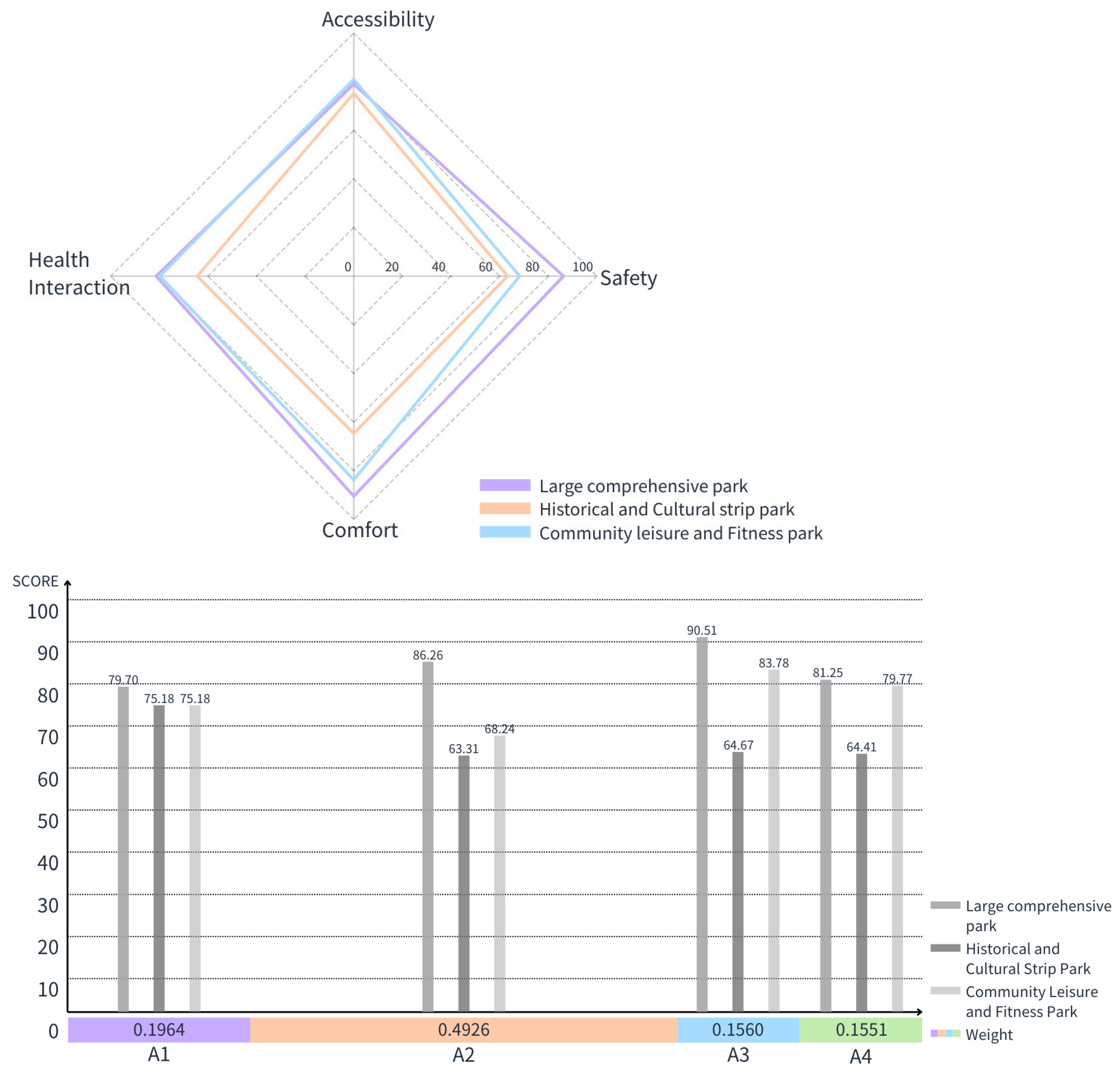
The radar chart and composite score (Figure 10) clearly reveal the significant differences in the health impacts of walking environments across the three park types for older adults, along with their underlying logic. Based on the overall scores, Xingqing Palace Park performed the best with 84.87 points; Changle Park came in second with 74.76 points; while Huancheng Park scored the lowest at 66.03 points. This ranking is not coincidental, but rather the result of the synergistic effects of park type, spatial form, management standards, and age-friendly design.
All three parks scored above 75 points in accessibility, indicating that they generally meet basic requirements for spatial coverage and entrance accessibility. Among them, the Huancheng Park scored 76.92 points for external accessibility due to its linear layout, which provided a slight advantage. However, its internal accessibility score was relatively low at 72.47 points, primarily because of its monotonous path design and lack of convenient internal loops. Xingqing Palace Park’s large scale results in significant distances between attractions, making internal accessibility a relative weakness. It scored 86.92 points—higher than the other two sample parks but lower than its own scores in other dimensions. Changle Park, as a community park, is most closely integrated with the surrounding residential areas and achieved the highest external accessibility score of 84.23 points.
In terms of safety, its weight of 0.4926 indicates that experts view safety as the most important dimension for evaluating park walking environments. Xingqing Palace Park demonstrates a clear advantage in this dimension, scoring 86.26 ± 13.0 points. Its systematic management ensures well-defined boundaries, comprehensive security facilities, and ample nighttime lighting, providing an excellent walking environment for the elderly. In contrast, Changle Park scored relatively low on safety, with a total score of 68.24 ± 13.0 points. Its weaknesses were particularly evident in the facility safety subcategory, where it scored only 65.70 points. Specific issues included outdated accessibility facilities, uneven ground surfaces, and insufficient security camera coverage. Huancheng Park has the most serious safety issues, with a total score of 63.31 ± 13.0, and both its site safety and facility safety scores are lower, at 64.18 and 62.42, respectively. Field research confirmed the park’s severe lack of nighttime lighting, lack of emergency aid, and mixing of people and vehicles in some sections, all of which combine to create barriers to use for seniors.
Commodity dimensions significantly influence park usage experiences and senior engagement. Changle Park demonstrates exceptional comfort, scoring 83.77 ± 12.0 points—particularly excelling in behavioral comfort with a high score of 91.79. This achievement stems from the park’s diverse activity spaces, abundant fitness facilities, and vibrant social atmosphere, all of which effectively promote daily activities among older adults. Xingqing Palace Park achieved the highest comfort score of 90.51 ± 12.0 points, reflecting its comprehensive strengths in spatial scale, greenery and shade coverage, and environmental hygiene. In contrast, Huancheng Park scored only 64.67 ± 12.0 points for comfort. Its linear layout struggles to create comfortable areas for lingering and activities. Combined with insufficient seating and other resting facilities, along with limited shade during summer, this reduces seniors’ willingness to stay and shortens their activity duration.
Health-related interactivity directly impacts older adults’ social engagement and mental health issues [8]. Xingqing Palace Park, with its beautiful scenery, achieved a visual aesthetics score of 97.28, providing an excellent aesthetic experience and tranquil atmosphere. Changle Park scored higher in social interaction at 77.73 ± 11.0 points, reflecting its role as a community space fostering neighborly connections. Huancheng Park performed weakly in this dimension with a total score of only 64.41 ± 11.0 points. Its monotonous linear landscape and limited interactive facilities constrained the richness of recreational activities and social engagement.
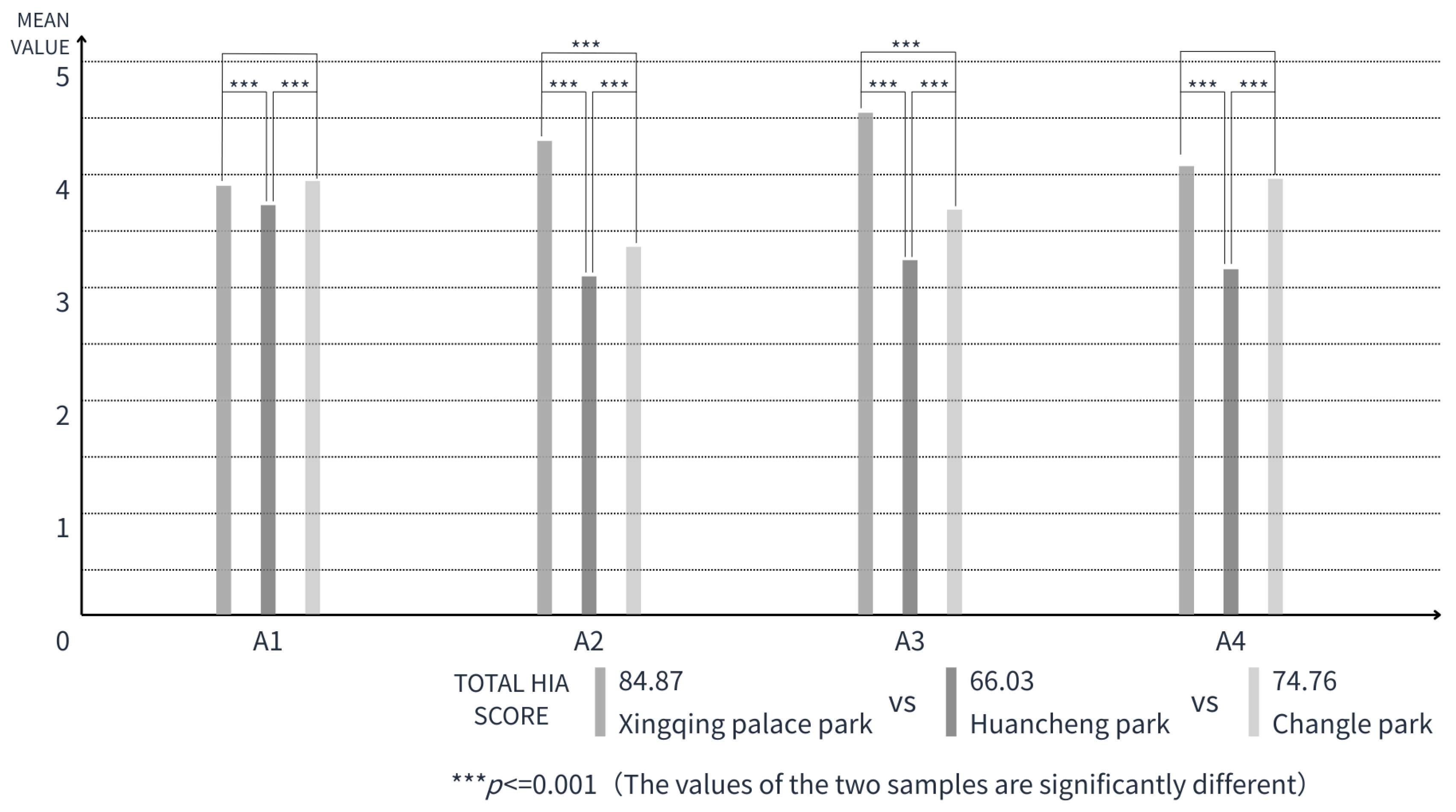
The assessment revealed significant differences in age-friendly performance among the three park types. Safety carried the highest weight (0.49) in the evaluation system, indicating that experts consider it the most important dimension for older adults. Independent samples t-tests (Table 7) further indicated that the urban comprehensive park performed significantly better in safety and comfort than both the historic–cultural park and the community leisure park, with a p-value of less than 0.001. Although the historic–cultural park demonstrated good external accessibility, its scores for safety and comfort were significantly lower than those of the other two park types, also at a p-value of less than 0.001. This finding suggests that high accessibility does not necessarily equate to effective health-promoting functions.
In this study, a significance analysis was conducted on the values at different levels of the three sample parks, and the results are shown in Figure 11.
Comprehensive analysis indicates that the primary challenge facing urban park green spaces has shifted from ensuring sufficient quantity to optimizing quality and service effectiveness. The case of the Ring Park serves as a stark warning: despite its excellent external accessibility due to its layout, its actual utility as a health-promoting space is significantly diminished by dual deficiencies in safety and comfort. This demonstrates that spatial advantages do not automatically translate to efficient services, nor does high route accessibility equate to rich park content. For the elderly, safety is the primary determinant of their willingness to use parks, while comfort and health-promoting interactions directly influence usage frequency, duration, and the health benefits gained.

5. Discussion

5.1. HIA System for Walking Environments for Seniors in Parks and Green Spaces

As key public spaces that support the physical and mental health of older adults, the age-appropriate quality of parkland is directly related to urban health equity. However, much of the existing research focuses on single-dimensional or broad landscape evaluations and lacks systematic diagnostic tools that address the complex health needs of older adults. Therefore, this study has established a park walking environment HIA system that integrates four dimensions: accessibility, safety, comfort, and health-related interactivity.
The core innovations of the system are: first, it realizes the transformation from needs to space; the framework is based on Maslow’s theory of needs, and transforms the multi-level needs of the elderly, ranging from safety and shelter to social participation, into specific and quantifiable spatial indicators; second, through the establishment of quantifiable spatial indicators, it can accurately locate the core contradictions of different parks in the area of aging, thus promoting the formulation of targeted strategies.
The tool has both a solid theoretical foundation and strong operationalization. It provides a reliable basis for the precise improvement of environmental health space.

5.2. Precise Optimization Strategy Based on Multi-Type Comparison and Four-Dimensional Diagnosis

Three types of typical parks, large comprehensive parks, historic–cultural parks, and community leisure parks, were selected for comparison in this study. The research found that the type of park directly affects its spatial form, functional layout, and management style, which in turn shapes its respective strengths and weaknesses. Based on the systematic assessment of the four dimensions, we propose targeted optimizations and recommendations that can be used for reference (Table 8):
Integrated urban parks should focus on improving their effectiveness and setting quality benchmarks. Specifically, their systemic strengths in safety management and facility maintenance need to be maintained. At the same time, the focus is on enhancing interactive features, such as adding social spaces and cultural activity points that encourage communication among different age groups. In addition, the guidance signs and transportation facilities within the park should also be improved to address the inconvenience caused by the large size of the park in terms of internal movement.
The transformation of historic–cultural parks focuses on making up for security loopholes and supplementing functional facilities. First of all, it is necessary to systematically solve the core problem of potential safety hazards, adopt intelligent lighting and safety monitoring technologies in line with historical features, and ensure the smooth flow of barrier-free passages throughout the process. At the same time, at key locations in the park, rest facilities should be cleverly integrated to enhance the comfort of these areas. The core strategy of community leisure parks is to maintain vitality and ensure safety. Such parks should continue to give full play to their own advantages, improve comfort, provide rich activity venues, and at the same time promote healthy interaction and maintain the vitality of community exchanges. In addition, it is necessary to establish a refined management and maintenance mechanism, regularly overhaul and update old fitness equipment, and provide barrier-free facilities.

5.3. Research Limitations and Future Prospects

In this study, a multidimensional HIA model was developed using hierarchical analysis, questionnaires, and field surveys. However, there are some limitations in this study. First, as a cross-sectional study, it is difficult to determine the causal relationship between environmental characteristics and health behaviors, based mainly on subjective perceptions and static environmental data.
In interpreting the results of this study, it is important to place them in the context of its cross-sectional design. The data presented reflect an association, rather than a causal relationship, between park environment characteristics and health-related perceptions of older adults at a particular point in time. While the HIA framework provides a systematic approach to assessing potential health impacts, the cross-sectional nature of this study meant that we could not determine whether the observed environmental features directly led to changes in health outcomes or whether there were other unmeasured factors (e.g., personal health status, socioeconomic background, personal preferences) that could influence park use patterns and health perceptions. Therefore, the relationships identified in this study should be viewed as correlational rather than causal. For example, the finding that safety had the highest weight (0.49) in the HIA system suggests that older adults perceive safety as the most important dimension in the park walking environment; however, this does not necessarily mean that improved safety features will directly lead to better health outcomes. It is possible that older adults who are otherwise in better physical condition or more active may have different perceptions of safety, or that those parks with better safety features attract older adults with specific socioeconomic characteristics. Future longitudinal studies or quasi-experimental designs are needed to determine the causal relationship between environmental improvements in parks and health outcomes.
Second, the psychometric validation of the assessment tools is still not fully developed. Although this study constructed an indicator system based on HIA theory and expert consultation, and determined the weights of each indicator through the Analytic Hierarchy Process (AHP), it did not conduct a complete psychometric test. Specifically, although we have tested the internal consistency reliability of the tool through the clonal Bach coefficient (total scale α = 0.92, each dimension α is between 0.78–0.88), indicating that the tool has good internal consistency, but Confirmatory factor analysis was not performed to confirm whether the preset four-dimensional structure (accessibility, safety, comfort, health interactivity) fits well with the data, nor was the test–retest reliability of the tool evaluated to test its cross-time.
Third, the weighting system of the HIA remains somewhat subjective, despite the fact that it was subjected to expert consultation and consistency tests. It should be noted that the expert panel did include local older adult residents who regularly used the study parks, which was intended to ensure that the assessment framework reflected the genuine experiences and needs of end-users. However, even with the inclusion of older representatives, the depth of their participation in the weight determination process remained limited. This limitation is discussed from two perspectives: ① the complexity of the AHP pairwise comparison process may have posed operational difficulties for some older adults, limiting their direct involvement in the weight assignment task; ② the views of a small number of older representatives cannot fully capture the heterogeneous needs of the entire older adult population, as older adults with different ages, health conditions, and activity preferences may have divergent judgments on the importance of various environmental factors. Therefore, while the current weighting system achieved consensus at the expert level, it remains essentially an “expert proxy judgment” rather than a direct quantification based on the preferences of a large sample of older adults. The weighting system could be further calibrated in the future by collecting data on the preferences of a large number of older adults using more accessible methods (such as simplified AHP, ranking methods, or discrete choice experiments).
Fourth, there is a potential selection bias in the survey content. The questionnaire of this study is limited to the elderly who are active in the park, and does not include those who do not often go to the park or are not elderly. There may be systematic differences in health status, mobility, needs and perceptions of the environment between the two groups of people. Therefore, the results of this study mainly reflect the perspective of “park users” and may not be generalized to the entire elderly population. Future research can include more elderly people who do not use parks frequently through community recruitment and other methods to reduce selection bias.
Fifth, we did not collect more detailed indicators on park use, such as the number of visits per week or the length of each visit, which limited our ability to analyze the relationship between different patterns of use and perceived health. As a result, this study could not rule out the possibility that there may be underlying systematic differences between age groups or exercise frequency, nor could it distinguish between high and low frequency users, or between first-time visitors and regulars in terms of their evaluations. Therefore, these findings primarily reflect the overall extent of the health impacts of the three parks on the walking environment for older adults, and do not explore differences between different groups of older adults.
Sixth, the regional specificity of the study limits the universal applicability of the conclusions. All three sample parks are located in Beilin District, Xi’an, a high-density old city with a specific historical background, population density and urban form. Parks in different cities and regions may have significant differences in their surrounding environment, user composition and management models. Therefore, the applicability of the assessment tool constructed in this study and its diagnoses should be carefully validated when applied in other cities or regions.
What is more, the seasonal constraints of data collection and a lack of objective indicators. All field surveys and questionnaire distribution for this study were completed in spring (March to May), failing to cover park use in other seasons, such as summer and winter. In particular, indicators such as “summer shade” in the “comfort” dimension are only evaluated based on the perception of spring, which may deviate from the actual experience of summer. In addition, this study is mainly based on the subjective perception of the elderly, and cannot be verified in combination with objective health indicators (such as actual visit frequency, physical activity level, blood pressure, heart rate, etc.). Future research should consider data collection across seasons and integrate objective health surveillance methods to obtain more comprehensive and accurate assessment results.
Finally, future research could use objective and dynamic data, such as GPS trajectories and physical activity monitoring, to track real behavioral patterns of older adults in parks. At the same time, a longitudinal study design was incorporated to observe the changes in health behaviors and the benefits of older adults before and after age-appropriate park improvements over time. On this basis, a dynamic health impact prediction and assessment model was constructed to upgrade the static evaluation framework of this study into a tool with prediction and simulation functions for assessing the changes in health benefits brought about by different interventions. In addition, the refined governance framework can be extended to more types of urban green spaces to promote the establishment of more systematic and precise inclusive urban green spaces.

6. Conclusions

This study developed and applied a health-oriented assessment tool for evaluating age-friendly walking environments in parks. The tool incorporates four core dimensions: accessibility, safety, comfort, and health-promoting interactivity. We employed it in an empirical evaluation of three representative park types in Beilin District, Xi’an: the urban comprehensive park known as Xingqing Palace Park, the historic–cultural park known as Huancheng Park, and the community leisure park known as Changle Park.
The evaluation revealed significant differences in age-friendly performance across the three park types. Safety received the highest weight (0.49), indicating that experts perceived it as the most critical dimension for older adults’ health perception. Statistical analysis showed that the comprehensive park performed significantly better in safety and comfort than both the historic–cultural park and the community leisure park (p < 0.001). Although the historic–cultural park demonstrated good accessibility, its safety and comfort scores were significantly lower than those of the other two park types (p < 0.001).
The primary contribution of this study lies in constructing and validating a structured assessment framework for age-friendliness. This framework provides an empirical basis for identifying specific deficiencies in park walking environments and for developing targeted optimization strategies. Our findings also show that park typology—namely urban comprehensive parks, historic–cultural parks, and community leisure parks—presents distinct age-friendly characteristics and challenges due to inherent variations in their historical functions, spatial layouts, and management approaches. Consequently, a standardized renovation approach is unlikely to be effective. Instead, tailored strategies that consider park typology are needed (Figure 10).
Future age-friendly urban planning should shift from merely pursuing quantitative green space targets to genuinely enhancing the health benefits derived from such spaces, promoting evidence-based interventions. Subsequent research could collect longitudinal data and employ more robust statistical models to further verify the applicability and explanatory power of this assessment tool across diverse urban contexts.

Author Contributions

Conceptualization, L.L. and X.L.; methodology, R.C., Y.L. and L.L.; software, R.C. and Y.L.; validation, R.C. and Y.L.; formal analysis, H.L.; investigation, H.L.; resources, L.L.; data curation, L.L.; writing—original draft preparation, X.L., R.C. and Y.L.; writing—review and editing, R.C. and Y.L.; visualization, R.C. and Y.L.; supervision, L.L.; project administration, L.L.; funding acquisition, L.L. All authors have read and agreed to the published version of the manuscript.

Funding

Research on the Mechanism and Design Strategies of Urban Community Built Environ-ment to Promote a Healthy Aging Society (20240108), Key Laboratory of Ecology and Energy Saving Study of Dense Habitat, Ministry of Education.

Data Availability Statement

The raw data supporting the conclusions of this article will be made available by the authors upon request.

Conflicts of Interest

The authors declare no conflicts of interest.

Abbreviations

The following abbreviations are used in this manuscript:
HIAHealth Impact Assessment
AHPAnalytic Hierarchy Process
WHOthe World Health Organization
YAAHPYet Another AHP
CRConsistency Ratio
CIConsistency Index
RIRandom Consistency
DHFDesign for Health
2SFCAtwo-step floating catchment area

Appendix A

HIA System Expert Consultation Form

Based on prior literature research, it has been found that urban green spaces are closely related to physical activity among older adults. Optimizing the green spaces themselves and their surrounding built environments can actively leverage the guiding role of urban green spaces in promoting older adults’ usage and activities, thereby enhancing their physical health. Therefore, this paper establishes an environmental health impact evaluation system for senior walking trails in park green spaces.
Given your extensive professional expertise in this field, your assistance and guidance are urgently needed for this research. Your insights are of paramount importance to us. We sincerely hope you can take the time to complete this questionnaire amidst your busy schedule. We deeply apologize for any inconvenience this may cause and extend our most sincere gratitude.
I.
Environmental Health Impact Assessment Factors for Senior Walking Trails in Park Green Spaces (Table A1).

Table A1. Environmental Health Impact Assessment Factors for Senior Walking Trails in Park Green Spaces.
Criterion LayerComprehensive LayerSpecific Health Impact Assessment Factor Layer
Accessibility A1B11 External AccessibilityC111 Walking travel time is not long
C112 Entrance is prominent and convenient
B12 Internal AccessibilityC121 Internal park pathways are unobstructed
C122 Visual permeability of spaces/sites is good
Safety A2B21 Site SafetyC211 Site has clear boundaries to prevent vehicle passage
C212 Site is free from noisy traffic sounds
C213 Vegetation branches are trimmed to avoid causing injury
C214 Avoid planting greenery with strong, irritating odors
C215 Night lighting system is adequate
B22 Facility SafetyC221 Structures and furnishings are sturdy, without sharp edges, damage, or other safety hazards
C222 Barrier-free facilities are well-equipped
C223 Park signage system is clear
C224 Security and first-aid facilities are well-equipped
Comfort A3B31 Behavioral ComfortC311 Spatial scale meets the activity needs of the elderly
C312 Walking path width is adequate
C313 Sufficient resting facilities
B32 Perceptual ComfortC321 Good ventilation and lighting conditions inside the park
C322 Adequate shade in summer
C323 Clean and well-maintained paths
Health Interaction A4B41 Social InteractionC411 Rich recreational activities
C412 Clear distinction between rest areas and activity areas
C413 Sufficient recreational and fitness facilities
C414 Co-located with children’s facilities
B42 Visual AestheticsC421 Diverse plant configuration
C422 Surrounding architectural landscape and structures have aesthetic design
II.
Questionnaire Completion and Selection Methods
Please carefully consider the relative importance of each factor. For example, if you rank factors X, Y, Z, pairwise comparisons should yield X ≥ Y, Y ≥ Z, X ≥ Z. Should Z ≥ X occur, this creates a logical contradiction requiring reassessment and correction. Otherwise, completed questionnaires may introduce self-contradictions, compromising survey accuracy. Thank you!
III.
Evaluation Factor Weight Assignment
Comparative Analysis of Relative Importance of Standard Layer Evaluation Factors:
Comparative Factors: Accessibility; safety; comfort; health-related interactivity.
  • 1.
    Priority Ranking: ( ) ≥ ( ) ≥ ( ) ≥ ( ).
    2.
    Based on the above ranking of importance, compare the relative significance of each pair of factors.
Evaluation FactorVery ImportantImportantFairly ImportantSlightly ImportantEqualSlightly ImportantFairly ImportantImportantVery ImportantEvaluation Factor
Weight value5/14/13/12/11/11/21/31/41/5Weight value
Accessibility (1) Safety (2)
Comfort (3)
health-related interactivity (4)
Safety (2) Comfort (3)
health-related interactivity (4)
Comfort (3) health-related interactivity (4)
Comparison Factors: External accessibility; internal accessibility.
  • 1.
    Priority Ranking: ( ) ≥ ( ).
    2.
    Based on the above ranking of importance, compare the relative significance of each pair of factors.
Evaluation FactorVery ImportantImportantFairly ImportantSlightly ImportantEqualSlightly ImportantFairly ImportantImportantVery ImportantEvaluation Factor
Weight value5/14/13/12/11/11/21/31/41/5Weight value
External Accessibility (1) Internal Accessibility (2)
Comparative factors: Short walking time required; prominent and convenient entrance to the venue.
  • 1.
    Priority Ranking: ( ) ≥ ( ).
    2.
    Based on the above ranking of importance, compare the relative significance of each pair of factors.
Evaluation FactorVery ImportantImportantFairly ImportantSlightly ImportantEqualSlightly ImportantFairly ImportantImportantVery ImportantEvaluation Factor
Weight value5/14/13/12/11/11/21/31/41/5Weight value
Short walking time required (1) Prominent and convenient entrance to the venue (2).
Comparative Factors: Park pathways are well-maintained; spatial sightlines are unobstructed.
1.
Priority Ranking: ( ) ≥ ( ).
2.
Based on the above ranking of importance, compare the relative significance of each pair of factors.
Evaluation FactorVery ImportantImportantFairly ImportantSlightly ImportantEqualSlightly ImportantFairly ImportantImportantVery ImportantEvaluation Factor
Weight value5/14/13/12/11/11/21/31/41/5Weight value
Park pathways are well-maintained (1) spatial sightlines are unobstructed. (2)
Comparative Factors: Site safety; facility safety.
  • 1.
    Priority Ranking: ( ) ≥ ( ).
    2.
    Based on the above ranking of importance, compare the relative significance of each pair of factors.
Evaluation FactorVery ImportantImportantFairly ImportantSlightly ImportantEqualSlightly ImportantFairly ImportantImportantVery ImportantEvaluation Factor
Weight value5/14/13/12/11/11/21/31/41/5Weight value
Site Safety (1) Facility Safety
(2)
Comparative Factors: The site has defined boundaries to prevent vehicle access; the area is free from disruptive traffic noise; branches of greenery are regularly trimmed to prevent injury; plants with pungent odors are avoided; and the nighttime lighting system is well-maintained.
  • 1.
    Priority Ranking: ( ) ≥ ( ) ≥ ( ) ≥ ( ) ≥ ( ).
    2.
    Based on the above ranking of importance, compare the relative significance of each pair of factors.
Evaluation FactorVery ImportantImportantFairly ImportantSlightly ImportantEqualSlightly ImportantFairly ImportantImportantVery ImportantEvaluation Factor
Weight value5/14/13/12/11/11/21/31/41/5Weight value
The site has defined boundaries to prevent vehicle access (1) the area is free from disruptive traffic noise (2)
branches of greenery are regularly trimmed to prevent injury (3)
plants with pungent odors are avoided (4)
the nighttime lighting system is well-maintained (5)
the area is free from disruptive traffic noise (2) branches of greenery are regularly trimmed to prevent injury (3)
plants with pungent odors are avoided (4)
the nighttime lighting system is well-maintained (5)
branches of greenery are regularly trimmed to prevent injury (3) plants with pungent odors are avoided (4)
the nighttime lighting system is well-maintained (5)
plants with pungent odors are avoided (4) the nighttime lighting system is well-maintained (5)
Comparison Factors: Compact design, sturdy facilities with no sharp edges or damage posing safety hazards; comprehensive accessibility features; clear park signage system; well-equipped security and first-aid facilities.
  • 1.
    Priority Ranking: ( ) ≥ ( ) ≥ ( ) ≥ ( ).
    2.
    Based on the above ranking of importance, compare the relative significance of each pair of factors.
Evaluation FactorVery ImportantImportantFairly ImportantSlightly ImportantEqualSlightly ImportantFairly ImportantImportantVery ImportantEvaluation Factor
Weight value5/14/13/12/11/11/21/31/41/5Weight value
Compact design, sturdy facilities with no sharp edges or damage posing safety hazards (1) comprehensive accessibility features (2)
clear park signage system (3)
well-equipped security and first-aid facilities (4)
comprehensive accessibility features (2) clear park signage system (3)
well-equipped security and first-aid facilities (4)
clear park signage system (3) well-equipped security and first-aid facilities (4)
Comparative factors: Behavioral comfort; perceived comfort.
1.
Priority Ranking: ( ) ≥ ( ).
2.
Based on the above ranking of importance, compare the relative significance of each pair of factors.
Evaluation FactorVery ImportantImportantFairly ImportantSlightly ImportantEqualSlightly ImportantFairly ImportantImportantVery ImportantEvaluation Factor
Weight value5/14/13/12/11/11/21/31/41/5Weight value
Behavioral comfort (1) Perceived comfort (2)
Comparative Factors: Spatial dimensions that accommodate the activity needs of older adults; ample width of walkways; sufficient recreational facilities.
  • 1.
    Priority Ranking: ( ) ≥ ( ) ≥ ( ).
    2.
    Based on the above ranking of importance, compare the relative significance of each pair of factors.
Evaluation FactorVery ImportantImportantFairly ImportantSlightly ImportantEqualSlightly ImportantFairly ImportantImportantVery ImportantEvaluation Factor
Weight value5/14/13/12/11/11/21/31/41/5Weight value
Spatial dimensions that accommodate the activity needs of older adults (1) ample width of walkways (2)
sufficient recreational facilities (3)
ample width of walkways (2) sufficient recreational facilities (3)
Comparative Factors: Good ventilation and lighting conditions within the park; provides shade during summer; clean pathways and good sanitation.
  • 1.
    Priority Ranking: ( ) ≥ ( ) ≥ ( ).
    2.
    Based on the above ranking of importance, compare the relative significance of each pair of factors.
Evaluation FactorVery ImportantImportantFairly ImportantSlightly ImportantEqualSlightly ImportantFairly ImportantImportantVery ImportantEvaluation Factor
Weight value5/14/13/12/11/11/21/31/41/5Weight value
Good ventilation and lighting conditions within the park; Provides shade during summer; (1) Provides shade during summer (2)
Clean pathways and good sanitation; (3)
Provides shade during summer (2) Clean pathways and good sanitation; (3)
Comparative Factors: social interaction; visual aesthetics.
  • 1.
    Priority Ranking: ( ) ≥ ( ).
    2.
    Based on the above ranking of importance, compare the relative significance of each pair of factors.
Evaluation FactorVery ImportantImportantFairly ImportantSlightly ImportantEqualSlightly ImportantFairly ImportantImportantVery ImportantEvaluation Factor
Weight value5/14/13/12/11/11/21/31/41/5Weight value
Social Interaction (1) Visual Aesthetics (2)
Comparative factors: Abundant recreational activities; clear demarcation between rest areas and activity zones; sufficient recreational and fitness facilities; integrated with children’s amenities.
  • 1.
    Priority Ranking: ( ) ≥ ( ).
    2.
    Based on the above ranking of importance, compare the relative significance of each pair of factors.
Evaluation FactorVery ImportantImportantFairly ImportantSlightly ImportantEqualSlightly ImportantFairly ImportantImportantVery ImportantEvaluation Factor
Weight value5/14/13/12/11/11/21/31/41/5Weight value
Abundant recreational activities (1) clear demarcation between rest areas and activity zones (2)
sufficient recreational and fitness facilities (3)
integrated with children’s amenities (4)
clear demarcation between rest areas and activity zones (2) sufficient recreational and fitness facilities (3)
integrated with children’s amenities (4)
sufficient recreational and fitness facilities (3) integrated with children’s amenities (4)
Comparative Factors: Rich plantings; aesthetic design of surrounding architectural landscapes and structures.
  • 1.
    Priority Ranking: ( ) ≥ ( ).
    2.
    Based on the above ranking of importance, compare the relative significance of each pair of factors.
Evaluation FactorVery ImportantImportantFairly ImportantSlightly ImportantEqualSlightly ImportantFairly ImportantImportantVery ImportantEvaluation Factor
Weight value5/14/13/12/11/11/21/31/41/5Weight value
Rich plantings (1) aesthetic design of surrounding architectural landscapes and structures (2).

Appendix B

Judgment Matrix and Consistency Test of the Expert Questionnaire

Table A2. Criteria Level CR = 0.0989.
Ai/AjA1 AccessibilityA2 SafetyA3 ComfortA4 Health-Related InteractivityWi
A1 Accessibility1.00000.14290.33333.00000.0883
A2 Safety7.00001.00007.00009.00000.6904
A3 Comfort3.00000.14291.00005.00000.1779
A4 Health-related Interactivity0.33330.11110.20001.00000.0434
Table A3. A1 Accessibility CR = 0.0000.
Ai/AjB11 External AccessibilityB12 Internal AccessibilityWi
B11 External Accessibility1.00000.14290.1250
B12 Internal Accessibility7.00001.00000.8750
Table A4. A2 Safety CR = 0.0000.
Ai/AjB21 Site SafetyB22 Facility SafetyWi
B21 Site Safety1.00001.00000.5000
B22 Facility Safety1.00001.00000.5000
Table A5. A3 Comfort CR = 0.0000.
Ai/AjB31 Behavioral ComfortB32 Perceptual ComfortWi
B31 Behavioral Comfort1.00003.00000.7500
B32 Perceptual Comfort0.33331.00000.2500
Table A6. A4 Health-related Interactivity CR = 0.0000.
Ai/AjB41 Social InteractionB42 Visual AestheticsWi
B41 Social Interaction170.875
B42 Visual Aesthetics0.142910.125
Table A7. B11 External Accessibility CR = 0.0000.
Ai/AjC111C112Wi
C1111.00005.00000.8333
C1120.20001.00000.1667
Table A8. B12 Internal Accessibility CR = 0.0000.
Ai/AjC111C112Wi
C1111.00005.00000.8333
C1120.20001.00000.1667
Table A9. B21 Site Safety CR = 0.0836.
Ai/AjC211C212C213C214C215Wi
C2111.00009.00007.00009.00003.00000.5126
C2120.11111.00000.33331.00000.11110.0359
C2131.14293.00001.00005.00000.14290.0906
C2140.11111.00000.20001.00000.11110.0337
C2150.33339.00007.00009.00001.00000.3272
Table A10. B22 Facility Safety CR = 0.0392.
Ai/AjC221C222C223C224Wi
C2211.00001.00005.00005.00000.4239
C2221.00001.00003.00007.00000.3911
C2230.20000.33331.00003.00000.1262
C2240.20000.14290.33331.00000.0588
Table A11. B31 Behavioral Comfort CR = 0.0279.
Ai/AjC311C312C313Wi
C3111.00003.00001.00000.4054
C3120.33331.00000.20000.1140
C3131.00005.00001.00000.4806
Table A12. B32 Perceptual Comfort CR = 0.0772.
Ai/AjC321C322C323Wi
C3211.00000.33330.11110.0658
C3223.00001.00000.14290.1488
C3239.00007.00001.00000.7854
Table A13. B41 Social Interaction CR = 0.0616.
Ai/AjC411C412C413C414Wi
C4111.00009.00003.00007.00000.5831
C4120.11111.00000.14290.33330.0425
C4130.33337.00001.00005.00000.2895
C4140.14293.00000.20001.00000.0849
Table A14. B42 Visual Aesthetics CR = 0.0000.
Ai/AjC421C422Wi
C4211.00000.33330.2500
C4223.00001.00000.7500

Appendix C

Detailed HIA Score Calculation Tables for the Three Parks

Table A15. Score Calculation Process for the Comprehensive and Criteria Layers of Xingqing Palace Park.
Criteria LevelAbsolute WeightComprehensive LayerAbsolute WeightRelative WeightIndicator LayerAbsolute WeightRelative WeightWeighted Indicator ScoreComprehensive Layer ScoreWeighted Layer ScoreCriteria Level Score
A10.1964B110.11980.6100C1110.08030.67032.36613.75422.29003.9851
C1120.03950.32971.3881
B120.07660.3900C1210.05020.65542.85734.34621.6951
C1220.02640.34461.4889
A20.4926B210.25000.5075C2110.10330.41322.02884.40342.23484.3130
C2120.02930.11720.5277
C2130.02760.11040.5277
C2140.01770.07080.3413
C2150.07220.28880.9559
B220.24260.4925C2210.07880.32481.31874.21992.0782
C2220.05860.24150.8720
C2230.02460.10140.4198
C2240.08050.33181.6093
A30.1560B310.09390.6019C3110.04800.51122.48434.39072.64294.5253
C3120.01170.12460.5806
C3130.03420.36421.3258
B320.06200.3974C3210.02120.34191.59684.73651.8825
C3220.00860.13870.6727
C3230.3220.15942.4669
A40.1551B410.11280.7273C4110.03920.34751.41093.76192.73594.0625
C4120.02740.24290.9619
C4130.03210.28460.9932
C4140.01400.12410.3959
B420.04230.2727C4210.02430.57452.78624.86391.3265
C4220.01790.42322.0778
Table A16. Score Calculation Process for the Comprehensive and Criteria Layers of Huancheng Park.
Criteria LevelAbsolute WeightComprehensive LayerAbsolute WeightRelative WeightIndicator LayerAbsolute WeightRelative WeightWeighted Indicator ScoreComprehensive Layer ScoreWeighted Layer ScoreCriteria Level Score
A10.1964B110.11980.6100C1110.08030.67032.53373.84592.34593.7951
C1120.03950.32971.323
B120.07660.3900C1210.05020.65542.70663.62341.4132
C1220.02640.34460.9168
A20.4926B210.25000.5075C2110.10330.41321.56603.20881.62853.1654
C2120.02930.11720.4442
C2130.02760.11040.4703
C2140.01770.07080.3384
C2150.07220.28880.3899
B220.24260.4925C2210.07880.32481.02643.12081.5369
C2220.05860.24150.3213
C2230.02460.10140.3529
C2240.08050.33181.4202
A30.1560B310.09390.6019C3110.04800.51121.70222.93111.76433.2336
C3120.01170.12460.1981
C3130.03420.36421.0307
B320.06200.3974C3210.02120.34191.22073.69691.4693
C3220.00860.13870.6325
C3230.03220.51941.8437
A40.1551B410.11280.7273C4110.03920.34751.17112.89632.10643.2205
C4120.02740.24290.7190
C4130.03210.28460.7940
C4140.01400.12410.2122
B420.04230.2727C4210.02430.57452.14284.08511.1141
C4220.01790.42321.9423
Table A17. Score Calculation Process for the Comprehensive and Criteria Layers of Changle Park.
Criteria LevelAbsolute WeightComprehensive LayerAbsolute WeightRelative WeightIndicator LayerAbsolute WeightRelative WeightWeighted Indicator ScoreComprehensive Layer ScoreWeighted Layer ScoreCriteria Level Score
A10.1964B110.11980.6100C1110.08030.67032.92244.21162.56903.9965
C1120.03950.32971.2892
B120.07660.3900C1210.05020.65542.33313.65991.4275
C1220.02640.34461.3269
A20.4926B210.25000.5075C2110.10330.41321.61563.53571.79443.4122
C2120.02930.11720.4583
C2130.02760.11040.4582
C2140.01770.07080.3250
C2150.07220.28880.6787
B220.24260.4925C2210.07880.32480.74063.28491.6178
C2220.05860.24150.5870
C2230.02460.10140.3945
C2240.08050.33181.5629
A30.1560B310.09390.6019C3110.04800.51122.52524.58972.76264.1887
C3120.01170.12460.5894
C3130.03420.36421.4751
B320.06200.3974C3210.02120.34191.44643.58811.4260
C3220.00860.13870.5784
C3230.03220.51941.5633
A40.1551B410.11280.7273C4110.03920.34751.53953.88662.82663.9887
C4120.02740.24290.9401
C4130.03210.28460.8907
C4140.01400.12410.5163
B420.04230.2727C4210.02430.57452.50474.26081.620
C4220.01790.42321.7561

References

  1. Browne, G.R.; Lowe, M. Liveability as determinant of health: Testing a new approach for health impact assessment of major infrastructure. Environ. Impact Assess. Rev. 2021, 87, 106546. [Google Scholar] [CrossRef]
  2. Ali, M.J.; Rahaman, M.; Hossain, S.I. Urban green spaces for elderly human health: A planning model for healthy city living. Land Use Policy 2022, 114, 105970. [Google Scholar] [CrossRef]
  3. Zheng, Z.W.; Hafizuddin-Syah, B.A.M.; Zaki, H.O.; Tan, Q.L. Aging and Its Societal Impact: A Bibliometric Analysis. Sage Open 2025, 15, 21582440251362564. [Google Scholar] [CrossRef]
  4. Fang, E.F.; Fang, Y.; Chen, G.B.; Wang, H.L.; Zhang, J.Y.; Wu, C.K.; Liao, J.; Xie, C.L.; Liu, X.T.; Wang, K.; et al. Adapting health, economic and social policies to address population aging in China. Nat. Aging 2025, 5, 2176–2187. [Google Scholar] [CrossRef] [PubMed]
  5. Paine, G.; Goh, L.; Thompson, S.; Connon, I.L.C.; Prior, J.H.; Thomas, L. Planning for health in higher density living: Learning from the experience of Green Square, New South Wales. Aust. Plan. 2021, 57, 139–149. [Google Scholar] [CrossRef]
  6. Levinger, P.; Dreher, B.L.; Dow, B.; Batchelor, F.; Hill, K.D. Older people’s views and usage of recreational spaces in parks with age-friendly outdoor exercise equipment. Int. J. Environ. Health Res. 2024, 35, 81–93. [Google Scholar] [CrossRef]
  7. Cerin, E.; Nathan, A.; van Cauwenberg, J.; Barnett, D.W.; Barnett, A. The neighbourhood physical environment and active travel in older adults: A systematic review and meta-analysis. Int. J. Behav. Nutr. Phys. Act. 2017, 14, 15. [Google Scholar] [CrossRef] [PubMed]
  8. Enssle, F.; Kabisch, N. Urban green spaces for the social interaction, health and well-being of older people— An integrated view of urban ecosystem services and socio-environmental justice. Environ. Sci. Policy 2020, 109, 36–44. [Google Scholar] [CrossRef]
  9. Hsieh, H.-S. Associations between built environments, heterogeneous walking behaviors, and wellbeing among pre-older and older adults in an upcoming super-aged society. J. Transp. Health 2024, 36, 101815. [Google Scholar] [CrossRef]
  10. Schmitt, A.C.; Baudendistel, S.T.; Lipat, A.L.; White, T.A.; Raffegeau, T.E.; Hass, C.J. Walking indoors, outdoors, and on a treadmill: Gait differences in healthy young and older adults. Gait Posture 2021, 90, 468–474. [Google Scholar] [CrossRef]
  11. Saelens, B.E.; Handy, S.L. Built Environment Correlates of Walking. Med. Sci. Sports Exerc. 2008, 40, S550–S566. [Google Scholar] [CrossRef] [PubMed]
  12. Shen, Z.Q.; Yu, P.C.; Tu, Y.J.; Zhuo, Y.X.; Qin, Y.X.; Hong, Y.F. Analysis of Accessibility and Landscape Patterns of Parks and Green Spaces in Hefei, China. Appl. Ecol. Environ. Res. 2024, 22, 4581–4592. [Google Scholar] [CrossRef]
  13. Mostafa, A.M.; Alshahrani, A. Humanizing sustainable development through green spaces: A case study of Saudi cities. Front. Sustain. Cities 2024, 6, 1416983. [Google Scholar] [CrossRef]
  14. Van Cauwenberg, J.; Nathan, A.; Barnett, A.; Barnett, D.W.; Cerin, E. Relationships Between Neighbourhood Physical Environmental Attributes and Older Adults’ Leisure-Time Physical Activity: A Systematic Review and Meta-Analysis. Sports Med. 2018, 48, 1635–1660. [Google Scholar] [CrossRef]
  15. Rojas-Rueda, D.; de Nazelle, A.; Teixidó, O.; Nieuwenhuijsen, M.J. Replacing car trips by increasing bike and public transport in the greater Barcelona metropolitan area: A health impact assessment study. Environ. Int. 2012, 49, 100–109. [Google Scholar] [CrossRef]
  16. Jaidee, P.H.; Bundittayanurak, A.; Jindasawat, R.; Wongdontree, S.; Sangjun, S.; Patipat, P.; Yingklang, M. Health impact assessment of decentralization of Emergency Medical Services: A case study in Chonburi Province, Thailand. Sci. Rep. 2025, 15, 44159. [Google Scholar] [CrossRef]
  17. Bhatia, R.; Seto, E. Quantitative estimation in Health Impact Assessment: Opportunities and challenges. Environ. Impact Assess. Rev. 2011, 31, 301–309. [Google Scholar] [CrossRef]
  18. Dannenberg, A.L.; Bhatia, R.; Cole, B.L.; Heaton, S.K.; Feldman, J.D.; Rutt, C.D. Use of Health Impact Assessment in the U.S. Am. J. Prev. Med. 2008, 34, 241–256. [Google Scholar] [CrossRef] [PubMed]
  19. Guo, Y.; Lei, G.; Zhang, L. Quality Evaluation of Park Green Space Based on Multi-Source Spatial Data in Shenyang. Sustainability 2023, 15, 8991. [Google Scholar] [CrossRef]
  20. Yin, Z.; Zhang, Y.; Ma, K. Evaluation of PM2.5 Retention Capacity and Structural Optimization of Urban Park Green Spaces in Beijing. Forests 2022, 13, 415. [Google Scholar] [CrossRef]
  21. Liao, Y.; Cheng, X.; Li, Z.; Li, Y. The mediating role of physical activity and health status between a health-supportive environment and well-being: A cross-sectional study. Front. Public Health 2023, 11, 1233970. [Google Scholar] [CrossRef]
  22. Delgado-Serrano, M.M.; Melichová, K.; Mac Fadden, I.; Cruz-Piedrahita, C. Perception of green spaces’ role in enhancing mental health and mental well-being in small and medium-sized cities. Land Use Policy 2024, 139, 107087. [Google Scholar] [CrossRef]
  23. Wang, W.; Li, L.; Lawson, G.; Li, Y.; Kong, H.; Yang, L.; Chen, L. Psychological and thermal responses to urban green space exposure among elderly: A comparative study of chronic and non-chronic disease populations. Int. J. Biometeorol. 2025, 69, 3013–3034. [Google Scholar] [CrossRef] [PubMed]
  24. Liu, L.; Tu, Y.; Sun, M.; Lyu, H.; Wang, P.; He, J. Spatial Quality Measurement and Characterization of Daily High-Frequency Pedestrian Streets in Xi’an City. Land 2024, 13, 885. [Google Scholar] [CrossRef]
  25. Kim, Y.; Yeo, H.; Lim, L. Sustainable, walkable cities for the elderly: Identification of the built environment for walkability by activity purpose. Sustain. Cities Soc. 2024, 100, 105004. [Google Scholar] [CrossRef]
  26. Zhai, Y.J.; Baran, P.K. Urban park pathway design characteristics and senior walking behavior. Urban For. Urban Green. 2017, 21, 60–73. [Google Scholar] [CrossRef]
  27. Laatikainen, T.E.; Piiroinen, R.; Lehtinen, E.; Kyttä, M. PPGIS approach for defining multimodal travel thresholds: Accessibility of popular recreation environments by the water. Appl. Geogr. 2017, 79, 93–102. [Google Scholar] [CrossRef]
  28. Hooper, P.; Foster, S.; Bull, F.; Knuiman, M.; Christian, H.; Timperio, A.; Wood, L.; Trapp, G.; Boruff, B.; Francis, J.; et al. Living liveable? RESIDE’s evaluation of the “Liveable Neighborhoods” planning policy on the health supportive behaviors and wellbeing of residents in Perth, Western Australia. SSM-Popul. Health 2020, 10, 100538. [Google Scholar] [CrossRef]
  29. Paydar, M.; Kamani Fard, A.; Gárate Navarrete, V. Design Characteristics, Visual Qualities, and Walking Behavior in an Urban Park Setting. Land 2023, 12, 1838. [Google Scholar] [CrossRef]
  30. Cernicova-Buca, M.; Gherheș, V.; Obrad, C. Residents’ Satisfaction with Green Spaces and Daily Life in Small Urban Settings: Romanian Perspectives. Land 2023, 12, 689. [Google Scholar] [CrossRef]
  31. Gaglione, F.; Gargiulo, C.; Zucaro, F. Where can the elderly walk? A spatial multi-criteria method to increase urban pedestrian accessibility. Cities 2022, 127, 103724. [Google Scholar] [CrossRef]
  32. Gong, Y.; Kim, E.J. Correlation Between Neighborhood Built Environment and Leisure Walking Time Around a Riverside Park. HERD Health Environ. Res. Des. J. 2023, 17, 227–244. [Google Scholar] [CrossRef] [PubMed]
  33. Lu, J.; Misni, A. The Relationship between Outdoor Environment and Recreational Activities of the Elderly Based on Behavioral Mapping. Int. Rev. Spat. Plan. Sustain. Dev. 2024, 12, 202–224. [Google Scholar] [CrossRef]
  34. Hu, X.; Cao, K.; Huang, B.; Li, X.; Wu, R. Walkability of greenways from the perspective of the elderly: A case study of Huangpu River waterfront greenway. Int. J. Appl. Earth Obs. Geoinf. 2025, 136, 104322. [Google Scholar] [CrossRef]
  35. Xu, C.; Wang, W.; Zhu, H. Spatial Gradient Differences in the Cooling Island Effect and Influencing Factors of Urban Park Green Spaces in Beijing. Buildings 2024, 14, 1206. [Google Scholar] [CrossRef]
  36. Zambrano-Monserrate, M.A.; Tarupi-Montenegro, E. Citizens’ cultural values and urban green spaces in Colombia: An experimental analysis. Cities 2024, 153, 105267. [Google Scholar] [CrossRef]
  37. Wang, T.; Du, X.; Feng, G.; Hu, H. Hidden Greens, Hidden Inequities? Evaluating Accessibility and Spatial Equity of Non-Park Green Spaces in London. Sustainability 2025, 17, 9284. [Google Scholar] [CrossRef]
  38. Edwards, N.; Hooper, P.; Knuiman, M.; Foster, S.; Giles-Corti, B. Associations between park features and adolescent park use for physical activity. Int. J. Behav. Nutr. Phys. Act. 2015, 12, 21. [Google Scholar] [CrossRef] [PubMed]
  39. Lowe, M.; Hooper, P.; Jordan, H.; Bowen, K.; Butterworth, I.; Giles-Corti, B. Evidence-Informed Planning for Healthy Liveable Cities: How Can Policy Frameworks Be Used to Strengthen Research Translation? Curr. Environ. Health Rep. 2019, 6, 127–136. [Google Scholar] [CrossRef]
  40. Liu, B.; Tian, Y.; Guo, M.; Tran, D.; Alwah, A.A.Q.; Xu, D. Evaluating the disparity between supply and demand of park green space using a multi-dimensional spatial equity evaluation framework. Cities 2022, 121, 103484. [Google Scholar] [CrossRef]
  41. Jing, Z.W.; Xiao, Q.; Yan, Y.H.; Jun, L.J.; Cheng, Y.S.; Tao, Z. Influence of Built Environment in Hygienic City in China on Self-Rated Health of Residents. Biomed. Environ. Sci. 2022, 35, 1126–1132. [Google Scholar] [CrossRef]
  42. Paudel, C.; Timperio, A.; Loh, V.; Deforche, B.; Salmon, J.; Veitch, J. Understanding the relative importance of micro-level design characteristics of walking paths in parks to promote walking among older adults. Urban For. Urban Green. 2023, 89, 128129. [Google Scholar] [CrossRef]
  43. Wind, Y.; Saaty, T.L. Marketing Applications of the Analytic Hierarchy Process. Manag. Sci. 1980, 26, 641–658. [Google Scholar] [CrossRef]
  44. Harker, P.T.; Vargas, L.G. The Theory of Ratio Scale Estimation: Saaty’s Analytic Hierarchy Process. Manag. Sci. 1987, 33, 1383–1403. [Google Scholar] [CrossRef]
  45. Schmidt, K.; Aumann, I.; Hollander, I.; Damm, K.; von der Schulenburg, J.M.G. Applying the Analytic Hierarchy Process in healthcare research: A systematic literature review and evaluation of reporting. BMC Med. Inform. Decis. Mak. 2015, 15, 112. [Google Scholar] [CrossRef]
  46. Li, C.; Wang, J. Using an age-grouped Gaussian-based two-step floating catchment area method (AG2SFCA) to measure walking accessibility to urban parks: With an explicit focus on elderly. J. Transp. Geogr. 2024, 114, 103772. [Google Scholar] [CrossRef]
  47. Kimic, K.; Polko, P. The Use of Urban Parks by Older Adults in the Context of Perceived Security. Int. J. Environ. Res. Public Health 2022, 19, 4184. [Google Scholar] [CrossRef]
  48. Pan, J.; Li, N.; Zhang, W.; He, Y.; Hu, X. Investigation based on physiological parameters of human thermal sensation and comfort zone on indoor solar radiation conditions in summer. Build. Environ. 2022, 226, 109780. [Google Scholar] [CrossRef]
Figure 1. Research Area Schematic. Administrative boundary of the study area, sourced from the National Geographical Information Center of China [41]; Park boundary of the study area, redrawn and adapted based on the study scope map from [24].
Buildings 16 01136 g001
Figure 2. Research Framework Diagram.
Buildings 16 01136 g002
Figure 3. Framework map for the selection of indicators.
Buildings 16 01136 g003
Figure 4. Diagram of the basic hierarchical structure of hierarchical analysis.
Buildings 16 01136 g004
Figure 5. Health Impact Assessment (HIA) Indicator Delineation for Elderly Walking Environment in Parks and Green Spaces.
Buildings 16 01136 g005
Figure 6. Schematic of the weighting analysis of the HIA rapid assessment system.
Buildings 16 01136 g006
Figure 7. Schematic Diagram of Health Impact Assessment Scores for Xingqing Palace Park.
Buildings 16 01136 g007
Figure 8. Schematic Diagram of Health Impact Assessment Scores for Huancheng Park.
Buildings 16 01136 g008
Figure 9. Schematic Diagram of Health Impact Assessment Scores for Changle Park.
Buildings 16 01136 g009
Figure 10. Comparative Analysis of HIA Scores for Three Parks.
Buildings 16 01136 g010
Figure 11. Comparison of HIA Dimension Means in Three Types of Sample Parks.
Buildings 16 01136 g011
Table 1. Aging Rates in Xi’an’s Central Urban Areas (Compiled from Data of the Seventh National Population Census by China’s National Bureau of Statistics).
DistrictSize (km2)Total Resident PopulationPopulation Aged 60 and AboveAging Population Ratio (%)Density of Aging Population (Persons/km2)
Beilin District23.36756,840152,83920.196542.77
Xincheng District31.2644,702128,59219.954121.54
Lianhu District431,019,102182,27917.894239.05
Yanta District1521,202,038162,61613.531069.84
Baqiao District324.5593,96290,51915.23278.95
Weiyang District262733,40394,09312.83359.113
Table 2. Integration of Basic Research Data.
VariableItemsXingqing Palace Park (n = 192)Huancheng Park (n = 187)Changle Park (n = 189)Total
(N = 568)
GenderMale102 (53.1%)99 (52.9%)90 (47.6%)291 (51.2%)
Female90 (46.9%)88 (47.1%)99 (52.4%)277 (48.8%)
Age Group (Years)60–6455 (28.6%)43 (23.0%)58 (30.7%)156 (27.5%)
65–6962 (32.3%)52 (27.8%)64 (33.9%)178 (31.3%)
70–7441 (21.4%)60 (32.1%)38 (20.1%)139 (24.5%)
75–7923 (12.0%)20 (10.7%)19 (10.0%)62 (10.9%)
≥8011 (5.7%)12 (6.4%)10 (5.3%)33 (5.8%)
Primary Mode of TravelWalking76 (39.6%)89 (47.6%)92 (48.7%)257 (45.2%)
Public Transit73 (38.0%)64 (34.2%)40 (21.2%)177 (31.2%)
Bicycle/E-bike36 (18.8%)23 (12.3%)53 (28.0%)112 (19.7%)
Other *7 (3.6%)11 (5.9%)4 (2.1%)22 (3.9%)
Exercise FrequencyDaily or more49 (25.5%)43 (23.0%)44 (23.3%)136 (23.9%)
3–5 times per week56 (29.2%)45 (24.1%)55 (29.1%)156 (27.5%)
1–2 times per week62 (32.3%)78 (41.7%)67 (35.4%)207 (36.4%)
Occasionally25 (13.0%)21 (11.2%)23 (12.2%)69 (12.2%)
Usual Activity Duration<1 h21 (10.9%)20 (10.7%)22 (11.6%)63 (11.1%)
1–2 h98 (51.0%)96 (51.3%)96 (50.8%)290 (51.1%)
>2 h73 (38.0%)71 (38.0%)71 (37.6%)215 (37.9%)
Peak Activity PeriodMorning (before 10:00)58 (30.2%)85 (45.5%)52 (27.5%)195 (34.3%)
Evening (16:00–20:00)104 (54.2%)72 (38.5%)107 (56.6%)283 (49.8%)
* “Other” includes taxi, private car, or being driven by family members.
Table 3. A four-level HIA rapid rating system for the walking environment for older adults in parks and green spaces (author’s own work).
Factor CategorySpecific FactorScore RangeScoring Instructions
Accessibility
(4 items)
A1 Time spent walking to the park1–5 pointsA shorter walking time corresponds to a score closer to 5, while a longer time corresponds to a score closer to 1.
A2 Park entrance location1–5 pointsA more conspicuous and convenient entrance corresponds to a score closer to 5, while a less conspicuous and convenient one corresponds to a score closer to 1.
A3 Unobstructed park circulation routes1–5 pointsSmooth, direct routes (with no detours) correspond to a score closer to 5, while obstructed or circuitous routes correspond to a score closer to 1.
A4 Clear sightlines along park paths1–5 pointsGood path visibility with no obstructions corresponds to a score closer to 5, while obstructed sightlines correspond to a score closer to 1.
Safety
(9 items)
A5 Defined park boundaries1–5 pointsClearer boundaries and a greater sense of security correspond to a score closer to 5, while less defined boundaries and a weaker sense of security correspond to a score closer to 1.
A6 Absence of intrusive traffic noise1–5 pointsLess traffic noise within the park corresponds to a score closer to 5, while more traffic noise corresponds to a score closer to 1.
A7 Vegetation safety (maintenance)1–5 pointsRegular pruning of greenery corresponds to a score closer to 5, while infrequent pruning corresponds to a score closer to 1.
A8 Non-irritating plant odors1–5 pointsThe absence of plants with strong or irritating odors corresponds to a score closer to 5, while the presence of such plants corresponds to a score closer to 1.
A9 Nighttime lighting adequacy1–5 pointsA well-functioning nighttime lighting system corresponds to a score closer to 5, while an inadequate or poorly functioning lighting system corresponds to a score closer to 1.
A10 Safety of activity facilities1–5 pointsFacilities that are sturdy and free of sharp edges or damage correspond to a score closer to 5, while facilities with such hazards or structural instability correspond to a score closer to 1.
A11 Accessibility facilities1–5 pointsA more complete provision of accessibility facilities corresponds to a score closer to 5, while a less complete provision corresponds to a score closer to 1.
A12 Clarity of park signage system1–5 pointsClearer and more legible signage corresponds to a score closer to 5, while less clear and legible signage corresponds to a score closer to 1.
A13 Completeness of security & emergency systems1–5 pointsMore complete security and first-aid systems correspond to a score closer to 5, while less complete systems correspond to a score closer to 1.
Comfort
(6 items)
A14 Diversity of activity spaces1–5 pointsA greater variety of activity space types corresponds to a score closer to 5, while a smaller variety corresponds to a score closer to 1.
A15 Spatial scale suitability for elderly activities1–5 pointsA spatial scale that better meets the activity needs of older adults corresponds to a score closer to 5, while a scale that is less suitable for their needs corresponds to a score closer to 1.
A16 Sufficiency of seating/rest facilities1–5 pointsA more adequate provision of rest facilities corresponds to a score closer to 5, while a less adequate provision corresponds to a score closer to 1.
A17 Internal ventilation & lighting conditions1–5 pointsGood natural ventilation and sunlight exposure correspond to a score closer to 5, while poor ventilation and limited sunlight exposure correspond to a score closer to 1.
A18 Summer shading from vegetation1–5 pointsAdequate shading from plants during summer days corresponds to a score closer to 5, while inadequate shading corresponds to a score closer to 1.
A19 Path cleanliness and hygiene1–5 pointsClean and well-maintained paths correspond to a score closer to 5, while poorly maintained or unclean paths correspond to a score closer to 1.
health-related interactivity (6 items)A20 Richness of recreational activities1–5 pointsA more diverse range of recreational activities corresponds to a score closer to 5, while a less diverse range corresponds to a score closer to 1.
A21 Clear zoning between rest and activity areas1–5 pointsA clear separation between rest and activity areas, preventing mutual disturbance, corresponds to a score closer to 5, while a poor separation corresponds to a score closer to 1.
A22 Sufficiency of recreational & fitness facilities1–5 pointsAn adequate provision of recreational and fitness amenities corresponds to a score closer to 5, while an insufficient provision corresponds to a score closer to 1.
A23 Proximity to children’s facilities1–5 pointsCloser proximity to children’s play areas corresponds to a score closer to 5, while greater distance from such areas corresponds to a score closer to 1.
A24 Diversity of plant configurations1–5 pointsA more diverse plant composition corresponds to a score closer to 5, while a less diverse composition corresponds to a score closer to 1.
A25 Aesthetic design of park structures1–5 pointsMore aesthetically pleasing architectural features or structures correspond to a score closer to 5, while structures with less aesthetic consideration correspond to a score closer to 1.
Table 4. Absolute total ranking weights for the four-level HIA indicator system.
Criteria Level (A)Absolute WeightSub-Criteria Level (B)Absolute WeightAlternative Level (C)Absolute Weight
A10.1964B110.1198C1110.0803
C1120.0395
B120.0766C1210.0502
C1220.0264
A20.4926B210.25C2110.1033
C2120.0293
C2130.0276
C2140.0177
C2150.0722
B220.2426C2210.0788
C2220.0586
C2230.0246
C2240.0805
A30.156B310.0939C3110.048
C3120.0117
C3130.0342
B320.062C3210.0212
C3220.0086
C3230.0322
A40.1551B410.1128C4110.0392
C4120.0274
C4130.0321
C4140.014
B420.0423C4210.0243
C4220.0179
Table 5. A system of walking environment indicators for older adults in parks and green spaces.
Factor CategorySpecific FactorScore RangeScoring Instructions
Accessibility
(4 items)
A1 Time spent walking to the park1–5 pointsShorter walking time → Score closer to 5 points. Longer time → Score closer to 1 point.
A2 Park entrance location1–5 pointsMore conspicuous and convenient entrance → Score closer to 5 points. Less so → Score closer to 1 point.
A3 Unobstructed park circulation routes1–5 pointsSmooth, direct routes (no detours) → Score closer to 5 points. Obstructed or circuitous routes → Score closer to 1 point.
A4 Clear sightlines along park paths1–5 pointsGood path visibility with no obstructions → Score closer to 5 points. Obstructed sightlines → Score closer to 1 point.
Safety
(9 items)
A5 Defined park boundaries1–5 pointsClearer boundaries and greater sense of security → Score closer to 5 points. Less defined → Score closer to 1 point.
A6 Absence of intrusive traffic noise1–5 pointsLess traffic noise within the park → Score closer to 5 points. More noise → Score closer to 1 point.
A7 Vegetation safety (maintenance)1–5 pointsRegular pruning of greenery → Score closer to 5 points. Infrequent pruning → Score closer to 1 point.
A8 Non-irritating plant odors1–5 pointsAbsence of plants with strong/pungent odors → Score closer to 5 points. Presence of such plants → Score closer to 1 point.
A9 Nighttime lighting adequacy1–5 pointsWell-functioning nighttime lighting system → Score closer to 5 points. Poor lighting → Score closer to 1 point.
A10 Safety of activity facilities1–5 pointsSturdy facilities, free of sharp edges or damage → Score closer to 5 points. Unsafe features present → Score closer to 1 point.
A11 Accessibility facilities1–5 pointsMore complete provision of accessibility facilities → Score closer to 5 points. Less complete → Score closer to 1 point.
A12 Clarity of park signage system1–5 pointsClearer, more legible signage → Score closer to 5 points. Less clear → Score closer to 1 point.
A13 Completeness of security & emergency systems1–5 pointsMore complete security and first-aid systems → Score closer to 5 points. Less complete → Score closer to 1 point.
Comfort
(6 items)
A14 Diversity of activity spaces1–5 pointsGreater variety of activity space types → Score closer to 5 points. Less variety → Score closer to 1 point.
A15 Spatial scale suitability for elderly activities1–5 pointsSpatial scale better meets elderly users’ needs → Score closer to 5 points. Less suitable → Score closer to 1 point.
A16 Sufficiency of seating/rest facilities1–5 pointsMore adequate provision of rest facilities → Score closer to 5 points. Less adequate → Score closer to 1 point.
A17 Internal ventilation & lighting conditions1–5 pointsGood natural ventilation and sunlight exposure → Score closer to 5 points. Poor conditions → Score closer to 1 point.
A18 Summer shading from vegetation1–5 pointsAdequate shading from plants during summer days → Score closer to 5 points. Inadequate shading → Score closer to 1 point.
A19 Path cleanliness and hygiene1–5 pointsClean, well-maintained paths → Score closer to 5 points. Poor cleanliness → Score closer to 1 point.
health-related interactivity (6 items)A20 Richness of recreational activities1–5 pointsMore diverse recreational activities → Score closer to 5 points. Less diverse → Score closer to 1 point.
A21 Clear zoning between rest and activity areas1–5 pointsClear separation preventing interference → Score closer to 5 points. Poor separation → Score closer to 1 point.
A22 Sufficiency of recreational & fitness facilities1–5 pointsAdequate quantity of recreational/fitness facilities → Score closer to 5 points. Insufficient quantity → Score closer to 1 point.
A23 Proximity to children’s facilities1–5 pointsCloser proximity to children’s play areas → Score closer to 5 points. Farther away → Score closer to 1 point.
A24 Diversity of plant configurations1–5 pointsMore diverse plant arrangements → Score closer to 5 points. Less diverse → Score closer to 1 point.
A25 Aesthetic design of park structures1–5 pointsMore aesthetically pleasing structural design → Score closer to 5 points. Less aesthetically considered → Score closer to 1 point.
Table 6. List of contents of the research on the walking environment space for the elderly in parks and green spaces.
Survey and Research TargetsContent of the Research
Park entrance and exitEntrance location, neighborhood features, entrance landscaping
Main walking pathsRoad network structure, road width, road greening, barrier-free facilities, tree species and vegetation conditions
Entrances and exits to major structures (e.g., pavilions, porches, restrooms, etc.) through which the pedestrian path passesLocation and environmental profile, paving form, the presence or absence of steps, barrier-free facilities, the number and location of landscape vignettes, the number, quality, location and material of ancillary fitness facilities, etc.
Lighting conditionNumber and spacing of streetlights, overall lighting condition of the pedestrian environment
UtilityType, number and maintenance of facilities, utilization, overall environmental conditions of the surroundings
Table 7. Comparison of HIA dimension means across the three parks, based on independent samples t-tests.
Comparison Group
(Park A vs. Park B)
Comparison DimensionMean
(M1, M2)
Mean Difference
(MD)
SDStandard Error
(SE)
t-Valuep-Value
Xingqing Palace park vs.
Huancheng park
Accessibility (A1)3.985, 3.7590.2260.50.0514.429<0.0001
Safety (A2)4.313, 3.1651.1480.650.06717.194<0.0001
Comfort (A3)4.525, 3.2341.2910.60.06220.857<0.0001
Health-related interactivity (A4)4.063, 3.2210.8420.550.05714.789<0.0001
Total HIA score84.87, 66.0318.8480.8222.976<0.0001
Xingqing Palace park vs.
Changle park
Accessibility (A1)3.985, 3.996−0.0110.50.051−0.2150.830
Safety (A2)4.313, 3.4120.9010.650.06713.493<0.0001
Comfort (A3)4.525, 4.1880.3370.60.0625.444<0.0001
Health-related interactivity (A4)4.063, 3.9890.0740.550.0571.3030.193
Total HIA score84.87, 74.7610.1180.8212.329<0.0001
Huancheng park
vs.
Changle park
Accessibility (A1)3.759, 3.996−0.2370.50.052−4.563<0.0001
Safety (A2)3.165, 3.412−0.2470.650.067−3.6990.0002
Comfort (A3)3.234, 4.188−0.9540.60.062−15.403<0.0001
Health-related interactivity (A4)3.221, 3.989−0.7680.550.057−13.486<0.0001
Total HIA score66.03, 74.76−8.7380.82−10.645<0.0001
Table 8. Focus of optimization strategy for three types of parks based on four-dimensional diagnosis.
Park TypeCore Optimization OrientationAccessibility (A1)Safety (A2)Comfort (A3)Health-Related Interactivity
(A4)
Large comprehensive parksEfficiency Improvement and Quality ImprovementOptimize internal guides and external connections to improve usage efficiency.Maintain a systematic safety advantage and do regular maintenance.Improvement of microclimate and open space layout.Focused Enhancement: Increasing the number of activity spaces and cultural facilities for all ages
Historic–cultural parksEnhanced security and patching featuresEnsure easy access to all entrances and road continuityKey enhancements: additional smart security and full coverage accessibility in harmony with the landscape.Incorporate diversified leisure facilities at the nodes.Installation of cultural interpretation and interactive facilities in conjunction with heritage.
Community leisure parksMaintaining vitality and securityMaintain good pedestrian accessibility to neighborhoods.Focus on enhancement: Establishment of a high-frequency inspection and maintenance system and timely replacement of old equipment.Maintain and optimize the event space and shade environment.Encourage community activities and optimize the spatial layout.
Disclaimer/Publisher’s Note: The statements, opinions and data contained in all publications are solely those of the individual author(s) and contributor(s) and not of MDPI and/or the editor(s). MDPI and/or the editor(s) disclaim responsibility for any injury to people or property resulting from any ideas, methods, instructions or products referred to in the content.