1. Introduction
The current housing crisis, increasing pressure on urban land, and the need to reduce the environmental impact of construction have renewed interest in prefabrication and modular systems applied to collective housing. Compared with conventional on-site construction models, the industrialisation of components shortens construction times, improves quality control, and optimises the use of material and energy resources, while opening up the possibility of designing configurable and adaptable systems.
At the same time, the incorporation of computational [
1] and parametric design methodologies has transformed the way in which these systems are conceived, simulated, and evaluated [
2]. Far from being understood merely as a formal language, parametric design has become established as a framework for defining relationships, rules, and dependencies between architectural elements, enabling systematic exploration processes and the large-scale generation of alternatives. In the recent literature, authors such as Schumacher [
3], Oxman [
4], Frazer [
5], and Jabi [
6] concur that the key to computational design lies in making explicit the underlying project logic, rather than in the mere geometric complexity of its outcomes. Ghannad and Lee [
7] demonstrate that combining modular configuration algorithms with generative adversarial networks enables the automation of modular housing design, producing diverse layouts that simultaneously satisfy geometric and functional constraints.
Yuan et al. [
8] conclude that integrating DFMA (Design for Manufacturing and Assembly) principles into BIM-based parametric design workflows enhances the constructability of prefabricated buildings, reduces design errors, and facilitates the optimisation of component configurations. Banihashemi et al. [
9,
10] optimise component decomposition in industrialised systems through a workflow that combines modular coordination and parametric design, achieving measurable reductions in panel waste.
Although such protocols might appear to constrain an architect’s stylistic coherence, works such as that of Duarte [
11] demonstrate the possibility of mass-customising housing while maintaining a consistent stylistic identity, anticipating the logic of generative design and the aggregation rules currently applied to modular systems through computational shape grammars.
This article is situated at the intersection of two converging trends: modular prefabricated housing on the one hand, and the use of generative tools to explore its spatial behaviour on the other. The main objective is to analyse how different organic growth rules (understood as three-dimensional aggregation patterns based on discrete modules) affect typological variability and flexibility of use in prefabricated housing systems.
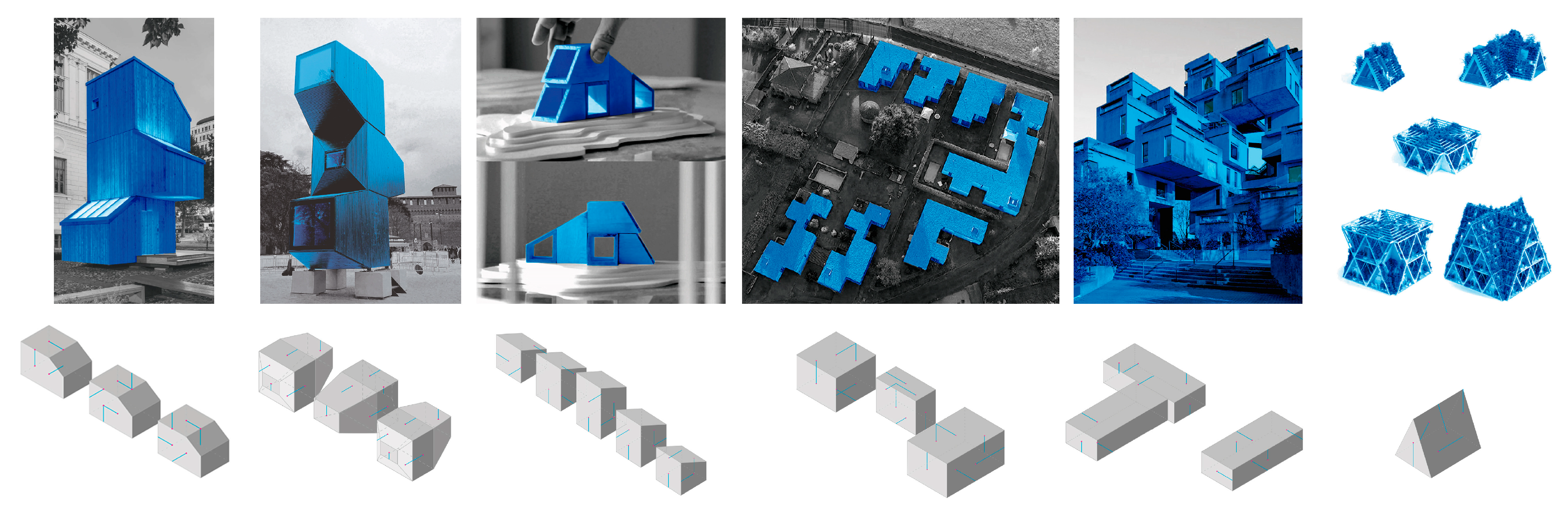
To this end, six case studies were selected, representative both for their relevance within the debate on modular housing and for the diversity of their geometric and programmatic logics: Kokoon (Aalto University Wood Programme), Housing in Covas (Salgado e Liñares Architects), Living Unit (OFIS Arhitekti), Welcome Home (Arkitekt Michael Donalds AB), The Farmhouse (Precht), and Habitat 67 (Moshe Safdie) [
12]. Based on the original documentation for each project, their base modules were reconstructed and aggregation rules were implemented within the Rhinoceros–Grasshopper–WASP environment, testing multiple growth scenarios.
2. Related Work
2.1. Prefabrication and Modular Housing
Prefabricated systems have been part of architectural practice since the nineteenth century, when early demountable dwellings were used to meet the demands of colonisation, urban expansion, and temporary accommodation. Throughout the twentieth century, prefabrication was often associated with mass production processes linked to social housing policies, where standardisation was prioritised over adaptability. However, seminal works by Habraken [
13] and Friedman [
14] had already emphasised the need to separate the supporting structure from infill elements, paving the way for “open building” models capable of accommodating variation over time.
With the emergence of new construction technologies, prefabrication has progressively evolved from an exclusively production-oriented approach towards a more flexible paradigm, in which modular systems are conceived as matrices of possibilities rather than as singular, closed solutions [
15]. Modular buildings tend to demonstrate improved environmental performance over their life cycle compared with conventional solutions [
16,
17,
18], although design-for-disassembly (DfD) criteria must be integrated from the earliest stages to fully realise their potential [
19]. Recent research on automated simulators for modular housing and prefabricated buildings has documented the advantages of these systems in terms of energy efficiency [
20,
21], improved working conditions, enhanced quality control, waste reduction, and significant time savings, reducing construction periods from months to weeks [
22]. Furthermore, such studies report a decrease in life-cycle carbon footprints [
23,
24], while emphasising the importance of incorporating advanced architectural design criteria in early project phases. In this respect, material production constitutes the dominant phase in the impacts of a prefabricated modular dwelling, and lightweight structural configurations (light-gauge steel or timber) significantly reduce embodied energy and emissions compared with heavier steel or concrete solutions [
25].
2.2. Computational Design and Discrete Aggregation Logic
The development of digital modelling tools and visual programming environments has enabled concepts such as discrete systems, digital materials, and combinatorial assemblies to be transferred into architectural practice. Early propositions by Frazer [
5] on evolutionary architecture have evolved into more recent work on machine learning models that extend generative design beyond explicit rules [
26] or hierarchical assemblies. Depending on scale, computational design is also employed in urban planning contexts [
27,
28]. Current research increasingly focuses on defining simple local rules capable of generating complex global configurations.
In this context, parametric design is understood as a strategy for defining relationships between elements, encoding geometric constraints, connection conditions, and performance parameters [
29]. Zesen et al. [
30] estimate that the time required to generate skyscraper designs can be reduced to one-sixteenth compared with manual methods, albeit under significant design and structural constraints. Unified matrix-based methods, such as that proposed by Pezhman et al. [
31], enable automatic model generation in early design stages. Computational design also facilitates investigation into the optimisation of disassembly processes to recover reusable components [
32]. Through graph-based models, it becomes possible to interconnect large numbers of elements in order to represent construction projects [
33].
Grasshopper, a visual programming environment integrated into Rhinoceros [
34], has contributed significantly to the dissemination of these methodologies by allowing architects and designers to work with algorithms without the need to write textual code. Its application enables the generation and analysis of parametric geometries through energy simulations [
35,
36] or the automation of unit growth across different programmes, such as hotel design [
37]. The proliferation of dedicated plugins has further expanded this ecosystem, integrating workflows with structural analysis, environmental simulation, and multi-objective optimisation.
The WASP plugin follows this trajectory by providing a framework for discrete design based on assembly rules between three-dimensional modules. Its successive developments have been described by Rossi and Tessmann [
38,
39]. It constitutes a consolidated, open-source toolkit specifically oriented towards design with discrete elements [
40].
By defining parts, connection points and planes, and growth volumes, it becomes possible to simulate guided or random aggregation processes, evaluate compatibility between elements, and explore the emergence of spatial patterns at different scales. Several studies have demonstrated that such approaches are useful for experimenting with timber elements through interactive aggregations in artistic installations [
41]. They are likewise applicable to the structuring of construction systems transferable to practice [
42], for example, in the field of scaffolding [
43] or in the automation of traditional timber structures [
44].
3. Methodology
3.1. General Approach
The proposed methodology combines case study analysis with parametric simulations of modular growth. In an initial phase, geometric and programmatic information from six selected prefabricated modular housing projects is collected and synthesised. This material serves as the basis for reconstructing the base modules and their original aggregation logic.
In a second phase, a unified computational model is implemented within the Rhinoceros–Grasshopper–WASP environment, enabling the six systems to be compared under a common set of rules, as illustrated in
Figure 1. For each case study, the following are defined: (i) one or more base modules; (ii) connection points and planes between faces; (iii) horizontal and vertical bounding boxes governing growth; and (iv) iteration parameters and the number of units added.
Finally, the results are analysed in terms of typological variability, spatial flexibility, and geometric feasibility. Common patterns and significant differences are identified between orthogonal and non-orthogonal systems, as well as between programmatically defined modules and formally open modules.
3.2. Digital Tools: Rhinoceros 8, Grasshopper and WASP
Rhinoceros 8 is employed as the geometric modelling platform, allowing precise definition of the base modules of each project and their spatial relationships. Its capacity to operate with NURBS (Non-Uniform Rational B-Splines) geometries and meshes facilitates the construction of clean models, which are essential for the subsequent definition of connection points and planes.
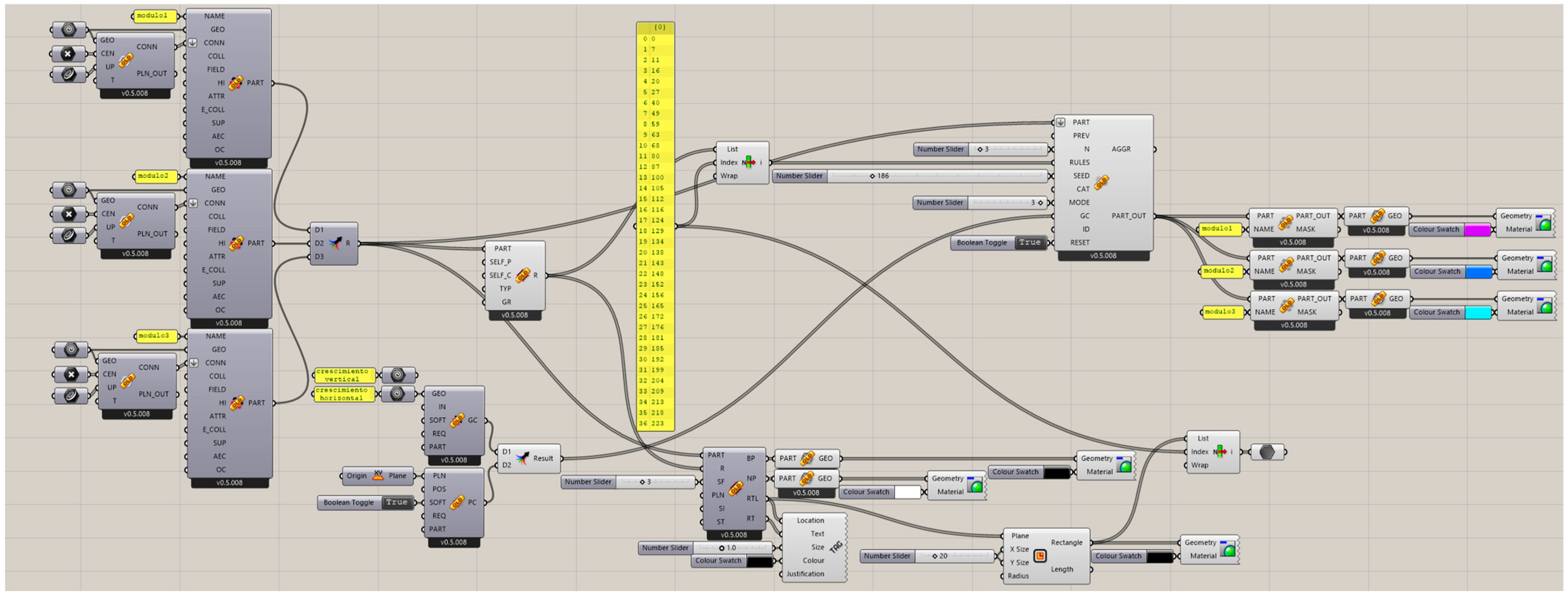
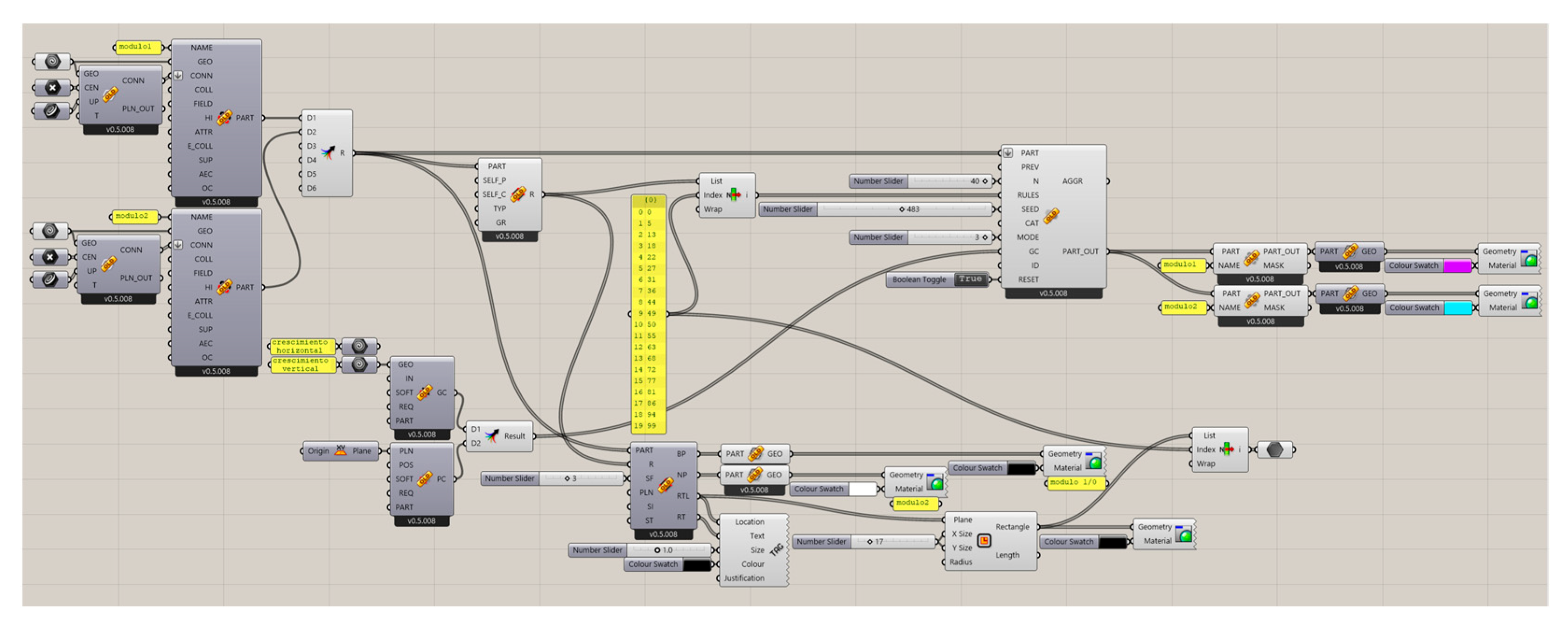
Grasshopper functions as the parametric control core of the process. Through its system of components and connections, data flows describing the aggregation logic are structured: from geometry import and the assignment of connection points to the definition of bounding boxes, growth rules, and result selection filters.
WASP is integrated into this framework by providing a dedicated set of components for discrete design. In each case study, analogous commands are used: geometry referencing, part definition, specification of connection points and directions, configuration of aggregation rules, and the execution of simulations with different set sizes (number of modules). This unified workflow enables behavioural comparisons without altering the overall methodological approach.
3.3. Growth Rules and Boundary Boxes
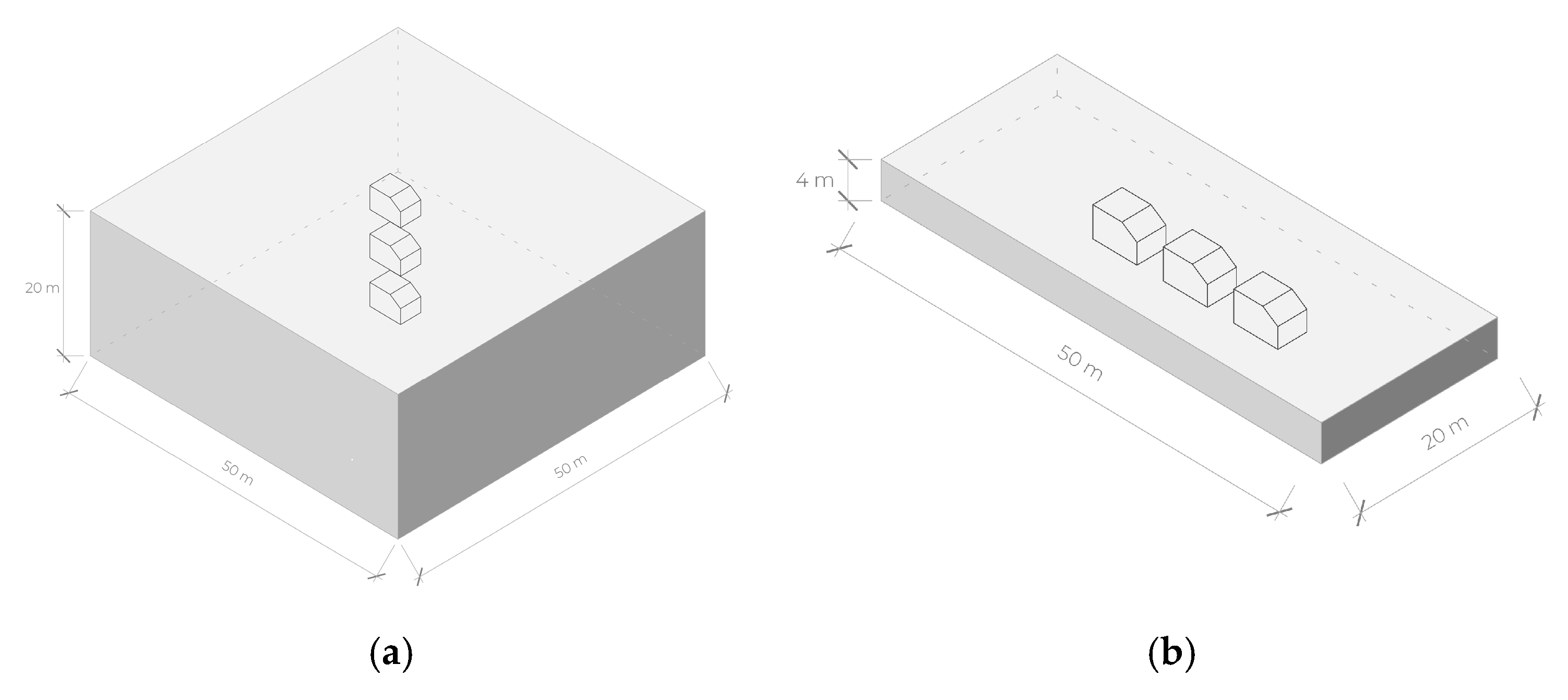
For each system, two principal growth scenarios are defined: a horizontal scenario prioritising planar expansion, and a vertical scenario oriented towards densification in height. Both scenarios are delimited by bounding boxes (
Figure 2), understood as enclosing volumes that constrain system expansion and prevent overlaps or geometric collapse.
Growth rules are specified as combinations of permitted connections between module types and aggregation directions. Stochastic behaviour is controlled through random seeds and iteration limits, allowing multiple configurations to be generated under the same rule set.
3.4. Definition of Geometric Constraints Prior to Aggregation
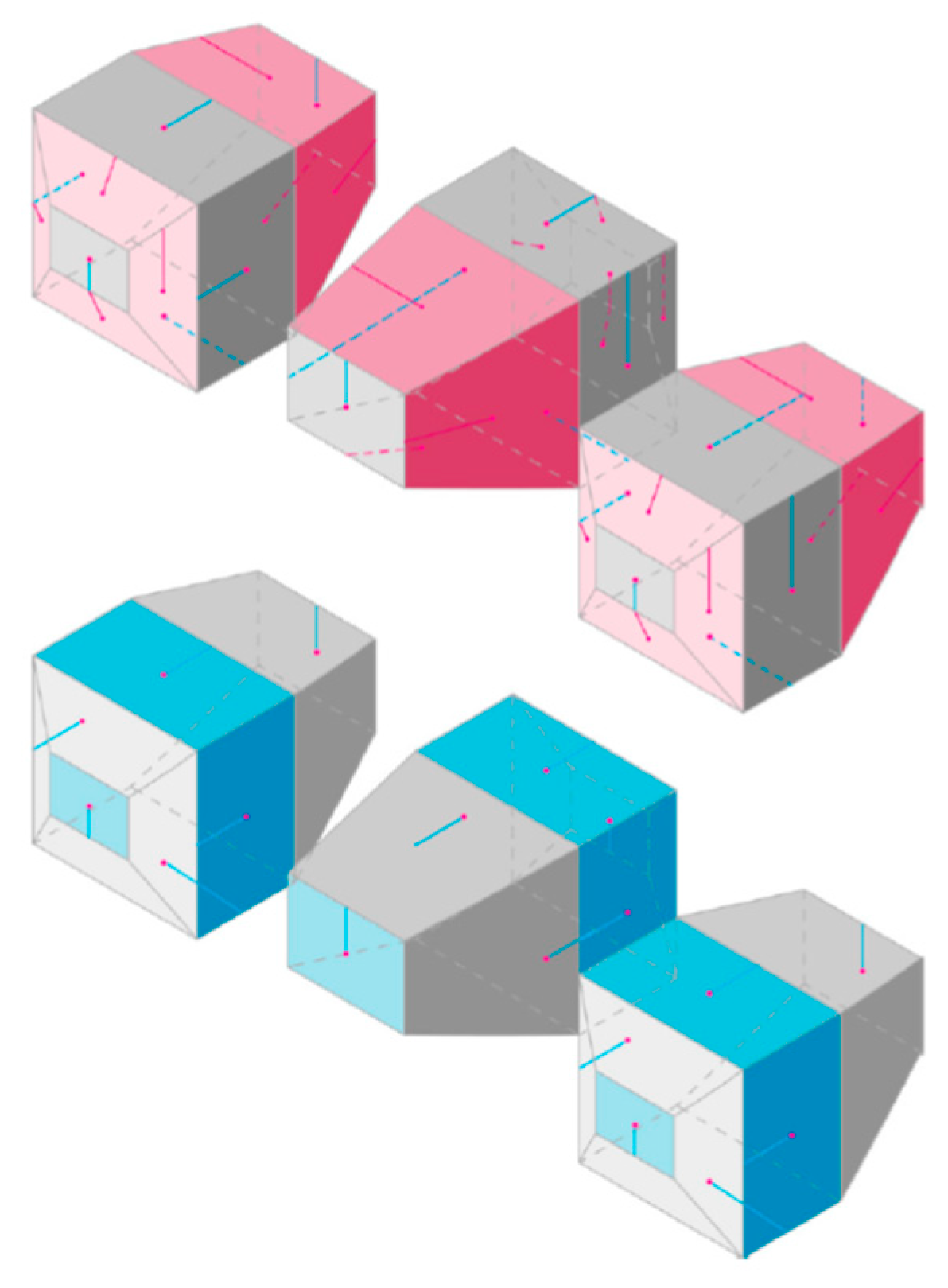
Before conducting large-scale simulations, preliminary tests were undertaken allowing connections across all module faces, including angular surfaces. In cases such as Kokoon, this resulted in cumulative rotations, inclined floor planes, loss of vertical alignment, and spatial torsion incompatible with realistic habitable conditions.
Connection faces were therefore selectively restricted (for example, excluding angular faces), effectively reducing the combinatorial search space and stabilising the aggregation logic. This restriction was performance-driven and grounded in architectural feasibility rather than aesthetic preference (
Figure 3,
Figure 4 and
Figure 5).
3.5. Post-Generation Feasibility Assessment
Once geometric constraints were defined, the system generated all possible aggregations within the controlled rule set. The results were evaluated according to three explicit architectural criteria.
Programmatic coherence: assessment of logical and functional compatibility between aggregated modules. Configurations generating monofunctional or functionally incoherent systems (e.g., only sanitary modules or only circulation elements), or lacking realistic adjacency, circulation continuity, or programmatic diversity in cases where modules had predefined uses, were excluded.
Geometric habitability: verification that resulting configurations maintained horizontal floor planes, vertical alignment, structural plausibility, and absence of excessive torsion or cumulative rotation. Aggregations producing inclined floors or spatial instability were considered incompatible with habitable architectural conditions.
Systemic spatial coherence: evaluation of the aggregation as a unified system, ensuring structural continuity, accessibility, legible spatial hierarchy, and avoidance of fragmented or contradictory compositions.
The classification of viable typologies was carried out through expert manual review, assessing configurations individually. No additional automated filter was applied in Grasshopper beyond the previously defined geometric constraints. The criteria may be formulated explicitly as operational conditions:
Exclusion of configurations exhibiting loss of horizontality or cumulative rotation.
Exclusion of monofunctional aggregations where modules incorporate predefined uses.
Exclusion of configurations lacking circulation continuity or presenting spatial fragmentation.
Exclusion of systems losing overall structural coherence.
These principles are consistent with the frameworks of functional coherence and adaptive modularity discussed in Benjamin et al. [
32], where programmatic compatibility and assembly logic determine system viability.
3.6. Implementation of Numerical Values for Comparative Case Analysis
The concept of a viability ratio (VR) is introduced, defined as the quotient between viable typologies and the total number of generated typologies (after the application of geometric constraints).
4. Comparative Analysis of the Six Case Studies
4.1. Non-Orthogonal Systems: Kokoon, Living Unit, and Welcome Home
4.1.1. Kokoon
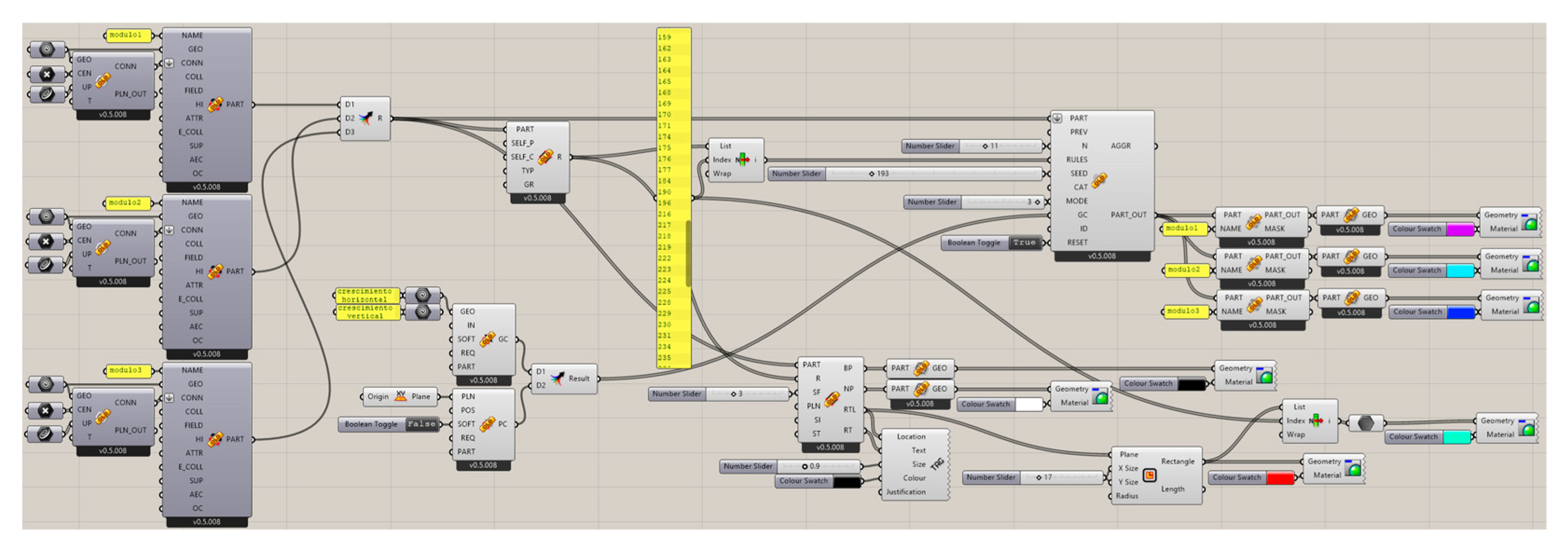
Kokoon, developed by the Aalto University Wood Programme, is based on a compact parallelepiped module with three programmatic variants (kitchen–bathroom, bedroom, and mixed unit).
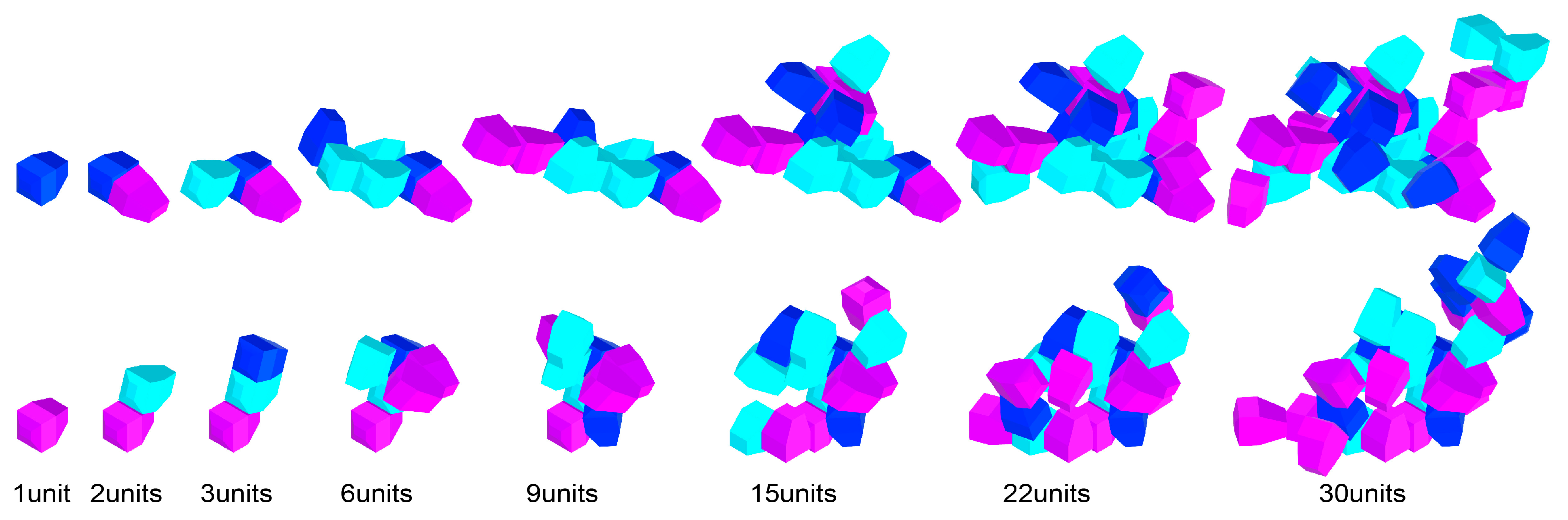
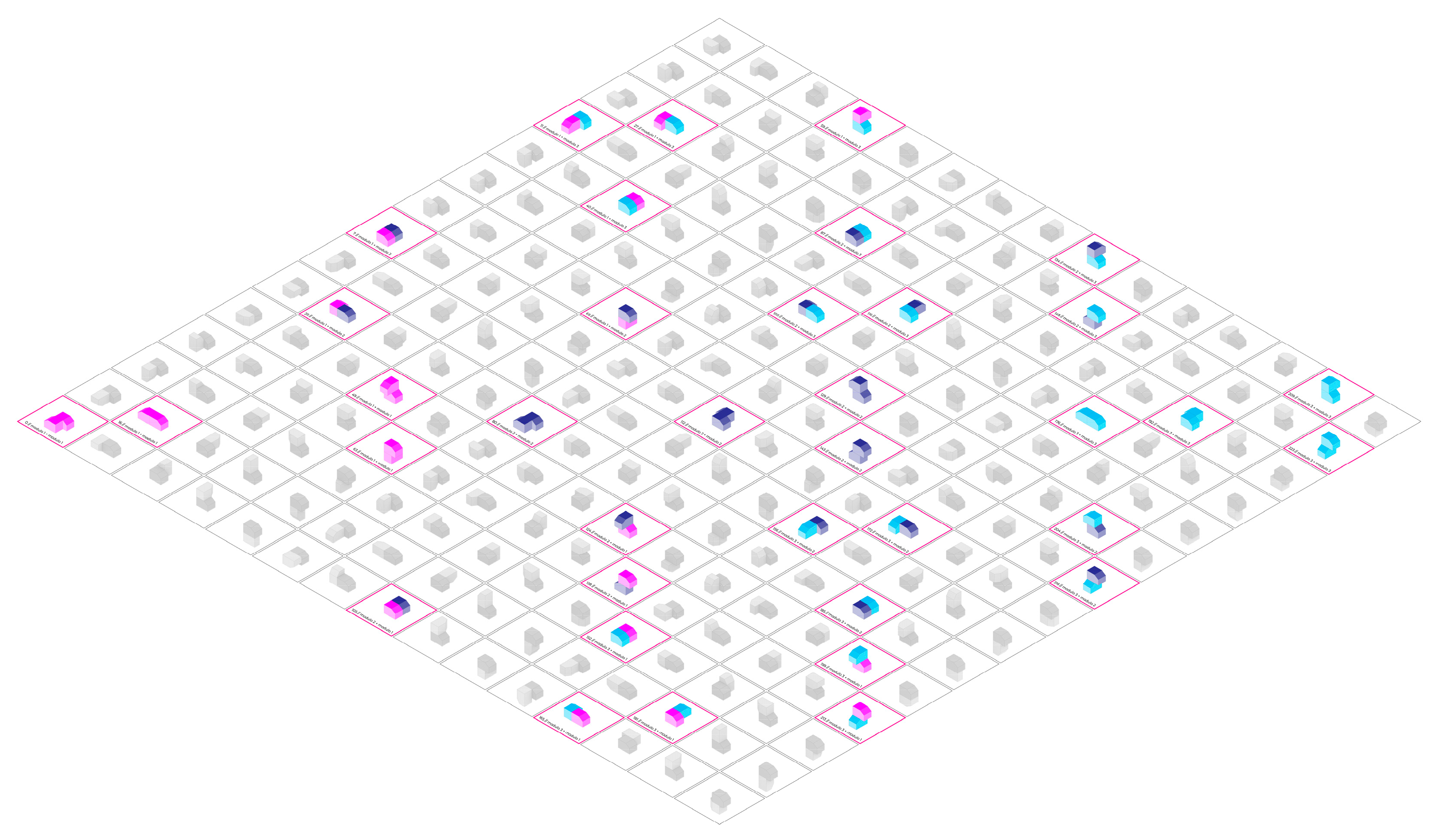
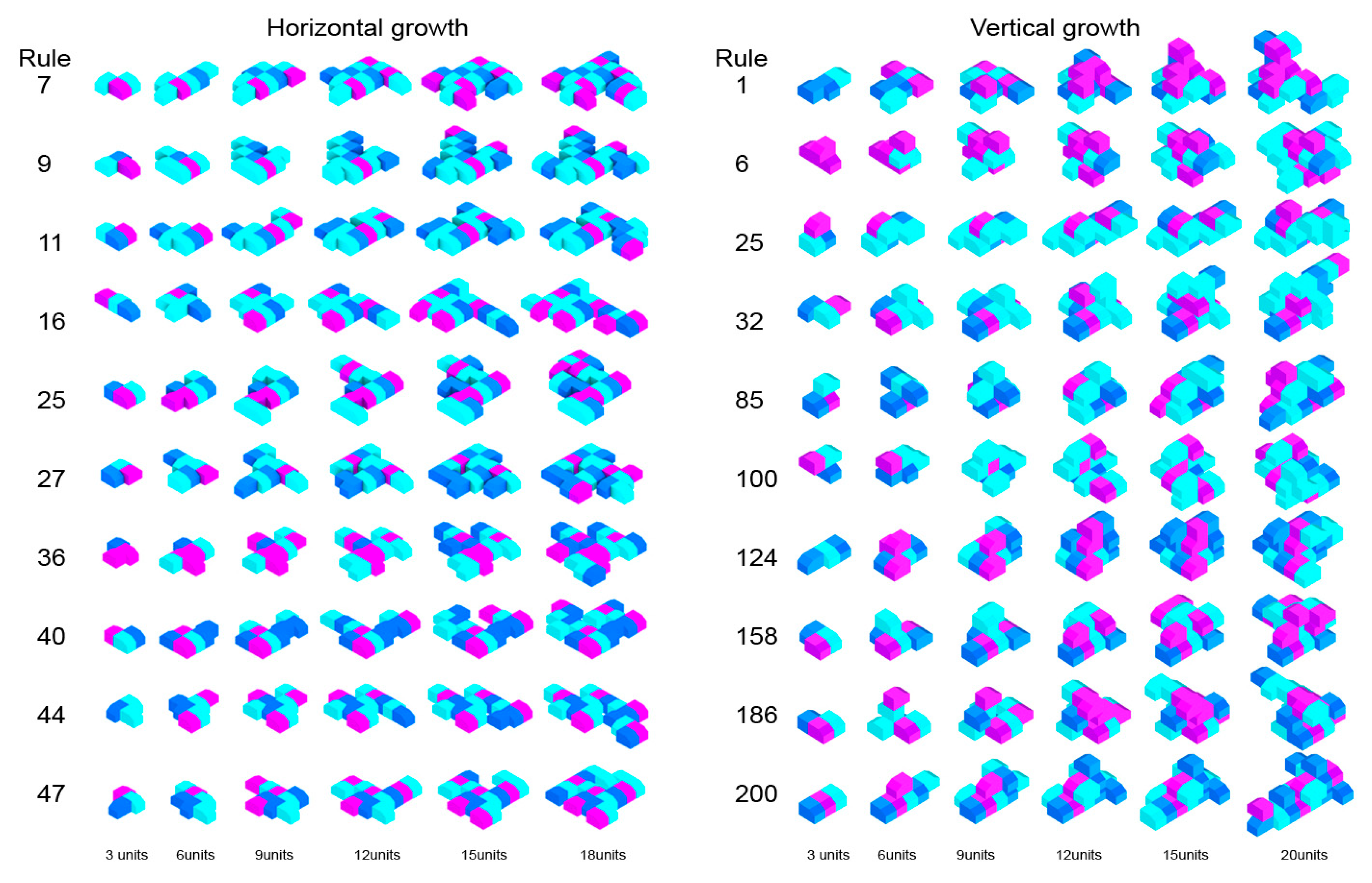
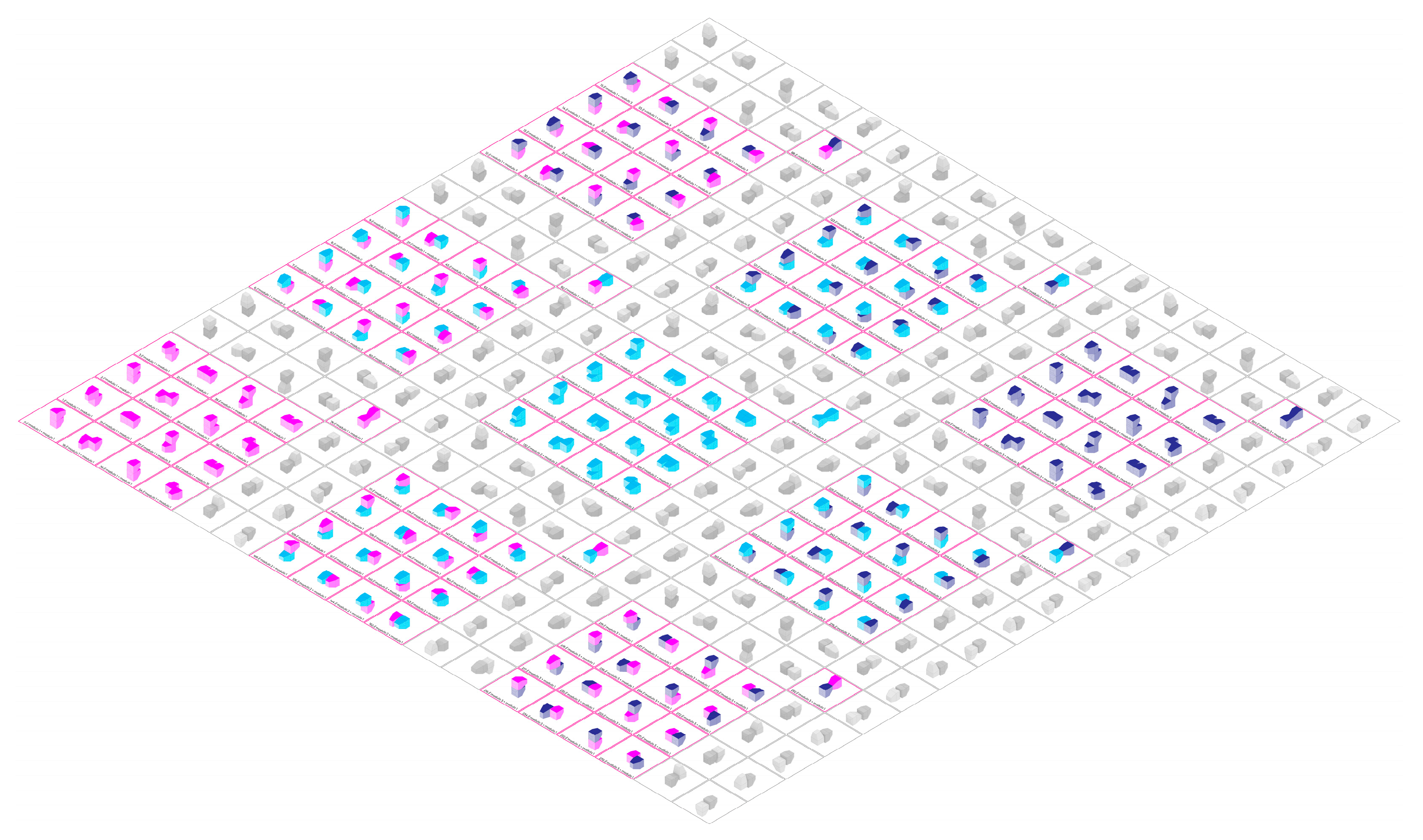
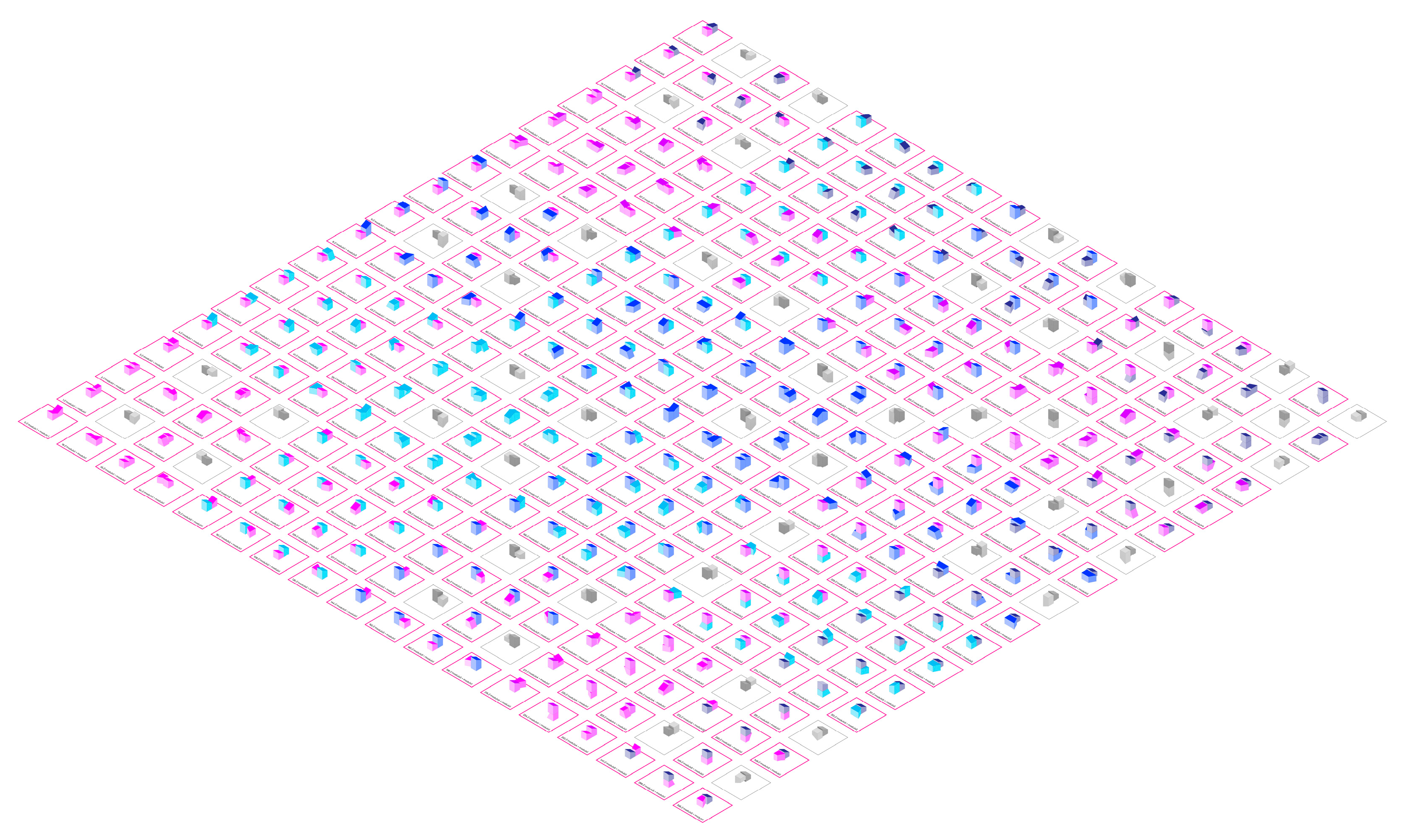
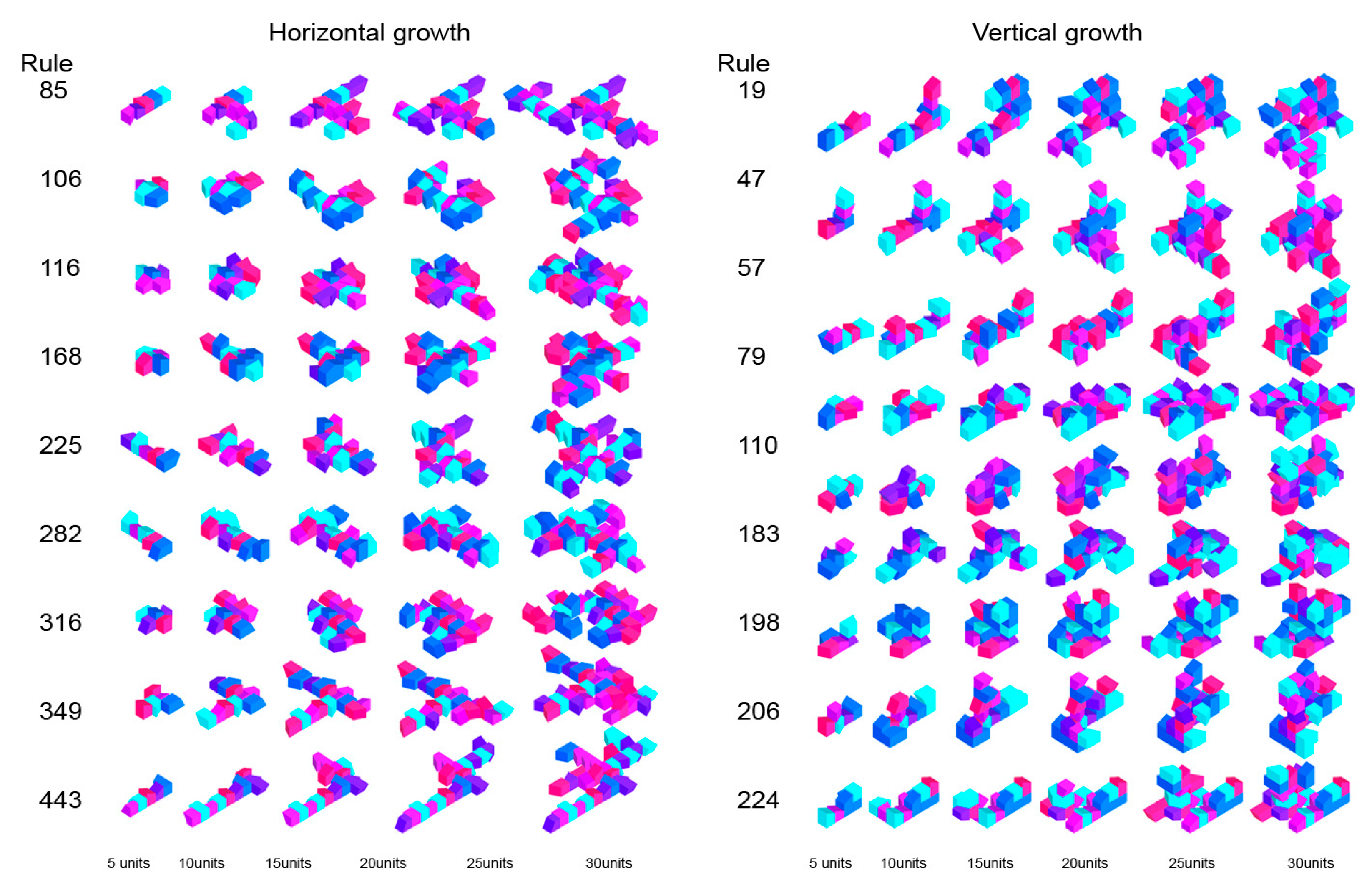
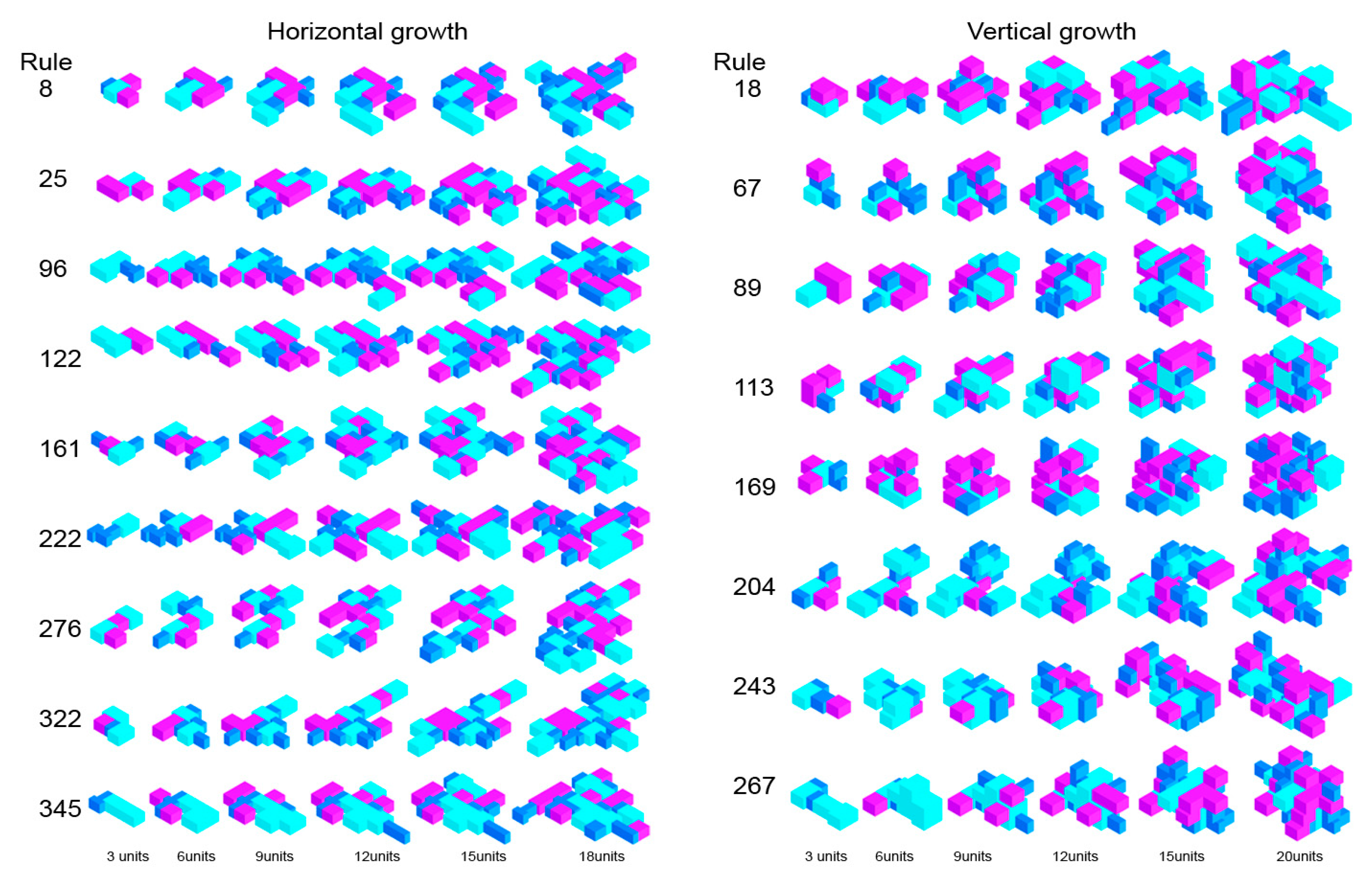
In the parametric reinterpretation, initial simulations revealed that indiscriminate assignment of connection points on inclined faces generated unexpected rotations and difficult-to-inhabit clusters. Restricting connections to orthogonal faces stabilised the system, yielding 37 viable typologies out of 225 explored configurations (VR 16.4%), combining the three modules in a balanced manner (
Figure 6,
Figure 7 and
Figure 8). The original project is documented in Kokoon Project Information by the Aalto University Wood Programme.
4.1.2. Living Unit
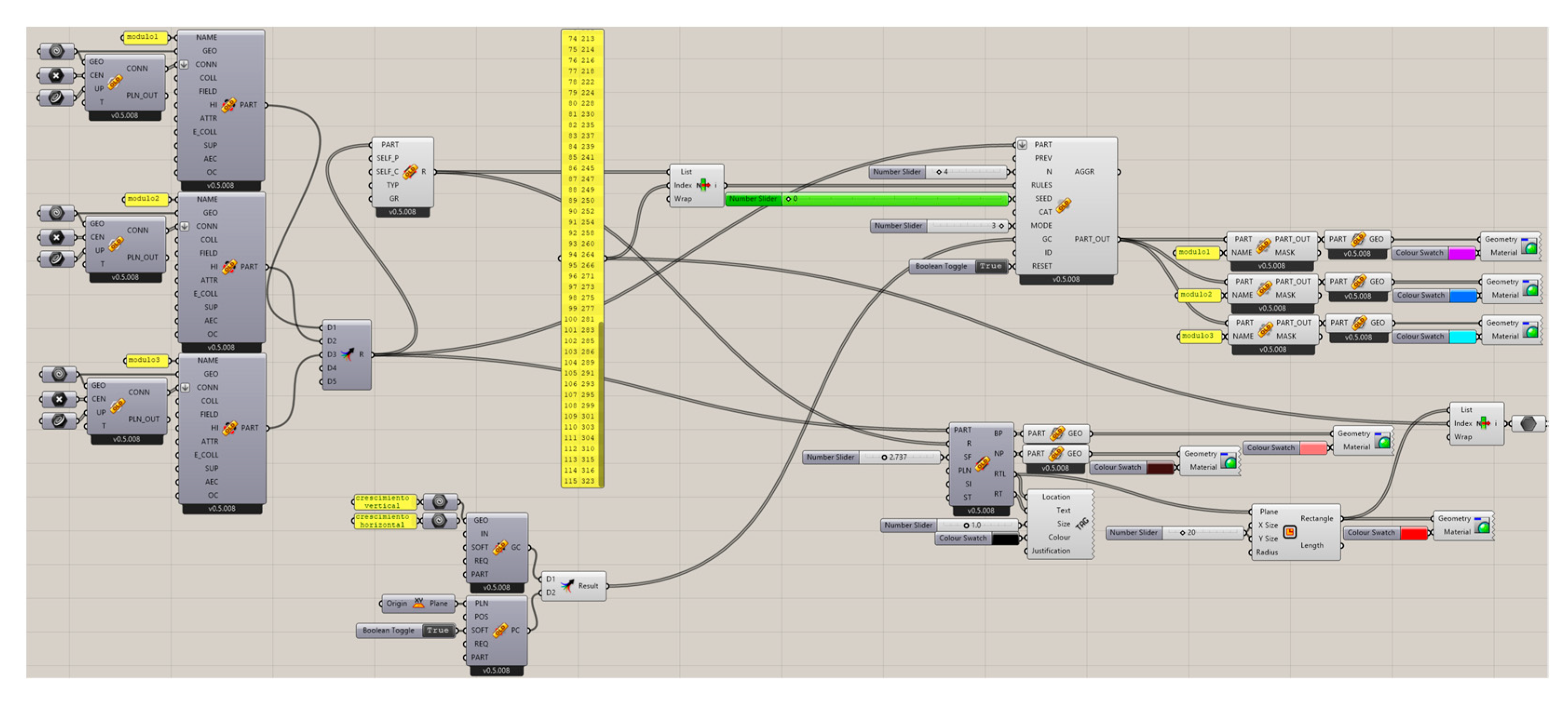
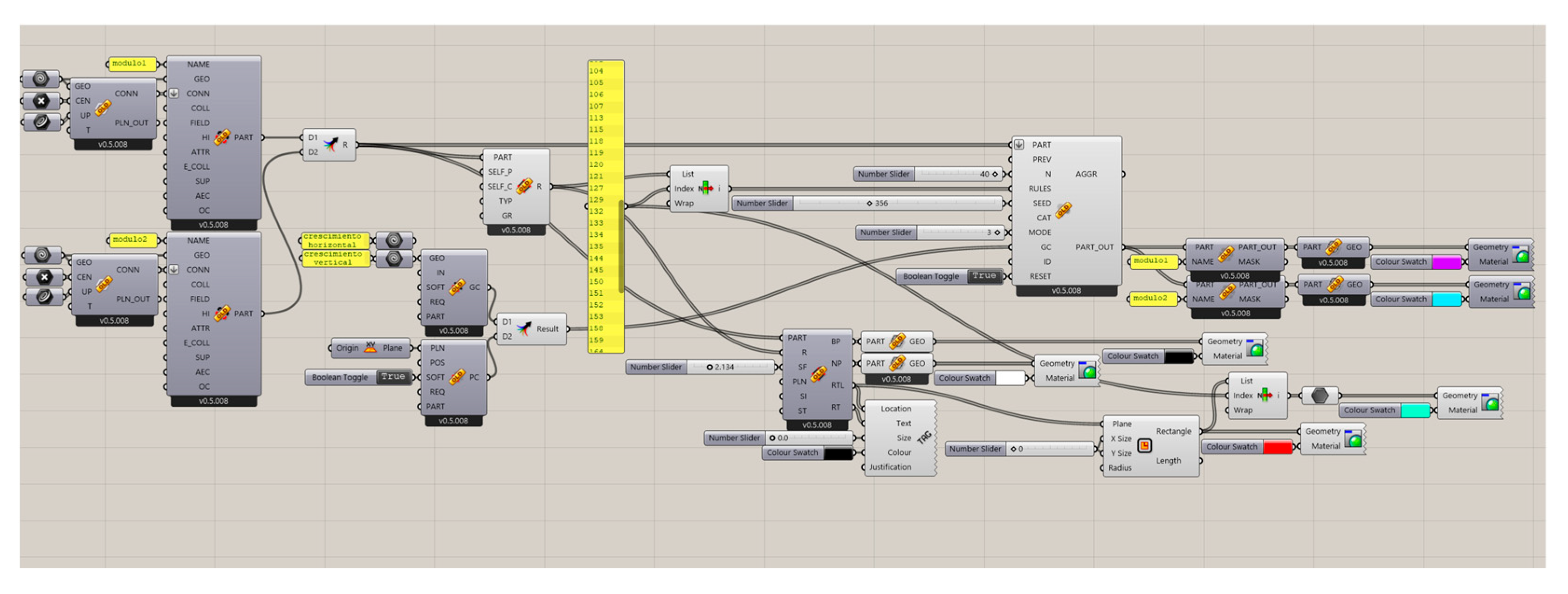
Living Unit, by OFIS Arhitekti, consists of a single module type with several non-orthogonal faces, conceived as a compact, autonomous unit adaptable to different climatic and topographic contexts (
Figure 9).
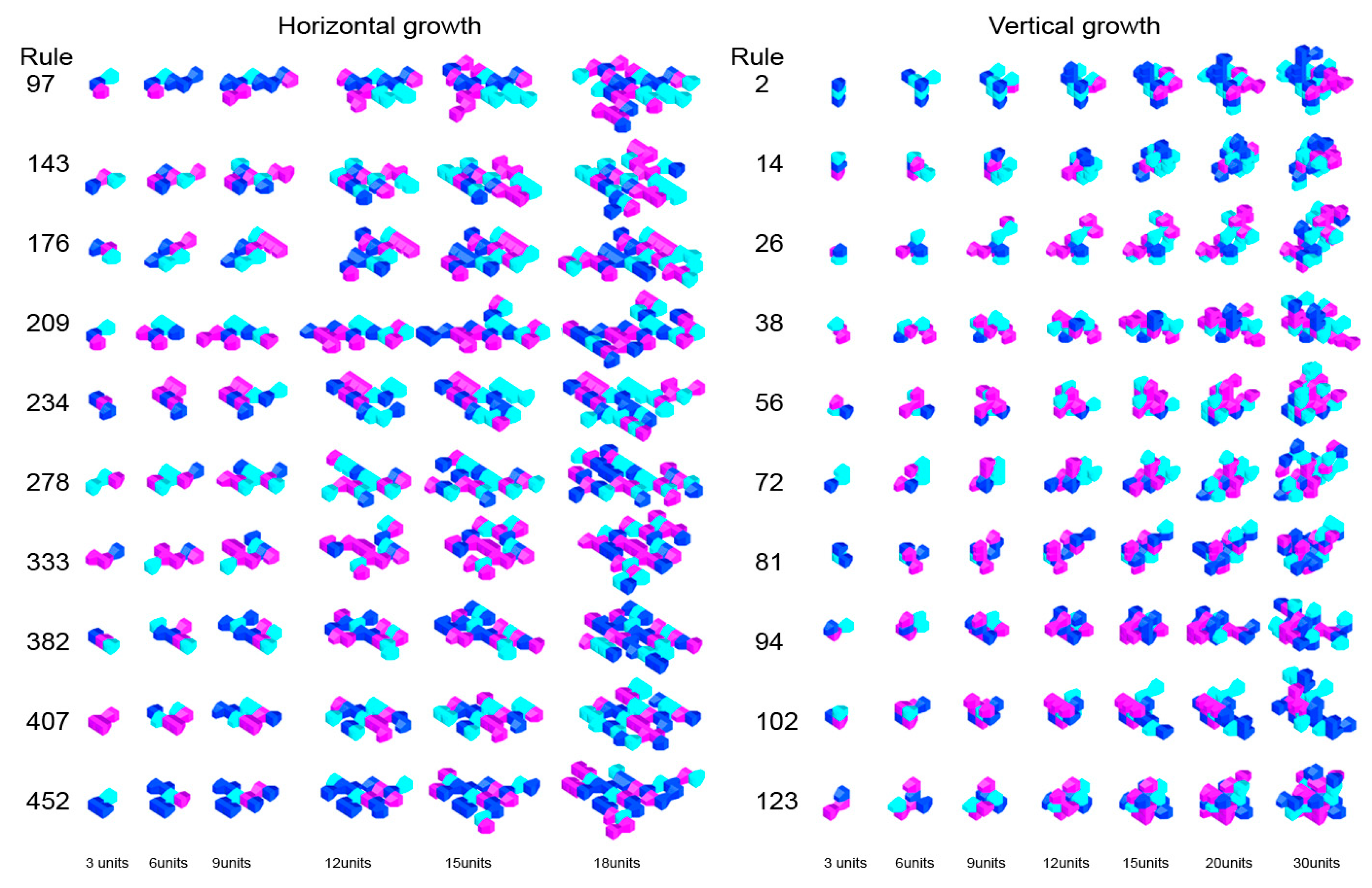
The abundance of inclined faces posed a greater challenge: even when restricting connection points to a subset of planar surfaces, the system tended to generate dense clusters whose functional legibility diminished beyond a limited number of modules. Around six units, configurations lost clarity, confirming that certain geometries favour only moderate growth (
Figure 10 and
Figure 11). A total of 128 viable typologies were obtained out of 324 generated, corresponding to a VR of 39.5%
4.1.3. Welcome Home
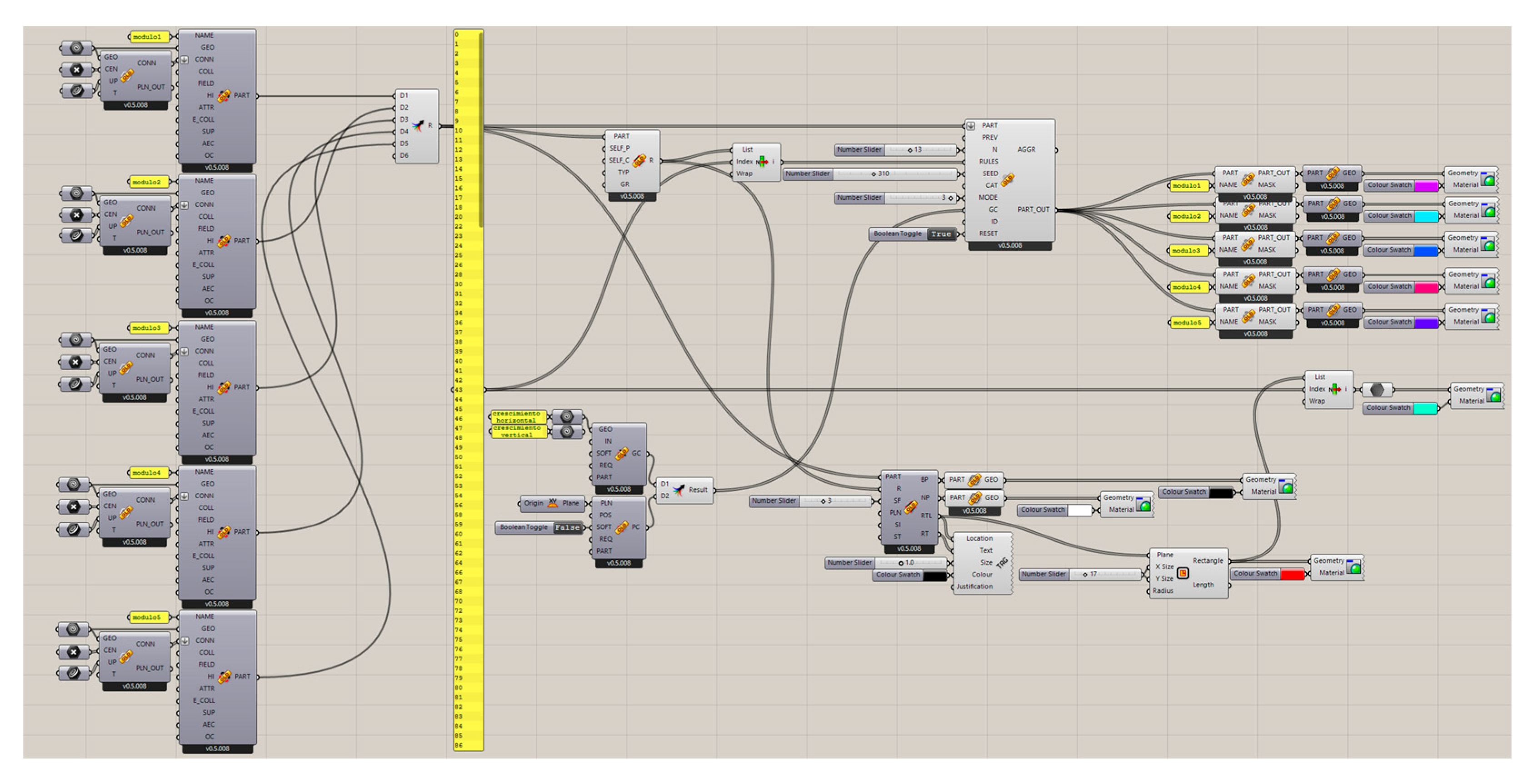
Presented by Arkitekt Michael Donalds AB, Welcome Home operates with five predominantly orthogonal base modules, each incorporating a single inclined face (
Figure 12).
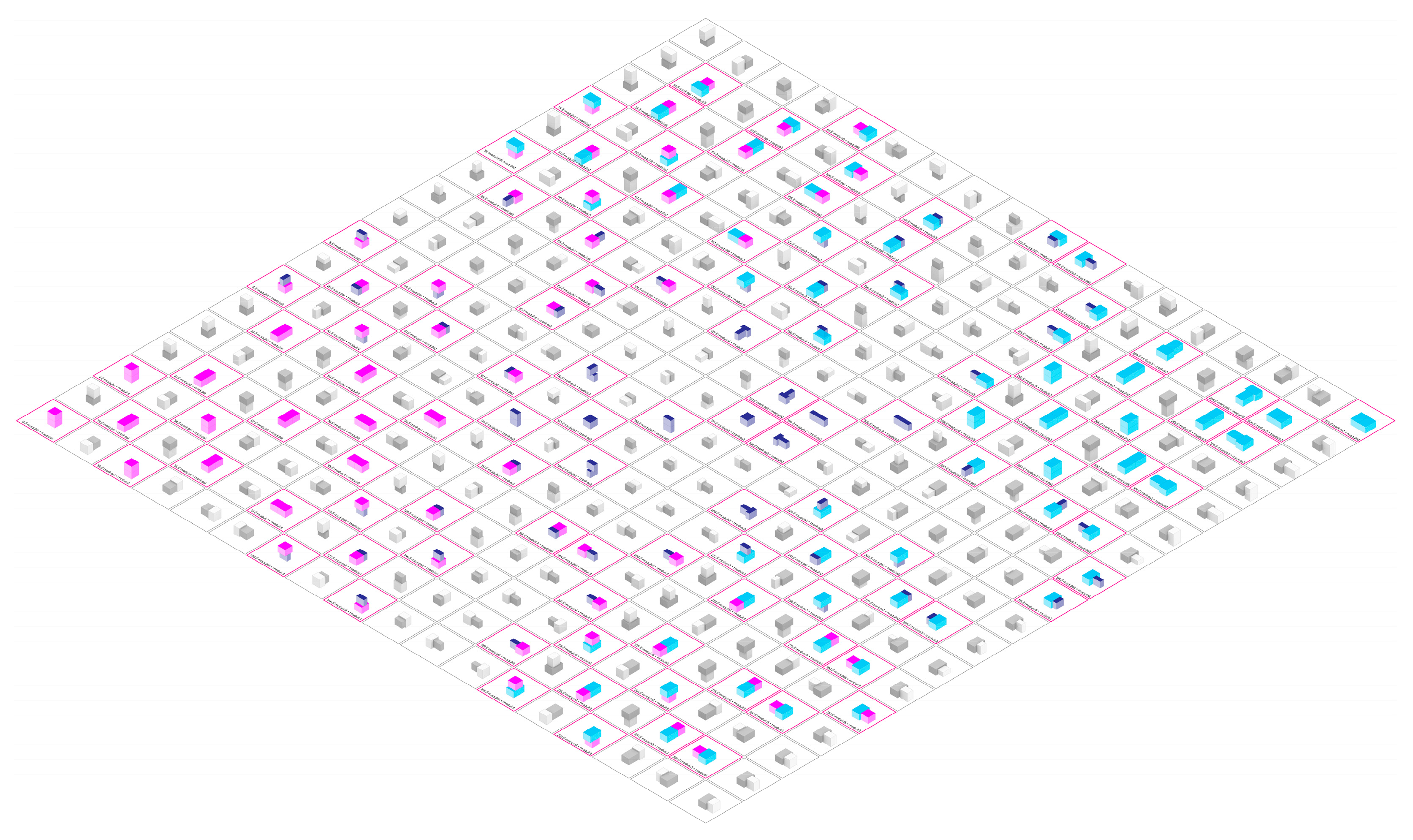
Excluding inclined surfaces from connections and concentrating growth on rectilinear faces produced one of the most robust sets in the study: of 324 generated typologies, 256 were deemed viable, achieving the highest VR of all cases (79.0%) (
Figure 13). The diversity of modules, combined with controlled geometry, enables complex configurations in both plan and section without compromising spatial continuity (
Figure 14).
4.2. Orthogonal Systems: Housing in Covas and Habitat 67
4.2.1. Housing in Covas
Housing in Covas, by Salgado e Liñares Architects, comprises three distinct orthogonal modules, two containing habitable spaces and a third functioning as a connecting element (
Figure 15).
This geometric clarity translates into strong simulation performance: the absence of inclined faces allows all surfaces to be used as connection points, generating 115 viable typologies out of 324, with a VR of 35.5% (
Figure 16). The system demonstrates considerable potential for extensive planar configurations, although its capacity for vertical growth is more limited due to the absence of a dedicated structural module (
Figure 17).
4.2.2. Habitat 67
Habitat 67, by Moshe Safdie, is included as a historical case study due to its relevance in the debate on prefabrication and high-density collective housing. The parametric model is based on two module types: a simple rectangular unit and an L-shaped unit resulting from the combination of two modules (
Figure 18).
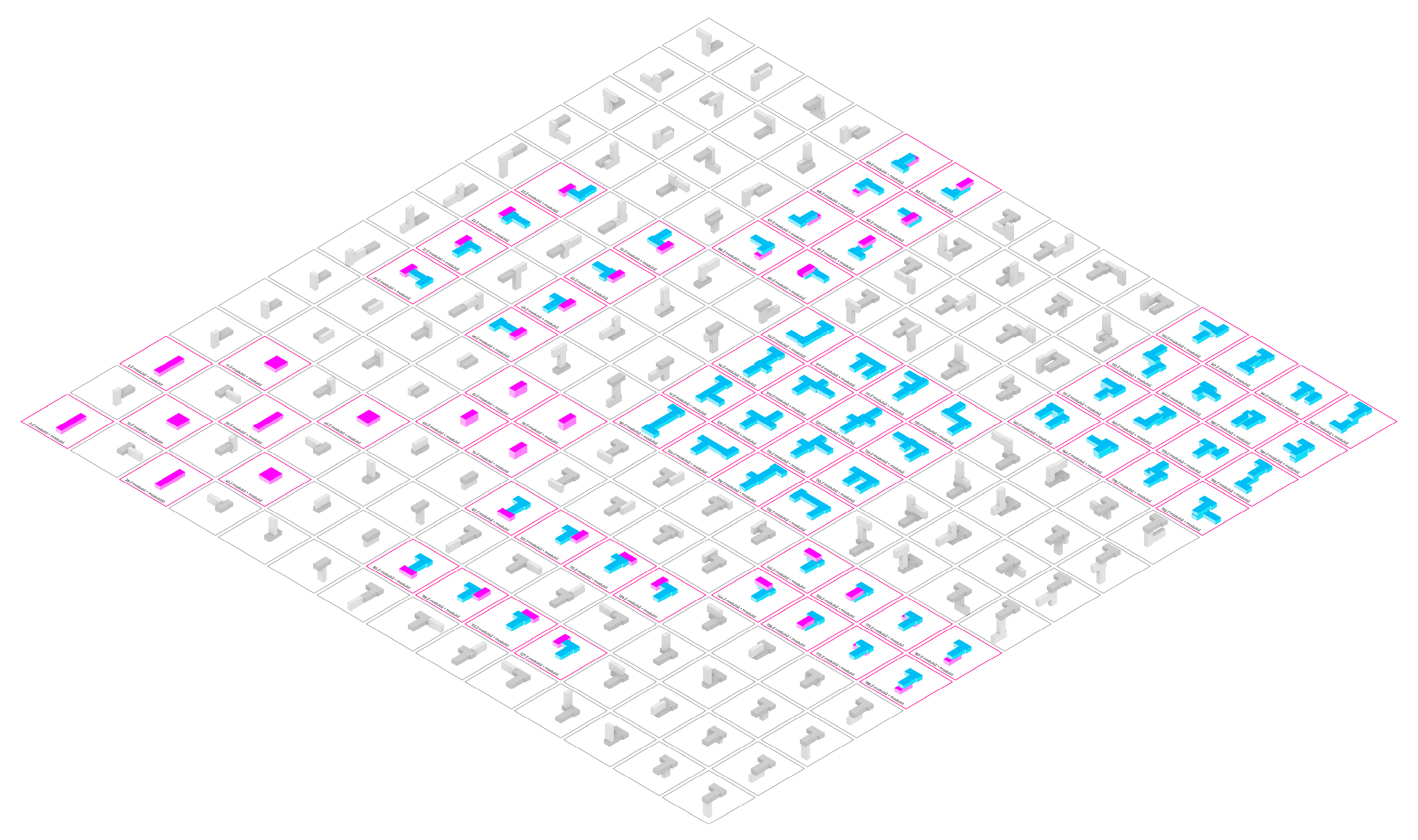
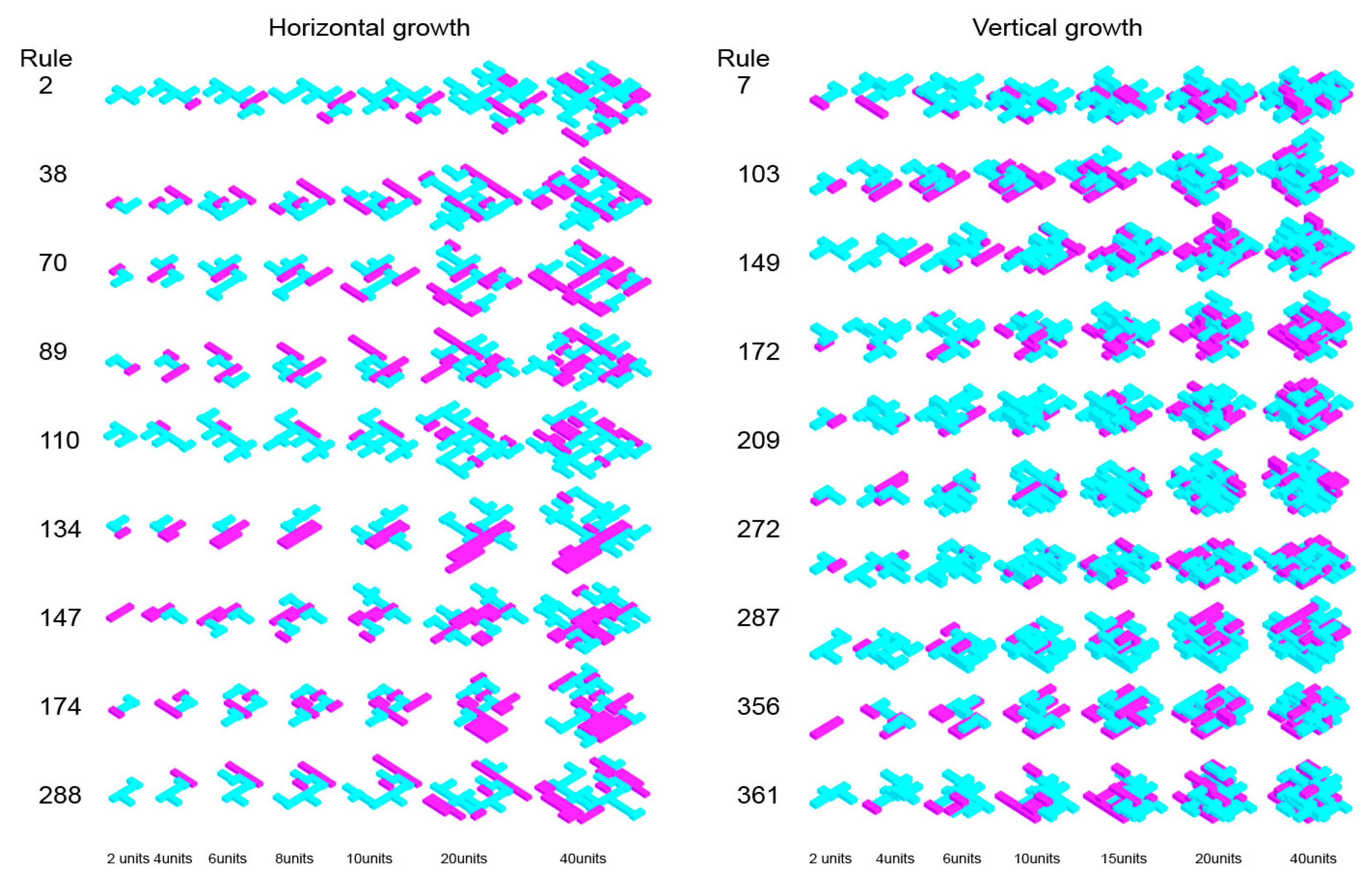
The absolute orthogonality of the components facilitates connection definition on all sides and enables partial reproduction of the stepped stacking logic of the built project. Of 196 generated typologies, 76 were considered viable (VR 38.8%), standing out for their formal robustness and hierarchical clarity (
Figure 19 and
Figure 20).
4.3. Hybrid System and Open Module: The Farmhouse
The Farmhouse
The Farmhouse, developed by Precht, introduces a distinctive approach by proposing a single triangular base module conceived as primary spatial infrastructure rather than as a closed programmatic unit (
Figure 21).
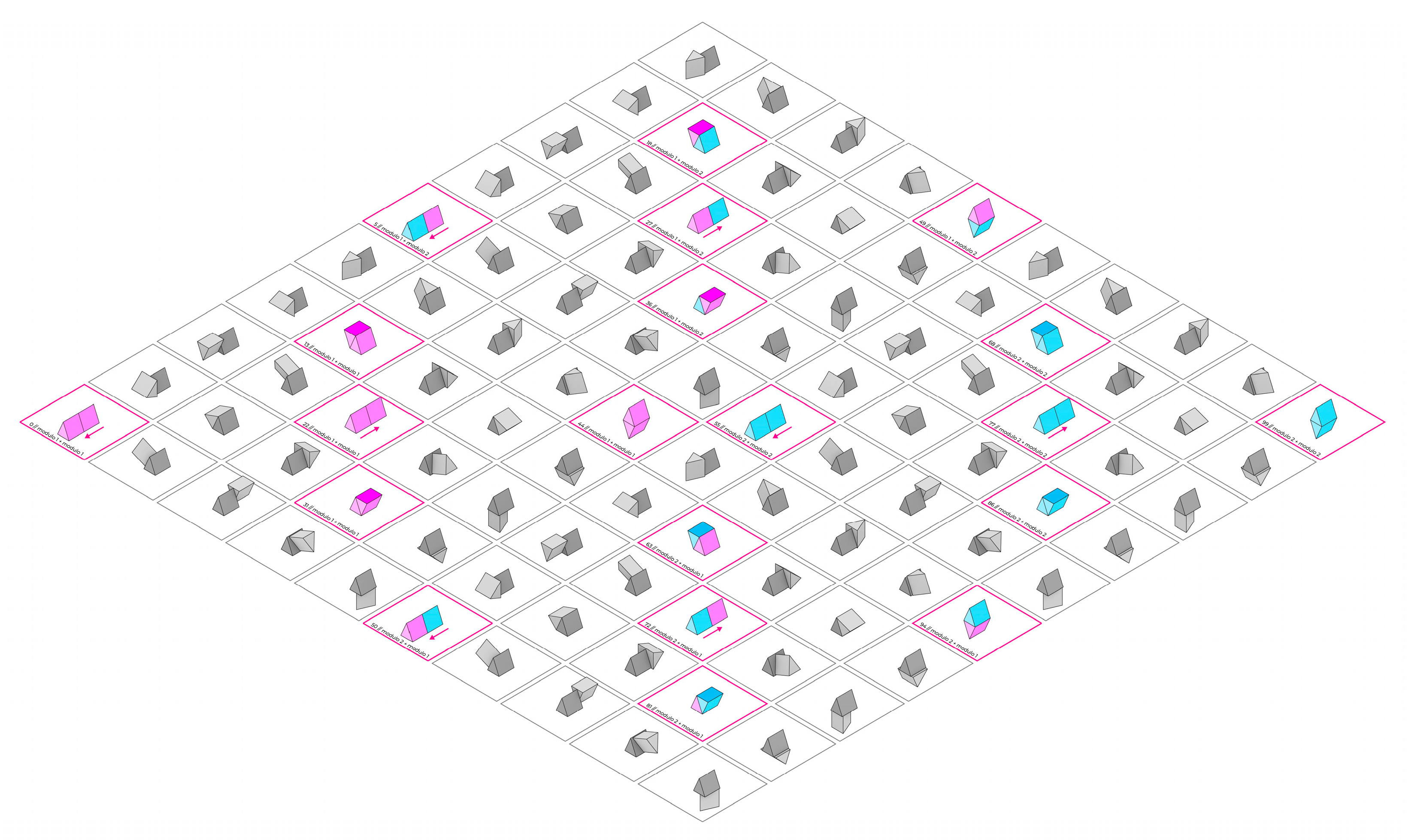
Despite presenting inclined faces, the system exhibited surprisingly stable behaviour in simulations, generating compact and homogeneous clusters. Of 100 possible typologies, 20 were selected as viable (VR 20.0%) following a design filter based on spatial continuity and functional legibility (
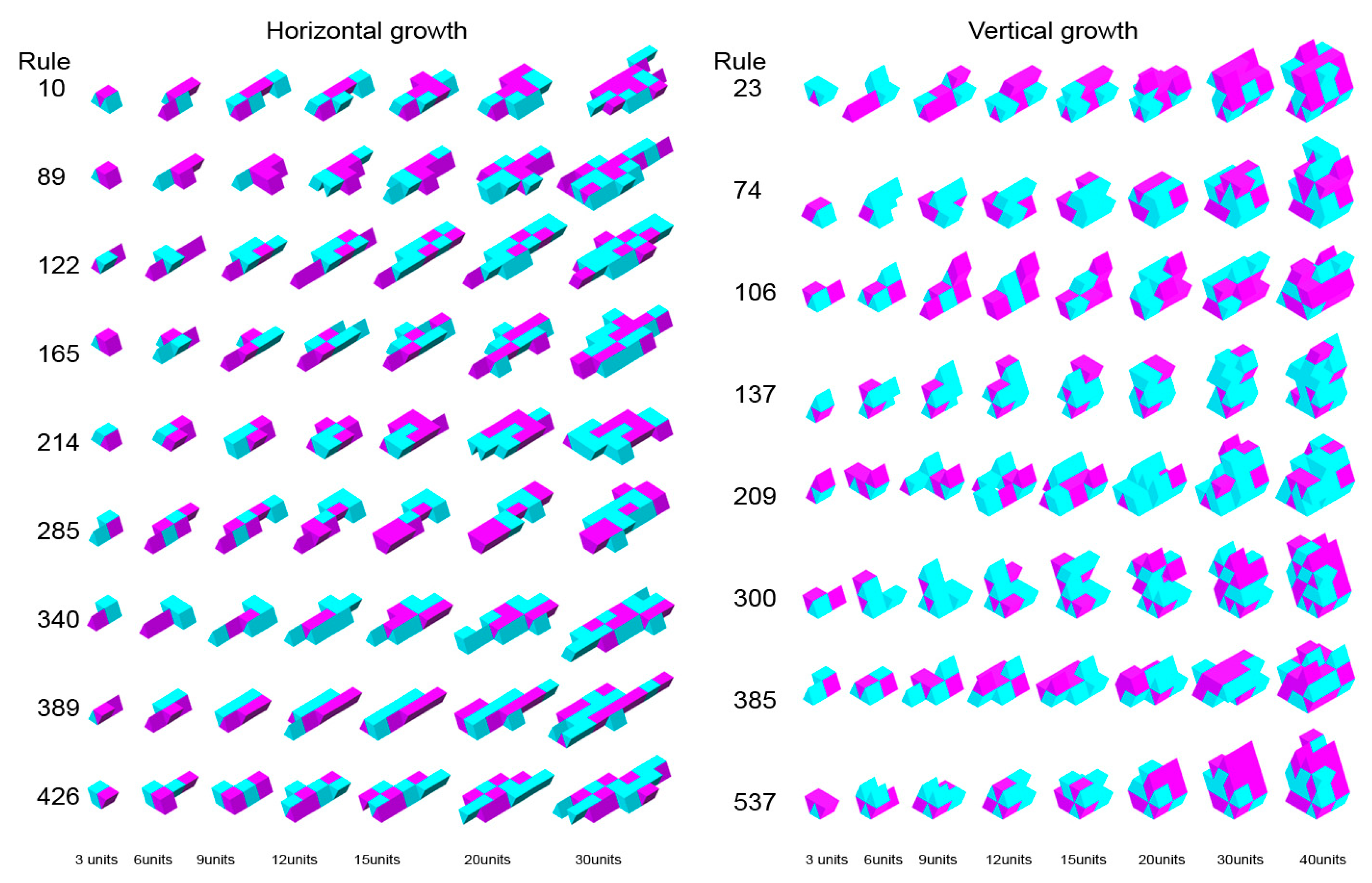
Figure 22). The programmatic indeterminacy of the module enhances system flexibility, allowing functions to be assigned after geometric configuration (
Figure 23).
4.4. Summary
The comparison of the six case studies reveals clear patterns in terms of flexibility, vertical growth potential, adaptability, and parametric innovation (
Table 1).
Orthogonal systems, such as Housing in Covas and Habitat 67, demonstrate greater geometric stability and higher viability ratios. Welcome Home achieved the highest viability ratio (79.0%), indicating strong combinatorial robustness under orthogonal aggregation rules. These orthogonal systems also present an evident geometric advantage in generating a large number of typologies without rotational errors or geometric collapse, resulting in high combinatorial variability. However, such variability is not always accompanied by equivalent programmatic flexibility, particularly where modules correspond to highly specific functions.
By contrast, angular systems such as Kokoon (VR 16.4%) exhibit significantly lower viability when left unrestricted, confirming the importance of carefully controlled geometric constraints and stricter connection rules to maintain habitable conditions. They tend to display more limited growth capacity, yet offer spatial configurations that are richer in perceptual and experiential terms.
When geometry is combined with open programming (as in The Farmhouse, VR 20.0%), flexibility of use may even surpass that of more conventional orthogonal systems. This example illustrates that formal simplicity does not necessarily translate into high combinatorial robustness.
Overall, the results suggest that the determining factor lies not solely in orthogonality or geometric complexity, but in the relationship between module form, connection rules, and programme distribution.
5. Discussion of Results
The combined use of Rhinoceros 8, Grasshopper and WASP enabled the construction of a coherent experimental framework for comparing highly diverse modular housing systems under a shared set of operations. Beyond the production of images or singular models, the value of this approach lies in its capacity to systematically explore the range of solutions permitted by each system, making explicit the growth logics that often remain implicit in the original projects.
5.1. Design Perspective
From a design standpoint, the findings highlight the need to critically reassess the notion of variability. The generation of hundreds of possible configurations does not, in itself, guarantee higher architectural quality. Variability must be accompanied by clear criteria for selection and validation, addressing not only geometry but also functionality, circulation, daylight access, and the feasibility of phased growth.
In this respect, parametric design and generative tools do not replace the designer’s judgement; rather, they extend it. The computational model enables hypotheses to be tested, patterns to be identified, and problematic configurations to be detected rapidly. Nevertheless, determining which typologies are genuinely valid remains a disciplinary and contextual matter. Cases such as Kokoon, Housing in Covas, and Habitat 67 demonstrate that balancing combinatorial freedom with operational constraints is crucial in avoiding formal arbitrariness.
This finding reinforces the argument advanced by Habraken [
13] that “
true design freedom lies not in the form of elements, but in the way they relate to one another”. Similarly, Rossi and Tessmann [
38,
39] emphasise that computational generation must be complemented by architectural selection criteria in order to avoid sterile or formally incoherent outcomes. As suggested by Kronenburg [
45,
46], adaptable architecture is effective only when design decisions respond to the structural and functional logic of the whole. In this sense, simulations alone do not guarantee circulation continuity, functional clarity, or spatial hierarchy, making the introduction of filtering mechanisms and critical interpretation by the designer essential. This observation aligns with the warnings expressed by Kolarevic [
2] and Oxman [
4]: generative systems do not replace architectural judgement but rather enhance it as an exploratory instrument. As Terzidis [
47] notes, computational logic is effective in producing variation, yet requires human control to preserve project validity.
The research further demonstrates that modular prefabrication does not imply rigidity, but rather controlled adaptability, in line with the position advocated by Kieran and Timberlake [
48]. Defining a sufficiently robust matrix of spatial relationships is fundamental to sustaining variation without descending into formal arbitrariness.
5.2. Mass Production
The study also confirms that prefabricated modular systems can transcend the logic of mechanical repetition historically associated with mass production. When designed according to flexible growth rules and supported by digital tools capable of managing large volumes of information, such systems become platforms for mass customisation. They can adapt to diverse urban contexts, densities, and programmes without relinquishing productive efficiency.
5.3. Limitations and Future Research
Certain limitations must be acknowledged. The simulations focus primarily on geometric feasibility and spatial organisation, leaving structural, energetic, and economic aspects in the background (dimensions that would be essential for direct transfer into practice). The integration of multi-criteria analysis, BIM workflows, or structural calculation into future iterations represents a logical step towards consolidating these methodologies within prefabricated housing design processes.
The developed model operates exclusively at a geometric–volumetric level and does not incorporate constructive parameters associated with material disassembly or specific structural systems. Digitally, the system is sequentially reversible within the parametric generator; however, such reversibility is algorithmic rather than constructive. As discussed by Vahdati and Tedjosaputro [
42], genuine integration of DfD (design for disassembly) requires explicit definition of assembly logic and joint hierarchies. While the present system does not model these variables, its rule-based aggregation structure would permit the incorporation of additional constraints linked to disassembly and circular construction strategies.
Furthermore, the approach adopted in this research is entirely rule-based and architect-controlled: WASP operates as a deterministic discrete aggregation system implemented in Grasshopper, functioning through explicitly defined geometric rules and designer-controlled connection logic. Rule-based systems prioritise traceability, control, and explicit architectural validation [
4,
47]. By contrast, machine-learning-based approaches extend formal exploration through data training, automated learning, and probabilistic inference [
7,
26].
In this study, artificial exaptation is not an autonomous property of the computational model. The system generates configurations according to explicit user-defined rules and constraints; it acts as a generator of possibilities but does not incorporate internal mechanisms for functional reinterpretation. Creative reuse occurs in the subsequent architectural interpretation, where the designer evaluates and recontextualises computational outcomes beyond the original scope of the rules.
6. Conclusions
Computational design can play a decisive role in the conception of new modular housing typologies through the study of organic growth rules applied to three-dimensional prefabricated modular aggregation systems. Through the parametric reinterpretation of six reference projects, the study demonstrates the following:
The form and programming of the base module directly condition the system’s capacity for variation and spatial flexibility.
Orthogonality facilitates the generation of extensive families of geometrically viable typologies but does not in itself guarantee higher residential quality.
Systems with non-orthogonal modules can achieve highly coherent behaviour when connection rules are precisely defined and combined with open programming.
The combined use of Rhinoceros 8, Grasshopper and WASP makes aggregation logic explicit and transparently assessable, facilitating comparison between different systems.
Variability should be understood as a resource serving habitability and adaptability, rather than as an end in itself.
Taken together, the results reinforce the view that parametric design, far from being a practice confined to complex geometries, can function as a rigorous framework for the exploration, validation, and optimisation of prefabricated modular housing systems. The future integration of structural, environmental, and social criteria into these processes represents a promising line of research towards more resilient, adaptable, and sustainable housing models.
Author Contributions
Conceptualization, M.I.P.-M. and C.P.-C.; methodology, C.D.S.-P. and A.M.C.-B.; software, A.M.C.-B.; validation, C.D.S.-P., M.I.P.-M. and C.P.-C.; formal analysis, A.M.C.-B.; investigation, C.D.S.-P. and A.M.C.-B.; resources, A.M.C.-B.; data curation, C.D.S.-P.; writing—original draft preparation, M.I.P.-M. and C.P.-C.; writing—review and editing, C.D.S.-P. and A.M.C.-B.; visualization, A.M.C.-B.; supervision, C.D.S.-P.; project administration, C.D.S.-P., M.I.P.-M. and C.P.-C.; funding acquisition, C.D.S.-P. and C.P.-C. All authors have read and agreed to the published version of the manuscript.
Funding
The APC was funded by AEDAS HOMES.
Data Availability Statement
No new data were created or analyzed in this study. Data sharing is not applicable to this article.
Acknowledgments
The research conducted prior to writing this article forms part of the final degree project on the Fundamentals of Architecture at the University of Alicante, carried out by Andrea Marie Chavez-Bonneau under the supervision of César Daniel Sirvent-Pérez.
Conflicts of Interest
The authors declare no conflicts of interest. The funders had no role in the design of the study; in the collection, analyses, or interpretation of data; in the writing of the manuscript; or in the decision to publish the results.
References
- Menges, A.; Ahlquist, S. Computational Design Thinking: Computation Design Thinking (AD Reader); Wiley: New York, NY, USA, 2011; p. 224. [Google Scholar]
- Kolarevic, B. Architecture in the Digital Age: Design and Manufacturing; Taylor & Francis: London, UK, 2004; p. 320. [Google Scholar] [CrossRef]
- Schumacher, P. Parametricism: A New Global Style for Architecture and Urban Design. Archit. Des. 2009, 79, 14–23. [Google Scholar] [CrossRef]
- Oxman, R. Performance-Based Design: Current Practices and Research Issues. Int. J. Archit. Comput. 2008, 6, 1–17. [Google Scholar] [CrossRef]
- Frazer, J. Themes VII: An Evolutionary Architecture; AA Publications: London, UK, 1995; 128p. [Google Scholar]
- Jabi, W. Parametric Design for Architecture. Int. J. Archit. Comput. 2013, 11, 465–468. [Google Scholar] [CrossRef]
- Ghannad, P.; Lee, Y.C. Automated Modular Housing Design Using a Module Configuration Algorithm and a Coupled Generative Adversarial Network (CoGAN). Autom. Constr. 2022, 139, 104234. [Google Scholar] [CrossRef]
- Yuan, Z.; Sun, C.; Wang, Y. Design for Manufacture and Assembly-Oriented Parametric Design of Prefabricated Buildings. Autom. Constr. 2018, 88, 13–22. [Google Scholar] [CrossRef]
- Banihashemi, S.; Tabadkani, A.; Hosseini, M.R. Integration of Parametric Design into Modular Coordination: A Construction Waste Reduction Workflow. Autom. Constr. 2018, 88, 1–12. [Google Scholar] [CrossRef]
- Banihashemi, S.; Tabadkani, A.; Hosseini, M.R. Modular Coordination-Based Generative Algorithm to Optimize Construction Waste. Procedia Eng. 2017, 180, 631–639. [Google Scholar] [CrossRef]
- Duarte, J.P. A Discursive Grammar for Customizing Mass Housing: The Case of Siza’s Houses at Malagueira. Autom. Constr. 2005, 14, 265–275. [Google Scholar] [CrossRef]
- Safdie, M. Beyond Habitat; MIT Press: Cambridge, MA, USA, 1970. [Google Scholar]
- Habraken, N.J. Supports, an Alternative to Mass Housing; Valkenburg, B., Translator; Architectural Press: Oxford, UK, 1972; p. 97. [Google Scholar]
- Friedman, Y.; Lang, C. Toward a Scientific Architecture/Yona Friedman; Lang, C., Translator; MIT Press: Cambridge, MA, USA, 1971. [Google Scholar]
- Boafo, F.E.; Kim, J.H.; Kim, J.T. Performance of Modular Prefabricated Architecture: Case Study-Based Review and Future Pathways. Sustainability 2016, 8, 558. [Google Scholar] [CrossRef]
- Bonamente, E.; Merico, M.C.; Rinaldi, S.; Pignatta, G.; Pisello, A.L.; Cotana, F.; Nicolini, A. Environmental Impact of Industrial Prefabricated Buildings: Carbon and Energy Footprint Analysis Based on an LCA Approach. Energy Procedia 2014, 61, 2841–2844. [Google Scholar] [CrossRef]
- Kamali, M.; Hewage, K.; Rana, A.; Alam, S.; Sadiq, R. Advancing Urban Resilience with Modular Construction: An Integrated Sustainability Assessment Framework. Resilient Cities Struct. 2025, 4, 46–68. [Google Scholar] [CrossRef]
- Faludi, J.; Lepech, M.D.; Loisos, G. Using Life Cycle Assessment Methods to Guide Architectural Decision-Making for Sustainable Prefabricated Modular Buildings. J. Green Build. 2012, 7, 151–170. [Google Scholar] [CrossRef]
- Kamali, M.; Hewage, K. Life Cycle Performance of Modular Buildings: A Critical Review. Renew. Sustain. Energy Rev. 2016, 62, 1171–1183. [Google Scholar] [CrossRef]
- Gan, J.; Li, K.; Li, X.; Mok, E.; Ho, P.; Law, J.; Lau, J.; Kwok, R.; Yau, R. Parametric BIM-Based Lifecycle Performance Prediction and Optimisation for Residential Buildings Using Alternative Materials and Designs. Buildings 2023, 13, 904. [Google Scholar] [CrossRef]
- Hong, J.; Shen, G.Q.; Mao, C.; Li, Z.; Li, K. Life-Cycle Energy Analysis of Prefabricated Building Components: An Input–Output-Based Hybrid Model. J. Clean. Prod. 2016, 112, 2198–2207. [Google Scholar] [CrossRef]
- Nasereddin, M.; Mullens, M.A.; Cope, D. Automated Simulator Development: A Strategy for Modeling Modular Housing Production. Autom. Constr. 2007, 16, 212–223. [Google Scholar] [CrossRef]
- Aye, L.; Ngo, T.; Crawford, R.H.; Gammampila, R.; Mendis, P. Life Cycle Greenhouse Gas Emissions and Energy Analysis of Prefabricated Reusable Building Modules. Energy Build. 2012, 47, 159–168. [Google Scholar] [CrossRef]
- Greer, F.; Horvath, A. Modular Construction’s Capacity to Reduce Embodied Carbon Emissions in California’s Housing Sector. Build. Environ. 2023, 240, 110432. [Google Scholar] [CrossRef]
- Tavares, V.; Lacerda, N.; Freire, F. Embodied Energy and Greenhouse Gas Emissions Analysis of a Prefabricated Modular House: The “Moby” Case Study. J. Clean. Prod. 2019, 212, 1044–1053. [Google Scholar] [CrossRef]
- Zhuang, X.; Zhu, P.; Yang, A.; Caldas, L. Machine Learning for Generative Architectural Design: Advancements, Opportunities, and Challenges. Autom. Constr. 2025, 174, 106129. [Google Scholar] [CrossRef]
- Costantino, D.; Grimaldi, A.; Pepe, M. 3D MODELLING OF BULDINGS AND URBAN AREAS USING GRASSHOPPER AND RHINOCERSOS. Geogr. Tech. 2022, 17, 167–176. [Google Scholar] [CrossRef]
- Zhou, J.; Wang, J. The Unconventional Village Model and Its Application as a Computational Design Method for Compact Communities in Rural China. Front. Archit. Res. 2025. [Google Scholar] [CrossRef]
- Shea, K.; Aish, R.; Gourtovaia, M. Towards Integrated Performance-Driven Generative Design Tools. Autom. Constr. 2005, 14, 253–264. [Google Scholar] [CrossRef]
- Fan, Z.; Liu, J.; Wang, L.; Cheng, G.; Liao, M.; Liu, P.; Chen, Y.F. Automated Layout of Modular High-Rise Residential Buildings Based on Genetic Algorithm. Autom. Constr. 2023, 152, 104943. [Google Scholar] [CrossRef]
- Sharafi, P.; Samali, B.; Ronagh, H.; Ghodrat, M. Automated Spatial Design of Multi-Story Modular Buildings Using a Unified Matrix Method. Autom. Constr. 2017, 82, 31–42. [Google Scholar] [CrossRef]
- Benjamin, S.; Christopher, R.; Carl, H. Feature Modeling for Configurable and Adaptable Modular Buildings. Adv. Eng. Inform. 2022, 51, 101514. [Google Scholar] [CrossRef]
- Isaac, S.; Bock, T.; Stoliar, Y. A Methodology for the Optimal Modularization of Building Design. Autom. Constr. 2016, 65, 116–124. [Google Scholar] [CrossRef]
- Canizares, G. Taming the Rhinoceros: A Brief History of a Ubiquitous Tool. Perspect. Archit. Urban. 2024, 1, 100020. [Google Scholar] [CrossRef]
- Elbeltagi, E.; Wefki, H.; Abdrabou, S.; Dawood, M.; Ramzy, A. Visualized Strategy for Predicting Buildings Energy Consumption during Early Design Stage Using Parametric Analysis. J. Build. Eng. 2017, 13, 127–136. [Google Scholar] [CrossRef]
- Shi, X.; Yang, W. Performance-Driven Architectural Design and Optimization Technique from a Perspective of Architects. Autom. Constr. 2013, 32, 125–135. [Google Scholar] [CrossRef]
- Cudzik, J.; Nessel, M. Algorithmic Space Optimization in Building Adaptations: Generative Design Comparison. J. Build. Eng. 2025, 112, 113660. [Google Scholar] [CrossRef]
- Rossi, A.; Tessmann, O. From Voxels to Parts: Hierarchical Discrete Modeling for Design and Assembly. Adv. Intell. Syst. Comput. 2019, 809, 1001–1012. [Google Scholar] [CrossRef]
- Rossi, A.; Tessmann, O. Designing with Digital Materials: A Computational Framework for Discrete Assembly Design. In Proceedings of the 22nd International Conference of the Association for Computer-Aided Architectural Design Research in Asia (CAADRIA 2017), Suzhou, China, 5–8 April 2017; Janssen, P., Loh, P., Raonic, A., Schnabel, M.A., Eds.; The Association for Computer-Aided Architectural Design Research in Asia (CAADRIA): Hong Kong, China, 2017; pp. 283–292. [Google Scholar]
- Rossi, A. Mediated Assemblies: An Open Source Software Approach to Combinatorial Design and Fabrication; Technische Universität Darmstadt: Darmstadt, Germany, 2023. [Google Scholar] [CrossRef]
- Drude, J.P.; Rossi, A.; Becker, M. Project DisCo: Choreographing Discrete Building Blocks in Virtual Reality. In Impact Design With All Senses; Springer International Publishing: Cham, Switzerland, 2020; pp. 288–299. [Google Scholar] [CrossRef]
- Vahdati, F.; Tedjosaputro, M. Benefits Derived from WASP (a Grasshopper Plugin) to Design for Disassembly Principles in the Built Environment. IOP Conf. Ser. Earth Environ. Sci. 2024, 1404, 12034. [Google Scholar] [CrossRef]
- Nan, C.; Rossi, A. Discrete Circular Scaffolding: A Reflection on Discrete Systems in Construction. Proc. Int. Conf. Educ. Res. Comput. Aided Archit. Des. Eur. 2023, 1, 559–568. [Google Scholar] [CrossRef]
- Lin, H.-T.; Hou, J.-H. Exploring the Topological System of Dougong. In Proceedings of the 27th CAADRIA Conference, Sydney, Australia, 9–15 April 2022. [Google Scholar] [CrossRef]
- Kronenburg, R. Flexible Architecture: The Cultural Impact of Responsive Building. Open House Int. 2005, 30, 59–65. [Google Scholar] [CrossRef]
- Kronenburg, R. Flexible, Architecture That Responds to Change; Laurence King Publishing: London, UK, 2007; 240p. [Google Scholar]
- Terzidis, K. Algorithmic Architecture; Routledge: London, UK, 2006; pp. 1–159. [Google Scholar] [CrossRef]
- Kieran, S.; Timberlake, J. Refabricating Architecture: How Manufacturing Methodologies Are Poised to Transform Building Construction; McGraw Hill Professional: New York, NY, USA, 2004; 175p. [Google Scholar]
Figure 1.
Volumetry and connecting axes of the six selected prefabricated modular projects.
Figure 1.
Volumetry and connecting axes of the six selected prefabricated modular projects.
Figure 2.
Boundary boxes: (a) vertical box; (b) horizontal box.
Figure 2.
Boundary boxes: (a) vertical box; (b) horizontal box.
Figure 3.
Growth after the deployment of the junction points on all faces of the module. Junction points restricted to orthogonal faces can be seen below, in blue.
Figure 3.
Growth after the deployment of the junction points on all faces of the module. Junction points restricted to orthogonal faces can be seen below, in blue.
Figure 4.
Growth when deploying the union points on all faces of the module.
Figure 4.
Growth when deploying the union points on all faces of the module.
Figure 5.
Growth when deploying junction points only on orthogonal faces.
Figure 5.
Growth when deploying junction points only on orthogonal faces.
Figure 6.
Grasshopper interface for Case Study 1.
Figure 6.
Grasshopper interface for Case Study 1.
Figure 7.
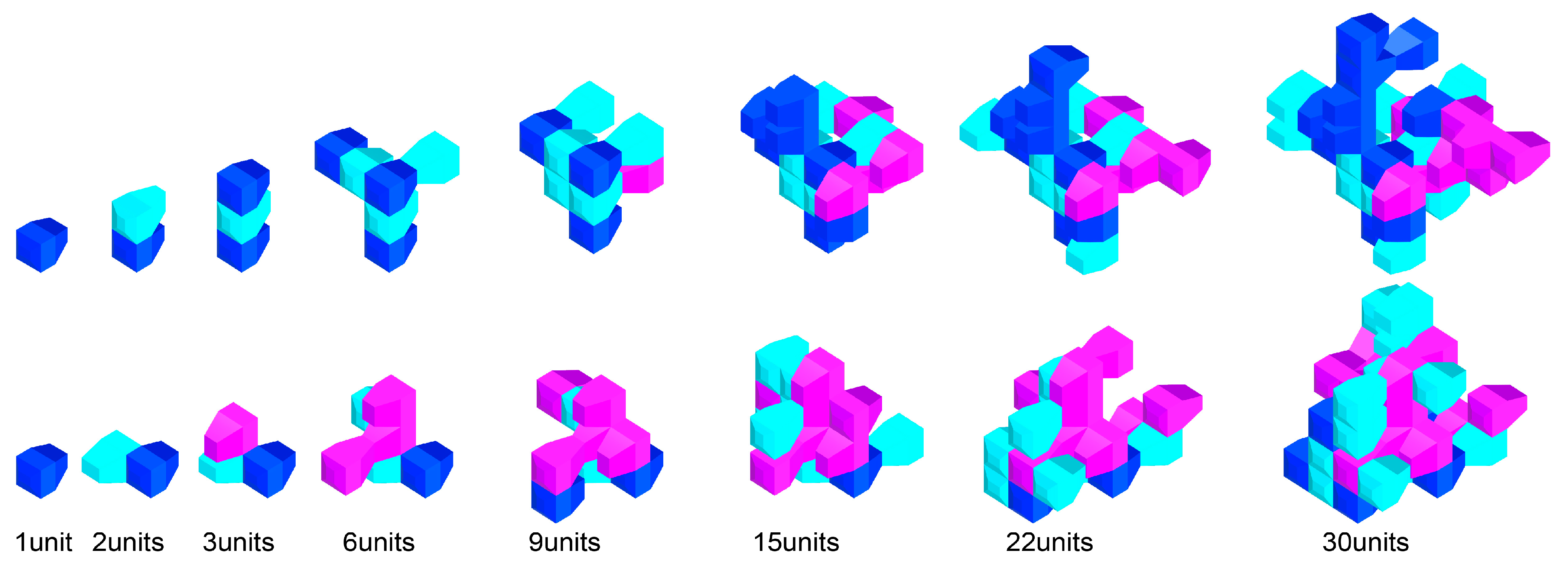
Typologies for Case Study 1; in this case, 37 joint typologies are viable (VR 16.4%).
Figure 7.
Typologies for Case Study 1; in this case, 37 joint typologies are viable (VR 16.4%).
Figure 8.
Growth studies, Case Study 1.
Figure 8.
Growth studies, Case Study 1.
Figure 9.
Grasshopper interface for Case Study 2.
Figure 9.
Grasshopper interface for Case Study 2.
Figure 10.
Typologies for Case Study 2; VR 39.5%.
Figure 10.
Typologies for Case Study 2; VR 39.5%.
Figure 11.
Growth studies, Case Study 2.
Figure 11.
Growth studies, Case Study 2.
Figure 12.
Grasshopper interface for Case Study 3.
Figure 12.
Grasshopper interface for Case Study 3.
Figure 13.
Typologies for Case Study 3; VR 79.0%.
Figure 13.
Typologies for Case Study 3; VR 79.0%.
Figure 14.
Growth studies, Case Study 3.
Figure 14.
Growth studies, Case Study 3.
Figure 15.
Grasshopper interface for Case Study 4.
Figure 15.
Grasshopper interface for Case Study 4.
Figure 16.
Typologies for Case Study 4; VR 35.5%.
Figure 16.
Typologies for Case Study 4; VR 35.5%.
Figure 17.
Growth studies, Case Study 4.
Figure 17.
Growth studies, Case Study 4.
Figure 18.
Grasshopper interface for Case Study 5.
Figure 18.
Grasshopper interface for Case Study 5.
Figure 19.
Typologies for Case Study 5; VR 38.8%.
Figure 19.
Typologies for Case Study 5; VR 38.8%.
Figure 20.
Growth studies, Case Study 5.
Figure 20.
Growth studies, Case Study 5.
Figure 21.
Grasshopper interface for Case Study 6.
Figure 21.
Grasshopper interface for Case Study 6.
Figure 22.
Typologies for Case Study 6; VR 20.0%.
Figure 22.
Typologies for Case Study 6; VR 20.0%.
Figure 23.
Growth studies, Case Study 6.
Figure 23.
Growth studies, Case Study 6.
Table 1.
Patterns of flexibility, vertical growth, adaptability, and parametric innovation.
Table 1.
Patterns of flexibility, vertical growth, adaptability, and parametric innovation.
| Case Study | Syst. | VR | Formal Flexibility | Vertical Growth | Environmental Adaptability | Parametric Innovation |
|---|
| Kokoon | N-O | 16.4% | Limited by scale; high repeatability | Limited | Very high; ideal for emergencies | Medium; high repetition |
| Living Unit | N-O | 39.5% | Medium; focused on quick configuration | Limited | Very high; good autonomous behaviour | Medium; simple structure |
| Welcome Home | N-O | 79.0% | Very high; balance between uses and forms | Very high | High; adaptable to different environments | High; clear coupling logic |
| Housing in Covas | O | 35.5% | Good; adaptable to rural context | Moderate | High; flexible rural implementation | High; good horizontal aggregation |
| Habitat 67 | O | 38.8% | Medium; limited by structural stiffness | High, with limitations | Low; limited adaptation | Low; difficult to iterate parametrically |
| The Farmhouse | H | 20.0% | Low; rigid hierarchy | High | Medium; closed design | Medium; rigid structure complicates simulation |
| Disclaimer/Publisher’s Note: The statements, opinions and data contained in all publications are solely those of the individual author(s) and contributor(s) and not of MDPI and/or the editor(s). MDPI and/or the editor(s) disclaim responsibility for any injury to people or property resulting from any ideas, methods, instructions or products referred to in the content. |




 ,
,