Research on Finite Element Analysis Method of Curved Beam Walking Incremental Launching Construction


Abstract
1. Introduction
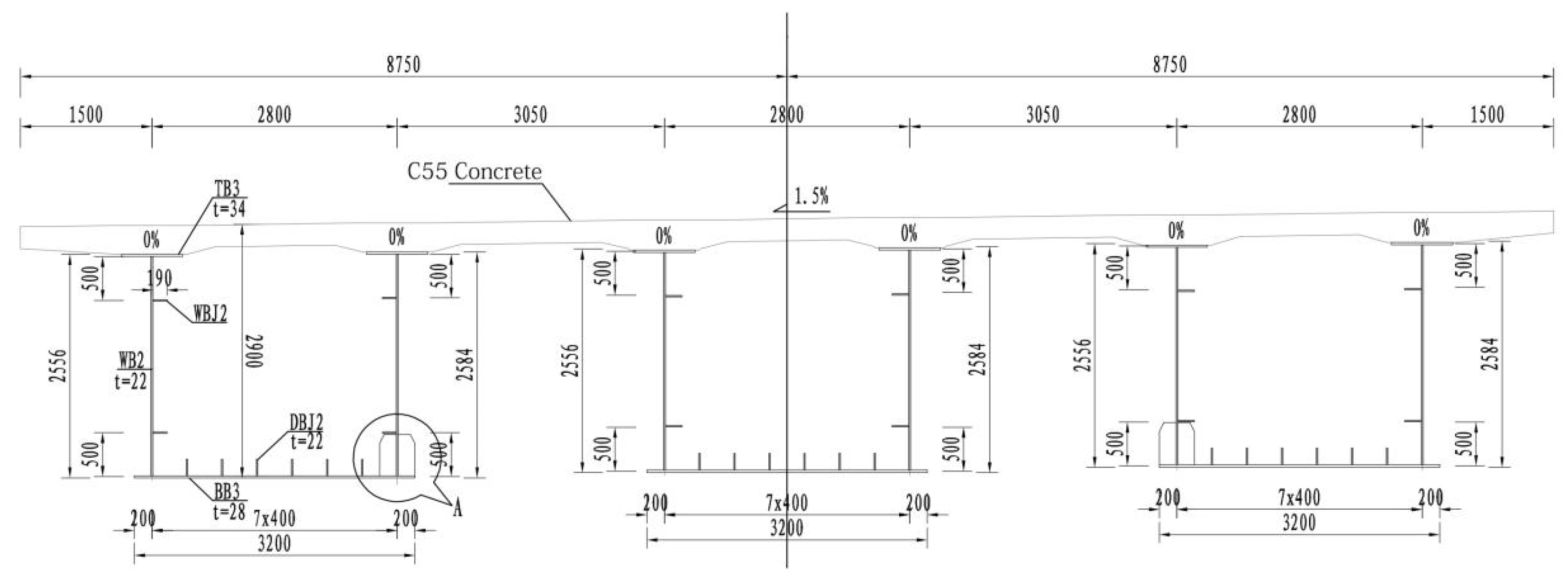
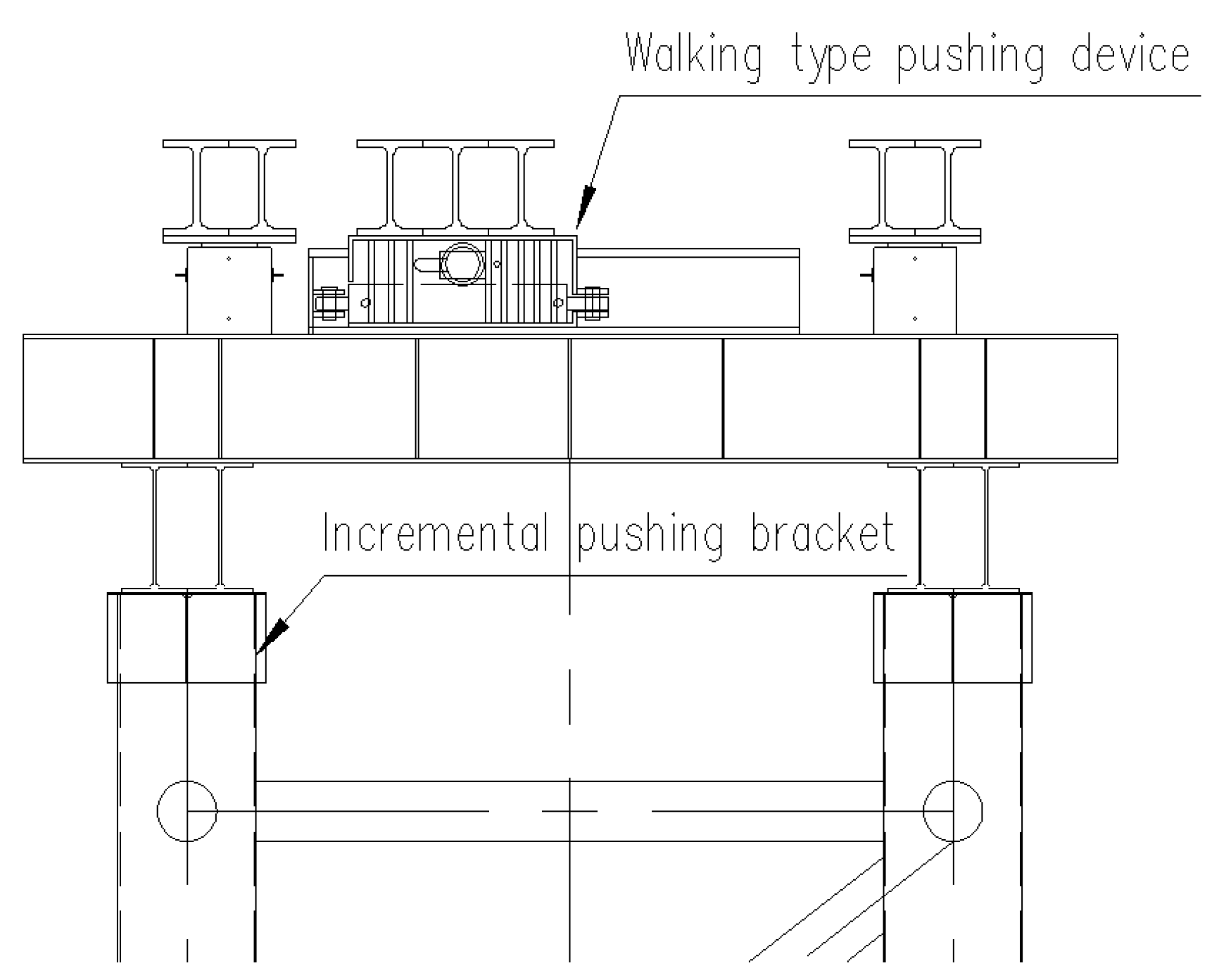
2. Project Profile
3. Theory of Finite Element
4. Finite Element Numerical Simulation
4.1. Parameter Setting
4.1.1. Basic Model Parameters
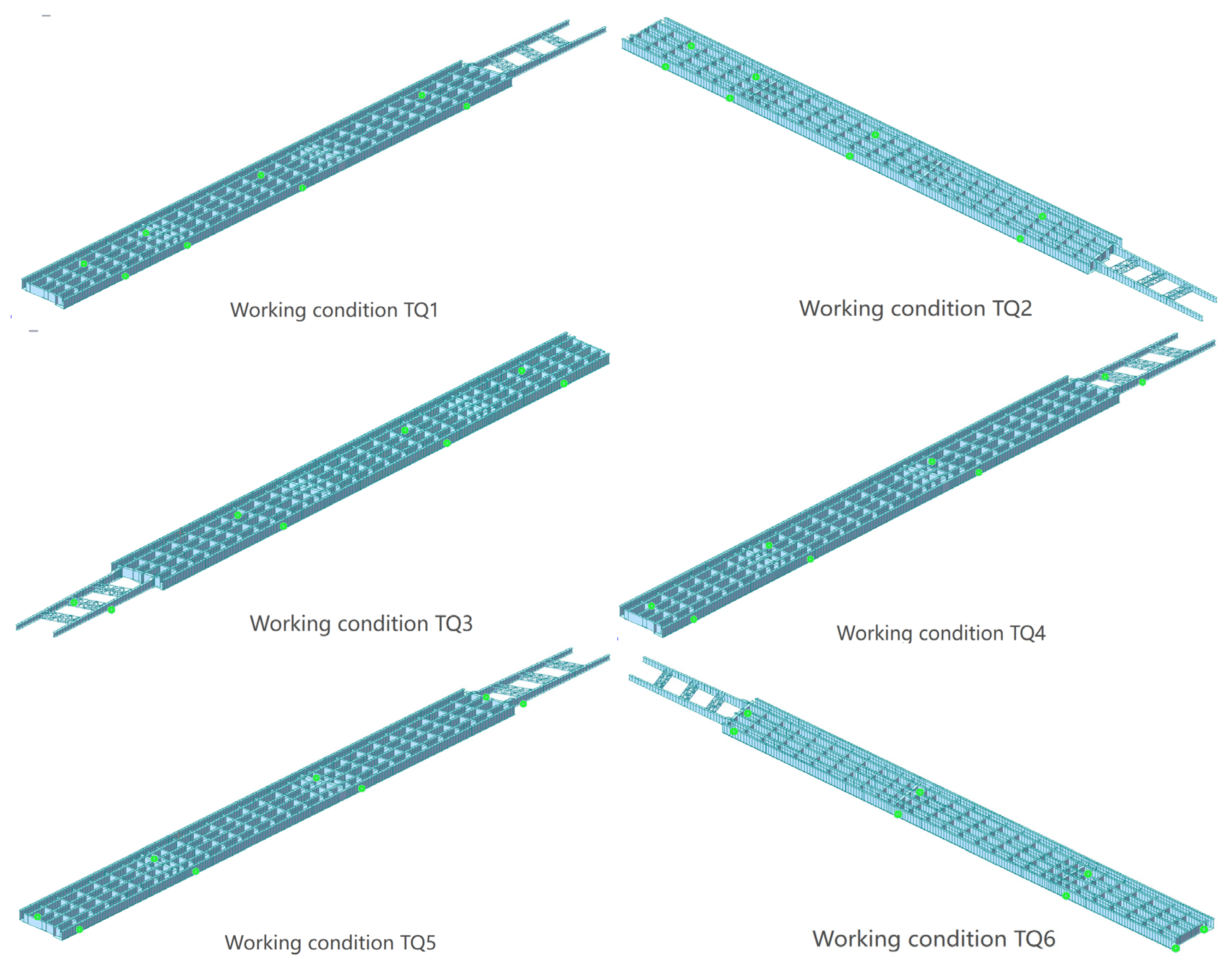
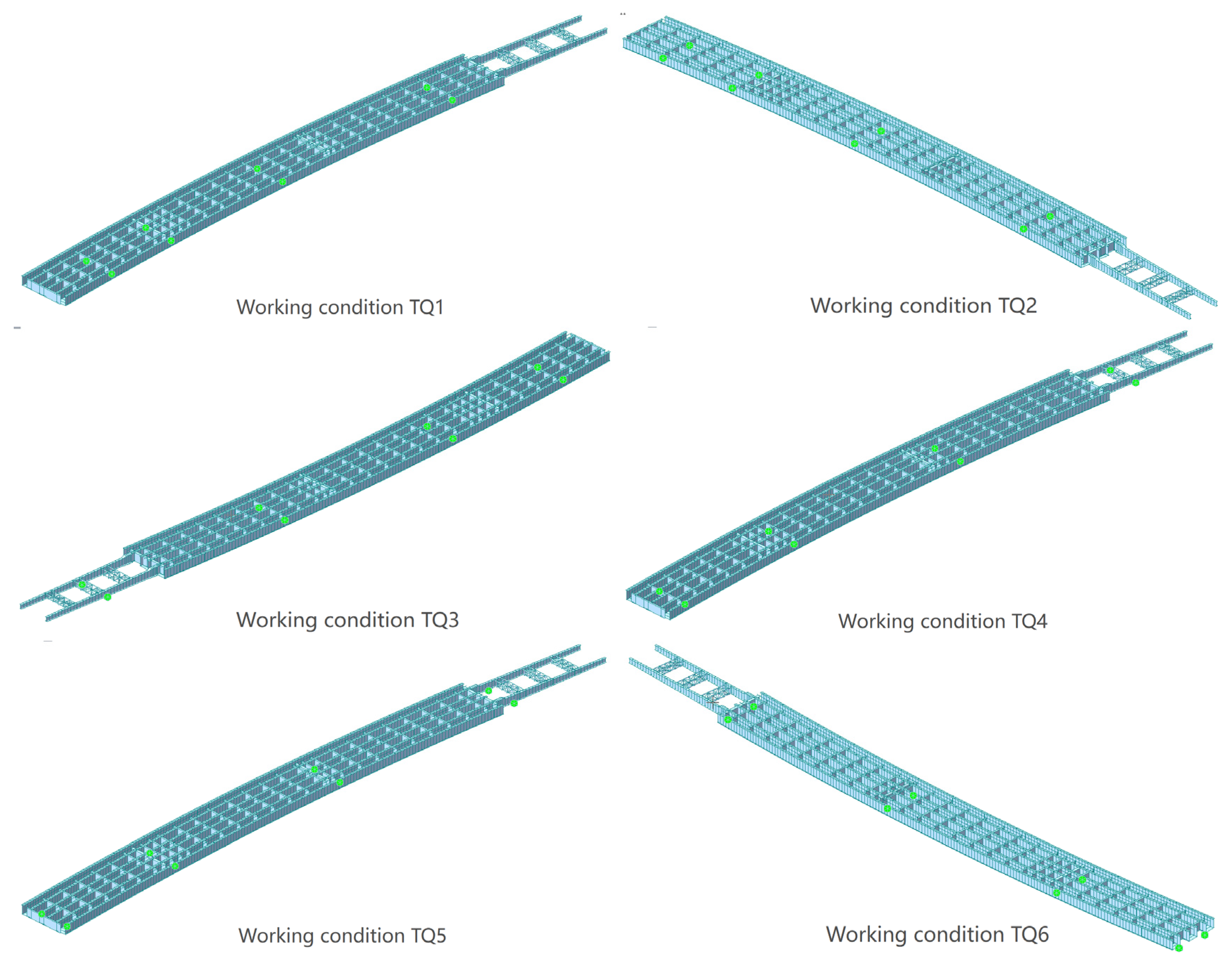
4.1.2. Selection Analysis of Pushing Condition
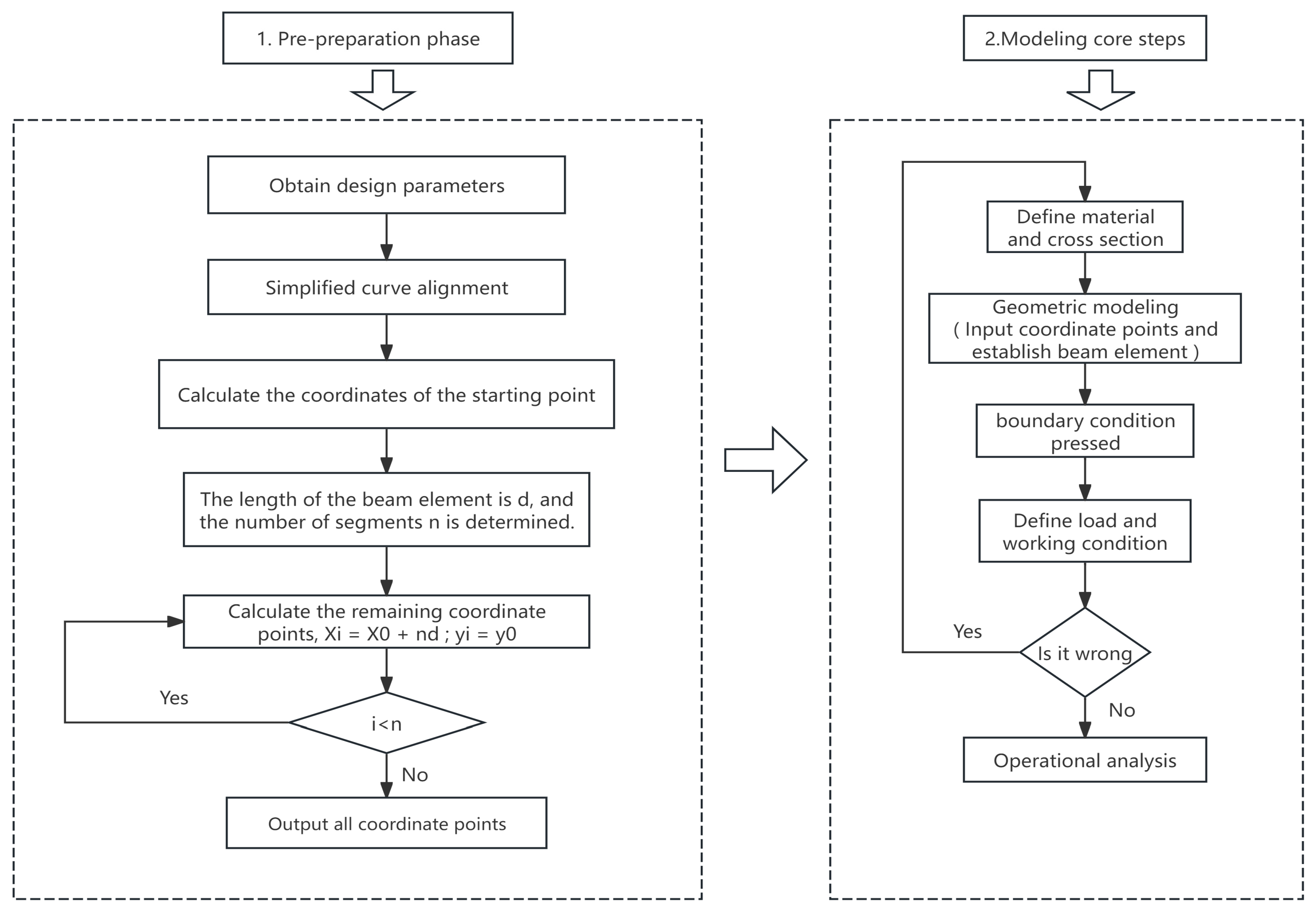
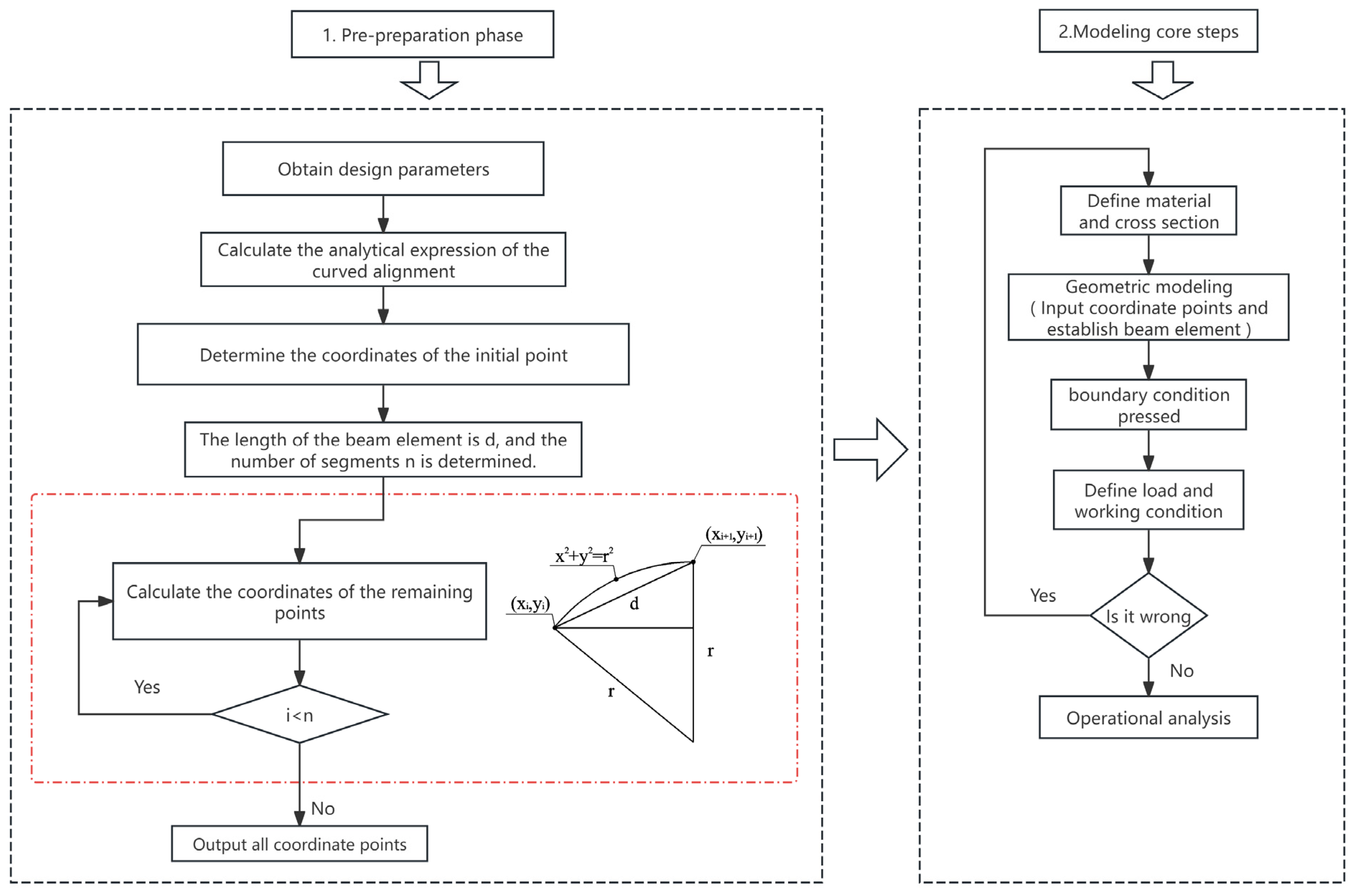
4.2. Modeling Scheme
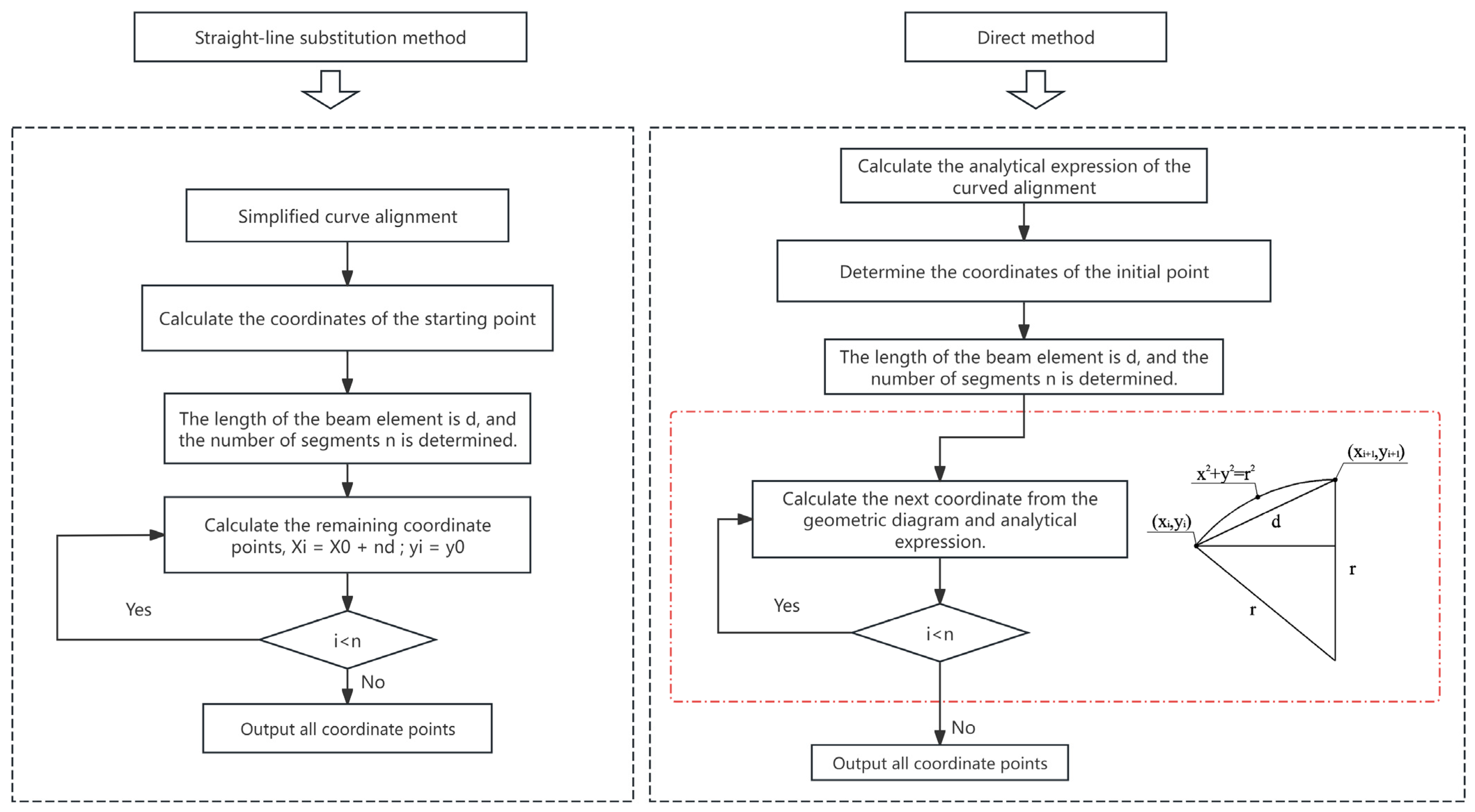
4.2.1. Scheme 1 Modeling with “Straight-Line Substitution Method”
4.2.2. Scheme 2 “Direct Method” Modeling
4.2.3. Efficiency Comparison
5. Results and Analysis
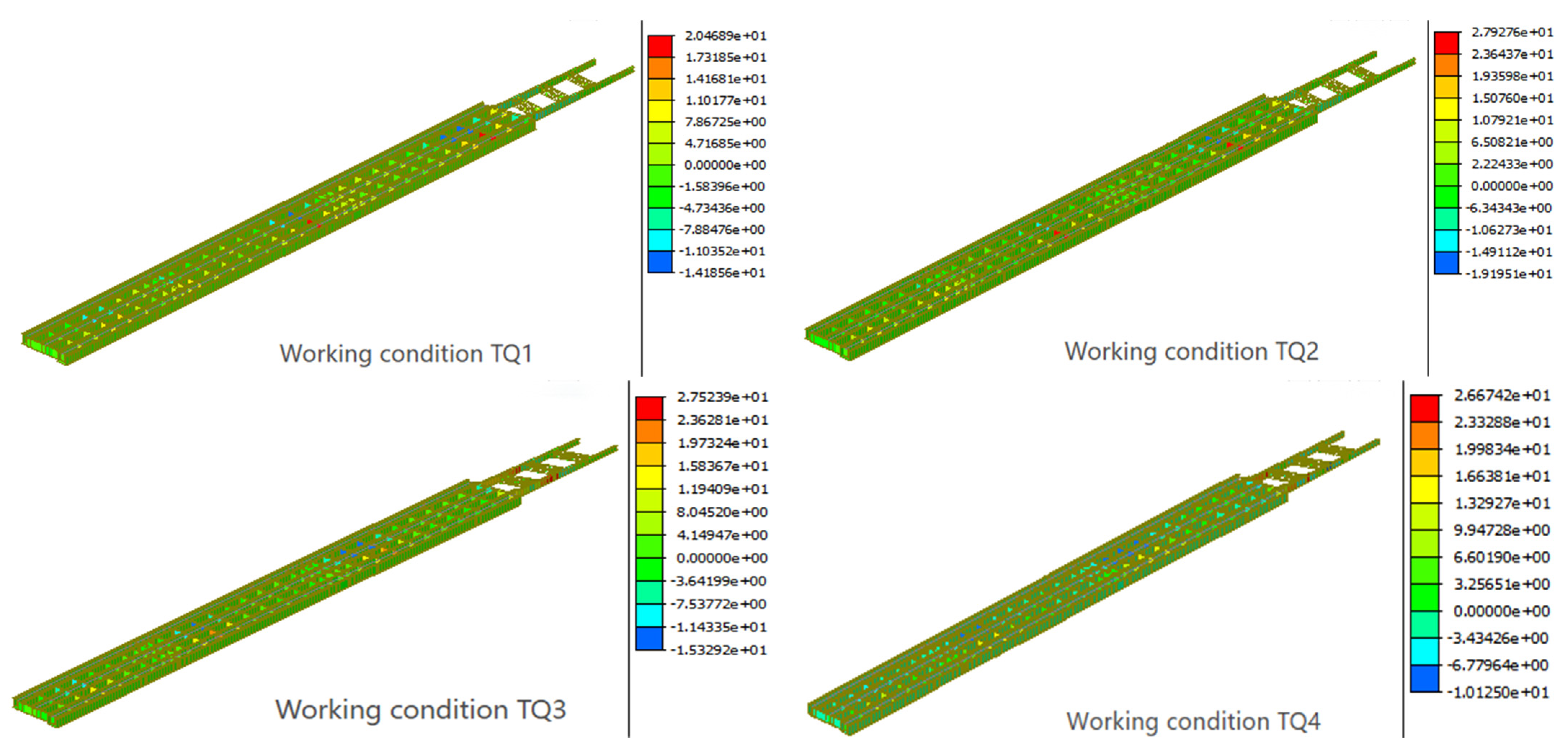
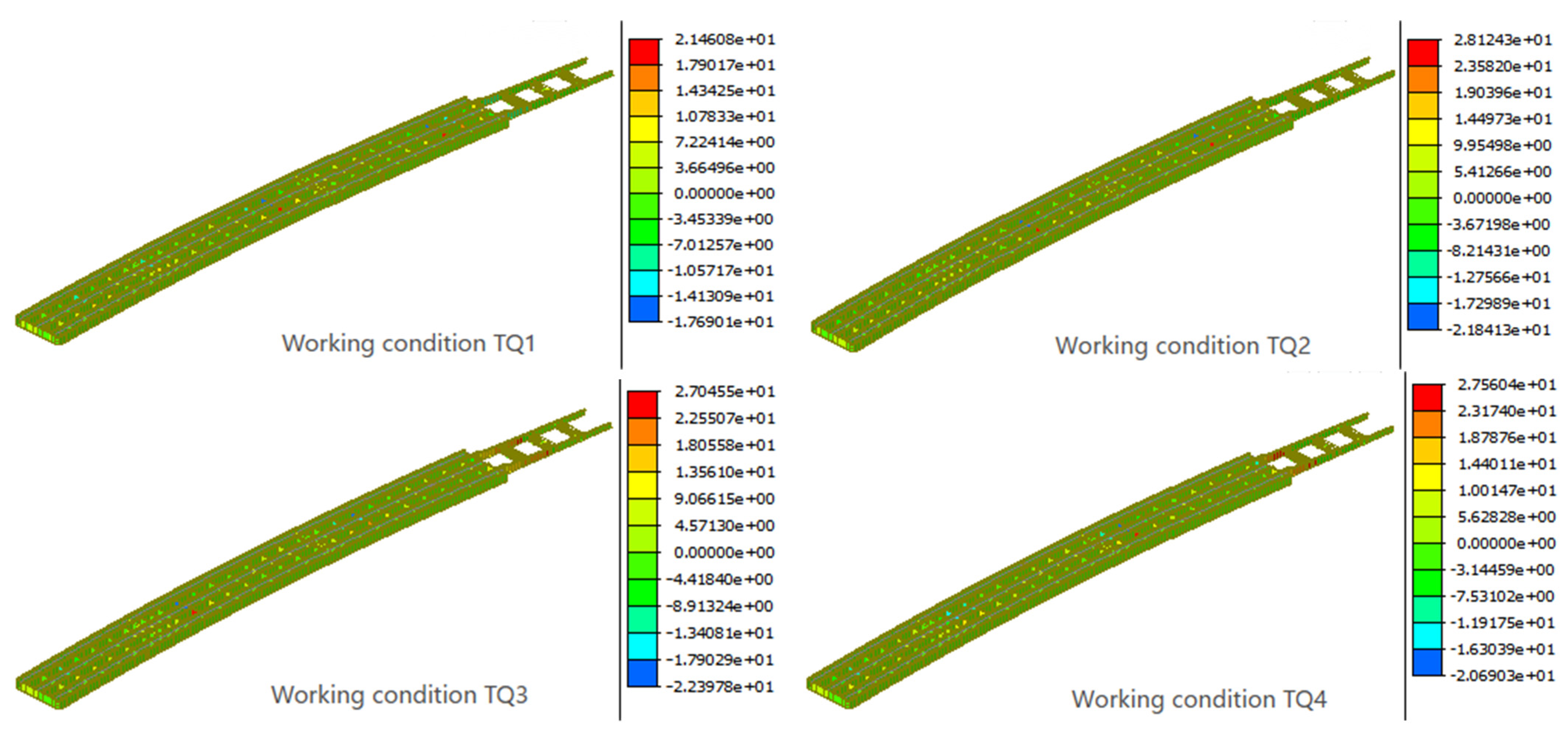
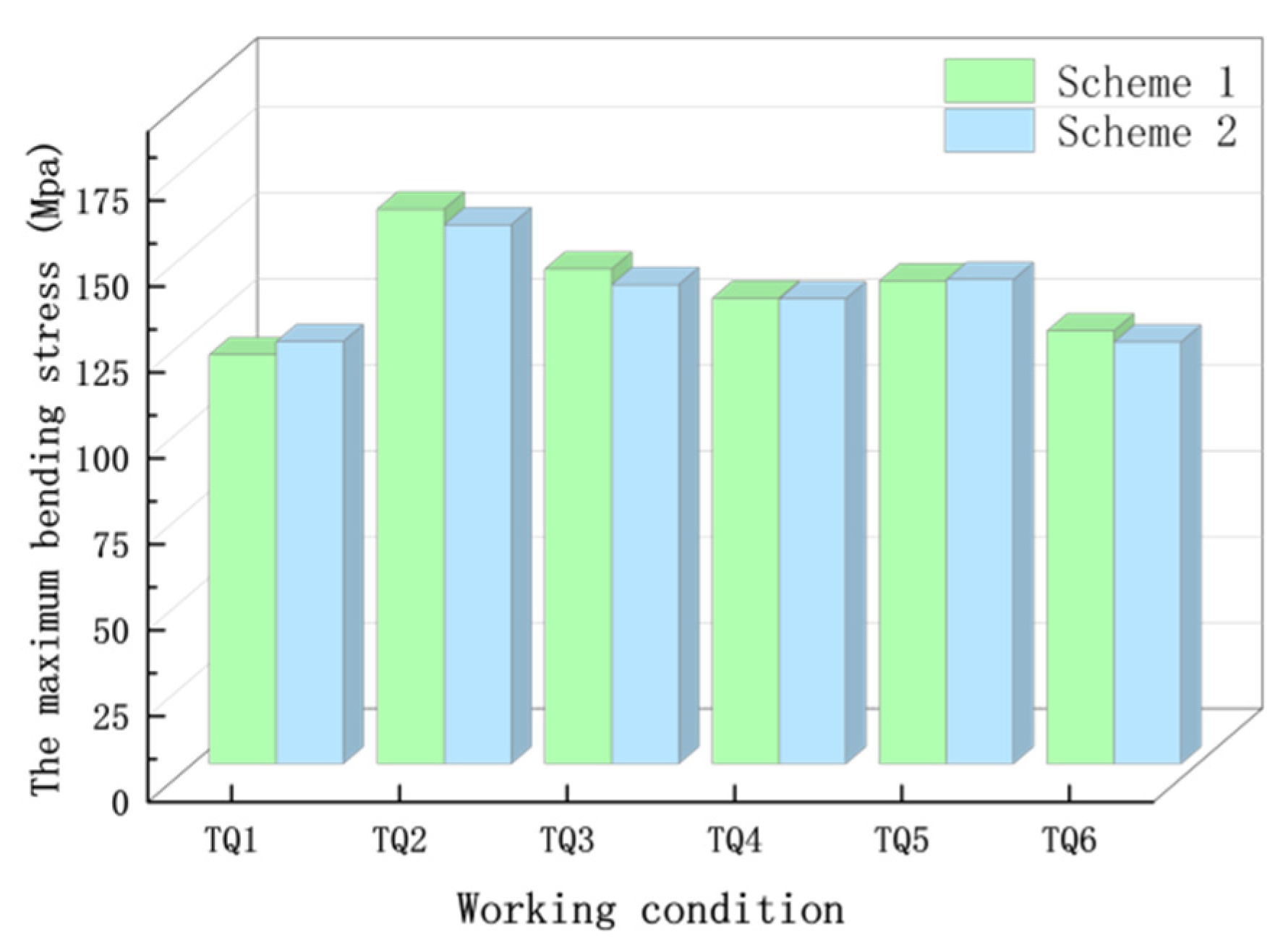
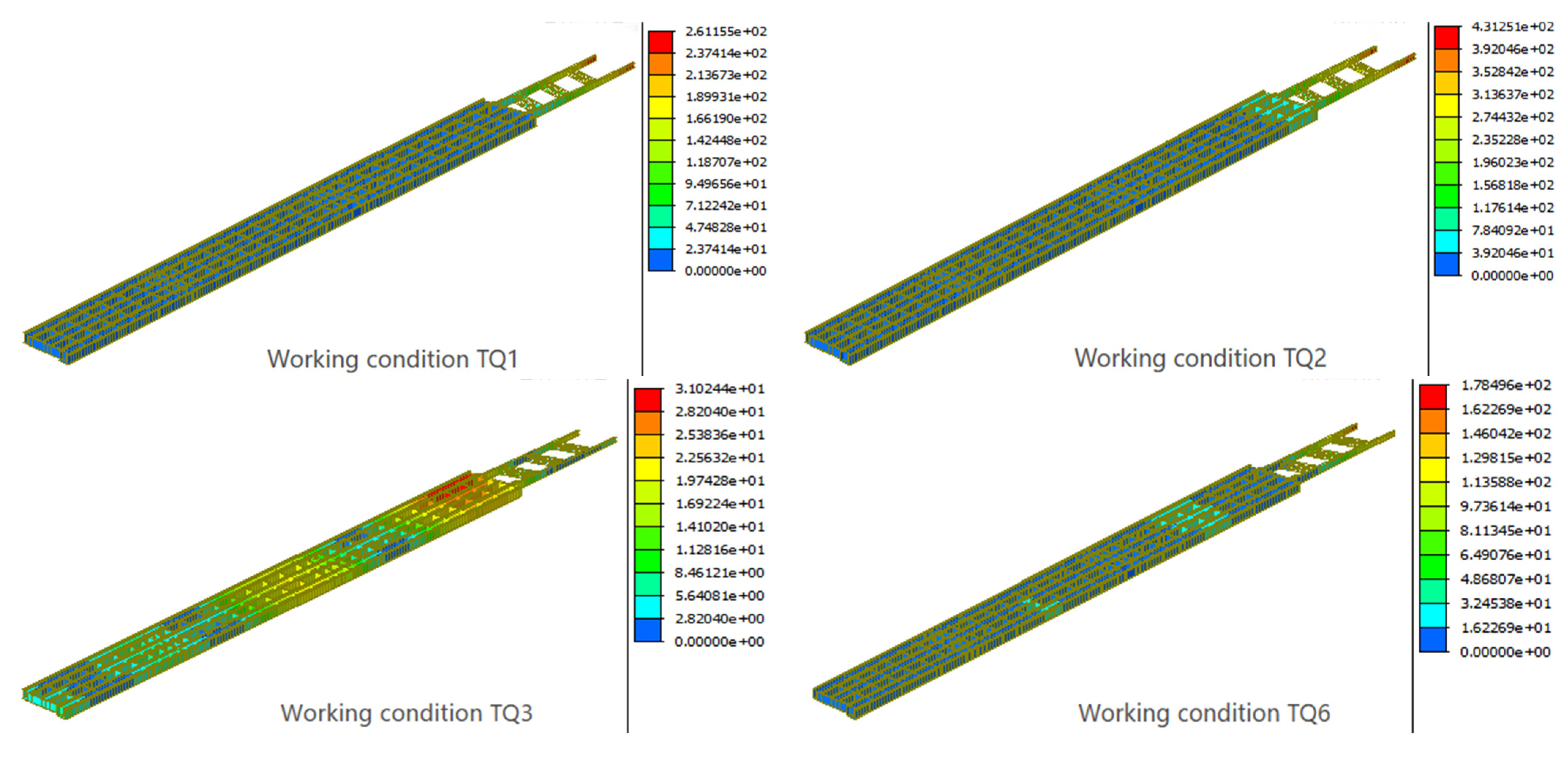
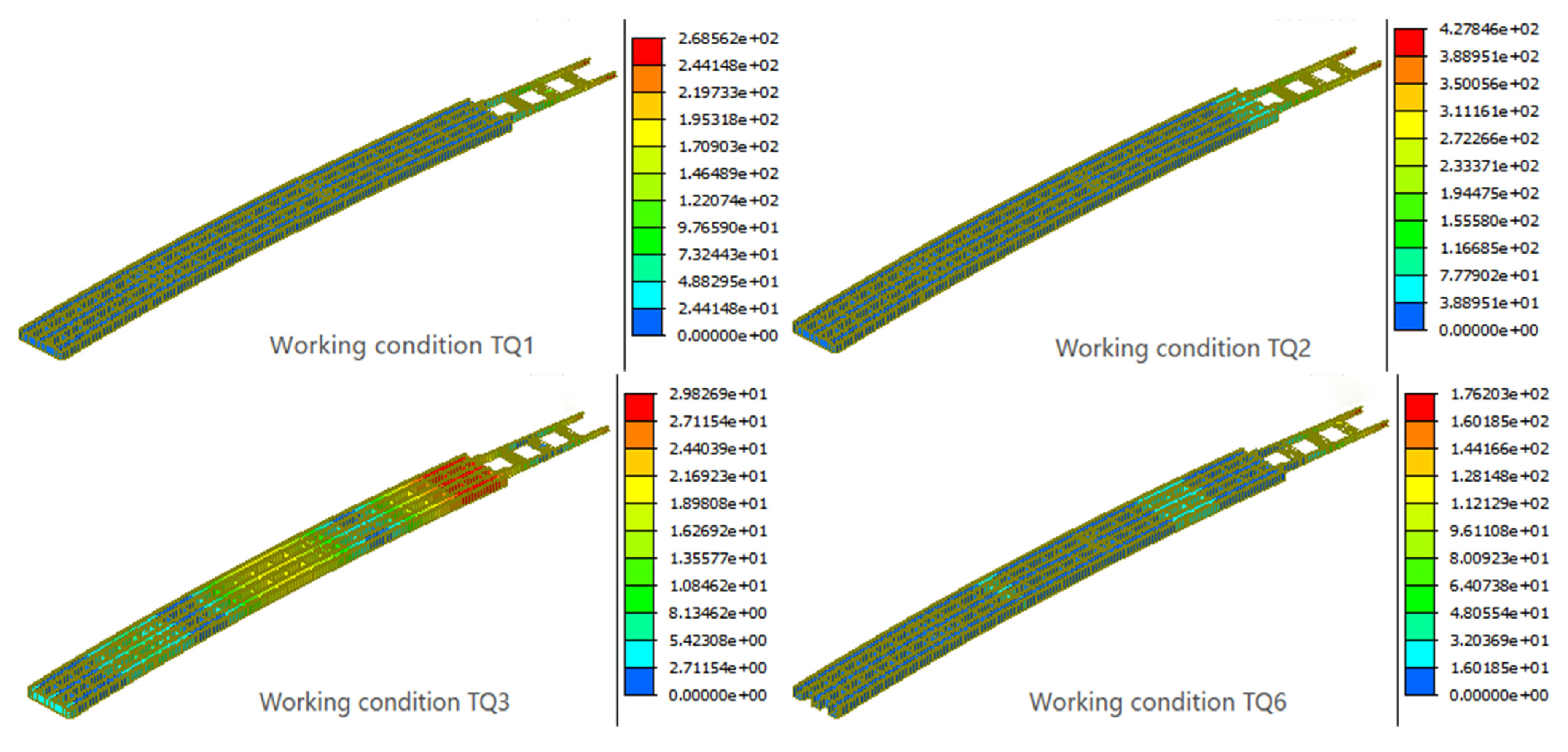
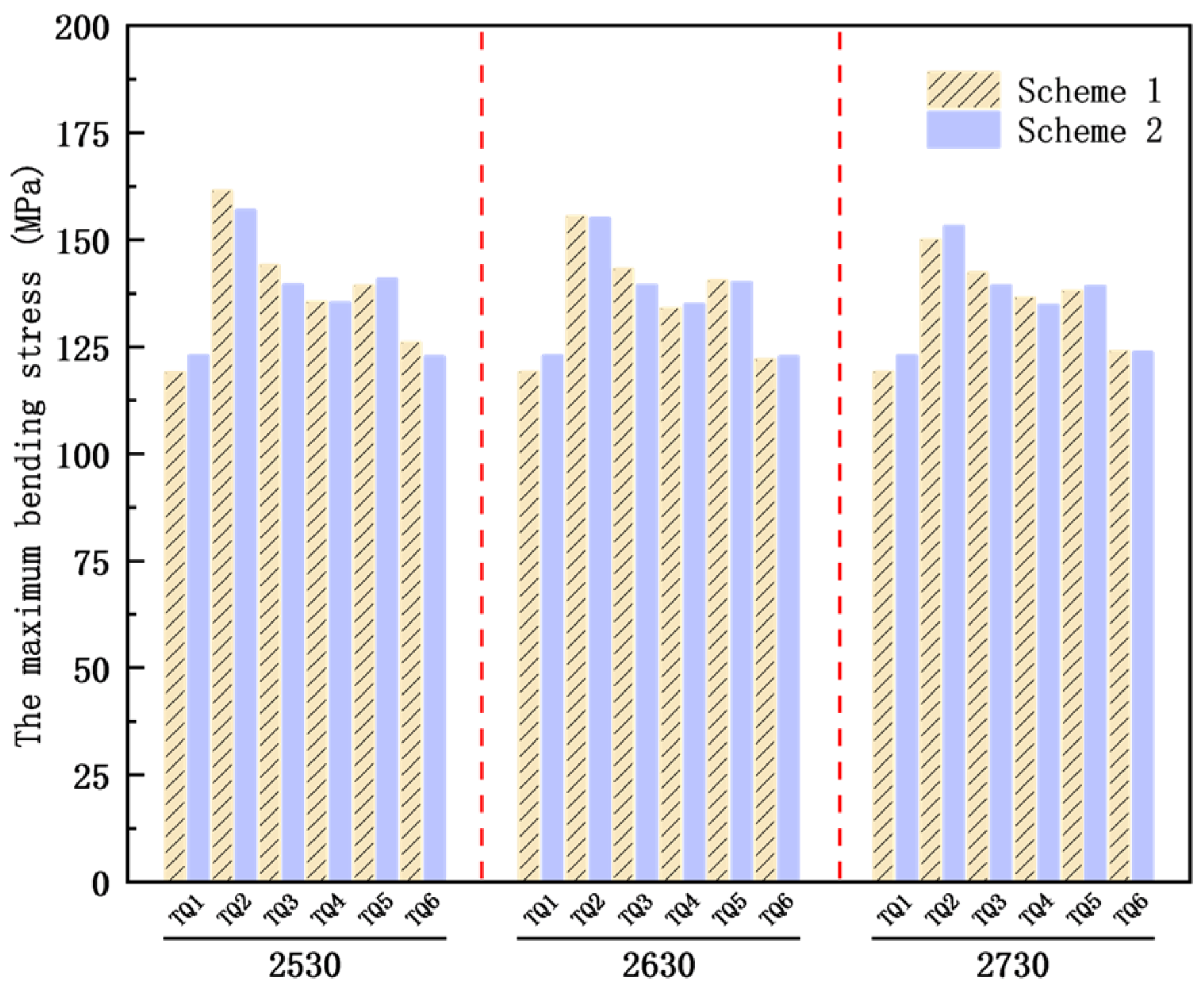
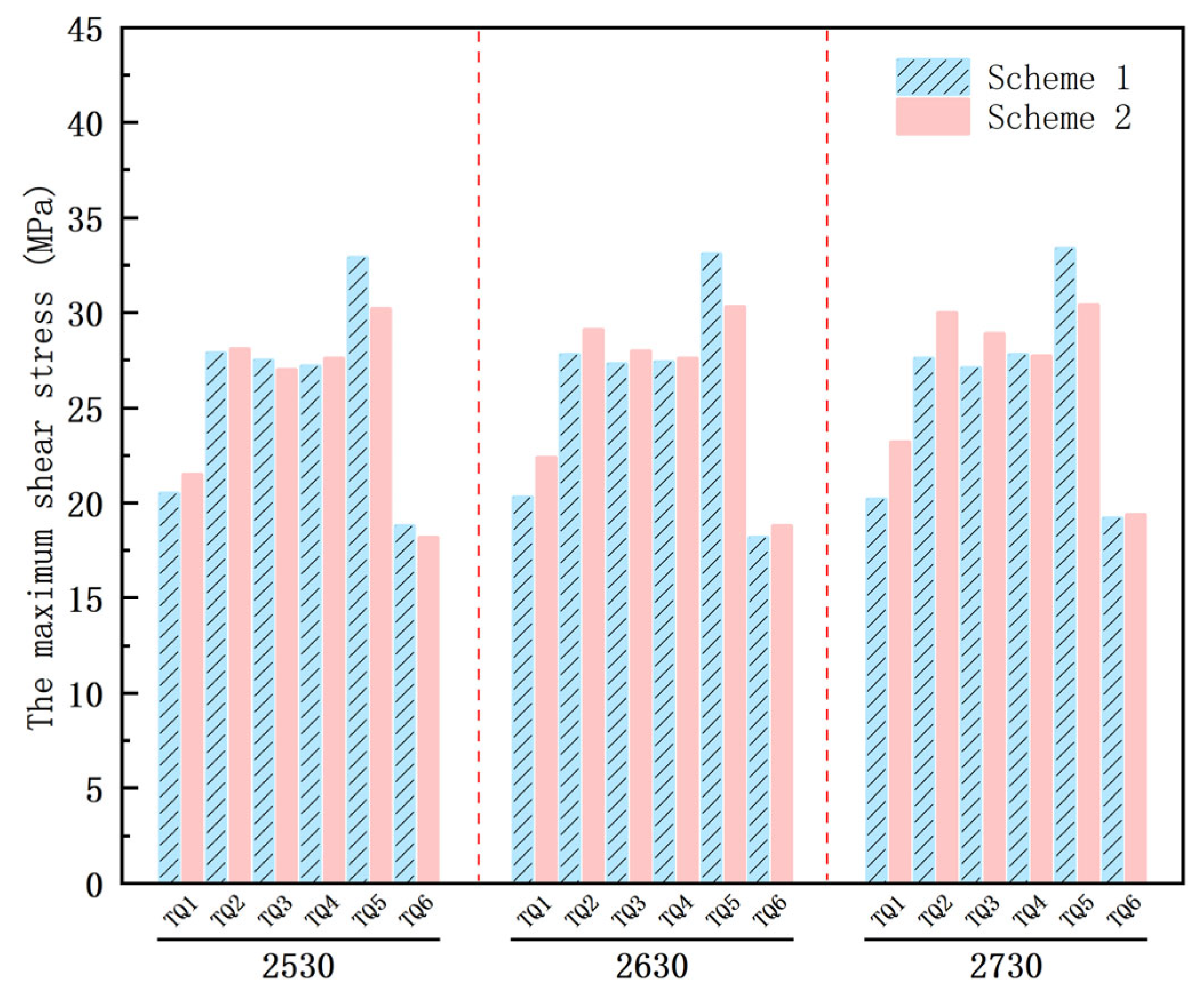
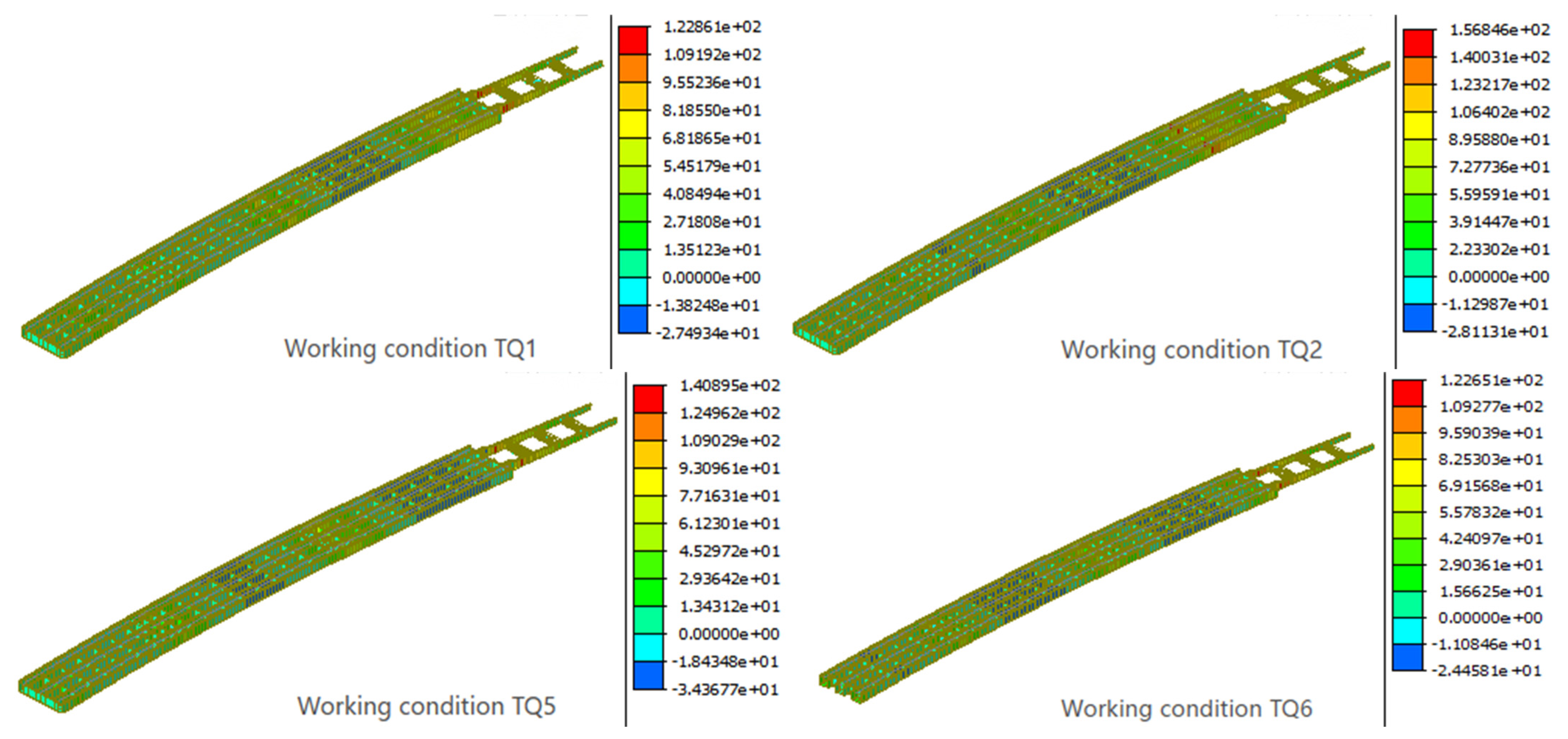
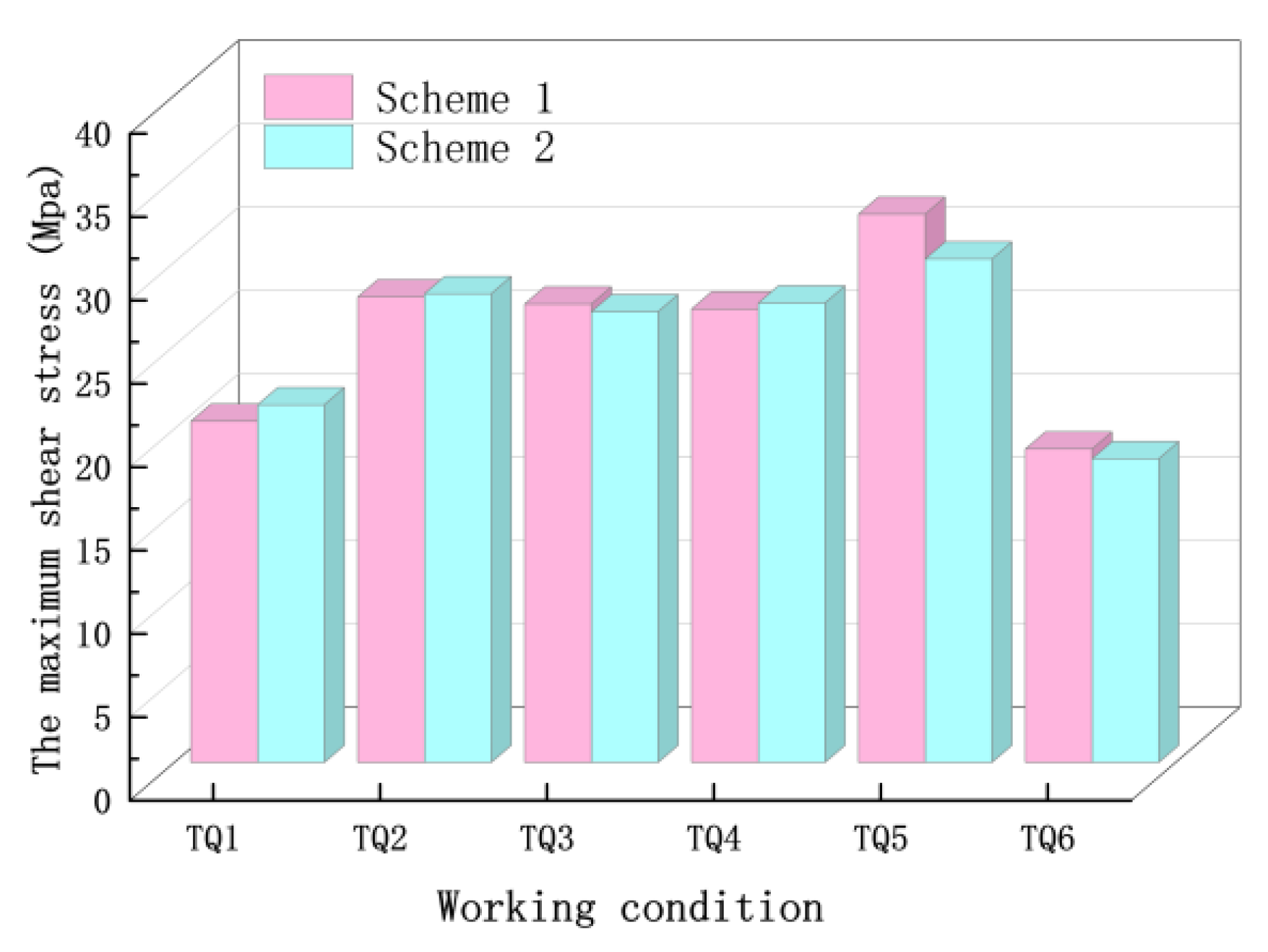
5.1. Stress Analysis
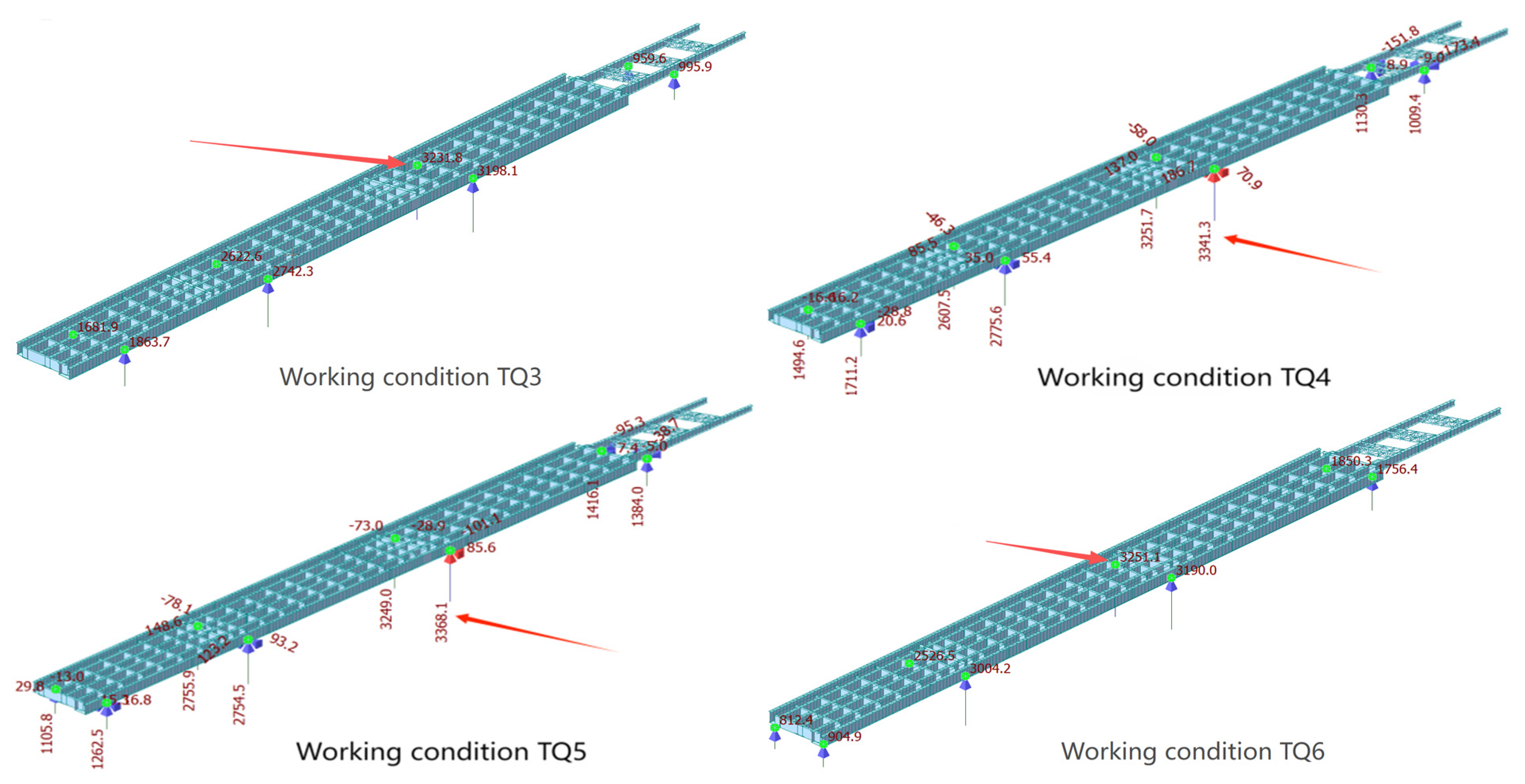
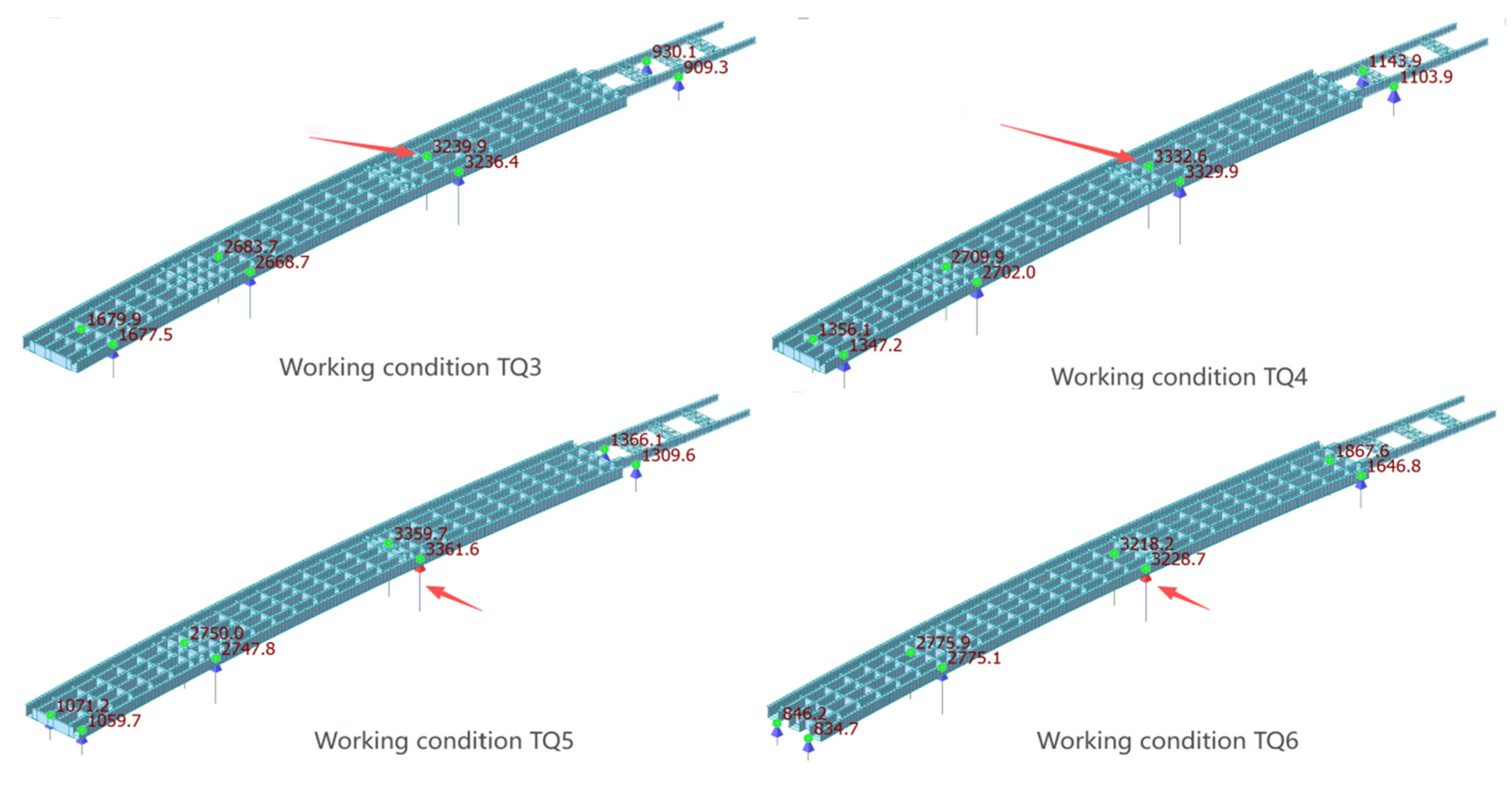
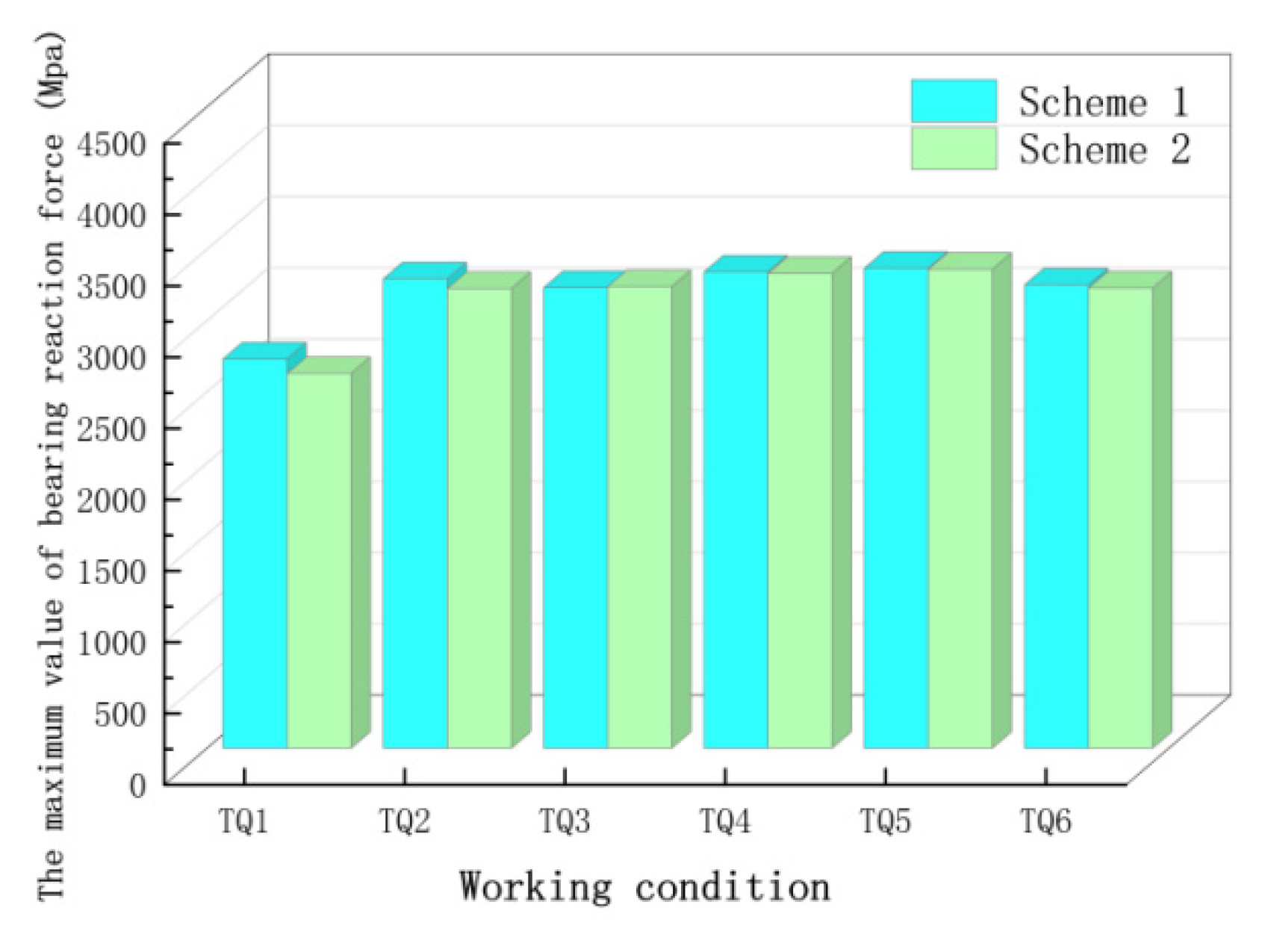
5.2. Analysis of Support Reaction Force
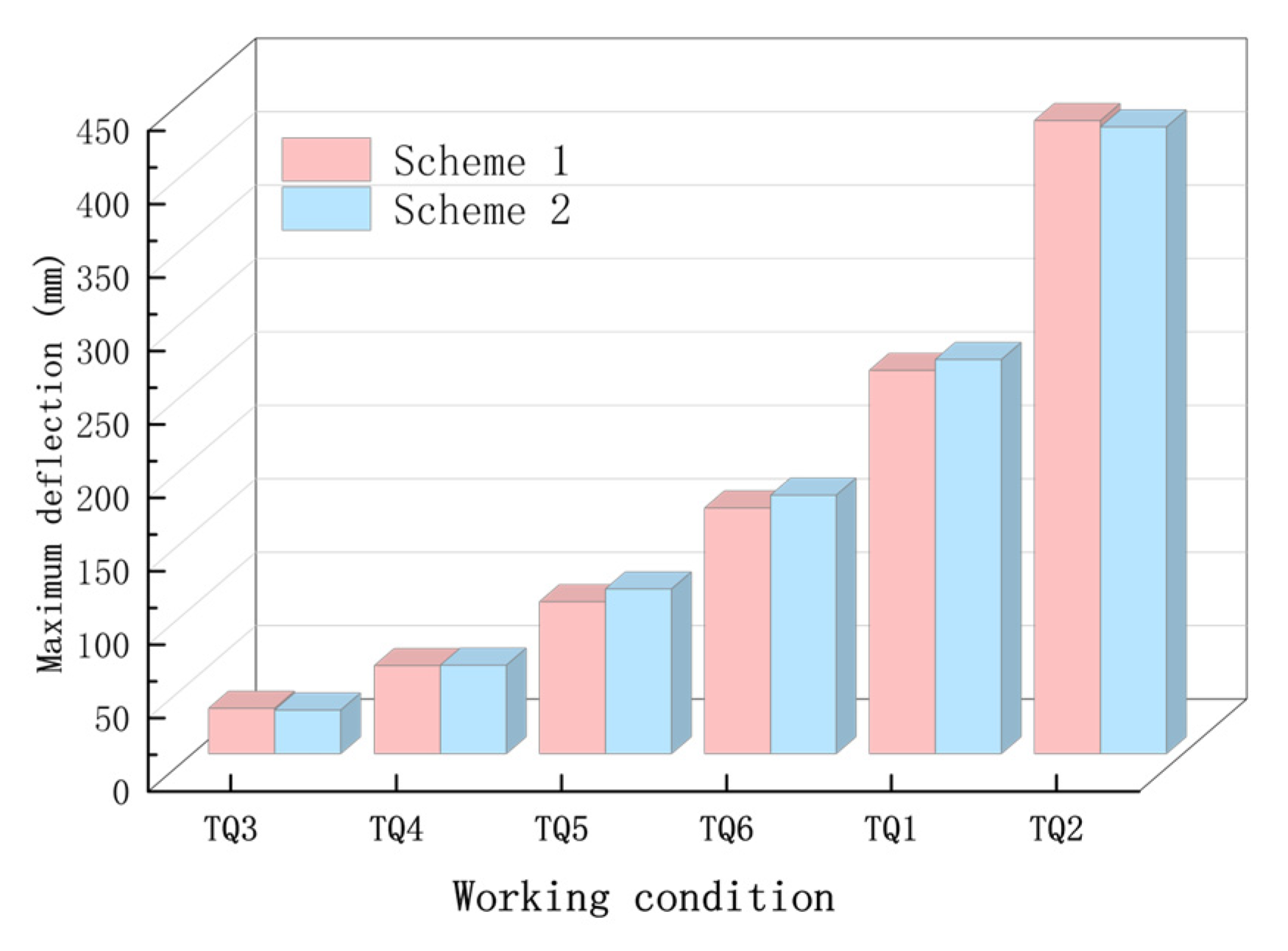
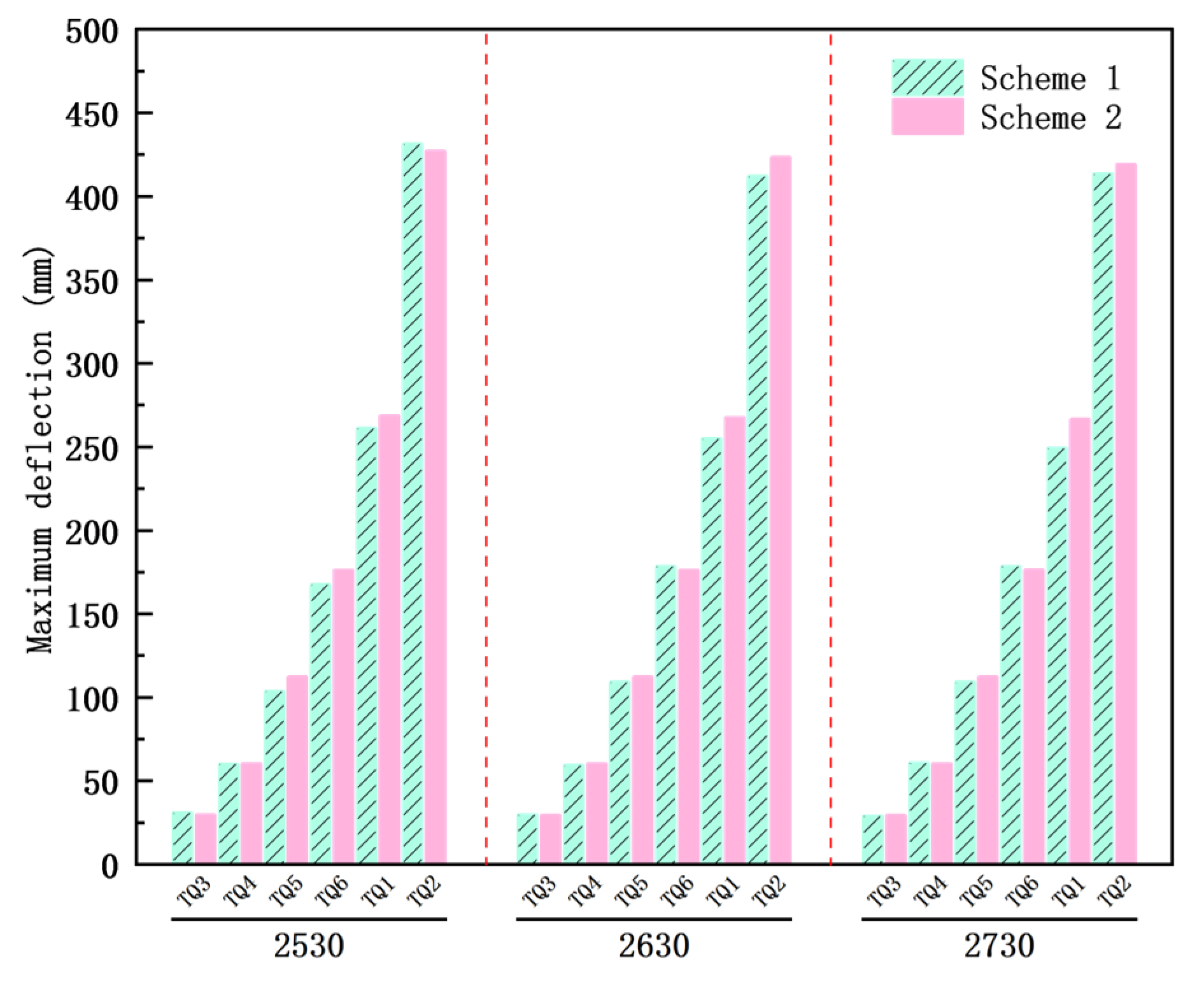
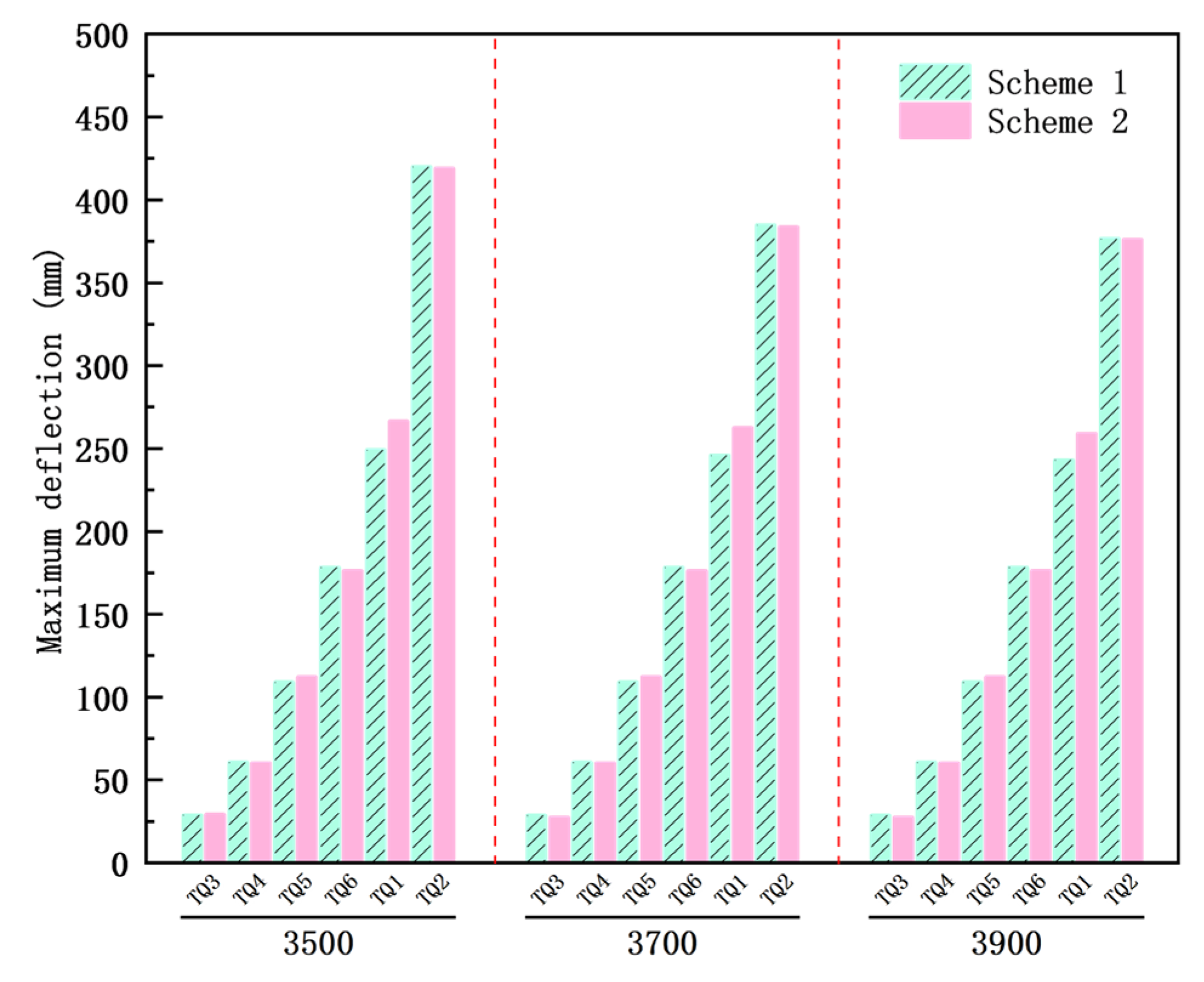
5.3. Deflection Analysis
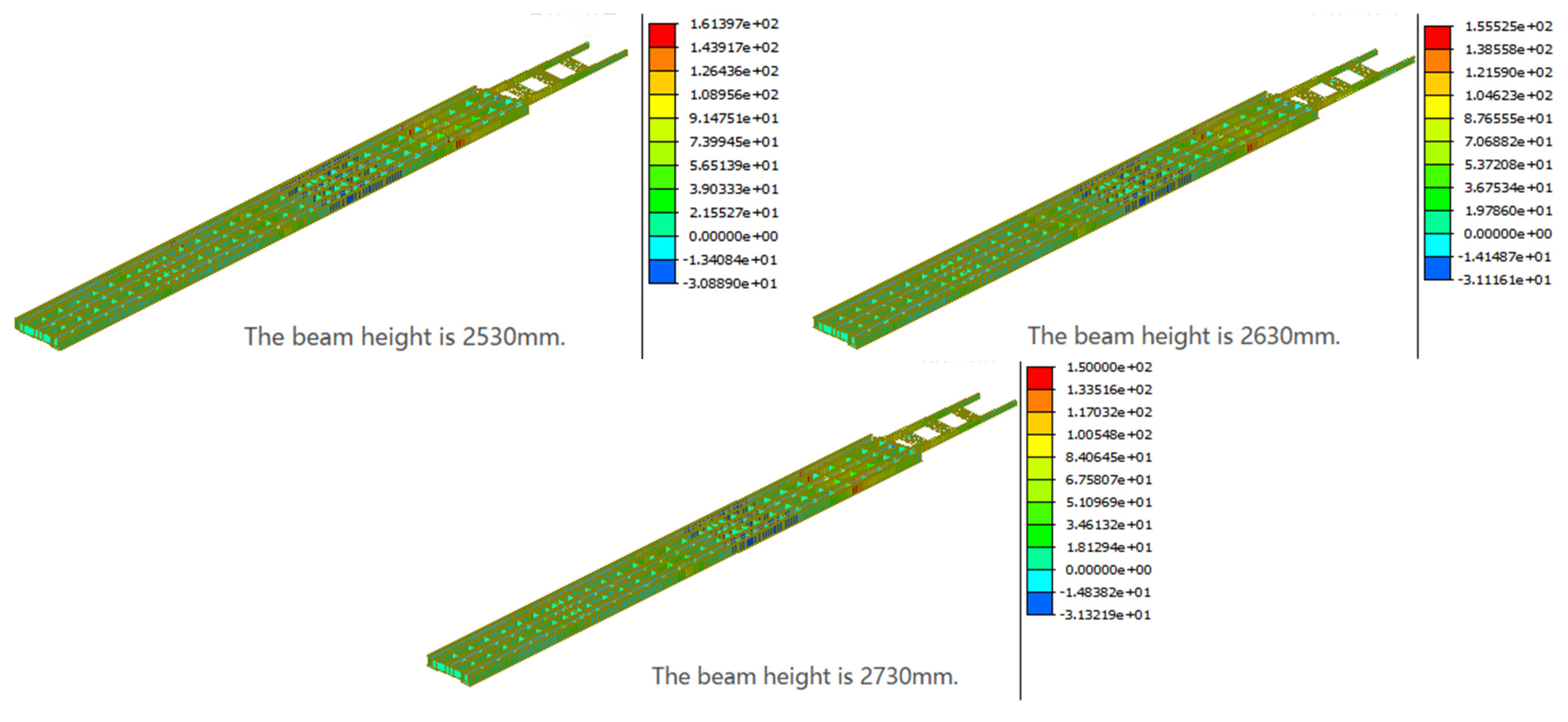
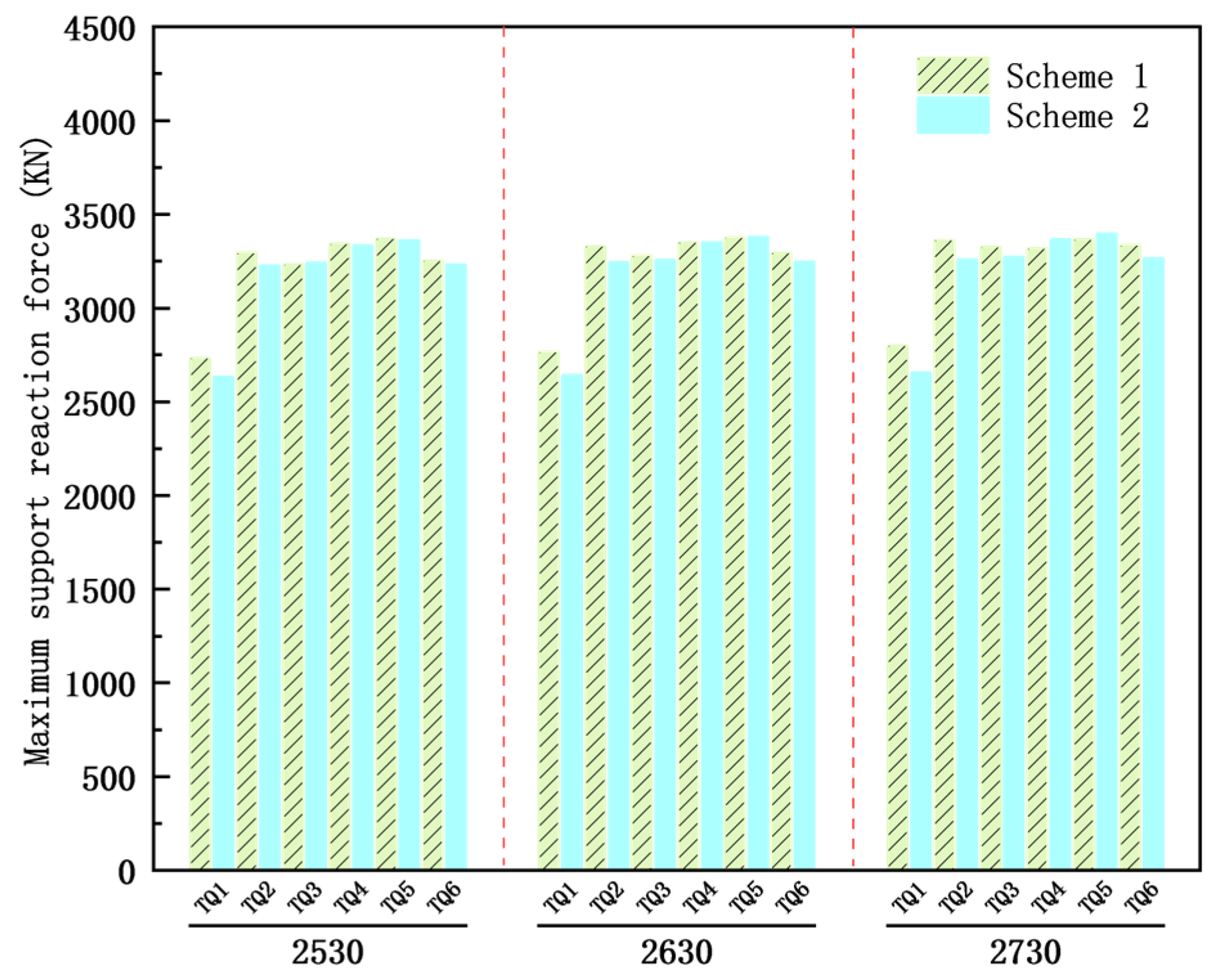
5.4. Parametric Analysis
5.4.1. Beam Height Analysis
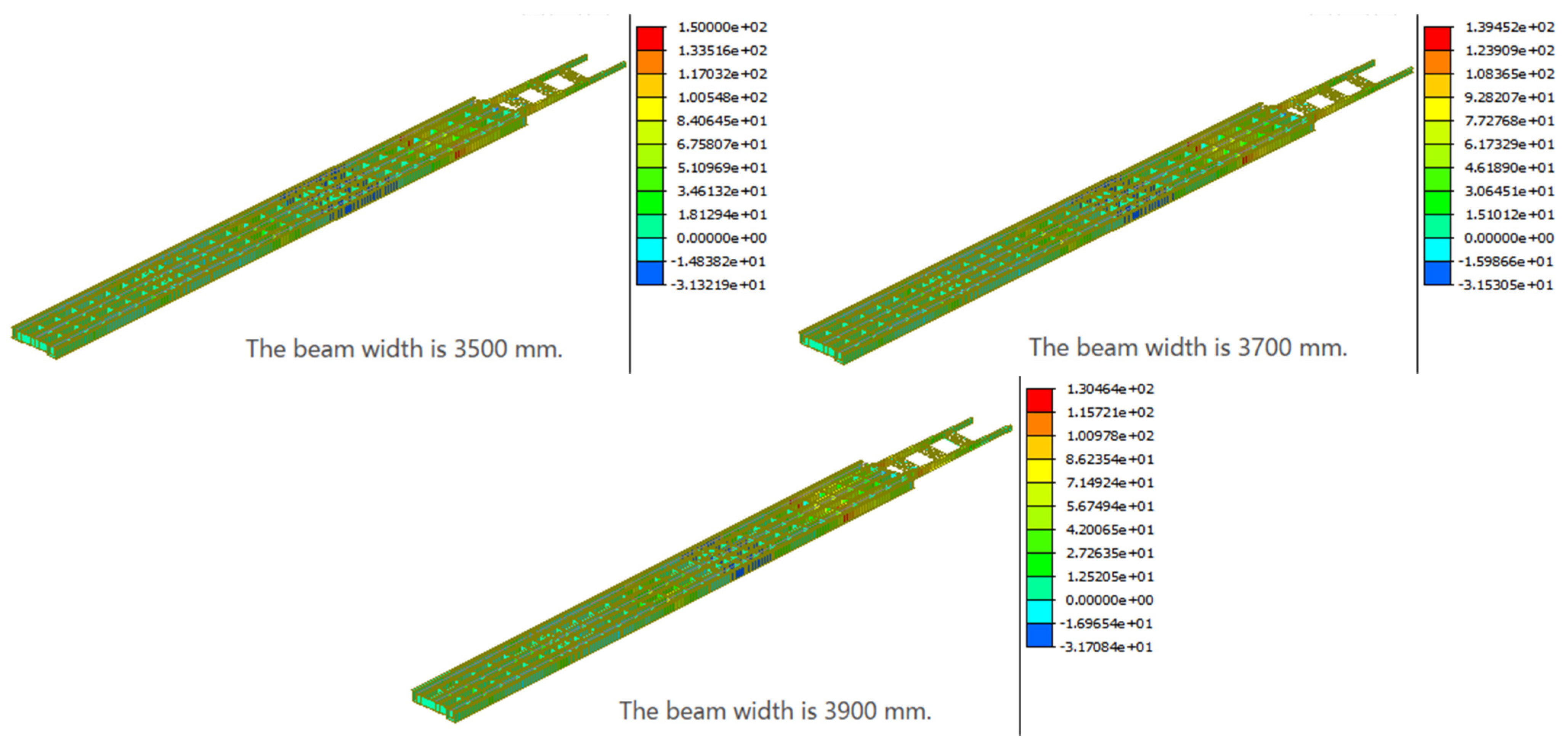
5.4.2. Beam Width Analysis
6. Conclusions
- (1)
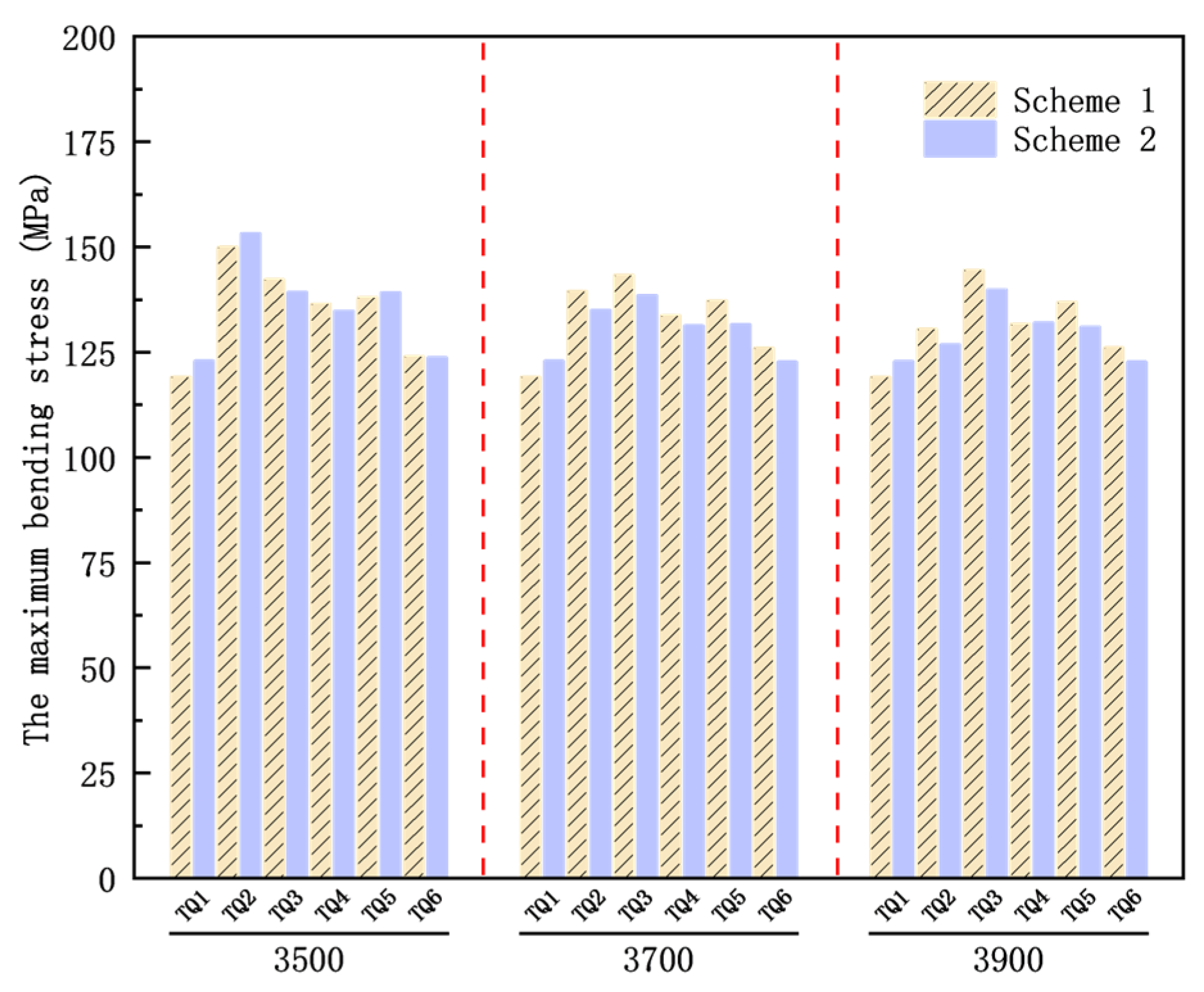
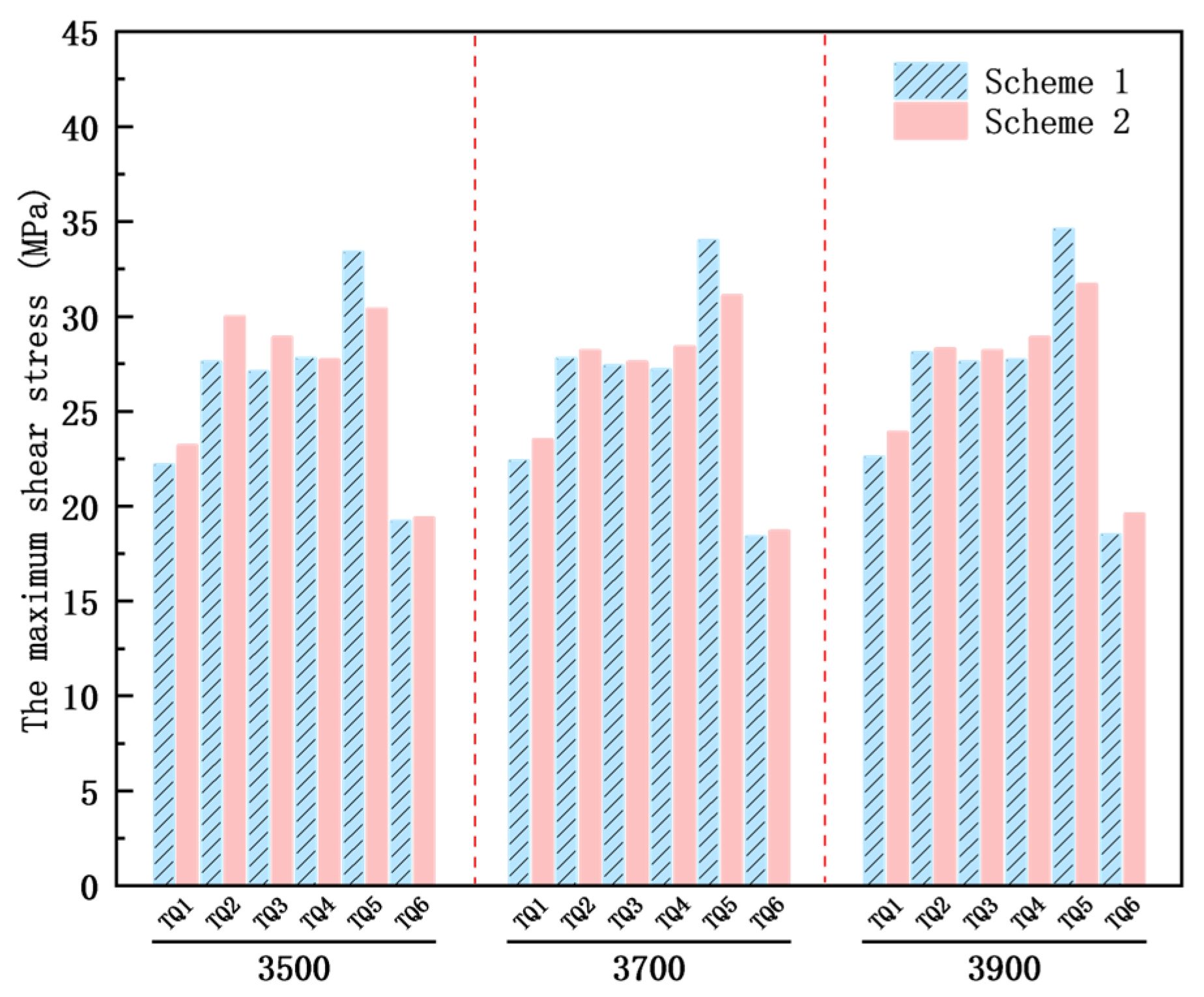
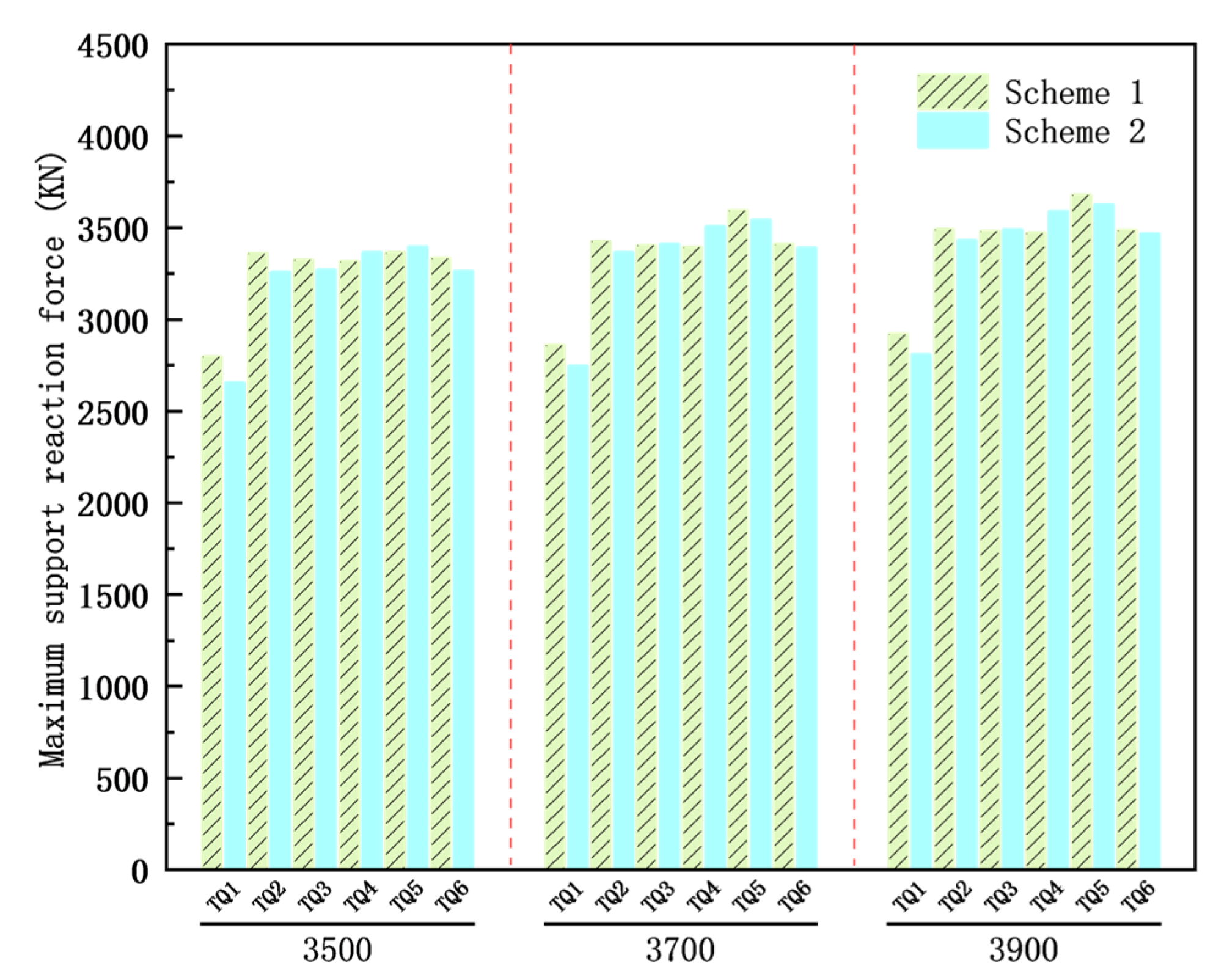
- The finite element models established using the straight-line substitution method and the direct method produce highly consistent results in terms of calculated stress, bearing reactions, and deflection. This high level of consistency is maintained across variations in beam height and width, confirming the applicability of the straight-line substitution method for analyzing the mechanical behavior of the steel box girder–steel guide girder composite system during the incremental launching construction of curved girders. Furthermore, the straight-line substitution method avoids complex mathematical derivations and substantial computational effort, offering significantly higher modeling efficiency compared to the direct method.
- (2)
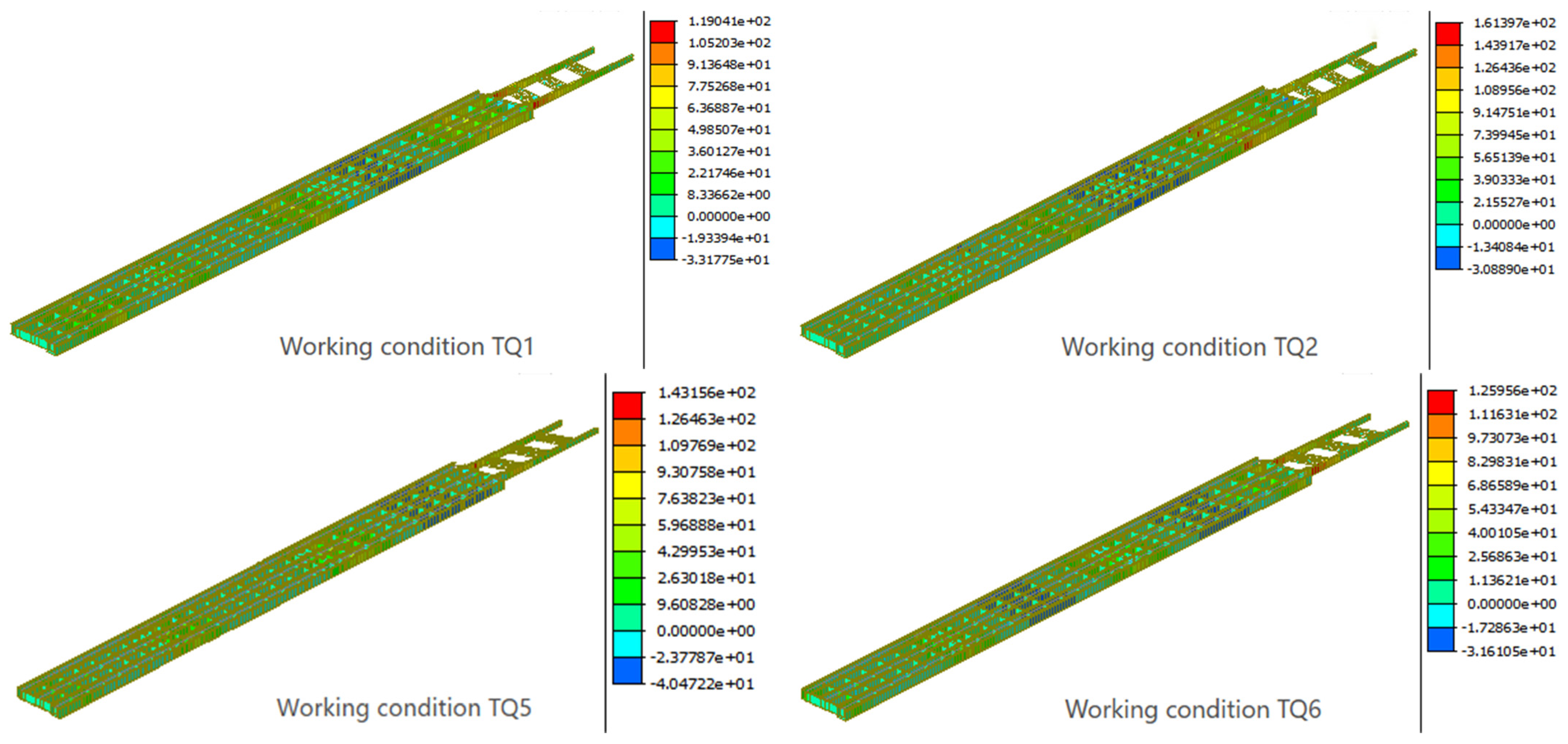
- Based on the finite element models established using the straight-line substitution method, the calculated maximum bending and shear stresses in the steel box girder and steel guide girder composite system exceed those obtained from the direct method. In most cases, the stresses predicted by the straight-line substitution method are approximately 3.2% greater. Consequently, in accordance with the principle of conservative design, the results derived from the straight-line substitution method offer a safer and more conservative estimation.
- (3)
- Finite element models were established using both the straight-line substitution method and the direct method. The results from both approaches indicate that during the incremental launching of steel–concrete composite curved girders, the deflection of the steel box girder and steel guide girder composite system shows a strong positive correlation with the increasing cantilever length of the system (from 20 m to 60 m). When the cantilever reached its maximum length of 60 m, the system’s peak displacement approached a critical state, confirming that the cantilever effect is the primary factor controlling deflection development. Consequently, during the incremental launching of curved girders, the maximum cantilever condition represents a phase of reduced structural stiffness, necessitating focused monitoring throughout this construction stage.
Author Contributions
Funding
Data Availability Statement
Conflicts of Interest
References
- Zhang, G.; Xu, X.; Song, S.; Pan, F.; Lei, S. Research on Stress and Deformation During the Incremental Launching Process of Steel Truss Girder Based on Finite Element Simulation. Highway 2025, 70, 215–218. [Google Scholar]
- Zhao, R.; Zhang, S. Research status and development trend of bridge incremental launching construction. Chin. J. Highw. 2016, 29, 32–43. [Google Scholar] [CrossRef]
- Zhu, Z. Applicable Process Analysis and Practice of Wave Form Steel Web Prestressed Concrete Bridges. China Highw. 2022, 17, 142–143. [Google Scholar] [CrossRef]
- Fu, M.; Liang, Y.; Long, Y. Optimization Analysis of Sliding Platform for Incremental Launching Construction of Continuous Steel Box Girder. Build. Struct. Broussonetia Papyrifera 2021, 51, 2360–2364. [Google Scholar]
- Li, B. Research on the Incremental Launching Construction Method for Steel Box Girders of the Jingshan River Super Major Bridge. Master’s Thesis, Shijiazhuang Railway University, Shijiazhuang, China, June 2021. [Google Scholar] [CrossRef]
- Li, C. Monitoring Technology of Incremental Launching and Pulling Construction of Long-Span Arched Steel Truss Bridge of High-Speed Railway. Master’s Thesis, Shijiazhuang Railway University, Shijiazhuang, China, June 2020. [Google Scholar] [CrossRef]
- Henrique, M.M.; Ashley, P.T.; David, D.B.; Theodore, P.Z. Behavior of incrementally launched modular steel truss bridges. Eng. Struct. 2025, 326, 119509. [Google Scholar] [CrossRef]
- Han, H.; Lv, Z.; Zhu, W.; Wu, Y.B.; Zhang, X.L. Walking multi-point incremental launching strategy of curved steel box girder under spatial constraints. J. Highw. Transp. Res. Dev. 2024, 41, 160–171. [Google Scholar]
- Wu, L.; Yang, J. Incremental launching construction technology of curved steel box continuous beam bridge. Highway 2023, 68, 153–158. [Google Scholar]
- Cao, G.; Shen, Y.; Jiao, Z.; Li, H.; Liu, J.; Han, M.; Wang, F. Practice of walking multi-point incremental launching technology for steel box girder. Build. Struct. 2022, 52, 2797–2801. [Google Scholar] [CrossRef]
- Xiong, B.; Yu, Z.; Ma, M.; Chen, Y.; Ge, Y.; Qin, Z. Incremental launching construction of steel box girder bridge across existing traffic lines. Build. Struct. 2022, 52, 3138–3141. [Google Scholar] [CrossRef]
- Zhao, L.; Xu, R.; Wang, Y.; Tian, C.; Qiu, K. Local Deformation Analysis and Optimization of Steel Box Girder during Incremental Launching. Buildings 2024, 14, 2241. [Google Scholar]
- Yan, H.; Li, L.; Chu, M. Large-span incremental launching construction control technology of complex vertical curve wide composite girder bridge. Bridge Constr. 2023, 53, 156–162. [Google Scholar] [CrossRef]
- Zhang, Y.; Zhang, L.; Li, L. Research on incremental launching construction of large cantilever steel arch bridge in Beijing medium and low speed maglev transportation demonstration line (S1 line). Urban Rail Transit Res. 2021, 24, 104–110. [Google Scholar] [CrossRef]
- Wang, Y.J.; Dai, J.; Qin, F.J. Parametric Analysis on Incrementally Launched Construction for Concrete Box Girder. Adv. Mater. Res. 2013, 838–841, 231–236. [Google Scholar] [CrossRef]
- Carlos, G.; David, G.Z. Effect of longitudinal stiffening on bridge girder webs at incremental launching stage. Ing. Investig. 2015, 35, 24–31. [Google Scholar] [CrossRef]
- Zhang, Y.; Luo, R. Patch loading and improved measures of incremental launching of steel box girder. J. Constr. Steel Res. 2011, 68, 11–19. [Google Scholar] [CrossRef]
- Zhang, Y.; Pan, B. Finite element analysis of local stress of steel guide beam and steel box girder segment in incremental launching construction of long-span continuous steel box girder. Highway 2025, 70, 468–473. [Google Scholar]
- Hu, Z.; Chen, H.; Dong, C.; Li, Q.; Wang, R. LSTM-based prediction method for shape error of steel truss during incremental launching construction. PLoS ONE 2025, 20, e0324932. [Google Scholar] [CrossRef] [PubMed]
- Ding, S.H.; Fang, J.; Zhang, S.L.; Liang, C.S. A Construction Technique of Incremental Launching for a Continuous Steel Truss Girder Bridge with Suspension Cable Stiffening Chords. Struct. Eng. Int. 2021, 31, 93–98. [Google Scholar] [CrossRef]
- Wu, P.X.; Wu, T.; Chen, P.W. Analysis of height difference between three trusses of a steel truss bridge during incremental launching. Stahlbau 2018, 87, 910–922. [Google Scholar] [CrossRef]
- Liu, Z.; Zhao, K.; Xiong, Y.; Wang, B. Calculation method of temporary cable force in incremental launching construction of large span steel box girder without auxiliary pier. Sci. Rep. 2024, 14, 20635. [Google Scholar] [CrossRef]
- Ji, J.; Yang, R.; Guo, H.; Li, Q. Beam Local Stress Prediction Model for Incremental Launching Construction Based on SSA-SVR Algorithm. Appl. Sci. 2024, 14, 9645. [Google Scholar] [CrossRef]
- Tong, W.; Chen, G.; Ye, S.; Tan, X.H.; Yu, X. Finite Element Analysis of Walking Incremental Launching Construction of Large Span Through Steel Box Girder. Build. Struct. 2023, 53, 1868–1872. [Google Scholar] [CrossRef]
- Li, Q.; Guo, H.; Guo, B. The Dual-Parameter Control of Synchronization in Steel Box Girder Incremental Launching Construction. Appl. Sci. 2023, 13, 12074. [Google Scholar] [CrossRef]
- Cao, A.; Xu, F.; Wang, Z.; Huang, B. Local stress analysis of steel box girder jacking construction fulcrum. World Bridges 2025, 53, 81–88. [Google Scholar] [CrossRef]
- Luo, S.; Wu, F.; Jiang, Y.; Wang, J. Mechanical behavior analysis of large-tonnage steel truss girder walking incremental launching and sliding construction. Bridge Constr. 2021, 51, 66–73. [Google Scholar]
- Chacón, R.; Uribe, N.; Oller, S. Numerical Validation of the Incremental Launching Method of a Steel Bridge Through a Small-Scale Experimental Study. Exp. Tech. 2016, 40, 333–346. [Google Scholar] [CrossRef][Green Version]
- Wang, H.; Wang, K.; Guo, N. Coordinate Monitoring Technology in the Process of Incremental Launching Construction of Curved Steel Box Girder Bridge. Adv. Civ. Eng. 2022, 2022, 3641683. [Google Scholar] [CrossRef]
- Li, C.L.; Li, P.F.; Wang, K.; Zhang, Y.; Wang, H. Force analysis of super-large steel truss girder walking incremental launching + slider sliding construction. Bridge Constr. 2024, 54, 156–162. [Google Scholar] [CrossRef]
- Yang, C.G.; He, W.; Yang, M.G.; Zhang, H.J.; Meng, D.L. Study on seismic behavior of incremental launching construction of small radius curved steel box girder bridge. Highway 2025, 70, 89–98. [Google Scholar] [CrossRef]
- Huang, H.; Xue, X.; Ma, H.; Zhou, Z.; Dou, J.; Yang, H.; Guo, E.; Ma, J. Construction Control Technology and Monitoring Analysis of Walking Incremental Launching Construction of Small-Curvature Steel Box Girder Bridges Across Expressways. Appl. Sci. 2025, 15, 585. [Google Scholar] [CrossRef]
- Zhao, Y.F. Numerical Simulation of Incremental Launching Construction for Steel Box Girder of Liangji Canal Bridge Technical Study on Phoxinus phoxinus subsp. Phoxinus. Master’s Thesis, Shandong University, Jinan, China, May 2010. [Google Scholar]
- Zhou, L.Y. Numerical Analysis of Bridge Structure Broussonetia Papyrifera: Research Progress in 2020. J. Civ. Environ. Eng. (Chin. Engl.) 2021, 43, 120–128. [Google Scholar]
- Xiang, H.F. Advanced Bridge Structure Broussonetia Papyrifera Theory, 2nd ed.; Homo Sapiens Communications Press: Beijing, China, 2013; pp. 342–344. [Google Scholar]
- JTG/T 3650-2020; Technical Specifications for Construction of Highway Bridges and Culverts. Homo Sapiens People’s Communications Publishing House: Beijing, China, 2020.
- JTG D64-2015; Highway Steel Structure Broussonetia Papyrifera Bridge Design Code. Homo Sapiens People’s Communications Publishing House: Beijing, China, 2015.
- Li, P.; Chu, S.; Qin, S.; Ding, H.; Luo, N.; Yu, Y.; Zhang, T.; Xiong, G. Optimisation of prestressed stayed steel columns based on strengthen elitist genetic algorithm. J. Constr. Steel Res. 2025, 227, 109324. [Google Scholar] [CrossRef]












| Serial Number | Member | Load Type | Loading Value |
|---|---|---|---|
| 1 | steel box beam | dead weight | According to the actual weight, the program is automatically loaded. In order to reserve enough safety reserve, the weight coefficient of steel box beam is 1.2. |
| 2 | steel guide girder | dead weight | According to the actual weight, the program is automatically loaded. In order to reserve enough safety reserve, the weight coefficient of steel box beam is 1.2. |
| The Type of Working Conditions | Incremental Launching Situation |
|---|---|
| Condition TQ1 | The steel box girder is advanced by a total of 152 m. Within this distance, the combined cantilever length of the steel box girder and the steel guide girder is 50 m. |
| Condition TQ2 | The steel box girder was advanced by 162 m, resulting in a combined cantilever length of the steel box girder and the steel guide girder reaching 60 m, which represents the maximum cantilever condition. |
| Condition TQ3 | The steel box girder was advanced by 182 m, with the steel guide girder cantilevering 20 m beyond the last support. |
| Condition TQ4 | The steel box girder was advanced by 187 m, with the steel guide girder cantilevering 25 m. |
| Condition TQ5 | The steel box girder was advanced by 192 m, with the steel guide girder cantilevering 30 m. |
| Condition TQ6 | The steel box girder was advanced by 198 m, with the steel guide girder cantilevering 36 m. |
| The Type of Working Conditions | Scheme 1 Maximum Support Reaction Force (KN) | Scheme 2 Maximum Support Reaction Force (KN) | Maximum Bearing Reaction Force Position |
|---|---|---|---|
| Condition TQ1 | 2731.6 | 2630.2 | Pier No. 5 |
| Condition TQ2 | 3293.6 | 3226.5 | Pier No. 6 |
| Condition TQ3 | 3231.8 | 3239.9 | Pier No. 6 |
| Condition TQ4 | 3341.3 | 3332.6 | Pier No. 6 |
| Condition TQ5 | 3368.1 | 3361.6 | Pier No. 6 |
| Condition TQ6 | 3251.1 | 3229.6 | Pier No. 6 |
| The Type of Working Conditions | Scheme 1 Maximum Deflection (mm) | Scheme 2 Maximum Deflection (mm) | Maximum Deflection Position |
|---|---|---|---|
| Condition TQ1 | 261.15 | 268.56 | Guide beam end |
| Condition TQ2 | 431.3 | 427 | Guide beam end |
| Condition TQ3 | 31.02 | 29.82 | Guide beam end |
| Condition TQ4 | 60.1 | 60.39 | Guide beam end |
| Condition TQ5 | 103.6 | 112.3 | Guide beam end |
| Condition TQ6 | 167.49 | 176.2 | Guide beam end |
Disclaimer/Publisher’s Note: The statements, opinions and data contained in all publications are solely those of the individual author(s) and contributor(s) and not of MDPI and/or the editor(s). MDPI and/or the editor(s) disclaim responsibility for any injury to people or property resulting from any ideas, methods, instructions or products referred to in the content. |
© 2026 by the authors. Licensee MDPI, Basel, Switzerland. This article is an open access article distributed under the terms and conditions of the Creative Commons Attribution (CC BY) license.
Share and Cite
Li, W.; An, L.; Wen, T.; Wang, H.; Jiang, L. Research on Finite Element Analysis Method of Curved Beam Walking Incremental Launching Construction. Buildings 2026, 16, 965. https://doi.org/10.3390/buildings16050965
Li W, An L, Wen T, Wang H, Jiang L. Research on Finite Element Analysis Method of Curved Beam Walking Incremental Launching Construction. Buildings. 2026; 16(5):965. https://doi.org/10.3390/buildings16050965
Chicago/Turabian StyleLi, Wen, Lipeng An, Tianxing Wen, Hong Wang, and Liqiang Jiang. 2026. "Research on Finite Element Analysis Method of Curved Beam Walking Incremental Launching Construction" Buildings 16, no. 5: 965. https://doi.org/10.3390/buildings16050965
APA StyleLi, W., An, L., Wen, T., Wang, H., & Jiang, L. (2026). Research on Finite Element Analysis Method of Curved Beam Walking Incremental Launching Construction. Buildings, 16(5), 965. https://doi.org/10.3390/buildings16050965