Article

Digital Twin-Stakeholder Informed Best Practice Framework for Building Management: A Case of a University Library


1
Centre for Smart Modern Construction (c4SMC), School of Built Environment and Design, Western Sydney University, Locked Bag 1797, Penrith, NSW 2751, Australia
2
Centre for Infrastructure Engineering (CIE), School of Engineering, Western Sydney University, Locked Bag 1797, Penrith, NSW 2751, Australia
3
Department of Construction Technology and Management, Kwame Nkrumah University of Science and Technology, Private Mail Bag, University Post Office, Kumasi AK-191-8267, Ghana
*
Author to whom correspondence should be addressed.
Buildings 2026, 16(5), 924; https://doi.org/10.3390/buildings16050924
Submission received: 12 January 2026 / Revised: 17 February 2026 / Accepted: 21 February 2026 / Published: 26 February 2026
(This article belongs to the Special Issue Digital Twins in Construction, Engineering and Management)

Abstract

Digital twin, a technology that offers an opportunity to access dynamic and real-time data for efficient decision-making, has witnessed minimal utilization in smart facilities management. Additionally, combining stakeholders’ views with a digital twin provides more efficient building management. Thus, this study aimed to combine digital twin technology and stakeholders’ views to develop a best practice framework for enhancing indoor conditions of a typical university building. It analyses feedback received from building stakeholders and results from a digital twin to develop the best practice framework. This study adopted a case study approach by using a university library at Western Sydney University, Australia. It used a multi-stage approach and a series of interviews with facility management experts for the development and validation of the framework, respectively. The key findings revealed that all the monitored parameters in the digital twin system were within acceptable thresholds. However, the building occupants expressed concerns regarding excessive solar heat gain, inadequate airflow, and direct glare. It was also revealed that heat was the most disturbing environmental parameter in the library, and built-in energy efficiency measures were also not adequately maintained, contributing to the building’s energy consumption. The proposed framework provides strategic measures for improving building occupants’ comfort and energy consumption. Furthermore, the best practice framework aids facility managers in holistically considering key aspects of building services management in managing such buildings.

1. Introduction

Smart facilities management has, in the past few years, been the trending discussion regarding smart and intelligent buildings [1]. This implies that there is a need to make well-informed decisions based on real-time environmental conditions data to meet the health, well-being, and comfort of building occupants. Although several efforts have been made in the field of building/facility management, there is still a heavy reliance on human efforts for coordinating the overall activities related to building and facilities management [2,3]. Furthermore, there is incomplete automation using the Internet of Things (IoT) in building management [4,5,6]. It is worth mentioning that current facilities management activities are mostly based on conditions that are pre-set without adopting dynamic and complex scenarios. In addition, these activities usually tend to be passive, reactive, and isolated [7]. Current building/facility management operations lack access to real-time and dynamic data for more efficient decision-making [8]. These predicaments of current facilities management operations and activities hinder the capability to adequately address the changing requirements and comfort of building occupants [1]. Additionally, it is also uncommon that most buildings and other facilities consume more energy in their operations than expected due to a lack of real-time and dynamic data for informed decision-making by building/facility managers. Thus, the building is unable to provide satisfactory service for its intended use [9].
Furthermore, in the application of digital technologies to tackle issues in the operation and management of buildings, the views of various stakeholders are not normally considered, although these digital technology applications are intended to improve the lives of the occupants [10,11]. Therefore, it is vital to inquire into the best practices for effectively managing buildings as well as other facilities. A key technology that can provide real-time and dynamic data for enhanced decision-making in building and facilities management activities is the digital twin (DT). As technologies are meant to aid in improving the lives of humans, it is vital to incorporate the views of the building’s or facility’s stakeholders to better achieve the purpose of applying these digital technologies [12,13]. It is also important to note that the use of DT technology provides a better impression of the building’s indoor environmental conditions [11].
Based on these gaps, this study is aimed at advancing a best practice framework for an enhanced indoor environment in buildings using DT technology and feedback from building stakeholders. To achieve this aim, two specific objectives were set: (1) to develop a best practice framework for an enhanced indoor environment in buildings, and (2) to validate the developed best practice framework for an enhanced indoor environment in buildings. It is worth mentioning that, based on the nature of the selected educational building, the environmental condition parameters affecting thermal comfort, visual comfort, and indoor air quality were considered in this study. Acoustic comfort parameters were not considered because noise was not a significant problem in the library building. The novelty of this study lies in the development of a best practice framework considering occupant feedback and standards for achieving enhanced indoor environmental conditions when using DT technology. Additionally, this paper contributes significantly to knowledge and practice by presenting comprehensive strategies for designing, constructing, and managing existing and new buildings.

2. Digital Twin for Smart Building Management

Smart building management (SBM) has become the focus of attention in recent literature on building or facilities management practices. SBM encompasses the incorporation of several systems, processes, and technologies to improve the operation and management of facilities. The discussions on SFM have mainly centred on concepts such as intelligent buildings, smart buildings, smart homes, and ambient intelligence. Intelligent buildings and smart buildings are often used interchangeably. However, intelligent buildings involve a responsive and dynamic architecture that offers building occupants an opportunity to possess productive, cost-efficient, and improved environmental conditions through continuous interactions between the basic elements of the building [14]. While smart buildings refer to the integration of enterprises, controls, materials, and construction of the whole building to ensure adaptability and progression [15], smart homes refer to residences that are capable of anticipating and responding to occupants’ needs using technologies in the home environment and also connecting to the world beyond [16]. Finally, ambient intelligence denotes an environment that is embedded with technologies in a natural setting that senses, adapts, and responds to the presence of people and objects [17]. It is worth noting that the underlying requirements in the management of smart facilities rely on data access using technology to improve building and facility management.
Several Industry 4.0 technologies, including building information modelling (BIM), are assisting in the implementation of SFM. BIM, a process or program for extracting as well as reusing data through the development of a model with multidimensional virtual space, has limitations since the technology works on static data [18,19]. While the management of facilities and buildings using BIM provides a machine-readable, parametric, and object-oriented 3D database, the emphasis has mostly been focused on activities regarding the maintenance and operation of the building. Notwithstanding, a significant part of the activities of the facility manager concerns providing comfort to the occupants of the facility [20], and that is problematic when managing with BIM. Furthermore, the deficiencies associated with accurate as-built as well as insufficient and obsolete information on the building prevent BIM usage in the management of existing buildings [21]. Additionally, the inadequacy of the as-built BIM model data restricts its possible usage in building and facility management [22]. Thus, the inadequacies in the information related to the building produce inefficient building management, increased time and cost, and unrealistic outcomes in the management of the building. In addition, Shalabi and Turkan [23] mentioned that the collected data from facility management systems, including building management systems (BMS), are deficient in abilities concerning interoperability as well as visualization to ensure effective management.
A key technology that can provide solutions to most of the challenges encountered in building and other facilities management is the concept of DT. DT refers to a connected and synchronised digital model of physical assets that characterise both the elements and the dynamics of how systems, as well as devices, function within their environment and live throughout their lifecycle [24]. DT has the capability of coordinating many models across the system’s lifecycle [25]. Additionally, the physical asset’s status, character, and conditions can be simulated for numerous decision-making related to the overall management and operation of the building, as well as the comfort of occupants of the building. Within the construction industry, DT denotes a fully or partially completed structure or building’s representation in real-time to reflect the status as well as the character of the structure or building [19]. To eloquently communicate this research, DT refers to a dynamic digital replica of a physical asset, facility, or building, systems, and processes through sensor devices, as well as the information feedback from the occupants [26,27].
Based on the complexities and dynamic environments associated with educational buildings, DT presents an excellent approach to managing these buildings for improved indoor conditions [28,29,30]. Buildings within the educational environment constantly interact with their occupants, thus possessing superior density in terms of population in comparison to residential and commercial buildings [31]. The population density in educational buildings could be as much as 3–4 times that of commercial and residential buildings. Furthermore, it is also worth mentioning that students spend much of their productive time (usually 6–8 h), constituting about 40% of their daytime in classrooms [32]. Some efforts by researchers have been geared towards the utilization of DT for managing buildings within the educational sector. For example, Desogus et al. [33] developed a DT solution for managing a pavilion at the University of Cagliari. The study highlighted the significance of DT in managing comfort and energy efficiency in buildings. Villa et al. [34] presented a fully automated framework to enhance decision-making regarding preventive maintenance in a laboratory room at the Politecnico di Torino. The authors established the prowess of DT in enhancing decision-making in building management. Notwithstanding the efforts by researchers directed towards the utilization of DT for educational buildings, there is limited attention towards managing library buildings. Unlike classrooms that have strictly scheduled usage by students, the library has a much more constant and consistent usage throughout the day, weeks, and years. Additionally, during examination periods, the library is more densely occupied compared to other times of the year. Scoulas, Carrillo, and Naru [35] conducted a study using a library at the University of Illinois, Chicago, and found that the library was used by 90% of the students. Therefore, a considerable percentage of time as well as interactions are witnessed in library buildings, and this significantly affects the indoor condition of the building. Furthermore, the feedback of the occupants is also not integrated with the technology to improve building and other facilities management. Against this background, this research centres on the aforementioned context for developing best practices for improving building/facility management.

3. Research Methodology

3.1. Selected Case Study

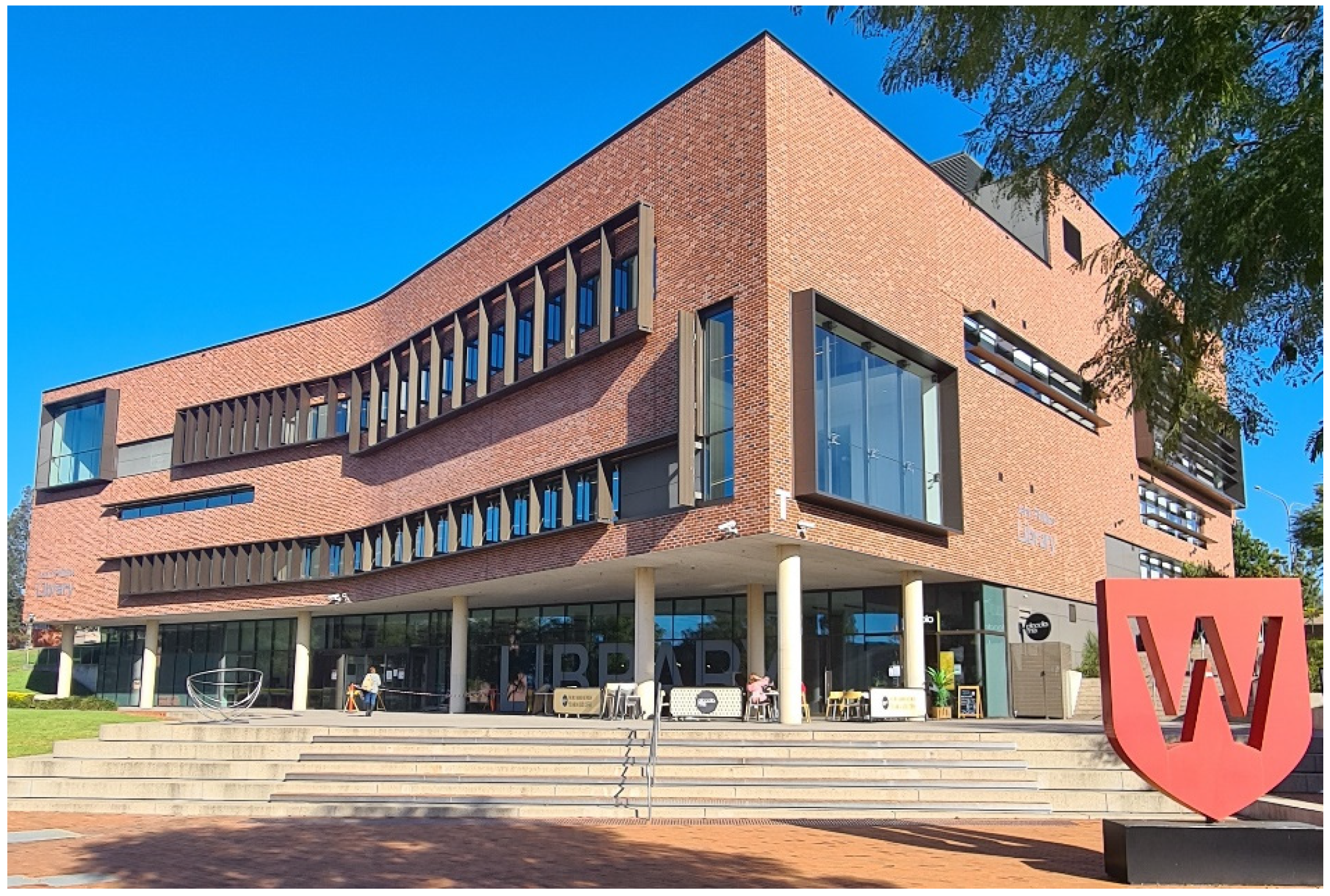
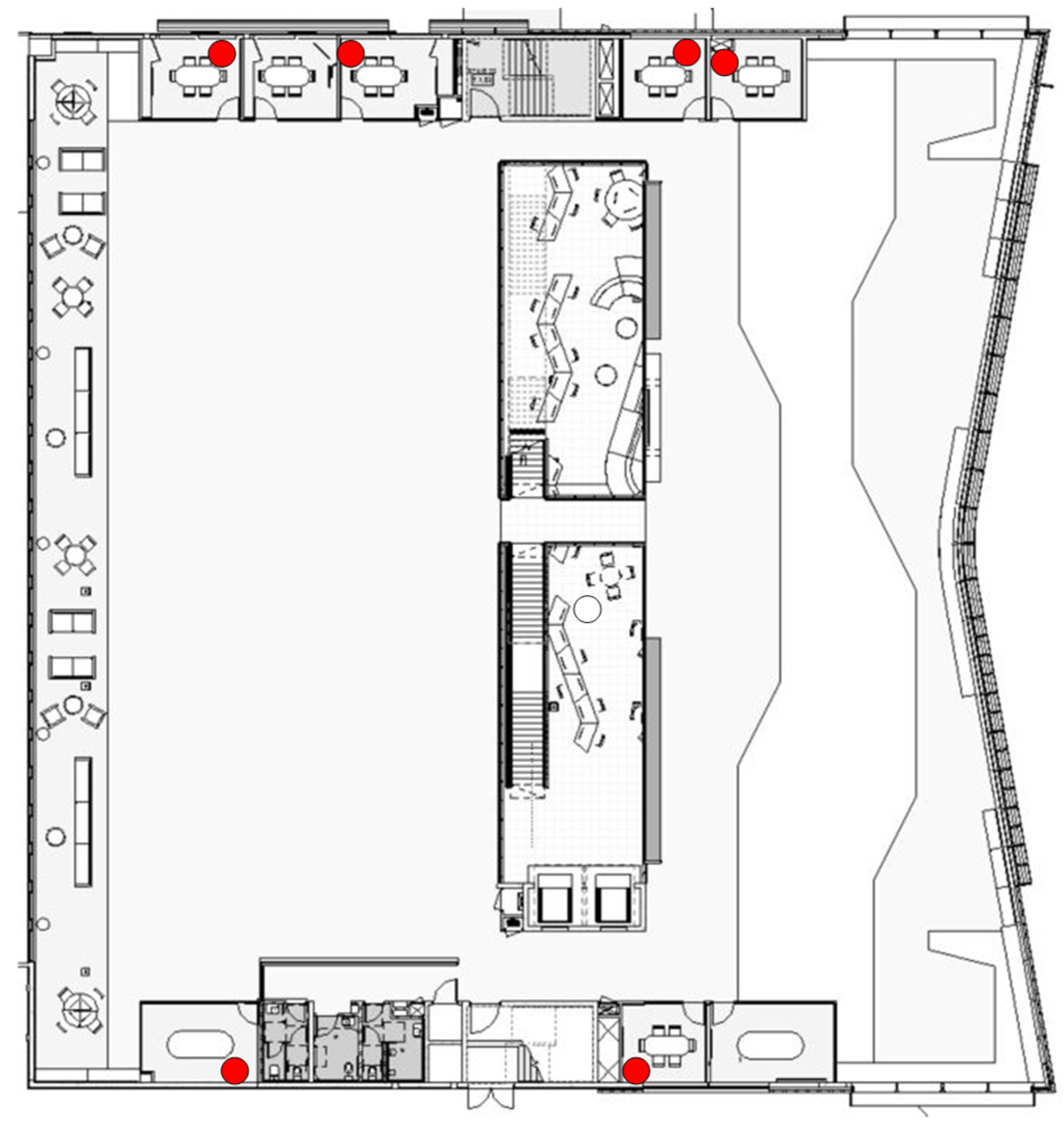
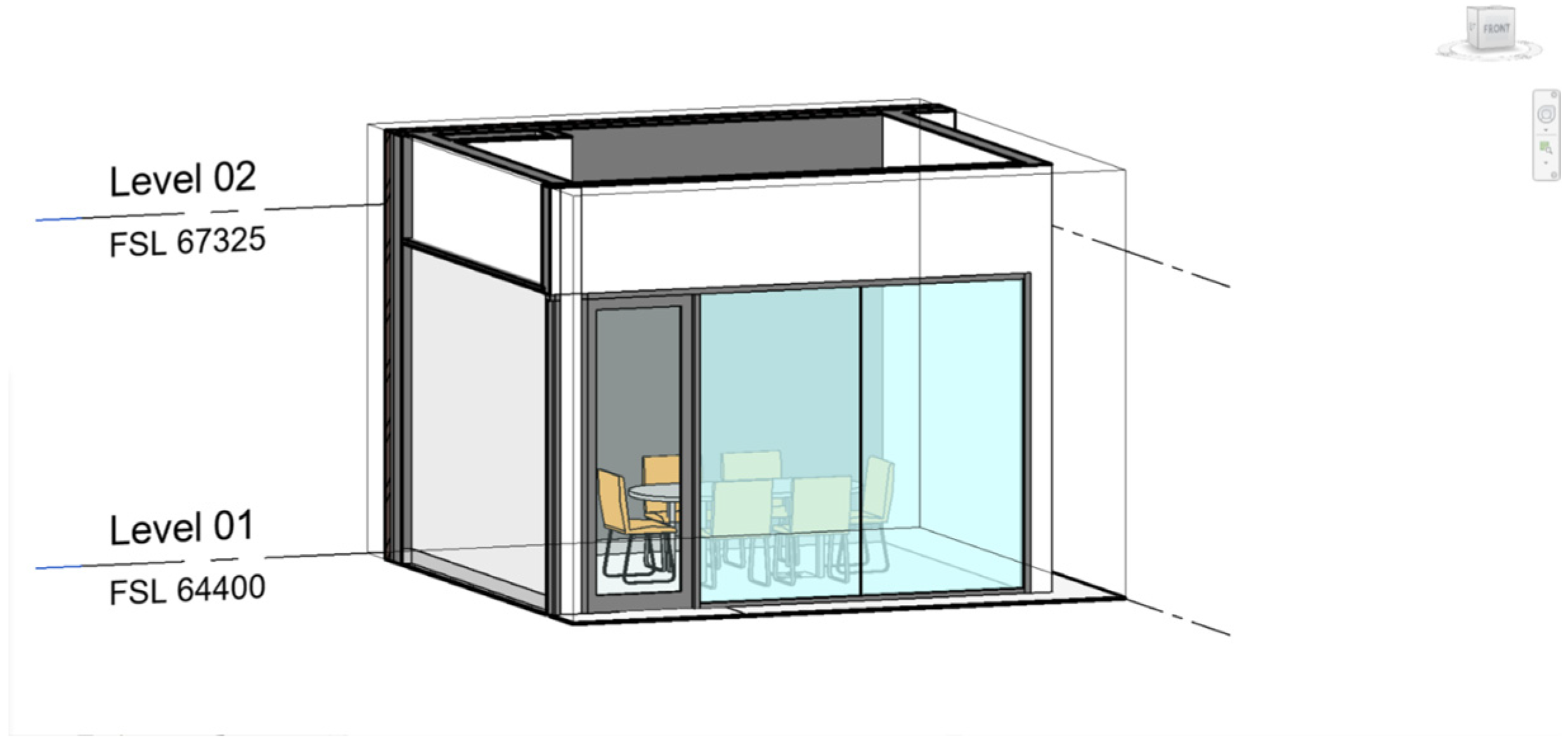
This study utilized a university library at Western Sydney University in Australia as its case study. The library was chosen due to the continuous interaction between the library and its occupants. The library has six stories, with only five being accessible to occupants. The overall floor area of the library is 6700 m2 and is oriented towards the north and south directions. There are several spaces for the daily operation of the library. These spaces include study spaces, collection areas, and printing areas, as well as spaces for offices. The Office of Estate and Commercial (OEC) of the university, library managers, librarians, and students serve as the critical stakeholders of the library. The OEC has the responsibility of operating and maintaining the requirements of the whole university. Additionally, the University Facility Management Team also forms part of the stakeholders and is accountable for the daily management of precise buildings, including the campus library. As a result of the vast floor area, research restrictions, and convenience, this study focused on the study spaces specifically, the level one group study rooms. Further, the group study rooms were selected based on their continuous interactions with the library occupants. The floor has six (6) group study rooms constituting an overall 86 m2 floor area. The dimensions of each of the rooms are approximately 4 m × 3.5 m. It is worth mentioning that each of the rooms has a maximum capacity of 6–8 persons at any given time. The library building that was used in this research as the case study is shown in Figure 1.
Figure 2 presents the floor plan of the library building, indicating the locations of the group study rooms and IoT sensors. In addition, an example of the group study room used in the research is presented in Figure 3.

3.2. Methodological Approach

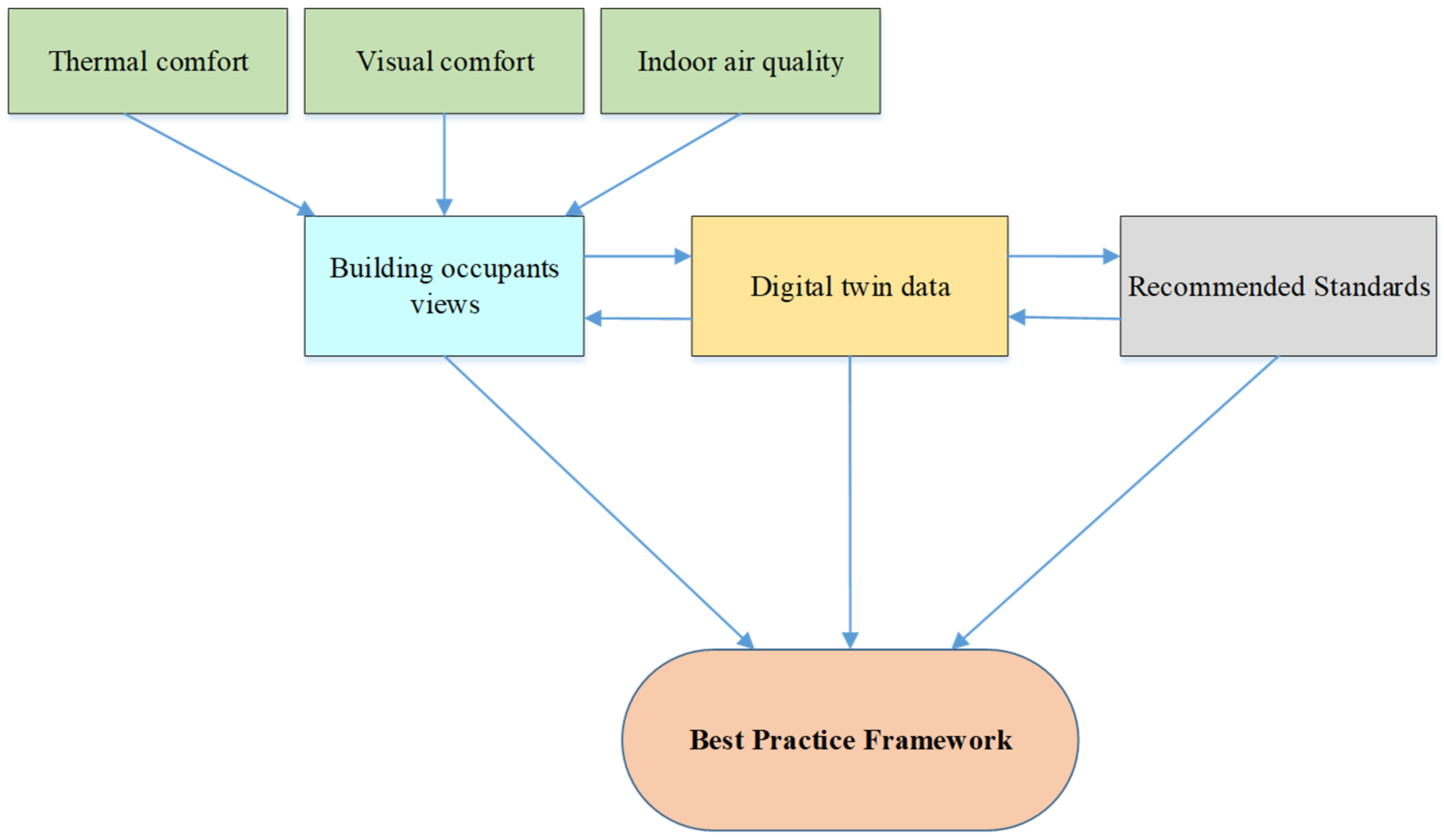
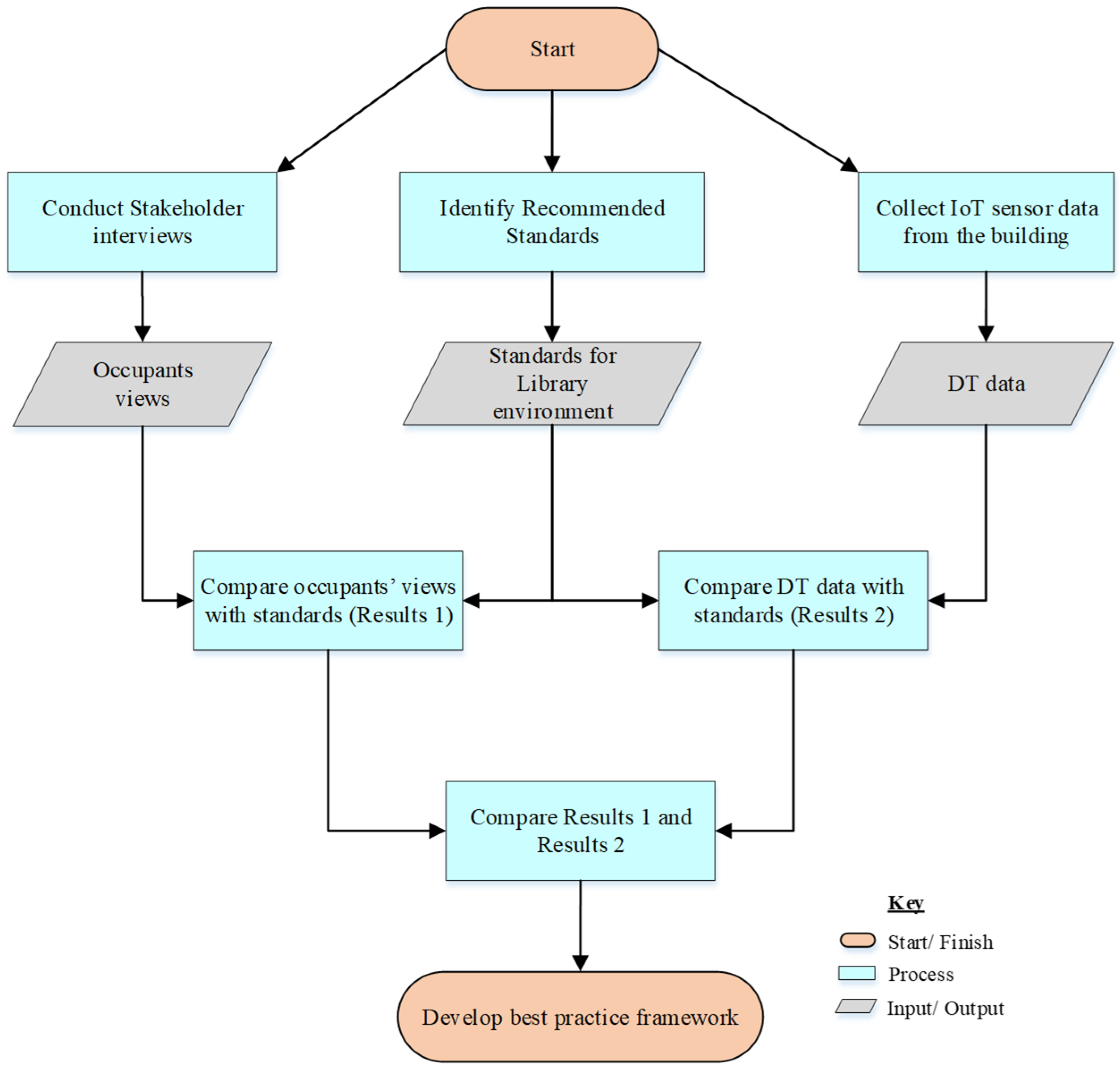
This study employed a four-stage approach to develop the best practice framework for enhancing indoor environmental conditions and subsequently reducing energy consumption in buildings. In the first stage, the views of the stakeholders in the case study (i.e., the library building) were gathered in line with their level of comfort within the building. These stakeholders included the library managers, librarians, and students who normally visit the library. Using a pre-defined set of criteria that included frequent visits to the library and staying for at least two hours, specific activities/experiences in the library, and being a library staff/student, sixteen stakeholders were purposively identified for the interviews. In the second stage, a digital twin system was developed using BIM and IoT to ascertain the library’s indoor environmental conditions [11]. In the third stage, a comparison was made between the measurements of the monitored indoor condition parameters and the recommended standards for a comfortable office environment, such as the library. In the last stage, the findings of the previous three stages were incorporated into the development of the framework for improving occupant comfort and subsequent energy consumption in the library. It is important to mention that the use of DT technology in developing the best practice framework enhances the comparison processes and provides the whole image of the indoor environmental conditions in the building. The components for developing the best practice framework are illustrated in Figure 4.
The key contributing factors to the indoor environmental quality (IEQ) of the library space, which include thermal comfort, lighting comfort, ventilation, and pollutants, were considered in assessing the occupants’ views in this study [36]. Temperature and relative humidity constituted the indicators for establishing the thermal comfort of the library stakeholders. Furthermore, the illumination of the visible light in the group study rooms under consideration also constituted the visual comfort of the library stakeholders. Finally, in terms of indoor air quality, the total volatile organic compounds (TVOC) concentration and carbon dioxide concentration (CO2) in the chosen group study rooms were considered in the study. Other air pollutants, such as particulate matter, radon, ozone, etc., were not considered in this study due to study relevance and monitoring limitations. The process followed in developing the best practice framework is illustrated in Figure 5.

4. Developing the Digital Twin-Based and Stakeholders-Informed Best Practice Framework

The best practices were developed considering the key contributing factors to IEQ of library spaces [37,38]. These factors include thermal comfort, lighting comfort, ventilation, and pollutants in the indoor environment [36]. To ensure comfort for occupants in the building, various actions were taken that adversely influenced how energy is used and consumed in the building. Therefore, the data from the DT system, which was developed using BIM and IoT, was compared with the recommended standard thresholds for the IEQ parameters in office buildings. These standards include ASHRAE 55-2017 for temperature and relative humidity; National Australian Built Environment Rating System (NABERS) and Australian Standard (AS 1680.1) for lighting; ASHRAE 62 for CO2; and Leadership in Energy and Environmental Design (LEED) version 4 and NABERS for TVOC. A summary of the recommended standard thresholds for each of the monitored environmental parameters and their associated key indicators is presented in Table 1. The results were further compared with the views of the relevant stakeholders of the library in terms of their comfort in the building. These best practices were created to ensure occupant comfort and optimum energy consumption of the library building.

4.1. Digital Twin System

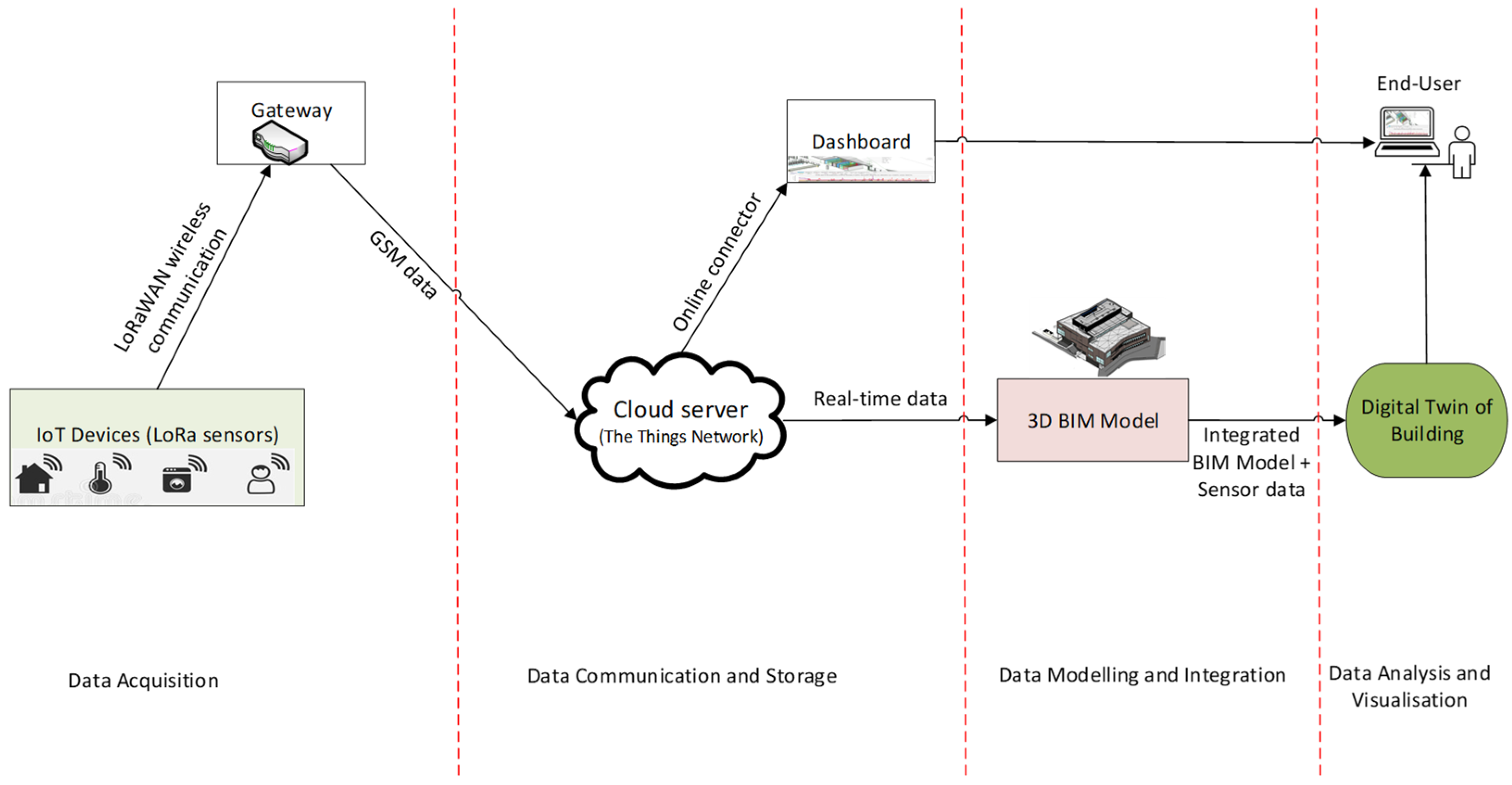
A DT system was developed using a 3D BIM model, IoT sensors, and actuators. The BIM model was created using Autodesk Revit 2020 software (.rvt file), and LoRa sensors were selected based on several considerations, including security protocols of the University’s information technology network. In addition, the cost and other expenses associated with the use of sensors, including data transmission range capabilities, sensor configurations, and energy consumption, informed the choice of sensors used in this study. The integration of the IoT data and 3D BIM model was carried out using ‘The Things Network’ cloud server, C# applications, and wireless sensor networks [11,39]. This integration provided the dynamic indoor conditions in the developed DT system. To provide bidirectional communication between the developed DT system and the physical building, the library’s building management system (BMS) was connected to the developed system to provide corrective actions in case of indoor environmental violations in the library building. A system architecture for developing the DT system is presented in Figure 6.
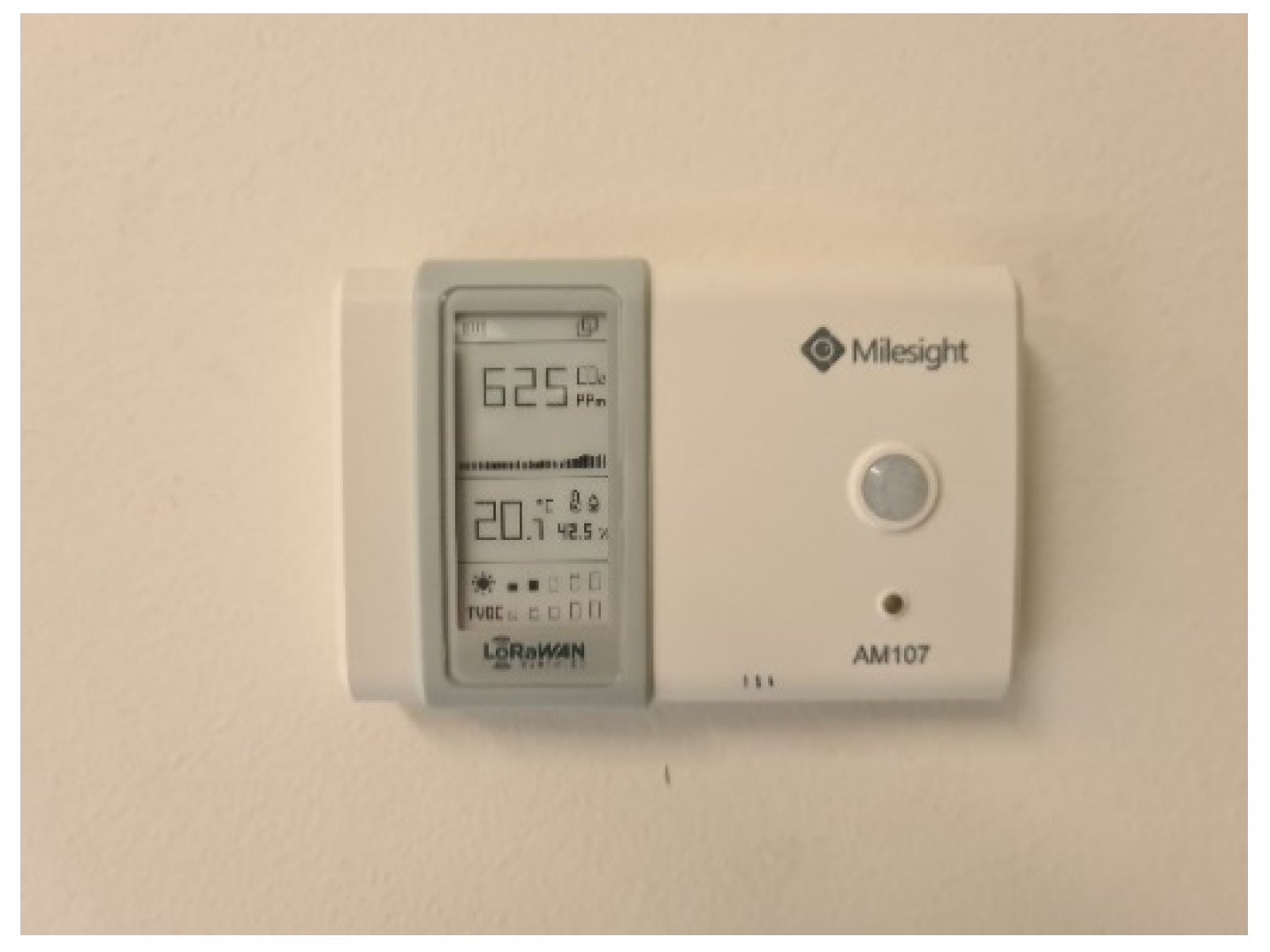
The details of the sensor used in this study are presented in Table 2. Additionally, the type of sensor is shown in Figure 7. This study used a LoRa Milesight AM107 sensor due to its ability to capture multiple environmental indicators in a single sensor. In addition, it has a passive infrared (PIR) sensor that captures signals related to movements within 82° vertical and 94° horizontal detection areas, 5 m detection distance, and 0–65,535 output range. It is worth mentioning that, before the deployment of the sensor, humidity and temperature values were calibrated against known values in a controlled environment. In addition, the sensor’s performance was continuously tested and validated to ensure it operated within the accuracy and technical specifications of the manufacturer.
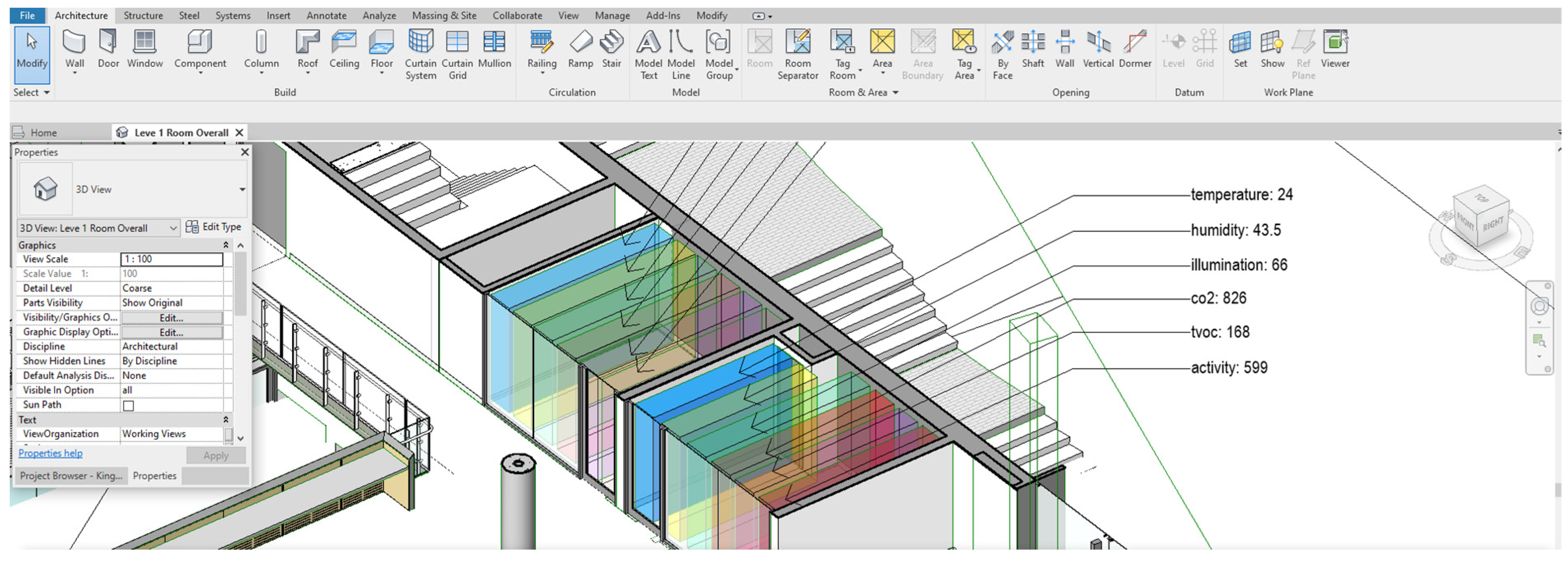
The results of the monitoring of the indoor environmental conditions of the targeted group study room in the library on 7 August 2023 at 1:13 pm are presented in Figure 8. The temperature reading was 24 °C, and the relative humidity was 43.5%. It must be noted that the recommended threshold for temperature in a comfortable office environment, such as the library, should be between the ranges of 21 °C and 24 °C [40]. Similarly, the ASHRAE [40] endorses 40–60%RH for a comfortable office setting. This implies that both the temperature and relative humidity conditions in the targeted room are adequate and significantly contribute to the activities and purpose of the library. It is worth mentioning that very cold or hot working environments significantly affect the building occupants’ productivity at any given time [41]. In terms of the lighting, total volatile organic compounds (TVOC) concentrations, and carbon dioxide (CO2), the indoor condition measurements revealed illumination (light) as 66 lux, TVOC as 168 μg/m3, and CO2 as 826 ppm. The recommended threshold in an office space for lighting is 160 lux, whilst CO2 is 1000 ppm. In addition, the recommended threshold for TVOC is 500 μg/m3 as mentioned earlier. The number of occupants’ movements in the target room was also monitored since they affect the building’s indoor conditions. There were 599 occupant movements in the target room, as depicted as ‘activity’ in Figure 8 and Figure 9. It must be noted that all the measured indoor condition parameters were within the acceptable thresholds on the exact date and time of measurement. These measurements are critical and can aid the manager of the facility in making data-informed choices, especially during the post-COVID-19 era. It is also worth mentioning that in a completely functional digital twin system, the decision-making process can be automated such that signals are sent by sensors to a building management system (BMS) if violations occur. These violations can then be fixed or corrected using actuators such as heating, ventilation, and air conditioning systems (HVAC), dampers and valves, and automated windows [42]. Thus, the manager of the facility would not be required to intervene in the actions related to the correction process.
Additionally, to provide a better impression of the conditions of the indoor environment of the monitored group study room, an indoor condition visualization dashboard is presented in Figure 9. This dashboard assists the facility manager in comparatively determining the most influential parameters in terms of the comfort of the building occupants. It is worth mentioning that the dashboard, apart from providing a line graph for various parameters, provides the numerical values associated with all the monitored parameters for easy understanding and enhanced decision-making.
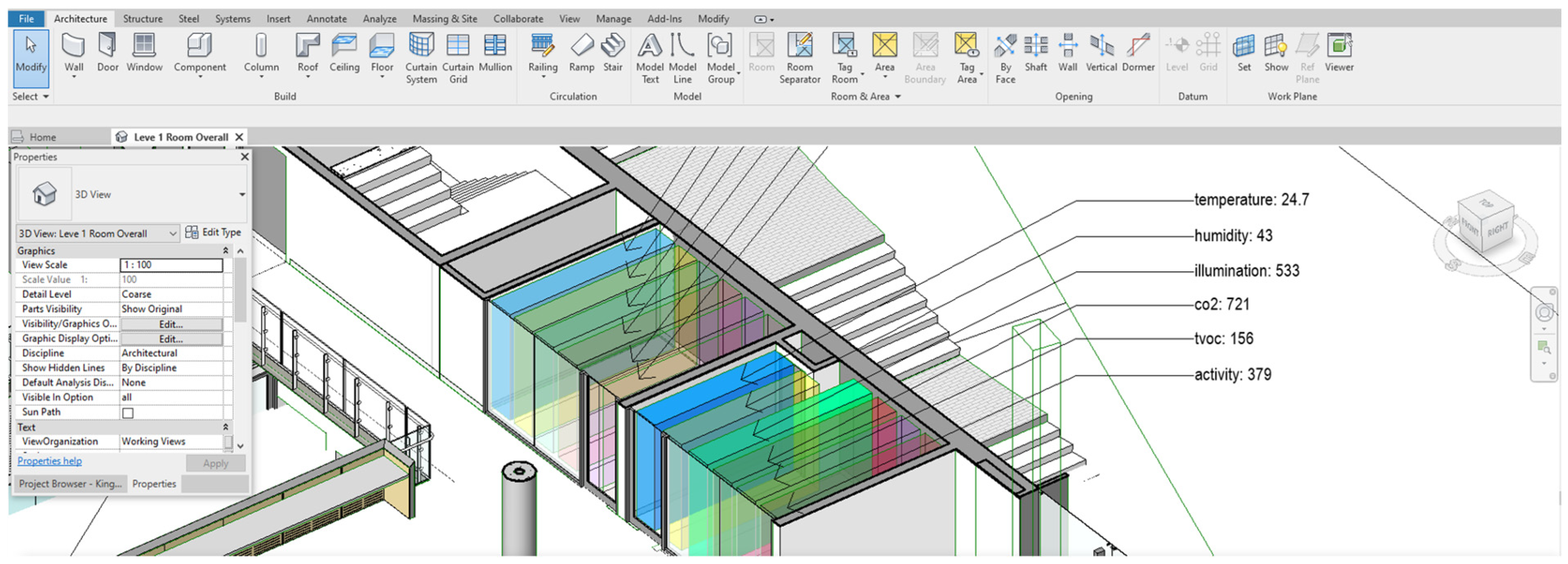
It is worth mentioning that the developed DT system provides dynamic data that supports enhanced decision-making in the management of buildings and other facilities. Thus, Figure 10 and Figure 11 present the monitored indoor environmental conditions in the targeted group study room in the library on 8 August 2023 at 1:58 pm. The readings were temperature 24.7 °C, relative humidity 43%, illumination (light) 533 lux, CO2 721 ppm, TVOC 156 μg/m3, and activity (occupant movements) 379. It was noted that most of the monitored parameters were within the recommended thresholds.
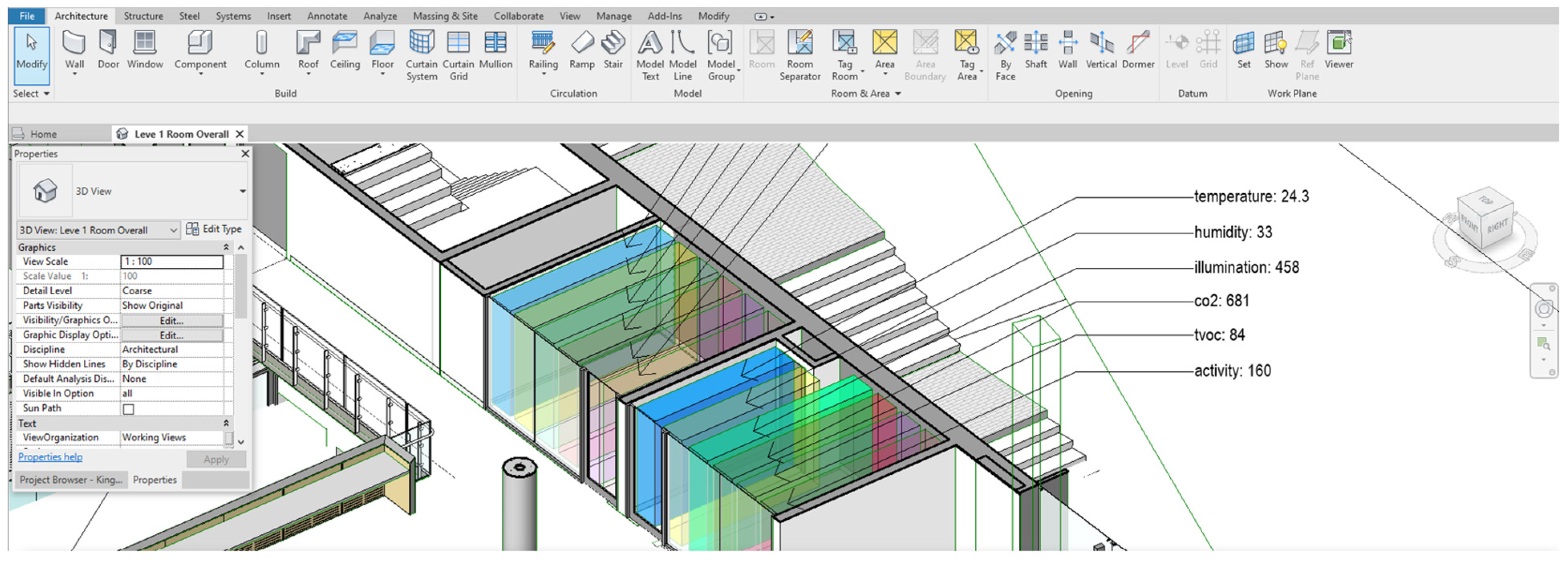
In addition, the monitored indoor environmental conditions on 11 August 2023 are shown in Figure 12 and Figure 13. The results indicate that the temperature was 24.3 °C, the relative humidity was 33%, the illumination (light) was 458 lux, the CO2 was 681 ppm, the TVOC was 84 μg/m3, and the activity (occupant movements) was 160. The results revealed that most of the monitored parameters were within acceptable thresholds.

4.2. Library Stakeholder Interviews

The rationale of the stakeholder interviews was to complement the data ascertained from the DT system to make realistic deductions of the indoor conditions of the library. The stakeholder interviews were very significant to this study since systems and technological applications have been developed to improve the lives of humans. It was therefore prudent to ascertain the views and sentiments of the building occupants or stakeholders regarding the indoor environmental conditions and how they feel in the library building. Semi-structured interviews were conducted with library stakeholders, which include library managers, librarians, and students who frequently visit the library. A purposive sampling was used to select the stakeholders based on pre-defined criteria comprising frequent visits to the library (at least three days per week), specific activities or experiences in the library, and being a library staff or student [43]. A total of sixteen respondents were involved in the study. It must be noted that the set criteria enhanced the genuineness of responses for further analysis. A theoretical saturation point was reached after conducting twelve interviews, and conducting four more interviews did not add any new insights [44]. This implies that the current number of sixteen interviewees was adequate for the study. Table 3 presents the background information of the stakeholders. To ensure anonymity, the names of the interviewees are denoted with codes LS1–LS4 (library staff) and ST1–ST12 (students).
It is observable from Table 3 that the stakeholders were either library staff or students who visited the library at least three times per week and had a specific activity of either managing the library or studying in the library. Further, it is noted that the library staff had more than 10 years of experience managing libraries. These details enhanced the genuineness, credibility, and authenticity of the interview responses. The key issues identified from the interviews with the stakeholders regarding the indoor environmental conditions in the library and their influence on the comfort of occupants and energy consumption are discussed as follows:
  • Heat: It was discovered that the stakeholders were generally satisfied with the indoor conditions of the library. However, the occupants were exposed to extreme heat during the summer season. This solar heat gain was a result of the large openings in the building. Stakeholder 11 mentioned that in the afternoons, it is almost impossible to study in the library because you get the sun coming straight at you, and it is very uncomfortable (ST7/Q7/S5). Stakeholder 7 highlighted that it is difficult to work comfortably sometimes in the afternoons of summer (ST3/Q7/S3). These findings from the stakeholders confirm the results in the DT system, where the highest temperature is 24.8 °C, and this is seen in the targeted GSRs situated in the building’s western direction. During the winter season, the library becomes too cold to ensure a comfortable working environment. The occupants do not have the opportunity to adjust the HVAC system due to its centrally controlled nature. This confirms the study by Sanni-Anibire and Hassanain [45], highlighting the relevance of occupants’ ability to regulate both the HVAC system and other openings for enhanced comfort levels.
  • Indoor air quality: The building occupants were generally satisfied with the indoor air quality in the library. However, airflow was sometimes a challenge in the autumn semester due to the non-operable nature of the windows [46].
  • Light: The occupants were generally satisfied with the lighting levels in the library, but expressed discomfort with the amount of glare in the library. This glare resulted from the large windows and is extreme in the windows facing east and west directions. Occupants may have to keep changing positions until they find a better location. Lakhdari, Sriti, and Painter [47] highlighted that a balance between daylighting and artificial lighting ensures adequate natural light through building openings.
  • Sound: The occupants expressed strong satisfaction with the level of noise in the library. Notwithstanding, it was discovered that a decrease in the collection may increase the level of sound in the library. In addition, it was revealed that the library becomes a bit noisy during examinations, and that affected the concentration of some occupants. However, an appropriate building design or taking necessary actions can effectively minimize indoor noise [41].
  • Overall comfort: The building occupants were generally satisfied with the overall comfort of the library. However, it was revealed that heat was the most disturbing environmental parameter in the library.
  • Energy consumption: Although the library is a 5-star-rated building, the stakeholders expressed concerns about the energy consumption in the building. It was discovered that the built-in energy efficiency measures have not been adequately maintained, which contributes to the energy consumption in the building.

4.3. Scope of the Framework

This study followed a similar approach to that used by Nulty et al. [48] and Crump, Sugarman, and Training [49] to prepare the best practice framework. Although the best practices are predominantly focused on the building’s operation and maintenance phase, several proposals were presented to be considered in the design and construction of new buildings. Additionally, improvement guides are provided for retrofitting existing buildings. The best practices were further categorized into energy consumption optimization and occupant comfort improvements in buildings.

4.4. Detailed Framework

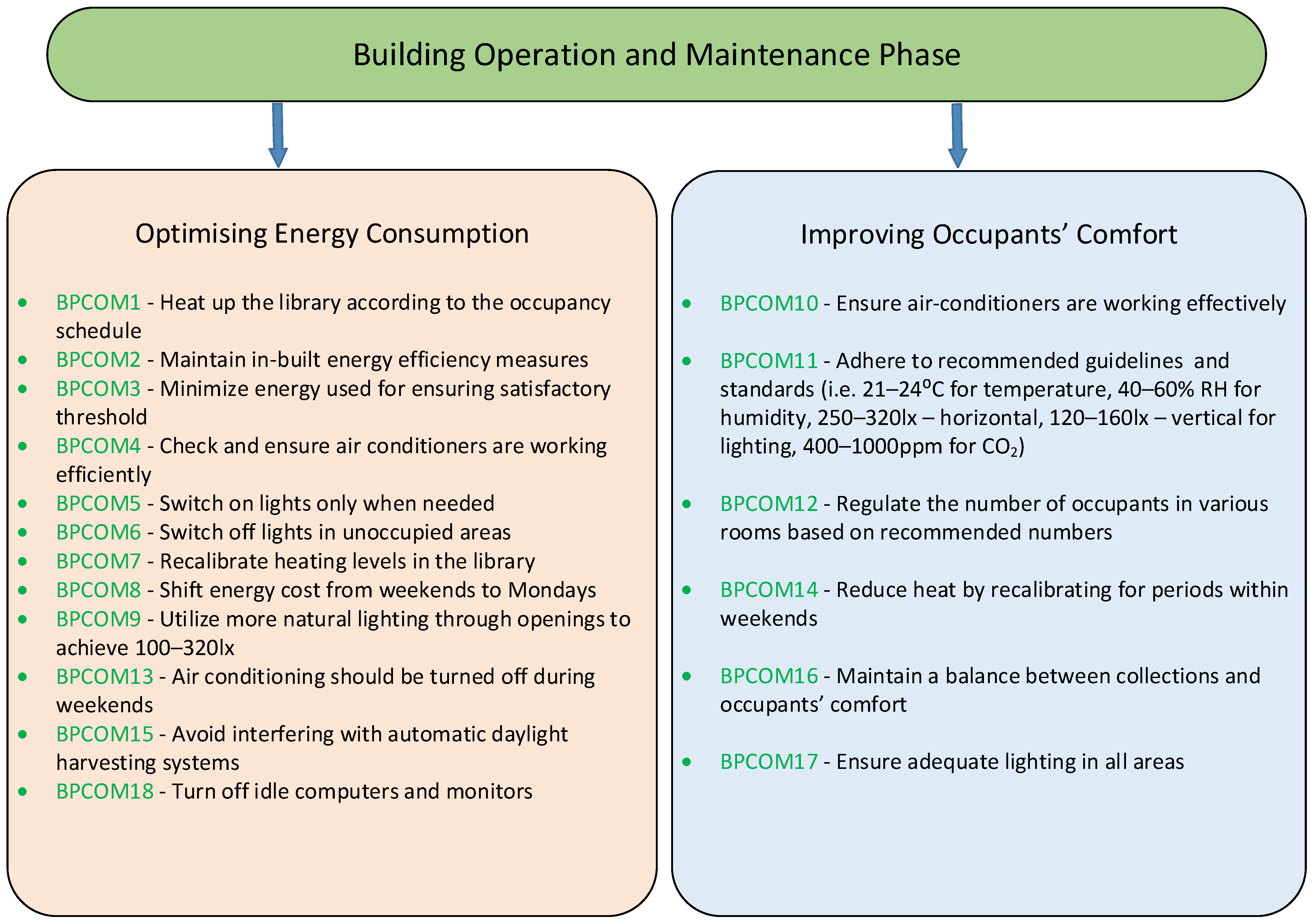
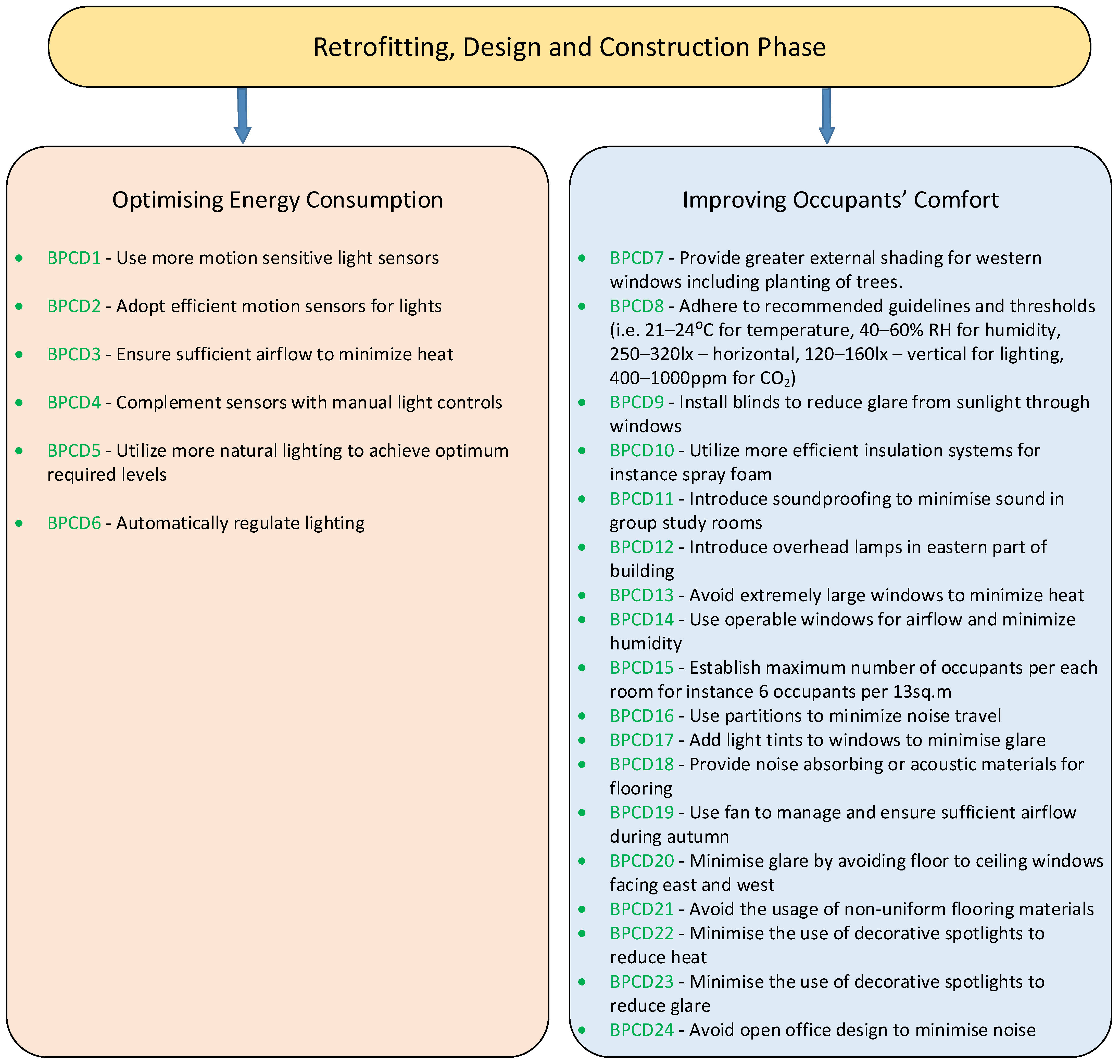
Based on the comparisons between the data from the developed DT system, recommended standard thresholds for the IEQ parameters, and the views of the relevant stakeholders of the library regarding their comfort in the library, the best practices in improving occupants’ comfort and subsequently optimizing energy consumption are presented in Figure 14 and Figure 15 (see detailed explanations of the guidelines in Table A1 and Table A2 in the Appendix). The best practices are based on the specific library building at Western Sydney University, Australia. Even though the practices are based on a specific library building, the findings could be adopted for improving occupants’ comfort and optimizing energy consumption in other similar library buildings. Furthermore, the approach used in this study could be espoused to enhance the comfort of occupants and optimize the consumption of energy in other buildings, including residential, commercial, and industrial buildings.
Figure 14 displays the best practice codes for operating and maintaining existing library buildings. The codes are presented for both energy consumption optimization and improvements in the occupants’ comfort within the building. In addition, Figure 15 indicates the best practice codes for building improvement guides for retrofitting the existing buildings and designing and constructing new library buildings. It is worth noting that although the focus of this study was on existing library buildings, there was a need to establish the best practices for improving occupants’ comfort and energy consumption in new library buildings. Figure 14 presents the best practice framework for operating and maintaining existing library buildings.
As presented in Figure 14, the first stage of the best practice framework consists of 18 best practices for the operation and maintenance phase of the library building: 12 for improving energy consumption and 6 for improving building occupants’ comfort. More importantly, the best practices provide effective management strategies that require attention in the operation and management of the library building. In the operation and maintenance phase, facility managers need to ensure adequate implementation of these measures to improve energy consumption and occupants’ comfort. The data from the digital twin system provides a better understanding of the indoor environmental conditions in the library, and thus, a resultant framework based on the digital twin system and the views of the occupants presents much more enlightened decision-making associated with the operation and maintenance of the library building.
The second stage of the framework presents the best practices for retrofitting existing library buildings and designing, as well as constructing, new library buildings. In this stage, 24 best practices are suggested. This stage encompasses 6 best practices for improving energy consumption and 18 for improving building occupants’ comfort. The best practices suggested will ensure continued improvement in occupants’ comfort and energy consumption. Considering the need to improve productivity and minimize energy consumption, which significantly contributes to climate change, strategies that will improve occupants’ comfort to ensure they become more productive, as well as actions that reduce the level of energy consumption in the building, are suggested. Hence, it is envisaged that this stage’s best practices will improve the management of retrofitted existing library buildings as well as the design and construction of new library buildings. Figure 15 presents the best practices for retrofitting existing library buildings and designing as well as constructing new library buildings.

5. Validation of the Best Practice Framework

Research validation is considered an essential component in the final stage of any research study [50]. The validation process measures the practicality, suitability, objectivity, and reliability of the developed best practice framework [51,52,53]. Furthermore, the validation of any research ensures that the needs of the potential users of the research are met [54].
A qualitative approach was utilized in this research to validate the best practice framework. The approach was selected due to the difficulties in assessing the framework quantitatively [55]. Thus, a more reliable approach to this type of research is opinion-based data rather than established assessment criteria [56]. The four validation facets comprise internal validity, external validity, content validity, and construct validity.
External validity considers the generalizability of the outcomes of the study and best practices [55]. This assesses whether the framework for improving occupants’ comfort and subsequently optimizing energy consumption in the library can be generalized. Internal validity evaluates the causality concept and is thoughtful of the derivability of the relationships in the data. The internal validity assesses if the developed best practice framework can be simply understood in practice [52]. Furthermore, content validity determines whether reality is accurately represented through the content of the research [57]. This validity determines whether the established best practices could guarantee a successful improvement in occupants’ comfort and optimize energy consumption in buildings. Finally, construct validity evaluates the operationalization of the theoretical constructs and determines whether the research efforts measured what was set out to be measured in the objectives of the research [55]. This validity assesses the appropriateness, together with the comprehensiveness, of the developed best practice framework for improving occupants’ comfort and optimizing energy consumption in buildings.

5.1. Design of the Questionnaire for Validation and Expert Interviews

To authenticate the quality as well as the credibility of the best practice framework, semi-structured interviews were conducted with experienced building/facilities management experts. The interviews comprised both internal and external experts. These experts are individuals who possess valuable knowledge in building and facility management [58]. The questionnaire for the validation comprised four sections. The first section requested the experts to provide information on their backgrounds. The second section offered the best practice framework (see Figure 5 and Figure 6). The third section requested the opinions of the experts on the level of agreement on the ten validation questions that relate to the four aspects of validity. The degree of agreement was evaluated based on a seven-point Likert scale, where 1 = strongly disagree, 2 = disagree, 3 = somewhat disagree, 4 = neither agree or disagree, 5 = somewhat agree, 6 = agree, and 7 = strongly agree. The seven-point Likert scale was used because it provides the respondents with much wider options to make the best decision [59]. The fourth section requested the qualitative feedback of the experts on the developed best practice framework.
The experts for the validation were chosen in line with predetermined criteria, which include extensive knowledge in building or facility management, a top management role in facility management, and more than 10 years of experience in building and facility management [60]. A purposive sampling technique was then used to select the experts for the interviews based on the predetermined criteria. This resulted in the identification of six domain experts for the interviews. The sample size for interviews is often based on reaching the theoretical saturation, where an extra few interviews will not provide new insights [44,61]. The point of theoretical saturation was achieved after conducting four interviews with the domain experts. Further conducting two more interviews did not add any new insights or provide any significant change to the results. This indicated the data saturation and therefore provided an appropriate sample size for the study. Table 4 shows the background of the experts who participated in the validation interviews.
From Table 4, it is evident that all six experts have extensive experience (i.e., more than 10 years of experience) in facility management. Thus, the experts had extensive knowledge of building/facility management. Furthermore, the experts were in top management roles in facility management. In addition, the experts were external or internal (users) to the case utilized in this study, which rendered the authenticity, credibility, and genuineness of the findings.

5.2. Results of the Validation

The findings of the validation of the developed framework are provided in Table 5. It is worth mentioning that this is not a quantitative analysis of the experts’ feedback. The number analysis was to get a feel for the opinions of the expert [53]. This was to determine whether the experts were predominantly in the satisfied range or dissatisfied range, or neutral [62]. Thus, the analysis does not have any statistical relevance but only achieves an in-depth understanding of the agreement of the experts on the validation questions/statements [53,63].
As can be seen from Table 5, all ten validation statements regarding the developed best practice framework obtained a mean value greater than the average of the ranking scale (i.e., 4.50). Thus, the lowest mean score value was 6.00. This implies that the experts agreed that the four facets of validation (internal validity, external validity, content validity, and construct validity) of the developed best practice framework are appropriate. Furthermore, it can also be seen that the experts did not have greater variability in the responses provided regarding the developed framework.
Statements 1 and 4 were utilized to evaluate the internal validity of the best practice framework. From the results, statement 1 was rated as agree, which indicates that the identified best practices are relevant and easy to understand in improving occupants’ comfort and optimizing energy consumption in the library building. More so, statement 4 was rated as agree, implying that the best practice codes were classified appropriately under those that are relevant to the operation and maintenance phase of a building, and those that are relevant to retrofitting existing buildings, and design and construction of new buildings. The construct validity was measured using statements 2, 3, 5, 7, and 9. Statement 2 was rated as agree, indicating that the experts hold an agreement regarding the appropriateness of the framework for managing the operation and maintenance of the building. More so, statement 3 was also rated as agree, implying that the experts agree that the best practices are appropriate for improving the retrofitting of existing buildings, as well as the designing and construction of new buildings. Statement 5 was rated as agree, signifying that the best practices for optimizing energy consumption are comprehensive and capture all the necessary aspects. Statement 7 obtained an agree rating, which indicates that the best practices for improving the comfort of building occupants are comprehensive. In addition, statement 9 was rated as agree, which means that the best practice framework is suitable for improving the occupants’ comfort and optimizing the consumption of energy in the building.
In addition, the content validity was measured using statements 6 and 8. Statement 6 was rated as agree, indicating that the framework can be carefully followed to optimize the energy consumption in the building. Statement 8 was rated between strongly agree and agree, which means that the framework, if appropriately adopted, can improve the comfort of the occupants of the building. Finally, statement 10 was meant to evaluate the external validity of the developed framework. Statement 10 was rated as agree, indicating that the developed framework is appropriate and can be accepted for use in buildings to improve occupants’ comfort and optimize the consumption of energy. In total, the high scores achieved for the four validation facets of the framework indicate that the framework is appropriate, replicable, credible, objective, comprehensive, and usable for improving occupants’ comfort and optimizing energy consumption in the library building.
Furthermore, the participants were requested to provide qualitative responses on the best practices regarding their usefulness to the building/facility manager. It was revealed that the best practices are very useful for improving occupants’ comfort and optimizing energy consumption in the building. This was confirmed by the statement of Expert 1 that I would say they are very useful because of the potential improvements in improving energy consumption and comfort of the occupants (E1/Q6/S3). Expert 6 reaffirmed the usefulness of the developed best practices in that they present very clear practices as to what can be done to improve energy consumption and occupants’ comfort in the building, and the appropriate use of the framework should result in a reduction in the energy consumption (E6/Q6/S2; E6/Q6/S3). The reduction in energy consumption in the library will then minimize energy bills and subsequently limit the carbon emissions from the building [64].
In addition, the experts indicated that the framework encompasses all the pertinent aspects for improving occupants’ comfort and optimizing energy consumption in the building. Experts 1, 3, and 4 confirmed the comprehensiveness of the framework. Expert 1 mentioned that I think you’ve captured every relevant area in the best practice framework (E1/Q7/S1). Expert 3 added that there is so much detail presented in the framework (E3/Q7/S3). Expert 4 stated that I am highly impressed with the level of detail in the framework and the detailed explanations document (E4/Q7/S2), and that’s excellent (E4/Q7/S3). The best practices were categorized to capture all the relevant aspects related to the operation and maintenance of buildings [65]. Further categorization was made for the retrofitting of existing buildings and the design and construction of new buildings [66]. These categorizations ensure that the majority of the relevant issues are captured in the developed best practices [67]. Finally, the respondents highlighted that the classification of the best practices under operation and maintenance of buildings, retrofitting of the existing buildings, and design and construction of new buildings, as well as energy optimization and improvements in occupants’ comfort, makes the framework easy to understand and use. The building/facility manager can easily continue to make improvements in the building. The ease of use of the framework by the building/facility manager was confirmed by Experts 1, 6, and 5. Expert 1 highlighted that I think the best practices are easy to follow and use (E1/Q8/S4). Expert 6 mentioned that they are easy to understand, so I don’t see any difficulty in using these best practices (E6/Q8/S1). Expert 5 opined that the categorization of the practices makes them very easy to understand and apply (E5/Q8/S2). The appropriate understanding and ease of use of the developed best practice framework would encourage and motivate the stakeholders and users to adopt and implement the framework for the management of buildings.

6. Implications for Best Practices in Building and Facility Management

The outputs of this paper provide valuable management strategies for improving occupants’ comfort and subsequently optimizing energy consumption in buildings. Although this best practice framework for managing buildings is specific to the case study (i.e., the library building), it is applicable to other similar buildings. Furthermore, these best practices can also be modified to suit any other buildings where the intention is to improve occupants’ comfort and subsequently optimize energy consumption. The experts pointed out that support from stakeholders and the availability of the needed resources are essential for the application of the framework. It must be noted that the experts indicated it would be prudent to determine whether there have been improvements after the best practice framework has been applied in the building. In addition, various proposals were made by the experts for the application of the best practice framework in building/facility management. Some of the proposals include adequate and early stakeholder engagement and a well-established operational program that incorporates an assessment or rating tool for the determination of the expected outcomes from the implementation of the best practice framework.
Additionally, this study provides a roadmap for embracing the concept and technology of DT in the management of buildings/facilities. This would help in accessing real-time data for efficient and informed decision-making to enhance the overall management of the facility. Further, the integration of the stakeholders’ views in the developed best practice framework would enable the facility managers to ascertain a realistic conditional appraisal since technologies are developed to improve human conditions. Essentially, the framework could be adopted and tested in the library building to assess its efficiency and effectiveness.

7. Conclusions

This study advanced a best practice framework for improving occupants’ comfort and subsequently optimizing energy consumption in library buildings using a case study approach. The framework was developed based on a BIM-based and IoT-driven DT system, the recommended standards for an office setting such as the library, and the views of the library stakeholders. The key contributing factors to the indoor environmental quality (IEQ) of library spaces were considered in developing the best practice framework. These factors include thermal comfort, lighting comfort, ventilation, and pollutants in the indoor environment of the library. To safeguard the comfort of building occupants, several actions are taken, and these adversely influence how energy is utilized and consumed in buildings. Therefore, the data from the DT system was compared with the recommended standard thresholds for the IEQ parameters in the library. These results were further compared with the views of the relevant library stakeholders regarding their comfort. The key findings of the digital twin system revealed that all the monitored parameters were within acceptable thresholds; however, the building occupants expressed concerns regarding excessive solar heat gain, inadequate airflow, and direct glare. It was also revealed that heat was the most disturbing environmental parameter in the library, and built-in energy efficiency measures were also not adequately maintained, contributing to the building’s energy consumption. It is worth mentioning that the best practices are predominantly focused on the operation and maintenance phase of the building, since the aim of this study is on an existing library building. Notwithstanding, several proposals were presented to be considered in the design and construction of new buildings. This study also presented improvement guides that could be considered in retrofitting existing buildings. Furthermore, the best practices were further categorized into those that are related to improving energy consumption and those that are related to improving occupants’ comfort in buildings. To determine the adequacy and validity of the developed framework, six experts with extensive building/facility management experience were asked to evaluate the developed framework in four facets of validation (i.e., internal validity, external validity, content validity, and construct validity). More importantly, the experts agreed that the four aspects of validation of the developed framework are appropriate. This suggests that the framework is appropriate, credible, objective, replicable, comprehensive, and usable for improving occupants’ comfort and energy consumption in the library building if carefully utilized. Thus, the framework can potentially enhance the management of the building. It is envisaged that the managers of the library building will adopt the developed best practice framework for managing the building to ensure an enhanced improvement in the comfort of occupants and subsequently optimize energy consumption. The novelty of this research lies in the development of a best practice framework considering occupant feedback and relevant standards for achieving enhanced indoor environmental conditions when using DT technology.
Notwithstanding the contributions of this study, some limitations are worth noting. Firstly, the limitation of the study to a single case of a university library in Australia would make it difficult to generalize the findings beyond the selected library. More so, the evaluations made in the study regarding the stakeholder and expert interviews were generally subjective and may be influenced by the respondents’ attitudes and experiences. Notwithstanding, the established best practices were cross-validated using both external experts and building users. This study’s intent was to carry out a detailed in-depth review of an instance of a particular library to understand the intricacies and nuances of a typical library building as an exemplar case study. Thus, the findings are accurate and credible for future reference. Secondly, the developed best practice framework was not implemented in the library building to ascertain the real outcomes after its adoption. This would have provided much better evaluation outputs of the validity of the developed framework.
Considering the limitations and based on the outcomes of this research, it is suggested that future research endeavors espouse the best practice framework and test it within the context of a library building to ascertain its real impact and outcomes. In addition, the current study analyzed the opinions of stakeholders and experts in developing the best practice framework. This study has been validated, and it is comprehensive, reliable, and easy to understand and use. Future studies may use this framework as the basis for developing best practice guidelines for enhancing the internal environments of different building types.

Author Contributions

Conceptualization, D.-G.J.O., S.P., R.O.-K. and M.R.; methodology, D.-G.J.O., S.P. and R.O.-K.; software, D.-G.J.O. and M.R.; validation, S.P., R.O.-K. and M.R.; formal analysis, D.-G.J.O.; investigation, D.-G.J.O.; resources, S.P., R.O.-K. and M.R.; data curation, D.-G.J.O.; writing—original draft preparation, D.-G.J.O.; writing—review and editing, S.P., R.O.-K., M.R. and K.A.; visualization, K.A.; supervision, S.P., R.O.-K. and M.R.; project administration, S.P., R.O.-K., M.R. and D.-G.J.O.; funding acquisition, D.-G.J.O. All authors have read and agreed to the published version of the manuscript.

Funding

This research was funded by the Western Sydney University Postgraduate Research Scholarship (No. 19621409) provided by Western Sydney University, Australia, and in-kind funding from the Centre for Smart Modern Construction (c4SMC).

Data Availability Statement

The data presented in this study are available on request from the corresponding author due to ethical reasons.

Acknowledgments

We acknowledge Western Sydney University (WSU) for funding this study through the Western Sydney University Postgraduate Research Scholarship. We also acknowledge the Environmental Sustainability Unit of the Office of Estate and Commercial (OEC), and the management of the John Phillips Library on the Kingswood campus of WSU. This study forms part of a research project being conducted at the Centre for Smart Modern Construction (c4SMC) at WSU.

Conflicts of Interest

The authors declare no conflicts of interest.

Appendix A

Table A1. Building operation and maintenance guidelines.
Best Practice CodeDetailed Explanations Specific to the Case Study
BPCOM1Activate the HVAC for heating the library only on weekdays (i.e., Monday-Friday) to minimize the amount of energy used in keeping the library warm using the HVAC system.
BPCOM2Various built-in energy efficiency measures have been built into the library. These measures should be regularly maintained to optimize the consumption of energy in the library.
BPCOM3Although the temperature required for maintaining the collection in the library should be much lower than it is comfortable for humans. A balance should be maintained using the HVAC in ensure human comfort and maintain the collection.
BPCOM4The air conditioning in the library should be regularly checked to ensure it is working effectively. This would minimize the amount of energy required to power the HVAC system.
BPCOM5Lights in the library are always switched on even when nobody is around. The lights should be turned off automatically when there is nobody in the various rooms.
BPCOM6Unoccupied areas in the library always have lights switched on. These lights should be automatically switched on only when the various areas are occupied.
BPCOM7The calibration of the HVAC system for heating should be properly carried out to ensure the required amount of heat is produced with an optimum energy use.
BPCOM8Instead of having the HVAC system working throughout the entire week in the library, the system could be turned off during weekends to save some energy costs.
BPCOM9Instead of having the lights working during sunny days, optimize energy use by opening blinds to admit more daylight through windows in the library. The lighting level in the library for comfortable reading should be in the range of 100–320 lx.
BPCOM10Ensure air-conditioners are working effectively to meet the needs and comfort of the library occupants.
BPCOM11Adhere to recommended guidelines and standards, for instance, 21–24 °C for temperature, 40–60% RH for humidity, 260–320 lx—horizontal, 120–160 lx—vertical for lighting, 400–1000 ppm for CO2
BPCOM12Regulate the number of occupants in various rooms to reduce the effects on temperature and CO2 in the study room.
BPCOM13Based on the occupancy profile of the library, the air conditioning/HVAC system could be turned off during weekends to conserve energy.
BPCOM14HVAC system should be recalibrated to the specific heat needs and comfort of the occupants based on the season (i.e., winter and summer). The temperature in winter should be in the range of 20–25 °C, and in summer it should be in the range of 23–26 °C.
BPCOM15Avoid interfering with automatic daylight harvesting systems that have been integrated in the library.
BPCOM16Although a lower temperature is required to maintain the collection in the library, this temperature level is not comfortable for humans. Therefore, a balance should be maintained between collections and occupants’ comfort.
BPCOM17There should be adequate lighting in all areas of the library using both natural and artificial lighting.
BPCOM18Sometimes, idle computers and monitors are still turned on in the library. These computers and monitors that are not in use should be turned off to optimize the use of energy in the library.
Table A2. Building improvement guides.
Best Practice CodesDetailed Explanations
BPCD1Use more sensitive light sensors in the library to regulate the switching off and on of the lights.
BPCD2Adopt efficient motion sensors for lights to determine where there is occupancy, so that lights are automatically switched on.
BPCD3Ensure sufficient airflow in the library through door and window openings to minimize the amount of heat in the library at any given time. This would limit the need for cooling using the HVAC system.
BPCD4Manual light controls should be used in the library to complement the sensors so that occupants can turn lights off if not needed at any time.
BPCD5Utilize more natural lighting from window openings instead of constantly using artificial lighting.
BPCD6Automatically regulate lighting in the library using smart light sensors.
BPCD7Provide greater external shading for western windows by planting more trees.
BPCD8Adhere to recommended guidelines for a comfortable work environment as specified by regulatory bodies.
BPCD9Install blinds to reduce glare from direct sunlight through windows.
BPCD10Utilize more efficient insulation systems like spray foam in buildings to minimize the transfer of heat. Spray foam insulation would have a significant impact on heating and cooling bills.
BPCD11Introduce soundproofing to minimize sound from occupants’ discussions in the group study rooms.
BPCD12Introduce overhead lamps in the eastern part of the buildings to improve visibility.
BPCD13Avoid extremely large windows in buildings to minimize heat gain and heat loss.
BPCD14Use operable windows for airflow and minimize humidity in spaces.
BPCD15Establish the maximum number of occupants per room to minimize CO2 concentration.
BPCD16Use partition blocks in buildings to minimize noise travel.
BPCD17Add light tints to windows to minimize glare.
BPCD18Provide noise-absorbing or acoustic materials for flooring, for example, carpet instead of marble.
BPCD19Use a fan to manage and ensure sufficient airflow during autumn.
BPCD20Minimize glare by avoiding floor-to-ceiling windows facing the eastern and western sides of the building.
BPCD21Avoid the usage of non-uniform flooring materials, i.e., carpet and marble together.
BPCD22Minimize the use of decorative spotlights to reduce heat since they add to the generation of heat in the building.
BPCD23Minimize the use of decorative spotlights to reduce glare in the building.
BPCD24Avoid open office design to minimize noise. Partition walls serve as a barrier to the easy transfer of sound in buildings.

References

  1. Xu, J.; Lu, W.; Xue, F.; Chen, K. Cognitive facility management’: Definition, system architecture, and example scenario. Autom. Constr. 2019, 107, 102922. [Google Scholar] [CrossRef]
  2. Pärn, E.A.; Edwards, D.J.; Sing, M.C. The building information modelling trajectory in facilities management: A review. Autom. Constr. 2017, 75, 45–55. [Google Scholar] [CrossRef]
  3. Niu, Y.; Lu, W.; Chen, K.; Huang, G.G.; Anumba, C. Smart construction objects. J. Comput. Civ. Eng. 2016, 30, 04015070. [Google Scholar] [CrossRef]
  4. Jiang, Y.; Yin, S.; Kaynak, O. Data-driven monitoring and safety control of industrial cyber-physical systems: Basics and beyond. IEEE Access 2018, 6, 47374–47384. [Google Scholar] [CrossRef]
  5. Van Roosmale, S.; Hellinckx, P.; Meysman, J.; Verbeke, S.; Audenaert, A. Building automation and control systems for office buildings: Technical insights for effective facility management-a literature review. J. Build. Eng. 2024, 97, 110943. [Google Scholar] [CrossRef]
  6. Vieira, R.; Carreira, P.; Domingues, P.; Costa, A.A. Supporting building automation systems in BIM/IFC: Reviewing the existing information gap. Eng. Constr. Archit. Manag. 2020, 27, 1357–1375. [Google Scholar] [CrossRef]
  7. Lau, D.; Liu, J.; Majumdar, S.; Nandy, B.; St-Hilaire, M.; Yang, C.S. A cloud-based approach for smart facilities management. In Proceedings of the 2013 IEEE Conference on Prognostics and Health Management (PHM), Milan, Italy, 8–11 September 2013; IEEE: Piscataway, NJ, USA, 2013. [Google Scholar] [CrossRef]
  8. Opoku, D.G.J.; Perera, S.; Osei-Kyei, R.; Rashidi, M. Digital twin application in the construction industry: A literature review. J. Build. Eng. 2021, 40, 102726. [Google Scholar] [CrossRef]
  9. Wang, Z.; de Dear, R.; Luo, M.; Lin, B.; He, Y.; Ghahramani, A.; Zhu, Y. Individual difference in thermal comfort: A literature review. Build. Environ. 2018, 138, 181–193. [Google Scholar] [CrossRef]
  10. Becerik-Gerber, B.; Lucas, G.; Aryal, A.; Awada, M.; Berges, M.; Billington, S.L.; Boric-Lubecke, O.; Ghahramani, A.; Heydarian, A.; Jazizadeh, F. Ten questions concerning human-building interaction research for improving the quality of life. Build. Environ. 2022, 226, 109681. [Google Scholar] [CrossRef]
  11. Opoku, D.G.J.; Perera, S.; Osei-Kyei, R.; Rashidi, M.; Bamdad, K.; Famakinwa, T. Digital twin for indoor condition monitoring in living labs: University library case study. Autom. Constr. 2024, 157, 105188. [Google Scholar] [CrossRef]
  12. Atkin, B.; Brooks, A. Total Facility Management, 1st ed.; John Wiley & Sons Ltd.: Oxford, UK, 2021. [Google Scholar]
  13. Fernandez-Anez, V.; Fernández-Güell, J.M.; Giffinger, R. Smart City implementation and discourses: An integrated conceptual model. The case of Vienna. Cities 2018, 78, 4–16. [Google Scholar] [CrossRef]
  14. Ghaffarianhoseini, A.; Berardi, U.; AlWaer, H.; Chang, S.; Halawa, E.; Ghaffarianhoseini, A.; Clements-Croome, D. What is an intelligent building? Analysis of recent interpretations from an international perspective. Archit. Sci. Rev. 2016, 59, 338–357. [Google Scholar] [CrossRef]
  15. Buckman, A.H.; Mayfield, M.; Beck, S.B.M. What is a smart building? Smart Sustain. Built Environ. 2014, 3, 92–109. [Google Scholar] [CrossRef]
  16. Harper, R. Inside the Smart Home; Springer Science & Business Media: Berlin/Heidelberg, Germany, 2006. [Google Scholar] [CrossRef]
  17. Weber, W.; Rabaey, J.; Aarts, E.H. Ambient Intelligence; Springer Science & Business Media: Berlin/Heidelberg, Germany, 2005. [Google Scholar] [CrossRef]
  18. Abanda, F.H.; Vidalakis, C.; Oti, A.H.; Tah, J.H.M. A critical analysis of Building Information Modelling systems used in construction projects. Adv. Eng. Softw. 2015, 90, 183–201. [Google Scholar] [CrossRef]
  19. Opoku, D.G.J.; Perera, S.; Osei-Kyei, R.; Rashidi, M.; Famakinwa, T.; Bamdad, K. Drivers for Digital Twin Adoption in the Construction Industry: A Systematic Literature Review. Buildings 2022, 12, 113. [Google Scholar] [CrossRef]
  20. Chen, W.; Chen, K.; Cheng, J.C.P.; Wang, Q.; Gan, V.J.L. BIM-based framework for automatic scheduling of facility maintenance work orders. Autom. Constr. 2018, 91, 15–30. [Google Scholar] [CrossRef]
  21. Becerik-Gerber, B.; Jazizadeh, F.; Li, N.; Calis, G. Application Areas and Data Requirements for BIM-Enabled Facilities Management. J. Constr. Eng. Manag. 2012, 138, 431–442. [Google Scholar] [CrossRef]
  22. Mannino, A.; Dejaco, M.C.; Cecconi, F.R. Building information modelling and internet of things integration for facility management-literature review and future needs. Appl. Sci. 2021, 11, 3062. [Google Scholar] [CrossRef]
  23. Shalabi, F.; Turkan, Y. IFC BIM-based facility management approach to optimize data collection for corrective maintenance. J. Perform. Constr. Facil. 2017, 31, 04016081. [Google Scholar] [CrossRef]
  24. Borth, M.; Verriet, J.; Muller, G. Digital Twin Strategies for SoS: 4 Challenges and 4 Architecture Setups for Digital Twins of SoS. In Proceedings of the IEEE 14th Annual Conference System of Systems Engineering (SoSE) 2019, Anchorage, AK, USA, 19–22 May 2019. [Google Scholar] [CrossRef]
  25. Bajaj, M.; Cole, B.; Zwemer, D. Architecture to geometry-integrating system models with mechanical design. In Proceedings of the AIAA SPACE Advances in Small Satellite Technology and Resilient Space Systems, Napa, CA, USA, 14–18 February 2016; p. 5470. [Google Scholar] [CrossRef]
  26. Bolton, A.; Butler, L.; Dabson, I.; Enzer, M.; Evans, M.; Fenemore, T.; Harradence, F.; Keaney, E.; Kemp, A.; Luck, A.; et al. The Gemini Principles: Guiding Values for the National Digital Twin and Information Management Framework; Centre for Digital Built Britain and Digital Framework Task Group; University of Cambridge: Cambridge, UK, 2018; Available online: https://www.repository.cam.ac.uk/handle/1810/284889 (accessed on 2 March 2023).
  27. Inyim, P.; Rivera, J.; Zhu, Y. Integration of building information modeling and economic and environmental impact analysis to support sustainable building design. J. Manag. Eng. 2015, 31, A4014002. [Google Scholar] [CrossRef]
  28. Opoku, D.G.J.; Perera, S.; Osei-Kyei, R.; Rashidi, M.; Bamdad, K.; Famakinwa, T. Barriers to the Adoption of Digital Twin in the Construction Industry: A Literature Review. Informatics 2023, 10, 14. [Google Scholar] [CrossRef]
  29. Gordo-Gregorio, P.; Alavi, H.; Edwards, D.J.; Forcada, N.; Guéna, F. An occupant-centric approach on digital twins for building management. Build. Res. Inf. 2026, 54, 59–78. [Google Scholar] [CrossRef]
  30. Ghansah, F.A. Digital twins for smart building at the facility management stage: A systematic review of enablers, applications and challenges. Smart Sustain. Built. Environ. 2025, 14, 1194–1229. [Google Scholar] [CrossRef]
  31. Chithra, V.; Nagendra, S.S. Indoor air quality investigations in a naturally ventilated school building located close to an urban roadway in Chennai, India. Build. Environ. 2012, 54, 159–167. [Google Scholar] [CrossRef]
  32. Godoi, R.H.; Godoi, A.F.L.; Junior, S.J.G.; Paralovo, S.L.; Borillo, G.C.; Barbosa, C.G.G.; Arantes, M.G.; Charello, R.C.; Rosário Filho, N.A.; Grassi, M.T. Healthy environment—Indoor air quality of Brazilian elementary schools nearby petrochemical industry. Sci. Total Environ. 2013, 463, 639–646. [Google Scholar] [CrossRef]
  33. Desogus, G.; Quaquero, E.; Rubiu, G.; Gatto, G.; Perra, C. Bim and iot sensors integration: A framework for consumption and indoor conditions data monitoring of existing buildings. Sustainability 2021, 13, 4496. [Google Scholar] [CrossRef]
  34. Villa, V.; Naticchia, B.; Bruno, G.; Aliev, K.; Piantanida, P.; Antonelli, D. IoT open-source architecture for the maintenance of building facilities. Appl. Sci. 2021, 11, 5374. [Google Scholar] [CrossRef]
  35. Scoulas, J.M.; Carrillo, E.; Naru, L. Assessing user experience: Incorporating student voice in libraries’ pandemic response. J. Libr. Adm. 2021, 61, 686–703. [Google Scholar] [CrossRef]
  36. Heracleous, C.; Michael, A. Experimental assessment of the impact of natural ventilation on indoor air quality and thermal comfort conditions of educational buildings in the Eastern Mediterranean region during the heating period. J. Build. Eng. 2019, 26, 100917. [Google Scholar] [CrossRef]
  37. Faraji, A.; Rashidi, M.; Rezaei, F.; Rahnamayiezekavat, P. A Meta-Synthesis Review of Occupant Comfort Assessment in Buildings (2002–2022). Sustainability 2023, 15, 4303. [Google Scholar] [CrossRef]
  38. Jazizadeh, F.; Ghahramani, A.; Becerik-Gerber, B.; Kichkaylo, T.; Orosz, M. Human-Building Interaction Framework for Personalized Thermal Comfort-Driven Systems in Office Buildings. J. Comput. Civ. Eng. 2014, 28, 2–16. [Google Scholar] [CrossRef]
  39. Lin, Y.C.P.; Cheung, W.F. Developing WSN/BIM-Based Environmental Monitoring Management System for Parking Garages in Smart Cities. J. Manag. Eng. 2020, 36, 04020012. [Google Scholar] [CrossRef]
  40. ANSI/ASHRAE Standard 55-2017; Thermal Environmental Conditions for Human Occupancy. American Society of Heating, Refrigeration and Air-Conditioning Engineers Inc.: Atlanta, GA, USA, 2017.
  41. Andargie, M.S.; Azar, E. An applied framework to evaluate the impact of indoor office environmental factors on occupants’ comfort and working conditions. Sustain. Cities Soc. 2019, 46, 101447. [Google Scholar] [CrossRef]
  42. Bengea, S.C.; Li, P.; Sarkar, S.; Vichik, S.; Adetola, V.; Kang, K.; Lovett, T.; Leonardi, F.; Kelman, A.D. Fault-tolerant optimal control of a building HVAC system. Sci. Technol. Built Environ. 2015, 21, 734–751. [Google Scholar] [CrossRef]
  43. Grassi, R. Building inclusive communities: Teens with disabilities in libraries. Ref. Serv. Rev. 2018, 46, 364–378. [Google Scholar] [CrossRef]
  44. Marshall, B.; Cardon, P.; Poddar, A.; Fontenot, R. Does sample size matter in qualitative research?: A review of qualitative interviews in IS research. J. Comput. Inf. Syst. 2013, 54, 11–22. [Google Scholar] [CrossRef]
  45. Sanni-Anibire, M.O.; Hassanain, M.A. Quality assessment of student housing facilities through post-occupancy evaluation. Archit. Eng. Des. Manag. 2016, 12, 367–380. [Google Scholar] [CrossRef]
  46. Tekin, B.H.; Aktog, M.A. A Conceptual Framework for Biophilic Architectural Design in Cold Climates: A Meta-Synthesis Analysis. Buildings 2025, 15, 3825. [Google Scholar] [CrossRef]
  47. Lakhdari, K.; Sriti, L.; Painter, B. Parametric optimization of daylight, thermal and energy performance of middle school classrooms, case of hot and dry regions. Build. Environ. 2021, 204, 108173. [Google Scholar] [CrossRef]
  48. Nulty, D.D.; Mitchell, M.L.; Jeffrey, C.A.; Henderson, A.; Groves, M. Best practice guidelines for use of OSCEs: Maximising value for student learning. Nurse Educ. Today 2011, 31, 145–151. [Google Scholar] [CrossRef]
  49. Crump, J.A.; Sugarman, J. Working Group on Ethics Guidelines for Global Health Training (WEIGHT). Ethics and best practice guidelines for training experiences in global health. Am. J. Trop. Med. Hyg. 2010, 83, 1178. [Google Scholar] [CrossRef]
  50. Almanasreh, E.; Moles, R.; Chen, T.F. Evaluation of methods used for estimating content validity. Res. Soc. Adm. Pharm. 2019, 15, 214–221. [Google Scholar] [CrossRef]
  51. Osei-Kyei, R.; Chan, A.P.C. A Best Practice Framework for Public-Private Partnership. In International Best Practices of Public-Private Partnership: Insights from Developed and Developing Economies; Springer: Singapore, 2021; pp. 145–149. [Google Scholar] [CrossRef]
  52. Osei-Kyei, R. A Best Practice Framework for Public-Private Partnership Implementation for Infrastructure Development in Ghana. Ph.D. Thesis, The Hong Kong Polytechnic University, Hong Kong, China, 2017. Available online: https://theses.lib.polyu.edu.hk/bitstream/200/9243/1/991022019999103411.pdf (accessed on 25 May 2023).
  53. Perera, S.; De Silva, S.; Osei-Kyei, R.; Yin, Y.; Zhou, L.; Jin, X.; Fernando, N.; Babatunde, S.O.; Feng, Y. BIM Execution Framework for Early-Stage Estimating in PPP Projects. RICS, London, UK. 2019. Available online: https://researchers.westernsydney.edu.au/en/publications/bim-execution-framework-for-early-stage-estimating-in-ppp-project/ (accessed on 6 July 2023).
  54. Taherdoost, H. Validity and reliability of the research instrument; how to test the validation of a questionnaire/survey in a research. SSRN Electron. J. 2016, 5, 28–36. [Google Scholar] [CrossRef]
  55. Hu, Y.; Chan, A.P.C.; Le, Y.; Xu, Y.; Shan, M. Developing a program organization performance index for delivering construction megaprojects in China: Fuzzy synthetic evaluation analysis. J. Manag. Eng. 2016, 32, 05016007. [Google Scholar] [CrossRef]
  56. Darko, A. Adoption of Green Building Technologies in Ghana: Development of a Model of Green Building Technologies and Issues Influencing Their Adoption. Ph.D. Thesis, The Hong Kong Polytechnic University, Hong Kong, China, 2019. Available online: https://theses.lib.polyu.edu.hk/bitstream/200/9924/1/991022197537003411.pdf (accessed on 25 May 2023).
  57. Lucko, G.; Rojas, E.M. Research validation: Challenges and opportunities in the construction domain. J. Constr. Eng. Manag. 2010, 136, 127–135. [Google Scholar] [CrossRef]
  58. Gavrilova, T.; Andreeva, T. Knowledge elicitation techniques in a knowledge management context. J. Knowl. Manag. 2012, 16, 523–537. [Google Scholar] [CrossRef]
  59. Taherdoost, H. What is the best response scale for survey and questionnaire design; review of different lengths of rating scale/attitude scale/Likert scale. Hamed Taherdoost 2019, 8, 1–10. [Google Scholar]
  60. Durdyev, S.; Ashour, M.; Connelly, S.; Mahdiyar, A. Barriers to the implementation of Building Information Modelling (BIM) for facility management. J. Build. Eng. 2022, 46, 103736. [Google Scholar] [CrossRef]
  61. Tallon, P.P.; Kraemer, K.L. Fact or fiction? A sensemaking perspective on the reality behind executives’ perceptions of IT business value. J. Manag. Inf. Syst. 2007, 24, 13–54. [Google Scholar] [CrossRef]
  62. Moe, C.; Brinchmann, B.; Rasmussen, L.; Brandseth, O.L.; McDaid, D.; Killackey, E.; Rinaldi, M.; Borg, M.; Mykletun, A. Implementing individual placement and support (IPS): The experiences of employment specialists in the early implementation phase of IPS in Northern Norway. The IPSNOR study. BMC Psychiatry 2021, 21, 632. [Google Scholar] [CrossRef]
  63. Behmann, M.; Lückmann, S.L.; Schneider, N. Palliative care in Germany from a public health perspective: Qualitative expert interviews. BMC Res. Notes 2009, 2, 116. [Google Scholar] [CrossRef]
  64. Cao, X.; Dai, X.; Liu, J. Building energy-consumption status worldwide and the state-of-the-art technologies for zero-energy buildings during the past decade. Energy Build. 2016, 128, 198–213. [Google Scholar] [CrossRef]
  65. Frank, O.L.; Omer, S.A.; Riffat, S.B.; Mempouo, B. The indispensability of good operation & maintenance (O&M) manuals in the operation and maintenance of low carbon buildings. Sustain. Cities Soc. 2015, 14, e1–e9. [Google Scholar] [CrossRef]
  66. Zhou, Z.; Zhang, S.; Wang, C.; Zuo, J.; He, Q.; Rameezdeen, R. Achieving energy efficient buildings via retrofitting of existing buildings: A case study. J. Clean. Prod. 2016, 112, 3605–3615. [Google Scholar] [CrossRef]
  67. Osei-Kyei, R.; Chan, A.P. A best practice framework for public-private partnership implementation for construction projects in developing countries: A case of Ghana. Benchmarking Int. J. 2018, 25, 2806–2827. [Google Scholar] [CrossRef]
Figure 1. Overview of the library building.
Buildings 16 00924 g001
Figure 2. Deployment of IoT sensors in the group study rooms is indicated with red dots [11].
Buildings 16 00924 g002
Figure 3. An illustration of the group study room [11].
Buildings 16 00924 g003
Figure 4. Components of the best practice framework.
Buildings 16 00924 g004
Figure 5. Process followed to develop the best practice framework.
Buildings 16 00924 g005
Figure 6. System architecture for developing the DT [11].
Buildings 16 00924 g006
Figure 7. LoRa Milesight AM107 sensor [11].
Buildings 16 00924 g007
Figure 8. Screenshot of the monitoring of the DT system’s indoor environmental conditions (7 August 2023).
Buildings 16 00924 g008
Figure 9. Screenshot of the indoor condition visualization dashboard (7 August 2023).
Buildings 16 00924 g009
Figure 10. Screenshot of the monitoring of the DT system’s indoor environmental conditions (8 August 2023).
Buildings 16 00924 g010
Figure 11. Screenshot of the indoor condition visualization dashboard (8 August 2023).
Buildings 16 00924 g011
Figure 12. Screenshot of the monitoring of the DT system’s indoor environmental conditions (11 August 2023).
Buildings 16 00924 g012
Figure 13. Screenshot of the indoor condition visualization dashboard (11 August 2023).
Buildings 16 00924 g013
Figure 14. The first stage of the best practice framework. Note: BPCOM = Best practice code for operation and maintenance.
Buildings 16 00924 g014
Figure 15. The second stage of the best practice framework. Note: BPCD = Best practice code for retrofitting, design, and construction.
Buildings 16 00924 g015
Table 1. Recommended thresholds for the studied parameters [11].
ParametersKey IndicatorsRecommended ThresholdsSource of Standard
Thermal environmentTemperature21–24 °CASHRAE 55
Relative humidity40–60%ASHRAE 55
Visual environmentIllumination320 lux (horizontal)NABERS
160 lux (vertical)AS1680
Indoor Air QualityCO21000 ppmASHRAE 62
TVOC500 μg/m3LEED V4/NABERS
Table 2. Technical details of the LoRa Milesight AM107 sensor.
Key IndicatorsAccuracyMeasurement RangeResolution
Temperature±0.3 °C−20 °C to +70 °C0.1 °C
Relative humidity±3%0–100% RH0.5% RH
Illumination±30%60,000 lux (visible + IR, IR) -
CO2±30 ppm or ±3%400–5000 ppm1 ppm
TVOC±15%0–6000 ppb1 ppb
Table 3. Background of the interviewees.
Stakeholder CodePositionFrequencyActivityExperience
1LS1Library Staff6Management role25 years
2LS2Library Staff5Management role30 years
3LS3Library Staff6Management role15 years
4LS4Library Staff5Management role17 years
5ST1Student5Studies-
6ST2Student3Studies-
7ST3Student3Studies-
8ST4Student3Studies-
9ST5Student4Studies-
10ST6Student5Studies-
11ST7Student5Studies-
12ST8Student4Studies-
13ST9Student4Studies-
14ST10Student5Studies-
15ST11Student5Studies-
16ST12Student4Studies-
Table 4. Details of experts who participated in the validation interviews.
Expert CodeRoleYears of ExperienceArea of ExpertiseExpert Category
E1Energy and Sustainability Manager30Facility ManagementExternal
E2Campus Coordinator15Facility ManagementInternal (User)
E3Campus Coordinator20Facility ManagementInternal (User)
E4Building Manager20Facility ManagementExternal
E5Campus Coordinator25Facility ManagementInternal (User)
E6Infrastructure and Sustainability Manager17Facility ManagementExternal
Table 5. Findings of the developed best practice framework validation.
S/NValidation Statements/QuestionsResponses of Experts
E1E2E3E4E5E6MeanMode
1The best practice framework is relevant and easy to understand6765676.126
2The best practices for building operation and maintenance are appropriate6666676.126
3The building improvement guides for retrofitting existing buildings, and designing and constructing new buildings are appropriate 5666676.006
4The various best practice codes are appropriately classified6666776.336
5The best practices for optimizing energy consumption are comprehensive6666676.126
6The framework can be carefully followed to optimize the building’s energy consumption6666676.126
7The best practices for ensuring building occupants’ comfort are comprehensive7666676.336
8The appropriate adoption of the framework can improve building occupants’ comfort6767676.507, 6
9The best practice framework is suitable for optimizing energy consumption and improving occupants’ comfort6666776.336
10I would accept the best practice framework for use in buildings6666676.336
Note: E1–E6 = Codes for the six experts.
Disclaimer/Publisher’s Note: The statements, opinions and data contained in all publications are solely those of the individual author(s) and contributor(s) and not of MDPI and/or the editor(s). MDPI and/or the editor(s) disclaim responsibility for any injury to people or property resulting from any ideas, methods, instructions or products referred to in the content.