Article

Experimental and Numerical Investigation on Three-Segment Precast Bridge Columns with Grouted Sleeve-Unbonded Prestressing Hybrid Connections

1
School of Civil Engineering, Chongqing Jiaotong University, Chongqing 400074, China
2
Hubei Communications Investment Group Co., Ltd., Wuhan 430050, China
3
Chongqing Architectural Design Institute Co., Ltd., Chongqing 400015, China
4
Chongqing Jiaotong University Construction Engineering Quality Inspection Center Co., Ltd., Chongqing 400074, China
*
Author to whom correspondence should be addressed.
Buildings 2026, 16(5), 1041; https://doi.org/10.3390/buildings16051041
Submission received: 3 February 2026 / Revised: 26 February 2026 / Accepted: 2 March 2026 / Published: 6 March 2026
(This article belongs to the Special Issue Analysis of Performance in Green Concrete Structures)

Abstract

Precast bridge columns offer efficiency and environmental benefits, yet complex mountainous terrain and limited workspace severely restrict the transportation of large segments. To address this challenge and the limited ductility of traditional connections, this study proposes a multi-segment precast bridge column with hybrid connections (PSC-GSPT) utilizing grouted sleeves and unbonded prestressing tendons. Quasi-static tests and OpenSees simulations compared a three-segment PSC-GSPT specimen with a cast-in-place (CIP) column. Results demonstrate that the hybrid system shifts the plastic hinge above the sleeves due to their high stiffness, ensuring controlled damage. Compared to the CIP specimen, the PSC-GSPT increased peak load by 30.2% and ductility by 20.7%, while exhibiting excellent self-centering capability and 27% higher cumulative energy dissipation. Numerical parametric analysis indicates that a central tendon configuration delays yielding, boosting ductility by over 15% versus perimeter layouts, and an initial prestress level of 30% is recommended to optimize both self-centering and ductility. This study provides a theoretical basis for applying high-performance precast piers in transportation-restricted environments.

1. Introduction

As a cornerstone of Accelerated Bridge Construction (ABC), precast segmental bridge columns (PSBCs) have gained widespread adoption in the bridge engineering sector [1]. Compared to traditional cast-in-place (CIP) counterparts, they offer significant advantages, including accelerated construction schedules, superior quality control, and a minimized environmental footprint [2,3]. However, in regions characterized by rugged terrain and complex transportation networks—such as Southwest China—the logistics of transporting and hoisting large-scale monolithic precast columns present formidable challenges. Consequently, adopting a multi-segment assembly strategy involving vertical segmentation has become an inevitable solution to facilitate prefabrication in these constrained environments [4].
Since multi-segment assembly introduces structural discretization, the design of segmental joints is critical for ensuring structural integrity and seismic safety [5]. In broader structural engineering practice, ensuring the reliability and effective practical application of reinforcement and connection technologies remains a paramount concern for structural resilience [6]. Common connection techniques include grouted sleeves (GS) [7,8], grouted corrugated ducts [9,10], post-tensioned tendons [11,12], and concrete wet joints [13,14]. Among these, grouted sleeves are extensively utilized in engineering practice due to their high load-bearing capacity and construction convenience.
Research has demonstrated that grouted sleeves connections provide reliable bond strength for longitudinal reinforcement when standard grouting materials are used and anchorage lengths meet code requirements [15]. However, the inherent high stiffness of the sleeves creates a localized rigid zone at the joint. While this often results in higher peak strength, it compromises displacement ductility compared to CIP members and typically leads to significant residual deformation following seismic events [16,17,18,19], thereby posing critical challenges to post-earthquake reparability and severely limiting long-term structural resilience.
Regarding the application of grouted sleeves in bridge engineering, distinct regulatory disparities exist. While ACI 318-02 [20] permits the use of grouted sleeves within plastic hinge regions for buildings, major bridge specifications—such as AASHTO LRFD Bridge Design Specifications [21] and the Caltrans Seismic Design Criteria [22]—explicitly prohibit their inclusion in these critical zones. This regulatory prohibition has consequently constrained the widespread adoption of grouted sleeves in international bridge practice. NCHRP Report 698 [23] highlights the critical need for further empirical validation regarding the seismic performance of grouted sleeves in moderate-to-high seismic zones. Addressing this concern, Ameli et al. [24] posited that GS-connected columns could be viable for such regions, provided their inherent ductility deficit is effectively mitigated. Subsequently, Su et al. [7] investigated two-segment precast piers and found that, despite outperforming single-segment counterparts, these structures still exhibited inferior ductility and energy dissipation capacities compared to conventional Cast-in-Place (CIP) piers. To circumvent these deficiencies, a hybrid connection system combining grouted sleeves with unbonded prestressing tendons has been proposed. Existing studies demonstrate that the elastic restoring force provided by the tendons significantly enhances self-centering capability and minimizes residual deformation, thereby augmenting overall ductility and energy dissipation [25,26]. Furthermore, it has been established that key design parameters—including the initial prestressing level, reinforcement ratio, and tendon layout—critically influence the seismic resilience of such systems [27,28,29].
Despite progress in hybrid connection systems, existing literature predominantly focuses on single- or two-segment piers, where the inelastic rotational demand is typically concentrated at a single primary joint. However, a multi-segment assembly (comprising three or more segments) introduces multiple discrete interfaces. This discretization fundamentally alters the structural kinematics, as the gap-opening behavior, shear slip, and energy dissipation are distributed across several joints, demanding a more robust restoring mechanism to coordinate the global deformation. To address this, the proposed PSC-GSPT detailing not only utilizes unbonded tendons to provide a stable self-centering force across multiple segments but also intentionally leverages the high stiffness of grouted sleeves to shift the plastic hinge away from the critical base connection. This distinct detailing ensures a controlled damage mechanism that goes beyond the capabilities of traditional one- or two-segment solutions.
To bridge this research gap, this study aims to evaluate the effectiveness of the hybrid grouted sleeve-unbonded prestressing connection system in multi-segment precast piers, with the goal of achieving improved deformation capacity. A comprehensive methodology combining quasi-static testing and finite element (FE) simulation was employed. A three-segment precast pier specimen with hybrid connections was designed, fabricated, and compared against a conventional cast-in-place reference column. Through low-cycle reversed cyclic loading tests, the failure modes, hysteretic characteristics, strength, stiffness, and energy dissipation capacities were rigorously analyzed to elucidate the underlying mechanical mechanisms. Furthermore, a parametric analysis was conducted using the experimentally validated FE model to investigate the impact of critical parameters, such as prestressing tendon configuration, on seismic performance. The findings validate the potential of hybrid connections in multi-segment piers, providing a theoretical basis and technical support for designing high-performance precast piers in transportation- and construction-restricted regions.

2. Experimental Program

2.1. Design of Test Specimens

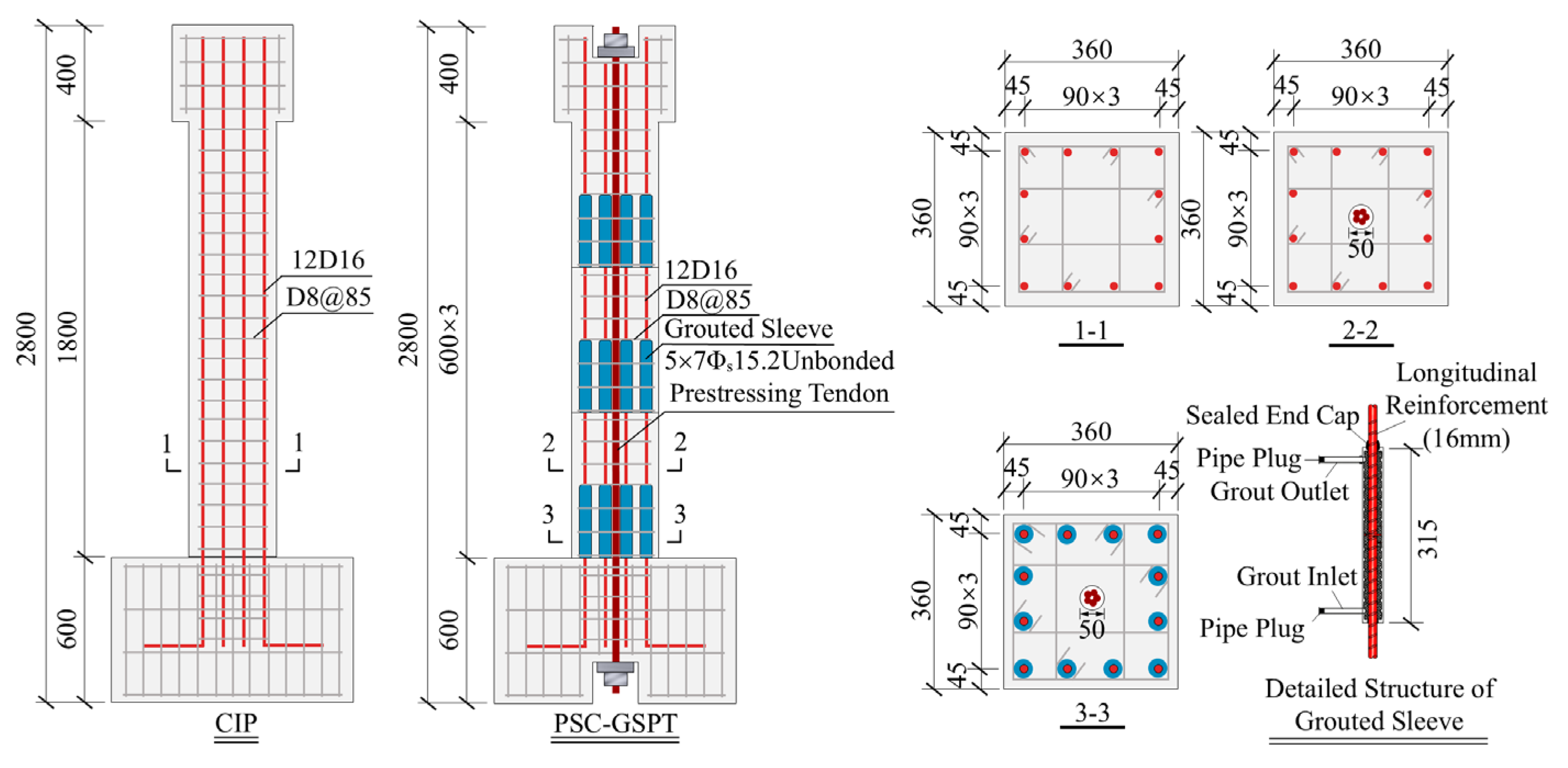
The experimental program involved the design and fabrication of two scaled bridge column specimens for quasi-static cyclic loading tests: a multi-segment precast column with hybrid connections of grouted sleeves and unbonded prestressing tendons (PSC-GSPT) and a conventional cast-in-place (CIP) reference column. The detailed specifications of the specimens are summarized in Table 1, while Figure 1 illustrates the geometric dimensions, reinforcement layouts, and the detailing of the grouted sleeves.
To accurately replicate the seismic response mechanisms of prototype bridge piers while ensuring experimental feasibility within laboratory constraints, a typical high-pier column from the North Ring Interchange renovation project in Chongqing was selected as the reference prototype. A geometric scale factor of 1:5 was adopted for the models, resulting in a square cross-section of 360 mm × 360 mm and an effective height of 2000 mm. This geometry corresponds to a shear span ratio of 5.56, which is representative of typical high-pier configurations in seismic regions. The structural design and detailing were conducted in strict accordance with China’s code GB 50010–2010 and relevant JTG specifications [30,31,32].
For the PSC-GSPT specimen, the hybrid connection system incorporated five unbonded prestressing tendons, each composed of a 15.2 mm diameter 7-wire strand (7Φs15.2). To ensure strict “unbonded” behavior, each strand was coated with anti-corrosion grease, encased in a high-density polyethylene (HDPE) sheathing, and subsequently routed through a 50 mm diameter PVC duct embedded in the concrete segments. The tendons were anchored at the top and bottom using standard steel anchor plates and multi-piece wedges. The grouted sleeves selected were compatible with the 16 mm longitudinal bars, featuring a total length of 315 mm and providing a targeted effective development length of approximately 130 mm (equivalent to 8 times the bar diameter) at both the top and bottom insertion ends, ensuring robust stress transfer compliant with JGJ 355-2015 [33].
The scaling strategy was based on practical similitude assumptions where normal stresses in the model are kept equal to those in the prototype. To preserve the relevant nondimensional quantities governing the flexural response, the longitudinal reinforcement ratio (1.86%) and the target axial load ratio (0.1) were kept identical to those of the prototype design. Maintaining this constant axial load ratio, along with an equivalent initial prestressing level, is crucial for preserving the normalized restoring forces, thereby accurately replicating the rocking and gap-opening kinematics at the segmental joints. Furthermore, the transverse reinforcement detailing (6 mm diameter bars spaced at 85 mm) was determined to maintain an equivalent volumetric confinement ratio, ensuring that the lateral confinement demand and the post-yield behavior of the core concrete are properly scaled.
Both specimens were designed with a longitudinal reinforcement ratio of 1.86% and subjected to a constant axial load ratio of 0.1 during testing. The longitudinal reinforcement comprised twelve 16 mm diameter deformed bars, while 6 mm diameter plain bars spaced at 85 mm were utilized as transverse stirrups. For the PSC-GSPT specimen, the hybrid connection system incorporated five unbonded prestressing tendons, each composed of a 15.2 mm diameter 7-wire strand (7Φs15.2). The grouted sleeves selected were compatible with the 16 mm longitudinal bars, and their mechanical properties and configuration strictly complied with the Technical Specification for Grout Sleeve Splicing of Rebar [33]. The foundation blocks were heavily reinforced to serve as rigid bases, ensuring that damage was concentrated within the column components as intended.

2.2. Material Properties

The fabrication of the specimens involved five primary material categories: HRB400 grade reinforcing bars, unbonded prestressing tendons, C40 grade structural concrete, high-strength bedding mortar, and non-shrink sleeve grout. Each column was reinforced longitudinally with twelve 16 mm diameter deformed bars and transversely with 8 mm diameter plain stirrups. Material characterization tests indicated that the 16 mm longitudinal bars exhibited a yield strength of 432 MPa and an ultimate tensile strength of 585 MPa. The prestressing system utilized 15.2 mm diameter, 7-wire low-relaxation steel strands (7-Φs15.2), with measured yield and ultimate strengths of 1832 MPa and 1960 MPa, respectively. The average 28-day cubic compressive strength of the C40 concrete was determined to be 48.5 MPa.
Strict performance criteria were applied to the connection materials in accordance with the Chinese code JGJ 1-2014 [34]. The specifications mandate that the sleeve grout must achieve compressive strengths exceeding 35 MPa, 60 MPa, and 100 MPa at 1, 3, and 28 days, respectively, while the bedding mortar requires a minimum 28-day compressive strength of 60 MPa. To verify these properties, mechanical tests were conducted on 50 mm × 50 mm × 150 mm prism specimens. The results, summarized in Table 2, confirm that the materials met all design requirements, with the sleeve grout and bedding mortar achieving 28-day compressive strengths of 103.2 MPa and 78.5 MPa, respectively.

2.3. Assembly of Specimens

The CIP specimen served as the control group and was fabricated using conventional monolithic casting techniques. In contrast, the PSC-GSPT specimen was assembled from four distinct precast components: a reinforced foundation block, two intermediate column segments (each 600 mm in height), and a top segment integrated with the loading stub. The assembly utilized a hybrid connection technology combining grouted sleeves and unbonded prestressing tendons.
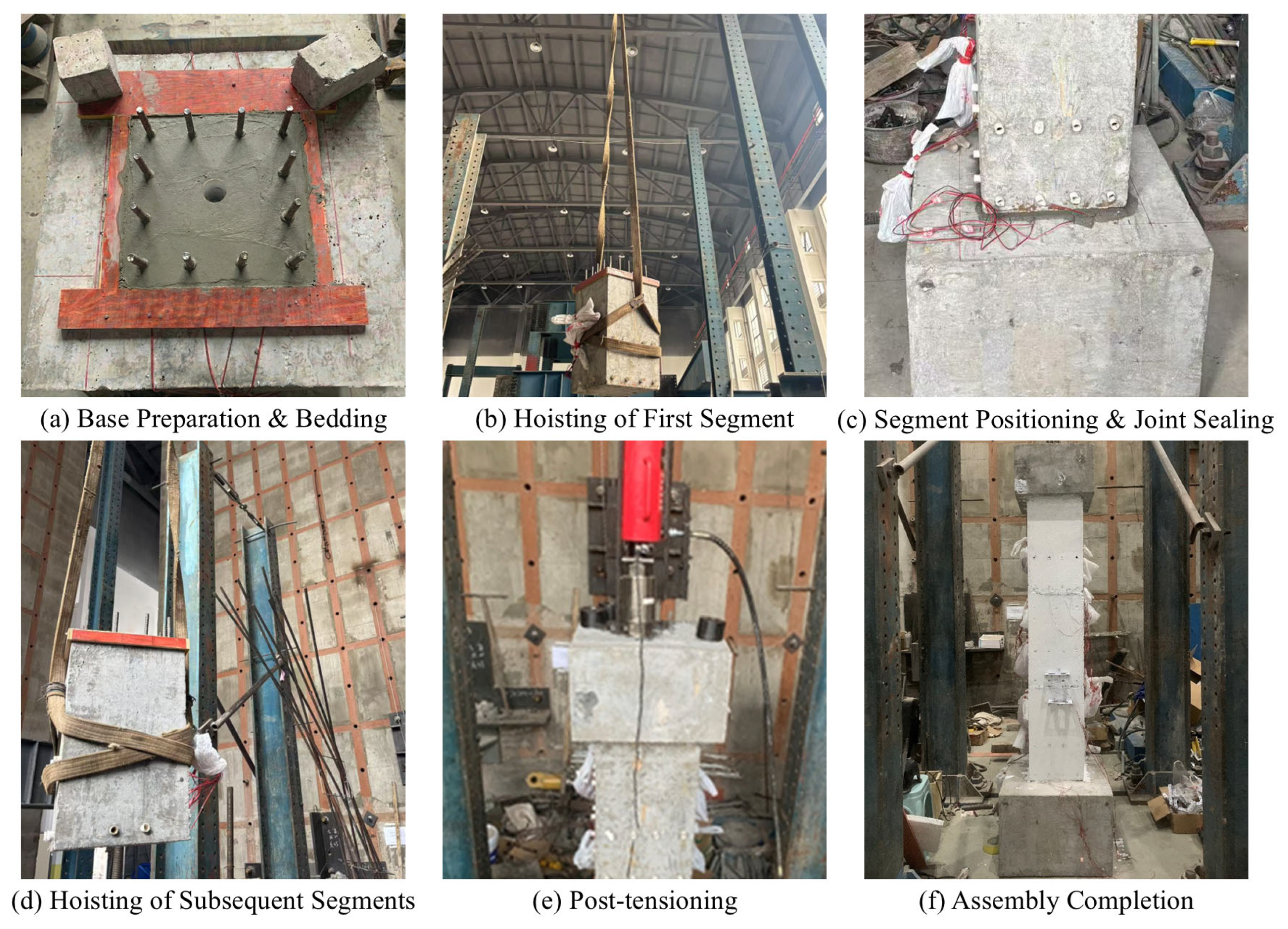
Prior to assembly, the contact surfaces of the precast segments were roughened (chiseled) to enhance bond integrity. The detailed assembly procedure, illustrated in Figure 2, was executed as follows: (1) A layer of high-strength bedding mortar, approximately 20 mm thick, was applied to the top surface of the foundation to ensure leveling and stress transfer. (2) Within two hours of mortar application, the first precast segment was hoisted into position. The longitudinal bars protruding from the foundation were inserted into the corresponding sleeves at the column base, while the prestressing strands were simultaneously threaded through the reserved ducts. This process was repeated sequentially for the remaining segments. (3) After the bedding mortar had cured sufficiently to form a watertight seal at the segment interfaces, pressure grouting was performed. As a quality control measure, the flowability of the non-shrink grout was tested prior to injection. The grout was then pumped through the bottom inlet of each sleeve until fresh, air-free grout continuously overflowed from the top outlet, after which the ports were sealed. (4) Seven days after assembly, when the grout reached its design strength, the unbonded tendons were post-tensioned from the top end using a hydraulic jack. The target initial prestress was defined as 30% of the tendon’s ultimate tensile strength (0.3 f p u ). Prestress losses due to anchorage seating and elastic shortening were accounted for during the jacking process. The specimen was then cured for an additional 21 days to ensure the full hardening of the mortar and grout before testing.

2.4. Test Setup and Loading Protocol

The boundary conditions for both specimens were designed to simulate realistic structural constraints. The footing was rigidly anchored to the strong floor to enforce a fixed base condition. At the column head, a low-friction roller bearing system was installed between the loading stub and the vertical actuator to facilitate free horizontal translation, thereby simulating a sliding boundary condition.
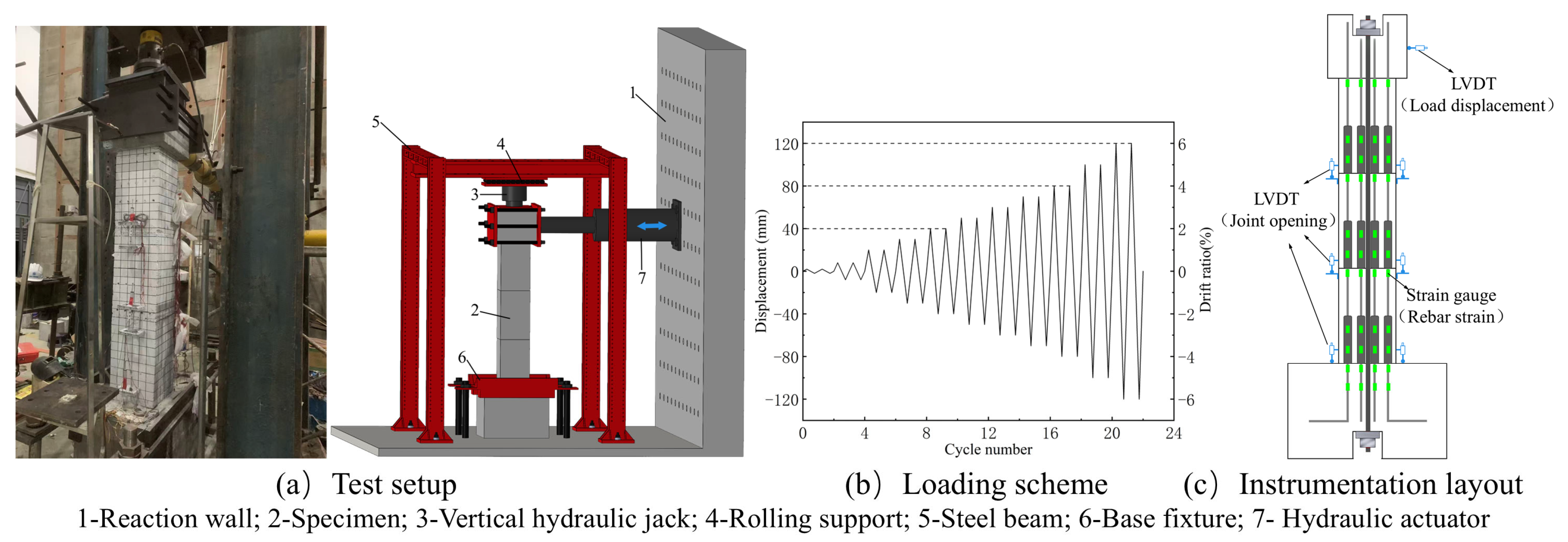
During the testing process, the specimens were subjected to a constant axial compression combined with quasi-static lateral cyclic loading. This loading regime was maintained until the specimens reached a state of failure. The detailed experimental setup and a schematic representation of the apparatus are illustrated in Figure 3a.
The lateral loading utilized a displacement-controlled protocol based on the effective pier height of 2000 mm. As depicted in the loading history shown in Figure 3b, the loading sequence commenced with initial drift ratios of 0.1%, 0.4%, and 1.0%. Subsequently, the drift amplitude was increased in increments of 0.5% up to a drift ratio of 4.0%, followed by increments of 1.0% until a maximum drift of 6.0% was reached. To adequately capture stiffness degradation and energy dissipation characteristics, two full cycles were imposed at each displacement amplitude level, in accordance with ACI 374.1-05 [35].
To comprehensively monitor the structural response and capture the specific damage mechanisms, a detailed instrumentation system was deployed, as systematically illustrated in Figure 3c. The global lateral displacement of the specimen was recorded using a horizontal linear variable differential transformer (LVDT) positioned at the loading elevation. To specifically evaluate the rocking behavior and measure the gap-opening kinematics characteristic of the multi-segment assembly, pairs of LVDTs were installed vertically across the critical segment interfaces. Furthermore, electrical resistance strain gauges were systematically attached to the longitudinal rebars at the expected plastic hinge regions to monitor local stress evolution and yielding. To continuously monitor the prestress level and accurately capture the variation of the restoring force during the cyclic loading, through-hole load cells (load washers) were installed between the anchor heads and the top steel bearing plates of the prestressing tendons.
For the interpretation of the performance indices in the subsequent sections, the specific computation procedures are defined as follows: the lateral drift ratio (θ) is computed as the top lateral displacement (∆) divided by the effective pier height (He = 2000 mm). Furthermore, the cycle-by-cycle residual displacement (∆res) is explicitly defined as the irrecoverable lateral displacement recorded precisely when the lateral applied load returns to zero during the unloading phase of each cycle.

3. Experimental Results and Discussion

3.1. Damage Progression and Failure Modes

The damage evolution of the two specimens exhibited four distinct stages: cracking, yielding, peak strength, and ultimate failure. During the initial loading phase, micro-cracks first appeared at the corners of the CIP column base at a displacement of 3 mm, rapidly evolving into a distributed network of transverse flexural cracks within the bottom 0–200 mm region as the load increased. In contrast, cracking in the PSC-GSPT specimen was significantly delayed due to the initial compressive stress induced by the prestressing; micro-cracks did not appear until a displacement of 6 mm, initiating at the top of the sleeve in the first segment, and these cracks fully closed upon unloading. Entering the yielding stage, the longitudinal reinforcement of the CIP specimen yielded at a displacement of 15.2 mm, with main cracks exhibiting flexural-shear coupling characteristics and extending upward to 350 mm. Conversely, the PSC-GSPT specimen yielded at 17.3 mm, with cracks showing significant localization, primarily concentrated in the 0–100 mm region above the sleeve of the first segment, while the sleeve region itself remained intact with no new cracks.
In the peak and plastic development stage, after the CIP specimen reached its peak displacement of 20.2 mm, damage accumulated rapidly, leading to concrete cover spalling and compression of the core area. The PSC-GSPT specimen reached its peak at 28.2 mm, exhibiting a rocking behavior at the section above the sleeve, dissipating energy mainly through the significant opening and closing of cracks without extensive concrete crushing. In the ultimate failure stage, the performance difference between the two specimens was significant: the bearing capacity of the CIP specimen decayed rapidly, reaching the ultimate failure state at 77.2 mm, accompanied by severe crushing of the core concrete at the base and buckling of longitudinal bars. In contrast, the strength degradation of the PSC-GSPT specimen was extremely slow; its bearing capacity did not drop below 85% of the peak load until loading reached 113.0 mm [36]. Its ultimate displacement was increased by nearly 2.8 times compared to the CIP specimen, fully validating the superior seismic resilience of this precast system.
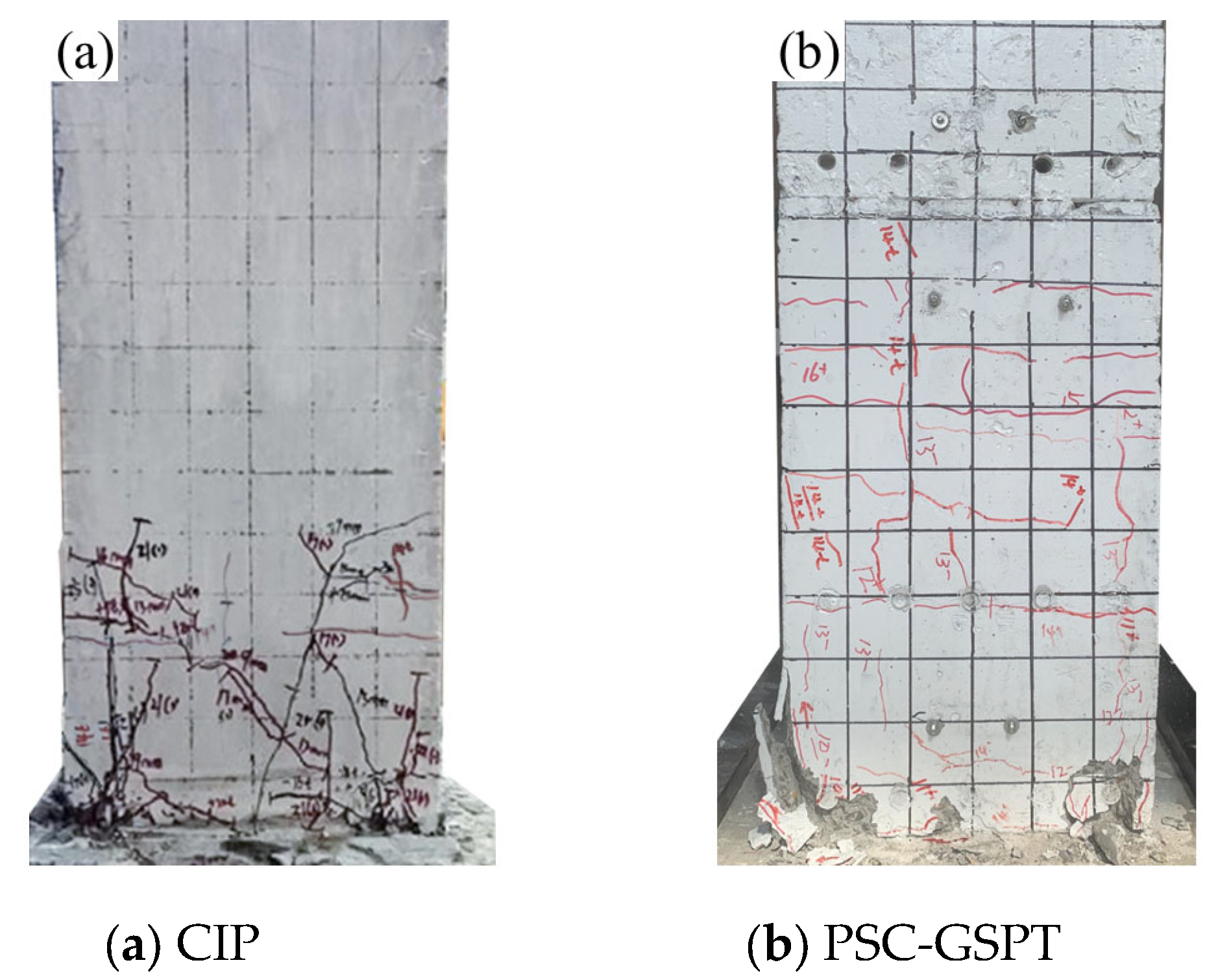
Figure 4 illustrates the final failure patterns of the specimens, revealing a fundamental shift in the mechanical behavior of the hybrid connection system. The failure of the CIP specimen was concentrated in the plastic hinge region at the column base (0–300 mm). In the PSC-GSPT specimen, however, the grouted sleeves, with their higher stiffness and strength, acted as rigid connectors, forcing the plastic hinge region to shift upward from the column base to the weaker section at the top of the sleeves (320–450 mm) [16,19,37]. Test results confirm that the segmental joints remained largely elastic during loading, and the unbonded prestressing tendons anchored at both ends spanned this localized plastic zone and remained elastic throughout, providing a global restoring force adapted to the rotation of the shifted plastic hinge. This ensures that the precast assembly system maintains a controlled damage mode under extreme deformation, making it suitable for high seismic intensity regions [29].
To quantify these observations, the key performance metrics for both specimens are summarized in Table 3.

3.2. Strength and Ductility

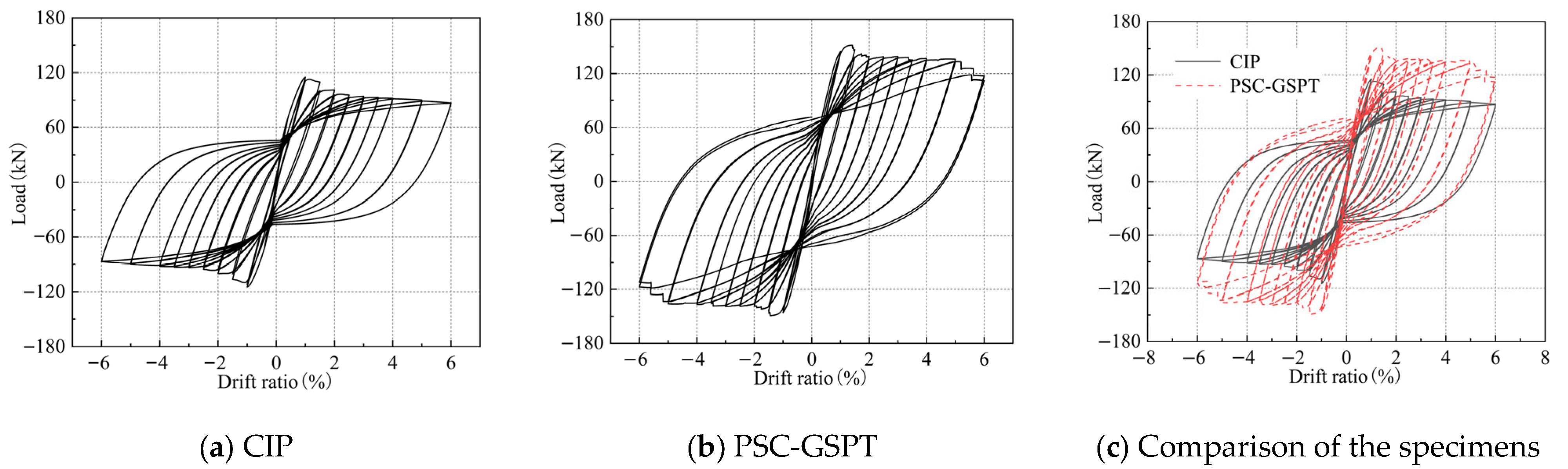
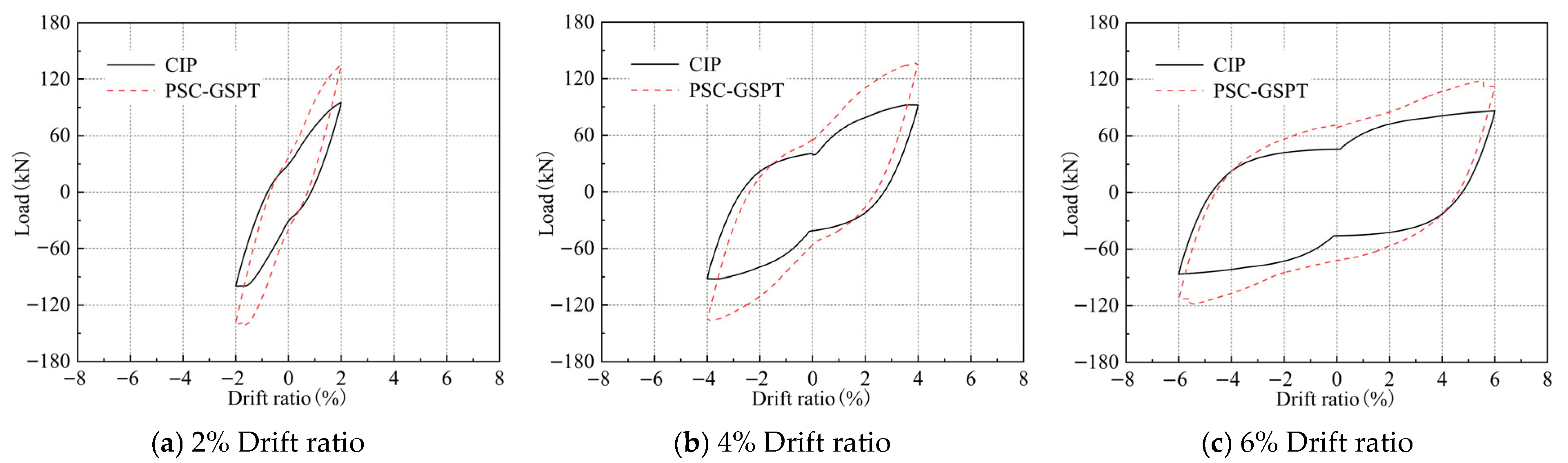
As illustrated in Figure 5, both specimens exhibited elastic behavior during the initial loading phase, characterized by comparable initial stiffness and negligible residual deformation. As the drift amplitude increased, the hysteretic loops of the cast-in-place (CIP) specimen developed a full, spindle-shaped morphology, indicating significant residual deformation and strength degradation reflective of an energy dissipation mechanism dominated by cumulative damage. In contrast, the PSC-GSPT specimen exhibited a “pinched” hysteretic response, a behavior attributed to the opening of segmental joints and the self-centering mechanism provided by the prestressing tendons [38,39]. Despite this pinching effect, the peak load-bearing capacity of the PSC-GSPT specimen was significantly higher than that of the CIP specimen, benefiting from the elastic restoring force of the prestressing tendons. Furthermore, the precast specimen demonstrated improved post-earthquake functional recoverability, evidenced by minimized residual deformations upon unloading from large displacements and a more gradual degradation of strength compared to the monolithic counterpart.
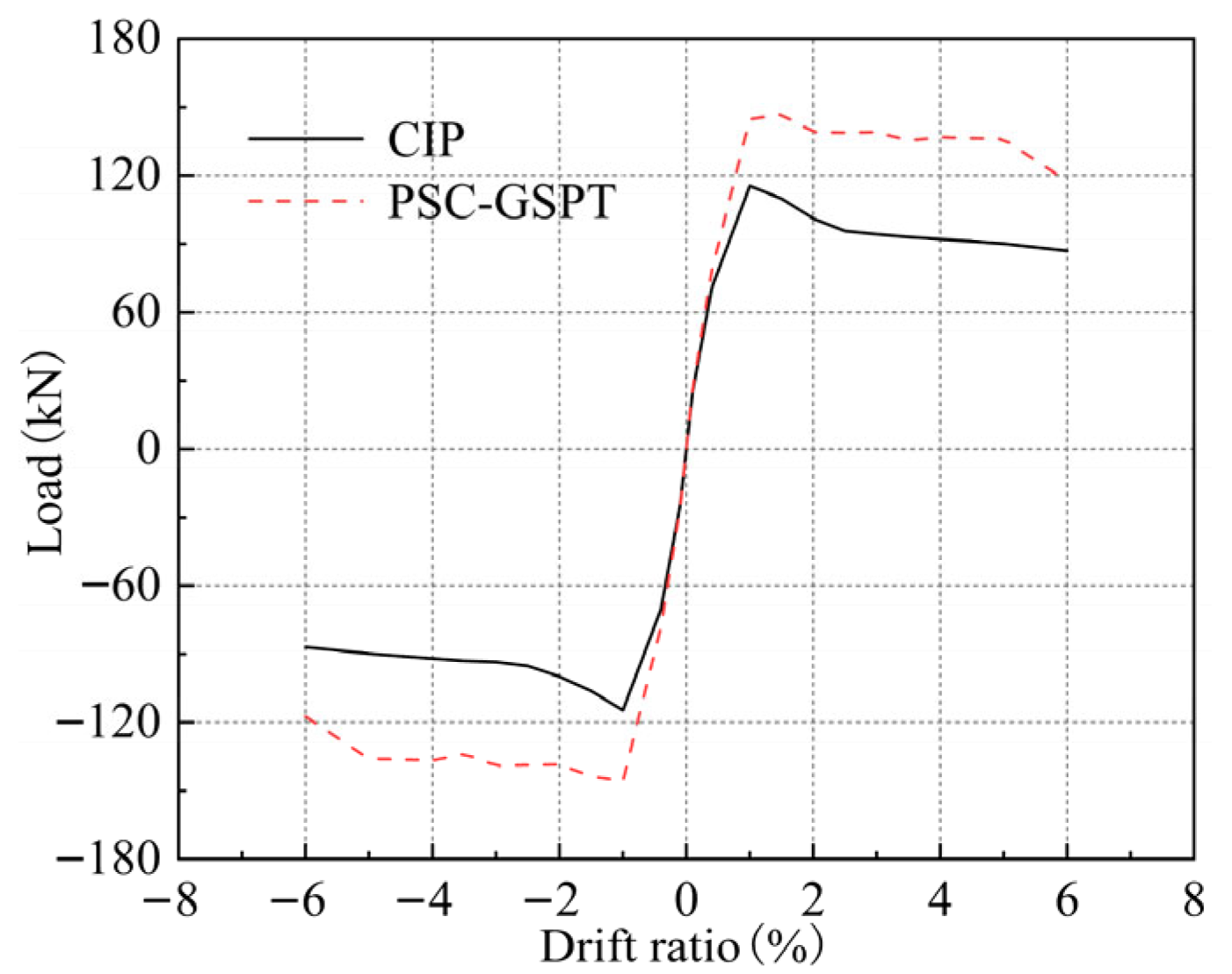
The skeleton curves presented in Figure 6 reveal that the trajectory of the PSC-GSPT specimen consistently envelops that of the CIP specimen, exhibiting a wider horizontal plateau and a gentler descending slope in the post-peak region, which indicates superior strength stability under large deformations. The specific mechanical performance metrics are detailed in Table 4. Driven by the enhanced confinement from the high-strength grout bedding and the active axial pressure exerted by the prestressing tendons, the positive yield load and peak load of the PSC-GSPT specimen were substantially increased by 32.8% and 30.2%, respectively, relative to the CIP specimen, reaching a measured peak load of 150.7 kN.
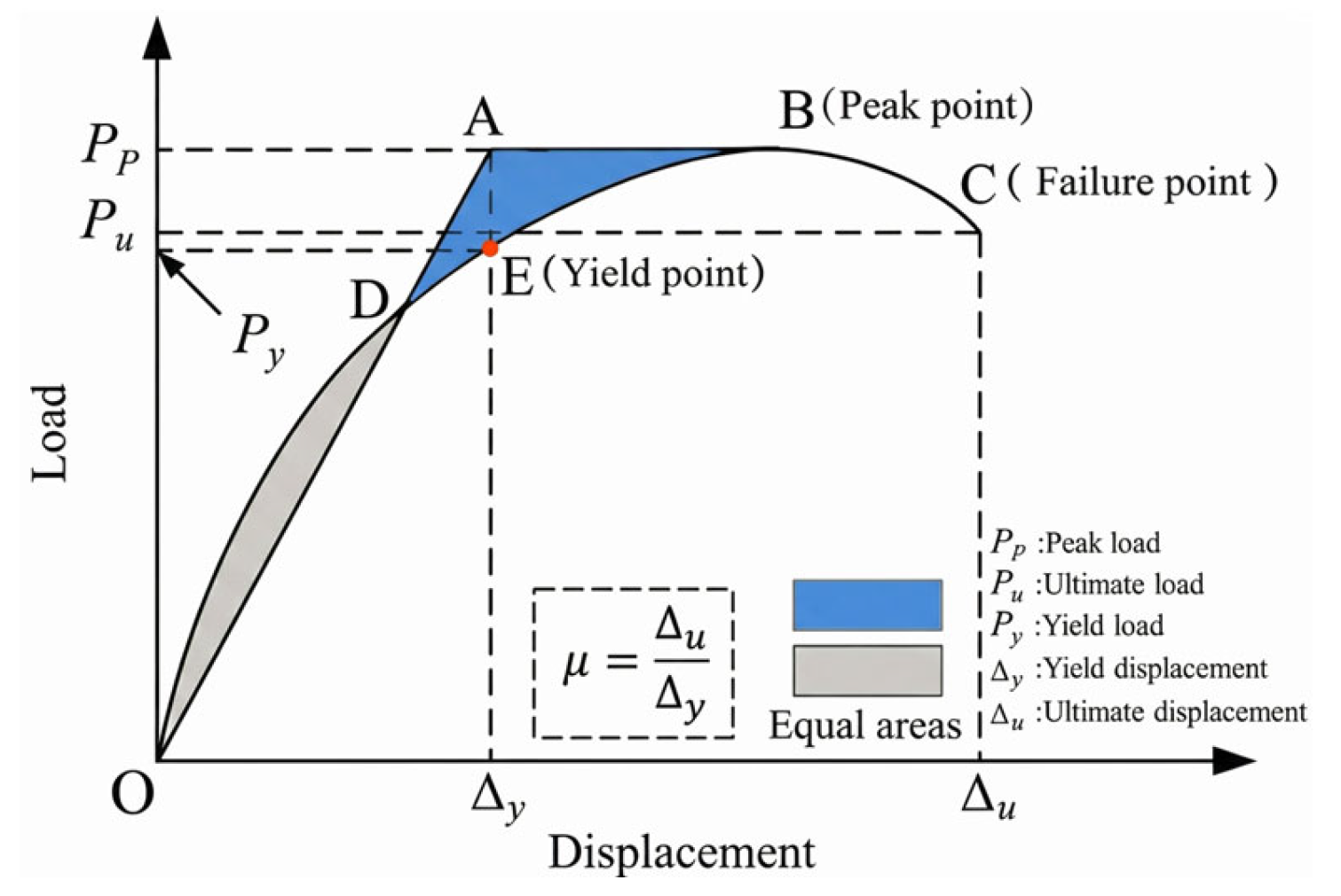
To ensure transparency and consistency across all evaluated specimens, the key response points on the skeleton curves were explicitly defined. The peak point (Pp, ∆p) is identified as the point corresponding to the maximum lateral force. The ultimate point (Pu, ∆u) is defined uniformly as the state where the lateral load drops to 85% of the peak load (0.85 Pp), or when physical ultimate failure (e.g., bar buckling or extensive concrete crushing) prevents further loading. The yield point (Py, ∆y) is determined using the energy-equivalent method (Park’s method [40]), as illustrated in Figure 7.
The displacement ductility factor (μ) is evaluated based on the displacement ratio, calculated using Equation (1):
μ = u y
To account for potential asymmetrical behavior under cyclic loading, the final ductility factor for each specimen is defined as the average of the values obtained in the positive (+) and negative (−) loading directions, as expressed in Equation (2):
μ = μ + + μ 2 = 1 2 ( | Δ u + | | Δ y + | | | Δ u | | Δ y | )
Taking the measured data of the PSC-GSPT specimen (Table 4) as a worked example, the displacement ductility factor was determined to be 6.58 for the PSC-GSPT specimen, marking a 20.7% improvement over the 5.45 value of the CIP specimen. These results comprehensively validate that the hybrid “grouted sleeve-prestressing” connection system significantly enhances the load-bearing capacity and ductility of Precast bridge columns by delaying cracking and providing an effective self-centering force.

3.3. Stiffness Degradation

Stiffness is a fundamental metric reflecting a structure’s capacity to resist deformation under external loading. In accordance with the Chinese standard JGJ/T 101–2015 [41], the secant stiffness is adopted for evaluation and is determined using Equation (3):
K i = | + F i | + | F i | | + X i | + | X i |
where + F i and F i represent the peak loads at the i-th loading level in the positive and negative directions, respectively; and + X i and X i denote the corresponding maximum displacements.
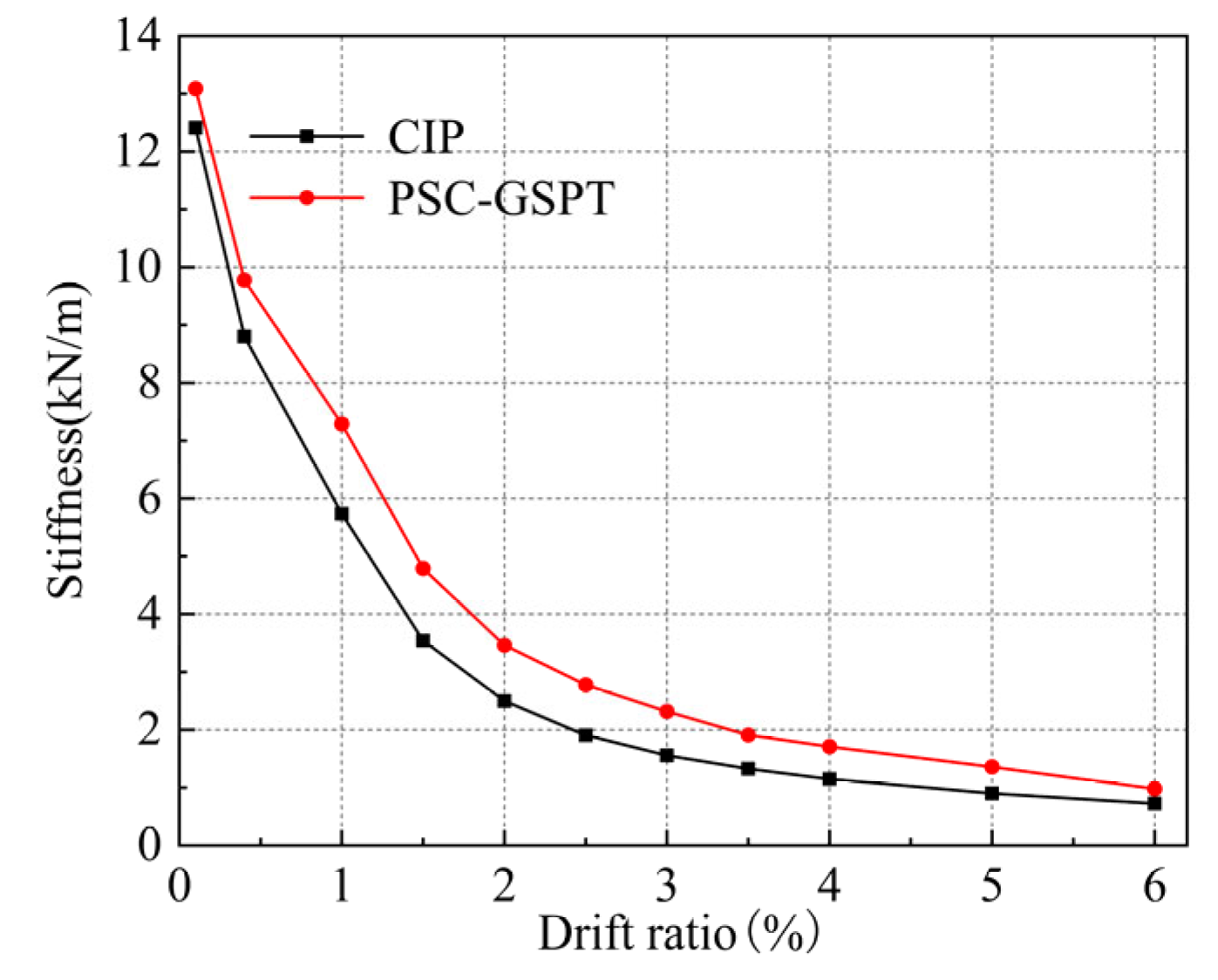
As illustrated by the stiffness degradation curves in Figure 8, the equivalent stiffness of both specimens exhibited a nonlinear attenuation profile characterized by a precipitous initial decay followed by a gradual stabilization as the drift ratio increased. This behavior corresponds to the progressive deterioration of structural stiffness induced by the accumulation of concrete cracking and the yielding of longitudinal reinforcement.
However, the PSC-GSPT specimen consistently maintained a higher equivalent stiffness compared to the CIP specimen throughout the entire loading history. This superior performance is primarily attributed to the active axial clamping force and self-centering mechanism provided by the unbonded prestressing tendons, in conjunction with the inherent high rigidity of the grouted sleeves. Consequently, the PSC-GSPT specimen not only demonstrated a distinct advantage in initial stiffness but also retained significantly higher residual stiffness following extensive plastic deformation. These findings indicate that the hybrid connection system effectively mitigates the stiffness degradation process by restraining crack propagation, thereby ensuring enhanced post-earthquake lateral stability for the structure.

3.4. Energy Dissipation Capacity

To rigorously compare the energy dissipation mechanisms and decouple the influence of structural strength, the energy dissipation capacity is evaluated through isolated single-cycle hysteretic loops, the equivalent viscous damping ratio ( ξ e q ), and cumulative energy dissipation.
Figure 9 illustrates the isolated single-cycle hysteretic loops of the specimens at representative drift ratios (2%, 4%, and 6%). The CIP specimen exhibits typical “plump” shuttle-shaped loops, signifying conventional energy dissipation governed by extensive material plasticity and cumulative damage. In contrast, the PSC-GSPT specimen demonstrates distinct “pinching” characteristics. This phenomenon is a direct result of the gap-opening mechanism at the segmental joints and the dominant elastic restoring force provided by the unbonded prestressing tendons.
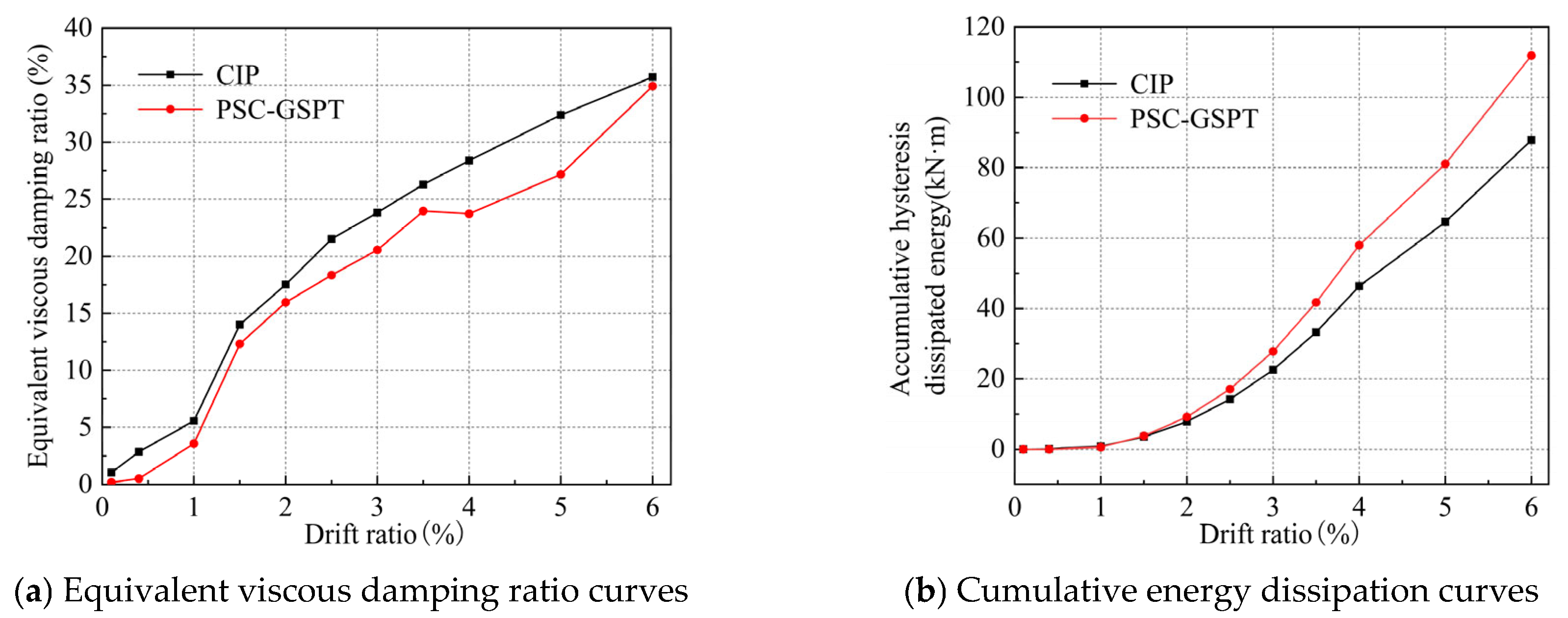
To provide a technically rigorous comparison of the energy dissipation efficiency per cycle, the equivalent viscous damping ratio ( ξ e q ) is adopted as a normalized metric. ξ e q inherently normalizes the dissipated energy in a single cycle by the maximum elastic strain energy (which is a function of peak strength and displacement). As shown in Figure 10a, the ξ e q of the CIP specimen rises rapidly and remains consistently higher than that of the PSC-GSPT specimen across the loading history. This normalized comparison explicitly confirms that the monolithic CIP column possesses a higher single-cycle energy dissipation efficiency due to its fuller hysteretic loops.
However, despite the lower normalized single-cycle efficiency and pinched hysteretic loops, Figure 10b reveals that the total cumulative energy dissipation of the PSC-GSPT specimen consistently surpasses that of the CIP specimen as the drift ratio increases, ultimately achieving a 27% increase by the final stage. It is crucial to clarify that this higher cumulative dissipation is primarily driven by the substantially enhanced lateral load-bearing capacity (as detailed in Section 3.2) provided by the hybrid connection system, rather than by fuller hysteretic loops.
The contrasting trends between the normalized single-cycle damping ( ξ e q ) and the total cumulative energy highlight a deliberate design trade-off inherent to the PSC-GSPT system. From a design perspective, the hybrid connection strategically sacrifices a certain degree of single-cycle hysteretic damping efficiency (accepting pinched loops) to secure a highly reliable elastic restoring mechanism. While traditional CIP designs rely heavily on severe structural damage to dissipate seismic energy, the proposed precast system relies on its enhanced strength and superior self-centering capabilities to limit maximum and residual deformations. This trade-off effectively shifts the structural performance objective from pure energy dissipation to controlled damage and rapid post-earthquake functional recoverability.

3.5. Residual Displacement

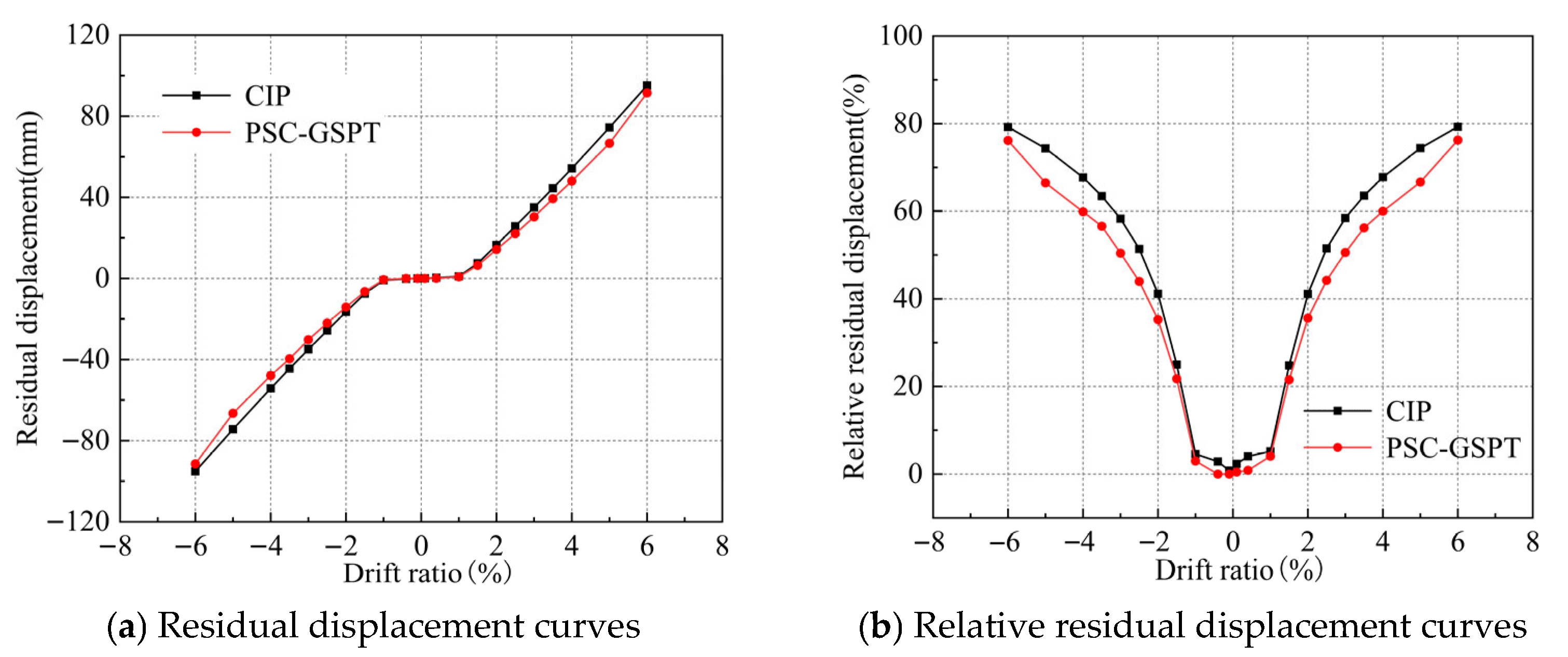
As evidenced by the residual displacement profiles in Figure 11a, the PSC-GSPT specimen exhibited greater self-centering capabilities than the CIP specimen, despite the presence of nonlinear phenomena such as segmental joint opening and shear slippage. The underlying mechanism for this performance lies in the behavior of the unbonded prestressing tendons, which remained within the elastic range (unyielded) throughout the loading protocol. The resulting elastic restoring force effectively counteracted the residual deformations arising from geometric nonlinearities and interfacial friction within the multi-joint system. Conversely, the seismic resistance mechanism of the CIP specimen relied primarily on material nonlinearity and hysteretic energy dissipation. Consequently, the yielding of reinforcement and concrete crushing in the plastic hinge region resulted in the accumulation of substantial irreversible plastic damage, leading to pronounced residual displacements.
To eliminate the influence of peak displacement magnitude on the evaluation of residual deformation and to more intuitively quantify self-centering efficiency, the relative residual displacement [42] was adopted as a normalized performance metric. It is defined using Equation (4):
ξ r e s = Δ r e s Δ m a x × 100 %
where ξ r e s is the relative residual displacement; Δ r e s represents the residual displacement (the irrecoverable displacement remaining after the external load is removed in a single cycle); and Δ m a x denotes the peak displacement reached during that specific loading cycle.
Figure 11b illustrates the comparative evolution of relative residual displacement for both specimens. As the lateral drift ratio increased, both specimens exhibited a nonlinear escalation in ξ r e s . However, a comparative analysis reveals that the PSC-GSPT specimen consistently maintained lower relative residual displacements than the CIP specimen across the entire loading history. Notably, in the large displacement stage (Drift > 4%), the PSC-GSPT specimen demonstrated superior re-centering performance, driven by the robust elastic restoring force provided by the prestressing tendons. These results confirm that the proposed hybrid connection system effectively controls permanent post-earthquake deformation, thereby improving the post-earthquake reparability of the structures.

4. Finite Element Model: Validation and Discussion

4.1. Modeling Technique

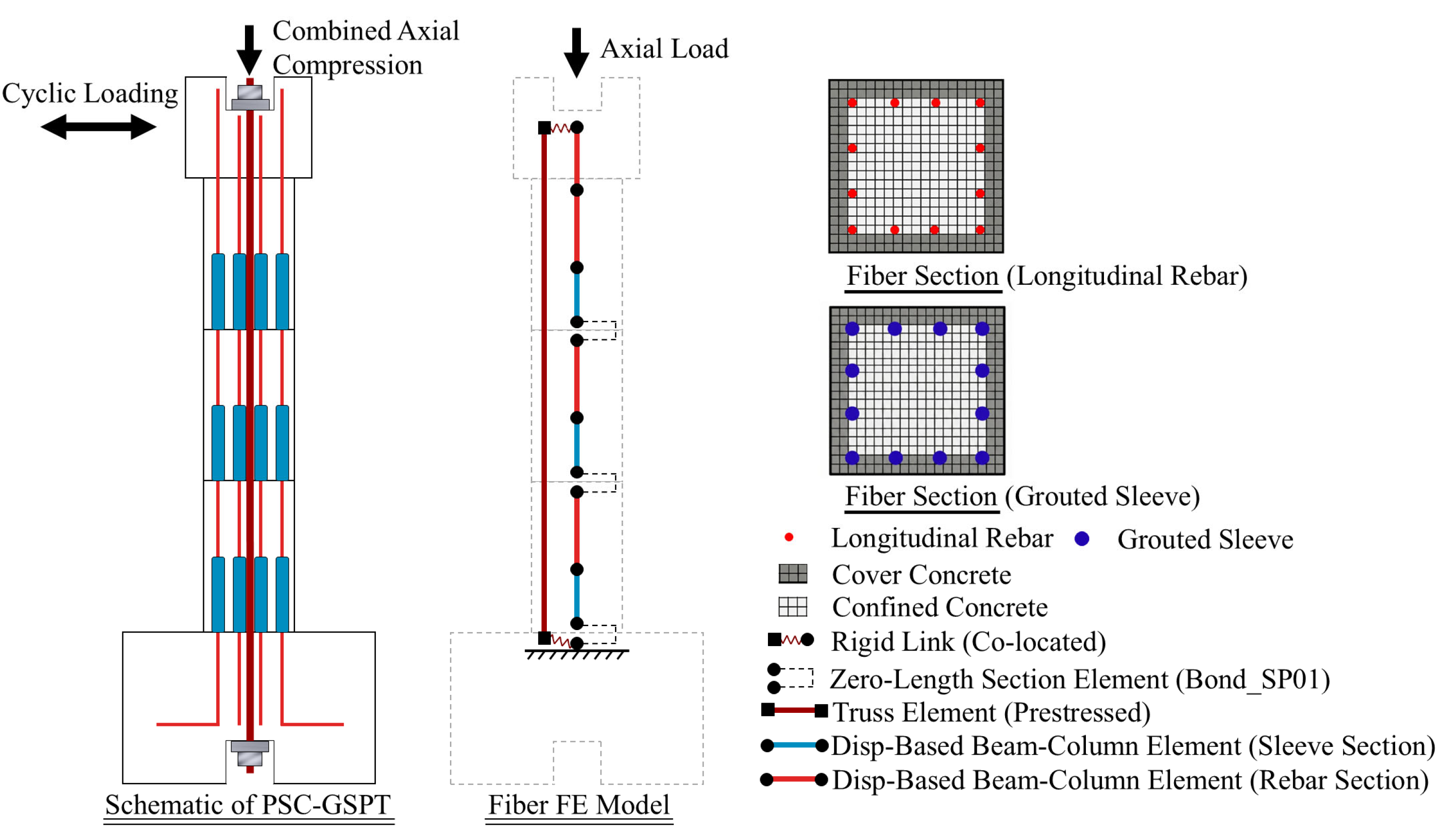
To accurately evaluate the seismic performance of the precast segmental column with grouted sleeve-prestressing tendon hybrid connections (PSC-GSPT), a numerical model was developed using the OpenSees framework, as illustrated in Figure 12. The modeling strategy adopted in this study aligns with the methodologies proposed by [7,43].
The column segments were modeled using displacement-based beam-column elements with discretized fiber sections. Regarding the constitutive laws, the Kent-Scott-Park model (Concrete02) was selected for both core and cover concrete. To accurately capture the confinement effect provided by the transverse stirrups, the Mander theoretical framework was utilized within the OpenSees material definition to establish the enhanced compressive strength ( f c c ) and corresponding strain ( ε c c ) for the confined core fibers. The unconfined cover concrete was assigned a compressive strength of 48.5 MPa. The longitudinal reinforcement was simulated using the Giuffre-Menegotto-Pinto model (Steel02) to incorporate the Bauschinger effect during cyclic loading. The key input parameters for these primary materials are summarized in Table 5.
To represent the localized stiffness enhancement provided by the grouted sleeves, the “equivalent steel section” method was applied over the exact physical length of the sleeves (LS = 315 mm). The cross-sectional area of the reinforcement fibers within this specific region was artificially amplified to account for the combined axial stiffness of the rebar, the grout, and the steel sleeve. The equivalent area (Aeq) of the reinforcement fiber was calculated using the modular ratio method, expressed as Equation (5):
A e q = A b a r + A s l e e v e E s l e e v e E b a r + A g r o u t E g r o u t E b a r
where Abar and Ebar are the cross-sectional area and elastic modulus of the longitudinal rebar, respectively; Asleeve and Esleeve are the area and elastic modulus of the metallic grouted sleeve; and Agrout and Egrout represent the area and elastic modulus of the high-strength grout filling the annular space. By adopting this amplified area Aeq and assigning it the rebar’s constitutive model (Steel02), the localized rigid zone induced by the sleeves was accurately captured in the fiber beam-column elements.
The nonlinear behavior at the segmental joints was simulated using zero-length section elements. To capture the strain penetration and bond-slip effects, the Bond_SP01 constitutive model was assigned to the reinforcement fibers at the column base and interfaces. The yield slip (Sy) and ultimate slip (Su) parameters were calibrated based on the CEB-FIP Model Code provisions and the measured anchorage lengths. The unbonded prestressing tendons were modeled using truss elements, with the initial prestress force applied via an initial strain command [42]. Although the tendons were designed to—and ultimately did—remain within the elastic range during the test, an elastic–perfectly plastic material model (Steel01 with a strain-hardening ratio b = 0) was intentionally adopted instead of a purely elastic model. This choice was made to serve as a numerical monitoring mechanism: it allows the model to inherently capture any potential yielding should the local strains exceed the yield threshold (fpy = 1832 MPa) during extreme drift demands. Numerical outputs confirmed that the maximum tensile stress recorded in the tendons at the 6% drift ratio was strictly below fpy, retrospectively validating the assumption of elastic behavior.

4.2. Modeling Validation

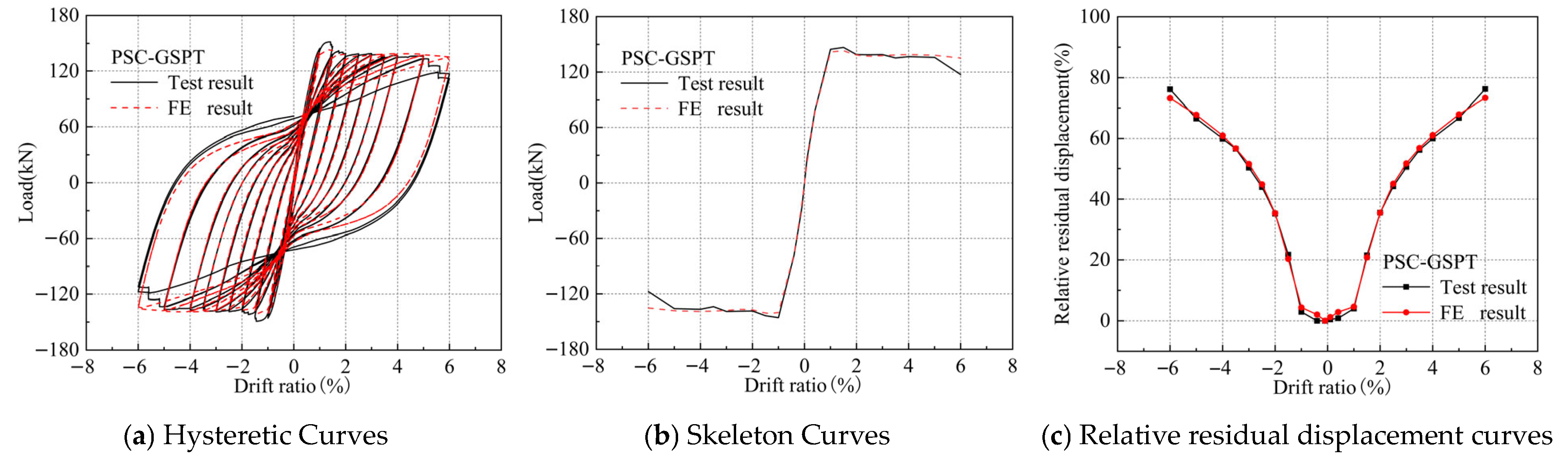
As depicted in Figure 13a, the FE model accurately replicates the characteristic “flag-shaped” hysteretic behavior observed in the experiment, effectively capturing the distinct “pinching effect” induced by the opening and closing mechanism of the segmental joints. Regarding the skeleton curves shown in Figure 13b, the predicted load-carrying capacity envelope closely aligns with the experimental results in both loading directions. Furthermore, Figure 13c reveals that the simulated evolution of relative residual displacement exhibits a remarkable consistency with the experimental observations. These comparisons corroborate the reliability of the proposed OpenSees model in evaluating the post-earthquake self-centering performance of the structure.
To objectively quantify the accuracy of the finite element model and avoid relying solely on qualitative graphical comparisons, key mechanical metrics were extracted from the numerical simulations and compared against the experimental results. As summarized in Table 6, the objective validation metrics include peak loads (Pp) and their corresponding drifts (Δp) in both loading directions, the initial secant stiffness (Ki), and the residual drift (Δres) at a representative large deformation stage (4% drift level).
The quantitative comparison demonstrates that the relative errors between the numerical predictions and the physical test data are strictly controlled within a narrow margin. Specifically, the error in predicting the positive and negative peak loads is remarkably low at 4.98% and 3.22%, respectively. The initial stiffness and the residual deformation at the 4% drift level also show excellent agreement, yielding relative errors of only 3.05% and 1.67%. Furthermore, the prediction errors for the drift at peak load remain below 10% (9.93% and 8.73%). These objective error measures rigorously confirm that the proposed OpenSees framework captures the complex nonlinear seismic response and self-centering kinematics of the PSC-GSPT specimen with high fidelity. Consequently, the validated model is deemed highly robust and reliable for the subsequent parametric study.

4.3. Parametric Study

To thoroughly investigate the influence of key design parameters on the seismic performance of the PSC-GSPT column, a parametric study was conducted by systematically varying these parameters within the validated numerical model under quasi-static loading conditions. In this study, the term “initial prestress level” is unambiguously defined as the effective initial prestress applied to the tendons after all short-term losses (e.g., anchorage seating and elastic shortening), expressed as a percentage of the tendon’s ultimate tensile strength (fpu). Furthermore, to comprehensively evaluate the hybrid system’s intended performance objectives, the quantitative assessment incorporates not only traditional metrics like peak load (Pp) and displacement ductility (μ), but also a direct damage-control and self-centering metric: the relative residual displacement ( ξ r e s ) evaluated at a severe deformation stage. The 4% drift level was purposefully selected for this metric, as it typically represents the maximum expected displacement demand under maximum considered earthquakes for such bridge columns, effectively highlighting the system’s post-earthquake reparability. The specific simulation cases and the corresponding calculation results are summarized in Table 7.

4.3.1. Prestress Level

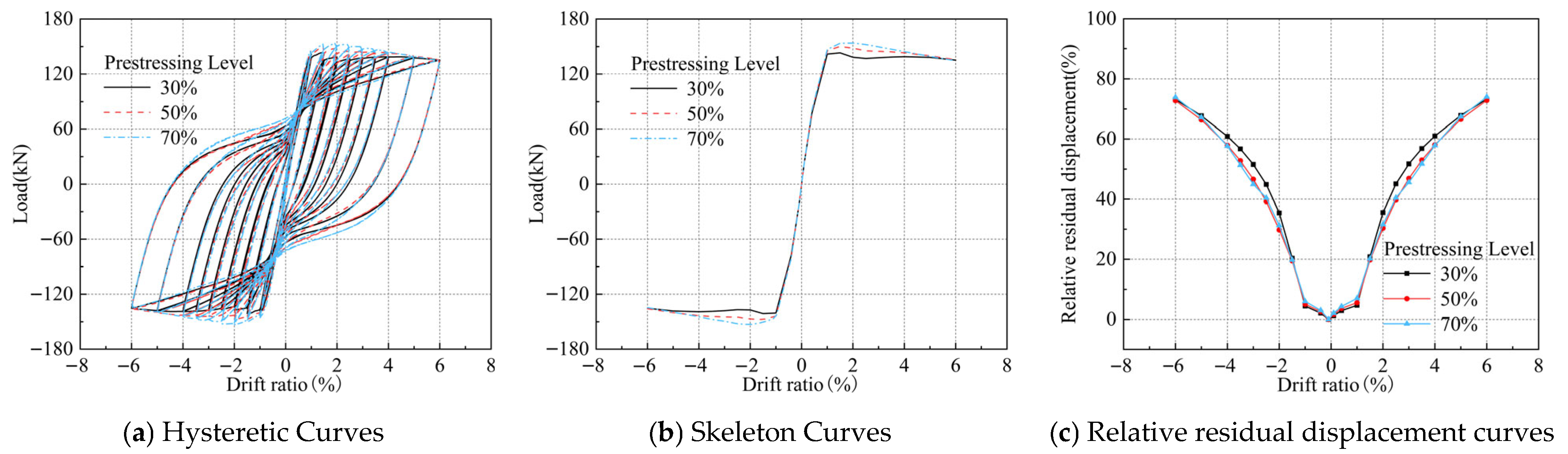
Figure 14 presents the finite element analysis results under varying initial prestress levels. Synthesizing these graphical results with the quantitative data in Table 7 reveals that variations in the initial prestress level exert a significant dual influence on the seismic performance.
On the one hand, as the prestress level increases from 30% to 70%, the peak load-carrying capacity of the specimen rises from 142.2 kN to 153.5 kN (an increase of approximately 7.9%). Concurrently, the higher initial clamping force yields a slight improvement in the self-centering capability at the 4% drift level, with ξ r e s decreasing from 60.93% to 57.75%.
Conversely, however, excessive initial prestress subjects the column shaft—particularly the plastic hinge region—to sustained high axial compression. This state accelerates the ultimate crushing of the concrete, thereby constraining the ultimate deformation capacity. Simulation results indicate that when the prestress level is raised from 30% to 70%, the displacement ductility coefficient (μ) decreases notably from 7.02 to 6.44 (a reduction of 8.26%). In conclusion, although higher prestress levels yield marginal gains in strength and residual drift control, the 30% prestress configuration achieves a highly favorable balance. It preserves a superior level of ductility while ensuring highly effective self-centering. Therefore, a moderate initial prestress level is recommended in practical design to avoid compromising structural ductility for the sake of load-bearing capacity.

4.3.2. Prestress Ratio

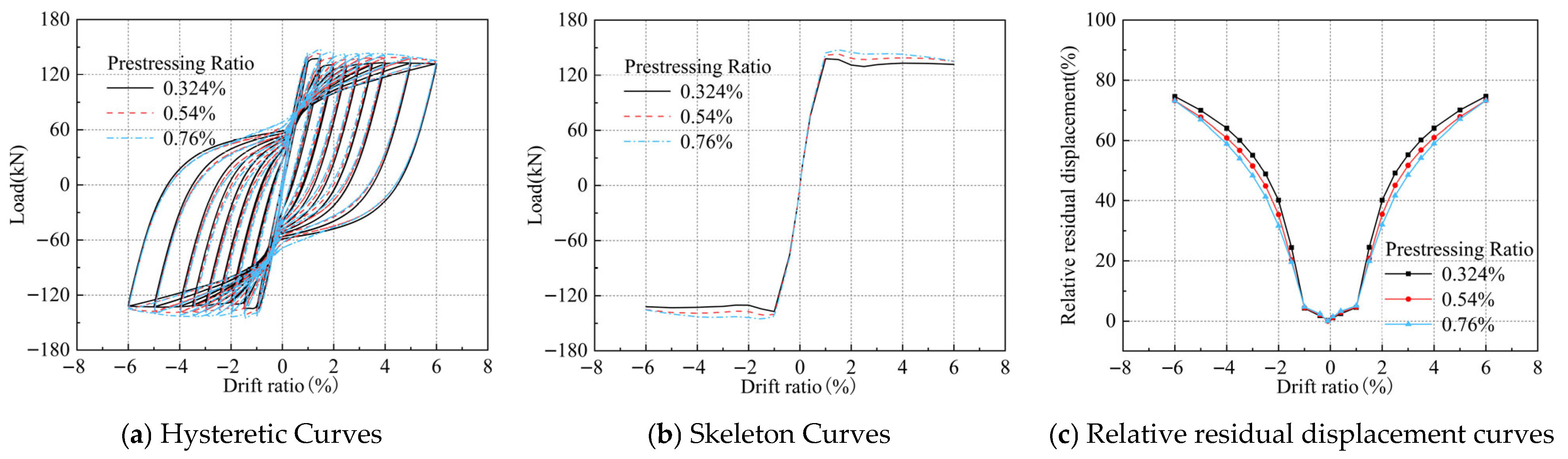
Figure 15 illustrates the simulation results under varying prestressing reinforcement ratios (0.324%, 0.54%, and 0.76%). A comprehensive analysis of Table 7 reveals that increasing the prestressing reinforcement ratio is a highly efficient strategy for enhancing the overall seismic resilience of the PSC-GSPT specimen.
As the reinforcement ratio increases from 0.324% to 0.76%, the peak load-carrying capacity experiences a steady increment from 137.6 kN to 146.6 kN. More importantly, this enhanced total axial clamping force and lateral stiffness significantly strengthen the self-centering capability, reducing the relative residual displacement ( ξ r e s ) from 64.07% to 58.93% at the MCE-level drift. Furthermore, the adverse impact of increasing the reinforcement ratio on structural ductility is negligible; the ductility coefficient (μ) decreases only slightly from 7.13 to 6.81.
From the perspective of engineering safety, employing a lower reinforcement ratio would necessitate a significantly higher initial tensioning control stress to achieve the required total restoring force, thereby exposing the structure to a greater risk of substantial prestress loss under seismic excitation. Consequently, moderately increasing the prestressing reinforcement ratio within a reasonable range is recommended, as it simultaneously enhances load-bearing capacity and damage control with virtually no compromise on ductility.

4.3.3. Configuration

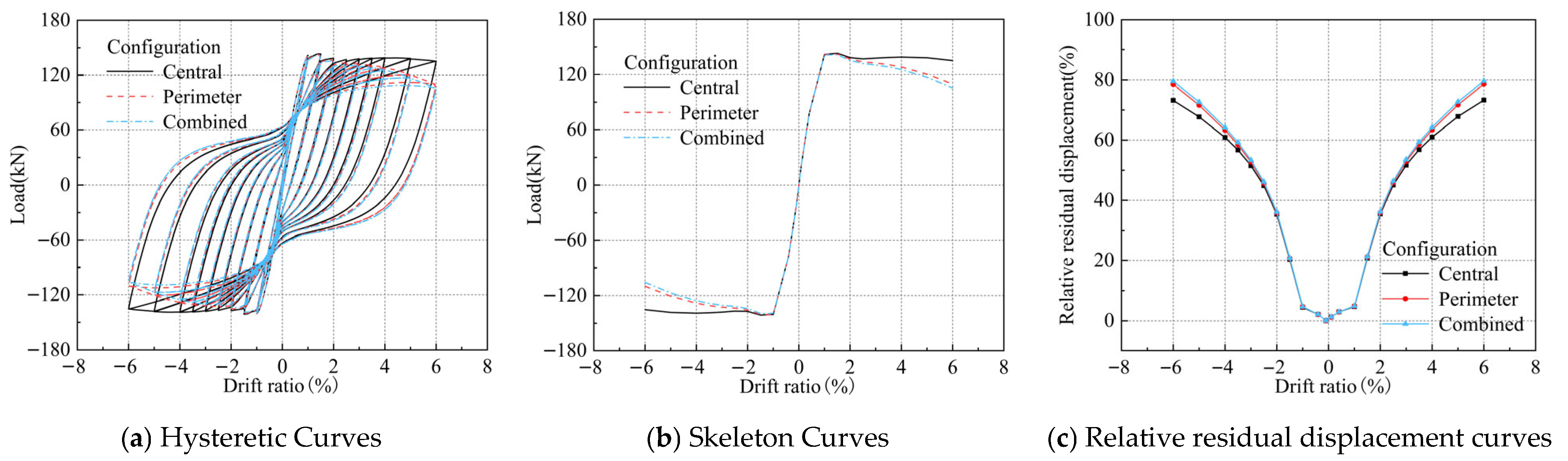
Figure 16 and Table 7 illustrate the performance across three different tendon configurations: Central, Perimeter, and Combined. The analysis reveals that the spatial arrangement of the prestressing tendons exerts a critical influence on both ductility and self-centering performance, while its effect on peak strength is negligible (deviation less than 1.2%).
Compared to the Central configuration, the Perimeter and Combined layouts exhibit substantial reductions in displacement ductility of 15.6% and 20.4%, respectively. Additionally, the Central configuration provides the best self-centering performance ( ξ r e s = 60.93%), whereas the Perimeter (63.35%) and Combined (64.22%) configurations result in larger residual drifts.
The underlying mechanism for this disparity lies in the geometric relationship between the tendon position and the strain demand. Tendons in the Perimeter configuration are positioned further from the neutral axis; consequently, they experience significantly higher tensile strains for a given lateral drift. This leads to premature yielding, which not only causes a rapid degradation of structural ductility but also results in a subsequent loss of the elastic restoring function, directly exacerbating the residual displacement. In contrast, centrally located tendons experience a slower rate of strain accumulation, allowing them to remain elastic and provide a stable self-centering moment even under extreme deformations. Therefore, to guarantee optimal ductility and improved post-earthquake reparability, the central concentration strategy is highly recommended.

5. Conclusions

This study presented a systematic experimental and numerical investigation into the seismic resilience of a three-segment precast bridge column utilizing a hybrid connection system (PSC-GSPT), composed of grouted sleeves and unbonded prestressing tendons. The performance was rigorously compared with a conventional cast-in-place (CIP) column. Based on the experimental observations, quantitative analyses, and parametric studies, the following major conclusions are drawn:
  • The PSC-GSPT specimen exhibited superior damage control capabilities through a favorable shift in the failure mechanism. In contrast to the CIP specimen, which suffered from severe concrete crushing and reinforcement buckling at the column base, the PSC-GSPT specimen successfully relocated the plastic hinge region from the base to the section immediately above the grouted sleeves due to their localized stiffening effect. Consequently, structural damage was primarily limited to joint opening and minor compressive crushing, while the unbonded tendons remained elastic throughout the loading process, effectively coordinating the deformation of the segments.
  • The proposed hybrid connection system significantly enhanced both the load-carrying capacity and deformation capability of the structure. Experimental results indicate that, driven by the confinement provided by high-strength grout and the active clamping force from the tendons, the PSC-GSPT specimen achieved a 30.2% increase in peak load and a 41.3% increase in ultimate displacement compared to the CIP specimen, with the displacement ductility coefficient improving by 20.7% (reaching 6.58). Furthermore, despite the characteristic “pinching” effect observed in its hysteretic loops, the specimen achieved a 27% increase in total cumulative energy dissipation compared to the CIP specimen, attributed to its superior strength and large deformation capacity.
  • The PSC-GSPT specimen demonstrated exceptional post-earthquake functional recoverability, characterized by consistently lower relative residual displacements than the CIP specimen across all displacement amplitudes. The elastic restoring force provided by the unbonded prestressing tendons effectively overcame the nonlinear deformations at the segmental joints, ensuring that the structure could return to its original position even after large-magnitude excursions, thereby significantly reducing post-earthquake repair costs.
  • Numerical parametric analyses indicate that optimizing prestressing parameters is a robust strategy for enhancing structural performance. Specifically, moderately increasing the prestressing reinforcement ratio (e.g., from 0.324% to 0.76%) significantly improves load-bearing capacity and self-centering capability with minimal ductility loss. However, the initial prestress level requires careful control; while excessive initial prestress (e.g., 70%) yields marginal strength gains, it accelerates core concrete crushing and causes a detrimental reduction in ductility. Therefore, an initial prestress level of approximately 30% is recommended for design.
  • The spatial layout of the prestressing tendons exerts a decisive influence on structural ductility. The central concentration configuration is identified as the optimal design strategy, as it significantly mitigates the rate of strain accumulation in the tendons during lateral drift compared to perimeter or combined arrangements, thereby preventing premature yielding. Simulation results confirm that the central configuration yields a displacement ductility coefficient 15.6% and 20.4% higher than that of the perimeter and combined configurations, respectively, ensuring sustained elastic restoring force under strong seismic excitations.

6. Discussion and Limitations

While this study demonstrates the superior seismic resilience of the PSC-GSPT system, its practical engineering application and the interpretation of these results require careful consideration of several factors:
  • Long-term Engineering Applicability: The practical implementation of this system must account for prestress losses due to concrete creep and shrinkage over time, which necessitates strict long-term monitoring to ensure sustained self-centering capability. However, the durability of grouted sleeve connections is inherently enhanced by the observed plastic hinge relocation mechanism, which shifts structural damage away from the joint interfaces and limits the mechanical demand on the sleeves.
  • Resilience under Repeated Events: The system’s ability to withstand repeated seismic events is fundamentally superior to traditional CIP columns due to its robust self-centering mechanism, which significantly minimizes the accumulation of irreversible plastic damage and residual displacement.
  • Experimental and Scaling Constraints: Due to laboratory and resource constraints, the experimental program used 1:5 scaled specimens and a limited sample size, which may introduce scale effects and does not fully account for the statistical variability found in full-scale bridge components.
  • Loading and Environmental Simplifications: The quasi-static cyclic testing was conducted under a constant axial load ratio, which does not capture the dynamic strain-rate effects or the fluctuating axial forces typical of real-time seismic excitations. Furthermore, future research incorporating environmental aging and dynamic sequential loading (e.g., shake-table tests) is essential to fully validate the system’s performance under realistic field conditions.
  • Limitations of Numerical Analysis: Although the baseline experiment validated the 30% initial prestress and central tendon layout, the broader recommendations derived from the parametric study rely on numerical projections. Establishing universally “optimal” design parameters requires further physical validation across diverse structural configurations and dynamic loading protocols. Furthermore, the finite element analysis relied on simplifications such as the equivalent steel section method for sleeves and idealized material models for tendons. While these effectively capture global kinematics, they may oversimplify complex, highly localized nonlinear interactions at the joint interfaces.

Author Contributions

Conceptualization, N.Z.; methodology, B.Y.; software, B.Y.; validation, N.Z., G.C., B.Y. and B.Z.; formal analysis, B.Y. and H.T.; investigation, B.Y. and N.Z.; resources, H.T. and G.W.; data curation, B.Y. and G.C.; writing—original draft preparation, B.Y.; writing—review and editing, H.T., G.W. and B.Z.; visualization, B.Y.; supervision, N.Z.; project administration, N.Z.; funding acquisition, N.Z. All authors have read and agreed to the published version of the manuscript.

Funding

This research was funded by Chongqing Construction Science and Technology Plan Project 2024 (No. Chengkezi 2024 3-5); JN North Ring Interchange Section Renovation Project 6 (2025) No. 2. General Program of Chongqing Technology Innovation and Application Development Special Project 2024 (No. CSTB2024TIAD-GPX0009); Research Project of Chongqing Design Group (No. 2023-C9).

Data Availability Statement

The data that support the findings of this study are available from the corresponding author upon reasonable request.

Conflicts of Interest

Author Haitao Tang was employed by the company Hubei Communications Investment Group Co., Ltd. Author Boheng Zhang was employed by the company Chongqing Architectural Design Institute Co., Ltd. Author Guan Wang was employed by the company Chongqing Jiaotong University Construction Engineering Quality Inspection Center Co., Ltd. The remaining authors declare that the research was conducted in the absence of any commercial or financial relationships that could be construed as a potential conflict of interest.

References

  1. Billington, S.L.; Barnes, R.W.; Breen, J.E. A precast segmental substructure system for standard bridges. PCI J. 1999, 44, 56–73. [Google Scholar] [CrossRef]
  2. Azizinamini, A. Accelerated Bridge Construction. J. Bridge Eng. 2020, 25, 02020002. [Google Scholar] [CrossRef]
  3. Zhang, Q.; Alam, M.S. State-of-the-art review of seismic-resistant precast bridge columns. J. Bridge Eng. 2020, 25, 03120001. [Google Scholar] [CrossRef]
  4. Liu, Y.Q.; Liang, F.; Au, F.T.K. Precast segmental bridge columns with resettable sliding joints—An inspiration from ancient Chinese pagodas. Structures 2021, 33, 615–626. [Google Scholar] [CrossRef]
  5. Zhu, Z.; He, S.H.; Li, Y.; Dong, P. Review of experimental investigations on seismic performance of precast segmental bridge columns in seismic regions. Adv. Struct. Eng. 2023, 26, 1161–1186. [Google Scholar] [CrossRef]
  6. Ramaglia, G.; Mecca, I.; Angrisano, M.; Santagata, R.; Olivieri, C. An optimization-based framework for the structural strengthening of masonry buildings. Int. J. Space Struct. 2025, 40, 170–179. [Google Scholar] [CrossRef]
  7. Su, H.; Yang, C.; Sun, C.; Hu, L.; Fan, W. Seismic performance of precast multi-segment columns with grouted sleeves: Experimental and numerical investigations. Eng. Struct. 2024, 301, 117239. [Google Scholar] [CrossRef]
  8. Su, H.; Yang, C.; Fan, W.; Sun, C.; Guo, W. Hysteresis characteristics of multi-segment precast columns with ultra-high performance concrete-based grouted sleeve connections: An experimental and analytical approach. Eng. Struct. 2025, 322, 119157. [Google Scholar] [CrossRef]
  9. Tazarv, M.; Shrestha, G.; Saiidi, M.S. State-of-the-art review and design of grouted duct connections for precast bridge columns. Structures 2021, 30, 895–909. [Google Scholar] [CrossRef]
  10. El-Naqeeb, M.H.; Hassanli, R.; Pham, T.M.; Ma, X.; Bazli, M.; Manalo, A. Seismic resistance of precast GFRP-reinforced concrete columns with grouted corrugated duct connections. Structures 2025, 81, 110142. [Google Scholar] [CrossRef]
  11. Dawood, H.; ElGawady, M.; Hewes, J. Behavior of segmental precast posttensioned bridge piers under lateral loads. J. Bridge Eng. 2012, 17, 735–746. [Google Scholar] [CrossRef]
  12. Wang, Z.; Wang, J.Q.; Zhao, G.T.; Zhang, J. Design criterion for the self-centering capacity of precast segmental UHPC bridge columns with unbonded post-tensioning tendons. Eng. Struct. 2019, 200, 109706. [Google Scholar] [CrossRef]
  13. Wang, Y.X.; Cheng, Z.; Li, S.; Wang, J.Q.; Zhong, R.; Zeng, M.; Ming, F.Y.; Cui, B. Effect of a novel joint connection of UHPC wet joint and tapered sleeve locking-type couplers on the lateral cyclic response of precast segmental railway bridge columns. Eng. Struct. 2023, 289, 116333. [Google Scholar] [CrossRef]
  14. Wang, Y.X.; Li, S.; Gao, C.S.; Cheng, Z.; Wang, J.Q.; Hu, Y.Q. Experimental and numerical study on cyclic behavior of precast segmental railway bridge columns with lap-spliced rebar connections using UHPC wet joints. Eng. Struct. 2024, 319, 118818. [Google Scholar] [CrossRef]
  15. Zhao, Y.; Zhang, H.P.; Pan, Z.F.; Li, G.Z. Mechanical behavior of grouted sleeve connection for rebars in precast concrete structures and reliability analysis considering the ratio of anchorage length to rebar diameter. Case Stud. Constr. Mater. 2024, 20, e02883. [Google Scholar] [CrossRef]
  16. Ameli, M.J.; Parks, J.E.; Brown, D.N.; Pantelides, C.P. Seismic evaluation of grouted splice sleeve connections for reinforced precast concrete column–to–cap beam joints in accelerated bridge construction. PCI J. 2015, 60, 80–103. [Google Scholar] [CrossRef]
  17. Liu, Y.; Li, X.P.; Zheng, X.H.; Song, Z. Experimental study on seismic response of Precast bridge columns with double-grouted sleeve connections. Eng. Struct. 2020, 221, 111023. [Google Scholar] [CrossRef]
  18. Haber, Z.B.; Saiidi, M.; Sanders, D.H. Seismic performance of precast column with mechanically spliced column-footing connection. ACI Struct. J. 2014, 111, 639–650. [Google Scholar] [CrossRef]
  19. Haber, Z.; Mackie, K.R.; Al-Jelawy, H.M. Testing and analysis of precast columns with grouted sleeve connections and shifted plastic hinging. J. Bridge Eng. 2017, 22, 04017078. [Google Scholar] [CrossRef]
  20. ACI Committee 318. Building Code Requirements for Structural Concrete (ACI 318-02) and Commentary (ACI 318R-02); American Concrete Institute: Farmington Hills, MI, USA, 2002. [Google Scholar]
  21. AASHTO. LRFD Bridge Design Specifications, 10th ed.; American Association of State Highway and Transportation Officials: Washington, DC, USA, 2024. [Google Scholar]
  22. California Department of Transportation (Caltrans). Seismic Design Criteria, Version 2.0; California Department of Transportation: Sacramento, CA, USA, 2019. [Google Scholar]
  23. Marsh, M.L.; Wernli, M.; Garrett, B.E.; Stanton, J.F.; Eberhard, M.O.; Weinert, M.D. Application of Accelerated Bridge Construction Connections in Moderate-to-High Seismic Regions; NCHRP Report 698; Transportation Research Board: Washington, DC, USA, 2011. [Google Scholar]
  24. Ameli, M.J.; Brown, D.N.; Parks, J.E.; Pantelides, C.P. Seismic column-to-footing connections using grouted splice sleeves. ACI Struct. J. 2016, 113, 1021–1030. [Google Scholar]
  25. Ge, J.P.; Yan, X.F.; Wang, Z.Q. Seismic performance of precast assembled bridge piers connected by grouted sleeves and prestressing tendons. J. Traffic Transp. Eng. 2018, 18, 42–52. (In Chinese) [Google Scholar]
  26. Chen, L.; Guo, M.; Hou, W.Q.; Yu, T.; Zhang, Y.; Guo, W. Experimental study on quasi-static of prefabricated and assembled bridge pier with “grouting sleeve + prestressing tendons” hybrid connection. J. Cent. South Univ. (Sci. Technol.) 2024, 55, 3814–3832. (In Chinese) [Google Scholar]
  27. Dawood, H.; ElGawady, M.; Hewes, J. Factors affecting the seismic behavior of segmental precast bridge columns. Front. Struct. Civ. Eng. 2014, 8, 388–398. [Google Scholar] [CrossRef]
  28. Zhang, D.; Zhou, Z.H.; Gao, S.L.; Yue, Y.N.; Zhang, Y.F.; Li, N. Experimental and numerical study on seismic performance of precast segmental CFST bridge columns with non-uniform prestressed steel tendons. Eng. Struct. 2023, 274, 115048. [Google Scholar] [CrossRef]
  29. Ma, C.; Zheng, X.B.; Zhu, Z.; Zhou, M. Seismic behavior of precast columns with unbonded prestressed tendons and energy-dissipating bars: Physical and numerical investigations. Sci. Rep. 2023, 13, 21544. [Google Scholar] [CrossRef] [PubMed]
  30. GB 50010-2010; Code for Design of Concrete Structures. China Architecture & Building Press: Beijing, China, 2010.
  31. JTG 3362-2018; Specifications for Design of Highway Reinforced Concrete and Prestressed Concrete Bridges and Culverts. China Communications Press: Beijing, China, 2018.
  32. JTG/T 2231-01-2020; Specifications for Seismic Design of Highway Bridges. China Communications Press: Beijing, China, 2020.
  33. JGJ 355-2015; Technical Specification for Grout Sleeve Splicing of Rebars. China Architecture & Building Press: Beijing, China, 2015.
  34. JGJ 1-2014; Technical Specification for Precast Concrete Structures. China Architecture & Building Press: Beijing, China, 2014.
  35. ACI 374.1-05; Acceptance Criteria for Moment Frames Based on Structural Testing and Commentary. American Concrete Institute: Farmington Hills, MI, USA, 2005.
  36. Yamashita, R.; Sanders, D.H. Precast Unbonded Prestressed Concrete Bridge Columns for Seismic Applications. In Proceedings of the 21st US-Japan Bridge Engineering Workshop, Tsukuba, Japan, 3–5 October 2005. [Google Scholar]
  37. Guan, D.; Chen, Z.; Liu, J.; Lin, Z.; Guo, Z. Seismic performance of precast concrete columns with prefabricated UHPC jackets in plastic hinge zone. Eng. Struct. 2021, 245, 112776. [Google Scholar] [CrossRef]
  38. Cai, Z.-K.; Yuan, W.; Wang, Z.; Smith, S.T. Seismic behavior of precast segmental bridge columns reinforced with hybrid FRP-steel bars. Eng. Struct. 2021, 228, 111484. [Google Scholar] [CrossRef]
  39. Gao, R.; Luo, Y.; Hong, Q.; He, J. Experimental study and numerical model validation on seismic performance of self-centering precast segmental bridge columns. Preprint 2025. [Google Scholar] [CrossRef]
  40. Park, R. Evaluation of ductility of structures and structural assemblages from laboratory testing. Bull. N. Z. Soc. Earthq. Eng. 1989, 22, 155–166. [Google Scholar] [CrossRef]
  41. JGJ/T 101-2015; Specification for Seismic Test of Buildings. China Architecture & Building Press: Beijing, China, 2015.
  42. Zhong, C.; Christopoulos, C. Self-centering seismic-resistant structures: Historical overview and state-of-the-art. Earthq. Spectra 2022, 38, 1168–1202. [Google Scholar] [CrossRef]
  43. Wang, Z.; Wang, J.-Q.; Liu, T.-X.; Zhang, J. An explicit analytical model for seismic performance of an unbonded post-tensioned precast segmental rocking hollow pier. Eng. Struct. 2018, 161, 176–191. [Google Scholar] [CrossRef]
Figure 1. Dimensions and reinforcement details of the CIP and PSC-GSPT specimens (unit: mm).
Buildings 16 01041 g001
Figure 2. Assembly procedure of the PSC-GSPT specimen.
Buildings 16 01041 g002
Figure 3. Quasi-static test scheme.
Buildings 16 01041 g003
Figure 4. Final failure of specimens.
Buildings 16 01041 g004
Figure 5. Hysteretic curves.
Buildings 16 01041 g005
Figure 6. Skeleton curves.
Buildings 16 01041 g006
Figure 7. Equivalent energy method.
Buildings 16 01041 g007
Figure 8. Stiffness degradation curves.
Buildings 16 01041 g008
Figure 9. Evolution of hysteretic response at different loading stages.
Buildings 16 01041 g009
Figure 10. Energy dissipation capacity of the specimens.
Buildings 16 01041 g010
Figure 11. Residual displacement characteristics.
Buildings 16 01041 g011
Figure 12. Fiber finite element model of PSC-GSPT.
Buildings 16 01041 g012
Figure 13. Validation of the finite element model.
Buildings 16 01041 g013
Figure 14. Influence of initial prestress level on the seismic performance of PSC-GSPT.
Buildings 16 01041 g014
Figure 15. Influence of prestressing reinforcement ratio on the seismic performance of PSC-GSPT.
Buildings 16 01041 g015
Figure 16. Influence of prestressed tendon position on the seismic performance of PSC-GSPT.
Buildings 16 01041 g016
Table 1. Details of test specimens.
BentJoint ConnectionConcreteRebarAxial Load Ratio (fcAc)
FlexuralShear
CIP-C40Twelve 16 mm dia.
HRB400
8 mm dia. HRB300
Hoops@85 mm
10%
PSC-GSPTGrouted sleeves and Unbonded Prestressing Tendon
Table 2. Mechanical properties of grouting materials and bedding mortar.
TypeDayMeasured Compressive Strength (MPa)Measured Bending Strength (MPa)
Grout140.57.2
359.28.5
28103.218.4
Bedding mortar2878.512.5
Table 3. Comparison of key performance points.
FeatureCIP SpecimenPSC-GSPT SpecimenNote
Yield Displacement15.2 mm17.3 mmDelayed yielding in PSC due to prestress
Peak Displacement20.2 mm28.2 mmHigher deformation capacity
Ultimate Displacement77.2 mm113.0 mmSignificant improvement (approx. 2.8×)
Plastic Hinge LocationColumn baseAbove grouted sleevesPlastic hinge relocation mechanism
Damage CharacteristicsBase crushing, rebar bucklingLocalized above sleeves, distributed cracksControlled damage
Table 4. Strength and deformation characteristics of specimens.
SpecimensTypey+Pyu+Pp−ΔyPy−ΔuPpμ
CIPMeasured15.297.677.2115.7−14.1−93.1−82.1−114.85.45
PSC-GSPTMeasured17.3129.6112.1150.7−16.9−128.5−113−145.86.58
Calculated17.2127120143.2−17−124.6−120−141.17.02
Refer to Figure 7 for symbol definitions. Units: displacement (mm); force (kN).
Table 5. Key input parameters for the OpenSees material models.
Material ModelTarget ComponentKey Parameters
Concrete02Confined Concretefcc = 50.5 MPa, εcc = 0.005, fcu = 40.4 MPa, εcu = 0.015
Steel02Longitudinal Rebarfy = 432 MPa, E0 = 200 GPa, b = 0.01, R0 = 18, cR1 = 0.925, cR2 = 0.15
Bond_SP01Boundary/Slipfy = 432 MPa, Sy = 1.0 mm, Su = 30.0 mm, b = 0.4
Steel01Prestressing Tendonfpy = 1832 MPa, Ep = 195 GPa, b = 0
Table 6. Quantitative comparison between experimental and numerical results.
Validation MetricDirection/LevelExperimentalNumericalRelative Error (%)
Peak Load (Pp)Positive (+)150.7 kN143.2 kN4.98%
Negative (−)−145.8 kN−141.1 kN3.22%
Drift at Peak (Δp)Positive (+)28.2 mm25.4 mm9.93%
Negative (−)−27.5 mm−25.1 mm8.73%
Initial Stiffness (Ki)Average13.1 kN/mm13.5 kN/mm3.05%
Residual Drift (Δres)at 4% Drift Level47.9 mm48.7 mm1.67%
Table 7. Numerical simulation cases and calculation results.
SpecimensPrestressing LevelPrestressing RatioConfigurationPp (kN)μ ξ r e s at 4% Drift Level
PSC-GSPT30%0.54%Central142.27.0260.93%
P-150%0.54%Central148.96.7357.99%
P-270%0.54%Central153.56.4457.75%
R-130%0.324%Central137.67.1364.07%
R-230%0.76%Central146.66.8158.93%
L-130%0.54%Perimeter141.55.9263.35%
L-230%0.54%Combined140.65.5964.22%
Disclaimer/Publisher’s Note: The statements, opinions and data contained in all publications are solely those of the individual author(s) and contributor(s) and not of MDPI and/or the editor(s). MDPI and/or the editor(s) disclaim responsibility for any injury to people or property resulting from any ideas, methods, instructions or products referred to in the content.