Article

An Analytical Model and Parameter Sensitivity Analysis of the Energy Dissipation Ratio for Nonlinear Viscous Dampers Under Seismic Excitation

1
School of Architecture and Civil Engineering, Kunming University, Kunming 650214, China
2
Institute of Engineering Earthquake Resistance and Disaster Reduction, Kunming University, Kunming 650214, China
3
School of Urban Construction, Yunnan Open University, Kunming 650032, China
4
Yunnan Nongken Yutai Technology Co., Ltd., Qujing 655000, China
*
Author to whom correspondence should be addressed.
Buildings 2026, 16(5), 1020; https://doi.org/10.3390/buildings16051020
Submission received: 11 February 2026 / Revised: 1 March 2026 / Accepted: 3 March 2026 / Published: 5 March 2026

Abstract

This study investigates the energy dissipation efficiency of structures equipped with nonlinear viscous dampers under seismic excitation. It aims to address the lack of a clear quantitative relationship between the energy dissipation ratio (the ratio of energy dissipated by dampers to the total seismic input energy), ground motion intensity, and damper parameters by systematically examining the underlying energy dissipation mechanism and parameter influence laws. First, an analytical model for a single-degree-of-freedom (SDOF) system controlled by the nonlinear viscous damper is established based on random vibration theory. An explicit analytical formula for the energy dissipation ratio is then derived by incorporating the statistical properties of the velocity response, which reveals a power-law relationship with the peak ground acceleration (PGA), damping coefficient (C), and damping exponent (α). Subsequently, this analytical model is extended to multi-degree-of-freedom (MDOF) structures using the mode decomposition method, leading to an engineering-oriented approximate formula for the energy dissipation ratio under the assumption of first-mode dominance, with its applicability conditions specified. Finally, a six-story reinforced concrete frame is employed as a numerical case study to evaluate the accuracy and engineering applicability of the proposed model through nonlinear time history and sensitivity analyses under various damper parameter combinations. The results indicate that PGA, C, and α all have a significant impact on the energy dissipation ratio and structural response, with C exerting a more direct influence on the overall energy dissipation level. The energy dissipation ratio is demonstrated to be a key performance indicator for damper parameter selection and seismic performance evaluation, providing a theoretical basis and practical reference for the damping design of structures incorporating nonlinear viscous dampers.

1. Introduction

In recent years, the accelerated urbanization in seismically active regions has led to a more pressing demand for the seismic protection of various building structures. As a primary strategy for enhancing seismic performance, supplemental dampers have been extensively studied and applied in civil engineering fields, particularly in frame structures [1,2,3]. Among these, the nonlinear viscous damper is recognized as a highly effective device for improving structural resilience, owing to its characteristic velocity-dependent energy dissipation, which allows it to maintain high energy absorption capacity under varying ground motion intensities and frequency contents [4,5,6].
Existing research has thoroughly demonstrated the vibration reduction and energy dissipation advantages of the nonlinear viscous dampers. The installation of supplemental dampers in multi-story and high-rise buildings can significantly reduce inter-story drift ratios, story shears, and floor accelerations without substantially altering the primary load-bearing system [7,8,9,10]. It has been shown that approximately 70–90% of the seismic input energy can be dissipated by the dampers, markedly enhancing structural resilience [11,12,13]. The nonlinear exponent (α) in the range of 0.15–0.5 often yields superior overall control effects under various types of ground motions (e.g., near-fault/far-field, high/low frequency content) [2,7]. Moreover, for the same level of energy dissipation, the peak damping force required is significantly lower than that of linear dampers [13,14]. The nonlinear viscous dampers have consistently demonstrated stable, velocity-dependent energy dissipation capabilities across different seismic intensities and frequency spectra in applications such as multi-story steel frames, RC frames, pounding mitigation between adjacent buildings, long-span bridges, and elevated liquid storage tanks [2,13]. They also effectively suppress the development of plasticity and the concentration of damage [15,16,17]. The integration of the nonlinear viscous dampers into hybrid systems, such as those involving Tuned Mass Damper Inerters (TMDIs) or negative stiffness devices, has also been validated. Through methods like statistical/equivalent linearization and random vibration theory, parameter optimization and performance-based design can be achieved, confirming the engineering applicability of the nonlinear viscous dampers in complex systems [7,17,18,19,20].
Random vibration theory, equivalent/statistical linearization, and explicit time-domain methods provide mature tools for analyzing and optimizing structures equipped with the nonlinear viscous dampers under both stationary and non-stationary random seismic excitations [17,21,22]. Ground motions are often modeled as white noise or Kanai–Tajimi filtered stochastic processes, calibrated to be consistent with design code spectra, which facilitates the definition of optimization objectives—such as displacement, acceleration, or energy metrics—within a stochastic framework [23,24]. The reduction in structural responses (e.g., displacement) is conceptually analogous to the insertion loss (IL) factor, which is widely used to quantify vibration isolation efficiency in classical analytical single-degree-of-freedom (SDOF) models [25]. While energy-based stochastic optimization has been preliminarily established, the analytical scaling relationship between the energy dissipation ratio of a nonlinear viscous damper system and key parameters like ground motion intensity and damper properties remains unclear. This leaves room for further refinement in energy-based seismic design [17,20,21,24,26]. For instance, Domenico et al. [21,27] utilized energy balance or energy indicators to define objectives, thereby achieving stochastic linearization. Lavan et al. [20,28] achieved cost minimization for dampers by controlling the failure probability or performance targets of the structure. Shahzad et al. [29,30] and Fan et al. [31] investigated the seismic response control, failure modes/optimization, and damage identification of the mega-subcontrolled structural system (MSCSS). Ruggieri et al. [32,33] proposed a range of state-of-the-art analytical and simplified models to evaluate structural responses under seismic loading, thereby improving computational efficiency.
In summary, the existing body of literature has systematically demonstrated the significant contributions of viscous dampers to enhancing supplemental damping ratios and reducing shear and displacement responses. However, a key performance metric for quantifying damper efficiency—the energy dissipation ratio (defined as the ratio of energy dissipated by dampers to the total seismic input energy)—still lacks a clear, design-oriented analytical formulation that quantitatively links it to Peak Ground Acceleration (PGA), the damping coefficient (C), and the damping exponent (α). To the best of the authors’ knowledge, similar explicit derivations of this PGA–C–α relationship have not been reported in the previous literature. Most existing work has focused on evaluating structural responses or equivalent damping ratios [34,35,36,37,38], with insufficient research dedicated to establishing an explicit analytical relationship from an energy perspective. Therefore, this study aims to develop an analytical model for the energy dissipation ratio in structures with nonlinear viscous dampers. By employing an energy-based approach to rigorously evaluate the energy dissipated by the dampers and the seismic input energy to the structure, this work successfully establishes a direct analytical relationship linking the energy dissipation ratio to PGA, C, and α. This model is extended from single-degree-of-freedom (SDOF) to multi-degree-of-freedom (MDOF) systems using random vibration theory and modal decomposition. The accuracy and engineering applicability of the proposed model will be validated through nonlinear time history analysis of an MDOF structural system. The findings are intended to provide a more physically meaningful and practical theoretical basis for the nonlinear viscous damper parameter selection and damping design.

2. Theoretical Model Construction and Derivation of Computational Formulas

2.1. Single Degree of Freedom System Analytical Model

2.1.1. Basic Assumptions and Parameter Definitions

To simplify the analysis of energy dissipation characteristics in complex structures, a theoretical model of a single-degree-of-freedom system (SDOF) is first established. The primary reason for choosing a single-degree-of-freedom system is that its dynamic response is dominated by a single mode, allowing the interference from higher modes to be stripped away. This approach clearly reveals the influence of damping parameters and seismic intensity on the energy dissipation ratio, laying the foundation for the subsequent extension to multi-degree-of-freedom systems.
Unlike traditional equivalent linearization methods that require an intermediate step of converting nonlinear parameters into linear ones, the proposed analytical solution is derived directly based on the nonlinear parameters, thereby providing a more direct and simpler solution.
  • Structural model parameters
A single degree of freedom system (SDOF) has a mass of m (unit: kg), stiffness of k (unit: N/m), and a natural frequency of ω n = k / m (unit: rad/s). The structural inherent damping coefficient is cs (unit: N s / m ), with the inherent damping ratio of ζ s = c s / ( 2 m ω n ) (dimensionless).
2.
Nonlinear viscous damper model
The mechanical behavior of nonlinear viscous dampers is described by the force-velocity relationship, considering the most commonly used power-law type nonlinear characteristics in engineering, which are expressed as follows.
F d = C u ˙ α sign ( u ˙ )
In the equation, C is the damping coefficient (unit: kN s α / m α ). The output capacity of the damper is reflected by this value; the larger the value, the stronger the damping force at the same velocity.
α is the damping exponent (0 < α ≤ 1), which is the core parameter characterizing the degree of nonlinearity. When α = 1 , it represents a linear viscous damper, where the damping force is proportional to the velocity. When α < 1 , it represents a nonlinear damper, where the rate of increase in damping force with velocity is lower than linear. In engineering applications, values of α = 0.15 0.65 are commonly used, such as in porous or gap-type dampers.
u ˙ represents the relative velocity at the two ends of the damper (unit: m/s), which is consistent with the relative velocity of the structure.
And sign ( ) is the sign function, ensuring that the direction of the damping force is always opposite to the direction of relative velocity.
3.
Seismic excitation model
The ground acceleration u ¨ g ( t ) is modeled as a zero-mean stationary Gaussian random process. The power spectral density adopts the Kanai–Tajimi spectrum [39], taking into account the effects of site filtering, as shown below.
S u ¨ g ( ω ) = S 0 1 + 4 ζ g 2 ω / ω g 2 1 ω / ω g 2 2 + 4 ζ g 2 ω / ω g 2
In the equation, ω represents the circular frequency of seismic motion (unit: rad/s). ω g is the site-specific circular frequency (unit: rad/s, related to site category). ζ g is the site damping ratio (dimensionless, typical values range from 0.3 to 0.9), the value of 0.6 is often used as a representative figure for moderately hard soil conditions. And S 0 denotes the spectral intensity (unit: (m/s2)2·s), which is positively correlated with the peak ground acceleration (PGA, unit: g or m/s2) ( S 0 ( 4 ζ g PGA 2 ) / ( 9 π ω g ) ), used to quantify the intensity of seismic motion.

2.1.2. Equations of Motion and the Definition of Energy

The dynamic equilibrium relationship of a single-degree-of-freedom system under seismic action is described by the equation of motion. The energy transfer process needs to be developed in conjunction with the definitions of input energy and damping energy dissipation.
According to D’Alembert’s principle, the equation of motion for a single-degree-of-freedom system is as follows.
m u ¨ ( t ) + c s u ˙ ( t ) + k u ( t ) + F d = m u ¨ g ( t )
The meanings of the terms in the equation are as follows. m u ¨ ( t ) represents the inertial force of the structure, which is proportional to acceleration and hinders changes in the state of motion. c s u ˙ ( t ) denotes the damping force inherent to the structure, proportional to velocity, and dissipates part of the energy. k u ( t ) signifies the elastic restoring force of the structure, proportional to displacement, and stores elastic potential energy. F d indicates the additional damping force provided by the damper, characterized by nonlinear properties, and serves as the core energy dissipation component. On the right side of the equation, m u ¨ g ( t ) represents the equivalent inertial force induced by seismic activity (external excitation source).
The energy input from an earthquake serves as the source of energy for structural vibrations, which is ultimately dissipated through structural damping, dampers, and plastic deformation (if it occurs). The total energy input into a system through the structural base due to seismic motion is defined as the work done by ground inertia forces on the structure, as shown below.
E input = 0 T ( m u ¨ g ) u ˙ d t
In the equation, the integral interval [0, T] represents the duration of the seismic motion (unit: s), and the negative sign indicates that the direction of energy input is consistent with the direction of ground motion.
Dampers dissipate energy by performing negative work on the structural motion through viscous forces, which is how energy dissipation occurs in dampers. The expression for this is as follows.
E d = 0 T F d u ˙ d t
Substituting Equation (1), since u ˙ α sign ( u ˙ ) u ˙ = u ˙ α + 1 , when the velocity and damping force are in opposite directions, the product represents negative work, and here the absolute value is used to calculate the energy consumption magnitude. The following formula is thus obtained.
E d = C 0 T u ˙ α + 1 d t

2.1.3. Statistical Characteristics of Velocity Response

Since seismic motion is a random process, the structural response (such as relative velocity u ˙ ) needs to be described through statistical characteristics to provide a foundation for the derivation of expected energy.
1.
Power spectral density
In the theory of random vibration, the power spectral density of the structural response can be obtained through the product of the excitation power spectrum and the transfer function. Consequently, the power spectral density of the relative velocity u ˙ can be calculated according to the following formula.
S u ˙ ( ω ) = H v ( ω ) 2 S u ¨ g ( ω )
In the formula, S u ˙ ( ω ) is the power spectral density of the structural relative velocity, and S u ¨ g ( ω ) is the power spectral density of the ground acceleration. The velocity transfer function H v ( ω ) represents the transfer relationship of seismic motion from the ground to the structural velocity response, and its expression is as follows.
H v ( ω ) = i ω ω n 2 ω 2 + 2 i ζ t o t ω n ω
In the formula, i = 1 , ζ t o t = ζ s + ζ d represents the total damping ratio. ζ s  is the inherent damping ratio of the structure. ζ d  is the equivalent damping ratio of the damper, which needs to be determined through the principle of energy equivalence. ωn denotes the structure’s natural frequency, and ω denotes the frequency of the external excitation. The square of the modulus of the transfer function, which reflects the efficiency of energy transfer, is calculated according to the following formula.
H v ( ω ) 2 = ω 2 ω n 2 ω 2 2 + ( 2 ζ t o t ω n ω ) 2
The above equation indicates that when the frequency of seismic motion ω approaches the natural frequency of the structure ωn, H v ( ω ) 2 reaches its peak, which is the resonance phenomenon, resulting in a significant increase in the structural response.
2.
Standard deviation of velocity
The root mean square of the velocity response, which reflects the statistical average of the response amplitude, is the integral of the power spectral density over the entire frequency domain. Its square root (standard deviation) is calculated using the following expression.
σ u ˙ 2 = 0 S u ˙ ( ω ) d ω σ u ˙ = 0 H v ( ω ) 2 S u ¨ g ( ω ) d ω
For stationary Gaussian seismic motions, the standard deviation σ u ˙ is directly related to the seismic intensity. Given that PGA σ u ¨ g S 0 , the following relationship is obtained.
σ u ˙ PGA
Equation (11) is the critical link associating the subsequent energy consumption ratio with PGA.
3.
Higher-order moment functions
From Equation (6), it can be seen that the energy dissipation of the damper involves the α + 1 order moment of the velocity. For a zero-mean Gaussian process u ˙ , its n-th order absolute moment can be expressed using the Gamma function as follows.
E [ | u ˙ | n ] = σ u ˙ n 2 n / 2 Γ n + 1 2 π  
In the formula, Γ ( z ) = 0 t z 1 e t d t represents the Gamma function, and for integer z = k, Γ(k) = (k − 1)!. When n = α + 1, the calculation of higher-order moments related to the energy dissipation of the damper is as follows.
E [ | u ˙ | α + 1 ] = σ u ˙ α + 1 2 ( α + 1 ) / 2 Γ α + 2 2 π
It should be noted that the assumption of velocity Gaussianity is adopted in this study. Strictly speaking, the presence of nonlinear viscous dampers induces a non-Gaussian velocity response. However, this assumption is practically justified and widely accepted in stochastic dynamics, serving as the mathematical foundation for the Stochastic Equivalent Linearization (EQL) method. For typical damper exponents (e.g., α ∈ [0.3, 1.0]), the velocity response exhibits only weak non-Gaussianity. Assuming a Gaussian velocity distribution introduces negligible errors in estimating the variance and mean crossing rates, while being mathematically essential to derive the closed-form analytical expression presented herein.

2.1.4. Derivation of Energy Expectation and Energy Consumption Ratio

The analytical formula for the energy consumption ratio needs to be derived through the ratio of energy expectations, with the core focus on establishing a statistical relationship between the energy consumption of dampers and the seismic input energy.
1.
Energy dissipation expectations of the damper
For Equation (6), taking the mathematical expectation of the time average (statistical average) and combining it with Equation (13), we obtain the following expression.
E [ E d ] = C T E [ | u ˙ | α + 1 ] = C T 2 ( α + 1 ) / 2 Γ α + 2 2 π σ u ˙ α + 1
By substituting Equation (11), it can be concluded that the expected energy dissipation of the damper is proportional to C PGA α + 1 . As follows in the expression.
E [ E d ] C PGA α + 1
2.
Expectation of seismic input energy
Taking the expectation of Equation (4) and utilizing the orthogonality of stationary random processes, where the cross terms are zero when displacement and velocity are uncorrelated, the expectation of input energy can be simplified to an integral related to the mean square value of velocity, as shown in the following equation.
E [ E input ] = m T 0 ω 2 | H v ( ω ) | 2 S u ¨ g ( ω ) d ω
Evidently, the result of the integral in the above equation is directly proportional to the first power of the seismic intensity, and since S u ¨ g ( ω ) PGA 2 , the entire equation is thus proportional to PGA2, as shown below.
E [ E input ] PGA 2
3.
Energy consumption ratio analytical formula
The energy consumption ratio is defined as the ratio of the expected energy dissipated by the damper to the expected seismic input energy, i.e., η = E [ E d ] / E [ E input ] . By simultaneously solving Equations (15) and (17) and combining the constant terms, the final expression for the energy consumption ratio is obtained as follows.
η = K · C · PGA α 1
In the formula, K is a comprehensive constant (unit: m α / ( kN s α g α 1 ) ), which integrates the inherent characteristics of the structure ( m , ω n ) , the seismic motion characteristics of the site ( ω g , ζ g ) , the nonlinear parameter α, and mathematical constants (Gamma function, integral terms). The specific derived expression is as follows.
K = 2 ( α + 1 ) / 2 Γ α + 2 2 π · m · ω n 2 · 0 ω 2 S u ¨ g ( ω ) ( ω n 2 ω 2 ) 2 + ( 2 ζ tot ω n ω ) 2 d ω
Equation (18) is the explicit analytical formula for the energy dissipation ratio of a nonlinear viscous damper in a single-degree-of-freedom system. It clearly reveals the quantitative relationship between the energy dissipation ratio and the damping coefficient C, damping exponent α, and seismic intensity PGA.
When the natural frequency of a structure, ωn, equals the external excitation frequency, ω (i.e., in a resonant state where ω ω n ), Equation (19) can be simplified using the characteristics of the transfer function under resonance conditions, resulting in the following expression.
K 2 ( α + 1 ) / 2 Γ α + 2 2 2 ζ tot m π · ω n S u ¨ g ( ω n )
The simplified expression above clearly illustrates the relationship between K and the total damping ratio ( ζ t o t ), as well as the site power spectrum ( S u ¨ g ( ω n ) ). The physical meaning is more intuitive: the larger the total damping ratio, the greater the value of K. Conversely, the stronger the site input energy, the smaller the value of K.
From a practical engineering perspective, the simplified resonance expression (Equation (20)) is of significant applicability. First, it serves as a conservative tool to evaluate the worst-case scenario (upper bound response). This is particularly relevant for structures located on soft-soil sites subjected to narrow-band, long-period ground motions, where stochastic resonance is likely to occur. Second, Equation (20) provides a highly efficient tool for the preliminary design of nonlinear viscous dampers. By providing a clean, closed-form relationship between the damper parameters (C and α) and the peak structural response, it enables engineers to rapidly size the required dampers without resorting to time-consuming nonlinear time history analyses.

2.2. Extension to Multi-Degree-of-Freedom Systems

In practical engineering, structures are typically multi-degree-of-freedom systems (MDOF). To extend the analysis model from single-degree-of-freedom systems, the mode decomposition method is employed. The first mode is often the optimal choice for simplifying the energy dissipation analysis of MDOF systems due to its high energy proportion, significant mode participation factor, and good alignment with the primary energy frequency band of seismic activity. This mode allows for a considerable simplification of calculations while maintaining accuracy. Based on this, the study focuses on leveraging the dominant characteristics of the first mode for simplified analysis and derivation.

2.2.1. Mode Decomposition and Dominance of the First Mode

The dynamic response of multi-degree-of-freedom structures can be decomposed into the linear superposition of each mode of vibration, as shown below.
u ˙ ( t ) = j = 1 n ϕ j q ˙ j ( t )
In the formula, ϕ j represents the mode shape vector describing the shape of the j-th mode, and q ˙ j ( t ) is the generalized velocity coordinate of the j-th mode.
For mid-rise buildings such as 4–9 story frames, the modal participation factor of the first mode (fundamental mode) typically exceeds 0.8, with its energy consumption proportion far surpassing that of higher modes, reaching 80% or even higher. Therefore, the influence of higher modes can be neglected, and by retaining only the first mode, Equation (21) simplifies to Equation (22).
u ˙ ( t ) ϕ 1 q ˙ 1 ( t )
In the formula, ϕ 1 represents the mode shape vector of the first mode. It should be noted that the analytical derivation in this study primarily considers the first mode and neglects the higher-order modes and modal coupling effects. Introducing a precise coupling correction coefficient for non-proportional damping would render the explicit analytical formulation mathematically intractable. Given that the first mode generally dominates the energy dissipation in regular structures, this simplification is adopted. The acceptable accuracy of this uncorrected, first-mode-based assumption will be validated through the subsequent nonlinear time history analyses, which account for all modes and actual coupling effects.

2.2.2. Formula for Energy Consumption Ratio in Multi-Degree-of-Freedom Systems

The relative velocity of the damper, u ˙ d , is related to the generalized velocity of the first mode shape of the structure, expressed as u ˙ d ϕ d , 1 q ˙ 1 . Here, ϕ d , 1 represents the modal coefficient of the damper in the first mode shape, which is associated with the damper’s placement. By substituting this relationship into the single-degree-of-freedom energy consumption ratio Formula (18) and introducing the coupling correction coefficient of the first mode shape, the energy consumption ratio formula for a multi-degree-of-freedom system can be derived as follows.
η MDOF = K 1 C PGA α 1
In the formula, the new coefficient K 1 is expressed as K 1 = K · ϕ d , 1 α + 1 , where K is the comprehensive constant in the single-degree-of-freedom system. This coefficient expression modifies the modal characteristics of the first mode shape and the influence of the damper arrangement. Formula (23) is consistent with the single-degree-of-freedom form (compared to Formula (18)), verifying the rationality of the simplified method. It provides a very practical tool for the energy consumption ratio analysis of mid-rise buildings dominated by the first mode shape.

2.3. Research Framework and Workflow

To provide a clear and comprehensive overview of the research framework, the methodology implemented in this study follows a systematic, four-step workflow:
  • Analytical Formulation: Establishing the theoretical model of the energy dissipation ratio for structures equipped with non-viscous dampers. This phase primarily focuses on evaluating the influence of key governing parameters, specifically the damping coefficient (C), the velocity exponent (α), and the Peak Ground Acceleration (PGA) of the seismic input.
  • Structural Modeling: Developing a detailed numerical model of a multi-story reinforced concrete (RC) frame based on a real-world case study. For instance, a representative six-story building is utilized as the benchmark structural system to implement and verify the proposed analytical model.
  • Dynamic Analysis: Performing comprehensive nonlinear time history analyses on the established numerical model, which is subjected to a carefully selected suite of representative ground motion records to simulate realistic seismic excitations.
  • Response Evaluation: Extracting and analyzing key macroscopic structural responses. Special attention is given to correlating the energy dissipation ratio with critical deformation metrics—such as the roof displacement and base shear force—to comprehensively assess the overall dynamic behavior and structural safety.

3. Numerical Validation Design

To validate the accuracy of the single-degree-of-freedom analytical model (Equation (18)) and the simplified formula for the first mode of multi-degree-of-freedom systems (Equation (22)), a six-story reinforced concrete frame structure was selected for study. Through parameterized time history analysis, the study systematically investigates the influence patterns of the damping coefficient C, damping exponent α, and seismic level (PGA) on the energy consumption ratio, and compares these findings with theoretical solutions.
Although specific experimental calibration was not performed in this study, it should be emphasized that the numerical models are established based on actual engineering case studies. Furthermore, the structural properties and damper parameters (C and α) are strictly assigned within realistic ranges commonly utilized in engineering practice. Combined with the well-established mathematical model of viscous dampers, this numerical setup provides a highly reliable benchmark for validating the proposed analytical relationships.

3.1. Parameters of the Six-Layer Reinforced Concrete Frame Structure Model

A typical six-story school teaching building was selected. Its structural system is a frame structure. The original structure’s preliminary seismic design parameters include a seismic fortification intensity of 8 degrees, a design basic seismic acceleration peak value of 0.20 g, a seismic design group of the third classification, a Category II site, a site characteristic period of 0.45 s, and seismic design considerations based on occasional earthquake events. The building’s plan dimensions are 47.5 m × 19.8 m, with column grid spacing in the X direction of 4.5 m × 2 + 9.0 m × 3 + 7.6 m + 3.9 m, and in the Y direction of 8.4 m + 3.0 m + 8.4 m. Each floor has a height of 3.7 m, with a total building height of 22.2 m. The total construction area is 5764 square meters. This frame structure is classified as a mid-rise building, with the first mode shape exhibiting dominant characteristics.
The main structural parameters are as follows.
  • Material properties
The concrete has a strength grade of C45, with a design value of axial compressive strength f c = 21.1   N / mm 2 and an elastic modulus E = 33500   N / mm 2 . The longitudinal reinforcement of the beams and columns is classified as HRB500, with a yield strength f y = 435   N / mm 2 . The stirrup reinforcement is classified as HRB400, with a yield strength f y = 360   N / mm 2 .
2.
Component cross-section
The column cross-sections for floors 1 to 3 are 700 × 800 and 950 × 1150, while for floors 4 to 6, they are 700 × 800 and 750 × 950. On the 6th floor, the column cross-sections are 550 × 600 and 600 × 700. The beam cross-sections for floors 1 to 3 are 400 × 800 and 500 × 900. For floors 4 to 5, the beam cross-sections are 400 × 900 and 500 × 800, and on the 6th floor, the beam cross-section is 300 × 800.
3.
Mass distribution
The mass of each floor is calculated based on the dead load plus the converted live load. The mass of each floor is as follows: m1 = 1.548 × 10⁶ kg, m2, m3 = 1.485 × 10⁶ kg, m4, m5 = 1.389 × 10⁶ kg, m6 = 1.522 × 10⁶ kg. The total mass of the structure is 8.818 × 10⁶ kg.
4.
Dynamic characteristics
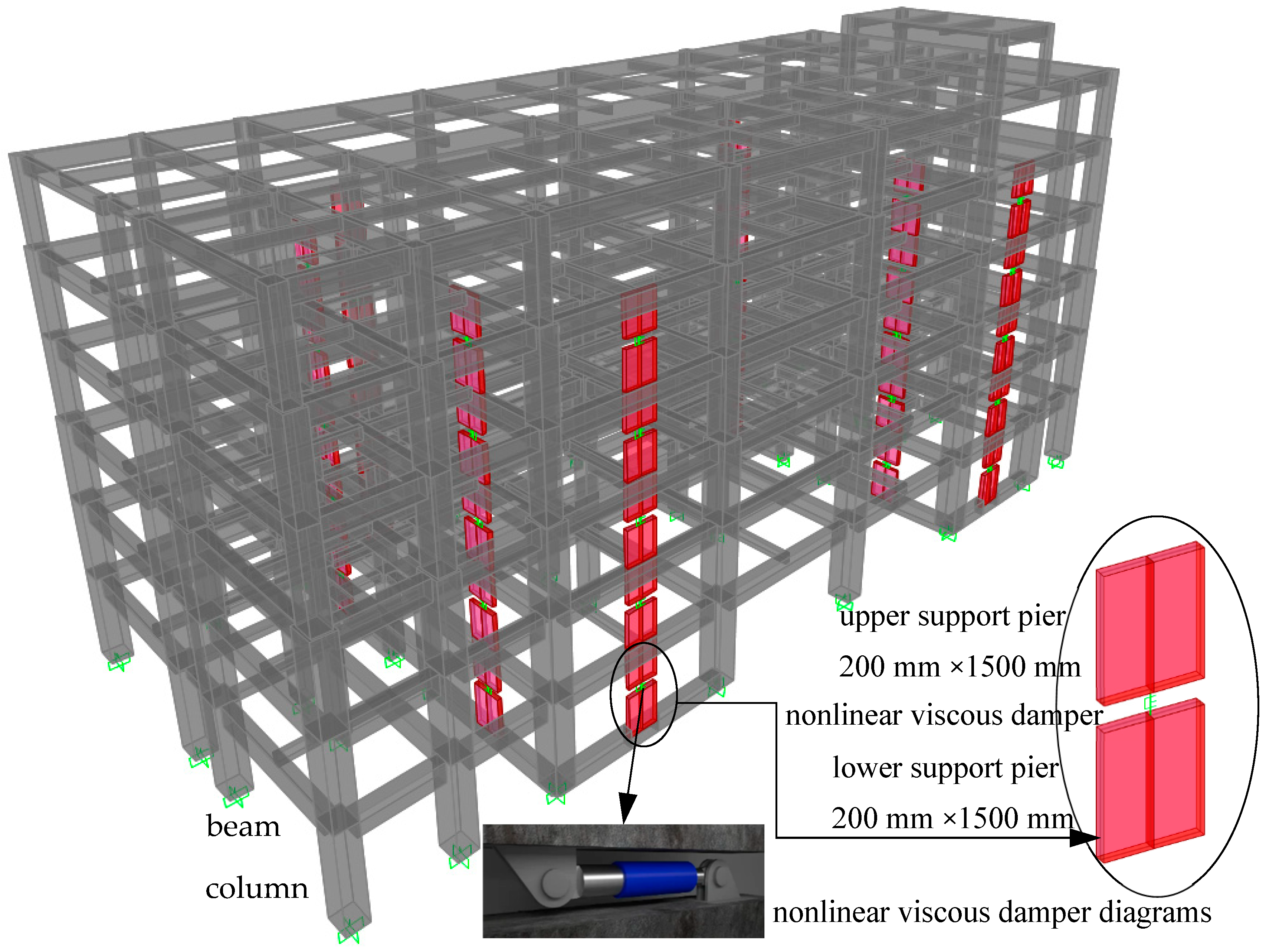
The dynamic characteristics of the structure were obtained through modal analysis using SAP2000 (Version 22.1.0, Computers and Structures, Inc., Walnut Creek, CA, USA). The structural model is shown in Figure 1. The first period T1 is 0.575 s (representing translational motion in the X direction), the second period T2 is 0.567 s (representing translational motion in the Y direction), and the third period T3 is 0.485 s (representing torsional motion). The participation coefficients for the first mode shape are γ1 = 0.85 in the X direction and γ1 = 0.83 in the Y direction. The mode shape curve exhibits a shear type, where the inter-story displacement decreases from bottom to top.

3.2. Arrangement and Parameter Range of Nonlinear Viscous Dampers

1.
Damper arrangement plan
Based on the characteristics of the first mode shape with larger upper and smaller lower inter-story displacement, dampers are uniformly arranged in the X and Y directions on floors 1 to 5, where lateral deformation is relatively large. Each floor has 4 dampers uniformly distributed in both the X and Y directions, totaling 40 dampers. The dampers are connected to the beams of the upper and lower floors via intermediate columns, which provide only horizontal damping and do not participate in vertical load-bearing, as illustrated in Figure 1. Through modal analysis calculations, the modal coefficients of the dampers on floors 1 to 5 in the first mode shape in the X direction are ϕ d , 1 , X = [0.13, 0.17, 0.16, 0.17, 0.13], and in the Y direction are ϕ d , 1 , Y = [0.12, 0.16, 0.16, 0.16, 0.13]. After weighted averaging, the overall modal coefficient ϕ d , 1 is 0.15, which can be used for the calculation of K1 in Equation (23).
2.
Range of values for damper parameters
To comprehensively cover the common parameter range and nonlinear characteristics of nonlinear viscous dampers in construction engineering, the parameters are selected as follows.
The damping coefficient C is set between 20 and 200 kN s α / mm α ( 1   kN s α / mm α   =   10 3 α   kN s α / m α ), with an interval of 20 kN s α / mm α , resulting in a total of 10 parameter sets. Considering the nonlinear relationship between damping force and velocity, a larger damping coefficient C is typically selected when the damping exponent α is relatively low to ensure that the output of the damper is not too small. The damping exponent α is set between 0.15 and 0.65, with an interval of 0.10, resulting in 5 parameter sets. This range encompasses the commonly selected damping exponent range in building structures, particularly for mid-rise buildings. All dampers adopt consistent parameter settings to ensure symmetrical arrangement, thereby avoiding interference from torsional effects on analytical results.
It should be noted that the damping force of a nonlinear viscous damper is fundamentally velocity-dependent, making it theoretically effective across a broad frequency spectrum. However, in the context of seismic energy dissipation investigated in this study, the practical operational frequency range of the dampers targets typical earthquake excitations and structural vibrations, which generally spans from 0.1 Hz to 10 Hz. In the numerical model, the nonlinear viscous dampers were simulated using the ‘Damper-Exponential’ link element in SAP2000, governed by the force-velocity relationship (Equation (1)). Furthermore, to accurately reflect actual installation conditions, the realistic elastic stiffness of the upper and lower supporting piers connected to the dampers was explicitly included in the model, ensuring the dynamic interaction between the dampers and the structure is properly captured.

3.3. Selection and Loading Scheme of Seismic Excitation

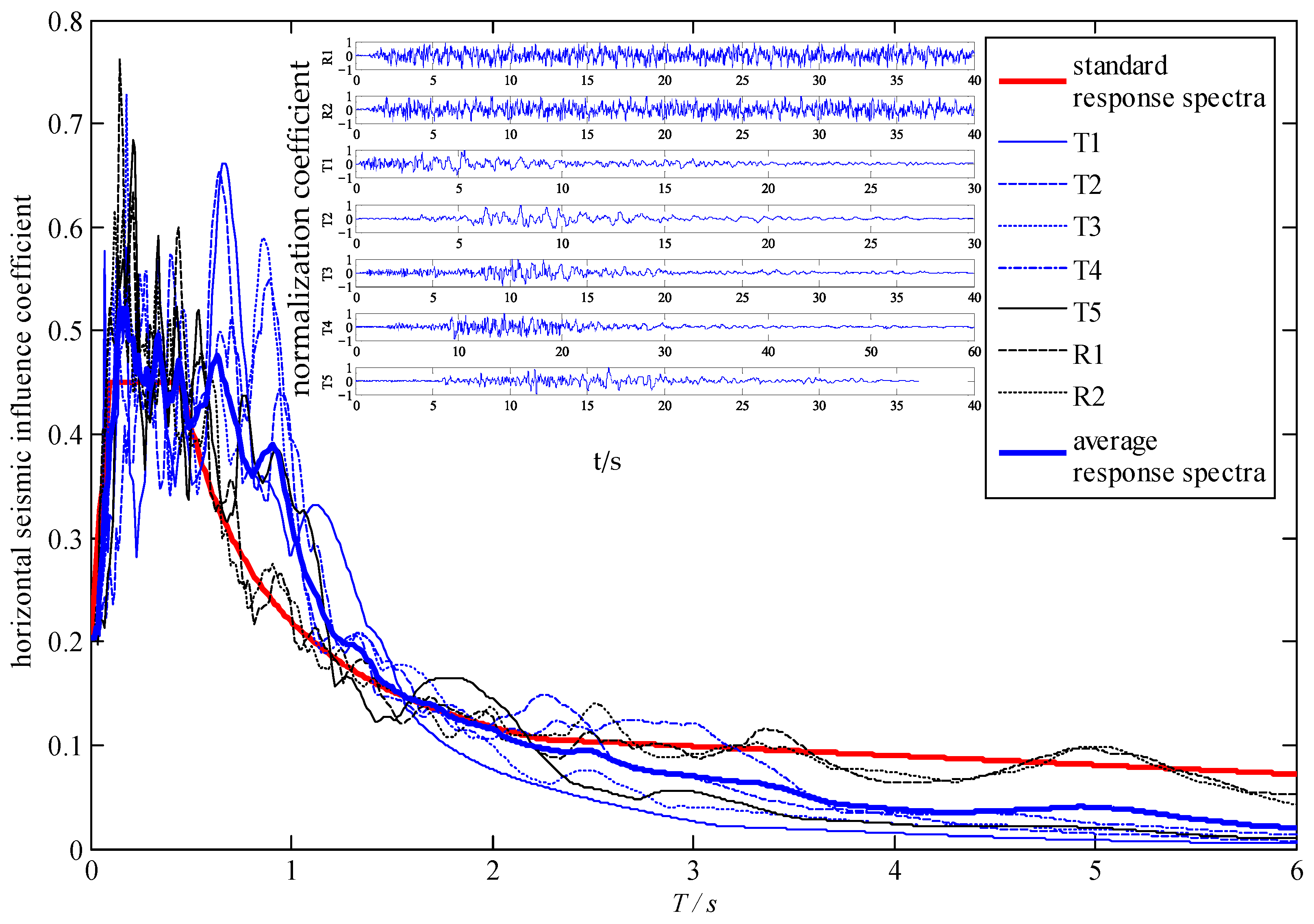
Based on the provisions for selecting seismic waves in time history analysis from the Standard for Seismic Design of Buildings (GB 50011-2010) (2024 edition) [40], and considering the dynamic characteristics (including natural vibration period, mode shapes, etc.) and site category of the 6-story frame structure, 7 sets of seismic waves were chosen, including 5 sets of natural waves and 2 sets of artificial waves. Natural waves reflect the randomness and complexity of earthquakes, while artificial waves can be specifically adapted to the site and structural characteristics. Together, they complement each other to ensure the reliability of input conditions. The time history curves of the seven sets of seismic waves, along with their comparison to the response spectrum curves, are shown in Figure 2.
To systematically explore the variation patterns of energy dissipation ratios in damping structures under different seismic levels, eight peak ground acceleration gradients were selected: 0.07 g, 0.20 g, 0.30 g, 0.40 g, 0.51 g, 0.62 g, 0.70 g, and 0.80 g. The setup encompasses multiple seismic intensity levels, including frequent, occasional, and rare occurrences. It is capable of comprehensively capturing the energy dissipation characteristics of the structure equipped with dampers, from its elastic state to elastoplastic and even near-failure conditions. This provides support for revealing the patterns of its energy dissipation ratio.

3.4. Numerical Simulation Methods and Parameter Sensitivity Analysis

A six-story reinforced concrete frame-damper coupling model was established using SAP2000, with a focus on simulating the dynamic response characteristics of the structure and the damper. The specific simulation method is as follows.

3.4.1. Numerical Simulation Methods

1.
Structural units and materials
The nonlinear frame element of SAP2000, combined with the plastic hinge model, is used to simulate the elastoplastic behavior. Plastic hinge locations are specified at both ends of the frame components (such as beam ends and column ends), and hinge properties (such as M3 hinge, P-M2-M3 hinge, etc.) are defined to match the yield characteristics of the components. For concrete materials, the “Concrete-Cracking” model is used to simulate cracking and compressive behavior, while “Steel-Yielding” is used for rebar materials to simulate yielding and strengthening. There is no need to manually divide fibers, as the elastoplastic rotation-moment relationship is directly defined through hinge parameters. Nodes are assumed to be rigidly connected by default to ignore shear deformation.
2.
Damping unit
The simulation of the viscous damper unit adopts a power-law constitutive model, directly inputting the parameters C (damping coefficient) and α (damping exponent). The unit is connected to structural nodes at both ends, and the program automatically calculates the relative velocity and outputs the damping force. It works in conjunction with the plastic hinge frame unit to jointly simulate the structure’s elastoplastic response and energy dissipation mechanism.
3.
Dynamic time history analysis
The dynamic time history analysis was conducted using the Hilber-Hughes-Taylor (HHT) method for integral solutions. In the HHT method, the parameter α is set to −0.02, which provides good convergence efficiency without affecting the accuracy of energy calculations. The time step is set to either 0.02 s or 0.01 s, which is compatible with the time step of the seismic waves and meets the accuracy requirements of the calculations. The seismic waves are input based on uniform excitation (assuming a rigid foundation) and are applied in both the X and Y directions. The bidirectional coupling effect is temporarily disregarded to simplify the analysis of the energy dissipation characteristics of the damper under unidirectional lateral displacement conditions.

3.4.2. Parameter Sensitivity Analysis

The study systematically explores the influence patterns of the damping coefficient C, damping index α, and earthquake intensity (PGA) on the energy dissipation ratio of the entire structure. It quantifies the sensitivity of each parameter to the energy dissipation ratio, providing a basis for the optimal design of damper parameters. The specific plan and indicators are as follows.
1.
Range of parameter values
For the analysis of a six-story reinforced concrete frame structure, the range of values for each key parameter has been specified. The damping coefficient C is set between 20 and 200 kN s α / mm α , divided into 10 groups at intervals of 20 kN s α / mm α , covering different levels of damping force. The damping exponent α is set between 0.15 and 0.65, subdivided into 6 groups at intervals of 0.10, allowing for the exploration of how changes in the exponent affect damping characteristics. Earthquake intensity is measured by peak ground acceleration (PGA), covering 8 groups: 0.07 g, 0.20 g, 0.30 g, 0.40 g, 0.51 g, 0.62 g, 0.70 g, and 0.80 g. Each set of parameter combinations corresponds to seven seismic waves, totaling 10 × 6 × 8 × 7 = 3360 sets of conditions. This extensive sample size ensures the statistical significance of the analysis results.
2.
Sensitivity evaluation indicators
To accurately assess the energy dissipation characteristics of nonlinear viscous dampers within structural systems, the total structural energy dissipation ratio η is designated as the core sensitivity evaluation indicator. This indicator quantitatively reflects the energy dissipation efficiency of dampers at the full structural level. It provides an intuitive measure of the energy consumption performance of both the dampers and the overall structure. Additionally, it offers a unified and critical quantitative analysis benchmark for subsequent studies on the influence of damping coefficient C, damping index α, and earthquake intensity (PGA) on energy dissipation patterns.
3.
Analysis Logic
Design a three-step analytical logic focusing on the impact of parameters on the energy dissipation ratio η . First, by fixing the damping index α and the seismic intensity PGA, we focus on analyzing the correlation between the damping coefficient C and η , and verify the relationship η C to further clarify the role of the damping coefficient in the energy dissipation ratio. Second, with both C and PGA held constant, we investigate the trend of η as the damping index α varies. This analysis explores the impact of nonlinearity on energy dissipation efficiency and clarifies the regulatory influence of the index on energy dissipation characteristics. Finally, with C and α fixed, we analyze the relationship between η and PGA, verifying the equation η PGA α 1 . This analysis elucidates the impact of seismic intensity on the energy dissipation performance of dampers. Consequently, it comprehensively reveals the interaction mechanisms between various parameters and the energy dissipation ratio.
It is worth noting that the structural energy dissipation ratio is also highly dependent on the spatial configuration of the dampers. Since the energy dissipated by viscous dampers is proportional to the inter-story velocity, configurations that allocate dampers to stories with larger inter-story drifts will yield a higher overall energy dissipation ratio. In this case study, a uniform damper configuration was adopted to serve as a baseline for investigating the influence of damper parameters (C and α).

4. Results and Discussions

4.1. Parametric Sensitivity Analysis for SDOF Systems

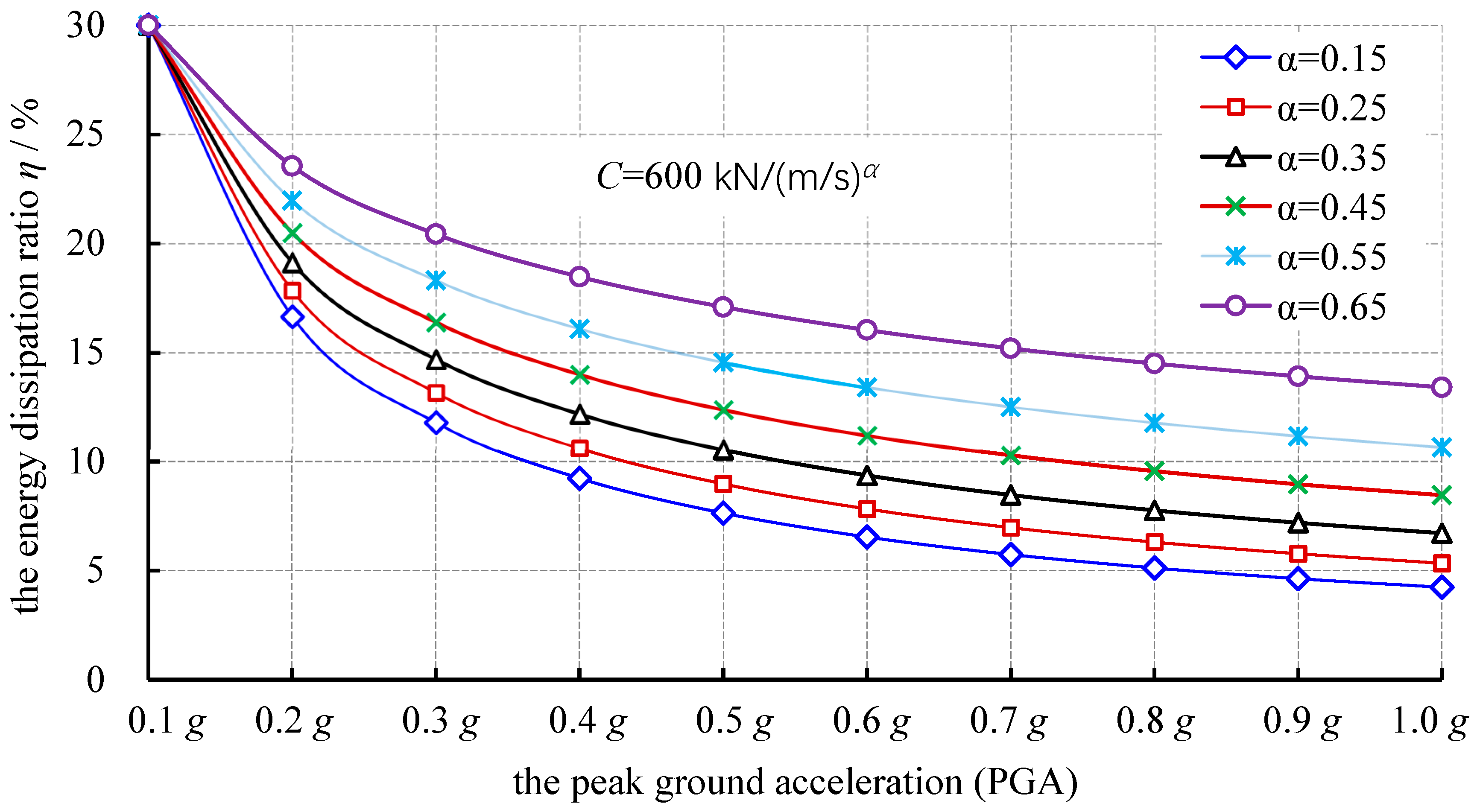
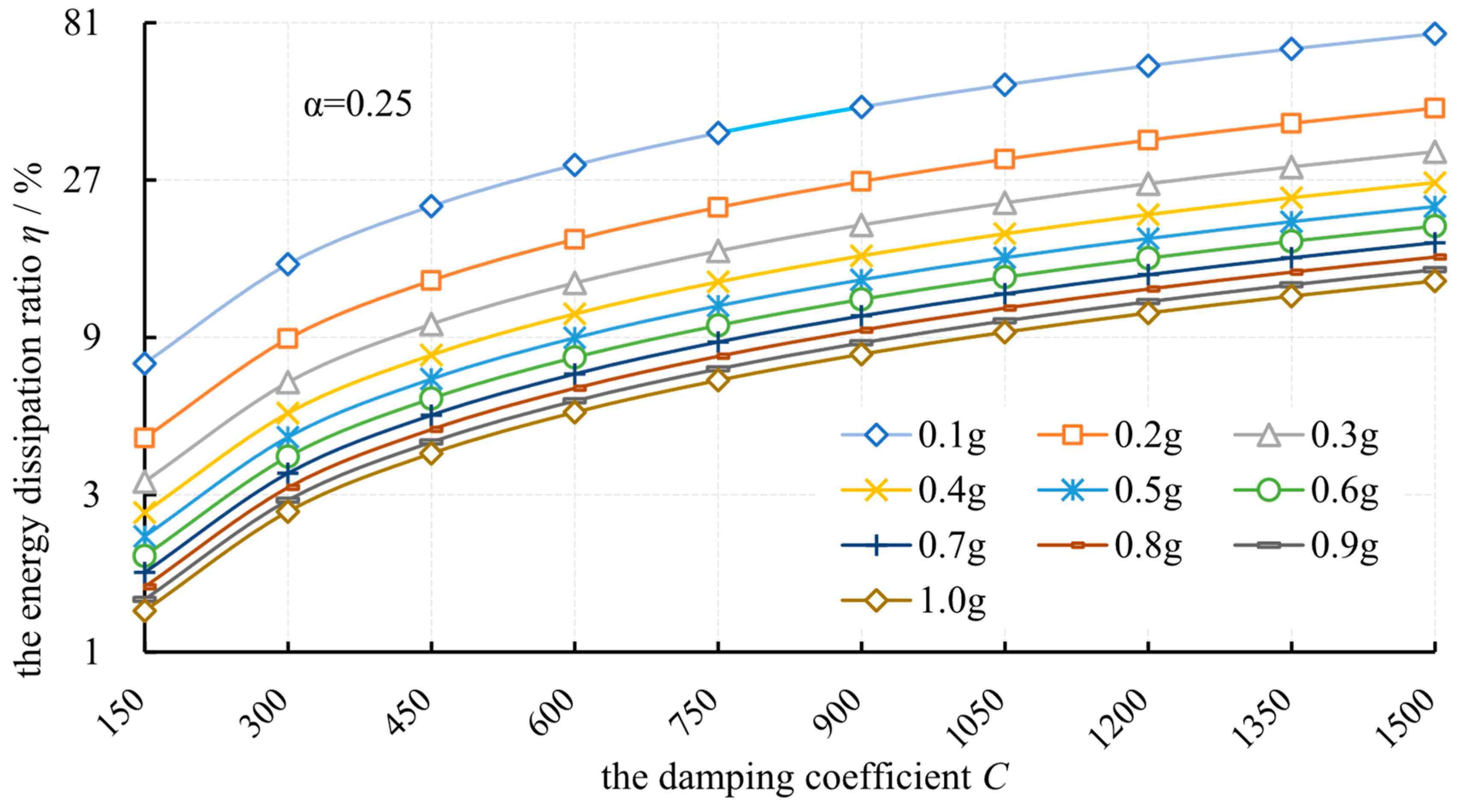
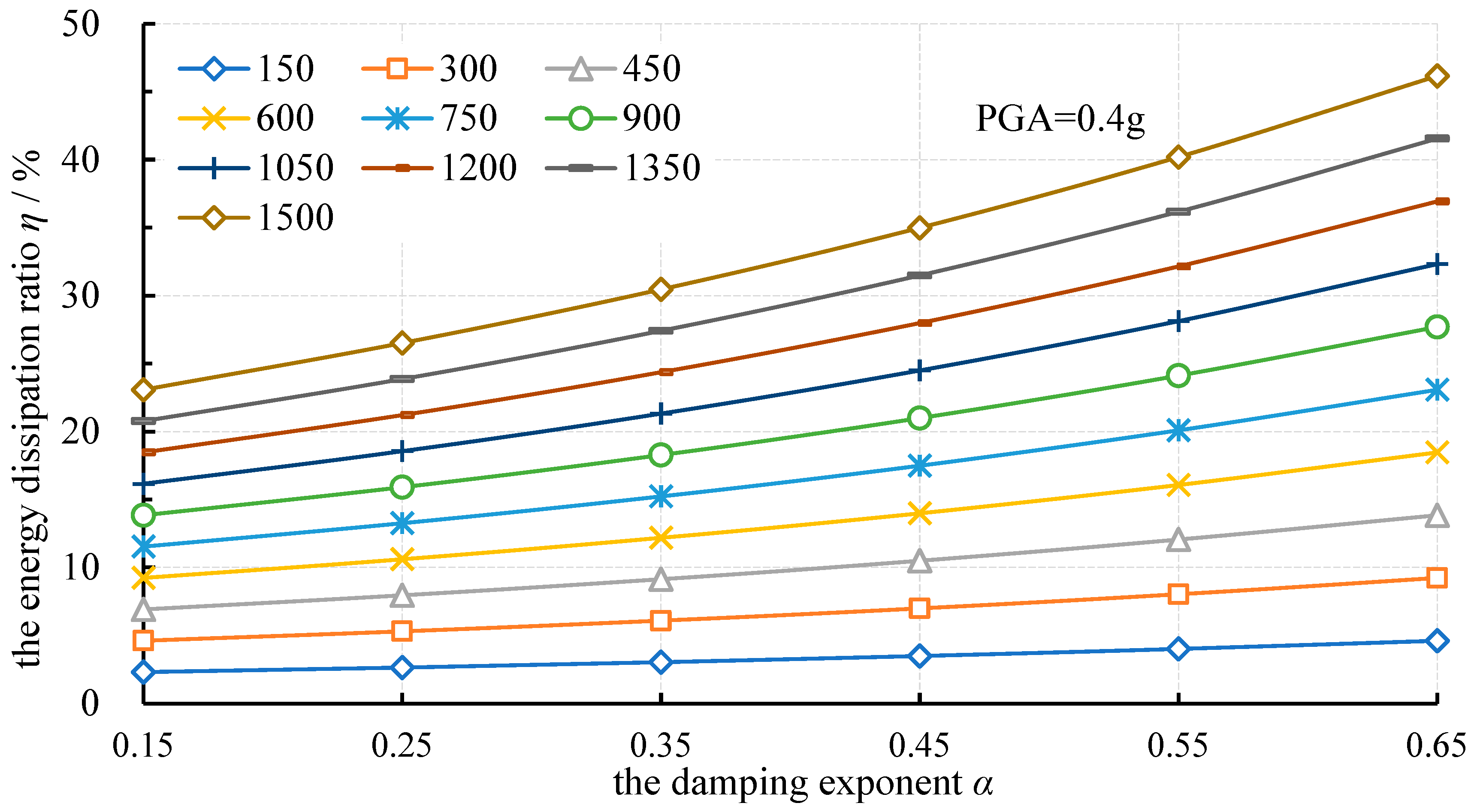
To systematically investigate the influence of key parameters on the energy dissipation characteristics of the structure, a series of parametric analyses was conducted. The results, illustrating the evolution of the energy dissipation ratio ( η ) with respect to the peak ground acceleration (PGA), the damping coefficient (C), and the damping exponent (α), are presented in Figure 3, Figure 4 and Figure 5. In all simulations, the comprehensive constant K was held constant at 0.05. Specifically, Figure 3 reveals how the energy dissipation ratio ( η ) responds to varying seismic intensity (PGA) under different damping exponents (α), with the damping coefficient C fixed at 600 kN/(m/s)α. Subsequently, Figure 4 explores the contribution of the damping coefficient C to the energy dissipation ratio across various PGA levels, while the damping exponent α is maintained at 0.25. Finally, Figure 5 elucidates the regulatory effect of the damping exponent α on the system’s energy dissipation efficiency by comparing curves for different damping coefficients (C) under a uniform seismic input of PGA = 0.40 g.
It is worth noting that the parameter K = 0.05 adopted in the SDOF plots is carefully selected to reflect a realistic engineering scenario rather than an arbitrary mathematical assumption. Specifically, based on Equations (2) and (20), for an equivalent SDOF system representing a typical medium-period structure with a fundamental period of T = 0.75 s (ωn ≈ 8.38 rad/s), subjected to an excitation with a predominant frequency of ω = ωg = 6 rad/s (typical for medium-to-soft soil sites), the calculated parameter is K ≈ 0.05099. This value is thereby approximated to 0.05 to ensure the parametric analyses remain physically meaningful and representative.
The following conclusions can be clearly obtained from Figure 3. First, a significant negative correlation exists between the energy dissipation ratio ( η ) and the peak ground acceleration (PGA). Specifically, as the PGA increases from 0.1 g to 1.0 g, the energy dissipation ratio corresponding to all curves shows a consistent downward trend. Second, the damping exponent α has a distinct positive influence on the energy dissipation ratio. That is, for any given PGA level, the energy dissipation ratio increases as the value of α rises. Finally, at the PGA of 0.1 g, the energy dissipation ratio for the structural system is 30%. However, this ratio gradually diminishes with increasing seismic intensity, indicating that the system’s relative energy dissipation efficiency decreases under strong ground motions.
Figure 4 clearly illustrates the relationship between the energy dissipation ratio, the damping coefficient (C), and the peak ground acceleration (PGA). The main conclusions are as follows:
(1)
The damping coefficient C has a significant positive effect on the energy dissipation ratio. At any given PGA level, the energy dissipation ratio increases markedly with the damping coefficient. This indicates that enhancing the structural damping is an effective means of improving its energy dissipation capacity.
(2)
A distinct negative correlation is observed between the energy dissipation ratio and PGA. For each fixed value of the damping coefficient, the corresponding curve shows a consistent decrease in the energy dissipation ratio as PGA increases. This trend is in complete agreement with the phenomenon observed in Figure 3, further confirming that the relative energy dissipation efficiency of the system diminishes under high-intensity ground motions.
Figure 5 shows the combined effects of the damping exponent (α) and the damping coefficient (C) on the energy dissipation ratio of the structure. The analysis yields the following findings:
(1)
The damping coefficient is the dominant factor influencing the energy dissipation ratio. For any given damping exponent α, the energy dissipation ratio increases significantly with the damping coefficient.
(2)
In contrast, the influence of the damping exponent α is more moderate. When the damping coefficient is held constant, the energy dissipation ratio also increases with α, but the growth trend is relatively gentle.
It is noteworthy that the larger the damping coefficient, the more pronounced the increase in the energy dissipation ratio with respect to α. This suggests that within the studied parameter range, adjusting the damping coefficient is a far more effective strategy for enhancing the system’s energy dissipation capacity than adjusting the damping exponent.

4.2. Parametric Sensitivity Analysis for MDOF Systems

The full parameter space considered in this study consists of 3360 possible combinations. To investigate this vast matrix efficiently and scientifically, a representative parametric sampling strategy was adopted rather than an exhaustive full-factorial simulation. Specifically, a targeted subset of representative cases (approximately 490 cases) was simulated to cover the boundaries and critical combinations of the key governing parameters. For the statistical aggregation of these selected cases, the peak responses from the numerical time history analyses were extracted and grouped by primary variables to identify underlying dynamic trends. Finally, the relative errors between these numerical data points and the proposed analytical model were computed to validate the model’s accuracy and generalizability across the parameter space.
Based on the parameterization scheme and analytical logic outlined in Section 3.4.2, the focus is on analyzing the influence patterns of the damping coefficient, damping exponent α, and seismic intensity (PGA) on the energy dissipation ratio of the entire structure. This aims to reveal the sensitivity characteristics of each parameter for MDOF systems. The detailed analysis of the results is presented as follows.

4.2.1. Sensitivity of the Damping Coefficient (C)

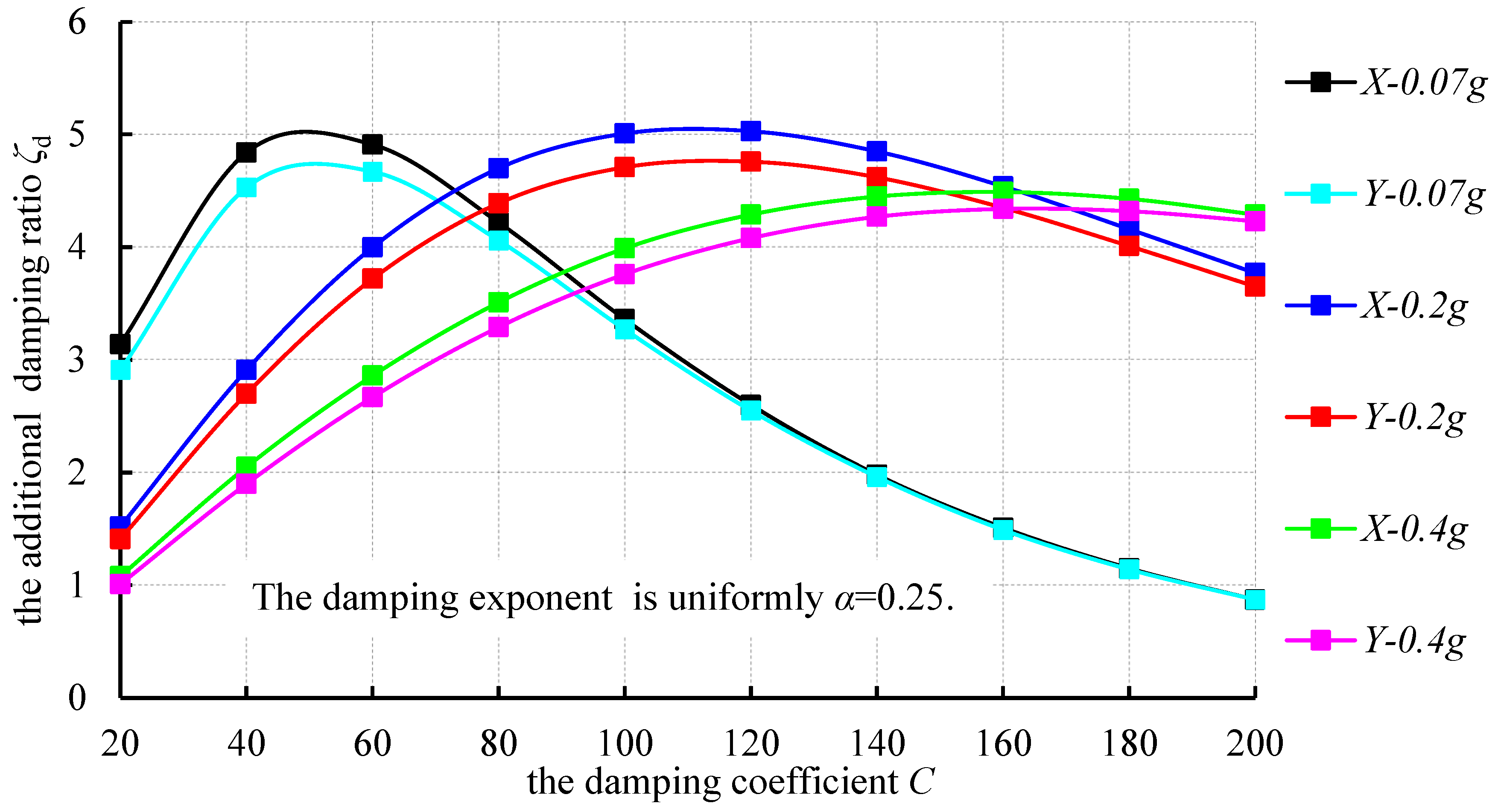
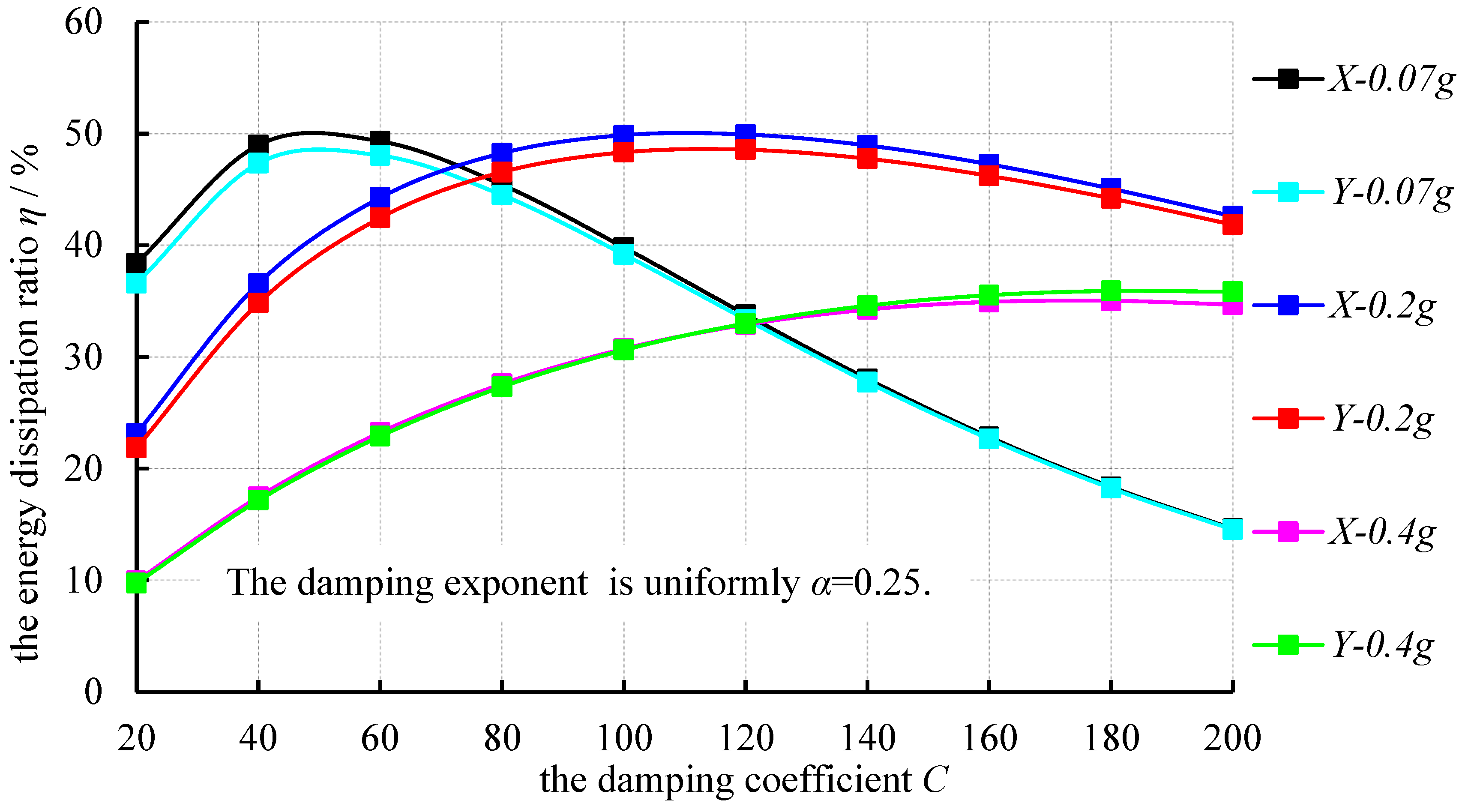
The effects of the damping coefficient on the additional damping ratio and the energy dissipation ratio of the multi-degree-of-freedom (MDOF) structural system are first investigated. The damper configuration and the selection criteria for the damping coefficient adhere to the principles outlined in Section 3.2. Accordingly, a parametric analysis is conducted using ten values of C, ranging from 20 to 200 in increments of 20. The damping exponent is held constant at 0.25, while three seismic intensity levels, defined by peak ground accelerations (PGA) of 0.07 g, 0.20 g, and 0.40 g, are considered. For each parameter combination, the resulting additional damping ratio and energy dissipation ratio are computed to systematically characterize their dependence on the damping coefficient. The results are shown in Figure 6 and Figure 7.
As illustrated in Figure 6, with the damping exponent consistently set at 0.25, the following observations can be made:
(1)
The relationship between the additional damping ratio and the damping coefficient is dependent on the seismic intensity (PGA). Under all tested seismic intensities, the additional damping ratio first increases to a peak and then decreases as the damping coefficient increases. This trend is consistent for the structure in both the X and Y directions.
(2)
The optimal damping coefficient, which corresponds to the peak additional damping ratio, shifts toward a larger value as the PGA increases. In other words, a higher seismic intensity requires a larger damping coefficient to maximize the additional damping ratio.
(3)
The effect of seismic intensity on the additional damping ratio is contingent on the magnitude of the damping coefficient. For smaller values of the damping coefficient, a higher seismic intensity results in a lower additional damping ratio. Conversely, for larger values of the damping coefficient, a higher seismic intensity leads to a greater additional damping ratio.
As illustrated in Figure 7, with the damping exponent consistently set at 0.25, the following observations can be made:
(1)
The relationship between the energy dissipation ratio and the damping coefficient is dependent on the seismic intensity (PGA). Under all tested seismic intensities, the energy dissipation ratio first increases and then decreases as the damping coefficient increases. This trend is consistent for the structure in both the X and Y directions.
(2)
The optimal damping coefficient, which corresponds to the peak energy dissipation ratio, shifts toward a larger value as the PGA increases. In other words, a higher seismic intensity requires a larger damping coefficient to maximize the energy dissipation ratio.
(3)
For smaller values of the damping coefficient, a higher seismic intensity results in a lower energy dissipation ratio. Conversely, for larger values of the damping coefficient, a higher seismic intensity leads to a greater energy dissipation ratio.
In conclusion, the additional damping ratio and the energy dissipation ratio exhibit a similar pattern of variation as the damping coefficient increases.

4.2.2. Sensitivity of the Damping Exponent (α)

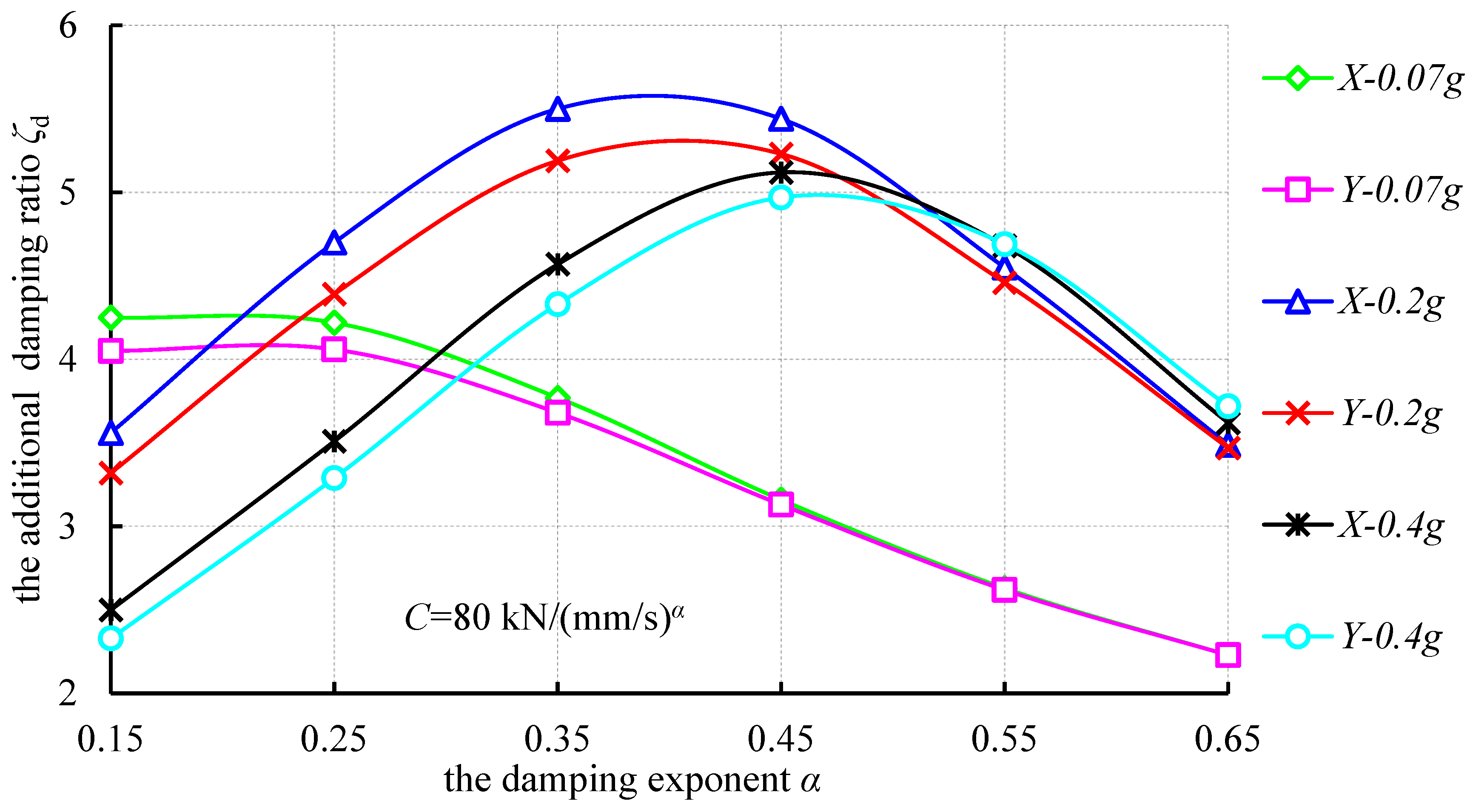
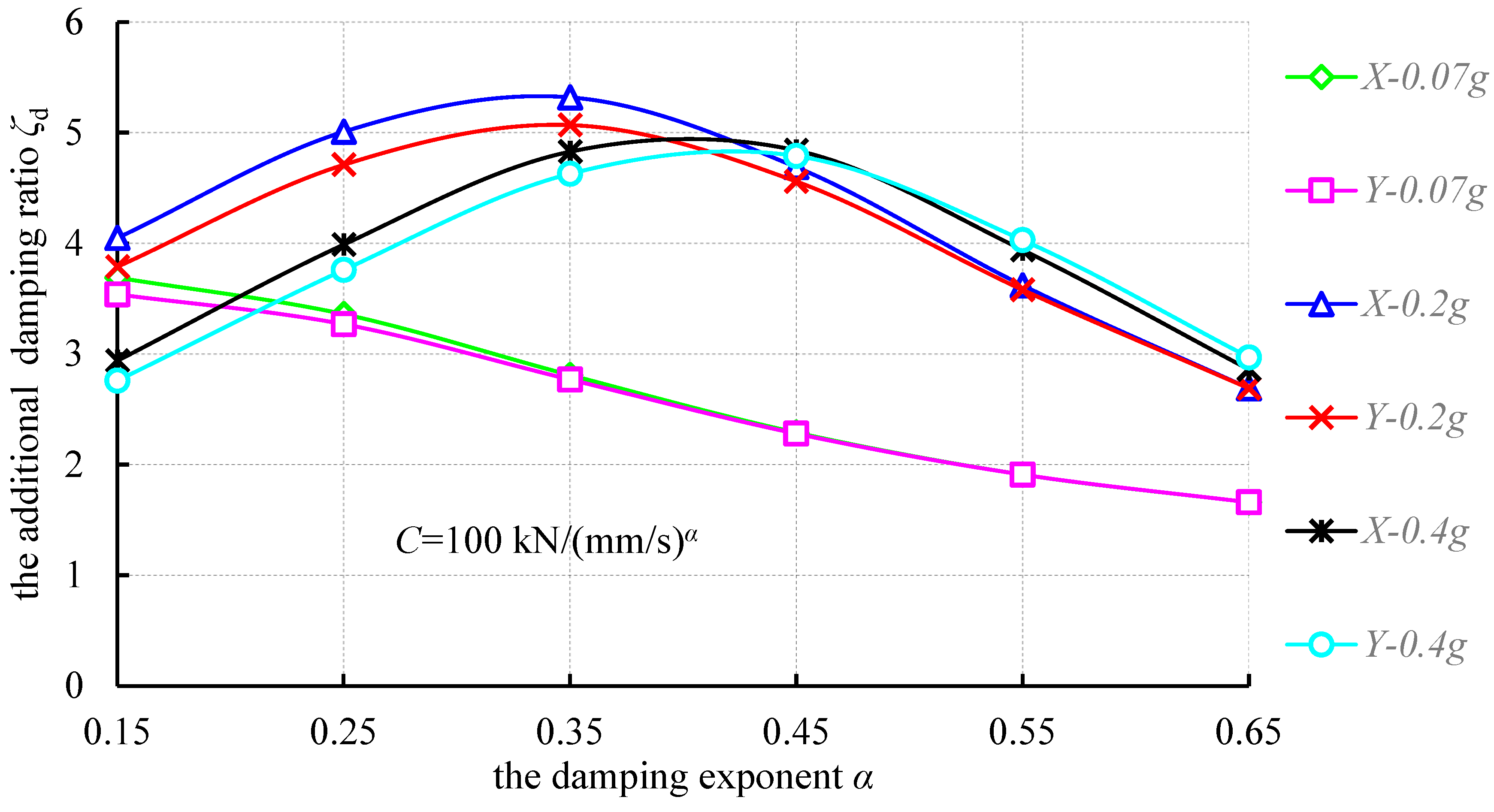
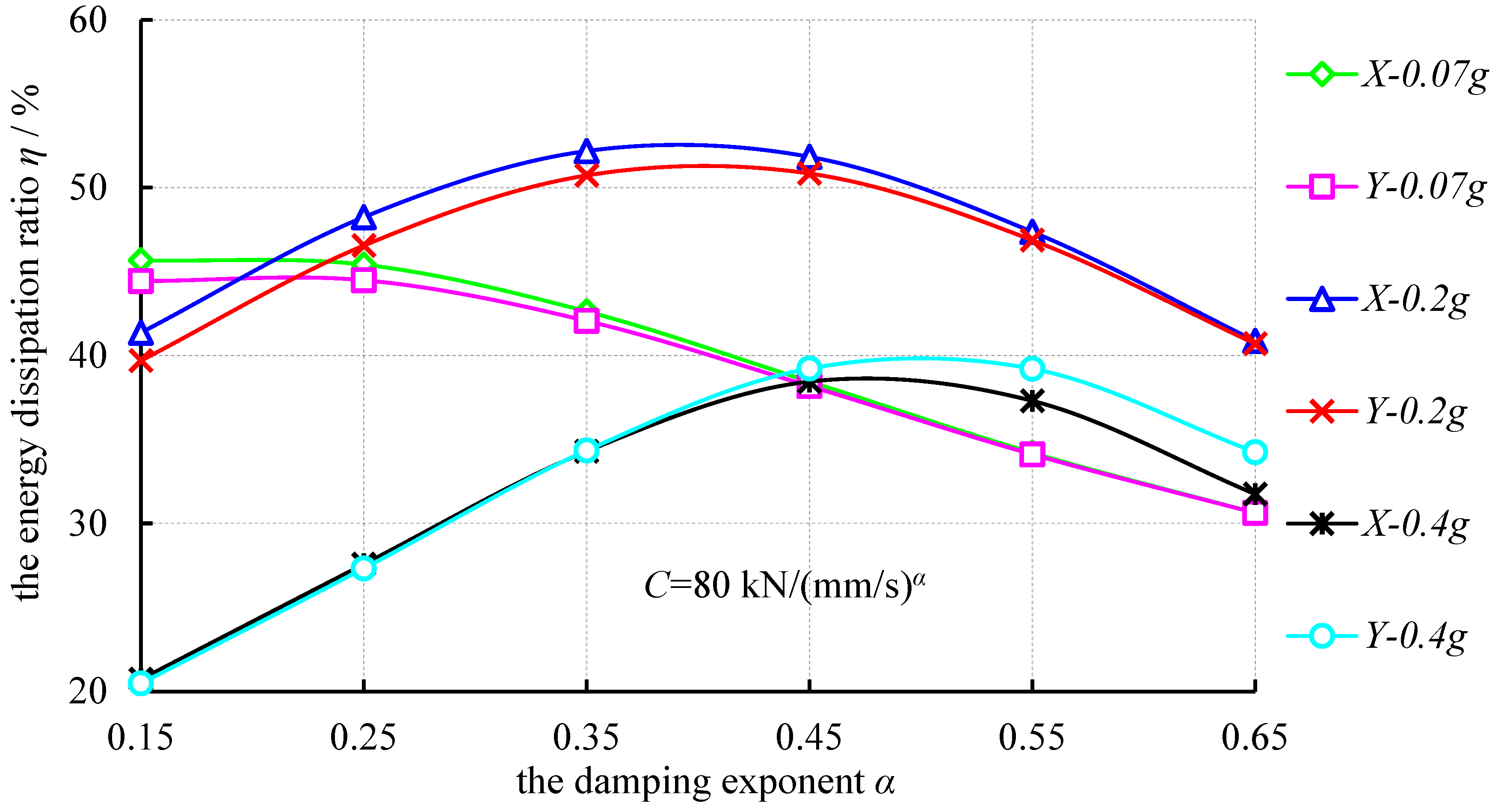
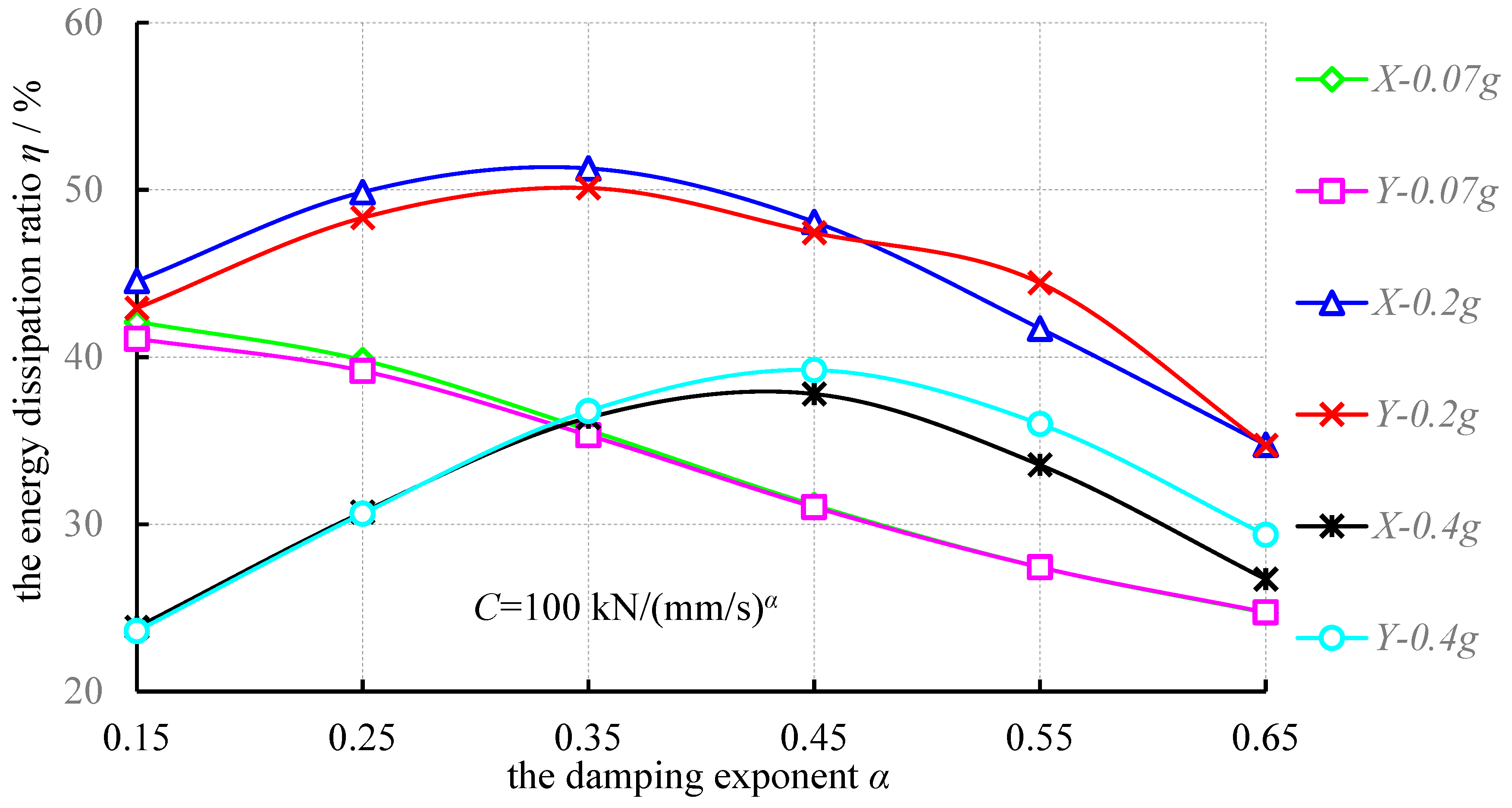
Secondly, another investigation was conducted to evaluate the influence of the damping exponent α on both the additional damping ratio and the energy dissipation ratio within multi-degree-of-freedom (MDOF) structural systems. The damper configuration and the selection criteria for the damping exponent adhere to the principles outlined in Section 3.2. Accordingly, a parametric analysis is conducted using five values of α, ranging from 0.15 to 0.65 in increments of 0.10. The damping coefficients are held constant at 80 and 100, while three seismic intensity levels, defined by peak ground accelerations (PGA) of 0.07 g, 0.20 g, and 0.40 g, are considered. For each parameter combination, the resulting additional damping ratio and energy dissipation ratio are computed to systematically characterize their dependence on the damping exponent. The results are shown in Figure 8, Figure 9, Figure 10 and Figure 11. (Note: In Figure 8, Figure 9, Figure 10 and Figure 11, α denotes the dimensionless parameter α [-]).
As illustrated in Figure 8 and Figure 9, the following observations can be made:
(1)
The relationship between the additional damping ratio and the damping exponent is dependent on the seismic intensity (PGA). Under varying seismic intensities, the additional damping ratio first increases to a peak and then decreases as the damping exponent increases. This trend is consistent for the structure in both the X and Y directions. However, under low seismic intensity (0.07 g), the additional damping ratio does not exhibit an initial increasing phase; instead, it decreases monotonically as the damping exponent increases.
(2)
The optimal damping exponent, which corresponds to the peak additional damping ratio, is influenced by both the seismic intensity and the damping coefficient. As the PGA increases, the optimal damping exponent shifts toward a larger value. In other words, a higher seismic intensity requires a larger damping exponent to maximize the additional damping ratio. Conversely, as the damping coefficient increases, the optimal damping exponent shifts toward a smaller value.
As illustrated in Figure 10 and Figure 11, the following observations can be made:
(1)
The relationship between the energy dissipation ratio and the damping exponent is dependent on the seismic intensity (PGA). Under varying seismic intensities, the energy dissipation ratio first increases to a peak and then decreases as the damping exponent increases. This trend is consistent for the structure in both the X and Y directions. However, under low seismic intensity (0.07 g), the energy dissipation ratio does not exhibit an initial increasing phase; instead, it decreases monotonically as the damping exponent increases.
(2)
The optimal damping exponent, which corresponds to the peak energy dissipation ratio, is influenced by both the seismic intensity and the damping coefficient. As the PGA increases, the optimal damping exponent shifts toward a larger value. In other words, a higher seismic intensity requires a larger damping exponent to maximize the energy dissipation ratio. Conversely, as the damping coefficient increases, the optimal damping exponent shifts toward a smaller value.
In conclusion, the additional damping ratio and the energy dissipation ratio exhibit a similar pattern of variation as the damping exponent increases.

4.2.3. Sensitivity of the Peak Ground Acceleration (PGA)

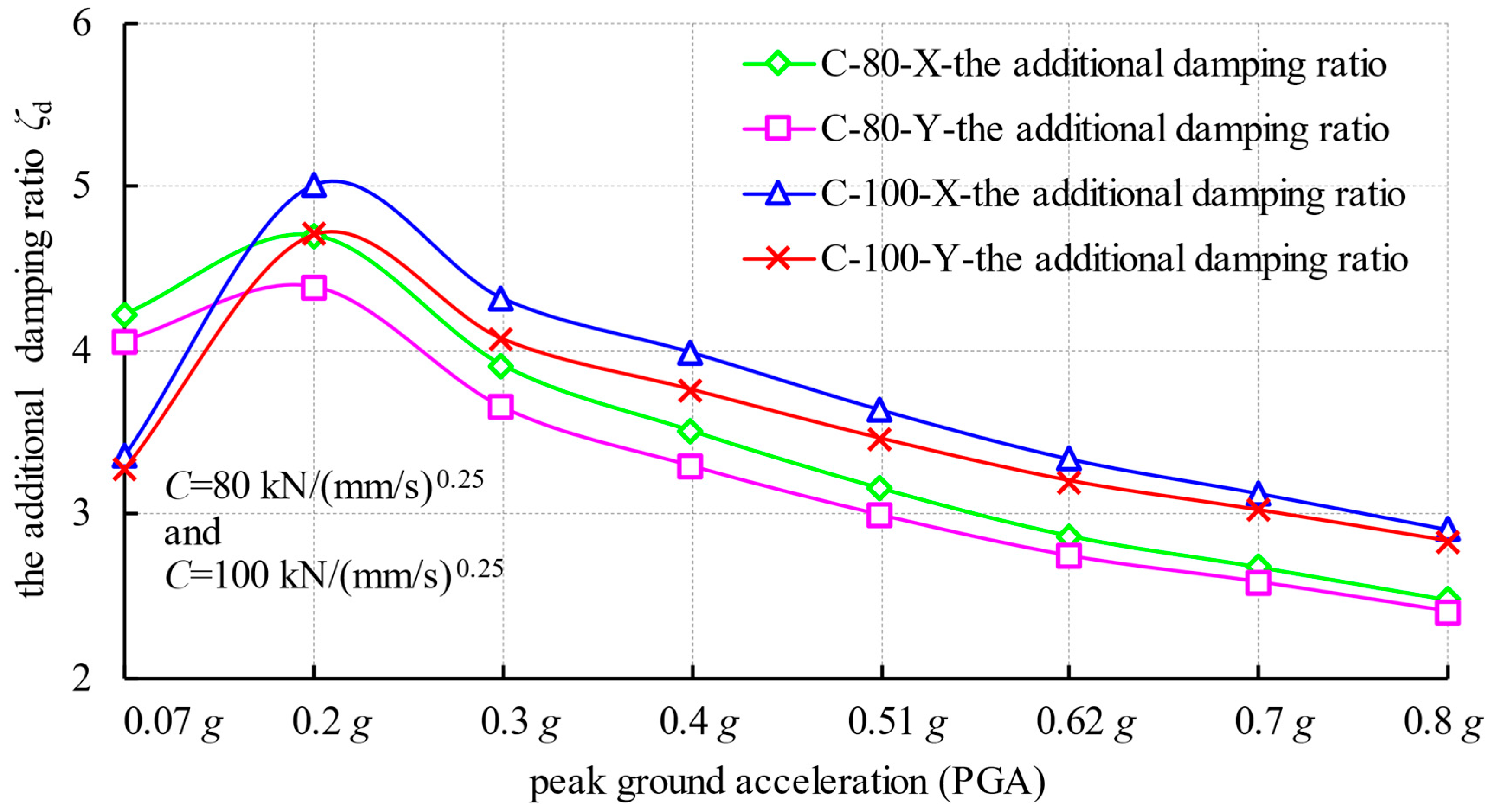
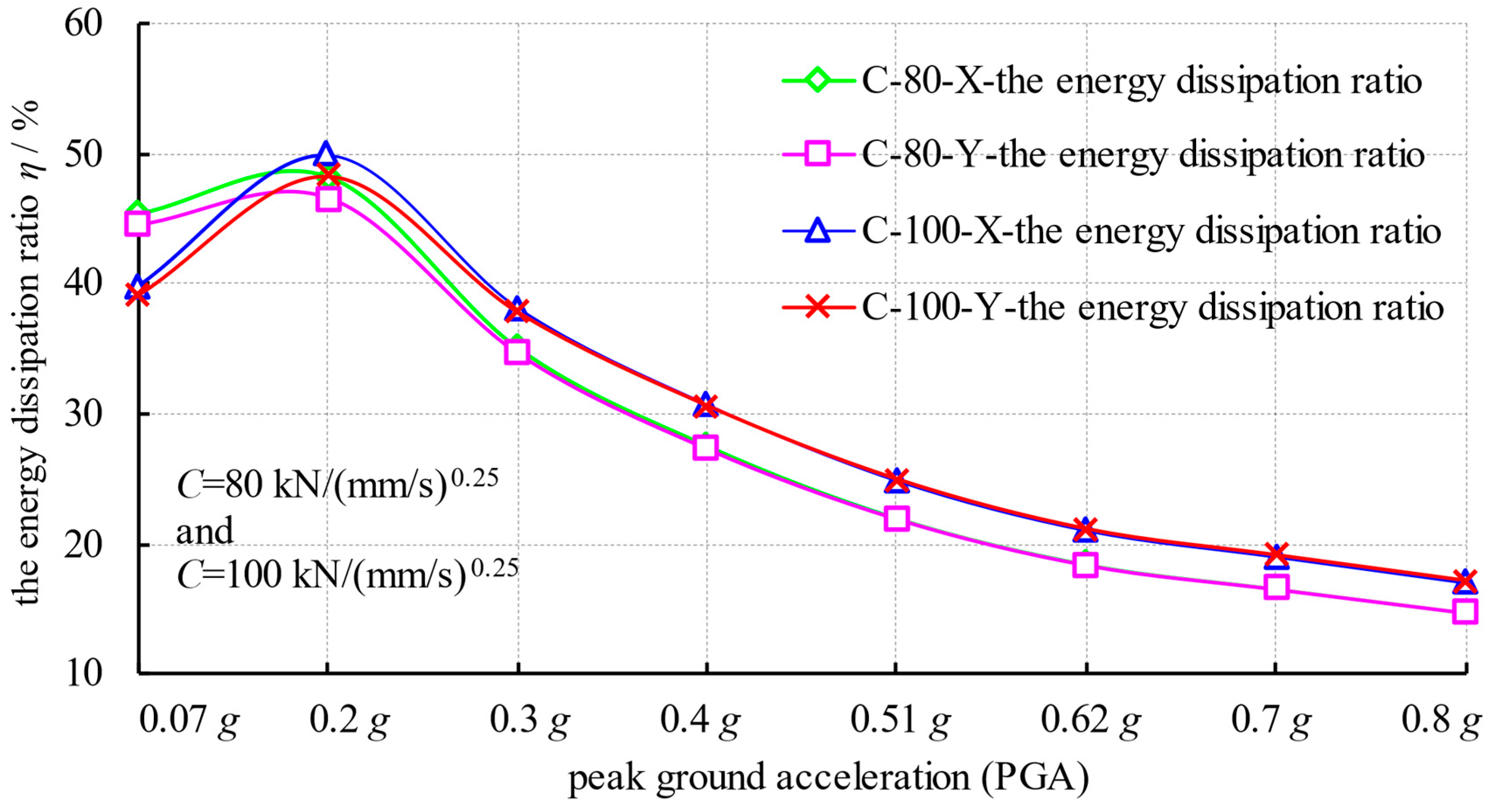
Finally, a study was conducted on the impact of peak ground acceleration on the additional damping ratio and energy dissipation ratio in multi-degree-of-freedom (MDOF) structural systems. The damper configuration and the selection criteria for the peak ground accelerations adhere to the principles outlined in Section 3.3. Accordingly, a parametric analysis is conducted using eight values of PGA, ranging from 0.07 g to 0.8 g in increments of approximately 0.10 g. The damping coefficient are held constant at 80 or 100, and the damping exponent is held constant at 0.25. For each parameter combination, the resulting additional damping ratio and energy dissipation ratio are computed to systematically characterize their dependence on the peak ground acceleration. The results are shown in Figure 12 and Figure 13.
Figure 12 indicates that for a fixed damping exponent of 0.25, the additional damping ratio exhibits a non-monotonic relationship with seismic intensity. Specifically, the additional damping ratio first increases and then decreases with rising the peak ground acceleration. This trend is consistent for the structure in both the X and Y directions and for damping coefficients of C = 80 and C = 100.
Figure 13 indicates that for a fixed damping exponent of 0.25, the energy dissipation ratio exhibits a non-monotonic relationship with seismic intensity. Specifically, the energy dissipation ratio first increases and then decreases with rising the peak ground acceleration. This trend is consistent for the structure in both the X and Y directions and for damping coefficients of C = 80 and C = 100.
In conclusion, the additional damping ratio and the energy dissipation ratio exhibit a similar pattern of variation as the peak ground acceleration increases.
It is worth emphasizing the comparison between the analytical proposal and the numerical models. Overall, the analytical predictions show highly consistent trends with the numerical results. The relative errors remain within an acceptable range (mostly under 15%). The minor discrepancies are mainly due to the simplified assumptions in the analytical derivation compared to the complex nonlinear integration in the numerical models. This comparison confirms that the proposed analytical method is accurate and reliable for practical design.
Overall, the energy dissipation ratio investigated in this study essentially and directly governs the structural response. An increase in this ratio indicates that the dampers are efficiently absorbing the seismic input energy, thereby reducing the portion of energy that must be dissipated by the primary structure. Consequently, a higher energy dissipation ratio leads to a pronounced reduction in roof displacement, inter-story drift ratio, base shear, and related response measures. This shift determines the global dynamic behavior: by dissipating a larger share of the input energy, the dampers can effectively prevent severe plastic damage in the reinforced-concrete frame, thereby ensuring improved structural safety.

4.3. Discussions

A key finding of this study is the marked discrepancy in the response of single-degree-of-freedom (SDOF) and multi-degree-of-freedom (MDOF) systems to variations in damping parameters. While SDOF models typically show a monotonic increase in performance with the damping coefficient and the damping exponent, the MDOF system exhibits a distinct non-monotonic (“increase-then-decrease”) trend. This divergence is primarily attributable to the localized nature of dampers in multi-story structures. This can primarily be interpreted through the following two dimensions:
(1)
The principal mechanism behind this non-monotonic behavior is the “local locking” effect. In an MDOF structure, dampers are installed between specific degrees of freedom (e.g., inter-story). As the damping coefficient exceeds an optimal value, the greater damping force severely restricts the inter-story velocity and displacement. This causes the targeted story to behave rigidly, effectively “locking” it. Once locked, the damper can no longer dissipate energy through motion, leading to a decline in the overall added damping ratio.
(2)
Furthermore, this localized stiffening largely alters the dynamic properties of the MDOF system. Unlike an SDOF system with its single vibration mode, an “over-damped” MDOF structure can experience modal redistribution. Seismic energy may bypass the stiffened, inefficiently damped stories and excite higher-order vibration modes or concentrate in other, less protected parts of the structure. This phenomenon further explains the reduction in system-level damping performance.
In summary, these findings highlight an impedance matching challenge inherent to MDOF systems. Optimal energy dissipation is achieved not by maximizing the damping force, but by balancing it with sufficient relative motion. For practical engineering design, this implies a critical conclusion: indiscriminately increasing damping coefficients is counterproductive. Instead, parameters must be carefully optimized to avoid over-damping and ensure the effective engagement of energy dissipation devices across the structure’s dynamic response.
In addition to, it is also important to critically discuss the applicability of the derived results to real, non-stationary earthquakes. Since the proposed law is based on a stationary Gaussian assumption, its practical application should be restricted to the strong motion duration of a seismic record, where the process is approximately stationary. However, researchers should be cautious of its limitations. For highly non-stationary events, particularly near-fault pulse-like ground motions, the stationary assumption is fundamentally violated. In such cases, applying this scaling law may underestimate the peak structural responses. Therefore, the proposed law serves best as a theoretical baseline for typical far-field earthquakes rather than highly impulsive events.
In summary, the analytical formulations and parametric analyses presented herein offer highly practical engineering implications, which can be concisely summarized in two primary aspects. First, the proposed theoretical model serves as a reliable and rapid alternative to computationally expensive non-linear time history analyses, enabling engineers to efficiently evaluate peak structural responses and significantly improve preliminary design efficiency. Second, by explicitly incorporating key design variables (e.g., the damping exponent, damping coefficient and PGA), these analytical expressions facilitate the optimal selection and configuration of protective devices during the conceptual design phase, effectively bridging the gap between complex stochastic dynamics and practical engineering applications.

5. Conclusions

This study investigates the energy dissipation mechanism and parameter design of nonlinear viscous dampers. An analytical model was first established for a Single-Degree-of-Freedom (SDOF) system, from which computational formulas for energy expectation and energy dissipation ratio were derived based on the statistical characteristics of the velocity response. The theory was then extended to Multi-Degree-of-Freedom (MDOF) systems, where an engineering-oriented expression was developed based on modal decomposition, assuming the dominance of the first mode. Finally, nonlinear time history and sensitivity analyses were conducted on a six-story reinforced concrete frame to validate the applicability of the derived formulas and to reveal the influence of key parameters.
(1)
An analytical model for an SDOF system was established, defining its equations of motion and energy balance. Based on this framework, formulas for the statistical characteristics of velocity response, expected energy, and the energy dissipation ratio were derived.
(2)
The methodology was extended to MDOF structures. Through modal decomposition, it was demonstrated that the first mode typically dominates the overall response, leading to a simplified, approximate formula for the energy dissipation ratio in MDOF systems.
(3)
The theoretical framework was evaluated using a six-story reinforced concrete frame as a numerical case study. Nonlinear time history and sensitivity analyses were performed, considering various damper parameters (damping coefficient C, exponent α), and seismic inputs with different peak ground accelerations.
(4)
The results indicate that C, α, and PGA all significantly influence the energy dissipation ratio and the structural response, while the effect of C is more direct.
(5)
The energy dissipation ratio serves as a key performance indicator for optimizing the selection and placement of dampers. For common frame structures, the first-mode dominant approximation demonstrates good engineering applicability.

Author Contributions

Conceptualization, X.L. and X.Z.; methodology, X.L.; software, X.L.; validation, X.L., W.X. and X.Z.; formal analysis, X.L.; investigation, W.X.; resources, X.L.; data curation, X.L.; writing—original draft preparation, X.L.; writing—review and editing, X.L. and X.Z.; visualization, X.Z.; supervision, W.X.; project administration, X.L.; funding acquisition, X.L. and X.Z. All authors have read and agreed to the published version of the manuscript.

Funding

This research was funded by the Foundation of Yunnan Provincial Educational Committee (No. 2025J2047) and the Excellence Cultivation Project for Young Faculty at Kunming University (Phase II, Key Cultivation Stage) (No. PY20250022).

Data Availability Statement

The original contributions presented in this study are included in the article. Further inquiries can be directed to the corresponding author.

Conflicts of Interest

Author Wandong Xu was employed by the company Yunnan Nongken Yutai Technology Co., Ltd. The remaining authors declare that the research was conducted in the absence of any commercial or financial relationships that could be construed as a potential conflict of interest.

References

  1. Talley, P.; Javidialesaadi, A.; Wierschem, N.; Denavit, M. Evaluation of steel building structures with inerter-based dampers under seismic loading. Eng. Struct. 2021, 242, 112488. [Google Scholar] [CrossRef]
  2. Elwardany, H.; Jankowski, R.; Seleemah, A. Mitigating the seismic pounding of multi-story buildings in series using linear and nonlinear fluid viscous dampers. Archiv. Civ. Mech. Eng. 2021, 21, 137. [Google Scholar] [CrossRef]
  3. Dong, S.; Pan, W.; Ye, L.; Wang, J. Design of displacement-based viscous damper damping structures. Sci. Rep. 2025, 15, 11742. [Google Scholar] [CrossRef] [PubMed]
  4. Kaleybar, R.; Tehrani, P. Effects of using different arrangements and types of viscous dampers on seismic performance of intermediate steel moment frames in comparison with different passive dampers. Structures 2021, 33, 3382–3396. [Google Scholar] [CrossRef]
  5. Deringöl, A.; Güneyisi, E. Influence of nonlinear fluid viscous dampers in controlling the seismic response of the base-isolated buildings. Structures 2021, 34, 1923–1941. [Google Scholar] [CrossRef]
  6. Asadpour, G.; Asadi, P.; Hajirasouliha, I. A new modified stochastic linearization technique to analyze structures with nonlinear fluid viscous dampers. J. Vib. Control 2021, 28, 2746–2761. [Google Scholar] [CrossRef]
  7. De Domenico, D.; Hajirasouliha, I. Multi-level performance-based design optimisation of steel frames with nonlinear viscous dampers. Bull. Earthq. Eng. 2021, 19, 5015–5049. [Google Scholar] [CrossRef]
  8. Mehmandousti, A.; Jalaeefar, A. Effect of seismic sequences on behavior of mid-rise steel moment-resisting frames equipped with fluid viscous dampers. Structures 2023, 54, 657–668. [Google Scholar] [CrossRef]
  9. Jia, S.; Ma, P. Comparative Assessment of Seismic Damping Scheme for Multi-Storey Frame Structures. Infrastructures 2025, 10, 258. [Google Scholar] [CrossRef]
  10. Zeng, B.; Gao, J.; Qing, Y.; Wang, C.; Sun, X. Seismic performance of suspended-floor structures with viscous dampers considering acceptable interstory drift. Struct. Design Tall Spec. Build. 2021, 31, e1912. [Google Scholar] [CrossRef]
  11. Ma, P.; Yuan, S. Seismic Retrofitting of RC Frames Using Viscous Dampers: Numerical Simulation and Nonlinear Response Analysis. Infrastructures 2025, 10, 235. [Google Scholar] [CrossRef]
  12. Ras, A.; Boumechra, N. Seismic energy dissipation study of linear fluid viscous dampers in steel structure design. Alex. Eng. J. 2016, 55, 2821–2832. [Google Scholar] [CrossRef]
  13. Mohemmi, M.; Dehcheshmeh, E.; Broujerdian, V. Seismic Vibration Control of Moment-Resistant Concrete Frames Using Nonlinear Viscous Dampers. Iran. J. Sci. Technol. Trans. Civ. Eng. 2022, 47, 973–986. [Google Scholar] [CrossRef]
  14. Kookalani, S.; Shen, D. Effect of Fluid Viscous Damper parameters on the seismic performance. J. Civ. Eng. Mater. Appl. 2020, 4, 141–153. [Google Scholar] [CrossRef]
  15. Waghmare, M.; Madhekar, S.; Matsagar, V. Influence of Nonlinear Fluid Viscous Dampers on Seismic Response of RC Elevated Storage Tanks. Civ. Eng. J. 2020, 6, 98–118. [Google Scholar] [CrossRef]
  16. Drosos, J.; Tsinopoulos, S.; Karabalis, D. Seismic retrofit of spherical liquid storage tanks with energy dissipative devices. Soil Dyn. Earthq. Eng. 2019, 119, 158–169. [Google Scholar] [CrossRef]
  17. Xian, J.; Su, C.; Spencer, B. Stochastic sensitivity analysis of energy-dissipating structures with nonlinear viscous dampers by efficient equivalent linearization technique based on explicit time-domain method. Probabilistic Eng. Mech. 2020, 61, 103080. [Google Scholar] [CrossRef]
  18. Rajana, K.; Wang, Z.; Giaralis, A. Optimal design and assessment of tuned mass damper inerter with nonlinear viscous damper in seismically excited multi-storey buildings. Bull. Earthq. Eng. 2023, 21, 1509–1539. [Google Scholar] [CrossRef]
  19. Idels, O.; Lavan, O. Performance-based seismic retrofitting of frame structures using negative stiffness devices and fluid viscous dampers via optimization. Earthq. Eng. Struct. Dyn. 2021, 50, 3116–3137. [Google Scholar] [CrossRef]
  20. Altieri, D.; Tubaldi, E.; De Angelis, M.; Patelli, E.; Dall’asta, A. Reliability-based optimal design of nonlinear viscous dampers for the seismic protection of structural systems. Bull. Earthq. Eng. 2018, 16, 963–982. [Google Scholar] [CrossRef]
  21. Domenico, D.; Ricciardi, G. Earthquake protection of structures with nonlinear viscous dampers optimized through an energy-based stochastic approach. Eng. Struct. 2019, 179, 523–539. [Google Scholar] [CrossRef]
  22. Domenico, D.; Deastra, P.; Ricciardi, G.; Sims, N.; Wagg, D. Novel fluid inerter based tuned mass dampers for optimised structural control of base-isolated buildings. J. Frankl. Inst. 2019, 356, 7626–7649. [Google Scholar] [CrossRef]
  23. Navarra, G.; Lo Iacono, F.; Oliva, M. An Efficient Stochastic Linearisation Procedure for the Seismic Optimal Design of Passive Control Devices. Front. Built Environ. 2020, 6, 32. [Google Scholar] [CrossRef]
  24. Su, C.; Li, B.; Chen, T.; Dai, X. Stochastic optimal design of nonlinear viscous dampers for large-scale structures subjected to non-stationary seismic excitations based on dimension-reduced explicit method. Eng. Struct. 2018, 175, 217–230. [Google Scholar] [CrossRef]
  25. Zbiciak, A.; Kraśkiewicz, C.; Oleksiewicz, W.; Zagrajek, M.; Lipko, C. Mechanical modelling and application of vibroacoustic isolators in railway tracks. MATEC Web Conf. 2017, 117, 00090. [Google Scholar] [CrossRef]
  26. Xian, J.; Su, C. Stochastic optimization of uncertain viscous dampers for energy-dissipation structures under random seismic excitations. Mech. Syst. Signal Process. 2021, 164, 108208. [Google Scholar] [CrossRef]
  27. Domenico, D.; Ricciardi, G.; Takewaki, I. Design strategies of viscous dampers for seismic protection of building structures: A review. Soil Dyn. Earthq. Eng. 2019, 118, 144–165. [Google Scholar] [CrossRef]
  28. Idels, O.; Lavan, O. Optimization-based seismic design of steel moment-resisting frames with nonlinear viscous dampers. Struct. Control Health Monit. 2020, 28, e2655. [Google Scholar] [CrossRef]
  29. Shahzad, M.M.; Zhang, X.A.; Wang, X.; Abdulhadi, M.; Wang, T.; Xiao, Y. Response control analysis of a new mega-subcontrolled structural system (MSCSS) under seismic excitation. Struct. Des. Tall Spec. Build. 2022, 31, e1935. [Google Scholar] [CrossRef]
  30. Shahzad, M.M.; Zhang, X.A.; Wang, X. Identification of structural damage and damping performance of a Mega-Subcontrolled Structural System (MSCSS) subjected to seismic action. Sustainability 2022, 14, 12390. [Google Scholar] [CrossRef]
  31. Fan, B.; Zhang, X.A.; Xiao, Y.; Abdulhadi, M.; Wang, X.; Shahzad, M.M. Failure mode and optimization for MSCSS with LRBs based on IDA method. Buildings 2022, 12, 998. [Google Scholar] [CrossRef]
  32. Ruggieri, S.; Chatzidaki, A.; Vamvatsikos, D.; Uva, G. Reduced-order models for the seismic assessment of plan-irregular low-rise frame buildings. Earthq. Eng. Struct. Dyn. 2022, 51, 3327–3346. [Google Scholar] [CrossRef]
  33. Ruggieri, S.; Perrone, D.; Leone, M.; Uva, G.; Aiello, M.A. A prioritization RVS methodology for the seismic risk assessment of RC school buildings. Int. Disaster Risk Reduct. 2020, 54, 101807. [Google Scholar] [CrossRef]
  34. Tubaldi, E.; Kougioumtzoglou, I.A. Nonstationary stochastic response of structural systems equipped with nonlinear viscous dampers under seismic excitation. Earthq. Eng. Struct. Dyn. 2014, 44, 121–138. [Google Scholar] [CrossRef]
  35. Moslehi Tabar, A.; De Domenico, D. Nonlinear response spectrum analysis of structures equipped with nonlinear power law viscous dampers. Eng. Struct. 2020, 219, 110857. [Google Scholar] [CrossRef]
  36. Landi, L.; Fabbri, O.; Diotallevi, P.P. A two-step direct method for estimating the seismic response of nonlinear structures equipped with nonlinear viscous dampers. Earthq. Eng. Struct. Dyn. 2014, 43, 1641–1659. [Google Scholar] [CrossRef]
  37. El Hankouri, Y.; El Ghoulbzouri, A. A Numerical Investigation of the Impact of Non-linear Viscous Damping on Structural Response to Seismic Excitation. Iran. J. Sci. Technol. Trans. Civ. Eng. 2025, 49, 5817–5838. [Google Scholar] [CrossRef]
  38. Diotallevi, P.P.; Landi, L.; Dellavalle, A. A Methodology for the Direct Assessment of the Damping Ratio of Structures Equipped with Nonlinear Viscous Dampers. J. Earthq. Eng. 2012, 16, 350–373. [Google Scholar] [CrossRef]
  39. Rofooei, F.R.; Mobarake, A.; Ahmadi, G. Generation of artificial earthquake records with a nonstationary Kanai–Tajimi model. Eng. Struct. 2001, 23, 827–837. [Google Scholar] [CrossRef]
  40. GB 50011-2010; Chinese Standard, Standard for Seismic Design of Buildings. Chinese Architecture and Building Press: Beijing, China, 2024. (In Chinese)
Figure 1. The structural analysis model of SAP2000.
Buildings 16 01020 g001
Figure 2. Seismic wave time history curves and response spectrum curves. Note: T1~T5 represent five natural waves, while R1 and R2 are artificial waves.
Buildings 16 01020 g002
Figure 3. The effect of the peak ground acceleration on the energy dissipation ratio.
Buildings 16 01020 g003
Figure 4. The effect of the damping coefficient on the energy dissipation ratio.
Buildings 16 01020 g004
Figure 5. The effect of the damping exponent on the energy dissipation ratio. Note: In the figure, α denotes the dimensionless parameter α [-].
Buildings 16 01020 g005
Figure 6. The relationship between the additional damping ratio and the damping coefficient.
Buildings 16 01020 g006
Figure 7. The relationship between the energy dissipation ratio and the damping coefficient.
Buildings 16 01020 g007
Figure 8. The relationship between the additional damping ratio and the damping exponent (C = 80).
Buildings 16 01020 g008
Figure 9. The relationship between the additional damping ratio and the damping exponent (C = 100).
Buildings 16 01020 g009
Figure 10. The relationship between the energy dissipation ratio and the damping exponent (C = 80).
Buildings 16 01020 g010
Figure 11. The relationship between the energy dissipation ratio and the damping exponent (C = 100).
Buildings 16 01020 g011
Figure 12. The relationship between the additional damping ratio and the peak ground acceleration.
Buildings 16 01020 g012
Figure 13. The relationship between the energy dissipation ratio and the peak ground acceleration.
Buildings 16 01020 g013
Disclaimer/Publisher’s Note: The statements, opinions and data contained in all publications are solely those of the individual author(s) and contributor(s) and not of MDPI and/or the editor(s). MDPI and/or the editor(s) disclaim responsibility for any injury to people or property resulting from any ideas, methods, instructions or products referred to in the content.