


Abstract
Mechanical ventilation achieved by range hoods and make-up air systems has been proven effective in enhancing pollutant capture efficiency, suppressing the diffusion of indoor pollutants, and thereby improving indoor air quality in residential kitchens. However, the impacts of specific make-up air strategies, particularly the air-supply distance and air-jet angle, on airflow organization and pollutant control performance remains insufficiently explored. In this study, an organized make-up air system with ceiling-mounted supply openings was investigated using computational fluid dynamics to evaluate both overall and local pollutant control effectiveness under varying air-supply distances and air-jet angles. The results indicate that, compared with the conventional window-based natural make-up air mode (i.e., relying solely on opening windows for air supplementation), the proposed system reduces indoor PM2.5 concentrations by more than 44%. Using the Technique for Order Preference by Similarity to Ideal Solution (TOPSIS) method, the optimal air-supply distance and air-jet angle were identified as 1.6 m and 60.9°, respectively, based on the layout of the studied kitchen. Under this optimal configuration, the individual intake fraction decreased by 62%, and the capture efficiency of the range hood exceeded 90%. In addition, the pollutant control performance of the make-up air system was found to be significantly influenced by kitchen layout and obstruction from furniture walls.
1. Introduction
The kitchen is a prominent space in residential buildings, and 60% of Chinese households use it more than five times per week [1]. Cooking generates various pollutants that can negatively impact human health and the environment [2,3], especially particulate matter [4,5]. The tiny particles in particulate matter stick to surfaces, creating a greasy film that contaminates kitchen walls, and their inhalation causes respiratory problems [6]. Numerous toxicological studies [7,8] have demonstrated a positive correlation between exposure to particulate matter and lung cancer and other diseases. H. Kim et al. [9] found that cooking is the primary source of particulate matter, which quickly spreads to different areas of a building. The release of particulate matter is generally higher in Chinese residential kitchens than in Western counterparts, largely due to prevalent cooking methods such as stir-frying, which generates more aerosols and oil fumes [10]. Lu et al. [11] measured the concentration level of pollutants in a Chinese kitchen and found that the concentration of PM2.5 in the directly exposed area was eight times the Chinese indoor air quality standard.
Mechanical ventilation equipment (e.g., range hoods) are typically used to remove pollutants and heat generated during cooking to maintain good indoor air quality [12,13,14]. However, the efficiency of range hoods depends on various factors, including kitchen ventilation behavior [15]. According to a survey on ventilation behavior in China [16], 80% of users turn on range hoods when cooking, whereas 20% choose not to turn on range hoods or open windows. If there is not enough air to facilitate good range hood operation, negative pressure is formed in the kitchen, which decreases the efficiency of the range hood and prevents pollutants from being expelled from the kitchen [1,17]. Thus, the outdoor air must be introduced to the kitchen to enhance the efficiency of range hoods.
In closed kitchens, natural and organized make-up air are commonly adopted in mechanical ventilation systems to compensate for exhausted air [18]. For example, opening windows to introduce outdoor fresh air during cooking is regarded as natural make-up air. However, window-induced airflow is typically unorganized and may reduce the capture efficiency of range hoods [19]. In this regard, L. Zeng et al. [20] investigated old residential buildings in Shanghai and found that opening windows to generate natural make-up air is limited by architectural layout problems and uncontrollable for creating a suitable kitchen indoor environment. Moreover, natural make-up air cannot satisfy the thermal comfort of the human body in a kitchen, especially in winter and summer [21].
Compared with natural make-up air, an organized counterpart performs better in terms of improving the effectiveness of the ventilation system with mechanical exhausts used in a kitchen [22]. For example, setting up air slits around the stove can effectively prevent the spread of pollutants and maintain a comfortable thermal environment [23,24,25]. However, for residential kitchens, making up air using air slits results in additional energy consumption and involves strict design and installation requirements for the system. In contrast, the use of organized make-up air, generated by installing tuyeres on the ceiling or ground, is more affordable, energy-efficient, and user-friendly and ensures good indoor air quality [19]. In this respect, Y. S. Eom et al. [15] found that setting a local supply air diffuser to create an air barrier helps improve the removal of particles and prevents particle dispersion in kitchens. Boughanmi et al. [26] indicated that the organized ventilation system in the car cabin, by installing air outlets on the ceiling or floor, can effectively improve the ventilation effect while ensuring the thermal comfort of passengers.
Thus, addressing indoor air quality in kitchens is vital, and the use of organized make-up air presents an effective solution [27]. The use of organized make-up air using ceiling-mounted openings was proved to be efficient in directing airflow and isolating pollutant diffusion, making it an ideal solution for Chinese residential kitchens [28]. However, there is a lack of comprehensive research on the optimal air-jet angles and positions for achieving the best pollutant control effect in residential kitchens using ceiling supply. Additionally, a holistic assessment of the impact of airflow management on local and general pollutant elimination within the context of ceiling supply is notably absent in the current literature. Accordingly, this study focuses on Chinese residential kitchens and examines the application of ceiling-mounted openings for organized make-up air supply. Numerical simulations were conducted to compare pollutant control performance in occupants’ breathing zones and overall kitchen air quality under different air-jet angles and diffuser positions. The results demonstrate the feasibility and effectiveness of ceiling-based organized make-up air systems and provide valuable guidance for the design and installation of make-up air systems in residential kitchens.
2. Methodology
2.1. Physical Model
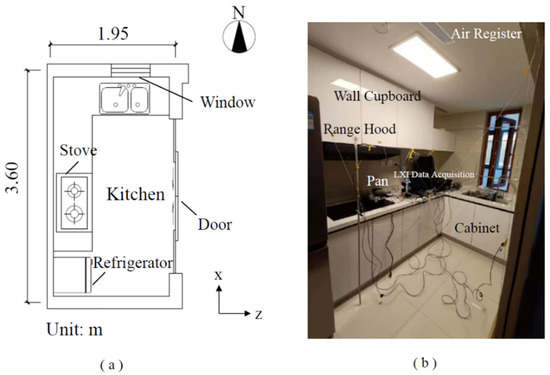
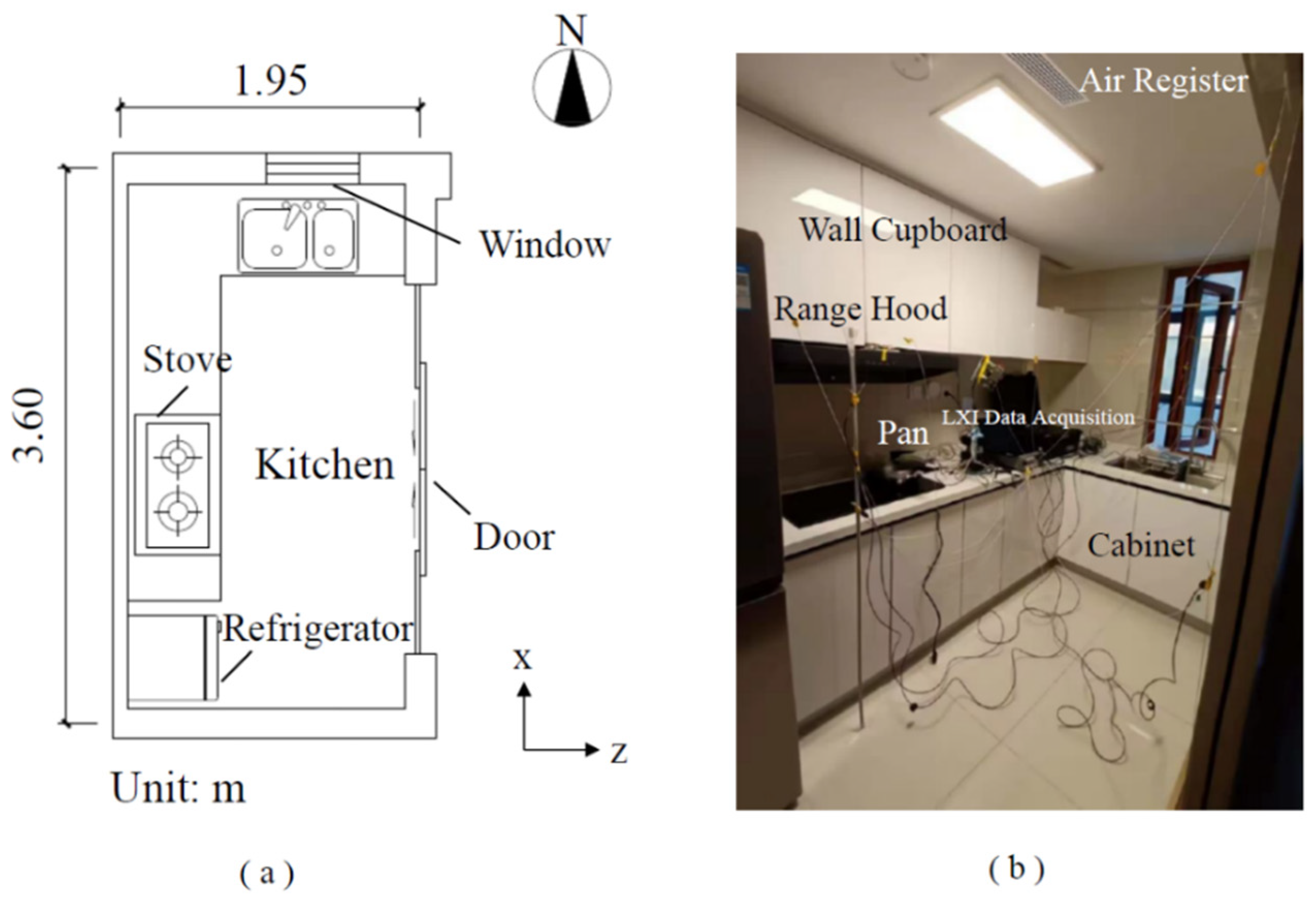
A kitchen located at the Nearly Zero-energy Residential Building Laboratory of the China Academy of Building Research in Beijing was selected as the research object. The kitchen had dimensions of 3.60 m (length) × 1.95 m (width) × 2.26 m (height), with a closed balcony on the north side along with a window, as shown in Figure 1a. The overall heat insulation and airtightness of the kitchen met the Chinese technical standard for nearly zero-energy buildings [29]. The kitchen was located adjacent to the dining room on the east, and a sliding door separated the kitchen and dining room. A stove, measuring 0.8 m in length and 0.6 m in width, was placed on a cabinet with a height of 0.8 m. And the pan is located on the right side of the stove. A range hood was installed at a height of 0.68 m above the stove, and above the range hood is the wall cupboard. An air register (0.9 × 0.1 m) was located at the ceiling and was designed as a single-layer louver connected to the outside through a pipe, as shown in Figure 1b. The centerline of the air register was located 1.4 m away from the wall in the west. Figure 1 displays the floor plan and an image of the kitchen.
Figure 1.
Floor plan and the kitchen under study. (a) floor plan of the kitchen; (b) image of the kitchen.
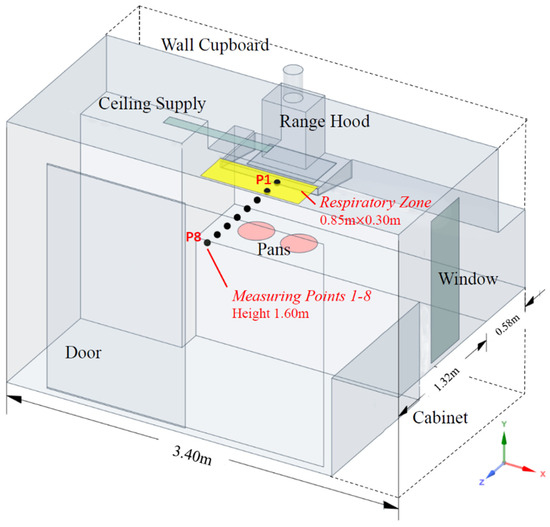
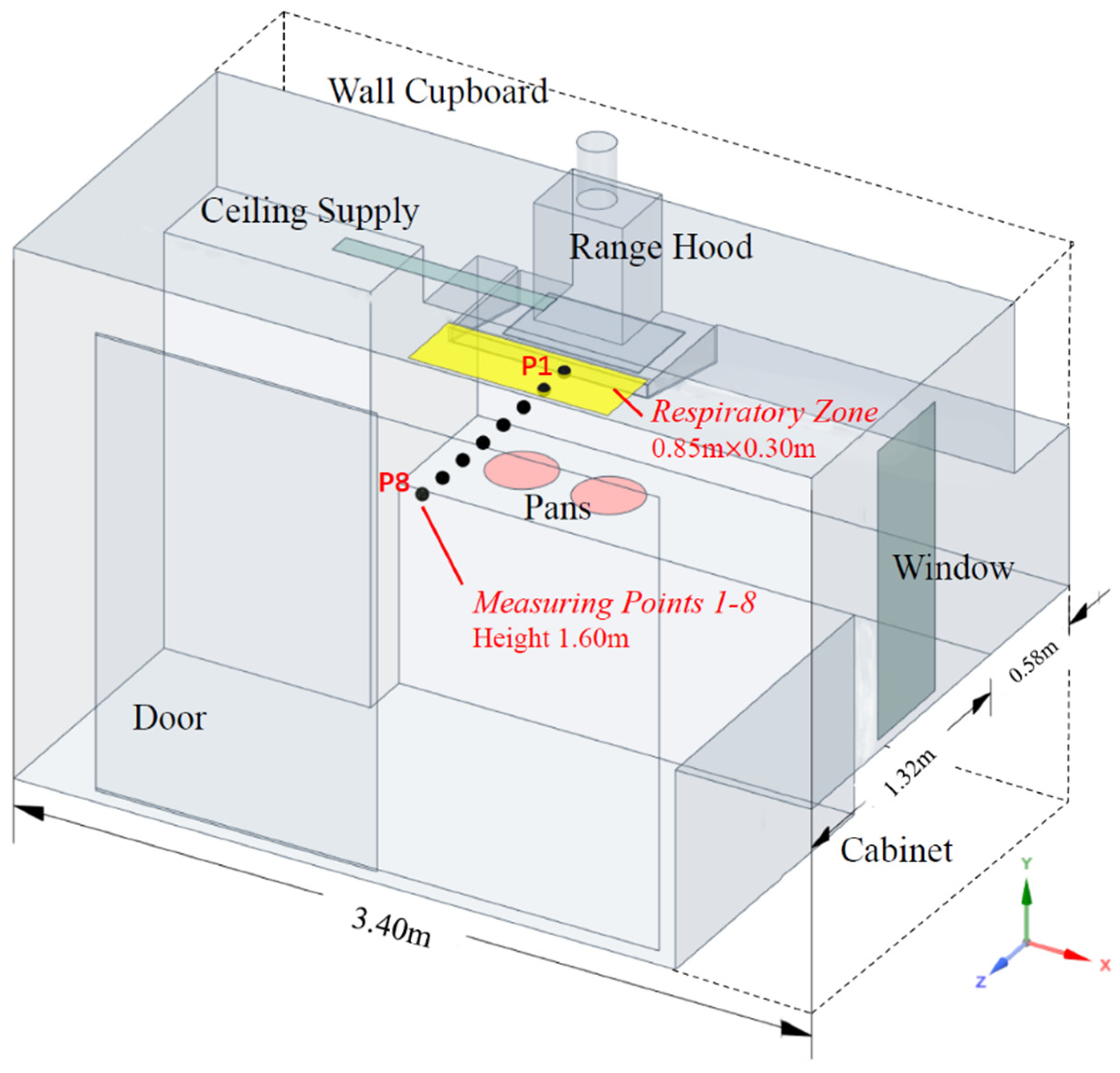
For reduced computational costs, the heat transfer between the airflow and solid surfaces of the wall cupboard, cabinet, and other objects was ignored in the following numerical simulation. Further, the rotation of fan blades in the range hood and occupant activities was not considered. Eight monitoring points with a spacing of 150 mm were set up in the kitchen to compare the impact of air supplementation by the organization on the removal of indoor pollutants under different conditions. The height of the monitoring points was set at the height of the human breathing area when standing (Y = 1.6 m). Monitoring point P1 was located in the breathing area, and it was 200 mm away from the edge of the range hood in the Z-axis direction. A schematic diagram of the kitchen model is shown in Figure 2, where some dimensions and measuring points are shown.
Figure 2.
Schematic diagram of the kitchen model.
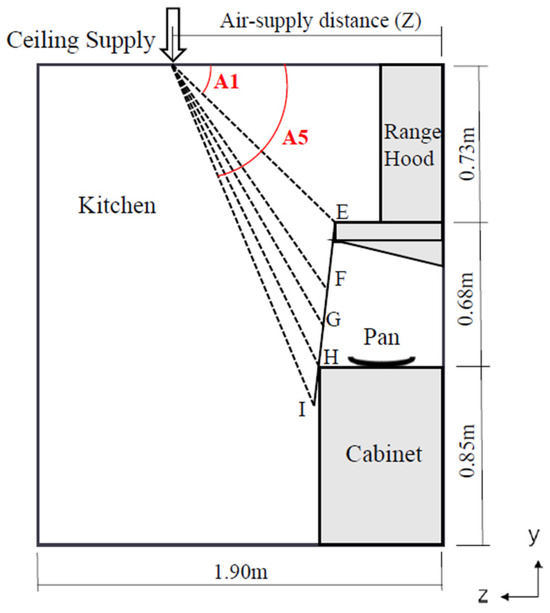
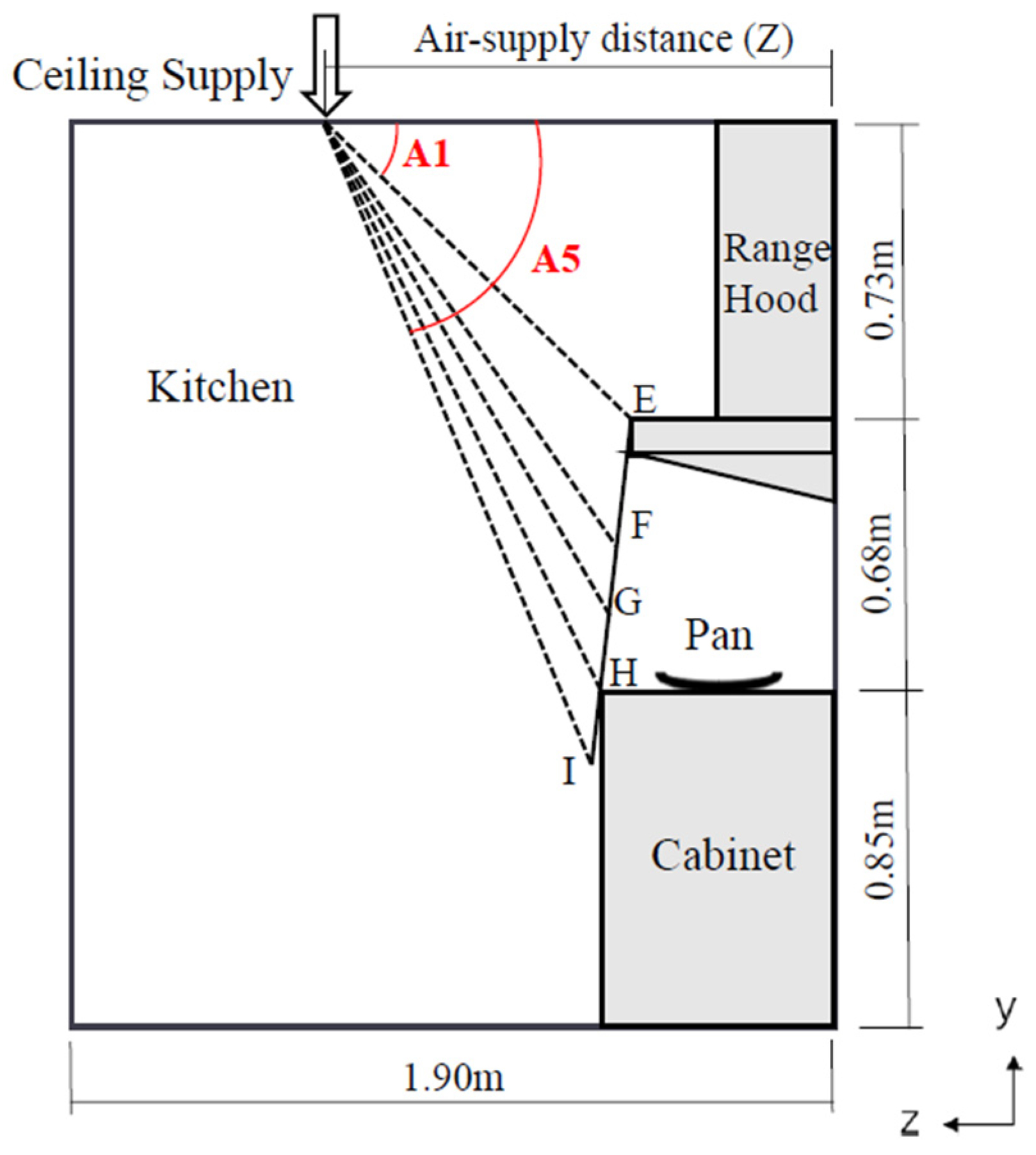
Figure 3 shows the air-jet angles of the ceiling supply. The ceiling air-jet directions are defined as follows: A1, directed toward the edge of the range hood at point E; A2, toward the midpoint between the range hood and the cabinet at point F; A3, toward the quarter-distance position between the range hood and the cabinet at point G; A4, toward the edge of the cabinet at point H; and A5, toward the lower side of the cabinet at point I. In the following, a specific code is used to represent a case of air-jet angle. For example, Z1.2–A1 denotes make-up air supply with an air-jet angle of A1 at a distance of Z = 1.2 m. For clarity, points E, F, G, H, and I are arranged sequentially from top to bottom along the range hood, satisfying the geometric relation of EF/2 = FG = GH = HI. Obviously, keeping the points E, F, G, H and I fixed, the air-jet angle varies with the distance Z.
Figure 3.
Air-jet angles.
A1 targets the upper boundary of the capture zone. A2 and A3 are both oriented toward the capture zone, with A2 acting closer to the range hood and A3 acting closer to the stove. A4 targets the top edge of the cabinet, close to the back of the stove. A5 points below the top edge of the cabinet, toward the lower boundary of the capture zone. The interaction among these specific air-jet angles, the thermal plume generated in the capture zone, and the air disturbance caused by the range hood may collectively lead to varying pollutant removal outcomes.
2.2. Numerical Model
The k–ε standard model [30] was used to simulate the three-dimensional transient airflow during cooking. Governing equations for incompressible fluid were as follows:
Continuity equation:
Momentum equation:
where p is the static pressure, T is the stress tensor, ρg is the gravitational body force, μ is the molecular viscosity, and I is the unit tensor.
Energy conservation equation:
where k is the molecular conductivity; kt is the conductivity due to turbulent transport (kt = cpμt/Prt), and the term Sh includes defined volumetric heat sources.
For simplification, the exhaust volume of the range hood was maintained constant for different cases. When an induction cooker was used, a flat-bottom pan was considered as a wall with constant temperature in calculations, as suggested in previous studies [31,32]. The boundary condition of the ceiling supply was set as an inlet vent with a certain resistance. The other boundary conditions set in the calculations were determined from experimental measurements, as listed in Table 1.
Table 1.
Boundary conditions.
The discrete phase model (DPM) was adopted to determine PM2.5 dispersion, and the relevant formula can be found in the references cited in previous studies [33,34]. The Lagrangian approach considers the fluid phase as a continuous medium, whereas the particle phase is considered as a discrete phase, emphasizing the distinct behavior of individual particles [35]. The momentum equation of the particle motion can be expressed as follows:
The left-hand side of the equation represents the inertial force per unit mass, where is the particle velocity vector. Meanwhile, there are four terms on the right side: a drag term, where FD is the inverse of the relaxation time; gravity and buoyancy terms that consider the densities of the air and particulate matter; and representing the thermophoretic and lift term, respectively. Additionally, DPM involves forces such as the pressure gradient and virtual mass. However, in this study, these forces were considered negligible compared with the drag force.
Particulate matter pollution in a kitchen originates from fine particles emitted by cooking pans. Because of the presence of a high-temperature heat source in the kitchen, the influence of air thermal buoyancy and temperature on PM2.5 dispersion should be considered [36]. According to experimental measurement, the PM2.5 emission rate was set to 3 × 10⁻⁷ kg/s in this study. The boundary condition of the range hood outlet was set as “Escape,” indicating that particles were allowed to escape freely, whereas the remaining solid surfaces were set as “Reflect,” representing the reflection of particles from those surfaces.
2.3. Grid Independence Verification
Meshing was generated using Workbench Mesh with the following key points: (1) A nonstructured mesh was used for the model for complex geometries; (2) local mesh refinement was adopted for the air register, windows, and areas near the stove where the velocity or temperature gradient was large; and (3) mesh parameters, such as the maximum aspect ratio and mesh orthogonality, were controlled to be within an acceptable range.
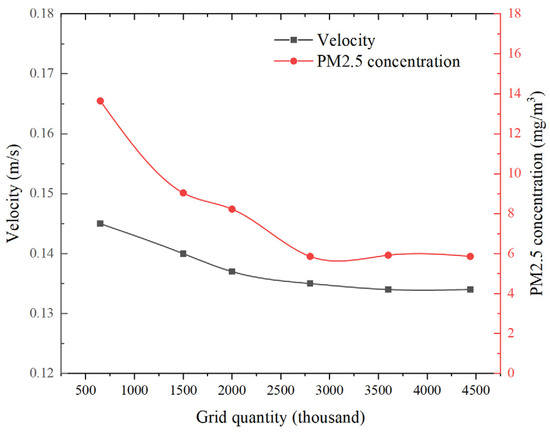
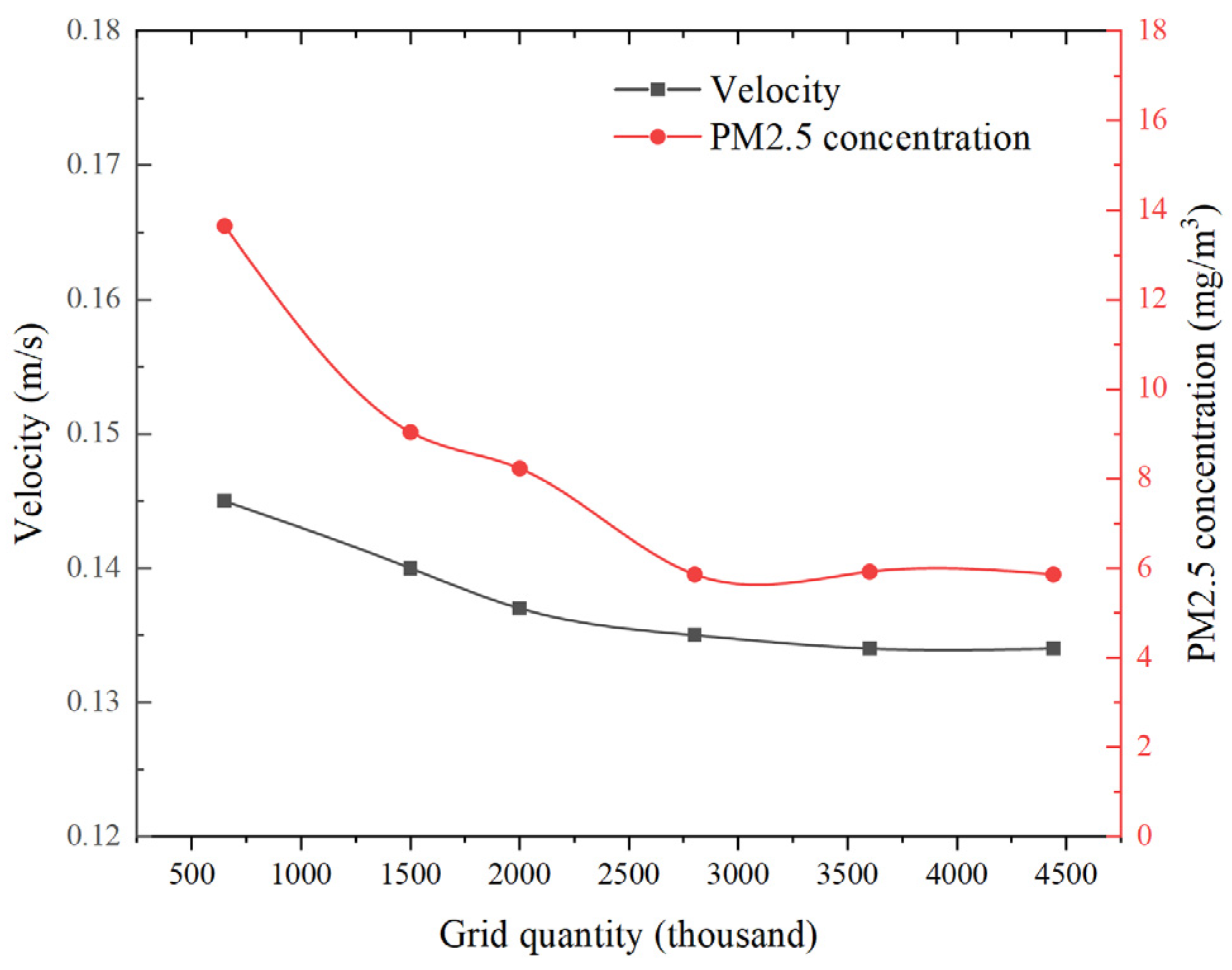
A grid independence test was conducted using grid-element numbers of 0.65, 1.5, 2.0, 2.8, 3.6, and 4.5 million. The PM2.5 concentration at monitoring point P4, which was along the horizontal direction of the occupant’s zone (Figure 2), was chosen as the parameter for grid independence verification. Because airflow also has a significant impact on the diffusion of pollutants, the air velocity at monitoring point P4 in the horizontal direction was verified for grid independence.
In the aforementioned different grid conditions, an air-supply distance (air register position, defined as the distance from the center of the register to the west wall shown in Figure 3) of 1.4 m and air-jet angle of 55.7° were used for independence verification. The PM2.5 particle emission rate was set to 3 × 10⁻⁷ kg/s, and the results are shown in Figure 4. The velocity at point P4 gradually approached consistency with increasing grid-element numbers, and the difference between the cases with 2.8 million grids, 3.6 million grids and 4.5 million grids was only 0.8%. The particle concentrations at various measuring points became stable in the case with 2.8 million grids, as shown in Figure 4. Therefore, a grid-element number of 2.8 million was chosen for the following calculations.
Figure 4.
Grid independence verification at point P4.
2.4. Experimental Verification
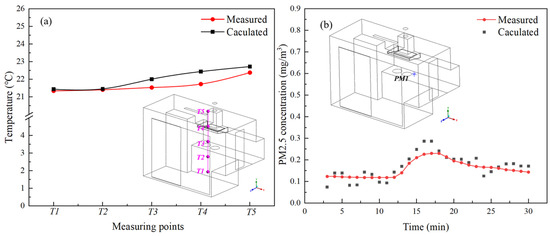
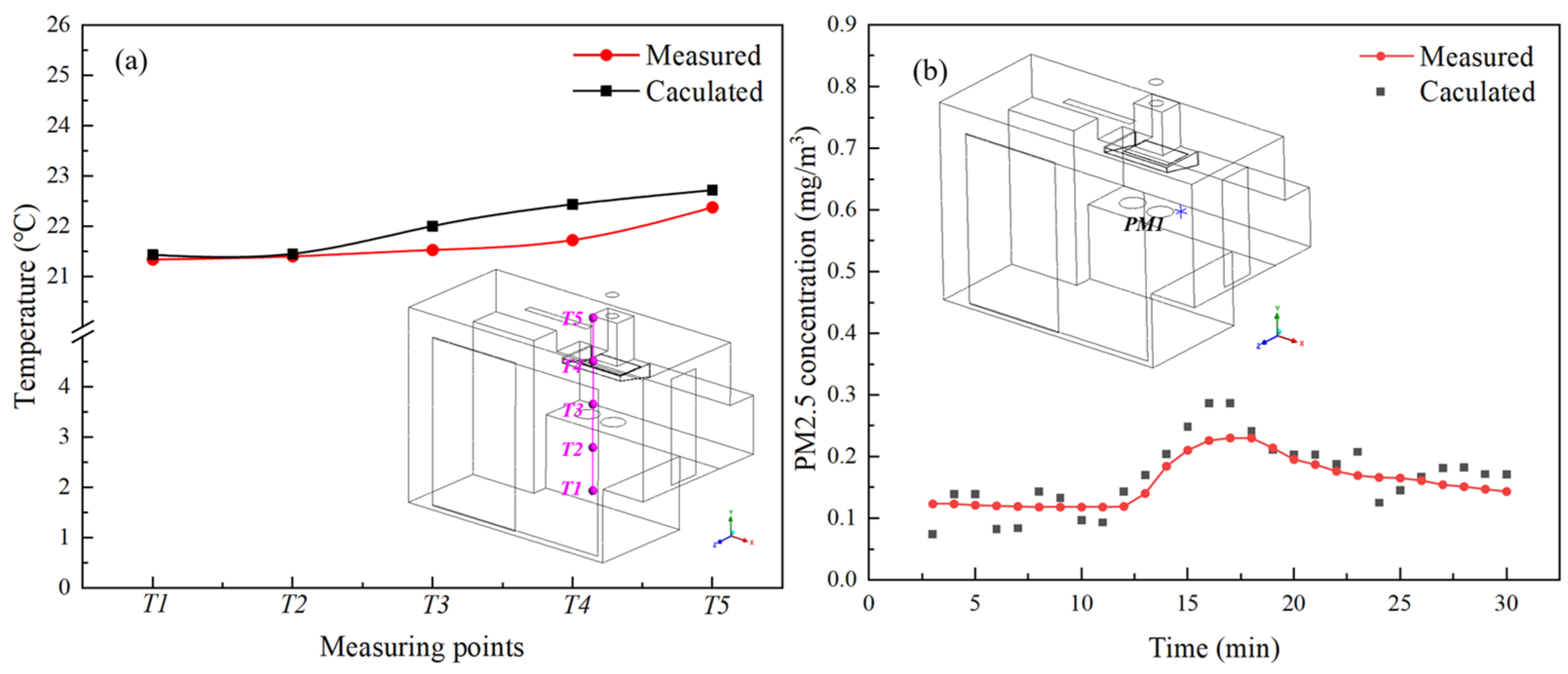
The experimental verification was conducted at the Future Building Laboratory of the China Academy of Building Research in Beijing during summer, and the outdoor temperature on the day of the experiment was about 21 °C. Before the experiment, the kitchen door and windows were closed and the range hood (operating at low speed) and air-supply system were turned on for 20 min to establish initial flow field inside the kitchen. Soybean oil was then heated in a pan on an induction cooker to simulate pollutant emission. During the experiment, the kitchen door was kept closed and the staff left the kitchen with the ventilation system in operation. The test duration was 30 min. Temperature measurement points were selected along the standing direction of the human body, with five measurement points spaced 50 cm apart from the bottom to top (Figure 5a). Then, the T-type thermocouple and 34972A LXI Data Acquisition system (Keysight; uncertainty: ±0.25 °C) was used to continuously monitor temperature at points T1–T5 every 30 s. The measurement point for PM2.5 particle concentration was selected near the pan (Figure 5b), and a DustTrak II Aerosol Monitor 8530 (TSI; uncertainty: ±10 µg/m3) was used to continuously monitor the PM2.5 mass concentration at point PM1 every 60 s.
Figure 5.
Experimental verification results of temperature and PM2.5 concentration. (a) Comparison of average temperature measurements for the last 10 min (left). (b) Comparison of PM2.5 concentration measurements at point PM1 over time (right).
Figure 5 presents the experimental verification results for temperature and PM2.5 concentration. The temperature simulation results agree with the measurements, revealing temperature stratification from the bottom to the top. The measured temperatures of points T3 and T4 were slightly higher (by ~0.5 °C) than the calculated results, possibly because of the assumption of constant temperature for the pan. Generally, the overall error among the five temperature measurement points was small and acceptable, indicating the feasibility of the numerical method. Similarly, the overall variation trend of the PM2.5 concentration was similar for the experiment and simulation, with a peak at ~15 min followed by a decrease and subsequent stabilization. The average relative error between the simulation and experiment over the entire period was 12%, which may be attributed to the intrinsic uncertainty of the particle-dust measurement instrument.
2.5. Simulation Conditions
2.5.1. Selection of Monitoring Points and Data
Figure 2 shows the locations of the monitoring points and respiratory-zone plane. The monitoring data include the hourly PM2.5 concentration at each monitoring point, average PM2.5 concentration in the respiratory-zone plane, and average PM2.5 concentration in the range hood exhaust outlet. A series of monitoring points with a spacing of 150 mm was set up in the simulation to monitor PM2.5 concentration for comparing the effectiveness of organized make-up air in removing indoor pollutants under different conditions. The height of the monitoring points was set as the height of the human respiratory zone when in a standing position (Y = 1.6 m).
2.5.2. Simulation Cases
The air-supply distance and air-jet angles may affect the flow field in the area between the stove and range hood, which in turn affects the distribution of particulate matter and capture efficiency of the range hood. Therefore, the two parameters were studied. Herein, five different air-jet angles were selected for simulation, as shown in Figure 3. The positions of the air-supply outlet at distances of 1.2, 1.4, and 1.6 m away from the west wall were set as the variables. All considered cases are summarized in Table 2.
Table 2.
Simulation cases.
2.6. Pollution-Exposure Assessment Index
Some pollution-exposure assessment indices are usually used to evaluate pollutants (e.g., particulate matter) and their dissipation effectiveness under different kitchen ventilation measures. As a personalized ventilation method, ceiling supply not only affects the efficiency of the range hood, but also the impact on local airflow is worth exploring. In this study, individual intake fraction (IF) and capture efficiency were chosen to demonstrate the removal effect of pollutants under the cases being considered, and these two indicators can reflect the emission and elimination of pollutants from different perspectives (local and overall air quality). The individual IF [37], which considers the effectiveness of the control device in removing pollutants and exposure pathway to the individual, quantifies the amount of pollutants that a person is exposed to as a result of emissions from a particular source. Meanwhile, capture efficiency [38] evaluates the capture effect of a range hood under various make-up air conditions.
The form of ceiling air supply affects indoor airflow and affects the pollutant removal effect of range hoods. Therefore, the performance of a range hood can reflect the removal effect of pollutants under different air-supply conditions. When evaluating the performance of a range hood, capture efficiency is commonly used to calculate the effectiveness of the smoke capture function [39,40,41]; its definition is as follows:
The individual IF [42,43,44] of pollutants represents the percentage of the total mass of pollutants inhaled by occupants over a certain period. It measures the proportion of emissions that each individual in a specific population eventually inhales or ingests and can be used to evaluate the efficiency of kitchen range hoods. A lower IF indicates a higher efficiency of a range hood. Over a given time, total intensity of pollutant sources, and inhalation rate, the IF is only related to the concentration of inhaled pollutants. The formula for the pollutant-exposure amount is as follows:
where Bv(t) is the rate of pollutant inhalation (L/s), Cv(t) is the concentration of pollutants ingested (i.e., the concentration of pollutants in the respiratory-zone plane) (kg/L), Sc is the rate at which pollutants are released from the pollution source (kg/s), and t is time.
Wang et al. [45] proposed an indoor pollution-exposure model that can be used to calculate the amount of air ingested by an individual over a given period. The model assumes that human respiration can be considered to be a steady state and the respiration rate is 10 breaths per minute, with each breath inhaling or exhaling 0.6 L of air. The equation for the respiratory process is as follows:
where n is the breathing frequency.
3. Results and Discussion
3.1. Velocity Field
When the range hood was turned on, negative pressure areas were created around the exhaust opening, leading to the movement of air toward the exhaust. As the doors and windows were closed, the only way for outdoor air to enter the kitchen was through the air-supply outlet. However, because of the suction force of the range hood, the kitchen remained in a negative pressure state even after the airflow reached a dynamic balance.
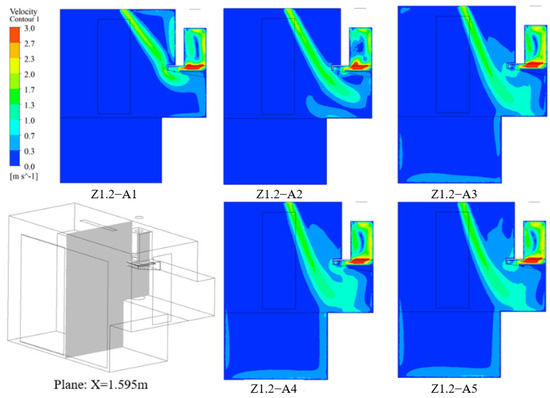
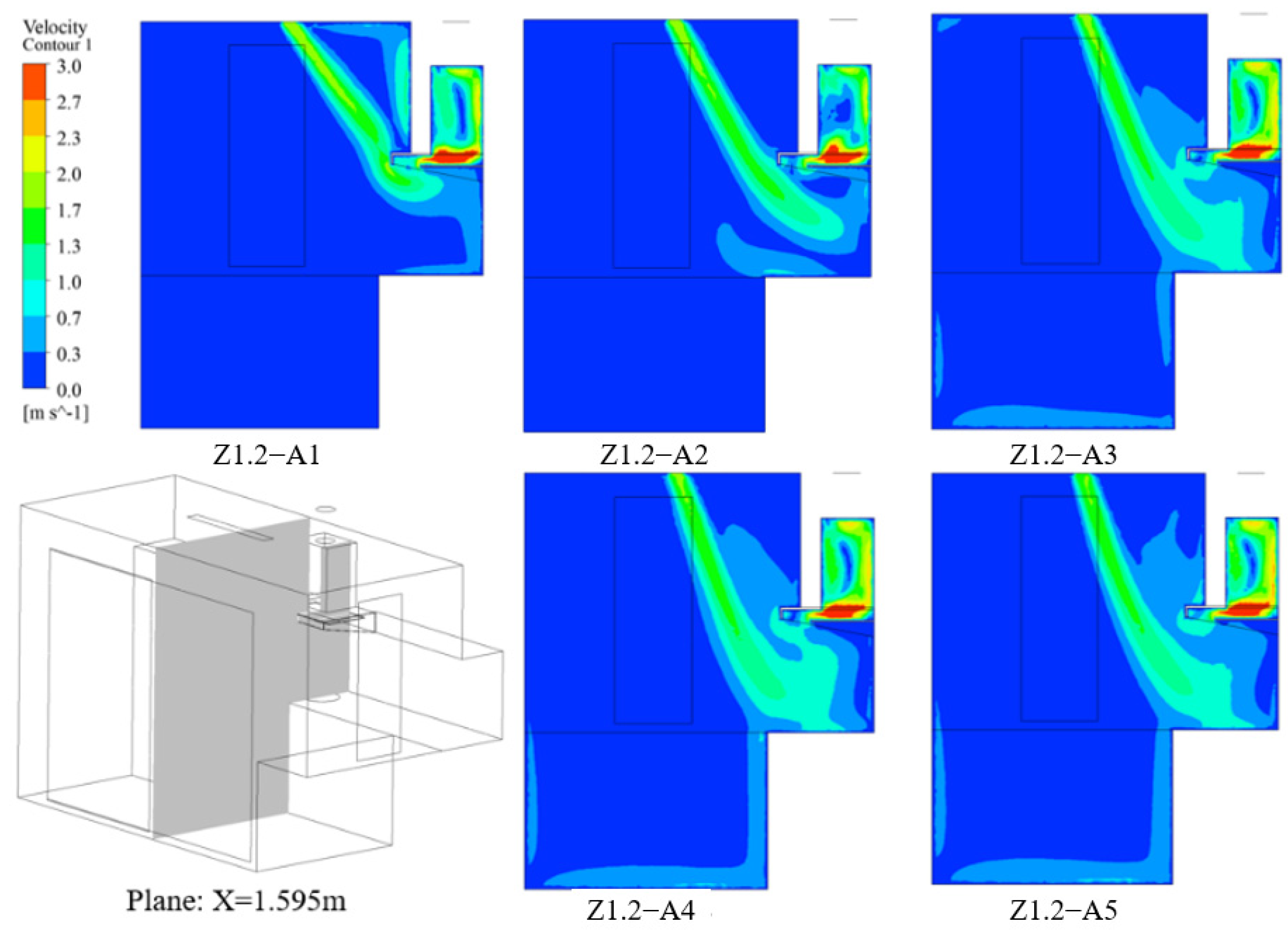
Figure 6 shows the velocity distribution at the end of the cooking activity in the vertical plane across the center line of the range hood for the air-supply distance of 1.2 m. In cases Z1.2-A1 and Z1.2-A2, most of the make-up air passing through the cooking zone was directly drawn into the range hood and expelled from the kitchen. This situation hindered the effective removal of oil smoke as the make-up air formed an air curtain with a velocity >1 m/s. This air curtain obstructed the removal of oil smoke and allowed pollutants to diffuse into the room, potentially leading to high concentrations of PM2.5.
Figure 6.
Velocity contour map.
In cases Z1.2-A3 to Z1.2-A5, after air entered the cooking area, it moved upward under the influence of the range hood’s negative pressure, forming a “hook” shape. This upward flow not only carried the particles emitted by the pollution source but also formed an air curtain that prevented the particles from diffusing into the room. Consequently, these cases exhibited a good pollutant control effect.
These observations highlight the importance of the air-jet angle at a fixed distance in achieving effective pollutant control in the kitchen.
3.2. Diffusion of Indoor Pollutants
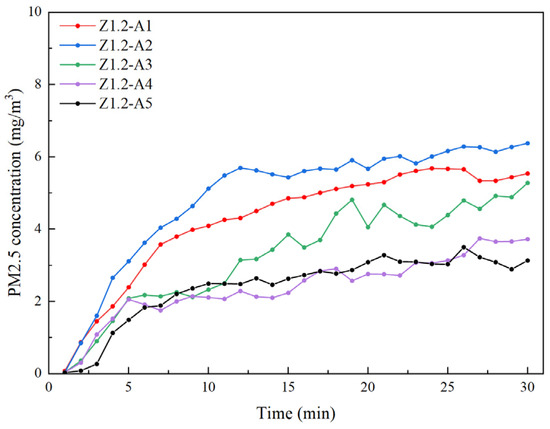
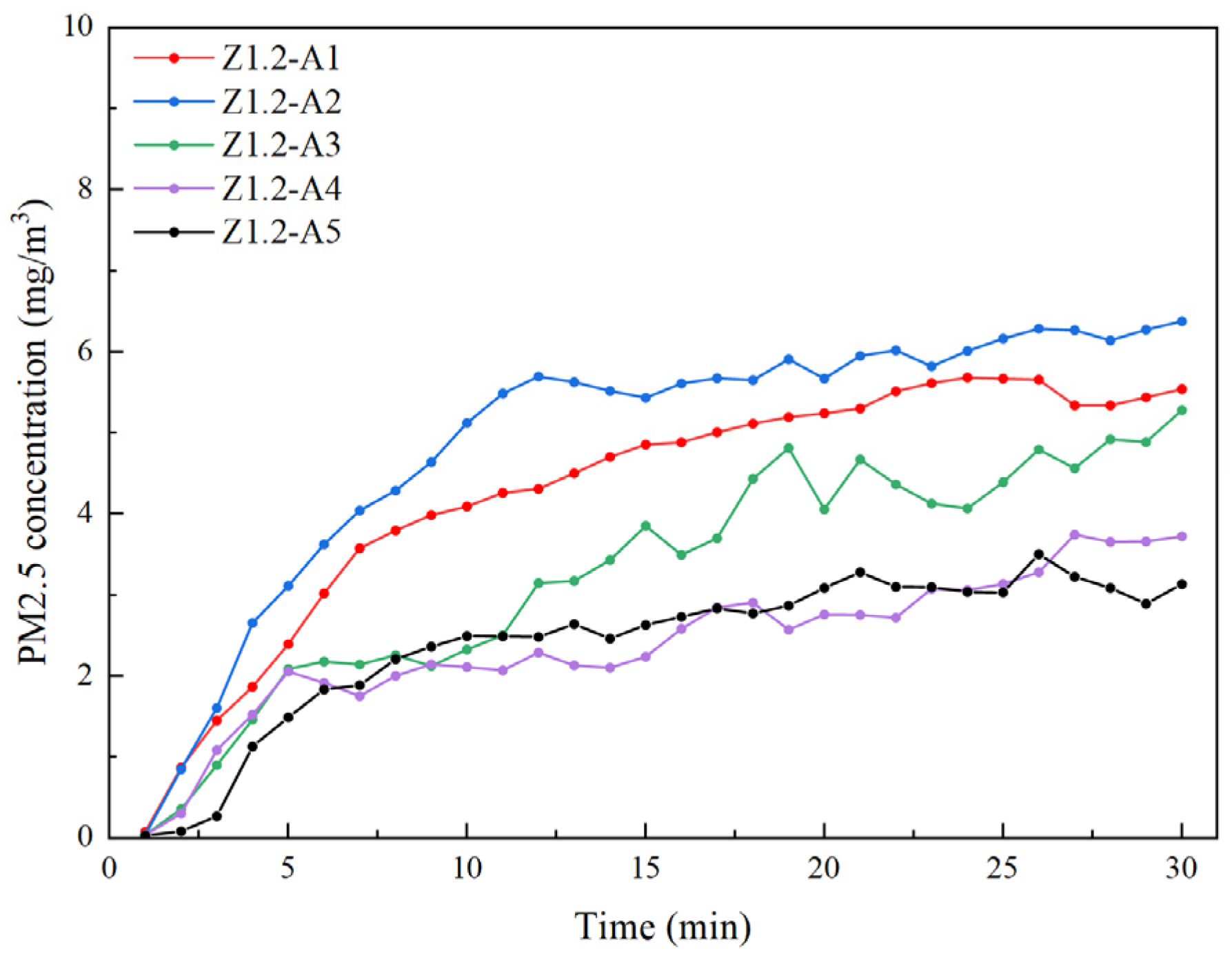
Figure 7 presents the PM2.5 concentration in the kitchen space during the cooking process at the air-supply distance of 1.2 m. As the cooking activity progressed, the PM2.5 concentration gradually increased. After 20 min, the concentration slowly increased over time in all the cases. However, there were notable differences depending on the air-jet angle. When the air-jet angles were 52.3° (Z1.2-A1) and 63.6° (Z1.2-A2), the overall pollutant concentration in the kitchen was higher, indicating poor ventilation effectiveness and significant diffusion of particulate matter to different areas. In contrast, when the air-jet angle was controlled between Z1.2-A4 and Z1.2-A5, the overall pollutant concentration was significantly reduced.
Figure 7.
Pollutant distribution in the kitchen over time.
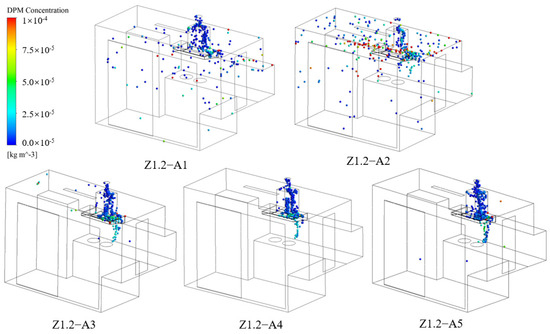
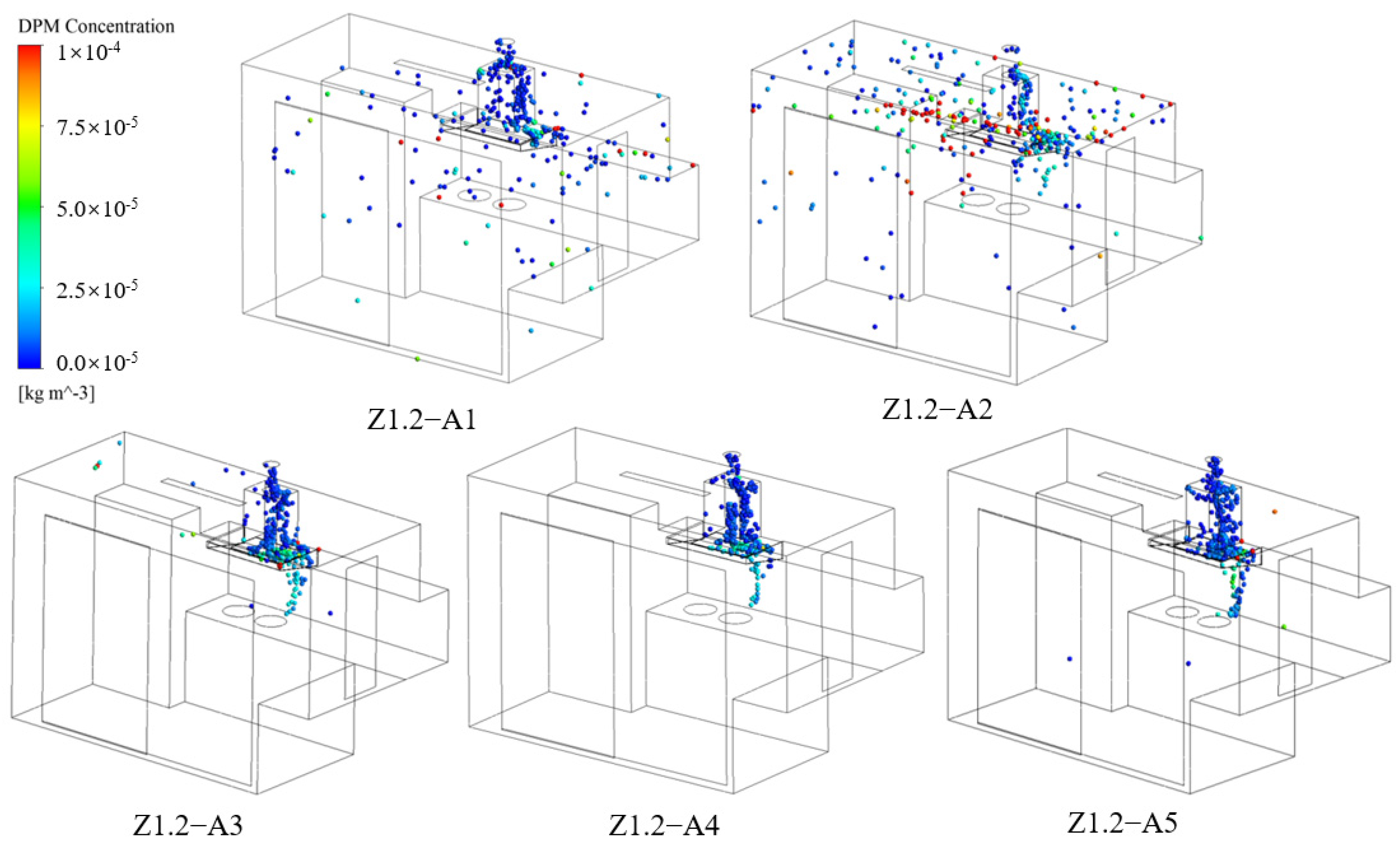
Figure 8 provides a detailed account of the distribution of 500 PM2.5 particles at the last moment of cooking (30 min). It is evident that, at the air-supply distance of 1.2 m, the indoor particle concentration is notably higher at smaller air-jet angles (A1 and A2), with A2 exhibiting an aggregation of particles within the kitchen space. Conversely, at larger air-jet angles (A3, A4, A5), the indoor PM2.5 concentration is significantly lower, predominantly localized between the stove and the range hood, with peripheral areas remaining relatively free of particulate matter.
Figure 8.
PM2.5 distribution in the kitchen.
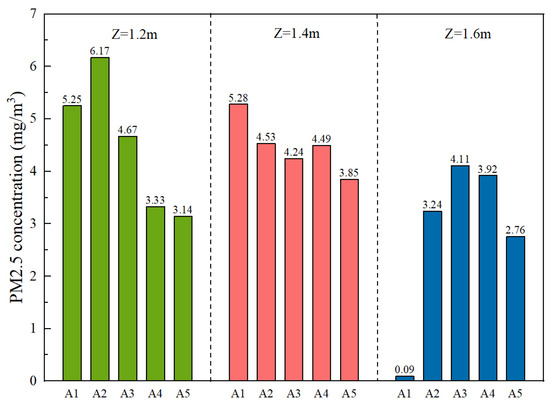
Figure 9 shows the average pollutant concentration in the entire kitchen space during the 30 min cooking activity under different air-supply conditions. Generally, the results showed that the peak value of particle concentrations in the kitchen rapidly decreased with increasing air-jet angles. When making up air at a smaller air-jet angle (A1 and A2), the pollutant concentration reached its peak at air-supply distances of 1.2 and 1.4 m. The average pollutant concentration was significantly lower for these air-jet angles, and it decreased by 49% and 27%, respectively, compared with the peak value, consistent with the observations in the velocity distribution presented in Figure 6. Additionally, when air was supplied at air-supply distances of 1.2 m, the make-up air strongly disturbed airflow in the area between the stove and range hood (A2 and A3), and a large number of particles would spill into the kitchen, resulting in indoor PM2.5 concentration reaching almost twice the minimum value. This indicates that choosing the appropriate air-jet angle for make-up air at the same air-supply distance is crucial for air quality.
Figure 9.
Average PM2.5 concentration in the kitchen.
However, an anomaly was noted for the result of Z1.6-A1 compared with those of Z1.2-A1 and Z1.4-A1 in Figure 8. At a distance of 1.6 m, while larger air-jet angles were effective in controlling pollutant concentrations, even small angles resulted in low indoor pollutant concentrations, with A1 producing the lowest concentration. This was due to changes in the flow field caused by small air-jet angles under these conditions, which are explained in detail in Section 3.5.
Du et al. [46] measured the PM2.5 concentration under typical ventilation methods in Chinese kitchens, which was 10.97 ± 9.53 mg/m3 under natural make-up air mode. Compared with natural make-up air, indoor pollutant concentration decreased significantly, even under the highest indoor pollutant conditions (Z1.2-A2), and indoor PM2.5 mass concentration still decreased by 44%. This also shows the effectiveness of ceiling supply mode in airflow organization and pollutant control.
3.3. Effect of Air-Jet Angles and Distance on Pollutant Control
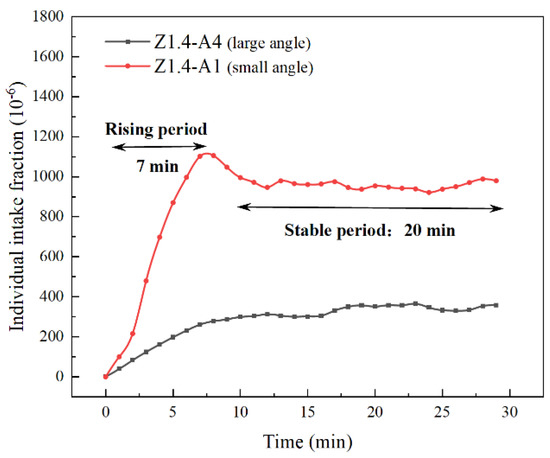
Figure 10 illustrates the individual IF over time for different air-jet angles at a distance of 1.4 m. The distribution of pollutants in the kitchen was found to be unstable because of the direct impact of the supplementary airflow on the flow field in the respiratory zone. Consequently, the individual IFs fluctuated over time. When the air-jet angle was small (Z1.4-A1), the IF initially increased significantly and then stabilized at a higher level after reaching a peak in a short time. Meanwhile, when the air-jet angle was large, the change in IF over time was less apparent, and the IF fluctuated at a low level after a slow increase. This phenomenon occurred because fresh air was directly supplied to the breathing area at a large angle of supply, reducing the intake of pollutants by occupants.
Figure 10.
Hourly change curve of the intake fraction.
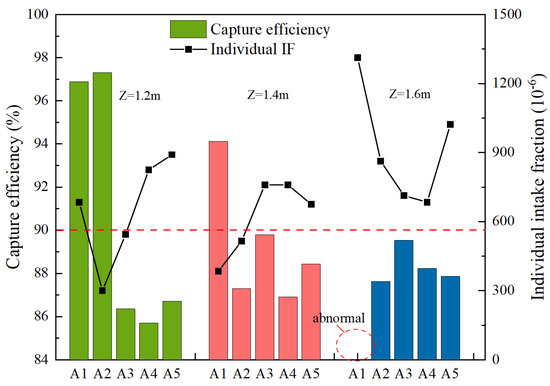
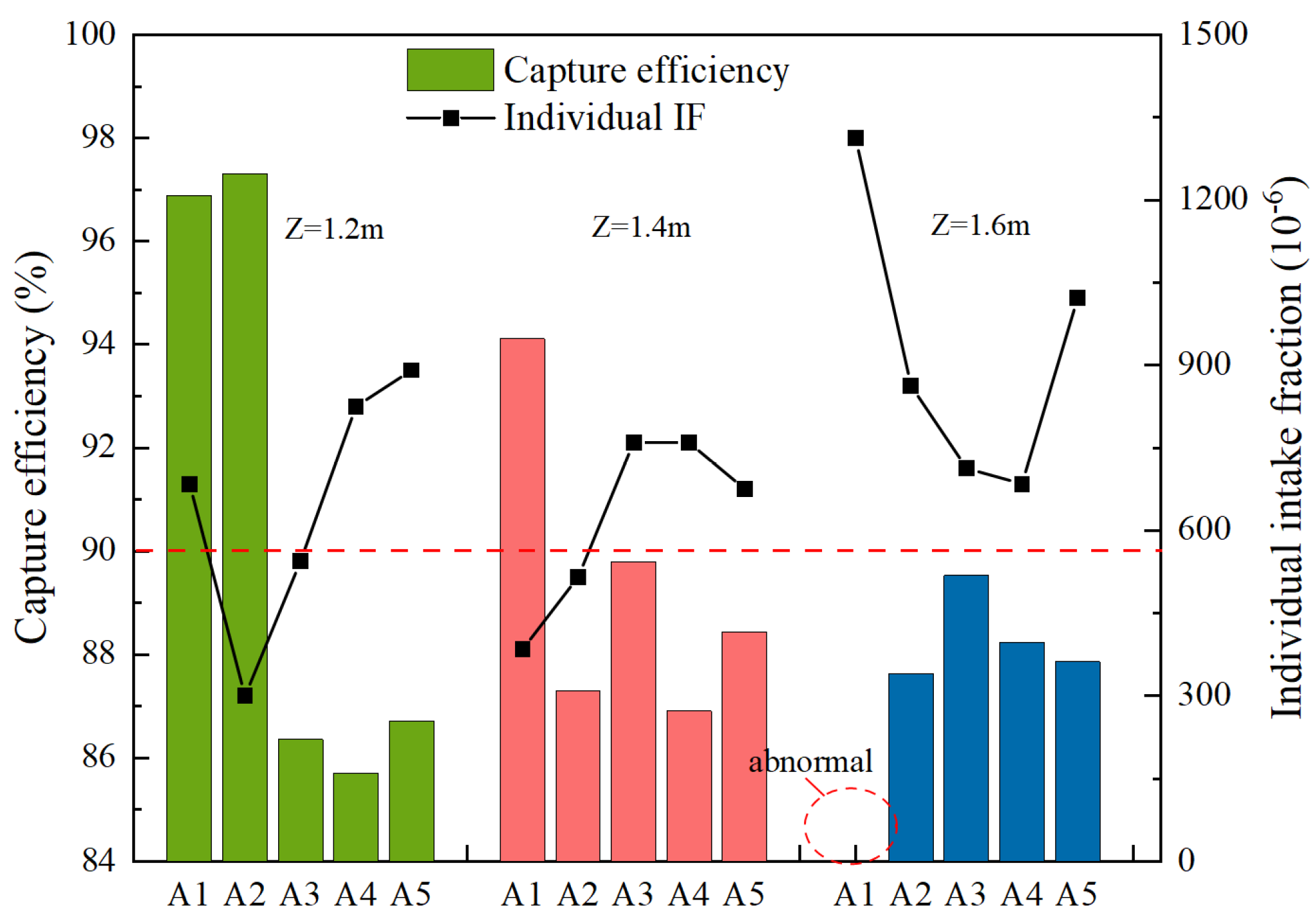
In Figure 11, the average IF of all the cases during the entire 30 min cooking activity is calculated and presented. Red bars represent the capture efficiency, while blue bars represent the individual intake fraction (IF). The IF significantly varied for different air-jet angles when make-up air was supplied at different distances. At a distance of 1.2 m, the difference between the highest and lowest IF reached a factor of 7.8, whereas a smaller difference in a factor of 1.5 was observed at a distance of 1.4 m. At 1.2 and 1.4 m distances, the IF was the lowest when the make-up air was supplied at angle-4, whereas there was minimal difference in the IF for cases A2–A5 at a distance of 1.6 m.
Figure 11.
Average intake fraction during cooking and capture effectiveness.
The capture efficiency of the range hood, which reflects its ability to remove pollutants, is also presented in Figure 11. Generally, the capture efficiency in most cases met the threshold of 90%, which is recommended by the Chinese standard [47]. For an air-supply distance of 1.2 m, the larger air-jet angles (A4 and A5) corresponded to higher capture efficiencies of the range hood, indicating better pollutant removal effectiveness. However, at distances of 1.4 and 1.6 m, while the difference in IF performance was insignificant, increasing the angle still improved the capture efficiency of the range hood, reaching the second-largest and maximum capture efficiency at A5, respectively. The results indicate that, at a certain air-supply distance, larger air-jet angles achieve better pollutant control effects (e.g., cases Z1.2-A4, Z1.4-A4, and Z1.6-A5).
The air-supply distance plays an important role in the effectiveness of pollutant control. For different air-supply distances, the IF was lower for air-jet angle-4, indicating effective pollutant control. When make-up air was supplied at angle-4, the IF was the lowest for an air-supply distance of 1.2 m, which is 41% lower than that at 1.4 m and 59% lower than that at 1.6 m. Additionally, because of the direct removal of pollutants from the respiratory zone by the supplementary airflow, the IF was low when supplying air with angles A3 to A5 at each air-supply distance. This indicates that the amount of pollutants inhaled by the occupant at this angle was low and the impact on the occupant was minimal. Although supplying air at angle-2 may have a higher impact on thermal plume, air supply at angle-2 proved superior when the supply distance was 1.6 m. In this case, the capture efficiency improved by 6% and 3.7% compared with those at distances of 1.2 and 1.4 m, respectively. This was because the airflow velocity reaching the top of the stove significantly decreased when the air-supply distance was higher, reducing the impact on thermal plume [48].
Figure 11 shows the high consistency between the IF and capture efficiency results. Higher IFs correspond to lower capture efficiencies, indicating increased exposure to pollutants. Combining both the indicators, the cases with better pollutant removal effects (i.e., the capture efficiency of the range hood should be >90% [47] and IF should be lower than a relatively low level: 5 × 10⁻⁴) were Z1.2-A4, Z1.2-A5, Z1.4-A5, Z1.6-A4, and Z1.6-A5. When the optimal combination of the air-jet angle and supply distance was realized (Z1.2-A4), the individual IF was reduced by 62% compared with the average IF of all cases and the capture efficiency of the range hood reached 92.8%.
3.4. Optimization of Ceiling Supply
In order to find the optimal method for the ceiling supply in residential kitchens, this study employs the Technique for Order Preference by Similarity to Ideal Solution (TOPSIS) method. The TOPSIS method operates on the premise that the optimal solution should have the shortest distance from the ideal solution and the farthest distance from the negative ideal solution. In the context of this study, the criteria for evaluation are indoor pollutant concentration, individual intake fraction (IF), and capture efficiency. The following are the specific steps of the TOPSIS method:
Step 1. Data Normalization. To facilitate the comparison, the data for each criterion were normalized using the following formula:
where Rij is the normalized value, Xij is the original value for the ith criterion and jth alternative, and the sum is taken over all alternatives for a given criterion.
Step 2. Weight Assignment
The weights for the criteria were assigned based on their relative importance. In this study, equal weights were assigned to indoor pollutant concentration, IF, and capture efficiency, as all three are critical for evaluating the effectiveness of the ceiling supply system.
Step 3. Calculation of Ideal and Negative Ideal Solutions
The ideal solution (A+) is the vector of the best values for each criterion, while the negative ideal solution (A−) is the vector of the worst values. For minimizing criteria (such as pollutant concentration and IF), the ideal value is the minimum and the negative ideal is the maximum. For the maximizing criterion (capture efficiency), the ideal value is the maximum and the negative ideal is the minimum.
Step 4. Distance Calculation
The distances of each alternative from the ideal (D+) and negative ideal (D−) solutions are calculated using the following formulas:
Step 5. Closeness Coefficient
The closeness coefficient (Cj) for each alternative is calculated to determine its proximity to the ideal solution:
The higher the closeness coefficient, the better the alternative in terms of the overall performance based on the selected criteria. The alternatives are ranked based on their closeness coefficients, with the highest coefficient indicating the optimal method of ceiling supply. In this study, the configuration that resulted in the lowest indoor pollutant concentration, lowest IF, and highest capture efficiency was identified as the optimal method, and the ranking results of the best ceiling supply modes are shown in Table 3.
Table 3.
Ranking of optimal ceiling supply mode.
The case Z1.6-A1, which ranked first in Table 3, demonstrated the lowest individual intake fraction (IF) and the highest capture efficiency. However, it is essential to note that this configuration is not inherently superior but rather a result of the specific combination of parameters tested. The angle’s effectiveness is contingent on the kitchen’s layout, the positioning of obstructions, and the range hood’s operation. Therefore, this case is ignored in the following discussion.
The air-jet angle plays a pivotal role in directing the airflow and consequently influences the distribution of pollutants within the kitchen. The optimal angle should facilitate the capture of pollutants by the range hood without creating turbulence that could disperse pollutants into the breathing zone. As shown in Table 3, the cases of the top 3 in Table 3, except for the special Z1.6-A1, all show a large air-jet angle, and the best air-jet angle is A5, which performs better at the three different distances.
The supply distance from the stove is another critical factor that affects the airflow pattern and the make-up air system’s efficiency. The results in Table 3 show that a larger supply distance will have a better pollutant control effect. An optimal distance ensures that the air supply is close enough to the cooking area to effectively dilute and capture pollutants, but not so close as to interfere with the range hood’s operation. The case Z1.6-A5, which is noted for its high performance, is attributed to a supply distance that balances the trade-off between effective pollutant capture and minimal interference with the range hood’s suction effect, when the IF is 3.62 e−4, and the capture efficiency of the range hood is 94.9%.
3.5. Discussion
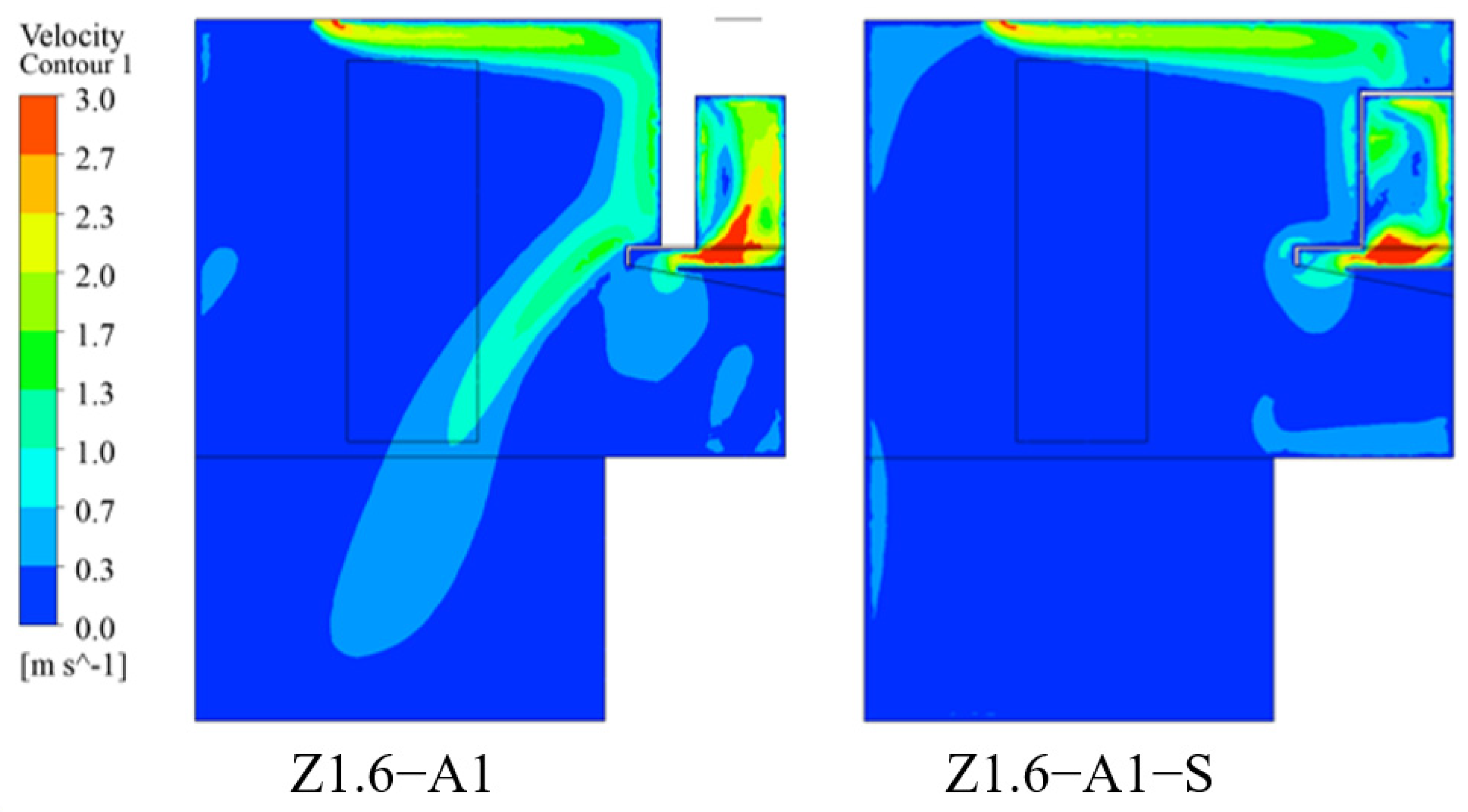
In Section 3.2, an abnormal phenomenon was observed when angle-1 was set at an air-supply distance of 1.6 m. Figure 12 shows the velocity contour of the make-up air at angle-1 and a supply distance of 1.2 m. The airflow for the case of Z1.6-A1 was significantly different from those of the other cases, including Z1.2-A1 and Z1.4-A1. In the case of Z1.6-A1, the air adhered to the ceiling because of air buoyancy and the Coanda effect and then continued to flow downward because of the obstruction from the wall cupboards. This flow pattern formed a high-velocity air curtain that effectively suppressed pollutant dispersion. Consequently, the abnormal behavior observed in Z1.6-A1 can be attributed to the influence of the kitchen layout.
Figure 12.
Velocity contour map for angle-1.
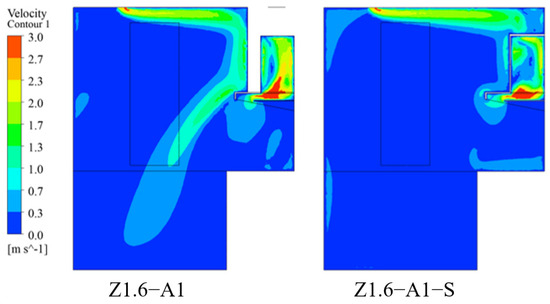
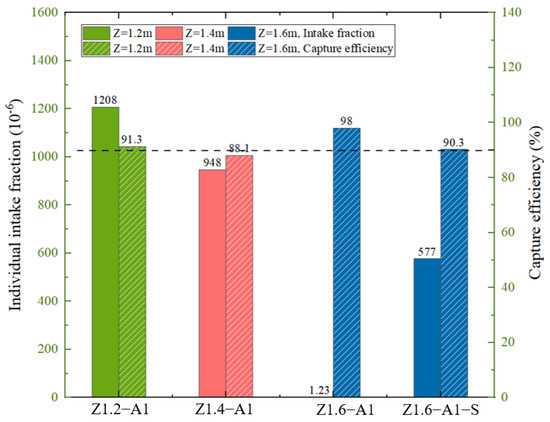
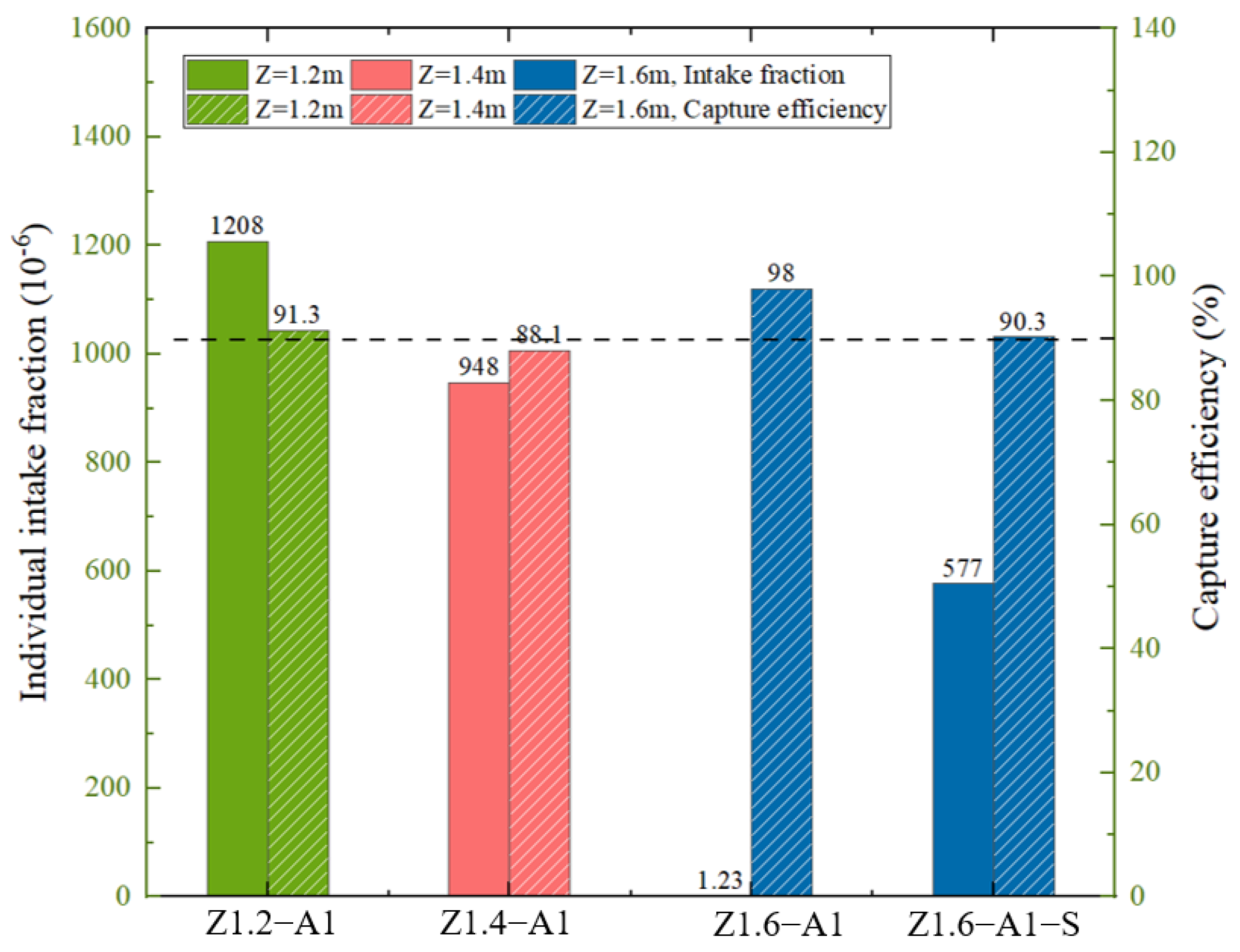
A control group called Z1.6A1-S was introduced for comparison with Z1.6-A1 to investigate the impact of wall surfaces, such as wall cupboard, on the indoor flow field, and the results are presented in Figure 13. Compared with Z1.6-A1, Z1.6-A1-S exhibited a 7.7% decrease in capture efficiency, and its IF was 469 times higher than that of Z1.6-A1. This was comparable to the pollutant control effects of the cases Z1.2-A1 and Z1.4-A1, which exhibited worse pollutant control effects at smaller air-jet angles. This drastic performance degradation highlights the inherent instability of the Z1.6-A1 configuration: Its high performance is not robust, but rather contingent upon a precise and favorable interaction with surrounding obstacles. While Z1.6-A1 demonstrates that layout-specific interactions can occasionally yield exceptional pollutant control, its performance is not generalizable. Therefore, from a design recommendation standpoint, more reliable and layout-agnostic strategies—such as directing the air jet toward the edge or below the cabinet (e.g., angles A4/A5)—are preferred for achieving consistent and stable ventilation performance across diverse kitchen geometries. Consequently, although Z1.6-A1 represents an instructive special case within this study, it is not recommended as a universal configuration due to its sensitivity to specific layout conditions.
Figure 13.
Results for different air-supply distances at air-jet angle-1.
From the above analysis, the installation recommendations for make-up air can be summarized as follows:
- When the air-supply outlet is installed on the kitchen ceiling, the air-jet centerline should be adjusted to the edge of the cabinet or below it (e.g., A4 and A5) to achieve better control of pollutant diffusion.
- Make-up air should avoid direct impingement on the area above the stove, and its flow should not interfere with the local airflow above the stove, which can effectively form an air curtain to prevent pollutant diffusion.
- The air-supply outlet can be positioned as far away from the stove area as possible to minimize high-velocity air from reaching the top of the stove (Z1.6-A1 to Z1.6-A5), which can also improve the pollutant removal effect at various angles to some extent.
Further, this study did not consider the impact of the make-up air method on human thermal comfort, and ceiling supply is expected to achieve better thermal comfort in summer through personalized adjustment of wind speed around the occupant. The simulation and experiment in this study were conducted in summer without considering the thermal comfort in winter. Simultaneously, the impact of an occupant on the indoor flow field was not considered. As another key pollutant in the kitchen, the heat transfer and fluid mechanics characteristics of CO2 are also worthy of further study for the optimization of kitchen ventilation systems [49].
4. Conclusions
This study investigated the pollutant control performance of organized make-up air supplied through ceiling-mounted openings in Chinese residential kitchens using numerical simulations. The main conclusions are summarized as follows.
(1) Organized make-up air supplied using ceiling-mounted openings effectively reduces the concentration of indoor pollutants, which is more than 44% lower than that of natural make-up air mode.
(2) Well-selected combinations of air-jet angles and air-supply distances can significantly improve pollutant removal effect. Supplying fresh air to the edge or below the cabinet can effectively inhibit the diffusion of pollutants by forming an air curtain, leading to a substantial reduction in the individual IF and an increase in the range hood capture efficiency. Through a comprehensive evaluation of multiple indicators by the TOPSIS method, we identified an optimal angle for the organized make-up air method. When the air-supply outlet was located 1.6 m from the stove-side wall and directed below the cabinet edge, the optimal pollutant control performance was achieved, with an average intake fraction (IF) of 3.62 × 10⁻⁴ and a capture efficiency of 94.9%.
(3) Supplying air in the area between the range hood and cabinet strongly interfered with the capture zone of the range hood, causing pollutants to spill out, resulting in a nearly double increase in PM2.5 concentration compared to the minimum value. Setting the air-supply outlet far away from the stove could reduce the speed of the airflow reaching the capture zone of the range hood, thereby improving the effectiveness of pollutant removal compared to the airflow under an improperly angled air supply. When supplying air at a distance of 1.6 m, the capture efficiency increased by 6% and 3.7%, respectively, compared to the make-up air at the same angle at a distance of 1.2 and 1.4 m.
(4) The study also highlights the significant role of kitchen layout and the placement of obstructions in influencing the airflow and pollutant distribution, underscoring the importance of considering these factors in the design of make-up air systems. The fundamental principles regarding air-jet targeting and the influence of layout obstructions are expected to be informative for kitchen ventilation design in broader contexts.
Author Contributions
Conceptualization, W.C. and Z.W.; methodology, W.C. and Y.Y.; software, W.C.; validation, H.Z.; formal analysis, W.C.; investigation, W.C., X.W. and Y.W.; resources, Z.W.; data curation, W.C. and Y.Y.; writing—original draft preparation, X.W. and Y.W.; writing—review and editing, W.C., Z.Y. and Y.Y.; visualization, W.C.; supervision, Z.W.; project administration, Z.W.; funding acquisition, W.C. and Z.W. All authors have read and agreed to the published version of the manuscript.
Funding
This work was supported by the Opening Funds of State Key Laboratory of Building Safety and Built Environment (BSBE-EET2021-02) from Wenzhi Cui.
Data Availability Statement
The data presented in this study are available upon request from the corresponding author. The data are not publicly available due to privacy concerns or commercial confidentiality.
Conflicts of Interest
Authors Zhichao Wang, Zhen Yu, Yingxia Yang, and Huijun Zhang were employed by the company China State Key Laboratory of Building Safety and Built Environment. The remaining authors declare that the research was conducted in the absence of any commercial or financial relationships that could be construed as potential conflicts of interest. The authors declare that they have no known competing financial interests or personal relationships that could have appeared to influence the work reported in this paper. The authors declare that this study received funding from China State Key Laboratory of Building Safety and Built Environment. The funder was not involved in the study design, collection, analysis, interpretation of data, the writing of this article or the decision to submit it for publication.
References
- Liu, S.; Dong, J.; Cao, Q.; Zhou, X.; Li, J.; Lin, X.; Qing, K.; Zhang, W.; Chen, Q. Indoor thermal environment and air quality in Chinese-style residential kitchens. Indoor Air 2019, 29, 198–212. [Google Scholar] [CrossRef] [Scilit] [PubMed]
- Duan, X.; Jiang, Y.; Wang, B.; Zhao, X.; Shen, G.; Cao, S.; Huang, N.; Qian, Y.; Chen, Y.; Wang, L. Household fuel use for cooking and heating in China: Results from the first Chinese Environmental Exposure-Related Human Activity Patterns Survey (CEERHAPS). Appl. Energy 2014, 136, 692–703. [Google Scholar] [CrossRef] [Scilit]
- Feng, S.; Shen, X.; Hao, X.; Cao, X.; Li, X.; Yao, X.; Shi, Y.; Lv, T.; Yao, Z. Pollution characteristics and carcinogenic risk of indoor kitchen air during cooking periods in rural households in North China. Environ. Sci. Pollut. Res. 2021, 28, 11498–11508. [Google Scholar] [CrossRef] [Scilit] [PubMed]
- Ho, K.F.; Lee, S.C.; Yu, J.C.; Zou, S.C.; Fung, K. Carbonaceous characteristics of atmospheric particulate matter in Hong Kong. Sci. Total Environ. 2002, 300, 59–67. [Google Scholar] [CrossRef] [Scilit]
- Zhao, Y.; Zhao, B. Emissions of air pollutants from Chinese cooking: A literature review. Build. Simul. 2018, 11, 977–995. [Google Scholar] [CrossRef] [Scilit]
- Alves, C.A.; Vicente, E.D.; Evtyugina, M.; Vicente, A.M.P.; Sainnokhoi, T.A.; Kováts, N. Cooking activities in a domestic kitchen: Chemical and toxicological profiling of emissions. Sci. Total Environ. 2021, 772, 145412. [Google Scholar] [CrossRef] [Scilit]
- Navruz-Varli, S.; Bilici, S.; Ari, A.; Ertürk-Ari, P.; Ilhan, M.N.; Gaga, E.O. Organic pollutant exposure and health effects of cooking emissions on kitchen staff in food services. Indoor Air 2022, 32, e13093. [Google Scholar] [CrossRef] [Scilit]
- Yu, I.T.S.; Chiu, Y.L.; Au, J.S.K.; Wong, T.W.; Tang, J.L. Dose–response relationship between cooking fumes exposure and lung cancer among Chinese nonsmoking women. Cancer Res. 2006, 66, 4961–4967. [Google Scholar] [CrossRef] [Scilit]
- Kim, H.; Kang, K.; Kim, T. Effect of occupant activity on indoor particle concentrations in Korean residential buildings. Sustainability 2020, 12, 9201. [Google Scholar] [CrossRef] [Scilit]
- Chen, C.; Zhao, Y.; Zhao, B. Emission rates of multiple air pollutants generated from Chinese residential cooking. Environ. Sci. Technol. 2018, 52, 1081–1087. [Google Scholar] [CrossRef] [Scilit]
- Lu, F.; Shen, B.; Yuan, P.; Li, S.; Sun, Y.; Mei, X. Emission of PM2.5 in the respiratory zone from Chinese family cooking and its health effects. Sci. Total Environ. 2019, 654, 671–677. [Google Scholar] [CrossRef] [Scilit]
- Chao, C.Y.H.; Law, A. A study of personal exposure to nitrogen dioxide using passive samplers. Build. Environ. 2000, 35, 545–553. [Google Scholar] [CrossRef] [Scilit]
- Kim, C.; Gao, Y.T.; Xiang, Y.B.; Barone-Adesi, F.; Zhang, Y.; Hosgood, H.D.; Ma, S.; Shu, X.O.; Ji, B.T.; Chow, W.H.; et al. Home kitchen ventilation, cooking fuels, and lung cancer risk in a prospective cohort of never-smoking women in Shanghai, China. Int. J. Cancer 2015, 136, 632–638. [Google Scholar] [CrossRef] [Scilit]
- Sun, L.; Wallace, L.A. Residential cooking and use of kitchen ventilation: Impact on exposure. J. Air Waste Manag. Assoc. 2021, 71, 830–843. [Google Scholar] [CrossRef] [Scilit]
- Eom, Y.S.; Kang, D.H.; Rim, D.; Yeo, M. Particle dispersion and removal associated with kitchen range hood and whole house ventilation system. Build. Environ. 2023, 230, 109986. [Google Scholar] [CrossRef] [Scilit]
- Cao, C.; Gao, J.; Wu, L.; Ding, X.; Zhang, X. Ventilation improvement for reducing individual exposure to cooking-generated particles in Chinese residential kitchens. Indoor Built Environ. 2017, 26, 226–237. [Google Scholar] [CrossRef] [Scilit]
- Song, Y.; Chen, X.; Zhang, Z.; Cao, S.; Du, T.; Guo, H. Control of kitchen pollutants by exhaust hoods with air-filled slots. J. Build. Eng. 2022, 48, 103891. [Google Scholar] [CrossRef] [Scilit]
- Zhang, J.; Gao, J.; Wang, J.; Cao, C.; Xie, M.; Zeng, L.; Lv, L. Performance of different ventilation methods in residential kitchens with different spatial organizations: A literature review. Build. Environ. 2021, 201, 107990. [Google Scholar] [CrossRef] [Scilit]
- He, L.; Gao, J.; Chen, J.; Zeng, L.; Zhang, C.; Zhang, M.; Xu, Y.; Guo, H. Experimental studies of natural make-up air distribution in residential kitchens. J. Build. Eng. 2021, 44, 102911. [Google Scholar] [CrossRef] [Scilit]
- Zeng, L.; Du, B.; Lv, L.; Gao, J.; Zhang, C.; Tong, L.; Liu, G. Occupant exposure and ventilation conditions in Chinese residential kitchens: Site survey and measurement in an old residential community in Shanghai. J. Build. Eng. 2020, 31, 101406. [Google Scholar] [CrossRef] [Scilit]
- Zhao, Y.; Li, A.; Gao, R.; Tao, P.; Shen, J. Measurement of temperature, relative humidity and concentrations of CO, CO2 and TVOC during cooking of typical Chinese dishes. Energy Build. 2014, 69, 544–561. [Google Scholar] [CrossRef] [Scilit]
- Pinto, M.; Viegas, J.; Freitas, V. Performance sensitivity study of mixed ventilation systems in multifamily residential buildings in Portugal. Energy Build. 2017, 152, 534–546. [Google Scholar] [CrossRef] [Scilit]
- Lu, S.; Zhou, B.; Zhang, J.; Hou, M.; Jiang, J.; Li, F.; Wang, Y. Performance evaluation of make-up air systems for pollutant removal from gas stoves in residential kitchens using a push–pull ventilation system. Energy Build. 2021, 240, 110907. [Google Scholar] [CrossRef] [Scilit]
- Lv, L.; Zeng, L.; Wu, Y.; Gao, J.; Xie, W.; Cao, C.; Zhang, J. Application of an air curtain range hood in reducing human exposure to cooking pollutants. Build. Environ. 2021, 205, 108204. [Google Scholar] [CrossRef] [Scilit]
- Zhou, B.; Wei, P.; Tan, M.; Xu, Y.; Ding, L.; Mao, X.; Zhao, Y.; Kosonen, R. Capture efficiency and thermal comfort in Chinese residential kitchens with push–pull ventilation systems in winter: A field study. Build. Environ. 2019, 149, 182–195. [Google Scholar] [CrossRef] [Scilit]
- Boughanmi, N.; Frisch, J.; van Treeck, C. Evaluation of the airflow distribution of a vertical air ventilation system in a car cabin using PIV measurements and CFD simulations. Int. J. Heat Fluid Flow 2024, 107, 109411. [Google Scholar] [CrossRef] [Scilit]
- Liu, S.; Cao, Q.; Zhao, X.; Lu, Z.; Deng, Z.; Dong, J.; Lin, X.; Qing, K.; Zhang, W.; Chen, Q. Improving indoor air quality and thermal comfort in residential kitchens with a new ventilation system. Build. Environ. 2020, 180, 107016. [Google Scholar] [CrossRef] [Scilit]
- Lim, K.; Lee, C. A numerical study on the flow field, temperature and concentration distribution according to changing the shape of separation plate of kitchen hood system. Energy Build. 2008, 40, 175–184. [Google Scholar] [CrossRef] [Scilit]
- GB/T 51350-2019; Technical Standard for Nearly Zero Energy Buildings. China Architecture & Building Press: Beijing, China, 2019.
- Xu, X.; Peng, L.; Yu, B.; Chen, Z.; Shi, F.; He, H. Influence of fresh air systems of range hoods on kitchen air quality. Atmosphere 2022, 13, 920. [Google Scholar] [CrossRef] [Scilit]
- Lai, A.C.K.; Chen, F.Z. Modeling of cooking-emitted particle dispersion and deposition in a residential flat: A real room application. Build. Environ. 2007, 42, 3253–3260. [Google Scholar] [CrossRef] [Scilit]
- Lai, A.C.K.; Ho, Y.W. Spatial concentration variation of cooking-emitted particles in a residential kitchen. Build. Environ. 2008, 43, 871–876. [Google Scholar] [CrossRef] [Scilit]
- Zhang, Z.; Chen, Q. Experimental measurements and numerical simulations of particle transport and distribution in ventilated rooms. Atmos. Environ. 2006, 40, 3396–3408. [Google Scholar] [CrossRef] [Scilit]
- Zhao, B.; Yang, C.; Yang, X.; Liu, S. Particle dispersion and deposition in ventilated rooms: Testing and evaluation of different Eulerian and Lagrangian models. Build. Environ. 2008, 43, 388–397. [Google Scholar] [CrossRef] [Scilit]
- Hassan, A.M.; ElMokadem, A.A.; Megahed, N.A.; Abo Eleinen, O.M. Urban morphology as a passive strategy in promoting outdoor air quality. J. Build. Eng. 2020, 31, 101204. [Google Scholar] [CrossRef] [Scilit]
- Guo, X.; Zhang, M.; Gao, Z.; Zhang, J.; Buccolieri, R. Neighborhood-scale dispersion of traffic-related PM2.5: Simulations of nine typical residential cases from Nanjing. Sustain. Cities Soc. 2023, 90, 104393. [Google Scholar] [CrossRef] [Scilit]
- Kim, N.K.; Kang, D.H.; Lee, W.; Kang, H.W. Removal efficiency of PM10 via ventilation with residential exhaust hood and conditions for reducing human intake fraction. Environ. Model. Assess. 2022, 27, 461–472. [Google Scholar] [CrossRef] [Scilit]
- Meleika, S.; Pate, M. Influence of range hood exhaust orientation on capture efficiency. Sci. Technol. Built Environ. 2021, 27, 843–857. [Google Scholar] [CrossRef] [Scilit]
- Lai, C.M. Assessment of side exhaust systems for residential kitchens in Taiwan. Build. Serv. Eng. Res. Technol. 2005, 26, 157–166. [Google Scholar] [CrossRef] [Scilit]
- Lunden, M.M.; Delp, W.W.; Singer, B.C. Capture efficiency of cooking-related fine and ultrafine particles by residential exhaust hoods. Indoor Air 2015, 25, 45–58. [Google Scholar] [CrossRef] [Scilit]
- Li, Y. Residential kitchen range hoods: Buoyancy-capture principle and capture efficiency revisited. Indoor Air 1997, 7, 151–157. [Google Scholar] [CrossRef] [Scilit]
- Bennett, D.H.; McKone, T.E.; Evans, J.S.; Nazaroff, W.W.; Margni, M.D.; Jolliet, O.; Smith, K.R. Defining intake fraction. Environ. Sci. Technol. 2002, 36, 207A–211A. [Google Scholar] [CrossRef] [Scilit]
- Nazaroff, W.W. Inhalation intake fraction of pollutants from episodic indoor emissions. Build. Environ. 2008, 43, 269–277. [Google Scholar] [CrossRef] [Scilit]
- Zhou, B.; Chen, F.; Dong, Z.; Nielsen, P.V. Pollution control in residential kitchens based on a push–pull ventilation system. Build. Environ. 2016, 107, 99–112. [Google Scholar] [CrossRef] [Scilit]
- Wang, J.; Zhang, X. Amount of occupants’ exposure to indoor pollutants and its characteristics. Environ. Sci. Technol. 2012, 35, 13–16. [Google Scholar]
- Du, B.; Gao, J.; Chen, J.; Stevanovic, S.; Ristovski, Z.; Wang, L.; Wang, L. Particle exposure level and potential health risks of domestic Chinese cooking. Build. Environ. 2017, 123, 564–574. [Google Scholar] [CrossRef] [Scilit]
- T/CECS 850-2021; Standard for Air Pollution Control and Ventilation Design of Residential Kitchens. China Association for Engineering Construction Standardization: Beijing, China, 2021.
- Han, O.; Li, A.; Kosonen, R. Hood performance and capture efficiency of kitchens: A review. Build. Environ. 2019, 161, 106221. [Google Scholar] [CrossRef] [Scilit]
- Xu, X.; Teng, L.; Ran, W.; Wang, Y.; Liu, C. Heat transfer deterioration mechanisms and mitigation strategies of supercritical CO2 heat transfer: A review. Int. J. Heat Fluid Flow 2024, 109, 109534. [Google Scholar] [CrossRef] [Scilit]

Disclaimer/Publisher’s Note: The statements, opinions and data contained in all publications are solely those of the individual author(s) and contributor(s) and not of MDPI and/or the editor(s). MDPI and/or the editor(s) disclaim responsibility for any injury to people or property resulting from any ideas, methods, instructions or products referred to in the content. |
© 2026 by the authors. Licensee MDPI, Basel, Switzerland. This article is an open access article distributed under the terms and conditions of the Creative Commons Attribution (CC BY) license.