
Article

Innovative Extraction and Design Application of Architectural Memes in Ganxi Former Residence, Nanjing, China, Based on Online Reviews

College of Art & Design, Nanjing Tech University, Nanjing 211816, China
*
Author to whom correspondence should be addressed.
Buildings 2026, 16(2), 305; https://doi.org/10.3390/buildings16020305 (registering DOI)
Submission received: 12 December 2025 / Revised: 30 December 2025 / Accepted: 5 January 2026 / Published: 11 January 2026
(This article belongs to the Section Architectural Design, Urban Science, and Real Estate)

Abstract

With the acceleration of modernization, historical residences are facing increasingly prominent conflicts between cultural inheritance and contemporary visitor experiences. However, existing research on the revitalization of architectural heritage predominantly focuses on spatial functional replacement and value assessment, with insufficient attention paid to user-perceived issues and the transformation of architectural features into specific design practices. To address these gaps, this study takes the Ganxi Former Residence as an example and proposes an innovative pathway that integrates online review data, architectural meme theory, eye-tracking experiments, shape grammar, and design application, aiming to explore the contemporary transformation of architectural heritage in a user-demand-oriented manner. Based on 2845 valid online reviews, the study identified an imperfect signage system as the primary existing problem of the Ganxi Former Residence. Subsequently, comprehensive architectural meme maps encompassing architectural form memes, spatial memes, and cognitive memes were constructed based on architectural meme theory; high-visual-attention architectural factors were objectively screened through eye-tracking experiments; and these factors were innovatively evolved using shape grammar and applied to signage board design. Evaluation results indicate that the design proposal yielded positive effects in wayfinding clarity, aesthetic appeal, cultural fit, and overall satisfaction. This study not only accomplishes the cross-media transformation of traditional architecture from its physical form to visual signage boards but also provides a replicable and verifiable methodological paradigm for the creative transformation and innovative development of other architectural cultural heritage sites worldwide.

1. Introduction

Historical residences, as material carriers embodying human habitation culture, social structures, and regional wisdom, constitute an indispensable component of global cultural heritage. From medieval manors in Europe and traditional machiya in Japan to traditional folk residences in China, these buildings not only reflect the architectural styles and aesthetic characteristics of specific historical periods but also encapsulate precious cultural memories and national spirit. Against the backdrop of accelerating global urbanization, the conservation and revitalization of historical residences have become a core issue of common concern in the international academic community [1,2]. How to enable such buildings to adapt to the constantly changing needs of contemporary society, promote the integration of architectural heritage into modern life, and achieve sustainable development of urban culture represents a universal and significant challenge in the revitalization of historical residences [3,4]. To address this challenge, a series of international explorations have been conducted. For instance, some studies have employed participatory multi-criteria analysis to evaluate multiple scenarios for introducing new functions into historical residences, thereby achieving economic sustainability while preserving heritage value [5]; others have assessed success and failure factors in adaptive reuse through field observations, statistical analysis, and visitor comments [6]; still others have applied user experience evaluation methods to analyze the feasibility of transforming them into multifunctional cultural spaces [7]. However, most existing studies remain focused on the spatial functional replacement and value assessment of architectural heritage, with relatively limited discussion on the extraction of architectural features and their revitalization through design applications.
In China, historical residences are diverse in type and possess significant cultural value, including siheyuan courtyards, Huizhou-style folk dwellings, and Jiangnan folk residences. These historical residences embody unique construction wisdom, and exploring their creative transformation and innovative development in the new era holds important research value and practical significance. The Ganxi Former Residence, as a highly representative architectural cultural heritage of the Jiangnan region, is located at No. 15 Nanbuting in Qinhuai District, Nanjing City, Jiangsu Province, China. Constructed during the Jiaqing period of the Qing Dynasty, it is one of the largest and best-preserved private residential complexes from the late Qing Dynasty in China, popularly known among locals as “ninety-nine and a half rooms.” Praised by the Chinese architect Wu Liangyong as a “national treasure” due to its exquisite architectural structure and unadorned architectural carvings [8], in 1992, the Ganxi Former Residence was transformed into the Nanjing Folk Museum and opened to the public, and in 2010, the Nanjing Intangible Cultural Heritage Museum was added, establishing the country’s first dual museum of folk customs and intangible cultural heritage. For a long time, academic research on the Ganxi Former Residence has primarily focused on its architectural form [9,10], decorative symbols [11,12], and preservation and inheritance [13,14], providing a systematic interpretation of its overall architectural style and cultural value. However, with the continuous renewal of cultural heritage revitalization concepts and the diversification of public aesthetic and experience demands, research on the Ganxi Former Residence remains insufficient in areas such as cultural dissemination, tourism development, and innovative transformation. There is an urgent need to explore more contemporary, interactive, and innovative transformation paths through interdisciplinary research methods.
In recent years, with the rise of social media platforms, the massive volume of accumulated online review data across various platforms continually influences user behavior and decision-making. Research and mining of user online review data have become a focal point across numerous fields [15]. Existing studies indicate that online review analysis has been widely applied in areas such as tourism management, cultural consumption, and public services, gradually becoming an essential tool for understanding user needs, enhancing user experience, and optimizing service management [16]. Nevertheless, for the Ganxi Former Residence, a valuable piece of architectural cultural heritage, research utilizing online reviews to excavate user demands, identify existing problems, and guide design practice remains largely absent. This deficiency results in relevant design practices merely perpetuating traditional approaches, making it difficult to achieve effective matching with user needs. Furthermore, how to effectively translate architectural elements into actionable design strategies that respond to user needs remains a critical challenge in the innovative transformation of architectural cultural heritage [17]. Therefore, it is necessary to introduce a theoretical and methodological framework that is user-demand oriented and can facilitate the effective transformation of architectural elements into design practices.
To address the aforementioned key issues, this study proposes an interdisciplinary innovation path combining online review data, architectural meme theory, eye-tracking experiments, shape grammar, and design applications. This path is utilized to improve the existing problems of the Ganxi Former Residence and to inherit its unique architectural cultural characteristics. The results demonstrate that this path can effectively address the main challenges currently facing the Ganxi Former Residence in terms of cultural dissemination, tourism development, and innovative transformation through the precise matching of user needs and design practice, thereby verifying the feasibility of applying its architectural memes in contemporary design through the application design for signage boards. This research holds significant theoretical and practical implications for promoting the revitalization and utilization of the Ganxi Former Residence as an important architectural cultural heritage. It also offers a replicable and verifiable new methodological paradigm for the creative transformation and innovative development of other architectural cultural heritage sites worldwide.

2. Theoretical Background

2.1. Online Reviews

Online reviews, as an important form of interaction in the Internet era, emerged in the early 21st century with the development of Web 2.0 technology and have gradually become a crucial channel for users to record consumption experiences, express emotional attitudes, and participate in social evaluation. In-depth analysis of online reviews provides a comprehensive understanding of users’ authentic feedback, serving as a critical basis for accurately identifying user demands. In studies related to architectural heritage, early approaches primarily relied on traditional methods such as questionnaire surveys [18], field investigations [19], and literature reviews [20] to obtain user evaluations. While these methods can provide structured research outcomes, they suffer from limitations including small sample sizes, time-consuming data collection, and significant subjective biases. In contrast, online review analysis offers advantages in its large-scale nature, real-time nature, objectivity, and authenticity, enabling more effective revelation of diverse user demands and practical issues. Peng et al. [21] acquired user online reviews of cultural heritage museums through web scraping and constructed an evaluation framework for visitor behavioral preferences and psychological experiences, providing empirical evidence for improving the environment of cultural heritage spaces in the digital age. Jia et al. [22] scraped online review data from popular travel platforms and utilized methods such as high-frequency word analysis, semantic networks, and sentiment analysis to describe the perceived image and characteristics of Macau’s historic districts from the tourist perspective, pointing out existing problems and suggesting improvements. Mo [23] utilized online reviews to identify key indicators affecting user satisfaction, thereby guiding design practice to improve the user experience of signage systems in ancient villages. It is evident that applying online reviews for analyzing user emotional preferences and satisfaction in tourist attractions has achieved a certain level of scientific validity and applicability. By using web crawler tools to collect relevant online reviews for the Ganxi Former Residence and combining them with text analysis tools, it is possible to effectively identify the public’s overall emotional tendency and their commonly noted advantages and disadvantages, thereby providing data support for scenic spot management and development decisions.

2.2. Architectural Memes

Architectural memes represent an important extension and application of meme theory in the field of architecture. The theoretical root can be traced back to the term “meme,” proposed by the British biologist Richard Dawkins in The Selfish Gene in 1976, which is an analogy to the biological “gene” to denote the basic unit of cultural transmission [24]. In 2006, American architectural theorist Nikos A. Salingaros first introduced meme theory into the architectural domain, positing that architectural memes are the reappearance of visual elements such as form, geometric configuration, and surface [25]. In 2018, based on complexity thinking, Chinese scholar Long et al. [26] defined architectural memes as minimalist basic factors with the ability to spread and adapt. He further divided architectural memes into two categories based on their carriers and manifestation forms: representational architectural memes, which imitate external surface forms, and genotypic architectural memes, which replicate internal psychological representations. The representational architectural memes can be further categorized into architectural form memes and spatial memes, while the genotypic architectural memes are referred to as architectural cognitive memes. For instance, Zhang et al. [27] built architectural form memes, spatial memes, and cognitive memes maps of the Cai Family’s Ancient Residence based on architectural meme theory and extracted salient memes for application in tourism promotion scenarios. Cao et al. [28] constructed an architectural meme system for industrial heritage from multiple dimensions, including roofs, walls, and facades, to refine overall style characteristics. Cai et al. [29] analyzed representative architectural memes in the evolution of urban architectural culture, constructing an urban architectural culture meme network from material memes, structural system memes, and style memes to explore their clustering and central features. The aforementioned studies on architectural meme theory and classification provide important theoretical reference for the construction of the architectural meme map in this study.

2.3. Eye-Tracking Experiments

In the process of human cognition, vision is the main channel for information acquisition. Eye movements, as a behavioral manifestation of the visual information processing process, can, to some extent, reflect individuals’ internal emotional activities and perceptual processes [30]. As a relatively mature research method in the field of neuroscience, eye-tracking technology precisely records indices such as eye movement trajectories and fixation durations when individuals observe external objects, allowing for a more objective analysis of visual attention characteristics toward specific content [31,32]. Research on eye-tracking can be traced back to the late 19th century, but in recent years, with the development of emerging technologies such as computer vision, graphics, and artificial intelligence, as well as increasing application demands, eye-tracking technology has been gradually introduced into related research fields such as architecture, design, and geography [33,34]. For example, Deng et al. [35] investigated the visual perception of the cultural value characteristics of traditional southern Fujian architecture based on eye-tracking experiments. Khalighy et al. [36] provided a methodology for quantifying visual aesthetic qualities in product design through eye-tracking experiments. Therefore, as a method for studying visual behavior, eye-tracking experiments can objectively capture observers’ visual attention patterns, providing data support for the screening of architectural factors. In related studies on the screening of architectural memes, the majority employ the Analytic Hierarchy Process (AHP) [37,38,39], which decomposes architectural features into a hierarchy and ranks their weights through expert judgment. However, this method has certain subjectivity and reliance on expert weighting. The eye-tracking experiment, conversely, can provide real-time physiological indicator data, allowing for the objective quantification of visual attention, thereby achieving more accurate architectural factor screening.

2.4. Shape Grammar

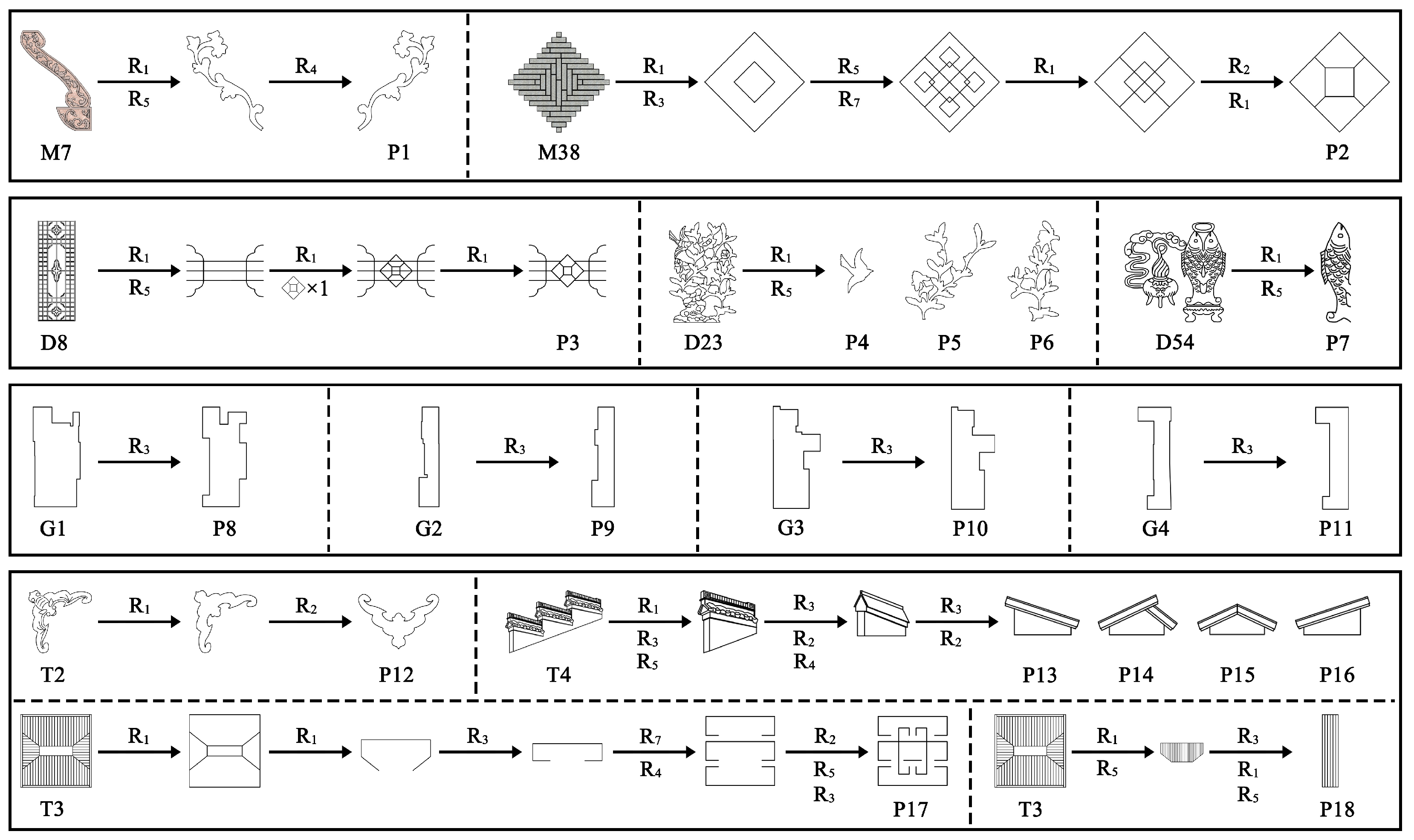
Shape grammar is a graphical design method proposed by Stiny et al. [40] in 1971. Its principle is to derive new graphics by deduction and combination of initial shapes according to specific rules, thereby generating various elements of design [41]. This method enables innovative design of shapes while retaining their original features [42]. In existing studies related to graphic design, methods such as parametric design [43], topological configuration [44], or artificial intelligence-generated design [45] are also employed. Although these methods can achieve diversified morphological changes, their rules are often embedded in algorithms or models, resulting in relatively limited controllability in the generation process, potentially producing outcomes that deviate significantly from original features, and making it difficult to precisely inherit design intentions. In comparison, shape grammar systematically evolves initial shapes through explicit transformation rules, effectively preserving core features while ensuring the continuity and controllability of cultural inheritance. For instance, Lambe et al. [46] generated new designs based on existing architectural styles using shape grammar, taking the traditional Pol houses in Ahmedabad, India, as an example. Chen [47] creatively reinterpreted and combined traditional pattern elements through the generative rules of shape grammar, forming a set of innovative designs that both preserve the essence of traditional culture and incorporate modern design aesthetics. Therefore, applying shape grammar to the design practice of the Ganxi Former Residence’s architectural memes can effectively achieve the inheritance and innovation of these architectural memes. Commonly used evolution rules include: R1 addition/deletion; R2 rotation; R3 fine-tuning; R4 mirroring; R5 scaling; R6 substitution; R7 copying; and R8 translation.

2.5. Research Framework

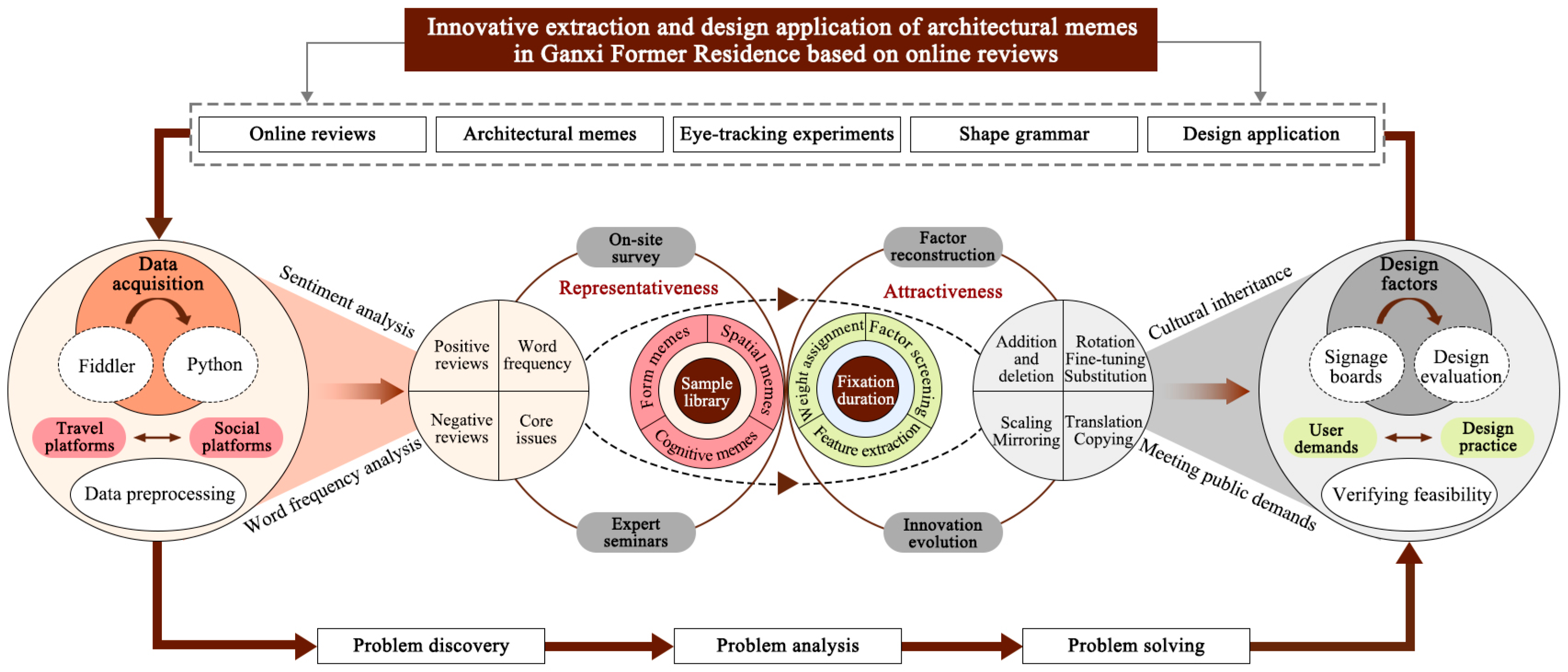
The innovative extraction and design application of architectural memes in the Ganxi Former Residence based on online reviews is developed through the following five sequential steps:
(1)
Effective online reviews related to the Ganxi Former Residence are obtained by crawling data from popular travel and social media platforms using the Fiddler 5.0 tool, and by writing Python scripts for data parsing and preprocessing.
(2)
The BERT deep learning language model is employed to classify the online reviews into two emotional categories (positive and negative), which are then imported into ROST CM6.0 software for word frequency visualization analysis to identify the main existing problems of the Ganxi Former Residence.
(3)
A sample library of architectural photos of the Ganxi Former Residence is established through on-site surveys and photography, combined with expert seminars, visitor interviews, and literature review.
(4)
Based on architectural meme theory, the types of architectural memes in the Ganxi Former Residence are analyzed, and meme maps are constructed according to the scope of the sample library. Simultaneously, eye-tracking experiments are utilized to screen architectural factors for design application.
(5)
Shape grammar is utilized to reorganize and evolve the screened architectural factors, which are then applied to the design practice. Meanwhile, the effectiveness of the design proposal is verified through design evaluation. This ensures that the design both inherits the architectural memes of the Ganxi Former Residence and meets public demands.
The specific research procedure is illustrated in Figure 1.
By synthesizing existing research frameworks on architectural meme extraction and design application, it can be found that the primary differences between the framework in this study and prior research lie in two key aspects: the method for extracting architectural memes and the approach to determining design objects. In existing studies, many scholars employ the analytic hierarchy process or its variants, combined with expert evaluation, to rank and select architectural memes by weight, and further apply the extracted results to design practice. For example, some studies use the analytic hierarchy process to extract high-weight architectural memes and transform them into new graphic forms with computer-aided design methods, directly applying them to wooden assembly product design [48]; others complete architectural meme extraction through fuzzy analytic hierarchy process, adopt design techniques such as abstraction, simplification, and combination to transform the extracted architectural memes, while identifying issues in signage systems of settlement scenic areas based on field surveys and literature, and accordingly conduct signage system design [49]; still others similarly employ the analytic hierarchy process to extract architectural genes and combine shape grammar with artificial intelligence technology to evolve and generate the screened factors, directly conducting the design of cultural and creative products [50].
Overall, the aforementioned studies vary in emphasis on research processes and technical paths, achieving positive progress in advancing the design transformation of architectural memes. However, their meme extraction processes often rely on subjective expert judgments, and the determination of design objects primarily stems from researcher experience or qualitative analysis, with relatively insufficient systematic quantitative attention to users’ authentic perceptions and demands. In contrast, this study innovates in the integration of research processes and methods. First, in terms of architectural meme extraction methods, eye-tracking experiments are innovatively introduced to quantitatively analyze the attention characteristics of different architectural elements from an objective visual behavior perspective, compensating for the limitations of traditional expert judgments at the perceptual level. Second, in determining design objects, online review analysis is used as the basis to identify the public’s emotional tendencies and key concerns from authentic user comments, providing realistic support for establishing design goals. Finally, by organically integrating online review data, architectural meme theory, eye-tracking experiments, shape grammar, and design application, a research framework oriented toward user demands, supported by objective data, and guided by rule-based design is constructed. This not only achieves precise matching between user demands and design practice but also effectively ensures the inheritance and continuity of architectural cultural features in the design process.

3. Online Review Data Analysis

3.1. Data Acquisition and Cleaning

Online review data is characterized by a large volume of information, rapid updates, and ease of collection. Common web crawling tools such as Python, HTTrack, and Octoparse can achieve efficient, large-scale, automated acquisition of relevant review data. However, considering the interface characteristics of the target platforms, this study utilized the Fiddler packet capture tool to monitor network requests on the web or mini-program interfaces related to the Ganxi Former Residence. This allowed for the capture of response data packets containing user review information and their subsequent saving as local JSON files. Subsequently, a Python script was written to parse these files, extract specific review information, and write it into an Excel spreadsheet, thereby obtaining user evaluation data. To deeply analyze users’ multi-dimensional perceptions of the Ganxi Former Residence, five popular travel platforms with high recognition in the vertical tourism sector—Dianping, Tongcheng, Ctrip, Qunar, and Mafengwo—were prioritized as the main data sources. Using “Ganxi Former Residence” as the search term, a total of 4012 user reviews were collected, spanning the period from 9 May 2008, to 13 October 2025. Concurrently, to further expand the data dimension and enrich the sample types, five mainstream social media platforms with high user activity—WeChat official accounts, Xiaohongshu, Weibo, Douyin, and Bilibili—were selected as auxiliary data sources, resulting in 470 reviews collected, spanning 10 July 2018, to 13 October 2025. After de-duplication, screening, and standardization of the total 4482 pieces of collected review data, 2845 valid reviews were finally obtained. Sentiment analysis was performed on the 2845 reviews using Python 3.8.8 combined with the BERT deep learning language model, yielding 2395 positive sentiment reviews and 450 negative sentiment reviews.

3.2. Positive Review Analysis

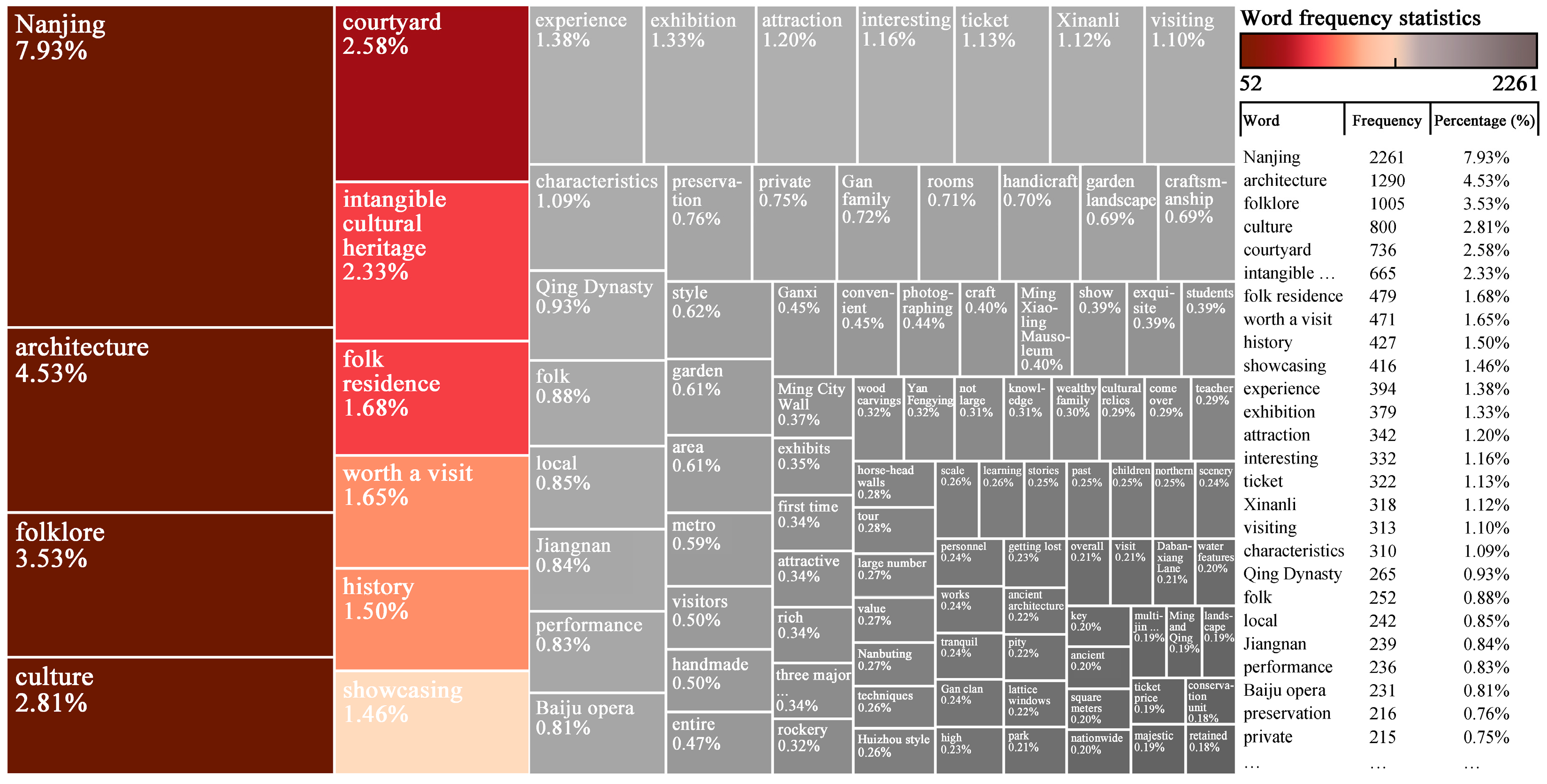
Word frequency statistical analysis was performed on the 2395 positive sentiment review data. To enhance the precision of the word frequency, the ROST CM6.0 text analysis software was first used to remove stop words from the review text and perform word segmentation. Custom vocabularies, such as “wood carvings (木雕),” “horse-head walls (马头墙),” and “ninety-nine and a half rooms (九十九间半),” were added to the software’s basic word segmentation list to form an initial word frequency count. Next, irrelevant words were deleted, and synonyms and near-synonyms were merged into a consolidation list (e.g., “courtyard,” “yard,” and “small yard” were grouped together), and a new word frequency table was recalculated. Finally, the above steps were repeated—updating custom vocabularies, segmentation, counting high-frequency words, deleting irrelevant words, and updating the consolidation list—until a scientifically reasonable statistical result was achieved [51].
The positive sentiment analysis of online reviews related to the Ganxi Former Residence shows that online users highly recognize its architectural entity, cultural connotation, and visiting value (see Figure 2). From the word frequency results, terms such as “Nanjing (7.93%),” “architecture (4.53%),” “courtyard (2.58%),” and “folk residence (1.68%)” show high frequency, reflecting the public’s widespread attention to the Ganxi Former Residence’s regional attributes, and also showing high interest in the characteristics of its architectural configuration. Meanwhile, words such as “folklore (3.53%),” “culture (2.81%),” “intangible cultural heritage (2.33%),” and “history (1.50%)” are also prominent. This indicates the important value of the Ganxi Former Residence in showcasing local folk culture and inheriting intangible cultural heritage. Furthermore, the appearance of phrases such as “worth a visit (1.65%),” “experience (1.38%),” and “interesting (1.16%)” demonstrates a high level of recognition among online users regarding the visiting value of the Ganxi Former Residence.

3.3. Negative Review Analysis

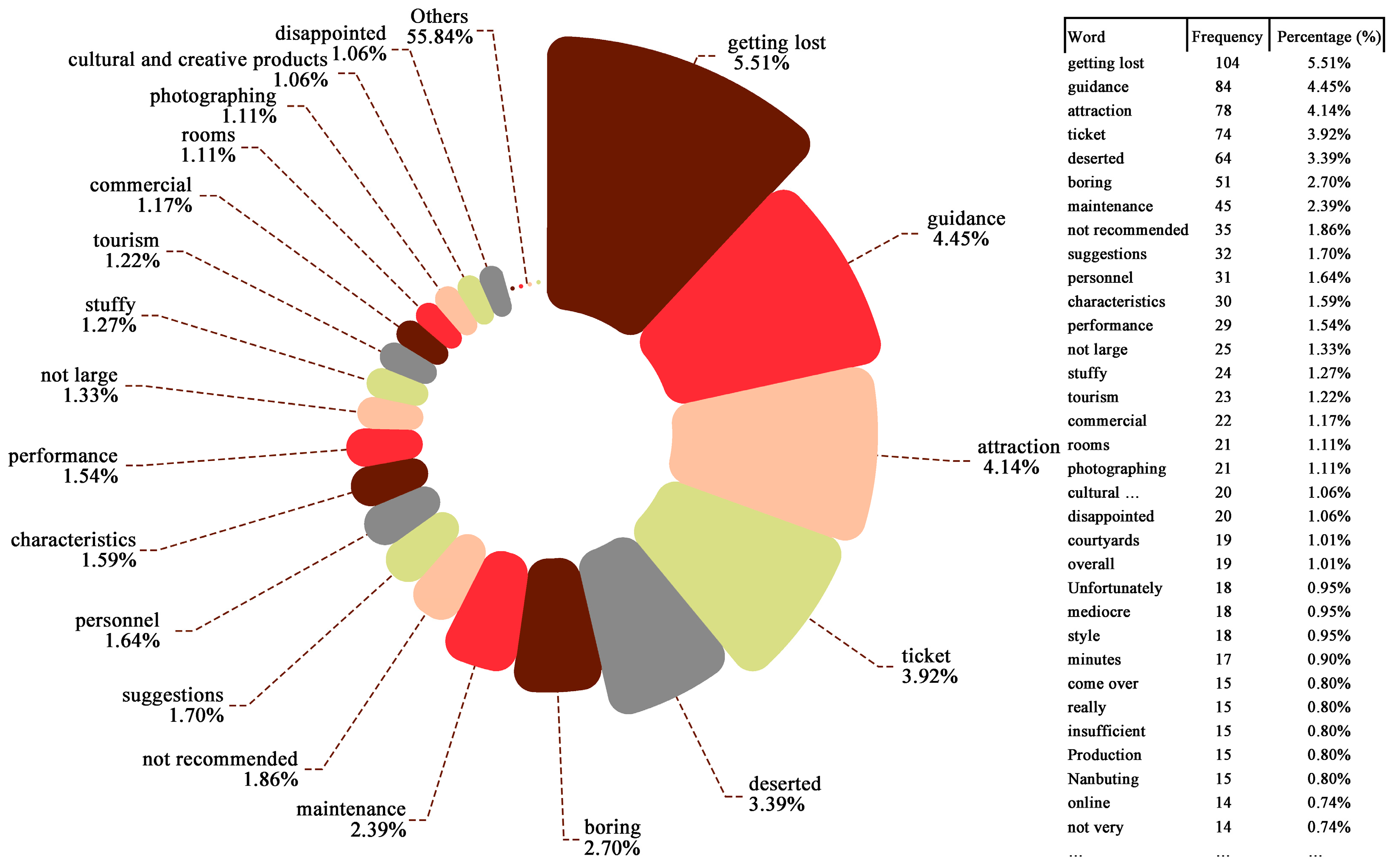
Word frequency statistical analysis of the 450 negative sentiment reviews helps to deeply identify the existing problems of the Ganxi Former Residence and the universal demands of users, providing a basis for proposing effective improvement strategies. The relevant texts also underwent steps such as word segmentation, stop word removal, and synonym consolidation. The visualization results of the word frequency statistics are shown in Figure 3. The results show that the top three words are “getting lost (5.51%),” “guidance (4.45%),” and “attraction (4.14%).” Tracing back to the original reviews reveals that “getting lost” and “guidance” correspond to descriptions such as “it’s easy to get lost even with a map” and “the guidance is not clear.” This suggests that the scenic area’s signage system is imperfect. Further analysis found that the existing signage has issues such as “not many directional arrows,” “no simple and easy-to-understand instructions,” “wayfinding guidance is disorganized,” and “not enough signboards.” It is thus evident that due to the similar layout and complex paths of the courtyards within the scenic area, the existing signage is deficient in information presentation, direction guidance, and quantity configuration, making it difficult for visitors to quickly determine their direction during the tour, thus increasing the possibility of getting lost. The term “attraction” corresponds to descriptions like “it’s considered a lesser-known attraction” and “there aren’t many people at the attraction,” suggesting a certain lack in tourism information publicity and promotion. Regarding attraction publicity and promotion, visitors commented: “publicity should be strengthened because not many people know about it,” “it’s a pity the publicity is insufficient,” and “it probably needs more promotion.” This indicates that the Ganxi Former Residence needs further enhancement in public awareness and communication efforts. With the continuous development of the Internet, mobile terminals, and intelligent technology, online dissemination and intelligent services have become important ways to enhance attraction visibility and visitor experience [52,53]. However, since the Ganxi Former Residence currently lacks independent online publicity channels and relevant information is scattered across various platforms, visitors face difficulties in efficiently obtaining information and fully understanding the residence’s characteristics and visiting value, ultimately affecting their intention to visit. Furthermore, issues such as the poor value for money of the “ticket (3.92%),” the place being too “deserted (3.39%),” lacking interactivity and being “boring (2.70%),” and inadequate architectural “maintenance (2.39%)” also received significant attention.
Based on the negative review analysis, the Ganxi Former Residence currently faces a core issue of an imperfect signage system. The positive review analysis, however, showed high public interest in the characteristics of the Ganxi Former Residence’s architectural configuration, and these buildings are important carriers of the scenic area’s cultural value. Existing studies have demonstrated that extracting architectural memes and integrating them into signage boards or other related design practices can significantly enhance the visual recognition of the scenic area’s signage system [54,55]. Building on this foundation, this study conducted in-depth interviews with some visitors to collect tangible suggestions regarding the existing problems and combined them with the opinions of experts in related fields. The decision was made to extract the architectural memes of the Ganxi Former Residence and apply them to the signage board design, placing the boards at key nodes throughout the scenic area, with the aim of systematically improving the guided tour experience.

4. Architectural Meme Map Construction

4.1. Architectural Meme Sample Library

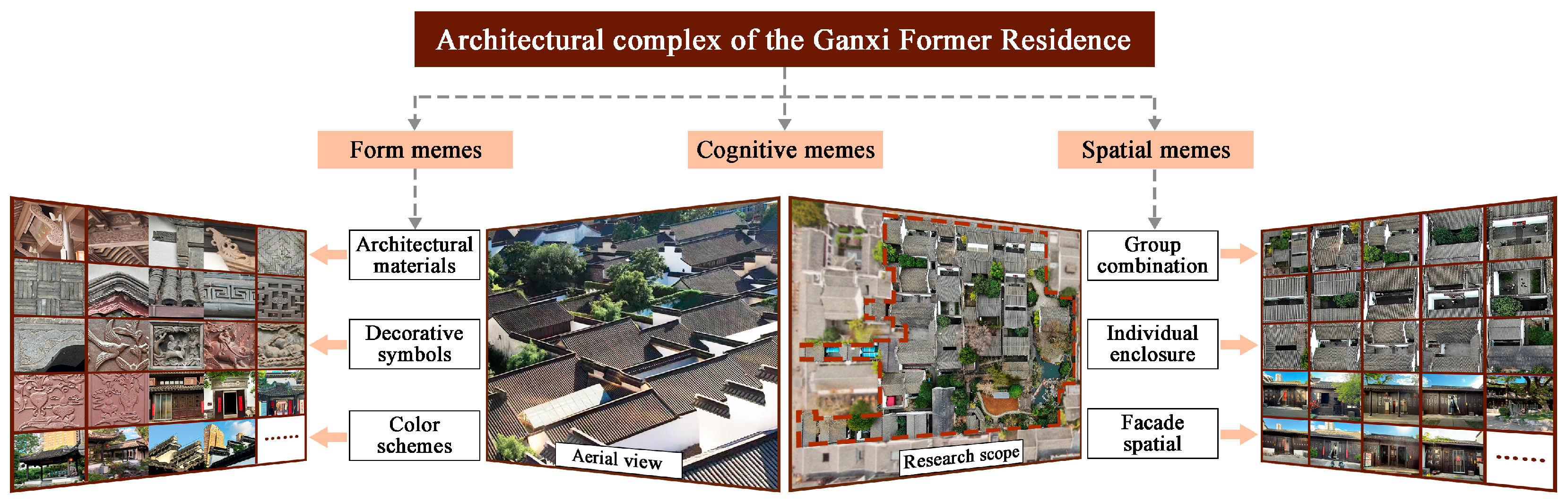
Prior to constructing the architectural meme map of the Ganxi Former Residence, it is essential to first define the composition and scope of the meme sample library. From 15 September to 15 October 2025, multiple rounds of on-site surveys and sample collection were conducted at the Ganxi Former Residence, yielding a total of 2735 original photographs and 75 video clips. These materials encompass various aspects, including the overall architectural layout, detailed components, and surrounding environment of the Ganxi Former Residence. Based on these original materials, and in conjunction with expert seminars, visitor interviews, and relevant literature, a comprehensive analysis of the architectural memes and their characteristics was conducted. The memes were ultimately classified into three main types: architectural form memes, architectural spatial memes, and architectural cognitive memes. Subsequently, the original materials underwent multiple rounds of screening, comparison, and coding. Finally, 219 image samples most representative of the Ganxi Former Residence were selected as the sample library for the architectural meme map construction (see Figure 4). This library includes 60 architectural material meme samples, 60 decorative symbol meme samples, 60 color scheme meme samples, 4 group combination spatial meme samples, 20 individual enclosure spatial meme samples, and 15 facade spatial meme samples.

4.2. Architectural Form Memes

Architectural form memes refer to the external representations of a building that can be directly perceived through the visual senses. Based on the overall architectural form characteristics of the Ganxi Former Residence, they can be further categorized into architectural material memes, decorative symbol memes, and color scheme memes.

4.2.1. Architectural Material Memes

Architectural material memes primarily comprise timber, stone, brick, and roof tiles in the Ganxi Former Residence. All structures within the complex are timber-framed, with timber serving as the principal load-bearing material. The weight of roofs and floors is mainly supported by tai-liang and chuan-dou timber frameworks to ensure overall structural stability, supplemented by cavity walls or brick-and-stone masonry to define and enclose architectural spaces. Roofs, horse-head walls, and similar elements are covered with roof tiles, which not only provide safety protection, waterproofing, and drainage but also serve decorative and aesthetic functions. These tiles exhibit diverse forms and are often adorned with textual motifs, animal patterns, and plant designs. Floor surfaces predominantly consist of brick and stone: the ground floor is generally paved with regularly arranged bluestone square tiles, whereas the second floor is composed of spliced wooden planks. The square tiles in the main hall measure approximately 40 cm × 40 cm, while those in other buildings are slightly smaller, reflecting hierarchical distinctions among different architectural spaces. Courtyards frequently feature small bluestone bricks, bluestone slabs, and stone strips. Small bluestone bricks are commonly laid in interlocking T-patterns or herringbone patterns, while certain courtyards incorporate cobblestones and tile fragments to create intricate inlaid floral designs with refined patterns and rich layering, embodying distinctive Jiangnan characteristics.

4.2.2. Decorative Symbol Memes

The decorative symbols of the Ganxi Former Residence exhibit a style that harmoniously blends northern and southern Chinese characteristics, inheriting the solemn and majestic atmosphere of northern folk residences while incorporating the refined and delicate aesthetic typical of Jiangnan dwellings. This synthesis creates a unique visual charm that is robust and restrained yet graceful and elegant. Based on their thematic content, these decorative symbols can be primarily classified into four categories: textual and geometric motifs, animal and plant motifs, human and deity figures, and apparatus and treasures, each distinguished by rich variety and profound symbolic connotations. These decorative symbols are predominantly concentrated on partition doors and windows, brick-carved door hoods, beams and purlins, floor pavements, and ceilings. For example, the central panels of partition doors feature carvings of peonies and the “Eight Immortals in disguise,” the apron panels are adorned with ruyi sceptres, the character for longevity (shou), and floral vases, while the lattice cores display diverse patterns such as ice-crack, well-shaped inlays, and angular crabapple patterns. Overall, the distribution of architectural decoration exhibits distinct characteristics: individual buildings present elaborate and intricate exterior ornamentation contrasted with relatively simple and unadorned interiors, whereas building clusters follow the principle of exterior simplicity and interior splendor, with decoration primarily manifested in the restrained shikumen and the elegant, refined brick-carved door hoods.

4.2.3. Color Scheme Memes

In terms of color scheme, the architectural complex of the Ganxi Former Residence exhibits a highly unified palette—predominantly gray, white, and brown—owing to the influence of traditional local materials and climatic conditions, resulting in an overall aesthetic that is simple yet dignified. Dark gray small tiles establish the fundamental gray tone of the roofs, whitewashed walls form the clean and unadorned primary facade, and brownish-red lacquer is applied to wooden components such as doors, windows, beams, and columns. These three colors create a clear chromatic hierarchy on the building exterior, simultaneously clarifying structural layers and achieving visual harmony and unity. The classic Jiangnan combination of white walls and dark tiles is further complemented by bluestone paving on the ground and concise horse-head walls, fully embodying the aesthetic ideal of Laozi that “simplicity is such that nothing in the world can compete with it in beauty.” At the same time, the vegetation within the gardens—flowers, grasses, and trees—introduces vibrant accents that integrate seamlessly with the dominant gray–white–brown palette and the surrounding environment, collectively generating an overall atmosphere that is elegant, tranquil, and serene.
Through the analysis of typical patterns in architectural materials, decorative symbols, and color schemes of the Ganxi Former Residence, combined with relevant sample images, a comprehensive map of architectural form memes for the Ganxi Former Residence has been constructed (see Table 1).

4.3. Architectural Spatial Memes

The spatial layout of the Ganxi Former Residence is profoundly influenced by feudal etiquette, the patriarchal clan system, and traditional Feng Shui principles. The overall architectural complex is oriented south–north (sitting north and facing south), featuring a rigorously symmetrical layout with a clear distinction between primary and secondary elements. It exhibits a central axis that rises toward the rear, with peripheral structures lower than the core. The total site area is approximately 10,000 m2, with a gross floor area of about 6000 m2. Based on the characteristics of its spatial layout, the architectural spatial memes of the Ganxi Former Residence can be classified into three categories: group combination spatial memes, individual enclosure spatial memes, and facade spatial memes.

4.3.1. Group Combination Spatial Memes

The overall architectural complex of the Ganxi Former Residence comprises three groups (Nos. 15, 17, and 19 Nanbuting) oriented south–north and one group at No. 42 Dabanxiang Lane oriented east–west. All are multi-courtyard through-hall compounds. Among them, No. 15 Nanbuting is the ancestral residence of the Gan family and is the largest, deepest, and structurally most complex of the four groups. Its main axis comprises six sequential buildings with two additional side courtyards on the west. No. 17 Nanbuting is smaller in both bay width and depth, yet its architectural carvings and ornamentation are the most exquisite and gorgeous. The main axis contains five sequential buildings with one side courtyard on the east. No. 19 Nanbuting possesses the highest architectural hierarchy and the greatest diversity of forms, with a main axis of five sequential buildings flanked by side courtyards on both the east and west. No. 42 Dabanxiang Lane, originally a Ming Dynasty residence purchased and extended by the Gan family, served as the personal dwelling of Ganxi himself. It exhibits typical Ming Dynasty architectural characteristics, comprising five sequential buildings along the main axis without side courtyards.

4.3.2. Individual Enclosure Spatial Memes

In terms of individual enclosure space, the Ganxi Former Residence is constructed using the bay as the fundamental modular unit to form individual buildings, which then combine to create courtyards, and these courtyards, in turn, form various architectural clusters. The complex currently retains over 160 bays of rooms. The three-bay configuration is the most common form, with the largest structures spanning up to six bays. These rooms collectively enclose 35 courtyards. The courtyards are sequentially linked front-to-back and interconnected laterally by waist gates which lead to the side service lanes. These side service lanes are long, narrow, longitudinal passages protected by high flanking walls. They serve dual functions as both fire corridors and the central circulation hub connecting the various rooms and courtyards. Furthermore, the rearmost building of each architectural group leads to the garden situated in the southeast corner. This garden is centered on a pond, with various landscaping elements arranged along its banks. Jindai Lou, historically Nanjing’s largest private library, is located within this garden.

4.3.3. Facade Spatial Memes

In terms of facade spatial memes, the principal facade of the Ganxi Former Residence is symmetrically arranged around the central axis defined by the main gate. These facades are predominantly single-story structures with a width of three bays. From top to bottom, the roofs are mostly gently sloping gabled roofs (ying-shan), with a minority employing hip-and-gable roofs (xie-shan), resulting in an overall appearance that is solid and dignified. On the principal facade, partition doors and windows occupy the largest proportion. The main gate typically consists of four-or six-panel partition doors positioned between the eave columns of the central bay. The outer frame of these partition doors is connected to the threshold frame, sill frame, and column tie beams, with an eave purlin above that supports transom windows decorated with various patterns of flowers, birds, and animals.
Based on field survey and measured drawings of the Ganxi Former Residence, the primary characteristics of group combination spatial memes, individual enclosure spatial memes, and facade spatial memes were extracted using AutoCAD 2023 software. These characteristics were subsequently used to construct the architectural spatial meme map of the Ganxi Former Residence, as presented in Table 2.

4.4. Architectural Cognitive Memes

The architectural cognitive memes of the Ganxi Former Residence embody both the refined literati ideals of serenity, detachment, restraint, and introspection pursued by its owners, and the secular aspirations of a merchant family for wealth and honour. Through traditional rhetorical devices such as homophony, analogy, metaphor, and symbolism, these memes seamlessly integrate architectural form with profound cultural connotations. For instance, the gourd vase motif carved on the apron panels of partition doors exploits the homophonic association between “gourd” (hulu) and “fortune and rank” (fulu), symbolising blessings, prosperity, longevity, peace, and abundant offspring. The skywell formed by the enclosure of roofs and walls represents the gathering of wealth and good fortune as well as the accumulation of auspicious qi. The ground level of each architectural group rises progressively from front to back and is complemented by stepped horse-head walls, conveying the notion of “step-by-step ascent” and expressing the family’s aspiration for continuous prosperity and rising status. The distinctive architectural cognitive memes of the Ganxi Former Residence are thus constituted by these architectural elements imbued with specific ideological and cultural meanings, as presented in Table 3.

5. Architectural Meme Design Application

5.1. Extraction of Design Factors

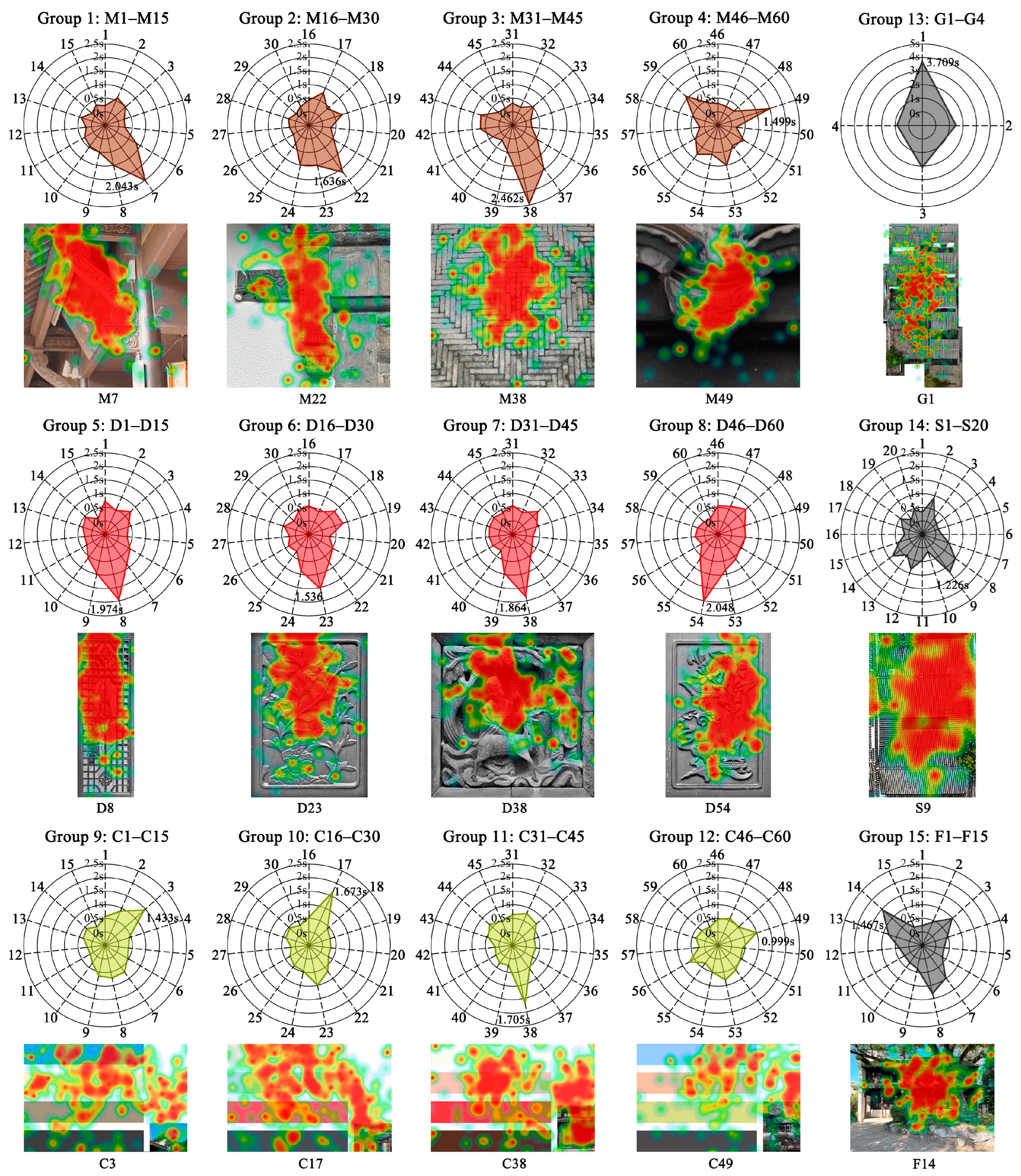
This study employed eye-tracking experiments to identify the architectural factors that attracted the highest visual attention across 15 groups of sample images representing architectural materials, decorative symbols, color schemes, group combination spatial memes, individual enclosure spatial memes, and facade spatial memes of the Ganxi Former Residence. To ensure the accuracy and reliability of the results, the following experimental protocols were implemented:
  • Equipment: An aSee Pro remote eye-tracker with a sampling rate of 250 Hz was used;
  • Samples: Images of architectural memes within each group were uniformly arranged on the same page with identical dimensions. To eliminate potential color bias, all decorative symbol images were desaturated. To prevent primacy effects, images within each group were presented in random order, with a fixed presentation duration of 15 s per group. A 2 s neutral gray screen was inserted between groups to prevent visual carry-over effects;
  • Participants: Fifty participants were recruited, comprising 10 domain experts, 20 undergraduate students, and 20 graduate students, with a balanced gender ratio of 1:1. All participants had naked or corrected visual acuity of 1.0 or better and exhibited no color vision deficiencies.
Prior to the experiment, participants watched an approximately 2 min video introducing the architectural features of the Ganxi Former Residence and were fully briefed by the experimenter on the study objectives, precautions, and operational procedures. The experiment was conducted in a quiet, evenly illuminated room. Formal testing commenced only after each participant had successfully completed individual eye-tracker calibration.
Upon completion, 50 datasets were collected using aSeeStudio 1.0.701 software. After excluding recordings with tracking ratios below 80% [56], 48 valid datasets were retained, yielding an effective rate of 96%. Each image was segmented into independent areas of interest (AOIs), and total fixation duration was calculated for each AOI. This metric reflects participants’ level of interest and the visual salience of the corresponding region [57]. Within each group, images were ranked by total fixation duration in descending order; the highest-ranked image in each category was selected as the representative design factor, and its characteristic features were extracted (see Table 1, Table 2 and Table 3).
Based on total fixation duration rankings, the highest-performing factors were M7, M22, M38, and M49 from architectural materials, D8, D23, D38, and D54 from decorative symbols, C3, C17, C38, and C49 from color schemes, the G1 from group combination spatial memes, the S9 from individual enclosure spatial memes, and the F14 from facade spatial memes. These factors demonstrated the strongest representativeness and visual attractiveness within their respective categories. Their incorporation into design practice can effectively trigger shared cognitive and emotional memories of the Ganxi Former Residence across diverse user groups (Figure 5).

5.2. Evolution of Design Factors

To enhance the innovative quality of the design, shape grammar was applied to evolve the architectural factors extracted from the Ganxi Former Residence. This method ensures that the final design products not only inherit the distinctive cultural and architectural characteristics of the Ganxi Former Residence but also resolve its existing deficiencies while satisfying contemporary aesthetic preferences in a novel manner.
The selection of initial shapes was guided by the weighting data derived from total fixation duration in the eye-tracking experiment, while simultaneously accounting for the functional requirements and cultural expression demands of the design object. The selected design factors are as follows:
  • Architectural form memes: M7, M38, D8, D23, and D54;
  • Architectural spatial memes: G1 as the primary element, supplemented by G2, G3, and G4 to enrich morphological hierarchy and spatial structure;
  • Architectural cognitive memes: T2, T3, and T4 to deepen the ideological core, thereby achieving cultural resonance beyond mere visual attraction.
These selected factors were subsequently used as initial shapes for shape grammar operations. The detailed evolution process is illustrated in Figure 6.

5.3. Application of Design Factors

Based on the key issues identified through online review analysis—such as “it’s easy to get lost even with a map,” and “the guidance is not clear”—this study proposes a solution that extracts architectural memes from the Ganxi Former Residence and applies them to the design of signage boards.
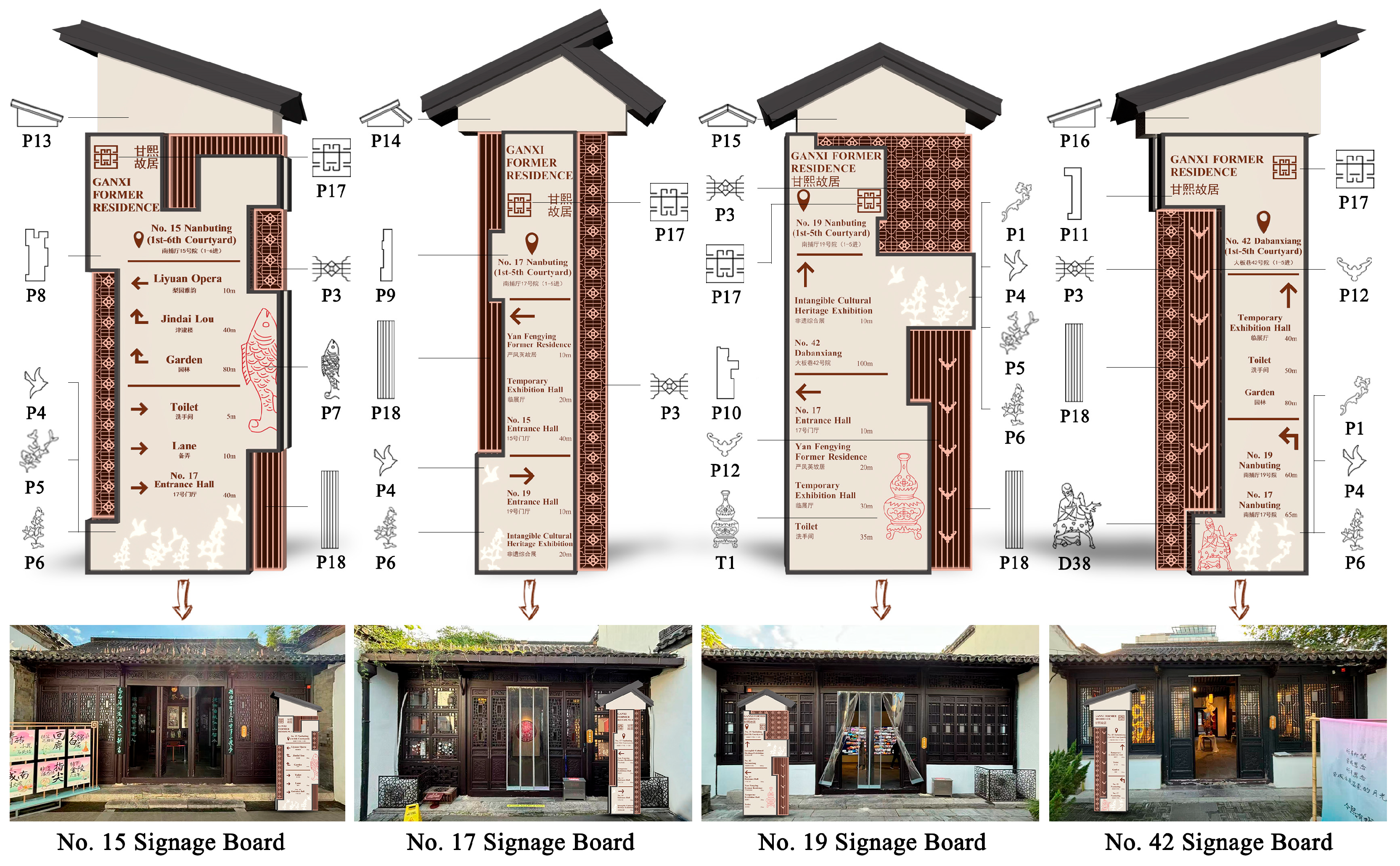
The signage board design comprehensively considers multiple dimensions, including form, function, cultural connotation, and color, with the aim of addressing the existing deficiencies in the current signage system, such as unclear information delivery, insufficient directional arrows, lack of intuitive indication, and an inadequate number of signboards. By exploring the feasibility of integrating architectural memes and shape grammar into signage system design practice, four sets of signage boards were developed, corresponding to No. 15 Nanbuting, No. 17 Nanbuting, No. 19 Nanbuting, and No. 42 Dabanxiang Lane, respectively. To ensure visual and stylistic consistency across the four sets, a unified design concept and methodology were adopted throughout the process. The specific design procedure is as follows:
(1)
P13, P14, P15, and P16—derived from the evolution of T4—were respectively applied to the top structural design of the four signage sets, thereby embodying the cultural implications of “step-by-step ascent” and “immediate success” conveyed by the horse-head wall.
(2)
P8, P9, P10, and P11—generated from the evolution of G1, G2, G3, and G4—were respectively incorporated into the main body structure of the four signage sets, enabling the signage to more clearly express the spatial characteristics of each building cluster, enhancing visitors’ cognition and memory of the spatial layout, and achieving a more efficient wayfinding effect.
(3)
P17, evolved from T3, was adopted as the iconic LOGO of the Ganxi Former Residence and integrated into the signage face, serving as the core visual symbol carrying architectural cultural connotations, thereby strengthening the overall identity and brand image of the Ganxi Former Residence.
(4)
P1, P4, P5, and P6—derived from the evolution of M7 and D23—were rationally combined. The resultant combined factor, along with P7 (evolved from D54), D38, and T1, was jointly incorporated into the primary panel of the signage board. Simultaneously, P3, P12, and P18—generated from the evolution of M38, D8, T2, and T3—were applied to the lattice structures on both sides of the signage, echoing the abundant traditional partition doors, windows, and other components found in the Ganxi Former Residence, thus enhancing the overall aesthetic appeal, artistic expression, and cultural continuity of the signage.
(5)
C38, the highest-weighted color scheme meme, was uniformly applied across all four signage sets. By employing high-contrast color schemes and rationally controlling the number of informational elements and arrows, the directional information becomes more intuitive and clear, enabling visitors to quickly obtain their current location as well as the orientation and distance to core scenic nodes, thereby significantly improving readability and usability efficiency.
Through the above design practice, the existing problems in the current signage system of the Ganxi Former Residence can be effectively addressed, while simultaneously inheriting and innovating its profound architectural cultural characteristics. The detailed design process and application scenarios are illustrated in Figure 7.

5.4. Evaluation of the Design Proposal

To verify whether the signage board design proposal effectively addresses the primary issues identified in the online reviews, this study conducted an evaluation of the design practice outcomes through a questionnaire survey. The questionnaire was based on a five-point Likert scale (1 = strongly disagree, 2 = disagree, 3 = neutral, 4 = agree, 5 = strongly agree) and assessed four dimensions: wayfinding clarity, aesthetic appeal, cultural fit, and overall satisfaction (see Table 4). The questionnaires were randomly distributed to visitors at the Ganxi Former Residence scenic area, with 50 copies issued and all validly recovered. Reliability and validity tests showed a Cronbach’s α coefficient of 0.918 and a KMO value of 0.906, both exceeding 0.9, indicating high internal consistency and structural validity of the questionnaire, as well as high reliability and scientific rigour of the data [58]. The evaluation results revealed a mean score of 4.16 for wayfinding clarity, demonstrating that the design performs well in information delivery and guidance efficiency, and can effectively alleviate the problem of visitors getting lost; a mean score of 4.03 for aesthetic appeal and 4.28 for cultural fit, indicating high recognition of the signage boards in terms of visual attractiveness and inheritance of architectural cultural characteristics; and an overall satisfaction mean score of 4.22, reflecting that visitors were generally satisfied with the design proposal overall and that it can effectively address the main existing problems of the Ganxi Former Residence.

6. Discussion

The innovative extraction and design application of architectural memes from the Ganxi Former Residence constitute an important pathway for the contemporary inheritance of its distinctive architectural cultural characteristics. This study establishes an interdisciplinary methodological framework for the innovative transformation of the Ganxi Former Residence as architectural cultural heritage by integrating online review data, architectural meme theory, eye-tracking experiments, shape grammar, and design application. The feasibility of this framework is validated through its implementation in signage board design, thereby providing a replicable and verifiable new methodological paradigm for research on the innovative transformation of architectural cultural heritage.
First, regarding online review analysis, previous studies have widely utilized online reviews to assess tourists’ satisfaction, emotional tendency, and perceived service quality in heritage sites and scenic areas [59,60,61,62]. These findings are generally consistent with those of the present study, indicating that user comments can genuinely reflect tourists’ experiences and expectations. However, most existing research remains at the level of evaluation and interpretation, rarely systematically translating the issues revealed in the reviews into specific design practices [63,64]. In contrast, this study expands the application boundary of online review analysis in the field of architectural heritage, employing it as a problem identification tool in design decision-making. By performing sentiment analysis and word frequency statistics on 2845 valid reviews of the Ganxi Former Residence, the study identified the inadequate signage system as a primary issue, and accordingly selected the signage board as the design carrier for architectural meme transformation. This problem-oriented approach bridges the gap between user perception analysis and design practice, highlighting the potential of online reviews in the design of architectural cultural heritage.
Second, in terms of architectural meme research, existing studies mostly discuss architectural memes as a subclass within landscape memes or spatial memes, lacking a systematic and independent classification study of the architectural meme itself, which has resulted in limitations in both the depth and breadth of related research [65,66,67,68]. For example, CAO et al. [69] regarded architectural genes as a type of landscape gene and classified them into categories such as courtyard layout, architectural structure, building materials, and architectural decoration. However, these categories only cover a portion of the architectural meme classification system established in this study. Therefore, the present study, based on the established classification system of architectural memes and the specific architectural features of the Ganxi Former Residence, categorizes its architectural memes into three major types: architectural form memes (encompassing architectural materials, decorative symbols, and color schemes), architectural spatial memes (including group combination, individual enclosure, and facade), and architectural cognitive memes. Drawing on a sample library of 219 images, a relatively comprehensive architectural meme map is constructed. The systematic classification of architectural memes facilitates the extraction of architectural factors with distinct characteristics, thereby enhancing their capacity for cultural dissemination and providing a rigorous and orderly source of factors for subsequent design applications [29].
Third, concerning the application of eye-tracking experiments, the practice of extracting high-visual-attention architectural memes through eye-tracking experiments in this study shares certain methodological similarities with the research by Wu et al. [70] and Li et al. [71] in screening high-attention samples from traditional decorative pattern samples. However, within the field of architectural heritage research, eye-tracking experiments have primarily been used to evaluate visual perception or cognitive characteristics of architectural value [72,73], with limited exploration of their direct application to architectural meme extraction. This study therefore innovatively introduces eye-tracking experiments into the screening process of architectural memes, using total fixation duration as the quantitative indicator to extract the most visually attractive architectural factors from the perspective of visual cognition. The experimental results show that architectural form memes M7, M22, M38, M49, D8, D23, D38, D54, C3, C17, C38, and C49, as well as architectural spatial memes G1, S9, and F14, all exhibit high visual attractiveness. Applying these factors to signage boards can effectively evoke a sense of cultural identity with the Ganxi Former Residence among diverse visitor groups [74].
Finally, this study adopts shape grammar as the method for the innovative evolution of architectural memes. While preserving prototypical features, new graphics P1–P18 are generated through rules R1–R8. This approach shares certain similarities with the work of Zhang et al. [54], who employed shape grammar to evolve design factors of the Meili Ancient Town in Jiangnan and applied them to signage system design. However, that study did not systematically evaluate the signage schemes generated via shape grammar to verify their design feasibility and effectiveness. In contrast, the present study conducted a questionnaire-based evaluation of the signage board design proposal, confirming that the new graphics evolved through shape grammar not only effectively inherit the architectural memes of the Ganxi Former Residence but also, through rational configuration, substantially resolve the identified issues.
Overall, this study integrates online review analysis, architectural meme theory, eye-tracking experiments, shape grammar, and design application into a unified research framework. It not only responds to actual user demands but also expands methodological pathways in architectural cultural heritage design research, thereby offering an empirical case with reference value for the field.
Despite the preliminary achievements of this study, certain limitations remain. First, users were not segmented by age, gender, or other characteristics, leaving the influence of different user types on experiential factors to be further investigated. Second, although the eye-tracking experiments achieved a high effective rate, the results remain constrained by the experimental environment, time limitations, and sample composition; thus, they require further validation through larger sample sizes and a greater number of participants.
Future research can be deepened in the following directions:
  • Extending online review analysis to segmented user types to clarify the specific experiential demands and perceptions of different visitor groups toward the Ganxi Former Residence, thereby enabling more refined service-oriented research;
  • Expanding the sample size and number of participants in eye-tracking experiments to improve the precision and reliability of the findings. Additionally, beyond eye-tracking indicators, physiological measures such as electroencephalography (EEG), electrocardiography (ECG), and electromyography (EMG) could be incorporated in future studies to examine their potential influence on the extraction of architectural memes;
  • Whereas the present application scenarios are primarily limited to signage boards, future work can be extended to broader cultural dissemination contexts, such as cultural and creative products, promotional posters, virtual exhibition halls, and other related scenarios.

7. Conclusions

This study constructs an innovative pathway that integrates online review data, architectural meme theory, eye-tracking experiments, shape grammar, and design application to address the challenges faced by the Ganxi Former Residence in cultural dissemination, tourism development, and innovative transformation.
The main research findings are as follows:
  • Online review analysis effectively identified the primary existing problems of the Ganxi Former Residence: Using web crawling tools, 4482 review comments were collected; after preprocessing, 2845 valid reviews were obtained, among which sentiment analysis identified 2395 positive reviews and 450 negative reviews. Word-frequency statistics performed on these reviews revealed that terms such as “Nanjing (7.93%),” “architecture (4.53%),” and “folklore (3.53%)” appeared with high frequency in positive reviews, whereas “getting lost (5.51%),” “guidance (4.45%),” and “attraction (4.14%)” exhibited higher frequency in negative reviews.
  • A comprehensive architectural meme map was established for the Ganxi Former Residence: The architectural memes of the Ganxi Former Residence were systematically classified into architectural form memes (encompassing architectural materials, decorative symbols, and color schemes), architectural spatial memes (including group combination, individual enclosure, and facade), and architectural cognitive memes. Based on a sample library of 219 images, detailed meme maps were constructed.
  • Eye-tracking experiments enabled objective extraction of high-visual-attention architectural factors: Using total fixation duration as the index, highly attractive architectural factors such as M7, M22, M38, M49 from architectural materials; D8, D23, D38, D54 from decorative symbols; C3, C17, C38, C49 from color schemes; G1 from group combination spatial; S9 from individual enclosure spatial; and F14 from facade spatial were quantitatively extracted.
  • Shape grammar successfully achieved innovative evolution of architectural memes: Through rules R1–R8, the extracted architectural factors were evolved into new graphics P1–P18, which were then applied to signage board design. Questionnaire evaluation (n = 50) showed mean scores of 4.16 for wayfinding clarity, 4.03 for aesthetic appeal, 4.28 for cultural fit, and 4.22 for overall satisfaction, confirming that the design proposal effectively addressed the main problems identified in the negative reviews while inheriting and innovating the architectural cultural characteristics of the Ganxi Former Residence.
These findings not only achieve precise matching between user demands and design practice but also verify the feasibility of applying architectural memes from the Ganxi Former Residence in contemporary design, thereby exploring new directions for the innovative transformation of architectural cultural heritage.
Overall, this study accomplishes the cross-media transformation of traditional architecture from its physical form to visual signage boards, thereby exploring new forms of innovative transformation for architectural cultural heritage. The research not only provides targeted solutions for the cultural inheritance and tourism service optimization of the Ganxi Former Residence but also offers a new research paradigm for the innovative transformation of other architectural cultural heritage sites.

Author Contributions

Conceptualization, Y.L. and A.Z.; methodology, Y.L.; software, Y.L.; validation, Y.L. and A.Z.; formal analysis, Y.L.; investigation, Y.L.; resources, Y.L.; data curation, Y.L.; writing—original draft preparation, Y.L.; writing—review and editing, A.Z.; visualization, Y.L.; supervision, A.Z.; project administration, A.Z.; funding acquisition, Y.L. All authors have read and agreed to the published version of the manuscript.

Funding

This research was funded by the Social Science Foundation of Jiangsu Province, grant number 24YSB008.

Institutional Review Board Statement

Ethical review and approval were waived for this study due to the use of publicly available anonymized online data and a non-invasive eye-tracking experiment with informed voluntary participants, and no harm was caused to the participants during the study.

Informed Consent Statement

Informed consent was obtained from all participants involved in the study.

Data Availability Statement

The original contributions presented in this study are included in the article. Further inquiries can be directed to the corresponding author.

Conflicts of Interest

The authors declare no conflicts of interest.

References

  1. Zhang, L.; Chen, Y.; Fang, J.; Zheng, L. Restoration Design of the Former Residences of Historical Dignitaries in Townships: Insights from Wu’s Juren Mansion in Fujian Province, China. Buildings 2025, 15, 1303. [Google Scholar] [CrossRef]
  2. Mao, Y.; Lu, H.; Xiao, Y.; Lai, Z.; Huang, L. A Parametric HBIM Approach for Preservation of Bai Ethnic Traditional Timber Dwellings in Yunnan, China. Buildings 2024, 14, 1960. [Google Scholar] [CrossRef]
  3. Zhang, Y.; Zhang, Q. A model approach for post evaluation of adaptive reuse of architectural heritage: A case study of Beijing central axis historical buildings. Herit. Sci. 2023, 11, 57. [Google Scholar]
  4. El Harrouni, R.; Benkirane, I.M.; Becue, V. Guideline for sustainable transformation of Riads and Hanoks. Discov. Cities 2025, 2, 15. [Google Scholar] [CrossRef]
  5. Amato, A.; Andreoli, M.; Rovai, M. Adaptive Reuse of a Historic Building by Introducing New Functions: A Scenario Evaluation Based on Participatory MCA Applied to a Former Carthusian Monastery in Tuscany, Italy. Sustainability 2021, 13, 2335. [Google Scholar] [CrossRef]
  6. Amro, D.K.; Sukkar, A.; Yahia, M.W.; Abukeshek, M.K. Evaluating the Cultural Sustainability of the Adaptive Reuse of Al-Nabulsi Traditional House into a Cultural Center in Irbid, Jordan. Sustainability 2023, 15, 13198. [Google Scholar] [CrossRef]
  7. Günçe, K.; Mısırlısoy, D. Assessment of Adaptive Reuse Practices through User Experiences: Traditional Houses in the Walled City of Nicosia. Sustainability 2019, 11, 540. [Google Scholar] [CrossRef]
  8. Ma, L.; Yang, Y. Historical Stories of the Ganxi Former Residence, 1st ed.; Nanjing Publishing House: Nanjing, China, 2008; pp. 1–2. ISBN 978-7-80718-340-2. [Google Scholar]
  9. Yin, C. Reinterpretation of the Book Collection Architecture of Ganxi Former Residence from the Perspective of Cultural Tourism Integration. Identif. Apprec. Cult. Relic. 2022, 22, 1–5. [Google Scholar]
  10. Zhang, Z.; Jiang, J.; Gu, X.; Yang, P. Study on the Role of Buffer Zones in Climate Regulation of Traditional Dwellings in Southern Jiangsu. Urban. Archit. 2020, 17, 89–93. [Google Scholar]
  11. Ji, H. Decorative Features and Cultural Connotations of Interior Spaces in Traditional Residences in Jiangnan—A Case Study of Ganxi’s Former Residence in Nanjing. Furnit. Inter. Des. 2025, 32, 98–103. [Google Scholar]
  12. Yu, L.; Lu, Y. Appreciating the Former Residence of Gan Xi from the Perspective of Semiotics. Furnit. Inter. Des. 2017, 11, 76–77. [Google Scholar]
  13. Jian, Z. Analysis of the Beauty of Residential Architecture and Discussion on the Protection and Utilization of Cultural Relics—A Case Study of Ganxi Former Residence. Identif. Apprec. Cult. Relic. 2024, 20, 165–168. [Google Scholar]
  14. Chun, Q.; Hua, Y.; Zhang, C.; Meng, Z. Research on Model Updating Methods of Traditional Timber Buildings in the Yangtze River Region—A Case Study of Jindai Building. J. Hunan Univ. Nat. Sci. 2019, 46, 54–63. [Google Scholar]
  15. Wang, A.; Zhang, Q.; Peng, Z.; Yang, S. A Review of Behavioral Influence and Value Application for Online Reviews. Chin. J. Manage. Sci. 2021, 29, 191–202. [Google Scholar]
  16. Ye, Q.; Law, R.; Gu, B.; Chen, W. The Influence of User-Generated Content on Traveler Behavior: An Empirical Investigation on the Effects of E-Word-of-Mouth to Hotel Online Bookings. Comput. Hum. Behav. 2011, 27, 634–639. [Google Scholar] [CrossRef]
  17. Atakul, N.; Ergonul, S. Exploring Architectural Design Factors Affecting Building Maintainability and Strategies to Overcome Current Shortcomings. J. Perform. Constr. Facil. 2022, 36, 04022053. [Google Scholar] [CrossRef]
  18. Wang, X.; Sun, X.; Wang, Z. Study on the Activation and Protection of Architectural Heritage Based on Post-Occupancy Evaluation. Urban. Archit. 2022, 19, 88–92. [Google Scholar]
  19. Wu, S.; Wu, W. Classification and Value Research on Taining Vernacular Architectural Heritage. Identif. Apprec. Cult. Relic. 2025, 18, 170–173. [Google Scholar]
  20. Tang, C.; Zhang, L.; Cai, Y.; Luo, W. The Current Status and Trend of the Research on Digital Protection of Domestic Traditional Architecture. Urban. Archit. 2025, 22, 1–4+34. [Google Scholar]
  21. Peng, W.; Gao, C.; Zhu, B.; Zhu, X.; Jing, Q. Visitor Behavioral Preferences at Cultural Heritage Museums: Evidence from Social Media Data. Buildings 2025, 15, 3756. [Google Scholar] [CrossRef]
  22. Jia, M.; Feng, J.; Chen, Y.; Zhao, C. Visual Analysis of Social Media Data on Experiences at a World Heritage Tourist Destination: Historic Centre of Macau. Buildings 2024, 14, 2188. [Google Scholar] [CrossRef]
  23. Mo, F. Design Research of Zhangjia Miao Village Guide System Based on SEM. Packag. Eng. 2024, 45, 315–324. [Google Scholar]
  24. Dawkins, R. The Selfish Gene, 1st ed.; Oxford University Press: Oxford, UK, 1976; p. 189. [Google Scholar]
  25. Salingaros, N.A. A Theory of Architecture, 1st ed.; Vajra Books: Kathmandu, Nepal, 2006; pp. 240–249. [Google Scholar]
  26. Long, B.; Yao, Q. The Exploration of Architectural Meme Based on Complexity Thinking. New Archit. 2018, 2, 89–93. [Google Scholar]
  27. Zhang, A.; Liu, W.; Lv, S. Digital Intelligence Empowered Intelligent Design Inheritance of Cai’s Ancient Residence Architectural Genetics. Packag. Eng. 2025, 46, 342–353. [Google Scholar]
  28. Cao, L.; Zeng, R.; Yu, H. Gene Identification and Style Analysis of Modern and Contemporary Industrial Heritage Buildings in Shanghai: A Case Study Based on the Third National Cultural Relics Census Results. Archit. Cult. 2025, 10, 222–225. [Google Scholar]
  29. Cai, J.; Dong, J.; Zhou, Y. The modern architecture culture of Harbin based on memes. Herit. Sci. 2024, 12, 412. [Google Scholar] [CrossRef]
  30. Kang, L. Application Misunderstanding and Prospect of Eye-Tracking Experiment in the Design Research: Review on Domestic Researches. Art. Des. 2017, 8, 122–123. [Google Scholar]
  31. Lisińska-Kuśnierz, M.; Krupa, M. Suitability of Eye Tracking in Assessing the Visual Perception of Architecture—A Case Study Concerning Selected Projects Located in Cologne. Buildings 2020, 10, 20. [Google Scholar] [CrossRef]
  32. Zhang, W.; Liang, Q.; Fang, H.; Zhang, Q. An Eye-movement Research on City Greening Landscape Appreciation. J. Psychol. Sci. 2009, 32, 801–803. [Google Scholar]
  33. Xu, J.; Wang, H. A Review of Studies on Behavioral Eye Tracking in Reading. Publ. J. 2020, 28, 52–66. [Google Scholar]
  34. Liu, L.; Wu, M.; Ma, Y.; Qu, H. A Review of Eye Tracking Researches in Landscape Architecture Field. J. Hum. Settl. West China 2021, 36, 125–133. [Google Scholar]
  35. Deng, J.; Chen, J.; Lei, Y. A Study on the Visual Perception of Cultural Value Characteristics of Traditional Southern Fujian Architecture Based on Eye Tracking. Buildings 2024, 14, 3529. [Google Scholar] [CrossRef]
  36. Khalighy, S.; Green, G.; Scheepers, C.; Whittet, C. Quantifying the qualities of aesthetics in product design using eye-tracking technology. Int. J. Ind. Ergon. 2015, 49, 31–43. [Google Scholar] [CrossRef]
  37. Jia, S.; Fu, Y.; Li, J.; Yan, X. Landscape gene evaluation and application of Pingyao Ancient City based on AHP-FCE model. Hubei Agric. Sci. 2025, 64, 137–144. [Google Scholar]
  38. Zhang, A.; Zhang, D.; Wan, L. Study on Furniture Design and Innovative Application of Jiangnan Classical Garden Culture Genes. Furnit. Inter. Des. 2023, 30, 45–51. [Google Scholar]
  39. Fan, D.; Maliki, N.Z.B.; He, C.; Bi, Y.; Yu, S. Cultural gene characterization and mapping of traditional Tibetan village landscapes in Western Sichuan, China. npj Herit. Sci. 2025, 13, 317. [Google Scholar] [CrossRef]
  40. Stiny, G.; Gips, J. Shape Grammars and the Generative Specification of Painting and Sculpture. IFIP Congr. 1971, 71, 1460–1465. [Google Scholar]
  41. Wang, Y.; Hai, Y.; Wang, Y. Innovative Design and Application of Mongolian Saddle Pattern under Shape Grammar. Wool Text. J. 2024, 52, 37–43. [Google Scholar]
  42. Wei, R.R.; Cho, T. A Study of the Influence of Shape Grammar on Architectural Form. Des. Res. 2021, 6, 426–438. [Google Scholar]
  43. Huang, J.; Wang, J. Innovative Design of Yangshao Pottery Pattern Based on Parametric Design. Packag. Eng. 2024, 45, 417–423. [Google Scholar]
  44. Hu, G.; Chen, J. Fractal Design and Application of Miao Costume Patterns Based on Topology Theory. Packag. Eng. 2025, 46, 432–441. [Google Scholar]
  45. Li, P.; Fan, W. Research on Furniture Morphological Design Based on the Perceptual Engineering of Huayao Cross-stitch Embroidery and AIGC. China For. Prod. Ind. 2025, 62, 62–72. [Google Scholar]
  46. Lambe, N.R.; Dongre, A.R. A shape grammar approach to contextual design: A case study of the Pol houses of Ahmedabad, India. Environ. Plann. B Urban Anal. City Sci. 2017, 46, 845–861. [Google Scholar] [CrossRef]
  47. Chen, J. Application of symbolic language and pattern innovation of Chaoshan peach cake mold in paper packaging design. BioResources 2025, 20, 482–499. [Google Scholar] [CrossRef]
  48. Zhang, Y.; Wang, Y.; Yu, J.; Chen, S.; Zhang, S.; Guo, J. Research on the Design of Wooden Assembled Products of Chinese Ancient Architectural Elements Based on Memes and AHP. China For. Prod. Ind. 2025, 62, 10–19. [Google Scholar]
  49. Zhu, W.; Cui, X.; Zheng, W. Innovative Design of Dong Settlement Landscape Visual System Under the Theory of Memes. Packag. Eng. 2022, 43, 231–240. [Google Scholar]
  50. Zhang, A.; Wang, S.; Zhang, D.; Ji, J. Gene Extraction and Intelligent-assisted Innovative Design of Nanjing Architecture in the Republic of China Period. Packag. Eng. 2024, 45, 302–314. [Google Scholar]
  51. Zhong, Y.; Hao, J. Furniture Purchase Intention Based on Online Reviews. Packag. Eng. 2025, 46, 262–270. [Google Scholar]
  52. Christou, P.; Hadjielias, E.; Simillidou, A.; Kvasova, O. The use of intelligent automation as a form of digital transformation in tourism: Towards a hybrid experiential offering. J. Bus. Res. 2023, 155, 113415. [Google Scholar] [CrossRef]
  53. Choi, Y.; Hickerson, B.; Lee, J.; Lee, H.; Choe, Y. Digital Tourism and Wellbeing: Conceptual Framework to Examine Technology Effects of Online Travel Media. Int. J. Environ. Res. Public Health 2022, 19, 5639. [Google Scholar] [CrossRef]
  54. Zhang, Y.; Wang, B.; Zhang, W. Research on Innovative Design of Visual Identification System in Meili Ancient Town in Jiangnan Based on AHP and Grounded Theory. Furnit. Inter. Des. 2024, 31, 44–51. [Google Scholar]
  55. Lv, W.; Chen, L. Research on Guide System Design under Rural Revitalization Strategy—A Case Study of Maierma Town. Art. Educ. Res. 2025, 4, 55–58. [Google Scholar]
  56. Sha, C.; Pan, X.; Yang, H.; Lu, Z.; Donkor, E.; Fang, F. Cognition Index Selection for Evaluating Matching Degree between Product Shapes and Image Space Based on Eye-tracking Experiment. Sci. Technol. Eng. 2019, 19, 105–111. [Google Scholar]
  57. Cao, S.; Cao, R.; Long, Y. Research on Navigation Optimization of Internet Rumor Refuting Platform from the Perspective of User Experience—Analysis Based on Eye Movement Experiments and Interviews. J. Mod. Inf. 2023, 43, 43–55. [Google Scholar]
  58. Xie, J.; Mo, J. Research on the Signage Design of Feng Menglong Village in Suzhou Based on the Integrated KANO-AHP-QFD-TRIZ Method. Furnit. Inter. Des. 2025, 32, 122–128. [Google Scholar]
  59. Chen, Y.; Chen, D.; Zhong, Z. Research on destination image perception of Fujian Tulou World Heritage Site based on online visitors’ reviews. J. Asian Archit. Build. Eng. 2025, 1–14. [Google Scholar] [CrossRef]
  60. Liu, Z.; Orr, S.A.; Kumar, P.; Grau-Bove, J. Measuring the impact of COVID-19 on heritage sites in the UK using social media data. Hum. Soc. Sci. Commun. 2023, 10, 537. [Google Scholar] [CrossRef]
  61. Wang, J.; Xia, Y.; Wu, Y. Sensing Tourist Distributions and Their Sentiment Variations Using Social Media: Evidence from 5A Scenic Areas in China. ISPRS Int. J. Geo-Inf. 2022, 11, 492. [Google Scholar] [CrossRef]
  62. Guo, H.; Liu, Z.; Jiao, Z. Research on Satisfaction Evaluation Based on Tourist Big Data. KSII Trans. Internet Inf. Syst. 2022, 16, 231–244. [Google Scholar] [CrossRef]
  63. He, W. The perception image of red tourist attractions based on search engine and data mining: A case study of Yan’an red tourist attractions. Eng. J. Wuhan Univ. 2024, 57, 1669–1676. [Google Scholar]
  64. Wang, C.; Dai, T.; Jiang, S.; Tu, M. A research on image perception and emotional evaluation of Shanghai red tourism based on network big data. Tour. Sci. 2022, 36, 138–150. [Google Scholar]
  65. Ji, J.; Li, J.; Guo, S.; Song, Y. Landscape gene characteristics and evolution of Hakka traditional villages in cultural marginal area: Example of Guangxi. J. Hum. Settl. West China 2025, 40, 181–189. [Google Scholar]
  66. Hao, F.; Huang, J. Landscape gene identification and zoning of traditional villages in Yellow River Basin. J. Arid. Land Resour. Environ. 2025, 39, 81–91. [Google Scholar]
  67. Sun, J.; Shao, L. The Impact of Gene Perception of Historic Urban Landscape on Experience Satisfaction with Historic Districts: A Case Study of the Chinese Baroque Historic District in Harbin. Chin. Landsc. Archit. 2024, 40, 84–90. [Google Scholar]
  68. Zhang, Z.; Wang, X. Research on spatial gene recognition and extraction in traditional villages of Qingmuchuan. J. Northwest Univ. Nat. Sci. Ed. 2025, 55, 420–437. [Google Scholar]
  69. Cao, K.; Liu, Y.; Cao, Y.; Wang, J.; Tian, Y. Construction and characteristic analysis of landscape gene maps of traditional villages along ancient Qin-Shu roads, Western China. Herit. Sci. 2024, 12, 37. [Google Scholar] [CrossRef]
  70. Wu, K.; Du, H. Tile Design Based on Eye Movement Experiment and Extension Semantics. Packag. Eng. 2025, 46, 295–305. [Google Scholar]
  71. Li, M.; Zhang, X.; Hao, Y.; Jia, Q.; Zhang, X.; Meng, G. Redesign of Huangmei Cross-stitch Based on Topological Semiotics and Eye-movement Experiments. Packag. Eng. 2024, 45, 213–224. [Google Scholar]
  72. Zhang, H.; Andrade, B.; Wang, X.; Aburabee, I.; Yuan, S. A study of spatial cognition in the rural heritage based on VR 3D eye-tracking experiments. Herit. Sci. 2024, 12, 141. [Google Scholar] [CrossRef]
  73. Xu, X.; Dong, R.; Li, Z.; Jiang, Y.; Genovese, P.V. Research on visual experience evaluation of fortress heritage landscape by integrating SBE–SD method and eye movement analysis. Herit. Sci. 2024, 12, 281. [Google Scholar] [CrossRef]
  74. Li, N.; Zhang, S.; Xia, L.; Wu, Y. Investigating the Visual Behavior Characteristics of Architectural Heritage Using Eye-Tracking. Buildings 2022, 12, 1058. [Google Scholar] [CrossRef]
Figure 1. Research process.
Buildings 16 00305 g001
Figure 2. Visualization of positive word frequency statistics.
Buildings 16 00305 g002
Figure 3. Visualization of negative word frequency statistics.
Buildings 16 00305 g003
Figure 4. Architectural meme sample library of the Ganxi Former Residence.
Buildings 16 00305 g004
Figure 5. Visualization of total fixation duration in the eye-tracking experiment.
Buildings 16 00305 g005
Figure 6. Process of design factor evolution.
Buildings 16 00305 g006
Figure 7. Signage boards design and application scenarios.
Buildings 16 00305 g007
Table 1. Architectural form meme map.
CodeSample TypeMeme Prototypes
(Partial)
Duration
(Range)/s
Meme
Extraction
Duration/sFactor
Features
Architectural
materials
M1–M15TimberBuildings 16 00305 i0010.162–2.043Buildings 16 00305 i0022.043Buildings 16 00305 i003
M16–M30StoneBuildings 16 00305 i0040.140–1.636Buildings 16 00305 i0051.636Buildings 16 00305 i006
M31–M45BrickBuildings 16 00305 i0070.173–2.463Buildings 16 00305 i0082.463Buildings 16 00305 i009
M46–M60TileBuildings 16 00305 i0100.174–1.499Buildings 16 00305 i0111.499Buildings 16 00305 i012
Decorative
symbols
D1–D15Textual
Geometric
Buildings 16 00305 i0130.145–1.974Buildings 16 00305 i0141.974Buildings 16 00305 i015
D16–D30Animal
Plant
Buildings 16 00305 i0160.201–1.536Buildings 16 00305 i0171.536Buildings 16 00305 i018
D31–D45Human
Deity
Buildings 16 00305 i0190.238–1.864Buildings 16 00305 i0201.864Buildings 16 00305 i021
D46–D60Apparatus
Treasures
Buildings 16 00305 i0220.152–2.048Buildings 16 00305 i0232.048Buildings 16 00305 i024
Color
schemes
C1–C15Horse-head wallBuildings 16 00305 i0250.176–1.433Buildings 16 00305 i0261.433Buildings 16 00305 i027
C16–C30RoofBuildings 16 00305 i0280.178–1.673Buildings 16 00305 i0291.673Buildings 16 00305 i030
C31–C45Door
Window
Buildings 16 00305 i0310.162–1.705Buildings 16 00305 i0321.705Buildings 16 00305 i033
C46–C60GardenBuildings 16 00305 i0340.218–0.999Buildings 16 00305 i0350.999Buildings 16 00305 i036
Table 2. Architectural spatial meme map.
CodeSample TypeMeme Prototypes
(Partial)
Meme
Extraction
Duration/sRankingFactor
Features
Group combination
spatial
G1Six-courtyard compound with double side wings
(No. 15 Nanbuting)
Buildings 16 00305 i037Buildings 16 00305 i0383.7091Buildings 16 00305 i039
G3Five-courtyard compound with double side wings
(No. 19 Nanbuting)
Buildings 16 00305 i040Buildings 16 00305 i0412.1662Buildings 16 00305 i042
G2Five-courtyard compound with a single side wing
(No. 17 Nanbuting)
Buildings 16 00305 i043Buildings 16 00305 i0441.5613Buildings 16 00305 i045
G4Five-courtyard compound without side wings
(No. 42 Dabanxiang)
Buildings 16 00305 i046Buildings 16 00305 i0470.8674Buildings 16 00305 i048
Individual enclosure
spatial
S9Fourth Courtyard/Courtyard/
Fifth Courtyard
(No. 17 Nanbuting)
Buildings 16 00305 i049Buildings 16 00305 i0501.2261Buildings 16 00305 i051
S8Third Courtyard/Courtyard/
Fourth Courtyard
(No. 17 Nanbuting)
Buildings 16 00305 i052Buildings 16 00305 i0531.0832Buildings 16 00305 i054
S2Second Courtyard/Courtyard/
Third Courtyard
(No. 15 Nanbuting)
Buildings 16 00305 i055Buildings 16 00305 i0560.9213Buildings 16 00305 i057
S14Fourth Courtyard/Courtyard/
Fifth Courtyard
(No. 19 Nanbuting)
Buildings 16 00305 i058Buildings 16 00305 i0590.8624Buildings 16 00305 i060
Facade
spatial
F14Facade of Jindai LouBuildings 16 00305 i061Buildings 16 00305 i0621.4671Buildings 16 00305 i063
F8First Courtyard facade
(No. 17 Nanbuting)
Buildings 16 00305 i064Buildings 16 00305 i0651.3112Buildings 16 00305 i066
F7Second Courtyard facade
(No. 15 Nanbuting)
Buildings 16 00305 i067Buildings 16 00305 i0680.9783Buildings 16 00305 i069
F3First Courtyard facade
(No. 19 Nanbuting)
Buildings 16 00305 i070Buildings 16 00305 i0710.9444Buildings 16 00305 i072
Table 3. Architectural cognitive meme map.
CodeMeme Prototypes
(Partial)
NameArchitectural ComponentFactor
Features
Symbolic
Meaning
T1Buildings 16 00305 i073Gourd vasePartition doorBuildings 16 00305 i074Blessings
Peace
Abundant offspring
T2Buildings 16 00305 i075BatEaves tile
Partition door
Buildings 16 00305 i076Good fortune
Longevity
Exorcism
T3Buildings 16 00305 i077SkywellRoofBuildings 16 00305 i078Gathering wealth
Accumulating auspicious qi
Receiving blessings
T4Buildings 16 00305 i079Horse-head wallGable wallBuildings 16 00305 i080Prosperity
Success
Step-by-step ascent
Table 4. Evaluation results of the signage board design proposal.
Evaluation DimensionNo.Evaluation StatementItem MeanOverall Mean
Wayfinding clarityQ1The text and symbols on the signage boards are clear and easy to read.4.244.16
Q2The information hierarchy on the signage boards is distinct, and the arrangement of text and icons is logical.4.06
Q3I can quickly find the information I need on the signage boards.4.18
Aesthetic appealQ4The overall form and graphic design of the signage boards are visually attractive.3.944.03
Q5The color combination and contrast of the signage boards are comfortable and harmonious.4.02
Q6The external design of the signage boards is exquisite and aesthetically pleasing.4.12
Cultural fitQ7The signage boards effectively inherit the architectural elements of the Ganxi Former Residence.4.544.28
Q8The design of the signage boards highly matches the architectural style of the Ganxi Former Residence.4.32
Q9The design of the signage boards is capable of evoking my cultural memory of the Ganxi Former Residence.3.98
Overall satisfactionQ10I am very satisfied with the design of these signage boards and look forward to their practical use.4.224.22
Disclaimer/Publisher’s Note: The statements, opinions and data contained in all publications are solely those of the individual author(s) and contributor(s) and not of MDPI and/or the editor(s). MDPI and/or the editor(s) disclaim responsibility for any injury to people or property resulting from any ideas, methods, instructions or products referred to in the content.