Article

Emotion-Driven Architectural Image Generation and EEG-Based Evaluation: Divergent Subjective and Physiological Responses to AI-Modified Design Elements

1
Jingjinji Spatial Intelligent Perception Collaborative Innovation Center, Hebei University of Engineering, Handan 056038, China
2
Department of Emotion Engineering, Sangmyung University, Seoul 03016, Republic of Korea
3
Department of Economics and Management, Hebei Vocational University of Technology and Engineering, Xingtai 054000, China
4
Department of Human-Centered Artificial Intelligence, Sangmyung University, Seoul 03016, Republic of Korea
*
Author to whom correspondence should be addressed.
Buildings 2026, 16(1), 36; https://doi.org/10.3390/buildings16010036
Submission received: 19 November 2025 / Revised: 15 December 2025 / Accepted: 19 December 2025 / Published: 22 December 2025
(This article belongs to the Section Architectural Design, Urban Science, and Real Estate)

Abstract

This study aims to establish a method-integrative framework for emotion-oriented architectural image generation. The framework combines Stable Diffusion with targeted LoRA (Low-Rank Adaptation), a lightweight and parameter-efficient fine-tuning approach, together with ControlNet-based structural constraints, to examine how controllable design-element manipulations influence emotional responses. The methodology follows a closed-loop “generation–evaluation” workflow, with each LoRA module independently targeting a single design element. Guided by the relaxation–arousal emotional dimension, the framework is evaluated using subjective ratings and electroencephalogram (EEG) measures. Twenty-seven participants viewed six architectural space categories, each comprising four conditions (baseline, color, material, and form modification). EEG α/β power ratio (RAB) served as the primary neurophysiological marker of arousal. Statistical analysis indicated that LoRA-based modifications of design elements produced distinct emotional responses: color and material changes induced lower arousal, whereas changes in form elicited a bidirectional pattern involving relaxation and arousal. The right parietal P4 electrode site showed the most sensitive emotional response to design element changes, with consistent statistical significance. P4 is a human scalp EEG location associated with cortical activity related to visuospatial processing. Descriptive results suggested opposite directional effects with similar intensity trends; however, linear mixed-effects model (LMM) inference did not support significant group-level linear coupling, indicating individual variation. This study demonstrates the feasibility of emotion-guided architectural image generation, showing that controlled manipulation of color, material, and form can elicit measurable emotional responses in human brain activity. The findings provide a methodological basis for future multimodal, adaptive generative systems and offer a quantitative pathway for investigating the relationship between emotional states and architectural design elements.

1. Introduction

The built environment serves not merely as a physical container but profoundly shapes human emotions and experiences. Research in environmental and architectural psychology has long demonstrated that spatial elements such as color, materiality, and form significantly influence emotional responses and modulate the quality of users’ experiences [1,2,3]. With the advancement of artificial intelligence (AI) technology, generative models have introduced novel possibilities for architectural effect research. AI-generated images allow for precise manipulation of individual design elements (e.g., color, material, or form) while preserving overall spatial composition, thereby differing from traditional approaches based on physical buildings or two-dimensional renderings. This facilitates more systematic exploration of how design elements influence emotional responses [4,5]. Therefore, this study examines how AI-generated architectural imagery enables controlled manipulation of design elements, providing a basis for evaluating their distinct contributions to emotional responses.
Nevertheless, despite methodological advances, architectural affect assessment remains predominantly reliant on self-report measures such as subjective questionnaires and semantic differential scales [6,7,8]. While these measures capture individuals’ cognitive evaluations, they do not always align with physiological affect responses [9,10]. For example, people might say they feel “excited” or “pleasurable,” but EEG metrics might show that they are relatively relaxed or not very aroused. Thus, a central objective of this study is to jointly assess subjective experience and physiological responses in order to determine whether they align or exhibit systematic dissociation.
Addressing this concern, the present study focuses on AI-generated architectural image modifications to explore consistency between subjective arousal changes and EEG physiological responses. Unlike prior research emphasizing emotional polarity (positive/negative), this study centers on the relaxation–arousal dimension to reveal the degree of alignment between subjective experience and physiological signals.

1.1. Architectural Elements and Emotional Perception

The emotional impact of architectural spaces is influenced by multiple design elements. Color can modulate an individual’s arousal level through hue and saturation [11,12], while material influences affinity and comfort through visual patterns and tactile associations [13]. Form, in turn, shapes perceptions of order and vigilance through scale and geometric boundaries [14,15] and under certain spatial conditions can also stimulate individual creativity. Recent studies show that greater visual openness, moderate complexity, and multisensory richness tend to enhance engagement and creative performance [16]. Within AI-generated architectural imagery, these creativity-supporting form characteristics can now be manipulated in a more controlled manner, allowing researchers to systematically examine how design elements influence emotion [17,18,19].
Among various physiological measurement methods, EEG offers high temporal resolution, reflecting immediate neural responses to emotional stimuli. Research indicates that the alpha/beta ratio (RAB) serves as a crucial indicator for assessing relaxation and arousal: increased alpha power or a higher alpha/beta ratio typically signifies relaxation and reduced attentional resources, whereas heightened beta power or a decreased alpha/beta ratio indicates heightened arousal or cognitive tension [20,21,22]. Consequently, this study employs RAB as the core physiological metric to quantify relaxation–arousal shifts elicited by AI-generated architectural image stimuli.

1.2. Emotion-Driven SD Spatial Generation Workflow

Recent years have witnessed rapid advancements in Generative Artificial Intelligence (GAI), providing controlled and efficient novel methodologies for architectural effect research. Compared to traditional rendering or real-world photography, generative models (such as Stable Diffusion and Midjourney) can precisely manipulate individual architectural elements—such as color, material, or form—while maintaining overall compositional and semantic coherence. This facilitates a more systematic examination of how elemental variations affect emotional responses.
Existing research has validated the affective validity of AI-generated architectural imagery: Zhang et al. (2024) found AI-generated images elicited emotional responses comparable to real architectural photographs; Ji et al. (2025) further employed EEG to establish an “emotion-perceiving architectural model [23,24], revealing AI images could induce distinct neural changes between relaxed and aroused states. These findings indicate that generative AI functions as a design tool. At the same time, it serves as a controllable experimental medium for architectural affect research.
In design practice, generative AI is increasingly employed for emotion-driven architectural image generation. Researchers utilize fine-tuning methods such as LoRA, together with structural control mechanisms like ControlNet, to instruct models to generate architectural imagery aligned with specific emotional objectives (e.g., “relaxing space,” “stimulating lobby”) [25,26]. This process establishes a closed-loop workflow involving emotional description, image generation, and subjective validation. From an architectural perspective, LoRA can be understood as a design-element-specific control layer that enables targeted modification of visual attributes without substantially altering overall spatial composition. This approach embodies the core tenets of Emotion-Driven Design: initiating design from emotional objectives and leveraging generative models to quantify and provide feedback on affective characteristics. However, most research remains confined to subjective evaluation, lacking synchronous validation of physiological emotional responses. In this paradigm, emotional intention functions as the primary design input. Generative AI serves as an intermediary that translates abstract affective goals into controllable architectural representations.

1.3. Theoretical Foundations for Emotion-Adaptive Architectural Design

Emotional experience is increasingly recognized as a fundamental dimension of spatial quality. Studies in neuroarchitecture and environmental psychology show that built environments influence occupants through processes of emotional appraisal and affect regulation, alongside traditional functional and aesthetic factors [10,27]. This evidence supports the broader shift toward human-centered and experience-oriented design, in which eliciting appropriate emotional responses is viewed as an integral architectural objective.
Parallel research on sustainable and healthy buildings highlights that high-quality environments must support both environmental performance and psychological well-being. Green and nature-responsive design strategies are associated higher emotional stability and greater subjective comfort [28,29]. Institutional frameworks, including environmental rights and the right to adequate housing, likewise affirm healthy, safe, and emotionally supportive environments as essential to human well-being [30,31]. Together, these perspectives position emotional well-being as a legitimate criterion for evaluating contemporary built environments and form the theoretical basis for emotion-adaptive architectural design.

1.4. Research on Subjective–Physiological Consistency

In architectural and environmental impact research, discrepancies between subjective reports and physiological responses are frequently observed. Studies on virtual reality transitional spaces show that physiological recovery (heart rate, blood pressure) can occur prior to noticeable changes in subjective anxiety [32]. Virtual reality experiments involving indoor natural environments similarly report reductions in EEG-based cognitive load without corresponding differences in comfort ratings [33]. Comparable mismatches have been documented in immersive color, soundscape, and fractal-stimulus studies, where elevated self-reported arousal contrasts with physiological indices that point toward relaxation [34,35,36,37]. Taken together, these findings illustrate a recurring phenomenon in which cognitive evaluations and autonomic responses become partially decoupled.
Three theoretical perspectives help clarify why such dissociation emerges. The dual-process model of emotion distinguishes between a rapid, automatic pathway that drives immediate physiological responses [38] and a slower, deliberative pathway that underpins subjective appraisal [39,40]. Because these systems operate on different temporal scales and respond to distinct categories of information, alignment between perceived arousal and bodily reactions cannot always be assumed. Cognitive load theory provides an additional explanation. Architectural scenes with high levels of unstructured or visually cluttered complexity can substantially increase cognitive load and attentional demand, thereby limiting the resources available for processing affective cues. By contrast, complexity that is appropriately organized may exert the opposite effect [41]. Under such conditions, physiological reactivity may be dampened or delayed, even as subjective reports reflect heightened stimulation or interest [42]. Studies of architectural complexity likewise show that preference ratings and EEG/HRV patterns frequently diverge [43]. A further account is offered by spatial perception mechanisms, which suggest that physiological systems respond primarily to affordances, enclosure, boundary definition, and perceived environmental controllability [44,45]. Specifically, clear and well-defined spatial cues are generally associated with reduced uncertainty and more stable physiological responses, whereas ambiguous cues may increase physiological activation. By contrast, subjective impressions draw more on cultural knowledge, aesthetic frameworks, and symbolic interpretation [46]. In AI-generated imagery—where geometry is stabilized and boundary cues are highly controlled—physiological arousal triggers may be reduced even when subjective perceptions of intensity or novelty increase.
To address gaps in existing research concerning “design element manipulation—spatial typology differences—subjective/physiological consistency”, this study employs generative AI technology to systematically manipulate three core design elements. It compares pre- and post-manipulation patterns of subjective and physiological arousal across six typical interior spaces, thereby elucidating the mechanisms underpinning the formation of subjective–physiological consistency (or inconsistency) in architectural affective responses.
We propose the following specific hypotheses:
Hypothesis 1.
Alterations to various design elements in AI-generated architectural images will produce significant variations in EEG patterns, with this effect differing among spatial types.
Hypothesis 2.
Under varying spatial and modification conditions, EEG relaxation-arousal responses will exhibit significant activity in specific brain regions.
Hypothesis 3.
Subjective arousal ratings and physiological RAB indicators will show an overall trend of directional inconsistency along the relaxation-arousal dimension.
From a systematic perspective, this study comprises five sections, progressively unfolding the theoretical foundation, methodological framework, empirical findings, and final conclusions. The introduction outlines the background and significance of emotion-driven architectural imagery research, situating this study within the broader framework of architecture-AI convergence while proposing theoretical underpinnings and research hypotheses. The Materials and Methods section establish the scientific foundation for the entire paper, detailing the emotion-guided image generation workflow, the selection and validation of experimental stimuli, and methodologies for collecting and analyzing subjective measurements alongside electroencephalographic (EEG) indicators. The Results section presents the study’s principal empirical findings, including subjective emotional evaluations, variations in RAB across different spatial types, and manifestations of subjective-physiological arousal consistency and dissociation. The Discussion section relates the findings to existing theories and research hypotheses, proposing design implications and future research directions. The Conclusion section synthesizes the study’s overall outcomes, clarifying its theoretical contributions and practical value.

2. Materials and Methods

This study adheres to a systematic methodological framework integrating analysis, comparison, induction, deduction, and synthesis. Analytical and comparative procedures were employed to deconstruct architectural imagery into key design elements and examine differences in subjective and physiological responses across distinct spatial typologies. Inductive reasoning identifies patterns in relaxation-arousal dynamics, whilst deductive reasoning situates these findings within existing theoretical frameworks of affective processing, cognitive load, and spatial perception. Finally, synthesis integrates evidence from subjective evaluations, physiological indicators, and image features to support proposed hypotheses and construct an affect-driven architectural image generation framework [28].

2.1. Generation Workflow and Experimental Image Selection

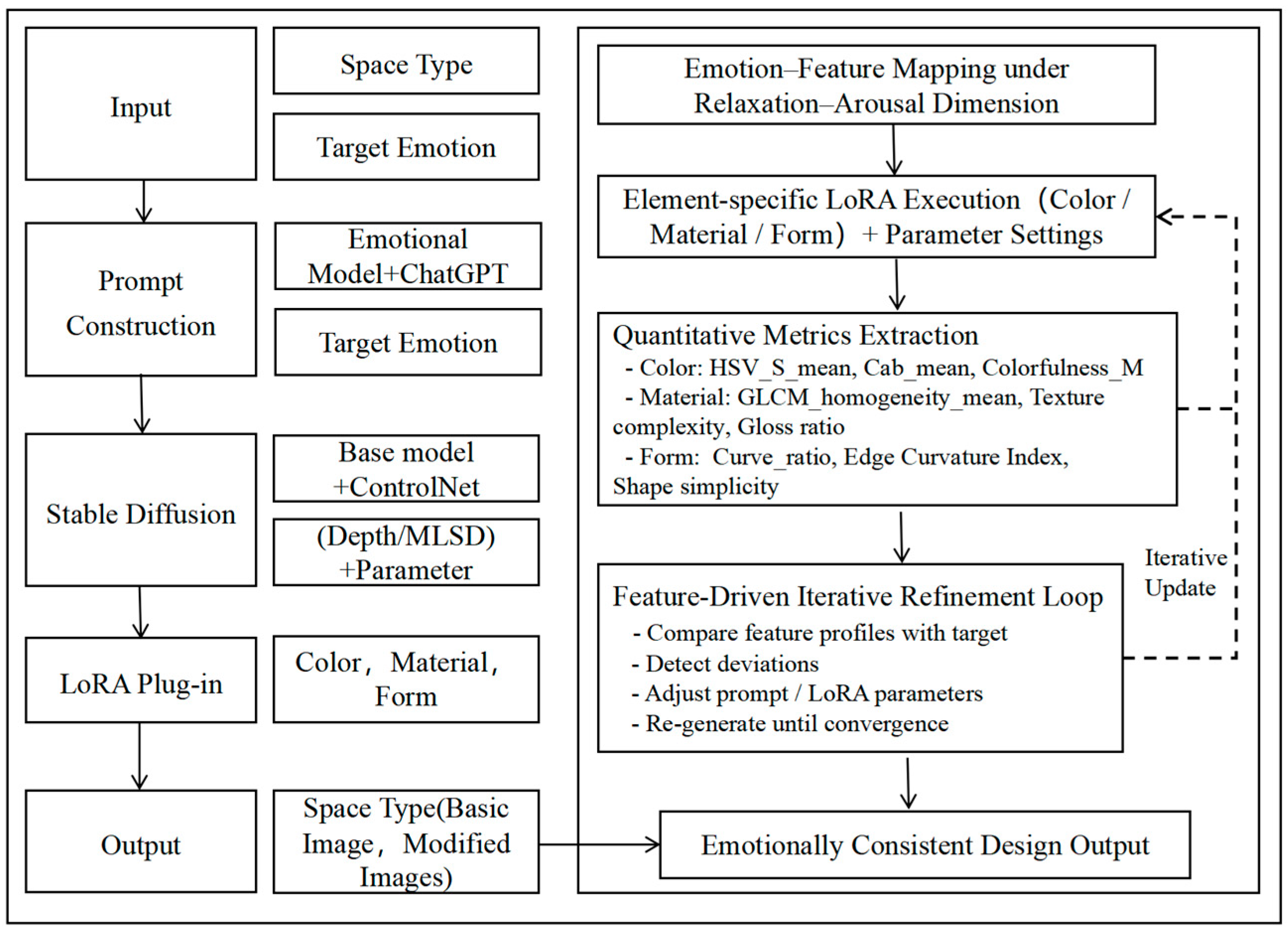
This study constructed an emotion-driven architectural image generation system based on a two-dimensional “Relaxation–Arousal” emotional framework, with the overall workflow depicted in Figure 1. The system integrates generative AI with controlled design-variable manipulation to support affective evaluation in architectural research. The primary generation engine is the Stable Diffusion model (v1.5), augmented by LoRA-based fine-tuning and ControlNet-based geometric constraints.
This configuration enables the generation of emotionally controllable architectural images while preserving spatial structure and semantic consistency [47,48]. The procedures described here represent a methodological integration. Emotional objectives are operationalized into concrete design-element manipulations, enabling Stable Diffusion to generate controlled architectural stimuli. This integrated workflow links generative AI with design-variable control and subjective–physiological validation, ensuring the reliability of the experimental stimuli.

2.1.1. Corpus Construction and Keyword Expansion

At the semantic level, this study combined large language models (ChatGPT 4.0 and DeepSeek) with TF–IDF keyword extraction techniques to mine high-frequency emotion co-occurrence terms from architectural design text corpora (ArchDaily, Dezeen, gooood), thereby constructing an emotion–design semantic lexicon. Based on the “relaxation–arousal” emotional dimension, two keyword sets were formed: the relaxation category (Relaxation) includes relaxing, cozy, serene, wooden, and warm light; the arousal category (Arousal) includes dynamic, bright, open, vivid, and angular [49].
Building upon this foundation, structured prompt templates were developed, such as “a relaxing wooden lounge with soft ambient lighting” and “a dynamic exhibition hall with vivid angular structures.” These templated prompts ensure generated images accurately correspond to target emotional orientations at the semantic level.

2.1.2. Emotion-Oriented Generation and LoRA Fine-Tuning Mechanism

To isolate the individual effects of different design elements on emotional perception, this study loaded three independent LoRA modules onto the Stable Diffusion base model and independently generated modified outputs: Color LoRA (color-oriented), Material LoRA (material-oriented), and Form LoRA (form-oriented). Each module was designed to bias the generative process toward a specific visual attribute, enabling element-level control without retraining the entire model. For fine-tuning, approximately 60–80 architectural images were used for each module, sourced from publicly available architectural media platforms such as ArchDaily, Dezeen, and Gooood. All images were restricted to non-commercial academic use and manually screened to ensure clear representation of the target design element.
During image generation, only one LoRA module was activated at a time, while all other generation parameters (e.g., sampling steps, classifier-free guidance scale, resolution, and random seed) were held constant. This controlled setting ensured comparability across different design-element conditions and minimized confounding influences from non-target variables. To prevent unintended semantic or spatial deviations during generation, ControlNet (Depth/MLSD) was employed to lock spatial proportions and structural skeletons, confining modifications to color, material, or form dimensions [50].
Following image generation, subjective expert validation was primarily used to conduct consistency checks on the three modification types. This process verified that each set of generated images accurately reflected the intended design manipulation and aligned with the corresponding emotional hypothesis. This verification reinforced the architectural validity and control efficacy of the experimental stimuli.

2.1.3. Experimental Stimulus Selection and Design-Element Manipulations

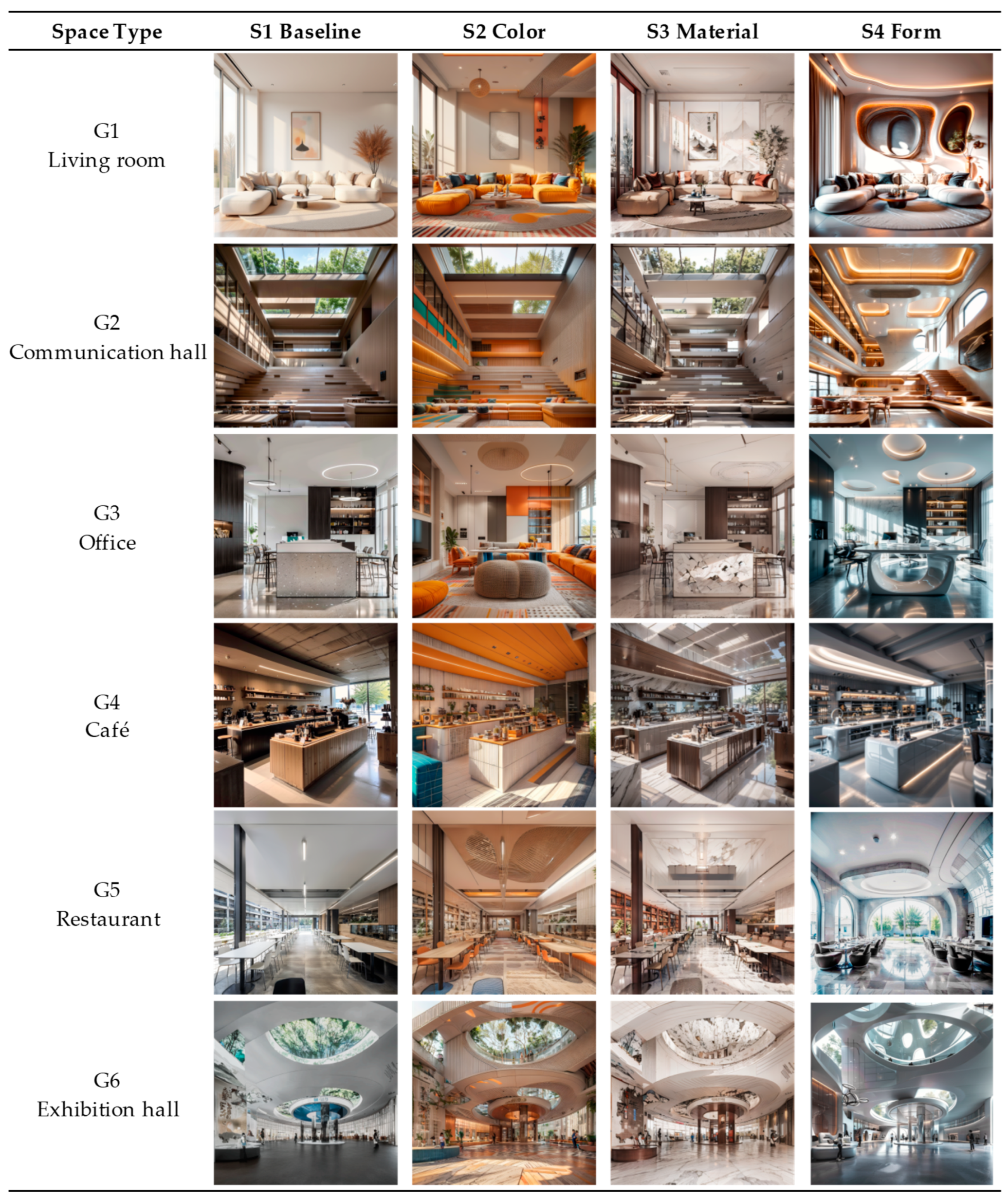
Ultimately, six representative indoor space types were generated: living room (G1), communication hall (G2), office (G3), café (G4), restaurant (G5), and exhibition hall (G6). The experimental stimuli are shown in Figure 2. For each space type, four experimental conditions were prepared. These included a baseline image (S1), color modification (S2), material modification (S3), and form modification (S4). Specifically, S2 involved adjusting global and local hue, saturation, and warmth while preserving the original spatial layout. S3 focused on updating surface material appearance and texture richness—such as walls, ceilings, and furniture finishes—under consistent geometry. S4 introduced geometric and curvilinear form alterations, as well as ceiling–boundary morphological changes, while maintaining the same functional typology.
These element-specific modifications were designed as controlled design interventions to examine how architectural elements within the same spatial function modulate arousal levels along the relaxation–arousal dimension, while minimizing functional and semantic confounds.
To ensure accurate emotional expression and spatial semantic consistency, three experts from architecture and environmental psychology independently assessed all generated images for emotional expression and spatial semantic coherence, reaching consensus through discussion. Images exhibiting semantic deviation or ambiguous emotional content were excluded, with the final 24 retained images constituting the dataset.

2.1.4. Quantitative Validation of Design-Element Manipulations

Following expert validation of image semantic consistency, this study further employed computer vision feature extraction methods to quantitatively verify the effects of manipulating three design elements: color, material, and form. By comparing differences in key visual features between baseline images (S1) and their corresponding manipulated versions (S2–S4), we assessed whether these three manipulations produced directional and measurable changes at the image level.
Results indicate that color manipulation significantly increased image saturation (HSV_S_mean; Δ = 0.219, p < 0.001), while texture manipulation markedly reduced surface homogeneity (GLCM_homogeneity_mean; Δ = −0.043, p = 0.029), reflecting richer textural structures. Form manipulation significantly increased the proportion of curved contours (Curve_ratio; Δ = 0.133, p = 0.010), validating the anticipated shift in geometric morphology from linear to curved structures. These alterations align with visual expectations for corresponding design elements, indicating that all three manipulations produced directional and measurable effects. These characteristic metrics effectively demonstrate that color, material, and form manipulations each produced clear and controllable alterations at the image level, providing reliable support for subsequent interpretation and analysis of EEG and subjective evaluation results (Table 1).
Concurrently, this quantitative validation underpins the methodological chain of “analysis–comparison–induction”: by rendering design elements measurable, it establishes an interpretable and reproducible research foundation for subsequent hypothesis testing.

2.2. Experimental Participants

To ensure the scientific rigor of the experimental procedure and the reliability of data collection, a total of 28 student volunteers were recruited (16 males, 12 females; mean age = 23 ± 5 years). All participants possessed normal vision or corrected vision (≥0.6) and reported no history of neurological, cardiovascular, or visual system disorders. Prior to EEG recording, all subjects underwent scalp cleansing to reduce electrode impedance and enhance signal quality. All participants signed written informed consent forms before the experiment, which was approved by the Ethics Review Committee of Hebei University of Engineering.
Sample size was estimated using an a priori statistical power analysis implemented in G*Power 3.1 [51], which is a commonly adopted approach for experimental planning to ensure that the sample size is adequate for the intended statistical analysis. Under a single-factor repeated-measures within-subject design, assuming a medium effect size (Cohen’s d = 0.4), a significance level of α = 0.05, and a statistical power of 1–β = 0.80, the minimum required sample size was N = 24. Ultimately, one participant with noncompliant data was excluded, resulting in 27 participants meeting the statistical power requirement.

2.3. Experimental Methodology

The experiment was conducted over 13 days in January and February 2025 at the Cognitive Data Laboratory of the International Research Centre for Architecture and Emotion, Hebei University of Engineering. The laboratory environment maintained constant conditions: illuminance fixed at 500 ± 30 lx (measured at the participant’s eye position, with no significant glare within the visual field), room temperature 22 ± 1 °C, and relative humidity 50 ± 5%, to ensure physiological comfort and minimize external interference [52].
The experimental procedure comprised four phases (Figure 3):
(1)
EEG preparation and baseline acquisition: Following informed consent, EEG electrodes were fitted and a resting-state baseline (60 s) recorded.
(2)
Stimulus presentation and recording: Twenty-four architectural images were sequentially presented, each for 20 s, with synchronous EEG recording. Stimulus duration was set at 20 s. This study adopted a common practice in environmental psychology and physiological signal research, employing relatively extended presentation durations (15–20 s) in EEG experiments to ensure subjects attained stable emotional states and generated measurable physiological responses [53].
(3)
Subjective scoring and transition intervals: Following each stimulus, participants completed a relaxation–arousal rating (40 s), after which a grey-background crosshair fixation point (10 s) was presented to mitigate interference from consecutive stimuli.
(4)
Experiment conclusion: Electrodes were removed and data saved upon task completion.
Under controlled conditions and standardized procedures, all participants received identical stimuli, minimizing interference from individual and environmental variations to ensure data reliability and comparability.
Figure 3. Experimental flowchart. Source: own processing. Source: own processing.
Buildings 16 00036 g003

2.3.1. Subjective Emotional Assessment

Drawing upon the two-dimensional effect model (valence–arousal; Russell, 1980 [6]), this study employed a bipolar semantic differential 7-point scale to assess relaxation and arousal dimensions. To enhance discriminative power and directional interpretability, the scale utilized a symmetrical interval ranging from −3 to +3 (with 0 denoting neutrality), anchored by labels “−3 = extremely relaxed” and “+3 = extremely aroused”. Compared to conventional 1–7 scoring, −3 to +3 provides more intuitive directional information (positive/negative) and effect size interpretation (values near 0 indicate neutrality) in statistical and graphical representations. It also aligns directly with the directionality of physiological indicators. Scale scores were treated as approximate interval data for statistical analysis; this approach has methodological justification in semantic differential/Likert-type scales [54,55]. To ensure consistent comprehension, examples and anchor explanations were provided before scoring, whilst stimulus order was randomized and response time windows restricted during experiments. Where necessary, confidence or attentional assessment items were employed to enhance scale quality. For cross-indicator comparability, subjective scores and physiological metrics underwent z-standardization during analysis.

2.3.2. Physiological Indicator Assessment

This study employed the TMSi Saga 64-channel EEG integrated system (TMSi, Oldenzaal, The Netherlands) with a sampling rate of 1024 Hz. Selected electrodes covered major brain regions, including the occipital lobe (O1, O2), frontal lobe (FP1, FP2, F7, F3, F4, F8, FC1, FC2, FC5, and FC6), temporal lobe (T7, T8, TP7, and TP8), parietal lobe (P3, P4, P7, P8, PO3, and PO4), and central lobe (C3, C4, CP1, CP2, CP5, and CP6). Data were segmented into fixed 20 s windows and strictly aligned with stimulus presentation times. The study focused on electroencephalogram (EEG) signals, extracting the relaxation–arousal core metric, the α/β ratio.
EEG signal processing and feature extraction followed standardized procedures. First, raw data underwent preprocessing, including filtering, ICA artifact removal, re-referencing, and feature extraction to ensure signal quality.
This study primarily investigated relaxation and arousal states; thus, the ratio of alpha (8–12 Hz) to beta (12–30 Hz) power was computed using Equation (1). The alpha-to-beta power ratio (RAB) was selected as the primary neurophysiological indicator. Although relatively simplified, RAB has been extensively validated as a reliable neurophysiological marker closely associated with relaxation–arousal states, rendering it an appropriate choice for this study’s exploration of fundamental consistency between subjective and physiological responses [56,57,58]. Subsequent research may expand upon this groundwork by integrating more intricate neurodynamic indicators, such as source localization or inter-regional functional connectivity analysis, to further substantiate the core findings of this study.
This is calculation Formula (1):
RAB   ( α / β   r a t i o ) =   ( P o w e r α )   /   ( P o w e r β )

2.4. Data Analysis Methods

Following the analytical-comparative-deductive approach proposed in this study, we first calculated the RAB significance channels for the three design elements before and after modification. Subsequently, under the conditions of color (S2–S1), material (S3–S1), and form (S4–S1), the RAB of the representative channel (P4) was extracted for further consistency analysis.
To examine the consistency between subjective arousal scores (ΔSEva) and EEG relaxation indicators (ΔRAB), a multilevel linear model (LMM) was employed [59]. This model accounts for both between-subjects variation and within-subjects repeated-measures structure to estimate the linear coupling strength between subjective ratings and physiological metrics. To eliminate individual variation and highlight within-subject covariate relationships, all variables underwent centering around the individual mean.
Subsequently, with ΔRAB as the dependent variable and ΔSEva as the primary independent variable, the model included Scene and Group as candidate fixed effects, with subjects as random effects for grouping. It incorporated random intercepts and slopes to characterize inter-individual coupling strength differences. Model selection employed information criteria and likelihood ratio tests: building upon a baseline model (M0) containing only ΔSEva, we successively added Scene (M1), Group (M2), and both simultaneously (M3), comparing AIC/BIC and LRT under maximum likelihood fitting. When added factors failed to improve model fit (i.e., positive ΔAIC/ΔBIC and a non-significant likelihood ratio test [LRT] [60]), the simpler model was retained. Empirical comparisons revealed that neither Scene nor Group significantly improved model fit and were excluded from the final model, indicating their limited explanatory power for the core relationship between ΔSEva and ΔRAB.
This is model Formula (2):
Δ R A B = γ 0 + γ 1 · Δ S E v a + u 0 + u 1 i · Δ S E v a + ε i t
Here, γ0 denotes the fixed intercept, representing the mean baseline level across the entire sample; γ1 denotes the fixed slope, indicating the average predictive strength of subjective arousal changes on physiological changes. u0 and u1ᵢ denote the random intercept and random slope for each subject, respectively. εᵢₜ represents the residual term. Through model comparison and variance decomposition, both group-level consistency trends and individual variation structures can be simultaneously revealed.
Overall, Section 2 establishes a comprehensive methodological chain encompassing “manipulation of design elements–quantification of image features–subjective evaluation–physiological measurement–statistical modelling”. This provides the experimental and data foundation for the presentation of results in Section 3 and the discussion of mechanisms in Section 4.

3. Results

This section reports the quantitative results of subjective ratings and EEG-based metrics under different design-element modifications. These results are intended to serve as an empirical foundation for understanding how architectural elements modulate relaxation–arousal responses, with their design implications discussed in Section 4.

3.1. Questionnaire Survey

First, the normality of paired differences between each functional space and the baseline (S1) was assessed across three modification scenarios (color S2, material S3, and form S4) using Shapiro–Wilk tests. A total of 6 functional spaces × 3 scenarios = 18 comparison sets were evaluated; 11 sets exhibited normal distributions (p ≥ 0.05), while 7 sets were non-normal (p < 0.05). Consequently, a dual-path testing strategy was adopted: paired t-tests were applied to normally distributed differences, and the Wilcoxon signed-rank test was used for non-normally distributed differences. This method guarantees the robustness and comparability of inferences in scenarios with small sample sizes and heterogeneous distributions across functional spaces.
Table 2 presents the statistically significant groups, displaying results from comparative distribution tests, modified means, effect sizes, and significance levels. Among the group-specific results, 9 out of 18 items achieved statistical significance. Given the marked heterogeneity across functional spaces, we further conducted an overall summary analysis (calculating the average difference within each of the 6 groups for each subject before testing; data were normally distributed, employing t-tests): Material modification (S3–S1) and Form modification (S4–S1) both demonstrated significant overall improvements. These modifications produced more stable and pronounced positive enhancements in participants’ perceptions. Color modification (S2–S1) showed no significant effect, with relatively limited overall impact. The overall pattern revealed formal modification > material modification > color modification in terms of effect size and arousal levels.

3.2. Variations in RAB Responses Across Architectural Elements

This study extracted RAB values from 28 channels across five brain regions, employing the Wilcoxon signed-rank test to compare pre- and post-modification differences.
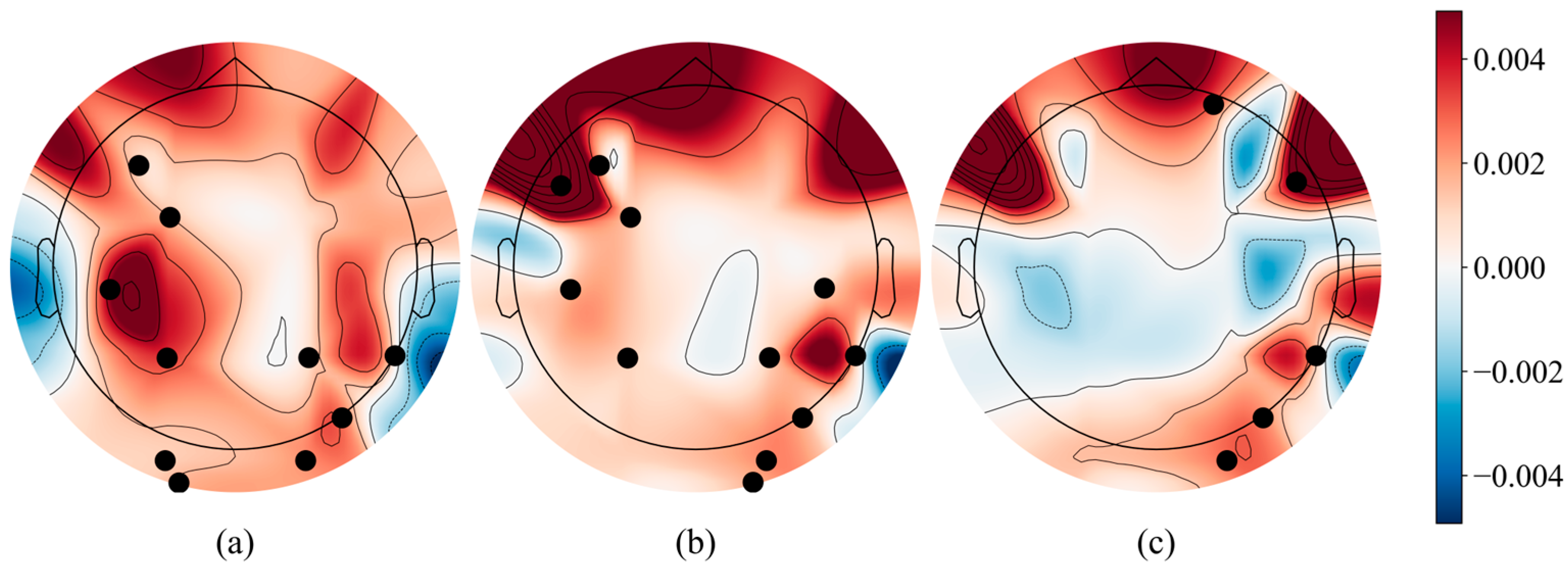
Color modification: Induced significant alterations (p < 0.05) across multiple channels, primarily distributed in F3, FC1, C3, CP1, CP2, CP6, P4, PO3, PO4, and O1. In non-significant regions, such as the temporal lobes (P8, T7, TP7), RAB values exhibited slight negative shifts, indicating local arousal responses. Overall, the broad distribution suggests color modification exerts dispersive and cross-regional effects on brain areas. Color emerged as the architectural element most potent in eliciting relaxation responses, with effects concentrated in the occipital and central lobes (Figure 4a).
Material modification: The number of significant channels was comparable to a color modification, though the overall mean was slightly lower. Significant channels included C3, C4, CP1, CP2, CP6, F3, F7, FC1, O2, P4, and PO4, primarily concentrated in the central and occipital lobes. All significant changes showed increased RAB values, consistent in direction and indicative of relaxation responses (Figure 4b).
Form modification: Showed the least number of significant channels, mostly in the frontal area at CP6, F8, Fp2, P4, and PO4. Although the remaining channels did not reach significance, they nevertheless hold reference value: nine channels showed negative RAB changes, indicating a bidirectional pattern of coexisting relaxation and arousal. This indicates that the influence of formal elements on physiological responses exhibits greater context dependency and individual variation, characterized by “fewer significant locations and mixed directionality” (Figure 4c).
As shown in Figure 4, which displays ΔRAB brain topography maps for the three design element modifications relative to baseline (S1), color intensity reflects the magnitude of ΔRAB values, with warmer colors indicating stronger relaxation responses (higher RAB). Channels reaching statistical significance are indicated by black dots.
Results indicate that across the CP6, P4, and PO4 channels, all three modification types (S2/S3/S4) exhibited significant changes relative to baseline. Among these, P4 demonstrated the strongest overall significance and effect size (all p ≤ 0.01). Given its stable significance, the functional role of the parietal lobe in visuospatial integration, and consistency with subjective ratings, subsequent analyses and visualizations prioritize reporting on P4 [61].

3.3. Comparative Analysis of Arousal Levels and RAB Metric Values for the P4 Channel

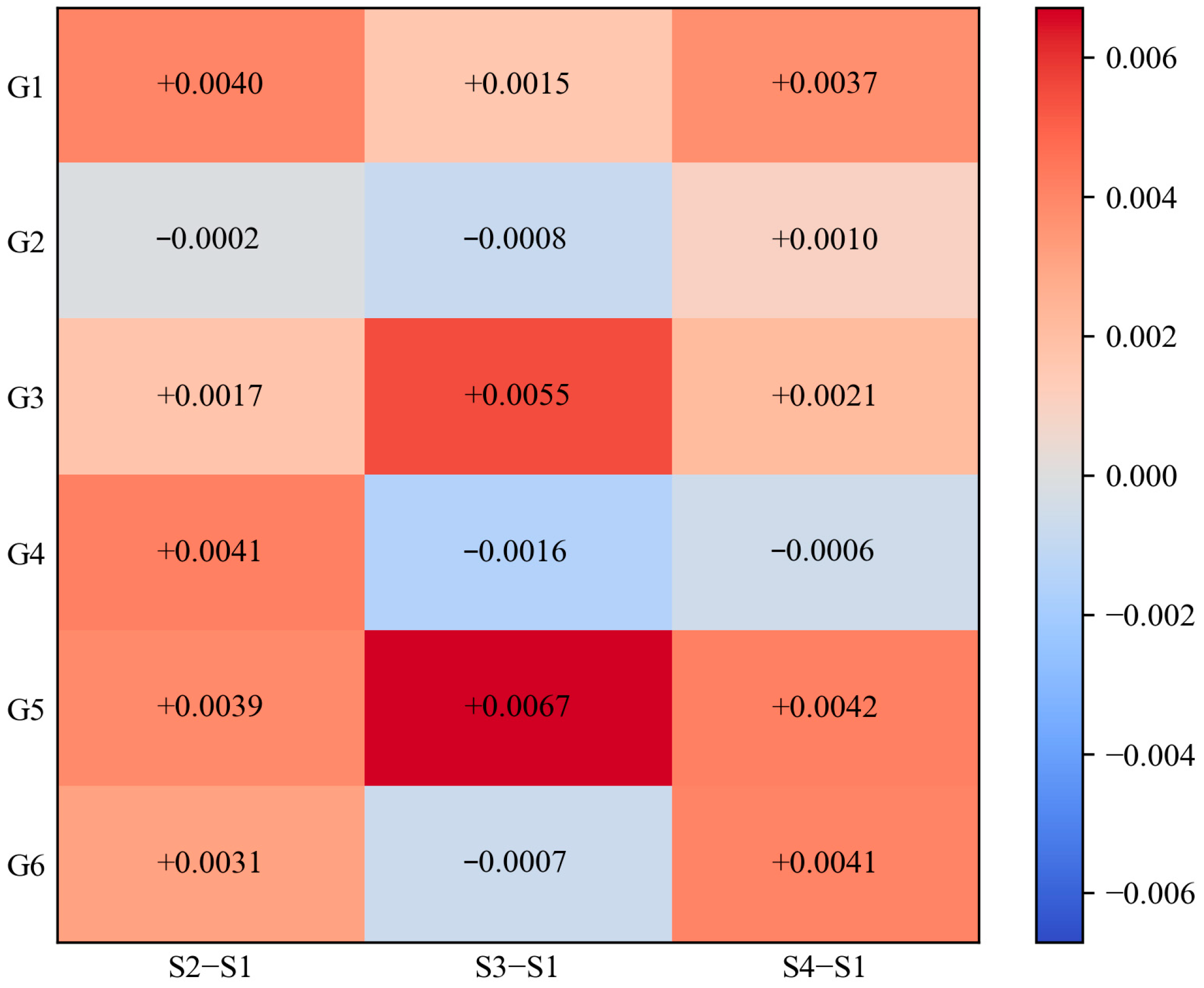
Based on the aforementioned findings, the right parietal channel P4 demonstrated superior significance in pre- to post-stimulus RAB metric differences compared to other channels. Furthermore, this channel was analyzed for relaxation-arousal levels across six functional spaces during the three modification experiments. Results indicate pronounced variations in changes relative to the baseline scenario (S1) across different spatial types (G1–G6) and three remodeling conditions (S2–S4).
Color remodeling (S2): Demonstrated a consistent elevation of RAB metrics in the living room (G1), café (G4), and restaurant (G5), indicating a stronger relaxation tendency.
Material modification (S3): Produced the most pronounced relaxation effect in the restaurant (G5), while eliciting a mild arousal tendency in the Communication hall (G2), café (G4) and Exhibition hall (G6).
Form modification (S4): Triggered significant relaxation responses in the living room (G1), restaurant (G5), and exhibition hall (G6), while inducing mild arousal in the café (G4).
These findings indicate that architectural modifications exhibit spatial dependency (context-dependent) and element-specific effects in eliciting emotional changes. The combination of different spatial functions and design elements directly influences physiological responses along the relaxation-arousal emotional dimension (Figure 5).

3.4. Comparison of Subjective Questionnaire and RAB Metric Values

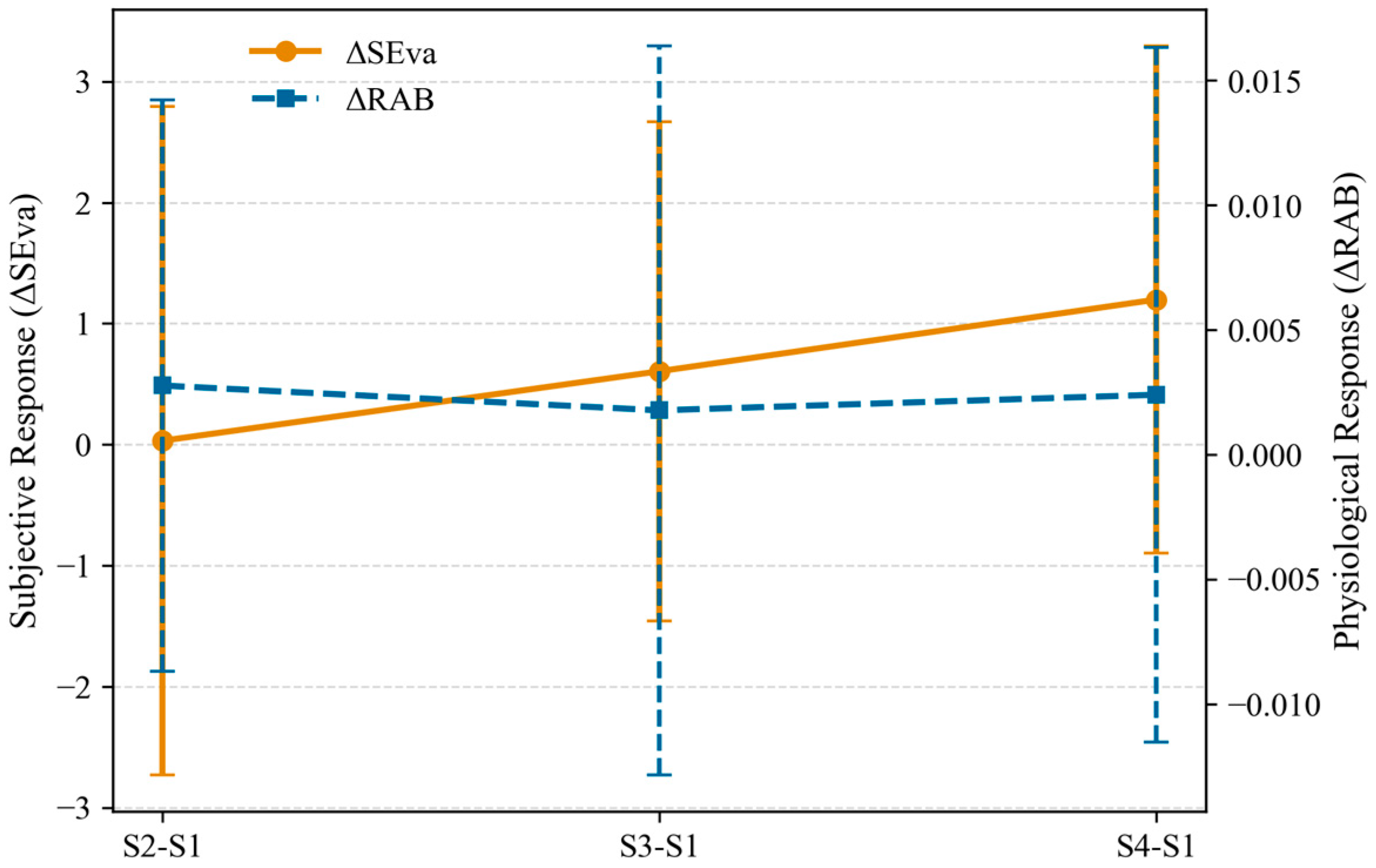
Figure 6 illustrates the overall mean trends (cross-group aggregated) of subjective questionnaire responses (ΔSEva) and EEG RAB metrics across three design element modifications. Note that their coding directions are opposite: a ΔSEva value greater than zero indicates heightened arousal, whereas a physiological RAB metric greater than zero signifies increased relaxation. At the aggregate level, subjective responses predominantly indicate arousal, whereas physiological responses predominantly indicate relaxation, revealing a systematic directional discrepancy between the two.
Regarding intensity of change, the three design modifications exhibit a trend-level inverse relationship at the overall mean level: under the material modification (S3) and form modification (S4) conditions, subjective arousal levels were relatively high, whereas physiological relaxation levels were comparatively low (i.e., “reduced relaxation ≈ increased arousal”). This trend indicates that, on average across conditions, subjective and physiological responses are directionally opposite, yet their intensity of change shows a certain tendency towards covariation at the overall level.
It must be emphasized that this “inverse coherence” reflects only an overall trend relationship and does not imply significant linear coupling at the functional space or individual level. To verify the statistical significance of this trend, we further employed a linear mixed-effects model (LMM) for testing.
To examine consistency between subjective and physiological change measures, a multilevel linear model was constructed. Results from the LMM (Table 3) confirmed our primary findings. The fixed effect of subjective arousal (ΔSEva) was not a significant predictor of physiological relaxation index (ΔRAB) (γ1 = 0.0039, 95% confidence interval [−0.143, 0.151], p > 0.05). In model selection (based on ML fit), we benchmarked against a model containing only ΔSEva (M0), sequentially adding scene (Scene; M1), group (Group; M2), and both simultaneously (M3) for comparison. Compared to M0, M1 showed no improvement in fit (ΔAIC = +3.45, ΔBIC = +11.82; LRT χ2(2) = 0.55, p = 0.760), nor did M2 (ΔAIC = +4.53, ΔBIC = +25.46; LRT χ2(5) = 5.47, p = 0.361), nor M3 (ΔAIC = +7.82, ΔBIC = +37.12; LRT χ2(7) = 6.18, p = 0.519). Consequently, the more parsimonious model retaining ΔSEva as the sole fixed predictor (M0) was retained as the final model.
This absence of a significant linear relationship at the population level, combined with the significant random slope variance (u1i = 0.0001), provides strong support for hypothesis H3: subjective responses are not directly coupled with physiological responses, and the strength of this coupling varies significantly between individuals. Regarding random effects, the small residual variance (εit = 0.0002, 95% CI [0.0001, 0.0004]) and significant intercept variance (u0 = 0.0003, 95% CI [0.0001, 0.0005]) and slope variance (u1 = 0.0001, 95% CI [0.00002, 0.0002]) further indicate that subjects exhibit differences in baseline physiological responses and, more importantly, significant individual variation in the strength of their subjective-physiological coupling.
Overall, subjective and physiological indicators exhibited opposing overall directional trends yet partially consistent intensity changes, though this did not constitute a statistically significant linear relationship. In other words, the “reverse consistency” observed in this study existed only at the level of cross-condition average trends, with considerable variation in its manifestation across individuals. LMM results indicate a loose coupling relationship between subjective arousal experiences and physiological relaxation responses to architectural imagery: while directional differentiation exists, their intensity varies across individuals. These results suggest that forthcoming emotion-design research ought to amalgamate group-level trends with individualized responses to thoroughly comprehend the dual mechanisms of subjective experience and physiological activation [62].

4. Discussion

4.1. Key Findings

This study constructed a generative system based on Stable Diffusion, LoRA, and ControlNet. The system was implemented and validated through a methodological closed-loop “generation–evaluation” workflow. Results demonstrate that the system effectively translates emotional targets into modifications of architectural image elements, with corresponding RAB changes observed across multiple channels and conditions. However, the subjective-physiological consistency exhibited trend-level rather than strong linear correlations overall, with marked individual variations persisting. This supports the feasibility of emotion-driven generation while indicating the necessity for subsequent integration of online feedback and physiological validation.
First, with regard to hypothesis H1, the findings of this study generally support it: modifications to distinct design elements within AI-generated architectural imagery elicit significant EEG differences, with this effect varying according to spatial typology. We analyzed differences in RAB metric values across six groups before and after changes in color, material, and form. Results indicate that relaxation levels follow the order: Color > Material ≈ Form (physiological metrics). Color and material modifications consistently elicited relaxation across all significant channels [34]. Form modifications exhibited a dual pattern of relaxation and arousal, suggesting that form changes may simultaneously activate cognitive evaluation and perceptual integration processes. Regarding arousal indicators, these were primarily concentrated in the frontal region and the parieto-central transition zone: the frontal region represented by F8 and FC6, and the parieto-central zone by C3, C4, CP1, CP5, and CP6. Concurrently, mild negative RAB changes were observable in the temporal region (T7, TP7) (mostly non-significant but directionally indicative). Conversely, forms exhibiting more balanced geometric proportions and stable spatial order were often accompanied by increased RAB at parietal sites such as P4/PO4 (relaxation). Thus, form modification presents a dynamic equilibrium between frontal/temporal-dominant attention–evaluation arousal and parietal-dominant spatial integration relaxation. This pattern differs from the more unidirectional relaxation effects observed for color and material modifications. Across different spatial contexts, leisure spaces—including living rooms (G1), offices (G3), and restaurants (G5)—consistently induced relaxation-related responses. Among the three modification types, material modifications yielded the most pronounced relaxation effect. In social spaces—communication halls (G2), cafés (G4), and exhibition halls (G6)—material modifications tended to elicit mild arousal. color and form modifications tended to elicit moderate relaxation emotions. EEG results for these spaces exhibited a characteristic “coexistence of moderate arousal and mild relaxation,” indicating that social venues should strike a balance between stimulation and comfort. Thus, the relaxation-arousal differences induced by design elements across distinct brain regions provide a foundation for subsequent region-specific analysis (Hypothesis 2).
Secondly, with regard to hypothesis H2, the findings of this study likewise provide support. Under various spatial and modification conditions, alterations to the three design elements significantly influenced the relaxation-arousal levels (RAB) of the CP6, PO4, and P4 channels. Among these, P4 (right parietal lobe) demonstrated the most robust response. As P4 participates in visual-spatial integration and attentional regulation, this suggests architectural elements’ emotional effects likely manifest through continuous relaxation-arousal modulation via parietal integration. Consequently, P4 may serve as a candidate “neural monitoring site” for emotion-guided architectural generation, applicable for closed-loop parameter tuning [63].
Finally, with regard to Hypothesis H3, the findings of this study partially support this hypothesis. Across-condition overall means reveal that subjective arousal and physiological relaxation exhibit opposite directions, yet demonstrate a covariate trend in intensity variation (Figure 6); while the LMM revealed non-significant fixed effects and significant random slopes, indicating this covariation lacks group-level linear coupling with marked individual variation. This defines their relationship as a trend-level inverse coherence. Subjective and physiological responses diverge directionally but exhibit consistency in intensity variation. This pattern aligns with a dual-pathway mechanism. Ascending (bottom-up) physiological responses drive EEG metrics, whereas descending (top-down) cognitive–aesthetic processing governs subjective ratings. Form modification may thus enhance aesthetic arousal while maintaining moderate arousal; color/material more directly influences physiological relaxation dimensions.
It is noteworthy that, at the subjective level, participants generally perceived formal transformations as the most stimulating and visually appealing, followed by material and color alterations. However, EEG results revealed that color and material modifications exhibited a more pronounced relaxation effect on the RAB, whereas formal transformations elicited mild arousal. This discrepancy may be explained by the following factors: (1) The temporal lag and distinct processing pathways between perceptual and physiological levels: subjective evaluations reflect cognitive and aesthetic processing outcomes, whereas EEG signals capture immediate physiological responses, operating on different processing pathways and temporal scales; (2) Form transformation may increase visual attentional load, thereby inducing mild physiological arousal. Yet subjectively, it is perceived as “interesting” and “design-rich,” enhancing perceptual vitality and spatial anticipation, thereby demonstrating the positive effects of moderate stimulation. (3) Color and material constitute lower-level visual features, more readily eliciting relaxation-oriented alpha rhythm responses, whereas form, as a higher-level structural element, activates spatial integration and semantic recognition in parietal regions, readily inducing heightened attention.
In summary, subjective and physiological responses show opposite directions but partially consistent intensity changes. Color and material primarily modulate relaxation-related physiology, whereas form engages higher-level attentional and spatial integration processes, consistent with a dual-pathway model of architectural emotional processing.

4.2. Design Implications

These findings are best regarded as an exploratory roadmap rather than definitive conclusions. Given that each design element was manipulated independently using representative instances, the implications presented here should be interpreted as tendency-based references rather than prescriptive design rules.
Theoretically, subjective evaluations and physiological responses do not always align. Relying solely on subjective judgment may yield cognitively “more appealing” solutions, yet their physiological effects may not necessarily benefit accordingly. Therefore, introducing a dual-validation framework that integrates subjective appraisal with physiological indicators is suggested as a more robust strategy for emotion-oriented design exploration, particularly when targeting the relaxation–arousal dimension.
Practically, these tendencies manifest differently across target scenarios. In low-arousal spaces (e.g., waiting rooms, rehabilitation areas), vigilance is required against visual stimuli that may subtly elevate implicit arousal; designers are encouraged to prioritize maintaining physiological relaxation while cross-checking subjective comfort, especially when introducing visually engaging features.
In high-arousal spaces (e.g., retail, fitness, creative work zones) the design objective is to elicit genuine physiological activation. If subjective excitement arises without corresponding bodily engagement, it may reflect perceptual novelty rather than sustained emotional activation.
For balanced environments (e.g., education, offices, or dining spaces), the findings highlight the need to seek a dynamic equilibrium. This balance lies between excessive tranquility [43,64], which is associated with reduced attentional engagement, and overstimulation, which is linked to increased stress responses.
Regarding key design elements, material-related modifications showed a relatively stable tendency toward relaxation-oriented responses across the tested spatial contexts. Color-based modifications were more suited to localized emotional tuning but exhibited higher inter-individual variability, requiring context-sensitive application. Form-related modifications produced strong subjective impact yet more frequently decoupled from physiological comfort, eliciting mixed relaxation–arousal patterns. These observations represent tendency-based effects under controlled experimental conditions and may vary with alternative design configurations or user populations. Methodologically, building upon this framework, a promising avenue for refinement involves establishing a closed-loop system for AI-driven generation-evaluation workflow. By employing dual subjective and physiological metrics as feedback signals, generative solutions can iteratively converge towards both aesthetic immersion and emotional functionality. This approach offers a more actionable prototype workflow for future intelligent generation and neuroarchitecture [65,66].

4.3. Limitations and Future Work

Our G*Power 3.1 analysis indicates that the sample size (N = 27) is statistically sufficient to detect a medium effect size. However, the sample size remains relatively small. While the homogeneity of this student sample reduced variance, it also limits the generalizability of our findings. This exploratory study establishes a solid foundation, yet these findings—particularly the robust sensitivity of the P4 channel—require validation in larger, more diverse populations. The use of generative static images as stimuli lacked multisensory and dynamic characteristics. Future research should incorporate virtual reality and 3D presentations to enhance spatial, auditory, and tactile perceptions. Physiologically, this study explored only EEG. Future research will incorporate multimodal physiological measurements, including electrocardiography (ECG), electrodermal activity (EDA), and other autonomic indicators, to more comprehensively examine the relationship between subjective experience and physiological responses in architectural spaces. A compelling future direction involves establishing a closed-loop “generative-evaluative workflow” system. This would use real-time physiological signals (like P4 RAB) as feedback to directly control generative AI, which would improve architectural imagery to fit not only personal tastes but also specific physiological states.

5. Conclusions

Overall, this study validates the feasibility of emotion-driven architectural generation, though its mechanisms require further refinement within multimodal and dynamic spatial experiences. Adopting an emotion-oriented perspective, the research explores the affective mechanisms of architectural design elements through architectural imagery, examined through a dual-validation framework combining subjective evaluations and physiological signals (RAB) [67]. Results reveal a non-linear relationship between subjective and physiological responses: cognitive-level “attractiveness” does not necessarily correlate with physiological “relaxation” or “arousal” [68].
Such a discrepancy can be interpreted through an integrative perspective combining dual-pathway emotion processing theory, cognitive load theory, and spatial perception mechanisms. These theories collectively indicate that subjective evaluations and autonomic responses differ in temporal scale and information processing pathways. Architectural elements—particularly color, material, and form—further amplify this separation by activating distinct perceptual pathways: subjective ratings rely primarily on higher-level semantic and aesthetic interpretations, whereas physiological responses are more directly influenced by lower-level spatial cues such as saturation, textural complexity, and geometric regularity. Consequently, relying solely on subjective evaluation in emotion-driven architectural design risks overlooking potentially significant emotional responses embedded within the building’s imagery. In contrast, incorporating physiological validation provides a more reliable foundation for aligning design outcomes with targeted emotional states.
The findings further suggest that the generation and evaluation of architectural emotion should not be treated as isolated processes but as components of a feedback-driven, AI-supported generation–evaluation loop. By incorporating dual subjective and physiological metrics as regulatory signals, generative AI outputs are more likely to achieve dynamic convergence between “aesthetic immersion” and “emotional functionality.” This methodological approach not only provides a foundation for quantifying and validating neuroarchitecture but also establishes an actionable research paradigm for future intelligent architectural generation systems.
Future research should incorporate additional design elements and integrate recent studies on EEG-based emotional mapping of built environments alongside CAVE (Cave Automatic Virtual Environment) and VR immersive environments. This will enable validation and exploration within larger-scale and more immersive scenarios [69,70]. Concurrently, incorporating source localization and brain network connectivity analysis will extend emotional mechanism modelling from the channel level to the source space and brain network layers [71,72,73]. Furthermore, drawing upon recent advances in adaptive closed-loop brain–computer interfaces (BCIs), key EEG features can serve as real-time feedback signals. These are integrated with generative AI to form a “generation–evaluation” workflow, thereby achieving genuinely physiologically driven architectural emotion generation [74].

Author Contributions

Conceptualization, Y.L. and M.W.; methodology, Y.L. and M.W.; software, S.J.; validation, Y.L. and S.J.; formal analysis, Y.L.; investigation, Y.L.; resources, M.W.; data curation, S.J.; writing—original draft preparation, Y.L. and S.J.; writing—review and editing, Y.L. and S.J.; visualization, Y.L. and S.J.; supervision, M.W.; project administration, M.W.; funding acquisition, M.W. All authors have read and agreed to the published version of the manuscript.

Funding

This research was funded by the China Hebei Provincial Department of Science and Technology “100 Foreign Experts Plan of Hebei Province” program in 2024.

Institutional Review Board Statement

The study was conducted in accordance with the Declaration of Helsinki and approved by the Ethics Committee of Medical Ethics Committee of the Affiliated Hospital of Hebei University of Engineering (protocol code 2023[k]110 and 23 June 2023) for studies involving humans.

Informed Consent Statement

Informed consent was obtained from all subjects involved in the study.

Data Availability Statement

The data that support the findings of this study are available from the author upon reasonable request.

Conflicts of Interest

The authors declare no conflicts of interest.

Abbreviations

The following abbreviations are used in this manuscript:
EEGElectroencephalography
ECGElectrocardiography
EDAElectrodermal Activity
RABRatio of Alpha to Beta power
LMMFurther Linear Mixed Model
MLMaximum Likelihood
AICAkaike Information Criterion
BICBayesian Information Criterion
LRTLikelihood Ratio Test
LoRALow-Rank Adaptation
ControlNetConditional control network for structure/geometry constraints
CFGClassifier-Free Guidance
GANsGenerative adversarial networks
BCIsBrain-computer interfaces

References

  1. Küller, R.; Mikellides, B.; Janssens, J. Color, Arousal, and Performance—A Comparison of Three Experiments. Color Res. Appl. 2009, 34, 141–152. [Google Scholar] [CrossRef]
  2. Cho, J.E.; Kang, S.Y.; Hong, Y.Y.; Jun, H.J. Predicting Architectural Space Preferences Using EEG-Based Emotion Analysis: A CNN-LSTM Approach. Appl. Sci. 2025, 15, 4217. [Google Scholar] [CrossRef]
  3. Abbas, S.; Okdeh, N.; Roufayel, R.; Kovacic, H.; Sabatier, J.-M.; Fajloun, Z.; Abi Khattar, Z. Neuroarchitecture: How the Perception of Our Surroundings Impacts the Brain. Biology 2024, 13, 220. [Google Scholar] [CrossRef]
  4. Shemesh, A.; Leisman, G.; Bar, M.; Grobman, Y.J. The Emotional Influence of Different Geometries in Virtual Spaces: A Neurocognitive Examination. J. Environ. Psychol. 2022, 81, 101802. [Google Scholar] [CrossRef]
  5. Weijs, M.L.; Jonauskaite, D.; Reutimann, R.; Mohr, C.; Lenggenhager, B. Effects of Environmental Colours in Virtual Reality: Physiological Arousal Affected by Lightness and Hue. R. Soc. Open Sci. 2023, 10, 230432. [Google Scholar] [CrossRef] [PubMed]
  6. Russell, J.A. A Circumplex Model of Affect. J. Pers. Soc. Psychol. 1980, 39, 1161–1178. [Google Scholar] [CrossRef]
  7. Mehrabian, A.; Russell, J.A. An Approach to Environmental Psychology; The MIT Press: Cambridge, MA, USA, 1974; ISBN 978-0-262-13090-5. [Google Scholar]
  8. Nasar, J.L. Urban Design Aesthetics: The Evaluative Qualities of Building Exteriors. Environ. Behav. 1994, 26, 377–401. [Google Scholar] [CrossRef]
  9. Aspinall, P.; Mavros, P.; Coyne, R.; Roe, J. The Urban Brain: Analysing Outdoor Physical Activity with Mobile EEG. Br. J. Sports Med. 2015, 49, 272–276. [Google Scholar] [CrossRef]
  10. Bower, I.; Tucker, R.; Enticott, P.G. Impact of Built Environment Design on Emotion Measured via Neurophysiological Correlates and Subjective Indicators: A Systematic Review. J. Environ. Psychol. 2019, 66, 101344. [Google Scholar] [CrossRef]
  11. Elliot, A.J.; Maier, M.A. Color Psychology: Effects of Perceiving Color on Psychological Functioning in Humans. Annu. Rev. Psychol. 2014, 65, 95–120. [Google Scholar] [CrossRef]
  12. D’andrade, R.; Egan, M. The Colors of Emotion. Am. Ethnol. 1974, 1, 49–63. [Google Scholar] [CrossRef]
  13. Kotradyova, V.; Vavrinsky, E.; Kalinakova, B.; Petro, D.; Jansakova, K.; Boles, M.; Svobodova, H. Wood and Its Impact on Humans and Environment Quality in Health Care Facilities. Int. J. Environ. Res. Public Health 2019, 16, 3496. [Google Scholar] [CrossRef]
  14. Franz, G.; von der Heyde, M.; Bülthoff, H.H. An Empirical Approach to the Experience of Architectural Space in Virtual Reality—Exploring Relations between Features and Affective Appraisals of Rectangular Indoor Spaces. Autom. Constr. 2005, 14, 165–172. [Google Scholar] [CrossRef]
  15. Hejazi, M. Geometry in Nature and Persian Architecture. Build. Environ. 2005, 40, 1413–1427. [Google Scholar] [CrossRef]
  16. Lee, J.H.; Lee, S. Relationships between Physical Environments and Creativity: A Scoping Review. Think. Ski. Creat. 2023, 48, 101276. [Google Scholar] [CrossRef]
  17. Salingaros, N.A. Environments That Boost Creativity: AI-Generated Living Geometry. Multimodal Technol. Interact. 2025, 9, 38. [Google Scholar] [CrossRef]
  18. Labib, Z.; Nabil, K.; Amin, K. A Spatial Design Guideline for Supporting Creativity at Architectural Firms. HBRC J. 2023, 19, 63–85. [Google Scholar] [CrossRef]
  19. Medel-Vera, C.; Britton, S.; Gates, W.F. An Exploration of the Role of Generative AI in Fostering Creativity in Architectural Learning Environments. Comput. Educ. Artif. Intell. 2025, 9, 100501. [Google Scholar] [CrossRef]
  20. Makeig, S.; Jung, T.-P. Tonic, Phasic, and Transient EEG Correlates of Auditory Awareness in Drowsiness. Cogn. Brain Res. 1996, 4, 15–25. [Google Scholar] [CrossRef]
  21. Broyd, S.J.; Demanuele, C.; Debener, S.; Helps, S.K.; James, C.J.; Sonuga-Barke, E.J.S. Default-Mode Brain Dysfunction in Mental Disorders: A Systematic Review. Neurosci. Biobehav. Rev. 2009, 33, 279–296. [Google Scholar] [CrossRef]
  22. Vecchiato, G.; Astolfi, L.; De Vico Fallani, F.; Cincotti, F.; Mattia, D.; Salinari, S.; Soranzo, R.; Babiloni, F. Changes in Brain Activity During the Observation of TV Commercials by Using EEG, GSR and HR Measurements. Brain Topogr. 2010, 23, 165–179. [Google Scholar] [CrossRef]
  23. Zhang, Z.; Fort, J.M.; Giménez Mateu, L. Decoding Emotional Responses to AI-Generated Architectural Imagery. Front. Psychol. 2024, 15, 1348083. [Google Scholar] [CrossRef]
  24. Ji, S.-Y.; Kim, M.-K.; Jun, H.-J. Emotion Analysis AI Model for Sensing Architecture Using EEG. Appl. Sci. 2025, 15, 2742. [Google Scholar] [CrossRef]
  25. Liu, Y.; Li, X.; Fang, L.; Zhang, J.; Whang, M. The Development of the Two-Dimensional Model of Emotion Based on Both Architectural Emotion Words and Design Elements in China. Buildings 2024, 14, 4000. [Google Scholar] [CrossRef]
  26. Dang, S.; He, Y.; Ling, L.; Qian, Z.; Zhao, N.; Cao, N. EmotiCrafter: Text-to-Emotional-Image Generation based on Valence-Arousal Model. arXiv 2025, arXiv:2501.05710. [Google Scholar]
  27. Higuera-Trujillo, J.L.; Llinares, C.; Macagno, E. The Cognitive-Emotional Design and Study of Architectural Space: A Scoping Review of Neuroarchitecture and Its Precursor Approaches. Sensors 2021, 21, 2193. [Google Scholar] [CrossRef] [PubMed]
  28. Peráček, T.; Kaššaj, M. Legal Easements as Enablers of Sustainable Land Use and Infrastructure Development in Smart Cities. Land 2025, 14, 681. [Google Scholar] [CrossRef]
  29. Hu, M.; Simon, M.; Fix, S.; Vivino, A.A.; Bernat, E. Exploring a Sustainable Building’s Impact on Occupant Mental Health and Cognitive Function in a Virtual Environment. Sci. Rep. 2021, 11, 5644. [Google Scholar] [CrossRef] [PubMed]
  30. OHCHR; UN-Habitat. The Right to Adequate Housing: Fact Sheet No. 21 (Rev.1); United Nations Human Rights Office United Nations Human Settlements Programme; UN-Habitat: Nairobi, Kenya, 2009. [Google Scholar]
  31. Pessina, S. The Link Between Environmental Rights and the Rights of Nature: The Virtues of a Complexity-Based Approach 1. Jurid. Trib.-Rev. Comp. Int. Law 2025, 15, 406–422. Available online: https://www.tribunajuridica.eu/arhiva/y15v2/9.pdf (accessed on 18 December 2025).
  32. Li, Z.; Huang, X.; White, M. Effects of the Visual Character of Transitional Spaces on Human Stress Recovery in a Virtual Reality Environment. Int. J. Environ. Res. Public Health 2022, 19, 13143. [Google Scholar] [CrossRef]
  33. Kim, S. Cognitive Efficiency in VR Simulated Natural Indoor Environments Examined through EEG and Affective Responses. Sci. Rep. 2025, 15, 33398. [Google Scholar] [CrossRef] [PubMed]
  34. Bower, I.S.; Clark, G.M.; Tucker, R.; Hill, A.T.; Lum, J.A.G.; Mortimer, M.A.; Enticott, P.G. Built Environment Color Modulates Autonomic and EEG Indices of Emotional Response. Psychophysiology 2022, 59, e14121. [Google Scholar] [CrossRef]
  35. Seiz, A.; Kweon, B.-S.; Ellis, C.D.; Oh, H.; Pietro, K. Exploring the Psychophysiological Effects of Viewing Urban Nature through Virtual Reality Using Electroencephalography and Perceived Restorativeness Scale Measures. Sustainability 2023, 15, 13090. [Google Scholar] [CrossRef]
  36. Bai, Z.; Zhang, S. Effects of Different Natural Soundscapes on Human Psychophysiology in National Forest Park. Sci. Rep. 2024, 14, 17462. [Google Scholar] [CrossRef] [PubMed]
  37. Yoon, H.; Jeon, J.Y. Relationship between Soundscape Perception and Psychophysiological Responses to Virtual Environmental Events. Virtual Real. 2024, 29, 11. [Google Scholar] [CrossRef]
  38. LeDoux, J.E. The Emotional Brain: The Mysterious Underpinnings of Emotional Life; Simon and Schuster: New York, NY, USA, 1996; ISBN 978-0-684-83659-1. [Google Scholar]
  39. Stanovich, K.E.; West, R.F. Individual Differences in Reasoning: Implications for the Rationality Debate? Behav. Brain Sci. 2000, 23, 645–665; discussion 665–726. [Google Scholar] [CrossRef]
  40. Kahneman, D. Thinking, Fast and Slow; Farrar, Straus and Giroux: New York, NY, USA, 2011; p. 499. ISBN 978-0-374-27563-1. [Google Scholar]
  41. Chen, T.; Wang, L.; Huang, B.; Yu, J.; Wu, Y. Pursued Spatial Perception Benefit Considering Attractiveness and Cognitive Load: Appropriate Visual Complexity of Indoor Commercial Space. J. Build. Eng. 2024, 98, 111144. [Google Scholar] [CrossRef]
  42. Lavie, N.; Hirst, A.; de Fockert, J.W.; Viding, E. Load Theory of Selective Attention and Cognitive Control. J. Exp. Psychol. Gen. 2004, 133, 339–354. [Google Scholar] [CrossRef]
  43. Vartanian, O.; Navarrete, G.; Chatterjee, A.; Fich, L.B.; Leder, H.; Modroño, C.; Nadal, M.; Rostrup, N.; Skov, M. Impact of Contour on Aesthetic Judgments and Approach-Avoidance Decisions in Architecture. Proc. Natl. Acad. Sci. USA 2013, 110, 10446–10453. [Google Scholar] [CrossRef]
  44. Kopec, D. Environmental Psychology for Design; Bloomsbury Publishing: New York, NY, USA, 2018. [Google Scholar]
  45. Gibson, J.J. The Ecological Approach to Visual Perception; Houghton, Mifflin and Company: Boston, MA, USA, 1979; ISBN 978-0-395-27049-3. [Google Scholar]
  46. Chatterjee, A.; Vartanian, O. Neuroaesthetics. Trends Cogn. Sci. 2014, 18, 370–375. [Google Scholar] [CrossRef] [PubMed]
  47. Rombach, R.; Blattmann, A.; Lorenz, D.; Esser, P.; Ommer, B. High-Resolution Image Synthesis with Latent Diffusion Models. In Proceedings of the 2022 IEEE/CVF Conference on Computer Vision and Pattern Recognition (CVPR), New Orleans, LA, USA, 18–24 June 2022; pp. 10684–10695. [Google Scholar]
  48. Jin, F.; Liu, Y.; Tan, Y. Derivative-Free Optimization for Low-Rank Adaptation in Large Language Models. IEEE/ACM Trans. Audio Speech Lang. Process. 2024, 32, 4607–4616. [Google Scholar] [CrossRef]
  49. Lee, J.-K.; Jeong, H.; Kim, Y.; Cha, S.H. Creating Spatial Visualizations Using Fine-Tuned Interior Design Style Models Informed by User Preferences. Adv. Eng. Inform. 2024, 62, 102686. [Google Scholar] [CrossRef]
  50. Yang, W.; Wang, C.; Liu, L.; Dong, S.; Zhao, Y. Advancing Interior Design with AI: Controllable Stable Diffusion for Panoramic Image Generation. Buildings 2025, 15, 1391. [Google Scholar] [CrossRef]
  51. Faul, F.; Erdfelder, E.; Lang, A.-G.; Buchner, A. G*Power 3: A Flexible Statistical Power Analysis Program for the Social, Behavioral, and Biomedical Sciences. Behav. Res. Methods 2007, 39, 175–191. [Google Scholar] [CrossRef]
  52. Fang, Y.; Liu, C.; Zhao, C.; Zhang, H.; Wang, W.; Zou, N. A Study of the Effects of Different Indoor Lighting Environments on Computer Work Fatigue. Int. J. Environ. Res. Public Health 2022, 19, 6866. [Google Scholar] [CrossRef] [PubMed]
  53. Branco, D.; Gonçalves, Ó.F.; Badia, S.B.i. A Systematic Review of International Affective Picture System (IAPS) around the World. Sensors 2023, 23, 3866. [Google Scholar] [CrossRef]
  54. Carroll, J.B. Review of The Measurement of Meaning. Language 1959, 35, 58–77. [Google Scholar] [CrossRef]
  55. Norman, G. Likert Scales, Levels of Measurement and the “Laws” of Statistics. Adv. Health Sci. Educ. 2010, 15, 625–632. [Google Scholar] [CrossRef]
  56. Sugimoto, K.; Kurashiki, H.; Xu, Y.; Takemi, M.; Amano, K. Electroencephalographic Biomarkers of Relaxation: A Systematic Review and Meta-Analysis. J. Cogn. Neurosci. 2025, 1–31. [Google Scholar] [CrossRef]
  57. Ren, H.; Wang, Y.; Zhang, J.; Zheng, Z.; Wang, Q. Evaluation of the Impact of VR Rural Streetscape Enhancement on Relaxation–Arousal Responses Based on EEG. Appl. Sci. 2024, 14, 2996. [Google Scholar] [CrossRef]
  58. Kim, S.; Park, H.; Choo, S. Effects of Changes to Architectural Elements on Human Relaxation-Arousal Responses: Based on VR and EEG. Int. J. Environ. Res. Public Health 2021, 18, 4305. [Google Scholar] [CrossRef]
  59. Barr, D.J.; Levy, R.; Scheepers, C.; Tily, H.J. Random Effects Structure for Confirmatory Hypothesis Testing: Keep It Maximal. J. Mem. Lang. 2013, 68, 255–278. [Google Scholar] [CrossRef] [PubMed]
  60. Bates, D.; Mächler, M.; Bolker, B.; Walker, S. Fitting Linear Mixed-Effects Models Using Lme4. J. Stat. Softw. 2015, 67, 1–48. [Google Scholar] [CrossRef]
  61. Benedek, M.; Schickel, R.J.; Jauk, E.; Fink, A.; Neubauer, A.C. Alpha Power Increases in Right Parietal Cortex Reflects Focused Internal Attention. Neuropsychologia 2014, 56, 393–400. [Google Scholar] [CrossRef]
  62. Gaekwad, J.S.; Sal Moslehian, A.; Roös, P.B. A Meta-Analysis of Physiological Stress Responses to Natural Environments: Biophilia and Stress Recovery Theory Perspectives. J. Environ. Psychol. 2023, 90, 102085. [Google Scholar] [CrossRef]
  63. Gallotto, S.; Duecker, F.; ten Oever, S.; Schuhmann, T.; de Graaf, T.A.; Sack, A.T. Relating Alpha Power Modulations to Competing Visuospatial Attention Theories. NeuroImage 2020, 207, 116429. [Google Scholar] [CrossRef]
  64. Kurdi, B.; Lozano, S.; Banaji, M.R. Introducing the Open Affective Standardized Image Set (OASIS). Behav. Res. Methods 2017, 49, 457–470. [Google Scholar] [CrossRef]
  65. Coburn, A.; Vartanian, O.; Chatterjee, A. Buildings, Beauty, and the Brain: A Neuroscience of Architectural Experience. J. Cogn. Neurosci. 2017, 29, 1521–1531. [Google Scholar] [CrossRef]
  66. Attaianese, E.; Barilà, M.; Perillo, M. Exploring Neuroscientific Approaches to Architecture: Design Strategies of the Built Environment for Improving Human Performance. Buildings 2025, 15, 3524. [Google Scholar] [CrossRef]
  67. Jelić, A.; Tieri, G.; De Matteis, F.; Babiloni, F.; Vecchiato, G. The Enactive Approach to Architectural Experience: A Neurophysiological Perspective on Embodiment, Motivation, and Affordances. Front. Psychol. 2016, 7, 481. [Google Scholar] [CrossRef] [PubMed]
  68. Evers, C.; Hopp, H.; Gross, J.J.; Fischer, A.H.; Manstead, A.S.R.; Mauss, I.B. Emotion Response Coherence: A Dual-Process Perspective. Biol. Psychol. 2014, 98, 43–49. [Google Scholar] [CrossRef]
  69. Liu, L.; Gan, X.; Ren, Z.; Hang, J.; Zhang, X.; Ji, Y. Mapping Approach for Emotional Response to Urban Visual Environments Based on Street View Images and EEG Signals. Build. Simul. 2025, 18, 2697–2721. [Google Scholar] [CrossRef]
  70. Kim, J.-Y.; Park, S.-J. AI-Driven Biophilic Façade Design for Senior Multi-Family Housing Using LoRA and Stable Diffusion. Buildings 2025, 15, 1546. [Google Scholar] [CrossRef]
  71. Eom, T.-H. Electroencephalography Source Localization. Clin. Exp. Pediatr. 2022, 66, 201–209. [Google Scholar] [CrossRef]
  72. Sun, H.; Wang, H.; Wang, R.; Gao, Y. Emotion Recognition Based on EEG Source Signals and Dynamic Brain Function Network. J. Neurosci. Methods 2025, 415, 110358. [Google Scholar] [CrossRef]
  73. Roshanaei, M.; Norouzi, H.; Onton, J.; Makeig, S.; Mohammadi, A. EEG-Based Functional and Effective Connectivity Patterns during Emotional Episodes Using Graph Theoretical Analysis. Sci. Rep. 2025, 15, 2174. [Google Scholar] [CrossRef] [PubMed]
  74. Yang, Q.; Cruz-Garza, J.G.; Kalantari, S. Brain–Computer Interfaces as an Architectural Design Tool: Feasibility and Usability Study. Autom. Constr. 2023, 154, 105011. [Google Scholar] [CrossRef]
Figure 1. Emotion-driven generative design workflow. Source: own processing.
Buildings 16 00036 g001
Figure 2. Experimental stimulus images. Source: own processing.
Buildings 16 00036 g002
Figure 4. Brain topography maps of ΔRAB changes under three design element modification conditions: (a) Color (S2–S1); (b) Material (S3–S1); (c) Form (S4–S1). Black dots indicate statistically significant channels. Source: own processing.
Buildings 16 00036 g004
Figure 5. Heatmap of RAB difference values before and after three-element modifications across six groups. Source: own processing.
Buildings 16 00036 g005
Figure 6. Comparison of subjective and physiological responses across three elements post-intervention. Source: own processing.
Buildings 16 00036 g006
Table 1. Quantitative Validation of Design-Element Manipulations (S2–S4 vs. S1). Source: own processing.
FeatureSceneΔMeanΔSDtdzp
HSV_S_meanS20.2190.0677.973.2540.000 ***
GLCM_homogeneity_meanS3−0.0430.035−3.023−1.2340.029 *
curve_ratioS40.1330.0814.0291.6440.010 *
Note: dz = Cohen’s d for effect size. Significance: * p < 0.05, *** p < 0.001.
Table 2. Subjective emotion analysis before and after modifications. Source: own processing.
GroupElementΔMeandzp
ALLS2–S10.0310.0200.918
S3–S10.6050.6620.002 **
S4–S11.1980.9170.000 ***
Group1S2–S10.8520.3260.102
S3–S11.1480.4820.019 *
S4–S11.7040.6630.002 **
Group2S2–S10.8520.3150.114
S3–S11.2220.5370.010 **
S4–S11.6300.6820.002 **
Group3S2–S1−0.111−0.0370.698
S3–S10.2960.2140.255
S4–S11.2220.6470.002 **
Group4S2–S10.6670.2580.698
S3–S11.0740.4810.019 **
S4–S11.4070.6650.003 **
Group5S2–S1−0.852−0.3050.126
S3–S10.4810.3010.168
S4–S10.9260.5160.013 *
Group6S2–S1−1.185−0.4780.033 *
S3–S1−0.593−0.3180.111
S4–S10.2960.1990.383
Note: ΔMean = Mean difference (Sx–S1); dz = Cohen’s d for effect size. Significance: * p < 0.05, ** p < 0.01, *** p < 0.001.
Table 3. Linear Mixed-Effects Modeling Results for Coherence Between EEG Relaxation (ΔRAB) and Self-Reported Arousal (ΔSEva). Source: own processing.
Effect TypeParameterEstimate (γ/Var)S.E.95% CI
Fixed EffectsIntercept (γ0)0.09080.079[−0.063, 0.245]
ΔSEva (γ1)0.00390.075[−0.143, 0.151]
Random EffectsResidual (εit)0.00020.0001[0.0001, 0.0004]
Intercept variance (u0)0.00030.0001[0.0001, 0.0005]
ΔSEva slope variance (u1)0.00010.00005[0.00002, 0.0002]
Note. N = 27 participants; Each participant viewed 6 groups × 4 scenes (S1–S4). ΔRAB = EEG-based relaxation index difference (Sx–S1). ΔSEva = self-reported arousal difference (Sx–S1). CI = 95% credible (or confidence) interval.
Disclaimer/Publisher’s Note: The statements, opinions and data contained in all publications are solely those of the individual author(s) and contributor(s) and not of MDPI and/or the editor(s). MDPI and/or the editor(s) disclaim responsibility for any injury to people or property resulting from any ideas, methods, instructions or products referred to in the content.