Analytical and Experimental Study on Bond Behavior of Embedded Through-Section FRP Bar-to-Concrete Joints Using a Trilinear Cohesive Material Law


Abstract
1. Introduction
2. Research Significance and Novelty
3. Theoretical Background
3.1. Fundamental Assumptions
- (i)
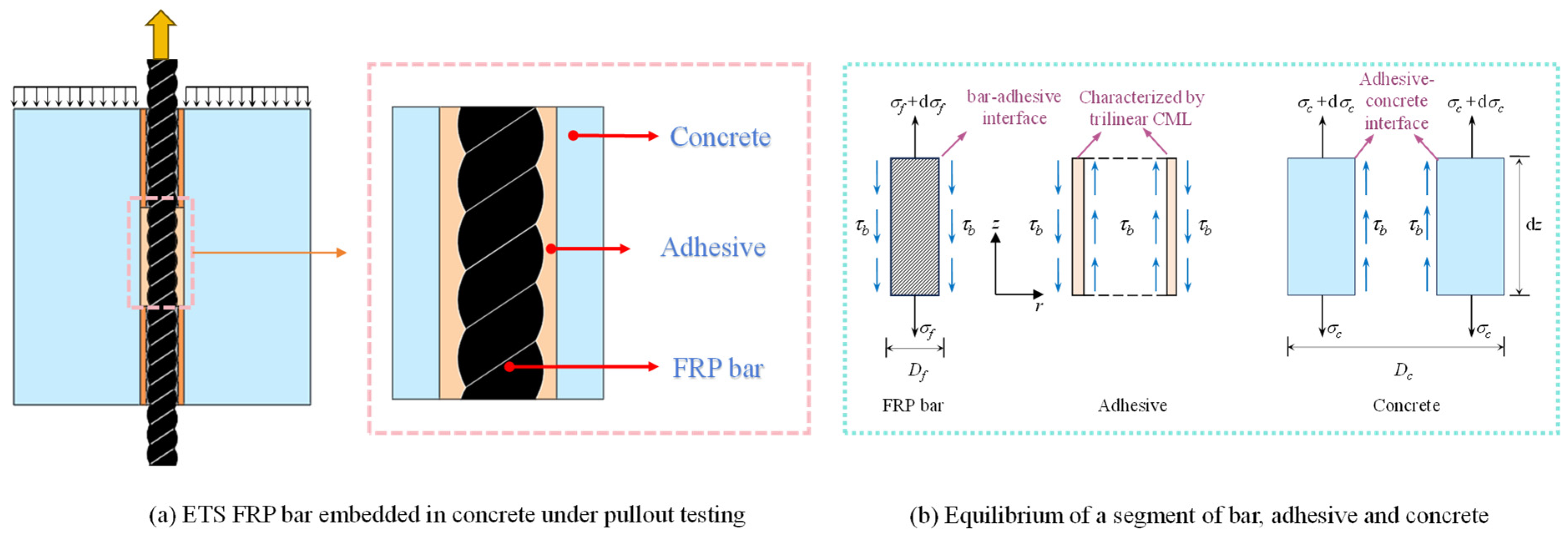
- The FRP bar exhibits linear elastic behavior until failure and the axial stress with the bar is uniformly distributed across the radial direction (r).
- (ii)
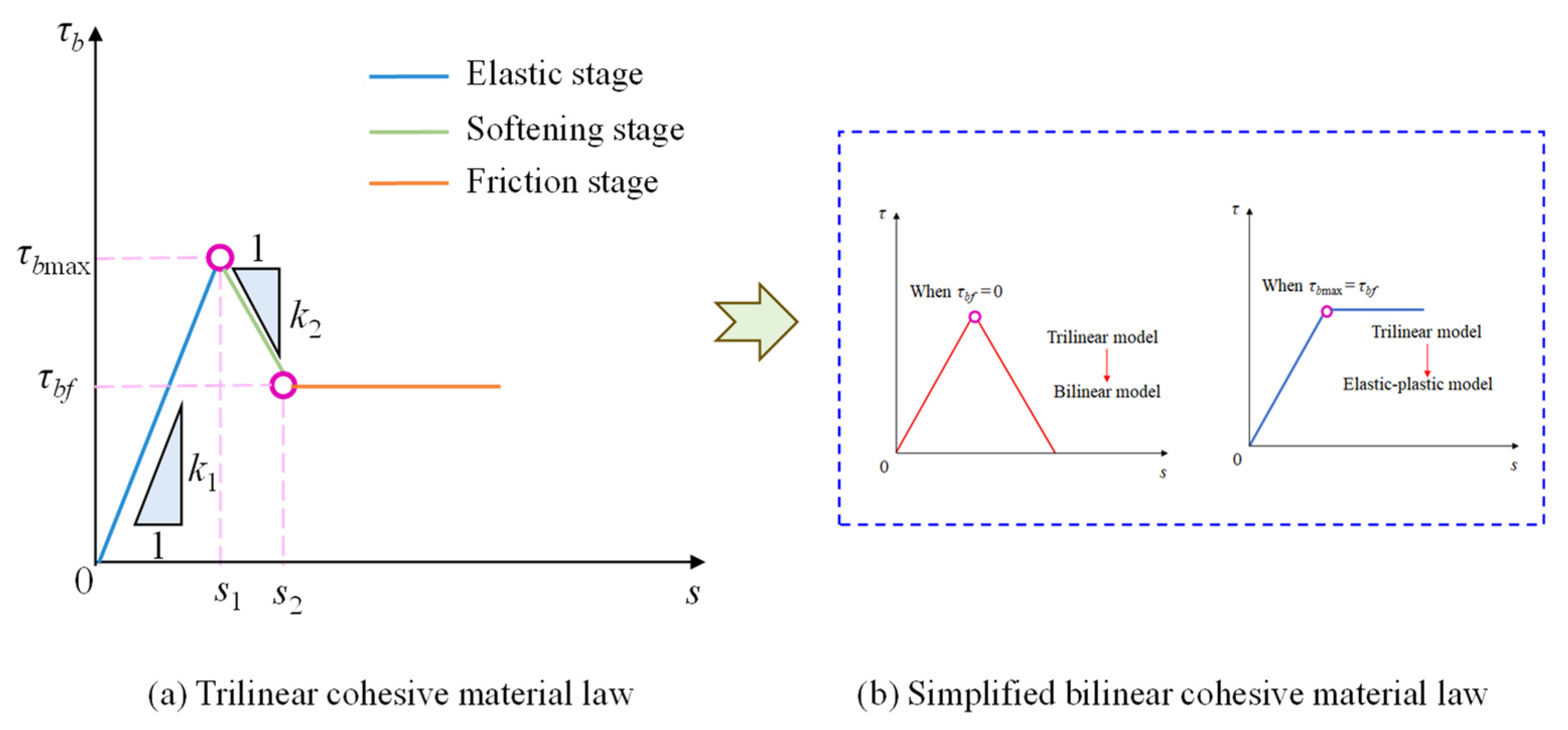
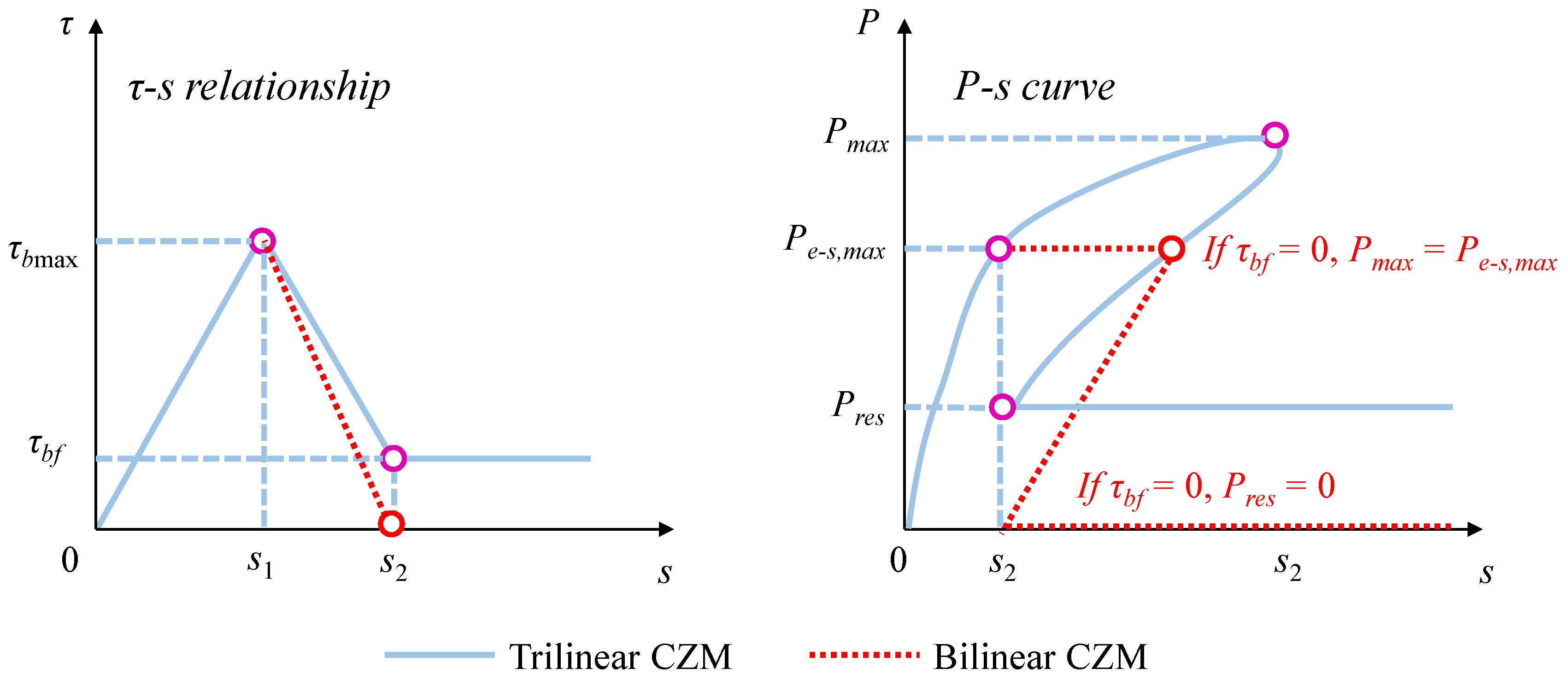
- The bonded interface is represented by a zero-thickness trilinear CML.
- (iii)
- The failure occurs at the bar-to-concrete interface. Therefore, only mode II failure is considered, while the concrete is assumed to behave elasticity throughout the failure process.
- (iv)
- Concrete substrate is not rigid but a constant axial stress along the radial direction.
3.2. Cohesive Material Law and Governing Equations
4. Analytical Modeling
4.1. Debonding Propagation Process for Long Bonded Lengths When
4.1.1. Stage I
4.1.2. Stage II
4.1.3. Stage IIIL
4.1.4. Stage IV
4.1.5. Stage V
4.2. Debonding Propagation Process for Short Bonded Lengths When
4.3. Calculation Procedure of Load–Slip Response and Maximum Load
- (i)
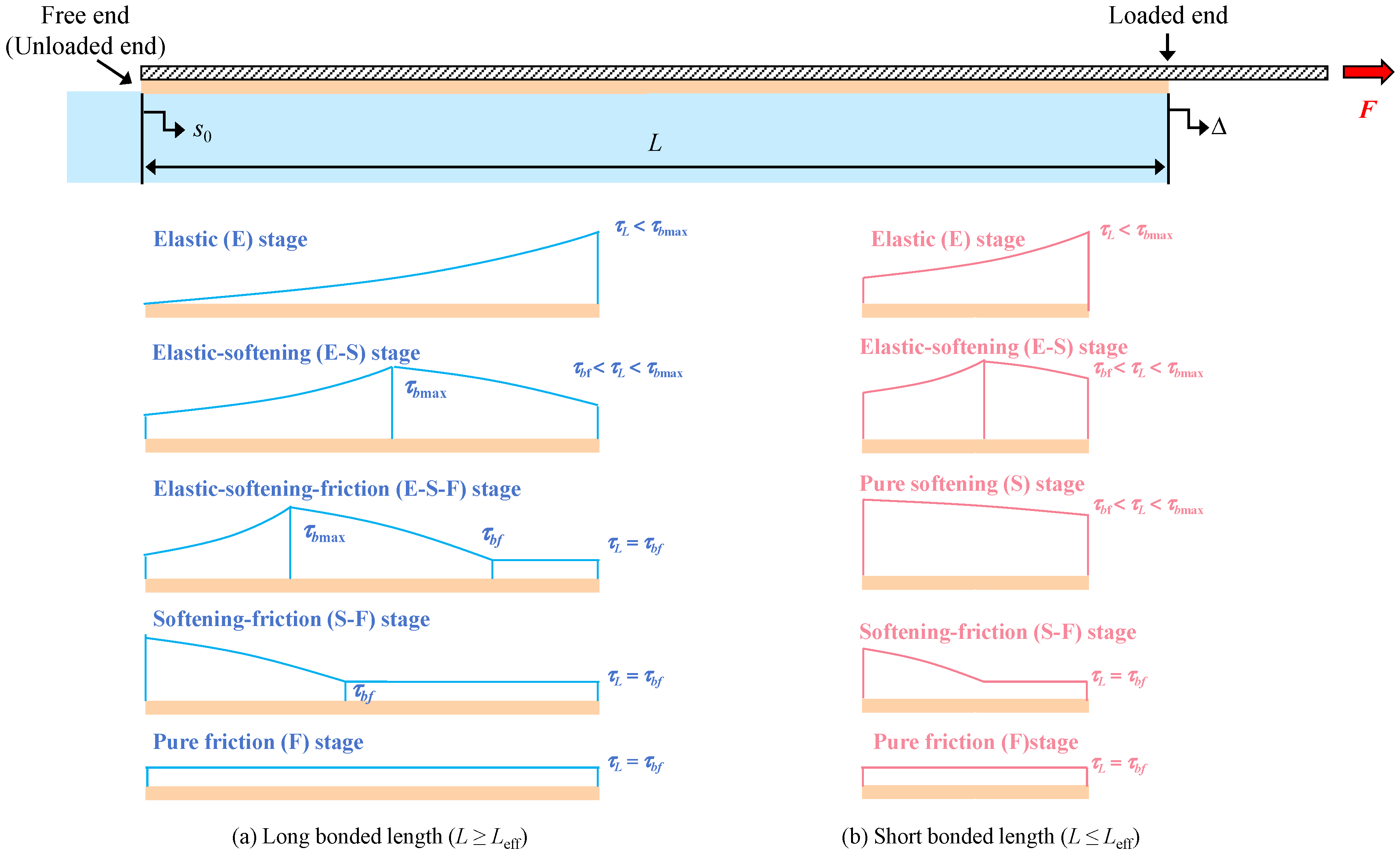
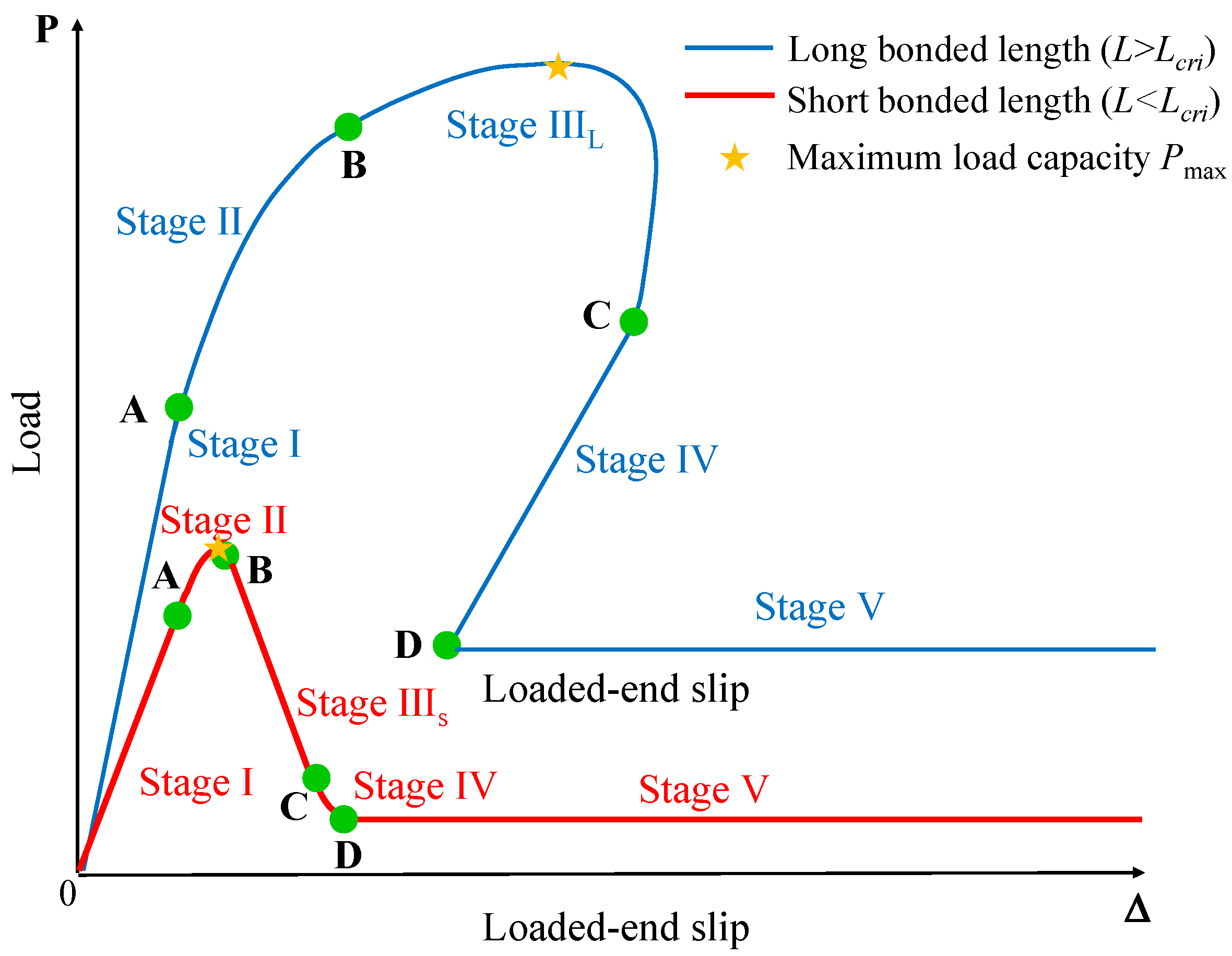
- Peak Load Location. For long joints, the consideration of the frictional component allows the load to continue increasing even as debonding initiates and propagates during Stage IIIL (segment BC). However, as the debonding zone expands and the elastic zone diminishes, the load reaches its maximum. This peak load is determined by solving the system of Equations (28)–(30). Conversely, the bonded area in short joints is insufficient to fully develop the frictional stress-transfer mechanism; consequently, the peak load occurs during the elastic Stage II.
- (ii)
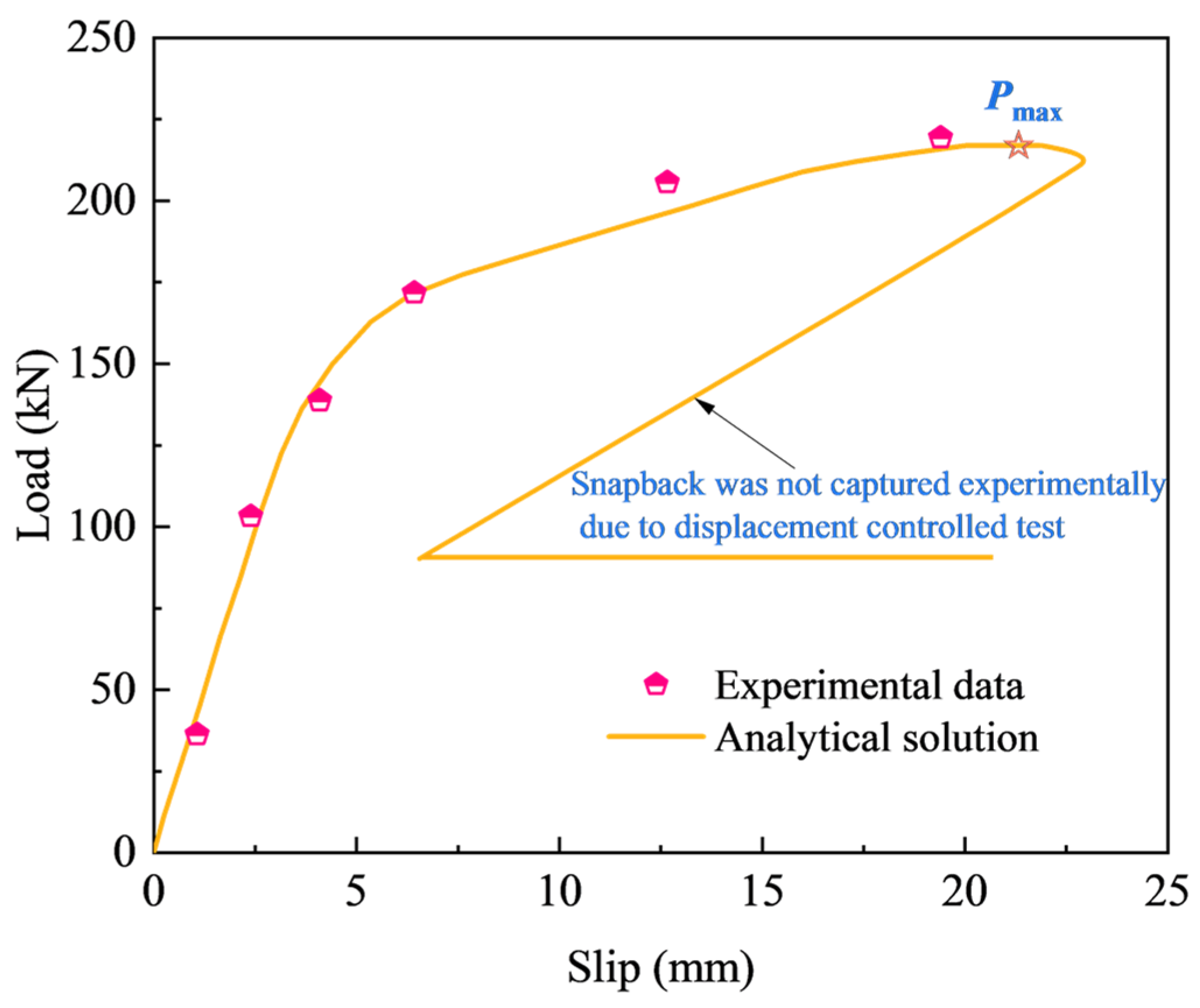
- Snapback Behavior. Snapback occurs exclusively in long joints where L > lsb. This indicates that the value of lsb must be greater than the crucial length Lcri. After Pmax is attained, when the elastic energy stored in the unbonded strip portion (encompassing both the non-bonded and debonded sections) is released. This release causes a shortening of the unbonded portion that exceeds the elongation of the bonded portion, leading to a snapback in the load response. Consequently, because the global slip decreases during this event, tests controlled by a monotonically increasing global slip cannot capture this phenomenon. However, the snapback has been successfully captured in FRP–concrete joints by controlling the displacement at the free end of the strip, which increases monotonically throughout the test [56]. In contrast, for bonded lengths shorter than lsb, the interface crack propagates stably, resulting in a softening branch in the load response without snapback.
5. Experimental Verification
5.1. Experimental Program
5.1.1. Material Properties
5.1.2. Specimen Preparation and Testing Procedure
5.2. Test Results
5.3. Inverse Determination of Trilinear CML Parameters
5.4. Comparison Between Analytical and Experimental Results
6. Discussion
6.1. Advancements and Boundaries of the Trilinear CML
6.2. Limitations and Future Work
7. Conclusions
- (1)
- The analytical framework facilitates the precise calculation of two key parameters: the critical bonded length (Lcri) and the snapback length (Lsn). For bonded lengths exceeding Lsn, the post-peak response of the ETS-GFRP-to-concrete interface is characterized by snapback. Conversely, for short bonded lengths lower than Lcri, the debonding cannot be fully developed and a linear softening branch is observed after the maximum load.
- (2)
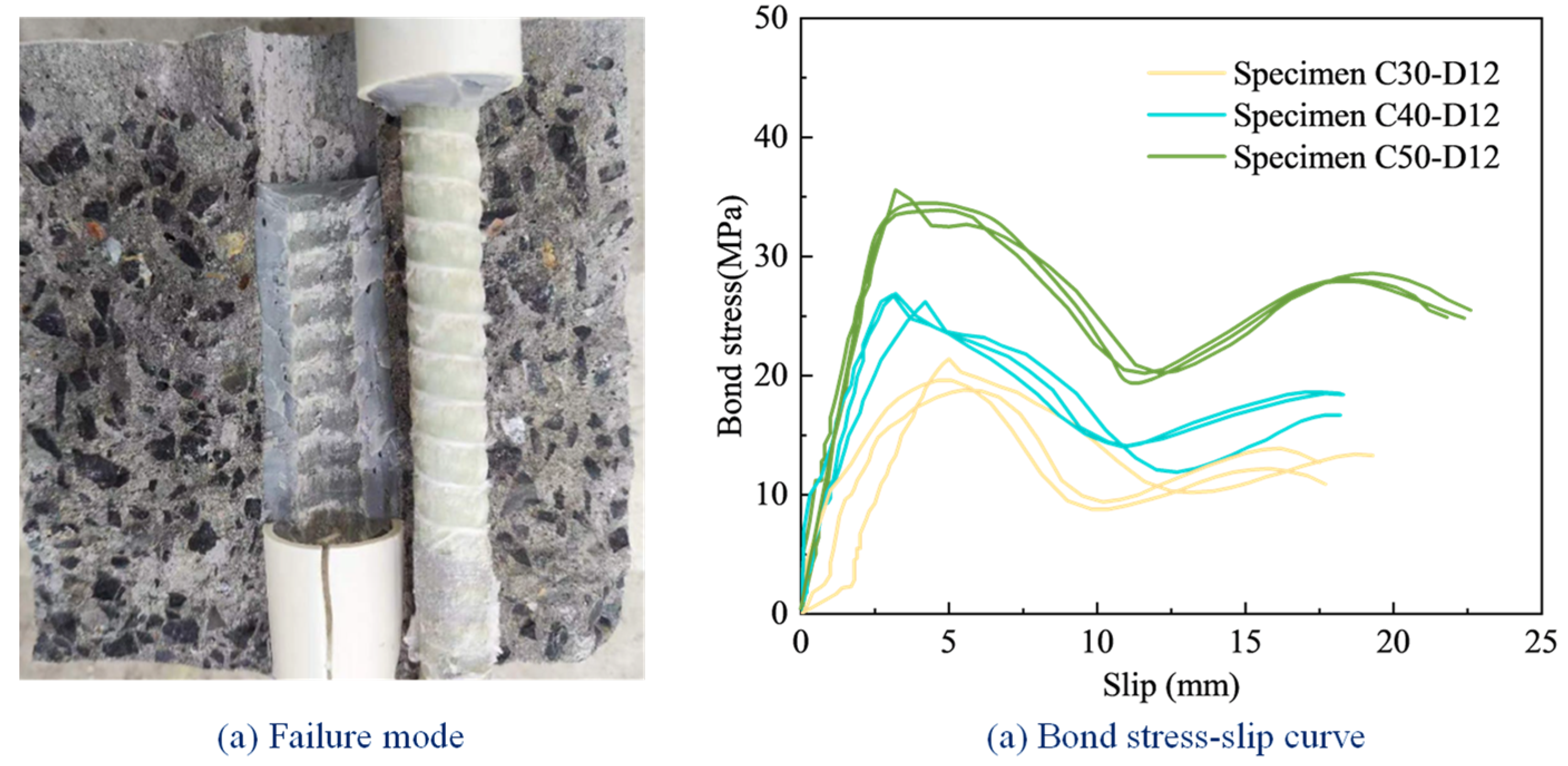
- An increase in concrete c strength significantly enhanced both the bond strength and stiffness. Specifically, elevating the concrete grade from C30 to C50 resulted in an increase in the average bond stress from 19.44 to 33.69 MPa and the frictional stress from 10.09 to 18.68 MPa. This improvement is attributed to the enhanced concrete confinement effect.
- (3)
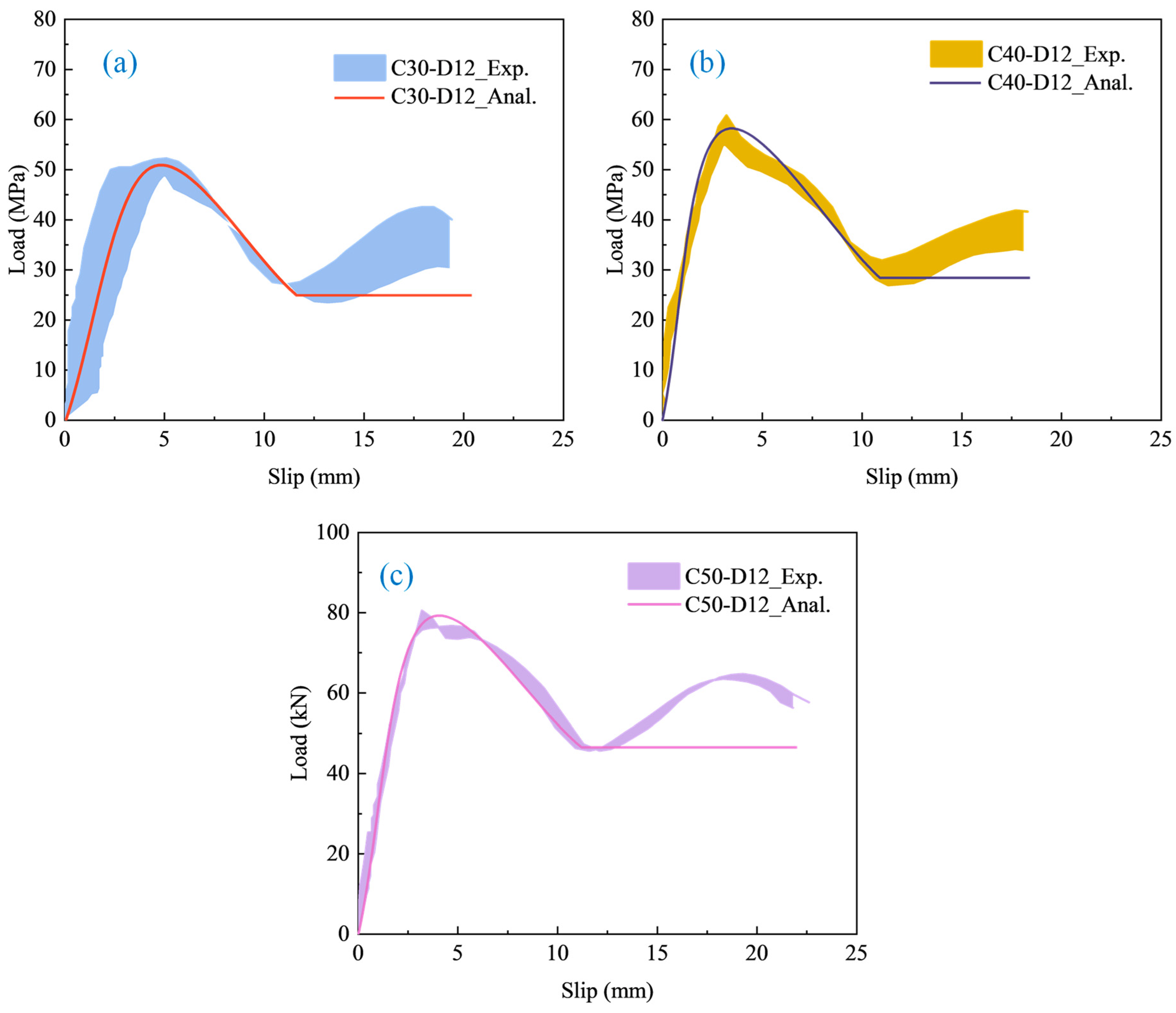
- The predictions can reproduce the experimental load–slip curve, as well as the peak load and the slip at the peak load, with relative errors less than 10%. Therefore, the analytical expressions provide a robust tool for simulating the mechanical behavior of RC members strengthened with the ETS technique by effectively capturing the contribution of ETS-FRP bars.
- (4)
- The snapback length lsn was found to be greater than the critical length Lcri, which serves as the threshold between ‘long’ and ‘short’ joints. From a design perspective, this necessitates that the bonded length be limited to less than lsn to avoid the undesirable brittle fracture and snapback instability.
Author Contributions
Funding
Data Availability Statement
Conflicts of Interest
References
- Chaallal, O.; Mofidi, A.; Benmokrane, B.; Neale, K. Embedded through-section FRP rod method for shear strengthening of RC beams: Performance and comparison with existing techniques. J. Compos. Constr. 2011, 15, 374–383. [Google Scholar] [CrossRef] [Scilit]
- Mofidi, A.; Chaallal, O.; Benmokrane, B.; Neale, K. Experimental tests and design model for RC beams strengthened in shear using the embedded through-section FRP method. J. Compos. Constr. 2012, 16, 540–550. [Google Scholar] [CrossRef] [Scilit]
- Breveglieri, M.; Aprile, A.; Barros, J.A. Shear strengthening of reinforced concrete beams strengthened using embedded through section steel bars. Eng. Struct. 2014, 81, 76–87. [Google Scholar] [CrossRef] [Scilit]
- Barros, J.A.O.; Dalfré, G.M. Assessment of the effectiveness of the embedded through-section technique for the shear strengthening of reinforced concrete beams. Strain 2013, 49, 75–93. [Google Scholar] [CrossRef] [Scilit]
- Breveglieri, M.; Aprile, A.; Barros, J. Embedded through-section shear strengthening technique using steel and CFRP bars in RC beams of different percentage of existing stirrups. Compos. Struct. 2015, 126, 101–113. [Google Scholar] [CrossRef] [Scilit]
- Bui, L.V.H.; Stitmannaithum, B.; Ueda, T. Mechanical performances of concrete beams with hybrid usage of steel and FRP tension reinforcement. Comput. Concr. Int. J. 2017, 20, 391–407. [Google Scholar]
- Godat, A.; Chaallal, O.; Neale, K.W. Nonlinear finite element models for the embedded through-section FRP shear-strengthening method. Comput. Struct. 2013, 119, 12–22. [Google Scholar] [CrossRef] [Scilit]
- Bui, L.V.H. Mechanical Performances of Concrete Beams with Hybrid Usage of Steel and FRP Reinforcement. Doctoral Dissertation, Chulalongkorn University, Bangkok, Thailand, 2018. [Google Scholar]
- Nakaba, K.; Kanakubo, T.; Furuta, T.; Yoshizawa, H. Bond behavior between fiber-reinforced polymer laminates and concrete. Struct. J. 2001, 98, 359–367. [Google Scholar]
- Ueda, T.; Dai, J.G. New shear bond model for FRP-concrete interface-from modeling to application. In Proceedings of the 2nd International Conference on FRP Composites in Civil Engineering—CICE, Adelaide, SA, Australia, 8–10 December 2004; pp. 69–81. [Google Scholar]
- Dai, J.; Ueda, T.; Sato, Y. Development of the nonlinear bond stress–slip model of fiber reinforced plastics sheet–concrete interfaces with a simple method. J. Compos. Constr. 2005, 9, 52–62. [Google Scholar] [CrossRef] [Scilit]
- Lin, X.; Zhang, Y. Evaluation of bond stress-slip models for FRP reinforcing bars in concrete. Compos. Struct. 2014, 107, 131–141. [Google Scholar] [CrossRef] [Scilit]
- Breveglieri, M.; Aprile, A.; Barros, J. RC beams strengthened in shear using the Embedded Through-Section technique: Experimental results and analytical formulation. Compos. Part B Eng. 2016, 89, 266–281. [Google Scholar] [CrossRef] [Scilit]
- Caro, M.; Jemaa, Y.; Dirar, S.; Quinn, A. Bond performance of deep embedment FRP bars epoxy-bonded into concrete. Eng. Struct. 2017, 147, 448–457. [Google Scholar] [CrossRef] [Scilit]
- Azevedo, A.S.; Firmo, J.P.; Correia, J.R. Bond behaviour at high temperatures between concrete and CFRP or steel strengthening bars applied according to the embedded through-section (ETS) technique. Cem. Concr. Compos. 2024, 151, 105580. [Google Scholar] [CrossRef] [Scilit]
- Azevedo, A.S.; Firmo, J.P.; Correia, J.R.; Almeida, J. Embedded through-section (ETS) technique for shear strengthening of reinforced concrete beams-Experimental and analytical study. Eng. Struct. 2025, 333, 120038. [Google Scholar] [CrossRef] [Scilit]
- Azevedo, A.; Firmo, J.; Correia, J. Fire behaviour of reinforced concrete beams strengthened in shear according to the embedded through-section (ETS) technique: Experimental and numerical study. Compos. Struct. 2025, 357, 118888. [Google Scholar] [CrossRef] [Scilit]
- Mofidi, A.; Mirzabagheri, S.; Doyle, A.K.K.; Chaallal, O. A novel analytical bond model for ETS FRP bars in shear rehabilitation of concrete members. Int. J. Concr. Struct. Mater. 2024, 18, 81. [Google Scholar] [CrossRef] [Scilit]
- Liu, H.; Ma, D.; Wang, Y.; Guo, Z.; Jia, M.; Wu, Z.; Gao, Y. Experimental and analytical study of bond-slip behavior of ETS GFRP bar-to-concrete joints subjected to elevated temperatures. Eng. Struct. 2025, 343, 121085. [Google Scholar] [CrossRef] [Scilit]
- Bui, L.V.H.; Jongvivatsakul, P.; Stitmannaithum, B.; Likitlersuang, S. Numerical modelling of bond mechanism of ETS FRP bar-concrete joints with long embedment length. Int. J. Adhes. Adhes. 2022, 117, 103179. [Google Scholar] [CrossRef] [Scilit]
- Spada, A.; Giambanco, G.; Rizzo, P. Elastoplastic damaging model for adhesive anchor systems. I: Theoretical formulation and numerical implementation. J. Eng. Mech. 2011, 137, 854–861. [Google Scholar] [CrossRef] [Scilit]
- Spada, A.; Rizzo, P.; Giambanco, G. Elastoplastic damaging model for adhesive anchor systems. II: Numerical and experimental validation. J. Eng. Mech. 2011, 137, 862–876. [Google Scholar] [CrossRef] [Scilit]
- Yang, S.; Yu, M.; Dong, K.; Yang, Y. Local bond strength prediction of deformed reinforcing bars in concrete considering heterogeneity at interface regions. Mag. Concr. Res. 2022, 74, 251–270. [Google Scholar] [CrossRef] [Scilit]
- Yang, S.; Yang, C.; Huang, M.; Liu, Y.; Jiang, J.; Fan, G. Study on bond performance between FRP bars and seawater coral aggregate concrete. Constr. Build. Mater. 2018, 173, 272–288. [Google Scholar] [CrossRef] [Scilit]
- Yang, S.; Chen, Y.; Du, D.; Fan, G. Determination of boundary effect on shear fracture energy at steel bar–concrete interface. Eng. Fract. Mech. 2016, 153, 319–330. [Google Scholar] [CrossRef] [Scilit]
- Dai, J.; Ueda, T.; Sato, Y. Unified analytical approaches for determining shear bond characteristics of FRP-concrete interfaces through pullout tests. J. Adv. Concr. Technol. 2006, 4, 133–145. [Google Scholar] [CrossRef] [Scilit]
- Milani, G.; Grande, E. Simple bisection procedure in quickly convergent explicit ODE solver to numerically analyze FRCM strengthening systems. Compos. Part B Eng. 2020, 199, 108322. [Google Scholar] [CrossRef] [Scilit]
- Bilotta, A.; Lignola, G.P. Effect of fiber-to-matrix bond on the performance of inorganic matrix composites. Compos. Struct. 2021, 265, 113655. [Google Scholar] [CrossRef] [Scilit]
- Zhang, X.; Aljewifi, H.; Li, J. Failure behaviour investigation of continuous yarn reinforced cementitious composites. Constr. Build. Mater. 2013, 47, 456–464. [Google Scholar] [CrossRef] [Scilit]
- D’antino, T.; Carloni, C.; Sneed, L.; Pellegrino, C. Matrix-fiber bond behavior in PBO FRCM composites: A fracture mechanics approach. Eng. Fract. Mech. 2014, 117, 94–111. [Google Scholar] [CrossRef] [Scilit]
- Colombi, P.; D’Antino, T. Analytical assessment of the stress-transfer mechanism in FRCM composites. Compos. Struct. 2019, 220, 961–970. [Google Scholar] [CrossRef] [Scilit]
- Vaculik, J.; Sturm, A.B.; Visintin, P.; Griffith, M.C. Modelling FRP-to-substrate joints using the bilinear bond-slip rule with allowance for friction—Full-range analytical solutions for long and short bonded lengths. Int. J. Solids Struct. 2018, 135, 245–260. [Google Scholar] [CrossRef] [Scilit]
- Wang, Y.J.; Wu, Z.M.; Zheng, J.J.; Zhou, X.M. Three-dimensional analytical model for the pull-out response of anchor-mortar-concrete anchorage system based on interfacial bond failure. Eng. Struct. 2019, 180, 234–248. [Google Scholar] [CrossRef] [Scilit]
- Wang, H.W.; Wang, Y.J.; Liu, H.B.; Ma, D.; Wu, Z.-M.; Jin, H.; Jia, M.-D.; Hu, X. Theoretical study on the bond performance of embedded through-section reinforcing bar-to-concrete joints with localized debonding defects. Structures 2025, 75, 108615. [Google Scholar] [CrossRef] [Scilit]
- Wang, Y.J.; Wu, Z.M.; Zheng, J.J.; Yu, R.C.; Zhou, X.-M. Three-dimensional axisymmetric analytical method for pull-out behaviour of adhesive anchors in concrete. Eng. Fract. Mech. 2020, 226, 106876. [Google Scholar] [CrossRef] [Scilit]
- Wang, Y.J.; Liu, H.B.; Ma, D.; Zhang, G.-Q.; Wu, Z.-M.; Jia, M.-D. Experimental and analytical investigations on debonding response of embedded through-section ribbed GFRP bar-to-concrete joints at elevated temperatures. Constr. Build. Mater. 2024, 447, 138000. [Google Scholar] [CrossRef] [Scilit]
- Pan, K.; Wang, Y.; Liu, H.; Wu, Z.; Jia, M.; Chen, Y. Closed-form solution to the debonding of embedded Through-Section FRP bar-to-concrete joints with interfacial defects. Eng. Fract. Mech. 2025, 314, 110708. [Google Scholar] [CrossRef] [Scilit]
- Wang, Y.J.; Wu, Z.M.; Zheng, J.J.; Yu, R.C.; Liu, Y. Analytical method for crack propagation process of lightly reinforced concrete beams considering bond-slip behaviour. Eng. Fract. Mech. 2019, 220, 106654. [Google Scholar] [CrossRef] [Scilit]
- Federation Internationale du Beton. FIB Bulletin 90. Externally Applied FRP Reinforcement for Concrete Structures; The International Federation for Structural Concrete: Lausanne, Switzerland, 2019. [Google Scholar] [CrossRef] [Scilit]
- Carloni, C.; Verre, S.; Sneed, L.H.; Ombres, L. Open issues on the investigation of PBO FRCM-Concrete debonding. Compos. Struct. 2022, 299, 116062. [Google Scholar] [CrossRef] [Scilit]
- Calabrese, A.S.; Colombi, P.; D’ANtino, T. Analytical solution of the bond behavior of FRCM composites using a rigid-softening cohesive material law. Compos. Part B Eng. 2019, 174, 107051. [Google Scholar] [CrossRef] [Scilit]
- D’Antino, T.; Colombi, P.; Carloni, C.; Sneed, L.H. Estimation of a matrix-fiber interface cohesive material law in FRCM-concrete joints. Compos. Struct. 2018, 193, 103–112. [Google Scholar] [CrossRef] [Scilit]
- Bertolli, V.; D’Antino, T. Modeling the behavior of externally bonded reinforcement using a rigid-trilinear cohesive material law. Int. J. Solids Struct. 2022, 248, 111641. [Google Scholar] [CrossRef] [Scilit]
- Yuan, H.; Teng, J.; Seracino, R.; Wu, Z.; Yao, J. Full-range behavior of FRP-to-concrete bonded joints. Eng. Struct. 2004, 26, 553–565. [Google Scholar] [CrossRef] [Scilit]
- Calabrese, A.S.; D’Antino, T.; Colombi, P. Effect of adhesive ductility on the bond behavior of CFRP-steel cohesive interfaces made with toughened epoxy resin. Compos. Sci. Technol. 2024, 257, 110824. [Google Scholar] [CrossRef] [Scilit]
- Godat, A.; L’hady, A.; Chaallal, O.; Neale, K.W. Bond behavior of the ETS FRP bar shear-strengthening method. J. Compos. Constr. 2012, 16, 529–539. [Google Scholar] [CrossRef] [Scilit]
- Caro, M.; Dirar, S.; Quinn, A.; Yapa, H. Shear strengthening of existing reinforced concrete beams with embedded bars–an overview. Proc. Inst. Civ. Eng.-Struct. Build. 2023, 176, 439–452. [Google Scholar] [CrossRef] [Scilit]
- Valerio, P.; Ibell, T.J.; Darby, A.P. Deep embedment of FRP for concrete shear strengthening. Proc. Inst. Civ. Eng.-Struct. Build. 2009, 162, 311–321. [Google Scholar] [CrossRef] [Scilit]
- Focacci, F.; D’Antino, T.; Carloni, C.; Sneed, L.; Pellegrino, C. An indirect method to calibrate the interfacial cohesive material law for FRCM-concrete joints. Mater. Des. 2017, 128, 206–217. [Google Scholar] [CrossRef] [Scilit]
- Zou, X.; D’ANtino, T.; Sneed, L.H. Analytical study of the bond behavior of fiber reinforced cementitious matrix (FRCM)-substrate joints based on a two-stage nonlinear cohesive material law. Compos. Struct. 2023, 304, 116457. [Google Scholar] [CrossRef] [Scilit]
- D’Antino, T.; Pisani, M.A. General analytical model for the bond capacity of NSM FRP-concrete joints. J. Compos. Constr. 2020, 24, 04020065. [Google Scholar] [CrossRef] [Scilit]
- Focacci, F.; Rahman, M.M.; D’aNtino, T.; Carloni, C. Frp strips externally bonded to quasi-brittle substrates: Discussions and advances of open research topics. J. Compos. Constr. 2024, 28, 04024055. [Google Scholar] [CrossRef] [Scilit]
- Bocciarelli, M. A new cohesive law for the simulation of crack propagation under cyclic loading. Appl. Steel-Concr.-FRP Bond. interface. Theor. Appl. Fract. Mech. 2021, 114, 102992. [Google Scholar] [CrossRef] [Scilit]
- Benmokrane, B.; Chennouf, A.; Mitri, H. Laboratory evaluation of cement-based grouts and grouted rock anchor. Int. J. Rock Mech. Min. Sci. Geomech. Abstr. 1995, 32, 633–642. [Google Scholar] [CrossRef] [Scilit]
- Lahouar, M.A.; Caron, J.-F.; Pinoteau, N.; Forêt, G.; Benzarti, K. Mechanical behavior of adhesive anchors under high temperature exposure: Experimental investigation. Int. J. Adhes. Adhes. 2017, 78, 200–211. [Google Scholar] [CrossRef] [Scilit]
- Carrara, P.; Ferretti, D.; Freddi, F.; Rosati, G. Shear tests of carbon fiber plates bonded to concrete with control of snap-back. Eng. Fract. Mech. 2011, 78, 2663–2678. [Google Scholar] [CrossRef] [Scilit]
- Ren, F.F.; Yang, Z.J.; Chen, J.F.; Chen, W.W. An analytical analysis of the full-range behaviour of grouted rockbolts based on a tri-linear bond-slip model. Constr. Build. Mater. 2010, 24, 361–370. [Google Scholar] [CrossRef] [Scilit]
- GB/T 50081-2019; Standard for Test Methods of Physical and Mechanical Properties of Concrete. Ministry of Construction of the People’s Republic of China: Beijing, China, 2019. (In Chinese)
- ACI 440.3R-15; Guide Test Methods for Fiber-Reinforced Polymers (FRPs) for Reinforcing or Strengthening Concrete Structures. American Concrete Institute (ACI): Farmington Hills, MI, USA, 2015.
- GB 50367-2013; Code for the Design of Strengthening Concrete Structures. Ministry of Housing and Urban-Rural Development: Beijing, China, 2013. (In Chinese)
- Chen, J.; Hagan, P.C.; Saydam, S. Sample diameter effect on bonding capacity of fully grouted cable bolts. Tunn. Undergr. Space Technol. 2017, 68, 238–243. [Google Scholar] [CrossRef] [Scilit]
- ASTM D7913-14; Standard Test Method for Bond Strength of Fiber-Reinforced Polymer Matrix Composite Bars to Concrete by Pullout Testing Is a New Standard Now Available. ASTM: West Conshohocken, PA, USA, 2020.
- Rong, G.; Zhu, H.C.; Zhou, C.B. Testing study on working mechanism of fully grouted bolts of thread steel and smooth steel. Chin. J. Rock Mech. Eng. 2004, 23, 469–475. [Google Scholar]
- Focacci, F.; Nanni, A.; Bakis, C.E. Local bond-slip relationship for FRP reinforcement in concrete. J. Compos. Constr. 2000, 4, 24–31. [Google Scholar] [CrossRef] [Scilit]
- Mofidi, A.; Rajabifard, M. Fracture Mechanics-Based Modelling of Post-Installed Adhesive FRP Composite Anchors in Structural Concrete Applications. J. Compos. Sci. 2025, 9, 282. [Google Scholar] [CrossRef] [Scilit]
- Guo, D.; Zhu, M.-C.; Deng, J.; Zhong, M.-T.; Zhou, H. A novel methodology for determining the FRP-to-steel/concrete bond-slip relationship from load-displacement curves under thermal effects. Compos. Struct. 2025, 377, 119886. [Google Scholar] [CrossRef] [Scilit]





| Debonding Stages | Long Bonded Joint | Short Bonded Joint | ||
|---|---|---|---|---|
| P-D Response | Pmax | P-D Response | Pmax | |
| Stage I | Equation (16) | - | Equation (16) | - |
| Stage II | Equations (20) and (21a) | - | Equations (20) and (21a) | Equation (21b) |
| Stage IIIL | Equations (27) and (28) | Equations (28)–(30) | - | - |
| Stage IIIS | - | - | Equation (47) | - |
| Stage IV | Equations (38) and (39) | - | Equations (38) and (39) | - |
| Stage V | Equation (43) | - | Equation (43) | - |
| Strength Grade | Cement | Water | Sand | Limestone | Fly Ash | Superplasticizer | Water-to-Binder Ratio |
|---|---|---|---|---|---|---|---|
| C30 | 325 | 195 | 696 | 1184 | / | / | 0.60 |
| C40 | 433 | 195 | 603 | 1170 | / | / | 0.45 |
| C50 | 420 | 199 | 800 | 832 | 130 | 6.26 | 0.36 |
| Strength Grade | Compressive Strength (MPa) | Tensile Strength (MPa) | Elastic Modulus (GPa) | Poisson’s Ratio |
|---|---|---|---|---|
| C30 concrete | 31.88 ± 0.35 | 2.77 ± 0.18 | 33.2 ± 1.25 | 0.2 |
| C40 concrete | 41.21 ± 0.74 | 3.35 ± 0.13 | 34.6 ± 0.81 | 0.2 |
| C50 concrete | 50.54 ± 1.27 | 3.78 ± 0.12 | 36.4 ± 2.73 | 0.2 |
| Specimen ID | τbmax (MPa) | s1 (mm) | τbf (MPa) | s2 (mm) |
|---|---|---|---|---|
| C30_D12 | 22.6 | 4.71 | 21.4 | 12.50 |
| C40_D12 | 25.8 | 3.34 | 14.5 | 12.31 |
| C50_D12 | 34.7 | 3.67 | 9.98 | 8.57 |
| Ren et al. [57] | 2.30 | 2.56 | 0.41 | 6.67 |
| Specimen ID | Average Maximum Load (kN) | Average Slip at the Maximum Load (mm) | ||||
|---|---|---|---|---|---|---|
| (kN) | (kN) | Absolute Error (%) | (kN) | (kN) | Absolute Error (%) | |
| C30_D12 | 48.68 | 51.07 | 4.91 | 4.87 | 4.71 | 3.29 |
| C40_D12 | 56.77 | 58.27 | 2.64 | 3.18 | 3.34 | 1.89 |
| C50_D12 | 78.52 | 79.46 | 1.20 | 3.37 | 3.67 | 8.90 |
| Ren et al. [57] | 219.3 | 216.9 | 1.09 | 19.41 | 21.29 | 8.83 |
| Average | - | - | 2.46 | - | - | 5.73 |
Disclaimer/Publisher’s Note: The statements, opinions and data contained in all publications are solely those of the individual author(s) and contributor(s) and not of MDPI and/or the editor(s). MDPI and/or the editor(s) disclaim responsibility for any injury to people or property resulting from any ideas, methods, instructions or products referred to in the content. |
© 2025 by the authors. Licensee MDPI, Basel, Switzerland. This article is an open access article distributed under the terms and conditions of the Creative Commons Attribution (CC BY) license.
Share and Cite
Liang, W.; Lu, J.; Fu, J.; Zhang, B.; Zhang, B.; Wang, Y. Analytical and Experimental Study on Bond Behavior of Embedded Through-Section FRP Bar-to-Concrete Joints Using a Trilinear Cohesive Material Law. Buildings 2026, 16, 164. https://doi.org/10.3390/buildings16010164
Liang W, Lu J, Fu J, Zhang B, Zhang B, Wang Y. Analytical and Experimental Study on Bond Behavior of Embedded Through-Section FRP Bar-to-Concrete Joints Using a Trilinear Cohesive Material Law. Buildings. 2026; 16(1):164. https://doi.org/10.3390/buildings16010164
Chicago/Turabian StyleLiang, Wensheng, Jiang Lu, Jinping Fu, Bi Zhang, Baowen Zhang, and Yanjie Wang. 2026. "Analytical and Experimental Study on Bond Behavior of Embedded Through-Section FRP Bar-to-Concrete Joints Using a Trilinear Cohesive Material Law" Buildings 16, no. 1: 164. https://doi.org/10.3390/buildings16010164
APA StyleLiang, W., Lu, J., Fu, J., Zhang, B., Zhang, B., & Wang, Y. (2026). Analytical and Experimental Study on Bond Behavior of Embedded Through-Section FRP Bar-to-Concrete Joints Using a Trilinear Cohesive Material Law. Buildings, 16(1), 164. https://doi.org/10.3390/buildings16010164