
Article

Performance Comparison of STPV and Split Louvers in Hot Arid Climates

by
Abdelhakim Mesloub
1,2,*,
Mohamed Ahmed Said Mohamed
1,2 and
Lambros T. Doulos
3,*
1
Department of Architecture Engineering, College of Engineering, University of Hail, Hail 55473, Saudi Arabia
2
Scientific and Engineering Research Center, University of Hail, Hail 55473, Saudi Arabia
3
School of Applied Arts and Sustainable Design, Hellenic Open University, 26331 Patras, Greece
*
Authors to whom correspondence should be addressed.
Buildings 2026, 16(1), 117; https://doi.org/10.3390/buildings16010117 (registering DOI)
Submission received: 21 October 2025 / Revised: 19 December 2025 / Accepted: 23 December 2025 / Published: 26 December 2025
(This article belongs to the Section Building Energy, Physics, Environment, and Systems)

Abstract

Façade systems in hot, high-insolation climates are required to simultaneously mitigate cooling loads, ensure high-quality daylight, and, where feasible, harvest on-site electricity demands that are often in tension. This study assesses and compares two efficient façade strategies for a fully glazed office prototype in Hail, Saudi Arabia: semi-transparent photovoltaic glazing (STPV10–30%VLT) and parametrically tuned split louvers (18 depth–spacing–tilt configurations). Using a unified parametric workflow (Rhino/Grasshopper), Radiance/honeybee for daylight metrics, ASHRAE-55 heat-balance metrics for thermal comfort, and EnergyPlus for end-use and PV yield, to evaluate annual and solstice performance across cardinal orientations. Optimized split louvers maintained UDI300–1000lx and effectively suppress glare, but incur substantial lighting-energy penalties. In contrast, STPV with 10–20% VLT broadly meets daylight targets while strongly reducing cooling and lighting demand, delivering whole-façade energy savings of up to 50–94% depending on orientation, but could be net-neutral to slightly adverse north 3% when daylight penalties dominate. Thermal comfort responses mirrored these trends: summer PMV was near 0 to +0.5 for both systems, with winter under-heating evident when solar gains are strongly suppressed. Overall, in hot-arid, highly glazed offices, STPV of 10–20%VLT provides the most balanced triad of daylight quality, cooling reduction, and net energy benefit, while optimized louvers excel where glare control is paramount but require careful daylight-control integration.

1. Introduction

The envelope of a building and, particularly, the façade, is the primary factor that affects energy use patterns in office buildings and levels of occupant comfort [1]. In hot climates with high insolation and significant cooling loads, façades are the interface through which natural light energy and overall indoor environmental quality have to pass [2]. One of the strategic approaches for achieving a significant reduction in operational energy consumption, especially with HVAC and lighting systems, is to enhance façade performance in these climate zones [3]. This challenge has been further compounded by the increasing urbanization of hot climates, which demand resourceful solutions for façades balanced to effectively mitigate the heat transmittance and maintain daylighting levels beneficial to indoor occupant comfort [4].
Merged advanced energy generation systems along with efficient and novel shading features for such are promising technological paths across the last decade. Of these, STPV systems that use hybrid mechanisms to generate photovoltaic electricity whilst harvesting daylight penetration have emerged as an innovative solution for enhancing energy self-sufficiency and indoor environment quality [5]. These systems effectively convert solar spectrum under illumination into usable power, utilizing photonics and reducing the dependence on fossil fuels. STPV technology, in turn, has synergy with split louvers [6] functioning as shading devices [7] which can control daylight and heat gains by changing the angle of louvers to adapt to external conditions. This modulation can greatly enhance visual comfort and energy loads, promoting the overall sustainability and livability of the office building. Both semi-transparent glazing technologies and split louvers, as presented, are examples of cutting-edge, multi-dimensional façade strategies that correspond to worldwide sustainability goals and growing requirements for high-performance building envelopes.

2. Literature Review

The integration of energy-efficient devices on building façades has been a rising research interest in the last two decades. The importance of façades in shaping the appearance and the thermal performance and energy requirements of buildings has always been recognized. Efficient façades are designed to react to the external environment, minimizing energy use and improving interior comfort [8]. The application of energy-efficient façade systems in building development has attracted a lot of research attention as they can contribute towards high-performing buildings that optimize building energy performance, nurturing occupant well-being, and minimizing the carbon footprint. The performance of energy-efficient façades has been studied by different researchers and can be classified as passive, active, and hybrid systems [9,10]. Passive systems are usually listed within building technologies as well, but they utilize architectural components such as shading devices and smart windows [11,12], while active ones present technology involved, such as photovoltaic [13,14] or thermal energy conversion. Hybrid systems integrate the two elements to maximize energy generation in various climatic conditions [15,16]. The systems STPV and split louvers, which are also under study in this paper, are two very different ways to meet them. While the literature demonstrates diverse approaches to façade energy efficiency, their performance remains highly climate-dependent, necessitating focused investigation of specific systems. The next Section 2.1, Section 2.2 and Section 2.3 therefore review the STPV systems and split louver systems, two complementary technologies that represent distinct strategies for optimizing building envelope performance through either solar energy harvesting or adaptive environmental control.

2.1. Semi-Transparent Photovoltaic System

STPV systems are hybrid in that they allow incoming daylight and produce energy [17]. Unlike traditional opaque solar panels, STPV systems regulate the amount of light entering a building’s façade used for electric power production from sunlight. This semi-transparency leads to the STPV applications having a unique advantage for building façades since they can transmit natural daylight into the space and thus, reduce electric lighting requirements while also reducing solar heat gain and hence providing energy harvesting together with thermal comfort. In another study by Alrashidi et al. (2020) [18], the application of STPV with CdTe in façade buildings reduced a significant portion of energy consumption when it peaked at 20%. Findings demonstrated that one of the tradeoffs between the energy consumption and visual comfort was the low transparency, which led to an increase in artificial lighting requirement. Additionally, Wu et al. (2021) [19] performed a full examination on STPV performance in the presence of building shading, demonstrating that the produced electricity was reduced by 15.3% and heat gain was cut down by 3.28% for eave-shadow-affected STPV systems. More studies of the STPV system in cold regions were carried out by Qiu and Yang (2019) [20], which is about the solar-driven vacuum STPV system near Harbin, China. They found that vacuum glazing had the potential of improving winter thermal performance, and energy savings could be up to 20% in the heating season. Another study by Setyantho et al. (2021) [21] evaluated the multi-criteria performance of STPV windows in Mediterranean conditions and found that by applying the electricity balance index, such windows proved a high energy efficiency. Additionally, Wang et al. (2024) [22] analyzed the net performance of STPV devices with passive cooling coating to have a 15% reduction in heat gain, coupled with an increase of only 3% electricity generation. A study by Ghasaban et al. (2025) [23] further optimized the optimal transparencies of STPV façades in different climates. They concluded that, for regions such as Riyadh and Tebessa, low WWRs and intermediate levels of transparency in the modules were optimum to minimize discomfort glare and maximize energy output.

2.2. Split Louver System

Split louvers are an efficient façade system that would greatly contribute to the energy efficiency of buildings through reconfiguring their position in response to environmental factors, including solar radiation, outside temperature, and wind speed. This powered technology is designed to optimize solar gain, daylight, and fresh air in response to changing local weather. By controlling the direct solar radiation into the building, split louvers minimize heat gain while achieving appropriate interior daylighting and better ventilation.
Split louver systems have also been widely investigated regarding their effects on the energy performance of buildings, specifically with respect to solar heat gain control, ventilation, and daylighting. Unlike STPV systems that rely solely on photovoltaic energy, split louvers consider solar access to improve the thermal conditions inside the home, both through air movement and shading.
In Alsukkar et al. (2022) [24], the research was directed towards optimizing daylighting with parametrically driven split louvers in a hot climate (Jordan). The researchers experimented with different slat angles and observed that parametric incremental control of the slats efficiently increased the daylight uniformity coefficient (Uo) up to 0.60. Moreover, the system also presented high daylight availability, where the UDI value varied from 90% 100% at noon. Another work performed by Ibrahim et al. (2024) [25] evaluated energy reductions and daylighting levels achieved by trapezoidal profile louver systems. These louvers were tested at various angles to investigate their effects on energy and daylight performance. Promising results were obtained, with energy savings reaching 40% to 44% in the different façades. The daylighting indices, such as UDI and DA, were also observed to improve substantially with the application of the trapezoidal profile system to achieve 92.6% and 67.23%, respectively. Bagheri Sabzevar & Erfan (2021) [26] studied the thermal efficiency of fixed louver shading devices. They performed a parametric analysis in different directions, and a decrease from 23% to 32% was recorded for the thermal energy consumption for optimal positions and angles of louvers. The study highlights that the optimal setting of louver with depth, angle, and distances was crucial to thermal comfort improvement in the east, south, and west façades. In the study of Alsukkar et al. (2023) [27], the effect of different louver slat profiles, including flat, curved, and oval-shaped profiles, on daylight performance was studied. Retro-shaped slats, improved daylight distribution that was more than 90% of the work plane area, and met the UDI range between 150 and 750 lux. Further, the slat configurations improved daylight uniformity with Uo of up to 0.70, as such was an effective reduction in glare while enhancing visual comfort of occupants. Rafati et al. (2022) [28], evaluated the best louver designs for three Canadian cities, noting that differences in latitude and climate require distinct louver depths and numbers to achieve the most energy efficiency and visual comfort. The research suggested that the right louver setting for a specific geographic context would lead to an optimized energy performance and occupants’ comfort.

2.3. Summary of Related STPV and Split Louver System Works

This section synthesizes recent studies on STPV and split louver systems across diverse climates. Table 1 summarizes key research works, documenting objectives, climatic zones, variables, and performance results. The table enables direct comparison of how these façade technologies perform under varying conditions and identifies critical design parameters for energy efficiency and visual comfort.

3. STPV and Split Louver Bibliometric Overview

The bibliometric analysis, using the Web of Science database and visualized by VOSviewer1.6.20 as depicted in Figure 1, allows identifying a research landscape that is related to two prominent façade technologies within sustainable architecture: semi-transparent photovoltaic (STPV) systems and split louver devices. The performative keywords “thermal comfort “, “daylighting”, “energy performance”, “design”, and “facades” are grouped together in this category, indicating that split louvers and STPVs are positioned in the current body of work as precisely integrated building skin techniques for improved performance.
Keyword networks revealed two distinct performance agendas, related to (i) energy generation and savings (solar energy harvesting, solar radiation control) and (ii) occupant-centric issues such as visual comfort as well as thermal comfort. STPV systems are commonly linked to “energy savings”, “solar energy”, and “solar radiation”, illustrating an increasing integration in buildings as elements that generate electricity while controlling solar gains to avoid glare or overheating. Meanwhile, split louver and shading systems are clustered around “systems,” “buildings,” and “façades,” reflecting their application in double-skin façades and adaptive envelope configurations, which informed the selection of parametric louver geometries (slat angle, depth, and profile) for this study.
All studies in the network gradually rely on using numerical simulation and optimization tools while investigating trade-offs between daylighting and cooling load with STPV electricity production. This methodological focus characterizes STPV and split louvers as controllable façade subsystems, the geometry and operation of which can be adjusted to address competing objectives, including maximizing on-site renewable energy generation; upholding satisfactory indoor thermal conditions; and providing well-distributed but non-glare daylight. Consequently, the façade configurations and performance metrics selected for this study, including transparency levels, louver angles, solar transmittance, daylight indices, and energy consumption, are grounded in the established research priorities identified through bibliometric analysis.

4. Research Gap

However, despite this increasing number of studies, the literature is still scattered on exactly how it analyzes and compares different façade technologies under hot climates. A lot of literature analyses STPV in isolation (glass type) or shading/louver system independently, often also just one performance indicator like energy savings, enhanced thermal comfort, or daylighting as measurement scales, but all those are analyzed separately from each other and not in a holistic comparison of different façade types.
There is limited reference to comparative investigation of STPV glazing with split louver shading in a direct comparison within typical façade issues for hot regions. There are currently few studies that compare these systems to a combination of performance parameters, such as whole-building thermal comfort, daylight quantity and quality (including glare), and energy performance for office buildings. This lack of comparative material constrains decision makers, designers, and policy developers in determining which façade strategy (or strategy sets) might be best for a given hot-climate situation.
As a result, a specific research gap can be found in the lack of such robust simulation-based performance comparison between STPV integrated glazing and split louver system in (a real or representative office building) context or case studies related to hot regions. Responding to this gap involves research that
  • Compares the two technologies on equal boundary conditions and climatic inputs.
  • Quantifies the outcomes on thermal comfort, climate-based daylight modeling and glare, and overall energy use.
  • Synthesizes results in design protocols that encourage the development and implementation of climate-responsive and scalable façade concepts for sustainable building practice in hot climates.
The present paper addresses this gap directly by providing a comparative analysis between STPV glazing and split louver shading for office buildings in hot climates with respect to optimizing the trade-off between thermal comfort, daylighting, and energy performance towards enhancing more resilient and efficient façade designs.

5. Materials and Methods

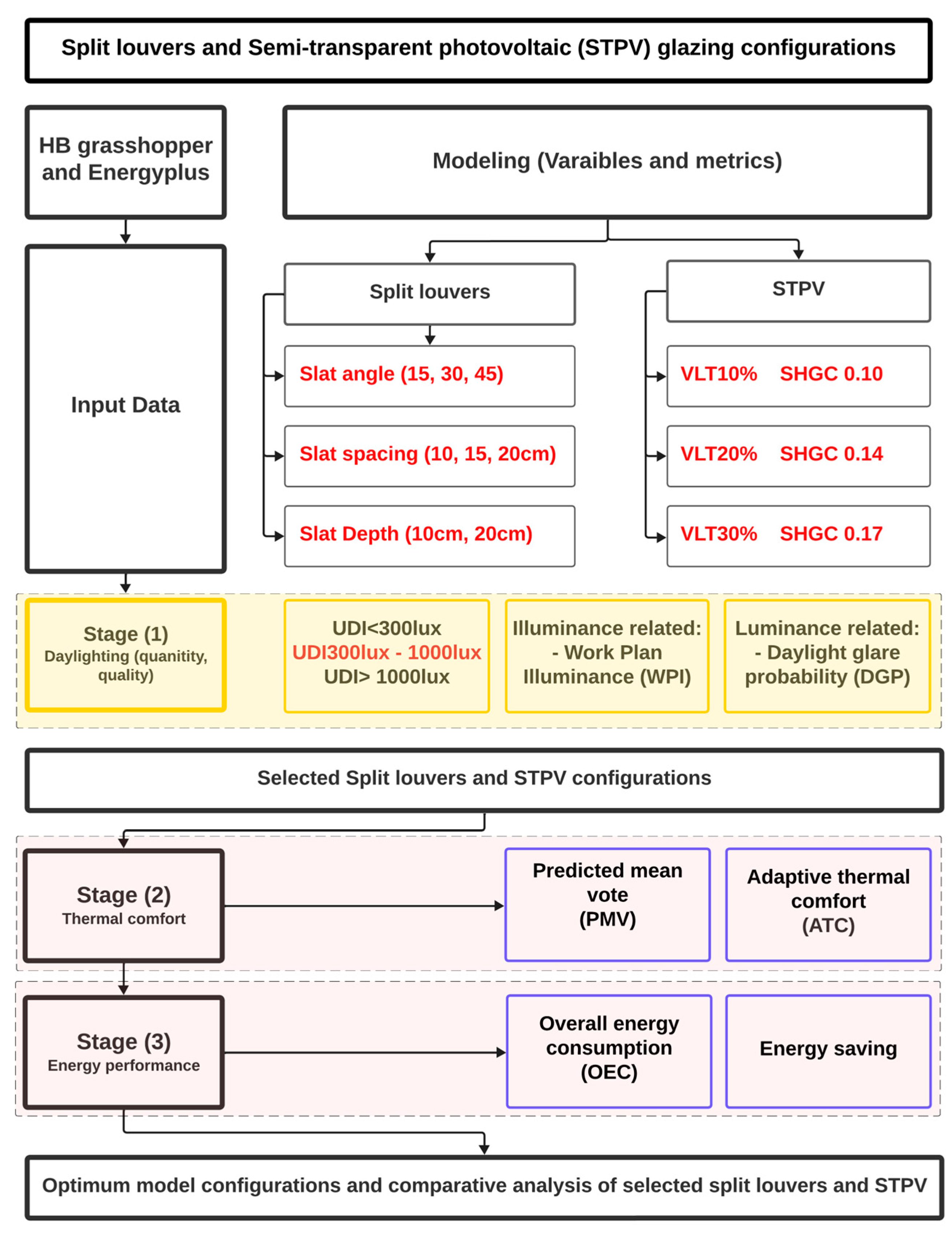
This study used a parametric simulation model to evaluate the thermal, daylighting, and energy performance of split louver shading devices and STPV glazing systems in an office building for a hot region (Hail City and Saudi Arabia). The study is based on a case study by implementing the proposed split louver system into an equivalent virtual model of a reference building model using parametric modeling. This parametric modeling allows for the control of variation in many design variables, such as slat angle, spacing, slat depth for split louvers, and optical transparency (10%, 20%, and 30%), for STPV glazing systems. The flexibility of parametric design enables to study of several possible configurations that are then assessed in terms of their daylighting performance. The methodology procedure comprises three stages: daylighting analysis, thermal comfort evaluation, and energy performance assessment, as shown in Figure 2 research method flowchart. Different design layouts and climate scenarios are considered in the analysis to allow for an extensive comparison of these building technologies systems.

5.1. Study Location and Climatic Conditions

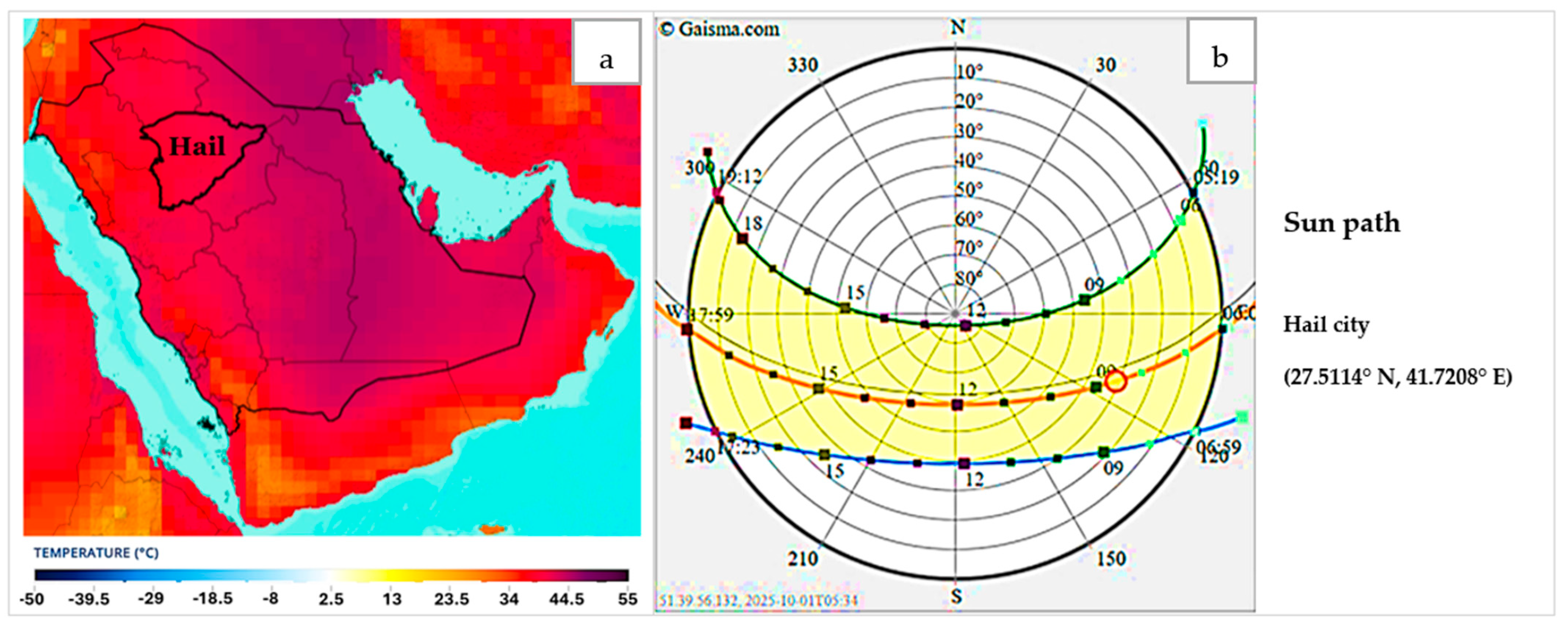
This part contributes to the understanding of the location of the case study, which is located in Hail City, Saudi Arabia (27.5° N; 41.7° E), as depicted in Figure 3, because this region falls within the northwestern side of Saudi Arabia and has an arid desert climate that suffers from high temperatures, especially during summertime. The area falls under a hot desert climate (Köppen BWh), with summer temperatures often touching 40 °C and above, whilst in the winter months daytime maximums are cooler to mild. Hail city is generally an arid type of region, and the average annual rainfall does not exceed 100 mm. Hail is mostly sunny, which gives plenty of daylight, and is clear throughout the year. The average daily solar irradiation is between 5 and 7 kWh/m2; the city benefits from some 300 days of sunshine per year, which corresponds to an annual average of solar radiation in a range of 1800–2400 kWh/m2. It is due to this important solar potential that the attention in the country has been focused on environmental energy practices, especially solar energy.

5.2. Model Office Description

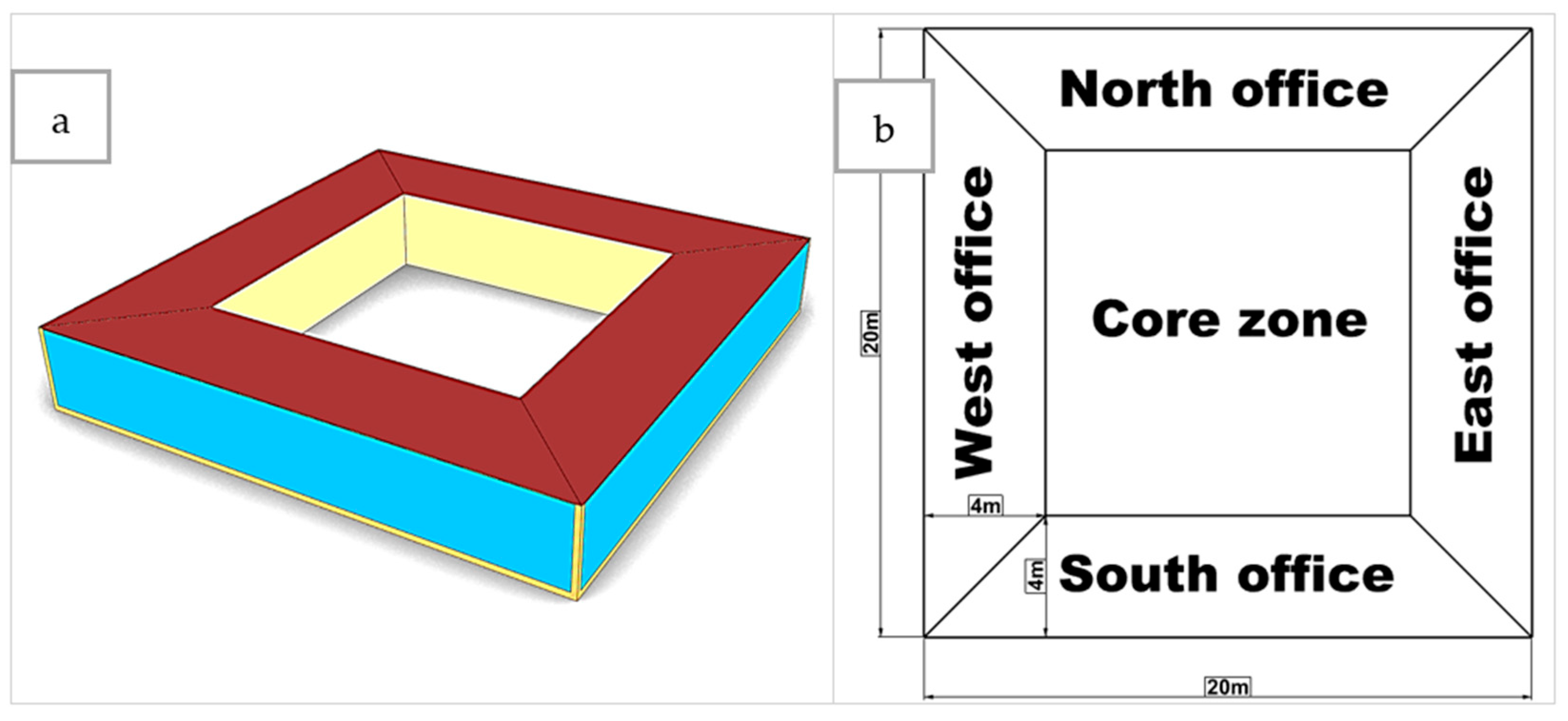
Rhino 7.0 simulation tool used to determine the typical office building form geometry. The model is based on a standard full office floor (400 m2) layout with one central and four perimeter pieces. Each office zone supports a work surface area of 64 m2 (20 m by 4 m deep) and sits under a ceiling height of 3.2 m to give a spacious, open sense for all zones, as depicted in Figure 4.

5.3. Proposed Façade Configurations

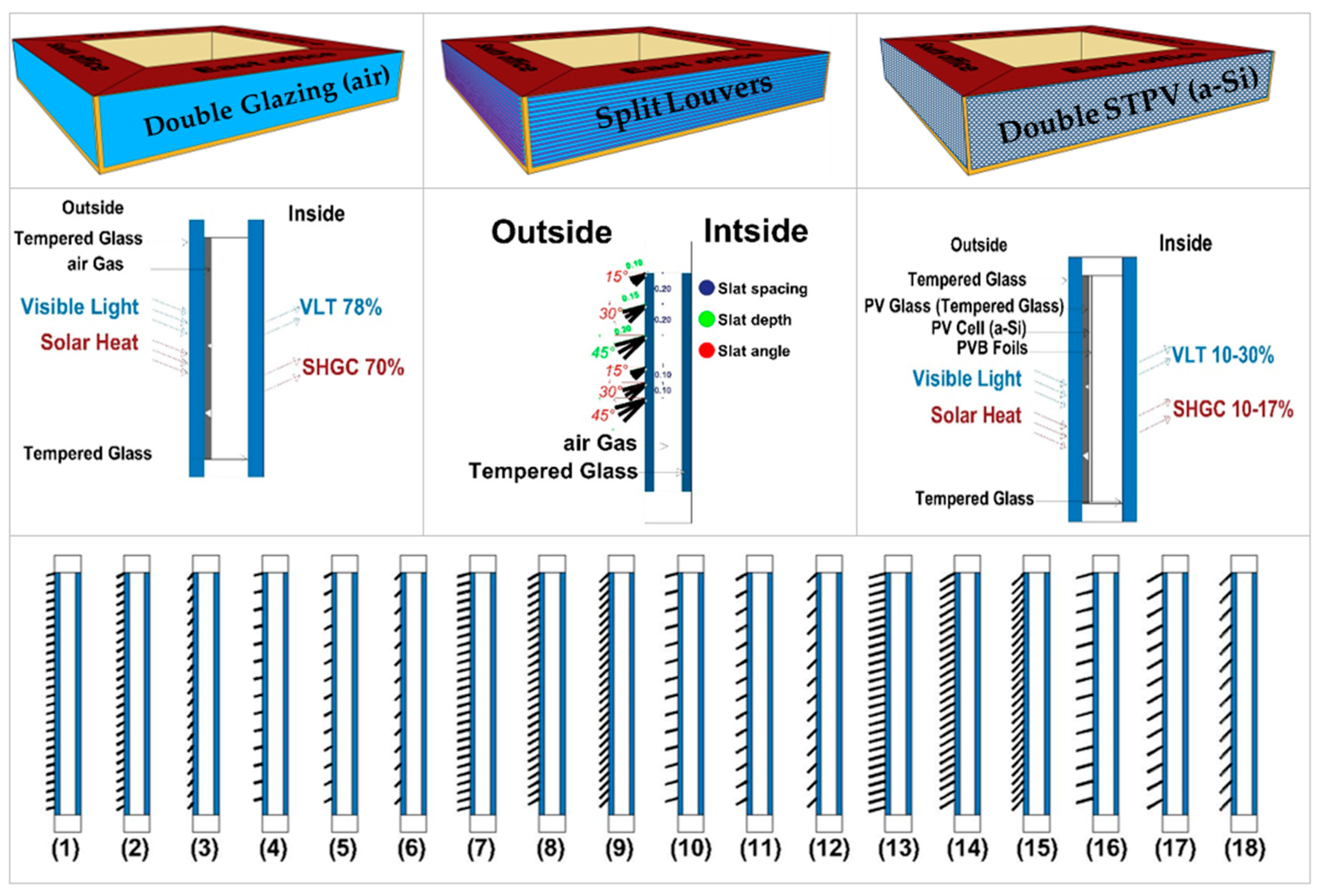
This paper describes two different systems incorporated in full-glazed façades that are developed to improve energy performance with advanced solar control and daylighting strategies. The first approach, namely the split louver system, is particularly designed to manage solar heat gain and improve daylighting performance. There are 18 different configurations that can be obtained by varying three important factors: slat angle (15°, 30°, and 45°), slat spacing, and depth (10 cm, 15 cm, and 20 cm). In this mode, all louvers of the feature move in tandem a single system, enabling shading to be continous across all elevation louvers, which made of premium materials, and are coated with a highly reflective surface, effectively redirecting light to the ceiling while providing additional shielding from direct brightness and then refreshing it to evenly distribute into the room; this also reduces glare, minimizes eye strain, and eliminates hot-spots. Installed on the outside of buildings, the louvers are ideal for blocking direct sunlight and heat through windows, such as prohibiting window exposure in hot climate areas, but maintaining natural light. They also block solar heat gain, depending on the way they are installed, so there is less dependence on mechanical cooling. Orientation-based and seasonal-adjustable custom optimization also enables tailored optimization, as illustrated in the examples depicted in Figure 5.
The second system (STPV glazing) is evaluated independently for comparison. This process is based on amorphous silicon (a-Si) photovoltaics, which has two functions: solar energy generation and heating control. The STPV glazing is available in a-Si 10%, a-Si 20% and a-Si 30% options, having maximum power capacities of, respectively, 92 W, 78 W, and 64 W. Transparency of the system is adjustable (VLT 10–30%) to allow daylight admission but without nearly as much solar input. The thermal performances of the glazing are described with a solar heat gain coefficient (SHGC) of 0.10 to 0.17 and a U-value of 1.6 W/m2K, providing good insulation in heat transfer, as represented in Table 2. These thermal characteristics correlate to the energy generation capability and thermal performance of the façade to reduce building cooling load. The main electrical characteristics are the maximum power outputs equal to 92 W, 78 W, and 64 W for a-Si 10%, a-Si 20%, and a-Si 30%. A summary of the electrical properties is given in Table 3. As a separate system, STPV glazing offers the inherent capability to generate passive solar energy in harmony with the building’s project-specific available energy approach—hence, supporting environmentally responsible, sustainable objectives.

5.4. Modeling Approach and Metrics

A parametric strategy with a built-in formula was possible using Grasshopper to adapt the louver system properties according to the solar path dynamics. The equation was developed to match the clear sky CIE conditions under direct sunlight and for Hail’s typical weather patterns.

5.4.1. Daylighting Performance Simulation

The daylighting performance was modeled with Ladybug and Honeybee components that interface Daysim (radiation model) and EnergyPlus to import the weather data and calculate the sun path for the Hail EPW weather file. Backward raytracing for sun irradiation and grid-based daylight analysis were performed by using Radiance, an artificial lighting simulation tool, with the assistance of a Honeybee plugin. The workplane was set at a height of 0.85 m for all daylighting performance simulations, and the grid distance between the tested points was 1 m. For more accurate results, the ambient radiation was defined to allow inclusion of the slat’s material reflections.
The research focused on the external global horizontal illuminance combined with direct and diffuse sunlight during the summer solstice (to simulate daylight variations due to changes in office working hours). A particular feature of Grasshopper was the calculation of the illuminance received by the tilted split louver panels, allowing accurate simulations of daylighting efficacy. The following settings were used for the Radiance simulation:

5.4.2. STPV Energy Output Simulation

The Meteonorm® database was used as the meteorological data for Hail in the simulations of EnergyPlus™. The Equivalent One-Diode Model was used to simulate STPV energy production. An empirical relationship is employed by this model to estimate the performance operation of PV systems, which are conditional upon parameters such as temperature at the PV cell and efficiency in energy conversion at every time step. Because objective testing of this ability was not feasible, empirical measurements were implemented. The simulation made use of the manufacturer’s technical specifications with thermal and optical data for estimating the energy generation. A summary table of electrical properties for different a-Si STPV technologies is given in Table 4.

5.4.3. Thermal Comfort Modeling

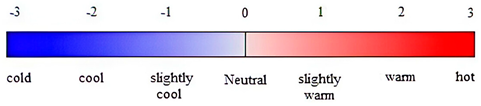
Thermal comfort was simulated with the predicted mean vote (PMV) and adaptive thermal comfort (ATC), which were developed by the ASHRAE 55 heat balance model, for predicting comfort conditions in the office. PMV [18] was estimated using air temperature (T-air), mean radiant temperature (MRT), air velocity (v), clothing insulation (I-cl), and metabolic rate (M-met), with an I-cl value of 0.9 clo in a general common attire at the illuminated building, i.e., Thobe for Saudi Arabia, where it is practiced year-round. This constant value of clothing insulation (I-cl = 0.9 clo) was kept constant during simulation in order to show typical office clothing worn in Saudi Arabia. The air velocity was set at 0.1 m∙s, which corresponded to typical office ventilation. The ATC was calculated using the Adaptive Thermal Comfort model (based on local climate parameters and design of the building), which is defined as a ratio between the time when PMV stays within ±0.5 criteria for comfort. Table 5 shows that the PMV performance criteria to be fulfilled were from −0.5 to +0.5, suggesting an ATC value of 80% for office space to be thermally comfortable. The solar heat gains from the windows, which were affected by the shading devices, were introduced into PMV calculations using MRT corrections due to transmitted solar radiation. These were based on the direct and diffuse solar radiation applied to building surfaces as well as on the additional thermal effect of the STPV glazing and split louver element, creating adjustments in interior conditions. The average and solstice hourly (08:00–17:00) thermal comfort across the year was reported, commonly used to maintain a comfortable thermal environment, providing an ATC value for comparing each system’s operational effectiveness.

5.4.4. Overall Energy Performance Modeling

Overall energy consumption (OEC) of the building was modeled by combining cooling, heating, and lighting loads and power generated from the STPV system. The cooling demand was estimated considering the internal heat gains due to the solar radiation transmittance through the façades affected by shading devices and due to equipment, lighting, and occupants. The consumption of heating energy was also simulated in order to keep the indoor temperature constant at 20 °C in winter, although it was low because of the high temperature properties of Hail. Lighting energy was simulated with continuous daylighting control, and the electric lighting responded to achieve a target of 300 lux on the workplane. The lighting energy consumption fluctuated, depending on solar availability and the performance of the shading system. The energy output from the STPV system was subtracted from the overall energy use, with its production calculated based on the efficiency of the a-Si PV modules, the vertical orientation of the façade, local solar radiation, and the temperature effects on the modules. The system’s losses (2%) and inverter efficiency (96%) were also factored in. The final OEC was expressed in units of kWh per year and represents the total energy consumption from cooling, heating, and lighting minus the energy produced by the STPV system. The aim was to minimize the OEC, with lower values indicating better energy performance.

6. Results

6.1. Daylighting Quantity and Quality Analysis

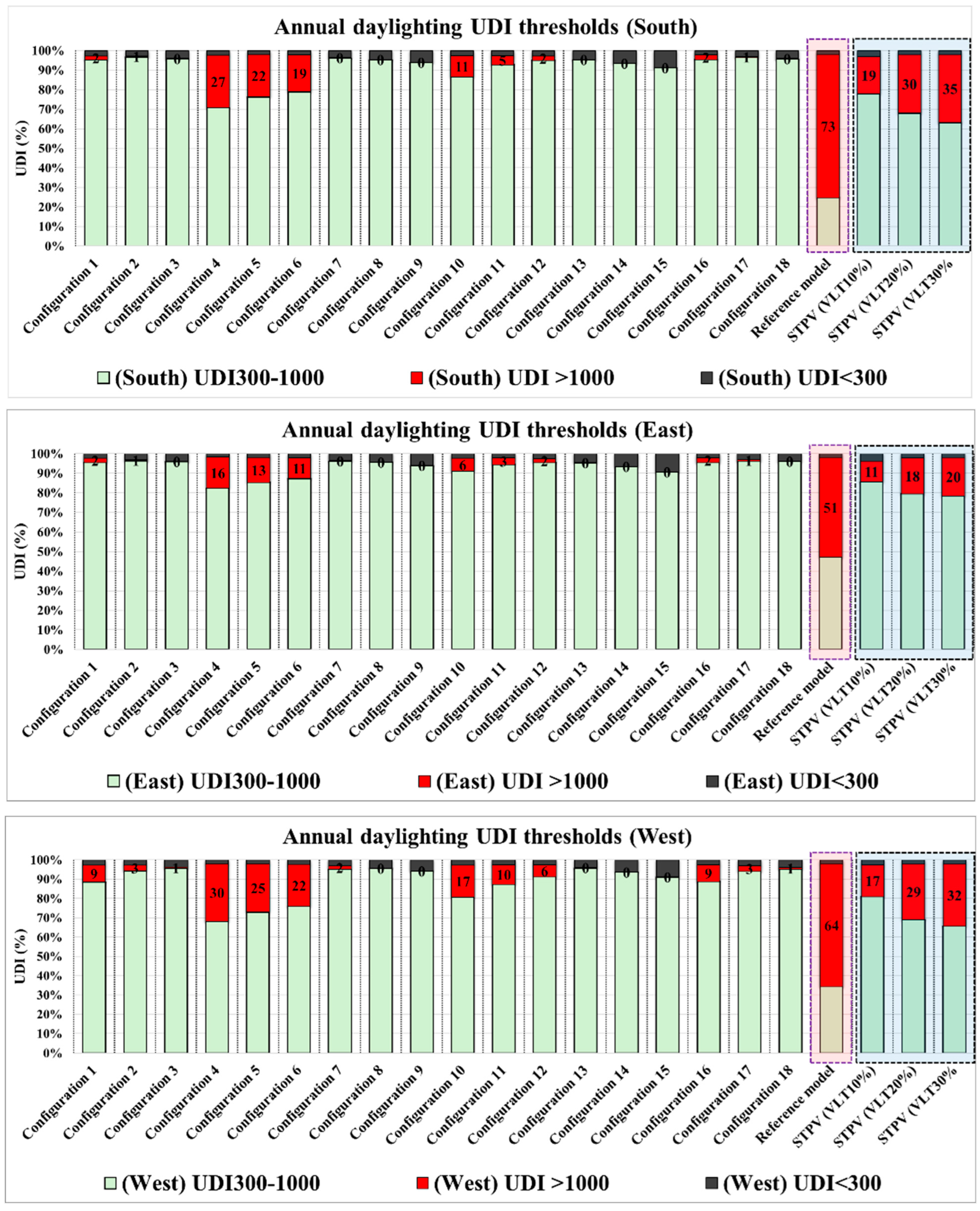
In an in-depth annual daylighting analysis, as presented in Figure 6, the distribution of UDI thresholds in the office across various split louvers and STPV configurations and cardinal orientations is meticulously examined. The study highlights that integrating all split louvers configurations achieves a UDI range of 300–1000 lux on the work plane in all cardinal orientations, demonstrates that the split louver system, particularly configurations with 15 cm or 20 cm slat depth and 45° angle, effectively mitigates excessive daylight (UDI>1000lux) while maintaining optimal daylighting (UDI300-1000lux) across all cardinal orientations, unlike Configuration 4 (slat spacing 20 cm, depth 10 cm, and angle 15°). Similarly, the STPV with transmittance 10% and 20% achieved surpassing the 70% threshold; only STPV 30% is not achieved in the western and southern orientation due to excessive penetration of direct sunlight, where the UDI > 1000 lux are 35% and 32%, respectively. Conversely, the reference model exhibits a notable deficiency in achieving the recommended UDI percentages, leading to potential glare and discomfort. Across all orientations, offices within this configuration predominantly fall above the optimal UDI category of higher than 1000 lux, with 73%, 51%, and 64% in south, east, and west orientations, due to excessive illumination levels exceeding 1000 lux near clear glazing windows (with a fully glazed façade accompanied by the presence of sunspots).
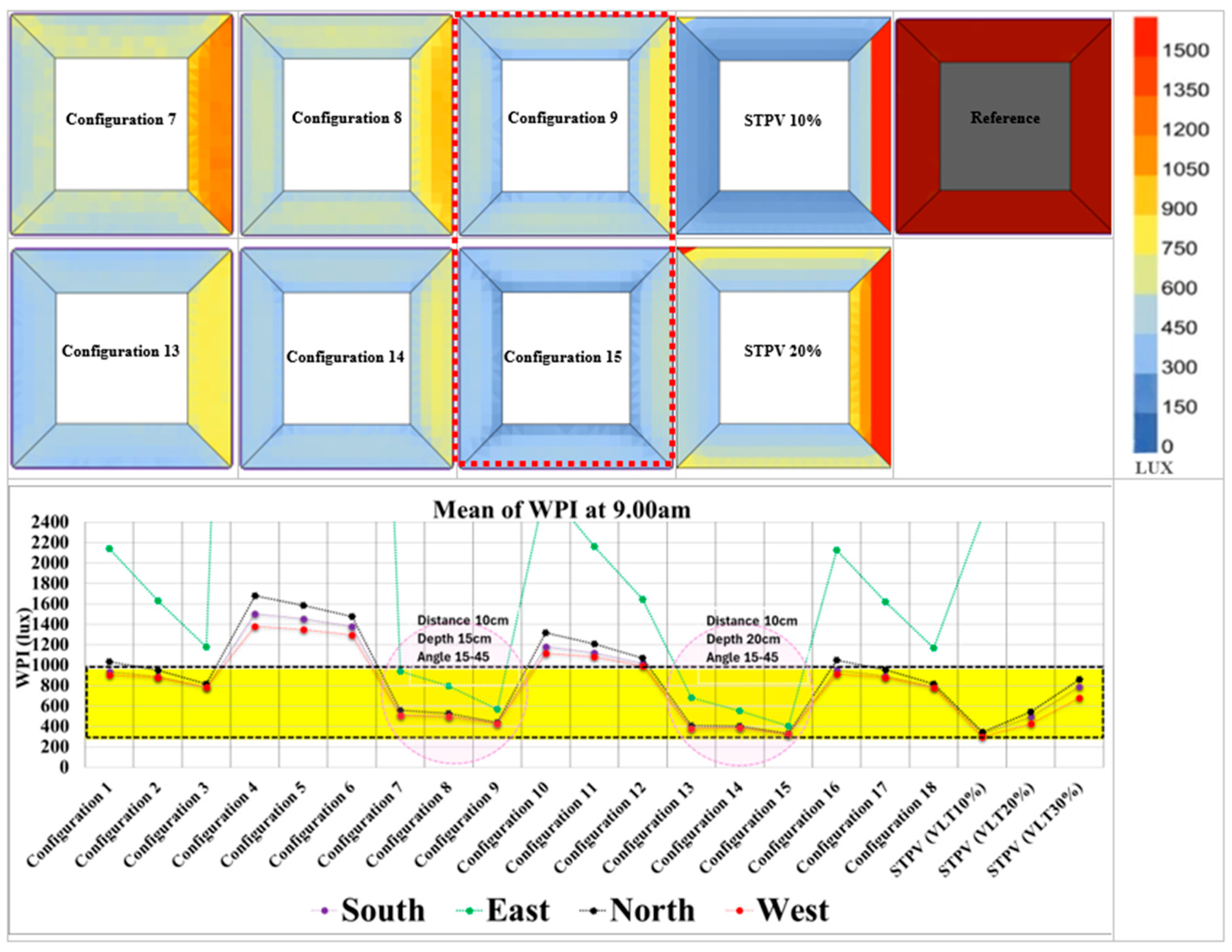
The analysis of the WPI distribution across various configurations of a split louver system and STPV glazing reveals significant insights into their performance in enhancing daylighting quantity, particularly during the summer solstice.
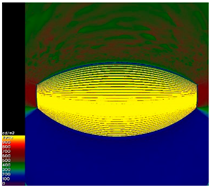
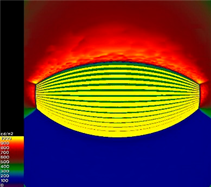
At 9:00 a.m., when the sun is at a lower position in the sky, this split louver system shows a significant potential for improving daylight spatial distribution, particularly at a distance of 10 cm, with deeper slats (15 cm and 20 cm) and higher tilt angles (30° and 45°). Thus, these solutions meet the WPI values within a well-recommended value (300 lux to 1000 lux) by optimizing sunlight redirection on the ceiling and also reducing artificial lighting needs without disturbing users due to glare. In contrast, STPV glazing with 10% and 20% transparency admits more daylight into the interior but leads to a higher WPI value, which exceeds the cut-off limit of 1000 lux in the zone near the window available at the east office (sometimes), which may create uncomfortable or glary conditions without any other shading solutions, as presented in Figure 7.
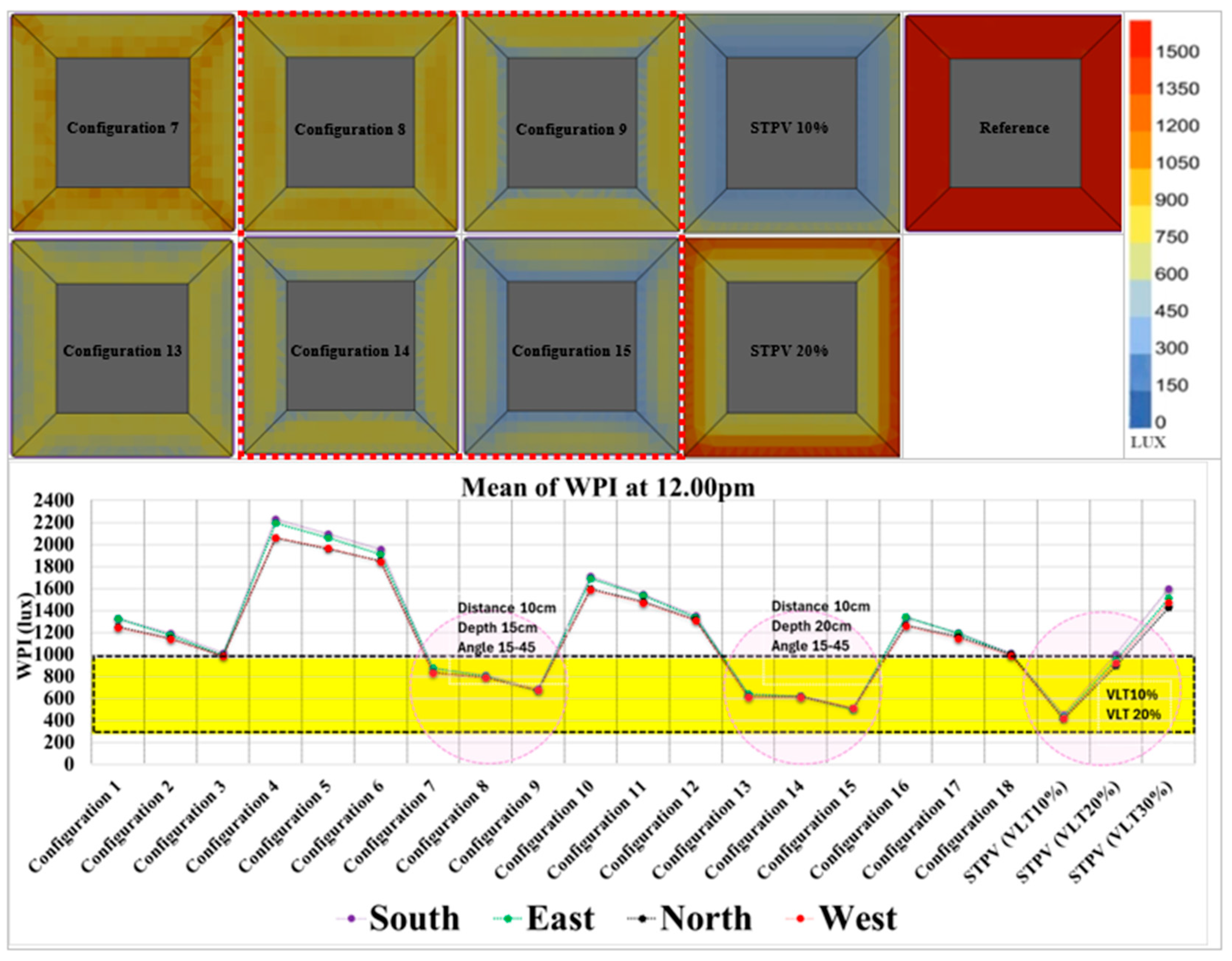
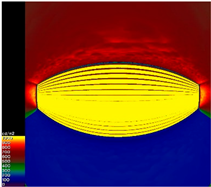
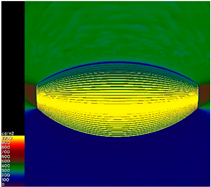
At 12:00 p.m., (noon), when the sun is high, the split louver system still performs well by maintaining the WPI within or close to the recommended value for all configurations, while a good shading and daylight distribution tradeoff can be achieved using slat depths of either 15 cm or 20 cm, with slightly better balance at higher depth. However, the WPI for STPV configurations for the 10% transparency model indicates a substantial decrease, with many falling below or very close to a recommended lower limit of 300 lux, implying a higher ratio (shading) as well as daylighting penetration impacting shortages, whereas that for STPV 20% identifies an optimal compromise in the shuttling of WPI towards its recommended value, as presented in Figure 8.
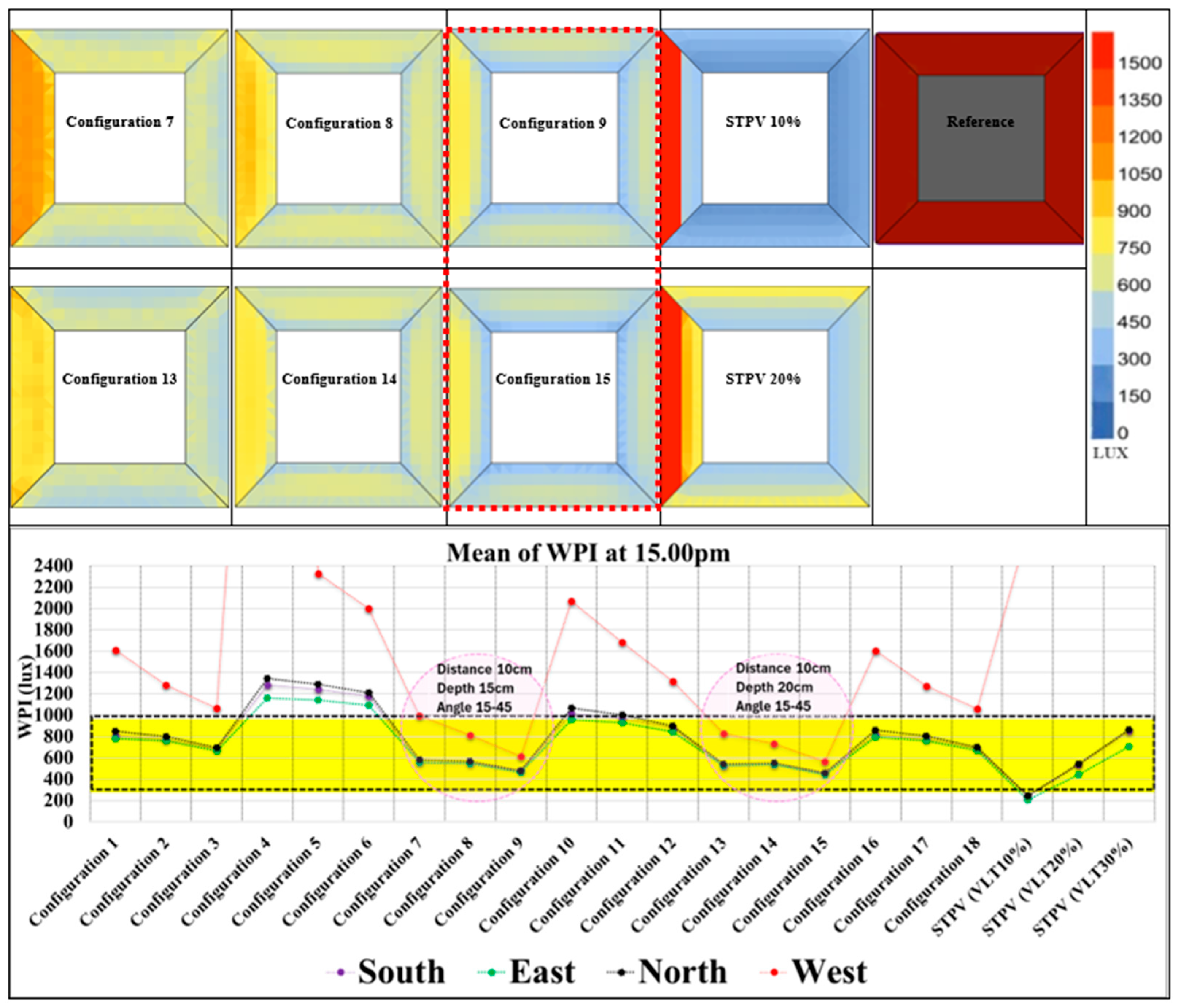
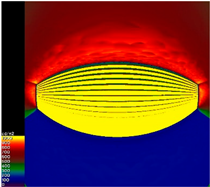
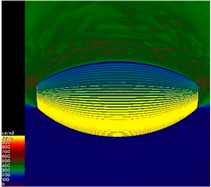
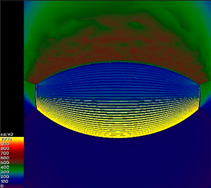
Even by 3 p.m., as displayed in Figure 9, the performance of the split louver system is still high, and configurations located south perform their best light redirection. The WPI values are regularly maintained in a predetermined range with slight change, according to the configuration of the slat, except for the west direction, which only has (Configurations 9 and 15) a slat angle of 45°, to solve the problem of excess sunlight. On the other hand, the STPV system, particularly at the 10% transparency condition, restricts daylight penetration as WPI values are consistently kept below 300 lux, suggesting that even though it is efficient for reducing solar heat gain, it compromises daylighting. Note that the reference model has not achieved characteristic distribution and WPI value in all orientations because of transmittance, mainly, and high WWR 95% (full glazing offices).
Overall, the split louver system in fact becomes a more versatile and preferable design to keep the WPI at the desired level across a summer solstice day, in which case, it provides a dynamic solution of daylight distribution. The STPV system is effective in controlling solar heat gains, as will be analyzed in detail in the next section (thermal analysis), but some deficiencies exist in this concept of daylighting phenomena and its dependency on transparency (STPV 30%), with optical property considerations that need proper integration to ensure the balance between solar control and daylight performance of offices.
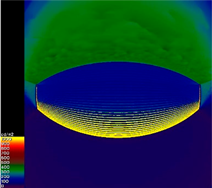
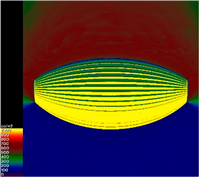
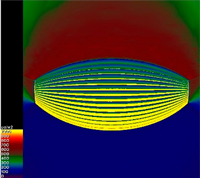
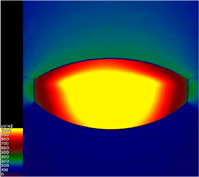
The qualitative daylighting analysis focuses on the daylight glare probability (DGP), results obtained for 18 configurations of split louvers implemented in the external façade office building, during which they were measured with the summer solstice at 9.00 a.m. (eastern office area), 12:00 p.m. (south office area and 15.00 p.m. (west office zone), as depicted in Table 6. The DGP was estimated at a sensor location 2 m away from the window in the middle of the office.
The findings of the south office zone indicated that louvers with a depth of 20 cm, slat distance of 10 cm, and angle of inclination of 45° resulted in lower DGP levels, even reducing DGP to an “imperceptible glare,” where the range of DGP = 0.28–0.39, than those with smaller depths or higher tilt angles. Meanwhile, for configurations with a 10 cm depth at all conditions and with a 10 cm (or 20 cm) slat distance, the corresponding intolerable glare occurred between (DGP = 0.46 and DGP = 0.57), attributable to deeper penetration of direct sunlight. The tilt angle significantly impacted the glare reduction: a steeper tilt (30° or 45°) in general suppressed DGP values over all depths and distances, with the best control found for a 45° tilt (a perceptible or imperceptible classification). For both 10 cm and 15 cm louver depths, the higher DGP values could, in general, be observed for smaller tilt angles, which suggests a more significant glare potential. In terms of glare reduction, installation of the STPV glazing system with even lower transparency (e.g., 10%) (high solar cell ratio) may possibly reduce the direct sunlight penetration into the office because it blocks off more direct solar radiation, while a larger value of transmittance (e.g., 30%) leads to a slight increase in DGP. On the other hand, eastern and western axis offices had imperceptible glare in all proposed conditions of split louvers and STPV, except for (Configuration 4), where perceivable glare was observed at 15° low angle with long slat distance (20 cm).

6.2. Thermal Analysis of Selected Efficient Façade Configurations

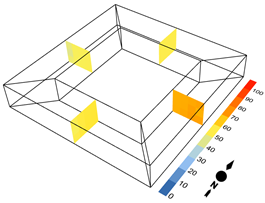
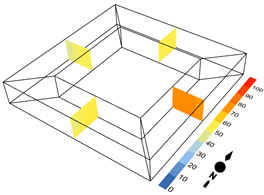
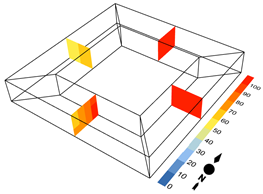
The analysis of the thermal comfort of effective façade solutions uses STPV and split louvers. Understanding the potential for improvement in office buildings requires an understanding of the thermal comfort analysis of the selected efficient façade systems (STPV and split louvers). This discussion is based on adaptive thermal comfort (ATC) concepts, which are ruled by the ASHRAE-55 standard and, in particular, by its acceptance limit of 80%. In light of users’ behavioral adaptability, the standard aims to ascertain if the indoor environment meets acceptable thermal performances. A double-temporal vertical mapping that encompasses all seasons of the year, including extremely hot and cold summer/winter conditions, serves as the foundation for this in-depth investigation. Given that occupancy and use patterns are predictable and recurring, this extended time period is required to examine the dynamic nature of ATC in office cardinal direction zones.
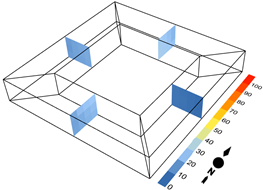
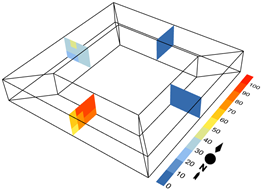
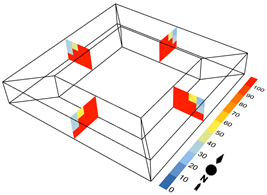
  • The base model failed to maintain adaptive features that are necessary to give an efficient response to different and dynamic climate conditions. In summer, particularly during the solstice period of summer, it has trouble overheating beyond what is considered appropriate for adaptive thermal comfort. The interior of the building is subjected to high operative temperatures and does not meet the 80% comfort threshold. Likewise, in the winter solstice period, when passive solar gain is not well-regulated, the model favors mechanical heating to achieve thermal comfort except when the south wall meets ATC. In general, this design strategy does not fully achieve comfortable conditions 24/7, and the importance of an advanced façade with certain levels of control is confirmed.
  • Configurations 9 and 15 (split louvers and 15 to 20 cm slat depth) are distinctly better in terms of adaptive thermal comfort than the reference model, yearly, and especially during the summer solstice. During the summer solstice, this configuration excels in solar heat gain control, significantly reducing cooling loads. This design effectively regulates solar heat gains and significantly lowers cooling loads throughout the solstice summer. Without lowering thermal comfort, the slats with a 10 cm pitch and 45° angle can block incident solar radiation, which is advantageous for indoor daylighting (as demonstrated in the previous section). The building stays within the 80% comfort criterion owing to the summertime drop in operating temperature, which reduces the need for artificial cooling systems. The system, on the other hand, lowers passive solar gain during the winter solstice, which considerably lowers the inside temperature and increases the need for heating. With an average result of about 50% ATC, this imbalance between heating and cooling performance preserves year-round comfort and offers the best option for both warm areas, where hot days throughout the year predominate.
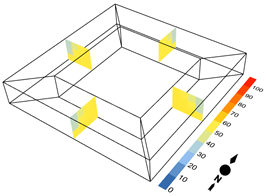
  • This model, the STPV 10% and 20%, is a further development of solar energy conversion and thermal comfort. Excellent performance with respect to heat gain during the solstice summer is provided, with 90% of solar radiation being restricted from entering the façade. The low SHGC and high insulative U-value of both the chosen STPV means that direct solar heat is mostly deflected. Such STPV layouts indicate to be very promising for ATC in warm climates with a high cooling efficiency. However, in the winter solstice (Table 7), due to its low SHGC, the STPV 10% configuration restrains passive solar gain and leads to a higher need for mechanical heating. Even though the performance of both STPV 10% and 20% systems is almost identical, an enhancement was observed in the eastern office zone during the winter solstice season.
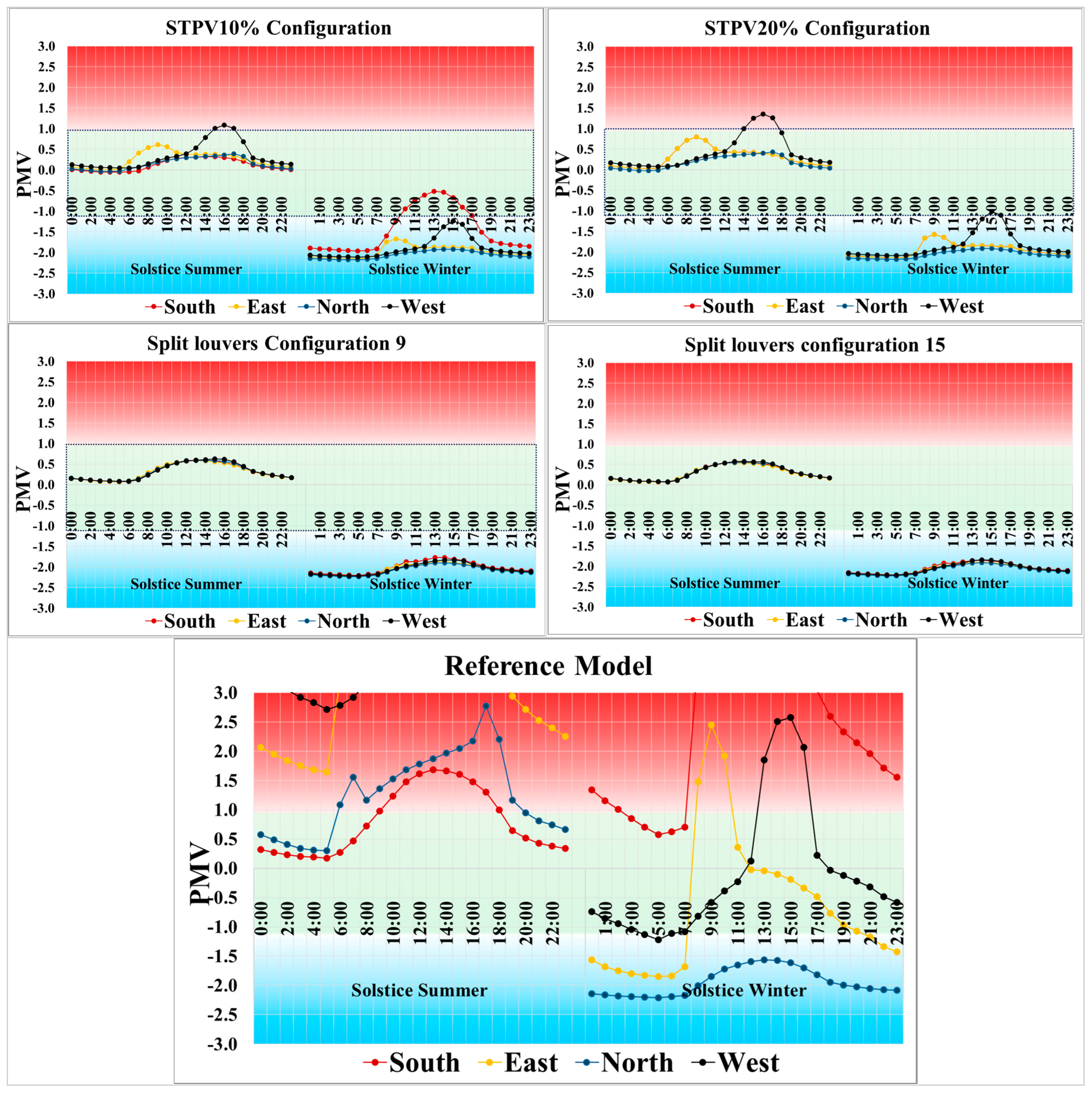
For a detailed examination of thermal comfort, the application of the PMV index for evaluating split louver and STPV glazing forms is described each approach with specific advantages and limitations based on Figure 10. The split louvers (Configurations 9 and 15) exhibit good shading during the summer solstice, with PMV values on the order of 0.5, indicating near-steady state thermal comfort. But, in the winter solstice, louvers shade passive solar and interior environments become colder, with PMV between −2 and −1.5. This brings about a lack of thermal comfort from under-warming. STPV glazing configurations perform better to reduce solar heat gains in summer, with PMV values around 0, which are suitable for comfort without a significant overheating and up to sensitive-level comfort. In winter, whilst the PMV for design with split louver is comparably the same as the sunshade, it signifies that both systems have limitations with respect to reducing cold discomfort because of the low solar gain.
When compared with the reference model, which has larger fluctuations in PMV and large peaks and troughs in a day, most of the analyzed configurations exhibit superior performance in avoiding serious discomfort. In the reference model, upper peaks in PMV (around 2.5) are shown during the summer period for south–north offices, followed by a great hot thermal discomfort in east–west offices zones (greater than 3), and very low values (lower than −2) result in winter to north orientation, which denotes underheating. Yet the office east and west zones remain in comfort zones with respect to working hours, while the office south zone is yet to be improved from extensive overheating. On the other hand, dynamic variations in PMV in both the split louver and STPV systems are relatively more stable than those in the fixed-louver configuration, providing a better stability in the thermal environment with lower PMVs, particularly for the summer period. Although overall there is comparably high thermal discomfort in both summer and winter, the building does perform much better during the winter. Due to direct solar gains, the south and west façades of the model maintain high PMV as compared to split louvers and STPV systems that do not capture sufficient passive solar heat. Thus, consideration is gained to some extent for the studied configurations (even though outperforming the reference case) compared with comfort levels of summertime, during which due temperature remained suboptimal.

6.3. Energy Analysis of Selected Efficient Façade Configurations

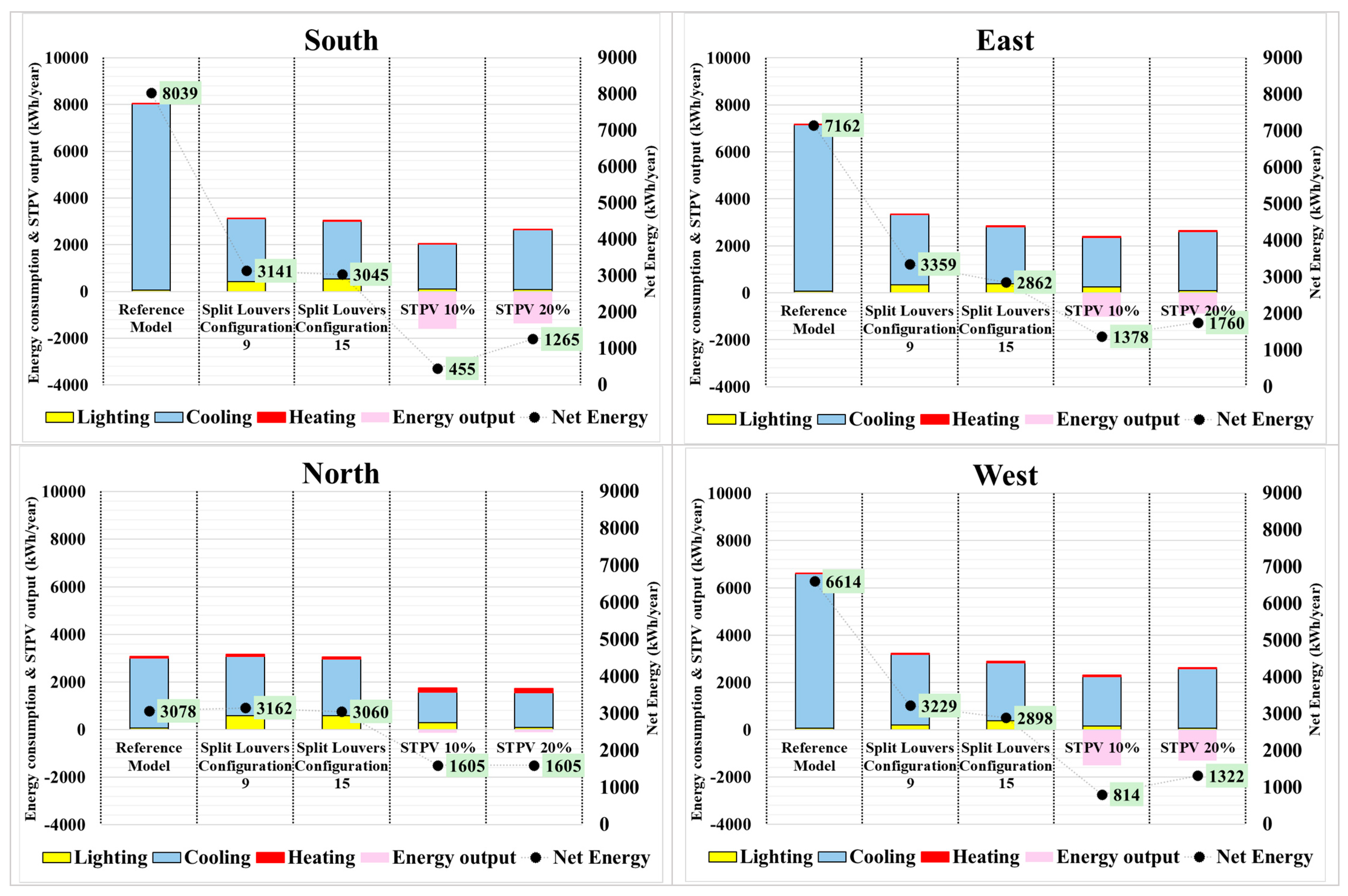
Energy performance results have revealed the substantial impact of the chosen energy-efficient façade configurations, split louvers, and STPV glazing for an office building on its energy consumption, which are articulated by different systems at different cardinal orientations, especially cooling, heating, and lighting, as shown in Figure 11. Cooling loads are significantly lowered for both the split louver Configurations 9 and 15 (% reductions in cooling demands of around 60–70% as compared to RM), especially when facing south and west. This reduction in cooling is achieved through the shading property of the louvers, which restricts solar gain during warmer months to prevent overheating and thereby reduces mechanical cooling loads. If the solar energy generated by cooling tends to decrease proportionately, heating is still required slightly more due to shading that blocks sunlight in winter, mainly on the south and west sides. The effect of shading is also at play in the lighting energy consumption for split louver configurations (for instance, Configuration 9 in the southern orientation exhibits drastically increased lighting energy use, growing to 429 kWh, as opposed to lighting use of 56 kWh in the reference model). This is an indication that the louvers obstruct natural sunlight and make it necessary to use artificial light. Also, in Configuration 15, lighting energy increases to 530 kWh, indicating the decrease in daylight reach received by the louver system. Therefore, although the louvers are a good solution for passive cooling, their shading effect on lighting energy consumption should be taken into consideration.
The STPV glazing system, on the other hand, serves as an effective solution to minimize cooling load and simultaneously produce electricity by integrating a-Si PV cells. Especially, STPV 10% panels in the south and east orientation would lower cooling energy demands (up to 1916 kWh compared to 7982 kWh of the reference model) to a significant amount, and some positive energy is generated, improving building electricity demand as well. So, with their shading potential, STPV systems have a lighting power energy performance advantage over the split louvers. For example, STPV 10% with the south orientation needs a lighting energy of 113 kWh, which is much lower than the combination manifested with split louvers. The STPV 20% generation also requires some cooling energy, but it continues to generate more electricity and keeps the lighting energy at 72 kWh, which is still lower than the split louver designs. Despite the aforementioned advantages, since STPV systems have relatively lower transparency, less solar radiation is admitted which leads to a small rise in heating demand in less exposed orientations (e.g., north and west façades Nevertheless, both STPV configurations outperform the reference model in every orientation also with an extra energy generation due to the use of photovoltaics and contributes to cover part of building total energy system load. In general, STPV glazing indeed tends to be more balanced, and not only considering the combination of shading and renewable energy harvesting—without large lighting energy increases observed in split louvers—making it a less energy-intensive solution for office buildings.
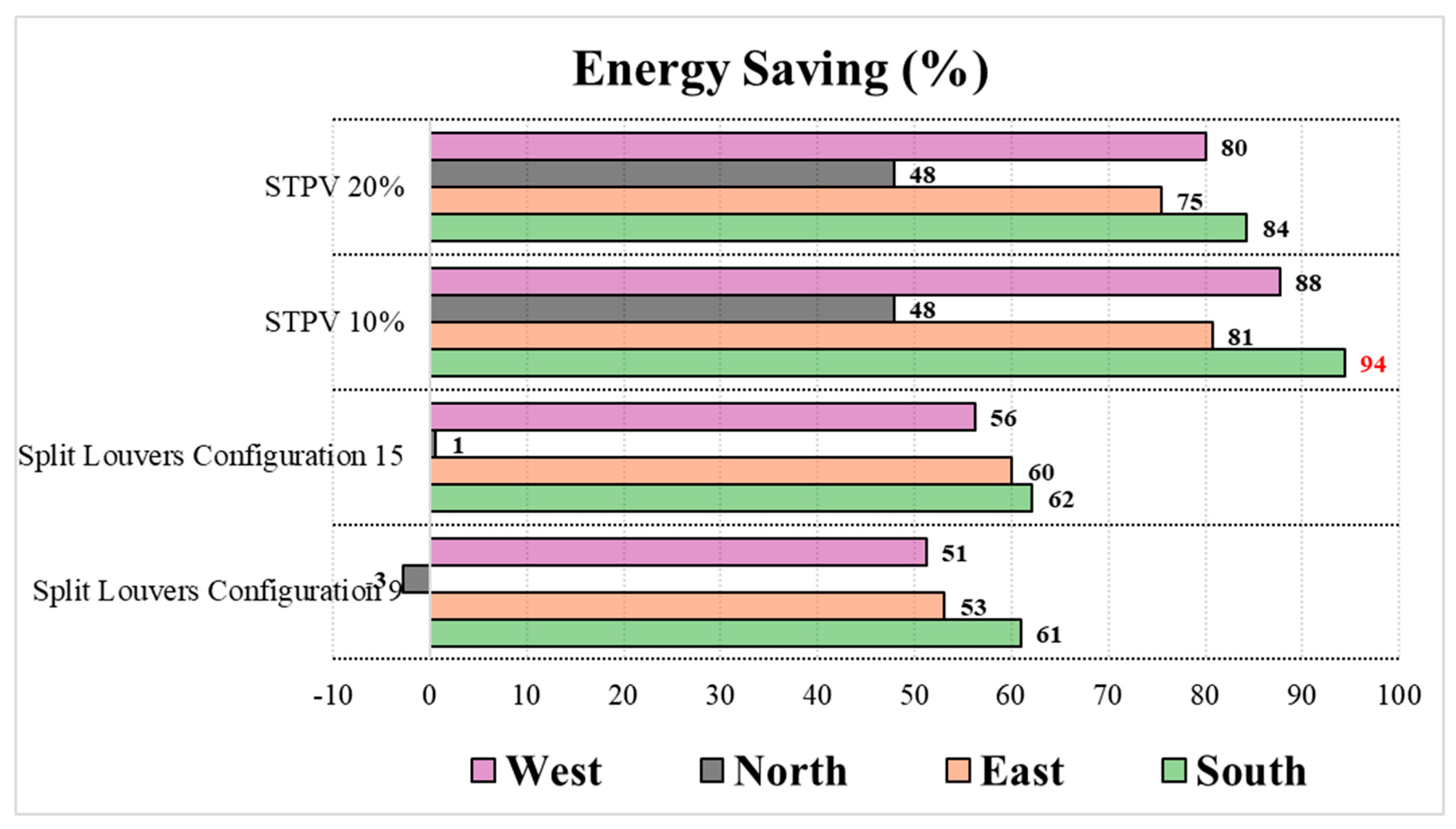
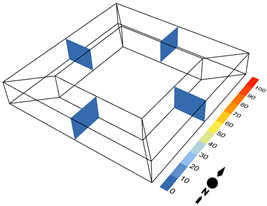
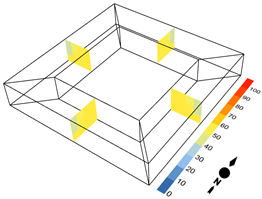
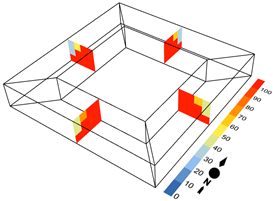
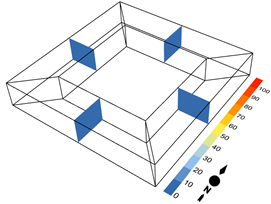
A detailed energy savings analysis is shown in Figure 12 for split louver and STPV glazing configurations, with noticeable reduction in energy consumption compared to the reference model and similar trends among orientation types. The energy savings varied between around 1% and 94%, and a negative 3% decrease for some of the configurations, such as for Configuration 9, of the split louver, in the north orientation. In summary, Configurations 9 and 15 of split louvers provide significant cooling energy savings in the south (61–62%) and west (51–56%) orientations as compared to no shadings at all but lighting energy goes up significantly especially for Configuration 15 On the other hand, STPV 10% glazing provides the most energy savings (up to 94% in south and up to 81% in east) mainly as a result of both cooling load reductions and energy generation from photovoltaic cells. STPV 20% also performs well, with savings of 84% in the south and 75% in the east, but is not quite as efficient as STPV 10%. The STPV 20% configuration also demonstrates strong performance, offering savings of 84% in the south and 75% in the east, although it is slightly less efficient than the STPV 10% configuration. In the north, both STPV and split louvers have higher savings than in occupied states of 54% and close to zero or negative, demonstrating that, in passive solar shading terms, short SSW orientations are difficult to work with.

7. Discussion

In hot, dry conditions, where light flux and thermal gain become overlapping but conflicting design factors, the contrast between energy-generative and strictly passive façade solutions clearly crystallizes. This current work shows that STPV glazing, for VLT in the range of 10–20%, presents a better triad of daylight quality, cooling reduction, and net energy gain over parametrically optimized split louvers; this result refines significantly previous claims made by Konstantinos Kapsis et al. [31] and Alrashidi et al. [18] about whether 30% VLT is acceptable in higher insolation areas. Although such studies reported moderate energy savings (12–20%) in temperate or warm climates, our simulations for Hail show that 30% VLT did not meet the UDI(300–1000) requirement in south and west orientations because of high illuminance exceedances (35% and 32%, respectively), while 10–20% VLT options lead to whole-façade energy reductions of 81–94%, partly through simultaneous cooling load reduction by cutting down from 7982 kWh to 1916 kWh as well as a power generation level of around 92–78 Wp/m2. Split louvers are, on the other hand, best at reducing glare and attain imperceptible daylight glare probability (DGP of ≈0.28–0.39) around noon for south-facing spaces but suffer substantial lighting loads (429 to 530 kWh), which reduces their net benefits; in particular, they experience insignificant to negative (−3% energy savings) effects on north façades where daylight suppression makes them net-neutral or poorer. This is in agreement with the parametric results from Alsukkar et al. and Ibrahim et al. of louver effectiveness, but broadens their applicability by including energy trade-offs that were missing from previous daylight-focused studies.
STPV 10–20% VLT is the optimum combination strategy for hot-arid fully glazed office designs when these complicated trade-offs are considered; split louvers continue to have a useful niche where visual comfort is crucial, and illumination charges can be minimized by sophisticated controls. The two systems’ thermal-comfort parallelism summer PMV is close to neutrality (0 to +0.5), yet they disguise a common winter weakness: during solstice seasons, STPV static SHGC gains (SHGC < 0.17) result in underheating (PMV −1.5 to −2.0), necessitating the employment of dynamic smart glazing systems or hybrid HVAC techniques, as previously documented in vacuum-STPV research for cold regions. This changing season disparity drives climate-based optimization; in Hail, with around 3900 h of sunshine per year and cooling-dominant demands, it prefers minimal transparency for maximum solar protection. For Mediterranean or composite climates, a moderate VLT (20–30%) provides a balance between heating and cooling requirements.

8. Conclusions

This comparative simulation of an effective two proposed façade system for a hot desert climate with abundant solar radiance and high WWR façades yields the following principal conclusions:
STPV glazing (10–20 VLT) is the only solution sufficiently resilient and superior across performance dimensions in a trio, managing substantial power output that balances the cooling and lighting load; effective annual reduction in solar gain; and accommodation of adequate dynamic daylighting without glare. This dual role offers whole-façade energy savings of 81–94% compared to passive-only alternatives.
Under certain restrictions, the optimal split louver configurations can offer excellent glare management. Parametrically adjusted louvers (15–20 cm depth, 10 cm separation, 45° tilt) minimize peak solar loads and attain near-imperceptible DGP values (DGP ≈ 0.28–0.39) but are less effective than low-transmissivity STPV for removing glare. They preserve, nevertheless, an adequate quality of indoor daylighting and provide good control of solar gains with marked loads in lighting energy consumption (429–530 kWh with respect to 113 kWh for SPV 10%).
On the thermal comfort side, seasonality is asymmetric in both systems: both can adequately achieve control of PMV between −0.5 and +0.5, but winter comfort starts to drop as solar entry becomes over-constrained (and PMV drops to −2), justifying an orientation-informed tuning and hybrid HVAC strategy to counteract the solstice-period under-heating.
Future work will need to move beyond the analysis of system components and consider system integration: dynamic STPV coupled with electrochromic switching, phase-change material (PCM) thermal buffers, and predictive louver control might be able to find a superior solution to the resilient daylight-energy issue. Additionally, lifespan performance should be the focus of policy objectives rather than just peak power rating. Finally, façade selection should be perceived as a socio-technical decision point integrating energy neutrality, occupant productivity, and financial risk; STPV now presents the most convincing combination for Saudi Arabia’s aim of carbon-neutral building estates. The closed-loop control also co-optimizes vertical-façade PV output, glare probability, and circadian-relevant illuminance in operation, and expands to measured-data validation to consolidate the modeled gains.

Author Contributions

Conceptualization, A.M. and M.A.S.M.; methodology, A.M. and M.A.S.M.; software, A.M. and M.A.S.M.; validation, A.M., M.A.S.M., and L.T.D.; data curation, A.M.; writing—original draft preparation, A.M. and M.A.S.M.; writing—review and editing, A.M., M.A.S.M., and L.T.D.; visualization, M.A.S.M.; supervision, M.A.S.M.; funding acquisition, M.A.S.M. All authors have read and agreed to the published version of the manuscript.

Funding

This research has been funded by the Scientific Research Deanship at the University of Hail, Saudi Arabia, through project number RCP-24-144.

Data Availability Statement

Data will be made available on request.

Conflicts of Interest

The authors declare no conflicts of interest.

Abbreviations

a-SiAmorphous Silicon
ASHRAEAmerican Society of Heating, Refrigerating, and Air-Conditioning Engineers
ATC Adaptive Thermal Comfort
BIPV-DSFBuilding Integrated Photovoltaic–Double-Skin Façade
CCRCell Coverage Ratio
CdTeCadmium Telluride
CIEInternational Commission on Illumination
DADaylight Autonomy
DGPDaylight Glare Probability
HVACHeating, Ventilation, Air-Conditioning
MRTMean Radiant Temperature
OECOverall Energy Consumption
PMVPredicted Mean Vote
PVPhotovoltaic
SHGCSolar Heat Gain Coefficient
STPVSemi-Transparent Photovoltaic
UDIUseful Daylight Illuminance
UHIUrban Hear Island
VLTVisible Light Transmittance
WPIWorkplane Illuminance
WWRWall-to-Window Ratio

References

  1. Ihara, T.; Gustavsen, A.; Jelle, B.P. Effect of facade components on energy efficiency in office buildings. Appl. Energy 2015, 158, 422–432. [Google Scholar] [CrossRef]
  2. Dabous, S.A.; Ibrahim, T.; Shareef, S.; Mushtaha, E.; Alsyouf, I. Sustainable façade cladding selection for buildings in hot climates based on thermal performance and energy consumption. Results Eng. 2022, 16, 100643. [Google Scholar] [CrossRef]
  3. Shan, R.; Junghans, L. Multi-objective optimization for high-performance building facade design: A systematic literature review. Sustainability 2023, 15, 15596. [Google Scholar] [CrossRef]
  4. Ghosh, A.; Hafnaoui, R.; Mesloub, A.; Elkhayat, K.; Albaqawy, G.; Alnaim, M.M.; Mayhoub, M. Active smart switchable glazing for smart city: A review. J. Build. Eng. 2024, 84, 108644. [Google Scholar] [CrossRef]
  5. Ghosh, A.; Mesloub, A.; Touahmia, M.; Ajmi, M. Visual comfort analysis of semi-transparent perovskite based building integrated photovoltaic window for hot desert climate (Riyadh, Saudi Arabia). Energies 2021, 14, 1043. [Google Scholar] [CrossRef]
  6. Alsukkar, M.; Hu, M.; Gadi, M.; Su, Y. A study on daylighting performance of split louver with simplified parametric control. Buildings 2022, 12, 594. [Google Scholar] [CrossRef]
  7. Al Dakheel, J.; Tabet Aoul, K. Building Applications, opportunities and challenges of active shading systems: A state-of-the-art review. Energies 2017, 10, 1672. [Google Scholar] [CrossRef]
  8. Kalwry, H.; Atakara, C. Exploring Energy-Efficient Design Strategies in High-Rise Building Façades for Sustainable Development and Energy Consumption. Buildings 2025, 15, 1062. [Google Scholar] [CrossRef]
  9. Yaman, M. Different facade types and building integration in energy efficient building design strategies. Int. J. Built Environ. Sustain. 2021, 8, 49–61. [Google Scholar] [CrossRef]
  10. Carlucci, F. A Review of Smart and Responsive Building Technologies and their Classifications. Future Cities Environ. 2021, 7. [Google Scholar] [CrossRef]
  11. Hafnaoui, R.; zin Kandar, M.; Ghosh, A.; Mesloub, A. Smart switchable glazing systems in Saudi Arabia: A review. Energy Build. 2024, 319, 114555. [Google Scholar] [CrossRef]
  12. Mesloub, A.; Alnaim, M.M.; Albaqawy, G.; Elkhayat, K.; Hafnaoui, R.; Ghosh, A.; Mayhoub, M.S. The Daylighting Optimization of Integrated Suspended Particle Devices Glazing in Different School Typologies. Buildings 2024, 14, 2574. [Google Scholar] [CrossRef]
  13. Mesloub, A.; Albaqawy, G.A.; Kandar, M.Z. The optimum performance of building integrated photovoltaic (BIPV) windows under a semi-arid climate in Algerian office buildings. Sustainability 2020, 12, 1654. [Google Scholar] [CrossRef]
  14. Alkahtani, M.; Hu, Y.; Alghaseb, M.A.; Elkhayat, K.; Kuka, C.S.; Abdelhafez, M.H.; Mesloub, A. Investigating fourteen countries to maximum the economy benefit by using offline reconfiguration for medium scale pv array arrangements. Energies 2020, 14, 59. [Google Scholar] [CrossRef]
  15. Mesloub, A.; Ghosh, A. Daylighting performance of light shelf photovoltaics (LSPV) for office buildings in hot desert-like regions. Appl. Sci. 2020, 10, 7959. [Google Scholar] [CrossRef]
  16. Mesloub, A.; Ghosh, A.; Albaqawy, G.A.; Noaime, E.; Alsolami, B.M. Energy and Daylighting Evaluation of Integrated Semitransparent Photovoltaic Windows with Internal Light Shelves in Open-Office Buildings. Adv. Civ. Eng. 2020, 2020, 8867558. [Google Scholar] [CrossRef]
  17. Mesloub, A.; Ghosh, A.; Touahmia, M.; Albaqawy, G.A.; Noaime, E.; Alsolami, B.M. Performance analysis of photovoltaic integrated shading devices (PVSDs) and semi-transparent photovoltaic (STPV) devices retrofitted to a prototype office building in a hot desert climate. Sustainability 2020, 12, 10145. [Google Scholar] [CrossRef]
  18. Alrashidi, H.; Issa, W.; Sellami, N.; Ghosh, A.; Mallick, T.K.; Sundaram, S. Performance assessment of cadmium telluride-based semi-transparent glazing for power saving in façade buildings. Energy Build. 2020, 215, 109585. [Google Scholar] [CrossRef]
  19. Wu, J.; Zhang, L.; Liu, Z.; Wu, Z. Coupled optical-electrical-thermal analysis of a semi-transparent photovoltaic glazing façade under building shadow. Appl. Energy 2021, 292, 116884. [Google Scholar] [CrossRef]
  20. Qiu, C.; Yang, H. Investigation on the overall energy performance of a novel vacuum semi-transparent photovoltaic glazing in cold regions of China. In Proceedings of the Applied Energy Symposium, Boston, MA, USA, 22–24 May 2019. [Google Scholar]
  21. Setyantho, G.R.; Park, H.; Chang, S. Multi-criteria performance assessment for semi-transparent photovoltaic windows in different climate contexts. Sustainability 2021, 13, 2198. [Google Scholar] [CrossRef]
  22. Wang, W.; Yang, H.; Xiang, C. The overall performance of a novel semi-transparent photovoltaic window with passive radiative cooling coating–A comparative study. Energy Build. 2024, 317, 114433. [Google Scholar] [CrossRef]
  23. Ghasaban, M.; Yeganeh, M.; Irani, M. Optimizing daylight, sky view and energy production in semi-transparent photovoltaic facades of office buildings: A comparative study in four climate zones. Appl. Energy 2025, 377, 124707. [Google Scholar] [CrossRef]
  24. Alsukkar, M.; Hu, M.; Eltaweel, A.; Su, Y. Daylighting performance improvements using of split louver with parametrically incremental slat angle control. Energy Build. 2022, 274, 112444. [Google Scholar] [CrossRef]
  25. Ibrahim, A.; Alsukkar, M.; Dong, Y.; Hu, P. Improvements in energy savings and daylighting using trapezoid profile louver shading devices. Energy Build. 2024, 321, 114649. [Google Scholar] [CrossRef]
  26. Bagheri Sabzevar, H.; Erfan, Z. Effect of fixed louver shading devices on thermal efficiency. Iran. J. Energy Environ. 2021, 12, 349–357. [Google Scholar] [CrossRef]
  27. Alsukkar, M.; Hu, M.; Alkhater, M.; Su, Y. Daylighting performance assessment of a split louver with parametrically incremental slat angles: Effect of slat shapes and PV glass transmittance. Sol. Energy 2023, 264, 112069. [Google Scholar] [CrossRef]
  28. Rafati, N.; Hazbei, M.; Eicker, U. Louver configuration comparison in three Canadian cities utilizing NSGA-II. Build. Environ. 2023, 229, 109939. [Google Scholar] [CrossRef]
  29. Yang, S.; Cannavale, A.; Prasad, D.; Sproul, A.; Fiorito, F. Numerical simulation study of BIPV/T double-skin facade for various climate zones in Australia: Effects on indoor thermal comfort. In Building Simulation; Springer: Berlin/Heidelberg, Germany, 2019. [Google Scholar]
  30. Ioannidis, Z.; Rounis, E.-D.; Athienitis, A.; Stathopoulos, T. Double skin façade integrating semi-transparent photovoltaics: Experimental study on forced convection and heat recovery. Appl. Energy 2020, 278, 115647. [Google Scholar] [CrossRef]
  31. Kapsis, K.; Dermardiros, V.; Athienitis, A. Daylight performance of perimeter office façades utilizing semi-transparent photovoltaic windows: A simulation study. Energy Procedia 2015, 78, 334–339. [Google Scholar] [CrossRef]
  32. Khele, I.; Szabo, M. A review of the effect of semi-transparent building-integrated photovoltaics on the visual comfort indoors. Dev. Built Environ. 2024, 17, 100369. [Google Scholar] [CrossRef]
  33. Chen, Z.; Utaberta, N.; Seghier, T.E. Optimal Semi-Transparent Photovoltaic (STPV) window based on energy performance, daylighting quality, and occupant satisfaction–A case study of private office in Chengdu China. Energy Build. 2024, 319, 114502. [Google Scholar] [CrossRef]
  34. Gaaliche, N.; Alsatrawi, H. Performance investigation of novel semitransparent buildings with integrated photovoltaic windows based on fluid-thermal-electric numerical model in the Persian Gulf region. J. Therm. Anal. Calorim. 2023, 148, 9063–9077. [Google Scholar] [CrossRef]
  35. Hazarika, P.; Shyam; Kalita, P.; Gaur, A. Annual Energy Analysis of a Building-Integrated Semitransparent Photovoltaic Thermal Façade. J. Sol. Energy Eng. 2025, 147, 034501. [Google Scholar] [CrossRef]
  36. Cheng, Y.; Gao, M.; Dong, J.; Jia, J.; Zhao, X.; Li, G. Investigation on the daylight and overall energy performance of semi-transparent photovoltaic facades in cold climatic regions of China. Appl. Energy 2018, 232, 517–526. [Google Scholar] [CrossRef]
  37. Roberts, F.; Yang, S.; Du, H.; Yang, R. Effect of semi-transparent a-Si PV glazing within double-skin façades on visual and energy performances under the UK climate condition. Renew. Energy 2023, 207, 601–610. [Google Scholar] [CrossRef]
  38. Zheng, J.; Tao, Q. Impact of shading louvers on wind-driven single-sided ventilation in a multi-storey building. In E3S Web of Conferences; EDP Sciences: Les Ulis, France, 2022; Volume 356, p. 03061. [Google Scholar]
  39. World Bank Group. Climate Change Knowledge Portal, Climatology in Saudi Arabia. 2021. Available online: https://climateknowledgeportal.worldbank.org/country/saudi-arabia/climate-data-historical (accessed on 1 November 2025).
  40. Mesloub, A.; Hafnaoui, R.; Abdelhafez, M.H.H.; Seghier, T.E.; Kolsi, L.; Ali, N.B.; Ghosh, A. Multi-objective optimization of switchable suspended particle device vacuum glazing for comfort and energy efficiency in school typologies under hot climate. Case Stud. Therm. Eng. 2024, 61, 105039. [Google Scholar] [CrossRef]
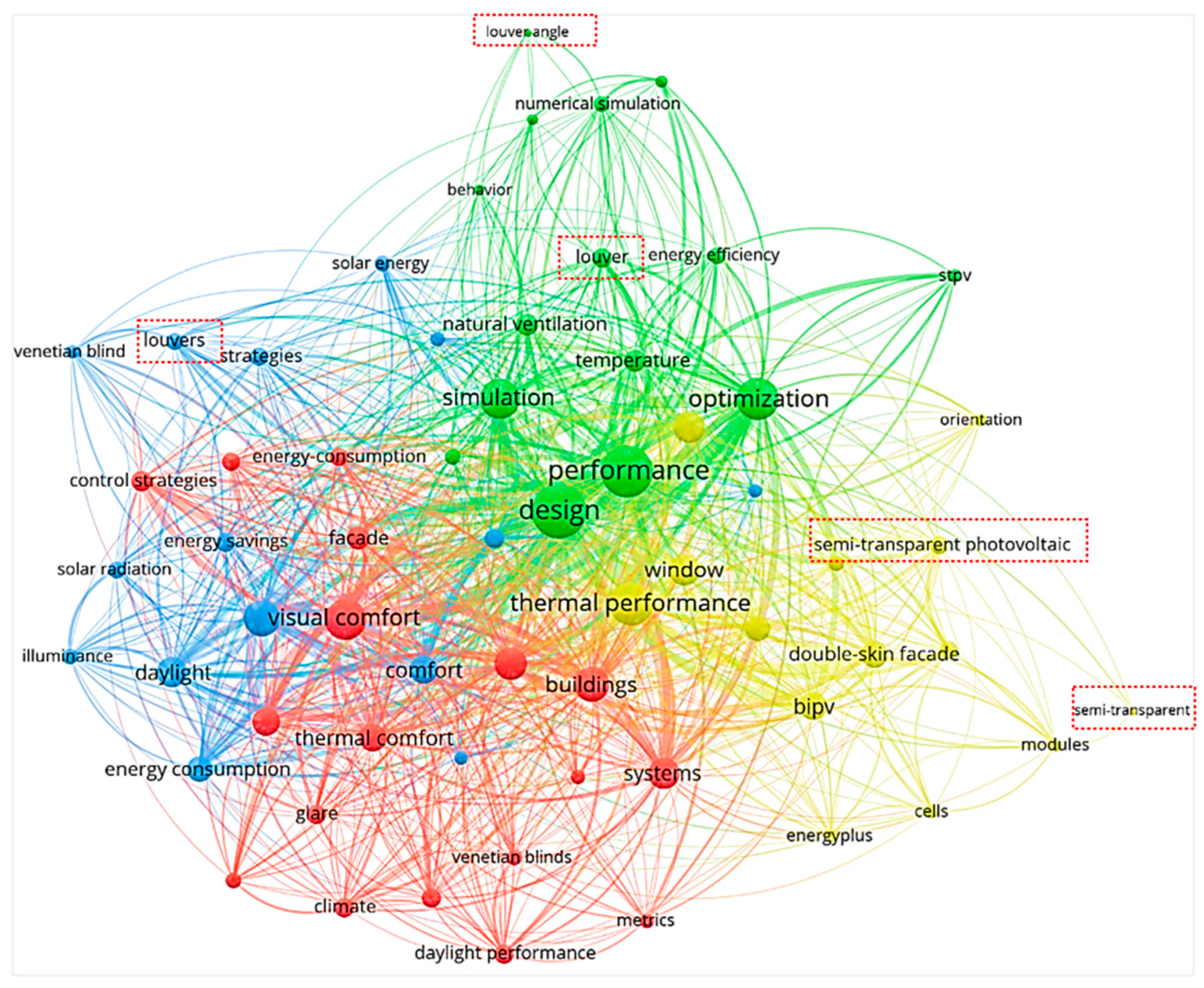
Figure 1. Keyword map of studies on STPV and Split louvers technologies published between 2015 and April 2025 on the WOS database.
Buildings 16 00117 g001
Figure 2. Schematic diagram of the comparison and based-simulation method.
Buildings 16 00117 g002
Figure 3. (a) Distribution map of the maximum average air temperature across Saudi Arabia from 1990 to 2020. (b) Yearly sun path diagram data for Hail city [39].
Buildings 16 00117 g003
Figure 4. Three-dimensional reference model of a typical office building: (a) isometric view of the complete structure and (b) plan view with dimensional specifications.
Buildings 16 00117 g004
Figure 5. Split louvers and STPV configurations proposed for based simulation assessment against typical office building double glazing (air).
Buildings 16 00117 g005
Figure 6. The UDI thresholds in cardinal office orientations for each tested split louvers and STPV against the reference model.
Buildings 16 00117 g006
Figure 7. Daylighting distribution and illuminance average at 9.00 am, on summer solstice, of split louvers configurations and STPV systems in cardinal orientation office space.
Buildings 16 00117 g007
Figure 8. Daylighting distribution and illuminance average at 12.00 pm, on summer solstice, of split louvers configurations and STPV systems in cardinal orientation office space.
Buildings 16 00117 g008
Figure 9. Daylighting distribution and illuminance average at 15.00 pm, on summer solstice, of split louvers configurations and STPV in cardinal orientation office space.
Buildings 16 00117 g009
Figure 10. Comparative PMV analysis of selected façade systems configurations against reference model during summer solstice and winter solstice days.
Buildings 16 00117 g010
Figure 11. Yearly overall energy consumption and energy output of selected façade system configurations against reference model in cardinal orientation.
Buildings 16 00117 g011
Figure 12. Energy saving of a selected efficient façade system in various orientations compared to reference models.
Buildings 16 00117 g012
Table 1. Related works to STPV and SL shading device technology.
Authors and YearObjectiveClimatic Zone/CountryVariablesMain Results
H. Alrashidi et al., 2020 [18]Investigate energy energy-saving potential of CdTe-STPV in façade buildingsHot climatesOrientation, Transparency of STPVEnergy saving up to 20%. Trade-off between energy saving and comfort (more artificial light required for low transparency).
Jing Wu et al., 2021 [19]Evaluate performance of STPV under building shadowChangsha, ChinaEave shadow width, Energy generationShadow loss of 15.3% in energy generation and reduction in heat gain by 3.28%.
Changyu Qiu & Hongxing Yang, 2019 [20]Investigate vacuum STPV performance in cold regions of ChinaHarbin, ChinaConfiguration of vacuum PV, Seasonal variationsVacuum PV glazing improves thermal performance in winter, with 20% higher energy savings.
Siliang Yang et al., 2018 [29]Study effects of BIPV/T double-skin façade on thermal comfort in AustraliaVarious Australian climatesVLT, operational modes, ventilationLower VLT (27%) provided better thermal comfort in hot climates. BIPV/T-DSF maintained indoor comfort without mechanical systems in cool climates.
G. R. Setyantho et al., 2021 [21]Evaluate multi-criteria performance of STPV windowsMediterranean climateSTPV module types, WWR, window orientationsSTPV windows in Mediterranean climate showed higher efficiency (elBI). Lighting consumption is critical for module type selection.
Z. Ioannidis et al., 2020 [30]Study DSF integrating STPV for heat recovery and energy performanceExperimental (outdoor)Solar radiation, wind speed, convectionHeat recovery index > 30% and total solar utilization efficiency is 30–77%.
Konstantinos Kapsis et al., 2015 [31]Assess daylight performance of STPV in office façadesVarious international locationsVLT, Façade configurationsSTPV system with 30% transmittance provides sufficient daylight with minimal glare.
Issam Khele & Márta Szabó, 2024 [32]Review impact of STPV on indoor visual comfort and energy efficiencyGlobal (no specific country)GHI, window transparencySTPV system reduces indoor illuminance but improves visual comfort and reduces glare.
Masoud Ghasaban et al., 2025 [23]Optimize daylight and energy production in STPV façadesHelsinki, Toronto, Riyadh, TebessaWindow-to-wall ratio, transparencyOptimal WWR ranged from 43 to 87%, maximizing daylight and minimizing glare.
Wanting Wang et al., 2024 [22]Study CSTPV glazing with passive cooling in improving energy performanceGlobal (no specific country)PV glazing, passive coolingCSTPV reduced heat gain by 15%, improved energy efficiency by 3%, and maintained high-quality indoor lighting (CRI > 96).
Chen Zhan et al., 2024 [33]Optimize CCR for STPV in Chengdu, ChinaChengdu, ChinaCCR, occupants’ satisfactionOptimal CCR: East 30%, west 10%, north 10%, and south 40%, based on energy, daylight, and satisfaction.
Nesrine Gaaliche & Hasan Alsatrawi, 2023 [34]Investigate STPV performance in Bahrain’s subtropical climateBahrain (Persian Gulf region)PV efficiency, cooling demandEnergy savings of 12% in cooling; maximum energy generation of 248.42 W.
Puja Hazarika et al., 2024 [35]Evaluate BiSPVT façade in Srinagar, IndiaSrinagar, IndiaThermal performance, energy outputElectrical efficiency 18.9%, generated 121.22 kWh/m2 of electrical energy annually.
Yuanda Cheng et al., 2018 [36] Investigate daylight and energy performance of STPV façades in ChinaHarbin, Beijing, Wuhan, Hong KongTransmittance, Orientation, WWR43.4% energy savings in Harbin and 66% in Beijing, with additional cooling demand in moderate climates like Kunming.
Frank Roberts et al., 2023 [37]Evaluating BIPV-DSF impact on visual comfort and energy consumption in UKUnited Kingdom (UK)Daylight factor, energy consumptionBIPV-DSF caused 73% drop in daylight illuminance and 8% increase in energy consumption.
Muna Alsukkar et al., 2022 [24]Improve daylight distribution using split louver with parametrically controlled slatsJordan (hot climate)Louver slat angles, daylight distributionParametrically incremental slat control improved daylight uniformity (up to 0.60) and high percentage coverage (90–100% at noon). Achieved glare-free environment with UDI150–750 lx.
Adnan Ibrahim et al., 2024 [25]Evaluate energy savings and daylighting with trapezoid profile louver shadingsGlobal (various orientations)Louver profile, slat length, shading configurationsEnergy savings of 40–44% in various orientations. UDI and DA improved significantly for trapezoid profile louvers (92.6% and 67.23%, respectively).
H. Bagheri Sabzevar & Z. Erfan, 2021 [26]Study effect of fixed louver shading devices on thermal efficiencyGlobal (various orientations)Louver angles, depth, distanceReduced thermal energy consumption by 23–32%. Optimization of louver positions and angles led to improved thermal efficiency on east, south, and west façades.
Muna Alsukkar et al., 2023 [27]Investigate daylighting performance of split louvers with various slat shapesGlobal (various climates)Louver slat shapes (flat, curved, oval), PV glazingRetro-shaped slats enhanced daylight distribution, achieving UDI coverage of >90% throughout day. Uo improved to 0.70, reducing glare.
Jianwen Zheng & Qiu-hua Tao, 2022 [38]Study impact of shading louvers on wind-driven ventilation in multi-storey buildingsGlobal (various climates)Louver angle, airflow directionShading louvers improved wind-driven ventilation and air quality. Performance varied with airflow direction and louver rotation.
Nariman Rafati et al., 2022 [28]Compare louver configurations for optimal shading and energy performance in CanadaCanada (various cities)Louver depth, count, latitudeLouvers significantly improved visual comfort and energy performance. Louver depth and count were critical for optimization across different Canadian cities.
Table 2. Thermal and optical properties of various amorphous silicon technologies and reference glazing model.
U-Value (W/m2K)SHGC (%)Transmittance VLT (%)Peak Power (Wp/m2)
a-Si 10%1.60.101092
a-Si 20%1.60.142078
a-Si 30%1.60.173064
Clear Double Glazing (Air)2.680.7078-
Table 3. Radiance parameters used for the daylighting simulation.
RadianceAmbient BouncesAmbient DivisionsAmbient SamplingAmbient AccuracyAmbient Resolution
Parameter64096640.1128
Table 4. Electrical properties of various STPV technologies.
Parametersa-si 10%a-si 20%a-si 30%
Max power (Pmax)92 W78 W64 W
Open circuit voltage144 V144 V144 V
Short circuit current1.15 A0.97 A0.77 A
Max power voltage (Vpm)99 V99 V99 V
Max power current (Ipm)0.93 A0.79 A0.65 A
Panel surface area (m2)2.3 m22.3 m22.3 m2
Table 5. The performance indicators of daylighting, thermal comfort, and energy end-use used in this study [16,17,40].
Analysis Performance Indicators Performance Indicators
DaylightingUDI300 lx < Dark area (need artificial light)
300 lx–1000 lx (comfortable), at least 50% of the time
>1000 lx too bright
WPIRecommended 300 lx–1000 lx
DGP0.35 < imperceptible glare
0.35–0.40 perceptible glare
0.4–0.45 disturbing glare
>0.45 intolerable glare
Thermal comfortPMVBuildings 16 00117 i001
ATC>80% of the time
Energy efficiencyOECLower values indicate better performance
Table 6. DGP false color representation of proposed configurations of split louvers and STPV at 12.00 pm in summer solstice southern office zone.
Split Louver Tilt Angle 15°Split Louver Tilt Angle 30°Split Louver Tilt Angle 45°
Louver Depth =10 cm
Louver Distance = 10 cm
Buildings 16 00117 i002Buildings 16 00117 i003Buildings 16 00117 i004
DGP = 0.50 Intolerable GlareDGP = 0.46 Intolerable GlareDGP = 0.39 Perceptible Glare
Louver Depth =10 cm
Louver Distance = 20 cm
Buildings 16 00117 i005Buildings 16 00117 i006Buildings 16 00117 i007
DGP = 0.57 Intolerable GlareDGP = 0.55 Intolerable GlareDGP = 0.51 Intolerable Glare
Louver Depth =15 cm
Louver Distance = 10 cm
Buildings 16 00117 i008Buildings 16 00117 i009Buildings 16 00117 i010
DGP = 0.44 Disturbing GlareDGP = 0.39 Perceptible GlareDGP = 0.31 Imperceptible Glare
Louver Depth =15 cm
Louver Distance = 20 cm
Buildings 16 00117 i011Buildings 16 00117 i012Buildings 16 00117 i013
DGP = 0.53 Intolerable GlareDGP = 0.50 Intolerable GlareDGP = 0.47 Intolerable Glare
Louver Depth =20 cm
Louver Distance = 10 cm
Buildings 16 00117 i014Buildings 16 00117 i015Buildings 16 00117 i016
DGP = 0.39 Perceptible GlareDGP = 0.35 Perceptible GlareDGP = 0.28 Imperceptible Glare
Louver Depth =20 cm
Louver Distance = 20 cm
Buildings 16 00117 i017Buildings 16 00117 i018Buildings 16 00117 i019
DGP = 0.50 Intolerable GlareDGP = 0.46 Intolerable GlareDGP = 0.39 Perceptible Glare
Transmittance (10%)
Transmittance (20%)
Transmittance (30%)
STPV 10%STPV 20%STPV 30%
Buildings 16 00117 i020Buildings 16 00117 i021Buildings 16 00117 i022
DGP = 0.21 Imperceptible GlareDGP = 0.28 Imperceptible GlareDGP = 0.35 Perceptible Glare
Table 7. Comparative ATC analysis of selected façade systems configurations during the year, as well as summer and winter solstices.
Yearly (%)Summer Solstice (%)Winter Solstice (%)
Reference modelBuildings 16 00117 i023Buildings 16 00117 i024Buildings 16 00117 i025
Configuration 09Buildings 16 00117 i026Buildings 16 00117 i027Buildings 16 00117 i028
Configuration 15Buildings 16 00117 i029Buildings 16 00117 i030Buildings 16 00117 i031
Configuration STPV 10%Buildings 16 00117 i032Buildings 16 00117 i033Buildings 16 00117 i034
Configuration STPV 20%Buildings 16 00117 i035Buildings 16 00117 i036Buildings 16 00117 i037
Disclaimer/Publisher’s Note: The statements, opinions and data contained in all publications are solely those of the individual author(s) and contributor(s) and not of MDPI and/or the editor(s). MDPI and/or the editor(s) disclaim responsibility for any injury to people or property resulting from any ideas, methods, instructions or products referred to in the content.