Article

External Annular Air Curtain to Mitigate Aerosol Pollutants in Wet-Mix Shotcrete Processes

by
Kunhua Liu
1,
Shu Wang
2,*,
Zhen Guo
1,
Longzhe Jin
3 and
Junyong Cui
1
1
School of Resources and Safety Engineering, University of Science and Technology Beijing, Beijing 100083, China
2
State Key Laboratory of Metal Mine Mining Safety and Disaster Prevention and Control, University of Science and Technology Beijing, Beijing 100083, China
3
NHC Key Laboratory for Engineering Control of Dust Hazard, University of Science and Technology Beijing, Beijing 100083, China
*
Author to whom correspondence should be addressed.
Buildings 2026, 16(1), 110; https://doi.org/10.3390/buildings16010110
Submission received: 6 November 2025 / Revised: 16 December 2025 / Accepted: 23 December 2025 / Published: 25 December 2025
(This article belongs to the Section Building Energy, Physics, Environment, and Systems)

Abstract

Dust generation from wet-mix shotcrete (WMS) is a major source of aerosol pollutants in underground construction. However, research on aerosol pollutant control equipment during the WMS process is still scarce. To achieve effective control of aerosol pollution during WMS production, this study introduced and applied air curtain dust suppression technology. A multi-dimensional jet test platform was used to investigate the dust suppression effects of a direct air curtain, an inner ring wall-attached air curtain, and an outer ring wall-attached air curtain during WMS production. By analyzing the variation characteristics of the dust concentration curve, key characteristic points were determined, and the diffusion phase and sedimentation phase were demarcated. With the incorporation of a K-C air curtain, the range reduction rates for the diffusion and sedimentation phases reached 51.92% and 80.85%, respectively, with an aerosol control efficiency of 57.10%. Additionally, numerical simulation was conducted to investigate the flow field characteristics during WMS production. It was found that the radial velocity gradient of the entire flow field in the spatial coordinate system was reduced, with a maximum reduction rate of 57% at (Y-axis = 560 mm). Furthermore, the affected area of the vorticity in the main jet shear layer was significantly reduced.

1. Introduction

With the sustained and in-depth progression of the global industrialization process, dust exposure has become a prominent occupational health challenge prevalent in multiple industries such as mining, construction, and tunnel excavation. Practical drawbacks, including insufficient awareness of dust prevention and control, as well as insufficient effective prevention and control technologies and measures, further exacerbate the severity of excessive dust concentration, posing a significant threat to the occupational health of workers [1,2,3,4,5]. As one of the main sources of dust pollutants in tunnel construction, dust emissions from wet-mix shotcrete (WMS) often exhibit characteristics such as potent alkalinity and fine particle size [6,7,8,9]. Such characteristics may induce pneumoconiosis, physical inflammation, and composite damage in the human body [10,11]. Therefore, effective control of dust emission from WMS and improvement of the tunnel construction environment are critical priorities for protecting the occupational safety and health of tunnel workers.
The rheological characteristics of freshly mixed cement play a dual role in the production process of wet-mix shotcrete: they not only influence the mechanical properties of the shotcrete but also serve as key determinants of dust production levels [12,13,14]. Zou et al. [15] conducted an analysis on the impact of silicide on the physical and chemical characteristics of concrete, including pore structure and hydration heat, through experimental methodologies. Furthermore, they extensively examined the nuanced alterations in the mechanical properties of concrete. Liu et al., using experimental methods, elaborated in detail on the dust generation mechanism during the production of wet-mix shotcrete, and systematically established the mathematical relationships between the rheological properties of freshly mixed concrete and its dust generation characteristics [16,17]. Wang et al. [18] employed an integrated approach, utilizing a blend of experimental techniques and numerical simulations to scrutinize the rheological characteristics inherent in fresh concrete. Their study elucidated the constitutive interplay within concrete derived from a rheological model.
Moreover, investigating the nozzle structure of wet-mix shotcrete is of great importance for effectively controlling shotcrete dust production [19,20]. Wang et al. conducted an experimental investigation aimed at discerning the impact of nozzle structure on the spray characteristics of wet-mix shotcrete [21]. Ginous et al. [22,23] conducted a comparative analysis of full-scale shotcrete sprays generated by three distinct nozzle configurations, elucidating the nuanced influence of these structural variants on the resulting spray velocity field. Furthermore, they delved into the kinematic attributes of jet particles during concrete deposition, employing simulation methodologies to inform the optimization of nozzle design. However, the adjustment of the internal structure of the nozzle exhibits inherent limitations in mitigating dust generation, thereby failing to satisfy the practical demands for dust suppression.
As an effective dust control method, the air curtain has been widely applied in mines and other underground engineering projects [24,25]. Nie et al. [26,27] introduced air curtain dust control technology in fully mechanized mining operations, which effectively curbed the dust diffusion from the coal cutting drum. By combining simulation methods, they further explored the impacts of outlet width, air volume, and air outlet angle on dust control efficiency, and optimized the operating parameters of the device. Wang et al. [28] reconstructed the spray paint mist flow field by introducing a protective annular airflow outside the spray gun jet, and systematically compared the evolution characteristics of the flow field. Previous investigations have established a critical foundation for the design and development of annular air curtains to mitigate aerosol pollutants during production of WMS.
In summary, current research on wet-mix shotcrete primarily focuses on aspects such as the mechanical properties of concrete, rheology and pipeline transportation, the wet-mix shotcrete nozzle structure, and optimization of the shotcrete process [29,30,31]. These studies have yielded valuable conclusions and advancements in the field. However, there remains a conspicuous lack of effective control equipment and validated methodologies for mitigating the velocity gradient between the main jet and the surrounding flow field, as well as restraining dust dispersion during production of WMS. This study focuses on developing a dust control technology for WMS by incorporating an external air curtain on the nozzle. Based on the multidimensional WMS test platform and numerical simulation methods, the evolutionary patterns of jet dust concentration were systematically revealed, and the dynamic characteristics of the flow field were analyzed. This analysis evaluated the dust suppression effects of different air curtains during WMS production and provided theoretical support and technical guidance for dust control in WMS production.

2. Methodology

2.1. Materials and Apparatus

2.1.1. Materials

P.O42.5 silicate cement manufactured by Tangshan Cement Co., Ltd. (Tangshan, China), which conforms to the GB 175-2020 standard, was selected for this study [32]. River sand with a fineness modulus of 2.8 was used as the fine aggregate, and 5–10 mm crushed stone was selected as the coarse aggregate [33]. Table 1 presents the details of the concrete formulation schemes utilized within the scope of this study.

2.1.2. Apparatus

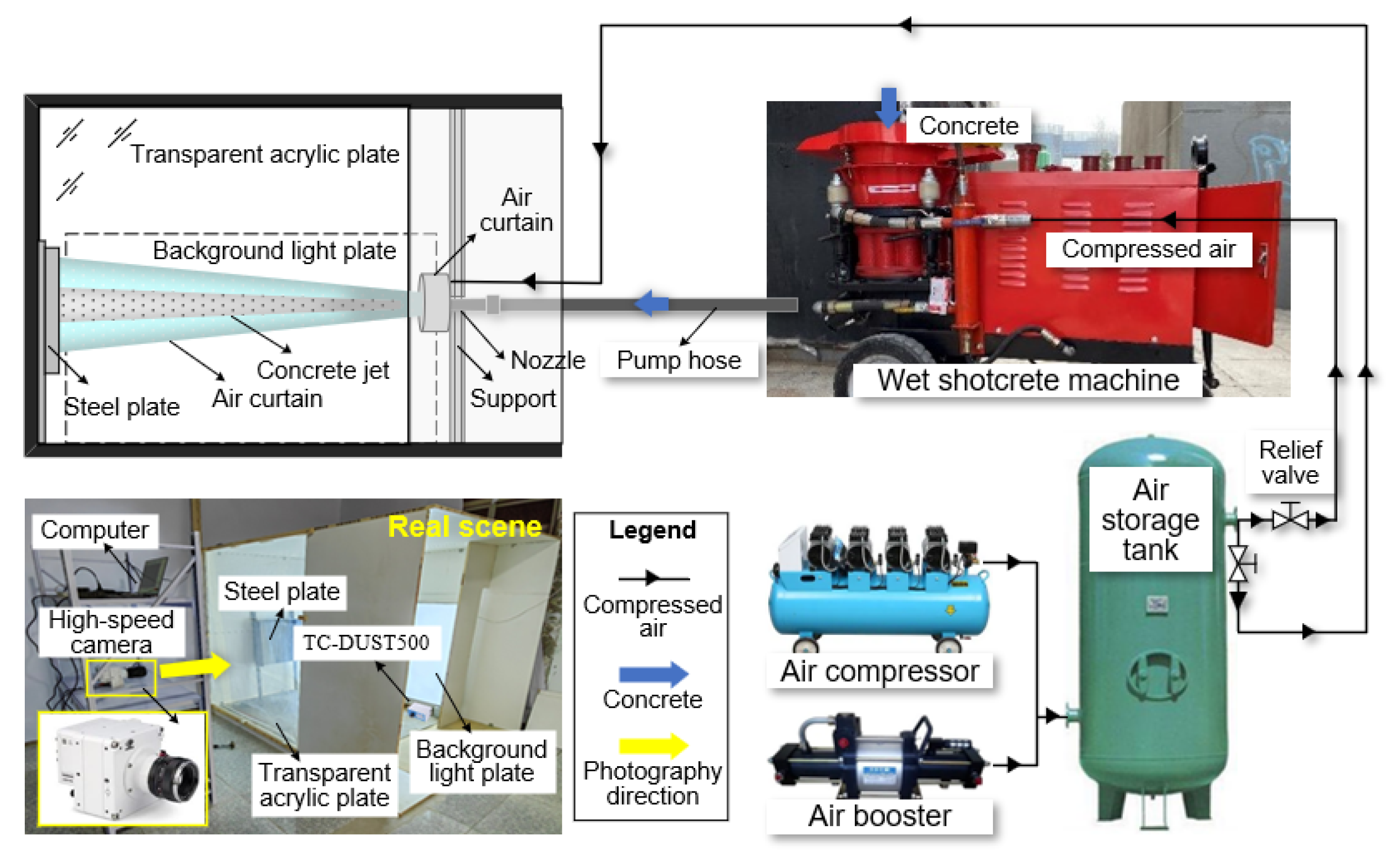
The experiment was conducted on the multidimensional WMS test platform. To ensure experimental validity, the jet air pressure was maintained constant at 0.4 MPa for all experimental groups, the jet direction was parallel to the ground, and the slump of fresh concrete was controlled at 200 mm. The diagram of the experimental platform is shown in Figure 1, and the air curtain was installed on the nozzle of the wet spraying machine.
The platform comprised a cabinet, a wet spraying machine, an air supply system, a 1.5 × 1.0 m acrylic observation window, a background light plate, and a high-speed camera. Among these components, the concrete wet spraying machine used was a PZ-3 manufactured (Hanoi Tian Shenyang Machinery Manufacturing Co., Ltd., Shenyang, China) with a flow rate of 5 m3/h. The air supply system consisted of a 2 m3 compressed air tank, along with supporting accessories including a matching air compressor, booster pump, and flow control valve, and provided high-pressure air in the range of 0–4 MPa. The high-speed camera (Phantom VEO-710L, Vision Research Inc., Charlottetown, PE, Canada) was equipped with a fixed-focus optical lens (AF-S 50 mm f/1.8, Nikon, Tokyo, Japan), with an acquisition frame rate of 3200 fps and a shooting duration of 3.8 s [16].
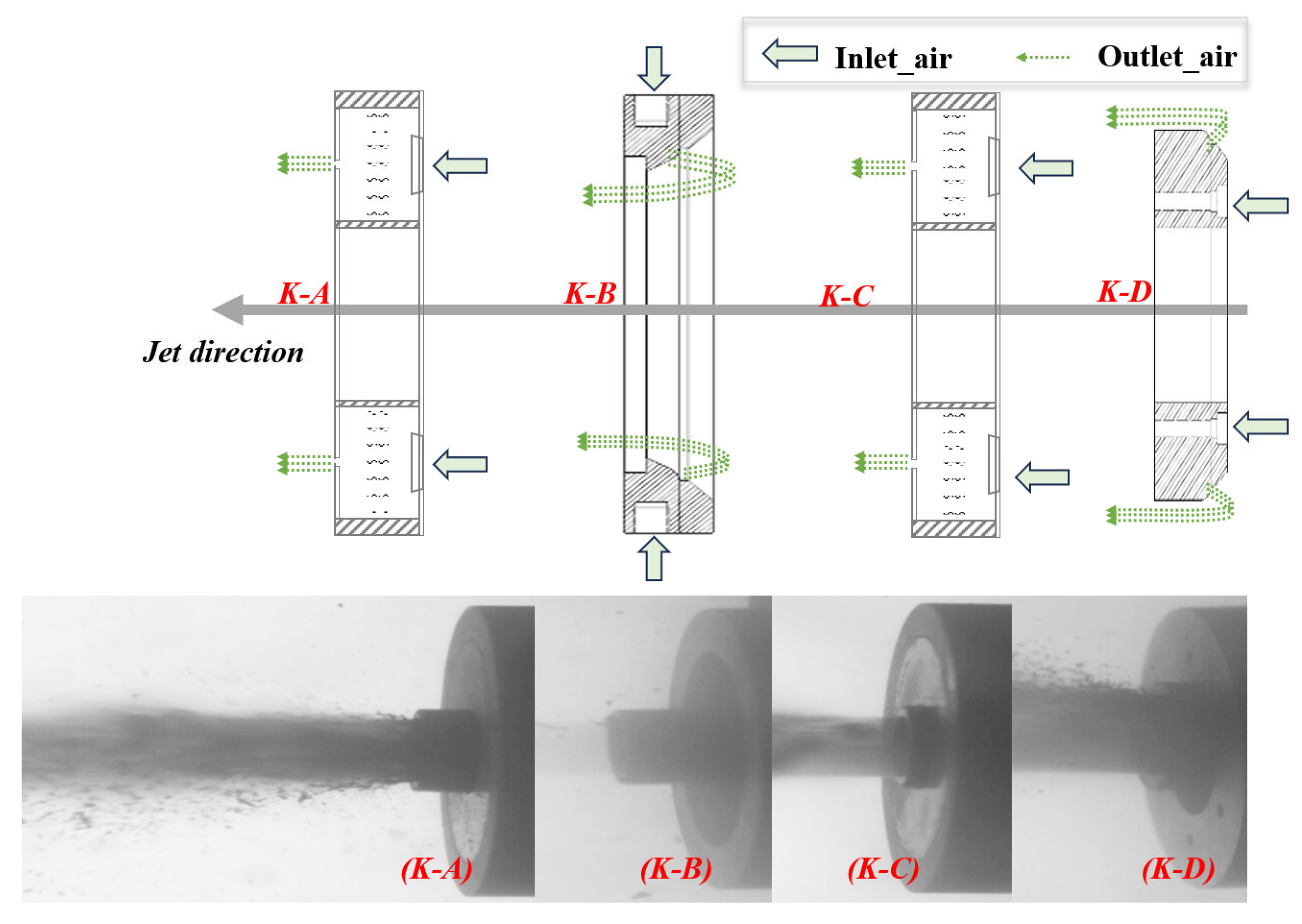
In this work, air curtains are mainly classified into three types based on their generation method: direct air curtain (K-A/K-C), inner ring wall-attached air curtain (K-B), and outer ring wall-attached air curtain (K-D). The air curtains were fabricated via electrical discharge machining or 3D printing technologies. To ensure consistency in the air curtain outlet positions, the outlet diameters of all air curtains were set to 160 mm; however, due to structural differences among the annular air curtains, their inner ring diameters were set to 42 mm (K-A/K-C), 160 mm (K-B), and 50 mm (K-D) respectively, while the outer ring diameters were 200 mm (K-A/K-C), 220 mm (K-B), and 160 mm (K-D), respectively. The gap-widths of the air curtains were 0.5 (K-A), 0.05 (K-B), 1.0 (K-C), and 0.05 (K-D) mm, respectively.
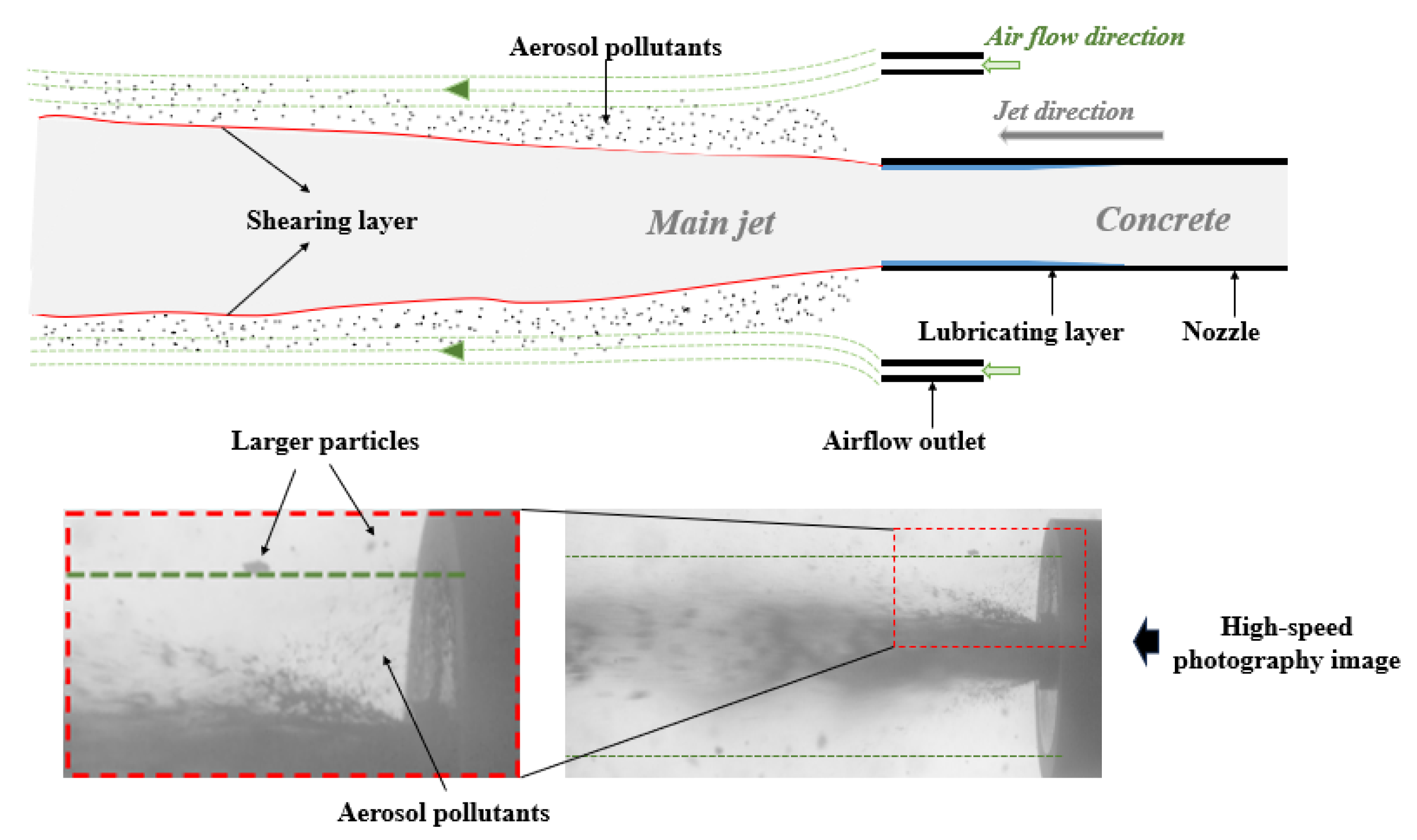
The direct air curtains (K-A/K-C) directly ejected compressed air via an annular nozzle, with their air discharge dominated by direct jet flow. In contrast, the wall-attached air curtains (K-B/K-D) achieved air discharge based on the Coanda effect, and enhanced airflow rate through wall-attached entrainment. The aerosol pollutant generation process during WMS production with an air curtain is shown in Figure 2. Various air curtain generation methods and physical devices are shown in Figure 3.
The TC-DUST 500 laser dust meter (manufactured by Beijing Tianchen Technology Co., Ltd., Beijing, China) was used to measure the concentration of aerosol pollutants generated during the WMS process. During the experiment, the instrument dust sampling interval was set to 3 s, with a total sampling duration of 11 min. Its measurement accuracy was calibrated in strict accordance with the Verification Regulation of Dust Concentration Meters (JJG 846-2015) [34]. Additionally, the slump test was conducted in strict compliance with the GB/T 50080-2016 standard [35]. Three parallel test groups were set up, and the measurement was completed within 30 min of concrete pouring, with the average value and range of slump values recorded with a measurement accuracy of ±1 mm.

2.2. Experimental Process

This work primarily evaluates the control effects of different air curtain modes and airflow velocities on aerosol pollutant generation during WMS production. In each experiment, cement slurry was used to lubricate the entire wet spraying machine pipeline. Subsequently, the freshly mixed concrete was poured into the wet spraying machine after mixing water, cement, and coarse and fine aggregates in the mixer for 6 min. Air curtains (K-A, K-B, K-C, K-D) were installed at the nozzle for the spraying experiment, with their outlet velocities controlled at 10, 20, 30, and 40 m/s, respectively. Furthermore, as the aerosol pollutant generated by WMS production is predominantly composed of liquid-laden micro-dust particles that are difficult to measure using conventional membrane filtration methods, this study utilized laser dust meters combined with imaging techniques to characterize the properties of the aerosol pollutants.
The TC-DUST 500 laser dust meter was used to measure the aerosol pollutant concentration for 10 min starting from the initiation of the spraying experiment, and a high-speed camera was used to record the WMS process. The laser dust meter was positioned at the top (1.5 m) and bottom (0.2 m) edges of the background lighting plate, and the measured values from these two positions were averaged to minimize spatial bias and enhance data reliability. In total, there were 17 experimental groups, and each group was replicated three times to ensure the reliability of the results.

2.3. Data Processing

With the adoption of an external air curtain to effectively evaluate its impact on the spread angle, the scope for determining the spread angle in this section is not limited to the main jet flow, but also encompasses the visible aerosol pollutant cloud generated thereby. The spread angle of the jet was determined by Equation (1):
α = 2 arctan D x / 2 L x
where α is the spread angle of the jet in degrees, °; Lx is the injection distance from the nozzle outlet to any point in the jet in millimeters, mm; Dx is the diameter of the jet at that specific point in millimeters, mm.
Considering that most spray aerosol pollutants consist of moist micron-sized particles, the spray aerosol pollutants can be reasonably assumed to be standard spherical microparticles. During the experiments, these spherical particles adhered to the surface of the background plate upon impact and deformed from a spherical shape into a circular morphology. The resulting particle thickness was mainly affected by factors such as impact momentum, aggregate content within the droplets, and viscosity, making it difficult to measure accurately. To ensure a unified and consistent analytical standard, this study defines the characteristic thickness of the circular particles as a constant value of 1 µm. This assumption allows the particle size characteristics to be represented through their intuitive morphological features. Such a definition is consistent with the intrinsic scale characteristics of aerosols while significantly simplifying the complexity of the analysis. The relationship between the spherical and circular radii is given by Equation (2):
π R c 2 = 4 3 π R s 3
where Rc is the radius of circle, μm; Rs is the radius of sphere, μm.
The concentration decline rate of aerosol pollutants was calculated by Equation (3):
β = C 0 C n C 0 × 100 %
where β is the concentration decline rate, %; C0 is the concentration of untreated group, mg/m3; Cn is the concentration of experimental group, mg/m3.

3. Mathematical Models

3.1. Physical Model and Boundary Condition

The dynamic transmission mechanism of WMS production is mainly centered on high-pressure air as the core driving force. Fresh concrete and high-pressure air were mixed in the swirler and ejected together from the nozzle. In the experimentally established jet system, the air served not only as the power source for the entire system but also as the primary component of the jet.
Observations on the dust generation process during WMS production have revealed that the dust-generating particles mostly originate from agglomerates formed by concrete slurry. These agglomerates mostly exhibit spherical or quasi-spherical morphologies driven by surface tension. Furthermore, the main components of dust generated by WMS production are inorganic minerals such as silicates and carbonates in concrete, which possess stable chemical properties. No chemical reactions occurred during the experimental cycle; there was no change in mass or composition, so the dust exhibited inert properties.
Based on the aforementioned findings and experimental results, this section formulates conditional assumptions and implements model simplifications for the WMS process.
The following assumptions are made:
(1)
The concrete aggregates and the aerosol pollutants generated during WMS production are spherical particles;
(2)
Ignoring the processes of collision, coalescence, and re-breakage between particles, the volatilization of components in the particles are neglected, and it is assumed that the system is in a steady state;
(3)
The heat exchange between the aerosol pollutants and the environment is ignored;
(4)
The aerosol pollutant are inert particles, and the motion of these particles in air obeys the three conservation laws of mass, momentum, and energy.
The standard k-ε model is a well-established, widely adopted two-equation model in turbulent numerical simulation. It can accurately capture the characteristics of fully developed turbulence during WMS production and is applicable to the steady-state gas-solid two-phase flow conditions of this study. Featuring moderate computational complexity, it achieves a balance between computational cost and prediction accuracy. Furthermore, this model has been extensively validated in studies on aerosol transport and gas-solid two-phase flow, ensuring high reliability of the simulation results [10,36]. In the simulation, the standard k-ε model was employed to describe airflow motion, with the equations presented as follows:
Continuity equation:
x i ρ u i = 0
Momentum equation:
u i t + u j u i x j = F i 1 ρ p x i + μ ρ 2 u i x j 2
where ρ is the air density, kg/m3; t is the time, s; μi and μj are the velocity components of the fluid in the i and j directions, m/s; xi and xj are the coordinates in the i and j directions, m; p is the effective turbulent pressure, Pa; Fi is the other forces, N.
Turbulent kinetic energy equation (k equation):
t ρ k + x i ρ k u i = x j μ + μ t σ k · k x j + G k + G b ρ ε Y M + S k
Turbulent dissipation rate equation (ε equation):
ρ ε t + ρ ε u i x i = x j μ + μ t σ ε · ε x j + C 1 ε ε k · G K + C 3 ε G b C 2 ε ρ ε 2 k + S ε
where k is the turbulent kinetic energy, J; ε is the turbulent kinetic energy dissipation rate, m2/s2; μ, μt are molecular viscosity and turbulent viscosity, Pa·s, μ t = ρ C μ k 2 ε , Cμ = 0.09; GK, Gb are the turbulent kinetic energy generated by the laminar velocity gradient and buoyancy; YM is the effect of compressible turbulence on the total dissipation rate; Sk, Se are the turbulent kinetic energy and turbulent kinetic energy dissipation rate source terms; σk, σε are the turbulent Prandtl numbers of the k and ε equations, σk = 1.0, σε = 1.3; C1ε, C2ε, C3ε are constants with empirical values of 1.44, 1.92, 0.09.
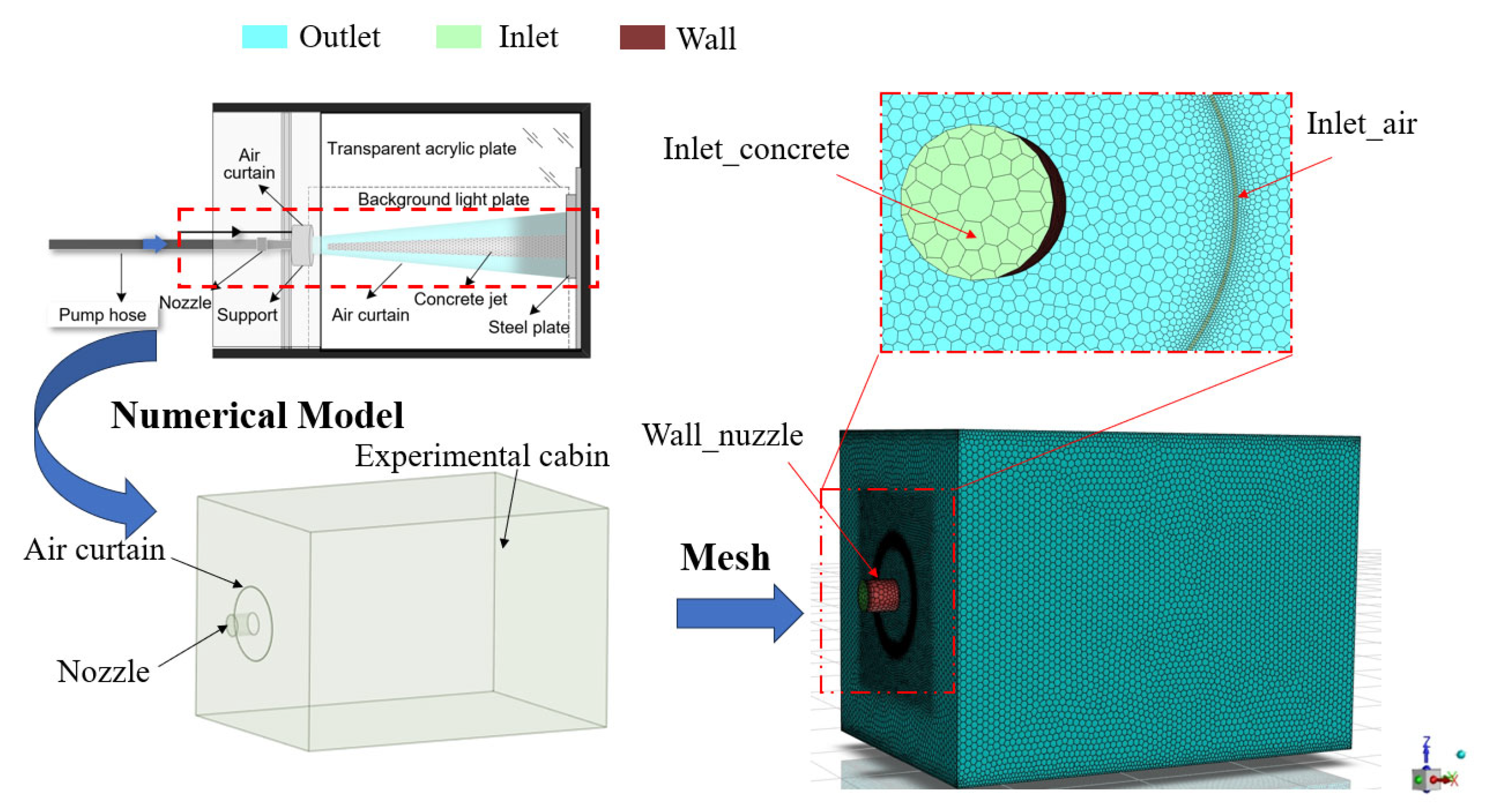
The main jet region was modeled as a rectangular computational fluid domain with dimensions of 400 × 400 × 700 mm. The Inlet_concrete, with a diameter of 40 mm, was located at the geometric center of one side plane of the fluid domain, serving as the inlet for the main jet. The Inlet_air served as the air curtain outlet, with a radius of 160 mm and an opening width of 1 mm. All other faces of the computational domain were designated as outlets, with boundary conditions specified as pressure-outlet. The numerical model and mesh generation are shown in Figure 4.
The numerical simulation was conducted as a transient analysis. Boundary conditions and solution parameters were set as listed in Table 2.

3.2. Mesh Independence and Verification

Based on the modeling strategy described in Section 3.1, three computational models with varying mesh densities were established on the Ansys Fluent platform (2020 R2). The mesh counts for the minimum (Min), medium (Med), and maximum (Max) mesh sizes were 356,377, 609,149, and 1,091,900, respectively. The velocity curve along the Y-axis at the jet axial center showed minimal discrepancies across the three mesh densities. The velocity curve in the Y-axis at the jet axial center, as depicted in Figure S1 of Supplementary Materials, exhibits minor discrepancies among the three mesh numbers. To strike a balance between simulation accuracy and computational efficiency, the medium mesh density was selected as the final mesh configuration in this study.
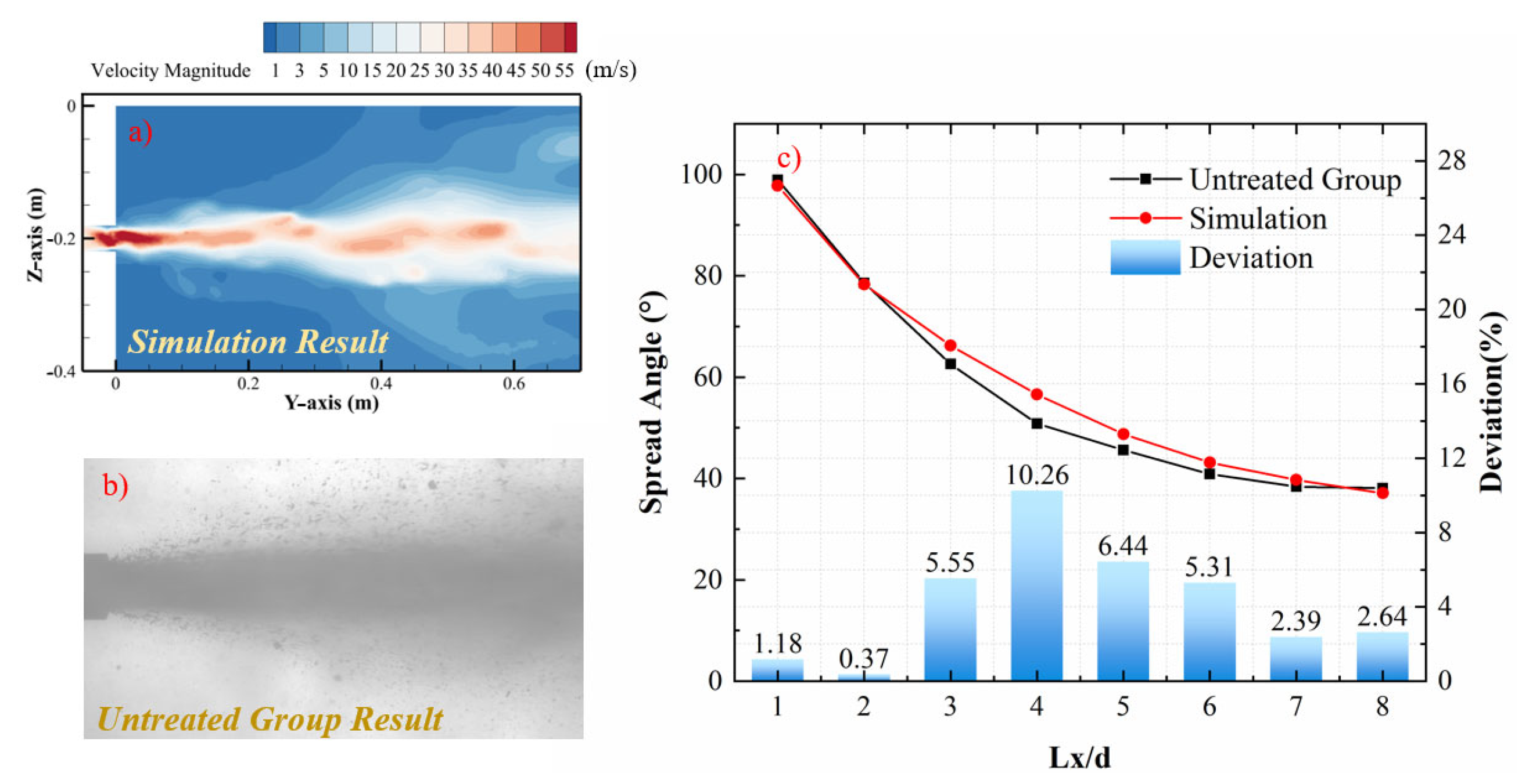
Figure 5 illustrates the deviation between the simulation and experimental results of the untreated group. As a characteristic parameter of jet momentum exchange and spatial coverage, the spread angle is amenable to engineering measurement and supports efficient simulation validation. Thus, the spread angle was selected as the indicator parameter for comparison, and the simulation results were in good agreement with experimental results of the untreated group. The average deviation of the spread angle at each measuring point between the numerical and the experimental results of the untreated group was 4.27%, indicating that the numerical model was reliable for investigating the flow field distribution during WMS production.

3.3. Approaches to Data Handling

In the context of fluid dynamics, vorticity can be considered as a quantitative descriptor of fluid flow. The vorticity was calculation by Equation (8):
ω = U z V y
where ω is the vorticity of fluid; U is the velocity in Y direction, m/s; V is the velocity in Z direction, m/s.
The transformation from rectangular coordinates to X–Z plane polar coordinates was calculated by Equations (9) and (10):
r = ( x 2 + y 2 + z 2 )
θ = arctan ( z x )
where r is the radial distance in polar coordinates, mm; θ is the azimuth in polar coordinates, °; x, y, and z are the coordinate values in the rectangular coordinate system, mm.
The radial velocity of the X–Z plane was calculated by Equation (11):
V r = V x cos θ + V z sin θ
where Vr is the radial velocity at r for θ, m/s; Vx and Vz are the velocity component of the X-axis and Z-axis on the X–Z plane.

4. Results and Discussion

4.1. Evolution of Spread Angle

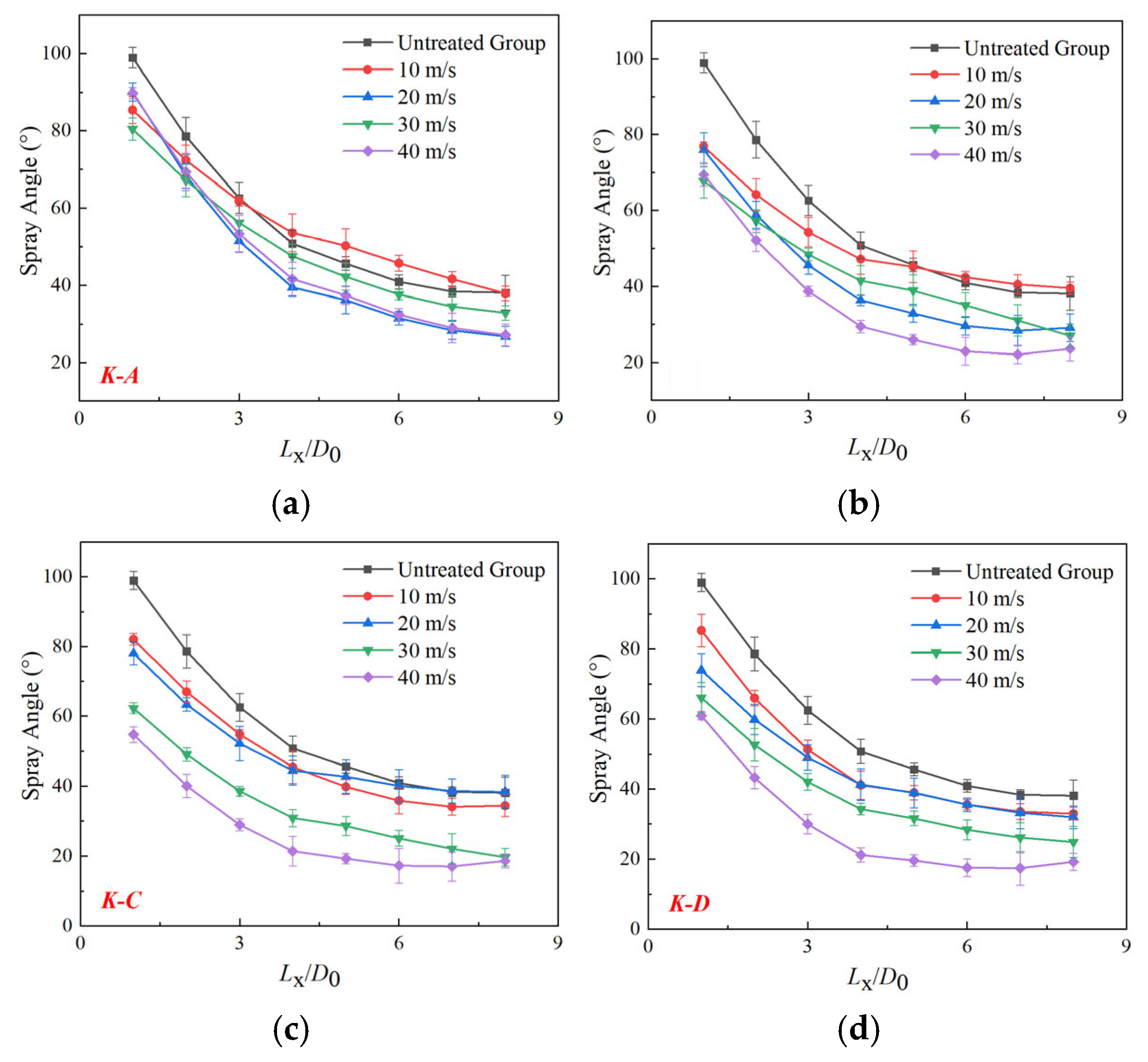
As the most direct macroscopic indicator of dust dispersion, the spread angle is widely recognized as a key parameter. Figure 6 shows the evolution of the spray angle (α) with the dimensionless distance from the nozzle (Lx/D0), where Lx/D0 is defined as the ratio of the distance from the nozzle (Lx) to the nozzle diameter (D0) and the error bars represent the standard deviation of the mean.
Based on experimental results, the incorporation of an air curtain effectively reduced the spreading angle of jets, with increasing airflow speed significantly enhancing the stream confinement effect. Comparing the results of different air curtain tests, K-C achieved the optimal dust control effect. At an airflow velocity of 40 m/s, the spread angle reduction rate of K-C was 52.2%, while the maximum spread angle reduction rate was 57.9%. In contrast, K-A had a significantly different effect on the spread angle compared to K-C. At an airflow velocity of 40 m/s, the spread angle reduction rate of K-A was 18%, while the maximum value was 29.7%. The reduction in air curtain outlet width increased the breakthrough rate of aerosol particles, so the decrease rate of the jet spread angle was limited.
The average spread angle decrease rates for K-B and K-D were 37.5% and 49.5%, respectively, mainly due to the Coanda effect. When airflow detached from the surface of the air curtain generator, small vortices and turbulence were generated in the detachment region. The vortices and turbulent enhanced the overall turbulence intensity, thereby reducing the kinetic energy of the air curtain airflow. Reduced momentum impaired the entrainment capacity of the air curtain flow [37].
Overall, momentum exchange in the near-field region (Lx/D0 < 10) occurred between the external annular air curtain and aerosol particles. The particles experienced aerodynamic drag and flow entrainment from the air curtain, resulting in significant deflection of their trajectories. Particles undergoing elastic collisions with the air curtain due to inertial effects experienced effective attenuation of their radial velocity components by the dynamic pressure of the air curtain, thereby demonstrating strong flow-following capability. Collectively, air curtains achieved active regulation of particle trajectories by inducing a forced convective flow field. Through momentum and energy coupling between airflow and particles, they established a ‘confinement-convergence’ control mechanism within and around the jet. This suppressed radial dispersion of particles, enabling directional contraction of the atomized flow morphology.

4.2. Aerosol Pollutant Transport Characteristics

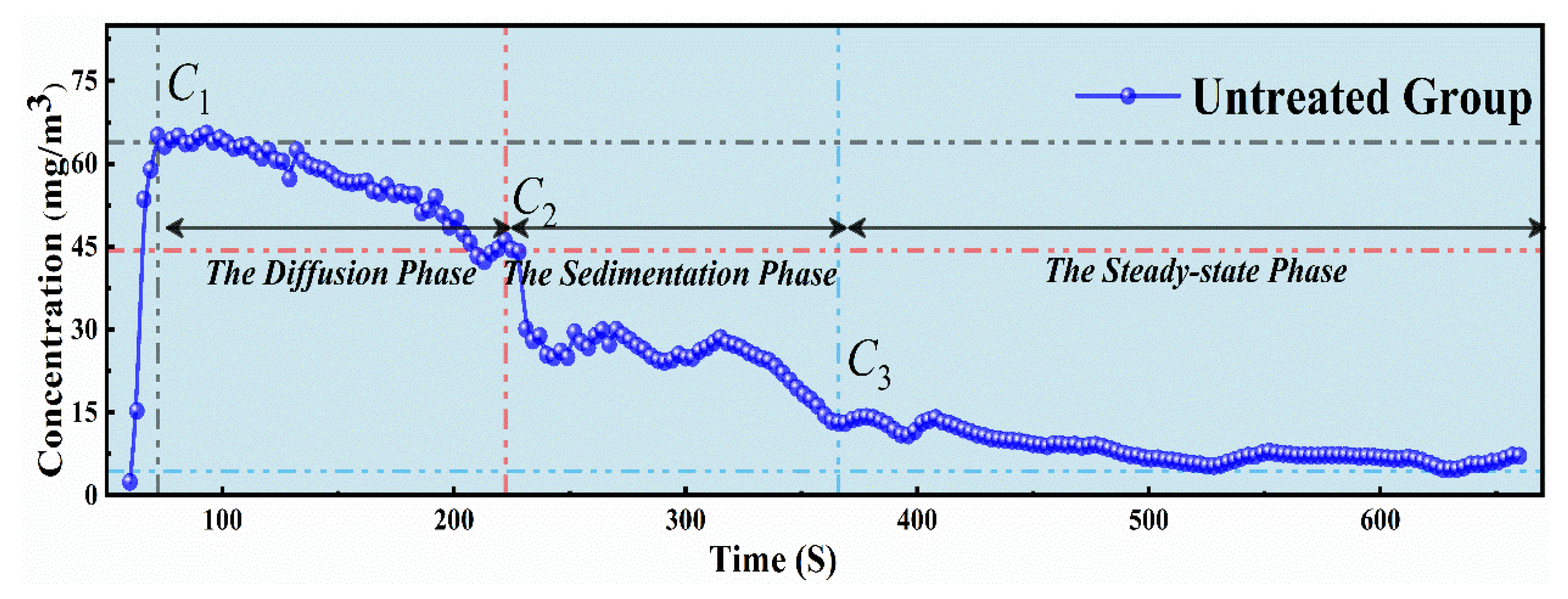
The results of two TC-DUST 500 laser dust meters were averaged to determine the aerosol pollutants during WMS production. Figure 7 illustrates the characteristic points and phase division of aerosol pollutant generation during WMS production. To ensure the reliability of the data, the dust concentration data used were the arithmetic means obtained from three experimental replicates.
Based on the variation characteristics of the aerosol pollutant concentration curve, the concentration peak was defined as the jet flow termination point C1, at which the jet process ceased with no further generation of new pollutants. The abrupt slope change point of the curve was defined as the sedimentation onset point C2, at which the aerosol pollutant concentration curve declined sharply and suspended aerosol pollutants within the experimental space commenced sedimentation. When the slope underwent a further inflection to near-zero, this point was designated as the sedimentation point C3. Thereafter, the curve became smooth and the dust concentration remained roughly constant. The jet process was categorized into three stages based on the characteristic points: the diffusion phase, the sedimentation phase, and the steady-state phase.
The diffusion phase (C1C2): After jet termination, aerosol pollutants generated during the WMS continuously dispersed and diffused in the experimental space. Influenced by factors such as gradually weakening airflow disturbance, the spatial transport dynamics of aerosol pollutants during this phase exhibited an overall relatively stable state, with concentration gradient changes tending to flatten out. The sedimentation phase (C2C3): As the flow field in the experimental space gradually approached a steady state, the magnitude of dominant external forces acting on aerosol particles decreased sharply, which was insufficient to counteract gravity. Thus, particle motion pattern shifted from being dominated by random dispersion to directional sedimentation; the force difference between gravity and buoyancy continuously drove the particles to migrate toward the lower part of the space until reaching sedimentation point C3. The steady-state phase (C3–end): Beyond sedimentation point C3, the aerosol pollutant sedimentation process was finalized, with spatial aerosol pollutant concentration nearing zero and stabilizing. Figure S2 of Supplementary Materials illustrates the concentration of aerosol pollutant with various airflow velocities during the WMS (Figure S2a) K-A; (Figure S2b) K-B; (Figure S2c) K-C; (Figure S2d) K-D. Table 3 displays the moment and concentration of the characteristic point at various airflow velocities during WMS production.
As indicated in Table 3, air curtains effectively reduced the durations of the diffusion phase (C2C1) and the sedimentation phase (C3C2). Moreover, this trend became more pronounced as airflow velocity increased. For the annular air curtains (K-A, K-B, K-C, and K-D), the average reduction rates in the diffusion phase were 15.87%, 58.17%, 31.25%, and 29.81%, respectively. In contrast, the average reduction rates in the sedimentation phase were 64.89%, −9.57%, 65.43%, and 65.43%, respectively. Air curtains reduced the shear force induced by excessive velocity difference and mitigated the direct impact of the jet on the surrounding flow field by generating a continuous annular airflow around the nozzle. These factors shortened the spatial dispersion cycle of aerosol pollutants by promoting more uniform distribution and dissipation of their kinetic energy.
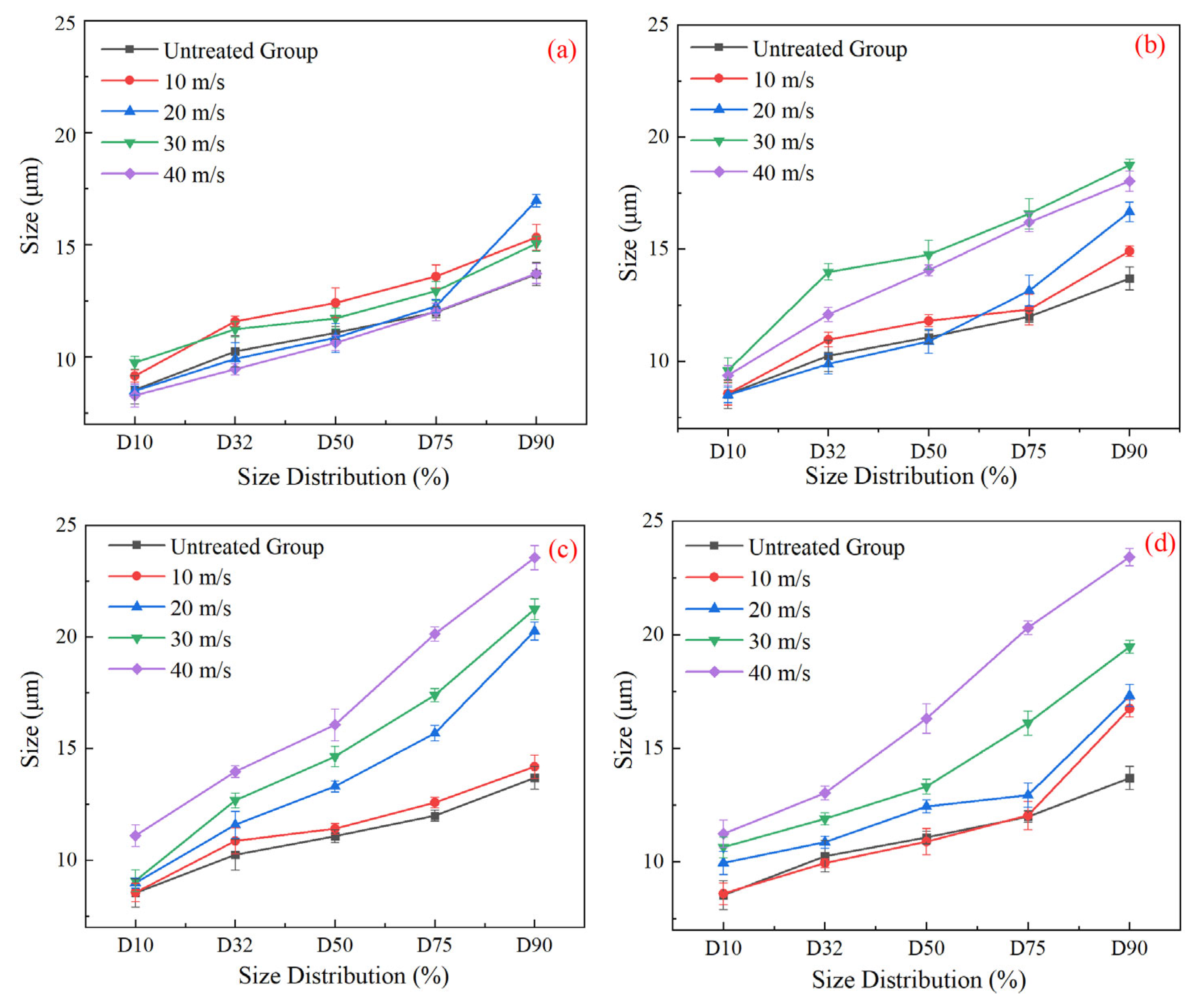
Meanwhile, the reduction in velocity gradient at the main jet edge effectively mitigated phenomena such as concrete slurry fragmentation and atomization caused by shear stress, which were manifested macroscopically as a decrease in aerosol pollutant concentration. The average aerosol pollutant control rate of the external air curtain at various airflow velocities was 29.23% (K-A), 41.42% (K-B), 42.40% (K-C), and 38.36% (K-D), respectively. Air curtains also promoted efficient aerosol drainage and accelerated particle settlement. Figure 8 illustrates the distribution of aerosol particle sizes with various airflow velocities during WMS production, and the airflow speed of the air curtains exhibited a positive correlation with the aerosol sizes.
Figure 8 compares the particle size changes between the experimental group and the untreated group; the error bars represent the standard deviation of the mean. The average median diameter D50 of injected aerosol under various airflow velocities increased by 2.93% (K-A), 16.22% (K-B), 25.05% (K-C), and 19.48% (K-D), respectively, in comparison to the untreated group. Table 3 reveals that an increase in median diameter lowered sedimentation efficiency. The K-C and K-D air curtains, operating at an airflow velocity of 40 m/s, exhibited sedimentation efficiency reduction of 65.43% compared to the untreated group. The annular air curtain formed near the jet effectively entrained some small-diameter aerosol particles generated by the jet, directing them toward the jet surface and thereby altering the overall aerosol particle size distribution of the jet.
Overall, the incorporation of an air curtain in the jet aerosol pollutant generation process exhibited three distinct macroscopic effects: reduced aerosol pollutant settling time, decreased aerosol pollutant concentration, and increased average median particle diameter. Mutual validation of these three parameters confirmed that air curtain application achieved promising effectiveness in suppressing aerosol pollutants during WMS. Based on comprehensive evaluation, the K-C air curtain attained a 57.10% aerosol pollutant control efficiency at an airflow velocity of 40 m/s.

4.3. Characteristic of Flow Field

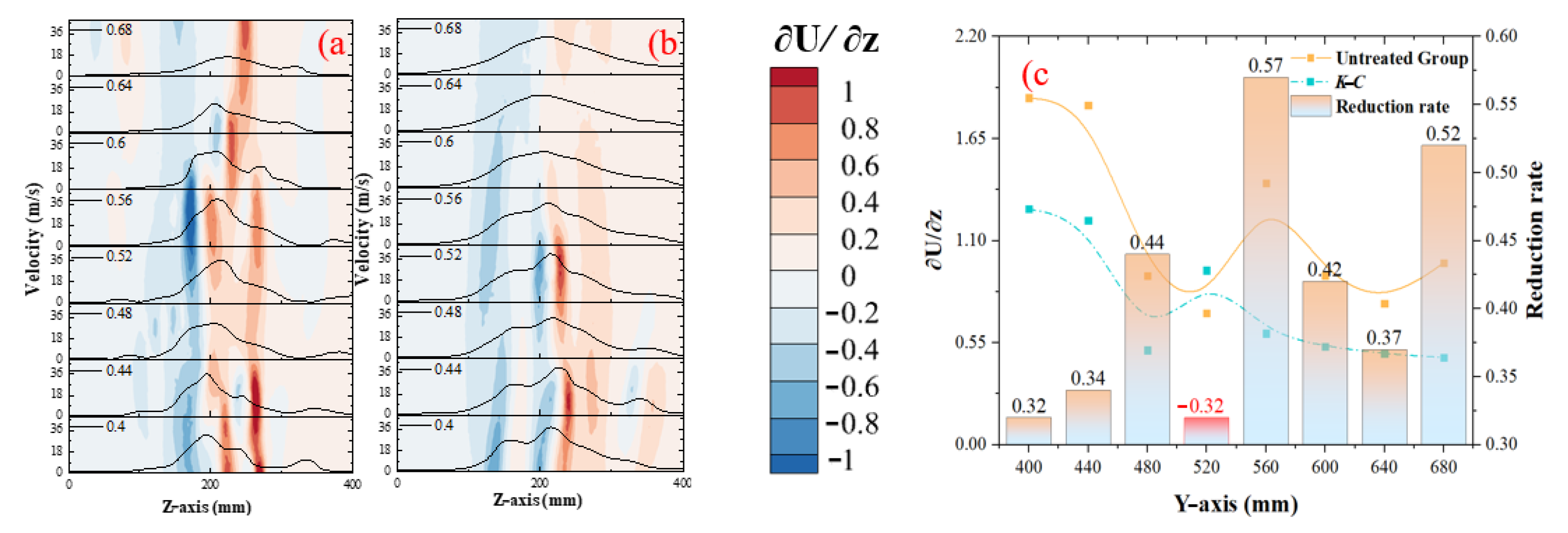
To further investigate the suppression mechanism of the K-C air curtain during WMS production, this section investigates the flow field distribution at an airflow speed of 40 m/s via numerical simulation. The far-field region of the shotcrete jet (Y = 400–680 mm) was the primary fragmentation region, and Figure 9 shows the distribution of the velocity gradient (U/z) and the Y-velocity (U–y) in the far-field region.
As can be seen from Figure 9, compared with the untreated group, the radial velocity gradient of the overall flow field was reduced with the K-C air curtain. The annular air curtain rendered the radial velocity distribution more uniform, a phenomenon mainly attributed to the dynamic buffering effect established at the interface between the main jet region and ambient air by introducing of annular airflow. This buffering effect stems from the regulatory effect of the annular airflow in the development of the jet shear layer. On the one hand, the buffer layer it forms effectively suppresses the premature separation of the jet boundary layer; on the other hand, it weakens the velocity discontinuity between the main jet and ambient fluid through gradient adjustment of momentum transport, establishing a smoother velocity gradient in the interface region. Macroscopically, this was reflected in reduced jet breakup and atomization intensity, coupled with a decrease in aerosol pollutant concentration.
Figure 9c illustrates the maximum velocity gradient and reduction rate at different horizontal positions along the Y-axis in the far-field region. Compared with the untreated group, after the application of the K-C air curtain, the maximum velocity gradient at Y = 560 was reduced by 57%. The average reduction rate of the maximum velocity gradient in the far-field region was 33%, indicating that the K-C air curtain effectively alleviated the shear effect between the main jet flow and surrounding air in the far-field region.
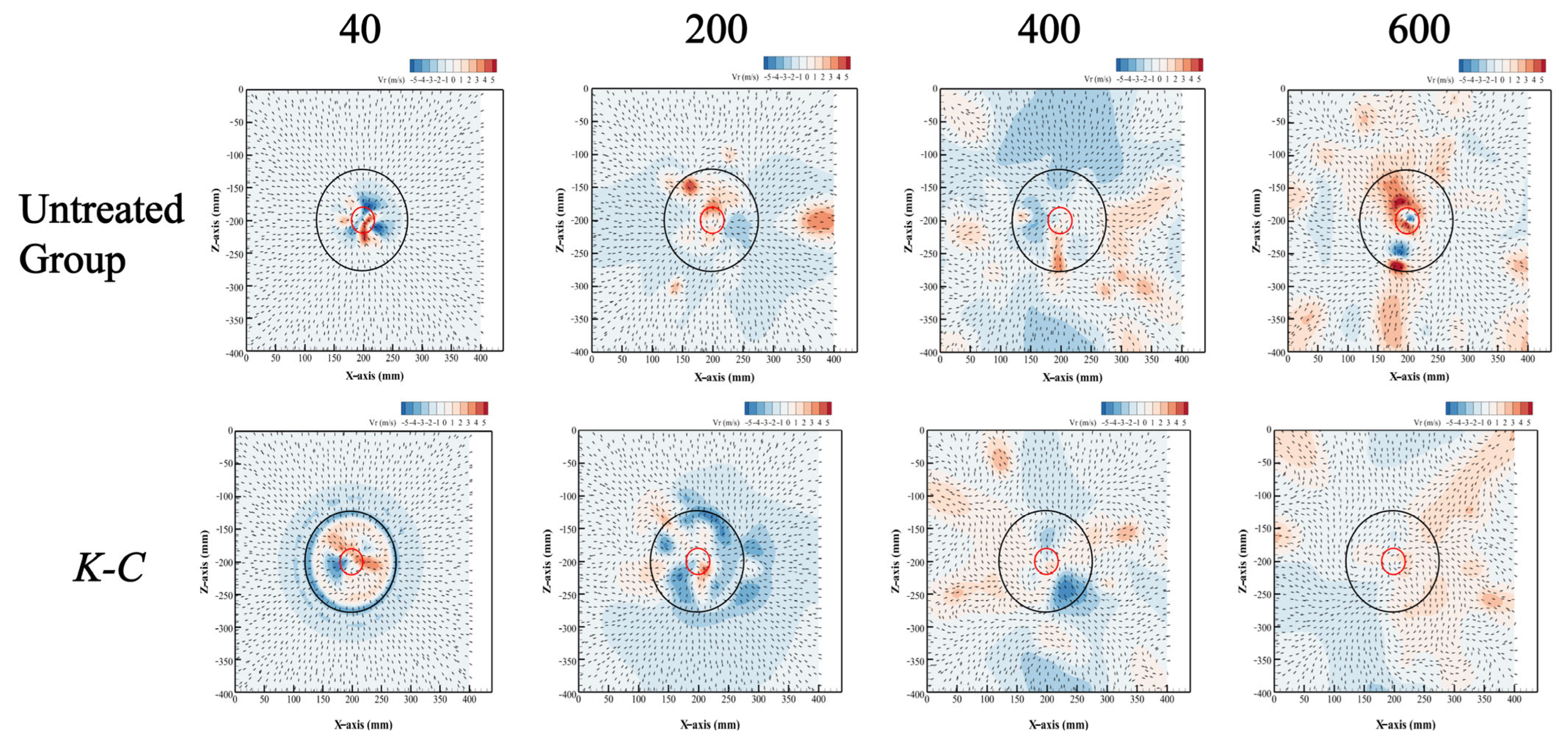
To better demonstrate the flow field characteristics, a polar coordinate transformation was applied to the global coordinate system in this section. Figure 10 displays the contour plots of radial velocity distribution and vector diagrams for different X–Z planes. The red circle denotes the boundary of the nozzle, while the black circle denotes the boundary of the K-C air flow outlet. The coordinate system is defined with the nozzle center as the origin, with positive radial velocity indicating the outward radial direction and negative radial velocity indicating the radial direction.
As illustrated in Figure 10, K-C air curtain application suppressed the outward radial velocity component within the jet boundary by forming a directional constraining airflow around the main jet. It also established a distinct continuous annular inward radial velocity structure in the region ranging from the jet center to 5D0 (D0 is the nozzle diameter). As the air curtain extended axially from 10D0 to 20D0, the annular structure disintegrated. However, the residual airflow generated by the air curtain did not dissipate but rather evolved into a weak centripetal flow field. This flow field achieved dynamic equilibrium between the jet body and the surrounding flows by reducing the momentum exchange rate between them.
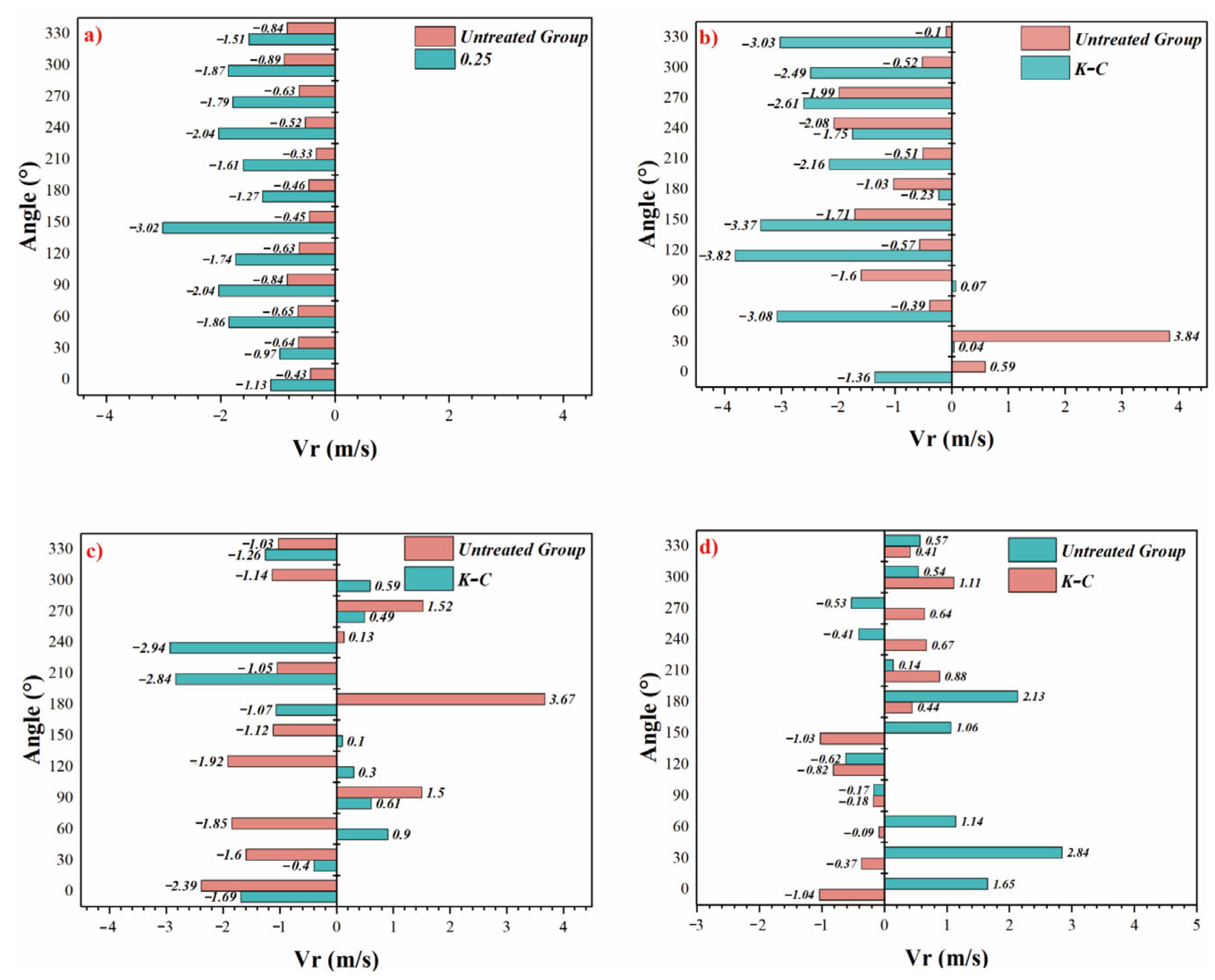
As shown in Figure 11, this section further conducts a quantitative evaluation of the radial velocity magnitude within a specific radial range (R = 60–80 mm, representing the transition zone between the nozzle boundary and the air curtain outlet boundary) at different X–Z planes. The results indicate that after incorporating the K-C air curtain, the average inward radial velocity in the R = 60–80 mm region across Y = 40, 200, 400, and 600 mm sections increased by 1.04, 1.48, 0.16, and 0.64 m/s, respectively, compared to the untreated group. Notably, part of the outward radial velocity in this region can be completely transformed into inward radial velocity. On the one hand, this inward radial velocity directly weakens the radial escape momentum of aerosol particles. On the other hand, through the entrainment effect of the centripetal flow field, it entrains aerosol pollutant particles that would otherwise escape the boundary into the main jet region (r < 0.5 D). This dual mechanism thereby realized active confinement of aerosol pollutants during WMS production.
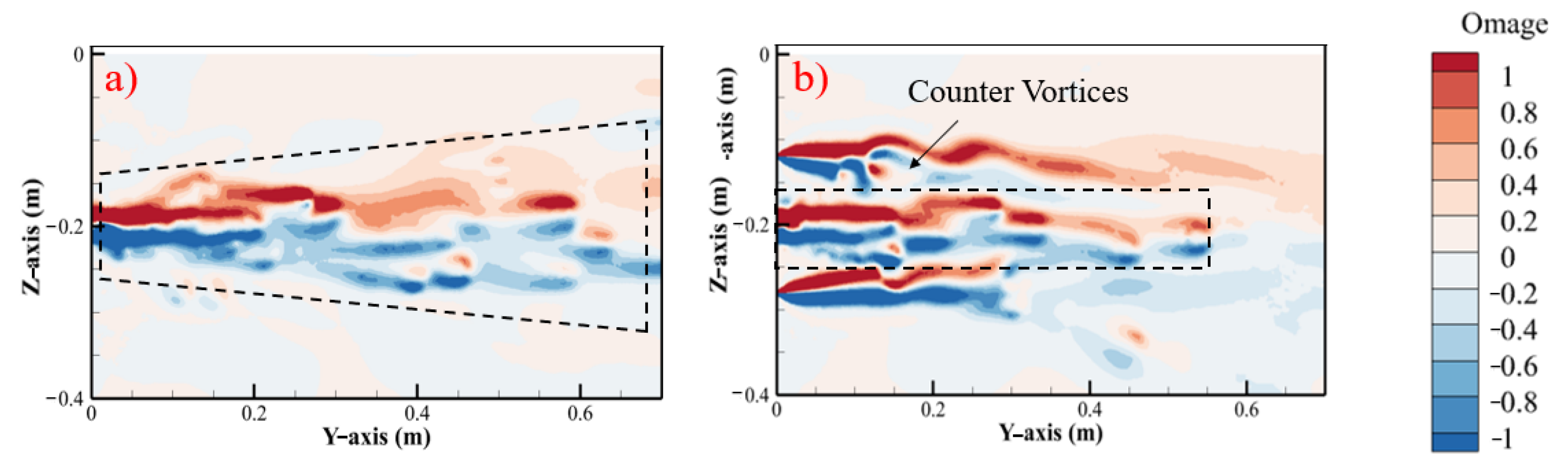
Figure 12 shows the dynamic evolution characteristics of the vorticity field during the WMS production. The shear layer exhibited a prominent high-vorticity accumulation phenomenon, which was induced by the Kelvin–Helmholtz instability generated by the velocity gradient in the free shotcrete jet. The incorporation of the K-C air curtain drove the vorticity field to undergo topological reconstruction, transforming from a diffuse distribution to surface convergence. Through the momentum coupling effect between the annular airflow and the primary shotcrete jet, the vorticity in the shear layer was gradually confined to the jet surface. This phenomenon is primarily attributed to the dynamic balance between the counter-flow vortices generated by the air curtain and the radial momentum of the main shotcrete jet. These counter vortices facilitate momentum dissipation by triggering secondary flows, and the overall vortex region also transforms from a trapezoid to a smaller rectangle. The counter vortices induced by the air curtain constricted the vorticity-influenced domain within the main jet shear layer of the primary jet and suppressed the energy cascade process of secondary atomization, thereby exerting control over aerosol pollutant generation during WMS production.

5. Conclusions

This study comprehensively evaluated the inhibitory effect of incorporating an external air curtain on aerosol pollutant generation during WMS production by combining experimental and simulation approaches, and its technical logic can provide a reference for relevant high-dust industries and has significance for promoting the development of occupational health protection systems on construction sites. The main findings are summarized as follows:
(1)
The incorporation of an air curtain during the jet aerosol pollutant generation process exhibited three distinct macroscopic effects: reduced aerosol pollutant settling time, decreased aerosol pollutant concentration, and increased average median particle diameter. Through the mutual confirmation of the three parameters, it was demonstrated that the incorporation of an air curtain exhibited encouraging efficacy in suppressing aerosol pollutants during WMS production.
(2)
With the incorporation of K-C air curtain (40 m/s), the decrease rate of the jet spread angle reached 52.2%, and the aerosol pollutant control rate reached 57.10%. Meanwhile, the reduction rate in the diffusion phase was 51.92%, demonstrating remarkable effectiveness in aerosol pollutant reduction and control.
(3)
The incorporation of K-C air curtain (40 m/s) significantly diminished the velocity gradient between the main jet and ambient air by 33% through momentum mixing, fundamentally inhibiting the energy-driven mechanism of jet breakup and atomization. Additionally, it reconstructed the circumferential flow field, transforming the outward-diffusive velocity profile of free jets into an inward-convergent configuration. The synergistic interplay of these dual mechanisms achieved efficient control over aerosol pollutant generation during the WMS.
(4)
This study adopted a combination of experimental and simulation methods to investigate the effects of different air outlet modes and air velocities on dust generation and flow field characteristics during WMS processes. However, it does not fully elucidate the relationships between more annular air curtain parameters and the flow field under varying operating flow rates. Future research could focus on this direction to develop a dust control device design method suitable for wet-mix shotcrete machines, thereby reducing the dust exposure risk for workers during construction operations.

Supplementary Materials

The following supporting information can be downloaded at: https://www.mdpi.com/article/10.3390/buildings16010110/s1.

Author Contributions

Conceptualization, S.W.; methodology, S.W.; software, K.L. and Z.G.; validation, K.L. and S.W.; formal analysis, K.L.; investigation, K.L. and Z.G.; writing–original draft, K.L. and S.W.; writing–review and editing, S.W. and L.J.; visualization, K.L. and J.C. All authors have read and agreed to the published version of the manuscript.

Funding

This research was funded by the Fundamental Research Funds for the Central Universities (No. FRF-BD-25-055).

Data Availability Statement

The original contributions presented in this study are included in the article. Further inquiries can be directed to the corresponding author.

Conflicts of Interest

The authors declare no conflicts of interest.

References

  1. Zhang, H.; Zhao, Y.Q.; Zhang, G.; Tao, Y.C.; Ge, Z.H. The dust pollution characteristic after tunnel blasting and related influence parameters by using experimental method. Tunn. Undergr. Space Technol. 2024, 148, 105752. [Google Scholar] [CrossRef]
  2. Xiao, Y.; Yang, X.E.; Wang, Z.P.; Li, Q.W.; Deng, J. Diffusion characteristics of coal dust associated with different ventilation methods in underground excavation tunnel. Process Saf. Environ. Prot. 2024, 184, 1177–1191. [Google Scholar] [CrossRef]
  3. Zhu, L.Q.; Du, J.Q.; Chen, J.; Guo, L.W.; Wang, F.S. Dust raising law of gas explosion in a 3D reconstruction real tunnel: Based on ALE-DEM model. Powder Technol. 2024, 434, 119224. [Google Scholar] [CrossRef]
  4. Zhang, Z.Q.; Zhao, Y.; Zhang, H.; Zhong, H. Experimental and numerical study on airflow-dust migration behavior in an underground cavern group construction for cleaner production. Tunn. Undergr. Space Technol. 2024, 144, 105558. [Google Scholar] [CrossRef]
  5. Wang, J.Z.; Du, C.F.; Luo, Z.M.; Ding, X.H. Study on starting mechanism and chemical control of road dust under disturbance of automobile tire in open-pit mine. J. Environ. Chem. Eng. 2025, 13, 116631. [Google Scholar] [CrossRef]
  6. He, B.; Armaghani, D.J.; Lai, S.H.; He, X.Z.; Asteris, P.G.; Sheng, D.C. A deep dive into tunnel blasting studies between 2000 and 2023—A systematic review. Tunn. Undergr. Space Technol. 2024, 147, 105727. [Google Scholar] [CrossRef]
  7. Shi, J.J.; Zhang, W.; Guo, S.C.; An, H.M. Numerical modelling of blasting dust concentration and particle size distribution during tunnel construction by drilling and blasting. Metals 2022, 12, 547. [Google Scholar] [CrossRef]
  8. Xie, Z.W.; Ruan, C.; Zhao, Z.T.; Huang, C.; Xiao, Y.M.; Zhao, Q.; Lin, J.Q. Effect of ventilation parameters on dust pollution characteristic of drilling operation in a metro tunnel. Tunn. Undergr. Space Technol. 2023, 132, 104867. [Google Scholar] [CrossRef]
  9. Chen, X.F.; Guo, C.; Song, J.X.; Wang, X.; Cheng, J.H. Occupational health risk assessment based on actual dust exposure in a tunnel construction adopting roadheader in Chongqing, China. Build. Environ. 2019, 165, 106415. [Google Scholar] [CrossRef]
  10. Zhang, G.L.; Jiang, Z.A.; Chen, J.W.; Yang, B.; Sun, Y.Q.; Si, M.L.; Chen, Y.; Zeng, F.B.; Wang, H.; Chen, J.H.; et al. Evolutionary mechanism and particle characterization analysis of dust produced by wet-mix shotcrete in tunnels. Constr. Build. Mater. 2024, 411, 134375. [Google Scholar] [CrossRef]
  11. Jafari, A.; Asadyari, S.; Sahihazar, Z.M.; Hajaghazadeh, M. Monte Carlo-based probabilistic risk assessment for cement workers exposed to heavy metals in cement dust. Environ. Geochem. Health 2023, 45, 5961–5979. [Google Scholar] [CrossRef]
  12. Tong, Y.P.; Tian, C.M.; Ye, F.; Jiang, Y.; Zhang, J.Y.; Han, X.B. Reducing Calcium Dissolution in Tunnel Shotcrete: The Impact of Admixtures on Shotcrete Performance. Langmuir 2024, 40, 9911–9925. [Google Scholar] [CrossRef]
  13. Tian, C.M.; Tong, Y.P.; Zhang, J.Y.; Ye, F.; Song, G.F.; Jiang, Y.; Zhao, M. Experimental study on mix proportion optimization of anti-calcium dissolution shotcrete for tunnels based on response surface methodology. Undergr. Space 2024, 15, 203–220. [Google Scholar] [CrossRef]
  14. Guler, S.; Öker, B.; Akbulut, Z.F. Workability, strength and toughness properties of different types of fiber-reinforced wet-mix shotcrete. Structures 2021, 31, 781–791. [Google Scholar] [CrossRef]
  15. Zou, D.H.; Xiao, L.T.; Zhang, Y.S.; Li, H.Y. Effect of hexadecyltrimethoxysilane modified micro silica particles on workability and compressive strength of ultra-high-performance concrete. Constr. Build. Mater. 2023, 399, 132480. [Google Scholar] [CrossRef]
  16. Liu, K.H.; Wang, S.; Zhao, J.W.; Guo, Z.; Ou, S.N.; Jin, L.Z.; Cui, J.Y. Understanding aerosol pollutant generation in wet-mix shotcrete for tunnel construction. Tunn. Undergr. Space Technol. 2025, 164, 106818. [Google Scholar] [CrossRef]
  17. Liu, K.H.; Wang, S.; Zhao, J.W.; Guo, Z.; Li, K.; Han, X.J.; Jin, L.Z. Optimizing concrete rheology to mitigate aerosol pollutants in wet-mix shotcrete processes. Environ. Technol. Innov. 2024, 36, 103885. [Google Scholar] [CrossRef]
  18. Wang, Z.G.; Yan, B.W.; An, X.P. Rheological and flow characteristics of fresh concrete in the rotational rheometer. J. Sustain. Cem.-Based Mater. 2023, 12, 487–500. [Google Scholar] [CrossRef]
  19. Chen, L.J.; Li, P.C.; Liu, G.M.; Wang, F. Numerical simulation for optimizing the nozzle of moist-mix shotcrete based on orthogonal test. J. Meas. Eng. 2017, 5, 205–221. [Google Scholar] [CrossRef]
  20. Su, C.; Cheng, Y.H. Numerical and experimental research on convergence angle of wet sprayer nozzle. Civ. Eng. J. 2018, 4, 1985–1995. [Google Scholar] [CrossRef]
  21. Wang, X.X.; Islam, M.M.; Zhang, Q. Influence of materials and nozzle geometry on spray and placement behavior of wet-mix shotcrete. Case Stud. Constr. Mater. 2024, 20, e02852. [Google Scholar] [CrossRef]
  22. Ginouse, N.; Jolin, M.; Bissonnette, B. Effect of equipment on spray velocity distribution in shotcrete applications. Constr. Build. Mater. 2014, 70, 362–369. [Google Scholar] [CrossRef]
  23. Ginouse, N.; Jolin, M. Experimental and numerical investigation of particle kinematics in shotcrete. J. Mater. Civ. Eng. 2014, 26, 06014023. [Google Scholar] [CrossRef]
  24. Wang, Y.F.; Wu, L.R.; Sun, X.W.; Zhang, J.H. Study on the law of dust isolation by three-dimensional adjustable rotating flow air curtain in fully mechanized mining face. J. Wind Eng. Ind. Aerodyn. 2025, 262, 106096. [Google Scholar] [CrossRef]
  25. Zhang, X.; Nie, W.; Peng, H.T.; Chen, D.W.; Du, T.; Yang, B.; Niu, W.J. Onboard air curtain dust removal method for longwall mining: Environmental pollution prevention. J. Environ. Chem. Eng. 2021, 9, 106387. [Google Scholar] [CrossRef]
  26. Nie, W.; Zhang, Y.L.; Guo, L.D.; Zhang, X.; Peng, H.T.; Chen, D.W. Research on airborne air curtain dust control technology and air volume optimization. Process Saf. Environ. Prot. 2023, 172, 113–123. [Google Scholar] [CrossRef]
  27. Nie, W.; Zhang, Y.L.; Peng, H.T.; Jiang, B.; Guo, L.D.; Zhang, X. Research on the optimal parameters of wind curtain dust control technology based on multi factor disturbance conditions. J. Clean. Prod. 2024, 434, 140196. [Google Scholar] [CrossRef]
  28. Wang, Q.W.; Liu, J.Y.; Liu, J.J.; Li, J.Y. Experimental research on the impact of annular airflow on the spraying flow field: A source control technology of paint mist. Build. Environ. 2021, 207, 108444. [Google Scholar] [CrossRef]
  29. Sun, Z.J.; Chen, L.J.; Ma, H.; Ma, G.G.; Li, P.C.; Gao, K. Study on flow characteristics of vertical pneumatic conveying of stiff shotcrete materials based on CFD-DEM. Powder Technol. 2024, 439, 119716. [Google Scholar] [CrossRef]
  30. Zhang, X.H.; Ma, C.; Liu, C.; Zhang, K.; Lu, J.; Liu, C.Q. Uniaxial tensile properties of steel fiber-reinforced recycled coarse aggregate shotcrete: Test and constitutive relationship. Constr. Build. Mater. 2024, 411, 134202. [Google Scholar] [CrossRef]
  31. Hung, C.C.; Do, T. Sprayed high-strength strain-hardening cementitious composite: Anisotropic mechanical properties and fiber distribution characteristics. Constr. Build. Mater. 2024, 412, 134862. [Google Scholar] [CrossRef]
  32. GB2020; The State General Administration of the People’s Republic of China for Quality Supervision and Inspection and Quarantine. Standards Press of China: Beijing, China, 2020.
  33. JGJ2006; Standard for Technical Requirements and Test Method of Sand and Curshed Stone (or Gravel) for Ordinary Concrete. Ministry of Construction of the People’s Republic of China: Beijing, China, 2006.
  34. JGJ2015; Dust Concentration Measuring Instruments, General Administration of Quality Supervision. Inspection and Quarantine of the People’s Republic of China: Beijing, China, 2015.
  35. GB/T2016; Standard for Test Method of Performance on Ordinary Fresh Concrete. Ministry of Housing and Urban–Rural Development of the People’s Republic of China: Beijing, China, 2016.
  36. Zhang, G.L.; Jiang, Z.A.; Li, X.C.; Chen, Y.; Yang, B.; Si, M.L.; Feng, R.; Wang, M. Impact of high-altitude environments on the motion and settling characteristics of wet-mix shotcrete dust in tunnels. Tunn. Undergr. Space Technol. 2024, 149, 105807. [Google Scholar] [CrossRef]
  37. Xu, K.W.; Su, X.C.; Bensow, R.; Krajnovic, S. Drag reduction of ship airflow using steady Coanda effect. Ocean Eng. 2022, 266, 113051. [Google Scholar] [CrossRef]
Figure 1. The diagram of the experimental platform [16].
Buildings 16 00110 g001
Figure 2. The aerosol pollutant generation process during WMS production with air curtain.
Buildings 16 00110 g002
Figure 3. The various air curtain generation methods and physical devices.
Buildings 16 00110 g003
Figure 4. The numerical model and meshing.
Buildings 16 00110 g004
Figure 5. Comparison of spread angle results (a) simulation results; (b) experimental results; (c) deviation.
Buildings 16 00110 g005
Figure 6. The curve of spread angle under different airflow speed (a) K-A; (b) K-B; (c) K-C; (d) K-D.
Buildings 16 00110 g006
Figure 7. The characteristic points and phase division of aerosol pollutant generation during WMS production (untreated group).
Buildings 16 00110 g007
Figure 8. The distribution of aerosol particle sizes with various airflow velocities during WMS production (a) K-A; (b) K-B; (c) K-C; (d) K-D.
Buildings 16 00110 g008
Figure 9. The distribution of velocity gradient (U/z) with the Y-velocity (U–y) in the far field region (a) untreated group; (b) K-C; (c) reduction rate.
Buildings 16 00110 g009
Figure 10. Contour plots of radial velocity distribution and vector distribution schematics with different X–Z planes.
Buildings 16 00110 g010
Figure 11. Radial velocity distribution with different X–Z planes of circumferential angle (a) Y = 4 mm; (b) Y = 20 mm; (c) Y = 40 mm; (d) Y = 60 mm.
Buildings 16 00110 g011
Figure 12. Dynamic evolution characteristics of vortex field in jet systems: (a) untreated group; (b) K-C (counterclockwise rotation defined as positive vortex).
Buildings 16 00110 g012
Table 1. The scheme of concrete formulation.
MaterialsCementFine
Aggregate
Coarse
Aggregate
AdmixtureWater
Benchmark4798178174.31192
Mass ratio1.01.711.710.0090.4
Table 2. The boundary conditions and solution parameters.
TypeParameter
Viscous modelk-ε, standard
Multiphase flow modelVolume of fluid (VOF)
Inlet_concrete boundary typeVelocity-inlet
Inlet_air boundary typeVelocity-inlet
Outlet boundary typePressure-outlet
Hydraulic diameter40 mm
Time step1 × 10−5 s
Computational duration3 s
Dynamic viscosity of concrete26.8 Pa·s
Table 3. The characteristic point at various airflow velocity during WMS production.
GroupsVelocity
(m/s)
C1C2C3
Time (s)Concentration
(mg/m3)
Time (s)Concentration
(mg/m3)
Time (s)Concentration
(mg/m3)
K-A109955.9926747.203189.57
209653.7223440.3431210.10
309651.6520143.3124014.39
408450.8119844.3422814.43
K-B109359.3213833.532977.63
206665.9317154.8728810.01
306650.9412947.982796.47
408452.8913251.243244.51
K-C109961.4322848.182616.90
208153.3421341.3428210.37
308743.8918040.1724610.65
407548.6215041.791776.59
K-D107260.7721044.552797.39
208750.9116538.942377.90
308760.2718646.732136.94
407853.3720140.132287.89
Untreated Group/7267.3022845.5536913.53
Disclaimer/Publisher’s Note: The statements, opinions and data contained in all publications are solely those of the individual author(s) and contributor(s) and not of MDPI and/or the editor(s). MDPI and/or the editor(s) disclaim responsibility for any injury to people or property resulting from any ideas, methods, instructions or products referred to in the content.