Article

Enhancing Pedestrian Satisfaction: A Quantitative Study of Visual Perception Elements

1
School of Art and Design, Shenyang Jianzhu University, Shenyang 110168, China
2
School of Architecture and Urban Planning, Shenyang Jianzhu University, Shenyang 110168, China
*
Author to whom correspondence should be addressed.
Buildings 2025, 15(23), 4389; https://doi.org/10.3390/buildings15234389

Submission received: 9 October 2025 / Revised: 12 November 2025 / Accepted: 2 December 2025 / Published: 4 December 2025
(This article belongs to the Section Architectural Design, Urban Science, and Real Estate)

Abstract

The urban street environment strongly influences pedestrian satisfaction, with visual perception elements playing a pivotal role. Historic districts serve not only as carriers of urban culture but also as key tourism resources, where spatial quality directly shapes visitor experience and city image. This study takes the Shenyang Fangcheng historic district as a case, combining field surveys and questionnaires to gather pedestrian satisfaction data, while applying semantic segmentation of street imagery to quantify visual elements. Using correlation analysis and multiple regression models, the research systematically reveals relationships and mechanisms linking visual elements with pedestrian satisfaction. Results show that an increase in landmark buildings and landscape features enhances legibility and attractiveness; optimizing spatial configuration improves openness and walking comfort; and reducing vehicle presence strengthens perceived safety and overall experiential quality. By integrating subjective perceptions with objective visual indicators, this study offers empirical evidence and methodological innovation to support enhancement of walkability and promote human-centered street design in historic districts.

1. Introduction

Street-level pedestrian spaces are vital carriers of urban public life and serve as key venues for living, social interaction, and everyday activities. Historic districts, in particular, function both as important repositories of urban cultural heritage and as essential public spaces; they are also core areas for cultural-tourism consumption and for projecting the city’s image. In recent years, urban design and urban regeneration have increasingly advocated a “people-centered” approach. High-quality spaces in historic districts can enhance visitors’ and residents’ walking experiences, extend dwell time, increase willingness to consume, and stimulate word-of-mouth dissemination [1,2]. However, most parcels and buildings within historic districts are under protection, making macro-scale demolition-and-reconstruction models difficult to implement. Consequently, improving spatial quality at the micro-scale has become one of the key priorities in current historic-district renewal [3,4,5].
In Shenyang, the Zhongjie–Fangcheng Historic District is among the city’s most distinctive, culturally resonant areas. It contains significant heritage architecture together with a rich assemblage of landscape elements and spatial typologies, and accommodates commercial, tourism, residential, and leisure functions—making it one of the representative cultural-tourism destinations in Northeast China. However, the district is undergoing rapid change; the unsystematic distribution of landscape elements, visual clutter, spatial crowding, incongruent shopfront façades relative to the historic character, and deferred maintenance of heritage buildings collectively undermine streetscape quality and, in turn, degrade the street-level pedestrian experience for visitors and residents. Against this backdrop, the present study develops an integrative framework linking subjective visual perceptions with objective, image-derived visual indicators, quantitatively identifies how key micro-scale visual elements shape pedestrian satisfaction, and proposes actionable recommendations to enhance tourism experiences within historic-district contexts.
Classic scholarship recognizes that the physical street space and street form constitute the foundation of street activities [6,7,8]. Walking is a moderate-intensity physical activity; since the twentieth century, research on walkability has been pioneered in public health and transport studies. Within the transport field, scholars have primarily examined the relationship between the urban built environment and walking behavior [9,10,11]. Cerike [12] emphasizes that density, diversity, and design are key environmental factors. These factors influence pedestrian satisfaction via the street-space environment: streetscape quality indicates whether people are willing to linger and enjoy urban space [13], and higher-quality street-level pedestrian space is associated with greater pedestrian satisfaction [14].
Existing reviews and empirical studies have shown that the research scale and environmental indicators of the built street environment have been continuously expanding. Studies on walkability have shifted from macro-level explanations—such as land use, connectivity, and accessibility—to the micro-scale of street spatial perception [15]. Recent research in cognitive architecture has emphasized that urban design should account for human psychological and neurological responses to the built environment. Studies by Sussman and Hollander highlight the use of eye-tracking and biometric tools to reveal how design elements guide attention and influence emotional comfort, thereby bridging spatial configuration with human cognitive patterns [16,17]. Early planning of walkable environments focused mainly on macro-indicators while neglecting residents’ psychological and emotional needs [18,19,20], and such approaches often fail to effectively improve residents’ quality of life [21]. In terms of urban form [22,23], scholars have summarized built-environment factors affecting pedestrians’ walking behavior and pedestrian satisfaction, such as land use mix, street connectivity, and population and building density [24,25,26,27,28,29,30,31,32]. Studies have found that walkable neighborhoods typically feature diverse land uses and a wide variety of destination types. These characteristics help improve community vitality and resident satisfaction [33]. In addition, neighborhood attributes such as higher population density and good street connectivity have been shown to be significantly associated with residents’ walking and cycling activity levels and the resulting health satisfaction [30,34,35].
In recent years, scholars’ research on walkability has increasingly focused on the micro-scale built environment, as macro-scale indicators were easier to quantify through GIS data, whereas micro-visual modeling has developed only recently [36]. This research emphasizes visual elements such as greenery, street openness or enclosure, interface continuity, building façade details, color and material expression, the continuity and quality of pedestrian walkways, and even the impact of vehicle presence on pedestrians’ perceived safety and comfort [37,38,39,40]. By designing streets with these micro-environmental elements, it is possible to promote greater pedestrian activity. This echoes Gehl’s human-scale approach, which argues that public life flourishes when streets are designed to match pedestrians’ sensory speed and field of view [8]. Incorporating such elements into street design can effectively enhance pedestrians’ sense of safety and comfort as well as their overall walking experience, thereby increasing their overall satisfaction with the walking environment.
Classical urban design principles also stress the aesthetic and proportional harmony of streets as essential to walkable, enduring spaces, consistent with the tenets of traditional planning articulated by Buras [41], who argued that beauty and visual coherence are indispensable for fostering pedestrians’ experiential satisfaction and psychological comfort. Research evaluating micro-scale environmental factors draws on fields such as spatial perception [42], environmental behavior studies [43], and virtual reality (VR) experiments. In particular, spatial perception studies often identify the key visual factors that influence public satisfaction within the environment and improve the spatial quality of the built environment [44]. Existing empirical studies at the micro-scale have largely focused on tourist behavior or resident perceptions [45,46], primarily examining visual preferences [47,48] and involving both objective quantitative evaluation and subjective spatial cognition [49,50,51,52]. From the perspective of network urbanism, Mehaffy and Lavdas [53] further contend that pedestrian vitality depends on a fine-grained, interconnected street network—a “small-world” morphology enhancing accessibility and social encounter. These studies consistently indicate that the spatial quality of a neighborhood represents the integrated perceptual experience of pedestrians with respect to the built environment, and serves as a core indicator of pedestrian satisfaction [54,55,56].
Furthermore, the public’s visual experience of the urban built environment [57] is closely related to the objective spatial environment [58]. High spatial visual quality has been found to enhance the spatial experiences and satisfaction of both visitors and residents [59,60]. Additional empirical research demonstrates that micro-design features of streets play a direct and sensitive role in shaping pedestrians’ walking satisfaction and experience [36,61,62,63]. For example, Ewing et al. [36] explored the relationship between urban design qualities and pedestrian walking behavior and satisfaction across dimensions such as legibility, human scale, enclosure, transparency, and complexity. Overall, from the perspective of satisfaction, optimizing the micro-scale design of street environments is of great significance for improving the public’s walking experience, satisfaction, and the overall quality of urban life.
These perspectives together support a human-centered and neuro-responsive understanding of urban space, linking perceptual comfort with environmental design quality [64]. In summary, this study is grounded in environmental perception theory and a framework of urban-design features, both of which emphasize the decisive role of spatial environmental attributes in shaping individual perceptions and behavioral choices [25,36]. Using the Zhongjie–Fangcheng Historic District in Shenyang as a case, we integrate multi-source questionnaire ratings with semantic segmentation of street-view imagery to construct a “micro-scale visual elements–pedestrian satisfaction” analytical model, and we elucidate its mechanisms through correlation tests and regression analyses. The results can inform indicator inventories and prioritization schemes for urban regeneration and cultural-tourism placemaking, providing an evidence base for enhancing visitor experience, extending dwell time, and stimulating business vitality and economic performance; they also offer a robust theoretical and methodological foundation for subsequent empirical research [15,65].

2. Materials and Methods

2.1. Study Site

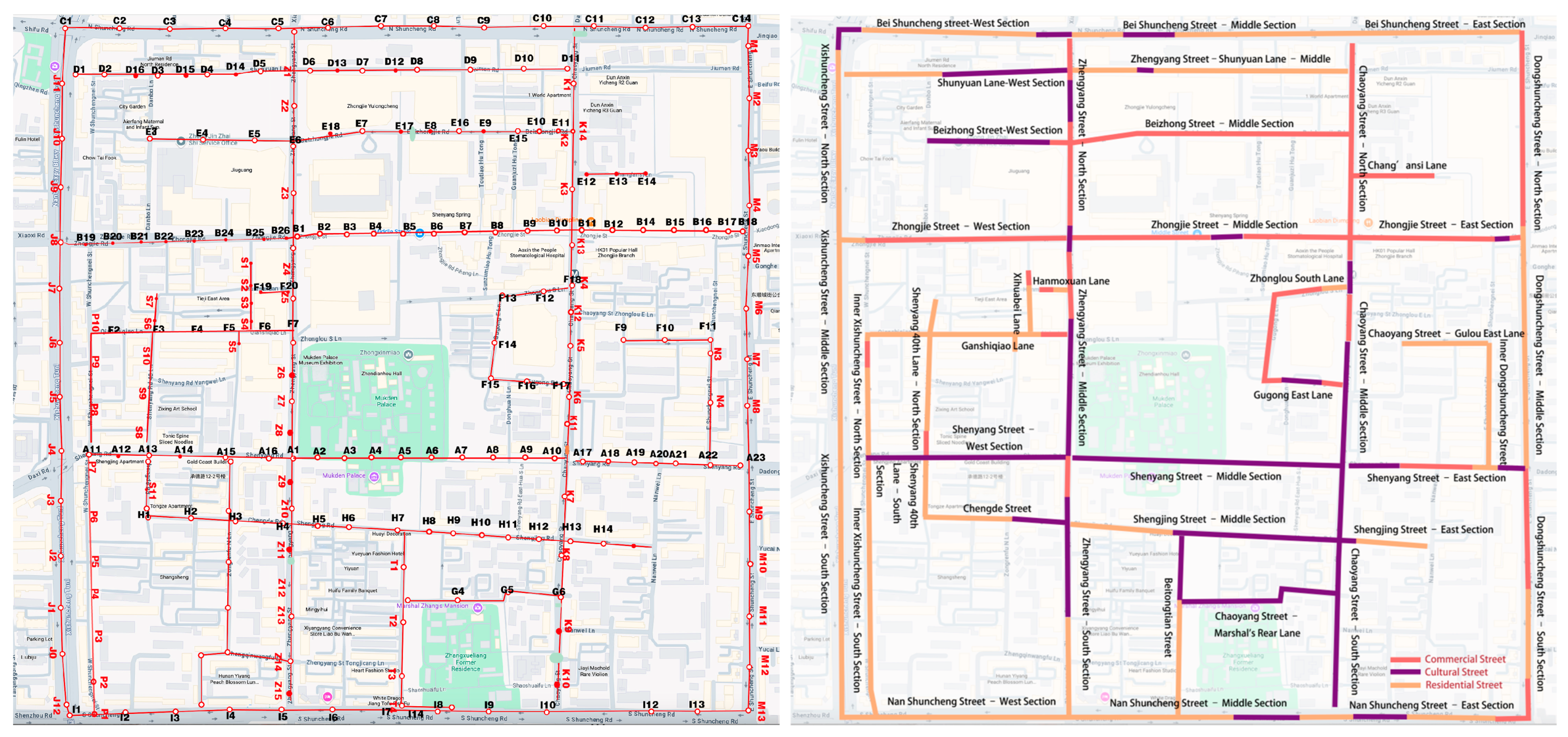
This study selects the Fangcheng historic and cultural district in Shenyang, China, as the research area. The district is located in the urban core of Shenyang and is characterized by a “grid-pattern street structure”. It has a total planned area of approximately 1.69 km2, encompassing landmark nodes such as Zhongjie and the Shenyang Imperial Palace, and carries the city’s historical context and cultural memory. The main functional types of the Fangcheng area include commercial streets, cultural streets, and residential streets. Its spatial morphology is diverse, with typical historic-district features and a variety of visual environments (See Figure 1).

2.2. Street Visual Perception Data Collection and Processing

Aligned with the street-network structure and functional zoning, this study selected 9 primary urban streets and 16 secondary streets within the Fangcheng area, yielding 45 street segments and 225 samples. In the sampling design, segments with high spatial heterogeneity were sampled at 50 m intervals, while segments with low spatial heterogeneity were sampled at 100 m intervals, to enhance the detection of short-scale variation in visual elements and to reduce spatial redundancy between adjacent points. At each sampling point, visual perception elements (independent variables) and pedestrian satisfaction (dependent variable) were co-located and collected at the same position, forming a one-to-one analytical unit. The sampling scheme ensured comprehensive spatial coverage and representativeness [66,67,68].
For the sampling design of visual perception elements (independent variables), all images were captured at a standardized height of 1.6 m, during clear weather in the morning (9:00–11:30) and afternoon (13:30–16:00), to ensure the comparability and usability of image quality [69]. While the original panoramic images were captured from the street center to avoid occlusion, four directional stills were extracted at pedestrian eye height (≈1.6 m) to simulate the sidewalk viewpoint for perception evaluation, a method widely validated in streetscape studies [15,70].
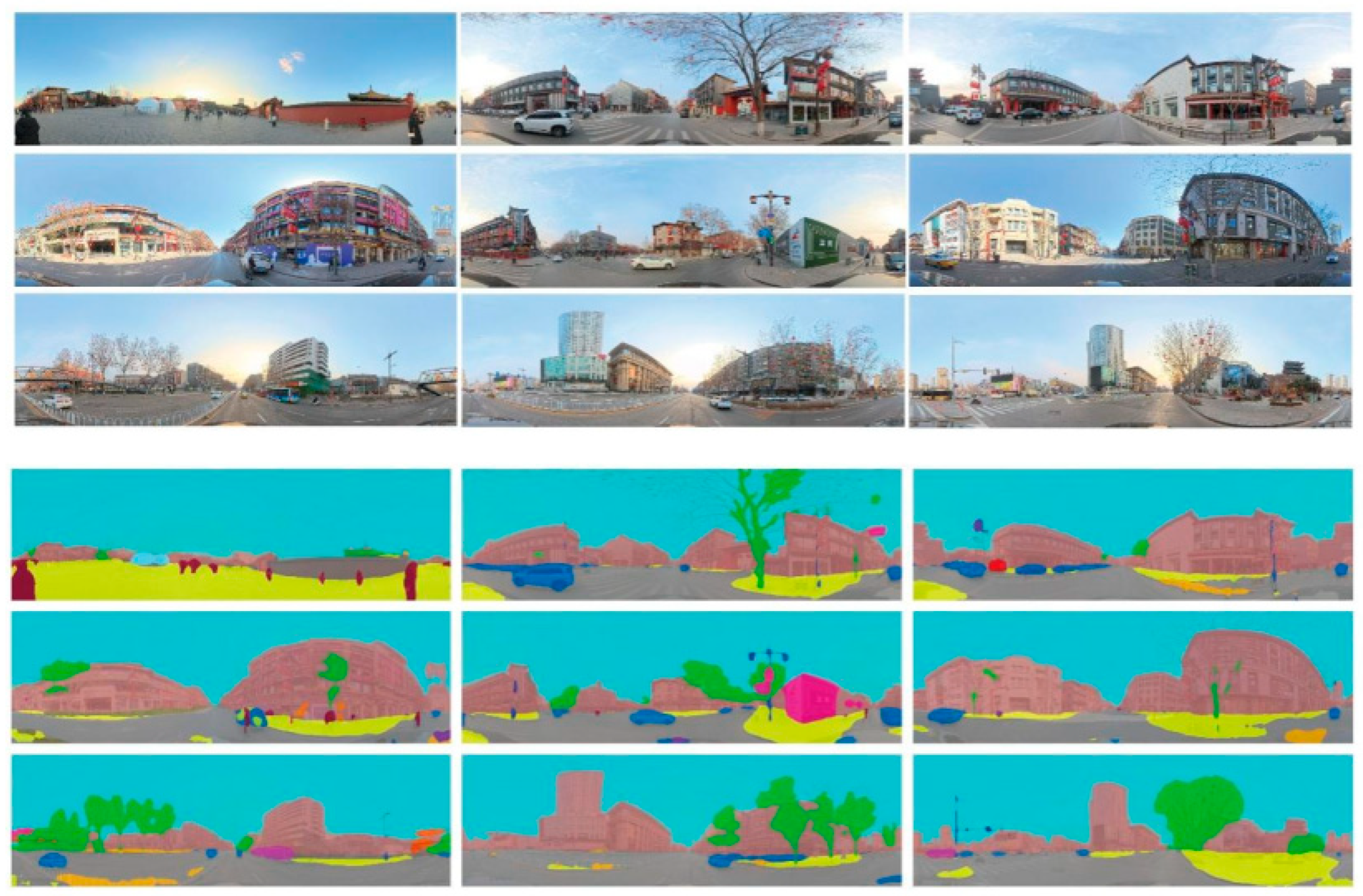
After image acquisition, standardized preprocessing was conducted—including cropping, view-angle unification, and exposure calibration—to eliminate external interference and to prepare for semantic-segmentation analysis [61,69]. Subsequently, deep-learning–based semantic segmentation was applied for pixel-level analysis of street-view images to automatically identify visual elements such as buildings, roads, vegetation, sky, pedestrians, and vehicles (See Figure 2) [71,72,73,74]. Semantic segmentation is a computer vision–based classification technique that automatically delineates landscape elements within images according to their boundaries [75]. This method offers an objective approach to quantify the physical features of street environments [76,77]. It has been widely applied to assess vegetation coverage [78,79] and to compute various landscape indicators such as openness—by extracting sky area [80,81,82]—as well as enclosure, by identifying built-up areas [83]. Among existing models, DeeplabV3+ is a widely recognized semantic segmentation framework proposed by Liang-Chieh Chen and colleagues [71], which has demonstrated strong performance in urban landscape analysis. This approach has been shown in prior studies to improve the objectivity and accuracy of visual measurements, reduce human interference, and achieve good consistency with traditional manual interpretation, thereby providing a reliable data basis for subsequent quantitative regression modeling [84].
Existing studies demonstrate that deep learning can effectively identify human subjective perceptions of urban environments from large-scale street-view data. For example, the Place Pulse project at the MIT Media Lab constructed a global-scale urban perception dataset by asking users to compare pairs of street-view images in terms of perceived safety, vibrancy, and affluence, thereby providing a reliable foundation for machine-learning models to learn regularities of human perception [85]. In parallel, Yao et al. [86] proposed a human–machine adversarial scoring framework and verified significant correlations between street-view visual features and residents’ perception ratings, further substantiating the scientific validity and operational feasibility of quantifying urban visual perception using semantic segmentation and deep learning methods. Together, these studies furnish the theoretical grounding and methodological basis for our use of street-view imagery and semantic analysis models to measure visual perception in this research.
In the sampling design, we ensured comprehensive coverage and representativeness. The visual perception elements identified and extracted in this study (See Table 1) consist of: Building with Identifiers, Landscape with Identifiers, Building Height, Pedestrians, Openness, Interface Enclosure Degree, Walkable Area, Greenness, Vehicle Occurrence Rate, and Landmark Quantity. These indicators constitute the main independent variables in the regression analysis [77,78,79,87,88,89].

2.3. Pedestrian Satisfaction Data Collection and Processing

Pedestrian satisfaction is a perception-based subjective evaluation that captures pedestrians’ holistic psychological response to the walking environment. It is commonly conceptualized as an overall appraisal of walking-experience quality, jointly shaped by physical attributes of the environment, visual-perception factors, and individual characteristics. This definition is consistent with prior research in environmental perception and walking behavior [36,90].
To enhance the objectivity and robustness of subjective evaluations, this study employs three complementary sources of ratings. (1) On-site public survey: using the Neighborhood Environment Walkability Scale (NEWS) as the questionnaire basis, we collected pedestrian satisfaction ratings for 225 samples from members of the general public experiencing the actual street environment. (2) Graduate professional team assessment: a team of 15 graduate students with backgrounds in urban design and environmental perception conducted on-site evaluations of the same 225 points using a Likert 1–5 scale, operationalized with the Urban Design Quality (UDQ) framework proposed by Ewing and colleagues—scoring indicators such as imageability, enclosure, human scale, transparency, and complexity, and aggregating these into a UDQ evaluation [23,36,91]. (3) Laboratory expert rating: domain experts in urban design judged street-view images for each sampling point, likewise, assigning Likert scores of 1–5.
This multi-source design pursues three aims (i) to capture cross-group differences in perception of the same streets and thereby reduce single-group bias; (ii) integrate professional and public perspectives so that the results both reflect real pedestrian experience and embody the scientific rigor of expert judgment; and (iii) furnish a richer and more stable dataset for subsequent analyses.
The three rating sources achieved full coverage of 225 samples distributed along nine primary and sixteen secondary streets within the Fangcheng Historic District. For each channel, 15 independent ratings were collected per point (225 × 15 = 3375), yielding 3375 valid pedestrian-satisfaction observations per channel. In addition, we extracted multiple objective street-environment indicators from street-view imagery—for example, the green view index (GVI), interface enclosure degree, and openness—to serve as independent variables. Indicator extraction was conducted independently of the satisfaction ratings, and regression models were estimated at the street-segment scale to examine correspondences between objective street features and pedestrian satisfaction. To harmonize scales and reduce bias across sources, all rating data were standardized using Z-scores [92]. The three channels were then averaged to obtain a composite satisfaction score for each sampling point, preserving the representativeness of public perceptions while incorporating the robustness of professional evaluations.
This composite score reflects the subjective perceptions of ordinary pedestrians while incorporating the professional and expert judgments, thereby improving objectivity, robustness, and reliability of the results [47]. The final composite satisfaction score serves as the dependent variable for subsequent correlation analysis and regression modeling.

3. Results

Using the Fangcheng historic district in Shenyang as a case, this study conducted an empirical analysis of the relationships between street visual perception elements and pedestrian satisfaction across 225 samples. The analysis includes descriptive statistics, correlation tests, and multiple regression models, aiming to reveal how visual perception elements affect pedestrian satisfaction and to identify key optimization factors.

3.1. Pedestrian Satisfaction and Visual-Perception Factors

3.1.1. Pedestrian Satisfaction Evaluation Results

Through a multi-source data collection approach, we conducted (1) on-site pedestrian satisfaction surveys; (2) professional team on-site ratings; and (3) laboratory expert visual evaluations based on street-view images. For each channel, a total of 3375 raw ratings were obtained across all samples (15 ratings per sampling point). The mean on-site pedestrian rating was 3.54, the mean professional team rating was 3.57, and the mean laboratory expert rating was 3.58. The final composite satisfaction score had a mean of 3.56 (See Table 2).
Based on street functional types, the 225 samples were classified into cultural streets (69 points), commercial streets (64 points), and residential streets (92 points). The classification followed the Shenyang Historic City Conservation Plan and the dominant functional characteristics of each street. According to the satisfaction analysis, the top 74 highest-scoring points were defined as high-quality satisfaction locations, and the bottom 74 lowest-scoring points were defined as low-quality satisfaction locations (See Table 3). Commercial streets achieved the highest mean satisfaction score (0.244), followed by cultural streets (0.197), while residential streets were the lowest (−0.318). Commercial streets also contained the largest number of high-quality samples (31), whereas residential streets had significantly more low-quality samples (41), indicating clear differences in satisfaction across street types.
Within cultural streets, high values are chiefly concentrated along Shenyang Road (area mean ≈ 0.90). Representative high-scoring segments include the west section of Shenyang Road (mean ≈ 0.603) and the mid-section of Shenyang Road (mean ≈ 1.238). In contrast, the south section of Chaoyang Street records a relatively low (mean ≈ −0.335). For commercial streets, high scores are observed near Hang Lung Plaza (mean ≈ 1.461) and in front of the Commercial City Gate on the east side of Zhongjie (mean ≈ 0.833), while the corridor from Xiaoximen to the Zhongjie–Zhengyang Street intersection remains consistently ≥1.30.
Residential/living streets are mainly distributed along the Fangcheng perimeter (East/South/West/North Shuncheng Roads) and exhibit overall low satisfaction; East of Shuncheng street constitutes a representative low-scoring segment (mean ≈ −0.362). Overall, the ranking by mean score is: Commercial > Cultural > Residential/Living.
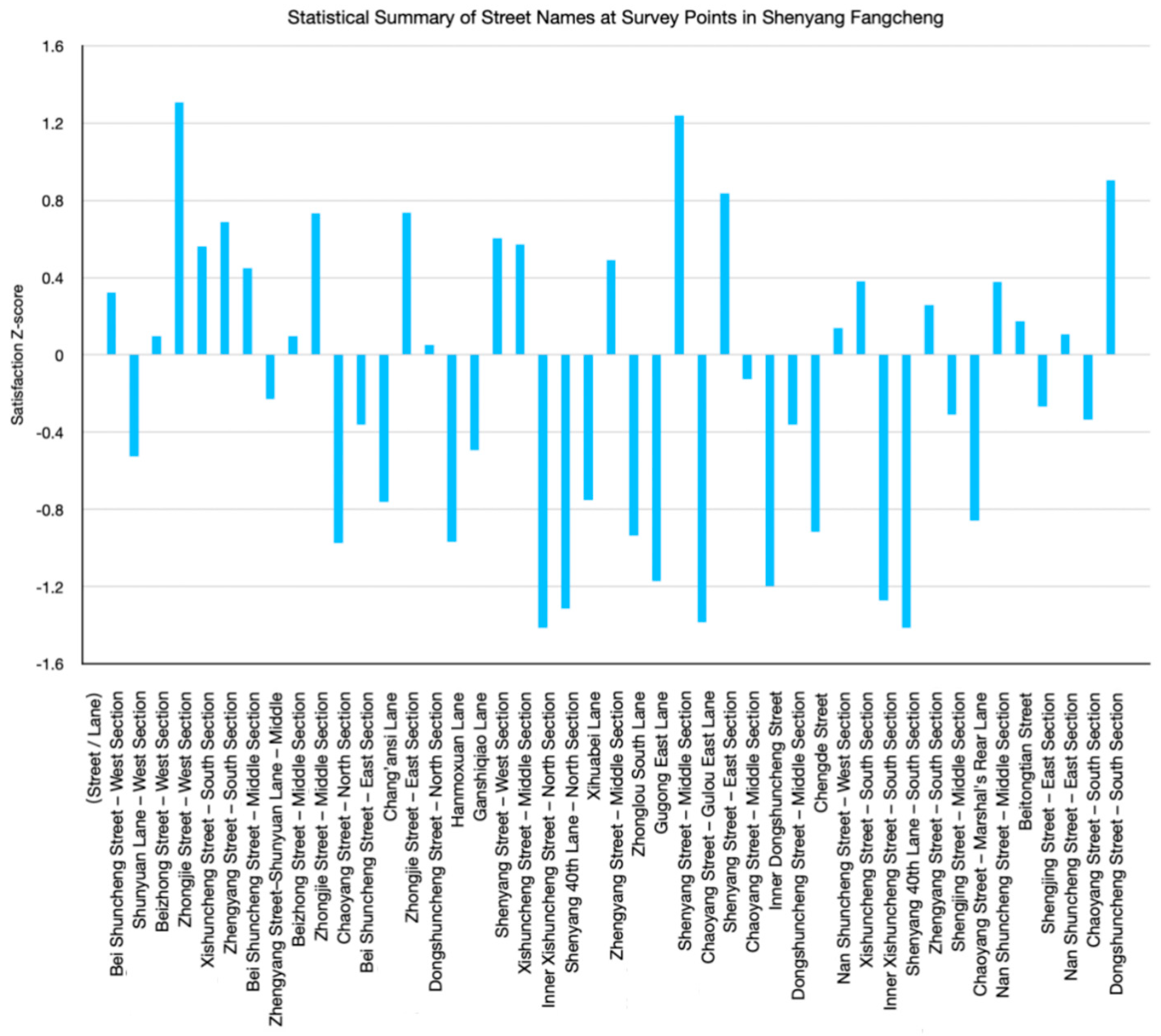
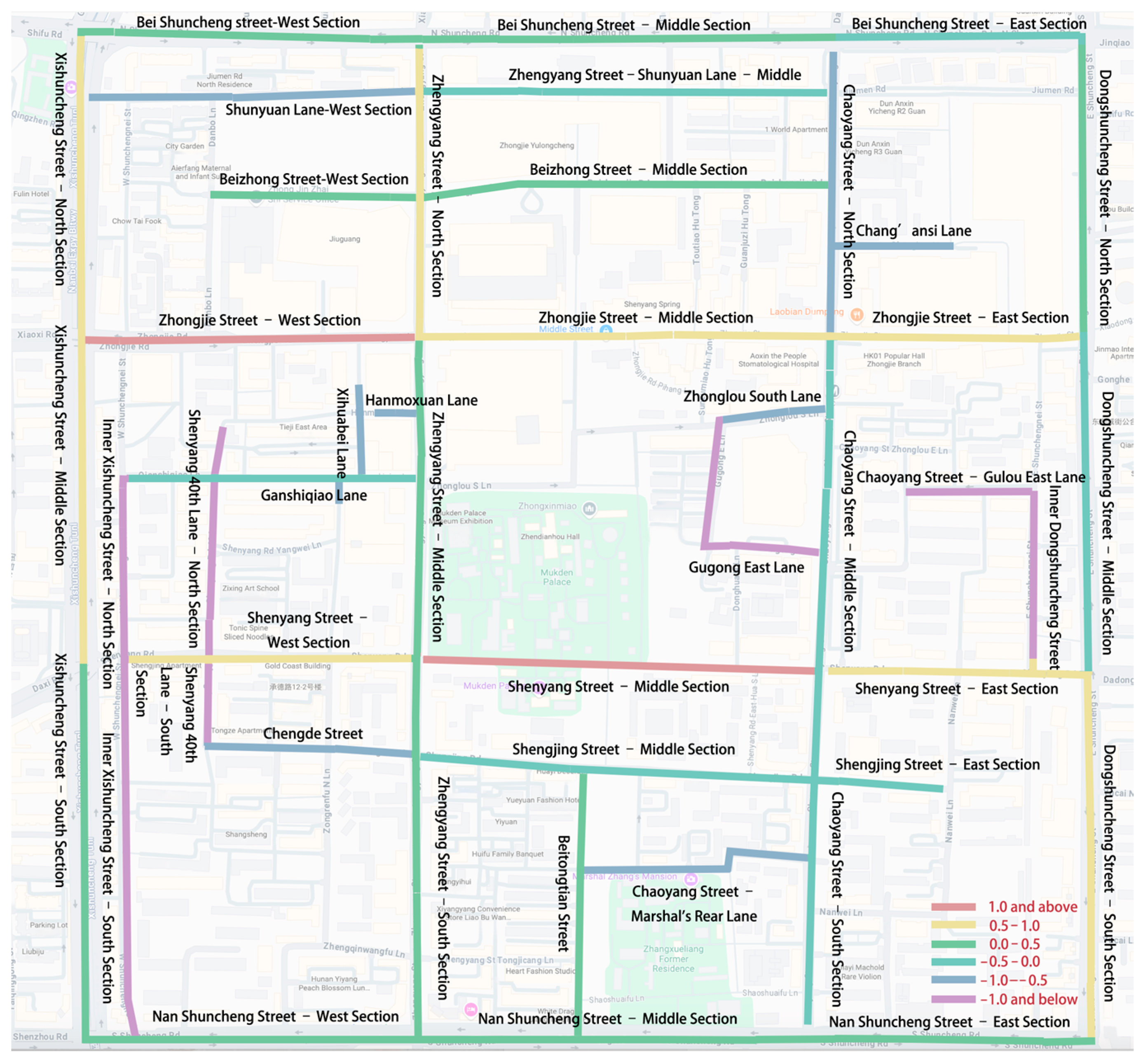
The street-by-street comparison further highlights substantial variability across the study area, with some corridors clearly outperforming others (See Figure 3). Based on the satisfaction scores, the west section of Zhongjie Road (mean ≈ 1.31) and the mid-section of Shenyang Road (mean ≈ 1.24) rank first and second among all streets. The map indicates that these two corridors lie at the intersection of the longitudinal and transverse axes of Fangcheng and form key streets within the historic-cultural core area: Zhongjie is a well-known commercial pedestrian street, while Shenyang Road is a major east–west thoroughfare. Other relatively high-scoring segments include the south section of Dongshuncheng Street (0.90), the east section of Shenyang Road (0.83), and the east section of Zhongjie Road (0.73). Although these streets do not sit at the core intersection, they function as peripheral access streets in spatial terms. For example, Dongshuncheng Street is an important eastern gateway linking metro and bus nodes; the east sections of Shenyang Road and Zhongjie Road extend outward along the central axis, preserving axial continuity and spatial order. These streets thus exhibit a “non-core yet extensionary” spatial advantage, acting as conduits for transport transition and the outward projection of the city image, which corresponds to their relatively high satisfaction scores (See Figure 4).
Internal branches and alleys score lower. Compared with the primary corridors above, Gulou East Alley (−1.39), Hanmoxuan Alley (−0.97), and Zhonglou South Alley (−0.94) show low values; these segments belong to the inner hierarchical network of the urban block. Mapping shows they are typically terminal streets within the secondary/tertiary branch system, serving adjacent residential areas or small-scale commercial spaces, with limited major node support and low presence in the cognitive paths of visitors and non-local users. Given their higher spatial enclosure, lower salience, and weaker resource allocation, these streets are less likely to be prioritized in mental evaluations, resulting in lower subjective scores. They also tend to be areas where historic-district conservation and renewal have yet to be comprehensively implemented, and lagging environmental upgrades further depress user satisfaction.
At the city-block scale, a clear spatial gradient emerges: core axes and intersections (e.g., Zhongjie Road—west section; Shenyang Road—mid section) achieve the highest scores and constitute the “core highlands” of Fangcheng; peripheral radial/access routes (e.g., Dongshuncheng Street—south section; Shenyang Road—east section) score next, benefiting from connectivity; and internal minor streets and living alleys (e.g., Gulou East Alley) register lower values, representing weak links for fine-grained urban governance. This distribution pattern reveals a pronounced association between urban spatial structure and subjective satisfaction. In renewal strategies, attention should not be limited to the primary core corridors; governance resources should be progressively extended to internal alleys so that improvements propagate from nodes to networks, enhancing spatial equity and overall livability across the district.

3.1.2. Visual-Perception Factors

A comparison of mean values for visual-perception factors across street types (see Table 4) shows that commercial streets (B) score relatively higher on several core factors, while cultural and residential streets exhibit distinct profiles. For Building with Identifiers, commercial streets have the highest mean (~1.14), clearly exceeding residential streets (~0.33), with cultural streets in between (~0.80). Landscape with Identifiers follows a similar pattern: commercial (~0.41) > cultural (~0.36) > residential (~0.20). This indicates that commerce-oriented streets contain the most landmark buildings and landscape elements, residential streets the fewest, and cultural streets fall between them. By contrast, Building Height does not differ markedly across the three types; the district is predominantly low-rise, and average heights are relatively close, without pronounced stratification.
For spatial-morphology factors, differences are more evident. Openness (proxied by the sky-visibility ratio) is highest on cultural streets (~0.469), followed by residential (~0.401), and lowest on commercial streets (~0.389). Conversely, Interface Enclosure Degree is greatest on residential streets (~2.28), moderate on commercial (~1.85), and lowest on cultural (~1.49), reflecting a trade-off between openness and enclosure: cultural streets are the most open, while residential streets are the narrowest and confined. The share of Walkable Area is highest on commercial streets (~0.09), next on cultural (~0.07), and lowest on residential (~0.03). Meanwhile, Greenness is most pronounced on cultural streets (~0.033), clearly above residential (~0.02) and commercial (below ~0.01). Thus, cultural streets feature relatively greater greenery and sky openness; commercial streets exhibit more extensive pedestrian space but the least greenery; and residential streets occupy an intermediate position in walkability and greening.
Regarding dynamic elements, people and vehicle flows differ substantially. Pedestrians (pixel proportion) reach ~0.007 on both commercial and cultural streets but are far lower on residential streets (~0.001), indicating more frequent pedestrian activity in commercial/cultural areas and sparse activity on residential streets. Vehicle Occurrence Rate is highest on residential streets (~0.27) and lower and similar on commercial and cultural streets (both ~0.02). In summary, each street type exhibits distinct average levels of visual-perception factors: commercial streets excel in landmark elements and pedestrian space, cultural streets in openness and greening, and residential streets in enclosure and vehicular presence with comparatively fewer pedestrians. These descriptive patterns underpin the regression analysis in Section 3.2, which further quantifies how the above visual-perception factors influence pedestrian satisfaction.

3.2. Correlation and Regression Analyses of Visual Perception Elements and Pedestrian Satisfaction

We first used Pearson correlation analysis to examine associations between visual perception elements and pedestrian satisfaction. The results show significant positive correlations for Landmark Buildings (r = 0.560), Walkable Area (r = 0.454), and Openness (r = 0.461), and significant negative correlations for Building (r = −0.484), Vehicle Occurrence Rate (r = −0.354), and Interface Enclosure Degree (r = −0.366). These findings provide the basis for subsequent regression analysis.
Based on the correlation results, we estimated a multiple linear regression model. To ensure the validity of the regression estimates, we conducted multicollinearity diagnostics on the independent variables using the variance inflation factor (VIF) and tolerance. As shown in Table 5, all VIF values range from 1.106 to 1.357, well below the commonly used threshold of 5, and all tolerance values exceed 0.737 (range 0.737–0.904), indicating no material multicollinearity and allowing statistically meaningful coefficient interpretation. The regression model yields R2 = 0.616 and adjusted R2 = 0.607, implying that the selected visual-perception factors explain about 60% of the variation in pedestrian satisfaction. The small difference between R2 and adjusted R2 suggests strong explanatory power and model stability, with no evident overfitting. These results validate the specification of the model variables and underscore the significant influence of visual elements on pedestrian satisfaction in the Fangcheng Historic District. The final model retained five significant predictors: Building, Vehicle Occurrence Rate, Walkable Area, Building with Identifiers, and Landscape with Identifiers. The model explains a substantial share of variance in pedestrian satisfaction (R2 = 0.616; adjusted R2 = 0.607) and is statistically significant overall (F = 70.314, p < 0.01). Building (β = −2.879) and Vehicle Occurrence Rate (β = −4.782) have significant negative effects on satisfaction, while Walkable Area (β = 3.434), Building with Identifiers (β = 0.374), and Landscape with Identifiers (β = 0.322) significantly increase satisfaction. These results indicate that excessive building density and vehicle disturbance reduce walking experience, whereas open, pleasant spaces and cultural identifier elements effectively enhance pedestrian satisfaction.
The final regression equation is as follows:
Satisfaction = 0.448 − 2.879 × Building − 4.782 × Vehicle Occurrence + 3.434 × Walkable Area + 0.374 ×number of Building with identifiers+ 0.322 × number of Landscape with identifiers.
The regression results show that Building has a significant negative effect on pedestrian satisfaction (β = −2.879, p < 0.01). This finding aligns with urban morphology theory on spatial crowding and theories of walking comfort [93]. Although moderate street-interface enclosure can, in some contexts, enhance perceived safety and spatial continuity, in a historic commercial area like Zhongjie–Fangcheng, an excessively high building share suppresses pedestrians’ sense of space and limits visual openness and permeability.
Vehicle occurrence (traffic interference) significantly and negatively affects satisfaction (coefficient = −4.782; t = −3.299, p = 0.001 < 0.01). Frequent motor-vehicle movement increases noise and air pollution, undermining comfort and safety and thus lowering pedestrian experience [94]. This is especially evident on segments such as Shunyuan Lane, East Zhongjie, and East Shuncheng Street node sections, where commuting pressure is high and commercial density is strong, but traffic control is weak, reducing visual comfort. Notably, Fangcheng operates as a typical “secondary-road + historic-district” mixed system with relatively weak motor-vehicle management. Field reconnaissance revealed extensive illegal parking, including occupation of sidewalks and bicycle lanes. These behaviors disrupt pedestrian continuity and create spatial compression and visual fragmentation, substantially degrading perceived walkability.
Walkable Area is an important positive predictor (β = 3.434, p < 0.01). Its significant positive association with satisfaction indicates that wider, more open pedestrian spaces markedly improve visual comfort and satisfaction. Expanding walkable areas not only directly improves accessibility and convenience, but also enhances psychological comfort and neighborhood vitality, thereby raising overall walking experience quality [95].
Landmark Buildings (β = 0.374) and Landmark Landscapes (β = 0.322) are significantly and positively related to satisfaction. Appropriately increasing the number of representative buildings or cultural markers enhances visual appeal and place identity within the study area [91,96].
Taken together, the results suggest the following preliminary implications: reasonably increase landmark buildings and landscape elements to strengthen visual legibility and attractiveness; optimize pedestrian-space layout to improve openness and comfort; and strengthen management and restrictions on vehicle presence to enhance the visual safety and comfort of walking spaces [47].

4. Discussion

This study verifies the mechanism by which micro-scale visual elements and street type significantly influence pedestrian satisfaction within historic-district settings. The results reveal a clear order: commercial streets exhibit the highest satisfaction, followed by cultural streets, with residential streets lowest. This indicates that the physical and visual attributes associated with different functional street types translate into distinct perceived walking experiences. The findings reaffirm that the diversity of visual perception elements significantly contributes to pedestrian satisfaction. This relationship can be further understood through Alexander’s “semi-lattice” concept, which emphasizes that urban systems achieve greater vitality when spatial and visual elements interweave, producing a complex network of sensory and behavioral interactions [97].
As the city’s showcase and a source of expected fiscal returns, the commercial spine exhibits path dependence toward frequent maintenance, strict enforcement, and higher aesthetic thresholds [93,98,99]. Field observations indicate that façades are cleaner, information is more orderly, and night lighting and wayfinding are better provided [100,101], partly compensating for limited winter greener [35,102], thereby stabilizing a stronger sense of order and legibility while walking.
By comparing visual-perception factors across three street types—commercial, cultural, and residential—this study finds significant differences in the configuration of visual elements, and these differences are associated with differing levels of pedestrian satisfaction. In commercial streets, Building Height and Openness emerge as key determinants of visual experience and satisfaction. The findings indicate that a moderate increase in building height helps articulate a richer skyline and spatial layering, thereby making streets more attractive, which is consistent with the higher pedestrian satisfaction observed on commercial streets in this study [103]. Meanwhile, greater openness affords broader views and better accessibility, enabling pedestrians to feel comfortable and free within the space, and thus further enhancing satisfaction with the street environment [104]. For cultural streets, the visual experience hinges on both Landscape with Identifiers and Building with Identifiers. As cultural landmarks, these elements not only enrich the streetscape’s visual layering but also carry local historical and cultural information [105]. Through distinctive visual cues and symbolic meanings, they reinforce the street’s uniqueness and strengthen pedestrians’ cognitive and affective experiences, thereby elevating satisfaction with cultural streets to some extent [106]. In residential streets, Walkable Area and Interface Enclosure Degree are crucial to pedestrians’ comfort and spatial perception. A smaller walkable area constrains freedom of movement and reduces permeability, while excessive enclosure brings street interfaces (e.g., building fronts and vegetation) uncomfortably close, producing a sense of pressure. Acting together, these factors typically reduce walking comfort and exert a negative effect on pedestrian satisfaction.
The regression results show that Vehicle Occurrence Rate has a significant negative effect on pedestrian satisfaction (coefficient ≈ −4.78, p < 0.01). This indicates that a higher proportion of motor vehicles on the street corresponds to lower pedestrian satisfaction. Mechanistically, frequent car presence heightens pedestrians’ concern about traffic crashes and introduces noise and exhaust pollution, thereby undermining environmental comfort and perceived safety [107]. From a neuro-sustainability perspective, recurrent vehicular noise and motion act as environmental stressors that elevate cognitive load and diminish perceived safety—an effect akin to “architectural allostatic overloading” [64]. Prior studies likewise note that streets with higher traffic volumes face greater crash risk and reduced perceived safety [108]. On secondary roads, heavy commuting pressure and weak vehicle management—up to and including sidewalk encroachment—compress pedestrian space, obstruct sightlines, and further disrupt continuity and comfort of walking. Accordingly, strengthening traffic management (e.g., delineating pedestrian zones, prohibiting illegal parking) and calming motor traffic can effectively improve perceived safety and satisfaction in Fangcheng. These findings also provide micro-scale empirical evidence for the “15-Minute City” concept proposed by Carlos Moreno [109], which emphasizes reducing car dependency and improving proximity-based, walkable urban experiences. Specifically, the observed negative impact of vehicle occurrence and the positive effects of openness and walkable areas align closely with the goals of enhancing accessibility and livability in compact, human-centered urban districts.
The coefficient for the Built-up Area Ratio (share of built-up area) is −2.879 (p < 0.01), indicating a significant negative association with satisfaction. This implies that excessive building concentration or density suppresses a sense of spatial openness and reduces the quality of the walking experience [110,111]. Psychologically, canyon-like or tightly enclosed street scenes can induce feelings of oppression, narrow the field of view, and increase cognitive load, leading to discomfort. In the old town of Fangcheng, tightly packed row shops on both sides and alleyways bounded by high walls lack view corridors or open courtyards, weakening spatial permeability and connectivity. This aligns with urban morphology and walking-comfort theories: when street-edge building density is too high, a crowded, closed atmosphere emerges, hindering vistas and diminishing perceived affinity, thereby markedly lowering pedestrian satisfaction [112].
By contrast, the coefficient for Walkable Area is 3.434 (p < 0.01), indicating a significant positive effect. Broad, unobstructed pedestrian space demonstrably enhances satisfaction. Mechanistically, generous and even walking surfaces reduce crowding and potential conflicts, improving passage convenience and psychological comfort [113]. Scholars further argue that adequate sidewalk width and continuous, barrier-free conditions reduce the risk of falls or collisions—particularly important for people with limited mobility [114,115]. In Fangcheng, some arterials are nominally wide but are frequently encroached upon by parked vehicles and street vendors, leaving insufficient effective width for pedestrians. Optimizing the cross-section (e.g., adding planted buffers, widening sidewalks, and strictly preventing encroachment) can improve visual permeability and significantly enhance perceived safety and comfort [116].
Finally, Building with Identifiers (i.e., recognizable buildings/landmarks) and Landscape with Identifiers (e.g., distinctive sculptures, themed greens) exhibit coefficients of 0.374 and 0.322 (p < 0.05), respectively, both indicating significant positive effects. Such elements provide salient visual reference points, strengthen district legibility and cultural identity, and thereby raise satisfaction [117]. Psychologically, clear architectural or landscape landmarks supply orientation cues and support place cognition, reducing wayfinding anxiety while increasing familiarity and attachment [6]. In Fangcheng, signature buildings (e.g., landmark theaters, historic sites) and uniquely styled sculpture plazas act as visual anchors in residents’ collective memory, enhancing the interest and appeal of pedestrian spaces. Increasing culturally embedded identifiers can enrich the streetscape, reinforce a sense of place, and in turn significantly improve evaluations of the street environment [118].
Overall, the distribution of satisfaction is jointly determined by identity (legibility), continuity, vehicle interference, and interface order. Policy and design should first remedy deficits on peripheral and inner streets, then consolidate the core commercial axis, and finally establish a dynamic feedback mechanism for iterative adjustment [18,98,100].

5. Limitations

This study has several limitations that should be acknowledged. First, data collection was conducted during daytime hours, so the findings reflect daytime walking experiences and do not capture potential nighttime effects on pedestrian satisfaction. Second, the analysis relies primarily on questionnaires and street-view imagery, which are essentially static; as a result, it does not fully represent real-time pedestrian dynamics or moment-to-moment psychological responses. Third, the empirical scope is limited to a single historic district—Fangcheng in Shenyang—without cross-city or cross–district-type comparisons, which constrains the generalizability of the conclusions.
Second, the present analysis relies solely on multiple regression to reveal statistically significant associations between visual-perception factors and pedestrian satisfaction. Future research could incorporate structural equation modeling (SEM) and longitudinal data analysis to probe causal pathways and mediating mechanisms among visual factors, thereby offering a more systematic explanation of how visual perception shapes pedestrian satisfaction.
Third, this study adopts the Zhongjie–Fangcheng Historic District in Shenyang as a single case, and the observed relationships between visual-perception factors and pedestrian satisfaction may require further verification for external applicability. Subsequent work should expand the comparative scope to a larger spatial scale and conduct cross-site validation—including at least one additional historic district—so as to test model robustness and transferability. In parallel, the classification and operational definitions of visual indicators should be further clarified to ensure consistent interpretability across diverse urban contexts, thereby providing a more generalizable basis for the quantitative study of walking environments in historic districts.
Looking ahead, future studies may integrate dynamic, multimodal data to capture pedestrians’ emotional and physiological responses in real time and to simulate varying visual and spatial conditions. Cross-city comparative analyses—particularly among historic districts with different morphological and cultural types—will enhance model robustness and portability. Moreover, research should align visual-perception inquiry with Healthy City and heritage-led regeneration policy agendas, advancing a holistic street-quality evaluation framework that links cultural value, psychological experience, and behavioral response mechanisms, and thereby provides a more scientific and actionable evidence base for urban renewal and spatial governance.

6. Conclusions

This study examined the Fangcheng historic district in Shenyang and employed street-view imagery analysis, semantic segmentation, and multiple regression to quantify how street-level visual perception elements influence pedestrian satisfaction. The results indicate that in Shenyang’s Zhongjie–Fangcheng area, commercial-type streets exhibit the highest level of pedestrian satisfaction, while residential-type streets have the lowest satisfaction. Vehicle occurrence rate and building density have significant negative effects on satisfaction, whereas walkable areas, spatial openness, and culturally identifiable landmark elements exert significant positive effects.
From both subjective and objective perspectives, we proposed a methodological framework for assessing the relationship between visual perception elements and pedestrian satisfaction. In the future, based on the results of the current quantitative evaluation, control indicators for the spatial form preservation and renewal of Zhongshan Road can be established:
(1)
Ensure the continuity of the street interface. For example, elements such as street greenery and shop facades should visually emphasize spatial coherence and unity, which helps enhance the city’s recognizability and image.
(2)
Control street scale. On one hand, the spatial proportions of historic streets should be preserved, maintaining an appropriate height-to-width ratio; on the other hand, designated leisure areas can be incorporated within wider sidewalks to increase street attractiveness.
(3)
Preserve and restore historic buildings. By maintaining a street space characterized by low building density and high greenery levels, the overall environmental quality of the heritage area can be improved.
The analytical method proposed in this study can be widely applied to composite districts or specific functional areas in other cities worldwide to identify and locate key visual factors that influence pedestrian satisfaction. The Zhongjie–Fangcheng Historic District serves as a representative case, as it faces typical spatial transformations and challenges during processes of commercialization and urban regeneration. The indicators and methods used in this study for assessing street space quality are also applicable to the spatial evaluation of other historic districts in Shenyang, helping to preserve historical and cultural character while enhancing overall street-space quality.
Furthermore, other historic districts may refer to the research framework of this study and adapt the evaluation indicators according to local conditions for practical application. The findings provide urban planners and managers with a rapid and effective diagnostic tool to quickly identify visual environment problems and develop targeted optimization strategies, thereby contributing to urban renewal and the conservation of historical and cultural heritage.

Author Contributions

Conceptualization, Y.T.; methodology, Y.T. and D.S.; validation, Y.T.; formal analysis, M.L. and S.W.; investigation, S.W. and Y.T.; resources, S.W.; data curation, S.W.; writing—original draft, Y.T. and S.W. All authors have read and agreed to the published version of the manuscript.

Funding

This study is supported by the Liaoning Provincial Department of Education, General Project (JYTMS20231560).

Institutional Review Board Statement

The study was conducted according to the guidelines of the Declaration of Helsinki, and approved by the Ethics Committee of School of Art and Design, Shenyang Jianzhu University (protocol code 2025SJZU-A001012025-01-13).

Informed Consent Statement

Informed consent was obtained from all subjects involved in the study.

Data Availability Statement

The raw data supporting the conclusions of this article will be made available by the authors on request.

Acknowledgments

We would like to thank the reviewers for their careful reading of the manuscript and look forward to their comments on the problems and corrections in the manuscript. This article is developed from the author’s doctoral dissertation conducted at Maharishi International University.

Conflicts of Interest

The authors declare no conflicts of interest.

References

  1. Carmona, M. Public Places Urban Spaces: The Dimensions of Urban Design; Routledge: Abingdon-on-Thames, UK, 2021. [Google Scholar]
  2. Hall, C.M.; Ram, Y. Measuring the relationship between tourism and walkability? Walk Score and English tourist attractions. J. Sustain. Tour. 2019, 27, 223–240. [Google Scholar] [CrossRef]
  3. Mansouri, M.; Ujang, N. Tourist’expectation and satisfaction towards pedestrian networks in the historical district of Kuala Lumpur, Malaysia. Asian Geogr. 2016, 33, 35–55. [Google Scholar] [CrossRef]
  4. Skotis, A.; Livas, C. A data-driven analysis of experience in urban historic districts. Ann. Tour. Res. Empir. Insights 2022, 3, 100052. [Google Scholar] [CrossRef]
  5. Zhao, X.; Chen, J.; Li, J.; Wang, H.; Zhang, X.; Yu, F. Unraveling the renewal priority of urban heritage communities via macro-micro dimensional assessment-A case study of Nanjing City, China. Sustain. Cities Soc. 2025, 124, 106317. [Google Scholar] [CrossRef]
  6. Lynch, K. Good City Form; MIT Press: Cambridge, MA, USA, 1984. [Google Scholar]
  7. Wiklund, J. Vägen Till Offentliga Rum. en Fallstudie om Barcelonas Superkvarter ur ett Vistelseperspektiv; GUPEA: Gothenburg, Sweden, 2021. [Google Scholar]
  8. Gehl, J. Cities for People; Island Press: Washington, DC, USA, 2013. [Google Scholar]
  9. Nabipour, M.; Rosenberg, M.W.; Nasseri, S.H. The built environment, networks design, and safety features: An analysis of pedestrian commuting behavior in intermediate-sized cities. Transp. Policy 2022, 129, 14–23. [Google Scholar] [CrossRef]
  10. Stensel, D.J.; Hardman, A.E.; Gill, J.M. Physical Activity and Health: The Evidence Explained; Routledge: Abingdon-on-Thames, UK, 2021. [Google Scholar]
  11. Gálvez-Pérez, D.; Guirao, B.; Ortuño, A.; Picado-Santos, L. The influence of built environment factors on elderly pedestrian road safety in cities: The experience of Madrid. Int. J. Environ. Res. Public Health 2022, 19, 2280. [Google Scholar] [CrossRef]
  12. Gerike, R.; Koszowski, C.; Schröter, B.; Buehler, R.; Schepers, P.; Weber, J.; Wittwer, R.; Jones, P. Built environment determinants of pedestrian activities and their consideration in urban street design. Sustainability 2021, 13, 9362. [Google Scholar] [CrossRef]
  13. Chen, F. Urban morphology and citizens’ life. In Encyclopedia of Quality of Life and Well-Being Research; Springer: Berlin/Heidelberg, Germany, 2021; pp. 1–6. [Google Scholar]
  14. Koohsari, M.J.; Oka, K.; Owen, N.; Sugiyama, T. Natural movement: A space syntax theory linking urban form and function with walking for transport. Health Place 2019, 58, 102072. [Google Scholar] [CrossRef]
  15. Biljecki, F.; Ito, K. Street view imagery in urban analytics and GIS: A review. Landsc. Urban Plan. 2021, 215, 104217. [Google Scholar] [CrossRef]
  16. Hollander, J.B.; Sussman, A.; Lowitt, P.; Angus, N.; Situ, M. Analyzing walkability through biometrics: Insights into sustainable transportation through the use of eye-tracking emulation software. J. Phys. Act. Health 2020, 17, 1153–1161. [Google Scholar] [CrossRef]
  17. Sussman, A.; Hollander, J. Cognitive Architecture: Designing for How We Respond to the Built Environment; Routledge: Abingdon-on-Thames, UK, 2021. [Google Scholar]
  18. Zhou, J.; Ujang, N. An analysis of pedestrian preferences for wayfinding signage in urban settings: Evidence from Nanning, China. Buildings 2024, 14, 2986. [Google Scholar] [CrossRef]
  19. Wang, R.; Feng, Z.; Pearce, J. Neighbourhood greenspace quantity, quality and socioeconomic inequalities in mental health. Cities 2022, 129, 103815. [Google Scholar] [CrossRef]
  20. Wu, Y.; Liu, Q.; Hang, T.; Yang, Y.; Wang, Y.; Cao, L. Integrating restorative perception into urban street planning: A framework using street view images, deep learning, and space syntax. Cities 2024, 147, 104791. [Google Scholar] [CrossRef]
  21. Zhou, H.; He, S.; Cai, Y.; Wang, M.; Su, S. Social inequalities in neighborhood visual walkability: Using street view imagery and deep learning technologies to facilitate healthy city planning. Sustain. Cities Soc. 2019, 50, 101605. [Google Scholar] [CrossRef]
  22. Da Cruz, N.F.; Rode, P.; McQuarrie, M. New urban governance: A review of current themes and future priorities. J. Urban Aff. 2019, 41, 1–19. [Google Scholar] [CrossRef]
  23. Ewing, R.H.; Clemente, O.; Neckerman, K.M.; Purciel-Hill, M.; Quinn, J.W.; Rundle, A. Measuring Urban Design: Metrics for Livable Places; Island Press: Washington, DC, USA, 2013; Volume 200. [Google Scholar]
  24. Aziz, H.A.; Nagle, N.N.; Morton, A.M.; Hilliard, M.R.; White, D.A.; Stewart, R.N. Exploring the impact of walk–bike infrastructure, safety perception, and built-environment on active transportation mode choice: A random parameter model using New York City commuter data. Transportation 2018, 45, 1207–1229. [Google Scholar] [CrossRef]
  25. De Vos, J.; Lättman, K.; Van der Vlugt, A.-L.; Welsch, J.; Otsuka, N. Determinants and effects of perceived walkability: A literature review, conceptual model and research agenda. Transp. Rev. 2023, 43, 303–324. [Google Scholar] [CrossRef]
  26. Ewing, R.; Cervero, R. Travel and the built environment: A meta-analysis. J. Am. Plan. Assoc. 2010, 76, 265–294. [Google Scholar] [CrossRef]
  27. Papas, M.A.; Alberg, A.J.; Ewing, R.; Helzlsouer, K.J.; Gary, T.L.; Klassen, A.C. The built environment and obesity. Epidemiol. Rev. 2007, 29, 129–143. [Google Scholar] [CrossRef]
  28. Lovasi, G.S.; Schwartz-Soicher, O.; Quinn, J.W.; Berger, D.K.; Neckerman, K.M.; Jaslow, R.; Lee, K.K.; Rundle, A. Neighborhood safety and green space as predictors of obesity among preschool children from low-income families in New York City. Prev. Med. 2013, 57, 189–193. [Google Scholar] [CrossRef]
  29. Saelens, B.E.; Handy, S.L. Built environment correlates of walking: A review. Med. Sci. Sports Exerc. 2008, 40, S550. [Google Scholar] [CrossRef] [PubMed]
  30. Yuan, K.; Abe, H.; Otsuka, N.; Yasufuku, K.; Takahashi, A. A comprehensive evaluation of walkability in historical cities: The case of Xi’an and Kyoto. Sustainability 2023, 15, 5525. [Google Scholar] [CrossRef]
  31. Handy, S.L.; Boarnet, M.G.; Ewing, R.; Killingsworth, R.E. How the built environment affects physical activity: Views from urban planning. Am. J. Prev. Med. 2002, 23, 64–73. [Google Scholar] [CrossRef]
  32. Saelens, B.E.; Sallis, J.F.; Frank, L.D. Environmental correlates of walking and cycling: Findings from the transportation, urban design, and planning literatures. Ann. Behav. Med. 2003, 25, 80–91. [Google Scholar] [CrossRef]
  33. Xu, G.; Zhong, L.; Wu, F.; Zhang, Y.; Zhang, Z. Impacts of micro-scale built environment features on tourists’ walking behaviors in historic streets: Insights from Wudaoying Hutong, China. Buildings 2022, 12, 2248. [Google Scholar] [CrossRef]
  34. Cutts, B.B.; Darby, K.J.; Boone, C.G.; Brewis, A. City structure, obesity, and environmental justice: An integrated analysis of physical and social barriers to walkable streets and park access. Soc. Sci. Med. 2009, 69, 1314–1322. [Google Scholar] [CrossRef] [PubMed]
  35. Zhao, T.; Liang, X.; Biljecki, F.; Tu, W.; Cao, J.; Li, X.; Yi, S. Quantifying seasonal bias in street view imagery for urban form assessment: A global analysis of 40 cities. Comput. Environ. Urban Syst. 2025, 120, 102302. [Google Scholar] [CrossRef]
  36. Ewing, R.; Handy, S. Measuring the unmeasurable: Urban design qualities related to walkability. J. Urban Des. 2009, 14, 65–84. [Google Scholar] [CrossRef]
  37. Lavizzo-Mourey, R.; McGinnis, J.M. Making the case for active living communities. Am. J. Public Health 2003, 93, 1386–1388. [Google Scholar] [CrossRef]
  38. Green, C. Health and Community Design: The Impact of the Built Environment on Physical Activity. Can. J. Urban Res. 2004, 13, 390. [Google Scholar]
  39. Northridge, M.E.; Sclar, E.D.; Biswas, P. Sorting out the connections between the built environment and health: A conceptual framework for navigating pathways and planning healthy cities. J. Urban Health 2003, 80, 556–568. [Google Scholar] [CrossRef] [PubMed]
  40. Hoehner, C.M.; Brennan, L.K.; Brownson, R.C.; Handy, S.L.; Killingsworth, R. Opportunities for integrating public health and urban planning approaches to promote active community environments. Am. J. Health Promot. 2003, 18, 14–20. [Google Scholar] [CrossRef] [PubMed]
  41. Buras, N.H. The Art of Classic Planning: Building Beautiful and Enduring Communities; Harvard University Press: Cambridge, MA, USA, 2020. [Google Scholar]
  42. Yun, H.Y.; Zegras, C.; Palencia Arreola, D.H. “Digitalizing walkability”: Comparing smartphone-based and web-based approaches to measuring neighborhood walkability in Singapore. J. Urban Technol. 2019, 26, 3–43. [Google Scholar] [CrossRef]
  43. Wang, D.; Zhang, Y. Study of street space perception in Shanghai based on semantic differential method. J. Tongji Univ. (Nat. Sci.) 2011, 39, 1000–1006. [Google Scholar]
  44. Jeon, J.Y.; Jo, H.I. Effects of audio-visual interactions on soundscape and landscape perception and their influence on satisfaction with the urban environment. Build. Environ. 2020, 169, 106544. [Google Scholar] [CrossRef]
  45. Mouratidis, K. Urban planning and quality of life: A review of pathways linking the built environment to subjective well-being. Cities 2021, 115, 103229. [Google Scholar] [CrossRef]
  46. Sun, D.; Ji, X.; Gao, W.; Zhou, F.; Yu, Y.; Meng, Y.; Yang, M.; Lin, J.; Lyu, M. The relation between green visual index and visual comfort in Qingdao coastal streets. Buildings 2023, 13, 457. [Google Scholar] [CrossRef]
  47. Qin, J.; Feng, Y.; Sheng, Y.; Huang, Y.; Zhang, F.; Zhang, K. Evaluation of pedestrian-perceived comfort on urban streets using multi-source data: A case study in Nanjing, China. ISPRS Int. J. Geo-Inf. 2025, 14, 63. [Google Scholar] [CrossRef]
  48. Sun, D.; Ji, X.; Lyu, M.; Fu, Y.; Gao, W. Evaluation and diagnosis for the pedestrian quality of service in urban riverfront streets. J. Clean. Prod. 2024, 452, 142090. [Google Scholar] [CrossRef]
  49. Cinnamon, J.; Jahiu, L. 360-degree video for virtual place-based research: A review and research agenda. Comput. Environ. Urban Syst. 2023, 106, 102044. [Google Scholar] [CrossRef]
  50. Yan, J.; Huang, X.; Wang, S.; He, Y.; Li, X.; Hohl, A.; Li, X.; Aly, M.; Lin, B. Toward a comprehensive understanding of eye-level urban greenness: A systematic review. Int. J. Digit. Earth 2023, 16, 4769–4789. [Google Scholar] [CrossRef]
  51. Huang, J.; Fei, T.; Kang, Y.; Li, J.; Liu, Z.; Wu, G. Estimating urban noise along road network from street view imagery. Int. J. Geogr. Inf. Sci. 2024, 38, 128–155. [Google Scholar] [CrossRef]
  52. Kang, Y.; Abraham, J.; Ceccato, V.; Duarte, F.; Gao, S.; Ljungqvist, L.; Zhang, F.; Näsman, P.; Ratti, C. Assessing differences in safety perceptions using GeoAI and survey across neighbourhoods in Stockholm, Sweden. Landsc. Urban Plan. 2023, 236, 104768. [Google Scholar] [CrossRef]
  53. Mehaffy, M.W.; Salingaros, N.A.; Lavdas, A.A. The “modern” campus: Case study in (Un) Sustainable urbanism. Sustainability 2023, 15, 16427. [Google Scholar] [CrossRef]
  54. Lu, X.; Li, Q.; Ji, X.; Sun, D.; Meng, Y.; Yu, Y.; Lyu, M. Impact of streetscape built environment characteristics on human perceptions using street view imagery and deep learning: A case study of Changbai Island, Shenyang. Buildings 2025, 15, 1524. [Google Scholar] [CrossRef]
  55. Xuan, W.; Zhao, L. Research on correlation between spatial quality of urban streets and pedestrian walking characteristics in china based on street view big data. J. Urban Plan. Dev. 2022, 148, 05022035. [Google Scholar] [CrossRef]
  56. Trop, T.; Shoshany Tavory, S.; Portnov, B.A. Factors affecting pedestrians’ perceptions of safety, comfort, and pleasantness induced by public space lighting: A systematic literature review. Environ. Behav. 2023, 55, 3–46. [Google Scholar] [CrossRef]
  57. Tian, M.; Li, Z.; Xia, Q.; Peng, Y.; Cao, T.; Du, T.; Xing, Z. Walking in China’s Historical and Cultural Streets: The Factors Affecting Pedestrian Walking Behavior and Walking Experience. Land 2022, 11, 1491. [Google Scholar] [CrossRef]
  58. Rahaman, M.A.; Kalam, A.; Al-Mamun, M. Unplanned urbanization and health risks of Dhaka City in Bangladesh: Uncovering the associations between urban environment and public health. Front. Public Health 2023, 11, 1269362. [Google Scholar] [CrossRef]
  59. Rapoport, A.; Hawkes, R. The perception of urban complexity. J. Am. Inst. Plan. 1970, 36, 106–111. [Google Scholar] [CrossRef]
  60. Tuan, Y.-F. Space and Place: The Perspective of Experience; University of Minnesota Press: Minneapolis, MN, USA, 1977. [Google Scholar]
  61. Li, X.; Zhang, C.; Li, W.; Ricard, R.; Meng, Q.; Zhang, W. Assessing street-level urban greenery using Google Street View and a modified green view index. Urban For. Urban Green. 2015, 14, 675–685. [Google Scholar] [CrossRef]
  62. Yang, Y.; He, D.; Gou, Z.; Wang, R.; Liu, Y.; Lu, Y. Association between street greenery and walking behavior in older adults in Hong Kong. Sustain. Cities Soc. 2019, 51, 101747. [Google Scholar] [CrossRef]
  63. Wu, W.; Guo, J.; Ma, Z.; Zhao, K. Data-driven approach to assess street safety: Large-scale analysis of the microscopic design. ISPRS Int. J. Geo-Inf. 2022, 11, 537. [Google Scholar] [CrossRef]
  64. Valentine, C. Architectural allostatic overloading: Exploring a connection between architectural form and allostatic overloading. Int. J. Environ. Res. Public Health 2023, 20, 5637. [Google Scholar] [CrossRef]
  65. Hillier, B.; Penn, A.; Hanson, J.; Grajewski, T.; Xu, J. Natural movement: Or, configuration and attraction in urban pedestrian movement. Environ. Plan. B Plan. Des. 1993, 20, 29–66. [Google Scholar] [CrossRef]
  66. Jin, B.; Geng, J.; Ke, S.; Pan, H. Analysis of spatial variation of street landscape greening and influencing factors: An example from Fuzhou city, China. Sci. Rep. 2023, 13, 21767. [Google Scholar] [CrossRef] [PubMed]
  67. Sakamoto, S.; Kogure, M.; Hanibuchi, T.; Nakaya, N.; Hozawa, A.; Nakaya, T. Effects of greenery at different heights in neighbourhood streetscapes on leisure walking: A cross-sectional study using machine learning of streetscape images in Sendai City, Japan. Int. J. Health Geogr. 2023, 22, 29. [Google Scholar] [CrossRef]
  68. Lin, L.; Moudon, A.V. Objective versus subjective measures of the built environment, which are most effective in capturing associations with walking? Health Place 2010, 16, 339–348. [Google Scholar] [CrossRef]
  69. Zang, P.; Liu, X.; Zhao, Y.; Guo, H.; Lu, Y.; Xue, C.Q. Eye-level street greenery and walking behaviors of older adults. Int. J. Environ. Res. Public Health 2020, 17, 6130. [Google Scholar] [CrossRef]
  70. Han, J.; Lee, S. Verification of immersive virtual reality as a streetscape evaluation method in urban residential areas. Land 2023, 12, 345. [Google Scholar] [CrossRef]
  71. Chen, L.-C.; Zhu, Y.; Papandreou, G.; Schroff, F.; Adam, H. Encoder-decoder with atrous separable convolution for semantic image segmentation. In Proceedings of the European Conference on Computer Vision (ECCV), Munich, Germany, 8–14 September 2018; pp. 801–818. [Google Scholar]
  72. Long, J.; Shelhamer, E.; Darrell, T. Fully convolutional networks for semantic segmentation. In Proceedings of the IEEE Conference on Computer Vision and Pattern Recognition, Boston, MA, USA, 7–12 June 2015; pp. 3431–3440. [Google Scholar]
  73. Cordts, M.; Omran, M.; Ramos, S.; Rehfeld, T.; Enzweiler, M.; Benenson, R.; Franke, U.; Roth, S.; Schiele, B. The cityscapes dataset for semantic urban scene understanding. In Proceedings of the IEEE Conference on Computer Vision and Pattern Recognition, Las Vegas, NV, USA, 27–30 June 2016; pp. 3213–3223. [Google Scholar]
  74. Zhao, H.; Shi, J.; Qi, X.; Wang, X.; Jia, J. Pyramid scene parsing network. In Proceedings of the IEEE Conference on Computer Vision and Pattern Recognition, Honolulu, HI, USA, 21–26 July 2017; pp. 2881–2890. [Google Scholar]
  75. Kido, D.; Fukuda, T.; Yabuki, N. Assessing future landscapes using enhanced mixed reality with semantic segmentation by deep learning. Adv. Eng. Inform. 2021, 48, 101281. [Google Scholar] [CrossRef]
  76. Bromm, K.N.; Lang, I.-M.; Twardzik, E.E.; Antonakos, C.L.; Dubowitz, T.; Colabianchi, N. Virtual audits of the urban streetscape: Comparing the inter-rater reliability of GigaPan® to Google Street View. Int. J. Health Geogr. 2020, 19, 31. [Google Scholar] [CrossRef]
  77. Yin, L.; Wang, Z. Measuring visual enclosure for street walkability: Using machine learning algorithms and Google Street View imagery. Appl. Geogr. 2016, 76, 147–153. [Google Scholar] [CrossRef]
  78. Seiferling, I.; Naik, N.; Ratti, C.; Proulx, R. Green streets–Quantifying and mapping urban trees with street-level imagery and computer vision. Landsc. Urban Plan. 2017, 165, 93–101. [Google Scholar] [CrossRef]
  79. Ye, Y.; Richards, D.; Lu, Y.; Song, X.; Zhuang, Y.; Zeng, W.; Zhong, T. Measuring daily accessed street greenery: A human-scale approach for informing better urban planning practices. Landsc. Urban Plan. 2019, 191, 103434. [Google Scholar] [CrossRef]
  80. Liang, J.; Gong, J.; Sun, J.; Zhou, J.; Li, W.; Li, Y.; Liu, J.; Shen, S. Automatic sky view factor estimation from street view photographs—A big data approach. Remote Sens. 2017, 9, 411. [Google Scholar] [CrossRef]
  81. Long, Y.; Liu, L. How green are the streets? An analysis for central areas of Chinese cities using Tencent Street View. PLoS ONE 2017, 12, e0171110. [Google Scholar] [CrossRef] [PubMed]
  82. Zeng, L.; Lu, J.; Li, W.; Li, Y. A fast approach for large-scale Sky View Factor estimation using street view images. Build. Environ. 2018, 135, 74–84. [Google Scholar] [CrossRef]
  83. Tang, J.; Long, Y. Measuring visual quality of street space and its temporal variation: Methodology and its application in the Hutong area in Beijing. Landsc. Urban Plan. 2019, 191, 103436. [Google Scholar] [CrossRef]
  84. Ki, D.; Lee, S. Analyzing the effects of Green View Index of neighborhood streets on walking time using Google Street View and deep learning. Landsc. Urban Plan. 2021, 205, 103920. [Google Scholar] [CrossRef]
  85. Dubey, A.; Naik, N.; Parikh, D.; Raskar, R.; Hidalgo, C.A. Deep learning the city: Quantifying urban perception at a global scale. In Proceedings of the European Conference on Computer Vision, Amsterdam, The Netherlands, 11–14 October 2016; pp. 196–212. [Google Scholar]
  86. Yao, Y.; Liang, Z.; Yuan, Z.; Liu, P.; Bie, Y.; Zhang, J.; Wang, R.; Wang, J.; Guan, Q. A human-machine adversarial scoring framework for urban perception assessment using street-view images. Int. J. Geogr. Inf. Sci. 2019, 33, 2363–2384. [Google Scholar] [CrossRef]
  87. Li, Y.; Lu, J.; Meng, Y.; Luo, Y.; Ren, J. Exploring Urban Spatial Quality Through Street View Imagery and Human Perception Analysis. Buildings 2025, 15, 3116. [Google Scholar] [CrossRef]
  88. Lyu, M.; Meng, Y.; Gao, W.; Yu, Y.; Ji, X.; Li, Q.; Huang, G.; Sun, D. Measuring the perceptual features of coastal streets: A case study in Qingdao, China. Environ. Res. Commun. 2022, 4, 115002. [Google Scholar] [CrossRef]
  89. Tang, J.; Long, Y.; Zhai, W.; Ma, Y. Measuring quality of street space, its temporal variation and impact factors: An analysis based on massive street view pictures. New Archit 2016, 5, 110–115. [Google Scholar]
  90. Rapoport, A. The Meaning of the Built Environment: A Nonverbal Communication Approach; University of Arizona Press: Tucson, AZ, USA, 1990. [Google Scholar]
  91. Ewing, R.; Handy, S.; Brownson, R.C.; Clemente, O.; Winston, E. Identifying and measuring urban design qualities related to walkability. J. Phys. Act. Health 2006, 3, S223–S240. [Google Scholar] [CrossRef]
  92. Lam, T.M.; Wang, Z.; Vaartjes, I.; Karssenberg, D.; Ettema, D.; Helbich, M.; Timmermans, E.J.; Frank, L.D.; den Braver, N.R.; Wagtendonk, A.J. Development of an objectively measured walkability index for the Netherlands. Int. J. Behav. Nutr. Phys. Act. 2022, 19, 50. [Google Scholar] [CrossRef] [PubMed]
  93. Shulin, S.; Zhonghua, G.; Leslie, H. How does enclosure influence environmental preferences? A cognitive study on urban public open spaces in Hong Kong. Sustain. Cities Soc. 2014, 13, 148–156. [Google Scholar] [CrossRef]
  94. Soares, F.; Silva, E.; Pereira, F.; Silva, C.; Sousa, E.; Freitas, E. The influence of noise emitted by vehicles on pedestrian crossing decision-making: A study in a virtual environment. Appl. Sci. 2020, 10, 2913. [Google Scholar] [CrossRef]
  95. Lee, S.; Han, M.; Rhee, K.; Bae, B. Identification of factors affecting pedestrian satisfaction toward land use and street type. Sustainability 2021, 13, 10725. [Google Scholar] [CrossRef]
  96. Arar, M.; Kazaz, K. Assessing urban design factors for walkable areas: Evidence from Dubai. Front. Built Environ. 2025, 11, 1631826. [Google Scholar] [CrossRef]
  97. Christopher, A. A city is not a tree. In Architectural Forum; Urban America Inc.: New York, NY, USA, 1965. [Google Scholar]
  98. Carmona, M. Place value: Place quality and its impact on health, social, economic and environmental outcomes. J. Urban Des. 2019, 24, 1–48. [Google Scholar] [CrossRef]
  99. Carmona, M.; De Magalhães, C.; Hammond, L. Public Space: The Management Dimension; Routledge: Abingdon-on-Thames, UK, 2008. [Google Scholar]
  100. Liu, M.; Zhang, B.; Luo, T.; Liu, Y.; Portnov, B.A.; Trop, T.; Jiao, W.; Liu, H.; Li, Y.; Liu, Q. Evaluating street lighting quality in residential areas by combining remote sensing tools and a survey on pedestrians’ perceptions of safety and visual comfort. Remote Sens. 2022, 14, 826. [Google Scholar] [CrossRef]
  101. Peña-García, A.; Hurtado, A.; Aguilar-Luzón, M.C. Impact of public lighting on pedestrians’ perception of safety and well-being. Saf. Sci. 2015, 78, 142–148. [Google Scholar] [CrossRef]
  102. Wang, K.; Fang, X.; Ma, Y.; Xue, S.; Yin, S. Assessing effects of urban greenery on the regulation mechanism of microclimate and outdoor thermal comfort during winter in China’s cold region. Land 2022, 11, 1442. [Google Scholar] [CrossRef]
  103. Karimimoshaver, M.; Winkemann, P. A framework for assessing tall buildings’ impact on the city skyline: Aesthetic, visibility, and meaning dimensions. Environ. Impact Assess. Rev. 2018, 73, 164–176. [Google Scholar] [CrossRef]
  104. Wu, T.; Lin, D.; Chen, Y.; Wu, J. Integrating Street View Images, Deep Learning, and sDNA for Evaluating University Campus Outdoor Public Spaces: A Focus on Restorative Benefits and Accessibility. Land 2025, 14, 610. [Google Scholar] [CrossRef]
  105. Metro-Roland, M.M. Tourists, Signs and the City: The Semiotics of Culture in an Urban Landscape; Routledge: Abingdon-on-Thames, UK, 2016. [Google Scholar]
  106. Huang, G.; Yu, Y.; Lyu, M.; Sun, D.; Dewancker, B.; Gao, W. Impact of physical features on visual walkability perception in urban commercial streets by using street-view images and deep learning. Buildings 2024, 15, 113. [Google Scholar] [CrossRef]
  107. Makarova, I.; Gabsalikhova, L.; Sadygova, G.; Magdin, K. Ways to improve safety and environmental friendliness of the city’s transport system. In IOP Conference Series: Materials Science and Engineering; IOP Publishing: Bristol, UK, 2020; p. 012072. [Google Scholar]
  108. Mohan, D.; Bangdiwala, S.I.; Villaveces, A. Urban street structure and traffic safety. J. Saf. Res. 2017, 62, 63–71. [Google Scholar] [CrossRef]
  109. Moreno, C.; Allam, Z.; Chabaud, D.; Gall, C.; Pratlong, F. Introducing the “15-Minute City”: Sustainability, resilience and place identity in future post-pandemic cities. Smart Cities 2021, 4, 93–111. [Google Scholar] [CrossRef]
  110. Sundling, C.; Jakobsson, M. How do urban walking environments impact pedestrians’ experience and psychological health? A systematic review. Sustainability 2023, 15, 10817. [Google Scholar] [CrossRef]
  111. Singh, R. Factors affecting walkability of neighborhoods. Procedia-Soc. Behav. Sci. 2016, 216, 643–654. [Google Scholar] [CrossRef]
  112. Wu, Z.; Zheng, M.; Zhang, T. Impact characteristics and interaction effects of built environment on street space quality in megacities: A case study of Xi’an, China. City Environ. Interact. 2025, 28, 100257. [Google Scholar] [CrossRef]
  113. Kim, S.; Park, S.; Lee, J.S. Meso-or micro-scale? Environmental factors influencing pedestrian satisfaction. Transp. Res. Part D Transp. Environ. 2014, 30, 10–20. [Google Scholar] [CrossRef]
  114. Herrmann-Lunecke, M.G.; Mora, R.; Vejares, P. Perception of the built environment and walking in pericentral neighbourhoods in Santiago, Chile. Travel Behav. Soc. 2021, 23, 192–206. [Google Scholar] [CrossRef]
  115. Tang, J.Y.; Chui, C.H.; Lou, V.W.; Chiu, R.L.; Kwok, R.; Tse, M.; Leung, A.Y.; Chau, P.-H.; Lum, T.Y. The contribution of sense of community to the association between age-friendly built environment and health in a high-density city: A cross-sectional study of middle-aged and older adults in Hong Kong. J. Appl. Gerontol. 2021, 40, 1687–1696. [Google Scholar] [CrossRef]
  116. Othman, A.; Al-Hagla, K.; Hasan, A.E. The impact of attributes of waterfront accessibility on human well-being: Alexandria Governorate as a case study. Ain Shams Eng. J. 2021, 12, 1033–1047. [Google Scholar] [CrossRef]
  117. Zhang, F.; Sun, X.; Liu, C.; Qiu, B. Effects of urban landmark landscapes on residents’ place identity: The moderating role of residence duration. Sustainability 2024, 16, 761. [Google Scholar] [CrossRef]
  118. Patria, A.H.; Hussain, M.R.M.; Tukiman, I. The Significance of Pedestrian Pathways as Place Identity in an Urban Environment. Semarak Int. J. Des. Built Environ. Sustain. 2024, 1, 72–83. [Google Scholar] [CrossRef]
Figure 1. Sampling Locations and Street Type Classification.
Buildings 15 04389 g001
Figure 2. Semantic Segmentation.
Buildings 15 04389 g002
Figure 3. Statistical Summary of Street Names at Survey Points in Shenyang Fangcheng.
Buildings 15 04389 g003
Figure 4. Spatial Distribution of Average Visual Perception Satisfaction.
Buildings 15 04389 g004
Table 1. Definitions and Formulas of Visual Perception Indicators in Street Environments.
Variable NameFormulaExpressionDefinition
Building with identifiers B I i = The number of buildings with identifiers Used to evaluate buildings with visually identifiable characteristics along the street.
Pedestrians P 1 i = 1 n i = 1 n P 1 n i 1 , 2 , , n P 1 n denotes the proportion of pedestrian pixels, and the sum indicates the total number of pedestrian pixels in each image.Recognizable individual pedestrians in the image, reflecting street vitality and perceived safety. It serves as an important visual indicator of walkability and social interaction.
Landscape with identifers M i = T h e   n u m b e r   o f   l a n d s c a p e   w i t h   i d e n t i f i e r s Used to evaluate the number of landscape elements with visually identifiable features along the street.
Openness O i = 1 n i = 1 n O n i 1 , 2 , , n O n denotes the proportion of sky pixels, and the sum indicates the total number of sky pixels in each image.Represented by the proportion of sky pixels, serving as an important parameter for measuring spatial openness and psychological comfort.
Interface enclosure degree D I E i = 1 n i = 1 n B n + 1 n i = 1 n T n + 1 n i = 1 n W n 1 n i = 1 n P 2 n + 1 n i = 1 n F n + 1 n i = 1 n R n B n is the percentage of building pixels; T n is the percentage of tree; W n is the percentage of wall pixels;   P 2 n is the percentage of pavement;   F n is the percentage of fence;   R n is the percentage of road.Used to measure the degree of spatial enclosure of the street. It is defined as the proportion of vertical interface pixels (building facades, trees, fences, etc.) to total pixels in the image. This index is regarded in environmental psychology as a key parameter reflecting “visual safety” and “sense of order,” and its conceptual logic has been validated in multiple studies based on street-view imagery.
Walkable area Walkable   Area   Ratio i =   Sidewalk   pixels i   Total   image   pixels i A higher walkable area ratio indicates a more pedestrian-supportive street environment, suggesting that the space is visually and functionally accessible for walking.Reflects the proportion of space available for pedestrian activity in the street scene, calculated as the ratio of the combined pixel areas of sidewalks and carriageways to total image pixels.
Vehicle occurrence rate V 1 i = 1 n i = 1 n C i + 1 n i = 1 n T 2 i + 1 n i = 1 n B 2 i 1 n i = 1 n R i   i 1 , 2 , , n C i denotes the proportion of car pixels,   T 2 i denotes the proportion of truck pixels,   B 2 i denotes the proportion of bus pixels.
R i is the percentage of road
Measures the degree of traffic disturbance.
greenness G i = 1 n i = 1 n T n + 1 n i = 1 n G n i 1 , 2 , , n T n denotes the proportion of trees pixels,   G n denotes the proportion of grass pixels, and the sum indicates the total number of tree pixels in each image.Indicates the proportion of vegetation pixels, reflecting the visibility of natural elements within the street environment.
wall   Walk   Rate i =   Wall   pixels i   Total   image   pixels i Proportion of pixels classified as wall.Includes courtyard walls, fences, low walls, and continuous railings—non-building but vertically separating elements that contribute to the “street wall effect.” Especially in historic districts, such walls, though not counted as building volumes, significantly enhance boundary clarity and visual enclosure.
road   Road   Rate i =   Road   pixels i   Total   image   pixels i Proportion of pixels corresponding to roads.Refers to hard-paved surfaces used for vehicles or shared transport. It represents the basic spatial element of the street traffic system, and its visual proportion reflects spatial occupation and ground hardening rather than direct pedestrian accessibility.
building   Building   Rate i =   Building   pixels i   Total   image   pixels i Proportion of pixels belonging to general building structures (excluding identifiers).Refers to stable and continuous vertical entities facing the street (building facades or continuous street-facing structures). It constitutes the main component of the street’s “boundary,” directly shaping pedestrians’ perception of enclosure, scale, and order.
Table 2. Descriptive Statistics of Pedestrian Satisfaction Ratings from Different Sources.
GroupCountMeanStd DevMin25%50%75%Max
Pedestrian Ratings2253.538371.6585212457
Professional Team2253.566811.6041912457
Lab Experts2253.580151.6417512457
Composite Score2253.559441.485761.160003.893334.873334.873336.84667
Table 3. Comparison of Sample Distribution Between High- and Low-Quality Satisfaction Scores Across Different Street Types (Each group: n = 74).
Street TypeNumber of High-Quality SamplesNumber of Low-Quality SamplesMean
Cultural Street28170.197
Commercial Street31160.244
Residential Street1541−0.318
Table 4. The Comparative Analysis of Visual Perception Indicators across Street Types in the Fangcheng Historic District.
Street TypeCommercial StreetCultural StreetResidential Street
Wall0.0016961750.0094164780.007568429
Building0.3544603290.246484190.340496224
Openness0.3888292920.4689600980.400734966
Road0.110646560.132365330.152070617
Pedestrians0.007070820.0071409280.00119
Vehicle occurrence rate0.0200399760.0196273290.02727968
Walkable area0.089700030.0694548750.034182277
Greenness0.00975030.0331417750.01975854
Interface enclosure degree1.8542397531.4946702942.278213772
Building with identifiers1.1406250.7971014490.326086957
Landscape with identifiers0.406250.3623188410.195652174
Table 5. Stepwise Regression Analysis Results (n = 225).
Unstandardized
Coefficient (B)
Standardized
Coefficient (Beta)
tpCollinearity
Diagnostics
BStd. ErrorBetaVIFTolera
Constant0.4480.137-3.2710.001 **--
Building−2.8790.358−0.357−8.0380.000 **1.1230.890
Vehicle occurrence−4.7821.450−0.151−3.2990.001 **1.1970.836
Walkable area3.4340.6890.2434.9860.000 **1.3570.737
Number of Landmark Buildings0.3740.0500.3477.5530.000 **1.2050.830
Number of Landmark Landscapes0.3220.0670.2124.8120.000 **1.1060.904
R20.616
Adjusted R20.607
FF (5219) = 70.314, p = 0.000
Dependent variable: Weighted Satisfaction Score, ** p < 0.01.
Disclaimer/Publisher’s Note: The statements, opinions and data contained in all publications are solely those of the individual author(s) and contributor(s) and not of MDPI and/or the editor(s). MDPI and/or the editor(s) disclaim responsibility for any injury to people or property resulting from any ideas, methods, instructions or products referred to in the content.