
Integrating Electroencephalography (EEG) and Machine Learning to Reveal Nonlinear Effects of Streetscape Features on Perception in Traditional Villages


Abstract
1. Introduction
- (1)
- This study introduced EEG-derived α PSD into streetscape big data analysis. By objectively quantifying physiological responses to streetscape perception through EEG, it provides an effective breakthrough to overcome the subjectivity limitations inherent in traditional questionnaire-based measurements. Furthermore, the significant correlation between subjective questionnaires and objective physiological data (α PSD) validates the effectiveness of α PSD in perception assessment.
- (2)
- Based on neural cognitive mechanisms, we constructed a streetscape feature index system integrating natural, artificial, and cultural dimensions, encompassing 29 indicators. This streetscape indicator system can be applied to the construction of independent variables for both urban and rural built environments. It represents an advancement over existing frameworks of streetscape feature indicators, which have rarely integrated neural–cognitive mechanisms and regional cultural dimensions.
- (3)
- This study successfully addressed the challenge of nonlinear modeling in traditional EEG-based landscape perception research caused by small sample sizes (e.g., n = 3 [59], 4 [12], 10 [16,57], 20 [60], 36 [61]). By increasing the sample size to 346, the study leveraged larger datasets as a foundation for nonlinear modeling. We employed Support Vector Regression (SVR) and eXtreme Gradient Boosting (XGBoost) alongside linear models (OLS) for comparison. The XGBoost model, selected for its optimal predictive performance, revealed the nonlinear mechanisms linking traditional village streetscape features and perception (α PSD). This approach overcomes the limitation of conventional linear models in streetscape research, which primarily identify correlations or variable importance.
2. Materials and Methods
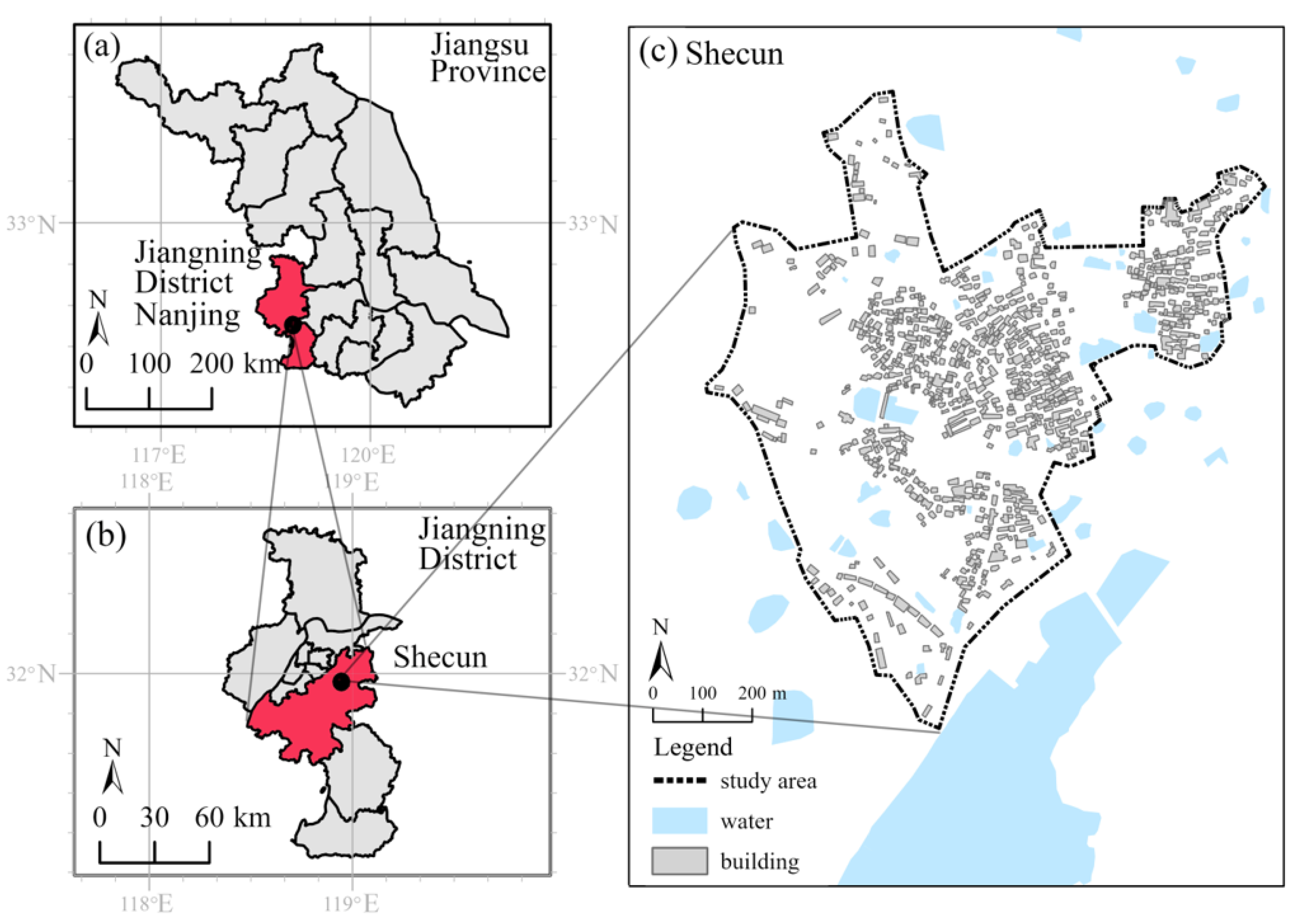
2.1. Research Area
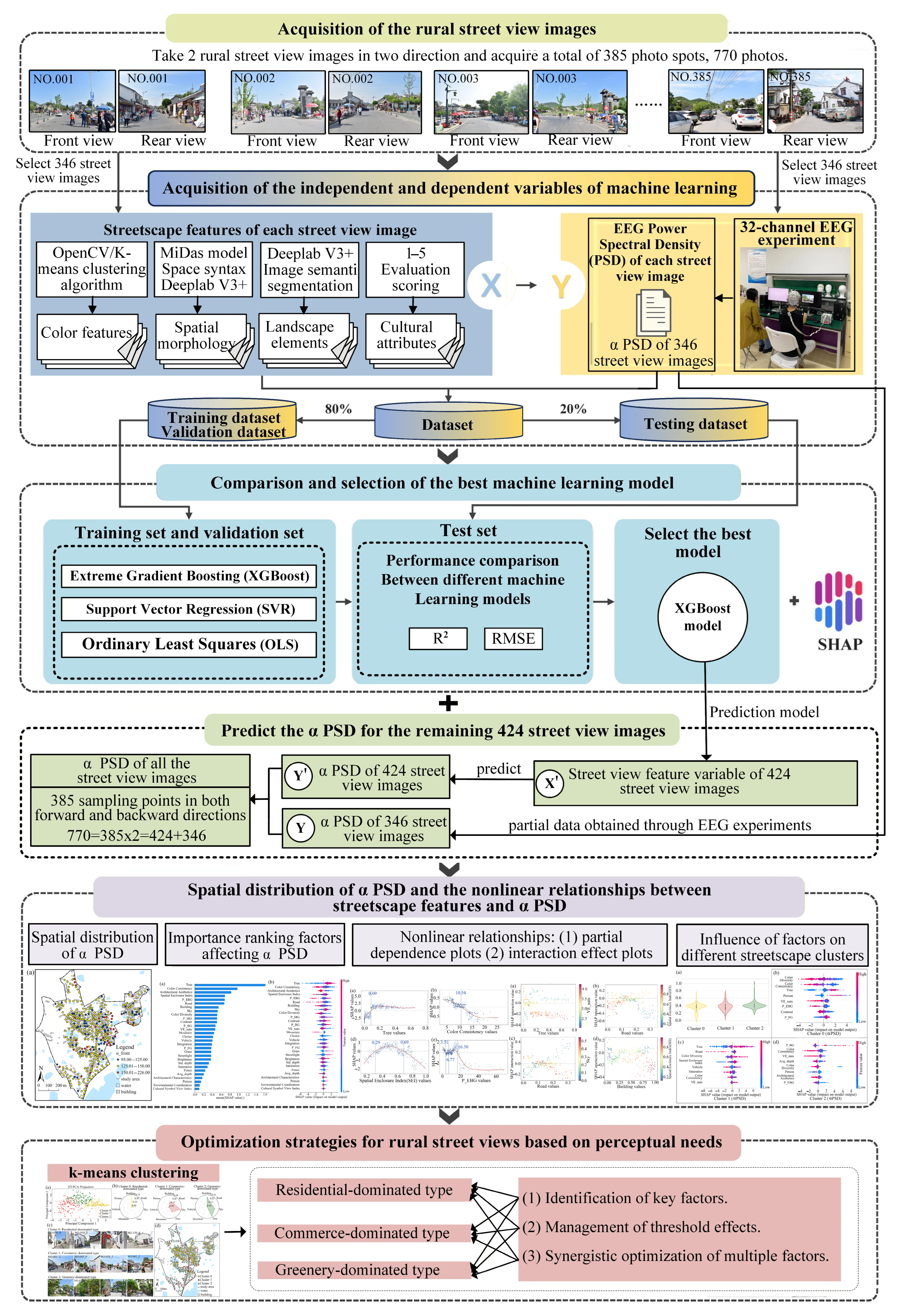
2.2. Research Framework
- (1)
- Streetscape image collection
- (2)
- Acquisition of independent and dependent variables for machine learning
- (3)
- Machine learning model construction and nonlinear mechanism analysis
- (4)
- Prediction of rural streetscape α PSD based on machine learning
- (5)
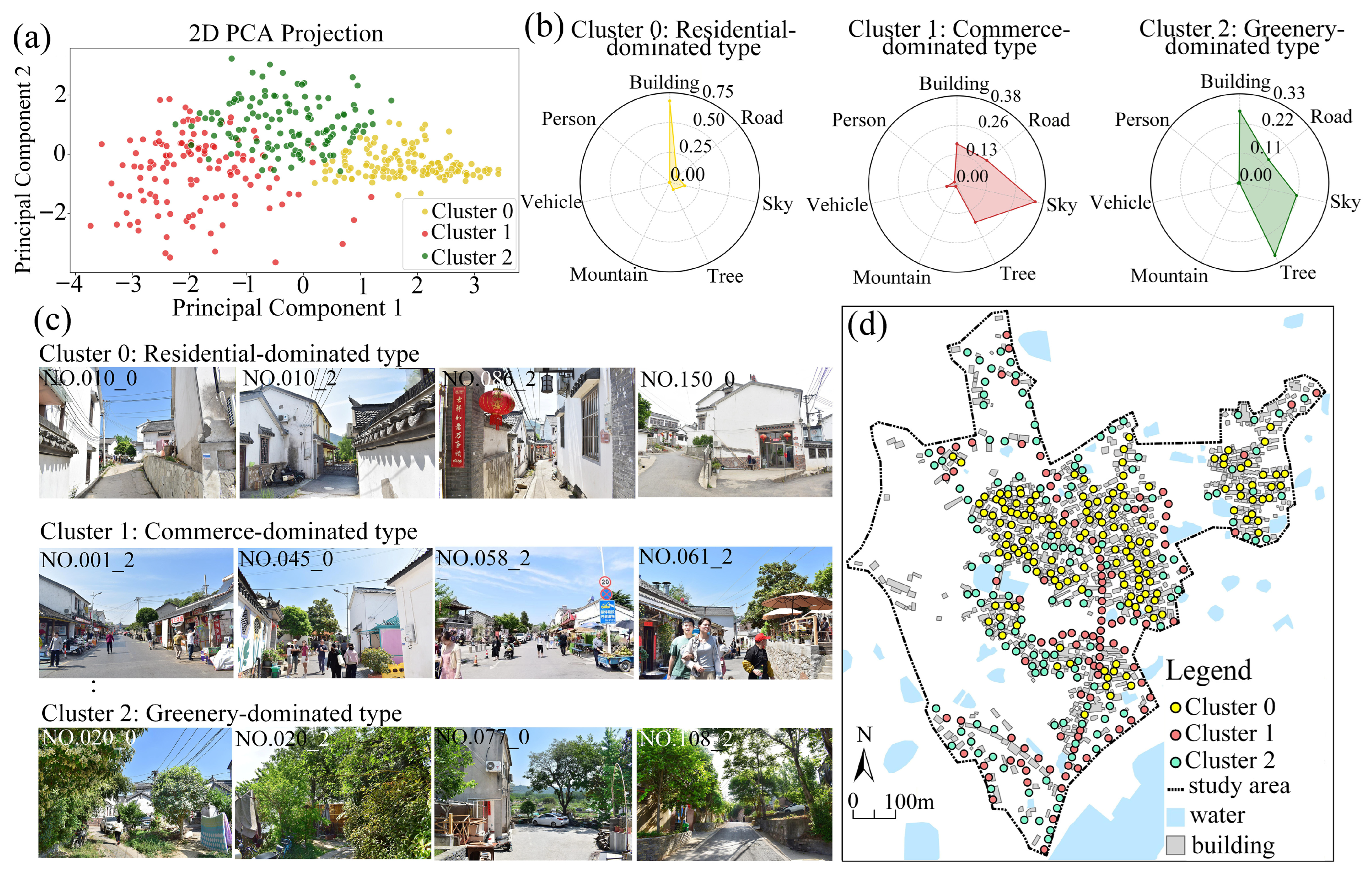
- K-means clustering and streetscape optimization strategies
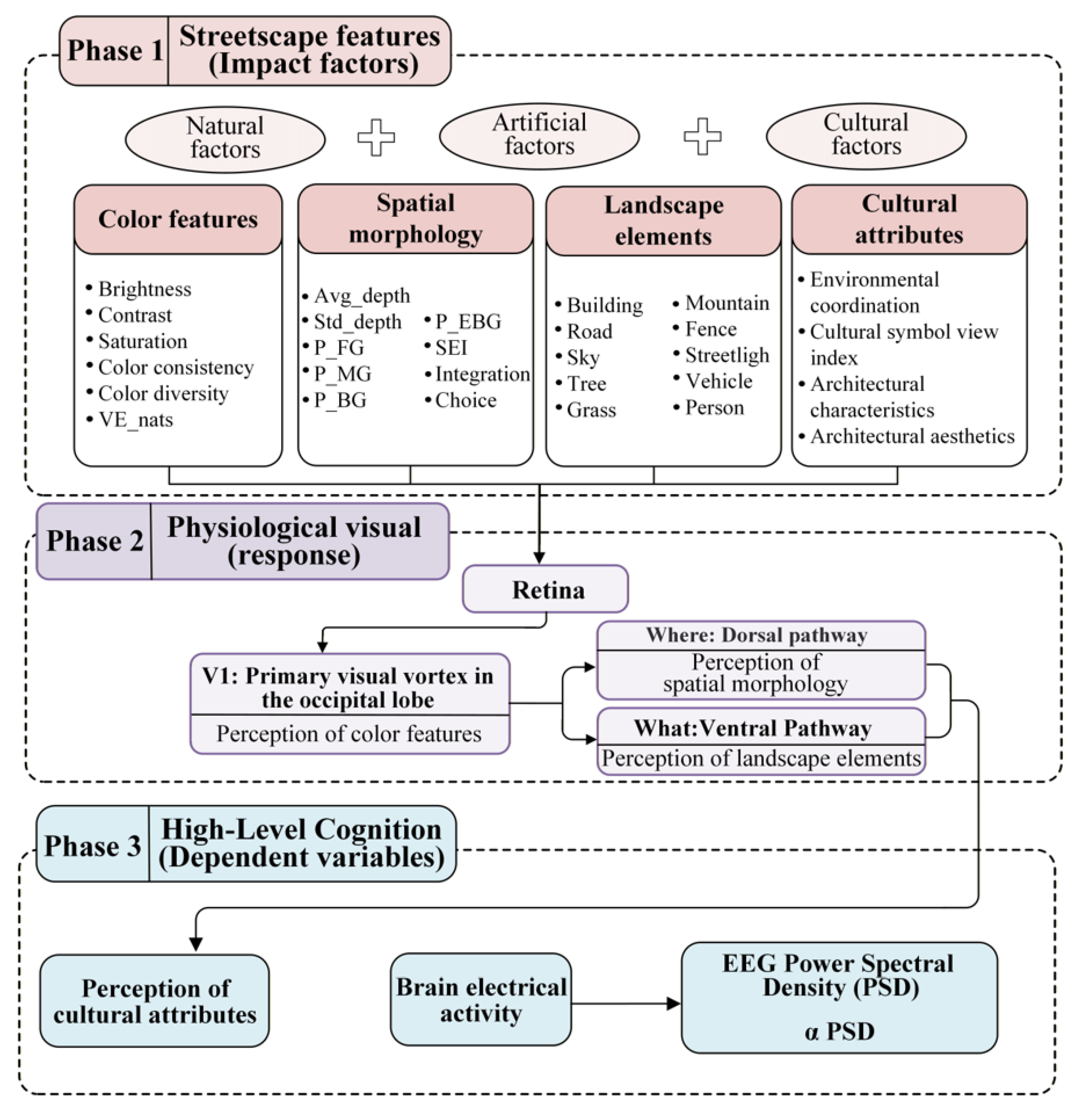
2.3. Integration of Streetscape Features
- 1.
- Perception of color features
- 2.
- Perception of space morphology
- 3.
- Perception of landscape elements
- 4.
- Cultural attributes and streetscape perception (α PSD)
- (1)
- Brightness, contrast and saturation
- (2)
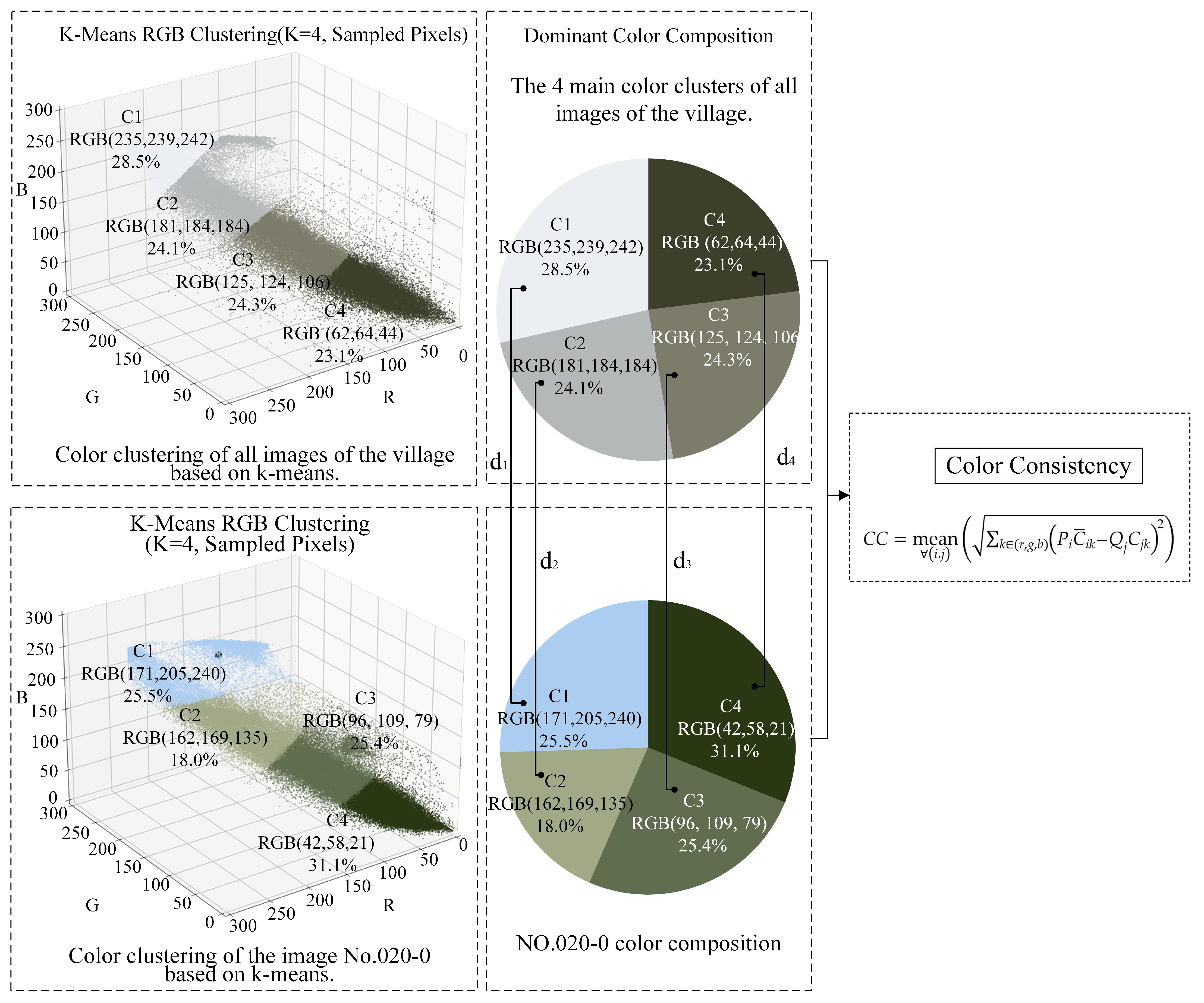
- Color Consistency and color diversity
- (3)
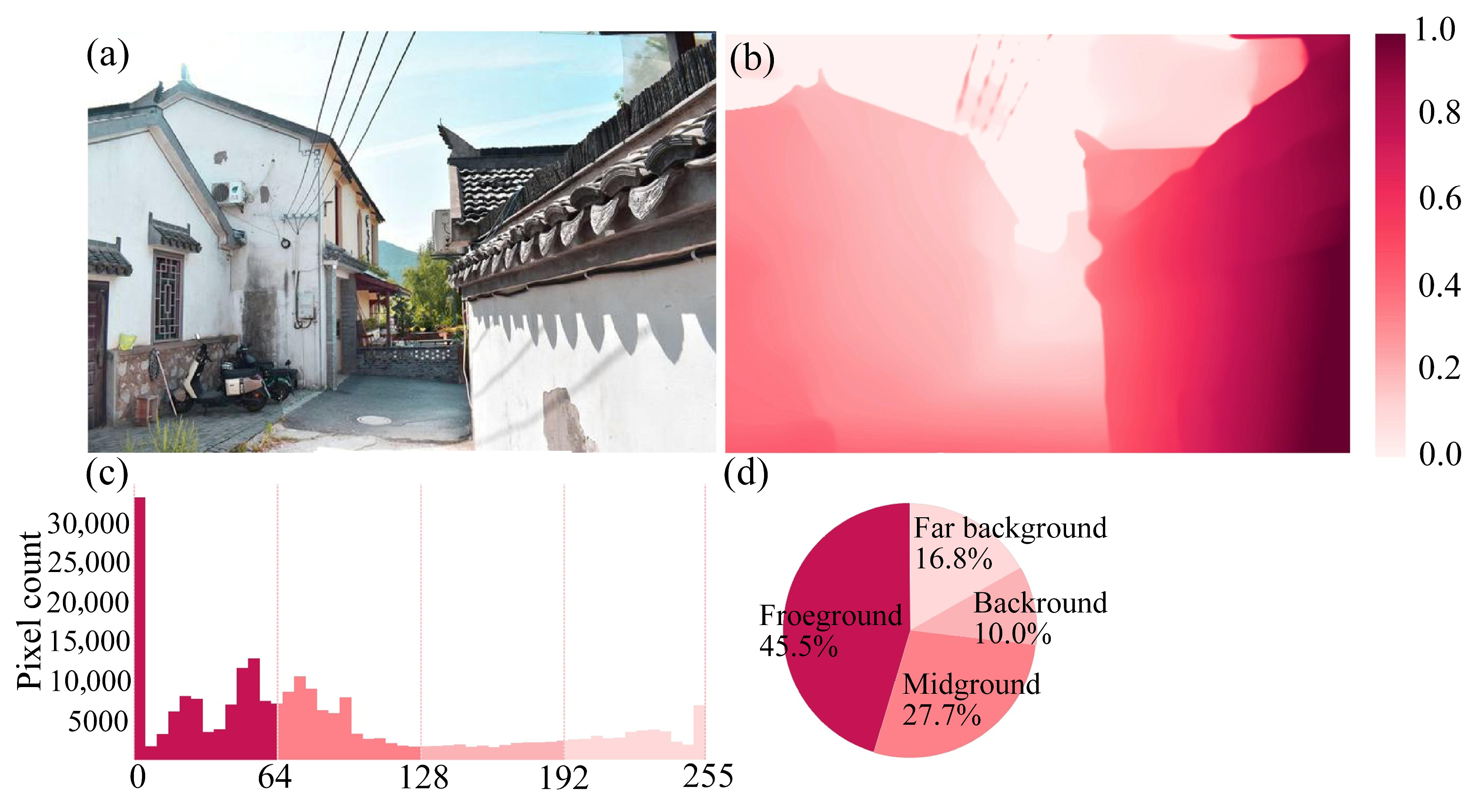
- Spatial depth
- (4)
- Spatial enclosure index
- (5)
- Integration and choice
- (6)
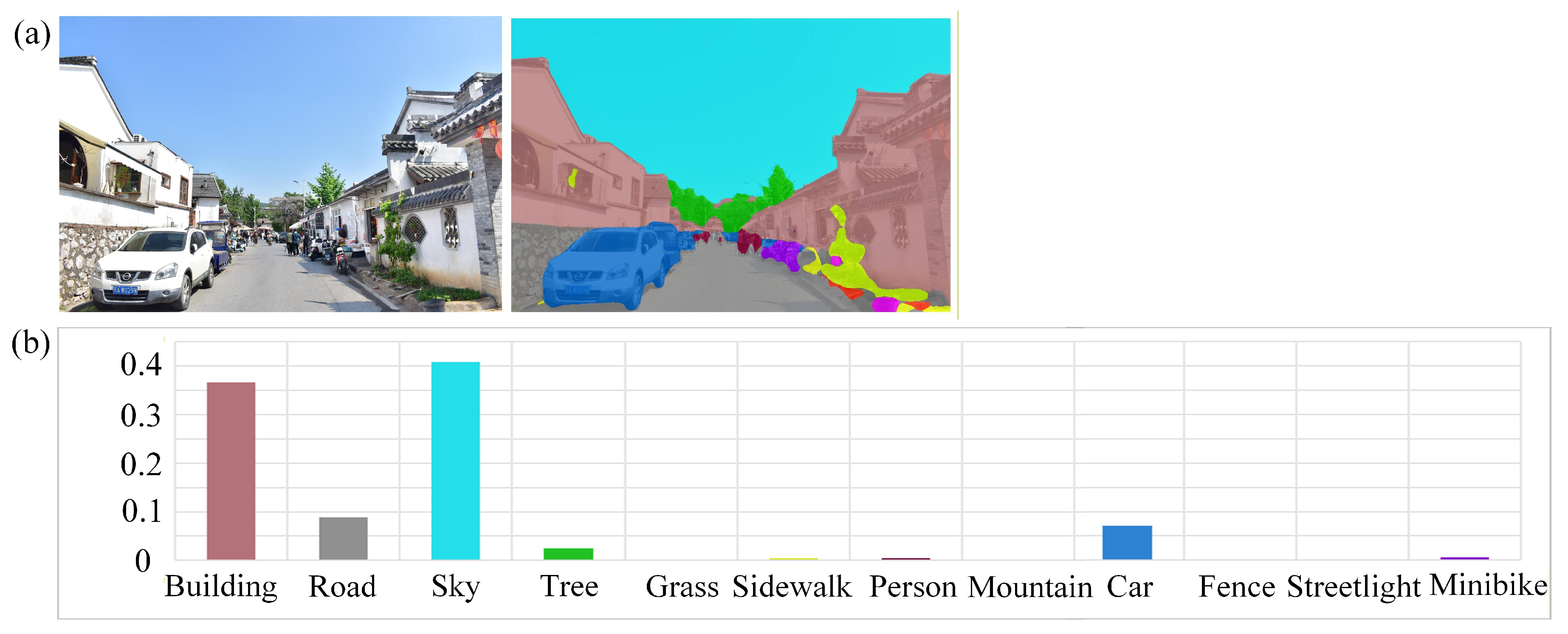
- Image semantic segmentation
- (7)
- Cultural attributes
2.4. Rural Streetscape Image Collection
2.5. EEG Experiment and Data Processing
2.5.1. Experimental Procedure
2.5.2. EEG Data Recording
2.5.3. Power Spectrum Density Analysis
2.6. Machine Learning Models
2.7. SHAP
3. Results
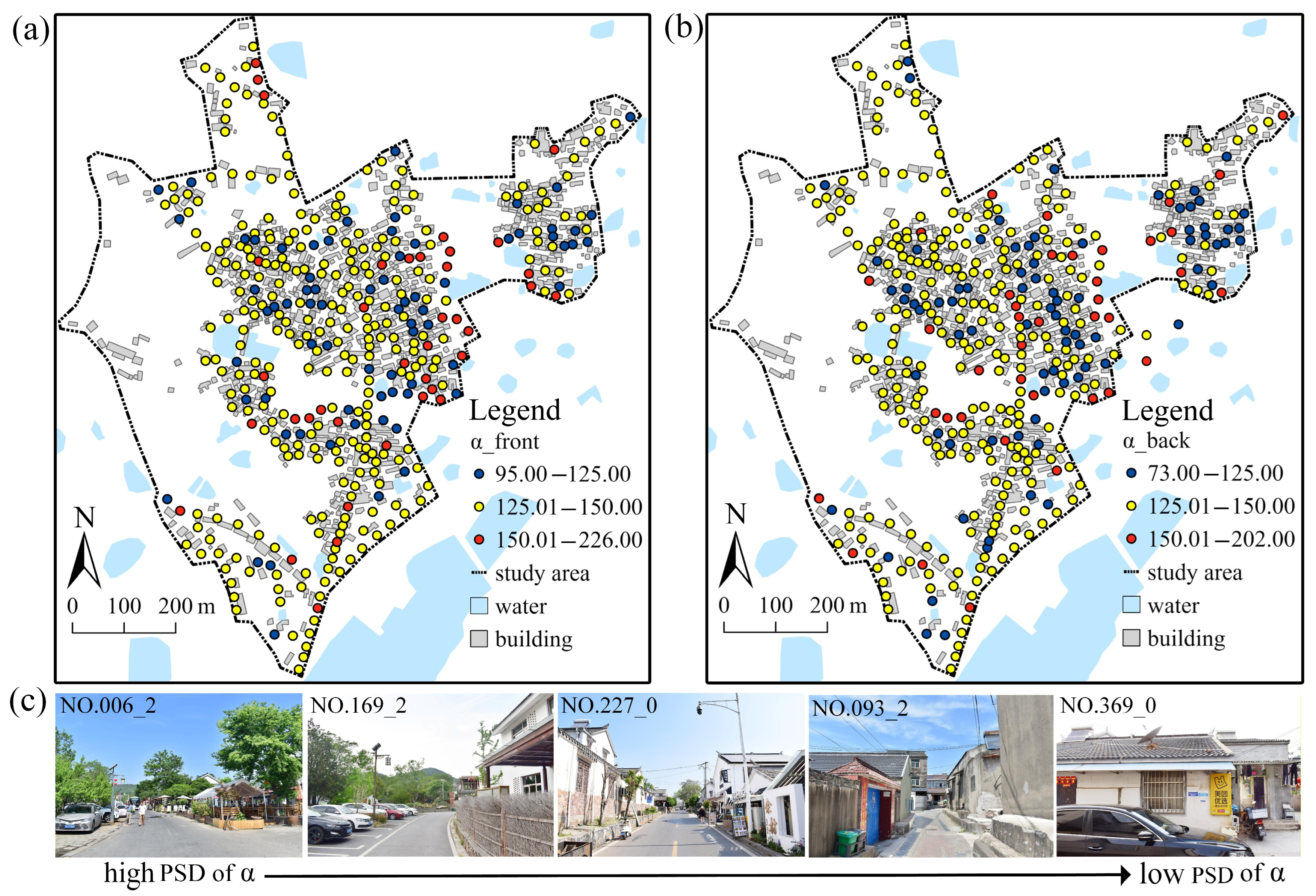
3.1. EEG PSD and Spatial Distribution
3.2. Influence of Streetscape Features on EEG PSD
3.3. Nonlinearity and Interactions
3.3.1. Nonlinear Effects of Color Features
3.3.2. Nonlinear Effects of Space Morphology
3.3.3. Nonlinear Effects of Streetscape Elements
3.3.4. Nonlinear Effects of Cultural Attributes
3.3.5. Interactions
3.4. Typical Streetscape Clustering
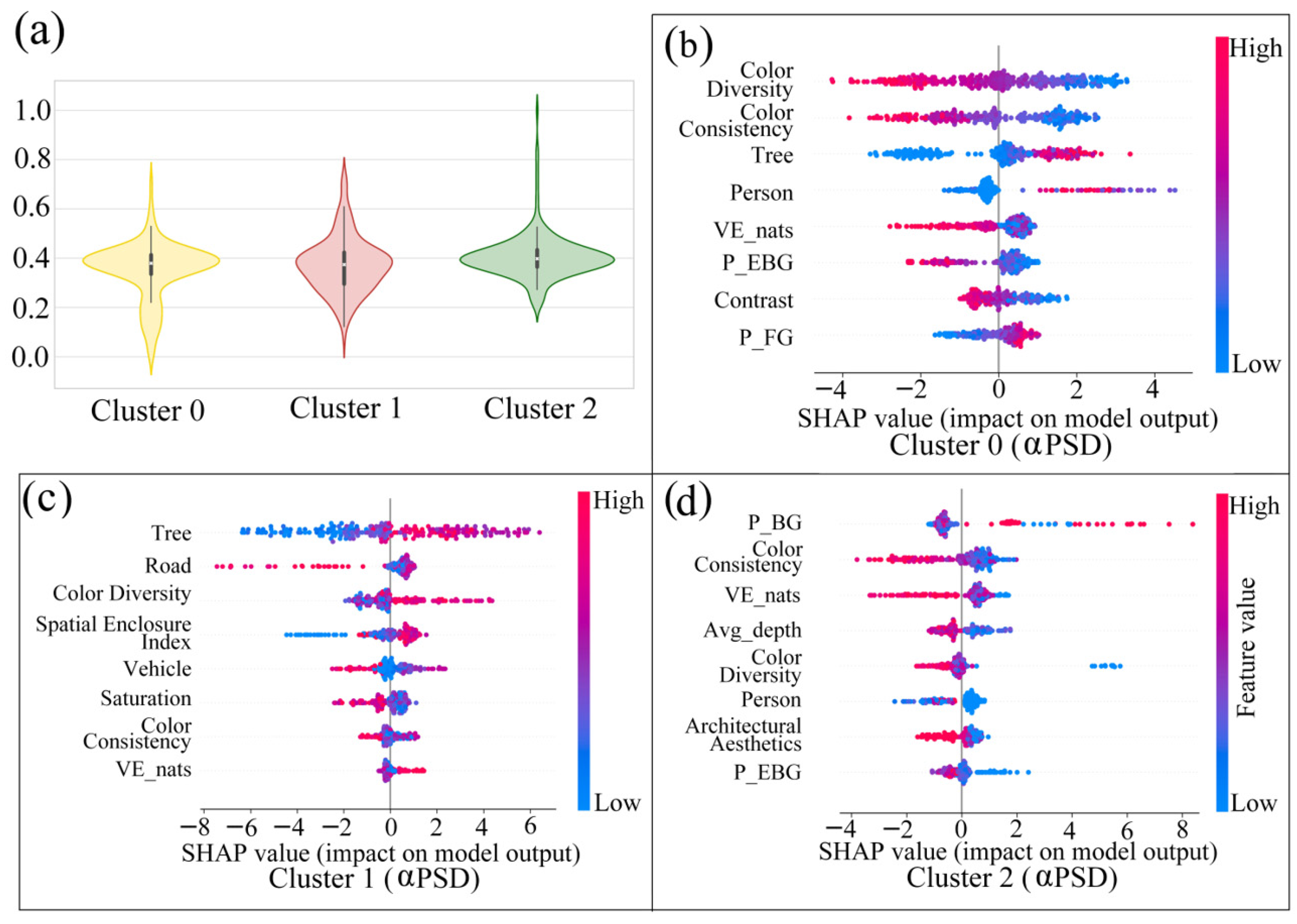
3.5. Influence of Streetscape Features on EEG PSD Across Different Clusters
4. Discussion
4.1. Nonlinear Relationships Between Streetscape Features and α PSD
4.1.1. Threshold Effects
- 1.
- Tree
- 2.
- Road
- 3.
- Color consistency and architectural aesthetics
- 4.
- Sky
- 5.
- Application of Thresholds in Design Practice
- (1)
- Prioritizing the incorporation of green vegetation
- (2)
- Creating semi-enclosed, open spaces that offer both protection and relaxation
- (3)
- Controlling road and sky view indices to mitigate feelings of emptiness and insecurity
- (4)
- Harmonizing the relationship between buildings and nature
4.1.2. Nonlinear Influence Patterns
4.2. Rural Streetscape Optimization Strategies Based on Perceptual Needs
4.3. Research Contributions
4.4. Limitations and Future Research
5. Conclusions
- (1)
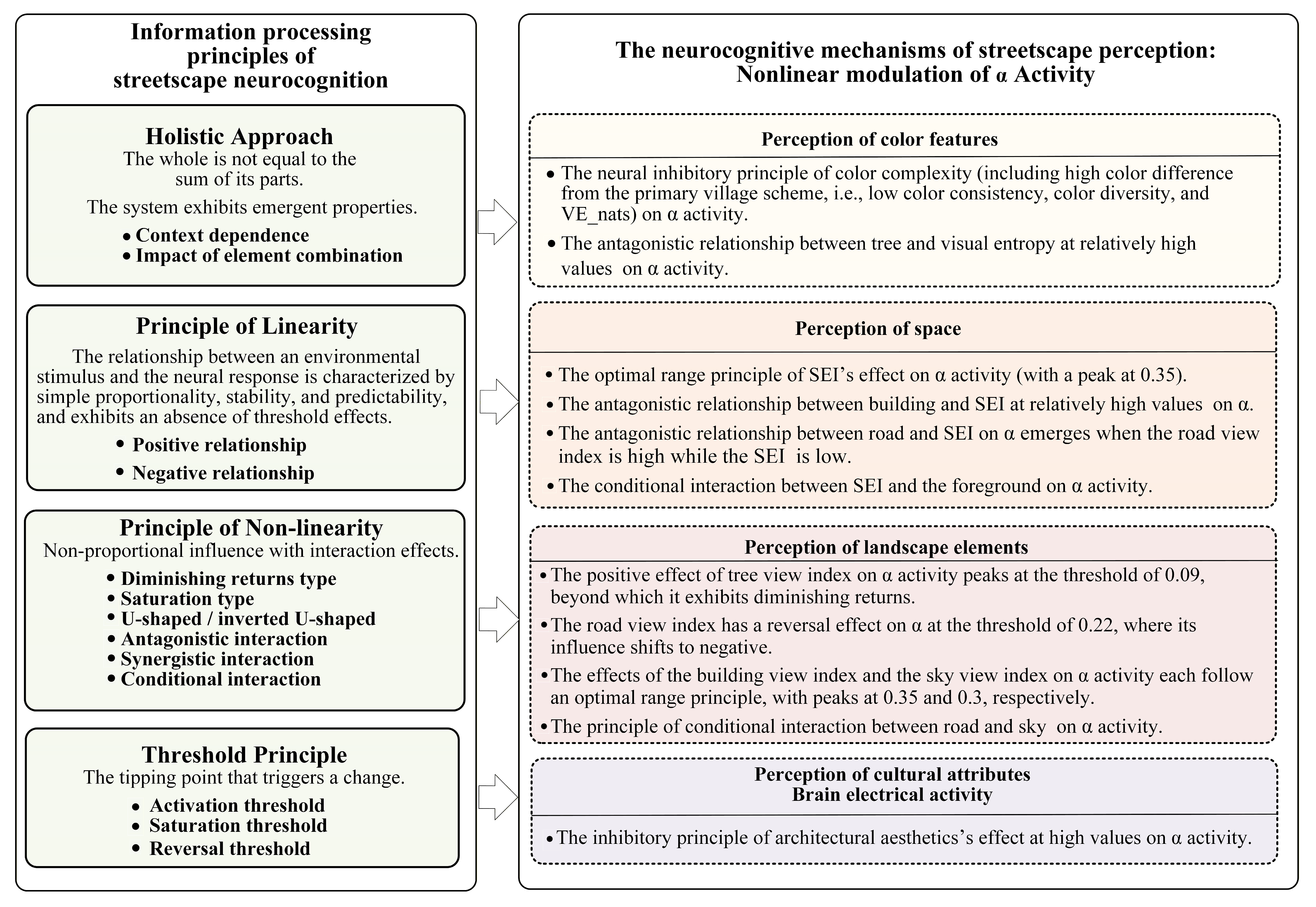
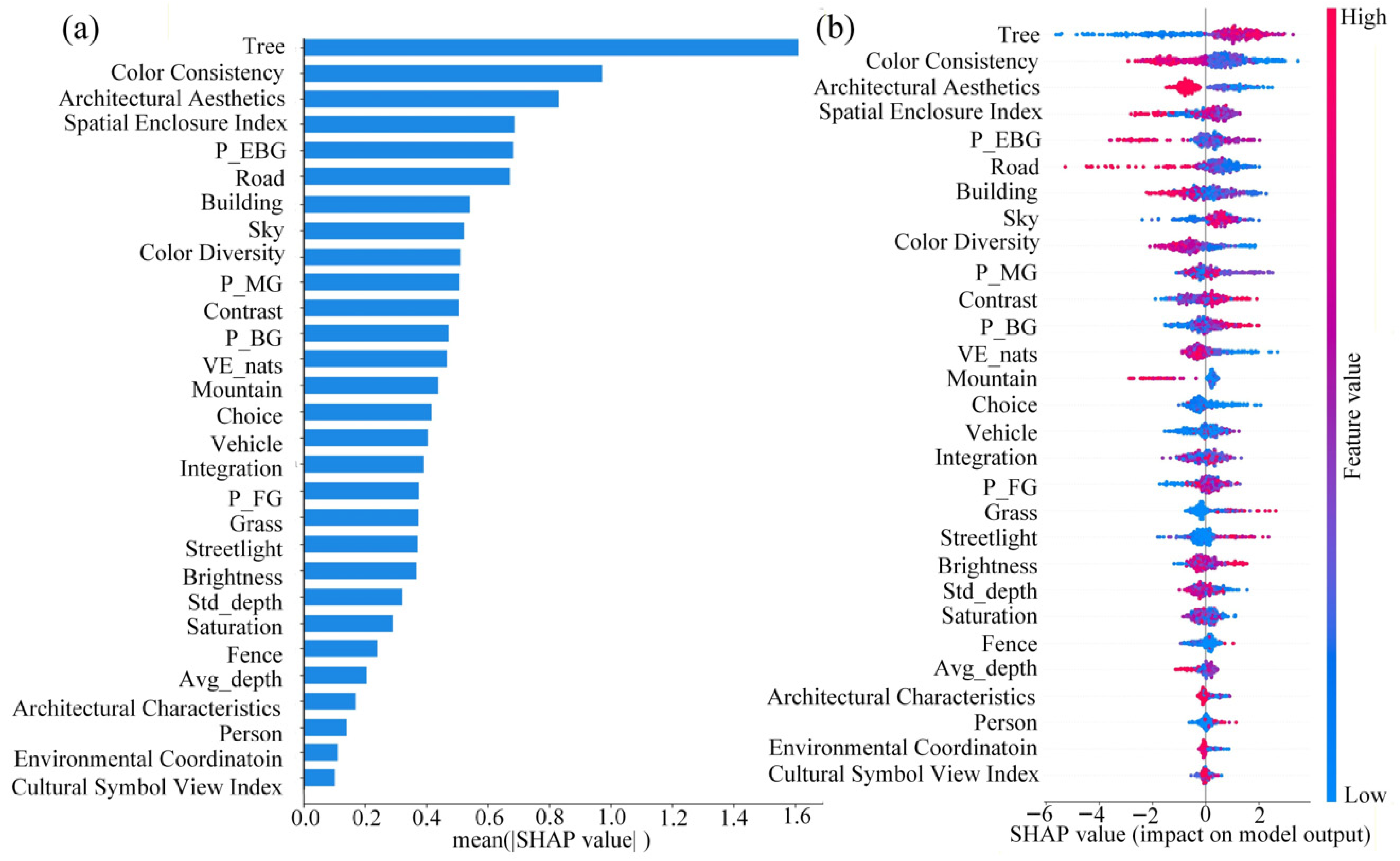
- The key streetscape features affecting rural streetscape α PSD, in order of importance, are tree, color consistency, architectural aesthetics, spatial enclosure index (SEI), P_EBG, and road.
- (2)
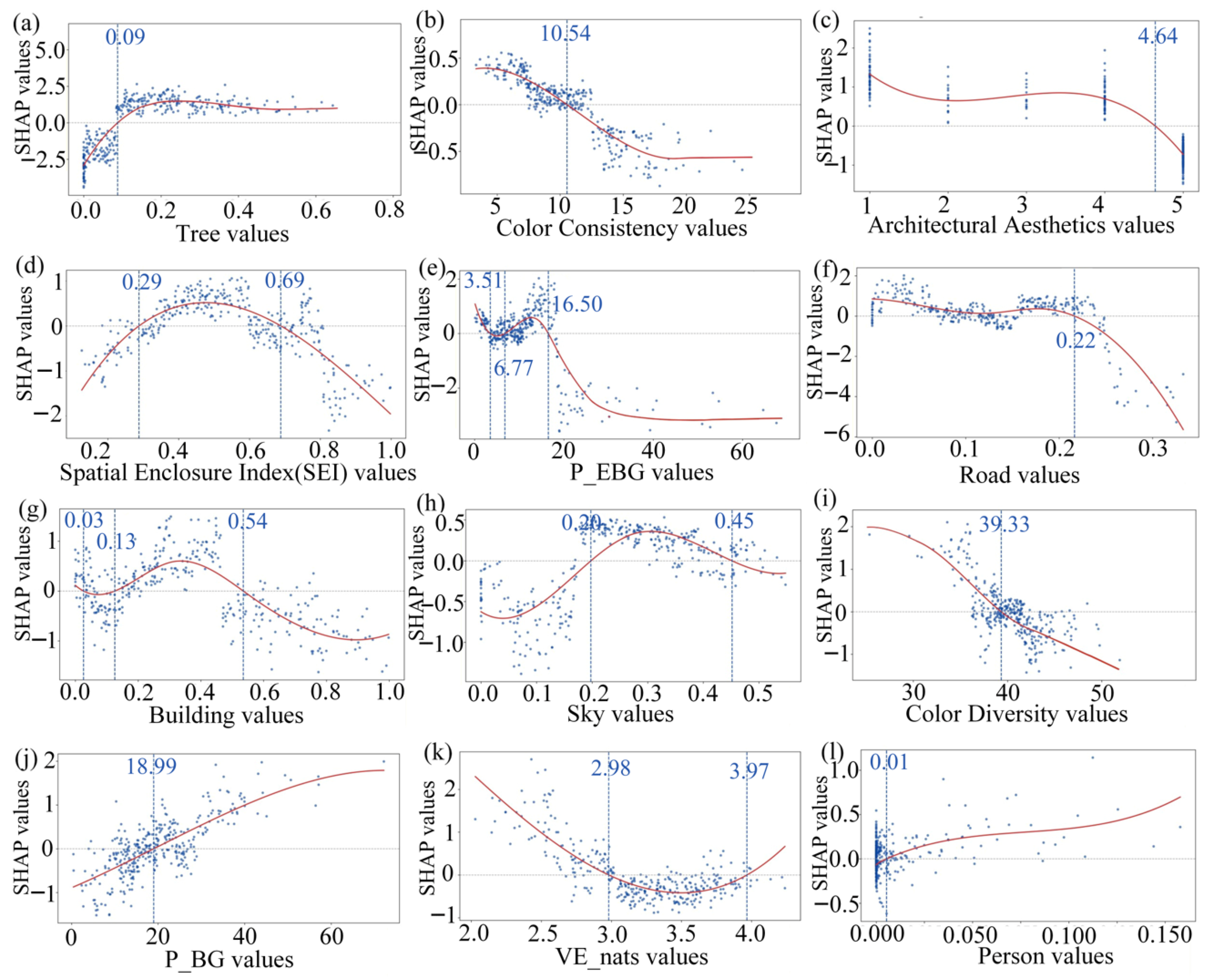
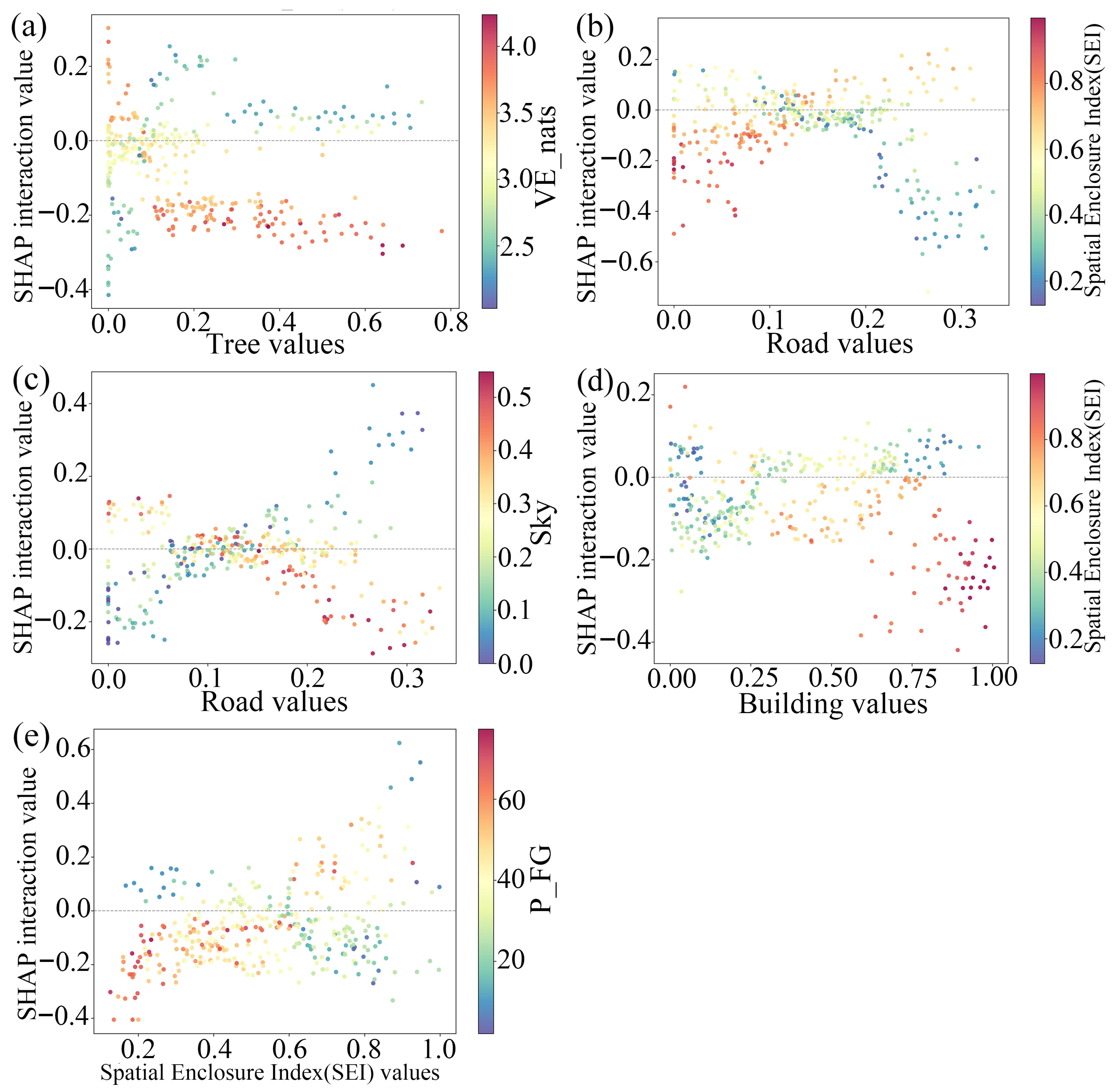
- In terms of color features, environments where colors are closer to the main village palette, with lower color diversity and visual entropy, are more conducive to promoting relaxation and calm perception (α PSD increases). We observed an antagonistic interaction between the tree view index and visual entropy on α PSD, but only when both variables had high values.
- (3)
- In terms of space morphology, SEI exhibits an inverted U-shaped effect on α PSD, peaking at SEI ≈ 0.50. When both the building view index and SEI are high, they interact antagonistically to influence α PSD. SEI also interacted with the foreground (P_FG) in a condition-specific manner on α PSD.
- (4)
- Regarding landscape elements, the tree view index shows diminishing marginal returns on α PSD. Building and sky view index have optimal intervals for α PSD, peaking at 0.35 and 0.30, respectively. We also found conditional interactions between road and sky on α PSD.
- (5)
- In terms of cultural attributes, architectural aesthetics exerts a negative effect on α PSD.
- (6)
- Finally, combining SHAP interpretability analysis with k-means clustering, we established an analytical paradigm integrating global explanation and cluster-specific differences. Based on the “key factor identification—threshold effect control—multi-factor synergistic optimization” approach, we proposed rural streetscape design strategies to modulate α PSD, promoting relaxation and calm responses.
Author Contributions
Funding
Institutional Review Board Statement
Informed Consent Statement
Data Availability Statement
Conflicts of Interest
Appendix A

| Term | Definition | Contextual Role in This Research |
|---|---|---|
| Electroencephalography (EEG) | A non-invasive neurophysiological method for recording brain electrical activity with high temporal resolution. | Used to objectively quantify the effects of streetscapes on brain relaxation and cognition. |
| Alpha-band Power Spectral Density (α PSD) | A physiological indicator reflecting the energy in the 8–13 Hz frequency band, which is associated with relaxed mental states. | Serves as the dependent variable representing perceptual responses. |
| Visual Cortex | Located in the occipital lobe, it refers to the overall brain region responsible for visual information processing, comprising multiple subregions such as V1, V2, V3, V4, and MT. | The starting point of neural processing for streetscape visual features. |
| V1 (i.e., the primary visual cortex) | A subregion of the visual cortex, it is the first cortical area to receive input from the retina, corresponding to Brodmann Area 17. It is responsible for the initial analysis of visual features such as edges, orientation, and contrast. | Responsible for the primary cortical processing of visual features during streetscape perception. |
| Lateral Geniculate Nucleus (LGN) | The visual relay nucleus in the thalamus, it receives input from the retina and transmits signals to the primary visual cortex (V1) in the occipital lobe. | Acts as the thalamic relay station transmitting retinal signals to the occipital cortex, forming the subcortical basis of visual perception. |
| Occipital Lobe | The rearmost lobe of the cerebral cortex, it contains both primary and higher-order visual areas (V1–V5/MT) and is responsible for the reception and initial processing of visual information. | Serves as the cortical hub for visual information processing, initiating neural encoding of streetscape stimuli. |
| “What” and “Where” Pathways | The two main processing pathways of the brain’s visual system: the former is responsible for object recognition (temporal lobe), while the latter is responsible for spatial localization (parietal lobe). | Used to explain the neural and cognitive division of labor involved in the processing of spatial morphology and landscape elements. |
| Fusiform Gyrus | Located in the inferior temporal lobe, it is a core region of the visual “What” Pathway, involved in the recognition and representation of faces and objects. | Responsible for the recognition of landscape elements within streetscape features. |
| Parietal Lobe | Located in the upper region of the cerebral cortex, it is involved in spatial localization, attentional allocation, and sensory integration, serving as a key brain region in the visual “Where” Pathway. | Responsible for spatial localization and attentional modulation of streetscape elements, supporting the neural basis of spatial cognition. |
| Perirhinal Cortex | Located in the medial temporal lobe, it connects the hippocampus and the fusiform gyrus, playing a key role in the integration of semantic features. | Integration and recognition of semantic features in streetscapes, whereby different streetscape elements are combined into a coherent perceptual representation of the overall streetscape. |
| Frontal Lobe/Prefrontal Cortex | An advanced cognitive region involved in decision-making, aesthetic evaluation, cultural judgment, and perceptual formation. | A key brain region involved in the cognition of cultural attributes—such as architectural aesthetics and environmental harmony—and in the generation of streetscape perception. |
| Visual Entropy (VE_nats) | An information-theoretic indicator reflecting the complexity of an image. | An objective indicator used to quantify the visual complexity of streetscape images. |
| Spatial Enclosure Index (SEI) | An indicator used to measure the degree of spatial enclosure formed by buildings, trees, and other elements on both sides of the street. | To assess the relationship between spatial enclosure and psychological relaxation. |
| DeepLabV3+ | A semantic segmentation model based on dilated convolution deep learning. | To extract the proportional composition of streetscape elements such as buildings, trees, and roads. |
| MiDaS Model | A deep computational model based on a convolution–Transformer hybrid architecture. | To compute spatial depth and to calculate the proportion of foreground, midground, background, and far background. |
| Spatial Enclosure Index (SEI) | An indicator used to measure the degree of enclosure on both sides of a street. | The proportion of pixels classified as buildings, trees, and streetlights relative to the total number of pixels in the streetscape image. |
| Space Syntax | A theoretical and methodological framework for quantifying spatial structure, which describes the relationship between human behavior and spatial morphology in architectural or urban environments through topological representations. | The Integration and Choice values were calculated using DepthMap (v X0.8.0) software. |
| Integration/Choice | Core indicators in space syntax, representing spatial accessibility and the probability of being traversed, respectively. | Serves as a sub-indicator of space morphology, reflecting the structural characteristics of street spaces. |
| Environmental Coordination | An indicator used to assess the environmental coordination of streetscapes, providing a comprehensive evaluation of the architectural coherence (in terms of scale, color, material, and style) and the environmental maintenance level (including cleanliness, sanitation, and degree of deterioration). | To measure the effect of environmental coordination of the streetscape on the dependent variable. |
| Cultural Symbol View Index | To quantify the proportion of cultural elements within the streetscape. | To measure the impact of the richness of cultural elements in streetscape images on the dependent variable. |
| Architectural Characteristics | A quantitative assessment of the regional characteristics and typicality of architecture. | To evaluate the effect of architectural regionality and typicality on the dependent variable. |
| Architectural Aesthetics | A comprehensive aesthetic evaluation of architectural form, proportion, and rhythm. | To assess the impact of architectural aesthetic quality on the dependent variable. |
References
- Shen, H.; He, X.; He, J.; Li, D.; Liang, M.; Xie, X. Back to the village: Assessing the effects of naturalness, landscape types, and landscape elements on the restorative potential of rural landscapes. Land 2024, 13, 910. [Google Scholar] [CrossRef]
- Wang, X.; Zhu, H.; Shang, Z.; Chiang, Y. The influence of viewing photos of different types of rural landscapes on stress in Beijing. Sustainability 2019, 11, 2537. [Google Scholar] [CrossRef]
- Jiang, S.; Ma, H.; Yang, L.; Luo, S. The influence of perceived physical and aesthetic quality of rural settlements on tourists’ preferences—A case study of Zhaoxing Dong Village. Land 2023, 12, 1542. [Google Scholar] [CrossRef]
- Fu, E.; Ren, Y.; Li, X.; Zhang, L. Research on the healing potential of rural community streets from the perspective of audiovisual integration: A case study of four rural communities in China. Front. Public Health 2022, 10, 861072. [Google Scholar] [CrossRef] [PubMed]
- Torkko, J.; Poom, A.; Willberg, E.; Toivonen, T. How to best map greenery from a human perspective? comparing computational measurements with human perception. Front. Sustain. Cities 2023, 5, 1160995. [Google Scholar] [CrossRef]
- Li, K. Research on the factors influencing the spatial quality of high-density urban streets: A framework using deep learning, street scene images, and principal component analysis. Land 2024, 13, 1161. [Google Scholar] [CrossRef]
- Fang, Y.-N.; Tian, J.; Namaiti, A.; Zhang, S.; Zeng, J.; Zhu, X. Visual aesthetic quality assessment of the streetscape from the perspective of landscape-perception coupling. Environ. Impact Assess. Rev. 2024, 106, 107535. [Google Scholar] [CrossRef]
- Li, M.; Fan, Z. Constructing High-Quality Livable Cities: A comprehensive evaluation of urban street livability using an approach based on human needs theory, street view images, and deep learning. Land 2025, 14, 1095. [Google Scholar] [CrossRef]
- Ye, Y.; Zeng, W.; Shen, Q.; Zhang, X.; Lu, Y. The visual quality of streets: A human-centred continuous measurement based on machine learning algorithms and street view images. Environ. Plan. B Urban Anal. City Sci. 2019, 46, 1439–1457. [Google Scholar] [CrossRef]
- Fang, Y.-N.; Namaiti, A.; Zhang, S.; Feng, T. Multimodal data-driven visual sensitivity assessment and planning response strategies for streetscapes in historic districts: A case study of Anshandao, Tianjin. Land 2025, 14, 1036. [Google Scholar] [CrossRef]
- Wang, L.; Zhuang, J.; Wang, M.; Adnan, R.M. Comprehensive assessment of spatial quality in traditional village landscapes of the Yuanshui River Basin using semantic differential and entropy weight methods. Front. Environ. Sci. 2025, 13, 1552489. [Google Scholar] [CrossRef]
- Li, J.; Wu, W.; Jin, Y.; Zhao, R.; Bian, W. Research on environmental comfort and cognitive performance based on EEG+VR+LEC evaluation method in underground space. Build. Environ. 2021, 198, 107886. [Google Scholar] [CrossRef]
- Wei, H.-L.; Guo, Y.; He, F.; Zhao, Y. EEG signal processing techniques and applications—2nd edition. Sensors 2025, 25, 805. [Google Scholar] [CrossRef]
- Shi, J.; Zhang, N.; Sun, Y.; Jiang, J.; Duan, H.; Gao, W. The impact of virtual images of coastal landscape features on stress recovery based on EEG. Sci. Rep. 2025, 15, 17369. [Google Scholar] [CrossRef]
- Asim, F.; Chani, P.S.; Shree, V.; Rai, S. Restoring the mind: A neuropsychological investigation of university campus built environment aspects for student well-being. Build. Environ. 2023, 244, 110810. [Google Scholar] [CrossRef]
- Qin, J.; Sun, C.; Zhou, X.; Leng, H.; Lian, Z. The effect of indoor plants on human comfort. Indoor Built Environ. 2014, 23, 709–723. [Google Scholar] [CrossRef]
- Grassini, S.; Revonsuo, A.; Castellotti, S.; Petrizzo, I.; Benedetti, V.; Koivisto, M. Processing of natural scenery is associated with lower attentional and cognitive load compared with urban ones. J. Environ. Psychol. 2019, 62, 1–11. [Google Scholar] [CrossRef]
- Lu, Y.; Liu, H.; Zhu, Y.; Zhu, Z.; Wang, H.; He, L.; Wang, J. Green relief: An exploration into the restorative effects of urban green spaces on eyestrain. Urban For. Urban Green 2025, 112, 128890. [Google Scholar] [CrossRef]
- Seiz, A.; Kweon, B.-S.; Ellis, C.D.; Oh, H.; Pietro, K. Exploring the psychophysiological effects of viewing urban nature through virtual reality using electroencephalography and perceived restorativeness scale measures. Sustainability 2023, 15, 13090. [Google Scholar] [CrossRef]
- Zhu, H.; Yang, F.; Bao, Z.; Nan, X. A study on the impact of visible green index and vegetation structures on brain wave change in residential landscape. Urban For. Urban Green 2021, 64, 127299. [Google Scholar] [CrossRef]
- Gong, S.; Zhang, L.; Zhang, J.; Duan, Y. Rural local landscape perception evaluation: Integrating street view images and machine learning. ISPRS Int. J. Geo Inf. 2025, 14, 251. [Google Scholar] [CrossRef]
- Zhang, X.; Xiong, X.; Chi, M.; Yang, S.; Liu, L. Research on visual quality assessment and landscape elements influence mechanism of rural greenways. Ecol. Indic. 2024, 160, 111844. [Google Scholar] [CrossRef]
- Cao, Y.; Yang, P.; Xu, M.; Li, M.; Li, Y.; Guo, R. A novel method of urban landscape perception based on biological vision process. Landsc. Urban Plan. 2025, 254, 105246. [Google Scholar] [CrossRef]
- Su, C.; Wang, X.; Wang, Y.; Chen, Y.; Dai, F.; Chen, X. Mediating roles of cultural perception and place attachment in the landscape–wellbeing relationship: Insights from historical urban parks in Wuhan, China. Land 2025, 14, 1176. [Google Scholar] [CrossRef]
- Hong, Z.; Cao, W.; Chen, Y.; Zhu, S.; Zheng, W. Identifying rural landscape heritage character types and areas: A case study of the Li River Basin in Guilin, China. Sustainability 2024, 16, 1626. [Google Scholar] [CrossRef]
- Gao, X.; Wang, H.; Zhao, J.; Wang, Y.; Li, C.; Gong, C. Visual comfort impact assessment for walking spaces of urban historic district in China based on semantic segmentation algorithm. Environ. Impact Assess. Rev. 2025, 114, 107917. [Google Scholar] [CrossRef]
- McDonnell, A.S.; LoTemplio, S.B.; Scott, E.E.; Strayer, D.L. Nature images are more visually engaging than urban images: Evidence from neural oscillations in the brain. Front. Hum. Neurosci. 2025, 19, 1575102. [Google Scholar] [CrossRef]
- Valentine, C.; Steffert, T.; Mitcheltree, H.; Steemers, K. Architectural neuroimmunology: A pilot study examining the impact of biophilic architectural design on neuroinflammation. Buildings 2024, 14, 1292. [Google Scholar] [CrossRef]
- Bidgoli, M.A.; Behmanesh, A.; Khademi, N.; Thansirichaisree, P.; Zheng, Z.; Tehrani, S.S.M.; Mazloum, S.; Kongsilp, S. Brain activity patterns reflecting security perceptions of female cyclists in virtual reality experiments. Sci. Rep. 2025, 15, 761. [Google Scholar] [CrossRef]
- Mavros, P.; JWälti, M.; Nazemi, M.; Ong, C.H.; Hölscher, C. A mobile EEG study on the psychophysiological effects of walking and crowding in indoor and outdoor urban environments. Sci. Rep. 2022, 12, 18476. [Google Scholar] [CrossRef]
- Rhee, J.H.; Schermer, B.; Han, G.; Park, S.Y.; Lee, K.H. Effects of nature on restorative and cognitive benefits in indoor environment. Sci. Rep. 2023, 13, 13199. [Google Scholar] [CrossRef]
- Naghibi, M.; Farrokhi, A.; Faizi, M. Small urban green spaces: Insights into perception, preference, and psychological well-being in a densely populated areas of Tehran, Iran. Environ. Health Insights 2024, 18, 11786302241248314. [Google Scholar] [CrossRef]
- Bagheri, S.; Good, J.; Alavi, H.S. Visual and acoustic discomfort: A comparative study of impacts on individuals with and without ADHD using electroencephalogram (EEG). Build. Environ. 2024, 264, 111881. [Google Scholar] [CrossRef]
- Li, X.; Wang, R.; Whang, M. Designing light for emotion: A neurophysiological approach to modeling affective responses to the interplay of color and illuminance. Biomimetics 2025, 10, 696. [Google Scholar] [CrossRef]
- Kim, S. Cognitive efficiency in VR simulated natural indoor environments examined through EEG and affective responses. Sci. Rep. 2025, 15, 33398. [Google Scholar] [CrossRef] [PubMed]
- Choi, T.; Ji, S.; Jun, H. Electroencephalogram-based analysis of attention in void and solid architectural spaces. J. Asian Archit. Build. Eng. 2025, 1–12. [Google Scholar] [CrossRef]
- Luo, J.; Zhao, T.; Cao, L.; Biljecki, F. Semantic riverscapes: Perception and evaluation of linear landscapes from oblique imagery using computer vision. Landsc. Urban Plan. 2022, 228, 104569. [Google Scholar] [CrossRef]
- Tao, Y.; Wang, Y.; Wang, X.; Tian, G.; Zhang, S. Measuring the correlation between human activity density and streetscape perceptions: An analysis based on Baidu Street View images in Zhengzhou, China. Land 2022, 11, 400. [Google Scholar] [CrossRef]
- Shao, Y.; Yin, Y.; Xue, Z.; Ma, D. Assessing and comparing the visual comfort of streets across four Chinese megacities using AI-based image analysis and the perceptive evaluation method. Land 2023, 12, 834. [Google Scholar] [CrossRef]
- Ma, X.; Ma, C.; Wu, C.; Xi, Y.; Yang, R.; Peng, N.; Zhang, C.; Ren, F. Measuring human perceptions of streetscapes to better inform urban renewal: A perspective of scene semantic parsing. Cities 2021, 110, 103086. [Google Scholar] [CrossRef]
- Adıgüzel, E.; Pirselimoğlu Batman, Z. Visual quality assessment in recreational and touristic landscape. Environ. Dev. Sustain. 2024, in press. [Google Scholar] [CrossRef]
- Ji, H.; Qing, L.; Han, L.; Wang, Z.; Cheng, Y.; Peng, Y. A new data-enabled intelligence framework for evaluating urban space perception. ISPRS Int. J. Geo Inf. 2021, 10, 400. [Google Scholar] [CrossRef]
- Zhang, X.; Lin, E.S.; Tan, P.Y.; Qi, J.; Waykool, R. Assessment of visual landscape quality of urban green spaces using image-based metrics derived from perceived sensory dimensions. Environ. Impact Assess. Rev. 2023, 102, 107200. [Google Scholar] [CrossRef]
- Yu, M.; Chen, X.; Zheng, X.; Cui, W.; Ji, Q.; Xing, H. Evaluation of spatial visual perception of streets based on deep learning and spatial syntax. Sci. Rep. 2025, 15, 18439. [Google Scholar] [CrossRef] [PubMed]
- Nathvani, R.; Cavanaugh, A.; Suel, E.; Bixby, H.; Clark, S.N.; Metzler, A.B.; Nimo, J.; Moses, J.B.; Baah, S.; Arku, R.E.; et al. Measurement of urban vitality with time-lapsed street-view images and object-detection for scalable assessment of pedestrian-sidewalk dynamics. ISPRS J. Photogramm. Remote Sens. 2025, 221, 251–264. [Google Scholar] [CrossRef]
- Kang, Y.; Abraham, J.; Ceccato, V.; Duarte, F.; Gao, S.; Ljungqvist, L.; Zhang, F.; Näsman, P.; Ratti, C. Assessing differences in safety perceptions using GeoAI and survey across neighbourhoods in Stockholm, Sweden. Landsc. Urban Plan. 2023, 236, 104768. [Google Scholar] [CrossRef]
- Wu, T.; Lin, D.; Chen, Y.; Wu, J. Integrating street view images, deep learning, and sDNA for evaluating university campus outdoor public spaces: A focus on restorative benefits and accessibility. Land 2025, 14, 610. [Google Scholar] [CrossRef]
- Xu, G.; Zhong, L.; Wu, F.; Zhang, Y.; Zhang, Z. Impacts of micro-scale built environment features on tourists’ walking behaviors in historic streets: Insights from Wudaoying Hutong, China. Buildings 2022, 12, 2248. [Google Scholar] [CrossRef]
- Zhao, X.; Lu, Y.; Lin, G. An integrated deep learning approach for assessing the visual qualities of built environments utilizing street view images. Eng. Appl. Artif. Intell. 2024, 130, 107805. [Google Scholar] [CrossRef]
- Ho, F.K.; Cole, T.J. Non-linear predictor outcome associations. BMJ Med. 2023, 2, e000396. [Google Scholar] [CrossRef]
- Li, B.; Wang, Z.; Xu, F. Exploring the effects of market-oriented reforms on industrial land use eco-efficiency in China: Evidence from a spatial and non-linear analysis. Environ. Impact Assess. Rev. 2023, 102, 107211. [Google Scholar] [CrossRef]
- Wang, Q.; Wang, H.; Ren, L.; Chen, J.; Wang, X. Hourly impact of urban features on the spatial distribution of land surface temperature: A study across 30 cities. Sustain. Cities Soc. 2024, 113, 105701. [Google Scholar] [CrossRef]
- Han, Y.; Qin, C.; Xiao, L.; Ye, Y. The nonlinear relationships between built environment features and urban street vitality: A data-driven exploration. Environ. Plan. B Urban Anal. City Sci. 2024, 51, 195–215. [Google Scholar] [CrossRef]
- Xiao, X.; Li, X.; Zhou, X.; Kang, J.; Luo, J.; Yin, L. Modulatory effects of the landscape sequences on pedestrians emotional states using EEG. Front. Archit. Res. 2024, 13, 1327–1341. [Google Scholar] [CrossRef]
- Jing, X.; Liu, C.; Li, J.; Gao, W.; Fukuda, H. Effects of window green view index on stress recovery of college students from psychological and physiological aspects. Buildings 2024, 14, 3316. [Google Scholar] [CrossRef]
- Cloquell-Ballester, V.-A.; Del Carmen Torres-Sibille, A.; Cloquell-Ballester, V.-A.; Santamarina-Siurana, M.C. Human alteration of the rural landscape: Variations in visual perception. Environ. Impact Assess. Rev. 2012, 32, 50–60. [Google Scholar] [CrossRef]
- Ren, H.; Wang, Y.; Zhang, J.; Zheng, Z.; Wang, Q. Evaluation of the impact of VR rural streetscape enhancement on relaxation–arousal responses based on EEG. Appl. Sci. 2024, 14, 2996. [Google Scholar] [CrossRef]
- Gao, H.; Abu Bakar, S.; Maulan, S.; Mohd Yusof, M.J.; Mundher, R.; Zakariya, K. Identifying visual quality of rural road landscape character by using public preference and heatmap analysis in Sabak Bernam, Malaysia. Land 2023, 12, 1440. [Google Scholar] [CrossRef]
- Gao, X.; Geng, Y.; Spengler, J.D.; Long, J.; Liu, N.; Luo, Z.; Kalantari, S.; Zhuang, W. Evaluating the impact of spatial openness on stress recovery: A virtual reality experiment study with psychological and physiological measurements. Build. Environ. 2025, 269, 112434. [Google Scholar] [CrossRef]
- Consalvi, L.; Ouwehand, K.; Paas, F. Effects of observing urban and natural scenes on working memory depletion and restoration: An EEG study. Educ. Sci. 2024, 14, 1204. [Google Scholar] [CrossRef]
- Yan, L.i.; Du, H. Research on the restorative benefits of sky gardens in high-rise buildings based on wearable biosensors and subjective evaluations. Build. Environ. 2024, 260, 111691. [Google Scholar] [CrossRef]
- Khanh, T.Q.; Bodrogi, P.; Zandi, B.; Vinh, T.Q. Brightness perception under photopic conditions: Experiments and modeling with contributions of S-Cone and ipRGC. Sci. Rep. 2023, 13, 14542. [Google Scholar] [CrossRef]
- Funahashi, S.; Bruce, C.J.; Goldman-Rakic, P.S. Mnemonic coding of visual space in the monkey’s dorsolateral prefrontal cortex. J. Neurophysiol. 1989, 61, 331–349. [Google Scholar] [CrossRef]
- Rui, Q.; Cheng, H. Quantifying the spatial quality of urban streets with open street view images: A case study of the main urban area of Fuzhou. Ecol. Indic. 2023, 156, 111204. [Google Scholar] [CrossRef]
- Haxby, J.V.; Mishkin, M.; Carson, R.E.; Herscovitch, P.; Schapiro, M.B.; Rapoport, S.I. Dissociation of object and spatial visual processing pathways in human extrastriate cortex. Proc. Natl. Acad. Sci. USA 1991, 88, 1621–1625. [Google Scholar] [CrossRef] [PubMed]
- Zhong, T.; Ye, C.; Wang, Z.; Tang, G.; Zhang, W.; Ye, Y. City-scale mapping of urban façade color using street-view imagery. Remote Sens. 2021, 13, 1591. [Google Scholar] [CrossRef]
- Izadmehr, Y.; Satizábal, H.F.; Aminian, K.; Perez-Uribe, A. Depth estimation for egocentric rehabilitation monitoring using deep learning algorithms. Appl. Sci. 2022, 12, 6578. [Google Scholar] [CrossRef]
- Yuan, H.; Zhu, J.; Wang, Q.; Cheng, M.; Cai, Z. An improved DeepLab V3+ deep learning network applied to the segmentation of grape leaf black rot spots. Front. Plant Sci. 2022, 13, 795410. [Google Scholar] [CrossRef]
- Zhou, B.; Zhao, H.; Puig, X.; Xiao, T.; Fidler, S.; Barriuso, A.; Torralba, A. Semantic understanding of scenes through the ADE20K dataset. Int. J. Comput. Vis. 2019, 127, 302–321. [Google Scholar] [CrossRef]
- Le, Q.H.; Moon, H.; Ho, J.; Ahn, Y. From seeing to hearing: A feasibility study on utilizing regenerated sounds from street view images to assess place perceptions. Build. Environ. 2025, 269, 112468. [Google Scholar] [CrossRef]
- Klakk, H.; Wester, C.T.; Olesen, L.G.; Rasmussen, M.G.; Kristensen, P.L.; Pedersen, J.; Grøntved, A. The development of a questionnaire to assess leisure time screen-based media use and its proximal correlates in children (SCREENS-Q). BMC Public Health 2020, 20, 664. [Google Scholar] [CrossRef]
- Kim, S.; Kim, N. Neurophysiological and psychological effects of color and ceiling height in learning spaces. Build. Environ. 2025, 282, 113296. [Google Scholar] [CrossRef]
- Yang, L.; Yang, H.; Yu, B.; Lu, Y.; Cui, J.; Lin, D. Exploring non-linear and synergistic effects of green spaces on active travel using crowdsourced data and interpretable machine learning. Travel Behav. Soc. 2024, 34, 100673. [Google Scholar] [CrossRef]
- Lan, H.; Gou, Z.; Lu, Y. Machine learning approach to understand regional disparity of residential solar adoption in Australia. Renew. Sustain. Energy Rev. 2021, 136, 110458. [Google Scholar] [CrossRef]
- Xie, H.; Liu, L.; Yue, H. Modeling the effect of streetscape environment on crime using street view images and interpretable machine-learning technique. Int. J. Environ. Res. Public Health 2022, 19, 13833. [Google Scholar] [CrossRef] [PubMed]
- Chen, J.; Cao, S.; Du, M.; Du, M.; Liu, X.; Song, W.; Liang, Y.; He, W.; Li, L.; Wang, N. Investigating the role of two-dimensional and three-dimensional urban structures in seasonal surface radiation budget. Build. Environ. 2025, 267, 112148. [Google Scholar] [CrossRef]
- Lee, D.-H.; Jang, K.-M.; Lim, H.K. Electroencephalography changes during cybersickness: Focusing on delta and alpha waves. Brain Topogr. 2025, 38, 37. [Google Scholar] [CrossRef]
- Roy, S.; Banerjee, A.; Roy, C.; Nag, S.; Sanyal, S.; Sengupta, R.; Ghosh, D. Brain response to color stimuli: An EEG study with nonlinear approach. Cogn. Neurodyn. 2021, 15, 1023–1053. [Google Scholar] [CrossRef]
- Li, W.; Ma, S.; Liu, Y.; Lin, H.; Lv, H.; Shi, W.; Ao, J. Environmental therapy: Interface design strategies for color graphics to assist navigational tasks in patients with visuospatial disorders through an analytic hierarchy process based on CIE color perception. Front. Psychol. 2024, 15, 1348023. [Google Scholar] [CrossRef]
- Nicolae, I.E.; Ivanovici, M. Color texture image complexity—EEG-sensed human brain perception vs. computed measures. Appl. Sci. 2021, 11, 4306. [Google Scholar] [CrossRef]
- Huang, Y.; Weng, Y.; Xu, W.; Lin, X.; Wang, M.; Dong, J. Relationship between Environmental Preferences and EEG Responses of Forest Park Visitors. Chin. Urban For. 2022, 20, 30–36. [Google Scholar]
- Li, J.; Jin, Y.; Zhao, R.; Han, Y.; Habert, G. Using the EEG+VR+LEC evaluation method to explore the combined influence of temperature and spatial openness on the physiological recovery of post-disaster populations. Build. Environ. 2023, 243, 110637. [Google Scholar] [CrossRef]
- Nesse, R.M. Anxiety disorders in evolutionary perspective. In Evolutionary Psychiatry; Abed, R., St John-Smith, P., Eds.; Cambridge University Press: Cambridge, UK, 2022; pp. 101–116. ISBN 978-1-009-03056-4. [Google Scholar]
- Zhang, N.; Liu, C.; Li, J.; Hou, K.; Shi, J.; Gao, W. A comprehensive review of research on indoor cognitive performance using electroencephalogram technology. Build. Environ. 2024, 257, 111555. [Google Scholar] [CrossRef]
- Fan, X.; Hu, D.; Fan, Y.; Yang, J.; Liang, H.; Gao, T.; Qiu, L. Urban restorative environments: The critical role of building density, vegetation structure, and multi-sensory stimulation in psychophysiological recovery. Build. Environ. 2025, 281, 113190. [Google Scholar] [CrossRef]
- Kuang, B.; Yang, H.; Jung, T. The impact of visual elements in street view on street quality: A quantitative study based on deep learning, elastic net regression, and Shapley additive explanations (SHAP). Sustainability 2025, 17, 3454. [Google Scholar] [CrossRef]
- Djebbara, Z.; King, J.; Ebadi, A.; Nakamura, Y.; Bermudez, J. Contemplative neuroaesthetics and architecture: A sensorimotor exploration. Front. Archit. Res. 2024, 13, 97–111. [Google Scholar] [CrossRef]
- Olszewska-Guizzo, A.; Sia, A.; Fogel, A.; Ho, R. Can exposure to certain urban green spaces trigger frontal alpha asymmetry in the brain?—Preliminary findings from a passive task EEG study. Int. J. Environ. Res. Public Health 2020, 17, 394. [Google Scholar] [CrossRef]
- Yeom, S.; Kim, H.; Hong, T. Psychological and physiological effects of a green wall on occupants: A cross-over study in virtual reality. Build. Environ. 2021, 204, 108134. [Google Scholar] [CrossRef]
- Kim, S.-H.; Lee, C.H.; Park, S.-A. Brain wave changes in the prefrontal cortex when exposed to varying plant types as visual stimuli. HortScience 2024, 59, 1413–1418. [Google Scholar] [CrossRef]
- Cruz-Garza, J.G.; Darfler, M.; Rounds, J.D.; Gao, E.; Kalantari, S. EEG-based investigation of the impact of room size and window placement on cognitive performance. J. Build. Eng. 2022, 53, 104540. [Google Scholar] [CrossRef]
- Chiang, Y.-C.; Li, D.; Jane, H.-A. Wild or tended nature? The effects of landscape location and vegetation density on physiological and psychological responses. Landsc. Urban Plan. 2017, 167, 72–83. [Google Scholar] [CrossRef]


| Primary Indicators | ID | Secondary Indicators | Calculation Method | Equation |
|---|---|---|---|---|
| Color features | 1 | Brightness | OpenCV [23] OpenCV OpenCV | Equation (1) |
| 2 | Contrast | Equation (2) | ||
| 3 | Saturation | Equation (3) | ||
| 4 | Color consistency | k-means clustering (k = 4) [7] | Equation (4) | |
| 5 | Color diversity | k-means clustering (k = 4) | Equation (5) | |
| 6 | VE_nats | a measure of image complexity [64] | Equation (6) | |
| Spatial morphology | 7 | Avg_depth | MiDaS model | |
| 8 | Std_depth | MiDaS model | ||
| 9 | P_FG | MiDaS model | Equation (7) | |
| 10 | P_MG | MiDaS model | Equation (8) | |
| 11 | P_BG | MiDaS model | Equation (9) | |
| 12 | P_EBG | MiDaS model | Equation (10) | |
| 13 | Spatial enclosure index | DeepLabV3+ [64] | ||
| 14 | Integration | Space Syntax (DepthMap) | ||
| 15 | Choice | Space Syntax (Depth Map) | ||
| Landscape elements | 16 | Building | DeepLabV3+ [22] | |
| 17 | Road | DeepLabV3+ | ||
| 18 | Sky | DeepLabV3+ | ||
| 19 | Tree | DeepLabV3+ | ||
| 20 | Grass | DeepLabV3+ | ||
| 21 | Mountain | DeepLabV3+ | ||
| 22 | Fence | DeepLabV3+ | ||
| 23 | Streetlight | DeepLabV3+ | ||
| 24 | Vehicle | DeepLabV3+ | ||
| 25 | Person | DeepLabV3+ | ||
| Cultural attributes | 26 | Environmental coordination | 32 experts scored on sanitation, deterioration, orderliness, and material coherence using a 1–5 scale. | |
| 27 | Cultural symbol view index | 32 experts scored on the proportion of cultural elements using a 1–5 scale. | ||
| 28 | Architectural characteristics | 32 experts scored on architectural characteristics using a 1–5 scale. | ||
| 29 | Architectural aesthetics | 32 experts scored on architectural aesthetics using a 1–5 scale. | ||
| Models | R2 | RMSE |
|---|---|---|
| XGBoost | 0.5932 | 0.1934 |
| SVR | 0.5566 | 0.2028 |
| OLS | 0.4527 | 0.2254 |
Disclaimer/Publisher’s Note: The statements, opinions and data contained in all publications are solely those of the individual author(s) and contributor(s) and not of MDPI and/or the editor(s). MDPI and/or the editor(s) disclaim responsibility for any injury to people or property resulting from any ideas, methods, instructions or products referred to in the content. |
© 2025 by the authors. Licensee MDPI, Basel, Switzerland. This article is an open access article distributed under the terms and conditions of the Creative Commons Attribution (CC BY) license (https://creativecommons.org/licenses/by/4.0/).
Share and Cite
Ren, L.; Li, J.; Zhuang, J. Integrating Electroencephalography (EEG) and Machine Learning to Reveal Nonlinear Effects of Streetscape Features on Perception in Traditional Villages. Buildings 2025, 15, 4087. https://doi.org/10.3390/buildings15224087
Ren L, Li J, Zhuang J. Integrating Electroencephalography (EEG) and Machine Learning to Reveal Nonlinear Effects of Streetscape Features on Perception in Traditional Villages. Buildings. 2025; 15(22):4087. https://doi.org/10.3390/buildings15224087
Chicago/Turabian StyleRen, Lanhong, Jie Li, and Jie Zhuang. 2025. "Integrating Electroencephalography (EEG) and Machine Learning to Reveal Nonlinear Effects of Streetscape Features on Perception in Traditional Villages" Buildings 15, no. 22: 4087. https://doi.org/10.3390/buildings15224087
APA StyleRen, L., Li, J., & Zhuang, J. (2025). Integrating Electroencephalography (EEG) and Machine Learning to Reveal Nonlinear Effects of Streetscape Features on Perception in Traditional Villages. Buildings, 15(22), 4087. https://doi.org/10.3390/buildings15224087