You are currently viewing a new version of our website. To view the old version click .
Buildings
  • Article
  • Open Access

3 March 2023

Analysis of the Conflicts in the Process of Industrial Building Renovation Based on Grounded Theory: A China Study

,
,
and
1
School of Spatial Planning and Design, Hangzhou City University, Hangzhou 310015, China
2
School of Media Engineering, Communication University of Zhejiang, Hangzhou 310018, China
3
School of Public Administration, Zhejiang University of Finance & Economics, Hangzhou 310018, China
4
School of Information Management and Artificial Intelligence, Zhejiang University of Finance & Economics, Hangzhou 310018, China
This article belongs to the Collection Strategies for Sustainable Urban Development

Abstract

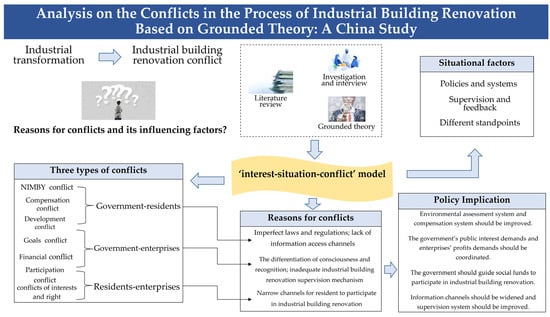
With the transformation of industry in China, and industrial production changes from an incremental economy to a stock economy, a massive renovation of industrial buildings and intensification of renovation conflicts coexist. Industrial building renovation conflict seriously affects industrial building renovation. Based on the Grounded Theory, this paper selects Ningbo City as the research area and builds the “interest–situation–conflict” model through investigation and interview, exploring the reasons for conflicts and the influencing factors of industrial building renovation. Situational factors for three types of conflicts, namely, government–residents, government–enterprises, and residents–enterprises, are greatly affected by policies and systems, supervision and feedback, and different standpoints, respectively. Based on the “interest-situation-conflict” model, this paper analyzes the reasons for the conflicts among government, enterprises, and residents and puts forward countermeasures to solve nimby (not in my back yard) conflict, compensation conflict, development conflict, goals conflict, financial conflict, participation conflict, and conflict of interests and rights, so as to promote the renovation of industrial buildings.

1. Introduction

Many countries are undergoing a transition from an incremental economy to a stock economy, where brownfield industrial building renovation is an important part of economic transformation and a research hotspot of global inefficient land redevelopment [1]. In the process of transformation, with the adjustment of industrial structure and the development of urbanization, many industries in the city have transferred to the suburbs of the industrial zone. As the original industrial zone is usually located close to the city center, it is necessary to redevelop the buildings on the urban brownfield sites. Post-industrial areas have been created as the main body to stimulate urban vitality. For the needs of warehouse management, we are observing the process of absorption of suburban areas for warehouse management purposes. It should be noted that the above processes, with varying intensity, have been observed in European countries for many years. There is a process of reduction and disappearance of industrial activity near the city center [2]. Post-industrial development projects are being contracted by residential developers, while economic development zones are being created in industrially concentrated suburbs. This process is known as the revitalization of post-industrial areas, and in warehouse economic activity areas are described as areas where local resources are used more efficiently [2]. However, there are many challenges with industrial building renovation [3]. From a global perspective, the return of transnational corporations has led to a decrease in foreign direct investment. From the national or regional point of view, the growing conflicts between industry, population, resources, government finance, and urban renovation funds will be seriously affected. These aspects will result in a reduction in funding sources for industrial building renovation. Currently, the regulation and exploitation of industrial buildings in China is still in its infancy stage, and some risks exist in technology, economy, management, policy, and law. Xu et al. [4] pointed out that mature modern technologies such as prefabrication and assembly have reduced the marginal cost of semi-industrial and industrial construction and provided a more economically viable option for industrial building renovation. Prioritizing the effective development of industrial buildings remains a challenge, given environmental, economic, and social constraints. Liu et al. [5] pointed out that the purpose of evaluating the value of industrial heritage restoration projects is to effectively use green technology, reduce construction cost, protect industrial heritage, and inherit historical culture. Furthermore, there are many uncertain factors in the development process of these projects, such as brownfield pollution, house dilapidation, etc. Appropriate transformation strategies can maximize the value of heritage and minimize potential safety hazards. The process of industrial building renovation involves many interest-related groups, such as the government, developers, polluting enterprises as well as community residents, so it is certain that conflicts will occur [6]. It is necessary to analyze the reasons and influencing factors for conflicts to lessen the barrier and reconcile the interests of different groups.
Scholars have carried out much research on the renovation of old industrial buildings, involving value assessment, interest-related groups, environmental factors, laws, and policies of renovation. Tian et al. [7] proposed that in the decision-making stage of industrial building renovation, a reasonable vulnerability analysis should be conducted on the old industrial zone. In China, industrial buildings could be dated back to the construction of some highly polluting industrial enterprises 50 years ago or earlier during the “Great Leap Forward”. Most factories were built in or around the city because early industrial planning did not emphasize environmental factors. Industrial building pollution was serious because of extensive management and imperfect environmental protection measures [8]. With the improved public awareness of the environment, problems of China’s brownfield building control started to be known by the public. The strong development of the real estate market has become an important driving force for industrial building renovation to a large extent. But industrial building renovation faces up to great social group risk [9]. On the one hand, there is the contradiction of control stakeholders in industrial building renovation. In other small and medium-sized cities, the government and the public have little knowledge about industrial buildings. Meanwhile, the cost of industrial building renovation is also too high to be subsidized by real estate development. This leads to conflicts between government and real estate developers in terms of industrial building renovation costs [10]. On the other hand, there is a conflict between interest stakeholders in industrial building renovation. The absence of law, the chaos of the market, difficulties of public rights protection, and a series of problems will make the government, developers, and the public fall into conflicts of interest, causing a severe problem that impedes the sustainable development of Chinese cities. International research on the types of conflicts in the renovation of industrial buildings focuses on conflicts between government and residents, between government and enterprises, and between residents and enterprises [11]. Clarifying the relationship between stakeholders is the basis for clarifying the types of stakeholders. Yang et al. [3] argued that developers (traders or investors) and government agencies (such as companies, environmental agencies, or regional development agencies) were interdependent, form a certain alliance through the economic interests or other relationships, and introduce other actors into the development process to make joint progress in the process of industrial building renovation. On the contrary, Zhou et al. [4] pointed out that interest stakeholders had conflict in their pursuit of different interest preferences in the process of industrial building renovation.
This study aims to reveal the root causes and situational factors for conflicts and to clarify the relationships between stakeholders in the process of industrial building renovation. The research of this paper is helpful in solving the problems of industrial building renovation. Firstly, China’s special land ownership system and the dual structure of land administration have resulted in the particularity of certain stakeholder identities and the uniqueness of the root causes of conflicts in the process of industrial building renovation across China. Based on China’s environment, this paper proposes conflict resolution measures for industrial building renovation. Secondly, resolving the conflicts of interest among local governments, polluting enterprises, developers, and community residents in the process of industrial building renovation can effectively curb a series of serious environmental problems. Therefore, gaining insights into the root causes of conflicts is of great significance to resolving the conflicts of interest between stakeholders and promotes scientific approaches to industrial building renovation.

2. Literature Review

2.1. Industrial Building Renovation

Scholars have summarized different concepts of industrial building renovation by the practice. For example, Tokede et al. [12] defined it as any construction that was not fully exploited and used. Wedding et al. [13] argued that industrial buildings were created by the abandonment of industrial sites due to socio-economic changes and poor industrial performance. There are many classification methods for building types. According to the nature of the use of buildings, they can be divided into productive buildings and non-productive buildings. Non-productive buildings include civil buildings, which are specifically subdivided into residential buildings and public buildings while productive buildings include industrial buildings and agricultural buildings. In terms of the form of buildings, they can be divided into residential buildings, public buildings, agricultural buildings, and industrial buildings. According to the height of buildings, they can be divided into the underlying or multistorey civil buildings, high-rise civil buildings, and high-rise buildings (Unified standard for civil building design GB50352-2019). Industrial buildings are buildings that provide workplaces for production products that meet the needs of production activities, including production buildings, auxiliary production buildings, power buildings, storage buildings, transportation buildings, etc. [14]. Civil buildings refer to non-productive residential buildings and public buildings, including residential buildings, office buildings, kindergartens, schools, canteens, theatres, hospitals, hotels, exhibition halls, shops, and stadiums [15]. Agricultural buildings refer to buildings used for agricultural and animal husbandry production and processing, including greenhouses, livestock and poultry farms, food and feed processing stations, agricultural machinery repair stations, etc. [16]. Compared with other building types, the production process of industrial buildings is complex and diverse. In terms of design coordination, use requirements, indoor lighting, roof drainage, and building structure, it has the characteristics of production process demand, waterproof and drainage structure complexity, equipment and pipeline installation and construction complexity, heavy structure bearing, heavy load, large open space and large width [17]. It can be seen that compared with other building renovation, industrial building renovation is a complex project involving the problems of capital, environment, and technology, especially the conflict between different interest groups, which hinders the transformation of industrial buildings.
Many studies focus on the discussion of interest-related groups. Rizzo et al. [18] divided the interest-related groups into several parts, including the government agency, local authoritative agency, landowners, developers, community residents, contractors, financial institutions, news media, and inquiry agencies, etc. Ongpeng et al. [19] rearranged the categories of stakeholders into five groups of stakeholders with similar characteristics, including site owners, authorities, problem holders, service providers, the scientific community, and research. Yang et al. [3] believed that stakeholders of industrial building renovations include elected officials, investors, developers, private business owners, lawyers, environmental professionals, private practitioners in multiple fields, community representatives, and university experts—essentially anyone interested in reviving a volatile region. However, Glaser et al. [20] believed that the main interest-related groups are the city government, industries that cause pollution, developers, and local community residents, among which the local residents take the least active part because they know little about the price evaluation of the industrial buildings and they care little about it. In addition, in the process of renovation, different interest-related groups will have conflicts because of interest. [21] Increasing interdependence among stakeholders has led to conflicting interactions as one of the most important causes of difficulties in industrial building renovation. However, Mutula [21] stressed that stakeholder groups or their interests may change during the project and renovation phases. Therefore, stakeholder analysis should be repeated at each stage, or when (significant) changes occur, such as boundary conditions or participants. Industrial building renovation conflicts are also affected by other stakeholders, such as local government, environmental associations, environmental remediation companies, etc. [22].
Furthermore, studies on environmental factors cannot be neglected, as buildings are always a mixture of physical, chemical, and biological land attachments [23]. Buildings have a cooling effect on the microclimate of a city and their renovation can lead to urban densification and a loss of cooling effects [24]. Soil metal pollution in buildings has also caused great concern for the environment and public health [25], so the renovation of buildings will always lead to environmental risks. Therefore, many documents have proposed measures for building restoration from a technical perspective. For example, Li [26] put forward the regulation mode for polluted buildings and its technical and economic analysis based on environmental risks. To mitigate environmental risks, Gontia [27] studied the coarse-scale (herbs, shrubs, and forests) beta trajectories in urban buildings. To lower the environmental risk, it is necessary to restore the buildings before the renovation. The technology for building restoration can be divided into phytoremediation, physical remediation, chemical remediation, and bioremediation [8]. However, Wu et al. [28] and Desouki and Feng [29] assumed that compared with traditional metal-contaminated chemical–physical remediation methods, phytoremediation plant stabilization technology is cost-effective and environmentally friendly.
Moreover, studies on renovation laws and policies prevail. For instance, Diaz-Lopez et al. [30] and Kris et al. [31] analyzed that the government should improve laws concerning the economy and environment from a macro perspective in order to promote the renovation of industrial buildings. As a result, financing has been a major challenge for many countries in addressing industrial building renovation. Many studies have made suggestions on financing issues. For example, Albrecht and Hamels [32] explored government funding, insurance claims, and cost recovery of initial polluters are the three financial mechanisms of industrial building renovation. Sroka [33] examined, as a result of lessons learned in other jurisdictions, how “tax incremental financing” has become an effective tool for promoting the renovation of industrial buildings. Although most of China’s brownfield industrial building renovation is mainly funded by the government, public-private partnerships (PPPs) may be an important and effective way to finance future industrial building renovation projects [34]. In addition, Lind et al. [35] pointed out that industrial building renovation policies should focus on market-oriented incentives such as indirect incentives, gap funding, etc. Petr Klusáček et al. [36] believed that good governance is a broad-based, inclusive strategy with economic resources to maximize its potential for industrial building renovation. Blokhuis et al. [37] proposed a new maintenance structure, focusing on the long-term strategic goals of various buildings, and made short-term adjustments when new information appeared. Attolico [15] proposed the implementation of a “community resilience” policy in territorial planning, applying it to local and urban planning and strategic actions by introducing risk mitigation directives and recommendations to enable local actors, the private sector, and the community itself to participate in the implementation of resilience. This represents a transition from a standard-based regulatory system to a performance-based system under which environmental, financial, and other risks can be effectively assessed [38].
However, there are few laws about industrial building renovation in China [39]. Based on the practical experience of the UK, VanFleet et al. [40] proposed suggestions for improving the management of contaminated land in China from the aspects of legislative and policy framework, regulatory structure and capacity, technical methods, and incentive measures for the reuse of contaminated land. Policies concerning industrial building renovation should not only be established from the land disposition but also from the intensive use of land. To sum up, nowadays, scholars both at home and abroad focus their research of industrial building renovation on the following four aspects. (1) The role of interest groups: stakeholder groups have conflicts due to different interests, which hinders the renovation of industrial buildings. (2) Environmental impacts: the renovation of buildings will always lead to environmental risks, including urban densification, the loss of cooling effects and soil metal pollution, etc. (3) Policies and laws: the policies on the economy, environment, financing issues, market-oriented incentives, and strategic plans should be improved.
Most studies have concentrated on the experience of developed countries. As China is still a developing country where industrialization and urbanization started late, the studies on industrial building renovation are not sufficiently profound. Few extant studies concern the reasons for the conflicts in industrial building renovation. Notably, analysis of the causes of industrial building renovation in China points to a growing conflict between a global perspective (reduction in foreign direct investment due to the return of multinational corporations) and a national or regional perspective of industry, population, resources, government finance, and urban renewal funding. It is of great value to study the different types of conflicts in the reconstruction of industrial buildings for global or regional development in the post-industrial era.

2.2. Types of Conflicts in the Process of Industrial Building Renovation

A conflict is a natural and normal discord in which the aims, goals, and values of different individuals or groups are incompatible. Individuals or groups will inevitably obstruct others from achieving their goals [41]. Industrial building renovation stakeholders refer to individuals or groups that are influenced or exert influence in the process of industrial building renovation. These individuals or groups include both contemporary and future generations. Stakeholders include supervisor groups (government) such as the Ministry of Land and Natural Resources, and local governmental authorities, supervised groups (enterprises) such as land developers and polluting enterprises, and social supervisory groups such as local community residents, etc. [27]. Some scholars summarize the types of conflict as relational conflict, status conflict, process conflict, and task conflict. These conflicts involve incompatibility in identity, ideology, values, how roles and responsibilities should be assigned, etc. [23]. Santos et al. [42] argued that property conflict, resource conflict, and development conflict are the three main conflicts in industrial building renovation. In summary, different stakeholders, including government, enterprises, and residents, pursue different interests in industrial building renovation, leading to three types of conflicts: conflicts between government and residents, conflicts between government and enterprises, and conflicts between residents and enterprises.
Firstly, some studies centered on conflicts between government and residents, including nimby conflict, responsibility subject conflict, and compensation conflict. Nimby (short for “not in my back yard”) refers to public opposition to the construction of certain public facilities in urban development. Nimby conflicts arise from local residents’ different perceptions of the benefits and losses brought about by the development of certain projects. While nimby facilities benefit the wider public, they can have negative environmental, health, safety, economic, and social impacts on nearby communities [43]. Empirical research shows that the existence of nimby conflicts makes residents distrust local government [44]. Key issues include public participation, environmental assessment, and the gap between policy development and rapid urban growth. Public opposition to nimby facilities was stoked by tough stability measures [45]. Wolfram et al. [46] have observed that the public protests targeted decision-making bodies, not industrial building renovation projects. In explaining the institutional cause of industrial building renovation conflicts in China, XIN et al. [47] stated that the weakened functions of the work unit and the communities’ design have resulted in community residents protesting industrial building renovation facilities around their communities against the local government, rather than against their work unit. Residents and local government often have gaps in compensation goals [28].
Secondly, some studies explore the conflicts between government and enterprises, including goals conflict, governance responsibility conflict, and financial conflict. There is a conflict between enterprises’ goal of developing resources and government’s requirement of realizing public interest [15]. The environmental conflict between government and business is most intense [48]. As rational economic individuals, to maximize their interests, land developers attempt to obtain huge profits from industrial building renovation. Meanwhile, they are worried about the potential risks arising from pollution under government’s environmental policy regulation [30]. Polluting enterprises are makers of polluted buildings. With the principle of “Whoever causes pollution should make compensation”, polluting enterprises are duty-bound to bear the industrial buildings pollution compensation and renovation expenses. However, if polluting enterprises are not identified or go bankrupt, funds for industrial buildings’ pollution control and renovation expenses are a hard nut to crack [49]. Wright et al. [50] argued that land trusts and land banks could help enterprises solve the funding problem of industrial building renovation, mitigating financial conflict between government and enterprises in industrial building renovation.
Finally, other studies concern conflicts between residents and enterprises, involving participation conflict, conflict of interest, and scheme conflict. According to findings by Healey [51], many of the industrial building renovation projects implemented by enterprises were completed based on opinions and suggestions from technical experts without sufficient community residents’ participation. He also stressed the need to strengthen the community residents’ awareness of participation in future renovation planning. Public participation in the urban planning process is needed for the renovation of buildings [52]. In the renovation of cultural tourism buildings, local residents want to get more benefits, and tourism developers want to get the greatest benefits, which creates a conflict of interest [53]. Some residents who opposed the compensation offer allied themselves to increase their influence as authorities. They expressed distrust of Yitian, a real-estate company, on posters posted at key locations in Mutoulong, a residential place. The developer-led approach has led to the segregation of cooperation and conflict amid heavy financial investment [37]. As the company’s operating model uses urban practices and technology, and the spatial configuration of the area is urban infrastructure and services, this has triggered new conflicts in the daily lives of rural residents.
Scholars carried out extensive research on stakeholders’ conflicts in industrial building renovation. From the above-mentioned studies, stakeholders are the key to handling industrial building renovation. Research on stakeholders’ participation in industrial building renovation is becoming more and more important, such as stakeholders’ conflict and cooperation, and interest distribution. This shows that industrial building renovation seems to be moving toward a “people-oriented” direction. However, it seems that few scholars pay attention to the reaction of residents during and after the renovation, such as the impact of outdoor elevators in stagnation on residents living at the bottom. Therefore, we can further study the true feelings of the residents during and after the transformation. In addition, most scholars analyze the types of conflicts from one aspect, without considering the conflicts among government, enterprises and residents synthetically. As industrial building renovation involves different driving factors, the root causes of conflicts among stakeholders still need to be ascertained. By means of analyzing the inherent logic of the conflicts in industrial building renovation, these conflicts can be practically resolved.

3. The Process of Conflict Model Building

3.1. Definition of Conflict Types

The conflicts in this study refer to those in the renovation of industrial buildings, mainly including three types of conflict subjects: namely government, residents and enterprises. There are three conflict situations among the three types of conflict subjects, including policies and systems, supervision and feedback, and different standpoints. In different conflict situations the specific conflict is different. The conflicts between government and residents include nimby conflict, compensation conflict, and development conflict. The conflicts between government and enterprises include goal conflict and financial conflict. The conflicts between residents and enterprises include participation conflict and conflict of rights and interests. Different types of conflicts will be affected by different factors, such as interest demand, policies and systems, supervision and feedback, standpoints and so on.

3.2. Materials and Methods

3.2.1. Study Area

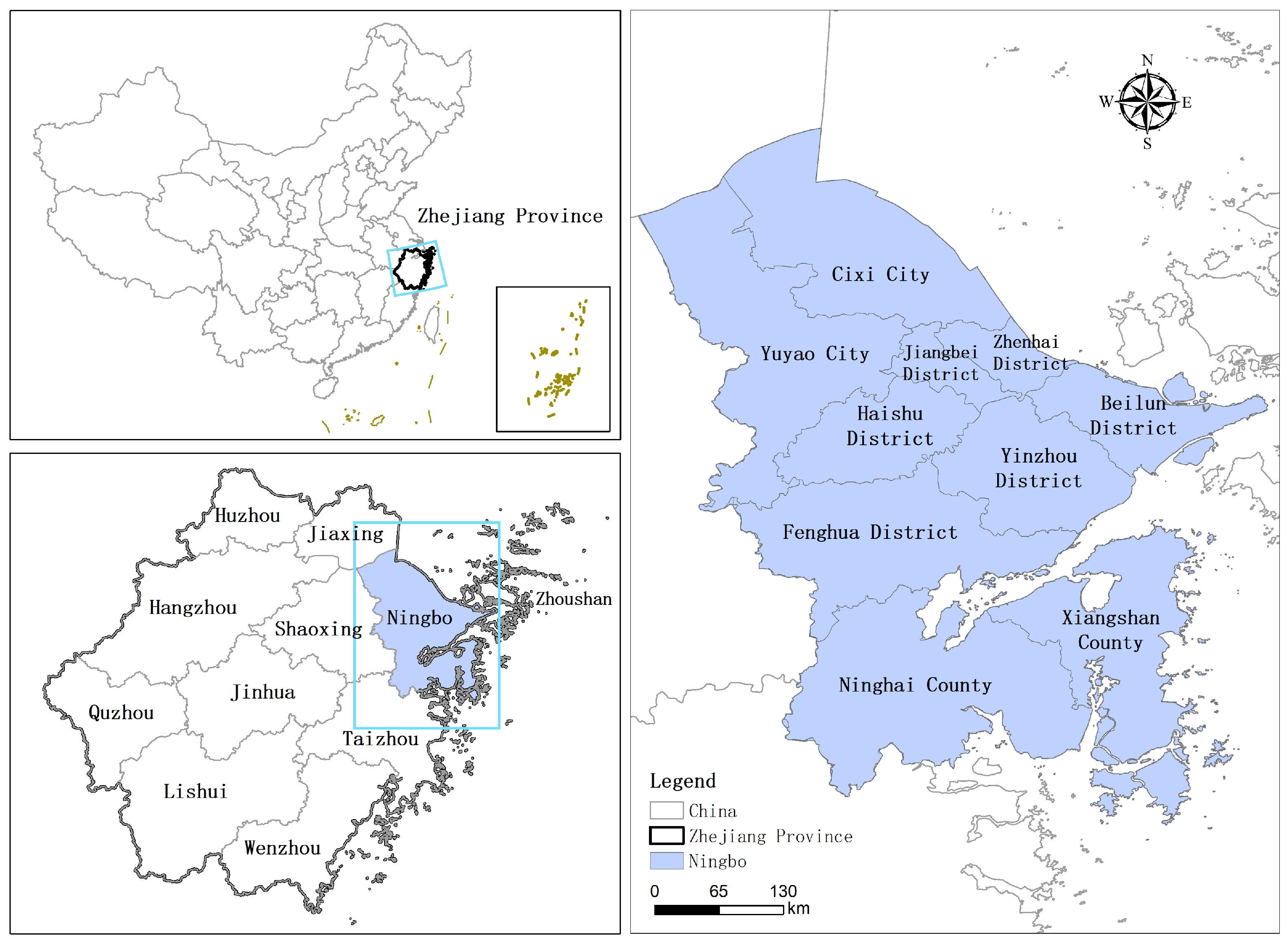
This paper takes Ningbo City as the research city, as shown in Figure 1. In 2018, the Ningbo Municipal People’s Government issued the “Implementation Opinions on Promoting the Work of Urban Organic Renovation”. Ningbo’s urban renovation is at the forefront of the country. Its urban renovation focuses on improving urban quality and creating a “coastal metropolis”. Guangdong Province has carried out urban renovation earlier and has certain reference significance, but its urban renovation is more inclined to the market-oriented model dominated by the public. Although this model is applicable in Guangdong Province, it is difficult to promote in the whole country. Government-led and market-involved renovation models might be more suitable in other provinces in China. Ningbo urban renovation mainly takes a government-led and market-involved model, which is more suitable for China’s present situation and easy to spread to the whole country. Ningbo takes the comprehensive improvement of the whole land space as the starting point to promote the renovation of industrial buildings and improve the quality of the city. Therefore, Ningbo is more representative when discussing multiple stakeholders.
Figure 1. Research location map.

3.2.2. Data Source

The relevant variable category, the chart for measurement, and the theory model need to be explored concerning the reasons for the conflicts between the interest-related groups in the industrial building renovation process. From the investigation, most people did not have a good understanding of the brownfield buildings. Therefore, designing a structured questionnaire for the public could not get satisfactory results. This study adopted a non-structured questionnaire and got first-hand material from the interviewees, and the qualitative research method is used to explore the reasons for conflicts model in the industrial building renovation. We use stratified sampling and random sampling to select areas. First, we use stratified sampling to select different administrative regions according to the ratio of GDP per area to per capita income. Then, we used the random sampling method to choose government officials and community residents in selected districts and counties for interviews. The community residents are those people who live near the industrial buildings, including those who always pass by the place, as they can give direct experience and they are the most easily contacted people and most influential group in the face of fierce conflict. The selection of samples in this paper mainly considers the following three aspects: (1) industrial building renovation occurs in the distribution range of the study area. The renovation areas of industrial buildings in Ningbo are mainly distributed in Fenghua district, Jiangbei district, Yinzhou district, and Xiangshan county. (2) This paper focuses on the conflict of interest between different groups in the transformation of industrial buildings; therefore, when selecting typical samples, the selected samples should be related to the transformation of industrial buildings. (3) At the same time, the selection of typical samples also conforms to the methods and requirements of statistics and Grounded Theory. According to the above principles, the investigation samples were Fenghua district, Jiangbei district, Yinzhou district, and Xiangshan county. We selected 7 government officials, 8 enterprise managers, and 33 community residents to conduct in-depth interviews which lasted about 1.5 h of interviews per person, and obtained a large number of initial data. Through field research and interviews, we understand the reasons and influencing factors behind the conflict of industrial building renovation, and obtained 48 valid samples, as shown in Table 1.
Table 1. The data of sample districts and counties.

3.2.3. Grounded Theory Approach

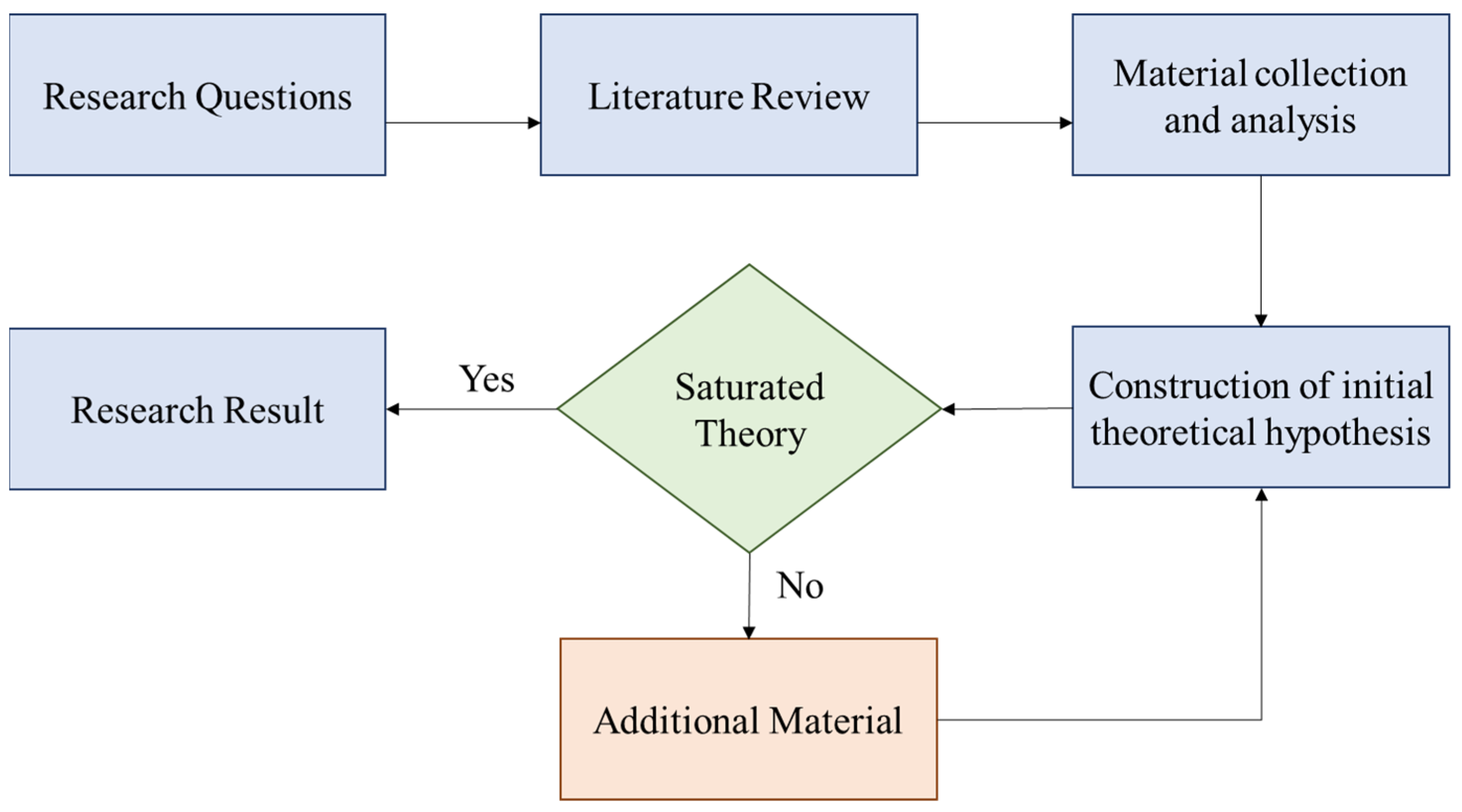
The perception of industrial building renovation conflict is a subjective feeling. It is not easy to accurately measure the influencing factors and reasons for industrial building renovation conflict by quantitative methods. Therefore, the qualitative research method is more popular. This paper adopts the Grounded Theory qualitative research method. Grounded Theory was developed by Glaser [20] and is a research method aiming at applying informative materials to building substantive theory from the bottom up. It follows the main idea of carrying out induction, deduction, comparison, and analysis through scientific logic, spirally and gradually upgrading the abstract level of concepts and their relationships to ultimately develop a specific theory. According to Glaser’s relevant works, the research process of classical Grounded Theory is divided into four stages: generating research questions, data collection, data processing, and theoretical construction [20]. In the process of generating research questions, the classical Grounded Theory emphasizes the natural emergence of research questions; that is, researchers must enter the research situation with a general and vague interest in a certain aspect of the problem at the beginning of the research, and naturally discover and propose research questions in the observation of the situation and the interaction of different subjects in the situation. In the process of data collection, the sampling method of the classical Grounded Theory is a theoretical sampling; that is, the sampling and data collection of the next research conducted by the researchers is guided by the concepts, categories, or theories formed in the research process. In the process of data processing, open coding and selective coding are conducted. In the process of theoretical construction, theoretical coding is conducted. Different from the general theory, Grounded Theory does not make logical deductions by reasoning assumptions pre-set by research personnel in advance but rather makes deductions and analyses based on materials. Theoretical abstraction points are not only derived from sentences and dialogues in materials but also are derived from abstract overviews, which comply with strict scientific principles and retain a certain degree of flexibility in terms of methodology.
This paper adopted Grounded Theory for the technical study. It is hard to put forward relevant theoretical hypotheses before investigation. It is through investigation that we could get some original material to sum up the concepts and refine the core category, and then explore the relationship between these concepts and categories to form a theoretical hypothesis. The operating procedures of Grounded Theory generally include five steps: generating concepts from materials and entering materials step by step; continuously comparing materials and concepts, systematically exploring generative theoretical issues related to concepts; developing theoretical concepts and establishing connections between concepts; theoretical sampling and systematic encoding of materials; constructing the theory, and striving to obtain density, variability and high integration of theoretical concepts. In this process, the core operation is to make clear the scope of materials through open encoding, principal axis encoding, and selective encoding, and to identify the nature of such complicated and intertwined essential relationships between scopes. The research methods mainly include open encoding (first encoding), principal axis encoding (second encoding), and selective encoding (third encoding).
Among them, open encoding is a process for decomposing, verifying, comparing, conceptualizing, and categorizing materials. Principal axis encoding is a process for linking various scopes derived from open encoding together through a typical encoding model, i.e., “causality condition—phenomenon—context—intermediary condition—action interaction strategy—result”. Selective encoding is a process for selecting core scope, systematically connecting it with other scopes, verifying the relationship between them, supplementing, and standardizing such scopes that have not been fully conceptualized yet. The study will adopt the research technology to construct the mode of the reasons for conflicts in the renovation of industrial buildings, and in the process of material analysis, the theoretical hypothesis will be amended constantly until it is theoretically saturated. The procedures are shown in Figure 2:
Figure 2. Research Procedure.

3.3. Model Building Based on Grounded Theory

3.3.1. Open Encoding

Open encoding means to encode, label, register, and analyze the first-hand materials word by word, conceptualize those materials and further categorize them. In order to avoid subjective prejudice, this paper labeled the original words of those interviewees and tried to dig out the original concept. According to the above-mentioned methods and procedures, 660 original sentences have been selected and some initial concepts have been extracted. As the number of initial concepts is too large, the contents are various, and some are repeated, the initial concepts that appear less than three times and those contradictory concepts are deleted. Then the initial concepts are categorized into 15 categories. Category construction is mainly through induction and summary, bottom-up analysis of the collected data. Category construction is also a dynamic process of continuous comparison. Researchers constantly compare data with data, theory with theory, and then extract relevant categories according to the relationship between data and theory. At the same time, researchers need to maintain a certain sensitivity to the theory to help discover concepts that can express data content more concisely. Table 2 shows the process of conceptualization and categorization of the reasons for the appearance and influence of conflicts in the renovation of industrial buildings.
Table 2. The process of conceptualization and categorization in the open encoding.

3.3.2. The Principal Axis Encoding

After the open encoding, the abstract summary of first-hand material is completed and some independent categories are obtained. The relationship between different categories should be studied in detail. The principal axis encoding is to provide a clustering analysis after discussing different relationships and finding out their potential relevance in establishing the relationship between the main category and subsidiary category. This study analyzes the possible relationship between different initial categories in open encoding and explores the internal logical relationship between the 15 initial categories that affect the conflict of industrial building renovation. In the process of principle encoding, we always paid attention to maintaining the strictness and mutual exclusion of the initial category relationship. Through refinement and grounded analysis of the 15 initial categories obtained in open encoding, the potential logical relationship between the 15 initial categories that affect the conflict of industrial building renovation was clarified again. Finally, 15 initial categories are integrated into the logical relationship of the 4 main categories, as shown in Table 3.
Table 3. The process for principal axis encoding.

3.3.3. Selective Encoding

Selective encoding extracts and obtains the core category from the main category, explores the relationship between the core category, the main category, and the subcategory through the “story line”, and gives a clear structure. Thus, the new theory model for the research object will be built. Table 4 shows the typical relational structure of the main categories.
Table 4. Typical relationship structure of the main categories.
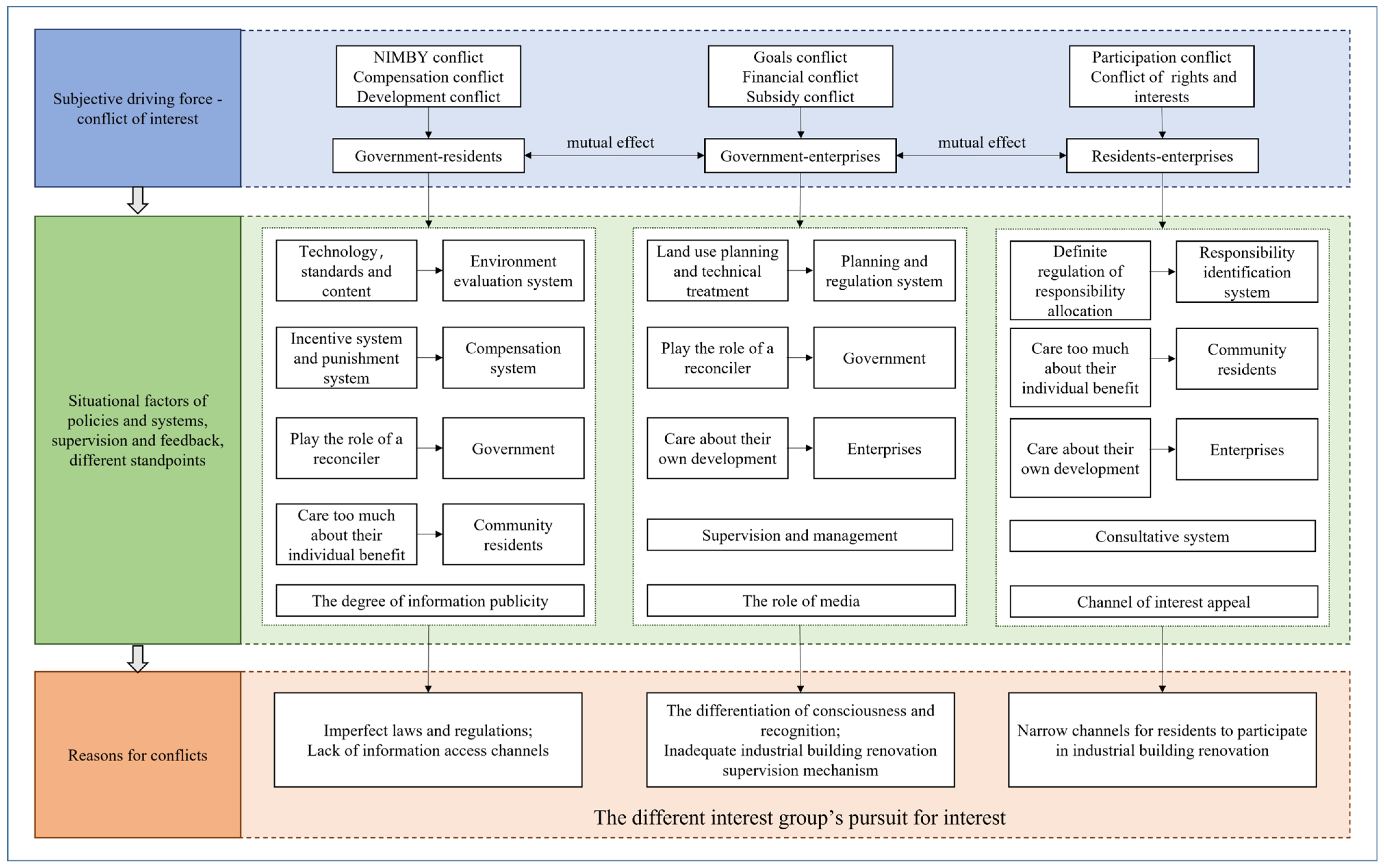
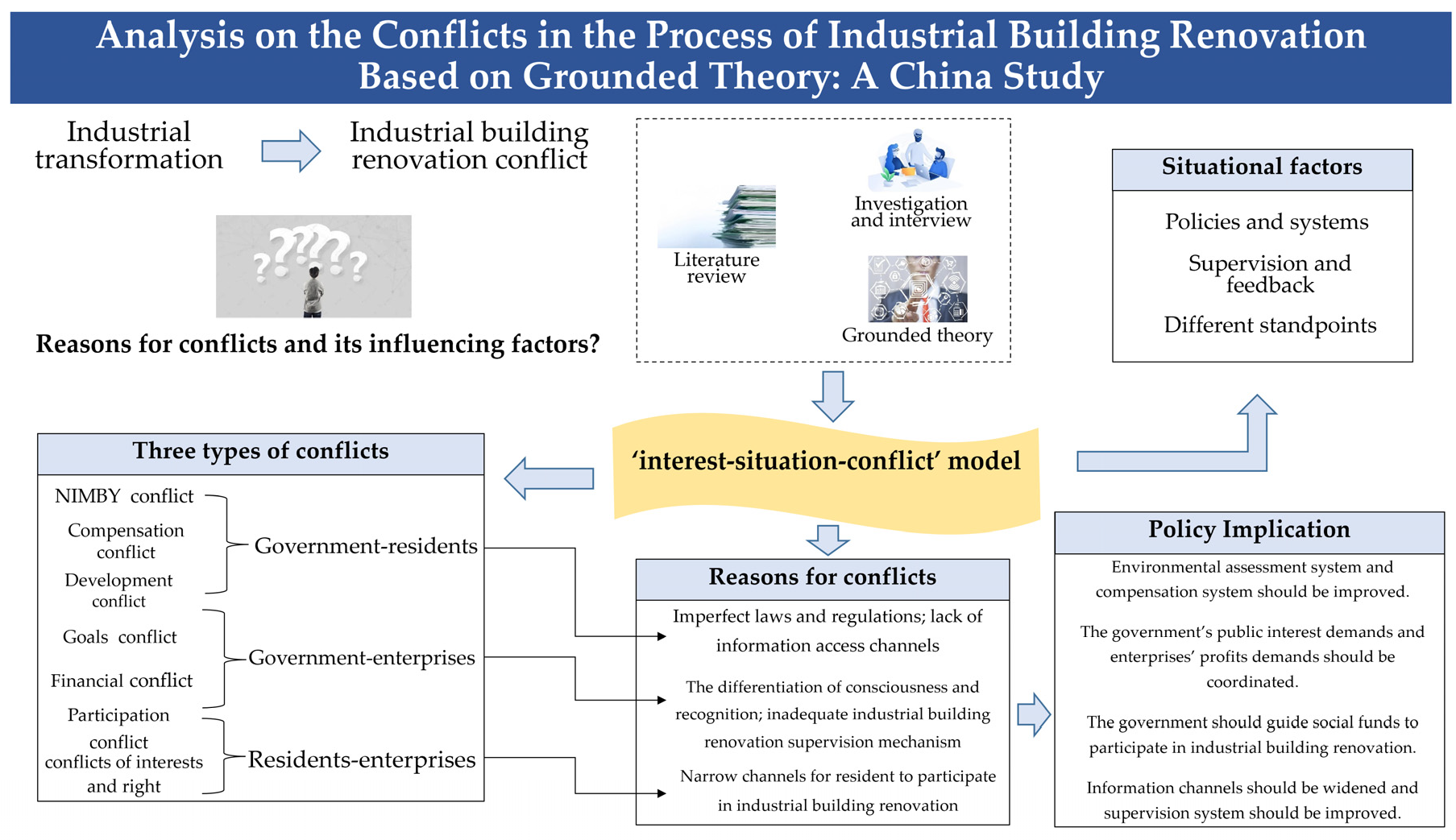
After research analysis, this paper confirmed that the core categories are the reasons and influencing factors for the conflicts in the renovation of industrial buildings, and surrounding this core category, the “line of the story” is summarized as the influence, which is brought by the 4 main categories, namely, interest contradiction, different standpoints, policy and system as well as supervision and feedback. The interest contradiction is the principal reason which forms the motivation factor of conflicts. Different standpoints, policy and system, along with supervision and feedback reconcile the benefit and contract with the former as subjective situational condition, with the latter two as the objective situational condition. Based on the line of the story, a new model for the reasons and influencing factors of the conflicts in the renovation of industrial buildings is built, which could be briefly referred to as “interest–situation–conflict” model, as shown in Figure 3.
Figure 3. The interest–situation–conflict model.

3.3.4. Saturation Test

Grounded Theory research is a process of drawing conclusions after sufficient theory appears in the data. Data is saturated when data collection is no longer conducive to describing the object being studied. In this study, eight community residents were randomly selected for the saturation test, and their original interview data were randomly selected for open coding, principal axis coding, and selective coding. In the process of analyzing the original data, there is no new main category and core category, indicating that the reasons and influencing factors of the conflict in the transformation of industrial buildings in Ningbo have been fully explored.

4. The Interest–Situation–Conflict Model Interpretation in the Process of Industrial Building Renovation

4.1. Reasons for Conflicts

Based on the above analysis, we built the “interest–situation–conflict” model, which was divided into three types of conflict subjects, three types of conflicts, and three conflict scenarios. Among them, the three types of conflict subjects included government, enterprises and residents; the three types of conflicts included the conflict between government and residents, the conflict between government and enterprises, and the conflict between enterprises and residents. Among them, seven types of conflicts were subdivided, including nimby conflicts, compensation conflict, development conflict, goal conflict, financial conflict, participation conflict, and conflict of rights and interests; the three conflict scenarios include policies and systems, supervision and feedback, and different standpoints. Specific analysis is as follows: The different interest groups’ pursuit for interest, including the interest of the government, the developers, the polluting enterprises, and the community residents, is the major cause of the conflicts in the renovation of industrial buildings. As the rational economic men, all interest-related groups will take every measure to maximize their interest and at the same time avoid hurting their own interest.
The conflicts between the government and residents mostly occur in the context of policies and systems and different standpoints. The importance of conflict types was ranked as nimby conflict, compensation conflict, and development conflict. As the distributor and manager of public resources, governments are prone to conflict with other interest groups in the renovation of industrial buildings. On the one hand, there are many conflicts between the government and the residents. Community residents are more concerned about the living environment. When the government implements industrial building renovation projects around residential areas, residents will worry about environmental pollution. Errors in environmental assessment, inadequate pollution compensation, and insufficient ecological restoration will aggravate residents’ opposition, resulting in strong nimby conflict and compensation conflict between government and residents, and even direct cancellation of projects.
The conflicts between government and enterprises mostly occur in the context of supervision and feedback and different standpoints. The importance of conflict types is ranked as goals conflict and financial conflict. There are also many conflicts between government and enterprises. As the defender of public interests, the government must clarify its responsibility to improve land utilization, protect the ecological environment and improve the living environment of residents. The facilities and technologies of these old enterprises are outdated, and the cost of pollution emissions increases. They had to give up their good position and obtain a large amount of compensation for their survival. In the process of industrial building renovation, developers aim at location advantages, such as town centers, industrial and commercial hubs, or areas of higher commercial value. The inconsistency between the goals of the government and the enterprise will lead to goal conflict. The government wants to introduce social capital to participate in the renovation of industrial buildings to alleviate financial pressures while polluting enterprises want to obtain government compensation through relocation. Developers are reluctant to make investments solely by themselves but want to obtain bank loans to play the role of economic leverage to obtain greater economic profits. Funding conflicts arise.
The conflicts between enterprises and residents mostly occur in the context of supervision and feedback and different standpoints. The importance of conflict types is ranked as participation conflict and conflict of rights and interests. With economic and social development, the public begins to concern more and more about environmental problems. Studies showed that the amount of heavy metal lessened in the residential places constructed on industrial buildings, and there was less health risk than in the original industrial buildings. Residents show greater enthusiasm for participating in industrial building renovation. However, due to the lack of information access channels, residents cannot obtain relevant information, such as land types before redevelopment, pollution degree, harm to people’s health, land use after redevelopment, and other information. Enterprises to implement building updates did not consult the views of residents, which is easy to bring participation conflict. For the sake of maximizing the benefits, the renovation model adopted by enterprises may not be suitable for the living habits and living concepts of local residents, which may easily lead to conflicts of rights and interests. Due to information asymmetry and lack of investigation of residents, it is easy to cause supervision and feedback problems. Enterprises are less supervised and easy to damage the public interest.

4.2. The Regulatory Mechanism of Situational Factors to Interest–Conflict Relationship

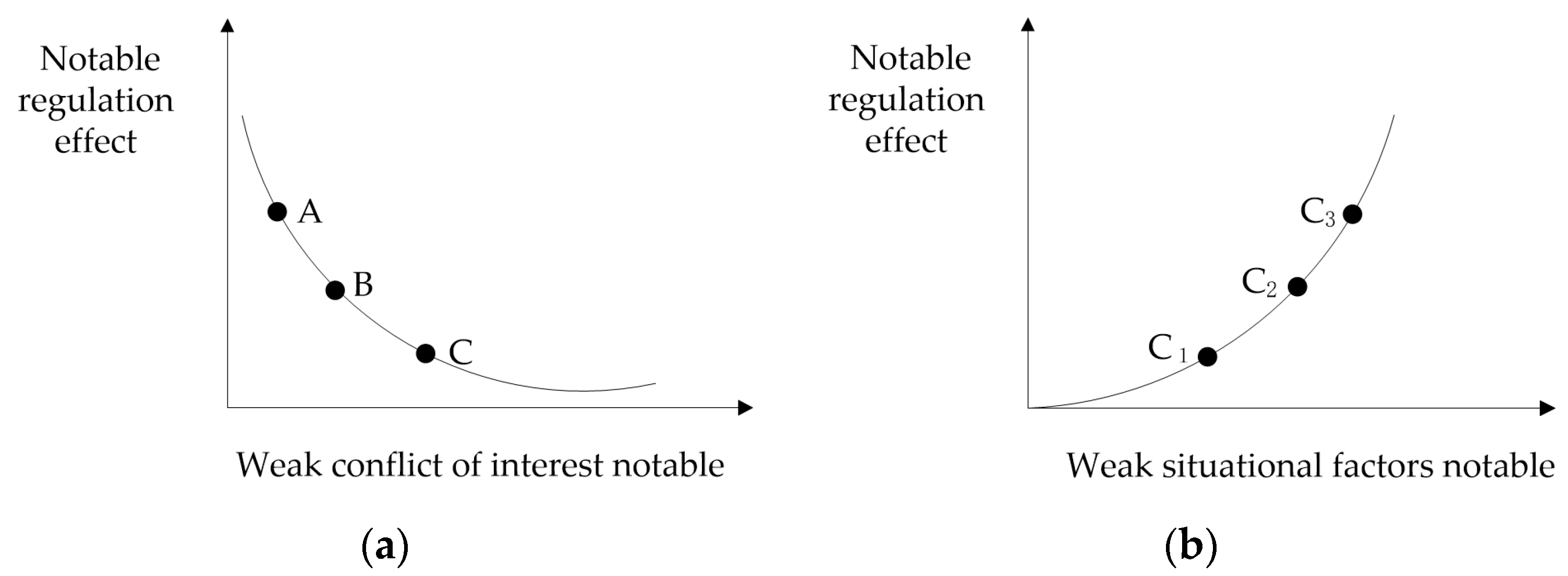
Conflicts among government, enterprises, and residents are the subjective driving forces that influence industrial building renovation, which affects the degree of interest pursuit of every part and drives the conflicts. The policies and systems (namely, the environmental evaluation system, compensation system, responsibility identification system, as well as planning and managing system) and supervision and feedback (namely, the publicity of information, the role of media, access to benefit appeal, supervision power, etc.), are the objective situational factors for the conflicts in the industrial building renovation, and they are also the outer driving forces and objective condition for the interest–conflict. Different standpoints, policies, and systems, as well as supervision and feedback, reconcile the interest–conflict relationship from the strength and direction. When the three situational variables give weak influence, or they give strong influence but have different directions in regulation, the driving relationship of interest-conflict can be reflected clearly. When the three situational variables give a strong influence, or the three have the same strength and direction, they will promote or restrain the conflicts in industrial building renovation, which shows that the driving relationship is the weakest. In addition, the degree of regulation will be affected by different features of the situational variables. When the situational variable is the establishment of some policies and laws, the regulation effect will be obvious. On the contrary, the regulation effect will be weak. The relationship between the interest contradiction and regulation effect can be shown in Figure 4a, and the relationship between three situational factors and the regulation effect can be shown in Figure 4b.
Figure 4. The regulatory mechanism. (a) The relationship between regulation effect and conflict of interest; (b) The relationship between regulation effect and situational factors.
In Figure 4, A, B, and C represent the three different degrees of interest pursuit. When it is in the C point, the benefit and conflict tend to be consistent with each other, and the regulation effect of situational factors tends to be low. Accordingly, for a specific point of C, for example, when the situational factors give strong influence (as seen in point C3), the degree of consistency between benefit and conflict tends to be low, and the situational factors give better regulation. On the contrary, when the situational factors give weak influence (as seen in point C1), the degree of consistency between benefit and conflict tends to be high, and the situational factors give less regulation.

5. Policy Implication

Nimby conflict, compensation conflict, and development conflict are prone to occur between the government and residents. The policy recommendations proposed include the following three aspects: (1) nimby conflict focusing on environmental pollution and environmental assessment system should be improved. In China, environmental evaluation is still in its infancy. Technological innovation incentives and preferential policy systems of industrial building renovation environment assessment need to be improved. Environmental assessments involving building materials, use and maintenance, demolition and recycling need to be refined. Environmental assessment standards for industrial buildings need to be systematized and standardized. Therefore, the environmental evaluation technology, the evaluation content and evaluation criteria should be improved to build more mature environmental evaluation system. (2) Compensation conflict focusing on compensation and compensation system should be improved. The compensation system includes two aspects. First, if primitive enterprises seriously pollute the surrounding environment and the residents, they should be fined and carry out the environmental restoration of industrial buildings. Second, corresponding compensation should be given to those who participate in the treatment and prevention of pollution so that buildings in old industrial areas and the surrounding environment could be improved. (3) Development conflicts focusing on the development direction of industrial building renovation should be improved. The renovation of industrial buildings is a problem met in recent economic transmission in China, and there is no definite regulation for the responsibility allocation of interest-related groups. All stakeholders involved in industrial building renovation allocate the corresponding responsibilities according to their roles. The responsibilities and roles of government and residents are different. Only by clarifying their respective responsibilities and boundaries can we coordinate the development direction of industrial building renovation.
Goals conflict and financial conflict between government and enterprises should be paid attention. The policy recommendations proposed include the following two aspects: (1) goals conflict involving the realization of different interests should be resolved by coordinating government’s public interest demand and enterprises’ profits demand. Different interest-related groups have their own standpoints because of different positions, which lead to the differentiation of consciousness and recognition and, furthermore, influence the direction and degree of interest pursuit. In the early industrial building renovation planning, interests between enterprises and government should be balanced, and the common interests should be enhanced. For example, when the government wants to introduce social capital for industrial building renovation and enterprises want to make a profit, how to strengthen the common interest and weaken the individual interest is of great importance. On the one hand, the government should do a good job in the guidance to ensure public interests (such as the interest of public service construction). On the other hand, enterprises should have a chance to make profits and be actively motivated. Therefore, it is necessary to be clear about the contribution of enterprises and increase the common interest. In the renovation of industrial buildings in China, many community residents’ interests cannot be guaranteed, and it is difficult for enterprises to be responsible for a specific resident. (2) The key to resolving financial conflict is government’s guidance of social funds to participate in industrial building renovation. First, the government in the specific project decision-making, the need to liberate ideas, change the traditional simple “land balance” perspective of the way of accounting, asset management thinking, the establishment of “global balance”, “unit balance” mechanism, from the macro, meso, and micro perspectives to find a solution to the problem of industrial buildings to update the balance of funds financial strategies and measures. Second, in the field of urban renovation, the government should give full play to the guiding investment role of the parent fund, attract investment, and promote the development of the industrial building renovation industry. Third, the government and enterprises need to have an in-depth understanding of the emerging financial instruments in the market to help participants expand financing channels.
Participation conflict and conflict of interests and rights are prone to occur between enterprises and residents. The policy recommendations proposed include the following two aspects: (1) participation conflict involving information asymmetry should be resolved by improving the government information disclosure system. Meanwhile, information feedback channels should be smooth and social supervision should be strengthened. Participation conflict results from untransparent and asymmetrical information. The construction of industrial building renovation information publicity can help improve residents’ knowledge of pollution and updated benefits and reduce the misunderstandings and conflicts caused by information blocks. The government and enterprises should publicize the relevant information about the industrial buildings, including the pollution, the remaining hazardous substances, the treatment to be used, the use of redevelopment and measures, etc. (2) Conflict of interests and rights involving social supervision should be resolved by perfecting social supervision system and enriching social supervision groups. The consultative system should be improved. Residents are consulted on the issue of industrial building renovation by means of hearings. In addition, the law and supervision power should be enforced, and we-media should play an active role in propaganda and supervision. With the timeliness and globalization of modern media information, we-media could help transmit the information and supervise the carry out of policies and regulations and guarantee the maintenance and realization of interests.

6. Conclusions

Based on the Grounded Theory analysis and interview data, this paper summarizes three types of conflicts: government–residents, government–enterprises, and resident–enterprises, and builds an “interest–situation–conflict” model. On this basis, this paper analyzes the situational factors and reasons for conflicts in industrial building renovation. Three types of situational factors include different standpoints, policy and system, and supervision and feedback. The conflicts between government and residents, government and enterprises, and enterprises and residents are mainly caused by environmental pollution, different development directions and insufficient participation of residents. Three kinds of conflicts are subjective driving forces that affect industrial building reconstruction. When the interest conflict is large, the moderating effect of situational factors is often small. Specific situational factors have different regulating effects on different interest contradictions, and different situational factors have different regulating effects on the same interest contradictions. In order to solve the contradiction of industrial building renovation, it is particularly important to do the following work: Environmental assessment system and compensation system should be improved. The government’s public interest demands and enterprises’ profit demands should be coordinated. The government should guide social funds to participate in industrial building renovation, widen information channels and improve the social supervision system.
Industrial building renovation conflicts are also affected by other stakeholders [22]. In the process of industrial building renovation, local government plays a guiding role in implementing policies to ensure the realization of public interests [54]. Banks, investment companies, and other financial institutions act as financing intermediaries to reduce government financial pressure [55]. Environmental associations, ecological protection associations, and other public welfare organizations play the role of publicity and supervision to avoid individual parties’ interest pursuit [56]. Environmental remediation companies act more as outsourcing companies in industrial building renovation before the environmental remediation, repair, and pave the way for industrial building renovation [24].
Based on the research on the reasons and situational factors of conflicts, we will further study policies of industrial building renovation and the impact of comprehensive land consolidation on conflicts in industrial building renovation. This study is only conducted in Ningbo, and future studies will focus on other cities for comparative research.

Author Contributions

Conceptualization, L.H. and W.Z.; formal analysis, L.H. and W.Z.; investigation, L.H., B.F. and W.F.; resources, L.H.; methodology, L.H. and W.Z.; validation, L.H. and W.Z.; funding acquisition, L.H. and W.Z.; writing—review and editing, L.H., B.F., W.F. and W.Z.; visualization, B.F.; software, B.F. and W.F.; project administration, W.Z.; supervision, W.Z.; writing—original draft, W.Z. All authors have read and agreed to the published version of the manuscript.

Funding

The work described in this paper was jointly supported by the National Natural Science Foundation of China (Project No. 72274166; Project No. 42271267) and the MOE (Ministry of Education in China) Project of Humanities and Social Sciences (No. 21YJA630022).

Data Availability Statement

Not applicable.

Conflicts of Interest

The authors declare no conflict of interest.

References

  1. Qu, Y.; Jiang, G.; Li, Z.; Shang, R.; Zhou, D. Understanding the multidimensional morphological characteristics of urban idle land: Stage, subject, and spatial heterogeneity. Cities 2020, 97, 102492. [Google Scholar] [CrossRef]
  2. Kalicki, T.; Przepióra, P.; Aksamit, M.; Frączek, M.; Kłusakiewicz, E.; Grzeszczyk, P. Forming and disappearance of small retention system in the postindustrial area—Case study from the central section of the Kamionka river valley (Central Poland) since the 18th century. Acta Geobalcanica 2018, 5, 29–34. [Google Scholar] [CrossRef]
  3. Yang, E.; Hua, Y.; Diciccio, T. Diffusion of innovation in sustainable building practices and the role of stakeholders. J. Green Build. 2018, 13, 91–102. [Google Scholar] [CrossRef]
  4. Zhou, Y.; Lan, F.; Zhou, T. An experience-based mining approach to supporting urban renewal mode decisions under a multi-stakeholder environment in China. Land Use Policy 2021, 106, 105428. [Google Scholar] [CrossRef]
  5. Liu, Y.; Li, H.; Li, W.; Li, Q.; Hu, X. Value assessment for the restoration of industrial relics based on analytic hierarchy process: A case study of Shaanxi Steel Factory in Xi’an, China. Environ. Sci. Pollut. Res. 2021, 28, 69129–69148. [Google Scholar] [CrossRef]
  6. Chun, L. How Does Morality Evaluate Public Works? Justifications in a Community-Based Environmental Dispute in Shenzhen. Chin. Sociol. Anthropol. 2007, 40, 35–64. [Google Scholar] [CrossRef]
  7. Tian, W.; Zhong, X.; Guo, P.; Zhang, G. Vulnerability Analysis for Reusing an Old Industrial Area: A Case Study of the Winter Olympic Park. Adv. Civ. Eng. 2021, 2021, 6634875. [Google Scholar] [CrossRef]
  8. Zhang, H.; Jiang, N. Discussion on Environmental Protection and Enterprise Economic Development. IOP Conf. Ser. Earth Environ. Sci. 2019, 242, 52004. [Google Scholar] [CrossRef]
  9. Sampson, R.J.; Raudenbush, S.W. Seeing Disorder: Neighborhood Stigma and the Social Construction of “Broken Windows”. Soc. Psychol. Q. 2004, 67, 319–342. [Google Scholar] [CrossRef]
  10. Li, Z.; Li, X.; Wang, L. Speculative urbanism and the making of university towns in China: A case of Guangzhou University Town. Habitat Int. 2014, 44, 422–431. [Google Scholar] [CrossRef]
  11. Tian, L.I. The Chengzhongcun Land Market in China: Boon or Bane?—A Perspective on Property Rights. Int. J. Urban Reg. Res. 2008, 32, 282–304. [Google Scholar] [CrossRef]
  12. Tokede, O.; Udawatta, N.; Luther, M. Retrofitting heritage office buildings in the UK: A case study. Built Environ. Proj. Asset Manag. 2018, 8, 39–50. [Google Scholar] [CrossRef]
  13. Wedding, G.C.; Crawford-Brown, D. Measuring site-level success in brownfield redevelopments: A focus on sustainability and green building. J. Environ. Manag. 2007, 85, 483–495. [Google Scholar] [CrossRef]
  14. D’Oca, S.; Ferrante, A.; Ferrer, C.; Pernetti, R.; Gralka, A.; Sebastian, R.; Op ‘t Veld, P. Technical, Financial, and Social Barriers and Challenges in Deep Building Renovation: Integration of Lessons Learned from the H2020 Cluster Projects. Buildings 2018, 8, 174. [Google Scholar] [CrossRef]
  15. Attolico, A. Building Resilience Through Territorial Planning: The Experience of Province of Potenza. Procedia Econ. Financ. 2014, 18, 528–535. [Google Scholar] [CrossRef]
  16. Samer, M. Towards the implementation of the Green Building concept in agricultural buildings: A literature review. Agric. Eng. Int. CIGR J. 2013, 15, 25–46. [Google Scholar]
  17. San-José, J.T.; Losada, R.; Cuadrado, J.; Garrucho, I. Approach to the quantification of the sustainable value in industrial buildings. Build. Environ. 2007, 42, 3916–3923. [Google Scholar] [CrossRef]
  18. Rizzo, E.; Pesce, M.; Pizzol, L.; Alexandrescu, F.M.; Bartke, S. Brownfield regeneration in Europe: Identifying stakeholder perceptions, concerns, attitudes and information needs. Land Use Policy 2015, 48, 437–453. [Google Scholar] [CrossRef]
  19. Ongpeng, J.; Rabe, B.; Razon, L.F.; Aviso, K.B.; Tan, R.R. A multi-criterion decision analysis framework for sustainable energy retrofit in buildings. Energy 2022, 239, 122315. [Google Scholar] [CrossRef]
  20. Glaser, B.G.; Strauss, A.L.; Strutzel, E. The Discovery of Grounded Theory; Strategies for Qualitative Research. Nurs. Res. 1968, 17, 364. [Google Scholar] [CrossRef]
  21. Mutula, S.M. Managing Stakeholder Interests during Change: The United States International University Library, Kenya. Inf. Dev. 2000, 16, 83–88. [Google Scholar] [CrossRef]
  22. Hou, D. Divergence in stakeholder perception of sustainable remediation. Sustain. Sci. 2016, 11, 215–230. [Google Scholar] [CrossRef]
  23. Sun, Z.; Xie, H.; Yang, Y. Preliminary Study of the Environmental Conflicts and Their Coordinating Countermeasures Among Brownfield Stakeholders. Environ. Sci. Manag. 2009, 34, 1–5. [Google Scholar]
  24. Dillon, L. Race, Waste, and Space: Brownfield Redevelopment and Environmental Justice at the Hunters Point Shipyard. Antipode 2014, 46, 1205–1221. [Google Scholar] [CrossRef]
  25. Bidar, G.; Pelfrêne, A.; Louvel, B.; Janus, A.; Douay, F. Influence of amendments on metal environmental and toxicological availability in highly contaminated brownfield and agricultural soils. Environ. Sci. Pollut. Res. 2019, 26, 33086–33108. [Google Scholar] [CrossRef]
  26. Li, J. Study on soil environmental assessment and remedy of Brownfield. Environ. Eng. 2011, 29, 109–111. [Google Scholar] [CrossRef]
  27. Gontia, P.; Thuvander, L.; Wallbaum, H. Spatiotemporal characteristics of residential material stocks and flows in urban, commuter, and rural settlements. J. Clean. Prod. 2019, 251, 119435. [Google Scholar] [CrossRef]
  28. Li, X.; Han, S.S.; Wu, H. Urban consolidation, power relations, and dilapidated residential redevelopment in Mutoulong, Shenzhen, China. Urban Stud. 2019, 56, 2802–2819. [Google Scholar] [CrossRef]
  29. Desouki, S.H.; Feng, H. Metal contaminant source, transport and fate in the environment and phytoremediation methods. In Metal Contamination: Sources, Detection and Environmental Impact; Nova Science Publishers, Inc.: New York, NY, USA, 2013; pp. 81–94. [Google Scholar]
  30. Díaz-López, C.; Navarro-Galera, A.; Zamorano, M.; Buendía-Carrillo, D. Identifying Public Policies to Promote Sustainable Building: A Proposal for Governmental Drivers Based on Stakeholder Perceptions. Sustainability 2021, 13, 7701. [Google Scholar] [CrossRef]
  31. Wernstedt, K.; Hersh, R. Brownfields regulatory reform and policy innovation in practice. Prog. Plan. 2006, 65, 7–74. [Google Scholar] [CrossRef]
  32. Albrecht, J.; Hamels, S. The financial barrier for renovation investments towards a carbon neutral building stock—An assessment for the Flemish region in Belgium. Energy Build. 2021, 248, 111177. [Google Scholar] [CrossRef]
  33. Sroka, R. TIF for that: Brownfield redevelopment financing in North America and Calgary’s Rivers District. Camb. J. Reg. Econ. Soc. 2016, 9, 391–404. [Google Scholar] [CrossRef]
  34. Liu, Z.; Yamamoto, H. Public-Private Partnerships (PPPs) in China: Present Conditions, Trends, and Future Challenges. Interdiscip. Inf. Sci. 2009, 15, 223–230. [Google Scholar] [CrossRef]
  35. Lind, H.; Muyingo, H. Building maintenance strategies: Planning under uncertainty. Prop. Manag. 2012, 30, 14–28. [Google Scholar] [CrossRef]
  36. Klusáek, P.; Alexandrescu, F.; Osman, R.; Maly, J.; Kunc, J.; Dvoák, P.; Frantál, B.; Havlíek, M.; Krejí, T.; Martinát, S. Good governance as a strategic choice in brownfield regeneration: Regional dynamics from the Czech Republic. Land Use Policy 2018, 73, 29–39. [Google Scholar] [CrossRef]
  37. Blokhuis, E.; Snijders, C.; Han, Q.; Schaefer, W.F. Conflicts and Cooperation in Brownfield Redevelopment Projects: Application of Conjoint Analysis and Game Theory to Model Strategic Decision Making. J. Urban Plan. Dev. 2012, 138, 195–205. [Google Scholar] [CrossRef]
  38. Cundy, A.B.; Bardos, R.P.; Church, A.; Puschenreiter, M.; Friesl-Hanl, W.; Müller, I.; Neu, S.; Mench, M.; Witters, N.; Vangronsveld, J. Developing principles of sustainability and stakeholder engagement for “gentle” remediation approaches: The European context. J. Environ. Manag. 2013, 129, 283–291. [Google Scholar] [CrossRef]
  39. Perkins, J.H. The New Law on Brownfields. Environ. Pract. 2003, 5, 1. [Google Scholar] [CrossRef]
  40. Vanfleet, D. Contemporary management. J. Oper. Res. Soc. 2011, 26, 462–463. [Google Scholar] [CrossRef]
  41. Murayama, A.; Ryan, C.S.; Shimizu, H.; Kurebayashi, K.; Miura, A. Cultural Differences in Perceptions of Intragroup Conflict and Preferred Conflict-Management Behavior. A Scenario Experiment. J. Cross-Cult. Psychol. 2014, 46, 88–100. [Google Scholar] [CrossRef]
  42. Santos, C.M.; Passos, A.M. Team mental models, relationship conflict and effectiveness over time. Team Perform. Manag. 2013, 19, 363–385. [Google Scholar] [CrossRef]
  43. Fang-Kun, X. A review of Chinese NIMBY study based on literature content analysis. Ecol. Econ. 2015, 11, 15–23. [Google Scholar]
  44. Lake, R.W. Planners’ Alchemy Transforming NIMBY to YIMBY: Rethinking NIMBY. J. Am. Plan. Assoc. 1993, 59, 87–93. [Google Scholar] [CrossRef]
  45. Sun, L.; Yung, E.H.; Chan, E.H.; Zhu, D. Issues of NIMBY conflict management from the perspective of stakeholders: A case study in Shanghai. Habitat Int. 2016, 53, 133–141. [Google Scholar] [CrossRef]
  46. Wolfram, M. Grassroots Niches in Urban Contexts: Exploring Governance Innovations for Sustainable Development in Seoul. Procedia Eng. 2017, 198, 622–641. [Google Scholar] [CrossRef]
  47. Xin, L.; Rk, A.; Mvha, C. Shantytown redevelopment projects: State-led redevelopment of declining neighbourhoods under market transition in Shenyang, China. Cities 2018, 73, 106–116. [Google Scholar] [CrossRef]
  48. Han, Q.; Zhu, Y.; Ke, G.Y.; Hipel, K.W. An ordinal classification of brownfield remediation projects in China for the allocation of government funding. Land Use Policy 2018, 77, 220–230. [Google Scholar] [CrossRef]
  49. Dai, S.; Nie, G.; Wu, Z. Research on government supervision and enterprise water pollution control based on the principal–agent model. Desalination Water Treat. 2018, 121, 213–218. [Google Scholar] [CrossRef]
  50. Wright, R.A.; Boudet, H.S. To Act or Not to Act: Context, Capability, and Community Response to Environmental Risk. Am. J. Sociol. 2012, 118, 728–777. [Google Scholar] [CrossRef]
  51. Healey, P. Building Institutional Capacity through Collaborative Approaches to Urban Planning. Environ. Plan. A 2016, 30, 1531–1546. [Google Scholar] [CrossRef]
  52. Payne, R.J. Public participation in the urban planning process. R. Aust. Plan. Inst. J. 1973, 11, 25–30. [Google Scholar] [CrossRef]
  53. Solitare, L. Prerequisite conditions for meaningful participation in brownfields redevelopment. J. Environ. Plan. Manag. 2005, 48, 917–935. [Google Scholar] [CrossRef]
  54. Chen, C.; Gao, J.; Chen, J. Behavioral logics of local actors enrolled in the restructuring of rural China: A case study of Haoqiao Village in northern Jiangsu. J. Rural. Stud. 2022, 93, 223–233. [Google Scholar] [CrossRef]
  55. Levine, R. Law, Finance, and Economic Growth. J. Financ. Intermediation 1999, 8, 8–35. [Google Scholar] [CrossRef]
  56. Taylor, L.O.; Phaneuf, D.J.; Liu, X. Disentangling property value impacts of environmental contamination from locally undesirable land uses: Implications for measuring post-cleanup stigma. J. Urban Econ. 2016, 93, 85–98. [Google Scholar] [CrossRef]
Disclaimer/Publisher’s Note: The statements, opinions and data contained in all publications are solely those of the individual author(s) and contributor(s) and not of MDPI and/or the editor(s). MDPI and/or the editor(s) disclaim responsibility for any injury to people or property resulting from any ideas, methods, instructions or products referred to in the content.

Article Metrics

Citations

Article Access Statistics

Multiple requests from the same IP address are counted as one view.