


Water Consumption and Environmental Impact of Multifamily Residential Buildings: A Life Cycle Assessment Study


Abstract
:1. Introduction and Background
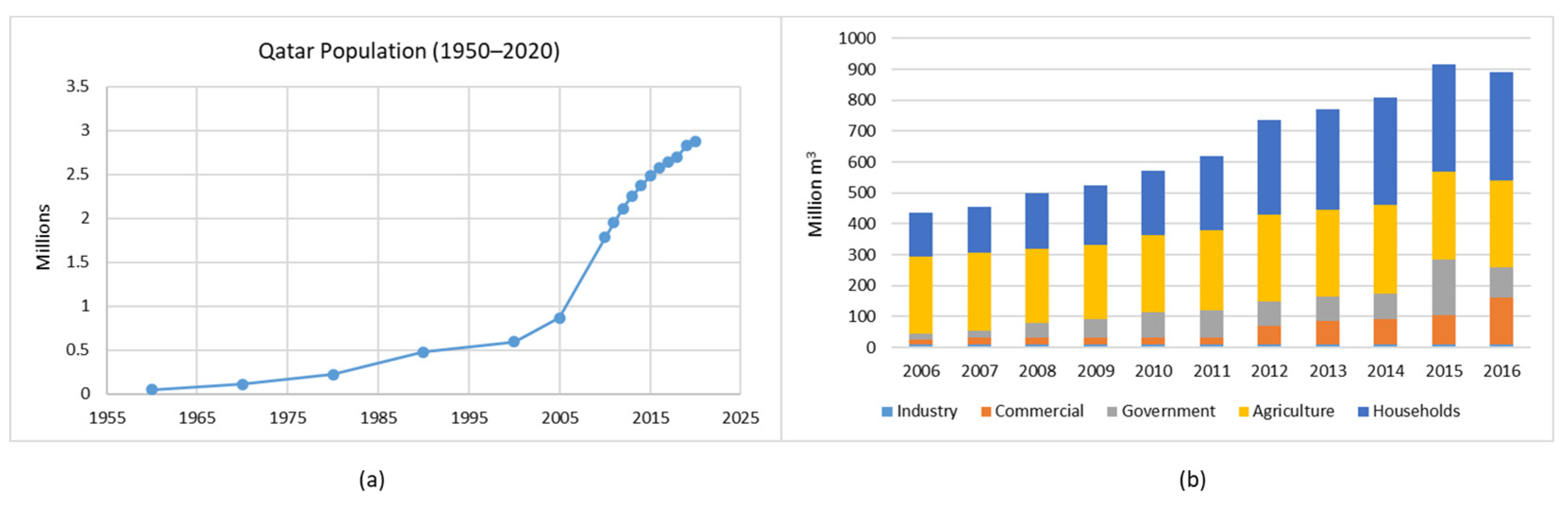
1.1. Water in Residential Buildings
1.2. Life Cycle Assessment of Residential Building’s Water Use
1.3. Purpose of the Study
2. Methods and Procedures
2.1. The Case Study Building
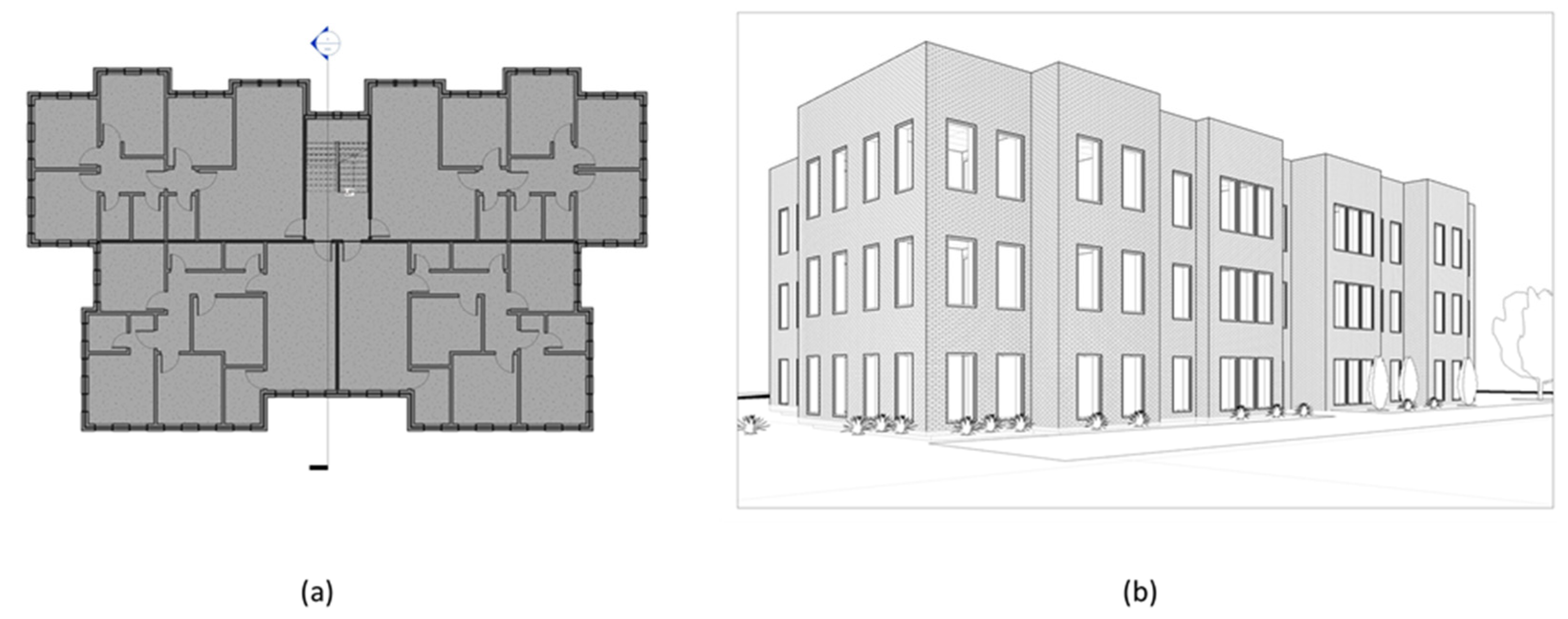
2.1.1. Building Characteristics
2.1.2. Water and Energy Requirements
2.2. Water Use Stages
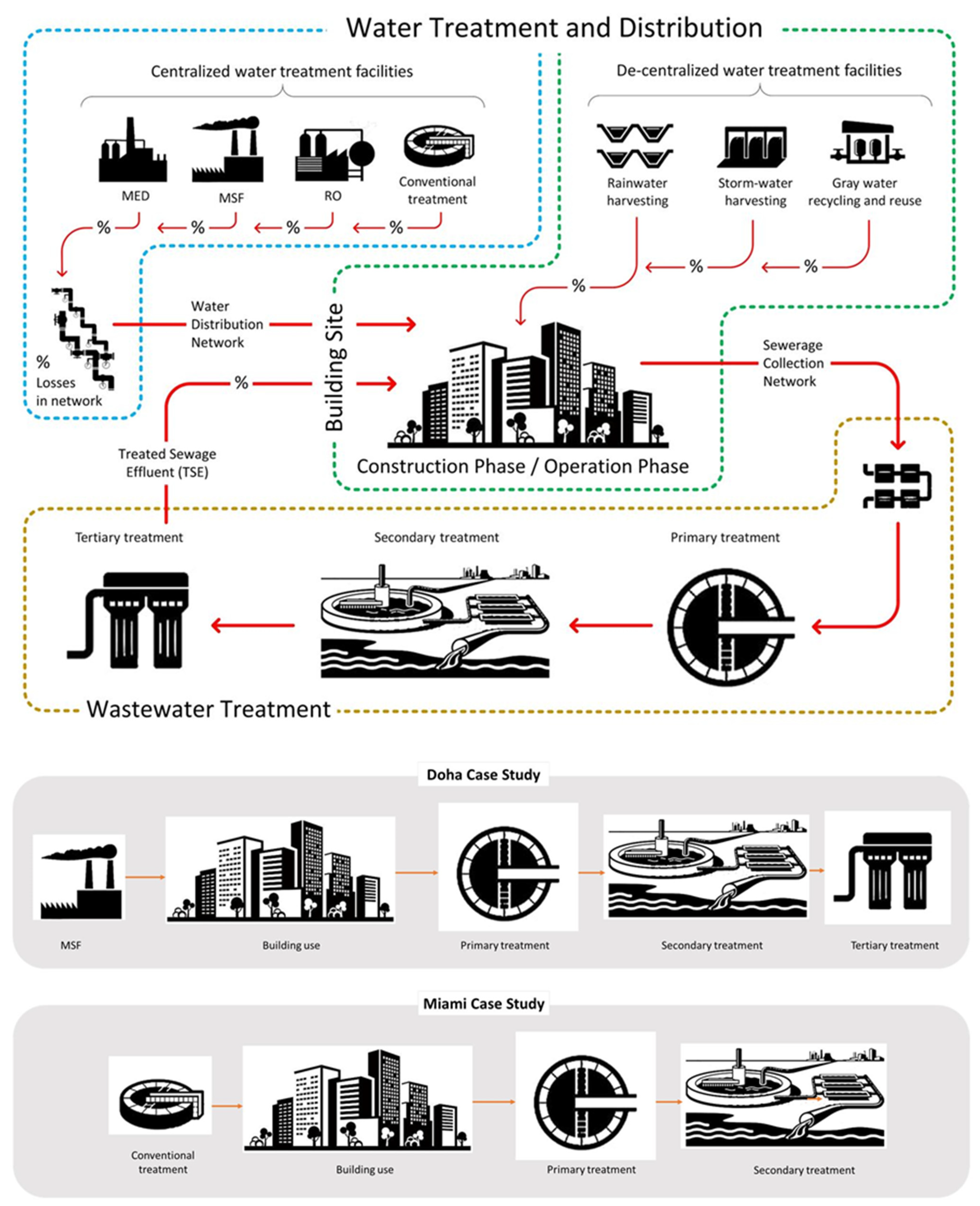
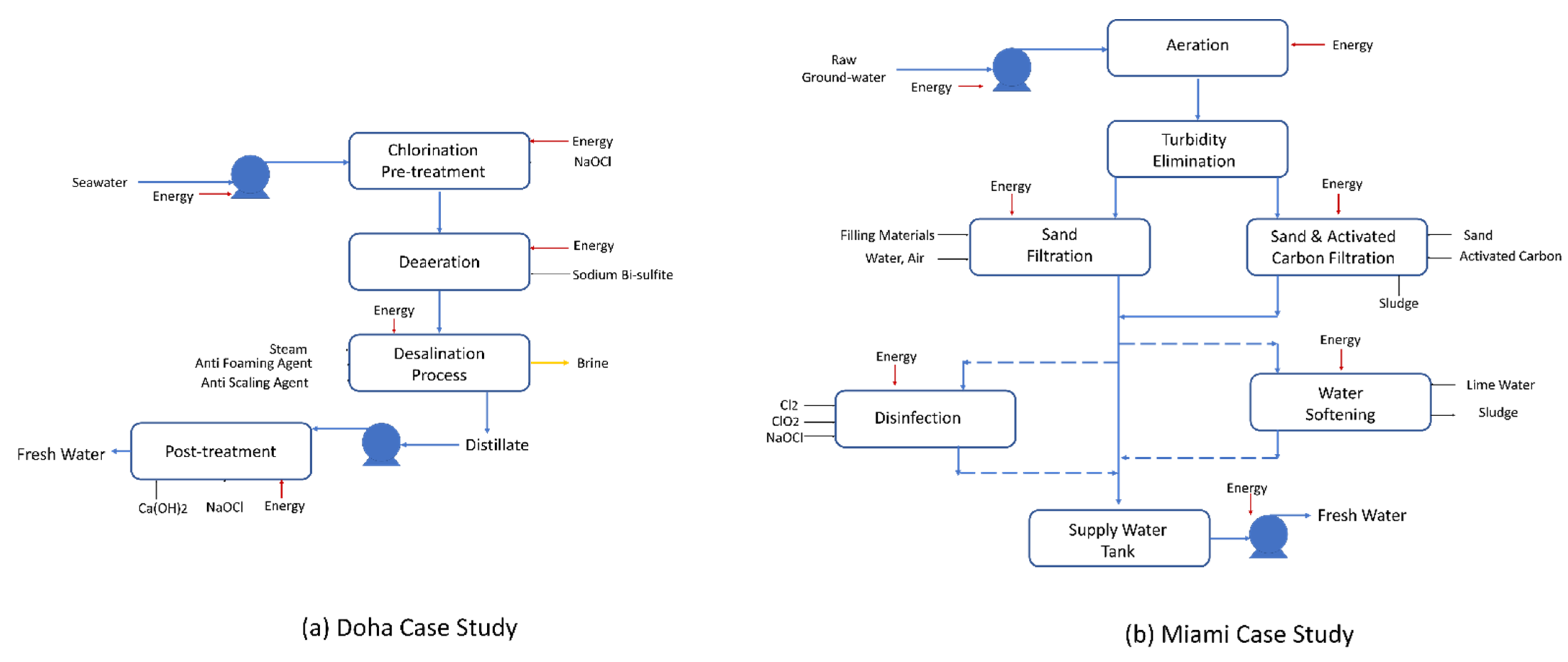
2.2.1. Water Treatment and Distribution
2.2.2. Water Use within Homes
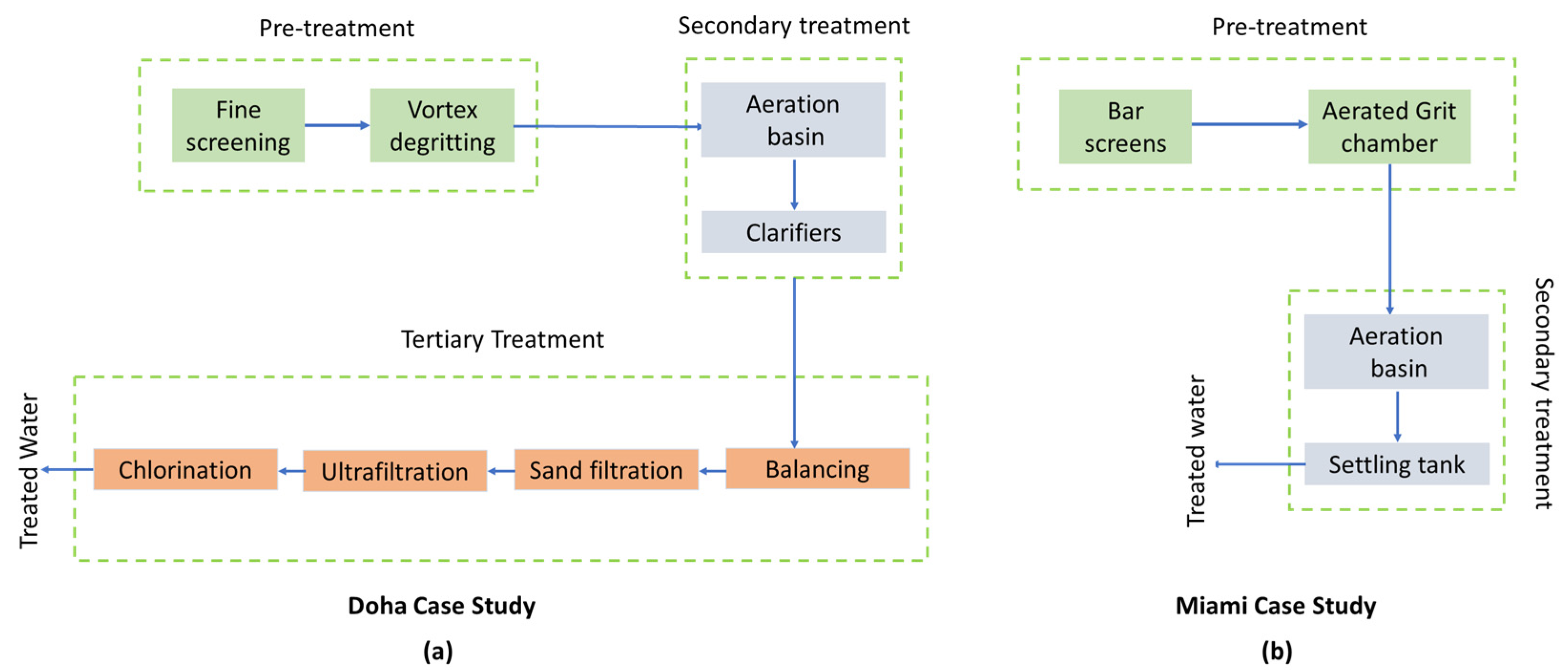
2.2.3. Wastewater Transport and Treatment
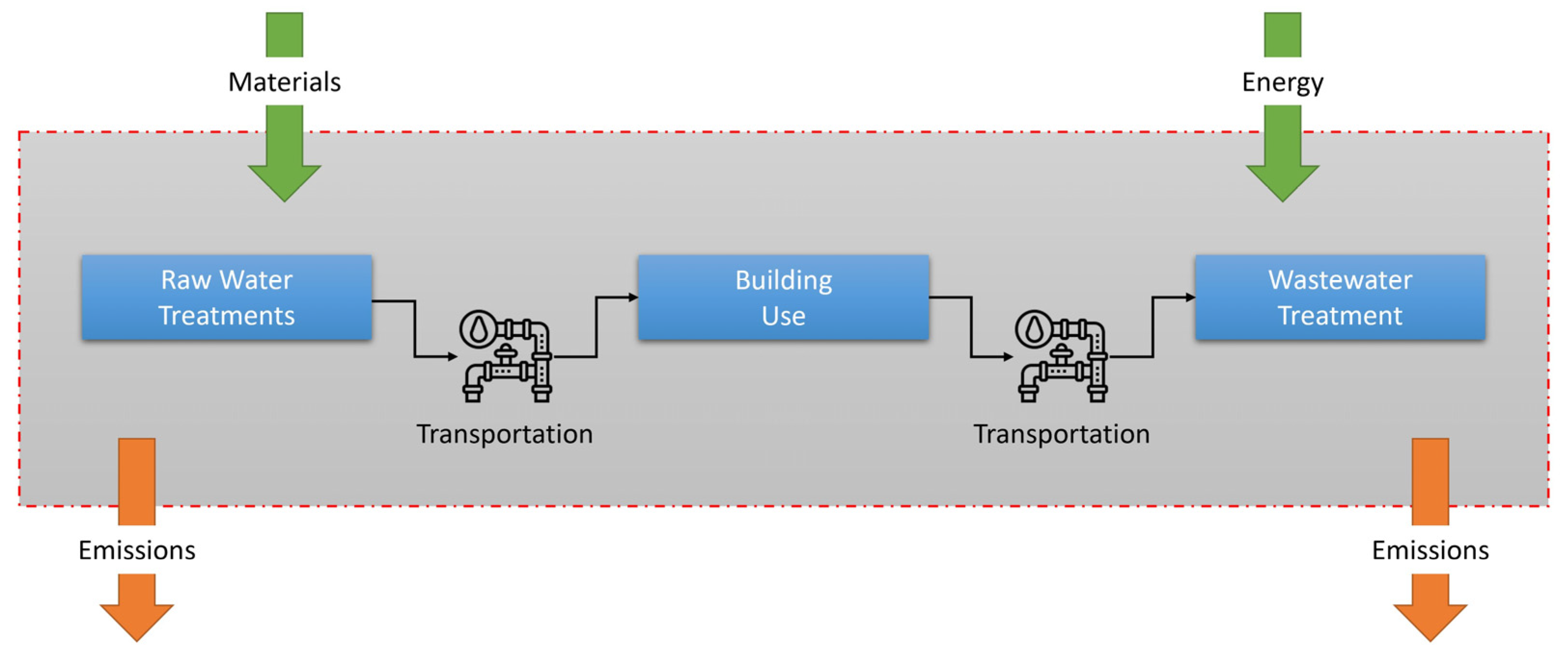
2.3. LCA Framework
3. Results
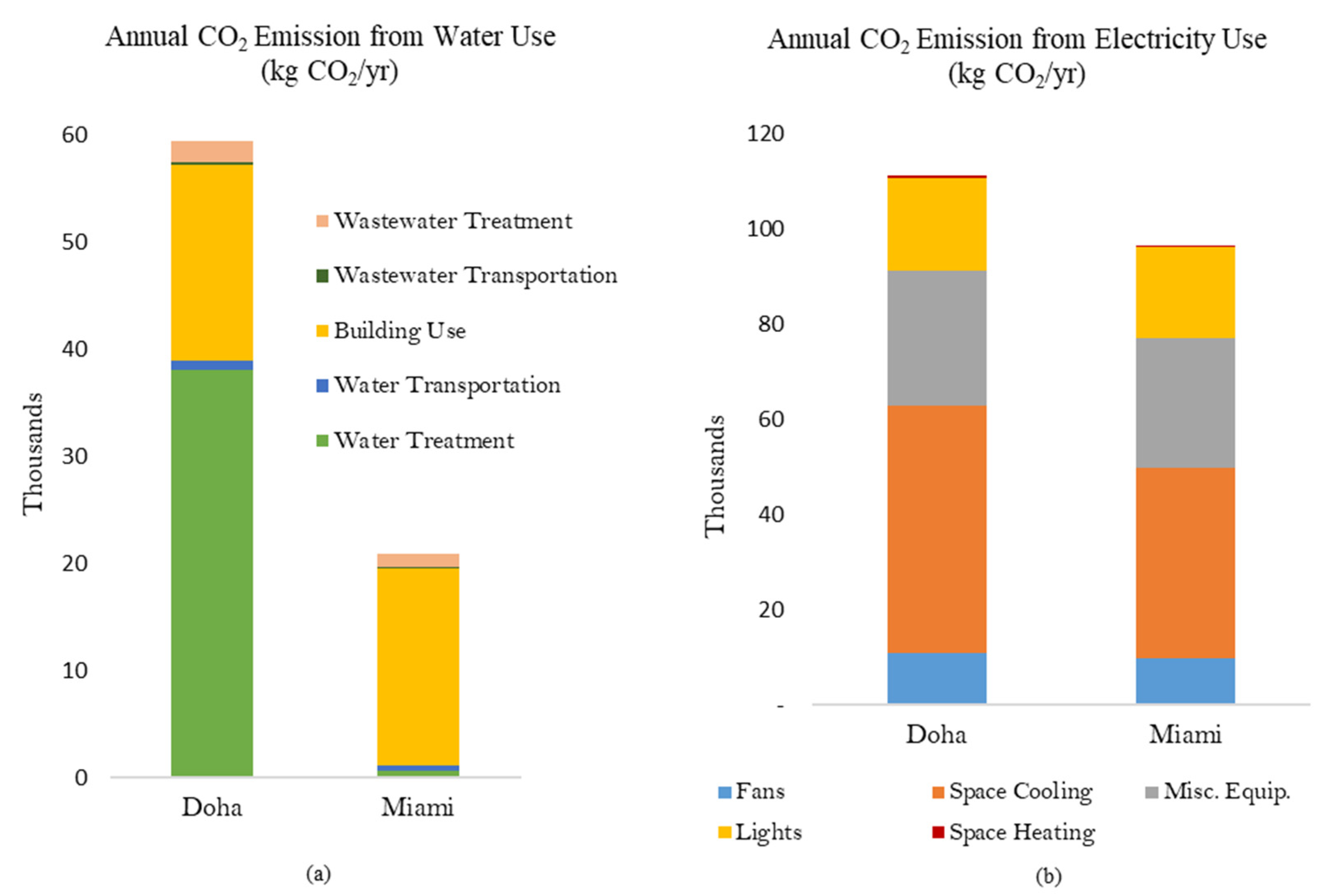
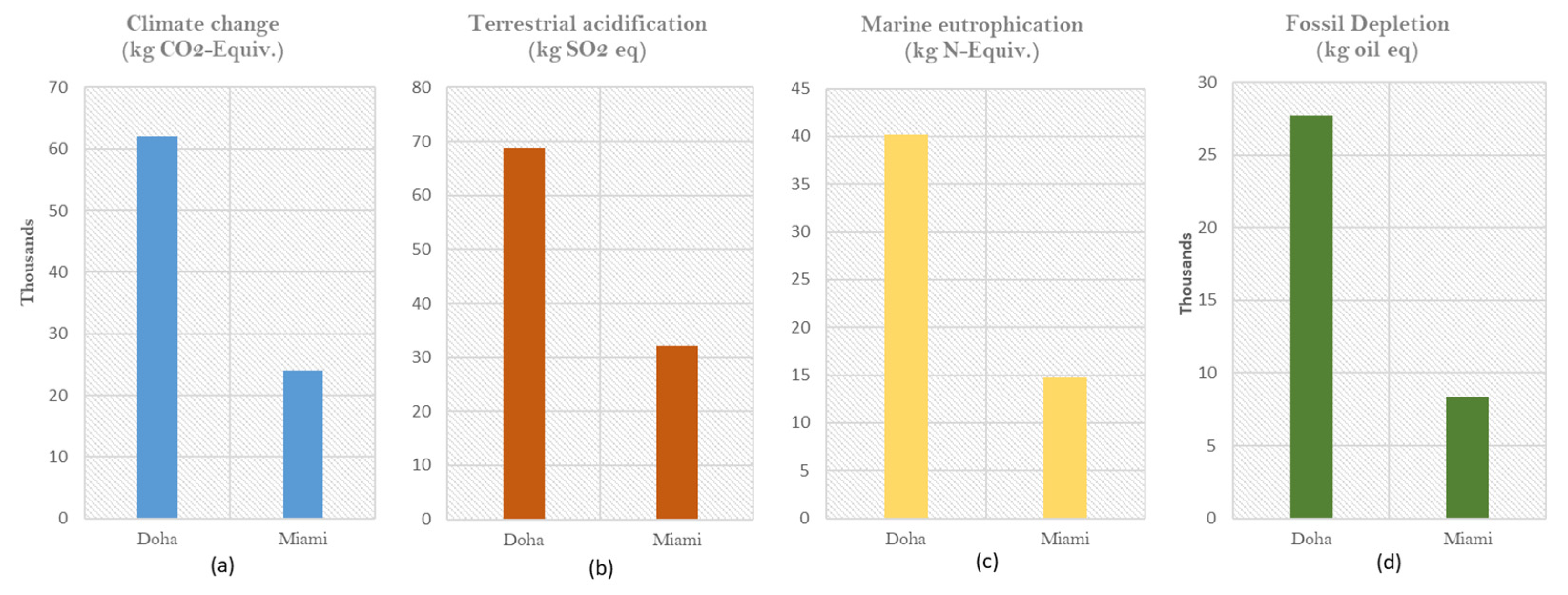
3.1. Impacts of the Water Use Stages
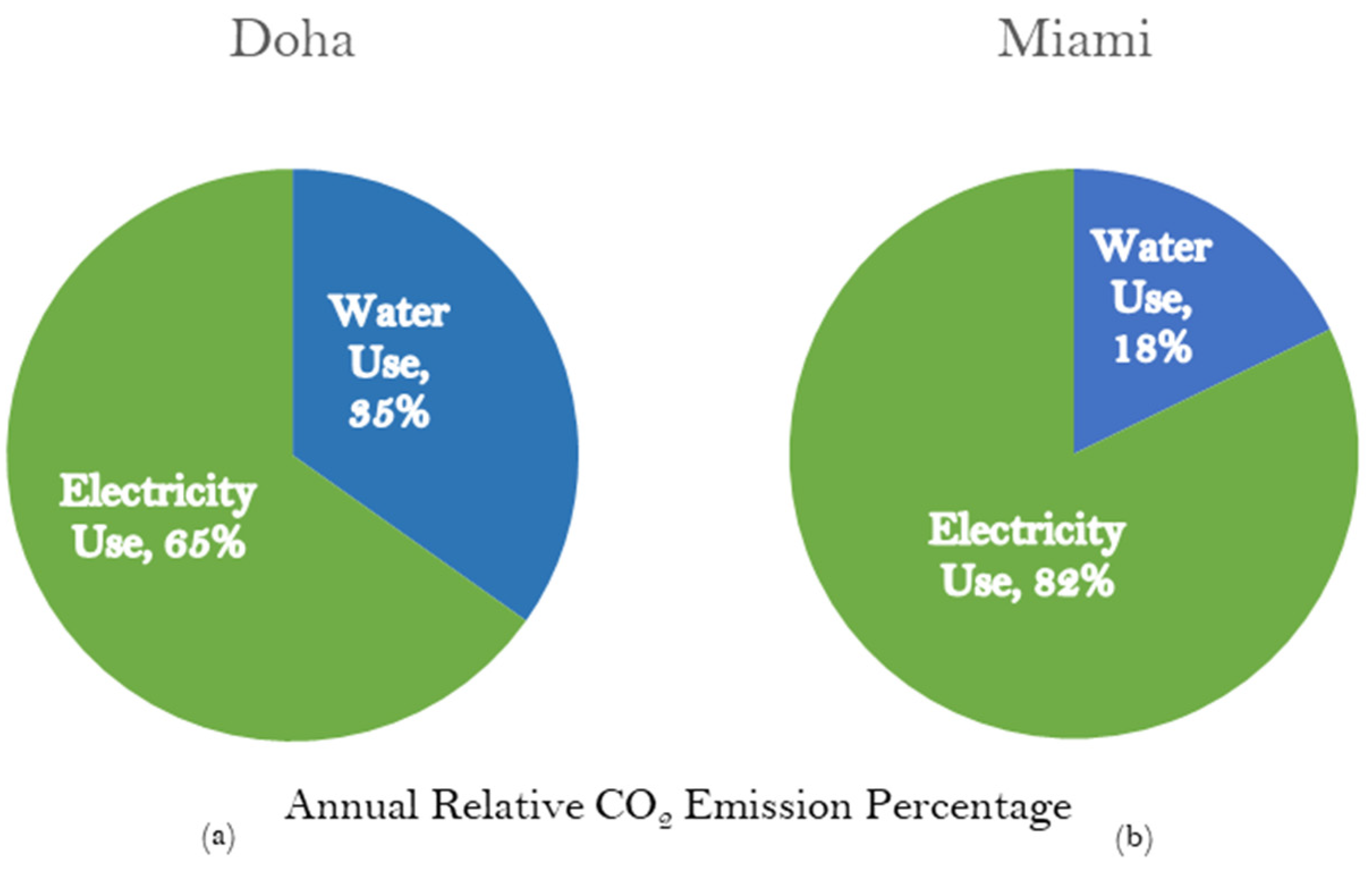
3.2. Relative Impacts of Water and Electricity Use
4. Conclusions and Future Work
Supplementary Materials
Author Contributions
Funding
Acknowledgments
Conflicts of Interest
References
- Arpke, A.; Hutzler, N. Domestic Water Use in the United States: A Life-Cycle Approach. J. Ind. Ecol. 2008, 10, 169–184. [Google Scholar] [CrossRef]
- FAO-Aquastat, Water Uses, Colombia. 2010. Available online: http://www.fao.org/nr/water/aquastat/data/query/results.html?regionQuery=false&showCodes=true&yearRange.fromYear=1960&yearRange.toYear=2015&varGrpIds=4250,4251,4252,4253,4254,4255,4256,4257,4260,4261,4262,4263,4264,4265,4269,4270,4275,4451,4475,4490,4491 (accessed on 19 January 2021).
- Glieck, P.H. Basic Water Requirements for Human Activities: Meeting Basic Needs. Water Int. 1996, 21, 83–92. Available online: http://www.pacinst.org/reports/basic_water_needs/basic_water_needs.pdf (accessed on 5 March 2021). [CrossRef]
- United Nations World Water Assessment Programme. Facts and Figures; from the United Nations World Water Development Report 4: Managing Water under Uncertainty and Risk. 2012. Available online: http://www.petrobras.com.br/fatos-e-dados (accessed on 12 January 2021).
- Ministry of Development Planning and Statistics. Water Statistics in the State of Qatar. 2017. Available online: https://www.psa.gov.qa/en/statistics/StatisticalReleases/Environmental/Water/2017/Water-Statistics-2017-EN.pdf (accessed on 3 April 2021).
- Ali, K.A.; Ahmad, M.; Yusup, Y. Issues, Impacts, and Mitigations of Carbon Dioxide Emissions in the Building Sector. Sustainability 2020, 12, 7427. [Google Scholar] [CrossRef]
- WorldGBC, New Report: The Building and Construction Sector Can Reach Net Zero Carbon Emissions by 2050. 2019. Available online: https://www.worldgbc.org/news-media/WorldGBC-embodied-carbon-report-published (accessed on 13 March 2021).
- Cassidy, R. White Paper on Sustainability. Building Design & Construction. 2003. Available online: http://www.usgbc.org/Docs/Resources/BDCWhitePaperR2.pdf%5Cn (accessed on 12 January 2021).
- Griffiths-Sattenspiel, B.; Wilson, W. The Carbon Footprint of Water. 2009. Available online: http://eec.ucdavis.edu/events/documents/water-energy_rivernetwork_carbon-footprint-of-water.pdf (accessed on 20 December 2020).
- Arpke, A.; Hutzler, N. Operational Life-Cycle Assessment and Life-Cycle Cost Analysis for Water Use in Multioccupant Buildings. J. Arch. Eng. 2005, 11, 99–109. [Google Scholar] [CrossRef]
- Stephan, A.; Crawford, R.H. A comprehensive life cycle water analysis framework for residential buildings. Build. Res. Inf. 2014, 42, 685–695. [Google Scholar] [CrossRef] [Green Version]
- ISO. ISO 14040:2006 Environmental Management—Life Cycle Assessment—Principles and Framework. 2006. Available online: https://www.iso.org/standard/37456.html (accessed on 29 July 2021).
- Fava, J.A. Will the Next 10 Years be as Productive in Advancing Life Cycle Approaches as the Last 15 Years? Int. J. Life Cycle Assess. 2006, 11, 6–8. [Google Scholar] [CrossRef]
- Bribian, I.Z.; Usón, A.A.; Scarpellini, S. Life cycle assessment in buildings: State-of-the-art and simplified LCA methodology as a complement for building certification. Build. Environ. 2009, 44, 2510–2520. [Google Scholar] [CrossRef]
- Lundie, S.; Peters, G.M.; Beavis, P.C. Life Cycle Assessment for Sustainable Metropolitan Water Systems Planning. Environ. Sci. Technol. 2004, 38, 3465–3473. [Google Scholar] [CrossRef] [Green Version]
- Mannan, M.; Al-Ghamdi, S.G. Environmental impact of water-use in buildings: Latest developments from a life-cycle assessment perspective. J. Environ. Manag. 2020, 261, 110198. [Google Scholar] [CrossRef]
- Bayer, P.; Finkel, M. Life cycle assessment of active and passive groundwater remediation technologies. J. Contam. Hydrol. 2006, 83, 171–199. [Google Scholar] [CrossRef]
- Ortíz-Rodriguez, O.O.; Gallardo, R.A.V.; García-C, R. Life cycle assessment of four potable water treatment plants in northeastern Colombia. Ambient. Agua-Interdiscip. J. Appl. Sci. 2016, 11, 268. [Google Scholar] [CrossRef] [Green Version]
- Mohamed-Zine, M.-B.; Hamouche, A.; Krim, L. The study of potable water treatment process in Algeria (boudouaou station) -by the application of life cycle assessment (LCA). J. Environ. Health Sci. Eng. 2013, 11, 37. [Google Scholar] [CrossRef] [Green Version]
- Cabejskova, Z. Life Cycle Assessment of Water Treatment Technology. 2012. Available online: https://is.cuni.cz/webapps/zzp/detail/106279/ (accessed on 13 February 2021).
- Raluy, R.; Serra, L.; Uche, J.; Valero, A. Life-cycle assessment of desalination technologies integrated with energy production systems. Desalination 2004, 167, 445–458. [Google Scholar] [CrossRef]
- Raluy, G.; Serra, L.; Uche, J. Life Cycle Assessment of Water Production Technologies—Part 1: Life Cycle Assessment of Different Commercial Desalination Technologies (MSF, MED, RO). Int. J. Life Cycle Assess. 2005, 10, 285–293. [Google Scholar] [CrossRef]
- Raluy, G.; Serra, L.; Uche, J.; Valero, A. Life Cycle Assessment of Water Production Technologies—Part 2: Reverse Osmosis Desalination versus the Ebro River Water Transfer. Int. J. Life Cycle Assess. 2005, 10, 346–354. [Google Scholar] [CrossRef]
- Raluy, G.; Serra, L.; Uche, J. Life cycle assessment of desalination technologies integrated with renewable energies. Desalination 2005, 183, 81–93. [Google Scholar] [CrossRef]
- Muñoz, I.; Fernández-Alba, A.R. Reducing the environmental impacts of reverse osmosis desalination by using brackish groundwater resources. Water Res. 2008, 42, 801–811. [Google Scholar] [CrossRef]
- Shahabi, M.P.; McHugh, A.; Anda, M.; Ho, G. Environmental life cycle assessment of seawater reverse osmosis desalination plant powered by renewable energy. Renew. Energy 2013, 67, 53–58. [Google Scholar] [CrossRef] [Green Version]
- Devkota, J.; Schlachter, H.; Apul, D. Life cycle based evaluation of harvested rainwater use in toilets and for irrigation. J. Clean. Prod. 2015, 95, 311–321. [Google Scholar] [CrossRef]
- Junnila, S.; Horvath, A. Life-Cycle Environmental Effects of an Office Building. J. Infrastruct. Syst. 2003, 9, 157–166. [Google Scholar] [CrossRef]
- Raghuvanshi, S.; Bhakar, V.; Sowmya, C.; Sangwan, K.S. Waste Water Treatment Plant Life Cycle Assessment: Treatment Process to Reuse of Water. Procedia CIRP 2017, 61, 761–766. [Google Scholar] [CrossRef]
- Machado, A.P.; Urbano, L.; Brito, A.G.; Janknecht, P.; Salas, J.J.; Nogueira, R. Life cycle assessment of wastewater treatment options for small and decentralized communities. Water Sci. Technol. 2007, 56, 15–22. [Google Scholar] [CrossRef] [PubMed] [Green Version]
- Al-Ghamdi, S.G.; Bilec, M.M. Green Building Rating Systems and Whole-Building Life Cycle Assessment: Comparative Study of the Existing Assessment Tools. J. Arch. Eng. 2017, 23, 04016015. [Google Scholar] [CrossRef]
- ANSI/ASHRAE/IES Standard 90.1, Energy Standard for Buildings Except Low-Rise Residential Buildings. 2019. Available online: https://www.techstreet.com/ashrae/standards/ashrae-90-1-2019-i-p?gateway_code=ashrae&product_id=2088527 (accessed on 3 April 2021).
- Mayer, P.W.; DeOreo, W.B. Residential End Uses of Water, Version 2; Water Research Foundation: Denver, CO, USA, 2016. [Google Scholar]
- Dziegielewski, B.; Kiefer, J.C.; Lantz, G.L.; Opitz, E.M.; Porter, G.A.; Mayer, P.; Dziegielewski, B.; Kiefer, J.C.; Lantz, G.L.; Opitz, E.M.; et al. Commercial and Institutional End Uses of Water, Power; American Water Works Association: Denver, CO, USA, 2000. [Google Scholar]
- Mannan, M.; Al-Ghamdi, S. Life-Cycle Assessment of Thermal Desalination: Environmental Perspective on a Vital Option for Some Countries. In World Environmental and Water Resources Congress 2019: Groundwater, Sustainability, Hydro-Climate/Climate Change, and Environmental Engineering; American Society of Civil Engineers: Reston, VA, USA, 2019. [Google Scholar] [CrossRef]
- Mannan, M.; Alhaj, M.; Mabrouk, A.N.; Al-Ghamdi, S.G. Examining the life-cycle environmental impacts of desalination: A case study in the State of Qatar. Desalination 2018, 452, 238–246. [Google Scholar] [CrossRef]
- Miami-Dade County, Water Supply and Treatment. 2021. Available online: https://www.miamidade.gov/global/water/water-supply-and-treatment.page (accessed on 14 February 2021).
- Miami-Dade Water and Sewer Department, Water Use Efficiency: Five Year Plan. 2006. Available online: https://www.miamidade.gov/waterconservation/library/reports/five-year-water-use-efficiency-plan.pdf (accessed on 9 June 2021).
- Sarbu, I. A Study of Energy Optimisation of Urban Water Distribution Systems Using Potential Elements. Water 2016, 8, 593. [Google Scholar] [CrossRef] [Green Version]
- Electric Power Research Institute. Electricity Use and Management in the Municipal Water Supply and Wastewater Industries; Electric Power Research Institute: Washington, DC, USA, 2013. [Google Scholar]
- Cheng, C.-L. Study of the inter-relationship between water use and energy conservation for a building. Energy Build. 2002, 34, 261–266. [Google Scholar] [CrossRef]
- U.S. Energy Information Administration (EIA). Household Energy Use in Texas—A Closer Look at Residential Energy Consumption. 2009. Available online: www.eia.gov/consumption/residential/ (accessed on 5 May 2021).
- Hendrickson, T.P.; Nguyen, M.T.; Sukardi, M.; Miot, A.; Horvath, A.; Nelson, K.L. Life-Cycle Energy Use and Greenhouse Gas Emissions of a Building-Scale Wastewater Treatment and Nonpotable Reuse System. Environ. Sci. Technol. 2015, 49, 10303–10311. [Google Scholar] [CrossRef]
- Hasik, V.; Anderson, N.E.; Collinge, W.O.; Thiel, C.; Khanna, V.; Wirick, J.; Piacentini, R.; Landis, A.E.; Bilec, M.M. Evaluating the Life Cycle Environmental Benefits and Trade-Offs of Water Reuse Systems for Net-Zero Buildings. Environ. Sci. Technol. 2017, 51, 1110–1119. [Google Scholar] [CrossRef]
- GaBi [Computer Software], Sphera, Echterdingen, Germany, N.D. Available online: http://www.gabi-software.com/international/index/ (accessed on 14 April 2021).
- Al-Ghamdi, S.G.; Bilec, M.M. Life-Cycle Thinking and the LEED Rating System: Global Perspective on Building Energy Use and Environmental Impacts. Environ. Sci. Technol. 2015, 49, 4048–4056. [Google Scholar] [CrossRef]

| Studies | Year of Publication | Study Location | Specific Focus | Main Findings |
|---|---|---|---|---|
| [17] | 2006 | Karlsruhe, Germany | Groundwater treatment | Steel-based treatment infrastructure was found responsible for significant emissions. |
| [18] | 2016 | Northern Colombia | Surface water treatments | Pumping power had the highest contribution to the global warming potential (GWP) category, and coagulation and disinfectant agents also had large impacts. |
| [19] | 2013 | Algeria | Surface water treatment | Pre-treatment chemicals were major contributors to GHG emissions. |
| [20] | 2012 | Czech Republic | Surface and groundwater treatment | Surface water plants had fourfold greater impacts on the GWP, fossil depletion, and acidification potential categories. Among the different chemicals, coagulation agents and aluminum sulfate were found to be critical for the total impact. |
| [21,22,23,24] | 2004–2005 | Spain | Treatment by desalination | Environmental impact of reverse osmosis (RO) was found to be significantly lower than that of the multi-stage flush distillation (MSF) or multi effect distillation (MED) processes as well as less emission when using renewable energies such as wind or solar. |
| [25] | 2008 | Southern Spain | Brackish groundwater and seawater | Global and local environmental impacts associated with RO could be significantly reduced by using brackish groundwater as the source rather than seawater. |
| [26] | 2014 | Perth, Western Australia | Reverse osmosis treatment | Renewable energy-based plants successfully reduced nearly 90% of GHG emissions compared to the fossil fuel-based plant. The use of electricity in conventional plants was responsible for more than 90% of the GHG emissions, while chemical use in renewable plants was identified as having a major contribution (60%). |
| [27] | 2015 | Toledo, Ohio | Water use in buildings (toilet flushing) | Rainwater harvesting was both economically and environmentally desirable compared to conventional toilet flushing. |
| [1] | 2006 | USA | Water use in buildings | Water heating consumed the most energy; thereby, in the building’s water cycle, water-use within buildings had the highest impact. |
| [10] | 2005 | USA | Water use in buildings | The LCA score for water heating utilizing natural gas resulted 30% lower than the LCA score for heating using electricity, while water-efficient appliances and fixtures were found to have 22% lower LCA scores than the conventional ones. |
| [28] | 2003 | Finland and USA | Water use in buildings | Water use had the significant impact (15% of total eutrophication) in the eutrophication category. |
| [29] | 2017 | India | Wastewater treatment | Electricity use in treatments had the highest impact out of all the nine impact assessment categories considered. |
| [30] | 2007 | Portugal | Wastewater treatment | High energy use in activated sludge treatment had the largest impact on the GWP category compared to other treatment processes such as constructed wetlands and slow-rate infiltration. |
| Characteristics | Area, m2 | Characteristics | Area, m2 |
|---|---|---|---|
| Roofs: R20 over roof deck (U value *:0.04) | 1340 | Air walls: Air surface (U value: 15.32) | 32 |
| Ceilings: Interior drop ceiling tile (U value: 0.46) | 0.929 | Non-sliding doors: R2 default door (U value: 0.42) | 223 |
| Exterior walls: (R5.7) 8 in concrete (U value: 0.15) | 845 | North facing-58 windows (U value: 4.99) | 97 |
| Interior walls: Uninsulated interior wall (U value: 0.41) | 1661 | Non-north facing-108 windows (U value: 4.99) | 181 |
| Category | Doha, Qatar (kWh/yr) | Miami, Florida (kWh/yr) |
|---|---|---|
| Fans | 18,166 | 16,638 |
| Misc. equipment | 46,240 | 46,290 |
| Space heating | 706 | 455 |
| Pumps & Aux. | 1468 | 1483 |
| Space cooling | 85,323 | 68,034 |
| Lights | 32,294 | 32,287 |
| Hot water | 28,711 | 32,010 |
| Total | 212,908 | 197,196 |
Publisher’s Note: MDPI stays neutral with regard to jurisdictional claims in published maps and institutional affiliations. |
© 2022 by the authors. Licensee MDPI, Basel, Switzerland. This article is an open access article distributed under the terms and conditions of the Creative Commons Attribution (CC BY) license (https://creativecommons.org/licenses/by/4.0/).
Share and Cite
Mannan, M.; Al-Ghamdi, S.G. Water Consumption and Environmental Impact of Multifamily Residential Buildings: A Life Cycle Assessment Study. Buildings 2022, 12, 48. https://doi.org/10.3390/buildings12010048
Mannan M, Al-Ghamdi SG. Water Consumption and Environmental Impact of Multifamily Residential Buildings: A Life Cycle Assessment Study. Buildings. 2022; 12(1):48. https://doi.org/10.3390/buildings12010048
Chicago/Turabian StyleMannan, Mehzabeen, and Sami G. Al-Ghamdi. 2022. "Water Consumption and Environmental Impact of Multifamily Residential Buildings: A Life Cycle Assessment Study" Buildings 12, no. 1: 48. https://doi.org/10.3390/buildings12010048
APA StyleMannan, M., & Al-Ghamdi, S. G. (2022). Water Consumption and Environmental Impact of Multifamily Residential Buildings: A Life Cycle Assessment Study. Buildings, 12(1), 48. https://doi.org/10.3390/buildings12010048

