A Risk Analysis‐Best Worst Method Based Model for Selection of the Most Appropriate Contract Strategy for Onshore Drilling Projects in the Iranian Petroleum Industry



Abstract
1. Introduction
2. Literature Review
2.1. Drilling Contracts
2.1.1. Day-Rate Contracts
2.1.2. Footage Contracts
2.1.3. Turnkey Contracts
2.1.4. Incentive Contracts
2.2. Risk Analysis of Drilling Projects
2.2.1. Risks of Contract
2.2.2. Risk Management in Drilling Process
3. Research Methodology
- At least eight years’ experience in management of drilling contracts; or
- At least 10 years’ experience in academic research on drilling contracts; or
- At least having a master’s degree in petroleum project management.
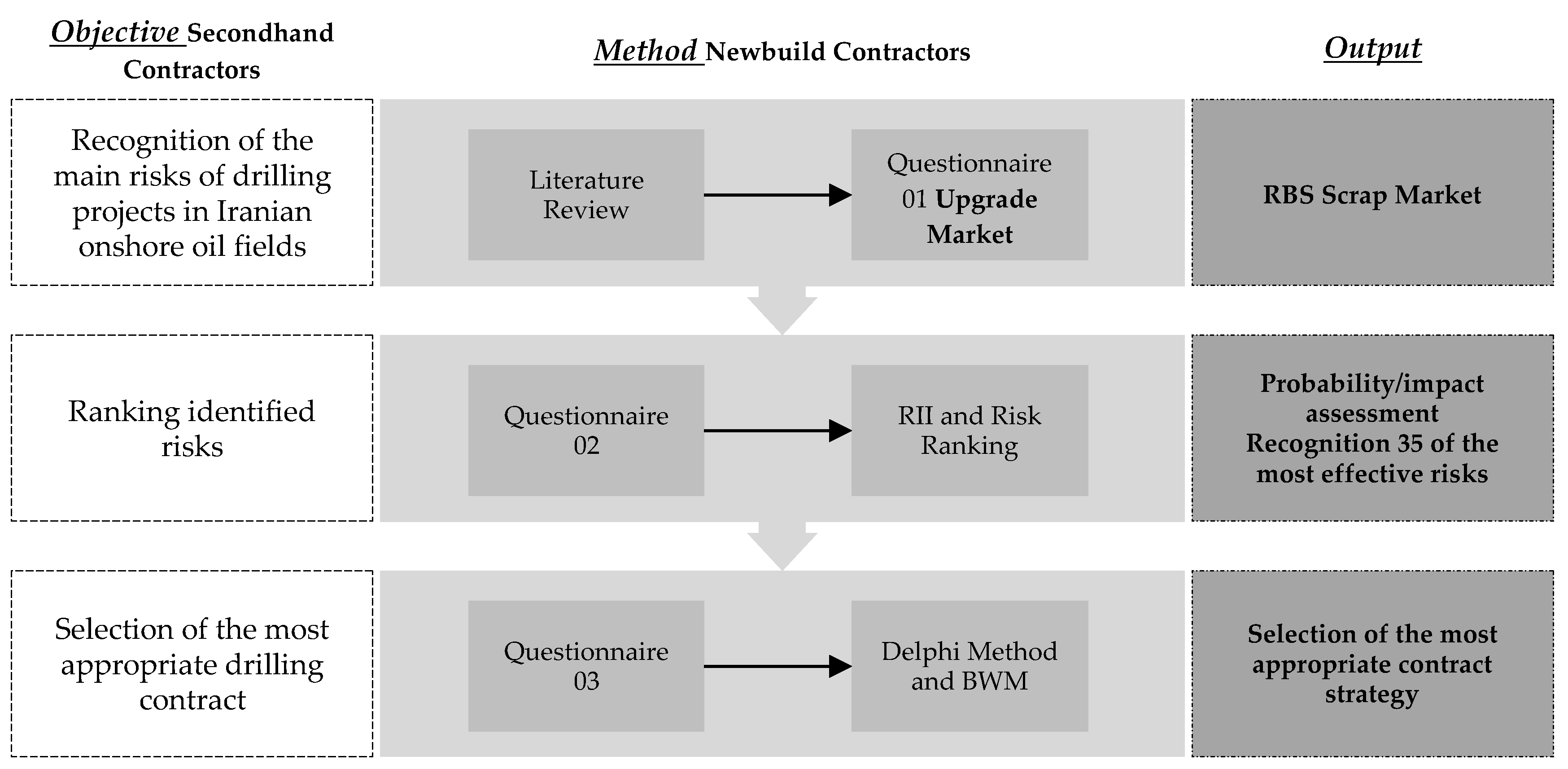
- The research methodology and its elements are shown in Figure 2.
4. Data Analysis and Results
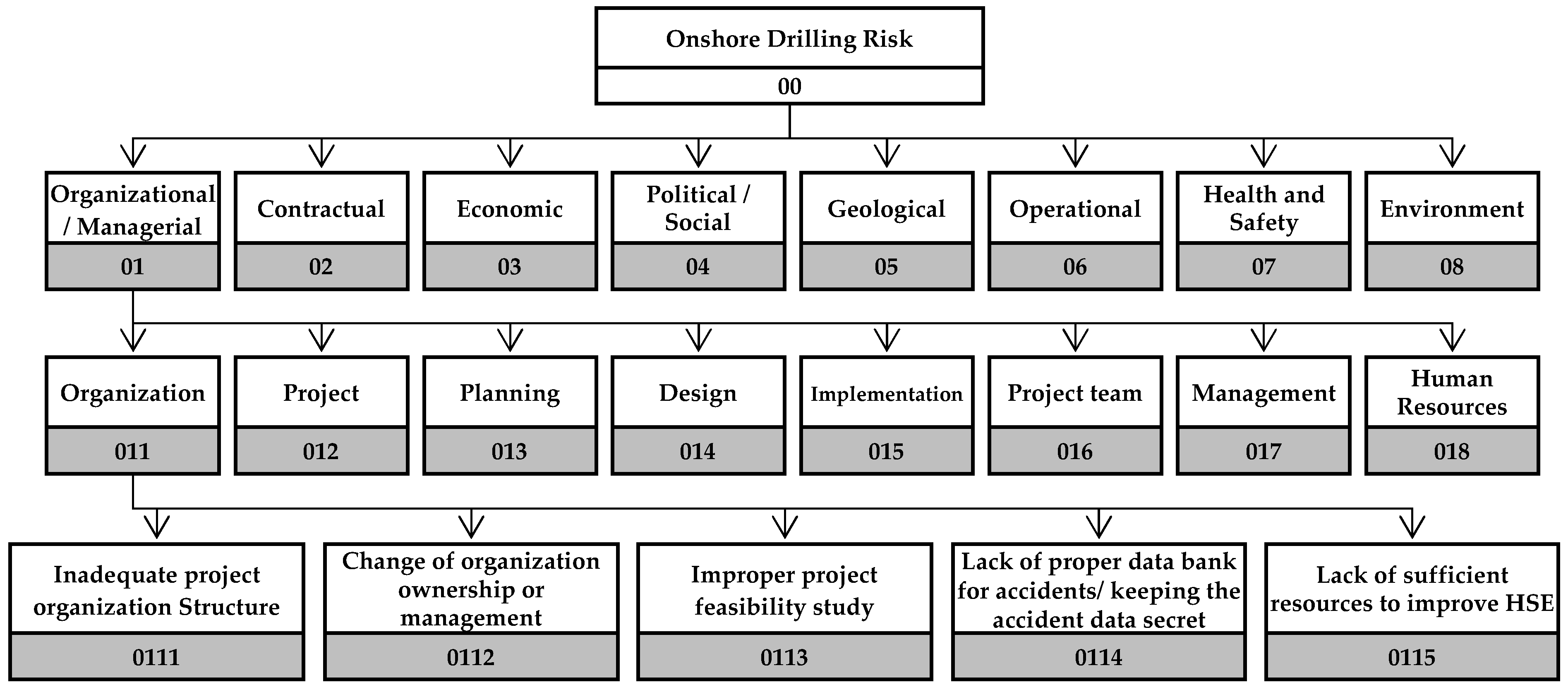
4.1. Risk Analysis to Develop the Selection Criteria
- Onshore project
- Oil field with about 10 years production (brown field)
- Sandstone formation with low porosity
- Homogeneous formation without fracture
- Drilling depth up to 100 m
- Vertical drilling method
- Available data of previous well drillings
- Conventional access to the well drilling location.
4.2. Weighting of Identified Drilling Risks Using BWM Method
- Considering the high importance risks as the set of decision criteria by decision-makers.
- Determining the best and the worst criteria to be used for the decision environment. This step generally is done by choosing the best and the worst criteria among the set of criteria identified in Step 1 from the perspective of decision-makers. The best criteria represent the most important criteria and the worst criteria are the least important criteria for the decision. This step in the current study has been completed in the previous stage and the importance of the criteria has been determined already. The Blow out contingency (R1) and the Changing social responsibility rules and regulations (R35) have been considered as the best criterion and the worst criterion, respectively.
- Determining the preference of the best criteria over all the other criteria: A number between 1 and 9 (1: equally important, 9: extremely more important) is used to indicate this value. The resulting Best-to-Others vector would be as , where indicates the preference of criteria B (best criteria) over criteria j and . Using the BWM questionnaire, experts were asked to compare R1 with each of the other criteria and to express their preference using a value between 1 and 9. Then, by calculating the geometric mean of the four questionnaires, aggregated Best-to-Others (BO) was constructed, as shown in Table 4.
- Determining the preference of each of the other criteria over the worst criteria: A number between 1 and 9 was assigned to this case as well. The Others-to-Worst vector would be , where indicates the preference of the criteria j over the worst criteria W and . Similarly to the previous step, the experts were then asked to express their preferences of all other criteria over the least important criterion of R35. As in the previous step, a value between 1 and 9 was used to determine the preferences. Then, by calculating the geometric mean, the aggregated Others-to-Worst (OW) vector was constructed as shown in Table 5.
- Find the optimal weights : Solving the problem (1) will result in the optimal weights for the criteria. To determine the optimal weights of the criteria, the maximum absolute differences and for all j should be minimized.
4.3. Prioritize Contract Alternatives Using the AHP Method
4.3.1. Development of the AHP Model
4.3.2. Determining the Comparison Matrix
4.4. Relative Weight and Priority Evaluation
5. Discussion and Practical Implications
6. Conclusions
Author Contributions
Funding
Institutional Review Board Statement
Informed Consent Statement
Data Availability Statement
Conflicts of Interest
Appendix A

| RBS Level 0 | RBS Level 1 | RBS Level 2 | RBS Level 3 | References | RBS Code |
|---|---|---|---|---|---|
| Onshore Drilling Risk | Organizational/Managerial Risk | Organization | Inadequate project organization Structure | [40] | 1101 |
| Change of organization ownership or management | [59] | 1102 | |||
| Improper project feasibility study | [40] | 1103 | |||
| Lack of proper data bank for accidents/ keeping the accident data secret | [60] | 1104 | |||
| Lack of sufficient resources to improve HSE | [60] | 1105 | |||
| Project | Bureaucratic government system and long project approval procedure | [40] | 1201 | ||
| Late internal approval process from the owner | [40] | 1202 | |||
| Unclear and imprecise delegation of responsibilities and roles and project charter | [61] | 1203 | |||
| Changes in the scope of the project | Survey | 1204 | |||
| Failure to achieve the main target point | [62] | 1205 | |||
| Lack of proper written work procedures and instructions | [60] | 1206 | |||
| Planning | Weakness in planning and scheduling and initial project resources | [63] | 1301 | ||
| Improper project planning and Budgeting and lack of accurate estimation of project value | [40] | 1302 | |||
| Lack of emergency response plan | [60] | 1303 | |||
| Design | Poor design | [64] | 1401 | ||
| Design changes | [65] | 1402 | |||
| Late changes to well design and procedures | [35] | 1403 | |||
| Implementation | Inappropriate choice of project implementation method | [62] | 1501 | ||
| Failure to predict the exact time to run the project | [62] | 1502 | |||
| Failure to select the type of implementation or project contract according to the conditions | Survey | 1503 | |||
| Project team | Incompetence of project team | [40] | 1601 | ||
| Inefficiency or inexperience of the project team | 1602 | ||||
| Contractor′s error | [66] | 1603 | |||
| Making the wrong decisions | Survey | 1604 | |||
| Inefficient and poor performance of Constructors | [40] | 1605 | |||
| Excessive delays due to late decisions making by project participants | Survey | 1606 | |||
| Management | Incompetence of project manager | [67] | 1701 | ||
| Lack of meritocracy (in recruiting, organizing and promoting staff) | [60] | 1702 | |||
| Incompetence of managers, supervisors and HSE crew | [60] | 1703 | |||
| Lack of support from executives and senior management | Survey | 174 | |||
| Human element | Lack of skills of drilling staff (inadequate practice of skills) | [68] | 1801 | ||
| Lack of effective trainings | [32] | 1802 | |||
| There is poor relationship between personnel and superiors | [32] | 1803 | |||
| Inexperienced and less knowledgeable personnel | [59] | 1804 | |||
| Unmotivated personnel | [3] | 1805 | |||
| High stress and work pressure | [68] | 1806 | |||
| The number of workers in workplace is not appropriate for the job (more or less) | [32] | 1807 | |||
| The worker is injured or sick (temporarily, e.g., because of a flu) | [32] | 1808 | |||
| Ergonomic problems due to fatigue and pressure of non-stop activities | [62] | 1809 | |||
| Inadequacy of specialized personnel | Survey | 1810 | |||
| Contractual Risk | Contract | Inappropriate contracts | Survey | 2101 | |
| Ambiguous conditions of contract | [40] | 2102 | |||
| Improper verification of contract documents | [3] | 2103 | |||
| Work conditions deferring from contract | [40] | 2104 | |||
| Changes on scope of contract | [59] | 2105 | |||
| Unballance share of legal risks between the parties | Survey | 2106 | |||
| Contractual liability failure | Survey | 2107 | |||
| Type and terms of contract | Unclear Contractual requirements | Survey | 2201 | ||
| Changes in contract related rules and regulations | Survey | 2202 | |||
| Economic Risk | Economic Changes and fluctuations | Changes in supply and demand | [63] | 3101 | |
| Changes in tax policy and tax rates | [63] | 3102 | |||
| Oil price fluctuations | [65] | 3103 | |||
| Exchange rate changes | [40] | 3104 | |||
| Interest rate fluctuation | [40] | 3105 | |||
| Inflation rate fluctuation | [40] | 3106 | |||
| Instability of economic indicators of the host country | Survey | 3107 | |||
| Increase of material cost | [40] | 3108 | |||
| Increase of labor cost | [40] | 3109 | |||
| Price instability of fuel and steel | [3] | 3110 | |||
| Financial risk | Deficiency in Provide project funds | Survey | 3201 | ||
| Increase the cost of materials and personnel | Survey | 3202 | |||
| Improper cost calculations for the investment | [66] | 3203 | |||
| Delayed disbursement of funds from financiers | [3] | 3204 | |||
| Lack of economic production | Survey | 3205 | |||
| Political / Social Risk | Government | Confiscation and nationalization | Survey | 4101 | |
| Expropriation | Survey | 4102 | |||
| Change in contract provisions by the government | [63] | 4103 | |||
| Reduction in annual budget allocation by government | [3] | 4104 | |||
| Changes in foreign investment laws | Survey | 4105 | |||
| Customs restrictions or the export and import of goods | Survey | 4106 | |||
| Change in rules and regulations | [67] | 4107 | |||
| Loss incurred due to corruption and bribery | [3] | 4108 | |||
| The state of the host country | Rebellion | Survey | 4201 | ||
| War/Vandalism | [64] | 4202 | |||
| Terrorism | Survey | 4203 | |||
| Political instability of the host country | Survey | 4204 | |||
| Sanctions and special bans | Survey | 4205 | |||
| Social Hazards | Sabotage measures | Survey | 4301 | ||
| Lack of acceptance in local communities | Survey | 4302 | |||
| Changing social responsibility rules and regulations | Survey | 4303 | |||
| Negative attitude towards local oil and gas multinational companies | Survey | 4304 | |||
| Changes in consumer demands | Survey | 4305 | |||
| Workers′ strikes | Survey | 4306 | |||
| Dispute with residents around site | [40] | 4307 | |||
| Geological Risk | Geological structure | Geological structure and complexity of the region | [65] | 5101 | |
| Geological Faults and Structures | [69] | 5102 | |||
| Abnormal pressured zone | [64] | 5103 | |||
| Unexpected natural subsurface obstacles | [62] | 5104 | |||
| Man-made subsurface obstacles | [62] | 5105 | |||
| Geological information | Lack of full knowledge of the field | Survey | 5201 | ||
| Lack of sufficient knowledge and information of field and reservoir structures | Survey | 5202 | |||
| Lack of accurate information on the structure and volume of the reservoir | Survey | 5203 | |||
| Lack of accurate information on the fluid properties of the tank and how it is distributed in the tank | Survey | 5204 | |||
| Formation | Different behavior of geological formations in different wells | Survey | 5301 | ||
| Displacement of formations | Survey | 5302 | |||
| Formation pressure | [35] | 5303 | |||
| Total/partial losses in formation layers | [62] | 5304 | |||
| Operational Risk | Well casing | Lack of well rehabilitation before casing running operations and the resulting problems | Survey | 6101 | |
| Problems with Reamer running into a well, such as Fishing or falling its rollers | Survey | 6102 | |||
| Problem in Shoe and its installation and disruption in casing running | Survey | 6103 | |||
| Float Shoe plaque while casing running | Survey | 6104 | |||
| Damage to casing in the operational area, especially their threads due to incorrect transmission conditions | Survey | 6105 | |||
| Changes in the size of the inner diameter of the casing in some parts due to impact | Survey | 6106 | |||
| Lack of wrenches and tools suitable for casing running | Survey | 6107 | |||
| Centralizers break during casing and liner running | Survey | 6108 | |||
| Tight hole of the well and casing run problems | Survey | 6109 | |||
| Problems with not installing Cager Hanger properly | Survey | 6110 | |||
| Liner Lap leak and perform Seal Nipple Packer operation | Survey | 6111 | |||
| Seal Nipple Packer leak if used | Survey | 6112 | |||
| Casing corrosion and H2s migration to annulus | Survey | 6113 | |||
| Casing Head Housing is not aligned for various reasons such as welding error and causing problems in the next phases of operation and installation BOPs | Survey | 6114 | |||
| Pipelines | Pipe failure | [70] | 6201 | ||
| Corrosion thinning | [70] | 6202 | |||
| Defect of pipe | [70] | 6203 | |||
| Interference from the third party | [70] | 6204 | |||
| Incorrect operation | [70] | 6205 | |||
| Corrosion fatigue | [70] | 6206 | |||
| Unsuitable material | [70] | 6207 | |||
| Blocking of the drilling pipe or product pipe installation due to the swelling of clay and silt | [66] | 6208 | |||
| Sudden shock to the lines and the possibility of bursting pipes and fittings | Survey | 6209 | |||
| Lack of a needle valve to relieve pressure | Survey | 6210 | |||
| Faulty pipe connections: the improper fusion/welding of pipes | [62] | 6211 | |||
| Inappropriate selection of external tube coating | [62] | 6212 | |||
| Tight hole stuck pipe | [69] | 6213 | |||
| Cementing | Cementing of long casing strings | [35] | 6301 | ||
| Increase the well cavity and cementing problems | [62] | 6302 | |||
| Problems in casing cementing and Staying cement in casing | Survey | 6303 | |||
| Improper quality of cement slurry | Survey | 6304 | |||
| Error in the amount of material added to the cement | [71] | 6305 | |||
| Contamination of cement liquid with drilling mud or other caustic fluids | [71] | 6306 | |||
| Error in choosing the type of cement class | [71] | 6307 | |||
| Error in measuring the correct weight of cement | [71] | 6308 | |||
| Cement Shrinkage | [71] | 6309 | |||
| Insufficient drilling mud to replace cement inside the casing | [71] | 6310 | |||
| Error in calculating the amount of cement required for the pipe | [71] | 6311 | |||
| Non-compliance of cement program with operations and wells as a result of not performing the required tests correctly | Survey | 6312 | |||
| Plugging the route of cementing during operation | Survey | 6313 | |||
| Leakage of the route of cementing during operation | Survey | 6314 | |||
| Loss of circulation | Formations that are inherently fractured, cavernous, or have high permeability | [69] | 6401 | ||
| Highly fractured formations | [72] | 6402 | |||
| Drilling Mud | Infiltration of mud into wells | Survey | 6501 | ||
| Insufficient mud weight | [73] | 6502 | |||
| Not testing the mud properties | [62] | 6503 | |||
| Not testing water for the drilling fluid preparation | [62] | 6504 | |||
| Drilling fluid seepage | [66] | 6505 | |||
| Blow out contingency | Facing the high pressure layer in the drilling formation | [71] | 6601 | ||
| Plug annulus | [71] | 6602 | |||
| Annular Loss | [71] | 6603 | |||
| Temperature effects on drilling fluid | [71] | 6604 | |||
| Cut Mud | [71] | 6605 | |||
| Error in density measuring equipment | [71] | 6606 | |||
| Operator error in mixing the correct drilling fluid density | [71] | 6607 | |||
| Improper casing running | [71] | 6608 | |||
| Error inspecting Casing | [71] | 6609 | |||
| Error inspecting Cementing | [71] | 6610 | |||
| Wellbore instability | Collapsing formation | [74] | 6701 | ||
| Mechanical failure by in-situ stresses | [69] | 6702 | |||
| Erosion caused by fluid circulation | [69] | 6703 | |||
| Chemical caused by interaction of borehole fluid with the formation | [69] | 6704 | |||
| Wellbore shrinkage | [75] | 6705 | |||
| Equipment | Corrosion or wear of mechanical parts | [60] | 6801 | ||
| Effect of Ageing; wear and tear, worn or fatigued part | [35] | 6802 | |||
| Equipment quality (special equipment; delay; damaged) | [35] | 6803 | |||
| Inadequate equipment for more high-tech production | [63] | 6804 | |||
| Inadequate equipment with type of operation | Survey | 6805 | |||
| Poor maintenance program | [60] | 6806 | |||
| Operational and resource limits | [35] | 6807 | |||
| Material suitability and defects; Fabrication defects | [35] | 6808 | |||
| Equipment Failure | [75] | 6809 | |||
| Equipment failure due to H2S gas | [62] | 6810 | |||
| Technology | New technology (e.g., packers and liner hangers) | [35] | 6901 | ||
| Immaturity of new technology | [61] | 6902 | |||
| Complex technologies | Survey | 6903 | |||
| Lack of access to new technologies in geophysics and earth sciences | Survey | 6904 | |||
| Risk of changes in upstream technology | Survey | 6905 | |||
| HSE Risk—Health and Safety | Drilling operation | Start of drilling, Increasing pressure and cracking high-pressure lines of drilling fluid, colliding lines with people | Survey | 7101 | |
| Casing running, Falling suspended loads, work at heights, fatal falls, Stuck organs, collisions of pipes with people, collisions of elevators with the position of casing derrick man | Survey | 7102 | |||
| Perforation, Falling suspended load, ergonomic damage, risk of employees falling from a height, hitting hammers on people, cracking of lines under pressure, explosion due to impact and electric current and lightning strike | Survey | 7103 | |||
| Acidizing, Cracking of lines and hitting people, Acid spraying and severe acid burns, skeletal injuries | Survey | 7104 | |||
| Cementing, Equipment damage, ergonomic discomfort, hearing problems, engine heat, heat stress, working with pressurized lines, tearing or cracking of lines, dust, falling and collision of equipment with people | Survey | 7105 | |||
| Air drilling, Cracking of lines and hitting people, Abnormal and unusual noise | Survey | 7106 | |||
| Underbalanced drilling, Hitting the plexus, ergonomic injuries, working at height and risk of falling from a height, hitting joints, shifting load, risk of falling load | Survey | 7107 | |||
| Well Logging, Stuck of body parts, skeletal and muscular injuries, ergonomic injuries, noise, falling of equipment, collision of a tube stand with the position of the derrick man and damage to the position of the derrick man | Survey | 7108 | |||
| Drilling equipment | Drilling rig installation, Stuck body parts between equipment, risk of falling load, falling from a height | Survey | 7201 | ||
| Capsule storage, Sudden explosion of cylinders during displacement of toxic and combustible gas leaks, fire | Survey | 7202 | |||
| Power supply device, Fire, stuck of organs inside machines and amputation, electrocution, burns caused by electric shock | Survey | 7203 | |||
| Raise BOP, Work at height and risk of fatal fall, Risk of falling suspended loads | Survey | 7204 | |||
| Coiled Tubing, Ergonomic injuries, collisions and damage to equipment and people, risk of falling, working with air lifts, working with pressure lines, cracking lines, spraying acid or diesel on people, skeletal and muscular injuries | Survey | 7205 | |||
| BOP Test, Slipping, Infiltration of mud and fluids into people′s eyes, falling into mud pit, Work at height, Failure to operate safety valves for drilling mud pumps, cracking of pressure lines, Elevators collide with people | Survey | 7206 | |||
| HSE Risk—Environment | Drilling operation | Groundwater contamination | [76] | 8101 | |
| Surface water contamination | [76] | 8102 | |||
| Releases to air (local air quality) | [77] | 8103 | |||
| Releases to air (contribution to global warming) | [77] | 8104 | |||
| Visual impact | [76] | 8105 | |||
| Biodiversity impacts | [76] | 8106 | |||
| Land take | [76] | 8107 | |||
| Noise | [76] | 8108 | |||
| Traffic | [76] | 8109 | |||
| Drilling fluid discharge | Soil pollution by drilling fluid | Survey | 8201 | ||
| Groundwater pollution by drilling fluid | Survey | 8202 | |||
| Adverse effects on wildlife | Survey | 8203 | |||
| Disposal and discharge of wastewater | Soil pollution by wastewater | Survey | 8301 | ||
| Visual impact in case of discharge to water resources | Survey | 8302 | |||
| Water pollution by wastewater | Survey | 8303 | |||
| Unpleasant odor emissions into the environment | Survey | 8304 | |||
| Acid deposition | Soil pollution by acid | Survey | 8401 | ||
| Air pollution caused by acid vapors | Survey | 8402 | |||
| Unpleasant odor of acid | Survey | 8403 | |||
| Groundwater pollution by acid | Survey | 8404 | |||
| Oil and gas leaks, toxic gas leaks, waste or other environmental pollutants | Reduction of biodiversity of organisms due to biological accumulation of hydrocarbons | Survey | 8501 | ||
| Damage to birds due to ingestion of petroleum products | Survey | 8502 | |||
| Biological accumulation of petroleum substances in the body of organisms | Survey | 8503 | |||
| Chronic effects for humans | Survey | 8504 | |||
| Hypothermia and death of mammals/birds | Survey | 8505 | |||
| Fire and damage to equipment | Survey | 8506 | |||
| Explosion | Survey | 8507 | |||
| Air pollution by gas | Survey | 8508 |
References
- Romagnoli, R.; Alkychyyev, D. Innovative Drilling and Completion Technologies. Ph.D. Thesis, Politecnico di Torino, Turin, Italy, 2020. [Google Scholar]
- Marjoribanks, R. Drilling: A General Discussion the Importance of Drilling. In Geological Methods in Mineral Exploration and Mining; Springer: Berlin/Heidelberg, Germany, 2010; pp. 75–84. [Google Scholar]
- Okwiri, L.A. Risk Assessment and Risk Modelling in Geothermal Drilling. Master’s Thesis, Iceland School of Energy, Reykjavík, Iceland, 2017. [Google Scholar]
- Jahn, F.; Cook, M.; Graham, M. Hydrocarbon Exploration and Production; Elsevier: Amsterdam, The Netherlands, 2008; ISBN 0080568831. [Google Scholar]
- Devereux, S. Drilling Technology in Nontechnical Language; PennWell Books: Tulsa, OK, USA, 1999; ISBN 0878147624. [Google Scholar]
- Schanche, L.E.; Steffensen, E.E. Valuation of Maersk Drilling. Master′s Thesis, Copenhagen Business School, Frederiksberg, Denmark, 2020. [Google Scholar]
- Stewart, A.M.Y.E. Indemnification and Insurance: Contractual Risk Transfer Provisions. Amystewartlaw 2020, 1, 5. [Google Scholar]
- Faraji, A. Smart Contract Based Conceptual Model for Optimizing Risk Distribution in Construction Industry. In Proceedings of the 3rd International Conference on Applied Researches in Structual Engineering and Construction Management, Chicago, IL, USA, 20–25 May 2019. [Google Scholar]
- Rahman, S.; Odeyinka, H.; Perera, S.; Bi, Y. Product-cost modelling approach for the development of a decision support system for optimal roofing material selection. Expert Syst. Appl. 2012, 39, 6857–6871. [Google Scholar] [CrossRef] [Scilit]
- Mohammadi, M. Maria Rashidi, Maryam Ghodrat, Bijan Samali and. Manag. Inf. Syst. 2018, 19, 22. [Google Scholar]
- Faraji, A.; Rashidi, M.; Sorooshnia, E. An Integrated Organizational System for Project Source Selection in the Major Iranian Construction Companies. Buildings 2020, 10, 251. [Google Scholar] [CrossRef] [Scilit]
- Marietta, K.; White, M. Drilling Contracts: Avoiding Misunderstanding. Energy Newsl. 2015, 1, 7. [Google Scholar]
- Anderson, O.L. The anatomy of an oil and gas drilling contract. Tulsa LJ 1989, 25, 359. [Google Scholar]
- Brown, L.B.; Flanagan, H.J. Onshore Drilling Contracts: Avoiding the Pitfalls of Form Drilling Contracts; Rocky Mountain Mineral Law Foundation: Westminster, CO, USA, 2004. [Google Scholar]
- Ottinger, P.S. Drilling Contracts. Ann. Inst. Min. L 1992, 38, 99. [Google Scholar]
- Caraballo, C.H.; Bastidas, G.E.; Torres, A.J. Experiences On New Types Of Drilling Contracts. In Proceedings of the IADC/SPE Drilling Conference, Dallas, TX, USA, 3–6 March 1998; Society of Petroleum Engineers: Richardson, TX, USA, 1998. [Google Scholar]
- De Wardt, J.D.P. Drilling in the Twilight Zone: Somewhere Between Dayrate and Turnkey. In Proceedings of the SPE/IADC Drilling Conference, Amsterdam, The Netherlands, 22–25 February 1993; Society of Petroleum Engineers: Richardson, TX, USA, 1993. [Google Scholar]
- Kaiser, M.J.; Snyder, B. A Primer on the Offshore Contract Drilling Industry. Ocean Dev. Int. Law 2013, 44, 287–314. [Google Scholar] [CrossRef] [Scilit]
- Miyora, T.O. Modelling and Optimization of Geothermal Drilling Parameters: A Case Study of Well MW-17 in Menengai, Kenya; United Nations University: Tokyo, Japan, 2014; ISBN 9979683449. [Google Scholar]
- Bret-Rouzaut, N.; Favennec, J.-P. Oil and Gas Exploration and Production: Reserves, Costs, Contracts; Editions Technip: Paris, France, 2011; ISBN 2710809753. [Google Scholar]
- Oeffner, J.A. New type of drilling contract minimizes well costs by guaranteeing performance. J. Pet. Technol. 1988, 40, 363–371. [Google Scholar]
- Kaiser, M.J.; Snyder, B.; Pulsipher, A.G. Offshore Drilling Industry and Rig Construction Market in the Gulf of Mexico; UBureau of Ocean Energy Management, Gulf of Mexico OCS Region: Washington, DC, USA, 2013. [Google Scholar]
- Moomjian, C.A., Jr. Incentive drilling contracts: A logical approach for enhancement of drilling efficiency. SPE Drill. Eng. 1992, 7, 9–14. [Google Scholar] [CrossRef] [Scilit]
- Jennings, A. Oil and Gas Exploration Contracts; Sweet & Maxwell: London, UK, 2002; ISBN 0421829206. [Google Scholar]
- Aven, T. On how to define, understand and describe risk. Reliab. Eng. Syst. Saf. 2010, 95, 623–631. [Google Scholar] [CrossRef] [Scilit]
- Wideman, R.M. Project and Program Risk Management: A Guide to Managing Project Risks and Opportunities. Ph.D. Thesis, Univerza v Ljubljani, Ljubljana, Slovenia, 1992. [Google Scholar]
- Lowrance, W.W. Of Acceptable Risk: Science and the Determination of Safety; William Kaufmann, Inc.: Los Altos, CA, USA, 1976. [Google Scholar]
- Guide 73: 2002: Risk Management Vocabulary Guidelines for use in standards. Int. Conf. Risk Assess. Manag. 2002, 24, 25.
- El-Sayegh, S.M. Risk assessment and allocation in the UAE construction industry. Int. J. Proj. Manag. 2008, 26, 431–438. [Google Scholar] [CrossRef] [Scilit]
- Aven, T. An emerging new risk analysis science: Foundations and implications. Risk Anal. 2018, 38, 876–888. [Google Scholar] [CrossRef] [Scilit] [PubMed]
- Nesticò, A.; He, S.; De Mare, G.; Benintendi, R.; Maselli, G. The ALARP principle in the Cost-Benefit analysis for the acceptability of investment risk. Sustainability 2018, 10, 4668. [Google Scholar] [CrossRef] [Scilit]
- Amir-Heidari, P.; Farahani, H.; Ebrahemzadih, M. Risk assessment of oil and gas well drilling activities in Iran–a case study: Human factors. Int. J. Occup. Saf. Ergon. 2015, 21, 276–283. [Google Scholar] [CrossRef] [Scilit]
- Pritchard, D.M. Drilling Hazards Management—Excellence in Drilling Performance Begins with Planning (Part 1 of DHM Series); Deepwater Horizon Study Group: Berkeley, CA, USA, 2010. [Google Scholar]
- Gala, D.M.; York, P.; Pritchard, D.M.; Rosenberg, S.M.; Dodson, J.K.; Utama, B. Drilling Hazard Mitigation Technologies Key in Eliminating Non-Productive Time in Challenging Wells. In Proceedings of the SPE Oil and Gas India Conference and Exhibition; Society of Petroleum Engineers, Mumbai, India, 9–11 January 2010. [Google Scholar]
- Yasseri, S. Drilling Risk Identification, Filtering, Ranking and Management. Int. J. Coast. Offshore Eng. 2017, 1, 17–26. [Google Scholar] [CrossRef] [Scilit]
- Saha, L.; Bauddh, K. Characteristics of mining spoiled and oil drilling sites and adverse impacts of these activities on the environment and human health. In Phytorestoration of Abandoned Mining and Oil Drilling Sites; Elsevier: Amsterdam, The Netherlands, 2021; pp. 87–101. [Google Scholar]
- Tewari, S.; Dwivedi, U.D.; Biswas, S. Intelligent Drilling of Oil and Gas Wells Using Response Surface Methodology and Artificial Bee Colony. Sustainability 2021, 13, 1664. [Google Scholar] [CrossRef] [Scilit]
- Edition, P.G. A Guide to the Project Management Body of Konwledge; Project Management Institute: Newtown Square, PA, USA, 2018. [Google Scholar]
- Barkley, B. Project Risk Management; McGraw Hill: New York, NY, USA, 2004; ISBN 007143691X. [Google Scholar]
- Van Thuyet, N.; Ogunlana, S.O.; Dey, P.K. Risk management in oil and gas construction projects in Vietnam. Int. J. Energy Sect. Manag. 2007, 1, 175–194. [Google Scholar] [CrossRef] [Scilit]
- Rezaei, J. Best-worst multi-criteria decision-making method: Some properties and a linear model. Omega 2016, 64, 126–130. [Google Scholar] [CrossRef] [Scilit]
- Rezaei, J.; Nispeling, T.; Sarkis, J.; Tavasszy, L. A supplier selection life cycle approach integrating traditional and environmental criteria using the best worst method. J. Clean. Prod. 2016, 135, 577–588. [Google Scholar] [CrossRef] [Scilit]
- Rezaei, J.; Wang, J.; Tavasszy, L. Linking supplier development to supplier segmentation using Best Worst Method. Expert Syst. Appl. 2015, 42, 9152–9164. [Google Scholar] [CrossRef] [Scilit]
- Javad, M.O.M.; Darvishi, M.; Javad, A.O.M. Green supplier selection for the steel industry using BWM and fuzzy TOPSIS: A case study of Khouzestan steel company. Sustain. Futur. 2020, 2, 100012. [Google Scholar] [CrossRef] [Scilit]
- Youssef, A.E. An Integrated MCDM Approach for Cloud Service Selection Based on TOPSIS and BWM. IEEE Access 2020, 8, 71851–71865. [Google Scholar] [CrossRef] [Scilit]
- Bonyani, A.; Alimohammadlou, M. A new approach for evaluating international EPC contractors in Iran’s energy sector. Int. J. Constr. Manag. 2020, 20, 775–782. [Google Scholar] [CrossRef] [Scilit]
- Hashemi, H.; Mousavi, S.M.; Zavadskas, E.K.; Chalekaee, A.; Turskis, Z. A new group decision model based on grey-intuitionistic fuzzy-ELECTRE and VIKOR for contractor assessment problem. Sustainability 2018, 10, 1635. [Google Scholar] [CrossRef] [Scilit]
- Maghsoodi, A.I.; Rasoulipanah, H.; López, L.M.; Liao, H.; Zavadskas, E.K. Integrating interval-valued multi-granular 2-tuple linguistic BWM-CODAS approach with target-based attributes: Site selection for a construction project. Comput. Ind. Eng. 2020, 139, 106147. [Google Scholar] [CrossRef] [Scilit]
- Stević, Ž.; Pamučar, D.; Subotić, M.; Antuchevičiene, J.; Zavadskas, E.K. The location selection for roundabout construction using Rough BWM-Rough WASPAS approach based on a new Rough Hamy aggregator. Sustainability 2018, 10, 2817. [Google Scholar] [CrossRef] [Scilit]
- Torabi, S.A.; Giahi, R.; Sahebjamnia, N. An enhanced risk assessment framework for business continuity management systems. Saf. Sci. 2016, 89, 201–218. [Google Scholar] [CrossRef] [Scilit]
- Chang, T.-W.; Lo, H.-W.; Chen, K.-Y.; Liou, J.J.H. A novel FMEA model based on rough BWM and rough TOPSIS-AL for risk assessment. Mathematics 2019, 7, 874. [Google Scholar] [CrossRef] [Scilit]
- Saaty, T.L. A scaling method for priorities in hierarchical structures. J. Math. Psychol. 1977, 15, 234–281. [Google Scholar] [CrossRef] [Scilit]
- Saaty, T.L. Decision Making for Leaders: The Analytic Hierarchy Process for Decisions in a Complex World; RWS Publications: Pittsburgh, PA, USA, 1990; ISBN 1888603135. [Google Scholar]
- Vargas, L.G. An overview of the analytic hierarchy process and its applications. Eur. J. Oper. Res. 1990, 48, 2–8. [Google Scholar] [CrossRef] [Scilit]
- Rezaei, J. Best-worst multi-criteria decision-making method. Omega 2015, 53, 49–57. [Google Scholar] [CrossRef] [Scilit]
- Rezaei, J.; Hemmes, A.; Tavasszy, L. Multi-criteria decision-making for complex bundling configurations in surface transportation of air freight. J. Air Transp. Manag. 2017, 61, 95–105. [Google Scholar] [CrossRef] [Scilit]
- PMBOK. A Guide to the Project Management Body of Knowledge (PMBOK® Guide), 6th ed.; Project Management Institute: Newtown Square, PA, USA, 2017; ISBN 9781628253900. [Google Scholar]
- Xiang, P.; Zhou, J.; Zhou, X.; Ye, K. Construction project risk management based on the view of asymmetric information. J. Constr. Eng. Manag. 2012, 138, 1303–1311. [Google Scholar] [CrossRef] [Scilit]
- Jones, M.S. Offshore and Onshore Drilling Contracts. Energy Symp. 2011, 1, 1–18. [Google Scholar]
- Amir-Heidari, P.; Maknoon, R.; Taheri, B.; Bazyari, M. Identification of strategies to reduce accidents and losses in drilling industry by comprehensive HSE risk assessment—A case study in Iranian drilling industry. J. Loss Prev. Process Ind. 2016, 44, 405–413. [Google Scholar] [CrossRef] [Scilit]
- Skogdalen, J.E.; Vinnem, J.E. Quantitative risk analysis of oil and gas drilling, using Deepwater Horizon as case study. Reliab. Eng. Syst. Saf. 2012, 100, 58–66. [Google Scholar] [CrossRef] [Scilit]
- Aboumasoudi, A.S.; Behvandi, O. Identification and ranking risks of horizontal directional drilling for oil & gas wells by using fuzzy analytic network process: A case study for Gachsaran oil field wells. J. Ind. Syst. Eng. 2019, 12, 46–60. [Google Scholar]
- Lenkova, O.V. Risk management of oil and gas company in terms of strategic transformations. Risk Manag. 2018, 39, 30. [Google Scholar]
- Abimbola, M.; Khan, F.; Khakzad, N. Dynamic safety risk analysis of offshore drilling. J. Loss Prev. Process Ind. 2014, 30, 74–85. [Google Scholar] [CrossRef] [Scilit]
- Yanting, Z.; Liyun, X. Research on Risk Management of Petroleum Operations. Energy Procedia 2011, 5, 2330–2334. [Google Scholar] [CrossRef] [Scilit]
- Gierczak, M. The quantitative risk assessment of MINI, MIDI and MAXI horizontal directional drilling projects applying fuzzy fault tree analysis. Tunn. Undergr. Sp. Technol. 2014, 43, 67–77. [Google Scholar] [CrossRef] [Scilit]
- Ketabchi, R.; Ghaeli, M. An application of fuzzy BWM for risk assessment in offshore oil projects. J. Proj. Manag. 2019, 4, 233–240. [Google Scholar] [CrossRef] [Scilit]
- Chan, M. Fatigue: The most critical accident risk in oil and gas construction. Constr. Manag. Econ. 2011, 29, 341–353. [Google Scholar] [CrossRef] [Scilit]
- Stumpf, A.J. Drilling Hazards. In Encyclopedia of Engineering Geology; Bobrowsky, P.T., Marker, B., Eds.; Springer International Publishing: Cham, Switzerland, 2018; pp. 244–248. ISBN 978-3-319-73568-9. [Google Scholar]
- Shahriar, A.; Sadiq, R.; Tesfamariam, S. Risk analysis for oil & gas pipelines: A sustainability assessment approach using fuzzy based bow-tie analysis. J. Loss Prev. Process Ind. 2012, 25, 505–523. [Google Scholar]
- Mirzaie Aliabadi, M.; Mohammadfam, I. Risk Assessment of Oil and Gas Exploration Well Blowout in Drilling Operations Using Bow Tie Analysis and Bayesian Network. J. Occup. Hyg. Eng. 2018, 4, 59–69. [Google Scholar]
- Lavrov, A. Lost Circulation: Mechanisms and Solutions; Gulf Professional Publishing: Houston, TX, USA, 2016; ISBN 0128039418. [Google Scholar]
- Abimbola, M.; Khan, F.; Khakzad, N.; Butt, S. Safety and risk analysis of managed pressure drilling operation using Bayesian network. Saf. Sci. 2015, 76, 133–144. [Google Scholar] [CrossRef] [Scilit]
- Saleem Qadir Tunio, S.; Abdul Haque Tunio, A.H.; Naveed Ahmed Ghirano, N. Is It Possible to Ignore Problems Rising During Vertical Drilling? A Review. Res. J. Appl. Sci. Eng. Technol. 2011, 3, 1331–1336. [Google Scholar]
- Zhang, L.; Wu, S.; Zheng, W.; Fan, J. A dynamic and quantitative risk assessment method with uncertainties for offshore managed pressure drilling phases. Saf. Sci. 2018, 104, 39–54. [Google Scholar] [CrossRef] [Scilit]
- Corden, C.; Whiting, R.; Luscombe, D.; Power, O.; Ma, A.; Price, J.; Sharman, M.; Shorthose, J. Study on the Assessment and Management of Environmental Impacts and Risks Resulting from the Exploration and Production of Hydrocarbons; Final Report; Publications Office of the European Union: Luxembourg, 2016. [Google Scholar]
- International Finance Corporation. Environmental, Health, and Safety Guidelines for Onshore Oil and Gas Development; International Finance Corporation: Washington, DC, USA, 2017; p. 47. [Google Scholar]

| Weight | Definition |
|---|---|
| 1 | Equal importance |
| 3 | Weak importance of one over another |
| 5 | Essential or strong importance |
| 7 | Very strong importance |
| 9 | Absolute importance |
| 2, 4, 6, 8 | Intermediate values between the two adjacent judgments |
| Reciprocals of previous values | If factor “i” has one of the previously mentioned numbers assigned to it when compared to factor “j,” then j has the reciprocal value when compared with i |
| Risk Code | Description of Risk | RBS Code | Probability | Impacts on Project Objectives | RII | ||||
|---|---|---|---|---|---|---|---|---|---|
| Cost | Time | Quality | Environment | Safety | |||||
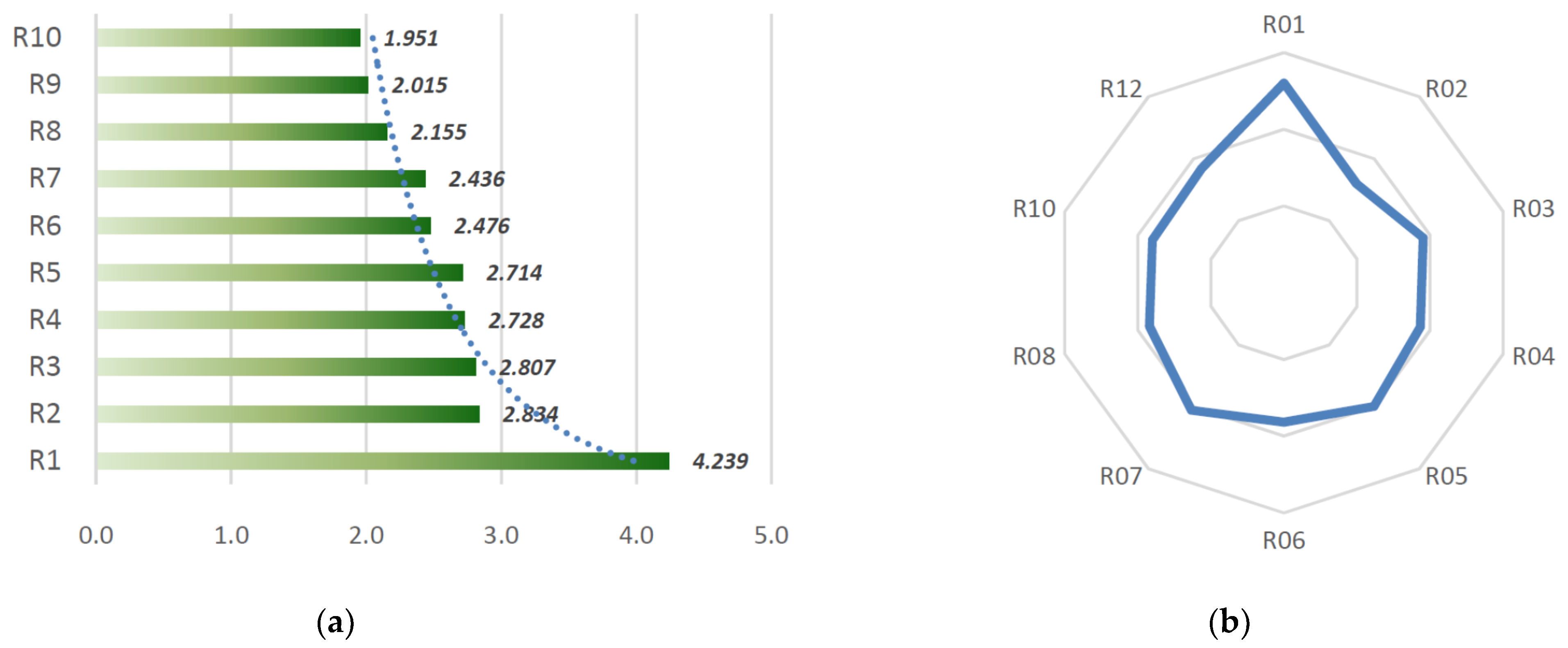
| R1 | Blow out of project contingency | 6601 | 0.55 | 5.206 | 4.250 | 4.327 | 3.331 | 4.082 | 4.239 |
| R2 | Tight hole of the well and casing run problems | 6109 | 0.42 | 3.198 | 2.753 | 2.808 | 2.474 | 2.939 | 2.834 |
| R3 | Pipe failure | 6201 | 0.45 | 3.805 | 4.418 | 3.156 | 0.953 | 1.702 | 2.807 |
| R4 | Changes in the size of the inner diameter of the casing in some parts due to impact | 6106 | 0.42 | 3.736 | 3.877 | 2.700 | 1.907 | 1.421 | 2.728 |
| R5 | Lack of well rehabilitation before casing running operations and the resulting problems | 6101 | 0.45 | 3.988 | 3.602 | 3.233 | 1.349 | 1.400 | 2.714 |
| R6 | Collapsing formation and wellbore instability | 6701 | 0.45 | 3.640 | 3.961 | 3.444 | 0.362 | 0.971 | 2.476 |
| R7 | Poor design and late changes to well design and procedures | 1403 | 0.46 | 4.108 | 4.875 | 2.830 | 0.124 | 0.241 | 2.436 |
| R8 | Loss of circulation | 6401 | 0.42 | 3.678 | 3.033 | 3.055 | 0.069 | 0.940 | 2.155 |
| R9 | Sanctions and special bans | 4205 | 0.35 | 2.235 | 2.547 | 1.660 | 0.852 | 2.782 | 2.015 |
| R10 | Incompetence of project team | 1601 | 0.35 | 3.598 | 2.806 | 3.104 | 0.133 | 0.111 | 1.951 |
| R11 | Equipment failure | 6809 | 0.35 | 2.262 | 2.764 | 2.681 | 0.707 | 1.337 | 1.950 |
| R12 | Blocking of the drilling pipe or product pipe installation due to the swelling of clay and silt | 6208 | 0.39 | 3.663 | 3.274 | 2.344 | 0.237 | 0.173 | 1.938 |
| R13 | Exchange rate changes | 3104 | 0.35 | 2.495 | 2.997 | 2.038 | 0.733 | 1.154 | 1.883 |
| R14 | Weakness in planning and scheduling and initial project resources | 1301 | 0.31 | 2.095 | 1.998 | 2.215 | 1.480 | 1.525 | 1.863 |
| R15 | Infiltration of drilling mud into wells | 6501 | 0.32 | 2.498 | 2.607 | 1.575 | 0.800 | 0.467 | 1.589 |
| R16 | Excessive delays due to late decisions making by project participants | 1606 | 0.31 | 2.413 | 2.704 | 1.071 | 0.481 | 0.781 | 1.490 |
| R17 | Problems in casing cementing and Staying cement in casing | 6303 | 0.25 | 1.653 | 1.675 | 1.325 | 0.825 | 0.691 | 1.234 |
| R18 | Ambiguous conditions of contract | 2102 | 0.25 | 1.520 | 1.878 | 1.183 | 0.612 | 0.693 | 1.177 |
| R19 | Inappropriate choice of project implementation method | 1501 | 0.21 | 1.129 | 1.409 | 1.383 | 0.306 | 1.152 | 1.076 |
| R20 | Corrosion or wear of mechanical parts | 6801 | 0.25 | 1.953 | 1.447 | 0.981 | 0.157 | 0.472 | 1.002 |
| R21 | Error in measuring the correct weight of cement | 6308 | 0.23 | 1.445 | 1.323 | 1.269 | 0.625 | 0.290 | 0.990 |
| R22 | Lack of skills of drilling staff (inadequate practice of skills) | 1801 | 0.23 | 1.426 | 1.199 | 1.196 | 0.515 | 0.567 | 0.981 |
| R23 | Work conditions deferring from contract | 2104 | 0.16 | 1.127 | 1.294 | 0.851 | 0.443 | 0.753 | 0.894 |
| R24 | Change in rules and regulations | 4107 | 0.22 | 1.486 | 1.538 | 0.759 | 0.270 | 0.115 | 0.834 |
| R25 | Improper cost calculations for the investment | 3203 | 0.15 | 0.818 | 0.707 | 0.715 | 1.052 | 0.834 | 0.825 |
| R26 | Inadequate project organization structure | 1101 | 0.21 | 1.590 | 1.059 | 0.652 | 0.089 | 0.545 | 0.787 |
| R27 | Unclear and imprecise delegation of responsibilities and roles and project charter | 1203 | 0.16 | 1.001 | 0.891 | 0.612 | 0.615 | 0.792 | 0.782 |
| R28 | Change of organization ownership or management | 1102 | 0.22 | 1.105 | 1.163 | 0.847 | 0.036 | 0.547 | 0.739 |
| R29 | Acidizing which causes cracking of lines and hitting people, acid spraying and severe acid burns | 7104 | 0.18 | 1.083 | 1.050 | 0.947 | 0.056 | 0.460 | 0.719 |
| R30 | New and complex technology (e.g., packers and liner hangers) | 6901 | 0.16 | 0.992 | 1.104 | 0.650 | 0.105 | 0.627 | 0.696 |
| R31 | Geological structure and complexity of the region | 5101 | 0.15 | 1.011 | 0.811 | 1.035 | 0.118 | 0.107 | 0.616 |
| R32 | Oil and gas leaks, toxic gas leaks, waste, or other environmental pollutants | 8501 | 0.14 | 1.026 | 0.929 | 0.383 | 0.281 | 0.460 | 0.616 |
| R33 | Disposal and discharge of wastewater and drilling fluid | 8301 | 0.15 | 0.730 | 0.144 | 0.057 | 1.213 | 0.037 | 0.436 |
| R34 | Lack of sufficient knowledge and information of field and reservoir structures | 5202 | 0.15 | 0.766 | 0.067 | 0.010 | 1.230 | 0.072 | 0.429 |
| R35 | Changing social responsibility rules and regulations | 4303 | 0.14 | 0.440 | 0.653 | 0.485 | 0.115 | 0.336 | 0.406 |
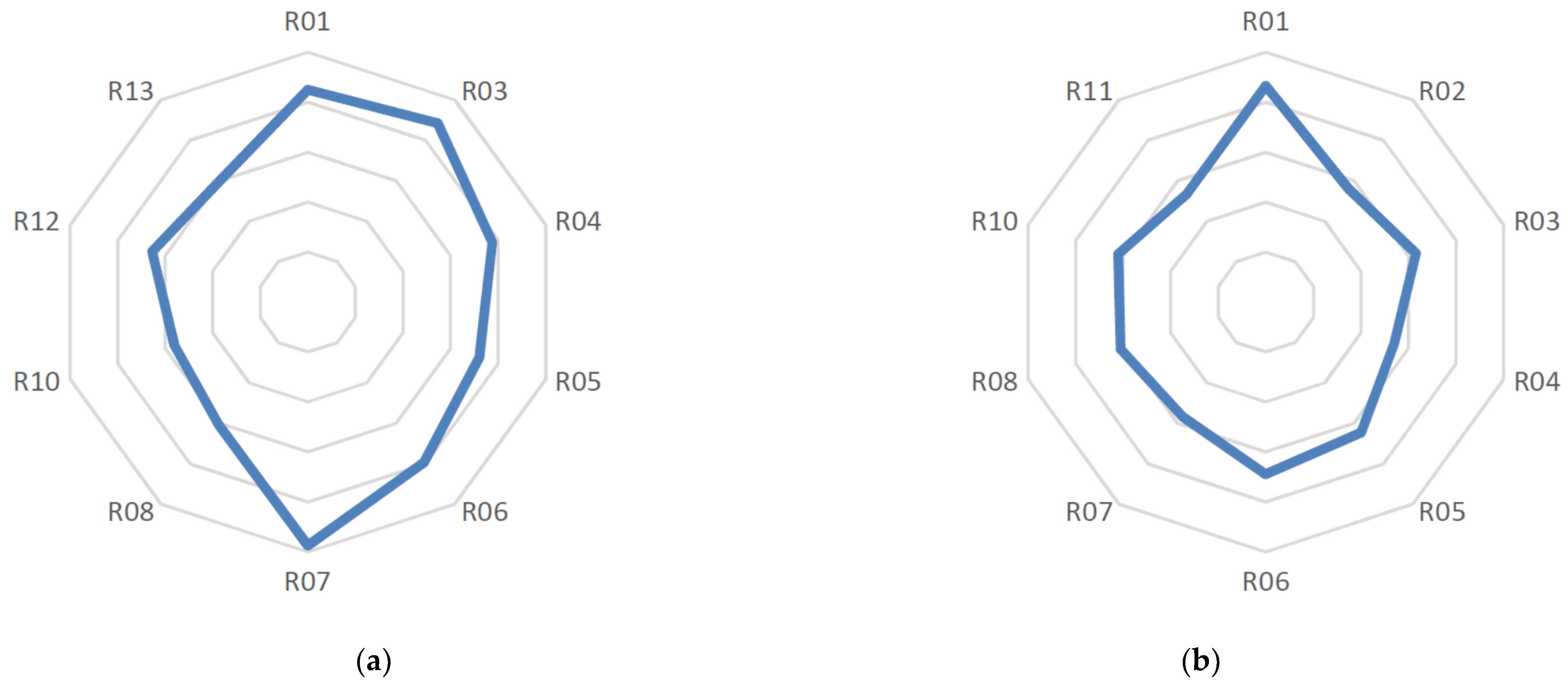
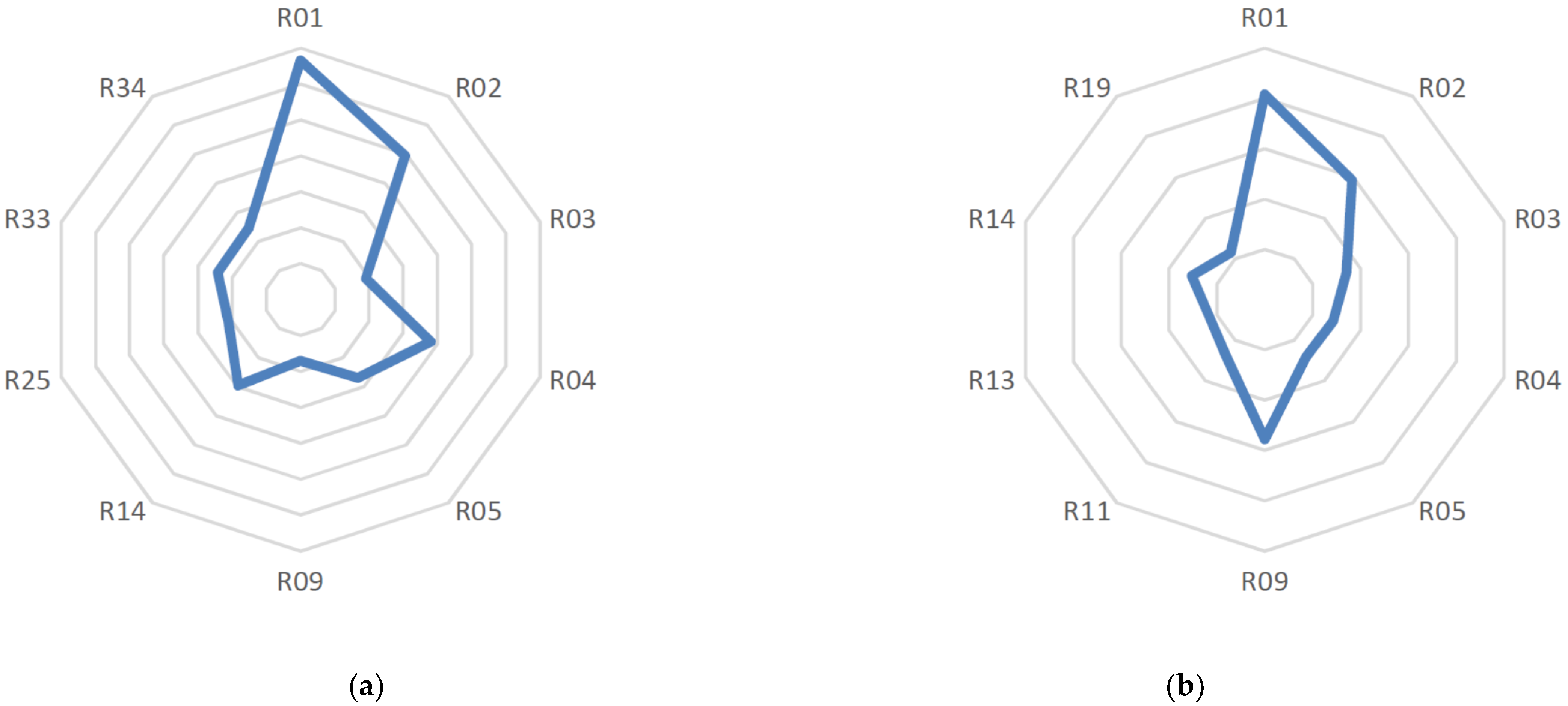
| Project Objective | Risk Code | Description of the Risk | RII |
|---|---|---|---|
| Cost | R1 | Blow out of project contingency | 5.206 |
| R7 | Poor design and late changes to well design and procedures | 4.108 | |
| R5 | Pipe failure | 3.988 | |
| R3 | Tight hole of the well and casing run problems | 3.805 | |
| R4 | Loss of circulation | 3.736 | |
| R8 | Lack of well rehabilitation before casing running operations and the resulting problems | 3.678 | |
| R12 | Sanctions and special bans | 3.663 | |
| R6 | Changes in the size of the inner diameter of the casing in some parts due to impact | 3.640 | |
| R10 | Exchange rate changes | 3.598 | |
| R2 | Collapsing formation and wellbore instability | 3.198 | |
| Time | R7 | Poor design and late changes to well design and procedures | 4.875 |
| R3 | Tight hole of the well and casing run problems | 4.418 | |
| R1 | Blow out of project contingency | 4.250 | |
| R6 | Changes in the size of the inner diameter of the casing in some parts due to impact | 3.961 | |
| R4 | Loss of circulation | 3.877 | |
| R5 | Pipe failure | 3.602 | |
| R12 | Sanctions and special bans | 3.274 | |
| R8 | Lack of well rehabilitation before casing running operations and the resulting problems | 3.033 | |
| R13 | Blocking of the drilling pipe or product pipe installation due to the swelling of clay and silt | 2.997 | |
| R10 | Exchange rate changes | 2.806 | |
| Quality | R1 | Blow out contingency | 4.327 |
| R6 | Changes in the size of the inner diameter of the casing in some parts due to impact | 3.444 | |
| R5 | Pipe failure | 3.233 | |
| R3 | Tight hole of the well and casing run problems | 3.156 | |
| R10 | Exchange rate changes | 3.104 | |
| R8 | Lack of well rehabilitation before casing running operations and the resulting problems | 3.055 | |
| R7 | Poor design and late changes to well design and procedures | 2.830 | |
| R2 | Collapsing formation and wellbore instability | 2.808 | |
| R4 | Loss of circulation | 2.700 | |
| R11 | Incompetence of project team | 2.681 | |
| Environment | R1 | Blow out contingency | 3.331 |
| R2 | Collapsing formation and wellbore instability | 2.474 | |
| R4 | Loss of circulation | 1.907 | |
| R14 | Infiltration of drilling mud into wells | 1.480 | |
| R5 | Pipe failure | 1.349 | |
| R34 | Disposal and discharge of wastewater and drilling fluid | 1.230 | |
| R33 | Oil and gas leaks, toxic gas leaks, waste, or other environmental pollutants | 1.213 | |
| R25 | Acidizing which causes cracking of lines and hitting people, acid spraying, and severe acid burns | 1.052 | |
| R3 | Tight hole of the well and casing run problems | 0.953 | |
| R9 | Equipment Failure | 0.852 | |
| Safety | R1 | Blow out contingency | 4.082 |
| R2 | Collapsing formation and wellbore instability | 2.939 | |
| R9 | Equipment Failure | 2.782 | |
| R3 | Tight hole of the well and casing run problems | 1.702 | |
| R14 | Infiltration of drilling mud into wells | 1.525 | |
| R4 | Loss of circulation | 1.421 | |
| R5 | Pipe failure | 1.400 | |
| R11 | Incompetence of project team | 1.337 | |
| R13 | Blocking of the drilling pipe or product pipe installation due to the swelling of clay and silt | 1.154 | |
| R19 | Lack of skills of drilling staff (inadequate practice of skills) | 1.152 |
| Best Criterion. | R1 | R2 | R3 | R4 | R5 | R6 | R7 | R8 | R9 | R10 | R11 | R12 | R13 | R14 | R15 | R16 | R17 | R18 | R19 | R20 | R21 | R22 | R23 | R24 | R25 | R26 | R27 | R28 | R29 | R30 | R31 | R32 | R33 | R34 | R35 |
|---|---|---|---|---|---|---|---|---|---|---|---|---|---|---|---|---|---|---|---|---|---|---|---|---|---|---|---|---|---|---|---|---|---|---|---|
| R1 | 7 | 8 | 7 | 5 | 3 | 6 | 4 | 5 | 6 | 5.7 | 6.6 | 4.3 | 6.9 | 6.7 | 3.6 | 8.8 | 8.2 | 8.7 | 2.5 | 2.2 | 1.9 | 2.1 | 4.2 | 5.4 | 6.2 | 3.3 | 4.9 | 1 | 2.8 | 6 | 3.9 | 7.9 | 7.8 | 8.5 | 8.4 |
| Worst Criterion. | R1 | R2 | R3 | R4 | R5 | R6 | R7 | R8 | R9 | R10 | R11 | R12 | R13 | R14 | R15 | R16 | R17 | R18 | R19 | R20 | R21 | R22 | R23 | R24 | R25 | R26 | R27 | R28 | R29 | R30 | R31 | R32 | R33 | R34 | R35 |
|---|---|---|---|---|---|---|---|---|---|---|---|---|---|---|---|---|---|---|---|---|---|---|---|---|---|---|---|---|---|---|---|---|---|---|---|
| R35 | 3.8 | 3.5 | 3.7 | 6.1 | 7.6 | 5.1 | 7 | 5.6 | 4.6 | 5.3 | 4.4 | 6.4 | 4 | 4.1 | 7.3 | 1 | 3 | 2.1 | 8.1 | 8.3 | 8.6 | 8.5 | 6.7 | 5.4 | 4.8 | 7.4 | 5.8 | 8.8 | 7.8 | 4.9 | 6.9 | 3.1 | 3.3 | 2.5 | 2.8 |
| 1 | 2 | 3 | 4 | 5 | 6 | 7 | 8 | 9 | |
|---|---|---|---|---|---|---|---|---|---|
| Consistency index | 0.00 | 0.44 | 1.00 | 1.63 | 2.30 | 3.00 | 3.73 | 4.47 | 5.23 |
| Criteria. | R1 | R2 | R3 | R4 | R5 | R6 | R7 | R8 | R9 | R10 | R11 | R12 | R13 | R14 | R15 | R16 | R17 | R18 | R19 | R20 | R21 | R22 | R23 | R24 | R25 | R26 | R27 | R28 | R29 | R30 | R31 | R32 | R33 | R34 | R35 |
|---|---|---|---|---|---|---|---|---|---|---|---|---|---|---|---|---|---|---|---|---|---|---|---|---|---|---|---|---|---|---|---|---|---|---|---|
| Weight | 0.0327 | 0.0299 | 0.0312 | 0.0937 | 0.1773 | 0.0503 | 0.1595 | 0.0736 | 0.0404 | 0.0529 | 0.0382 | 0.1169 | 0.0332 | 0.0349 | 0.1608 | 0.0131 | 0.0271 | 0.0239 | 0.2023 | 0.2072 | 0.2179 | 0.2097 | 0.1268 | 0.0625 | 0.0438 | 0.1736 | 0.0873 | 0.2454 | 0.1863 | 0.0479 | 0.1469 | 0.0286 | 0.0290 | 0.0251 | 0.0261 |
| Rank | 26 | 28 | 27 | 14 | 7 | 19 | 10 | 16 | 22 | 18 | 23 | 13 | 25 | 24 | 9 | 35 | 31 | 34 | 5 | 4 | 2 | 3 | 12 | 17 | 21 | 8 | 15 | 1 | 6 | 20 | 11 | 30 | 29 | 33 | 32 |
| 0.98356948 | |||||||||||||||||||||||||||||||||||
| Consistency Ratio | 0.18 | ||||||||||||||||||||||||||||||||||
| Pair-Wise Comparison Matrix for R1 Criterion | Day-Rate (X1) | Footage (X2) | Turnkey (X3) | Day-Rate Incentive (X4) | Footage Incentive (X5) | Turnkey Incentive (X6) |
|---|---|---|---|---|---|---|
| Day-rate (X1) | 1 | a | b | c | d | e |
| Footage (X2) | 1/a | f | g | h | i | j |
| Turnkey (X3) | 1/b | 1/g | 1 | k | l | m |
| Day-rate Incentive (X4) | 1/c | 1/h | 1/k | 1 | n | o |
| Footage Incentive (X5) | 1/d | 1/i | 1/l | 1/n | 1 | p |
| Turnkey Incentive (X6) | 1/e | 1/j | 1/m | 1/o | 1/p | 1 |
| Alternative Code. | Contract Type | Final Normalized Score |
|---|---|---|
| X1 | Day-rate | 0.65 |
| X2 | Footage | 0.59 |
| X3 | Turnkey | 0.71 |
| X4 | Day-rate Incentive | 0.69 |
| X5 | Footage Incentive | 0.86 |
| X6 | Turnkey Incentive | 0.78 |
Publisher’s Note: MDPI stays neutral with regard to jurisdictional claims in published maps and institutional affiliations. |
© 2021 by the authors. Licensee MDPI, Basel, Switzerland. This article is an open access article distributed under the terms and conditions of the Creative Commons Attribution (CC BY) license (http://creativecommons.org/licenses/by/4.0/).
Share and Cite
Faraji, A.; Rashidi, M.; Khadir, P.; Perera, S. A Risk Analysis‐Best Worst Method Based Model for Selection of the Most Appropriate Contract Strategy for Onshore Drilling Projects in the Iranian Petroleum Industry. Buildings 2021, 11, 97. https://doi.org/10.3390/buildings11030097
Faraji A, Rashidi M, Khadir P, Perera S. A Risk Analysis‐Best Worst Method Based Model for Selection of the Most Appropriate Contract Strategy for Onshore Drilling Projects in the Iranian Petroleum Industry. Buildings. 2021; 11(3):97. https://doi.org/10.3390/buildings11030097
Chicago/Turabian StyleFaraji, Amir, Maria Rashidi, Pegah Khadir, and Srinath Perera. 2021. "A Risk Analysis‐Best Worst Method Based Model for Selection of the Most Appropriate Contract Strategy for Onshore Drilling Projects in the Iranian Petroleum Industry" Buildings 11, no. 3: 97. https://doi.org/10.3390/buildings11030097
APA StyleFaraji, A., Rashidi, M., Khadir, P., & Perera, S. (2021). A Risk Analysis‐Best Worst Method Based Model for Selection of the Most Appropriate Contract Strategy for Onshore Drilling Projects in the Iranian Petroleum Industry. Buildings, 11(3), 97. https://doi.org/10.3390/buildings11030097