Surface Integrity and Subsurface Modification Depths During Grinding Under Varying Process Conditions

 , , ,
, , ,  and
and
Abstract
1. Introduction
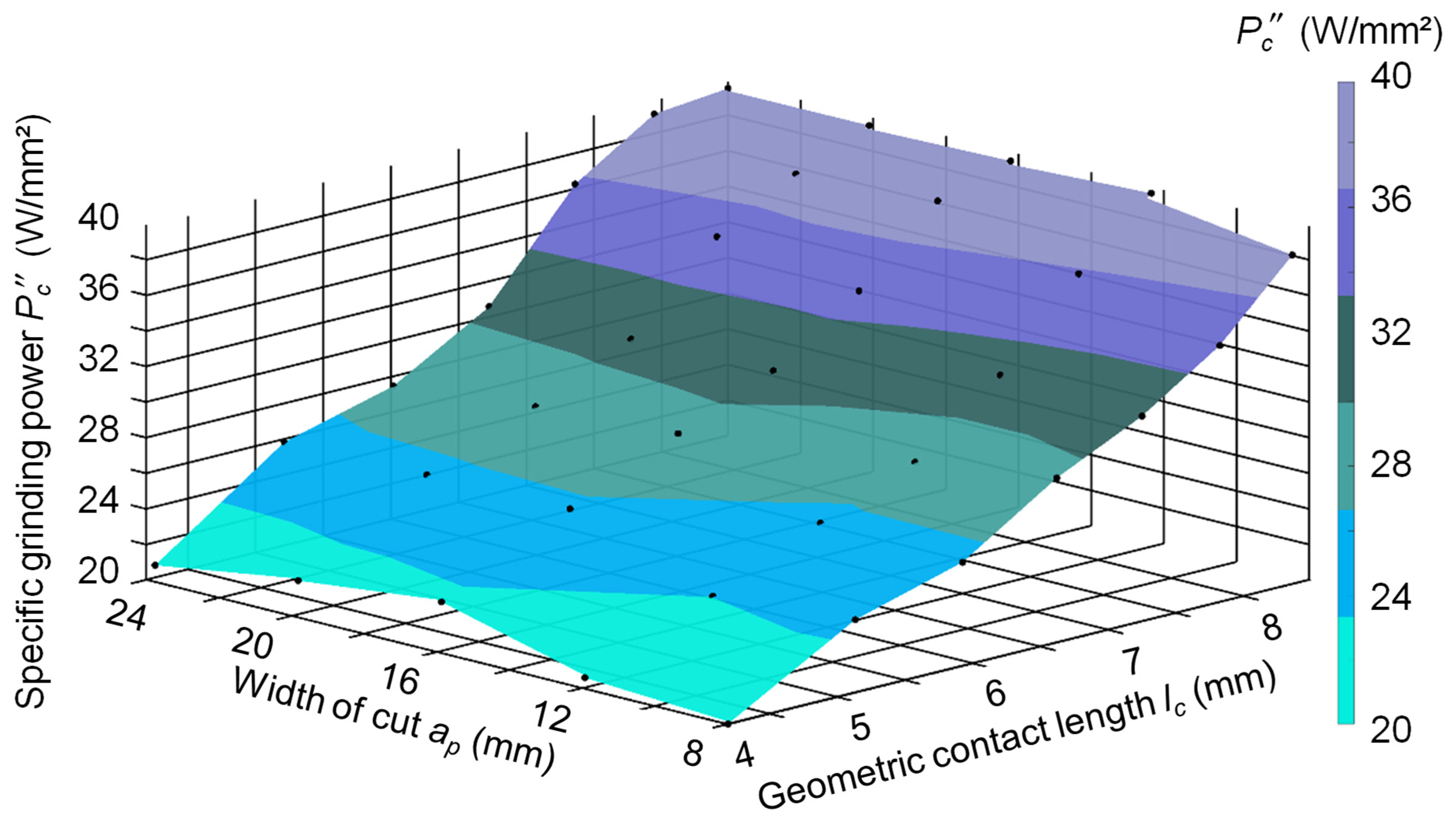
- Is the specific grinding power uniformly distributed across the width of cut ap and linearly increasing along the geometric contact length lc or is there a need to incorporate these geometric parameters explicitly into the Pc″–Δt diagram?
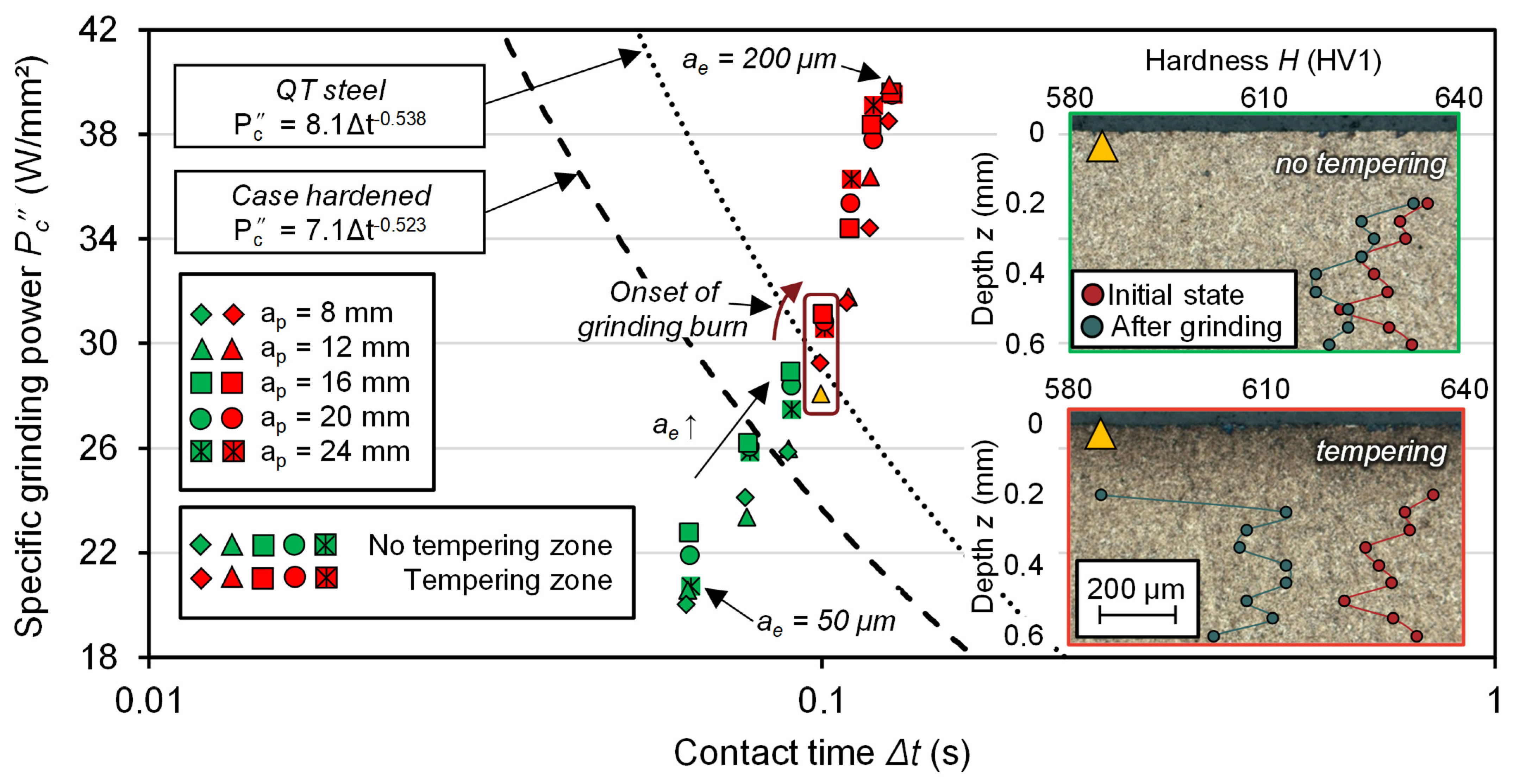
- Does the width of cut ap influence the position of the grinding burn limit established for AISI 4140 (42CrMo4) in the Pc″–Δt diagram?
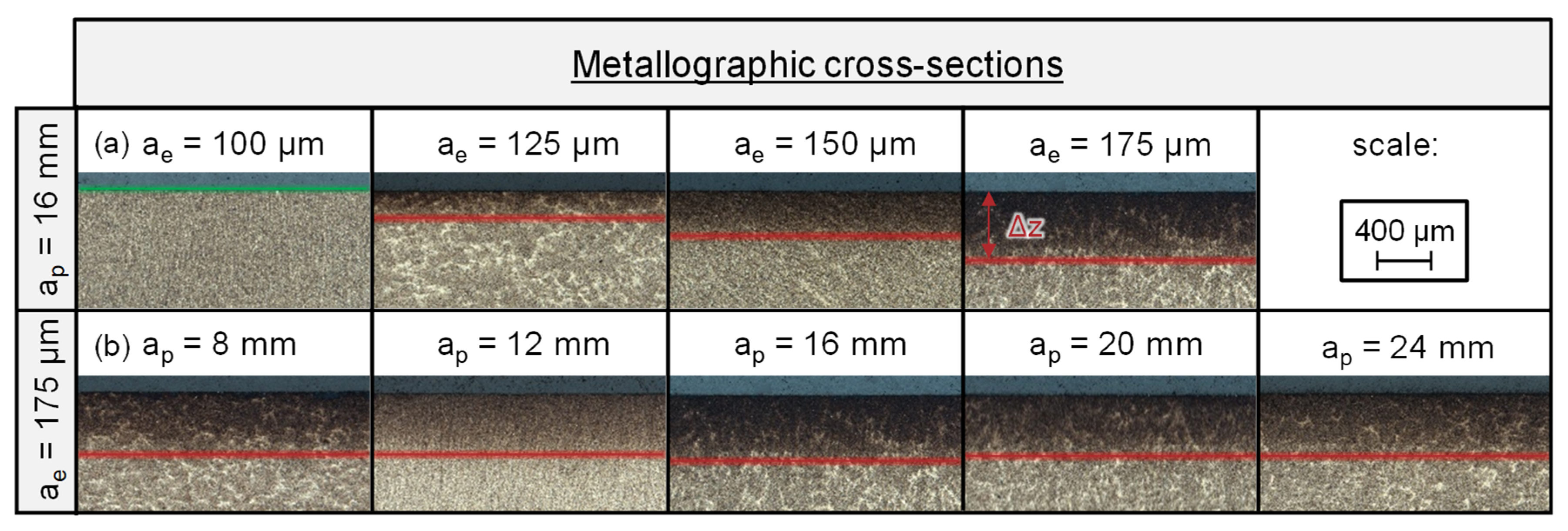
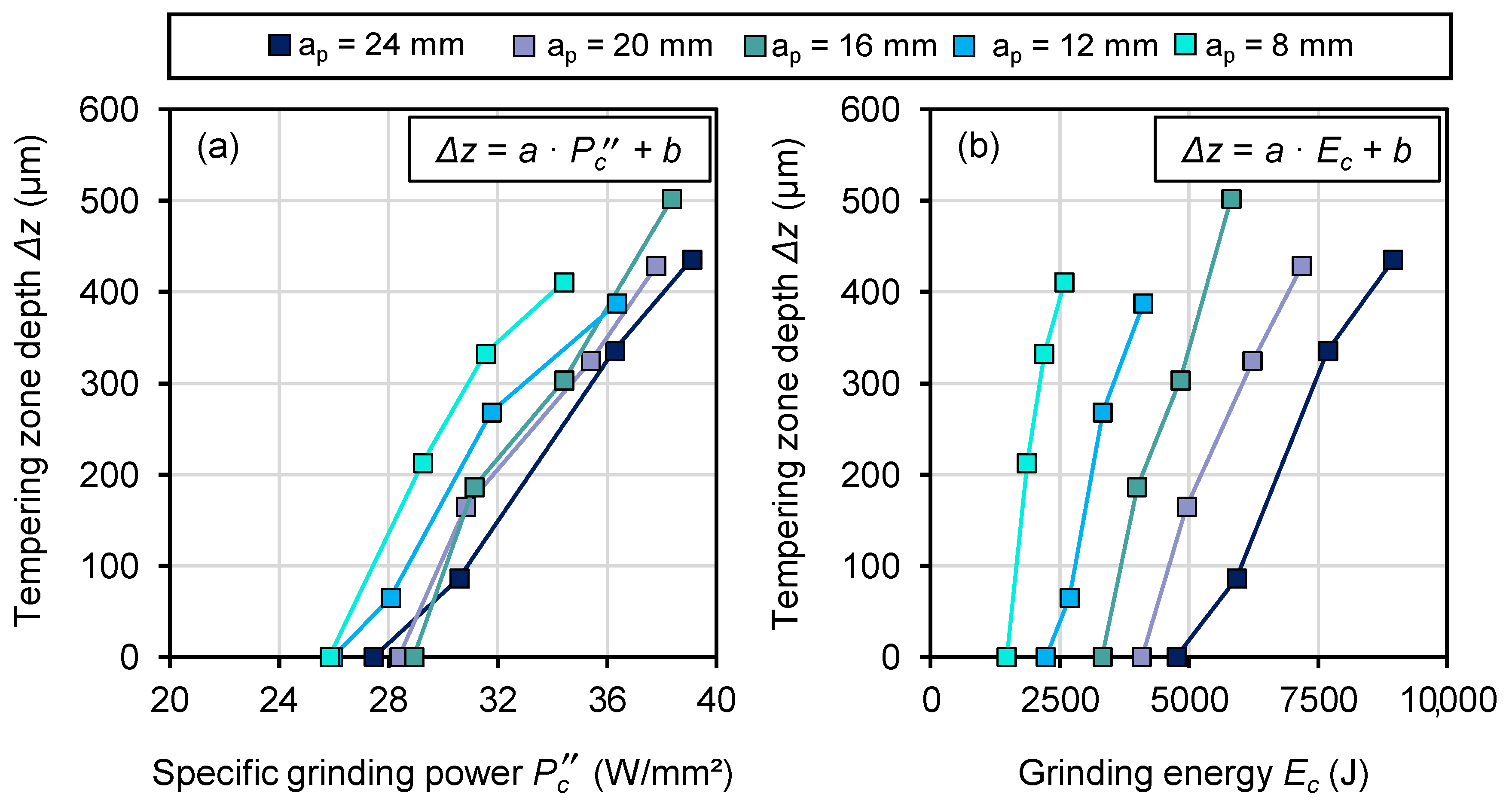
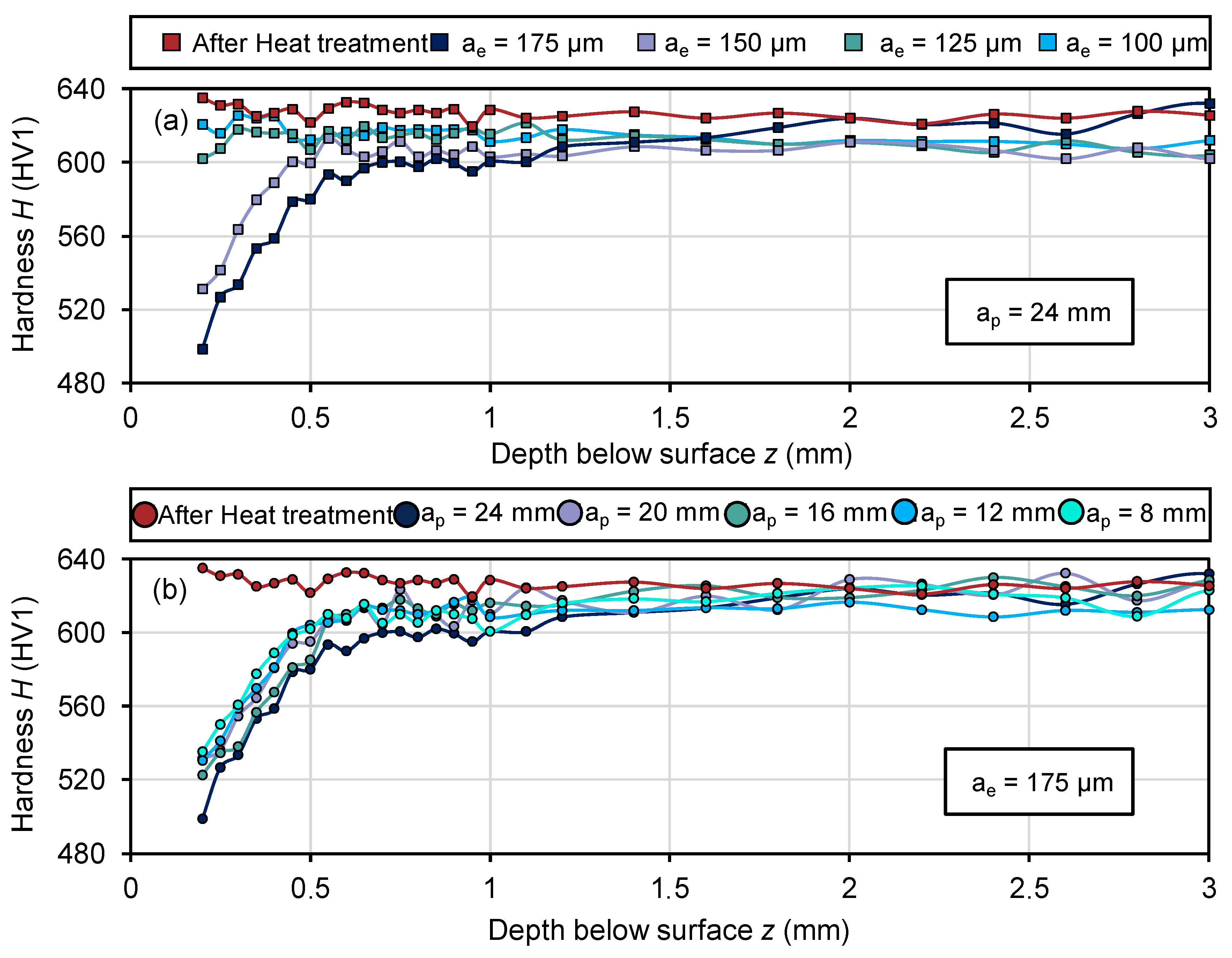
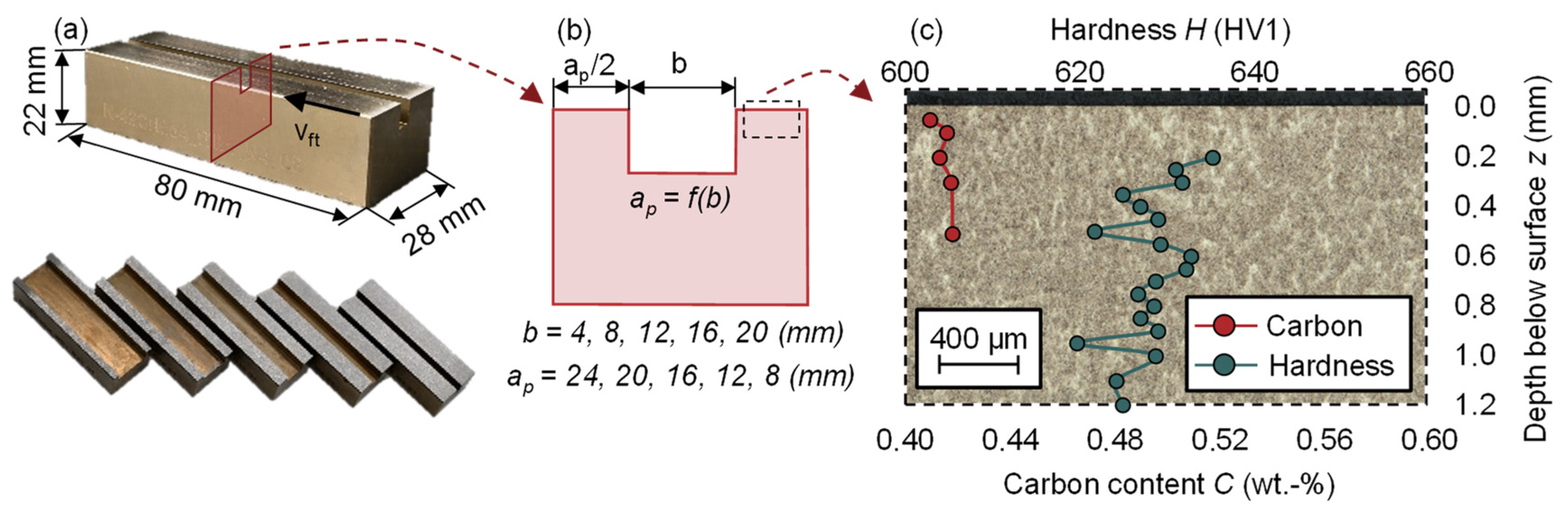
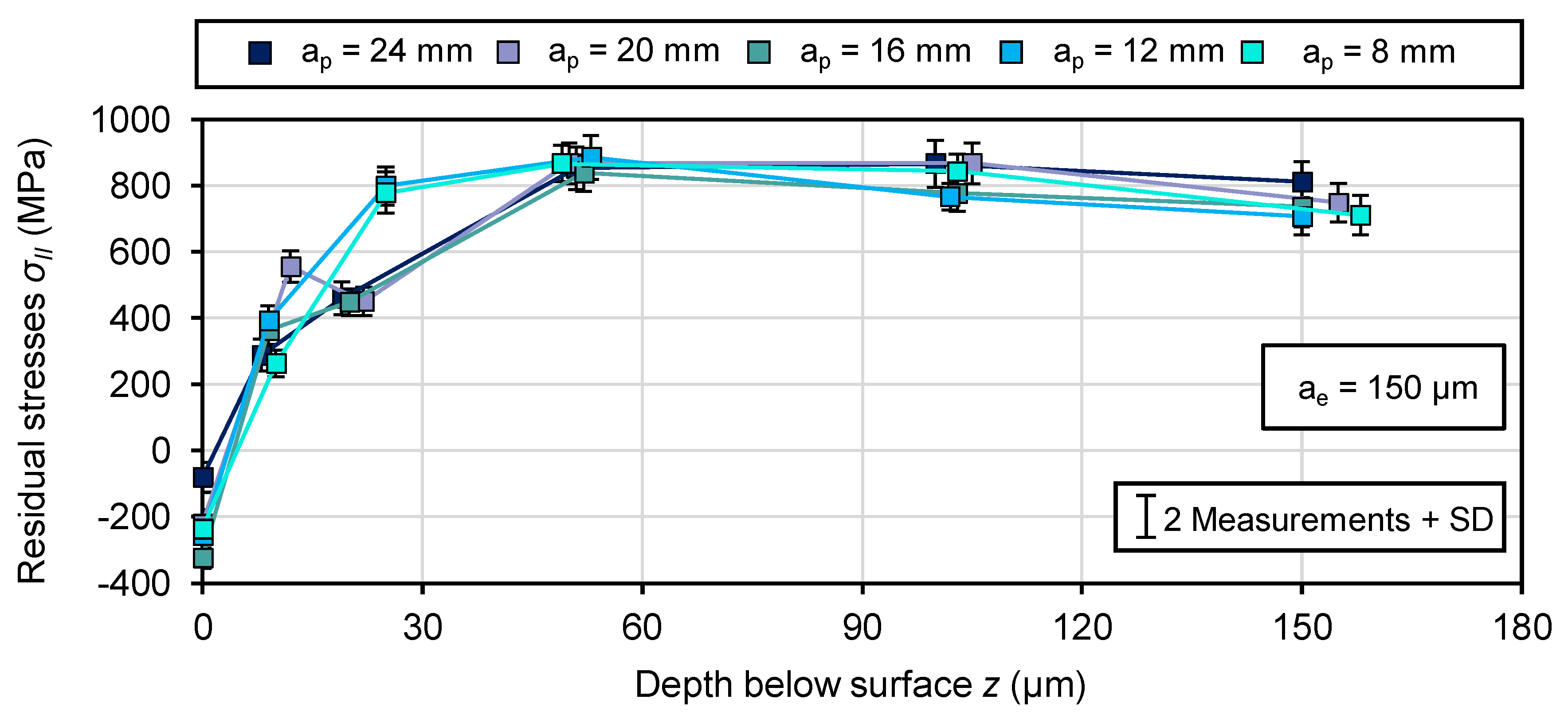
- How do different widths of cut ap take effect on the subsurface modification depth, particularly with regard to tempering zones, hardness and residual stress depth profiles?
2. Materials and Methods
3. Results
3.1. Distribution of Specific Grinding Power Within the Contact Zone
3.2. Prediction of Grinding Burn Limit
3.3. Surface Integrity and Subsurface Modification Depth
4. Discussion
5. Conclusions
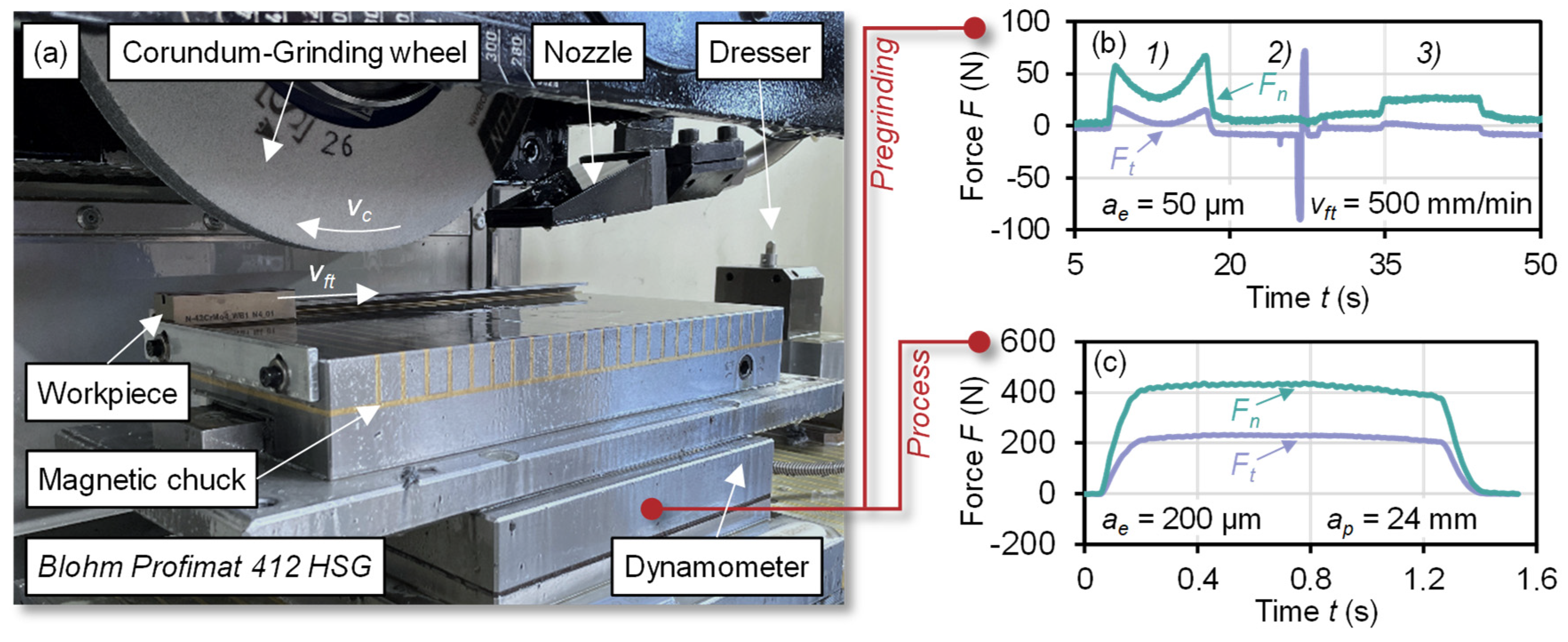
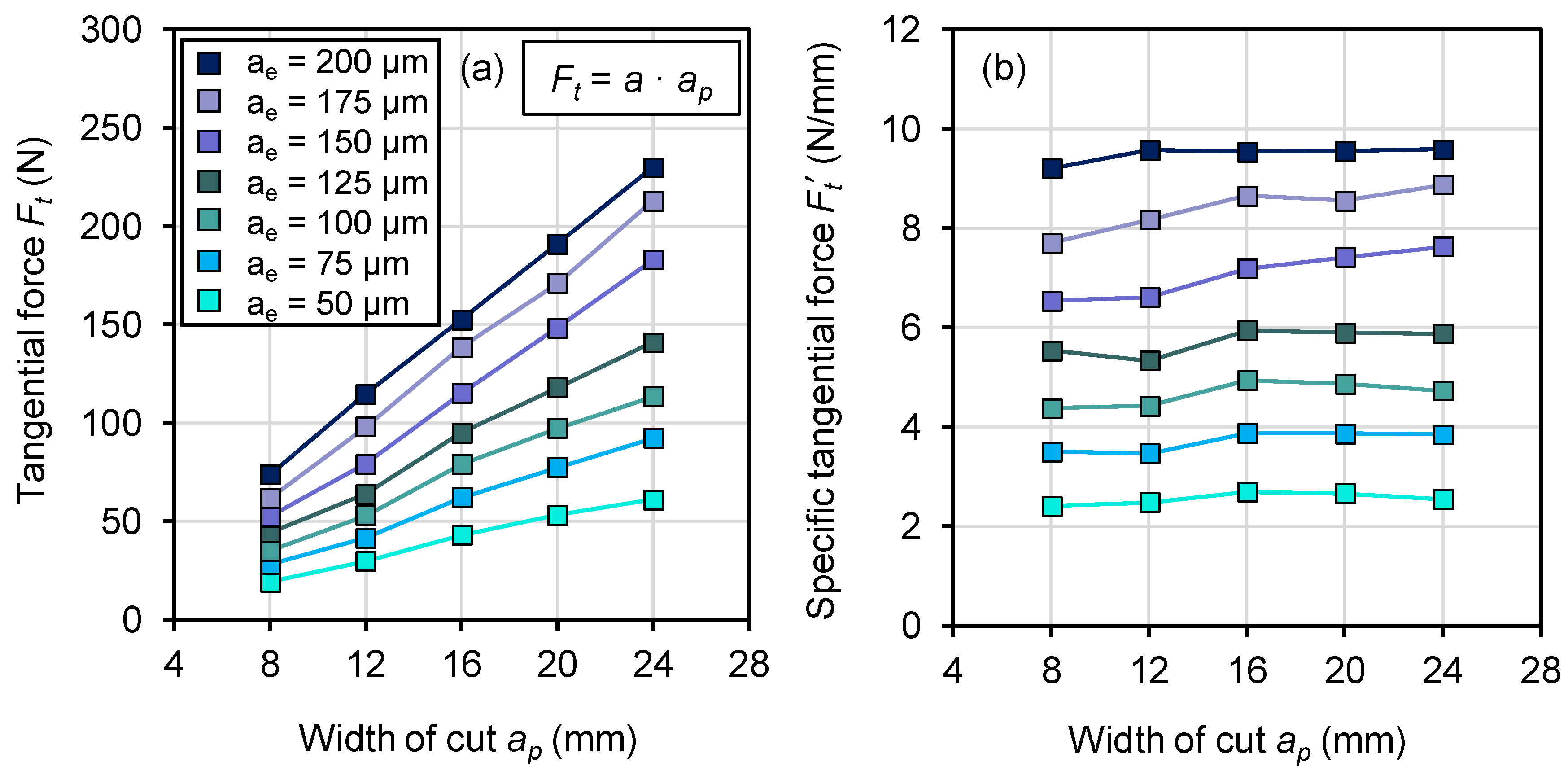
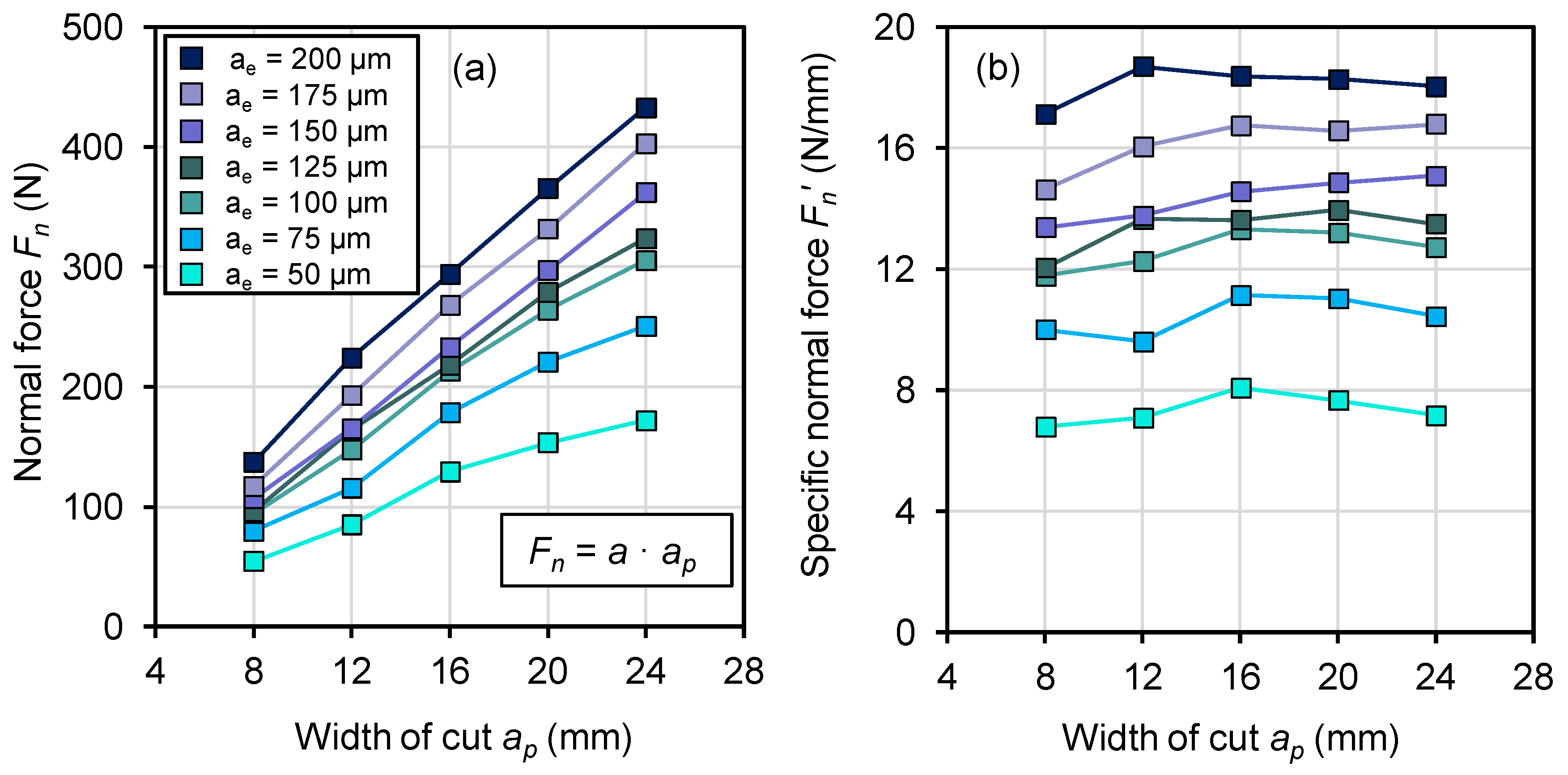
- The tangential and normal grinding forces increased proportionally with both width of cut ap and depth of cut ae. When normalized to the width of cut, the forces (Ft′ and Fn′) remained nearly constant, indicating an approximately uniform load distribution across the width of cut ap.
- The specific grinding power Pc″ was found to be distributed nearly uniformly across the width of cut ap and to increase linearly along the geometric contact length lc.
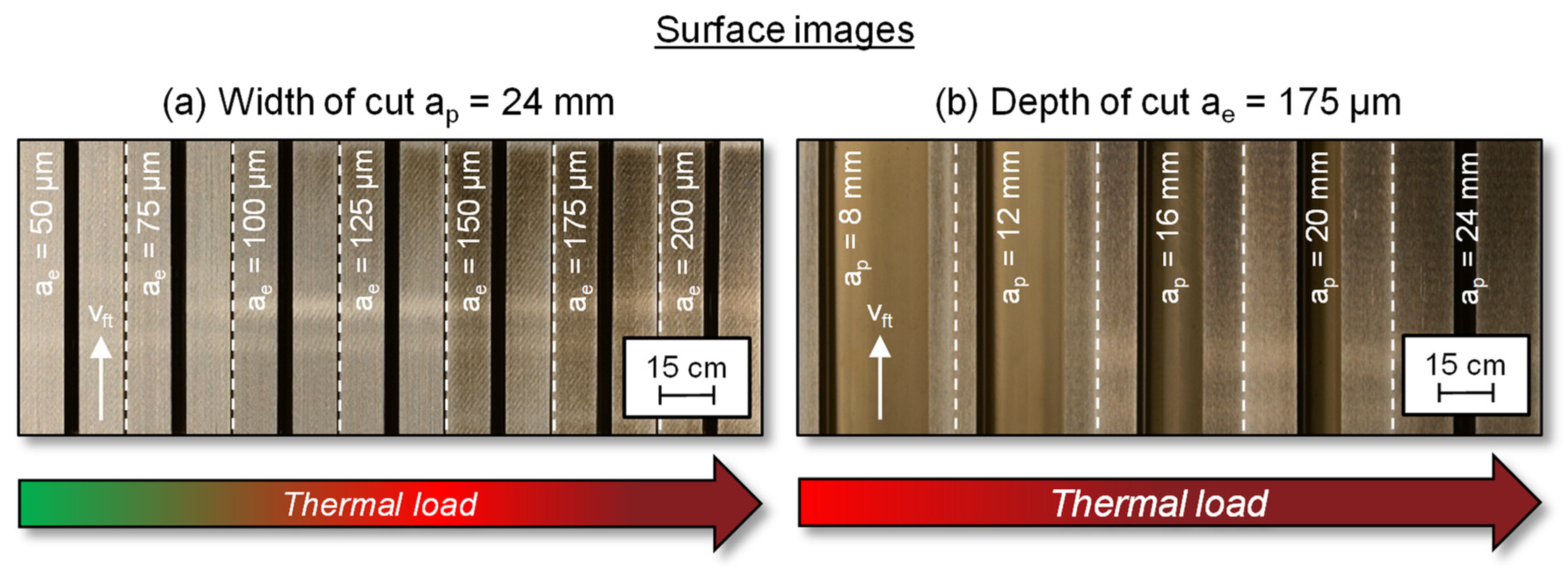
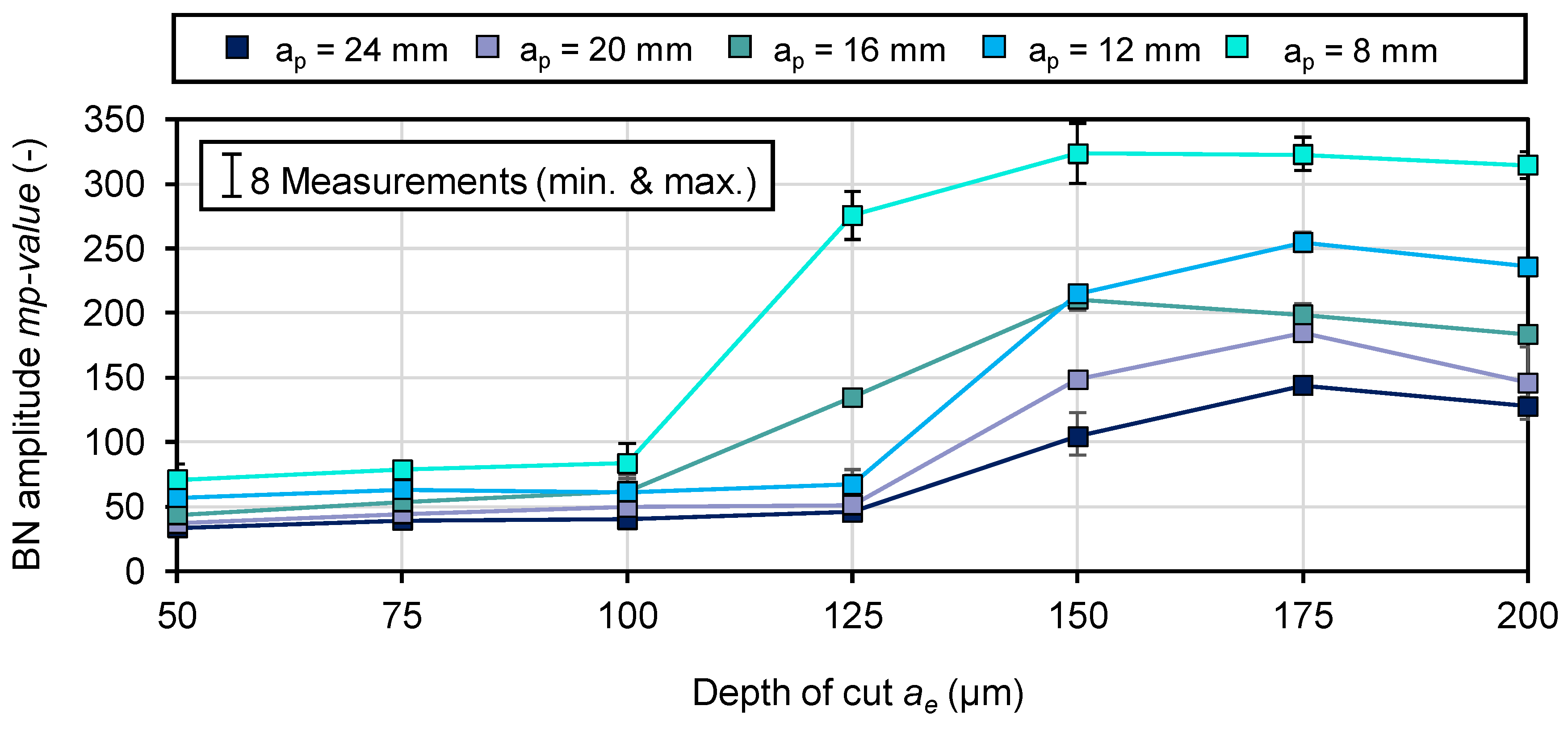
- Barkhausen noise measurements, visual surface inspection and metallographic analyses consistently identified the onset of thermally induced tempering effects at comparable process conditions.
- The experimentally determined grinding burn threshold corresponded well with the thermal process limit previously proposed for quenched and tempered AISI 4140. The results indicate that the position of the grinding burn limit in the Pc″–Δt diagram is independent of the width of cut ap.
- Increasing thermal load resulted in progressively larger tempering zone depths Δz, stronger hardness reductions and more pronounced subsurface modifications.
- Hardness depth profiles demonstrated that increasing thermal load not only intensified surface softening but also increased the depth of the affected subsurface region.
- Residual stress depth profiles showed compressive residual stresses at the surface for all investigated conditions. Only minor differences between the investigated widths of cut were observed, indicating that residual stress formation is primarily controlled by process energy input rather than by the engagement width itself.
Author Contributions
Funding
Data Availability Statement
Conflicts of Interest
References
- Brinksmeier, E.; Meyer, D.; Heinzel, C.; Lübben, T.; Sölter, J.; Langenhorst, L.; Frerichs, F.; Kämmler, J.; Kohls, E.; Kuschel, S. Process signatures—The missing link to predict surface integrity in machining. Procedia CIRP 2018, 71, 3–10. [Google Scholar] [CrossRef]
- Hashimoto, F.; Yamaguchi, H.; Krajnik, P.; Wegener, K.; Chaudhari, H.; Hoffmeister, H.-W.; Kuster, F. Abrasive fine-finishing technology. CIRP Ann. 2016, 65, 597–620. [Google Scholar] [CrossRef]
- Malkin, S.; Guo, C. Thermal analysis of grinding. CIRP Ann. 2007, 56, 760–782. [Google Scholar] [CrossRef]
- Karpuschewski, B.; Bleicher, O.; Beutner, M. Surface integrity inspection on gears using Barkhausen noise analysis. Procedia Eng. 2010, 19, 162–171. [Google Scholar] [CrossRef]
- Krajnik, P.; Drazumeric, R.; Badger, J.; Hashimoto, F. Cycle optimization in cam-lobe grinding for high productivity. CIRP Ann. 2014, 63, 333–336. [Google Scholar] [CrossRef]
- Kukla, D.; Kopec, M.; Gradzik, A. Identification and characterization of the grinding burns by eddy current method. Open Eng. 2022, 12, 1046–1050. [Google Scholar] [CrossRef]
- Hou, Z.B.; Komanduri, R. On the mechanics of the grinding process. Part II—Thermal analysis of fine grinding. Int. J. Mach. Tools Manuf. 2004, 44, 247–270. [Google Scholar] [CrossRef]
- Stephenson, D.J.; Jin, T. Physical basics in grinding. In Proceedings of the 1st European Conference on Grinding, Aachen, Germany, 6–7 November 2003. [Google Scholar]
- Snoeys, R.; Maris, M.; Peters, J. Thermally induced damage in grinding. CIRP Ann. 1978, 27, 571–581. [Google Scholar]
- Shaw, M.C.; Vyas, A. Heat-affected zones in grinding steel. CIRP Ann. 1994, 43, 279–282. [Google Scholar] [CrossRef]
- Jawahir, I.S.; Brinksmeier, E.; Saoubi, R.M.; Aspinwall, D.K.; Outeiro, J.C.; Meyer, D.; Umbrello, D.; Jayal, A.D. Surface integrity in material removal processes: Recent advances. CIRP Ann. 2011, 60, 603–626. [Google Scholar] [CrossRef]
- Field, M.; Koster, W. Optimizing grinding parameters to combine high productivity with high surface integrity. CIRP Ann. 1978, 27, 523–526. [Google Scholar]
- He, B.; Wei, C.; Ding, S.; Shi, Z. A survey of methods for detecting metallic grinding burn. Measurement 2019, 134, 426–439. [Google Scholar] [CrossRef]
- Oliveira, J.F.G.; Silva, E.J.; Guo, C.; Hashimoto, F. Industrial challenges in grinding. CIRP Ann. 2009, 58, 663–680. [Google Scholar] [CrossRef]
- Rowe, W.B. Towards high productivity in precision grinding. Inventions 2018, 3, 24. [Google Scholar] [CrossRef]
- Duscha, M.; Eser, A.; Klocke, F.; Broeckmann, C.; Wegner, H.; Bezold, A. Modeling and simulation of phase transformation during grinding. Adv. Mater. Res. 2011, 223, 743–753. [Google Scholar] [CrossRef]
- Carslaw, H.; Jaeger, J.C. Conduction of Heat in Solids; Oxford University Press: Oxford, UK, 1959. [Google Scholar]
- Brinksmeier, E.; Aurich, J.C.; Govekar, E.; Heinzel, C.; Hoffmeister, H.W.; Klocke, F.; Peters, J.; Rentsch, R.; Stephenson, D.J.; Uhlmann, E.; et al. Advances in modeling and simulation of grinding processes. CIRP Ann. 2006, 55, 667–696. [Google Scholar] [CrossRef]
- Cao, Y.; Zhao, B.; Ding, W.; Jia, X.; Wu, B.; Liu, F.; Zhu, Y.; Lui, Q.; Xu, D. Evolution of undeformed chip thickness and grinding forces in grinding of K4002 nickel-based superalloy using corundum abrasive wheels. Chin. J. Aeronaut. 2025, 38, 102937. [Google Scholar] [CrossRef]
- Jamshidi, H.; Budak, E. A 3D analytical thermal model in grinding considering a periodic heat source under dry and wet conditions. J. Mater. Process. Technol. 2021, 295, 117158. [Google Scholar] [CrossRef]
- Guo, C.; Malkin, S. Analysis of energy partition in grinding. J. Eng. Ind. 1995, 117, 55–61. [Google Scholar] [CrossRef]
- Mao, C.; Zhou, Z.X.; Zhou, D.W.; Gu, D.Y. Analysis of influence factors for the contact length between wheel and workpiece in surface grinding. Key Eng. Mater. 2007, 359–360, 128–132. [Google Scholar] [CrossRef]
- Zhang, L.; Mahdi, M. Applied mechanics in grinding—IV. The mechanism of grinding induced phase transformation. Int. J. Mach. Tools Manuf. 1995, 35, 1397–1409. [Google Scholar] [CrossRef]
- Anderson, D.; Warkentin, A.; Bauer, R. Comparison of numerically and analytically predicted contact temperatures in shallow and deep dry grinding with infrared measurements. Int. J. Mach. Tools Manuf. 2008, 48, 320–328. [Google Scholar] [CrossRef]
- Schulze, V.; Aurich, J.C.; Jawahir, I.S.; Karpuschewski, B.; Yan, J. Surface conditioning in cutting and abrasive processes. CIRP Ann. 2024, 73, 667–693. [Google Scholar] [CrossRef]
- Malkin, S.; Lenz, E. Burning limit for surface and cylindrical grinding of steels. CIRP Ann. 1978, 27, 233–236. [Google Scholar]
- Heinzel, J.; Jedamski, R.; Rößler, M.; Karpuschewski, B.; Epp, J.; Dix, M. Hybrid approach to evaluate surface integrity based on grinding power and Barkhausen noise. Procedia CIRP 2022, 108, 489–494. [Google Scholar] [CrossRef]
- Guba, N.; Heinzel, J.; Heinzel, C.; Karpuschewski, B. Grinding burn limits: Generation of surface layer modification charts for discontinuous profile grinding with analogy trials. CIRP J. Manuf. Sci. Technol. 2020, 31, 99–107. [Google Scholar] [CrossRef]
- Heinzel, C.; Heinzel, J.; Guba, N.; Hüsemann, T. Comprehensive analysis of the thermal impact and its depth effect in grinding. CIRP Ann. 2021, 70, 289–292. [Google Scholar] [CrossRef]
- Jedamski, R.; Kuhlmann, G.; Rößler, M.; Karpuschewski, B.; Dix, M.; Epp, J. Towards developing a control of grinding processes using a combination of grinding power evaluation and Barkhausen noise analysis. Prod. Eng. 2024, 18, 339–351. [Google Scholar] [CrossRef]
- Guba, N. Einflüsse auf Thermische Prozessgrenzen beim Schleifen Gehärteter Stähle. Ph.D. Thesis, University of Bremen, Bremen, Germany, February 2025. [Google Scholar]
- Takazawa, K. Effects of grinding variables on surface structure of hardened steel. Bull. Jpn. Soc. Precis. Eng. 1966, 2, 14–21. [Google Scholar]
- Jamshidi, H.; Budak, E. On the prediction of surface burn and its thickness in grinding processes. CIRP Ann. 2021, 70, 285–288. [Google Scholar] [CrossRef]
- Kuhlmann, G.; Langenhorst, L.; Hüsemann, T.; Heinzel, C. Consideration of thermally induced material modification depth for grinding process cycle design. CIRP Ann. 2025, 74, 423–427. [Google Scholar] [CrossRef]
- Kuhlmann, G.; Langenhorst, L.; Knauer, M.; Guba, N.; Hüsemann, T.; Heinzel, C. Investigation of Surface Integrity Changes in Multistage Grinding with Interim Thermally Induced Material Modifications. Procedia CIRP, 2026; in press.
- Kohli, S.; Guo, C.; Malkin, S. Energy partition to the workpiece for grinding with aluminum oxide and CBN abrasive wheels. J. Eng. Ind. 1993, 117, 160–168. [Google Scholar] [CrossRef]
- Rowe, W.B.; Black, S.C.E.; Mills, B. Temperature control in CBN grinding. Int. J. Adv. Manuf. Technol. 1996, 12, 387–392. [Google Scholar] [CrossRef]
- Lavine, A.S.; Malkin, S.; Jen, T.C. Thermal aspects of grinding with CBN abrasives. CIRP Ann. 1989, 38, 557–560. [Google Scholar] [CrossRef]
- Rowe, W.B.; Black, S.C.E.; Mills, B.; Qi, H.S.; Morgan, M.N. Experimental investigation of heat transfer in grinding. CIRP Ann. 1995, 44, 329–332. [Google Scholar] [CrossRef]
- Kuhlmann, G.; Guba, N.; Hüsemann, T.; Heinzel, C. Comprehensive study of grinding burn limit and subsurface modifications in grinding with CBN and corundum abrasives. CIRP J. Manuf. Sci. Technol. 2025, 63, 490–504. [Google Scholar] [CrossRef]
- DIN EN ISO 683-2; Für eine Wärmebehandlung Bestimmte Stähle, Legierte Stähle und Automatenstähle—Teil 2: Legierte Vergütungsstähle. Beuth Verlag: Berlin, Germany, 2016.
- Li, L.; Zhang, Y.; Cui, X.; Said, Z.; Sharma, S.; Liu, M.; Gao, T.; Zhou, Z.; Wang, X.; Li, C. Mechanical behavior and modeling of grinding force: A comparative analysis. J. Mater. Process. Technol. 2023, 102, 921–954. [Google Scholar] [CrossRef]
- Kuhlmann, G.; Baschak, M.; Guba, N.; Hüsemann, T.; Heinzel, C. Surface Integrity of Ground AISI4140: A Comparison of Quenched and Tempered and Induction Hardened States. Procedia CIRP, 2026; in press.
- Brinksmeier, E.; Cammett, J.T.; König, W.; Leskovar, P.; Peters, J.; Tönshoff, H.K. Residual Stresses—Measurement and Causes in Machining Processes. CIRP Ann. 1982, 31, 491–510. [Google Scholar] [CrossRef]
- Chen, X.; Rowe, W.B.; McCormack, D.F. Analysis of the transitional temperature for tensile residual stress in grinding. J. Mater. Process. Technol. 2000, 107, 216–221. [Google Scholar] [CrossRef]







| Element | C | Si | Mn | P | S | Cr | Mo | Ni | Al | Cu | N | Co |
|---|---|---|---|---|---|---|---|---|---|---|---|---|
| Min. | 0.38 | - | 0.6 | - | - | 0.9 | 0.15 | - | - | - | - | - |
| Max. | 0.45 | 0.4 | 0.9 | 0.025 | 0.035 | 1.2 | 0.3 | - | - | - | - | - |
| Measured | 0.446 | 0.263 | 0.734 | 0.012 | 0.002 | 1.09 | 0.243 | 0.199 | 0.018 | 0.065 | 0.007 | 0.008 |
| ap (mm) | b (mm) | ae (μm) | vc (m/s) | vft (mm/min) | Q′w (mm3/mm∙s) |
|---|---|---|---|---|---|
| 8 | 20 | 50–200 (25) | 35 | 4000 | 0.33–13.33 (1.67) |
| 12 | 16 | 50–200 (25) | 35 | 4000 | 0.33–13.33 (1.67) |
| 16 | 12 | 50–200 (25) | 35 | 4000 | 0.33–13.33 (1.67) |
| 20 | 8 | 50–200 (25) | 35 | 4000 | 0.33–13.33 (1.67) |
| 24 | 4 | 50–200 (25) | 35 | 4000 | 0.33–13.33 (1.67) |
| Tangential Force Ft | Normal Force Fn | ||||
|---|---|---|---|---|---|
| ae (μm) | a (-) | R2 (-) | ae (μm) | a (-) | R2 (-) |
| 200 | 9.55 | 0.99 | 200 | 18.19 | 0.99 |
| 175 | 8.62 | 0.99 | 175 | 16.55 | 0.99 |
| 150 | 7.34 | 0.99 | 150 | 14.71 | 0.99 |
| 125 | 5.82 | 0.99 | 125 | 13.59 | 0.99 |
| 100 | 4.75 | 0.99 | 100 | 12.87 | 0.99 |
| 75 | 3.81 | 0.99 | 75 | 10.63 | 0.99 |
| 50 | 2.59 | 0.99 | 50 | 7.44 | 0.99 |
| Specific Grinding Power Pc″ | Grinding Energy Ec | ||||||
|---|---|---|---|---|---|---|---|
| ap (μm) | a (-) | b (-) | R2 (-) | ap (μm) | a (-) | b (-) | R2 (-) |
| 8 | 48.55 | −1230 | 0.97 | 8 | 0.37 | −505 | 0.95 |
| 12 | 38.85 | −1006 | 0.98 | 12 | 0.22 | −488 | 0.98 |
| 16 | 50.66 | −1435 | 0.98 | 16 | 0.19 | −623 | 0.99 |
| 20 | 43.55 | −1212 | 0.98 | 20 | 0.13 | −535 | 0.99 |
| 24 | 38.67 | −1075 | 0.99 | 24 | 0.11 | −535 | 0.98 |
Disclaimer/Publisher’s Note: The statements, opinions and data contained in all publications are solely those of the individual author(s) and contributor(s) and not of MDPI and/or the editor(s). MDPI and/or the editor(s) disclaim responsibility for any injury to people or property resulting from any ideas, methods, instructions or products referred to in the content. |
© 2026 by the authors. Licensee MDPI, Basel, Switzerland. This article is an open access article distributed under the terms and conditions of the Creative Commons Attribution (CC BY) license.
Share and Cite
Kuhlmann, G.; Langenhorst, L.; Hüsemann, T.; Heinzel, C.; Karpuschewski, B. Surface Integrity and Subsurface Modification Depths During Grinding Under Varying Process Conditions. Metals 2026, 16, 770. https://doi.org/10.3390/met16070770
Kuhlmann G, Langenhorst L, Hüsemann T, Heinzel C, Karpuschewski B. Surface Integrity and Subsurface Modification Depths During Grinding Under Varying Process Conditions. Metals. 2026; 16(7):770. https://doi.org/10.3390/met16070770
Chicago/Turabian StyleKuhlmann, Gerrit, Lars Langenhorst, Tobias Hüsemann, Carsten Heinzel, and Bernhard Karpuschewski. 2026. "Surface Integrity and Subsurface Modification Depths During Grinding Under Varying Process Conditions" Metals 16, no. 7: 770. https://doi.org/10.3390/met16070770
APA StyleKuhlmann, G., Langenhorst, L., Hüsemann, T., Heinzel, C., & Karpuschewski, B. (2026). Surface Integrity and Subsurface Modification Depths During Grinding Under Varying Process Conditions. Metals, 16(7), 770. https://doi.org/10.3390/met16070770