Effect of Al Content on Microstructure and Mechanical Properties of CoCrFeNiMn High-Entropy Alloy

 , ,
, ,
Abstract
1. Introduction
2. Materials and Methods
3. Results and Discussion
3.1. Microstructure Analysis
3.2. Mechanical Properties Analysis
4. Conclusions
- (1)
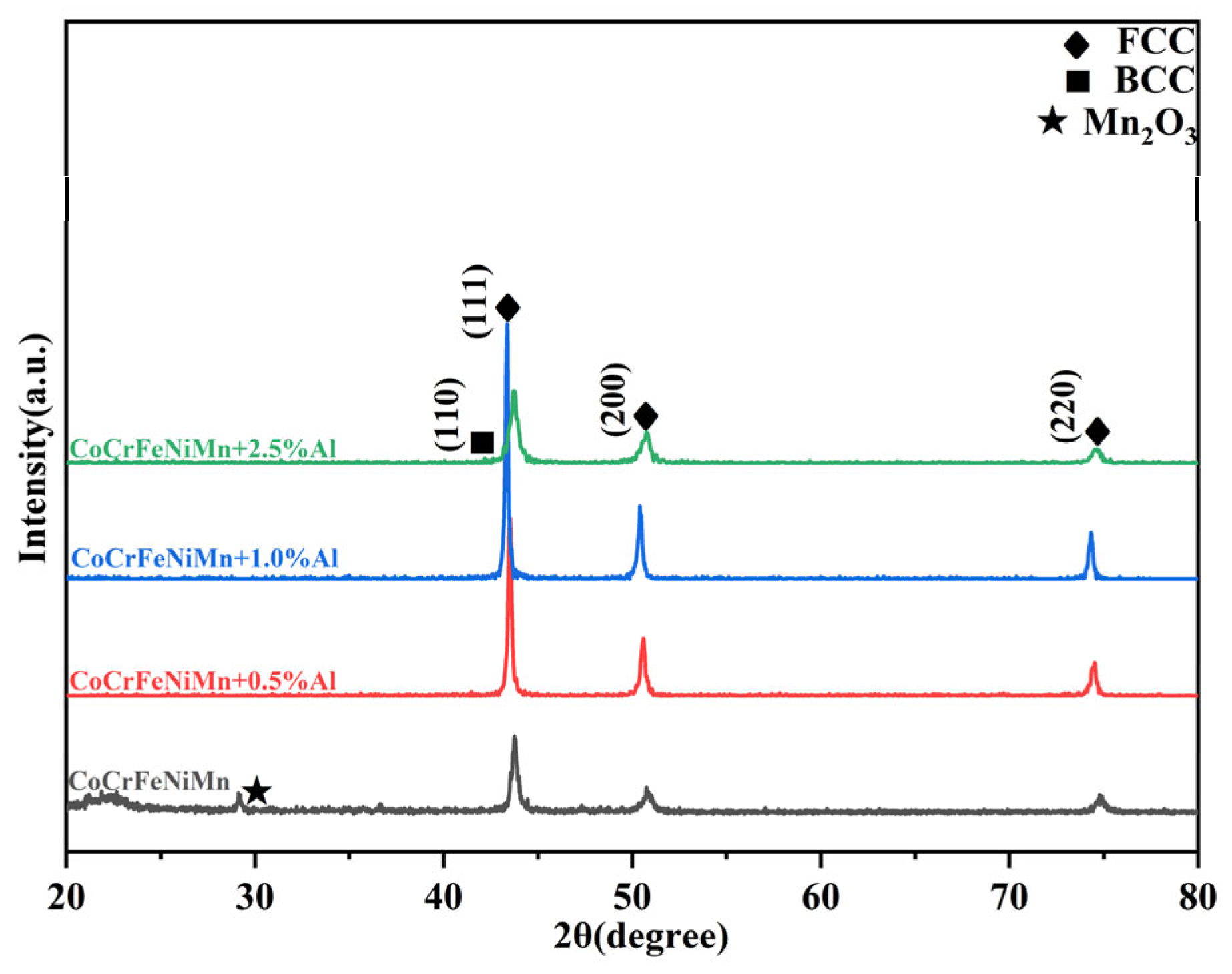
- The alloy transitions from a single FCC phase (0–0.5 wt.% Al) to a mixed FCC + BCC dual-phase structure (1.0–2.5 wt.% Al), with the BCC phase becoming progressively dominant at higher Al additions. This phase evolution is critical for tailoring performance, as FCC phases typically offer high ductility, while BCC phases enhance strength and hardness.
- (2)
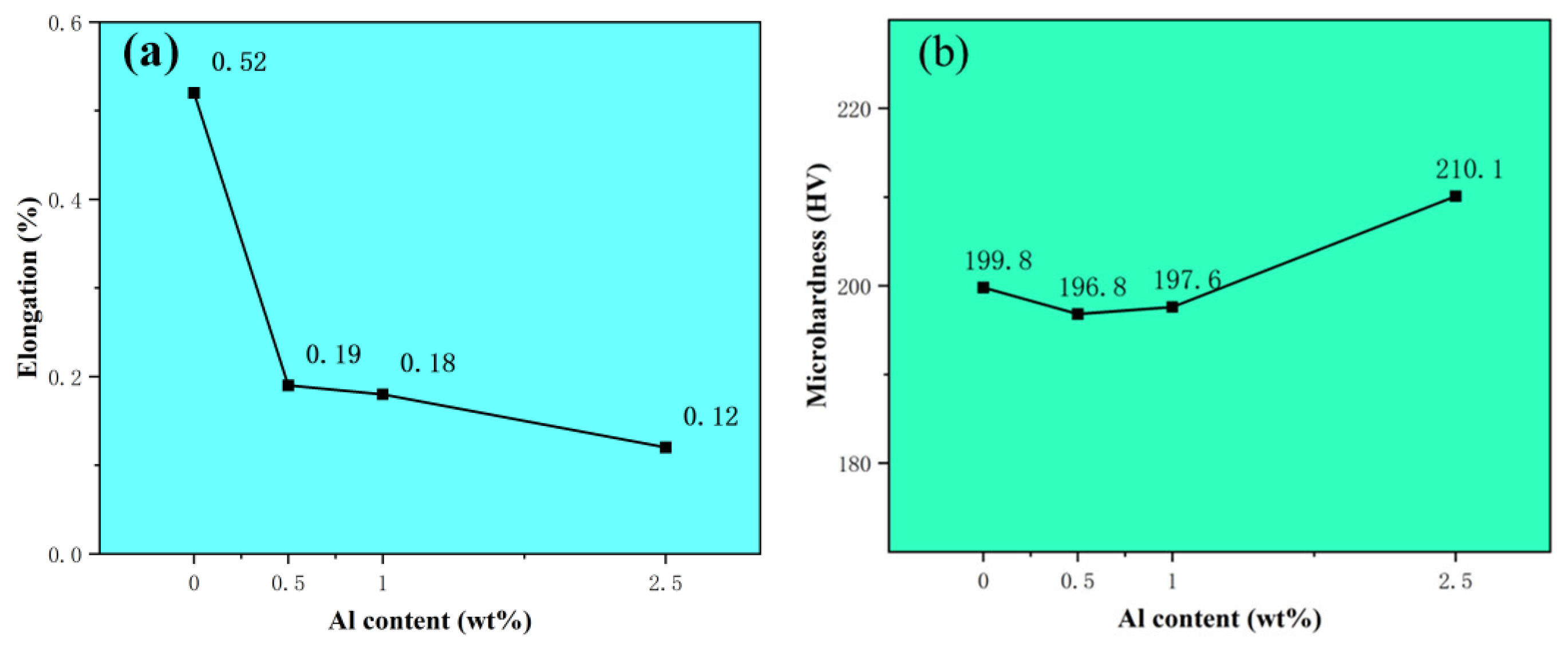
- With increasing Al content, the hardness of the alloy increases continuously, which can be attributed to the lattice distortion of the solid-solution matrix and the formation of second-phase particles induced by Al addition, and higher hardness reflects stronger deformation resistance and wear resistance of the material. This trend directly translates to improved deformation resistance and wear performance, making higher-Al variants promising candidates for components subjected to abrasive wear or high-contact loads, such as industrial tooling or structural parts requiring surface durability.
- (3)
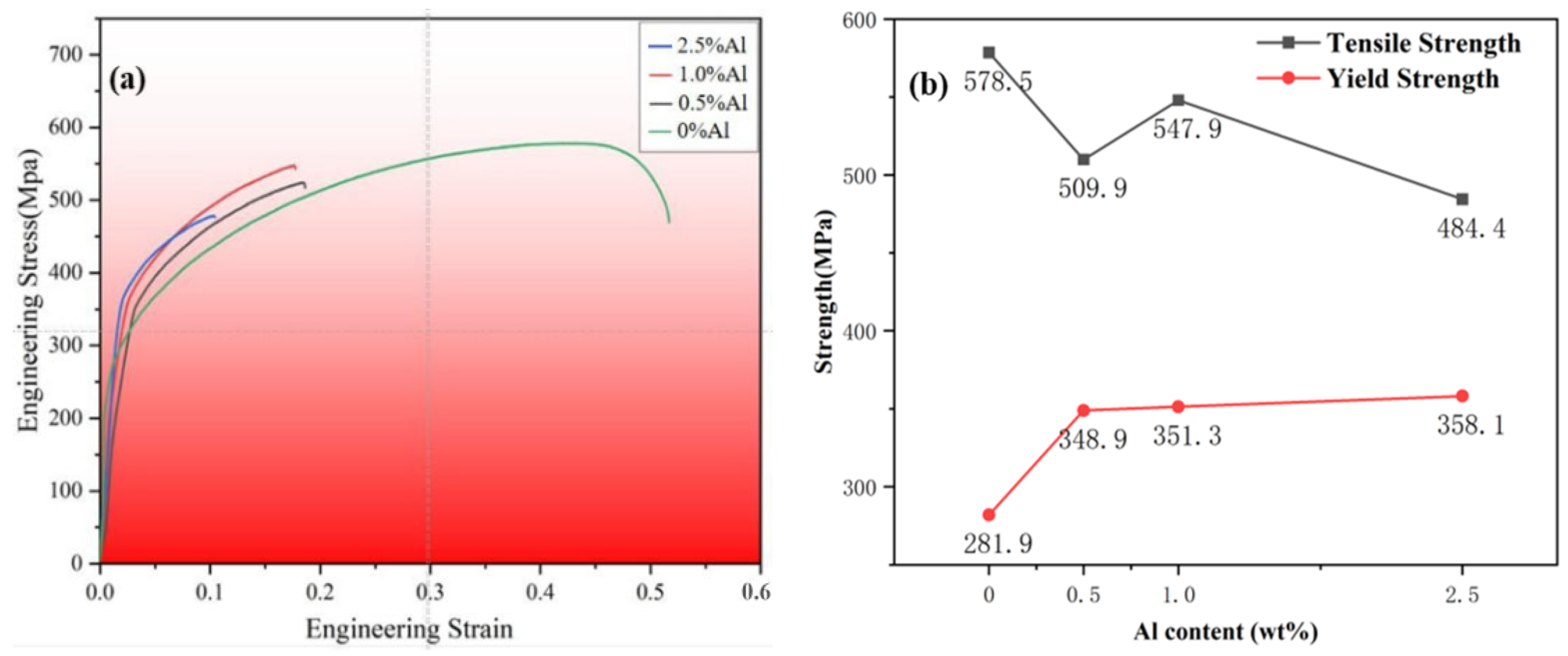
- Tensile strength exhibits a non-monotonic, fluctuating trend with Al addition, governed by competing microstructural effects. While solid-solution strengthening and BCC phase formation can boost strength, excessive Al-induced grain boundary segregation or brittle intermetallic precipitation may degrade it. This balance requires careful composition optimization to meet specific structural load-bearing requirements, such as in aerospace or automotive components where consistent tensile performance is critical.
- (4)
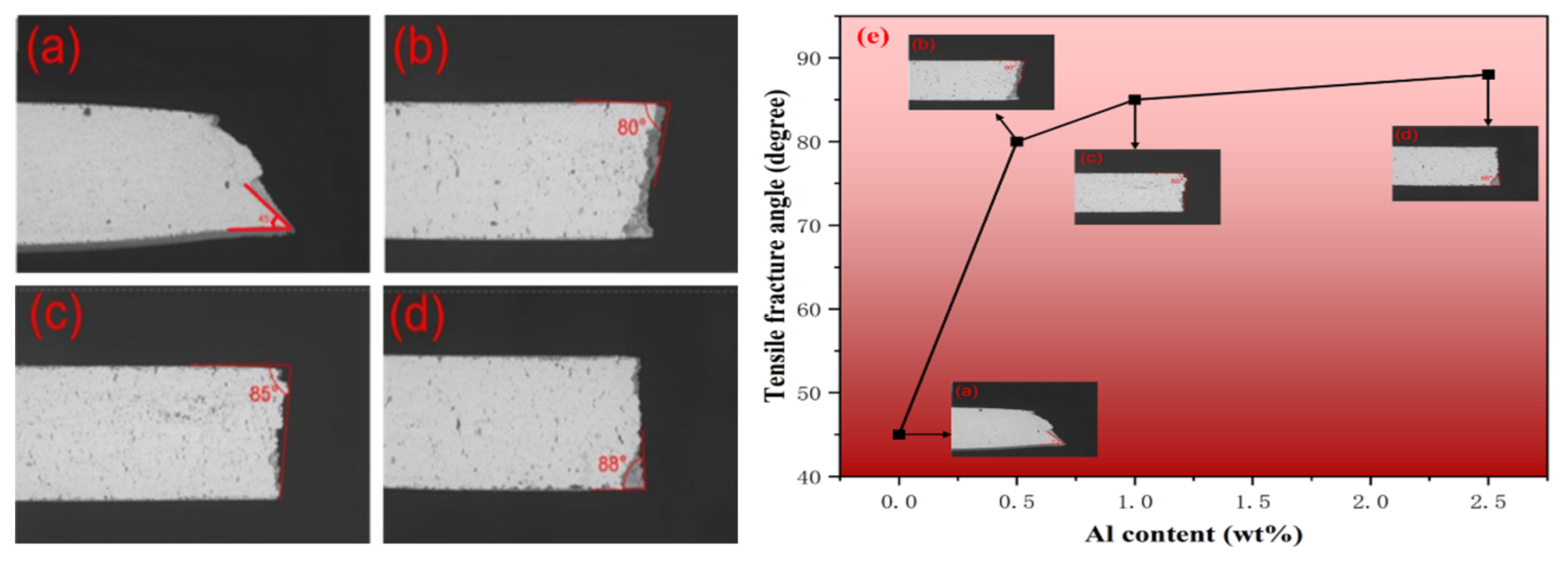
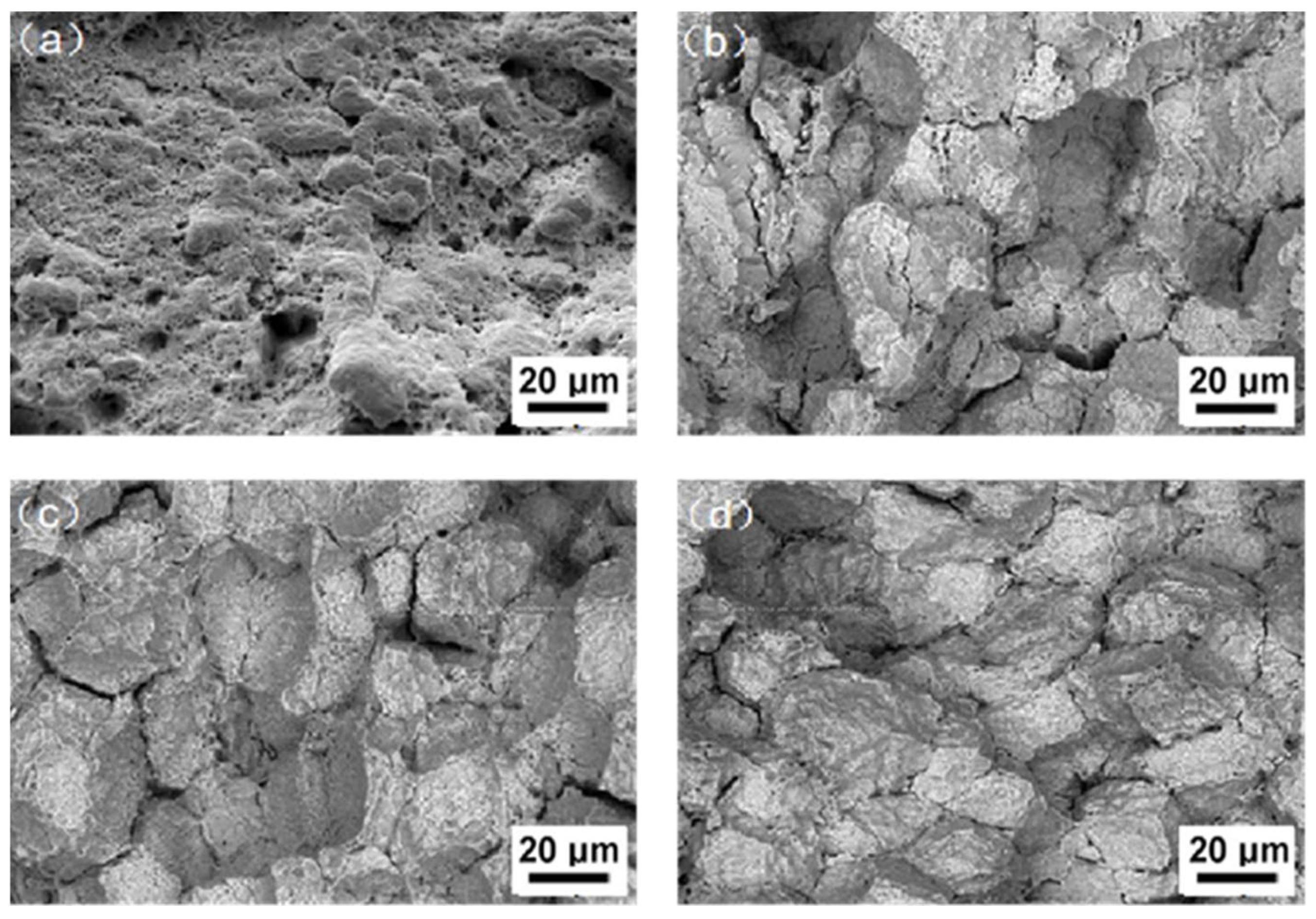
- Contrary to hardness, elongation decreases continuously with increasing Al content, reflecting a transition from ductile to brittle fracture behavior. The FCC-dominated low-Al alloys retain excellent plastic deformability, which is essential for forming operations (e.g., rolling, stamping) and for applications requiring tolerance to impact or overload. In contrast, high-Al alloys with reduced ductility are more suited for static, low-stress environments, where high hardness and wear resistance are prioritized over formability or toughness.
Author Contributions
Funding
Data Availability Statement
Conflicts of Interest
References
- Yeh, J.W.; Chen, S.K.; Lin, S.J.; Gan, J.Y.; Chin, T.S.; Shun, T.T.; Tsau, C.H.; Chang, S.Y. Nanostructured High-Entropy Alloys with Multiple Principal Elements: Novel Alloy Design Concepts and Outcomes. Adv. Eng. Mater. 2004, 6, 299–303. [Google Scholar] [CrossRef]
- Cantor, B.; Chang, I.T.H.; Knight, P. Microstructural development in equiatomic multicomponent alloys. Mater. Sci. Eng. A 2004, 375–377, 213–218. [Google Scholar] [CrossRef]
- Wei, M.; Liu, Y.; Xing, X.; Zhang, Z.; Liu, T. (TiVZrNb)83Cr17 high-entropy alloy as catalyst for hydrogen storage in MgH2. Chem. Eng. J. 2023, 476, 146639. [Google Scholar] [CrossRef]
- Liu, T.Y.; Han, Y.Y.; Wang, L. Constitutive equation on AlCoCrFeNi0.6 high entropy alloy based on double multiple nonlinear regression model. Forg. Stamp. Technol. 2023, 48, 258. [Google Scholar]
- Huang, G.; Li, L.; Cheng, J.; Chen, W.; Chen, J.; Zhu, S.; Yang, J. Tribological behavior of detonation sprayed CrFeNiAl0.3Ti0.3 high entropy alloy coatings in seawater environment. Tribol. Int. 2024, 194, 109480. [Google Scholar] [CrossRef]
- Zhang, W.; Liaw, P.K.; Zhang, Y. Science and technology in high-entropy alloys. Sci. China Mater. 2018, 61, 2–22. [Google Scholar] [CrossRef]
- Liu, Z.Q.; Qiao, J.W. Research progress of refractory high-entropy alloys. Mater. China 2019, 38, 768–774. [Google Scholar]
- Li, N.; Wu, C.; Wu, Z.; Jiang, M.; Hou, J.; Dong, F. Effect of Sintering Temperature and Time on Microstructure and Mechanical Properties of CoCrFeNiMn High-Entropy Alloys. Metals 2025, 15, 591. [Google Scholar] [CrossRef]
- Zhang, Y.; Zuo, T.T.; Cheng, Y.Q.; Liaw, P.K. High-entropy Alloys with High Saturation Magnetization, Electrical Resistivity, and Malleability. Sci. Rep. 2013, 3, 1455. [Google Scholar] [CrossRef] [PubMed]
- Ibrahim, P.A.; Özkul, İ.; Canbay, C.A. An overview of high-entropy alloys. Emergent Mater. 2022, 5, 1779–1796. [Google Scholar] [CrossRef]
- Gu, H.; Wu, D.; Ran, R.; Yang, Q.; Zhang, Y. Tensile properties of non-equiatomic Ni38Co25Cr15Fe10Al10Ti1Nb1 high entropy alloy. J. Shenyang Univ. Technol. 2024, 46, 172–176. [Google Scholar]
- Li, W.J.; An, J.H.; Zhang, L.; Tu, J.; Wang, L.Z.; Zheng, S.K.; Zhou, Z.M. Microstructure, mechanical and tribological properties of CoCrFeNi high-entropy alloy fabricated by different preparing processes. Mater. Lett. 2023, 335, 133760. [Google Scholar] [CrossRef]
- Li, D.; Li, C.; Feng, T.; Zhang, Y.; Sha, G.; Lewandowski, J.J.; Liaw, P.K.; Zhang, Y. High-entropy Al0.3CoCrFeNi alloy fibers with high tensile strength and ductility at ambient and cryogenic temperatures. Acta Mater. 2017, 123, 285–294. [Google Scholar]
- Ming, K.; Bi, X.; Wang, J. Precipitation strengthening of ductile Cr15Fe20Co35Ni20Mo10 alloys. Scr. Mater. 2017, 137, 88–93. [Google Scholar] [CrossRef]
- Zhao, F.; Zhang, Z.; Liu, Y.; Zhang, Z.; Xie, J. The coarse microstructure of medium-carbon microalloyed steel crankshafts: Formation mechanism and finish forging control. Steel Res. Int. 2020, 91, 1900572. [Google Scholar] [CrossRef]
- Otto, F.; Dlouhy, A.; Somsen, C.; Bei, H.; Eggeler, G.; George, E.P. The influences of temperature and microstructure on the tensile properties of a CoCrFeMnNi high-entropy alloy. Acta Mater. 2013, 61, 5743–5755. [Google Scholar] [CrossRef]
- Zhang, Y.; Zhou, Y.J.; Lin, J.P.; Chen, G.L.; Liaw, P.K. Solid-Solution Phase Formation Rules for Multi-component Alloys. Adv. Eng. Mater. 2008, 10, 534–538. [Google Scholar] [CrossRef]
- Sha, M.H.; Zhang, W.H.; Li, X.; Li, S. Effects of alloying elements on properties of high entropy alloys. J. Univ. Sci. Technol. Liaoning 2020, 43, 161–166. [Google Scholar]
- Cong, X.Y. Process Parameters Optimization and Performance Characterization of Laser Cladding CrMnFeCoNi High Entropy Alloy on 2A14 Aluminum Alloy Sur-face. Ph.D. Thesis, Northeast Forestry University, Harbin, China, 2024. [Google Scholar] [CrossRef]
- Zan, Y.N.; Zhang, Q.; Zhou, Y.T.; Liu, Z.Y.; Wang, Q.Z.; Wang, D.; Xiao, B.L.; Ren, W.C.; Ma, Z.Y. Introducing graphene (reduced graphene oxide) into Al matrix composites for enhanced high-temperature strength. Compos. Part B Eng. 2020, 195, 108095. [Google Scholar] [CrossRef]
- Xu, G.T. Application of Advanced Coating Technology in Extending the Service Life of Machine Tool Cutting Tools. J. South. Agric. Mach. 2025, 56, 148–151. [Google Scholar]
- Sekban, D.M.; Ozkaya, S.; Yanar, H.; Karabacak, A.H.; Aktarer, S.M.; Coskun, A. Effect of High-Entropy Alloy Amount on Microstructural and Mechanical Properties of Metal Matrix Composites Fabricated via Friction Stir Processing. Adv. Eng. Mater. 2025, 27, 2500724. [Google Scholar] [CrossRef]
- He, J.Y.; Liu, W.H.; Wang, H.; Wu, Y.; Liu, X.J.; Nieh, T.G.; Lu, Z.P. Effects of Al addition on structural evolution and tensile properties of the FeCoNiCrMn high-entropy alloy system. Acta Mater. 2014, 62, 105–113. [Google Scholar] [CrossRef]
- Pang, B.-L.; Wang, M.; Liu, T.T.; Xi, X.-L. Effects of Al Addition on Tensile Properties and Aqueous Corrosion Behavior of Cantor Alloy. J. Mater. Eng. Perform. 2022, 31, 5602–5610. Available online: https://api.semanticscholar.org/CorpusID:246752562 (accessed on 22 June 2026). [CrossRef]
- Cheng, Q.; Xu, X.D.; Li, X.Q.; Li, Y.P.; Nieh, T.G.; Chen, M.W. Solid solution softening in a Al0.1CoCrFeMnNi high-entropy alloy. Scr. Mater. 2020, 186, 63–68. [Google Scholar] [CrossRef]
- Oglezneva, S.A.; Porozova, S.E.; Kachenyuk, M.N.; Kul’met’eva, V.B.; Smetkin, A.A. Spark Plasma Sintering of Ceramic Materials Based on Rare-Earth Zirconates. Refract. Ind. Ceram. 2023, 63, 659–664. [Google Scholar] [CrossRef]
- Li, N.; Hu, X.; Wu, C.; Jiang, M.; Li, H.; Zhang, J.; Dong, F. Effect of SiC Content on Microstructure and Mechanical Properties of CoCrFeNi High-Entropy Alloy Composites. Materials 2026, 19, 2501. [Google Scholar] [CrossRef]
- Tian, Y.Z.; Wu, S.D.; Zhang, Z.F.; Figueiredo, R.B.; Gao, N.; Langdon, T.G. Microstructural evolution and mechanical properties of a two-phase Cu–Ag alloy processed by high-pressure torsion to ultrahigh strains. Acta Mater. 2011, 59, 2783–2796. [Google Scholar] [CrossRef]
- Zhang, Z.F.; Eckert, J. Unified Tensile Fracture Criterion. Phys. Rev. Lett. 2005, 94, 094301. [Google Scholar] [CrossRef] [PubMed]



| Element | Nominal (wt%) | ICP-OES (wt%) | EDS (wt%) |
|---|---|---|---|
| Al | 0.00 | 0.02 | 0.00 ± 0.03 |
| Co | 20.00 | 19.92 | 20.15 ± 0.42 |
| Cr | 20.00 | 19.95 | 19.86 ± 0.38 |
| Fe | 20.00 | 19.88 | 19.91 ± 0.35 |
| Ni | 20.00 | 19.90 | 19.83 ± 0.40 |
| Mn | 20.00 | 19.94 | 20.25 ± 0.36 |
| Element | Nominal (wt%) | ICP-OES (wt%) | EDS (wt%) |
|---|---|---|---|
| Al | 0.50 | 0.48 | 0.56 ± 0.08 |
| Co | 19.90 | 19.86 | 19.72 ± 0.45 |
| Cr | 19.90 | 19.89 | 19.98 ± 0.33 |
| Fe | 19.90 | 19.83 | 19.80 ± 0.39 |
| Ni | 19.90 | 19.85 | 19.94 ± 0.41 |
| Mn | 19.90 | 19.87 | 19.81 ± 0.34 |
| Element | Nominal (wt%) | ICP-OES (wt%) | EDS (wt%) |
|---|---|---|---|
| Al | 1.00 | 0.97 | 1.09 ± 0.10 |
| Co | 19.80 | 19.78 | 19.65 ± 0.43 |
| Cr | 19.80 | 19.81 | 19.92 ± 0.37 |
| Fe | 19.80 | 19.75 | 19.76 ± 0.32 |
| Ni | 19.80 | 19.79 | 19.88 ± 0.39 |
| Mn | 19.80 | 19.76 | 19.70 ± 0.35 |
| Element | Nominal (wt%) | ICP-OES (wt%) | EDS (wt%) |
|---|---|---|---|
| Al | 2.50 | 2.46 | 2.63 ± 0.12 |
| Co | 19.50 | 19.43 | 19.31 ± 0.48 |
| Cr | 19.50 | 19.47 | 19.54 ± 0.41 |
| Fe | 19.50 | 19.41 | 19.38 ± 0.36 |
| Ni | 19.50 | 19.45 | 19.49 ± 0.44 |
| Mn | 19.50 | 19.42 | 19.36 ± 0.38 |
Disclaimer/Publisher’s Note: The statements, opinions and data contained in all publications are solely those of the individual author(s) and contributor(s) and not of MDPI and/or the editor(s). MDPI and/or the editor(s) disclaim responsibility for any injury to people or property resulting from any ideas, methods, instructions or products referred to in the content. |
© 2026 by the authors. Licensee MDPI, Basel, Switzerland. This article is an open access article distributed under the terms and conditions of the Creative Commons Attribution (CC BY) license.
Share and Cite
Dong, F.; Zhang, J.; Hu, X.; Wu, C.; Li, H.; Jiang, M.; Li, N. Effect of Al Content on Microstructure and Mechanical Properties of CoCrFeNiMn High-Entropy Alloy. Metals 2026, 16, 693. https://doi.org/10.3390/met16070693
Dong F, Zhang J, Hu X, Wu C, Li H, Jiang M, Li N. Effect of Al Content on Microstructure and Mechanical Properties of CoCrFeNiMn High-Entropy Alloy. Metals. 2026; 16(7):693. https://doi.org/10.3390/met16070693
Chicago/Turabian StyleDong, Fuyuan, Jinlong Zhang, Xinlong Hu, Chengbo Wu, Huiying Li, Mengyuan Jiang, and Ning Li. 2026. "Effect of Al Content on Microstructure and Mechanical Properties of CoCrFeNiMn High-Entropy Alloy" Metals 16, no. 7: 693. https://doi.org/10.3390/met16070693
APA StyleDong, F., Zhang, J., Hu, X., Wu, C., Li, H., Jiang, M., & Li, N. (2026). Effect of Al Content on Microstructure and Mechanical Properties of CoCrFeNiMn High-Entropy Alloy. Metals, 16(7), 693. https://doi.org/10.3390/met16070693