


Abstract
The dynamic behavior within the melt pool governs the final quality of components fabricated by laser powder bed fusion (LPBF). To address key technical challenges—rapid keyhole evolution, low absorption contrast from metal vapor, and difficulties in quantifying internal flow fields—this study introduces move contrast X-ray imaging (MCXI), a technique leveraging time-series frequency characteristics. Combined with a multi-scale Horn–Schunck global optical flow method, MCXI enables full-field quantitative extraction of the melt-pool velocity field. Experimental validation across feature points shows a relative deviation of less than 2% compared to independent manual feature-point tracking, confirming consistency with the best available experimental ground truth. Analysis reveals the keyhole tail evolution cycle comprises three distinct dynamic stages: expansion, stratification, and contraction, with its area increasing from 1329 μm2 to 6508 μm2 before stabilizing. For the first time, pore pinch-off events were quantitatively measured, revealing front and rear wall collision velocities of 7.98 m/s and 8.04 m/s, respectively, consistent with available high-fidelity simulations. Furthermore, analysis of the overall melt-pool momentum field demonstrates a near-equal distribution of positive and negative momentum, providing an internal self-consistency check confirming the absence of systematic directional bias in the extracted velocity field. This study enables quantitative analysis of LPBF melt-pool dynamics, providing a novel tool for process optimization and defect control.
1. Introduction
As the dominant metal additive manufacturing technology, laser powder bed fusion (LPBF) enables the production of complex geometries, profoundly transforming high-end manufacturing in aerospace and biomedicine [1,2,3]. However, widespread adoption remains constrained by process-induced defects, especially porosity, which significantly degrades fatigue life and corrosion resistance [4,5,6,7]. The quality and integrity of LPBF components are fundamentally governed by the transient dynamics of the melt pool: keyhole morphology, fluid flow patterns, and pressure fluctuations within the melt pool collectively determine where and how pores nucleate and become entrapped. Over the past decade, research has shifted from empirical power–velocity process maps and post mortem defect analysis [8,9,10] toward understanding the micro-scale physical mechanisms that underlie defect formation. High-fidelity numerical simulations have revealed the complex multi-physics of melt flow, keyhole instability, and pore generation [11,12,13,14], and analogous studies in laser welding have further demonstrated the critical role of transient internal flow in keyhole dynamics [15]. However, these models require experimental velocity-field data for calibration of key sub-models such as surface tension and recoil pressure—data that have remained experimentally inaccessible.
In situ synchrotron X-ray imaging has provided unique and transformative insights into LPBF melt-pool dynamics and defect formation mechanisms [16,17,18,19,20,21]. Studies by Parab et al. [16], Leung et al. [17], and Cunningham et al. [18] established ultrafast imaging platforms and revealed keyhole formation thresholds, morphological transitions, and defect dynamics with sub-microsecond temporal resolution. Zhao et al. [21] further identified the critical keyhole-tip instability as the primary mechanism of porosity generation. Despite these advances, all existing Absorption-Contrast X-ray Imaging (ACXI) approaches share a fundamental limitation: they cannot quantify the continuous full-field velocity distribution of the liquid metal inside the melt pool. This limitation has two distinct origins. First, the melt-pool interior presents extremely low absorption contrast. The contrast-to-noise ratio (CNR) for dynamic fluid boundaries in ACXI is approximately 0.78 under the imaging conditions of this study (Section 3.1), well below the Rose Criterion threshold of CNR ≥ 3–5 required for reliable feature detection [22,23], so that subtle internal flow structures are statistically invisible. Second, existing velocity measurement approaches in X-ray imaging rely on tracking discrete identifiable features such as gas pores or spatter particles. Particle Image Velocimetry (PIV) techniques can in principle extract velocity fields, but require the introduction of exogenous tracer particles into the melt, which risks altering local fluid properties and is impractical near the high-curvature keyhole walls where tracers are frequently absent or become trapped. As a result, the continuous, full-field flow pattern of the liquid metal itself—which directly governs heat redistribution, keyhole stability, and pore transport—has remained beyond the reach of direct experimental quantification.
To address this challenge, this work proposes a quantitative analysis framework that couples move contrast X-ray imaging (MCXI) with the Horn–Schunck global optical flow method. MCXI, developed by Xiao et al. [24], differs fundamentally from conventional contrast enhancement: it applies frequency-domain filtering to time-series pixel intensity data, selectively retaining the dynamic motion signals of target flow structures while suppressing the static background noise that renders them invisible in standard ACXI. This approach raises the dynamic signal sensitivity by more than two orders of magnitude over conventional ACXI [24], and has previously been validated in electrochemical reaction visualization [25], plant water-transport studies [26,27,28], and pixel-level non-destructive defect detection [29,30]. However, these prior implementations extracted motion signals only qualitatively; none derived quantitative velocity fields. The optical flow method, originating in computer vision [31,32,33], estimates pixel-level velocity fields from image sequences by solving a spatiotemporal brightness-constancy constraint. Heitz et al. [34] and Liu et al. [35] demonstrated that the Horn–Schunck global smoothness formulation [36] is particularly well suited to continuous fluid velocity fields, and recent work by Sun et al. [37] confirmed its viability for extracting sub-pixel dynamics from synchrotron X-ray image sequences in a materials-science context. By coupling MCXI—which converts previously invisible internal melt flow into detectable dynamic signals—with the Horn–Schunck optical flow method—which translates those signals into quantitative pixel-level velocities—the present work achieves, for the first time, tracer-free full-field velocity measurement of the LPBF melt-pool interior.
In this paper, we apply the MCXI–optical flow framework to quantitatively analyze the full-field velocity evolution of a Ti–6Al–4V LPBF melt pool. The method detects subtle internal flow structures that are indistinguishable in conventional ACXI and translates melt-pool dynamics—previously accessible only through simulation—into direct experimental measurements. The results quantify keyhole evolution stages, identify the quasi-stationary stagnation zone and its mechanical origin, and capture pore pinch-off kinematics, providing both physical insight into defect formation and the experimental velocity-field data needed to validate high-fidelity numerical models.
2. Principle and Method
The core idea of the proposed method is to: first, apply move contrast X-ray imaging (MCXI) to process the raw image sequences to extract motion signals and suppress background interference [24,25]; then, apply the Horn–Schunck optical flow method to the processed image sequences to achieve pixel-by-pixel velocity vector calculations. This section introduces the basic principles and Fourier transform implementation of MCXI; (Section 2.1) explains the mathematical foundation and numerical implementation of the Horn–Schunck optical flow method (Section 2.2); and describes the parameter adaptation strategy tailored to the characteristics of move contrast images (Section 2.3).
2.1. Fundamentals of Move Contrast Imaging
Move contrast imaging employs relative motion between the sample and the detector, capturing a time-series sequence of pixel intensity variations. By applying time–frequency transforms—such as the Fourier transform (FT) or wavelet analysis—it extracts frequency-domain features of moving targets and maps them back into real space, thereby achieving high-sensitivity enhancement of weak signals. MCXI distinguishes itself from conventional X-ray imaging modalities (e.g., absorption or phase contrast) by exploiting temporal evolution of gray-level modulation induced by motion, enabling robust suppression of complex background noise and precise visualization of microstructures with low intrinsic contrast [24].
In in situ X-ray image sequences of LPBF, the gray-scale value g(x,y,t) of a pixel is a superposition of a static background and a dynamic signal. By performing a discrete Fourier transform on the gray-scale time-series signal of each pixel, the signal can be converted from the time domain to the frequency domain [29]:
where N is the sequence length, and k represents the frequency component. Static backgrounds or slowly changing signals (such as solid substrates or steadily advancing solidification fronts) have their energy concentrated primarily in the low-frequency region. Conversely, violent fluctuations of the melt-pool walls and fluid motions are non-stationary signals distributed across a wider frequency band. By setting specific bandpass filters, low-frequency background noise and high-frequency random noise can be effectively suppressed, extracting the amplitude spectrum A(x,y,k) reflecting the motion trajectory and the phase spectrum φ(x,y,k) reflecting the time evolution information:
The advantage of this frequency-domain processing method is its ability to extract weak motion signals obscured by high-contrast backgrounds in absorption contrast imaging. Concerning the Ti-6Al-4V melt-pool data used in this manuscript, MCXI is employed to reveal previously blurred fine flow structures inside the keyhole, demonstrating its superiority in handling low-contrast images in extreme environments.
2.2. Optical Flow Method for Velocity-Field Calculation
The optical flow method estimates the motion velocity of objects by analyzing the spatiotemporal variations in pixel brightness in an image sequence. Its core theoretical framework has been verified and refined over decades in computer vision and fluid dynamics measurement fields [31]. The fundamental assumption is that the brightness of the same object point remains constant between adjacent frames and its motion is continuous. This paper employs the Horn–Schunck global optical flow method, which, while satisfying the brightness-constancy assumption, ensures the spatial continuity of the velocity field through a global smoothness constraint, making it particularly suitable for the full-field calculation of continuous fluid motions like the melt-pool flow field [36].
2.2.1. Brightness-Constancy Assumption and Optical Flow Constraint Equation
Let the image brightness be I(x,y,t), where (x,y) are spatial coordinates and t is time. According to the brightness-constancy assumption:
Expanding the right side using a Taylor series and ignoring higher-order terms yields:
where and are image spatial gradients, is the time gradient, and and are the velocity components to be determined. Equation (5) is known as the optical flow constraint equation. It contains two unknowns but only one equation, so it cannot be solved directly and requires additional constraints [31,36].
2.2.2. Horn–Schunck Algorithm
The Horn–Schunck algorithm establishes a global energy functional to find the velocity vector field (u, v) that minimizes the energy. The energy functional consists of a data term (satisfying the brightness-constancy constraint) and a smoothness term (ensuring spatial continuity of the velocity field) [37]:
The first term is the data term, forcing the velocity field to satisfy the optical flow constraint; the second term is the smoothness term, controlling the spatial gradient of the velocity field, where is the smoothing factor. In melt-pool dynamics research, the selection of the smoothing factor is critical: if is too large, it will erase severe velocity gradients in regions like the keyhole tip; if is too small, it becomes overly sensitive to image noise, producing false velocity fluctuations. The optimization of this parameter is a crucial step in fluid optical flow calculations [35,36]. This paper determined the optimal value of through feature-point-tracking validation, keeping the calculation error within 2%, a precision that performs excellently under a high-frame-rate imaging environment of 1.087 MHz.
Convergence is assessed using the normalized L2-norm of the velocity-field update between successive iterations: , where the tolerance ε is set to 1 × 10⁻⁴. A maximum iteration count of 200 is imposed per pyramid level as a fallback termination criterion. Under the imaging conditions of this study (512 × 512 pixels, α = 0.1), convergence is typically achieved within 80–120 iterations at the finest pyramid level, corresponding to a wall-clock time of approximately 0.5 s per frame pair on a standard desktop workstation (MATLAB R2022b, Intel Core i7). These parameters were fixed prior to all experimental analyses reported in this manuscript.
By solving the minimum of this energy functional using variational calculus, the corresponding Euler–Lagrange equations are obtained. In practical calculations, an iterative relaxation method is typically used to solve the discretized linear equation system. Let and be the values at the k-th iteration, then the iterative scheme is:
where and are the local average values of and (usually using neighborhood averaging). Iterating until convergence yields the velocity vector (u,v) for each pixel.
While optical flow is a mature algorithm in computer vision, its application to LPBF X-ray imaging is traditionally hindered by the lack of trackable texture. MCXI provides the necessary physical texture signals by filtering multi-scale frequency components, making high-fidelity velocity extraction possible for the first time.
2.3. Parameter Adaptation for Move Contrast Images
Move contrast images feature a high temporal resolution and specific noise distributions. Directly applying the standard optical flow method may introduce errors. This paper adapts the method in the following aspects:
Noise preprocessing: High-frequency noise present in move contrast images may affect the accuracy of gradient calculations. Gaussian filtering is used to preprocess the image sequences, suppressing noise while retaining edge information. The filter kernel size is set to 3 × 3 with a standard deviation of σ = 0.8.
Selection of smoothing factor: The selection of the smoothing factor needs to balance velocity-field smoothness and detail preservation. By comparing velocity calculation results under different values, using feature-point tracking velocity as a reference (see Section 3), .1 was determined as the optimal value. This value maintains velocity-field continuity while adapting to the “globally continuous, locally intensely changing” flow-field characteristics of the LPBF melt pool [35].
It is important to note that the transferability of α = 0.1 across different material systems or processing conditions cannot be assumed a priori. The optimal α represents a balance between the velocity gradient magnitude (which scales with melt-pool flow speed and laser power) and the image contrast-to-noise ratio (CNR). As a practical guideline, we propose the following adaptive selection strategy: (i) estimate the image CNR from a static background region; (ii) compute the expected maximum inter-frame displacement = /(pixel_size × frame_rate); (iii) select α according to the empirical relationship , where and correspond to the Ti-6Al-4V reference conditions in this study. This framework provides an initial estimate that should be refined through validation against trackable feature points whenever they are available in the dataset. For conditions significantly deviating from those in this study (e.g., α-Al alloys with higher thermal diffusivity or substantially different laser power densities), a dedicated calibration step is strongly recommended.
Boundary handling: At the melt-pool boundaries, image contrast changes dramatically, and occlusion and out-of-bounds issues exist. Direct calculation can lead to velocity anomalies. A unidirectional difference approximation is used in boundary regions, and mask processing is introduced to perform velocity iterative calculations only in valid internal areas of the melt pool. Boundary pixel velocities are obtained by interpolating from the internal region, effectively reducing calculation errors caused by boundary occlusion [33].
Multi-scale calculation: To improve computational efficiency and handle large displacements, a pyramid hierarchical strategy is adopted [38]. A Gaussian pyramid is first constructed for the original image. Optical flow is computed starting from the top layer, and the result is interpolated as the initial value for the next layer, refining layer by layer. The number of pyramid layers is set to 3, with the top layer image size being 1/8 of the original.
All algorithms were implemented in the MATLAB R2022b environment. For a typical 512 × 512 pixel image, a single calculation takes about 0.5 s, which satisfies off-line analysis requirements.
3. Validation of Velocity Calculation
The raw image data used in this paper originate from the open-source data [21] which reports the in situ high-speed X-ray imaging experiments of a Ti-6Al-4V alloy laser melt pool. The experiment utilized synchrotron X-rays as the light source, with laser parameters: power 205 W, spot diameter about 100 μm, scanning speed 500 mm/s. The temporal resolution of the imaging data is 1.087 MHz, and the spatial resolution is 1 μm/pixel. Several feature points can be clearly identified in the raw images, and their motion trajectories can be independently tracked, providing a reliable benchmark for method validation.
3.1. Method of Velocity Calculation
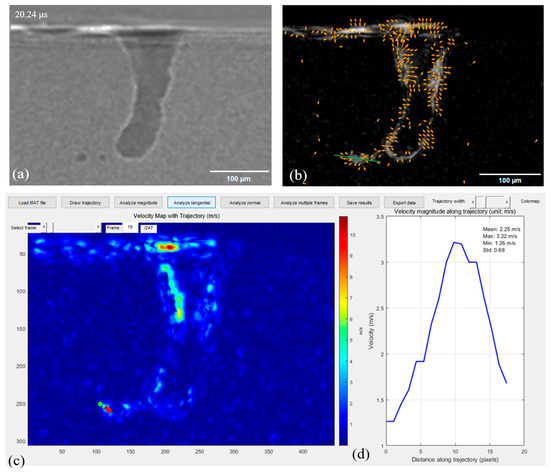
The MCXI–optical flow coupled analysis yields the global velocity field and velocity vector distribution. Using a trackable bubble as a tracer point, as shown in Figure 1, the standard velocity was determined by calculating the ratio of its displacement to the time interval. Subsequently, the same image sequence was input into the proposed method to compute the corresponding optical flow velocity. By comparing the two results, the accuracy of the method is demonstrated.
Figure 1.
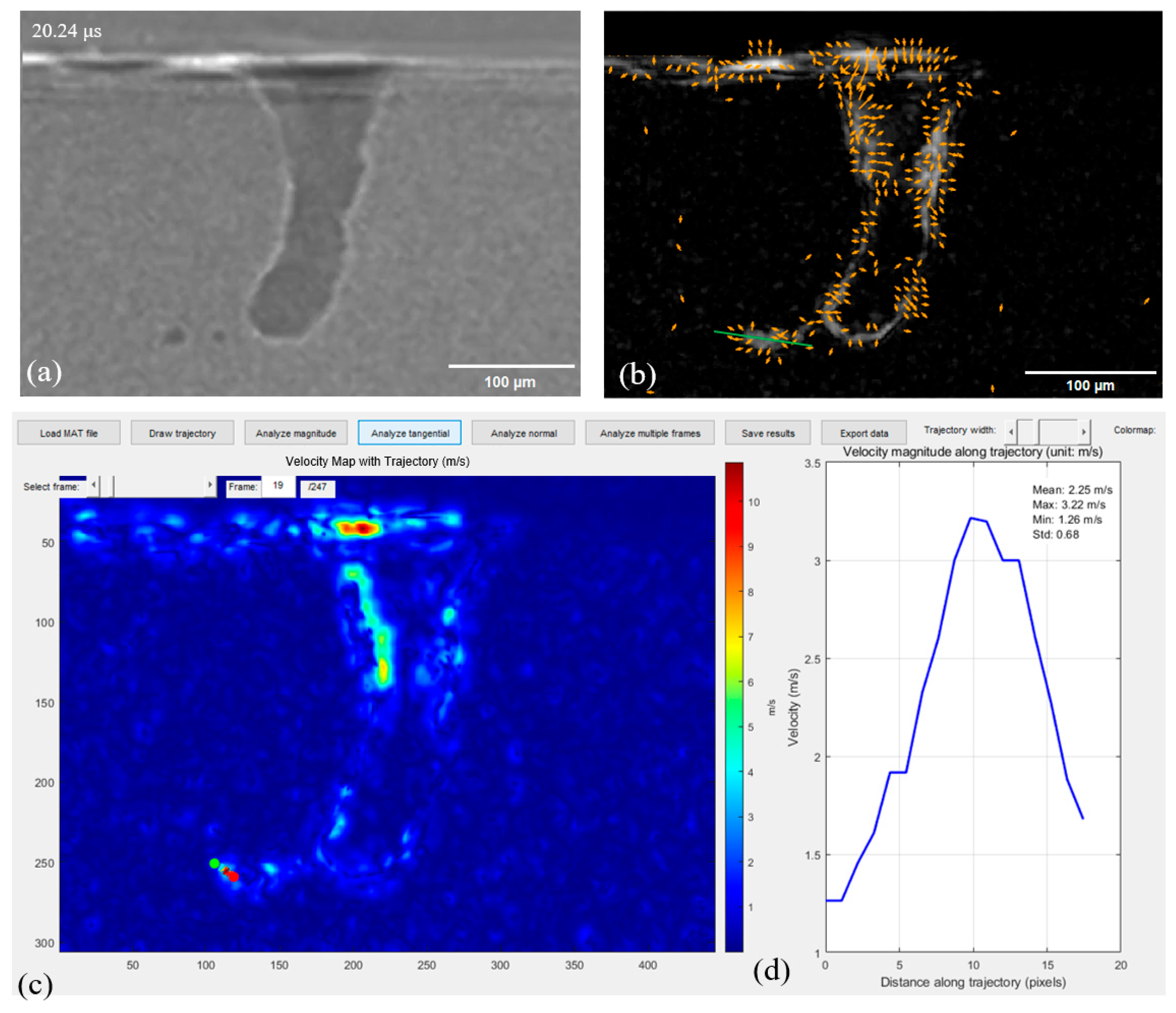
Validation of velocity calculation using a trackable bubble. (a) Absorption contrast image at 22.24 μs with the tracked bubble; (b) velocity vector field showing the full-field flow direction and magnitude; (c) MCXI-derived velocity field with color-coded velocity magnitudes and custom user interface for extracting velocity at specified positions; (d) velocity profile along the direction of maximum flow, showing a peak velocity of 3.22 m/s.
Figure 1a shows the absorption contrast image of the melt pool at 22.24 μs. As a reference, the small bubble in the left was selected as the feature point for velocity calculation. The maximum velocity of this bubble was measured to be 3.26 m/s. The contrast-to-noise ratio (CNR) of the move contrast image at the same boundary position reached 7.78, which is 9.97 times that of the absorption contrast image (CNR = 0.78). According to the Rose Criterion [22,23], a CNR of at least 3–5 is required for reliable feature detection; the absorption contrast image therefore falls well below this threshold, confirming that subtle internal flow structures are statistically invisible in standard ACXI. Figure 1b displays the velocity vector image, where the arrow length represents the velocity magnitude (longer arrows indicate higher velocity), and the arrow direction indicates the local flow direction. This allows for intuitive observation of the full-field velocity distribution. It can be observed that the velocity is maximal at the position indicated by the green line. The velocity at this position and direction was selected for quantitative analysis. Figure 1c presents the velocity-field distribution obtained by MCXI, with the color bar on the right indicating the velocity magnitudes corresponding to different colors, ranging from 0 m/s to 10 m/s. Red regions indicate intense motion, while blue regions indicate slow motion. Additionally, a user interface for extracting and analyzing velocity at specified positions was developed, as shown in Figure 1c. This interface allows the selection of target positions to obtain the corresponding velocity magnitudes. Figure 1d illustrates the process of calculating the velocity at the selected feature point using the MCXI method. By extracting velocities along a segment in the direction of maximum velocity, the maximum velocity was determined to be 3.22 m/s, which deviates by only 1.23% from the result obtained by absorption contrast imaging.
3.2. Accuracy Validation Results
The basic validation approach is to select manually trackable feature points in the image sequence, calculate standard velocity by dividing their displacement by the time interval, and input the same image sequence into the proposed method to calculate the corresponding optical flow velocity. The accuracy of the method is evaluated by comparing the difference between the two. Specifically, four feature points were selected, corresponding to four different time intervals: frames 23–24, 24–25, 25–26, and 26–27. The standard velocity is obtained by manually tracking the displacement of feature points between adjacent frames, combined with pixel size and time interval.
The validation results are shown in Table 1. The relative deviation between the optical flow results and the manual tracking reference is within 2% across all tested frames. In our validation procedure, the manual tracking velocity was computed specifically along the principal direction of maximum velocity of each feature point—the direction in which inter-frame displacement is largest and the positional identification of a high-contrast feature (gas pore, CNR = 7.78) is most reliable.
Table 1.
Optical flow velocity detection accuracy.
The within-2% agreement between the two independently derived velocities confirms that the optical flow result isconsistent with the best available experimental ground truth under these imaging conditions and exhibits no systematic directional bias.
It should be noted that synchrotron X-ray imaging is a two-dimensional projection of a three-dimensional structure. The velocity vector measured by the optical flow method reflects the integral contribution of motion signals along the beam path. However, MCXI’s high sensitivity to motion signals causes the calculation results to be dominated by the most violently moving gas–liquid interfaces (keyhole contours), effectively reducing measurement deviations caused by 2D projection. The order of magnitude of the velocities measured in this study is highly consistent with previous numerical simulations and in situ observations, further corroborating the reliability of the method.
3.3. Statistical Characteristics Analysis of Melt-Pool Velocity Field
Analyzing the statistical characteristics of the full-field velocity vectors of the melt pool can reveal the overall motion laws of the melt pool and verify the physical rationality of the velocity-field calculation.
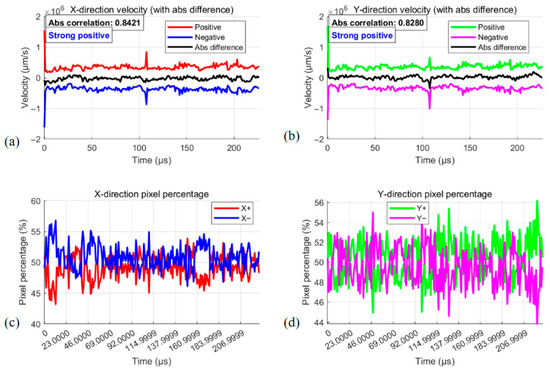
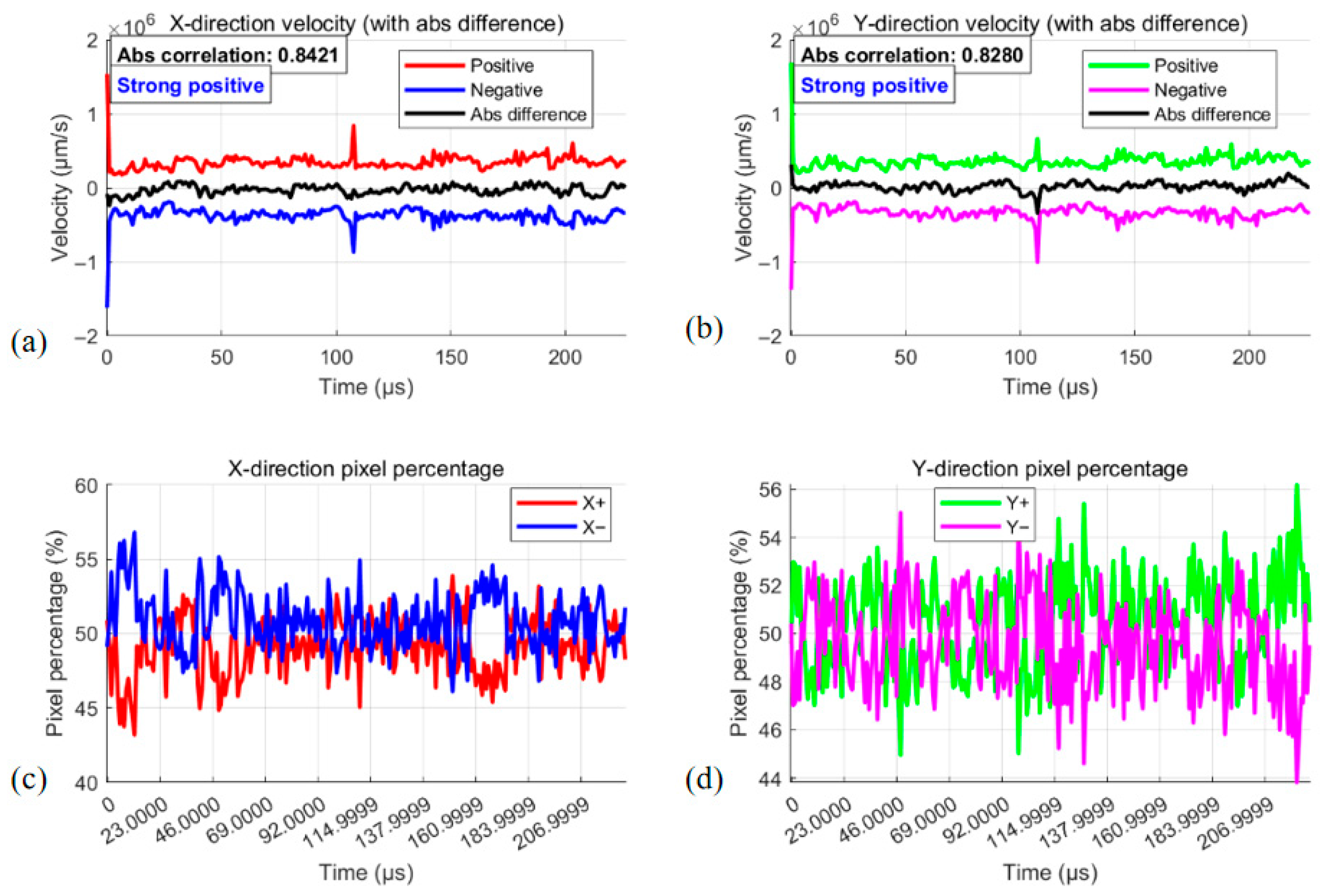
X-direction velocity statistical results show a strong positive correlation between velocity magnitudes in the positive and negative X directions across frames (absolute value correlation coefficient 0.8421). The total momentum moving left and right inside the melt pool is basically equal; the positive X-direction momentum accounts for an average of 49.7%, and the negative X-direction accounts for 50.3% (Figure 2a,c). With no external mass input in the X direction, the Marangoni convection inside the melt pool inevitably forms closed flow loops. This balance of positive and negative momentum conforms to the fundamental physical constraints of mass and momentum conservation.
Figure 2.
Statistical analysis and conservation verification of the melt-pool momentum field. (a) Distribution of velocity components in the X-direction; (b) distribution of velocity components in the Y-direction; (c) linear correlation analysis of positive and negative momentum in the X-direction (R = 0.8421); (d) linear correlation analysis of positive and negative momentum in the Y-direction (R = 0.8280), demonstrating global momentum conservation.
Y-direction velocity statistical results indicate that the upward and downward momentum are also basically equal, with the positive Y-direction momentum averaging 50.3% and the negative Y-direction averaging 49.7%, achieving an absolute correlation coefficient of 0.8280 (Figure 2b,d). Although recoil pressure provides an upward driving force, under the premise of no violent material ejection and negligible mass loss from the keyhole, the upward motion of vapor and droplets must be accompanied by the downward backfill of liquid from the side walls. Macroscopic momentum balance is the core manifestation of the melt pool maintaining morphological stability.
From a physical perspective, the LPBF melt pool is a locally closed fluid system, where internal flow is jointly driven by surface tension gradients (Marangoni convection), recoil pressure, gravity, and buoyancy, forming a complex three-dimensional flow field [12]. In a closed recirculating system with no net external momentum input, conservation of mass and momentum requires that the time-averaged positive and negative momentum components in any given direction remain approximately balanced. The near-equal distribution of positive and negative momentum fractions observed in Figure 2a,b (~49.7%/50.3% in X, ~50.3%/49.7% in Y) is consistent with this physical expectation, and provides an internal self-consistency check demonstrating that the extracted 2D projected velocity field is free of systematic directional bias. While a 2D projection cannot constitute a rigorous proof of three-dimensional momentum conservation, this result supports the physical plausibility of the calculated velocity field and confirms the absence of systematic algorithmic drift.
Pixel distribution statistics in Figure 2c,d show that the pixel distribution of velocities in all directions is generally uniform, indicating that the overall motion of the melt pool maintains balance in all directions without net flow in a single direction, consistent with the physical constraints of a closed melt pool. Non-equilibrium flow fields appear only in local areas with energy concentration, such as the keyhole tip and shadowed structures.
4. Fluid Dynamics Inside the Melt Pool
Based on the MCXI–optical flow coupled analysis system developed in this paper, the full-field velocity field of the in situ image sequences of the Ti-6Al-4V alloy LPBF melt pool was analyzed. The core physical laws inside the melt pool are revealed from four dimensions: momentum conservation verification, the mechanical essence of the stagnation zone, the fluid instability mechanism of keyhole destabilization, and porosity generation dynamics.
4.1. Initial Keyhole Expansion and Stabilization
By performing Fourier frequency-domain filtering on the raw images at a 1.087 MHz frame rate, MCXI significantly enhanced the motion textures of the front and rear keyhole walls. As quantified in Section 3.1, the CNR improvement factor reaches 9.97×.
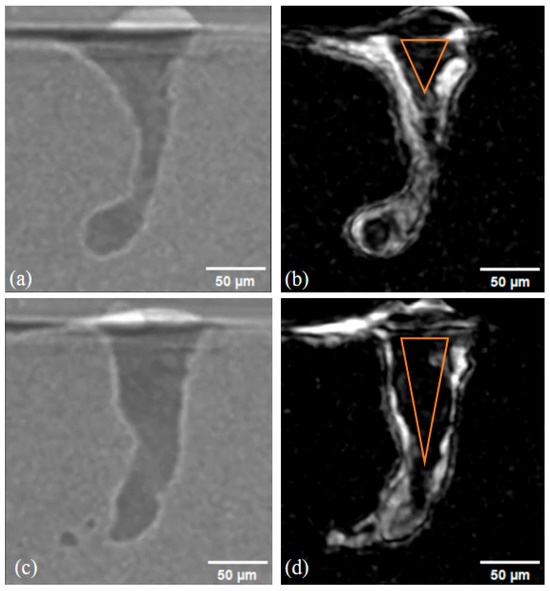
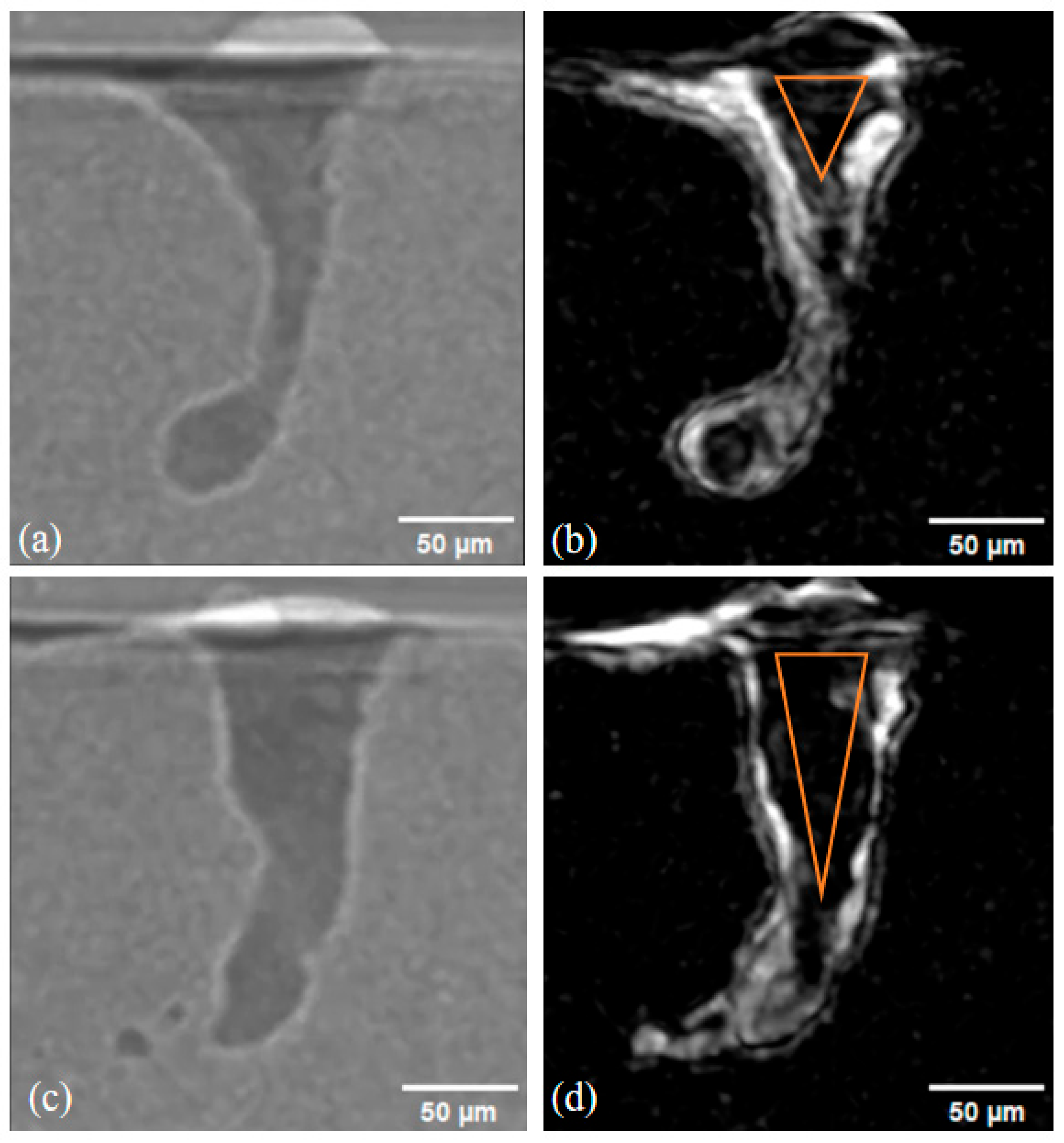
For comparison, absorption contrast images of the melt pool at 0.92 μs and 13.8 μs [21] are presented in Figure 3a,c. Shown in Figure 3b,d are the corresponding MCXI images respectively. A quasi-stationary stagnation zone (QSSZ) is identified directly from the MCXI frequency-domain amplitude images as a spatially localized region where the temporal-frequency amplitude approaches the noise floor—prior to any optical flow computation. According to the fundamental principle of move contrast imaging, image contrast in MCXI-reconstructed images originates from the relative motion of material components: regions where constituents undergo no relative motion, or only extremely weak motion, appear as black or near-zero-contrast areas. The low-amplitude region visible in Figure 3b,d (marked by the triangle) therefore constitutes a direct imaging observation that material motion within this zone is negligible. This near-zero contrast region is present in the input data before velocity calculation begins, confirming that the QSSZ is a genuine physical feature of the flow field and not an artifact introduced by optical flow smoothing.
Figure 3.
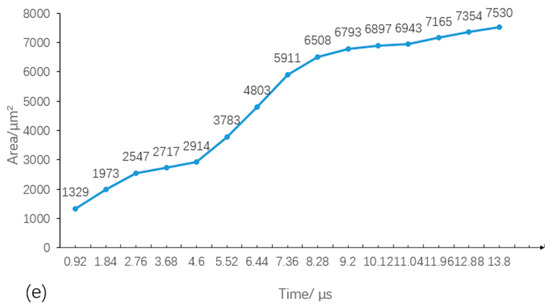
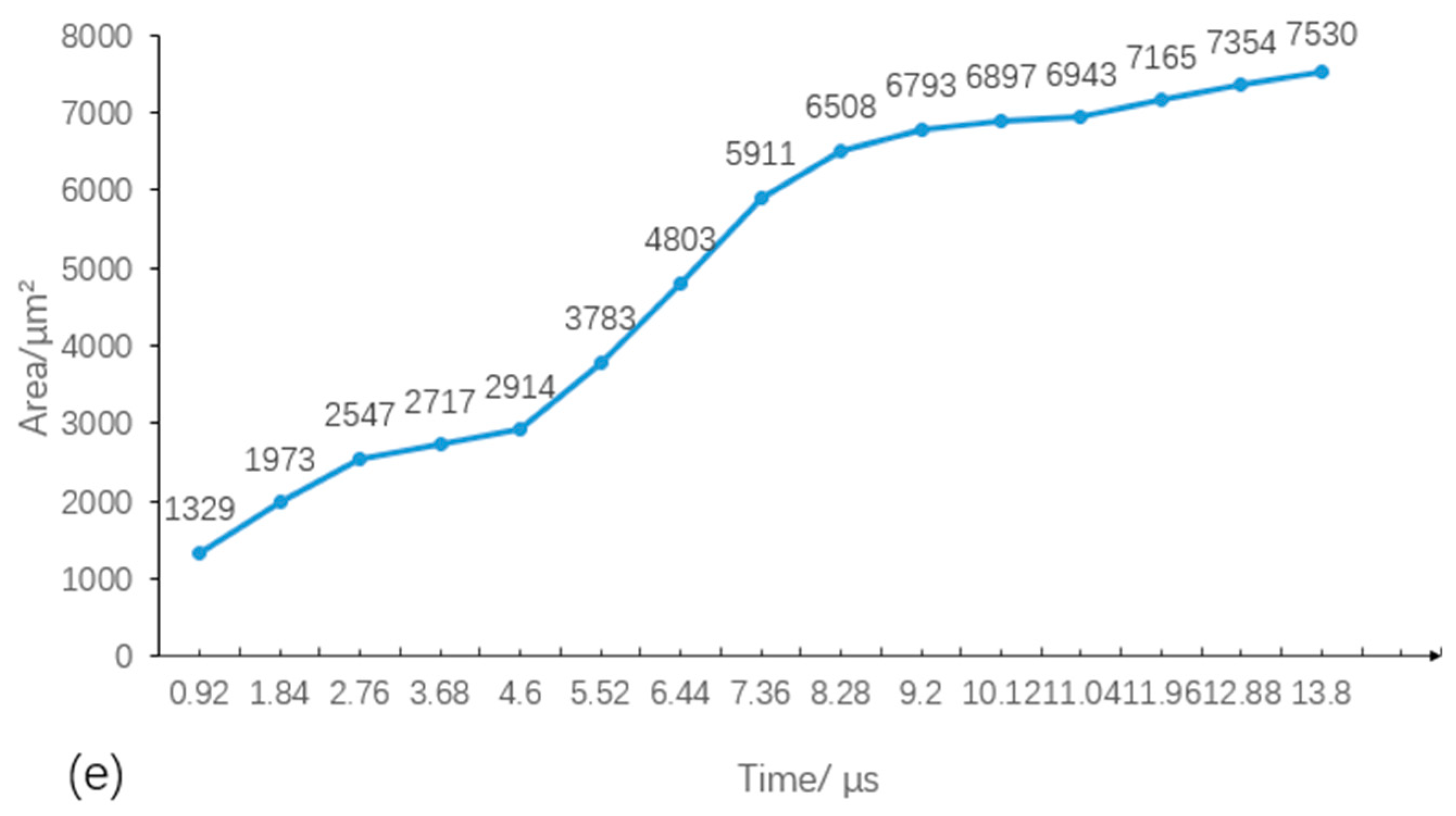
Quantitative characterization of the quasi-stationary stagnation zone inside the keyhole. (a) X-ray absorption contrast image at t = 0.92 μs; (b) corresponding velocity vector map showing the initial stagnation zone (marked by the triangle); (c) X-ray absorption contrast image at t = 13.8 μs after expansion; (d) velocity vector map in the stabilized stage; (e) evolution of the quasi-stationary stagnation zone area over time, indicating the transition from rapid growth to dynamic equilibrium.
The identified QSSZ exhibits velocity fluctuations below 0.8 m/s, approaching the amplitude of the background noise. Adjacent to the keyhole boundary, a high-speed flow zone approximately 20 μm wide is observed, with maximum velocities reaching 12.3 m/s.
Figure 3e illustrates the temporal evolution of the QSSZ area. Between 0.92 μs and 8.28 μs, the QSSZ area expands rapidly. Beyond this point, the growth rate decreases significantly, stabilizing thereafter. The QSSZ area increases from an initial 1329 μm2 to 6508 μm2, indicating that the recoil pressure within the keyhole has achieved a dynamic quasi-equilibrium with the opposing surface tension and hydrostatic pressure. Notably, abrupt changes in the QSSZ area often precede subsequent destabilization of the keyhole morphology (see Section 4.2).
4.2. Melt-Pool Evolution Cycle
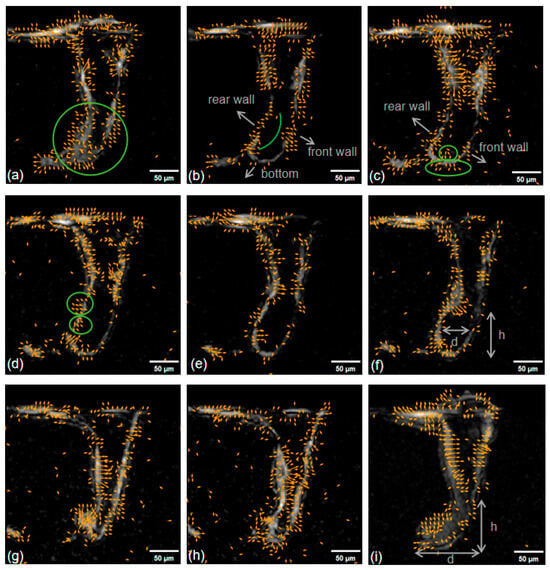
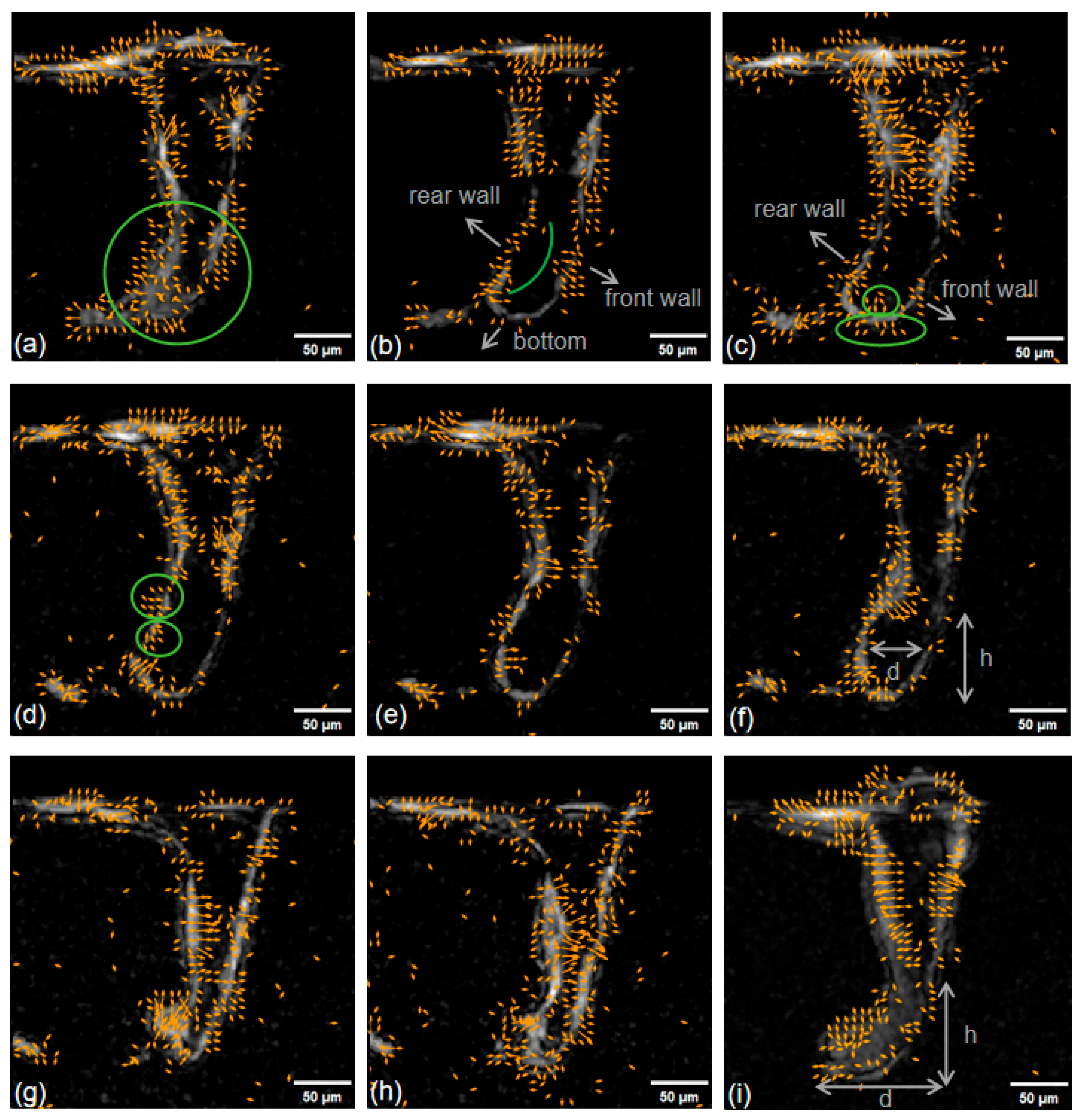
The dynamic behavior of the melt-pool tip is the core cause of porosity formation. Based on move contrast images and full-field velocity analysis, this paper divides the complete evolution cycle of the keyhole tail into three dynamic stages: expansion phase, stratification phase, and contraction phase, with an average cycle duration of 23.92 μs. Velocity vector distributions for each stage are shown in Figure 4.
Figure 4.
Full-field velocity vector distributions during a complete melt-pool evolution cycle (average single cycle duration: 23.92 μs). (a,b) Expansion phase (9.2 μs, 14.72 μs): High-speed outward flow driven by intense recoil pressure; (c–e) Stratification phase (16.56 μs, 19.32 μs, 21.16 μs): Emergence of bidirectional flow at the keyhole tail, serving as a precursor to instability; (f,g) Contraction phase (23.92 μs, 26.68 μs): Inward collapse of liquid walls under surface tension; (h) End of the cycle, re-entering the expansion phase (33.12 μs); (i) typical moments of standard pore generation (4.6 μs). The orange arrows represent velocity vectors, and the green circles mark key regions of interest.
Expansion phase (9.2 μs~14.72 μs, Figure 4a,b): Under continuous laser irradiation, the initial keyhole shape is “I”-shaped. The laser directly irradiates the keyhole bottom. The tail continuously absorbs laser energy and expands outward, transitioning the shape from “I” to “J”. The “J”-shaped tail position is marked by the green line in Figure 4b. In this stage, the maximum expansion velocity of the keyhole front wall is 8.6 m/s, the rear wall is 8.3 m/s, and the bottom downward expansion is 2.2 m/s, as indicated by the gray arrows in Figure 4b.
Stratification phase (16.56 μs~21.16 μs, Figure 4c–e): The keyhole tail expansion is essentially complete. The front and rear walls maintain outward expansion, but the bottom begins to show stratified flow—the lower melt layer continues to expand downward, while the upper melt layer starts moving upward. The stratified flow region is marked by green circles. This phenomenon is triggered by uneven heat distribution caused by increased keyhole tail depth, serving as a critical precursor to subsequent keyhole collapse and the core marker of the keyhole transitioning from stable expansion to unstable contraction [21,39].
Contraction phase (23.92 μs~26.68 μs, Figure 4f,g): Momentum is transferred outward from inside the keyhole, and the outer keyhole walls begin to contract inward. The contraction of the tail is influenced by the inward contraction at the position marked by the green circle in Figure 4f. Due to the shadowing effect at this location, the bottom absorbs less laser energy, leading to a temperature decrease and enhanced contraction. By Figure 4g, the contraction at the green circle position is nearly complete. In this stage, the keyhole depth “h” and the drag length “d” of the “J”-shaped tail determine the bottom’s motion direction and whether a pore will form. The cycle shown in Figure 4 is a stable cycle without pore generation; the keyhole does not form a high-aspect-ratio “J” structure, thus not meeting the critical conditions for pore generation. The aspect ratio at this stage is d/h = 0.69 in Figure 4f. However, in the cycle shown in Figure 4i, the keyhole forms a high-aspect-ratio “J” tail (d/h = 1.31), ultimately triggering porosity [39].
4.3. Quantitative Dynamic Analysis of Porosity Generation
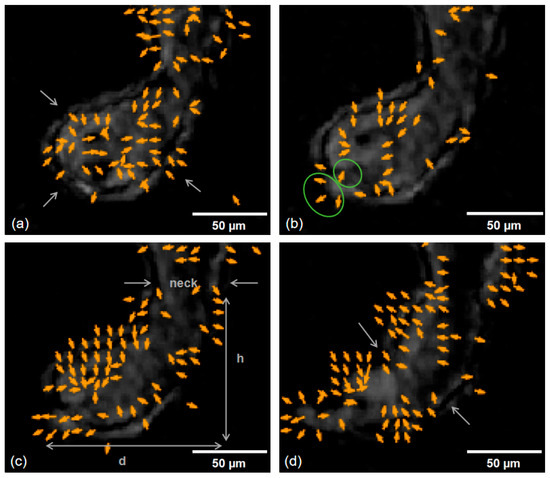
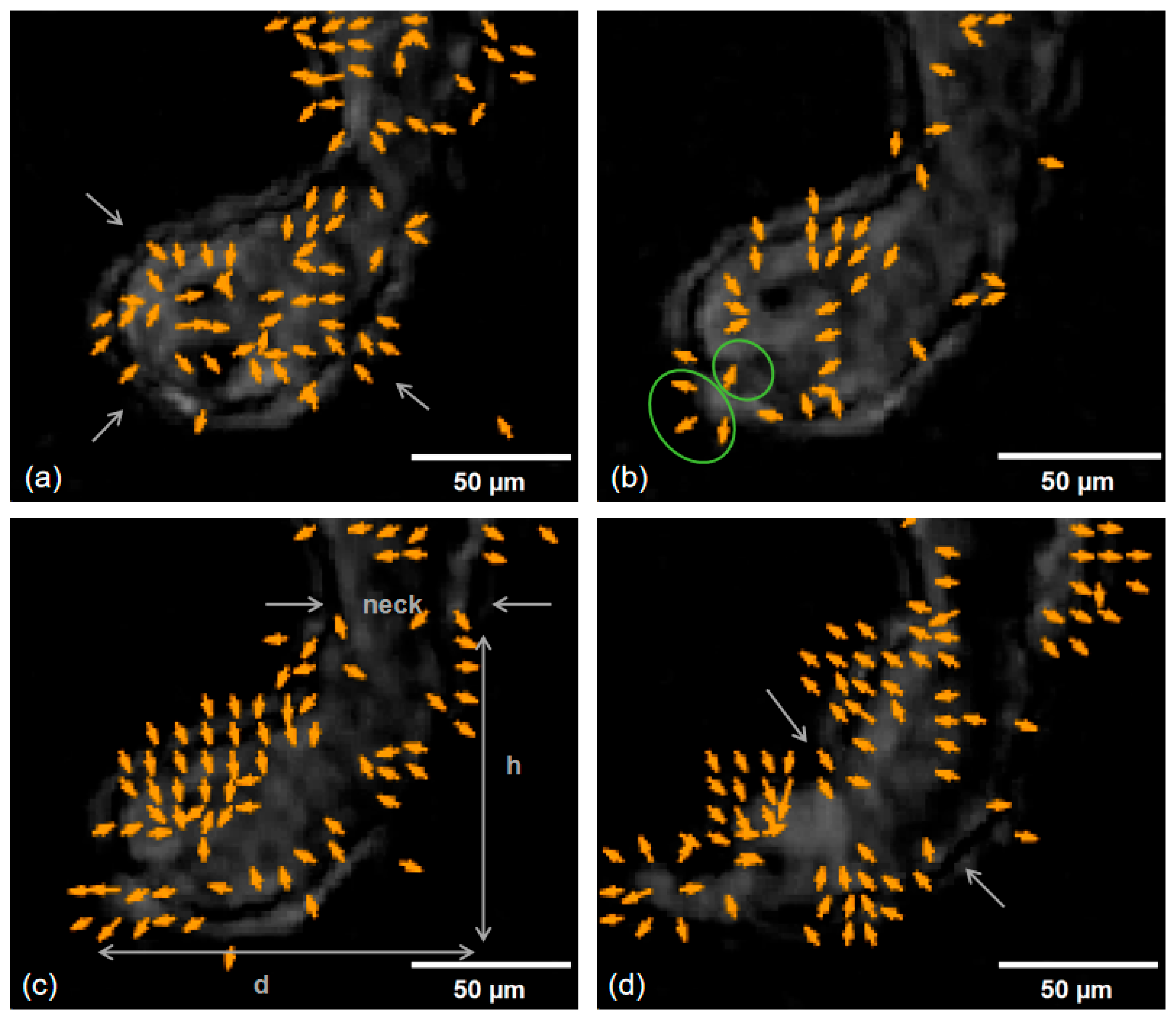
Porosity is the most common process defect in LPBF. The full-field velocity analysis of the proposed method quantitatively reveals the complete dynamic process of porosity from incubation to generation. The velocity vector evolution of key frames is shown in Figure 5, where orange arrows represent velocity vectors and gray arrows serve as indicators.
Figure 5.
Time evolution of the velocity vector field during the pore generation process. (a) 1.84 μs: Contraction phase, pore incubation stage; (b) 3.68 μs: Contraction phase, bidirectional flow emerges at the bottom; (c) 4.60 μs: The keyhole evolves into a high-aspect-ratio “J” structure, and the bottom begins to expand; (d) 6.44 μs: Pinch-off at the keyhole tip, with the pore fully formed.
Pore incubation stage (1.84 μs, Figure 5a): The “J”-shaped tail of the keyhole is in the contraction phase. As indicated by the gray arrows, the keyhole tail contracts in all directions. The liquid walls on both sides contract toward the center, causing the pressure inside the keyhole to rise and breaking the original mechanical equilibrium. Local flow-field disturbances triggered by uneven energy absorption create the initial conditions for pore generation.
Stratified flow stage (3.68 μs, Figure 5b): Both sides of the keyhole continue to contract, while the bottom simultaneously exhibits bidirectional (upward and downward) flow. The stratified flow region is marked by the green circle. The keyhole depth continues to increase, laying the foundation for the formation of a high-aspect-ratio “J”-shaped structure.
Structural evolution stage (4.60 μs, Figure 5c): The liquid walls on both sides continue to contract, and the bottom continues to expand. The keyhole evolves into a high-aspect-ratio “J” structure (d/h = 1.31). Driven by gravity and the Marangoni effect [12], the liquid metal in the upper-middle part backfills downward, triggering the “shadow effect”. The multiple reflection distribution of the laser beam in the middle section of the keyhole changes, causing an instantaneous local temperature drop in the neck region, as indicated by the gray arrows. This cooling process induces a precipitous decline in recoil pressure —a core precursor to pore pinch-off [21,39]—while the surface tension coefficient increases simultaneously. Consequently, the local capillary pressure () instantaneously dominates, driving the keyhole bottom to continue expanding and creating the critical conditions for pore pinch-off.
Pore detachment stage (6.44 μs, Figure 5d): The front and rear walls of the keyhole collide, and the pore completely detaches from the main melt pool. The measured velocities of the rear and front walls at the moment of collision were 7.98 m/s and 8.04 m/s, respectively. The detached pore moves with the melt flow and is eventually captured by the solidification front, forming porosity defects in the fabricated part.
5. Discussion
5.1. Mechanical Origin of the Quasi-Stationary Stagnation Zone
From the perspective of local fluid dynamics, the formation of the QSSZ signifies a state of dynamic equilibrium in normal forces at the gas–liquid interface. Within the keyhole, the metal vapor recoil pressure (, promoting expansion) counterbalances the capillary pressure (, induced by surface tension and promoting closure) and the liquid metal’s hydrostatic pressure (). When these pressures satisfy locally, the macroscopic acceleration of the fluid element approaches zero. Owing to the high motion sensitivity of MCXI, this force equilibrium manifests as extremely weak, low-frequency motion signals in the reconstructed images, forming the near-zero-contrast stagnation region observed in Figure 3.
The mechanical origin of the QSSZ can be elucidated through a quantitative force balance analysis. While the peak recoil pressure () at the laser-irradiated keyhole bottom (T ≈ 3560 K) reaches 0.1–1 MPa, the QSSZ is spatially localized on the mid-keyhole wall. In this region, the local energy density is significantly attenuated due to multiple reflections and the shadowing effect, leading to a localized temperature drop. Given that decays exponentially with temperature, a reduction of 300–400 K decreases the local to approximately 10–30 kPa.
We then estimate the magnitude of the opposing capillary pressure via the Young–Laplace equation: where is the surface tension of liquid Ti-6Al-4V at ~1600 K [40], and R ≈ 50–100 μm is the radius of curvature of the keyhole sidewall near the QSSZ boundary, measured directly from the MCXI images. Substituting these values yields a capillary pressure of , which is on the same order of magnitude as the attenuated local recoil pressure.
In comparison, the hydrostatic pressure is calculated as: where is the density of liquid Ti-6Al-4V, g = 9.8 m/s2 is gravitational acceleration, and h ≈ 150 μm is the typical depth of the QSSZ below the melt pool surface. This yields which is more than three orders of magnitude smaller than and , and is thus negligible in the local force balance.
This order-of-magnitude analysis confirms that a localized dynamic equilibrium can be established at the QSSZ between the attenuated recoil pressure and the capillary pressure, which is consistent with the observed velocity fluctuations below 0.8 m/s within the zone. This finding provides direct in-situ experimental evidence for the existence of transient thermo-capillary equilibrium states on the keyhole wall, even in the highly non-equilibrium LPBF process. While such local equilibrium states have been predicted in prior high-fidelity numerical simulations [11,14], this study achieves the first quantitative experimental validation of this phenomenon.
The temporal evolution of the QSSZ area shown in Figure 3e can also be interpreted via this force balance framework. During the initial laser irradiation phase (0.92 μs to 8.28 μs), the high recoil pressure at the keyhole bottom drives continuous expansion of the keyhole, and the QSSZ area expands rapidly as the mid-wall region gradually reaches the pressure equilibrium state. Beyond 8.28 μs, the local force balance is fully established, the net driving force for wall displacement at the QSSZ approaches zero, and the area of the stagnation zone subsequently stabilizes. Notably, abrupt changes in the QSSZ area are observed to precede keyhole destabilization events (Section 4.2), indicating that the breakdown of this local pressure balance is a sensitive precursor to impending morphological instability of the keyhole.
We emphasize that this force balance interpretation is a mechanistic hypothesis consistent with our experimental observations. Rigorous quantitative validation of this hypothesis would require coupled thermodynamic and fluid dynamic simulations, which is identified as a key direction for future work.
5.2. Fluid Instability Mechanism of Keyhole Destabilization
The stratification and ultimate necking pinch-off at the keyhole tail are fundamentally triggered jointly by local Plateau–Rayleigh instability and uneven heat distribution. This instability is the core trigger for keyhole destabilization in the LPBF process [11,21]. During the contraction phase, the dragged structure of the “J”-shaped tail prevents the laser from directly illuminating the keyhole bottom. Driven by gravity and the Marangoni effect [12], the liquid metal in the upper-middle part backfills downward, creating a significant “Shadow Effect”. This causes an instantaneous loss of recoil pressure in the neck region. Surface tension dominates at this moment, driving the liquid walls on both sides to “collide” at a velocity of ~8 m/s. This result is consistent with the simulation values reported by Yu and Zhao [39], supporting the conclusion that local subcooling and the “J”-shaped tail induced by the shadow effect are the core drivers of pore induction. Simultaneously, this result explains why porosity easily occurs at the initial and concluding stages of laser irradiation, providing a confirmed theoretical basis for reducing porosity defects through laser power modulation.
5.3. Physical Mechanism of Pore Pinch-Off
This process partially aligns with the porosity generation mechanism revealed by Yu and Zhao [39] through high-fidelity simulations. However, the physical mechanism inferred in the present work differs from their analysis, which attributed pore detachment to a vortex driven by the combined motion of the keyhole tail and the surrounding melt. In the present measurements, the flow velocity of the melt pool outside the keyhole is below 0.8 m/s. Using a characteristic length of L ≈ 200 μm (melt-pool width) and the kinematic viscosity of liquid Ti–6Al–4V of ν ≈ 0.5 × 10⁻⁶ m2/s, the Reynolds number of the exterior melt flow is , which is far below the critical threshold for coherent vortex formation in free-surface Marangoni convection () [41]. This quantitative estimate suggests that vortex-driven momentum transfer is unlikely to account for the observed pinch-off kinematics under the present conditions, and that the capillary-pressure-dominated collapse mechanism is more consistent with the measured data. We acknowledge, however, that the present measurements are based on 2D projections of a three-dimensional flow field, and that out-of-plane vortical components cannot be excluded from the imaging data alone. The collision velocity of 6–8 m/s predicted by the simulations of Yu and Zhao [39] is in close quantitative agreement with the measured values in this work (7.98–8.04 m/s), providing experimental support for the velocity scale of the pinch-off event regardless of the underlying driving mechanism.
Beyond direct numerical validation, the measured pinch-off kinematics provide quantitative constraints for refining physical sub-models in computational frameworks. The collision velocity of ~8 m/s, combined with the measured neck width at pinch-off (~10–20 μm from MCXI images) and the known dynamic viscosity of liquid Ti-6Al-4V (μ ≈ 0.005 Pa·s), yields a capillary number Ca = μV/γ~0.025, enabling back-calculation of the effective surface tension γ_eff at the pinch-off temperature. Discrepancies between this back-calculated value and the temperature-dependent surface tension model used in simulations (typically for Ti-6Al-4V) would identify systematic errors in the thermophysical property databases employed. Furthermore, the kinematics of wall acceleration following recoil pressure collapse constrain the time scale of the evaporation rate sub-model: the ~1–2 μs acceleration window inferred from the MCXI velocity sequence places a quantifiable test on the accuracy of Hertz–Knudsen evaporation models near the boiling point. These experimental benchmarks provide the additive manufacturing simulation community with directly actionable data for sub-model calibration.
5.4. Process Control Implications
The quantitative findings of this study translate directly into actionable strategies for LPBF process control. First, the identification of the critical J-shaped aspect ratio threshold (d/h = 1.31 for pore-generating cycles versus d/h = 0.69 for stable cycles) provides a morphological criterion that can be incorporated into real-time process monitoring systems: when in situ imaging or proxy sensors (e.g., photodiode-based plasma plume monitoring) detect the onset of stratified flow at the keyhole tail—the characteristic precursor identified here—a brief laser power increment (~+10–20% power, ~2–5 μs duration) can be triggered to maintain sufficient recoil pressure and prevent the keyhole from crossing the critical aspect ratio threshold. Second, since pore pinch-off consistently occurs during the late contraction phase (~23–27 μs within a ~24 μs cycle), time-resolved power modulation synchronized to the predicted keyhole evolution cycle could suppress pore nucleation events with minimal perturbation to overall energy input. Third, the elevated porosity risk at scan initiation and termination—where recoil pressure builds and collapses abruptly—supports the use of power ramp-up and ramp-down profiles at scan path endpoints, with ramp durations matched to the measured expansion-phase time scale (~5 μs). These control strategies, individually or in combination, constitute a physically grounded roadmap for closed-loop laser parameter optimization aimed at keyhole porosity suppression.
6. Conclusions
This paper developed a highly sensitive quantitative analysis method for the dynamic evolution of fine structures in the melt pool by combining move contrast X-ray imaging with the optical flow method. This method effectively suppresses complex static backgrounds and achieves pixel-by-pixel calculation of full-field velocity vectors, with a relative deviation of less than 2% compared to manually tracked feature point velocities across validated feature points, confirming consistency with the available experimental ground truth.
This study employed quantitative analysis to investigate Ti-6Al-4V laser melt-pool dynamics, revealing a keyhole “quasi-stationary stagnation zone” under local dynamic equilibrium. The zone expanded from 1329 μm2 to 6508 μm2 during initial expansion, then stabilized, indicating dynamic quasi-equilibrium among recoil pressure, surface tension, and hydrostatic pressure. Full-field velocity analysis divided the keyhole evolution into three stages: expansion, stratification, and contraction, uncovering a destabilization mechanism driven by Plateau–Rayleigh instability and uneven heat distribution.
For porosity generation, a localized temperature drop triggered a sudden recoil pressure plummet, allowing capillary pressure to dominate and force opposing liquid walls to collapse inward. The complete pore formation dynamics were quantified, with front/rear wall collision velocities reaching 7.98 m/s and 8.04 m/s at pinch-off—consistent with high-fidelity simulations and providing experimental constraints for sub-model calibration in computational frameworks. Melt-pool momentum statistics showed balanced proportions (~50%) of positive/negative momentum in X/Y directions, providing an internal self-consistency check confirming the absence of systematic directional bias in the extracted velocity field.
Although the proposed method achieved quantitative performance, certain limitations remain. First, the accuracy of the optical flow calculation is directly dependent on the quality of the MCXI reconstructed images, which is constrained by the temporal resolution and signal-to-noise ratio of the raw imaging data. Second, the adaptive strategy for the smoothing factor is only proposed as an empirical formula for initial parameter estimation, which has not been fully validated across multi-material systems and wide processing parameter ranges. Third, the current 2D projection-based velocity field analysis cannot fully capture the out-of-plane components of the three-dimensional flow field inside the melt pool.
This framework directly enables quantitative characterization of transient fluid dynamics in high-speed processes—such as laser welding, molten droplet collision, and directed energy deposition—where spatiotemporal flow evolution governs defect formation. It provides a novel technical approach transitioning from “qualitative observation” to “quantitative analysis” for process optimization and defect control in metal additive manufacturing.
Author Contributions
Conceptualization, Z.S. and T.X.; Methodology, Z.S. and T.X.; Software, Z.S., K.L. and F.W.; Validation, Z.S., C.M. and Y.C.; Formal analysis, Z.S. and F.W.; Investigation, C.M. and Y.C.; Resources, K.L. and T.X.; Data curation, Z.S. and C.M.; Writing—original draft, Z.S.; Writing—review and editing, Y.C., K.L., F.W. and T.X.; Visualization, Z.S.; Supervision, T.X.; Project administration, T.X.; Funding acquisition, T.X. All authors have read and agreed to the published version of the manuscript.
Funding
This research was funded by The National Key Research and Development Program of China (Grant Nos. 2022YFA1603601, 2021YFF0601203, 2021YFA1600703), and the Young Scientists Fund of the National Natural Science Foundation of China (Grant No. 12205361).
Data Availability Statement
The original contributions presented in the study are included in the article, further inquiries can be directed to the corresponding author.
Acknowledgments
The raw in situ synchrotron X-ray imaging experimental data of the Ti-6Al-4V alloy laser powder bed fusion used in this paper originates from the open-source data published by Zhao Cang et al. [21]. The authors would like to give their thanks for the fruitful discussion with Zhao Cang from Tsinghua University. At the same time, we thank the 13HB and 16U2 beamline of the Shanghai Synchrotron Radiation Facility for providing platform support for the related imaging technology research.
Conflicts of Interest
The authors declare no conflicts of interest.
Abbreviations
The following abbreviations are used in this manuscript:
| LPBF | Laser Powder Bed Fusion |
| MCXI | Move Contrast X-ray Imaging |
| ACXI | Absorption-Contrast X-ray Imaging |
| CNR | Contrast-to-Noise Ratio |
| FT | Fourier Transform |
References
- DebRoy, T.; Wei, H.L.; Zuback, J.S.; Mukherjee, T.; Elmer, J.W.; Milewski, J.O.; Beese, A.M.; Wilson-Heid, A.; De, A.; Zhang, W. Additive manufacturing of metallic components—Process, structure and properties. Prog. Mater. Sci. 2018, 92, 112–224. [Google Scholar] [CrossRef] [Scilit]
- King, W.E.; Barth, H.D.; Castillo, V.M.; Gallegos, G.F.; Gibbs, J.W.; Hahn, D.E.; Kamath, C.; Rubenchik, A.M. Observation of keyhole-mode laser melting in laser powder-bed fusion additive manufacturing. J. Mater. Process. Technol. 2014, 214, 2915–2925. [Google Scholar] [CrossRef] [Scilit]
- Gong, H.; Rafi, K.; Gu, H.; Ram, G.D.J.; Starr, T.; Stucker, B. Influence of defects on mechanical properties of Ti–6Al–4V components produced by selective laser melting and electron beam melting. Mater. Des. 2015, 86, 545–554. [Google Scholar] [CrossRef] [Scilit]
- Leuders, S.; Thöne, M.; Riemer, A.; Niendorf, T.; Tröster, T.; Richard, H.; Maier, H. On the mechanical behaviour of titanium alloy TiAl6V4 manufactured by selective laser melting: Fatigue resistance and crack growth performance. Int. J. Fatigue 2013, 48, 300–307. [Google Scholar] [CrossRef] [Scilit]
- Vrancken, B.; Thijs, L.; Kruth, J.P.; Van Humbeeck, J. Heat treatment of Ti6Al4V produced by Selective Laser Melting: Microstructure and mechanical properties. J. Alloys Compd. 2012, 541, 177–185. [Google Scholar] [CrossRef] [Scilit]
- Beese, A.M.; Carroll, B.E. Review of Mechanical Properties of Ti-6Al-4V Made by Laser-Based Additive Manufacturing Using Powder Feedstock. JOM 2016, 68, 724–734. [Google Scholar] [CrossRef] [Scilit]
- Groeber, M.A.; Jackson, M.A. Application of characterization, modelling, and analytics towards understanding process-structure linkages in metallic 3D printing. In IOP Conference Series: Materials Science and Engineering; IOP Publishing: Bristol, UK, 2017; Volume 219, p. 012002. [Google Scholar]
- Rubenchik, A.M.; King, W.E.; Wu, S.S. Scaling laws for the additive manufacturing. J. Mater. Process. Technol. 2018, 257, 234–243. [Google Scholar] [CrossRef] [Scilit]
- Bertoli, U.S.; Wolfer, A.J.; Matthews, M.J.; Delplanque, J.-P.R.; Schoenung, J.M. On the limitations of Volumetric Energy Density as a design parameter for selective laser melting. Mater. Des. 2017, 113, 331–340. [Google Scholar] [CrossRef] [Scilit]
- Prashanth, K.G.; Scudino, S.; Maity, T.; Das, J.; Eckert, J. Is the energy density a reliable parameter for materials synthesis by selective laser melting? Mater. Res. Lett. 2017, 5, 386–390. [Google Scholar] [CrossRef] [Scilit]
- Gan, Z.; Kafka, O.L.; Parab, N.; Zhao, C.; Fang, L.; Heinonen, O.; Sun, T.; Liu, W.K. Universal scaling laws of keyhole stability and porosity in 3D printing of metals. Nat. Commun. 2021, 12, 2379. [Google Scholar] [CrossRef] [Scilit]
- Khairallah, S.A.; Anderson, A.T.; Rubenchik, A.; King, W.E. Laser powder-bed fusion additive manufacturing: Physics of complex melt flow and formation mechanisms of pores, spatter, and denudation zones. Acta Mater. 2016, 108, 36–45. [Google Scholar] [CrossRef] [Scilit]
- Cook, P.S.; Murphy, A.B. Simulation of melt pool behaviour during additive manufacturing: Underlying physics and progress. Addit. Manuf. 2020, 31, 100909. [Google Scholar] [CrossRef] [Scilit]
- Bayat, M.; Mohanty, S.; Hattel, J. Multiphysics modelling of lack-of-fusion voids formation and evolution in IN718 made by multi-track/multi-layer L-PBF. Int. J. Heat Mass Transf. 2019, 139, 95–114. [Google Scholar] [CrossRef] [Scilit]
- Matsunawa, A.; Kim, J.D.; Seto, N.; Mizutani, M.; Katayama, S. Dynamics of keyhole and molten pool in laser welding. J. Laser Appl. 1998, 10, 247–254. [Google Scholar] [CrossRef] [Scilit]
- Parab, N.D.; Zhao, C.; Cunningham, R.; Escano, L.I.; Fezzaa, K.; Everhart, W.; Rollett, A.D.; Chen, L.; Sun, T. Ultrafast X-ray imaging of laser–metal additive manufacturing processes. J. Synchrotron Radiat. 2018, 25, 1467–1477. [Google Scholar] [CrossRef] [Scilit]
- Leung, C.L.A.; Marussi, S.; Atwood, R.C.; Towrie, M.; Withers, P.J.; Lee, P.D. In situ X-ray imaging of defect and molten pool dynamics in laser additive manufacturing. Nat. Commun. 2018, 9, 1355. [Google Scholar] [CrossRef] [Scilit]
- Cunningham, R.; Zhao, C.; Parab, N.; Kantzos, C.; Pauza, J.; Fezzaa, K.; Sun, T.; Rollett, A.D. Keyhole threshold and morphology in laser melting revealed by ultrahigh-speed x-ray imaging. Science 2019, 363, 849–852. [Google Scholar] [CrossRef] [Scilit]
- Leung, C.L.A.; Gardy, J.; Isaacs, M.; Marathe, S.; Kłosowski, M.M.; Shinjo, J.; Panwisawas, C.; Lee, P.D. Unravel melt pool and bubble dynamics during laser powder bed fusion of polyamides using synchrotron X-ray imaging and process simulation. Virtual Phys. Prototyp. 2025, 20, 2465905. [Google Scholar] [CrossRef] [Scilit]
- Xiong, L.; Zhang, S.; Zhou, J.; Zhai, Q.; Zhang, Q.; Zhang, Y.; Zhou, C.; Xie, H.; Dong, A.; Xiao, T.; et al. A versatile miniature laser powder bed fusion setup for in situ observations of keyhole and phase transformation dynamics via high-speed synchrotron imaging and diffraction. Rev. Sci. Instrum. 2026, 97, 033704. [Google Scholar] [CrossRef] [Scilit]
- Zhao, C.; Parab, N.D.; Li, X.; Fezzaa, K.; Tan, W.; Rollett, A.D.; Sun, T. Critical instability at moving keyhole tip generates porosity in laser melting. Science 2020, 370, 1080–1086. [Google Scholar] [CrossRef] [Scilit]
- Rose, A. The Quantum Efficiency of Vision; Advances in Biological and Medical Physics; Optical Society of America: Washington, DC, USA, 1948; Volume 1, pp. 103–150. [Google Scholar]
- Bahn, C.H.; Barrett, H.H. Objective assessment of image quality: From detection to estimation. Med. Phys. 2002, 29, 848–862. [Google Scholar]
- Wang, F.; Li, K.; Xu, M.; Ju, X.; Xiao, T. Move contrast X-ray imaging and its applications. Nucl. Instrum. Methods Phys. Res. Sect. A 2023, 1055, 168560. [Google Scholar] [CrossRef] [Scilit]
- Ju, X.L.; Li, K.; Yu, F.C.; Xu, M.; Deng, B.; Li, B.; Xiao, T. Move contrast X-ray imaging of electrochemical reaction processes in electrolytic cell. Acta Phys. Sin. 2022, 71, 144101. [Google Scholar] [CrossRef] [Scilit]
- Xu, M.; Li, K.; Xue, Y.; Wang, F.; Liu, Z.; Song, Z.; Xiao, T. Water refilling along vessels at initial stage of willow cuttage revealed by move contrast CT. Front. Phys. 2023, 11, 1174387. [Google Scholar] [CrossRef] [Scilit]
- Xu, M.W.; Du, K.; Li, K.; Wang, F.X.; Xiao, T.Q. High sensitivity tracking of free-moving targets in time-varying complex backgrounds. Acta Phys. Sin. 2023, 72, 150701. [Google Scholar] [CrossRef] [Scilit]
- Xu, M.; Li, K.; Xue, Y.; Wang, F.; Liu, Z.; Xiao, T. Measurement of mass force field driving water refilling of cuttage. Sci. Rep. 2024, 14, 8947. [Google Scholar] [CrossRef] [Scilit]
- Song, Z.H.; Du, K.; Li, K.; Wang, F.; Xu, M.; Ma, C.; Xiao, T. Nondestructive testing of defects at pixel level with move contrast X-ray imaging. NDT E Int. 2025, 155, 103400. [Google Scholar] [CrossRef] [Scilit]
- Li, K.; Deng, B.; Zhang, H.; Yu, F.; Xue, Y.; Xie, C.; Ye, T.; Xiao, T. Comprehensive characterization of TSV etching performance with phase-contrast X-ray microtomography. J. Synchrotron Radiat. 2020, 27, 1023–1032. [Google Scholar] [CrossRef] [Scilit]
- Barron, J.L.; Fleet, D.J.; Beauchemin, S.S. Performance of optical flow techniques. Int. J. Comput. Vis. 1994, 12, 43–77. [Google Scholar] [CrossRef] [Scilit]
- Lucas, B.D.; Kanade, T. An iterative image registration technique with an application to stereo vision. In Proceedings of the 7th International Joint Conference on Artificial Intelligence, Vancouver, Canada; Morgan Kaufmann Publishers Inc.: San Francisco, CA, USA, 1981; pp. 674–679. [Google Scholar]
- Baker, S.; Scharstein, D.; Lewis, J.P.; Roth, S.; Black, M.J.; Szeliski, R. A database and evaluation methodology for optical flow. Int. J. Comput. Vis. 2011, 92, 1–31. [Google Scholar] [CrossRef] [Scilit]
- Heitz, D.; Mémin, E.; Schnörr, C. Fluid experimental flow estimation based on an optical-flow scheme. Exp. Fluids 2008, 44, 81–103. [Google Scholar]
- Liu, A.; Salzmann, M.; Fua, P. Estimating fluid flow from image sequences: A survey. Found. Trends Comput. Graph. Vis. 2016, 10, 1–108. [Google Scholar]
- Horn, B.K.P.; Schunck, B.G. Determining optical flow. Artif. Intell. 1981, 17, 185–203. [Google Scholar] [CrossRef] [Scilit]
- Sun, T.; Qian, G.; Fang, R.; Zan, G.; Xue, Z.; Trask, S.E.; Gutierrez, A.; Li, W.; Deng, S.; Li, L.; et al. Electrode strain dynamics in layered intercalation battery cathodes. Science 2025, 390, 1272–1277. [Google Scholar] [CrossRef] [Scilit]
- Anandan, P. A computational framework and an algorithm for the measurement of visual motion. Int. J. Comput. Vis. 1989, 2, 283–310. [Google Scholar] [CrossRef] [Scilit]
- Yu, T.; Zhao, J. Quantifying the mechanisms of keyhole pore evolutions and the role of metal-vapor condensation in laser powder bed fusion. Addit. Manuf. 2023, 72, 103632. [Google Scholar] [CrossRef] [Scilit]
- Paradis, P.F.; Ishikawa, T.; Yoda, S. Non-contact measurements of surface tension and viscosity of niobium, zirconium, and titanium using an electrostatic levitation furnace. Int. J. Thermophys. 2002, 23, 825–842. [Google Scholar] [CrossRef] [Scilit]
- Reynolds, O. An experimental investigation of the circumstances which determine whether the motion of water shall be direct or sinuous, and of the law of resistance in parallel channels. Philos. Trans. R. Soc. Lond. 1883, 174, 935–982. [Google Scholar] [CrossRef] [Scilit]

Disclaimer/Publisher’s Note: The statements, opinions and data contained in all publications are solely those of the individual author(s) and contributor(s) and not of MDPI and/or the editor(s). MDPI and/or the editor(s) disclaim responsibility for any injury to people or property resulting from any ideas, methods, instructions or products referred to in the content. |
© 2026 by the authors. Licensee MDPI, Basel, Switzerland. This article is an open access article distributed under the terms and conditions of the Creative Commons Attribution (CC BY) license.