Article

Mechanism of Synergistic Purification of Lead Sulfide and Antimony Sulfide via Alkaline Leaching with Deep Antimony Removal

1
Faculty of Metallurgical and Energy Engineering, Kunming University of Science and Technology, Kunming 650093, China
2
National Engineering Research Center of Vacuum Metallurgy, Kunming University of Science and Technology, Kunming 650093, China
3
Key Laboratory for Nonferrous Vacuum Metallurgy of Yunnan Province, Kunming University of Science and Technology, Kunming 650093, China
4
State Key Laboratory of Complex Non-Ferrous Metal Resources Clean Utilization, Kunming University of Science and Technology, Kunming 650093, China
5
School of International Languages and Cultures, Yunnan University of Finance and Economics, Kunming 650221, China
*
Authors to whom correspondence should be addressed.
Metals 2026, 16(5), 478; https://doi.org/10.3390/met16050478
Submission received: 17 March 2026 / Revised: 10 April 2026 / Accepted: 10 April 2026 / Published: 28 April 2026
(This article belongs to the Section Extractive Metallurgy)

Abstract

The increasing demand for high-purity lead sulfide (PbS) for optoelectronic applications necessitates efficient methods to remove residual antimony sulfide (Sb2S3) from complex ores—a challenge due to their chemical similarity and fine intergrowth. This study presents a hybrid purification strategy combining vacuum distillation pretreatment with oxygen-free alkaline selective leaching. Thermodynamic analysis using Eh-pH diagrams revealed significant differences in the behavior of trace Sb2S3 and bulk PbS under alkaline conditions (pH 9–11), identifying a suitable window for selective dissolution. The process begins with mechanical ball milling to break Sb2S3 inclusions and improve reaction kinetics, followed by anaerobic leaching in a sealed reactor under inert atmosphere using a NaOH solution at a controlled potential (Eh 0.1–0.35 V vs. SHE). Multiple characterization techniques confirmed that Sb2S3 undergoes dissolution and conversion while the PbS phase remains intact. Notably, zeta potential measurements (−12.3 mV) and high conductivity (204 mS/cm) indicated the formation of a stable colloidal dispersion system favorable for interfacial reactions. Under optimal conditions, antimony removal exceeded 99% with lead loss below 1%. Overall, the proposed strategy offers a technically viable route to produce ≥99.9% pure PbS from polymetallic sources, addressing a longstanding separation challenge.

1. Introduction

The demand for high-purity lead sulfide (PbS)—particularly material with purity exceeding 99.9%—has grown significantly due to its role as a core semiconductor in advanced optoelectronic applications, including infrared detectors, photovoltaic converters, and quantum dots [1,2]. These applications require extremely high material purity, as even trace impurities can introduce carrier trap centers that degrade device performance [3,4]. As a result, the efficient production of electronic-grade PbS has become an urgent priority for the industry [5,6]. At present, two major technical challenges hinder the production of high-purity PbS [7,8]. The first involves top-down synthesis, which relies on high-purity metals as starting materials. Although effective, this approach is costly and difficult to scale for industrial use [9]. The second challenge arises in the bottom-up purification route, which begins with abundant but complex Pb–Sb resources, such as coexisting galena–stibnite ores. In this case, the similar chemical behavior of Pb and Sb, combined with their intricate mineral associations, makes deep separation particularly difficult [10,11,12]. Intermediate products obtained through conventional pyrometallurgical or hydrometallurgical processes typically retain around 1–2% Sb2S3, limiting the PbS purity to the 98–99% range—insufficient for high-end applications [13,14]. Thus, the selective removal of trace Sb2S3 impurities while preserving the PbS matrix has emerged as a key scientific challenge. Solving this problem is essential not only for advancing the high-value utilization of complex mineral resources but also for overcoming the current bottleneck in producing high-purity PbS.
Traditional hydrometallurgical methods often struggle to remove trace impurities that are chemically similar to the target mineral. Strong acids or oxidizing agents can dissolve Sb2S3, but they also attack the PbS matrix, resulting in poor selectivity and significant lead loss [15,16]. In contrast, mild leaching systems tend to be ineffective due to slow reaction kinetics and the encapsulation of impurities [17,18]. From a pyrometallurgical standpoint, the primary route for treating complex lead–antimony sulfide ores—such as certain galena concentrates—is sintering followed by blast furnace smelting and blowing. Although these processes offer high throughput and operational simplicity, they suffer from incomplete Pb–Sb separation and relatively low metal recoveries [19,20]. Typical recovery rates are around 90% for lead and only about 70% for antimony [21]. Moreover, the large volumes of dilute SO2 flue gas generated during smelting are difficult to utilize economically. This gas is usually neutralized with lime milk, leading to the wastage of sulfur resources and the generation of hazardous solid residues that pose serious environmental concerns. Alternative hydrometallurgical routes, such as chlorination–dry distillation or sodium sulfide leaching followed by electrowinning, can achieve simultaneous separation of lead and antimony [22,23,24]. However, these approaches involve complex procedures, high reagent consumption, severe equipment corrosion, and strict requirements regarding impurity levels (e.g., iron) in the feed material. These factors have limited their widespread industrial application. In summary, both pyrometallurgical and hydrometallurgical techniques face common obstacles when tasked with the deep removal of trace Sb2S3 impurities. Issues such as poor selectivity, excessive lead loss, and incomplete impurity removal remain unresolved. There is therefore an urgent need to develop a new refining strategy that combines high separation efficiency with strong selectivity.
To address these challenges, this study proposes a novel refining strategy based on anaerobic alkaline mild hydrometallurgy. The core idea is to establish a well-defined reaction window through precise thermodynamic control—one that allows for the selective dissolution of trace Sb2S3 while ensuring the stability of PbS. The investigation begins with a systematic thermodynamic analysis of PbS and Sb2S3 in an oxygen-free alkaline system. Using Eh-pH diagrams and dissolution equilibrium calculations, we identify the potential–pH range within which selective separation is thermodynamically feasible. Building on this theoretical foundation, a series of controlled experiments are carried out. These include mechanical ball milling to activate the PbS-rich feedstock—thereby exposing and uniformly dispersing impurity phases—followed by potential-controlled alkaline leaching conducted under vacuum or inert atmosphere to maintain oxygen-free conditions. To evaluate the effectiveness of the process, we employ a range of characterization techniques. Raman spectroscopy and SEM-EDS are used to track phase evolution and morphological changes. ICP-OES provides quantitative data on separation efficiency, while zeta potential measurements offer insight into the interfacial state of the system. Overall, this work aims to establish a technically feasible and theoretically grounded route for producing ≥99.9% high-purity PbS from complex lead–antimony resources. In doing so, it also offers broader methodological insights into the precise separation of chemically similar elements within hydrometallurgical systems.

2. Raw Material and Methods

2.1. Raw Material

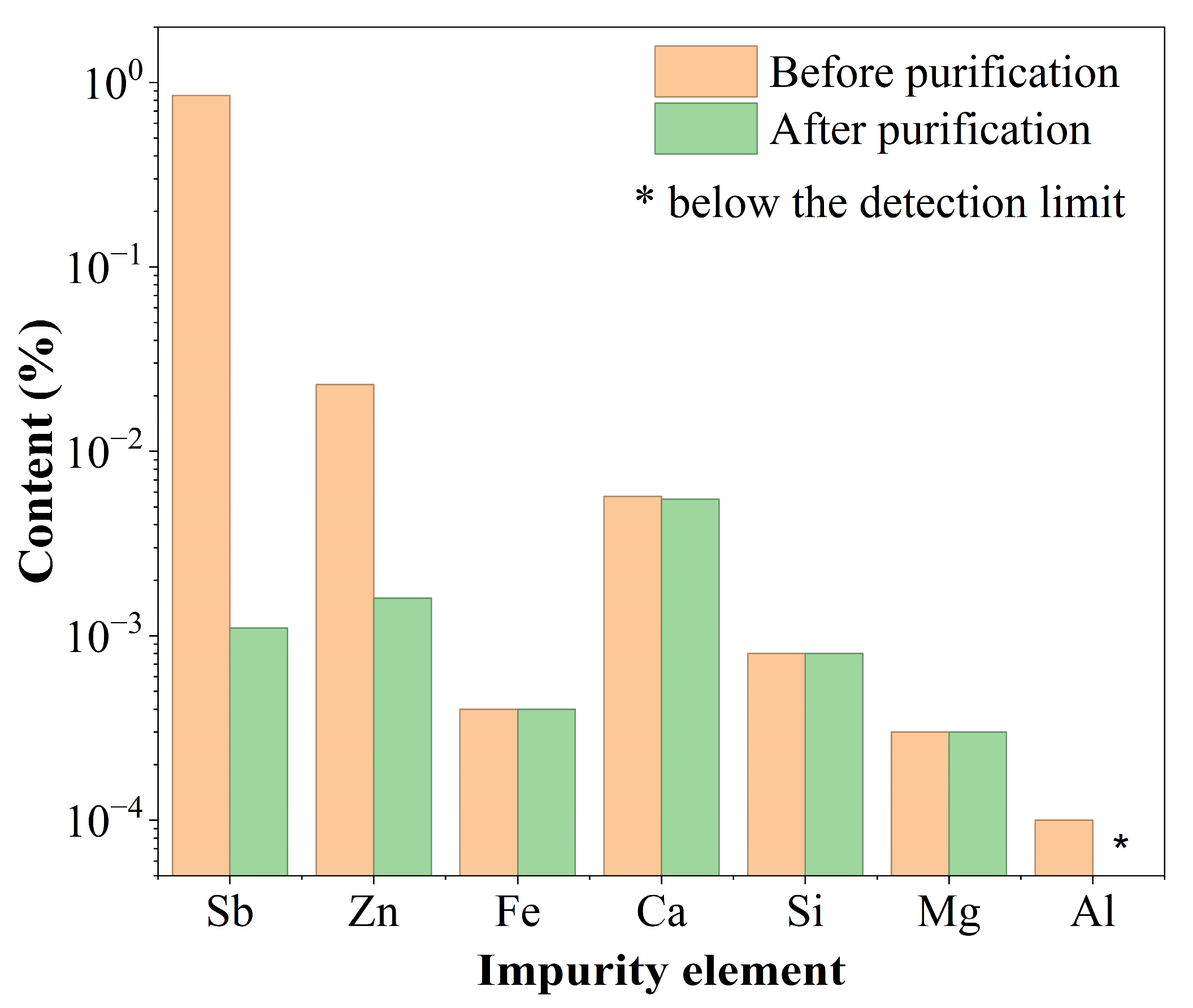
The raw material used in this study was a lumpy PbS-rich intermediate product obtained after a single vacuum distillation treatment of a complex lead–antimony ore. To determine its chemical composition—particularly the content of key impurity elements—the sample was analyzed using ICP-MS. The results are presented in Table 1. Following vacuum distillation pretreatment, lead in the sample was primarily concentrated in the form of PbS. The main impurity element, Sb, showed a mass fraction of 0.85%. The total content of other impurities—including Zn, Fe, Ca, Si, Mg, and Al—was relatively low, at approximately 0.03% by mass.
The analysis confirms that a single vacuum distillation step effectively separates and concentrates lead and antimony from the complex ore, resulting in a PbS-rich feed material containing only trace amounts of Sb and other elements. The 0.85% antimony present is mainly in the form of Sb2S3, which is the primary impurity targeted for removal in the subsequent hydrometallurgical refining process. In addition, the raw material is lumpy and has a relatively small specific surface area, which limits solid–liquid mass transfer. For this reason, the material needs to be crushed and ground before leaching to increase the reaction surface area and promote the exposure and dispersion of impurity phases.

2.2. Procedure

To enhance its leaching performance, the raw material was mechanically activated in a planetary ball mill. Zirconia balls served as the grinding medium, and milling was carried out continuously for 4 h at a ball-to-material mass ratio of 10:1 and a rotational speed of 800 rpm. The purpose of this step was to reduce particle size, achieve uniform dispersion of antimony, break down impurity encapsulation, and increase the available surface area for subsequent reactions.
The hydrometallurgical leaching experiments were carried out in vacuum flasks equipped with mechanical stirrers and online monitoring systems. Before each run, the air was completely removed by vacuum pumping to establish an oxygen-free atmosphere. A predetermined amount of ball-milled material was then mixed with preheated NaOH solution (25–80 °C). Unless otherwise specified, the suspension was stirred continuously for 8 h at a speed of 300 rpm. The solution pH was maintained naturally within the range of 9 to 11 by adjusting the initial NaOH concentration (0.1–3 mol/L). Meanwhile, the redox potential was monitored online using a platinum electrode coupled with a saturated calomel electrode (SCE). Process conditions were adjusted to keep the Eh within the target range of 0.05–0.65 V (vs. SHE).
After the reaction, solid–liquid separation was carried out. The leaching residue was washed repeatedly with deionized water, dried, and then prepared for further characterization.

2.3. Analytical Characterization

The microstructure and elemental composition of the samples were examined by Scanning Electron Microscopy coupled with Energy Dispersive Spectroscopy (SEM-EDS; TESCAN MIRA LMS, Brno, Czech Republic) and Transmission Electron Microscopy (TEM; Thermo Fisher Talos F200X, Waltham, MA, USA). The ionic composition of leachate was determined by Raman spectrometer (HORIBA Scientific LabRAM HR Evolution, Palaiseau, France). Meanwhile, the concentrations of Pb and Sb in the dried residues were detected by means of Inductively Coupled Plasma Mass Spectrometry (ICP-MS; Agilent ICP-MS 7800, Santa Clara, CA, USA), allowing the antimony removal rate to be calculated. In addition, the zeta potential and conductivity of the reaction slurry were measured using a nanoparticle zeta potential analyzer (Malvern Instruments ZS-90, Worcestershire, UK) to assess particle surface charge and the stability of the dispersion.

2.4. Data Processing and Evaluation Metrics

Equation (1) is used to calculate the antimony removal rate (RSb).
R S b = 1 m S b , R e s i d u e m S b , F e e d × 100 %
where m s b , R e s i d u e represents the mass of antimony in the raw material before processing and m s b , F e e d represents the mass of antimony in the raw material after processing. All experiments were conducted with at least two parallel tests, and the data are presented as averages.

2.5. Thermodynamic Analysis Methods

HSC Chemistry 9.0 software (Outotec Oyj, Espoo, Finland) was employed to perform thermodynamic calculations for the system, and the thermodynamic stability of raw materials in solution was analyzed.

3. Results and Discussions

3.1. Thermodynamic Analysis

3.1.1. Eh-pH Stability Analysis of the System

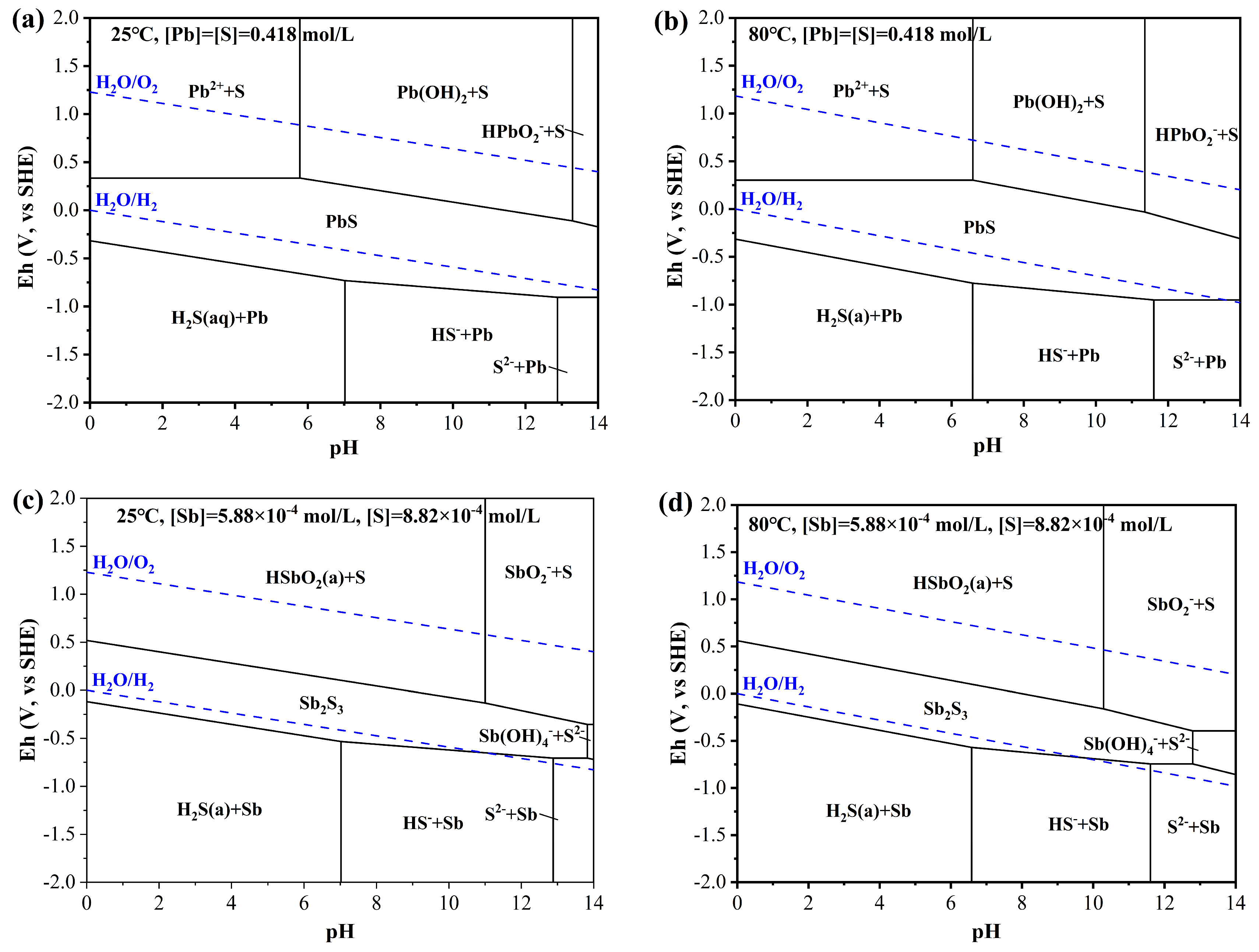
Achieving efficient separation of lead and antimony from complex sulfide ores requires identifying a thermodynamic window in which the dissolution behaviors of PbS and Sb2S3 differ markedly. However, due to their chemical similarity, conventional leaching systems struggle to balance selectivity with thorough impurity removal. It is therefore essential to examine the stability boundaries of both compounds from an electrochemical perspective. To assess the thermodynamic feasibility of deep Pb–Sb separation in an alkaline hydrometallurgical system, this study employed the thermodynamic database and Eh-pH module of HSC Chemistry. The E-pH diagrams for the Pb–S–H2O and Sb–S–H2O systems at 25 °C and 80 °C were constructed at a system pressure of 1 bar; the ion concentrations of Pb and Sb were 0.418 mol/L and 5.88 × 10⁻⁴ mol/L.
The Eh-pH diagrams reveal that the Pb–S–H2O system includes solid phases such as PbS, Pb, PbO, and PbSO4, along with dissolved species including Pb2+, HPbO2, and PbO32−. In the Sb–S–H2O system, the stable solid phases are Sb2S3, Sb, and Sb2O3, while the main dissolved species are SbO+, SbO2, SbO33−, and HSbO2. In addition, both systems share common sulfur-containing species, including S, HS, SO42−, and HSO4.
The thermodynamic analysis presented in Figure 1 suggests that selective removal of trace Sb2S3 impurities (approximately 1–2%) from the PbS matrix is theoretically feasible. Consider, for instance, the calculated data at 80 °C shown in Figure 1b,d. Under alkaline conditions (pH = 10), the equilibrium potential for the oxidation of Sb2S3 to SbO2 is around 0.05 V, while that for PbS oxidation to Pb2+ is approximately 0.65 V. This difference of about 0.60 V defines a distinct thermodynamic window for selective oxidation leaching. By carefully controlling the system potential—for instance, maintaining it between 0.20 and 0.40 V—it becomes possible to preferentially oxidize and dissolve Sb2S3 into the solution while keeping PbS thermodynamically stable. Importantly, this potential window remains consistent across a pH range of 8 to 12, with ΔEh values between 0.35 and 0.65 V. Such stability offers considerable operational flexibility. Moreover, since Sb2S3 accounts for only about 1% of the material, its dissolution has a limited effect on the overall solution composition and potential. This further minimizes the risk of co-dissolving PbS. In summary, under appropriately controlled potential and pH conditions, the highly selective removal of Sb2S3 appears achievable while preserving the PbS matrix. Subsequent experiments will be conducted within this theoretical framework to validate the approach and optimize process parameters.

3.1.2. Thermodynamic Analysis of Residual Equilibria for PbS and Sb2S3 in an Anaerobic Alkaline Environment

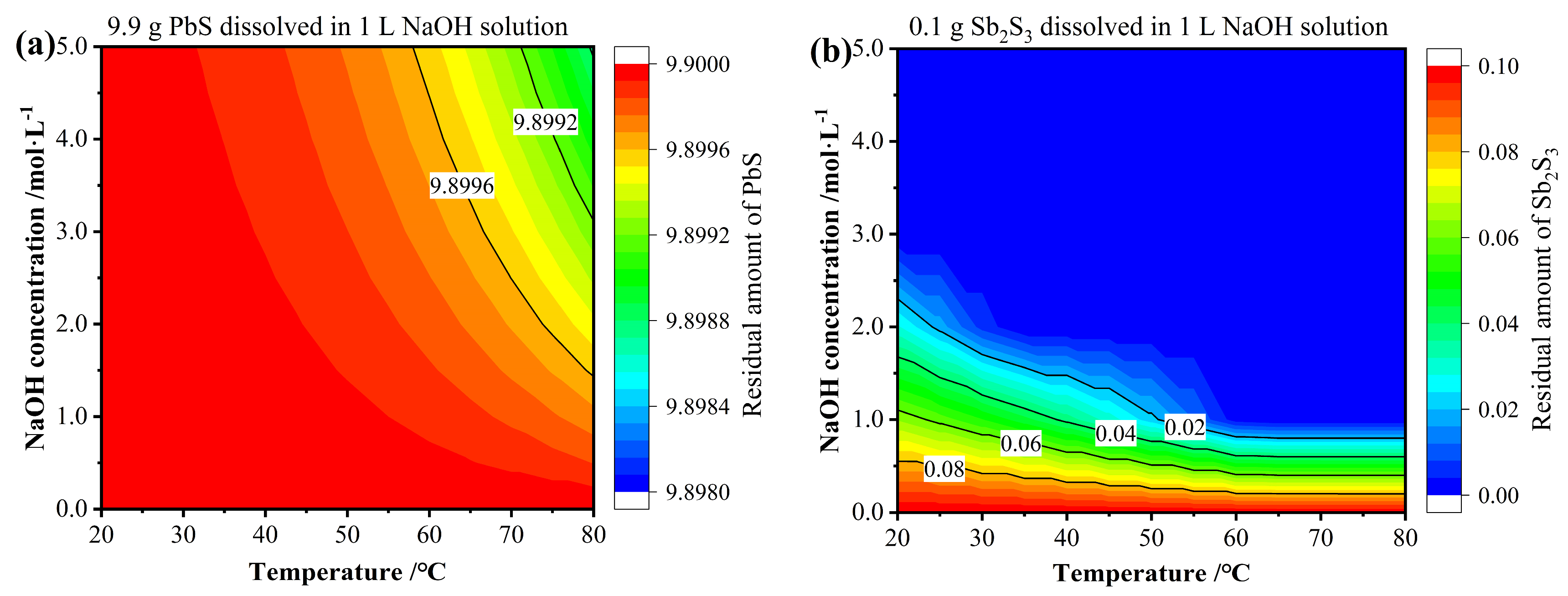
While Eh-pH analysis has established the potential–pH range for selective Pb–Sb separation from an electrochemical perspective, actual leaching behavior is influenced not only by redox potential but also by the intrinsic solubility of each phase in a given medium. In the alkaline system proposed here—which operates without external oxidants—it remains unclear whether separation can be achieved based on solubility differences alone. This question calls for further examination from a dissolution equilibrium standpoint. To address this point, thermodynamic equilibrium calculations were performed using HSC Chemistry 9.0 for the PbS–Sb2S3–NaOH–H2O system. These simulations were designed to model the dissolution behavior and solid-phase residues of both compounds in an alkaline medium. The calculation conditions were set as follows: 1 L of NaOH solution served as the leaching agent; the system was maintained under vacuum or inert atmosphere (i.e., oxygen-free); and the temperature was fixed at 80 °C. The feed material consisted of PbS-rich ore containing 1% Sb2S3 impurities (9.9 g PbS and 0.1 g Sb2S3). The objective was to determine how the residual amounts of PbS and Sb2S3 in the solid phase vary with NaOH concentration once chemical equilibrium is reached.
The thermodynamic equilibrium calculations, presented in Figure 2, reveal a clear contrast between the behaviors of PbS and Sb2S3. Across the entire NaOH concentration range examined (0–2 mol/L), the equilibrium residue of PbS remains stable, ranging from 9.895 to 9.915 g (see Figure 2a). This corresponds to a loss rate of less than 0.05%, indicating that under oxygen-free alkaline conditions, PbS exhibits excellent chemical stability and minimal involvement in dissolution reactions. In contrast, the equilibrium residue of Sb2S3 decreases markedly with increasing NaOH concentration (Figure 2b). When the NaOH concentration reaches 0.5 mol/L, the Sb2S3 residue falls below 0.0125 g. Under optimized conditions, the calculated residue approaches zero, confirming that Sb2S3 can be almost completely dissolved.
These thermodynamic equilibrium calculations demonstrate that by regulating parameters such as alkalinity, it is possible to preferentially dissolve approximately 1% Sb2S3 impurities while ensuring negligible loss of the PbS matrix. This theoretical finding provides a crucial justification for the subsequent oxygen-free hydrometallurgical leaching experiments conducted in vacuum-sealed reactors. It also supports the development of a clean separation pathway that relies on direct alkali dissolution, eliminating the need for strong oxidizing agents. It is important to note, however, that thermodynamic equilibrium calculations describe only the final state of the system once equilibrium is reached. Whether the actual leaching process can approach this ideal outcome depends on kinetic factors—including mass transfer efficiency and solid–liquid interfacial reactions. These aspects will be examined in detail in the experimental sections that follow.

3.1.3. Analysis of Solubility Equilibrium Concentrations Based on Changes in Gibbs Free Energy

The previous section established the thermodynamic feasibility of selective Pb–Sb separation in an anaerobic alkaline system, using Eh-pH diagrams and equilibrium residue calculations. However, in actual leaching processes, the dissolution behavior of PbS and Sb2S3 is governed not only by redox potential and intrinsic solubility, but also by the Gibbs free energy changes associated with specific reaction pathways. To better understand the underlying differences in their dissolution behavior under alkaline conditions, it is necessary to analyze potential reactions from a thermodynamic standpoint and calculate the corresponding equilibrium concentrations of the species involved. Table 2 summarizes the possible reactions between PbS and Sb2S3 in NaOH solution under anaerobic conditions, based on the Eh-pH diagrams presented earlier [25].
The reactions listed in Table 2 represent the possible dissolution pathways for PbS and Sb2S3 in an alkaline environment. For any reaction of the form aA + bB = cC + dD, the change in Gibbs free energy can be calculated using Equation (2).
Δ G = Δ G + R T l n Q
In this expression, ΔG is the Gibbs free energy change under non-standard conditions, while ΔGθ refers to the change under standard conditions. R is the gas constant (8.314 J·mol−1·K−1), and T is the absolute temperature. The term Q represents the reaction quotient, which is calculated using Equation (3).
Q = [ C ] c [ D ] d [ A ] a [ B ] b
In this equation, the terms [A], [B], [C], and [D] represent the activities of the reactants and products. For pure solids or liquids—including water—activity is taken as 1. In dilute solutions, activity can be approximated by concentration. At equilibrium, the reaction quotient becomes constant and is referred to as the equilibrium constant, denoted as Keq.
K e q = C e q c D e q d A e q a B e q b
Combining this with ΔG = 0 yields the following:
Δ G θ = R T l n C e q c D e q d A e q a B e q b
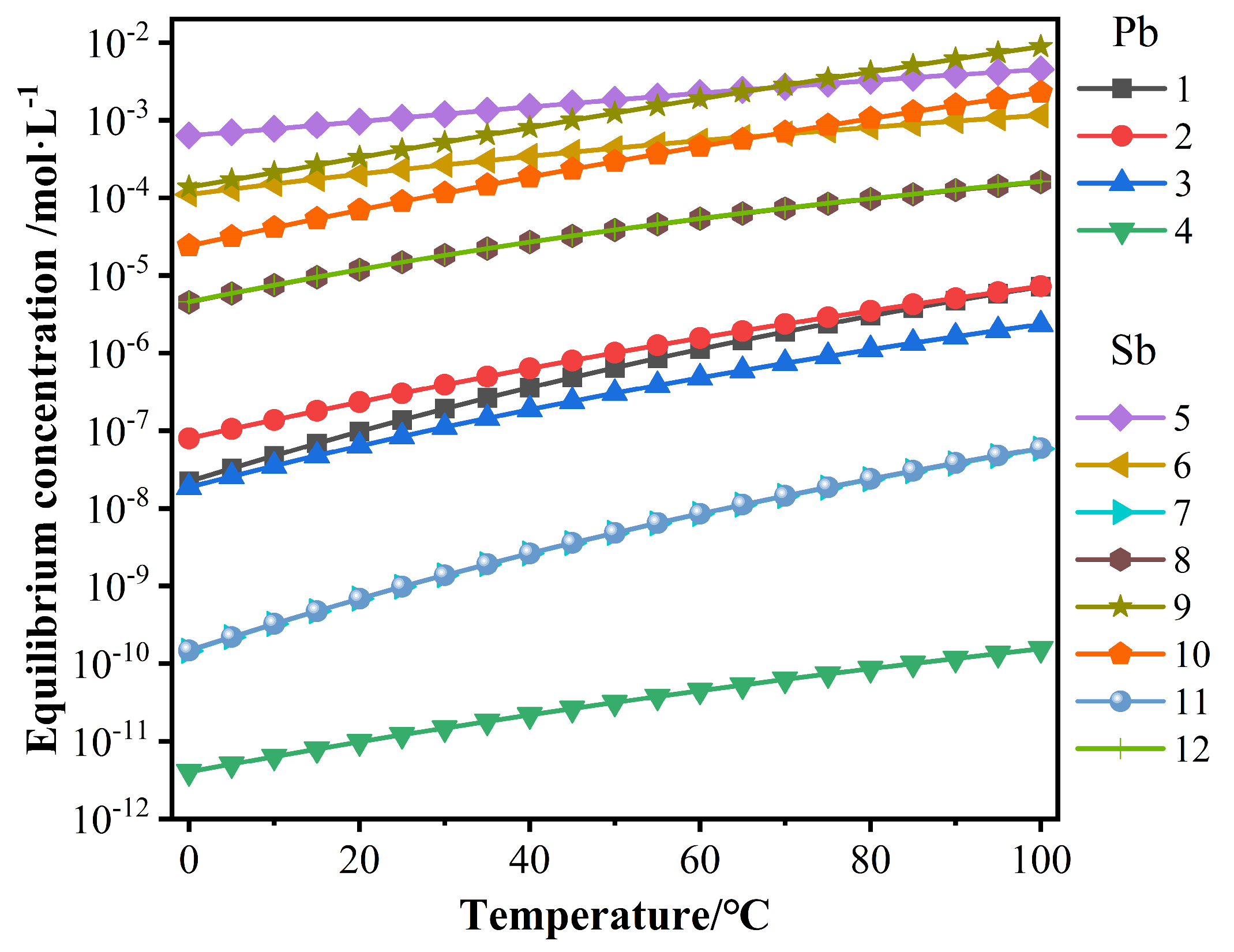
Thermodynamic data—specifically ΔGθ or Keq for each reaction at various temperatures—were obtained using HSC Chemistry software. These values were then used to calculate the equilibrium concentrations of the relevant species via Equation (5). In this study, the initial NaOH concentration was set at 5 mol·L−1, and it was assumed that the reaction products formed strictly according to stoichiometric ratios. Based on these assumptions, the equilibrium concentrations of dissolved Pb and Sb were determined across a range of temperatures. The results are presented in Figure 3.
Figure 3 illustrates that across the temperature range of 0–100 °C, the equilibrium concentration of dissolved antimony consistently exceeds that of dissolved lead. This difference is particularly evident at moderate to low temperatures (20–60 °C). At 40 °C, for example, the concentration of Sb is approximately 1.0 × 10⁻⁷ mol·L−1, while that of Pb is around 1.0 × 10⁻¹⁰ mol·L−1—a difference of three orders of magnitude. These results clearly indicate that, from a thermodynamic standpoint, Sb2S3 has a much stronger tendency to dissolve in NaOH solution than PbS does. From a mechanistic perspective, Sb2S3 can undergo multiple dissolution pathways under alkaline conditions (e.g., Reactions 5–12), forming soluble antimony oxide anions such as SbO2, HSbO2, and Sb (OH)4, along with the release of S2− or HS. In contrast, the alkaline dissolution of PbS (Reactions 1–3) is thermodynamically unfavorable, with extremely small equilibrium constants for species such as HPbO2 or Pb(OH)2. This results in very low equilibrium concentrations of lead. Thus, by operating in a non-oxidizing environment with moderate to low temperature and appropriate alkalinity, the substantial difference in solubility between the two compounds can be exploited: trace Sb2S3 preferentially dissolves via direct alkali reaction, while the PbS matrix remains largely intact due to its extremely low solubility. Although the solubility gap narrows above 80 °C, efficient removal of Sb2S3 and recovery of PbS remain achievable under optimized low-to-medium temperature conditions, combined with suitable liquid-to-solid ratios and enhanced mass transfer. The thermodynamic analysis provides a solid foundation for understanding the selective separation of lead and antimony in alkaline hydrometallurgical systems, particularly from the perspectives of dissolution equilibrium and reaction pathways.

3.2. Pretreatment of Raw Materials

To improve the physical characteristics of the PbS-rich raw material—which contains approximately 1% Sb2S3—and to enhance mass transfer and reaction kinetics in the subsequent hydrometallurgical separation, the material was first subjected to mechanical activation pretreatment. The raw material was placed in a planetary ball mill using zirconia balls as the grinding medium. The objective was to reduce particle size and achieve a uniform dispersion of the impurity phases.
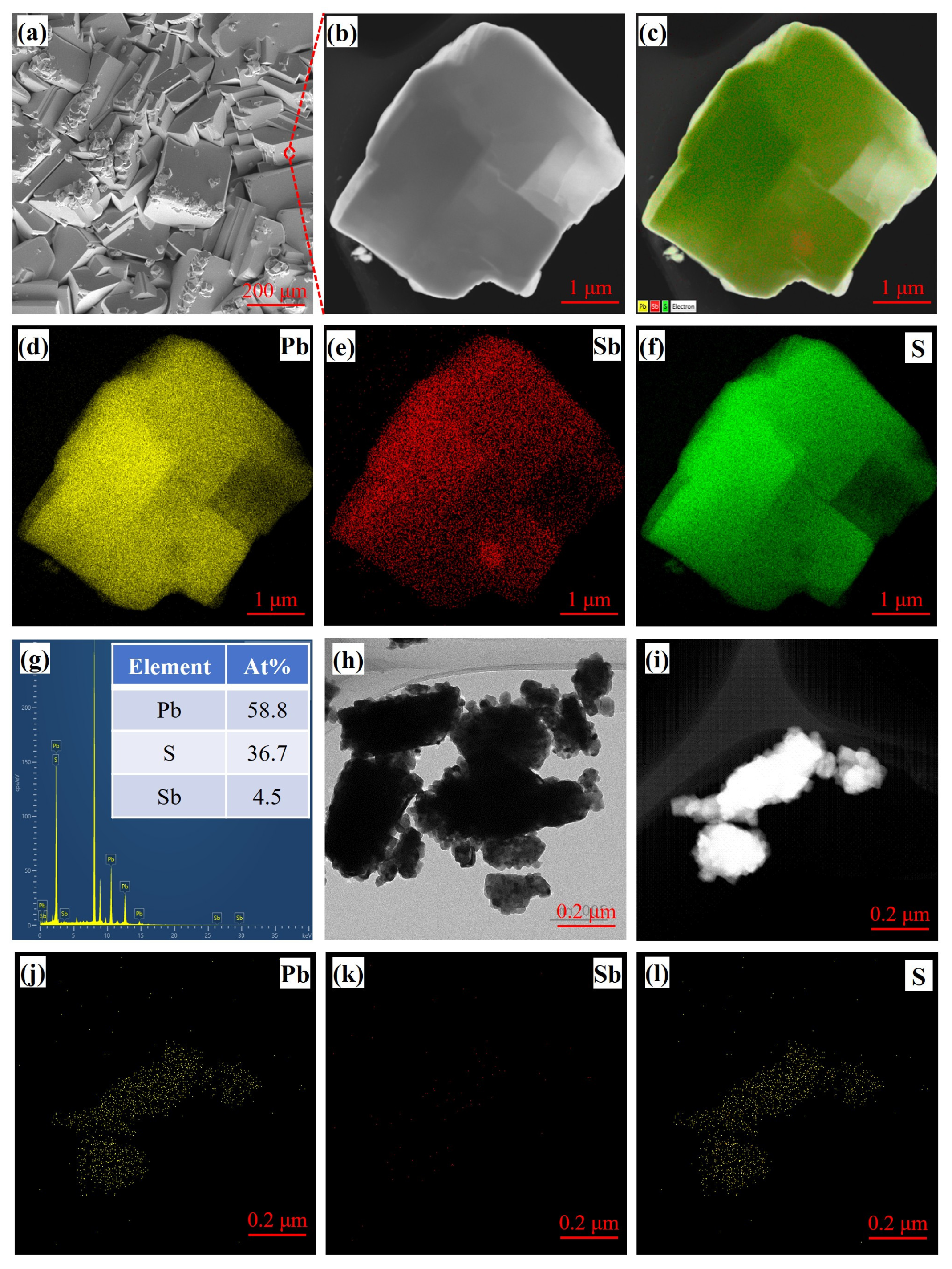
The microstructure and elemental distribution of the samples were characterized using SEM and EDS before and after ball milling. Analysis of the untreated material (Figure 4a) showed a broad particle size distribution. Many particles ranged in size from tens to hundreds of micrometers, with some exceeding 300 µm in their longest dimension. EDS area mapping (Figure 4b–f) further revealed a distinctly non-uniform distribution of antimony, with noticeable enrichment in localized regions. This microstructure indicates that Sb2S3 impurities are not uniformly dispersed throughout the PbS matrix. Instead, they occur partly as inclusions or as independently enriched phases. Such an arrangement limits effective contact between the leaching agent and the target impurities, thereby hindering selective removal.
After four hours of ball milling, the physical characteristics of the sample changed considerably. The particle size distribution became markedly finer, with the primary particle size reduced to the submicrometer-to-micrometer range. More importantly, EDS area mapping (Figure 4j–l) showed that the distribution of antimony had improved substantially, with no large-scale enrichment zones detected. This indicates that the Sb2S3 impurities were uniformly dispersed throughout the PbS matrix.
This mechanical activation step—by reducing particle size and homogenizing the composition—creates favorable kinetic conditions for the subsequent thermodynamically driven selective separation. On one hand, the increased specific surface area significantly expands the solid–liquid reaction interface. On the other, the uniform dispersion of impurities helps eliminate diffusion barriers caused by localized encapsulation. As a result, the leaching agent can interact more effectively and selectively with trace Sb2S3 within the thermodynamically defined “selective window.” This allows for maximum impurity removal while minimizing unwanted dissolution of the PbS matrix. Therefore, this pretreatment plays a critical role in achieving high separation efficiency in the proposed process.

3.3. Purification Experiment Results

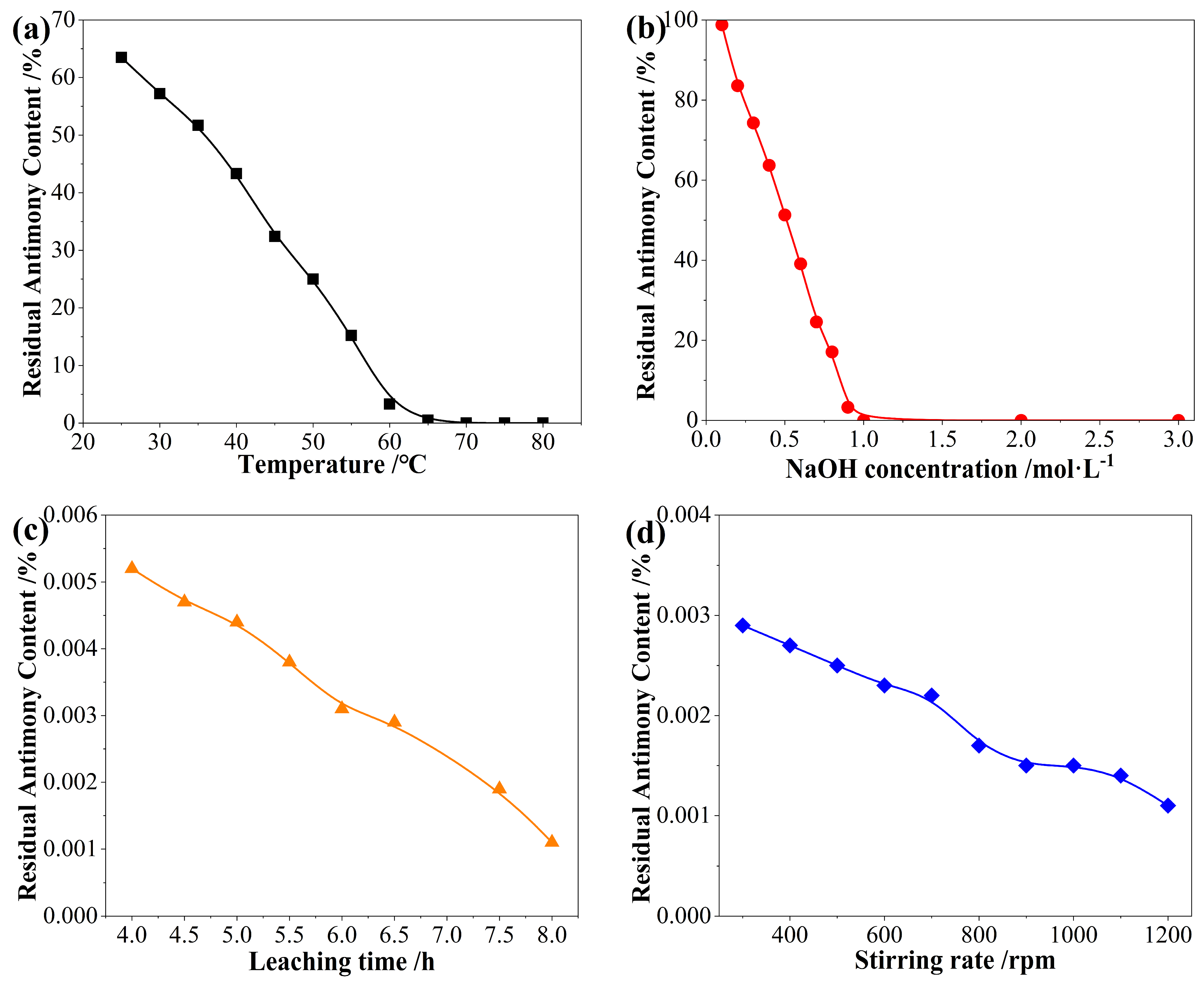
Wet purification experiments were conducted on the pretreated raw materials at various temperatures and NaOH concentrations. First, 10 g of the sample was added to 1 L of NaOH solution, and the experiments were performed under negative-pressure and oxygen-free conditions. The suspension was stirred continuously for 8 h at speed of 300 rpm, with the NaOH concentration fixed at 1 mol/L, the residual antimony content in the material was investigated at temperatures ranging from 25 °C to 80 °C; with the reaction temperature fixed at 80 °C, the residual antimony content was examined as the NaOH concentration varied from 0.1 mol/L to 3.0 mol/L. Furthermore, at a constant NaOH concentration of 1 mol/L and reaction temperature of 80 °C, the residual antimony content was first examined as the leaching time varied from 4 to 8 h. Subsequently, with the leaching time held at 8 h, the effect of stirring rate (300–1200 rpm) on the residual antimony content was investigated.
As shown in Figure 5, with increasing temperature, the residual antimony content in the samples decreases, and negligible antimony remains in the samples when the temperature exceeds 70 °C. Similarly, as the NaOH concentration rises, the residual antimony content declines, with almost no antimony detected in the samples at NaOH concentrations above 1 mol/L. Under oxygen-free conditions, the treatment of Sb2S3-containing PbS-rich samples with alkaline solution can effectively achieve the removal of antimony.
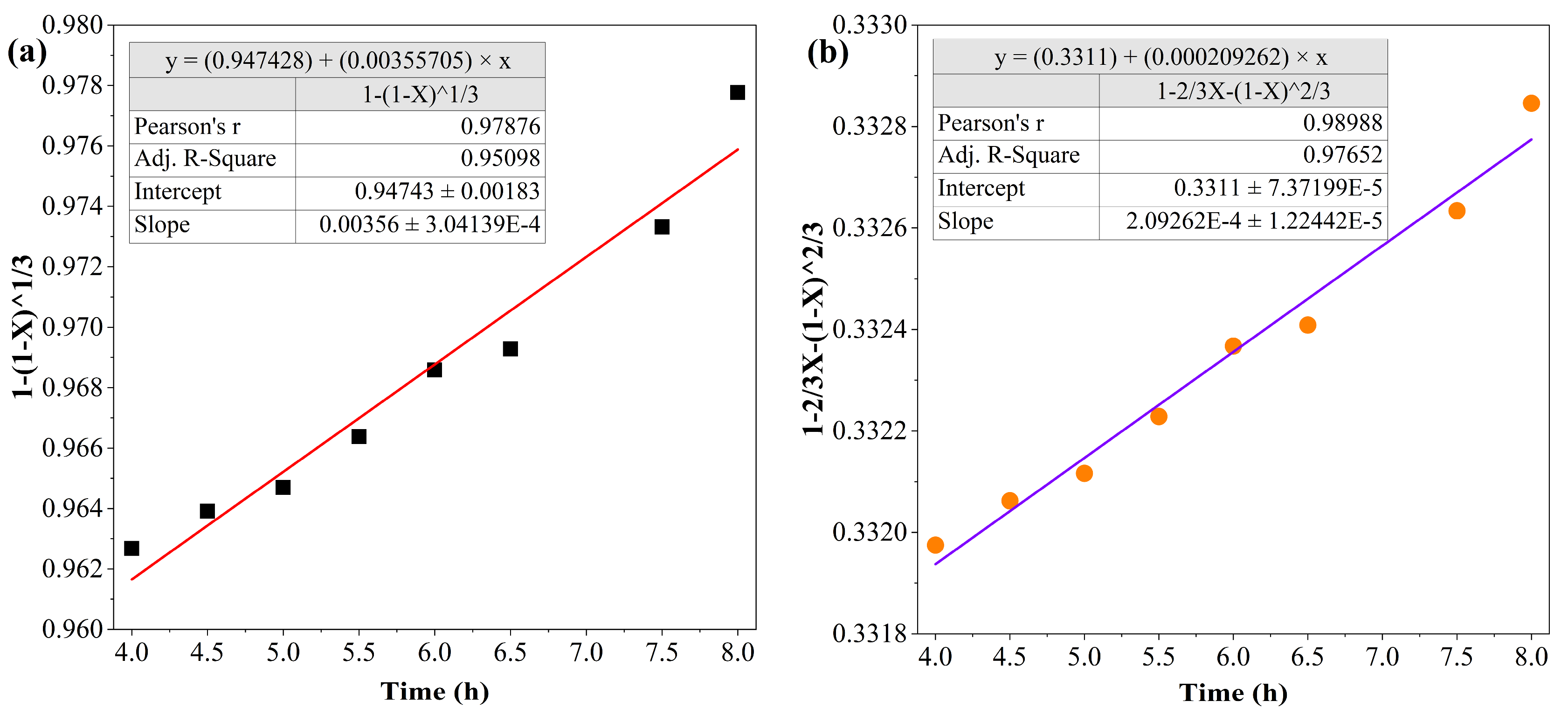
Given that this study aims to achieve deep antimony removal, the effects of kinetic factors, such as leaching time and stirring speed, on the Sb removal efficiency were investigated under the optimal temperature and NaOH concentration. The results indicate that extending the leaching time reduces the residual Sb content in the samples. The shrinking core model was employed to fit the kinetic data (Figure 6). The diffusion-controlled model yielded a higher correlation coefficient (R2 = 0.977) compared to the chemical reaction-controlled model (R2 = 0.951), demonstrating that the Sb leaching process is diffusion-controlled. Furthermore, as shown in Figure 5d, increasing the stirring speed generally decreased the residual Sb content, which further corroborates that the deep Sb removal process is governed by diffusion.

3.4. Discussions

3.4.1. Feasibility Analysis of Phase Transformation and Separation

To confirm the selective removal of trace Sb2S3 impurities from PbS in the alkaline wet separation system—both in terms of phase structure and microstructure—samples were characterized before and after leaching using Raman spectroscopy.
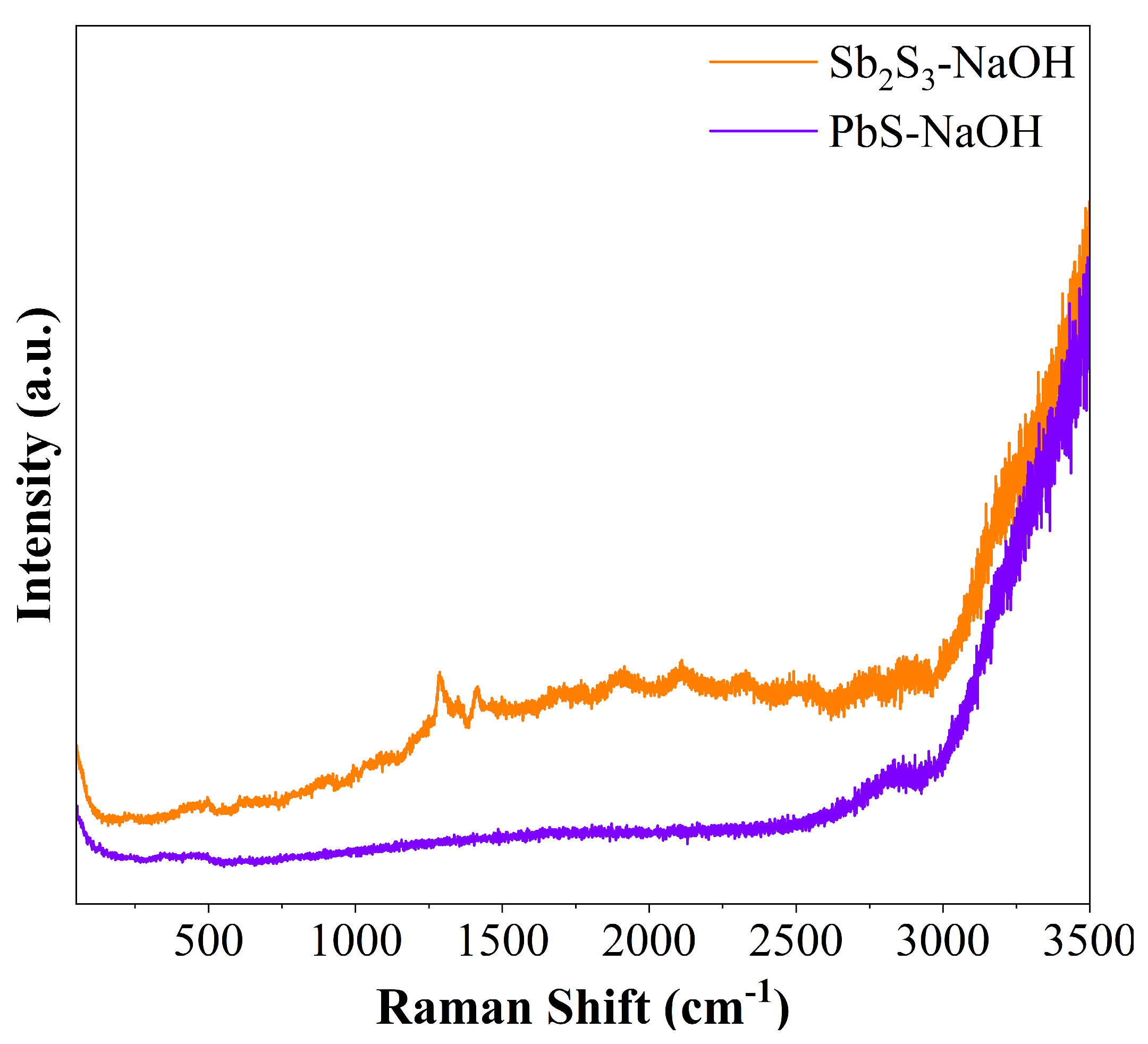
Figure 7 shows the Raman spectra of pure PbS and Sb2S3 before and after reaction under identical oxygen-free alkaline conditions. After leaching, the spectrum of Sb2S3 leachate displays three sharp characteristic peaks at 1287, 1341, and 1414 cm−1, which correspond to vibrations of S2− and HS. In addition, broad bands appear at 1915, 2110, and 1328 cm−1, consistent with hydroxyl group vibrations and antimony–oxygen bonds in species such as Sb(OH)3 and Sb(OH)4. Given that Sb2S3 generates soluble ions when heated in an oxygen-free NaOH solution, these results suggest that dissolution occurs through the breakdown of its crystal structure: sulfur is converted into S2− or HS, while antimony forms soluble hydroxyl-coordinated complexes. This confirms that Sb2S3 undergoes structural disruption and transforms into soluble products under the applied conditions.
By contrast, the Raman spectrum of PbS leachate after leaching shows only a broad, weak peak near 2796 cm−1, which likely corresponds to H2S vibrations arising from the conversion of trace sulfur species in the system. Importantly, the strong characteristic peak of the Pb–S bond at 290 cm−1 remains fully intact, and no new peaks corresponding to potential oxidation products—such as PbO, PbSO4, or Pb(OH)2—are observed. These results clearly indicate that, under the same oxygen-free alkaline conditions, the phase structure of PbS remains stable and undergoes no significant chemical transformation.
The Raman analyses demonstrate that, within the established oxygen-free alkaline wet system, trace Sb2S3 impurities undergo selective chemical dissolution and transformation, while the PbS matrix retains its original phase structure and chemical composition. These findings are in good agreement with the “selective dissolution window” predicted by the earlier thermodynamic Eh-pH analysis. This confirms that—under appropriately controlled potential and alkalinity conditions—the efficient and selective removal of trace Sb2S3 from PbS can indeed be achieved in practice.

3.4.2. Correlation Between the Eh-pH Range and Electrochemical Parameters

To ensure high selectivity during lead–antimony separation, the redox potential (Eh) of the leaching system was carefully controlled within the “selective dissolution window” defined by thermodynamic analysis. The Eh value was monitored in real time using a platinum electrode coupled with a saturated calomel electrode (SCE), and all measurements were converted to the standard hydrogen electrode (SHE) scale. Throughout the experiment, the Eh was maintained between 0.1 and 0.35 V (vs. SHE) by adjusting process parameters, while the pH was kept within the range of 9 to 11 using NaOH.
Based on prior thermodynamic calculations for the Pb–S–H2O and Sb–S–H2O systems, a theoretical Eh–pH window enabling selective separation of lead and antimony in alkaline media was identified. To verify whether the actual leaching behavior aligns with these predictions—and to assess the state of the solid–liquid interface—experiments were carried out in which the zeta potential and conductivity of the slurry were measured simultaneously. Key electrochemical parameters obtained from these measurements are summarized in Table 3.
As shown in Figure 1b,d, the experimentally controlled operating conditions—approximately Eh = 0.15 V and pH = 10—fall well within the theoretically predicted selectivity window. The upper limit of this window is defined by the PbS oxidation–dissolution equilibrium line (around 0.65 V), while the lower limit is set by the Sb2S3 oxidation–dissolution equilibrium line (approximately 0.05 V). The experimental Eh value lies significantly below the threshold for PbS oxidation, ensuring its thermodynamic stability. At the same time, it remains well above the critical potential for Sb2S3 oxidation, providing sufficient driving force for the selective dissolution of trace Sb2S3. This control strategy—characterized by a high potential difference relative to the impurity but a low absolute potential—is key to achieving highly selective separation. As a result, lead loss is kept below 1%, while antimony removal exceeds 99%.
Under the controlled Eh–pH conditions, the measured zeta potential was −12.3 mV. This negative value indicates that the particle surface carries a negative charge in the alkaline environment, consistent with the adsorption of OH and oxygen-containing anions at the interface. The resulting electrostatic repulsion helps maintain good dispersion of the fine ball-milled particles—particularly the highly dispersed Sb2S3—during leaching, thereby preventing agglomeration that could otherwise hinder interfacial reactions. At the same time, the system exhibits high ionic strength, reflected by a conductivity of up to 204 mS/cm. Although this compresses the electrical double layer, the surface charge density remains sufficient to preserve colloidal stability and support efficient mass transfer and reaction kinetics.
In summary, the macroscopic Eh values and microscopic zeta potentials measured experimentally confirm that the electrochemical environment of the actual leaching system is well aligned with the thermodynamic predictions. This consistency—between bulk thermodynamic conditions and the interfacial state—validates the reliability of the earlier Eh-pH analysis and sheds light on the underlying mechanism that enables efficient and selective removal of trace Sb2S3 from PbS. Specifically, it establishes a solid–liquid reaction interface that is both stable and kinetically favorable, while simultaneously satisfying the selectivity requirements of the bulk reaction.

3.4.3. Comparison of Impurity Contents Before and After Purification

Quantitative evaluation of the purification efficiency was carried out by analyzing the leaching residues using ICP-MS. The results are presented in Table 4.
As shown in Figure 8, after treatment, the mass fraction of Sb—the primary impurity—dropped sharply from 0.85% in the raw material to just 0.0008%, corresponding to an antimony removal rate of 99.91%. The total content of other impurity elements, including Zn, Fe, and Ca, remained at a very low level of approximately 0.0086%. Importantly, phase analysis confirmed that the PbS structure remained intact, and morphological observation showed no significant etching of the PbS particles. These findings indicate that the PbS matrix was effectively preserved during the process. Together, the results demonstrate that the proposed method not only achieves highly efficient removal of Sb2S3 impurities but also exhibits strong selectivity toward the PbS host—an essential requirement for producing ultra-high-purity PbS.
Although the removal of Zn was not the primary focus of this study, it was effectively removed under the optimized conditions. Thermodynamic analysis based on the E-pH diagram of the Zn-S-H2O system (Figure S1) reveals that while ZnS remains insoluble in the NaOH solution at low temperatures, it dissolves as Zn(OH)42− at the optimized temperature of 80 °C.

4. Conclusions

This study tackles the challenge of deeply removing trace Sb2S3 impurities during the production of high-purity PbS from complex lead–antimony sulfide ores. A synergistic refining strategy based on thermodynamic regulation—namely, “vacuum distillation pretreatment followed by oxygen-free alkaline wet selective leaching”—is proposed and systematically validated. Through a combination of theoretical analysis and experimental investigation, the following key conclusions are drawn:
(1)
Thermodynamic analysis reveals that PbS and Sb2S3 exhibit distinctly different dissolution behaviors in oxygen-free alkaline systems (pH 9–11). Eh-pH diagram calculations show a difference of approximately 0.60 V in their oxidation–reduction equilibrium potentials, defining a clear potential window (0.05–0.65 V) within which Sb2S3 can selectively dissolve while PbS remains stable. Further dissolution equilibrium calculations indicate that, under optimized conditions, Sb2S3 undergoes near-complete dissolution, whereas PbS loss is limited to less than 0.05%. These findings provide a sound thermodynamic basis for selective separation.
(2)
Mechanical activation pretreatment plays a critical role in improving separation efficiency. Ball milling under optimized conditions—a ball-to-material ratio of 10:1, rotational speed of 800 rpm, and duration of 4 h—effectively disrupted the encapsulated structure of Sb2S3 in the raw material. This process reduced particle size to the submicron-to-micrometer range and achieved uniform dispersion of the impurity phases. These improvements created favorable kinetic conditions for the subsequent selective leaching step.
(3)
Experimental results confirm the high efficiency and selectivity of the proposed process. Under vacuum or inert atmosphere protection, the ball-milled and activated PbS-rich material—containing 0.85% antimony—was subjected to oxygen-free leaching in NaOH solution with carefully controlled potentials (0.1–0.35 V vs. SHE). This approach enabled efficient separation of lead and antimony. Raman spectroscopy and SEM morphological analysis confirmed the selective dissolution and transformation of Sb2S3, while the PbS phase structure remained intact. ICP-MS analysis showed that the antimony removal rate reached 99.91%, with lead loss below 1%, yielding a final product purity exceeding 99.9%.
(4)
The interfacial electrochemical environment plays a key role in facilitating the separation process. The measured zeta potential of −12.3 mV confirms that the particle surface carries a negative charge under alkaline conditions. The high conductivity of 204 mS/cm reflects the system’s substantial ionic strength. Together, these factors help maintain stable dispersion of the fine particles during leaching, preventing agglomeration that could otherwise hinder interfacial reactions and ensuring efficient mass transfer and reaction kinetics.
(5)
The synergistic refining strategy developed in this study offers a technically robust, efficient, and environmentally sound route for producing ultra-high-purity PbS from complex lead–antimony ores. It also provides broader insights into the precise separation of chemically similar elements in other complex polymetallic resources. Future work could focus on continuous process scale-up, optimization of reactor design, and recovery of dissolved antimony.

Supplementary Materials

The following supporting information can be downloaded at https://www.mdpi.com/article/10.3390/met16050478/s1. Figure S1. Eh-pH diagrams of the ZnS systems under different conditions: (a) Zn−S−H2O at 25 °C; (b) Zn−S−H2O at 80 °C.

Author Contributions

Methodology, J.W., Y.S., H.X., Z.D. and Y.H.; Software, J.W., Y.S., S.H. and Z.Z.; Validation, J.W., H.X. and Z.D.; Investigation, Y.S., S.H., Z.Z. and Y.H.; Resources, H.X.; Writing—original draft, J.W.; Writing—review and editing, H.X.; Visualization, S.H. and Z.Z.; Supervision, Z.D.; Funding acquisition, J.W. All authors have read and agreed to the published version of the manuscript.

Funding

The authors gratefully acknowledge the financial support from the National Key Research and Development Program of China (2022YFC2904203).

Data Availability Statement

The original contributions presented in this study are included in the article/Supplementary Material. Further inquiries can be directed to the corresponding authors.

Conflicts of Interest

The authors declare that they have no known competing financial interest or personal relationships that could influence the work in this article.

References

  1. Yin, X.; Zhang, C.; Guo, Y.; Yang, Y.; Xing, Y.; Que, W. PbS QD-based photodetectors: Future-oriented near-infrared detection technology. J. Mater. Chem. C 2021, 9, 417–438. [Google Scholar] [CrossRef]
  2. Xu, W.; Peng, H.; Zhu, T.; Yi, C.; Liu, L.; Gong, X. A solution-processed near-infrared polymer: PbS quantum dot photodetectors. RSC Adv. 2017, 7, 34633–34637. [Google Scholar] [CrossRef]
  3. Huang, J.; Lee, J.; Vollbrecht, J.; Brus, V.V.; Dixon, A.L.; Cao, D.X.; Zhu, Z.; Du, Z.; Wang, H.; Cho, K.; et al. A high-performance solution-processed organic photodetector for near-Infrared sensing. Adv. Mater. 2020, 32, 1906027. [Google Scholar] [CrossRef]
  4. Wang, J.; Chen, J. High-sensitivity silicon: PbS quantum dot heterojunction near-infrared photodetector. Surf. Interfaces 2022, 30, 101945. [Google Scholar] [CrossRef]
  5. Mochalov, L.; Dorosz, D.; Kochanowicz, M.; Logunov, A.; Letnianchik, A.; Starostin, N.; Zelentsov, S.; Boreman, G.; Vorotyntsev, V. Optical emission spectroscopy of lead sulfide films plasma deposition. Spectrochim. Acta Part A Mol. Biomol. Spectrosc. 2020, 241, 118629. [Google Scholar] [CrossRef]
  6. Chen, W.; Tang, H.; Chen, Y.; Heger, J.E.; Li, N.; Kreuzer, L.P.; Xie, Y.; Li, D.; Anthony, C.; Pikramenou, Z.; et al. Spray-deposited PbS colloidal quantum dot solid for near-infrared photodetectors. Nano Energy 2020, 78, 105254. [Google Scholar] [CrossRef]
  7. Mubiayi, K.P.; Revaprasadu, N.; Garje, S.S.; Moloto, M.J. Designing the morphology of PbS nanoparticles through a single source precursor method. J. Saudi Chem. Soc. 2017, 21, 593–598. [Google Scholar] [CrossRef]
  8. Meng, W.; Yuan, W.; Wu, Z.; Wang, X.; Xu, W.; Wang, L.; Zhang, Q.; Zhang, C.; Wang, J.; Song, Q. Mechanochemical synthesis of lead sulfide (PbS) nanocrystals from lead oxide. Powder Technol. 2019, 347, 130–135. [Google Scholar] [CrossRef]
  9. Dong, Z.; Zhou, Z.; Xiong, H.; Yang, B.; Dai, Y. Direct extracting lead sulfide and antimony trisulfide via a vacuum distillation method. Sep. Purif. Technol. 2021, 279, 119776. [Google Scholar] [CrossRef]
  10. Dong, Z.; Guo, X.; Yang, B.; Xiong, H.; Jiang, W. One-step extracting lead from galena (PbS) by a vacuum distillation method. Vacuum 2022, 196, 110789. [Google Scholar] [CrossRef]
  11. Xie, H.; Zhou, Z.; Xiong, H.; Chen, X.; Deng, P.; Wang, Y.; Yang, H.; Meng, C. Theoretical calculation and experimental study on the separation mechanism of PbS-Sb2S3. J. Mol. Struct. 2023, 1273, 134327. [Google Scholar] [CrossRef]
  12. Zhou, Z.; Xiong, H.; Chen, X.; Liu, D.; Zhang, B.; Zhang, Y. Thermodynamic calculation and experimental investigation on the dissociation of lead sulfide under vacuum. Vacuum 2018, 155, 504–508. [Google Scholar] [CrossRef]
  13. Yang, H.; Meng, C.; Wei, X.; Xiong, H.; Kong, X.; Yang, B.; Xu, B.; Dong, Z.; He, Y. Evaporation rate and kinetic mechanism of lead sulfide under vacuum. Metall. Mater. Trans. B 2024, 55, 4787–4793. [Google Scholar] [CrossRef]
  14. Yang, H.; Meng, C.; Wei, X.; Xu, C.; Zeng, Y.; Xiong, H.; Yang, B.; Xu, B. A new process for accumulation and purification of lead sulfide from complex lead ore. Vacuum 2023, 218, 112638. [Google Scholar] [CrossRef]
  15. Zhou, Z.; Wang, C.; Ma, B.; Zhang, B.; Liu, D.; Xiong, H.; Deng, Y.; Xu, B. Separation of lead sulfide from galena concentrate via two-step vacuum distillation. Vacuum 2023, 213, 112155. [Google Scholar] [CrossRef]
  16. Zhou, Z.; Liu, D.; Xiong, H.; Wang, C.; Ma, B.; Wei, L.; Chen, Y.; Huang, K. A vacuum distillation process for separation of antimony trisulfide and lead sulfide from jamesonite. Vacuum 2021, 188, 110172. [Google Scholar] [CrossRef]
  17. Rajathi, S.; Kirubavathi, K.; Selvaraju, K. Structural, morphological, optical, and photoluminescence properties of nanocrystalline PbS thin films grown by chemical bath deposition. Arab. J. Chem. 2014, 10, 1167–1174. [Google Scholar] [CrossRef]
  18. Ikhioya, I.L.; Ehika, S.; Ijabor, B.O. Influence of deposition potential on lead sulphide (PbS) thin film using electrodeposition technique. Asian J. Chem. Sci. 2018, 350, 1–8. [Google Scholar] [CrossRef] [PubMed]
  19. Hu, Y.; Wu, M.; Liu, R.; Sun, W. A review on the electrochemistry of galena flotation. Miner. Eng. 2020, 150, 106272. [Google Scholar] [CrossRef]
  20. Petrović, S.J.; Bogdanović, G.D.; Antonijević, M.M.; Vukčević, M.; Kovačević, R. The extraction of copper from chalcopyrite concentrate with hydrogen peroxide in sulfuric acid solution. Metals 2023, 13, 1818. [Google Scholar] [CrossRef]
  21. Zhang, Q.; Zhang, L.; Jiang, F.; Tang, H.; Wang, L.; Sun, W. Ferric ion-triggered surface oxidation of galena for efficient chalcopyrite-galena separation. Int. J. Miner. Metall. Mater. 2024, 31, 261–267. [Google Scholar] [CrossRef]
  22. Sokić, M.; Marković, B.; Stanković, S.; Kamberović, Ž.; Štrbac, N.; Manojlović, V.; Petronijević, N. Kinetics of chalcopyrite leaching by hydrogen peroxide in sulfuric acid. Metals 2019, 9, 1173. [Google Scholar] [CrossRef]
  23. Yang, X.; Lai, H.; Wei, X.; Shen, P.; Wang, Y.; Li, M.; Cai, J.; Liu, D. Adsorption mechanism of Na2S2O3 and FeSO4 as a combined depressant for galena in chalcopyrite-galena flotation separation. Colloids Surf. A Physicochem. Eng. Asp. 2025, 706, 135799. [Google Scholar] [CrossRef]
  24. Urtnasan, E.; Kumar, A.; Wang, J.P. Correlation between thermodynamic studies and experimental process for roasting cobalt-bearing pyrite. Metals 2024, 14, 777. [Google Scholar] [CrossRef]
  25. Xie, H.; Deng, P.; Zhou, Z.; Xiong, H.; Chen, X.; Yang, B.; Xu, B. Exploring the vacuum distillation mechanism of PbS and Sb2S3 from ab initio and experiments perspective. J. Mol. Struct. 2023, 1287, 135686. [Google Scholar] [CrossRef]
Figure 1. Eh-pH diagrams of the Sb2S3 and PbS systems under different conditions: (a) Pb−S−H2O at 25 °C; (b) Pb–S–H2O at 80 °C; (c) Sb–S–H2O at 25 °C; (d) Sb−S−H2O at 80 °C.
Metals 16 00478 g001
Figure 2. Thermodynamic equilibrium calculations for the PbS−Sb2S3−NaOH−H2O system: (a) The PbS−NaOH−H2O system and (b) the Sb2S3−NaOH−H2O system.
Metals 16 00478 g002
Figure 3. Analysis of the dissolution equilibrium concentrations in the lead and antimony systems.
Metals 16 00478 g003
Figure 4. Microstructure and elemental distribution of the sample before and after ball milling: (ag) before ball milling, and (hl) after ball milling.
Metals 16 00478 g004
Figure 5. Influence of leaching conditions on residual antimony: (a) temperature, (b) NaOH concentration, (c) leaching time, and (d) stirring rate.
Metals 16 00478 g005
Figure 6. (a) the chemical reaction-controlled model, (b) the diffusion-controlled model.
Metals 16 00478 g006
Figure 7. Raman spectroscopy analysis of pure PbS and Sb2S3 before and after the reaction was conducted under identical oxygen-free, alkaline conditions.
Metals 16 00478 g007
Figure 8. Comparison of key impurity element content before and after wet purification.
Metals 16 00478 g008
Table 1. Impurity content in PbS after one vacuum distillation (wt. %).
ElementContent (%)ElementContent (%)
Sb0.85Zn0.023
Fe4 × 10−4Ca5.7 × 10−3
Si8 × 10−4Mg3 × 10−4
Al1 × 10−4Others<1 × 10⁻⁴
Table 2. Possible dissolution reactions of the PbS-Sb2S3 system in alkaline media.
ReactionReaction Equation
13OH + PbS = HPbO2 + S2− + H2O
22OH + PbS = Pb(OH)2 + S2−
3OH + H2O + PbS = Pb(OH)2 + HS
42H + + PbS = Pb2+ + H2S
58OH + Sb2S3 = 2SbO2 + 3S2− + 4H2O
65OH + Sb2S3 = 2SbO2 + 3HS + H2O
74H2O + Sb2S3 = 2HSbO2 + 3H2S
83OH + H2O + Sb2S3 = 2HSbO2 + 3HS
98OH + Sb2S3 = 2Sb(OH)4 + 3S2−
105OH + 3H2O + Sb2S3 = 2Sb(OH)4 + 3HS
116H2O + Sb2S3 = 2Sb(OH)3 + 3H2S
123OH + 3H2O + Sb2S3 = 2Sb(OH)3 + 3HS
Table 3. Key electrochemical parameters of the leaching system.
ParametersValueRemarks
Eh0.09–0.18 V (vs. SHE)pH was maintained between 9 and 11 through online monitoring using Pt/SCE electrodes.
Zeta−12.3 mVCharacterization of particle surface charge, measured at 80 °C.
Electrical conductivity204 mS/cmReflects the ionic strength of the solution.
Zeta deviation0.00 mVSystem stability
Multimodal distributionNot detected (peak area 0%)The particle surfaces are uniform, with no significant heterogeneous aggregates.
Table 4. The key impurity element content after wet purification.
ElementContent (%)ElementContent (%)
Sb0.0011Zn1.6 × 10−3
Fe4 × 10−4Ca5.5 × 10−3
Si8 × 10−4Mg3 × 10−4
Al- *Others<1 × 10⁻⁴
* Below the detection limit.
Disclaimer/Publisher’s Note: The statements, opinions and data contained in all publications are solely those of the individual author(s) and contributor(s) and not of MDPI and/or the editor(s). MDPI and/or the editor(s) disclaim responsibility for any injury to people or property resulting from any ideas, methods, instructions or products referred to in the content.