Article

Influence of Axial Magnetic Field Polarity on the Microstructure and Wear Behavior of High-Entropy Alloy Coatings Deposited by Cable-Type Wire GMAW

School of Mechanical and Electrical Engineering, Lanzhou Jiaotong University, Lanzhou 730070, China
*
Author to whom correspondence should be addressed.
Metals 2026, 16(3), 316; https://doi.org/10.3390/met16030316
Submission received: 3 February 2026 / Revised: 7 March 2026 / Accepted: 10 March 2026 / Published: 12 March 2026

Abstract

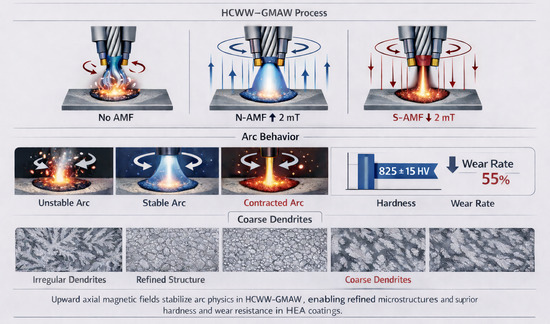
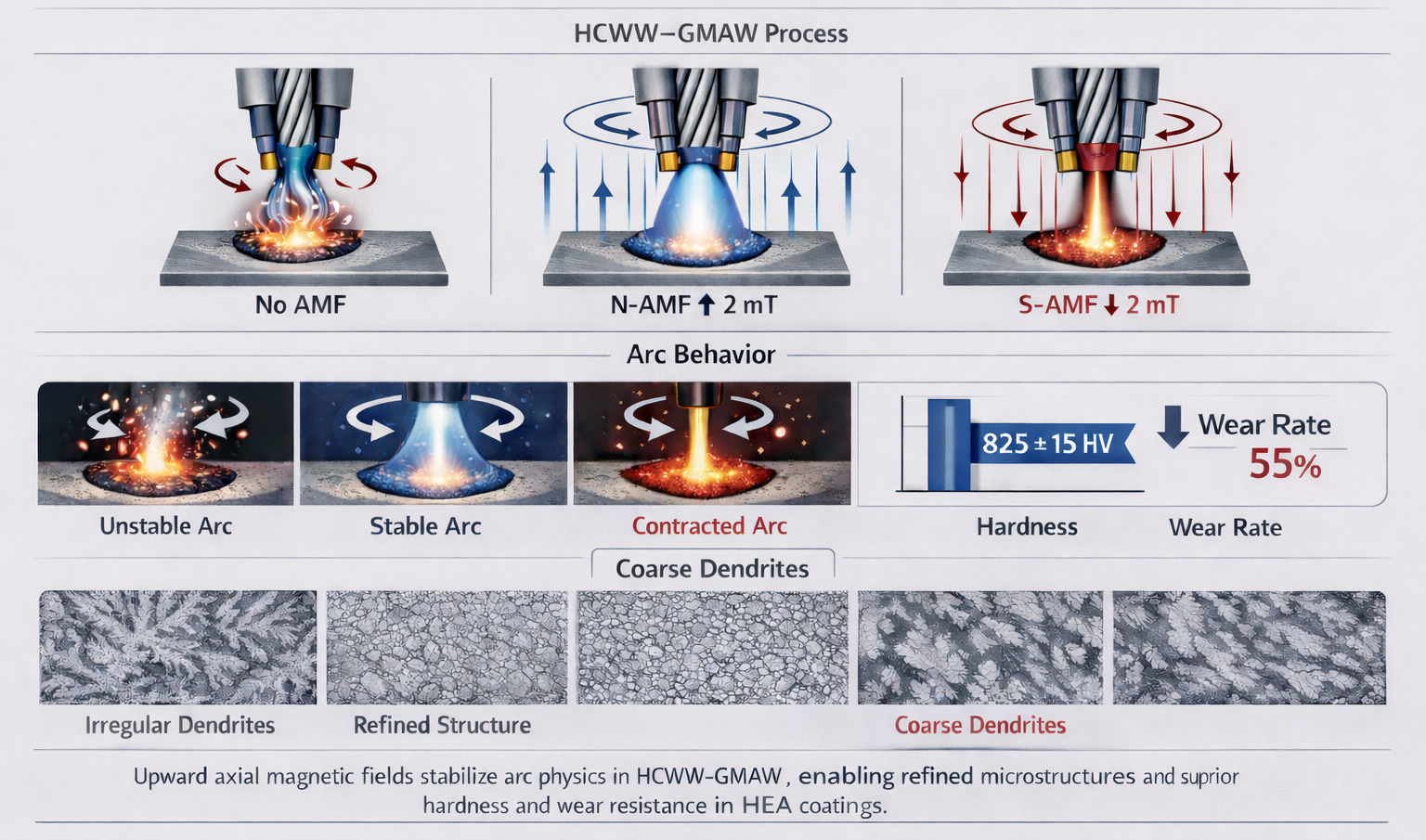
High-entropy alloy (HEA) coatings are widely recognized for their excellent hardness and wear resistance. Heterogeneous cabled wire welding (HCWW) combined with gas metal arc welding (GMAW) has emerged as an efficient approach for fabricating HEA coatings; however, severe arc instability inherent to HCWW often deteriorates coating quality. In this study, the effects of axial magnetic fields (AMFs) with different orientations on the HCWW–GMAW process were systematically investigated. High-speed imaging revealed that the HCWW arc without magnetic assistance exhibits pronounced instability, characterized by asymmetric morphology and rotational behavior. The application of AMFs significantly altered arc dynamics. An upward axial magnetic field (N-AMF, 2 mT) effectively suppressed arc rotation, resulting in a stable bell-shaped arc and more uniform heat input, whereas a downward axial magnetic field (S-AMF) caused arc contraction and promoted dendrite coarsening. Consequently, the N-AMF condition led to a refined and homogeneous microstructure, yielding a high microhardness of 825 ± 15 HV. Tribological tests demonstrated that the wear rate of the N-AMF-assisted coating was reduced by 55% compared with that produced by conventional GMAW. These results highlight that magnetic-field-induced arc stabilization plays a critical role in achieving high-performance HEA surface coatings.

Graphical Abstract

1. Introduction

High-entropy alloys (HEAs), as a novel alloy system proposed and developed over the past two decades, represent a fundamental shift in alloy design paradigm—from single-principal-element systems to multi-principal-element compositional systems [1,2,3,4,5]. These alloys are typically composed of five or more elements in equiatomic or near-equiatomic proportions, utilizing high configurational entropy to stabilize simple solid solution phases (such as face-centered cubic FCC, body-centered cubic BCC, or their coexistence) rather than forming complex intermetallic compounds [6,7]. This unique structural characteristic endows high-entropy alloys (HEAs) with a series of outstanding properties, including high strength and hardness, excellent wear and corrosion resistance, as well as remarkable thermal stability, making them the material of choice for demanding applications in aerospace, power generation, and nuclear industries [8,9,10]. Therefore, the development of high-performance HEA coatings through surface engineering technology has become a key research direction [11,12,13,14]. Despite the significant application prospects of high-entropy alloy (HEA) coatings, producing high-quality, defect-free HEA coatings through fusion processes such as arc welding still poses considerable challenges [15,16,17]. Traditional arc deposition methods often suffer from excessive heat input, leading to an oversized heat-affected zone (HAZ), element segregation, and microstructural coarsening. These factors collectively result in degraded mechanical properties and reduced performance uniformity of the coatings [18,19,20]. While high configurational entropy contributes to phase stability in high-entropy alloys, recent studies suggest that solid-solution formation is governed by the combined effects of mixing enthalpy, atomic size mismatch, electronic structure, and short-range chemical ordering. Therefore, phase stability in HEAs should be understood as a result of the interplay among multiple thermodynamic and kinetic factors rather than entropy alone.
To alleviate these issues, gas metal arc welding (GMAW) using Cable-type wire welding (CWW) has been introduced as an innovative and efficient solution [21,22,23,24]. The Cable-type wire (HCWW) is formed by twisting multiple strands of solid metal wires, enabling precise and flexible adjustment of the chemical composition of the cladding alloy [25,26,27,28]. This design not only enhances cladding efficiency, but also induces arc self-rotation and molten pool agitation, thereby promoting element mixing and microstructural homogenization [29,30].
However, the heterogeneity of these wires introduces new problems. Due to the varying physical properties (such as electrical resistivity and thermal conductivity) of the constituent strands, the current distribution among them becomes uneven [31]. This may lead to arc instability, significant arc asymmetry accompanied by self-rotation phenomena, consequently causing issues like uneven heat distribution and inconsistent coating geometry. This inherent instability poses a significant obstacle to producing high-quality, highly reproducible HEA coatings using the CWW-GMAW process [32,33]. Despite the promising prospects of HEA coatings, the fabrication of high-quality, defect-free HEA coatings, particularly through fusion processes like arc welding, still faces major challenges. Traditional arc deposition methods are often accompanied by excessive heat input, resulting in a large heat-affected zone (HAZ), element segregation, and coarse microstructure, all of which collectively degrade the mechanical properties and service performance of coatings [34]. Studies have shown that the stability of the electric arc significantly affects the uniformity of the heat-affected zone in welding, and these factors are directly and highly correlated with welding quality [35,36,37].
Magnetically controlled welding has emerged as a versatile strategy for the active regulation of arc behavior, plasma flow, and heat transfer dynamics [38,39]. The integration of an axial magnetic field (AMF), in particular, facilitates a transition in arc morphology from a constricted Gaussian distribution to a diffuse, rotating bell-shaped or annular profile [40,41,42]. This transformation is fundamentally driven by the Lorentz force, which imparts a circumferential velocity component to the charged particles within the arc plasma [43,44]. Such controlled rotation not only homogenizes heat distribution across the workpiece but also intensifies fluid convection within the molten pool, thereby refining the solidification microstructure and mitigating defects such as porosity and spatter [45].
Despite the well-documented advantages of AMF in conventional gas-shielded metal arc welding—including arc length regulation and phase transformation control [46]. the stability of the process remains highly sensitive to magnetic field orientation [47]. Crucially, the interaction between an external AMF and the inherently complex multi-arc system in heterogeneous cable-type wire welding (CWW) is still poorly understood. Furthermore, the influence of such magnetic modulation on the microstructural evolution and functional properties of high-entropy alloy (HEA) coatings represents a significant knowledge gap [48,49]. In addition to arc stability, the tribological performance of HEA coatings has attracted increasing attention due to their potential for wear-resistant applications. Previous studies indicate that wear behavior is strongly governed by hard-phase distribution, matrix integrity, and the formation of protective tribo-oxide layers [50]. Typical wear mechanisms include abrasive wear, adhesive wear, oxidative wear, and fatigue-induced delamination, all of which are highly sensitive to microstructural refinement and compositional homogeneity. However, how magnetic-field-controlled arc dynamics influences the tribological response of HEA coatings—particularly in heterogeneous cable-type wire systems—remains largely unexplored. Understanding this relationship is therefore essential for optimizing coating performance.
To address the aforementioned challenges, this study investigates the regulation of arc deflection and rotation in heterogeneous cable-type wire GMAW under an axial magnetic field (AMF) and its impact on the performance of high-entropy alloy (HEA) coatings [51,52,53]. Although magnetic-field-assisted GMAW has been extensively studied, previous work has mainly focused on single-wire systems, and the interaction between AMF polarity and the intrinsic rotational behavior of multi-strand cable-type wires remains insufficiently understood. In particular, how polarity-dependent arc modulation affects microstructural evolution and tribological performance of HEA coatings has rarely been systematically explored. In this work, MoCuNiCrTiNb heterogeneous cable-type wires were used to deposit coatings under different AMF orientations. The arc behavior, thermal characteristics, microstructure, and mechanical and tribological properties were comprehensively analyzed to establish the arc–structure–property relationship. The results provide insights into polarity-controlled arc stabilization and offer guidance for optimizing magnetic field-assisted welding processes for high-performance HEA coatings [54,55,56,57].

2. Experimental Methods

2.1. Experimental Setup

Circular 316LN stainless steel discs ϕ100 mm × 5 mm were utilized as the substrate material, with their chemical composition detailed in Table S1. Arc behavior and droplet transfer were captured using a high-speed camera (Revealer S1315M; Hefei Zhongke Junda Vision Technology Co., Ltd., Hefei, China) equipped with a 100 mm F/2.8 lens. To ensure clear imaging of the arc pool, an 808 nm laser and an 808 nm narrow-band filter (Hefei Zhongke Junda Vision Technology Co., Ltd., Hefei, China) were utilized. Concurrently, synchronized welding current and voltage signals were acquired via a data acquisition (DAQ) system (National Instruments, Austin, TX, USA) and processed using LabVIEW software (Version 2022; National Instruments, Austin, TX, USA). Prior to welding, the substrate surfaces were meticulously cleaned to remove oxides, lubricants, and moisture, ensuring optimal metallurgical bonding. After the cladding process, cross-sectional specimens were extracted perpendicular to the welding direction. The specimens underwent a standard metallographic preparation procedure, including rough grinding, progressive fine grinding with SiC papers, and final mechanical polishing to a mirror finish. To reveal the macrostructure of the weld joints, the cross-sections were etched with a 4% nital solution (nitric acid in ethanol).

2.2. Welding Parameters

To ensure process reproducibility, key welding parameters were kept constant throughout the experiments. The torch was oriented at a travel angle of approximately 10° (within a range of 5–15°) to balance arc stability and penetration control, with a contact tip-to-workpiece distance (CTWD) of 15 mm. The wire feed speed was maintained at 7.7 m·min−1 at a welding current of 180 A. The welding process operated in pulse mode using a preset waveform of the power source, and identical parameters were used for all experiments. Except for the magnetic field configuration, all process parameters remained unchanged. The experimental plan consisted of three magnetic-field configurations: no magnetic field (0 mT), downward axial magnetic field (S-AMF), and upward axial magnetic field (N-AMF). For all experimental groups, identical welding parameters—including current range, wire feed speed, travel speed, shielding conditions, CTWD, and torch angle—were maintained, and the magnetic field configuration was the only variable. Each condition was repeated three times to verify the stability and repeatability of the process. The detailed welding parameters and corresponding experimental groups are summarized in Table S3.

2.3. Characterization Methods

The phase constitution and microstructural evolution of the coatings were characterized using X-Ray diffraction (XRD) and scanning electron microscopy (SEM; GeminiSEM 500, ZEISS, Oberkochen, Germany) equipped with an energy dispersive spectrometer (EDS; UltimMax 65, Oxford Instruments, Abingdon, UK). The constituent phases, crystal structures, and lattice constants were identified using a Bruker D8 VENTURE XRD system (Bruker AXS GmbH, Karlsruhe, Germany) with Cu K radiation (λ = 0.15406 nm). The 2θ scanning range spanned from 20° to 100° with a scan speed of 12° min−1.

2.4. Mechanical and Tribological Testing

To evaluate the mechanical properties of the HEA coatings, Vickers microhardness was measured under a load of 5 N with a dwell time of 15 s. The reported hardness values represent the average of ten indents performed on the mirror-polished surface of each specimen. The tribological behavior of the HEA coatings under dry sliding conditions was assessed using a ball-on-disk tribometer (HT-1000; Lanzhou Zhongke Kaihua Technology Development Co., Ltd., Lanzhou, China). Silicon nitride (Si3N4) balls were selected as the counterbody material. The wear tests were conducted with a normal load of 10 N, a sliding speed of 0.15 m/s, and a total duration of 30 min. To ensure reliability, each test was repeated at least three times. The coefficient of friction (COF) was recorded in real time by the integrated software (FT-1, Version 2.0; Lanzhou Zhongke Kaihua Technology Development Co., Ltd., Lanzhou, China). The wear rate (WR) of the specimens was calculated using the following equation:
W = Δ m ρ F L
where Δm is the mass loss, ρ is the density, F is the normal load, and L is the total sliding distance. The density (ρ) was determined via the Archimedes displacement method (ZMD-2; Shanghai Fangrui Instrument Co., Ltd., Shanghai, China).

3. Results and Discussion

3.1. Analysis of Arc Physical Characteristics and Process Stability Under Axial Magnetic Field

3.1.1. Intrinsic Instability of the Arc in Heterogeneous Cable-Type Welding Wire

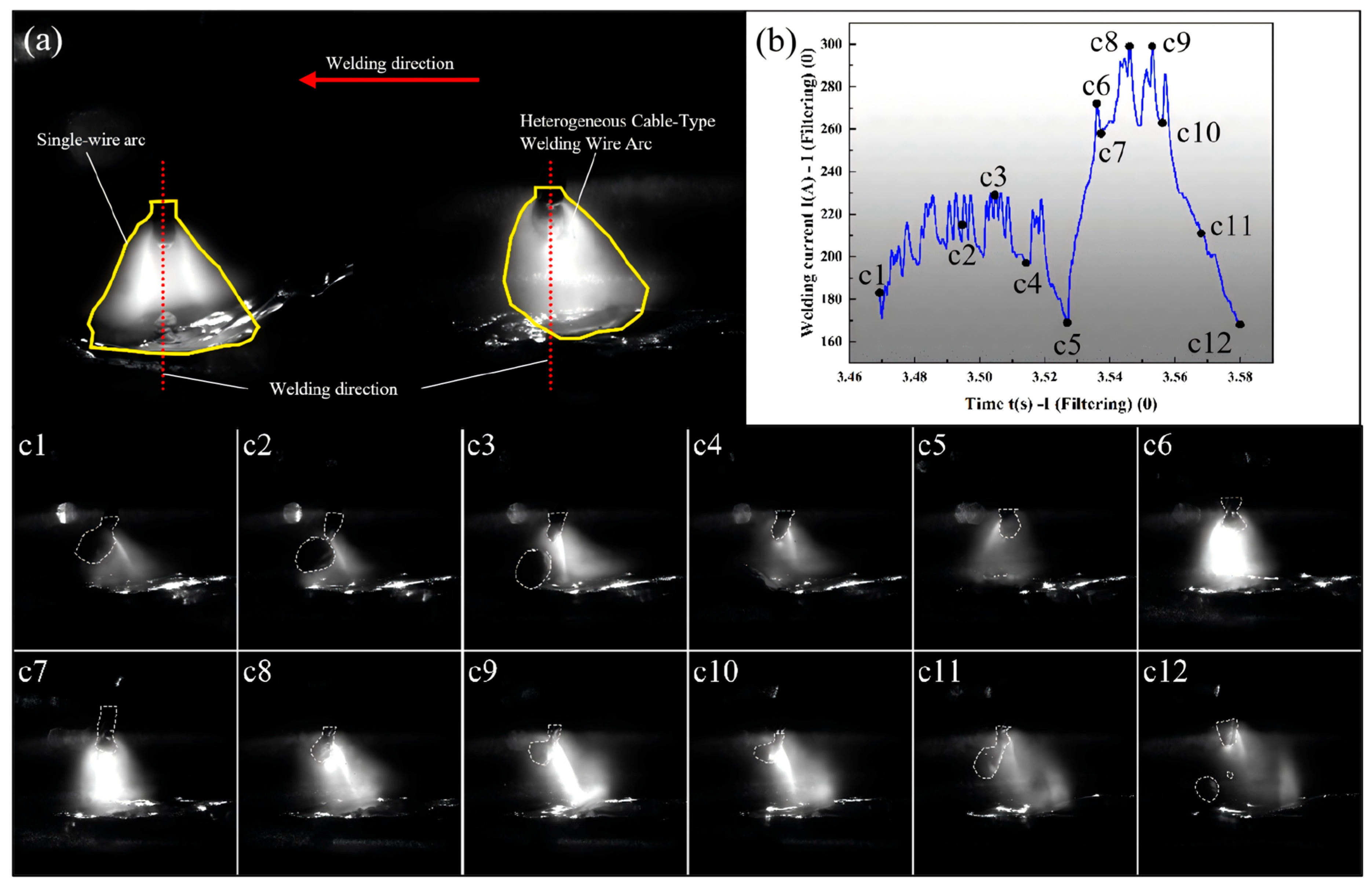
Research indicates that cable-type welding wires exhibit characteristics of concentrated heat input and four-dimensional arc rotation. However, during the preparation of high-entropy alloy coatings using heterogeneous composite cable-type wires in conjunction with GMAW, their unique physical structure introduces complex evolutionary dynamics to the arc behaviour [44,58]. This exhibits a marked difference from the traditional single-wire arc, as illustrated in Figure 1a, where the arc generated by a single aluminium welding wire presents a typical symmetrical conical morphology. In contrast, the arc produced by the multi-element (molybdenum, copper, nickel, chromium, titanium, niobium) heterogeneous cable-type welding wire exhibits a distinctly asymmetrical beam-like morphology. By comparing arc morphologies at identical points in time during welding under identical process parameters, it is evident that the arc from the multi-element cable wire not only loses the axial symmetry characteristic of a single-wire arc but also exhibits a pronounced deviation of its centre from the wire’s geometric axis. Under the same welding current, the arc radius diminishes. This distinctive arc behaviour directly diminishes the physical stability of the welding process and leads to severe thermal input inhomogeneity within the high-entropy alloy coating. This represents a primary factor influencing the coating’s ultimate mechanical properties.
This asymmetry of the arc results from significant differences in electrical conductivity between the different wires that make up the heterogeneous cable-type welding wire, leading to an uneven distribution of current density. During the welding arc initiation phase, each sub-conductor of the cable-type welding wire independently initiates an arc, thus forming several independent arc conduction paths [59]. Although each sub-conductor arc generates its own magnetic field, these arcs are subject to mutual electromagnetic contraction forces directed towards the conductor axis. Ultimately, they couple to form a cohesive and unified arc.
Owing to the differing material properties of the constituent sub-wires within the MoCuNiCrTiNb cable-type welding wire (as shown in Table 1), electrical principles dictate that current will preferentially flow through paths of higher conductivity. Taking the copper (Cu) welding wire as an example, its exceptional conductivity enables the sub-wire arc to carry a greater current density, thereby generating a stronger local magnetic field and enhancing electromagnetic attraction. Driven by these asymmetrical electromagnetic forces, the centre of the coupled arc inevitably shifts towards the higher conductivity component (such as copper), resulting in frequent arc deflection and an imbalance in energy distribution.
It should be noted that the current distribution presented in Table 1 represents a first-order estimation based on bulk electrical resistivity values at ambient conditions. In the actual welding process, the current paths in the heterogeneous multi-strand wire are influenced by additional factors, including temperature-dependent resistivity, interfacial contact resistance between strands, dynamic melting behavior, and arc attachment fluctuations. These effects may lead to deviations from the calculated values.
Nevertheless, the estimated distribution provides useful qualitative insight into the tendency of current preferentially flowing through high-conductivity strands, which is consistent with the observed arc deflection toward the Cu-rich region in high-speed imaging. Therefore, the calculated results are intended to illustrate the relative current partition rather than precise quantitative values.
Beyond arc asymmetry, the unique helical winding structure of this cable-type welding wire induces complex dynamic evolution characteristics under thermal stress [60]. According to arc rotation theory, when the conductor enters the high-temperature zone, it exhibits pronounced “de-spiralling”. The elastic torque released by heating generates a counter-clockwise rotational force at the wire tip. Driven by this force, the coupled arc displays a distinct counter-clockwise rotation, its rotational frequency highly synchronised with the wire unwinding frequency, thereby achieving sustained arc rotation during welding.
As observed by the high-speed camera in Figure 1b, the arc of the heterogeneous cable-type welding wire exhibits periodic, non-uniform contractions during rotation. As the wire feed progresses, the arc continues to rotate irregularly around its axis, causing both the arc length and rotational radius to fluctuate chaotically. This physical instability in energy input is directly reflected in the electrical signal curve (Figure 1(c1–c12)), manifesting as severe fluctuations in current and voltage. Such extreme arc behaviour not only degrades the droplet transition mode, leading to frequent short-circuiting (as discussed in Section 3.1.3), but also directly causes significant non-uniformity in heat input distribution across the molten pool surface. This imbalance in energy distribution constitutes the primary physical cause of solute segregation and subsequent uncontrolled spatial distribution of hard phases within the solidified microstructure, thereby posing a potential risk to coating performance variability.

3.1.2. Mechanism by Which Axial Magnetic Fields (AMF) Regulate Arc Behaviour

To suppress the inherent instability of dissimilar-cable welding wires, the introduction of an external axial magnetic field (AMF) fundamentally reshapes the energy distribution within the plasma flow field. According to the Lorentz force formula:
F e x t = j × B e x t
where Fext denotes the external electromagnetic force, j represents the current density, and Bext signifies the applied magnetic field strength.
According to Equation (2), the greater the current density, the greater the external electromagnetic force Fext exerted upon it. Under the influence of an axial magnetic field, the arc undergoes rotation, resulting in a marked alteration in its morphology. Simultaneously, the direction of the applied axial magnetic field influences the arc’s rotation direction differently [61]. Research indicates that during GMAW, with current flowing from the torch tip towards the workpiece, an upward axial magnetic field (N-AMF) induces clockwise arc rotation, whereas a downward axial magnetic field (S-AMF) induces counterclockwise rotation.
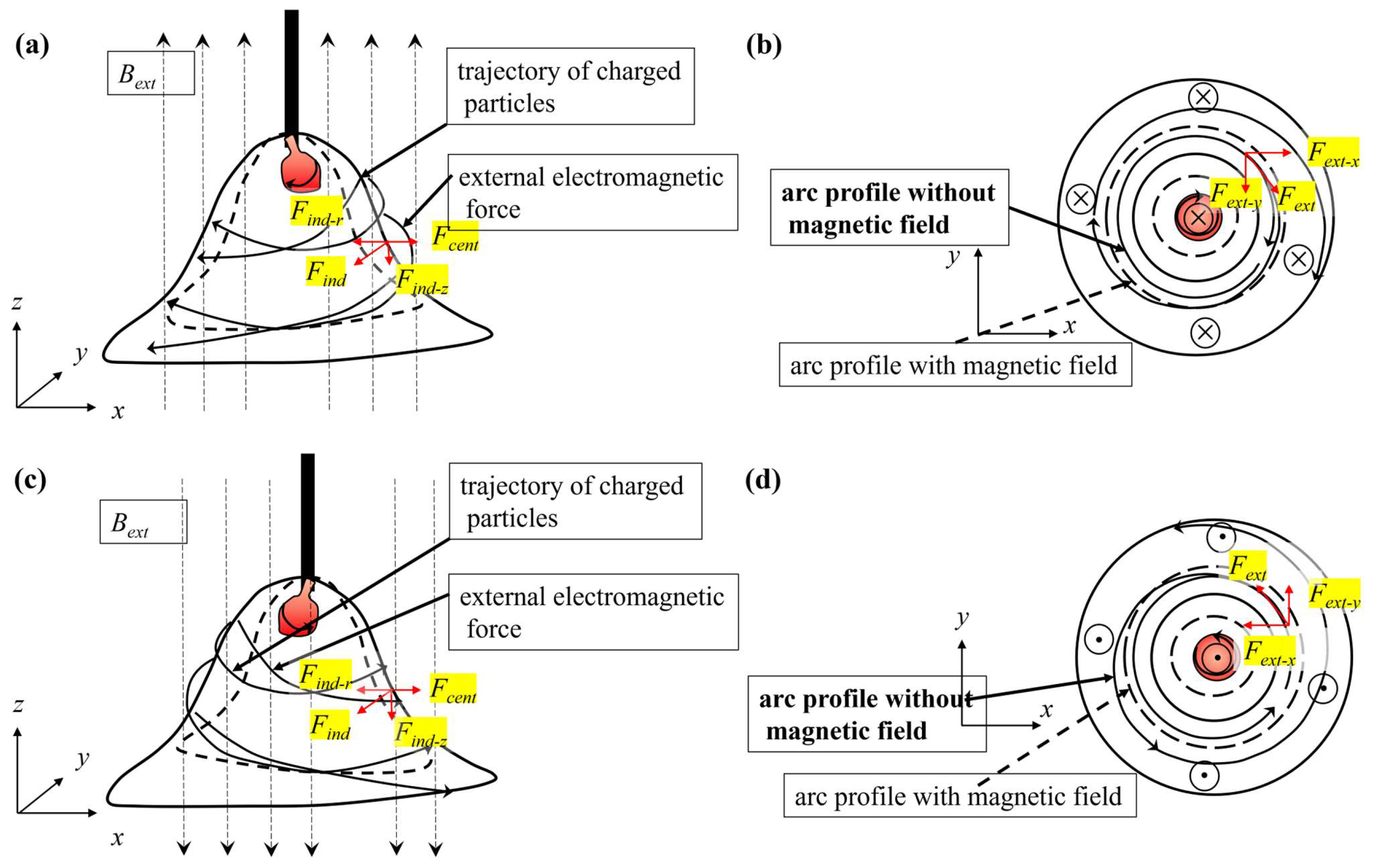
The force conditions on the arc plasma of a heterogeneous cable-type welding wire under an axial magnetic field are illustrated in Figure 2. The magnetic field polarity determines the coupling relationship between the external electromagnetic torque and the arc’s intrinsic spin force. Under a downward axial magnetic field (S-AMF) (Figure 2a,b), the torque generated by the external electromagnetic force aligns with the inherent counterclockwise rotation induced by the de-helixing of the cable-type welding wire. This positive coupling produces a “spin gain effect”, significantly increasing the arc’s rotational frequency. The abrupt increase in rotational speed intensifies the electromagnetic contraction force (pinch effect) exerted on the plasma fluid, leading to a reduction in arc cross-sectional area and triggering severe arc contraction. This highly concentrated, unimodal heat flux distribution causes localised thermal overload, resulting not only in abnormal fluctuations in melting rate but also in coarsening of the alloy microstructure at the metallurgical level.
Figure 2. Schematic diagram illustrating the effects of magnetic fields applied in different directions: (a) Frontal view of S-AMF, (b) Top view of S-AMF, (c) Frontal view of N-AMF, (d) Top view of N-AMF.
Metals 16 00316 g002
In stark contrast, the external electromagnetic torque induced by the upward axial magnetic field (N-AMF) opposes the inherent rotational direction of the dissimilar conductor (Figure 2c,d), thereby generating a crucial “braking effect”. This counteracting force effectively neutralises and suppresses the arc’s inherent asymmetric contraction and rotation, thereby eliminating the random instabilities present in the non-magnetic field state and promoting the evolution of the arc into a highly symmetric bell-shaped structure.
The pronounced dispersion of the arc under N-AMF action is fundamentally attributable to the redistribution of particle radial momentum and the reconfiguration of centrifugal force equilibrium. As shown in Figure 2a, the interaction between the external magnetic field Bext and the divergent arc current density j enhances the radial motion of charged particles. Concurrently, the controlled steady-state rotation generates an outward centrifugal force (Fext), which partially counteracts the electromagnetic contraction force, leading to the outward diffusion of plasma particles. This radial expansion effect creates a distinct “hollow region” near the substrate, thereby increasing the effective rotational radius of the arc. Consequently, this induces a qualitative change in heat input, transforming it from a concentrated, high-energy, single-peak distribution into a uniform, double-peak distribution. Conversely, when an axial magnetic field (S-AMF) is applied in the direction of the arc, the external electromagnetic force generates a radially inward force. This promotes further arc contraction, reducing the arc’s cross-sectional area and triggering a pronounced arc collapse phenomenon.

3.1.3. Experimental Verification of Process Stability

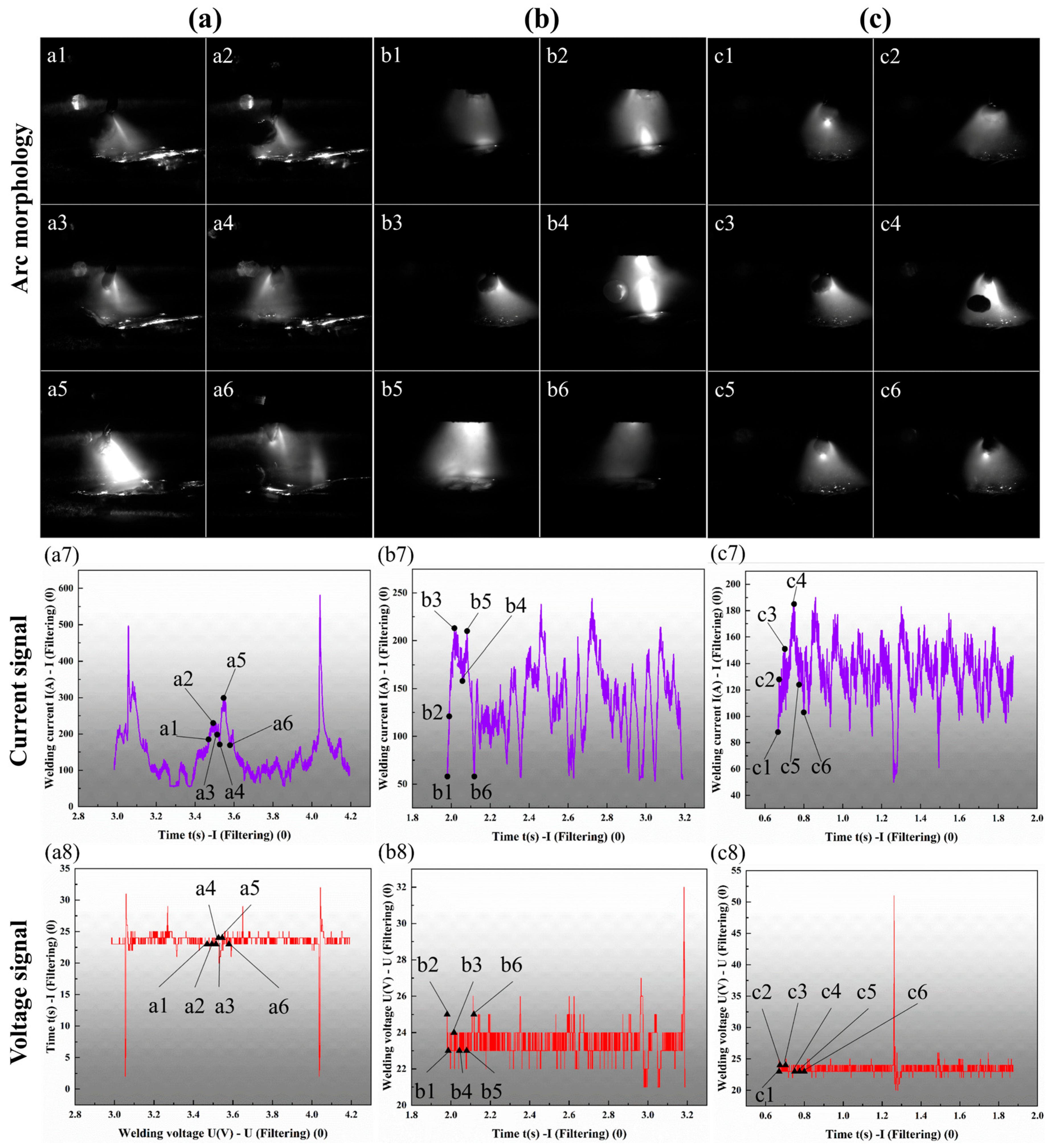
Figure 3 illustrates the arc morphology changes and droplet transition phenomena captured by a high-speed camera under different axial magnetic field modulations, alongside corresponding electrical signal data. As depicted in Figure 3a, under zero magnetic field conditions (0 mT), molten droplet transition predominantly exhibited short-circuit characteristics accompanied by droplet transition, with pronounced spatter. Based on the aforementioned analysis of cable-type welding wire, this phenomenon arises from the uneven rotational torque exerted upon the molten droplet during welding, caused by the unwinding of the wire’s helix. Concurrently, the arc morphology exhibited pronounced variations: arc length cyclically fluctuated throughout welding, displaying asymmetric contraction. The arc rotated counterclockwise at a frequency matching that of the wire end (as will be further discussed in the microstructural analysis in Section 3.3). Correlated electrical signal data revealed significant fluctuations in welding voltage and current, indicating poor arc stability.
As shown in Figure 3b, when subjected to 2 mT S-AMF modulation, the arc morphology observed under high-speed camera imaging exhibited a pronounced change, transforming into a more distinctly contracted, beam-like arc (Figure 3(a1–a6)). Notably, droplet transition transformed into a droplet-like transition, with the arc’s thermal input becoming more concentrated, accelerating wire melting. Analysis of electrical signal data revealed intensified voltage and current oscillations (Figure 3(a7,a8)), indicating deteriorated arc stability.
Conversely, under 2 mT N-AMF modulation, the arc morphology evolved into a highly symmetrical and stable bell-shaped configuration. The homogenising effect of the rotating magnetic field optimised the molten droplet transition mode into a stable droplet transition, with reduced spattering phenomena. Concurrently, reduced voltage fluctuations and minimal arc length variations were observed in the electrical signal data, indicating enhanced arc stability compared to both the absence of magnetic fields and the presence of a downward axial magnetic field (S-MF), as illustrated in Figure 3c.
The aforementioned analysis demonstrates that an upward axial magnetic field (N-AMF) effectively enhances arc stability. Specifically, the magnetic field regulates the arc displacement and contraction phenomenon in dissimilar-Cable-type wires, suppressing or counteracting their spin. This renders the arc more stable, reduces droplet transition spatter, and contributes to improved thermal input uniformity and surface quality of the coating. At the macroscopic level, this verifies the role of magnetic fields in stabilising the arc.
Figure 3. High-speed camera data under different magnetic field conditions: (a) 0 mT condition, including (a1a6) sequential arc morphology, (a7) welding current signal, and (a8) welding voltage signal; (b) 2 mT S-AMF condition, including (b1b6) sequential arc morphology, (b7) welding current signal, and (b8) welding voltage signal; (c) 2 mT N-AMF condition, including (c1c6) sequential arc morphology, (c7) welding current signal, and (c8) welding voltage signal.
Metals 16 00316 g003
In summary, N-AMF establishes a bell-shaped arc morphology with an increased rotational radius and stable arc length by counteracting the inherent offset of heterogeneous cable-type welding wires. This process-level optimisation not only achieves spatially uniform heat input distribution but also significantly alters the dynamic solidification process within the molten pool through its potent electromagnetic stirring effect [62,63]. This stable thermal input influences the flow of alloying elements and the solidification kinetics of the liquid metal. To validate the impact of this physical field regulation on the material’s intrinsic properties, the phase evolution patterns of the coating will be further elucidated via X-ray diffraction (XRD) in the subsequent section.

3.2. Phase Composition and Crystallographic Structure Analysis

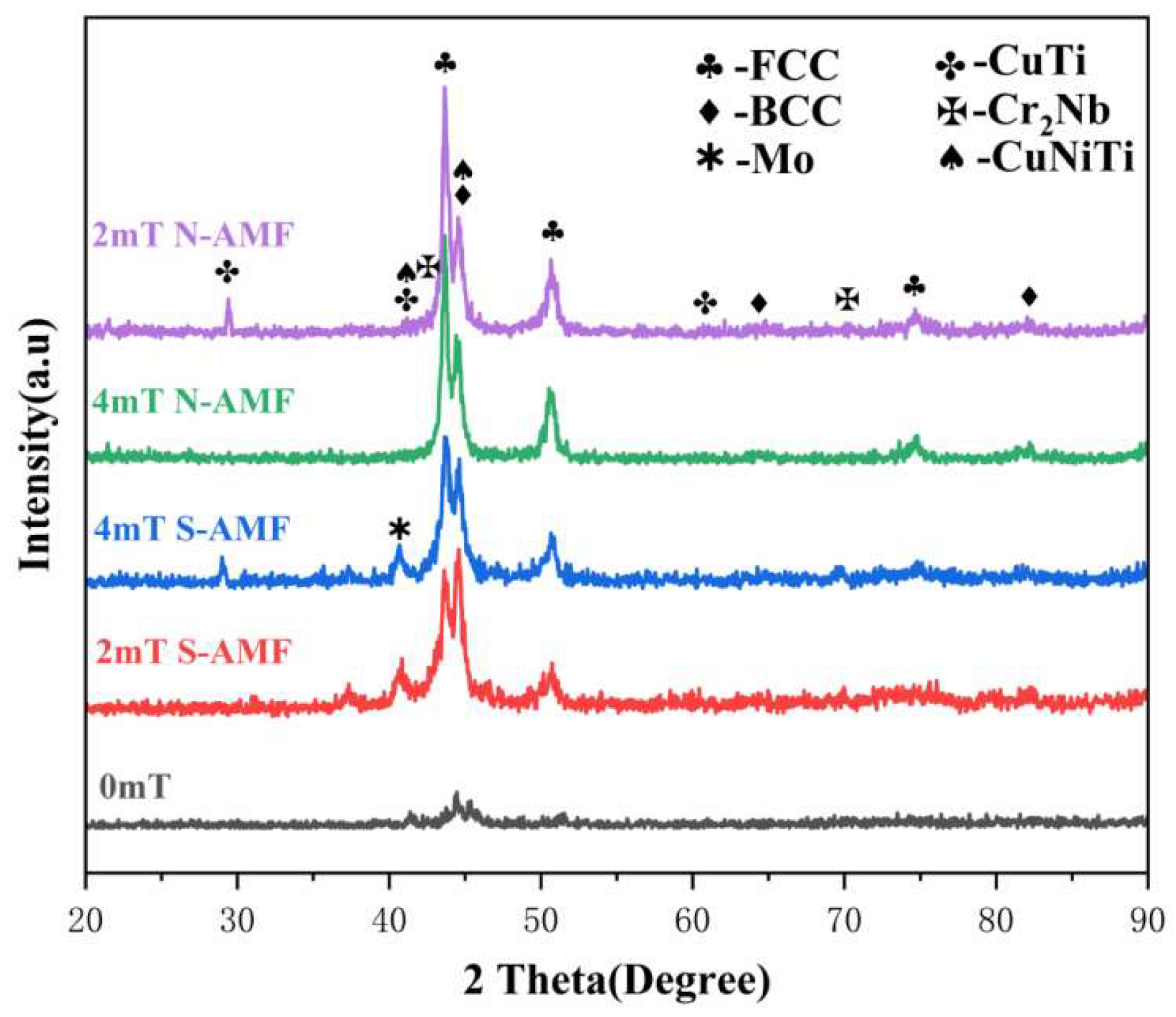
The phases present in the high-entropy alloy coatings prepared under different magnetic field conditions were identified via X-ray diffraction (XRD) analysis. As shown in Figure 4, the coatings across all groups primarily comprise a face-centred cubic (FCC) matrix phase, a body-centred cubic (BCC) strengthening phase, and multiple intermetallic compounds, including molybdenum-rich phases, Cr2Nb Laves phases, CuTi phases, and CuNiTi phases [62,63]. The consistency in phase composition indicates that the application of an external magnetic field did not significantly alter the equilibrium phase composition of the alloy; however, it did markedly influence the precipitation behaviour and crystalline quality of the various phases.
The evolution of the X-ray diffraction (XRD) pattern clearly reflects the significant influence of arc stability on phase precipitation. Under zero magnetic field conditions (0 mT), the diffraction peak intensities are extremely low and markedly broadened, indicating poor coating crystallinity and significant elemental segregation. This phenomenon can be attributed to factors such as arc instability, uneven thermal input to the coating, inconsistent stirring of the molten pool, and uncontrolled cooling rates. To further support this interpretation, the apparent crystallite size was estimated from the FWHM of the principal diffraction peaks using the Scherrer equation. The results indicate a trend toward finer crystallites in the N-AMF sample, consistent with the observed microstructural refinement. It should be noted that the present analysis provides an approximate measure of crystallite size, while precise quantitative phase fractions would require full-pattern refinement, which is beyond the scope of this work.
In stark contrast, the diffraction peaks observed under N-AMF (north-up axial magnetic field) conditions exhibited the highest intensity and sharpness. Specifically, under 2 mT N-AMF conditions, the characteristic peaks of the hardening phase Cr2Nb and BCC reached their maximum intensity. This observation clearly demonstrates that the uniform thermal field provided by the stable rotating arc induced by N-AMF significantly promotes solute atom diffusion and uniform nucleation, thereby simultaneously enhancing both the volume fraction and crystalline quality of the strengthening phase.
In contrast, the diffraction peak intensity under S-AMF (downward axial magnetic field) conditions was lower than that observed in the N-AMF group. This phenomenon can be attributed to arc contraction and excessive heat concentration induced by S-AMF, leading to coarse grain growth and potentially triggering localised over-evaporation or segregation of certain alloying elements. This, in turn, inhibits the preferential precipitation of strengthening phases. Furthermore, the slight shifts in the main peak positions between groups indicate variations in lattice distortion induced by magnetic field modulation, further illustrating the influence of energy distribution uniformity on atomic arrangement.

3.3. Microstructural Evolution and Elemental Distribution

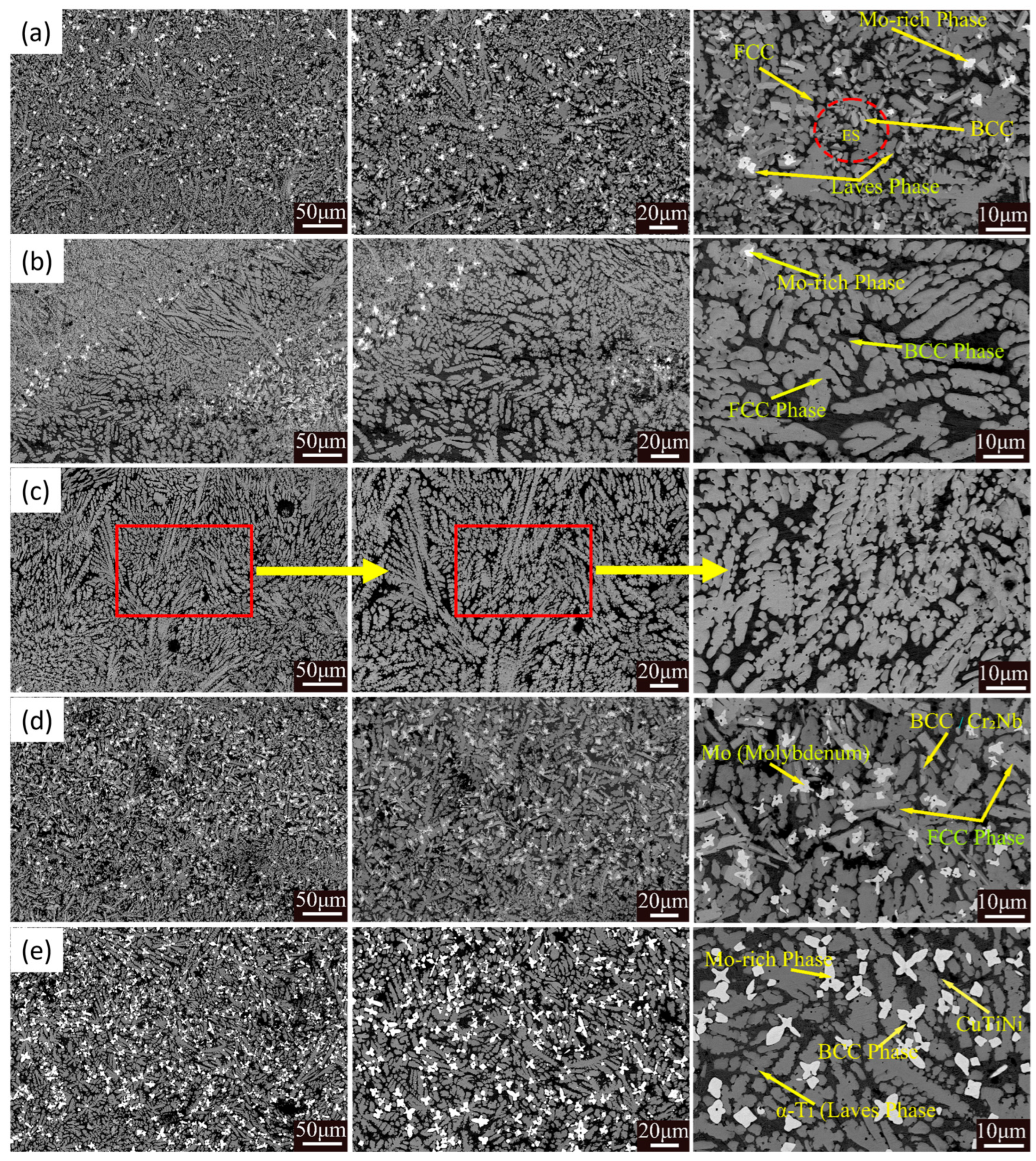
As shown in Figure 5, high-entropy alloy (HEA) coatings modulated by different magnetic fields exhibit significant multiscale microstructural evolution, characterised by complex multiphase structures composed of multiple strengthening phases. As shown in Figure 5a, under 0 mT conditions, the inherent instability of the GMAW arc causes significant fluctuations in heat input within the molten pool. This phenomenon induces severe elemental segregation (ES) and disordered phase distribution, hindering the formation of an effective continuous support network by the strengthening phases. To ensure that the observed differences are solely attributable to the magnetic field, all welding parameters—including current range, wire feed speed, travel speed, shielding conditions, and torch configuration—were kept identical for all samples. The coating thickness and bead geometry were also comparable among the samples, indicating similar dilution levels and deposition conditions. Furthermore, compositional analyses did not reveal significant differences between coatings produced under different magnetic field orientations. Therefore, the observed microstructural variations are primarily attributed to magnetic-field-induced modifications of arc behavior and molten pool dynamics. Interestingly, when no magnetic field is applied, the microstructure of the coating observed under an electron microscope reveals pronounced size variations among the phases present, particularly within the face-centred cubic (FCC) phase. Concurrently, the phase composition is dominated by the FCC phase, containing minor amounts of body-centred cubic (BCC) phase and Cr2Nb Laves phase, alongside sparse and unevenly distributed Mo precipitates.
As shown in Figure 5b,c, when an S-AMF is applied, arc contraction leads to highly concentrated heat input. This significantly enhances dendritic features and coarsens phase boundaries due to reduced solidification rates. Such coarse microstructures are prone to stress concentration during cyclic friction. Under electron microscopy, alterations in both the phase composition and size distribution of the coating were observed. Specifically, under 2 mT (S-AMF) conditions, the phase structure of the coating primarily comprised FCC and BCC phases, with minimal precipitation of Mo elements. This indicates that the magnetic field influenced the thermal input of the arc. S-AMF induced further arc contraction, concentrating thermal input and reducing precipitation of certain hardening phases. The distribution of phases such as Mo and Cr2Nb became more non-uniform, reflecting how arc instability directly influenced the coating’s microstructure. As the S-AMF intensity increases, under 4 mT S-AMF, phases such as Mo and Cr2Nb are scarcely present in the coating, and the phase size further enlarges. This indicates greater thermal input into the coating, leading to grain coarsening.
In stark contrast, the application of an upward axial magnetic field (N-AMF) induces an exceptionally high degree of refinement and uniformity in the coating microstructure. High-magnification scanning electron microscopy (SEM) observations reveal that under a 2 mT N-AMF, the strengthening phase transforms into an interlocking skeletal network composed of finely interwoven dendrites. This contrasts with the coarse, molybdenum-rich phases observed under no magnetic field or a downward axial magnetic field (S-AMF), which are fragmented and dispersed into fine, stellate particles with a more uniform distribution. This ideal microstructural evolution is directly attributed to the N-AMF-modulated stable arc rotation. The electromagnetic stirring effect significantly enhances the undercooling and nucleation rate within the molten pool, thereby producing a pronounced grain refinement effect. This dense, composite-reinforced network structure contributes to enhanced coating performance.
Figure 5. SEM images of high-entropy alloy coatings under different magnetic field strengths: (a) 0 mT, (b) 2 mT with S-AMF, (c) 4 mT with S-AMF, (d) 4 mT with N-AMF, (e) 2 mT with N-AMF.
Metals 16 00316 g005
In summary, microstructural findings reveal significant spatial overlap between Cr and Nb elements within the grey matrix regions, confirming their formation of a composite strengthening framework comprising BCC solid solutions and Cr2Nb Laves phases. Concurrently, molybdenum exhibits high enrichment within bright white stellate phases, which provide critical dispersion strengthening, as illustrated in Figure 5d,e. Under the 4 mT N-AMF process treatment, all elements exhibit the highest distribution uniformity between the matrix and precipitates, strongly confirming the pivotal role of controlled arc dynamics in eliminating metallurgical segregation and constructing high-performance HEA coating structures. To further validate the chemical nature of phase evolution, EDS surface scanning results elucidate the spatial distribution characteristics of each alloying element.
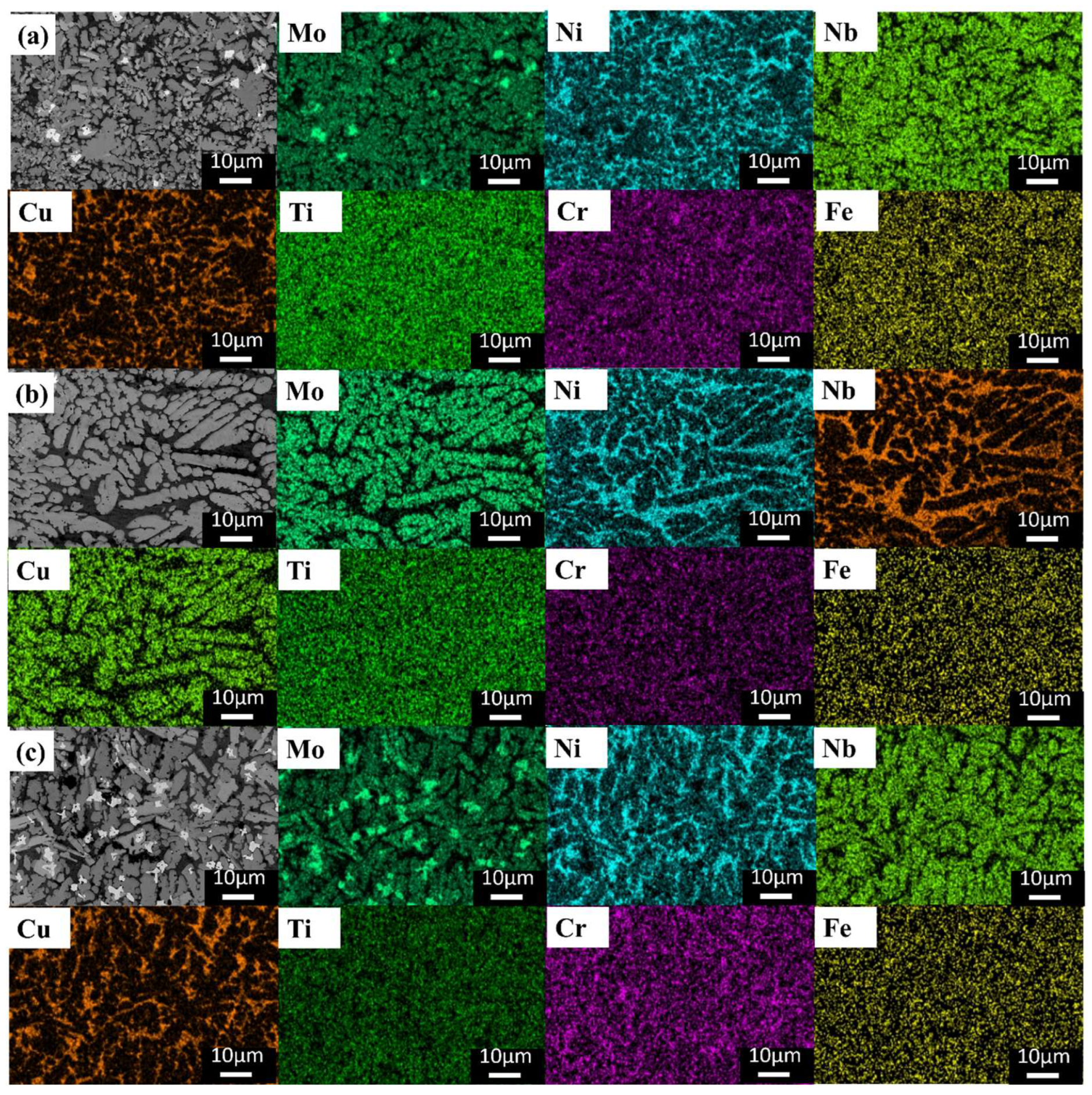
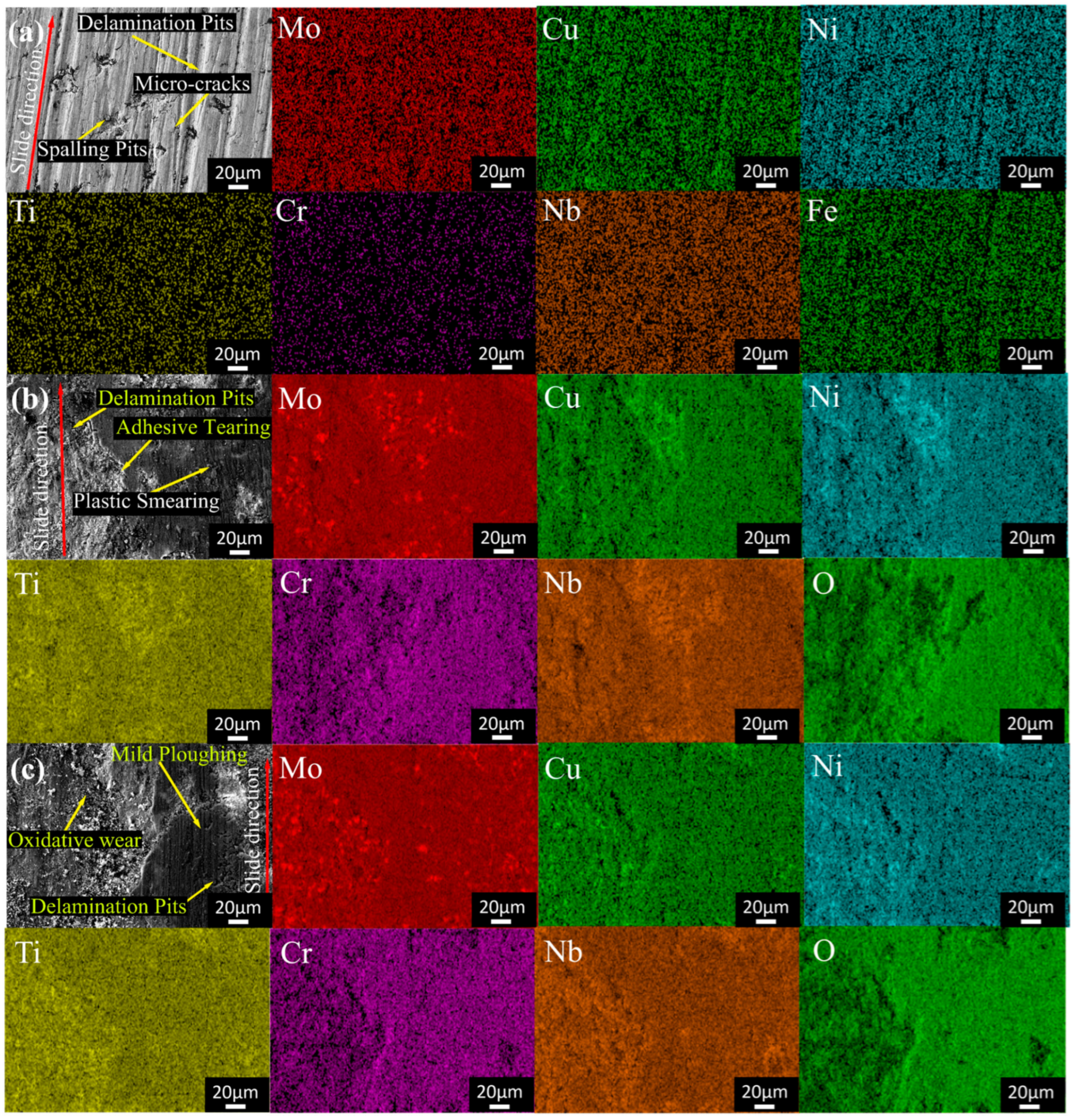
To further elucidate the chemical essence of phase evolution under magnetic field modulation, Figure 6 presents the elemental distribution mapping (EDS mapping) results of representative coating regions under different magnetic field conditions. These results visually demonstrate the spatial distribution patterns of alloying elements across various microstructural scales. Combined with X-ray diffraction analysis and scanning electron microscopy topography observations, the elemental distribution maps clearly delineate the chemical boundaries between the face-centred cubic matrix, body-centred cubic strengthening phases, and molybdenum-rich phases.
Under conditions of no magnetic field (0 mT) and a downward axial magnetic field (S-AMF), the elemental distribution exhibits pronounced micro-segregation and coarsening characteristics. As shown in Figure 6a, the spatial arrangement of elements at 0 mT demonstrates significant disorder, indicating insufficient diffusion of solute atoms within the molten pool—a consequence of arc instability. Conversely, under S-AMF conditions (Figure 6b), the elemental distribution map reveals distinctly coarse dendritic morphology: elements Cr, Nb, and Mo are significantly enriched in robust dendrite trunk regions, while Cu, Ni, and Fe are predominantly distributed in broad dendrite-interval zones. This elemental segregation, caused by concentrated excess heat input, creates pronounced chemical differences between the strengthening phase and the matrix; however, the coarsening of phase boundaries weakens the overall mechanical coordination of the material.
In stark contrast, the elemental distribution under N-AMF conditions exhibits exceptional spatial uniformity and microstructural refinement. As depicted in Figure 6c, under the influence of the north-axis magnetic field (N-AMF), the enrichment zones of Cr and Nb transform from coarse, banded structures into a finely interwoven network. This transformation confirms the refinement and precipitation of Cr2Nb Laves phase and BCC strengthening phases under the uniform rotating electromagnetic field of the molten pool. Notably, the Mo-rich bright white phase appears as finely dispersed, high-brightness particles in the elemental distribution map, starkly contrasting with the large-sized clusters observed in the 0 mT and S-AMF groups. This highly refined and uniform elemental distribution clearly demonstrates that the potent electromagnetic stirring effect generated by the rotating arc significantly suppresses solute segregation, promotes thorough mixing of multivalent alloy atoms, and constructs a robust “hard phase skeleton-ductile matrix” microstructure. It should be noted that the EDS elemental maps primarily provide qualitative information on spatial distribution. Semi-quantitative point analyses in representative regions confirmed the enrichment of Cr and Nb in the framework phases and the dispersed distribution of Mo in the matrix. Due to interaction volume effects and signal overlap, the compositions obtained by EDS contain inherent uncertainties; therefore, the results are interpreted as indicative of relative elemental partitioning rather than precise quantitative values.
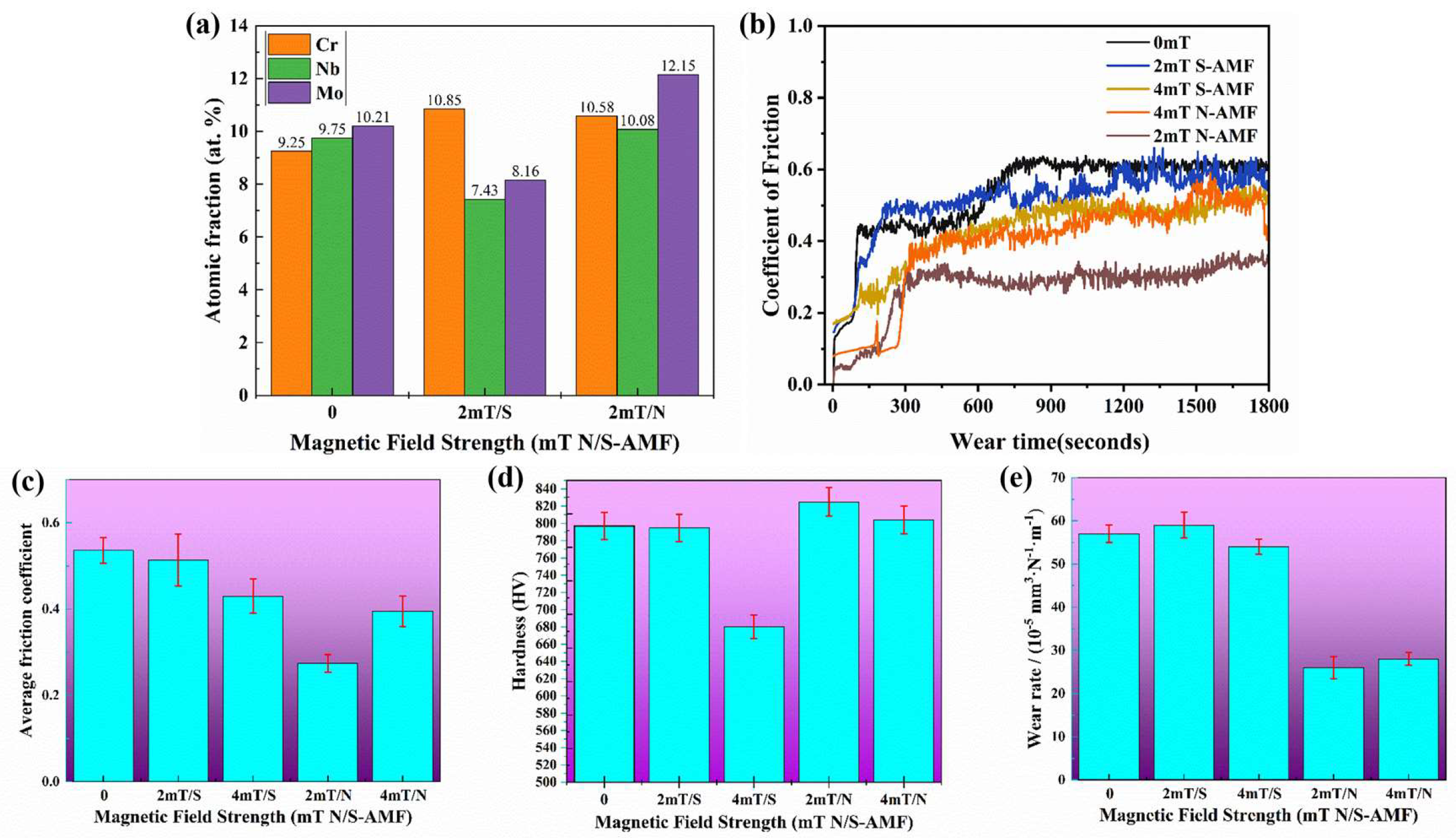
The comprehensive distribution characteristics of elements confirm that the multi-level strengthening effect of the coating stems from the precise allocation of chemical components across its phases. The composite framework formed through the synergistic interaction of chromium (Cr) and niobium (Nb) provides crucial support for compressive strength and resistance to ploughing. Meanwhile, the dispersed distribution of molybdenum (Mo) further enhances the matrix’s creep resistance and toughness. Through optimising arc dynamics using N-AMF technology, these critical strengthening elements achieve optimal arrangement at the micro-scale. From an atomic distribution perspective, this highly uniform and refined chemical structure fundamentally drives the significant enhancement in both mechanical properties and tribological resistance of the coating. This finding is fully consistent with the high hardness observed in subsequent testing (see Section 3.4) and the extremely low wear rate (Figure 7), thereby establishing a coherent logical connection.

3.4. Quantitative Evaluation and Evolutionary Characteristics of Tribological Behavior

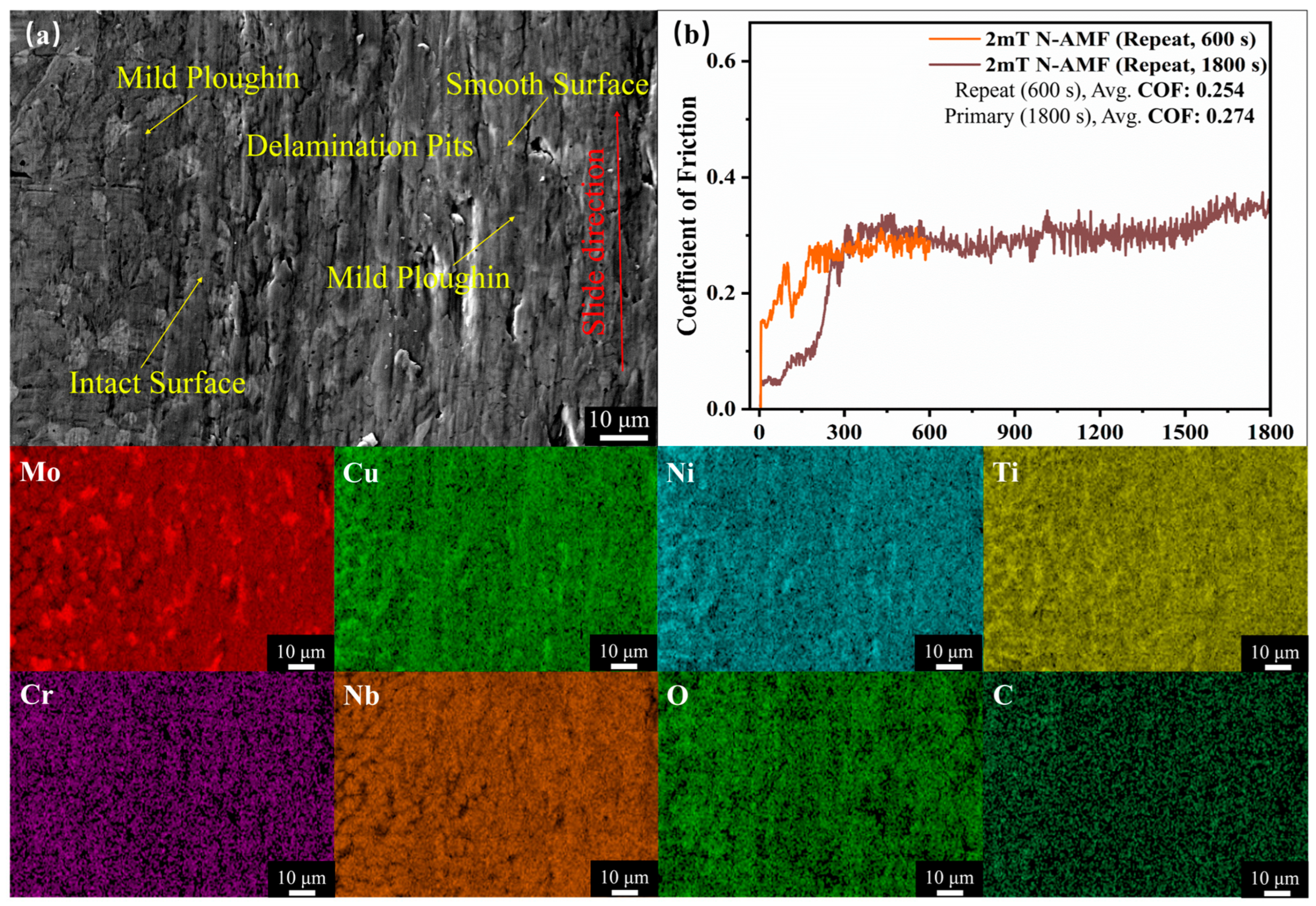
As illustrated in Figure 7, the dynamic stability of the coating during sliding is clearly reflected in the coefficient of friction (COF) curve. During the prolonged wear test lasting 30 min, both the non-magnetic field (0 mT) group and the S-AMF group samples exhibited significant fluctuations in their friction coefficients, ultimately stabilising within the elevated range of 0.55–0.65. In contrast, the N-AMF-coated samples exhibited superior anti-friction properties, with their coefficient of friction curve maintaining the lowest and most stable level (approximately 0.33) throughout the entire test period. To investigate this unique low-friction phenomenon, a supplementary 10 min friction and wear test was conducted under identical experimental conditions. Interestingly, in the 10 min specialised test on the 2 mT N-AMF sample, the initial coefficient of friction was merely 0.28. This indicates the coating possesses outstanding operational stability and a shorter running-in period. Although three-dimensional surface profilometry was not performed, the wear volume was quantitatively evaluated using the mass-loss method, which is widely accepted for tribological assessment of coatings. In addition, detailed SEM observations of the wear tracks were conducted to analyze surface damage features and wear mechanisms. These combined approaches provide reliable information on both quantitative wear resistance and qualitative degradation behavior.
Quantitative wear rate data further corroborates the divergence in friction behaviour. When magnetic field polarity transitions from downward (S-AMF) to upward (N-AMF), the wear rate exhibits a pronounced “cliff-like” decline. The wear rate for the N-AMF coating was measured at merely (26–27) × 10−5 mm3 N−1 m−1, representing a 55% reduction compared to conventional GMAW conditions (approximately 58 × 10−5 mm3 N−1 m−1). The concurrent enhancement in friction stability and wear resistance stems not only from the high hardness support (approximately 825 HV) induced by N-AMF but also from its effective regulation of damage evolution at the friction interface. To elucidate the microstructural evolution mechanisms underpinning this macroscopic performance advantage, subsequent discussions will integrate morphological observations from the N-AMF experimental group coatings during the early wear stage (10 min) to investigate the wear mechanisms across various samples. Compared with previously reported magnetic field-assisted GMAW or arc-deposited HEA coatings, the tribological performance achieved in this study is markedly superior. Reported wear rates for GMAW-fabricated HEA coatings typically fall within the range of (40–80) × 10−5 mm3 N−1 m−1, depending on alloy composition and processing conditions. The present N-AMF coating exhibits a significantly lower wear rate of (26–27) × 10−5 mm3 N−1 m−1, indicating enhanced resistance to material removal. Similarly, the microhardness (~825 HV) exceeds values commonly reported for arc-deposited HEA coatings (typically 600–750 HV). These improvements highlight the effectiveness of AMF polarity control in stabilizing the arc and homogenizing the molten pool, particularly for heterogeneous cable-type wire systems, which have been rarely investigated in previous studies.

3.4.1. Evolution of Wear Mechanisms and the Establishment of Protection

To comprehensively understand the tribological reliability of N-AMF-modified coatings, wear initiation characteristics were characterised at the 10 min time point. As demonstrated by scanning electron microscope micrographs (Figure 8a), the N-AMF coating exhibited a highly cohesive surface during the initial stage, characterised primarily by micrometre-scale parallel mild ploughing (MP). No significant material removal or deep cracks were observed, consistent with the stable coefficient of friction (COF) of approximately 0.28 recorded during the initial sliding phase.
This exceptional initial resistance is intrinsically linked to the stable microstructural refinement induced by the N-AMF arc. The high-volume fraction of refined Cr2Nb Laves phase and BCC phase forms a robust load-bearing framework. Combined with a high hardness of approximately 825 HV, this effectively shields the ductile FCC matrix from deep abrasive penetration. Furthermore, initial EDS mapping reveals uniform oxygen (O) distribution across the polished surface. This observation indicates that the refined microstructure inherently facilitates a homogeneous and controllable oxidation process from the outset. Such a stable initial phase constitutes a critical prerequisite for the subsequent formation of a continuous, dense glaze layer. This glaze, observed at 30 min, effectively transitions the wear mechanism from mechanical abrasion to self-lubricating oxidative protection. This temporal evolution underscores that N-AMF-mediated regulation of arc stability not only decisively influences the initial mechanical integrity of HEA coatings but also critically impacts their long-term tribological reliability.

3.4.2. Comparative Analysis of Wear Morphologies and Mechanisms

To investigate the wear initiation and persistence of the enhanced microstructure, the N-AMF group coating was observed during the initial wear phase (10 min). During this period, the coating surface exhibited high structural integrity, displaying only microscopic ploughing phenomena corresponding to a stable friction plateau value of approximately 0.28. This exceptional initial wear resistance laid the foundation for the formation of a protective oxide glaze layer, observed after 30 min. In contrast, when sliding duration extended to 30 min, coatings with poorer arc stability (Figure 9a,b) exhibited severe delamination, whereas the N-AMF group coating maintained its steady-state low-wear performance (Figure 9c).
To further elucidate the relationship between friction stability and surface degradation, we systematically compared the wear topographies of samples corresponding to three representative COF curves (black, blue, and brown curves) (Figure 9a). Figure 9a illustrates the most severe surface damage features, characterised by deep irregular spalling pits and pronounced longitudinal grooves. Extensive material detachment indicates a catastrophic delamination wear mechanism, wherein subsurface fatigue cracks propagate and interconnect under high cyclic contact stresses. Detached debris and hard-phase fragments subsequently acted as third-body abrasives, etching deep grooves and exacerbating frictional resistance. This is corroborated by the peak and most volatile friction coefficient values observed in the black curve. In Figure 9b, the surface exhibits characteristics transitioning towards fatigue-driven delamination and adhesive wear. Unlike the deep spalling observed in Figure 9a, material removal here occurs in flake-like patterns, leaving flat-bottomed pits. Concurrently, evidence of localised adhesive tearing and plastic smearing is visible, indicating that flash temperatures at contact micro-asperities were sufficient to induce transient welding followed by subsequent shearing. This mechanically dominated failure mode corresponds to the moderate friction levels and controlled fluctuations observed in the blue curve.
In contrast, Figure 9c exhibits a relatively smooth surface characterised by finely fragmented oxide deposits forming bright white clusters. Energy-dispersive X-ray spectroscopy (EDS) mapping (Figure 8) confirms that these oxide particles were repeatedly compacted during sliding, forming a discontinuous yet protective friction layer. The pervasive occurrence of oxide wear coupled with mild ploughing phenomena effectively prevents direct metal-to-metal contact, thereby inhibiting the initiation of deep cracks. This oxide-dominated mechanism is the fundamental reason why the brown curve maintained the most stable and lowest coefficient of friction (COF) of approximately 0.33 throughout the entire test. Comparative analysis indicates that while fatigue-induced spalling (Figure 9a,b) may induce tribological instability, the dynamic formation of an oxide-based lubricating layer (Figure 9c) ensures the high-entropy alloy (HEA) coating’s exceptional wear resistance and long-term reliability.

3.5. Discussion on Cross-Scale Coupling Mechanisms in Arc–Structure–Performance Evolution

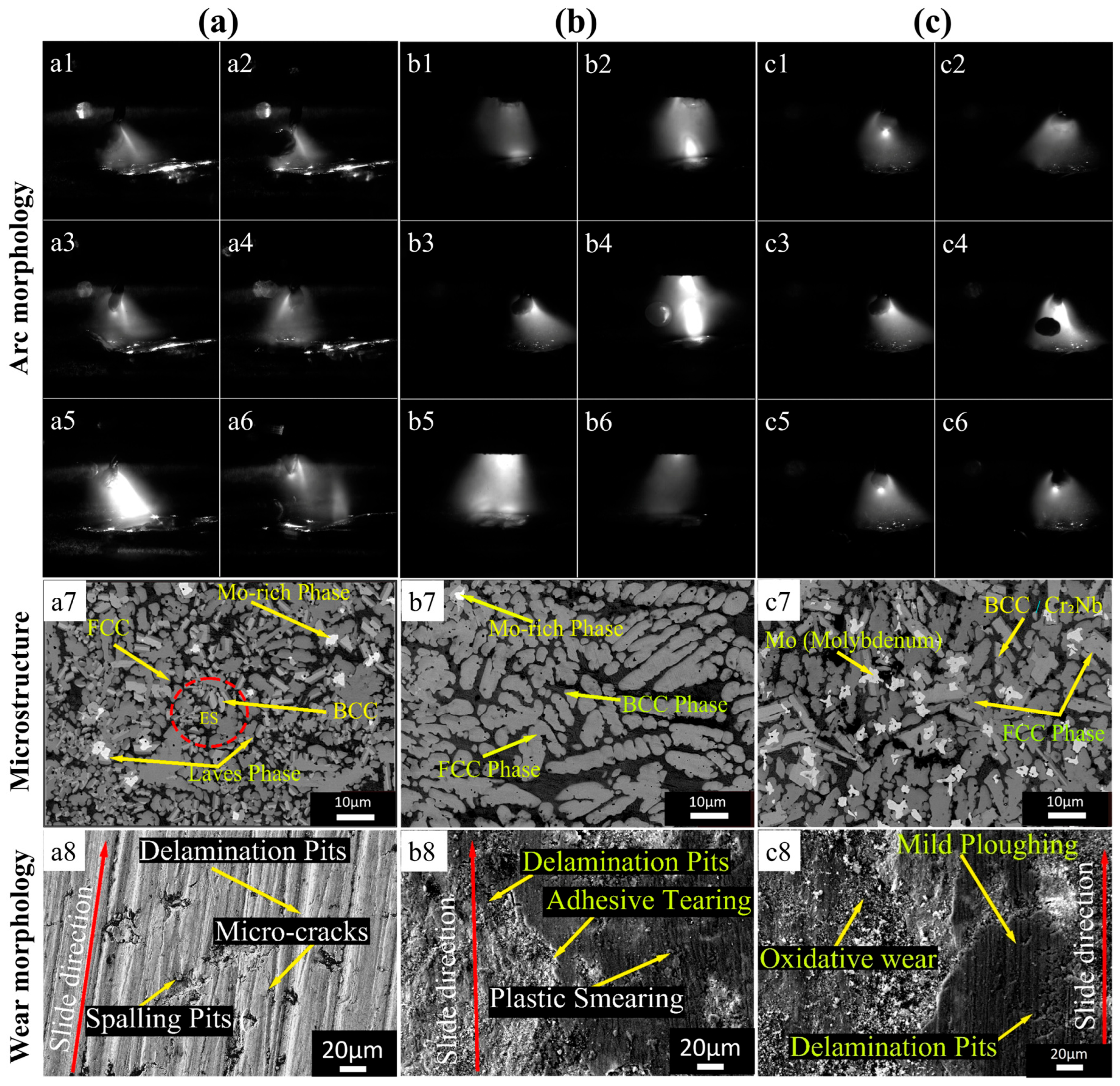
To systematically elucidate the influence of magnetic field polarity on the lifecycle of high-entropy alloy (HEA) coatings, this study established a comprehensive mechanistic model as depicted in Figure 10. This model reveals a complete causal chain comprising “physical modulation-metallurgical response-performance feedback”. At the physical level, the polarity of the magnetic field determines the intervention mode addressing the inherent instability of heterogeneous cable-type welding wires. Owing to differences in electrical conductivity between the individual strands composing the welding wire, the arc in conventional gas metal arc welding (GMAW) (0 mT, Figure 10a) exhibits pronounced eccentric oscillation and random wandering phenomena. An upward magnetic field (N-AMF) generates a Lorentz force opposing the arc’s inherent rotation direction, creating a “braking effect” that effectively counteracts arc deflection and reduces current density variations within the arc. This induces the arc to transition into a stable bell-shaped profile with an expanded rotational radius, thereby achieving spatial homogenisation of heat input (Figure 10c). Conversely, a downward magnetic field (S-AMF) couples with the intrinsic spin in the same direction, accelerating cyclotron motion and inducing severe arc contraction. This leads to excessive heat concentration in the central region (Figure 10b).
At the metallurgical level, the spatial distribution of the thermal field directly determines the quality of precipitates and the spatial configuration of strengthening phases. The stable, uniform thermal environment provided by N-AMF, combined with strong electromagnetic stirring, effectively suppresses solute segregation in the melt pool. This promotes the dispersion precipitation of hard Cr2Nb (Laves phase) and BCC phases in the form of ultrafine grains, thereby constructing a dense “interlocking skeletal network” structure within the ductile FCC matrix, as shown in Figure 10c. In contrast, unstable energy input under 0 mT or S-AMF conditions leads to microstructural coarsening and element segregation (ES), forming mechanically weak zones. These weak zones subsequently become preferred locations for stress concentration and crack initiation during subsequent slip processes, as illustrated in Figure 10a,b.
At the tribological level, structural integrity governs the qualitative transformation of surface damage mechanisms. The N-AMF group coating, with its exceptional microhardness (approximately 825 ± 15 HV), provides robust load-bearing support, thereby effectively suppressing micro-ploughing phenomena during the initial sliding phase. Friction-induced oxides progressively accumulate and consolidate upon a uniformly distributed reinforcing framework, ultimately evolving into a continuous, smooth oxide glaze layer that effectively prevents direct cutting of the coating by the counter-grinding balls. This transition from “mechanical spalling” to “adaptive oxidation protection” has reduced the wear rate of N-AMF coatings by 55%. This underscores that precise regulation of magnetic field polarity is not merely a process optimisation technique, but a fundamental physical prerequisite for preparing high-performance HEA surface protective layers.
In summary, the inherent instability of the arc in dissimilar cable-type welding wires manifests as arc deflection and thermal expansion unwinding characteristics. This instability can be effectively suppressed by applying a northward axial magnetic field (N-AMF). The N-AMF generates a counteracting electromagnetic torque to offset these disturbances, thereby forming a stable bell-shaped arc configuration that facilitates radial expansion. This ensures spatially uniform thermal input distribution, whereas a downward axial magnetic field (S-AMF) exacerbates arc centripetal contraction and heat concentration. The stable thermal field and enhanced electromagnetic stirring provided by N-AMF suppress solute segregation (ES) and promote the precipitation of ultrafine Cr2Nb (Laves phase) and body-centred cubic (BCC) phases. In addition to electromagnetic stirring, the upward AMF also modifies the thermal gradient, cooling rate, and molten pool convection behavior. The more uniform heat distribution reduces localized overheating and constitutional supercooling, thereby suppressing dendritic coarsening and promoting homogeneous nucleation. Furthermore, the stabilized arc minimizes fluctuations in heat input, leading to more controlled solidification dynamics and improved elemental diffusion. These synergistic effects collectively contribute to the formation of a dense, interlocking skeletal network within the face-centred cubic (FCC) matrix, significantly enhancing microstructural integrity and elevating the microhardness to approximately 825 HV. In contrast, unstable thermal cycling under 0 mT or S-AMF conditions leads to microstructural coarsening and the formation of regions with weakened mechanical properties. The improved structural integrity under N-AMF induces a fundamental shift in wear mechanisms, transitioning from catastrophic adhesive wear and flaking to a stable, mild oxidation–abrasion mechanism. The optimized reinforcement framework provides robust load-bearing support and promotes the formation of a protective glaze layer, thereby reducing wear rates by approximately 55%. These findings demonstrate that N-AMF modulation establishes a causal chain of “stable thermal field—fine framework—adaptive protection”, constituting a fundamental physical prerequisite for fabricating high-performance HEA coatings.

4. Conclusions

This study employed gas metal arc welding (GMAW) with a cable-type welding wire to fabricate Mo-Cu-Ni-Cr-Ti-Nb high-entropy alloy (HEA) coatings. The research focused on investigating the cross-scale regulation mechanism of axial magnetic field (AMF) on arc physical characteristics, microstructural evolution, and tribological properties. The principal research findings are as follows: the inherent instability of the arc in heterogeneous cable-type welding wires manifests as arc deflection and thermal expansion unwinding characteristics. The application of an upward axial magnetic field (N-AMF) effectively suppresses this phenomenon. The stable thermal field and enhanced electromagnetic stirring provided by N-AMF suppress solute segregation (ES) and promote the precipitation of ultrafine Cr2Nb (Laves phase) and body-centred cubic (BCC) phases. These phases form a dense, interlocking skeletal network within the face-centred cubic (FCC) matrix, significantly enhancing microstructural integrity and elevating microhardness to 825 ± 15 HV. This strengthened microstructural integrity induces a fundamental shift in wear mechanisms, transitioning from catastrophic adhesive wear and flaking to a stable, mild oxidation/abrasion mechanism. The optimised reinforced framework provides robust load-bearing support, promoting the formation of a protective glaze layer that reduces wear rates by 55%.

Supplementary Materials

The following supporting information can be downloaded at: https://www.mdpi.com/article/10.3390/met16030316/s1.

Author Contributions

J.J.: Conceptualization, Methodology, Software, Validation, Writing—Original Draft. X.W.: Resources, Writing—Review & Editing, Supervision, Project administration. X.L.: Formal analysis, Investigation. C.W.: Data Curation, Visualization. Y.D.: Data Curation, Visualization. F.D.: Visualization. All authors have read and agreed to the published version of the manuscript.

Funding

This work was supported by the [National Natural Science Foundation of China] under Grant No. [52505383]; and the [Lanzhou Jiaotong University Scientific Research Project] under Grant No. [KT24S003-YIY].

Data Availability Statement

The original contributions presented in this study are included in the article/Supplementary Material. Further inquiries can be directed to the corresponding author.

Conflicts of Interest

The authors declare no conflict of interest.

References

  1. Matson, T.P.; Schuh, C.A. A “bond-focused” local atomic environment representation for a high throughput solute interaction spectrum analysis. Acta Mater. 2024, 278, 120275. [Google Scholar] [CrossRef]
  2. Xu, D.; Wang, X.; Lu, Y. Heterogeneous-Structured Refractory High-Entropy Alloys: A Review of State-of-the-Art Developments and Trends. Adv. Funct. Mater. 2024, 34, 2408941. [Google Scholar] [CrossRef]
  3. Liang, J.; Cao, G.; Zeng, M.; Fu, L. Controllable synthesis of high-entropy alloys. Chem. Soc. Rev. R. Soc. Chem. 2024, 53, 6021–6041. [Google Scholar] [CrossRef]
  4. Liu, Y.-H.; Hsieh, C.-J.; Hsu, L.-C.; Lin, K.-H.; Hsiao, Y.-C.; Chi, C.-C.; Lin, J.-T.; Chang, C.-W.; Lin, S.-C.; Wu, C.-Y.; et al. Toward controllable and predictable synthesis of high-entropy alloy nanocrystals. Sci. Adv. 2023, 9, eadf9931. [Google Scholar] [CrossRef]
  5. Marques, F.; Balcerzak, M.; Winkelmann, F.; Zepon, G.; Felderhoff, M. Review and outlook on high-entropy alloys for hydrogen storage. Energy Environ. Sci. 2021, 14, 5191–5227. [Google Scholar] [CrossRef]
  6. Song, X.-R.; Wang, J.-J.; Tu, X.-X.; Hu, X.-Y.; Zhao, D.; Ma, S.-G.; Jiao, Z.-M.; Zhang, T.-W.; Wen, W.; Wang, Z.-H. Coupling effects of temperature and strain rate on the deformation behavior of an equiatomic refractory high-entropy alloy. Rare Met. 2025, 44, 9086–9104. [Google Scholar] [CrossRef]
  7. Jeong, Y.J.; Kim, S.O.; Park, J.S.; Lee, J.W.; Hwang, J.-K.; Lee, S.G.; Choi, J.K.; Kim, S.J. Strong and ductile Fe-24Mn-3Cr alloy resistant against erosion-corrosion. npj Mater. Degrad. 2021, 5, 47. [Google Scholar] [CrossRef]
  8. Chen, C.-L.; Huang, F.-Y.; West, G. Effect of Al/Co ratio on phase stability and mechanical behavior of mechanically alloyed AlxCoyCrFeNi HEAs. J. Mater. Res. Technol. 2025, 39, 1222–1231. [Google Scholar] [CrossRef]
  9. Zhang, C.; Wang, X.; Xu, M.; MacDonald, B.E.; Hong, R.; Zhu, C.; Dai, X.; Vecchio, K.S.; Apelian, D.; Hahn, H.; et al. Orientation-dependent superelasticity of a metastable high-entropy alloy. Appl. Phys. Lett. 2021, 119, 161908. [Google Scholar] [CrossRef]
  10. Yu, B.; Ren, Y.; Zeng, Y.; Ma, W.; Morita, K.; Zhan, S.; Lei, Y.; Lv, G.; Li, S.; Wu, J. Recent progress in high-entropy alloys: A focused review of preparation processes and properties. J. Mater. Res. Technol. 2024, 29, 2689–2719. [Google Scholar] [CrossRef]
  11. Qiao, L.; Aorigele; Lai, Z.; Zhu, J. A promising new class of multi-component alloys with exceptional mechanical properties. J. Alloys Compd. 2020, 847, 155929. [Google Scholar] [CrossRef]
  12. Kumar, D. Recent advances in tribology of high entropy alloys: A critical review. Prog. Mater. Sci. 2023, 136, 101106. [Google Scholar] [CrossRef]
  13. Li, X.; Meng, X. Recent advances on high entropy alloys for electrocatalytic applications. Int. J. Hydrogen Energy 2024, 82, 1471–1480. [Google Scholar] [CrossRef]
  14. Shome, S.; Ray, N. High-Entropy Alloys for Next-Generation Electromagnetic Shielding Applications. Adv. Eng. Mater. 2025, 27, 2500361. [Google Scholar] [CrossRef]
  15. He, Y.; Cong, M.; Lei, W.; Ding, Y.; Xv, T.; Han, Z. Microstructure, mechanical and corrosion properties of FeCrNiCoMnSi0.1 high-entropy alloy coating via TIG arc melting technology and high-frequency ultrasonic impact with welding. Mater. Today Adv. 2023, 20, 100443. [Google Scholar] [CrossRef]
  16. Shen, Q.; Kong, X.; Chen, X. Fabrication of bulk Al-Co-Cr-Fe-Ni high-entropy alloy using combined cable wire arc additive manufacturing (CCW-AAM): Microstructure and mechanical properties. J. Mater. Sci. Technol. 2021, 74, 136–142. [Google Scholar] [CrossRef]
  17. Banerjee, A.; Mondal, A.K.; Haldar, B.; Chatterje, S.; Alsaleh, N.A. Synthesis and characterisation of Fe38Al26Cu16Ni13Cr6 high entropy alloy processed through combined cable wire arc additive manufacturing (WAAM) process. Int. J. Adv. Manuf. Technol. 2024, 135, 5553–5573. [Google Scholar] [CrossRef]
  18. Kumar Chandel, D.; Thakur, L.; Kumar, V. Investigation of the failure behaviour of equiatomic AlCrCuNiFe based high entropy alloy TIG weld cladding. Eng. Fail. Anal. 2024, 165, 108836. [Google Scholar] [CrossRef]
  19. Chandel, D.K.; Thakur, L.; Kumar, V. An investigation on the tribological behaviour of AlCrCuNiFe high entropy alloy optimized TIG weld cladding in room temperature conditions. Tribol. Int. 2023, 189, 108982. [Google Scholar] [CrossRef]
  20. Wen, X.-L.; Song, L.-Y.; Zhang, W.-B.; Gong, Y.-D.; Han, F.-B. Experimental study on microstructure of high-entropy alloy reinforced with ceramic particles formed by laser cladding. Arch. Civ. Mech. Eng. 2024, 25, 6. [Google Scholar] [CrossRef]
  21. Wang, Z.-Q.; Shi, Y.; Zhang, L.-J.; Wang, X.-R. Preparation of medium-entropy alloy coating using GMAW cladding with MoFe3TiNiCu cable-type welding wire. Mater. Sci. Technol. 2023, 39, 1827–1834. [Google Scholar] [CrossRef]
  22. Kaushik, A.; Singh, V.; Choudhury, B.; Ashutosh, S.; Chandrasekaran, M. Experimental investigation on cladding with metal cored wire using GMAW process and parametric optimization. Eng. Res. Express 2021, 3, 045025. [Google Scholar] [CrossRef]
  23. Chaudhari, R.; Parikh, N.; Khanna, S.; Vora, J.; Patel, V. Effect of multi-walled structure on microstructure and mechanical properties of 1.25Cr-1.0Mo steel fabricated by GMAW-based WAAM using metal-cored wire. J. Mater. Res. Technol. 2022, 21, 3386–3396. [Google Scholar] [CrossRef]
  24. Pawlik, J.; Bembenek, M.; Góral, T.; Cieślik, J.; Krawczyk, J.; Łukaszek-Sołek, A.; Śleboda, T.; Frocisz, Ł. On the Influence of Heat Input on Ni-WC GMAW Hardfaced Coating Properties. Materials 2023, 16, 3960. [Google Scholar] [CrossRef]
  25. Yao, X.; Peng, K.; Chen, X.; Jiang, F.; Wang, K.; Wang, Q. Microstructure and mechanical properties of dual wire-arc additive manufactured Al-Co-Cr-Fe-Ni high entropy alloy. Mater. Lett. 2022, 326, 132928. [Google Scholar] [CrossRef]
  26. Treutler, K.; Lorenz, S.; Hamje, J.; Wesling, V. Wire and Arc Additive Manufacturing of a CoCrFeMoNiV Complex Concentrated Alloy Using Metal-Cored Wire—Process, Properties, and Wear Resistance. Appl. Sci. 2022, 12, 6308. [Google Scholar] [CrossRef]
  27. Wu, K.; Yang, H.; Lin, J.; Shi, Y.; Zeng, M.; Hong, X. Novel double-wire GMAW arc length control method based on PID with derivative on measurement. J. Manuf. Process. 2025, 150, 827–842. [Google Scholar] [CrossRef]
  28. Wu, P.; Wang, M.; Fang, N.; Xu, K.; Sun, L.; Huang, R.; Qin, J. Analysis on the technology, microstructure, and mechanical properties of Ti-6Al-4 V alloy narrow gap oscillation laser welding with multi-stranded wire. Int. J. Adv. Manuf. Technol. 2023, 128, 729–742. [Google Scholar] [CrossRef]
  29. Gonçalves e Silva, R.H.; Correa Riffel, K.; Pompermaier Okuyama, M.; Dalpiaz, G. Effect of dynamic wire in the GTAW process. J. Mater. Process. Technol. 2019, 269, 91–101. [Google Scholar] [CrossRef]
  30. Sun, L.; Wang, M.; Huang, L.; Fang, N.; Wu, P.; Huang, R.; Xu, K.; Wang, X.; Qin, J.; Li, S.; et al. Comparative Study on Laser Welding Thick-Walled TC4 Titanium Alloy with Flux-Cored Wire and Cable Wire. Materials 2023, 16, 1509. [Google Scholar] [CrossRef]
  31. Chen, Y.; Yang, Z.; Ni, Z.; Xu, J.; Dong, S.; Xu, G.; Chen, S.-J. Effect of distance between heat sources on droplet transfer behavior and weld formation of AH36 during laser and CWW GMAW arc hybrid welding. J. Iron Steel Res. Int. 2024, 31, 3069–3079. [Google Scholar] [CrossRef]
  32. Rhode, M.; Richter, T.; Schroepfer, D.; Manzoni, A.M.; Schneider, M.; Laplanche, G. Welding of high-entropy alloys and compositionally complex alloys—An overview. Weld. World 2021, 65, 1645–1659. [Google Scholar] [CrossRef]
  33. Jin, J.; Geng, S.; Jiang, P.; Ren, L.; Han, C.; Yang, L.; Xu, K. Arc behavior and droplet transfer characteristics during oscillating laser-arc hybrid welding of 2024 Al alloy based on Zr-core-Al-shell wire. J. Mater. Res. Technol. 2024, 32, 1521–1537. [Google Scholar]
  34. John, M.; Diaz, O.; Esparza, A.; Fliegler, A.; Ocenosak, D.; Van Dorn, C.; Menezes, P.L. Welding Techniques for High Entropy Alloys: Processes, Properties, Characterization, and Challenges. Materials 2022, 15, 2273. [Google Scholar] [CrossRef] [PubMed]
  35. Xu, X.; Mi, G.; Xiong, L.; Jiang, P.; Shao, X.; Wang, C. Morphologies, microstructures and properties of TiC particle reinforced Inconel 625 coatings obtained by laser cladding with wire. J. Alloys Compd. 2018, 740, 16–27. [Google Scholar] [CrossRef]
  36. Gook, S.; El-Batahgy, A.-M.; Gumenyuk, A.; Biegler, M.; Rethmeier, M. Application of Hybrid Laser Arc Welding for Construction of LNG Tanks Made of Thick Cryogenic 9% Ni Steel Plates. Lasers Manuf. Mater. Process. 2023, 10, 659–680. [Google Scholar] [CrossRef]
  37. Miao, J.; Li, Y.; Zhang, S.; Zhao, H.; Zou, W.; Chang, C.; Chang, Y. Magnetic controlled arc welding technology: A review. Rapid Prototyp. J. 2024, 30, 1929–1955. [Google Scholar] [CrossRef]
  38. Wu, H.; Chang, Y.; Lu, L.; Bai, J. Review on magnetically controlled arc welding process. Int. J. Adv. Manuf. Technol. 2017, 91, 4263–4273. [Google Scholar] [CrossRef]
  39. Xu, T.; Shi, Y.; Cui, Y.; Liang, Z. Effects of Magnetic Fields in Arc Welding, Laser Welding, and Resistance Spot Welding: A Review. Adv. Eng. Mater. 2023, 25, 2200682. [Google Scholar] [CrossRef]
  40. Du, H.; Zhang, K.; Liu, D.; Lang, W. Progress in the Circular Arc Source Structure and Magnetic Field Arc Control Technology for Arc Ion Plating. Materials 2025, 18, 3498. [Google Scholar] [CrossRef]
  41. Zhao, W.; Jin, H.; Du, X.; Chen, J.; Wei, Y. A 3D arc-droplet-molten pool integrated model of Al alloy GMAW process: Heat transfer, fluid flow and the effect of external magnetic field. Vacuum 2022, 202, 111129. [Google Scholar]
  42. Ahsan, M.R.U.; Seo, G.-J.; Fan, X.; Liaw, P.K.; Motaman, S.; Haase, C.; Kim, D.B. Effects of process parameters on bead shape, microstructure, and mechanical properties in wire + arc additive manufacturing of Al0.1CoCrFeNi high-entropy alloy. J. Manuf. Process. 2021, 68, 1314–1327. [Google Scholar] [CrossRef]
  43. Xiao, L.; Fan, D.; Huang, J.-K. Numerical Study on Arc Plasma Behaviors in GMAW with Applied Axial Magnetic Field. J. Phys. Soc. Jpn. 2019, 88, 074502. [Google Scholar] [CrossRef]
  44. Xiao, L.; Fan, D.; Huang, J.; Tashiro, S.; Tanaka, M. Numerical study on arc-droplet coupled behavior in magnetic field controlled GMAW process. J. Phys. D Appl. Phys. 2020, 53, 115202. [Google Scholar]
  45. Xiao, L.; Fan, D.; Huang, J.; Tashiro, S.; Tanaka, M. 3D Numerical Study of External Axial Magnetic Field-Controlled High-Current GMAW Metal Transfer Behavior. Materials 2020, 13, 5792. [Google Scholar] [CrossRef]
  46. Biesuz, M.; Saunders, T.; Ke, D.; Reece, M.J.; Hu, C.; Grasso, S. A review of electromagnetic processing of materials (EPM): Heating, sintering, joining and forming. J. Mater. Sci. Technol. 2021, 69, 239–272. [Google Scholar] [CrossRef]
  47. Zhang, H.; Li, Z.; Wei, L.; Xia, F. The Influence of Magnetic Field Orientation on the Efficacy and Structure of Ni-W-SiC Coatings Produced by Magnetic Field-Assisted Electrodeposition. Coatings 2024, 14, 1272. [Google Scholar] [CrossRef]
  48. Yang, Z.; Huang, J.; Xu, K.; He, P. Effect of polarities and shielding gases in CWW GMAW. Mater. Manuf. Process. 2024, 39, 227–236. [Google Scholar]
  49. Zhao, W.; Wei, Y.; Zhang, X.; Chen, J.; Ou, W. Comparative investigation of wire arc additive manufacturing of Al-5%Mg alloy with and without external alternating magnetic field. Int. J. Adv. Manuf. Technol. 2022, 119, 2571–2587. [Google Scholar] [CrossRef]
  50. Haftlang, F.; Zargaran, A.; Son, S.; Lee, S.; Hong, S.-J.; Kim, H.S. The subsurface deformed region and superficial protective tribo-oxide layer during wear in a non-equiatomic CoCrFeNiV high entropy alloy. Mater. Des. 2022, 218, 110685. [Google Scholar]
  51. Hu, Y.; Chen, F.; Cao, S.; Fan, Y.; Xie, R. Preparation and characterization of CMT wire arc additive manufacturing Al-5%Mg alloy depositions through assisted longitudinal magnetic field. J. Manuf. Process. 2023, 101, 576–588. [Google Scholar] [CrossRef]
  52. Ishikawa, S.; Yamashita, T.; Kiryu, T.; Chai, Y.W.; Kimura, Y. Effect of Mo addition on laves phase precipitation behavior in Fe-20%Cr-x%Nb alloys. Mater. Charact. 2022, 190, 112077. [Google Scholar] [CrossRef]
  53. Yin, H.; Ge, W.; Yin, F.; Zhao, J.; Yang, G.; Bao, H.; Zhou, L. Effect of stress on the nucleation and evolution of Mo-rich Laves phase in 9.5Cr-1.5MoCoVNbNB heat-resistant steel during tensile rupture at 620 °C. Mater. Charact. 2023, 196, 112565. [Google Scholar] [CrossRef]
  54. Xiong, W.; Guo, A.X.Y.; Zhan, S.; Liu, C.-T.; Cao, S.C. Refractory high-entropy alloys: A focused review of preparation methods and properties. J. Mater. Sci. Technol. 2023, 142, 196–215. [Google Scholar]
  55. Sun, S.; Wang, H.; Huang, L.; Feng, Z.; Sun, R.; Zhang, W.; Zhang, W. Microstructure evolution and mechanical properties of refractory high-entropy alloy nitride film. Surf. Coat. Technol. 2024, 483, 130775. [Google Scholar] [CrossRef]
  56. Laube, S.; Kauffmann, A.; Schellert, S.; Seils, S.; Tirunilai, A.S.; Greiner, C.; Eggeler, Y.M.; Gorr, B.; Christ, H.-J.; Heilmaier, M. Formation and thermal stability of two-phase microstructures in Al-containing refractory compositionally complex alloys. Sci. Technol. Adv. Mater. 2022, 23, 692–706. [Google Scholar] [CrossRef]
  57. Frey, C.; Silverstein, R.; Pollock, T.M. A high stability B2-containing refractory multi-principal element alloy. Acta Mater. 2022, 229, 117767. [Google Scholar] [CrossRef]
  58. Yang, X.; Yang, D.; Huang, H.; Wang, S.; Zhang, Z.; Liang, Z.; Wang, L.; Peng, Z.; Liu, Y.; Wang, D. Root inspired in situ interlocked interface for strength and ductility combination of refractory high-entropy alloys/Ni composites by activated sintering. Mater. Sci. Eng. A 2025, 939, 148500. [Google Scholar] [CrossRef]
  59. Du Toit, M.; Mutombo, K. The influence of pulsed gas metal arc welding on the fatigue and corrosion-fatigue properties of wrought aluminium 6061-T651. Anti-Corros. Methods Mater. 2019, 66, 719–729. [Google Scholar] [CrossRef]
  60. Xu, Z.; Yang, C.; Liu, W.; Liu, K.; Shi, F.; Tan, Z.; Cao, P.; Wang, D. Numerical Simulation of Arc Welding in Large Flange Shafts Based on a Novel Combined Heat Source Model. Materials 2025, 18, 3932. [Google Scholar] [CrossRef] [PubMed]
  61. Huang, X.; Wang, L.; Deng, J.; Jia, S.; Qin, K.; Shi, Z. Modeling of the anode surface deformation in high-current vacuum arcs with AMF contacts. J. Phys. D Appl. Phys. 2016, 49, 075202. [Google Scholar] [CrossRef]
  62. Qin, M.; Shen, Z.; Xiong, F.; Han, S.; Zou, R. Toward High-Power and High-Density Thermal Storage: Dynamic Phase Change Materials. ACS Energy Lett. 2023, 8, 3552–3557. [Google Scholar] [CrossRef]
  63. Sun, Y.; Zhao, Z.; Bai, T.; Zhao, Y.; Feng, L.; Liu, Y.; Ding, J.; Liu, J. Numerical Simulation of Multiple Electromagnetic Effects Inside Laser Cladding Coatings Assisted by Alternating Magnetic Fields: Analysis of Eddy Currents, Joule Heat, and Lorentz Forces. J. Electron. Mater. 2026, 55, 837–853. [Google Scholar] [CrossRef]
Figure 1. Arc behavior observed by high-speed camera: (a) Transient images comparing single-filament and HCWW-welding arcs; (b) filtering current and voltage data curves; (c1c12) sequential images capturing the rotation of the HCWW-welding arc.
Metals 16 00316 g001
Figure 4. XRD patterns of high-entropy alloy coatings under different magnetic field conditions.
Metals 16 00316 g004
Figure 6. EDS elemental mapping results of high-entropy alloy coatings under different magnetic field conditions: (a) 0 mT, (b) 2 mT with S-AMF, (c) 2 mT with N-AMF.
Metals 16 00316 g006
Figure 7. Mechanical and tribological properties of high-entropy alloy coatings under different magnetic field strengths: (a) Quantitative EDS analysis of key strengthening elements (Cr, Nb, Mo), (b) Coefficient of friction, (c) Average friction coefficient, (d) Hardness, (e) Wear rate.
Metals 16 00316 g007
Figure 8. Wear surface morphology of high-entropy alloy coating under dry friction conditions: (a) SEM and EDS; (b) coefficient of friction at 10 min of testing.
Metals 16 00316 g008
Figure 9. Wear surface morphology of high-entropy alloy coatings under dry friction conditions: (a) 0 mT, (b) 2 mT with S-AMF, (c) 2 mT with N-AMF.
Metals 16 00316 g009
Figure 10. Mechanism of magnetic field influence on GMAW-prepared high-entropy alloy coatings and the resulting performance: (a) 0 mT condition, including (a1a6) sequential arc morphology, (a7) SEM microstructure and phase distribution, and (a8) wear track morphology; (b) 2 mT S-AMF condition, including (b1b6) sequential arc morphology, (b7) SEM microstructure and phase distribution, and (b8) wear track morphology; (c) 2 mT N-AMF condition, including (c1c6) sequential arc morphology, (c7) SEM microstructure and phase distribution, and (c8) wear track morphology.
Metals 16 00316 g010
Table 1. Estimated current distribution based on resistivity.
ElementResistivity (Ω·m)Conductivity (S/m)Current Distribution (%)Current (A)
Mo5.20 × 10−81.92 × 10717.2034.40
Cu1.67 × 10−85.99 × 10753.56107.12
Ni6.84 × 10−81.46 × 10713.0826.15
Cr1.30 × 10−77.69 × 1066.8813.76
Ti4.20 × 10−72.38 × 1062.134.26
Nb1.25 × 10−78.00 × 1067.1614.31
Disclaimer/Publisher’s Note: The statements, opinions and data contained in all publications are solely those of the individual author(s) and contributor(s) and not of MDPI and/or the editor(s). MDPI and/or the editor(s) disclaim responsibility for any injury to people or property resulting from any ideas, methods, instructions or products referred to in the content.