A Short Review of Electromagnetic Attractive Forming and Its Applications

Abstract
1. Introduction
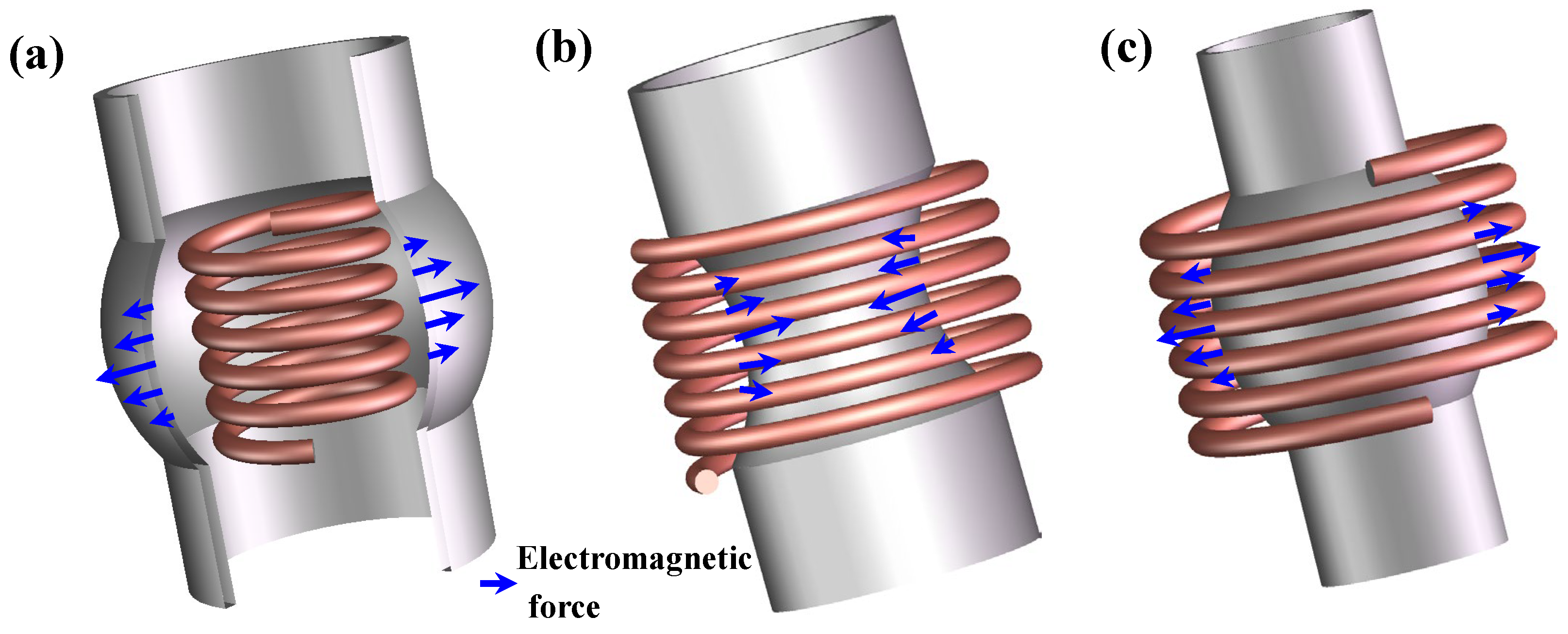
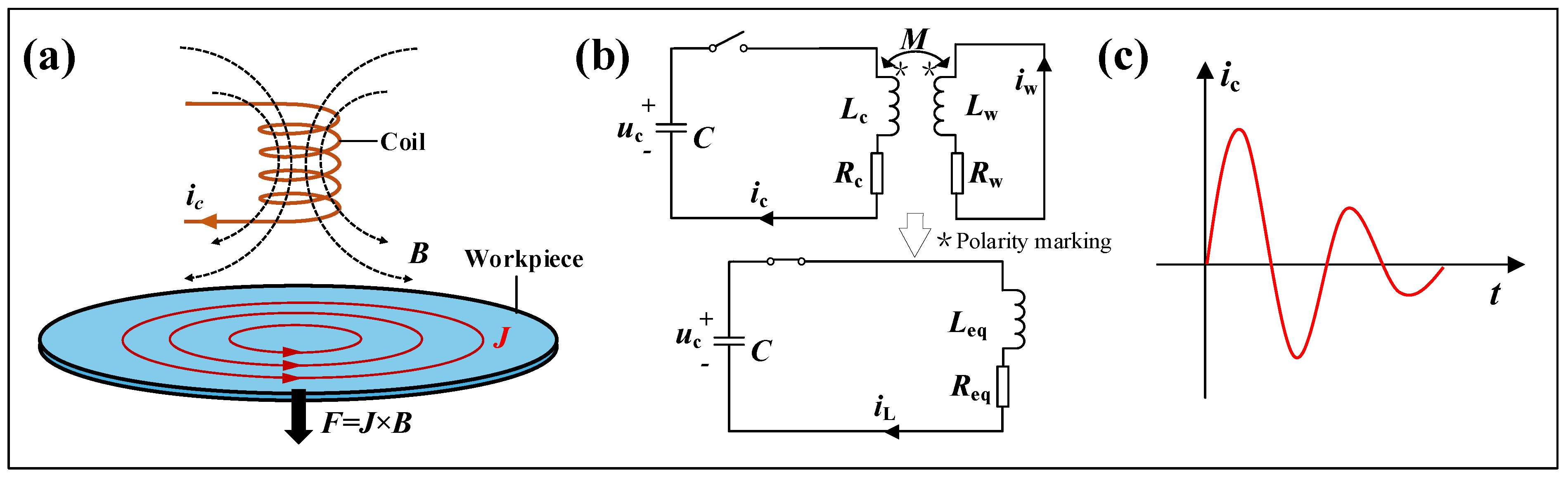
2. Principle of Electromagnetic Forming
3. Attractive Forming Using a Dual-Frequency Discharge
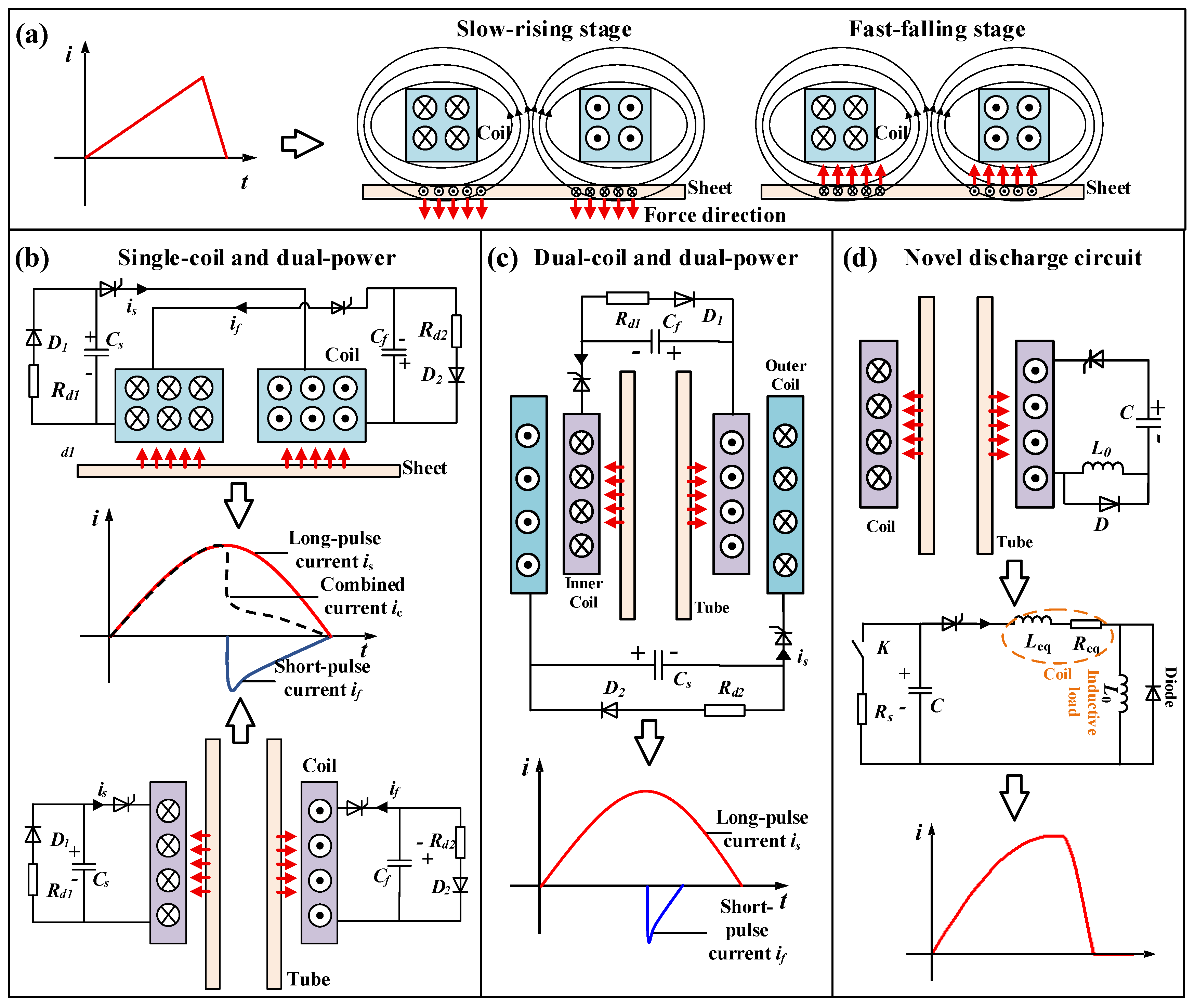
3.1. Principle for Attractive Force Generation
3.2. Dual-Frequency Current Generation by a Single-Coil and Dual-Power Configuration
3.3. Dual-Frequency Current Generation by a Dual-Coil and Dual-Power Configuration
3.4. Dual-Frequency Current Generation by a Novel Discharge Circuit
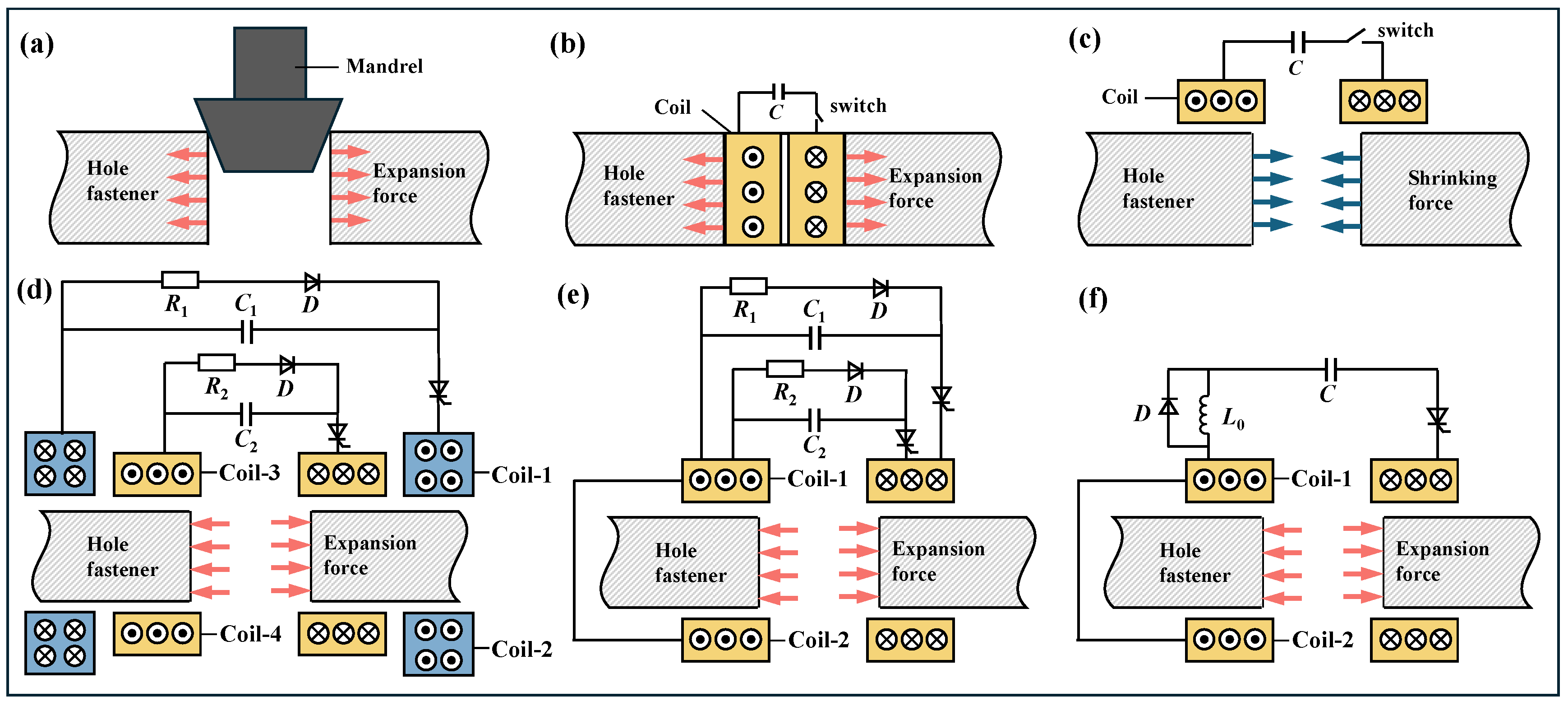
3.5. Application for Strengthening Fatigue Performance of Hole Fastener
4. Attractive Forming Using a Low-Frequency Discharge
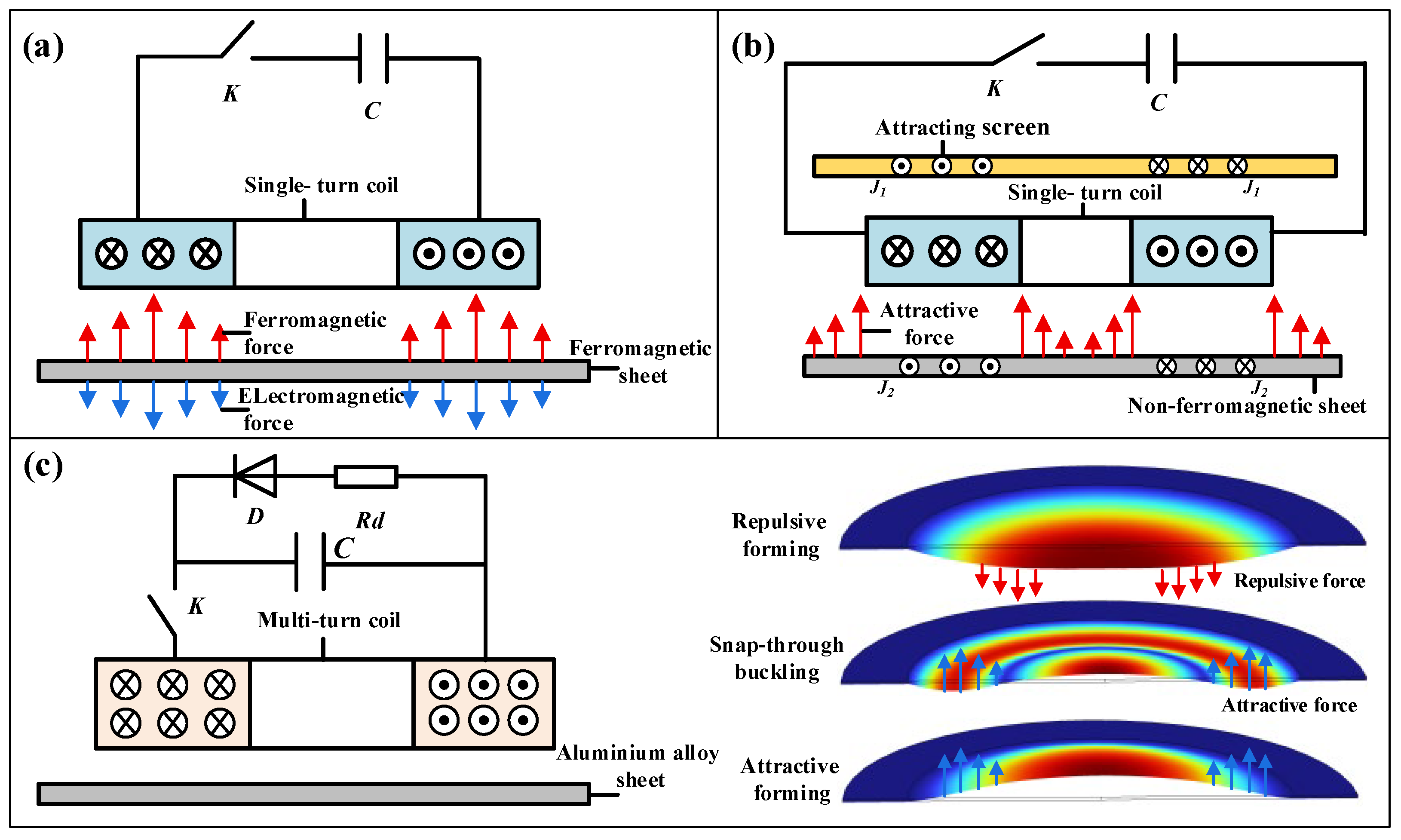
4.1. Attractive Forming for Ferromagnetic Materials Based on Ferromagnetic Effect
4.2. Attractive Forming for Non-Ferromagnetic Materials Based on Attractive Screen
4.3. Attractive Forming for Non-Ferromagnetic Materials Based on Current Phase Difference
5. Discussion on Technical Limitations
- 1.
- Dual-Frequency Discharge Method
- (1)
- Single-coil dual-power configuration: The main limitation lies in high equipment complexity—requiring two independent pulse power supplies and a precise synchronous control system, which increases system cost and implementation difficulty. Additionally, both long- and short-pulse-width currents flow through the same coil, leading to severe Joule heat accumulation and reduced coil lifespan.
- (2)
- Dual-coil dual-power configuration: Although this configuration reduces the thermal load by distributing the long- and short-pulse-width currents into separate coils, it still requires two power supplies and synchronous control, so the equipment complexity issue persists. Moreover, precise alignment and gap control between the inner and outer coils significantly affect forming results, increasing tooling difficulty.
- (3)
- Novel single-power-supply circuit: By introducing a large inductive load and a bypass diode, this circuit achieves dual-frequency current output using a single power supply, significantly simplifying the system structure. However, its main limitation is low energy efficiency—the large inductive load substantially attenuates the peak discharge current, resulting in low energy efficiency.
- 2.
- Low-Frequency Discharge Method
- (1)
- Method based on ferromagnetic effect: The primary limitation is that it is only applicable to ferromagnetic materials (such as low-carbon steel) and cannot be directly applied to lightweight materials like aluminum alloys or titanium alloys.
- (2)
- Method based on attractive screen: Whilst this method is applicable to various metallic materials, it necessitates the addition of a supplementary conductive screen, thereby increasing tooling complexity. Furthermore, the magnetic field distribution proves uneven, with the maximum magnetic force concentrated in the peripheral regions of the coil.
- (3)
- Method based on current phase difference: The attractive force magnitude is much smaller than that of the repulsive force, requiring the pre-deformation generated during the repulsive force stage to achieve effective attractive forming. Consequently, its application scenarios are considerably limited.
6. Conclusions and Future Research Directions
- (1)
- The dual-frequency discharge method has been successfully implemented through various circuit and coil configurations, including single-coil dual-power-supply sequential discharge, dual-coil dual-power-supply independent discharge, and novel single-power-supply discharge circuits. This approach effectively reverses the direction of electromagnetic force by regulating the temporal relationship between magnetic fields and eddy currents. Its technical feasibility and application versatility have been experimentally validated in applications including sheet metal forming, small-diameter tube expansion, hole fastener strengthening, and even non-destructive tube disassembly.
- (2)
- The low-frequency discharge method reveals the potential to alter the electromagnetic force by reducing the discharge current frequency. For ferromagnetic materials, their inherent magnetization effect can generate a dominant attractive force at a low frequency. For non-ferromagnetic materials, attractive forming can be achieved at low frequencies by introducing additional attractive screens or utilizing the phase difference between the coil current and the eddy currents in the workpiece. This offers new insights for expanding the material applicability of electromagnetic attractive forming technology.
- (1)
- Enhance energy efficiency. At present, electromagnetic attractive forming (especially the dual-frequency discharge method) exhibits significantly lower energy efficiency than traditional repulsive forming, coupled with complex equipment, which severely limits its engineering applicability. This issue could be partially addressed by developing new and highly efficient circuit topologies. However, a more fundamental challenge lies in achieving stable, attractive forming under high-frequency discharge without relying on low-frequency excitation or complex waveform modulation. Overcoming this hurdle would greatly enhance the processing efficiency of electromagnetic attractive forming and substantially broaden its industrial application scope.
- (2)
- Deepening fundamental mechanism research. Currently, the theoretical system of electromagnetic attractive forming remains underdeveloped, with most existing studies focusing primarily on verifying process feasibility and lacking systematic investigation into the forming mechanisms. Future efforts should be undertaken to systematically investigate the microstructural evolution of lightweight alloys under attractive versus repulsive electromagnetic pulses, with a focus on grain refinement, texture development, and defect generation. This will provide a solid scientific foundation for process optimization and engineering applications.
- (3)
- Expanding application scenarios. Beyond existing sheet and tube forming and hole fastener reinforcement, we should actively explore the unique value of electromagnetic attractive forming in additional fields, such as developing attractive force-based progressive forming or composite forming combining attractive and repulsive forming.
- (4)
- Engineering reliability and industrialization research. To bridge the gap between laboratory demonstration and industrial application, future efforts must address critical engineering challenges. These include coil durability under repeated high-current discharges, system integration and reliability under high-volume production conditions, and operational safety protocols for high-voltage pulsed power systems.
Author Contributions
Funding
Data Availability Statement
Conflicts of Interest
References
- Lyu, F.; Yu, H.; Cheng, X. Formability and Microscopic Behavior of 2219-T6 Aluminum Alloy under Electromagnetic Forming with Cryogenic Temperatures. J. Mater. Res. Technol. 2025, 37, 4466–4475. [Google Scholar] [CrossRef]
- Jin, Y.; Yu, H. Enhanced Formability and Hardness of AA2195-T6 during Electromagnetic Forming. J. Alloys Compd. 2022, 890, 161891. [Google Scholar] [CrossRef]
- Oliveira, D.A.; Worswick, M.J.; Finn, M.; Newman, D. Electromagnetic Forming of Aluminum Alloy Sheet: Free-Form and Cavity Fill Experiments and Model. J. Mater. Process. Technol. 2005, 170, 350–362. [Google Scholar] [CrossRef]
- Cui, X.; Zhang, Z.; Yu, H.; Xiao, X.; Cheng, Y. Springback Calibration of a U-Shaped Electromagnetic Impulse Forming Process. Metals 2019, 9, 603. [Google Scholar] [CrossRef]
- Deng, H.; Mao, Y.; Li, G.; Cui, J. A Study of Electromagnetic Free Forming in AA5052 Using Digital Image Correlation Method and FE Analysis. J. Manuf. Process. 2019, 37, 595–605. [Google Scholar] [CrossRef]
- Guo, K.; Lei, X.; Zhan, M.; Tan, J. Electromagnetic Incremental Forming of Integral Panel under Different Discharge Conditions. J. Manuf. Process. 2017, 28, 373–382. [Google Scholar] [CrossRef]
- Xiao, A.; Yan, Z.; Huang, C.; Wang, S.; Long, Z.; Cui, X. Effect of Initial State on Formability of AA1060 Alloy under Quasi-Static and Electromagnetic Forming. J. Mater. Res. Technol. 2022, 19, 2781–2793. [Google Scholar] [CrossRef]
- Jiang, Y.; Chen, Y.; Guo, Z.; Dan, J.; Liu, M. Effect of Strain Rate on Ductility of Cu TU1 in Electromagnetic Ring Expansion. Int. J. Impact Eng. 2024, 184, 104832. [Google Scholar] [CrossRef]
- Liu, W.; Wu, J.; Li, J.; Meng, Z.; Lin, Y.; Huang, S. Electromagnetic Forming Limit Diagram of AA5182-O Aluminum Alloy Sheet: Marciniak–Kuczynski Model, Simulation and Experiment. Int. J. Mater. Form. 2022, 15, 74. [Google Scholar] [CrossRef]
- Iriondo, E.; Gutiérrez, M.A.; González, B.; Alcaraz, J.L.; Daehn, G.S. Electromagnetic Impulse Calibration of High Strength Sheet Metal Structures. J. Mater. Process. Technol. 2011, 211, 909–915. [Google Scholar] [CrossRef]
- Ghaffari, H. Improvement of Electromagnetic Calibration of Springback in Bent Sheet Metals Using a Novel Tool Coil. J. Manuf. Process. 2024, 117, 111–124. [Google Scholar] [CrossRef]
- Iriondo, E.; Alcaraz, J.L.; Daehn, G.S.; Gutiérrez, M.A.; Jimbert, P. Shape Calibration of High Strength Metal Sheets by Electromagnetic Forming. J. Manuf. Process. 2013, 15, 183–193. [Google Scholar] [CrossRef]
- Li, J.; Qiu, W.; Huang, L.; Su, H.; Tao, H.; Li, P. Gradient Electromagnetic Forming (GEMF): A New Forming Approach for Variable-Diameter Tubes by Use of Sectional Coil. Int. J. Mach. Tools Manuf. 2018, 135, 65–77. [Google Scholar] [CrossRef]
- Deng, F.; Xu, X.; Wang, Y.; Yu, Z.; Jiang, C. Investigation of the Effect of Coil Current Waveform on Electromagnetic Tube Forming. Metals 2025, 15, 367. [Google Scholar] [CrossRef]
- Nassiri, A.; Zhang, S.; Kinsey, B. An Accelerated Analytical Method for Predicting Workpiece Velocity and Displacement during Electromagnetic Forming. J. Manuf. Process. 2022, 82, 64–77. [Google Scholar] [CrossRef]
- Yu, H.; Li, C.; Deng, J. Sequential Coupling Simulation for Electromagnetic–Mechanical Tube Compression by Finite Element Analysis. J. Mater. Process. Technol. 2009, 209, 707–713. [Google Scholar] [CrossRef]
- Cao, Q.; Han, X.; Lai, Z.; Xiong, Q.; Zhang, X.; Chen, Q.; Xiao, H.; Li, L. Analysis and Reduction of Coil Temperature Rise in Electromagnetic Forming. J. Mater. Process. Technol. 2015, 225, 185–194. [Google Scholar] [CrossRef]
- Cui, X.; Mo, J.; Li, J.; Huang, L.; Zhu, Y.; Li, Z.W.; Zhong, K. Effect of Second Current Pulse and Different Algorithms on Simulation Accuracy for Electromagnetic Sheet Forming. Int. J. Adv. Manuf. Technol. 2013, 68, 1137–1146. [Google Scholar] [CrossRef]
- Fang, J.; Mo, J.; Cui, X.; Li, J.; Zhou, B. Electromagnetic Pulse-Assisted Incremental Drawing of Aluminum Cylindrical Cup. J. Mater. Process. Technol. 2016, 238, 395–408. [Google Scholar] [CrossRef]
- Duan, L.; Jiang, H.; Zhang, X.; Li, G.; Cui, J. Experimental Investigations of Electromagnetic Punching Process in CFRP Laminate. Mater. Manuf. Process. 2021, 36, 223–234. [Google Scholar] [CrossRef]
- Yu, H.; Chen, J.; Liu, W.; Yin, H.; Li, C. Electromagnetic Forming of Aluminum Circular Tubes into Square Tubes: Experiment and Numerical Simulation. J. Manuf. Process. 2018, 31, 613–623. [Google Scholar] [CrossRef]
- Zhu, X.; Xu, X.; Zhang, W.; Du, L.; Shao, Z.; Lai, Z.; Han, X.; Li, L.; Cao, Q.; Ouyang, S. Electromagnetic Shielding Forming: A Facile Approach for Lorentz Force Regulation and Its Application in Tube Forming. J. Mater. Process. Technol. 2025, 338, 118795. [Google Scholar] [CrossRef]
- Soni, M.; Ahmed, M.; Panthi, S.K.; Kumar, S. Effect of Coil Design Parameters on Performance of Electromagnetic Forming Process. Mater. Manuf. Process. 2022, 37, 64–80. [Google Scholar] [CrossRef]
- Shrivastava, A.; Telang, A.; Jha, A.K.; Ahmed, M. Experimental and Numerical Study on the Influence of Process Parameters in Electromagnetic Compression of AA6061 Tube. Mater. Manuf. Process. 2019, 34, 1537–1548. [Google Scholar] [CrossRef]
- Geier, M.; Paese, E.; Rossi, R.; Rosa, P.A.R.; Homrich, R.P. Experimental Analysis of Interference-Fit Joining of Aluminum Tubes by Electromagnetic Forming. IEEE Trans. Appl. Supercond. 2020, 30, 1–6. [Google Scholar] [CrossRef]
- Raoelison, R.N.; Buiron, N.; Rachik, M.; Haye, D.; Franz, G. Efficient Welding Conditions in Magnetic Pulse Welding Process. J. Manuf. Process. 2012, 14, 372–377. [Google Scholar] [CrossRef]
- Yu, H.; Ma, B.; He, Y.; Qi, Y. Deformation Behavior and Connection Mechanism of EMP Connections in Aluminum Pipe Joints. Metals 2022, 12, 1892. [Google Scholar] [CrossRef]
- Psyk, V.; Risch, D.; Kinsey, B.L.; Tekkaya, A.E.; Kleiner, M. Electromagnetic Forming—A Review. J. Mater. Process. Technol. 2011, 211, 787–829. [Google Scholar] [CrossRef]
- Park, H.; Kim, D.; Lee, J.; Kim, S.-J.; Lee, Y.; Moon, Y.H. Effect of an Aluminum Driver Sheet on the Electromagnetic Forming of DP780 Steel Sheet. J. Mater. Process. Technol. 2016, 235, 158–170. [Google Scholar] [CrossRef]
- Cui, X.H.; Mo, J.H.; Li, J.J.; Zhao, J.; Zhu, Y.; Huang, L.; Li, Z.W.; Zhong, K. Electromagnetic Incremental Forming (EMIF): A Novel Aluminum Alloy Sheet and Tube Forming Technology. J. Mater. Process. Technol. 2014, 214, 409–427. [Google Scholar] [CrossRef]
- Qiu, L.; Yu, Y.; Xiong, Q.; Deng, C.; Cao, Q.; Han, X.; Li, L. Analysis of Electromagnetic Force and Deformation Behavior in Electromagnetic Tube Expansion With Concave Coil Based on Finite Element Method. IEEE Trans. Appl. Supercond. 2018, 28, 1–5. [Google Scholar] [CrossRef]
- Cao, Q.; Xia, L.; Li, X.; Du, L.; Lai, Z.; Han, X.; Li, L. The Importance of Coil Conductivity and Eddy Current Effects in the Analysis of Electromagnetic Forming Process. High Volt. 2022, 7, 390–404. [Google Scholar] [CrossRef]
- Qiu, L.; Wang, C.; Abu-Siada, A.; Xiong, Q.; Zhang, W.; Wang, B.; Yi, N.; Li, Y.; Cao, Q. Coil Temperature Rise and Workpiece Forming Efficiency of Electromagnetic Forming Based on Half-Wave Current Method. IEEE Access 2020, 8, 9371–9379. [Google Scholar] [CrossRef]
- Ouyang, S.; Zhang, W.; Du, L.; Li, C.; Zhu, X.; Li, X.; Lai, Z.; Han, X.; Cao, Q.; Li, L. Enhancing Forming Accuracy in Aluminum Alloy Variable-Diameter Tubes through Dual-Coil Controllable Electromagnetic Forming. J. Manuf. Process. 2023, 108, 126–140. [Google Scholar] [CrossRef]
- Furth, H.P. Devices for Metal Forming by Magnetic Tension. US Patent 3,196,649, 27 July 1965. [Google Scholar]
- Deng, J.; Li, C.; Zhao, Z.; Tu, F.; Yu, H. Numerical Simulation of Magnetic Flux and Force in Electromagnetic Forming with Attractive Force. J. Mater. Process. Technol. 2007, 184, 190–194. [Google Scholar] [CrossRef]
- Cao, Q.; Lai, Z.; Xiong, Q.; Chen, Q.; Ding, T.; Han, X.; Li, L. Electromagnetic Attractive Forming of Sheet Metals by Means of a Dual-Frequency Discharge Current: Design and Implementation. Int. J. Adv. Manuf. Technol. 2017, 90, 309–316. [Google Scholar] [CrossRef]
- Xiong, Q.; Tang, H.; Wang, M.; Huang, H.; Qiu, L.; Yu, K.; Chen, Q. Design and implementation of tube bulging by an attractive electromagnetic force. J. Mater. Process. Technol. 2019, 273, 116240. [Google Scholar] [CrossRef]
- Xiong, Q.; Tang, H.; Deng, C.; Li, L.; Qiu, L. Electromagnetic Attraction-Based Bulge Forming in Small Tubes: Fundamentals and Simulations. IEEE Trans. Appl. Supercond. 2018, 28, 1–5. [Google Scholar] [CrossRef]
- Xiong, Q.; Huang, H.; Xia, L.; Tang, H.; Qiu, L. A Research Based on Advance Dual-Coil Electromagnetic Forming Method on Flanging of Small-Size Tubes. Int. J. Adv. Manuf. Technol. 2019, 102, 4087–4094. [Google Scholar] [CrossRef]
- Ouyang, S.; Li, X.; Li, C.; Du, L.; Peng, T.; Han, X.; Li, L.; Lai, Z.; Cao, Q. Investigation of the Electromagnetic Attractive Forming Utilizing a Dual-Coil System for Tube Bulging. J. Manuf. Process. 2020, 49, 102–115. [Google Scholar] [CrossRef]
- Ouyang, S.; Du, L.; Li, C.; Li, X.; Wu, Z.; Lai, Z.; Han, X.; Cao, Q.; Li, L. Electromagnetic Attractive Forming of Aluminum Alloy Tubes Utilizing a Dual-Frequency Current: New Circuit Design and Forming Process Analysis. J. Mater. Process. Technol. 2023, 318, 118006. [Google Scholar] [CrossRef]
- Tang, K.; Zhang, X.; Wu, D.; Dong, D.; Deng, H.; Cui, J. An Experimental and Theoretical Investigation on Residual Stress of 7075-T651 Aluminum Alloy Hole under Electromagnetic Cold Expansion. Eng. Fail. Anal. 2024, 165, 108793. [Google Scholar] [CrossRef]
- Fu, Y.; Ge, E.; Su, H.; Xu, J.; Li, R. Cold Expansion Technology of Connection Holes in Aircraft Structures: A Review and Prospect. Chin. J. Aeronaut. 2015, 28, 961–973. [Google Scholar] [CrossRef]
- Wang, J.; Lei, X.; Zeng, F.; Li, W.; He, C.; Cheng, L.; Zhang, X. Design of a Novel Cold Expansion Tool for Deep Small Holes Based on FEM Simulations and Experimental Study. Int. J. Adv. Manuf. Technol. 2024, 130, 4933–4949. [Google Scholar] [CrossRef]
- Faghih, S.; Behravesh, S.B.; Kumar Shaha, S.; Jahed, H. Effect of Split Sleeve Cold Expansion on Fatigue and Fracture of Rolled AZ31B Magnesium Alloy. Theor. Appl. Fract. Mech. 2023, 123, 103715. [Google Scholar] [CrossRef]
- Baltach, A.; Djebli, A.; Bendouba, M.; Besseghier, E.H.; Aid, A. Numerical Analysis and Optimization of the Residual Stresses Distribution Induced by Cold Expansion Technique. Frat. Integrità Strutt. 2018, 12, 252–265. [Google Scholar] [CrossRef]
- Amjad, K.; Wang, W.C.; Patterson, E. A Comparison of Split Sleeve Cold Expansion in Thick and Thin Plates. J. Strain Anal. Eng. Des. 2016, 51, 375–386. [Google Scholar] [CrossRef]
- Dalle Donne, C.; Karch, C.; Steinwandel, J.; Wulbrand, W. Method and Device for Surface-Layer Strengthening of Bores by Means of Magnetic Fields and Bore Arrangement with Surface-Layer Strengthened Bores. Patent WO 2009065486, 28 May 2009. [Google Scholar]
- Zhou, Z.; Fu, J.; Cao, Q.; Lai, Z.; Xiong, Q.; Han, X.; Li, L. Electromagnetic Cold-Expansion Process for Circular Holes in Aluminum Alloy Sheets. J. Mater. Process. Technol. 2017, 248, 49–55. [Google Scholar] [CrossRef]
- Xu, X.; Geng, H.; Ouyang, S.; Li, C.; Cao, Q.; Ouyang, X.; Li, L. Improvement in Fatigue Performance of Thin Fasteners via Electromagnetic Strengthening Process. Int. J. Fatigue 2022, 162, 106991. [Google Scholar] [CrossRef]
- Xu, X.; Geng, H.; Cao, Q.; Cao, Q.; Li, L.; Ouyang, X. Numerical Investigation on the Effects of Circuit Parameters on the Plastic Deformation of Fastener Holes in Thin Aluminum Alloy via Electromagnetic Expansion Process. Int. J. Adv. Manuf. Technol. 2021, 117, 795–807. [Google Scholar] [CrossRef]
- Geng, H.; Xu, X.; Cao, Q.; Lai, Z.; Li, L. Improving the Fatigue Performance of AZ31 Sheet with Hole via Electromagnetic Cold Expansion Process. Int. J. Adv. Manuf. Technol. 2022, 120, 5057–5071. [Google Scholar] [CrossRef]
- Geng, H.; Xu, X.; Lai, Z.; Cao, Q.; Li, L. A Novel Non-Contacting Single-Coil Electromagnetic Hole Expansion Process to Improve the Fatigue Performance of Hole Component. Int. J. Fatigue 2022, 162, 106924. [Google Scholar] [CrossRef]
- Ouyang, L.; Chen, X.; Zhao, Q.; Zhang, C.; Wang, J.; Xu, X.; Geng, H.; Ouyang, S.; Li, C. Improving the Fatigue Life of Thin Plates with Small-Spacing Adjacent Double Holes with Electromagnetic Process. Eng. Fract. Mech. 2025, 320, 111056. [Google Scholar] [CrossRef]
- Ouyang, S.; Xu, X.; Geng, H.; Du, L.; Li, C.; Zhang, W.; Zhu, X.; Han, X.; Cao, Q.; Li, L. Enhancing Fatigue Performance of AA6063-T6 Fasteners through Novel Electromagnetic Cold Expansion Using a Double-Frequency Discharge. Eng. Fract. Mech. 2024, 310, 110509. [Google Scholar] [CrossRef]
- Batygin, Y.; Lavinsky, V.; Khimenko, L. Direction Change of the Force Action upon Con- Ductor under Frequency Variation of the Acting Magnetic Field. In Proceedings of the 1st International Conference on High Speed Forming, Dortmund, Germany, 31 March–1 April 2004; pp. 139–144. [Google Scholar]
- Batygin, Y.; Golovashchenko, S.; Gnatov, A. Pulsed Electromagnetic Attraction of Sheet Metals—Fundamentals and Perspective Applications. J. Mater. Process. Technol. 2013, 213, 444–452. [Google Scholar] [CrossRef]
- Batygin, Y.; Golovashchenko, S.; Gnatov, A. Pulsed Electromagnetic Attraction of Nonmagnetic Sheet Metals. J. Mater. Process. Technol. 2014, 214, 390–401. [Google Scholar] [CrossRef]
- Batygin, Y. Experimental Test of the Tool for the External EMF Removing Dents on a Car Body. IJEPE 2014, 3, 204. [Google Scholar] [CrossRef][Green Version]
- Ouyang, S.; Li, C.; Du, L.; Li, X.; Lai, Z.; Peng, T.; Han, X.; Cao, Q.; Li, L. Electromagnetic Forming of Aluminum Alloy Sheet Metal Utilizing a Low-Frequency Discharge: A New Method for Attractive Forming. J. Mater. Process. Technol. 2021, 291, 117001. [Google Scholar] [CrossRef]
- Ouyang, S.; Du, L.; Cao, Q.; Li, L. Electromagnetic Attractive Forming of Aluminum Alloy Sheets Utilizing a Low-Frequency Half-Wave Current. Mater. Manuf. Process. 2022, 37, 55–63. [Google Scholar] [CrossRef]
- Lai, Z.; Cao, Q.; Zhang, B.; Han, X.; Zhou, Z.; Xiong, Q.; Zhang, X.; Chen, Q.; Li, L. Radial Lorentz Force Augmented Deep Drawing for Large Drawing Ratio Using a Novel Dual-Coil Electromagnetic Forming System. J. Mater. Process. Technol. 2015, 222, 13–20. [Google Scholar] [CrossRef]



| Method | Material | Thickness | Deformation | Energy | Reference |
|---|---|---|---|---|---|
| Dual-frequency discharge | AA1060-H28 | 1 mm | 4.7 mm | 103 kJ | [37] |
| AA1060-O | 1 mm | 1.67 mm | 140 kJ | [38] | |
| AA6061-O | 1 mm | 4.75 mm | 46 kJ | [41] | |
| AA6061-O | 1 mm | 2 mm | 92 kJ | [42] | |
| Low-frequency discharge | AA1060-H24 | 1 mm | 8 mm | 25 kJ | [61] |
| AA1060-H24 | 1 mm | 10 mm | 25 kJ | [62] |
Disclaimer/Publisher’s Note: The statements, opinions and data contained in all publications are solely those of the individual author(s) and contributor(s) and not of MDPI and/or the editor(s). MDPI and/or the editor(s) disclaim responsibility for any injury to people or property resulting from any ideas, methods, instructions or products referred to in the content. |
© 2026 by the authors. Licensee MDPI, Basel, Switzerland. This article is an open access article distributed under the terms and conditions of the Creative Commons Attribution (CC BY) license.
Share and Cite
Jiang, C.; Ouyang, S.; Geng, H.; Li, C. A Short Review of Electromagnetic Attractive Forming and Its Applications. Metals 2026, 16, 268. https://doi.org/10.3390/met16030268
Jiang C, Ouyang S, Geng H, Li C. A Short Review of Electromagnetic Attractive Forming and Its Applications. Metals. 2026; 16(3):268. https://doi.org/10.3390/met16030268
Chicago/Turabian StyleJiang, Can, Shaowei Ouyang, Huihui Geng, and Changxing Li. 2026. "A Short Review of Electromagnetic Attractive Forming and Its Applications" Metals 16, no. 3: 268. https://doi.org/10.3390/met16030268
APA StyleJiang, C., Ouyang, S., Geng, H., & Li, C. (2026). A Short Review of Electromagnetic Attractive Forming and Its Applications. Metals, 16(3), 268. https://doi.org/10.3390/met16030268