Article

Structure and Mechanical Properties of Laves Phase Al0.5Nb0.5TiV2Zrx (x = 0–2) Refractory High-Entropy Alloys

1
School of Mechanical and Electrical Engineering, Shenzhen Polytechnic University, Shenzhen 518055, China
2
State Key Laboratory of Precision Electronic Manufacturing Technology and Equipment, School of Electromechanical Engineering, Guangdong University of Technology, Guangzhou 510006, China
*
Author to whom correspondence should be addressed.
Metals 2026, 16(3), 255; https://doi.org/10.3390/met16030255
Submission received: 20 January 2026 / Revised: 20 February 2026 / Accepted: 23 February 2026 / Published: 26 February 2026

Abstract

Refractory high-entropy alloys (RHEAs) have garnered attention for their exceptional high-temperature mechanical properties, making them suitable for aerospace and energy applications. However, balancing strength and ductility remains a challenge due to the presence of Laves phases. In this study, Al0.5Nb0.5TiV2Zrx (x = 0–2.0) alloys were prepared using vacuum arc melting, and their microstructural evolution and mechanical properties were analyzed. At room temperature, the Al0.5Nb0.5TiV2Zr0.5 alloy exhibits the highest yield strength (1658.1 MPa), which is primarily attributed to strong lattice distortion induced by Zr and moderate precipitation strengthening from Laves phases. In contrast, at higher Zr contents, excessive Laves phase precipitation promotes stress concentration, leading to a marked reduction in both strength and ductility. High-temperature compression tests revealed that the Al0.5Nb0.5TiV2Zr0.5 and Al0.5Nb0.5TiV2Zr1.5 alloys still exhibited over 50% compressive plasticity at 800 °C and 1000 °C. However, when the temperature reached 1000 °C, the instability of the Laves phase led to a reduction in the yield strength to below 160 MPa, indicating that the effect of solid-solution strengthening was no longer significant under high-temperature conditions. These findings clarify the critical role of Zr content and temperature in governing the microstructural and mechanical evolution of the Al–Nb–Ti–V–Zr system and provide a theoretical basis for achieving an optimized strength–ductility balance in RHEAs through compositional control.

1. Introduction

High-entropy alloys (HEAs) have attracted significant interest in recent years due to their unique composition and ability to form stable solid solution phases with simple structures, such as face-centered cubic (FCC) or body-centered cubic (BCC), over a wide temperature range [1,2,3]. These alloys exhibit excellent mechanical properties, including high strength, hardness, and wear resistance, making them promising candidates for applications in extreme environments, such as aerospace, nuclear reactors, and high-temperature turbines [4,5].
A subset of HEAs, refractory high-entropy alloys (RHEAs), incorporates high-melting-point elements such as W, Nb, Mo, Zr, Ta, Hf, V, Cr, and Ti. These alloys are specifically designed for use in harsh environments characterized by extremely high temperatures, intense mechanical loads, and aggressive oxidation or corrosion conditions [6,7]. RHEAs exhibit exceptional high-temperature properties, including superior strength retention, oxidation resistance, and creep resistance, which make them ideal candidates for high-temperature structural applications [8,9,10].
While many HEAs form single-phase solid solutions, secondary-phase-containing HEAs have also been extensively studied due to their potential to further enhance mechanical properties [11]. For instance, CoCrFeNiMn HEA exhibits a B2 phase in an FCC matrix, contributing to improved mechanical strength [5]. However, HEAs containing intermetallic phases, particularly Laves phases, receive comparatively limited attention because the effects of Laves phases on alloy properties are strongly temperature dependent. In binary alloys, Laves phases typically exhibit low room-temperature ductility and are widely regarded as brittle [12]. In contrast, in HEA systems, the presence of Laves phases is often associated with improved high-temperature strength and creep resistance [13,14,15,16].
Among RHEAs, Al-Nb-Ti-V-Zr system alloys have emerged as promising candidates for high-temperature applications, particularly in the aerospace industry, due to their combination of high strength, low density, and excellent high-temperature mechanical properties [17,18]. For instance, Qian et al. reported that the Al2NbTi3V2Zr0.4 alloy was fabricated by mechanical alloying and vacuum hot pressing. The content of the Laves phase in the alloy was 13.9%, the yield strength was 1742 MPa, the fracture strength was 2420 MPa, and the compressive strain was 38.2% [17]. In addition, Wang et al. investigated Al0.5Nb0.5TiV2Zrx (x = 0.5, 1.0, 1.5) alloys prepared via vacuum arc melting. They found that the Zr0.5 alloy exhibited a high yield strength of 1390 MPa at room temperature, although its plasticity was limited. However, at 800 °C, this alloy achieved a remarkable 50% plastic deformation without fracture, demonstrating its potential for high-temperature applications [19]. Overall, the Al–Nb–Ti–V–Zr system combines low density, high strength, and stable high-temperature mechanical performance, making it a promising lightweight, high-performance material for high-temperature applications.
Despite these promising findings, the influence of secondary phases, particularly Laves phases, on the mechanical properties of Al-Nb-Ti-V-Zr alloys remains unclear, especially under varying Zr contents and at high temperatures. Understanding the microstructural evolution and phase stability, as well as their relationship with mechanical properties, is essential for optimizing the performance of these alloys. This study aims to address these gaps by systematically investigating the effects of Zr content on the phase composition, microstructure, and mechanical properties of Al0.5Nb0.5TiV2Zrx (x = 0, 0.5, 1.0, 1.5, 2.0) alloys. The results provide new insights into the role of Laves phases in RHEAs and contribute to the design of high-temperature structural materials.

2. Materials and Methods

RHEAs with the nominal composition Al0.5Nb0.5TiV2Zrx (x = 0, 0.5, 1.0, 1.5, 2.0) are prepared by vacuum arc melting (DHL-400, Sky Technology Development Co., Shenyang, China) under an argon atmosphere on a water-cooled copper crucible. Before alloy preparation, high-purity titanium particles are initially melted to verify the airtightness of the furnace. The elemental purities of Al, Nb, Ti, V, and Zr exceed 99.99 wt.%. To compensate for Al evaporation during melting, approximately 10 wt.% excess Al is added to each batch before arc melting. Each alloy ingot is melted twice and subjected to magnetic stirring 3–5 times to ensure the uniform distribution of elements. For clarity in analysis and discussion, the five alloys are designated as Zr0, Zr0.5, Zr1.0, Zr1.5, and Zr2.0, corresponding to the value of x in Al0.5Nb0.5TiV2Zrx (x = 0–2.0).
An XEmpyrean with Cu-Kα diffraction is used to collect XRD (X-ray diffractometer, Bruker D8 Advance, Karlsruhe, Germany) at 40 kV and 40 mA. The scan rate of the XRD device is 2°/min, the step size is 0.02°, and the 2θ diffraction angle is 20–90°. The microstructure of the alloys is observed by SEM (scanning electron microscope, Tescan Mira4, Brno, Czech Republic), equipped with an EDS (energy dispersive spectroscopy, Tescan Mira4, Brno, Czech Republic) detector for analyzing the chemical composition and element distribution in the alloys. The volume fraction of different phases is measured using Image-J 1.54 Analysis Software on SEM-BSE images. To further observe the microstructure of the alloys, samples are prepared into 100 μm foils by mechanical thinning and ion thinning for TEM (transmission electron microscope, Thermo Scientific, Waltham, MA, USA) analysis. TEM investigations are performed using a FEI Talos F200X apparatus equipped with an EDS detector at an accelerating voltage of 200 kV.
The density of the Al0.5Nb0.5TiV2Zrx alloys is measured using the standard Archimedes method. Each specimen is measured six times and reported as the mean, with surface cleaning and bubble removal performed, and no additional correction for surface-connected porosity applied. Isothermal compression of rectangular specimens measured 5 × 5 × 8 mm3 is performed at 22 °C, 800 °C, and 1000 °C using a Zwick Z250 test machine (Zwick Roell, Ulm, Germany) equipped with a radial furnace. Before heating the specimens, a vacuum pump evacuates the chamber, which is then filled with high-purity argon to prevent severe oxidation during high-temperature deformation. The specimens are heated from room temperature to the specified deformation temperature at a rate of 10 °C s−1 and held at the target temperature for 3 min. The temperature of the specimens is monitored by a thermocouple (Omega Engineering, Norwalk, CT, USA) attached to the side of the specimen. The initial strain rate is 1 × 10⁻³ s−1. Three specimens of each alloy are tested at different temperatures to obtain representative stress–strain curves.

3. Results

3.1. Microstructure of the Al0.5Nb0.5TiV2Zrx (x = 0, 0.5, 1.0, 1.5, 2.0) Alloys

Due to variations in elemental composition, the phase constitution of HEAs within the same system can differ. Influenced by mixing entropy ( S m i x ) and mixing enthalpy ( H m i x ), HEAs may form not only solid solution phases but also intermetallic compounds. Previous studies have shown that HEAs with single solid solution phases often fail to meet the performance requirements for structural materials due to insufficient strength [20,21,22]. Therefore, predicting the phase constitution of Al0.5Nb0.5TiV2Zrx alloys is of critical importance. The phase composition can be predicted using the following equation, which considers the effects of mixing enthalpy, mixing entropy, and atomic size mismatch on the formation of solid solution phases:
H m i x = i = 1 , i j n 4 c i c j H i j m i x
S m i x = R n = 1 n c i l n c i
T m = i = 1 n c i ( T m ) i
Ω = T m S m i x H m i x
δ = i = 1 n c i 1 r i / i = 1 n c i r i 2
where H m i x and S m i x are the mixing enthalpy and mixing entropy of the alloy, respectively. Δ H i j m i x is the enthalpy of binary mixing of the i th and j th components, ci is the molar percentage of the i th component, R is the gas constant 8.314 J/(mol·K), T m i is the melting point of the i th component, and r i is the atomic radius of the i th component.
The calculated parameters of the Al0.5Nb0.5TiV2Zrx RHEAs are presented in Table 1. Relevant studies indicate that the alloy tends to form a stable solid solution phase when −20 < H m i x > 5 kJ/mol, Ω ≥ 1.1, and δ ≤ 6.6% [23]. When Zr is absent from the alloy, the values of H m i x , Ω , and δ meet these criteria, resulting in a single solid solution phase. However, when the molar fraction of Zr exceeds 0, the δ values of the other alloys are greater than 6.6%, making the alloy more likely to form secondary phases. This is due to the highly negative binary H m i x of Al and Zr ( H m i x = −44 kJ/mol) and the significantly larger atomic radius of Zr compared to the other components, which makes it difficult for Zr to dissolve in the alloy matrix. Simultaneously, the values of Ω and δ rise along with the augmentation of Zr content. It is rational to presume that the intermetallic compounds of the alloy increase in accordance with the growth of Zr content.
As the Zr content increases from 0 to 2.0, the XRD patterns (Figure 1) indicate a transition from a single BCC phase to a multiphase microstructure comprising BCC, C14 Laves, and C15 Laves phases. The Zr0 alloy exhibits only BCC reflections. In the Zr0.5 and Zr1.0 alloys, BCC and C14 Laves phases coexist, and the C14 peak intensity increases with increasing Zr content. For Zr1.5, the BCC reflections weaken markedly, and peaks attributable to the C15 Laves phase emerge, indicating the formation of an additional Laves structure. At Zr2.0, the BCC phase is nearly absent, while C14 persists, and C15 peaks become more prominent. These results are consistent with the phase prediction that Laves phase fraction increases with Zr addition. Overall, Zr addition is shown to stabilize Laves phases and to promote a progressive shift from C14-dominated to C15-enhanced phase constitution.
Notably, the identification of the C14 and C15 Laves phases is subject to uncertainty, as the marked peaks exhibit low intensity and may correspond to overlapping BCC peaks. This underscores the inherent limitations of XRD in resolving low-intensity peaks, particularly in complex multi-phase systems. To address this, SEM and TEM analyses are planned to provide more precise structural and phase characterization.
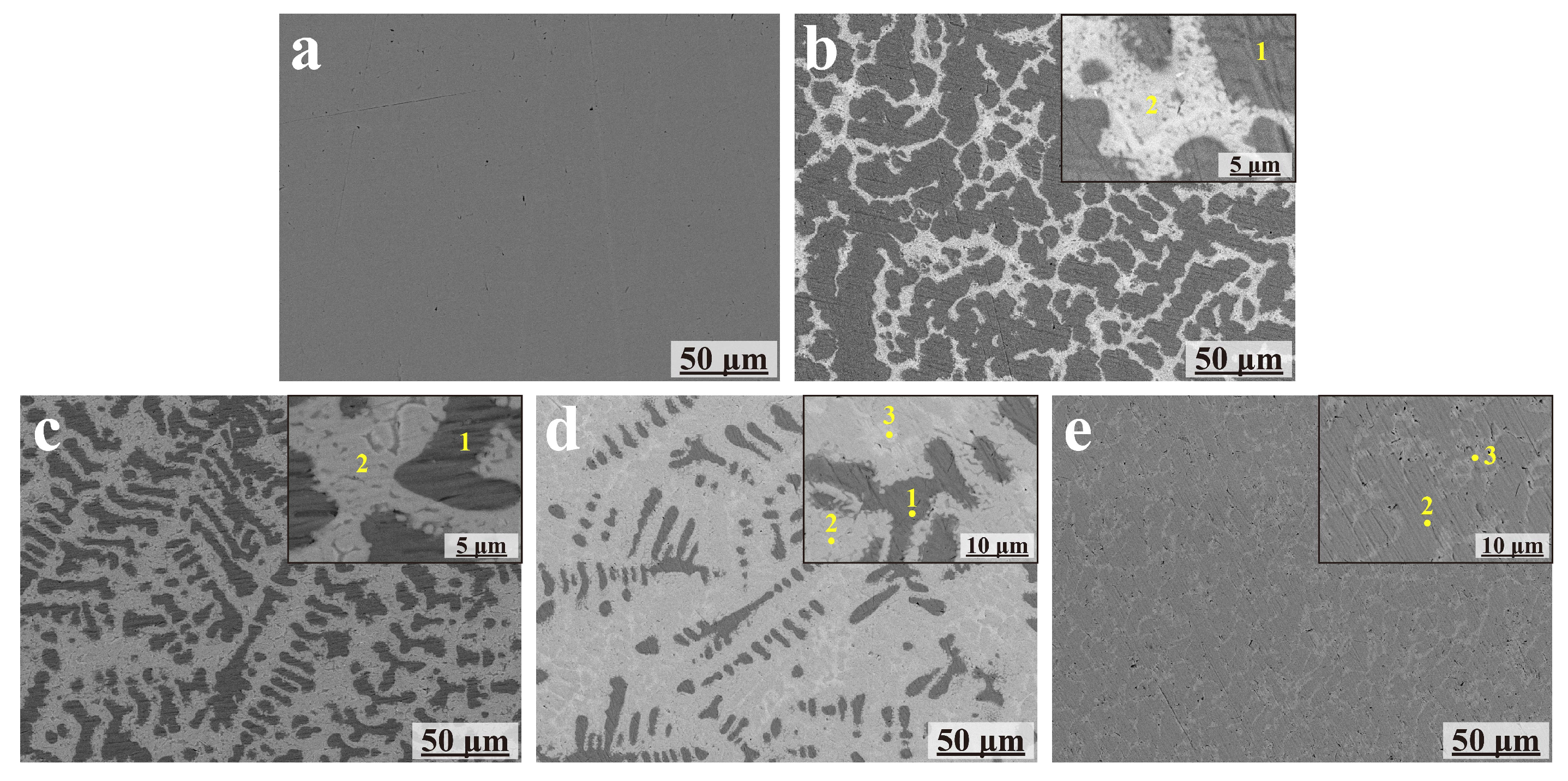
Based on the XRD results and SEM images (Figure 2), along with the chemical composition and phase volume fractions presented in Table 2, it can be observed that as the Zr content increases from Zr0 to Zr2.0, the volume fraction of the dark gray BCC matrix phase decreases, while the light gray C14 Laves phase and the white C15 Laves phase gradually increase. In the Zr0 alloy, Figure 2a shows a uniform dark gray region, indicating the presence of only the single-phase BCC structure. In the Zr0.5 alloy, a light gray second phase (C14 Laves phase, labeled as 2 in Figure 2b) appears in the BCC matrix, with a volume fraction of 25.8%. This second phase is rich in Zr and Al (Table 2). In the Zr1.0 alloy, the volume fraction of the BCC phase decreases to 44.3%, while the C14 Laves phase increases to 55.7%.
In the Zr1.5 and Zr2.0 alloys, the proportion of the BCC phase further decreases, while the proportions of the C14 and C15 Laves phases significantly increase. The Zr1.5 alloy consists of the BCC phase (labeled as 1 in Figure 2d), a Zr- and Al-rich C14 Laves phase (labeled as 2 in Figure 2d), and a Zr- and Ti-rich C15 Laves phase (labeled as 3 in Figure 2d). The increase in Zr content reduces the volume fraction of the BCC phase to 18.7%, while the volume fractions of the C14 Laves and C15 Laves phases rise to 74.0% and 7.3%, respectively (Table 2). However, in the Zr2.0 alloy, the BCC phase is almost entirely absent. The sample is mainly composed of 55.5% C14 Laves phase and 44.5% C15 Laves phase (Table 2). This indicates that the addition of Zr promotes the formation of Laves phases, and as the Zr content increases, the proportion of Laves phases increases, consistent with the phase prediction hypothesis.
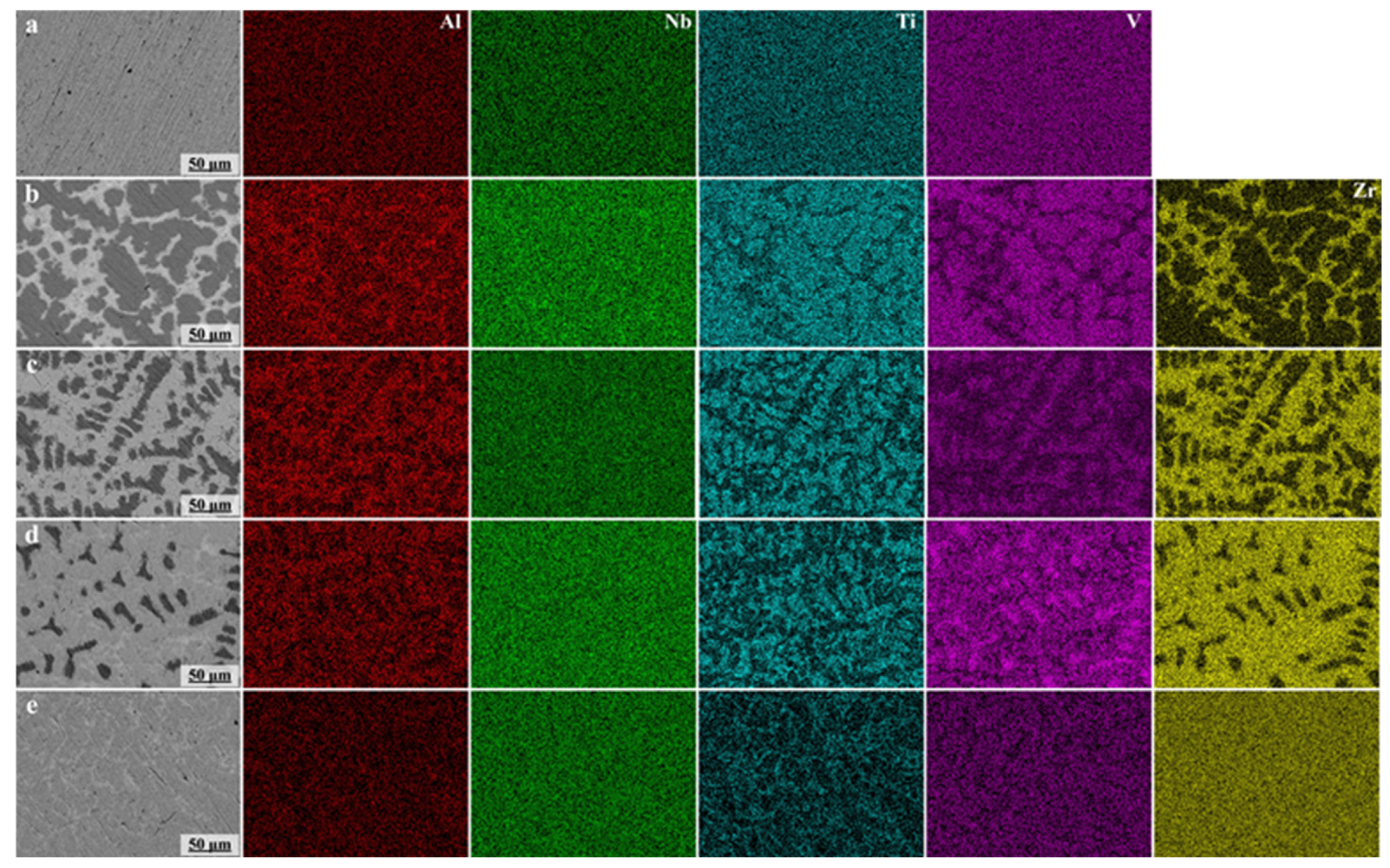
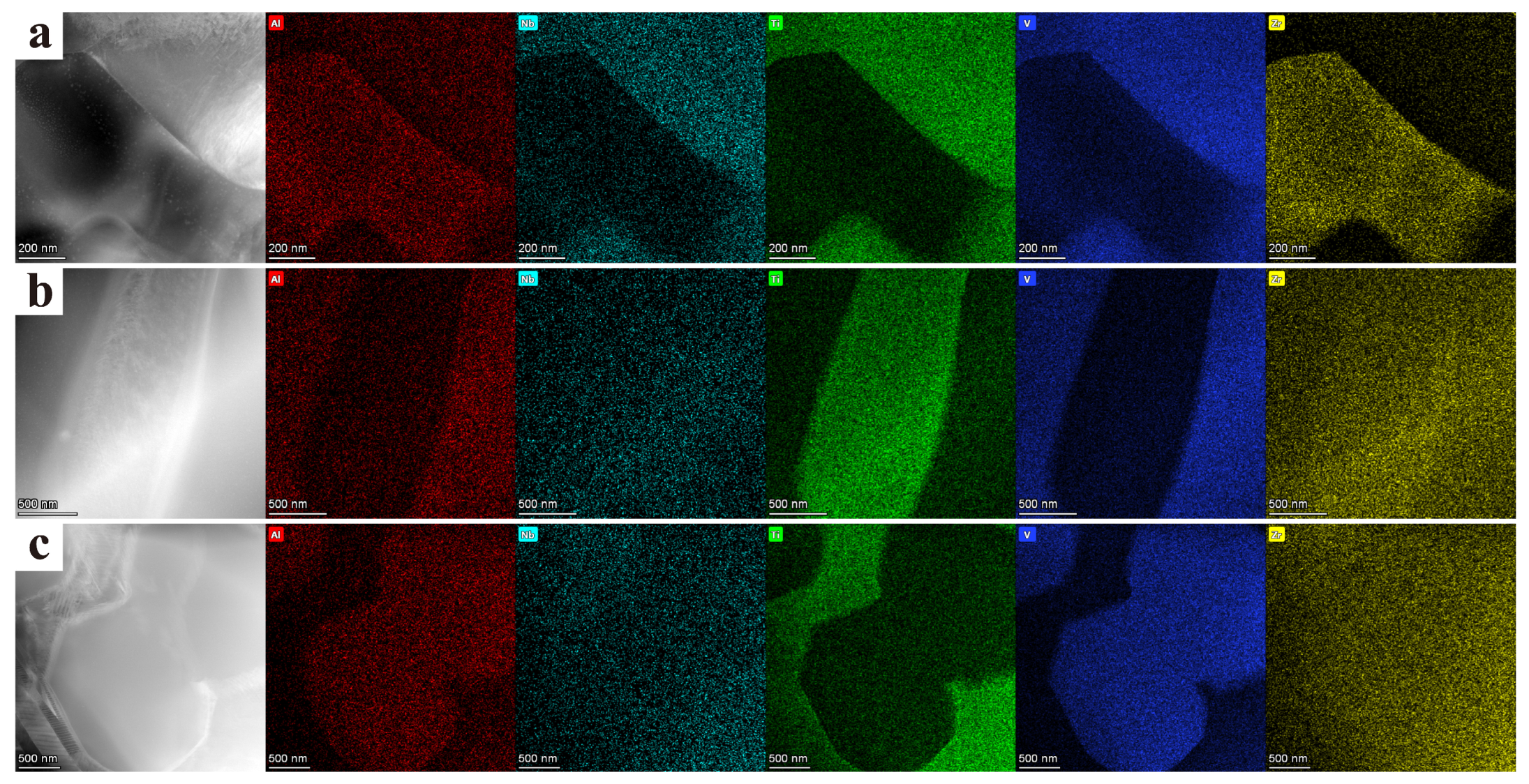
Figure 3 shows the energy dispersive scanning analysis of Al0.5Nb0.5TiV2Zrx RHEAs. The increase in Zr promotes a significant change in microstructure, especially the volume fraction of the second phase. Based on the mapping results and the compositional analysis, the BCC matrix compositions are slightly enriched in Ti and V, while Zr is relatively low, less than 11.81%, which implies that the solubility of the Zr element in the BCC matrix is smaller than 11.81%. Obviously, since the radius of the Zr atom is 160 nm, it is difficult to dissolve a large amount in the matrix. Thus, it is easier to form a stably solid solution in the matrix with the low Zr content by the high entropy effect. Compared with the BCC matrix, the C14 Laves phase is observed to be rich in Zr and Al, and the C15 Laves phase shows higher Ti. Furthermore, as shown in Table 2 and Figure 3, the measured bulk composition of the Al0.5Nb0.5TiV2Zrx alloys closely matches the nominal design, indicating that complete melting is achieved and that the constituent elements are distributed uniformly during processing.
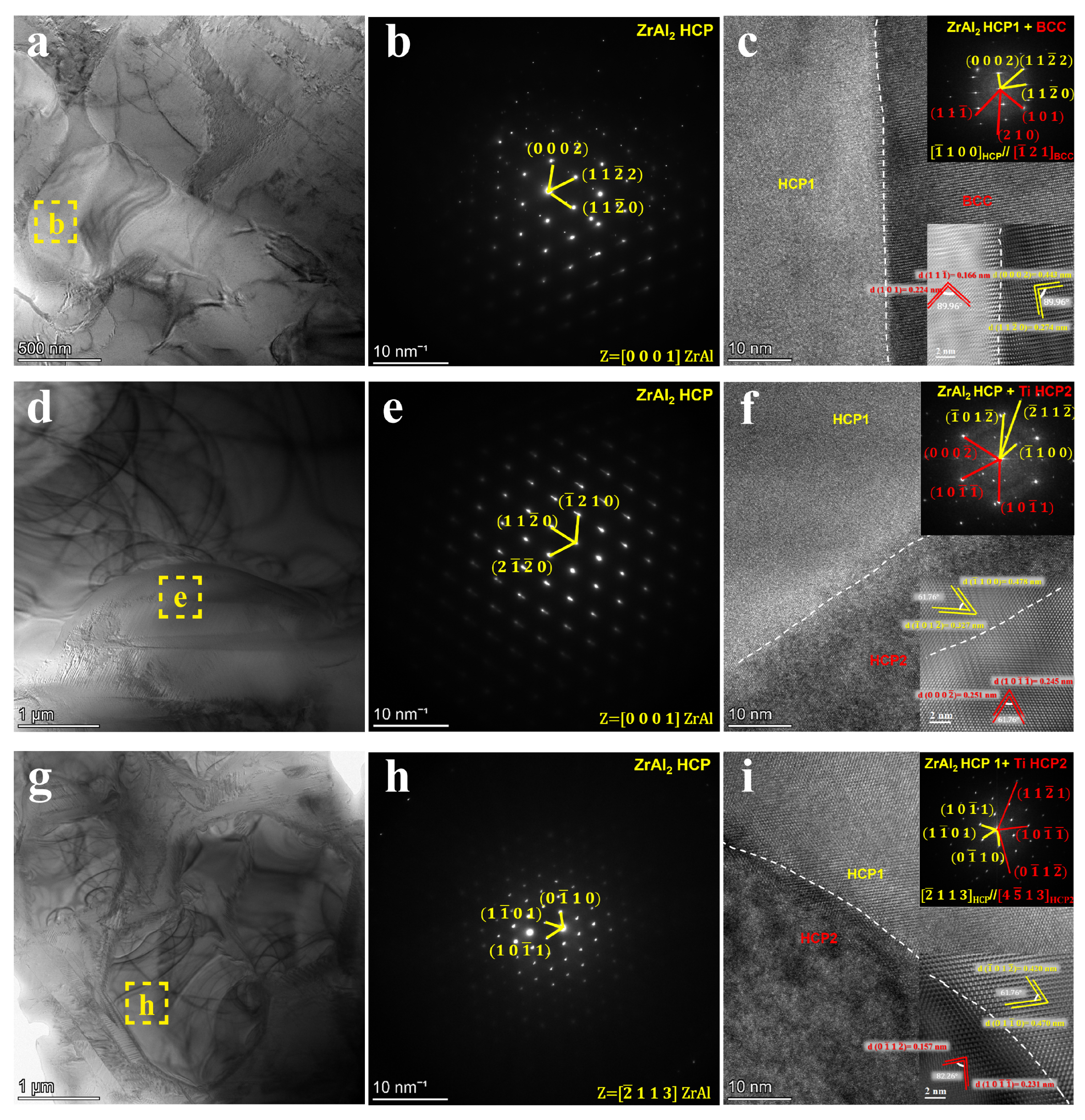
To further investigate the effect of Zr content on the microstructure of Al0.5Nb0.5TiV2Zrx (x = 0, 0.5, 1.0, 1.5, 2.0) alloys, representative alloys with different Zr contents were selected: Zr0.5 (Figure 4a–c), Zr1.5 (Figure 4d–f), and Zr2.0 (Figure 4g–i). These alloys were analyzed using TEM. The analysis of the three samples reveals consistency in their microstructural features. Selected area electron diffraction (SAED) patterns (Figure 4b,e,h) for all samples show the characteristics of a hexagonal close-packed (HCP) structure, with high symmetry and stable crystal orientation.
Although the three samples show common Laves phase characteristics, subtle differences between them remain noteworthy. The High-Resolution Transmission Electron Microscope (HTEM) image of the Zr0.5 alloy (Figure 4c) shows a coherent interface between the HCP and BCC phases. This indicates that at lower Zr content, the microstructure is more homogeneous, with relatively stable interfaces between the two phases. In contrast, the HTEM image of the Zr1.5 alloy (Figure 4f) reveals the coexistence of two HCP phases (HCP1 and HCP2), with HCP2 exhibiting features of a Ti-rich C15 Laves phase. This multi-phase coexistence, driven by Ti segregation, further demonstrates uneven elemental distribution, which may contribute to variations in crystal orientation and phase behavior. The Zr2.0 alloy presents an even more complex scenario. The SAED image (Figure 4h) shows that the crystal phase remains HCP, but the appearance of {0110} and {1011} planes suggests a significant change in crystal orientation. The HTEM image (Figure 4i) further reveals a pronounced lattice mismatch between the HCP1 and HCP2 phases (In order to clearly distinguish HCP1 from HCP2, a white dashed lines has been added).
Furthermore, the element distribution of Zr0.5, Zr1.5, and Zr2.0 alloys was analyzed by TEM-EDS. The results indicated that the HCP1 phase was enriched with Al and the HCP2 phase was enriched with Ti. This element segregation was consistent with the SEM-EDS observation (Figure 5), confirming that HCP1 was the C14 Laves phase and HCP2 was the C15 Laves phase. This was also in accordance with the XRD results. However, the diffraction peak intensities in the XRD patterns of Zr1.5 and Zr2.0 were low, which might be attributed to the uneven element distribution and lattice mismatch.

3.2. Density and Mechanical Properties of the Al0.5Nb0.5TiV2Zrx (x = 0, 0.5, 1.0, 1.5, 2.0) Alloys

The experimentally measured densities are presented in Table 3. The measured values closely align with the theoretical values calculated using Equation (6). As the Zr content increases, the alloy density gradually rises from 5.58 g/cm3 in the Zr0 alloy to 5.95 g/cm3 in the Zr2.0 alloy. These values indicate that the alloys under investigation fall within the category of lightweight refractory high-entropy alloys [24].
ρ m i x = i = 1 n c i A i i = 1 n c i A i / ρ i
where A i and r i is the relative atomic weight and density of the i th component. Compared with the density test results (Table 3), the theoretical density of the alloy shows minimal deviation from the measured density, indicating a relatively uniform distribution of the alloy components.
As shown in Table 3, the hardness of the Al0.5Nb0.5TiV2Zrx alloys first increases and then decreases with increasing Zr content. When x increases from 0 to 0.5, the hardness rises from 412.79 HV to 657.57 HV, which is attributed to the combined effects of strengthening of the BCC matrix and the introduction of a moderate fraction of a hard Laves phase. With further Zr addition, the hardness decreases slightly, suggesting that the strengthening efficiency is reduced as element partitioning and Laves phase constitution evolve. At x = 2.0, the alloy is dominated by Laves phases, yet the hardness decreases to 547.75 HV, indicating that the fully Laves phase microstructure does not necessarily maximize hardness because the effective indentation response is influenced by the specific C14/C15 Laves constitution, local compositional variations, and microstructural scale rather than phase fraction alone.
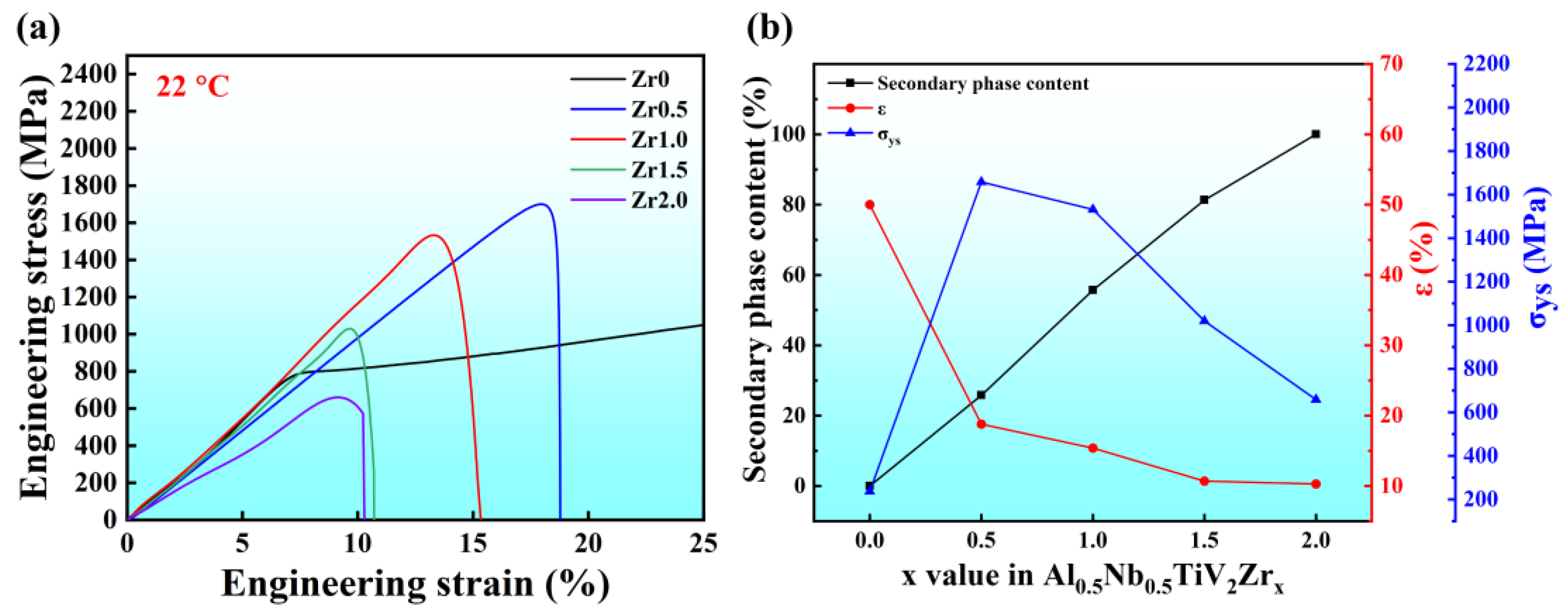
Figure 6 presents the compressive engineering stress–strain curves of Al0.5Nb0.5TiV2Zrx (x = 0, 0.5, 1.0, 1.5, 2.0) alloys at room temperature. The yield strength, peak stress, and engineering strain-to-failure (calculated from crosshead displacement) are summarized in Table 4. The yield strength shows an initial increase followed by a decrease with increasing Zr content (Figure 6b). The Zr0 alloy exhibits a relatively low yield strength (638.5 MPa) and high deformability (engineering strain > 50%). With Zr addition, both yield strength and peak compressive strength increase markedly. The Zr0.5 alloy exhibits the highest yield strength (1658.1 MPa), and fracture occurs at an engineering strain of 18.8%; however, it should be noted that strain includes testing-system compliance, so the true specimen strain at room temperature may be lower without extensometer/DIC or compliance correction. The Zr1.0 alloy shows a slightly lower yield strength (1531.6 MPa) with fracture at an engineering strain of 15.4%, subject to the same strain-measurement limitation.
As the Zr content increases further, both yield strength and apparent deformability decline. The yield strength of the Zr1.5 and Zr2.0 alloys decreases to 1019.4 MPa and 658.2 MPa, respectively, while the engineering strain decreases to 10.7% and 10.3%. This trend correlates with the formation and growth of Laves phases. Zr addition promotes the formation of Laves-type intermetallic phases, and the Laves phase fraction increases with Zr content (Figure 6b). Because these hard intermetallic phases exhibit limited plastic accommodation, increasing Laves fraction and interface density facilitates stress localization and crack initiation. Consequently, while a moderate Zr addition strengthens the alloy, excessive Zr leads to a high fraction of Laves phases (≥25.8%), which accelerates premature fracture and reduces the measured strength and deformability.
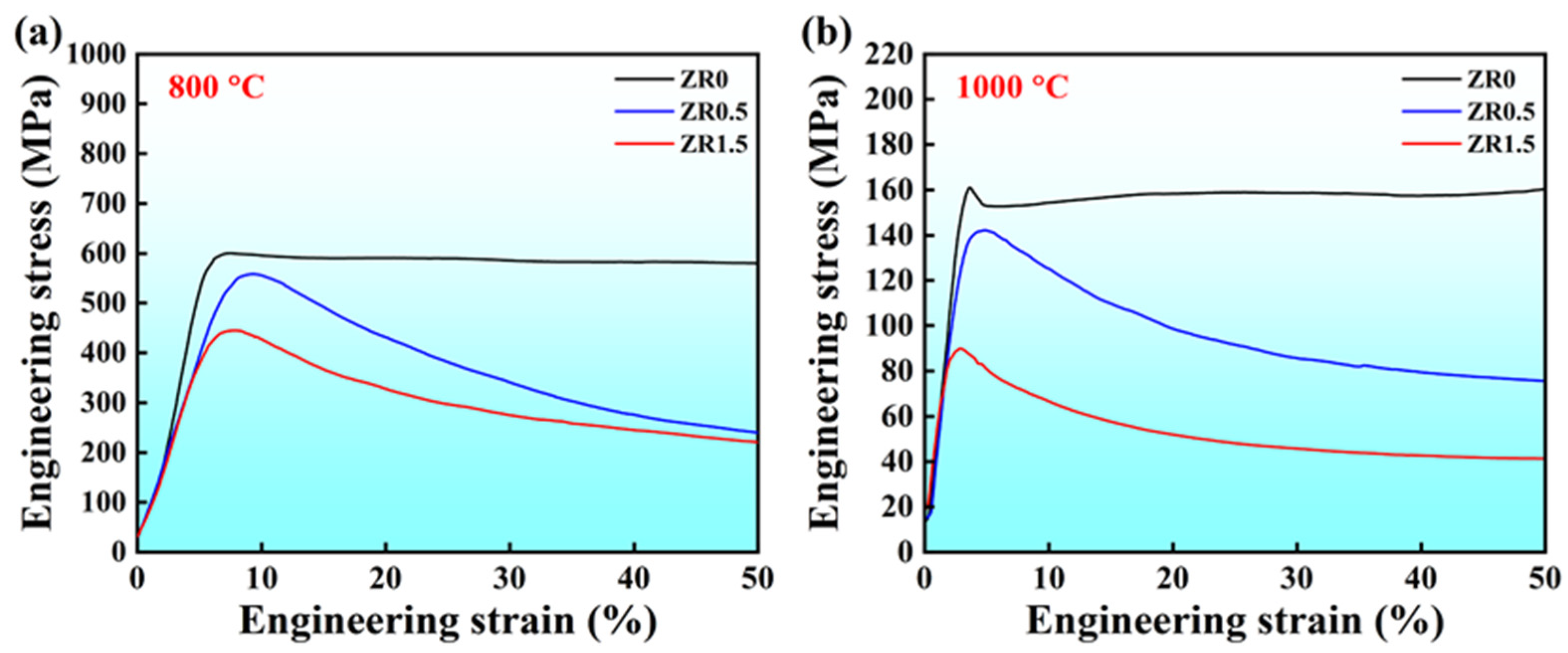
Previous studies have demonstrated that Al0.5Nb0.5TiV2Zr0.5 alloys maintain excellent yield strength at high temperatures of 400 °C and 600 °C, with values of 1366 MPa and 1317 MPa, respectively, which are only slightly lower than the room temperature yield strength of 1480 MPa. However, when the temperature increases to 800 °C, the yield strength significantly drops to 656 MPa [19]. To further investigate the relationship between the significant decline in compressive performance after 800 °C and the Zr content (i.e., the Laves phase content), three alloys with different compositions (Zr0, Zr0.5, and Zr1.5) were selected for high-temperature compression tests at 800 °C and 1000 °C. These experiments aim to reveal the influence of Laves phase content on the high-temperature mechanical properties, thereby providing a better understanding of the microstructure-property relationship in these materials.
After increasing the test temperatures to 800 °C and 1000 °C, the yield strength of the alloys decreases significantly, while their deformability improves markedly, with compressive strains exceeding 50% without fracture (Figure 7). Unlike their behavior at room temperature, the yield strength of the alloys decreases with increasing Zr content under high-temperature conditions. As presented in Table 5, at 800 °C, the yield strengths of the Zr0, Zr0.5, and Zr1.5 alloys are measured to be 536.60 MPa, 400.24 MPa, and 381.53 MPa, respectively. When the temperature rises to 1000 °C, the yield strengths of all three alloys drop below 160 MPa. Notably, after reaching peak compressive strength, the Zr0, Zr0.5, and Zr1.5 alloys exhibit a distinct softening behavior. This phenomenon may be attributed to the increased dislocation mobility within the BCC matrix phase, leading to a transition from brittle to ductile behavior within this temperature range [25].

4. Discussion

4.1. Effect of Zr on the Structure of the Al0.5Nb0.5TiV2Zrx of the Alloys

The microstructural analysis of Al0.5Nb0.5TiV2Zrx alloys reveals two key characteristics. As the Zr content increases, two types of Laves phases gradually form: A Zr-Al2-type C14 Laves phase and a Ti-rich C15 Laves phase (as shown in Figure 3). The precipitation of these Laves phases is primarily driven by the large atomic radius of Zr (160 pm), which induces lattice distortion, providing favorable conditions for their formation. The Laves phases preferentially form within the grains and along the grain boundaries, with their volume fraction increasing as the Zr content rises. While the precipitation of Laves phases generally enhances the alloy’s strength, their inherent brittleness significantly reduces the alloy’s ductility.
Furthermore, when the Zr content reaches 2.0, no significant volume fraction of the BCC phase is observed. This phenomenon can be attributed to the preferential growth of the Laves phase and competition between the phases. The large atomic radius of Zr induces substantial lattice distortion, promoting the formation of Laves phases, while simultaneously depleting the elements such as Nb, Ti, and V required for BCC phase formation [26]. As the Laves phase occupies most of the alloy’s volume, the thermodynamic stability of the BCC phase is significantly reduced, ultimately leading to its complete disappearance at Zr2.0. Additionally, the increase in Zr content alters the free energy, further reducing the likelihood of BCC phase formation, allowing the Laves phase to gradually replace the BCC phase through changes in chemical potential [27,28,29].
Referring to the classical solidification theory [30], both the temperature gradient (G) and the growth rate of the crystal (R) influence the solidification morphology, with the G/R ratio playing a critical role. At higher G/R ratios, the solidification front tends to be more stable, promoting planar or cellular growth with uniform microstructures and minimal solute segregation [31]. Conversely, lower G/R ratios are associated with dendritic growth or other unstable morphologies, characterized by significant solute segregation and the formation of coarse secondary phases in the inter-dendritic regions [31]. In the vacuum arc melting (VAM) process, the cooling rate is estimated to range between 10 and 100 K s−1, corresponding to intermediate G and R values. Under these conditions, the interplay between G and R governs the formation of the primary BCC phase and the secondary Laves phases, as observed in Figure 2.
For alloys with lower Zr content (i.e., Zr0 and Zr0.5 in Figure 2a,b), the observed microstructure suggests a relatively higher G/R ratio. A high G/R ratio stabilizes the solidification front, promoting cellular or planar growth of the BCC phase and leading to more homogeneous microstructures with fewer secondary phases. As the Zr content increases (i.e., Zr1.5 and Zr2.0 in Figure 2d,e), the increase in solute segregation at the solidification front results in the destabilization of the growth front, favoring dendritic growth. This phenomenon is consistent with a decrease in the G/R ratio, which promotes the formation of coarse Laves phases in interdendritic regions. This transition is evident in the evolution from fine, evenly distributed microstructures in Zr0.5 to the irregular, coarse microstructures in Zr2.0.
It is important to note that Zr content itself does not directly affect the G/R ratio, which is primarily determined by the cooling conditions during the VAM process. However, Zr addition indirectly influences the microstructure by increasing solute segregation, which modifies the growth morphology and enhances dendritic instability. With lower Zr content, solute redistribution is limited due to a relatively high G/R ratio, suppressing the excessive growth of secondary phases. In contrast, higher Zr content (i.e., Zr1.5 and Zr2.0) leads to significant solute segregation, creating favorable conditions for the growth of coarse Laves phases and the coarsening of the microstructure.

4.2. Effect of Zr on Mechanical Properties of the Al0.5Nb0.5TiV2Zrx of the Alloys

The Zr content significantly influences the mechanical properties of Al0.5Nb0.5TiV2Zrx alloys, particularly under both room temperature and elevated temperature conditions. The combined effects of Zr content and temperature variations result in a complex influence on the alloy’s strength (Table 4).
First, it should be clarified that, with increasing Zr content, the BCC/Laves interface evolves from a relatively ordered interface to a more disordered one, which quantitatively reduces both strengthening efficiency and damage tolerance. An ordered interface enables more effective load sharing because local shear mismatch is minimized; once coherence is lost, larger lattice misfit and residual stresses accumulate at the interface, thereby lowering the efficiency of load transfer and increasing local peak stresses. Moreover, a disordered interface provides energetically favorable sites for void formation and microcrack nucleation, particularly under compressive shear, which accelerates crack initiation and reduces the apparent ductility.
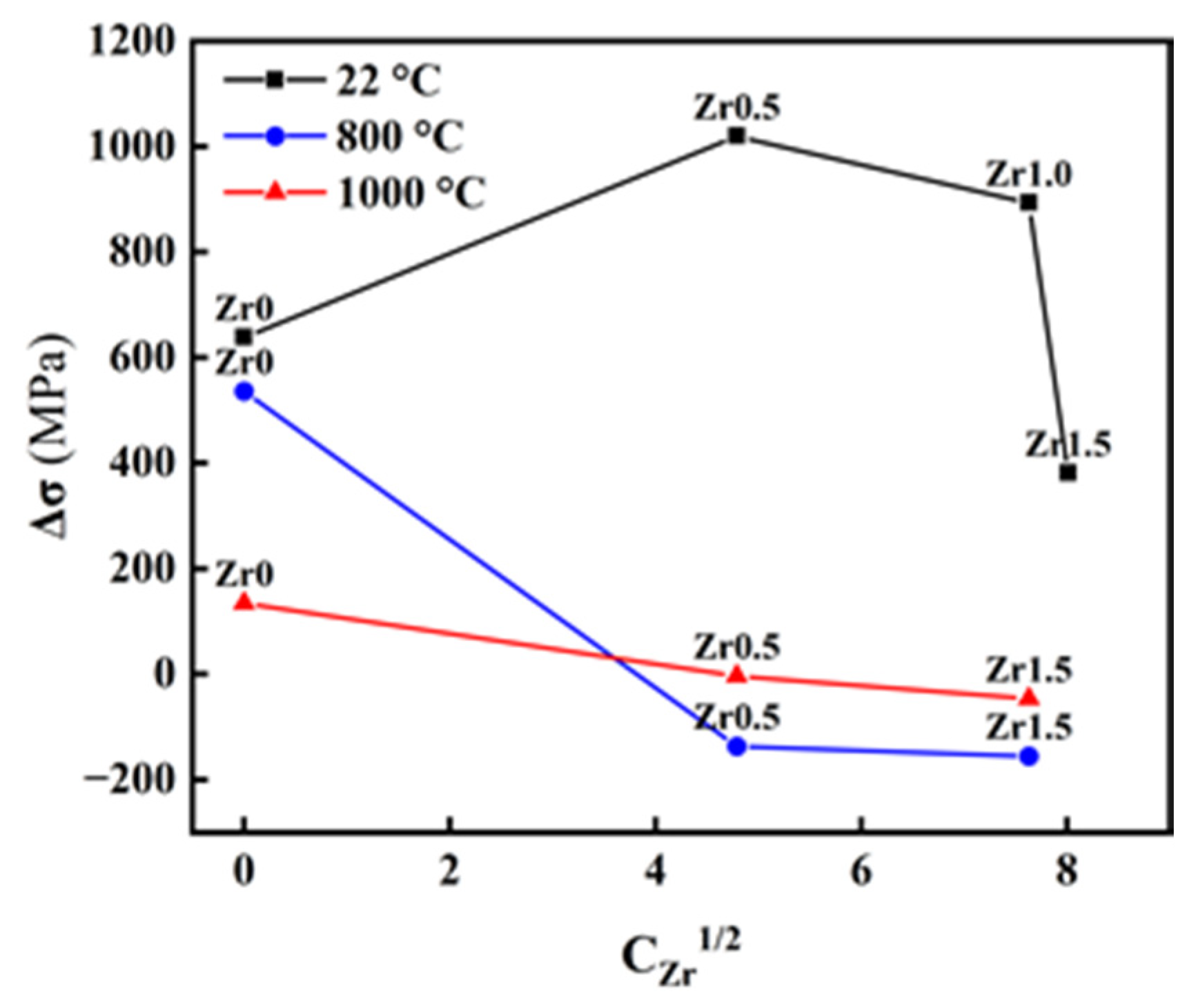
According to previous studies [29,30], two strengthening mechanisms exist in Al-Cr-Nb-Ti-V-Zr alloys: (i) solid-solution strengthening (SSS) and (ii) second-phase strengthening. Zr, being the element with the largest atomic radius (rZr = 160 pm), induces significant SSS through lattice distortion. Several attempts were made to evaluate the SSS in HEAs [31,32]. These calculations gave reasonable agreement with the strength of disordered HEAs; however, theoretical predictions are obviously inappropriate for ordered alloys like the Al0.5Nb0.5TiV2Zrx. To quantify the solid-solution strengthening effect, the relationship between the yield strength increment ( σ , the difference in yield strength between the Zr-containing alloys and the Al0.5Nb0.5TiV2 alloy (Table 4) and c Z r (Zr concentration in the BCC phase (Table 2)) was fitted using a power law function:
σ ~ c Z r n
The value of n = 0.5 represents the solid-solution strengthening exponent in the classical Fleischer model [31]. Therefore, when n = 0.5, a good fit is achieved between σ and c Z r for the Al0.5Nb0.5TiV2Zrx (x = 0, 0.5, 1.0, 1.5) alloys at room temperature. Additionally, based on SEM and TEM analyses, a significant volume fraction of the BCC phase was not detected in the Zr2.0 alloy, indicating that its strengthening mechanism primarily depends on second-phase strengthening rather than solid-solution strengthening (SSS).
At room temperature, σ exhibits an initial increase followed by a decrease as the Zr content increases (Figure 8). When x ranges from 0 to 0.5, the alloy experiences a significant enhancement in solid-solution strengthening, with Zr0.5 reaching a yield strength of 1019.4 MPa. This is primarily attributed to the intense lattice distortion induced by Zr atoms, which hinders dislocation movement and results in an increase in yield strength. At room temperature, this distortion is difficult to recover, leading to a pronounced strengthening effect. However, as the Zr content continues to increase, the yield strength gradually decreases, likely due to the excessive precipitation of secondary phases or the introduction of stress concentrations, which counteract part of the solid-solution strengthening’s benefits.
As the temperature increases to 800 °C and 1000 °C, the contribution of solid-solution strengthening (SSS) becomes negligible, with ∆σ approaching or even falling below zero (Figure 8). This reflects the weakening of strengthening mechanisms due to high-temperature diffusion, lattice recovery, and phase evolution. Accelerated Zr diffusion at elevated temperatures reduces lattice distortions, diminishing the effectiveness of SSS. Additionally, the precipitation and coarsening of Zr-containing Laves phases at high temperatures act as stress concentrators, reducing the yield strength and contributing to embrittlement. The combined effects of solute diffusion and phase instability may result in negative ∆σ values, where material strength falls below that of the unreinforced state. This highlights the limitations of SSS at elevated temperatures, necessitating an analysis of secondary phase-strengthening mechanisms.
As shown in Table 2, the content of the Laves phase increases significantly with the rise in Zr content. However, the trend in yield strength does not exhibit a strictly positive correlation with Laves phase content (Table 3). From Zr0 to Zr0.5, a positive correlation is observed, where a moderate amount of the Laves phase enhances the material’s strength by impeding dislocation motion through the Orowan mechanism [32]. Additionally, in Zr0.5, the interface between the Laves phase and the matrix is coherent (Figure 4c), indicating good lattice matching between the precipitate and the matrix. This results in a continuous interface with minimal dislocation at the phase boundary, reducing stress concentration. However, from Zr0.5 to Zr2.0, a negative correlation is observed as the Laves phase content increases by 74.2%. The substantial increase in Laves phase content in Zr2.0 leads to the formation of incoherent phase boundaries (Figure 4i). The lattice mismatch reduces the ability to effectively impede dislocation motion compared to coherent phase boundaries, thereby lowering the material’s yield strength.
At 800 °C and 1000 °C, the increase in Laves phase content leads to a significant decrease in the alloy’s yield strength. This decline is primarily attributed to the brittleness of the Laves phase, which becomes more pronounced at elevated temperatures. Additionally, the interaction between phase boundaries and dislocation movement weakens, reducing the strengthening effect. Moreover, the instability of the Laves phase at high temperatures further diminishes its reinforcing contribution, resulting in a notable reduction in the alloy’s strength under these conditions [18].
The relationship between the plasticity of Al0.5Nb0.5TiV2Zrx alloys and Zr content is illustrated in Figure 6. At room temperature, the precipitation of Laves phases significantly affects the balance between plasticity and strength. Zr0.5 represents the optimal balance point between plasticity and strength, as the moderate content of Laves phases effectively strengthens the alloy by pinning dislocations without excessively compromising plasticity. In Zr0.5, the Laves phase exhibits good lattice matching with the matrix (coherent phase boundary), resulting in lower interfacial stress and efficiently impeding dislocation movement, thereby enhancing both yield strength and fracture toughness. However, as the volume fraction of Laves phases increases (from 25.8% to 100%), especially in Zr2.0, incoherent phase boundaries gradually dominate. This lattice mismatch generates significant interfacial stress, making it difficult for dislocations to transmit stress across phase boundaries, which leads to the formation of cracks at stress concentration points, significantly reducing plasticity.
In contrast, the Zr0 alloy demonstrates over 50% compressive strain at room temperature without fracturing, which is attributed to the high plasticity of its BCC phase. The BCC structure contains multiple slip systems that facilitate dislocation motion, allowing stress to be more evenly distributed throughout the alloy and delaying crack initiation. Additionally, the stress distribution in the single-phase BCC structure is more uniform, reducing the formation of localized stress concentration points [33]. As a result, the Zr0 alloy maintains high plasticity under high strain conditions, preventing early fracture.
At elevated temperatures of 800 °C and 1000 °C, the compressive plasticity of the alloy is significantly enhanced. The Al0.5Nb0.5TiV2Zrx alloy exhibits high plasticity at these temperatures, with no clear correlation to the Laves phase content. This is likely due to the increased dislocation mobility at high temperatures, which improves the material’s ductility. Future research could further investigate the dissolution behavior of the Laves phase at elevated temperatures and its specific effects on the alloy’s microstructure and mechanical properties.
Overall, this study elucidates the combined roles of BCC-matrix solid-solution strengthening (SSS) and Laves phase/interface strengthening in Al0.5Nb0.5TiV2Zrx RHEAs at both room and elevated temperatures. The results indicate that at room temperature, low Zr addition strengthens the BCC matrix via SSS while a moderate Laves fraction provides additional strengthening, leading to an increase in yield strength. However, when the Zr content becomes excessive, the rapidly increased Laves phase volume fraction and interface density promote stress localization and early cracking, so the overall strength becomes dominated by second-phase effects rather than further matrix SSS. As the temperature increases to 800 °C and 1000 °C, thermally activated deformation in the BCC matrix and diffusion-assisted phase evolution reduce the effectiveness of both matrix SSS and dispersion strengthening, resulting in pronounced softening. This research provides a theoretical foundation and design guidelines for optimizing Zr content to balance strength and ductility, particularly for high-temperature applications.

5. Conclusions

In this study, the structure and mechanical properties of the Al0.5Nb0.5TiV2Zrx (X = 0, 0.5, 1.0, 1.5, 2.0) refractory high-entropy alloys were examined. The following conclusions were drawn:
(1)
With increasing Zr content, the volume fraction of the second phase gradually increased from 0% to 100%. The Zr0 alloy exhibited a single-phase BCC structure. The Zr0.5 and Zr1.0 alloys were composed of a BCC matrix and ZrAl2-type C14 Laves phase. The Zr1.5 alloy consisted of BCC, C14 Laves, and Ti-rich C15 Laves phases. In the Zr2.0 alloy, only C14 and C15 Laves phases were observed, indicating the complete disappearance of the BCC phase.
(2)
The density of the Al0.5Nb0.5TiV2Zrx alloys increased slightly from 5.58 g/cm3 to 5.95 g/cm3 with increasing Zr content. The hardness exhibited a peak at Zr0.5, reaching 657.57 HV. The subsequent decrease in hardness for higher Zr contents suggests that the excessive precipitation of Laves phases led to a reduction in the strengthening effect.
(3)
As the Zr content increases, the strength of the Al0.5Nb0.5TiV2Zrx alloys changes significantly. At 22 °C, the yield strength rises sharply from 638.5 MPa for Zr0 to 1658.1 MPa for Zr0.5, primarily due to solid-solution strengthening induced by Zr and second-phase strengthening from the precipitation of a moderate amount of Laves phase. However, when the Zr content increases further to Zr1.0 and above, the yield strength gradually decreases to 658.2 MPa. This reduction is attributed to stress concentration caused by the excessive precipitation of the second phase, which diminishes the effect of solid-solution strengthening. At 800 °C and 1000 °C, the yield strength further decreases, likely due to the increased brittleness and instability of the Laves phase at elevated temperatures, causing the strengthening effect to gradually diminish.
(4)
The plasticity of the alloys exhibited a complex relationship with Zr content. At 22 °C, the plasticity decreased from 18.8% for Zr0.5 to 10.3% for Zr2.0. However, at 800 °C and 1000 °C, the plasticity of Al0.5Nb0.5TiV2Zrx (x = 0.5, 1.5) exceeded 50%, indicating that at high temperatures, the second-phase precipitation had no significant impact on plasticity. In contrast, the Zr0 alloy (single-phase BCC structure) exhibited excellent plasticity at both room temperature and high temperatures, with over 50% strain without fracture.
In conclusion, this study demonstrates that the addition of Zr has a significant impact on the microstructure and mechanical properties of Al0.5Nb0.5TiV2Zrx alloys. Moderate Zr content (e.g., Zr0.5) provides an optimal balance between strength and ductility due to solid-solution strengthening and controlled Laves phase precipitation. However, excessive Zr leads to brittle behavior and reduced strength, especially at elevated temperatures. These findings contribute to the understanding of microstructure-property relationships in refractory high-entropy alloys and provide valuable insights for the design of high-temperature structural materials.

Author Contributions

W.Z.: Writing—original draft and Investigation. S.W. (Shiliang Wu): Analysis and Writing—review and editing. H.W. (Haitao Wang): Conceptualization and Writing—review and editing. S.W. (Sujuan Wang): Investigation and Writing—review. H.W. (Huiming Wu): Supervision, Funding, and Editing. All authors have read and agreed to the published version of the manuscript.

Funding

This work was supported by the Shenzhen institutions of higher learning stability support plan project (1053-6023210087K1); Research Projects of Department of Education of Guangdong Province (2023ZDZX3080 and 2023ZDZX3081)) and Shenzhen Polytechnic University-Xmind Technology Digital and Intelligence Competition Technology R&D Center (602331010PQ).

Data Availability Statement

The original contributions presented in the study are included in the article, further inquiries can be directed to the corresponding author.

Conflicts of Interest

The authors declare no conflicts of interest.

References

  1. Chen, J.; Zhou, X.; Wang, W.; Liu, B.; Lv, Y.; Yang, W.; Xu, D.; Liu, Y. A review on fundamental of high entropy alloys with promising high–temperature properties. J. Alloys Compd. 2018, 760, 15–30. [Google Scholar] [CrossRef]
  2. Praveen, S.; Kim, H.S. High-Entropy Alloys: Potential Candidates for High-Temperature Applications—An Overview. Adv. Eng. Mater. 2018, 20, 1700645. [Google Scholar] [CrossRef]
  3. Wang, M.; Li, T.; Wang, J.; Li, G.; Cheng, C.; Zheng, Y.; Fu, Y.; Ni, Y. Mechanical properties of refractory HEA WNbTaV and its penetration behavior to aluminum alloy plate. Mater. Today Commun. 2023, 36, 106822. [Google Scholar] [CrossRef]
  4. Miracle, D.B.; Senkov, O.N. A critical review of high entropy alloys and related concepts. Acta Mater. 2017, 122, 448–511. [Google Scholar] [CrossRef]
  5. Shahmir, H.; Mehranpour, M.S.; Shams, S.A.A.; Langdon, T.G. Twenty years of the CoCrFeNiMn high-entropy alloy: Achieving exceptional mechanical properties through microstructure engineering. J. Mater. Res. Technol. 2023, 23, 3362–3423. [Google Scholar] [CrossRef]
  6. Chen, W.; Li, X. A lightweight NbMoZrTi refractory high entropy alloy with high specific strength. Mater. Lett. 2024, 354, 135330. [Google Scholar] [CrossRef]
  7. Tong, Y.; Bai, L.; Liang, X.; Hua, M.; Liu, J.; Li, Y.; Zhang, J.; Hu, Y. Mechanical performance of (NbTaW)1−xMox (x = 0, 0.05, 0.15, 0.25) refractory high entropy alloys: Perspective from experiments and first principles calculations. J. Alloys Compd. 2021, 873, 159740. [Google Scholar] [CrossRef]
  8. Lei, Y.; Taheri, M.; Lashkari, A.H.; Torkamany, P.; Heidarpour, I.; Torkamany, M.J. Corrosion resistance of NbCrFeNiCoMoX coating applied by laser cladding on GTD-111 superalloy: Application of gas turbine blade. Mater. Today Commun. 2024, 38, 108157. [Google Scholar] [CrossRef]
  9. Lin, Y.; Guo, Y.; Dong, Q.; Huang, R.; Tan, J. Effects of vanadium content on the high temperature oxidation behavior of NbTiZrAlV refractory complex concentrated alloys. J. Alloys Compd. 2022, 905, 164180. [Google Scholar] [CrossRef]
  10. Chen, W.; Li, X. Microstructure, wear and corrosion resistance mechanism of as-cast lightweight refractory NbMoZrTiX (X = Al, V) high-entropy alloys. J. Mater. Res. Technol. 2024, 31, 1215–1228. [Google Scholar] [CrossRef]
  11. Wu, S.; Wang, H.; Wang, S.; Liu, W. Strong yet ductile (FeCoNi)86Al7Ti7 high-entropy alloy via laser powder bed fusion. Mater. Today Commun. 2024, 41, 110285. [Google Scholar] [CrossRef]
  12. Tsai, M.-H.; Tsai, R.-C.; Chang, T.; Huang, W.-F. Intermetallic Phases in High-Entropy Alloys: Statistical Analysis of their Prevalence and Structural Inheritance. Metals 2019, 9, 247. [Google Scholar] [CrossRef]
  13. Gorban’, V.F.; Krapivka, N.A.; Firstov, S.A. High-entropy alloys: Interrelations between electron concentration, phase composition, lattice parameter, and properties. Phys. Met. Met. 2017, 118, 970–981. [Google Scholar] [CrossRef]
  14. Stein, F.; Leineweber, A. Laves phases: A review of their functional and structural applications and an improved fundamental understanding of stability and properties. J. Mater. Sci. 2021, 56, 5321–5427. [Google Scholar] [CrossRef]
  15. Zhang, Y.; Chen, X.; Jayalakshmi, S.; Singh, R.A.; Deev, V.B.; Prusov, E.S. Factors determining solid solution phase formation and stability in CoCrFeNiX0.4 (X = Al, Nb, Ta) high entropy alloys fabricated by powder plasma arc additive manufacturing. J. Alloys Compd. 2021, 857, 157625. [Google Scholar] [CrossRef]
  16. Zhang, Y.; Zhao, Y.; Sun, L.; Wang, L.; Li, L.; Zhan, X. Formation mechanism of AlNbTiVZr high entropy alloy/Ti multi-principal element alloy by laser direct energy deposition: Microstructure evaluation and mechanical properties. J. Alloys Compd. 2024, 997, 174782. [Google Scholar] [CrossRef]
  17. Zhi, Q.; Tan, X.; Liu, Z.; Liu, Y.; Zhang, Q.; Chen, Y.; Li, M. Effect of Zr content on microstructure and mechanical properties of lightweight Al2NbTi3V2Zrx high entropy alloy. Micron 2021, 144, 103031. [Google Scholar] [CrossRef]
  18. Yurchenko, N.; Stepanov, N.; Zherebtsov, S.; Tikhonovsky, M.; Salishchev, G. Structure and mechanical properties of B2 ordered refractory AlNbTiVZrx (x = 0–1.5) high-entropy alloys. Mater. Sci. Eng. A 2017, 704, 82–90. [Google Scholar] [CrossRef]
  19. Jiang, W.; Wang, X.; Kang, H.; Jiang, B.; Dong, D.; Wang, Y.; Zhu, D. Microstructure and mechanical properties of AlNbTiVZr system refractory high entropy alloys. J. Alloys Compd. 2022, 925, 166767. [Google Scholar] [CrossRef]
  20. Senkov, O.N.; Wilks, G.B.; Scott, J.M.; Miracle, D.B. Mechanical properties of Nb25Mo25Ta25W25 and V20Nb20Mo20Ta20W20 refractory high entropy alloys. Intermetallics 2011, 19, 698–706. [Google Scholar] [CrossRef]
  21. Sun, S.; Tian, Y.; Lin, H.; Lu, S.; Yang, H.; Zhang, Z. Modulating the prestrain history to optimize strength and ductility in CoCrFeMnNi high-entropy alloy. Scr. Mater. 2019, 163, 111–115. [Google Scholar] [CrossRef]
  22. Xiong, T.; Zheng, S.; Pang, J.; Ma, X. High-strength and high-ductility AlCoCrFeNi2.1 eutectic high-entropy alloy achieved via precipitation strengthening in a heterogeneous structure. Scr. Mater. 2020, 186, 336–340. [Google Scholar] [CrossRef]
  23. Gao, M.C.; Yeh, J.-W.; Liaw, P.K.; Zhang, Y. (Eds.) High Entropy Alloys; Springer International Publisher: Cham, Switzerland, 2016. [Google Scholar] [CrossRef]
  24. Wang, Z.; Chen, S.; Yang, S.; Luo, Q.; Jin, Y.; Xie, W.; Zhang, L.; Li, Q. Light-weight refractory high-entropy alloys: A comprehensive review. J. Mater. Sci. Technol. 2023, 151, 41–65. [Google Scholar] [CrossRef]
  25. Wang, T.; Jiang, W.; Wang, X.; Jiang, B.; Rong, C.; Wang, Y.; Yang, J.; Zhu, D. Microstructure and properties of Al0.5NbTi3VxZr2 refractory high entropy alloys combined with high strength and ductility. J. Mater. Res. Technol. 2023, 24, 1733–1743. [Google Scholar] [CrossRef]
  26. Ma, Q.; Zhao, W.; Li, X.; Gao, W.; Zhang, H.; Ma, X.; Lv, Y.; Xiao, G. Impact of Nb and Zr on the precipitation evolution of Laves phase and the properties of laser cladding coating of AlCoCrFeNi high entropy alloy. Mater. Charact. 2024, 215, 114146. [Google Scholar] [CrossRef]
  27. Wan, C.; Denys, R.; Yartys, V. Effects of Ti substitution for Zr on the electrochemical characteristics and structure of AB2-type Laves-phase alloys as metal hydride anodes. J. Alloys Compd. 2021, 889, 161655. [Google Scholar] [CrossRef]
  28. Kumar, A.; Abu Shaz, M.; Mukhopadhyay, N.K.; Yadav, T.P. Phase transformation of AB5 to AB2 type phase on substitution of Mn with Zr in TiVCoNi (ZrxMn2-x) (x = 0, 0.3, 0.6, 1.0) high entropy alloys. Mater. Chem. Phys. 2024, 318, 129291. [Google Scholar] [CrossRef]
  29. Stepanov, N.; Yurchenko, N.Y.; Skibin, D.; Tikhonovsky, M.; Salishchev, G. Structure and mechanical properties of the AlCrxNbTiV (x = 0, 0.5, 1, 1.5) high entropy alloys. J. Alloys Compd. 2015, 652, 266–280. [Google Scholar] [CrossRef]
  30. Yurchenko, N.Y.; Stepanov, N.D.; Shaysultanov, D.G.; Tikhonovsky, M.A.; Salishchev, G.A. Effect of Al content on structure and mechanical properties of the AlxCrNbTiVZr (x = 0; 0.25; 0.5; 1) high-entropy alloys. Mater. Charact. 2016, 121, 125–134. [Google Scholar] [CrossRef]
  31. Fleischer, R. Substitutional solution hardening Durcissement de solution par substitution Verfestigung in substitutionsmischkkistallen. Acta Met. 1963, 11, 203–209. [Google Scholar] [CrossRef]
  32. Liu, L.; Zhang, Y.; Han, J.; Wang, X.; Jiang, W.; Liu, C.; Zhang, Z.; Liaw, P.K. Nanoprecipitate-Strengthened High-Entropy Alloys. Adv. Sci. 2021, 8, 2100870. [Google Scholar] [CrossRef]
  33. Basu, I.; Ocelík, V.; De Hosson, J.T. BCC-FCC interfacial effects on plasticity and strengthening mechanisms in high entropy alloys. Acta Mater. 2018, 157, 83–95. [Google Scholar] [CrossRef]
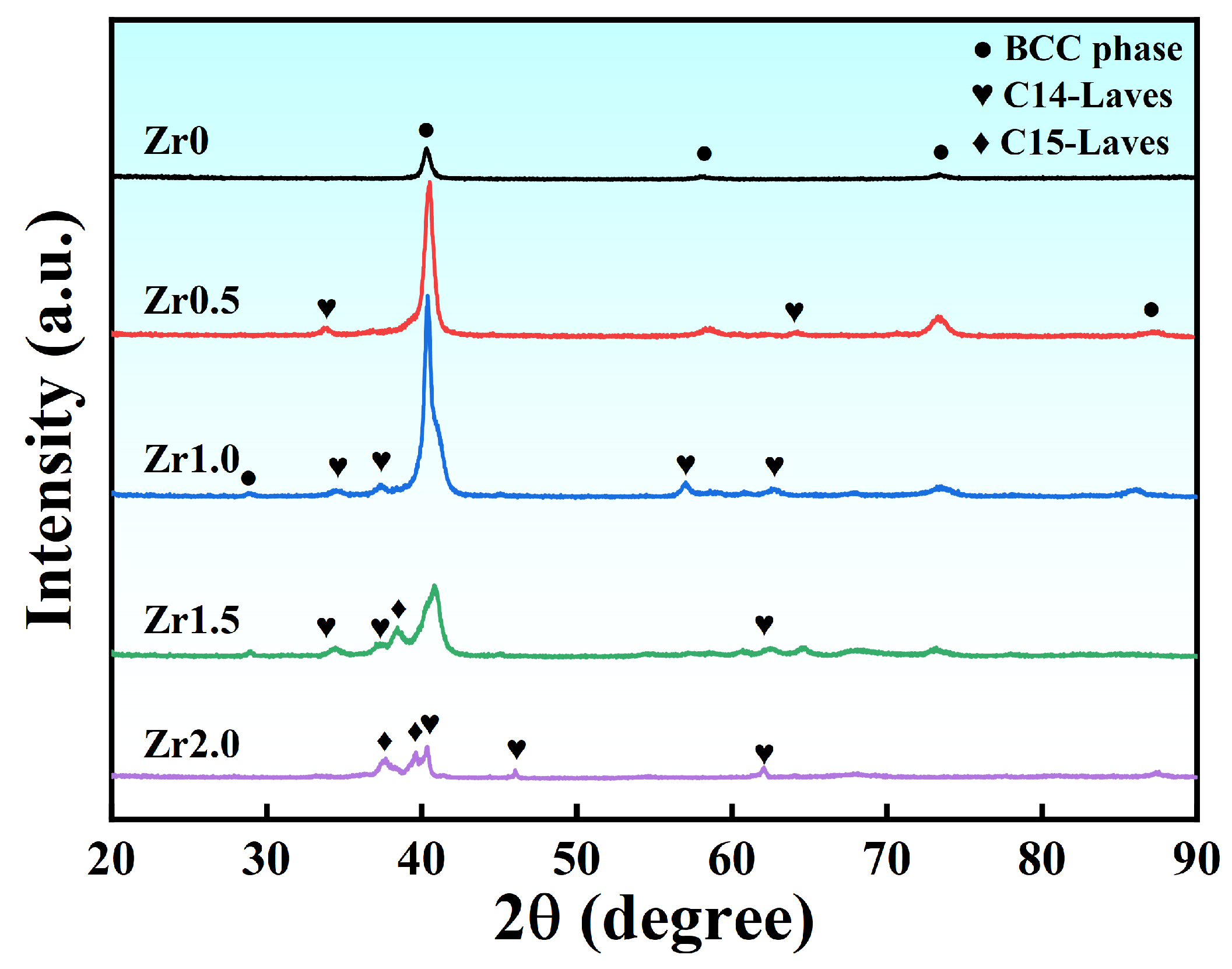
Figure 1. XRD patterns of the Al0.5Nb0.5TiV2Zrx (x = 0, 0.5, 1.0, 1.5, 2.0) alloys.
Metals 16 00255 g001
Figure 2. Microstructure of the Al0.5Nb0.5TiV2Zrx alloys: (a) x = 0, (b) x = 0.5, (c) x = 1.0, (d) x = 1.5, (e) x = 2.0.
Metals 16 00255 g002
Figure 3. Energy dispersive spectrometer (EDS) mappings of Al0.5Nb0.5TiV2Zrx alloys: (a) Zr0, (b) Zr0.5, (c) Zr1.0, (d) Zr1.5, (e) Zr2.0.
Metals 16 00255 g003
Figure 4. (ac) Bright-field TEM and the corresponding SAED pattern and HTEM of Zr0.5. (df) Bright-field TEM and the corresponding SAED pattern and HTEM of Zr1.5. (gi) Bright-field TEM and the corresponding SAED pattern and HTEM of Zr2.0.
Metals 16 00255 g004
Figure 5. TEM-EDS mapping of the alloys: (a) Zr0.5; (b) Zr1.5; (c) Zr2.0.
Metals 16 00255 g005
Figure 6. (a) Engineering stress–strain curves of the Al0.5Nb0.5TiV2Zrx alloys at 22 °C, (b) Effect of Zr molar ratio on the compressive yield strength, elongation and secondary phase content of Al0.5Nb0.5TiV2Zrx alloys.
Metals 16 00255 g006
Figure 7. Engineering stress–strain curves of the Al0.5Nb0.5TiV2Zrx (x = 0, 0.5, 1.0, 1.5, 2.0) alloys at (a) 800 °C, (b) 1000 °C.
Metals 16 00255 g007
Figure 8. The increment in the yield strength, Δσ, at T = 22 to 1000 °C as a function of the Zr concentration, cZr, in the matrix phase of the Al0.5Nb0.5TiV2Zrx alloys.
Metals 16 00255 g008
Table 1. Calculation results of related parameters of the Al0.5Nb0.5TiV2Zrx alloys.
AlloyZr0Zr0.5Zr1.0Zr1.5Zr2.0
H m i x (kJ/mol)9.8810.5710.8010.7710.61
S m i x J/(mol K)10.0811.8612.2212.2112.01
Tm (K)20372047205520612067
Ω2.082.302.332.342.34
δ (%)4.286.656.727.107.28
Table 2. The estimated volume fraction of Al0.5Nb0.5TiV2Zrx refractory high entropy alloys.
AlloyNoChemical Composition (at%)Volume Fraction (%)
AlNbTiVZr
Zr0All composition13.8312.4025.3048.46--
13.5812.4725.0348.92-100
Zr0.5All composition11.9710.8022.0443.3811.81-
1 (BCC Phase)10.0012.6822.3950.144.7974.2
2 (C14 Laves Phase)17.906.7316.5629.7129.0825.8
Zr1.0All composition11.179.9219.5238.9820.42-
1 (BCC Phase)6.9612.7723.9248.727.6344.3
2 (C14 Laves Phase)15.617.0310.3236.7730.2655.7
Zr1.5All composition9.409.1418.7335.9326.79-
1 (BCC Phase)5.0113.1424.0249.828.0118.7
2 (C14 Laves Phase)13.347.8910.2438.0730.4774.0
3 (C15 Laves Phase)6.079.0034.7815.4534.717.3
Zr2.0All composition8.138.6116.0333.9333.30-
2 (C14 Laves Phase)12.077.5410.7238.1531.5255.5
3 (C15 Laves Phase)4.8711.1434.8114.3434.8544.5
Table 3. Density and microhardness of the Al0.5Nb0.5TiV2Zrx (x = 0, 0.5, 1.0, 1.5, 2.0) alloys.
Alloyρexp (g/cm3)ρmix (g/cm3)Microhardness (HV)
Zr05.585.62412.79
Zr0.55.705.72657.57
Zr1.05.815.82602.33
Zr1.55.885.91592.42
Zr2.05.956.0547.75
Table 4. Mechanical properties of Al0.5Nb0.5TiV2Zrx alloys obtained during the compression tests at 22 °C.
Alloyσys (MPa)σp (MPa)ε (%)
Zr0638.51047.9>50
Zr0.51658.11700.018.8
Zr1.01531.61532.915.4
Zr1.51019.41029.610.7
Zr2.0658.2659.810.3
Table 5. The compression of yield strength (σYS), peak stress (σP), and fracture strain (ε) of the Al0.5Nb0.5TiV2Zrx (x = 0, 0.5, 1.0, 1.5, 2.0) alloys at 800–1000 °C.
Temperature (°C)8001000
AlloyσYS (MPa)σP (MPa)ε (%)σYS (MPa)σP (MPa)ε (%)
Zr0536.60602.56>50134.59162.48413>50
Zr0.5400.24558.79>50131.47142.264>50
Zr1.5381.53445.46>5088.6289.84491>50
Disclaimer/Publisher’s Note: The statements, opinions and data contained in all publications are solely those of the individual author(s) and contributor(s) and not of MDPI and/or the editor(s). MDPI and/or the editor(s) disclaim responsibility for any injury to people or property resulting from any ideas, methods, instructions or products referred to in the content.