Article

Microstructure Evolution and Wear Resistance of TiC-Reinforced H13 Alloy Coatings Fabricated by Laser Cladding on H13 Steel

1
Centre for Advanced Laser Manufacturing (CALM), School of Mechanical Engineering, Shandong University of Technology, Zibo 255000, China
2
School of Materials Science and Engineering, Guangdong Ocean University, Yangjiang 529500, China
3
Jiangsu Longcheng Precision Forging Group Co., Ltd., Changzhou 213164, China
*
Authors to whom correspondence should be addressed.
Metals 2026, 16(3), 258; https://doi.org/10.3390/met16030258
Submission received: 18 January 2026 / Revised: 19 February 2026 / Accepted: 22 February 2026 / Published: 26 February 2026

Abstract

With the growing demand for high-performance die materials under harsh service conditions, the development of composite coatings with enhanced hardness and wear resistance has attracted significant attention. In this study, homogeneous laser cladding was employed to fabricate H13 alloy coatings reinforced with varying TiC contents (0, 10, 20, and 30 in wt.%) on H13 steel, which minimizes compositional segregation and ensures strong metallurgical bonding. TiC particles acted as heterogeneous nucleation sites during solidification, refining the microstructure and enhancing phase stability. The coatings consisted of initial TiC residues, newly formed primary and eutectic TiC, as well as austenite and martensite phases. With increasing TiC addition, TiC morphology evolved from fine particles to complex fishbone-like and polygonal structures. The coating containing 30% TiC achieved the highest hardness of 1095.9 HV0.5, approximately five times that of the as-annealed H13 steel substrate while the 20% TiC coating exhibited optimal high-temperature wear resistance. Under the sliding conditions at 600 °C, the friction coefficient decreased from 0.467 for the substrate to 0.367 for the 20% TiC coating, accompanied by a remarkable reduction in wear rate from 27.45 × 10⁻⁴ mm3 N−1 m−1 to 4.32 × 10⁻⁴ mm3 N−1 m−1. The superior performance was attributed to the multiscale TiC reinforcement mechanism: initial TiC promoted grain refinement and strong interfacial bonding, in situ formed primary TiC induced lattice distortion and dislocation strengthening, and eutectic TiC reinforced grain boundaries, jointly enhancing hardness, thermal stability, and wear resistance.

1. Introduction

H13 steel, as a high-performance steel widely used in hot work mold making, automobile manufacturing, metallurgy and other fields, has been widely adopted in practical applications due to its excellent thermal stability and wear resistance [1]. However, during long-term use, H13 steel often faces severe challenges in the working environment such as wear and thermal fatigue, resulting in its surface being prone to damage and degradation, thus affecting the service life and work performance of the workpiece [2]. Therefore, effective surface strengthening treatment of H13 steel has become one of the keys to enhancing its working performance. In the past, attempts have been made to improve the wear resistance of molds by increasing their surface hardness, such as thermal spraying [3], vapor phase deposition [4] electron beam powder bed fusion [5] and laser surface hardening [6]. Compared with the traditional surface modification techniques, ceramic particles reinforced metal matrix composites prepared on the surface of metal substrate using laser cladding technology have enhanced hardness and superior interfacial bonding, which has become a research hotspot [7].
Laser cladding is a process that employs a high-energy laser beam to melt the surface of the substrate and the cladding powder, followed by rapid solidification to form a cladding layer, which is particularly well known for its minimized dilution, narrow heat-affected zone, and excellent metallurgical bonding [8,9,10]. Homogeneous laser cladding refers to a process in which the cladding material has the same or similar chemical composition as the substrate. During the process, both the feed powder and the substrate surface are simultaneously melted by the laser beam, forming a coating whose composition closely matches that of the base material [11]. Many researchers have prepared Fe-based [12], Ni-based [13,14], Co-based [15], and high-entropy alloys [16,17,18] cladding layers on H13 steel substrate by using laser cladding technology. However, compared with heterogeneous alloy powders, using H13 alloy powders with compositions identical to that of the substrate offers clear advantages, as they are highly matched with the H13 substrate in terms of metallurgical compatibility and thermo-physical properties, and they can effectively alleviate interfacial stresses, and inhibit cracks [19]. Moreover, the H13 alloy powder continues the excellent high-temperature strength, thermal fatigue properties and heat treatment stability of the base material, contributing to the formation of a dense and uniformly organized cladding layer. In addition to this, the alloying elements such as Cr, Mo and V contained in H13 can promote the metallurgical bonding of ceramic particles with the substrate and improve the interfacial stability. Compared with Ni-based and Co-based powders, H13 powder is not only lower in cost, but also has better process compatibility, which makes it an ideal material choice for realizing high-performance and low-cost homogeneous cladding repair. However, in order to maintain its long-term operation under severe operating conditions, it is also necessary to improve its mechanical properties by adding appropriate amounts of ceramic particles, and common ceramic reinforced particles include WC [20,21], TiC [22,23], SiC [24], TiN [25], etc. TiC, as a ceramic material with high hardness, high temperature resistance and excellent thermal stability, is believed to be an ideal reinforcing phase in homogeneous laser cladding coatings for H13 steel [26]. TiC not only significantly enhances the hardness and wear resistance of the coating during the solidification process but also inhibits grain growth and refines the microstructure by serving as effective nucleation sites. Chai et al. fabricated FeCrAl metallic coatings and FeCrAl/TiC composite coatings on the surface of ferritic/martensitic (F/M) steel by laser cladding. The results revealed that the addition of TiC effectively refined the grain size and promoted the transition of crystal morphology from columnar to equiaxed grains [22]. In addition, TiC forms strong metallurgical bonds with elements such as Fe, Cr, and V in H13 steel, enabling it to be firmly embedded within the metallic matrix. This integration mitigates interfacial detachment issues and improves the bonding strength between the reinforcement phase and the matrix [27]. Li et al. reported that the incorporation of nanoscale TiC particles into H13 steel significantly improved the wear resistance and toughness [28]. Chen et al. fabricated TiC-reinforced Fe-based coatings on 40 Cr steel and investigated the morphological evolution of TiC during the cladding process [29]. TiC-reinforced Stellite 6 coatings with varying TiC contents were fabricated via laser cladding by V. Tiwari et al. [30]. Zhong et al. fabricated FeCrAl/TiC composite coatings on the surface of typical F/M steel by laser cladding. The analysis indicated that the FeCrAl/TiC coating exhibited excellent tribological properties [31]. Chai et al. fabricated CrCoNi-TiC/SiC composite coatings by laser cladding. The results revealed that, compared with CrCoNi coating, CrCoNi-TiC/SiC coating exhibited a relatively higher surface hardness [32]. The results demonstrated that the addition of TiC significantly refined the grain structure, leading to notable improvements in both hardness and wear resistance. However, the underlying mechanisms by which TiC enhances the wear performance of the coatings especially at elevated temperatures remain unclear. Wang et al. successfully prepared SiC/TC4 composite coatings on TC4 substrates and systematically investigated the influence of in situ formed TiC reinforcement on the microhardness and wear resistance of the coatings [24]. Nevertheless, the precipitation mechanism of the reinforcing phase has not yet been fully elucidated.
Although laser cladding has been widely applied for surface enhancement and repairment of die steels, systematic investigations on the effect of incorporating TiC particles into homogeneous H13 alloy coatings on H13 steel remain limited. In particular, the underlying mechanisms governing the influence of TiC content on microstructural evolution, mechanical and tribological performance are not yet fully understood. Therefore, this study aims to fabricate TiC-reinforced H13 alloy coatings with varying TiC fractions (0, 10, 20, 30 in wt.%) on H13 steel via laser cladding. Chen et al. conducted a similar study in which TiC/H13 steel composites with different ceramic volume fractions were fabricated by laser cladding [19]. However, their investigation was limited to examining the influence of ceramic volume fraction on the microstructure and hardness of the composites. In contrast, the present study performed a quantitative and mechanism analysis, emphasizing the synergistic effects of three TiC morphologies-initial TiC, primary TiC, and eutectic TiC-on grain refinement and high-temperature wear resistance. Particularly, the effect of TiC addition on grain refinement, recrystallization behavior, and dislocation density was further characterized via EBSD analysis. Furthermore, by correlating the EBSD-derived microstructural evolution with high-temperature wear performance, this work established a comprehensive structure-mechanism-property relationship, providing new insights into the strengthening mechanisms of TiC-reinforced H13 coatings. In addition, the design of TiC/H13 composite powders based on mass fraction offers greater advantages in experimental controllability, reproducibility, and industrial applicability, further enhancing the practical significance of this study.

2. Materials and Methods

2.1. Materials Preparation and Laser Cladding Process

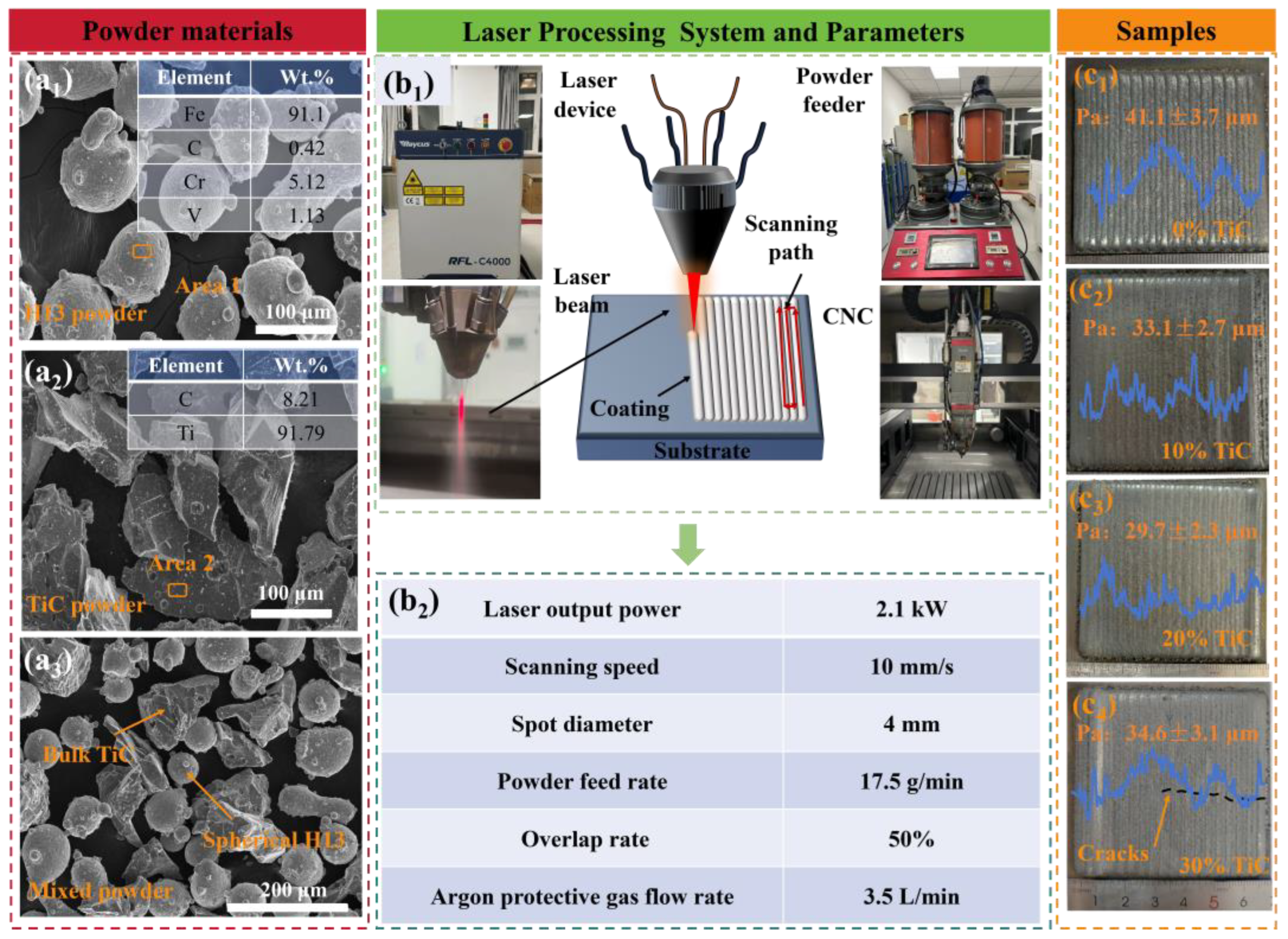
The substrate used for laser cladding was annealed H13 steel, and its chemical composition is listed in Table 1. The combined addition of Cr, Mo, and V promotes the formation of stable carbides (e.g., VC, Mo2C, and M7C3), thereby imparting excellent hot strength, tempering stability, and resistance to thermal fatigue. The medium carbon content (~0.4 wt.% C) provides a favorable balance between strength and toughness, making the steel suitable for hot-work tooling and high-temperature service conditions. After annealing, the typical hardness ranges from 200 to 240 HV, with a tensile strength of 650–800 MPa and a yield strength of 400–550 MPa. The substrates were machined into plates with dimensions of 70 mm × 70 mm × 15 mm. All experiments were conducted on annealed H13 steel substrates (~200 HV) to minimize cracking during process development. The relatively low hardness and high ductility of annealed H13 reduce thermal stresses and suppress crack formation during laser cladding, ensuring stable coating formation and reliable metallurgical bonding. The substrate surface was first ground with 1000 grit sandpaper to remove the oxide layer and then cleaned with acetone. As shown in Figure 1(a1), H13 steel alloy powder (Guangzhou Xinyanjin Additive Manufacturing Technology Co., Ltd., Guangzhou, China) with spherical particle sizes ranging from 56 μm to 111 μm was selected as the matrix powder for the coating, which is identical in composition to the substrate. As shown in Figure 1(a2), bulk TiC (Hebei Yanyou Metal Materials Co., Ltd., Handan, China) particles sizing from 60 μm to 100 μm were considered as the reinforcing phase of the coating. The ceramic particles reinforced metal matrix composites designed in this study were composed of X% TiC/H13 (X = 0, 10, 20, 30 in wt.%) using a planetary ball mill to mix the two powders at 150 rpm for 2.5 h. No grinding balls were added to maintain the original shape of the powders, and the mixed powders are presented in Figure 1(a3). After drying to remove residual moisture, the mixed powders were deposited onto the substrate using a laser cladding system equipped with a coaxial powder feeding device, following the scanning path in Figure 1(b1). As shown in Figure 1(b1), the laser cladding system (Hefei Xinsan Aerospace 3D Technology Co., Ltd., Hefei, China) consists of a 4000 W fiber laser, a dual-temperature water chiller, a powder feeder, a CNC motion platform, and a four-channel powder feeding nozzle. The macroscopic morphology, dilution ratio, microstructure, and mechanical properties of the cladded layers are strongly dependent on the laser cladding process parameters. Among them, laser power and scanning speed play crucial roles in determining the coating quality. Insufficient laser power may lead to the formation of pores and cracks, resulting in poor metallurgical bonding between the coating and substrate, whereas excessive laser power increases the dilution ratio and promotes excessive elemental diffusion from the substrate, thereby deteriorating the coating properties. Similarly, the scanning speed has a comparable influence: an excessively high scanning speed may cause incomplete melting of the powders, while an overly slow speed can lead to powder over-burning and excessive heat input, both of which increase dilution [33,34]. To ensure the formation of a dense coating with a smooth surface and sound metallurgical bonding, the laser power, scanning speed, and powder feeding rate were systematically optimized through a series of preliminary experiments to minimize cracks, porosity, and over-dilution. The optimized parameters were selected based on the superior surface morphology, dilution ratio, and microstructural uniformity. Meanwhile, the TiC contents (10 wt.%, 20 wt.%, and 30 wt.%) were chosen according to previous studies and preliminary trials. A lower TiC content (<10 wt.%) provided limited strengthening while an excessive addition (>30 wt.%) caused severe particle agglomeration and poor coating quality. Therefore, the selected composition range offers a balanced comparison for evaluating the microstructural evolution and performance enhancement of TiC/H13 composite coatings. The key process parameters adopted for cladding are summarized in Figure 1(b2). Figure 1(c1–c4) show the surface morphologies of composite coatings fabricated with different TiC mass fractions, each consisting of four overlapping tracks. Quantitative surface topography measurements were conducted using a surface roughness tester (Mitutoyo SJ-210, Kawasaki-shi, Japan). To ensure representative results and minimize edge effects, roughness profiles were measured over the central 9 mm region of each coating, and the corresponding Pa values are indicated in each image. As the TiC content increased from 0% to 10% and 20%, the Pa value decreased from 41.1 ± 3.7 μm to 33.1 ± 2.7 μm and 29.7 ± 2.3 μm, respectively, indicating that moderate TiC addition effectively reduces melt-track waviness and improves surface uniformity. However, when the TiC content was further increased to 30%, the Pa value rose to 34.6 ± 3.1 μm, accompanied by the emergence of surface cracks (Figure 1(c4)), suggesting that excessive ceramic reinforcement induces thermal stress concentration, deteriorates surface quality, and promotes crack formation. All specimens used for subsequent characterization and testing were extracted from the coatings shown in Figure 1(c1–c4).

2.2. Microstructure Characterization

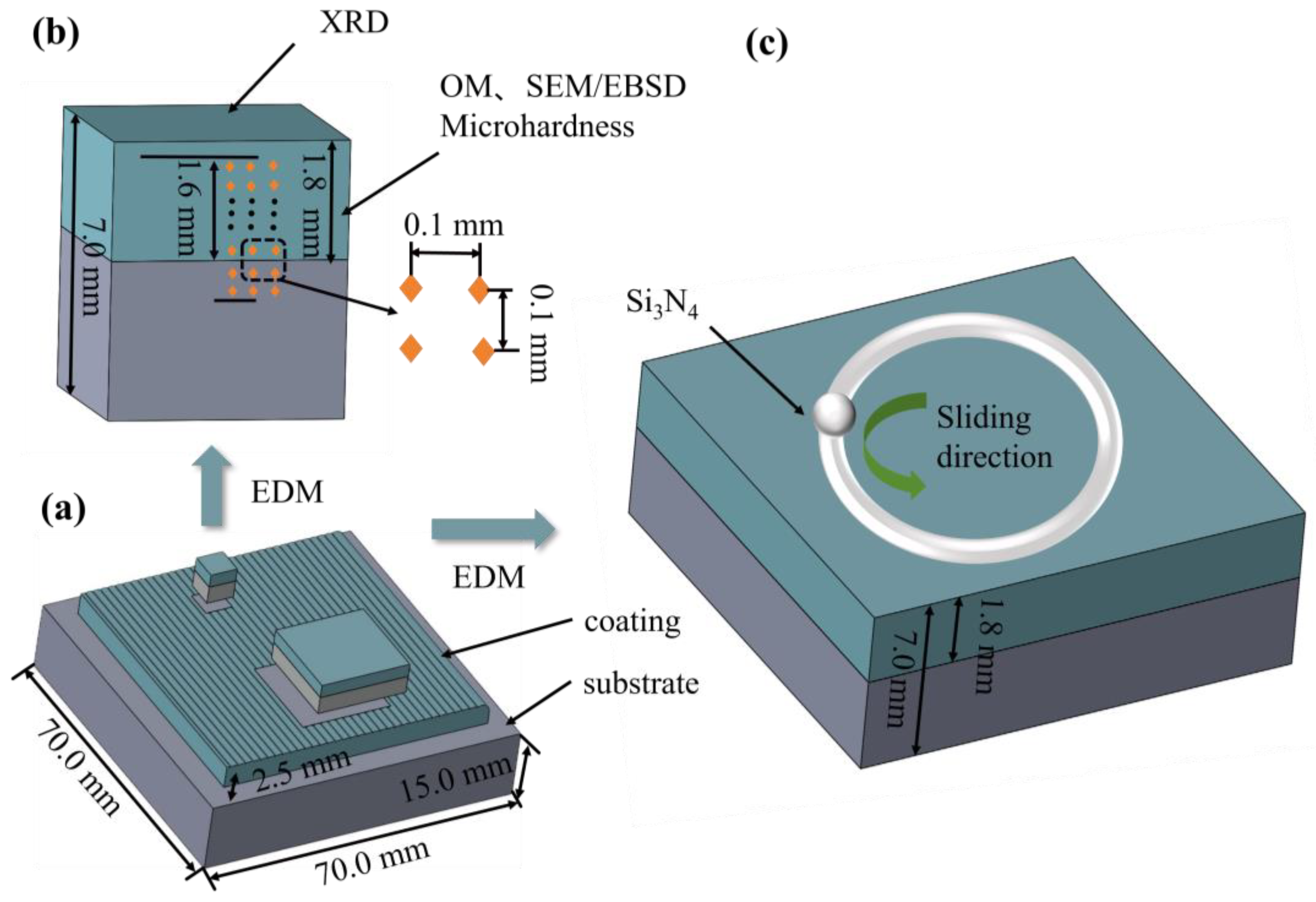
As shown in Figure 2, the specimen positions are indicated. The coatings fabricated by multi-track laser cladding were approximately 2.5 mm thick, while the coating thickness of specimens prepared by wire cutting for microstructure, hardness, and wear tests was about 1.8 mm. For the subsequent characterization, samples with thickness of 7.0 mm were cut out covering the coating thickness of about 1.8 mm. The coated sample surfaces were ground, polished and then cleaned with anhydrous ethanol in an ultrasonic bath for 10 min. The samples were analyzed for surface micromorphology and chemical composition using a Quanta 250 FEG field emission scanning electron microscope (FESEM) (Carl Zeiss AG, Oberkochen, Germany) and its own X-ray energy dispersive spectrometer (EDS). The specimens were tested using a D8 Advance X-ray diffractometer (XRD) (Bruker AXS, Karlsruhe, Germany) analyzer using Cu-K α rays, an accelerating voltage of 40 kV, and scanning angle range from 20° to 90° with a step size of 0.02°. The microstructure, TiC particle distribution and cracks in the cross-section of the samples were observed using an Axio Vert optical microscope (OM) (Olympus Corporation, Tokyo, Japan). Electron backscatter diffraction (EBSD) (HKL Technology Inc., Hobro, Denmark) measurements were conducted at an accelerating voltage of 20 kV and a working distance of approximately 15–20 mm. The sample was tilted at an angle of 70° relative to the incident electron beam to optimize backscattered electron diffraction patterns. A step size of 0.4 μm was adopted to capture detailed microstructural features, and the scan area was set to 80 μm × 80 μm. EBSD data processing was conducted using OIM Analysis software 7.0.

2.3. Hardness and Wear Resistance

Microhardness measurements on the cross-section of the samples were performed using an HVS-1000A fully automatic turret microhardness tester (Shandong Weiyi Instrument Co., Ltd., Laizhou, China), in accordance with the ASTM E384-22 standard [35]. A load of 5 N was applied with a dwell time of 15 s to ensure stable indentation formation and clear profiles. According to the standard, the minimum distance between adjacent indentations should be at least 2.5 times the diagonal length of the indentation. The measurements began 0.2 mm from the surface of the sample, where the diagonal length of the indentations was approximately 27 μm. To accurately capture the hardness gradient between the coating and the substrate, while meeting the required indentation spacing, the measurement range extended 1.6 mm above the substrate and 0.4 mm below. The spacing in the depth direction was 0.1 mm, as shown in Figure 2b. Before testing, the instrument was calibrated using a standard hardness block to ensure measurement accuracy. To improve the data accuracy, three indentations were tested along the horizontal direction for each position, and the average of the three readings was taken as the final microhardness value.
Wear tests were performed using an MS-HT1000 high-temperature tribometer (Lanzhou Huahui Instrument Technology Co., Ltd., Lanzhou, China) at 600 °C. The wear test conditions, particularly the selection of 600 °C as the test temperature, were chosen in accordance with the typical service temperature range of H13 hot-work tool steel (approximately 400–650 °C). This temperature roughly represents the upper limit of its practical working conditions, such as those encountered in hot forging, die casting, and extrusion dies. Testing at 600 °C therefore provides a realistic simulation of the severe thermal and frictional environment experienced during service. Moreover, this wear temperature allows us to better evaluate the high-temperature strengthening, oxidation resistance, and wear performance contributed by TiC reinforcement, thereby ensuring that the experimental results possess strong engineering relevance. The testing position is illustrated in Figure 2c. The specimens were prepared with dimensions of 20 mm × 20 mm × 7 mm. The test parameters were set as follows: an applied load of 20 N, a rotation speed of 300 rpm, a friction radius of 6 mm, and a total test duration of 60 min. A Si3N4 ball with a diameter of 4.0 mm was employed as the counter-body. To minimize experimental error, each specimen was subjected to three repeated wear tests, and the average values of the coefficient of friction were calculated. In addition, all specimens were ground using 80#, 200#, 600#, and 1000# grit sandpapers to ensure consistent surface conditions. Surface morphology and roughness of the worn specimens were characterized using a KC-X1000 laser (Nanjing KathMaticTechnology Co., Ltd., Nanjing, China) confocal microscope, with a scanning area of 20 mm × 10 mm, a scanning interval of 10 μm, and a scanning frequency of 3000 Hz. The three-dimensional morphology and volume of the wear tracks were reconstructed using KC-ANAL software 1.0. The wear rate was determined by dividing the wear volume by the applied load, and the total sliding distance.
W e a r   r a t e = V W · L
where V (mm3) represents wear volume, W (N) is applied load and L (m) is total sliding distance.

3. Results and Discussion

3.1. XRD Analysis

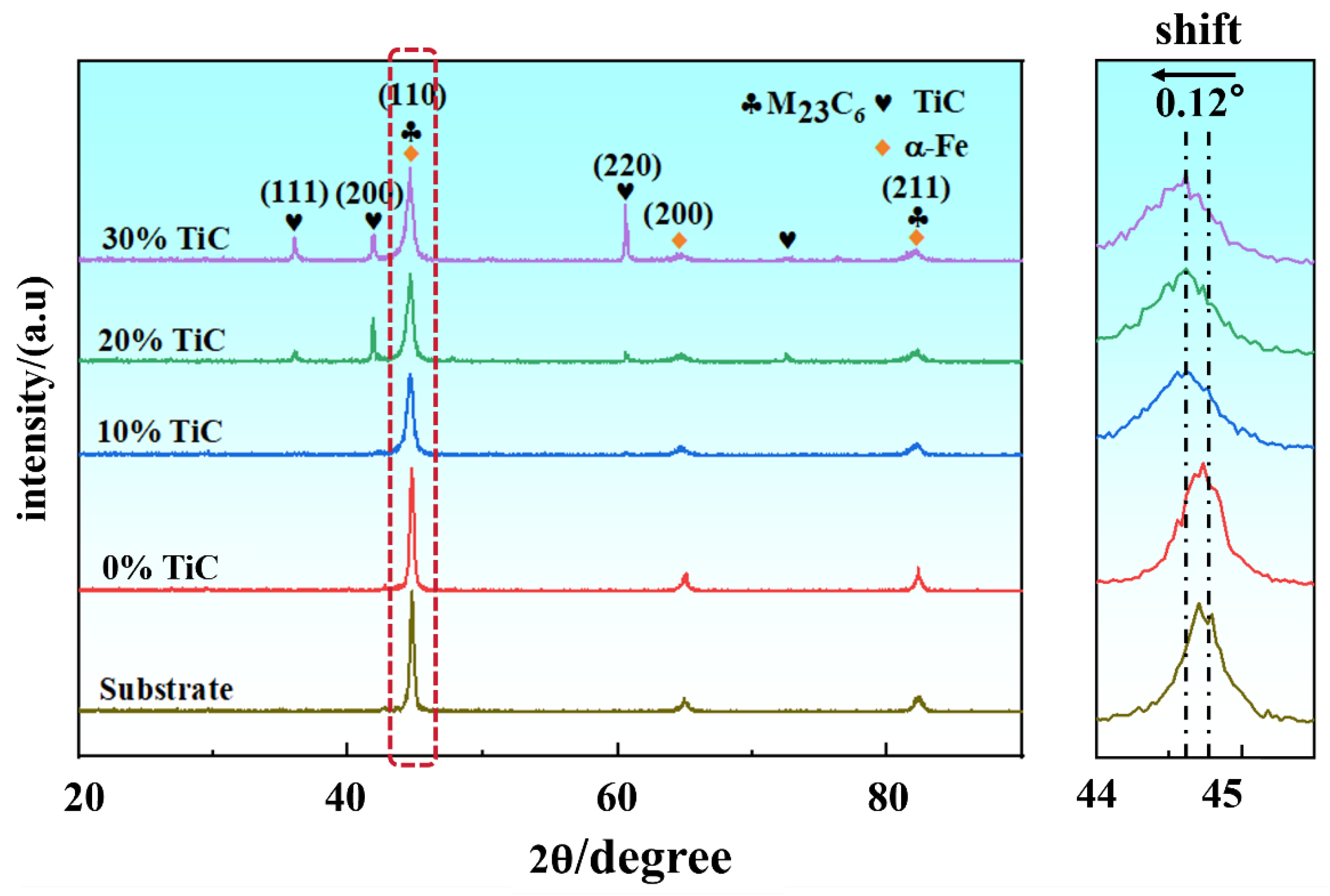
Before analyzing the microstructure in detail, it is necessary to know which phases are present in the TiC/H13 composite coating. Therefore, phase analysis is performed by XRD on the polished surface of the laser deposits. To more clearly elucidate the effect of TiC on the metal matrix, the XRD pattern of the 0% TiC laser cladding H13 coating has also been included for comparison, as indicated by “0% TiC” in Figure 3. XRD results show that no other phases are recognized in H13 steel substrate except for α-Fe and M23C6 (M = Mo/Cr/V/Mn) [29,36]. The phase composition of the 0% TiC coating is consistent with that of the substrate, and no significant shift in the diffraction peaks is observed. Due to fast cooling and solidification during laser cladding, a fine and oriented grain structure may form in the coating. This rapid solidification promotes the preferential orientation of the grains, leading to an increase in the orientation density of certain crystal planes (e.g., (110)), which enhances the intensity of corresponding diffraction peaks. After the addition of 10% TiC particles, XRD results reveal that no obvious new phases are detected in the coating, which are still dominated by α-Fe and weak TiC diffraction peaks. With the increase in TiC addition from 10% to 30%, the peaks for TiC are evidently intensified and the main peak of (110) for α-Fe is gradually weakened, obviously broadened, and accompanied by a slight shift of about 0.12° to the low-angle direction. This phenomenon can be attributed to the fact that TiC particles serve as effective heterogeneous nucleation points during the melting and solidification process, which promotes grain refinement and results in peak broadening, as illustrated in Figure 3. Furthermore, the rapid solidification rate, together with the thermal stress arising from the mismatch in thermal expansion coefficients between TiC and the matrix, induces lattice distortion, thereby leading to a slight shift in diffraction peaks [37].

3.2. Microstructure Observation

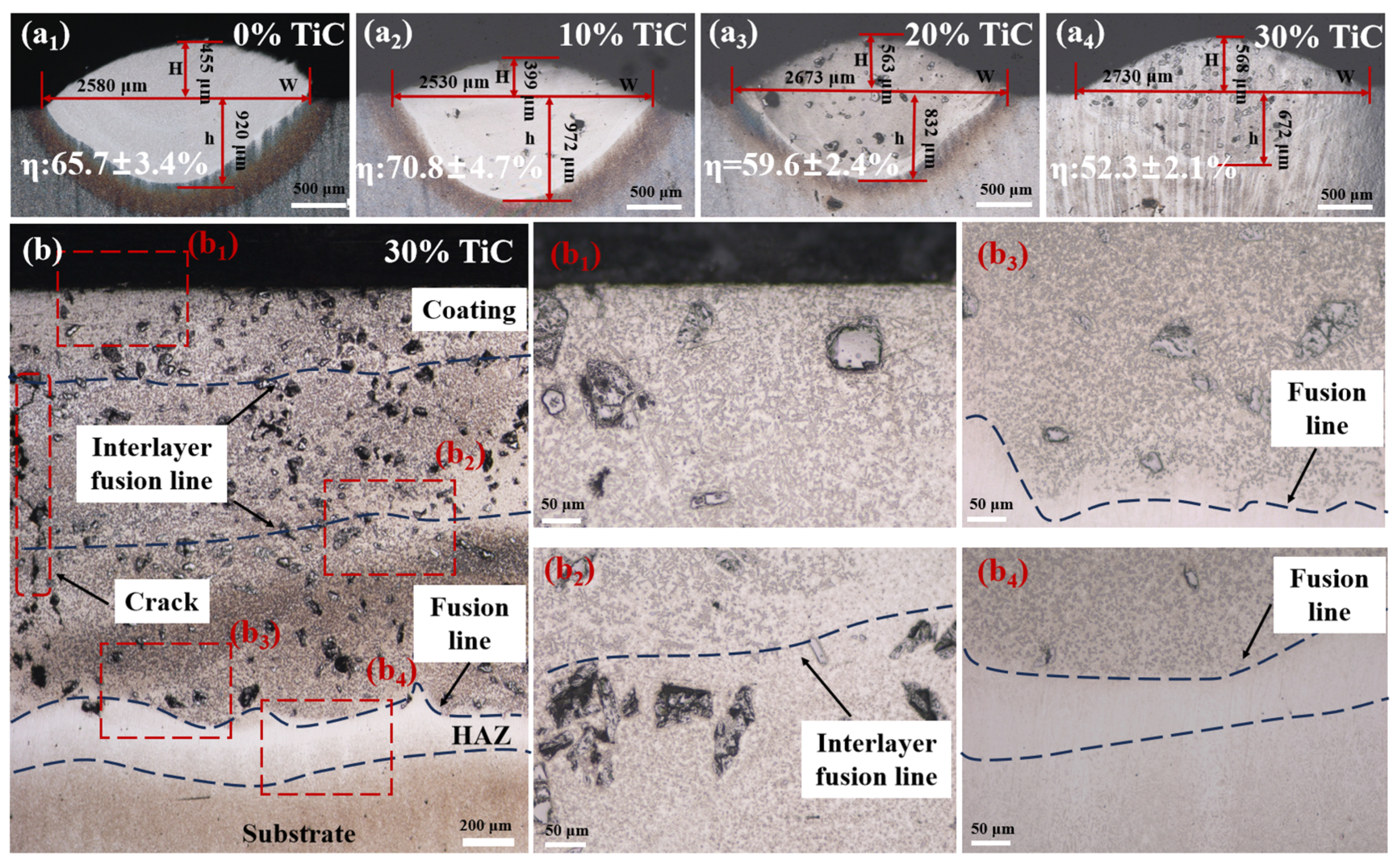
During the laser cladding process, the dilution rate (η) is commonly used to quantify the extent of compositional variation in the cladding alloy caused by mixing with the substrate material. As illustrated in Figure 4(a1–a4), H represents the height of the cladding layer, h denotes the penetration depth into the substrate, and W corresponds to the coating width. The dilution rate can be calculated using the following equation:
η = h H + h ×   100 %
As shown in Figure 4(a1–a4), with increasing TiC content, the height of the coating gradually increases while the penetration depth into the substrate decreases. The dilution rate of the pure H13 coating reaches 66.9%, and this can be attributed to the homogeneous composition between the cladding powder and substrate, which leads to low interfacial energy and good wettability, thereby promoting deeper substrate melting and a wider fusion zone. In addition, the use of relatively high laser power and low scanning speed to ensure complete melting further increases the dilution degree. Moreover, the absence of compositional incompatibility reduces the resistance to substrate dissolution, making the process thermodynamically closer to laser alloying. With the addition of TiC particles, the ceramic reinforcements modify the molten pool dynamics and heat flow, partially reflecting or scattering the laser energy, resulting in reduced thermal input and thus lower dilution rates of 59.6% and 54.1% with 20% and 30% TiC, respectively. Figure 4b shows the overall microstructure of the coating with 30% TiC, and Figure 4(b1–b4) illustrate the spatial distribution of TiC particles from the top surface to the fusion zone. In the top region of Figure 4(b1), a large number of TiC particles are uniformly distributed with relatively fine sizes. In the middle region of Figure 4(b2), the particles become slightly coarser and less uniformly distributed, with some local agglomeration caused by partial remelting and redistribution during multi-layer cladding. Near the fusion line shown in Figure 4(b3,b4), the number of TiC particles decreases significantly, suggesting that some TiC may have been partially dissolved or diluted in the high-temperature area adjacent to the substrate. Moreover, the distribution of in situ formed TiC is closely related to the local Ti atomic concentration and is further influenced by the thermal gradient and dilution effect during laser cladding. Regions with higher Ti content promote the nucleation and growth of TiC, while in the bottom area, the Ti concentration is significantly reduced due to element dilution from the substrate, resulting in a lower amount of in situ TiC formation. As shown in Figure 4(b3,b4), the coating and substrate are metallurgically bonded with a continuous interface, and no visible cracks or pores are observed, indicating sound coating quality [38]. Moreover, the bonding between successive cladding layers is uniform without defects. However, a few longitudinal cracks are observed along the depth direction of the 30% TiC/H13 coating. Overall, the coatings exhibit good metallurgical quality.
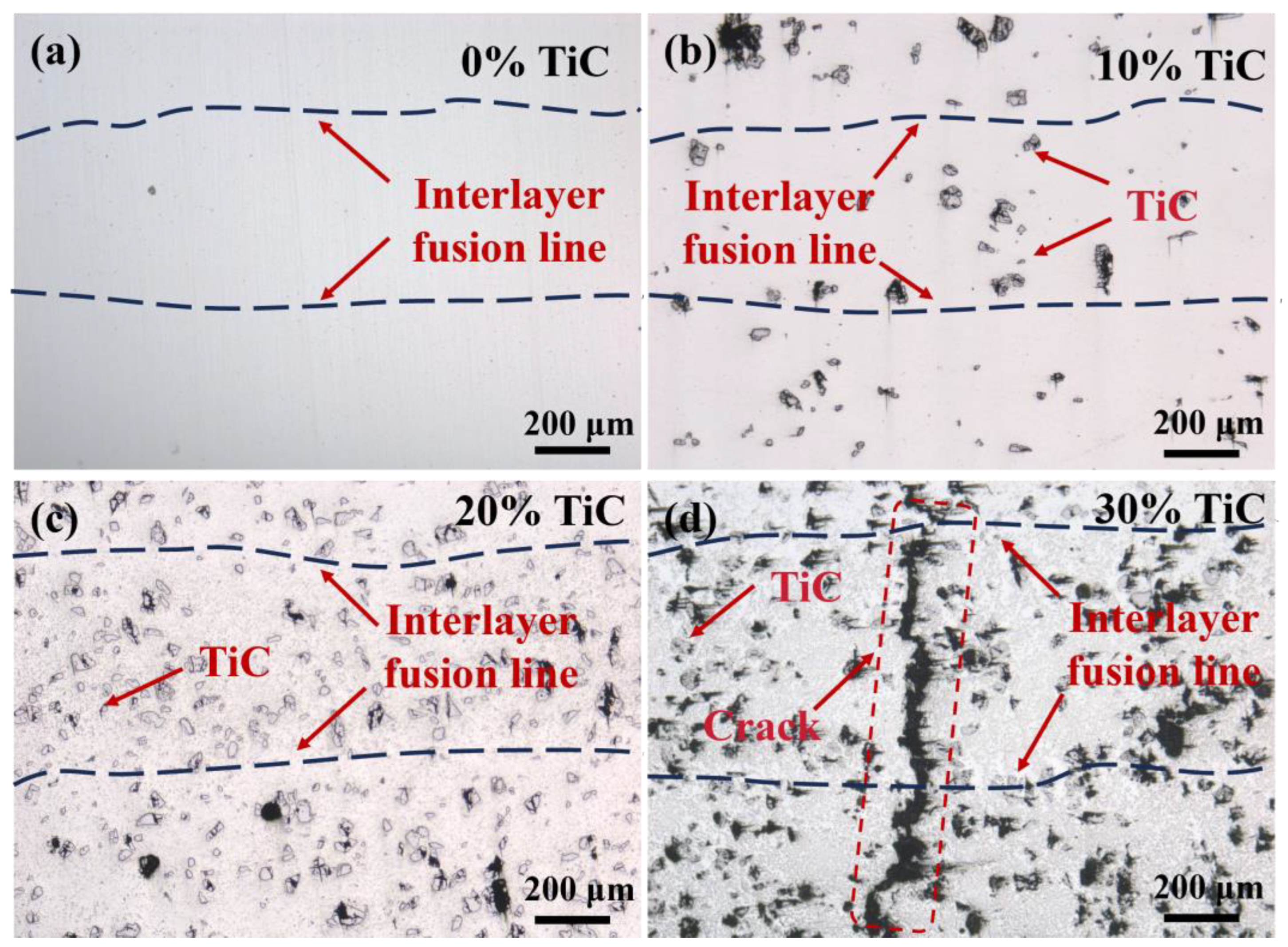
Figure 5 presents the unetched cross-section optical micrographs indicating the interlayer regions in H13 coatings with various TiC contents. Owing to the sufficient remelting that occurred during multi-track laser cladding, the actual interlayer boundaries are indistinct, indicating that good metallurgical bonding was achieved between successive layers. As shown in Figure 5a, the coating with 0% TiC exhibits a dense and homogeneous appearance without observable cracks or pores, demonstrating excellent interlayer bonding quality. As shown in Figure 5b, TiC particles are dispersed throughout the matrix, and no discontinuities are observed near the estimated interlayer boundary, suggesting that moderate TiC incorporation does not hinder metallurgical bonding. When the TiC content increases to 20% shown in Figure 5c, the number of TiC particles significantly rises and their distribution becomes more homogeneous, forming a stable particle-reinforced network across layers. However, with 30% TiC, as shown in Figure 5d, longitudinal cracks appear along the depth direction, which may be attributed to localized thermal stress concentration induced by particle agglomeration.
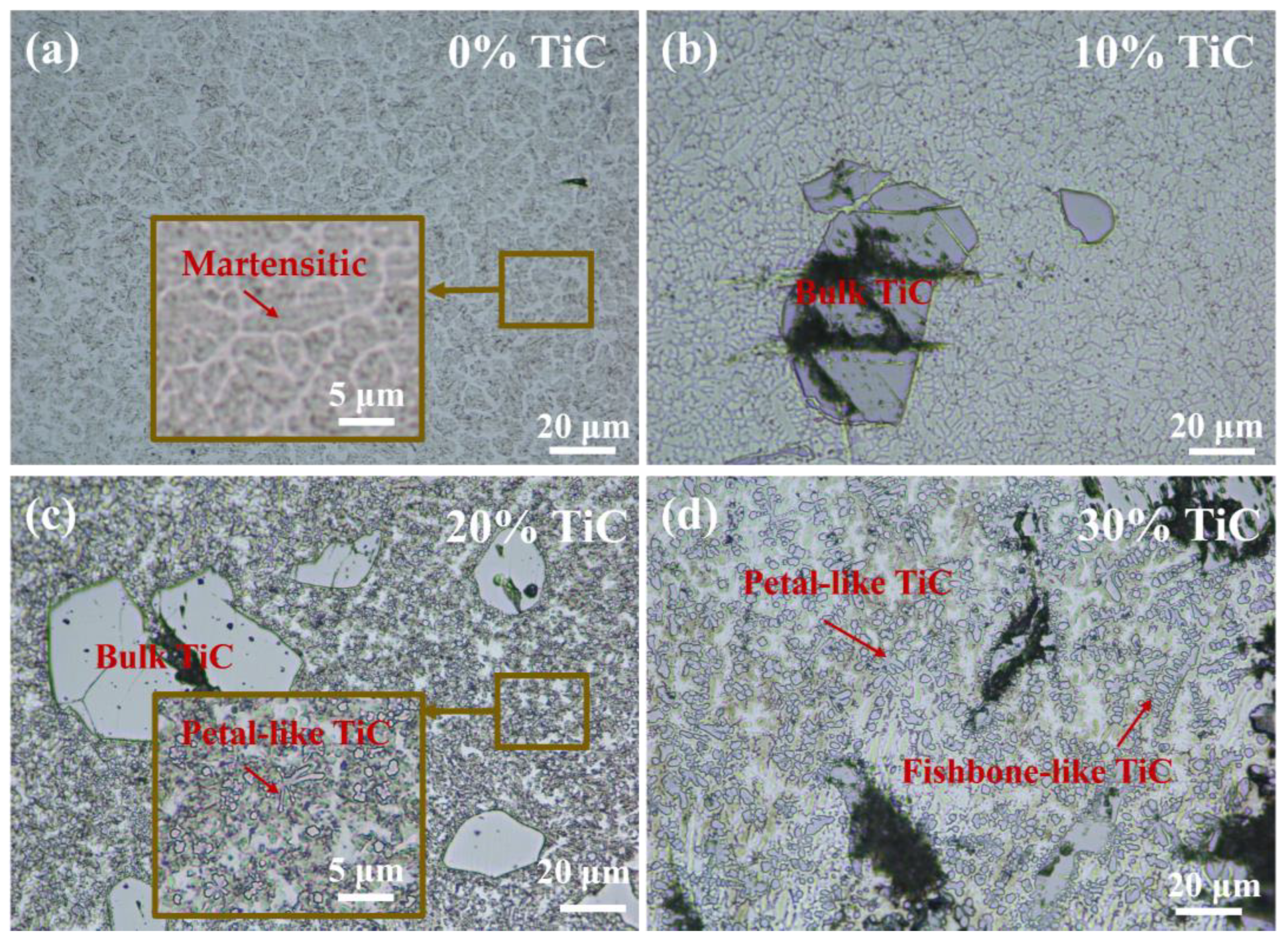
Figure 6 presents the etched and magnified cross-section optical microstructure of the deposited metal matrix composite coatings. In the case of laser cladding on H13 steel without TiC addition, the microstructure exhibits a blocky martensitic morphology rather than the typical acicular martensite, as shown in Figure 6a. These seemingly uniform and fine morphologies are actually composed of densely interlaced lath martensite or martensitic packets [39]. After the addition of TiC powder, the microstructure of the coatings have undergone significant changes, most of the initial TiC particles are still present in the molten pool, and by a part of the melting and dissolution, as shown in Figure 6b–d. TiC particles serve as heterogeneous nucleation sites during the laser cladding process, effectively refining grain size and enhancing microstructural densification [36]. With the addition of 10% TiC, the microstructure becomes noticeably refined. This uniform dispersion likely contributes to improvements in microhardness and wear resistance. When the TiC content is increased to 20%, the distribution of reinforcement particles become most uniform, and the resulting microstructure exhibits excellent densification with fine grains and diffusely distributed reinforcement phases. This optimized combination enhances the mechanical performance of the coating by promoting dispersion strengthening and grain refinement. When the TiC content is further increased to 30%, excessive particle agglomeration occurs, resulting in microstructural inhomogeneity, local grain coarsening, and the formation of pores and microcracks in the regions of particle clustering. Additionally, numerous fine TiC particles (up to 10 μm) are dispersed within the metal matrix, while the original blocky martensite grain boundaries become indistinct. These microstructural features indicate that, although local densification may occur in some regions due to fine particle distribution, the overall coating quality is compromised by clustering-induced defects, which can adversely affect mechanical properties.
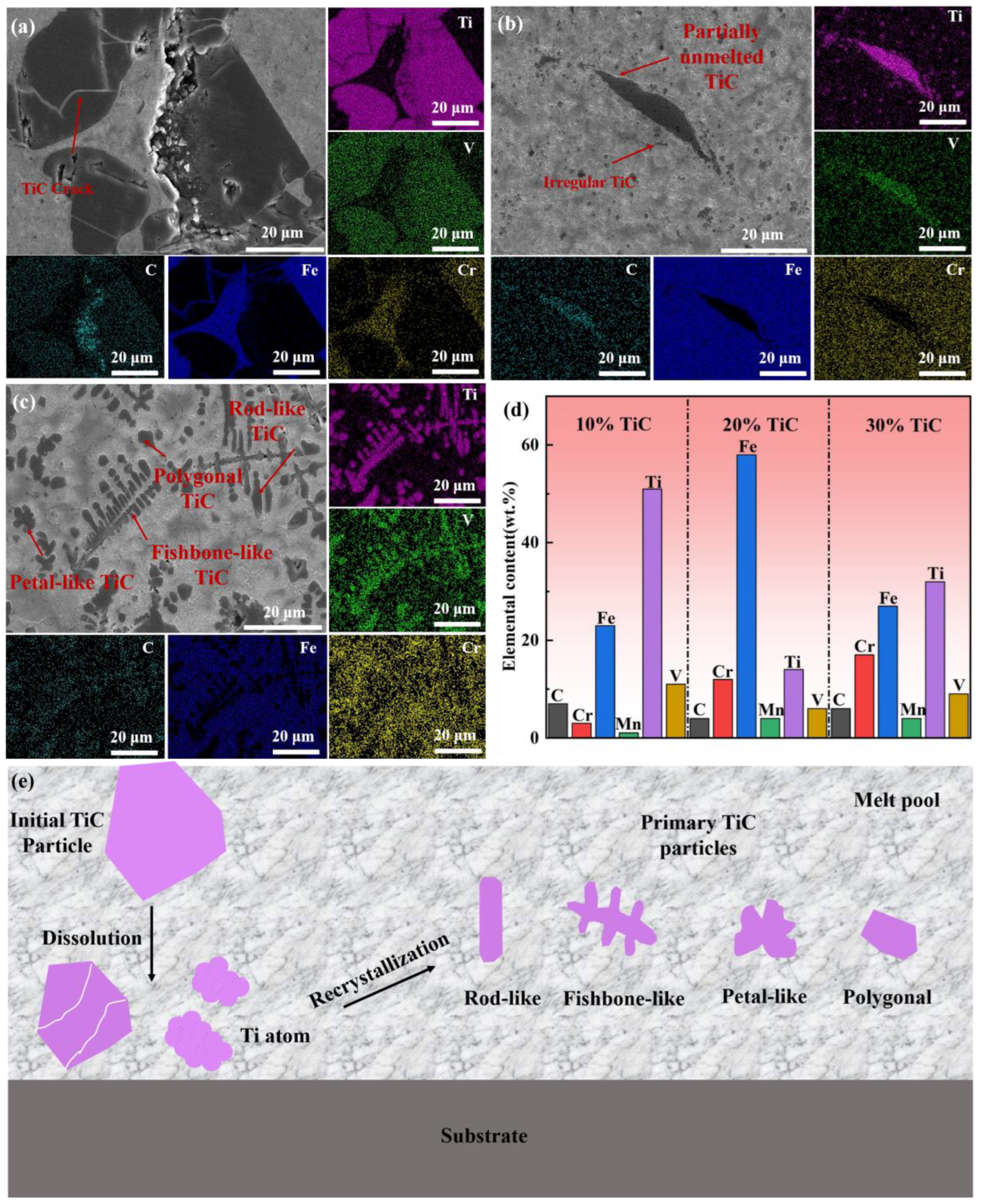
The morphology of the various shapes of primary TiC appearing in Figure 6b–d is further manifested in Figure 7a–c. In the TiC/H13 composite coatings fabricated by laser cladding, TiC exists in three main forms-initial TiC, primary TiC, and eutectic TiC [40]. When the laser beam acts on the surface, the TiC particles are exposed to high-density energy flow, the local temperature rises sharply followed by rapid cooling, leading to particle fragmentation and partial dissolution at the edges or corners of the TiC particles, as shown in Figure 7e. The initial TiC particles may be partially thermally decomposed into Ti and C atoms in localized superheated regions (especially interfacial regions), forming Ti or C-rich localized regions. Due to the extremely high cooling rate of laser cladding (104–106 K/s), atomic diffusion during solidification is severely restricted, and recrystallization may not proceed along the original crystal orientation. The rapid solidification front promotes high nucleation rates but limits grain growth, leading to the formation of fine, misoriented grains and a refined matrix structure in the coating. For TiC, the constrained diffusion of Ti and C atoms and the solute trapping effect result in nonequilibrium solidification, where well-faceted cubic TiC crystals are replaced by complex primary TiC morphologies [41,42]. The shapes of primary TiC particles can be roughly categorized into four types as petal-like, rod-like, fishbone-like and polygonal [43]. Among the classified morphologies, the petal-like TiC particles are predominantly observed in coatings with 30% TiC, as shown in Figure 7c. These particles typically exhibit four to six petal branches extending radially from a central core, indicating a polycrystalline growth mode. Their formation is closely associated with the localized supersaturation of Ti and C in the melt pool and directional solidification under a moderate thermal gradient. The presence of petal-like TiC is indicative of adequate atomic mobility during solidification, which promotes multi-nucleation and branched growth along energetically favorable crystallographic orientations [44]. This morphology provides a high interfacial area with the matrix, potentially enhancing interfacial bonding and mechanical interlocking. Rod-like TiC particles are characterized by their elongated, columnar shapes and are commonly found across a wide TiC content range. Their formation is generally attributed to anisotropic crystal growth along specific crystallographic directions (e.g., (100) or (111)), driven by the strong thermal gradients and directional solidification inherent to laser processing. These rod-like particles can effectively impede dislocation motion and crack propagation due to their aspect ratio, contributing to the enhancement of hardness and fracture resistance. Fishbone-like TiC morphologies exhibit multiple secondary branches extending obliquely from a central stem, resembling a skeletal structure. Such features likely result from rapid dendritic solidification in highly supersaturated and unstable thermal fields. The irregular geometry of fishbone-like TiC increases their surface roughness and anchoring effect within the matrix, which may enhance load transfer and contribute to crack deflection, thereby improving the toughness of the composite coating. Polygonal TiC particles, often with sharp edges and well-defined facets, suggest a relatively slow and equilibrium solidification process in localized melt regions. These particles may nucleate and grow when TiC concentration is high, and local cooling rates are reduced due to thermal shielding or particle clustering. Their compact shape and high crystallinity can contribute to overall hardness, although excessive formation may lead to stress concentration and local brittleness, particularly if the particles agglomerate [45]. The eutectic TiC forms at the terminal stage of solidification through the eutectic reaction between the remaining Ti, C, and Fe atoms in the residual melt. Because the melt is enriched with Ti and C near grain boundaries and interdendritic regions, the eutectic TiC preferentially nucleates along these areas and grows cooperatively with γ-Fe. Morphologically, the eutectic TiC exhibits various structures-fine lamellar, flake-like, or reticulated morphologies-with sizes typically ranging from a few hundred nanometers to several micrometers depending on the local cooling rate and solute concentration [46]. Under the extremely rapid solidification conditions of laser cladding, the eutectic TiC tends to appear as discontinuous or semi-networked clusters rather than a fully continuous skeleton, forming a “grain boundary frame” that effectively pins grain boundaries and impedes their migration. As shown in Figure 7d, the coarse initial TiC particles experience only partial dissolution in the molten pool and do not sufficiently mix with the surrounding Fe-based melt. Consequently, they retain a high Ti concentration (~51%) and a relatively pure chemical composition. These TiC particles typically exhibit well-defined crystal facets and larger sizes, representing initial or residual TiC. In contrast, in regions where primary TiC forms, V and Cr-both transition metals-can participate in substitutional solid solution within the TiC lattice (Ti ↔ V/Cr), owing to the similar crystal structures and good mutual solubility of their respective carbides (VC, Cr7C3, Cr3C2, etc.). This promotes the formation of multicomponent carbide solid solutions [47]. In general, when 10% TiC is added, most TiC particles retain their initial angular or blocky morphology, indicating that undissolved TiC dominates the coating. With 20% TiC, the proportion of primary TiC increases significantly, appearing as fine irregular TiC particles of approximately 2–3 μm, uniformly distributed within the coating, while some initial TiC particles remain partially unmelted. When the TiC content reaches 30%, excessive TiC addition promotes particle agglomeration and local enrichment, leading to coarser primary TiC and partially interconnected eutectic TiC structures at interdendritic regions. Both the size and number of primary TiC particles increase significantly, and their morphologies become more complex, exhibiting rod-like, fishbone-like, and polygonal shapes. This evolution suggests a transition from predominantly undissolved TiC to a coexistence of undissolved and in situ formed TiC, and finally toward eutectic-type TiC with increasing TiC content [48].
Figure 7 also shows the EDS surface scanning patterns of laser cladding TiC/H13 composite coatings with different TiC contents. From Figure 7a–c, the black particles are mainly enriched with Ti and C elements, indicating that this is the TiC reinforced phase. At the same time, the regions also contain a small amount of V, suggesting possible formation of secondary carbide phases or interface reaction layers. The Fe element is significantly reduced in the TiC particle regions, further highlighting the clear separation between the matrix metal and the reinforced phase. In addition, the pronounced segregation of carbon along the crack paths corroborates that the fracture of TiC particles constitutes a primary mechanism responsible for the degradation and failure of the coating. As shown in Figure 7c, with a TiC content of 30%, Ti and C elements are more densely concentrated within the particle regions. Both the size and number of TiC particles increase significantly, and their morphologies become more complex, exhibiting rod-like, fishbone-like, and polygonal shapes. At higher TiC contents, the enrichment of V elements in the particle regions becomes more evident, and part of the V is incorporated into the TiC lattice, promoting the formation of composite carbides containing multiple transition elements. By contrast, the enrichment of Cr elements plays a different role: a high concentration of Cr is mainly distributed at the particle–matrix interface, which contributes to the enhancement of metallurgical bonding and thermal stability of the coatings [41]. Based on the EDS results, it is evident that increasing the TiC content leads to significant growth in both the size and quantity of TiC reinforcement phases. Elemental enrichment becomes more pronounced, and the types of composite carbides formed become increasingly complex. These changes directly influence the microstructural evolution mechanisms of the coatings, further confirming the strong modulatory effect of TiC content on both phase morphology and elemental distribution. The higher Fe content and lower Ti content observed in the 20% TiC condition in Figure 7d are mainly attributed to the local nature of SEM/EDS measurements. When the analyzed area is located within or near TiC particles, the measured Ti concentration is relatively high, whereas regions dominated by the Fe matrix and located away from TiC reinforcements exhibit lower Ti and higher Fe signals. Therefore, this variation reflects local microstructural heterogeneity rather than an actual decrease in the overall TiC content.
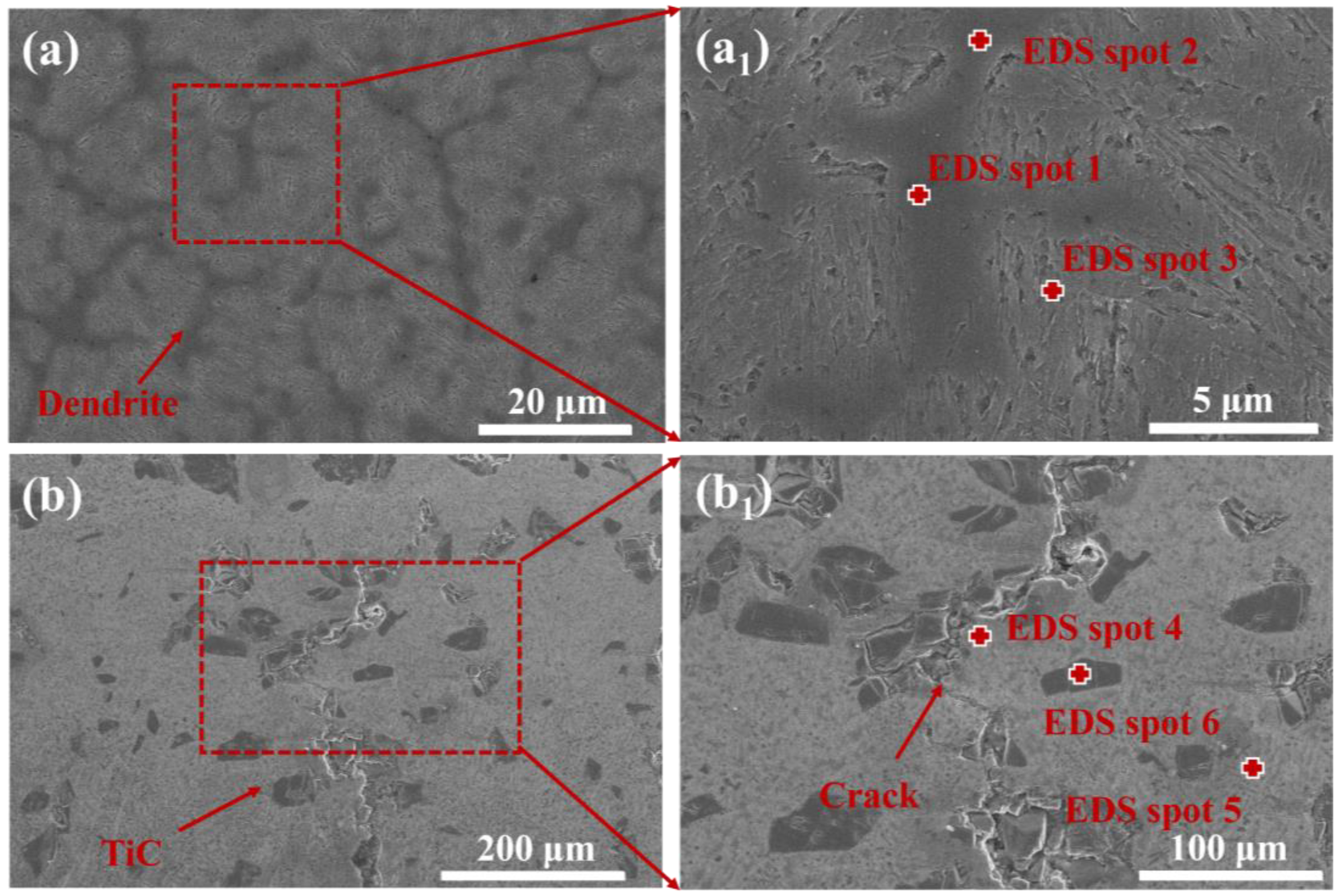
Figure 8 illustrates the SEM images and EDS spots of composite coatings with 0% and 30% TiC. As shown in Figure 8a, a distinct reticular structure is observed in the microstructure of the laser cladding coating, predominantly distributed along the grain boundaries and exhibiting typical interdendritic precipitation characteristics. In order to elucidate its chemical composition, three EDS spots were selected in the enlarged Figure 8(a1), where Spot 1 and Spot 2 correspond to the interdendritic reticular phase while Spot 3 is located within the dendritic matrix regions. According to the results summarized in Table 2, the reticular phase is significantly enriched in Mo (12.15 ± 2.35%), Cr (10.04 ± 1.56%), and V (3.15 ± 0.23%), whereas the matrix regions contain markedly lower concentrations of these alloying elements (Mo: 0.57 ± 0.15%, Cr: 4.86 ± 1.11%, V: 0.78 ± 0.13%). The above results indicate that the reticular structure is an eutectic carbide formed after the alloying elements are polarized to the grain boundaries during the rapid solidification process, and the XRD patterns shown in Figure 3 suggest that it is mainly a Mo-Cr-Mn-rich M7C3 or M23C6 type of carbide [43]. This type of carbide generally exhibits high hardness and excellent thermal stability, thereby enhancing the wear resistance of the coating. However, its continuous precipitation along grain boundaries may increase the brittleness of the coating and provide preferential sites for crack initiation and propagation. The matrix region, with a relatively low concentration of alloying elements, is mainly composed of tempered martensite. A clear interface can be observed between the precipitated phase and the matrix, and the microstructure reveals typical features of interdendritic segregation [44].
As shown in Figure 8b, the microstructure of the 30% TiC/H13 composite coating exhibits irregularly distributed angular TiC particles embedded in the matrix. Figure 8(b1) further reveals extensive crack propagation associated with these reinforcing particles. EDS point analysis indicates that the area adjacent to the crack (Spot 4) is significantly enriched in Ti (35.09%) and C (14.11%), suggesting partially molten or aggregated TiC-rich regions. In contrast, the matrix region near the crack (Spot 5) shows a higher Fe content (81.91%), corresponding to the matrix phase. Further analysis of Spot 6 demonstrates that the typical TiC particles mainly consist of Ti (83.95%), confirming their role as the primary reinforcing phase distributed within the coating. The excessive addition of TiC particles leads to severe microstructural inhomogeneity due to their tendency to aggregate during laser cladding. This aggregation creates localized stress concentration sites that significantly increase the susceptibility to crack initiation. Specifically, TiC possesses a relatively low coefficient of thermal expansion of approximately 7.4 × 10⁻⁶ K−1, whereas H13 steel exhibits a higher and temperature-dependent one of about 11.4 × 10⁻⁶ K−1 at room temperature, which increases further with rising temperature. This significant mismatch can lead to the accumulation of residual tensile stress at the TiC/matrix interface during rapid heating and cooling cycles in the laser cladding process. As a result, microcracks preferentially nucleate at the particle-matrix interfaces and subsequently propagate into continuous transgranular or intergranular cracks [49].

3.3. EBSD Analysis

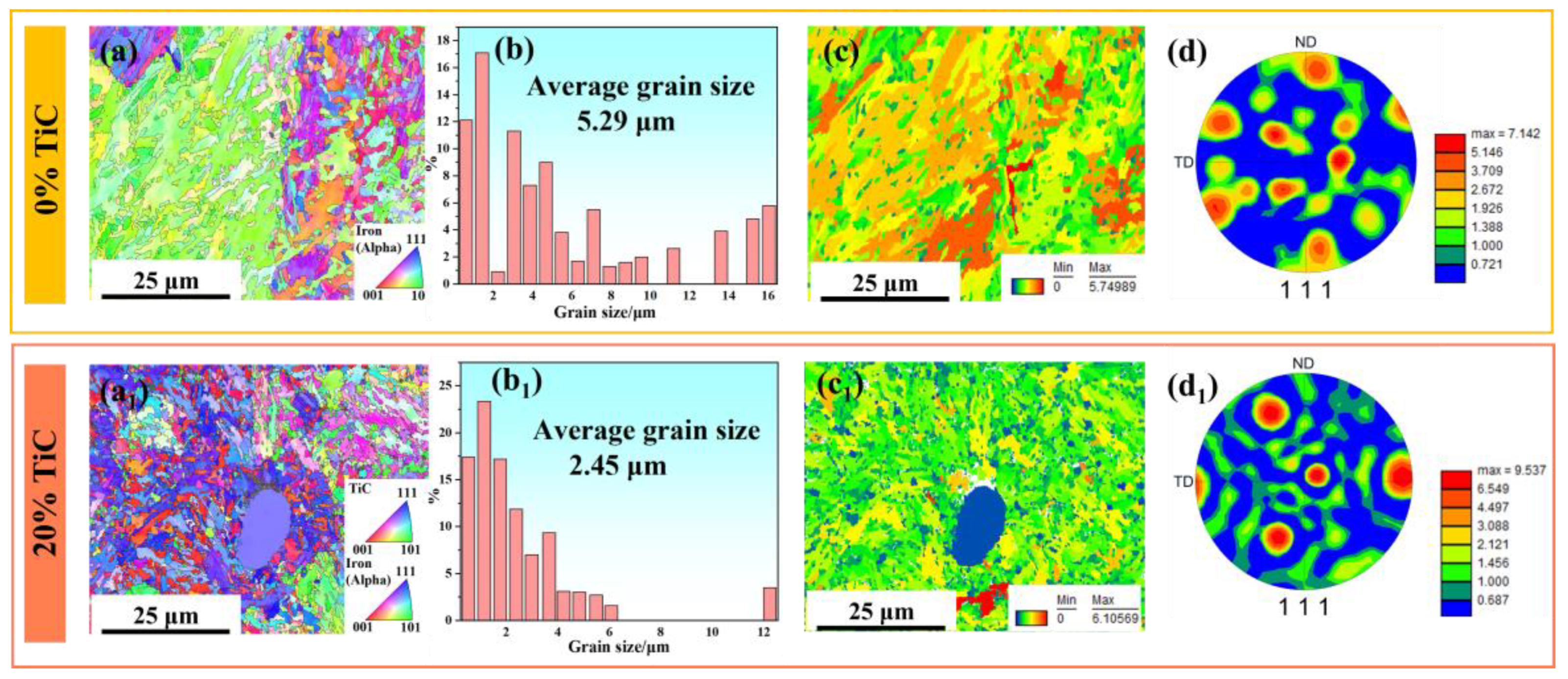
To further investigate the influence of TiC on the microstructural characteristics of H13-based laser cladding coatings, EBSD analysis was performed on both 0% and 20% TiC/H13 composite coatings, as shown in Figure 9. Figure 9(a,a1) display the inverse pole figure (IPF) maps of the coatings. Both exhibit a distinct columnar grain structure whereas the grains in the 0% TiC coating are relatively coarse and exhibit a strong preferential orientation, as indicated by the uneven distribution in grain orientation. In contrast, the 20% TiC/H13 coating exhibits significantly refined ferritic grains with a more uniform and random orientation distribution, indicating a transition toward a polycrystalline microstructure and a pronounced reduction in structural anisotropy [50]. Figure 9(b,b1) illustrate the corresponding grain size distributions, providing quantitative validation of the microstructural observations. The average grain size of the 0% TiC coating was measured at 5.29 μm while that of the 20% TiC-reinforced coating was markedly reduced to 2.45 μm. The incorporation of TiC particles effectively suppressed grain coarsening and facilitated grain refinement, underscoring their crucial role in modulating the microstructure of the coating [48]. The introduction of TiC significantly reduces the anisotropy of the coating by promoting multiple-site heterogeneous nucleation, refining the grains, disturbing the heat flow direction, and suppressing preferential grain growth, thereby leading to a more uniform microstructure. Figure 9(c,c1) show the grain orientation spread (GOS), with the colors distinguishing the recrystallization states: blue-green areas are fully recrystallized, and red-orange areas are subcrystalline or highly deformed structures. The 0% TiC coating has a low degree of recrystallization, with only localized areas of recrystallization occurring, indicating a high degree of residual plastic strain. In the 20% TiC/H13 coating, the recrystallized grains are widely distributed, and the deformed structures are significantly reduced, indicating that the TiC particles promote the recrystallized nucleation and increase the overall degree of recrystallization. Figure 9(d,d1) show the (111) crystal surface pole figures of the two coatings. The maximum orientation strength of the pole figure of the 0% TiC coating is 7.142, reflecting a stronger texture with a distinctly preferential orientation. In contrast, the strength of the 20% TiC/H13 coating is further enhanced to 9.537, indicating that it exhibits stronger texture characteristics despite the finer grains [51,52]. This may be attributed to the anisotropic growth of some primary TiC particles along specific crystallographic directions (e.g., (100) or (111)), driven by the strong thermal gradients and directional solidification inherent to the laser processing conditions. This interpretation is also consistent with the description of the diverse morphologies of primary TiC particles presented in the main text.
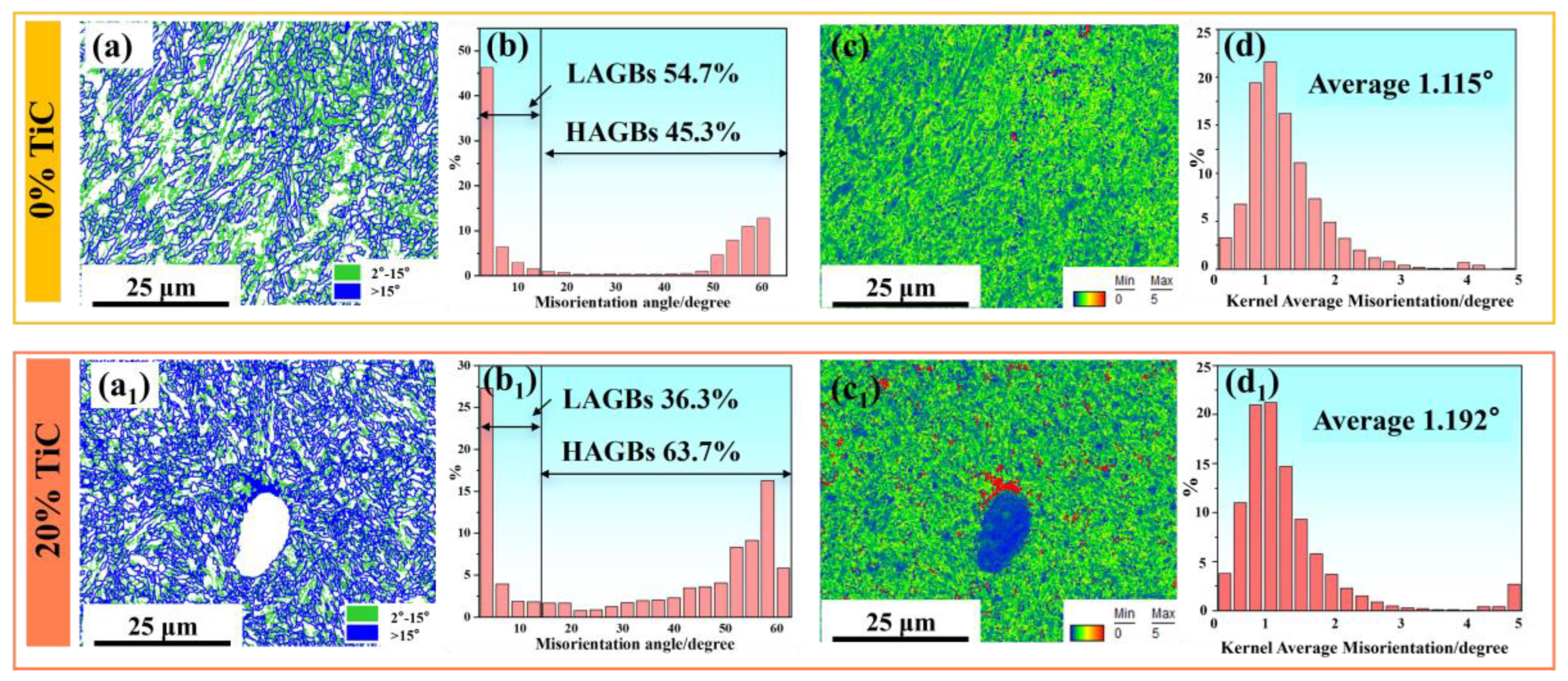
Figure 10(a,a1) demonstrate the distribution of grain boundaries for the two coatings, where green color indicates low-angle grain boundaries (LAGBs, 2–15°) and blue color indicates high-angle grain boundaries (HAGBs, >15°). The statistical results in Figure 10(b,b1) show that the percentage of HAGBs in the 0% TiC coating is 45.3% whereas the percentage of HAGBs in the 20% TiC/H13 composite coating is significantly increased to 63.7%. The increase in the HAGBs indicates the increase in the misorientation between the grains, which suggests that a higher degree of recrystallization is present in the composite coating, which can help to improve the thermal stability and creep resistance of the material performance. Figure 10(c,c1) show the kernel average misorientation (KAM) maps of the two coatings, and the KAM maps of both coatings are dominated by green color, indicating that the overall strain level of the material is low. However, there are relatively fewer high KAM regions in the 0% TiC coating, indicating a lower dislocation density. In contrast, the 20% TiC/H13 coating exhibits a slightly larger proportion of red areas with a broader distribution, indicating that more dislocations were generated during the rapid solidification process due to the reinforcement of TiC particles. The statistical histograms of the KAM angles are presented in Figure 10(d,d1). The average KAM value of the 0% TiC coating is 1.115°, whereas that of the 20% TiC/H13 composite coating increases slightly to 1.192°. This tendency further confirms that the incorporation of TiC promotes dislocation formation, thereby providing additional barriers to plastic deformation and improving the overall strength of the coating [31,53].
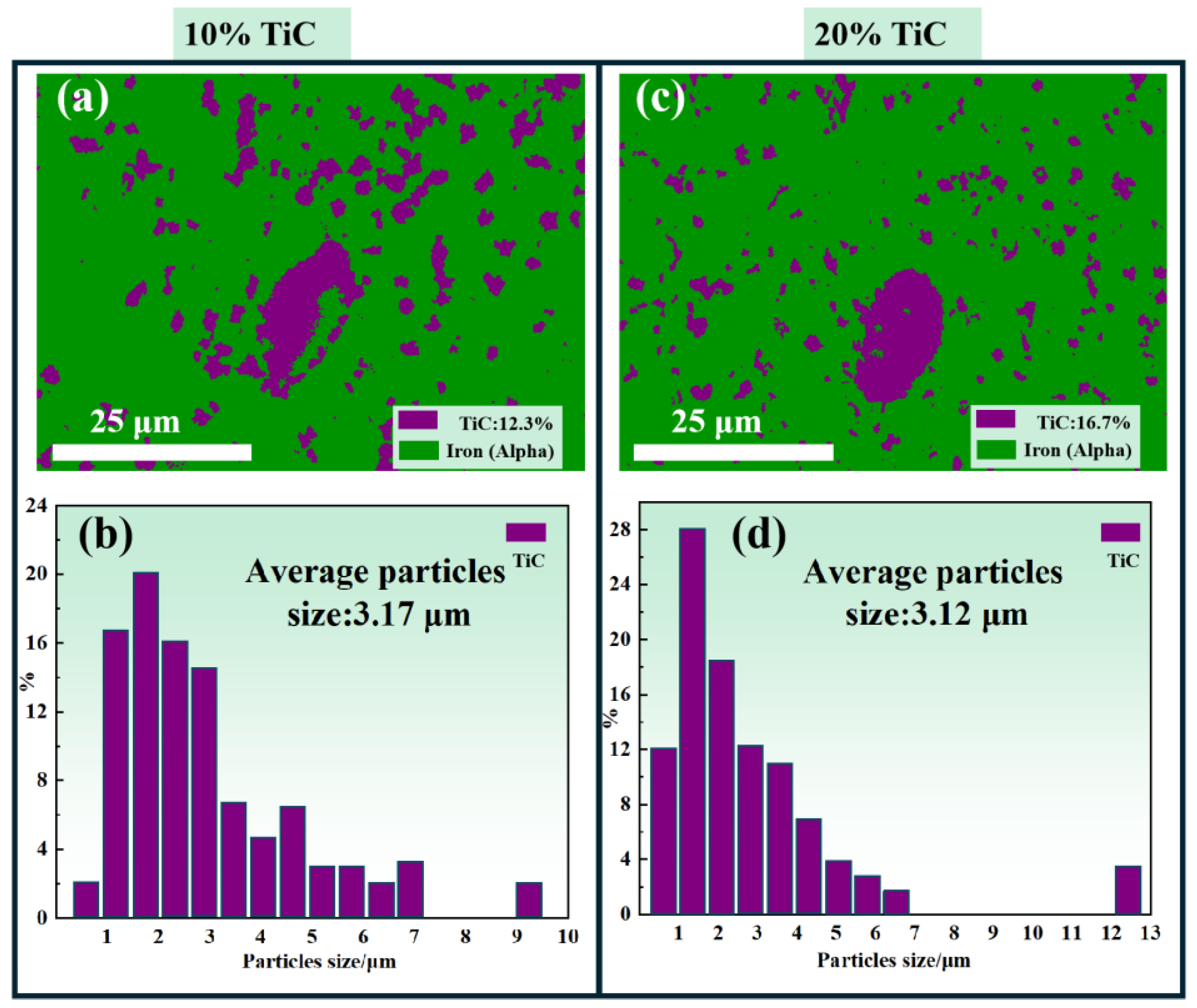
Quantitative statistics of TiC morphology and particle size distribution were obtained from EBSD phase maps, as shown in Figure 11a–d. The TiC area fraction increases from ~12.3% in the 10% TiC coating to ~16.7% in the 20% TiC coating, confirming effective incorporation of ceramic reinforcements. In both coatings, TiC particles are mainly blocky or equiaxed, accompanied by a limited amount of petal-like and irregular morphologies. The TiC particle size distribution shows that most particles are concentrated in the 1–3 μm range, forming a pronounced unimodal peak in the histogram. Compared with the 10% TiC coating, the 20% TiC coating exhibits a significantly higher fraction of fine TiC particles (<3 μm), resulting in a slight decrease in the average TiC size from 3.17 μm to 3.12 μm. Overall, finer TiC particles are more abundant and uniformly distributed in the 20% TiC coating, which can be attributed to the increased density of heterogeneous nucleation sites, mutual growth inhibition among particles, and suppressed coarsening under rapid solidification conditions at higher TiC concentrations.

3.4. Microhardness

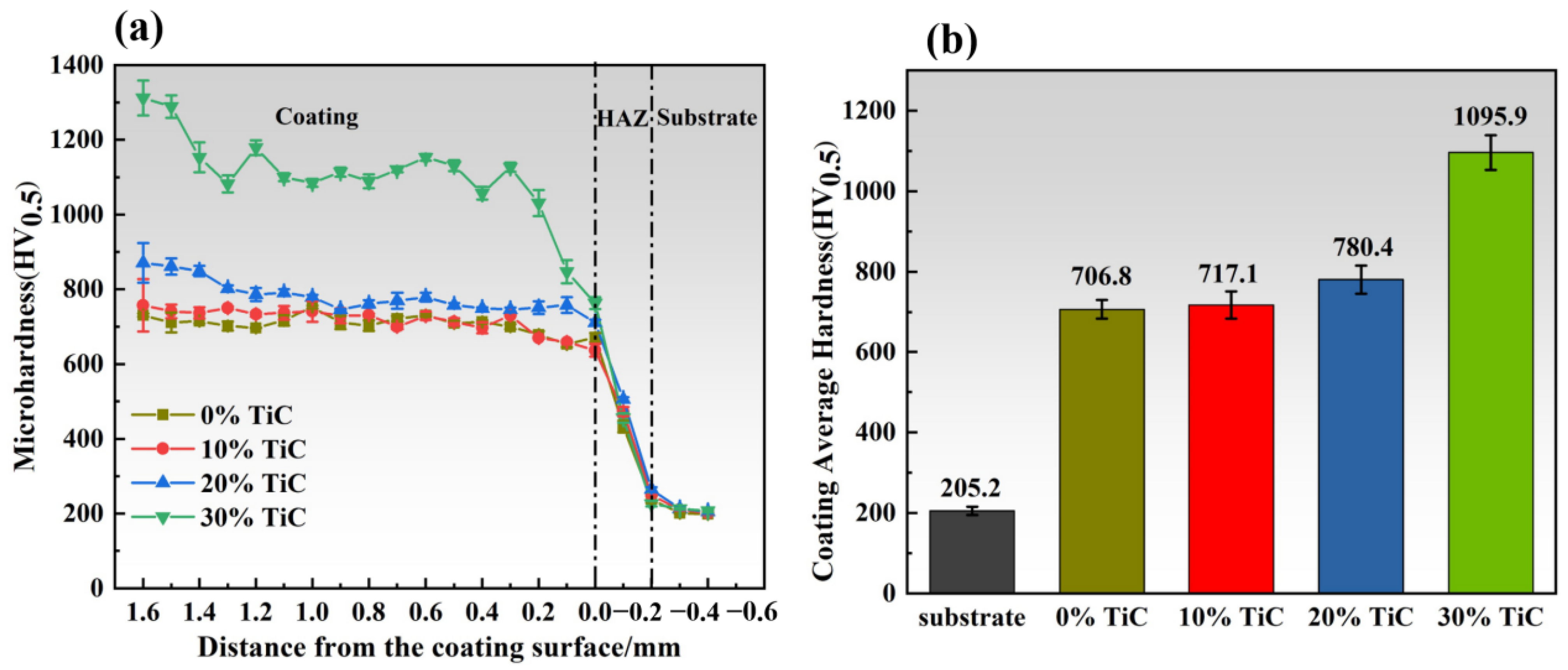
Figure 12 presents the microhardness distributions and average hardness values of TiC/H13 composite coatings with different TiC contents. As shown in Figure 12a, all coatings exhibit significantly higher hardness than the substrate, and the hardness generally increases with increasing TiC content [54]. The 30% TiC coating shows the highest hardness level, maintaining values above ~1000 HV0.5 throughout most of the coating thickness, with peak values exceeding 1200 HV0.5 near the top surface. In contrast, the coatings containing 20%, 10%, and 0% TiC exhibit relatively stable hardness levels of approximately 750–800 HV0.5, 700–730 HV0.5, and ~700 HV0.5, respectively. A distinct gradient hardness distribution is observed in the 30% TiC coating, where the hardness gradually decreases from the coating surface toward the fusion line. This behavior is attributed to the partial dissolution of TiC particles, dilution effects, and melt-pool convection during laser cladding. In addition, since TiC has a lower density than steel, newly formed particles tend to float toward the top of the molten pool, resulting in a higher TiC fraction in the upper region and a reduced ceramic content near the bottom of the coating. This phenomenon is most pronounced in the 30% TiC coating. In the 20% TiC coating, the hardness in the upper region is also higher than that at the bottom, but the gradient is less pronounced. Across the heat-affected zone (HAZ), the hardness decreases rapidly toward the substrate and finally approaches the intrinsic hardness of the annealed H13 steel (~200 HV0.5), demonstrating a smooth mechanical transition and good metallurgical bonding. Figure 12b summarizes the average hardness values. The average hardness increases from 706.8 HV0.5 for the monolithic H13 coating to 717.1 HV0.5 and 780.4 HV0.5 for the 10% and 20% TiC coatings, respectively, and reaches 1095.9 HV0.5 for the 30% TiC coating, corresponding to an approximately fivefold enhancement compared with the substrate (205.2 HV0.5). Notably, the hardness difference between the 0% TiC and 10% TiC coatings is relatively small. This can be attributed to the limited TiC fraction at 10%, where most particles undergo partial dissolution during laser processing, contributing primarily through weak dispersion strengthening and solid-solution strengthening rather than effective load-bearing reinforcement. Moreover, the intrinsically high hardness of the laser cladding H13 matrix, dominated by fine martensitic microstructures [55]. With further increases in TiC content to 20% and 30%, the ceramic particles become sufficiently abundant and stable to provide pronounced dispersion strengthening and grain refinement, eventually forming a semi-continuous reinforcing framework in the 30% TiC coating, which leads to the maximum hardness enhancement.

3.5. Wear Resistance

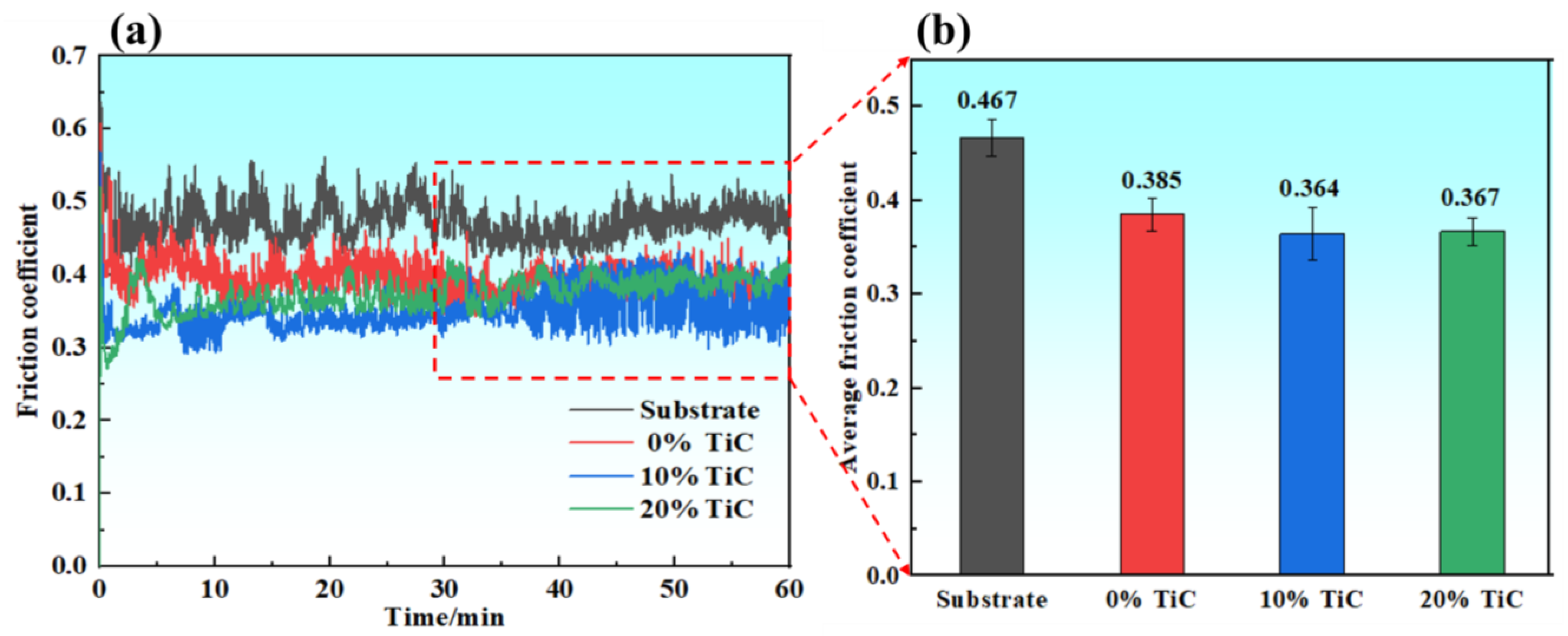
Since cracks were observed on the surface of the 30% TiC/H13 coating, this specimen was excluded from the subsequent friction and wear tests. Figure 13 illustrates the evolution of the friction coefficient and the average values during the stabilization phase for the uncoated substrate and TiC/H13 composite coatings with varying TiC contents under high-temperature sliding conditions at 600 °C. As shown in Figure 13a, the friction coefficient of the uncoated substrate exhibits pronounced fluctuations throughout the test, maintaining the highest average friction coefficient of approximately 0.467, indicating unstable frictional behavior. In contrast, the incorporation of TiC significantly reduces the friction coefficient and enhances its stability. The average friction coefficients of the 0% TiC, 10% TiC, and 20% TiC coatings are 0.385, 0.364, and 0.367, respectively, as shown in Figure 13b. Notably, the 10% TiC/H13 coating presents the lowest average value, while the 20% TiC/H13 coating demonstrates the smallest fluctuations curve during the entire test, suggesting a synergistic effect of TiC reinforcement in reducing friction and improving high-temperature thermal stability of the coating.
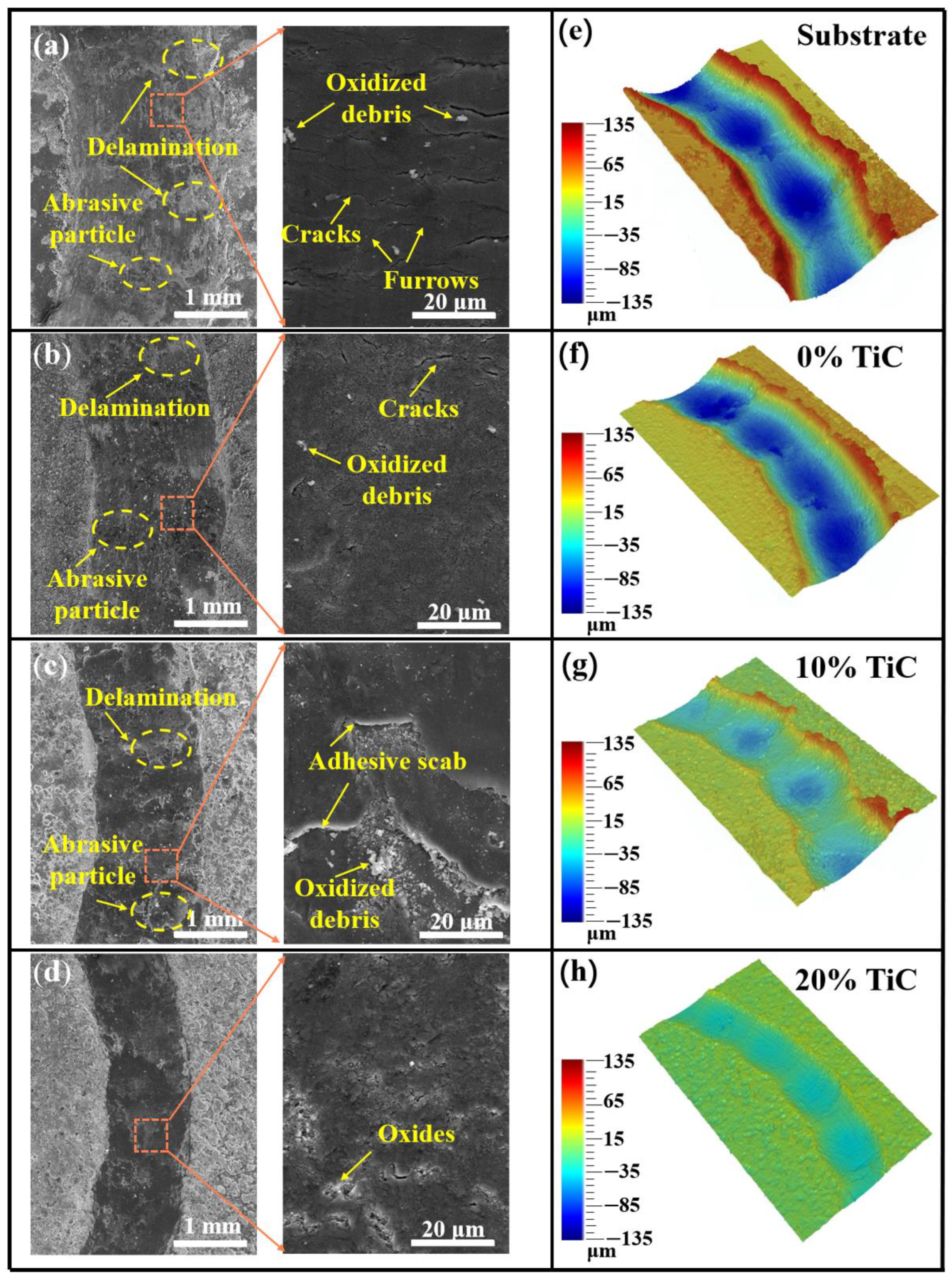
Figure 14 systematically illustrates the wear morphologies, local features and three-dimensional topographies of the substrate and H13 laser cladding coatings with different TiC contents after wear testing. As shown in Figure 14a, the substrate exhibits severe furrows, with numerous cracks delamination and oxidized debris distributed across the worn surface. This indicates extremely poor wear resistance, with the dominant wear mechanisms being severe adhesive wear accompanied by pronounced oxidative wear. In the case of the 0% TiC/H13 coating, as shown in Figure 14b, cracks and local delamination are still evident. However, the wear track appears relatively smoother compared with the substrate. This suggests that the coating provides a certain improvement in wear resistance although it remains insufficient to suppress crack propagation and the formation of oxidation products. For the 10% TiC/H13 coating shown in Figure 14c, the extent of crack and delamination is reduced, while localized adhesive scab and oxidized debris are observed. This demonstrates that the introduction of TiC particles effectively enhances the load-bearing capacity of the coating, mitigates plastic deformation, and shifts the wear mechanism toward a combination of adhesive wear and slight oxidative wear. In contrast, the 20% TiC/H13 coating exhibits a smooth and uniform worn surface without extensive crack, primarily covered by a dense oxide film, as shown in Figure 14d. This suggests that higher TiC content markedly improves the wear resistance of the coating, with the stable oxide layer further retarding the wear process. The corresponding three-dimensional wear topographies further corroborate this trend. The substrate and 0% TiC/H13 coating exhibit wide and deep wear tracks with rough surfaces whereas the 10% TiC coating shows significantly reduced depth and width. The 20% TiC coating exhibits the shallowest and smoothest wear track [56]. The systematically repeating depressions observed in Figure 14 are likely caused by the combined effects of cyclic oxidation and adhesive wear during high-temperature sliding. At elevated temperatures, the oxide film continuously forms, fractures, and spalls off under repeated shear and thermal stresses, leading to periodic undulations and depressions on the wear track surface. Meanwhile, localized adhesive interactions between the counterpart and the coating surface result in material pull-out or transfer, further accentuating these periodic depressions.
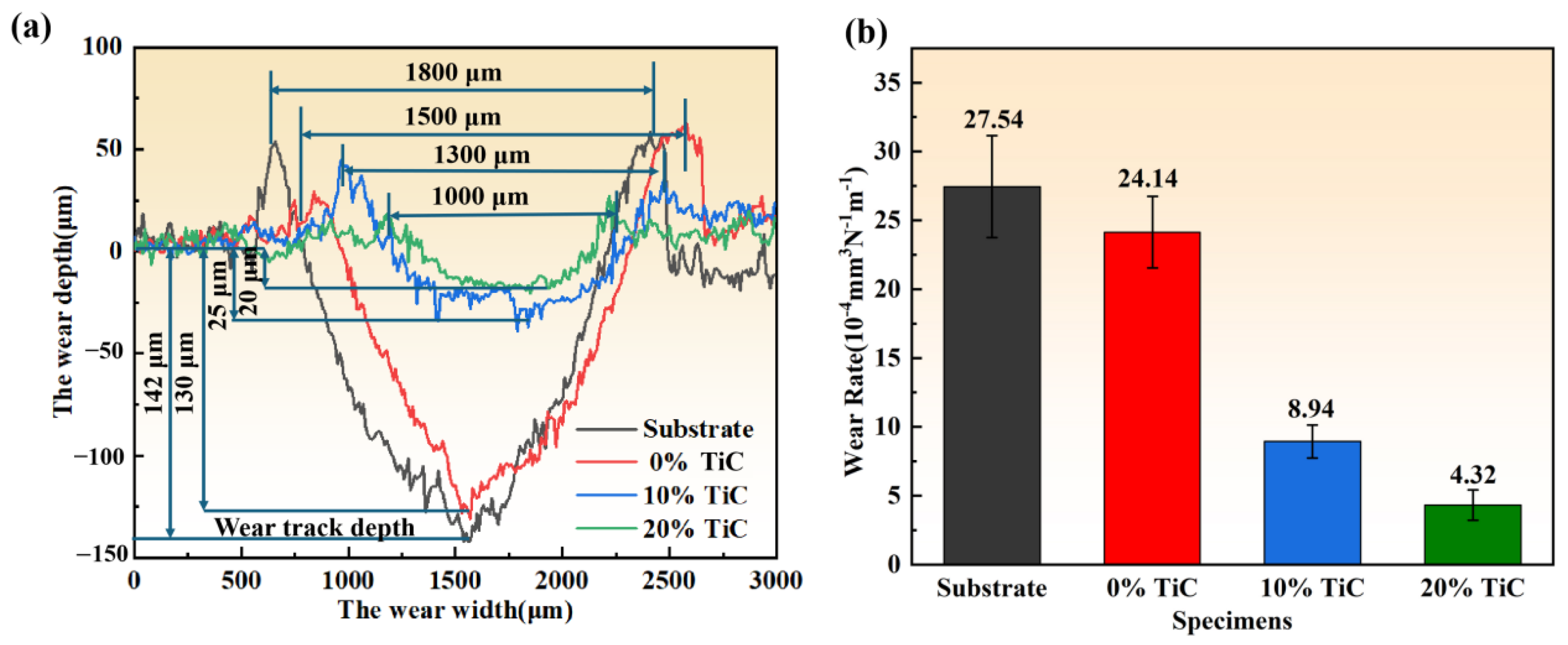
The two-dimensional wear profile curves shown in Figure 15a further confirm the progressive improvement in wear resistance with increasing TiC content. The substrate exhibits a pronounced wear depth of approximately 142 μm and a width of 1800 μm, while the 0% TiC/H13 coating shows a slight reduction in depth to 130 μm. With the incorporation of 10% TiC, the wear depth of the coating sharply decreases to 25 μm and the width narrows to 1300 μm. A further increase to 20% TiC results in the shallowest wear depth of 20 μm and the smallest width of 1000 μm, indicating excellent resistance to material removal. As illustrated in Figure 15b, the corresponding wear rate results display a consistent trend. The substrate presents the highest wear rate of 27.45 × 10⁻⁴ mm3 N−1 m−1, indicating poor wear resistance. After laser cladding, the 0% TiC/H13 coating exhibits a moderate improvement with a wear rate of 24.14 × 10⁻⁴ mm3 N−1 m−1, primarily due to microstructural refinement and enhanced metallurgical bonding. When 10% TiC is introduced, the wear rate markedly decreases to 8.94 × 10⁻⁴ mm3 N−1 m−1, reflecting a significant enhancement in wear resistance. The 20% TiC/H13 coating exhibits the lowest wear rate of 4.32 × 10⁻⁴ mm3 N−1 m−1, consistent with its minimal wear depth and narrow wear track. These results confirm that the uniform distribution of TiC particles effectively improves the coating’s resistance to plastic deformation and crack propagation during sliding. Consequently, the progressive incorporation of TiC notably reduces material loss and facilitates the transition of the dominant wear mechanism from severe adhesive/spalling wear to mild oxidative wear, with the 20% TiC/H13 coating exhibiting the optimum wear performance [32].
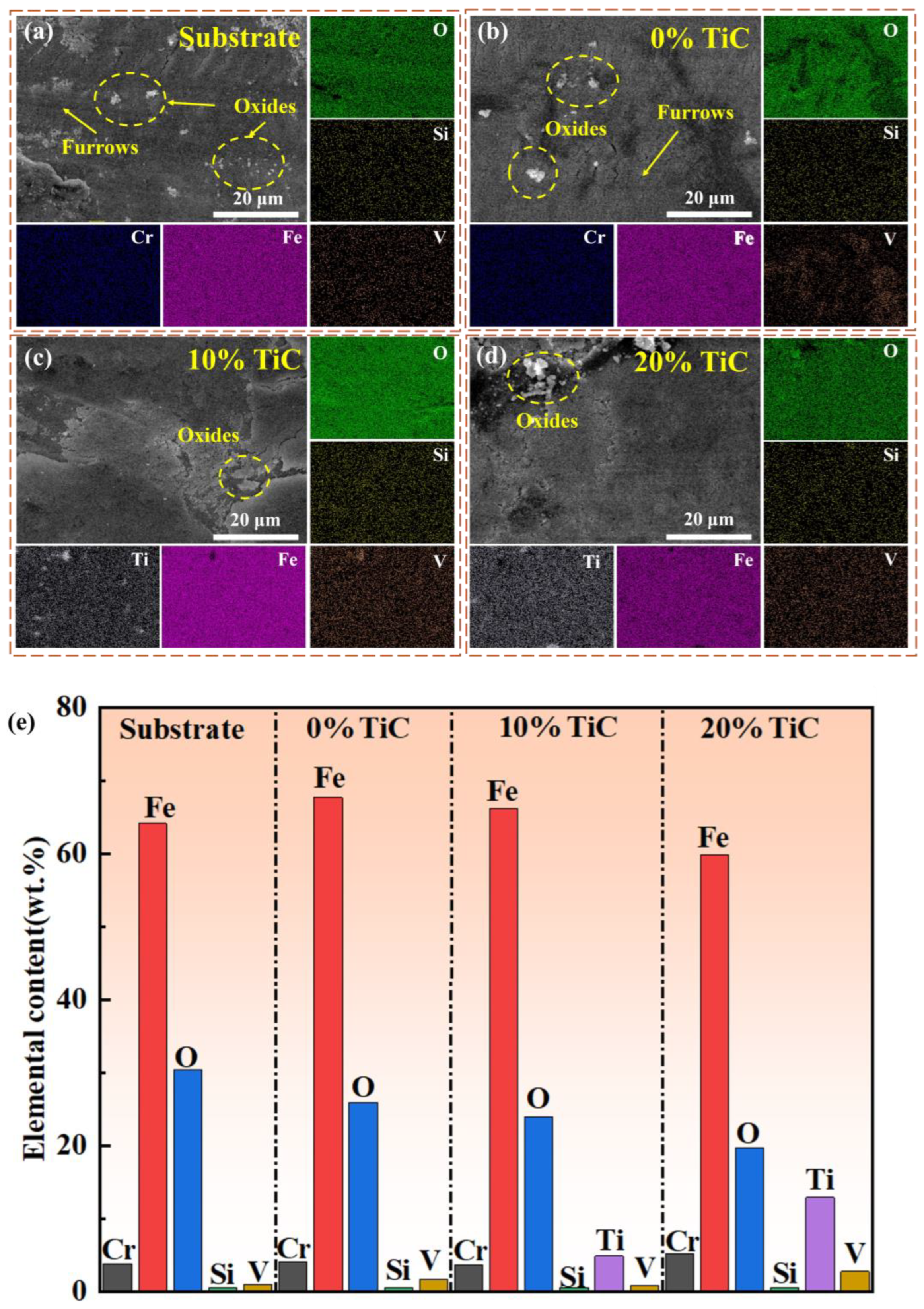
Figure 16a–d present the wear track surface morphologies and the corresponding EDS mapping analyses of homogeneous laser cladding H13 coatings with different TiC contents. The maximum wear depth reported here corresponds to the peak depth extracted from the cross-sectional profile rather than an averaged value. As shown in Figure 16a, the substrate exhibits numerous deep furrows on the worn surface, indicating inherently poor wear resistance. Additionally, it reveals an evident distribution of oxygen elements, suggesting that severe oxidative wear occurs during the friction process. The 0% TiC/H13 coating displays a marginally smoother surface compared to the substrate, as shown in Figure 16b. However, pronounced abrasive wear tracks are still evident, and the oxygen content remains relatively high. As the TiC content increases, the wear track morphology progressively improves. The 10% TiC/H13 coating illustrated in Figure 16c shows a reduced number of furrows and EDS confirms the presence of Ti-rich regions, indicating partial exposure of TiC particles within the wear track. This observation suggests that TiC reinforcement contributes to enhanced hardness and improved resistance to oxidative degradation. The 20% TiC/H13 coating shown in Figure 16d exhibits the most uniform and shallow wear tracks among all tested specimens, together with a more continuous distribution of Ti and a marked decrease in oxygen content, demonstrating that proper TiC incorporation substantially improves both wear resistance and oxidation stability. Furthermore, the quantitative elemental analysis presented in Figure 16e indicates that increasing TiC addition leads to a slight reduction in Fe content and a significant increase in Ti content, while the oxygen content shows a pronounced decreasing trend, reaching its minimum value in the 20% TiC/H13 coating. In contrast, the contents of Cr and V remain relatively stable across all specimens, suggesting that their role is primarily associated with the formation of protective oxide films rather than direct reinforcement. Overall, these results demonstrate that the incorporation of TiC particles effectively improves the microstructural stability and tribological performance of TiC/H13 coatings by promoting mechanical strengthening and mitigating oxidative wear [57]. Among the investigated compositions, the 20% TiC/H13 coating exhibits the most favorable combination of wear resistance and oxidation protection.

3.6. Discussion

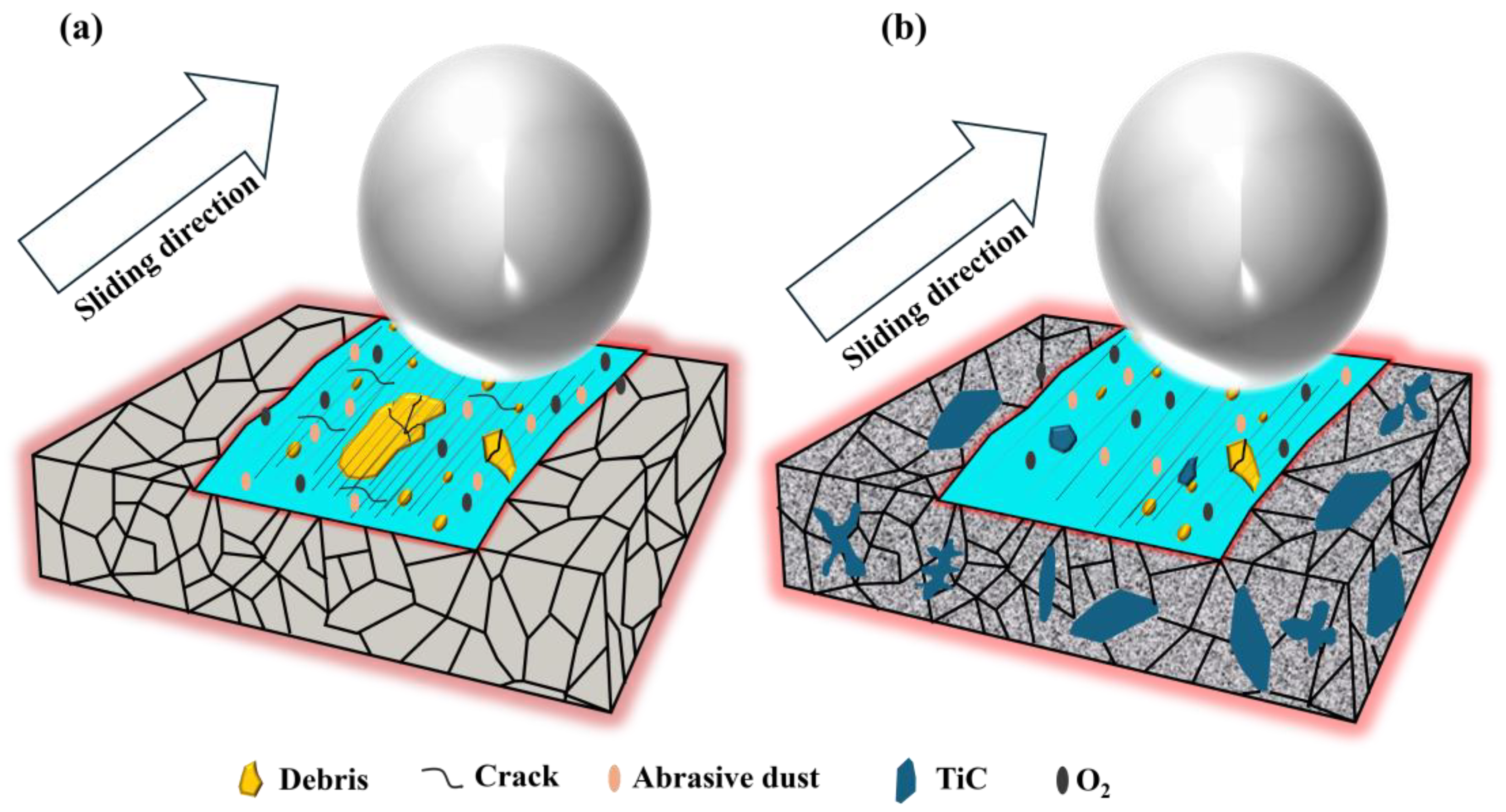
Figure 17 illustrates the wear mechanism diagram of H13 alloy coatings without and with TiC tested at 600 °C. The strengthening mechanism of TiC/H13 composite coatings originates from both the presence and morphological evolution of TiC during laser cladding. TiC exists in three main forms- initial TiC, primary TiC, and eutectic TiC-each contributing synergistically to microstructural refinement and high-temperature wear resistance. The undissolved initial TiC particles act as heterogeneous nucleation sites for γ-Fe, effectively refining grains (from 5.29 μm to 2.45 μm) and disturbing the heat flow, thus reducing texture anisotropy. Their strong interfacial bonding with the Fe matrix ensures stable load transfer and prevents interfacial decohesion. Fine primary TiC precipitates re-form in situ during solidification, creating semi-coherent interfaces that induce lattice distortion and Orowan strengthening, consistent with the increase in average KAM from 1.115° to 1.192°. These precipitates also facilitate recrystallization, increasing the HAGB fraction to 63.7%, thereby enhancing hardness and thermal stability. At the final solidification stage, eutectic TiC forms a continuous network along grain boundaries, reinforcing the boundary skeleton and improving creep and oxidation resistance. Under high-temperature sliding (600 °C), both the Fe matrix (ferrite/martensite) and multiscale TiC particles participate in friction: the matrix undergoes plastic deformation, while some TiC particles embed or move to form a friction-induced layer (i.e., a hardened, modified layer formed on the surface due to plastic deformation and frictional heating); surface wear manifests as micro-spalling, particle detachment, and local oxide formation. TiC particles bear part of the frictional load, impede Fe matrix deformation, and promote the formation of the friction-induced layer, thereby enhancing wear resistance. Wear resistance is not governed solely by hardness, but rather by the combined effects of hardness–toughness balance, microstructural integrity, phase constitution and distribution, interfacial bonding strength, and resistance to crack initiation and propagation. Superior and stable wear performance can only be achieved when high hardness is accompanied by sufficient structural stability and damage tolerance. Consequently, the hierarchical TiC network provides integrated strengthening through grain refinement, dislocation interaction, and grain boundary stabilization, leading to superior mechanical and tribological performance [42,58].

4. Conclusions

In this study, H13 alloy coatings with varying TiC contents (0%, 10%, 20%, and 30%) were successfully fabricated by homogeneous laser cladding on H13 steel substrate. The evolution mechanism of TiC during the process was elucidated, and its influence on the microstructural development, phase composition, mechanical properties, and high-temperature tribological behavior of the coatings was comprehensively evaluated. The main findings are summarized as follows.
  • TiC particles act as heterogeneous nucleation points and effectively promote grain refinement. Under the thermal gradient and directional solidification conditions of laser cladding, combined with the local Ti and C concentration fields, TiC undergoes morphological evolution, resulting in petal-like, rod-like, fishbone-like, and polygonal features.
  • The addition of TiC enhances grain refinement, increases the recrystallization and HAGBs fractions, and elevates dislocation density. These microstructural features also improve the mechanical properties and wear resistance of the coatings.
  • The microhardness increases with increasing TiC content. The coating with 30% TiC achieves the highest average hardness of 1095.9 HV0.5, approximately five times that of the as-annealed H13 steel substrate (205.2 HV0.5). However, excessive TiC addition leads to particle agglomeration, interfacial stress concentration, and microcrack formation, negatively influencing the performance of the coatings.
  • The coating with 20% TiC demonstrates the optimum high-temperature tribological performance. The average friction coefficient decreases from 0.467 for the as-annealed substrate to 0.367. The wear track depth is markedly reduced from 142 μm to 20 μm, while the width decreases from 2000 μm to 1000 μm. The worn surface of the coating presents shallower grooves, fewer oxidative debris, and a smoother morphology, confirming the remarkable enhancement in wear resistance.

Author Contributions

Conceptualization, Z.W.; Methodology, S.G., X.Z., Y.W., X.C., and Z.W.; Investigation, X.J., S.G., X.Z., H.Z., Y.W., and X.C.; Data curation, X.J. and X.Z.; Resources, H.Z.; Writing—original draft preparation, X.J.; Writing—review and editing, S.G. and Z.W.; Supervision, Z.W.; Project administration, H.Z.; Funding acquisition, S.G., H.Z., X.C., and Z.W. All authors have read and agreed to the published version of the manuscript.

Funding

This research was funded by National Natural Science Foundation of China (U24A20109), Shandong Provincial Natural Science Foundation (ZR2023ME134 and ZR2022ZD07), Shandong Provincial Key Research and Development Plan Project (2025CXPT053), Scientific Innovation Project for Young Scientists in Shandong Provincial Universities (2021KJ068), and program for scientific research start-up funds of Guangdong Ocean University (360302032503 and 360302032504).

Data Availability Statement

The original contributions presented in this study are included in the article. Further inquiries can be directed to the corresponding authors.

Conflicts of Interest

Author Shan Gao was employed by the company Jiangsu Longcheng Precision Forging Group Co., Ltd. The remaining authors declare that the research was conducted in the absence of any commercial or financial relationships that could be construed as a potential conflict of interest.

Abbreviations

The following abbreviations are used in this manuscript:
CNCComputer numerical control
EDMElectrical discharge machining
FESEMField emission scanning electron microscope
XRDX-ray diffractometer
EDSEnergy dispersive spectrometer
EBSDElectron back-scattered diffraction
IPFInverse pole figure
GOSGrain orientation spread
HAGBsHigh-angle grain boundaries
LAGBsLow-angle grain boundaries
KAMKernal average misorientation

References

  1. Osman, M.; Wanjara, P.; Gholipour, J.; Bernier, F.; Molavi-Zarandi, M.; Brochu, M. H13 tool steel-copper composite fabricated by laser powder bed fusion and melt infiltration for high thermal conductivity tooling applications. Mater. Today Commun. 2025, 49, 114221. [Google Scholar] [CrossRef]
  2. Deng, J.; Wang, G.; Qi, H.; Ma, H.; Huang, Z. Excellent isotropic mechanical properties of electron beam melted H13 tool steel: Process optimization and microstructural control. J. Mater. Process. Technol. 2025, 343, 118980. [Google Scholar] [CrossRef]
  3. Gu, R.; Li, C.; Wang, P.; He, W.; Ren, C.; Ma, Y. Microstructure, thermophysical properties and thermal shock resistance of toughened hafnia-based thermal barrier coating fabricated by plasma spray. J. Alloys Compd. 2025, 1043, 184274. [Google Scholar] [CrossRef]
  4. Park, Y.H.; Abolhasani, D.; Moon, Y.H. Graphene-based hardening agent modified using Ni and Cu nanoparticles in laser surface hardening of ferritic stainless steel. Appl. Surf. Sci. 2025, 700, 163151. [Google Scholar] [CrossRef]
  5. Davoodi, F.; Varmaziar, S.; Atapour, M.; Iuliano, L.; Saboori, A. In vitro corrosion and bio-tribocorrosion performance of electron beam powder bed fusion Ti6Al4V specimens with lapping and superfinishing treatments. Prog. Addit. Manuf. 2025, 10, 9117–9132. [Google Scholar] [CrossRef]
  6. Senthil Kumar, P.; Jegadheesan, C.; Somasundaram, P.; Praveen Kumar, S.; Vivek Anand, A.; Singh, A.P.; Jeyaprakash, N. State of art: Review on laser surface hardening of alloy metals. Mater. Today Proc. 2023; in press. [Google Scholar] [CrossRef]
  7. Liu, M.; Cai, Y.; Duan, C.; Li, G. Key techniques in parts repair and remanufacturing based on laser cladding: A review. J. Manuf. Process. 2024, 132, 994–1014. [Google Scholar] [CrossRef]
  8. Yang, Z.-z.; Hao, H.; Gao, Q.; Cao, Y.-b.; Han, R.-h.; Qi, H.-b. Strengthening mechanism and high-temperature properties of H13+WC/Y2O3 laser-cladding coatings. Surf. Coat. Technol. 2021, 405, 126544. [Google Scholar] [CrossRef]
  9. Zhang, H.F.; Wang, L.; Zhang, S.; Wu, C.L.; Zhang, C.H.; Sun, X.Y.; Chen, J. An investigation on wear and cavitation erosion-corrosion characteristics of the TiC modified Fe-based composite coating via laser cladding. J. Mater. Res. Technol. 2023, 26, 8440–8455. [Google Scholar] [CrossRef]
  10. Xu, L.; Sun, S.; Xia, J.; Liu, Z.; Deng, W.; Li, J.; Wu, T.; Zhu, X.; Lv, Z.; Gao, J.; et al. Effect of WC content on microstructure, mechanical properties, and tribo-corrosion behavior of laser-cladded Ni40A/WC composite coatings on H13 steel. Mater. Charact. 2025, 224, 115072. [Google Scholar] [CrossRef]
  11. Aprameya, C.R.; Joladarashi, S.; Ramesh, M.R. Dry linear reciprocating wear behavior of molybdenum-reinforced SS316 laser claddings deposited by laser directed energy deposition. Results Surf. Interfaces 2025, 18, 100407. [Google Scholar] [CrossRef]
  12. Wang, Y.; Yu, T.; Sun, J.; Zhang, Y.; Sun, Z.; Yu, C.; Yin, J. Investigation of laser cladding using Inconel 625-Enhanced Fe-Based Coatings: Microstructure, wear Behavior, and corrosion resistance properties. Appl. Surf. Sci. 2025, 688, 162398. [Google Scholar] [CrossRef]
  13. Zhu, Y.; Shen, S.; Yang, X.; Song, F.; Dong, W.; Wang, Z.; Wu, M. Study on the friction and wear performance of laser cladding WC-TiC/Ni60 coating on the working face of shield bobbing cutter. Opt. Mater. 2024, 148, 114875. [Google Scholar] [CrossRef]
  14. Huang, S.W.; Samandi, M.; Brandt, M. Abrasive wear performance and microstructure of laser clad WC/Ni layers. Wear 2004, 256, 1095–1105. [Google Scholar] [CrossRef]
  15. Yuan, J.; Li, X.; Pan, G.; Zhang, S.; Cui, Y.; Zhu, R.; Lu, H.; Song, Q. Effect of SiC-Si4N3 ceramic reinforcement on the microstructure and corrosion resistance to molten aluminum of laser-cladded Co-based coatings. Ceram. Int. 2025, 51, 13493–13506. [Google Scholar] [CrossRef]
  16. Wang, W.; Zheng, Y.; Zheng, W.; Shen, Z.; Hu, M.; Wang, Y.; Feng, D.; Ma, Y.; Cai, Z.; Yang, J. Dilution induced variation of microstructure and mechanical properties on Co-Cr-Fe-Ni high entropy alloy coatings prepared by laser cladding. Surf. Coat. Technol. 2024, 493, 131256. [Google Scholar] [CrossRef]
  17. Wu, H.; Zhang, S.; Wu, C.L.; Zhang, C.H.; Sun, X.Y.; Bai, X.L. Electrochemical corrosion behavior in sulfuric acid solution and dry sliding friction and wear properties of laser-cladded CoCrFeNiNbx high entropy alloy coatings. Surf. Coat. Technol. 2023, 460, 129425. [Google Scholar] [CrossRef]
  18. Zhu, J.; Zhao, S.; Cheng, Y.; Xu, M.; Zhang, Y.; Hui, X.; Wang, Z.; Yu, J.; Xu, Y.; Shen, Y. Microstructural evolution and high-temperature wear resistance of novel TiC cermet coatings with CoCrFeNiMo0.1 high-entropy alloy binder fabricated by laser powders directed energy deposition. J. Alloys Compd. 2025, 1033, 181370. [Google Scholar] [CrossRef]
  19. Chen, H.; Lu, Y.; Sun, Y.; Wei, Y.; Wang, X.; Liu, D. Coarse TiC particles reinforced H13 steel matrix composites produced by laser cladding. Surf. Coat. Technol. 2020, 395, 125867. [Google Scholar] [CrossRef]
  20. Zhang, K.; Liu, C.; Wang, W.; Ju, H.; Liu, W.; Wang, H.; Bian, H. Microstructure, performance, strengthening and toughening mechanisms of WC-reinforced Inconel 625 gradient composite coating by laser cladding on nonmagnetic steel. Surf. Coat. Technol. 2025, 496, 131657. [Google Scholar] [CrossRef]
  21. Bartkowski, D.; Bartkowska, A. Wear resistance in the soil of Stellite-6/WC coatings produced using laser cladding method. Int. J. Refract. Met. Hard Mater. 2017, 64, 20–26. [Google Scholar] [CrossRef]
  22. Yuan, Q.; Chai, L.; Yang, T.; Wang, H.; Shen, J.; Guo, N.; Yin, X.; Xiao, J. Laser-clad FeCrAl/TiC composite coating on ferrite/martensitic steel: Significant grain refinement and wear resistance enhancement induced by adding TiC. Surf. Coat. Technol. 2023, 456, 129272. [Google Scholar] [CrossRef]
  23. Sun, D.; Zhu, L.; Cai, Y.; Yan, Y.; Ge, F.; Shan, M.; Tian, Y.; Han, J.; Jiang, Z. Tribology comparison of laser-cladded CrMnFeCoNi coatings reinforced by three types of ceramic (TiC/NbC/B4C). Surf. Coat. Technol. 2022, 450, 129013. [Google Scholar] [CrossRef]
  24. Wang, H.; Wu, M.; Miao, X.; Jin, X.; Cui, C. TiC in-situ strengthening mechanism and crack initiation mechanism of SiC/TC4 composite coatings by laser cladding. Ceram. Int. 2024, 50, 52558–52571. [Google Scholar] [CrossRef]
  25. Jiang, J.; Pang, X.; Zhou, J.; Li, B.; Zhou, F. Optical performance and corrosion resistance of TiN/Ni multiphase cermet by laser cladding. Opt. Laser Technol. 2021, 143, 107308. [Google Scholar] [CrossRef]
  26. Chen, H.; Yu, D.T.; Mao, J.T.; Wu, C.L.; Zhang, S.; Zhang, C.H.; Wang, Q.; Zhang, D. Microstructure and tribo-corrosion behavior of TC4 composites reinforced by in situ synthesized TiC ceramics particles through laser cladding. Ceram. Int. 2025, 51, 31719–31733. [Google Scholar] [CrossRef]
  27. Meng, C.; Cao, R.; Li, J.; Geng, F.; Zhang, Y.; Wu, C.; Wang, X.; Zhuang, W. Mechanical properties of TiC-reinforced H13 steel by bionic laser treatment. Opt. Laser Technol. 2021, 136, 106815. [Google Scholar] [CrossRef]
  28. Li, C.-D.; Wang, W.-X.; Qiu, F.; Zhang, H.; Shu, S.-L.; Li, T.-Y.; Jiang, Q.-C. Application of ceramic nanoparticles in microstructure manipulation and simultaneously strengthening toughness and wear resistance of tool and die steels. Ceram. Int. 2023, 49, 16661–16672. [Google Scholar] [CrossRef]
  29. Chen, L.; Yu, T.; Guan, C.; Zhao, Y. Microstructure and properties of metal parts remanufactured by laser cladding TiC and TiB2 reinforced Fe-based coatings. Ceram. Int. 2022, 48, 14127–14140. [Google Scholar] [CrossRef]
  30. Tiwari, V.; Mandal, V.; Sarkar, M.; Kumar, A.; Bhagyaraj, J.; Singh, M.K.; Mukherjee, S.; Mondal, K.; Ramkumar, J.; Jain, J.; et al. Enhanced mechanical properties and microstructure of TiC reinforced Stellite 6 metal matrix composites (MMCs) via laser cladding additive manufacturing. J. Alloys Compd. 2025, 1010, 178001. [Google Scholar] [CrossRef]
  31. Zhong, S.; Chai, L.; Wang, Z.; Yang, T.; Liu, Y.; Dong, H.; Shen, J.; Li, Y.; Cheng, E.J.; Yin, X.; et al. Microstructures and tribological properties of laser-clad FeCrAl-TiX composite coatings on ferritic-martensitic steel. J. Mater. Res. Technol. 2025, 36, 922–938. [Google Scholar] [CrossRef]
  32. Liu, Y.; Chai, L.; Yang, T.; Hu, C.; Wang, C.; Xi, G. Pulsed laser cladding on IN718 alloy using pre-coated CrCoNi-TiC/SiC powders for enhancing wear resistance. Surf. Coat. Technol. 2024, 476, 130253. [Google Scholar] [CrossRef]
  33. Zhang, Y.; Bai, P.; Li, Z.; Zhang, J. Rapid optimization of iron-based alloy laser cladding process based on orthogonal experiment and machine learning for Q345. Opt. Laser Technol. 2025, 182, 112086. [Google Scholar] [CrossRef]
  34. Xiang, D.; Liu, Y.; Yu, T.; Wang, D.; Leng, X.; Wang, K.; Liu, L.; Pan, J.; Yao, S.; Chen, Z. Review on wear resistance of laser cladding high-entropy alloy coatings. J. Mater. Res. Technol. 2024, 28, 911–934. [Google Scholar] [CrossRef]
  35. ASTM E384-22; Standard Test Method for Microindentation Hardness of Materials. ASTM International: West Conshohocken, USA, 2022.
  36. Kyekyere, E.; Olakanmi, E.O.; Prasad, R.V.S.; Botes, A.; Pityana, S.L. Microstructure, wear, and compressive behaviour of laser cladded hybrid TiC-SiC reinforced 16MnCr5 composites. Surf. Coat. Technol. 2025, 498, 131808. [Google Scholar] [CrossRef]
  37. Zhu, H.; Ouyang, M.; Hu, J.; Zhang, J.; Qiu, C. Design and development of TiC-reinforced 410 martensitic stainless steel coatings fabricated by laser cladding. Ceram. Int. 2021, 47, 12505–12513. [Google Scholar] [CrossRef]
  38. Cui, C.; Wu, M.; Han, J.; Miao, X.; Jie, D.; Zhu, K.; Li, P. Preparation of FeCoNiCrMo high entropy alloy coatings by laser cladding on Ti6Al4V surface: Evolution of columnar—Equiaxed crystal transition and longitudinal comparison of mechanical properties. J. Mater. Res. Technol. 2025, 38, 4414–4436. [Google Scholar] [CrossRef]
  39. Zhang, J.; Guo, H.; Hu, M.; Xu, H.; Ju, H.; Xu, D.; Teng, C.; Yang, R. Effect of common alloying elements on α’ martensite start temperature in titanium alloys. J. Mater. Res. Technol. 2023, 27, 4562–4572. [Google Scholar] [CrossRef]
  40. Ouyang, C.; Deng, R.; Wei, R.; Li, H.; Wang, R.; Zhao, C. Methods and techniques for enhancing wear resistance of laser cladding coatings: A comprehensive review. J. Manuf. Process. 2025, 152, 1123–1149. [Google Scholar] [CrossRef]
  41. An, Y.; Zhou, Q.; Lin, X.; Xiong, L.; Tang, C.; Gao, W. The numerical simulation of cooling rate at the moving solid-liquid interface in Fe-based cladding layers. Opt. Laser Technol. 2025, 184, 112412. [Google Scholar] [CrossRef]
  42. Li, Y.; Sun, D.; Fan, W.; Zhu, L.; Niu, J.; Li, F.; Li, J. Improved crack resistance and toughness of laser-clad H13 steel coatings enabled by CoCrFeNi transition layer. J. Mater. Process. Technol. 2025, 344, 119036. [Google Scholar] [CrossRef]
  43. Li, S.; Niu, W.; Lei, Y.-W.; Zheng, Y. Microstructure and wear performance of ex/in-situ TiC reinforced CoCrFeNiW0.4Si0.2 high-entropy alloy coatings by laser cladding. J. Alloys Compd. 2024, 1002, 175458. [Google Scholar] [CrossRef]
  44. Zhang, Y.; Liu, Z.; Lv, Z.; Cao, J.; Tong, Y.; Sun, M.; Cui, C.; Wang, X. Effect of SiC and TiC content on microstructure and wear behavior of Ni-based composite coating manufactured by laser cladding on Ti–6Al–4V. Wear 2024, 552–553, 205431. [Google Scholar] [CrossRef]
  45. Zhang, C.-Y.; Li, Z.-S.; Liu, X.-B.; Xie, X.-M.; Li, X.-G.; Zhou, H.-B.; Meng, Y.; Wang, D.-S.; Xie, F. Development and wear performance of ceramic TiC reinforced Ni-based solid lubrication composite coatings by laser cladding. Ceram. Int. 2025, 51, 38884–38898. [Google Scholar] [CrossRef]
  46. Zhou, J.-l.; Cheng, Y.-h.; He, B.; Wan, Y.-x.; Chen, H.; Wang, Y.-f.; Yang, J.-y. Enhancement of high-entropy alloy coatings with multi-scale TiC ceramic particles via high-speed laser cladding: Microstructure, wear and corrosion. Appl. Surf. Sci. 2025, 685, 162061. [Google Scholar] [CrossRef]
  47. Hu, C.; Qi, C.; Zhao, K.; Cheng, L.; Yao, W.; Li, C. The microstructure and wear properties of Ni-coated and agglomerated-sintered WC-10Ni/316 composite by laser melting deposition. Mater. Today Commun. 2024, 41, 110498. [Google Scholar] [CrossRef]
  48. Gu, R.; Wang, J.; Ma, Z.; Guan, C.; Jiang, C.; Yu, T.; Chen, L. Microstructure and mechanical property of in situ TiC reinforced Ni-based composite coatings fabricated by ultrasonic vibration assisted laser cladding. Int. J. Refract. Met. Hard Mater. 2026, 134, 107494. [Google Scholar] [CrossRef]
  49. Xu, Y.; Wang, D.; Wu, S.; Lu, H.; Yao, R.; Yang, J.; Jiang, F.; Takao, A. Research progress on defect formation mechanism and process optimization of laser cladding high entropy alloy coatings. Opt. Laser Technol. 2025, 187, 112819. [Google Scholar] [CrossRef]
  50. Liao, L.; Zhou, S.; Cheng, Y.; Li, F.; Dai, S.; Khan, M.A.; Zhang, H. Microstructure characteristics and high-temperature properties of AlCoCrFeNi high entropy alloy coating on TC4 alloy prepared by laser cladding. Surf. Interfaces 2025, 74, 107717. [Google Scholar] [CrossRef]
  51. Tiwari, V.; Kumar, A.; Sarkar, M.; Ramkumar, J.; Gupta, M.; Mondal, K.; Jain, J.; Singh, M.K.; Singh, S.S. Microstructure and enhanced high-temperature wear properties of TiC reinforced Co-Cr-W metal matrix composite (MMC) coatings fabricated by laser cladding. J. Alloys Compd. 2025, 1040, 183565. [Google Scholar] [CrossRef]
  52. Guo, J.; Xie, W.; Pu, J. Tribocorrosion behaviors and mechanisms of in-situ TiC/TiB/Cr2B reinforced CrMnFeCoNi high-entropy alloy composite coatings prepared by laser cladding. Ceram. Int. 2025, 51, 26742–26756. [Google Scholar] [CrossRef]
  53. Tong, Z.; Liu, H.; Jiao, J.; Zhou, W.; Yang, Y.; Ren, X. Microstructure, microhardness and residual stress of laser additive manufactured CoCrFeMnNi high-entropy alloy subjected to laser shock peening. J. Mater. Process. Technol. 2020, 285, 116806. [Google Scholar] [CrossRef]
  54. Mo, K.; Cao, L.; Zhao, D.; Long, Y.; Zhong, J.; Zhong, J.; Bi, G. Study on the microstructure and wear resistance of laser clad martensitic stainless steel 420 with different content of TiC. Mater. Today Commun. 2025, 46, 112615. [Google Scholar] [CrossRef]
  55. Niu, J.-J.; Liu, X.-B.; Xie, X.-M.; Li, X.-G.; Wang, Z.-W.; Zhou, H.-B.; Shen, M.-X. Microstructure, tribological performance and oxidation behavior of laser cladding TiC/Ni3Ti reinforced MMC coatings. Tribol. Int. 2026, 213, 111097. [Google Scholar] [CrossRef]
  56. Zhang, Z.; Ling, Y.; Hui, J.; Yang, F.; Zhang, X.; Tan, S.; Xie, Z.; Fang, F. Effect of C additions to the microstructure and wear behaviour of CoCrFeNi high-entropy alloy. Wear 2023, 530–531, 205032. [Google Scholar] [CrossRef]
  57. Li, M.; Li, C.; Zheng, X.; Li, J.; Zhu, Y.; Hu, C.; Ye, H. Microstructure and wear resistance of laser cladding (Dy0.2Ho0.2Er0.2Tm0.2Lu0.2)B12 high-entropy ceramic composite coatings on 304 stainless steel. Ceram. Int. 2025, 51, 51170–51181. [Google Scholar] [CrossRef]
  58. Yang, S.; Xue, L.; Dou, K.; Shao, L.; Zhang, Z.; Liang, X.; Zhang, B.; Hong, S.; Cheng, J. Cr3C2/CoCrNi medium-entropy coating with superior tribocorrosion resistance by laser cladding. Surf. Coat. Technol. 2025, 514, 132592. [Google Scholar] [CrossRef]
Figure 1. Schematic illustration of (a1a3) the powder materials, (b1,b2) laser cladding process, and (c1c4) fabricated coating samples.
Metals 16 00258 g001
Figure 2. Schematic diagram of (a) specimen extraction from the coated samples for (b) XRD, OM and SEM/EBSD characterization, and microhardness measurements and (c) the friction and wear test.
Metals 16 00258 g002
Figure 3. XRD patterns of H13 steel with TiC/H13 coatings.
Metals 16 00258 g003
Figure 4. (a1a4) Cross-sectional microscopic morphology of single-track laser cladding layer and (b,b1b4) microstructural details of the TiC/H13 composite coating with 30% TiC.
Metals 16 00258 g004
Figure 5. Unetched cross-section optical micrographs of TiC/H13 composite coatings with (a) 0%, (b) 10%, (c) 20%, and (d) 30% TiC.
Metals 16 00258 g005
Figure 6. Etched cross-section optical microstructure of TiC/H13 composite coatings with (a) 0%, (b) 10%, (c) 20%, and (d) 30% TiC.
Metals 16 00258 g006
Figure 7. FESEM images and EDS distribution maps of TiC/H13 composite coatings with (a) 10%, (b) 20% and (c) 30% TiC, (d) elemental content variation, and (e) schematic diagram of TiC evolution mechanism.
Metals 16 00258 g007
Figure 8. SEM images of composite coatings with (a) 0% and (b) 30% TiC, together with the magnified views of the marked regions as (a1) and (b1), respectively.
Metals 16 00258 g008
Figure 9. EBSD results of X% TiC/H13 (X = 0, 20) composite coatings with (a,a1) IPF, (b,b1) grain size distributions, (c,c1) GOS and (d,d1) PF (Note that ND and TD represent the normal direction and transverse direction of the sheet sample, respectively).
Metals 16 00258 g009
Figure 10. EBSD results of X% TiC/H13 (X = 0, 20) composite coatings with (a,a1) GB distribution, (b,b1) misorientation distributions, (c,c1) KAM and (d,d1) KAM distributions.
Metals 16 00258 g010
Figure 11. EBSD phase maps and TiC particle size distributions of coatings with (a,b) 10% TiC and (c,d) 20% TiC, respectively.
Metals 16 00258 g011
Figure 12. (a) Microhardness distribution along the vertical section and (b) average hardness of the coatings.
Metals 16 00258 g012
Figure 13. (a) Friction coefficient curves of substrate and TiC/H13 coatings and (b) average friction coefficient within the stable stage after being worn at 600 °C.
Metals 16 00258 g013
Figure 14. (ad) Worn surface morphology and (eh) three-dimensional profilometry of substrate and TiC/H13 coatings with 0%, 10% and 20% TiC after worn at 600 °C.
Metals 16 00258 g014
Figure 15. (a) Cross-sectional profile curves and (b) wear rate of substrate and TiC/H13 coatings after worn at 600 °C.
Metals 16 00258 g015
Figure 16. (ad) EDS mapping and (e) elemental content for the worn regions of substrate and TiC/H13 coatings after worn at 600 °C.
Metals 16 00258 g016
Figure 17. Wear mechanism diagram of H13 alloy coatings (a) without and (b) with TiC tested at 600 °C.
Metals 16 00258 g017
Table 1. Chemical composition of H13 tool steel (wt.%).
ElementCSiMnCrMoVFe
Content0.32–0.450.80–1.200.20–0.504.75–5.501.10–1.750.80–1.20Bal.
Table 2. EDS results of composite coatings with 0% and 30% TiC (wt.%).
ElementMoVCrMnCTiFe
Spot 112.15 ± 2.353.15 ± 0.2310.04 ± 1.566.19 ± 1.138.07 ± 2.46-60.4 ± 5.23
Spot 27.67 ± 1.783.66 ± 1.636.93 ± 1.595.42 ± 0.896.66 ± 2.41-70.53 ± 4.31
Spot 30.57 ± 0.150.78 ± 0.134.86 ± 1.110.45 ± 0.234.61 ± 1.87-88.72 ± 6.15
Spot 43.02 ± 0.772.06 ± 0.452.98 ± 0.380.33 ± 0.1114.11 ± 3.2635.09 ± 4.1142.40 ± 5.37
Spot 51.59 ± 0.321.52 ± 0.194.89 ± 1.260.60 ± 0.314.43 ± 1.575.07 ± 2.1781.91 ± 6.31
Spot 6----16.05 ± 3.3783.95 ± 4.12-
Disclaimer/Publisher’s Note: The statements, opinions and data contained in all publications are solely those of the individual author(s) and contributor(s) and not of MDPI and/or the editor(s). MDPI and/or the editor(s) disclaim responsibility for any injury to people or property resulting from any ideas, methods, instructions or products referred to in the content.