Article

Effect of Cr–Ni Co-Alloying on Corrosion Behavior and Rust-Layer Evolution of HRB500 Rebar in Chloride-Containing Environments

1
Institute of Advanced Materials and Technology, University of Science and Technology Beijing, Beijing 100083, China
2
School of Advanced Engineering, University of Science and Technology Beijing, Beijing 100083, China
3
Wuhan Research Institute of Materials Protection Co., Ltd., 126 Bao Feng Erlu, Wuhan 430030, China
4
Wuhu Xinxing Ductile Iron Pipe Co., Ltd., Wuhu 241000, China
*
Authors to whom correspondence should be addressed.
Metals 2026, 16(3), 253; https://doi.org/10.3390/met16030253
Submission received: 28 January 2026 / Revised: 16 February 2026 / Accepted: 22 February 2026 / Published: 26 February 2026
(This article belongs to the Special Issue Advances in Corrosion and Protection of Materials (Third Edition))

Abstract

This study investigated how increased Cr and Ni contents affect the corrosion behavior and rust layer evolution of HRB500 rebar in chloride-containing environments. Corrosion of the Cr- and Ni-alloyed rebars was characterized by distinct stages: in the initial stage, before a stable rust layer formed, the corrosion rate increased; with continued immersion, corrosion products progressively covered the surface and became more compact, and the overall corrosion rate decreased. Higher Cr and Ni contents were found to mitigate overall corrosion damage, markedly suppress localized corrosion, and shift the corrosion morphology toward a more uniform attack. Electrochemical measurements showed a noble shift in corrosion potential, a reduction in corrosion current density, and significant increases in low-frequency impedance and charge transfer resistance, indicating enhanced barrier properties against charge transfer and ionic migration. With corrosion progression, rust layer phases evolved from an Fe3O4-dominated assemblage to enrichment in stable iron oxyhydroxides; the fraction of α-FeOOH increased, raising the α/γ* index and suggesting improved rust layer stability and protectiveness. Mechanistically, Cr and Ni enrichment was found to facilitate the conversion of metastable products to α-FeOOH and to promote the formation of compact spinel oxides FeCr2O4 and NiFe2O4, thereby hindering chloride ion ingress and interfacial corrosion reactions and markedly improving corrosion resistance. Overall, this work elucidated the Cr–Ni co-alloying mechanism for rust layer stabilization and pitting suppression. At 504 h, the high Cr–Ni rebar reduced the maximum pit depth by approximately 61.8% and lowered i_corr to approximately 43% of that of the low Cr–Ni rebar, thereby providing quantitative guidance for marine-grade rebar design.

1. Introduction

The durability of reinforced concrete structures in marine environments has been recognized as a major concern in civil engineering. Penetration of chloride ions (Cl) through the concrete cover to the steel surface can trigger localized breakdown of the passive film, resulting in pitting corrosion, cracking, and spalling of the concrete cover, thereby markedly shortening the service life of reinforced concrete structures. To address this issue, studies aimed at enhancing rebar corrosion resistance in chloride-bearing environments have primarily focused on two approaches: (i) investigating rebar corrosion behavior in simulated concrete pore solutions and (ii) tailoring alloy composition to regulate the microstructure and rust-layer characteristics, thereby improving corrosion resistance at the source [1,2,3,4,5]. Accordingly, the development of low-cost, high-performance, low-alloy, corrosion-resistant rebar steels, together with clarification of their rust-layer evolution mechanisms in chloride-bearing environments, is of substantial scientific and engineering significance.
Low alloying has been widely regarded as a feasible approach for mitigating chloride-induced corrosion of reinforcing steel. Its core advantage lies in the fact that both the base steel microstructure and the compactness and stability of the rust layer can be regulated synergistically. In chloride environments, localized corrosion of reinforcing steel is often initiated at microstructural heterogeneities (such as inclusions, segregation bands, and coarse second phases). These heterogeneities readily trigger microgalvanic coupling and generate local chemical gradients, thereby promoting preferential dissolution and pit initiation. It has been demonstrated in both theoretical and experimental studies that microalloying elements can act as “microstructure modifiers”; grains are refined, precipitation behavior is altered, and inclusion morphology and distribution are tailored, thereby reducing preferential anodic sites and suppressing pit initiation and growth [6,7,8]. By combining first-principles calculations with experiments, Zeng et al. showed that trace Nb can affect the stability of the corrosion layer and the rust layer steel interface, suggesting that microalloying modifies not only the matrix microstructure but also influences rust layer formation and evolution under chloride attack [9]. Xu et al. further reported that adjusting the N and Si contents in V-containing HRB400e steel significantly altered the microstructure and mechanical properties [10]. This finding is relevant to corrosion resistance because composition and microstructure coupling may shift the balance between stable passivation and susceptibility to depassivation. Li et al. likewise reported that variations in Cr content can markedly influence the microstructure, κ carbide precipitation, and recrystallization behavior of lightweight steels, highlighting the critical role of Cr in microstructure property coupling [11]. Huang et al. further noted that a small Ni addition can significantly modify HSLA steel microstructural characteristics by reducing M–A constituents and promoting acicular ferrite formation, demonstrating Ni’s capability for microstructural control [12]. Taken together, prior studies indicate that compositional optimization through microalloying can reduce microscale electrochemical heterogeneity and promote more uniform interfacial reactions and a more stable rust layer in chloride environments, thereby improving corrosion resistance and service reliability.
Among alloying elements, sustained attention has been paid to Cr and Ni because passive film integrity and rust layer protectiveness can be directly modified, often in a stage-dependent manner. Cr has been commonly associated with enhanced passivation and improved resistance to early-stage anodic dissolution. In marine-related environments, Cr-alloyed rebars have been reported to exhibit surface enrichment of Cr and the formation of denser oxide and hydroxide films, which retard anodic dissolution and delay the onset of localized corrosion [13]. Consistently, in simulated concrete pore solutions, improved passivation behavior was observed for chromium-alloyed high-strength rebars, highlighting the role of Cr in stabilizing the passive film under alkaline conditions and increasing tolerance to chloride-induced perturbation [14]. In contrast, Ni has been frequently linked to the long-term stabilization of corrosion products after depassivation has occurred. Studies on Ni-containing steels exposed to chloride environments indicated that Ni promotes the formation of more compact and protective rust phases (e.g., spinel-type products), increasing rust layer potential and compactness and thereby hindering electrolyte penetration and Cl ingress during prolonged exposure [15,16]. This mechanistic distinction suggests a complementary strategy. Cr primarily strengthens the initial passive barrier and delays depassivation, whereas Ni mainly improves the transport blocking capability and stability of the rust layer at later stages. Such prior findings provide a clear theoretical basis for optimizing low-alloy rebar designs that balance early-stage passivity retention with long-term rust layer protectiveness.
Although the effects of individual elements have been extensively investigated, the synergistic effect between Cr and Ni cannot be considered a simple additive superposition. Wang and co-workers examined the effects of Cr and Ni on the microstructure and corrosion resistance of high-strength low-alloy steel and reported that, in chloride-bearing environments, appropriate Cr–Ni alloying markedly improved corrosion resistance [17]. Existing work shows that Cr and/or Ni can improve corrosion resistance in chloride media, but a key gap remains in linking Cr and Ni co-alloying to rust layer evolution and pitting suppression under wet–dry exposure. Specifically, the coupled role of Cr and Ni in promoting protective α-FeOOH and compact spinel oxides, and the quantitative connection between these rust layer changes and reductions in pit depth and icorr, remain insufficiently established. Accordingly, low-alloy steel specimens with varying Cr–Ni contents were designed using HRB500 as the base material. A 2 wt.% NaCl wet–dry cyclic immersion accelerated corrosion test was conducted in combination with microstructural characterization, electrochemical measurements, and phase analysis to investigate how Cr–Ni co-alloying (together with the associated microstructure refinement) influences rust-layer evolution and localized corrosion, thereby providing a theoretical basis for compositional design of corrosion-resistant rebars for marine engineering.

2. Materials and Methods

2.1. Materials and Alloy Design

Using HRB500 rebar as the base material, two experimental steels were produced by adding different amounts of Cr and Ni. The resulting corrosion-resistant rebars were designated as LCN and HCN. The main chemical compositions of the two steels, measured by inductively coupled plasma mass spectrometry (ICP–MS), are summarized in Table 1.

2.2. Specimen Preparation and Initial Microstructure

Specimens with dimensions of 10 mm × 10 mm × 5 mm were machined from the steel plate. The specimen surfaces were sequentially ground using SiC papers up to 2000 grit and then polished stepwise with diamond suspensions (2.5 μm and 0.5 μm) to obtain a mirror-like finish. After surface preparation, the specimens were etched by immersion in 5 vol.% nital solution. Finally, the surface morphology was examined using a scanning electron microscope (SEM; FEI Quanta 250, FEI Company, Hillsboro, OR, USA).

2.3. Cyclic Immersion Corrosion Test

The accelerated corrosion test for deformed rebar was conducted in accordance with GB/T 43356-2023 [18] and was performed using a custom-built EA-08 cyclic immersion chamber. A neutral 2 wt.% NaCl solution was used as the corrosive medium. Four exposure durations were selected for sampling: 72, 168, 336, and 504 h. Prior to exposure, specimens (50 mm × 25 mm × 3 mm) were ground sequentially to 1500 grit, cleaned, and dried, after which their dimensions were measured and the mass was recorded to 0.0001 g. The wet–dry cyclic parameters were set to a 60 min cycle, consisting of 12 min wetting at 45 °C followed by 48 min drying at 70 °C and 70% RH. During exposure, 100 mL of deionized water was replenished every 24 h to maintain a constant solution volume, and the corrosive solution was replaced every 168 h to stabilize the medium pH. At each sampling point, five replicate specimens were retrieved and allocated as follows: three specimens were used for rust scraping for phase analysis, after which chemical rust removal was performed to determine the corrosion rate and to quantify pit depth; one specimen was first used for rust-layer surface morphology observation and subsequently for cross-sectional elemental distribution analysis. The remaining specimen was used for electrochemical impedance spectroscopy (EIS) measurements.

2.4. Electrochemical Tests of Rusted Samples

All electrochemical measurements were performed using a PARSTAT 4A electrochemical workstation (Princeton Applied Research, Oak Ridge, TN, USA) with a conventional three-electrode configuration. Deformed rebar specimens retrieved after the cyclic immersion test at the four exposure durations were subjected to electrochemical testing on the as-formed rust layers. A clamp-type electrochemical cell was employed, and the exposed working area was confined to a circular region 10 mm in diameter. A platinum sheet served as the counter electrode, and a saturated calomel electrode (KCl) was used as the reference electrode. The electrolyte was identical to that used in the cyclic immersion test (2 wt.% NaCl).
Prior to each test, the open-circuit potential (OCP) was monitored for 60 min to allow stabilization of the electrode surface. A steady state was assumed when the potential drift was ≤10 mV over a continuous 5 min period. EIS was then conducted at OCP over a frequency range of 100 kHz to 10 mHz with a 10 mV sinusoidal perturbation. The impedance data were fitted to equivalent electrical circuits using ZsimpWin 3.20, and the results were presented as Nyquist and Bode plots (|Z| and phase angle). Potentiodynamic polarization (PDP) was subsequently performed at a scan rate of 0.5 mV s−1, starting from −0.25 V vs. OCP in the cathodic direction and sweeping into the anodic region. The scan was terminated when the anodic current density reached 1 mA cm−2. All measurements were conducted at room temperature, and each test was repeated at least three times to ensure the reliability and reproducibility of the results.

2.5. Corrosion Rate and Morphology Characterization

After completion of the cyclic immersion test, specimens from the four exposure periods were oven dried, and macroscopic appearances before and after rust removal were recorded using a digital camera. Subsequently, one specimen from each exposure period was selected for each steel, and the corrosion morphology of the rust-covered surface was examined by scanning electron microscopy (SEM; FEI Quanta 250, FEI Company, Hillsboro, OR, USA). Finally, the rusted specimens were cold mounted in epoxy resin, and the side surfaces were sequentially ground with SiC papers and polished to expose the rust layer steel interface. After preparation, the cross-sectional morphology and elemental distribution of the rust layer were characterized by SEM equipped with energy dispersive X-ray spectroscopy (EDS) on the same instrument (FEI Quanta 250).
Rust-layer corrosion products were mechanically removed by scraping the rust layers from the specimens at each exposure duration (including both outer- and inner-rust constituents) and then ground into fine powders in an agate mortar for phase and chemical-state characterization. Phase identification of the corrosion products was performed by X-ray diffraction (XRD; D8 ADVANCE, Mannheim, Bruker, Germany) at a tube voltage of 40 kV and a tube current of 150 mA, with 2θ scanned from 10° to 80° at 3° min−1. The chemical states of Fe, Cr, and Ni in the rust layer were analyzed by X-ray photoelectron spectroscopy (XPS, Thermo Scientific K-Alpha, Waltham, MA, USA) using a non-monochromated Al Kα X-ray source operated at 250 W. High-resolution spectra were acquired with a constant pass energy of 15 eV. The photoelectron take-off angle was normal (vertical) to the specimen surface, and the analyzed spot diameter was approximately 0.6 mm. All binding energies were calibrated by referencing the adventitious C 1s peak at 284.8 eV.
After rust-layer sampling, chemical rust removal was performed in accordance with GB/T 16545-2015 [19]. The derusting solution was prepared at room temperature by mixing 500 mL of concentrated HCl with 500 mL of deionized water, followed by the addition of 3.5–10 g hexamethylenetetramine as a corrosion inhibitor. After derusting, the specimens were thoroughly rinsed with deionized water and dried, and the mass was measured using an analytical balance (±0.0001 g). The mass loss was determined from the difference between the pre- and post-corrosion masses, and the corrosion rate was calculated accordingly. Subsequently, the derusted substrate surface was scanned using a laser confocal scanning microscope (CLSM; VK-9700, KEYENCE, Osaka, Japan) to obtain three-dimensional topography data and to quantify the maximum pit depth. The corrosion rate was calculated using the following equation.
v = 87,600 × Δ m S × T × ρ
where v is the corrosion rate of the rebar steel (mm·a−1); Δm is the mass difference before and after rust removal (g); S is the exposed surface area (cm2); T is the exposure time (h); and ρ is the density of the rebar steel (g·cm−3); 87,600 is the unit conversion factor equal to 8760 h·a−1 × 10 mm·cm−1, which converts the thickness loss rate from cm·h−1 to mm·a−1.

3. Results

3.1. Materials Characterization and Corrosion Performance

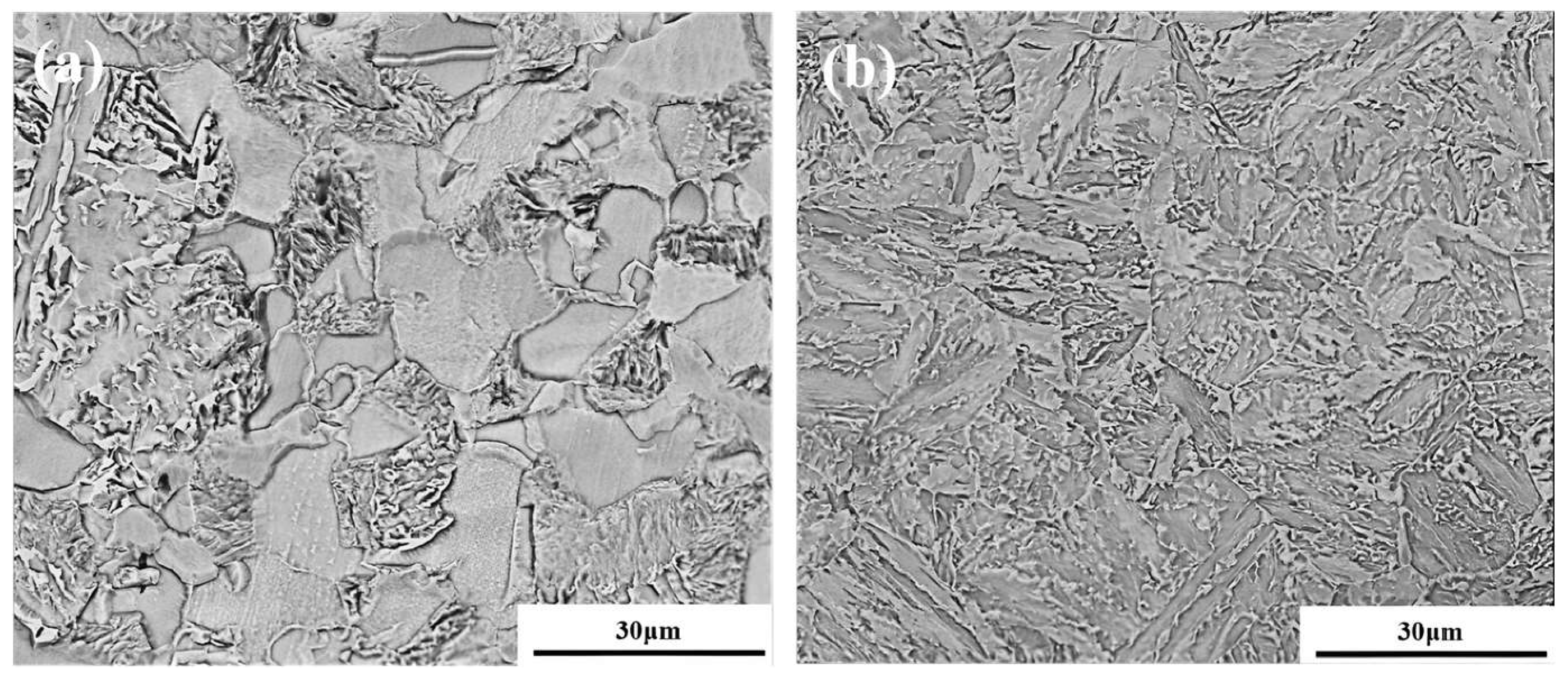
Figure 1 presents the microstructural morphologies of the two experimental steels. As shown in Figure 1a, the LCN steel was characterized by a typical ferrite–pearlite (F–P) microstructure, in which the matrix was composed of polygonal ferrite, while the dark pearlite colonies were distributed in an island-like manner along ferrite grain boundaries. In contrast, with increasing Cr and Ni contents, the microstructure of the HCN steel was markedly altered. As shown in Figure 1b, the HCN steel was primarily composed of fine lath bainite (LB) with a minor fraction of granular bainite (GB), and the overall microstructure was refined. This difference was mainly attributed to the higher Cr and Ni additions, by which the hardenability of the steel was increased and the diffusional transformation of austenite to high-temperature ferrite and pearlite was suppressed; consequently, undercooled austenite was transformed within a lower temperature range to form a dense lath-bainitic microstructure [20,21].
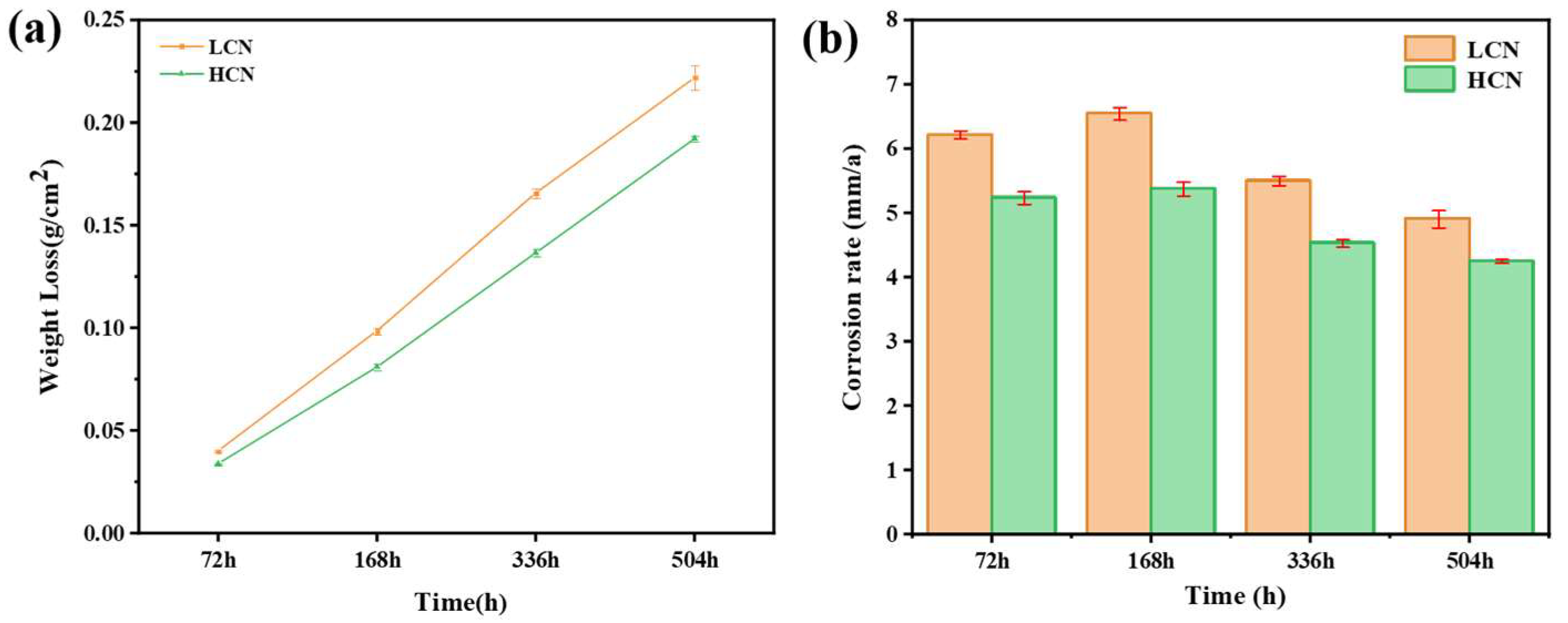
Figure 2 summarizes the evolution of corrosion mass loss and corrosion rate for the two Cr–Ni steels after the cyclic immersion accelerated corrosion test. As shown in Figure 2a, the corrosion mass loss of both steels increased in an approximately linear manner with increasing exposure time. Throughout the entire exposure period, the corrosion mass loss of the HCN steel remained lower than that of the LCN steel. At 504 h, the mass loss of the HCN steel was approximately 13.6% lower than that of the LCN steel, suggesting that higher Cr and Ni additions effectively suppressed matrix dissolution. As shown in Figure 2b, the corrosion rate was defined as the average value over the 0–t interval (converted from cumulative mass loss) and did not vary monotonically with time. An anomalous increase in corrosion rate was observed at 168 h relative to 72 h: the LCN steel increased from 6.22 to 6.55 mm·a−1, whereas the HCN steel increased from 5.24 to 5.38 mm·a−1. With further exposure, the corrosion rate gradually decreased for both steels, reaching 4.91 mm·a−1 for the LCN steel and 4.25 mm·a−1 for the HCN steel by 504 h.

3.2. Evaluation of Localized Corrosion

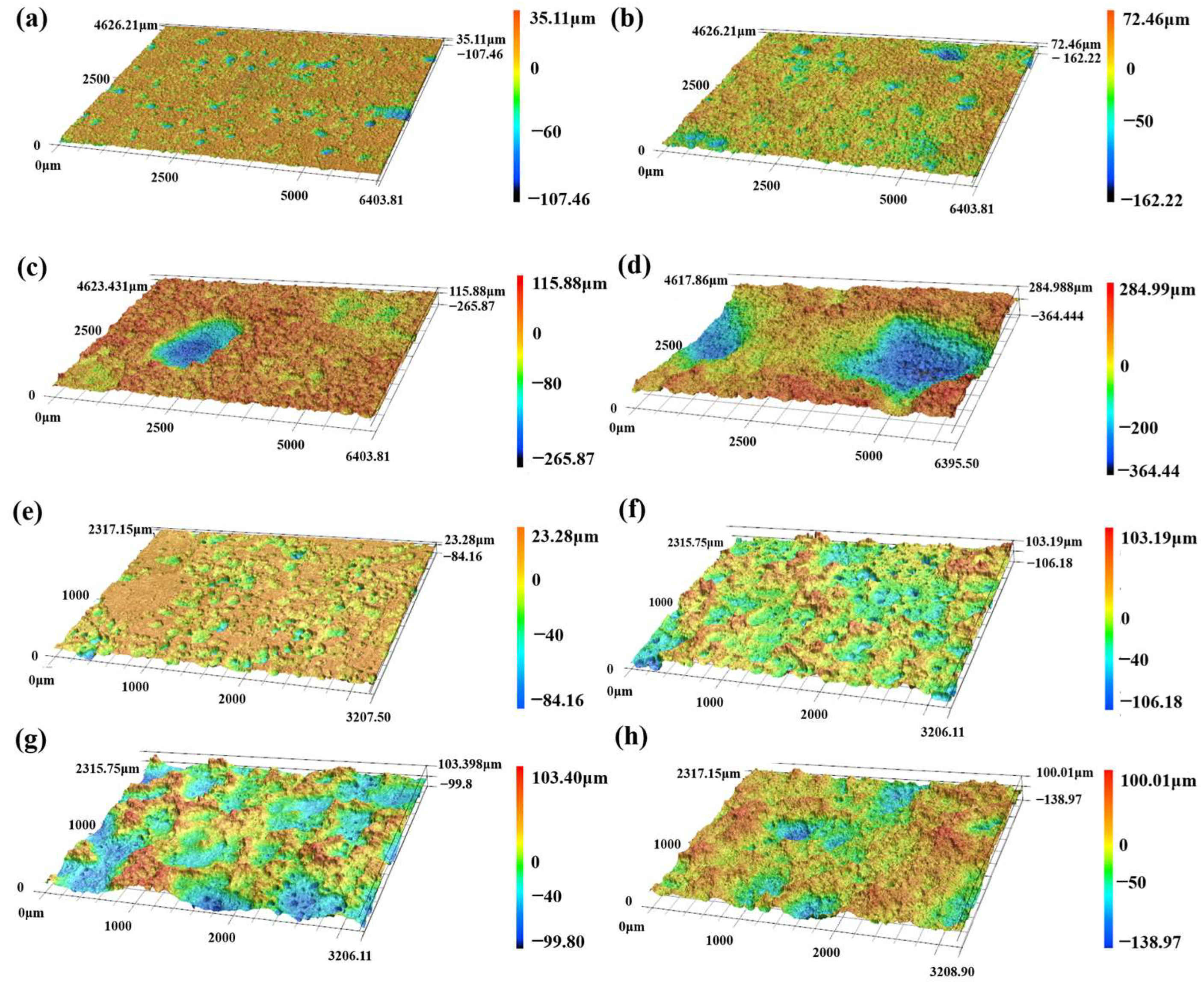
Rebar is susceptible to corrosion in marine environments, where chloride-induced pitting is a major contributor to the shortened service life of reinforced concrete structures [22,23]. Accordingly, pit depth—particularly the maximum pit depth—was used as a key metric for assessing localized corrosion severity and structural safety [24]. The derusted surface topography of the two Cr–Ni steels after different immersion durations was characterized by three-dimensional laser confocal scanning microscopy. For each condition, a randomly selected area of 2500 μm × 2500 μm was analyzed, as shown in Figure 3. At the early stage (72 h), numerous dispersed pits were initiated on both steels. With increasing exposure to 168 h, the pits began to grow and coalesce. At 168 h, the pits on the LCN steel increased markedly in both maximum depth and diameter, indicating pronounced localized corrosion. In contrast, the pits on the HCN steel remained relatively shallow and scattered.
During the mid-to-late corrosion stage (336–504 h), the two steels exhibited fundamentally different corrosion morphologies. As shown in Figure 3c,d, pits on the LCN steel began to coalesce, leading to the formation of dominant wide and deep cavities. The maximum pit depth increased from 265.87 μm to 364.44 μm. In contrast, as shown in Figure 3g,h, the HCN steel at the same stage remained dominated by dispersed, shallow pits, with the maximum pit depth increasing only slightly from 99.80 μm to 138.97 μm. At 504 h, the maximum pit depth of the HCN steel was 61.8% lower than that of the LCN steel. Moreover, the corrosion morphology of the HCN steel tended to shift from localized pitting toward a more uniform attack. Overall, higher Cr–Ni contents effectively suppressed pit initiation and growth and reduced the maximum pit depth, thereby limiting pit penetration into the substrate and substantially lowering the risk of pitting-induced perforation in rebar [25,26].
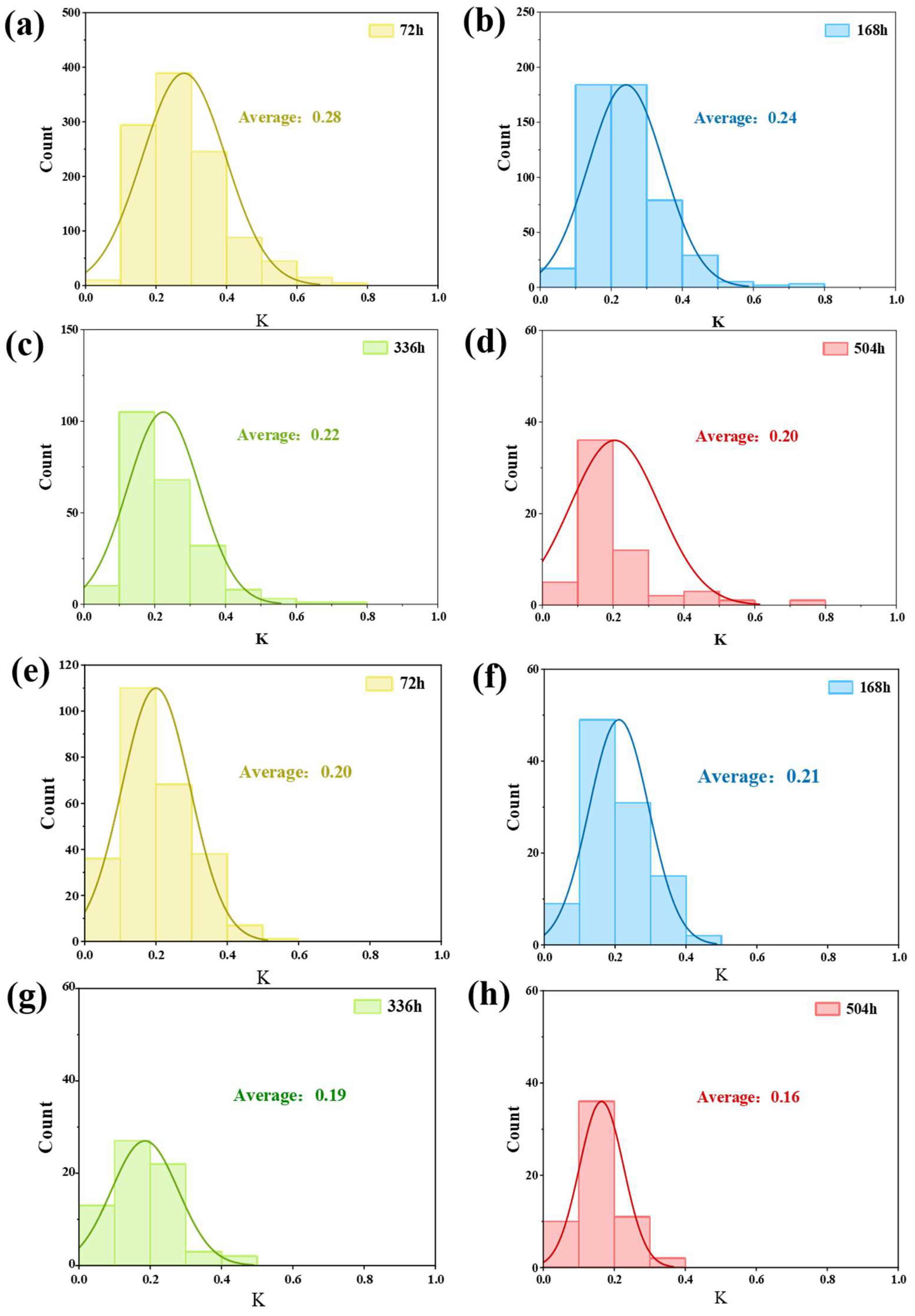
To further elucidate differences in derusted surface morphology between the LCN and HCN steels, the pit morphologies of specimens retrieved after different immersion durations were statistically analyzed. The maximum depth and the equivalent horizontal Feret diameter of individual pits were used as key parameters, and the depth-to-diameter ratio (K) was introduced as a quantitative descriptor of localized corrosion severity. A smaller K value indicates that pits tend to be shallower and wider, and the corrosion morphology approaches a more uniform attack; conversely, a larger K value corresponds to deeper and narrower pits, indicating a stronger propensity for localized corrosion [27].
As shown in Figure 4a,b, the average K value of the LCN steel decreased continuously from 0.28 to 0.20 with increasing immersion duration. This trend suggests that pits on the LCN steel evolved from relatively deep and narrow to shallow and wide, and that localized corrosion severity decreased with exposure time; correspondingly, the late-stage morphology exhibited a tendency toward a more uniform attack. In contrast, Figure 4e–h shows that the HCN steel exhibited an overall lower average K value: K increased slightly from 0.20 to 0.21 at the early stage, then decreased modestly and stabilized at 0.16. Overall, pits on the HCN steel also shifted toward shallower and wider geometries, indicating a progressive reduction in localized corrosion tendency and a morphology closer to a uniform-corrosion regime.

3.3. Electrochemical Analysis of the Rust Layer

3.3.1. Potentiodynamic Polarization Curves

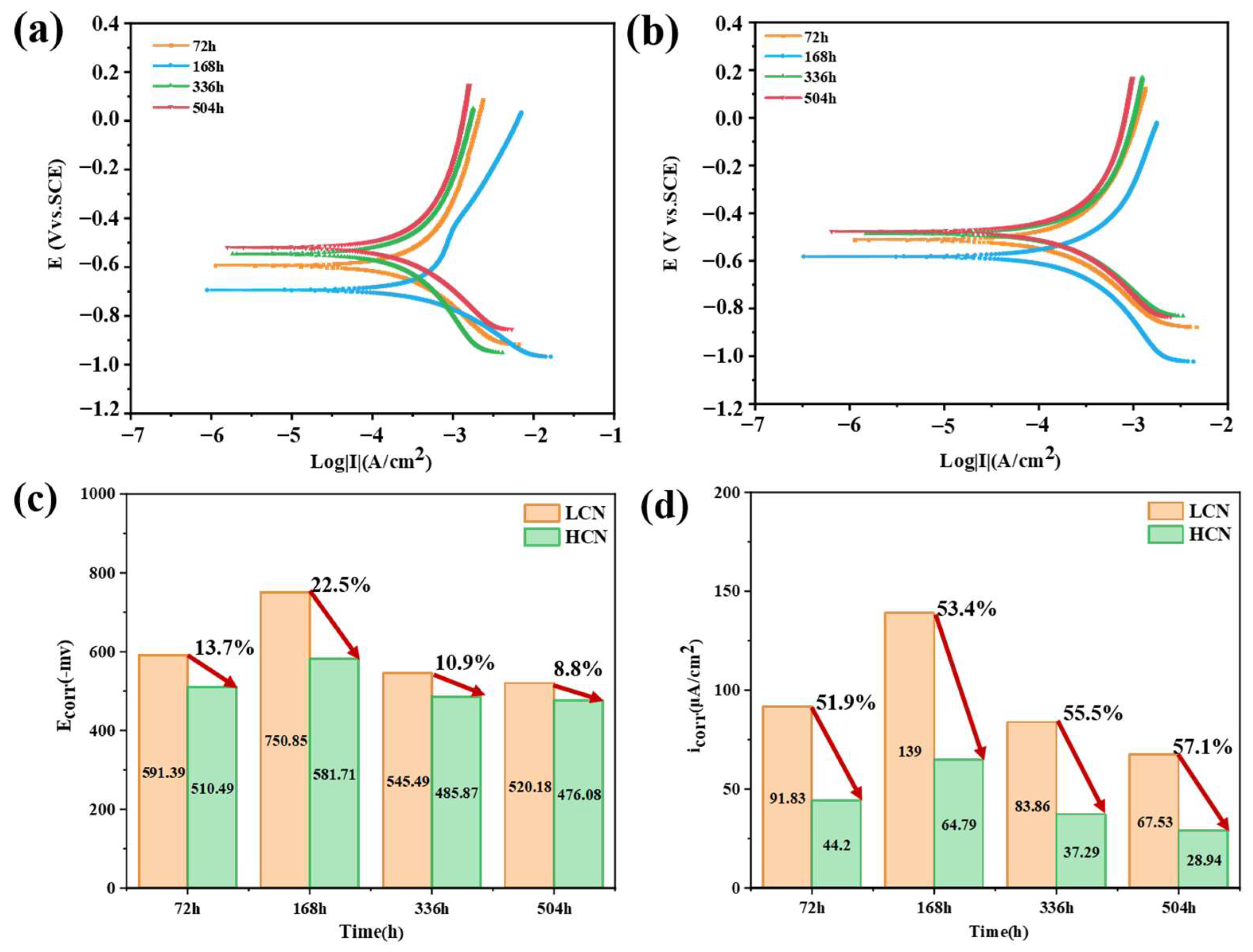
Figure 5 presents the PDP curves of as-corroded (rust-covered) specimens for the two steels after the cyclic immersion accelerated corrosion test in a 2 wt.% NaCl solution at four exposure durations. The electrochemical parameters derived from Tafel extrapolation are summarized in Figure 5. As shown in Figure 5, the PDP curves of both steels at different exposure durations exhibited similar electrochemical features: the cathodic branch was dominated by the oxygen reduction reaction, whereas the anodic branch corresponded to active dissolution of the steel substrate. No distinct stable passive region was observed, indicating that corrosion in the chloride-containing solution was governed primarily by active dissolution for both steels. These results suggest that the addition of Cr and Ni did not alter the fundamental corrosion reaction pathway of the steels in the chloride-bearing environment.
At the early stage, both the LCN and HCN steels exhibited a similar trend: relative to 72 h, the PDP curves at 168 h shifted overall toward the lower-right, accompanied by a more negative Ecorr and an increased icorr. With continued exposure, the PDP curves of both steels gradually shifted leftward, i.e., Ecorr shifted in the noble direction and icorr decreased. Specifically, for the LCN steel, Ecorr shifted from −750.85 to −520.18 mV, while icorr decreased from 139.0 to 67.53 μA·cm−2; for the HCN steel, Ecorr shifted from −581.71 to −476.08 mV, and icorr decreased from 64.79 to 28.94 μA·cm−2.
Comparison of the electrochemical parameters of the two Cr–Ni steels across the four exposure durations revealed that the HCN steel consistently exhibited a more noble corrosion potential and a lower corrosion current density. In particular, at 504 h, the icorr of the HCN steel was approximately 43% of that of the LCN steel, further indicating that higher Cr and Ni contents effectively reduced the corrosion rate in chloride-bearing environments and enhanced corrosion resistance [28].

3.3.2. Electrochemical Impedance Spectroscopy

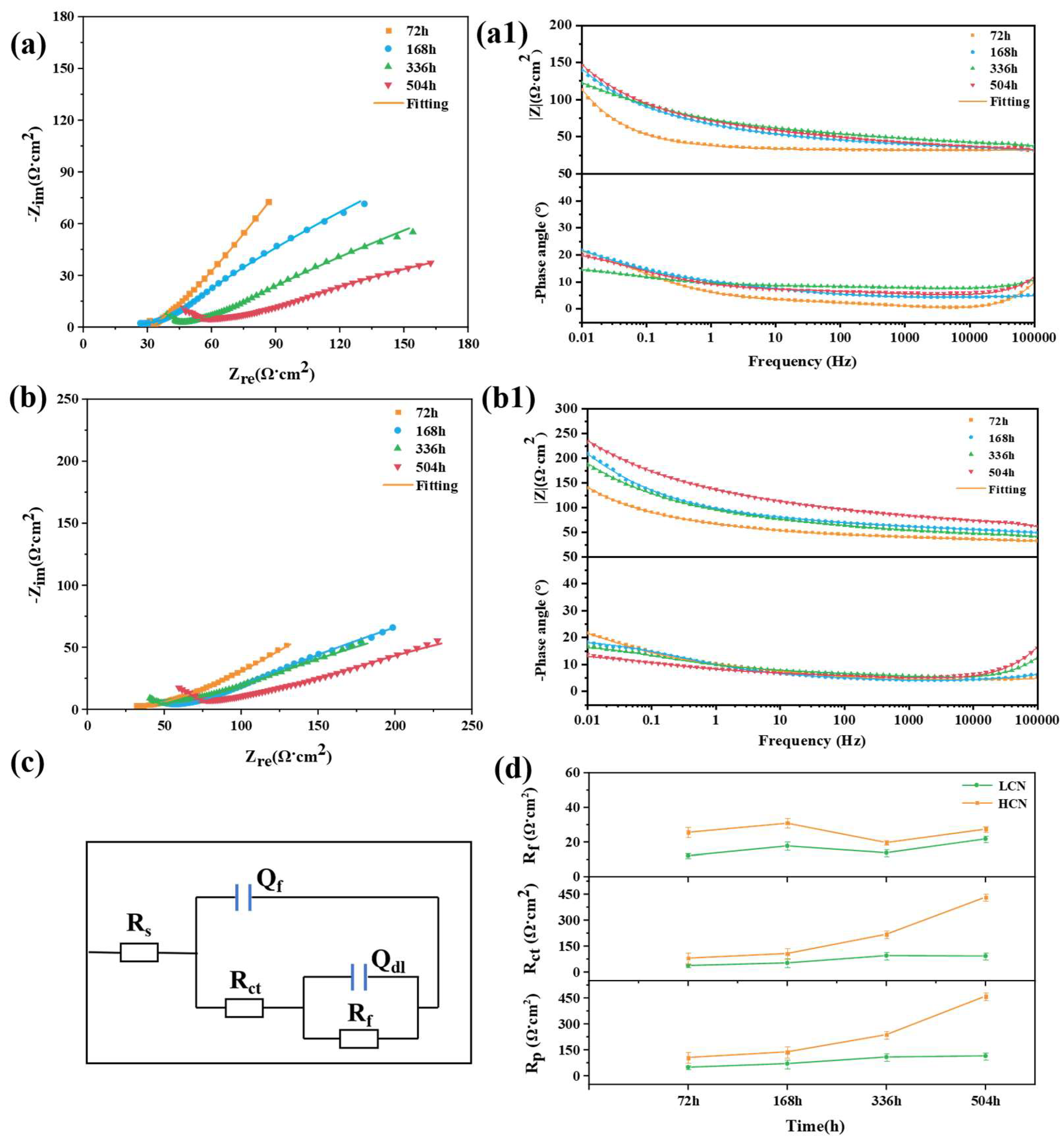
At the end of each immersion period, EIS was performed on the surface rust layers of the LCN and HCN steels, and the results are presented in Figure 6. In Figure 6a,a1 correspond to the Nyquist and Bode plots of the LCN steel, whereas Figure 6b,b1 correspond to those of the HCN steel. In the Nyquist plots (Figure 6a,b), the capacitive arc radii of both steels were relatively small at the early stage, indicating that a stable corrosion-product layer had not yet developed on the surface. With continued corrosion, the arc radii increased gradually, suggesting enhanced barrier (shielding) effects of the rust layer at later stages [29]. In the Bode plots (Figure 6a1,b1), the low-frequency impedance modulus |Z|0.01HZ generally increased with exposure time. At 504 h, |Z|0.01Hz reached 230 Ω·cm2 for the HCN steel, compared with 150 Ω·cm2 for the LCN steel.
To comparatively assess the electrochemical processes associated with the rust layers on the Cr–Ni rebars, the impedance spectra were fitted using the equivalent circuit shown in Figure 6c. The fitting results are presented in Figure 6d and Table 2. Here, Rs denotes the solution resistance; Qdl and Rct represent the double-layer capacitance and charge-transfer resistance at the metal/rust-layer interface, respectively; and Rf and Qf correspond to the rust-layer resistance and the interfacial capacitance at the rust layer/solution interface, respectively. The parameter Rct is commonly employed as an indicator related to interfacial charge-transfer kinetics [30]. As shown in Figure 6d, the Rct of the LCN steel increased from 37.47 Ω·cm2 at 72 h to 92.64 Ω·cm2 at 504 h. The overall magnitude remained relatively low, indicating that the rust layer provided limited protection to the substrate. With higher Cr–Ni contents, the Rct of the HCN steel increased markedly: values of 80.17, 107.30, 218.30, and 432.80 Ω·cm2 were obtained at 72, 168, 336, and 504 h, respectively, indicating superior corrosion resistance compared with the LCN steel. In the 2 wt.% NaCl solution, Rf was relatively small; therefore, the polarization resistance Rp (Rp = Rf + Rct) exhibited the same trend as Rct. Accordingly, Rp is used as a comparative indicator of the rust-covered surface’s resistance to electrochemical polarization, rather than as a direct measure of rust-layer permeability or ionic transport.

3.4. Surface and Cross-Sectional Characterization of Rust Layers

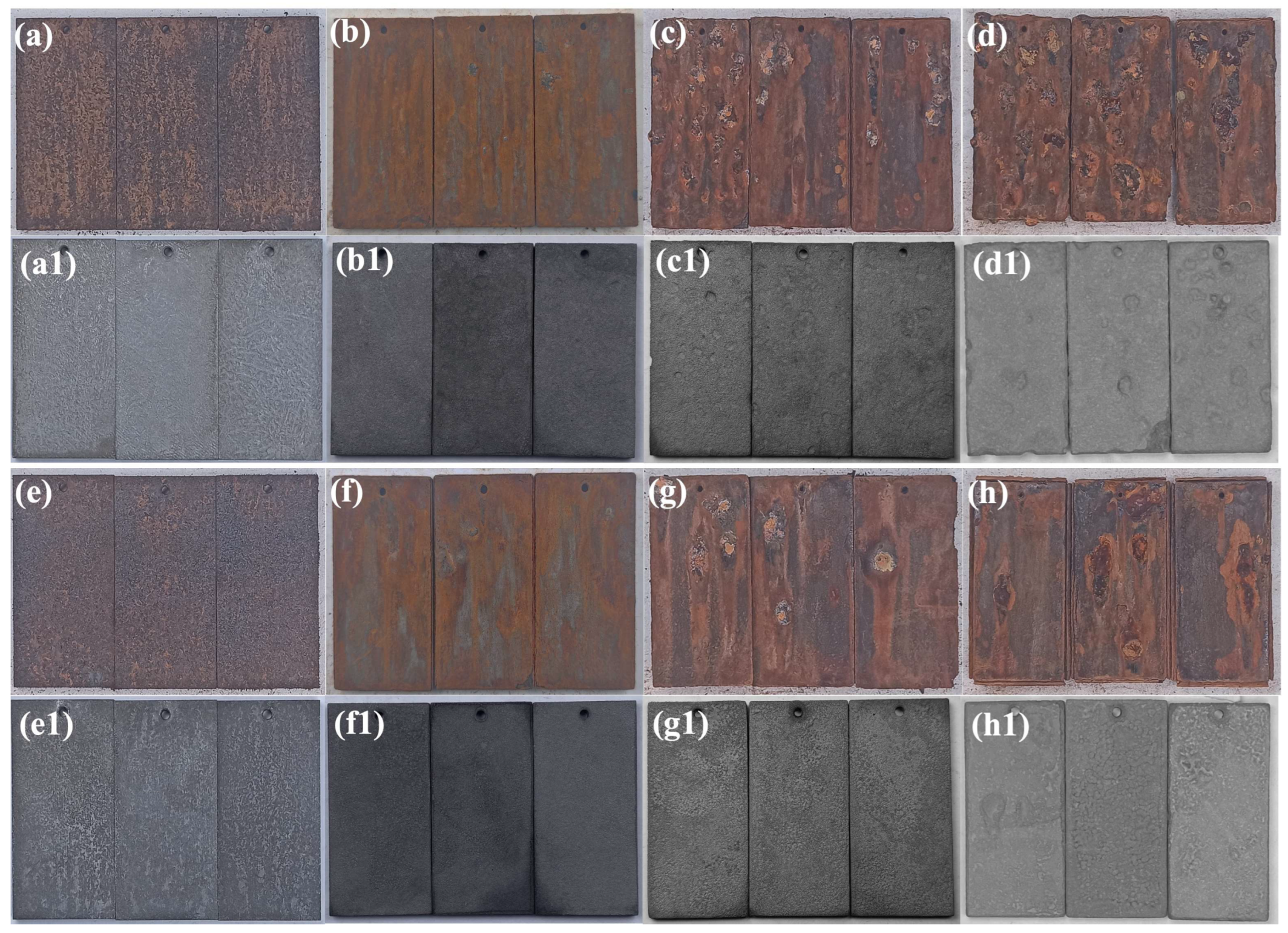
Figure 7 presents the macroscopic corrosion morphologies of the LCN and HCN steels after cyclic immersion in neutral 2 wt.% NaCl for 72, 168, 336, and 504 h. As shown in Figure 7a–h, relatively limited corrosion products were observed at 72 h for both steels, and the surfaces were mainly covered by a nearly uniform, light brown rust layer. After 168 h, corrosion products increased markedly, and the surface color gradually shifted from light brown to yellowish brown, indicating increased rust coverage and thickness. In general, α-FeOOH is brown and relatively stable, γ-FeOOH is often yellow and less stable, whereas Fe3O4 typically appears as a black corrosion product [31]. Accordingly, when the immersion time was extended to 336 and 504 h, darker regions gradually developed on the specimen surfaces, reflecting further evolution of the rust layer toward a denser, more compact structure. Notably, distinct differences were observed at later times. From 336 h onward, the LCN steel exhibited more localized corrosion spots and discontinuities in the rust layer, and by 504 h, more pronounced local spallation and delamination were observed, suggesting weaker rust adhesion and integrity. In contrast, although localized corrosion features also developed on the HCN steel, its rust layer remained more continuous with less spallation, and the overall macroscopic damage remained relatively limited. The comparison after rust removal further corroborates these observations. The LCN substrate retained more numerous corrosion spots and pit traces, whereas the HCN surface appeared more uniform, indicating a lower degree of substrate damage. This trend is consistent with the detailed characterization of rust-removed macroscopic morphology discussed in Section 3.2.
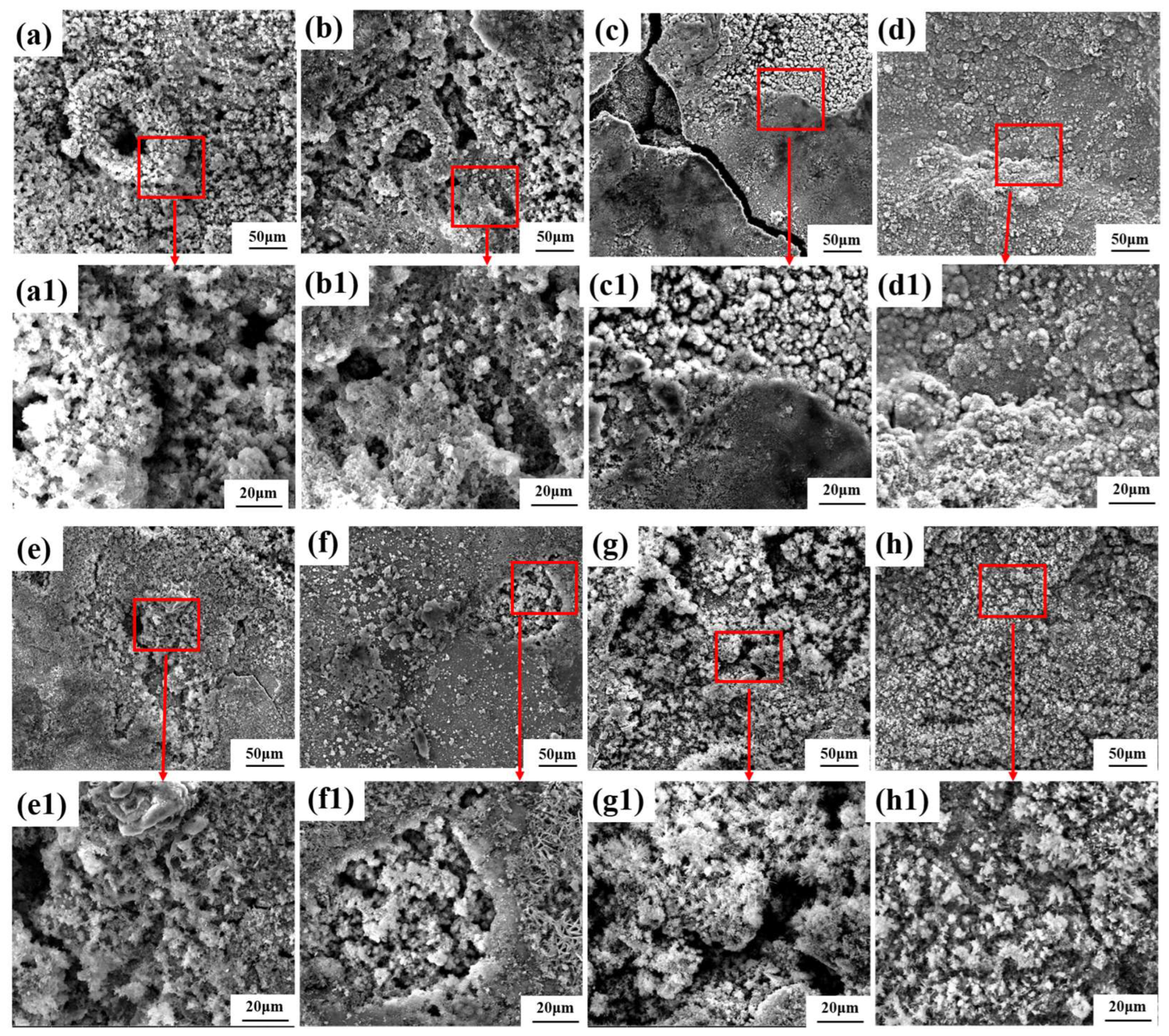
Figure 8a–f show the microstructural features of the corrosion products formed on the LCN and HCN steels after the four immersion durations, respectively. Three major iron-containing corrosion products were identified: Fe3O4, α-FeOOH, and γ-FeOOH. Fe3O4 typically appeared as dense, dark regions or annular (“donut”-like) structures. α-FeOOH was characterized by needle-like (acicular) bundles and hair-/filament-like crystals, which were often aggregated in a radial or flocculent manner. γ-FeOOH typically manifested as fine powder- or sand-like particles and stacked thin flakes/lamellae, resembling scale-like, petal-like, or layered plate-like structures [31].
As shown in Figure 8a–d, during the early stage (72–168 h), the corrosion products on the LCN steel surface were dominated by annular Fe3O4 and granular γ-FeOOH, and the rust layer contained abundant pores. At 336 h, needle-bundle α-FeOOH was first observed in localized regions. With further exposure to 504 h, although the fraction of the stable α-FeOOH phase increased, the overall rust layer remained rich in cracks and pores, indicating insufficient compactness.
As shown in Figure 8e,f, at 72 h the HCN steel surface already exhibited large areas of relatively compact Fe3O4 together with granular γ-FeOOH; however, the rust layer still showed relatively high porosity. At 168 h, pronounced radially arranged needle-bundle/feather-like clusters were observed, indicating that the stable α-FeOOH phase had formed abundantly at an earlier stage. With further exposure, the stable α-FeOOH phase increased markedly and accumulated on the surface, thereby enhancing rust-layer compactness. At 504 h, compared with the LCN steel, fine needle-like α-FeOOH on the HCN steel formed an interwoven network that filled pores, leading to a substantial reduction in surface voids.
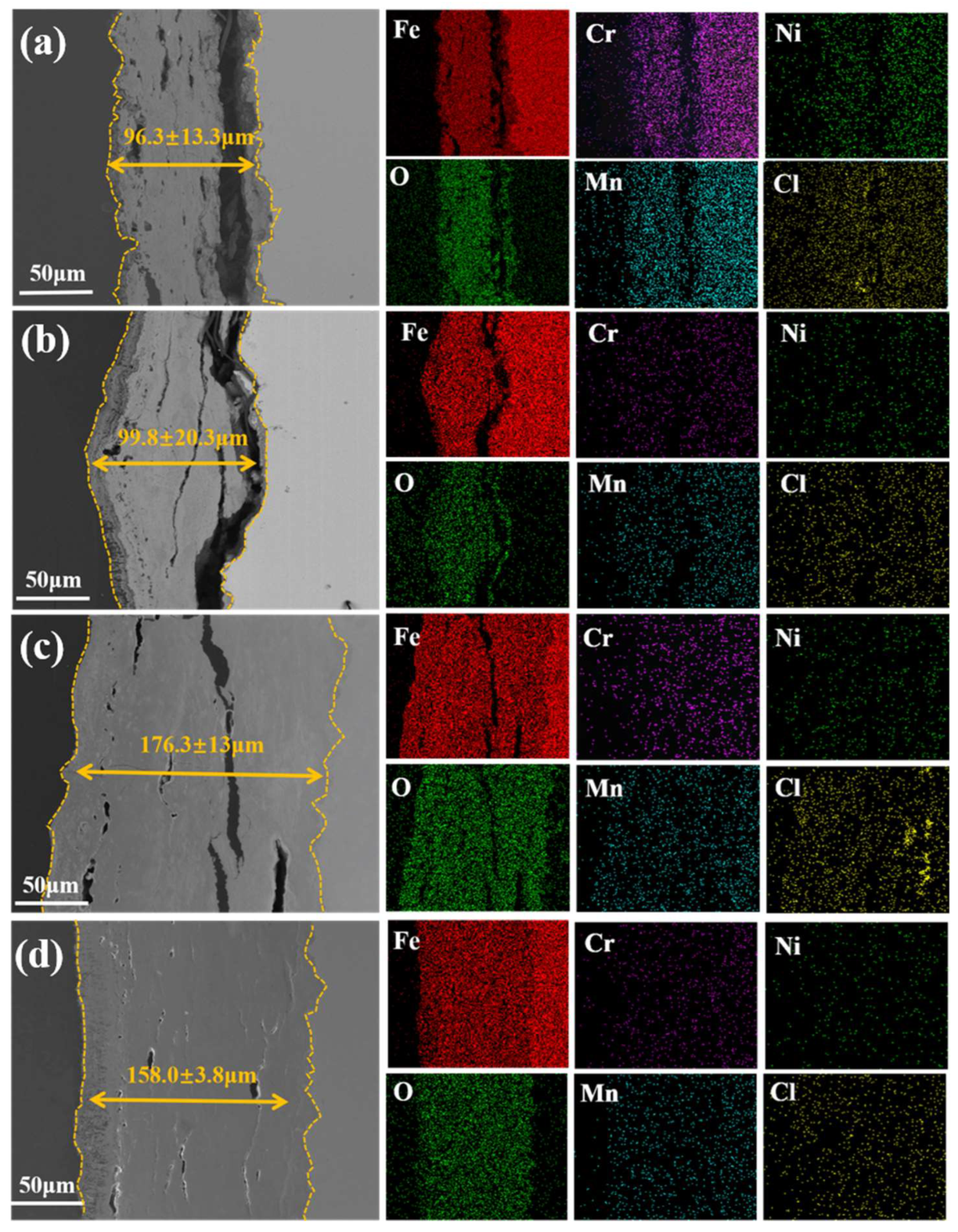
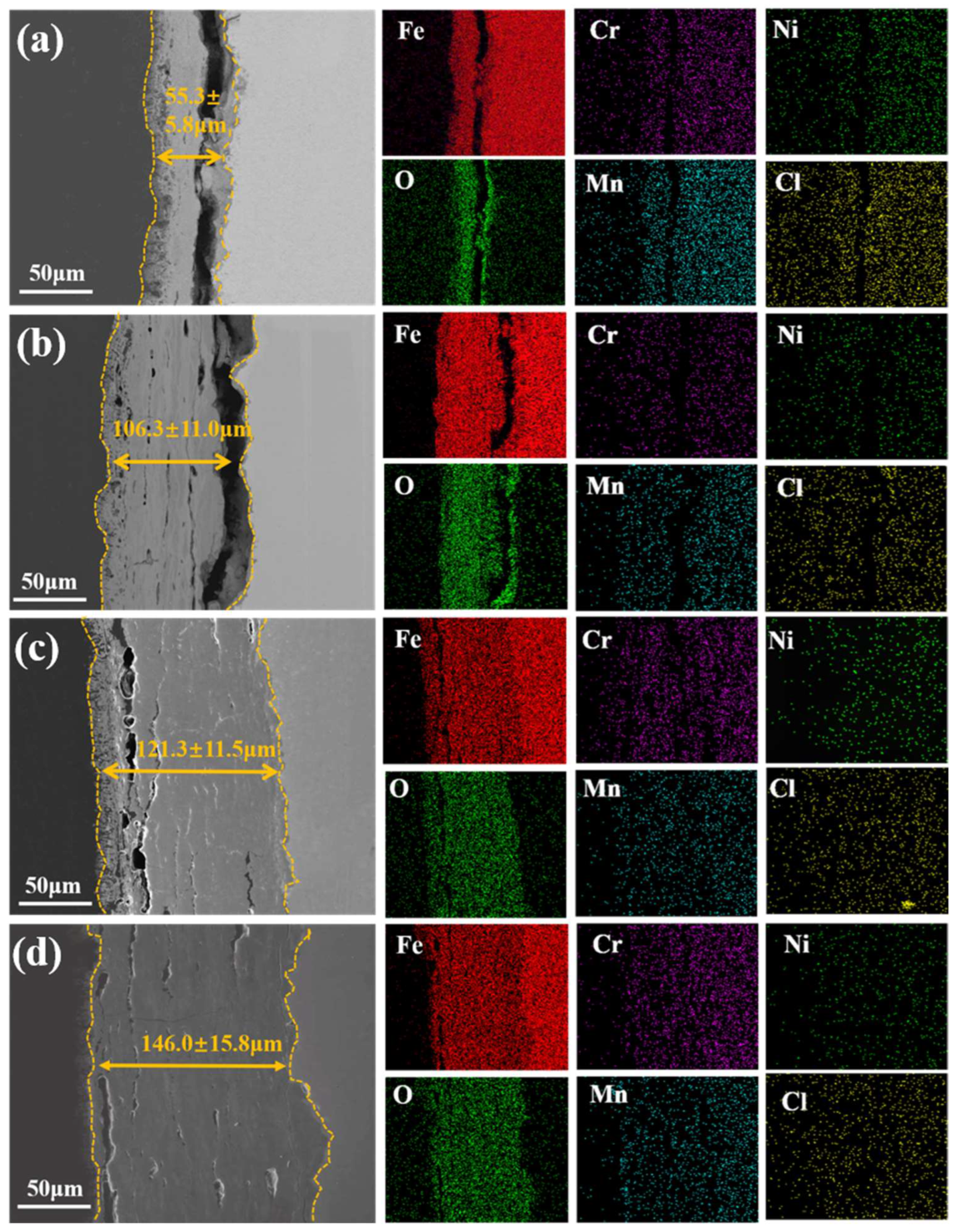
After four wet–dry cycles, the cross-sectional morphology and elemental distributions of the rust layers on the LCN and HCN steels were examined by SEM coupled with EDS, as shown in Figure 9 and Figure 10. As shown in Figure 9, the rust layer on the LCN steel was mainly composed of Fe and O. During the early stage (72–168 h), repeated volumetric expansion and contraction of the rust layer during wet–dry cycling generated internal stresses, which led to interfacial gaps between the substrate and the rust layer. With further exposure, the interfacial gap disappeared and the corrosion-product layer continued to thicken, reaching 158.0 ± 3.8 μm at 504 h; however, numerous cracks and pores remained within the rust layer. EDS mapping showed that Cl was widely distributed within the rust layer and tended to concentrate near cracks and pores, indicating that the porous rust layer was ineffective in blocking electrolyte ingress. Consequently, Cl could migrate inward along defect pathways to the steel surface and promote substrate corrosion [32].
As shown in Figure 10, the HCN steel exhibited a superior rust-layer structure. Although the rust layer was also dominated by Fe and O, pronounced enrichment of Cr and Ni was observed in the inner rust-layer region adjacent to the substrate. This enrichment suggests that the alloying elements were actively involved in the modification and stabilization of the inner rust layer. With increasing exposure time, the corrosion-product layer on the HCN steel thickened progressively, increasing from 55.3 ± 5.8 μm to 146.0 ± 15.8 μm. Meanwhile, the rust layer became more continuous and compact, with fewer cracks and pores than that on the LCN steel. More importantly, the presence of a dense, Cr/Ni-enriched inner rust layer effectively impeded Cl ingress. EDS mapping further showed that most Cl was confined to the outer rust layer and rarely penetrated into the Cr/Ni-enriched inner region.

3.5. Phase and Chemical-State Analysis of Rust Products

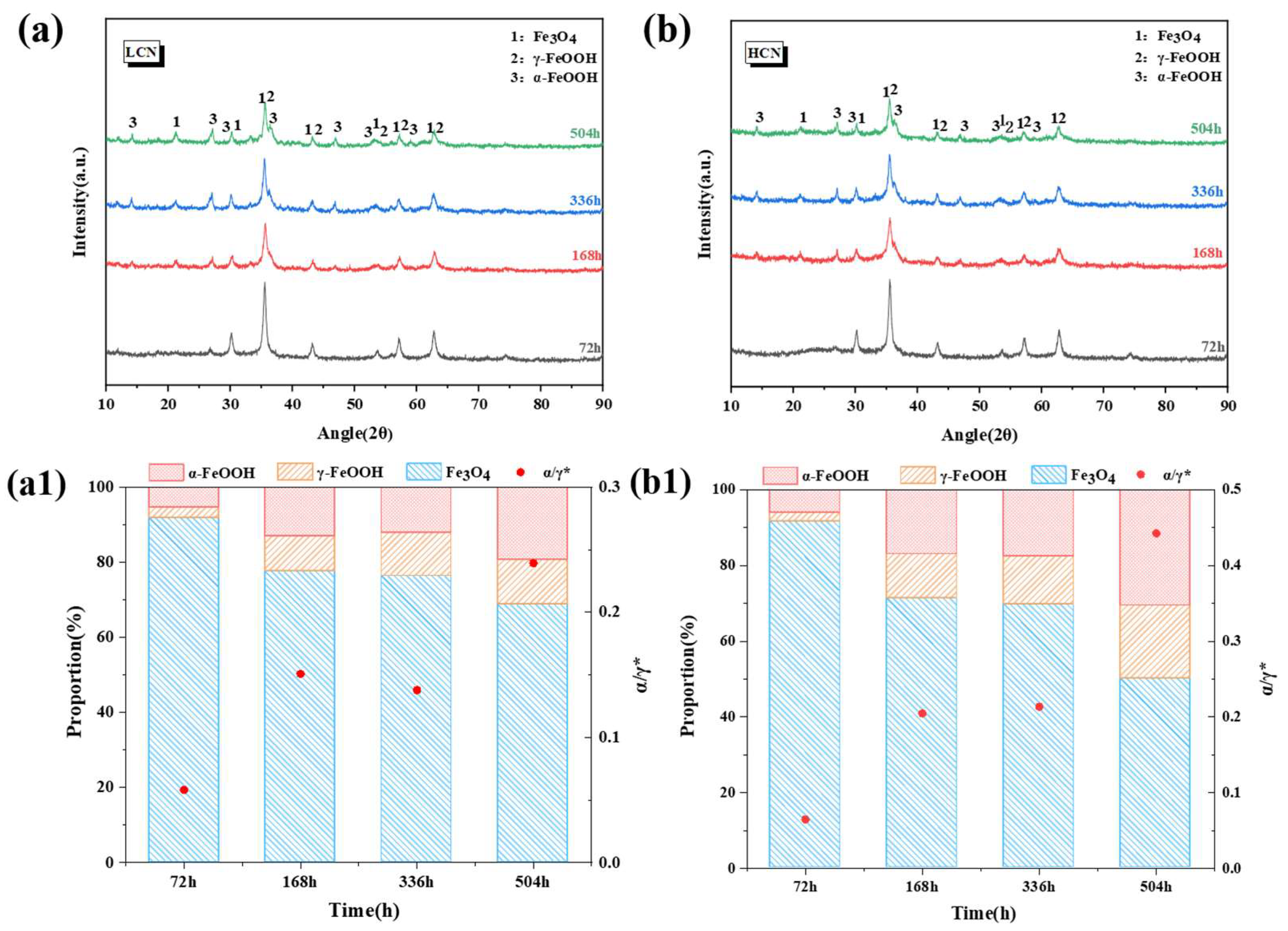
XRD was employed to analyze the phase constituents of the rust layers formed on the LCN and HCN steels after different immersion durations. Figure 10a,b present the XRD patterns of the rust layers on the LCN and HCN steels at different immersion durations. For semi-quantitative comparison of rust-layer phases across the exposure durations, the relative intensities ratio (RIR) method was applied to estimate the relative fraction of each phase [33], and the results are summarized in Figure 11a1,b1. It should be noted that RIR-based phase fractions are semi-quantitative and may be affected by crystallinity, preferred orientation (texture), and particle size/microstrain effects, which can be particularly pronounced for heterogeneous and partially amorphous corrosion products. Therefore, the estimated phase fractions are used here primarily to indicate relative trends with exposure time and between steels, rather than to provide absolute quantitative phase contents.
As shown in Figure 11a,b, the rust layers formed on both steels at all exposure durations contained the same phases, namely Fe3O4, γ-FeOOH, and α-FeOOH. This observation indicates that Cr–Ni alloying did not fundamentally alter the phase assemblage of the corrosion products; however, as corrosion progressed, the characteristic peaks exhibited marked differences in intensity and breadth, suggesting that the relative fractions of the individual phases were modified. The physicochemical properties of these phases govern the eventual protectiveness of the rust layer. According to thermodynamic considerations of corrosion products, γ-FeOOH, which is often an early-formed rust constituent, is thermodynamically metastable and highly reactive, with a relatively loose and porous structure; therefore, it is unfavorable for the development of a stable, protective rust layer [34]. Although Fe3O4 is structurally denser than γ-FeOOH, it exhibits relatively high electrical conductivity and can be readily reduced [35]. In contrast, α-FeOOH is thermodynamically stable and features a compact structure with good insulating properties, thereby enhancing rust-layer stability [36].
As shown in Figure 11a1,b1, the relative phase fractions changed markedly with exposure time. At 72 h, the rust layers on both steels were dominated by Fe3O4, whereas γ-FeOOH and α-FeOOH were present at lower levels. With prolonged exposure, the fraction of Fe3O4 decreased, while γ-FeOOH and α-FeOOH increased progressively. At 504 h, Fe3O4 in the LCN steel decreased to ~70%, whereas α-FeOOH increased to approximately 20%. In the HCN steel, a larger decrease in Fe3O4 (to approximately 50%) and a more pronounced increase in α-FeOOH (to approximately 30%) were observed, indicating that higher Cr and Ni contents favored the formation and enrichment of the stable α-FeOOH phase.
The α/γ* index was further introduced to assess rust-layer stability, where α denotes the fraction of α-FeOOH and γ* is defined as the sum of the fractions of Fe3O4 and γ-FeOOH [37]. With increasing immersion duration, α/γ* increased overall for both steels, and the HCN steel maintained higher values than the LCN steel during the mid-to-late stage, with a particularly pronounced increase at 504 h. These results suggest that rust-layer protectiveness increased with corrosion progression for both steels; moreover, the higher Cr and Ni contents in the HCN steel were associated with a rust maturation trend, reflected by a reduced Fe3O4 contribution and an increased α-FeOOH fraction, which—together with the observed rust-layer morphology and electrochemical responses—indicates a more stable and potentially less permeable rust layer.
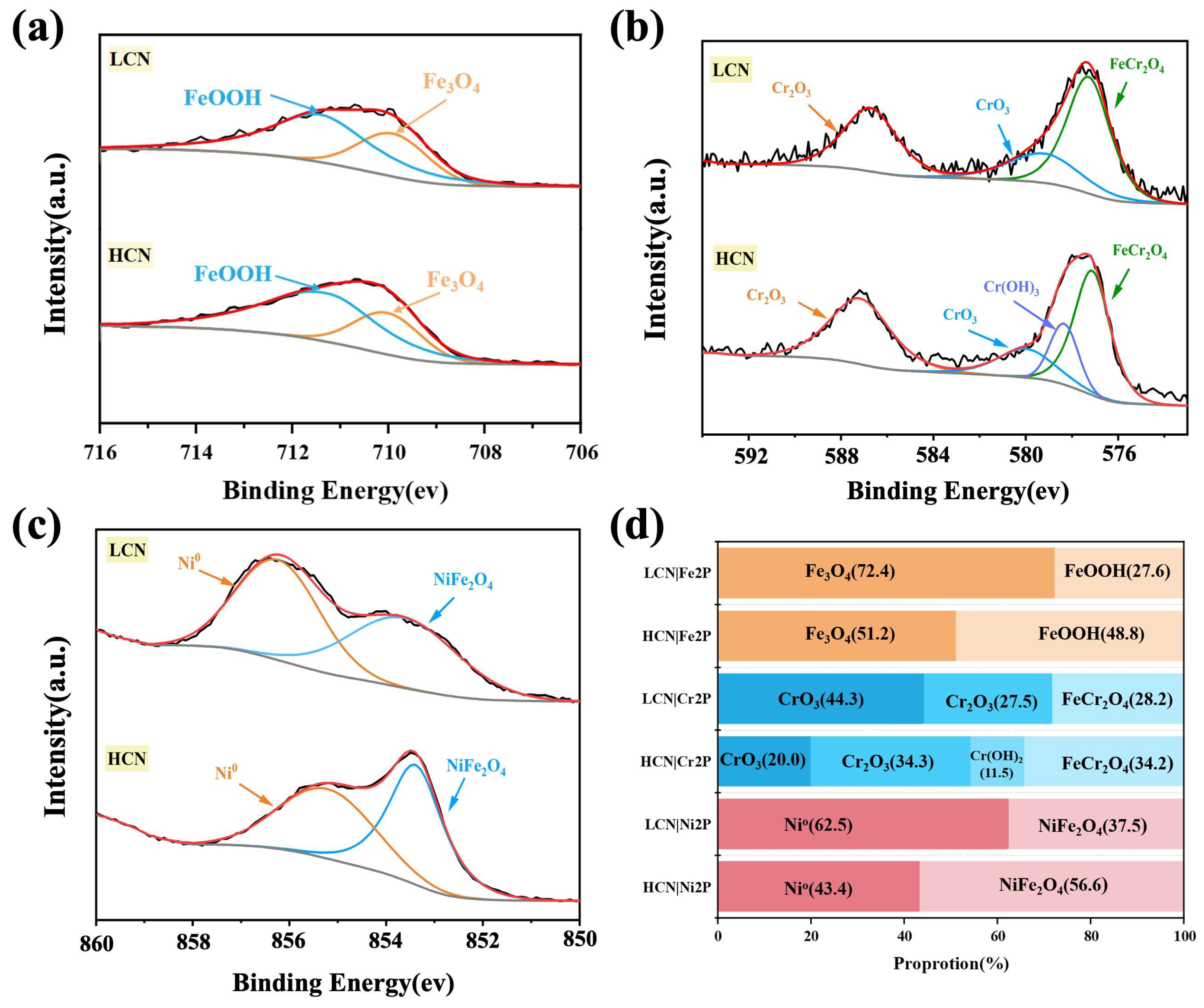
Because XRD is primarily used to identify Fe-containing crystalline phases and their relative fractions in the rust layer, it cannot unambiguously determine the chemical states and bonding environments of other alloying elements. To further elucidate the chemical states of Cr and Ni in the rust layer, XPS was performed for in-depth analysis. Figure 12a–c present the Fe 2p3/2, Cr 2p3/2, and Ni 2p3/2 XPS spectra of the rust layers formed on the two Cr–Ni steels after 504 h of immersion, together with the corresponding peak deconvolution results. Figure 12d summarizes the relative fractions of the fitted chemical components based on peak-area integration.
As shown in Figure 12a, the Fe spectrum was deconvoluted into two components at 710.1 and 711.8 eV, which were assigned to Fe3O4 and FeOOH, respectively. Semi-quantitative analysis indicated that Fe3O4 and FeOOH accounted for 72.4% and 27.6% in the LCN rust layer, whereas in the HCN rust layer Fe3O4 decreased to 51.2% and FeOOH increased to 48.8%. This shift suggests that Cr–Ni co-alloying promoted FeOOH formation/enrichment, consistent with the XRD results. As shown in Figure 12b, Cr species in the LCN rust layer were identified as FeCr2O4 (576.4 eV), CrO3 (578.2 eV), and Cr2O3 (587.4 eV), with relative fractions of 28.2%, 44.3%, and 27.5%, respectively. For the HCN steel, the overall Cr signal intensity was markedly higher, and an additional Cr(OH)3 component at 577.3 eV was detected. The fractions of FeCr2O4, Cr2O3, and Cr(OH)3 increased to 34.2%, 34.3%, and 11.5%, respectively, whereas CrO3 decreased to 20.0%. These results indicate that the rust layer on the HCN steel was more compositionally complex and enriched in Cr-bearing species associated with improved corrosion resistance. Previous studies have indicated that the protectiveness of corrosion-product films is closely related to the fraction of Cr-bearing compounds; FeCr2O4, Cr2O3, and Cr(OH)3 are generally considered beneficial, whereas CrO3 is relatively unstable and is typically less effective in enhancing corrosion resistance [38]. As shown in Figure 12c, Ni species were resolved into metallic Ni (852.7 eV) and NiFe2O4 (855.4 eV). In the LCN rust layer, Ni0 and NiFe2O4 accounted for 62.5% and 37.5%, respectively, whereas in the HCN rust layer Ni0 decreased to 43.4% and NiFe2O4 increased to 56.6%. The higher Ni content in the HCN steel was accompanied by an increased fraction of NiFe2O4, indicating that Ni promoted the formation of additional spinel-type mixed oxides. Together with Cr-bearing corrosion products, these oxides contributed to a denser and more continuous rust layer, thereby providing structural and chemical-state evidence for enhanced rust-layer protectiveness and stability.
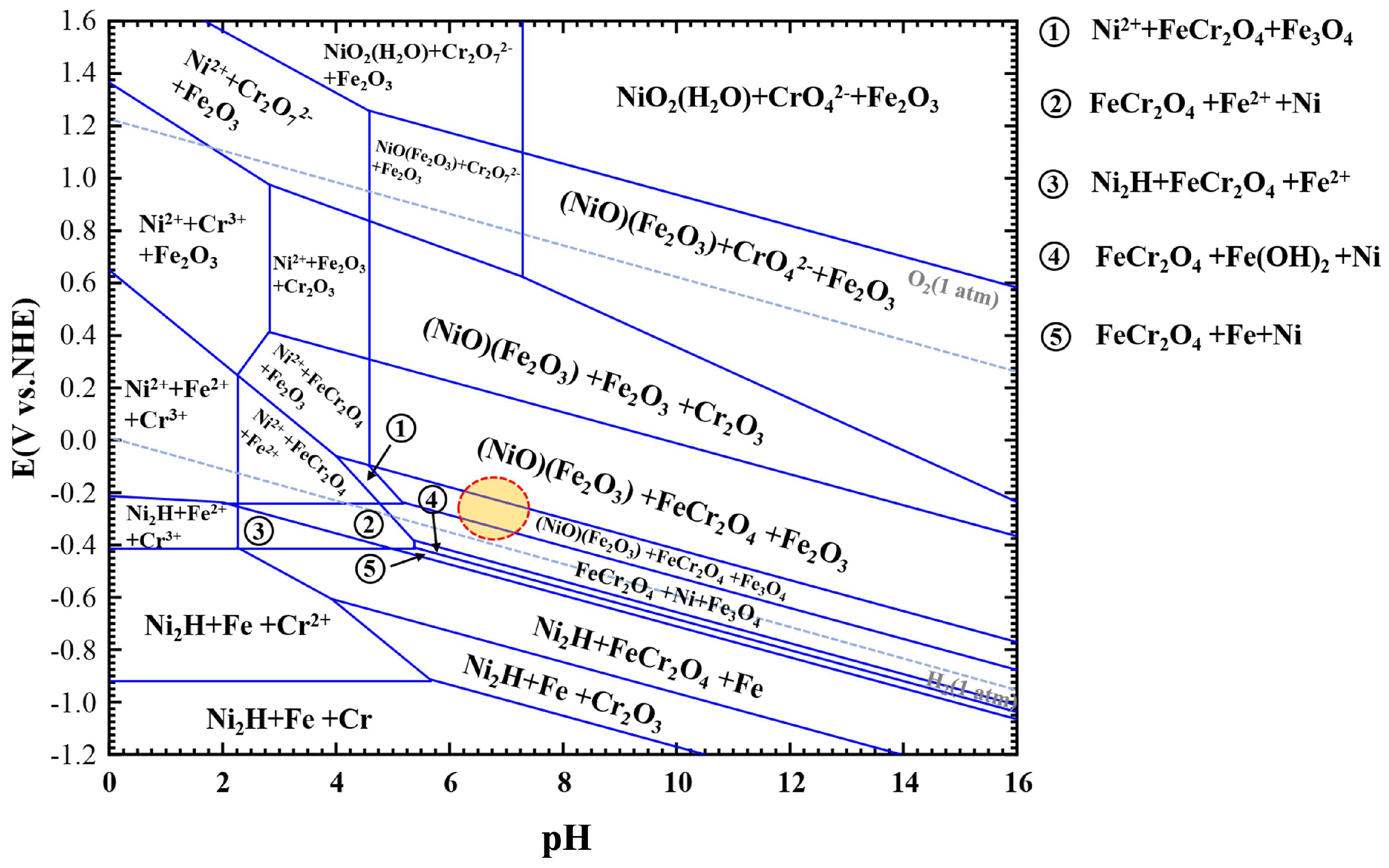
To further elucidate the roles of Cr and Ni in the rust layer, the E–pH (Pourbaix) diagram of the Fe–Cr–Ni–H2O system was constructed at 298.15 K. As shown in Figure 13, the yellow region indicates the E–pH window corresponding to the test solution used in this study. The thermodynamically stable Cr species were dominated by sparingly soluble Cr3+-bearing solid phases, indicating a tendency to form Cr2O3 and spinel-type mixed oxides such as FeCr2O4. In this system, Ni was predicted to interact with Fe, thereby favoring the formation of the spinel phase NiFe2O4.

4. Discussion

Based on the results in Section 3.1, Section 3.2, Section 3.3, Section 3.4 and Section 3.5, the HCN steel consistently exhibited lower mass loss and lower corrosion rates than the LCN steel during cyclic exposure in 2 wt.% NaCl, indicating improved corrosion resistance under the present test conditions. It should be emphasized that the two steels differ not only in Cr/Ni contents but also in microstructure; therefore, the respective contributions of alloying chemistry and microstructure cannot be fully decoupled within this two-material comparison. For the LCN steel, a ferrite–pearlite microstructure was observed. In such a microstructure, cementite (Fe3C) can form micro-galvanic couples with ferrite, which may accelerate early selective dissolution and facilitate corrosion initiation [39,40]. In contrast, the HCN steel showed a refined and more homogeneous bainitic microstructure, which is expected to reduce micro-galvanic heterogeneity and may weaken the initial driving force for localized attack. This microstructural difference could therefore contribute to the reduced early-stage corrosion tendency of HCN. In parallel, multiple observations support a composition-related improvement associated with Cr–Ni co-alloying and rust-layer evolution. Macroscopically, the more pronounced late-stage decrease in corrosion rate for HCN is consistent with a two-stage process involving an initially porous rust layer followed by development of a denser inner layer at longer times [41]. Electrochemical results align with this trend: at 504 h, icorr of HCN was ~43% of that of LCN, while |Z|0.01Hz and Rct were higher, implying slower interfacial kinetics and hindered ionic transport. Morphological observations further indicate less severe pit coalescence and reduced pit growth in depth for HCN, consistent with mitigated localized penetration. Regarding rust characteristics, LCN presented more pores/cracks and delayed α-FeOOH formation, whereas abundant needle-like α-FeOOH appeared as early as 168 h on HCN and was associated with pore filling and a more compact barrier-like morphology [42,43], consistent with Cl being mainly retained in the outer rust layer. XRD/XPS also indicate a higher α-FeOOH fraction and enrichment of FeCr2O4 and NiFe2O4 in HCN, which is consistent with enhanced rust stability/compactness and provides a plausible explanation for the lower corrosion rate and reduced pitting tendency under chloride exposure.
Under weekly immersion in 2 wt.% NaCl, the steel substrate underwent anodic dissolution to release Fe2+, which hydrolyzed to form Fe(OH)2 and was subsequently oxidized to γ-FeOOH [44,45]. Owing to its high electrochemical activity, γ-FeOOH can participate in cathodic processes and promote the formation of Fe3O4, while a fraction of γ-FeOOH is transformed into the thermodynamically more stable α-FeOOH [46] (Equations (2)–(5)). After anodic dissolution, Cr was converted to Cr(OH)3 and dehydrated to Cr2O3; meanwhile, Cr-containing products reacted in the solid state with iron oxides to form the stable spinel phase FeCr2O4 (Equations (6)–(9)). In this way, Cr oxides provided a physical barrier, and Cr3+, with an ionic radius similar to that of Fe3+, occupied octahedral sites in the spinel lattice to form a Cr-doped structure, thereby enhancing rust layer stability and suppressing unfavorable phase transformations [47]. Ni formed Ni(OH)2 and NiO and subsequently reacted with iron oxides to produce the spinel phase NiFe2O4 (Equations (10)–(13)) [48]. This process can reduce the number of active sites by partially substituting for Fe2+. Moreover, nanoscale NiFe2O4 can act as heterogeneous nucleation sites that promote nucleation of Fe(O,OH)6 structural units, refine the corrosion products, and accelerate the transformation of γ-FeOOH to α-FeOOH [49,50,51], thereby healing pores and cracks in the rust layer and blocking Cl diffusion pathways.
2 Fe + O 2 + 2 H 2 O     2 Fe ( OH ) 2
4 Fe ( OH ) 2 + O 2     4 γ - FeOOH + 2 H 2 O
8 γ - FeOOH + Fe     3 Fe 3 O 4 + 4 H 2 O
γ - FeOOH     α - FeOOH
4 Cr + 3 O 2 + 6 H 2 O     4 Cr ( OH ) 3
Cr ( OH ) 3     CrOOH + H 2 O
2 CrOOH     Cr 2 O 3 + H 2 O
Fe ( OH ) 2 + 2 CrOOH     Fe Cr 2 O 4 + 4 H 2 O
2 Ni + 3 O 2 + 2 H 2 O     2 Ni ( OH ) 2
Ni ( OH ) 2     NiO + H 2 O
2 Ni ( OH ) 2 + 4 Fe ( OH ) 2 + O 2     2 NiFe 2 O 4 + 6 H 2
2 NiO + 4 Fe ( OH ) 2 + O 2     2 NiFe 2 O 4 + 4 H 2 O
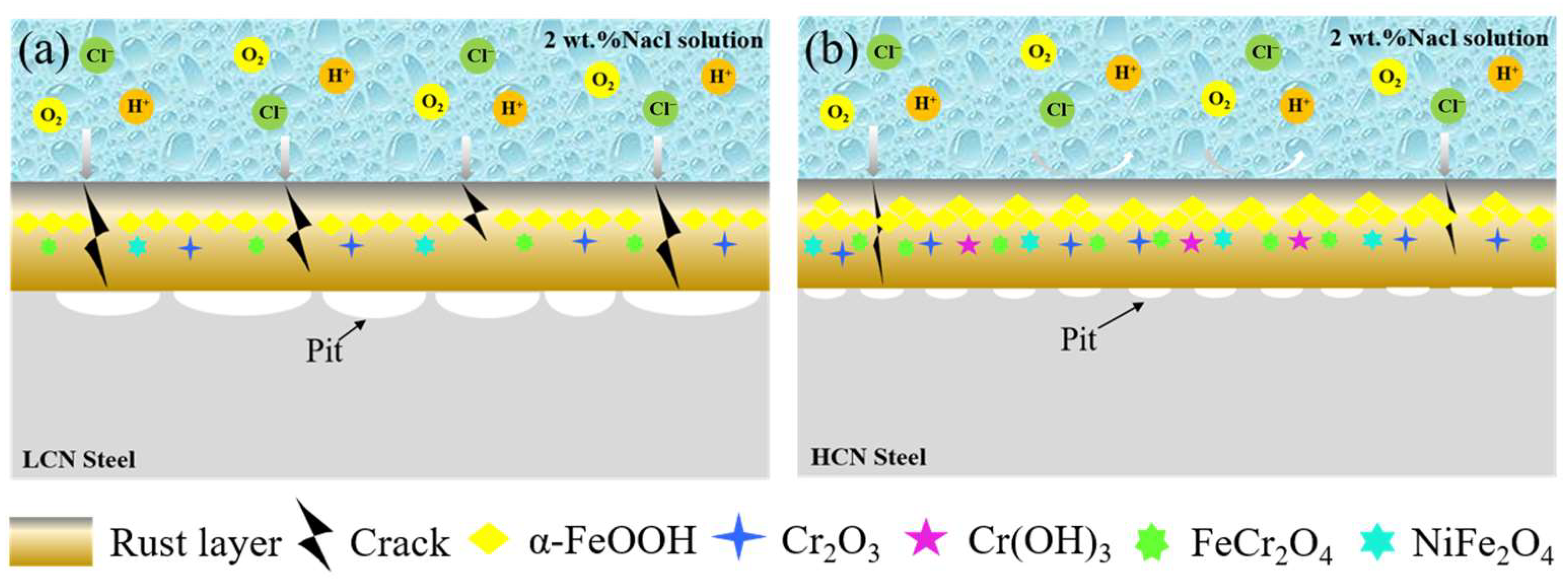
Based on a multidimensional analysis of the experimental results and the mechanisms by which Cr and Ni alloying enhances corrosion resistance, schematic corrosion mechanisms for the LCN and HCN steels in chloride-containing environments were constructed (Figure 14). The schematics contrast the distinct corrosion behaviors of the two steels and illustrate that Cl ingress was impeded by improved rust layer compactness and stability. In Figure 14a, the LCN steel, owing to its lower Cr and Ni contents, was unable to form a sufficient amount of the stable α-FeOOH phase. Under Cl attack and wet–dry cycling, the rust layer readily developed through thickness cracks and pores that served as rapid transport pathways for Cl to reach the substrate interface, thereby causing localized acidification and accelerating anodic dissolution. As a consequence, rust layer protectiveness was markedly reduced, allowing local Cl accumulation and the formation of deep, wide pits. In contrast, in Figure 14b the HCN steel, with higher Cr and Ni contents, formed abundant spinel phases FeCr2O4 and NiFe2O4, which further densified the rust layer. FeCr2O4 enhanced rust layer stability and filled residual pores, whereas NiFe2O4 acted as a heterogeneous nucleation site that promoted rapid transformation of γ-FeOOH to α-FeOOH, thereby increasing the α-FeOOH fraction. The synergistic effects of chemical modification and densification effectively blocked Cl transport pathways, suppressing pit initiation and growth and shifting the corrosion morphology from localized pitting toward a more uniform attack, thereby yielding a substantial improvement in corrosion resistance.

5. Conclusions

Using wet–dry cyclic immersion accelerated corrosion tests, this study systematically elucidated the mechanisms by which combined Cr and Ni additions affect the corrosion behavior and rust-layer evolution of HRB500 rebar in a chloride-containing marine atmospheric environment. The main conclusions are summarized as follows.
  • Increasing Cr and Ni contents increased hardenability and refined the matrix from a ferrite–pearlite structure to a more homogeneous bainitic microstructure; as a result, microgalvanic heterogeneity was reduced, contributing to lower corrosion susceptibility under the present test conditions.
  • Both gravimetric measurements and electrochemical parameters indicated a two-stage corrosion process, characterized by early acceleration followed by a late-stage decline. Compared with LCN, HCN exhibited lower mass loss and a lower average corrosion rate, and PDP measurements yielded a lower icorr (28.94 vs. 67.53 μA·cm−2 at 504 h).
  • Cr–Ni co-alloying was found to markedly mitigate localized corrosion. At 504 h, HCN reduced the maximum pit depth by approximately 61.8% and shifted the corrosion morphology from deep pitting toward a more uniform attack.
  • Rust-layer analyses show that higher Cr and Ni promote earlier, enriched α-FeOOH formation and a compact Cr/Ni-enriched inner layer containing spinels (FeCr2O4, NiFe2O4). These features limit chloride ingress and reduce interfacial charge transfer, enhancing rust-layer protectiveness.

Author Contributions

Methodology, investigation, data curation, writing—original draft preparation, S.Z.; Methodology, investigation, data curation, writing—original draft preparation, J.L.; Supervision, resources, writing—review and editing, W.Y.; Data curation, formal analysis, X.Z.; Data curation, formal analysis, T.C.; Project administration, writing—review and editing, X.L.; Conceptualization, supervision, project administration, writing—review and editing, funding acquisition, C.L. All authors have read and agreed to the published version of the manuscript.

Funding

This research was funded by the National Natural Science Foundation of China, grant number No. 52522409.

Data Availability Statement

The original contributions presented in this study are included in the article. Further inquiries can be directed to the corresponding authors.

Conflicts of Interest

Author Jing Liu was employed by the company Wuhan Research Institute of Materials Protection Co., Ltd. Authors Weiyong Yang and Xiaotan Zuo were employed by the company Wuhu Xinxing Ductile Iron Pipe Co., Ltd. The remaining authors declare that the research was conducted in the absence of any commercial or financial relationships that could be construed as a potential conflict of interest.

References

  1. Lu, Y.; Narayanan, D.; Kim, C.; Macdonald, D.D.; Castaneda, H. Determination of the Chloride Threshold of Cr-Based Steel Rebars in a Synthetic Concrete Pore Solution Based on Electrochemical Methods. Corrosion 2023, 79, 696–708. [Google Scholar] [CrossRef]
  2. Ming, J.; Zhou, X.; Jiang, L.; Shi, J. Corrosion Resistance of Low-Alloy Steel in Concrete Subjected to Long-Term Chloride Attack: Characterization of Surface Conditions and Rust Layers. Corros. Sci. 2022, 203, 110370. [Google Scholar] [CrossRef]
  3. Chen, T.; Zhou, X.; Zhang, S.; Du, Y.; Chen, J.; Cheng, X.; Li, X.; Liu, C. Insights into Multiple Coupling Mechanisms of SO42−/Cl and Cr/RE Elements on the Corrosion Resistance of Rebar in Simulated Carbonated Concrete Pore Solution. Constr. Build. Mater. 2025, 485, 141957. [Google Scholar] [CrossRef]
  4. Zhang, S.; Wang, Q.; Guan, H.; Zou, G.-N.; Wang, G.-W.; Zhang, S.-G.; Song, D. Chloride-Induced Macro-Cell Corrosion Behavior of a Novel Alloyed-Steel Rebar and Its Inhibition Strategy. J. Iron Steel Res. Int. 2025, 32, 2995–3013. [Google Scholar] [CrossRef]
  5. Fu, Q.; Zhao, Y.; Niu, D. Review: Corrosion Development of Steel Bars in Concrete under the Combined Effect of Chloride Salt Attack and Carbonation. J. Mater. Sci. 2025, 60, 8384–8408. [Google Scholar] [CrossRef]
  6. Li, Z.; Xue, W.; Chen, Y.; Yu, W.; Xiao, K. Microstructure and Grain Boundary Corrosion Mechanism of Pearlitic Material. J. Mater. Eng. Perform. 2022, 31, 483–494. [Google Scholar] [CrossRef]
  7. Li, S.; Li, C.; Zeng, Z.; Zhuang, C.; Huang, S.; You, J. Research Progress of Corrosion Induced by Second-Phase Particles in Microalloyed High-Strength Rebars—Review. Metals 2022, 12, 925. [Google Scholar] [CrossRef]
  8. Liu, T.; Li, N.; Liu, C.; Li, J.; Zhang, T.; Cheng, X.; Yang, S. Attempt to Optimize the Corrosion Resistance of HRB400 Steel Rebar with Cr and Rare Earths (RE). Materials 2022, 15, 8269. [Google Scholar] [CrossRef] [PubMed]
  9. Zeng, Z.Y.; Gu, S.J.; Wang, J. Effect of Trace Nb on Corrosion Resistance of Corrosion Layer of High-Strength Anti-Seismic Rebar by First-Principles and Experimental Methods. J. Iron Steel Res. Int. 2025, 32, 1427–1453. [Google Scholar] [CrossRef]
  10. Xu, Q.; Zhan, D.P.; Xu, W.L.; Fan, F.-H.; Li, H.-T.; Li, H.-Z.; Wang, S.-K. Effect of Different N and Si Contents on Microstructures and Properties of HRB400e Steel Containing Vanadium. J. Iron Steel Res. Int. 2025, 32, 452–465. [Google Scholar] [CrossRef]
  11. Bai, R.; Du, Y.; He, X.; Zhang, Y. The Influence of Cr Addition on the Microstructure and Mechanical Properties of Fe-25Mn-10Al-1.2C Lightweight Steel. Metals 2024, 14, 687. [Google Scholar] [CrossRef]
  12. Huang, G.; Wan, X.; Wu, K.; Zhao, H.; Misra, R.D.K. Effects of Small Ni Addition on the Microstructure and Toughness of Coarse-Grained Heat-Affected Zone of High-Strength Low-Alloy Steel. Metals 2018, 8, 718. [Google Scholar] [CrossRef]
  13. Liu, T.; Che, Z.; Zhang, T.; Jin, Z.; Yang, W.; Liu, C.; Cheng, X.; Li, X. Focusing on the Corrosion Resistance Enhancement of HRB400 Rebar by Cr Addition in the Marine Environment. Case Stud. Constr. Mater. 2024, 20, e03236. [Google Scholar] [CrossRef]
  14. Bao, H.; Gu, S.; Wang, J.; Wei, F.; Xie, X.; Li, Z.; Yang, H.; Zeng, Z.; Li, C. Passivation Behavior of Chromium Alloyed High-Strength Rebar in Simulated Concrete Pore Solution. Metals 2024, 14, 859. [Google Scholar] [CrossRef]
  15. Fan, Y.; Liu, W.; Sun, Z.; Chowwanonthapunya, T.; Zhao, Y.; Dong, B.; Zhang, T.; Banthukul, W. Effect of Chloride Ion on Corrosion Resistance of Ni-Advanced Weathering Steel in Simulated Tropical Marine Atmosphere. Constr. Build. Mater. 2021, 266, 120937. [Google Scholar] [CrossRef]
  16. Sato, H.; Ito, M.; Kashima, K.; Kaneko, M.; Nagasawa, M.; Doi, T. Effect of Nickel Addition on the Corrosion Resistance of Steel in a Subtropical Seashore Environment. ISIJ Int. 2020, 60, 2024–2030. [Google Scholar] [CrossRef]
  17. Wang, D.; Zhong, Q.; Yang, J.; Zhang, S. Effects of Cr and Ni on the Microstructure and Corrosion Resistance of High-Strength Low Alloy Steel. J. Mater. Res. Technol. 2023, 23, 36–52. [Google Scholar] [CrossRef]
  18. GB/T 43356-2023; Test Method for Alternate Immersion Corrosion in Salt Solution of Steel Bars. Standardization Administration of China: Beijing, China, 2023.
  19. GB/T 16545-2015; Corrosion of Metals and Alloys—Removal of Corrosion Products from Corrosion Test Specimens. China Standards Press: Beijing, China, 2015.
  20. Bracke, L.; Xu, W. Effect of the Cr Content and Coiling Temperature on the Properties of Hot Rolled High Strength Lower Bainitic Steel. ISIJ Int. 2015, 55, 2206–2211. [Google Scholar] [CrossRef]
  21. Bramfitt, B.L. Carbon and Alloy Steels. In Handbook of Materials Selection; Kutz, M., Ed.; John Wiley & Sons: New York, NY, USA, 2002; pp. 25–65. [Google Scholar]
  22. Li, D.; Wei, R.; Li, L.; Guan, X.; Mi, X. Pitting Corrosion of Reinforcing Steel Bars in Chloride-Contaminated Concrete. Constr. Build. Mater. 2019, 199, 359–368. [Google Scholar] [CrossRef]
  23. Liu, Y.; Yuan, H.; Miao, Z.W.; Geng, X.; Shao, X.; Lu, Y. Tensile Behaviour of Pitting Corroded Steel Bars: Laboratory Investigation and Probabilistic-Based Analysis. Constr. Build. Mater. 2024, 411, 134502. [Google Scholar] [CrossRef]
  24. Wang, Y.D.; Xu, S.H.; Li, H.; Zhang, H.J. Surface Characteristics and Stochastic Model of Corroded Structural Steel under General Atmospheric Environment. Acta Metall. Sin. 2020, 56, 148–160. [Google Scholar] [CrossRef]
  25. Shi, J.; Sun, W.; Jiang, J.; Zhang, Y. Influence of Chloride Concentration and Pre-Passivation on the Pitting Corrosion Resistance of Low-Alloy Reinforcing Steel in Simulated Concrete Pore Solution. Constr. Build. Mater. 2016, 111, 805–813. [Google Scholar] [CrossRef]
  26. Pavapootanont, G.; Wongpanya, P.; Viyanit, E.; Lothongkum, G. Corrosion Behavior of Ni Steels in Aerated 3.5-wt.% NaCl Solution at 25 °C by Potentiodynamic Method. Eng. J. 2018, 22, 1–12. [Google Scholar] [CrossRef]
  27. Chen, T.; Hao, L.; Liu, T.; Zhong, Y.; Wang, Z.; Liu, C.; Cheng, X.; Li, X. Insights into the Role of the Cr and Rare Element in Improving the Corrosion Resistance of HRB400 Rebars in Simulated SO2-Polluted Marine Environment. J. Build. Eng. 2024, 97, 110807. [Google Scholar] [CrossRef]
  28. Narasimharaju, S.J.; Annamalai, K.; Poorna Chandra Rao, B.; Sakthivel, P. Experimental Investigation of Polypyrrole Coating Doped with Chromium Nitride Nanoparticles on Aluminum Alloy Bipolar Plates for PEMFC. J. Mater. Sci. 2024, 59, 21515–21536. [Google Scholar] [CrossRef]
  29. Ariyoshi, K.; Siroma, Z.; Mineshige, A.; Takeno, M.; Fukutsuka, T.; Abe, T.; Uchida, S. Electrochemical Impedance Spectroscopy Part 1: Fundamentals. Electrochemistry 2022, 90, 102007. [Google Scholar] [CrossRef]
  30. Pattnaik, A.B.; Roy, S.; Raja, V.S.; Parida, S. Understanding the Structure and Electrochemical Behavior of the Rust Layer Formed on a High-Strength Low-Alloy Structural Steel under Cyclic Exposure to Polluted Marine Atmosphere. J. Mater. Eng. Perform. 2025, 34, 2093–2106. [Google Scholar] [CrossRef]
  31. Alcántara, J.; Chico, B.; Simancas, J.; Díaz, I.; de la Fuente, D.; Morcillo, M. An Attempt to Classify the Morphologies Presented by Different Rust Phases Formed during the Exposure of Carbon Steel to Marine Atmospheres. Mater. Charact. 2016, 118, 65–78. [Google Scholar] [CrossRef]
  32. Hao, L.; Cai, X.; Chen, T.; Zhang, C.; Liu, C.; Cheng, X.; Li, X. Corrosion Behavior of 650 MPa High Strength Low Alloy Steel in Industrial Polluted Environments Containing Different Concentrations of Cl. Int. J. Miner. Metall. Mater. 2026, 33, 228–241. [Google Scholar] [CrossRef]
  33. Zhao, Q.-H.; Liu, W.; Zhu, Y.-C.; Zhang, B.-L.; Li, S.-Z.; Lu, M.-X. Effect of Small Content of Chromium on Wet–Dry Acid Corrosion Behavior of Low Alloy Steel. Acta Metall. Sin. (Engl. Lett.) 2017, 30, 164–175. [Google Scholar] [CrossRef]
  34. Liu, W.; Zhao, Q.H.; Li, S.Z. Relationship between the Specific Surface Area of Rust and the Electrochemical Behavior of Rusted Steel in a Wet–Dry Acid Corrosion Environment. Int. J. Miner. Metall. Mater. 2017, 24, 55–63. [Google Scholar] [CrossRef]
  35. Guo, T.M.; Song, Z.T.; Dong, J.J.; Qin, J.S.; Yang, X.L. Corrosion Behavior of Q345qNH Bridge Weathering Steel in Simulating Northwest Atmospheric Environment. Surf. Technol. 2018, 47, 187. [Google Scholar]
  36. Wang, Y.; Li, J.; Wang, Q.; Wang, T. Some New Discoveries on the Structure of the Rust Layer of Weathering Steel in a Simulated Industrial Atmosphere by STEM–EDS and HRTEM. Corros. Sci. 2021, 183, 109322. [Google Scholar] [CrossRef]
  37. Alcántara, J.; Fuente, D.d.l.; Chico, B.; Simancas, J.; Díaz, I.; Morcillo, M. Marine Atmospheric Corrosion of Carbon Steel: A Review. Materials 2017, 10, 406. [Google Scholar] [CrossRef] [PubMed]
  38. Yang, S.; Gao, X. Corrosion Resistance Behavior of a New Type of Weathering Steel in Simulated Environments with Different pH Values. Corrosion 2025, 81, 726–741. [Google Scholar] [CrossRef]
  39. Murase, Y.; Masuda, H.; Katayama, H. Crystallographic Orientation and Microstructure Dependences of Surface Potential for Annealed S45C Steel. Mater. Trans. 2020, 61, 482–489. [Google Scholar] [CrossRef]
  40. Liu, C.; Li, C.; Che, Z.; Li, X.; Yang, S.; Liu, Z.; Zhou, Y.; Cheng, X. Influence of Cementite Coarsening on the Corrosion Resistance of High Strength Low Alloy Steel. npj Mater. Degrad. 2023, 7, 43. [Google Scholar] [CrossRef]
  41. Zhou, Y.L.; Chen, J.; Xu, Y.; Liu, Z.Y. Effects of Cr, Ni and Cu on the Corrosion Behavior of Low Carbon Microalloying Steel in a Cl-Containing Environment. J. Mater. Sci. Technol. 2013, 29, 168–174. [Google Scholar] [CrossRef]
  42. Zhang, T.; Xu, X.; Li, Y.; Lv, X. The Function of Cr on the Rust Formed on Weathering Steel Performed in a Simulated Tropical Marine Atmosphere Environment. Constr. Build. Mater. 2021, 277, 122298. [Google Scholar] [CrossRef]
  43. Jaén, J.A.; Guzmán, K.; Iglesias, J.; Caballero Manrique, G. Ten Years Outdoor Exposure of Steel in an Urban and Coastal Tropical Atmosphere. Corros. Eng. Sci. Technol. 2021, 56, 522. [Google Scholar] [CrossRef]
  44. Refait, P.; Grolleau, A.-M.; Jeannin, M.; Rémazeilles, C.; Sabot, R. Corrosion of Carbon Steel in Marine Environments: Role of the Corrosion Product Layer. Corros. Mater. Degrad. 2020, 1, 198–218. [Google Scholar] [CrossRef]
  45. Stratmann, M.; Bohnenkamp, K.; Engell, H.J. An Electrochemical Study of Phase-Transitions in Rust Layers. Corros. Sci. 1983, 23, 969–985. [Google Scholar] [CrossRef]
  46. Wu, W.; Cheng, X.; Hou, H.; Liu, B.; Li, X. Insight into the Product Film Formed on Ni-Advanced Weathering Steel in a Tropical Marine Atmosphere. Appl. Surf. Sci. 2018, 436, 80–89. [Google Scholar] [CrossRef]
  47. Zinnatullin, A.L.; Cherosov, M.A.; Batulin, R.G.; Vagizov, F.G.; Yusupov, R.V. An Effect of Fe3+ Ion Substitution for Cr3+ in the Octahedral Sites of FeCr2O4 Multiferroic Spinel: Mössbauer Spectroscopy Study. Magnetochemistry 2023, 9, 98. [Google Scholar] [CrossRef]
  48. Liu, W.; Bian, Q.; Liao, J.; Wang, Q.; Pan, H.; Cao, F.; Wu, Z. Influence Mechanism of Ni Content on Corrosion Behavior of Weathering Steel under the Simulated Industrial Atmosphere. J. Solid State Electrochem. 2025, 29, 4623–4639. [Google Scholar] [CrossRef]
  49. Chen, X.; Dong, J.; Han, E.; Ke, W. Effect of Ni on the Ion-Selectivity of Rust Layer on Low Alloy Steel. Mater. Lett. 2007, 61, 4050–4053. [Google Scholar] [CrossRef]
  50. Cano, H.; Neff, D.; Morcillo, M.; Dillmann, P.; Díaz, I.; de la Fuente, D. Characterization of Corrosion Products Formed on Ni 2.4 wt%–Cu 0.5 wt%–Cr 0.5 wt% Weathering Steel Exposed in Marine Atmospheres. Corros. Sci. 2014, 87, 438–451. [Google Scholar] [CrossRef]
  51. Cheng, X.; Jin, Z.; Liu, M.; Li, X. Optimizing the Nickel Content in Weathering Steels to Enhance Their Corrosion Resistance in Acidic Atmospheres. Corros. Sci. 2017, 115, 135–142. [Google Scholar] [CrossRef]
Figure 1. Microstructures of the experimental rebar steels: (a) LCN steel; (b) HCN steel.
Metals 16 00253 g001
Figure 2. Corrosion data of Cr-Ni steels in a 2 wt.% NaCl solution: (a) mass loss, (b) corrosion rate.
Metals 16 00253 g002
Figure 3. 3D surface morphology of LCN and HCN steel specimens after weekly immersion and subsequent rust removal. (ad) LCN steel: 72, 168, 336, and 504 h; (eh) HCN steel: 72, 168, 336, and 504 h.
Metals 16 00253 g003
Figure 4. Statistical distributions of pit depth-to-diameter ratio (K) for derusted LCN and HCN steel specimens after cyclic immersion corrosion. (ad) LCN steel: 72, 168, 336, and 504 h; (eh) HCN steel: 72, 168, 336, and 504 h.
Metals 16 00253 g004
Figure 5. Potentiodynamic polarization curves and Tafel fitting results of the two tested steels in a 2 wt.% NaCl solution. (a) LCN steel; (b) HCN steel; (c) Ecorr; (d) icorr.
Metals 16 00253 g005
Figure 6. EIS results and fitting analysis of rusted rebar specimens of the two tested steels after cyclic immersion. (a,a1) LCN steel: Nyquist and Bode plots; (b,b1) HCN steel: Nyquist and Bode plots; (c) equivalent electrical circuit used for fitting; (d) fitted EEC parameters of the rust layer.
Metals 16 00253 g006
Figure 7. Macroscopic appearance of LCN and HCN steels before and after rust removal following wet–dry cyclic immersion in neutral 2 wt.% NaCl for up to 504 h. (ad) LCN before rust removal at 72, 168, 336, and 504 h; (a1d1) corresponding LCN after rust removal. (eh) HCN before rust removal at 72, 168, 336, and 504 h; (e1h1) corresponding HCN after rust removal.
Metals 16 00253 g007
Figure 8. Micro-morphology of corrosion on LCN and HCN steels after multiple cycles. (ad) LCN steel: 72, 168, 336, and 504 h; (eh) HCN steel: 72, 168, 336, and 504 h. (a1h1) Higher-magnification images of the areas marked by the red boxes in (ah), respectively.
Metals 16 00253 g008
Figure 9. Cross-sectional SEM–EDS images of the rust layer on LCN steel in a chloride-containing environment: (a) 72 h, (b) 168 h, (c) 336 h, and (d) 504 h.
Metals 16 00253 g009
Figure 10. Cross-sectional SEM–EDS images of the rust layer on HCN steel in a chloride-containing environment: (a) 72 h, (b) 168 h, (c) 336 h, and (d) 504 h.
Metals 16 00253 g010
Figure 11. Phase composition of rust layers formed on Cr–Ni steels after the cyclic immersion corrosion test: (a) LCN steel, (b) HCN steel; quantitative phase fractions and α/γ* ratios of the rust layers: (a1) LCN steel, (b1) HCN steel.
Metals 16 00253 g011
Figure 12. XPS analysis of major alloying elements in the rust layer of Cr–Ni rebar after 504 h of accelerated cyclic wet–dry immersion: (a) Fe 2p3/2, (b) Cr 2p3/2, (c) Ni 2p3/2, (d) phase proportions in the rust layer.
Metals 16 00253 g012
Figure 13. E–pH diagram for the Fe–Cr–Ni–H2O system.
Metals 16 00253 g013
Figure 14. Schematic diagram of corrosion mechanism: (a) LCN steel, (b) HCN steel.
Metals 16 00253 g014
Table 1. The chemical compositions of the experimental steels (wt.%).
SteelCSiMnSPVCrNiNbFe
LCN0.19190.50841.47370.00450.00520.03430.32330.11070.0129Bal.
HCN0.19120.52221.46710.00450.00520.03133.08430.49520.0135Bal.
Table 2. Two Cr-Ni steels’ impedance spectra fitting results.
SteelTimeRsRfQdlRctQfRpx2 (×10−5)
hΩ·cm2Ω·cm2Y0 (Ω−1·cm−2·sn)nΩ·cm2Y0 (Ω−1·cm−2·sn)nΩ·cm2
LCN7230.412.176.740.5437.472.220.6449.647.04
16827.717.454.020.5352.621.200.6670.072.47
33638.813.782.500.5794.721.090.51108.54.64
50445.721.791.110.6192.640.920.55114.439.51
HCN7232.825.571.640.5980.171.030.57105.744.29
16854.830.851.590.52107.31.050.62138.153.67
33646.619.661.570.47218.30.900.60237.965.39
50474.327.411.060.46432.80.740.49460.214.84
Disclaimer/Publisher’s Note: The statements, opinions and data contained in all publications are solely those of the individual author(s) and contributor(s) and not of MDPI and/or the editor(s). MDPI and/or the editor(s) disclaim responsibility for any injury to people or property resulting from any ideas, methods, instructions or products referred to in the content.