Article

Influence of Ga Content and Pre-Treatment on the Mechanical Properties of High-Mg-Content Al-Mg-Zn-Ga Alloys


1
State Key Laboratory of Nonferrous Structural Materials, China GRINM Group Co., Ltd., Beijing 100088, China
2
GRIMAT Engineering Institute Co., Ltd., Beijing 101407, China
3
General Research Institute for Nonferrous Metals, Beijing 100088, China
4
Department of Materials Physics and Chemistry, Northeastern University, Shenyang 110819, China
*
Authors to whom correspondence should be addressed.
Metals 2026, 16(2), 196; https://doi.org/10.3390/met16020196
Submission received: 8 January 2026 / Revised: 2 February 2026 / Accepted: 4 February 2026 / Published: 6 February 2026
(This article belongs to the Section Metal Casting, Forming and Heat Treatment)

Abstract

Al-Mg-Zn crossover alloys are promising lightweight structural materials. This study systematically investigates the effects of Ga content (0–0.8 wt.%) and pre-treated aging (PA) on the mechanical properties and microstructure in high-Mg-content Al-Mg-Zn crossover alloys. The results show that, under two-step aging (90 °C/24 h + 140 °C/24 h), increasing the Ga content from 0 to 0.8 wt.% leads to a significant enhancement in mechanical strength. The hardness, ultimate tensile strength (UTS) and yield strength (YS) increased from 102.8 HV to 169.2 HV, from 457.7 MPa to 592.0 MPa, and from 288.0 MPa to 505.7 MPa, respectively, while maintaining an elongation (EL) of 15.8%. This enhancement is attributed to increased Ga content, which promotes precipitation refinement and a morphology transition from rod-like to fine spherical precipitates. Furthermore, in the alloy containing 0.4 wt.% Ga, the application of PA treatment enhanced the UTS and YS from 527.3 MPa to 569.3 MPa, and from 413.7 MPa to 483.7 MPa, respectively. This work demonstrates that the appropriate addition of Ga and PA treatment effectively enhances the precipitation behavior and tensile properties of Al-Mg-Zn alloys, providing valuable guidance for the development of high-performance, lightweight structural materials.

1. Introduction

Al-Mg-Zn crossover alloys have emerged as promising lightweight structural materials owing to their high specific strength, good corrosion resistance and excellent formability [1,2,3,4,5,6]. By synergistically changing the Mg and Zn contents, these alloys effectively combine the advantages of conventional 5xxx and 7xxx series aluminum alloys, exhibiting substantial design flexibility in terms of strength–ductility balance and aging response [7,8,9,10]. Unlike 7xxx series alloys, which achieve strengthening primarily through increasing the Zn/Mg ratio and the precipitation of the η′/η phase, high-Mg-content Al-Mg-Zn alloys retain pronounced solid solution strengthening and work hardenability while still benefiting from age hardening [8]. Their age-hardening behavior mainly relies on the precipitation of the T-phase (Mg32(Al,Zn)49) and its precursors. Although the T-phase exhibits a lower shear modulus than the η phase [11,12], its relatively lower Zn content and density enable effective strengthening while offering a higher specific strength, making high-Mg-content Al-Mg-Zn alloys attractive candidates for lightweight, high-strength structural applications [7,13].
Despite the considerable strengthening potential of the T-phase, its relatively high nucleation energy barrier in high-Mg ternary alloys often leads to a low precipitate number density and sluggish aging kinetics, thereby severely limiting the strengthening efficiency [14,15]. Consequently, promoting the nucleation and precipitation of the T-phase has become a critical scientific challenge for enhancing the performance of high-Mg aluminum alloys. To address this challenge, alloying strategies and process optimizations are commonly employed to regulate microstructural evolution [16,17,18,19,20,21,22,23,24,25]. For instance, Stemper et al., who proposed the concept of “crossover alloys,” demonstrated that the addition of Cu and Ag to Zn-modified EN AW-5182 alloys significantly enhanced the aging response and effectively promoted T-phase precipitation [7,8,9,10,26,27]. The application of two-step aging or pre-treatments, such as long-term aging at 60 °C for 42 days (LTA), can induce the formation of high-density, finely dispersed clusters or precipitates, thereby optimizing the strength–ductility balance [27]. Tang et al. investigated the synergistic effect of aging temperature and Cu content, revealing that Cu addition suppressed the coarsening of the T-phase during high-temperature aging and improved precipitate thermal stability [28]. Guo et al. combined non-linear heating aging (NLHA) with Ag microalloying, which promoted the co-precipitation of T′-Mg32(Al, Zn, Ag)49 and η′-MgZn2 phases, resulting in simultaneous enhancement of both strength and corrosion resistance in Al-Mg-Zn alloys [29]. In addition, microalloying elements such as Si, Ti, Mn, Zr and Sc have been reported to influence nucleation kinetics, precipitate stability and coarsening behavior by modifying solute–vacancy interactions, reducing interfacial energy and promoting heterogeneous nucleation of strengthening phases [1,30,31,32,33,34,35]. Nevertheless, the selection of alloying elements for high-Mg alloys still relies heavily on empirical knowledge, and the lack of a physics-based predictive and screening approach has somewhat hindered the efficient development of high-performance alloys.
In recent years, the integration of computational simulations and experimental characterization has enabled researchers to reveal the site occupancy of alloying elements in the T-phase and their effects on phase stability at the atomic scale, providing new pathways for the rational design of microalloying strategies [36]. Based on our recent work, which established the physical understanding of the T-phase [37], and a computational framework for evaluating substitution energetics, Ga was selected in the present study as a representative microalloying element for further investigation [38]. Although previous studies have shown that Ga can significantly influence precipitation kinetics and aging response in aluminum alloys [39,40,41], systematic experimental investigations into the effects of Ga content and heat treatment strategies on the microstructure and mechanical properties of high-Mg-content Al-Mg-Zn crossover alloys remain scarce.
In this work, the effects of varying Ga addition (0–0.8 wt.%) and PA treatment on the mechanical properties and precipitation behavior of a Ga-containing high-Mg-content Al-Mg-Zn crossover alloy were systematically investigated. This study aims to clarify the role of Ga in regulating T-phase precipitation and to provide experimental evidence and theoretical insight for the design of high-performance Al-Mg-Zn alloys.

2. Materials and Methods

The alloys were prepared from pure Al, Mg and Zn, together with binary intermediate alloys of Al-10 wt.% Ga, Al-5 wt.% Zr and Al-10 wt.% Ti. The raw materials were melted in a resistance-heated furnace using a graphite crucible, and the molten alloys were poured into a water-cooled copper mold to produce cylindrical ingots with a diameter of 130 mm. Based on a nominal composition of Al-7.5Mg-2.5Zn(wt.%), three alloys were produced containing 0 wt.% Ga (Alloy 1), 0.4 wt.% Ga (Alloy 2) and 0.8 wt.% Ga (Alloy 3), respectively. The measured chemical compositions of the three alloys are listed in Table 1. The chemical compositions of the alloys were determined using inductively coupled plasma-atomic emission spectroscopy (ICP-AES).
All ingots were subjected to homogenization treatments with parameters summarized in Table 2, followed by air cooling. The homogenized ingots were subsequently extruded at 380 °C to obtain extrusion strips with dimensions of 62 mm (T) × 16 mm (S), corresponding to an extrusion ratio of 1:13. After solution treatment, the samples were aged at different schedules, listed in Table 2.
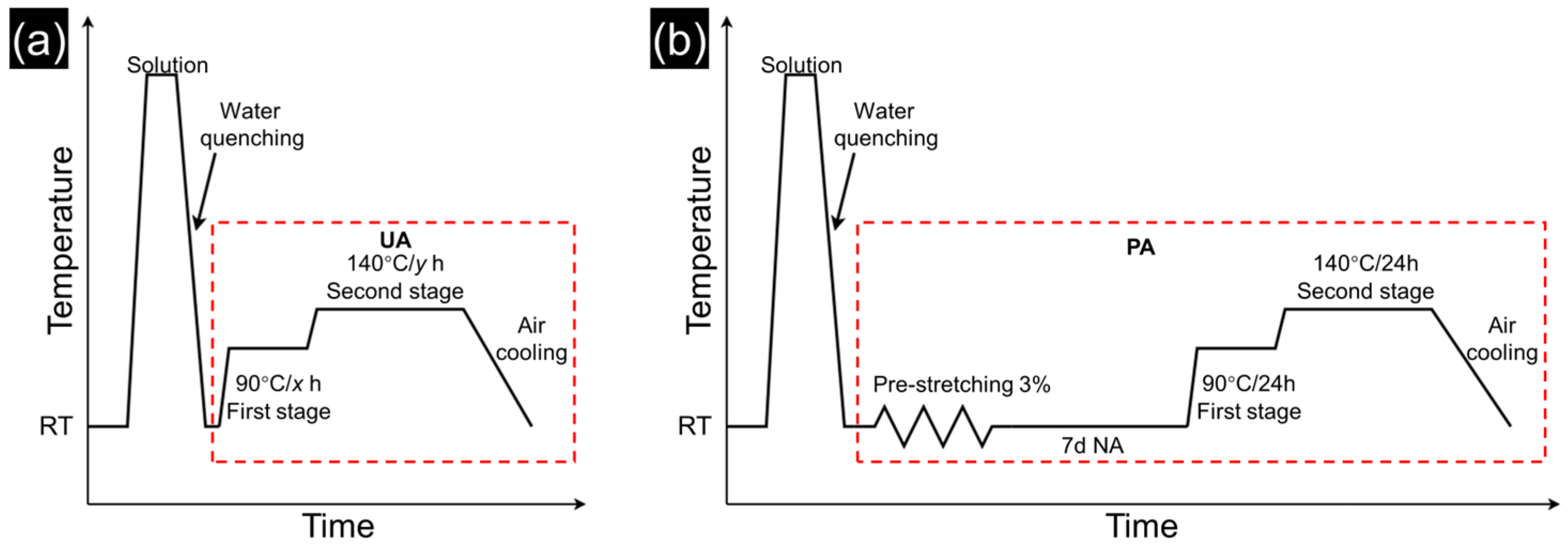
To systematically investigate the effect of Ga content on the precipitation behavior, all three alloys were subjected to a two-step artificial aging treatment (UA). In addition, to explore the influence of pre-treatment, Alloy 2 was further processed using a pre-treated aging route (PA). As illustrated in Figure 1, the PA process consisted of a 3% pre-stretching deformation, followed by natural aging at room temperature for 7 days, and then two-step aging treatment.
The hardness was measured using Wilson VH1150 Vickers (Buehler, Lake Bluff, IL, USA) under loading force of 5 kgf with dwell time of 15 s. For each sample, the hardness value was obtained by averaging at least five valid measurements. Tensile properties were determined using CMT4303 microcomputer-controlled universal testing machine (MTS, Shenzhen, China) in accordance with the GB/T 228.1–2010 standard [42] at a tensile speed of 2 mm/min. The dimensions of tensile specimens were M10–Ø5 mm, and three parallel specimens were tested to ensure reproducibility.
The microstructure of different samples was characterized using Talos F200X field emission transmission electron microscope (TEM) with energy dispersive spectrometer (EDS) operating at 200 kV (Thermo Fisher Scientific, Waltham, MA, USA). The foils for TEM observation were prepared by mechanically grinding the samples to a thickness of approximately 50 μm, followed by twin-jet electropolishing at approximately −30 °C using an electrolyte solution consisting of 25% nitric acid and 75% methanol.

3. Results and Discussion

3.1. Effect of Ga Content on Mechanical Properties and Microstructure of Al-Mg-Zn Alloys

3.1.1. Hardness and Tensile Properties

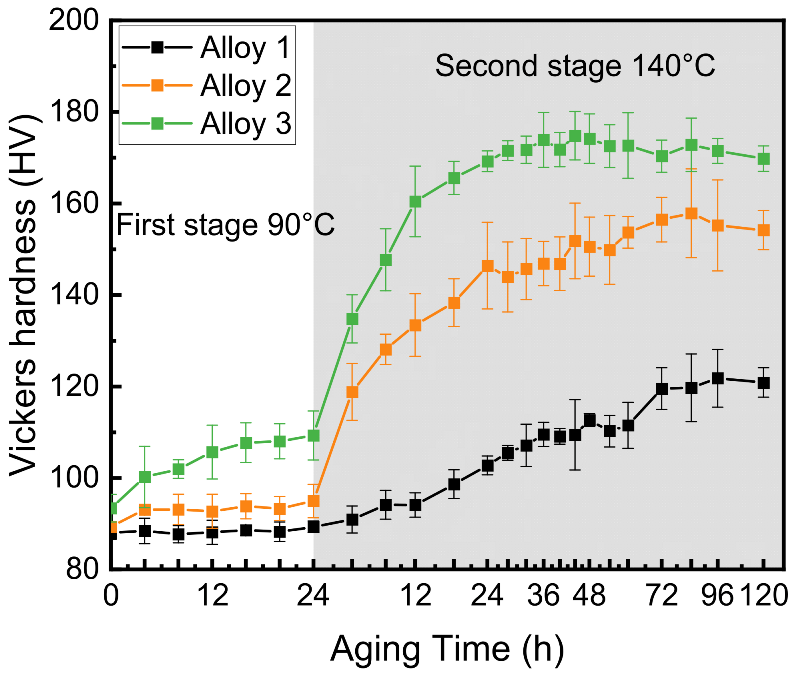
Figure 2 shows the hardness curves of alloys with different Ga contents under UA treatment. During the one-step aging stage (90 °C/x h), the high-Ga alloy (Alloy 3) exhibited pronounced hardening acceleration, while the hardness of the Ga-free (Alloy 1) and low-Ga (Alloy 2) alloys remained nearly unchanged. When the temperature increased to 140 °C, all alloys showed obviously faster hardening speed, indicating that the higher temperature effectively enhanced precipitation kinetics. Furthermore, after the same treatment, both the hardening rate and peak-aged hardness value were significantly increased with the Ga content increasing. After aging at 90 °C for 24 h and 140 °C for 24 h, the hardness values of Alloy 1, Alloy 2 and Alloy 3 reached approximately 102.8 HV, 146.4 HV and 169.2 HV, respectively. Extending the second-step aging time to 48 h, the hardness values further increased to about 112.6 HV, 150.6 HV and 174.2 HV, respectively.
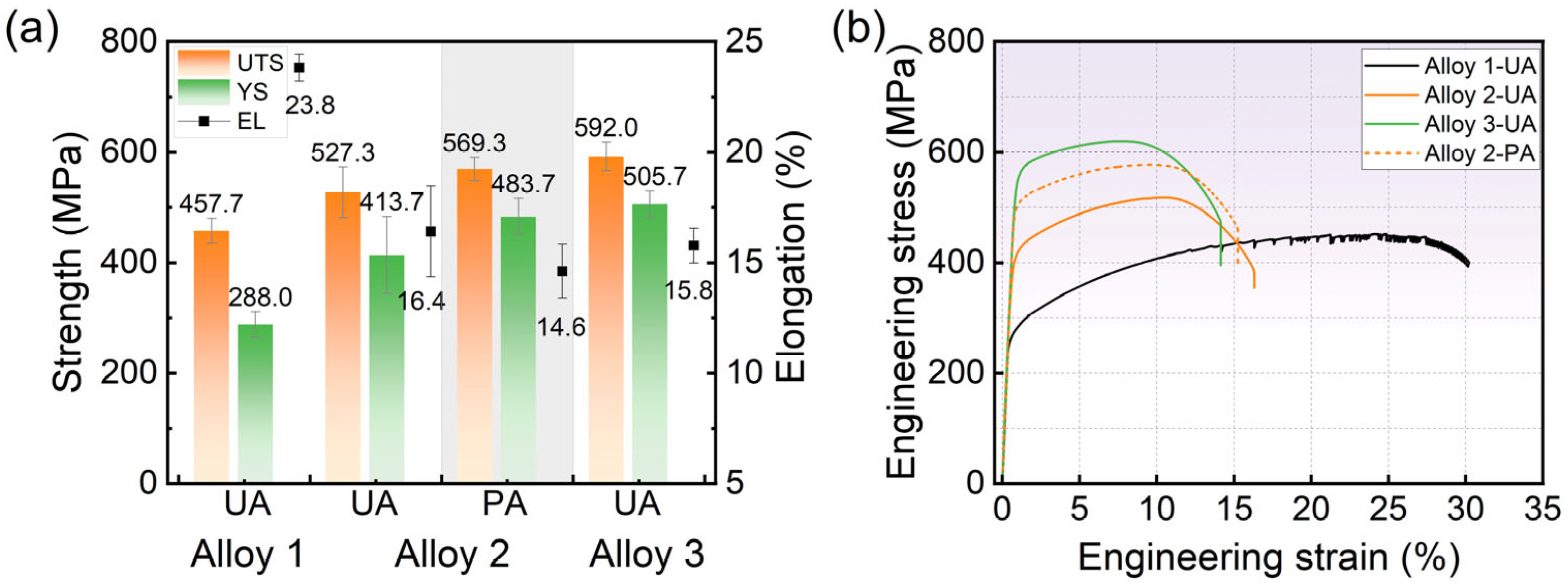
To further evaluate the effect of Ga content on the mechanical properties of the investigated Al-Mg-Zn-Ga alloys, tensile tests were performed on samples aged at 90 °C for 24 h followed by 140 °C for 24 h. As shown in Figure 3, under UA conditions, the UTS, YS and EL of the Ga-free Alloy 1 are 457.7 MPa, 288.0 MPa and 23.8%, respectively. In contrast, the Ga-containing alloys exhibit significantly enhanced strength. Alloys 2 and 3 achieve UTS values of 527.3 MPa and 592.0 MPa, and YS values of 413.7 MPa and 505.7 MPa, respectively. Compared with Alloy 1, the YS of Alloys 2 and 3 increases by approximately 44% and 76%, respectively. It is worth noting that the improvement in the UTS with increasing Ga content is relatively more gradual, showing an increase of about 15% per 0.4 wt.% Ga addition. Furthermore, although the addition of Ga improves strength, it reduces ductility, with EL of both Alloys 2 and 3 decreasing to about 16%.

3.1.2. Precipitation Behavior

To clarify the effects of Ga content on the precipitation behavior of the alloys, detailed microstructural investigations were carried out using the TEM technique. The microstructure during the first aging stage was examined, followed by an analysis of the evolution of precipitates during the subsequent high-temperature aging stage.
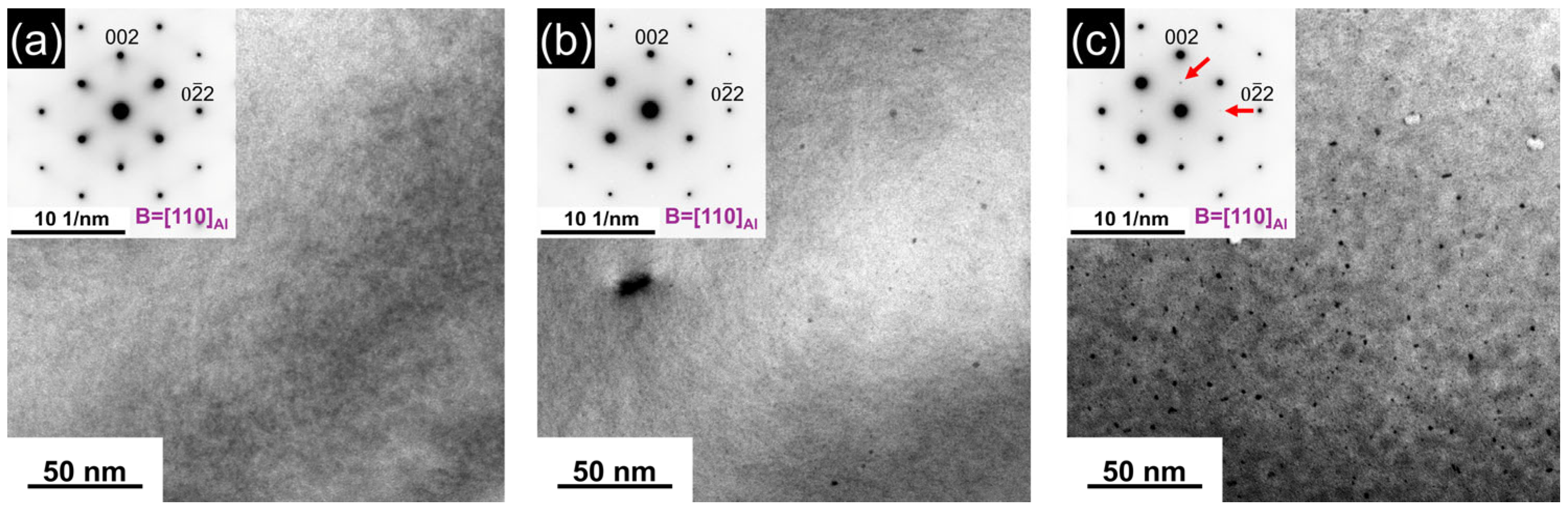
Figure 4 presents the bright-field TEM (BF-TEM) pictures of the three alloys after the UA treatment at 90 °C for 24 h, revealing pronounced differences in precipitation behavior. Alloy 3 exhibits a high number density of uniformly dispersed, nanoscale dot-like precipitates within the Al matrix. Correspondingly, its SAED pattern observed along the <110>Al zone axis (Figure 4c) shows distinct diffraction spots, unambiguously indicating the formation of GP zones (red arrows). In contrast, no discernible precipitates are observed in Alloy 1, while only a very limited number is observed in Alloy 2. Consistent with the TEM micrographs, the SAED patterns of Alloys 1 and 2 show no precipitate-related diffraction reflections. The observed precipitation characteristics provide a clear explanation for the differences in the age-hardening response. During the first aging stage, the pronounced hardness increase in Alloy 3 is associated with the dense distribution of GP zones, while the hardness of Alloys 1 and 2 remains essentially stable due to the lack of effective precipitate formation.
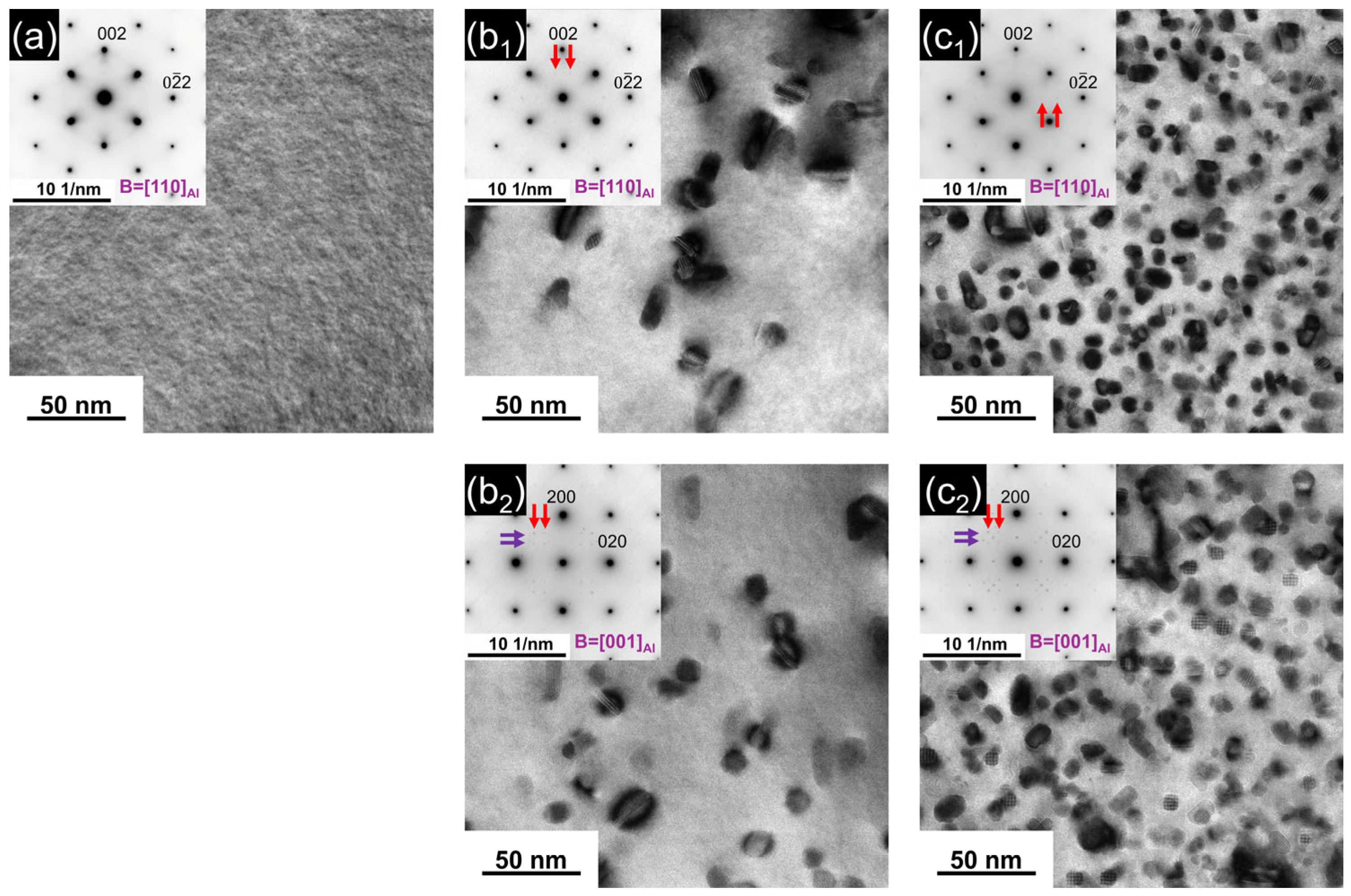
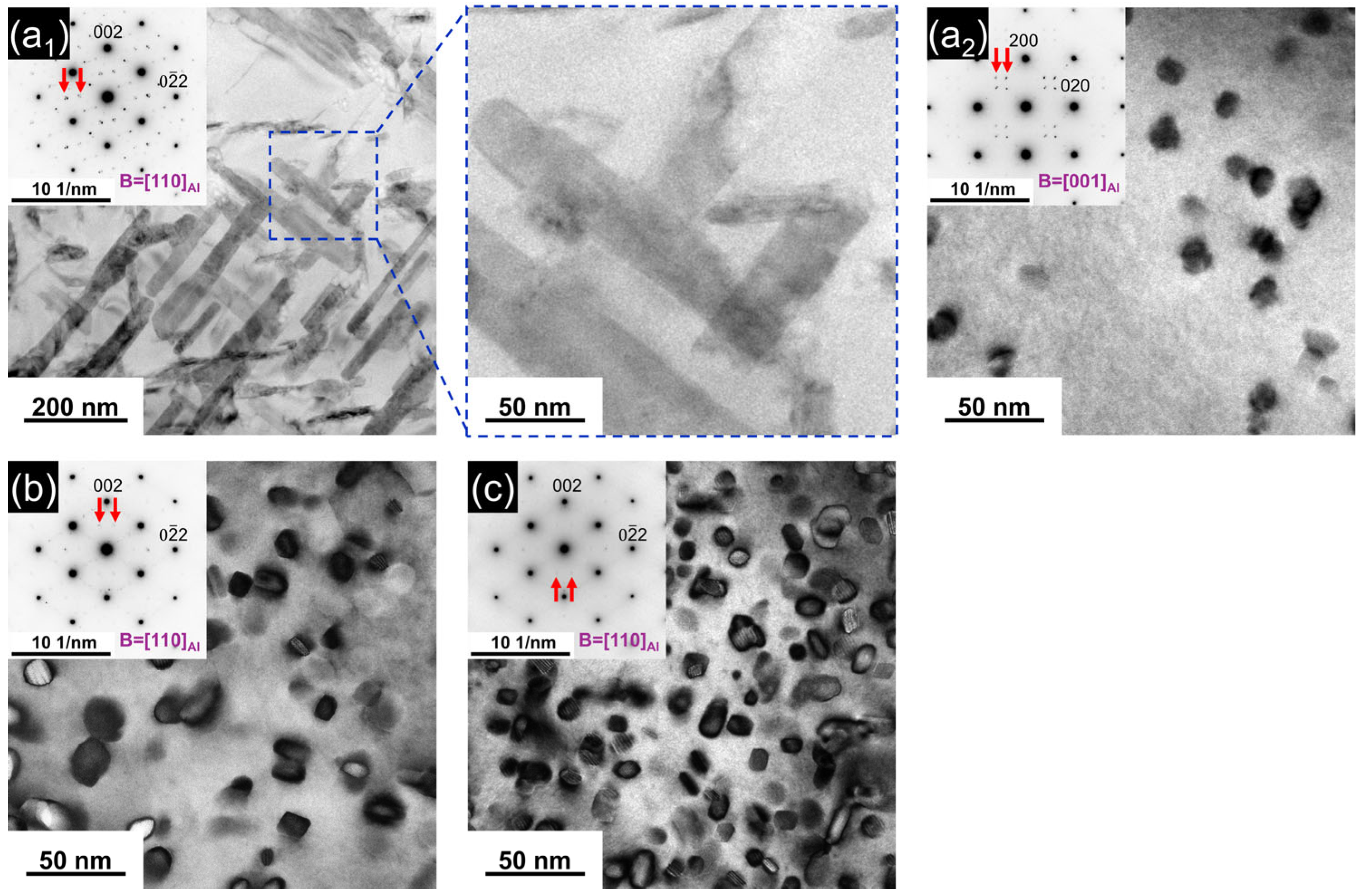
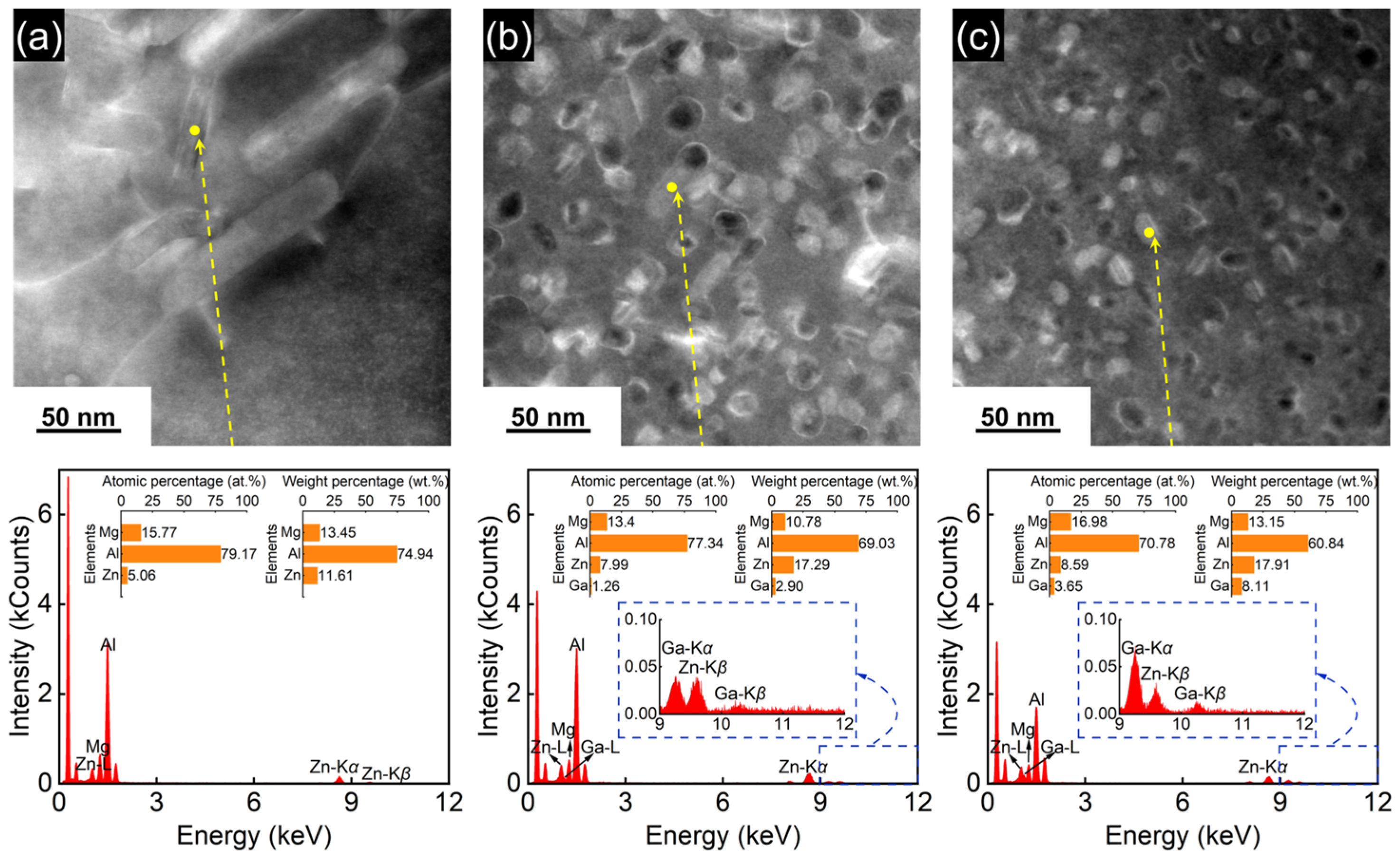
Figure 5 and Figure 6 show the evolution of matrix precipitates in the three alloys during subsequent aging at 140 °C. In the Ga-containing alloys, a high density of nanoscale spherical precipitates form after only 24 h of aging (Figure 5). The precipitates in Alloy 3 are notably finer and denser than those in Alloy 2, which exhibits a lower number density and larger size. With increasing aging time, continued nucleation and growth of precipitates lead to a denser distribution accompanied by pronounced coarsening (Figure 6). In contrast, significant precipitation in the Ga-free Alloy 1 became evident only after extending the high-temperature aging to 48 h, leading to the formation of relatively coarse rod-like precipitates, which are characteristic of T-phase precipitation in alloys with low Zn content [43]. Corresponding SAED analyses reveal characteristic diffraction spots at the {400} and {600} positions along the <110>Al zone axis, as well as at the 2/5 and 3/5{220}Al positions along the <001>Al zone axis, confirming the formation of the T’/T-phase [1,11]. By comparison, additional diffraction spots, marked by purple arrows in the patterns of the Ga-containing alloys (Figure 5), are observed and can be indexed to an icosahedral quasicrystalline phase [39,40,41]. This indicates that Ga addition accelerates the precipitation kinetics of the T’/T-phase and may further facilitate quasicrystalline phase formation. As shown in Figure 7, pronounced Ga enrichment within the precipitates is detected by EDS analysis, which is consistent with our first-principles calculations [38] and supports the role of Ga in stabilizing the T-phase and promoting precipitation.

3.2. Effect of PA Process on the Hardening Behavior

The influence of the PA treatment on the hardening behavior was evaluated through tensile tests and microstructural characterization. Notably, the PA treatment results in a marked optimization of the mechanical properties in Alloy 2 (Figure 3). The strength is significantly enhanced, with the UTS and YS reaching 569.3 MPa and 483.7 MPa, which are 8% and 17% higher than those of the UA-treated samples, respectively. This strength improvement is achieved with a reduction in EL to 14.6%, while still maintaining a favorable strength–ductility balance.
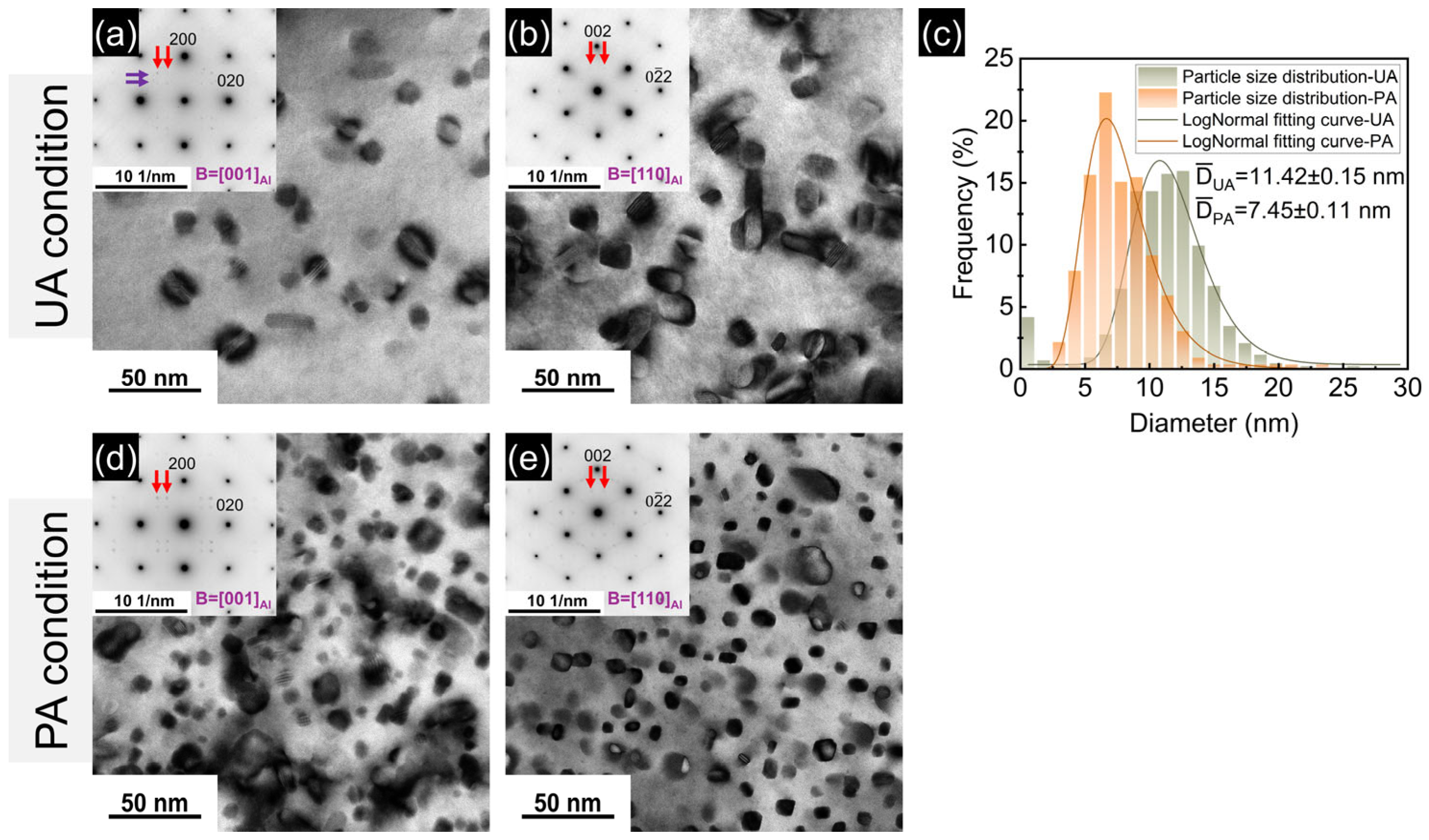
As shown in Figure 8, the PA treatment has a pronounced promoting effect on the precipitation behavior of Alloy 2. Compared with the UA condition, PA treatment significantly increases the number density of precipitates in the matrix and refines their average size from 11.42 ± 0.15 nm to 7.45 ± 0.11 nm, as confirmed by quantitative particle size analysis (Figure 8c). Furthermore, SAED patterns reveal diffraction spots corresponding to the T-phase, whereas those associated with the quasicrystalline phase, highlighted by purple arrows under the UA condition, disappear after PA treatment. This indicates that PA promotes T-phase precipitation while suppressing quasicrystalline formation, resulting in a finer and phase-pure strengthening microstructure.

3.3. Relationship Between Precipitation Behavior and Mechanical Properties

The mechanical performance of the investigated Al-Mg-Zn(-Ga) alloys is closely associated with the evolution of precipitation behavior during aging. In the Ga-free alloy, the precipitation response during the early aging stage is relatively sluggish, leading to a limited number density of strengthening precipitates. Upon aging at elevated temperature, precipitation is dominated by the growth of coarse T-phase particles. Their large size is more likely to cause dislocation annihilation and weaken dislocation–precipitate interactions, which thereby reduces the strengthening efficiency [44,45].
With increasing Ga content, a pronounced refinement of the precipitation microstructure is observed. TEM analyses reveal a substantially higher number density of fine and uniformly distributed T-phase precipitates. These nanoscale precipitates act as effective barriers to dislocation motion, resulting in pronounced increases in hardness and strength. More importantly, according to the Refining and Densifying Precipitates (RDP) effect [44], precipitation refinement plays a dual role in strengthening: precipitate densification primarily contributes to the high strength level, while precipitate refinement suppresses dislocation annihilation and cross-slip, thereby preserving the strain-hardening capability. Furthermore, the application of PA treatment to Alloy 2 leads to a more homogeneous and refined precipitation microstructure. The suppression of quasicrystalline phases and the dominance of the T-phase lead to a more homogeneous precipitation microstructure, thereby contributing to a favorable balance between strength and ductility. From a mechanistic perspective, the refined precipitate population promotes work-hardening behavior. Similar strengthening mechanisms associated with fine T-phase dispersions have been reported in Al-Mg-Zn crossover alloys, where precipitate refinement plays a dominant role in optimizing strength levels [15,22,27,46]. These results indicate that the synergistic regulation of alloy composition and aging strategy provides an effective route to tailoring the structure–property relationship in high-Mg-content Al-Mg-Zn crossover alloys.

4. Conclusions

In this study, the effects of Ga content and different aging treatments on the precipitation behavior and mechanical properties of high-Mg-content Al-Mg-Zn-Ga alloys were systematically investigated. The main conclusions can be summarized as follows:
(1)
Ga significantly accelerates precipitation kinetics, leading to a substantial enhancement in strength. During UA treatment, Ga addition promotes the formation of GP zones and the T-phase. As the Ga content increases to 0.8 wt.%, the alloy hardness rises from 112.6 HV to 174.2 HV, the YS increases from 288.0 MPa to 505.7 MPa, and the ultimate tensile strength improves from 457.7 MPa to 592.0 MPa. This strength enhancement is accompanied by a reduction in ductility, indicating a strength–ductility trade-off induced by Ga addition.
(2)
The PA treatment optimizes the microstructure and mechanical properties. For low-Ga Alloy 2, it refines and homogenizes precipitates, suppresses quasicrystalline phase formation, and makes the T-phase the dominant strengthening phase. This increases the UTS from 527.3 MPa to 569.3 MPa and the YS from 413.7 MPa to 483.7 MPa, respectively, resulting in an excellent strength–ductility combination.
(3)
Ga segregates during precipitation and stabilizes T-phase formation. Although Ga addition can induce quasicrystalline phases, these are suppressed by PA treatment, which selectively promotes finer and more uniform T-phase precipitates. This demonstrates that a synergistic control of alloy composition and processing enables precise tailoring of precipitate structures.

Author Contributions

B.X. (Boyu Xue) and W.X.; methodology, H.Y. and B.X. (Boyu Xue); software, B.X. (Boyu Xue); validation, Q.L., W.X., X.L. (Xiwu Li), H.Y., X.L. (Xiaowu Li), Y.Z., L.W. and B.X. (Baiqing Xiong); formal analysis, B.X. (Boyu Xue); investigation, B.X. (Boyu Xue), Q.L., W.X., X.L. (Xiwu Li), G.G. and K.W.; resources, W.X., X.L. (Xiwu Li), X.L. (Xiaowu Li), Y.Z., L.W. and B.X. (Baiqing Xiong); data curation, X.L. (Xiwu Li) and K.W.; writing—original draft preparation, B.X. (Boyu Xue); writing—review and editing, Q.L., W.X., G.G., X.L. (Xiwu Li), Y.Z. and L.W.; visualization, G.G.; supervision, Q.L., W.X., X.L. (Xiwu Li), G.G., H.Y., K.W., X.L. (Xiaowu Li), Y.Z. and L.W.; project administration, W.X., X.L. (Xiwu Li) and X.L. (Xiaowu Li); funding acquisition, W.X. and X.L. (Xiwu Li); All authors have read and agreed to the published version of the manuscript.

Funding

This work was financially supported by the National Key R&D Program of China (No. 2023YFB3710403).

Data Availability Statement

The data presented in this study are available on request from the corresponding author. The data are not publicly available due to privacy.

Acknowledgments

The Innovation Fund Project of GRINM and other related projects. The study on the differential precipitation behavior of a novel high-Mg-containing Al-Mg-Zn-Si alloy by Xiong et al. [1] has also served as an important reference and foundation for the initiation of this work.

Conflicts of Interest

Authors Boyu Xue, Qilong Liu, Wei Xiao, Xiwu Li, Guanjun Gao, Hongwei Yan, Kai Wen, Yongan Zhang, Ligen Wang were employed by the China GRINM Group Co., Ltd. and GRIMAT Engineering Institute Co., Ltd. Author Baiqing Xiong was employed by the China GRINM Group Co., Ltd. The remaining author declare that the research was conducted in the absence of any commercial or financial relationships that could be construed as a potential conflict of interest.

References

  1. Xiong, B.; Wen, K.; Li, X.; Zhang, Y.; Li, Z.; Yan, H.; Gao, G.; Li, Y.; Xiao, W.; Zhu, K.; et al. Disclosing Differential Precipitation Behavior of a Novel High Mg-Containing Al-Mg-Zn-Si Alloy. Mater. Des. 2024, 246, 113349. [Google Scholar] [CrossRef]
  2. Zhang, H.; Nan, Y.; Guo, C.; Cui, J. Age Hardening and Intergranular Corrosion Behavior of New Type Al-4.5Mg-0.6Zn-0.5Cu-XAg (wt%) Alloy. J. Alloys Compd. 2022, 910, 164767. [Google Scholar] [CrossRef]
  3. Jiang, L.; Zhang, Z.; Bai, Y.; Wang, Y.; Mao, W. Design of Novel Al-Mg-(Zn-Sc) Alloys with Enhanced Mechanical Properties and Corrosion Resistance. J. Alloys Compd. 2023, 969, 172425. [Google Scholar] [CrossRef]
  4. Guo, C.; Zhang, H.; Li, S.; Chen, R.; Nan, Y.; Li, L.; Wang, P.; Li, B.; Cui, J.; Nagaumi, H. Evolution of Microstructure, Mechanical Properties and Corrosion Behavior of Al-4Mg-2Zn-0.3Ag (wt.%) Alloy Processed by T6 or Thermomechanical Treatment. Corros. Sci. 2021, 188, 109551. [Google Scholar] [CrossRef]
  5. Zhang, X.; Yang, C.; Meng, L.; Chen, Z.; Gong, W.; Sun, B.; Zhao, S.; Zhang, D.; Li, Y.; Zhou, D. The Influence of Precipitation on Plastic Deformation in a High Mg-Containing AlMgZn-Based Crossover Alloy: Slip Localization and Strain Hardening. Int. J. Plast. 2024, 173, 103896. [Google Scholar] [CrossRef]
  6. Guo, C.; Fan, M.; Li, J.; Li, Y.; Qian, F.; Pan, S.; Yan, H.; Li, X.; Cheng, X. Hot Compression Behaviors and Microstructural Evolution of High-Mg Crossover Al-Mg-Zn Based Alloys. J. Alloys Compd. 2025, 1036, 181741. [Google Scholar] [CrossRef]
  7. Tunes, M.A.; Stemper, L.; Greaves, G.; Uggowitzer, P.J.; Pogatscher, S. Prototypic Lightweight Alloy Design for Stellar-Radiation Environments. Adv. Sci. 2020, 7, 2002397. [Google Scholar] [CrossRef]
  8. Stemper, L.; Tunes, M.A.; Tosone, R.; Uggowitzer, P.J.; Pogatscher, S. On the Potential of Aluminum Crossover Alloys. Prog. Mater. Sci. 2022, 124, 100873. [Google Scholar] [CrossRef]
  9. Stemper, L.; Tunes, M.A.; Dumitraschkewitz, P.; Mendez-Martin, F.; Tosone, R.; Marchand, D.; Curtin, W.A.; Uggowitzer, P.J.; Pogatscher, S. Giant Hardening Response in AlMgZn(Cu) Alloys. Acta Mater. 2021, 206, 116617. [Google Scholar] [CrossRef]
  10. Stemper, L.; Tunes, M.A.; Oberhauser, P.; Uggowitzer, P.J.; Pogatscher, S. Age-Hardening Response of AlMgZn Alloys with Cu and Ag Additions. Acta Mater. 2020, 195, 541–554. [Google Scholar] [CrossRef]
  11. Pang, J.; Gao, G.; Xiong, B.; Wen, K.; Li, X.; Yan, H.; Zhang, Y.; Zhu, K. Investigation of Microstructure Evolution and Quench Sensitivity of Al-Mg-Zn-Si Alloy during Isothermal Treatment. J. Alloys Compd. 2025, 1048, 185176. [Google Scholar] [CrossRef]
  12. Song, Y.; Zhan, S.; Nie, B.; Qi, H.; Liu, F.; Fan, T.; Chen, D. First-Principles Investigations on Structural Stability, Elastic Properties and Electronic Structure of Mg32(Al,Zn)49 Phase and MgZn2 Phase. Crystals 2022, 12, 683. [Google Scholar] [CrossRef]
  13. Raabe, D.; Tasan, C.C.; Olivetti, E.A. Strategies for Improving the Sustainability of Structural Metals. Nature 2019, 575, 64–74. [Google Scholar] [CrossRef] [PubMed]
  14. Zhao, Y.; Zha, M.; Jia, H.; Ma, P.; Jin, S.; Jiang, B.; Yang, Z.; Wang, H. Enhanced Age-Hardening of an Al-5Mg-2Zn-1Cu Alloy by Pre-Aging Combined with Pre-Straining. Mater. Sci. Eng. A 2023, 881, 145410. [Google Scholar] [CrossRef]
  15. Zhang, Z.; Li, Y.; Li, H.; Zhang, D.; Zhang, J. Effect of High Cu Concentration on the Mechanical Property and Precipitation Behavior of Al-Mg-Zn-(Cu) Crossover Alloys. J. Mater. Res. Technol. 2022, 20, 4585–4596. [Google Scholar] [CrossRef]
  16. Mo, W.; Xiao, Y.; Huang, Y.; Sun, P.; Li, Y.; Zheng, X.; Lu, Q.; Li, B.; Liu, Y.; Du, Y. Active Learning-Based Alloy Design Strategy for Improving the Strength-Ductility Balance of Al-Mg-Zn Alloys. Mater. Des. 2025, 252, 113772. [Google Scholar] [CrossRef]
  17. Zhang, X.; Zhou, D.; Li, Y.; Zhang, D. Concurrent Dynamic Strain Aging and Dynamic Precipitation Evades Strength-Ductility Trade-Off in a High Mg-Content Aluminum Crossover Alloy. Mater. Sci. Eng. A 2022, 854, 143800. [Google Scholar] [CrossRef]
  18. Zhao, Y.; Jia, H.; Tian, T.; Gu, T.; Ma, P.; Song, J.; Zha, M.; Wang, H. Improved Mechanical Properties of Al-xMg-yZn-Cu Alloys via Optimized Mg/Zn Ratio and Thermomechanical Processing. Mater. Sci. Eng. A 2024, 911, 146916. [Google Scholar] [CrossRef]
  19. Zhang, Z.; Hou, S.; Wang, H.; Zhang, D.; Zhang, J. Achieving Microstress-Induced Strengthening and Grain Refinement of Crossover Al-Mg-Zn-Cu Alloy via Deformation-Induced Precipitation of Multiscale T-Phase Mg32(Al Zn Cu)49. J. Alloys Compd. 2024, 988, 174296. [Google Scholar] [CrossRef]
  20. Yao, J.; Zhang, D.; Geng, Y.; Pan, Y.; Zhang, J. Regulating Microstructure of Novel Al-Mg-Zn Alloy for Enhancing Comprehensive Performance through Retrogression and Thermo-Mechanical Treatment. Mater. Charact. 2023, 202, 113000. [Google Scholar] [CrossRef]
  21. Zhang, Z.; Hao, Z.; Wang, H.; Zhang, D.; Zhang, J. Modifying the Microstructure and Stress Distribution of Crossover Al-Mg-Zn Alloy for Regulating Stress Corrosion Cracking via Retrogression and Re-Aging Treatment. Mater. Sci. Eng. A 2023, 884, 145564. [Google Scholar] [CrossRef]
  22. Zhang, Z.; Li, Y.; Liu, Y.; Li, H.; Zhang, D.; Zhang, J. A Novel Al-Mg-Zn(-Cu) Crossover Alloy with Ultra-High Strength. Mater. Lett. 2023, 347, 134640. [Google Scholar] [CrossRef]
  23. Willenshofer, P.D.; Pezzato, L.; Weißensteiner, I.; Calliari, I.; Pogatscher, S.; Bortolussi, T.; Tunes, M.A. Influence of Alloy Chemistry and Overaging on Mechanical Properties and Corrosion Resistance in Aluminium Crossover Alloys. Mater. Des. 2025, 254, 114046. [Google Scholar] [CrossRef]
  24. Wang, Y.; Chen, S.; Zhang, Y.; Bai, Y.; Fang, Z.; Cui, T.; Liang, J.; Sun, X. Effects of Post Heat Treatment on Key T-Phase Evolution and the Matching Mechanism of Enhanced Strength-Toughness, Wear Resistance and Corrosion Resistance in Al-Mg-Zn-(Cu-Er-Zr) Alloy by Laser Powder Bed Fusion. J. Alloys Compd. 2024, 1005, 175976. [Google Scholar] [CrossRef]
  25. Tao, K.; Xu, J.; Zhang, D.; Zhang, A.; Su, G.; Zhang, J. Effect of Final Thermomechanical Treatment on the Mechanical Properties and Microstructure of T Phase Hardened Al-5.8Mg-4.5Zn-0.5Cu Alloy. Materials 2023, 16, 3062. [Google Scholar] [CrossRef]
  26. Willenshofer, P.D.; Tunes, M.A.; Vo, H.T.; Stemper, L.; Alfreider, M.; Renk, O.; Greaves, G.; Kiener, D.; Uggowitzer, P.J.; Pogatscher, S. Radiation-Resistant Aluminum Alloy for Space Missions in the Extreme Environment of the Solar System. Adv. Mater. 2025, 37, 2513450. [Google Scholar] [CrossRef]
  27. Aster, P.; Dumitraschkewitz, P.; Uggowitzer, P.J.; Weißensteiner, I.; Tunes, M.A.; Schmid, F.; Stemper, L.; Pogatscher, S. Effect of Long-Term Aging and Cu Addition on Clustering, Strength and Strain Hardening in Al-Mg-Zn-(Cu) Crossover Alloys. Mater. Des. 2025, 257, 114341. [Google Scholar] [CrossRef]
  28. Tang, S.; Cao, L.; Wu, X.; Zou, Y.; Bai, M.; Yang, Y. Tailoring Two-Step Ageing and Cu Content for Rapid Ageing Response and High Strength in T-Phase Reinforced Al-Mg-Zn Alloys. J. Alloys Compd. 2025, 1029, 180792. [Google Scholar] [CrossRef]
  29. Guo, C.; Wang, H.; Guo, Y.; Chen, Y.; Yang, D.; Fu, J.; Wu, Z.; Zhang, H.; Liu, X.; Nagaumi, H. Understanding the Strengthening Mechanism and Corrosion Behavior of Al-Mg-Zn(-Ag) Alloys Treated by Non-Linear Heating Ageing. J. Alloys Compd. 2025, 1010, 177600. [Google Scholar] [CrossRef]
  30. Zhang, T.; Yan, L.; Li, X.; Xiao, W.; Gao, G.; Li, Z.; Zhang, Y.; Xiong, B. Research on Grain Refinement of Sc and Zr Addition in an Al-Mg-Zn Alloy from Experiments and First-Principles Calculations. Metals 2023, 13, 519. [Google Scholar] [CrossRef]
  31. Zhang, Y.; Yan, F.; Zhao, Y.; Song, C.; Hou, H. Effect of Ti on Microstructure and Mechanical Properties of Die-Cast Al-Mg-Zn-Si Alloy. Mater. Res. Express 2020, 7, 036526. [Google Scholar] [CrossRef]
  32. Lu, Y.; Wen, S.; Wei, W.; Wu, X.; Gao, K.; Huang, H.; Nie, Z. High Thermal Stability of Si-Containing Al-Zn-Mg-Cu Crossover Alloy Caused by Metastable GPB-II Phase. Mater. Charact. 2025, 223, 114870. [Google Scholar] [CrossRef]
  33. Wang, Y.; Chen, S.; Zhang, Y.; Liang, J.; Cui, T.; Chen, J.; Wang, M. Effect of Multi-Element Synergistic Addition on the Microstructure Evolution and Performance Enhancement of Laser Cladded Al-Mg-Zn-(Mn-Cu-Er-Zr) Alloy. Mater. Sci. Eng. A 2024, 896, 146256. [Google Scholar] [CrossRef]
  34. Wang, Y.; Yang, B.; Gao, M.; Zhao, E.; Guan, R. Microstructure Evolution, Mechanical Property Response and Strengthening Mechanism Induced by Compositional Effects in Al–6 Mg Alloys. Mater. Des. 2022, 220, 110849. [Google Scholar] [CrossRef]
  35. Glavatskikh, M.V.; Barkov, R.Y.; Gorlov, L.E.; Khomutov, M.G.; Pozdniakov, A.V. Microstructure and Phase Composition of Novel Crossover Al-Zn-Mg-Cu-Zr-Y(Er) Alloys with Equal Zn/Mg/Cu Ratio and Cr Addition. Metals 2024, 14, 547. [Google Scholar] [CrossRef]
  36. Vo, M.D.; Lafaye, P.; Jofre, J.; Harvey, J. Crystal Structure and Crystal Chemistry of the τ-Mg32(Al,Zn)49 Solid Solution Using First-Principles Calculations and Thermodynamic Modelling. J. Solid State Chem. 2024, 338, 124892. [Google Scholar] [CrossRef]
  37. Xue, B.; Xiao, W.; Li, X.; Gao, G.; Li, X.; Zhang, Y.; Wang, L.; Xiong, B. Comprehensive Investigation on the Structural, Electronic and Mechanical Properties of T-Mg32(Al, Zn)49 Phases in Al-Mg-Zn Alloys. J. Mater. Sci. Technol. 2024, 173, 237–246. [Google Scholar] [CrossRef]
  38. Xiao, W.; Li, X.; Xiong, B.; Zhang, Y.; Li, Z.; Yan, L.; Wen, K.; Li, Y.; Yan, H.; Gao, G.; et al. A Materials Computation-Driven Compositional Design Method for T-Phase Precipitation-Strengthened Al-Mg-Zn Alloys. CN202411677960.1, 22 November 2024. [Google Scholar]
  39. Stan-Głowińska, K.; Zięba, A.; Rogal, Ł. Characterization of Quasicrystalline Precipitates in Artificially Aged Al-Mg-Zn Alloy with Ga Addition. J. Mater. Res. Technol. 2022, 21, 1749–1759. [Google Scholar] [CrossRef]
  40. Stan-Głowińska, K.; Zięba, A.; Chulist, R.; Czaja, P.; Shell, N.; Rogal, Ł. Formation of Crystalline and Quasicrystalline Phases in As-Cast and Aged Al-Mg-Zn and Al-Mg-Zn-Ga Alloys. J. Alloys Compd. 2025, 1016, 178948. [Google Scholar] [CrossRef]
  41. Stan-Głowińska, K.; Garzeł, G. Effect of Ga Addition on the Kinetics of Decomposition Process of Al-Mg-Zn Alloy during Aging. Mater. Charact. 2025, 228, 115458. [Google Scholar] [CrossRef]
  42. GB/T 228.1-2010; Metallic Materials-Tensile Testing-Part 1: Method of Test at Room Temperature. China Standards Press: Beijing, China, 2010.
  43. Ahmed, A.; Matsuda, K.; Lee, S.; Tsuchiya, T.; Nishimura, K.; Nunomura, N.; Toda, H.; Hirayama, K.; Shimizu, K.; Yamaguchi, M.; et al. Microstructure Observation of T-Phase in Al-Zn-Mg Alloy with Low Zn/Mg Ratio. J. Alloys Compd. 2025, 1010, 177781. [Google Scholar] [CrossRef]
  44. Dai, R.; Zhang, Z.; Li, K.; Liu, R.; Hou, J.; Qu, Z.; Gong, B.; Zhang, Z. Achieving Excellent Strength and Plasticity of Aluminum Alloy through Refining and Densifying Precipitates. Mater. Des. 2024, 248, 113439. [Google Scholar] [CrossRef]
  45. Simar, A.; Bréchet, Y.; de Meester, B.; Denquin, A.; Pardoen, T. Sequential Modeling of Local Precipitation, Strength and Strain Hardening in Friction Stir Welds of an Aluminum Alloy 6005A-T6. Acta Mater. 2007, 55, 6133–6143. [Google Scholar] [CrossRef]
  46. Guo, C.; Chen, Y.; Wang, H.; Guo, Y.; Zhang, H.; Wu, Z.; Nagaumi, H. Simultaneously Improving Strength and Ductility of New-Type Al–4.5Mg–2.0Zn–0.3Ag Alloy by Coupling of Pre-deformation and Non-isothermal Ageing. Mater. Sci. Eng. A 2023, 881, 145379. [Google Scholar] [CrossRef]
Figure 1. Schematic illustration of the heat treatment schedules: (a) UA process; (b) PA process.
Metals 16 00196 g001
Figure 2. Effect of Ga content on the hardness of Al-Mg-Zn crossover alloys under UA process.
Metals 16 00196 g002
Figure 3. Tensile properties of Al-Mg-Zn-Ga alloys aged under UA process (90 °C/24 h + 140 °C/24 h) and of the Alloy 2 after PA treatment (data with gray background): (a) mechanical properties; (b) engineering stress–strain curves.
Metals 16 00196 g003
Figure 4. BF-TEM micrographs of Al-Mg-Zn crossover alloys with different Ga contents aged at the first stage of UA process (90 °C/24 h), viewed along the <110>Al zone axis: (a) Alloy 1; (b) Alloy 2; (c) Alloy 3. The red arrows indicate the diffraction spots from the precipitated phase.
Metals 16 00196 g004
Figure 5. BF-TEM micrographs of Al-Mg-Zn crossover alloys with different Ga contents after the second stage of UA process (90 °C/24 h + 140 °C/24 h): (a) Alloy 1 viewed along the <110>Al zone axis; (b1,b2) Alloy 2 viewed along the <110>Al and <001>Al zone axes; (c1,c2) Alloy 3 viewed along the <110>Al and <001>Al zone axes. The red and purple arrows indicate the diffraction spots from the precipitated phase.
Metals 16 00196 g005
Figure 6. BF-TEM micrographs of Al-Mg-Zn crossover alloys with different Ga contents after the second stage of UA process (90 °C/24 h + 140 °C/48 h): (a1,a2) Alloy 1 showing low-magnification and magnified TEM images together with corresponding SAED patterns along the <110>Al and <001>Al zone axes; (b) Alloy 2 viewed along the <110>Al zone axis; (c) Alloy 3 viewed along the <110>Al zone axis. The red arrows indicate the diffraction spots from the precipitated phase.
Metals 16 00196 g006
Figure 7. STEM images and EDS compositional analysis of precipitates in Al-Mg-Zn crossover alloys with different Ga contents after the second stage of UA process (90 °C/24 h + 140 °C/48 h): (a) Alloy 1; (b) Alloy 2; (c) Alloy 3.
Metals 16 00196 g007
Figure 8. Precipitate morphology and particle size distribution of Alloy 2 under UA and PA conditions: (a,b) BF-TEM images in the UA condition viewed along the <001>Al and <110>Al zone axes, respectively; (c) particle size distribution of precipitates corresponding to (b,e); (d,e) BF-TEM images in the PA condition viewed along the <001>Al and <110>Al zone axes, respectively. The red and purple arrows indicate the diffraction spots from the precipitated phase.
Metals 16 00196 g008
Table 1. Nominal and measured elemental contents of the Al-Mg-Zn alloys with different Ga contents (wt.%).
AlloysMgZnGaZrTiAl
Alloy 1Nominal7.502.500.000.120.02Bal.
Measured7.002.540.000.100.02Bal.
Alloy 2Nominal7.502.500.400.120.02Bal.
Measured7.242.520.370.070.02Bal.
Alloy 3Nominal7.502.500.800.120.02Bal.
Measured7.442.580.740.080.01Bal.
Table 2. Heat treatment schedules for Al-Mg-Zn-based alloys used in this study.
Homogenization TreatmentSolution TreatmentAging Treatment
UAPA
Alloy 1450 °C/48 h450 °C/2 h90 °C/x h + 140 °C/y h-
Alloy 2435 °C/48 h435 °C/2 hpre-stretching 3%+ 7 d NA + 90 °C/24 h + 140 °C/24 h
Alloy 3415 °C/48 h + 432 °C/24 h415 °C/1 h + 435 °C/1.5 h-
Disclaimer/Publisher’s Note: The statements, opinions and data contained in all publications are solely those of the individual author(s) and contributor(s) and not of MDPI and/or the editor(s). MDPI and/or the editor(s) disclaim responsibility for any injury to people or property resulting from any ideas, methods, instructions or products referred to in the content.